Article

Recycled Denim and Polyurethane Foam for Building Insulation and Resource Conservation

1
School of Sustainable Engineering and the Built Environment, Ira A. Fulton Schools of Engineering, Arizona State University, 660 S. College Avenue, Tempe, AZ 85287, USA
2
Laboratory of Construction, Transport and Environmental Protection, University Abdelhamid Ibn Badis of Mostaganem, Mostaganem 27000, Algeria
*
Authors to whom correspondence should be addressed.
Sustainability 2026, 18(8), 3847; https://doi.org/10.3390/su18083847
Submission received: 21 February 2026 / Revised: 4 April 2026 / Accepted: 8 April 2026 / Published: 13 April 2026
(This article belongs to the Section Energy Sustainability)

Abstract

Construction industry remains a major driver of global resource use and waste generation, therefore, identifying sustainable material alternatives is increasingly important. Recycled-textile-based insulation presents a promising pathway to support circular economy principles by diverting post-consumer waste from landfills and reducing reliance on virgin petrochemical materials. This study conducts a cradle-to-gate life cycle assessment (LCA) using SimaPro to compare polyurethane (PU) foam and recycled denim (cotton fiber) insulation. The system boundary includes raw material extraction, transportation, and manufacturing. A functional unit of 1 m2 of installed insulation with a thermal resistance of RSI = 1 m2·K/W at the factory gate ensures comparability, with mass-based results reported as secondary metrics. The results indicate that recycled denim exhibits higher embodied carbon per unit mass, despite lower production energy and lower cradle-to-gate impacts per installed area, reinforcing the need for a declared-unit-based comparison tied to thermal performance. Air leakage is evaluated separately as a complementary performance indicator influencing in-service energy behavior showing significantly lower air leakage for PU; but is not included in the cradle-to-gate normalization. However, it could be argued that materials with improved airtightness may enable the use of reduced insulation thickness while still achieving equivalent performance, thereby potentially lowering overall material demand. Nevertheless, recycled denim offers environmental advantages by reducing landfill waste and promoting resource conservation through material reuse. A transient coupled heat–moisture model in COMSOL Multiphysics, using climate data from Arizona and Florida, further reveals that denim absorbs more moisture than polyurethane. This leads to larger heat flux fluctuations, highlighting a trade-off between denim’s sustainability advantages and its reduced hygrothermal durability. Overall, these findings demonstrate the limitations of single-metric comparisons and emphasize the need for performance-based, multi-criteria assessments that integrate functional efficiency with circularity. Future research should incorporate occupant health and comfort to enable a more comprehensive evaluation of insulation sustainability.

1. Introduction

The construction industry is responsible for a significant portion of global greenhouse gas emissions. As more sustainable and eco-friendly practices are adopted around the world, the environmental performances of buildings and materials are receiving more attention. Among the various metrics of environmental sustainability, embodied carbon, which is defined as the total greenhouse gas emissions associated with the production of a material, is recognized as a key indicator of environmental performance. This metric is critical because it captures the emissions that occur before a material is used in a building, encompassing everything from the extraction of raw materials to manufacturing and transportation [1]. Among the diverse materials used in construction, insulation materials play a particularly vital role. Insulation materials are essential for improving energy efficiency in buildings by reducing heat loss and minimizing the need for artificial heating or cooling. Even though energy costs can be saved through the use of insulation materials in buildings, it is important to note that a significant carbon footprint can actually be carried by them from the start of their life. The environmental impacts of these materials vary significantly depending on several factors, such as raw materials, production processes, and transportation logistics. Some materials, such as synthetic foams, have high embodied carbon due to energy-intensive manufacturing processes, while others, such as natural fibers, might offer lower embodied carbon but could have other environmental trade-offs, such as land use or water consumption. This variability makes it essential to evaluate insulation materials through a life cycle assessment (LCA), which accounts for every stage of the material’s life from cradle to grave [2].

2. Background

Recycled denim (cotton fiber) insulation has attracted interest as a lower-impact alternative to conventional thermal materials. Studies report that post-consumer denim panels exhibit useful acoustic performance and can be produced from diverted textile waste, thereby reducing landfill inputs and associated environmental burdens. Thermally, denim insulation typically delivers moderate R-values per unit thickness, but its practical application can be constrained by moisture-related issues such as elevated hygroscopicity and potential reductions in thermal performance when wet [3].
By contrast, polyurethane (PU) foam is widely used for applications demanding high thermal resistance and airtightness, yet its manufacture is associated with relatively large greenhouse gas emissions and high embodied energy because of energy-intensive petrochemical synthesis and foaming processes; accordingly, research has emphasized bio-based chemistries and lower-impact processing routes to reduce PU’s environmental footprint [4]. The two material types present different trade-offs: PU tends to outperform on thermal efficiency and airtightness but scores worse on upstream carbon and energy intensity, whereas recycled denim panels score better on material circularity and lower production energy but may require thicker assemblies or moisture mitigation to achieve equivalent in-service performance. This study compares recycled denim and PU insulation using a declared unit tied to delivered thermal resistance, while reporting airtightness and hygrothermal response as complementary performance indicators rather than using them to renormalize A1–A3 embodied impacts.

2.1. Human Health

In terms of impact on human health, studies have highlighted concerns regarding volatile organic compounds and semi-volatile organic compounds emitted by synthetic insulation materials. PU insulation, despite its superior airtightness and thermal performance, has been found to release volatile organic compounds that may negatively affect indoor air quality. However, while this increased airtightness improves energy efficiency, it can also lead to higher indoor concentrations of volatile organic compounds and semi-volatile organic compounds emitted from PU materials, which may impact indoor air quality if proper ventilation strategies are not implemented [5].
Other studies regarding bio-based insulation material emphasize that natural insulation materials such as hemp insulation can be a viable retrofit option, particularly in social housing, where it can enhance energy efficiency, indoor air quality, and thermal comfort. Additionally, experiments conducted in a 20 m2 test chamber found that materials like phenolic foam (PF-2) and expanded polystyrene emit high levels of volatile organic compounds, exceeding recommended thresholds in some cases [6]. Furthermore, it has been found that polyurethane-foam-filled joints exhibited varying air leakage rates, impacting overall airtightness and, consequently, occupant health by allowing air pollutants to circulate. Planed timber had the lowest leakage rate (V400 = 0.549 L/(min·m), while sawn timber’s (V400 = 1.132 L/(min·m)) and plastic-coated (PVC) surfaces’ (V400 = 1.438 L/(min·m), 28% failure) performances were rated lower. Wider joints (30 mm) leaked more than narrower ones (10 mm), and different polyurethane foams showed no significant performance differences. The analysis also concluded that polyurethane foam alone is not a reliable airtightness solution, as failure rates had a greater impact on airtightness than average leakage rates, emphasizing the need for additional sealing measures [7]. Frequency-dependent sound transmission loss of recycled denim composite panels was measured by Islam et al. using a four-microphone impedance tube (ASTM E2611), and a maximum transmission loss of >23 dB around 1200–1600 Hz was reported [3]. It was found that increases in panel thickness and areal density led to greater transmission loss, whereas higher air permeability was associated with reduced performance. Because Islam et al. present spectral transmission loss data rather than reverberation room absorption coefficients or full assembly transmission loss curves, their results cannot be directly converted to the single-number industry metrics such as NRC (ASTM C423) or STC (ASTM E90); NRC requires reverberation room absorption measurements, and STC requires full assembly TL spectra. Nonetheless, the findings demonstrate the acoustic potential of recycled textile panels; however, NRC/STC-compliant testing would be required for formal industry comparisons [3].

2.2. Energy Consumption

Incorporating thermal insulation into existing buildings can substantially reduce energy use. For example, TRNSYS simulations reported a 55% drop in heating demand in winter and an 18% reduction in cooling demand in summer, results that also reflected improved indoor thermal stability [8]. These findings not only underscore the potential for substantial energy savings but also highlight the stability of indoor temperatures, which remained nearly 25 °C even when significant fluctuations in outdoor temperatures were observed 9. A study in Saudi Arabia found energy savings of 2–14% depending on climatic zone; within that study, polyurethane (PU) performed best in extremely hot locations such as Dammam and Riyadh, highlighting its effectiveness in reducing cooling loads under severe heat conditions [9]. The same paper cautioned that excessive insulation can sometimes lead to heat accumulation and higher energy use. Their conclusions were supported by measured thermal conductivities and IES-VE energy simulations, which identified PU as having the lowest thermal conductivity among the tested materials (0.025 W/m·K). Energy modeling in that work also showed that insulation markedly lowers cooling requirements in hot climates but can be less beneficial or even counterproductive in moderate climates [9]. Targeted airtightness measures yield additional benefits. Analyses of roof-only air-sealing strategies on 1.5-story houses, with an emphasis on an External Thermal Moisture Management System, demonstrated that airtightness gains depend strongly on access to roof planes and gable ends: when full air-barrier continuity was achieved, air leakage decreased by up to 44%, whereas houses with limited gable access realized only about a 20% improvement. Whole-house deep energy retrofits produced still greater reductions, up to 90%, in air leakage [10].
Operational savings are only part of the picture; insulation materials also differ substantially in embodied energy across their life cycles. PU, owing to its petrochemical origin and energy-intensive manufacture, typically exhibits an embodied energy of 84–127 MJ/kg, while cotton-based materials and cellulose generally lie in the 39–52 MJ/kg range [11]. A harmonized LCA review synthesized 223 values (primarily from 156 Environmental Product Declarations) using the functional unit 1 m2 of insulation delivering R = 1 m2K/W over 50 years. That review compared fossil-based products (EPS, XPS, and PUR), mineral insulations (glass wool and stone wool), natural options (cork, cellulose, and wood fibers), and innovative solutions (aerogels, vacuum panels, and recycled PET). Conventional mineral insulations tended to show favorable environmental profiles (glass wool: 16–31 MJ/FU; stone wool: 21–66 MJ/FU), whereas emerging technologies such as aerogels displayed substantially higher embodied energy (251–372 MJ/FU), largely reflecting immature production pathways [11].
Material performance and local conditions together govern thermal regulation demands. Recycled and cellulose-based insulations typically report thermal conductivities around 0.038–0.042 W/m·K, though composition matters: P1 (cellulose acetate from cigarette-filter waste) reached 0.0330 W/m·K and outperformed conventional cellulose, while P3 (cellulose with aluminized paper waste) showed much poorer performance at 0.070 W/m·K. Recycled textile wastes have also proven viable; nonwoven textiles from polyethylene-based waste exhibited thermal conductivity near 0.039 W/m·K, which is comparable to mineral wool and fiberglass, while ordinary felt at 40 kg/m3 performed particularly well and coated felt (slightly lower density) measured about 0.042 W/m·K [12]. Other comparisons found textile fibers with conductivity ≈0.14 W/m·K to be competitive with petroleum-based insulations, and date-palm wood (0.08 W/m·K) to rival mineral wool [13,14]. Composite and cementitious approaches can also improve thermal behavior. Mortars containing 40% textile fibers reduced thermal conductivity by 42% (to 0.87 W/m·K) and increased thermal resistance to 1.27 m2K/W; a 20 mm coating of such mortar was reported to lower indoor temperatures by ≈1.5 °C. Although compressive strength fell by 15%, flexural strength rose by 22%. Thus, mechanical performance changes are mixed but, in some respects, beneficial; numerical (COMSOL, RMSE 0.59) and theoretical models corroborated these results [13,14]. Several bio-based and composite alternatives show promising thermal metrics. Reported conductivities include 0.036 W/m·K for expanded polystyrene, 0.042 W/m·K for corn-pith–alginate, and 0.048 W/m·K for wood wool, indicating some bio-based materials approach conventional performance. Binderless cotton-stalk fiberboard has been effective for wall and ceiling applications, and composite blocks of waste cotton and fly ash have reached conductivities as low as 0.035 W/m·K, outperforming traditional concrete blocks [15,16]. In a static heat transfer comparison, PU again showed the lowest thermal conductivity (0.029 W/m·K) while recycled cotton fiber measured 0.042 W/m·K. On thermal diffusivity, which is important for dynamic response, PU registered 0.247 × 10⁻⁶ m2/s versus 0.729 × 10⁻⁶ m2/s for recycled cotton, implying that recycled cotton reacts more quickly to external temperature changes and may therefore provide less temporal stability of indoor temperatures [17].

2.3. Greenhouse Gas Emissions

When analyzing greenhouse gas emissions, significant advantages of bio-based insulation materials over conventional synthetic options have been demonstrated [18]. Using an integrated Multi-Criteria Decision-Making model, 20 commonly used insulation materials were ranked based on nine key criteria, including vapor diffusion resistance factor, sound absorption coefficient, embodied carbon, embodied energy, cost, recyclability factor, specific heat capacity, thermal conductivity, and density. Sheep wool was ranked the most efficient insulation material, followed by wood fiber and hemp, primarily due to their superior thermal and acoustic properties, low embodied carbon, and sustainability [19]. A sensitivity analysis has revealed that vapor diffusion resistance factor and sound absorption coefficient are the most influential factors in material ranking, while embodied carbon and specific heat capacity have a lesser impact [19]. It has been found that textile waste insulation exhibits a much lower carbon footprint than polyurethane [12,20]. While PU insulation has been shown to contribute 22.9 kg CO2-eq per square meter for a thermal transmittance of 0.20 W/(m2K), textile waste insulation ranges from 7.3 to 11.7 kg CO2-eq with a thermal conductivity of 0.0358 W/mK for densities between 50 and 80 kg/m3. Textile waste insulation has been found to perform similarly to EPS (0.037 W/mK) and mineral wool (0.036–0.040 W/mK) while offering a significantly lower environmental impact [20]. Mineral wool includes materials like glass wool (0.6–1.2 kg CO2-eq/FU) and stone wool (1.4–4.2 kg CO2-eq/FU), which are commonly used but have variable GWP values depending on production methods [11].
The importance of considering whole-life carbon impact when selecting insulation materials has been emphasized, noting that high operational efficiency can still lead to significant emissions [20]. For instance, cork has been found to have a higher carbon footprint (43.8 kg CO2-eq/m2) than textile waste insulation, making the latter a greener choice [20]. Additionally, innovative materials such as aerogels, despite their excellent insulating properties, exhibit significantly higher GWP values (11.6–18.7 kg CO2-eq/FU), raising concerns about their environmental trade-offs [11]. It has been further highlighted that recycled-textile-based insulation achieves thermal conductivity as low as 0.032 W/mK and sound absorption coefficients above 0.9 at 1000–2000 Hz. It has been shown to reduce building energy consumption by up to 65% and lower carbon emissions by 2.4 million tons CO2 annually when using recycled cotton instead of virgin cotton [21]. Additionally, substituting recycled polyester for virgin polyester has been found to cut emissions by 2.3 million tons of CO2 annually [21]. It has been demonstrated that bio-based materials such as hemp–lime composites and wood wool have significantly lower environmental impacts while maintaining effective thermal performance [16]. Thermal performance tests have confirmed their insulation properties to be comparable to conventional materials, while LCA studies have shown significantly lower GWP. It has been found that producing cellulose insulation requires over 40 times less energy than expanded polystyrene or polyurethane, significantly lowering CO2 emissions [14]. Given that the construction sector accounts for 36% of total carbon emissions in the European Union, a shift to bio-based insulation has been suggested to lead to substantial environmental benefits [14]. Additionally, bio-based insulation materials have been identified as compostable, suitable for repurposing, or convertible into bioenergy, whereas conventional synthetic options like expanded polystyrene and mineral wool have been found to be difficult to recycle and require energy-intensive disposal methods, increasing their environmental burden [14]. In line with these findings, it has been highlighted that cotton insulation has a relatively low material carbon emission compared to synthetic materials like extruded polystyrene and polyurethane [15]. While extruded polystyrene has been found to have one of the highest carbon footprints among insulation materials, natural fiber insulation such as cotton or cellulose has been shown to significantly reduce CO2 and SO2 emissions by lowering heating and cooling energy demand [15]. Additionally, it has been determined that increasing insulation thickness from 0 mm to 10 mm leads to a notable decrease in greenhouse gas emissions, after which further reductions stabilize [15]. In another study, four bio-based insulation materials, including wood fiber, hemp fiber, flax, and miscanthus, along with two conventional insulations, expanded polystyrene and stone wool, were compared in terms of their environmental impact. The results showed that wood fiber and miscanthus had the lowest environmental impacts across most categories, while flax and hemp fiber exhibited higher burdens, mainly due to agricultural inputs [18]. Cultivation was identified as the primary environmental hotspot for agricultural materials, whereas manufacturing had the greatest impact for wood fiber [18]. Moreover, polyurethane, as a synthetic petrochemical-based material, is associated with greater environmental impact during its production and life cycle [17]. Recycled cotton fiber, on the other hand, is derived from reclaimed textile waste, making it a more sustainable alternative [17]. Despite its relatively higher thermal diffusivity, recycled cotton fiber offers advantages in terms of renewability, recyclability, and a reduced carbon footprint [17]. These factors make it a more environmentally favorable option compared to polyurethane, particularly in the context of sustainable building practices [17].

2.4. Durability and Effectiveness

Moisture resistance is a critical determinant of both the durability and the thermal performance of insulation materials. Experimental work has shown that the thermal conductivity of mineral wool can increase dramatically, from 0.041 W/m·K to 0.9 W/m·K, when volumetric moisture content rises from 0 to 1 m3/m3 [22]. Such a large increase severely degrades insulation efficacy and underscores the need for robust moisture protection in insulation assemblies. Indeed, exposure to humidity has been reported to raise thermal conductivity by between 14.8% and 186.7%, a pronounced effect observed particularly in rock wool and fiberglass, which are prone to moisture uptake (for composite blocks made from waste cotton and fly ash) [15]. Similarly, expanded polystyrene’s conductivity has been observed to climb from 0.037 to 0.051 W/m·K, while inorganic insulation mortar increased from 0.087 to 0.137 W/m·K at 15.6% moisture content, further illustrating the severe loss of thermal performance that moisture can induce [23]. Moisture uptake varies substantially between materials. In one comparative assessment, P5 (wood fibers) and P7 (poorly processed cardboard) retained the most water (23.4% and 22.1%, respectively), whereas P1 (cellulose acetate) and P9 (sheep wool blended with PET fibers) showed much lower absorption (4.8% and 2.9%, respectively), reducing their susceptibility to mold. Bio-based materials additionally exhibit meaningful moisture-buffering capacities, with reported values ranging from 1.9 g·m−2·ΔRH−1 for wood fiber up to 3.3 g·m−2·ΔRH−1 for hemp–lime composites, which can help moderate indoor relative humidity [24]. By contrast, polyurethane (PU) insulation is frequently highlighted for its combined thermal and airtightness performance, especially when applied as spray foam. PU’s low air permeability and ability to reduce thermal bridging make it an effective option in high-performance and green-building applications, with some studies reporting up to 60% reductions in heating demand relative to uninsulated buildings and 39.1–59.3% better thermal performance than conventional insulations attributable to its lower thermal conductivity [5]. Although recycled denim insulation is increasingly promoted as a sustainable alternative to conventional polyurethane (PU) foam, systematic cradle-to-gate evaluations that account for both airtightness and thermal performance (R-value) are lacking. This study compares recycled denim and PU insulation using a declared unit tied to delivered thermal resistance, while reporting airtightness and hygrothermal response as complementary performance indicators rather than using them to renormalize A1–A3 embodied impacts

3. Methodology

The present study employs the method of life cycle assessment (LCA) to determine the environmental impacts of two insulation materials: polyurethane and denim (cotton fiber). LCA is an internationally standardized approach for assessing the environmental performance of products by considering all stages of their life cycle, from raw material extraction through manufacturing to use by the consumer and eventual disposal. This methodology provides a comprehensive understanding of the embodied carbon of materials, allowing for a comparative analysis based on their environmental footprints.
To ensure accurate and reliable results, all calculations have been conducted using SimaPro software, a widely recognized tool for LCA modeling. The software facilitates a detailed assessment by utilizing databases and predefined impact assessment methods to quantify the potential environmental burdens associated with each material.

3.1. Life Cycle Assessment Framework

A life cycle assessment (LCA) of insulation materials is a structured, systematic method for quantifying the environmental impacts associated with every stage of a product’s life from raw material extraction through manufacture, use, and end of life management. By converting material and energy flows into impact indicators, LCA highlights the life cycle stages and processes that drive emissions, resource depletion, and waste generation, thereby revealing the most effective opportunities for environmental improvement (for example, reducing greenhouse gas emissions, curbing resource use, or improving energy efficiency).
The LCA framework itself is conventionally divided into four main stages: (1) goal and scope definition, where the study objectives, system boundaries and the functional unit (the reference basis for comparison) are specified; (2) the life cycle inventory (LCI), which compiles and quantifies all relevant inputs and outputs (energy, raw materials, emissions, and wastes) across the defined system; (3) the life cycle impact assessment (LCIA), which translates inventory flows into potential environmental impacts using metrics such as global warming potential, eutrophication, and resource depletion; and (4) interpretation, in which results are evaluated against the study aims to draw conclusions, identify uncertainty and limitations, and formulate recommendations for decision makers and stakeholders [25].
Depending on the scope of the study, different types of LCA approaches can be applied [25]:
  • Cradle-to-grave LCA evaluates the full life cycle of insulation materials from raw material extraction to disposal.
  • Cradle-to-gate LCA assesses impacts only up to the production stage, excluding transportation, installation, and end of life.
  • Cradle-to-installation (also known as cradle-to-end of the construction) LCA includes the production and installation phases but omits the use and disposal stages.
  • Partial life cycle assessments focus on specific phases, such as the operational performance of insulation materials in buildings or waste management strategies.
This study follows the cradle-to-gate approach, limited to modules A1–A3, evaluating the embodied carbon and embodied energy of insulation materials up to the factory gate. Moreover, to ensure comparability across insulation types, the primary declared unit is defined as 1 m2 of installed insulation product providing a thermal resistance of RSI = 1 m2·K/W at the factory gate, consistent with common practice in insulation environmental declarations. Mass-based results (e.g., kg CO2e per kg of material) are retained as secondary “inventory intensity” indicators, but all comparative conclusions are anchored to the declared unit by converting thermal requirements to installed thickness and mass per unit area.
To ensure that all results are traceable to the declared unit, thermal resistance, thickness, and installed mass are linked through explicit conversion equations. Let λ denote thermal conductivity (W/m·K), ρ density (kg/m3), RSI the target thermal resistance (m2·K/W), t required thickness (m), and m mass per installed square meter (kg/m2). Thickness for a specified RSI is calculated as t = RSI·λ. Installed mass per square meter is calculated as m = ρ·t. Cradle-to-gate global warming potential per declared unit is then calculated as GWP(m2,RSI) = m·GWP_kg, where GWP_kg is the modeled cradle-to-gate impact per kilogram. These equations allow consistent scaling to secondary targets such as R-20 while preserving a single, auditable comparison basis.

3.2. Life Cycle Inventory

The cradle-to-gate framework aligns with established life cycle assessment (LCA) methodologies for evaluating embodied carbon, emphasizing the direct environmental impacts of material production. In this study, a cradle-to-gate LCA approach is applied, encompassing the extraction and processing of raw materials together with the manufacturing phase of insulation materials. Transportation to the construction site, installation, the use phase, and end of life disposal are excluded, as these stages lie beyond the system boundary.
Embodied carbon calculations were carried out using SimaPro 9, a widely recognized LCA software that integrates market-specific datasets to capture emissions from both raw material extraction and manufacturing processes. This methodological framework is consistent with international standards such as ISO 14040/44 and has been widely adopted in studies assessing embodied carbon in building materials. SimaPro is regarded as a robust tool in LCA research due to its reliable databases, such as Ecoinvent, and its capability to calculate life cycle impacts extending from raw material extraction through transportation [26].
Carbon dioxide equivalent (CO2 eq) values were calculated per kilogram of material, covering all major greenhouse gases, including carbon dioxide (CO2), methane (CH4), and nitrous oxide (N2O). These values were determined using the global warming potential (GWP) metric over a 100-year time horizon [27].
Because no specific life cycle inventory (LCI) dataset for denim insulation was available in the SimaPro database, a proxy material was selected to approximate its environmental impact. However, commercial recycled denim insulation is a nonwoven composite product derived from recycled textile fibers and treated with additives such as borates, and it is not equivalent to virgin cotton fiber from agricultural production. The impact of recycled denim insulation was estimated using datasets for recycled cotton proxy consistent with cut-off handling of recycled content [28]. By contrast, a complete LCI dataset for polyurethane foam insulation is available in SimaPro 9, allowing emissions data to be extracted directly from the database and ensuring consistency with prior LCA studies [28].

3.3. Hygrothermal Simulation Using COMSOL Multiphysics®

To investigate the coupled heat and moisture transport behavior of insulation materials under dynamic environmental conditions, a hygrothermal simulation was performed using COMSOL Multiphysics® 6.1 [29]. The simulation employed the “Heat Transfer in Porous Media” and “Moisture Transport in Building Materials” interfaces to model transient responses in one-dimensional wall assemblies representative of real field conditions.
The numerical model developed in this study is inherently adaptable to any climate zone, as it operates on transient hourly boundary conditions (temperature and relative humidity) that can be sourced from any meteorological dataset. The simulations presented herein for Phoenix, Arizona (hot–dry) and Wellington, Florida (warm–humid) serve as representative case studies; however, the model framework can be readily applied to evaluate hygrothermal performance under any climatic condition.
Hourly weather data from January 2024 in Phoenix and Wellington were applied to define the external boundary condition, while indoor conditions were maintained at 22 °C for winter and 24 °C for the summer season and 50% relative humidity [30]. The simulation covered a 480 h period (20 days), with an initial material moisture content corresponding to 30% RH. Each insulation layer was modeled as a 10 cm thick slab. Mesh refinement was applied at the boundaries to capture surface flux transitions, and implicit time integration with an adaptive time step and a convergence tolerance of 10−4 was used. The detailed 20-day simulation was intended to illustrate the transient hygrothermal behaviors under a specific weather event. While it clearly demonstrates the huge difference in moisture adsorption kinetics of the two materials, it does not capture the full effect of cumulative moisture buildup over multiple seasonal cycles. The long-term performance implications are better inferred from the annual heat flux trends (Figure 1), which show the cyclical behavior and overall stability of each material over a full year.
Material properties, including thermal conductivity [31,32], porosity [33,34], vapor diffusivity [35,36], and density [37,38], were obtained from the literature for polyurethane and recycled denim (cotton fiber). Some other properties were also sourced from the COMSOL Material Library (version 6.1), which is based on established databases for building materials. Cotton fiber was assumed to exhibit higher hygroscopicity and vapor permeability than polyurethane. Based on these parameters, the model generated outputs such as water content (kg/kg), heat flux (W/m2), and cumulative energy transfer over time. This modeling framework enabled the evaluation of insulation degradation risks linked to moisture uptake, which is particularly relevant for materials with high fiber content or porous microstructures.

4. Results and Discussion

This section reports the principal findings from the life cycle assessment (LCA) of the selected insulation materials. To enable a meaningful comparison, the study employs multiple analytical frameworks that reflect both performance-based and standardized thickness-based evaluations of embodied carbon, thereby capturing realistic application scenarios.
The results are presented using a hierarchical framework to ensure clarity in interpretation. First, embodied carbon is reported per unit mass to illustrate baseline material differences. Second, results are normalized using a declared functional unit based on delivered thermal resistance to enable equivalent thermal performance comparison. Third, scenario-based comparisons (e.g., R-20 assemblies) are presented to reflect practical application conditions. Air leakage and hygrothermal behavior are evaluated separately as complementary performance indicators and are not incorporated into the normalization of cradle-to-gate embodied carbon.
Under the adopted cradle-to-gate framework, greenhouse gas (GHG) emissions for each material (CO2, CH4, and N2O) were quantified on a per kilogram basis to provide a direct comparison of relative environmental burdens. These baseline emissions form the basis for subsequent comparative analyses and policy-relevant interpretation.
The results summarized in Table 1 show that denim (cotton fiber) exhibits the highest total CO2-equivalent (CO2 eq) emissions at 7046.93 g CO2 eq per kg, followed by polyurethane at 5375.52 g CO2 eq per kg. A similar ordering holds for CO2 emissions alone: denim (cotton fiber) records 6100.26 g CO2 per kg, whereas polyurethane records 4439.57 g CO2 per kg. The SimaPro-derived value for polyurethane corresponds closely with industry benchmarks [39]. For instance, the 2024 Environmental Product Declaration (EPD) for closed-cell spray polyurethane foam (SPF) reports a cradle-to-gate (A1–A3) global warming potential of 5.9 kg CO2 eq per m2 of installed insulation at RSI = 1 m2·K/W, which supports the robustness of the present assessment. It should be emphasized that the present study is limited to A1–A3 (raw material supply, transport to manufacturing, and manufacturing) and does not extend to downstream stages such as transport to site, installation, use, or end of life.
On a gas-specific basis, polyurethane shows the largest methane (CH4) emissions at 37.06 g per kg, substantially higher than cotton fiber (11.74 g per kg). Conversely, denim (cotton fiber) has markedly higher nitrous oxide (N2O) emissions at 2.19 g per kg compared with polyurethane at 0.03 g per kg. These patterns indicate that, while polyurethane registers lower overall GHG emissions per kilogram in this cradle-to-gate comparison, it is particularly notable for elevated methane emissions, whereas denim (cotton fiber) is characterized by relatively high nitrous oxide emissions.
The results are further analyzed in two complementary assessments: (1) embodied carbon normalized to the thickness required to achieve an R-value of 20, which captures material efficiency in providing thermal resistance; and (2) evaluation of airtightness and hygrothermal behavior as complementary performance indicators influencing whole-envelope performance [1,40]. These parameters are not incorporated into the normalization of cradle-to-gate embodied carbon but are instead discussed to provide additional insight into operational performance implications. Examining these scenarios enables an assessment of trade-offs between thermal performance, material selection, and environmental impact. The detailed outcomes of these assessments are presented in the following subsections and Table 1 presents cradle-to-gate impacts per kilogram as secondary inventory intensity indicators; however, comparative conclusions are based on declared unit results.

4.1. Embodied Carbon at Thicknesses to Achieve Target R-Value

To evaluate the environmental impact of insulation materials, the embodied carbon was calculated based on the thickness required to achieve a thermal resistance (R-value) of 20. The results are summarized in Table 2. Note: Results are reported primarily per declared unit (1 m2 of installed insulation providing RSI = 1 m2·K/W) and secondarily scaled to a representative R-20 scenario using the traceability equations defined in Section 3.1.
The results are sensitive to assumed thermal conductivity and density values; therefore, R-20 values should be interpreted as scenario-based comparisons rather than absolute performance rankings. The density values used in this study are based on representative ranges reported in the literature for typical insulation products; however, variability may exist depending on specific product formulations and manufacturing processes.
It should be noted that the R-20 comparison presented here represents a material-level scenario analysis and does not constitute a full building assembly or constructability assessment. Differences in required thickness may influence practical design considerations such as wall assembly depth, usable floor area, structural detailing, and installation complexity. In addition, differences in material density may affect transportation, handling, and system integration. These factors, along with cost implications, were not explicitly evaluated in this study and are outside the defined cradle-to-gate system boundary. Accordingly, the R-20 results should be interpreted as a comparative illustration of material performance rather than a direct indicator of engineering feasibility or optimal design selection.
Among the insulation materials analyzed, cotton fiber requires a thickness of 0.15 m to achieve an R-value of 20, with an embodied carbon of 20.30 kg CO2 eq per m2. Within the assumptions adopted here, denim (recycled cotton fiber) shows a lower cradle-to-gate GWP per installed square meter at the target R-value; however, this result remains sensitive to proxy inventory selection and to the assumed density and product class for polyurethane. In contrast, polyurethane insulation exhibits significantly higher embodied carbon values despite its higher thermal performance per unit thickness.
The required thickness varies based on application, with walls requiring 0.14 m and an embodied carbon of 48.92 kg CO2 eq per m2. These results highlight a trade-off between insulation efficiency and environmental sustainability. Thus, demonstrating lower GWP per kilogram does not necessarily correspond to lower cradle-to-gate impacts per installed area, reinforcing the need for a declared-unit-based comparison tied to thermal performance.

4.2. Comparison of Airtightness and Normalized Embodied Carbon in Insulation Materials

A comprehensive evaluation of insulation materials requires consideration of both thermal resistance and airtightness, as both parameters can influence building energy use. Thermal resistance governs conductive heat transfer through the building envelope, while airtightness affects air infiltration and associated heat losses [43]. However, airtightness primarily influences operational performance rather than cradle-to-gate embodied impacts. For this reason, in the present study, airtightness is treated as a complementary performance indicator and is not used to modify or normalize A1–A3 embodied carbon results. This distinction ensures a clear separation between embodied and operational effects and avoids conflating different life cycle stages.
To comprehensively assess the environmental impact of different insulation materials, two key factors are considered: embodied carbon (EC) and airtightness. The embodied carbon values for each material are derived from life cycle assessment (LCA) data, measured in CO2-equivalent emissions per kilogram. Airtightness is commonly reported as ACH50, defined as the air changes per hour at a pressure differential of 50 Pa derived from blower-door airflow and conditioned volume. Airtightness can influence operational energy use by increasing or decreasing infiltration losses; however, this study’s LCA boundary is limited to cradle-to-gate modules A1–A3 and does not model operational energy (B6). For this reason, ACH50 is reported here as a complementary performance indicator and is not used to mathematically adjust or “normalize” cradle-to-gate embodied impacts. However, it could be argued that materials with improved airtightness may enable the use of reduced thicknesses while still achieving equivalent performance, thereby potentially lowering overall material demand.
A C H 50 = C M F 50 × 60 R o o m   V o l u m e
where
  • CFM50: air leakage rate (cubic feet per minute at 50 Pa);
  • Room Volume: given as 54.18 m3 (1912.8 ft3);
  • Conversion factor: 1 m3 = 35.3147 ft3.
To further analyze the relationship between airtightness and EC, EC values have been normalized based on polyurethane foam (PU) as the reference material (Table 3).
The results indicate that polyurethane (PU) has the lowest ACH50 value (18.82), demonstrating superior airtightness compared to the cotton fiber insulation (26.65). Improved airtightness can reduce infiltration-related heat losses and may contribute to lower operational energy demand. However, operational energy use was not explicitly modeled in this study, and therefore these airtightness differences are not translated into CO2-equivalent emissions. The reported embodied carbon values (A1–A3) for polyurethane (5.376 kg CO2 eq) and denim (7.047 kg CO2 eq) are independent of airtightness performance. Accordingly, airtightness is interpreted as a complementary performance indicator rather than a factor used to adjust cradle-to-gate impacts.
This distinction avoids conflating embodied and operational effects and ensures consistency with the defined system boundary.

4.3. Embodied Energy (Cradle-to-Gate) Assessment

A comprehensive appraisal of insulation materials requires explicit consideration of embodied energy in addition to operational performance. Embodied energy (Table 4), which is commonly expressed as cumulative energy demand (CED), captures the total energy required for raw material extraction, processing, manufacture, and transport up to the point of installation. Although operational energy efficiency often dominates discussions of building performance, embodied energy can represent a substantial share of a building’s life cycle impact, particularly in highly insulated or low-energy buildings [44,45].
The present results indicate that polyurethane (PU) foam exhibits the highest embodied energy primarily because its manufacture relies on energy intensive processes. These include the synthesis of petrochemical precursors (isocyanates and polyols) and the use of blowing agents during foam formation [11].
By contrast, recycled denim (cotton fiber) insulation shows the lowest embodied energy, an advantage attributable to its feedstock and relatively simple production chain, which typically involves mechanical shredding, cleaning, and binding rather than high-temperature or chemically intensive processing [44].
Although PU delivers superior thermal performance (lowest thermal conductivity and highest R value per inch), this benefit must be weighed against the substantial energy inputs required for its production. In many applications, the initial embodied energy burden of PU, especially in large-scale projects, may take years to amortize through operational energy savings. Several studies therefore emphasize the importance of evaluating embodied energy alongside in-service thermal performance, since the embodied phase can account for more than 50% of total life cycle energy use in ultra-low-energy buildings [45,46]. These findings underscore the importance of material selection during the early design stages. While PU may remain appropriate for space-constrained or extreme climate applications where high thermal resistance per unit thickness is essential, bio-based and recycled alternatives (for example, cotton, hemp, and cellulose) offer substantially lower embodied energy profiles and are therefore better aligned with net zero and carbon neutral construction objectives [44,45,46].

4.4. Hygrothermal Performance and Long-Term Implications

4.4.1. Moisture and Heat Boundary Conditions

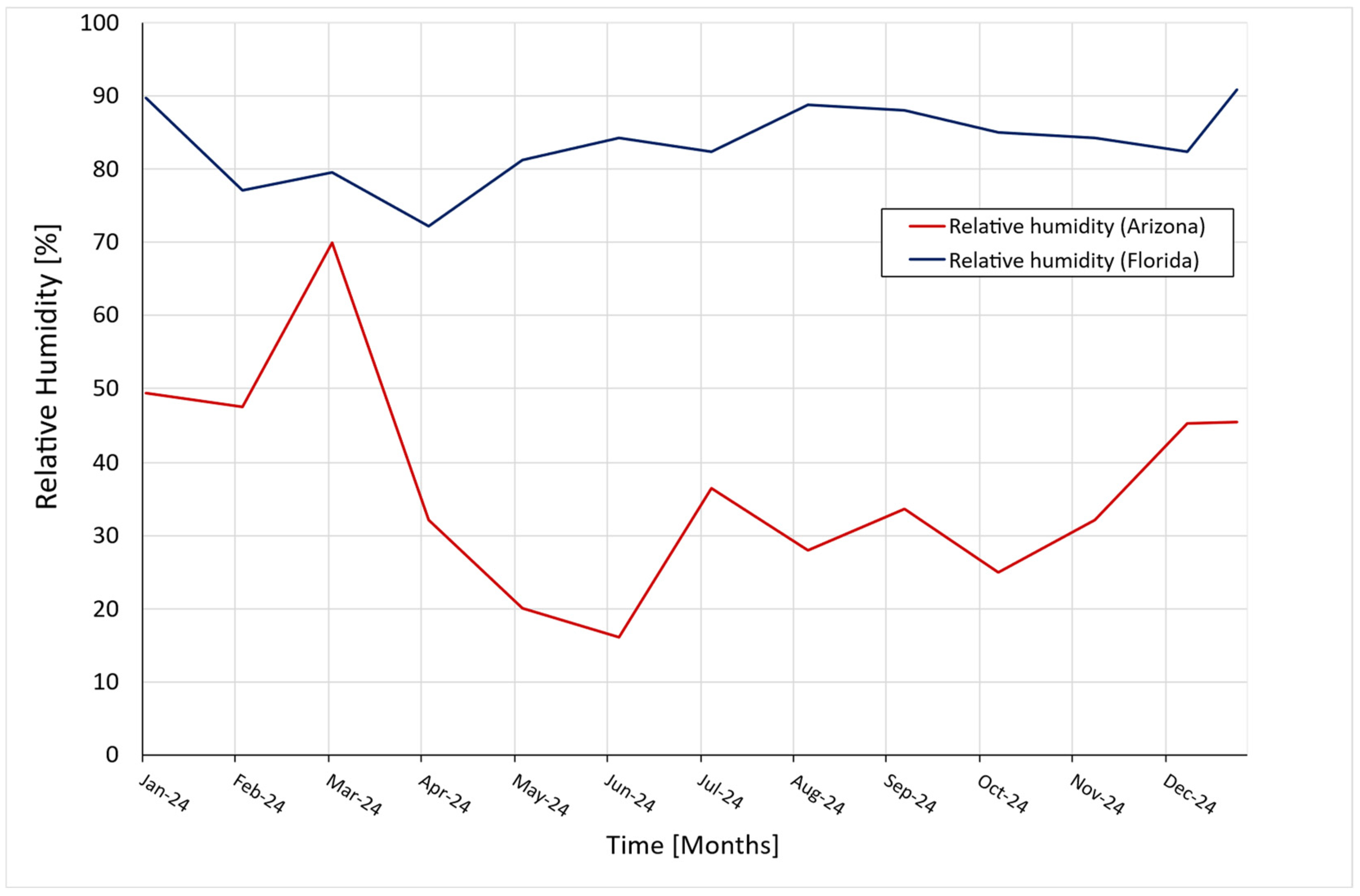
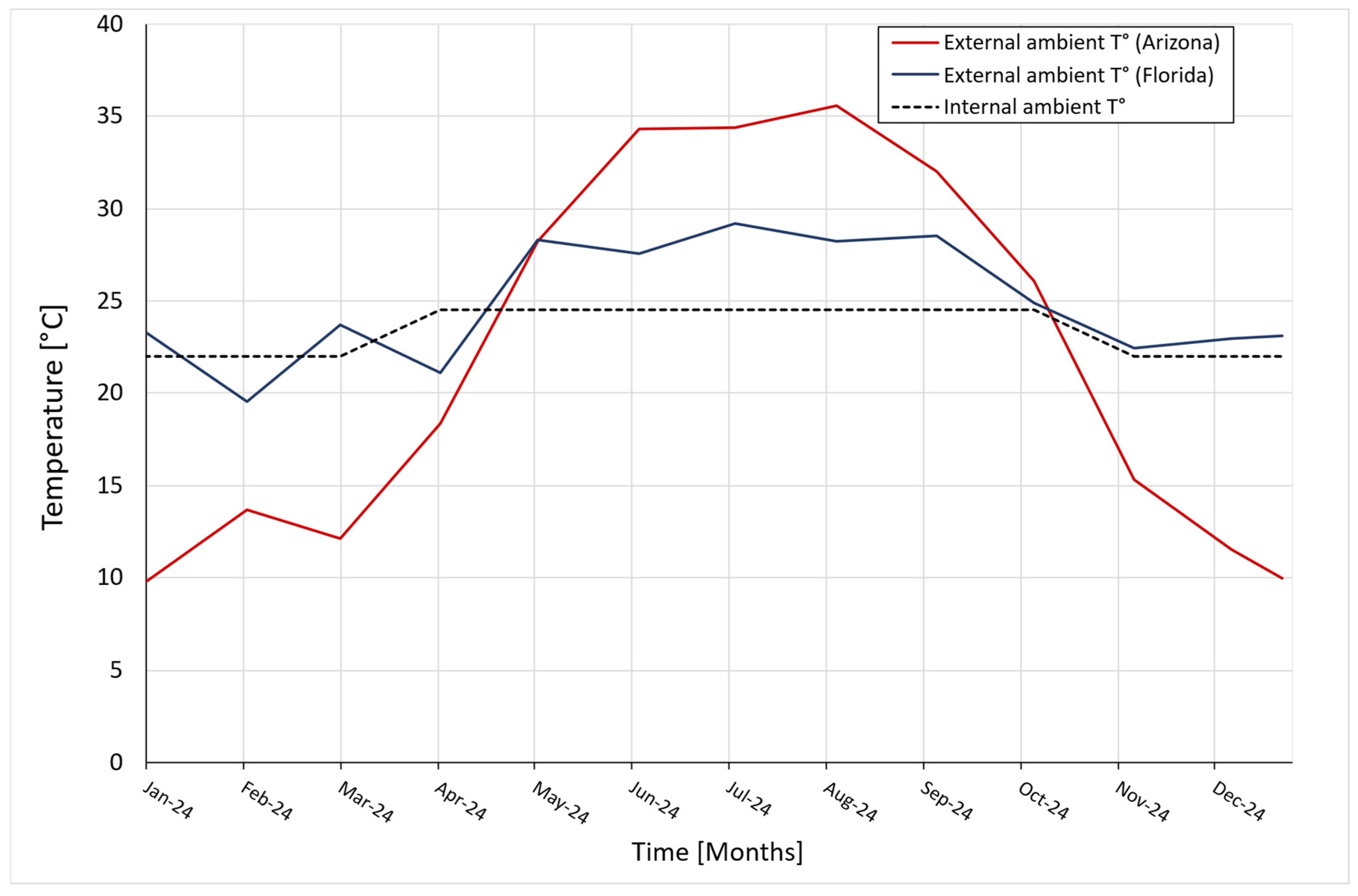
External boundary conditions are sourced from hourly meteorological data for Phoenix, Arizona, and Wellington, Florida (2024). Figure 1 presents relative humidity, while Figure 2 presents the internal and external ambient temperatures.
Equations (1) and (2), given below, provide the exterior boundary conditions based on Dirichlet assumptions. As for the internal surface of the wall, the temperature and pressure are maintained constant. The moisture supply from the environment g n , e consists of the evaporation due to unequal vapor pressure between the material and the surrounding air g e v a p .
g n , e = β P , e p v , e p s u r f , e g e v a p
where β P , e is the surface vapor transfer coefficient, p v , e is the water vapor pressure of the outdoor air, and p s u r f , e is the water vapor pressure at the surface of the building envelope part. Note that benchmarking of the above numerical model supposes that moisture content at surface is limited to the saturated value.
For the internal side of the wall, the moisture flux is obtained according to the following relationship:
g n , i = β P , i p v , i p s u r f , i
where β P , i is the vapor transfer coefficient of the interior surface, p v , i is the water vapor pressure of the indoor air and p s u r f , i is the water vapor pressure of the interior surface.
The heat flow across the exterior surface expressed in Equations (3) and (4), given below, includes the effects of conduction, convection, latent heat flow due to vapor transfer and sensible heat flow due to rain absorption; therefore, radiation is not considered, except for the influence on T e q (longwave radiation).
q n , e = α e T e q T s u r f , e + β p , e L V + C p , m T p v , e p s u r f , e
where α e is the convective heat transfer coefficient of the exterior surface, T e q is the equivalent exterior temperature and T s u r f , e is the temperature of the exterior surface.
Likewise, heat flux through internal surface of the building envelope, q n , i , is given by:
q n , i = α i T i T s u r f , i + L V β p , i p v , i p s u r f , i
where α i is the heat transfer coefficient of the interior surface, T i is the temperature of the indoor air, and T s u r f , i is the temperature of the interior surface.

4.4.2. Numerical Simulation Results

The hygrothermal simulation revealed distinct differences in moisture handling and thermal response between polyurethane (PU) and recycled denim (cotton fiber) insulation. Over the simulation period, PU consistently exhibited low moisture accumulation, maintaining an average water content of 0.0122 kg/kg; this stability is attributable to its closed-cell structure and low vapor permeability, which restrict moisture ingress and help preserve thermal properties under fluctuating environmental conditions.
By contrast, denim absorbed substantially more moisture, with an average content of 0.0587 kg/kg, approximately 4.8 times greater than PU (Table 5). This can lead to a significant increase in thermal conductivity, potentially rising from a dry value of 0.04 W/m·K to over 0.07 W/m·K at the simulated moisture levels. This corresponds to a potential reduction in the effective R-value of up to 50%, depending on the insulation thickness.
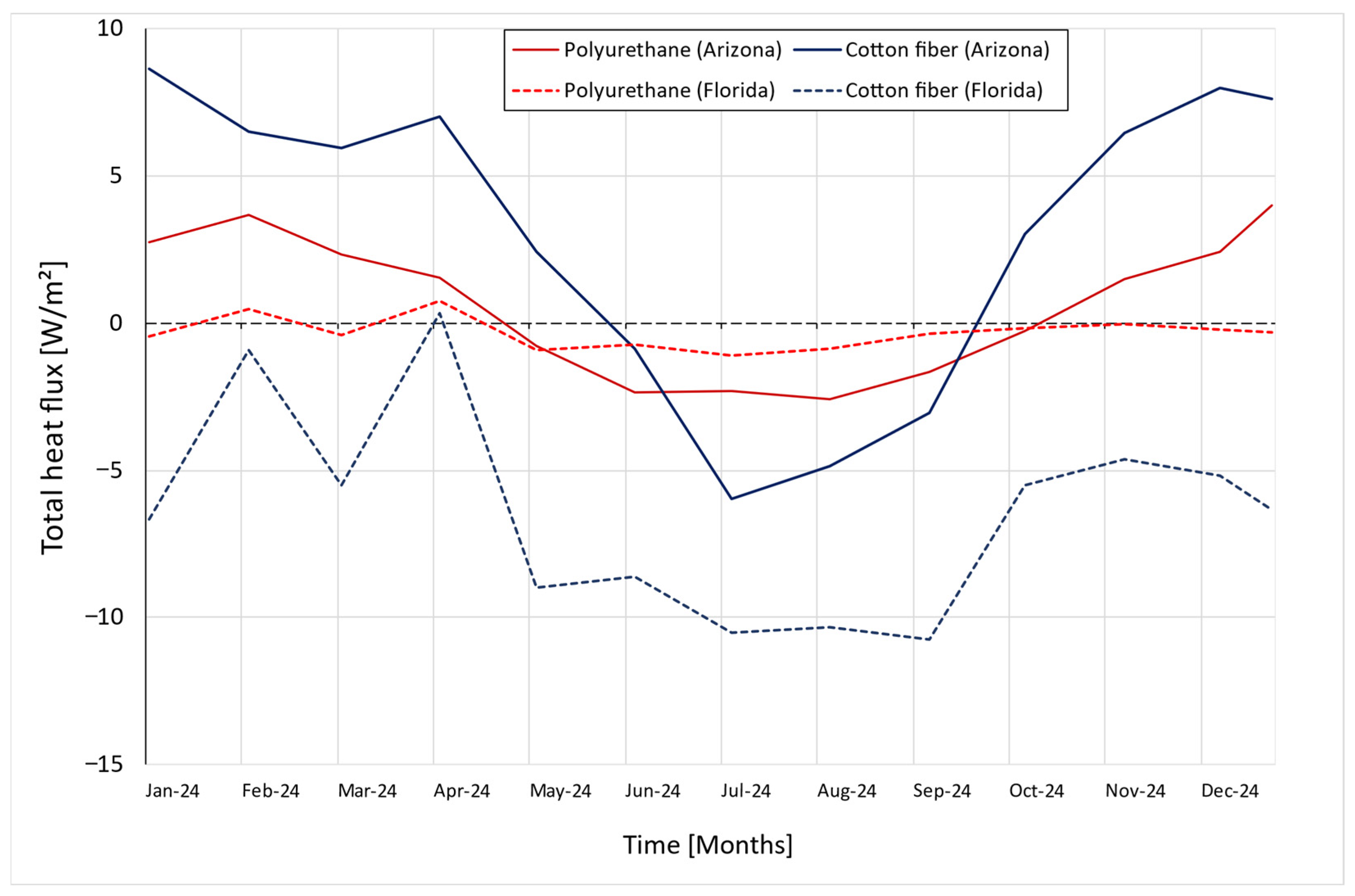
The monthly heat flux data reveal distinct seasonal and climate dependent performance differences between the two insulation materials (Figure 3). In Arizona’s hot–dry climate, both materials exhibit positive heat flux during winter months (heat gain) and negative flux during summer (heat loss), with cotton fiber consistently showing higher flux values than polyurethane, peaking at 8.6 kW/m2 in January compared to PU’s 2.8 kW/m2. In Florida’s warm–humid climate, both materials show quasi-negative heat flux throughout most of the year, reflecting persistent cooling demand, with polyurethane consistently exhibiting fewer negative values than cotton fiber across all months, most notably during summer, where CF reaches −10.8 kW/m2 versus PU’s −0.3 kW/m2 in September. Across both climates, cotton fiber consistently demonstrates greater heat flux magnitudes than polyurethane during peak demand seasons, confirming that polyurethane’s closed-cell structure and moisture resistance deliver superior and more stable thermal performance, while cotton fiber’s hygroscopic nature compromises its insulation effectiveness regardless of environmental conditions.
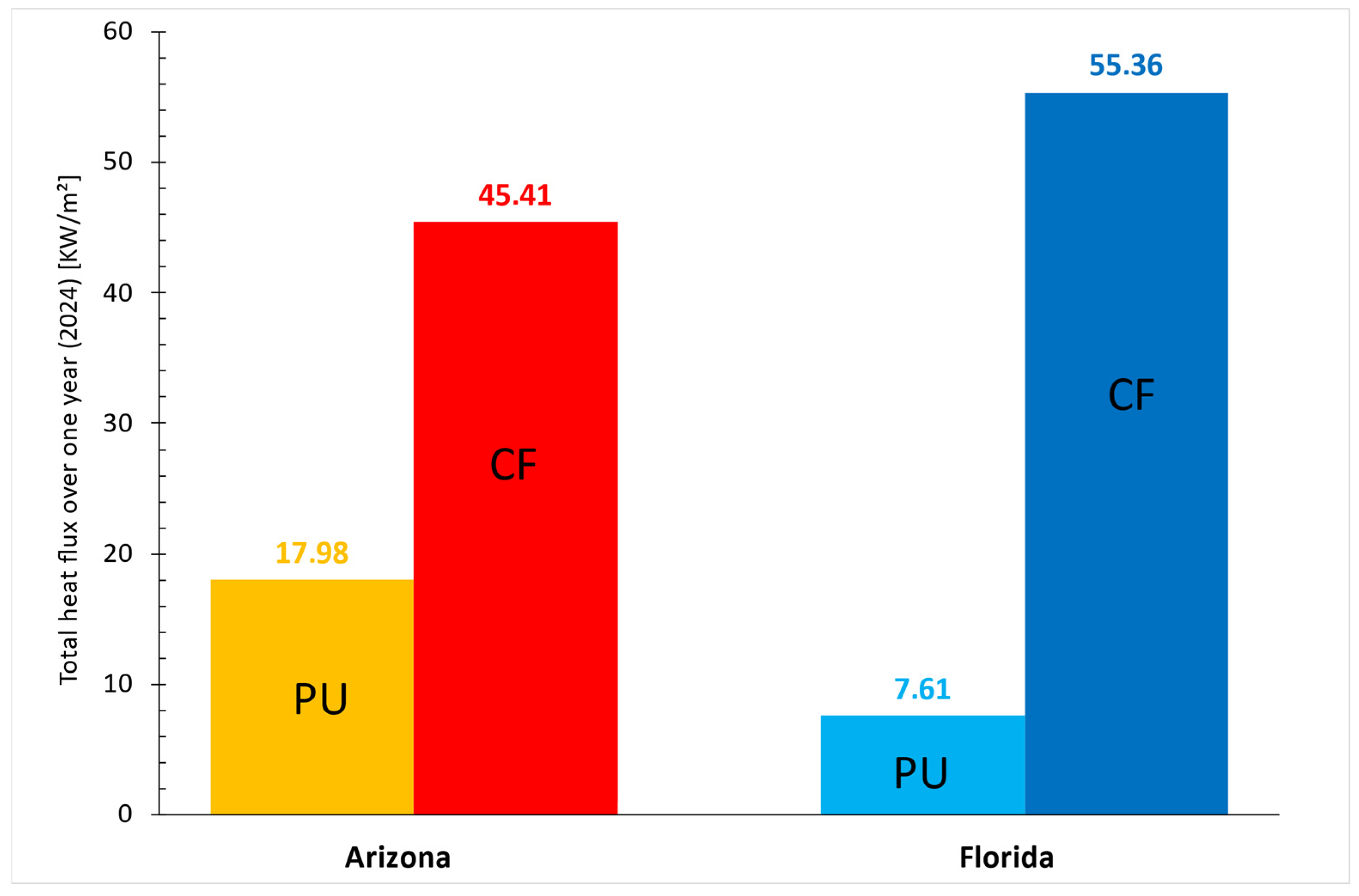
The total annual energy consumption data reveal performance differences between the two insulation materials (Figure 4). In Arizona, cotton fiber (CF) exhibits 45.41 kW/m2, substantially higher than polyurethane (PU) at 17.98 kW/m2. This represents a 2.5× increase for CF, confirming that PU’s closed-cell structure provides superior thermal resistance under hot–dry conditions by minimizing moisture ingress and maintaining stable thermal properties. In Florida, polyurethane shows 7.61 kW/m2, while cotton fiber exhibits 55.36 44.36 kW/m2, nearly seven six times higher than PU. This substantial divergence in Florida is attributed to CF’s hygroscopic nature; under high ambient humidity, CF absorbs significant moisture, increasing its thermal conductivity and resulting in elevated heat transfer. Conversely, PU’s moisture resistance allows it to maintain low heat flux even in humid environments. Across both climates, cotton fiber consistently demonstrates higher total heat flux than polyurethane, with the performance gap widening considerably in warm–humid conditions. These findings underscore that moisture sensitivity directly compromises insulation effectiveness, and that polyurethane offers superior and more stable thermal performance across diverse climate regimes.

5. Conclusions

The growing demand for sustainable construction materials requires evaluation frameworks that integrate environmental impacts with functional performance. Within a cradle-to-gate (A1–A3) scope, this study compares polyurethane (PU) foam and recycled denim insulation through a life cycle assessment conducted in SimaPro. Although recycled denim requires less production energy due to its predominantly mechanical processing, it exhibits higher emissions when evaluated using a performance-based functional unit. Specifically, PU foam shows lower life cycle emissions (5.376 kg CO2e per unit) compared to recycled denim (9.979 kg CO2e per unit), highlighting the importance of performance-normalized comparisons over mass-based metrics. Recycled denim nonetheless offers clear environmental advantages by diverting post-consumer textile waste from landfills and supporting resource conservation. However, its functional limitations become evident when hygrothermal behavior is considered. A transient coupled heat–moisture model in COMSOL Multiphysics, using climate data from Phoenix, Arizona (hot–dry) and Wellington, Florida (warm–humid), shows that denim absorbs 4.8 times more moisture than polyurethane, increasing thermal conductivity from 0.04 to 0.07 W/m·K and reducing effective R-value by up to 50%. This leads to larger heat flux fluctuations compared to the relatively stable response of polyurethane, indicating reduced hygrothermal durability under variable or humid conditions.
Overall, the results highlight a clear trade-off: recycled denim advances circularity and waste reduction, while polyurethane provides more consistent thermal and hygrothermal performance with lower emissions at the functional unit level. These findings demonstrate that single-metric comparisons, such as embodied carbon or R-value alone, are insufficient. Instead, performance-based, multi-criteria assessments are essential to capture the combined effects of efficiency, durability, and environmental impact. Given the cradle-to-gate boundary, the results should be interpreted as illustrating trade-offs rather than establishing overall environmental superiority. This study distinguishes between embodied environmental impacts and in-use performance parameters. While airtightness and moisture behavior significantly influences operational energy demand, they are treated as complementary performance indicators rather than components of the functional unit used for embodied carbon comparison. This distinction ensures methodological consistency and avoids conflating cradle-to-gate impacts with operational performance metrics.
Future work should extend this analysis to a full life cycle perspective by incorporating operational energy use, service life, and end-of-life scenarios. In addition, evaluating occupant health and indoor environmental quality, including thermal comfort, moisture regulation, and indoor air quality, will enable a more comprehensive and application-relevant assessment of insulation sustainability.

Author Contributions

Conceptualization, E.H.F.; methodology, F.S., N.M.; software, F.S.; validation, N.M., M.M., N.L.; formal analysis, M.M., N.M.; investigation, N.M., F.S.; data curation, N.L., F.S.; writing—original draft preparation, N.M., F.S., M.M.; writing—review and editing, A.L., E.H.F., H.K.T.; visualization, M.M., F.S.; supervision, E.H.F. All authors have read and agreed to the published version of the manuscript.

Funding

This research received no external funding.

Institutional Review Board Statement

Not applicable.

Informed Consent Statement

Not applicable.

Data Availability Statement

The original contributions presented in this study are included in the article. Further inquiries can be directed to the corresponding author.

Conflicts of Interest

The authors declare no conflicts of interest.

References

  1. Zhao, J.R.; Zheng, R.; Tang, J.; Sun, H.J.; Wang, J. A mini-review on building insulation materials from perspective of plastic pollution: Current issues and natural fibres as a possible solution. J. Hazard. Mater. 2022, 438, 129449. [Google Scholar] [CrossRef]
  2. Gunawan, N.R.; Tessman, M.; Schreiman, A.C.; Simkovsky, R.; Samoylov, A.A.; Neelakantan, N.K.; Bemis, T.A.; Burkart, M.D.; Pomeroy, R.S.; Mayfield, S.P. Rapid biodegradation of renewable polyurethane foams with identification of associated microorganisms and decomposition products. Bioresour. Technol. Rep. 2020, 11, 100513. [Google Scholar] [CrossRef]
  3. Islam, S.; El Messiry, M.; Sikdar, P.P.; Seylar, J.; Bhat, G. Microstructure and performance characteristics of acoustic insulation materials from post-consumer recycled denim fabrics. J. Ind. Text. 2022, 51, 6001S–6027S. [Google Scholar] [CrossRef]
  4. Vevere, L.; Yakushin, V.; Sture-Skela, B.; Andersons, J.; Cabulis, U. Cryogenic insulation—Towards environmentally friendly polyurethane foams. Polymers 2024, 16, 2406. [Google Scholar] [CrossRef] [PubMed]
  5. Naldzhiev, D.; Mumovic, D.; Strlic, M. Polyurethane insulation and household products–A systematic review of their impact on indoor environmental quality. Build. Environ. 2020, 169, 106559. [Google Scholar] [CrossRef]
  6. Narayanan, V.V.; Hashemi, A.; Elsharkawy, H.; Newport, D.; Basaly, L.G. Comparative assessment of insulation materials for improving indoor air quality in building retrofit. Environ. Sci. Sustain. Dev. 2024, 9, 1–14. [Google Scholar] [CrossRef]
  7. Hallik, J.; Gustavson, H.; Kalamees, T. Air leakage of joints filled with polyurethane foam. Buildings 2019, 9, 172. [Google Scholar] [CrossRef]
  8. Bentoumi, L.; Bouacida, T.; Bessaih, R.; Bouttout, A. Impact of thermal insulation on energy consumption in buildings. J. Therm. Eng. 2021, 10, 924–935. [Google Scholar] [CrossRef]
  9. Alyami, S.H.; Alqahtany, A.; Ashraf, N.; Osman, A.; Aldossary, N.A.; Almutlaqa, A.; Al-Maziad, F.; Alshammari, M.S.; Al-Gehlani, W.A.G. Impact of location and insulation material on energy performance of residential buildings as per Saudi Building Code (SBC) 601/602 in Saudi Arabia. Materials 2022, 15, 9079. [Google Scholar] [CrossRef]
  10. Ojczyk, C.; Murry, T.; Mosiman, G. Airtightness Results of Roof-Only Air Sealing Strategies on 1-1/2 Story Homes in Cold Climates; U.S. Department of Energy: Washington, DC, USA, 2014. Available online: https://www.osti.gov/servlets/purl/1144819 (accessed on 15 January 2026).
  11. Grazieschi, G.; Asdrubali, F.; Thomas, G. Embodied energy and carbon of building insulating materials: A critical review. Clean. Environ. Syst. 2021, 2, 100032. [Google Scholar] [CrossRef]
  12. Samardzioska, T.; Jovanoska, M.; Grujoska, V. Sustainable thermal insulation derived from recycled textile waste. Adv. Environ. Eng. Res. 2023, 4, 1–8. [Google Scholar] [CrossRef]
  13. Ayed, R.; Bouadila, S.; Skouri, S.; Boquera, L.; Cabeza, L.F.; Lazaar, M. Recycling textile waste to enhance building thermal insulation and reduce carbon emissions: Experimentation and model-based dynamic assessment. Buildings 2023, 13, 535. [Google Scholar] [CrossRef]
  14. Biyada, S.; Merzouki, M.; Urbonavičius, J. New resources for sustainable thermal insulation using textile and agricultural waste in a new circular economy approach: An overview. Processes 2023, 11, 2683. [Google Scholar] [CrossRef]
  15. Ali, A.; Issa, A.; Elshaer, A. A comprehensive review and recent trends in thermal insulation materials for energy conservation in buildings. Sustainability 2024, 16, 8782. [Google Scholar] [CrossRef]
  16. Raja, P.; Murugan, V.; Ravichandran, S.; Behera, L.; Mensah, R.A.; Mani, S.; Kasi, A.; Balasubramanian, K.B.N.; Sas, G.; Vahabi, H. A review of sustainable bio-based insulation materials for energy-efficient buildings. Macromol. Mater. Eng. 2023, 308, 2300086. [Google Scholar] [CrossRef]
  17. Pal, R.K.; Goyal, P.; Sehgal, S. Effect of cellulose fibre based insulation on thermal performance of buildings. Mater. Today: Proc. 2021, 45, 5778–5781. [Google Scholar] [CrossRef]
  18. Schulte, M.; Lewandowski, I.; Pude, R.; Wagner, M. Comparative life cycle assessment of bio-based insulation materials: Environmental and economic performances. Glob. Change Biol. Bioenergy 2021, 13, 979–998. [Google Scholar] [CrossRef]
  19. Ulutaş, A.; Balo, F.; Topal, A. Identifying the most efficient natural fibre for common commercial building insulation materials with an integrated PSI, MEREC, LOPCOW and MCRAT model. Polymers 2023, 15, 1500. [Google Scholar] [CrossRef]
  20. Violano, A.; Cannaviello, M. The carbon footprint of thermal insulation: The added value of circular models using recycled textile waste. Energies 2023, 16, 6768. [Google Scholar] [CrossRef]
  21. Islam, S.; Bhat, G. Environmentally-friendly thermal and acoustic insulation materials from recycled textiles. J. Environ. Manag. 2019, 251, 109536. [Google Scholar] [CrossRef] [PubMed]
  22. Jerman, M.; Černý, R. Effect of moisture content on heat and moisture transport and storage properties of thermal insulation materials. Energy Build. 2012, 53, 39–46. [Google Scholar] [CrossRef]
  23. Pei, W.; Ming, F.; Zhang, M.; Wan, X. A thermal conductivity model for insulation materials considering the effect of moisture in cold regions. Cold Reg. Sci. Technol. 2023, 207, 103770. [Google Scholar] [CrossRef]
  24. Yuan, Y.; Lin, W.; Xiao, Y.; Yu, B.; Wang, W. Advancements in flame-retardant systems for rigid polyurethane foam. Molecules 2023, 28, 7549. [Google Scholar] [CrossRef] [PubMed]
  25. Harvey, J.; Meijer, J.; Ozer, H.; Al-Qadi, I.L.; Saboori, A.; Kendall, A. Pavement Life Cycle Assessment Framework; Federal Highway Administration: Washington, DC, USA, 2016. Available online: https://rosap.ntl.bts.gov/view/dot/38470/dot_38470_DS1.pdf (accessed on 15 January 2026).
  26. SimaPro, version 9.0. Life Cycle Assessment Software. PRé Sustainability: Amersfoort, The Netherlands, 2019. Available online: https://simapro.com/ (accessed on 15 January 2026).
  27. Armour, K.; Forster, P.; Storelvmo, T.; Collins, W.; Dufresne, J.-L.; Frame, D.; Lunt, D.; Mauritsen, T.; Palmer, M.; Watanabe, M. The Earth’s energy budget, climate feedbacks, and climate sensitivity. In AGU Fall Meeting Abstracts; AGU: Washington, DC, USA, 2021; Available online: https://ui.adsabs.harvard.edu/abs/2021AGUFM.U13B..07A/abstract (accessed on 15 January 2026).
  28. Adam, N.; Avar, G.; Blankenheim, H.; Friederichs, W.; Giersig, M.; Weigand, E.; Halfmann, M.; Wittbecker, F.-W.; Larimer, D.-R.; Maier, U.; et al. Polyurethane Production, Flexible Foam, UPR, Ecoinvent 3.6, Consequential Dataset. Ecoinvent. 1997. Available online: https://ecoquery.ecoinvent.org/3.7.1/cutoff/dataset/7730/documentation (accessed on 15 January 2026).
  29. COMSOL Multiphysics®, version 6.1; COMSOL AB: Stockholm, Sweden, 2022. Available online: https://www.comsol.com (accessed on 15 January 2026).
  30. National Oceanic and Atmospheric Administration. Phoenix ENcanto Weather Data—NOAA Station Dataset; National Oceanic and Atmospheric Administration: Washington, DC, USA, 2024. Available online: https://www.ncei.noaa.gov/access/search/data-search/global-summary (accessed on 15 January 2026).
  31. Angelotti, A.; Alongi, A.; Augello, A.; Dama, A.; De Antonellis, S.; Ravida, A.; Zinzi, M.; De Angelis, E. Thermal conductivity assessment of cotton fibers from apparel recycling for building insulation. Energy Build. 2024, 324, 114866. [Google Scholar] [CrossRef]
  32. Zhang, H.; Fang, W.-Z.; Li, Y.-M.; Tao, W.-Q. Experimental study of the thermal conductivity of polyurethane foams. Appl. Therm. Eng. 2017, 115, 528–538. [Google Scholar] [CrossRef]
  33. Gupta, B.S. Porosity and its characterization in nonwovens. In Proceedings of the 2003 Beltwide Cotton Conferences; North Carolina State University: Raleigh, NC, USA, 2003; pp. 1–6. Available online: https://www.cotton.org/beltwide/proceedings/getPDF.cfm?year=2003&paper=N015.pdf (accessed on 15 January 2026).
  34. Hao, L.; Wang, Q.; Liang, K.; Yang, Y.; Wang, L.; Li, W.; Wei, H. Determination of pore size in reticulated polyurethane foam through pressure drop analysis of forced monophasic gas flow. Chem. Eng. Res. Des. 2025, 215, 253–262. [Google Scholar] [CrossRef]
  35. Ramkumar, S.S.; Purushothaman, A.; Hake, K.D.; McAlister, D.D., III. Relationship between cotton varieties and moisture vapor transport of knitted fabrics. J. Eng. Fibers Fabr. 2007, 2, 155892500700200403. [Google Scholar] [CrossRef]
  36. Rezaei, F.; Sharif, F.; Sarabi, A.A.; Kasiriha, S.M.; Rahmanian, M.; Akbarinezhad, E. Evaluating water transport through high solid polyurethane coating using the EIS method. J. Coat. Technol. Res. 2010, 7, 209–217. [Google Scholar] [CrossRef]
  37. Bondedlogic. Building On a Shared Commitment to Innovation and Sustainability. 2011. Available online: https://bondedlogic.com/pdf/denim-insulation/ESR-1134.pdf (accessed on 15 January 2026).
  38. Polyurethane Performance. (n.d.). Available online: https://www.poliuretano.it/EN/mechanical_properties_polyurethane.html (accessed on 15 January 2026).
  39. ASTM International. Spray Polyurethane Foam Insulation; ASTM International: West Conshohocken, PA, USA, 2023; Available online: https://pcr-epd.s3.us-east-2.amazonaws.com/1301.EPD_806_Spray_Polyurethane_Foam_Insulation_Closed_Cell_Using_Hydrofluorocarbons_CCSPF_HFC.pdf (accessed on 15 January 2026).
  40. Boricel Corporation dba Bonded Logic. UltraTouch Natural Cotton Fiber Insulation; Boricel Corporation (dba Bonded Logic): Chandler, AZ, USA, 2011; Available online: https://sweets.construction.com/swts_content_files/100938/833948.pdf (accessed on 15 January 2026).
  41. Roberts, T. Cotton Batt Insulation: A Comprehensive Guide. 2025. Available online: https://www.buildwithrise.com/stories/cotton-batt-insulation-is-it-for-you (accessed on 15 January 2026).
  42. Metro Home Insulation. The Differences Between Polystyrene Insulation and Polyurethane. 2017. Available online: https://www.metrohomeinsulate.com/blog/polystyrene-vs-polyurethane-insulation (accessed on 15 January 2026).
  43. Heim, D.; Miszczuk, A. Modelling building infiltration using the airflow network model approach calibrated by air-tightness test results and leak detection. Build. Serv. Eng. Res. Technol. 2020, 41, 681–693. [Google Scholar] [CrossRef]
  44. Asdrubali, F.; D’Alessandro, F.; Schiavoni, S. A review of unconventional sustainable building insulation materials. Sustain. Mater. Technol. 2015, 4, 1–17. [Google Scholar] [CrossRef]
  45. Papadopoulos, A.M. State of the art in thermal insulation materials and aims for future developments. Energy Build. 2005, 37, 77–86. [Google Scholar] [CrossRef]
  46. McGuinness, W.J.; Stein, B. Mechanical and Electrical Equipment for Buildings; Wiley: Hoboken, NJ, USA, 1980. [Google Scholar]
Figure 1. External boundary conditions for relative humidity (%) (Phoenix, Arizona and Wellington, Florida).
Sustainability 18 03847 g001
Figure 2. Internal and external boundary conditions for temperature (°C) (Phoenix region, Arizona and Wellington, Florida).
Sustainability 18 03847 g002
Figure 3. Annual heat flux trends (W/m2) for polyurethane and cotton fiber (2024).
Sustainability 18 03847 g003
Figure 4. Thermal performance comparison: polyurethane vs. cotton fiber.
Sustainability 18 03847 g004
Table 1. Secondary inventory intensity results (A1–A3): impacts per kg of material.
MaterialCO2 Eq (g)CO2 (g)CH4 (g)N2O (g)
Denim (Cotton Fiber)7046.936100.2611.742.19
Polyurethane5375.524439.5737.060.03
Table 2. Cradle-to-gate GWP for insulation materials at R-20 (scenario-based results).
MaterialMaterial R-Value per InchTarget R-ValueThickness (Inch)Density (kg/m3)Area (m2)CO2 Eq (kg)R-20 kg CO2 Eq/m2
Denim (cotton fiber)3.5 [41]205.71 (0.15 m)19.2 [37]17.04720.30
Polyurethane (wall)3.6 [42]205.56 (0.14 m)65 [38]15.37648.92
Table 3. Comparative analysis of materials based on ACH50.
MaterialCMF50ACH50CO2 Eq (kg)Note
Denim (cotton fiber)85026.657.047A1–A3 embodied carbon
Polyurethane (wall)60018.825.376A1–A3 embodied carbon
Table 4. Cradle-to-gate embodied energy of insulation materials.
Insulation MaterialEmbodied Energy (MJ/kg)Reference
Polyurethane84–127[11]
Cotton fiber39–52[11]
Table 5. Statistical summary for hygrometric analysis.
Polyurethane (PUR)Cotton Fiber (CF)
Avg. Water Content (kg/kg)0.0122250.058651
Relative to PUR (Ratio)1.04.80
% Increase vs. PUR0%+380%
Disclaimer/Publisher’s Note: The statements, opinions and data contained in all publications are solely those of the individual author(s) and contributor(s) and not of MDPI and/or the editor(s). MDPI and/or the editor(s) disclaim responsibility for any injury to people or property resulting from any ideas, methods, instructions or products referred to in the content.