1. Introduction
1.1. Background and Purpose
In contemporary cities, museums function not only as places for exhibiting and preserving artifacts, but also as knowledge infrastructures and public commons through which local cultural identity and historical memory are collected, interpreted, and socially recontextualized [
1,
2,
3]. Through the preservation and communication of both tangible and intangible cultural assets, museums contribute to the continuity of social memory and provide visitors with cultural ecosystem services, thereby supporting urban cultural sustainability [
4,
5]. In addition, museums increasingly serve as urban social infrastructures by promoting cultural inclusiveness and social cohesion through educational and participatory programs while also building cooperative relationships with local communities [
6,
7,
8].
Within the context of urban tourism, museums further operate as interpretive platforms through which tourists understand, experience, and reconstruct the meaning of place [
9,
10,
11,
12,
13]. In particular, museum agglomerations, where multiple museums and related cultural resources are spatially concentrated, form extended experiential environments that connect visits across individual facilities and surrounding urban spaces. Such environments influence tourist mobility, length of stay, activity linkage, cultural consumption, and the overall depth of place-based learning. In this process, perceived tourist comfort becomes a critical experiential condition because it reduces the physical and psychological burdens associated with movement and stay and stabilizes the continuity of the overall tourism experience [
14,
15]. Tourist comfort in museum agglomerations can therefore be understood as a multidimensional construct shaped by walkability and mobility, congestion and waiting time, the availability of rest and convenience facilities, the clarity of guidance and information, pedestrian safety, and the general comfort of movement [
16,
17,
18,
19,
20,
21].
At the same time, sustainable urban tourism should not be understood solely in terms of economic growth or increased visitor numbers. Rather, it refers to a structural condition in which tourism activity is balanced with the social and environmental capacities of the city, the preservation and transmission of cultural resources, and the qualitative spillover effects generated within the local economy [
22,
23]. From this perspective, museum agglomerations located in historic urban centers are especially important because they simultaneously concentrate cultural resources, tourism demand, and everyday urban activities. However, such concentration also intensifies negative externalities, including congestion, prolonged waiting, crowded pedestrian environments, safety concerns, and potential conflicts between residents’ daily lives and tourism activities [
24,
25,
26,
27]. Under these conditions, perceived tourist comfort should be treated not merely as an individual evaluation of convenience, but as an important planning and management indicator for maintaining tourism quality, securing urban carrying capacity, and enhancing the social acceptability of tourism development.
Nevertheless, previous studies on museum tourism have tended to focus primarily on the service quality, exhibition content, or visitor satisfaction associated with individual museums. Comparatively limited attention has been paid to the structural role of tourist comfort within museum agglomerations, particularly in relation to tourist satisfaction, museum agglomeration vitality, and perceptions of sustainable urban tourism development. This limitation is especially important when the analysis concerns Chinese tourists, because they constitute a practically significant inbound visitor group for Korea and often navigate museum districts through mobile-based information search, itinerary adjustment, and platform-mediated travel routines. In this study, Chinese tourists are treated not as statistically representative of all international visitors, but as an analytically important segment through which the role of tourist comfort can be examined with greater specificity. In addition, Jongno-gu, Seoul, provides an appropriate empirical setting because it is a representative historic urban district in which museums, heritage resources, tourism circulation, and commercial activities are densely interconnected. Accordingly, this study examines the structural relationship through which perceived tourist comfort in museum agglomerations influences tourist satisfaction and museum agglomeration vitality and, in turn, shapes perceptions of sustainable urban tourism development, based on data collected from Chinese tourists visiting Jongno-gu, Seoul. On this basis, the study seeks to provide case-based empirical evidence and policy implications for the sustainable management of museum agglomerations in historic urban destinations.
1.2. Scope of the Study
Seoul is one of Asia’s leading urban tourism destinations and has recently shown a clear recovery in inbound tourism demand. According to publicly available data released by the Seoul Metropolitan Government, the number of international tourists visiting Seoul in January 2025 exceeded the level recorded in the same month before the pandemic [
28]. In addition, Seoul has continued to maintain a high position in global urban tourism evaluations, ranking within the top tier of major international city destinations in Euromonitor International’s Top 100 City Destination Index 2025 [
29]. These trends indicate not only the recovery of tourism demand but also the continued strengthening of Seoul’s position as a competitive global urban destination. Under such conditions, the issue of urban tourism sustainability should be considered not simply in terms of visitor growth, but in relation to how tourism experiences are managed in ways that can preserve destination quality, mitigate concentration pressures, and maintain long-term competitiveness.
Within Seoul, Jongno-gu constitutes an especially appropriate case for this study because it represents the city’s most prominent historic and cultural core. The district contains a dense concentration of palaces, museums, traditional streetscapes, cultural facilities, and tourism-oriented commercial areas, forming a spatially integrated environment in which heritage, tourism activities, and everyday urban functions are closely intertwined. In addition, Jongno-gu includes several landmark attractions that consistently draw large numbers of visitors, and recent reports point to a marked increase in visits by international tourists [
30]. These characteristics make Jongno-gu analytically suitable for examining museum agglomerations as more than a collection of individual institutions; rather, they can be understood as cluster-based urban tourism environments in which movement, stay, orientation, congestion, and cultural consumption are experienced in an interconnected manner.
Based on this context, the present study focuses specifically on Chinese tourists who visited Jongno-gu, Seoul, as the primary subjects of analysis. This scope is justified for both empirical and practical reasons. First, Chinese tourists constitute a strategically important inbound market segment for Korea, making their experiences especially relevant to discussions of urban tourism management. Second, because museum agglomerations require continuous movement across multiple facilities and surrounding urban spaces, tourists who are unfamiliar with the local language and service environment may be more sensitive to operational conditions such as information clarity, wayfinding, procedural convenience, pedestrian circulation, and congestion management. Focusing on Chinese tourists is therefore useful for identifying how perceived tourist comfort functions within museum agglomerations and how it is associated with tourist satisfaction, museum agglomeration vitality, and perceptions of sustainable urban tourism development. However, this case selection should be understood as an analytical boundary rather than a claim of broad demographic representativeness.
1.3. Literature Review and Research Hypotheses
Previous studies on museums and urban tourism have shown that museums contribute to destination attractiveness and urban image formation by interpreting cultural resources and providing visitors with meaningful place-based experiences [
31,
32,
33,
34,
35,
36]. However, most of this literature has examined museums at the level of individual institutions, with particular attention to exhibition content, service quality, and visitor evaluation. Comparatively less attention has been paid to museum agglomerations as integrated tourism environments in which visitors experience multiple facilities and surrounding urban spaces in a continuous and connected manner. In such settings, the overall tourism experience depends not only on what happens inside each museum, but also on how visitors move across the area, obtain information, cope with congestion and waiting, use rest facilities, and extend their activities beyond a single site. Accordingly, a cluster-based perspective is needed to explain how museum-related tourism experiences are formed and how they are linked to broader urban tourism outcomes.
On this basis, the present study establishes four latent constructs, each representing a distinct aspect of the museum-agglomeration tourism experience and its broader urban implications. Specifically, (1) Tourist Comfort captures the quality of the continuous tourism process within museum agglomerations, where visitors must move, orient themselves, and use the area with ease rather than simply complete isolated visits [
16,
17,
18,
19,
20,
21]; (2) Tourist Satisfaction represents the central evaluative outcome reflecting the overall quality of the tourism experience [
37,
38,
39,
40,
41]; (3) Museum Agglomeration Vitality refers to the extent to which the clustered museum area functions as an active and interconnected tourism environment rather than merely a spatial concentration of facilities [
42,
43,
44]; and (4) Cultural Sustainability of Urban Tourism serves as the final outcome variable, reflecting the view that the significance of urban tourism should be assessed not only in terms of short-term growth, but also in terms of its contribution to the continued use, preservation, understanding, and socially acceptable operation of cultural resources [
45,
46,
47,
48,
49,
50,
51,
52].
These four latent constructs are operationalized through the observed indicators presented in
Table 1, with each construct measured by a set of indicators corresponding to its core conceptual dimensions. Specifically, (1) Tourist Comfort is measured through ease of mobility, burden of congestion and waiting, sufficiency of rest and convenience, clarity of guidance and information, pedestrian safety, and travel comfort, as these dimensions represent the practical conditions under which visitors experience the clustered environment. (2) Museum Agglomeration Vitality is measured through intensity of use, linked visits and expansion of circulation, extended length of stay and activity range, and participation in cultural events, reflecting the view that vitality in a museum cluster is expressed through the activation and extension of visitor behavior across the district. (3) Tourist Satisfaction is measured through service satisfaction, perceived satisfaction, satisfaction relative to expectations, revisit intention, and recommendation intention, reflecting the view that satisfaction includes both evaluative judgment and subsequent positive behavioral disposition. (4) Cultural Sustainability of Urban Tourism is measured through positive evaluation of preservation and transmission, understanding and respect for urban culture, intention for responsible tourism behavior, consumption perception of cultural products, and cultural coexistence and acceptance, reflecting the view that cultural sustainability involves not only resource continuity, but also supportive attitudes and socially grounded forms of cultural engagement.
It should be emphasized that this study does not measure the objective level of museum clustering in the regional-economic sense. Such clustering may be conditioned by a range of structural and policy-related factors, including public cultural investment, industrial development strategies, urban planning, transport accessibility, and functional linkages with adjacent cultural and commercial sectors. Instead, Museum Agglomeration Vitality is defined in this study as a demand-side perceptual construct that captures the extent to which an already clustered museum district is experienced as active and vibrant through linked visitation, longer duration of stay, broader circulation, and participatory involvement. Within this analytical framework, Tourist Comfort and Tourist Satisfaction are treated as antecedent variables influencing the perceived vitality of an existing cluster.
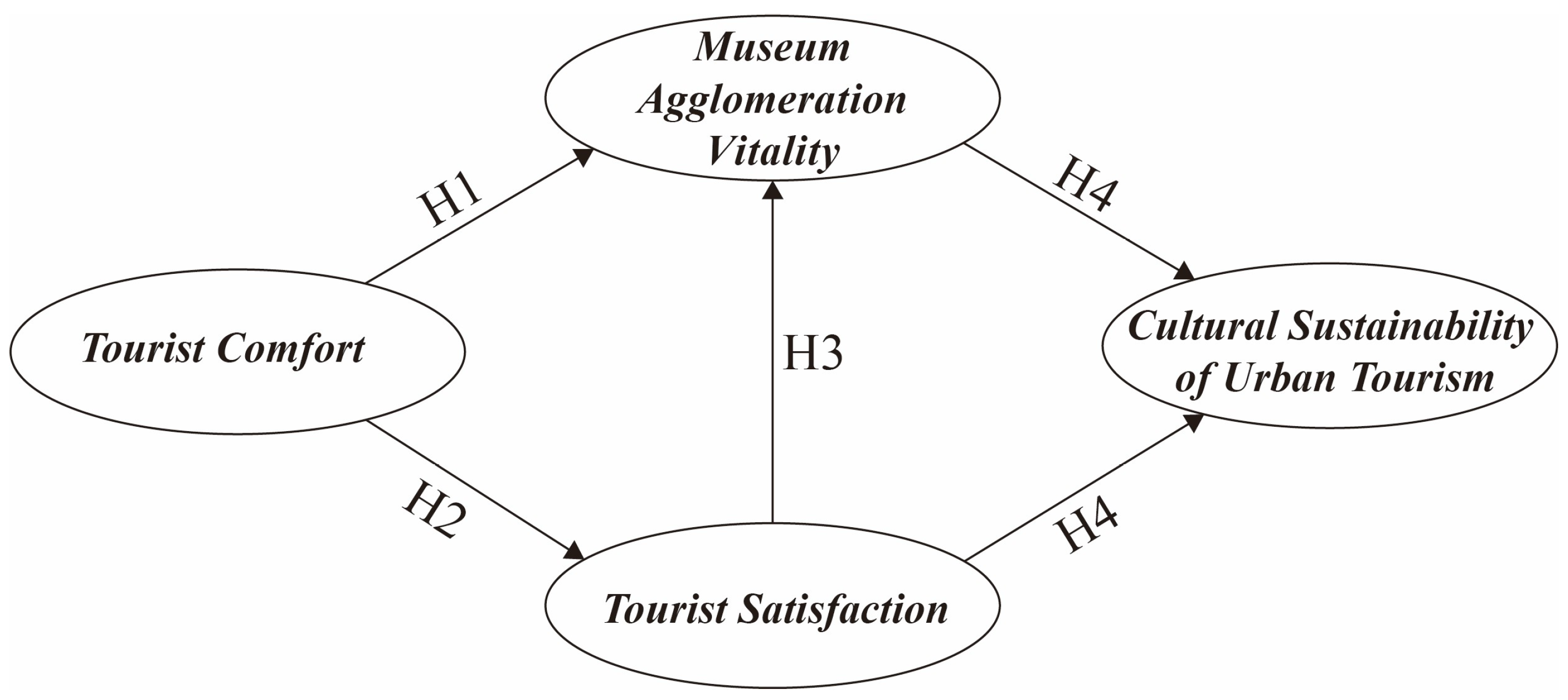
Based on these constructs, the structural paths proposed in this study follow a sequential logic. First, Tourist Comfort is expected to affect Museum Agglomeration Vitality because easier movement, clearer information, lower congestion burden, and more stable use conditions make it more likely that visitors will continue their activities across multiple facilities, extend their stay, and participate more actively in the clustered museum environment. Second, Tourist Comfort is expected to affect Tourist Satisfaction because visitors evaluate their experience not only in terms of museum content itself, but also in terms of whether the tourism process is convenient, understandable, safe, and comfortable. Third, Tourist Satisfaction is expected to affect Museum Agglomeration Vitality because satisfied visitors are more likely to remain in the area longer, engage in additional activities, and participate more broadly in clustered cultural spaces. Finally, Museum Agglomeration Vitality and Tourist Satisfaction are expected to affect the Cultural Sustainability of Urban Tourism, because an active cluster environment and positive visitor evaluation can jointly support continued cultural participation, a favorable understanding of urban culture, responsible tourism behavior, and the socially sustainable use of cultural tourism spaces. On this basis, the proposed research model is presented in
Figure 1. The corresponding hypotheses are formulated as follows. In other words, the model is intended to explain the experiential activation of an existing museum agglomeration rather than the macro-level formation of museum clustering itself.
Hypothesis 1 (H1). Tourist comfort significantly affects museum agglomeration vitality.
Hypothesis 2 (H2). Tourist comfort significantly affects tourist satisfaction.
Hypothesis 3 (H3). Tourist satisfaction significantly affects museum agglomeration vitality.
Hypothesis 4 (H4). Museum agglomeration vitality and tourist satisfaction significantly impact the cultural sustainability of urban tourism.
2. Materials and Methods
This study adopted a survey-based quantitative research design to examine how perceived tourist comfort in museum agglomerations influences museum agglomeration vitality and tourist satisfaction, and how these relationships are associated with the cultural sustainability of urban tourism. The analysis focused on Chinese tourists who had visited museum clusters in Jongno-gu, Seoul. To test the proposed relationships among the focal constructs within a single analytical framework, this study employed structural equation modeling (SEM). SEM was selected because the research model includes multiple latent variables and simultaneous direct relationships among them, namely Tourist Comfort, Museum Agglomeration Vitality, Tourist Satisfaction, and Cultural Sustainability of Urban Tourism.
The questionnaire was composed of six sections: (1) an informed consent statement explaining the purpose of the study, voluntary participation, anonymity, and data use; (2) respondent demographic characteristics; (3) tourist comfort; (4) museum agglomeration vitality; (5) tourist satisfaction; and (6) cultural sustainability of urban tourism. The target population was limited to Chinese tourists who had visited a museum cluster in Jongno-gu, Seoul, at least once within the previous five years. In the first section, respondents who did not agree to participate were regarded as not meeting the requirements for ethically usable research data, and the survey was therefore terminated; such cases were excluded from the final sample. In the second section, screening items were included to verify whether respondents met the eligibility criteria, including their status as Chinese tourists and their prior museum-cluster visit experience in Jongno-gu. If a respondent indicated that they had not visited a museum cluster in Jongno-gu within the previous five years, the survey was automatically terminated, and the case was treated as an invalid sample and excluded from the analysis. Survey logic was applied so that the questionnaire could proceed only when both the consent requirement and the eligibility criteria were satisfied.
To improve data quality, response validity was examined after data collection. Responses were excluded from the final analysis if they were identified as careless or insincere responses, duplicate submissions under the same respondent ID, responses showing repetitive or mechanically uniform answer patterns, or cases containing inconsistencies in the screening items. These procedures were intended to minimize the influence of invalid, duplicate, or ineligible responses on the measurement and structural results.
All statistical analyses were conducted using IBM SPSS Statistics 25 and Amos 26, and the online survey was administered via the SoJump platform [
53]. In practical terms, SPSS was used for data screening, descriptive statistics, and reliability and validity checks, whereas Amos was used to estimate the measurement model and the structural model. SoJump served as the web-based survey platform through which the questionnaire was distributed and response data were collected and screened.
The analytical procedure consisted of three main stages. First, descriptive statistics were used to summarize the basic characteristics of the sample, including gender, age group, length of stay, and visit frequency. This step was intended to clarify the composition of the respondents and the general context of their museum-cluster visits.
Second, the measurement properties of the scales were assessed. Internal consistency was evaluated using Cronbach’s alpha. Convergent validity was examined using composite reliability (CR) and average variance extracted (AVE). Discriminant validity was evaluated by comparing the square root of AVE for each construct with the inter-construct correlation coefficients. These procedures were used to determine whether the observed indicators adequately represented their intended latent constructs and whether the constructs were empirically distinguishable from one another.
Third, the structural model was estimated to test the hypothesized relationships among Tourist Comfort, Museum Agglomeration Vitality, Tourist Satisfaction, and Cultural Sustainability of Urban Tourism. This step was intended to examine whether the proposed causal structure of the study was supported by the survey data. The fit of the structural model was assessed using multiple goodness-of-fit indices, including χ2/df, RMR, RMSEA, GFI, CFI, IFI, and TLI. These indices were interpreted together to determine how closely the proposed model matched the patterns observed in the actual data. In general, lower values of χ2/df (commonly <3.0), RMR (preferably <0.05, although values below 0.08 may still be considered acceptable), and RMSEA (commonly <0.08, with values < 0.05 indicating a close fit) indicate a better model fit, whereas higher values of GFI, CFI, IFI, and TLI suggest that the model provides a better representation of the observed data. Path coefficients were reported as standardized estimates, and statistical significance was assessed using p-values.
3. Results
3.1. Frequency and Reliability Analysis
The survey was conducted from 15 September to 15 November 2025, and yielded a total of 597 responses. After the data-screening procedure, 506 responses were retained as valid for the final analysis, corresponding to a valid response rate of 84.8%. Invalid cases were excluded when respondents did not satisfy the eligibility criteria, failed to provide informed consent, showed inconsistencies in the screening items, submitted duplicate responses under the same respondent ID, or displayed careless or mechanically repetitive response patterns. This data-cleaning process was undertaken to reduce the influence of invalid or ineligible responses on the reliability of the measurement scales and on the stability of the structural model estimates.
Table 2 presents the sociodemographic characteristics of the valid sample and respondents’ frequency of visits to Seoul over the previous five years. Because the target population of this study was restricted to Chinese tourists, nationality was controlled at the sampling stage and was therefore not treated as a variable characteristic within the final sample. The gender distribution was balanced, with 256 males (50.6%) and 250 females (49.4%). The largest age group was 25–34 years (148 respondents, 29.2%), followed by 35–44 years (115 respondents, 22.7%), 18–24 years (114 respondents, 22.5%), 45–54 years (88 respondents, 17.4%), and 55 years and over (41 respondents, 8.2%). Overall, 77.4% of respondents were under 45 years of age, indicating that the sample was concentrated in younger and middle-aged adult groups. This distribution is understandable in light of the online survey mode and the characteristics of self-directed urban museum tourism, which often involves mobile-based navigation, digital information search, and independent itinerary management. At the same time, this age concentration has interpretive consequences for the study. The estimated effects of Tourist Comfort on Tourist Satisfaction and Museum Agglomeration Vitality may be more strongly associated with the behavioral patterns of digitally confident travelers than with those of older tourists, who may rely more on assisted guidance, barrier-free routes, seating availability, and lower walking burden. Accordingly, the findings should be interpreted as being more directly applicable to younger and middle-aged Chinese tourists than to senior visitor groups, and broader age-balanced validation remains necessary.
With regard to visit frequency to Seoul over the previous five years, 196 respondents (38.7%) had visited once, 298 respondents (58.9%) had visited twice, and 12 respondents (2.4%) had visited three or more times. Thus, 310 respondents (61.3%) had visited Seoul more than once, indicating that the majority of the sample had prior experience with the city rather than evaluating it only as first-time visitors. This is analytically meaningful because repeated visitation may provide respondents with a more accumulated basis for assessing museum-agglomeration environments, including circulation, convenience, and overall experiential quality.
Next, Cronbach’s alpha was calculated to assess the internal consistency of the measurement instruments. As shown in
Table 3, the Cronbach’s alpha values were 0.923 for Tourist Comfort, 0.914 for Tourist Satisfaction, 0.894 for Museum Agglomeration Vitality, and 0.917 for Cultural Sustainability of Urban Tourism. These values indicate a high level of internal consistency across all four latent constructs and suggest that the observed indicators within each scale measured conceptually coherent dimensions. In addition, the mean scores of the constructs ranged from 3.633 to 3.691, indicating that respondents’ evaluations were generally moderate to moderately positive rather than concentrated at the extreme ends of the scale. This pattern suggests that the sample retained sufficient variation for subsequent validity testing and structural model estimation.
3.2. Confirmatory Factor Analysis
Prior to estimating the structural model, confirmatory factor analysis (CFA) was conducted to assess the adequacy of the measurement model. Convergent validity was evaluated using standardized factor loadings, composite reliability (CR), and average variance extracted (AVE). As shown in
Table 4, the standardized factor loadings ranged from 0.804 to 0.827 for Tourist Comfort, from 0.807 to 0.851 for Tourist Satisfaction, from 0.800 to 0.856 for Museum Agglomeration Vitality, and from 0.790 to 0.853 for Cultural Sustainability of Urban Tourism. Because all factor loadings were relatively high and consistently above commonly accepted threshold levels, the observed indicators can be regarded as adequately representing their respective latent constructs. In substantive terms, these results suggest that the items included in each scale captured conceptually coherent dimensions of comfort, satisfaction, agglomeration vitality, and cultural sustainability in the museum-agglomeration context.
The composite reliability values were 0.923 for Tourist Comfort, 0.914 for Tourist Satisfaction, 0.894 for Museum Agglomeration Vitality, and 0.917 for Cultural Sustainability of Urban Tourism. The corresponding AVE values were 0.667, 0.681, 0.679, and 0.689, respectively. All CR values exceeded the commonly accepted threshold of 0.70, and all AVE values were above 0.50, indicating satisfactory convergent validity. These results imply that each latent construct explained a substantial proportion of the variance in its observed indicators and that the measurement model remained stable even when measurement error was taken into account.
Discriminant validity was assessed using the Fornell–Larcker criterion, which compares the square root of AVE for each construct with the correlations among constructs. As shown in
Table 5, the square root of AVE was 0.817 for Tourist Comfort, 0.825 for Tourist Satisfaction, 0.824 for Museum Agglomeration Vitality, and 0.830 for Cultural Sustainability of Urban Tourism. In all cases, the square root of AVE for each construct exceeded the corresponding inter-construct correlations, indicating that the four latent constructs were empirically distinguishable from one another. Taken together, these findings support the adequacy of the measurement model and provide a sound basis for proceeding to the structural model analysis.
3.3. Structural Equation Modeling and Hypothesis Testing
As shown in
Table 6, the structural model demonstrated an acceptable overall fit. The root mean square residual (RMR) was 0.073, which falls within an acceptable range, and the x
2/df ratio was 1.964, below the commonly accepted threshold of 3.0. In addition, the root mean square error of approximation (RMSEA) was 0.044, indicating a low level of approximation error. The remaining fit indices were also favorable (GFI = 0.978, CFI = 0.978, IFI = 0.979, and TLI = 0.975), suggesting that the proposed structural model adequately reproduced the covariance structure observed in the sample data. Taken together, these results indicate that the model fit was sufficiently stable to proceed with hypothesis testing. The results of the structural path analysis are presented in
Table 7.
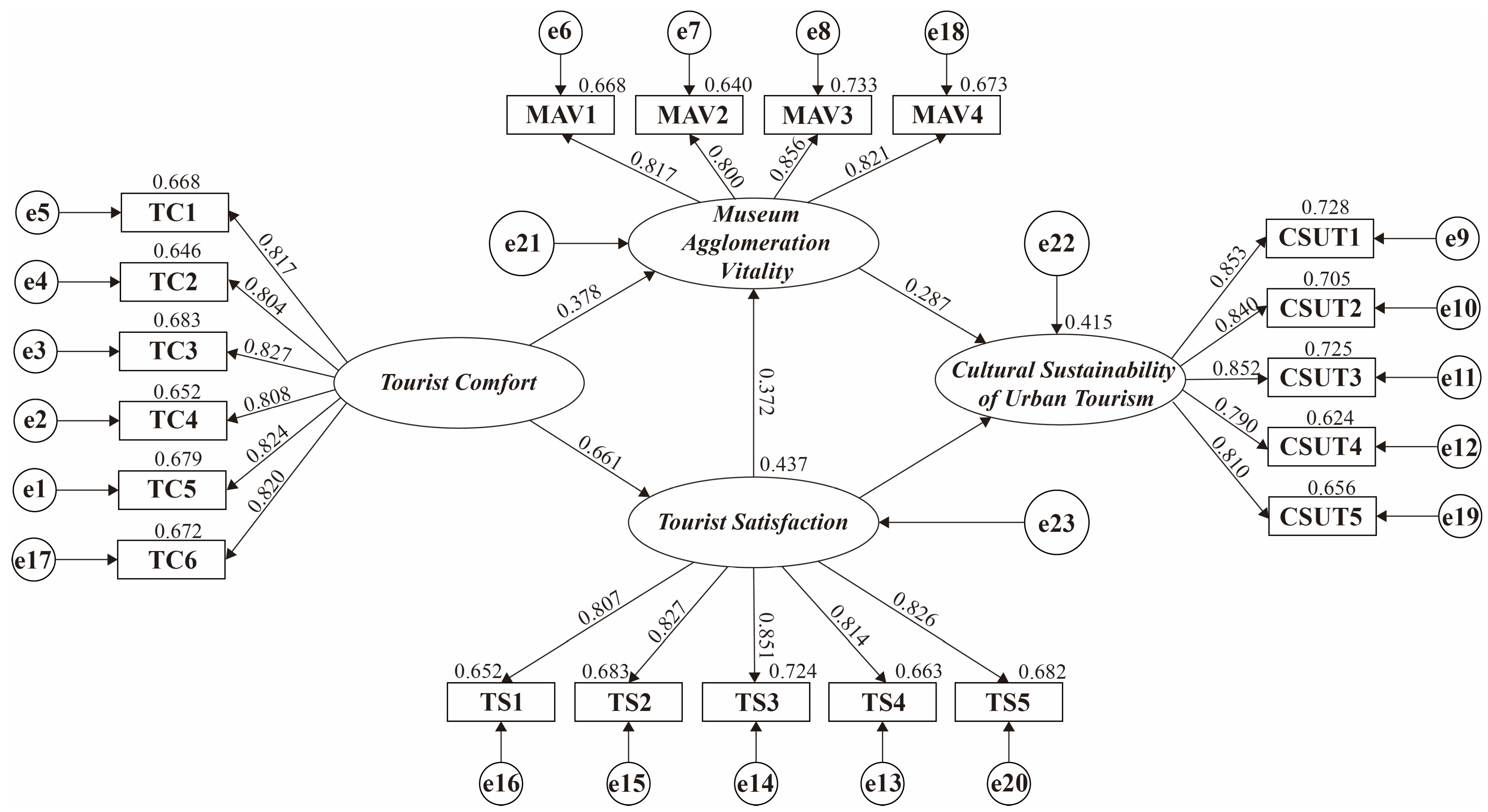
First, Tourist Comfort had a significant positive effect on Museum Agglomeration Vitality (Estimate = 0.378, S.E. = 0.056, C.R. = 6.735, p < 0.001), supporting H1. This finding suggests that when visitors can move more easily, obtain clearer information, experience lower congestion burden, and use the clustered environment more comfortably, the museum agglomeration is more likely to function as an active and connected tourism space. In practical terms, tourist comfort appears to contribute to the activation of museum-cluster use by facilitating continuous movement, broader participation, and extended activity within the district.
Second, Tourist Comfort also had a significant positive effect on Tourist Satisfaction (Estimate = 0.661, S.E. = 0.048, C.R. = 13.870, p < 0.001), supporting H2. Compared with the other direct effects in the model, this path showed the largest coefficient, indicating that tourist comfort plays a particularly important role in shaping overall evaluations of the museum-agglomeration experience. This result suggests that tourist satisfaction is influenced not only by museum content itself, but also by whether the broader tourism process is perceived as convenient, understandable, safe, and comfortable.
Third, Tourist Satisfaction had a significant positive effect on Museum Agglomeration Vitality (Estimate = 0.372, S.E. = 0.056, C.R. = 6.602, p < 0.001), supporting H3. This result indicates that museum-agglomeration vitality is not determined solely by environmental or operational conditions. Rather, as visitors form more positive evaluations of their overall experience, they are more likely to remain in the area longer, continue activities across multiple facilities, and participate more actively in the clustered cultural environment. In this sense, tourist satisfaction functions not only as an evaluative outcome, but also as a factor that reinforces the behavioral activation of the museum agglomeration.
Fourth, both Tourist Satisfaction and Museum Agglomeration Vitality had significant positive effects on the Cultural Sustainability of Urban Tourism. The path from Tourist Satisfaction to Cultural Sustainability of Urban Tourism was significant (Estimate = 0.425, S.E. = 0.059, C.R. = 7.692, p < 0.001), and the path from Museum Agglomeration Vitality to Cultural Sustainability of Urban Tourism was also significant (Estimate = 0.287, S.E. = 0.058, C.R. = 5.290, p < 0.001). These findings support H4. Substantively, they suggest that perceptions of cultural sustainability are strengthened not only when visitors are satisfied with their tourism experience, but also when the museum agglomeration operates as an active and well-functioning cultural environment. In other words, positive experiential evaluation and the effective activation of clustered museum space jointly contribute to more favorable perceptions of culturally sustainable urban tourism.
Finally, the structural model did not specify a direct path from Tourist Comfort to the Cultural Sustainability of Urban Tourism. Instead, Tourist Comfort was modeled as influencing this outcome indirectly through Tourist Satisfaction and Museum Agglomeration Vitality, as illustrated in
Figure 2. Based on the product of the relevant path coefficients, the indirect effect of Tourist Comfort on Cultural Sustainability of Urban Tourism was estimated to be approximately 0.281 through Tourist Satisfaction, approximately 0.108 through Museum Agglomeration Vitality, and approximately 0.071 through the sequential pathway of Tourist Comfort → Tourist Satisfaction → Museum Agglomeration Vitality → Cultural Sustainability of Urban Tourism. These results suggest that the influence of tourist comfort on perceived cultural sustainability is transmitted through multiple mediating pathways rather than through a direct effect alone.
4. Discussion
The present study provides several implications for understanding museum agglomerations as experiential urban tourism environments rather than as simple collections of individual museums. First, the significant effect of Tourist Comfort on Tourist Satisfaction indicates that the quality of the museum-agglomeration experience is shaped not only by exhibition content or museum-specific services, but also by the operational conditions under which visitors move through the clustered area. This finding is particularly meaningful in the case of Chinese tourists visiting Jongno-gu, Seoul. For this group, the overall experience may be especially sensitive to the clarity of guidance and information, the ease of movement, the management of congestion and waiting, and the availability of rest and convenience facilities, because these conditions influence how predictably and efficiently the destination can be used. The result therefore contributes a more specific, demand-side understanding of museum agglomerations: within an already clustered historic district, visitor comfort functions as a foundational experiential condition that stabilizes cross-site movement and supports positive evaluation of the district as a whole rather than of a single museum alone. The relatively strong path coefficient from Tourist Comfort to Tourist Satisfaction further suggests that comfort is not a peripheral factor, but a central component in the formation of visitor satisfaction in museum agglomerations.
The age profile of the sample further sharpens this interpretation. Because most respondents were under 45, the model primarily reflects the responses of younger and middle-aged tourists who are likely to rely on digital navigation, mobile information search, real-time itinerary adjustment, and cashless transactions when traveling through unfamiliar urban environments. For such visitors, Chinese-language digital guidance, QR-linked interpretation, queue and operating information on mobile interfaces, and frictionless switching between online information and on-site movement may have disproportionately strong effects on perceived comfort. Older tourists, by contrast, may respond more strongly to barrier-free mobility, staff-based guidance, seating frequency, simplified routes, and reduced walking burden. The current results should therefore be interpreted as age-sensitive rather than age-neutral.
Second, the significant effect of Tourist Comfort on Museum Agglomeration Vitality suggests that the activation of museum clusters cannot be explained by spatial concentration alone. A museum agglomeration becomes functionally active when visitors are able to continue their activities across multiple facilities, extend their stay, and participate more broadly in the clustered cultural environment. From this perspective, Tourist Comfort can be interpreted as an enabling condition that lowers movement-related burden and improves the usability of the clustered area. The finding should be interpreted carefully: the study does not claim that tourist comfort produces the initial spatial formation of a museum cluster. Rather, within an already existing cluster, better comfort appears to promote the experiential activation of the district by facilitating continuous movement, broader participation, and extended activity. This distinction helps explain why the model can legitimately position comfort as an antecedent of Museum Agglomeration Vitality without denying that objective clustering conditions may also influence visitor experience.
Third, the positive effect of Tourist Satisfaction on Museum Agglomeration Vitality indicates that cluster vitality is reinforced not only by environmental and operational conditions, but also by visitors’ accumulated positive evaluations of the experience. This result is important because it shows that vitality should not be treated solely as a spatial or managerial outcome. Rather, when visitors feel satisfied with the overall quality of their visit, they are more likely to remain in the area longer, continue visiting additional facilities, and engage more actively with the clustered cultural environment. In this regard, satisfaction functions not only as an endpoint of experience evaluation, but also as a mechanism through which demand-side responses contribute to the practical activation of museum agglomerations. This interpretation helps explain why the sustainable operation of museum clusters requires not only physical infrastructure and circulation management, but also high-quality on-site experiences that encourage continued participation.
Fourth, the significant effects of both Tourist Satisfaction and Museum Agglomeration Vitality on the Cultural Sustainability of Urban Tourism suggest that cultural sustainability is strengthened through a mediated experiential process rather than through immediate convenience alone. In this study, cultural sustainability was associated with positive evaluations of preservation and transmission, understanding and respect for urban culture, responsible tourism intention, cultural consumption, and cultural coexistence and acceptance. The results imply that visitors are more likely to form favorable perceptions of culturally sustainable urban tourism when they are satisfied with their experiences and when the museum agglomeration operates as an active and meaningful cultural environment. This finding adds theoretical depth to the discussion by clarifying that comfort does not directly translate into cultural sustainability. Instead, comfort first improves the quality of the tourism experience and the usability of the clustered environment, and these improved conditions then contribute to stronger perceptions of cultural sustainability through satisfaction formation and agglomeration vitality. However, the positive coefficient from Museum Agglomeration Vitality to Cultural Sustainability should not be interpreted as implying that unlimited activation is always desirable. When vitality grows without heritage-sensitive governance, it may also generate over-commercialization, crowding pressure, standardized retail experiences, or dilution of cultural authenticity. In historic districts such as Jongno-gu, sustainable management therefore requires a balance between activation and protection so that increased visitation strengthens cultural interpretation and continuity rather than eroding them.
At the same time, museum agglomerations are shaped not only by visitor experience but also by broader supply-side and policy conditions. Public investment, cultural-industry strategies, land-use planning, transport systems, the surrounding commercial ecology, and inter-organizational linkages may all influence the objective degree and competitiveness of clustering. The present study does not model these macro- and meso-level determinants; instead, it explains how an already clustered district is activated from the visitor side. Future research should therefore integrate objective clustering indicators and policy variables with perception-based measures and should test potentially reciprocal relationships between clustering conditions and tourist experience.
Taken together, these findings highlight the importance of an integrated management perspective for museum agglomerations in historic urban districts such as Jongno-gu. For Chinese tourists, who may rely heavily on efficient information access, intuitive wayfinding, and stable movement conditions when navigating an unfamiliar urban cultural environment, management strategies should focus not only on the internal quality of museums but also on the continuity of the clustered experience as a whole. For the Chinese-tourist segment examined here, this implies more specific interventions such as Chinese-language route guidance distributed through mobile channels, QR-linked information connecting nearby museums, clearer real-time information on queues and operating conditions, intuitive digital wayfinding, and wider communication of convenient mobile payment and reservation options. More broadly, the findings suggest that the cultural sustainability of urban tourism in museum agglomerations depends on whether convenience-related conditions are transformed into positive experiences and active participation while remaining aligned with authenticity protection and heritage-sensitive place management.
5. Conclusions
This study examined how perceived tourist comfort in museum agglomerations influences the cultural sustainability of urban tourism through tourist satisfaction and museum agglomeration vitality, based on data collected from Chinese tourists visiting Jongno-gu, Seoul. By applying a structural equation modeling approach, the study moved beyond facility-centered evaluations of individual museums and instead analyzed museum agglomerations as continuous and interconnected tourism environments. More specifically, it offered a demand-side explanation of how an existing museum cluster becomes experientially activated through comfort and satisfaction, while treating the case as a bounded investigation rather than a universally generalizable model. In this framework, Tourist Comfort was conceptualized as a multidimensional experiential condition consisting of mobility, congestion and waiting, rest and convenience, guidance and information, pedestrian safety, and travel comfort, while Museum Agglomeration Vitality, Tourist Satisfaction, and Cultural Sustainability of Urban Tourism were specified as the core latent constructs of the model.
First, Tourist Comfort significantly enhanced both Tourist Satisfaction and Museum Agglomeration Vitality. This result indicates that the quality of museum-agglomeration experiences is shaped not only by museum content or internal services, but also by the practical conditions under which visitors move through and use the clustered environment. In this respect, museum-agglomeration management should not be confined to the service quality of individual institutions. Rather, it should adopt an integrated cluster-level perspective that improves circulation, reduces congestion and waiting burdens, strengthens multilingual information and wayfinding systems, provides rest and support facilities, and connects on-site guidance with mobile-based route information and payment convenience for cross-site movement.
Second, Tourist Satisfaction significantly strengthened Museum Agglomeration Vitality, indicating that cluster vitality is reinforced not only by environmental and operational conditions but also by visitors’ positive evaluations of their experiences. This finding suggests that museum agglomerations should be managed not simply as collections of cultural facilities, but as active tourism environments in which continued participation, linked visits, extended activity, and sustained engagement can emerge. Accordingly, management strategies should focus on improving the experiential continuity of the cluster through route design, clear information provision, and operational quality that encourages visitors to remain engaged throughout the museum-agglomeration experience.
Third, both Tourist Satisfaction and Museum Agglomeration Vitality had significant positive effects on the Cultural Sustainability of Urban Tourism. This indicates that cultural sustainability is strengthened not through convenience alone, but through a mediated process in which improved comfort contributes to more positive experience evaluation and more active use of the clustered cultural environment. In substantive terms, this means that the cultural sustainability of urban tourism depends on whether museum agglomerations can support preservation and transmission, understanding and respect for urban culture, responsible tourism intention, cultural consumption, and culturally acceptable coexistence through the quality of visitor experience. Yet the positive effect of vitality should not be read as support for unlimited intensification. In historic districts, vitality must be managed within heritage-sensitive limits so that commercial activation does not overwhelm authenticity, local cultural meaning, or everyday urban coexistence.
At the same time, this study has several limitations. First, the analysis was based on a single case area, Jongno-gu in Seoul, and the findings should therefore be interpreted as a case-based examination rather than a universally generalizable model. Second, the study relied on survey-based perceptual data, which limits causal inference and does not fully capture objective environmental conditions. Third, the sample was restricted to Chinese tourists and was weighted toward younger and middle-aged respondents, which may limit the applicability of the findings to other tourist groups, particularly senior visitors or tourists from different national backgrounds. Fourth, the model focused on demand-side experiential activation and did not include supply-side determinants of clustering, such as government planning, cultural-industry strategies, surrounding commercial linkages, transport systems, or objective spatial measures of cluster formation. Future research should therefore expand the comparative scope of analysis, incorporate more diverse visitor groups, test possible reciprocal relationships between clustering conditions and visitor experience, and combine perceptual data with objective indicators such as pedestrian flow, congestion conditions, wayfinding systems, planning context, and circulation patterns.