1. Introduction
Firms have increasingly relied on open innovation to address complex technological and environmental challenges [
1]. Open innovation is defined as a paradigm where firms integrate external knowledge and resources across organizational boundaries [
2]. Unlike traditional innovation perspectives that emphasize internal R&D investment and firm-specific resource accumulation (closed innovation), open innovation represents a paradigm of deliberate boundary-spanning. Empirical research by Cheng and Huizingh (2014) emphasizes the importance of open innovative activities by showing their significant positive effects on new product innovativeness, market success rates, and financial performance [
3]. Open innovation enables firms to develop sustainable solutions and maintain long-term competitive advantage [
4].
However, despite its strategic importance, open innovation poses substantial implementation challenges. Compared with internal research and development, open innovation requires long-term, uncertain, and relationship-specific investments, often involving high coordination costs and delayed returns [
5,
6]. These features make open innovation especially sensitive to managerial short-termism. A large body of literature shows that managers facing capital market pressure and career concerns tend to prioritize short-term performance, leading to the underinvestment in long-horizon innovative activities [
7,
8]. As a result, a fundamental tension emerges: while open innovation is essential for sustainable value creation, its long-term and high-risk nature makes it particularly vulnerable to managerial myopia. Therefore, it is essential to investigate how the characteristics of executives affect open innovation activities.
To explain how executives affect the firms’ strategies on open innovation, we draw on upper echelons theory, which posits that executives’ expertise shapes their cognitive frameworks and, in turn, influences strategic choices [
9]. For example, building on the upper echelons theory, the prior literature has shown ample empirical evidence that educational background, career expertise, age, and gender gradually shape the cognitive framework, values, and risk preferences of senior executives. This information is then transmitted to the organizational level, directly influencing the strategic direction and the quality of results [
9]. Thus, executives’ distinct past expertise fundamentally shapes their values, time horizons, and subsequent strategic choices. In this situation, the cognitive abilities of managers, particularly the time span for making decisions, play a crucial role in determining whether an enterprise adopts a sustainable innovation strategy [
10,
11].
Recent studies have shifted research interests towards the importance of one particular executive characteristic, the executives’ environmental expertise. For example, Xie et al. (2023) point out that the pro-environmental educational backgrounds help executives accumulate knowledge-based resources and enhance eco-friendly production capabilities [
12]. Environmental expertise endows executives with specialized expertise, which enables them to improve corporate environmental governance and enhance their green reputation, thereby meeting green credit standards and attracting environment-oriented capital [
13]. Although the existing literature has examined the impact of green executives on information disclosure quality [
14], ESG performance [
15], and environmental performance [
16], how green executives affect corporate open innovation remains underexplored. Therefore, this paper fills in the gap by investigating the proposition that the appointments of executives with environmental expertise (hereafter referred to as green executives) promote open innovation activities.
Our proposition is grounded in both upper echelons theory and stewardship theory. First, based on stewardship theory, we argue that green executives develop long-term cognitive orientation [
11]. Stewardship theory posits that managers are intrinsically motivated to act in the best interests of the organization, prioritizing long-term value creation over short-term personal gains [
17]. A recent series of studies demonstrates that green executives are oriented toward the long-term interests of the firm and place greater emphasis on sustainability-driven objectives that generate enduring value [
10,
11]. In contrast to conventional executives who may be constrained by short-term performance pressures or monitoring mechanisms, green executives are more likely to support investments in sustainability initiatives. By prioritizing long-term environmental and economic objectives, green executives foster organizational resilience and sustainable growth, effectively counterbalancing short-term decision biases.
Second, drawing on the upper echelons theory, we argue that green executives could affect the corporate open innovation. Environmental expertise enhances executives’ ability to process complex, uncertain, and long-horizon problems, as environmental issues typically involve delayed feedback and intertemporal trade-offs. This cognitive capability promotes forward-looking decision-making and reduces short-term bias. Open innovation, which relies on boundary-spanning collaboration and long-term resource commitment, is particularly dependent on managerial willingness to forgo short-term gains in favor of long-term value creation. By extending decision-making horizons, environmentally expertised executives enable firms to engage more actively in open innovation and to better internalize the benefits of sustainability-oriented investments. We therefore propose that green executives promote corporate open innovation by alleviating managerial myopia.
To empirically test our hypotheses, we utilize a comprehensive panel of 40,133 firm–year observations from China’s A-share listed firms between 2002 and 2022. We choose the Chinese market as our empirical setting for two primary reasons. First, as the world’s center of the manufacturing industry, China provides an unparalleled context to observe the profound tensions between traditional industrial scale and the urgent need for green transformation. Second, as we established, Chinese listed firms face strong capital market pressures alongside an increasing policy emphasis on sustainability. In such a rapidly transforming market, corporate strategic choices are highly sensitive to managerial time horizons, making it an ideal setting to examine how environmentally expertised executives navigate the long-term challenges of open innovation.
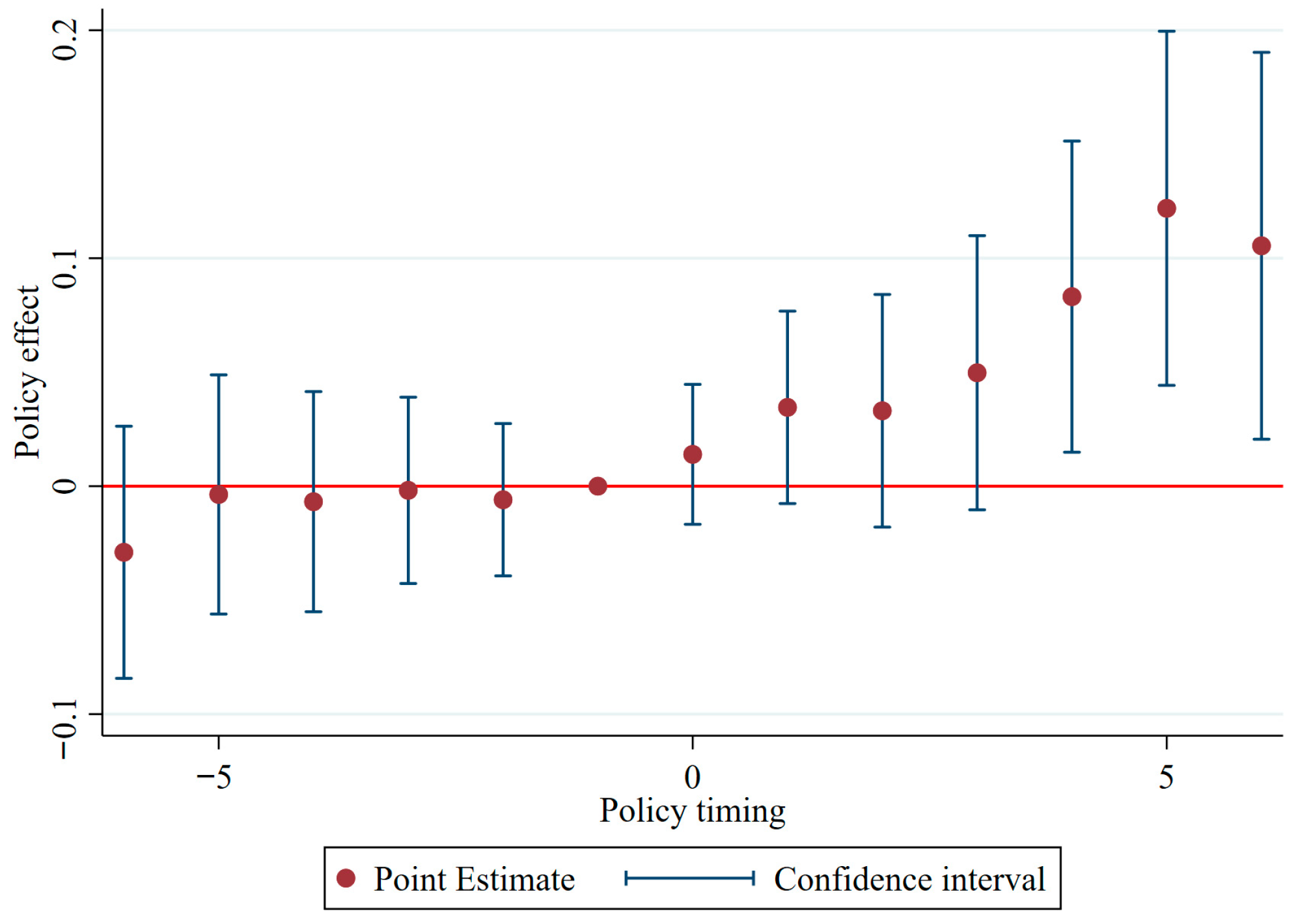
Our results show that firms with environmentally expertised executives exhibit significantly higher levels of open innovation. To address endogeneity issues, we employ a multi-period difference-in-differences (DID) design combined with propensity score matching (PSM). Our findings do not alter in a series of robust checks. Mediation mechanism analyses indicate that this effect operates through the alleviation of managerial myopia.
Furthermore, we examine the managerial myopia mechanism using the cross-sectional heterogeneity tests. We hypothesize that the effect of appointing green executives will be greater in firms with stronger managerial myopia issues. First, we expect the positive effect of green executives to be more pronounced in firms with weak supervision. In such environments, the lack of formal monitoring exacerbates myopic behaviors [
18,
19], thereby elevating the strategic necessity for green executives to act as a form of “substitute” cognitive governance [
16,
20,
21]. Second, we posit a stronger effect of green executives on firms facing higher capital market pressure. Highly capital market pressure imposes severe short-term performance pressures and heightened takeover threats [
22,
23]. The cross-sectional tests reveal that the effect is more pronounced in firms with weaker governance and greater capital market pressure, where short-term incentives are more severe. Therefore, green executives play a crucial role in alleviating the myopia and promoting open innovation [
24]. Their cognitive framework effectively mitigates managerial excessive sensitivity to short-term financial fluctuations and reduces myopic discounting when firms face high-risk innovation projects [
11].
The contribution of this paper is threefold. First, it contributes to the open innovation and sustainability literature by identifying managerial cognition as a key determinant of firms’ ability to engage in sustainability-oriented innovation. Although existing studies have explored their impact in environmental and social dimensions [
15,
16], to the best of our knowledge, this is the first paper investigating the path of green executives promoting open innovation by alleviating myopia. This paper deepens our understanding of how green executives create financial and strategic value. Second, it extends the upper echelons literature by highlighting environmental expertise as an important source of heterogeneity in managerial time horizons. We provide empirical evidence that green executives can mitigate short-term bias and facilitate long-term investment strategies. Third, our findings highlight the role of environmental human capital in enabling firms to adopt open innovation and develop sustainable business models.
5. Conclusions and Discussion
5.1. Conclusions
This study examines how executives’ environmental expertise influences firms’ engagement in open innovation. Building on upper echelons theory, we conceptualize open innovation as an intertemporal investment decision that is particularly vulnerable to managerial myopia. We show that environmental expertise shapes managerial cognition by extending decision-making time horizons, thereby mitigating managerial myopia and enabling firms to undertake long-term, uncertain, and collaborative innovation activities.
Using a panel of 40,133 firm–year observations from Chinese listed firms over 2002–2022, our results corroborate the hypothesis that firms led by environmentally expertised executives exhibit significantly higher levels of open innovation. This effect operates through the alleviation of managerial myopia and is more pronounced in firms facing stronger short-term pressures.
Additionally, we identify specific environments that are more likely to induce managerial myopia and demonstrate how environmental expertise interacts with these conditions. The promoting effect of green executives on open innovation is stronger in firms with weaker corporate governance and higher capital market pressure. Suggesting that in environments lacking robust formal monitoring, the long-term cognitive orientation of green executives serves as a form of substitute cognitive governance to alleviate myopia. Moreover, the strategic value of green executives is more pronounced when firms operate in heavy-polluting and capital-intensive industries. Firms in these sectors face higher environmental compliance costs and severe short-term financial pressures, making the long-term strategic vision of green executives particularly critical for navigating such constraints.
Importantly, corporate sustainability is closely relevant to the firm’s ability to generate long-term economic and strategic value through continuous innovation and capability renewal. In this context, open innovation serves as a critical mechanism for internalizing sustainability-related externalities by facilitating knowledge sharing, stakeholder collaboration, and the co-creation of sustainable solutions. Our findings imply that green executives enhance open innovation and corporate sustainability by alleviating managerial myopia.
5.2. Discussion
Our empirical results offer significant theoretical contributions by examining the causal link between environmentally expertise executives (green executives) and open innovation in firms. Moving beyond simply documenting an empirical relationship, our analysis unpacks the underlying cognitive mechanisms and theoretical boundaries. This extends upper echelons theory, stewardship theory, and the literature on sustainable innovation. Specifically, we make three primary contributions: extending the innovation context, revealing the mediating channel of managerial myopia, and identifying critical boundary conditions.
First, we bridge the theoretical gap between general innovation and boundary-spanning collaborative strategies in firms. Our findings are closely related to Luo and Zhang (2024) [
41]. Their study documents that executives with environmental expertise promote corporate innovation. However, our study extends this line of research by examining the more demanding context of open innovation. As our study notes, open innovation requires long-term, uncertain, and relationship-specific investments. By demonstrating that environmental expertise facilitates these specific collaborative strategies, we complement the existing literature and show that green executives are vital for navigating the unique complexities of open innovation.
Second, we unpack the mechanism of this relationship by providing direct evidence that the effect of green executives operates through the alleviation of managerial myopia. Drawing on upper echelons and stewardship theories, we show how environmental expertise shapes managers’ time horizons. Because open innovation is highly vulnerable to managerial short-termism, green executives act as a corrective force by developing a long-term cognitive orientation. By extending decision-making horizons, these executives mitigate short-term bias and prioritize sustainable value creation, thereby contributing directly to the literature on managerial myopia.
Third, our analysis refines established governance frameworks by identifying the environments where this cognitive orientation is most critical. Based on our cross-sectional and heterogeneity results, the promoting effect of green executives is stronger in firms with weaker corporate governance and higher capital market pressure. In these settings, the long-term orientation of green executives serves as a substitute cognitive governance mechanism to buffer against severe short-term incentives. Furthermore, we find that this strategic value is more pronounced in heavy-polluting and capital-intensive industries, confirming that environmental human capital is especially critical when firms face high compliance costs and severe sunk cost pressures.
From a practical perspective, our findings provide important implications. For policymakers, promoting sustainability-oriented innovation requires not only external regulation but also the development of managerial human capital aligned with long-term sustainability goals. Policymakers and boards of directors may consider encouraging the integration of environmental expertise into top management teams through governance guidelines, disclosure frameworks, and talent development programs. Such initiatives can help firms overcome short-termism, strengthen sustainable business models, and accelerate the transition toward innovation-driven and collaborative sustainability.
Our study also has limitations that point to avenues for future research. In particular, while we focus on executives’ green expertise as a form of knowledge-based human capital acquired through education and professional experience, we do not directly capture executives’ exposure to environmental conditions in their personal histories. The prior literature suggests that environmental experiences may shape managerial cognition and behavior through an experiential channel; however, the direction of this effect remains theoretically ambiguous. Adverse environmental experiences, such as exposure to pollution or climate-related shocks, may either foster resilience and prosocial orientation or induce greater caution and risk aversion, depending on the nature and salience of exposure. Meanwhile, executives may also benefit from positive environmental experiences. For example, growing up in regions with strong environmental quality or sustainability practices, which could reinforce pro-environmental preferences and long-term orientation through a different mechanism [
60]. Future research could more precisely distinguish between positive and negative environmental experiences and examine how these distinct experiential channels interact with knowledge-based green expertise in shaping corporate innovation and sustainability strategies.
Furthermore, our analysis does not classify sectors that offer different challenges and possibilities for innovation. We acknowledge this limitation and suggest that future research should consider differentiations by activity, examining whether the influence of green executives varies across technological regimes with distinct innovation requirements.