1. Introduction
The confluence of environmental degradation, resource scarcity, and social inequality has elevated sustainable development from peripheral concern to the epicentre of policy and business discourse. Within this context, the circular economy paradigm has emerged as a transformative approach, fundamentally reconceptualising economic activity from linear ‘take-make-dispose’ patterns towards regenerative systems wherein resources circulate continuously, waste becomes obsolete, and value creation occurs within planetary boundaries [
1,
2]. This shift demands not only technological innovation but also socio-institutional transformation, positioning sustainability as a multidimensional endeavour shaped by cultural practices, governance arrangements, and collective learning processes.
The circular economy is understood here as an economic paradigm aimed at reducing resource extraction and waste through strategies such as reuse, regeneration, and extended product lifecycles. This perspective highlights systemic change in production and consumption patterns rather than isolated efficiency improvements.
Sustainable entrepreneurship represents a critical mechanism for actualising circular economy transitions. However, the realisation of genuinely circular enterprises requires more than ethical intention or incremental efficiency improvements; it demands deep changes in how knowledge is created, shared, and mobilised across stakeholders, and in how innovation processes integrate environmental, social, and economic logics [
3,
4]. Despite growing research, a conceptual gap persists regarding how shared knowledge—particularly when structured through social innovation—enables entrepreneurs to reconfigure business models and navigate the institutional tensions characteristic of circular transitions. As a result, existing research provides limited explanation of how sustainable entrepreneurs translate normative sustainability commitments into coherent circular business model architectures that integrate economic, social, and environmental value over time, particularly beyond typological or outcome-oriented approaches [
2,
5]
In this study, sustainable entrepreneurship refers to entrepreneurial activity that seeks to generate economic value while simultaneously addressing social and environmental objectives. This definition emphasises the integration of multiple value dimensions within entrepreneurial decision-making rather than the prioritisation of financial outcomes alone. This paper addresses a critical gap in understanding how sustainable entrepreneurs navigate the inherent tensions between competing institutional logics—commercial imperatives demanding financial returns versus social and environmental logics prioritising collective welfare and ecological preservation—within the specific context of circular economy transitions [
6,
7]. Institutional logics are understood as socially constructed sets of norms, values, and assumptions that shape how actors interpret situations and guide organisational behaviour. In the context of this study, institutional logics provide a lens for understanding the tensions entrepreneurs face when integrating economic, social, and environmental objectives. This tension is especially pronounced in circular contexts, where long-term value preservation, material regeneration, and collaborative arrangements often collide with conventional market imperatives.
In this article, shared knowledge is understood as the collective creation, exchange, and mobilisation of knowledge among multiple actors through collaborative processes. Rather than being treated as an individual or proprietary resource, shared knowledge is conceptualised as a relational and dynamic process that emerges through interaction within entrepreneurial and innovation ecosystems.
The central research question guiding this investigation asks the following: How can shared knowledge, operationalised through social innovation, catalyse the redefinition of business models towards enduring sustainable value creation within circular economy frameworks? This question gains urgency given the United Nations’ Sustainable Development Goals, which require unprecedented collaboration and innovation across sectors, and the imperative transition from linear to circular economic models across all industries [
8,
9]. Moreover, recent policy frameworks emphasise collaborative, community-rooted approaches to circularity [
10], underscoring the importance of social innovation as a driver of systemic change. Rather than offering a descriptive account of circular entrepreneurship practices, this research question is analytically oriented towards explaining the mechanisms and processes through which shared knowledge, mediated by social innovation, enables the reconfiguration of business models under competing institutional logics in circular economy contexts.
The argument advanced herein posits that social innovation serves as the fundamental mechanism through which sustainable entrepreneurship achieves legitimacy and practical efficacy in circular economy contexts. Social innovation is used in this study to refer to processes through which new social practices, relationships, or organisational arrangements are developed to address social and environmental challenges. The emphasis is placed on social innovation as a processual and collaborative mechanism rather than solely on its outcomes. Social innovation transforms sustainability from a technical objective into a collective cultural practice, whilst shared knowledge—articulated through open innovation and co-creation—provides the dynamic capability, enabling entrepreneurs to reconfigure business models authentically integrating economic, social, and environmental values [
11,
12]. This integration proves especially critical for enterprises operating in resource-constrained contexts, such as rural communities and manufacturing sectors, where collaborative approaches to innovation become not merely advantageous but essential for survival and growth within circular paradigms [
13,
14].
The contribution of this research operates at three levels. Theoretically, it positions social innovation as an epistemological integrator, bridging entrepreneurship and circular economy principles. Conceptually, it offers an integrated framework explaining how diverse knowledge inputs transform, through social innovation mechanisms, into circular business model architectures [
15,
16]. Circular business model architecture refers to the configuration of value creation, delivery, and capture mechanisms designed to support resource circularity and long-term sustainability. This concept emphasises how business models are structurally organised to enable circular value flows rather than focusing solely on individual circular practices. Practically, it provides strategic guidance for entrepreneurs, policymakers, and ecosystem designers seeking to foster sustainable value creation through collaborative innovation within circular economy transitions [
17,
18].
Rather than proposing a new theory of circular entrepreneurship, this study contributes an integrative conceptual framework that brings together insights from sustainable entrepreneurship, social innovation, and circular economy research. Its contribution lies in clarifying the mechanisms through which shared knowledge and social innovation jointly support circular business model development, particularly in contexts characterised by competing institutional logics. By focusing on these mechanisms, the framework complements existing models and provides a coherent basis for subsequent empirical research. In contrast to existing models that primarily describe circular business model types or sustainability outcomes, the proposed framework explicates the processual mechanisms through which shared knowledge and social innovation jointly enable the emergence and stabilisation of circular value creation under institutional complexity.
This study adopts a conceptual and analytical perspective focused on the organisational and inter-organisational levels of analysis. The proposed framework is not limited to early-stage entrepreneurial ventures but is equally applicable to established firms engaged in circular transformation processes. Rather than offering sector-specific prescriptions, the framework is intended to capture generic mechanisms through which shared knowledge and social innovation support circular business model development across diverse industrial and institutional contexts. As a conceptual contribution, the framework aims to provide analytical clarity and theoretical integration rather than empirical generalisation or normative prediction.
Methodologically, the study adopts a conceptual theory synthesis approach rather than a systematic or exhaustive literature review. The objective is not to map the entirety of existing research, but to integrate and reconcile insights from distinct yet complementary literatures in order to clarify core constructs, identify underlying mechanisms, and articulate their interrelationships within a coherent analytical framework. This positioning reflects the exploratory and theory-building nature of the contribution.
Rather than proposing new constructs, this study contributes to the existing body of knowledge by clarifying how shared knowledge operates as a relational mediating infrastructure, enabling actors to navigate institutional tensions in circular contexts [
19]. Specifically, the role of shared knowledge is to act as a mediator between competing logics (commercial, environmental, social, circular) through three mechanisms: boundary spanning by hybrid professionals, co-creation processes integrating heterogeneous knowledge, and open social innovation systems institutionalising circular practices [
19,
20,
21]. The mediation function is distinct from absorptive capacity (firm-level learning), open innovation (idea generation), or knowledge sharing (information transfer). This distinctiveness lies in shared knowledge’s capacity to translate between competing logics, rather than merely transmitting information or developing organisational capabilities. The framework elucidates the reasons why circular entrepreneurship is successful through relational coordination under institutional tension rather than technical innovation alone [
22].
The paper proceeds as follows.
Section 2 introduces the theoretical foundations that inform the study.
Section 3 explains the conceptual approach adopted.
Section 4 develops the proposed framework linking shared knowledge, social innovation, and circular business model development.
Section 5 reflects on the implications of the framework, and
Section 6 concludes by outlining limitations and avenues for future research.
4. Results
The integrated conceptual framework presented in this section explains how shared knowledge is transformed into circular sustainable value through social innovation mechanisms. It conceptualises this transformation as a three-stage process encompassing strategic inputs, transformation mechanisms, and value outputs, connected through feedback loops that allow for continuous refinement and adaptation. In this way, circular value creation is understood as a dynamic and evolutionary process rather than a one-off design outcome. Analytically, the framework does not aim to catalogue circular practices or business model archetypes, nor to propose a normative roadmap for circular transition. Instead, it specifies a set of relational mechanisms through which shared knowledge is converted into organisational and systemic outcomes under conditions of institutional complexity. By foregrounding the role of social innovation as a mediating process, the framework shifts attention from static configurations of circular business models to the dynamic conditions under which such models emerge, stabilise, and evolve. In this sense, the contribution of the framework lies not in introducing new circular archetypes, but in clarifying how existing circular strategies become viable through knowledge-based and socially embedded mechanisms.
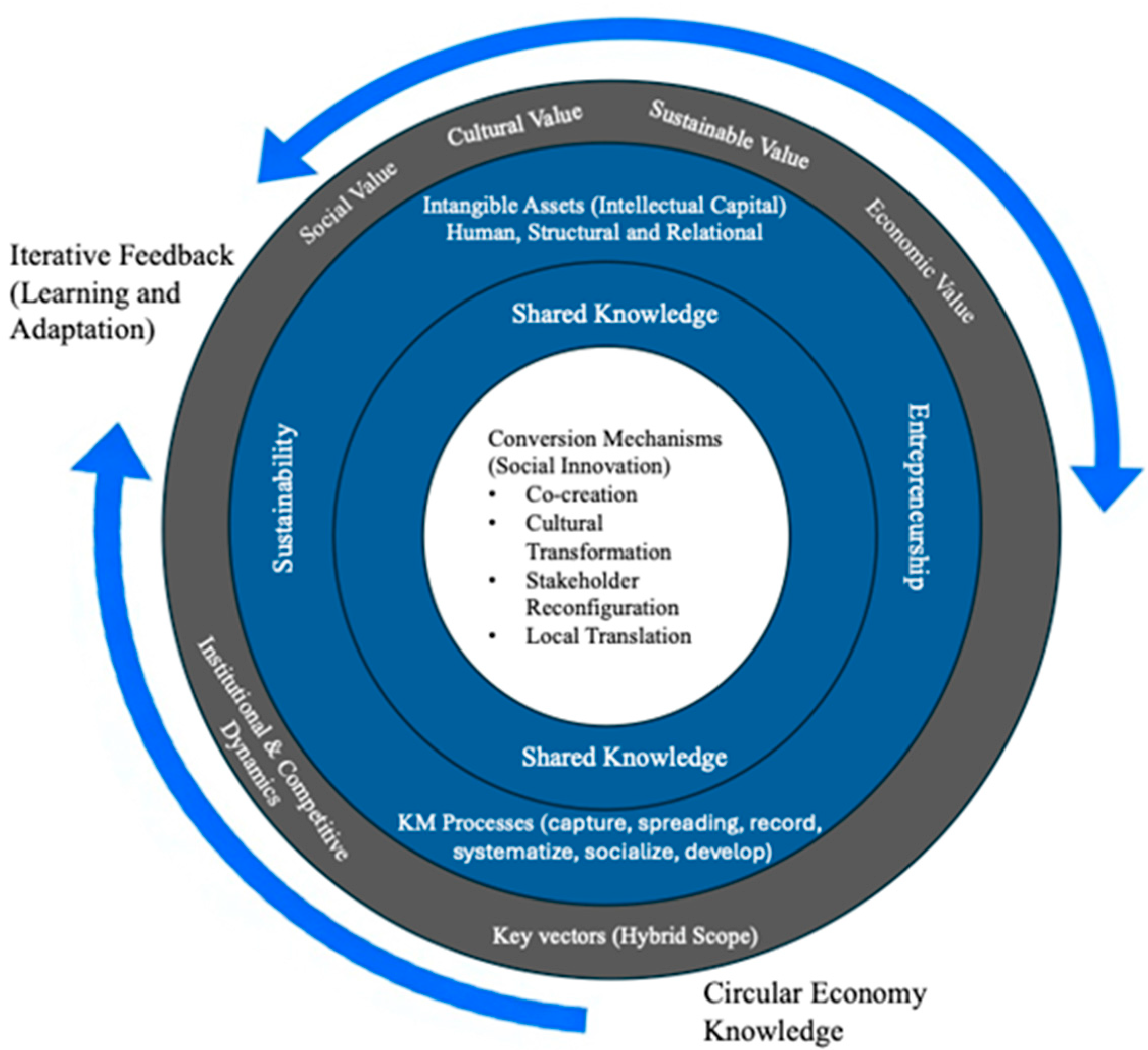
Figure 1 presents a conceptual framework that illustrates the dynamic conversion of shared knowledge into circular sustainable value through social innovation mechanisms. The framework is organised into four interconnected layers that jointly explain how sustainable entrepreneurship can be enabled within circular economy contexts.
At the core of the framework lies social innovation as the triggering approach that activates a shared knowledge scheme oriented towards sustainable entrepreneurship. This layer incorporates the conversion mechanisms through which social innovation processes translate knowledge into entrepreneurial action. These processes include co-creation—encompassing participatory design, ideation processes, and communities of practice—cultural transformation through the development of shared narratives, collective identity-building initiatives, and gap analysis, the reconfiguration of stakeholder relationships via participatory governance arrangements, consortia, and interest matrices, and the local translation of global frameworks through community ownership models, governance and funding structures, and dedicated technical offices. Together, these mechanisms enable the transformation of abstract circular economy commitments into socially embedded practices.
The second layer conceptualises shared knowledge as the foundational asset upon which sustainable entrepreneurial projects are developed, explicitly recognising its dual explicit and tacit nature. Shared knowledge is not treated as an isolated resource but as a collectively constructed input that emerges from interaction among diverse actors and informs entrepreneurial decision-making within circular systems.
The third layer refers to the intangible assets that sustain knowledge management processes and enable the emergence of an ecosystem conducive to collective reflection and problem-solving. These intangible assets—including human, structural, and relational capital—support the capture, dissemination, systematisation, socialisation, and development of knowledge, thereby creating conditions in which collaborative responses to sustainability and entrepreneurship challenges can be generated.
The fourth layer concerns the configuration of the value proposition based on the key principles of the circular economy, incorporating integrative vectors associated with the hybrid approach discussed in this article. This layer explicitly accounts for the dynamics—opportunities, tensions, and challenges—that must be managed within both institutional and competitive environments. It integrates social, cultural, environmental, sustainable, and economic dimensions through key performance indicators that do not merely serve to monitor progress, impacts, and outcomes, but also function as behavioural guides shaping the orientation and evolution of the entrepreneurial project. This layer requires continuous feedback so that learning derived from implementation not only supports entrepreneurial adaptation but also reinforces knowledge management within the broader system.
Accordingly, circular business model archetypes that generate sustainable hybrid value across social, cultural, environmental, and economic dimensions—such as the empowerment of social groups, transformation of social practices, mitigation of environmental imbalances, territorial development, reduction in social gaps, and, more broadly, entrepreneurial alignment with the Sustainable Development Goals—find in
Figure 1 a reflective framework that can be applied prior to project configuration or used to reassess initiatives that have already been launched.
The effectiveness of the social innovation mechanisms represented in the framework is likely to vary across contexts. In environments characterised by high stakeholder density and mature innovation ecosystems, co-creation and stakeholder relationship reconfiguration tend to be more readily activated due to existing collaborative infrastructures and trust-based relationships. By contrast, in contexts with lower ecosystem maturity or limited organisational capacity, these mechanisms may evolve more gradually and require stronger facilitation and institutional support. Organisational capabilities, including absorptive capacity, governance structures, and cultural openness, further condition the extent to which shared knowledge sources can be effectively mobilised and translated into circular business model architectures. The framework assumes that circular value creation is contingent upon minimum levels of collaborative capacity, institutional support, and organisational openness, and that these conditions moderate the strength and sequencing of the proposed mechanisms.
Within this institutional and competitive dynamics framework, entrepreneurs are shaped by specific logics and contextual conditions that guide their interpretation of the circular economy. Shared knowledge is conceptualised here as a set of strategic inputs—including opportunities, needs, requirements, references, experiences, and ideas—that orient and constrain which circular strategies are perceived as legitimate and operationally viable.
Environmental and social logics constitute a key source of knowledge, encompassing values, ethical commitments, and understandings of ecological and social systems that orient entrepreneurs towards circular economy objectives. These logics derive from multiple sources, including cultural traditions emphasising stewardship and regeneration, scientific understandings of ecological limits and planetary boundaries, policy frameworks such as the Sustainable Development Goals and circular economy action plans, and community practices of resource sharing and collective management [
8]. Within circular economy contexts, these logics provide constitutive knowledge that shapes both the objectives pursued by circular entrepreneurs and their understanding of value creation across extended temporal horizons and complex material flows.
External knowledge accessed through open innovation networks also represents a critical input for circular transitions. Open social innovation in circular economy contexts involves collaboration with diverse external actors, including customers, suppliers, research institutions, non-governmental organisations, waste management organisations, and complementary enterprises that enable industrial symbiosis and closed-loop systems [
52]. Through these interactions, entrepreneurs gain access to technical, economic, social, and environmental knowledge that supports the development of circular business models.
Human capital, particularly in terms of skills, capabilities, and attitudes, plays a central role in this process by shaping levels of commitment, motivation, creativity, and entrepreneurial orientation within circular economy initiatives from a social innovation perspective. Practices such as green volunteerism—understood as employee engagement in environmental initiatives—perform multiple functions beyond their immediate environmental benefits [
14]. Participation in circular economy initiatives strengthens understanding of resource flows and regeneration principles, reinforces cultures oriented towards circular values, builds social cohesion that facilitates subsequent organisational transformation towards circular business models, and generates experiential knowledge about implementation challenges. The knowledge produced through such participatory practices differs qualitatively from formal training or policy directives, as it incorporates experiential understanding and personal commitment that are essential for authentic circular transformation.
Circular economy knowledge constitutes an additional input stream addressing the technical, systemic, and strategic dimensions of circular transitions. This knowledge includes principles related to regenerative design, reverse logistics, circular business model innovation, and systems thinking. Collectively, these elements define the conditions under which circular business models can emerge and stabilise.
These knowledge inputs interact with institutional logics that structure how knowledge is interpreted and deployed within circular economy contexts, alongside commercial logics that emphasise financial viability, market positioning, efficiency, and scalability. While these commercial considerations remain relevant insofar as financial sustainability enables long-term operation and impact, they may constrain circular ambitions when allowed to dominate other considerations. Such dominance can result in weak circular approaches—often due to a lack of hybrid ambidexterity at the initial strategic reflection stage of sustainable entrepreneurial projects—where isolated recycling initiatives are implemented while fundamentally linear business models based on volume growth and planned obsolescence remain intact.
Social and environmental logics provide alternative interpretive frameworks that emphasise collective welfare, intergenerational equity, ecological regeneration, and community resilience. In circular economy contexts, these logics prescribe actions that frequently contradict commercial imperatives, such as prioritising product durability and repairability over planned obsolescence, investing in recovery infrastructure without immediate financial returns, maintaining local production and repair networks instead of cost-efficient global supply chains, or sharing intellectual property related to circular innovations to enable systemic transformation.
Circular economy logic itself represents an emerging institutional framework that challenges both conventional commercial logic and traditional environmental logic by emphasising systemic resource circulation, collaborative value creation, and regenerative rather than merely sustainable practices. These institutional logics act as interpretive lenses through which strategic knowledge inputs are selected, combined, and translated into entrepreneurial decisions.
Social innovation–related conversion mechanisms trigger the transformation of shared knowledge inputs into organisational practices and forms that enable circular and sustainable value creation. Social innovation translates circular economy commitments into concrete practices across technical, economic, social, and cultural dimensions through four interdependent processes: co-creation, cultural transformation, stakeholder relationship reconfiguration, and local translation.
Economic actors typically prioritise financial returns and operational efficiency, users emphasise convenience and performance, environmental actors focus on material regeneration and ecosystem restoration, and community actors value social cohesion and local resilience. Co-creation provides a means to manage these diverse value perspectives and to develop hybrid propositions that address multiple dimensions across circular system lifecycles.
The co-creation process in circular entrepreneurship generally unfolds through several phases addressing both technical and social transformation. Initial phases emphasise inclusive participation, ensuring that diverse actors are involved in defining circular challenges rather than merely implementing solutions. This inclusive problem framing is essential, as conventional linear business approaches often misinterpret circular challenges by focusing on end-of-life waste management instead of systemic redesign of production and consumption patterns.
Subsequent phases involve collaborative knowledge construction, whereby participants share their distinctive expertise and experiential knowledge to develop a shared understanding of material flows, usage patterns, recovery possibilities, and systemic interdependencies. This, in turn, facilitates collaborative design and implementation, with continued stakeholder engagement ensuring that circular solutions remain responsive to diverse needs across their lifecycle while building the social infrastructure required for circular system functioning.
Cultural transformation represents a second critical social innovation process for circular economy transitions. Circular initiatives require not only technical change but also shifts in organisational cultures, community practices, consumption norms, and societal values related to ownership, waste, and material use. Social innovation supports this transformation by fostering new narratives around circular value, establishing shared stewardship norms, and building social capital that enables collaborative consumption and resource sharing. For circular enterprises, cultural transformation may involve shifting from identifying primarily as manufacturing entities producing goods for sale to identifying as service providers managing resources across extended lifecycles, or as platform orchestrators enabling collaborative consumption and resource exchange.
The transformation of stakeholder relationships constitutes a third critical social innovation process. Linear business models typically rely on hierarchical relationships in which firms occupy dominant positions. In contrast, circular business models—particularly those based on access rather than ownership or requiring active user participation—depend on more collaborative and reciprocal stakeholder relationships. Social innovation facilitates this transformation by creating forums for stakeholder dialogue on circular system design and governance, establishing participatory structures that grant stakeholders genuine influence, developing benefit-sharing mechanisms that distribute value equitably among contributors, and building networks of mutual obligation and reciprocity that enable informal resource exchange and collaboration with public administrations.
Social innovation translates circular economy commitments into practice through four interdependent processes—co-creation, cultural transformation, stakeholder relationship reconfiguration, and the local translation of global circular economy frameworks—as detailed in
Section 4.2.
The outcomes generated through social innovation processes consolidate into new circular business models that translate circular economy commitments into systems for value creation, delivery, and capture. Social contributions include the reduction in social gaps, advancement of specific Sustainable Development Goals, and empowerment of social groups; cultural contributions include a strengthened sense of belonging, diffusion of sustainable culture, and changes in consumption habits; environmental contributions include material circularity rates, carbon footprints, and waste reduction; and economic contributions include circular revenues, social return on investment, and cost savings along the value chain.
Circular business model architecture differs qualitatively from linear counterparts in several fundamental respects. In circular models, value propositions prioritise resource regeneration and extended lifecycle management rather than treating them as secondary outcomes of commercial activity. Core offerings focus on access, performance, or service-based value, while revenue models often rely on hybrid mechanisms that align economic incentives with long-term resource stewardship through recurring, outcome-oriented, and collaborative arrangements.
Circular business model architectures embed stakeholder participation directly into value creation and delivery and rely on multi-dimensional performance metrics that go beyond financial indicators. Environmental value generated by circular business model architectures encompasses resource conservation through extended lifecycles and closed-loop systems, waste reduction through regenerative design, ecosystem regeneration, and climate mitigation through reduced primary production and resource-efficient service delivery. In circular models, environmental value is pursued as an intrinsic objective embedded within business model architecture rather than as a peripheral response to regulatory requirements or risk management concerns.
Social value creation in circular business models includes addressing unmet needs through affordable access-based services, employment generation in repair and remanufacturing activities, skills development in circular economy competencies, and strengthened community cohesion through local networks and sharing platforms. Beyond service provision, circular business models contribute to transforming consumption practices and empowering communities to actively participate in resource stewardship, embedding circularity within social systems rather than limiting it to material flows.
Economic value in circular business models encompasses financial returns generated through recurring service-based revenues, employment creation across circular value chains, contributions to local economic development, cost reductions through resource efficiency, and enhanced competitiveness through differentiated value propositions. Although economic value is not the primary objective in strongly circular models, financial viability remains essential for sustaining long-term operation and impact.
The key distinction lies in subordinating economic value to environmental regeneration and social equity objectives rather than the reverse, while demonstrating that circular business models can achieve superior long-term financial performance through enhanced resource security, customer loyalty, and market differentiation. This illustrates that multidimensional value creation can be both strategically coherent and operationally synergistic in circular contexts.
Finally, the framework incorporates feedback loops that enable continuous learning and refinement, which are essential for navigating the uncertainties and complexities of circular economy transitions. Value generated through circular initiatives produces new knowledge inputs by indicating which approaches are effective under specific conditions, revealing unmet needs and emerging opportunities, and identifying technical challenges requiring further innovation. Moreover, successful environmental and social value creation strengthens ethical, cultural, and contextual legitimacy, reinforcing environmental and circular institutional logics and, in some cases, contributing to the reconfiguration of commercial logic to incorporate broader regenerative and restorative objectives.
These feedback dynamics reflect the evolutionary nature of circular entrepreneurship. Rather than designing optimal circular business models from the outset, enterprises develop capabilities to navigate institutional complexity and systemic interdependencies through iterative experimentation and learning. Shared knowledge accelerates this process by enabling access to others’ experiences with circular transitions, while social innovation provides methodologies for embedding learning within organisational and community practices, ensuring that insights translate into strategic and operational adaptation.
Feedback loops are particularly critical in circular economy contexts, where successful business models must coordinate complex material flows across multiple actors, manage uncertainties regarding product returns and material quality, and adapt to evolving technologies, regulatory environments, and market conditions affecting circular viability. This underscores the need for continuous recalibration as circular systems mature
4.1. Shared Knowledga as Relational Mediating Infrastructure Operating Between Input and Mechanism Stages
The framework under discussion identifies institutional tensions and shared knowledge as foundational inputs. It is important to note that shared knowledge in this context functions not as a generic input resource, but rather as a relational mediating infrastructure. This infrastructure specifically addresses how circular entrepreneurship manages competing institutional logics (i.e., commercial, environmental, social and circular logics). These logics frequently conflict [
19]. The dissemination of knowledge has been proven to facilitate logical translation, thereby rendering these tensions navigable rather than fatal contradictions [
19]. The organisation functions through three operationalised mechanisms: Making commercial imperatives intelligible to environmental and social actors is essential for navigating institutional tensions. Furthermore, the co-creation of hybrid knowledge synthesising multiple value orientations is essential. Finally, the institutionalisation of durable capacity for managing complexity is fundamental [
20,
21,
22]. This positioning clarifies why shared knowledge proves distinct from absorptive capacity, open innovation, or knowledge sharing—its distinctive function is mediation, enabling action under institutional tension [
19].
Environmental and social logics constitute a first and central knowledge source at this stage, encompassing values, ethical commitments, and understandings of ecological and social systems that orient entrepreneurs towards circular economy objectives. These logics derive from multiple origins, including cultural traditions emphasising stewardship and regeneration, scientific understanding of ecological limits and planetary boundaries, policy frameworks such as the Sustainable Development Goals and circular economy action plans, and community practices of resource sharing and collective management [
8]. Within circular economy contexts, these logics provide constitutive knowledge that shapes both the objectives circular entrepreneurs pursue and their understanding of value creation across extended temporal horizons and complex material flows.
Human capital, particularly as manifested in practices such as green volunteerism and participatory circular design, represents a third knowledge input. Green volunteerism refers to employee engagement in environmental initiatives, which serves multiple functions beyond the immediate environmental benefits of such activities [
14]. Participation in circular economy initiatives builds employees’ understanding of resource flows and regeneration principles, strengthens organisational culture oriented towards circular values, creates social cohesion that facilitates subsequent organisational transformation towards circular business models, and generates experiential knowledge regarding practical implementation challenges. The knowledge generated through such participatory practices differs qualitatively from formal training or policy directives, embodying experiential understanding and personal commitment that prove essential for authentic circular transformation.
Circular economy knowledge constitutes a fourth input stream addressing the technical, systemic, and strategic dimensions of circular transitions. This knowledge encompasses principles related to regenerative design, reverse logistics, circular business model innovation, and systems thinking. Taken together, these elements define the conditions under which circular business models can emerge and stabilise.
These knowledge inputs encounter and interact with institutional logics that structure how knowledge is interpreted and deployed within circular economy contexts. Commercial logic emphasises financial viability, market positioning, efficiency, and scalability, remaining essential for circular entrepreneurship insofar as financial sustainability enables long-term operation and impact. However, commercial logic can constrain circular ambitions when permitted to dominate other considerations, leading to weak circular approaches that implement isolated recycling initiatives whilst maintaining fundamentally linear business models based on volume growth and planned obsolescence.
Social and environmental logics provide alternative frameworks emphasising collective welfare, intergenerational equity, ecological regeneration, and community resilience. Within circular economy contexts, these logics prescribe actions that often contradict commercial imperatives—prioritising product durability and repairability over planned obsolescence, investing in take-back infrastructure without immediate financial return, maintaining local production and repair networks over cost-efficient global supply chains, or sharing intellectual property regarding circular innovations to enable systemic transformation.
Circular economy logic itself represents an emerging institutional framework that challenges both conventional commercial logic and traditional environmental logic, emphasising systemic resource circulation, collaborative value creation, and regenerative rather than merely sustainable practices. In the framework, these institutional logics act as interpretive lenses through which strategic knowledge inputs are selected, combined, and translated into entrepreneurial decisions.
4.2. Conversion Mechanisms: Social Innovation Processes
The second stage specifies the mediating mechanisms through which shared knowledge inputs are translated into organisational practices and structural configurations capable of supporting circular value creation. Social innovation is analytically treated as the primary conversion mechanism, translating circular economy commitments into concrete practices across technical, economic, social, and cultural dimensions. Within the framework, this conversion is structured around four interdependent processes: co-creation, cultural transformation, stakeholder relationship reconfiguration, and local translation.
Co-creation constitutes the central methodology through which social innovation supports circular entrepreneurship. It frames innovation as an interactive process involving the participation of multiple stakeholders, rather than as an organisational activity in which value is produced and subsequently delivered to passive recipients [
53,
55]. In circular economy contexts, co-creation is particularly relevant because stakeholders hold different and often complementary understandings of value across product lifecycles and resource circulation systems, which must be aligned into workable circular solutions. As discussed in
Section 2.2, co-creation helps align heterogeneous value perspectives across actors, enabling the design of workable circular solutions.
The co-creation process within circular entrepreneurship typically unfolds through several phases that address both technical and social transformation. Initial phases emphasise inclusive engagement, ensuring that diverse stakeholders participate in defining circular challenges rather than only in implementing solutions. This inclusive problem framing is critical, as conventional linear business approaches often misinterpret circular challenges by focusing on end-of-life waste management instead of systemic redesign of production and consumption patterns.
Subsequent phases involve collaborative knowledge construction, wherein participants share their distinctive forms of expertise and experiential knowledge to develop shared understanding of material flows, usage patterns, recovery possibilities, and systemic interdependencies. Later phases concern collaborative design and implementation, with continued stakeholder participation ensuring that circular solutions remain responsive to diverse needs across product lifecycles whilst building the social infrastructure necessary for circular system functioning.
Cultural transformation represents a second critical social innovation process for circular economy transitions. Circular economy initiatives require not only technical change but also shifts in organisational cultures, community practices, consumption norms, and societal values related to ownership, waste, and material use. Social innovation supports such transformation by fostering new narratives around circular value, establishing shared norms of stewardship, and building social capital that enables collaborative consumption and resource sharing.
For circular enterprises, cultural transformation might involve shifting from identifying primarily as a manufacturing entity producing products for sale towards identifying fundamentally as a service provider managing resources across extended lifecycles, or as a platform orchestrator enabling collaborative consumption and resource sharing.
Transformation of stakeholder relationships constitutes a third social innovation process critical for circular transitions. Linear business models typically rely on hierarchical relationships in which firms occupy dominant positions. In contrast, circular business models—particularly those based on access rather than ownership or requiring active user participation—depend on more collaborative and reciprocal stakeholder relationships.
Social innovation facilitates this transformation by creating forums for stakeholder dialogue regarding circular system design and governance, establishing participatory structures that grant stakeholders genuine influence over circular system development, developing benefit-sharing mechanisms that distribute value equitably among stakeholders contributing to circular systems, and building networks of mutual obligation and reciprocity that enable informal resource sharing and collaborative stewardship.
Local translation of global circular economy frameworks represents a fourth critical social innovation process. Global circular economy principles and frameworks provide valuable normative guidance but require translation into locally appropriate practices reflecting specific material contexts, cultural norms, institutional arrangements, and community needs. Social innovation enables this translation by engaging local communities in interpreting global circular economy frameworks within their specific contexts, identifying locally salient circular priorities such as particular waste streams or resource constraints, developing culturally appropriate implementation methodologies that align with existing community practices, and creating locally meaningful indicators of circular progress that resonate with community values.
While shared knowledge provides the infrastructure, social innovation provides the mechanism by which this knowledge is operationalised into action [
19,
22]. The concept of social innovation is predicated on the activation of shared knowledge through three distinct functions. The translation of institutional logics is achieved via participatory design and multi-stakeholder workshops, which create space for logical reconciliation [
19]. The integration of heterogeneous knowledge is facilitated through open approaches, including challenges, co-creation events and collaborative problem-solving, thereby mobilising diverse stakeholders’ knowledge that remained isolated [
20,
22]. Finally, successful innovations are institutionalised by embedding them in formal practices, governance and partnerships, thus converting temporary projects into durable capacity [
19,
22]. In this theoretical framework, social innovation is defined as a specific mechanism of conversion, which transforms relational infrastructure into operational circular business model architectures. These architectures are designed to manage competing institutional logics in a sustainable manner over time [
19,
22].
4.3. Value Outputs: Circular Business Models and Multi-Dimensional Value
The third stage captures the organisational outcomes of social innovation processes, specifying how circular business model architectures materialise as observable configurations of value creation, delivery, and capture. Business model architecture represents the organisational expression of the social innovation processes discussed above, translating circular economy commitments into systems for value creation, delivery, and capture.
Value creation and delivery systems in circular business models incorporate stakeholder participation directly into operational processes. Users engage actively in product care and return, enterprises collaborate in recovery and remanufacturing activities, and communities participate in local repair and sharing networks. Accordingly, success metrics extend beyond financial indicators to include measures of material circularity, lifecycle environmental performance, social value creation, and contributions to broader systemic circular transitions.
Circular business models thus generate social value not only by providing services, but by transforming consumption practices and enabling community-based stewardship of resources.
Economic value in circular business models remains necessary to sustain operations, even when financial performance is explicitly subordinated to environmental and social objectives.
The key distinction lies in subordinating economic value to environmental regeneration and social equity objectives rather than the reverse, whilst demonstrating that circular business models can achieve superior long-term financial performance through enhanced resource security, customer loyalty, and market differentiation, illustrating that multi-dimensional value creation is both strategically coherent and operationally synergistic in circular contexts. This articulation allows circular value creation to be empirically assessed through indicators aligned with each value dimension, rather than inferred indirectly from normative claims.
4.4. Feedback Dynamics and Continuous Refinement
The feedback dynamics specify the learning mechanisms through which value outcomes inform subsequent cycles of knowledge mobilisation, innovation, and organisational adaptation. The value generated through circular initiatives produces new knowledge inputs by indicating which approaches are effective under specific conditions, revealing unmet needs and emerging opportunities, and identifying technical challenges requiring further innovation. Moreover, successful creation of environmental and social value enhances cultural legitimacy, strengthening environmental and circular institutional logics and, in some cases, contributing to the reconfiguration of commercial logic to incorporate broader regenerative and restorative objectives.
Circular business models thus emerge through iterative experimentation, learning, and the progressive alignment of institutional logics.
In circular settings, feedback loops are essential for recalibrating business models as technologies, regulations, and market conditions evolve.
Finally, it is crucial to note that the efficacy of these mechanisms is not uniform. Contextual factors such as ecosystem maturity and stakeholder density play a moderating role; in high-trust environments, co-creation may occur spontaneously, whereas in fragmented ecosystems, it requires deliberate orchestration. The framework does not assume convergence towards a single optimal circular configuration but highlights continuous adjustment under conditions of uncertainty and institutional change.
4.5. Conceptual Propositions
To formalise the relationships articulated in the conceptual framework and to support future empirical inquiry, this section advances a set of conceptual propositions. These propositions clarify the expected relationships between shared knowledge sources, social innovation mechanisms, circular business model architectures, and the generation of circular sustainable value. While not empirically tested within the present study, they serve to explicate the internal logic of the framework and provide a structured basis for subsequent empirical validation across diverse circular economy contexts.
P1. Institutional tensions between competing logics positively condition the activation and utilisation of shared knowledge sources within circular entrepreneurship.
This proposition reflects the assumption that access to heterogeneous knowledge streams—environmental, social, technical, and experiential—enhances entrepreneurs’ capacity to initiate social innovation processes. At the same time, dominant institutional logics condition how such knowledge is interpreted and mobilised, either enabling or constraining collaborative and transformative innovation practices.
P2. Boundary spanning by hybrid professionals positively mediates the relationship between shared knowledge sources and circular business model architectures by creating translation spaces.
Social innovation processes—such as co-creation, cultural transformation, stakeholder relationship reconfiguration, and local translation—constitute the primary means through which shared knowledge is converted into organisational arrangements capable of supporting circular value creation.
P3. Co-creation processes positively mediate the relationship between shared knowledge sources and circular business model architectures by enabling stakeholders to synthesise heterogeneous knowledge into hybrid value propositions.
Here, circular business model architecture is understood as the organisational expression of social innovation, embedding regenerative objectives and stakeholder participation within systems of value creation, delivery, and capture.
P4. Institutionalisation of circular practices positively mediates the relationship between shared knowledge sources and circular business model architectures by embedding collaborative practices in formal governance structures.
Rather than treating these dimensions as inherent trade-offs, this proposition reflects the framework’s assumption that, under conditions of strong circularity, environmental regeneration, social equity, and economic viability can reinforce one another through synergistic mechanisms.
P5. The effectiveness of social innovation mechanisms positively influences the emergence of circular business model architectures that generate multi-dimensional sustainable value, with feedback loops enabling continuous learning.
This proposition captures the dynamic and evolutionary character of circular entrepreneurship, whereby value creation outcomes generate new knowledge inputs that inform subsequent cycles of innovation, adaptation, and organisational learning.
Together, these propositions articulate a coherent causal logic connecting shared knowledge, institutional contexts, social innovation mechanisms, and circular sustainable value creation. They provide a parsimonious yet robust agenda for future empirical research aimed at testing, refining, and contextualising the proposed framework across sectors, organisational forms, and stages of circular economy transition.
The propositions are intentionally formulated at a mid-range level of abstraction, allowing empirical operationalisation across different organisational forms and sectors while remaining sensitive to contextual variation in institutional environments. These outputs form the basis for the research, and practical implications are discussed in the following section.
4.6. Causal Logic: How Shared Knowledge Infrastructure Enables Circular Business Model Development Under Institutional Tension
The framework’s causal logic specifies a sequential process through which shared knowledge infrastructure enables circular business model architecture under conditions of institutional tension. Carreño-Ortiz et al. posit that institutional tensions emerge from competing logics. Commercial imperatives prioritise efficiency, environmental logics demand regeneration, social logics emphasise equity, and circular logics require systemic collaboration. This creates the fundamental challenge that sustainable entrepreneurs must navigate. The present study posits that, in contrast to the elimination of such tensions, shared knowledge functions as a relational mediating infrastructure that renders them navigable through three functionally interdependent mechanisms.
The initial mechanism under discussion is that of boundary spanning, in which hybrid professionals translate between incommensurable logics. This process creates a negotiation space in which previously incompatible imperatives become mutually intelligible. Co-creation processes operationalise this translation into knowledge integration, as demonstrated by De Silva and Wright and De Silva et al. Heterogeneous stakeholder knowledge synthesises into hybrid value propositions addressing multiple objectives simultaneously. The process of institutionalisation through open systems has been demonstrated to capture and embed these circular practices within formal governance structures and partnerships, thereby building durable institutional capacity that extends beyond the scope of individual initiatives [
19,
22]. The activation of this causal pathway is contingent upon three boundary conditions: the heterogeneity of the actors involved, thereby ensuring the accessibility and legitimacy of diverse logics; the prevention of any single logic from dominating overwhelmingly by power symmetry; and the provision of institutional support, which furnishes formal structures and resources that enable sustained boundary spanning and co-creation [
19,
21]. The strength of these causal relationships is further moderated by ecosystem maturity, regulatory alignment, trust relationships among stakeholders, and urgency perception regarding circular transition imperatives [
Table 2]. This specification elucidates the mechanisms through which systems integrate, thereby enabling institutional logic mediation. This theoretical distinction from prior models treating boundary spanning, co-creation, and institutionalisation separately or contextually [
19,
22] is a significant contribution of this study.
5. Discussion
This section clarifies the analytical contribution of the framework by specifying (i) what existing research does not sufficiently explain about circular sustainable entrepreneurship, and (ii) what the present framework adds in terms of mechanisms, boundary conditions, and pathways for empirical operationalisation. Rather than extending the catalogue of circular practices, the discussion focuses on how shared knowledge becomes organisationally consequential through social innovation mechanisms under conditions of institutional complexity.
5.1. Operationalising Hybrid Sustainability Through Knowledge Mechanisms
The framework addresses a persistent challenge concerning how entrepreneurs integrate multiple, and often contradictory, forms of value interpretation within coherent business models pursuing circular objectives. While established classifications of circular business models [
32] focus primarily on technical resource loops, the proposed framework advances theory by identifying the socio-institutional mechanisms—specifically social innovation—that render these technical loops socially legitimate and operationally viable. In this sense, the framework explains the conversion pathway from knowledge inputs to business model configurations, which is not explicit in typologies that primarily map circular strategies at the level of technical loops [
32].
The term ‘navigable tensions’ is employed to denote the notion that competing logics persist yet become manageable through three distinct mechanisms. Firstly, the creation of translation spaces by boundary spanning results in the reframing of imperatives as compatible by hybrid professionals [
19]. Secondly, the process of co-creation enables stakeholders to collaboratively design solutions that simultaneously embed multiple values [
19]. Thirdly, institutionalisation embeds these practices in formal governance structures and organisational routines [
19] building durable capacity to manage institutional complexity over time. This approach stands in contrast to both elimination, which is theoretically implausible in pluralistic contexts, and compartmentalization, which is insufficient for circular systems requiring cross-logic coordination [
59]. The framework has been developed to identify the infrastructure that enables continuous negotiation and adaptation within institutional complexity [
20,
21].
This distinction is critical because, although institutional logics theory highlights the tensions involved in navigating commercial and social–environmental imperatives, existing research has paid limited attention to the specific mechanisms through which entrepreneurs move beyond these tensions in circular economy contexts characterised by high levels of stakeholder collaboration and systemic coordination [
6]. Consequently, our framework contributes by demonstrating the operational role of knowledge processes in mediating and reconciling such tensions. Specifically, the framework theorises shared knowledge as a set of knowledge-management processes that connect actors and stabilise collaboration over time. These processes include: (i) knowledge capture through shared references and documentation, (ii) knowledge availability through common repositories and access routines, (iii) knowledge socialisation through communities of practice and peer exchange, and (iv) knowledge development through iterative learning that generates refinements and new solutions. By making these processes explicit, the framework clarifies how collaboration can persist beyond initial engagement and become a repeatable mechanism supporting circular entrepreneurship and social innovation. Prior empirical research has already shown that circular economy performance depends on the coordinated functioning of system-level infrastructures and multi-actor configurations, particularly in reverse supply chains and resource recovery systems, reinforcing the argument that circular transitions cannot be achieved through isolated organisational efforts alone [
60].
This framework contributes by positioning shared knowledge—operationalised through open social innovation and co-creation methodologies—as a fundamental enabling mechanism for the integration of institutional logics within circular business model architectures. In this way, it explains how hybrid models can be stabilised as they evolve through iterative cycles of experimentation and refinement.
A second contribution concerns conceptual integration across entrepreneurship and circular economy research. Entrepreneurship studies often focus on organisational forms and market mechanisms, whereas circular economy research has frequently prioritised material flows and technical design. The framework links these strands by specifying social innovation as the mechanism through which circular commitments become socially embedded practices, thereby connecting circular strategies to stakeholder participation, legitimacy dynamics, and institutional constraints.
Its emphasis on simultaneously addressing social needs and transforming social relations helps explain how circular enterprises generate immediate value while contributing to broader circular economy transitions. These transitions require fundamental shifts in consumption patterns, production systems, and stakeholder relationships
Linking shared knowledge to collective resilience. The framework extends understanding of knowledge’s role by linking shared knowledge to collective resilience and circular system capabilities rather than restricting analysis to organisational knowledge management at the micro, organisational level. Conventional knowledge-based views of entrepreneurship emphasise knowledge as a source of competitive advantage, with entrepreneurs protecting proprietary knowledge whilst strategically acquiring external knowledge to enhance competitive position [
46].
This competitive orientation proves inadequate for circular economy contexts, wherein the systemic nature of circular transitions means that social welfare improves when circular innovations diffuse widely rather than remaining proprietary. The framework demonstrates that shared knowledge in circular entrepreneurship does not primarily serve to enhance individual enterprise competitiveness but rather to build collective capabilities that enable communities and sectors to navigate circular transitions requiring coordination across multiple actors and value chains.
Dynamic process model of circular value creation. The framework advances a dynamic understanding of circular value creation, conceptualising it as emerging from ongoing interactions among knowledge inputs, social innovation mechanisms, and iterative business model refinement, rather than as a static outcome of optimal design. This process-oriented perspective addresses limitations in business model research, which often relies on design science approaches that assume models can be specified ex ante and implemented through rational planning. In circular economy contexts characterised by complexity, uncertainty in material flows and product returns, and evolving institutional logics, such rationalist assumptions are insufficient.
The framework’s three-stage process model with feedback loops captures the evolutionary character of circular entrepreneurship, wherein enterprises develop through successive iterations involving experimentation with knowledge sources, refinement of social innovation practices, and reconfiguration of business model architecture towards stronger circularity.
5.2. Strategic Recommendations for Stakeholder Groups
The practical implications of this research manifest through strategic recommendations addressing diverse stakeholder groups engaged in fostering circular sustainable value creation. The recommendations below are derived from the framework’s three stages and therefore indicate which type of actor intervention aligns with each stage (inputs, mechanisms, or outputs), rather than offering general prescriptions. [
Table 3] synthesises these recommendations across stakeholder groups, highlighting the distinctive roles different actors play in enabling circular economy transitions through collaborative innovation and knowledge sharing.
For Circular Entrepreneurs. Entrepreneurs should embrace radical openness in knowledge practices by actively cultivating open innovation relationships that extend beyond conventional customer and supplier interactions. Such relationships may involve civil society organisations that provide connections and enhance community legitimacy, research institutions contributing expertise in circular design and material science, waste management organisations offering knowledge on reverse logistics, and even competitors facing similar circular challenges. This openness is essential because circular economy challenges typically exceed the problem-solving capacity of any single organisation, and the systemic nature of circular transitions means that widespread adoption strengthens collective welfare and the shared capabilities upon which circular ecosystems depend.
Entrepreneurs should institutionalise co-creation methodologies throughout circular value creation processes rather than treating stakeholder engagement as peripheral consultation. This requires establishing participatory governance structures that grant stakeholders genuine influence over circular system development, developing inclusive design processes in which users and affected communities participate in defining circular solutions, creating benefit-sharing mechanisms that distribute value equitably among contributors to circular systems, and implementing collaborative assessment practices through which stakeholders jointly define success criteria across environmental, social, and economic dimensions.
Entrepreneurs should pursue circular business model architectures in which resource regeneration and extended lifecycle management constitute the core purpose, with economic viability serving as an enabling constraint rather than the ultimate objective. This architectural orientation differs fundamentally from weak circular approaches that generally simply add recycling initiatives to linear models. In practice, this involves developing value propositions that position circular outcomes as the primary offering, configuring operations to integrate stakeholder participation directly into circular value chains, adopting hybrid revenue models that combine service fees with performance-based payments and deposit-refund schemes, and establishing assessment systems that evaluate performance across material circularity, environmental regeneration, social equity, and economic dimensions, without subordinating any of these to the others and ensuring alignment with long-term regenerative goals.
For Policymakers and Ecosystem Architects. Policymakers should establish open social innovation infrastructure that facilitates collaboration among diverse actors addressing circular economy challenges. This includes creating multi-stakeholder platforms that bring together enterprises, civil society, research institutions, and communities to co-create circular solutions; developing knowledge commons that document circular innovations and make them accessible to potential adopters; supporting innovation intermediaries that enable collaboration and knowledge exchange around circular technologies and business models; and designing regulatory frameworks that incentivise knowledge sharing and open innovation while protecting enterprises from competitive disadvantage arising from transparency. Through these measures, collaborative learning can become structurally embedded within circular ecosystems.
Policymakers should support community-rooted social innovation as a key mechanism linking circular economy policies with community practices. This support may include funding community-led circular initiatives that generate local knowledge and demonstrate contextually appropriate solutions; establishing participatory processes through which affected communities shape policy priorities and implementation approaches; fostering local circular economy leadership through training and networking programmes; and creating experimental spaces, such as regulatory sandboxes, that allow communities to pilot novel circular approaches without facing the full regulatory burden.
Policymakers should develop holistic assessment frameworks that move beyond narrow environmental metrics towards comprehensive evaluations capturing multiple dimensions of circular value creation. Such frameworks may include indicators of collective resilience that assess communities’ capacity to manage resource flows and adapt to disruption; measures of ethical, cultural and circumstantial legitimacy examining the extent to which circular initiatives align with community values and receive broad social support; metrics of systemic contribution evaluating enterprises’ roles in advancing sectoral or regional circular transitions rather than focusing solely on individual performance; and longitudinal approaches that track circular trajectories over time, recognising that circular maturity depends on the progressive integration of environmental, social, and economic dimensions.
For Investors and Financiers. Investors should develop capabilities for multi-dimensional value assessment, building expertise in evaluating environmental regeneration and social value creation alongside financial performance. This approach recognises that circular enterprises generate value across multiple dimensions with different temporal dynamics and therefore require investment strategies calibrated to long-term impact horizons.
Practical approaches include establishing dedicated teams with expertise spanning finance, environmental science, and social impact assessment, engaging with enterprises’ diverse stakeholders to understand circular value creation from multiple perspectives, conducting site visits and community consultations to assess circular system functioning and important thresholds of social legitimacy directly, and tracking impact metrics longitudinally to understand circular transition trajectories rather than assessing only current state.
Investors should adopt patient capital orientations accepting longer time horizons for financial return realisation, recognising that circular enterprises often prioritise building circular infrastructure and stakeholder capabilities before optimising financial performance. This orientation entails structuring investment vehicles with return expectations and exit timelines aligned with the extended lifecycles characteristic of the circular economy, communicating clearly with limited partners regarding circular impact-oriented investment strategies, accepting lower short-term financial returns when accompanied by substantial environmental regeneration and social value creation, and providing flexible capital adapting to enterprises’ evolving circular transition needs to ensure that financing practices reinforce, rather than constrain, circular transformation trajectories.
For Research and Educational Institutions. Research institutions should conduct engaged transdisciplinary research wherein academic researchers collaborate with circular entrepreneurs, communities, and policymakers throughout research processes rather than studying circular entrepreneurship at distance.
Effective approaches include action research, in which researchers work alongside practitioners to address circular economy challenges, as well as the co-design of research agendas that involve practitioners in identifying priority questions related to circular transitions, longitudinal case studies tracking circular enterprises’ evolution over extended periods to capture dynamic processes, and comparative research across diverse contexts to identify both common patterns and contextual variations in circular value creation processes and to generate frameworks capable of informing policy, practice, and pedagogy simultaneously.
Educational institutions should develop programmes integrating business, environmental science, engineering, and social science rather than maintaining disciplinary silos inadequate for circular economy’s complexity. Effective pedagogical approaches include project-based learning wherein students address actual circular economy challenges faced by community organisations or enterprises, experiential learning through internships placing students within circular enterprises or policy organisations, interdisciplinary team projects requiring collaboration among students from business, engineering, social sciences, and design, and engagement with diverse stakeholders including circular entrepreneurs, community leaders, investors, and policymakers to expose students to multiple perspectives on circular value creation.
5.3. Framework Operationalisation and Measurement Indicators
To support the transition from conceptual modelling to empirical validation, it is necessary to operationalise the framework’s “Value Outputs” (Stage 3) through specific indicators. Moving beyond normative descriptions, we propose that future research employs multi-dimensional metrics to capture the hybrid nature of circular value:
Economic and Environmental Integration: Assessment should integrate financial performance with material accountability. To undertake valid measurements of circular eco-innovation, it is necessary to employ environmental management accounting tools that track not just costs, but also the specific accountability of material flows and investment returns in regenerative projects [
61].
Social Value and Scalability: Measuring the social dimension requires indicators that capture the depth and breadth of innovation adoption. In the context of circular initiatives, scalability metrics must explicitly account for stakeholder inclusion rates and the replicability of social practices across diverse community contexts [
62].
By applying these specific indicators, researchers can empirically test the proposed correlation between the intensity of social innovation mechanisms (Stage 2) and the generation of authentic, multi-dimensional circular value.
5.4. Navigating Paradoxical Tensions
Finally, a more profound critical engagement necessitates the acknowledgement that the integration of hybrid values is seldom seamless. Circular entrepreneurship is characterised by the navigation of persistent “paradoxical tensions” between commercial scaling and social mission integrity, as opposed to a state of permanent synergy. As it has been observed [
63], circular ventures frequently encounter a “performative paradox”, whereby the pursuit of efficiency within resource loops is at odds with the relational time necessary for inclusive social innovation.
The proposed framework indicates that social innovation mechanisms do not result in the elimination of these tensions; rather, they render them manageable. The creation of spaces for “translation” and “co-creation” enables entrepreneurs to embrace contradictions as generative drivers of innovation, rather than perceiving them as paralysing. This perspective is supported by recent findings on paradox management in sustainability transitions [
64,
65]. However, the framework does not imply that tensions disappear; rather, it specifies social innovation practices as mechanisms that can render them governable under particular institutional and organisational conditions.
6. Conclusions, Implications and Future Works
This research has examined the critical nexus between shared knowledge, social innovation, and sustainable entrepreneurship in fostering enduring circular sustainable value creation. The central argument positions social innovation as the fundamental mechanism through which sustainable entrepreneurs navigate inherent tensions between competing institutional logics—namely, commercial imperatives and social, environmental, and circular economy commitments. In this process, shared knowledge, operationalised through open innovation and co-creation methodologies, functions as a dynamic capability that enables the authentic integration of multiple value dimensions within circular business model architectures and supports the transition from isolated sustainable practices towards genuinely regenerative organisational models. In answer to the research question, this study shows that shared knowledge contributes to circular sustainable value creation by operating as a strategic input that, when mediated through social innovation mechanisms, enables the development of circular business model architectures capable of generating integrated environmental, social, and economic value through iterative learning processes.
The contribution of this study lies in the explicit integration of circular economy principles within the sustainable entrepreneurship framework, with particular attention to collaborative and systemic processes of value creation that are often examined separately in prior research. It demonstrates how shared knowledge and social innovation enable the coordination and cultural transformation required to realise circular transitions that cannot be achieved through purely technical solutions or individual organisational efforts.
The conceptual framework developed in this study contributes to a more structured understanding of circular sustainable value creation by foregrounding the role of knowledge diversity and social innovation in enabling systemic transformation processes. Rather than treating circularity as the outcome of predefined design choices, the framework emphasises how normative orientations, external knowledge exchanges, participatory human capital, and circular economy expertise interact dynamically to shape regenerative entrepreneurial pathways.
The imperative nature of circular economy transitions—driven by climate change, biodiversity loss, resource depletion, and mounting waste challenges—renders these issues not merely academically relevant but practically urgent. By offering an integrated conceptual understanding of how sustainable entrepreneurship, enabled by shared knowledge and social innovation, can support more planned, inclusive, and regenerative transition pathways, this study contributes to ongoing efforts to move circular economy debates from abstract principles towards actionable change.
From a theoretical perspective, the framework contributes to a more integrated understanding of sustainable entrepreneurship in circular economy contexts by bringing together insights from institutional logics, social innovation, and knowledge-based perspectives. Rather than treating entrepreneurial action as driven by a single dominant logic, the framework highlights how commercial, social–environmental, and circular economy logics jointly shape entrepreneurial sensemaking and decision-making processes. This perspective helps clarify how sustainable entrepreneurs interpret, prioritise, and recombine multiple value orientations when developing circular business models under conditions of institutional complexity.
By integrating these logics within a single conceptual model, the study draws on the institutional logics perspective to show how tensions between competing value orientations can be navigated through social innovation processes. This perspective redirects analytical attention from static depictions of hybrid organisations towards a processual understanding of how hybrid configurations are continuously configured, represented, stabilised, and reconfigured through shared knowledge and collaborative practices.
The framework further reconceptualises entrepreneurship as a fundamentally collaborative endeavour rather than an individualistic one. It shifts analytical attention away from linear profit maximisation towards the creation of regenerative hybrid value, reframing entrepreneurial agency as contributing to systemic transformation rather than merely to the success of individual enterprises. In this way, entrepreneurship is situated within the broader pursuit of socio-ecological regeneration.
This analytical reframing invites a reconsideration of conventional entrepreneurship theory by extending attention beyond individual firms towards collaborative, regenerative, and system-level processes. From this perspective, social innovation operates as the conceptual bridge linking circular economy principles to entrepreneurial action, while shared knowledge functions as the enabling mechanism that sustains such innovation across organisational and sectoral boundaries. Overall, the framework shifts the analytical focus from circular business models as isolated organisational designs towards circular entrepreneurship as a socially embedded, knowledge-mediated process shaped by institutional complexity and iterative learning.
Empirical and research implications: From an empirical perspective, the framework provides a theoretically integrated and propositional basis that calls for systematic empirical examination. It implies a shift towards research designs capable of capturing how circular entrepreneurship processes unfold in practice across diverse organisational and contextual settings, thereby enabling validation and refinement of the proposed relationships.
The generalisability of the framework across sectoral, geographical, and cultural contexts constitutes a key empirical challenge. Variations in circular economy implementation across manufacturing and service sectors, urban and rural settings, and institutional and cultural environments suggest the need for comparative research designs capable of examining how the proposed mechanisms operate under different contextual conditions.
Longitudinal and process-oriented research designs are particularly well suited to capturing the dynamic nature of circular entrepreneurship. Such approaches enable systematic examination of how shared knowledge is mobilised over time, how social innovation practices evolve through iterative experimentation, and how circular business models are progressively stabilised under conditions of institutional complexity and uncertainty.
Empirical research can help distinguish enterprises that achieve authentic circular value creation from those that engage primarily in circular economy rhetoric while maintaining fundamentally linear operations. Such research would clarify the institutional, cultural, and organisational conditions that enable—or constrain—genuine circular transformation.
Limitations: This study is subject to several limitations that should be considered when interpreting its contributions. First, the research is conceptual in nature and is based on the synthesis and integration of existing literature rather than on primary empirical data. Consequently, the relationships and mechanisms proposed represent theoretically grounded propositions rather than empirically observed patterns.
Second, the framework does not empirically test the dynamic interactions among shared knowledge, social innovation, and circular business model development. While the model articulates how diverse knowledge inputs may be converted into circular sustainable value, the extent to which these processes operate as described in real-world settings remains to be validated.
Third, the generalisability of the framework is inherently limited across different sectoral, geographical, and cultural contexts. Circular economy implementation varies across institutional arrangements, social norms, and value orientations, which may influence the relevance and salience of specific mechanisms. It is evident that the framework does not capture all possible pathways through which circular transitions may unfold. It should therefore be understood as an analytically useful lens rather than an exhaustive or deterministic representation of circular economy transitions.
It is important to acknowledge the boundary conditions of this framework. The effectiveness of the social innovation mechanisms is likely contingent on the maturity of the local innovation ecosystem. In contexts with low institutional trust or weak digital infrastructure, the translation of global circular goals into local practices may require stronger intermediation than our model currently depicts. The framework should be interpreted as an analytical device for theory development and empirical guidance, rather than as a predictive or prescriptive model applicable uniformly across all circular economy contexts.
This framework contributes to institutional theory by demonstrating the coexistence and mutual reinforcement of competing logics within a single system through relational mediating infrastructures [
19,
21]. In contrast to the conventional approaches of hierarchy and compartmentalisation, circular entrepreneurship is characterised by a systematic translation and coordination of institutional tensions [
19,
20] insights extend beyond the confines of a circular economy, encompassing social entrepreneurship, impact investing, and public–private partnerships. In these contexts, organisation must manage competing value orientations within systems where multiple institutional logics coexist [
21]. The research contributes to the advancement of understanding of how mediating infrastructures become central to organisational strategy and ecosystem design, rather than peripheral facilitation [
21,
22].
Future research directions: Future research can build on the proposed framework by further examining the dynamic and processual nature of circular entrepreneurship. Longitudinal studies would allow scholars to analyse how shared knowledge, social innovation practices, and circular business model configurations co-evolve over time, capturing iterative learning processes and feedback dynamics.
Further research could explore how different forms of shared knowledge and social innovation interact under varying institutional conditions. Comparative studies across sectors, regions, and cultural contexts would help refine the contextual boundaries of the framework. Qualitative research, including in-depth case studies and ethnographic approaches, may provide deeper insight into micro-level practices, stakeholder interactions, and organisational challenges faced by circular entrepreneurs.
Finally, future research may extend the framework to emerging entrepreneurial forms and innovation ecosystems, such as platform-based models, collaborative consumption systems, and digitally enabled circular initiatives, contributing to a more comprehensive and empirically grounded understanding of circular entrepreneurship.