Validity and Reliability Analysis of the Household Water Insecurity Experiences Scale: The Case of Argentina
 , , , and
Abstract
1. Introduction
2. Materials and Methods
2.1. Source of Information
2.2. Evaluation of Water Insecurity
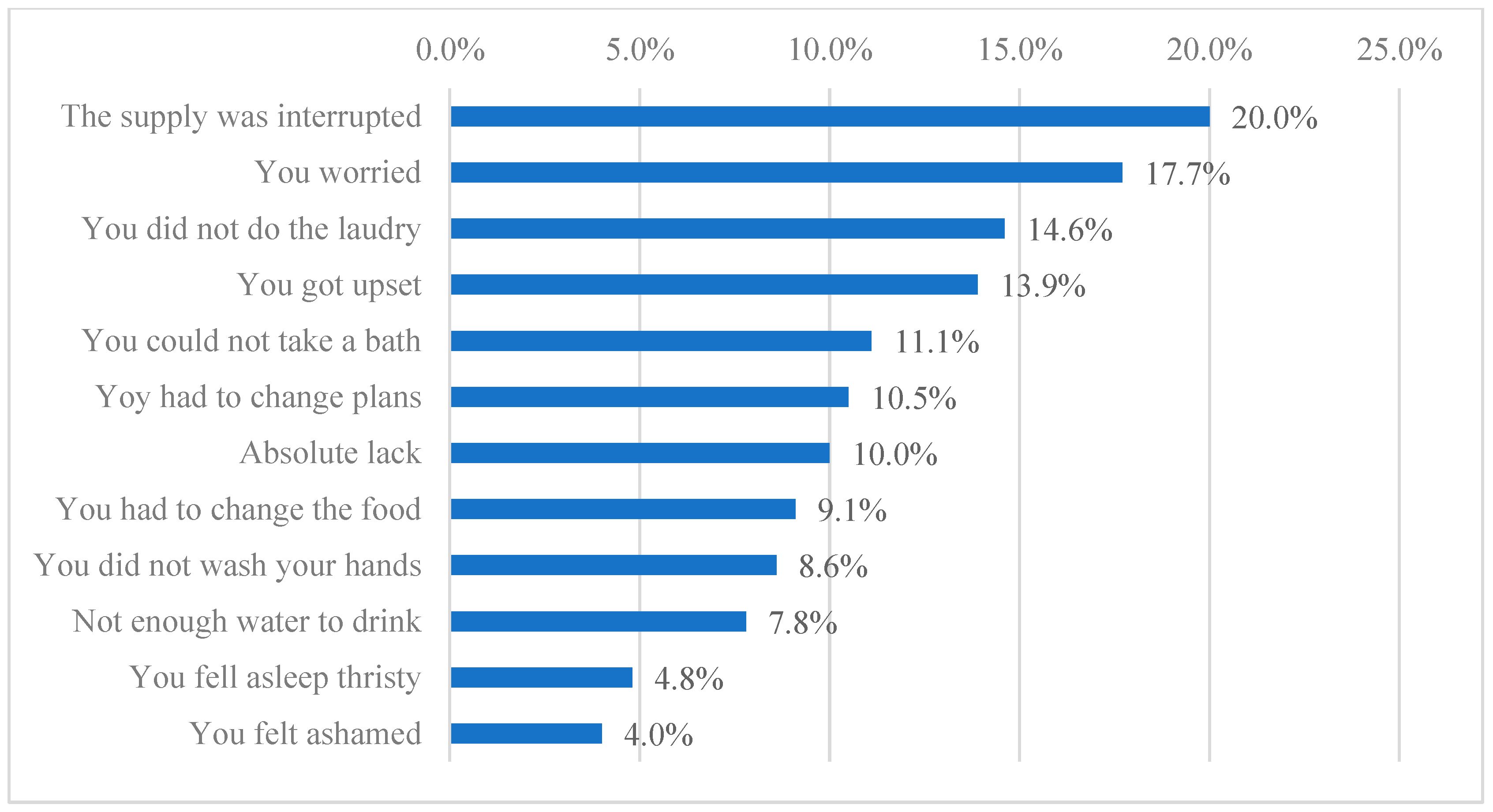
- How frequently did you or anyone in your household worry you would not have enough water for all of your household needs?
- How frequently has your main water source been interrupted or limited (e.g., water pressure, less water than expected, river dried up)?
- How frequently have problems with water meant that clothes could not be washed?
- How frequently have you or anyone in your household had to change schedules or plans due to problems with your water situation (activities that may have been interrupted include caring for others, doing household chores, agricultural work, income-generating activities, sleeping, etc.)?
- How frequently have you or anyone in your household had to change what was being eaten because there were problems with water (e.g., for washing foods, cooking, etc.)?
- How frequently have you or anyone in your household had to go without washing hands after dirty activities (e.g., defecating or changing diapers, cleaning animal dung) because of problems with water?
- How frequently have you or anyone in your household had to go without washing their body because of problems with water (e.g., not enough water, dirty, unsafe)?
- How frequently has there not been as much water to drink as you would like for you or anyone in your household?
- How frequently did you or anyone in your household feel angry about your water situation?
- How frequently have you or anyone in your household gone to sleep thirsty because there was not any water to drink?
- How frequently has there been no useable or drinkable water whatsoever in your household?
- How frequently have problems with water caused you or anyone in your household to feel ashamed/excluded/stigmatized?
2.3. Validity and Reliability Measurements
2.4. Data Analysis
3. Results
4. Discussion
5. Conclusions
Author Contributions
Funding
Institutional Review Board Statement
Informed Consent Statement
Data Availability Statement
Acknowledgments
Conflicts of Interest
Abbreviations
| CABA | Ciudad Autónoma de Buenos Aires (Autonomous City of Buenos Aires) |
| CBA | Canasta Básica Alimentaria (Basic Food Basket) |
| CBT | Canasta Básica Total (Total Basic Basket) |
| CTT | Classical Test Theory |
| EDSA | Encuesta de la Deuda Social Argentina (Argentine Social Debt Survey) |
| ENSANUT | Encuesta Nacional de Salud y Nutrición (Mexican National Health and Nutrition Survey) |
| HWISE | Household Water Insecurity Experiences |
| CI | Confidence Interval |
| KPDS-10 | Kessler Psychological Distress Scale-10 |
| SDGs | Sustainable Development Goals |
| UCA | Pontifical Catholic University of Argentina |
| UN | United Nations |
| WI | Water Insecurity |
References
- United Nations General Assembly. Universal Declaration of Human Rights. Resolution 217 A (III). 1948. Available online: https://www.acnur.org/fileadmin/Documentos/BDL/2003/2336.pdf (accessed on 25 March 2025).
- United Nations General Assembly. Convention on the Rights of the Child. 1989. Available online: https://www.un.org/es/events/childrenday/pdf/derechos.pdf (accessed on 25 March 2025).
- World Health Organization (WHO). Guidelines for Drinking-Water Quality. In Volume 1: Recommendations, 3rd ed.; World Health Organization (WHO): Geneva, Switzerland, 2011; Available online: https://iris.who.int/bitstream/handle/10665/272403/9789243549958-spa.pdf?sequence=1 (accessed on 25 March 2025).
- United Nations Committee on Economic, Social and Cultural Rights. General Comment No. 15 (Arts. 11 and 12): The Right to Water. International Covenant on Economic, Social and Cultural Rights. 2002. Available online: https://digitallibrary.un.org/record/486454?ln=es&v=pdf (accessed on 25 March 2025).
- United Nations (UN). Sustainable Development Goals. 2004. Available online: https://www.un.org/es/impacto-acad%C3%A9mico/page/objetivos-de-desarrollo-sostenible (accessed on 25 March 2025).
- World Health Organization; United Nations Children’s Fund. Progress on Household Drinking Water, Sanitation and Hygiene 2000–2020: Five Years into the SDGs; World Health Organization: Geneva, Switzerland, 2021. [Google Scholar]
- Rimba, A.B.; Hirabayashi, Y. Interlinkages of Water-Related SDG Indicators Globally and in Low-Income Countries. Water 2023, 15, 613. [Google Scholar] [CrossRef] [Scilit]
- Ingutia, R. Who is being left behind in water security, where do they live, and why are they left behind towards the achievement of the 2030 agenda? Sustain. Water Resour. Manag. 2024, 10, 168. [Google Scholar] [CrossRef] [Scilit]
- Young, S.L.; Boateng, G.O.; Jamaluddine, Z.; Miller, J.D.; Frongillo, E.A.; Neilands, T.B.; Collin, S.M.; Wutich, A.; Jepson, E.; Stoler, J. The Household Water Insecurity Experiences (HWISE) Scale: Development and validation of a household water insecurity measure for low-income and middle-income countries. BMJ Glob. Health 2019, 4, e001750. [Google Scholar] [CrossRef] [Scilit]
- Hunter, P.R.; Zmirou-Navier, D.; Hartemann, P. Estimating the impact on health of poor reliability of drinking water interventions in developing countries. Sci. Total Environ. 2009, 407, 2621–2624. [Google Scholar] [CrossRef] [Scilit] [PubMed]
- Bethancourt, H.; Frongillo, E.; Viviani, S.; Cafiero, C.; Young, S. Household water insecurity is positively associated with household food insecurity in low-and middle-income countries. Curr. Dev. Nutr. 2022, 6, 549. [Google Scholar] [CrossRef] [Scilit]
- Jepson, W.E.; Stoler, J.; Baek, J.; Martínez, J.M.; Salas, F.J.U.; Carrillo, G. Cross-sectional study to measure household water insecurity and its health outcomes in urban Mexico. BMJ Open 2021, 11, e040825. [Google Scholar] [CrossRef] [Scilit] [PubMed]
- Baisa, B.; Davis, L.W.; Salant, S.W.; Wilcox, W. The welfare costs of unreliable water service. J. Dev. Econ. 2010, 92, 1–12. [Google Scholar] [CrossRef] [Scilit]
- Majuru, B.; Mokoena, M.M.; Jagals, P.; Hunter, P.R. Health impact of small-community water supply reliability. Int. J. Hyg. Environ. Health 2011, 214, 162–166. [Google Scholar] [CrossRef] [Scilit]
- Young, S.L. The measurement of water access and use is key for more effective food and nutrition policy. Food Policy 2021, 104, 102138. [Google Scholar] [CrossRef] [Scilit]
- Aihara, Y.; Shrestha, S.; Kazama, F.; Nishida, K. Validation of household water insecurity scale in urban Nepal. Water Policy 2015, 17, 1019–1032. [Google Scholar] [CrossRef] [Scilit]
- Kumpel, E.; Nelson, K.L. Comparing microbial water quality in an intermittent and continuous piped water supply. Water Res. 2013, 47, 5176–5188. [Google Scholar] [CrossRef] [Scilit] [PubMed]
- Melgar-Quiñonez, H.; Gaitán-Rossi, P.; Pérez-Escamilla, R.; Shamah-Levy, T.; Teruel-Belismelis, G.; Young, S.L.; The Water Insecurity Experiences-Latin America; the Caribbean (WISE-LAC) Network. A declaration on the value of experiential measures of food and water insecurity to improve science and policies in Latin America and the Caribbean. Int. J. Equity Health 2023, 22, 184. [Google Scholar] [CrossRef] [Scilit] [PubMed]
- Bonfiglio, J.I.; Vera, J.; Salvia, A. Privaciones sociales y desigualdades estructurales. In Condiciones Materiales de los Hogares en un Escenario de Estancamiento Económico (2010–2022), 1st ed.; Educa: Ciudad Autónoma de Buenos Aires, Argentina, 2023. [Google Scholar]
- Tuñón, I. Retorno a la senda de privaciones que signan a la infancia argentina. In Las Deudas Sociales con la Infancia se Retrotraen a los Niveles Prepandemia, Marcando lo Estructural de las Carencias y Desigualdades Sociales que Condicionan su Desarrollo; Documento Estadístico, Barómetro de la Deuda Social de la Infancia; Serie Agenda para la Equidad (2017–2025); EDUCA: Buenos Aires, Argentina, 2023. [Google Scholar]
- Rodríguez Espínola, C.S.; Garofalo, C.S.; Paternó Manavella, M.A.; Bauso, N.; Lafferriere, F. Desigualdades y retrocesos en el desarrollo humano y social 2010–2022. In El Deterioro del Bienestar de los Ciudadanos en la Pospandemia por COVID-19, 1st ed.; Educa: Ciudad Autónoma de Buenos Aires, Argentina, 2023. [Google Scholar]
- Shamah-Levy, T.; Mundo-Rosas, V.; Muñoz-Espinosa, A.; Gómez-Humarán, I.M.; Pérez-Escamilla, R.; Melgar-Quiñones, H.; Young, S.L. Viabilidad de una escala de experiencias de inseguridad del agua en hogares mexicanos. Salud Publica Mex. 2023, 65, 219–226. [Google Scholar] [CrossRef] [Scilit]
- Stoler, J.; Miller, J.D.; Brewis, A.; Freeman, M.C.; Harris, L.M.; Jepson, W.; Pearson, A.L.; Rosinger, A.; Shah, S.; Staddon, C.; et al. Household water insecurity will complicate the ongoing COVID-19 response: Evidence from 27 sites in 23 low- and middle-income countries. Int. J. Hyg. Environ. Health 2021, 234, 113715. [Google Scholar] [CrossRef] [Scilit] [PubMed]
- Jepson, W.E.; Wutich, A.; Collins, S.M.; Boateng, G.O.; Young, S.L. Progress in household water insecurity metrics: A cross-disciplinary approach. Wiley Interdiscip. Rev. Water 2017, 4, e1214. [Google Scholar] [CrossRef] [Scilit]
- Tuñón, I.; Lamarmora, G.; Sánchez, M.E. Pobreza multidimensional infantil en España y Argentina. Un ejercicio de construcción, compatibilización y análisis de robustez. EMPIRIA Rev. Metodol. Las Ciencias Sociales 2022, 55, 57–96. [Google Scholar] [CrossRef] [Scilit]
- Nunnally, J.; Bernstein, L. Psychometric Theory, 3rd ed.; McGraw-Hill Higher, INC: New York, NY, USA, 1994. [Google Scholar]
- Bridges Jr, C.C. Hierarchical cluster analysis. Psychol. Rep. 1966, 18, 851–854. [Google Scholar] [CrossRef] [Scilit]
- Young, S.L.; Bethancourt, H.J.; Ritter, Z.R.; Frongillo, E.A. Estimating national, demographic, and socioeconomic disparities in water insecurity experiences in low-income and middle-income countries in 2020–2021: A cross-sectional, observational study using nationally representative survey data. Lancet Planet. Health 2022, 6, e880–e891. [Google Scholar] [CrossRef] [Scilit]
- Korc, M.; Hauchman, F. Advancing environmental public health in Latin America and the Caribbean. Rev. Panam. Salud Pública 2021, 45, e118. [Google Scholar] [CrossRef] [Scilit]
- Rosinger, A.Y.; Bethancourt, H.J.; Young, S.L.; Schultz, A.F. The embodiment of water insecurity: Injuries and chronic stress in lowland Bolivia. Soc. Sci. Med. 2021, 291, 114490. [Google Scholar] [CrossRef] [Scilit]
- Tuñón, I.; Bauso, N.; Maljar, M.; García, O.; Melgar Quiñonez, H. Validación cualitativa de la Escala de Inseguridad Hídrica (HWISE): Caso Gran Buenos Aires, Argentina. Agua Y Territorio, 2025; in press.
- Stoler, J.; Pearson, A.L.; Staddon, C.; Wutich, A.; Mack, E.; Brewis, A.; Rosinger, A. Cash water expenditures are associated with household water insecurity, food insecurity, and perceived stress in study sites across 20 low-and middle-income countries. Sci. Total Environ. 2020, 716, 135881. [Google Scholar] [CrossRef] [Scilit] [PubMed]
- Boateng, G.O.; Neilands, T.B.; Frongillo, E.A.; Melgar-Quiñonez, H.R.; Young, S.L. Best practices for developing and validating scales for health, social, and behavioral research: A primer. Front. Public Health 2018, 6, 149. [Google Scholar] [CrossRef] [Scilit] [PubMed]
- Frongillo, E.A.; Nanama, S.; Wolfe, W.S. Technical Guide to Developing a Direct, Experience-Based Measurement Tool for Household Food Insecurity; Food and Nutrition Technical Assistance, Academy for Educational Development: Washington, DC, USA, 2004; pp. 1–51. Available online: https://www.fantaproject.org/sites/default/files/resources/Experience-Expression-Food-Insecurity-Apr2004.pdf (accessed on 25 March 2025).
- Schuster, R.C.; Butler, M.S.; Wutich, A.; Miller, J.D.; Young, S.L.; Household Water Insecurity Experiences-Research Coordination Network (HWISE-RCN); Workman, C. “If there is no water, we cannot feed our children”: The far-reaching consequences of water insecurity on infant feeding practices and infant health across 16 low-and middle-income countries. Am. J. Hum. Biol. 2020, 32, e23357. [Google Scholar] [CrossRef] [Scilit]
- Workman, C.L.; Ureksoy, H. Water insecurity in a syndemic context: Understanding the psycho-emotional stress of water insecurity in Lesotho, Africa. Soc. Sci. Med. 2017, 179, 52–60. [Google Scholar] [CrossRef] [Scilit] [PubMed]
- Satterthwaite, D. The millennium development goals and urban poverty reduction: Great expectations and nonsense statistics. Environ. Urban. 2003, 15, 179–190. [Google Scholar] [CrossRef] [Scilit]
- Workman, C.L.; Brewis, A.; Wutich, A.; Young, S.; Stoler, J.; Kearns, J. Understanding biopsychosocial health outcomes of syndemic water and food insecurity: Applications for global health. Am. J. Trop. Med. Hyg. 2021, 104, 8–11. [Google Scholar] [CrossRef] [Scilit]
- Brewis, A.; Choudhary, N.; Wutich, A. Household water insecurity may influence common mental disorders directly and indirectly through multiple pathways: Evidence from Haiti. Soc. Sci. Med. 2019, 238, 112520. [Google Scholar] [CrossRef] [Scilit] [PubMed]
- Bose, I.; Bethancourt, H.J.; Shamah-Levy, T.; Mundo-Rosas, V.; Muñoz-Espinosa, A.; Ginsberg, T.; Kadiyala, S.; Frongillo, E.A.; Gaitán-Rossi, P.; Young, S.L. Mental health, water, and food: Relationships between water and food insecurity and probable depression amongst adults in Mexico. J. Affect. Disord. 2025, 370, 348–355. [Google Scholar] [CrossRef] [Scilit]
- Young, S.L.; Frongillo, E.A.; Jamaluddine, Z.; Melgar-Quiñonez, H.; Pérez-Escamilla, R.; Ringler, C.; Rosinger, A.Y. Perspective: The importance of water security for ensuring food security, good nutrition, and well-being. Adv. Nutr. 2021, 12, 1058–1073. [Google Scholar] [CrossRef] [Scilit]
- Mehta, L.; Movik, S. Liquid dynamics: Challenges for sustainability in the water domain. Wiley Interdiscip. Rev. Water 2014, 1, 369–384. [Google Scholar] [CrossRef] [Scilit]


| Variable | Operational Definition | Variable Values |
|---|---|---|
| Poverty [19] | Percentage of households whose income does not allow them to acquire the value of the Total Basic Basket (CBT) and/or does not allow them to acquire the value of the Basic Food Basket (CBA). | 0. Not poor 1. Poor but not indigent 2. Homeless |
| Food insecurity [19] | Percentage of households that reported reducing food portions and/or experiencing hunger due to economic hardship during the past 12 months. | Moderate Deficit: Households in which it is expressed that they had to reduce the portion of food in the last 12 months. Severe Deficit: Households in which it is expressed that they have felt hungry in the last 12 months. Secure: Households in which it is not reported that they have reduced the portion of food in the last 12 months. |
| Socioeconomic level in quartiles [20] | Percentage of households that are classified into four categories based on a factorial index that takes into account the educational capital of the head of household, access to durable household goods, and the residential condition of the housing, this index being re-coded into socioeconomic strata according to quartiles of the distribution. | 1. Very low (1st quartile) 2. Low (2nd quartile) 3. Middle (3rd quartile) 4. Middle–high (top 25%) |
| Urban agglomeration [20] | Percentage of households residing in four large regions of urban agglomerations taken in the sample according to their spatial distribution, geopolitical importance, and degree of socioeconomic consolidation. | 1. Autonomous City of Buenos Aires 2. Buenos Aires Metropolitan Area 3. Other metropolitan areas 4. Other urban areas in the interior |
| Neighborhood type [19] | Percentage of households residing in three different forms of urbanization with varying degrees of formality in terms of planning, regulation, and public investment in urban assets and with a heterogeneous presence of different socioeconomic levels. | 1. Emergency village/settlement 2. Social housing/monoblocks 3. With an urban layout |
| Lack of access to the sewer network [19] | Percentage of households living in homes without access to the sewer network. | 0. With access 1. No access |
| Perception of lack of water in the home [19] | Percentage of households in which the respondent reports that the neighborhood has the problem of a lack of water. | 0. No deficit 1. Deficit |
| Psychological distress [21] | Percentage of households in which the respondent reports having symptoms of anxiety and depression, integrated into a score that indicates a moderate or high risk of psychological distress on the KPDS-10 scale (score ranging from 10 to 50 points, and the distribution is categorized into tertiles). | 1. High 2. Moderate 3. Low |
| % | 95% CI * | ||
|---|---|---|---|
| OVERALL AVERAGE | 6.5% | 5.6% | 7.5% |
| SEX OF HEAD OF HOUSEHOLD | |||
| Female | 6.8% | 5.5% | 8.3% |
| Male | 6.3% | 5.2% | 7.6% |
| AGE OF THE HEAD OF HOUSEHOLD | |||
| 18 to 29 years old | 5.4% | 3.6% | 7.8% |
| 30–49 | 7.2% | 5.8% | 9.0% |
| More than 50 years old | 6.1% | 4.9% | 7.5% |
| ACCESS TO THE SEWER NETWORK | |||
| No access | 10.8% | 8.7% | 13.4% |
| With access | 4.9% | 4.1% | 5.9% |
| PRESENCE OF CHILDREN AND ADOLESCENTS IN THE HOME | |||
| With children | 8.6% | 7.2% | 10.3% |
| Without children | 4.3% | 3.4% | 5.4% |
| SOCIOECONOMIC LEVEL | |||
| Very low | 12.8% | 10.4% | 15.6% |
| Low | 7.0% | 5.4% | 9.1% |
| Middle | 3.4% | 2.4% | 4.8% |
| Middle–high | 2.4% | 1.5% | 3.8% |
| POVERTY AND INDIGENCE BY INCOME | |||
| Indigent | 14.0% | 9.6% | 20.0% |
| Poor but not indigent | 10.1% | 8.1% | 12.6% |
| Not poor | 4.1% | 3.3% | 5.0% |
| URBAN REGIONS | |||
| Autonomous City of Buenos Aires | 1.7% | 0.6% | 4.3% |
| Buenos Aires Metropolitan Area | 8.0% | 6.4% | 9.9% |
| Other metropolitan areas | 7.1% | 6.0% | 8.4% |
| Other urban areas in the interior | 6.0% | 4.7% | 7.7% |
| TYPE OF NEIGHBORHOOD | |||
| Emergency village/settlement | 12.6% | 7.9% | 19.3% |
| Social housing/monoblocks | 23.2% | 14.0% | 36.0% |
| With an urban layout | 5.9% | 5.0% | 6.8% |
| % | 95% CI * | ||
|---|---|---|---|
| OVERALL AVERAGE | 6.5% | 5.6% | 7.5% |
| FOOD INSECURITY | |||
| Severe | 23.1% | 17.8% | 29.3% |
| Moderate | 12.5% | 9.1% | 16.9% |
| Secure | 3.8% | 3.1% | 4.6% |
| PSYCHOLOGICAL DISTRESS | |||
| High | 10.5% | 8.5% | 12.9% |
| Moderate | 5.2% | 4.1% | 6.7% |
| Low | 4.3% | 3.1% | 5.8% |
| WI | |
|---|---|
| Female head of household | 0.127 |
| (0.156) | |
| Age of the head of household | 0.005 |
| (0.005) | |
| Household has no access to sewers | 0.360 ** |
| (0.181) | |
| Presence of children (0 to 17 years) in the home | 0.324 * |
| (0.180) | |
| POVERTY LEVEL (BASE = not poor) | |
| Poor but not indigent | 0.621 *** |
| (0.184) | |
| Indigent | 0.914 *** |
| (0.264) | |
| URBAN AGGLOMERATION (BASE = CABA) | |
| Greater Buenos Aires | 1.222 ** |
| (0.546) | |
| Other large metropolitan areas | 1.188 ** |
| (0.531) | |
| The rest of the urban areas | 1.103 ** |
| (0.544) | |
| TYPE OF NEIGHBORHOOD (BASE = with urban layout) | |
| Social housing/monoblocks | 1.515 *** |
| (0.310) | |
| Emergency village/settlement | 0.669 ** |
| (0.291) | |
| With an urban layout | −4.798 *** |
| (0.613) | |
| Pseudo-R2 | 0.0714 |
| Remarks | 5.684 |
| Cronbach’s Apha If the Item Is Deleted | |
|---|---|
| Total alpha (without the deletion of any items) | 0.95 |
| The supply was interrupted | 0.94 |
| You worried | 0.94 |
| You did not do the laundry | 0.94 |
| You got upset | 0.94 |
| You could not take a bath | 0.94 |
| You had to change plans | 0.94 |
| Absolute lack | 0.94 |
| You had to change the food | 0.94 |
| You did not wash your hands | 0.94 |
| Not enough water to drink | 0.94 |
| You fell asleep thirsty | 0.95 |
| You felt ashamed | 0.95 |
| Beta coefficient | 0.81 |
| Lambda 2 | 0.95 |
| Lambda 3 = alpha | 0.95 |
| Lambda 4 | 0.97 |
| Omega_t | 0.96 |
Disclaimer/Publisher’s Note: The statements, opinions and data contained in all publications are solely those of the individual author(s) and contributor(s) and not of MDPI and/or the editor(s). MDPI and/or the editor(s) disclaim responsibility for any injury to people or property resulting from any ideas, methods, instructions or products referred to in the content. |
© 2025 by the authors. Licensee MDPI, Basel, Switzerland. This article is an open access article distributed under the terms and conditions of the Creative Commons Attribution (CC BY) license.
Share and Cite
Tuñón, I.; Maljar, M.; Bauso, N.; García, O.P.; Quiñonez, H.M. Validity and Reliability Analysis of the Household Water Insecurity Experiences Scale: The Case of Argentina. Sustainability 2026, 18, 3707. https://doi.org/10.3390/su18083707
Tuñón I, Maljar M, Bauso N, García OP, Quiñonez HM. Validity and Reliability Analysis of the Household Water Insecurity Experiences Scale: The Case of Argentina. Sustainability. 2026; 18(8):3707. https://doi.org/10.3390/su18083707
Chicago/Turabian StyleTuñón, Ianina, Matías Maljar, Nazarena Bauso, Olga P. García, and Hugo Melgar Quiñonez. 2026. "Validity and Reliability Analysis of the Household Water Insecurity Experiences Scale: The Case of Argentina" Sustainability 18, no. 8: 3707. https://doi.org/10.3390/su18083707
APA StyleTuñón, I., Maljar, M., Bauso, N., García, O. P., & Quiñonez, H. M. (2026). Validity and Reliability Analysis of the Household Water Insecurity Experiences Scale: The Case of Argentina. Sustainability, 18(8), 3707. https://doi.org/10.3390/su18083707