1. Introduction
Forest harvesting and log-yard transportation constitute one of the most energy-intensive and environmentally sensitive stages of the forestry supply chain [
1]. As concerns about global climate change intensify, the transportation sector has become a major contributor to greenhouse gas emissions, and road transportation accounts for a substantial proportion of energy-related CO
2 emissions, exerting long-term impacts on both the global climate system and regional ecological environments [
2]. In forest operations, timber transportation activities typically rely on diesel-powered vehicles [
3]. The resulting carbon emissions are determined not only by transportation distance but also by payload and operating conditions associated with forest road characteristics [
4,
5]. In this study, vehicle speed is treated as an exogenous parameter determined by road class, representing typical operating conditions of forest transportation networks. Meanwhile, frequent truck traffic along forest and skid roads may induce considerable surface disturbance [
6], including soil compaction, rut formation, and increased risks of soil erosion, which may negatively affect soil structure and long-term forest productivity [
7,
8]. Ecological disturbance and carbon emissions are considered jointly in this study because they represent two complementary but non-equivalent dimensions of environmental sustainability in forest transportation systems [
9]. Under the dual pressures of climate change mitigation and ecological conservation, reducing carbon emissions and minimizing surface disturbance while maintaining transportation efficiency and operational schedules has therefore become a central research challenge in forest transportation system optimization.
In typical forest operations involving multiple trucks, inherent trade-offs arise among distance, time, ecological disturbance, and carbon emissions. Shortening total transportation distance may disrupt workload balance across vehicles and consequently increase the overall completion time (makespan) [
10,
11], because a solution with a smaller sum of route lengths can still assign a disproportionately long route to the last-returning vehicle [
12]. Moreover, compared with purely distance-based proxies, emission estimation can be improved by incorporating vehicle load and road-class-dependent operating parameters, because fuel use in timber transportation differs substantially between empty and loaded movements. In this framework, representative travel speeds are predefined for each road class and are not treated as optimization variables [
13]. These interactions highlight the need to consider forest road hierarchy, surface disturbance mechanisms, and load-dependent fuel consumption within a unified multi-objective routing and scheduling framework, thereby supporting computational decision-making for log-yard operations that aim to achieve timely completion, lower ecological disturbance, and reduced carbon emissions simultaneously [
14,
15,
16].
Vehicle Routing Problems (VRP) and their multi-objective extensions have long relied on evolutionary computation and swarm intelligence for approximate solutions. The NSGA-II framework is widely applied for Pareto-based multi-objective optimization and trade-off exploration [
17], while MOEA/D enhances scalability by decomposing multi-objective problems into coordinated subproblems [
18]. At the route improvement level, local search operators such as 2-opt and Or-opt have been demonstrated to effectively shorten routes and improve path structures, forming essential components of many high-performance VRP heuristics [
19]. In the context of green or pollution-routing research, scholars have emphasized that fuel consumption and emissions may depend on payload and travel conditions, leading to the development of Pollution Routing Problems (PRP) and time-dependent fuel consumption models in which speed is often treated as an exogenous parameter or defined according to road categories [
5,
20]. Beyond environmental routing, recent transportation decision studies have also begun to incorporate runtime safety-aware mechanisms into intelligent mobility systems; for example, Huang et al. (2026) developed a runtime-enabled active collision-avoidance framework for autonomous driving, highlighting the broader trend toward context-aware and constraint-sensitive decision frameworks in transportation intelligence [
21]. In parallel, forestry-specific modeling and algorithmic studies have gradually emerged to address harvesting, transportation routing, and scheduling problems [
22]. Compared with previous VRP studies, the present work incorporates ecological disturbance considerations into the evolutionary search process.
To date, prior forestry transportation-routing studies have mainly optimized cost, time, allocation, or carbon emissions, whereas surface disturbance has usually been discussed in forest-road planning or soil-impact assessment rather than formulated as a co-equal operational routing objective; therefore, studies that jointly optimize distance, makespan, ecological disturbance, and CO
2 emissions in a hierarchical forest road network remain very limited. One reason is that disturbance metrics are often closely related to road types and edge traversal frequencies, resulting in sharper objective landscapes and increased susceptibility to local optima. In addition, approximating carbon emissions solely by distance may be overly coarse for forestry logistics, where incorporating payload-dependent terms and road-class-dependent operating parameters can better represent emission variability across forest road segments [
23,
24]. Furthermore, conventional crossover and mutation operators may become ineffective in highly constrained VRP search spaces, leading to search stagnation. Lévy flight, characterized by heavy-tailed step-length distributions, provides a mechanism for occasional long jumps that can help algorithms escape local structural traps [
25,
26]. If these limitations persist, transportation optimization in log-yard operations may result in solutions that fail to reduce completion time, control ecological disturbance, or achieve verifiable emission reductions, ultimately limiting the applicability and credibility of optimization algorithms in low-carbon and eco-constrained forestry logistics.
Recent studies increasingly emphasize the importance of incorporating environmental objectives such as fuel consumption and carbon emissions into vehicle routing optimization, highlighting the role of multi-objective optimization methods in balancing operational efficiency with environmental sustainability [
27,
28]. A time-dependent green vehicle routing study proposed a machine-learning-assisted NSGA-II framework to improve the joint optimization of distance, travel time, and fuel-related performance [
29]. A recent multi-objective evolutionary study also proposed constraint-compliant initialization and domain-specific operators for electric-vehicle routing integrated with energy transport, highlighting the growing importance of problem-specific feasible-search mechanisms in modern routing optimization [
30]. In this context, the present study focuses on the multi-vehicle routing and scheduling problem in forest log-yard transportation. Without sacrificing performance in completion time, the study aims to systematically reduce surface disturbance and CO
2 emissions. The research objective is to characterize and solve the interpretable trade-offs among distance, makespan, disturbance, and carbon emissions within a unified multi-objective framework, while reducing the risk that ecologically favorable solutions are eliminated during evolutionary selection [
31]. The study considers a single-depot, multi-vehicle operational scenario with deterministic service times and road hierarchy parameters [
32]. Surface disturbance is modeled using road-class disturbance coefficients and traversal frequencies [
33], while carbon emissions are derived from a load-dependent fuel consumption model combined with emission conversion factors [
34]. The overall modeling framework emphasizes computational tractability, comparability, and reproducibility for engineering-oriented implementation.
The remainder of this paper is organized as follows.
Section 2 presents the Problem Statement and Formulation, defining the multi-objective model and constraints integrating road hierarchy, disturbance, and fuel consumption.
Section 3 introduces the ECLS-NSGA-II Algorithm Design, describing eco-constrained initialization, Lévy-flight mutation, and hybrid local search mechanisms.
Section 4 reports the Numerical Experiments, including algorithm comparisons and robustness validation. Finally,
Section 5 concludes the study and discusses limitations and future research directions.
2. Problem Statement and Formulation
The forest log-yard transportation scheduling problem can be formulated as a Multi-Objective Vehicle Routing Problem (MO-VRP) with ecological and carbon emission constraints. In recent years, timber transportation has been recognized as one of the most energy-intensive and environmentally sensitive stages of the forest supply chain, generating considerable carbon emissions and soil disturbance, which has drawn increasing attention in sustainable forest operations research [
27,
35]. However, most existing vehicle routing studies primarily focus on economic objectives such as distance or cost minimization, while ecological impacts and forest compartment constraints are rarely incorporated simultaneously into routing models, leaving a significant research gap in environmentally sustainable forest transportation planning [
28]. Accordingly, consider a forest transportation system consisting of one depot (node 0) and
harvesting sites
, forming the node set
. The system operates with
homogeneous transport vehicles
, each with a maximum loading capacity
. Each harvesting site
has a timber demand
, service time
, and spatial coordinates
. The forest management area is divided into several compartments
, and each harvesting node is associated with a compartment label
. The route of vehicle
is denoted as
.
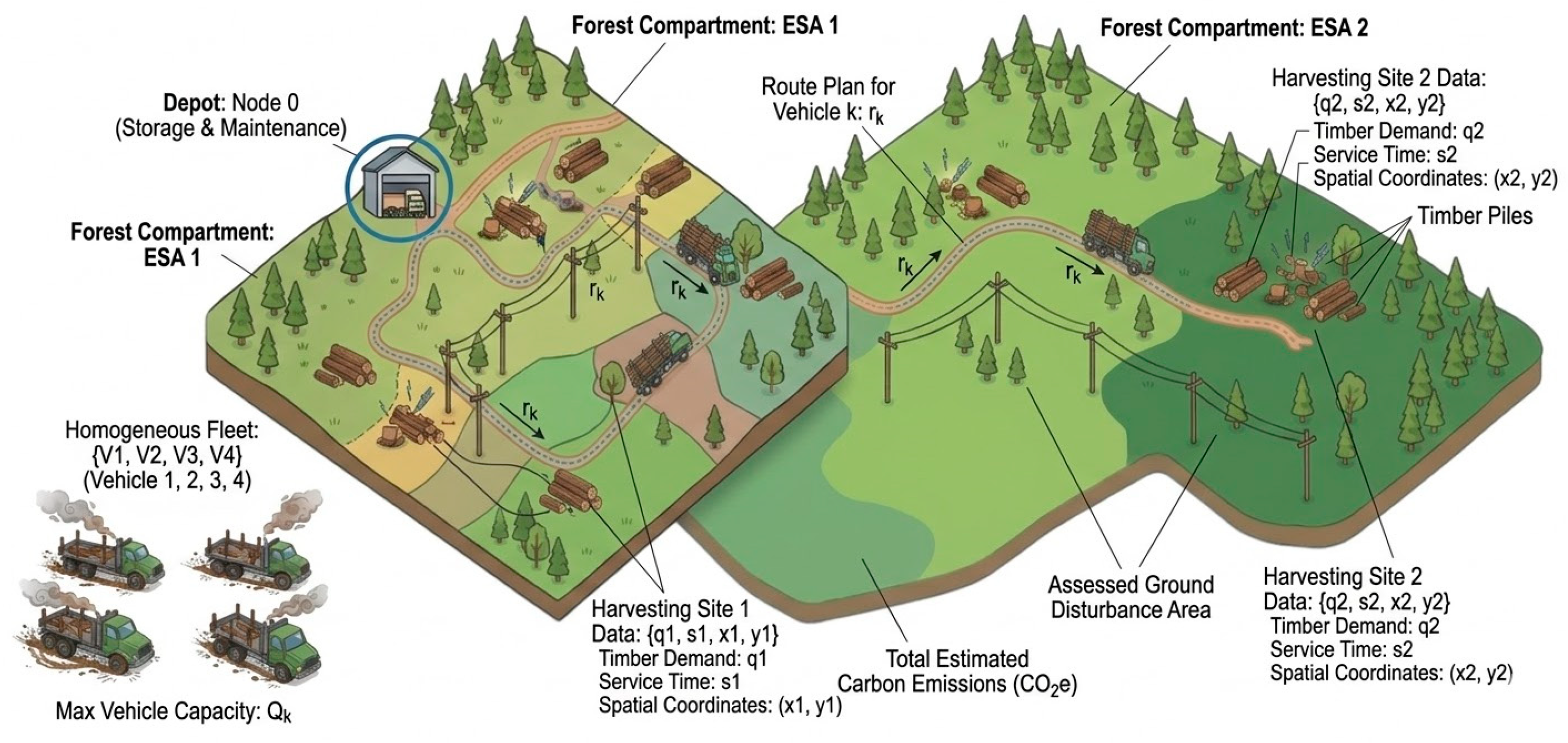
Figure 1 schematically illustrates the conceptual forest transportation framework considered in this study. It is intended to explain the depot–site–vehicle relationship and environmental impact pathways rather than to define the numerical experimental parameters. The system consists of a central depot, multiple harvesting sites located in different forest compartments, and a fleet of homogeneous transport vehicles that transport timber along forest roads. Each harvesting site is characterized by timber demand, service time, and spatial coordinates, while vehicles operate under capacity constraints and follow specific routing plans. During transportation, vehicle movements generate both operational costs and environmental impacts, including soil disturbance along road segments and carbon emissions from fuel consumption. This framework forms the basis for modeling the problem as a multi-objective vehicle routing problem with ecological and carbon constraints.
In forest transportation systems, road classes influence both operational efficiency and ecological disturbance. To represent these effects, the transportation infrastructure is modeled as a sparse road graph , where nodes denote depots, log landings, or harvesting sites, and edges represent feasible road segments. Unlike classical vehicle routing problems defined on complete graphs, node pairs are considered directly connected only when a feasible road segment exists.
Each edge
is assigned a road class
. Road-class-specific parameters—including travel speed
, tortuosity coefficient
, and disturbance weight—are defined on edges rather than arbitrary node pairs. This formulation ensures that routing decisions reflect the hierarchical structure of forest transportation networks. For an edge
, the geometric distance between nodes is corrected using a class-dependent tortuosity factor to approximate the actual drivable distance under terrain constraints:
where
denotes a road-class-dependent circuity correction used to approximate actual drivable distance under terrain and alignment constraints, including road curvature, slope avoidance, and engineering detours.
represents a feasible path connecting nodes
and
in the road network. For node pairs that are not directly connected, the effective transportation distance is obtained through the shortest-path aggregation of segment distances. Based on this path representation, travel time, ecological disturbance, and fuel consumption are accumulated along the same sequence of road segments, forming a road-class-driven spatially coupled cost structure integrating transportation distance, travel time, environmental disturbance, and energy consumption.
Forest transportation networks commonly follow a three-level hierarchy consisting of main haul roads, secondary forest roads, and skid trails. These road classes differ in road standard, vehicle accessibility, and environmental impact [
6,
36]. Accordingly, each edge is assigned a class
, where higher classes represent better road conditions, higher speeds, and lower tortuosity [
37]. The forest road classification adopted in the transportation network model is summarized in
Table 1.
Where
represents the road class connecting nodes
and
, and
is the tortuosity coefficient representing the influence of terrain constraints such as winding forest roads, slope, and detours. Such corrected distance metrics are widely used in forest transportation planning and road network modeling [
38].
The three-level road hierarchy adopted in this study reflects the typical structure of forest transportation systems, where trunk haul roads serve long-distance timber transport, secondary roads distribute traffic within forest compartments, and skid trails provide direct harvesting access.
Based on the road distance, the travel time between nodes can be estimated using the average speed associated with each road class. In this study, vehicle speed is treated as an exogenous parameter determined by road class, reflecting typical operational conditions on different forest road types rather than a decision variable in the optimization process. Since road curvature and slope may increase travel resistance, the travel time is expressed as
where
is the average speed associated with road class
, and
is a geometric correction factor accounting for terrain- and alignment-related extension of actual travel distance relative to geometric node-to-node distance, reflecting the fact that forest-road circuity varies with road type, slope position, and terrain constraints [
39]. Distance-speed-based time estimation is a standard approach in forest transportation planning and forest operations research [
40].
Frequent traffic of heavy forestry vehicles on forest roads often causes significant surface disturbance, including soil compaction, rut formation, and degradation of soil structure. Previous studies have shown that soil disturbance does not accumulate in a strictly linear manner with repeated vehicle passes, but instead depends on traffic intensity, soil condition, and corridor type [
7,
8,
41]. Accordingly, the surface disturbance index is defined as
where
denotes a relative disturbance-severity coefficient associated with road class, reflecting the fact that lower-standard traffic corridors generally exhibit higher disturbance potential than more stable transportation surfaces [
8,
42], and
represents a nonlinear repeated-traffic amplification parameter introduced to reflect the literature-supported nonlinearity of pass effects on forest soil disturbance [
8,
41]. Similar disturbance accumulation models based on traffic intensity and road type are commonly used in forest operations environmental impact studies.
Regarding carbon emissions, vehicle fuel consumption is modeled as a function of travel distance, vehicle load, and road conditions. Following the Pollution Routing Problem (PRP) framework [
5], the fuel consumption of vehicle
on arc
can be expressed as
where
denotes the cumulative load of vehicle
when traveling on arc
,
represents the base fuel consumption rate under empty load,
and
represent linear and nonlinear load-dependent fuel consumption coefficients, and
denotes the additional fuel consumption associated with the road class
, reflecting the combined effects of road roughness, curvature, and representative operating conditions associated with that road type. In this formulation, the influence of vehicle speed is implicitly represented through road-class-dependent parameters rather than explicitly optimized. The base fuel consumption rate is set to 0.30 L/km, while the load-dependent coefficient is 0.005 L/(km·t), representing typical fuel consumption parameters for heavy logging trucks under forest transportation conditions.
Total diesel consumption can then be converted into CO
2 emissions through a standard emission factor. According to green transportation research [
34], the total carbon emissions of the transportation system can be calculated as
where
denotes the emission factor of diesel fuel.
Combining the above formulations, the forest log-yard multi-vehicle routing problem can be expressed as a four-objective optimization problem:
This formulation simultaneously captures the trade-offs between transportation efficiency (distance and makespan) and environmental impacts (surface disturbance and carbon emissions). Due to vehicle capacity constraints, node visit constraints, and path sequence coupling, the problem belongs to the class of NP-hard combinatorial optimization problems, whose computational complexity grows exponentially with the number of nodes [
43,
44]. Consequently, efficient multi-objective evolutionary algorithms are typically employed to approximate high-quality Pareto-optimal solutions.
3. ECLS-NSGA-II Algorithm Design
The forest log-yard transportation scheduling problem can be formulated as a multi-objective vehicle routing problem (MO-VRP) that simultaneously considers operational efficiency, ecological disturbance, and carbon emissions. In recent years, transportation optimization models have increasingly incorporated environmental objectives due to the growing recognition that freight transport contributes significantly to global greenhouse gas emissions and ecological impacts. In forest operations, heavy truck traffic can lead to soil compaction, rutting, and long-term degradation of forest soil structure, which directly affects ecosystem productivity and hydrological processes [
28,
33]. These environmental pressures highlight the necessity of integrating disturbance-aware and emission-aware optimization mechanisms into forest transportation planning.
Although the classical NSGA-II framework has been widely applied in multi-objective vehicle routing problems, several limitations arise when it is directly applied to environmentally constrained forest transportation systems. First, standard NSGA-II typically uses random initialization, which often produces routing solutions with severe ecological disturbance in early generations, resulting in inefficient exploration in environmentally constrained search spaces. Second, traditional mutation and crossover operators mainly rely on short-range perturbations, which can easily lead to search stagnation in highly constrained routing problems such as forest transportation networks. Third, Pareto selection in NSGA-II does not explicitly protect ecological extreme solutions, which may cause environmentally favorable routing structures to disappear during evolutionary competition.
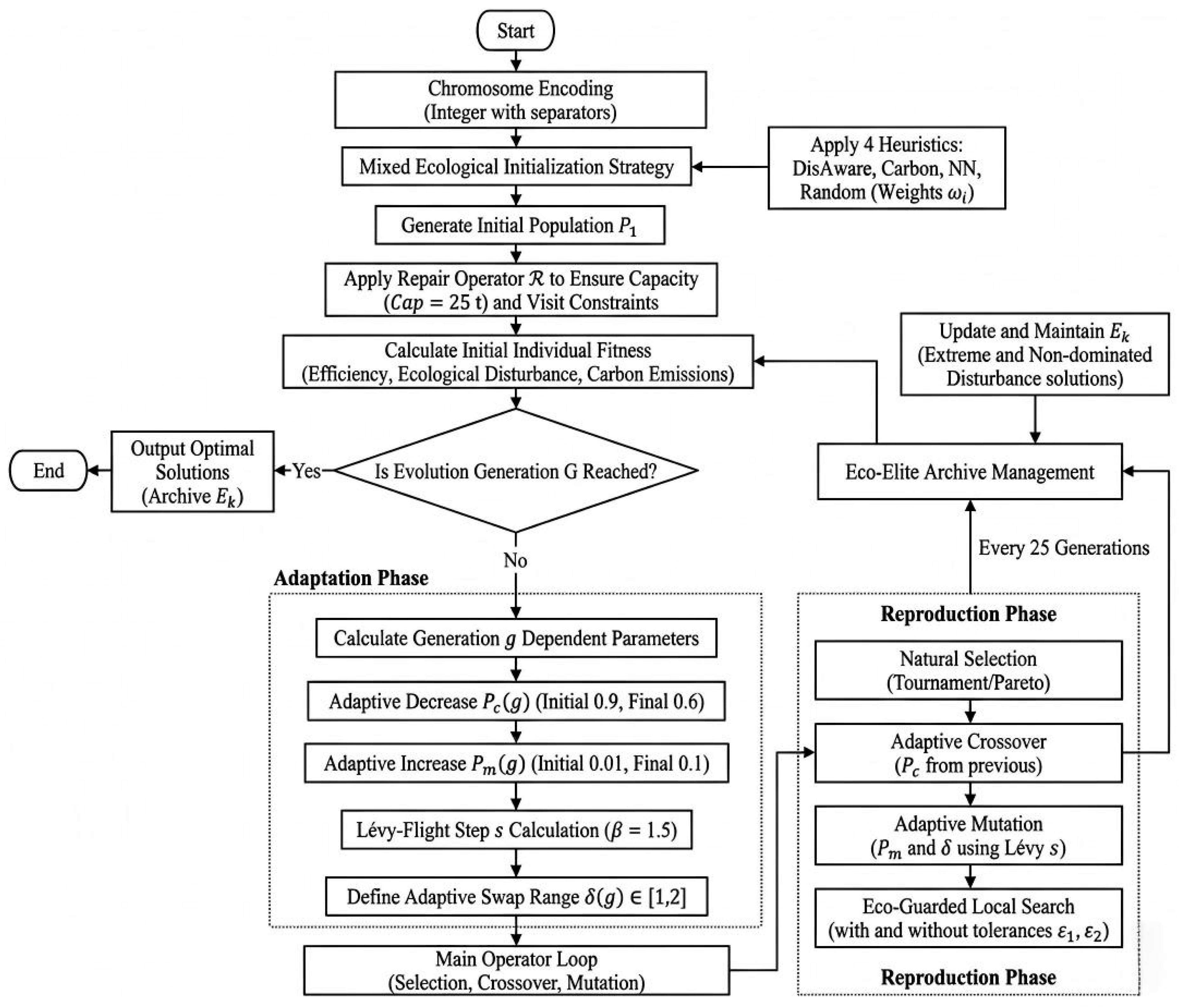
To address the ecological and operational challenges described above, this study develops an Eco-Constrained Lévy-flight Local Search NSGA-II (ECLS-NSGA-II) framework for solving the forest transportation routing problem. The overall optimization procedure is illustrated in
Figure 2, which integrates ecological initialization, adaptive evolutionary operators, eco-guarded local search, and eco-elite archive management into a unified multi-objective evolutionary framework. The algorithm begins with a mixed ecological initialization strategy that generates feasible routing solutions using multiple heuristic rules considering disturbance, carbon emission, nearest-neighbor proximity, and random exploration. During the evolutionary process, adaptive crossover and mutation operators dynamically adjust exploration and exploitation according to the generation index, while Lévy-flight mutation introduces long-range perturbations that help escape local optima. In addition, an eco-elite archive periodically stores extreme ecological solutions and reinjects them into the population to preserve environmentally favorable routing structures. This framework enables the algorithm to balance transportation efficiency, ecological disturbance, and carbon emissions in a unified evolutionary search process.
A transportation solution is encoded as an integer chromosome with route separators:
which is decoded into vehicle routes
where node
denotes the depot and
represents the route of vehicle
. During decoding, a repair operator
is applied to ensure feasibility with respect to capacity and visit constraints. The repaired solution set therefore satisfies
subject to
where
denotes timber demand and
represents vehicle capacity. In practical forest transport operations, heavy timber trucks typically operate under medium-to-high payload conditions, and in this study the vehicle capacity is set to 45 t in accordance with the numerical experiment setting, and in this study the capacity parameter is set as
, the following typical logging truck specifications reported in forestry transportation studies [
33].
Unlike the standard NSGA-II algorithm that relies on purely random initialization, the proposed framework introduces a mixed ecological initialization strategy to generate environmentally feasible routing structures in the early population. To improve initial solution quality while maintaining population diversity, the algorithm adopts a mixed ecological initialization strategy. The initial population
is generated using four constructive heuristics: disturbance-aware initialization
, carbon-guided initialization
, nearest-neighbour initialization
, and random initialization
. The population generation process follows the mixture distribution
where the mixture weights are defined as
. These proportions are selected to ensure that disturbance-aware solutions dominate the early population while maintaining sufficient structural diversity for evolutionary search. During diversity perturbation, swap operators are applied with probabilities
,
, and
. Similar probabilistic perturbation mechanisms have been widely used to maintain diversity in evolutionary multi-objective optimization algorithms [
31].
The disturbance-aware constructor assigns harvesting nodes to vehicles using a compartment conflict-minimization rule
where
candidate solutions are generated and evaluated. This repeated sampling strategy has been shown to improve ecological robustness in routing heuristics [
25].
To balance exploration and exploitation across evolutionary generations, the crossover probability is adaptively decreased according to
where the initial crossover probability is
and the final value is
. These values fall within the commonly recommended range of 0.6–0.9 for evolutionary recombination operators [
31]. The mutation probability follows a complementary schedule
where
and
. Similar adaptive mutation schedules have been widely adopted in multi-objective evolutionary algorithms to prevent premature convergence [
18].
To overcome the limited exploration capability of conventional mutation operators, the proposed algorithm introduces a Lévy-flight mutation mechanism that enables occasional long-distance structural perturbations. Mutation intensity is controlled by a Lévy-flight step mechanism
where the stability parameter is set to
. Lévy distributions with
are commonly used in metaheuristic optimization because they enable occasional long-distance exploration steps that help algorithms escape local optima [
26]. The scale parameter is calculated using the Mantegna sampling formulation
The number of swap operations triggered by mutation is determined as
This mechanism allows up to two swaps in the early generations while restricting late-stage mutations to smaller structural adjustments.
To protect environmentally favorable solutions during local search, two ecological acceptance criteria are introduced. The disturbance-guarded 2-opt operator accepts a move only if transportation distance decreases while disturbance does not increase
where the tolerance parameter is set as
[
31], following numerical precision recommendations in evolutionary optimization.
A second eco-constrained 2-opt rule minimizes a composite ecological cost function
where the ecological weight coefficient is set as
. A candidate route is accepted only if
where the allowable completion-time tolerance is set to
h. Similar relaxed acceptance strategies have been used to maintain operational feasibility in green routing optimization [
34].
To further preserve ecological extreme solutions during evolutionary selection, an external eco-elite archive is maintained
where
with
. The eco-elite archive is reintroduced into the population every 25 generations, which prevents ecological optimal solutions from disappearing during Pareto selection. Such external archiving mechanisms are commonly used to maintain solution diversity in multi-objective evolutionary algorithms.
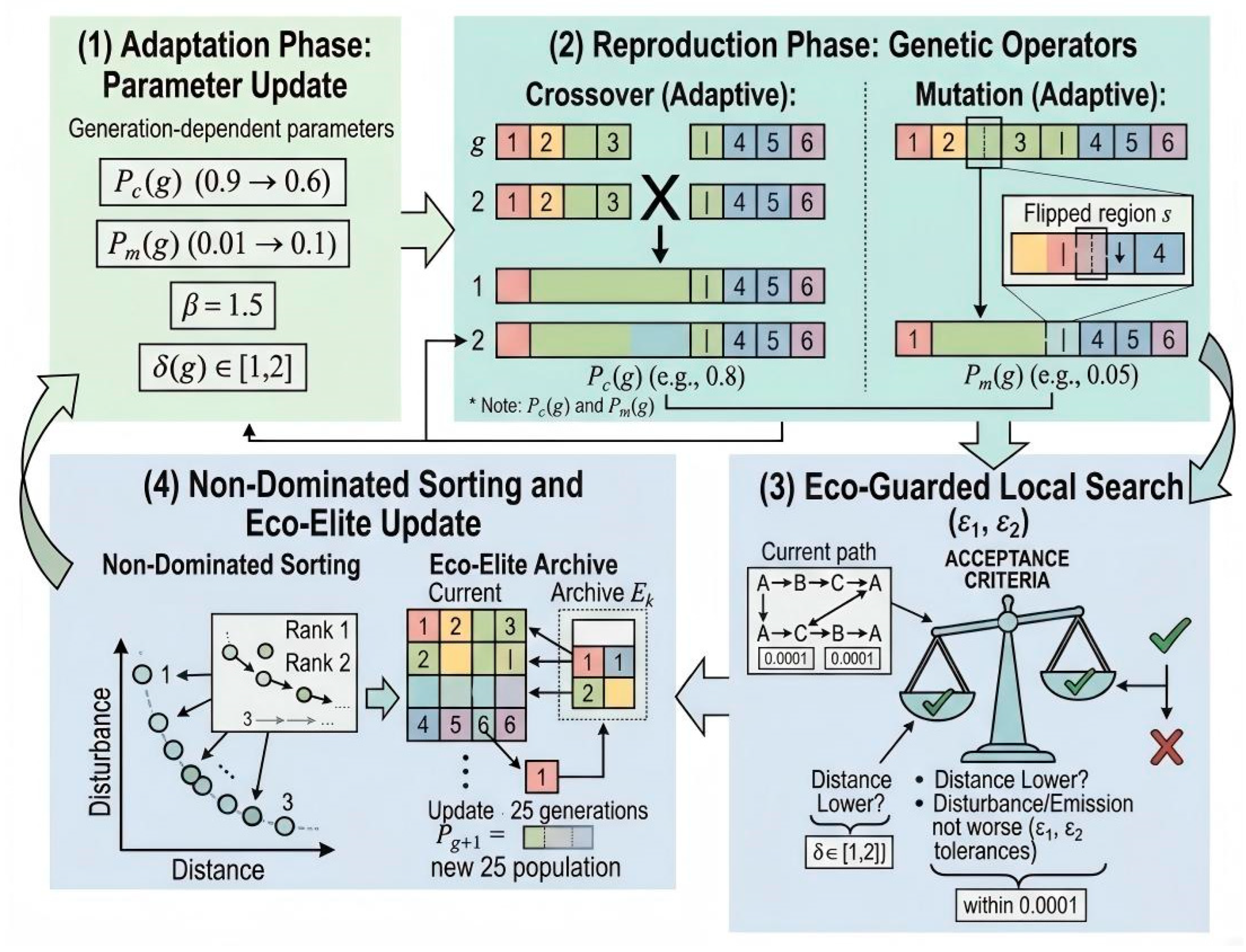
Figure 3 summarizes the overall evolutionary framework of the proposed ECLS-NSGA-II algorithm and illustrates how the key design components jointly address the ecological–operational trade-off in forest log-yard transportation routing. The algorithm operates through four iterative stages: adaptive parameter adjustment, genetic reproduction, eco-guarded local search, and non-dominated sorting with eco-elite archiving. In the early search stage, adaptive crossover and mutation probabilities maintain sufficient exploration, while Lévy-flight mutation introduces occasional large structural perturbations to avoid premature convergence. The eco-guarded local search integrates disturbance- and emission-aware acceptance criteria to ensure that route improvements in distance do not lead to increased ecological disturbance or carbon emissions. Meanwhile, the eco-elite archive continuously preserves historically optimal disturbance and emission solutions and periodically reinjects them into the population every 25 generations, preventing environmentally favorable routing structures from being eliminated during Pareto selection. Through the interaction of these mechanisms, the algorithm is able to maintain a balanced search between transportation efficiency and ecological sustainability, thereby directly responding to the multi-objective optimization challenge discussed in the previous section. Based on this algorithmic framework, the effectiveness and performance of the proposed ECLS-NSGA-II are further evaluated in the numerical experiments presented in the next section.
4. Numerical Experiments
To evaluate the effectiveness of the proposed ECLS-NSGA-II, simulation experiments were conducted on a forest multi-vehicle routing scenario consisting of 25 harvesting sites and one depot. A fleet of five homogeneous timber trucks with a maximum payload capacity of 45 t is used to transport harvested wood from field sites to the depot. In addition to the 25-site base instance used for detailed analysis, supplementary tests were conducted on larger 40-site and 60-site instances and on heterogeneous terrain configurations, and the proposed ECLS-NSGA-II maintained superior hypervolume performance in all cases. This capacity reflects typical payload levels of medium-size forestry transport trucks reported in forest logistics studies [
45]. Each harvesting site iii is associated with a timber demand q
i, service time s
i, and spatial coordinates (x
i,y
i).
The forest transportation network is modeled using a three-level road hierarchy, including primary forest roads, secondary roads, and skid trails. These road types represent the typical transportation infrastructure used in timber harvesting systems [
6]. The corresponding travel speeds are set to 40 km/h, 20 km/h, and 10 km/h, respectively, which fall within the typical operational speed ranges observed in forest road transportation [
33]. To account for geometric irregularities and road curvature, road tortuosity correction factors are set to 1.1, 1.3, and 1.5 for the three road classes, respectively, following common road network approximations used in forest transportation modeling [
46].
To represent ecological impacts caused by vehicle traffic, the disturbance coefficients for the three road levels are set to 0.5, 1.0, and 2.0, respectively. These values reflect the increasing level of soil disturbance associated with narrower and less-engineered forest roads, consistent with empirical observations reported in forest operations research [
8].
The fuel consumption and carbon emission model follows a load-dependent formulation commonly used in green vehicle routing research [
34]. The base fuel consumption rate is set to 0.30 L/km, while the load-dependent coefficient is 0.005 L/(km·t). The carbon emission factor of diesel fuel is 2.68 kg CO
2/L, according to the IPCC greenhouse gas emission guidelines [
47].
The optimization simultaneously minimizes four objectives: total transportation distance, makespan, surface disturbance, and CO
2 emissions. To demonstrate the effectiveness of the proposed method, four representative multi-objective optimization algorithms are used as benchmarks: NSGA-II [
31], MOPSO [
48], MOEA/D [
18], and WS-GA based on weighted-sum aggregation [
49]. These algorithms are widely used in multi-objective optimization and vehicle routing research and provide a representative baseline for comparison. All algorithms are implemented under identical computational conditions and evaluated under the same forest-specific feasibility framework, including the same road-hierarchy setting, route encoding/decoding procedure, and feasibility repair for capacity and visit constraints, to ensure a fair comparison of the search mechanisms themselves.
All algorithms are implemented under identical computational conditions to ensure fair comparison. The key simulation parameters used in the evolutionary search are summarized in
Table 2.
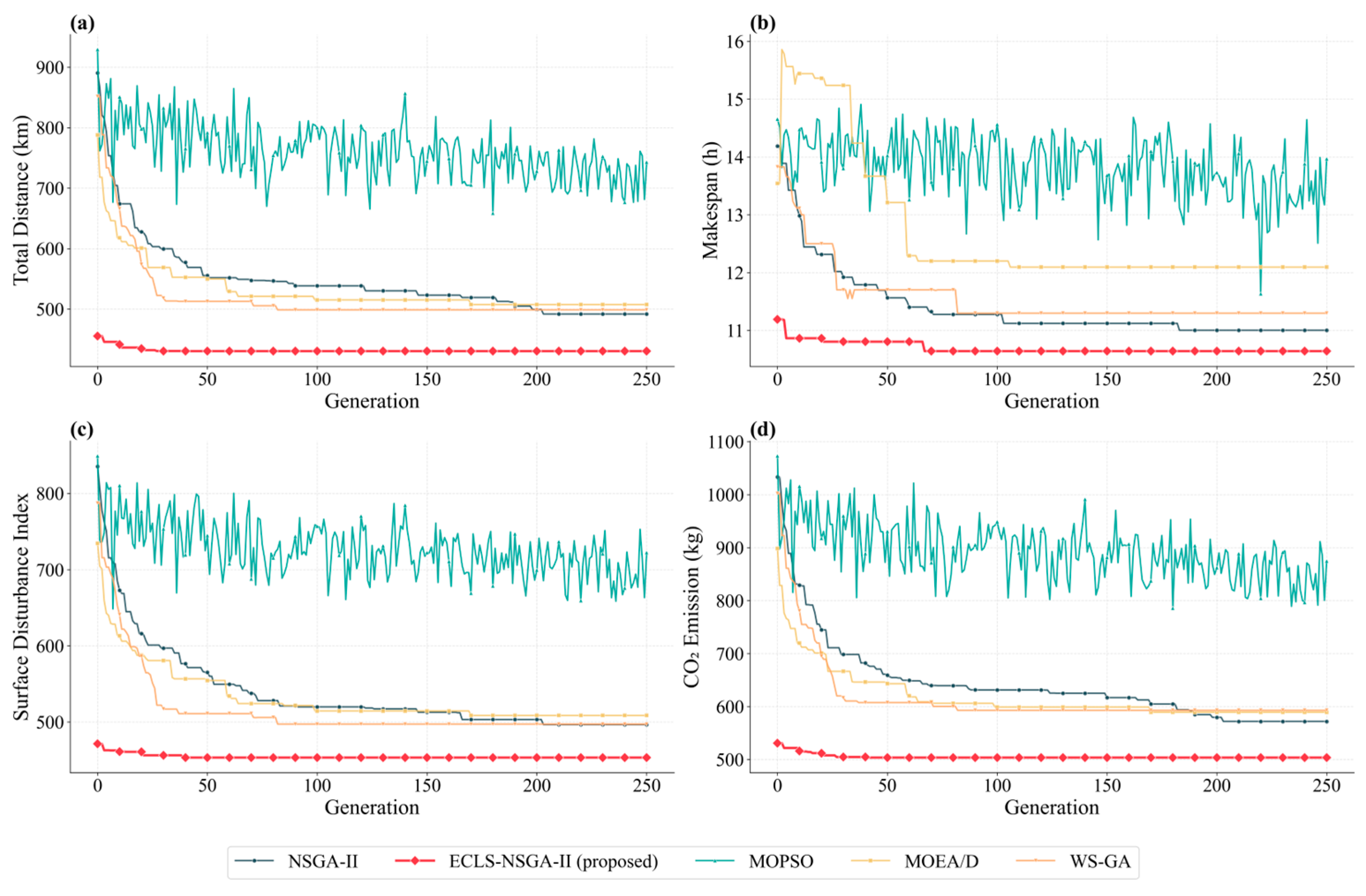
The convergence behavior of the five algorithms across the four optimization objectives is illustrated in
Figure 4. For total transportation distance and makespan, the proposed ECLS-NSGA-II exhibits a rapid descent in the early stage (approximately within the first 30–50 generations) and then stabilizes at the lowest objective levels among all methods. NSGA-II and MOEA/D show slower and more gradual improvements, requiring more generations to approach their final plateaus, whereas MOPSO remains highly fluctuating throughout the run, indicating weak convergence stability. Similar patterns are observed for CO
2 emissions: ECLS-NSGA-II maintains the lowest emission trajectory during the evolution, while NSGA-II and MOEA/D decrease more slowly and MOPSO stays at substantially higher levels with persistent oscillations. For the surface disturbance objective, the curves clearly reflect the distance-weighted disturbance definition (values in the order of 100–1000): ECLS-NSGA-II converges to the lowest disturbance range (approximately 450 times) and remains stable, while NSGA-II and WS-GA settle at higher plateaus (around 500 times). In contrast, MOPSO converges poorly and fluctuates at much larger disturbance levels (around 700 times), suggesting that stochastic particle updates struggle to preserve low-disturbance structures under eco-constrained routing.
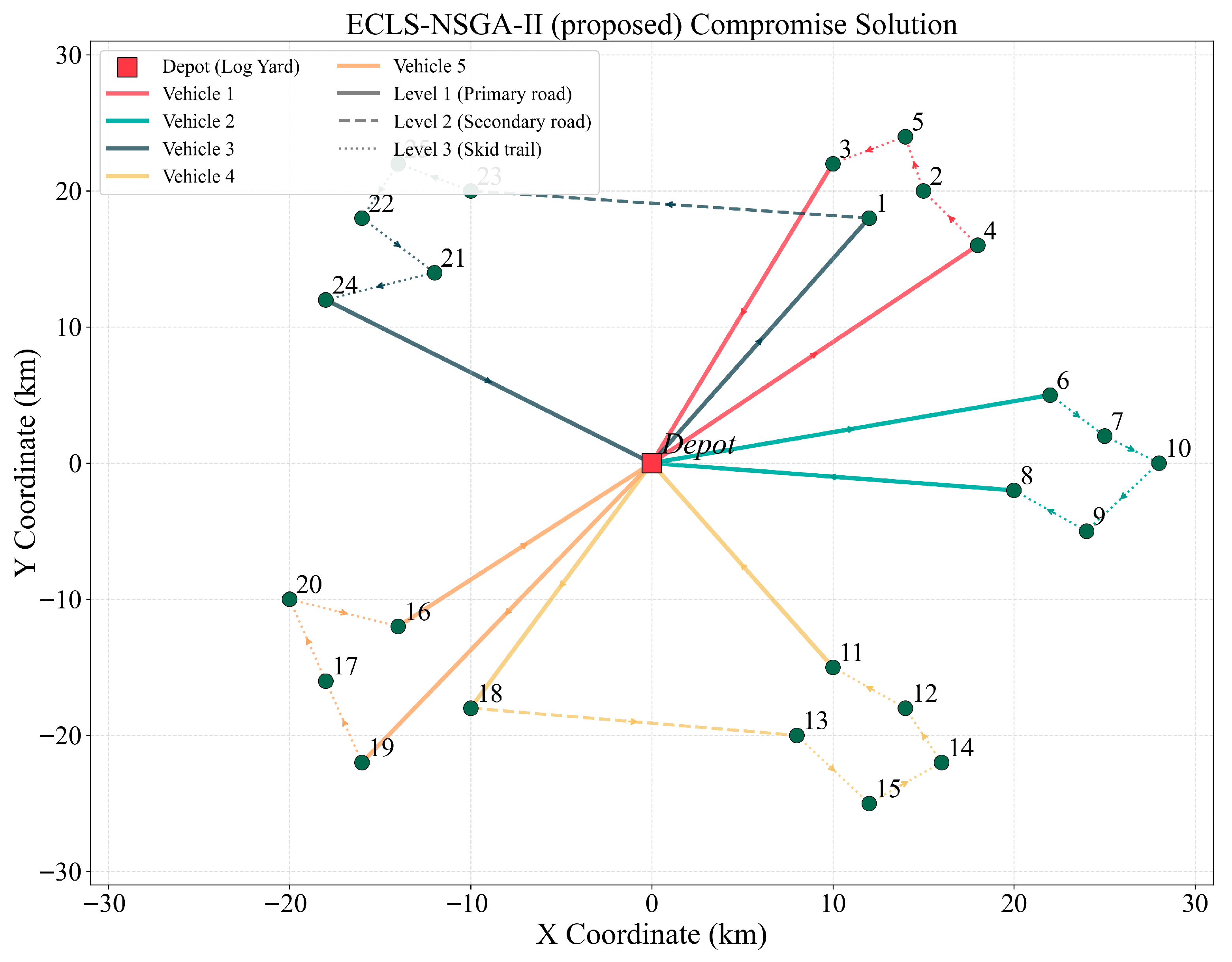
A representative compromise routing solution obtained by the proposed method is presented in
Figure 5. The routing structure reveals that harvesting sites are organized into spatially coherent clusters, allowing vehicles to service nearby nodes sequentially and thereby reducing unnecessary cross-region travel. In addition, long-distance connections tend to follow higher-level forest roads, which contributes to reduced travel distance and lower fuel consumption while maintaining minimal ecological disturbance.
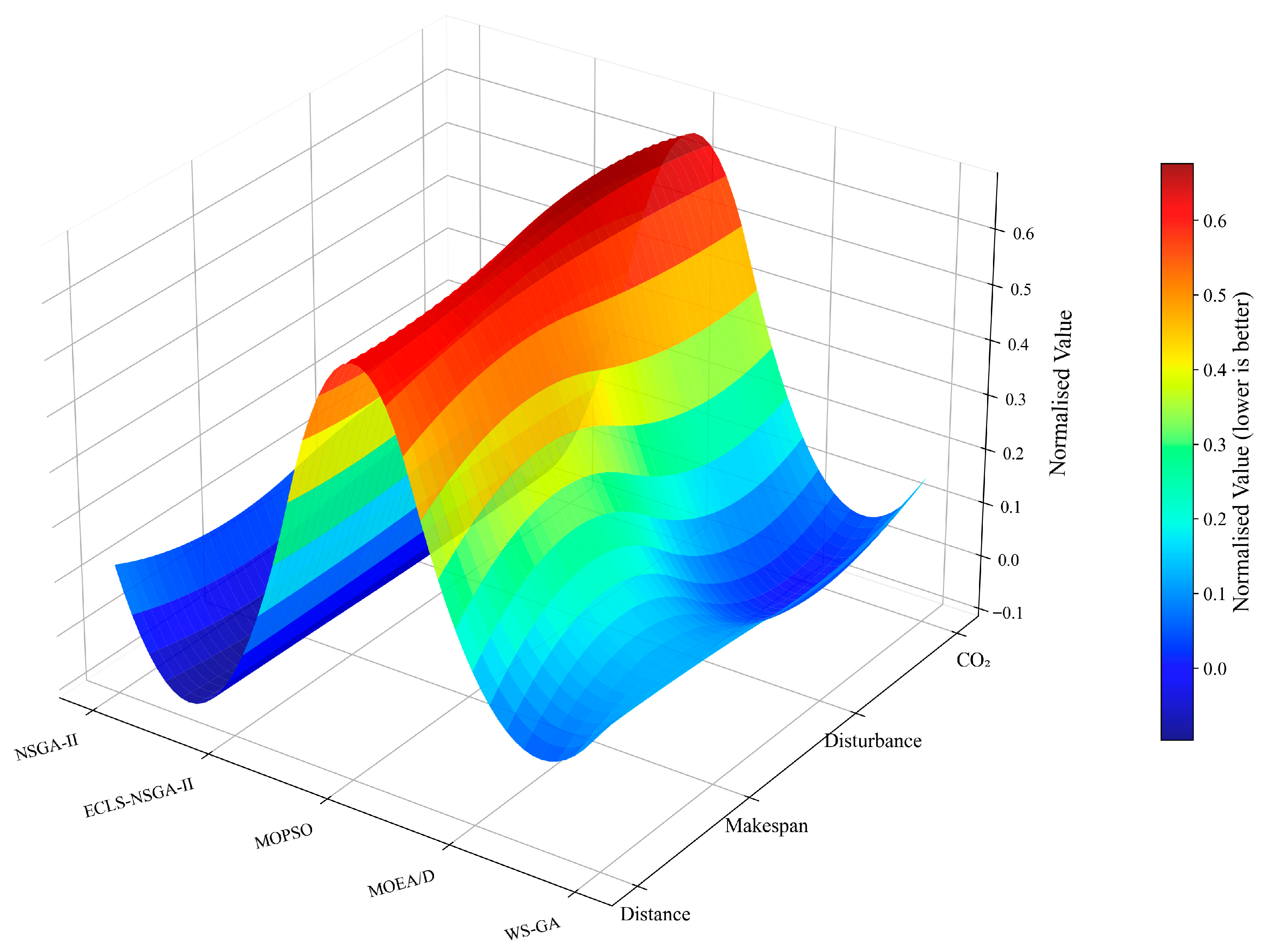
To provide a more intuitive comparison of algorithm performance across multiple objectives,
Figure 6 presents a normalized algorithm–objective performance surface, where lower normalized values indicate better results. As shown in the figure, ECLS-NSGA-II consistently achieves the lowest normalized levels across the four objectives, reflecting balanced optimization capability rather than single-objective dominance. In contrast, MOPSO exhibits clearly inferior normalized performance, particularly for distance-related and emission-related objectives, consistent with its oscillatory convergence in
Figure 4. WS-GA shows relatively competitive performance in distance/time but deteriorates in the disturbance objective, highlighting the limitation of weighted-sum aggregation in maintaining eco-favorable solutions under multi-objective competition.
To reduce the influence of stochastic variability inherent in evolutionary algorithms, each algorithm was independently executed 30 times under identical parameter settings. The best and average objective values obtained from these 30 independent runs are reported in
Table 3.
As shown in
Table 3, ECLS-NSGA-II achieves the best performance in three of the four objectives, including distance, makespan, and CO
2 emissions, while maintaining the minimum disturbance level. Compared with the classical NSGA-II, the proposed algorithm reduces transportation distance by approximately 8.24%, makespan by 2.70%, and carbon emissions by 6.88% on average. To further examine whether the observed performance improvements are statistically reliable, a Wilcoxon signed-rank test was conducted across the independent runs. The results show that ECLS-NSGA-II significantly outperforms all benchmark algorithms in Distance, Time, Disturbance, CO
2, IGD, and Pareto front size, with all pairwise comparisons significant at least at the
p < 0.01 level and most at the
p < 0.001 level. The results demonstrate that the proposed ecological search mechanism effectively improves routing efficiency while maintaining environmental sustainability.
5. Conclusions
Forest harvesting transportation planning involves complex trade-offs between operational efficiency and environmental protection. Traditional vehicle routing optimization methods often focus primarily on minimizing transportation distance or completion time, while ecological impacts such as soil disturbance and carbon emissions receive limited attention. Recent studies on green vehicle routing increasingly emphasize integrating environmental indicators such as fuel consumption and carbon emissions into routing optimization models, highlighting the need for environmentally aware transportation planning [
25]. In addition, conventional multi-objective evolutionary algorithms may suffer from slow convergence, unstable search behavior, and the loss of environmentally favorable solutions during the evolutionary process, which restricts their effectiveness in eco-sensitive forest logistics systems.
To address these limitations, this study formulated a forest multi-vehicle routing optimization model that simultaneously considers transportation distance, makespan, surface disturbance, and CO2 emissions under a realistic forest road hierarchy. On this basis, an enhanced multi-objective evolutionary framework, Eco-Constrained Lévy-flight Local Search NSGA-II (ECLS-NSGA-II), was proposed. The algorithm integrates several mechanisms designed to improve both search efficiency and ecological performance. First, an eco-biased initialization strategy generates disturbance-aware initial solutions to guide the search toward environmentally favorable routing structures. Second, an adaptive Lévy-flight mutation operator enhances global exploration while maintaining solution diversity. Third, a multi-stage ecological local search mechanism combines disturbance-aware and fuel-aware operators to refine routing structures while preventing increases in ecological disturbance. Finally, an eco-elite archive and periodic injection strategy preserves historically optimal ecological solutions and prevents them from being lost during Pareto selection.
Simulation experiments were conducted on a forest transportation scenario involving multiple harvesting sites and hierarchical road networks. Comparative results against four representative algorithms—NSGA-II, MOPSO, MOEA/D, and WS-GA—demonstrate that the proposed ECLS-NSGA-II consistently achieves superior performance. The algorithm produces shorter transportation routes, lower completion times, and reduced carbon emissions while maintaining the minimum ecological disturbance level. Additional robustness tests using randomly generated map instances further confirm that the proposed approach maintains stable performance across different spatial configurations.
From a practical perspective, the proposed ECLS-NSGA-II can serve as a planning-support tool for forest managers when basic operational data are available, including harvesting-site locations, road-network connectivity and road classes, timber demand, vehicle capacity, and approximate disturbance- and fuel-related coefficients. These data are commonly obtainable from harvesting plans, road inventories, and routine transport records. Because the method is intended for off-line planning rather than real-time dispatching, it is compatible with planning-scale decision support and can be linked conceptually with existing GIS-based forest logistics and transport-planning workflows.
Overall, the proposed method provides an effective optimization framework for balancing transportation efficiency and ecological sustainability in forest harvesting logistics under controlled simulation settings. By explicitly incorporating ecological constraints into the evolutionary search process, the study demonstrates the methodological potential of eco-constrained routing optimization for sustainable forest transportation planning. Nevertheless, the present conclusions should not be interpreted as direct evidence of field-level applicability, because real-world deployment would require further validation using geographically referenced forest road networks, site-specific terrain and accessibility data, and field-supported calibration of model parameters. Future work may therefore consider extending the model to more complex operational conditions, such as heterogeneous vehicle fleets, dynamic harvesting schedules, and stochastic road conditions, as well as integrating real-world geographically referenced forest road networks to further strengthen the practical applicability of the proposed approach in forestry management.