1. Introduction
The rapid development of animal husbandry has led to a steady increase in demand for feed grain. Since 2001, China’s soybean imports have grown at an average annual compound rate of approximately 10%, rising from 10.38 million tons in 2001 to 105 million tons in 2024. Imported soybeans now account for nearly 80% of China’s total domestic demand. Similarly, China’s corn imports have consistently exceeded 22 million tons since 2020. However, as import volumes grow, the international feed grain supply chain faces multiple risks. One major concern is the heavy reliance on a limited number of import channels and the high concentration of sources and varieties, which increases dependency risks. Additionally, resource constraints in exporting countries, combined with an uncertain trade environment, heighten the risk of disruptions, such as supply shortages or trade embargoes [
1,
2,
3,
4,
5,
6,
7,
8]. The “two markets and two resources” strategy plays a crucial role in stabilizing China’s feed grain supply. In light of rising global trade protectionism and the instability of international supply conditions, the strategic importance of geographical factors in securing China’s feed grain imports has become increasingly evident [
9,
10]. Therefore, strengthening the resilience of feed grain imports, mitigating potential risks, and fostering long-term, sustainable trade relationships are essential for ensuring the security of China’s feed grain supply chain.
Enhancing the resilience and security of imports is a cornerstone of China’s new development pattern and a critical aspect of national security. The 20th National Congress of the Communist Party of China emphasized improving the resilience and security of industrial and supply chains, including critical sectors such as grain, and enhancing overseas security capacity. The “14th Five-Year Plan for Promoting Agricultural and Rural Modernization” further calls for stabilizing international agricultural product supply chains to ensure a reliable grain supply and improve agriculture’s risk resistance. Overall, the CPC Central Committee and the State Council prioritize supply chain resilience and security, with imported grain supply chains being a key focus that requires urgent strengthening.
A substantial body of research has examined feed grain import supply chains both domestically and internationally. However, studies analyzing these supply chains from a resilience perspective remain limited. Research exploring strategies to enhance feed grain import resilience in relation to national distance has also made little progress. To address this gap, this study measures national distance across four dimensions—geography, economy, institutions, and culture, and investigates its impact on China’s feed grain import resilience. The mechanisms through which national distance affects this resilience are also examined.
This study focuses on three core questions:
How can feed grain import resilience be systematically defined from a resilience perspective, and how can an evaluation framework be developed to accurately measure China’s import risk resistance and recovery capacity?
What are the mechanisms for strengthening feed grain import resilience, and which factors are critical in enhancing risk resistance and recovery capacity?
How does national distance influence China’s feed grain import resilience, and through which specific mechanisms does it operate?
By addressing these questions, this study aims to provide a comprehensive understanding of how distance factors shape China’s feed grain import resilience. It also seeks to offer empirical evidence to support the protection of China’s feed grain import security and to promote efficient, mutually beneficial trade with partner countries.
2. Literature Review
Existing studies have extensively explored the risks associated with food imports and the resilience of food supply chains.
First, research on food import risks. In recent years, global food production and supply have faced increasing risks and uncertainties. Frequent major emergencies have heightened the vulnerability of international food supplies, creating non-traditional challenges in accessing global food markets. In this context, importing food carries inherent risks [
11,
12]. Scholars have analyzed the risks in imported food supply chains from multiple perspectives, including external dependency, import concentration, price fluctuations, and geopolitical factors [
8,
13,
14,
15,
16,
17]. Some researchers have also focused on risks related to critical nodes in food trade routes, trade embargoes, and epidemic outbreaks [
18,
19,
20,
21]. Major emergencies can disrupt imported food supply chains through trade interruptions, transport delays, and supply breakdowns [
22].
Second, research on the resilience assessment of the grain supply chain is crucial. Evaluating supply chain resilience not only clarifies the level of resilience and the capacity to bear risks, but also helps identify the factors that influence resilience and assess the effectiveness of strategies aimed at enhancing it. This provides valuable guidance for improving overall supply chain robustness [
23]. There are two main approaches for measuring resilience. The first is qualitative assessment, which includes qualitative case studies and semi-quantitative evaluations based on expert judgment. These methods, however, involve a certain degree of subjectivity [
24]. The second is quantitative assessment, which relies on resilience evolution curve models, structural models, and composite indicators [
25]. Quantitative methods generally provide more precise evaluations, but the choice of a specific approach depends on the research subject, objectives, and method applicability. Some studies have highlighted the challenges faced by China’s grain supply chain, including the urgent need for infrastructure upgrades, relatively low levels of digital operations, insufficient financial service systems, and significant supply chain security risks. Despite this, quantitative assessments specifically focused on the resilience of grain imports remain limited [
26].
Overall, existing research provides a useful reference for this study, but further investigation is needed in several areas. First, although current studies widely recognize that China’s feed grain imports face multiple potential risks, they have not yet assessed these imports from the perspective of resilience. In particular, there is no established evaluation system to characterize the resilience features of China’s feed grain imports. Second, few studies have explored, from both theoretical and empirical perspectives, the mechanisms for enhancing the resilience of these imports. As a result, the key factors that strengthen risk resistance and recovery capacity in China’s feed grain import relationships remain insufficiently understood.
The marginal contribution of this study is mainly reflected in the following aspects: First, the theoretical connotation and evaluation system of feed grain import resilience are constructed, and the research perspective from risk identification to resilience measurement is expanded. Existing research mostly focuses on various external risks faced by China’s feed grain import, but lacks a systematic perspective of resilience to quantitatively describe the resistance and resilience of the import supply chain when it is impacted. This study introduces the resilience theory into the field of feed grain import, systematically defines the core connotation of feed grain import resilience, and constructs a multi-dimensional evaluation index system covering anti-risk ability and recovery ability, which provides a new analytical tool for quantitative evaluation of China’s feed grain import safety level.
Second, the strengthening mechanism of feed grain import resilience is revealed, and the key factors to improve import risk resistance and resilience are identified. The existing literature mostly stays in the qualitative description of the source of import risk or the static analysis of a single factor. Through theoretical analysis and empirical test, this study clarifies the internal strengthening mechanism of feed grain import resilience, clarifies the key factors affecting the stability of the import relationship, makes up for the shortcomings of existing research on the formation mechanism of resilience, and provides a theoretical basis for precise policy implementation.
Third, from the perspective of multi-dimensional national distance, it deepens the heterogeneous understanding of the factors affecting China’s feed grain import resilience. Different from previous studies that focused more on explicit factors such as economic and trade policies, this study incorporates the national distance of four dimensions of geography, economy, institution and culture into a unified analysis framework, and systematically investigates the differential impact of multi-dimensional distance on China’s feed grain import resilience and its path of action. It breaks through the single understanding of distance in traditional trade research, reveals the deep role of hidden barriers in shaping import resilience, and provides new empirical evidence and policy implications for optimizing the layout of China’s feed grain import sources and promoting the efficient and mutual promotion of national feed grain trade.
3. Concept Definition and Theoretical Analysis
3.1. Concept Definition
The concept of country distance was first proposed by Beckerman (1956) [
27]. Ghemawat (2001) [
28] later developed the CAGE framework, which integrates cultural, institutional, geographic, and economic dimensions of country distance. The framework explains how each dimension affects firms’ foreign trade. Since then, CAGE has been widely applied in trade research [
29,
30]. This study defines national distance as a combination of geographical distance, economic distance, institutional distance and cultural distance.
Feed grain import resilience is defined as the capacity of feed grain import trade to recover and transform in response to shocks and pressures [
31,
32]. Specifically, it refers to the ability of the feed grain import chain to maintain stable operations, recover to pre-shock conditions, and even adapt and transform over time when faced with domestic and international shocks.
Trade efficiency is the ability to obtain the maximum economic output with the least resource input in trade activities, which reflects the optimization degree of the trade process, including time, cost and resource utilization efficiency. Its core elements include logistics and supply chain management, trade policies and regulations, technology and innovation, and international cooperation and standardization.
3.2. Theoretical Analysis and Research Hypotheses
Feed grains, as bulk agricultural commodities, have distinct physical characteristics: they are highly perishable, have a short shelf life, and require specific storage and transportation conditions. These attributes make the import trade of feed grains particularly sensitive to transaction costs, efficiency, and risks. Increased country distance not only results in greater geographical separation but also creates disparities in economic systems, institutions, and cultures. These factors collectively undermine China’s feed grain import resilience, primarily by reducing trade efficiency. From a geographical perspective, greater country distance directly leads to higher transportation and communication costs. These costs hinder the development of feed grain imports. Additionally, broader institutional and cultural differences increase transaction frictions, resulting from information asymmetry and communication barriers. This adversely affects China’s feed grain import trade [
33].
Country distance primarily impacts feed grain import resilience by reducing trade efficiency. As distance increases, cross-border procedures such as customs inspections, Sanitary and Phytosanitary Measures (SPS), and document processing become more complex. The time required for these procedures grows with institutional distance, which conflicts with the strict timeliness requirements of feed grain imports. Prolonging the import cycle increases the risk of supply chain disruptions, reduces supply chain responsiveness and flexibility, and hinders improvements in import efficiency. This, in turn, weakens the system’s ability to recover quickly from disturbances. Specifically, Geographical distance directly results in higher transportation and time costs. Feed grains have strict freshness requirements, and longer transport distances demand more complex cold chain or temperature-controlled facilities, significantly raising logistics costs. Extended transit times also increase the economic risk of spoilage during transportation. Institutional distance, including differences in laws, regulations, quality standards, and cultural distance, such as differences in business practices and language, exacerbates information asymmetry. These differences complicate contract negotiation, execution, and oversight, increasing the resources needed to obtain reliable information and adapt to foreign regulatory environments. The resulting rise in transaction costs reduces the economic viability of import trade and limits importers’ ability to respond to price fluctuations or supply shocks, ultimately affecting import resilience. Furthermore, as geographical distance increases, imports face broader and more complex risks. These include market risks due to greater information asymmetry (e.g., misjudged pricing), higher rent-seeking and corruption risks from unfamiliar institutional environments, and political risks arising from fluctuating bilateral relations (e.g., trade bans or export controls). These risks affect every stage of the process—from contract signing and cargo shipment to cross-border payments—weakening the enforceability of contracts. In distant markets, Chinese enterprises also encounter more intense and unstable competition. Together, these factors heighten the impact of country distance on supply chain stability.
Based on these considerations, this study proposes the following hypotheses:
Hypothesis 1. Country distance has a significant negative impact on feed grain import resilience.
Hypothesis 2. Country distance weakens China’s feed grain import resilience by hindering trade efficiency.
Bilateral political relations play a crucial role in “country-specific advantages” by mitigating the negative effects of increased investment and trade costs, as well as heightened risks associated with country distance. This is achieved through measures such as signing trade agreements, enhancing high-level communication, and harmonizing institutional arrangements [
34,
35,
36]. Countries with Regional Trade Agreements (RTA) with China facilitate feed grain imports by reducing trade policy uncertainty, lowering trade barriers, and cutting transaction costs [
37]. Specifically, the BRI directly enhances trade facilitation in two ways. First, it improves physical infrastructure by shortening transport times and streamlining customs procedures. Second, it strengthens institutional frameworks through high-level exchanges, policy coordination, and infrastructure connectivity. These efforts build political trust, reduce the risks and uncertainties associated with political distance, and mitigate the impact of geographic distance on transaction costs, efficiency, and risk. Additionally, signing an RTA with China establishes unified, transparent, and predictable trade rules. It reduces tariffs, simplifies rules of origin, lowers non-tariff barriers (such as harmonized SPS standards), and provides dispute resolution mechanisms. These institutional measures directly lower transaction costs related to institutional distance, improve trade efficiency, and effectively manage policy risks. Together, these institutional arrangements help overcome the trade challenges posed by geographic distance.
Based on these observations, this study proposes the following hypothesis:
Hypothesis 3. The BRI and RTA negatively moderate the impact of country distance on feed grain import resilience.
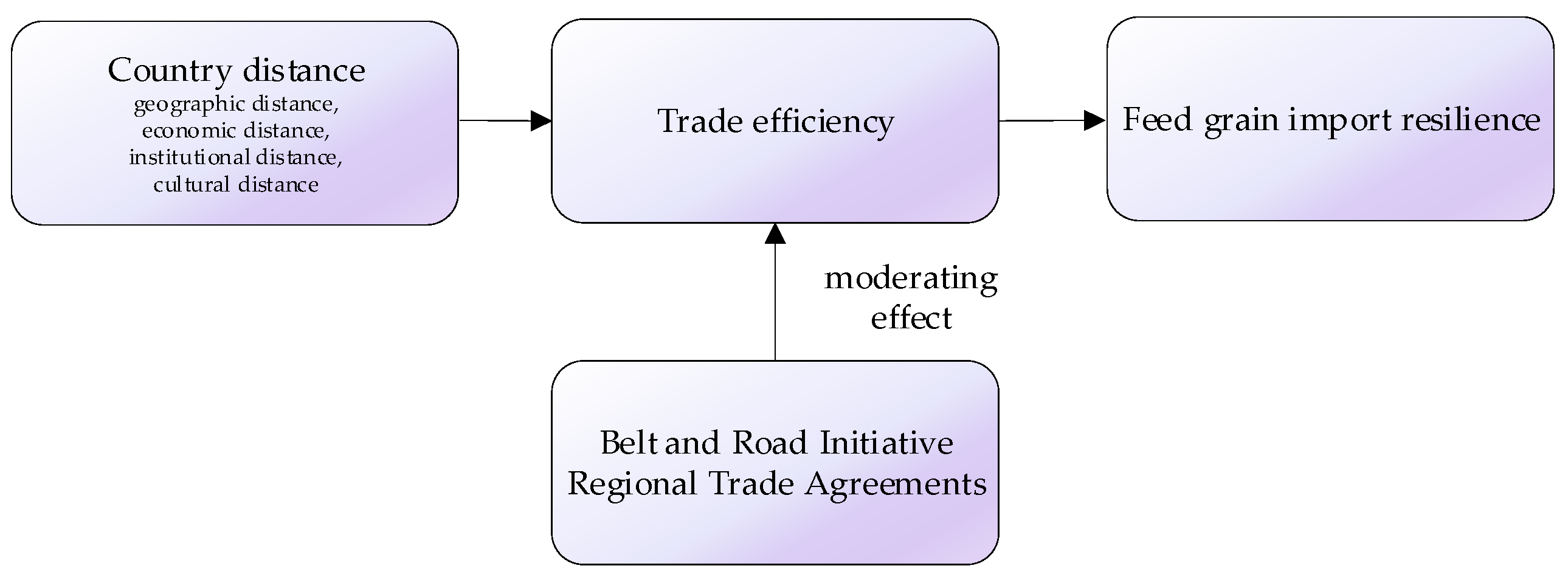
In summary, the analysis framework of this study is shown in
Figure 1.
4. Variables, Models, and Data
4.1. Model Specification
The dependent variable in this study is feed grain import resilience, and the core explanatory variable is country distance. We employ a two-way fixed-effects model for the econometric analysis. The model specification is as follows:
where
denotes the feed grain import resilience of country
i at time
t;
represents the distance between country
i and China at time
t, considering economic, cultural, institutional, and geographical factors;
includes a set of control variables such as economic scale, population size, and trade openness;
captures the country-specific effect;
accounts for the time fixed effect;
,
and
are the parameters to be estimated; and
represents the random error term.
This study explores how trade efficiency affects China’s feed grain import resilience, specifically focusing on the role of country distance. To achieve this, we build upon Model (1) and apply a three-step mediation model [
38]. The model is expressed as follows:
Here, epresents the mediating variable at time t in country i, which is used to measure trade facilitation levels through customs clearance efficiency.
Additionally, to examine the moderating effects of the BRI and RTA, we establish a moderation model, as shown in the following equations:
Here, represents the moderator variable at time t in country i. It consists of two components: the BRI dummy variable (BRIit) and the RTA dummy variable (RTAit). The term refers to the interaction between the independent variable and the moderator variable.
4.2. Variable Selection
Dependent Variable. This study selects feed grain import resilience as the dependent variable. This concept encompasses three main aspects: import resilience, recovery capacity, and transformation capabilities. In the context of international trade, import prices and volumes are influenced by multiple factors, many of which are beyond the control of importing countries. Import resilience, therefore, primarily refers to “passive pressure absorption”. A system with strong resilience can make timely adjustments to the import chain when external shocks lead to abnormal fluctuations in feed grain import prices or declines in import volumes. This facilitates the prompt recovery of import volumes and the stabilization of price volatility. This study quantifies import resilience using the following factors: import source diversification, domestic supply foundations, the export capacity of source countries, and the political stability of source countries. Recovery capacity emphasizes “proactive adjustment”. A system with strong recovery capacity can make timely refinements to the import chain when feed grain import channels are disrupted by sudden factors, ensuring stable import rhythms. Thus, recovery and adjustment capacity are measured through import scale stability, import price stability, trade liberalization, and trade facilitation. Transformation and upgrading capacity refer to the ability for “subjective adjustment”. A system with strong transformation capacity can quickly optimize import chains in response to external shocks, adjusting and substituting feed grain import sources as necessary. Therefore, transformation and upgrading capacity is quantified using conversion agility, product conversion capability, and the trade policy environment. Finally, the entropy method is used to establish indicators for measuring feed grain import resilience across three dimensions: resistance and adaptation capacity, recovery and adjustment capacity, and structural conversion capacity. The specific indicator definitions are provided in
Table 1.
Core Explanatory Variable. This study uses country distance as the core explanatory variable. Based on the CAGE framework, this study constructs an indicator system to measure the country distance between China and its partner countries across four dimensions: geographic, economic, institutional, and cultural distance. Geographic distance captures the spatial separation between two countries and is a fundamental component of country distance. Existing measures typically rely on great-circle distances, such as distances between capital cities, maritime distances, or the shortest distance from an FDI host location to the nearest coast of the home country [
39]. In this study, geographic distance is measured as the straight-line distance between the two countries’ capitals. The main data source is the CEPII distance database, which applies the Haversine formula to compute distances on the Earth’s surface [
40]. Economic distance reflects differences in macroeconomic characteristics across countries. Here, it is measured by the ratio of China’s GDP per capita to that of the host country. This choice is motivated by the idea that cross-country economic gaps are largely reflected in income differences. GDP per capita also captures differences in purchasing power levels across countries. Institutional distance refers to similarities or differences in countries’ legal systems and policy environments. It provides a relative assessment of national institutions [
41]. Prior studies often measure institutional quality using six dimensions: political stability and absence of violence/terrorism, government effectiveness, regulatory quality, control of corruption, rule of law, and voice and accountability [
42]. Cultural distance reflects differences in traditions, values, and customs. Such differences shape moral expectations and behavioral norms across societies [
43]. Many studies adopt Hofstede’s cultural framework and use the Kogut-Singh cultural distance index. The commonly used indicators include power distance, individualism, masculinity, uncertainty avoidance, long-term orientation, and indulgence [
44,
45]. The method of entropy weighting is used to compute the overall country distance index. Geographic and economic distance are each represented by a single variable, as described above. Institutional and cultural distance are measured using multidimensional indicators and aggregated using weighted averages (see
Table 2).
This study chooses population size, resource endowment, trade openness, economic scale, exchange rate and whether it is a WTO member as control variables. The theoretical basis is as follows. Population size (POP
i,t) is measured as the natural logarithm of the importing country’s population density. A larger population size may lead to higher feed grain consumption and greater demand for a variety of feed grains, potentially reducing resilience to Chinese feed grain imports. However, a larger population size may also increase domestic feed grain production capacity, which could enhance resilience to imports. Resource endowment (Prod
i,t) is represented by per capita grain yield. A better resource endowment suggests higher feed grain self-sufficiency, strengthening a country’s capacity to export feed grains. Trade openness (open
i,t) is measured as the ratio of total imports to GDP. This indicator reflects a country’s overall trade level. Higher trade openness is typically associated with increased international economic activity, which may lead to greater bilateral trade. As such, trade openness is expected to have a positive relationship with feed grain imports. Economic scale (GDP
i,t) is represented by the importing country’s GDP, adjusted for constant 2010 US dollars. Generally, a larger economic scale is positively correlated with the variety and quantity of exportable goods. When the domestic supply of trading partners is stable, a larger economic scale tends to increase demand for imports, including feed grains. WTO membership (WTO
i,t) is represented as a dummy variable, where a value of 1 indicates membership in the World Trade Organization, and 0 indicates non-membership. Finally, the exchange rate (RAT
i,t) is calculated as the ratio of the exchange rate between the importing country and China against their respective exchange rates to the US dollar in period
t. This measure reflects the purchasing power of the importing country relative to China. Descriptive statistics for these variables are presented in
Table 3.
4.3. Data Sources and Processing
The term “feed grain” can be interpreted in both narrow and broad terms. In the narrow sense, it refers specifically to the portion of grain consumed as animal feed. In the broader sense, it encompasses not only grains consumed directly as feed for livestock—unprocessed and with husks intact—but also grain processing byproducts such as meal, bran, dried distillers grains, and other soluble materials derived from grain processing. Feed grain trade statistical categories include: Corn (100590), Soybeans (120100) (Before 2018, soybeans were classified under HS code 120100. After 2018, seed and non-seed soybeans were assigned separate HS codes: 120110 for seed soybeans and 120190 for non-seed soybeans. For consistency, this paper uses HS code 120100 for non-seed soybeans produced after 2018), Barley (100300), Sorghum (100700), Cassava (071410), Corn Distillers Grains (230330), Other Feed Distillers Grains (230210–230250, 230310, 230320, 230810, 230890), Soybean Meal (230400), Peanut Meal (230500), Rapeseed Meal (230640), and Other Meals (230610–230630, 230650–230670, 230690).
This study uses data from 2000 to 2023, the samples are all countries that export feed grains to China. Feed grain import values and tariffs are obtained from the UN Comtrade database. Economic indicators such as distance, population size, per capita grain yield in exporting countries, trade openness, GDP, import/export trade, and customs efficiency come from the World Bank database. Geographical distance data is sourced from the CEPII database, while institutional distance data is drawn from the Global Governance Index. Cultural distance data is taken from the Hofstede Cultural Dimensions database. Both institutional and cultural distances are calculated using standardized Euclidean distance methods. WTO variables are retrieved from the official World Trade Organization website. The exchange rate is based on data from the International Monetary Fund, and information about RTA signed by exporting countries with China is sourced from the China Free Trade Zone Service Network of the Ministry of Commerce of the People’s Republic of China. Finally, data on whether importing countries are part of the BRI comes from the China Belt and Road Network.
6. Conclusions and Discussions
This study evaluates the resilience of China’s feed grain imports in relation to the country’s distance of trading partners. Using a two-way fixed effects model, it investigates the impact of country distance on import resilience. The findings advance the theoretical understanding of food security and trade resilience, while offering empirical guidance for optimizing China’s feed grain import strategies amid deepening globalization.
First, country distance has a significant negative effect on China’s feed grain import resilience. Among the various types of distance, geographic and economic distances have the most pronounced negative impacts, while institutional and cultural distances exhibit positive effects. This negative impact of country distance is particularly evident in China’s soybean and corn import resilience. National distance reduces the resilience of feed grain imports, consistent with the gravity model [
50], which considers distance a natural barrier to trade. The effects, however, vary across different distance dimensions. Geographic and economic distances strongly hinder imports by increasing logistics costs, transit times, and transaction risks—factors that are particularly critical for time-sensitive feed grains [
51]. In contrast, institutional and cultural distances can enhance resilience. Institutional diversity may encourage cooperation and innovation, while cultural differences broaden the range of potential partners, helping to diversify supply and reduce dependence on a single market. This supports the concept of institutional complementarity, where certain differences mitigate supply concentration risks. For soybeans and corn, national distance consistently exerts a negative effect, reflecting high dependence on external sources and concentrated import origins. These results highlight the importance of tailored risk management strategies for different grain types.
Second, trade efficiency plays a mediating role in the relationship between country distance and feed grain import resilience. Specifically, country distance reduces import resilience by weakening the trade efficiency of the exporting countries. This study identifies trade efficiency as a key mediator linking national distance to import resilience. Greater national distance reduces trade efficiency by raising customs barriers, extending logistics lead times, and increasing transaction costs such as negotiation and communication. Lower trade efficiency, in turn, constrains the ability to respond to supply shocks, adjust import channels, and maintain stable supplies—core components of import resilience. This mechanism provides a micro-foundation for understanding how distance affects food security. These findings extend existing research on trade barriers. While previous studies emphasized tariffs and non-tariff measures, this study highlights informal barriers inherent in national distance. The results also support the view that improving trade facilitation can mitigate distance-related frictions [
52,
53]. For China, advancing institutional reforms and infrastructure connectivity offers a practical approach to reducing distance-related obstacles and enhancing the stability of feed grain supply chains.
Third, the interaction between the BRI, RTA, and country distance is consistently negative and statistically significant. This suggests that participation in the BRI and RTA can help mitigate the negative impact of country distance on China’s feed grain import resilience. This finding underscores the role of institutional openness in complementing market openness [
54]. Through cross-border infrastructure development and policy coordination, BRI reduces both physical and institutional barriers to trade, thereby lowering logistics costs and uncertainty [
55]. Similarly, RTAs standardize trade rules and reduce tariff and non-tariff barriers, creating a more predictable trade environment that stabilizes import supply. These results align with China’s strategy of promoting multilateral and regional trade cooperation. Compared with merely expanding import partners, institutional cooperation is more effective in stabilizing trade expectations and enhancing the resilience of feed grain imports. For example, cooperation with countries along the BRI has diversified import sources, shortened transit times, and reduced costs for corn imports [
56]. Nevertheless, the effectiveness of different institutional arrangements varies by crop type and region, highlighting the need for targeted design and implementation.
7. Policy Recommendations
Based on the findings, the following policy recommendations are proposed to enhance China’s feed grain import resilience and safeguard the security of its feed grain supply chain:
7.1. Optimize Import Arrangements and Manage Country Distance Risks
This study confirms that geographical and economic distances are primary factors hindering import resilience, while institutional and cultural distances promote it. Therefore, China should implement a strategy of diversifying and targeting import sources. While strengthening trade relations with geographically proximate countries, such as those in Southeast Asia, China should also deepen cooperation with core suppliers like Brazil and Argentina. These countries, although geographically distant, are rich in agricultural resources. Long-term agreements and strategic investments in these regions can stabilize imports and mitigate the negative impact of geographic distance. Moreover, the potential positive impacts of institutional and cultural differences should be leveraged. By fostering cultural exchanges and institutional learning, these differences can be transformed into complementary advantages, expanding trade channels and enhancing resilience.
7.2. Strengthen Institutional Openness to Mitigate Distance-Related Disadvantages
Research indicates that initiatives like BRI and RTA can effectively reduce the constraints posed by geographic distance. China should advance high-quality agricultural cooperation within the BRI, focusing on feed grain supply chains. Key areas such as warehousing, logistics, port construction, and inspection should be prioritized, as they help reduce logistics and transaction costs. Furthermore, China should actively negotiate and upgrade regional trade agreements, incorporating high-standard provisions for trade facilitation, investment protection, and mutual recognition of standards. Binding institutional arrangements will bridge institutional and economic gaps, fostering a stable, transparent, and predictable international policy environment for feed grain imports.
7.3. Enhance Trade Efficiency Through Key Intermediaries
Trade efficiency plays a critical role in overcoming the challenges posed by country distance. Therefore, it should be treated as a core policy lever. Domestically, China should promote digital and standardized reforms in cross-border trade processes. Major ports should align with international standards, and facilitation models like “advance declaration” and “two-step declaration” should be widely implemented to improve customs clearance efficiency. Internationally, China should lead global trade facilitation initiatives, prioritizing mutual recognition agreements with key supplier countries on document formats and inspection/quarantine standards. Furthermore, dedicated “green channels” for essential goods, such as feed grains, should be established, ensuring priority inspection and rapid release. By enhancing operational-level facilitation, China can offset the negative impact of country distance on import resilience.
7.4. Build a Resilient and Secure Supply System with Domestic Foundations
To strengthen resilience against international supply chain fluctuations, it is essential to integrate domestic and international efforts while enhancing domestic capabilities. On the domestic front, China should continue boosting oilseed production capacity, such as through soybean cultivation. This can be achieved through stable planting subsidies, breakthrough technologies like soybean-corn intercropping, and improved supply chain coordination. These efforts will raise self-sufficiency rates and reduce over-reliance on imports. Additionally, China should implement a “comprehensive food perspective”. While ensuring basic self-sufficiency in grains, the planting structure should be optimized for food, cash crops, and fodder. Expanding production across diverse national territories, including forests, grasslands, and oceans, will create a diversified food and feed resource base. Ultimately, this will establish a modern food supply system that relies primarily on domestic production, while maintaining diverse and resilient import sources, supported by strong security safeguards.