1. Introduction
The 21st century is experiencing a global environmental crisis, leading to an international consensus that future graduates of educational systems require a new approach. Consequently, in Israel, the Ministry of Education, in collaboration with the Ministry of Environmental Protection, is leading processes to advance education for sustainability. The educational program is underpinned by the understanding that the development of values and behavioral norms for a sustainable lifestyle will occur within frameworks based on multidisciplinary integration in learning and action for the environment.
The years 2005–2014 were declared by the United Nations as the Decade of Education for Sustainable Development. The aim of education for sustainable development (ESD) is to promote education as a crucial tool for preparing young people to become responsible future citizens, enabling subsequent generations to shape society in a sustainable manner that considers environmental preservation [
1]. In response to these challenges, 17 Sustainable Development Goals (SDGs) were set, defining global priorities for 2030 and offering an opportunity to eradicate extreme poverty and place the world on a sustainable trajectory [
2].
In recent years, substantial resources have been invested in developing environmental education programs, and numerous studies have shown that factors such as school-based educational activities and external projects motivate environmentally conscious behavior [
1]. Environmentally friendly behavior is a primary objective of sustainability education; however, efforts to foster this approach through knowledge have not yielded the desired results, and adequate attention has not been devoted to teachers [
3].
However, before going into the details, it is necessary to clarify the essential constructs that are relevant for this study. “Sustainability” means that development meets the needs of the present without compromising the ability of future generations to meet their own needs [
4]. “Education for Sustainable Development” (ESD) is a learning process that is based on ideas and principles that help individuals address planning for solutions to issues of sustainability while developing the knowledge, skills, values, and competencies necessary for informed action [
5]. “Environmental behavior” means actions taken by individuals or groups that help or hinder environmental sustainability [
6].
Despite the growing body of literature on the topic, an important gap still exists in scientific literature. Indeed, although a number of research studies have focused on the sustainability knowledge and attitude of students and pre-service teachers [
7,
8,
9], little research has been conducted to examine the SDG awareness of in-service science teachers from underrepresented or under-examined minority educational contexts. The majority of the existing research literature has been conducted in the context of Higher Education or majority groups from Western or East Asian cultures [
10,
11], leaving a notable gap in knowledge regarding the SDG awareness of teachers from minority and underserved educational communities. The current research is intended to fill the gap. Focusing on a specific minority educational community provides an opportunity to examine how contextual and systemic factors interact with global sustainability agendas, an intersection that majority-focused studies have largely overlooked. The Arab education sector in Israel constitutes approximately 20% of the student population. Research has noted that this sector has encountered distinct challenges in resource allocation, professional development opportunities, and integration of new educational reforms, reflecting broader patterns of differential development between the Arab and Hebrew-speaking sectors [
12,
13]. Studies have also noted lower levels of academic attainment, budgetary limitations in Arab sector schools, and comparatively lower enrollment in higher education [
14,
15]. These factors have been shown to influence teachers’ access to professional development opportunities and their capacity to engage with innovative educational approaches [
13,
16]. These disparities make the Arab sector a particularly important context for investigating SDG awareness, as limited resources and professional development may constrain teachers’ ability to engage with global sustainability frameworks. Moreover, studying this population addresses a notable gap in the ESD literature, which has largely focused on majority populations in Western and East Asian contexts. The rationale for this study is to expose science teachers to, and engage them in, the international framework for achieving the United Nations Sustainable Development Goals for 2030. The significance of this research stems from its aim to investigate and characterize the level of self-assessed awareness among science teachers regarding the SDGs amid the escalating climate crisis and to examine differences in awareness levels according to background variables among teachers in the Arab sector in Israel.
Accordingly, the research objectives are:
To examine the level of self-reported awareness regarding SDGs among science teachers in various schools in the Arab sector in Israel;
To examine differences in the level of self-reported awareness regarding SDGs among science teachers in relation to background variables: gender (male, female), teaching seniority (1–10 years, 11–20 years, over 20 years), academic institution (college or university), degree type (bachelor’s degree, master’s degree), school type (elementary, middle school, or high school), and area of specialization;
To conduct a focused, in-depth qualitative investigation of SDG awareness specifically among middle school science teachers, complementing the broader quantitative analysis in Objective 2 by providing detailed insight into this sub-group’s awareness profiles, sources of knowledge, and professional perceptions;
To assess the extent to which, according to middle school science teachers, selected “science-related” goals are integrated into the middle school curriculum.
Based on these objectives, the following research questions guided this study: (1) To what extent are science teachers in the Arab sector in Israel aware of the SDGs, and what are their sources of knowledge? (2) To what extent is there a relationship between awareness levels and teacher background variables (gender, teaching seniority, teaching subject, academic degree, academic institution, and school type)? (3) To what extent are middle school science teachers aware of selected science-related SDGs? (4) According to middle school science teachers, to what extent are selected SDGs integrated into the science curriculum? The remainder of this paper is organized as follows:
Section 2 presents the literature review, covering sustainability concepts, ESD, the SDGs and their relationship to education, and the Israeli science curriculum.
Section 3 describes the research methodology, including participants, instruments, and analytic procedures.
Section 4 presents the findings and discussion organized by research question.
Section 5 offers conclusions, practical recommendations, and directions for future research.
In accordance with the formulated research questions and literature review, the following hypotheses were formulated for the quantitative phase of this study: (H1) Science teachers in the Arab sector will show a moderate overall level of self-reported SDG awareness, considering the limited integration of SDGs in teacher training courses [
10,
11]; (H2) Significant differences in SDG awareness will exist among teachers by their teaching subject; environmental studies teachers will show the highest level of SDG awareness due to their disciplinary training background [
1,
17]; (H3) No significant differences in SDG awareness will exist among teachers by gender, academic degree, or type of school, as no such relations are theoretically grounded [
18,
19]; (H4) SDG-related content will be reported by middle school teachers as being present in the curriculum in an implicit manner, considering the lack of a framework for SDG integration in Israeli science curricula.
4. Findings and Discussion
4.1. Research Question One
To what extent are science teachers aware of the SDGs, and what is the source of their knowledge?
To address the first research question, descriptive statistics were used, including measures of central tendency and dispersion (means, standard deviations, and frequencies) for the SDG awareness questionnaire items, as presented in
Table 3.
Half of the participants were familiar with the term “sustainable development goals.” Sources of that knowledge are reported in
Table 4.
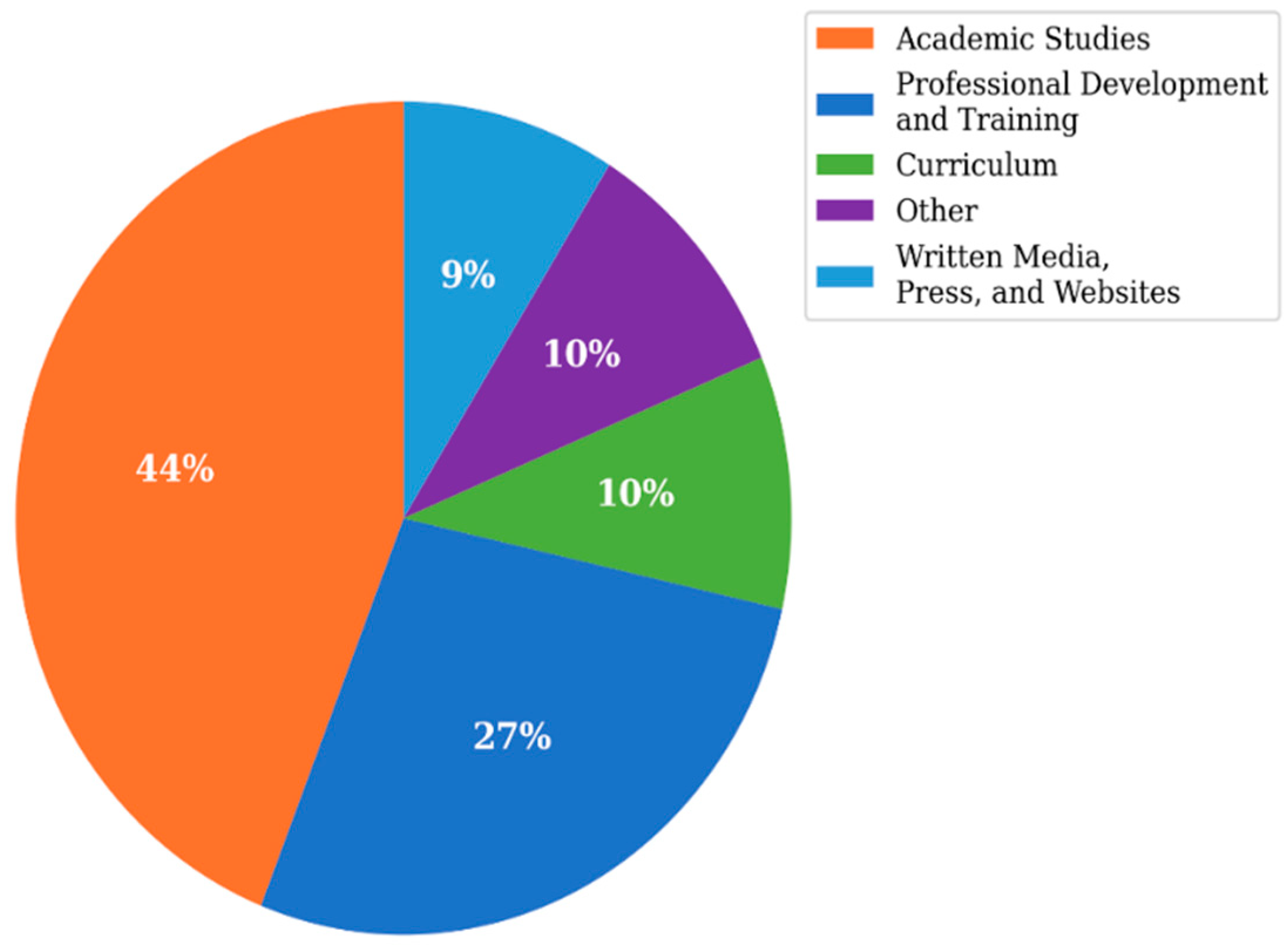
The data in
Table 4 and
Figure 1 indicate that 102 participants (50%) reported being familiar with the term “sustainable development goals” (SDGs). Regarding sources of knowledge about SDGs: 28 (27.5%) reported professional development and training, 45 (44.0%) reported academic studies, 9 (8.9%) reported written media, press, and websites, 10 (9.8%) reported the curriculum, and 10 (9.8%) reported other sources. However, the most striking feature in this data is the preeminence of formal academic study as a first source of knowledge, suggesting that awareness of SDGs among this sample is passed on via formal channels and not via individual interests or media channels. This has significant implications for teacher training courses, as if formal academic study is a first source of SDG knowledge, then the absence of SDG education in most Israeli teacher training programs [
15] is a structural, as opposed to motivational, issue.
The findings indicate that science teachers demonstrated moderate awareness of the SDGs, with academic studies as the primary source of knowledge, followed by professional development (
Figure 1). Some of the teachers were unaware of the goals, even when they were included in the curriculum, because they had not been exposed to it in this context. This finding aligns with the research literature [
47,
48,
49], indicating that teachers are typically not exposed to the SDGs prior to entering the profession and, within schools, teachers of subjects unrelated to these goals do not engage with them [
36,
50]. For instance, survey studies in France, Australia, and Russia found that most teachers were unfamiliar with the concepts of sustainable development and ESD [
49,
51]. Exceptions were teachers who engaged personally in relevant activities or studied environmental sciences at university [
24,
52], demonstrating some familiarity and understanding of sustainable development [
47,
53].
UNESCO’s objectives for ESD focus on integrating sustainable development into educational activities, reorienting lifelong education, raising awareness of the concept, and providing ongoing teacher education [
18,
19]. However, numerous researchers have argued that knowledge and understanding of sustainability do not necessarily lead to responsible behavior or effective teaching [
54,
55]. Nevertheless, extensive knowledge of sustainability issues may enhance teachers’ confidence and willingness to engage in ESD [
30,
56,
57,
58]. Assisting teachers in modifying their attitudes may lead to greater impact on their students [
2,
22].
These results are also consistent with those of a 2023 UNESCO study of over 530 ninth-grade science and social science curricula that found 69% made no mention of climate change and 66% made no mention of sustainability [
37], similar to our results but also cautioned that passive exposure alone is not sufficient to drive sustainable behavioral changes in teaching practices.
4.2. Research Question Two
To what extent is there a relationship between awareness levels and teacher background variables: seniority, gender, teaching subject, academic degree, type of academic institution, and school type?
To address the second research question, a series of independent-samples t-tests and ANOVAs were conducted, as presented in
Table 5.
Female teachers showed slightly higher awareness of the SDGs than male teachers, but the difference was not significant. Teachers with master’s degrees demonstrated higher SDG awareness than those with bachelor’s degrees, but again, the difference was not significant, and there was no difference between college and university graduates. However, there were significant differences in SDG awareness by teaching subject. Environmental studies teachers demonstrated the highest awareness (
p < 0.05). Post hoc comparisons using the Scheffé test revealed that environmental studies teachers scored significantly higher than chemistry teachers (mean difference = 0.58,
p < 0.05). No other pairwise comparisons reached statistical significance. There was no significant difference in SDG awareness by teaching seniority. Nevertheless, teachers with over 20 years of experience reported the highest awareness, followed by those with 11–20 years, while teachers with 1–10 years showed the lowest awareness. Finally, there was no significant difference in SDG awareness by school type. However, middle and high school teachers demonstrated relatively higher awareness than elementary school teachers. The most theoretically interesting result in
Table 5 is not the string of non-significant findings per se, but rather what they collectively suggest: namely, that SDG awareness among this sample is not a function of demographics or seniority, but rather almost entirely a function of content exposure. This interpretation is entirely consistent with H2 and H3 as stated above and suggests an important practical implication: content-based professional development rather than awareness campaigns may be the most effective solution to the challenge of improving SDG integration among the teaching staff.
The answer to the second research question indicated that the teaching subject is the only factor influencing SDG awareness, with environmental studies and science teachers demonstrating the highest levels of awareness. This finding aligns with the research literature, which suggests that ESD is broader than environmental education, encompassing sociocultural and political issues [
1,
18]. ESD promotes core values such as respect for others, the environment, and Earth’s resources [
2,
57], and should be a lifelong process including five domains: ESD knowledge, systems thinking, emotions, ethics and values, and environmental actions [
17,
19]. Our findings further align with studies indicating that colleges training environmental and science teachers emphasize practical aspects of SDGs through dedicated courses, whereas university learning tends to be more theoretical [
1,
17,
49,
59].
The lack of a relationship between teaching seniority and SDG awareness supports the notion that the dominant variable influencing awareness is knowledge derived from exposure to relevant content; in other words, practice, not seniority, determines awareness [
42]. No difference in gender awareness of the SDGs indicates that this is practical knowledge that any teacher can acquire through reading, professional development, or other means [
18,
19]. Academic degree type had no effect on SDG awareness because neither bachelor’s nor master’s level teachers have been exposed to the required knowledge [
2,
22]. Similarly, the course content of both universities and colleges fails to focus on SDG awareness [
1,
18]. Consequently, these teachers lack the necessary awareness of sustainability goals, regardless of the grade level they teach [
2,
22,
30,
57].
4.3. Research Question Three
To what extent are middle school science teachers aware of selected “science-related” SDGs, and what is the source of their knowledge?
In this section, 30 middle school science teachers with diverse backgrounds were interviewed. They were asked about their familiarity with the term “sustainable development goals” and their awareness of six of these goals, selected for their association with science. Responses were categorized as A (full awareness), B (partial awareness), or C (no awareness) (
Table 6).
Regarding the effects of background variables on teachers’ awareness of the selected SDGs (
Table 7), the interview analysis revealed that more female teachers were fully aware of the SDGs than male teachers. Female teachers noted that they extend beyond the curriculum to include environmental and sustainability topics. College graduates showed greater awareness of the SDGs than university graduates because colleges emphasize these topics more. Teachers with over 20 years of experience demonstrated higher awareness and better familiarity with the curriculum.
Thus, science teachers demonstrated partial to full awareness of SDGs, concluding that these goals are important for fostering environmental and social belonging. The primary knowledge source was teaching materials (
Table 8). Awareness varied by teaching subject: physics teachers emphasized energy goals, while biology teachers emphasized health goals.
This high reliance on teaching materials as a primary knowledge source (63% of interviewees) is in contrast to Ferguson et al. [
59], who indicated that teachers in similar contexts relied more on their own values and informal community engagement than on formal instructional resources. This could imply that in the Arab sector, the lack of embedded professional development might heighten reliance on readily available teaching materials. The fact that teachers in this study tended to show more SDG awareness in certain subject areas, depending on their own discipline, is in line with Kalsoom and Qureshi [
58], who indicated that in-service teachers generally remained aware of SDGs in areas most proximal to their own discipline unless professional development intervened to bridge this divide.
Despite efforts toward ESD since 2004, it is not yet standard practice in many curricula, and interdisciplinarity remains challenging for educators [
36,
52]. To incorporate ESD, educators require knowledge, positive attitudes, and awareness of appropriate teaching approaches. Lack of knowledge remains a significant barrier [
56,
60].
4.4. Research Question Four
According to middle school science teachers, to what extent are selected SDGs integrated into the science curriculum, and in which topics/units are they integrated?
Teachers were asked about the six selected science-related SDGs’ integration into the curriculum (A, full integration; B, partial integration; C, not integrated at all), in which topics, and at which grade levels. The results are presented in
Table 9.
Teachers perceived all selected goals as integrated directly or indirectly into the school science curriculum. Goals identified as fully integrated were Good Health, Energy, and Life on Land. Only a small percentage indicated that Clean Water and Life Below Water were not integrated (
Table 9).
Teachers explained that the goals are addressed within the Ecosystems unit. One teacher noted: “Main science topics include ecosystems, water importance, systems and processes in living organisms, nutrition, and energy.” Teachers reported integrating goals through projects, including green school initiatives, cross-curricular integration, and healthy food projects.
Sustainable development content was reported to be integrated at moderate to high levels in the curriculum. All teachers confirmed a strong connection between science topics and SDGs. However, many interviewees noted that the curriculum lacks explicit guidance for teaching these goals. One participant stated: “There is no explicit incorporation of SDG values; students learn topics theoretically without direct exposure to the goals—this requires active initiatives and projects.”
All teachers agreed that the curriculum provides environmental principles and opportunities for teachers to address environmental issues, but it is insufficient as it does not directly address all goals. This finding aligns with studies indicating that SDGs span a broad range of topics that curricula cannot fully accommodate [
30,
57]. Many goals are not easily understood theoretically without demonstration [
2,
22], and the problem originates with teachers who did not receive adequate illustrations during their training [
24,
50].
This trend is comparable to that observed by Miedijensky and Abramovich [
16], who demonstrated that even where sustainability content is present within Israeli school curricula, effective implementation of that content into teaching is contingent upon specific pedagogical scaffolding and institutional support structures that may not always be.
4.5. Research Limitations
The use of convenience sampling introduces research biases, particularly a lack of representativeness, and findings cannot be generalized to all teachers. The correlational nature of the study does not allow for inferring the direction of relationships or causality. The academic institution type cannot be causally responsible for differences in awareness. Moreover, this study did not include a broad range of variables influencing teachers’ awareness and knowledge, including control, mediating, and moderating variables. Several additional limitations should be acknowledged. First, the questionnaire measured self-reported awareness rather than objective knowledge; therefore, responses may be subject to social desirability bias, with teachers potentially overstating their familiarity with the SDGs. Second, during the qualitative interviews, brief explanations were provided to teachers who were unfamiliar with specific SDGs before asking about curricular integration. While necessary for enabling meaningful discussion, this procedure may have introduced a priming effect that influenced subsequent responses. Third, no exploratory or confirmatory factor analysis was conducted on the questionnaire, which limits conclusions about its construct validity and the dimensionality of the awareness construct. Fourth, the study focused exclusively on science teachers in the Arab sector, and findings may not generalize to teachers in other subjects or other educational sectors in Israel. Fifth, future research can focus on the inclusion of SDG 12 (Responsible Consumption and Production), as well as the others not explicitly embedded within the current science curricula.
5. Conclusions and Recommendations for the Educational Field
First, teachers demonstrated high awareness of the SDGs only when the SDGs were professionally relevant to the subject being taught. Without this connection, teachers showed low levels of awareness. Thus, knowledge stems from professional necessity rather than environmental concern. Second, despite teachers’ agreement that the SDGs are essential for developing students’ environmental awareness, implementation remains far from systematic or widespread, according to teachers’ perceptions. Most teachers reported that their knowledge derives primarily from theoretical materials rather than from practical experience or fieldwork. In addition, teachers recognized that the school curriculum has significant gaps in its teaching of the SDGs. The implementation methods do not meet practical teaching criteria, as the content is theoretical and only partially connected to students’ lives.
The awareness patterns identified among the participants may be interpreted, tentatively and with caution, in light of factors related to their academic preparation and broader sociocultural context. These interpretations are offered as possible explanations grounded in the existing literature rather than as conclusions directly evidenced by the data collected in this study, and they suggest directions for future empirical investigation. In terms of academic background, higher educational institutions in Israel, both at the college and university levels, have not systematically incorporated SDGs into teacher training programs [
57]. Science teacher training programs focus primarily on chemistry, biology, and physics, with minimal exposure to cross-disciplinary approaches to sustainability. As a result, teachers are not provided with a foundation in SDGs and are therefore aware of them to the degree to which their subject matter includes exposure to sustainability. In this context, environmental studies teachers scored highest in awareness, while chemistry and physics teachers scored lowest. In terms of sociocultural background, the context of Arab society in Israel warrants consideration. Arab society in Israel is a specific cultural and linguistic entity, making up 20% of the general population, concentrated mainly in northern and central Israel, in rural and suburban communities on the socioeconomic periphery, generally characterized by low-to-middle SES, and having specific cultural traditions based on intergenerational responsibility and a strong attachment to land and community [
12,
13]. Such cultural values are naturally consistent with the values underpinning the SDGs and may potentially function as an intrinsic motivational base for engagement in sustainability issues [
61]. However, as a relatively neglected cultural group within the context of the ESD research tradition, Arab sector teachers do offer a significant and understudied population in terms of their SDG awareness profiles, warranting specific empirical examination. However, this was not assessed within the current study, and this interpretation should be treated as a hypothesis for future potential examination.
In conclusion, the findings of the present study suggest that, overall, science teachers are only moderately aware of the SDGs. Even though a majority of the participating teachers were aware of the term “sustainable development goals,” the awareness of the goals was only on a surface level and only focused on the goals that directly overlapped with the subject matter of the teachers’ classes. A comprehensive awareness of the total scope of the 17 SDGs was noticeably absent in most of the participating teachers. This level of awareness, or lack thereof, highlights potential challenges to integrating the SDGs effectively into formal education systems. If the teachers, who are the conduit through which the knowledge of sustainability needs to be passed on for the future, are lacking in awareness, then the chances of achieving the SDGs through the educational system may be limited, at least within this population. Not only does the achievement of the SDGs demand a commitment at the policy level, but it also requires a teacher force that is sufficiently aware of the SDGs and can make the necessary connections between the abstract global goals and the practical reality of the classroom.
It is important to develop teacher awareness of ESD pedagogies and practices: acting willingly, understanding the teacher’s role, developing students as future leaders, understanding connections between global and local events, and recognizing cause-and-effect relationships. Required competencies include presenting ESD in the curriculum, convincing students of the importance of sustainability, designing situations for ESD understanding, and presenting examples for daily life implementation. In particular:
Institutions for teachers’ professional development and ministries of education should develop professional development courses on SDGs for all science teachers, exposing each teacher to diverse and up-to-date knowledge;
Theory is insufficient—there is a need to make knowledge practical through teacher participation in dedicated SDG workshops;
Teachers should impart environmental knowledge through diverse means, such as projects analyzing environmental issues relevant to students’ lives, thereby deepening and expanding that knowledge.
Overall, this study contributes to expanding theoretical knowledge in environmental education, particularly regarding SDG awareness among science teachers in an underexplored minority educational context. It is recommended to develop professional development programs for teachers to clarify and expand the topic and to integrate SDGs while considering teacher diversity based on background variables: gender, seniority, degree type, and specialization area. Future research should employ validated instruments with established factorial structures to measure SDG awareness more precisely, examine the relationship between teacher awareness and actual classroom implementation through observational studies, and investigate whether targeted professional development interventions can improve both awareness and integration. Comparative studies across different educational sectors in Israel and similar contexts internationally would also help to disentangle the effects of sociocultural factors from structural educational disparities. The results of this research suggest that there is a pressing need for professional development, and recent research offers not only empirical support but also conceptual guidance as to what such development might entail. Grosseck et al. [
62] utilized a bibliometric analysis of nearly three decades of ESD research to demonstrate that there is one major finding to which the ESD research community has been able to agree: the need to translate sustainability policy into teaching practice requires deliberate, competency-based development, not simply goodwill or knowledge of the subject matter at hand. The question of what those competencies are that are most important has been directly addressed by González-Salamanca et al. [
63] through a systematic review of the research to date, suggesting that agency, systems thinking, and futures literacy are the most important skills to be possessed by teachers for effective integration of the SDGs into curricula. This might serve as a potential framework for designing in-service education programs for Arab sector science teachers that move beyond the level of awareness of the importance of the environment to the actual skills necessary to implement the SDG curriculum into practice. Goldman and Aram [
64] found that, within the Israeli national curriculum, ESE is not considered a mandatory element, and therefore integration into curricula depends on the initiative of individual teachers and their discipline. This mirrors our findings that formal academic study is the primary means through which teachers become aware of the SDGs within the Arab sector.




 ,
,