Article

Local Institutions Mediate Effects of Land Scarcity in Indigenous Territories in Amazonia
by
Ana Lucía Araujo Raurau
1,* and
Oliver T. Coomes
2
1
Department of Geography, Clark University, Worcester, MA 01610, USA
2
Department of Geography, McGill University, Montreal, QC H3A 0B9, Canada
*
Author to whom correspondence should be addressed.
Sustainability 2026, 18(8), 3665; https://doi.org/10.3390/su18083665
Submission received: 20 December 2025 / Revised: 20 February 2026 / Accepted: 26 February 2026 / Published: 8 April 2026

Abstract

Indigenous territories in Amazonia sustain forest cover through the practice of swidden-fallow agriculture, yet declining land availability threatens both the ecological sustainability of this agricultural system and its contributions to community livelihoods. While scholars recognize land scarcity’s potential to drive transformations in shifting cultivation systems, we lack a systematic understanding of how local institutional frameworks shape heterogeneous responses to resource constraints. This study examines how land access mechanisms, distribution dynamics and property regimes among Indigenous communities mediate experiences of and adaptations to land scarcity in the Peruvian Amazon. We conducted a comparative case study of Solidaridad and Tamboruna, two land-scarce Indigenous communities in Peru’s Napo River basin, employing mixed methods including household surveys (n = 74), plot-level assessments, and qualitative interviews with community leaders. Our findings reveal three critical pathways through which institutions mediate scarcity outcomes. First, land access mechanisms determine whether scarce resources produce equitable constraint or acute land inequality. Second, land use intensification emerges not from scarcity alone but from accumulated inequality and household labor capacity, with land accumulated over lifecycles showing stronger associations with management practices than initial endowments. Third, where scarcity manifests as extreme polarization, it precipitates renegotiation of land property norms shaped by Indigenous sociability and moral economies, defying straightforward trajectories toward either resource privatization or collective governance. These results demonstrate that land scarcity produces divergent trajectories mediated by community-specific institutions, with swidden-fallow systems likely diminishing their capacity to sustain forest regeneration in Indigenous communities where scarcity leads to acute land inequality. Rather than uniform solutions, sustainability policy must therefore tailor interventions to local institutional contexts—prioritizing territorial expansion, facilitating communities’ own governance development, and supporting household adaptive capacity to resource scarcity.

1. Introduction

Indigenous territories across Amazonia—numbering approximately 7000 recognized territories—encompass some 28% of the biome [1], and have demonstrably contributed to forest and biodiversity preservation [2,3,4]. Central to maintaining stable forest cover within these territories is the practice of swidden-fallow agriculture, a rotational land system which alternates short-term cropping and long-term fallows to support agricultural productivity while fostering forest regeneration [5,6]. Recognition of this ecological contribution has prompted a fundamental reorientation in sustainability scholarship over the last decade, and swidden-fallow agriculture is increasingly recognized as integral to sustaining complex forest landscapes rather than as a destructive, pre-modern practice demanding suppression [7].
Smallholders practicing swidden-fallow systems require access to abundant land to maintain long-term fallows, and declining land availability fundamentally limits their capacity to preserve forest cover [8,9]. With growing populations and limited endowments of land, concerns have emerged that Indigenous communities in Amazonia may face growing land scarcity [10,11]. Just how Indigenous communities adapt to land scarcity—and the ecological outcomes of those adjustments—is potentially determinant in defining sustainability pathways within Indigenous territories.
Scholars have long recognized land scarcity’s transformational potential in land use systems and local institutions; specifically, land tenure has been recognized as central in shaping land scarcity adaptations. Nonetheless, the mechanics through which local institutional frameworks structure heterogeneous responses and outcomes to scarcity in swidden-fallow systems remain understudied. This is in part because of the complexity of Indigenous and peasant forest governance, which operates predominantly through informal institutional arrangements where kinship and moral norms are central in shaping land access, accumulation, and property norms [8,12,13,14,15]. How do these particular institutional arrangements mediate communities’ adaptations to land constraints? How do they buffer land scarcity’s impacts, exacerbate them, or fundamentally redirect adaptive pathways?
We address this gap by examining how land distribution dynamics, access regimes, and property norms among Indigenous territories in Amazonia shape the diverse experiences of and responses to land scarcity. We conducted a comparative study of two Indigenous communities in the Peruvian Amazon, both confronting acute land scarcity yet exhibiting markedly different adaptations. Employing a mixed-methods approach combining household surveys, plot assessments, and qualitative interviews, our findings reveal that (1) land access regimes influence whether scarce resources produces equitable constraint or polarizing land inequality; (2) land use intensification patterns are shaped by accumulated inequality and by community- and household-level contexts rather than land availability per se; and, (3) acute land inequality can precipitate renegotiation of property norms, a process deeply shaped by Indigenous sociability and morality. Collectively, these results demonstrate that land scarcity does not produce a singular trajectory and adaptations cannot be predicted from resource constraints alone. Instead, responses depend on community-specific institutions that structure land distribution, with the resulting inequality patterns fundamentally mediating communities’ experiences of and adaptations to land scarcity.

2. Land Scarcity in Amazonian Swidden-Fallow Systems: Patterns and Responses

Swidden-fallow agriculture in Amazonia involves clearing forest patches through cutting and burning, followed by short cropping phases (1–3 years) and extended forest fallows (15–25 years) that enable soil nutrient regeneration and anthropic management of secondary forest succession [6]. Because smallholders rely almost entirely on internal ecosystem processes rather than external inputs to sustain production, the ecological sustainability of this system hinges on sufficient land availability—larger landholdings allow longer fallows, fostering forest regeneration with abundant biomass that, once slash-and-burned, enables fuller soil fertility restoration [14,16,17]. The swidden-fallow system often operates across two distinct landforms in Amazonia: the fertile, seasonally flooded várzea (floodplain) and the nutrient-poor but flood-secure terra firme, with households strategically managing plots across both zones to balance productivity with asset security [14,18]. Supporting remarkable crop diversity—including manioc (Manihot esculenta), plantain (Musa sp.), maize (Zea mays), and dozens of other cultigens—the system serves as the primary source of food and monetary income for Indigenous households. At the landscape level, swidden-fallow agriculture creates a dynamic mosaic of primary forest, active cultivation plots, and regenerating fallows at various successional stages.
Land scarcity represents one of the most prominent constraints facing smallholders who depend on swidden-fallow cultivation throughout tropical forests [9,19,20]. Land scarcity can be defined as a form of resource pressure that emerges when demand for land exceeds its supply; critically, scarcity is a processual phenomenon that unfolds and intensifies as more land is claimed, progressively reducing the pool of available resources [21]. The extensive nature of swidden-fallow agriculture creates a fundamental vulnerability to land shortage—as land availability diminishes, smallholders are likely to face pressure to shorten fallow periods in order to maintain cultivated areas [8,15]. This compression of rotation cycles risks declining soil fertility and crop productivity, fundamentally threatening the long-term ecological and agricultural sustainability of swidden-fallow systems [22]. While this logic of change reflects an abstract understanding of the dynamics of swidden-fallow systems, the causes and outcomes of land scarcity on the ground—particularly in the Amazonian context—are far more complex and highly heterogeneous.
To date, no large-scale analysis exists of what drives land scarcity among Indigenous communities in Amazonia; however, available data and case studies point to key factors that may be relevant at a regional scale. A first factor potentially driving land scarcity is the limited territorial allocation granted to Indigenous communities. In the Loreto region of the Peruvian Amazon—our area of study—approximately 578 Indigenous territories have been titled, yet the land areas granted to these communities are remarkably unequal, ranging from 113 to nearly 70,000 hectares, with nearly a quarter of communities holding fewer than 2000 ha [23]. In addition, not few Indigenous communities have been allocated land partially or entirely within the floodplain, exposing these communities to land loss through river erosion and flooding [24]. While population dynamics in Amazonian societies are not linear due to complex migration patterns [25], case studies suggest that in some communities, growth in household numbers is adding pressure on land availability [11,26]. Finally, and critically, Indigenous territories are typically exposed to land and forest enclosure from multiple sources—settler invasion, illegal economies, conservation regimes—given their highly precarious tenure rights [27]. Land scarcity is therefore a phenomenon arising from the interaction of deficient territorial allocation, population dynamics, and territorial enclosure, with communities that received less land likely being the most vulnerable to this sustainability challenge [28].
For Indigenous communities, land scarcity is experienced as declining availability of unclaimed old-growth forest suitable for agricultural conversion within their territorial jurisdictional limits or within accessible distances from the house—typically within a radius that makes rotational cultivation economically viable (~5 kms in Amazonia) [28,29]. Smallholder responses to land scarcity are highly heterogeneous. Regarding land use, the most frequently observed outcome is agricultural intensification, whereby households respond to declining land availability by shortening fallow periods and increasing production cycles on existing plots [9,11,16,22,29,30], with attendant negative impacts on soil condition and crop yields [9,22]. However, differential land and labor endowments shape how sharply households are affected, with land-poorer smallholders having less room to adjust their management practices [16,30]. In addition, smallholders also deploy alternative but lesser-known strategies to alleviate land pressure while mitigating these negative effects. These include targeted fallow management practices—such as fallow enrichment, orchard-fallow substitution and biochar enrichment—that improve soil quality and diversify production [22,31], as well as exploitation of floodplain land to reduce pressure on upland forests [32]. Such adaptations demonstrate that smallholders can manage swidden-fallow systems with considerable flexibility when facing land constraints, showing an important level of resilience [10].
At a distributional level, scholarship shows that land scarcity can intensify resource rivalry and land claiming, potentially leading to a more unequal land distribution. Coomes et al. [30] document an Amazonian community where scarcity triggered an internal land rush that favored better-off households who secured higher-quality plots, while land-poor families acquired marginal areas, ultimately creating persistent land-use poverty traps. An increase in land rivalry may also transform land governance and property norms. Whereas in the face of land scarcity some communities have experienced privatization and emerging land markets [27], others strengthen formal communal institutions to manage scarce forests under common-good criteria [11,26].
In sum, existing scholarship suggests that land scarcity, though not generalized across Amazonia, may be often induced by deficient territorial allocation policies, particular population dynamics and territorial enclosure. Moreover, land scarcity produces significantly different household experiences and adaptive responses. While the effects of land scarcity on household land-use management tend to follow relatively predictable pathways toward intensification, households’ adaptive capacities vary according to their resource endowments. More strikingly, impacts on land distribution and property are highly diverse, depending largely on how pre-existing institutional arrangements within forest communities shape their capacity to manage increasing resource rivalry.

3. Swidden-Fallow Agriculture Among Indigenous Territories of the Peruvian Amazon

The practice of swidden-fallow agriculture by Indigenous peoples of the Peruvian Amazon occurs within a finite territory allocated by the State which mandates rules that shape both its practice and its sustainability. Indigenous peoples are typically organized into Indigenous communities, legally designated as comunidades nativas (native communities), which comprise Indigenous families linked by kinship and ethnic ties and whose historical land claims derive from diverse settlement histories including former Franciscan and Jesuit missions, rubber estates and modern evangelical schools. Since 1974, the Peruvian State has formalized and demarcated territories to Indigenous communities, resulting in 2703 comunidades nativas by 2017; home to some 418,400 people from 44 distinct Amazonian ethnic groups [33].
Considerable variability exists in the size of territorial allocations, with comunidades nativas varying from just 31 hectares in area to nearly 70,000 hectares, reflecting a broader pattern of fragmented, archipelago-like titling [34] which disadvantages a significant number of communities [23]. Further, the rights granted to comunidades nativas are both partial and precarious: communities hold only usufruct rights over forest lands and lack any rights over water bodies, rendering them highly vulnerable to territorial enclosure and resource access loss [35]. As the Peruvian State has focused more heavily over the past three decades towards promoting extractive activities in Amazonia, community demands to secure or expand their territories have been systematically deprioritized and inadequately addressed in policy [35].
Although Peruvian law stipulates a collective governance structure—comprising an assembly and elected leadership—resource management within most comunidades nativas remains largely household-based. Agricultural land is commonly accessed through two main mechanisms: clearing new land by selectively burning patches of old-growth intact forest or by obtaining land from relatives and other community members. Households often combine both strategies to expand their holdings [36,37,38]. Possession rights are informally recognized for those who actively cultivate and maintain their plots, creating labor-based tenure that persists over time and even generations [12,39]. Land alienation by outsiders is typically prohibited, as the collective territory is legally and socially understood to belong to the community as a whole; requests for access from non-members (for instance, from neighboring communities) are often adjudicated by the community’s leadership.
Patterns of land accumulation generally follow the household life cycle [40,41], with holdings expanding according to labor availability and consumption needs. Land endowments at household formation strongly condition subsequent accumulation trajectories—families starting with larger holdings tend to consolidate greater areas over time [40,42,43]. While kinship-based circulation of land and the subsistence orientation of production typically result in relatively equitable land distribution, cases of pronounced inequality have been documented in contexts of acute land scarcity [30].
Taken together, agricultural land allocation and management in comunidades nativas operate through four institutional features: territorially constrained and precarious collective tenure; a non-centralized land governance; household-based land management anchored in informal, labor-derived possession rights; and kinship-mediated land circulation that generally sustains equitable distribution. Given this configuration, Indigenous communities’ responses to land scarcity are expected to vary depending on how these institutional features interact in practice.

4. Area of Study

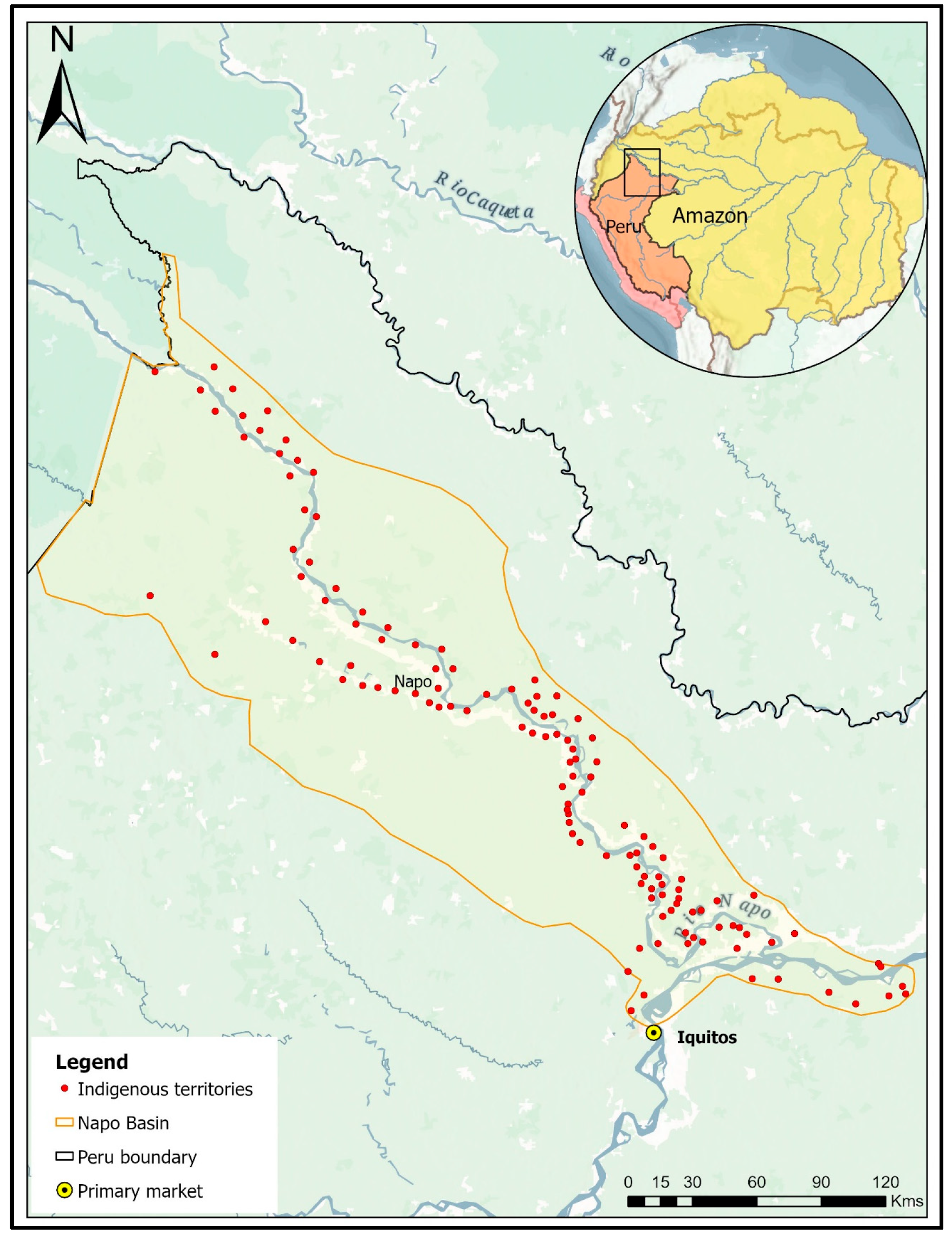
We conducted our comparative study in two Indigenous communities in Peru’s Napo River basin (Figure 1). These communities were purposively selected in consultation with the basin-level Indigenous federation to meet specific analytical criteria: both face severe land constraints—falling within the most land-scarce 10% of Indigenous territories in the Peruvian Amazon—yet exhibit contrasting institutional arrangements for land access and distribution, making them theoretically informative cases for examining how different property regimes mediate scarcity responses. While land property regimes across Amazonian rural settlements are extremely diverse [12], these communities share fundamental institutional features common to many Indigenous territories—including predominantly individual management of agricultural plots, kinship-based land circulation, and the centrality of moral economies in shaping possession norms—enhancing the transferability of insights to similar contexts. Practical considerations of community approval, logistical accessibility, and researcher safety further supported their selection.
The Napo River originates in the eastern Ecuadorian Andes and flows 885 km eastward to join the Amazon River about 80 km downstream from Iquitos. Situated in the Loreto region of northeastern Peru, the Napo basin encompasses some 125 Indigenous territories and supports about 16,500 Indigenous residents, primarily identifying as Kichwa del Napo and Arabela [33]. Livelihoods throughout the basin depend on seasonal wage labor, swidden-fallow agriculture and fisheries.
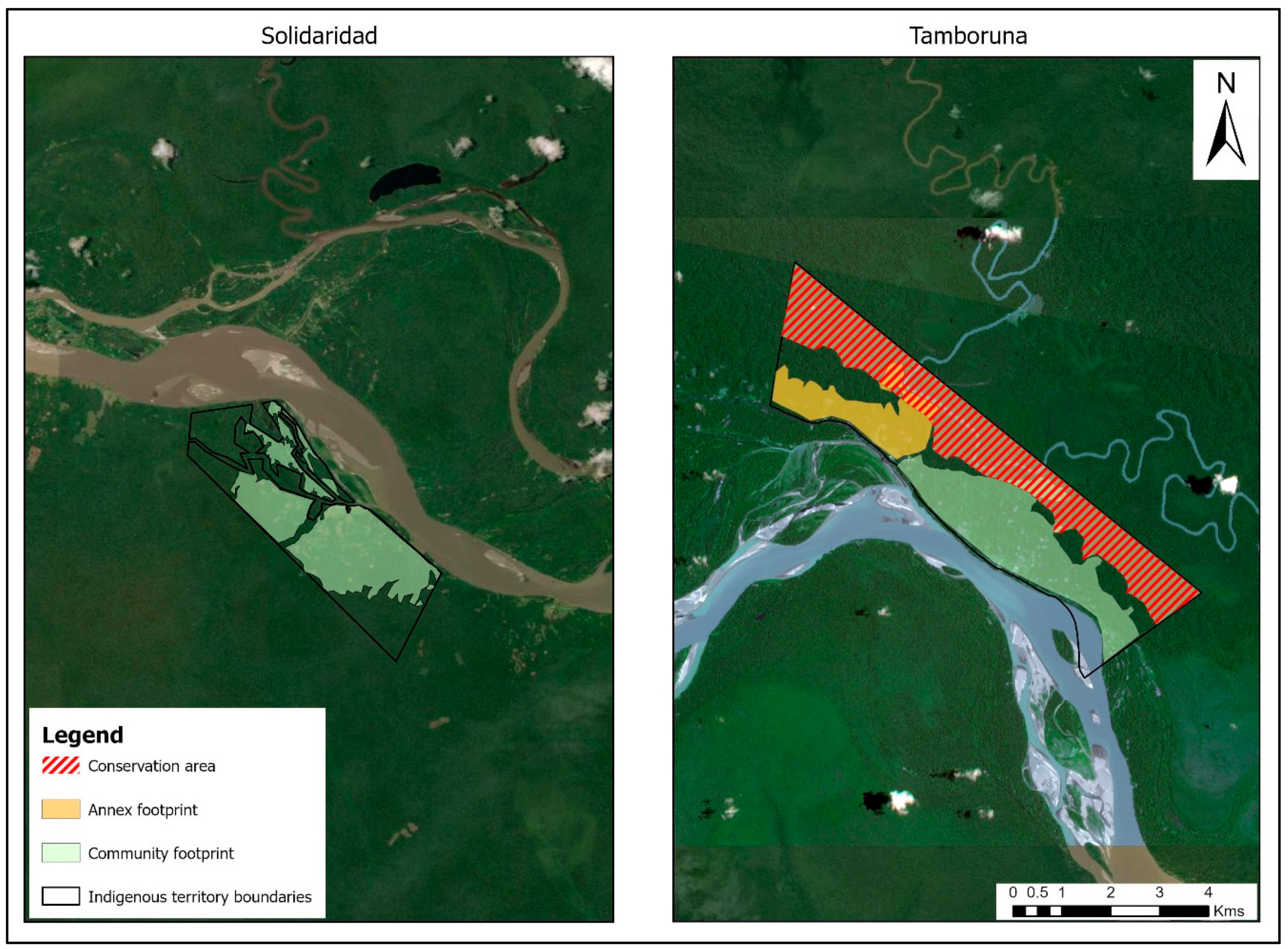
The comunidades nativas of Tamboruna and Solidaridad (pseudonyms) were officially recognized and titled in the early 1970s, with their demarcated territories situated predominantly in upland terra firme environments (Figure 2). Both Indigenous territories are relatively small: Tamboruna covers 2447 ha, while Solidaridad is even smaller at 969 ha. Demographically, Tamboruna is a densely populated community of 119 households, predominantly Kichwa del Napo, the largest ethnic group in the basin. Solidaridad, by contrast, is a much smaller settlement of 34 Murui-Munuane households. Families in both communities maintain diversified livelihood portfolios, combining seasonal wage labor—men often migrate to work in oil palm plantations—with swidden-fallow cultivation and fishing. Despite this diversification, most households remain income-poor. Following the poverty lines for rural Amazonia established by the National Institute of Statistics and Information Peru, over 40% of community members live in poverty (below USD 2.36 per person per day), and 10% live in extreme poverty (below USD 1.43 per person per day).
Solidaridad and Tamboruna experience acute and highly acute land scarcity, respectively. We operationalized land scarcity by estimating the remaining old-growth forest area not yet converted to cultivation—that is, the potential available cropland (PAC)—within each community’s titled territory and dividing this area by the number of households. Lower PAC per household values indicate more severe scarcity. In Tamboruna, only 306 ha of old-growth forest remain available, or 2.6 ha of PAC per household. This extreme scarcity reflects several interacting constraints: the community’s large built-up footprint (811 ha occupied by the main community and its annex, which includes land currently under settlement, cropping, and fallow), a forest conservation area enforced through a payment for ecosystem services (PES) initiative (1193 ha where community members cannot open new land), and riverbank erosion (137 ha). In Solidaridad, 400 ha of old-growth forest remain, providing 11.7 ha of PAC per household. The community footprint covers 569 ha, and unlike in Tamboruna, no additional territorial constraints are evident in the community territory.

5. Data Collection

To examine how institutional arrangements mediate how smallholder households experience and respond to land scarcity within Indigenous communities, we employed a comparative case study design—an approach particularly valuable for understanding causal mechanisms in complex social-ecological systems where experimental designs are infeasible. By selecting cases within a single river basin, we controlled for macro-level unobserved factors, though this geographic constraint may limit the broader applicability of our findings to other ecological or cultural contexts across Amazonia. While this two-case comparative design provides rich contextual insights about the associations between local institutional arrangements and resource pressures, we acknowledge that this design prioritizes depth of understanding over statistical generalizability.
Fieldwork in Tamboruna and Solidaridad was undertaken between August and October 2022 by A.L.A.R and fieldwork assistant J.H.E. Our fieldwork protocol was approved by the REB committee of McGill University, the basin-level Indigenous federation (Federation of Native Communities of the Middle Napo and Curaray, FECOMNANCUA in Spanish) and Tamboruna and Solidaridad communities’ assemblies. Communities were selected because they experience land scarcity, and provided conditions that ensured logistical feasibility and safety to the fieldwork team.
Data collection employed a multi-level strategy encompassing household, plot, and community levels across both study sites. Structured questionnaires and qualitative interviews were applied to 74 households practicing swidden-fallow agriculture (Tamboruna: 40 hh, Solidaridad: 34 hh). The questionnaire addressed household and kin demographics, income, land holdings (initial and current), labor availability, and access to natural resources. For land holdings, we documented the size, land cover, distance from home (in minutes), years under cover type, and land access mechanism (claimed or transferred) at two points in time—the year of the fieldwork (2022) and the year of household formation. Household land accumulation can be inferred by comparing initial and current land holdings. Qualitative interviews with the same households explored land conflicts, land tenure changes and scarcity perceptions. In addition, plot-level assessments reconstructed complete land-use histories for one representative field per household (n = 74). Community-level data was gathered through key informant interviews with 12 leaders (6 per community), including elected authorities and elders. Given that all collaborators were fluent in Spanish, all interviews and discussions were conducted in this language.

6. Methods

Our analysis examines how local institutional arrangements mediate smallholder households’ experience of and responses to land scarcity within two communities in which land availability has declined significantly. We focus on three key scarcity outcomes documented in previous scholarship: (1) land inequality, (2) land use intensification, and (3) transformations in land access and property regimes. We employ a mixed-methods approach combining quantitative distributional and regression analyses with qualitative examination of land tenure conflicts.

6.1. Distribution and Inequality Analysis

We first analyze how land access mechanisms produce land distribution patterns that determine the household’s experience of land scarcity. Summary statistics and non-parametric hypothesis tests (Kruskal-Wallis) characterize differences in land access patterns and resulting distributions between the two communities. We complement this with the analysis of internal land distribution across household lifecycles, with households classified into four age cohorts based on years since household formation: young households (≤10 years), young adult households (11–20 years), adult households (21–30 years), and elderly households (>30 years). To quantify inequality, we calculate Gini coefficients for both initial land holdings (at household formation) and current land holdings in each community. Additionally, we decompose the Gini coefficient by land access mechanism to measure their proportional and marginal contribution to community-level land inequality.

6.2. Regression Analysis

Second, we test whether household land holdings are associated with land use management intensification through OLS regression models with community and household life cycle interaction terms. Household land holdings capture how institutional arrangements mediate land scarcity into differential household resource endowments. Our analysis uses initial land holdings measured at household formation as the main predictor. While this temporal ordering does not establish causality, it reduces reverse causality concerns by capturing land endowments that predate current management practices.
To capture how the effects of initial land endowments evolve over household lifecycles—particularly important as land scarcity intensifies over time and constrains land availability for successive generations—we include household age (measured as years since household formation) and its interaction with initial land holdings. This specification allows us to test whether initial endowments have differential effects as households mature, potentially illuminating how the temporal unfolding of land scarcity and community-specific institutional arrangements shape land accumulation and management dynamics across household lifecycles.
Our regression model takes the form:
Y i = β 0 + β 1 L a n d H o l d i n g s i + β 2 H o u s e h o l d A g e i + β 3 L a n d H o l d i n g s i × H o u s e h o l d A g e i + β 4 C o m m u n i t y i + β 5 L a n d H o l d i n g s i × C o m m u n i t y i + γ j C o v a r i a t e s i j +   ε i
where Y i represents various land use outcomes, including swidden land (ha, log-transformed), fallow land (ha, log-transformed), proportion of land under fallow (%), cropping phase length (years), average fallow length of current fallows (years), and a weighted fallow index. The weighted fallow index multiplies fallow area by fallow length, providing an integrated measure that accounts for both the extent and maturity of fallows (following Coomes et al., [30]). L a n d H o l d i n g s i  represents standardized initial household land holdings at household formation. H o u s e h o l d A g e i  measures years since household formation, capturing lifecycle effects on land management. C o m m u n i t y i is a dummy variable (0 = Solidaridad, 1 = Tamboruna). The interaction term β 3 tests whether the relationship between initial land holdings and land use practices changes over the household lifecycle, while β 5 tests whether this relationship differs systematically between communities. The covariates control for household demographics (number of adults) and the proportion of holdings in lowland areas. All land area variables are log-transformed to account for skewness in the distribution, and land holdings variables are standardized to facilitate interpretation of interaction effects and reduce multicollinearity between main effects and interaction terms.
To complement the regression analysis, we present Spearman rank correlations between land use outcomes and both initial holdings and accumulated land holdings. This test further illuminates how inequality that develops over household lifecycles—shaped by community-specific access mechanisms—may increasingly influence contemporary land use management decisions.

6.3. Qualitative Analysis

Finally, we conducted semi-structured qualitative interviews with the same 74 households surveyed, targeting three specific themes: (1) perceptions and experiences of land scarcity; (2) land conflicts and tenure disputes; and, (3) changes in land property norms in response to land scarcity. Interview guides included open-ended prompts about each theme while allowing respondents to elaborate on their experiences. Interviews were transcribed verbatim and analyzed using Atlas.ti software v.22 (Lumivero LLC, Denver, CO, USA). We employed thematic coding to identify (a) competing moral frameworks justifying possession rights, (b) specific mechanisms of tenure contestation, and (c) the role of community leadership in mediating conflicts. Coding was iterative, with initial codes refined through constant comparison across cases. We then linked emergent themes to the quantitative results.

7. Results

7.1. Land Scarcity and Land Inequality

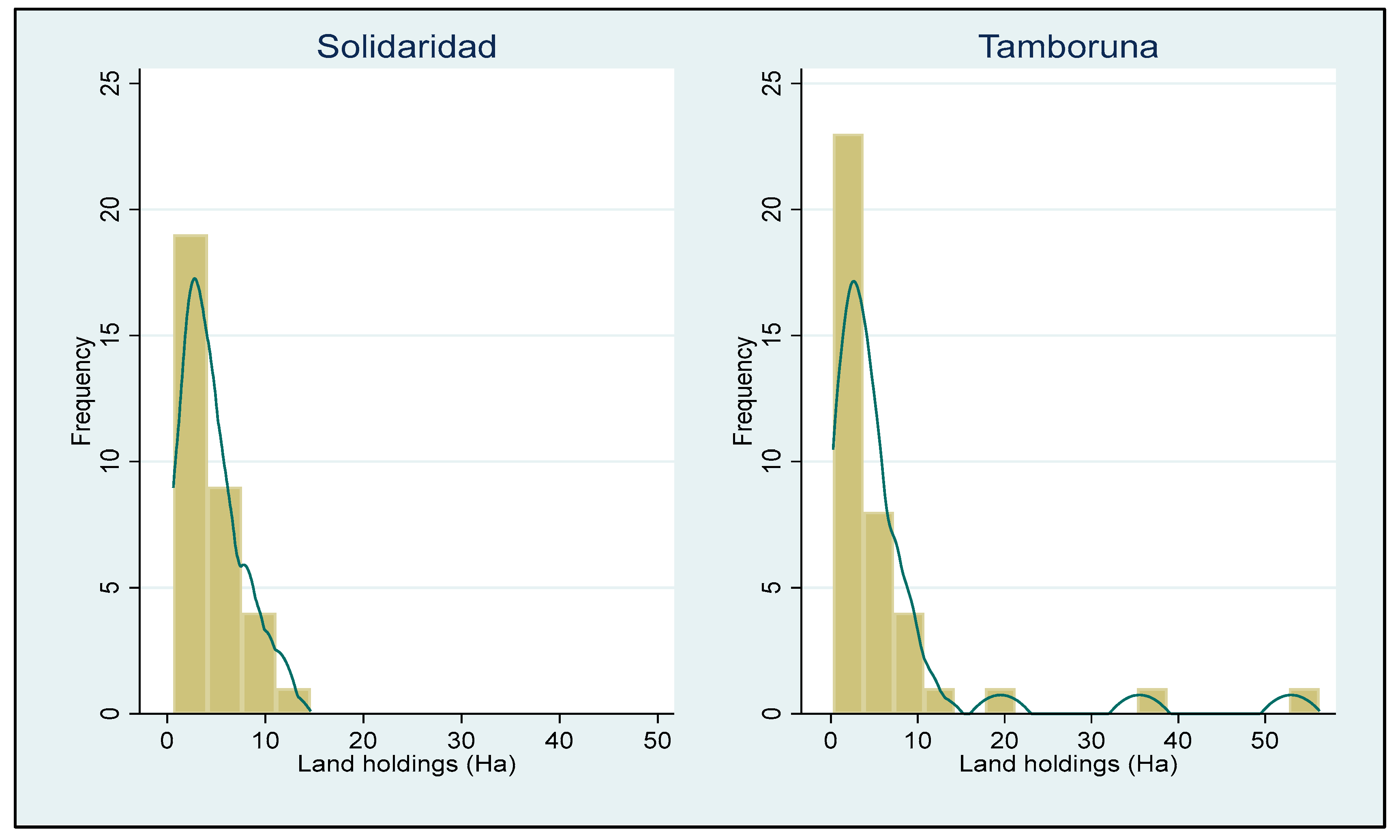
Households in Solidaridad and Tamboruna manage small holdings comprised of scattered plots in various stages of cropping and fallowing. Basic landholding patterns reveal initial similarities between the two communities (Table 1, Figure 3). Solidaridad households hold an average of 4.4 hectares distributed across plots averaging 0.6 hectares, while Tamboruna households manage 6.4 hectares with a mean plot size of 1.1 hectares. Upland terra firme areas dominate household portfolios in both communities, accounting for 60–80% of total holdings. However, Tamboruna’s greater availability of high levees (restinga baja) enables families to cultivate an additional 0.5 hectares on average in the floodplain compared to Solidaridad, reflecting how local landform availability shapes agricultural possibilities.
Despite experiencing similar levels of land scarcity and initial similarities, these communities exhibit strikingly different patterns of land accumulation and inequality—differences that can be traced directly to their contrasting land access mechanisms. In Solidaridad, land transfers from relatives constitute the primary access pathway to upland land holdings (2.2 ha on average), while claiming old-growth forest plays a secondary role (1.2 ha on average). Tamboruna presents the inverse pattern: households strongly rely on claiming new land (3.9 ha on average) while receiving only 0.7 ha through transfers. These contrasting patterns reflect fundamentally different institutional arrangements—Solidaridad’s system emphasizes active land circulation across generations, while Tamboruna’s individualistic system depends on continuous incorporation of new forest land similar to frontier expansion among colonists.
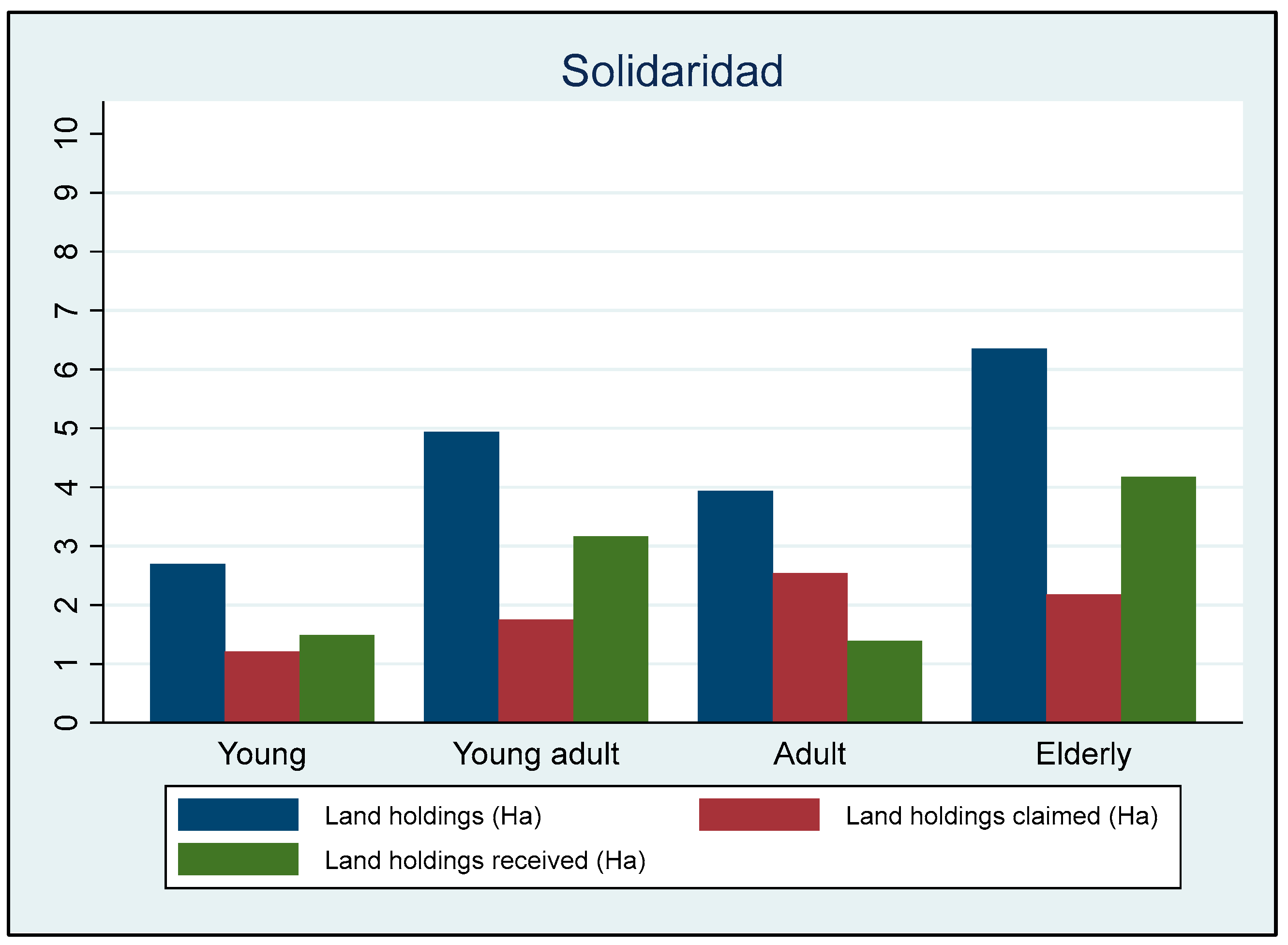
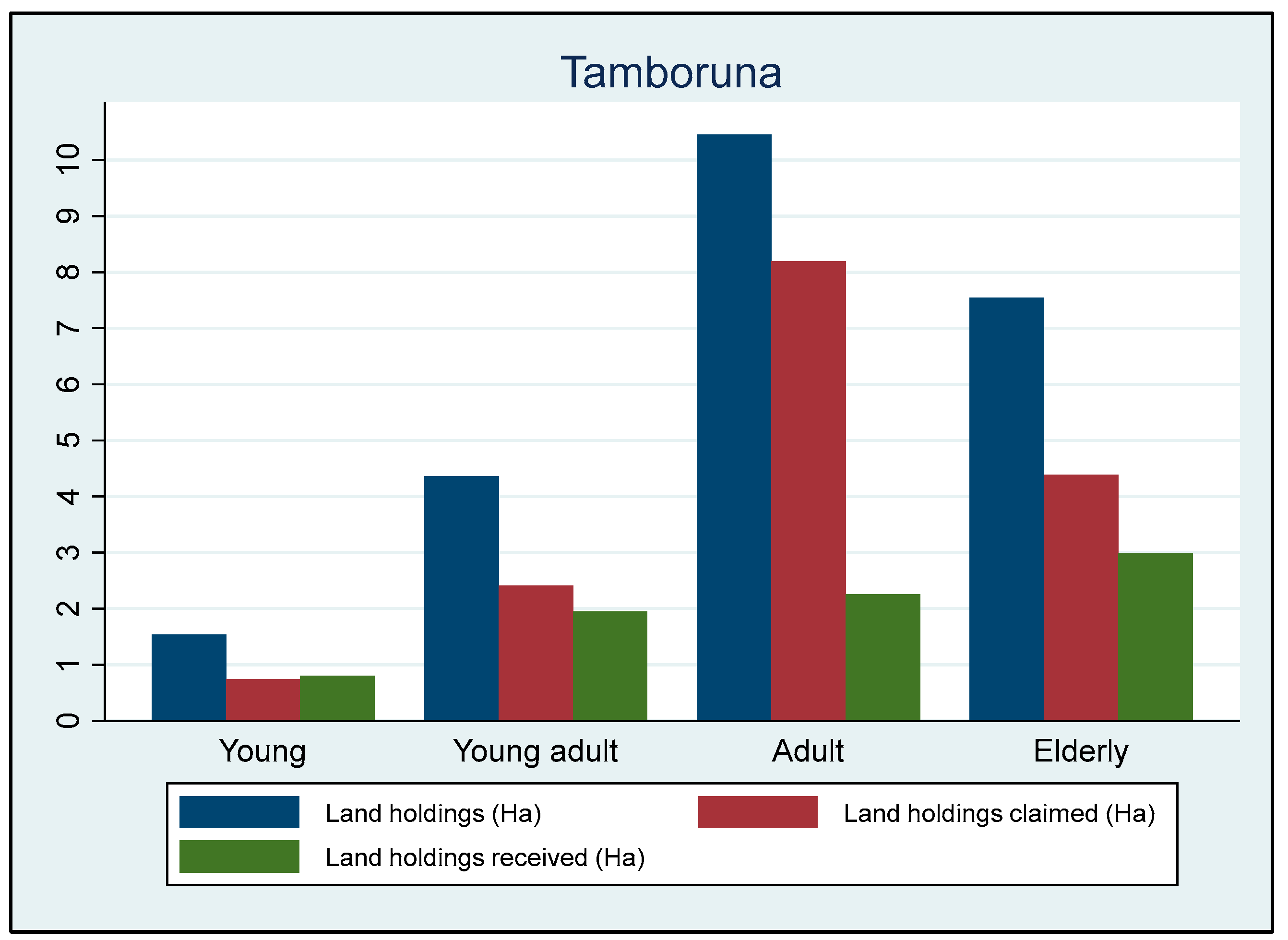
Concurrently, land accumulation over household lifecycles follows divergent trajectories in each community (Figure 4). Solidaridad exhibits a pattern consistent with the household demographic cycle, where land holdings expand gradually as families mature, reaching peak holdings among elderly households (6.3 hectares on average). Land received through transfers plays a dominant role across all lifecycle stages, accounting for the majority of holdings, particularly among young and elderly households, and reflecting active intergenerational land circulation. In contrast, Tamboruna displays a different pattern whereby land holdings expand dramatically through the lifecycle, peaking among adult households who constitute the land-richest segment in the community (average of 10.5 ha). This accumulation is enabled almost entirely by forest clearing and land claiming, with adult households having claimed approximately 8 hectares compared to only 2.2 hectares received. Interviews reveal that perceived land scarcity drove these adult families to rapidly claim large forest areas, securing land while it was still available. This land rush, however, has effectively restricted land access for younger generations of households (e.g., young households hold only1.5 hectares on average)—creating pronounced intergenerational polarization.
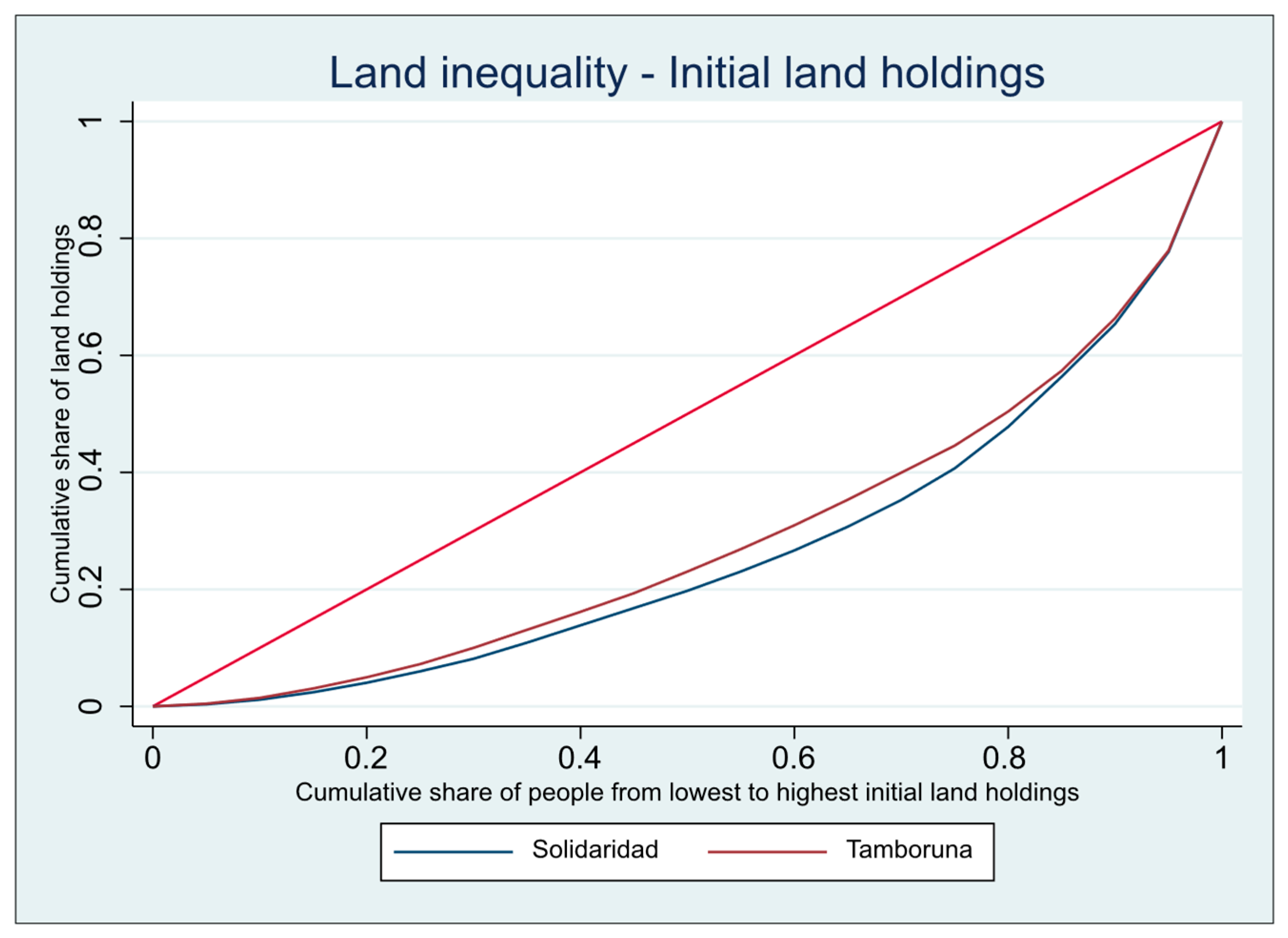
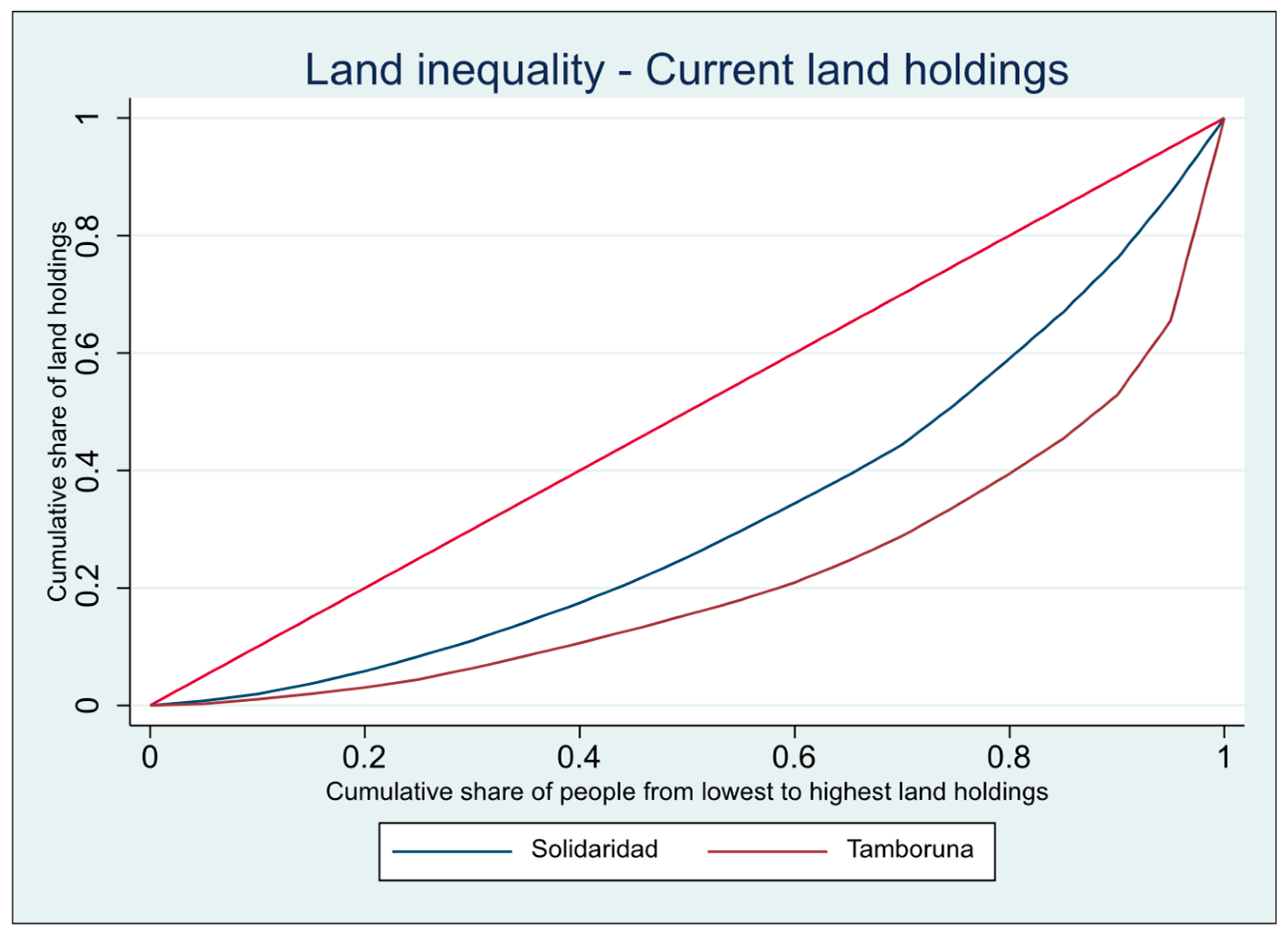
These divergent accumulation patterns produce markedly different inequality trajectories. Initial land holding inequality at household formation was similar in both communities (Gini coefficients: 0.47 in Solidaridad, 0.43 in Tamboruna), reflecting lifecycle differences across households within each community, such that younger households held less land than older households. However, current holdings reveal opposite trajectories: Solidaridad’s inequality moderated over time (Gini declining to 0.35), while Tamboruna experienced a sharp increase in inequality (Gini rising to 0.56) (Figure 5). Contemporary Tamboruna displays acute polarization, with land-rich households averaging 18 hectares while land-poor families hold less than 1.2 hectares.
Decomposing Gini coefficients by access mechanism reveals the structural dynamics underlying these divergent outcomes (Table 2). In Tamboruna, land claiming dominates both total holdings (67%) and inequality contribution (78%), whereas land transfers account for only one-third of land (33%) and contribute minimally to inequality (22%). An exceptionally strong Gini correlation (Rk = 0.93, p < 0.01)—the association between the land claimed and the position of the household in the land distribution—shows that successful claimants monopolize overall land wealth. The marginal inequality effect of land claiming is severe: each 1% increase in claimed land amplifies total inequality by 10.5%. In contrast, Solidaridad maintains a more balanced system. Land transfers constitute the primary mechanism (61% of total land, 60% of inequality contribution), while claiming plays a significant but secondary role (39% of land, 40% of inequality contribution). The moderate Gini correlation of land claiming (Rk = 0.58, p < 0.01) and moderate inequality within transfers (Gini: 0.48) in this community indicate that intergenerational circulation effectively redistributes land, moderating resource concentration. Both access mechanisms generate marginal inequality effects below 1%, reflecting the system’s equity-maintaining properties.

7.2. Land Scarcity Associated with Land Use Intensification

Consistent with swidden-fallow agriculture practices, households in both communities dedicate the majority of their land to forest fallow cover, though with markedly different patterns. While Solidaridad households maintain relatively balanced allocations (2 ha cultivation, 2.4 ha fallow), Tamboruna households hold proportionally more fallow (2.4 ha cultivation, 3.8 ha fallow)—particularly in uplands where they maintain 20% more fallow than Solidaridad. However, rotation cycles reveal that this higher fallow allocation in Tamboruna signals agricultural stress rather than extensive management. Tamboruna exhibits dramatically shortened cycles—plots remain under cultivation for only 0.8 years compared to 1.4 years in Solidaridad, while fallows last just 5–8 years versus 12–22 years in Solidaridad. These compressed cycles taking place in Tamboruna suggest plots can sustain only brief cultivation periods before requiring rest, yet fallows achieve only early-stage regeneration before being cleared again. In contrast, Solidaridad’s system shows resilience: fallows reach early adult succession stages when fruit trees peak in production, while plots sustain longer cultivation periods.
To examine whether a decrease in land holdings shapes these varying land uses, we estimate OLS regression models with interaction terms with household age and community (Table 3). This approach allows us to test whether initial land endowments influence land management practices, and whether these effects change as households age and accumulate (or fail to accumulate) additional land differently across the two communities.
Initial land endowments demonstrate strong associations with land use intensification patterns. In both communities, households starting with larger land holdings maintain significantly longer fallow periods (β = 0.406, p < 0.001) and higher weighted fallow indices (β = 0.434, p < 0.01), indicating more extensive management practices. However, larger initial endowments do not show significant associations with expanded swidden lands (β = 0.246, n.s.), while they do enable shorter cropping cycles (β = −0.248, p < 0.01)—suggesting that land-richer households can afford to rotate plots more frequently rather than exhausting individual fields. These patterns align with traditional expectations for swidden-fallow systems, where greater land availability enables more sustainable rotation practices.
However, our results indicate that the effects of initial land endowments may change significantly as households mature. The negative interaction between initial holdings and household age for cultivation area (β = −0.0101, p < 0.1) and fallow length (β = −0.0209, p < 0.01) indicates that the advantages conferred by larger initial endowments may diminish over time. As households age, the influence of initial land endowments on management practices (fallow duration, proportion of land under fallow, cropping cycle length) diminishes, while other factors, such as the unequal land accumulated and evolving labor capacity, become stronger predictors of land use intensification.
The importance of accumulated inequality over initial endowments is further demonstrated by correlation analyses (Table 4). In both communities, land accumulated over household lifecycles shows substantially stronger associations with land use patterns than initial holdings. In Solidaridad, the correlation between accumulated land and fallow area (r = 0.64, p < 0.01) far exceeds that with initial holdings (r = 0.29, n.s.), with accumulated land also showing stronger associations with the proportion under fallow (r = 0.42, p < 0.05) and fallow length (r = 0.35, p < 0.1) compared to weak or non-significant correlations with initial holdings. In Tamboruna, the pattern is even more pronounced: accumulated land correlates strongly with both an increase in swidden land area (r = 0.58, p < 0.01) and fallow area (r = 0.82, p < 0.01), while initial holdings show only weak associations with swidden area (r = 0.31, p < 0.1) and non-significant associations with fallow area (r = 0.23, n.s.). These patterns indicate that inequality accumulated over household lifecycles—shaped by community-specific access mechanisms documented in Section 7.1—may fundamentally influence contemporary land use practices more than the initial land endowments of households.
Beyond land holdings, household demographics and community-level factors provide additional insights. Household age demonstrates independent positive effects on swidden land area (β = 0.0123, p < 0.1), fallow area (β = 0.0215, p < 0.001), and the proportion under fallow (β = 0.0564, p < 0.01), as well as fallow length (β = 0.0193, p < 0.01), suggesting that older households—with less labor available—generally shift toward more extensive practices regardless of their initial endowments. Labor capacity further influences management intensity: households with more adult members maintain significantly more swidden land (β = 0.259, p < 0.1) and more fallow land (β = 0.209, p < 0.01) but show lower fallow length (β = −0.200, p < 0.01) and weighted fallow indices (β = −0.326, p < 0.1), suggesting labor availability enables management of larger areas through more intensive rotation. Most notably, community-level fixed effects emerge as the strongest determinants: Tamboruna exhibits systematically more intensive practices than Solidaridad, with significantly higher proportions of land under fallow (β = 0.121, p < 0.1), shorter cropping cycles (β = −0.291, p < 0.01) and fallow periods (β = −0.452, p < 0.01), suggesting that broader structural factors—potentially including differential market orientation of agricultural livelihoods, population densities, and soil conditions—shape land use decisions beyond simple land availability.

7.3. Land Scarcity and Changes in Property Norms

Of the two study communities, Tamboruna experiences the more critical decline in land availability with old-growth forest access constrained by a conservation area within its territory and land transfers limited, fallow lands (purmas) have emerged as the primary source of agricultural land. Notably, in several cases, fallows are being encroached upon by other community members without acknowledgement of established possession rights. Survey data reveals the pervasiveness of internal land encroachment in the community—more than one-quarter of households (27%) experienced purma invasion, where portions of their fallow lands were cleared by other families without permission, while 17% suffered complete purma dispossession. These encroachments predominantly flow from younger to older generations, directly reflecting the intergenerational land polarization documented in Section 7.1, where land-poor younger households (averaging 1.5 ha) contest the land control of land-richer older households (averaging 10+ ha). Through qualitative analysis of these disputes, this section examines how material inequality precipitates fundamental renegotiation of property norms via contested fallow appropriation.
Land contentions in Tamboruna center on the moral basis of possession rights as younger and older generations advance irreconcilable bases for legitimate land control. From the perspective of younger generations facing acute land scarcity, older families holding extensive fallow areas are mezquinos (stingy)—a characterization carrying particularly strong moral condemnation in the rural Peruvian Amazon—because these lands are not being put to productive use and often exceed what elders need to or can cultivate with available household labor. This moral critique draws on deep-rooted principles in Indigenous societies against resource hoarding and wealth concentration [37,45].
Yes, we ask them (older people) whether we can clear their fallow and sow it. Because sometimes we do not have land where to cultivate one plant of yuca, one of plantain, one of guineo. […] lots of them have (extra land), despite that they deprive you from the land [te mezquinan], and they don’t even slash-and-burn to produce it. (male, 31 years old. Translation is ours)
As an alternative to permanent possession, younger families contend that fallow possession rights should be time-limited, automatically reverting to community availability when fallows remain idle beyond a certain number of years. The precise definition of “idle” secondary forest, however, remains contested. Some respondents suggest 10 years as the appropriate limit, while others identify declining fruit production around 15 years or more depending on the species of tree crop as the proper indicator that fallows have exhausted their productive function for the original holder.
In contrast, families facing invasion or dispossession unanimously defend their labor-earned land rights. They emphasize that the original transformation of old-growth forest into productive agricultural land remains the definitive basis for asserting legitimate possession. Their narratives vividly describe these appropriation processes—the enormous physical effort invested in clearing old-growth forest with thick logs and the deep personal identification developed with plots individually shaped through decades of continuous management and care. One 78-year-old comunero, among the community’s most land-wealthy members, articulates a stark intergenerational divide in labor ethics. Given the labor invested in his fallows, he identifies as a land “owner” (dueño), while viewing younger generations as lazy opportunists (shegue) who prefer invading others’ established plots rather than undertaking the arduous work of clearing their own land in more remote areas. Significantly, many reported cases of land encroachment occur between kin members, significantly violating kinship conventions: first, by appropriating land without seeking permission or recognition, and second, by neglecting the reciprocity obligations owed to kin after a land transfer. The aggrieved elder’s testimony powerfully captures this disruption of kinship bonds:
(When I) walk to the church, they (my grandnephew and his family) do not even tell me ‘hey, uncle, come here, drink masato [yuca beer], not even a little cup. They do not remember in whose land they are working at, where they are producing at. They took my fallow, in there they produced manioc, plantain, everything! (male, 78 years old. Translation is ours)
Despite intense private animosity, land contentions frequently remain unaddressed between the parties. Land invasions and dispossessions are never publicly denounced, and oral resolutions are rarely achieved, manifesting the strong preference of household to avoid direct confrontation with relatives and neighbors —a typical sociability pattern in Amerindian societies [37,46]. Notably, community leadership plays an ambiguous and potentially complicit role in these disputes. Some authorities claim ignorance of well-known dispossession cases, effectively sanctioning appropriations through inaction. Others openly support local encroachment by citing assembly agreements that supposedly permit free purma appropriation—a norm never formally incorporated into the community statute, raising fundamental questions about both its legitimacy and authorities’ actual capacity or willingness to mediate member disputes.
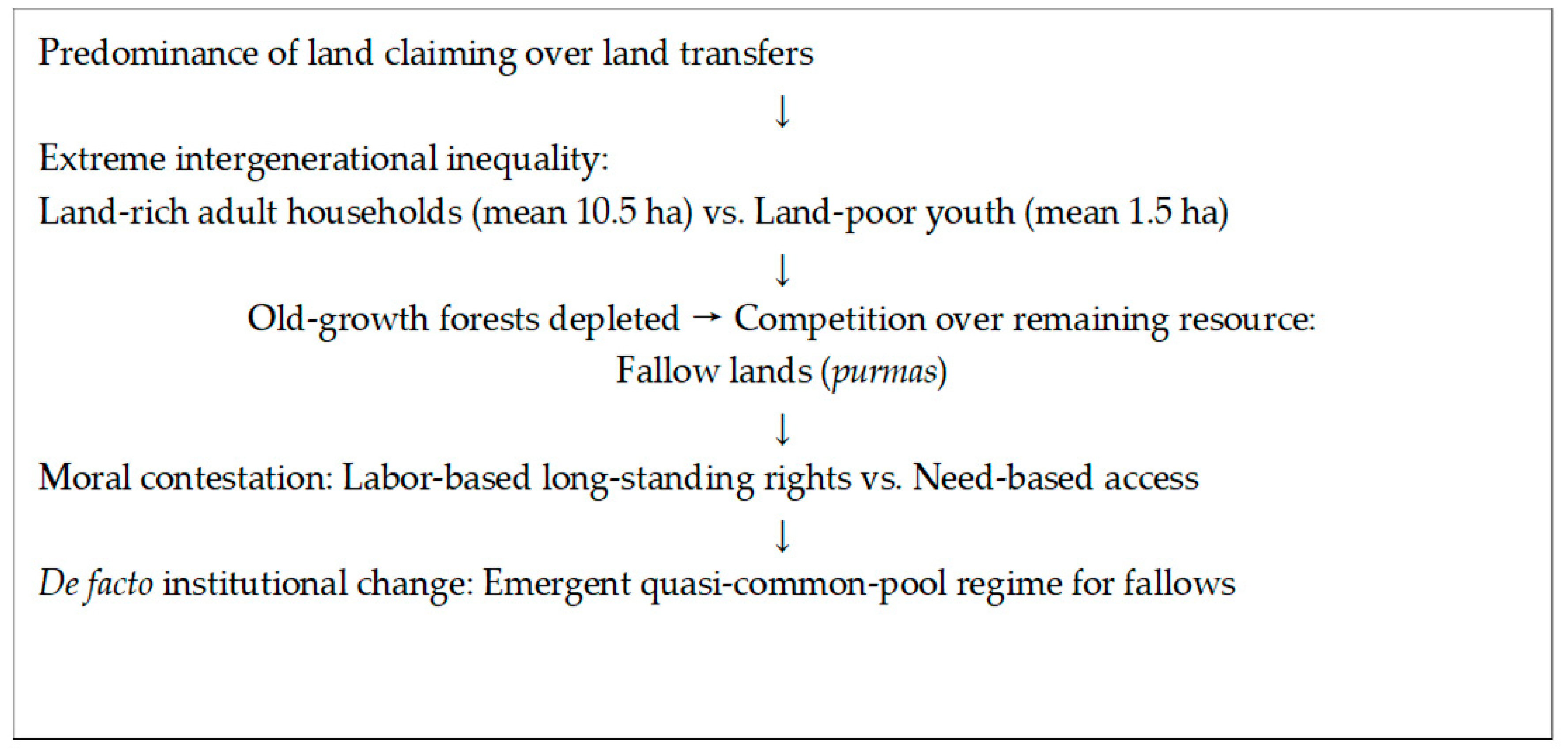
This combination of household-level conflict avoidance and strategic ambiguity among community leaders leaves land encroachment uncontained, gradually eroding traditional labor-based possession rights and repositioning fallow lands as quasi common-pool resources accessible to anyone who needs and can actively work them. Notably, this communalization of fallow lands and the shift toward need-based land access is being grounded through tacit acceptance of encroachment—a de facto institutional transformation unfolding in the absence of formal rule change (Figure 6).

8. Discussion and Conclusions

Our comparative analysis of two land-scarce Indigenous territories in the Peruvian Amazon demonstrates that local institutional arrangements fundamentally shape how communities experience and respond to land scarcity, challenging assumptions of uniform responses to declining resources in swidden-fallow systems [8,15]. Critically, institutions matter because they determine land distribution outcomes—and across every dimension we examined, the degree of land inequality mediates the relationship between scarcity and adaptation pathways. Rather than resource constraints alone driving responses, distributional trajectories shaped by access regimes and property norms determine how scarcity unfolds in these communities. This finding extends Coomes et al. [16,30], who demonstrated that land-poorer and land-richer households adapt differently to scarcity, with land-poorer households experiencing land-use poverty traps. We add two critical dimensions: first, the institutional mechanisms through which this inequality is produced; and second, how households confront intensifying resource disparity under scarcity.
Land access regimes determine whether scarcity produces shared constraint or polarizing inequality. In Tamboruna, where individual land claiming predominates, land scarcity triggered an internal land rush—a ‘winner-takes-all’ dynamic—that allowed early claimants to secure disproportionate holdings while latecomers face foreclosed access, creating extreme inequality and intergenerational land polarization. Conversely, Solidaridad’s access regime fosters land circulation, distributing land more equitably across households and generations. These contrasting access arrangements produce fundamentally different lived experiences of land scarcity: while households in Solidaridad experience scarcity as a more generalized, shared constraint, Tamboruna’s scarcity produces pronounced inequality, creating divergent realities of resource abundance and deprivation within a single community.
Though it is the most common ramification of land scarcity [9,11], we found that land use intensification is not an immediate result of land shortage but is shaped by unequal household trajectories. While larger initial endowments enable longer fallows early in household lifecycles, these advantages erode as households mature. Unequal land accumulation—structured by each community’s access regime—and household labor capacity—structured by the household’s life cycle—increasingly drive management decisions over time: land-richer households secure longer fallows and more sustainable rotations, while labor-rich households intensify cultivation across larger areas, denoting intensification.
Acute land inequality in a context of declining land availability precipitates significant transformations in property regimes, demonstrating that resource scarcity—associated with subsistence crisis—is a fundamental driver of institutional development in smallholder settlements bounded by kinship and moral economies [26]. In Tamboruna, where extreme stratification has developed, land-poor younger households invoke Indigenous principles against resource hoarding to challenge elders’ labor-based claims over extensive fallows, while land-rich elders defend permanent possession rights derived from original forest clearing. This moral contestation unfolds not through collective deliberation or open confrontation but through strategic and undisputed fallow encroachment. The emergent regime is neither privatization nor collective governance but a quasi-common-pool system where fallows become accessible to those demonstrating need yet retainable only through active use, overriding long-standing labor-based property norms.
Just how communities and households respond to land scarcity has important implications for agricultural sustainability and whether forest and biodiversity preservation in Indigenous territories will continue into the future. Although forest cover in territories with abundant land tends to be stable because households rely upon a stock of forest fallows that they build up through time and across generations [32], land scarcity can promote a drive to strategically clear old-growth forest, claim the land, and reduce the duration of the fallow period —as in the case of Tamboruna—which can lead to progressively younger secondary forest cover and a land-use poverty trap for young households. Moreover, the unresolved intergenerational tensions arising from extreme inequality risk eroding community cohesion, potentially undermining communal capacity to manage forest resources sustainably. Forest preservation is more likely in land-scarce communities such as Solidaridad where swidden-fallow agriculture remains more sustainable because of institutions that redistribute land within and across generations, and buttress long-standing property rights to fallowed land.
Our findings suggest that policy responses to land scarcity in Indigenous territories must be tailored to local institutional contexts rather than being implemented as uniform interventions. First, given that scarcity can drive land use changes that undermine both livelihoods and forest regeneration, territorial extension—already advocated by Indigenous federations and NGOs across the Peruvian Amazon [47]—represents a critical policy response that could alleviate distributional pressures for growing Indigenous settlements. Second, conservation programs operating in these territories (especially those implementing PES initiatives) must account for how they further constrain available land and exacerbate distributional conflicts and the formation of land-use poverty traps, particularly where land access mechanisms favor accumulation. Rather than directly intervening in Indigenous communities’ land governance—which may compromise local autonomy—support should focus on strengthening communities’ own institutional capacity to manage distributional tensions. This could include facilitating intergenerational dialogues around land access and evolving property norms. Additionally, interventions should look to strengthen the resilience and adaptive capacity of smallholders facing land scarcity, by supporting practices of fallow-enrichment already documented among Amazonian smallholders [31] and the diversification of off-farm and non-farm livelihoods (e.g., non-timber extraction, fisheries, seasonal wage labor) that can relieve the pressure of the forest [48].
Two design limitations of our study point the way for future research. First, our two-case comparative design prioritizes depth of contextual understanding over statistical generalizability, limiting our capacity to make broad claims about land scarcity responses across the diverse Indigenous territories of Amazonia. And second, the cross-sectional nature of our data constrains causal inference, as we cannot observe how institutional arrangements and land use patterns evolve dynamically over time. Future studies are needed to track institutional and ecological changes over time; to examine through multi-level analyses the experience of a greater number of settlements; and, to investigate the conditions under which land access and possession regimes among Indigenous communities persist and change. Despite these limitations, our mixed-methods approach provides valuable insights into the mechanisms through which institutions mediate land scarcity experiences, contributing to understanding of heterogeneity in swidden-fallow system responses to land constraint.

Author Contributions

Conceptualization, A.L.A.R. and O.T.C.; methodology, A.L.A.R. and O.T.C.; software, A.L.A.R.; validation, O.T.C.; formal analysis, A.L.A.R.; investigation, A.L.A.R.; resources, O.T.C.; data curation, A.L.A.R.; writing—original draft preparation, A.L.A.R.; writing—review and editing, A.L.A.R. and O.T.C.; visualization, A.L.A.R.; supervision, O.T.C.; project administration, O.T.C.; funding acquisition, O.T.C. All authors have read and agreed to the published version of the manuscript.

Funding

This research was funded by the Social Sciences and Humanities Research Council of Canada (grants 435-2020-0182).

Institutional Review Board Statement

The study was conducted in accordance with the Declaration of Helsinki and approved by the Research Ethics Board Office of McGill University (#REB 22-06-019, 26 July 2022).

Informed Consent Statement

Verbal informed consent was obtained from the participants. Verbal consent was obtained rather than written because it was deemed culturally appropriate for the research context (research within Indigenous communities).

Data Availability Statement

The data presented in this study are only available on request from the corresponding author due to ethical restrictions related to research with Indigenous communities.

Acknowledgments

The authors extend their deepest gratitude to the Indigenous Federation of the Native Communities of Middle Napo and Curaray for their generous support and collaboration throughout this research process. Their partnership was essential to the success of this work. We are grateful to research assistant J.H.E. for providing invaluable assistance during data collection. We thank the Editors and three anonymous reviewers for their helpful comments and suggestions on an earlier version of the manuscript.

Conflicts of Interest

The authors declare no conflicts of interest.

References

  1. Red Amazónica de Información Socioambiental Georreferenciada (RAISG). Amazonia 2023 Protected Areas Indigenous Territories (Stable Forest 1985–2022) 2023; Red Amazónica de Información Socioambiental Georreferenciada (RAISG): São Paulo, Brazil, 2023. [Google Scholar]
  2. Baragwanath, K.; Bayi, E.; Shinde, N. Collective property rights lead to secondary forest growth in the Brazilian Amazon. Proc. Natl. Acad. Sci. USA 2023, 120, e2221346120. [Google Scholar] [CrossRef]
  3. Blackman, A.; Corral, L.; Lima, E.S.; Asner, G.P. Titling indigenous communities protects forests in the Peruvian Amazon. Proc. Natl. Acad. Sci. USA 2017, 114, 4123–4128. [Google Scholar] [CrossRef] [PubMed]
  4. Gray, C.; Bilsborrow, R. Stability and change within indigenous land use in the ecuadorian amazon. Glob. Environ. Change 2020, 63, 102116. [Google Scholar] [CrossRef]
  5. Bennett, A.; Larson, A.; Zamora Ríos, A.; Monterroso, I.; Sheila, G. Forty-year multi-scale land cover change and political ecology data reveal a dynamic and regenerative process of forests in Peruvian Indigenous Territories. Glob. Environ. Change 2023, 81, 102695. [Google Scholar] [CrossRef]
  6. Denevan, W.M.; Padoch, C.; Prance, G.T.; Treacy, J.M.; Unruh, J.; Alcorn, J.B.; Paitán, S.F.; Inuma, J.C.; de Jong, W. Swidden-fallow agroforestry in the Peruvian amazon. Adv. Econ. Bot. 1988, 5, 1–107. [Google Scholar]
  7. Padoch, C.; Pinedo-Vasquez, M. Saving Slash-and-Burn to Save Biodiversity. Biotropica 2010, 42, 550–552. [Google Scholar] [CrossRef]
  8. Boserup, E. The Conditions of Agricultural Growth: The Economics of Agrarian Change Under Population Pressure; Routledge: London, UK, 1965. [Google Scholar] [CrossRef]
  9. Jakovac, C.C.; Peña-Claros, M.; Kuyper, T.W.; Bongers, F. Loss of secondary-forest resilience by land-use intensification in the Amazon. J. Ecol. 2015, 103, 67–77. [Google Scholar] [CrossRef]
  10. Coomes, O.T.; Takasaki, Y.; Rhemtulla, J.M. What fate for swidden agriculture under land constraint in tropical forests? Lessons from a long-term study in an Amazonian peasant community. J. Rural Stud. 2017, 54, 39–51. [Google Scholar] [CrossRef]
  11. Sirén, A.H. Population growth and land use intensification in a subsistence-based indigenous community in the amazon. Hum. Ecol. 2007, 35, 669–680. [Google Scholar] [CrossRef]
  12. Cronkleton, P.; Larson, A.M. Formalization and collective appropriation of space on forest frontiers: Comparing communal and individual property systems in the peruvian and ecuadoran amazon. Soc. Nat. Resour. 2015, 28, 496–512. [Google Scholar] [CrossRef]
  13. Peluso, N.L. Fruit trees and family trees in an anthropogenic forest: Ethics of access, property zones, and environmental change in indonesia. Comp. Stud. Soc. Hist. 1996, 38, 510–548. [Google Scholar] [CrossRef]
  14. Pinedo-Vásquez, M.; Hetch, S.; Padoch, C. Amazonia. In Traditional Forest-Related Knowledge: Sustaining Communities, Ecosystems and Biocultural Diversity; Parrotta, J.A., Trosper, R.L., Eds.; Springer: Dordrecht, The Netherlands, 2012; pp. 119–155. [Google Scholar]
  15. Bilsborrow, R.E. Population Growth, Internal Migration, and Environmental Degradation in Rural Areas of Developing Countries. Eur. J. Popul. Rev. Eur. Démographie 1992, 8, 125–148. [Google Scholar] [CrossRef] [PubMed]
  16. Coomes, O.T.; Grimard, F.; Burt, G.J. Tropical forests and shifting cultivation: Secondary forest fallow dynamics among traditional farmers of the Peruvian Amazon. Ecol. Econ. 2000, 32, 109–124. [Google Scholar] [CrossRef]
  17. Filho, A.A.R.; Adams, C.; Murrieta, R.S.S. The impacts of shifting cultivation on tropical forest soil: A review. Bol. Mus. Para. Emílio Goeldi. Ciênc. Hum. 2013, 8, 693–727. [Google Scholar] [CrossRef]
  18. Hiraoka, M. Agricultural systems on the floodplains of the peruvian amazon. In Fragile Lands of Latin America; Routledge: London, UK, 1989. [Google Scholar]
  19. Dressler, W.H.; Wilson, D.; Clendenning, J.; Cramb, R.; Keenan, R.; Mahanty, S.; Bruun, T.B.; Mertz, O.; Lasco, R.D. The impact of swidden decline on livelihoods and ecosystem services in Southeast Asia: A review of the evidence from 1990 to 2015. Ambio 2017, 46, 291–310. [Google Scholar] [CrossRef]
  20. Lambin, E.F.; Meyfroidt, P. Global land use change, economic globalization, and the looming land scarcity. Proc. Natl. Acad. Sci. USA 2011, 108, 3465–3472. [Google Scholar] [CrossRef]
  21. Hartmann, T.; Gerber, J.-D. Land, scarcity, and property rights. In Instruments of Land Policy; Routledge: Abingdon, UK, 2018. [Google Scholar]
  22. Wood, S.L.R.; Rhemtulla, J.M.; Coomes, O.T. Cropping history trumps fallow duration in long-term soil and vegetation dynamics of shifting cultivation systems. Ecol. Appl. 2017, 27, 519–531. [Google Scholar] [CrossRef]
  23. Instituto del Bien Común (IBC). Directorio 2016 Comunidades Nativas del Perú Sistema de Información Sobre Comunidades Nativas de la Amazonía Peruana—SICNA; Instituto del Bien Común: Lima, Peru, 2016. [Google Scholar]
  24. Abizaid, C. Floodplain Dynamics and Traditional Livelihoods in the Upper Amazon: A Study Along the Central Ucayali River, Peru. Ph.D. Thesis, McGill University, Montreal, QC, Canada, 2007. [Google Scholar]
  25. McSweeney, K. Indigenous population growth in the lowland neotropics: Social science insights for biodiversity conservation. Conserv. Biol. 2005, 19, 1375–1384. [Google Scholar] [CrossRef]
  26. Oldekop, J.A.; Bebbington, A.J.; Truelove, N.K.; Holmes, G.; Villamarín, S.; Preziosi, R.F. Environmental impacts and scarcity perception influence local institutions in indigenous amazonian kichwa communities. Hum. Ecol. 2012, 40, 101–115. [Google Scholar] [CrossRef]
  27. Sarmiento Barletti, J.P.; Begert, B.; Loza, M.A.G. Is the formalization of collective tenure rights supporting sustainable indigenous livelihoods? Insights from comunidades nativas in the peruvian amazon. Int. J. Commons 2021, 15, 381–394. [Google Scholar] [CrossRef]
  28. Araujo Raurau, A. Land Scarcity in Indigenous Territories of the Peruvian Amazon: A Dual Challenge for Indigenous Land Rights and Resource Sustainability. Master’s Thesis, McGill University, Montreal, QC, Canada, 2024. Available online: https://escholarship.mcgill.ca/concern/theses/7s75dk02c (accessed on 8 February 2025).
  29. Jakovac, C.C.; Peña-Claros, M.; Mesquita, R.C.G.; Bongers, F.; Kuyper, T.W. Swiddens under transition: Consequences of agricultural intensification in the Amazon. Agric. Ecosyst. Environ. 2016, 218, 116–125. [Google Scholar] [CrossRef]
  30. Coomes, O.T.; Takasaki, Y.; Rhemtulla, J.M. Land-use poverty traps identified in shifting cultivation systems shape long-term tropical forest cover. Proc. Natl. Acad. Sci. USA 2011, 108, 13925–13930. [Google Scholar] [CrossRef]
  31. Rios, P.; Smith, S.; Thomas, S. Biochar effects on NTFP-enriched secondary forest growth and soil properties in Amazonian Ecuador. J. Environ. Manag. 2024, 350, 119068. [Google Scholar] [CrossRef] [PubMed]
  32. Coomes, O.; Kalacska, M.; Takasaki, Y.; Abizaid, C.; Grupp, T. Smallholder agriculture results in stable forest cover in riverine Amazonia. Environ. Res. Lett. 2021, 17, 014024. [Google Scholar] [CrossRef]
  33. Instituto Nacional de Estadística e Información (INEI). Directorio de Comunidades Nativas y Campesinas; Censos Nacionales 2017: XII de Población, VII de Vivienda, y III de Comunidades Indígenas; Instituto Nacional de Estadística e Información (INEI): Lima, Peru, 2018. [Google Scholar]
  34. Esbach, M.S.; Correia, J.E.; Valdivia, G.; Lu, F. Amazonian conservation across archipelagos of Indigenous territories. Conserv. Biol. 2024, 39, e14407. [Google Scholar] [CrossRef] [PubMed]
  35. Monterroso, I.; Cronkleton, P.; Pinedo, D.; Larson, A.M. Reivindicación de Derechos Colectivos: Reformas de Tenencia de Tierras y Bosques en el Perú (1960–2016); CIFOR: Bogor, Indonesia, 2017. [Google Scholar] [CrossRef]
  36. Brisson, S. Labor Access and Unequal Land Holdings Among Peasant Farmers in a Lowland and Upland Community of the Peruvian Amazon. Master’s Thesis, McGill University, Montréal, QC, Canada, 2003. Available online: http://oatd.org/oatd/record?record=oai%5C%3Aescholarship.mcgill.ca%5C%3Ajw827d81b (accessed on 21 June 2022).
  37. Brown, M.F. Una Paz Incierta: Comunidades Aguarunas Frente al Impacto de la Carretera Marginal; Centro Amazónico de Antropología y Aplicación Práctica: Lima, Peru, 1984. [Google Scholar]
  38. Ocampo-Raeder, V.C. ¿Tierras ociosas o productivas? El impacto y significado cultural de la agricultura indigena de la Amazonia Peruana. Debate Agrar. Anal. Altern. 2008, 101–127. Available online: https://cepes.org.pe/wp-content/uploads/2019/03/debate44_04.pdf (accessed on 10 December 2025).
  39. Lu, F.E. The common property regime of the huaorani indians of ecuador: Implications and challenges to conservation. Hum. Ecol. 2001, 29, 425–447. [Google Scholar] [CrossRef]
  40. Barbieri, A.F.; Bilsborrow, R.E.; Pan, W.K. Farm Household Lifecycles and Land Use in the Ecuadorian Amazon. Popul. Environ. 2005, 27, 1–27. [Google Scholar] [CrossRef]
  41. Ellis, F. Peasant Economics: Farm Households in Agrarian Development; Cambridge University Press: Cambridge, UK, 1993. [Google Scholar]
  42. López-Carr, D.; Suter, L.; Barbieri, A. Population dynamics and tropical deforestation: State of the debate and conceptual challenges. Popul. Environ. 2005, 27, 89–113. [Google Scholar] [CrossRef]
  43. Perz, S.G. Household demographic factors as life cycle determinants of land use in the Amazon. Popul. Res. Policy Rev. 2001, 20, 159–186. [Google Scholar] [CrossRef]
  44. Instituto del Bien Común (IBC). Comunidades Nativas Tituladas. 2023. Available online: https://peru.mapbiomas.org/ (accessed on 11 November 2025).
  45. Descola, P. In the Society of Nature: A Native Ecology in Amazonia; Cambridge University Press: Cambridge, UK, 1994. [Google Scholar]
  46. Gow, P. Of Mixed Blood: Kinship and History in Peruvian Amazonia; Oxford University Press: Oxford, NY, USA, 1991. [Google Scholar]
  47. Monterroso, I.; Larson, A.M.; Gutiérrez, Y.; Quaedvlieg, J.; Jarama, L. Guía Práctica Para el Proceso de Titulación de Comunidades Nativas; CIFOR Center for International Forestry Research: Bogor, Indonesia, 2019. [Google Scholar] [CrossRef]
  48. Wright, S.J.; Muller-Landau, H. The future of tropical forest species. Biotropica 2006, 38, 287–301. [Google Scholar] [CrossRef]
Figure 1. Indigenous territories of the Napo basin in the Peruvian Amazon. (Spatial data source: Instituto del Bien Común [44]).
Sustainability 18 03665 g001
Figure 2. Case studies: land-scarce Indigenous territories of Solidaridad and Tamboruna.
Sustainability 18 03665 g002
Figure 3. Size distribution of current land holdings in study communities.
Sustainability 18 03665 g003
Figure 4. Land distribution according to age cohort for study communities.
Sustainability 18 03665 g004aSustainability 18 03665 g004b
Figure 5. Lorenz curves depicting distribution of initial household land holdings (at time of household inception) and current household land holdings for the two study communities.
Sustainability 18 03665 g005aSustainability 18 03665 g005b
Figure 6. Tamboruna: pathway from land access and inequality to institutional change.
Sustainability 18 03665 g006
Table 1. Summary statistics for two study communities.
SolidaridadTamborunaTest of Difference
VariableNMeanSDMinMaxNMeanSDMinMaxk-Wallis
Number of plots349.45.03.023.0408.53.71.0170.01
Land holdings (ha)334.42.90.611.9396.49.80.3530.01
Upland holdings (ha)333.42.30.110.0394.69.60.0521.89
Lowland holdings (ha)341.01.10.04.5391.82.60.015.22.57
Lowland holdings—high levee (ha)330.40.90.04.0400.91.10.04.710.75 ***
Lowland holdings—low levee (ha)340.70.90.04.5390.92.50.015.20.35
% upland holdings330.80.20.21.0390.60.30.013.61 *
% high levee—lowland holdings330.20.40.01.0400.50.40.016.09 **
Average area per plot (ha)330.60.40.12.0391.12.90.117.70.00
Land claimed (ha)331.72.20.010.3394.39.60.0522.99 *
Upland claimed (ha)331.21.70.05.8383.99.80.0525.58 **
Land received (ha)332.72.50.08.9382.13.10.018.52.23
Upland received (ha)332.22.10.08.9380.71.00.04.614.01 ***
% Land claimed 330.30.40.01.0370.60.40.0111.31 ***
Initial land holdings (ha)321.71.70.08.5401.61.60.18.30.04
Cultivation land (ha)332.01.70.58.3372.76.20.0361.85
Fallow land (ha)332.42.40.08.5373.86.00.0341.32
% Fallow land 330.50.30.00.9370.60.20.01.03.39 *
% Upland fallow land330.50.30.00.9370.70.30.01.011.02 ***
Average cropping length (years)331.30.90.54.1390.90.80.15.08.05 ***
Average fallow length (years)3012.711.11.455.0387.45.21.222.25.37 **
Fallow length of the last plot cleared (years)2822.114.72.050.0336.87.30.030.019.80 ***
Weighted fallow index293.53.80.418.3352.33.40.220.04.96 **
Note: *** p < 0.01, ** p < 0.05, * p < 0.1.
Table 2. Decomposition of Gini coefficient by land acquisition mechanism.
SolidaridadTamborunaDifference
Land claiming from old-growth forest
Share of Total Land39%67%+28 pp
Gini coefficient 0.620.70+0.08
Gini correlation (Rk)0.58 ***0.93 ***+0.35
Contribution to Total Inequality40%78%+38 pp
Inequality Effect (% Change)+0.9%+10.5%12x stronger
Land transfers
Share of Total Land61%33%−28 pp
Gini coefficient0.480.57+0.09
Gini correlation (Rk)0.72 ***0.68 ***−0.04
Contribution to Total Inequality60%22%−37 pp
Inequality Effect (% Change)−0.8%−10.41%14x stronger
Note: Gini correlation (Rk) measures the association between each land access mechanism and household position in the total land distribution. Statistical significance assessed using Spearman rank correlations, which yielded highly similar correlation coefficients: *** p < 0.01.
Table 3. Results of OLS regression analyses of initial land holdings as a predictor of land use variables.
(1)(2)(3)(4)(5)(6)
VariablesSwidden Land (log ha)Fallow Land
(log ha)
% Fallow Land Average Cropping Length
(log Years)
Average Fallow Length
(log Years)
Weighted Fallow Index
Initial land holdings (std)0.2460.158−0.00656−0.248 **0.406 ***0.434 **
(0.155)(0.152)(0.0747)(0.102)(0.141)(0.174)
Household age (years since formation)0.0123 *0.0215 ***0.00564 **−0.0008970.0193 **−0.000776
(0.00702)(0.00560)(0.00223)(0.00529)(0.00736)(0.00857)
Initial land holdings × Household age−0.0101 *−0.002470.0004210.00467−0.0209 ***−0.0147
(0.00544)(0.00582)(0.00263)(0.00401)(0.00755)(0.00927)
Community dummy 0.06340.1140.121 *−0.291 **−0.452 **−0.250
(0: Solidaridad, 1: Tamboruna)(0.220)(0.196)(0.0686)(0.145)(0.183)(0.246)
Initial land holdings × Community−0.0457−0.03970.05090.1890.2130.108
(0.156)(0.157)(0.0696)(0.126)(0.154)(0.187)
Number of adults0.259 *0.209 ***0.0222−0.0121−0.200 **−0.326 **
(0.137)(0.0765)(0.0298)(0.0883)(0.0985)(0.126)
% Lowland holdings−0.274−0.575−0.254−0.771−0.01450.143
(0.595)(0.421)(0.165)(0.466)(0.426)(0.596)
Constant−0.6690.2990.372 ***0.3702.312 ***1.568 ***
(0.428)(0.256)(0.108)(0.246)(0.284)(0.343)
Observations656666666260
R-squared0.1650.3030.1940.2200.4060.270
Adj R-squared0.06200.2190.09630.1250.3290.172
F-Stat2.2073.7432.2942.2286.7872.526
Prob > F0.04690.002070.03910.04478.78 × 10−60.0258
Mean of outcome variable0.1171.1120.527−0.08261.9690.613
Note: Robust standard errors in parentheses; *** p < 0.01, ** p < 0.05, * p < 0.1
Table 4. Spearman correlations between land use variables and initial/accumulated land holdings per community.
SolidaridadTamboruna
Initial
Holdings (ha)
Land
Accumulated (ha)
Initial
Holdings (ha)
Land
Accumulated (ha)
Swidden land (log ha)0.110.220.31 *0.58 ***
Fallow land (log ha)0.290.64 ***0.2310.82 ***
% Fallow land0.160.42 **0.110.19
Cropping length (log years)−0.32 *−0.110.257−0.17
Fallow length (log years)0.200.35 *0.110.2
Weighted fallow index0.280.030.130.08
Note: *** p < 0.01, ** p < 0.05, * p < 0.1
Disclaimer/Publisher’s Note: The statements, opinions and data contained in all publications are solely those of the individual author(s) and contributor(s) and not of MDPI and/or the editor(s). MDPI and/or the editor(s) disclaim responsibility for any injury to people or property resulting from any ideas, methods, instructions or products referred to in the content.