Evolutionary Game Analysis of Industrial Robot-Driven Air Pollution Synergistic Governance Incorporating Public Environmental Satisfaction

Abstract
1. Introduction
2. Literature Review
2.1. Related Research on Promoting Air Pollution Governance by Industrial Robots
2.2. Related Research on Public Environmental Satisfaction
2.3. Implications and Shortcomings of Existing Research
3. Problem Description and Model Assumptions
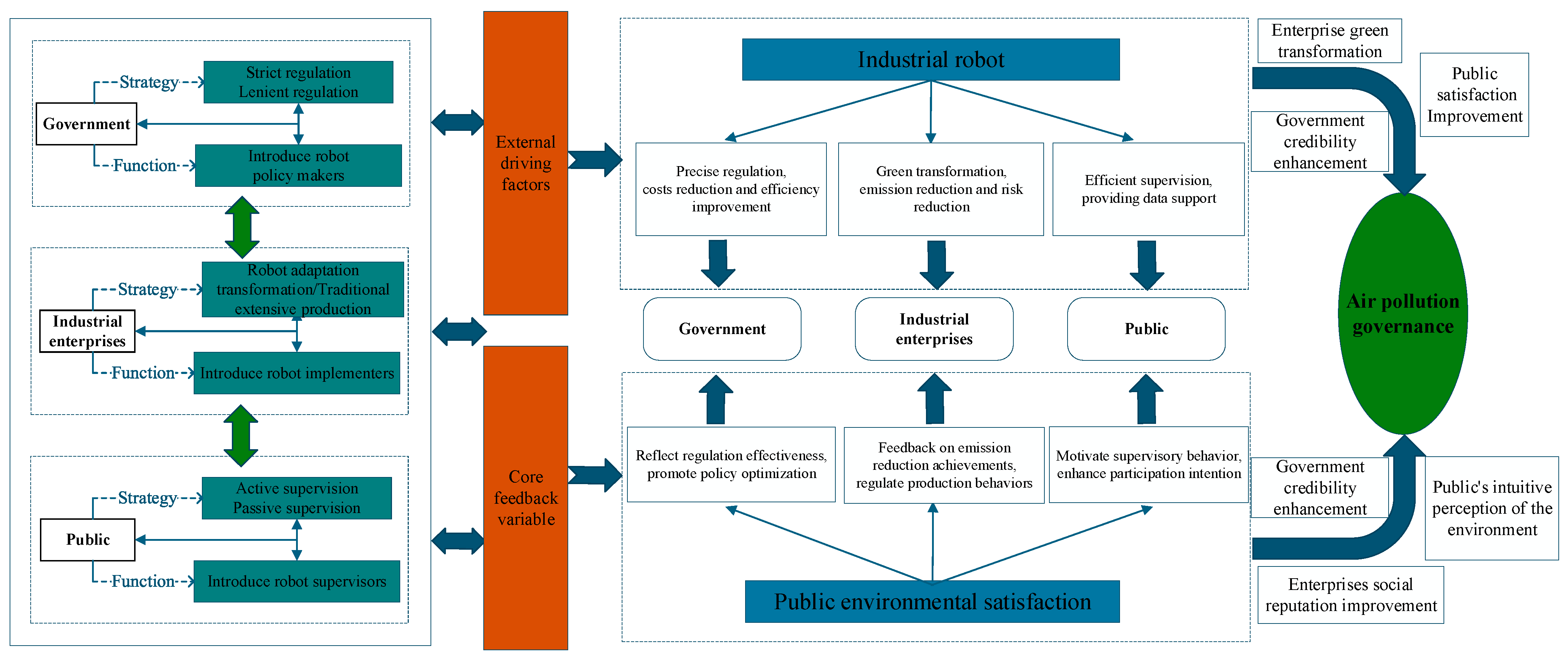
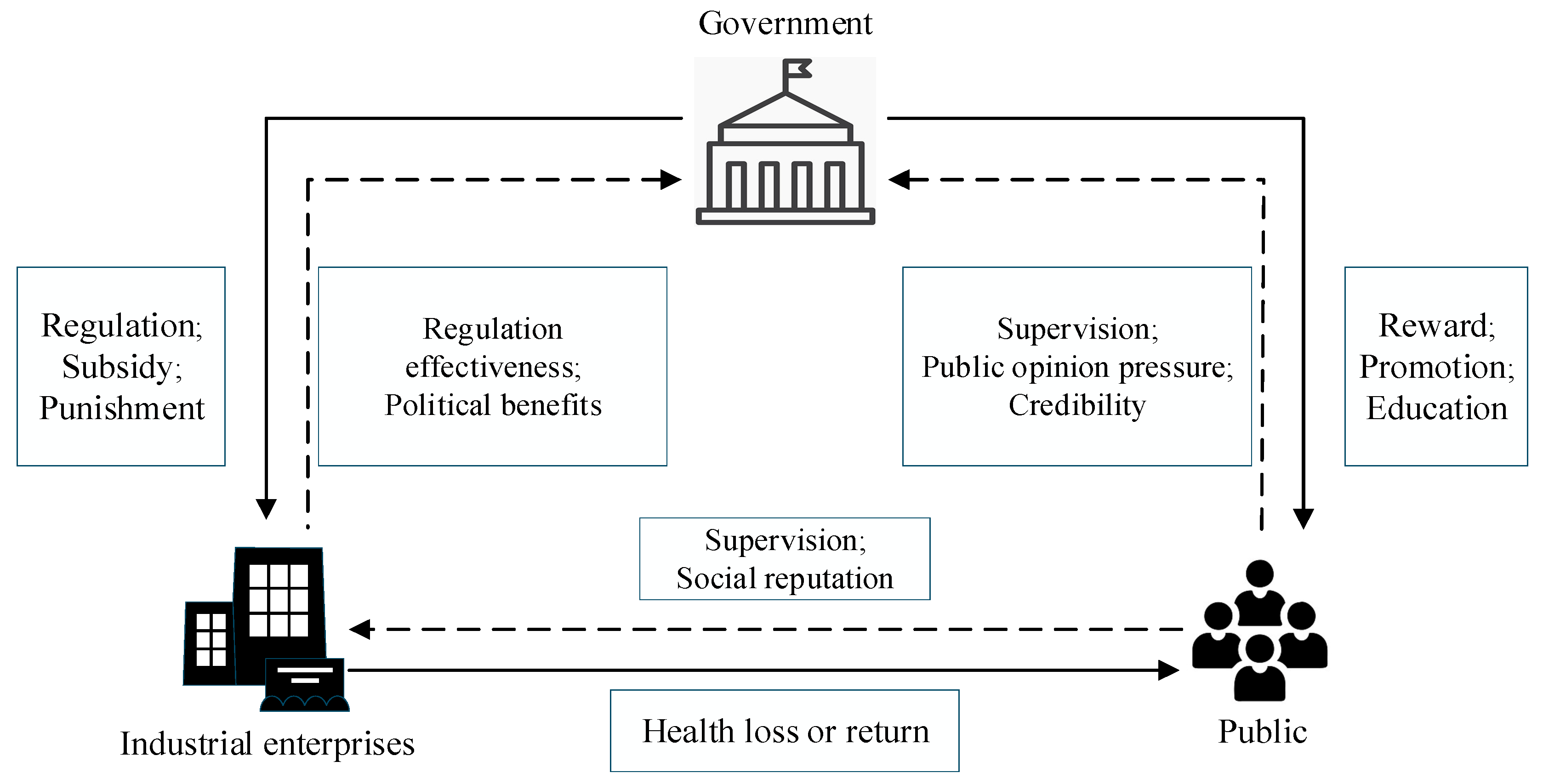
3.1. Problem Description
3.2. Model Hypothesis
3.3. Payment Matrix
4. Model Construction and Analysis
4.1. Model Construction
4.1.1. Analysis of Government Policy Stability
4.1.2. Analysis of Industrial Enterprises’ Strategy Stability
4.1.3. Analysis of Public Strategy Stability
4.2. Stability Analysis of Equilibrium Strategies in the Game System
5. Numerical Simulation
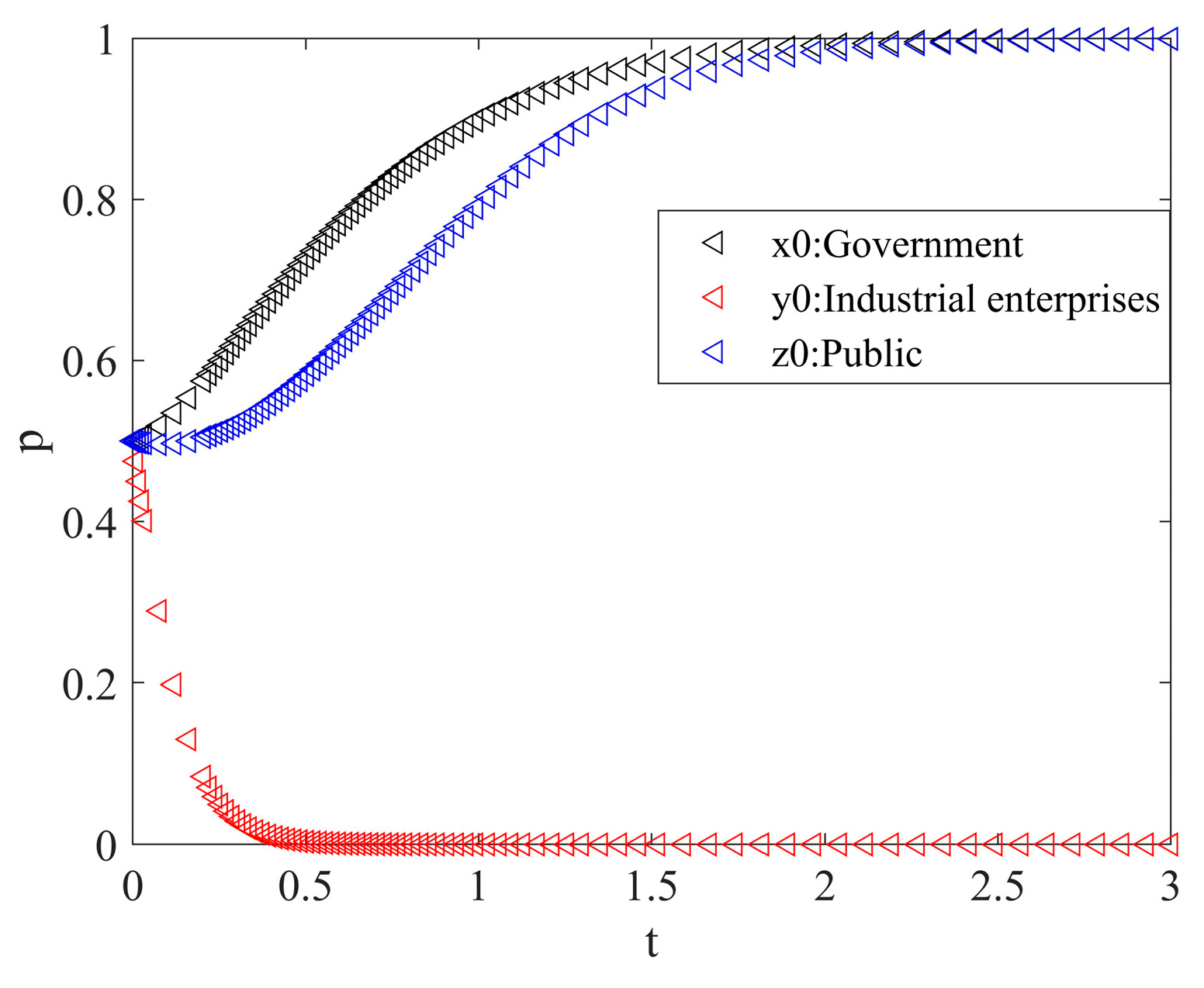
5.1. Simulation Analysis of Initial Probability
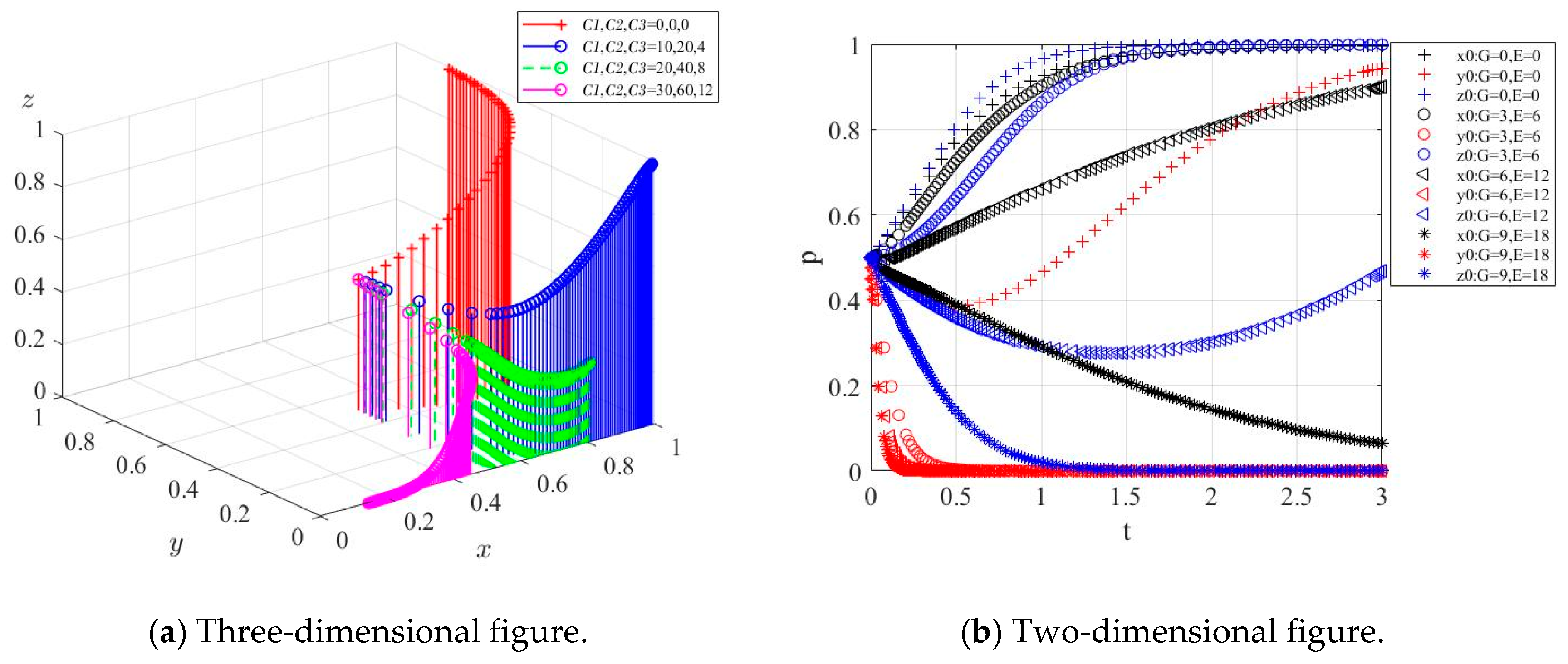
5.2. Sensitivity Analysis of Third-Party Costs
5.3. Sensitivity Analysis of the Benefits from the Green Transformation of Industrial Enterprises
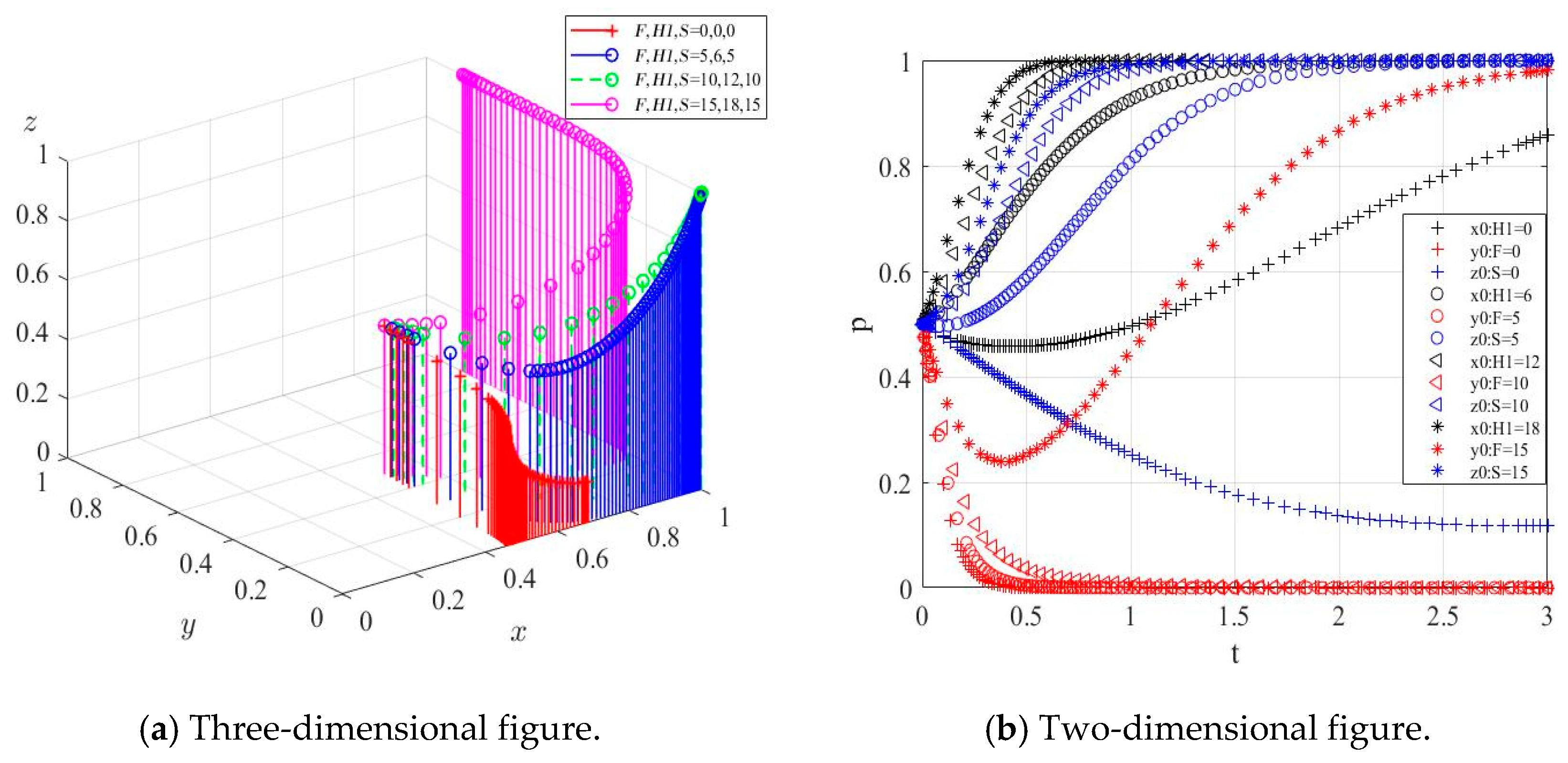
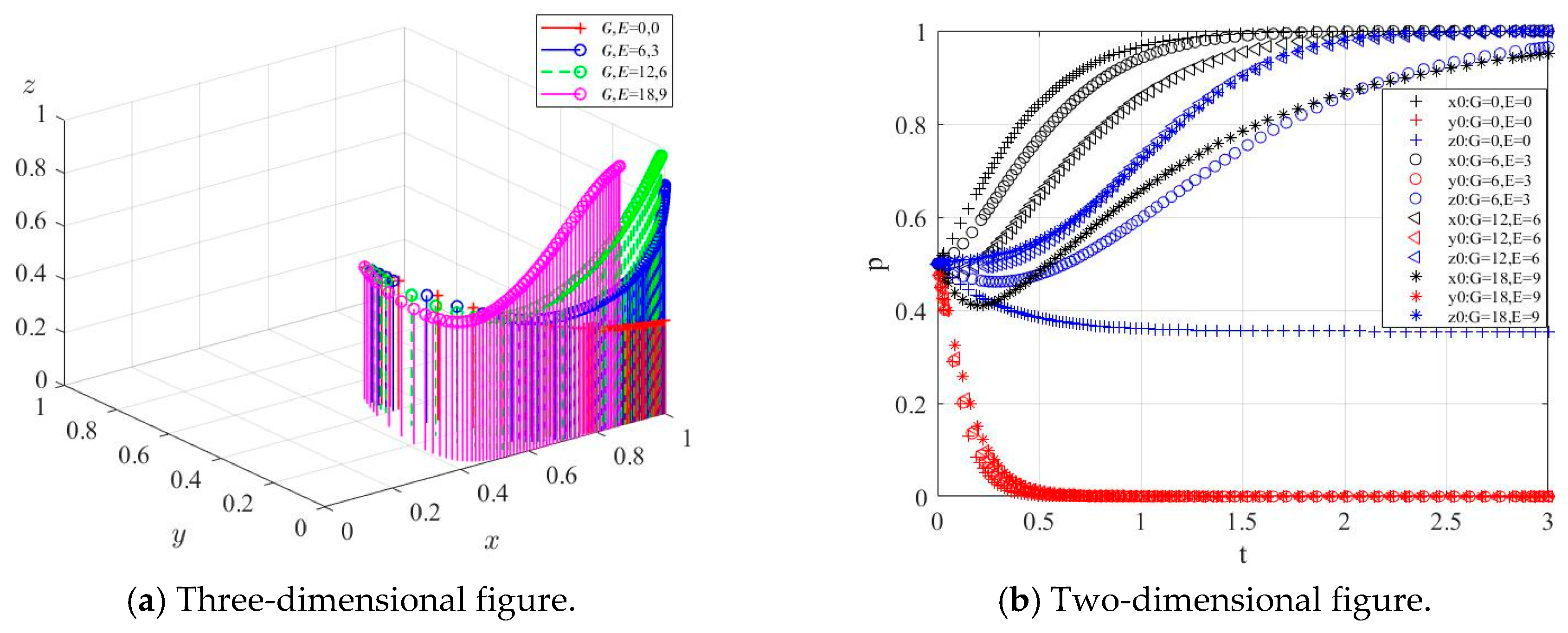
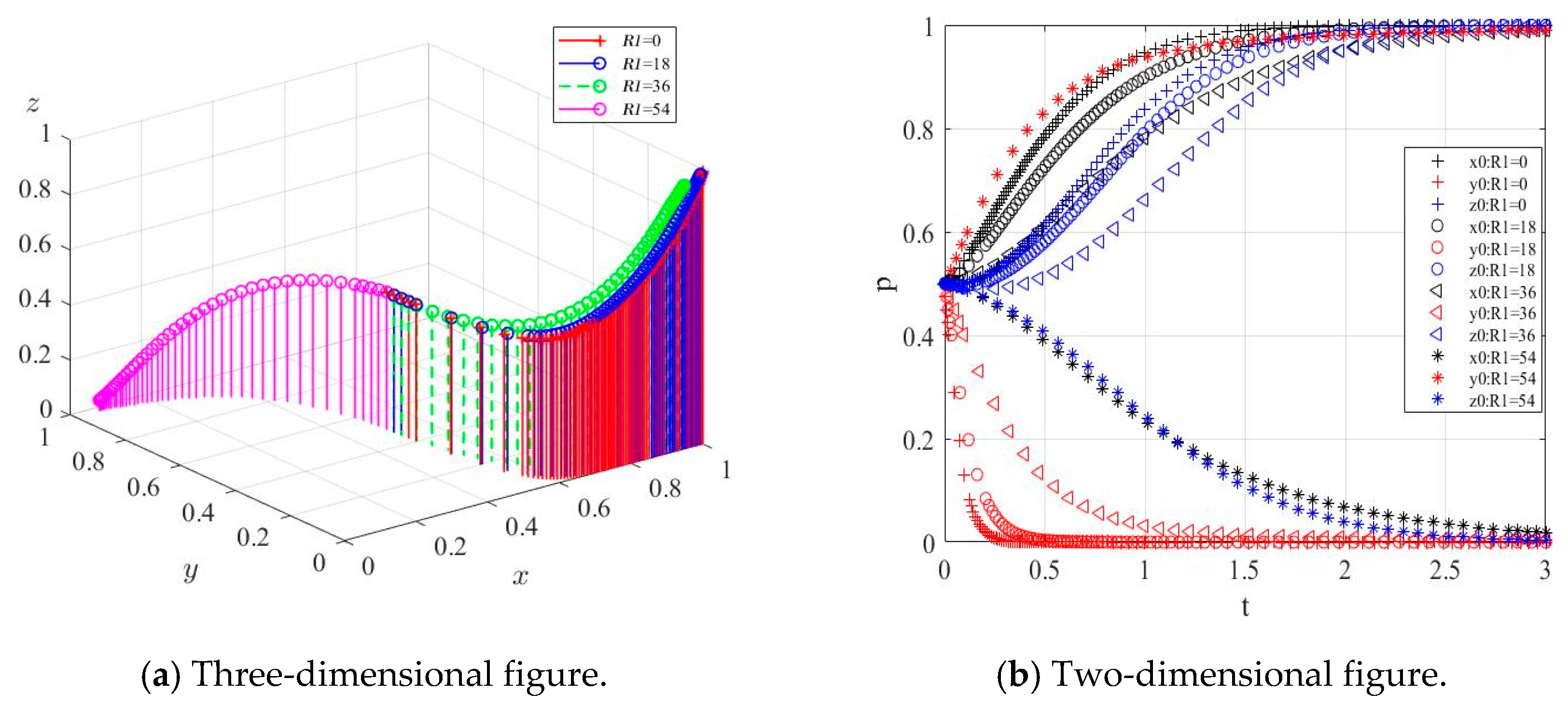
5.4. Sensitivity Analysis of Punishment and Reputation Mechanisms
5.5. Sensitivity Analysis of Government Incentive Compensation Mechanism
6. Research Conclusions and Implications
6.1. Research Conclusions
6.2. Theoretical Implications
6.3. Practical Implications
7. Limitations of the Research and Future Prospects
Supplementary Materials
Author Contributions
Funding
Institutional Review Board Statement
Informed Consent Statement
Data Availability Statement
Conflicts of Interest
References
- Qiao, S.S. Spatiotemporal Trends and Drivers of PM2.5 Concentrations in Shandong Province from 2014 to 2023 Under Socioeconomic Transition. Toxics 2025, 13, 978. [Google Scholar] [CrossRef] [PubMed]
- Zhang, Y.L.; Zhu, J.N.; Wang, S.L. Industrial robots reduce carbon emissions in manufacturing through global value chains. Sci. Rep. 2025, 15, 27602. [Google Scholar] [CrossRef] [PubMed]
- Li, H.; Li, X.Q.; Hu, Z.Y.; Li, Y.B. Does industrial robot adoption inhibit environmental pollution in China? An empirical study on energy consumption and green technology innovation. Environ. Manag. 2025, 373, 123392. [Google Scholar] [CrossRef] [PubMed]
- Sun, Z.F.; Li, J.T. Citizens’ satisfaction with air quality and key factors in China—Using the anchoring vignettes method. Sustainability 2019, 11, 2206. [Google Scholar] [CrossRef]
- Qin, Z.L.; Zuo, Z.D. Industrial robots application and collaborative governance of pollution reduction and carbon reduction. Sci. Rep. 2025, 15, 18279. [Google Scholar] [CrossRef]
- Yao, W.Z.; Liu, L.; Fujii, H.; Li, L.S. Digitalization and net-zero carbon: The role of industrial robots towards carbon dioxide emission reduction. J. Clean. Prod. 2024, 450, 141820. [Google Scholar] [CrossRef]
- Luan, F.; Yang, X.H.; Chen, Y.; Regis, P.J. Industrial robots and air environment: A moderated mediation model of population density and energy consumption. Sustain. Prod. Consum. 2022, 30, 870–888. [Google Scholar] [CrossRef]
- Zhu, J.; Lu, C.T.; Song, A. Air pollution governance and residents’ happiness: Evidence of blue sky defense in China. Sustainability 2023, 15, 15288. [Google Scholar] [CrossRef]
- Ruan, H.B.; Qiu, L.; Chen, J.; Liu, S.; Ma, Z.Y. Government trust, environmental pollution perception, and environmental governance satisfaction. Int. J. Environ. Res. Public Health 2022, 19, 9929. [Google Scholar] [CrossRef]
- Arents, J.; Greitans, M. Smart industrial robot control trends, challenges and opportunities within manufacturing. Appl. Sci. 2022, 12, 937. [Google Scholar] [CrossRef]
- Usmani, R.S.A.; Pillai, T.R.; Hashem, I.A.T.; Marjani, M.; Shaharudin, R.; Latif, M.T. Air pollution and cardiorespiratory hospitalization, predictive modeling, and analysis using artificial intelligence techniques. Environ. Sci. Pollut. Res. 2021, 28, 56759–56771. [Google Scholar] [CrossRef] [PubMed]
- Acemoglu, D.; Pascual, R. Robots and jobs: Evidence from US labor markets. J. Political Econ. 2020, 128, 2188–2244. [Google Scholar] [CrossRef]
- Yu, L.; Zeng, C.; Wei, X. The impact of industrial robots application on air pollution in China: Mechanisms of energy use efficiency and green technological innovation. Sci. Prog. 2022, 105, 00368504221144093. [Google Scholar] [CrossRef] [PubMed]
- Supekar, S.D.; Graziano, D.J.; Riddle, M.E.; Nimbalkar, S.U.; Sujit, D.; Shehabi, A.; Cresko, J. A framework for quantifying energy and productivity benefits of smart manufacturing technologies. Procedia CIRP 2019, 80, 699–704. [Google Scholar] [CrossRef]
- Gan, J.W.; Liu, L.H.; Qiao, G.; Zhang, Q. The role of robot adoption in green innovation: Evidence from China. Econ. Model. 2023, 119, 106128. [Google Scholar] [CrossRef]
- Lee, C.C.; Qin, S.; Li, Y.Y. Does industrial robot application promote green technology innovation in the manufacturing industry? Technol. Forecast. Soc. Change 2022, 183, 121893. [Google Scholar] [CrossRef]
- Yin, Z.H.; Zeng, W.P. The effects of industrial intelligence on China’s energy intensity: The role of technology absorptive capacity. Technol. Forecast. Soc. Change 2023, 191, 122506. [Google Scholar] [CrossRef]
- Roy, V.; Singh, S. Mapping the business focus in sustainable production and consumption literature: Review and research framework. J. Clean. Prod. 2017, 150, 224–236. [Google Scholar] [CrossRef]
- Wu, D.Z.; Rosen, D.W.; Wang, L.H.; Schaefer, D. Cloud-based design and manufacturing: A new paradigm in digital manufacturing and design innovation. Comput.-Aided Des. 2015, 59, 1–14. [Google Scholar] [CrossRef]
- Shen, Y.; Yang, Z.H. Chasing green: The synergistic effect of industrial intelligence on pollution control and carbon reduction and its mechanisms. Sustainability 2023, 15, 6401. [Google Scholar] [CrossRef]
- Guo, J.H.; Chang, S.W.; Guo, M.N. The impact of peer effect of industrial robot application on enterprise carbon emission reduction. Sci. Rep. 2024, 14, 12070. [Google Scholar] [CrossRef] [PubMed]
- Tang, B.; Tang, Y.Y.; Zhou, F. Determinants of public environmental satisfaction: An analysis based on socio-ecological system theory. Front. Psychol. 2025, 16, 1631240. [Google Scholar] [CrossRef] [PubMed]
- Huang, Q. Public trust in local governments and environmental risks in China: The effects of media use, perceived dread, and perceived inequality. Chin. J. Commun. 2018, 11, 88–104. [Google Scholar] [CrossRef]
- Yang, Y.L.; Shen, L.W.; Li, Y.W.; Li, Y. The impact of environmental information disclosure on environmental governance satisfaction. Sustainability 2022, 14, 7888. [Google Scholar] [CrossRef]
- Kelly, J.M.; Swindell, D. A multiple–indicator approach to municipal service evaluation: Correlating performance measurement and citizen satisfaction across jurisdictions. Public Admin. Rev. 2002, 62, 610–621. [Google Scholar] [CrossRef]
- Jia, H.Y.; Lin, B.Q. Does public satisfaction with government environmental performance promote their participation in environmental protection? Socio-Econ. Plan. Sci. 2025, 98, 102161. [Google Scholar] [CrossRef]
- Chen, L.J.; Zhang, J.L.; You, Y. Air pollution, environmental perceptions, and citizen satisfaction: A mediation analysis. Environ. Res. 2020, 184, 109287. [Google Scholar] [CrossRef]
- Enderle, G.; Tavis, L.A. A balanced concept of the firm and the measurement of its long-term planning and performance. J. Bus. Ethics 1998, 17, 1129–1144. [Google Scholar] [CrossRef]
- Lund-Thomsen, P. Towards a critical framework on corporate social and environmental responsibility in the South: The case of Pakistan. Development 2004, 47, 106–113. [Google Scholar] [CrossRef]
- Blacconiere, W.G.; Patten, D.M. Environmental disclosures, regulatory costs, and changes in firm value. J. Account. Econ. 1994, 18, 357–377. [Google Scholar] [CrossRef]
- Lan, L.; Huang, T.J.; Du, Y.Q.; Bao, C.K. Exploring mechanisms affecting environmental risk coping behaviors: Evidence from China. Environ. Sci. Pollut. Res. 2024, 31, 57025–57047. [Google Scholar] [CrossRef] [PubMed]
- Taylor, P.D.; Jonker, L.B. Evolutionary stable strategies and game dynamics. Math. Biosci. 1978, 40, 145–156. [Google Scholar] [CrossRef]
- Friedman, D. Evolutionary economics goes mainstream: A review of the theory of learning in games. J. Evol. Econ. 1998, 8, 423–432. [Google Scholar] [CrossRef]
- Yu, N.; Lu, M.L. Analysis of the dynamic evolution game of government, enterprise and the public to control industrial pollution. Sustainability 2024, 16, 2760. [Google Scholar] [CrossRef]
- Zhang, N.; Wang, H.Y.; Yang, B.H.; Wu, M.Y. Evolutionary game mechanism of governmental cross-regional cooperation in Air Pollution management. Sustainability 2023, 15, 1413. [Google Scholar] [CrossRef]
- Tilman, A.R.; Plotkin, J.B.; Akçay, E. Evolutionary games with environmental feedbacks. Nat. Commun. 2020, 11, 915. [Google Scholar] [CrossRef]
- Zhong, Z.Q.; Peng, B.H. Multi-agent behavior strategy game and evolutionary simulation analysis under environmental regulation. Energy Environ. 2023, 34, 3365–3390. [Google Scholar] [CrossRef]






| Parameters | Meaning |
|---|---|
| The regulatory costs of the government under strict supervision. | |
| The coefficient of the government regulatory intensity. | |
| The government provides special green technology subsidies to industrial enterprises that introduce industrial robots and undertake green transformation. | |
| The ratio of the actual tax burden to the base tax rate. | |
| Enterprises comprehensive tax rate benchmark value. | |
| The government’s rewards for the public’s active supervision of environmental behavior. | |
| Fines for enterprises that do not introduce industrial robots and continue with traditional high-pollution production methods. | |
| The loss of economic growth due to air pollution. | |
| The loss of social reputation due to the decline in public environmental satisfaction. | |
| The short-term benefits that industrial enterprises obtain by choosing the “robotic adaptation transformation” strategy. | |
| The short-term benefits of industrial enterprises choosing the “traditional extensive production” strategy. | |
| Industrial enterprises bear the direct costs related to the green transformation, such as the equipment purchase premium, installation and maintenance, and technical training for industrial robots. | |
| The compensation demanded by the public from polluting enterprises for health losses. | |
| The loss of social reputation suffered by industrial enterprises due to their polluting activities. | |
| The cost of public active supervision. | |
| The health loss of the public resulting from air pollution caused by industrial enterprises’ failure to adopt industrial robots. |
| Game Participants | Government | ||||
|---|---|---|---|---|---|
| Public | Active supervision | Industrial enterprises | Robotic adaptation transformation | ||
| Lenient regulation | |||||
| Passive supervision | Industrial enterprises | Robotic adaptation transformation | 0 | 0 | |
| Lenient regulation | |||||
| Equilibrium Point | |||
|---|---|---|---|
| Equilibrium Point | Real Part Symbol | Stable Conditions | Stability Results |
|---|---|---|---|
| ; ; | ESS | ||
| ; ; | ESS | ||
| ; ; | Saddle point | ||
| ; ; | Saddle point | ||
| ; ; | ESS | ||
| ; ; | ESS | ||
| ; ; | ESS | ||
| ; ; | ESS |
| Parameter | Assignment | Parameter | Assignment | Parameter | Assignment |
|---|---|---|---|---|---|
| 10 | 18 | 4 | |||
| 20 | 35 | 6 | |||
| 5 | 3 | 6 | |||
| 0.7 | 6 | 5 | |||
| 3 | 0.5 | 0.2 | |||
| 6 |
Disclaimer/Publisher’s Note: The statements, opinions and data contained in all publications are solely those of the individual author(s) and contributor(s) and not of MDPI and/or the editor(s). MDPI and/or the editor(s) disclaim responsibility for any injury to people or property resulting from any ideas, methods, instructions or products referred to in the content. |
© 2026 by the authors. Licensee MDPI, Basel, Switzerland. This article is an open access article distributed under the terms and conditions of the Creative Commons Attribution (CC BY) license.
Share and Cite
Qin, H.; Zhong, X.; Ma, R.; Luo, D. Evolutionary Game Analysis of Industrial Robot-Driven Air Pollution Synergistic Governance Incorporating Public Environmental Satisfaction. Sustainability 2026, 18, 3664. https://doi.org/10.3390/su18083664
Qin H, Zhong X, Ma R, Luo D. Evolutionary Game Analysis of Industrial Robot-Driven Air Pollution Synergistic Governance Incorporating Public Environmental Satisfaction. Sustainability. 2026; 18(8):3664. https://doi.org/10.3390/su18083664
Chicago/Turabian StyleQin, Hao, Xiao Zhong, Rui Ma, and Dancheng Luo. 2026. "Evolutionary Game Analysis of Industrial Robot-Driven Air Pollution Synergistic Governance Incorporating Public Environmental Satisfaction" Sustainability 18, no. 8: 3664. https://doi.org/10.3390/su18083664
APA StyleQin, H., Zhong, X., Ma, R., & Luo, D. (2026). Evolutionary Game Analysis of Industrial Robot-Driven Air Pollution Synergistic Governance Incorporating Public Environmental Satisfaction. Sustainability, 18(8), 3664. https://doi.org/10.3390/su18083664