Article

Succeeding Through Quality: The Impact of the Science and Technology Finance Ecosystem on Innovation in Specialized and Sophisticated SMEs

1
Institute of Resource-Based Economic Transformation and Development, Shanxi University of Finance and Economics, Taiyuan 030006, China
2
Institute of Dual Carbon Industry, Shanxi University of Finance and Economics, Taiyuan 030006, China
*
Author to whom correspondence should be addressed.
Sustainability 2026, 18(8), 3663; https://doi.org/10.3390/su18083663
Submission received: 26 February 2026 / Revised: 1 April 2026 / Accepted: 4 April 2026 / Published: 8 April 2026

Abstract

Achieving high-level self-reliance in science and technology requires a science and technology finance ecosystem that is aligned with the needs of technological innovation. To overcome bottlenecks in core technologies, firms must accelerate R&D, strengthen their core competitiveness, and pursue innovation-led, quality-oriented development. Using provincial-level data for 2013–2023, this paper constructs an index system for China’s science and technology finance ecosystem from four dimensions: science and technology financial services, science and technology capital markets, science and technology financial organizations, and government guidance for science and technology. We then measure the development level of this ecosystem and employ a panel data model to examine its impact on innovation in Specialized and Sophisticated SMEs. The results show that a more developed science and technology finance ecosystem significantly promotes innovation in these firms, with a stronger effect on substantive innovation than on strategic innovation. These findings remain robust across a series of robustness checks. Further analysis reveals significant heterogeneity across regions and levels of government intervention: the positive effect is stronger in eastern China and in regions with weaker government intervention. Mechanism tests indicate that the science and technology finance ecosystem promotes innovation by facilitating the accumulation of R&D capital and the agglomeration of scientific and technological talent. This study enriches the literature on science and technology finance ecosystems and SME innovation, and provides policy-relevant evidence for ecosystem development and the cultivation of Specialized and Sophisticated SMEs.

1. Introduction

New-quality productive forces represent an advanced form of productivity driven by scientific and technological innovation and characterized by breakthroughs in core and disruptive technologies. Such breakthroughs require sustained, stable, and appropriately structured financial support. As an emerging financial model, science and technology finance helps integrate innovation resources with financial capital and fosters the formation of “patient capital” guided by long-term, value-oriented, and responsible investment principles. In doing so, it supports a virtuous cycle of “science and technology–industry–finance” and accelerates the development of new-quality productive forces. Recent policy initiatives, including the Implementation Plan for the High-Quality Development of Sci-Tech Finance in the Banking and Insurance Sectors, have explicitly called for building a science and technology finance system that better serves the needs of technological innovation. Compared with conventional financial support, a multi-level science and technology finance system is better able to match the capital needs of technology-oriented firms at different stages of innovation, ease financing constraints, and promote the commercialization of technological achievements, thereby enhancing regional innovation capacity [1,2].
Promoting the development of Specialized, Sophisticated, Distinctive, and Innovative (SSDI) enterprises has become a key policy priority in China’s effort to foster new-quality productive forces, advance new industrialization, and build a modern industrial system. The Third Plenary Session of the 20th Central Committee of the Communist Party of China proposed establishing a long-term mechanism to support the growth of SSDI enterprises, and the 2025 Government Work Report further emphasized expanding and strengthening this group of firms. These agile SMEs typically focus on narrow market segments, possess strong innovative capabilities, enjoy relatively high market shares, and exhibit considerable growth potential. As such, they play an important role in strengthening scientific and technological self-reliance and stabilizing industrial and supply chains [3]. However, because they are characterized by high technology input, high human capital input, and light-asset structures, SSDI SMEs often face substantial uncertainty and severe financing constraints in their innovation activities [4,5]. Against this background, an important question arises: can the construction of a science and technology finance ecosystem effectively improve the innovation performance of SSDI SMEs, and through which channels does this effect operate?
Using provincial panel data from 2013 to 2023, this paper examines the impact of the science and technology finance ecosystem on innovation in SSDI SMEs and explores its underlying mechanisms. This study makes three main contributions. First, it develops a measurement framework for the science and technology finance ecosystem that better captures the deep integration of science and technology with finance and improves the systematicity and specificity of existing indicators. Second, it provides both theoretical and empirical evidence on how the science and technology finance ecosystem affects innovation in regional SSDI SMEs, with particular attention to heterogeneity across regions and policy environments. Third, it identifies the main transmission mechanisms through which the ecosystem promotes innovation, namely by supporting the accumulation of R&D capital and the agglomeration of scientific and technological talent. By addressing gaps in perspective, measurement, and mechanism analysis, this study offers both theoretical insights and practical implications for strengthening technology–finance ecosystems and supporting high-quality SME innovation.

2. Literature Review

Enterprise innovation, especially the innovation practices of small and medium-sized enterprises (SMEs), has always been one of the key topics in innovation economics and regional development studies. As an important force in scientific and technological innovation, SSDI SMEs have limited financing channels and face high innovation risks and uncertainties [6]. Restricted by their scale and limited financing approaches, they often encounter financing difficulties in the development process and are in urgent need of external financial support to resolve their predicaments [7]. Existing studies show that the innovation performance of SSDI SMEs is jointly affected by multi-level factors. From an internal driving perspective, sufficient financial support, targeted innovation incentive policies, and adaptive corporate innovation strategies serve as the core drivers for enhancing innovation performance [8,9]. From an external regulation perspective, supply chain concentration exerts a negative moderating effect on the relationship between digital transformation and innovation performance. Excessive reliance on supply chains may constrain enterprises’ innovation autonomy and diminish the innovation dividends generated by digital transformation [10,11]. Furthermore, external environmental factors such as regional business climate, cultural ambiance, and digital economy development levels may also influence innovation activities through pathways including resource supply and institutional safeguards [12,13].
Existing research has conducted valuable explorations on the sci-tech finance ecosystem. From a disciplinary perspective, the academic community has established a systematic theoretical consensus regarding the mechanisms through which technology and finance drive corporate innovation [14]. On one hand, technological progress effectively stimulates corporate innovation vitality by reshaping production processes and enhancing the integration capabilities of innovation resources [15]. On the other hand, financial development can enhance capital allocation efficiency and mitigate information asymmetry between banks and enterprises, thereby providing stable funding for corporate innovation [16]. Building on this foundation, as a product of deep integration between technology and finance, the synergistic empowerment effect of fintech on corporate innovation is gradually becoming a research focus in the field. Current studies from the perspective of fintech primarily explore this phenomenon from both macro and micro dimensions.
At the macro level, technology finance drives high-quality economic development through three core pathways: first, accelerating the transformation and application of technological innovation outcomes [17,18]. Second, guide capital to flow into high-tech industries to promote industrial structure optimization and upgrading [19]; third, expand the scale of technology-intensive industries to drive high-quality economic growth [20,21]. Meanwhile, factors such as regional marketization levels, maturity of the sci-tech finance ecosystem, and capital source structures serve as key moderating variables constraining the effectiveness of sci-tech finance. A higher degree of marketization can amplify its economic promotion effects by reducing transaction costs and strengthening competitive mechanisms [22,23].
At the micro level, existing research confirms that technology finance exerts multi-dimensional empowerment effects on enterprise development. Firstly, technology finance policies can significantly enhance corporate competitiveness, though their policy effects exhibit certain lagging characteristics. Full potential release requires long-term resource accumulation and institutional refinement [24]. Secondly, the development of technology finance enhances financing efficiency for high-tech enterprises through two primary pathways: first, alleviating corporate financing constraints to overcome funding bottlenecks for innovation; second, accelerating the cross-entity diffusion of technological innovation outcomes to reduce enterprises’ innovation trial-and-error costs. Thirdly, specialized policies such as the ‘Pilot Program for Promoting the Integration of Technology and Finance’ have not only facilitated deep integration of technology and finance within the region [25], but also effectively stimulated corporate green innovation vitality by directing capital flows toward green technology sectors [26,27]. The aforementioned studies collectively demonstrate that technology-driven finance exerts empowerment effects on micro-level entities, exhibiting both multidimensional characteristics and cross-cycle attributes.
In summary, existing studies have generated valuable insights into both the science and technology finance ecosystem and the innovation of SSDI SMEs, yet several gaps remain. First, most studies examine either the economic effects of technology finance or the innovation performance of SSDI SMEs in isolation, while relatively few analyze their relationship from the perspective of an integrated science and technology finance ecosystem. Second, the mechanisms through which such an ecosystem affects enterprise innovation have not been sufficiently unpacked, especially in light of the heterogeneous characteristics of SSDI SMEs. Third, existing measurement systems often treat science and technology and finance as two parallel dimensions rather than capturing their deep integration, which limits both measurement accuracy and explanatory power. To address these gaps, this paper constructs a more systematic evaluation framework for the science and technology finance ecosystem and examines how it affects regional innovation in SSDI SMEs. In doing so, it contributes to the literature by deepening the analysis of perspective, mechanism, and measurement.

3. Theoretical Analysis and Research Hypotheses

3.1. Direct Impact of the Science and Technology Finance Ecosystem on Innovation in SSDI SMEs

With the issuance of relevant sci-tech finance policies and the construction of the science and technology finance ecosystem, the innovation behaviors of regional enterprises are directly affected. The close integration of science and technology with finance has promoted the innovation and deepening of the financial market, especially providing diversified financing options for SSDI SMEs. In regions with active sci-tech finance, the government usually invests more financial support in SSDI SMEs. These measures will alleviate the financing constraints of enterprise innovation and improve the scientific and technological innovation level of SSDI SME [28,29]. In the process of the integration of science and technology with finance, financial institutions and SSDI SMEs realize the efficient integration of social resources by setting up special funds and venture capital guidance funds. The professional services of financial institutions in risk assessment and management can help SSDI SMEs accurately identify R&D risks, formulate scientific and efficient R&D plans and risk control strategies, and facilitate the smooth operation of the R&D process, thus reducing unnecessary losses. These measures can optimize the allocation of R&D resources, improve the level of R&D management, reduce innovation risks, and enhance the efficiency of enterprise R&D, thereby improving the quality of enterprise technological innovation [30,31].
At the same time, China has a large number of SSDI SMEs, and information asymmetry often exists between investors and enterprises, which may lead to adverse selection problems. Driven by industrial policies, numerous enterprises have substantially raised their patent filings—particularly non-invention patents—with the aim of securing more government subsidies and tax preferences, thus prioritizing quantity over quality. This behavior leads enterprises to innovate for “seeking support”. SSDI SMEs are outstanding enterprises among a large number of sci-tech SMEs that have passed strict certification standards. The certification policy of “specialized, sophisticated, unique and novel” qualification can significantly improve the technological innovation level of small and medium-sized enterprises. The reason why SSDI SMEs can form their own unique core technologies lies in their continuous innovation and pursuit of excellence. Therefore, the innovation output of SSDI SMEs should tend to have professional and innovative characteristics. Based on the above analysis, this paper proposes:
Hypothesis 1. 
The science and technology finance ecosystem can promote the innovation of SSDI SMEs, especially substantive innovation.

3.2. Heterogeneous Impact of the Science and Technology Finance Ecosystem on Innovation in SSDI SMEs Across Regions

At present, SSDI SMEs are mainly concentrated in the eastern coastal provinces and the rapidly developing provinces in the central and western regions, showing a spatial pattern of “strong in the east, developing in the west and clustered development”. Moreover, the vast majority of SSDI SMEs belong to the manufacturing industry, followed by the sci-tech field, and the common characteristics of SSDI SMEs are dominated by the private economy and a relatively high proportion of sci-tech personnel. At the same time, the development of SSDI SMEs is related to the local economic development level, leading industries and natural resources [32,33,34]. Regions in different geographical locations have great differences in resource endowments, economic policies and sci-tech policies, which may lead to differentiated impacts of the science and technology finance ecosystem on the innovation of regional SSDI SMEs.
Due to the differences in their own resource endowments, industrial characteristics, location advantages and economic development, local governments have obvious differences in their intervention strategies and policy effects. Government intervention in enterprise innovation behaviors may produce two effects [35,36]. On the one hand, government administrative intervention in the allocation of key innovation factors can produce distortion effects and even misallocation effects. Such intervention may raise the factor costs of enterprise innovation, create entry barriers for enterprises in the innovation market, and encourage enterprises to obtain additional key innovation resources through collusion and rent-seeking. Consequently, it exerts a significant inhibitory effect on enterprise innovation input [37,38,39]. On the other hand, when enterprises lack strong innovation capabilities, face inadequate intellectual property protection, and receive insufficient financial support, the government can exert its authority to allocate specific innovation factors and set their prices. This approach effectively reduces both innovation costs and institutional transaction costs borne by high-tech enterprises. This ultimately encourages them to enhance their independent innovation capabilities. Therefore, the impact of the science and technology finance ecosystem on the innovation of SSDI SMEs may have heterogeneous differences from the perspective of government intervention. Based on the above analysis, this paper proposes the following:
Hypothesis 2a. 
From the perspective of geographical location, the science and technology finance ecosystem has a heterogeneous impact on the innovation of SSDI SMEs.
Hypothesis 2b. 
From the perspective of government intervention, the science and technology finance ecosystem has a heterogeneous impact on the innovation of SSDI SMEs.

3.3. Indirect Mechanisms Through Which the Science and Technology Finance Ecosystem Affects Innovation in SSDI SMEs

According to the endogenous growth theory, R&D capital and human capital are the core driving forces for sustainable economic growth. As the material foundation of knowledge production, continuous R&D capital investment forms a core component of innovation activities. It enhances innovation efficiency by generating increasing returns to scale [40]. As the core carriers of knowledge, the agglomeration of sci-tech talents facilitates the application and transformation of knowledge. This in turn improves the overall innovation capacity of the region. The two ultimately realize the sustainable growth of enterprise innovation capacity [41,42].
The science and technology finance ecosystem requires supporting the R&D and innovation of sci-tech enterprises. On the one hand, as an important tool of fiscal policy, fiscal subsidies can directly provide financial support for sci-tech enterprises, alleviate their financing constraints, and at the same time, fiscal subsidies send a signal of supporting the R&D of sci-tech enterprises, enhance the confidence and enthusiasm of sci-tech enterprises in R&D, and make them more willing to increase R&D input [43,44]. On the other hand, the science and technology finance ecosystem improves the R&D input of enterprises through the credit support effect. Due to information asymmetry, it is difficult for sci-tech enterprises to obtain R&D funds through bank credit channels. The government can act as an information disseminator. By providing government sci-tech guarantees and establishing special sci-tech credit institutions, it can send positive signals to banking financial institutions regarding support for sci-tech enterprises. This helps mitigate the adverse effects arising from information asymmetry. It also encourages bank credit to increase support for sci-tech enterprises and expand loan quotas. Consequently, it promotes the accumulation of R&D capital and enhances the innovation level of sci-tech enterprises [45].
The construction of the science and technology finance ecosystem can promote the formation of a good innovation environment, which is an important factor attracting the agglomeration of sci-tech talents. To a certain extent, sci-tech talents prefer regions with a high level of innovation and abundant innovation resources [46,47]. At the same time, as an important subject of innovation activities, sci-tech talents have a two-way relationship with the regional innovation level. The improvement of the regional innovation level will increase the demand for sci-tech talents and promote the agglomeration of sci-tech talents, while the agglomeration of sci-tech talents will also improve the urban innovation level. In addition, the science and technology finance ecosystem provides tailored financial services to sci-tech enterprises across different stages of development [48,49]. It enhances small and medium-sized sci-tech enterprises’ access to commercial financing and reduces their financing costs. By doing so, it provides a powerful impetus for the advancement of regional sci-tech industries, thereby accelerating the growth of the region’s emerging technology sectors. At the same time, sci-tech talents also tend to choose emerging technology industries with abundant innovation resources and a high conversion rate of scientific and technological achievements. Based on the above analysis, this paper proposes the following:
Hypothesis 3a. 
The science and technology finance ecosystem affects the innovation of regional SSDI SMEs by promoting the accumulation of R&D capital.
Hypothesis 3b. 
The science and technology finance ecosystem affects the innovation of regional SSDI SMEs by promoting the agglomeration of sci-tech talents.

4. Model Setting and Variable Description

4.1. Model Setting

This paper mainly uses the panel fixed effect model for regression estimation to examine the impact of the science and technology finance ecosystem on the innovation level of SSDI SMEs. Based on the above theoretical analysis, the following panel econometric model is constructed:
P a t e n t i t = α 1 + β 1 T e c h f i n i t + γ 1 c o n t r o l i t + μ i + θ t + ε i t    
In Formula (1), i represents the province, t represents the year, the explained variable P a t e n t i t represents the innovation level of SSDI SMEs in the i-th region in the t-th year, T e c h f i n i t represents the level of the science and technology finance ecosystem, and controlit represents the control variables. μ i and  θ t represent the fixed effects of provinces and years, respectively, and ε i t is the random error term.

4.2. Variable Selection

4.2.1. Explained Variable: Innovation Level of SSDI SMEs (Pat)

Referring to existing studies, this paper uses the annual number of patent applications of SSDI SMEs as a proxy variable for the innovation level of SSDI SMEs. Considering that enterprise patents are divided into invention patents, utility model patents and design patents, this paper uses the number of patent applications for inventions to measure substantive innovation (PatInv), and the sum of the number of patent applications for utility models and designs to measure strategic innovation (PatPrac). Due to the right-skewed distribution of the number of enterprise patent applications, this paper adopts the method of adding 1 and taking the natural logarithm for processing.

4.2.2. Core Explanatory Variable: Science and Technology Finance Ecosystem (Techfin)

The science and technology finance ecosystem is a complex dynamic balance system formed by the interaction and coordinated development of various subjects and the external environment. Building upon prior studies, this paper attempts to construct a more systematic measurement framework for the technology finance ecosystem. It thoroughly examines its impact and transmission mechanisms on regional innovation by SMEs with high-level R&D capabilities. This study also addresses deficiencies in existing research perspectives, content, and mechanism analysis. Furthermore, it promotes theoretical progress in the fields of technology, finance and SME innovation. On this basis, the key second-level indicators are extracted in combination with the content of the Work Plan, and the relevant indicators in the existing evaluation system are introduced [50,51]. Finally, a science and technology finance ecosystem evaluation indicator system containing 11 second-level indicators and their clear connotations is formed (Table 1). Among them, sci-tech financial services refer to the professional capabilities of financial institutions in the field of sci-tech finance. The objective is to address funding bottlenecks from R&D to industrialization through diversified and customized financial products and services [52]. Specific indicators include sci-tech loans of financial institutions, digital financial inclusion and financial resource agglomeration, reflecting the accuracy and effectiveness of financial services. The initiative aims to provide equity financing, value-based pricing, and resource integration platforms for enterprises at various developmental stages through a multi-tiered capital market framework [53], including sci-tech investment services, sci-tech equity financing and the scale of technology markets. Technology finance organizations are specialized financial institutions dedicated to serving technological innovation. Through professional organizational structures and business models, they provide diversified financial services to support corporate innovation [54]. They mainly include the number of financial institutions, sci-tech finance platforms and sci-tech intermediary organizations. The objective is to foster a favorable financial ecosystem and institutional environment for corporate innovation through policy guidance, institutional design, and resource allocation [55]. This dimension mainly includes special sci-tech funds and fiscal support for science and technology.
This study references relevant literature [56] and employs the coefficient of variation method to evaluate the aforementioned indicator system. The coefficient of variation method is an objective assessment approach that dynamically determines weights based on the variation degree of individual indicators. Its core principle states: indicators with significant variation across different evaluation subjects demonstrate high discriminative capacity and should be assigned higher weights in the evaluation system; conversely, indicators with minimal variation indicate limited discriminative power, warranting corresponding weight reduction. The specific calculation process of the coefficient of variation method is as follows:
(1)
Data standardization. Since indicators within the system vary in magnitude, they must be normalized to a unified range for comparison. The standardization process is implemented as follows: Let r i j denote the normalized data matrix elements. All indicators in this study are normalized, resulting in x i j as the normalized data matrix elements.
r i j = x i j i = 1 m x i j 2
(2)
Calculate the coefficient of variation. After standardization, a data matrix R = r i j m × n can be constructed to compute the mean value of the indicators
A j = 1 n i = 1 m r i j
Standard deviation of calculation metrics:
S j = 1 n i = 1 m r i j A 2
Calculate coefficient of variation:
V j = S j A j
(3)
Determine the weight coefficients:
w j = V j j = 1 n V j
(4)
Calculate the final score:
S c o r e i = j = 1 n w j r i j

4.2.3. Control Variables

This paper selects the following control variables: Level of economic development (Pgdp), tax burden level (Tax), marketization degree (Mak), and urbanization rate (Urb). They are measured by regional per capita GDP, the ratio of tax revenue to regional GDP, Marketization Index Released by Beijing National Economic Research Institute, and the ratio of urban registered population to total registered population, respectively.

4.2.4. Mechanism Variables

(1)
R&D Capital Accumulation. This paper uses two methods, actual R&D expenditure (RDacc1) and R&D capital stock (RDacc2), to characterize the level of R&D capital accumulation. The former is measured by the actual R&D expenditure of the region. The latter is calculated by the perpetual inventory method with reference to existing studies [51,52,53], and the specific formula is:
R D t = ( 1 δ ) R D t 1 + R I t
Among them, R D t   is the R&D capital stock in the t-th period, R D t 1 is the R&D capital stock in the t−1-th period (calculated based on the R&D expenditure price index), RIt is the R&D capital investment in the t-th period, and δ represents the R&D depreciation rate.
(2)
Sci-tech Talent Agglomeration. This paper uses two methods, the proportion of the number of sci-tech talents in the population (Agg1) and the number of regional R&D personnel (Agg2), to characterize the level of sci-tech talent agglomeration. Among them, the number of sci-tech talents is represented by the sum of the number of employees in scientific research, technical services and geological prospecting industry and the number of employees in information transmission, computer services and software industry.

4.3. Data Sources

In view of the large volume of data of the science and technology finance ecosystem indicators and the core data coming from authoritative materials such as the China Torch Statistics Yearbook and China Sci-Tech Finance Development Report, the current materials do not include the detailed statistical data at the prefecture-level city dimension. At the same time, considering that the formulation of sci-tech finance policies and resource coordination are mostly carried out at the provincial level, the provincial level can better reflect the overall characteristics of the system. Therefore, to ensure the unification of research caliber, the standardization of indicator statistics and the accuracy of analysis results, this paper conducts research and analysis at the provincial level. The research sample includes 30 provincial administrative regions in China (excluding Xizang Autonomous Region), and the research period is from 2013 to 2023. Considering the availability and authority of data, the data are mainly selected from the China Statistical Yearbook (https://www.stats.gov.cn/sj/ndsj/, accessed on 15 January 2025), China Science and Technology Statistics Yearbook (https://www.sts.org.cn/html/index.html, accessed on 10 September 2025), China Financial Statistics Yearbook (https://www.pbocri.org.cn/jrnj.html, accessed on 20 January 2025), China Torch Statistics Yearbook (http://www.chinatorch.gov.cn/kjfw/tjsj/list.shtml, accessed on 8 June 2025), China Venture Capital Development Report (http://casted.org.cn/channel/newsinfo/9879, accessed on 8 June 2025), China Intellectual Property Development Status Report (https://www.cnipa-ipdrc.org.cn/listy.aspx?newsClassid=22&flag=2&flag1=1, accessed on 15 December 2025) provide data on SSDI enterprises sourced from the CSMAR database (https://data.csmar.com/, accessed on 8 November 2025, the certification criteria for SSDI enterprises are provided in Appendix A). This commercial financial research database specifically compiles a series of data on such enterprises and requires subscription access. The Peking University Digital Inclusive Finance Index originates from the Peking University Digital Finance Center (https://www.idf.pku.edu.cn/zsbz/bjdxszphjrzs/index.htm, accessed on 20 January 2025), while the marketization index is derived from the China Provincial Marketization Index Database (https://cmi.ssap.com.cn/, accessed on 12 September 2025). All statistical data take 2012 as the base period. Some missing data are filled by the linear interpolation method or trend extrapolation method, and the explained variables are logarithmically processed to eliminate heteroscedasticity and maintain data stationarity. The descriptive statistical results of each variable are shown in Table 2.

5. Empirical Results and Analysis

5.1. Analysis of the Current Situation of the Science and Technology Finance Ecosystem

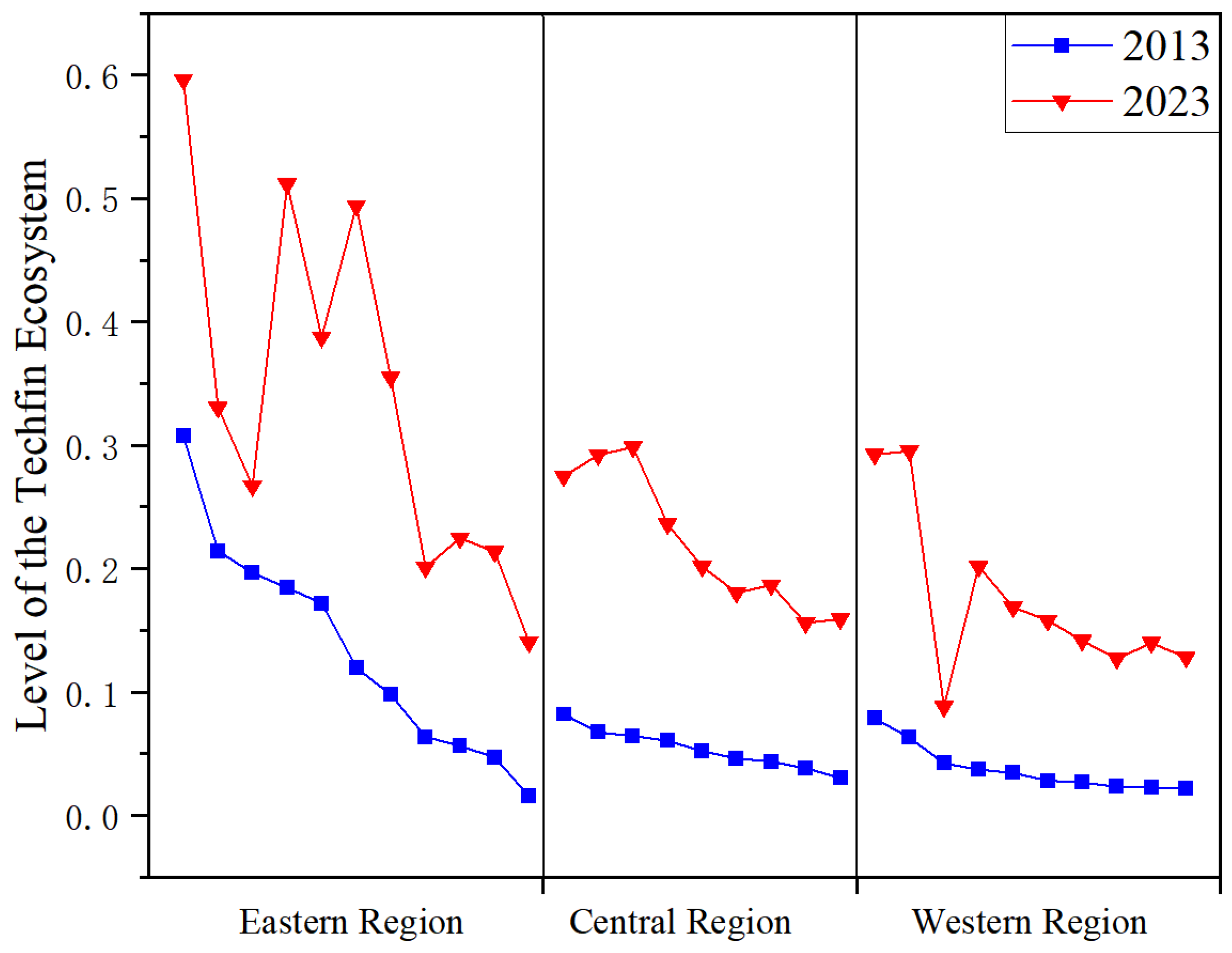
It can be seen from Figure 1 that from the regional perspective, compared with 2013, the science and technology finance ecosystem of each region has been greatly improved in 2023; there are significant differences in the science and technology finance ecosystem among the eastern, central and western regions. On the whole, it presents a pattern of the eastern region taking the lead, the central region catching up, and the western region being relatively backward. The reasons are as follows: the eastern region has a solid economic foundation, improved financial infrastructure, highly agglomerated scientific and technological innovation resources and the advantage of piloting policies first. In contrast, although the central region has potential in industrial foundation and some science and education resources, it still lags behind the eastern region in the depth and breadth of the financial market and the agglomeration degree of high-end innovation factors, making it in a catching-up position. The western region is constrained by a relatively weak economic foundation. It is also restricted by its geographical location and the challenge of the continuous outflow of sci-tech talents. These constraints lead to insufficient endogenous power for scientific and technological innovation in the region. Meanwhile, the development of its financial system is, relatively, lagging behind. As a result, the western region is in an overall backward position in the field of sci-tech finance.

5.2. Benchmark Regression

Table 3 presents the benchmark regression results. Without introducing control variables, the coefficient of Techfin is 1.4337 and significantly positive at the 1% level, indicating that the science and technology finance ecosystem has improved the innovation level of SSDI SMEs. On this basis, a series of control variables are further added, and the coefficient of Techfin is 1.1468 and significant at the 5% level, and the result is still robust, which further verifies the effectiveness of the science and technology finance ecosystem in promoting the growth of the innovation level of regional SSDI SMEs. Hypothesis 1 is verified.
The underlying rationale lies in the enhanced regional sci-tech financial ecosystem, which provides broader channels, multi-tiered services, and sustainable financial solutions for technological innovation and industrialization. By leveraging market forces to guide resource allocation in tech finance, this ecosystem facilitates the aggregation of key resources, reduces investment risks for financial capital, and directs capital flows toward innovation-driven sectors. It plays a pivotal role in addressing market failures in resource allocation: Firstly, through establishing scientific evaluation mechanisms for tech startups, it ensures efficient allocation of financial resources to high-potential innovators. Secondly, by optimizing credit allocation efficiency, it delivers robust financial support to early-stage tech enterprises in need of funding but facing financing barriers, thereby meeting equity financing demands throughout their lifecycle and boosting innovation capabilities among specialized SMEs. Simultaneously, by integrating diversified financial resources and innovative market structures, the ecosystem delivers tailored investment solutions, establishing a comprehensive financial service framework that significantly improves regional financial environments and mitigates structural distortions in resource endowments. From an industrial development perspective, optimized financial resource allocation plays multiple positive roles. It not only promotes the rational spatial distribution of industries and curbs traditional extensive growth models, but also fosters collaborative industrial clustering effects. Furthermore, it accelerates the mid-to-high-end transformation of industries. Ultimately, this exerts profound impacts on the growth of innovative enterprises within the region [57,58].

5.3. Innovation Preference Test

To test the impact of the science and technology finance ecosystem on substantive innovation and strategic innovation, this paper further conducts regression analysis, and the results are shown in Table 4. It can be seen from Table 4 that the coefficient of Techfin for substantive innovation is significantly positive at least at the 1% level, while the coefficient of Techfin for strategic innovation is not significant. These regression results support Hypothesis 1, that is, the improvement of the science and technology finance ecosystem has promoted the substantive innovation with high technical content and strong originality of regional SSDI SMEs to a greater extent.
The possible reasons are as follows: on the one hand, government sci-tech finance policies (such as special loans and innovation funds) usually focus on fields such as bottleneck technologies and key generic technologies, rather than simply pursuing the quantity of innovation. This policy orientation makes resources tend to tilt toward enterprises with substantive innovation, while the incentive effect on strategic innovation is limited. At the same time, the science and technology finance ecosystem emphasizes market-oriented operation, requiring enterprise innovation to meet market demand and bring actual commercial value. Therefore, enterprises relying only on strategic innovation are difficult to obtain sustainable financing, while enterprises with real technological breakthrough capabilities can obtain more support through market verification. On the other hand, SSDI SMEs often occupy advantages in the segmented market by virtue of unique technologies or business models. To maintain this competitive advantage, they must carry out continuous original R&D instead of relying on imitation or low-level innovation. This market-driven innovation model naturally rejects strategic innovation and is more inclined to substantive technological breakthroughs.

5.4. Robustness Tests and Endogeneity Treatment

Shortening the research period: The outbreak of the COVID-19 pandemic in 2020 had an impact on China’s macro economy. To exclude the interference of this impact on the regression results, only the samples before 2020 are retained for regression. It can be seen from the regression results in columns (1), (2) and (3) of Table 5. After excluding the samples after 2020 and the impact of COVID-19, the improvement of the science and technology finance ecosystem still significantly promotes the growth of the innovation level of regional SSDI SMEs. This also proves the robustness of the benchmark regression conclusions. Changing the indicator weight method: Different weighting methods may lead to large changes in the index. The coefficient of variation method is replaced by the entropy weight method to calculate the indicator value of the sci-tech ecosystem level. The regression results in columns (4), (5) and (6) of Table 5 show that the empirical results are consistent with the benchmark regression results.
Eliminating comprehensive indicator variables: Considering that the digital financial inclusion index is a comprehensive index, which may have an impact on other results, the comprehensive indicator variables are eliminated to make all variables in the indicator system single indicator variables. The results in columns (7), (8) and (9) of Table 5 show that the benchmark conclusion is still robust after eliminating the comprehensive indicator variables.
Lagging treatment of explanatory variables. The core explanatory variables are replaced with their first-period lagged counterparts for regression analysis. If the coefficient direction and significance of the lagged variables remain consistent with the baseline results, this indicates that the research conclusions are not affected by endogenous interference within the current period, demonstrating robustness. The regression results in columns (10), (11), and (12) of Table 5 show that the empirical findings remain statistically significant, thereby validating the robustness of the baseline regression model.

5.5. Endogeneity Treatment

Regions with higher innovation levels among specialized, refined, distinctive, and innovative (SRDI) small and medium-sized enterprises (SMEs) may demonstrate stronger motivation to develop technology–finance ecosystems, thereby addressing these SMEs’ demands for innovation environments and sustainable growth. To mitigate endogeneity issues arising from reverse causality that could distort the study’s conclusions, the lagged first-period explanatory variables are employed as instrumental variables to effectively control model endogeneity. Furthermore, to comprehensively address potential endogeneity challenges and ensure the robustness of core findings, this study extends the instrumental variable approach by incorporating Systematic Generalized Method of Moments (GMM) techniques for endogeneity adjustment. Regression results in Columns (1) and (2) of Table 6 confirm the statistical significance of empirical conclusions, validating the endogeneity assumptions of the baseline regression model.
Specifically, Column (1) presents the two-stage least squares regression results based on instrumental variable methods. The identification test (Kleibergen-Papr LM) yields a statistic value of 12.876, rejecting the null hypothesis of insufficient instrumental variable identification at the 1% significance level. The weak instrumental variable test (Kleibergen-Pap Wald F) produces a statistic value of 91.982, significantly exceeding the critical threshold at the 10% significance level, indicating no weak instrumental variable problem. The coefficient for Techfin is 0.5137 and statistically significant at the 1% level, demonstrating that after controlling for endogeneity caused by reverse causality, technology finance still exerts a significant positive impact on innovation levels among specialized, refined, distinctive, and innovative small and medium-sized enterprises.
Column (2) presents the estimation results of System GMM. The first-period lag coefficient (L.lny) of the dependent variable is 0.883, statistically significant at the 1% level, indicating strong dynamic continuity in innovation levels among specialized, refined, distinctive, and innovative small and medium-sized enterprises (SMEs). The coefficient for Techfin is 0.171, maintaining the same sign as the benchmark regression and passing significance tests. Model specification tests reveal an AR(1) p-value of 0.011, confirming first-order autocorrelation and meeting GMM method prerequisites; the AR(2) p-value of 0.797 fails to reject the null hypothesis of “zero second-order autocorrelation,” indicating no serial correlation in disturbance terms. The Hansen test p-value of 0.477 confirms overall instrumental variable validity without overidentification issues.

5.6. Heterogeneity Tests

Geographical location heterogeneity: China has a vast territory and significant differences in the factor endowment structure of different regions, which may affect the effect of the science and technology finance ecosystem on the innovation of SSDI SMEs. Therefore, referring to existing literature, the sample is divided into two groups: the eastern region and the central and western regions for regression, so as to examine the heterogeneous impact of the science and technology finance ecosystem on the innovation of SSDI SMEs due to spatial differences. It can be seen from the regression results in Table 7 that the impact of the science and technology finance ecosystem on the innovation level of SSDI SMEs in the eastern region is significantly positive, while the estimation results of the central and western regions are only significant for substantive innovation. Among them, the impact of the science and technology finance ecosystem on substantive innovation is greater than that on strategic innovation. The primary reason for this phenomenon lies in the unique geographical advantages of the eastern region [59], which are specifically manifested in the following four dimensions. First, strong talent agglomeration and scientific and technological strength. Second, the educational resources are of high quality, and the cultural literacy and overall quality of the population are generally high. Third, the industrial collaboration and support system is well-established, with solid foundations for industry–academia–research integration. The eastern region has many high-level universities and research institutions nationwide, and innovation activities are inseparable from the cooperation of relevant enterprises and research institutions. Fourth, the innovation support system has been improved, with high enthusiasm from multiple stakeholders participating. Local governments, enterprises and social organizations in the eastern region have a high level of enthusiasm, willingness and ability for R&D investment, and actively participate in supporting innovation activities. Therefore, the science and technology finance ecosystem in the eastern region has a positive impact on the innovation of SSDI SMEs.
Government intervention heterogeneity: The intensity of government intervention in different regions is different, which may have a heterogeneous impact on the innovation of SSDI SMEs in the region. Referring to existing studies [60,61], it uses the proportion of local government fiscal expenditure in the sci-tech field to GDP as a proxy variable for local government intervention. According to the median of the government intervention indicator, the sample is divided into two groups: regions with a lower degree of government intervention and regions with a higher degree of government intervention. It can be seen from the regression results in Table 8. In regions with lower government intervention, the science and technology finance ecosystem has a significantly positive impact on the total innovation level and substantive innovation level of SSDI SMEs. However, the estimation results are not significant for strategic innovation in regions with lower intervention and all types of innovation in regions with higher government intervention. The underlying logic of this disparity can be elucidated by examining the heterogeneous impact of government intervention intensity on the allocation of science and technology financial resources [62]. SSDI SMEs can more flexibly obtain financial support from financial institutions, venture capital and the favor of the capital market by virtue of their own innovation potential and market prospects. At the same time, a weaker intervention environment gives SSDI SMEs greater innovation autonomy and decision-making space, encouraging R&D personnel to carry out technological R&D and innovation practice, thus promoting the development of substantive innovation and enhancing core competitiveness. On the contrary, strategic innovation may be regarded as a short-term behavior with limited effect on the long-term development of enterprises. Therefore, enterprises will invest more resources and energy in substantive innovation, leading to an insignificant performance of strategic innovation. In contrast, regions with high levels of government intervention exhibit excessive administrative interference in the technology finance ecosystem, which exerts dual negative impacts on innovation activities [63]. On the one hand, excessive administrative intervention may inhibit the innovation autonomy of enterprises and weaken their agility and innovation motivation in responding to market changes. On the other hand, resource allocation is easily affected by non-market factors. Resource tilt may occur based on government–enterprise relations rather than innovation efficiency. This leads to the distortion of the allocation of sci-tech financial resources. As a result, enterprises with real innovation capacity cannot be effectively identified and supported. Thus, the promoting effect of the science and technology finance ecosystem on the innovation of various enterprises is generally weakened. It should be pointed out that the above grouping analysis based on the degree of government intervention mostly reveals a conditional correlation heterogeneity pattern. Since the grouping variable (degree of government intervention) may not be independent of the core explanatory variable (science and technology finance ecosystem), there is a certain endogeneity. However, we believe that this bias is limited under the research framework of this paper and does not affect the robust inference of the core conclusions. The reasons are as follows: the core explanatory variable (science and technology finance ecosystem) of this study is a multi-dimensional comprehensive evaluation system, covering four dimensions: sci-tech financial services, sci-tech capital markets, sci-tech financial organizations and government sci-tech guidance. In the measurement, the weight of indicators reflecting administrative intervention only accounts for a part of the comprehensive index. Although the source of endogeneity can partially affect the “science and technology finance ecosystem” through the channel of “government sci-tech guidance”, its explanatory share of the overall variation in the comprehensive variable is low. At the same time, to further strengthen the rigor of the conclusion and eliminate endogeneity, this paper further adopts the method of “removing potential endogenous components”, eliminates the indicator of “fiscal support for science and technology”, and re-tests the heterogeneity results.

6. Mechanism Tests

The theoretical analysis above suggests that the science and technology finance ecosystem may promote innovation in regional SSDI SMEs through two main channels: the accumulation of R&D capital and the agglomeration of scientific and technological talent. Following Jiang Ting [64,65,66], this paper tests these mechanisms by examining the direct effects of the science and technology finance ecosystem on the proposed mediating variables. More specifically, the analysis investigates whether the ecosystem improves innovation by promoting R&D capital accumulation and accelerating the concentration of scientific and technological talent.

6.1. R&D Capital Accumulation

It can be seen from the regression results in columns (1) and (2) of Table 9 that the estimated coefficients of Techfin are significantly positive at the 1% level, indicating that the science and technology finance ecosystem has a positive effect in promoting the accumulation of R&D capital. Existing studies have consistently shown that R&D capital plays an important role in improving the technological innovation level of enterprises. At the micro level of enterprises, sufficient R&D capital investment provides a solid material foundation for technological innovation. Financial support can purchase advanced R&D equipment, build a high-level experimental platform, and create hardware conditions for the R&D of new technologies and new products; the salary incentive and training investment for R&D personnel can attract and retain innovative talents and improve the professional quality and innovation capacity of the team. At the same time, intellectual property generated by R&D capital not only creates technical barriers to enhance competitiveness but also generates revenue through licensing and transfers, thereby sustaining a positive R&D cycle [67,68,69]. From a macro perspective, the accumulation of R&D capital yields multiple positive effects. It can boost the enthusiasm of economic agents for collaborative innovation. In addition, this accumulated R&D capital stock can enhance the knowledge production efficiency of enterprises in the region. It also accelerates the development of R&D networks and optimizes the allocation of innovation resources. Ultimately, this promotes the improvement of enterprise technological innovation efficiency. Based on this, this study holds that the science and technology finance ecosystem has promoted the improvement of the innovation level of SSDI SMEs by promoting the accumulation of R&D capital, and Hypothesis 3a is verified.

6.2. Sci-Tech Talent Agglomeration

It can be seen from the regression results in columns (3) and (4) of Table 9 that the estimated coefficients of Techfin are significantly positive at the 1% level, indicating that the science and technology finance ecosystem has a positive effect in promoting the agglomeration of sci-tech talents. Talents are the carriers of knowledge. In addition to promoting regional innovation as key input factors, the agglomeration of sci-tech talents has a spatial spillover effect on regional technological innovation, and there is an obvious positive spatial correlation between the two; the agglomeration of sci-tech talents will bring about mutual competition among sci-tech talents inside and outside the region, further improve their own technological innovation capacity, and thus stimulate their innovative spirit [70,71,72]. Sci-tech talents affect the level of regional innovation output by influencing the regional knowledge absorption capacity. In cities with a high level of innovation, the knowledge absorption capacity brought by the agglomeration of scientific research talents can accelerate the process of knowledge commercialization, thus improving the efficiency of innovation transformation in enterprise R&D activities. For government R&D investment, the agglomeration of scientific research talents can also enhance the connection between industry, university and research in the urban innovation system by virtue of the spillover of cutting-edge knowledge and the flow of talents, thus effectively promoting the supporting effect of local governments on urban innovation activities. Therefore, Hypothesis 3b is verified.

7. Research Conclusions and Policy Recommendations

7.1. Research Conclusions

Based on the panel data of 30 provincial administrative regions in mainland China (excluding Xizang Autonomous Region) from 2013 to 2023, and on the basis of theoretical analysis, this paper reconstructs the evaluation index system of the science and technology finance ecosystem from four dimensions, namely sci-tech financial services, sci-tech capital markets, sci-tech financial organizations and government sci-tech guidance, and empirically explores the impact of the science and technology finance ecosystem on the innovation of SSDI SMEs as well as its underlying mechanism. The findings reveal that: (1) From 2013 to 2023, the sci-tech finance ecosystem across all regions of China underwent significant development, forming an overall pattern characterized by eastern leadership, central catch-up, and western lag. (2) The sci-tech finance ecosystem significantly boosts innovation among SSDI SMEs, with a particularly pronounced impact on substantive innovation. This conclusion has been validated through a series of robustness tests. (3) The promotional effect of the sci-tech finance ecosystem on SSDI SMEs innovation is more pronounced in eastern regions and areas with less government intervention. (4) The sci-tech finance ecosystem plays a positive role in driving the accumulation of R&D capital and the agglomeration of sci-tech talent, which in turn fosters innovation among regional SSDI SMEs.

7.2. Research Recommendations

Based on the above research conclusions, the following policy recommendations are put forward:
First, establish a collaborative and interconnected sci-tech finance ecosystem. Governments should coordinate efforts across multiple dimensions including sci-tech financial services, capital markets, institutional frameworks, and their own leadership roles. This involves promoting synergy among fiscal investments, venture capital, and technology-backed loans to expand the overall scale of sci-tech finance. Financial institutions should be incentivized to innovate products and services, providing more tailored financial support for technology-based SMEs in their startup and growth phases. Concurrently, comprehensive policy safeguards must be strengthened throughout the entire technological innovation process, with a focus on developing integrated service systems covering R&D, technology transfer, industrialization, and market expansion to solidify the foundation for sustainable ecosystem development.
Second, prioritize high-quality innovation and enhance targeted support. This study demonstrates the driving effect of technology finance on substantive innovation among specialized, refined, distinctive, and innovative small and medium-sized enterprises (SMEs). Government funding expenditures should focus on improving innovation quality by implementing targeted investments to stimulate corporate innovation vitality, support breakthroughs in core technologies, and foster original and disruptive achievements. Local governments should optimize investment mechanisms through integrated policy tools such as loan interest subsidies, risk compensation, and government investment funds, ensuring fiscal resources precisely align with innovation needs. This approach will leverage more social capital into technological innovation, comprehensively enhancing corporate innovation capabilities and professional expertise.
Third, the development of technology finance should be tailored to local conditions. This study reveals that the technology finance ecosystem exerts heterogeneous impacts on innovation among specialized, refined, distinctive, and innovative small and medium-sized enterprises (SMEs), necessitating the exploration of localized technology financial service systems. Given significant disparities in geographical location, resource endowments, industrial structures, and development stages across regions, a one-size-fits-all approach should be avoided. Instead, differentiated support measures should be implemented based on local comparative advantages and strategic industry characteristics. Concurrently, governments should enhance market mechanisms and business environments by strengthening infrastructure such as credit systems, property rights trading platforms, and risk-sharing mechanisms, thereby minimizing the negative effects of excessive intervention on corporate innovation.
Fourth, governments should prioritize efficient allocation of R&D capital and establish sustainable innovation funding mechanisms. By creating dedicated risk capital pools and optimizing credit guarantee systems, market risks associated with innovation activities can be mitigated, thereby leveraging diversified financial resources from banks and insurance institutions to sustain investments in key technological innovation sectors. Concurrently, it is essential to systematically enhance incentive frameworks and service systems for scientific talent, fostering an ecosystem conducive to attracting top-tier professionals. Strengthening talent acquisition and development mechanisms for tech enterprises will further expand the supply of high-quality scientific expertise.

7.3. Limitations

First, explore the expansion of research scales. Future studies may adopt the following approaches to obtain micro-level data: Collaborate with specialized databases (e.g., Tianyancha or industry association databases) to collect detailed metrics such as team composition and supply chain relationships of specialized, refined, distinctive, and innovative enterprises; conduct small-scale field surveys or questionnaire interviews to supplement qualitative data not covered by existing databases, thereby refining the research scope to the enterprise level.
Second, innovative measurement approaches. This study employs patent application counts to gauge corporate innovation levels, distinguishing between substantive innovation and strategic innovation. Although this methodology is widely adopted in the existing literature, patent metrics exhibit significant heterogeneity across industries and regions. Factors such as industry-specific technological characteristics, regional policy environments, and intellectual property protection levels may introduce systematic biases in innovation measurement, potentially failing to fully reflect enterprises’ actual innovation activities. Future research could develop a “multi-dimensional innovation measurement framework” that incorporates additional indicators beyond patent quantity, including patent grant rates (reflecting patent quality), citation frequency (indicating technological impact), and patent commercialization revenue (measuring business value), to comprehensively assess innovation quality.


Author Contributions

Conceptualization, J.Z. and J.S.; methodology, J.Z., X.L. and L.N.; software, J.S. and X.L.; validation, J.S.; formal analysis, Q.Z. and L.N.; data curation, J.S., Q.Z. and J.Z.; writing—original draft preparation, J.Z., X.L. and J.S.; writing—review and editing, J.Z.; J.S. and R.L.; visualization, J.Z.; supervision, J.Z. and R.L.; project administration, J.Z. and R.L.; funding acquisition, J.Z. All authors have read and agreed to the published version of the manuscript.

Funding

This study was supported by Youth Fund Project for Humanities and Social Sciences Research of the Ministry of Education (Grant No. 21YJCZH212); Philosophy and Social Sciences Research Project of Colleges and Universities in Shanxi Province (Grant No. 2019W079).

Institutional Review Board Statement

Not applicable.

Informed Consent Statement

Not applicable.

Data Availability Statement

The data presented in this study are openly available in China Statistical Yearbook (https://www.stats.gov.cn/sj/ndsj/, accessed on 15 January 2025).

Conflicts of Interest

The authors declare no conflicts of interest.

Appendix A

The recognition of specialized, refined, distinctive, and innovative small and medium-sized enterprises (SMEs) is voluntarily applied for by technology-based and innovative SMEs according to the territorial principle. The provincial SME authorities of China organize the review of application materials and relevant supporting documents, on-site inspections, and public announcements based on the recognition criteria for specialized, refined, distinctive, and innovative SMEs. Those that pass the public announcement will be recognized as specialized, refined, distinctive, and innovative SMEs by the provincial SME authorities.

Appendix A.1. Application Eligibility Requirements

The applying enterprise must be legally registered within China, meet the classification criteria for small and medium-sized enterprises (SMEs), and simultaneously satisfy the following conditions:
Compliance operations: Not listed in the Business Abnormality Catalog or the Serious Dishonesty Subject List, and no major safety accidents or environmental violations have occurred in the past three years.
Dynamic management: The certification is valid for 3 years and requires re-evaluation upon expiration. Enterprises must update information annually. Failure to update for two consecutive years will result in immediate revocation of certification.

Appendix A.2. The Certification Criteria for Specialized, Refined, Distinctive, and Innovative Small and Medium-Sized Enterprises (SMEs)

Must simultaneously meet the following six indicators:
(1)
Having obtained the title of technology-driven and innovative SME, with at least three years of operation in a specific niche market as of the end of the previous year.
(2)
The total operating revenue of the previous year must exceed 15 million yuan, or the total newly added equity investments (paid-in capital of qualified institutional investors) over the past two years must exceed 20 million yuan. The proportion of core business revenue to total operating revenue shall be no less than 80%, and the debt-to-asset ratio at the end of the previous year shall not exceed 80%.
(3)
R&D expenditures in the past two years shall not be less than 1 million yuan, and the annual proportion of R&D expenses to operating revenue shall not be less than 3%.
(4)
Possessing at least one Class I intellectual property right related to the flagship product, which has been practically applied and generated economic benefits. Enterprises that have received provincial/ministerial-level or above scientific and technological awards (ranking in the top three) or possess accredited provincial/ministerial-level or above R&D institutions within the past three years are exempt from evaluation under this indicator.
(5)
The flagship product holds a leading market share in domestic or international niche markets, with established recognition and influence.
(6)
The evaluation score for specialized, refined, distinctive, and innovative development of small and medium-sized enterprises (SMEs) in the current year must reach 50 points or above (a score of 50 points or above in any one of the past two years is sufficient for re-evaluation). The indicator system is detailed in the “Evaluation Indicator System for Specialized, Refined, Distinctive, and Innovative Development of SMEs (Trial)”.
Table A1. Evaluation Index System for Specialized, Refined, Distinctive and Innovative Development of Small and Medium-sized Enterprises (Trial).
Primary IndicatorSecondary IndicatorLevel 3 IndicatorsConsiderations for Indicator SelectionIndicator Type
Professionalization (15%)Business FocusYears of experience in niche marketsReflected in the level of investment in niche marketspositive indicator
Revenue ranking by industry segmentReflects competitive effectiveness in niche marketspositive indicator
Technology FocusInvention patent concentrationReflects the focus areas of technological achievementspositive indicator
Professional StatusNumber of international, national, and industry standards formulated or participated in revisingReflects influence across niche industriespositive indicator
Refine (20%)Operating efficiencyPer capita operating revenue exceeding the industry averagereflect labor output efficiencypositive indicator
Return on equity exceeding the industry averagereflecting asset utilization efficiencypositive indicator
Cost-profit margin exceeding industry averagereflecting input–output efficiencypositive indicator
Managerial effectivenessSales and administrative expenses ratio exceeding industry averageReflect management efficiencynegative indicator
Quality controlCertification Status of Quality Management Systems for EnterprisesReflects the quality management levelpositive indicator
Product certification status by authoritative institutions positive indicator
Specialization (15%)Market advantageGross margin exceeding industry averagereflects excess profitabilitypositive indicator
Digital TransformationDigital transformation evaluation score / Awarded titles such as Smart Factory and 5G Factory / Level of integration between informatization and industrialization / Passed the certification of integration management system for informatization and industrializationReflecting digitalization levelpositive indicator
innovation ability (35%)Green BenchmarkHas been awarded titles such as Green Factory, Green Supply Chain Management Enterprise, Green Product, and Energy Efficiency/Water Efficiency “Pacesetter” Enterprise, meeting the regulatory requirements for environmental protection equipment manufacturing industries.Reflecting the level of greeningpositive indicator
International ExpansionPCT patent countReflect internationalization standardspositive indicator
Innovation investmentResearch inputReflects the absolute level of R&D investmentpositive indicator
R&D investment ratioReflects the relative level of R&D investmentpositive indicator
Innovation outputNumber of invention patents (weighted)Reflects the number of innovation achievementspositive indicator
Degree Centrality of Invention Patent Network NodesReflects the quality of innovation outcomespositive indicator
Innovative organizationLevel of R&D institution developmentReflects innovative organizational capabilitiespositive indicator
Number and proportion of R&D personnelReflects the scale of innovative organizationspositive indicator
Growth potential (15%)Market expansionOperating revenue growth rate exceeding the industry averagereflects income growthpositive indicator
Profit growthProfit growth rate exceeding the industry averagereflects profit growthpositive indicator
Accumulation of assetsNet asset value growth rate exceeding industry averagereflects net asset growth statuspositive indicator

References

  1. Zou, X.X.; Min, J.D.; Meng, S. The green development effect of science and technology financial policy in China. Front. Environ. Sci. 2024, 12, 1463679. [Google Scholar] [CrossRef]
  2. Wang, K.L.; Peng, J.H. Technology–finance integration and energy system resilience: The moderating role of climate policy uncertainty. Environ. Res. Lett. 2025, 20, 114057. [Google Scholar] [CrossRef]
  3. Ren, Y.M.; Gao, J.Y.; Zhan, X.Y.; Xu, Q.Z. Banking competition and the enhancement of new quality productive forces: Evidence from China. Int. Rev. Financ. Anal. 2025, 102, 104099. [Google Scholar] [CrossRef]
  4. Varzaru, A.A.; Bocean, C.G. Digital Transformation and Innovation: The Influence of Digital Technologies on Turnover from Innovation Activities and Types of Innovation. Systems 2024, 12, 359. [Google Scholar] [CrossRef]
  5. Wang, A.; Saqib, A. How entrepreneurship drives ESG performance: The roles of data assetization and financing constraints. Financ. Res. Lett. 2025, 82, 107630. [Google Scholar] [CrossRef]
  6. Valdez-Juárez, L.E.; Ramos-Escobar, E.A.; Rui-Zamora, J.A.; Borboa-Álvarez, E.P. Drivers and pressures of industry 4.0 that generate marketing innovation and affect the innovative performance of Mexican SMEs: From the perspective of open innovation. J. Open Innov. Technol. Mark. Complex. 2025, 11, 100541. [Google Scholar] [CrossRef]
  7. Green, C.J.; Kirkpatrick, C.H.; Murinde, V. Finance for small enterprise growth and poverty reduction in developing countries. J. Int. Dev. 2006, 18, 1017–1030. [Google Scholar] [CrossRef]
  8. Kang, F.L.; Yu, Q.M.; Wan, M.F. Corporate Innovation Incentive Policy During Business Cycles: Fiscal Subsidies or Tax Incentives? Emerg. Mark. Financ. Trade 2023, 59, 2190–2203. [Google Scholar] [CrossRef]
  9. Computational, I.A.N. Retracted: Tripartite Evolutionary Game Analysis of Financial Support for Science-Tech Enterprises’ Innovation with Government Participation. Comput. Intell. Neurosci. 2023, 2023, 9852672. [Google Scholar]
  10. Fan, L.; He, J.; Su, B.; Wang, C. Digital technology penetration and supply chain resilience improvement: Enterprise innovation strategies in the digital age. Int. Rev. Financ. Anal. 2025, 108, 104722. [Google Scholar] [CrossRef]
  11. Sun, Y.; Wang, D. Green finance and ESG performance of enterprises: Evidence from Green Finance Reform and Innovation Pilot Zone. Appl. Econ. 2025, 57, 11204–11218. [Google Scholar] [CrossRef]
  12. Li, P.; Guo, X.; Wang, F.; Zhang, Q. Digital transformation and corporate innovation boundaries: Role of supply chain concentration and transparency. Int. Rev. Financ. Anal. 2025, 98, 103922. [Google Scholar] [CrossRef]
  13. Sun, L.; Bai, C.; Sarkis, J. Corporate ESG performance and operational efficiency: The moderating effect of supply chain concentration. Transp. Res. Part E 2025, 204, 104446. [Google Scholar] [CrossRef]
  14. Ma, Y.; Rong, K.; Mangalagiu, D.; Thornton, T.F.; Zhu, D. Co-evolution between urban sustainability and business ecosystem innovation: Evidence from the sharing mobility sector in Shanghai. J. Clean Prod. 2018, 188, 942–953. [Google Scholar] [CrossRef]
  15. Gaglio, C.; Kraemer-Mbula, E.; Lorenz, E. The effects of digital transformation on innovation and productivity: Firm-level evidence of South African manufacturing micro and small enterprises. Technol. Forecast. Soc. 2022, 182, 121785. [Google Scholar] [CrossRef]
  16. Bakhtiari, S.; Breunig, R.; Magnani, L.; Zhang, J. Financial Constraints and Small and Medium Enterprises: A Review*. Econ. Rec. 2020, 96, 506–523. [Google Scholar] [CrossRef]
  17. Yun, Z.; Changjun, Y. Business environment distance, absorptive capacity and innovation performance of EMNEs: Evidence from China. Kybernetes 2023, 52, 4531–4550. [Google Scholar]
  18. Zhang, H.; Cai, C.; Zhang, X.; Tu, Y.; Zhu, Q. Relationship between business environment and regional innovation level: Examining the moderating role of digital finance. Int. Rev. Financ. Anal. 2024, 96, 103647. [Google Scholar] [CrossRef]
  19. Gosens, J.; Lu, Y. From lagging to leading? Technological innovation systems in emerging economies and the case of Chinese wind power. Energy Policy 2013, 60, 234–250. [Google Scholar] [CrossRef]
  20. Su, M.; Ji, M.; Li, M. Education, technology and high-quality economic development. Int. Rev. Financ. Anal. 2025, 102, 104143. [Google Scholar]
  21. Zhou, D.; Song, Y. Study on the measurement and driving mechanisms for coordinated development level of digital economy and low-carbon economy: Evidence from China. Carbon Balance Manag. 2026, 21, 57. [Google Scholar] [CrossRef] [PubMed]
  22. Qin, Q.; Gao, D.; Tan, L. Strategic or substantive: The role of green finance in shaping enterprise green innovation. Int. Rev. Econ. Financ. 2025, 104, 104636. [Google Scholar]
  23. Liu, Y.; Chen, W.; He, X. Substantive innovation or strategic catering: Capital market pressure and corporate green innovation structure. Int. Rev. Econ. Financ. 2025, 97, 103752. [Google Scholar] [CrossRef]
  24. Zhang, Z.; Luo, X.; Du, J.; Xu, B. Substantive or strategic: Government R&D subsidies and green innovation. Financ. Res. Lett. 2024, 67, 105796. [Google Scholar]
  25. Bai, Y.; Song, S.; Jiao, J.; Yang, R. The impacts of government R&D subsidies on green innovation: Evidence from Chinese energy-intensive firms. J. Clean. Prod. 2019, 233, 819–829. [Google Scholar]
  26. Qi, Y.; Liu, Y. Technology Spillovers, Collaborative Innovation and High-Quality Development—A Comparative Analysis Based on the Yangtze River Delta and Beijing-Tianjin-Hebei City Clusters. Sustainability 2025, 17, 5587. [Google Scholar] [CrossRef]
  27. Huang, B.; Li, H.; Liu, J.; Lei, J. Digital Technology Innovation and the High-Quality Development of Chinese Enterprises: Evidence from Enterprise’s Digital Patents. China Financ. Econ. Rev. 2025, 14, 28–49. [Google Scholar]
  28. Li, F.; Gao, H.J.; Qi, D.X.; Qi, P.Z.; He, Y.X.; Cai, X.Z. Spatiotemporal differentiation and prediction analysis of China’s marine fishery scientific and technological innovation level. Front. Mar. Sci. 2025, 12, 1647837. [Google Scholar] [CrossRef]
  29. Yaliu, Y.; Xue, W.; Fan, L.; Yingyan, Z.; Conghu, L. Promoting the efficiency of scientific and technological innovation in regional industrial enterprises: Data-driven DEA-Malmquist evaluation model. J. Intell. Fuzzy Syst. 2022, 43, 4911–4928. [Google Scholar]
  30. Li, Y.; Chenxi, H.; Yuxuan, C. The impact of FDI technology spillover on the innovation quality of Chinese enterprises: A microperspective based on geographic proximity. Eur. J. Innov. Manag. 2024, 27, 981–1000. [Google Scholar]
  31. Xin, L.; Siwei, W.; Xue, L.; Fei, G. Quantity or quality? The effect of green finance on enterprise green technology innovation. Eur. J. Innov. Manag. 2025, 28, 1114–1140. [Google Scholar]
  32. Liu, X.; Xu, Z.; Zhang, K.; Kang, Z.; Xie, X. Can upgrading development zones enhance regional entrepreneurial activity? Evidence from Chinese enterprise registration data. Int. Rev. Econ. Financ. 2025, 98, 103903. [Google Scholar] [CrossRef]
  33. Sulumov, I.O.; Tavbulatova, Z.K.; Galieva, G.F.; Kochyan, G.A.; Bzhasso, A.A. Human resource management at the enterprise during the development of new forms of employment. Int. J. Appl. Decis. Sci. 2023, 16, 300–312. [Google Scholar] [CrossRef]
  34. Lumbanraja, V.; Saraan, M.I.K. Moulita Analysis of the impact of halal tourism policy on the development of natural resources and the economy of local communities in the Lake Toba Region. IOP Conf. Ser. Earth Environ. Sci. 2025, 1445, 12037. [Google Scholar] [CrossRef]
  35. Chen, Y.; Zhan, Y.; Hayat, B.M. The staged government intervention, situational characteristics and innovation: Evidence from China. Hum. Syst. Manag. 2020, 39, 293–308. [Google Scholar]
  36. Taoxiong, L.; Wenwen, Y.; Yadi, Z. Functional or selective policy?—Research on the relationship between government intervention and enterprise innovation in China. Int. Rev. Econ. Financ. 2023, 86, 82–96. [Google Scholar]
  37. Su, L.; Wu, T. How does the “pecking order” of financing channels drive green innovation efficiency? The agency cost mechanism of heterogeneous financing preferences in new energy enterprises under dual carbon goals. Energy Econ. 2026, 157, 109299. [Google Scholar] [CrossRef]
  38. Liu, X.; Wang, M.; Wang, T. Enterprise green innovation: The role of data factor inputs. Int. Rev. Econ. Financ. 2026, 105, 104769. [Google Scholar] [CrossRef]
  39. Yin, H.; Wang, J.; Cai, C.; Zhang, Z.; Dong, H. Strong financial regulation, shadow banking, and enterprise innovation inputs: A quasi-natural experiment based on the introduction of the “new regulation on asset management”. Int. Rev. Financ. Anal. 2025, 99, 103949. [Google Scholar] [CrossRef]
  40. Lu, S.; Huang, M.; Su, P.; Tseng, K.; Chen, F. Development strategy of green energy industry for Taipei—A modern medium-sized city. Energy Policy 2013, 62, 484–492. [Google Scholar] [CrossRef]
  41. Chen, J.; Deng, H.; Ge, C.; Li, J. Attention to scientific and technological talents and corporate business model innovation—Causal inference based on double machine learning. Int. Rev. Econ. Financ. 2025, 104, 104724. [Google Scholar] [CrossRef]
  42. Tian, Y. Patience Capital, Technological Innovation, and Coordinated Regional Economic Development: An Empirical Analysis Based on the Moderating Effect of Financial Mismatch. Financ. Res. Lett. 2025, 109305. [Google Scholar] [CrossRef]
  43. Park, S.S.; Koo, B.K.; Park, S.; Han, K.; Moon, M.K. Impact of New-Onset Diabetes after Transplantation on Cardiovascular Risk and Mortality in Korea: A Nationwide Population-Based Study. Diabetes Metab. J. 2025, 49, 117–127. [Google Scholar] [PubMed]
  44. Anna, S.; Karol, S.; Haug, A.A. The effects of fiscal policy shocks: Evidence from a Bayesian SVAR model with uncertain identifying assumptions. Macroecon. Dyn. 2026, 30, e4. [Google Scholar] [CrossRef]
  45. He, L.; Zhang, L.; Zhong, Z.; Wang, D.; Wang, F. Green credit, renewable energy investment and green economy development: Empirical analysis based on 150 listed companies of China. J. Clean. Prod. 2019, 208, 363–372. [Google Scholar] [CrossRef]
  46. Weber, C.; Falchi, A.; Chassagnon-Haned, N. Is innovation good for the environment? A macro-level analysis. Ecol. Econ. 2025, 237, 108712. [Google Scholar] [CrossRef]
  47. Djibo, B.; Horsey, E.M.; Zhao, S.L. Good Innovation Capacity, Good Eco-Innovation Performance? From Firms Innovation, Learning Capacity, and Institutional Environment. J. Knowl. Econ. 2024, 15, 1179–1209. [Google Scholar]
  48. Liu, Y. Talent scouting to accelerate technological innovation during the COVID-19 global health crisis: The role of organizational innovation in China. Eur. Manag. J. 2025, 43, 700–709. [Google Scholar]
  49. Wu, M.; Liu, W.; Zhang, R.; Fan, Z.; Zhong, X. Spatiotemporal impacts of scientific and technological innovation and industry chain resilience on ecological Efficiency: Evidence from 284 Chinese cities. J. Environ. Manag. 2025, 384, 125532. [Google Scholar]
  50. Zhang, T.; Tian, J. The impact mechanism and empirical analysis of financial efficiency of science and technology empowering regional real economy growth. PLoS ONE 2024, 19, e0307497. [Google Scholar]
  51. Ding, Q.; Deng, Y. Local government debt management system, digital finance, and regional economic resilience: A quasi-natural experiment. Financ. Res. Lett. 2026, 91, 109288. [Google Scholar] [CrossRef]
  52. Zhu, K.; Guo, L. Financial technology, inclusive finance and bank performance. Financ. Res. Lett. 2024, 60, 104872. [Google Scholar] [CrossRef]
  53. Li, X.; Song, H.; Zheng, Y. The impact and mechanism of venture capital on the innovation performance of sci-tech enterprises: Evidence from chinese star market. Pac.-Basin Financ. J. 2025, 92, 102767. [Google Scholar] [CrossRef]
  54. Floetgen, R.; Mitterer, N.; Urmetzer, F.; Böhm, M. Platform Ecosystem Structures: Leveraging Platform-based Technology and the Finance Ecosystem for the New Normal. In Proceedings of the Pacific Asia Conference on Information Systems 2021, Dubai, United Arab Emirates, 12–14 July 2021. [Google Scholar]
  55. Zhao, C.; Zhang, L. Can government-guided funds promote innovation output in strategic emerging enterprises? Evidence from China. PLoS ONE 2025, 20, e334826. [Google Scholar] [CrossRef] [PubMed]
  56. Odu, G. Weighting methods for multi-criteria decision making technique. J. Appl. Sci. Environ. Manag. 2019, 23, 1449. [Google Scholar] [CrossRef]
  57. Shu, T.; Liao, X.; Yang, S.; Cheng, G.; Yu, T. From innovation to sustainability: How does the birth of innovative enterprises affect urban carbon emission intensity in China? Sustain. Cities Soc. 2025, 134, 106956. [Google Scholar] [CrossRef]
  58. Wu, T.; Du, J. Digital economy policy, supply chain finance, and enterprise innovation resilience: A quasi-natural experiment based on pilot innovative industry clusters. Financ. Res. Lett. 2025, 85, 108161. [Google Scholar] [CrossRef]
  59. Lin, X. The impact of innovative human capital on green growth convergence in China’s regions from the perspective of space. Heliyon 2024, 10, e34463. [Google Scholar] [CrossRef]
  60. Cao, H. Underlying the International Business Direction, Assessing the Role of Government Intervention and Management in Africa facilitating SMEs’ Development. Econ. Manag. Rev. 2022, 3. [Google Scholar] [CrossRef]
  61. Keke, D.; Jing, L.; Qin, W. Digital finance, government intervention, and carbon emission efficiency in China. Environ. Sci. Pollut. Res. Int. 2023, 30, 119356–119371. [Google Scholar]
  62. Sun, Y.; Liu, Y.; Luo, M.; Chen, X. The innovative incentive effect of local government debt management: Evidence from China. Pac.-Basin Financ. J. 2026, 103154. [Google Scholar] [CrossRef]
  63. Zhang, Y.; Yang, Y. Can governmental innovation subsidies promote firm innovative economic efficiency? Evidence from China. Int. Rev. Financ. Anal. 2025, 106, 104473. [Google Scholar] [CrossRef]
  64. Yhee, Y.; Park, J. Causal Inference with Regression: Leveraging Graphical Models in Tourism and Hospitality Context. J. Smart Tour. 2026, 6, 17–28. [Google Scholar] [CrossRef]
  65. Wu, W.; Li, X.; Surangkana, B. Mediation effect of knowledge management on the impact of IT capability on firm performance: Exploring the moderating role of organization culture management. Front. Psychol. 2024, 15, 1344330. [Google Scholar] [CrossRef]
  66. Liu, Q.; Zhao, F.; Yang, C.; Ding, J. Temporal supervised generative adversarial functional causal model for root cause diagnosis. J. Process Control 2026, 159, 103652. [Google Scholar] [CrossRef]
  67. Nie, P.Y.; Yang, Y.C. Innovation and competition with human capital input. Manag. Decis. Econ. 2023, 44, 1779–1785. [Google Scholar] [CrossRef]
  68. Fahrudi, A.N.L.I.; Hutahayan, B.; Sthapit, E.; Nuralam, I.P.; Yuliaji, E.S. Towards a better understanding of business competitiveness: Micro, small, and medium enterprises context. Strateg. Bus. Res. 2026, 2, 100036. [Google Scholar] [CrossRef]
  69. Tran, S.N.; Thi, C.N. Business performance of family firms: Exploring the roles of knowledge management, innovation and competitive advantage. J. Fam. Bus. Manag. 2025, 15, 1621–1644. [Google Scholar] [CrossRef]
  70. Yuan, J.; Yue, H.L.; Zhao, Z.; Xu, J.; Khan, N.; Ma, J.L.; Zhang, H.J. Assessing efficiency in sustainable allocation of agricultural scientific and technological talent: A spatial-temporal analysis in China. Front. Sustain. Food Syst. 2024, 8, 1384734. [Google Scholar] [CrossRef]
  71. Mi, Z.; Sun, Y.; Qiu, Z.; Fu, J. Knowledge base, innovation network, and innovation in different types of high-tech industries—A comparative study of STI (science-technology-innovation) and DUI (learning by doing, using and interacting)-type industry in China. Post-Communist Econ. 2025, 37, 688–713. [Google Scholar] [CrossRef]
  72. Li, D.; Yao, Q. A pathway towards high-quality development of the manufacturing industry: Does scientific and technological talent matter? PLoS ONE 2024, 19, e294873. [Google Scholar] [CrossRef]
Figure 1. Level of the science and technology finance ecosystem in the Three Major Regions in 2013 and 2023.
Sustainability 18 03663 g001
Table 1. Evaluation System of the science and technology finance ecosystem.
First-Level IndicatorsSecond-Level IndicatorsSpecific IndicatorsSource/Measurement Method
Sci-tech Financial ServicesSci-tech Loans of Financial InstitutionsSci-tech loans of financial institutions in software parksChina Torch Statistics Yearbook
Digital Financial InclusionDigital financial inclusion indexPeking University Digital Finance Research Center
Financial Resource AgglomerationFinancial resource agglomeration degreeThe proportion of regional financial industry employees/the proportion of national financial industry employees
Sci-tech Capital MarketsSci-tech Investment ServicesTotal venture capital management capitalChina Venture Capital Development Report
Sci-tech Equity FinancingEquity financing amount of sci-tech enterprisesZero2IPO Database
Scale of Technology MarketTurnover of technology marketChina Statistical Yearbook
Sci-tech Financial OrganizationsNumber of Financial InstitutionsNumber of financial institution outletsWebsite of the State Administration of Financial Regulation
Sci-tech Finance PlatformsEstablishment of sci-tech finance platformsStatistics from the official websites of regional sci-tech finance platforms
Sci-tech Intermediary OrganizationsNumber of sci-tech enterprise incubatorsChina Torch Statistics Yearbook
Government Sci-tech GuidanceSpecial Sci-tech FundsCentral government guidance funds for local scientific and technological developmentWebsite of the People’s Bank of China
Fiscal Support for Science and TechnologyProportion of scientific and technological expenditureRegional scientific and technological expenditure/regional fiscal expenditure
Table 2. Descriptive Statistics of Variables.
Variable TypeVariable SymbolNMeanSDMinMax
Explained VariablePat3307.63151.63363.434010.7933
PatInv3306.64651.66261.791810.2687
PatPrac3307.12721.66261.609410.1478
Core Explanatory VariableTechfin3300.16180.11980.01560.6890
Control VariablePgdp3306.46763.21792.208918.9988
Tax3300.08110.02880.03550.1882
Mak3308.44371.90513.580012.8640
Urb3300.61820.11280.37890.8958
Mechanism VariableRDacc13300.72410.86040.01194.9923
RDacc23301.72232.04000.028410.4376
Agg13300.01840.01200.00330.0554
Agg23301.57531.83460.040110.1025
Table 3. Benchmark Regression Results.
Variables(1)(2)
Techfin1.5123 ***1.2384 ***
(4.0953)(3.0131)
Pgdp −0.0245
(−0.9213)
Tax 3.9405 **
(2.3111)
Mak 0.0460
(1.3844)
Urb −3.1643 **
(−2.3539)
_cons8.8410 ***10.6342 ***
(83.6556)(8.7607)
Year Fixed EffectsYESYES
Province Fixed EffectsYESYES
N330330
F418.1226387.9312
r2_a0.98070.9810
Note: ** p < 0.05, *** p < 0.01; the values in parentheses are heteroscedasticity-robust standard errors.
Table 4. Innovation Preference Test Results.
Variables(1)(2)
PatInvPatPrac
Techfin1.8793 ***0.6191
(3.6911)(1.2952)
Control VariablesYESYES
Year Fixed EffectsYESYES
Province Fixed EffectsYESYES
N330330
F258.8596295.5534
r2_a0.97180.9752
Note: *** p < 0.01; the values in parentheses are heteroscedasticity-robust standard errors.
Table 5. Robustness Tests and Endogeneity Control.
VariablesShortening the Research PeriodChanging the Indicator Weight Method
(1)(2)(3)(4)(5)(6)
PatPatInvPatPracPatPatInvPatPrac
Techfin1.2235 **2.0258 ***0.4803
(−2.1281)(−2.8578)(−0.6938)
Techfin_evm 0.9700 ***1.3118 ***0.5979
(2.8128)(3.0546)(1.4951)
Control VariablesYESYESYESYESYESYES
Year Fixed EffectsYESYESYESYESYESYES
Province Fixed EffectsYESYESYESYESYESYES
N210210210330330330
F261.572174.1293190.1329386.3664255.0446296.1408
r2_a0.98030.97070.97310.98100.97140.9753
Eliminating Comprehensive Indicator VariablesLagged Treatment of Explanatory Variables
(7)(8)(9)(10)(11)(12)
PatPatInvPatPracPatPatInvPatPrac
Techfin_drop0.9718 **1.3401 ***0.5823
(2.4092)(2.6674)(1.2478)
L.Techfin 0.9778 **1.0528 **0.7831 *
(2.4163)(2.0896)(1.7385)
Control VariablesYESYESYESYESYESYES
Year Fixed EffectsYESYESYESYESYESYES
Province Fixed EffectsYESYESYESYESYESYES
N330330330300300300
F383.5397253.0762295.4262435.0367287.8925356.3431
r2_a0.98080.97120.97520.98420.97630.9808
Note: * p < 0.10, ** p < 0.05, *** p < 0.01; the values in parentheses are heteroscedasticity-robust standard errors.
Table 6. Identification and Testing of Instrumental Variables.
Variables(1) IV Instrumental Variable(2) System GMM
L.lny 0.883 ***
(0.03)
Techfin0.5137 ***0.534 ***
(0.5356)(0.171)
Control VariablesYESYES
Year Fixed EffectsYESYES
Province Fixed EffectsYESNO
N300300
F91.98
Kleibergen-Paap rk LM12.876
Kleibergen-Paap Wald rk F91.982
AR(1) p-value 0.011
AR(2) p-value 0.797
Hansen p-value 0.477
Note: *** p < 0.01; the values in parentheses are heteroscedasticity-robust standard errors.
Table 7. Geographical Location Heterogeneity.
VariablesEastern RegionCentral and Western Regions
PatPatInvPatPracPatPatInvPatPrac
Techfin1.3275 ***1.3788 **0.9974 **0.71361.8771 **−0.2634
(3.2512)(2.4563)(2.1182)(1.0098)(2.2542)(−0.3137)
Control VariablesYESYESYESYESYESYES
Year Fixed EffectsYESYESYESYESYESYES
Province Fixed EffectsYESYESYESYESYESYES
N132132132198198198
F526.5265266.2701440.9718192.0503146.5392135.4519
r2_a0.99050.98140.98870.96880.95940.9562
Note: ** p < 0.05, *** p < 0.01; the values in parentheses are heteroscedasticity-robust standard errors.
Table 8. Government Intervention Heterogeneity.
Regions with Lower Government InterventionRegions with Higher Government Intervention
PatPatInvPatPracPatPatInvPatPrac
Techfin2.8169 ***4.3443 ***1.46300.25100.35450.0781
(3.0349)(3.7695)(1.3553)(0.7342)(0.8219)(0.2219)
Control VariablesYESYESYESYESYESYES
Year Fixed EffectsYESYESYESYESYESYES
Province Fixed EffectsYESYESYESYESYESYES
N165165165165165165
F147.749196.9282117.0072335.6687230.4620306.7321
r2_a0.96290.94430.95350.98340.97590.9818
Techfin_ex2.5167 **3.6256 ***1.27690.18390.07870.2426
(−2.5034)(−2.9183)(−1.0791)(−0.5341)(−0.1835)(−0.6889)
Control VariablesYESYESYESYESYESYES
Year Fixed EffectsYESYESYESYESYESYES
Province Fixed EffectsYESYESYESYESYESYES
N165165165165165165
F137.494490.5885107.0032301.3721211.7327280.9191
r2_a0.96250.94390.95220.98260.97540.9813
Note: ** p < 0.05, *** p < 0.01; the values in parentheses are heteroscedasticity-robust standard errors.
Table 9. Regression Results of Mechanism Analysis.
R&D Capital AccumulationSci-Tech Talent Agglomeration
(1)
R D A c c 1
(2)
R D A c c 2
(3)
Agg1
(4)
Agg2
Techfin3.3953 ***7.3203 ***0.0281 ***5.1036 ***
(8.6154)(9.2448)(3.5271)(6.8259)
Control VariablesYESYESYESYES
Year Fixed EffectsYESYESYESYES
Province Fixed EffectsYESYESYESYES
N330330330330
F112.5350159.231750.6103143.8371
r2_a0.93720.95490.86900.9503
Note: *** p < 0.01; the values in parentheses are heteroscedasticity-robust standard errors.
Disclaimer/Publisher’s Note: The statements, opinions and data contained in all publications are solely those of the individual author(s) and contributor(s) and not of MDPI and/or the editor(s). MDPI and/or the editor(s) disclaim responsibility for any injury to people or property resulting from any ideas, methods, instructions or products referred to in the content.