Article

How Green Value Co-Creation and Perceived Greenwashing Affect Customer Brand Advocacy in Vietnam’s Tourism Industry

by
Ngan Thi Huyen Nguyen
,
Hang Thi Bich Tran
,
Nhung Thi Hong Duong
and
Hanh Hong Duong
*
Faculty of Hospitality and Tourism, Thuongmai University, Hanoi 100000, Vietnam
*
Author to whom correspondence should be addressed.
Sustainability 2026, 18(8), 3660; https://doi.org/10.3390/su18083660
Submission received: 2 March 2026 / Revised: 24 March 2026 / Accepted: 2 April 2026 / Published: 8 April 2026

Abstract

This paper presents a study on green value co-creation behavior in the relationship to tourists’ behavior, including perceived green empowerment, experience value, satisfaction and brand advocacy, specifically considering the role of perceived greenwashing in these relationships based on Service-Dominant Logic. A quantitative study using the structural equation modeling analysis technique was conducted with customers of tourism businesses in Vietnam. The result of the study shows that green value co-creation behavior has a positive effect on perceived green empowerment, experience value, satisfaction and brand advocacy. In addition, the study also shows the positive effect of perceived green empowerment, experience value and satisfaction on brand advocacy. Perceived greenwashing reduces the impact of green value co-creation behavior on perceived green empowerment, experience value and satisfaction. The research results provide empirical evidence confirming the important positive role of green value co-creation and the barrier role of perceived greenwashing in achieving positive outcomes on customer behavior of tourism businesses. At the same time, the study provides useful information for managers in increasing perceived green empowerment, experience value, satisfaction and brand advocacy through customer green value co-creation activities, based on honest and standard green practices.

1. Introduction

Since the first introduction by Normann and Ramirez [1], value co-creation (VCC) has received considerable attention from researchers and managers. VCC is the collaboration between customers and businesses in product development [2] or customizing a product through close collaboration with the customer [3]. Researchers agree that VCC represents the cooperative generation of value between customers and businesses. Within the service industry, Vargo and Lusch [4] proposed the Service-Dominant Logic (SDL)—the conceptual model designed to enhance understanding of how value is jointly created through services. SDL rests on the idea that service and engagement between both businesses and their customers form the basis for value realization, emphasizing cooperation, mutual assistance, and balanced exchange at every phase of the value creation journey [4]. According to SDL, clients act as active contributors, taking part in the value process and influencing the firm’s resource utilization [5]. VCC supports better identification of customer needs, fosters strong customer relationships, and generates income growth [6,7,8]. Specifically, in the tourism industry, co-creation is increasingly significant as tourists actively engage in service delivery beyond mere sightseeing. There is a growing trend of tourists seeking direct participation in destination activities, thus acting as creators of the value experience [9].
Besides its significant economic contributions, tourism has had major impacts on the global and Vietnamese environment, posing great challenges for countries in realizing the Sustainable Development Goals (SDGs). The green trend is prominent in the tourism industry, driven by increasing awareness of its environmental impact. Tourism’s GHG emissions were 8% of global emissions in 2019 (World Travel & Tourism Council, 2021) [10]. By 2021, this equated to 363 million tons of CO2 (Circular Ecology, 2022) [11], and Deloitte estimated the sector’s carbon footprint at 3% of global emissions in 2022. Hotels emit approximately 0.2 tons/m2 of carbon during operation. Beyond carbon, hotels also consume vast amounts of water, with 1500 L/room daily (Sustainable Hospitality Alliance, 2018) [12], and the water consumption stood at about 0.3 m3 per guest night in 2023 (according to sustainability reports from various hotels). Hotels also generate substantial waste, with 289,700 tons annually and significant single-use plastic consumption (The Waste and Resources Action Programme). An improved economic landscape often leads to heightened customer awareness regarding health and ecological concerns, consequently driving increased engagement with green consumption. In Vietnam, empirical evidence from the survey (“Brand Strategy Associated with Green Development” Workshop, the Ministry of Industry and Trade) demonstrated that more than 80% of customers were willing to incur higher costs for green products. Moreover, 62% of respondents stated that their purchasing choices were swayed by a company’s dedication to environmental stewardship. Consistent with these findings, the Ministry of Industry and Trade has reported that the demand for green products has expanded by 15% each year.
In the context of increasingly urgent environmental issues and increasing customer awareness of sustainability, businesses are being forced to switch to green models. Globally, hotels are adopting green initiatives. The Green Lodging trends report (2022) [13] found that over 90% reuse linens, 80% reduce energy, 70% involve guests, and 60% implement comprehensive sustainability plans. In Vietnam, 41 hotels hold ASEAN Green Hotel certification, and many hotels have achieved the Green Lotus Label (according to the Vietnam National Administration of Tourism). However, along with green practices, the phenomenon of greenwashing in this industry is also becoming more common as businesses communicate more than they do for the environment, even hiding their harmful environmental practices while still claiming to be green.
From the perspective of SDL, value is not an output solely generated by businesses and delivered to passive customers; it emerges from the collaborative interaction between businesses and their customers. Therefore, is green practice alone sufficient to create value without customer participation? How do customers’ perceptions of greenwashing influence relationships between green VCC (GVC) and their perceived green empowerment, experience value, satisfaction, and brand advocacy? This study is conducted to address this issue, based on a literature review on GVC and links between GVC, perceived green empowerment, experience value, satisfaction and brand advocacy, the moderating role of perceived greenwashing; investigating and analyzing the research of 246 customers of tourism businesses in Vietnam; and drawing discussions and implications for managers.

2. Materials and Methods

2.1. Materials

2.1.1. Green Value Co-Creation Behavior

Based on the view that value creation was created through the interaction between businesses and customers, Normann and Ramirez [1] proposed the concept of VCC. Co-creation took place when businesses established platforms for experience, which are characterized by open dialogue and readily available information, enabling customers to participate in experiences that were precisely aligned with their specific requirements and engagement preferences [14]. In the service sector, VCC is more clearly recognized through SDL when engagement is considered the foundation for realizing value for businesses and customers. Based on SDL, Vargo and Lusch [15] argued that the customer was an active resource involved in the value creation process; there is collaboration and mutual support between businesses and customers at all stages of this process. Payne et al. [8] asserted that VCC was a process of exchanging resources and creating value together. Consistent with related perspectives, Lyu et al. [16] highlighted that VCC is a mechanism through which customers create value; this process is realized via their interaction within the experience setting by integrating the businesses’ resources with their individual resources.
VCC is a key force shaping the modern tourism experience, as tourist participation is a prerequisite for the service to be delivered. Prebensen et al. [17] described VCC as tourists’ interest in participating both mentally and physically in tourism activities. Instead of passively sightseeing, tourists want to participate in experiential activities; they want to do more than just see [18].
GVC is developed based on the concept of VCC. The process involves the exchange of environmental concerns between customers and businesses; customers’ participation can be at the production or consumption stage [19]. GVC can be measured, describing how customers perform behavior as co-creators [20]. According to Yi and Gong [21], GVC is expressed through five factors, including: “information seeking”, which provides ways for customers to take on a role as co-creators of value in the service delivery process; “information sharing”, which helps service providers complete their tasks; “responsible behavior”, which is cooperation and following instructions and rules during service use to successfully implement VCC; “feedback”, which is information and suggestions which are provided by customers to improve services; and “helping” represents customers helping other customers.

2.1.2. Perceived Green Empowerment

Customer empowerment refers to the extent to which businesses enable customers to engage actively with them, influencing transactions and collaborating by sharing feedback, ideas, praise, and criticism regarding the company’s products, services, and policies [22]. It encompasses customers having choices, control over the type of interactions, and the ability to influence decisions [23]. To empower customers, businesses create environments where customers can regularly exchange information, take part in service design, and interact with servers during service delivery [24].
According to Han et al. [25], customer empowerment involves the feeling of control that customers have during the service encounter. This empowerment reflects customers’ belief that their involvement is valued by businesses and positively impacts service development. Customers feel that businesses care for, appreciate, and respect their opinions and see their participation as making a meaningful difference and bringing benefits to businesses [26]. Hence, in this study, perceived empowerment in the context of green tourism reflects customers’ perceptions of the positive impact as well as the businesses’ respect and concern for customers’ participation in the businesses’ green activities. Auh et al. [26] assumed that perceived green empowerment is expressed as customers being well aware of the positive impact of their participation; businesses caring about their participation; their participation being very important; businesses appreciating their participation; and businesses valuing their participation in the service process.

2.1.3. Experience Value

Customer experience is the collection of interactions that requires customers’ involvement and generates responses [27]. Value is created during that experience. Nadeem et al. [28] argued that experience value was the perceived or actual effectiveness of a product stemming from interactions, which can hinder or accelerate the achievement of customer objectives. In their research on the tourism industry, Zhang et al. [29] argued that experience value was experiences and emotions that tourists had when interacting with stakeholders in tourism activities.
Experience value is a subjective feeling of customers, created through interaction [30] throughout the entire tourism process. According to Varshneya and Das [31], experience value includes: “cognitive value”, “hedonic value”, “social value”, and “ethical value”.

2.1.4. Satisfaction

Research on customer satisfaction consistently indicates that it is the feeling of satisfaction that customers achieve when their evaluation after consumption meets or exceeds their expectations. Satisfaction is the feelings of customers toward brands based on contact and use of their products [32]. Customer satisfaction is measured through customer perceptions, as satisfaction depends on how well the service experience meets their expectations [33].
According to Hennig-Thurau [34], satisfaction is expressed when customers are fully satisfied with the business, their expectations are met, they have never been disappointed with the business, their experiences with the business are great, and the business is a good one to have experience with its service.

2.1.5. Brand Advocacy

Brand advocacy has been described by some researchers as similar to word-of-mouth recommendations given by customers who have experienced services [35]. When customers form a strong connection with a brand, this often leads to brand advocacy, where they actively share positive feedback about the brand [36]. Fundamentally, brand advocacy manifests when customers communicate favorable opinions about a brand and what it provides [37]. Brand advocacy is demonstrated through customers writing positive comments, referring new customers, and creating content to promote the brand [38].
However, word of mouth alone is not enough. Brand advocacy involves active engagement, requiring customers to put significant effort into promoting the brand [39]. It serves as a critical indicator of the strength of the relationship between customers and brand, as advocates are willing to defend the brand against negative information [40]. Such advocates demonstrate a high level of commitment. In some cases, they even confront members of competing brand communities [41].
Sride and Pounglek [42] argued that brand advocacy reflects behaviors rooted in strong emotional engagement and loyalty, manifested through recommending, defending, or actively promoting the brand. Wilk et al. [43] also agreed with this point of view and said that the brand advocated communicated positively about the brand, encouraged others to try it, and stood up for it when it faced criticism. Melancon et al. [44] identified key measures of brand advocacy: intentions to recommend, positive speech, and defend the brand from negative comments.

2.1.6. Relationships Between Green Value Co-Creation, Perceived Green Empowerment, Experience Value, Satisfaction and Brand Advocacy

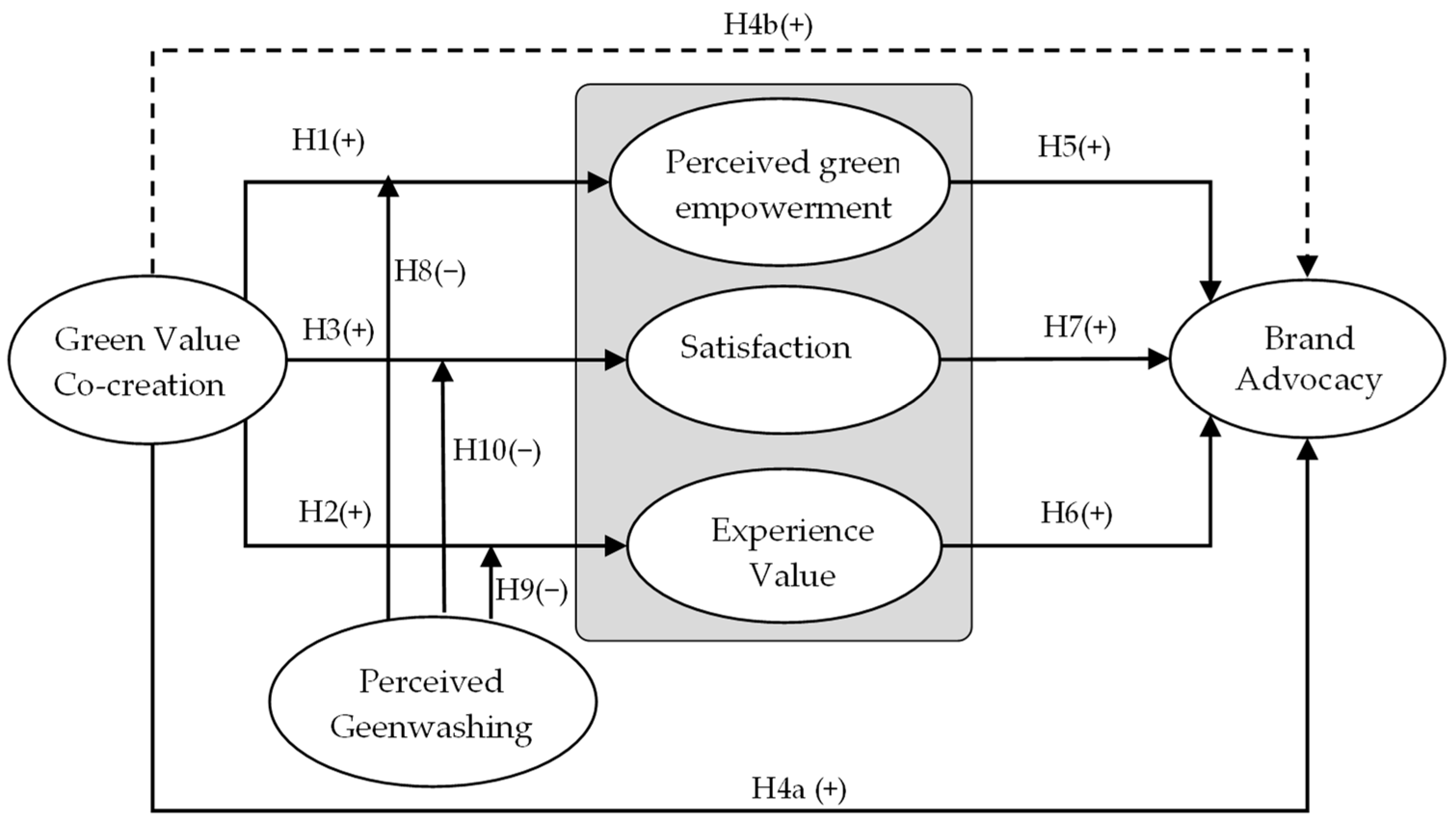
The effect of GVC on perceived green empowerment, experience value, satisfaction and brand advocacy is proposed based on SDL. SDL suggests that businesses can not provide value to customers unless customers actively participate in cocreating value [4]. Value is always created together with customers during use through the integration of their resources. According to SDL, when customers actively participate in the creative process, they integrate their resources to shape the experience and outcome achieved from that experience. It directly leads to improving the customers’ perceived values, thereby building positive relationships with the business’s brand. Many studies have also shown positive relationships between co-creation behavior, perceived green empowerment, experience value, satisfaction and brand advocacy. Participation is found to enhance an individual’s sense of empowerment [45]. This effect is largely attributed to the belief among participants that their input will be acknowledged and valued, thereby strengthening their perception of being empowered [46]. Based on SDL, when customers engage in GVC, they integrate their resources into sustainable activities. This proactive role can directly generate a sense of control, competence, and impact on green outcomes, thereby enhancing their sense of green empowerment. In the context of green tourism, the above theoretical reasoning suggests following hypothesis:
H1. 
GVC is positively associated with perceived green empowerment.
Participation positively influences both service quality and the creation of experiences for the customer [47]. According to Tchorek et al. [48], a positive link exists between VCC and brand experience. Bu et al. [49] also argued that since customers are central to the VCC process, it directly influences their experience value. Based on SDL, GVC enables customers to integrate personal resources into sustainable tourism experiences. This active participation can make the experience more personalized, meaningful, and memorable, directly enhancing their experience value. Thus, we hypothesize the following:
H2. 
GVC is positively associated with experience value.
Customer satisfaction is widely recognized as the most frequently examined customer participation [50]. Empirical findings, such as those by Chan et al. [51], consistently illustrate that active customer participation positively influences their satisfaction levels. Studies on sporting events, such as that by Woratschek et al. [52], have shown that VCC improves customer satisfaction. Barnes and Vidgen’s [53] research on online VCC behavior found that effective communication and interaction between users is positively associated with customer satisfaction. Lee [54] also found that users’ learning and training experiences on an online platform for a product positively impact their satisfaction. Based on SDL, when customers GVC, they tailor services to better suit their needs and sustainability values. By enabling value-in-use to meet or surpass expectations, participation directly contributes to enhanced customer satisfaction. Therefore, we hypothesize that:
H3. 
GVC is positively associated with satisfaction.
Advocacy is significantly propelled by involvement [55] and active customer interaction [56]. Thus, the relationship between VCC and brand advocacy has been widely studied and confirmed across diverse fields. Opata et al. [57] discovered that customer involvement in VCC affects their brand advocacy through loyalty. Similarly, Woratschek et al.’s [52] research has shown a significant effect of VCC on loyalty in the sport industry. Cermak et al. [47] demonstrated that VCC participation was closely related to service repurchase and referral. Chen et al.’s [58] research on the hospitality industry has shown that customer participation significantly affects brand advocacy for the brand. Although VCC has been recognized to affect brand advocacy, GVC has not received much attention in its relationship with loyalty in the context of green tourism. Thus, we hypothesize that:
H4a. 
GVC is directly positively associated with brand advocacy.
This study posits three parallel mediating mechanisms linking GVC to brand advocacy: specifically, through green customer empowerment, experience value, and customer satisfaction. Customer participation is anticipated to foster improved performance, stemming from customers’ perception that the business values their input and that their engagement genuinely contributes to enhancing service processes and outcomes. As articulated by Füller et al. [59], empowered customers who exhibit trust in businesses and feel actively involved tend to sustain their interactions. Supporting this, Auh et al. [26] also demonstrated that customer participation positively influences performance, with customer empowerment mediating this relationship. Consequently, the perception of valuable and impactful customer participation is thus expected to yield significant benefits, notably brand advocacy. The established connections between customer participation, satisfaction/experience value, and brand advocacy have been widely evidenced in existing literature [50,51,60]. Despite this broad support for the links between customer participation, customer empowerment, experience value, satisfaction, and brand advocacy, these specific relationships remain largely unexplored within the context of green tourism. We hypothesize that:
H4b. 
GVC is indirectly positively associated with brand advocacy through perceived green empowerment, experience value and satisfaction.
Customers are motivated to invest their time in participatory activities when they believe their contributions can truly effect change and that their input will be actively considered by businesses [61]. When customers perceive their participation as valuable and influential to businesses, the participation is expected to yield substantial customer-related value for businesses [26]. In other words, when customers perceive their participation as valued, they will respond with actions that bring value to businesses. Important value that businesses can achieve includes customer advocacy for their brand. Therefore, in the context of green tourism, we hypothesize that perceived green empowerment can bring value to businesses through brand advocacy. Therefore, we hypothesize that:
H5. 
Perceived green empowerment is positively associated with brand advocacy.
Several studies supported the impact of customer experience on brand advocacy. Rehman and Shafiq [62] proved that experience value directly affected brand loyalty, including attitudinal loyalty. Sommakettarin and Khamwon [63] argued that businesses need to create the best customer experience to lead to brand advocacy. However, further research is needed on the specific impact of experience value on brand advocacy in the context of green tourism. The following hypothesis is proposed:
H6. 
Experience value is positively associated with brand advocacy.
The correlation between customer satisfaction and business performance is well-documented [61]. Sommakettarin and Khamwon [63] contended that customer satisfaction is a precursor to brand advocacy. This perspective is corroborated by a meta-analysis conducted by Bhati and Verma [64], which consolidated findings from empirical studies to identify satisfaction as a fundamental driver of brand advocacy. Sride and Pounglek [42] indicated the positive relationship where elevated satisfaction levels promote brand advocacy, encouraging contented customers to disseminate favorable experiences and recommendations. However, the precise way in which satisfaction influences brand advocacy in the context of green tourism warrants further investigation. The following hypothesis is proposed:
H7. 
Satisfaction is positively associated with brand advocacy.

2.1.7. Greenwashing and Its Moderating Role

The term “greenwashing” was proposed by Jay Westerveld to refer to hotels encouraging customers to reuse towels under the pretense of environmental conservation, while often doing little else to genuinely protect the environment and primarily aiming to reduce laundry costs [65]. The concept gained popularity in the late 20th century, as environmental issues such as climate change, plastic waste, and industrial pollution became a global focus. The growing customer demand for green products has prompted many businesses to shift toward sustainable development. However, instead of making substantive changes, many businesses have opted for a superficial greenwashing solution, leading to a widespread and increasingly sophisticated wave of greenwashing. Greenwashing refers to the misrepresentation of a business’s environmental performance or the eco-friendly attributes of its products to consumers [66]. Furthermore, Lyon and Maxwell [67] contended that greenwashing also encompasses the strategic disclosure of only advantageous information concerning businesses’ environmental performances, while deliberately omitting negative information, with the strategic intent of cultivating overly positive images. Nyilasy et al. [68] suggest that perceived greenwashing is manifested through the following: businesses omit or hide information to make them greener; they are misleadingly literal, visually or graphically, about their environmental attributes; and they exaggerate the reality of green features.
The gap between businesses’ communication contents and actual environmental practices is a manifestation of business hypocrisy that can be detected and reacted to with anger by customers [69]. Perceptions of greenwashing reduce perceived empowerment, experience value and customer satisfaction due to perceptions of corporate hypocrisy. Being perceived as greenwashing negatively affects customers’ evaluations and attitudes toward businesses. Perceived value is an important antecedent of satisfaction, so when businesses are perceived as hypocritical, customers receive less perceived value from businesses’ products, which will lead to lower customer satisfaction [70]. During the process of GVC, customers may perceive the greenwashing behavior of the business. Therefore, we believe that perceived greenwashing may influence relationships between GVC and perceived green empowerment, customer experience value and satisfaction. The following hypotheses are proposed:
H8. 
Greenwashing moderates the relationship between GVC and perceived green empowerment.
H9. 
Greenwashing moderates the relationship between GVC and experience value.
H10. 
Greenwashing moderates the relationship between GVC and satisfaction.
The research model and hypotheses are presented in the Figure 1.

2.2. Research Methodology

2.2.1. Research Context

The study was conducted in Vietnam’s tourism industry. In Vietnam, many tourism businesses have implemented basic green practices such as adopting green technologies in operations—from energy-saving lighting systems to using eco-friendly materials in bathroom amenities, replacing plastic bottles with glass ones, implementing farm-to-table programs to reduce carbon footprints, prioritizing local products, and enforcing strict waste management processes to meet international sustainability standards. With these proactive green practices, numerous Vietnamese tourism businesses have earned certifications from prestigious organizations, such as the Green Lotus Label, the emblem appraised and awarded by Vietnam’s National Tourism Administration to accommodation facilities meeting environmental protection and sustainable development standards, such as the ASEAN Green Hotel Award.
Tourists in Vietnam increasingly engage with and participate deeply in businesses’ green practices. Customer participation in GVC transforms tourists from passive recipients to active sustainability partners through five distinct behavioral dimensions. First, customers proactively research a company’s green practices via Google, OTA, and social media, enabling informed choices that reward authentic sustainability. Second, they provide real-time operational feedback—such as reporting water leaks, suggesting energy-saving adjustments, or verifying waste sorting—to enable staff completion of green tasks, creating closed-loop improvement systems where customer insights directly enhance execution. Third, they follow explicit green rules, such as no plastic bottles, towel reuse programs, segregated recycling, etc. Fourth, customers offer actionable improvements via comment cards, online reviews, or direct feedback, driving continuous innovation beyond internal capabilities. Fifth, helping fellow guests adopt green behaviors (e.g., explaining towel reuse to families, modeling plastic-free habits) creates social contagion effects.
However, greenwashing manifestations exist among some Vietnamese tourism businesses. These include: (1) omitting or hiding important information to make green claims sound better than reality, such as concealing single-use plastic usage behind plastic-free marketing; (2) misleadingly literal environmental attributes, like labeling standard cleaning products as eco-friendly without chemical disclosure; (3) visually or graphically misleading through lush imagery of pristine beaches while concealing nearby waste dumping; and (4) exaggerating green features, such as claiming zero-carbon operations while ignoring speedboat emissions.
Greenwashing manifestations necessitate rigorous research validation in Vietnam’s tourism. Despite proliferating green claims, businesses require empirical evidence linking authentic GVC participation to brand advocacy, distinguishing genuine sustainability from deceptive practices. This study fills critical knowledge gaps, equipping managers with validated strategies to foster customer co-creation while mitigating trust erosion.

2.2.2. Data Collection and Research Sample

To evaluate the research model and hypotheses, a survey was conducted to collect data. The study’s objective was to assess the impact of green value co-creation and perceived greenwashing on brand advocacy in Vietnam’s tourism industry. Therefore, to ensure comprehensive evaluation, the research population was defined as customers who have used services from tourism businesses across Vietnam with diverse types and scales, including customers of hotels (1–5 star properties, encompassing both international chains and local hotels) and travel agencies. To ensure representativeness, the authors determined an appropriate sample size and sampling method.
The sample size is determined according to Hair [71] and Tabachnick et al. [72]. According to Hair [71], the ratio of observations to observed variables should be 5:1. With the model comprising 26 observed variables, the minimum number of observations required is 130 (5 × 26). According to Tabachnick et al. [72], the number of variables in the model must exceed (50 + 8 m), where m represents the number of variables. In this study, m = 6, thus requiring a minimum of 98 observations (50 + 8 × 6). Therefore, to ensure representativeness, the study required at least 130 returned questionnaires for analysis. A total of 350 questionnaires were distributed to account for response rates and enhance the reliability of survey results.
Stratified random sampling allocated 65% (228 questionnaires) to hotel customers and 35% (122 questionnaires) to travel agency customers from 350 total. This mirrors Vietnam’s tourism landscape—over 13,000 accommodation establishments across key cities (Hanoi, Ho Chi Minh City, Da Nang, etc.; Vietnam National Tourism Administration Statistics and JLL Vietnam Hotel Investment Guide), versus over 7000 licensed travel agencies (Ministry of Culture, Sports and Tourism of Vietnam)—prioritizing hotel customer interactions as the dominant service touchpoint over organized tour segments. Within each stratum, respondents were selected randomly without replacement from customer lists provided by participating businesses.
A mixed-method approach combining direct and online distribution was employed to reach customers of Vietnamese tourism businesses. Direct surveys (60%, number of observations n = 210) were conducted face-to-face by the research team directly surveying these customer subjects at hotel lobbies (1–5 star properties) and travel agency offices. Hotel reception staff, tour guides, and sales personnel facilitated access by identifying recent guests/tour participants and making initial introductions using standardized scripts. We explained the survey questions clearly to customers to ensure they correctly understood what was being asked. Online surveys (40%, number of observations n = 140) through Google Forms were sent via email based on customer lists provided and authorized for use by hotels and travel agencies. In addition to the questionnaires, we included a terminology explanation file to ensure customers fully understood and correctly interpreted the questions asked. A second email was sent to non-respondents after 3 days. After 3 additional days, the research team directly contacted non-responding customers via telephone to record responses. Quality controls included unique access codes, IP/timestamp verification, and mandatory informed consent.
After two months, from May to July 2024, the research team received responses. A total of 246 valid responses were collected from 350 distributed forms, yielding an effective response rate of 70.28%. Table 1 presents some basic descriptive statistics regarding the respondents.

2.2.3. Variable Measurement and Regression Method

The scales are inherited with adjustments from previous studies published in prestigious journals in the same field to ensure the validity and reliability of the instruments. GVC was measured using the scale developed by Yi and Gong [21]. The measurement of perceived green empowerment was adapted from the scale developed by Auh et al. [26]. To measure experience value, a scale originally developed by Varshneya and Das was used [31]. The scale used to measure satisfaction was based on the work of Hennig-Thurau [34]. Brand advocacy is measured based on the scale development of Melancon et al. [44]. To measure perceived greenwashing, a scale originally developed by Nyilasy et al. was used [68].
The questionnaire comprised the following: (1) research purpose introduction, (2) main constructs sections with Likert 5-point scales (1 = strongly disagree to 5 = strongly agree), and (3) customer demographic questions (gender, age, income, education, nationality, customer type). The questionnaire was designed in both Vietnamese and English to accommodate survey respondents. In direct interviews, research team members personally explained questions to ensure customer comprehension and accurate responses. Online surveys and terminology explanation files were accompanied by Google Forms links, clarifying key concepts for self-completion.
A pilot test with 35 customers was conducted before the official survey began. Through the pilot survey, several technical terms were rephrased into customer-friendly language more suitable for the Vietnamese green tourism context. For example: “cognitive value” was adapted to “I experience high-quality, time-saving, and convenient green services”—emphasizing practical benefits customers recognize in sustainable tourism offerings; “hedonic value” became “I derive enjoyment, pleasure, and escapism from green experiences”—capturing emotional satisfaction from eco-friendly travel; “social value” was reworded as “I gain improved status, esteem, and social approval through green choices”—reflecting prestige associated with sustainable consumption; and “ethical value” transformed into “I maintain high trust and privacy in green commitments”—addressing customer confidence in tourism operators’ genuine sustainability efforts. The adjusted scale is shown in Table 2.
Data analysis was executed by SPSS 25 and AMOS 25. Scale reliability was meticulously assessed through the computation of Cronbach’s alpha coefficients and corrected item–total correlations. To ensure a robust factor solution, we performed an EFA evaluating several key criteria: KMO measure for sampling adequacy, Bartlett’s test, total variance explained, eigenvalues, and factor loadings. We analyzed CFA to assess the overall model fit. To validate the model, we first analyzed the regression and standardized regression weights to check the quality of the observed variables. We then assessed convergent validity using CR and AVE, and, finally, established discriminant validity by examining MSV, the square root of AVE, and inter-construct correlations.
The bootstrap resampling method was used to evaluate the structural model. This involved drawing 1000 sub-samples from the original dataset and analyzing them at a 5% significance level. Similarly, the bootstrapping technique was used to assess moderation relationships with 1000 replicates.

3. Results

All constructs exhibited robust internal consistency reliability, with Cronbach’s alpha values exceeding the 0.7 threshold. In particular, GVC yielded an alpha of 0.839, perceived green empowerment of 0.834, satisfaction of 0.848, experience value of 0.788, and brand advocacy of 0.718. Furthermore, item–total correlations surpass 0.3 for all observed variables, indicating high internal consistency and reliable measurement within each construct. These findings align with Hair [71], suggesting strong relationships among items within each construct.
EFA results, summarized in Table 3, demonstrate a suitable structure of factors. KMO measure of sampling adequacy (0.823) is higher than the recommended threshold of 0.5. Furthermore, Bartlett’s test was statistically significant (p < 0.05), indicating sufficient inter-correlation among the variables for further analysis. The analysis revealed a robust five-factor structure, collectively capturing 63.134% of the overall variance. Each of these factors demonstrated strong statistical justification, with all eigenvalues substantially surpassing the conventional 1.0 threshold (the lowest value is 1.327). A total of 22 items were successfully grouped into these 5 constructs. These findings collectively suggest that EFA is an appropriate technique for data analysis and that significant correlations exist among the observed variables.
CFA results indicate a good model fit. Chi-square test is significant with a p-value of less than 0.001, and CFI (0.920) and TLI (0.907) exceed the recommended threshold of 0.90. Additionally, CMIN/df (1.719) is less than 3, and GFI (0.871) is acceptable. RMSEA (0.061) is within an acceptable range. These findings align with the guidelines established by Baumgartner and Homburg [73] and Hair [71], indicating that the CFA model demonstrates a good fit to the data. The measurement model demonstrates strong construct validity. Standardized factor loadings exceed 0.50 for all items, indicating strong relationships between constructs and their respective items. CR values surpass 0.70 for all constructs, demonstrating adequate internal consistency. Furthermore, all constructs exhibit acceptable convergent validity, with AVE values exceeding the 0.50 threshold [71]. Discriminate validity is also established. Discriminate validity is established through multiple criteria. Specifically, all MSV values are greater than their corresponding AVE values. Furthermore, the square root of each construct’s AVE surpassed its correlation with any other construct, thereby supporting the discriminant validity of the measures. These collective findings robustly support the discriminant validity and overall robustness of the scales within the market context.
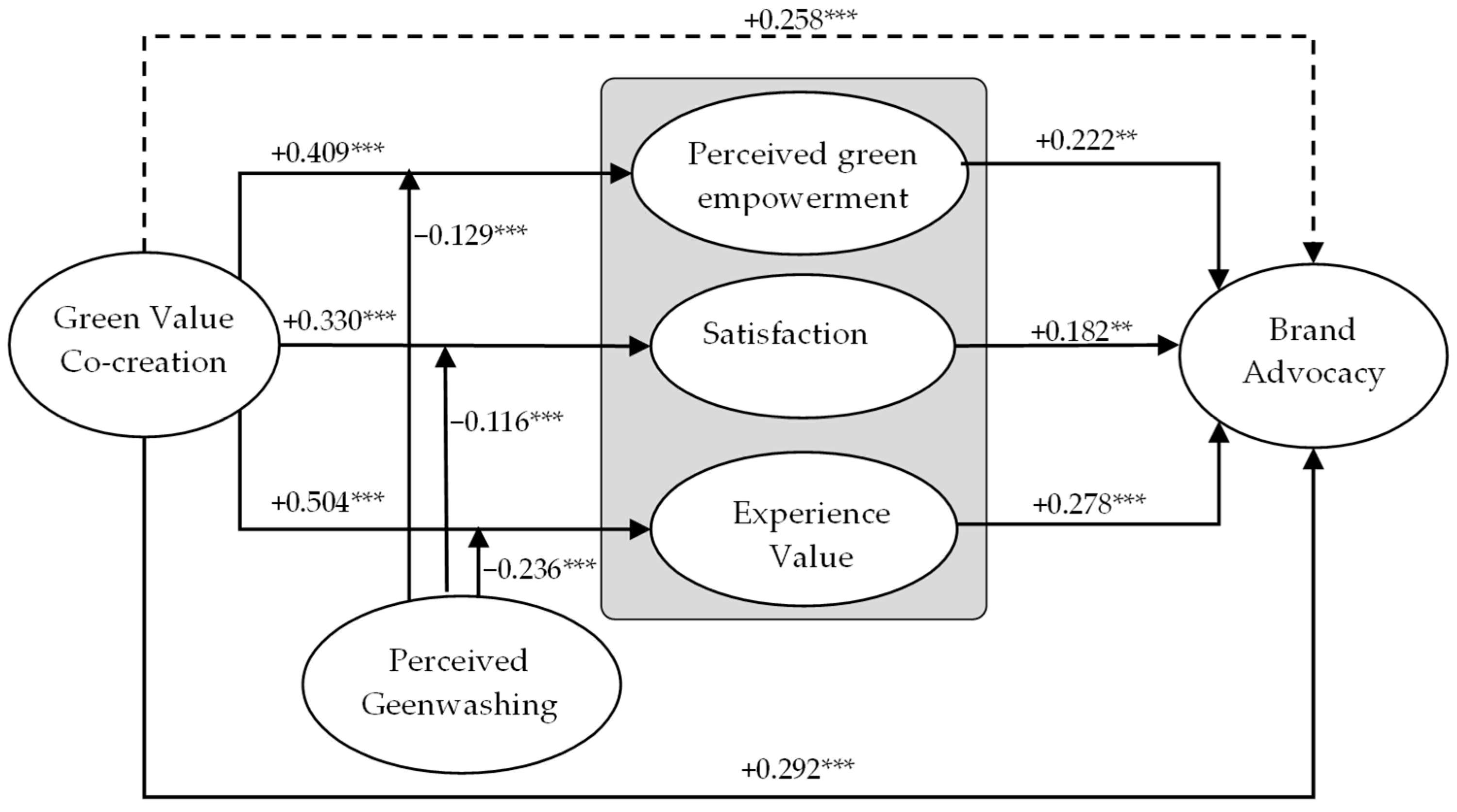
GVC affects all constructs at the 1% significance level. Specifically, GVC affects perceived green empowerment (β = 0.409). GVC also demonstrates a significant positive impact on experience value (β = 0.504). GVC positively affects satisfaction (β = 0.330). These findings support H1, H2, and H3 (Figure 2 and Table 3).
The results indicate a positive direct effect of GVC on brand advocacy (β = 0.292, p < 0.01). Furthermore, GVC exerts an indirect effect on brand advocacy (β = 0.258, p < 0.01) through the mediating factors of perceived green empowerment, experience value and satisfaction. These findings support H4a and H4b. The inclusion of the indirect effect raises the standardized regression coefficient from 0.292 (the direct effect) to 0.551 (the total effect). This result underscores the critical function of these mediators in amplifying the effect of GVC on brand advocacy (Figure 2 and Table 4).
Perceived green empowerment has a significant positive effect on brand advocacy (β = 0.222, p < 0.05). This was also true for experience value, which had an even stronger effect (β = 0.278, p < 0.01), and for satisfaction (β = 0.182, p < 0.05). Thus, H5, H6, and H7 are supported (Figure 2 and Table 3).
The R2 value of brand advocacy is 0.408, indicating that GVC, experience value, satisfaction, and perceived green empowerment explain 40.8% of the variance in brand advocacy. Similarly, the R2 value for experience value is 0.167, suggesting that GVC accounts for 16.7% of the variance in experience value. The R-squared value for perceived green empowerment is 0.254, indicating that GVC explains 25.4% of the variance in perceived green empowerment.
The t-test p-value of the relationship between INT and perceived green empowerment is 0.001 < 0.05, showing that INT (GVC*GW) has an impact on perceived green empowerment. Therefore, greenwashing has a significant moderating effect on the link between GVC and perceived green empowerment. Hypothesis H8 is accepted. The regression coefficient Original Sample = −0.129 < 0 shows that the more greenwashing increases, the more it reduces the impact of GVC on perceived green empowerment. The t-test p-value of the relationship between INT and experience value is 0.001 < 0.05, so INT (GVC*GW) influences experience value. The link between GVC and experience value is moderated by greenwashing. Hypothesis H9 is accepted. The regression coefficient Original Sample = −0.236 < 0 shows that the more greenwashing increases, the more it reduces the impact of GVC on experience value. The t-test p-value of the relationship between INT and satisfaction is 0.001 < 0.05; INT (GVC*GW) has an impact on satisfaction. Therefore, greenwashing plays a moderating role in the relationship between GVC and satisfaction. Hypothesis H10 is accepted. The regression coefficient Original Sample = −0.116 < 0 shows that the more greenwashing increases, the more it reduces the impact of GVC on satisfaction (Table 5).

4. Discussion

The research findings support SDL and the results of numerous previous studies, while also offering new insights compared to previous studies when clarifying the role of GVC and perceived greenwashing in the tourism industry context.
Research findings indicate that GVC positively influences perceived green empowerment, which in turn positively impacts brand advocacy. This outcome aligns with the SDL and prior studies. According to SDL, when customers engage in GVC, they actively integrate their own resources into the process of creating a more sustainable tourism experience. This active role directly generates a sense of control, competence, and impact, leading customers to perceive their actions as meaningful and contributing to a shared green objective. Speer et al. [45] similarly posited that participation enhanced customers’ sense of empowerment. This engagement, driven by the integration of personal resources with those of businesses, leads them to feel empowered to make a positive environmental difference. When customers perceive green empowerment, they develop a deeper psychological connection to the brand’s green mission. This sense of empowerment transforms customers from passive customers into active partners in green value creation. Consequently, customers are inclined to advocate for brands they feel they have helped build and with which they share values. Auh [26] also demonstrated that perceived empowerment mediated the influence of customer participation on businesses’ performances, including brand advocacy. This study clarifies that relationships built upon GVC will foster stronger affiliation with tourism brands.
GVC positively influences experience value, which subsequently impacts brand advocacy. The current results corroborate the findings of prior studies that have investigated the relationship between VCC and experience value, such as the studies by Tchorek et al. [48], Bu et al. [49], Rehman and Shafiq [62], and Sommakettarin and Khamwon [63]. When customers actively engage in GVC, they are not merely consuming a service but are also participating in the process of shaping and enriching their own experiences. GVC renders the tourism experience more personalized, meaningful, and memorable. This deep involvement, achieved through the integration of personal knowledge and effort, enhances the perceived value of the entire experience. A high-value green tourism experience, being co-created and deeply personalized, generates strong positive emotions and lasting memories. According to SDL, these valuable experiences derived from GVC foster continuous resource integration and, consequently, build relationships with businesses. Customers will naturally desire to share these exceptional experiences, becoming brand advocates by recommending them to others, thereby reinforcing the value they have received and sustaining their relationship with the brand.
GVC positively influences satisfaction, which in turn affects brand advocacy. When customers actively co-create, they can tailor the service to better align with their needs, preferences, and personal values. This finding lends further support to the existing literature, such as that by Woratschek et al. [52] and Lee [54], which demonstrates a positive effect of participation in VCC on satisfaction. Cheung and To [74] further argued that when customers acquire new knowledge and skills through co-creation, it boosts their competence and self-esteem, which in turn fosters satisfaction. However, in this study, the role of VCC is specifically emphasized within green practices of businesses. GVC enables tourists to tailor their green tourism experiences to better align with their sustainable values and expectations. A customer’s active involvement in the co-creation of green services increases the likelihood that the final service will align with or surpass their expectations, thereby fostering a greater sense of satisfaction. The research findings also indicate a positive effect of satisfaction on brand advocacy. According to SDL, satisfaction is a crucial driver for continuous resource integration and the establishment of sustained engagement. This outcome aligns with the conclusions of prior studies such as Sommakettarin and Khamwon [63], Bhati and Verma [64], and Sride and Pounglek [42]. Customers satisfied with their green tourism experience are more likely to become advocates. They will share positive experiences, recommend brands to others, and protect businesses’ reputation, thereby maintaining and fostering their relationship with brands.
The study provides evidence of positive relationships between GVC and brand advocacy, consistent with previous research by Chen et al. [58], Cermak et al. [47], Auh et al. [26], etc. SDL offers a robust framework for understanding that GVC in tourism is not merely an isolated activity but a profound customer resource integration process. This process generates initial positive impacts, such as enhanced perceived green empowerment, enriched experience value, and increased satisfaction. In turn, these positive perceptions and experiences motivate customers to become strong brand advocates, thereby strengthening the relationship between customers and tourism businesses.
The moderating role of perceived greenwashing is specifically investigated within the green tourism context. Firstly, when customers perceive a high level of greenwashing, they become skeptical about the authenticity of businesses’ green efforts. Despite their potential engagement in GVC, this skepticism leads them to question businesses’ true motives and the actual efficacy of their own participation. Customers may perceive their involvement as merely contributing to the businesses’ green facade, rather than genuinely making a difference. This consequently diminishes the perceived green empowerment that GVC would otherwise foster. Secondly, while GVC enhances experience value by making the experience more meaningful and authentic, a high perception of greenwashing renders this green experience artificial or inauthentic. This perceived inauthenticity directly reduces the perceived value of the experience. Customers may feel deceived or manipulated. Such negative emotions attenuate any positive value they might have perceived from their participation. The experience no longer feels unique and meaningful as expected, potentially transforming into a disappointing one. Thirdly, even when customers have invested in GVC and experienced some positive aspects, the perception of greenwashing leads to disappointment and a loss of trust. The incongruence between businesses’ green claims and their perceived actual practices diminishes the satisfaction derived from GVC. Thus, the perception of greenwashing significantly weakens the positive link between GVC and beneficial customer outcomes. While GVC enhances perceived green empowerment, experience value, and satisfaction, the presence of perceived greenwashing erodes trust, fosters skepticism, and generates feelings of deception. This not only weakens but can also reverse the positive impacts of GVC, leading to negative outcomes for both customers and tourism brands. The research results of Senan et al. [75] demonstrated a positive direct impact of greenwashing on brand hate.
Implications for tourism businesses and service providers (tourism businesses, hotels, tourism service providers, etc.) should focus on promoting GVC through the following implications. Businesses should facilitate information access and personalized services. They should provide comprehensive information to tourists about themselves and their services, products tailored to each customer group. Tourists must be given opportunities to share their ideas and designs. For example, tourism businesses should focus on online interaction between consultants and tourists through information channels, aiming to save tourists’ time. Managers need to focus on the readiness to participate component as it is a direct precursor to tourists’ co-creation activities. A few solutions could be as follows: When introducing service packages, the details of the responsibilities and benefits of tourists need to be made clear. In addition, businesses need to disseminate a list of things that customers need to prepare for the service to be effective. Businesses need to create favorable conditions for tourists to give feedback through different information channels; create customer groups and community groups for customers to share and help each other; and have many solutions for service errors. Businesses need to pay attention to the insights (hidden thoughts) of tourists in the present digital age, such as change and boredom, and quickly make a decision to book services, which also change continuously.

5. Conclusions

Our research demonstrates that GVC by tourists significantly affects customer perceived green empowerment, experience value, satisfaction and customer brand advocacy. Results of reliability analysis, EFA, CFA, and SEM using survey data from 246 tourists of Vietnamese tourism businesses support our hypotheses. The study provides evidence supporting SET and SDL theories, proving the positive effect of GVC on perceived green empowerment, experience value, satisfaction and brand advocacy, and negative effects of a moderator—perceived greenwashing—in relationships between GVC, perceived green empowerment, experience value and satisfaction.
Greenwashing has a negative impact on relationships between GVC and customer perceptions/behaviors. GVC is no longer meaningful and brings positive outcomes if customers find signs of greenwashing by businesses. Therefore, businesses need to avoid greenwashing by being aware of its negative impacts and adjusting their green activities and communications. Specifically, they should make accurate and truthful claims about green activities, avoid misleading information about green activities and the environmental attributes of products, and refrain from using misleading images.
This study has several limitations that require acknowledgment and create gaps for future research. First, a key limitation of this study is the lack of multi-group analysis to identify differences in the impact of green value co-creation and perceived greenwashing on brand advocacy across customer segments. Heterogeneity likely exists between customer groups based on age, education level, income, and other demographics, which could moderate these relationships differently. Identifying such differences would enable more targeted strategic recommendations for tourism businesses to enhance brand advocacy among specific customer segments, optimizing marketing and sustainability initiatives for maximum customer loyalty. In addition, while encompassing diverse business types and scales (international chains, local hotels, various travel agencies), this study does not analyze the differential impacts of GVC and perceived greenwashing on brand advocacy across branded versus local businesses. This limits understanding of segment-specific sustainability dynamics. Future research should employ multi-group structural equation modeling to test the moderating effects of business scale and branding on these relationships. Second, the cross-sectional design captures relationships at a single point, limiting causal inferences between GVC, perceived greenwashing, and brand advocacy outcomes. Future research should employ longitudinal studies tracking GVC evolution across multiple customer interactions to establish causality. Third, the analysis focuses solely on customers, overlooking employees’ and suppliers’ roles in the green co-creation ecosystem. Multi-stakeholder studies incorporating these actors would reveal their contributions and firm-level performance impacts. Fourth, the green tourism context restricts generalizability to manufacturing, retail, or transportation. Cross-industry applications would validate GVC’s broader applicability.

Author Contributions

Conceptualization, N.T.H.N. and N.T.H.D.; Methodology, N.T.H.N. and H.H.D.; Formal Analysis, N.T.H.N. and N.T.H.D.; Investigation, H.H.D., H.T.B.T. and N.T.H.D.; Data Curation, H.H.D. and H.T.B.T.; Validation, H.T.B.T.; Supervision, N.T.H.N. and H.H.D.; Writing—Original Draft Preparation, N.T.H.N. and N.T.H.D.; Writing—Review and Editing, N.T.H.N., H.H.D. and H.T.B.T. All authors have read and agreed to the published version of the manuscript.

Funding

This research was funded by Thuongmai University, Hanoi, Vietnam (funding number: NNC23-02).

Institutional Review Board Statement

The study was conducted in accordance with the Declaration of Helsinki and approved by the CSTRAD Ethics Committee of Thuongmai University (protocol code: 2025/CSTRAD-11-05 and date of approval: 5 November 2025).

Informed Consent Statement

Informed consent was obtained from all subjects involved in the study.

Data Availability Statement

The original contributions presented in this study are included in the article. Further inquiries can be directed to the corresponding author.

Conflicts of Interest

The authors declare no conflicts of interest.

References

  1. Normann, R.; Ramirez, R. From value chain to value constellation: Designing interactive strategy. Harv. Bus. Rev. 1993, 71, 65–77. [Google Scholar]
  2. Hoyer, W.D.; Chandy, R.; Dorotic, M.; Krafft, M.; Singh, S.S. Consumer cocreation in new product development. J. Serv. Res. 2010, 13, 283–296. [Google Scholar] [CrossRef]
  3. Chathoth, P.; Altinay, L.; Harrington, R.J.; Okumus, F.; Chan, E.S. Co-production versus co-creation: A process based continuum in the hotel service context. Int. J. Hosp. Manag. 2013, 32, 11–20. [Google Scholar] [CrossRef]
  4. Vargo, S.L.; Lusch, R.F. Evolving to a new dominant logic for marketing. J. Mark. 2004, 68, 1–17. [Google Scholar] [CrossRef]
  5. Solakis, K.; Katsoni, V.; Mahmoud, A.B.; Grigoriou, N. Factors affecting value co-creation through artificial intelligence in tourism: A general literature review. J. Tour. Futures 2022, 10, 116–130. [Google Scholar] [CrossRef]
  6. Füller, J.; Bilgram, V. The moderating effect of personal features on the consequences of an enjoyable co-creation experience. J. Prod. Brand Manag. 2017, 26, 386–401. [Google Scholar] [CrossRef]
  7. Lusch, R.F.; Vargo, S.L. Service-dominant logic: Reactions, reflections and refinements. Mark. Theory 2006, 6, 281–288. [Google Scholar] [CrossRef]
  8. Payne, A.F.; Storbacka, K.; Frow, P. Managing the co-creation of value. J. Acad. Mark. Sci. 2008, 36, 83–96. [Google Scholar] [CrossRef]
  9. Antón, C.; Camarero, C.; Garrido, M.-J. Exploring the experience value of museum visitors as a co-creation process. Curr. Issues Tour. 2018, 21, 1406–1425. [Google Scholar] [CrossRef]
  10. World Travel & Tourism Council. WTTC Unveils World-First Global Travel & Tourism Climate Footprint Data. 2022. Available online: https://wttc.org/news/wttc-unveils-industry-leading-and-ground-breaking-global-travel-and-tourism-sustainability-data (accessed on 2 March 2026).
  11. Circular Ecology. The Carbon Emissions of Staying in a Hotel. 2022. Available online: https://circularecology.com/news/the-carbon-emissions-of-staying-in-a-hotel (accessed on 2 March 2026).
  12. Alliance, S.H. Water Stewardship for Hotel Companies. 2022. Available online: https://sustainablehospitalityalliance.org/wp-content/uploads/2020/06/Water-Stewardship-for-Hotel-Companies-2018.pdf (accessed on 2 March 2026).
  13. Greenview. Green Lodging Trends Report 2022. Available online: https://greenview.sg/resources/green-lodging-trends-report/ (accessed on 2 March 2026).
  14. Prahalad, C.K.; Ramaswamy, V. Co-creating unique value with customers. Strategy Leadersh. 2004, 32, 4–9. [Google Scholar] [CrossRef]
  15. Vargo, S.L.; Lusch, R.F. Institutions and axioms: An extension and update of service-dominant logic. J. Acad. Mark. Sci. 2016, 44, 5–23. [Google Scholar] [CrossRef]
  16. Lyu, J.; Cao, K.; Yang, S. The impact of value co-creation behavior on customers’ experiences with and loyalty to P2P accommodations. Front. Psychol. 2022, 13, 988318. [Google Scholar] [CrossRef]
  17. Prebensen, N.K.; Kim, H.; Uysal, M. Cocreation as moderator between the experience value and satisfaction relationship. J. Travel Res. 2016, 55, 934–945. [Google Scholar] [CrossRef]
  18. Assiouras, I.; Skourtis, G.; Giannopoulos, A.; Buhalis, D.; Koniordos, M. Value co-creation and customer citizenship behavior. Ann. Tour. Res. 2019, 78, 102742. [Google Scholar] [CrossRef]
  19. Guo, Y.; Wang, L.; Yang, Q. Do corporate environmental ethics influence firms’ green practice? The mediating role of green innovation and the moderating role of personal ties. J. Clean. Prod. 2020, 266, 122054. [Google Scholar] [CrossRef]
  20. Laud, G.; Karpen, I.O. Value co-creation behaviour-role of embeddedness and outcome considerations. J. Serv. Theory Pract. 2017, 27, 778–807. [Google Scholar] [CrossRef]
  21. Yi, Y.; Gong, T. Customer value co-creation behavior: Scale development and validation. J. Bus. Res. 2013, 66, 1279–1284. [Google Scholar] [CrossRef]
  22. Ramani, G.; Kumar, V. Interaction orientation and firm performance. J. Mark. 2008, 72, 27–45. [Google Scholar] [CrossRef]
  23. Alshibly, H.; Chiong, R. Customer empowerment: Does it influence electronic government success? A citizen-centric perspective. Electron. Commer. Res. Appl. 2015, 14, 393–404. [Google Scholar] [CrossRef]
  24. Xie, L.; Li, D.; Keh, H.T. Customer participation and well-being: The roles of service experience, customer empowerment and social support. J. Serv. Theory Pract. 2020, 30, 557–584. [Google Scholar] [CrossRef]
  25. Han, X.; Fang, S.; Xie, L.; Yang, J. Service fairness and customer satisfaction: Mediating role of customer psychological empowerment. J. Contemp. Mark. Sci. 2019, 2, 50–62. [Google Scholar] [CrossRef]
  26. Auh, S.; Menguc, B.; Katsikeas, C.S.; Jung, Y.S. When does customer participation matter? An empirical investigation of the role of customer empowerment in the customer participation-performance link. J. Mark. Res. 2019, 56, 1012–1033. [Google Scholar] [CrossRef]
  27. Verhoef, P.C.; Lemon, K.N.; Parasuraman, A.; Roggeveen, A.; Tsiros, M.; Schlesinger, L.A. Customer experience creation: Determinants, dynamics and management strategies. J. Retail. 2009, 85, 31–41. [Google Scholar] [CrossRef]
  28. Nadeem, W.; Tan, T.M.; Tajvidi, M.; Hajli, N. How do experiences enhance brand relationship performance and value co-creation in social commerce? The role of consumer engagement and self brand-connection. Technol. Forecast. Soc. Change 2021, 171, 120952. [Google Scholar] [CrossRef]
  29. Zhang, Y.; Liu, Y.; Tao, W. The Influence of Tourists’ Online Value Co-creation Behavior on Consumer-Brand Relationship Quality: The Moderating Effect of Altruism. Front. Psychol. 2022, 13, 950546. [Google Scholar] [CrossRef]
  30. Cheng, H.; Liu, Q.; Bi, J.-W. Perceived crowding and festival experience: The moderating effect of visitor-to-visitor interaction. Tour. Manag. Perspect. 2021, 40, 100888. [Google Scholar] [CrossRef]
  31. Varshneya, G.; Das, G. Experiential value: Multi-item scale development and validation. J. Retail. Consum. Serv. 2017, 34, 48–57. [Google Scholar] [CrossRef]
  32. Bitner, M.J.; Hubbert, A.R. Encounter satisfaction versus overall satisfaction versus quality. In Service Quality: New Directions in Theory and Practice; Sage Publications: Thousand Oaks, CA, USA, 1994; pp. 72–94. [Google Scholar]
  33. Reid, M. IMC-performance relationship: Further insight and evidence from the Australian marketplace. Int. J. Advert. 2003, 22, 227–248. [Google Scholar] [CrossRef]
  34. Hennig-Thurau, T. Customer orientation of service employees: Its impact on customer satisfaction, commitment, and retention. Int. J. Serv. Ind. Manag. 2004, 15, 460–478. [Google Scholar] [CrossRef]
  35. East, R.; Hammond, K.; Lomax, W. Measuring the impact of positive and negative word of mouth on brand purchase probability. Int. J. Res. Mark. 2008, 25, 215–224. [Google Scholar] [CrossRef]
  36. Rini, E.; Sembiring, B. The effect of customer engagement and brand advocacy on brand value co-creation. In Proceedings of the 19th International Symposium on Management (INSYMA 2022), Surabaya, Indonesia, 23–24 March 2022. [Google Scholar]
  37. Khamwon, A.; Masri, P. Brand experience, brand love, and brand advocacy: A case of premium smartphone. Int. J. Technol. Manag. Inf. Syst. 2020, 2, 21–26. [Google Scholar]
  38. Ahmadi, A.; Ataei, A. Emotional attachment: A bridge between brand reputation and brand advocacy. Asia-Pac. J. Bus. Adm. 2024, 16, 1–20. [Google Scholar] [CrossRef]
  39. Jillapalli, R.K.; Wilcox, J.B. Professor brand advocacy: Do brand relationships matter? J. Mark. Educ. 2010, 32, 328–340. [Google Scholar] [CrossRef]
  40. Walz, A.M.; Celuch, K.G. The effect of retailer communication on customer advocacy: The moderating role of trust. J. Consum. Satisf. Dissatisf. Complain. Behav. 2010, 23, 95–110. [Google Scholar]
  41. Schultz, D.E.; Bailey, S.E. Customer/brand loyalty in an interactive marketplace. J. Advert. Res. 2000, 40, 1–12. [Google Scholar] [CrossRef]
  42. Sride, P.; Pounglek, W. The Influence of Service Quality, Brand Trust, and Customer Satisfaction Affecting Brand Advocacy of Government Hospitals in Bangkok. J. Bus. Innov. Sustain. (JBIS) 2025, 20. [Google Scholar] [CrossRef]
  43. Wilk, V.; Soutar, G.N.; Harrigan, P. Online brand advocacy (OBA): The development of a multiple item scale. J. Prod. Brand Manag. 2020, 29, 415–429. [Google Scholar] [CrossRef]
  44. Melancon, J.P.; Noble, S.M.; Noble, C.H. Managing rewards to enhance relational worth. J. Acad. Mark. Sci. 2011, 39, 341–362. [Google Scholar] [CrossRef]
  45. Speer, P.W.; Peterson, N.A.; Armstead, T.L.; Allen, C.T. The influence of participation, gender and organizational sense of community on psychological empowerment: The moderating effects of income. Am. J. Community Psychol. 2013, 51, 103–113. [Google Scholar] [CrossRef] [PubMed]
  46. Zimmerman, M.A.; Rappaport, J. Citizen participation, perceived control, and psychological empowerment. Am. J. Community Psychol. 1988, 16, 725–750. [Google Scholar] [CrossRef] [PubMed]
  47. Cermak, D.S.; File, K.M.; Prince, R.A. Customer participation in service specification and delivery. J. Appl. Bus. Res. 1994, 10, 90. [Google Scholar] [CrossRef]
  48. Tchorek, G.; Brzozowski, M.; Dziewanowska, K.; Allen, A.; Kozioł, W.; Kurtyka, M.; Targowski, F. Social capital and value co-creation: The case of a polish car sharing company. Sustainability 2020, 12, 4713. [Google Scholar] [CrossRef]
  49. Bu, Q.; Jin, Y.; Li, Z. How does a customer prefer community or brand? The impacts of customer experience on customer loyalty based on the perspective of value co-creation. J. Contemp. Mark. Sci. 2020, 3, 281–302. [Google Scholar] [CrossRef]
  50. Dong, B.; Sivakumar, K. Customer participation in services: Domain, scope, and boundaries. J. Acad. Mark. Sci. 2017, 45, 944–965. [Google Scholar] [CrossRef]
  51. Chan, K.W.; Yim, C.K.; Lam, S.S. Is customer participation in value creation a double-edged sword? Evidence from professional financial services across cultures. J. Mark. 2010, 74, 48–64. [Google Scholar] [CrossRef]
  52. Woratschek, H.; Horbel, C.; Popp, B. Determining customer satisfaction and loyalty from a value co-creation perspective. Serv. Ind. J. 2020, 40, 777–799. [Google Scholar] [CrossRef]
  53. Barnes, S.J.; Vidgen, R.T. Technology socialness and Web site satisfaction. Technol. Forecast. Soc. Change 2014, 89, 12–25. [Google Scholar] [CrossRef]
  54. Lee, D. Strategies for technology-driven service encounters for patient experience satisfaction in hospitals. Technol. Forecast. Soc. Change 2018, 137, 118–127. [Google Scholar] [CrossRef]
  55. Harrigan, P.; Roy, S.K.; Chen, T. Do value cocreation and engagement drive brand evangelism? Mark. Intell. Plan. 2021, 39, 345–360. [Google Scholar] [CrossRef]
  56. Bilro, R.G.; Loureiro, S.M.C. I am feeling so good! Motivations for interacting in online brand communities. J. Res. Interact. Mark. 2023, 17, 61–77. [Google Scholar] [CrossRef]
  57. Opata, C.N.; Xiao, W.; Nusenu, A.A.; Tetteh, S.; Asante Boadi, E. The impact of value co-creation on satisfaction and loyalty: The moderating effect of price fairness (empirical study of automobile customers in Ghana). Total Qual. Manag. Bus. Excell. 2021, 32, 1167–1181. [Google Scholar] [CrossRef]
  58. Chen, S.C.; Raab, C.; Tanford, S. Antecedents of mandatory customer participation in service encounters: An empirical study. Int. J. Hosp. Manag. 2015, 46, 65–75. [Google Scholar] [CrossRef]
  59. Füller, J.; Mühlbacher, H.; Matzler, K.; Jawecki, G. Consumer empowerment through internet-based co-creation. J. Manag. Inf. Syst. 2009, 26, 71–102. [Google Scholar] [CrossRef]
  60. Bendapudi, N.; Leone, R.P. Psychological implications of customer participation in co-production. J. Mark. 2003, 67, 14–28. [Google Scholar] [CrossRef]
  61. Merlo, O.; Eisingerich, A.B.; Auh, S. Why customer participation matters. MIT Sloan Manag. Rev. 2013, 54, 81–87. [Google Scholar]
  62. Rehman, S.U.; Shafiq, M. Role of brand experience in building brand loyalty: Mediating role of brand trust and brand commitment. South Asian Rev. Bus. Adm. Stud. (SABAS) 2019, 1, 41–56. [Google Scholar]
  63. Sommakettarin, A.; Khamwon, A. Service quality, customer experience quality, customer satisfaction and brand advocacy. Int. J. Bus. Econ. 2020, 2, 31–37. [Google Scholar]
  64. Bhati, R.; Verma, H.V. Antecedents of customer brand advocacy: A meta-analysis of the empirical evidence. J. Res. Interact. Mark. 2020, 14, 153–172. [Google Scholar] [CrossRef]
  65. Delmas, M.A.; Burbano, V.C. The drivers of greenwashing. Calif. Manag. Rev. 2011, 54, 64–87. [Google Scholar] [CrossRef]
  66. Parguel, B.; Benoit-Moreau, F.; Russell, C.A. Can evoking nature in advertising mislead consumers? The power of ‘executional greenwashing’. Int. J. Advert. 2015, 34, 107–134. [Google Scholar] [CrossRef]
  67. Lyon, T.P.; Maxwell, J.W. Greenwash: Corporate environmental disclosure under threat of audit. J. Econ. Manag. Strategy 2011, 20, 3–41. [Google Scholar] [CrossRef]
  68. Nyilasy, G.; Gangadharbatla, H.; Paladino, A. Perceived greenwashing: The interactive effects of green advertising and corporate environmental performance on consumer reactions. J. Bus. Ethics 2014, 125, 693–707. [Google Scholar] [CrossRef]
  69. Wagner, T.; Lutz, R.J.; Weitz, B.A. Corporate hypocrisy: Overcoming the threat of inconsistent corporate social responsibility perceptions. J. Mark. 2009, 73, 77–91. [Google Scholar] [CrossRef]
  70. Ioannou, I.; Kassinis, G.; Papagiannakis, G. The impact of perceived greenwashing on customer satisfaction and the contingent role of capability reputation. J. Bus. Ethics 2023, 185, 333–347. [Google Scholar] [CrossRef]
  71. Hair, J.F. Multivariate Data Analysis, 7th ed.; Pearson: London, UK, 2009. [Google Scholar]
  72. Tabachnick, B.G.; Fidell, L.S.; Ullman, J.B. Using Multivariate Statistics; Pearson: Boston, MA, USA, 2007; Volume 5. [Google Scholar]
  73. Baumgartner, H.; Homburg, C. Applications of structural equation modeling in marketing and consumer research: A review. Int. J. Res. Mark. 2014, 13, 139–161. [Google Scholar] [CrossRef]
  74. Cheung, F.Y.M.; To, W.M. A customer-dominant logic on service recovery and customer satisfaction. Manag. Decis. 2016, 54, 2524–2543. [Google Scholar] [CrossRef]
  75. Senan, N.A.M.; Al-Kahtani, S.M.; Alanazi, I.D.; AbdAlatti, A.; Alshadadi, M.A.; Alhebri, A.; Mohammad, R.A. Unveiling the linkages between greenwashing, brand hate, and negative consumer behavior: The moderating effect of environmental concern. Discov. Sustain. 2025, 6, 446. [Google Scholar] [CrossRef]
Figure 1. The proposed conceptual model.
Sustainability 18 03660 g001
Figure 2. Structural model analysis results. Note: ** p < 0.05, *** p < 0.01.
Sustainability 18 03660 g002
Table 1. Profile of respondents.
N = 246
FrequencyPercentage
GenderMale11847.9
Female12852.0
AgeUnder 25 years old156.1
25–34 years old7430.1
35–49 years old10944.3
50–64 years old3715.0
Over 65 years old114.5
Income (per month)Under $50052.0
$500–$9993715.0
$1000–$14996225.2
$1500–$19997430.1
$2000–$24994919.9
Over $2500197.7
Highest level of educationHigh school or below7128.9
Bachelor’s degree11044.7
Postgraduate (Master’s, Doctorate)6526.4
Type of customerInternational13956.5
Domestic10743.5
Customer of hotels16567.1
Customer of travel agencies8132.9
Table 2. Variable measurement.
Construct/ItemsSources
GVCGreen value co-creation behaviorYi and Gong [21]
GVC1I search for information about the company’s green practices
GVC2I share information with staff so they can complete their green practice tasks
GVC3I follow the company’s green practice guidelines and rules.
GVC4I provide information and suggestions to improve the company’s green practices
GVC5I assist other guests with green practices if they need help
PGEPerceived green empowermentAuh et al. [26]
PGE 1I am very well aware of the ways in which my participation in the company’s green practices is benefiting the company
PGE 2The company cares about my participation in the company’s green practices
PGE 3My participation in the company’s green practices is very important to the company
PGE 4The company appreciates my participation in the company’s green practices
PGE 5The company values my participation in the company’s green practices
STFSatisfactionHennig-Thurau [34]
STF1I am fully satisfied with the company.
STF2The company always fulfils my expectations.
STF3The company has never disappointed me so far.
STF4My experience with the company is excellent.
STF5The company is a good one to have experience with its service
EVExperience valueVarshneya and Das [31]
EV1I experience high-quality, time-saving, and convenient green services
EV2I derive enjoyment, pleasure, and escapism from green experiences
EV3I gain improved status, esteem, and social approval through green choices
EV4I maintain high trust and privacy in green commitments
BABrand advocacyMelancon et al. [44]
BA1I try to get my friends and family to buy the company’s products and services
BA2I seldom miss an opportunity to tell others good things about the company
BA3I would defend the organization to others if I heard someone speaking poorly about the company
GWPerceived greenwashingNyilasy et al. [68]
GW1The company omits or hides important information to make green claims sound better than they are
GW2The company is misleadingly literal about its environmental attributes
GW3The company is visually or graphically misleading about its environmental attributes
GW4The company exaggerates the reality of its green features
Table 3. Measurement model assessment results.
Construct/ItemsCronbach’s AlphaCorrected Item–Total CorrelationFactor
Loadings
GVC0.839
GVC1 0.7270.876
GVC2 0.6620.758
GVC3 0.6980.859
GVC4 0.5050.653
GVC5 0.6280.680
PGE0.834
PGE 1 0.7000.792
PGE 2 0.6290.821
PGE 3 0.6840.765
PGE 4 0.5760.747
PGE 5 0.5790.693
STF0.848
STF1 0.6130.681
STF2 0.6710.801
STF3 0.6480.748
STF4 0.6700.830
STF5 0.6870.852
EV0.788
EV1 0.6240.766
EV2 0.6200.787
EV3 0.5230.674
EV4 0.6460.854
BA0.718
BA1 0.5280.642
BA2 0.5570.825
BA3 0.5270.842
Table 4. Hypothesis testing results.
HypothesesRelationshipsStandardized Regressionp-ValueConclusion
H1GVC → PGEDirect0.4090.000Support
H2GVC → EVDirect0.5040.000Support
H3GVC → STFDirect0.3300.000Support
H4aGVC → BADirect0.2920.009Support
H4bGVC → BAIndirect0.2580.001Support
GVC → BATotal0.5510.003-
H5PGE → BADirect0.2220.013Support
H6EV → BADirect0.2780.006Support
H7STF → BADirect0.1820.032Support
Table 5. Results of moderation effect analysis.
HypothesesOriginal Samplep ValuesConclusion
H8: ZPGE ← INT−0.1290.001Supported
H9: ZEV ← INT−0.2360.001Supported
H10: ZSTF ← INT−0.1160.001Supported
Disclaimer/Publisher’s Note: The statements, opinions and data contained in all publications are solely those of the individual author(s) and contributor(s) and not of MDPI and/or the editor(s). MDPI and/or the editor(s) disclaim responsibility for any injury to people or property resulting from any ideas, methods, instructions or products referred to in the content.