Article

Assessment of Policy Benefit Configurations of Net-Zero Emissions: The Impact of Carbon Trading Policy Synergy on Carbon Neutrality Goals


1
School of Economics and Management, Tongji University, Shanghai 200092, China
2
School of Management, Jiangsu University, Zhenjiang 212013, China
3
School of Management, Shanghai University, Shanghai 200444, China
*
Author to whom correspondence should be addressed.
Sustainability 2026, 18(7), 3362; https://doi.org/10.3390/su18073362
Submission received: 22 February 2026 / Revised: 23 March 2026 / Accepted: 26 March 2026 / Published: 31 March 2026

Abstract

China’s carbon neutrality plan centers on a carbon trading policy system integrating market economy, guidance, regulation, command-and-control, and fiscal measures into an inter-domain synergy. Based on the system science methodology, by leveraging the gray system evaluation method and the multiple regression model, a carbon neutrality policy analysis system has been formed. This paper constructs a policy synergy model to examine its role in achieving net-zero goals. This article measures the policy synergy and effectiveness of China’s carbon neutrality goals in different years through policy evaluation theory and coupling models. Results show China’s net carbon emissions have passed through three cycles—rapid rise, gradual growth, and slow decline—while policy synergy peaked in 2011, 2014, and 2016, aligning with changes in emission growth rates. The significance of this discovery indicates the pulse effect of China’s green policies. In key starting years such as the 12th and 13th Five-Year Plans, China has invested a significant amount of green policy resources. Synergy levels vary by measure: When applying market economy tools, the deterrent effect of command-and-control should be reduced; command-and-control should be paired only with regulation; fiscal measures should be balanced against guidance to avoid counteracting effects. Internal equilibrium between measures is crucial, with mandatory and flexible tools configured separately to maximize policy effectiveness for net-zero emissions. This study expands the quantitative research on policy coordination and effectiveness analysis. At the same time, it provides policy-level guidance and optimization for the realization of the carbon neutrality goal, avoiding the waste and redundancy of policy resources

1. Introduction

Since the Industrial Revolution, the contradiction between economic development and climate change has become increasingly prominent. Sustained growth of the world economy has come at the cost of rising energy consumption and greenhouse gas concentrations, gradually depleting the sustainability of ecological resources. Frequent occurrences of extreme weather events such as floods, droughts, and freezes have inflicted irreversible adverse impacts on economic, cultural, social, political, and ecological systems. Against this backdrop, numerous countries have acceded to the Paris Agreement, striving to limit global temperature rise to well below 2 °C above pre-industrial levels and pursue efforts to limit it to 1.5 °C [1]. However, the intertwining and conflicts of national interests make it difficult to unify collective actions and consistent stances among countries [2]. The U.S. withdrawal from the Agreement has further exposed the deficiencies and drawbacks of the Western-led climate governance system. The use of coal and other fossil fuels has harmful effects on the global climate due to greenhouse gas emissions and the release of toxic and carcinogenic particles produced during combustion. To address these negative effects, many countries around the world have introduced very strict emission regulations [3].
In response, China aspires to build a social development and climate governance system with Chinese characteristics and take the lead in responding to the carbon neutrality goal. In September 2020, President Xi Jinping pledged at the 75th Session of the United Nations General Assembly that “China will scale up its Intended Nationally Determined Contributions, aim to peak carbon dioxide emissions before 2030, and strive to achieve carbon neutrality before 2060”. This commitment demonstrates China’s sense of responsibility as a major country in participating in global climate governance and building a community with a shared future for mankind, and also presents a Chinese solution for carbon emission reduction. In December 2020, the Central Economic Work Conference listed advancing carbon peaking and carbon neutrality as one of the eight key tasks for 2021. Synergistic arrangements based on markets and institutions further ensure the steady progress of the carbon neutrality strategy [4]. In another way, to produce clean energy, the transition to RES leads to the creation of new jobs, stimulates economic growth, contributes to climate resilience, and creates a more environmentally resilient and acceptable energy system [5].
As a government-led initiative, the carbon neutrality strategy requires a series of policy measures under top-level design to be realized, among which carbon trading policy is the optimal path to simultaneously promote low-carbon transition and economic development. In 2011, the National Development and Reform Commission issued the Notice on Launching Pilot Work of Carbon Emission Trading [6]. Many experts and scholars have high expectations for carbon trading as a means to achieve carbon neutrality goals. The 19th National Congress of the Communist Party of China also proposed to steadily advance the construction of a national carbon market in phases in accordance with the principles of “market orientation, government services, coordinated promotion, extensive participation, unified standards, fairness and openness”. On the basis of ensuring the smooth and effective operation of the carbon market, the carbon trading system should be continuously improved to give full play to the role of market mechanisms in controlling and reducing greenhouse gas emissions and lowering the cost of carbon emission reduction for the whole society [7,8].
Nevertheless, the implementation of a single carbon trading policy is insufficient to drive the achievement of carbon neutrality goals. Relevant regulatory measures are fundamental to guaranteeing the stable operation of the carbon trading market. For instance, the three landmark documents issued by the Ministry of Ecology and Environment for the construction of the national carbon emission trading market—the three institutional rules for registration, trading, and settlement—further standardize national carbon emission registration, trading, and settlement activities, protect the legitimate rights and interests of all participants in the national carbon trading market, and constitute an indispensable part of the carbon trading policy system. Therefore, the carbon trading policy system refers to a series of policies, guidelines, and methodologies supporting carbon trading. Compared with the mature carbon trading market in the European Union, China’s carbon trading market started late, has an incomplete supporting policy system, and is still in the initial stage of development. It still needs policy support and market guarantees in aspects such as rationally designing the carbon trading market management model, vigorously cultivating the supply and demand sides of the carbon trading market, improving relevant laws, regulations and supporting policies, and strengthening international cooperation in the carbon trading market. Exploring the effectiveness, measures, and objectives of China’s existing carbon trading policy-related government documents, as well as issues such as carbon trading policy synergy, is of great significance for improving China’s carbon trading policy system.
In fact, since the official launch of carbon trading pilots in 2013, China’s carbon trading volume has generally shown an upward trend. In 2020, the trading volume reached 57.4091 million tons of carbon dioxide, with a turnover of 1.578 trillion yuan [9]. The national carbon trading market was officially launched in July 2021. Against this backdrop, questions arise: What is the level of carbon neutrality in China’s various provinces and cities? Is carbon trading policy effective in achieving carbon neutrality goals? How does carbon trading act on carbon neutrality? What is the content effectiveness of carbon trading-related policy documents? How do different policy tools affect carbon neutrality? Focusing on these questions, this paper takes carbon trading policy as the research object, analyzes its impact mechanism and policy effectiveness on carbon neutrality, and provides suggestions for improving the carbon trading policy system based on research conclusions and the development status of carbon trading policies, thereby promoting the realization of carbon neutrality goals.
In summary, carbon neutrality seeks net-zero emissions by integrating economic, ecological, social, and political dimensions, aligning with the Paris Agreement’s responsibility mechanism. It requires a carbon trading-centered policy supported by complementary measures. Using China’s carbon trading data, this study builds a policy synergy model to examine mechanisms and identify optimal configurations for net-zero goals. Contributions include: proposing a framework for evaluating policy benefit configurations as an integrated analysis problem; conceptualizing carbon neutrality as the practical translation of net-zero; and outlining a research path for synergistic carbon trading policies—China’s main tool for carbon neutrality—enabling targeted policy adjustments and integrated strategies for specific scenarios [10]. From the perspective of research gaps, quantitative research on policy effectiveness is still in a weak stage and seriously disconnected from the practical needs of carbon neutrality policies. Existing research mainly focuses on qualitative analysis, emphasizing the theoretical value and implementation path of policies, lacking precise quantitative measurement and empirical testing of policy effectiveness, making it difficult to quantitatively answer core questions such as “Is policy implementation effective?”, “How does the effectiveness of different policies vary?”, and “What is the degree of synergy or conflict effects between policies?”.
The possible innovation of this article lies in quantitatively analyzing the policy effectiveness and the outcome of carbon trading policies. Existing studies mostly focus on the final results after the implementation of carbon trading policies, but rarely examine the policies themselves. In fact, policy effects are often influenced by multiple factors and multiple entities during the policy implementation process. Traditional policy evaluation methods tend to measure the merits or demerits of the policy based on its evaluation results, without integrating the content of the policy and its corresponding implementation effect. This article believes that the carbon trading policy system should consist of a series of policies, guidelines, and methods that support carbon trading, jointly exerting policy effectiveness and promoting the realization of the carbon neutrality goal. Therefore, this article takes all the policy documents related to carbon trading into consideration, organizes them to form a carbon trading policy system, and conducts a quantitative analysis of the text, supplementing the research content in the field of carbon trading policy effectiveness and outcome assessment.

2. Literature Review

2.1. The Effects of Carbon Trading

Carbon trading, derived from emissions trading, involves buying and selling CO2 emission permits and is key to achieving rational allocation and a virtuous cycle via market mechanisms [11]. Many countries have adopted it for its cost-effectiveness, with Europe and the U.S. leading mature systems, and the Asia–Pacific market emerging as a third global pillar [12]. Studies on its long-term applicability focus mainly on direct and indirect effects.
The direct effect. Studies confirm the efficacy of carbon trading policies, particularly their direct effect on reducing CO2 emissions. Using a dynamic general equilibrium model, Burniaux, Martin, Nicoletti, and Martins found that carbon trading significantly lowered global emissions [13]. Capoor and Ambrosi reported a 2–5% global reduction between 2005 and 2007 [14]. Gottinger [15] and Zhang and Wei examined the EU ETS, verifying its emission reduction impact [16]. Cheng et al. showed that carbon trading achieves emission goals while minimizing GDP loss [17]. In China, Liu, Wen, Wang, and Sun [18] and Tan, Liu, and Wang [19] found substantial emission reductions in Tianjin and Hubei after pilot adoption. Provincial-level analyses using DID or PSM methods similarly show significant CO2 reductions from pilot policies [20,21,22,23]. Scholars have extensively examined the mechanisms through which carbon trading reduces emissions, highlighting technological advancement as key to energy conservation and emission reduction [24,25]. According to Porter’s hypothesis, carbon quotas as scarce resources incentivize enterprises to invest in new technologies, improving energy efficiency. Evidence from China’s carbon trading pilots confirms significant technological progress and efficiency gains [26]. Higher efficiency reduces energy use per output, thereby lowering emissions. Carbon trading also influences industrial and energy structures, encouraging firms to replace high-emission energy sources with cleaner alternatives [27]. In Germany’s power industry, emissions trading spurred innovation in efficiency, emission reduction, and energy upgrades, with natural gas and renewables steadily replacing fossil fuels [28]. Using panel data, Yang and Liu found that pilots optimized industrial and energy structures, offering strategies for carbon trading and finance development [29]. Tan and Zhang observed that pilots strongly promoted industrial upgrading [30], while Wang and Wang showed that carbon trading reduced emissions primarily by lowering total energy consumption and shifting its structure [31].
The indirect effects. The major focus of the indirect effects is on the synergistic effects of carbon trading policy on the economy, innovation, and social welfare. In terms of economic effects, Liu, Cai, Wang, and Chen simulated the carbon trading system in Guangdong and Hubei provinces and analyzed the inputs and economic benefits of their respective systems in terms of their economic consequences [32]. They demonstrated that this trading mechanism may drastically lower the input in reducing emissions. Dong, Dai, Zhang, Zhang, and Long [33] and Yu and Lu also argued that facilitating the carbon trading market generated economic benefits and accomplished the Porter effect over time [34]. China’s goal of reaching net-zero emissions by 2060 involved a well-developed carbon market and precludes the construction of new coal power facilities. China’s GDP was expected to rise by 5% over the next decade due to the investments taken to cut carbon emissions, with favorable spillover effects for other countries [35]. In terms of the innovation effects, Fan, Wang, and Liang [36] and Hu, Huang, and Shen [37] believed that the adoption of the carbon emissions trading mechanism not only slashed the total carbon emission but also accelerated the technological innovation of enterprises. In terms of social welfare, Wei, Pan, and Li constructed a general equilibrium model under the production constraint of the duopoly [38], taking the operating environment of the Chinese carbon market into account. They explored the effects of carbon allocation and subsidy policies on enterprises’ output and operations and analyzed the maximum of societal welfare by numerical case analysis. Yu and Li assessed the employment implications of carbon emissions trading policy from the perspective of firms, considering spatial spillover effects [39].

2.2. The Policy System of Carbon Trading

Carbon trading combines the characteristics of market activity and political regulation. China’s net-zero strategy lies at the core of an integrated zero-emissions policy framework. By evolving through market practice, the carbon trading-centered system aims to achieve optimal emission reduction and effective climate governance.
The carbon emissions trading system is vital for cost-effective emission reduction, yet a single policy alone cannot achieve carbon neutrality. A stable market requires supporting measures, such as the Ministry of Ecology and Environment’s issuance of registration, trading, and settlement rules, which safeguard participants’ rights and underpin market operations. Thus, China’s carbon trading policy framework comprises a coordinated set of policies, guidelines, and procedures [40].
Compared with the EU’s mature carbon trading market, China’s system developed relatively late. Raising public awareness and encouraging enterprise and individual participation require clear guiding metrics and stronger promotion of pilot programs. Fiscal support is also essential, particularly for advancing low-carbon technologies, expanding pilot initiatives, and enhancing trading platforms. Carbon market development requires fiscal support, government participation, and a green taxation framework. Fiscal policies should balance market and government pressures, with dedicated funds guiding investment toward corporate ESG performance through capital market and credit incentives, thereby amplifying market benefits. As an environmental governance tool, carbon trading sets national and regional emission caps under aggregate constraints before each compliance cycle. Firms emitting over 26,000 tons of GHG annually are subject to the mandatory carbon trading system, where command-and-control measures remain crucial [25]. Given the risks of unauthorized emissions and market monopolization during compliance periods, strict regulation and financial penalties are essential. Strengthening institutional mandates ensures both policy support and market integrity.
The carbon trading system’s design encompasses the legal and support frameworks, coverage, cap setting, quota allocation, MRV (monitoring, reporting, and verification), flexibility measures, compliance mechanisms, market regulations, transaction and offset mechanisms, as well as linkage and communication mechanisms. Each component involves decisions that shape core system features, with strong interrelations and interdependencies across stages [41]. To ensure the orderly operation of each step, it is necessary to refine the comprehensive carbon trading policy system. The final synergistic effect of the carbon trading policy system is indicative of the effectiveness of the configurations of China’s net-zero carbon emissions policies [42].

2.3. Mechanism for Achieving Carbon Neutrality

Stabilizing global temperature rise at a given level implies a decline in global “net” GHG emissions to near zero. There is a balance between carbon sinks emitted and absorbed by GHG. It is often referred to as neutrality or net-zero emissions. Since the majority of current anthropogenic GHG emissions are carbon dioxide, carbon is frequently used as a proxy for GHG in the target of neutrality or net-zero emissions [43]. Studies have been conducted to investigate the socio-economic pathways associated with the target of carbon neutrality.
The goal of carbon neutrality necessitates invoking the cooperation of society, government, enterprises, and individuals. These subjects play vital roles in the process [44]. Diverse industries have devoted themselves to fulfilling the goal of carbon neutrality. Li argued for the growth of biofuel and bio-based material sectors that rely on independent innovative technologies [45]. It will foster the new energy revolution and facilitate the gradual transition from an oil-based to a bio-based economy. Dou and Wang proposed the green and low-carbon development path of China’s aluminum industry from the perspectives of effective control of production capacity [46], the optimization of energy structure, and the enhancement of independent innovation, green cycle, and international cooperation [47]. Tian urged that, as a key actor in green climate finance, the financial sector should embrace the national growth trend and make plans for net-zero emissions [48]. At the individual level, Zhuang recommended directing the green transformation of consumption patterns and supporting carbon neutrality from the consumption side by increasing consumer awareness, optimizing consumption policy design, and concentrating on informal institutional factors [49].
There are numerous ways for the government to pursue carbon neutrality. There are both governmental control measures such as specific plans and market-based measures such as carbon taxes for reducing carbon emissions [50]. Yang contrasted a carbon trading system with a carbon tax system and argued that different emission reduction measures should be implemented at various stages of China’s development [51]. In the short term, the carbon tax system was more effective and conducive to enterprise structural reform and technical advancement. However, the carbon trading system was more appropriate in the long run [52]. Regarding the emission reduction function of carbon markets, the market-based approach to balancing economic development and carbon reduction is the main reason why carbon markets have been adopted by many countries and regions [9,53]. Anger believed that carbon market trading supplied more abatement tools to traders [54]. Specifically, it permitted participants to adopt less expensive abatement technologies, hence slashing the total cost of abatement [55]. This viewpoint was reinforced by Hahn and Stavins, who believed that a cap-and-trade system enables carbon markets to cut emissions to the specified target at the lowest possible social cost [56]. The ultimate objective of carbon neutrality is to achieve net-zero carbon emissions without unnecessarily restricting the amount of carbon emissions. Instead, it promotes the improvement of carbon absorption capacity as a way to achieve high-quality social development.

2.4. An Assessment of the Carbon Trading System

How to conduct quantitative analysis of policy texts based on the content and characteristics of the policy documents themselves has attracted widespread attention from scholars at home and abroad. Libecap was the first to use the legal change index to conduct quantitative analysis on various legal and policy texts related to mineral property rights in Nevada, USA [57]. Daugbjerg et al. studied the policy effectiveness of 27 sports promotion policies in the UK from eight dimensions: responsible department, implementation plan, legal status, target group, policy objective, time plan, budget, and evaluation and feedback, which expanded the ideas of quantitative research on policy texts [58].
In China, Peng Jisheng et al. took technological innovation policies as an example, quantified the policies themselves from three dimensions: policy intensity, policy measures, and policy objectives, and used the quantified results to explore the evolution path of policy synergy and its impact on economic performance [59]. Guo drew on the theories and methods of public policy evaluation, constructed a theoretical system of intellectual property policy evaluation according to the process and performance characteristics of intellectual property policies, including the theoretical model, system structure, evaluation subject, evaluation index system, and index weight design of evaluation, and put forward countermeasures and suggestions to promote the evaluation of China’s intellectual property policies.
Zhang Guoxing et al. quantified the energy conservation and emission reduction policies issued in China from 1997 to 2013 from two dimensions—policy intensity and policy objectives—and took energy consumption per unit of GDP [60], pollutant emissions per unit of GDP, and GDP as dependent variables to explore the evolution trend of different policy objectives and their energy conservation and emission reduction effects. Wang quantified industry–university–research innovation policies and ecological civilization policies in Jiangsu Province from four dimensions [61]—policy intensity, policy measures, policy objectives, and policy feedback—and evaluated the policy effectiveness and effects of relevant policies. Liu analyzed the policy intensity, objectives and measures of China’s existing renewable energy policies, the synergy between different policy tools, and the coordination among various departments, revealing the background, laws and principles of policy formulation [62].
The above methods of quantitative policy research have been greatly enlightening for this study, but there are still few evaluations on the policy effectiveness in the field of carbon trading.

2.5. Final Review

The policy synergy model constructed in this article is supported by interdisciplinary theories, integrating the core logic of systems science, policy science, and industrial economics to form an analytical framework that combines theoretical rigor and practical applicability. Its core theoretical basis can be summarized as system theory, coupling theory, and gray system theory. At the same time, it combines policy tool theory and industrial development theory to form supplementary support, providing a solid theoretical basis for measuring the correlation and coupling effects of policy systems. System theory is the underlying framework for model construction, which holds that the carbon-neutrality policy system is a complex organic whole composed of multiple subsystems. The overall effectiveness of the system is not simply a combination of subsystems, but depends on the interaction and coordination between subsystems. Based on this, the study breaks down policies into multiple subsystems, clarifies the functional positioning and internal connections of each subsystem, breaks through the limitations of single policy research, and analyzes the internal logic of policy collaboration from the perspective of the overall system. The coupling theory provides theoretical support for the core connotation of policy coordination, which explains the internal mechanism of multiple systems interacting and influencing each other through material, energy, and information exchange. Its core essence is highly consistent with the essence of policy coordination. The study applies coupling theory across disciplines to the policy field, defining policy coupling effects as the superposition, synergy, or opposition effects of policy subsystems on carbon neutral development goals. The degree of coupling is characterized by the difference in the contribution of policy subsystems to green goals, achieving the concrete application of coupling theory in the field of policy science. The gray system theory is a key methodological support for model quantification analysis. The carbon neutrality policy system has gray characteristics such as fuzzy element relationships and limited data sample sizes, making it difficult for traditional quantification methods to adapt. The study introduces the gray relational analysis method to measure the degree of policy text correlation by calculating the gray relational degree between policy subsystems. At the same time, a gray relational coupling model is constructed to measure the contribution of policy subsystems to green development goals, effectively solving the problem of quantitative analysis of complex policy systems and improving the scientificity and applicability of the model. In addition, policy tool theory and industrial development theory provide supplementary support for the research and design of the model. Policy tool theory provides a basis for the decomposition of policy elements and the formulation of quantitative standards, while industrial development theory clarifies the core goals of policy coupling such as industrial scale and technological progress, so that the model construction always revolves around the actual needs of carbon neutrality, achieving the organic combination of theoretical research and green practice.

3. The Mechanism of Carbon Trading Policy Synergy on Carbon Neutrality Target

3.1. Carbon Trading

Carbon trading is the exchange of emission permits, functioning as an economic instrument for climate governance. The government sets a national emissions cap, allocates quotas to major emitters—such as thermal power, chemical, and building material plants—and allows flexible trading. Emitters may sell surplus quotas or purchase additional ones if allocations are insufficient, with prices determined through market negotiation between buyers and sellers [63]. Subject-to-subject transactions occur under total quantity control, ensuring an upper limit on emissions within a given period. Unlike traditional markets for physical goods, the carbon permit market is artificially created, operating transparently yet invisibly.
“Carbon” is directly related to the costs and benefits of various emitters in carbon trading. Carbon quotas with transparent price and tradability will become an asset that may channel more social resources to the carbon market and ultimately achieve the goal of decreasing carbon in a cost-effective way [64]. Its effective operation depends on robust rule-making and implementation. As a mitigation tool, carbon trading can lower abatement costs, meet overall reduction targets, and optimize the allocation of public resources.
China’s carbon trading development has evolved through three stages. The first centered on participation in international Clean Development Mechanism (CDM) projects, initiated with the 30 June 2004 Interim Measures for the Administration of CDM Projects issued by the Ministry of Science and Technology, NDRC, and Ministry of Foreign Affairs. The Beijing Anding Landfill gas collection and utilization project became the first government-approved CDM project (Certificate No. 001), marking China’s entry into the global carbon market. By the close of the CDM era, China had approved 5074 projects. However, from 2011, the market contracted sharply due to the global economic downturn, misalignment between market and environmental costs, and tighter domestic policies worldwide, prompting China to adopt an alternative carbon trading strategy.
The second stage marked the pilot phase of carbon trading. In 2011, the NDRC issued the Notice on Carbon Emission Trading Pilot, designating seven provinces and cities—Beijing, Tianjin, Shanghai, Chongqing, Hubei, Shenzhen, and Guangdong—for implementation. Shenzhen launched the first regional carbon market in June 2013, followed by others, culminating with Fujian’s launch in December 2016. These pilots provided operational experience for the national market. By March 2021, they covered over 20 industries, including cement, steel, and electricity, involving around 3000 major emitters and 440 million tons of CO2 emissions. Transaction activity has steadily increased, indicating strong market performance.
The third stage involves the development of a nationwide carbon trading market. By the end of 2017, the National Development and Reform Committee issued the National Emissions Trading Market Construction Plan (Power Generation Industry), indicating that the overall design of the national carbon emissions trading system was launched. The power industry, particularly power generation firms, is characterized by high carbon emissions, single products, complete measurement equipment, and standardized management, making it the preferred industry and a breakthrough for the carbon market. The nationwide carbon emission trading market was activated on 16 July 2021. It consists of 2162 major emission agencies in the power generation industry and covers over 4.5 billion tons of carbon dioxide emissions, making it the world’s largest carbon market.

3.2. Connotation and Current Situation of Carbon Neutrality

3.2.1. Conceptual Connotation of Carbon Neutrality

Carbon neutrality was first proposed by Future Forests, a British company, in 1997. It mainly focuses on the paths to achieve carbon neutrality in fields such as transportation and tourism, family life, and individual behaviors from the perspective of energy technology, offsetting carbon emissions by purchasing certified carbon credits. The British Standards Institution (BSI) further defines carbon neutrality at the product level as follows: The subject product (or service) does not cause a net increase in greenhouse gases emitted into the atmosphere throughout its entire life cycle. Therefore, achieving “carbon neutrality” does not require zero greenhouse gas emissions, but rather offsetting the direct or indirect greenhouse gas emissions through afforestation, energy conservation and emission reduction, and other forms, so that emissions equal absorptions, thereby achieving an overall “zero emission” [65].
Carbon neutrality is an important symbol of the economic and social transition towards sustainable development. For a large-scale economy, achieving carbon neutrality is a systematic project based on solid economic, technological, and policy foundations. Carbon reduction does not negate growth or passively compress growth space, but rather focuses more on ecological and environmental benefits to achieve comprehensive development of harmonious coexistence between humans and nature. The ultimate goal of carbon neutrality is to achieve a deep decoupling between economic growth and carbon emissions, and realize the organic unity between social prosperity and sustainable improvement of the ecological environment. However, this involves long-term reforms in all aspects of society; it can neither be achieved overnight nor once and for all. Overall planning and steady progress are the reasonable paths to continuously promote the comprehensive green transition of economic and social development.

3.2.2. Paths to Achieve Carbon Neutrality

Based on the principle that “carbon neutrality requires emissions to equal absorptions”, there are two main paths to achieve carbon neutrality: reducing carbon emissions and increasing carbon absorption.
Reducing carbon emissions mainly focuses on reducing the use of fossil energy, which requires large-scale adjustments to the energy structure, industrial structure, and traditional production and consumption patterns of the economy. For example, in industries such as construction, infrastructure, and transportation, carbon emissions should be reduced in the production of building materials and steel. At the same time, smart building technologies such as distributed measurement and control systems should be used to improve equipment energy efficiency, coordinate the overall planning of energy such as electricity, heat, and gas, and adopt more efficient and low-carbon energy power systems, so as to reduce “black carbon” emissions from the source [15].
Increasing carbon absorption focuses on absorbing the emitted carbon dioxide, with the main absorption methods being “biological carbon sequestration” and “technological carbon sequestration”. “Biological carbon sequestration” can be divided into forest carbon sinks and marine carbon sinks. Forest carbon sinks refer to the process by which plants absorb carbon dioxide from the atmosphere through photosynthesis and fix it in vegetation and soil, reducing the concentration of carbon dioxide in the atmosphere. Marine carbon sinks refer to the processes, activities, and mechanisms that use marine activities and marine organisms to absorb and store carbon dioxide in the atmosphere. “Technological carbon sequestration” involves collecting carbon dioxide generated by human activities, storing it, and even utilizing it to prevent it from being emitted into the atmosphere. There are three main technological directions: carbon capture, carbon storage, and carbon cycle.
At present, the scientific community has not yet reached a consensus on the comprehensive effect of biological carbon sequestration in controlling the greenhouse effect, and it is slow to take effect and high in cost. Technological carbon sequestration, on the other hand, has high economic costs and technical requirements, and does not have the conditions for large-scale application in the short term. Therefore, China focuses on reducing carbon emissions and takes increasing carbon absorption as a supplement.

3.2.3. Current Development Situation of Carbon Neutrality

China’s carbon emissions showed slow growth from 78.58 million tons in the early days of the founding of the People’s Republic of China to 1.46 billion tons during the reform and opening-up period. After entering the 2000s, it grew rapidly. In 2021, China’s carbon emissions reached 1.19 billion tons, an increase of 20% compared with 990 million tons in 2020, a record high. China’s share of global carbon emissions also rose from 30.7% in 2020 to 33% in 2021, making it the world’s largest carbon dioxide emitter.
Of course, China has also realized the importance of global climate governance and has successively introduced many policies and measures to cope with the rapid growth of carbon emissions. In 2007, China established the Leading Group for Addressing Climate Change and Energy Conservation and Emission Reduction, with the Premier of the State Council as the group leader, specifically responsible for coordinating and formulating policies and measures related to climate change. It has gradually put forward goals of reducing energy intensity, carbon emission intensity, and increasing the share of non-fossil energy in the Five-Year Plans. Since the 12th Five-Year Plan period, the central and local governments have successively issued a series of policies and regulations to guide and standardize energy conservation and emission reduction work nationwide and in various regions, achieving remarkable results.

3.3. The Connection Between Carbon Trading Policy Measures and Carbon Neutrality

Achieving carbon peaking and carbon neutrality in China is a systematic project covering numerous fields such as energy, economy, society, culture, climate, and environment, involving multiple levels including the government, enterprises, and the public, which requires pooling the wisdom and strength of the whole society to take joint actions.
In terms of the path to achieve carbon neutrality, whether it is improving China’s industrial structure and energy structure or constructing ecological carbon sinks, a large amount of financial support is needed. Practices in various countries have shown that, in terms of financial support for carbon neutrality, the government mainly plays a guiding role, while the market is the key to giving play to the role of financial assistance. Therefore, on the one hand, the government needs to formulate a series of fiscal and taxation policies, provide financial guarantees and policy incentives at the government level, and guide enterprises and the public to participate in carbon neutrality actions; on the other hand, it is necessary to continuously accelerate the innovation of carbon neutrality-related products and services, and use market economic means to mobilize the enthusiasm of social investors to participate [66].
From the perspective of long-term goals, establishing and improving a green, low-carbon, and circular economic system and promoting the comprehensive green transition of economic and social development are the fundamental strategies for achieving carbon neutrality. Therefore, formulating a series of guiding and demonstration measures, promoting green and low-carbon lifestyles and consumption patterns, exploring the construction of pilot demonstration zones for carbon neutrality, and forming a consensus on green life across the whole society are the keys to achieving the carbon neutrality goal from the bottom up [67].
In accordance with the requirements of peaking carbon emissions before 2030 and achieving carbon neutrality before 2060, there should be clear quantitative goals for total carbon emission control, and phased long-term total control goals should be formed. These goals should be allocated to enterprises that need to emit emissions in the form of free or paid auctions from the top down as rigid targets that must be achieved. In this process, command-and-control policy measures are indispensable; at the same time, the carbon emission verification and supervision system and punishment mechanism are the keys to improving the openness and transparency of carbon verification.
Therefore, government departments need to give full play to the role of command-and-control, fiscal and taxation support, market-orientation, guiding and demonstration, and supervision and guarantee policies, continuously improve and strengthen the optimal combination and innovation of various policy measures, promote the complementary advantages and strengths and avoid weaknesses of different policy forms, enhance the effect of the carbon trading policy system, and promote the realization of the carbon neutrality goal as a whole.

4. Assessment Model of Policy Synergy of Carbon Trading (Model of Policy Benefit Configurations of Net-Zero Emissions)

4.1. Deconstruction of Carbon Trading Policy (Analysis of Policy Configurations of Net-Zero Emission)

This study quantifies carbon trading policy synergy through two dimensions: policy strength, reflecting legal authority and administrative impact, and policy measures, classified into five types—command-and-control, market economy, fiscal support, guidance, and regulation.
Command-and-control measures use direct government intervention to restrict behavior, as in the Eleventh Five-Year Plan’s mandated energy and emission cuts. They feature clear instruments, strong control, and short-term impact. Gup found that command-and-control measures can affect the price of carbon by the supply and demand of carbon dioxide quotas on the carbon market [68]. In carbon trading, command-and-control sets binding emission targets, enforces accountability, and imposes bans, regulations, and penalties, as shown in Table 1.
Market economy measures use market rules—centered on carbon trading and carbon finance—to make emission reduction market-driven and support national carbon reduction goals. Guo and Ma revealed that the market mechanism has an obligatory effect on the environmental pollution behavior of enterprises. These measures spur green innovation by increasing firms’ R&D and include carbon trading, carbon finance, green credit, and green bonds [69]. Table 2 lists representative policies.
Fiscal support measures—such as subsidies, tax exemptions, and government funds—have accelerated ecological construction. From 2015 to 2020, national spending on energy conservation and environmental protection exceeded 3 trillion RMB, growing 4.22% annually [70]. In carbon market development, fiscal policies refine systems, incentivize enterprise participation, and fund carbon trading research. Table 3 presents representative policies.
Guidance measures influence public opinion through education, knowledge dissemination, and pilot projects [71]. Initiatives such as Energy Conservation Awareness Week and low-carbon demonstrations foster green values and competitive performance. Compared with command-and-control, they better engage individual initiative. Table 4 lists examples.
Regulation measures apply legal, economic, and financial tools to manage quota allocation, trading, and MRV in the carbon market [72]. They curb risks by restricting behavior, intervening in price fluctuations, inspecting institutions, and penalizing noncompliant traders or emitters. Table 5 lists representative measures.
Following the Regulations of the State Council on Regulation Making Procedures, policy effectiveness is rated 1–5 by issuing authority level, while policy measures are rated 1–5 for specificity and operability. Higher-level policies have greater legal authority and thus higher effectiveness scores but tend to score lower on measures due to broader scope. Lower-level policies, though less authoritative, often score higher on measures for clearer impacts on actors. Combining both indicators offsets the limitations of each in assessing policy validity. See Appendix A for sample items.

4.2. Collection and Collation of Carbon Trading Policy

Following the principles of openness and authority, this study retrieved policy texts using keywords such as “carbon trading”, “carbon emission trading”, and “carbon market” from sources including the State Council and CNKI. From 434 policies issued between 2009 and 2020, informal texts (e.g., inquiries, notices) were excluded, yielding 327 highly relevant documents. After refinement by release date, agency, type, measures, and objectives, 275 carbon trading-related policies were retained for analysis.

4.3. The Policy Intensity and Measure Score of Carbon Trading Policy

After defining quantitative criteria, this study employed a seven-step scoring process. First, three master’s students were briefed on the context, principles, and criteria. Second, 30 randomly selected policies were scored, yielding only 78% directional consistency. Third, scorers revised results using combined criteria and policies, leading to formalized criteria in step four. All 275 policies were then scored. Fifth, consistency rose to 90%, indicating improved understanding. Sixth, two carbon trading experts reviewed and resolved inconsistencies, achieving 100% directional agreement. Finally, the arithmetic mean of scores from the three scorers was calculated for each policy. This process ensured accuracy in evaluating the effectiveness and measures of 275 carbon trading policies issued between 2009 and 2020.

4.4. Calculation Model

Calculation of net carbon emissions. A. Estimation of carbon sources. Since carbon dioxide emissions are not authoritatively published, we need to calculate carbon dioxide emissions from the energy consumption of each region. According to the calculation method proposed by the United Nations Intergovernmental Panel on Climate Change (IPCC) and the China Energy Statistical Yearbook in 2006, the eight major types of energy consumption are coal, coke, crude oil, gasoline, diesel, kerosene, fuel oil, and natural gas. The IPCC proposes the following formula for calculating carbon dioxide:
E U = j = 1 8 M j × N C V j × C C j × C O F j × 44 12
EU represents the carbon dioxide emissions. M j represents the consumption of the eight energy sources for final use. N C V j is the average low calorific value of the energy source. C C j is the carbon content of each energy source. C O F j is the carbon oxidation factor (COF) of each energy source, which typically has a value of 1 to indicate that the energy source is completely oxidized, and 44/12 is the mass conversion factor for carbon dioxide. Table 6 displays the carbon emission coefficient for each final-use energy source.
B. Estimation of carbon sinks. Most carbon sinks are terrestrial vegetation and watershed wetlands. Terrestrial vegetation absorbs CO2 via photosynthesis, storing it in biomass or soil organic matter, while waters sequester carbon through deposition and aquatic processes [73]. This study focuses on forests, grasslands, and urban green areas as the predominant types of vegetation. Rivers, lakes, and mudflats are included in the waters. The carbon sink calculation formula is as follows:
R E = Σ C i × a r e a i
RE denotes total carbon absorption. C i denotes the carbon sequestration rate of the ith vegetation or water area. areai denotes the areas of the ith vegetation or watershed.
C. Model of policy benefit configurations of net-zero emission: This is the policy synergy model for carbon trading. In our study of policy synergy, we mainly refer to the synergetic measurement model of the research of Peng [61]. The synergy of a certain carbon trading policy is considered to be the simultaneous implementation of multiple measures. A high degree of synergy is indicated when a policy is intensive and adopts detailed and specific measures. We use Equation (3) to calculate the degree of the synergy of carbon trading policy measures for each year from 2009 to 2020.
C X t = i = 1 N E t i × S i x × S i y x y , t [ 2009 , 2020 ]
CXt denotes the degree of the synergy of measures of China’s carbon trading policies in year t. N denotes the total number of carbon trading policies issued in year t. E t i denotes the score of the effectiveness of policy i in year t. S i x and S i y denote the scores of measures x, y (x ≠ y) of policy i. There are 10 combinations of the two synergies of measures of carbon trading policies. The specific combinations and corresponding variables are defined in Table 7 below.
In this study, Equations (4)–(8) are used to analyze the effects of market economy measures, guidance measures, regulation measures, command-and-control measures, and fiscal support measures in synergy with other measures of carbon neutrality.
C N E R t = α 1 + β 11 C M t j + β 12 M F t j + β 13 M G t j + β 14 M R t j + ε t
C N E R t = α 2 + β 21 C G t j + β 22 M G t j + β 23 F G t j + β 24 G R t j + ε t
C N E R t = α 3 + β 31 C R t j + β 32 M R t j + β 33 F R t j + β 34 G R t j + ε t
C N E R t = α 4 + β 41 M S t j + β 42 M Y t j + β 43 M C t j + β 44 M J t j + ε t
C N E R t = α 5 + β 51 M C t j + β 52 S C t j + β 53 C Y t j + β 54 C J t j + ε t
where C N E R t denotes the growth rate of net carbon emissions. M S t j denotes the synergy of policy measures in year t (see Table 7 for detailed variable definitions). i is the policy synergy lag, chosen according to the Akaike information criterion and the Schwartz criterion (SC minimization). β a b ( a = 1 , 2 , 3 , 4 , 5 ; b = 1 , 2 , 3 , 4 ) is the coefficient of the independent variable. α k ( k = 1 , 2 , 3 ) is a constant of the model. ε t is the effect of other stochastic factors on the dependent variable.

5. Empirical Test

5.1. The Achievement of China’s Carbon Neutrality

We evaluate the status of China’s carbon neutrality process based on the measurement of carbon emissions net. With Equations (1) and (2) and converting the measured net carbon emissions into growth rate indicators, the effect of the synergy of different policy measures on carbon neutrality is verified. Due to the absence of carbon sink data before 2008 and the non-publication of the statistical yearbook for 2021, the net carbon emission data from 2008 to 2020 are selected. This study calculates the net carbon emission growth rate from 2009 to 2020. The precise index values are shown in Table 8.
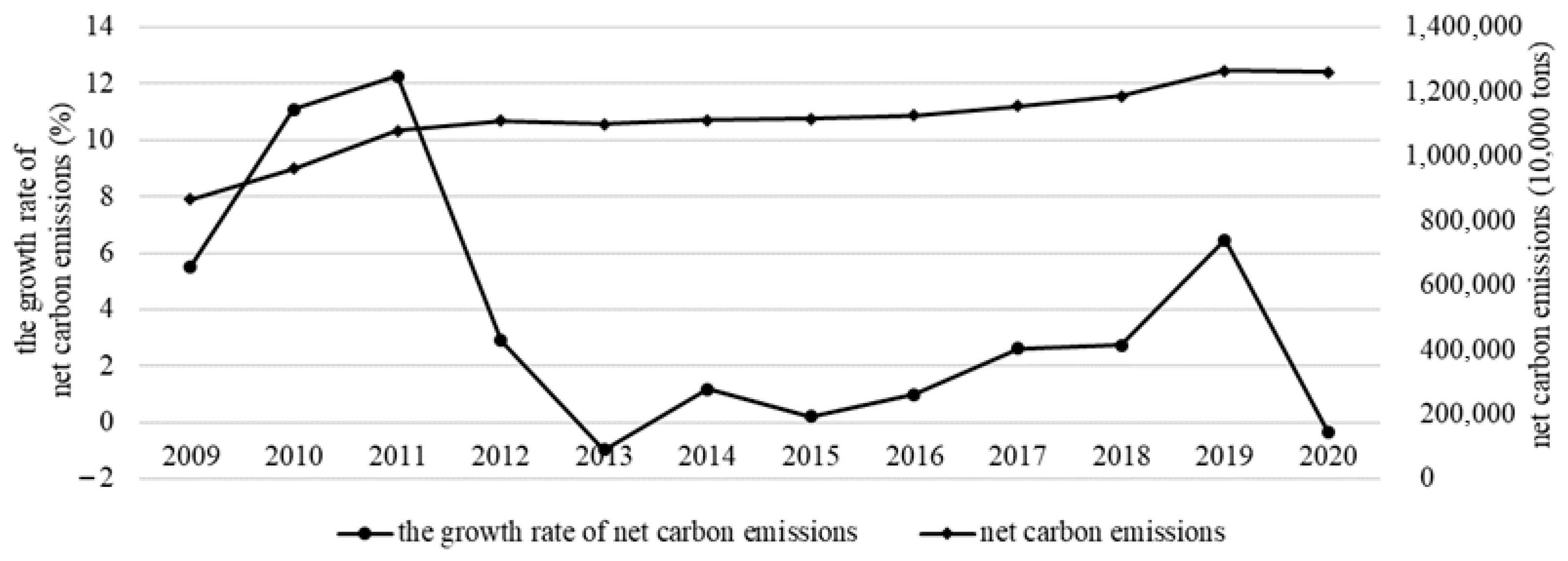
Figure 1 shows China’s net carbon emissions from 2009 to 2020, revealing a shift from rapid growth to slow growth and eventual decline. Emissions surged between 2009 and 2011, peaking at a 12.3% growth rate, then slowed sharply as energy conservation, carbon trading, and low-carbon city initiatives took effect. Negative growth first appeared in 2013, with 2013–2019 averaging 1.88% annual growth. In 2020, pandemic-driven transport cuts and consumption shifts caused another negative growth.
From 2009 to 2011, net carbon emissions and GDP both grew by about 9.6% annually, indicating a strong link between emissions and economic growth. Rising carbon loads fueled value creation, consumption, investment, and exports, making “carbon equals growth” a prevailing notion. Policy reform began shifting toward green and new energy industries, replacing some traditional activities with clean energy to sustain growth while reducing emissions. However, structural rigidity, continued investment in conventional manufacturing, high entry barriers, and low marginal returns in new energy limited transformation. The absence of a mature new energy market and insufficient policy support further constrained progress, underscoring the critical role of effective policy configurations in steering energy activities toward net-zero goals.
From 2011 to 2013, net carbon emissions growth slowed as the 18th CPC National Congress introduced new governance approaches to the economy–environment nexus. This phase’s key contribution to carbon neutrality was elevating environmental protection to strategic status, ensuring mechanisms for balanced economic–environmental development. For the first time, environmental value was formally integrated into national governance, with the State Council asserting that “protecting the environment is protecting productivity”. At the highest level, the dialectical relationship among environmental construction, ecological resources, and economic growth was systematically defined, shifting away from purely economic priorities. Increased green energy activities curbed emissions growth without hindering economic performance, marking a period of dynamic economic–environmental adjustment.
After 2014, China adopted the carbon neutrality goal, forming a net-zero framework that balances economic quality with necessary emissions. Achieving this requires accelerating carbon absorption and sinks, treating emissions and sinks as economic–environmental offsets. Carbon neutrality is realized through dynamic balance at the societal level. A carbon trading-centered policy system emerged, with coordinated measures shaping China’s net-zero configuration. By curbing inefficient economic segments, the nation steadily reduces net emissions toward its CO2 peak.

5.2. The Impact of Policy Synergy of Carbon Trading on Carbon Neutrality

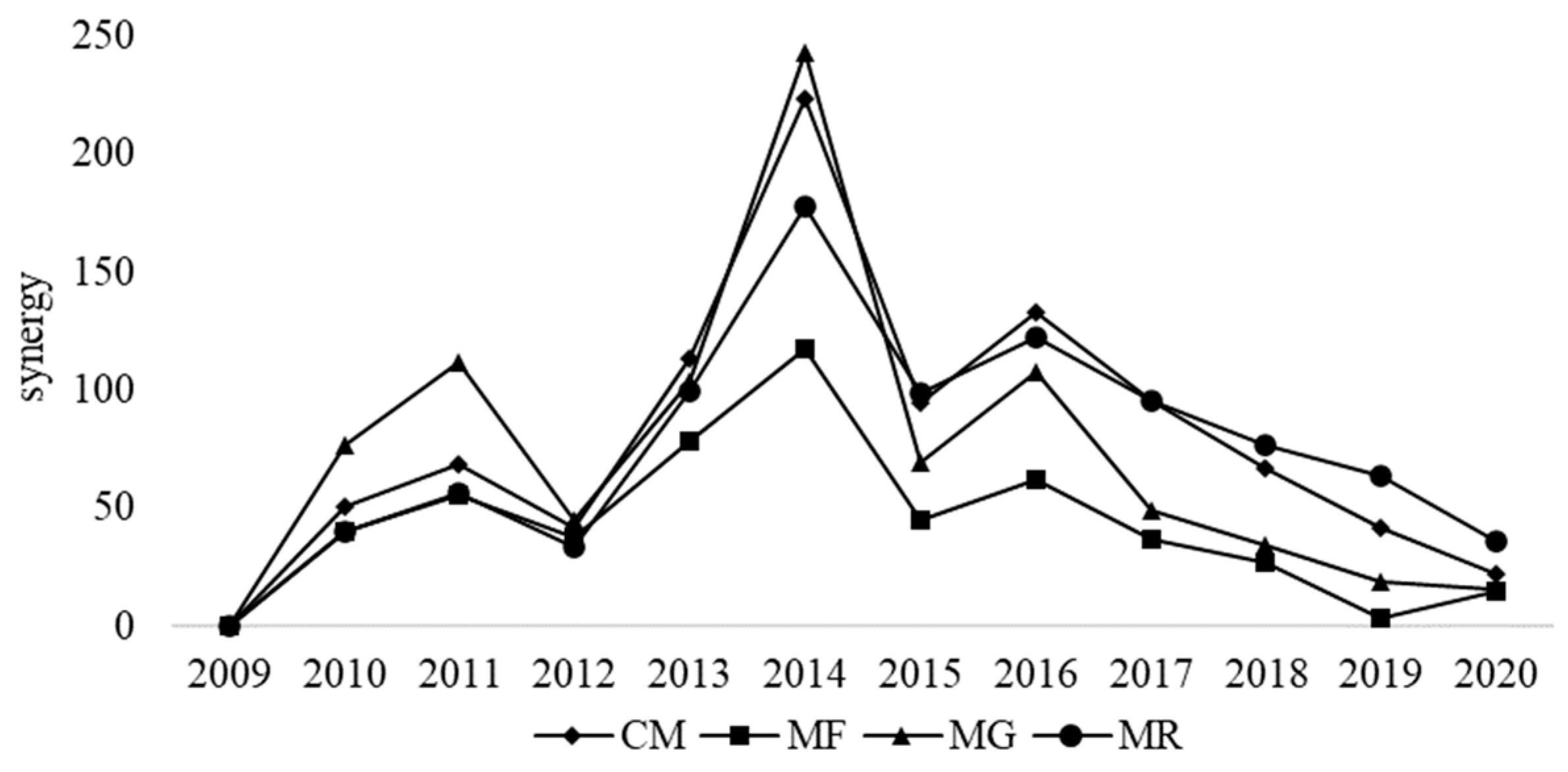
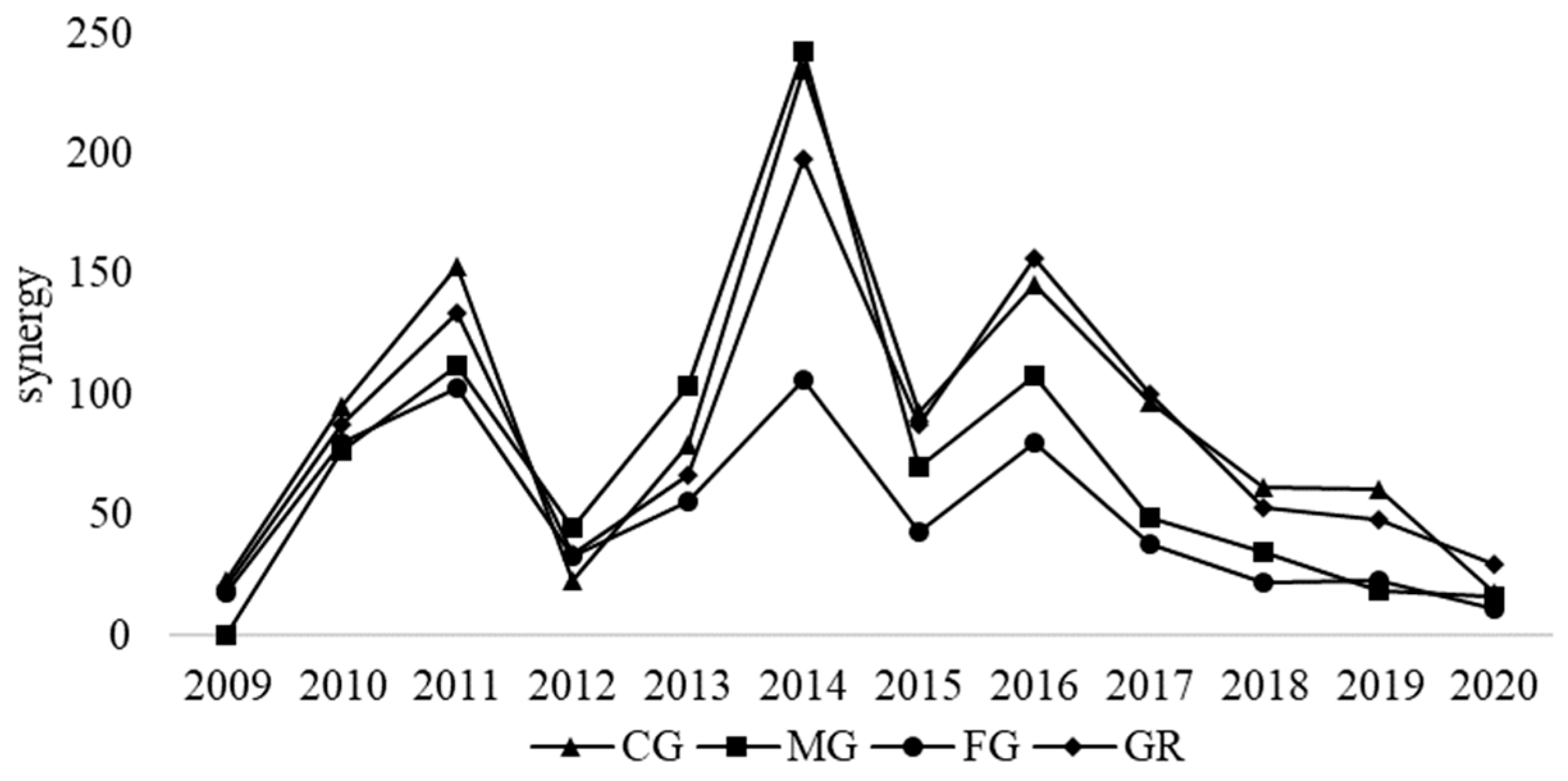
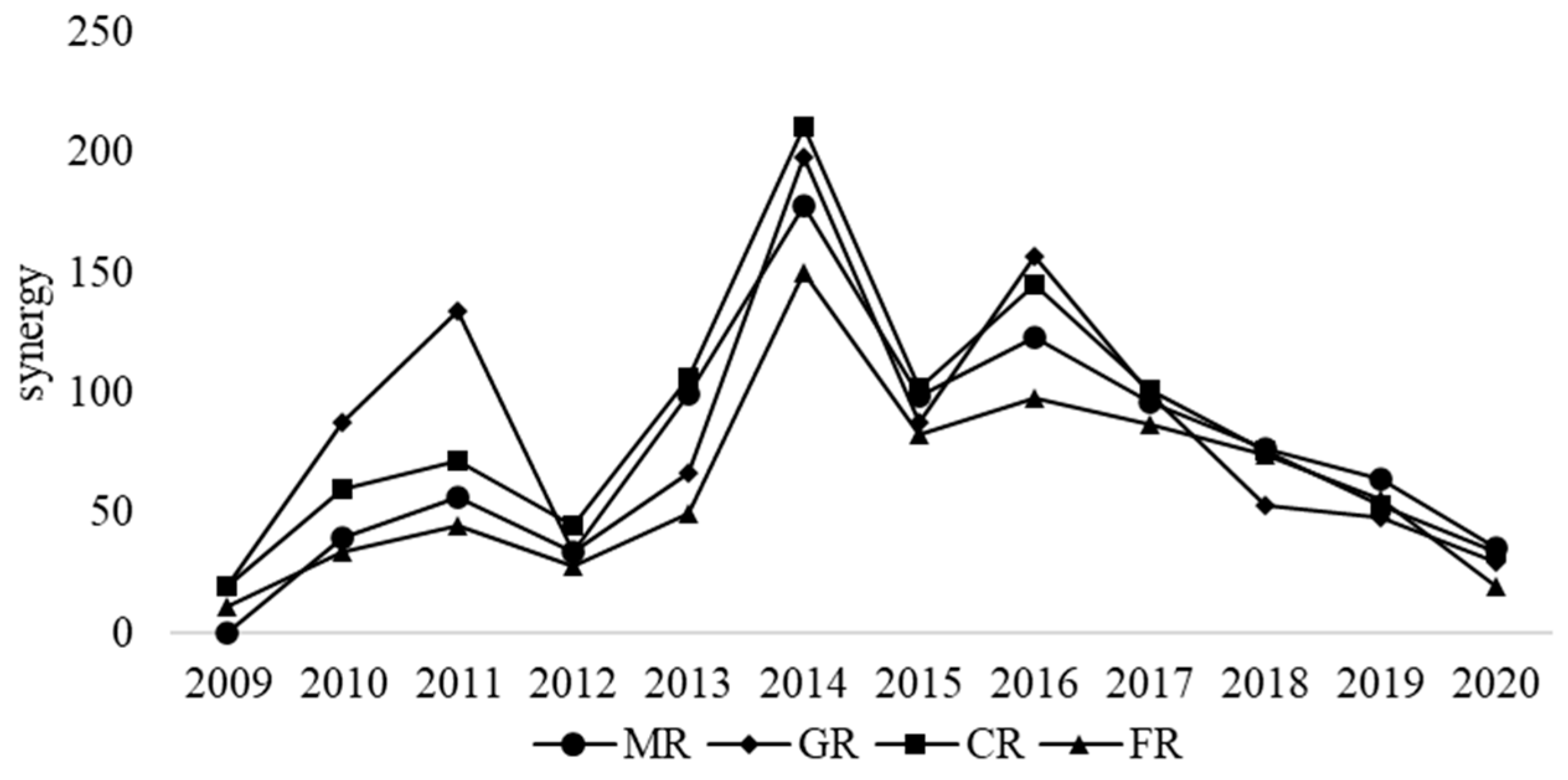
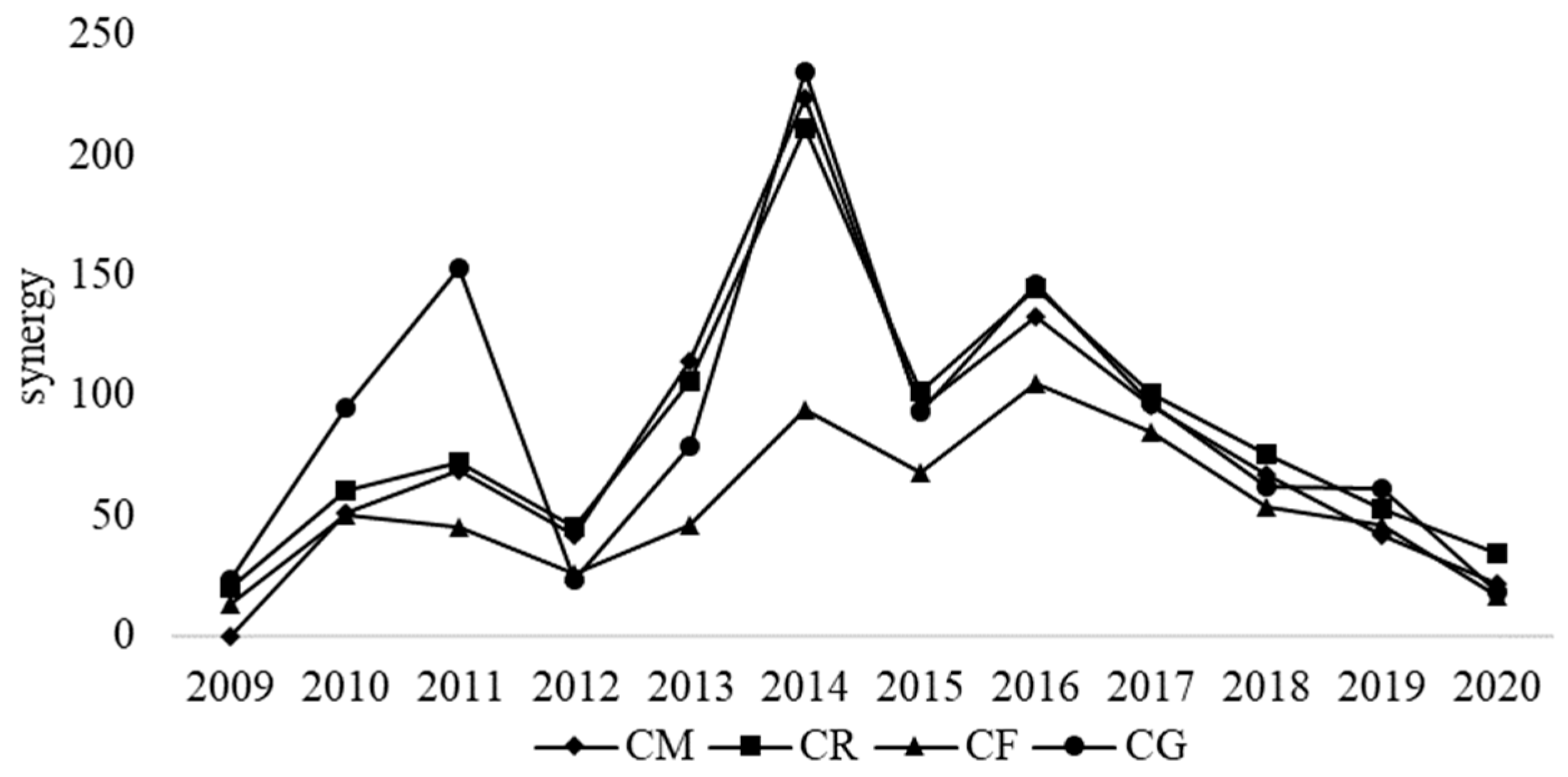
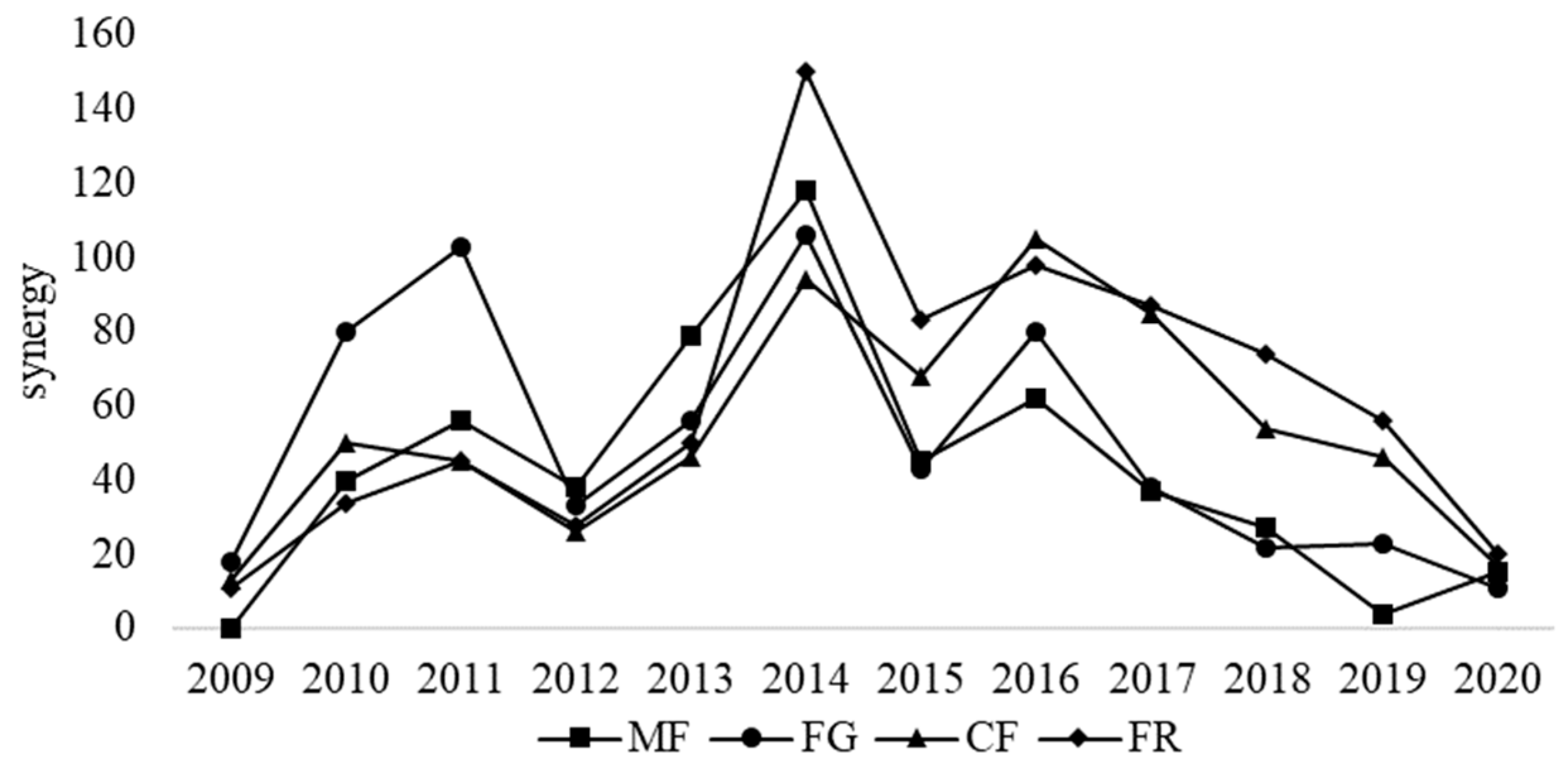
The evolution of the synergy of measures for carbon trading is as follows. Figure 2, Figure 3, Figure 4, Figure 5 and Figure 6 show the evolution of synergy among market economy, guidance, supervision, command-and-control, and fiscal measures from 2009 to 2020. The synergy exhibited cyclical peaks in 2011, 2014, and 2016, largely driven by the cumulative issuance of multiple concurrent policy tools. In 2011, the Twelfth Five-Year Plan identified establishing a carbon market as a key strategy for energy conservation and emission reduction. The NDRC’s Notice on Carbon Emission Trading Pilot launched pilots integrating market economy with other measures to control emissions, producing the first synergy peak. Between June 2013 and June 2014, seven carbon trading pilots began operation, supported by numerous new policies that stabilized market function. This surge in policy issuance and multi-measure coordination created the second peak in 2014. In 2016, Fujian became the eighth pilot market, and the NDRC issued the Notice on the Key Work for the Launch of the National Carbon Emissions Trading Market, directing nationwide preparations. The Control Greenhouse Gas Emissions Plan under the Thirteenth Five-Year Plan aimed to establish by 2020 a robust, active, transparent, and well-regulated national market. These efforts drove the third synergy peak in 2016, reflecting intensified coordination to achieve national carbon trading goals.
From 2009 to 2014, policy measure synergy rose as the carbon trading system focused on encouraging participation and ensuring stable pilot operations, with multiple measures advancing in parallel. After 2014, as pilots stabilized, policies shifted toward refined technical tasks—data reporting, registration, quota clearing—reducing synergy due to their specialized nature. This decline does not indicate lower policy effectiveness, as synergy intensity is not equivalent to efficiency. The current priority is to assess the effectiveness of policy synergy, eliminating inefficient combinations and strengthening coordination among effective measures to enhance overall carbon trading performance.
Figure 2 shows that market economy-centered policy configurations in China’s carbon trading system form an inverted V-shape, fluctuating in two cycles. From 2009 to 2014, synergy between market economy measures and others remained stable, peaking in coordination with guidance measures, followed by command-and-control and regulation. Synergy with fiscal support was consistently low and largely ineffective. From 2014 to 2020, command-and-control and regulation measures alternated as the strongest partners, before stabilizing with regulation.
Achieving carbon neutrality requires adjusting energy, industrial, and technological structures to build a net-zero industrial chain. Given the economic and behavioral attributes of market actors, policies must incorporate market-based governance. Within this, market economy measures are central to the carbon trading transaction mechanism. In the short term, carbon taxes can address technical gaps in the emerging energy market, incentivizing industries to pursue carbon-neutral transformation. In the long term, carbon trading provides a sustainable path for GHG reduction. Coordinating carbon tax and carbon market policies across industries and phases ensures seamless policy transitions.
Initially, demonstration-type policy configurations stimulate market activity by establishing model frameworks and cultivating leaders to drive top-down transformation through interest incentives. In later stages, coordination between market economy and regulation measures becomes critical to define market boundaries, clarify rights and responsibilities, and prevent disorder.
Figure 3 shows an inverted W-shaped trend in the synergy between guidance measures and others. From 2009 to 2012, high-intensity synergy supported early carbon trading and governance. A second peak from 2012 to 2015 aimed to accelerate system expansion and curb emissions. After 2016, synergy declined, indicating guidance measures’ gradual withdrawal and reduced effectiveness. Command-and-control policies complement guidance by providing the coercive power and regulation it lacks, while regulation measures define demonstration boundaries to prevent market disruption from poorly performing or opportunistic enterprises. Together, these measures enhance guidance effectiveness and optimize its role within policy configurations.
Figure 4 shows that regulation measures synergize most with guidance measures and least with fiscal measures. Historically, regulatory rules and safeguards precede market formation, ensuring order and reducing risks of misconduct, systemic instability, and manipulation—as illustrated by the EU’s VAT fraud case. Regulation aligns well with demonstration activities, fostering positive market behavior and improving the environment. In contrast, regulation and fiscal measures often conflict: Regulation constrains behavior, while fiscal policies incentivize it, leading to weaker synergy in carbon market governance.
Figure 5 shows that command-and-control measures are most closely aligned with market economy measures, with minimal synergy differences across other measures as the system matures. Serving as a mandatory guarantee, their authority, effectiveness, and normativity enable and reinforce the implementation of all other carbon trading policies.
Figure 6 shows fiscal measures strongly synergize with all but market economy measures, reflecting their consistent role in driving carbon reduction and neutrality. In 2022, the first compliance cycle involved 2162 power generators, trading 179 million tons of quotas worth 7.66 billion yuan. Pilot programs for paid quota use are advancing, with coverage expanding to steel, non-ferrous metals, construction materials, chemicals, and paper. Fiscal tools such as VAT credits and tax exemptions are expected to further activate industry-wide carbon trading.
The synergy of measures for carbon trading and the effect of carbon neutrality are as follows. Table 9, Table 10, Table 11, Table 12 and Table 13 show the estimated effectiveness of the market economy measures, guidance measures, regulation measures, command-and-control measures, and fiscal measures in synergy with other policy measures in China’s carbon trading system.
Table 9 and Table 10 show that synergy between market economy measures and guidance, fiscal, and regulation measures effectively reduces net carbon emission growth, confirming the validity of China’s carbon trading policy system. Guidance and pilot demonstrations have lowered both total and intensity-based emissions in pilot areas, advancing low-carbon development and providing benchmarks for the national market. Fiscal support, as outlined in the Ministry of Finance’s Opinions on Fiscal Support for Carbon Peak and Carbon Neutrality, strengthens market coordination through subsidies, incentives, investment funds, and tax benefits. Legislative and regulatory synergy is also vital. While the Measures for the Administration of Carbon Emission Trading (Trial) currently govern the market, the Interim Regulations on the Administration of Carbon Emission Trading—included in the State Council’s 2022 legislative plan—remain pending, making formal legislation a priority.
Table 10 and Table 11 show that guidance–regulation synergy effectively curbs net carbon emission growth. Carbon market operation requires accurate measurement, maintained trading order, and strict government surveillance with economic penalties. Such measures raise public awareness, shape opinion, and foster corporate social responsibility. Penalties exceeding treatment costs incentivize enterprises to adopt emission reduction actions.
Table 9, Table 10, Table 12 and Table 13 show that command-and-control measures in synergy with market economy, guidance, and fiscal measures negatively affect carbon neutrality. In recent years, the Chinese government has relied heavily on administrative orders—such as energy-saving directives, fees, and licensing—to address urgent conservation and emission reduction needs. The Tenth CPC National Congress set targets to cut energy intensity by 20% and major pollutant emissions by 10% by the end of the Tenth Five-Year Plan; the Eleventh Plan elevated these as binding indicators. While such measures achieved short-term results, they made conservation a government-driven responsibility, limiting enterprises’ initiative.
In contrast, synergy between command-and-control and regulation measures has had a positive effect, showing that pre-control, interim regulation, and post-verification can reduce emissions. This supports the need for reforms toward decentralization, deconcentration, and service optimization. After setting clear targets, the government should reduce direct resource allocation, strengthen process regulation, and shift from “strict entry, lax control” to “lax entry, strict control”, thereby optimizing government–market synergy to advance carbon neutrality.
Table 11 and Table 12 show that fiscal–guidance and fiscal–regulation synergies negatively affect carbon neutrality. Early carbon trading relied on subsidies to boost participation, especially in voluntary markets, cutting emissions short-term but fostering long-term dependency and weakening enterprise resilience. Fiscal focus should shift to attracting broader social investment, enhancing precision, and fostering competition. Initially, lenient quota allocation, free permits, and low carbon prices limited fiscal–regulation effectiveness. Over time, however, well-targeted fiscal policies combined with strong regulatory safeguards can improve market vitality and support carbon neutrality.
Table 13 presents the findings on command-and-control measures, with their synergistic relationships detailed in the preceding section. This indicates that the implementation and effectiveness release of command-based policies cannot be separated from the scientific guidance of guiding policies and the rigid guarantee of regulatory policies. The coordinated efforts and deep coordination of the three types of policies are the key support for promoting the coupled implementation of carbon neutrality policy system. Command-based policies, as the core constraint of carbon neutrality governance, clarify the emission reduction responsibilities and action boundaries of various fields and entities by setting industry carbon reduction standards, market access regulations, energy consumption control bottom lines and other mandatory requirements. However, their single implementation is prone to problems such as insufficient adaptability and lack of execution power; guiding policies provide path references and direction guidance for the implementation of command-based policies through industrial planning, technical guidance, pilot demonstrations, etc. By clarifying key areas of low-carbon development, promoting advanced emission reduction technologies and models, solving practical difficulties in the implementation of command-based policies, and enhancing the scientificity and adaptability of policy implementation, regulatory policies establish a full process monitoring system, improve law enforcement supervision mechanisms, strengthen assessment and accountability, accurately control the implementation process of command-based policies, severely crack down on carbon emission data fraud, violations and excessive emissions, and force market entities to strictly implement policy requirements. At the same time, they evaluate and provide feedback on the demonstration and promotion effects of guidance policies, and optimize and adjust the guidance direction in a timely manner. The three are mutually supportive and synergistically coupled, with command-based policies setting bottom lines and boundaries, guiding policies clarifying paths and strong empowerment, and regulatory policies implementing and ensuring effectiveness. This not only avoids market resistance caused by the rigid implementation of command-based policies, but also compensates for the lack of binding force in the flexible guidance of guiding policies. Through dynamic feedback of regulatory policies, the continuous optimization of the three types of policies is achieved, ultimately ensuring the full effectiveness of the carbon neutrality policy system and promoting the steady implementation of carbon reduction targets.

6. Conclusions

This paper assesses net-zero policy benefit configurations to examine how carbon trading support measures affect carbon neutrality. We construct evaluation criteria, score policies, and build a synergy model for five policy types—command-and-control, fiscal, market economy, guidance, and regulation—showing cyclical fluctuations peaking in 2011, 2014, and 2016. A time-series regression using net carbon emission growth as the outcome finds that market economy synergies positively drive carbon neutrality, confirming the effectiveness of China’s carbon trading policies. Table 14 summarizes the impacts of policy synergies.
In conclusion, China’s net-zero policy design should strengthen synergies among fiscal, guidance, and regulation measures to curb net carbon emission growth. Fiscal support initiates market activity, guidance builds demonstration effects, and regulation safeguards market order. Command-and-control measures work best with regulation, mitigating harmful behaviors during market establishment; synergy with more flexible measures risks enterprise resistance. Fiscal measures should align with market economy and regulation policies to avoid resource dispersion and policy imbalance. Guidance, as a flexible measure, generally supports net-zero goals, except when paired with command-and-control.
Policy synergy enhances the systemic nature of climate action and is vital for carbon neutrality. Economically, carbon taxes complement carbon trading by offsetting its limited coverage and high costs. Environmentally, integrating air pollutant and carbon markets enables joint emission reductions. Cross-regional and cross-sectoral carbon trading systems, supported by comprehensive information sharing and region-specific policies, can improve precision and implementability.
The rise in systematic emission reduction policies, such as carbon trading, reflects strengthened policy benefit configurations for achieving carbon neutrality, contributing to climate improvement and enhanced environmental management.
China uses carbon trading to phase out resource-intensive, uninnovative enterprises and build ecologically oriented policy clusters. Once synergized, these clusters enable cross-regional, cross-enterprise, and cross-level exchanges, forming integrated emission, information, and value chains. Economically, the model coordinates regional, urban–rural, economic–social, human–nature, and domestic–international development.
As a facet of China’s ecological civilization, the carbon trading system integrates multiple disciplines, balancing environmental and economic goals while expanding environmental and climate economics. It introduces new social and organizational models and calls for Chinese solutions to environmental cost–benefit, risk, responsibility, and global governance through theoretical, cultural, scientific, and institutional innovation.
Climate change poses major direct and indirect risks to global sustainability and China’s development, representing a “gray rhino” threat to national security. The carbon trading system supports green development and climate governance, while China strategically elevates climate security, integrating it into the national security framework through synergistic policy configurations.
It is important to develop a green climate culture by replacing resource-intensive growth with brand- and culture-driven industries, and to leverage regional traditions and unique crafts to create differentiated, inimitable products, fostering green motivation under a people-centered ideology.

7. Discussion

(1)
Scientific Basis of the Research
This research focuses on the collaborative coupling of the carbon neutrality policy system, and its scientific basis is rooted in the interdisciplinary support of theories from systems science, policy science, and ecological economics. It also aligns with the objective laws of carbon neutrality governance and the complex system operation characteristics, providing a solid theoretical foundation and scientific logic.
From the perspective of core theoretical support, the holistic and collaborative theories of systems science provide the underlying logic for the research. Carbon neutrality, as a systematic project involving energy, industry, ecology, consumption, and regional development, has a policy system that is a complex organic whole composed of multiple domains, multiple levels, and multiple type policy subsystems. The interaction and coordination adaptation among subsystems determine the overall efficacy of the policy system. This is highly consistent with the core principle of systems science that “the overall function is greater than the sum of its parts,” providing fundamental theoretical guidance for the construction of the analysis framework for the collaborative coupling of the policy system. The integration and application of coupling theory and policy science provide scientific methods for the quantitative analysis and mechanism research of policy collaboration. The coupling mechanism in physics, after cross-disciplinary adaptation, can effectively explain the information, resources, and efficiency exchange laws among carbon neutrality policy subsystems. Combined with policy tool theory and policy implementation effect evaluation theory, it can accurately identify the coupling nodes and weak links of policy collaboration, allowing the research on policy collaboration to shift from qualitative analysis to quantitative and qualitative combination scientific demonstration. The theory of ecological economics, such as “harmonious coexistence of humans and nature” and “green and low-carbon development,” clarifies the core goals and value orientation of the carbon neutrality policy system, providing a disciplinary basis for the setting of policy collaboration coupling goals and indicators, ensuring that the research always focuses on the objective laws of the coordinated development of the environment and society.
(2)
Social Legitimacy of the Research
This research focuses on the collaborative coupling of the carbon neutrality policy system, and its social legitimacy stems from the alignment of the research topic with national strategic needs, social development demands, and common human interests. The research results can provide scientific support for carbon neutrality governance practices and have practical necessity, value legitimacy, and social publicness. It is in line with the overall interests of economic and social development and environmental protection.
Firstly, the research is in line with the implementation needs of major national strategies and has a solid practical legitimacy. Carbon neutrality has become the core goal of China’s ecological civilization construction and is also an important means to promote high-quality economic development and accelerate the green transformation of industries. It is a core content included in the national medium- and long-term development plan. Currently, China’s carbon neutrality policy system is in the stage of improvement, and the insufficient policy collaborative coupling has become a key bottleneck restricting the implementation of the strategy. This research conducts systematic research on this practical issue: By constructing a scientific policy collaborative coupling framework and proposing practical implementation paths, it can provide decision-making references for optimizing the carbon neutrality policy system at the national level and improving the effectiveness of policy implementation, helping to steadily advance the carbon neutrality national strategy. Its research value is highly consistent with the national development strategy and has sufficient practical legitimacy.
Secondly, the research responds to the social demands for green transformation of the economy and the improvement of people’s well-being, possessing distinct value legitimacy. Carbon neutrality is not merely an environmental governance goal, but a systematic project deeply integrated with economic structure adjustment, industrial transformation and upgrading, energy security, and improvement of people’s well-being. The collaborative coupling of the policy system can promote the transformation of the energy structure to be cleaner and the upgrading of the industrial structure to be greener. It can not only cultivate new green industries such as new energy and energy conservation and environmental protection, creating new economic growth points and job opportunities, but also effectively improve environmental quality and reduce climate disaster risks, meeting the people’s beautiful ecological environment and high-quality life demands. This research optimizes the policy synergy coupling mechanism to promote the realization of the “ecological benefits, economic benefits, and social benefits” in the carbon neutrality policy system. Its research results can effectively serve the sustainable development of the economy and society and the improvement of people’s livelihoods. It is in line with the core value orientation of social development.
Thirdly, the research aligns with the common interests of global climate governance and has broad public legitimacy. Climate change is a common challenge faced by humanity, and carbon neutrality has become a global consensus and the direction of joint actions of various countries. As a responsible major country, China actively promoting carbon neutrality governance is not only a necessary choice to fulfill global climate governance responsibilities but also an important measure to promote the construction of the human community with a shared future. The research on the synergy coupling of the carbon neutrality policy system can not only provide scientific support for China’s carbon neutrality governance but also offer Chinese experience and solutions for developing countries around the world to explore the construction path of carbon neutrality policies suitable for their own national conditions. This will help improve and develop the global climate governance system. The research topics and results of this study transcend the interests of a single country and are in line with the common ecological and development interests of humanity, possessing broad international publicness and social legitimacy.
(3)
Policy suggestion
At present, our country is in a crucial stage of building the national carbon trading market. In order to further enhance the positive role of the carbon trading policy in achieving the goal of carbon neutrality, based on the research content and conclusions of this paper, the following policy suggestions are proposed:
  • Improve the legal framework of the carbon trading market
At present, the carbon trading market in our country is operating in a healthy and orderly manner. However, there are still some issues in aspects such as market influence, policy coordination, regulation construction, and tax-related transactions, which need to be further improved. Particularly in the aspect of regulation construction, although the state has introduced a series of policies to implement the carbon trading policy, it is still necessary to strengthen management at the legal level. For example, it is important to clarify the legal attributes of carbon emission rights, whether carbon emission rights can be endowed with property right attributes, and whether the holders have the rights to possess, transfer, use and dispose of such property. The clear stipulation of these issues can avoid disputes over carbon emission rights during the transaction process. In addition, the construction of supervision and punishment systems is also an important direction of legislation. Firstly, it is necessary to strengthen guidance and supervision of the participating entities in the carbon emission trading market, so that they can carry out business strictly in accordance with relevant regulations; secondly, various departments should jointly supervise, and relevant departments should supervise each link of market operation in accordance with laws and regulations; thirdly, it is important to expand the scope of supervision to achieve full coverage of key areas and industries of carbon emission trading, so as to ensure the stable and healthy development of the carbon market.
2.
Enhance the synergy of carbon trading policies
“Policy coordination” is an important means to enhance the systematic and comprehensive nature of climate action, and it is a powerful tool for achieving the goal of carbon neutrality. In terms of economic policies, carbon tax, as an important component of the carbon pricing mechanism, has good complementarity with the carbon trading mechanism. The carbon tax rate is relatively stable and flexible, which can make up for the shortcomings of the narrow coverage and high operating costs of China’s carbon market. Therefore, carbon tax can be introduced at an appropriate time and collaborate with the carbon trading policy to jointly control the carbon emissions of the entire society. In terms of environmental policies, air pollution and greenhouse gas emissions have the characteristics of the same origin, same source, and simultaneous occurrence. Promoting the coordinated reduction in air pollutants and carbon emissions is an important means to curb climate change. Therefore, it is advisable to build an interconnected emissions trading system to achieve the unification of the pollutant emissions trading system and the carbon emissions trading system. In addition, from the perspective of policy formulation and implementation, establishing a cross-regional and cross-departmental carbon trading system is particularly important. Carbon trading information needs to be fully circulated and shared among various regions and departments, and policies should be formulated in combination with regional differences to make the policy content more comprehensive, more directive, more precise, and more operational.
3.
Strengthen top-level design coordination and establish a unified national carbon neutrality policy framework.
With the national carbon neutrality medium- and long-term plan as the core, coordinated policy goals across various fields and levels incorporate carbon peak and carbon neutrality indicators into the national economic and social development planning system, clearly define the emission reduction tasks and policy connection nodes in key fields such as energy, industry, buildings, and transportation, and eliminate deviations in policy goals across different fields and inconsistent regional policy implementation standards. It is important to establish a cross-departmental policy coordination review mechanism, where departments such as the National Development and Reform Commission, Industry and Information Technology Commission, Ecology and Environment Commission, Finance Commission, and Energy Commission jointly formulate policy implementation details, clearly define the coupling points and connection points of policies in various fields, avoid disconnection between single-department policies and the overall layout of carbon neutrality, and enhance the comprehensiveness and coordination of the policy system.
4.
Promote deep coupling of sectoral policies to achieve coordinated efforts in all links of emission reduction.
In the energy sector, it is important to strengthen the coupling of clean substitution policies and capacity control policies, promote the large-scale development of wind power, photovoltaic power, etc., while improving the exit mechanism for traditional high-energy-consuming energy, and introduce supporting policies such as power grid upgrading and energy storage construction; in the industrial sector, it is important to deepen the coupling of industrial structure adjustment policies and green manufacturing policies, incorporate carbon emission reduction indicators into the core standards of industry entry and capacity replacement, and link fiscal policies to provide special subsidies and tax reductions for green technological transformation and circular economy projects; in the consumption sector, it is important to promote the integration of green consumption policies and public service policies, guide residents to choose green travel and living through subsidies and tax incentives, and improve public transportation, garbage classification and other public service systems to provide basic guarantees for green consumption. All sectoral policies need to strengthen coupling with technological innovation policies, incorporate core technologies for carbon emission reduction research and development into national major science and technology projects, and introduce policies such as research and development subsidies and patent protection to avoid disconnection between single-department policies and the overall layout of carbon neutrality, and enhance the comprehensiveness and coordination of the policy system.
5.
Improve the coordination of fiscal and market policies to establish a carbon neutrality incentive and restraint mechanism.
It is important to coordinate the design of fiscal policies and carbon market policies, link tax incentives and fiscal subsidies with the carbon emission volume and carbon market trading behavior of enterprises, provide VAT and corporate income tax reductions for enterprises with significant carbon emission reduction achievements, raise tax standards for over-emitting enterprises and strengthen carbon market penalties. It is important to improve the coupling of green finance policies and fiscal policies, encourage financial institutions to launch carbon neutrality special credit and bond products, and the fiscal department to provide interest subsidies and risk compensation for green financial products, guiding social capital to tilt towards low-carbon projects. It is important to promote regional fiscal policy coordination, establish a cross-regional carbon emission reduction benefit-sharing mechanism, and provide joint fiscal support for cross-regional renewable energy bases and carbon capture, utilization and storage projects, to solve the problem of imbalance in emission reduction responsibilities and benefits distribution among regions.
6.
Strengthen regulatory and assessment policy coordination to ensure the implementation and execution of policies.
It is important to build a unified national carbon neutrality regulatory monitoring system, integrate monitoring data from departments such as the Ecology and Environment, Statistics, and Energy, achieve real-time monitoring and precise accounting of enterprise carbon emissions and regional emission reduction effectiveness, and provide data support for the assessment of policy implementation effects. It is important to improve the carbon neutrality assessment and evaluation policies, incorporate carbon emission reduction indicators into the core content of local government performance assessment and the operating performance assessment of state-owned enterprises, establish an “assessment—feedback—adjustment” closed-loop mechanism, require regions and enterprises that fail to meet the assessment standards to make rectifications within a time limit, and strengthen the rigid constraints on policy implementation. It is important to promote the coupling of regulatory policies and enforcement policies, clarify the enforcement standards and penalty details in the carbon emission reduction field, strengthen cross-departmental and cross-regional joint enforcement, and severely crack down on carbon emission data fraud and illegal over-emission, to create a favorable environment for the implementation of the carbon neutrality policy system.
7.
Promote coordination and linkage of central and local policies, balancing policy uniformity and regional adaptability.
At the national level, clear core standards, overall requirements and implementation bottom lines for carbon neutrality policies are defined, granting local governments certain autonomy in policy formulation and implementation. Localities are encouraged to formulate differentiated emission reduction implementation plans based on their resource endowments and industrial structures, such as focusing on promoting clean energy development in resource-rich areas and strengthening industrial green technological upgrades in industrial centers. A mechanism for sharing policy information and communication and coordination between the central and local governments is established. Local governments promptly report problems and difficulties encountered in policy implementation, and the national level dynamically adjusts national policies based on local realities. At the same time, special fiscal transfer payments and policy support are provided to regions with fragile ecosystems and heavy emission reduction tasks to achieve the organic combination of national policies “as a whole” and regional policy implementation “with precision”.
8.
Promote the synergy between domestic policies and international rules, and integrate into the global carbon neutrality governance system.
Based on China’s actual development of carbon neutrality, it is important to actively align with international carbon tariffs, green trade standards and other rules, improve China’s carbon footprint accounting and green product certification systems, and promote mutual recognition of domestic and international standards. It is important to strengthen the coupling of domestic green trade policies and carbon neutrality policies, provide tax rebates and subsidies for exporting low-carbon products, impose carbon tariffs on importing high-carbon products, and guide foreign trade enterprises to transform towards a low-carbon model. It is important to strengthen international carbon neutrality policy exchanges and cooperation, participate in the formulation of global carbon governance rules, and promote cooperation in low-carbon technologies, funds and projects between China and foreign countries. Through policy synergy, it is important to attract international resources to participate in China’s carbon neutrality construction, and achieve the carbon neutrality goal under the mutual promotion of domestic and international dual circulation.

Author Contributions

Conceptualization, H.L.; methodology, Y.C.; writing—original draft preparation, H.L. and X.W. All authors have read and agreed to the published version of the manuscript.

Funding

This research was funded by National Social Science Fund of China (23BJY085).

Institutional Review Board Statement

Not applicable.

Informed Consent Statement

Not applicable.

Data Availability Statement

The data presented in this study are available on request from the corresponding author.

Conflicts of Interest

The authors declare no conflicts of interest.

Appendix A

Table A1. The criteria of policy intensity and measures of carbon trading.
IndicatorRateCriteria
Policy intensity5Laws issued by the National People’s Congress and its Standing Committee.
4Regulations, instructions, and rules issued by State Council; Orders issued by the ministries and commissions.
3Provisional regulations, plans, decisions, opinions, methods, and standards issued by State Council.
Regulations, rules, and decisions issued by the ministries and commissions.
2Provisional regulations, plans, opinions, methods, provisional rules standards, and criteria by the ministries and commissions.
1Notices, announcements, layouts.
MeasuresCommand-and-control
(C)
5Set mandatory carbon emission standards.
List detailed rules and regulatory subjects.
Clarify the subjects of carbon trading.
Develop catalogs of products with backward production capacity eliminated.
Implement the environmental impact assessment for administrative approval projects.
Formulated mandatory regulations specifically to promote carbon trading.
3Require the establishment of carbon emission standards.
Require the elimination of backward production capacity.
Strict implementation of environmental impact assessment.
Require the formulation of relevant policies or systems to promote energy conservation and emission reduction.
None of the above actions have developed relevant plans.
1Only mention or refer to the above actions.
Market economy
(M)
5Establish a sound market system for carbon trading and formulate relevant support measures or mechanisms.
Develop relevant credit supervision regulations and impose credit penalties on energy-intensive and polluting projects.
Encourage private capital to invest in low-carbon industries.
3Stress the importance of improving financial policies to support carbon trading.
Impose credit penalties on enterprises that violate relevant regulations.
Require strengthening credit supervision.
None of the above actions have developed relevant plans.
1Only mention or refer to the above actions.
Fiscal support (F)5Set up special funds to support carbon trading. Propose the amount and management measures for financial subsidies, grants, inputs, and incentives. Support low-carbon technology innovation by special funds and promote low-carbon projects.
Regulate the layout of low-carbon industries by taxation.
3Propose to support low-carbon projects by fiscal taxes without the amount of support, management measures, or catalogs.
None of the implementation management measures have been proposed.
1Only mention or refer to the above actions.
Guidance (G)5Guide individuals or enterprises to participate in carbon trading and carbon reduction actions and develop specific implementation measures.
Develop recommended catalogs of products, consumption, and technologies.
Formulate measures for implementing demonstration or pilot projects.
Develop detailed guidance systems.
Formulate other related guidance measures.
3Propose to implement low-carbon propaganda and guide the carbon trading construction.
Propose to develop recommended catalogs and implement demonstration projects.
Propose to formulate other related guidance measures.
None of the relevant implementation measures or the catalogs have been developed.
1Only mention or refer to the above actions.
Regulation (R)5Develop carbon emission-related assessment and inspection measures.
Develop systems for reporting carbon emission information of enterprises.
Develop certification systems for carbon emission information of emission-controlled businesses.
Develop supervision and management mechanisms for carbon trading activities.
3Require the implementation of carbon emission-related assessment and inspection.
Require the establishment of systems for reporting carbon emission information of enterprises.
Require the establishment of certification systems for carbon emission information of emission-controlled businesses.
Strengthen the supervision and management of carbon trading activities.
None of the relevant plans have been developed.
1Only mention or refer to the above actions.

References

  1. Fernández-Amador, O.; Francois, J.; Oberdabernig, D. Carbon dioxide emissions and economic growth: An assessment based on production and consumption emission inventories. Ecol. Econ. 2017, 135, 269–279. [Google Scholar] [CrossRef]
  2. Kim, Y. International policy coordination mechanism with respect to the moral hazards of financial intermediaries. Econ. Model. 2011, 28, 1914–1922. [Google Scholar] [CrossRef]
  3. Lungkadee, T.; Tippayawong, K.Y.; Tangparitkul, S.; Jaroenkhasemmeesuk, C.; Chaichana, C.; Wongspai, W.; Tippayawong, N. Decarbonizing a Thai Coal Power Plant: Effect of Flue Gas Loads on Carbon Capture Performance and Economics. Appl. Eng. Lett. 2023, 9, 12–21. [Google Scholar] [CrossRef]
  4. Zhang, Y.; Liang, T.; Jin, Y.; Shen, B. The impact of carbon trading on economic output and carbon emissions reduction in China’s industrial sectors. Appl. Energy 2020, 260, 114290. [Google Scholar] [CrossRef]
  5. Ašonja, A.; Vještica, S.; Bošković, A.; Živković Radeta, S.; Ćeranić, M.; Jovanović, Z.; Škrbić, S. Research into the Energy Potential of Vine Pruning Residues in Western Serbia. Energies 2025, 18, 6384. [Google Scholar] [CrossRef]
  6. Carley, S. Decarbonization of the US Electricity Sector: Are state energy policy portfolios the solution? Energy Econ. 2011, 33, 1004–1023. [Google Scholar] [CrossRef]
  7. Wang, B.; Du, X.; Wang, Y.; Mao, H. Multi-machine collaboration realization conditions and precise and efficient production mode of intelligent agricultural machinery. Int. J. Agric. Biol. Eng. 2024, 17, 27–36. [Google Scholar] [CrossRef]
  8. Ding, C.; Wang, L.; Chen, X.; Yang, H.; Huang, L.; Song, X. A blockchain-based wide-area agricultural machinery resource scheduling system. Appl. Eng. Agric. 2023, 39, 1–12. [Google Scholar] [CrossRef]
  9. Burnett, J.; Bergstrom, J.; Wetzstein, M. Carbon dioxide emissions and economic growth in the U.S. J. Policy Model. 2013, 35, 1014–1028. [Google Scholar] [CrossRef]
  10. International Energy Agency. Global Energy Review: CO2 Emissions in 2021 [R]; International Energy Agency: Paris, France, 2022. [Google Scholar]
  11. Guan, Z.; Zhong, R.; Zhao, Y. Study on the mechanism and optimization path of China’s carbon trading system. Guizhou Soc. Sci. 2019, 40, 124–133. [Google Scholar]
  12. Yu, P.; Liu, J. Research on the effects of carbon trading market size on environment and economic growth. China Soft Sci. 2020, 35, 46–55. [Google Scholar]
  13. Burniaux, J.M.; Martin, J.P.; Nicoletti, G.; Martins, J.O. Green a Multi-Sector, Multi-Region General Equilibrium Model for Quantifying the Costs of Curbing CO2 Emissions: A Technical Manual; OECD Publishing: Paris, France, 1992. [Google Scholar]
  14. Capoor, K.; Ambrosi, P. State and trends of the carbon market 2009. World Bank Other Oper. Stud. 2009, 6, 24–25. [Google Scholar]
  15. Gottinger, H.W. Greenhouse gas economics and computable general equilibrium. J. Policy Model. 1998, 20, 537–580. [Google Scholar] [CrossRef][Green Version]
  16. Zhang, Y.J.; Wei, Y.M. An overview of current research on EU ETS: Evidence from its operating mechanism and economic effect. Appl. Energy 2010, 87, 1804–1814. [Google Scholar] [CrossRef]
  17. Cheng, B.; Dai, H.; Wang, P.; Xie, Y.; Chen, L.; Zhao, D.; Masui, T. Impacts of low-carbon power policy on carbon mitigation in Guangdong Province, China. Energy Policy 2016, 88, 515–527. [Google Scholar] [CrossRef]
  18. Liu, Y.; Wen, D.; Wang, Y.; Sun, Z. Assessment of impacts of Tianjin pilot emission trading schemes in China: A CGE-Analysis using TermCO model. Clim. Change Res. 2016, 12, 561. [Google Scholar]
  19. Tan, X.; Liu, Y.; Wang, Y. The economic and environmental impacts of the Hubei pilot emission trading schemes: Based on Chinese multi-regional general equilibrium model. Wuhan Univ. J. (Philos. Soc. Sci.) 2016, 2, 64–72. [Google Scholar]
  20. Li, G.; Zhang, W. Research on industrial carbon emissions and emissions reduction mechanism in China’s ETS. China Popul. Resour. Environ. 2017, 27, 141–148. [Google Scholar]
  21. Song, D.; Xia, T. Performance evaluation of China’s carbon trading pilot policies. Stat. Decis. 2019, 35, 157–160. [Google Scholar]
  22. Zhu, F.; Li, T. An empirical study on emission reduction performance of China’s carbon trading market. Tax. Econ. 2021, 43, 54–62. [Google Scholar]
  23. Lu, Z.; Luo, Y. Analysis of China’s carbon trading policy in mitigation effectiveness. J. Arid. Land Resour. Environ. 2020, 34, 1–7. [Google Scholar]
  24. Lutz, C.; Meyer, B.; Nathani, C.; Schleich, J. Endogenous technological change and emissions: The case of the German steel industry. Energy Policy 2005, 33, 1143–1154. [Google Scholar] [CrossRef]
  25. Wu, L.; Kaneko, S.; Matsuoka, S. Driving forces behind the stagnancy of China’s energy-related CO2 emissions from 1996 to 1999: The relative importance of structural change, intensity change and scale change. Energy Policy 2005, 33, 319–335. [Google Scholar] [CrossRef]
  26. Zhao, N.; Jia, L.; Zhang, J. Analysis of Effect Mechanism of Technical Progress on Energy Efficiency. Stat. Res. 2013, 30, 63–69. [Google Scholar]
  27. Huang, X.; Zhang, X.; Liu, Y. Does China’s carbon emissions trading policy fulfill the environmental dividend? Econ. Rev. 2018, 39, 86–99. [Google Scholar]
  28. Cames, M.; Weidlich, A. Emissions trading and innovation in the German electricity industry—Impact of possible design options for an emissions trading scheme on innovation strategies in the German electricity industry. In Emissions Trading and Business; Physica-Verlag HD: Heidelberg, Germany, 2006; pp. 39–51. [Google Scholar]
  29. Yang, D.; Liu, J. The impact of carbon finance on industrial structure and energy consumption structure in China: An empirical study from the perspective of CDM. Jilin Univ. J. Soc. Sci. Ed. 2012, 58, 98–105. [Google Scholar]
  30. Tan, J.; Zhang, J. Does China’s ETS force the upgrade of industrial structure: Evidence from synthetic control method. Res. Econ. Manag. 2018, 39, 104–119. [Google Scholar]
  31. Wang, H.; Wang, Z. Research on the effects and influencing mechanism of carbon emission trading policy in Chinese pilot cities. Urban Dev. Stud. 2021, 28, 133–140. [Google Scholar]
  32. Liu, Y.; Cai, S.; Wang, Y.; Chen, Y. Comparative analysis of the separate carbon market and inter-provincial carbon market: Based on Chinese multi-regional CGE model TermCo2. Financ. Trade Econ. 2013, 34, 117–127. [Google Scholar]
  33. Dong, F.; Dai, Y.; Zhang, S.; Zhang, X.; Long, R. Can a carbon emission trading scheme generate the Porter effect? Evidence from pilot areas in China. Sci. Total Environ. 2019, 653, 565–577. [Google Scholar] [CrossRef] [PubMed]
  34. Yi, L.; Lu, Y.; Li, Z. Research on the regulatory mechanisms of China’s pilot carbon markets and comparison with international experiences. China Popul. Resour. Environ. 2016, 27, 77–86. [Google Scholar]
  35. Pollitt, H. Analysis: Going Carbon Neutral by 2060 ‘Will Make China Richer’. Carbon Brief, 24 September 2020.
  36. Fan, D.; Wang, W.; Liang, P. Analysis of the performance of carbon emissions trading right in China: The evaluation based on the difference-in-difference model. China Environ. Sci. 2017, 37, 2383–2392. [Google Scholar]
  37. Hu, J.; Huang, N.; Shen, H. Can Market-Incentive Environmental Regulation Promote Corporate Innovation? A Natural Experiment Based on China’s Carbon Emissions Trading Mechanism. J. Financ. Res. 2020, 63, 171–189. [Google Scholar]
  38. Wei, Q.; Pan, Y.; Li, L. A comparative study of corporate emission reduction and social welfare under carbon quota and carbon subsidy policies. South China Financ. 2021, 43, 25–37. [Google Scholar]
  39. Yu, D.J.; Li, J. Evaluating the employment effect of China’s carbon emission trading policy: Based on the perspective of spatial spillover. J. Clean. Prod. 2021, 292, 126–152. [Google Scholar] [CrossRef]
  40. Dani, R. Green industrial policy. Oxf. Rev. Econ. Policy 2015, 30, 469–491. [Google Scholar]
  41. Zhang, X.; Zhou, L. A Practice Manual of National Carbon Emission Trading System; Institute of Energy, Environment and Economy, Tsinghua University: Beijing, China, 2021; pp. 9–10. [Google Scholar]
  42. Chomać-Pierzecka, E. Economic, Environmental and Social Security in accordance with the Concept of Sustainable Development. Stud. Adm. Bezpiecz. 2025, 18, 257–272. [Google Scholar] [CrossRef]
  43. Intergovernmental Panel on Climate Change. Special Report on Global Warming of 1.5 °C; Cambridge University Press: London, UK, 2018. [Google Scholar]
  44. Wang, C.; Zhang, Y. Implementation pathway and policy system of carbon neutrality vision. Chin. J. Environ. Manag. 2020, 12, 58–64. [Google Scholar] [CrossRef] [PubMed]
  45. Li, S. Promoting the new energy revolution and achieving the goal of carbon neutrality. Frontiers 2021, 10, 42–51. [Google Scholar]
  46. Dou, H.; Wang, Z. Speed up peaking carbon dioxide emissions of aluminum industry facilitate the green and low-carbon development of aluminum industry. Light Met. 2021, 58, 1–3. [Google Scholar]
  47. Liu, H.; Yao, P.; Wang, X.; Huang, J.; Yu, L. Research on the peer behavior of local government green governance based on seci expansion model. Land 2021, 10, 472. [Google Scholar] [CrossRef]
  48. Tian, H. Financial institutions should speed up the development of carbon neutrality. China Financ. 2021, 72, 60–61. [Google Scholar]
  49. Zhuang, G. The consumption responsibility and policy suggestions under the guidance of the target of carbon neutralization. Frontiers 2021, 10, 62–68. [Google Scholar]
  50. Weng, Z. Research on China’s market-oriented emission reduction mechanism to achieve carbon neutral long-term goals. Environ. Prot. 2021, 49, 66–69. [Google Scholar]
  51. Yang, X. Facing climate change: A comparative analysis of carbon tax and carbon emission trading. Qinghai Soc. Sci. 2010, 31, 36–39. [Google Scholar]
  52. Liu, H.D.; Huang, F.; Huang, J. Measuring the coordination decision of renewable energy as a natural resource contracts based on rights structure and corporate social responsibility from economic recovery. Resour. Policy 2022, 78, 102915. [Google Scholar] [CrossRef]
  53. Liu, H.; Zhao, S.; Wang, X.; Huang, J. Spatial assessment of China’s green governance efficiency in the period of high-quality development. Environ. Dev. Sustain. 2022, 27, 28539–28577. [Google Scholar] [CrossRef]
  54. Anger, N. Emissions trading beyond Europe: Linking schemes in a post-Kyoto world. Energy Econ. 2008, 30, 2028–2049. [Google Scholar] [CrossRef]
  55. Liu, H.D.; Zhao, H.F.; Li, S.Y. Future social change of manufacturing and service industries: Service-oriented manufacturing under the integration of innovation-flows drive. Technol. Forecast. Soc. Change 2023, 196, 122808. [Google Scholar] [CrossRef]
  56. Hahn, R.W.; Stavins, R.N. The effect of allowance allocations on cap-and-trade system performance. J. Law Econ. 2011, 54, S267–S294. [Google Scholar] [CrossRef]
  57. Libecap, G. Economic variables and the development of the law: The case of western mineral rights. J. Econ. Hist. 1978, 38, 338–362. [Google Scholar] [CrossRef]
  58. Daugbjerg, S.B.; Kahlmeier, S.; Racioppi, F.; Martin-Diener, E.; Martin, B.; Oja, P.; Bull, F. Promotion of physical activity in the European region: Content analysis of 27 national policy documents. J. Phys. Act. Health 2009, 6, 805–817. [Google Scholar] [CrossRef]
  59. Peng, J.; Zhong, W.; Sun, W. Policy measurement, policy co-evolution, and economic performance: An empirical study based on innovation policy. J. Manag. World 2008, 24, 25–36. [Google Scholar]
  60. Zhuang, G. Policy design logic of low-carbon city pilots in China. China Popul. Resour. Environ. 2020, 31, 19–28. [Google Scholar]
  61. Wang, Z.; Zhang, X.; Qiu, X. Estimation of net carbon emissions and construction of low carbon scenic area based on Carbon neutralization: A case study of Jiaoshan in Zhenjiang. J. Nanjing Norm. Univ. (Nat. Sci. Ed.) 2016, 62, 107–113. [Google Scholar]
  62. Liu, Y.; Yang, L.; Li, B.; Jiang, C.; Zhang, J. Research on the Pathway for China’s Transformation and Development toward Carbon Neutrality. J. Beijing Inst. Technol. (Soc. Sci. Ed.) 2022, 24, 27–36. [Google Scholar]
  63. Liao, W.; Shen, B. Study on differential pricing of supply chain based on carbon trading and subsidy policy. J. Technol. Econ. 2020, 39, 51–60. [Google Scholar]
  64. Zheng, P.; Zhang, Y. The marketization path of the realization of the “Dual Carbon” goal and its system improvement. J. Hunan Univ. (Soc. Sci.) 2022, 36, 107–112. [Google Scholar]
  65. Liu, H.; Zhao, H. Upgrading models, evolutionary mechanisms and vertical cases of service-oriented manufacturing in SVC leading enterprises: Product-development and service-innovation for industry 4.0. Humanit. Soc. Sci. Commun. 2022, 9, 387. [Google Scholar] [CrossRef]
  66. Gao, H.; Xu, Y.; Zhu, Y. Impact of Command Controlled Environmental Regulation on Carbon Price: Experiment Based on Central Environmental Protection Inspector. J. China Univ. Geosci. (Soc. Sci. Ed.) 2022, 68, 54–66. [Google Scholar]
  67. Zhang, G.; Gao, X.; Wang, Y.; Guo, J.; Wang, S. Measurement, coordination and evolution of energy conservation and emission reduction policies in China: Based on the research of the policy data from 1978 to 2013. China Popul. Resour. Environ. 2014, 25, 62–73. [Google Scholar]
  68. Guo, B.; Li, J.; Zhang, X. Influences of policy coordination on policy effectiveness: An empirical study based on 227 Chinese photovoltaic industry policies. Stud. Sci. Sci. 2018, 36, 790–799. [Google Scholar]
  69. Guo, Q.; Ma, X. A study on the impact of market-driven environmental regulation on the green innovation of enterprises: From the perspective of green patent of listed companies. J. Technol. Econ. Manag. 2022, 43, 44–50. [Google Scholar]
  70. Feng, Q.; Bai, X.; Li, H. Fiscal and Tax Theoretical Innovation and Policy System Construction to Support Carbon Emission Peak and Carbon Neutrality. Reform 2022, 35, 106–116. [Google Scholar]
  71. Mi, L.; Yang, J. Evaluation of the effect of guiding policies on energy conservation in China: Based on quantitative analysis of policy texts in China from 1996 to 2015. Resour. Sci. 2017, 41, 651–663. [Google Scholar]
  72. State Council of the People’s Republic of China. Regulations on Rulemaking Procedures; State Council of the People’s Republic of China: Beijing, China, 2017.
  73. Zhao, R.; Huang, X.; Peng, B. Research on the carbon cycle and carbon balance of Nanjing urban system. Acta Geogr. Sin. 2012, 79, 758–770. [Google Scholar]
Figure 1. The growth rate of net carbon emissions.
Sustainability 18 03362 g001
Figure 2. The evolution of market economy measures in synergy with other measures.
Sustainability 18 03362 g002
Figure 3. The evolution of guidance measures in synergy with other measures.
Sustainability 18 03362 g003
Figure 4. The evolution of regulation measures in synergy with other measures.
Sustainability 18 03362 g004
Figure 5. The evolution of command-and-control measures in synergy with other measures.
Sustainability 18 03362 g005
Figure 6. The evolution of fiscal support measures in synergy with other measures.
Sustainability 18 03362 g006
Table 1. The representative policies of the command-and-control measures.
DepartmentReference NumberPolicy Document
NDRC[2014]1828Measures for the Assessment of Responsibility of Reducing Carbon Dioxide Emissions per unit of GDP
NDRC[2016]1557On-site Assessment of Responsibility of Reducing Carbon Dioxide Emissions per unit of GDP during the 12th Five-Year Plan Period
Shanghai Development and Reform Commission[2018]152Shanghai 2018 Carbon Emission Quota Allocation Plan
Table 2. The representative policies of the market economy measures.
DepartmentReference NumberPolicy Document
Ministry of Ecology and Environment of the People’s Republic of ChinaNo.19Measures for the Administration of Carbon Emission Trading (Trial)
Shanxi Forestry Department[2010]187 Measures for Shanxi Special Management of China Green Carbon Fund (Trial)
China Banking and Insurance Regulatory Commission (CBRC)[2022]15 Notice on Issuing Guidelines on Green Finance for the Banking and Insurance Industry
Table 3. The representative policies of the fiscal support measures.
DepartmentReference NumberPolicy Document
Nanchang Development and Reform Commission[2015]28 Measures for the Special Management of Nanchang Low-carbon Development Fund (Trial)
Ministry of Finance of the People’s Republic of China[2019]22Interim Provisions on the Accounting Treatment of Carbon Emission Trading
Ministry of Finance of the People’s Republic of China[2022]53 Opinions on Fiscal Support for Carbon Peak and Carbon Neutrality
Table 4. The representative policies of the guidance measures.
DepartmentReference NumberPolicy Document
NDRC[2014]926 Notice on Activities Arrangement of 2014 National Energy Conservation Publicity Week and National Low-carbon Day
NDRC[2014]19Interim Provisions on the Promotion of Energy-saving and Low-carbon Technologies
NDRC[2013]849Notice on the Demonstration to Promote Carbon Capture, Utilization, and Storage
Table 5. The representative policies of the regulation measures.
DepartmentReference NumberPolicy Document
Ministry of Ecology and Environment of the People’s Republic of China[2021]491Notice on the Supervision and Management of Data Quality in the National Carbon Emission Trading Market
NDRC[2017]1989Notice on the Formulation of 2016 and 2017 Annual Carbon Emission Reporting and Inspection Plan
Ministry of Ecology and Environment of the People’s Republic of China[2021]130 Guidelines for Inspection of Greenhouse Gas Emission Reports of Enterprises (Trial)
Table 6. Carbon emission coefficient of final-use energy sources.
Final-Use Energy SourcesAverage Net Calorific Power (kJ/kg)Carbon Content (kgC/GJ)Oxidation Rate
Coal20,90825.81
Coke28,43529.21
Crude oil41,81620.01
Gasoline43,07018.91
Kerosene43,07019.51
Diesel42,65220.21
Fuel oil41,81621.11
Natural gas38,931 (kJ/m3)15.31
Table 7. Variable description.
VariablesDescription
CMThe synergy of command-and-control measures and market economy measures
CFThe synergy of command-and-control measures and fiscal support measures
CGThe synergy of command-and-control measures and guidance measures
CRThe synergy of command-and-control measures and regulation measures
MFThe synergy of market economy measures and fiscal support measures
MGThe synergy of market economy measures and guidance measures
MRThe synergy of market economy measures and regulation measures
FGThe synergy of fiscal support measures and guidance measures
FRThe synergy of fiscal support measures and regulation measures
GRThe synergy of guidance measures and regulation measures
Table 8. Carbon emissions.
YearNet Carbon Emissions (10,000 Tons)The Growth Rate of Net Carbon Emissions Per Year (%)
2008820,188.164/
2009865,430.6775.516
2010961,453.79111.095
20111,079,448.55012.273
20121,110,674.3802.893
20131,100,023.239−0.959
20141,112,900.5611.171
20151,115,265.8340.213
20161,126,268.9880.987
20171,155,766.8222.619
20181,187,315.0972.730
20191,263,973.5706.456
20201,259,710.648−0.337
Table 9. Estimation of market economy measures in synergy with other policy measures.
Explanatory Variable
(Lag Phase)
MS (1)SCSYSJ (1)R2DW
CNER0.123 **
(2.45)
−0.234 ***
(−4.89)
−0.090 ***
(3.89)
−0.187 **
(−3.07)
0.8691.802
*** and ** denote significance at the 1% and 5% levels, respectively.
Table 10. Estimation of guidance measures in synergy with other policy measures.
Explanatory Variable
(Lag Phase)
CGMGFGGRR2DW
CNER0.183 **
(3.19)
−0.123 ***
(−4.99)
0.223 ***
(5.58)
−0.193 **
(−3.42)
0.8743.127
*** and ** denote significance at the 1% and 5% levels, respectively.
Table 11. Estimation of regulation measures in synergy with other policy measures.
Explanatory Variable
(Lag Phase)
CRMR(1)FRGRR2DW
CNER−0.217 ***
(−4.53)
−0.058 **
(−2.63)
0.156 *
(2.26)
−0.111 ***
(−4.23)
0.8721.894
***, **, and * denote significance at the 1%, 5%, and 10% levels, respectively.
Table 12. Estimation of fiscal support measures in synergy with other policy measures.
Explanatory Variable
(Lag Phase)
CF(1)MFFGFR(1)R2DW
CNER0.014
(0.25)
−0.140 ***
(−4.72)
0.123 ***
(4.13)
0.040
(0.95)
0.8482.23
*** denotes significance at the 1% levels.
Table 13. Estimation of command-and-control measures in synergy with other policy measures.
Explanatory Variable
(Lag Phase)
CMCFCGCRR2DW
CNER0.105
(1.02)
0.068
(1.48)
0.123 ***
(7.24)
−0.310 **
(−2.37)
0.9042.148
*** and ** denote significance at the 1% and 5% levels, respectively.
Table 14. Effect of policy synergy of different measures on carbon neutrality.
Policy Synergy TypeEffects on Carbon Neutrality
Market economy measures in synergy with fiscal measuresReduce the growth rate of net carbon emissions
Market economy measures in synergy with guidance measuresReduce the growth rate of net carbon emissions
Market economy measures in synergy with regulation measuresReduce the growth rate of net carbon emissions
Market economy measures in synergy with command-and-control measures Increase the growth rate of net carbon emissions
Command-and-control measures in synergy with fiscal measuresIncrease the growth rate of net carbon emissions
Command-and-control measures in synergy with guidance measuresIncrease the growth rate of net carbon emissions
Command-and-control measures in synergy with regulation measuresReduce the growth rate of net carbon emissions
Fiscal measures in synergy with the guidance measuresIncrease the growth rate of net carbon emissions
Fiscal measures in synergy with the regulation measuresIncrease the growth rate of net carbon emissions
Guidance measures in synergy with the regulation measuresReduce the growth rate of net carbon emissions
Disclaimer/Publisher’s Note: The statements, opinions and data contained in all publications are solely those of the individual author(s) and contributor(s) and not of MDPI and/or the editor(s). MDPI and/or the editor(s) disclaim responsibility for any injury to people or property resulting from any ideas, methods, instructions or products referred to in the content.