Rapid Five-Year Repowering of Photovoltaic Power Plants in Demanding Climates: Effective Clean Recycling and Disassemblable PDMS Gel Encapsulation to Reduce the Environmental Impact


Abstract
1. Introduction
1.1. Repowering as an Operational Reality—Not an Exception
1.2. Short Effective Service Life in Demanding Climates
1.3. Wet Condition Insulation Is Routinely Relevant and Commonly Under-Screened
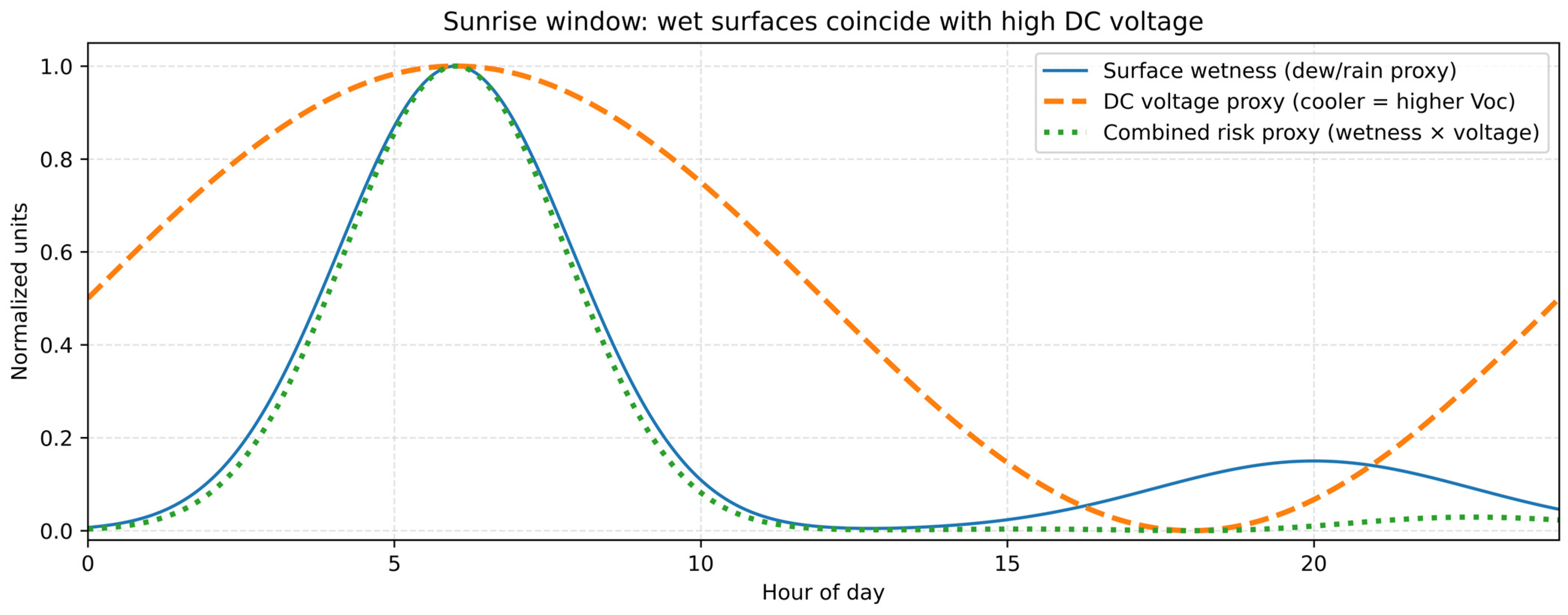
1.4. Sunrise Window: Wet Surfaces Can Coincide with High DC Voltage
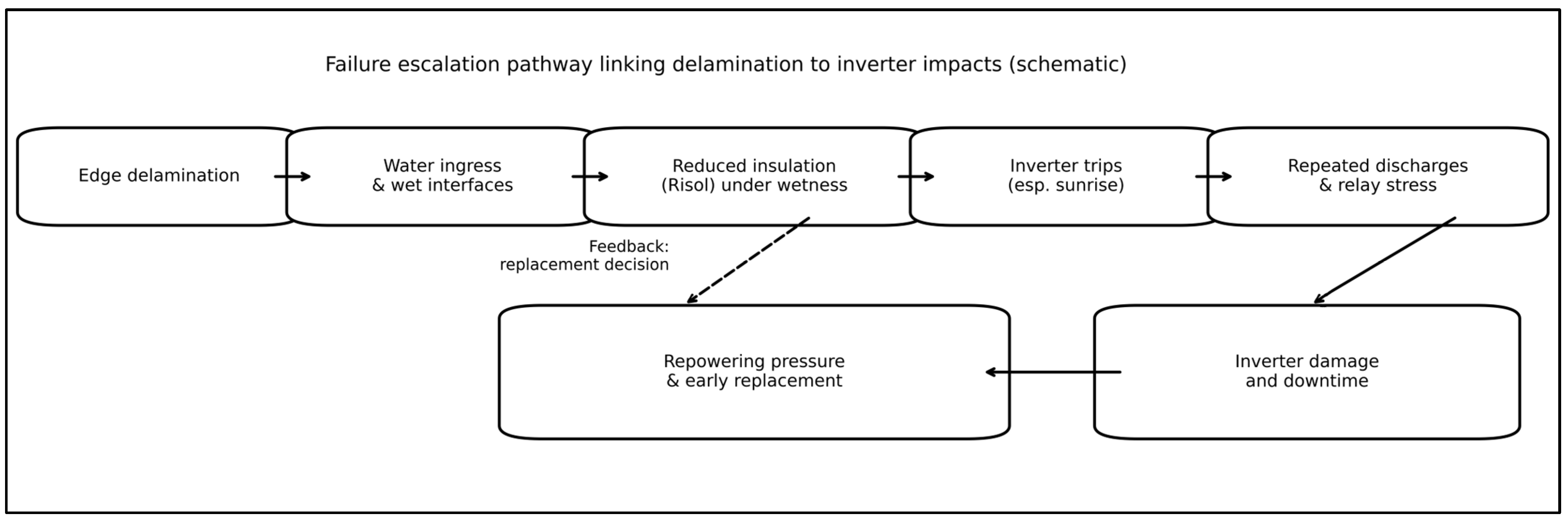
1.5. Failure Escalation: From Delamination to Inverter-Level Impacts
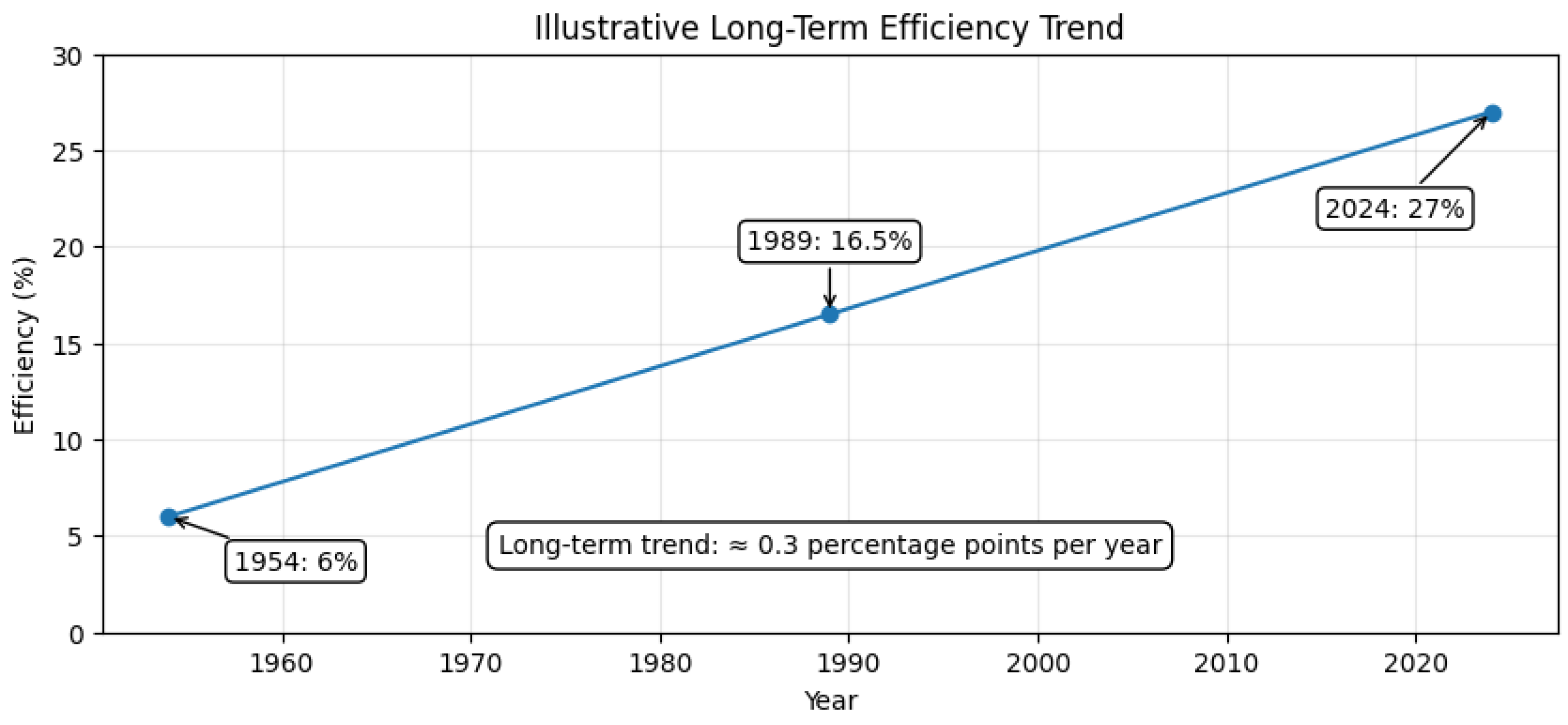
1.6. Repowering Pressure and Technology-Driven Efficiency Improvements
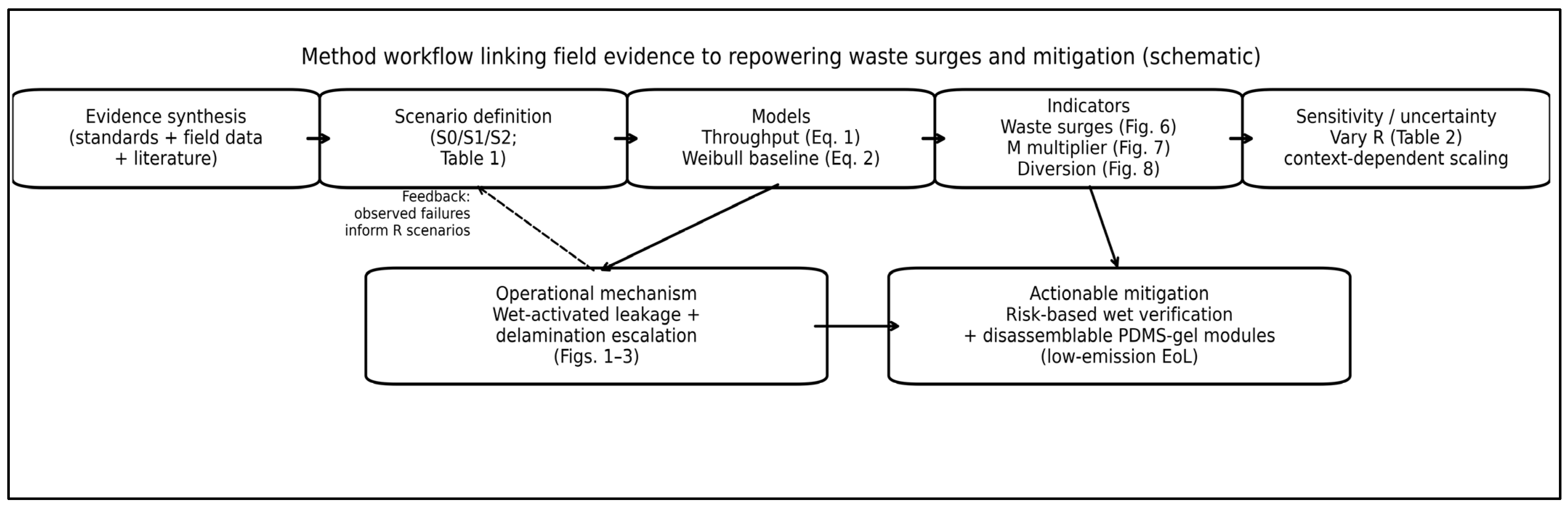
1.7. Objectives and Research Logic
- To summarize a plausible failure escalation pathway linking module defects to inverter-level impacts [24].
- To quantify, using a transparent 30-year scenario model, how a 5-year repowering practice changes the waste timing (“surges”) module throughput multipliers and manufacturing diversion.
- To argue, on technical and sustainability grounds, that the construction of repowering ready modules that enable clean disassembly and high direct reuse—specifically soft PDMS gel encapsulation—reduces the environmental burden of inevitable repowering processes [26].
2. Materials and Methods
2.1. Evidence Base
2.2. Functional Unit and System Boundary
2.3. Scenarios
- S0 (rapid representation): Full module replacement every 5 years → six complete module sets over 30 years.
- S1 (sensitivity): Full module replacement every 10 years → three complete module sets over 30 years.
- S2 (baseline expectation): No replacement within 30 years → one module set over 30 years.
2.4. Indicators and Models
- Waste timing: Replacement events create discrete waste “surges” over time.
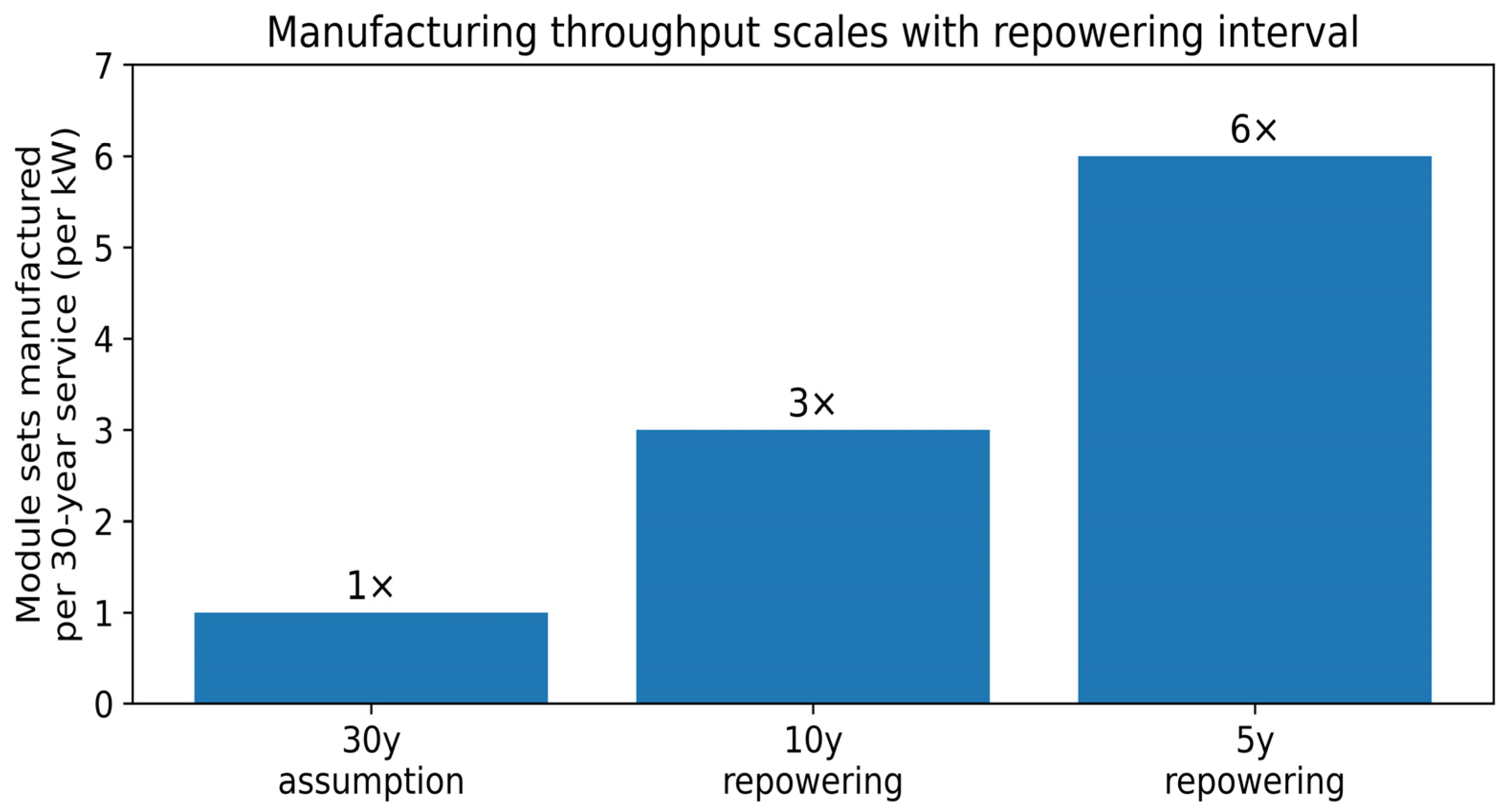
- Module throughput multiplier: The number of module sets installed per 30 years (mechanical multiplier for manufacturing and EoL flows).
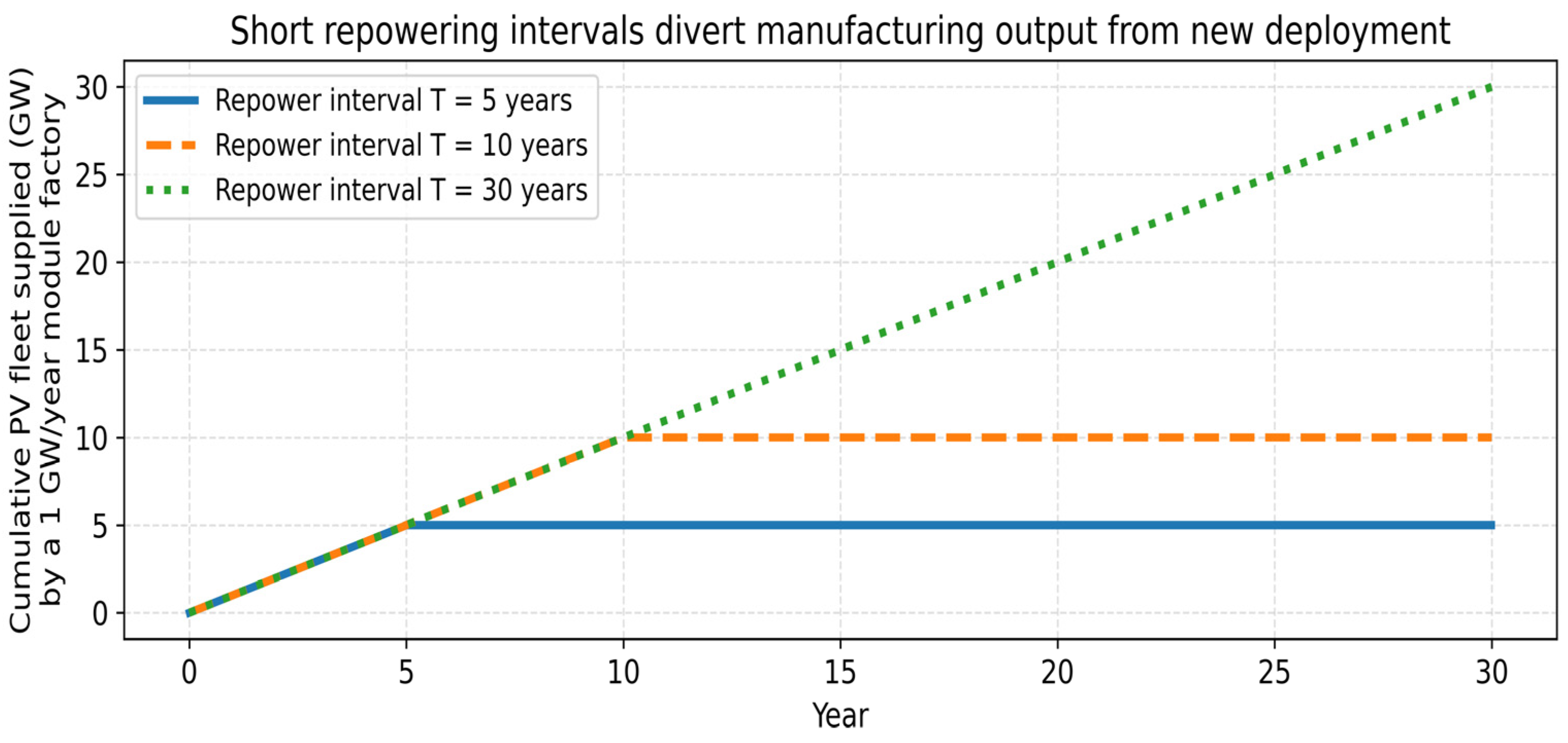
- Stylized manufacturing diversion: The replacement demand consumes the factory output, which could otherwise supply new deployments.
2.4.1. Throughput Multiplier (Equation (1)) and Scenario Sensitivity (Table 3)
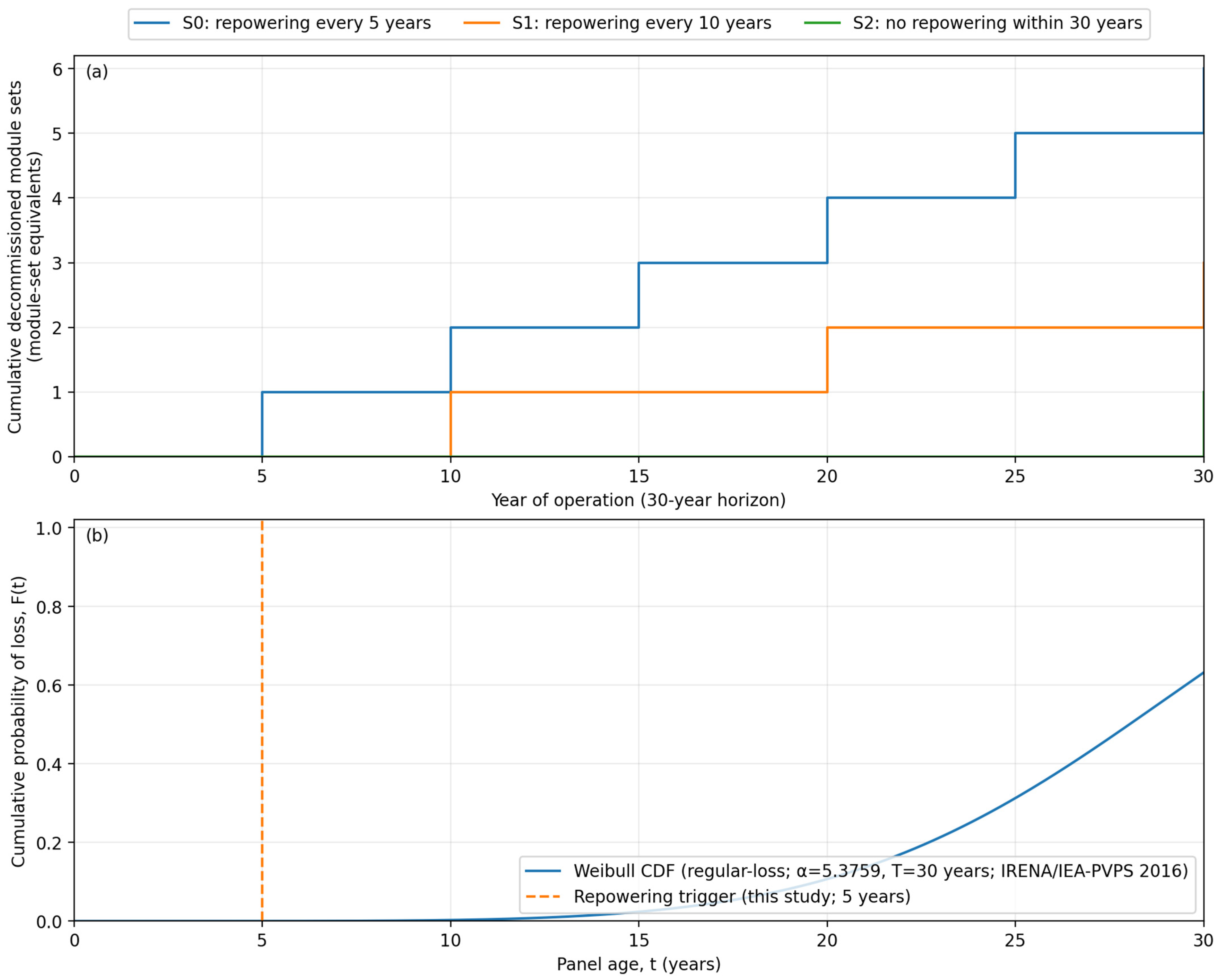
2.4.2. Waste-Timing Baseline Using Weibull Cumulative Loss (Equation (2)) and the Exogenous Repowering Trigger
2.4.3. Uncertainty Framing
3. Results
3.1. Wet Condition Operation Creates a Sunrise Risk Window
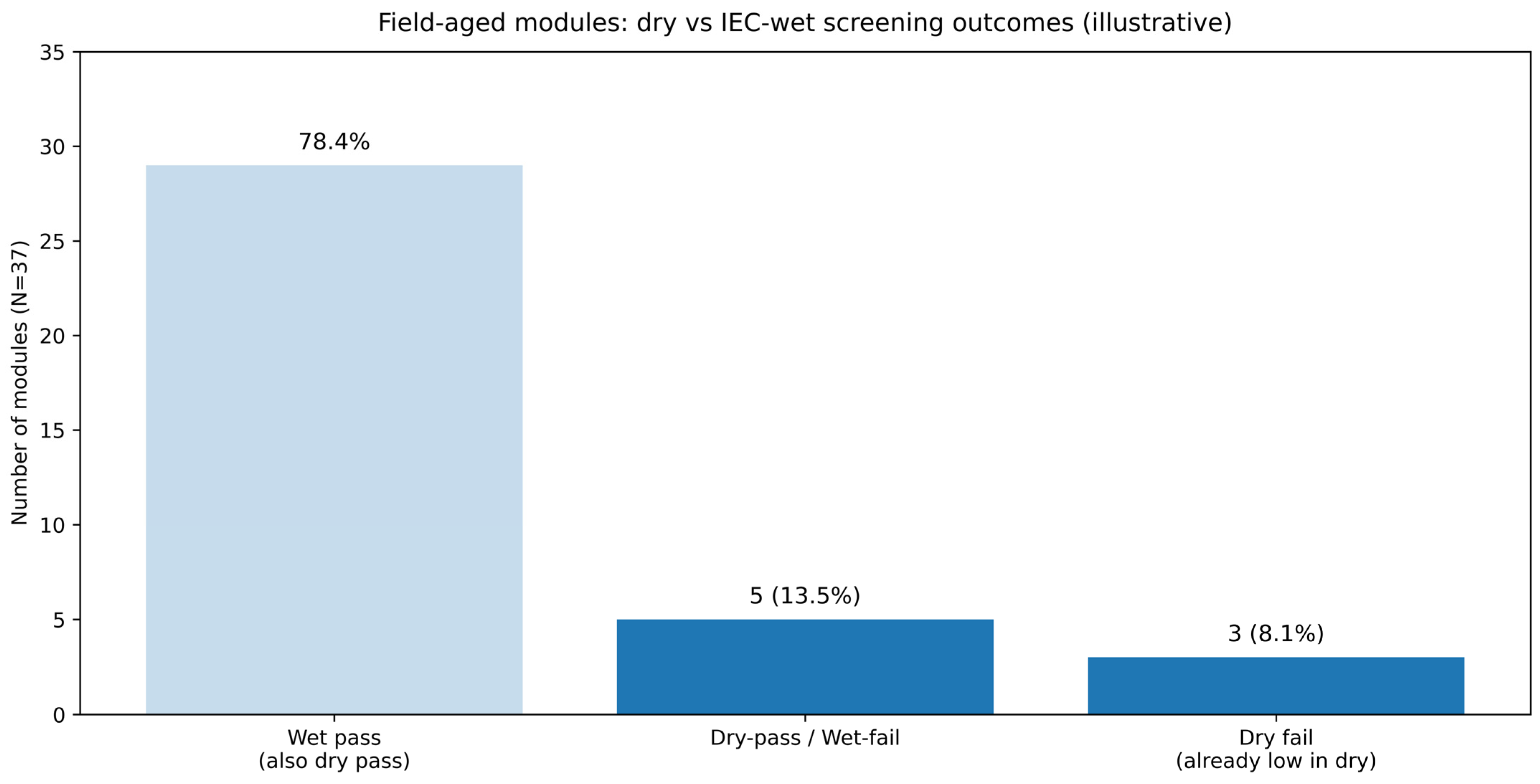
3.2. Dry-Only Screening Can Miss Wet Failures at Non-Trivial Rates
3.3. Delamination-Driven Escalation Increases Repowering Pressure
3.4. Waste Timing: 5-Year Repowering Produces Repeated “Year 5 Surges”
3.5. Module Throughput Multiplier Scales with a Repowering Interval
3.6. Manufacturing Capacity Constraint: Replacement Demand Diverts Output from New Deployment
4. Discussion
4.1. The Core Discontinuity: 30-Year Expectation Versus 5-Year Practice
4.2. Wet Condition Insulation Verification: A Practical Lever
- Repeated sunrise trips and delayed morning start-ups;
- Risol alarms correlated with dew/rain events;
- Visible edge/interface degradation;
4.3. Why Delamination Escalation Changes the Repowering Decision Threshold
4.4. Repowering Ready Circular Module Construction: Why Soft PDMS Gels Matter
- Repowering will happen (for reliability and/or upgrading reasons).
- Therefore, the sustainability result depends on whether the module can be cleanly and quickly dismantled, enabling high-value reuse and low-emission processing during repeated replacement.
- A demountable PDMS gel architecture is therefore an enabling technology for sustainable repowering in demanding climates and not an esthetic design feature [26].
Cell Replacement During Repowering
4.5. End-of-Life Governance: Why “Certified Clean Recycling” Is Required Under Replacement
4.6. Embodied Emissions: Repetition Dominates First-Order Scaling
4.7. Practical Synthesis
- We assume that repowering will occur and plan the EoL capacity accordingly (repeated surges).
- Treat delamination-driven escalation as an inverter-level risk, not merely as module cosmetic degradation [24].
- Repowering ready module construction that enables clean disassembly and high-value reuse, specifically soft PDMS gel lamination, enabling room-temperature delamination and high direct reuse, should be adopted [26].
4.8. Summary of the Main Reasons for Rapid 5-Year Repowering
4.9. Limitations and Future Research Directions
5. Conclusions
- PV projects are typically associated with ~30-year module service life expectations; however, in demanding climates, repowering after ~5 years is a practical and economically feasible [23] reality for a subset of plants.
- Intensive financial optimization is a decisive factor in the rapid repowering of solar PV farms (especially in combination with rapid degradation).
- Using a transparent scenario model over a 30-year horizon, we show that the primary calling term is the throughput multiplier (Equation (1)). For years, (Table 2), increased waste is produced during repowering events, rather than during a single end-horizon decommissioning wave (Figure 6). A compact sensitivity analysis (Table 3) demonstrates that this effect remains strong for other short replacement intervals and prevents the deterministic interpretation of “5 years” as universal.
- If repowering after ~5 years occurs despite a 30-year expectation, sustainability requires two practical measures: (i) very clean low-emission end-of-life processing enabled by repowering ready disassemblable module architectures (with soft PDMS gel encapsulation as a key enabler) [26,27] and (ii) risk-based wet condition insulation verification to reduce latent wet failures and operational escalation.
Author Contributions
Funding
Institutional Review Board Statement
Informed Consent Statement
Data Availability Statement
Conflicts of Interest
References
- Villena Ruiz, R.; Martín Martínez, S.; Honrubia Escribano, A.; Javier Ramírez, F.; Gómez Lázaro, E. Solar PV power plant revamping: Technical and economic analysis of different alternatives for a Spanish case. J. Clean. Prod. 2024, 446, 141439. [Google Scholar] [CrossRef] [Scilit]
- Jean, J.; Woodhouse, M.; Bulović, V. Accelerating photovoltaic market entry with module replacement. Joule 2019, 3, 2824–2841. [Google Scholar] [CrossRef] [Scilit]
- IEA PVPS. T12. Available online: https://iea-pvps.org/wp-content/uploads/2021/11/IEA_PVPS_T12_Preliminary-EnvEcon-Analysis-of-module-reuse_2021_report.pdf (accessed on 7 February 2026).
- Fraunhofer Institute for Solar Energy Systems ISE. Photovoltaics Report; Fraunhofer Institute for Solar Energy Systems ISE: Freiburg, Germany, 2025; Available online: https://www.ise.fraunhofer.de/en/publications/studies/photovoltaics-report.html (accessed on 7 February 2026).
- IRENA. Renewable Power Generation Costs in 2020; International Renewable Energy Agency: Abu Dhabi, United Arab Emirates, 2021; Available online: https://www.irena.org/-/media/Files/IRENA/Agency/Publication/2021/Jun/IRENA_Power_Generation_Costs_2020.pdf (accessed on 7 February 2026).
- Libra, M.; Mrazek, D.; Tyukhov, I.; Severova, L.; Poulek, V.; Mach, J.; Subrt, T.; Beranek, V.; Svoboda, R.; Sedlacek, J. Reduced real lifetime of PV panels—Economic consequences. Sol. Energy 2023, 259, 229–234. [Google Scholar] [CrossRef] [Scilit]
- Sharma, V.; Chandel, S.S. A novel study for determining early life degradation of multi-crystalline-silicon photovoltaic modules observed in western Himalayan In-dian climatic conditions. Sol. Energy 2016, 134, 32–44. [Google Scholar] [CrossRef] [Scilit]
- Le, N.T.; Asdornwised, W.; Chaitusaney, S.; Benjapolakul, W. Annual Degradation Rate Analysis of Mono-Si Photovoltaics Systems in Thailand Using the Mixed Effects Method. IEEE Access 2021, 9, 101335–101343. [Google Scholar] [CrossRef] [Scilit]
- Ndiaye, A.; Kébé, C.M.F.; Charki, A.; Ndiaye, P.A.; Sambou, V.; Kobi, A. Degradation evaluation of crystalline silicon photovoltaic modules after a few operation years in a tropical environment. Sol. Energy 2014, 103, 70–77. [Google Scholar] [CrossRef] [Scilit]
- Bouraiou, A.; Hamouda, M.; Chaker, A.; Mostefaoui, M.; Lachtar, S.; Sadok, M.; Boutasseta, N.; Othmani, M.; Issam, A. Analysis and evaluation of the impact of climatic conditions on photovoltaic module performance in the desert environment. Energy Convers. Manag. 2015, 106, 1345–1355. [Google Scholar] [CrossRef] [Scilit]
- Bouaichi, A.; Merrouni, A.A.; Hajjaj, C.; Messaoudi, C.; Ghennioui, A.; Benlarabi, A.; Ikken, B.; El Amrani, A.; Zitouni, H. In situ evaluation of early PV module degradation of various technologies under harsh climatic conditions: The case of Morocco. Renew. Energy 2019, 143, 1500–1518. [Google Scholar] [CrossRef] [Scilit]
- Buerhop Lutz, C.; Stroyuk, O.; Pickel, T.; Winkler, T.; Hauch, J.; Peters, I.M. PV modules and their backsheets—A case study of a multi MW PV power station. Sol. Energy Mater. Sol. Cells 2021, 231, 111295. [Google Scholar] [CrossRef] [Scilit]
- Lutz, C.B.; Lüer, L.; Stroyuk, O.; Hauch, J.; Peters, I.M. Dynamics of backsheet driven insulation issues. Sol. Energy Mater. Sol. Cells 2023, 257, 112398. [Google Scholar] [CrossRef] [Scilit]
- Hassan Daher, D.; Gaillard, L.; Ménézo, C. Experimental Assessment of Long-Term Performance Degradation for a PV Power Plant Operating in a Desert Maritime Climate. Renew. Energy 2022, 187, 44–55. [Google Scholar] [CrossRef] [Scilit]
- Simsek, E.; Williams, M.J.; Pilon, L. Effect of dew and rain on photovoltaic solar cell performances. Sol. Energy Mater. Sol. Cells 2021, 222, 110908. [Google Scholar] [CrossRef] [Scilit]
- Hernández, J.; Vidal, P.G.; Medina, A. Characterization of the insulation and leakage currents of PV generators: Relevance for human safety. Renew. Energy 2010, 35, 593–601. [Google Scholar] [CrossRef] [Scilit]
- Roy, J.N. Modeling of insulation characteristics of solar photovoltaic (SPV) modules. Sol. Energy 2015, 120, 1–8. [Google Scholar] [CrossRef] [Scilit]
- Buerhop, C.; Stroyuk, O.; Zöcklein, J.; Pickel, T.; Hauch, J.; Peters, I.M. Wet leakage resistance development of modules with various backsheet types. Prog. Photovolt. Res. Appl. 2022, 30, 938–947. [Google Scholar] [CrossRef] [Scilit]
- Stroyuk, O.; Güttler, C.; Buerhop Lutz, C.; Hauch, J.; Peters, I.M. Identification of Backsheet Type of Silicon PV Modules from Encapsulant Fluorescence Images. ACS Appl. Energy Mater. 2023, 6, 2340–2346. [Google Scholar] [CrossRef] [Scilit]
- Kempe, M.D.; Lyu, Y.; Kim, J.H.; Felder, T.; Gu, X. Fragmentation of photovoltaic backsheets after accelerated weathering exposure. Sol. Energy Mater. Sol. Cells 2021, 226, 111044. [Google Scholar] [CrossRef] [Scilit]
- Ketjoy, N.; Mensin, P.; Chamsa Ard, W. Impacts on insulation resistance of thin film modules: A case study of flooding of a photovoltaic power plant in Thailand. PLoS ONE 2022, 17, e0274839. [Google Scholar] [CrossRef] [Scilit]
- Luo, W.; Khoo, Y.S.; Hacke, P.; Naumann, V.; Lausch, D.; Harvey, S.P.; Singh, J.P.; Chai, J.; Wang, Y.; Aberle, A.G.; et al. Potential induced degradation in photovoltaic modules: A critical review. Energy Environ. Sci. 2017, 10, 43–68. [Google Scholar] [CrossRef] [Scilit]
- Poulek, V.; Beranek, V.; Finsterle, T.; Kozelka, M. Dry pass, wet fail: Ground impedance testing of field aged PV modules—Implications for repowering/revamping within 5–10 years and for environmental sustainability. Sustainability 2026, 18, 1212. [Google Scholar] [CrossRef] [Scilit]
- Poulek, V.; Safrankova, J.; Cerna, L.; Libra, M.; Beranek, V.; Finsterle, T.; Hrzina, P. PV panel and PV inverter damages caused by combination of edge delamination, water penetration, and high string voltage in moderate climate. IEEE J. Photovolt. 2021, 11, 561–565. [Google Scholar] [CrossRef] [Scilit]
- IEC 61215-2:2021; Terrestrial Photovoltaic (PV) Modules—Design Qualification and Type Approval—Part 2: Test Procedures (MQT 15: Wet Leakage Current Test). International Electrotechnical Commission: Geneva, Switzerland, 2021. Available online: https://webstore.iec.ch/en/publication/61350 (accessed on 7 February 2026).
- Poulek, V.; Beranek, V.; Kozelka, M.; Finsterle, T. Environmentally sustainable recycling of photovoltaic panels laminated with soft polysiloxane gels: Promoting the circular economy and reducing the carbon footprint. Sustainability 2025, 17, 8167. [Google Scholar] [CrossRef] [Scilit]
- Papamichael, I.; Voukkali, I.; Jeguirim, M.; Argirusis, N.; Jellali, S.; Sourkouni, G.; Argirusis, C.; Zorpas, A.A. End of life management and recycling on PV solar energy production. Energies 2022, 15, 6430. [Google Scholar] [CrossRef] [Scilit]
- Reich, N.H.; Alsema, E.A.; van Sark, W.G.J.H.M.; Turkenburg, W.C.; Sinke, W.C. Greenhouse gas emissions associated with photovoltaic electricity from crystalline silicon modules under various energy supply options. Prog. Photovolt. Res. Appl. 2011, 19, 603–613. [Google Scholar] [CrossRef] [Scilit]
- IRENA; IEA-PVPS. End-of-Life Management: Solar Photovoltaic Panels. 2016. Available online: https://www.irena.org/-/media/Files/IRENA/Agency/Publication/2016/IRENA_IEAPVPS_End-of-Life_Solar_PV_Panels_2016.pdf (accessed on 7 February 2026).
- Królikowski, M.; Fotek, M.; Żach, P.; Michałowski, M. Development of a Recycling Process and Characterization of EVA, PVDF, and PET Polymers from End-of-Life PV Modules. Materials 2024, 17, 821. [Google Scholar] [CrossRef] [Scilit]
- Heubl, B. Spotlight on a solar scandal: Millions of solar PV panels could fail or degrade prematurely and may even be at risk of fires. But no one knows exactly where they are or how big the problem is. Rectifying the faults could cost billions. E&T investigates. Eng. Technol. 2020, 15, 38–41. [Google Scholar] [CrossRef] [Scilit]
- Anagha, E.R.; Kulkarni, S.V.; Shiradkar, N. Development of a Characterization Technique to Effectively Detect Latent Insulation Defects in the Field-Deployed PV Modules. Sol. Energy Mater. Sol. Cells 2025, 292, 113761. [Google Scholar] [CrossRef] [Scilit]
- Ketola, B.M.; McIntosh, K.R.; Norris, A.; Tomalia, M.K. Silicones for photovoltaic encapsulation. In Proceedings of the 23rd European Photovoltaic Solar Energy Conference, Valencia, Spain, 1–5 September 2008; pp. 2969–2973. Available online: https://www.researchgate.net/publication/266496217_Silicones_for_Photovoltaic_Encapsulation (accessed on 7 February 2026).
- Hara, K.; Ohwada, H.; Furihata, T.; Masuda, A. Durable Crystalline Si Photovoltaic Modules Based on Silicone-Sheet Encapsulants. Jpn. J. Appl. Phys. 2018, 57, 027101. [Google Scholar] [CrossRef] [Scilit]
- Lopez-Garcia, J.; Pozza, A.; Sample, T. Analysis of crystalline silicon PV modules after 30 years of outdoor exposure. In Proceedings of the 31st European Photovoltaic Solar Energy Conference and Exhibition, Munich, Germany, 14–18 September 2015; pp. 1839–1845. [Google Scholar] [CrossRef] [Scilit]
- Dintcheva, N.T.; Morici, E.; Colletti, C. Encapsulant Materials and Their Adoption in Photovoltaic Modules: A Brief Review. Sustainability 2023, 15, 9453. [Google Scholar] [CrossRef] [Scilit]
- Spampinato, C.; Valastro, S.; Calogero, G.; Smecca, E.; Mannino, G.; Arena, V.; Balestrini, R.; Sillo, F.; Cinà, L.; La Magna, A.; et al. Improved radicchio seedling growth under CsPbI3 perovskite rooftop in a laboratory-scale greenhouse for Agrivoltaics application. Nat. Commun. 2025, 16, 2190. [Google Scholar] [CrossRef] [Scilit] [PubMed]





| Item | Conventional Laminated Glass/TPT PV Panel, Weight ~22 kg |
|---|---|
| Backsheet [~1 kg] | Polymer/TPT separation often requires thermal and/or chemical treatment; |
| Encapsulant [3 kg] | EVA/POE separation is often burden-dominant; direct emissions/residues |
| Front glass sheet [15 kg] | Recoverable fraction; secondary remelting impacts are not included here |
| Polymer J-box [~0.5 kg] | Recoverable fraction; secondary remelting impacts are not included here |
| Aluminum frame [2 kg] | Recoverable fraction; secondary remelting impacts are not included here |
| c-Si solar cells [0.8 kg] | Recoverable/refinable fraction; secondary processing impacts are not included here |
| Direct Reuse | Very limited in conventional irreversible lamination |
| Direct Hazardous Emissions | Substantial in polymer-separation steps; 15% weight; route-dependent |
| Recycling Efficiency | ~15 ÷ 90% (process- and design-dependent) |
| Scenario | Repowering Interval R (Years) | Module Sets over 30 Years M (=H/R) | Repowering Events (Years) | Final Decommissioning (Year) |
|---|---|---|---|---|
| S0 | 5 | 6 | 5, 10, 15, 20, 25 | 30 |
| S1 | 10 | 3 | 10, 20 | 30 |
| S2 | 30 | 1 | – | 30 |
| R (years) | 5 | 7.5 | 10 | 15 | 30 |
| M (=H/R) | 6.0 | 4.0 | 3.0 | 2.0 | 1.0 |
| Location Ref. No. | Morocco [11] | India [7] | Thailand [8] | Senegal [9] |
|---|---|---|---|---|
| Annual degradation | −2.6% | −20% | −2.7% | −2.96% |
| Exposure | 3 years | 2.5 years | 3 years | 4 years |
Disclaimer/Publisher’s Note: The statements, opinions and data contained in all publications are solely those of the individual author(s) and contributor(s) and not of MDPI and/or the editor(s). MDPI and/or the editor(s) disclaim responsibility for any injury to people or property resulting from any ideas, methods, instructions or products referred to in the content. |
© 2026 by the authors. Licensee MDPI, Basel, Switzerland. This article is an open access article distributed under the terms and conditions of the Creative Commons Attribution (CC BY) license.
Share and Cite
Poulek, V.; Kozelka, M. Rapid Five-Year Repowering of Photovoltaic Power Plants in Demanding Climates: Effective Clean Recycling and Disassemblable PDMS Gel Encapsulation to Reduce the Environmental Impact. Sustainability 2026, 18, 3599. https://doi.org/10.3390/su18073599
Poulek V, Kozelka M. Rapid Five-Year Repowering of Photovoltaic Power Plants in Demanding Climates: Effective Clean Recycling and Disassemblable PDMS Gel Encapsulation to Reduce the Environmental Impact. Sustainability. 2026; 18(7):3599. https://doi.org/10.3390/su18073599
Chicago/Turabian StylePoulek, Vladislav, and Martin Kozelka. 2026. "Rapid Five-Year Repowering of Photovoltaic Power Plants in Demanding Climates: Effective Clean Recycling and Disassemblable PDMS Gel Encapsulation to Reduce the Environmental Impact" Sustainability 18, no. 7: 3599. https://doi.org/10.3390/su18073599
APA StylePoulek, V., & Kozelka, M. (2026). Rapid Five-Year Repowering of Photovoltaic Power Plants in Demanding Climates: Effective Clean Recycling and Disassemblable PDMS Gel Encapsulation to Reduce the Environmental Impact. Sustainability, 18(7), 3599. https://doi.org/10.3390/su18073599