Article

Experiencing Coordination with Non-Humans Through Role-Playing: The “Ubuntu” Game for Engaging with Non-Human Agency

1
Centre de Coopération Internationale en Recherche Agronomique pour le Développement—CIRAD, Unité Mixte de Recherche Savoirs, Environnement, Sociétés—SENS, 34398 Montpellier, France
2
SENS, Centre de Coopération Internationale en Recherche Agronomique pour le Développement, Institut de Recherche pour le Développement, Université Paul Valery Montpellier 3, 34398 Montpellier, France
Sustainability 2026, 18(7), 3602; https://doi.org/10.3390/su18073602
Submission received: 29 January 2026 / Revised: 21 March 2026 / Accepted: 24 March 2026 / Published: 7 April 2026
(This article belongs to the Section Sustainability, Biodiversity and Conservation)

Abstract

Scholars across disciplines are urging a rethinking of human–nature relationships beyond anthropocentrism, but these ideas remain difficult to convey to broader audiences and to implement in environmental management practices. This study analyses the design and performance of a serious game (used in 12 sessions with 99 participants in total) developed to encourage participants to reflect on modes of attention and relationships with non-humans in an everyday environment. The game draws on storytelling and art-based approaches to guide players through a thought experiment in which humans and non-humans can gradually communicate and coordinate. A series of game features have been designed to challenge players’ perception of ownership, stakeholders and agency beyond humans. In the sessions played, players initially competed against each other. The revelation, throughout the game, of non-humans’ presence in the landscape, and among the game’s characters themselves, led players to cooperate. Yet they mostly cooperated among human characters to address the needs of non-humans, but they rarely engaged directly with the non-human characters themselves through voluntary interactions. Engaging participants to act as, and interact with, non-humans through role-play allows questioning established interpretations and power dynamics in land or resource management. It offers an imaginative yet embodied experience for exploring what happens if non-humans are treated as active partners with whom we can directly communicate and coordinate to address environmental challenges.

Graphical Abstract

1. Introduction

1.1. The Invisibilization or Subordination of Non-Humans in Our Living Environment

A wide variety of non-human living beings (i.e., flora and fauna) are present in our living spaces, even in the most anthropized environments (this study adopts the common term “non-human”, widely used in the literature, while acknowledging the limitations of framing other living beings in relation to humans). However, these living beings remain largely absent from our field of attention and concern in our everyday environment [1]. Aside from domesticated species, interactions with non-humans are rare in modern lifestyles due to our inattention and ignorance of their signs of presence, as well as a separation between our lifestyles [2]. This loss of direct experience is reinforced by a “societal extinction of species,” marked by declining collective awareness, knowledge, and cultural representations of non-humans [1]. Experience with non-humans is often reduced to an aesthetic vicarious encounter, mediated by attention-grabbing images of spectacular and exotic ecosystems and charismatic species, which obscure the forms of life and interaction that characterize everyday environments [3]. This is exacerbated by the proliferation of AI-generated images, which flood media with fantastical portrayals of nature. This widespread invisibilization of non-humans in our daily lives is gradually no longer consciously recognized, and their presumed absence is perceived as a given.
In the field of biological sciences, non-humans are alternately treated as objects of scientific knowledge or as indicators of environmental changes. While it helps improve our understanding and concern about biodiversity, the objective perspective adopted by scientists imposes an emotional detachment by maintaining these lifeforms in a relationship of exteriority [4,5]. Within contemporary political and legal frameworks, the primary modes of relating to non-humans continue to be exploitation, control, or protection [6]. These relations are all based on a profoundly anthropocentric vision of living things perceived as either useful, as harmful, or of heritage value. This stance of control relegates non-humans to the status of subordinate objects and resources whose destiny is managed by humans [7,8]. Furthermore, this management is carried out through generic and complex environmental norms, often disembodied and detached from emotional ties and local particularities, reducing the possibility of local actors to appropriate them [9]. Although public authorities widely promote citizen participation to restore the connection between societies and their environment, it is most often limited to participatory science projects that mimic scientific protocols for monitoring biodiversity but fail to capture the affective and emotional affinity people have with their natural surroundings [10,11,12].
Finally, the subordination or exclusion of non-humans is at the heart of our way of apprehending the space we inhabit. The notion of ownership that underpins our relationship with land, whether private, public, or under a common property regime, implies the right to exclude others [13,14]. This perception ignores the needs of all the non-humans who depend on it [15]. But it also fails to recognize that ecological processes generating land-based resources or services for humans are in fact co-produced by the very non-humans with whom we share these environments through a diversity of interactions within ecological communities [16].

1.2. A Perspective: Considering Alternative Forms of Attention and Relationships with Non-Humans

This study draws on posthuman theory [17,18] and multispecies studies [19,20,21] to explore alternative perspectives and ways to relate to non-humans. An ecological reading of the ethics of care and compassion, this relational and active practice of caring for others and their needs offers the opportunity to extend moral consideration beyond humans alone [21,22]. Viewing non-humans as both sentient beings and social subjects invites us to envision human–non-human relations as networks of social ties and mutual interdependencies [7,8,19,23]. An increasing number of studies highlight the capacity of agency of non-humans in co-shaping a landscape in which human and non-human practices mutually affect each other [21,24,25,26,27,28]. These studies show that treating non-humans as actors, whose roles and decision-making actions in socio-ecological systems affect humans, can foster multispecies collaborative management and enhance the well-being of humans and non-humans alike [4,7,23].
This study also builds upon the concept of “commoning” [29,30,31] as a promising way of renewing our relationship with living beings. The commons challenge traditional notions of ownership to consider the needs of others, together with social innovations in terms of collective organizations and practices in the allocation of rights of use [13,16,32,33]. The commons, understood as self-organized social practices grounded in ethics of inclusion, cooperation, and reciprocity, provide an opportunity “to embrace the needs of those who are marginalized under contemporary property arrangements” [14], a concern that has traditionally focused on human users. The concept of commons is widely studied and promoted today, both conceptually and empirically. However, it often remains abstract and difficult to convey to the general public. Furthermore, despite the inclusive dimension of the commons, which express “relationships in society that are inseparable from relations to nature” [29], non-humans are rarely included in the analytical frameworks that define commoning or are overlooked by the commons practitioners themselves [31].
Yet the commons are based on a relational vision of the world. The concept of commoning provides a framework for restoring visibility to the interdependencies that link human and non-human activities within the interaction networks of biotic communities. In this regard, the recognition of “latent commons” [34] or “natural commons” [35], conceived as an unnoticed entanglement of interdependent relationships within assemblages associating humans and non-humans [20], opens the field of study to the inclusion of non-humans within collectives of resource users. This means that non-humans can be viewed as partners or allies whose interests in the use and sustainability of a space or a resource can be defended by humans on behalf of an entire collective of human and non-human users (e.g., [7,24,36]).

1.3. Using Serious Games to Challenge Perceptions and Coordination in Land and Resource Management

Experiential learning can be a powerful mechanism to acquire knowledge or to make meaning through observation and experimentation [37]. Because most learning takes place in some social context, the experiential dimension of learning appears inseparable from its collective dimension. Social learning occurs when one acquires an improved understanding by observing the behavior and performance of others but also as a result of social interactions between actors within a social network [38] In this context, serious games are regarded as effective learning environments in which participants can gain new perspectives through active experimentation and players’ interactions in a problem-solving context [39], including the ability to coordinate between competing demands among resource users [40,41].
Most role-playing games designed to stimulate discussion about how natural re-sources or land are managed generally assume—often implicitly—that the users and other stakeholders are exclusively humans [40,41]. When non-humans are represented, it is in the form of resources, external constraints, or indicators reflecting the environmental consequences of human actions but not as full-fledged social subjects, i.e., active members of an interdependent network of users. Although a few games have invited participants to play non-humans roles [42,43,44], until recently, none have enabled players embodying both human and non-human characters to interact and directly coordinate their actions within a simulated environment. Yet nothing prevents us from adopting this approach within the realm of fiction and imagination on which these participatory frameworks are based. In practice, a situation where a resource used by humans is also used by non-humans is the rule, not the exception. Thus, the objective of serious games—to encourage participants to recognize the existence of multiple subjective perspectives, interests, and roles among stakeholders regarding the issue at hand [40,41]—should be able to be extended to non-humans [45].

1.4. A Proposal: A Role-Playing Game to Experience Commoning with Non-Humans

This study aims to explore the potential of a role-playing game in engaging participants in a collective experience of commoning with non-humans. It revolves around two questions. First, what game features can be designed to encourage participants to question and discuss their perception of the place and role of non-humans in their everyday environment and to experiment with various forms of interaction with non-humans, including competition, exclusion, or collaboration? Second, how do players react to this series of role-playing situations designed to confront them with different modes of attention and relation with non-humans?
This work is based on the experience of conceptualizing, designing, and implementing a role-playing game called “Ubuntu”. This name comes from a term used in several Bantu languages in Africa that signifies several things at once: relational benevolence, an ethic of care, and a means of building humanity (the term “Ubuntu” is untranslatable, but its essence can be captured through several aphorisms: “I am what I am because of who we all are”, and “I am because we are, and since we are, therefore I am”). Ubuntu is based on the idea of the interdependence of the bonds between living beings, a way of thinking that recognizes the profound link between personal fulfillment and collective well-being [46].
This game aims to create a space where players can come to see non-humans as legitimate users and, possibly, social partners with whom to organize. It combines storytelling and art-based approaches to stimulate imagination and creativity for the formulation of new narratives of relationships between humans and non-humans. Players are first exposed to a series of social and environmental dilemmas; then, they progressively experience the presence and capacity of non-humans to affect the environment; and finally, they are led to engage in a thought experiment in which humans and non-humans can communicate and coordinate in order to compose a way of inhabiting a shared territory.
Rethinking human interactions with non-humans and moving beyond dominant anthropocentric perspectives are currently fueling debates across scientific communities as diverse as philosophy [17,25], anthropology [19,26,47], political science [45], legal theory [7,16,35], economics [48], animal geography [24,49], agronomy [50], urban design [51], and conservation biology [4,5,20]. These works propose to renew our perception of non-humans and their role within our socio-ecosystems as truly active social subjects. However, these conceptual propositions often prove difficult to share with a wider audience and to translate into environmental management practices. This role-playing game aims to translate, at least in part, these theoretical advances and recommendations into practical terms by restoring visibility to non-humans and acknowledging their capacity for agency in relation to humans.
This game is intended for residents and local stakeholders who wish to reflect and discuss ways to handle biodiversity issues locally. The figurative form of the game (scenario events and characters) presented here was inspired by the real-life context of a region in the south of France, but it can be adapted to other territorial contexts based on the generic structure of the game. The first section of this study presents the concepts that support the rationale for designing this game, as well a brief description of the structure, rules, and scenario of the game and of the methodology used to analyze game sessions. The second section analyzes the game’s features designed to challenge players’ attention to and interactions with non-humans (including the scenario, staging, rules, and structure of the game, as well as the attributes of the game characters) and presents the participants’ reactions (attitudes, emotions, and choices) during a series of twelve game sessions. Finally, these results are discussed in light of the potential offered by adopting a non-human perspective and a relational approach to imagine possible alliances between human and non-human stakeholders in addressing environmental challenges.

2. Concepts and Methods

2.1. Conceptual Framework for Designing the Game

2.1.1. Carry Out Uses Rather Than Collecting Resources to Experiment with Commoning

E. Ostrom’s work [52] demonstrated that communities of users can organize in common to sustainably manage a shared resource thanks to autonomous local rules and institutions. Under the influence of her work, analysis of the commons has often focused on the resource itself, that is, the resource that poses a question of common management [30,53]. These “common pool resources” are regarded as common goods [31], differing from other types of goods (such as public, private, or toll goods) in that their use is not exclusive, and their consumption is rivalrous (i.e., no longer available to others). Role-playing games focused on natural resource management are typically designed to test this rivalry by having players collect finite resources and to experiment with rules governing their allocation and sharing [40]. However, considering natural resources as goods is not neutral, as it presupposes that they can be appropriated (and thus are subject to accumulation) and assigned a price by the market (and thus be traded). What is more, it focuses attention on the individuals (the users) and the object of rivalry (the resource) rather than on the social relationships produced through the process of using things in common [30,53]. And with this perspective, natural resources tend to be viewed as mere materials to be shared among humans, rather than as living organisms, themselves users and active members of the ecological network of the biotic community.
The choice was made here to focus the gameplay on carrying out uses rather than collecting resources. A use is defined as a voluntary practice by a resident, on a located space or resource, to satisfy a need. Uses are specified by players themselves and are materialized by placing tangible objects, i.e., tokens, on the game board. This makes it possible to address the plurality of relationships that users have with their living environment beyond the mere exploitation of a resource. It also opens up the possibility of considering a diversity of forms of interaction between users, such as mutualism or commensalism, beyond competition alone. All these elements allow for approaching the commons not as a physical resource to be managed but, instead, as a social practice of using things in common [29,32,33]. With this approach, players can do more than organize “in common” for the allocation of a shared resource; they can also organize “for the common” by engaging in a cooperative process of using a shared territory, thereby fostering the potential for creating opportunities for collective benefits and solidarities [30,53]. This perspective highlights the profoundly relational dimension of the commons and the importance of the network of interdependencies that connects the community of users. Finally, in the game, both humans and non-humans act by carrying out uses. This allows one to view humans and non-humans similarly—as users whose needs and well-being can be recognized in the same way [15,51]. Taking into account both human and non-human uses simultaneously invites us to consider the existence of multispecies user groups that are capable of organizing the conditions for collective use that ensure solidarity and sustainability [30,36].

2.1.2. Assigning Agency to Individuals

The concept of “capabilities” was developed by Amartya Sen [54] in relation to social justice to assess a person’s ability to satisfy their needs and achieve well-being. It takes into account the degree of freedom of action rather than solely measuring one’s level of financial or material resources as in conventional economic analyses. Individuals, in fact, have distinct abilities, according to their social network, education, skills, or health status, to convert financial or material resources into actions useful for them. Therefore, what matters is the capacity for action individuals are able to develop to become what they want to be. Here, players are allocated “potentials of uses” in the form of a number of tokens that allows them to perform activities: these tokens represent equipment and skills rather than financial means. The game leaves it up to the players to decide whether or not to realize their potential of uses according to their subjective assessment of their needs and the different ways to satisfy them [15]. The number of uses to be realized by a player is not set as a game rule; only the objectives of fully inhabiting the territory and deciding how to live together to achieve well-being are set.

2.1.3. Challenging the Perception of Ownership Rights and User Rights

In modern liberal societies, private ownership is the predominant form of rights over land, giving the exclusive right to use, collect, and dispose, as defined by statutory law. Ownership rights are viewed as somehow natural, taken for granted constituents of the landscape [14]. However, other conceptions of property can be considered. Multiple legal orders can coexist within a social setting (i.e., a legal pluralism) which provides a basis for multiple people to claim different and overlapping rights of access or use over a site or a resource [55]. Recognizing bundles of rights allows third parties to be included in the use of private property, recognizing their needs and interests beyond those of the sole owner. By decoupling ownership from use, it becomes possible to recognize co-possession or co-use of resources or to establish partial and relative rights for multiple users [56]. Under the notion of the commons, property can be seen in terms of use rather than appropriation [13]. In this game, commoning therefore revolves around the question of how to allocate user rights [30], as we shall see, by testing how uses can coexist beyond the juxtaposition of modes of appropriation.

2.1.4. Putting Different Modes of Attention and Relationships with Non-Humans into Perspective

The invisibilization of non-humans in our daily environment, or their subordination to human control, has resulted in the general disregard of their presence as legitimate residents and their active role in socio-ecological systems [4,7,8,19]. Yet humans and non-humans share a long history of co-constructing the landscape in which they live by their complementary actions and interactions [23,57]. Studies that recognize an “agent” status for non-humans illustrate how their practices, like those of humans, are shaped by their environment and how they also build, in return, their environment by their actions [24,25,26,27,28]. This relational approach to coexistence between humans and non-humans involves viewing the territory as a network of interactions whose vitality must be preserved and nurtured for the benefit of all [4,8,22]. The game proposes to create a contrafactual situation to explore what it means if we imagine non-humans as kin whose actions affect humans [4], genuine companion species [17], or social partners with whom to organize [47], not as equals but “from one way of existing to another” [25]. As in a thought experiment, the game invites players to imagine what humans and non-humans would do together if they could communicate and coordinate with each other. It proposes to experience an expanded political community [24,27], an “ecoumenic community” [11] that brings together humans and non-humans, to broaden the concern and scope of environmental management decisions to all living beings.

2.1.5. Create a Sensitive and Immersive Gaming Experience to Stimulate the Imagination

Mobilizing our social skills towards our non-human neighbors and considering them as potential partners remains difficult to imagine from a conventional modern perspective [8,47]. Storytelling and art-based approaches can be a powerful tool to stimulate imagination and to facilitate expression of people’s emotional understanding of, and connection with, nature [12,58,59]. This game relies on the creative power of imaginative excess, in line with Gaston Bachelard’s recommendation [60] that “the imagination must take too much for thought to have enough”. A combination of artistic forms, including role-playing and storytelling with actors in theatrical scenes and audiovisual media, are used to guide the players through a thought experiment in which they allow themselves to think like non-humans and imagine what humans and non-humans would say if they could communicate to each other.

2.2. Description of the Ubuntu Role-Playing Game

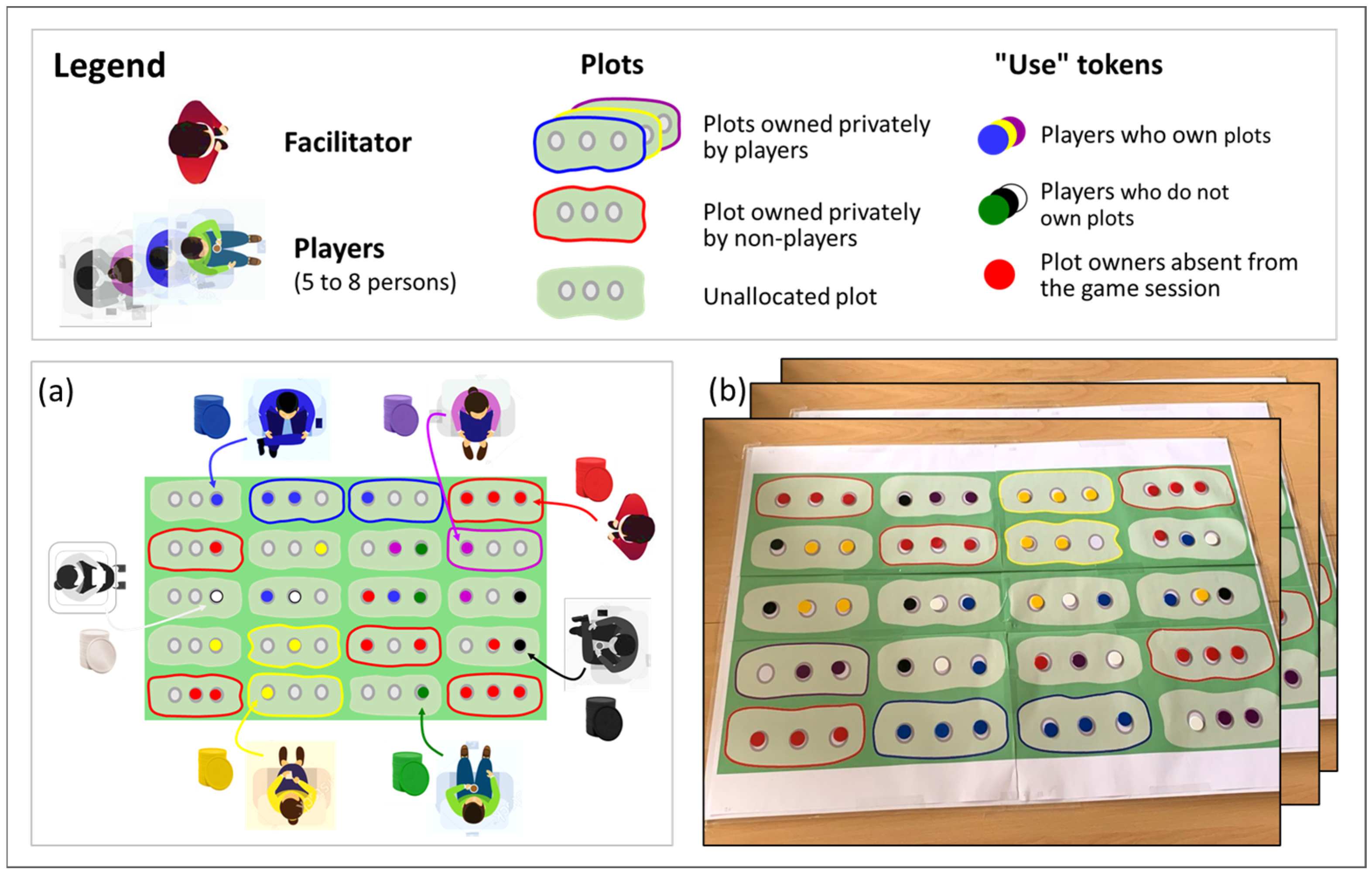
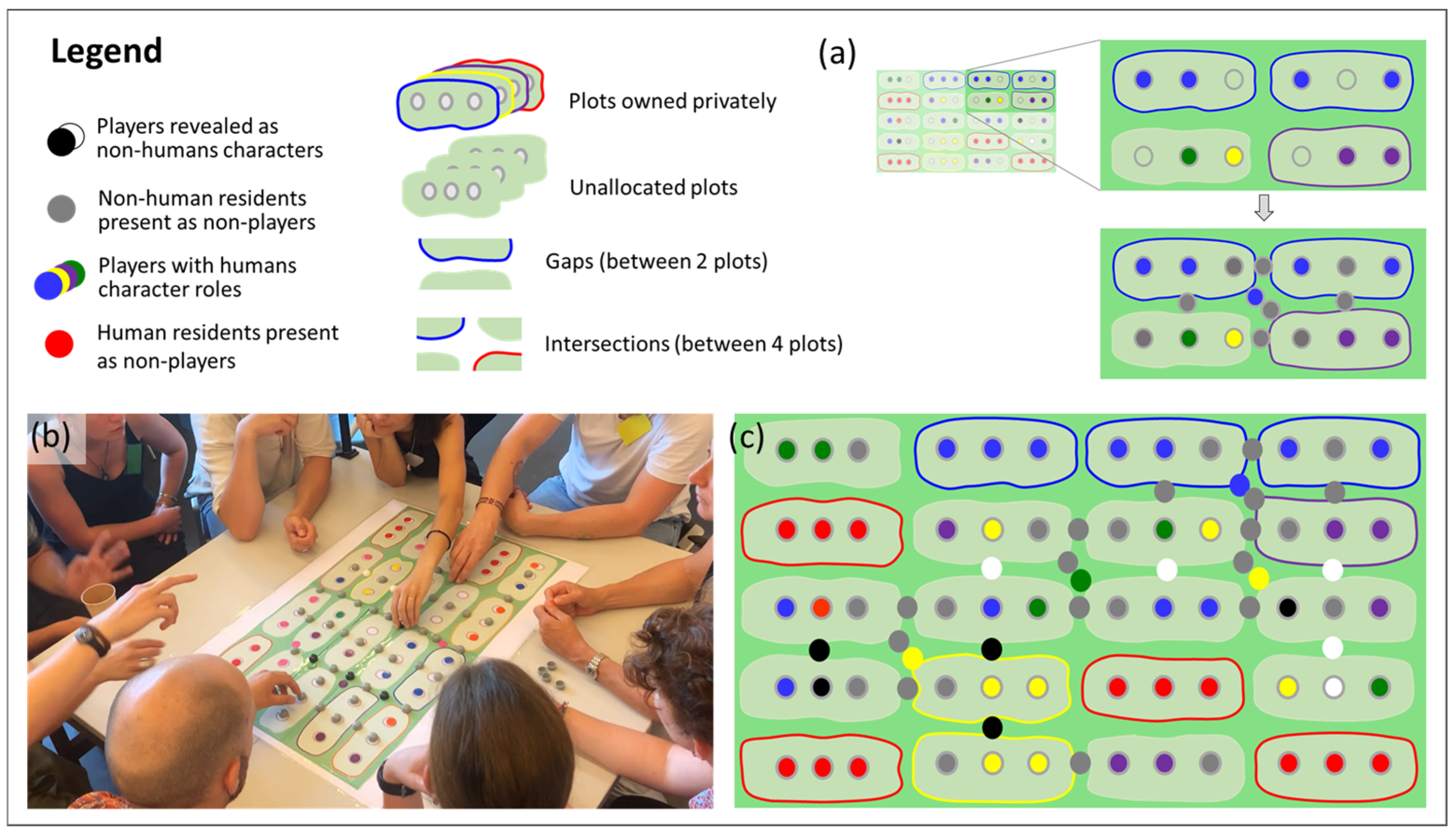
The game session is led by a facilitator and two actors playing the roles of the different characters. The game board represents a schematic map of a territory consisting of 20 plots of land, including private properties and unallocated plots (Figure 1; see Supplementary Material for a detailed description of the game).
Each player is invited to play a local resident who carries out his daily activities in this territory. Players receive individual colored tokens which they can choose to place on the board to perform a use according to their needs, desires, and possibilities. There is only one simple rule: a maximum of three tokens can be placed per plot to account for incompatibility or rivalry between certain activities (disturbance, subtractibility). The first objective set for players is to imagine which character they wish to embody and to live fully in this territory by carrying out their uses to satisfy their needs. The second objective is to decide how they want to live in this shared territory, choosing individually or collectively how to use the space.
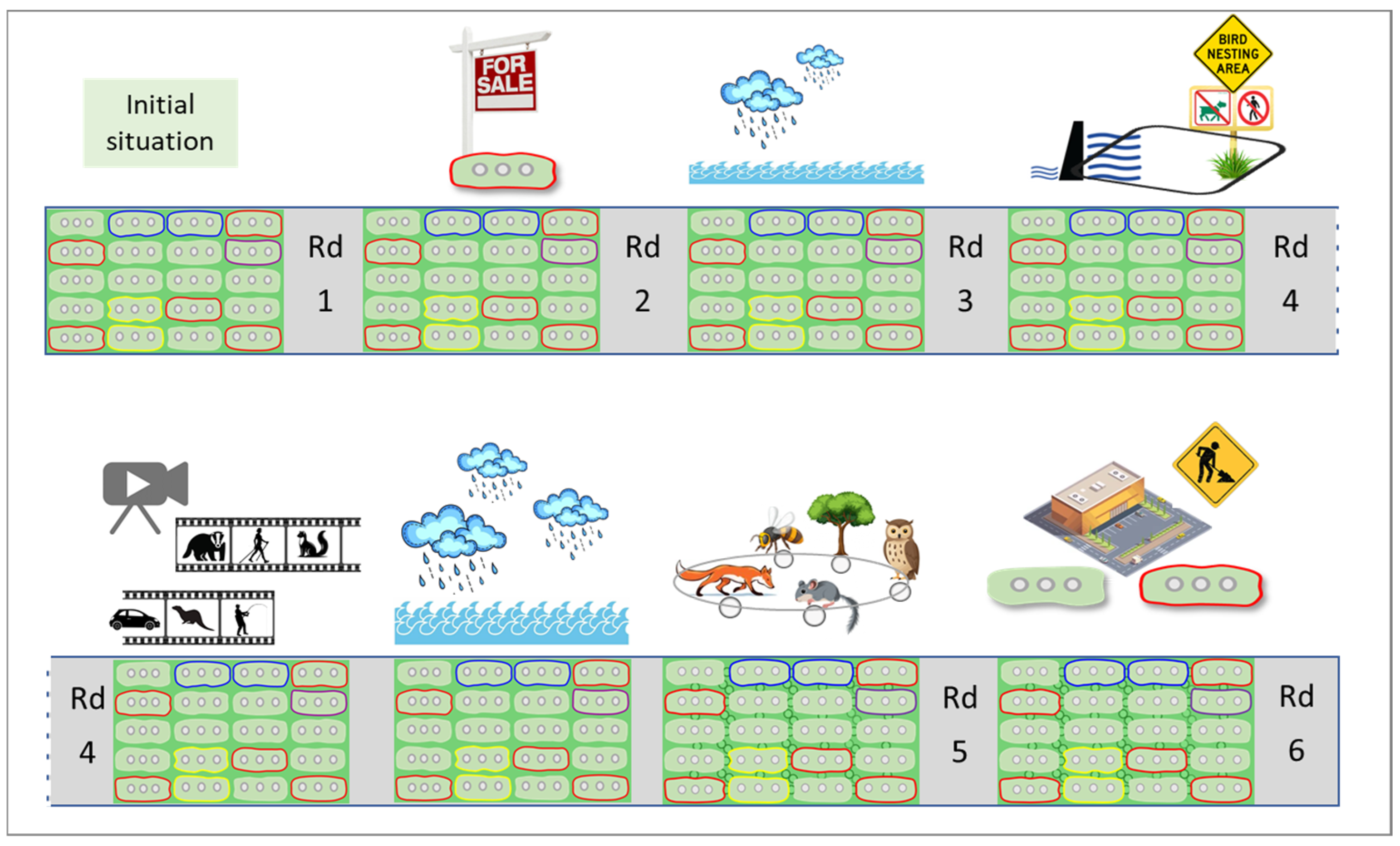
The game is divided into six rounds during which actors appear in theatrical scenes to narrate the story. They embody the events and interact with the players to help them project their imagination into the game. Only the general framework of the scenario is presented here (Figure 2; see Supplementary Material for a detailed description). The first period of the game (rounds 1 to 4) is punctuated by a succession of events that fluctuate the amount of space available. The second period (rounds 5 and 6) is organized around the revelation of the presence and role of non-humans.
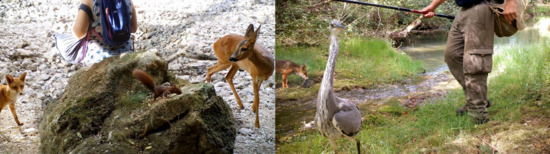
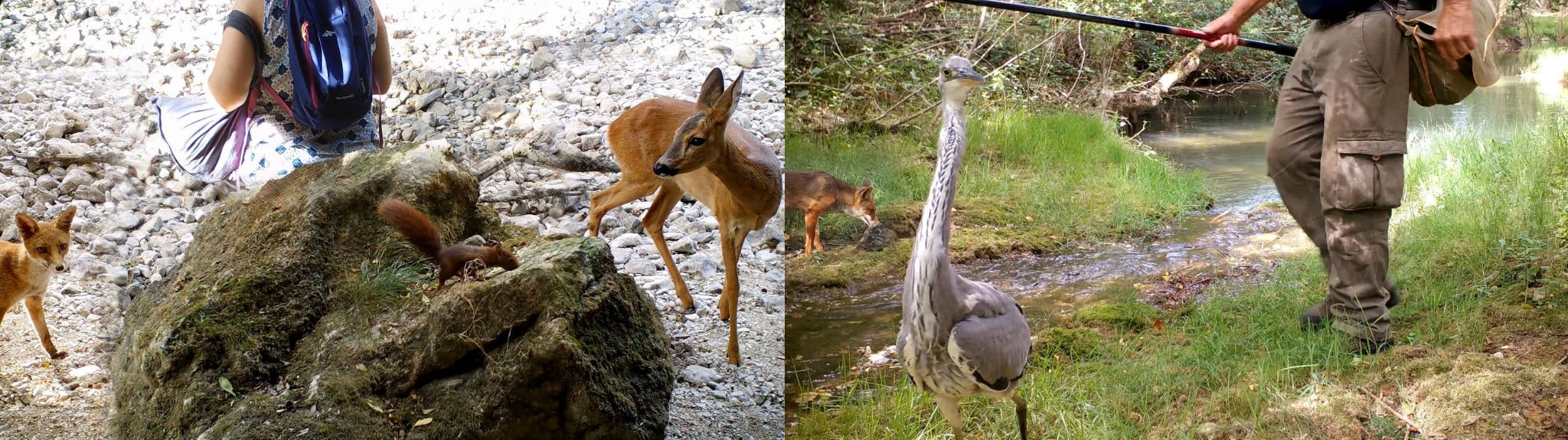
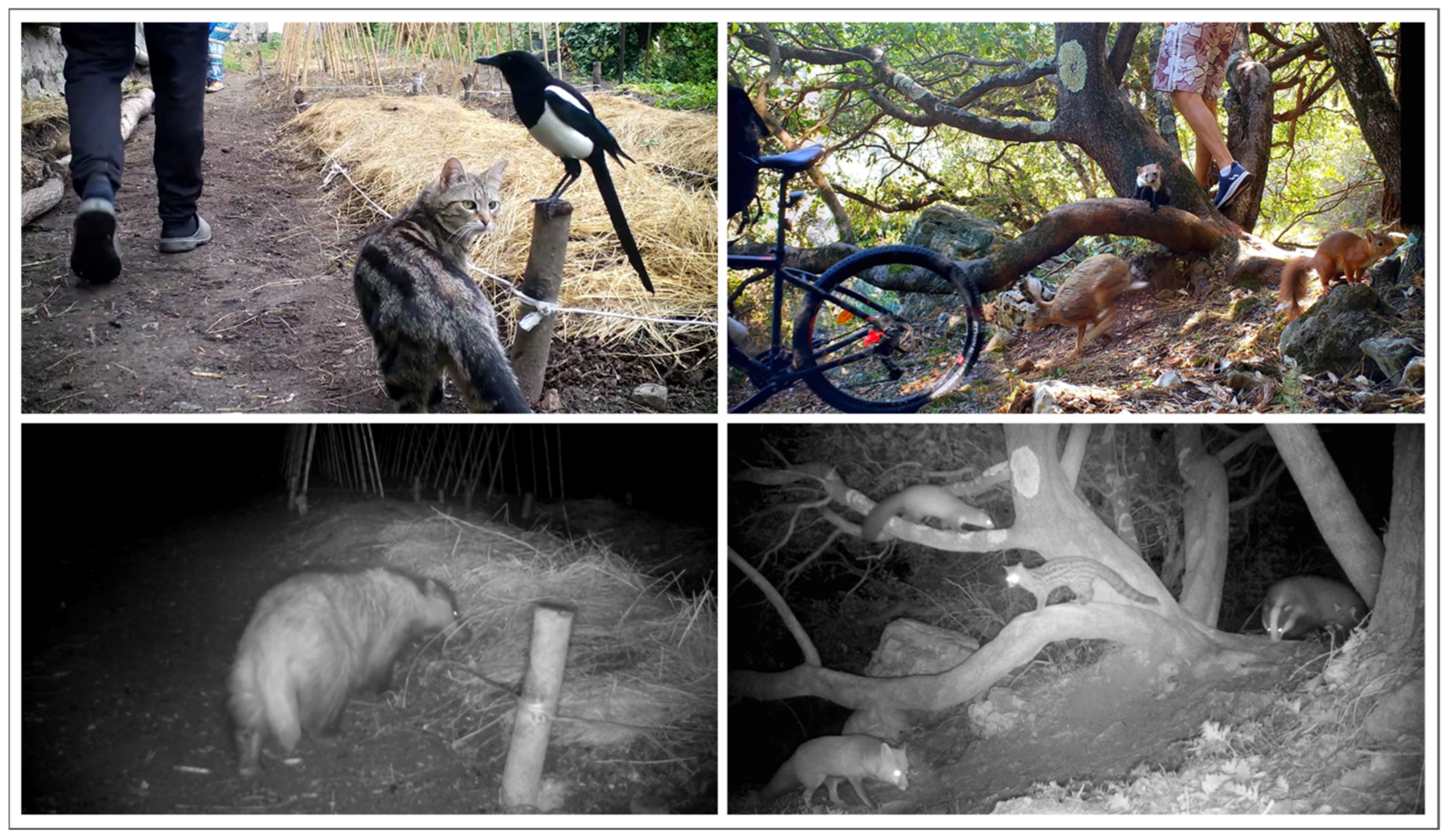
A character played by an actor uses videos recorded by camera traps to reveal that non-humans are potentially present throughout the territory (Figure 3). Players are informed that non-humans can carry out their activities on plots like humans, but also on the gaps between plots thanks to their specific capacities, provided the neighboring plots are not fully used by humans. Interaction rules between human and non-human uses (Figure 4) mean that they are partly in competition (rivalry within plots), partly complementary (in the gaps between plots), and partly mutually facilitated (reciprocal benefits at the intersections of plots). A character played by an actor, who had appeared earlier in the game (round 1), returns and reveals his non-human identity. Players are thus informed that non-humans can communicate with humans. Two players also discover at this point that their character in the game actually has a non-human identity (Figure 4). The facilitator supports them in making this shift in identity and to play henceforth according to their new abilities. All these elements set the stage for potential multispecies coordination. Players now have the possibility to place tokens for non-human uses (gray), those they wish to host or not on plots, or favorable gaps and intersections, in addition to their own uses.
A collective debriefing is organized at the end of the game session to let players express their feelings and reactions about the role-playing experience. Participants are also invited to propose and test alternative solutions to the dilemma they have encountered during the game, using scenes replay and role-swapping borrowed from forum theater.

2.3. Data Collection and Analysis

A total of twelve sessions were organized between February 2023 and November 2025, with a total of 99 participants (see further details in Supplementary Material). The participants were environmental management practitioners (n = 22), master’s or PhD students (n = 45) and researchers (n = 26) in social sciences, and people involved in artistic practices (n = 6). A series of photos recording the state of the game board at the end of each game round (Figure 1b) was used to analyze the players’ choices: the number of uses made per player and per plot type were calculated for each game round, as well as the number of diverse players per plot and the number of plots with free space. These data were used to calculate the proportion of tokens placed by players, the proportion of plots occupied by one or more players, and the proportion of plots and gaps with open spaces. The participants’ attitudes and reactions to the role-playing situations were recorded by the facilitator during the game to facilitate the debriefing process. These data were then used, along with the participants’ expressions collected during the debriefing, to analyze the game sessions.

3. Results

The various game mechanisms, as scripted and staged, are presented here in turn according to the modes of relationships and affects they aim to explore. Each section is organized to first present the outcomes of the conceptual reflections and practical development that guided the game’s design (considering the game form itself as a significant result), and second to reports the findings from the game sessions with participants, including their attitudes, reactions, and choices, with reference to theses game features.

3.1. Stimulating Imagination and Affects to Foster a Personal Experience

Various arrangements have been devised to involve players in this fictional experience through imagination and affects. First, a warm-up exercise at the beginning of the session, based on a simple exercise of synchronizing movements between participants, aims to awaken the senses and stimulate attention and coordination by engaging the participants’ bodies. Participants are then invited to imagine their own role-playing character (its identity, history, and activities) and to play that character during the game. This aims to encourage each participant to project their own imagination into the game. But allowing players to choose the attributes, the perspective, and the goals of their character also aims to facilitate engagement through identification [61]. Social inequalities among players (such as differences in the number of tokens assigned, lack of plot of land owned privately for some) and arbitrary decisions (the expropriation of one player when a nature reserve is created, the arbitrary allocation of a plot put up for sale to one player) are orchestrated through the game to provoke a sense of injustice. A series of events is also scripted to create uncertainty about space availability (sale or flooding of plots, reduction of access within the nature reserve; Figure 2), thus enhancing this climate of inequality and vulnerability.
The game’s story is unfolded for players through various forms of artistic communication rather than being only stated directly by the facilitator. A soundtrack is played throughout the game to create a soundscape, including audio cues related to events in the scenario (e.g., birdsong, animal cries, voices, cars and construction noise, sounds of storm and rain). Actors intervene at each game round during theatrical scenes on stage or interact with the players themselves around the game board to embody events occurring in the territory. The revelation of a non-human presence in the territory constitutes a turning point in the game. This announcement is staged through theatrical scenes and the projection of a video: noticing, viewing, and listening to non-humans in familiar everyday human contexts are used to connect players with an emotional and embodied presence of non-humans [59]. This video montage shows, through a succession of images of humans and wildlife passing by in a fixed frame, how their activities overlap, rather than being separated, with humans on one side and wildlife on the other (Figure 3). These images of human activities are depicted in everyday places (roadside, house facade, garden, path) in order to create an element of surprise and identification for players, with the aim of stimulating their imagination as a prelude to active attention [21].
In the sessions played, participants interacted easily with the actors during the scenes they performed. They generally needed a first round to successfully take on the role of a character and projected themselves onto the abstract landscape (Figure 1). Their testimony about their character’s activities was subsequently consistent. During the debriefing, they often explained that they drew inspiration from familiar situations. The individual narratives formulated often gradually intertwined between several players: “I take care of beehives to produce honey; I welcome you with your beehives on my plot to pollinate my orchard”. The existence of inequalities in treatment among players was consistently noted in the first round of the game. These inequalities were often seized upon by players in constructing their character, referencing concrete social situations. Many players without plots owned privately shared, during the debriefing, their feelings of vulnerability and social downgrading due to the difficulty of finding spaces to exist. The expropriation of a player for the creation of the nature reserve often elicited discontent among the players, but none offered to accommodate them.

3.2. Gradually Making Non-Humans Visible to Challenge the Anthropocentric Vision of the Territory

The game is first designed around a tension mechanism on the availability of space to stimulate competition between players, an essential driver of motivation and participation in game systems [39]. Typically, the attribution of tokens is set up so that not all players have the opportunity to place all their tokens. Scripted events also fluctuate the availability of space as mentioned previously. But such rivalry for space mostly aims to focus the attention of players on their individual needs and reinforce the tendency to forget the presence and needs of non-humans in an everyday environment. In the initial phase of the game, the presence of non-humans in the territory or among players is not hidden but simply not specifically mentioned. Generic terms applicable to both humans and non-humans are intentionally used: all players are “residents” invited to perform “uses” on a “territory”. Similarly, the first character played by an actor, which appears as a simple resident, presents its activities with ambivalent terms which initially suggest a human identity. Its non-human identity is only revealed when it returns later in the game and expresses itself in more specific terms. This approach encourages players to retrospectively question the automatic attribution of a human identity to all resident characters, whether they are player or actors. This also creates two periods in the game, leading players to face social and environmental dilemmas first among humans only and then with non-humans.
Players are only informed of the presence of non-humans midway through the game. The specific way of non-humans to inhabit the territory is described through their ability to use the gaps between plots (Figure 4). Indeed, the sensory, physiological, and locomotion capacities of non-humans give them access to a different part of the environment. These specific game rules aim to introduce the idea of plurality of worlds perceived and experienced between humans and non-humans, whose space, time, and signifiers are unique to them [62]. Players can experience how several worlds coexist in the same space: from round 5 onwards, what makes sense on the game board (plots or gaps) and the capacity for action (rules of access) differ between players with a human and a non-human character. Thus, the anthropocentric perception and management of a territory is called into question, playing with the fact that the environment we perceive as humans is only part of what non-humans perceive and use.
In all the sessions played, players initially ignored the possible presence and needs of non-human residents in the territory. Players quickly occupied plots in the early rounds (1 to 4) and almost systematically saturated them with their tokens: on average, 82% and 86% of private and unallocated plots, respectively, were fully occupied (e.g., Figure 1b). The possible needs of non-human were never spontaneously mentioned (except for on one occasion and by only one player), despite players often recounting activities related to non-human entities (e.g., farming, birdwatching, fishing, or hunting). Players generally showed indifference to the first announcement of the presence of the endangered bird species: no one asked for any information about the lifestyle or needs of this animal nor about the effectiveness of the regulatory measures put in place with the creation of the nature reserve. In contrast, following the revelation of the ubiquitous presence of non-humans after round 4, the players consistently reacted by adapting their way of placing their tokens to accommodate the needs of non-humans. Most players readily accepted to leave room on some plots to open gaps for non-humans, as we will see below.

3.3. Getting Players Take on a Non-Human Role in the Course of the Game

Two of the players have their character’s non-human identity revealed midway through the game (after round 4). This revelation aims to illustrate, by example, that despite their change of identity in the eyes of others, they remain residents in their own right, with legitimate needs and uses. These “revealed” players are accompanied by the facilitator so that this change of identity is not an abandonment of their initial character but, rather, an imaginative process of a shift in identity. They are invited to adopt a non-human identity based on analogies with the behaviors and the activities of the human character they previously embodied. The scene depicted by an actor portraying the first character of a simple resident, mistakenly taken for a human, who transposes his storyline to a non-human when he returns to this point of the game, is used to illustrate such an identity shift by example. This character also serves to show that in this imaginary setting, non-humans have the ability to communicate with humans and vice versa. Players are thus placed in situations where they can utilize their social skills in their dealings with other living beings to discuss their respective needs and desires. The two players who have been revealed are later invited to share with the group how this change of identity has altered their perception and use of the territory and their interactions with their neighbors. Sharing this subjective experience through storytelling aims to highlight what adopting the point of view of non-humans can reveal about space sharing and well-being [58]. By bringing together human and non-human characters among players, and encouraging them to communicate with each other, this game aims to give players the opportunity to experiment with a form of multispecies interaction, as we shall see below.
During the session played, all players spontaneously chose human identities for their characters at the beginning of the game, with one exception during a session where two players chose non-human characters: one a holm oak, the other a red fox. Both of these are common residents in southern France. The first player explained during the debriefing that he had been inspired by the green color he had been given, while the other admitted to having heard about the game beforehand. In all other sessions, several players expressed surprise at their own prejudice, acknowledging that “obviously, a resident could also be non-human.” The revelation of the presence of non-humans was always well received: the video prompted reactions of amusement and enthusiasm at discovering this diversity of wildlife species in familiar contexts, with no negative perceptions expressed. However, revealing players’ non-human identities elicited more contrasting feelings, with three types of reaction: (i) a discomfort for those unfamiliar with the lifestyles of non-humans or who had difficulty abandoning their initial character; (ii) a relief for those who felt their character was already marginalized and who could now slip into these new safe spaces, escaping rivalry with other players and enjoying a form of invisibility out of sight; (iii) an obvious fit for those who already felt that their character was different and a pleasure in flourishing with their new abilities. The non-human identities these players adopted were diverse, though more often associated with animals than plants, some being inspired by the wildlife species featured in the video (owl, genet, fox), others were completely imagined or inspired by their own work (bee, soil microfauna, fungus).

3.4. Confronting Ownership and Use to Question the Social and Ecological Function of Land Property

The game depicts two successive modes of relations to the land; first a territory managed as a juxtaposition of separated, autonomous private properties, and then, a territory managed as a space of relations where new capacities for action can emerge from collective spatial arrangements. In the first period, the game features create spatial and social heterogeneities in access rights between players, with plots that are either owned privately or unallocated and residents who are either owner or non-owner. But the rules of the game give players the chance to experiment with the social function of ownership: these rules allow uses to overlap with property rights and leave it to the players to decide on the rules of access to the plots. Property-owning players thus have a responsibility “to embrace the needs of those who are marginalized under the ownership regime” of the game [14], i.e., the non-owners, whether humans or non-humans.
The ecological function of the property is addressed in the second period, after the presence of non-humans and the conditions under which they are accommodated are revealed. The rules of interaction in the game (Figure 4) assign property-owning players a major responsibility in the choice of accommodating non-humans, both in plots and in gaps. The game thus leads to thinking about land property from a relational perspective, where each plot is reintegrated into a territorial network: a plot turns out to be the living space of a plurality of users beyond the sole owner, and its modes of use have repercussions on a larger scale. Property can thus become a means to allow relationships to flourish, transcending logics of exclusion and exclusivity. Inspired by the “ecosystemic conception” of property rights [63] and the concept of “relationalized property” [31], this game setup aims to question the notion of land property rights in light of the satisfaction and respect of the interests of all those, humans and non-humans, who dependent on it. Thus, property-owners are put in a position to make informed decisions and socially assume responsibility for their “way of owning” as a way of constructing the world in which they live. Property thus confers not only a right but also a social and ecological responsibility: to allow everyone to thrive and to take care of the relationships between living beings to ensure collective well-being.
In the early rounds of the sessions played, private plots held a central role in the game. Property-owning players consistently carried out their uses primarily in their private plots and often exclusively (on average, 44% of private plots were occupied by the sole owner player). The opportunity to acquire a private plot put up for sale was systematically seized, almost always contested between several players, and always motivated by individual projects. Despite the limited space available, some property-owning players accepted tokens from other players on their plots, but always in small numbers. As a result, space was shared between players on unallocated plots much more than on private plots (87% of unallocated plots were occupied by at least two players on average compared to 56% of private plots). During debriefing, a participant shared his feeling that “placing a token on his private plot might be a way for some players to assert their property right rather than to meet a particular need”.
After the revelation of the presence of non-humans, the vast majority of players chose to leave a free space for non-humans on plots, both in private and in unallocated plots (91 and 93%, respectively; e.g., Figure 4b). This contrasts with the early rounds, where players occupied most plots entirely (only 18% and 14% of private and unallocated plots, respectively, had free space). However, this choice in favor of non-humans was accompanied by a reduction in space-sharing among players within plots: the proportion of unallocated plots occupied by at least two players decreased from 87% to 55% after the revelation (this same proportion decreased from 56% to 42% on private plots).

3.5. Orchestrate Contrasting Ways of Relating to Nature and Living with Non-Humans

The game’s approach is based on the confrontation between visions of the environment successively managed without, for, and with non-humans. The presence of non-humans, initially kept silent and generally ignored by players, is progressively revealed. The game initially focuses players’ attention on a single animal species. The argument justifying the importance of this species’ presence is based on expert criteria relating to its rarity and the threat it faces at the international level rather than on criteria of local significance, such as the cultural or emotional attachment of residents to this species. Specific protection measures are decided upon and implemented by the public authority, with regulations leading to a reduction in the number of possible human activities in a designed area (i.e., the nature reserve). In a second stage, the players’ attention is turned to a diversity of non-human entities potentially present everywhere in the territory and not only in the place where they are expected (i.e., inside the reserve). Players, informed that the presence of non-humans depends on how they use the plots of land, have the responsibility from now on to decide how to inhabit the territory. It is a way to put into practice the principle of active responsibility [6,64], which involves acting with awareness of the potential side effects of one’s actions on other community members.
This series of situations highlights the contrast between exclusion-based management and inclusive coexistence between humans and non-humans, a classic opposition in biodiversity conservation policies [65]. But more importantly, it draws attention to how establishing a reserve may reduce the potential for interactions between humans and non-humans through exclusion and, conversely, it highlights the possibility of cultivating the relationships that humans and non-humans weave together at the heart of environmental management. The protection of key biodiversity areas often leads to the neglect of other areas, where non-humans receive little to no attention. By materializing the presence and uses of non-humans only during the game through the addition of their specific tokens (gray) on the game board (Figure 4), the game clearly reveals how non-humans were invisible during the first rounds. It also illustrates how non-humans emerge spontaneously in all favorable spaces, recognizing their inherent vitality, independently of human intervention.
The choice of whether to accommodate or restrict the inclusion of non-humans becomes all the more significant when considering lifeforms perceived as undesirable or harmful. The sudden appearance of numerous non-human gray tokens on all favorable spaces (plots, gaps, and intersections) creates a visual effect of non-human omnipresence on the game board (Figure 4). Here again, the aim is to stimulate affects: possible enthusiasm fueled by positive mental images associated with nature or, conversely, apprehension imbued with fears or disgust for certain living beings. Additionally, choosing symbolic spaces like gaps or interstices between plots—those in-between spaces such as ditches, wastelands, or impenetrable thickets—to reveal the spontaneous presence of non-humans reinforces potential anxiety towards these alien lifeforms that infiltrate and proliferate out of sight in inhospitable times (darkness) and spaces (cracks) and threaten to re-emerge and overwhelm us beyond our control.
During the sessions played, the participants never raised any significant objections regarding the establishment of the reserve. Some players readily supported the protection plan, others were amused by the presence of the enigmatic endangered bird species, but most of them accepted without significant reaction this management decision setting aside part of the land. This contrasts with the stronger reactions observed in response to the expropriation of a player, as previously mentioned. It should also be noted that the regulations restricting access to the reserve were generally followed: players exceeded the authorized number of uses in the reserve area in only two of the twelve sessions. The addition of gray tokens in the reserve by the facilitator as a sign of the success in protecting the endangered bird species also received very few comments. In contrast, following the revelation of the ubiquitous presence of non-humans, the addition of their gray tokens in all favorable spaces on the game board as a tangible presence of non-humans elicited contrasting reactions (Figure 4). Many players expressed pleasure at the idea of being surrounded by numerous non-humans. Others were willing to accommodate some non-humans but not those perceived as nuisances, such as wild boars. But several players also expressed concern or hostility upon discovering the large number of gray tokens appearing on the game board. They expressed a feeling of being invaded by non-humans and worried that they would “swarm” if their presence was not “regulated”.

3.6. Providing an Experience of Commoning Through Multispecies Coordination Practices

In the second period of the game, the revelation of the presence and specific needs of non-humans opens up a possibility for collective management, whether it be to accommodate them or to prevent their spontaneous emergence in available spaces. Furthermore, the rules of the game make the inclusion or exclusion of non-humans both an individual choice (on individual plots) and a collective choice (on gaps between plots). The decision to open a gap for non-human use depends on the way human residents occupy neighboring plots and, therefore, involves several players. This has been designed as an incentive for cooperation. But it also aims to shift perspectives by moving players’ attention from managing individual plots to managing the territory as a whole. This spatial distribution of responsibilities, spread evenly across the territory without hierarchical structure, encourages the emergence of self-organization among players in the form of horizontal and distributed peer-to-peer coordination rather than centralized vertical coordination. This practice aligns with the process of “peer governance” inherent to the commons [31], where residents recognize themselves as active peers in a collective process rather than competitors or subjects whose sovereignty is delegated to a representative authority.
This is when the existence of non-player (red) owners in the game becomes meaningful. These red owners represent neighbors with whom it is not possible to interact, either because they are absent or because they do not wish to communicate. Their plots are distributed across the territory to constrain collective arrangements, with their number and position parameterized to reduce the possibility of opening gaps for non-humans. The last theatrical scenes, where an actor portraying a red character tries to buy plots of land for a private project (round 6), also aims to spark a discussion about land management choices. The goal is to generate frustration and provoke debate about these openly individualistic red characters: do we accept their individual strategies, or do we seek a way to involve or constrain them in a collective project? Should we establish rules (and if so, which ones) for managing unallocated plots, plots put up for sale, or for the whole territory?
This second period of the game also highlights the capacity of agency of non-humans in co-shaping a living space. From the fifth round of the game onwards, the activities of humans and non-humans are presented as affecting each other. The rules of the game are designed so that interactions between human and non-human uses generates either competition (for the same locations on plots), nonreciprocal benefits (for non-humans on gaps between plots), or mutual benefits (for both for humans and non-humans at the intersection of four plots). These rules illustrate different forms of ecological interactions that exist naturally between living organisms (competition, commensalism, mutualism) but also that interdependence among lifeforms is not necessarily equal and often relies on asymmetrical and unbalanced mutual dependencies [35]. To ensure that accommodating non-humans is a deliberate choice of players, and also for the sake of realism, the game’s design is structured in such a way that the presence of non-humans is not without cost for human characters. Individually, this means giving up certain uses to make room for non-humans. But the rules of interaction moderate the collective cost: up to 52 human uses can be carried out in a territory of optimum interaction between humans and non-humans (thanks to mutual benefits at favorable intersections) compared with a maximum of 60 human uses in a scenario that leaves no specific space for non-humans. In this way, players experience solidarity, not as a fair distribution of resources or balanced relationships and strict reciprocity, but as an end in itself: organizing for the common and creating a sense of community through the collective use of a shared territory [30].
During the game sessions, once the rules for accommodating non-humans were revealed, players generally played in a way that promoted the inclusion of non-humans to the territory, and very few openly played to exclude them. All players with a human character left some free space for non-human uses on plots, as previously mentioned, to varying degrees depending on the individual (i.e., 92% of the plots, on average, were left not fully occupied by players in round 5 and 6 compared to only 16% in rounds 1 to 4). Most players also coordinated to place their tokens on neighboring plots in a way that opened space for a non-human use in the gaps: on average, 89% of gaps between plots were made available for non-human uses across all game sessions (i.e., excluding gaps linked to red plots owned by non-players). However, cooperation rarely included the entire group of players. Instead, it was mainly organized locally, between players in pairs eager to manage the gap between their neighboring plots. No real collective arrangement was observed. In one session, one player deliberately took the lead to organize the entire game board for maximizing the number of spaces for non-humans use, with other players following and adapting to this plan without openly expressing their reactions.
The individualistic behavior of non-player (red) owners was systematically denounced by players but only at this stage of the game, when the question of cooperation became central to accommodate the non-humans. During the previous rounds (1 to 4), players incorporated these inaccessible private red plots as a structural element of the territory without questioning them. On one occasion, a player deliberately intruded into a red plot in round 6: he explained during the debriefing that he had intentionally chosen to break the rules to force this owner into communication. The role of these non-player (red) owners was one of the most debated points during debriefings and led to replaying scenes with them on several occasions. The participants expressed satisfaction at having communicated with these red owners but also the difficulty of convincing or coercing them into a collective project. The plan to acquire plots of land for a private commercial project, championed by a red character played by an actor in round 6, was consistently denounced by players. Players often proposed a collective project as an alternative, which they implemented on the board (e.g., a community garden, a third place, a social housing), often providing a place for non-humans, but without ever discussing the project with players embodying non-human characters.
Players understood the rules of reciprocal interaction between humans and non-humans in the game, but they rarely used the capacity of agency of non-humans to co-shape the shared living space. Creating space for non-humans in gaps between neighboring plots was always cited by players embodying a human character as the motivation for cooperation. Conversely, the reciprocal benefit for human characters of opening up spaces at intersections between four plots was rarely mentioned by players, and they did not systematically seize this opportunity to place their own token: 30% of the spaces opened up at intersections for additional human uses remained unoccupied by players embodying a human character. Communication for coordination purposes was common between players embodying human characters but was rare with players embodying non-human characters. Similarly, during debriefings, none of the participants expressed a desire to play a scene in which a human character and a non-human character would discuss. In other words, players embodying human characters organized between themselves for the non-humans but they rarely cooperated directly with the non-humans themselves to explore how their voluntary interactions might fulfill their respective needs and potentially create mutual benefits. For their part, players embodying a non-human character often preferred to slip silently into the spaces that opened up to them, without coordinating with human characters. Interestingly, with this strategy, they seem to mimic the behavior of non-humans who utilize spaces and times left unused by humans.

4. Discussions

4.1. Caring for Relationships with Non-Humans as a Way of Managing Environmental Issues

This study aims to explore the possibility of creating a collective experience of commoning between humans and non-humans through role-playing. Commoning with non-humans is not just about sharing a resource with them or leaving spaces for them. It is about creating community and organizing solidarity by leveraging the potential that emerges from our interactions with non-humans [30]. It also means knowing whether or not we accept to be affected by non-humans’ activities to compose a shared living space. As this game displays, carrying out uses goes beyond the satisfaction of individual needs; it is about deciding how one wants to contribute to the functioning of a network of interactions between residents and to the vitality of a territory. It is a temporary renunciation of this “right to negligence” [66] toward other kinds of life that we have granted ourselves as a constitutive principle of our modern societies, born from the dualism constructed between nature and culture, moral value and instrumental value, and the wild and the civilized [17,47].
In various African Bantu languages, the term “ubuntu” expresses the interconnectedness and interdependence between “me” and “the other”, involving not only living human beings but all lives in the natural and spiritual worlds [46]. Thus, the practice of commoning and the Ubuntu philosophy converge in essence: both are deeply relational. Ecological sciences also recognize the essentially relational dimension of life that exists through ecological interactions processes [6]. According to these convergent perspectives, relations between entities are more fundamental than the entities themselves, since communities, the commons, and living organisms only exist through the relations that constitute them.
However, commoning with and carrying for non-humans cannot be imposed as directives: it is by feeling the existence of connections, by putting interdependencies to the test, and experimenting with ways of affecting and being affected that a sense of ties, solidarity, and reciprocity can emerge [5,9,12,22]. Here, players are invited to experience a fictional yet embodied form of multispecies collaborative management where the capacity of action of non-humans is staged. Non-human agency extends beyond the ability to act individually or intentionally, being understood instead as a relational capacity through which humans and non-humans alike generate effects within the networks they inhabit [28]. It illustrates how paying attention to and cultivating relations with non-humans can be a way to align individual fulfillment with respect for the conditions of collective well-being. Players experience the territory as an integrated organic system, formed by the interweaving of interactions between living beings, rather than as a juxtaposition of segmented, autonomous, and privately owned properties. The territory of relationships that emerges during the game illustrates how the availability of space on the game board is not reducible to the sum of its parts, in this case, the immediately visible plots. New abilities to act emerge from relationships as “entangled agency” [31] that does not otherwise exist in individual plots. Fully inhabiting this territory can only be achieved through the flourishing of the biotic community as a whole: for example, a total of 115 uses can be achieved in a scenario of maximum interactions between humans and non-humans (52 human uses and 63 non-human uses) compared to just 60 (human) uses on a territory with no gaps created from human and non-human interactions.
The duality staged in the game between control-based management of nature and “living with it”, although somewhat caricatured, are not intended to be opposed but, rather, to be experienced in turn by participants, highlighting what each reveal. The aim is not to discredit the objective perspective of scientific expertise or the relevance of biodiversity protection measures but, rather, to allow science to coexist with other perspectives on framing what is important to preserve and what actions are appropriate [5,11,67]. The desire to regulate interactions between humans and non-humans through engineering warrants critical examination as it may generate an anxiety from the inherent limits of control [25] but also because it contributes to the reduction of personal interactions with living beings and to the disempowerment of individuals. The successive role-playing situations designed in this game are intended to prompt participants to reappropriate environmental issues, by questioning what they are intimately attached to, and what they believe deserves attention and care, from a perspective that recognizes the sensory and affective dimensions of the human–nature relationship in addition to its cognitive dimension [67].

4.2. Embodying Non-Humans as a Perspective for Imagining Multispecies Coordination

Socializing and coordinating with non-humans, as experimented with this game, is a notion quite distant from the way nature is perceived in modern western societies. However, many cultures commonly attribute to plants and animals an interiority, intentions, and desires that make social relationships with these non-human beings possible [4,8,23,47]. A growing body of research studies propose analytical frameworks and methods to adopt a “more-than-human” perspective [9,21,68] based on experiences that engage the body or imagination in “becoming-non-human” [44,49,69,70]. However, until recently, participatory approaches did not propose to consider non-humans as active social partners with whom humans can ally to experiment with ways of living together. In recent years, several experiments have advanced in this direction, inviting participants to play both human and non-human characters who are given the possibility to communicate and coordinate with each other in storytelling or role-playing narratives [58,71,72].
Allowing ourselves to act as, and interact directly with, non-humans in a role-playing situation creates an opportunity to break with familiar routines, which allows us to question established interpretations and power dynamics about our relations with nature and environmental management [45,69]. In this situation, respective desires and intentions of participants, and if necessary, limits and prohibitions, can be expressed [7,25]. There are pitfalls, such as ignorance of non-human lifestyles and the tendency toward anthropomorphism, which are difficult to avoid in such a fictional experience. However, it is a risk worth taking, with awareness of these biases, to experiment with new regimes of attention and concern for what surrounds us [17,21,34]. Anthropomorphism, though often discredited because its subjective and emotional dimension interferes with scientific analysis, is also recognized as beneficial to enhance understanding of and consideration for other species [58,73]. Identifying with behaviors and feelings of non-human characters helps develop empathy and create a social bond that can translate into a desire to learn more about their perspective [22,61,70] and to question their “rights” to satisfy their needs [74].
Such experiences of coordination between humans and non-humans can be more than just a playful thought experiment. Today, scholars of agricultural system [50] or urban design [51] advocate moving beyond traditional human-centered needs to incorporate more-than-human perspectives and agencies into the design of our living environments. They explore ways to engage with other living beings as collaborators—be they informants, co-designers, or target users—to pave the way for designs that promote multispecies cohabitation [75].

5. Conclusions

The representation of non-human perspectives and interests has been recognized as one of the major current challenges in participatory processes regarding biodiversity [45]. The aim of this study was to explore the potential of a serious game to engage participants in diverse forms of coexistence with non-humans—successively invisibilization, regulation, care and commoning—through role-playing. The various game features imagined and designed to confront players with different modes of attention and relationships with non-humans were integrated into a coherent gameplay flow. The game environment, staging, and scenario proved effective in fostering players’ interest and curiosity, eliciting a range of emotions (surprise, joy, frustration, concern), and encouraging both individual expression and collective discussion regarding the place and role of non-humans in everyday contexts.
The game presented in this study is generic enough to be used in different socio-ecological contexts. It can be used in single sessions with groups of participants wishing to explore the potential of role-playing to stimulate discussion on local biodiversity issues. It can also be implemented across a series of sessions, based on an evolving version of the game within an iterative and adaptive process conducted with participants (https://www.commod.org/en, accessed on 24 July 2024), with a group seeking to engage in reflection and experimentation on integrating biodiversity issues into a territorial project.
Conceived as a role-playing experience rather than a game structured around winning objectives, this participatory tool aims to explore modes of coexistence in a shared environment through various forms of interaction, including competition, commensalism and cooperation for unilateral or reciprocal benefits. It invites participants to adopt the perspectives of their non-human neighbors, to imagine and express what could be their interests alongside those of humans, and to experiment with non-human agency in shaping a network of relationships. This role-playing experience offers an imaginary playground where we can question what happens if we no longer consider non-humans as mere objects of exploitation, regulation, or protection but as active and full-fledged partners with whom we can directly interact, communicate, and coordinate, to forge possible alliances to meet environmental challenges. This imagination is not a mere dream; it drives action by providing perspective, taking the form of a narrative that gives meaning and embodies a renewed vision of our relationship with nature.

Supplementary Materials

The following supporting information can be downloaded at: https://www.mdpi.com/article/10.3390/su18073602/s1.

Funding

This research was carried out in part by, and received financial support from, the “Estives” project funded by the French Foundation for Research on Biodiversity (FRB—www.fondationbiodiversite.fr, accessed on 20 January 2026) as part of its Scénario #2 Program.

Institutional Review Board Statement

To carry out the study, the ethical principles of the Companion Modelling charter were followed (https://www.commod.org/en/who-are-we/posture accessed on 12 July 2022). Ethical review was waived for this study due to the de-identified information of the participants included in the study and because no personal information was collected.

Informed Consent Statement

Verbal informed consent to participate was obtained from all subjects involved in the study after they received a briefing on the objectives and structure of the game at the beginning of the session. They were invited to take part in a playful, immersive experience to discuss our different ways of perceiving and inhabiting our living territory. A collective debriefing was organized at the end of each game session to exchange feelings and to let participants express their reactions about this role-playing experience. Given the nature of the research and the anonymity of the data collected and analyzed, verbal consent was considered to be sufficient. To guarantee anonymity, only color identifiers were used for participants during the game sessions, and no personally identifiable information was collected, either in the raw game data, the debriefing data, or the analyzed results.

Data Availability Statement

The deidentified, compiled, and archived data are available on request from the corresponding author.

Acknowledgments

The author thanks C. Le Page and S. Aubert for their support in the development of the Ubuntu game, as well as their collaboration during some of the game sessions. Additionally, gratitude is extended to G. Fontaine from SCIC TETRIS and the Sainte-Marthe third place for the insightful exchanges during the residencies that initially nourished this project.

Conflicts of Interest

The author declares no conflicts of interest.

References

  1. Jarić, I.; Roll, U.; Bonaiuto, M.; Brook, B.W.; Courchamp, F.; Firth, J.A.; Gaston, K.J.; Heger, T.; Jeschke, J.M.; Ladle, R.J.; et al. Societal extinction of species. Trends Ecol. Evol. 2022, 37, 411–419. [Google Scholar] [CrossRef]
  2. Cazalis, V.; Loreau, M.; Barragan-Jason, G. A global synthesis of trends in human experience of nature. Front. Ecol. Environ. 2023, 21, 85–93. [Google Scholar] [CrossRef]
  3. Truong, M.X.A.; Clayton, S. Technologically transformed experiences of nature: A challenge for environmental conservation? Biol. Conserv. 2020, 244, 108532. [Google Scholar] [CrossRef]
  4. Bhattacharyya, J.; Slocombe, S. Animal agency: Wildlife management from a kincentric perspective. Ecosphere 2017, 8, e01978. [Google Scholar] [CrossRef]
  5. Mathews, F. Conservation needs to include a ‘story about feeling’. Biol. Conserv. 2022, 272, 109668. [Google Scholar] [CrossRef]
  6. Gaidet, N.; Aubert, S. Écologie et régulation des relations homme-faune: Repenser la conservation de la biodiversité par les Communs. VertigO 2019, 19. [Google Scholar] [CrossRef]
  7. Edelblutte, É.; Krithivasan, R.; Hayek, M.N. Animal agency in wildlife conservation and management. Conserv. Biol. 2023, 37, e13853. [Google Scholar] [CrossRef]
  8. Jolly, H.; Stronza, A. Insights on human−wildlife coexistence from social science and Indigenous and traditional knowledge. Conserv. Biol. 2025, 39, e14460. [Google Scholar] [CrossRef]
  9. Lien, M.E. What’s Love Got to Do with It? Care, Curiosity, and Commitment in Ethnography beyond the Human. Environ. Humanit. 2022, 14, 457–474. [Google Scholar] [CrossRef]
  10. Lejeune, C.; Hess, G. L’expérience vécue de la nature: Un levier pour transformer le politique dans un monde fini. VertigO 2019, 32. [Google Scholar] [CrossRef]
  11. Guimont, C. L’euphémisation des interdépendances entre humains et non-humains. Étude de cas à partir d’une sociologie politique écocentrée. VertigO 2020, 32. [Google Scholar] [CrossRef]
  12. Renowden, C.; Beer, T.; Mata, L. Exploring integrated ArtScience experiences to foster nature connectedness through head, heart and hand. People Nat. 2022, 4, 519–533. [Google Scholar] [CrossRef]
  13. Blomley, N. Enclosure, common right and the property of the poor. Soc. Leg. Stud. 2008, 17, 311–331. [Google Scholar] [CrossRef]
  14. Mitchell, J. What public presence? Access, commons and property rights. Soc. Leg. Stud. 2008, 17, 351–367. [Google Scholar] [CrossRef]
  15. Jolibert, C.; Max-Neef, M.; Rauschmayer, F.; Paavola, J. Should we care about the needs of non-humans? Needs assessment: A tool for environmental conflict resolution and sustainable organization of living beings. Environ. Policy Gov. 2011, 21, 259–269. [Google Scholar] [CrossRef]
  16. Levrel, H. Property rights and natural resources: In search of a panacea. Rev. Française Socio-Econ. 2023, 30, 129–141. [Google Scholar] [CrossRef]
  17. Haraway, D.J. When Species Meet; University of Minnesota Press: Minneapolis, MN, USA, 2008. [Google Scholar]
  18. Braidotti, R. The Posthuman; Polity Press: Cambridge, UK, 2013. [Google Scholar]
  19. Tsing, A. Unruly edges: Mushrooms as companion species: For Donna Haraway. Environ. Humanit. 2012, 1, 141–154. [Google Scholar] [CrossRef]
  20. Aisher, A.; Damodaran, V. Introduction: Human-nature interactions through a multispecies lens. Conserv. Soc. 2016, 14, 293–304. [Google Scholar] [CrossRef]
  21. van Dooren, T.; Kirksey, E.; Münster, U. Multispecies studies: Cultivating arts of attentiveness. Environ. Humanit. 2016, 8, 1–23. [Google Scholar] [CrossRef]
  22. Batavia, C.; Nelson, M.P.; Bruskotter, J.T.; Jones, M.S.; Yanco, E.; Ramp, D.; Bekoff, M.; Wallach, A.D. Emotion as a source of moral understanding in conservation. Conserv. Biol. 2021, 35, 1380–1387. [Google Scholar] [CrossRef]
  23. Stépanoff, C. The rise of reindeer pastoralism in Northern Eurasia: Human and animal motivations entangled. J. R. Anthropol. Inst. 2017, 23, 376–396. [Google Scholar] [CrossRef] [PubMed]
  24. Ampumuza, C.; Driessen, C. Gorilla habituation and the role of animal agency in conservation and tourism development at Bwindi, South Western Uganda. Environ. Plan. E Nat. Space 2021, 4, 1601–1621. [Google Scholar] [CrossRef]
  25. Morizot, B. Wild Diplomacy: Cohabiting with Wolves on a New Ontological Map; State University of New York Press: Albany, NY, USA, 2022. [Google Scholar]
  26. Orrick, K.; Dove, M.; Schmitz, O.J. Human–nature relationships: An introduction to social–ecological practice theory for human–wildlife interactions. Ambio 2023, 53, 201–211. [Google Scholar] [CrossRef]
  27. Edelblutte, É.; Short Gianotti, A.G.; Gunnell, Y. The agency of urban carnivores in human politics: Leopards in Mumbai, India. Front. Ecol. Environ. 2024, 22, e2702. [Google Scholar] [CrossRef]
  28. Culos, M.; Ouvrier, A.; Vimal, R. Thinking coexistence in human-dominated landscapes with the lens of multi-species assemblages: Farmers, brown bears and other wild species in the Pyrenees. Biol. Conserv. 2025, 302, 111006. [Google Scholar] [CrossRef]
  29. Linebaugh, P. The Magna Carta Manifesto: Liberties and Commons for All; University of California Press: Oakland, CA, USA, 2008. [Google Scholar]
  30. Fournier, V. Commoning: On the social organisation of the commons. M@n@gement 2013, 16, 433–453. [Google Scholar] [CrossRef]
  31. Bollier, D.; Helfrich, S. Free, Fair, and Alive: The Insurgent Power of the Commons; New Society Publishers: Gabriola Island, BC, Canada, 2019. [Google Scholar]
  32. Hardt, M.; Negri, A. Commonwealth; Harvard University Press: Cambridge, MA, USA, 2009. [Google Scholar]
  33. Dardot, P.; Laval, C. Common: On Revolution in the 21st Century; Bloomsbury Academic: London, UK, 2019. [Google Scholar]
  34. Tsing, A. The Mushroom at the End of the World: On the Possibility of Life in Capitalist Ruins; Princeton University Press: Princeton, NJ, USA, 2015. [Google Scholar]
  35. Camproux Duffrène, M.-P. Les communs naturels comme expression de la solidarité écologique. Rev. Jurid. L’environnement 2020, 45, 689–713. [Google Scholar]
  36. Gaidet, N.; Aubert, S. Faire commun avec un non-humain. In Les Communs, Un Autre Récit pour la Coopération Territoriale; Aubert, S., Botta, A., Eds.; Quæ: Montpellier, France, 2022; pp. 109–140. [Google Scholar]
  37. Kolb, D.A. Experiential Learning: Experience as the Source of Learning and Development; Prentice Hall: Englewood Cliffs, NJ, USA, 1984. [Google Scholar]
  38. Reed, M.S.; Evely, A.C.; Cundill, G.; Fazey, I.; Glass, J.; Laing, A.; Newig, J.; Parrish, B.; Prell, C.; Raymond, C.; et al. What is social learning? Ecol. Soc. 2010, 15, r1. [Google Scholar] [CrossRef]
  39. Krath, J.; Schürmann, L.; Von Korflesch, H.F. Revealing the theoretical basis of gamification: A systematic review and analysis of theory in research on gamification, serious games and game-based learning. Comput. Hum. Behav. 2021, 125, 106963. [Google Scholar] [CrossRef]
  40. Edwards, P.; Sharma-Wallace, L.; Wreford, A.; Holt, L.; Cradock-Henry, N.A.; Flood, S.; Velarde, S.J. Tools for adaptive governance for complex social-ecological systems: A review of role-playing-games as serious games at the community-policy interface. Environ. Res. Lett. 2019, 14, 113002. [Google Scholar] [CrossRef]
  41. Falk, T.; Zhang, W.; Meinzen-Dick, R.; Bartels, L.; Sanil, R.; Priyadarshini, P.; Soliev, I. Games for experiential learning: Triggering collective changes in commons management. Ecol. Soc. 2023, 28. [Google Scholar] [CrossRef]
  42. Depigny, S.; Michelin, Y. Shrub Battle: Understanding the making of landscape. Simul. Gaming 2007, 38, 263–277. [Google Scholar] [CrossRef]
  43. Coz, D.; Mathevet, R. Human-Wild Boar Coexistence: A Role-Playing Game for Collective Learning and Conflict Mitigation. Sustainability 2024, 16, 3551. [Google Scholar] [CrossRef]
  44. Bolduc, D.; Dulude-de Broin, F.; Bergeron, G.; Villeneuve, C.; Weiss-Blais, M.; Couloigner, C.; Dubourg, R.; Fraser-Franco, M.; Banville, F.; Moisan, L.; et al. Impersonating predators and prey to study trophic interactions through real-life simulations. Methods Ecol. Evol. 2025, 17, 158–171. [Google Scholar] [CrossRef]
  45. Lécuyer, L.; Balian, E.; Butler, J.R.A.; Barnaud, C.; Calla, S.; Locatelli, B.; Newig, J.; Pettit, J.; Pound, D.; Quétier, F.; et al. The importance of understanding the multiple dimensions of power in stakeholder participation for effective biodiversity conservation. People Nat. 2024, 6, 1407–1420. [Google Scholar] [CrossRef]
  46. Ewuoso, C.; Hall, S. Core aspects of ubuntu: A systematic review. S. Afr. J. Bioeth. Law 2019, 12, 93–103. [Google Scholar] [CrossRef]
  47. Descola, P. Beyond Nature and Culture; University of Chicago Press: Chicago, IL, USA, 2013. [Google Scholar]
  48. Ortiz-Przychodzka, S.; Benavides-Frías, C.; Raymond, C.M.; Díaz-Reviriego, I.; Hanspach, J. Rethinking economic practices and values as assemblages of more-than-human relations. Ecol. Econ. 2023, 211, 107866. [Google Scholar] [CrossRef]
  49. Hodgetts, T.; Lorimer, J. Methodologies for animals’ geographies: Cultures, communication and genomics. Cult. Geogr. 2015, 22, 285–295. [Google Scholar] [CrossRef]
  50. Moreira, T.; Meesters, M.E.; Kok, K.P.; Legun, K.; Ditzler, L.; Klerkx, L. Designing with non-humans for agricultural systems transformation: An interdisciplinary review and framework for reflection. Agric. Syst. 2026, 231, 104512. [Google Scholar] [CrossRef]
  51. Fieuw, W.; Foth, M.; Caldwell, G.A. Towards a more-than-human approach to smart and sustainable urban development: Designing for multispecies justice. Sustainability 2022, 14, 948. [Google Scholar] [CrossRef]
  52. Ostrom, E. Governing the Commons: The Evolution of Institutions for Collective Action; Cambridge University Press: Cambridge, UK, 1990. [Google Scholar]
  53. Varvarousis, A. The Common (s). In Handbook of Critical Environmental Politics; Edward Elgar Publishing: Cheltenham, UK, 2022; pp. 206–216. [Google Scholar]
  54. Sen, A. Commodities and Capabilities; Elsevier Science Publishers: Amsterdam, The Netherlands, 1985. [Google Scholar]
  55. Meinzen-Dick, R.; Pradhan, R. Legal Pluralism and Dynamic Property Rights; CAPRi Working Paper No. 22; International Food Policy Research Institute: Washington, DC, USA, 2002. [Google Scholar]
  56. Crétois, P. Defending the co-ownership of resources to preserve the environmental commons. Rev. Française Socio-Econ. 2022, 29, 131–148. [Google Scholar]
  57. McKey, D.; Rostain, S.; Iriarte, J.; Glaser, B.; Birk, J.J.; Holst, I.; Renard, D. Pre-Columbian agricultural landscapes, ecosystem engineers, and self-organized patchiness in Amazonia. Proc. Natl. Acad. Sci. USA 2010, 107, 7823–7828. [Google Scholar] [CrossRef]
  58. Talgorn, E.; Ullerup, H. Invoking ‘empathy for the planet’ through participatory ecological storytelling: From human-centered to planet-centered design. Sustainability 2023, 15, 7794. [Google Scholar] [CrossRef]
  59. Gulari, N.; Dziuba, A.; Hannula, A.; Kujala, J. Artist-led practices for the inclusion of nonhuman stakeholders. J. Bus. Ethics 2025, 199, 231–253. [Google Scholar] [CrossRef]
  60. Bachelard, G. Air and Dreams: An Essay on the Imagination of Movement; The Dallas Institute Publications: Dallas, TX, USA, 1983. [Google Scholar]
  61. Bachen, C.M.; Hernández-Ramos, P.; Raphael, C.; Waldron, A. How do presence, flow, and character identification affect players’ empathy and interest in learning from a serious computer game? Comput. Hum. Behav. 2016, 64, 77–87. [Google Scholar] [CrossRef]
  62. Von Uexküll, J. A Foray into the Worlds of Animals and Humans: With a Theory of Meaning; University of Minnesota Press: Minneapolis, MN, USA, 2013. [Google Scholar]
  63. Vanuxem, S. La Propriété de la Terre; Wildproject: Marseille, France, 2018. [Google Scholar]
  64. Salles, D. Responsibility based environmental governance. Surv. Perspect. Integr. Environ. Soc. 2011, 4, 1–7. [Google Scholar]
  65. Loconto, A.; Desquilbet, M.; Moreau, T.; Couvet, D.; Dorin, B. The land sparing–land sharing controversy: Tracing the politics of knowledge. Land Use Policy 2020, 96, 103610. [Google Scholar] [CrossRef]
  66. Fontaine, G. Du social au commun: Des conditions favorables au changement de paradigme. In Du Social au Commun: Un Changement de Paradigme; Regards croisés en droit, économie et philosophie; Institut de Recherches sur l’Évolution de la Nation et de l’État: Nancy, France, 2022. [Google Scholar]
  67. Pramova, E.; Locatelli, B.; Valdivia-Díaz, M.; Vallet, A.; Quispe Conde, Y.; Djoudi, H.; Colloff, M.; Bousquet, F.; Tassin, J.; Múnera-Roldán, C. Sensing, feeling, thinking: Relating to nature with the body, heart and mind. People Nat. 2022, 4, 351–364. [Google Scholar] [CrossRef]
  68. Colombino, A.; Bruckner, H.K. Methods in Human-Animal Studies: Engaging with Animals Through the Social Sciences; Taylor & Francis: Abingdon, UK, 2023. [Google Scholar]
  69. Bastian, M. Towards a more-than-human participatory research. In Participatory Research in More-Than-Human Worlds; Bastian, M., Jones, O., Moore, N., Eds.; Routledge: London, UK, 2017; pp. 19–37. [Google Scholar]
  70. Caiza-Villegas, A.; van Hoven, B.; Jones, O. Bats in the City: Exploring Practices of Citizen Bat Conservation Through the Lens of Becoming-With Animal. Anthrozoös 2023, 36, 389–405. [Google Scholar] [CrossRef]
  71. Romani, A.; Casnati, F.; Ianniello, A. Codesign with more-than-humans: Toward a meta co-design tool for human-non-human collaborations. Eur. J. Futures Res. 2022, 10, 17. [Google Scholar] [CrossRef]
  72. Harms, P.; Joshi, N.; Knauß, S. Designing multispecies role-playing games: From human-nature partnerships towards multispecies justice. Urban Sustain. 2025, 5, 68. [Google Scholar] [CrossRef]
  73. Burns, G.L.; Paterson, M. Anthropomorphism and Animals in the Anthropocene. In Engaging with Animals: Interpretations of a Shared Experience; Burns, G.L., Paterson, M., Eds.; Sydney University Press: Sydney, Australia, 2014; pp. 3–20. [Google Scholar]
  74. Daston, L.; Mitman, G. Thinking with Animals: New Perspectives on Anthropomorphism; Columbia University Press: New York, NY, USA, 2005. [Google Scholar]
  75. Roudavski, S. Multispecies cohabitation and future design. In Proceedings of Design Research Society International Conference, Synergy—DRS International Conference 2020, Virtual, 11–14 August 2020; Boess, S., Cheung, M., Cain, R., Eds.; Design Research Society: London, UK, 2020; pp. 731–750. [Google Scholar]
Figure 1. Structure of the Ubuntu game board: (a) the territory is made up of 20 plots of land. Plots surrounded by a colored line are private properties of some players (one color per player); they decide who has access to their plots. Some players do not own any plots. Plots surrounded by a red line belong to owners absent at the game session (non-player owners); they are not accessible to players. The other plots are unallocated: their access rules are not predetermined; it is therefore up to the players to decide how to manage their access. Players are local residents invited to carry out their uses by placing their tokens on one of the three locations of the land plots; the number of plots and tokens allocated to each player varies; the facilitator places the tokens of owners absent from the session (red non-players). (b) A photo of the game board illustrating the distribution of tokens was systematically captured at the end of each game round for data analysis of the game sessions.
Sustainability 18 03602 g001
Figure 2. Sequential diagram of a game session. During each game round (Rd), players are invited to place their tokens on the board to carry out their uses to satisfy their needs. During the first period (Rd 1 to 4), various events impact the availability of space for players: a plot of land is put up for sale, a river overflows after heavy rains, a nature reserve is created to protect an endangered species, and a dam is built to control flooding. The second period (Rd 5 and 6) revolves around events that lead players to consider the presence and role of non-humans: videos recorded by camera traps illustrate the coexistence of human and wildlife activities in the territory (Figure 3), the reserve and the dam are withdrawn after another flood, the rules of interaction between humans and non-humans on, and between plots, are revealed (Figure 4), some players see their character’s identity revealed as non-human, and finally a shopping center project creates a new dilemma.
Sustainability 18 03602 g002
Figure 3. Photomontage (composite) illustrating, by superimposition, images extracted from the video shown during the game in order to reveal the presence of non-humans in the living environment of humans. Daytime (top) and nighttime (bottom) images were produced using camera traps at various sites (illustrated here as a vegetable garden (left) and a forest path (right)). Clockwise, starting at the top left: a gardener, a cat, a magpie; a mountain biker, a hare, a hiker, a red squirrel; a badger, a genet, a stone marten, a red fox; a badger.
Sustainability 18 03602 g003
Figure 4. Following the revelation before round 5 of the presence of non-humans, either among the players (white and black players) or as residents absent from the game session (in gray), players are invited to take into account the rules of interaction between humans and non-humans: (a) Non-humans can carried out their uses on plots like humans, but they can also use the gaps between plots provided the neighboring plots are “welcoming”, meaning they each offer an open space for a non-human use; when four neighboring “welcoming” plots form a square, two additional locations for uses are opened at the intersection of the four plots, one for human use and the other for non-human use. (b,c) In Rounds 5 and 6, players decide whether or not to accommodate non-human uses on the territory based on their individual and collective choices.
Sustainability 18 03602 g004
Disclaimer/Publisher’s Note: The statements, opinions and data contained in all publications are solely those of the individual author(s) and contributor(s) and not of MDPI and/or the editor(s). MDPI and/or the editor(s) disclaim responsibility for any injury to people or property resulting from any ideas, methods, instructions or products referred to in the content.