Article

Self-Determination, Perceived Risk, and Well-Being in Continued Use of Self-Service Kiosks

1
School of Food Biotechnology & Nutrition, Kyungsung University, 309 Suyeong-ro, Nam-gu, Busan 48434, Republic of Korea
2
School of Economics and Management, Dalian University of Technology, 2 Linggong Road, Ganjingzi District, Dalian 116024, China
3
Department of Food Science and Nutrition, Pukyong National University, 45 Yongso-ro, Nam-gu, Busan 48513, Republic of Korea
4
Department of Hospitality and Tourism Management, Sejong University, 209 Neungdong-ro, Gwangjin-gu, Seoul 05006, Republic of Korea
*
Author to whom correspondence should be addressed.
Sustainability 2026, 18(7), 3387; https://doi.org/10.3390/su18073387
Submission received: 6 February 2026 / Revised: 20 March 2026 / Accepted: 27 March 2026 / Published: 31 March 2026

Abstract

This study empirically examined how autonomy and competence from Self-Determination Theory (SDT), along with perceived risk, influenced customers’ well-being and continued use intention of restaurant self-service kiosks in South Korea. Despite the rapid adoption of kiosk-based services, limited research has explored how psychological factors shape both hedonic and eudaimonic well-being in technology-mediated service contexts. To address this gap, this study investigates the role of autonomy, competence, and perceived risk in influencing well-being and subsequent behavioral intentions. Data were collected from Korean customers who had used restaurant self-service kiosks, for one month starting on 10 October 2024, and a total of 360 valid responses were used for hypothesis testing. The results indicated that both autonomy and competence positively affected on hedonic well-being, while only autonomy significantly affected eudaimonic well-being. Perceived risk negatively influenced both hedonic and eudaimonic well-being, which in turn positively influenced continued use intention. The findings contribute to the literature by extending SDT research in a kiosk-based service environment and highlighting the pivotal role of hedonic and eudaimonic well-being in shaping technology use behavior. Practical implications are offered and provide insights into the design of user-centered kiosk services that promote sustainable dining experiences.

1. Introduction

The rapid diffusion of digital technologies has fundamentally transformed service delivery in the tourism and hospitality industries. Among these innovations, self-service technologies (SSTs), particularly self-service kiosks (hereafter SSKs) in restaurants, have become increasingly prevalent worldwide [1]. Recently, the global SSK market was valued at approximately USD 34.4 billion in 2024 and it was projected to reach about USD 37.2 billion in 2025, with further expansion to more than USD 60 billion by 2030 [2]. This growth is driven by the increasing adoption of contactless and automated service solutions across industries such as quick-service restaurants and retail [2]. Accelerated by labor shortages, rising operational costs, and heightened expectations for contactless services following the COVID-19 pandemic, kiosks are now widely adopted across casual dining, quick-service, and tourist-oriented restaurants [3]. SSKs can contribute to economic sustainability by improving service efficiency and reducing labor dependency, while also supporting social sustainability by enhancing customer autonomy and reducing service stress in high-demand environments [4]. The touchscreen-based self-ordering kiosk has emerged as one of the most commonly implemented and socially accepted technological innovations within the fast-food industry [5,6].
This phenomenon is particularly pronounced in South Korea due to the country’s rapid technological development. In South Korea, consumers have a high level of digital familiarity as the internet usage rate and smartphone ownership rate stands at approximately 95% [7]. Thus, there is a high digital familiarity in the country as well as an expectation of speed related to information services. Recent evidence shows that the adoption of SSKs in Korean food service establishments has continued to increase. For example, a December 2025 report found that approximately 10% of restaurants and bars nationwide had installed kiosks; a separate 2025 survey reported that nearly 30% of restaurants in Seoul used kiosk ordering systems [8]. SSKs can serve to facilitate economic sustainability through increased adoption of use, a trend that is likely to continue. Additionally, the digital accessibility offered by SSKs can serve to enhance inclusive and sustainable access to the overall population that encounters the service environment. However, despite the growth of SSKs, in recent years, customer concerns regarding use have increased, particularly with respect to personal information protection.
While SSKs are often promoted as efficiency-enhancing and cost-reducing solutions [9], their long-term sustainability depends not only on operational performance but also on customers’ psychological experiences and willingness to continue using such technologies [10]. For example, psychological experience has been related to attitude and adoption intention concerning SSTs in an airport setting [11]. Nonetheless, this area remains in need of further research in other settings. Negative customer experiences, perceived risks, or psychological discomfort may undermine acceptance and continued use, thereby limiting the long-term viability of such systems. Stone and Grønhaug [12] noted different types of risk categories, among which was psychological risk. Yordam Dağistan et al. [13] identified technology-driven risks as a distinct domain within perceived risk research in tourism and hospitality. Thus, connecting the user’s psychological experience with their perceived risk and SSK use intention is an area where further research is warranted to inform sustainable tourism management. From a sustainability perspective, technology-enabled service innovations play a critical role in shaping resilient and sustainable tourism and hospitality systems [14]. Prior research on SSKs has largely focused on technology acceptance [1,15,16], service quality [9,16], technology attributes [4,17], and customer satisfaction [18,19]. Although these studies provided valuable insights, they offer a limited understanding of the psychological mechanisms through which experiences with SSKs influence continued use. Distinguishing between hedonic well-being (e.g., pleasure, enjoyment, and comfort) and eudaimonic well-being (e.g., meaning, competence, and personal fulfillment) allows for a more nuanced understanding of how technology-mediated service encounters contribute to sustainable customer experiences [20].
To address this research gap, the present study draws on Self-Determination Theory (SDT) to examine how restaurant SSKs support or undermine customers’ basic psychological needs during the ordering process. SDT identified three fundamental psychological needs underlying motivation: competence, relatedness, and autonomy [21]. Autonomy refers to the feeling of choice that can accompany an action [21]. Competence describes people’s need to have mastery or effective operation [22]. Relatedness refers to a sense of belonging and connection to other people, groups, or cultures [22]. Prior research suggests that satisfaction of autonomy and competence is particularly critical for individuals to thrive and experience well-being [21]. While SDT conceptualizes autonomy, competence, and relatedness as core psychological needs, this study focuses on autonomy and competence. The focal context of this research involves largely individual and self-directed experiences in which interpersonal interactions are minimal. In research that examined technology adoption and tested SDT, only the autonomy and competence dimensions of SDT were examined [23]. Also, recent research noted that the relatedness dimension is not essential to outcome achievement [24].
The primary purpose of this study (i.e., research objective) was to examine how psychological factors from SDT and perceived risk influence users’ well-being dimensions and how those dimensions influenced continued use intention of restaurant SSKs. Based on this framework, the present study proposes a conceptual model in which perceived autonomy and perceived competence positively influence both hedonic and eudaimonic well-being. Perceived risk was conceptualized as negatively affecting these well-being outcomes. The two dimensions of well-being are proposed to positively influence continued use intentions among users of SSKs. By empirically testing this model, this research aims to make theoretical and practical contributions. By testing SDT, it elucidates the psychological considerations under which digital service innovations foster well-being and customer use intentions in a sustainable tourism and hospitality context. The research also serves to offer practical insights for restaurant operators and destination managers seeking to implement or design kiosk systems that support customer well-being while promoting sustainable service practices.

2. Theoretical Background and Hypothesis Development

2.1. Self-Determination Theory (SDT)

Motivation has long been recognized as a central construct in psychological research and is commonly conceptualized as intrinsic or extrinsic in nature [25]. While extrinsic motivation is driven by external contingencies, intrinsic motivation emerges from individuals’ inherent interests and self-endorsed engagement. Building on this distinction, Self-Determination Theory (SDT) posits that optimal functioning and well-being are supported through the satisfaction of three basic psychological needs: autonomy, competence, and relatedness [21]. SDT emphasizes that environmental contexts play a critical role in facilitating or undermining these psychological needs, thereby influencing individuals’ motivation, social functioning, and well-being [21]. Prior research has demonstrated that supportive environments enhance human growth and overall welfare, whereas controlling or unsupportive contexts may hinder psychological development [22].
Autonomy refers to individuals’ experience of self-regulation and volitional action, whereby behaviors are perceived as self-endorsed rather than externally imposed [21,22]. Competence reflects individuals’ inherent tendency to develop and demonstrate skills, enabling effective interaction with their environment and reinforcing feelings of mastery and efficacy [22]. The concept of relatedness refers to a person’s sense of social belonging [22]. Relatedness may be facilitated by social interactions and achieving social connections. Although SDT includes relatedness as a core need reflecting social belonging and interpersonal connection, the present study focuses on autonomy and competence, as restaurant self-service technology ordering systems represent largely self-directed, technology-mediated interactions with minimal interpersonal engagement. Both autonomy and competence have been consistently identified as key antecedents of intrinsic motivation and psychological flourishing [25]. In technology-mediated self-service environments, such as restaurant kiosks, these needs are particularly salient, as users must independently navigate systems, make decisions, and complete tasks without direct human assistance.

SDT in Self-Service Technologies (SST) Contexts

SDT has been applied to a few research studies about self-service technologies (SST) in the current decade. Chiu and Nguyen [26] found that the three SDT perceived dimensions all influenced expected value towards self-recovery and attitude towards self-recovery in a study about airport self-check in kiosks. Hong and Ahn [27] noted that the autonomy and competence SDT dimensions influenced intrinsic motivation, which in turn influenced satisfaction and adoption intention of SST in a study that surveyed American customers who had experienced challenges using SST in restaurant contexts. Chiu et al. [28] discovered that intrinsic motivation and extrinsic motivation influenced attitude, which in turn influenced intention to perform self-recovery in a study of convenience store kiosk use in Taiwan. Ma et al. [29] found that both extrinsic and intrinsic motivation had a significant influence on intention to use SST among SST users in a restaurant context. Loan et al. [30] explored SDT in relation to the technology acceptance model (TAM). These researchers found that all three SDT dimensions influenced perceived ease of use, but only autonomy influenced perceived usefulness in a study of Vietnamese SST users. This recent research has helped to highlight the importance of autonomy and competence as SDT dimensions that relate to SST user outcomes. It also serves to underscore the need for research into well-being outcomes and perceived risk in SST contexts.

2.2. Self-Determination Theory Dimensions and Well-Being in Self-Service Technologies (SST) Contexts

2.2.1. Autonomy and Well-Being

SDT posits that autonomy support is a fundamental antecedent of positive psychological outcomes [31]. When individuals perceive that their actions are self-initiated and aligned with personal preferences, they are more likely to experience positive affective states and enhanced well-being [32]. Empirical evidence across cultural and contextual settings indicates that autonomy support contributes to enjoyment, comfort, and positive emotions, which are central components of hedonic well-being [33]. Beyond immediate affective outcomes, autonomy support has also been linked to deeper forms of psychological fulfillment. In organizational, healthcare, and educational contexts, autonomy-supportive environments promote meaningful engagement, internal motivation, and long-term psychological health [34,35]. These findings suggest that autonomy support facilitates not only feeling good but also functioning well, aligning closely with the concept of eudaimonic well-being. Hedonic well-being is associated with pleasure and positive emotions and eudaimonic well-being is associated with self-actualization and personal significance [36].
In recent SST research, autonomy has been explored in some recent studies. Autonomy influenced expected value towards self-recovery and attitude towards self-recovery in a study about airport self-check in kiosks [26]. Autonomy affected intrinsic motivation in a restaurant SST study context [27], and autonomy influenced both perceived ease of use and perceived usefulness in a study of SDT in relation to technology acceptance. In restaurant self-service kiosk contexts, autonomy support may be reflected in features that allow customers to freely navigate menus, customize orders, and proceed at their own pace. Such autonomy-supportive design elements can foster a sense of control and self-direction, thereby enhancing both pleasurable experiences and meaningful engagement during kiosk use. The literature indicates that autonomy can influence positive well-being benefits through activation of positive affect and alignment with personal preferences. Accordingly, the following hypotheses are proposed:
H1. 
Perceived autonomy positively affects customers’ hedonic well-being when using restaurant self-service kiosks.
H2. 
Perceived autonomy positively affects customers’ eudaimonic well-being when using restaurant self-service kiosks.

2.2.2. Competence and Well-Being

Competence, defined as an individual’s perceived ability to effectively interact with and master their environment, represents another central psychological need within SDT [22]. Prior research indicates that perceptions of competence are associated with heightened enjoyment, satisfaction, and emotional well-being, as successful task performance reinforces feelings of effectiveness and control [37,38]. Competence-related experiences have also been shown to buffer stress and elicit positive affective responses, thereby supporting hedonic well-being [39,40]. Importantly, competence support extends beyond immediate pleasure to influence eudaimonic well-being. Longitudinal and experimental studies demonstrate that competence experiences contribute to personal growth, psychological resilience, and sustained well-being trajectories [41,42]. In service and healthcare contexts, competence-supportive environments have been found to promote meaningful engagement and self-realization [43].
In recent SST research, competence has been explored in some recent studies. Competence influenced expected value towards self-recovery and attitude towards self-recovery in a study about airport self-check in kiosks [26]. Competence affected intrinsic motivation in a restaurant SST study context [27], and competence influenced perceived ease of use in a study of SDT in relation to technology acceptance. Within restaurant self-service technology ordering systems, competence support may arise from intuitive interfaces, clear system feedback, and successful order completion. When customers perceive themselves as capable of managing kiosk interactions, they are more likely to experience enjoyment as well as a sense of mastery and accomplishment. The literature indicates that competence can produce feelings of control and connect with user’s personal growth, allowing for task mastery to be demonstrated. Accordingly, the following hypotheses are proposed:
H3. 
Perceived competence positively affects customers’ hedonic well-being when using restaurant self-service kiosks.
H4. 
Perceived competence positively affects customers’ eudaimonic well-being when using restaurant self-service kiosks.

2.3. Perceived Risk and Well-Being in Self-Service Technologies (SST) Contexts

While SDT emphasizes motivational resources that enhance well-being, perceived risk represents a psychological constraint that may undermine positive experiential outcomes. Perceived risk heightens uncertainty and anxiety, thereby weakening individuals’ emotional experiences and reducing enjoyment [44]. Empirical evidence across tourism, environmental, and digital consumption contexts consistently shows that perceived risk diminishes happiness, life satisfaction, and hedonic well-being by generating negative affective responses [45,46,47]. Cui et al. [48] noted that perceived risk in tourism contexts can include subjective or objective factors and perceived risks will be different depending on the factors that influence risk perceptions in various contexts.
Beyond affective outcomes, perceived risk may also erode eudaimonic well-being by disrupting individuals’ sense of control, purpose, and long-term orientation. Studies have shown that threat appraisals and perceived barriers limit opportunities for personal growth and meaningful engagement, thereby reducing eudaimonic functioning [49,50]. In organizational and social contexts, environments perceived as risky or morally uncertain have been found to inhibit self-realization and psychological flourishing [51]. In restaurant self-service kiosk settings, perceived risks may include such concerns as payment security, privacy, or system malfunction. These may evoke stress and undermine both pleasurable experiences and meaningful engagement with the technology. The literature indicates that perceived risk can be a constraint through uncertainty and potential negative appraisal, serving to potentially reduce the well-being of SSK users. Accordingly, the following hypotheses are proposed:
H5. 
Perceived risk negatively affects customers’ hedonic well-being when using restaurant self-service kiosks.
H6. 
Perceived risk negatively affects customers’ eudaimonic well-being when using restaurant self-service kiosks.

2.4. Well-Being and Continued Use Intention of Self-Service Technology (SST)

Continued use intention refers to users’ willingness to persist in using a technology after initial adoption and is a critical determinant of the long-term success of self-service systems [17]. While prior research has emphasized usability, perceived usefulness, and ease of use as key drivers of continuous intention [52,53], emerging studies highlight the importance of experiential and psychological outcomes. For example, Keating and Aslan [54] found that user’s psychological need support influenced usage intentions in an SST use context.
Hedonic well-being, characterized by enjoyment and positive affect, has been shown to strengthen continued use intentions across various self-service and digital service contexts [55]. Pleasant and emotionally rewarding interactions with kiosks may motivate users to repeatedly engage with the technology. In addition, eudaimonic well-being may capture deeper psychological outcomes related to competence, autonomy, and personal growth. Individuals with higher eudaimonic well-being tend to exhibit stronger self-efficacy, resilience, and openness to self-directed technologies, which in turn promote sustained usage [56,57]. Repeated successful kiosk interactions may reinforce customers’ sense of mastery and meaningful engagement, thereby strengthening continued use intention. The literature indicates that well-being can influence the continued use intention of SSK users due to affective reinforcement and reinforcement of personal growth.
Accordingly, the following hypotheses are proposed:
H7. 
Hedonic well-being positively affects customers’ continued use intention of self-service kiosks.
H8. 
Eudaimonic well-being positively affects customers’ continued use intention of self-service kiosks.
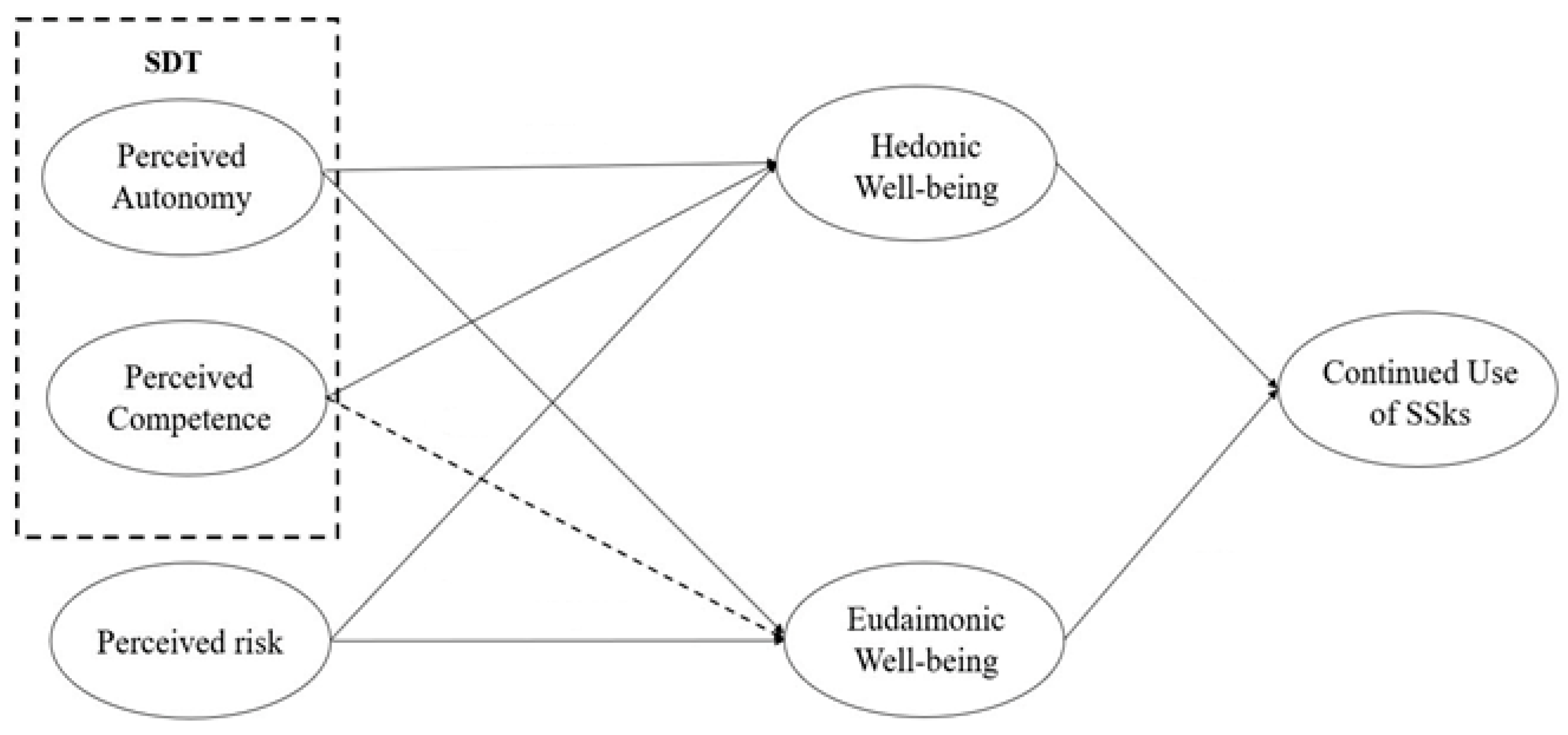
The model framework shown above proposes a framework to examine SDT dimensions, perceived risk, well-being, and continuous use intention among SSK users. The framework proposes that perceived autonomy, perceived competence, and perceived risk serve as antecedents to hedonic well-being and eudaimonic well-being. Greater perceived autonomy and competence were proposed to positively influence well-being while perceived risk was proposed to have a negative influence. Both hedonic and eudaimonic well-being are proposed to be positive influences on the continuous use intention of users.

3. Methodology

3.1. Data Collection

The questionnaire was originally developed in English and subsequently translated into Korean by a bilingual researcher. To ensure linguistic equivalence and clarity, the translated version was reviewed by native Korean-speaking graduate students and faculty members. Based on their feedback, revisions were made, followed by a pilot test involving 20 adults residing in South Korea to evaluate item clarity and response ease. After minor refinements, the final questionnaire was finalized, and data collection was conducted to examine the proposed research model (see Figure 1).
The study targeted Korean customers aged 18 years and older who had used self-service kiosks at restaurants in South Korea within the preceding three months. Data were collected through online. To collect data, an online questionnaire was developed using Google’s survey platform. A non-probability sampling approach was employed, primarily based on convenience sampling and supplemented by a snowball sampling technique. Once created, the survey was distributed online to participants, including university faculty, students, and professionals in the tourism and hospitality industry. In addition, respondents were encouraged to share the survey link with their acquaintances. The survey introduction outlined the study’s purpose and included an informed consent statement. Informed consent information was shared with all study participants. To continue with the survey, participants had to agree to the informed consent information and participants were free to discontinue the survey if they chose to. According to the regulations of the university that oversaw the research study, non-interventional studies that do not use personally identifiable information are considered exempt under the university’s regulations. Consequently, this research study was exempted because the study did not involve direct intervention or sensitive information. Data collection took place from 10 October 2024 for one month, yielding a total of 370 responses. After screening the data, 10 responses were removed due to incompleteness, resulting in 360 valid cases for analysis. Regarding sample adequacy, prior methodological guidelines recommend a minimum sample size of 5 to 20 times the number of estimated parameters, with at least 150 observations required for structural equation modeling [58]. Based on these criteria, the final sample size of 360 was considered sufficient for subsequent analyses.

3.2. Construct Measurement

To measure each construct, this study used measurement items that have been found to be reliable and valid in previous studies. Perceived risk was measured with eight items that were drawn from previous studies (e.g., “Personal information could be exposed when using a kiosk at a restaurant,” “Personal information when using a kiosk at a restaurant may be stolen by others”) [59,60]. Two dimensions of SDT with eight items were adopted from previous studies [61,62]. Well-being was measured using nine items (e.g., “Using restaurant SSKs made me feel at ease,” “Using restaurant SSKs was fun”) drawn from previous studies [63,64]. As these measurement items indicate, well-being was measured as a state characteristic in the context of a single service experience. Continued use of SSKs was measured with three items (e.g., “I intend to use the SSKs at restaurants in the future,” “I will always try to use SSKs at restaurants”) drawn from [65] All measurement items were measured on a five-point Likert scale, ranging from 1 (strongly disagree) to 5 (strongly agree). Questions regarding respondents’ demographic profiles were also included in the final section.

3.3. Data Analysis

Data were analyzed using the Statistical Package for the Social Sciences (SPSS) version 30. Confirmatory factor analysis (CFA) was conducted to assess the reliability and validity of the measurement constructs. Subsequently, structural equation modeling (SEM) was performed using SPSS and AMOS version 30 to test the proposed research model and hypotheses. Structural equation modeling (SEM) was chosen as it allows simultaneous estimation of multiple relationships among latent constructs while accounting for measurement error. Given that the current research includes several latent constructs and examines complex relationships between constructs, including indirect effects, SEM was considered an appropriate analytical approach.

4. Results

4.1. Profile of Respondents

A total of 360 valid responses were included in the final analysis. As shown in Table 1, the sample comprised 53.3% females and 46.7% males. Respondents in their 30s represented the largest age group (28.1%), followed by those in their 40s (25.6%), and 20s (23.1%), while participants aged 60 and above accounted for 6.4% of the sample. Just over half of the respondents were single (51.7%). Office workers constituted the largest occupational group (46.9%). Most respondents held a university degree (71.4%). In terms of monthly income, the largest group in the sample reported earnings between USD 4001 and 6000 (30.8%), followed by those who reported a monthly income of USD 2001–4000 (26.7%).

4.2. Confirmatory Factor Analysis

Prior to evaluating the measurement and structural models, the dataset was examined for potential violations of normality assumptions. Normality was assessed by inspecting skewness and kurtosis values using SPSS (version 30). The results indicated that skewness values for all items were below 1.0 and kurtosis values were below 2.0, suggesting an acceptable approximation of normal distribution (see Table 2).
Following confirmation of normality, Harman’s single-factor test was conducted by loading all measurement items into an unrotated exploratory factor analysis to assess potential common method bias [66]. The analysis revealed that the largest proportion of variance explained by a single factor was 30.06%, which is below the recommended threshold of 50% [67]. In addition, a common latent factor approach was implemented in AMOS by allowing all latent constructs to load onto a single method factor. A comparison between the original CFA model and the common-factor model showed that differences in factor loadings ranged from 0.00 to 0.12, remaining below the suggested cutoff of 0.20 [68]. Collectively, these findings indicate that common method variance is unlikely to pose a significant concern to the study’s findings. To assess the reliability and validity of the measurement model, confirmatory factor analysis (CFA) was performed. The standardized factor loadings exceeded the recommended threshold of 0.50, ranging from 0.58 to 0.92, and were statistically significant at p < 0.001 (see Table 2). During this process, one item measuring perceived autonomy (i.e., “I felt that my ordering choices were based on my true preferences”) was removed due to a factor loading below the recommended cutoff. All remaining measurement items were retained for subsequent analyses.
Composite reliability (CR) values ranged from 0.76 to 0.95, while average variance extracted (AVE) values ranged from 0.52 to 0.71. These results demonstrated satisfactory convergent validity, as all CR values exceeded the 0.70 criterion and AVE values surpassed the 0.50 benchmark, in accordance with established guidelines [69]. Discriminant validity was evaluated by comparing the square roots of the AVEs for each construct with the corresponding inter-construct correlations. As shown in Table 3, all correlation coefficients were lower than the square roots of the AVEs, indicating satisfactory discriminant validity [70]. The final measurement model results revealed that χ2 = 736.95; df = 309; χ2/df = 2.39; p < 0.001; CFI = 0.94, NFI = 0.90, IFI = 0.94, TLI = 0.93, RMR = 0.04. Based on these results, the final measurement model exhibited a good fit to the data.

4.3. Structural Model Testing

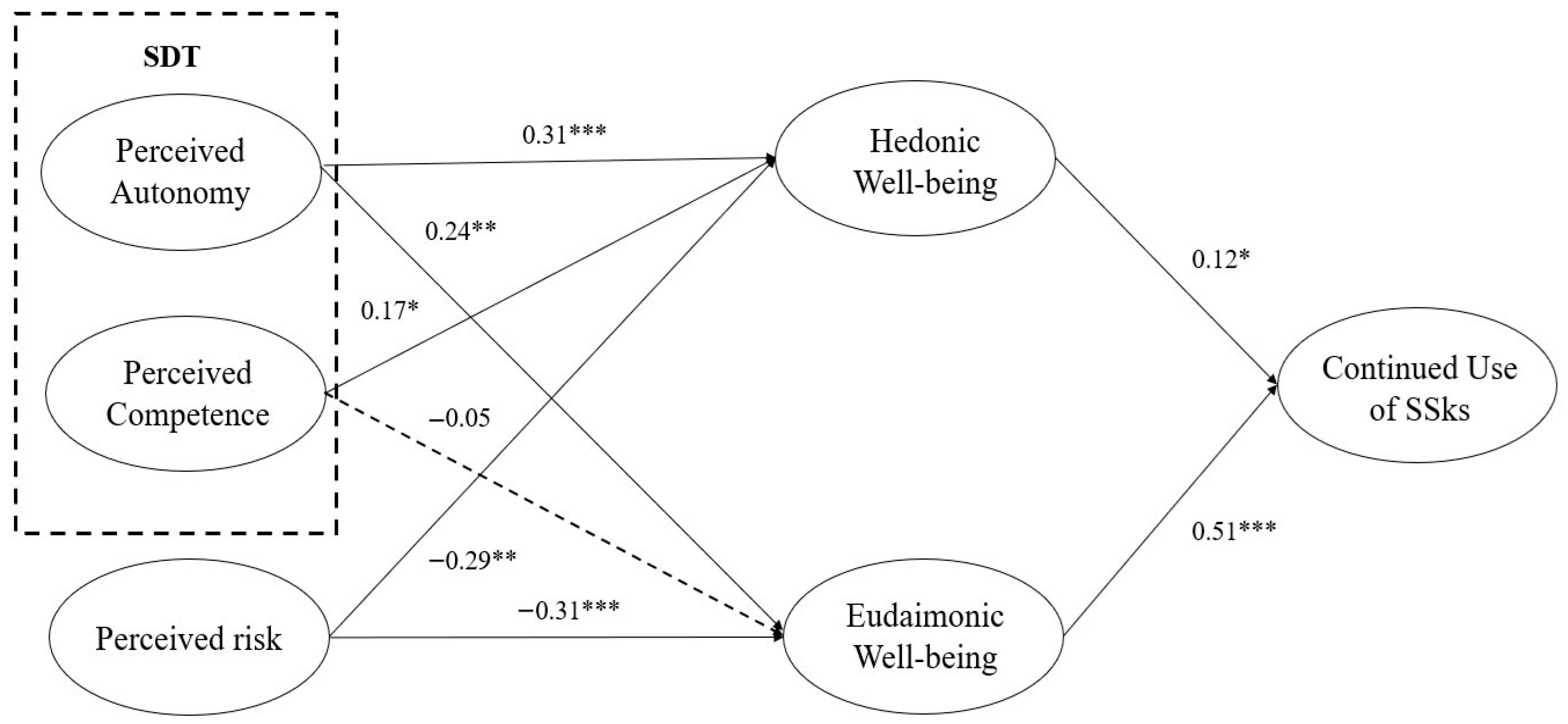
AMOS version 30 was employed for SEM so that hypothesized relationships in the measurement model could be tested. Strong fit with the data was shown by the model: χ2 = 768.76; df = 305; p < 0.001; CFI = 0.93, GFI = 0.89, IFI = 0.93, TLI = 0.92, NFI = 0.90, RMSEA = 0.05. The findings indicated that perceived autonomy positively and significantly affected both well-being dimensions: hedonic well-being (β = 0.31, t = 4.30, p < 0.001) and eudaimonic well-being (β = 0.24, t = 3.25, p < 0.01). The results showed that perceived autonomy had a modest effect on hedonic well-being and eudaimonic well-being. Perceived competence positively influenced hedonic well-being (β = 0.17, t = 2.05, p < 0.05). The effect size demonstrated was small. However, perceived competence did not show a statistically significant effect on eudaimonic well-being (β = −0.05, t = −0.57, p = 0.65). Perceived risk had a negative influence on hedonic well-being (β = −0.29, t = −4.18, p < 0.01), and eudaimonic well-being (β = −0.31, t = −4.27, p < 0.001). The results showed that perceived risk had a modest effect on hedonic well-being and eudaimonic well-being. The two dimensions of well-being and continued use intention of SSKs were investigated together. Both hedonic well-being (β = 0.12, t = 2.01, p < 0.05), and eudaimonic well-being (β = 0.51, t = 7.74, p < 0.001) were found to significantly and positively influence continued intention to use SSKs. Hedonic well-being had a small effect on use intention, but eudaimonic well-being demonstrated a strong effect on use intention. Accordingly, most hypotheses (H1–H3, H5–H8) were supported, with the exception of Hypothesis 4, as depicted in Figure 2 and Table 4.
As a result of verifying the indirect effect using the bootstrapping method, it was found that perceived risk had a significant indirect effect on the intention to continue using through hedonic well-being and eudaimonic well-being (indirect effect = 0.20, p < 0.01). In addition, perceived autonomy also showed a significant indirect effect on the intention to continue using through the two well-being constructs (indirect effect = 0.14, p < 0.01). On the other hand, in the case of perceived competence, the indirect effects through well-being constructs were not found to be statistically significant (indirect effect = 0.00, p = 0.939). These results suggest that perceived risk and perceived autonomy affect the intention to continue using through well-being constructs, while perceived competence does not significantly influence the corresponding path. To assess potential multicollinearity concerns, variance inflation factor (VIF) values were examined. As reported in Table 4, all VIF values were below the recommended threshold of 5.0 [71], with the highest VIF value being 1.66 for the relationship between perceived autonomy and eudaimonic well-being and perceived risk and hedonic well-being. It suggests that multicollinearity is unlikely to have a substantial impact on the estimation of the structural model.

5. Discussion

This study empirically examined how autonomy and competence, two core components of Self-Determination Theory (SDT), and perceived risk influenced hedonic and eudaimonic well-being. It also examined how these well-being dimensions subsequently affected continued use intention of restaurant SSKs.
The results provide strong support for the role of autonomy in shaping both dimensions of well-being. Specifically, autonomy was found to have a significant positive effect on hedonic well-being and eudaimonic well-being. Thus, both Hypothesis 1 and Hypothesis 2 were supported. These findings are consistent with the SDT literature, which emphasizes autonomy as a fundamental psychological need that enhances positive affect, enjoyment, and psychological fulfillment [21,32]. This means that the more customers can freely order on their own or have independence when ordering using kiosks at restaurants, the more enjoyable or fulfilling they feel to use kiosks for orders. It demonstrates that autonomy-supportive kiosk features, such as flexible navigation and order customization, contribute not only to immediate pleasure but also to deeper experiences of meaning and self-endorsed engagement.
Regarding the influence of competence on well-being, the findings partially supported the proposed hypotheses. Competence had a significant positive effect on hedonic well-being, whereas its effect on eudaimonic well-being was not statistically significant. Accordingly, Hypothesis 3 was supported, while Hypothesis 4 was not. This pattern suggests that feeling capable and effective when using kiosks primarily enhances enjoyment and emotional comfort rather than deeper forms of psychological fulfillment. While prior research has linked competence to long-term growth and resilience [41,42], the current findings imply that in routine, transactional service contexts such as restaurant kiosks, competence may function more as a facilitator of smooth and pleasant experiences than as a source of meaning or self-realization.
As hypothesized, perceived risk had a significant negative effect on both hedonic well-being and eudaimonic well-being. Therefore, Hypothesis 5 and Hypothesis 6 were supported. This finding reinforces prior evidence that perceived risk heightens anxiety and uncertainty, thereby diminishing enjoyment and emotional satisfaction [44,45]. Importantly, the negative association with eudaimonic well-being extends existing research by showing that perceived risk undermines not only momentary affect but also customers’ sense of control, purpose, and meaningful engagement. This result aligns with studies demonstrating that perceived threats and barriers constrain opportunities for personal growth and psychological flourishing [49,51]. In kiosk settings, concerns related to payment security, privacy, or system malfunction appear to disrupt both experiential and meaning-oriented dimensions of well-being.
Finally, the results confirm the pivotal role of subjective well-being in driving continued use intention of SSKs. Both hedonic well-being and eudaimonic well-being positively influenced customers’ intention to continue using self-service kiosks. Thus, both Hypothesis 7 and Hypothesis 8 were supported. This finding is consistent with prior SST and digital service research emphasizing the importance of enjoyment and positive affect for continued usage [55]. Moreover, the significant effect of eudaimonic well-being highlights that sustained kiosk use is not driven solely by pleasure or convenience, but also by deeper psychological experiences related to self-sufficiency, competence, and meaningful engagement, supporting arguments advanced by [56,57]. Taken together, the findings indicate that self-service kiosks should be understood not merely as efficiency-enhancing technologies but as psychologically meaningful service environments.
Furthermore, the findings should be interpreted within the cultural and technological context of South Korea, where digital service technologies, including self-service kiosks, are widely adopted and customers are generally familiar with technology-mediated interactions. Prior research has shown that customers, particularly younger consumers, are highly accustomed to using kiosks in restaurant settings, valuing both the time efficiency and the sense of autonomy provided by self-service technologies [68]. In this context, competence for kiosk use can be taken for granted, which can play a relatively limited role in shaping deeper psychological outcomes such as eudaimonic well-being. Instead, the autonomy associated with kiosks use, which allows customers to independently navigate the ordering process without direct interaction with employees, becomes a more salient factor in enhancing both experiential and meaningful aspects of the service experience. These findings may also be partially explained by the characteristics of the sample. Given that a substantial number of respondents were younger than 60, autonomy in using kiosk technology may be perceived as more meaningful and influential in shaping their experience.
The present findings extend prior technology adoption research grounded in models such as the Technology Acceptance Model (TAM) and the Unified Theory of Acceptance and Use of Technology (UTAUT). While these models emphasize utilitarian factors such as perceived usefulness and ease of use, the current research demonstrates that psychological needs and well-being play a critical role in shaping continued use intention. In particular, the inclusion of hedonic and eudaimonic well-being provides a more comprehensive understanding of customers’ experience beyond functional evaluations, thereby offering a complementary perspective to traditional technology acceptance frameworks.
In this study, autonomy emerged as the most robust predictor of both hedonic and eudaimonic well-being, underscoring its central role in non-face-to-face, technology-mediated services. Competence enhanced hedonic well-being but appears less critical for eudaimonic well-being in routine service encounters. Perceived risk was found to undermine both dimensions of well-being. Subjective well-being served to enhance continuous use intention of SSKs. Based on these findings, theoretical and practical implications are suggested.

6. Implications

6.1. Theoretical Implications

Firstly, the results revealed that both autonomy and competence exerted significant positive effects on hedonic well-being, whereas perceived risk had a significant negative effect on hedonic well-being. These findings suggest that when users perceive a high level of choice, control, and proficiency during the kiosk ordering process, they experience greater enjoyment and pleasure. In contrast, concerns related to payment errors, privacy breaches, or usage failure increase psychological burden and hinder positive affective experiences. This finding extended previous SDT research by demonstrating that users’ autonomy and competence were influential in a non-face-to-face service environment. These SDT dimensions can influence well-being psychological constructs in SSK contexts. The influence they have in other SST contexts may also be investigated by future researchers to continue to enhance understanding of these dimensions in SST contexts.
Secondly, with respect to eudaimonic well-being, autonomy was found to have a significant positive effect on it, while perceived risk had a significant negative effect on eudaimonic well-being. Competence did not exhibit a significant influence on eudaimonic well-being. This finding indicates that autonomous choice and perceived control during technology use may foster a sense of meaning and self-realization, whereas mere proficiency in using a system does not necessarily translate into deeper, purpose-driven well-being. Competence may play a limited role in cultivating eudaimonic well-being in an SSK service experience. It was also found that perceived competence did not have an indirect effect on use intention. These findings may suggest boundary conditions of this SDT construct in a non-face-to-face service environment as such findings are contrary to what may be expected of this SDT dimension in an SST context. This pattern may be interpreted in light of the sample characteristics, as the majority of respondents were in their 20s and 30s. For younger users, competence in kiosk use may overlap with their routine digital literacy and thus be perceived as a basic requirement rather than a source of personal growth or self-actualization. Nevertheless, this points to the need for further research about this SDT dimension in SST contexts as this finding may characterize specific demographic segments or may only characterize certain populations. The negative effect of perceived risk on eudaimonic well-being suggests that anxiety and uncertainty experienced in non-face-to-face service encounters can undermine individuals’ positive evaluations of life meaning and value formation. This also points to an area where theoretical advances can be made in exploring perceived risk in SST contexts.
Thirdly, the results demonstrated that both hedonic and eudaimonic well-being positively influenced continued use intention. This finding highlights that users’ behavioral intentions are shaped not only by immediate pleasure and satisfaction but also by deeper psychological experiences grounded in meaning and personal fulfillment. In other words, continued use intention toward self-service kiosks extends beyond evaluations of functional efficiency and is reinforced by subjective well-being formed through the service experience. Well-being dimensions in SST contexts have been underexplored in research to date. This study helped to advance understanding of well-being in this context. Psychological constructs may be examined further in different contexts to further determine influences on continuous use intention in SST settings.
Taken together, this study provides empirical evidence that core SDT dimensions and perceived risk influence well-being, and well-being can influence continuous use intention in an SSK environment. Furthermore, perceived autonomy and perceived risk were found to have an indirect effect on continuous use intention through well-being in this study. By integrating a well-being perspective into SST research, this study advances existing technology acceptance literature and underscores the importance of considering users’ psychological experiences in understanding sustained technology use.

6.2. Practical Implications

Firstly, service designs that simultaneously enhance users’ autonomy and competence are essential. Given that both autonomy and competence positively influenced hedonic well-being, self-service kiosk systems should be designed to allow users to experience a strong sense of choice, control, and proficiency during the ordering process. Practical design strategies include providing step-by-step options, flexible modification and cancellation functions, intuitive menu structures, and clear feedback with actionable solutions when errors occur. Such design features can foster psychological fulfilment by enabling users to feel in control and capable, thereby enhancing both immediate enjoyment and comfort during use. In addition, autonomy-supportive design may facilitate more meaningful engagement, which can ultimately strengthen long-term use intention. These strategies may be particularly beneficial for customers with low technology familiarity or limited experience with non-face-to-face services and for whom autonomy and competence support can reduce usage barriers and improve overall service experiences.
Secondly, managing perceived risk and building trust are critical managerial priorities. The finding that perceived risk negatively affected both dimensions of well-being suggests that reducing customers’ psychological burden is essential for successful kiosk adoption and continued use. Measures such as ensuring payment security, strengthening personal data protection, and providing clear guidance for immediate customer support in case of system failure can effectively reduce perceived risk and enhance service trust. By alleviating anxiety and uncertainty during the service encounter, such strategies support customers’ sense of control and meaningful engagement, thereby contributing to higher eudaimonic well-being, ultimately, fostering long-term behavioral intention and positive usage behavior.

6.3. Study Limitations and Future Research

Despite its contributions, this study has several limitations that point to important directions for future research. First, the sample consisted predominantly of respondents in their 20s to 40s, which limits the generalizability of the findings across age groups. As self-service kiosks may impose greater cognitive burden and usage barriers for older adults, future studies should include a larger proportion of participants aged 60 and above and conduct comparative analyses across age groups. Older users may perceive competence and risk differently from younger users, and examining these differences could provide deeper insights into the mechanisms through which both hedonic and eudaimonic well-being are formed during kiosk use.
Second, related to the age imbalance noted above, this study relied on convenience sampling for data collection. The use of convenience sampling may have introduced sampling bias, as the resulting sample may not fully represent the target population, thereby further limiting the generalizability of the study findings. In particular, the response rate among participants aged 60 and above was relatively low. It remains unclear whether this reflects older adults’ avoidance of restaurants equipped with self-service kiosks or whether it is an incidental outcome of convenience sampling. Accordingly, future research should examine this issue more systematically using alternative sampling strategies.
Third, perceived risk was operationalized as a unidimensional construct in this study. However, technology-based services can involve multiple forms of risk including financial, privacy, performance, time, and psychological risk. Future research could examine these risk dimensions separately to better capture their differential effects on customers’ experiences with self-service kiosks. Moreover, incorporating user characteristics such as age and technology familiarity may facilitate the development of more tailored and inclusive service design strategies for diverse user groups.

7. Conclusions

This study advanced understanding of how psychological needs and perceived risk shaped SSK user experiences. It demonstrated that SDT dimensions (i.e., autonomy and competence) both influenced hedonic well-being positively. However, only perceived autonomy significantly influenced hedonic well-being. This suggests that competence does not result in deeper fulfillment. Perceived risk negatively affected both well-being dimensions in this study. Such results indicate that perceived autonomy and perceived risk may be stronger drivers of well-being in the context of SSK use. Well-being was found to be a critical mechanism that influenced continuous use intention. Both well-being dimensions had a significant positive influence on use intention in this study. By investigating SDT dimensions and well-being, the psychological complexity of users’ SSK experiences was elucidated. Study findings provide insights into the psychological components of user’s experiences and can be used to inform future academic research and can inform future SSK design and use.

Author Contributions

Conceptualization, H.Y. and S.A.; methodology, H.Y.; validation, H.Y.; formal analysis, H.Y.; Investigation, H.Y.; data curation, H.Y.; writing—original draft, H.Y., L.J., S.A. and T.E.; writing—review and editing, L.J., S.A. and T.E.; visualization, H.Y.; supervision, H.Y.; project administration, H.Y. All authors have read and agreed to the published version of the manuscript.

Funding

This research received no external funding.

Institutional Review Board Statement

Ethical review and approval were waived for this study due to the study being a non-interventional survey-based research study.

Informed Consent Statement

Informed consent was obtained from all subjects involved in the study.

Data Availability Statement

The raw data supporting the conclusions of this article will be made available by the authors on request.

Conflicts of Interest

The authors declare no conflicts of interest.

References

  1. Baba, N.; Hanafiah, M.H.; Mohd Shahril, A.; Zulkifly, M.I. Investigating customer acceptance, usage, trust, and perceived safety risk of self-ordering kiosk technology in Malaysian quick-service restaurants during COVID-19 pandemic. J. Hosp. Tour. Technol. 2023, 14, 309–329. [Google Scholar] [CrossRef]
  2. Grand View Research. Self-Service Kiosk Market Size, Share & Trends Analysis Report by Product, Application, Region, and Segment Forecasts 2025–2030. Available online: https://www.grandviewresearch.com/industry-analysis/self-service-kiosk-market-report (accessed on 31 January 2026).
  3. Brewer, P.; Sebby, A.G. The effect of online restaurant menus on consumers’ purchase intentions during the COVID-19 pandemic. Int. J. Hosp. Manag. 2021, 94, 102777. [Google Scholar] [CrossRef]
  4. Kim, J.K.; Yang, J.J.; Lee, Y.K. How do self-service kiosks improve COVID-19 pandemic resilience in the restaurant industry? Sustainability 2023, 15, 10168. [Google Scholar] [CrossRef]
  5. Kim, J.; Christodoulidou, N.; Choo, Y. Factors influencing customer acceptance of kiosks at quick service restaurants. J. Hosp. Tour. Technol. 2013, 4, 40–63. [Google Scholar] [CrossRef]
  6. Kim, Y.H.; Kim, D.J.; Wachter, K. A study of mobile user engagement (MoEN): Engagement motivations, perceived value, satisfaction, and continued engagement intention. Decis. Support Syst. 2013, 56, 361–370. [Google Scholar] [CrossRef]
  7. Statista. Digital Lifestyles in South Korea. Available online: https://www.statista.com/topics/9057/digital-lifestyles-in-south-korea (accessed on 17 December 2025).
  8. Chosun Ilbo. One in Ten Restaurants Adopts Self-Service Kiosks Amid Labor Shortages. Available online: https://www.chosun.com/economy/economy_general/2025/12/18/OFSQ75KYMNGBHDHTAG5OA2QEOU/?utm_source (accessed on 18 December 2025).
  9. Park, S.; Kwun, D.J.; Park, J.Y.; Bufquin, D. Service quality dimensions in hotel service delivery options: Comparison between human interaction service and self-service technology. Int. J. Hosp. Tour. Adm. 2022, 23, 931–958. [Google Scholar] [CrossRef]
  10. Park, D.H.; Bae, Y.N. Proposed UI design for café kiosks for seniors: Focusing on heuristic evaluation. Int. J. Adv. Smart Converg. 2024, 13, 395–402. [Google Scholar]
  11. Feng, W.; Tu, R.; Lu, T.; Zhou, Z. Understanding forced adoption of self-service technology: The impacts of users’ psychological reactance. Behav. Inf. Technol. 2019, 38, 820–832. [Google Scholar] [CrossRef]
  12. Stone, R.N.; Grønhaug, K. Perceived risk: Further considerations for the marketing discipline. Eur. J. Mark. 1993, 27, 39–50. [Google Scholar] [CrossRef]
  13. Yordam Dağıstan, S.; Sevim, B.; Arici, H.E.; Saydam, M.B.; Köseoglu, M.A. Perceived risk in hospitality and tourism: Scholarship: A systematic review and future research agenda. J. Travel Tour. Mark. 2023, 40, 863–877. [Google Scholar] [CrossRef]
  14. Liu, S.Q.; Bilgihan, A.; Kandampully, J. The intersection of technology, sustainability and consumer experiences in hospitality and tourism for new horizons. J. Hosp. Tour. Horiz. 2025, 1, 87–109. [Google Scholar] [CrossRef]
  15. Xu, Y.; Jeong, E.; Baiomy, A.E.; Shao, X. Investigating onsite restaurant interactive self-service technology (ORISST) use: Customer expectations and intentions. Int. J. Contemp. Hosp. Manag. 2020, 32, 3335–3360. [Google Scholar] [CrossRef]
  16. Yang, T.; Lai, I.K.W.; Fan, Z.B.; Mo, Q.M. Interactive service quality on the acceptance of self-service ordering systems for the restaurant industry. J. Hosp. Tour. Technol. 2021, 12, 271–286. [Google Scholar]
  17. Park, J.W.; Lee, H.R. The effect of fast-food restaurant customers’ kiosk use on acceptance intention and continuous use intention: Applying UTAUT2 model and moderating effect of familiarity. J. Tour. Sci. 2020, 44, 207–228. [Google Scholar]
  18. Mo, W.Y.; Xu, X. An Investigation of the Consumers’ Experience Satisfaction and Extension for Self-Service Technology of Hong Kong Fast-Food Restaurants during the COVID-19 Epidemic. Eur. J. Bus. Manag. Res. 2026, 11, 14–27. [Google Scholar]
  19. Zaitouni, M.; Murphy, K.S. Self-Service Technologies (SST) in the US Restaurant industry: An evaluation of consumer perceived value, satisfaction, and continuance intentions. J. Foodserv. Bus. Res. 2025, 28, 245–276. [Google Scholar] [CrossRef]
  20. Abolnasser, M.S.A.; Abdou, A.H.; Hassan, T.H.; Salem, A.E. Transformational leadership, employee engagement, job satisfaction, and psychological well-being among hotel employees after the height of the COVID-19 pandemic: A serial mediation model. Int. J. Environ. Res. Public Health 2023, 20, 3609. [Google Scholar]
  21. Ryan, R.M.; Deci, E.L. Self-Determination Theory and the facilitation of intrinsic motivation, social development, and well-being. Am. Psychol. 2000, 55, 68–78. [Google Scholar] [CrossRef]
  22. Ryan, R.M.; Deci, E.L. Self-Determination Theory: Basic Psychological Needs in Motivation, Development, and Wellness; Guilford Publications: New York, NY, USA, 2017. [Google Scholar]
  23. Peters, D.; Calvo, R.A.; Ryan, R.M. Designing for motivation, engagement and wellbeing in digital experience. Front. Psychol. 2018, 9, 300159. [Google Scholar] [CrossRef]
  24. Howard, J.L.; Bradshaw, E.L.; Ryan, R.M. Future directions for Self-Determination Theory: Introduction to the special issue. Motiv. Emot. 2025, 1–12. [Google Scholar] [CrossRef]
  25. Ryan, R.M.; Deci, E.L. Intrinsic and extrinsic motivations: Classic definitions and new directions. Contemp. Educ. Psychol. 2000, 25, 54–67. [Google Scholar] [CrossRef]
  26. Chiu, Y.T.H.; Nguyen, D.M. Service failure and self-recovery in tech-based services: Self-Determination Theory perspective. Serv. Ind. J. 2022, 42, 1075–1100. [Google Scholar] [CrossRef]
  27. Hong, E.; Ahn, J. The role of autonomy, competence and relatedness in motivation to use self-service technology (SST) among customers with difficulties in SST. J. Hosp. Tour. Technol. 2023, 14, 630–642. [Google Scholar] [CrossRef]
  28. Chiu, Y.T.H.; Nguyen, D.M.; Hofer, K.M. Self-recovery after self-service technology failures: Do motivations and self-efficacy matter? Int. J. Retail Distrib. Manag. 2023, 51, 1195–1212. [Google Scholar] [CrossRef]
  29. Ma, H.; Kwon, J.; Ahn, J. The impact of regulations and motivations on behavioural intentions of customers with self-service technology difficulties. Curr. Issues Tour. 2024, 27, 142–153. [Google Scholar] [CrossRef]
  30. Loan, P.T.B.; Huyen, T.K.; Thu, N.B.M.; Na, L.T.L.; Linh, N.T.P. Investigating users’ behavioral intention toward public self-service technologies (SSTS) based on intrinsic motivation and self-service technology quality. J. Sci. Technol. Univ. Danang 2025, 23, 32–41. [Google Scholar] [CrossRef]
  31. Chirkov, V.I.; Ryan, R.M. Parent and teacher autonomy-support in Russian and US adolescents: Common effects on well-being and academic motivation. J. Cross Cult. Psychol. 2001, 32, 618–635. [Google Scholar]
  32. Church, A.T.; Katigbak, M.S.; Locke, K.D.; Zhang, H.; Shen, J.; de Jesús Vargas-Flores, J.; Ibáñez-Reyes, J.; Tanaka-Matsumi, J.; Curtis, G.J.; Cabrera, H.F.; et al. Need satisfaction and well-being: Testing Self-Determination Theory in eight cultures. J. Cross Cult. Psychol. 2013, 44, 507–534. [Google Scholar] [CrossRef]
  33. Arroyo, J.C.; Díaz, R.P.; Giuliani, A.C. El futuro de la cultura de consumo en América Latina. Posibles caminos y consecuencias. Inven. Rev. Investig. Acad. 2012, 29, 45–54. [Google Scholar]
  34. Bassi, M.; Bacher, G.; Negri, L.; Delle Fave, A. The contribution of job happiness and job meaning to the well-being of workers from thriving and failing companies. Appl. Res. Qual. Life 2013, 8, 427–448. [Google Scholar] [CrossRef]
  35. Gilbert, M.H.; Dagenais-Desmarais, V.; St-Hilaire, F. Transformational leadership and autonomy support management behaviors: The role of specificity in predicting employees’ psychological health. Leadersh. Organ. Dev. J. 2017, 38, 320–332. [Google Scholar] [CrossRef]
  36. Ryan, R.M.; Deci, E.L. On happiness and human potentials: A review of research on hedonic and eudaimonic well-being. Annu. Rev. Psychol. 2001, 52, 141–166. [Google Scholar] [CrossRef]
  37. Gillet, N.; Fouquereau, E.; Forest, J.; Brunault, P.; Colombat, P. The impact of organizational factors on psychological needs and their relations with well-being. J. Bus. Psychol. 2012, 27, 437–450. [Google Scholar] [CrossRef]
  38. León, J.; Núñez, J.L. Causal ordering of basic psychological needs and well-being. Soc. Indic. Res. 2013, 114, 243–253. [Google Scholar] [CrossRef]
  39. Rosen, L.N.; Moghadam, L.Z. Social support, family separation, and well-being among military wives. Behav. Med. 1988, 14, 64–70. [Google Scholar] [CrossRef]
  40. Thrash, T.M.; Elliot, A.J.; Maruskin, L.A.; Cassidy, S.E. Inspiration and the promotion of well-being: Tests of causality and mediation. J. Pers. Soc. Psychol. 2010, 98, 488–497. [Google Scholar] [CrossRef]
  41. Fredrickson, B.L.; Grewen, K.M.; Algoe, S.B.; Firestine, A.M.; Arevalo, J.M.; Ma, J.; Cole, S.W. Psychological well-being and the human conserved transcriptional response to adversity. PLoS ONE 2015, 10, e0121839. [Google Scholar] [CrossRef]
  42. Nikolaev, B.N.; Lerman, M.P.; Boudreaux, C.J.; Mueller, B.A. Self-employment and eudaimonic well-being: The mediating role of problem- and emotion-focused coping. Entrep. Theory Pract. 2023, 47, 2121–2154. [Google Scholar] [CrossRef]
  43. Halvari, A.E.M.; Halvari, H.; Deci, E.L.; Williams, G.C. Autonomy-supportive dental treatment, oral health-related eudaimonic well-being and oral health: A randomized clinical trial. Psychol. Health 2019, 34, 1421–1436. [Google Scholar] [CrossRef]
  44. Chaudhuri, A.; Aboulnasr, K.; Ligas, M. Emotional responses on initial exposure to a hedonic or utilitarian description of a radical innovation. J. Mark. Theory Pract. 2010, 18, 339–359. [Google Scholar] [CrossRef]
  45. Nawijn, J.; Mitas, O. Resident attitudes to tourism and their effect on subjective well-being: The case of Palma de Mallorca. J. Travel Res. 2012, 51, 531–541. [Google Scholar] [CrossRef]
  46. Xu, G.; Feng, X.; Li, Y.; Chen, X.; Jia, J. Environmental risk perception and its influence on well-being. Chin. Manag. Stud. 2017, 11, 35–50. [Google Scholar] [CrossRef]
  47. Zhang, X.; Ma, L.; Wang, G.S. Factors influencing users’ subjective well-being: An empirical study based on shared bicycles in China. Inf. Discov. Deliv. 2017, 45, 202–211. [Google Scholar] [CrossRef]
  48. Cui, F.; Liu, Y.; Chang, Y.; Duan, J.; Li, J. An overview of tourism risk perception. Nat. Hazards 2016, 82, 643–658. [Google Scholar] [CrossRef]
  49. Paleari, F.G.; Pivetti, M.; Galati, D.; Fincham, F.D. Hedonic and eudaimonic well-being during the COVID-19 lockdown in Italy: The role of stigma and appraisals. Br. J. Health Psychol. 2021, 26, 657–678. [Google Scholar] [CrossRef]
  50. Tian, J.; Sardina, A.; Allan, A.; Gamaldo, A.; Mogle, J. Relationship between leisure constraints and well-being in middle to older adults. Innov. Aging 2023, 7, 1109. [Google Scholar] [CrossRef]
  51. Höge, T.; Strecker, C.; Hausler, M.; Huber, A.; Höfer, S. Perceived socio-moral climate and the applicability of signature character strengths at work: A study among hospital physicians. Appl. Res. Qual. Life 2019, 15, 463–484. [Google Scholar] [CrossRef]
  52. Wang, Y.S.; Shih, Y.W. Why do people use information kiosks? A validation of the Unified Theory of Acceptance and Use of Technology. Gov. Inf. Quar. 2009, 26, 158–165. [Google Scholar] [CrossRef]
  53. Kim, H.J.; Lee, J.M. Consumers’ resistance and continued use intention of self-service kiosk. Hum. Ecol. Res. 2020, 58, 401–416. [Google Scholar] [CrossRef]
  54. Keating, B.W.; Aslan, M. Self-service technology recovery: The importance of psychological need support. J. Serv. Manag. 2023, 34, 725–749. [Google Scholar] [CrossRef]
  55. Na, T.K.; Yang, J.Y.; Lee, S.H. Determinants of behavioral intention of the use of self-order kiosks in fast-food restaurants: Focus on the moderating effect of age difference. SAGE Open. 2021, 11, 21582440211031907. [Google Scholar] [CrossRef]
  56. Freire, C.; Ferradás, M.D.M.; Núñez, J.C.; Valle, A.; Vallejo, G. Eudaimonic well-being and coping with stress in university students: The mediating/moderating role of self-efficacy. Int. J. Environ. Res. Public Health 2019, 16, 48. [Google Scholar] [CrossRef]
  57. Lee, W.; Castellanos, C.; Choi, H.S. The effect of technology readiness on customers’ attitudes toward self-service technology and its adoption: The empirical study of US airline self-service check-in kiosks. J. Travel Tour. Mark. 2012, 29, 731–743. [Google Scholar] [CrossRef]
  58. Anderson, J.C.; Gerbing, D.W. Structural equation modeling in practice: A review and recommended two-step approach. Psychol. Bull. 1988, 103, 411–423. [Google Scholar] [CrossRef]
  59. Hwang, J.; Choe, J.Y. Exploring perceived risk in building successful drone food delivery services. Int. J. Contemp. Hosp. Manag. 2019, 31, 3249–3269. [Google Scholar] [CrossRef]
  60. Hwang, J.; Kim, H.; Kim, J.J.; Kim, I. Investigation of perceived risks and their outcome variables in the context of robotic restaurants. J. Travel Tour. Mark. 2021, 38, 263–281. [Google Scholar] [CrossRef]
  61. Chen, B.; Vansteenkiste, M.; Beyers, W.; Boone, L.; Deci, E.L.; Van der Kaap-Deeder, J.; Verstuyf, J. Basic psychological need satisfaction, need frustration, and need strength across four cultures. Motiv. Emot. 2015, 39, 216–236. [Google Scholar] [CrossRef]
  62. Kim, Y. Exploring the interplay of psychological need satisfaction, well-being, and behavioral intentions in tourism: A Self-Determination Theory perspective. J. Travel Res. 2026, 65, 222–241. [Google Scholar] [CrossRef]
  63. Huta, V.; Ryan, R.M. Pursuing pleasure or virtue: The differential and overlapping well-being benefits of hedonic and eudaimonic motives. J. Happiness Stud. 2010, 11, 735–762. [Google Scholar] [CrossRef]
  64. Voigt, C.; Howat, G.; Brown, G. Hedonic and eudaimonic experiences among wellness tourists: An exploratory enquiry. Ann. Leis. Res. 2010, 13, 541–562. [Google Scholar] [CrossRef]
  65. Cheng, Y.; Sharma, S.; Sharma, P.; Kulathunga, K.M.M.C.B. Role of personalization in continuous use intention of mobile news apps in India: Extending the UTAUT2 model. Information 2020, 11, 33. [Google Scholar] [CrossRef]
  66. Podsakoff, P.M.; MacKenzie, S.B.; Lee, J.Y.; Podsakoff, N.P. Common method biases in behavioral research: A critical review of the literature and recommended remedies. J. Appl. Psychol. 2003, 88, 879–903. [Google Scholar] [CrossRef]
  67. Podsakoff, P.M.; Organ, D.W. Self-reports in organizational research: Problems and prospects. J. Manag. 1986, 12, 531–544. [Google Scholar] [CrossRef]
  68. Williams, L.J.; Anderson, S.E. An alternative approach to method effects by using latent-variable models: Applications in organizational behavior research. J. Appl. Psychol. 1994, 79, 323–333. [Google Scholar] [CrossRef]
  69. Tabachnick, B.G.; Fidell, L.S. Using Multivariate Statistics, 7th ed.; Pearson: New York, NY, USA, 2019; pp. 60–116. [Google Scholar]
  70. Fornell, C.; Larcker, D.F. Evaluating structural equation models with unobservable variables and measurement error. J. Mark. Res. 1981, 18, 39–50. [Google Scholar] [CrossRef]
  71. Hair, J.F.; Black, W.C.; Babin, B.J.; Anderson, R.E. Multivariate Data Analysis: Pearson New International Edition, 7th ed.; Pearson: Upper Saddle River, NJ, USA, 2014. [Google Scholar]
Figure 1. Research framework: Self-Determination Theory (SDT), perceived risk, and well-being’s influence on continued use intention of self-service kiosks.
Sustainability 18 03387 g001
Figure 2. The result of SEM with standardized coefficients. Note: * p < 0.05; ** p < 0.01; *** p < 0.001.
Sustainability 18 03387 g002
Table 1. Demographic characteristics of respondents.
Frequency (n)Percentage (%)
Gender
Female19253.3
Male16846.7
Age groups
20s8323.1
30s10128.1
40s9225.6
50s6116.9
Over 60s236.4
Marital Status
Single18651.7
Married 17448.3
Occupation
Office worker16946.9
Self-employed3610.0
Professional298.1
Homemaker359.7
Government Employee154.2
Student226.1
Not employed4111.4
Other133.6
Education level
High school and below7220.0
University25771.4
Graduate school318.6
Monthly income (USD)
2000 and below349.4
2001–40009626.7
4001–600011130.8
6001–80006818.9
8001 and above5114.2
Total360100.0
Table 2. Confirmatory factor analysis.
Factors and ItemsStandardized LoadingS.E.Skew.Kurt.C.R.
Perceived autonomy (CR = 0.76, AVE = 0.52)
I felt free to order food in my own way using the SSKs0.71N/A−0.640.51N/A
I felt that my ordering choices reflected my ‘true self’0.780.10−0.32−0.0110.77
I felt a sense of choice and freedom while using the SSKs0.650.10−0.11−0.4410.04
Perceived competence (CR = 0.84, AVE = 0.58)
I felt confident that I could use the SSKs well0.82N/A−0.560.11N/A
I felt capable of ordering food using the SSKs0.770.06−1.121.2815.39
I felt competent in achieving my ordering goals using the SSKs0.660.06−0.570.2612.69
I felt that I could successfully compete my order using the SSKs0.780.06−1.141.4015.63
Perceived risk (CR = 0.95, AVE = 0.70)
Personal information could be exposed when using SSKs at a restaurant0.89N/A−0.750.03N/A
Personal information when using SSKs at a restaurant may be stolen by others.0.920.04−0.68−0.1827.32
I might get overcharged if I use SSKs restaurant.0.860.04−0.850.1823.61
It will take time to learn how to use SSKs restaurant0.820.05−0.51−0.5121.53
If I use SSKs restaurant, I am more likely to lose time because of switching to a new service0.880.04−0.87−0.0724.51
Using SSKs at a restaurant makes me feel nervous0.810.04−0.40−0.4521.04
The usage of kiosk at a restaurant would lead me to a psychological loss.0.710.05−0.50−0.3616.49
Using SSKs at a restaurant makes me feel anxiety0.780.04−0.720.0819.36
Hedonic well-being (CR = 0.90, AVE = 0.65)
Using SSKs at a restaurant made me feel at ease0.73N/A−0.50−0.24N/A
Using SSKs at a restaurant was fun0.790.07−0.37−0.2214.71
Using SSKs at a restaurant made me feel a sense of enjoyment0.790.07−0.30−0.2614.80
Using SSKs at a restaurant made me feel a sense of pleasure0.850.07−0.22−0.0915.94
Using SSKs at a restaurant made me feel a sense of relaxation0.850.07−0.22−0.1615.91
Eudaimonic well-being (CR = 0.86, AVE = 0.68)
Using SSKs at a restaurant helped me feel a sense of accomplishment and fulfillment.0.83N/A−0.550.49N/A
Using SSKs at a restaurant stimulated my reflection0.820.06−0.570.5316.87
Using SSKs at a restaurant made me feel a sense of relaxation0.820.06−0.42−0.0716.86
Continued Use of SSK (CR = 0.88, AVE = 0.71)
I intend to use the SSKs at a restaurant in the future 0.82N/A−0.23−0.27N/A
I will always try to use SSKs at a restaurant 0.810.060.19−0.5217.34
I will keep using SSKs as regularly as I do now for my purchases at restaurants0.900.06−0.08−0.6219.78
Goodness-of-fit statistics: χ2 = 736.95; df = 309; χ2/df = 2.39; p < 0.001; CFI = 0.94, TLI = 0.93, IFI = 0.94, NFI = 0.90; RMR = 0.04. Note: p < 0.001. N/A. In AMOS, one loading, the first item of each construct had to be fixed to 1, thus the C.R. and S.E. could not be calculated for that item.
Table 3. Validity assessment criteria and inter-factor correlations.
MeasuresPAPCPRHWEWCU
PA0.69
PC0.450.76
PR0.270.660.84
HW0.290.10−0.130.81
EW0.17−0.14−0.300.640.83
CU0.23−0.36−0.590.540.680.84
Note: 1. The bold diagonal elements are the square root of the AVE. 2. Off-diagonal elements are the inter-factor correlations. 3. PA: perceived autonomy, PC: perceived competence, PR: perceived risk, HW: hedonic well-being, EW: eudaimonic well-being, CU: continued use of SSKs.
Table 4. Standardized parameter estimates for the structural model.
Hypothesized PathStandardized EstimatesTVIFTest
Result
H1: Perceived Autonomy → Hedonic Well-being0.314.30 ***1.16Yes
H2 Perceived Autonomy → Eudaimonic Well-being0.243.25 **1.66Yes
H3: Perceived Competence → Hedonic Well-being0.172.05 *1.52Yes
H4: Perceived Competence → Eudaimonic Well-being−0.05−0.571.16No
H5: Perceived Risk → Hedonic Well-being−0.29−4.18 **1.66Yes
H6: Perceived Risk → Eudaimonic Well-being−0.31−4.27 ***1.52Yes
H7: Hedonic Well-being → Continued use of SSKs0.122.01 *1.51Yes
H8: Eudaimonic Well-being → Continued use of SSKs0.517.74 ***1.51Yes
Note: 1. * p < 0.05; ** p < 0.01; *** p < 0.001.
Disclaimer/Publisher’s Note: The statements, opinions and data contained in all publications are solely those of the individual author(s) and contributor(s) and not of MDPI and/or the editor(s). MDPI and/or the editor(s) disclaim responsibility for any injury to people or property resulting from any ideas, methods, instructions or products referred to in the content.