Abstract
As a primary associated by-product of coal mining, the comprehensive utilization of coal gangue has become a core pathway for the green transformation of the energy system and the establishment of a resource recycling system. The fully mechanized top-coal caving mining method used in China lacks a quality linkage mechanism between underground matched mining and surface coal blending, resulting in significant fluctuations in coal quality, larger volumes of gangue brought to the surface, and low utilization rates of coal washing by-products. In this paper, we propose a reverse decision-making method for whole-lifecycle coal quality control and construct an ash content tracing and regulation model to coordinate coal blending and matched mining in fully mechanized caving faces. In the coal blending stage, under the constraints of calorific value balance and cost minimization, the method transforms low-calorific-value by-products, such as middlings and fine gangue, into valuable resources. In the matched mining stage, a reverse tracking model based on the surface–underground ash content balance is proposed, grounded in material flow analysis theory. The model formulates correlation equations among face length, the low calorific value of raw coal, daily advance per cycle, and caved gangue volume. It further proposes a reverse coal quality tracing theory that links commercial coal sales targets with caving process parameters. The study clarifies the deep coordination mechanism between underground matched mining and surface coal blending. The results demonstrate that the proposed method systematically establishes a closed-loop pathway integrating underground gangue reduction at the source and surface fine gangue blending. The implementation has yielded direct economic benefits totaling RMB 65.31 million, increased commercial blended coal output by 104.5 thousand tons, and reduced gangue emissions by 258.5 thousand tons. This study provides a reference for the reduction, resource utilization, and recycling of coal gangue.
1. Introduction
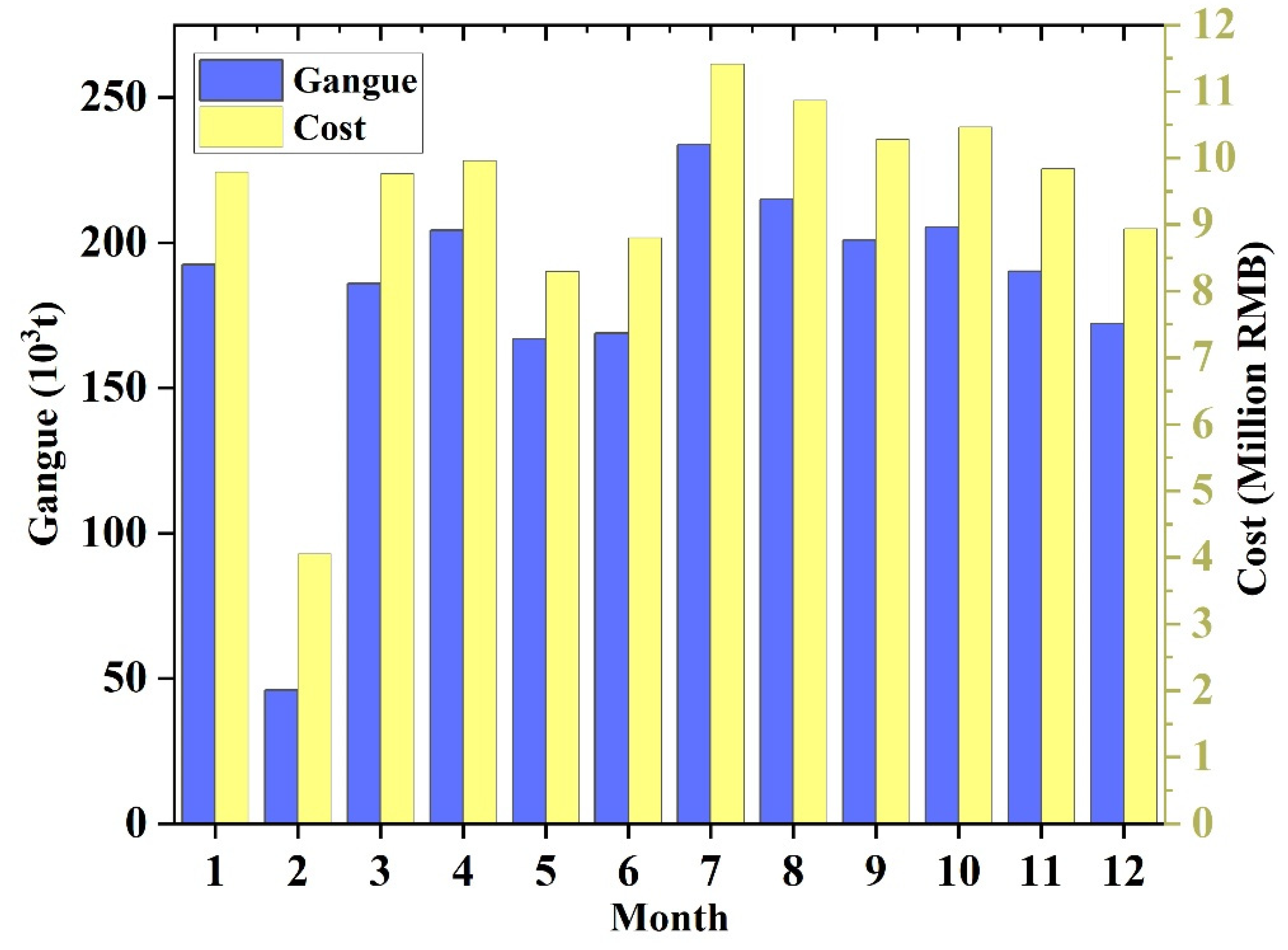
Under the dual drivers of global carbon neutrality and sustainable development goals, the coal industry faces an urgent need to transition from “output-oriented” to “clean and efficient” practices. As the world’s largest coal producer, China generated 825 million tons of coal gangue in 2024, with accumulated stockpiles exceeding 7 billion tons, forming over 2600 gangue hills that occupy approximately 15,000 hectares of land [1]. Coal gangue, as the primary associated by-product of coal mining, has become the most urgent bulk solid waste to be addressed in China. The thorough utilization of coal gangue is essential for advancing sustainable coal extraction, expanding the coal industry value chain, fostering a resource- and environmentally friendly society, and facilitating the shift toward a more sustainable economic model [2,3,4]. Fully mechanized top-coal caving, as the primary method for mining thick coal seams in China, contributes about 40% of the nation’s total raw coal output. However, the process often brings significant volumes of non-productive gangue to the surface, substantially increasing costs for hoisting, transportation, and washing. The long-term stockpiling of gangue further contributes to environmental pollution, greenhouse gas emissions, and land-use occupation, making it a critical challenge in global solid waste management in the mining sector [5,6]. Taking the Gucheng Coal Mine in China as an example, annual gangue generation reached 2182 thousand tons in 2023, with disposal costs totaling RMB 112.46 million (as shown in Figure 1), imposing significant constraints on production and operational efficiency, as well as the green mining transition.
Figure 1.
Gangue Discharge and Treatment Cost.
Currently, mine production planning is largely centered on output targets, lacking the systematic coordination of quality across underground mining, washing, and commercial coal sales. This makes it difficult to achieve precise reverse quality control from the sales end back to the production end. Daily production plans rely heavily on manual experience and fail to establish a multi-objective, collaborative optimization model that links surface and underground operations. As a result, the complex relationship between surface calorific value requirements for blended coal and underground caving process parameters cannot be efficiently coordinated, leading to significant execution deviations and unstable coal quality. Furthermore, low-calorific-value by-products such as middlings and fine gangue remain underutilized, contributing not only to resource waste but also to higher coal blending costs and gangue disposal expenses. Therefore, addressing the dual challenge of coal quality fluctuations due to excessive gangue mixing and the sustainable management of gangue as solid waste requires urgent research into a deep collaboration mechanism between underground matched mining and surface coal blending. Such a mechanism would reduce gangue output at the source while enabling the resource-oriented utilization of low-calorific-value by-products through the surface blending of fine gangue. Promoting the synergistic enhancement of quality, efficiency, and green mining in fully mechanized top-coal caving faces is of significant importance for advancing circular economy practices and the resource utilization of mine solid waste in China’s coal industry.
Existing studies have achieved considerable results in green mining, coal quality control, solid waste resource utilization, and the collaborative optimization of coal production, transportation, and marketing. From the perspective of green mining, the ash traceability regulation in fully mechanized caving mining requires synergy across three dimensions—source reduction, process control, and uncertainty quantification—to achieve green closed-loop management from the mining source to commercial coal sales [7,8,9]. The resource utilization of coal gangue is key to promoting the green transformation of the coal industry. Through a closed-loop technological system encompassing building material production, backfilling, and high-value utilization, industrial waste is converted into strategic resources. This not only mitigates the ecological and environmental burden, but also reshapes the industrial value chain, thereby driving the coal economy toward a low-carbon, circular, efficient, and intensive sustainable development model [10,11,12,13,14,15]. Prior literature [16,17,18,19,20,21] established group-level integrated dispatch optimization models with multi-source, multi-node, and multi-path characteristics, applying linear programming and collaborative management models to address resource allocation problems in large-scale complex networks. In refs. [22,23], multi-objective optimization dispatch models were developed to derive sales schemes that maximize profit. The researchers in [24,25,26] proposed the “sales-oriented production” concept, employing methods such as geological modeling and deep learning to dynamically adjust mining plans according to market demand. In refs. [27,28,29], prediction and optimization mathematical models for coal washing product structures were investigated, and the application of marginal cost and revenue in washing decision-making was discussed, thereby providing tools for the real-time adjustment of washing schemes in coal preparation plants. The researchers in [30,31,32,33,34,35] designed whole-process coal quality management systems for mines and explored the application of data mining in the rapid estimation of coal sample calorific value. Current domestic and international research is shifting from simple linear programming (LP) to mixed-integer linear programming (MILP), heuristic algorithms, and reinforcement learning to optimize mining sequences in longwall faces and short-term production scheduling [36,37,38,39,40]. However, most studies focus on macro-level integrated coordination and the route optimization of production, transportation, and sales, aiming to determine who to sell to and how much to transport, yet they rarely delve into the control of micro-level caving parameters at the underground working face, such as how many cuts to perform and how much gangue to draw. These studies lack effective theoretical support for the integrated investigation of gangue reduction and low-calorific-value by-product resource utilization.
For this reason, in this paper, we propose a synergistic mechanism of coal blending–matched mining and an ash content traceability regulation method for fully mechanized top-coal caving mining, with the aim of developing a daily production plan for the caving face. The objective is to establish a reverse coal quality traceability theory that translates sales quality targets into underground caving parameters. In the coal blending stage, a non-homogeneous linear equation model is established, with calorific value balance as the constraint, guided by cost minimization to transform low-calorific-value by-products into valuable resources. In the matched mining stage, a deep coordination mechanism between underground matched mining and surface coal blending is proposed. Based on the principle of the mass conservation of ash content between surface and underground operations, the method traces coal flow from surface commercial coal to underground raw coal in reverse. This allows for the precise mapping of commercial coal quality requirements at the sales end to microscopic caving process parameters, such as cyclic advance per day and caving volume per cut, thereby supporting rapid decomposition and the accurate formulation of daily production plans for the caving face. This approach establishes a closed-loop pathway that integrates underground gangue reduction at the source with the surface blending of fine gangue, effectively reducing the amount of non-productive gangue brought to the surface and lowering disposal costs. It also provides a feasible technical pathway for the reduction, resource utilization, and recycling of coal gangue.
2. Materials and Methods
2.1. Synergistic Mechanism of Blending–Mining Coordination
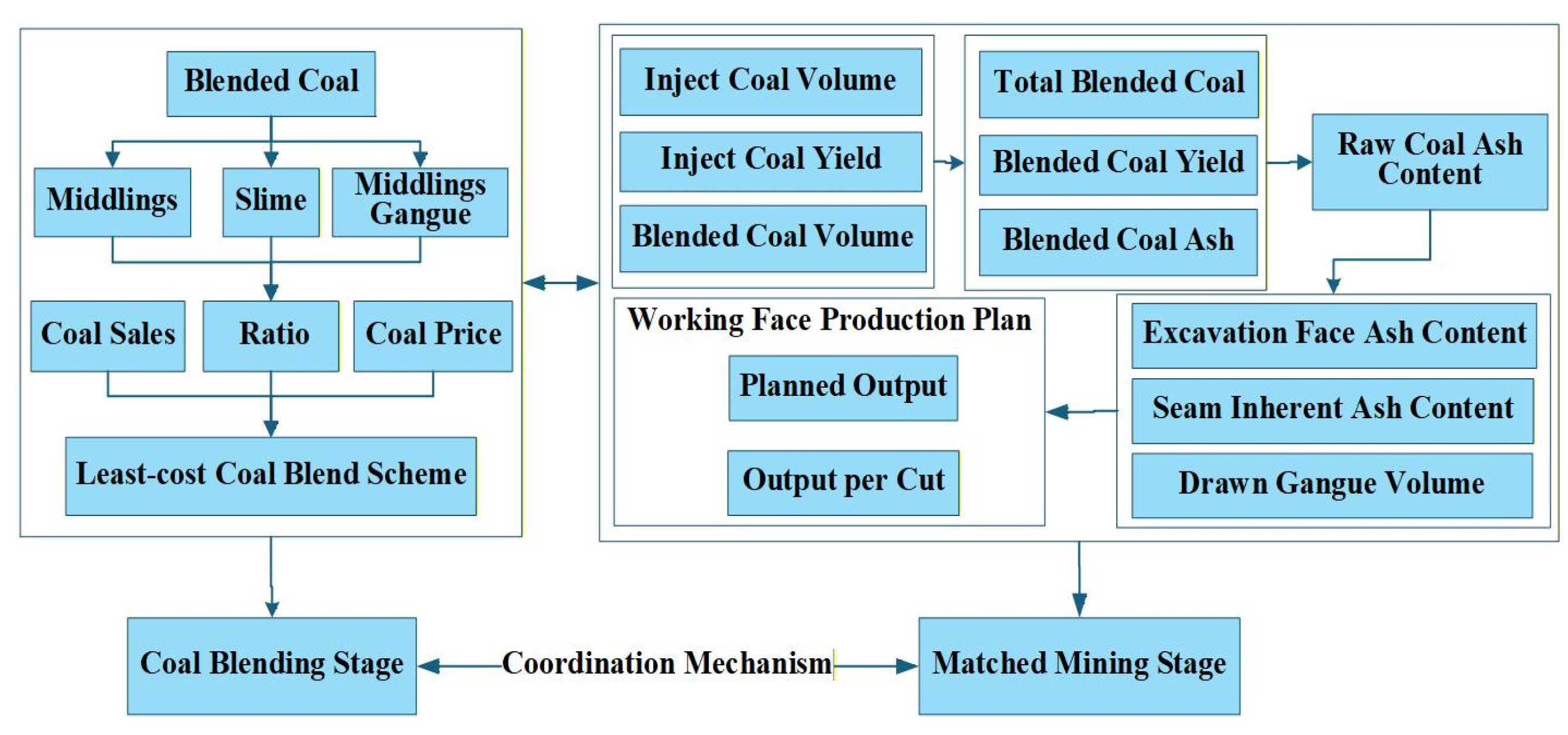
A reverse decision-making methodology is proposed for whole-lifecycle coal quality management by innovatively constructing a synergistic mechanism that deeply integrates a surface coal blending optimization model driven by “calorific value–cost” with an underground matched mining model driven by “ash balance–reverse tracing.” This mechanism takes surface commercial coal quality targets as input, optimizes material proportions through an economic blending model constrained by calorific value, achieves the resource-oriented utilization of low-calorific-value by-products, and generates the raw coal output baseline required for the matched mining stage. Building on this, and based on the mass conservation relationship between the surface and underground ash content, a reverse mapping model from sales targets to working face process parameters is established. The approach accurately decomposes production tasks into executable parameters such as the number of cutting cycles, output per cut, and drawn gangue volume, thereby forming a closed-loop quality traceability system from the market end to the mining end (as shown in Figure 2).
Figure 2.
Overall framework.
The core of this synergistic mechanism lies in establishing a bidirectional dynamic dialog and joint optimization between “how to blend” at the surface and “how to mine” underground. Through the real-time interaction and feedback of key data such as output, ash content, and cost, the model continuously coordinates the economic feasibility of the blending scheme with the operational feasibility of the mining allocation scheme during operation, systematically establishing a production solution based on the source reduction of underground gangue–surface blending of fine gangue. This approach not only supports the rapid and scientific formulation of daily production plans, shifting from experience-driven to model-driven decision-making and significantly enhancing coal quality stability and comprehensive resource utilization efficiency, but also reduces the hoisting of non-valuable gangue from the source. It effectively addresses issues arising from fragmented decision-making in traditional models, such as significant coal quality fluctuations, high comprehensive costs, and serious resource waste, thereby providing a systematic solution with both theoretical innovation and engineering feasibility for advancing green mining and developing a circular economy in the Chinese coal industry.
2.2. A Quality–Cost Coordinated Optimization Model for Coal Blending
2.2.1. Economically Optimal Coal Blending Ratio Under Calorific Value Constraints
For three typical coal material combinations—blended coal with middlings, blended coal with slime, and blended coal with middlings and gangue—a blending proportion calculation model was developed based on the calorific value balance principle. The model determines the optimal blending proportions for each material by solving a non-homogeneous system of linear equations. The general mathematical model for economically optimal coal blending under calorific value constraints is given by Equation (1).
is the blending proportion of the i-th material, > 0; is the lower calorific value of the i-th material, in kcal/kg; is the target lower calorific value, in kcal/kg; and α is the blending coefficient, set to 1.02 based on the common engineering rule of thumb, ensuring that the calorific value of the blended coal is slightly higher than the target value.
2.2.2. Comparative Evaluation of Multi-Material Coupled Coal Blending Schemes
After determining the blending proportions, the unit cost of each blending scheme is calculated based on the market prices of blended coal, middlings, and slime. Following the principle of minimizing blending cost, the most economically efficient blending scheme is selected. This optimizes the structure of commercial coal and provides data support for subsequent estimates of raw coal output. The cost calculation model for multi-material coupled coal blending is presented in Equation (2):
C is the blending cost, in RMB/t; is the market price of the i-th material, in RMB/t; and is the blending proportion of the corresponding material, in %.
The unit blending costs for the three material combinations—blended coal with middlings, blended coal with slime, and blended coal with middlings and gangue—are calculated separately, as shown in Equations (3)–(5):
is the blending cost for blended coal with middlings, in RMB/t; is the blending proportion of blended coal, in %; is the selling price of blended coal, in RMB/t; is the blending proportion of middlings, in %; is the price of middlings, in RMB/t; is the blending cost for blended coal with slime, in RMB/t; is the blending proportion of slime, in %; is the price of slime, in RMB/t; is the blending cost for blended coal, middlings, and gangue, in RMB/t; is the blending proportion of gangue, in %; and is the disposal cost of gangue, and the price of fine gangue is 0 RMB/t.
2.3. Ash Reverse Traceability-Based Intelligent Matched Mining Model for Working Faces
2.3.1. Sales-Target-Driven Reverse Calculation Model for Underground Raw Coal Output
Underground raw coal is crushed and screened, with the undersized material forming blended coal and the oversized material being large-sized gangue. The blended coal then enters a dense-medium separation system to produce value-added products such as injection coal. Based on this process flow, a reverse calculation model for underground raw coal output is established. Specifically, using the planned sales volumes of injection coal and blended coal and their average yield rates, the total blended coal required for production is calculated, and the underground raw coal mining volume is derived in reverse.
Based on the sales plan and quality requirements for commercial coal at the surface, the total required volume of blended coal includes both the volume sold directly as blended coal and the volume consumed in the production of injection coal, as shown in Equation (6).
is the total amount of blended coal to be produced, in t; is the planned sales volume of directly sold blended coal, in t; is the planned sales volume of injection coal, in t; and is the average yield of injection coal, in %.
Based on Equation (6), the average yield rate of blended coal from crushed-and-screened raw coal is statistically determined, and then the total raw coal tonnage that must be extracted underground is calculated using Equation (7).
is the total raw coal mining volume, in t; and is the average yield of blended coal, in %.
2.3.2. Dynamic Ash Balance Model from a Coal Quality Flow Perspective Between Surface and Underground
Based on material flow analysis theory, we constructed a dynamic ash balance model from a coal quality flow perspective that integrates surface and underground operations. This model transforms traditional static ash indicators into a dynamic material flow spanning the entire chain of “geological occurrence–mining and gangue drawing–washing and separation–blending and recombination.” It enables the systematic tracking and quantitative analysis of inherent ash in the coal seam, drawn gangue ash, and ash lost during washing, accurately delineating the spatial migration pathway of ash from underground working faces to surface commercial coal. This provides a deeper theoretical foundation and dynamic control strategies for the coordinated optimization of coal blending and matched mining. Accordingly, based on material flow analysis theory, the sources of ash in raw coal are decomposed and quantified. The total ash content of raw coal at the surface mainly originates from three components: the inherent ash of the coal seam in the fully mechanized top-coal caving face, the ash from gangue drawn during the caving process, and the ash contained in the coal and rock extracted during roadway excavation.
- Ash Content of Raw Coal at the Surface
After raw coal is crushed and screened, the undersized material is blended coal, and the oversized material is large-sized gangue. Therefore, the ash content of raw coal consists of the ash inherent in the blended coal and the ash from large-sized gangue, as shown in Equation (8).
is the ash content of raw coal at the surface, in t; is the ash content of blended coal, in %; and is the large-sized gangue content, in %.
- 2.
- Inherent Ash Content of the Coal Seam in the Fully Mechanized Top-Coal Caving Face
The theoretical pure coal output from a fully mechanized top-coal caving face is the amount of pure coal that can be extracted under ideal conditions, as given by Equation (9).
is the extractable pure coal volume of the i-th working face, in t; is the length of the i-th working face along the advance direction, in m; is the average extractable thickness of the coal seam in the i-th working face, in m; is the planned daily advance of the i-th working face, in m; is the bulk density of coal in the i-th working face, in t/m3; and is the recovery rate of the i-th fully mechanized top-coal caving face, in %.
The inherent ash content of the coal seam is determined by the inherent ash of the seam, i.e., the ash mass contained in the theoretical coal volume without external gangue mixing, as shown in Equation (10).
is the total ash content from the fully mechanized top-coal caving faces, in t; is the inherent ash content of the i-th working face, in t; and is the average ash content of the coal seam in the i-th fully mechanized top-coal caving face, in %.
- 3.
- Coal/Gangue Output from Excavation Faces
Roadway excavation is an important component of mine production, and the coal–rock mixture generated during the process is a significant source of ash in raw coal. Excavation roadways can be classified as coal roadways, rock roadways, and semi-coal–rock roadways. The ash content generated by excavation faces is calculated using Equation (11).
is the total ash content from coal and rock generated by excavation faces, in t; is the daily advance of the k-th excavation face, in m; is the designed cross-sectional area of the roadway for the k-th excavation face, in m2; and are the bulk densities of coal and rock for the k-th excavation face, respectively, in kg/m3; and are the ash contents of coal and rock, respectively, in %; and and are roadway-type coefficients, whose values are determined by the geological conditions of the excavation. For a coal roadway, ; for a rock roadway, ; for a semi-coal–rock roadway, .
- 4.
- Ash–Mass Conservation Between Surface and Underground
The ash loss resulting from coal slurry water loss accounts for less than 1% of the total ash content; therefore, the ash loss during the washing process is neglected. Based on the principle of ash–mass conservation between the surface and underground, the ash content of raw coal at the surface equals the sum of the inherent ash content of the coal seam, the ash content from excavation, and the gangue drawn from working faces, as shown in Equation (12).
is the total ash content of raw coal underground, in t; and is the amount of gangue drawn from the i-th working face, in t.
2.3.3. Daily Production Planning with Multi-Working-Face Coordination
Based on the ash balance relationship between surface and underground operations, a coordination mechanism is established between underground matched mining and surface coal blending. The total production task and total gangue volume are allocated to each fully mechanized top-coal caving face, and specific daily production plans for the working faces are formulated to reduce the hoisting volume of coal gangue from the source.
- Correlation Model for Gangue Drawn from Fully Mechanized Top-Coal Caving Faces
The output of a working face can be divided into theoretical coal volume and drawn gangue volume. The amount of gangue drawn is closely related to the coal seam’s lower calorific value, the length of the working face, and the production intensity. Generally, a higher calorific value of the coal seam implies relatively less gangue dilution, so the drawn gangue volume is usually lower; conversely, a lower calorific value leads to a higher drawn gangue volume. A longer working face, under the same mining height and advance per cycle, results in more drawn gangue. A greater number of cutting cycles per shift leads to more drawn gangue from the fully mechanized top-coal caving face, and vice versa.
In summary, the gangue volume is proportional to the working face length and the number of cutting cycles, and inversely proportional to the coal seam’s lower calorific value. By correlating the drawn gangue volume with three key influencing factors, a relational model is established among coal calorific value, working face length, advance per cycle, and drawn gangue volume, as shown in Equation (13).
is the drawn gangue volume of the -th fully mechanized top-coal caving face over the calculation period, in t; is the average lower calorific value of the coal seam in the -th working face, in kcal/kg; is the length of the -th working face, in m; and is the number of cutting cycles for the -th working face.
By combining the ash balance equation (Equation (12)) and the gangue volume proportionality equation (Equation (13)), the gangue volumes for different fully mechanized top-coal caving faces are determined (Equation (14)). The planned output and output per cut for each working face can then be calculated, enabling the formulation of daily production plans for these working faces.
- 2.
- Calculation of Working-Face Production Indicators
The planned output of a working face is the sum of the theoretical coal volume and the drawn gangue volume, as shown in Equation (15). Output per cut is the amount of raw coal produced by the shearer of a fully mechanized top-coal caving face after completing one cutting cycle, reflecting the production intensity per cycle (Equation (16)). Gangue content per cut is the percentage of gangue weight in the coal extracted per cutting cycle of the shearer in a fully mechanized top-coal caving face (Equation (17)). The planned ash content is the predetermined target ash content for raw coal from a fully mechanized top-coal caving face, including the drawn gangue and the inherent ash of the coal seam (Equation (18)).
is the planned raw coal output of the i-th working face, in t; is the output per cut for the i-th working face, in t/cut; is the gangue content per cut for the i-th working face, in %; and is the planned ash content for the i-th working face, in %.
3. Experiments and Discussion
This section applies and validates the previously developed coal blending–matched mining coordination optimization model using actual production data from Gucheng Coal Mine, demonstrating its practical effectiveness in daily production planning and technical/transformation benefit evaluation, thereby reducing the hoisting volume of coal gangue at the source.
3.1. Overview of the Coal Preparation Process at Gucheng Coal Mine
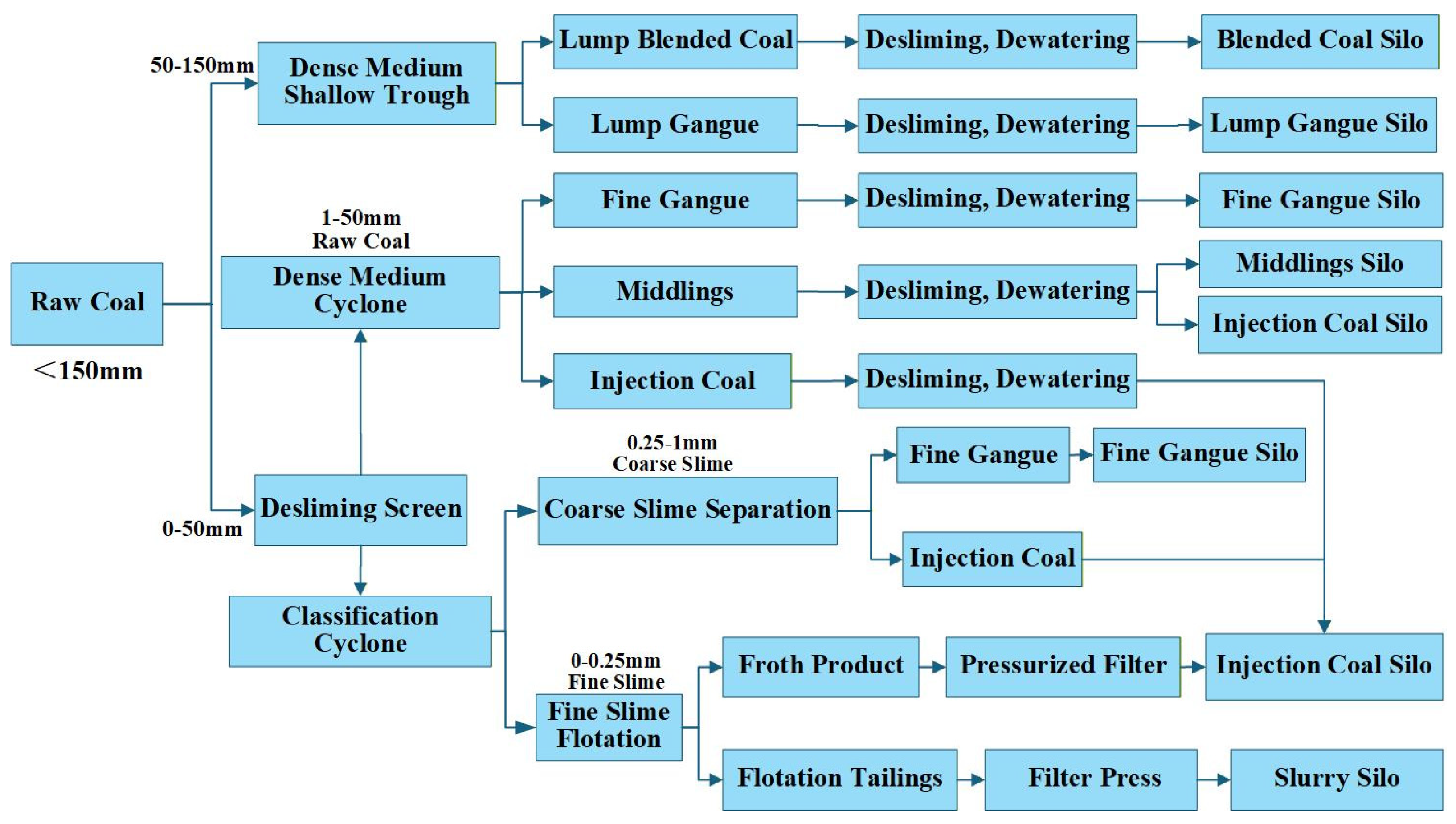
The coal preparation plant at Gucheng Coal Mine is a modern thermal coal washing plant that uses size-graded crushing and modular separation processes. Raw coal is first crushed to less than 150 mm and classified at a 50 mm cut-point: material larger than 50 mm (lump coal) is fed to a shallow-trough dense-medium separation system to produce lump clean coal and lump gangue. The lump clean coal is then crushed to become part of the blended coal product. Material smaller than 50 mm (fine coal) enters a non-pressure three-product dense-medium cyclone separation system, yielding injection coal, middlings, slime, and fine gangue. All products undergo desliming and dewatering before being sent to their respective storage silos. Additionally, coarse slime is separated using a TBS (teetered bed separator), and fine slime is treated using a flotation system. The resulting injection coal is conveyed to the final injection coal silo, while the tailings are dewatered and sent to the fine gangue system (as illustrated in Figure 3). The preparation process at Gucheng Coal Preparation Plant achieves efficient coal quality control and resource utilization, providing a stable raw material supply for subsequent blending optimization.
Figure 3.
Process flow diagram of Gucheng Coal Mine Preparation Plant.
3.2. Application of Cost-Optimal Blending Schemes and Benefit Analysis
To optimize the commercial coal structure at Gucheng Coal Mine, an economic analysis of blending schemes was conducted using calorific value balance and cost minimization principles.
3.2.1. Comparative Evaluation of Multi-Material Coupled Coal Blending
Based on the daily dispatch reports and financial settlement system of Gucheng Coal Mine, parameters such as sales volume, low calorific value, and sales price of blended coal, middlings, and coal slime were obtained. The output data originated from belt scales, and the low calorific value was determined in accordance with GB/T 213–2008 [41] “Determination of Calorific Value of Coal,” with test reports issued and confirmed by the mine’s coal quality inspection center. Sales prices were derived from the financial settlement system to ensure an accurate reflection of market transaction conditions. With the objective of minimizing coal blending costs, the blending costs for different material combinations were calculated to optimize the commercial coal structure of Gucheng Coal Mine. The parameters for low calorific value and the sales price of each material are as follows:
- (1)
- Commercial blended coal: The lower calorific value of commercial blended coal should not be less than 5600 kcal/kg.
- (2)
- Material parameters: Blended coal lower calorific value, 5820 kcal/kg; middlings lower calorific value, 3728 kcal/kg; slime lower calorific value, 2839 kcal/kg; fine gangue lower calorific value, 300 kcal/kg.
- (3)
- Price parameters (as of 1 April 2024): Blended coal price, 800 RMB/t; middlings price, 499 RMB/t; slime price, 239 RMB/t; gangue treatment and transportation cost, 56 RMB/t (fine gangue price, 0 RMB/t).
- (4)
- Middlings blending ratio: the yield of middlings accounts for approximately 1.5% of the raw coal, and all of it is blended into the blended coal. Therefore, the blending ratio for middlings is 1.5%.
The blending costs of different combinations were calculated based on the calorific value balance model and the blending cost calculation model (Equations (1)–(5)). The results are shown in Table 1. The combination “blended coal + middlings + gangue” yields the lowest blending cost of 783 RMB/t, which is the optimal economic blending scheme.
Table 1.
Economic comparison of blending schemes.
3.2.2. Technical and Transformation Scheme for Blending Middlings and Fine Gangue
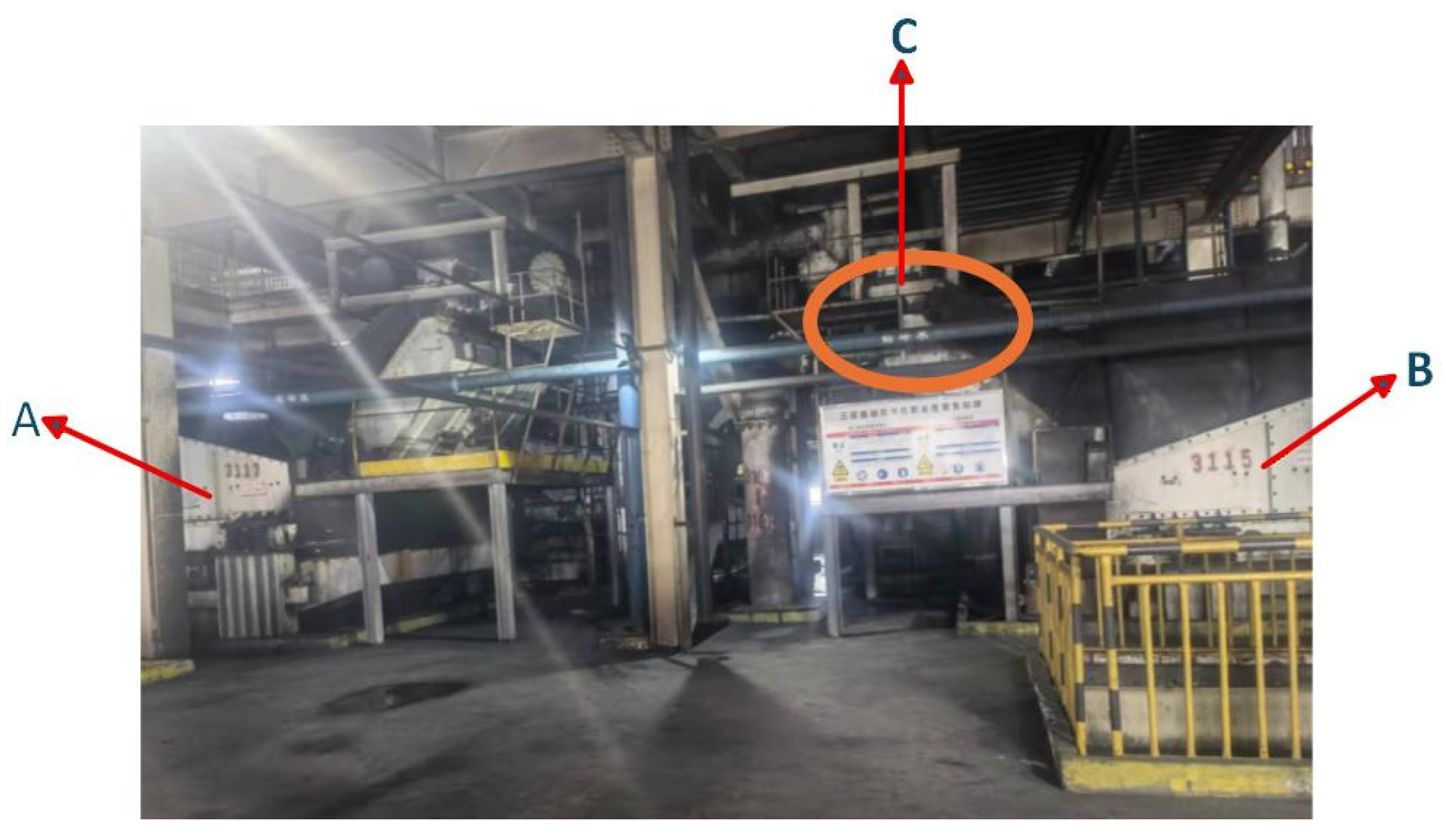
To implement the proportional blending of middlings and fine gangue into blended coal, a pipeline modification project was carried out. In order to first introduce a portion of fine gangue into the middlings system, a pipeline was added from the east side of the feed end of the fine gangue demediuming screen (No. 3115) to the middlings demediuming screen (No. 3113). The fine gangue is transferred via this pipeline to a newly installed feed chute and enters the middlings screen together with the medium, thereby diverting part of the fine gangue and merging it onto the middlings demediuming screen (as illustrated in Figure 4).
Figure 4.
Installation of the diversion pipeline. (A) Middlings desliming screen. (B) Gangue desliming screen. (C) Pipeline from fine gangue to middlings. Fine gangue is transferred from the collection hopper to the middlings desliming screen via the newly installed pipeline (highlighted in orange).
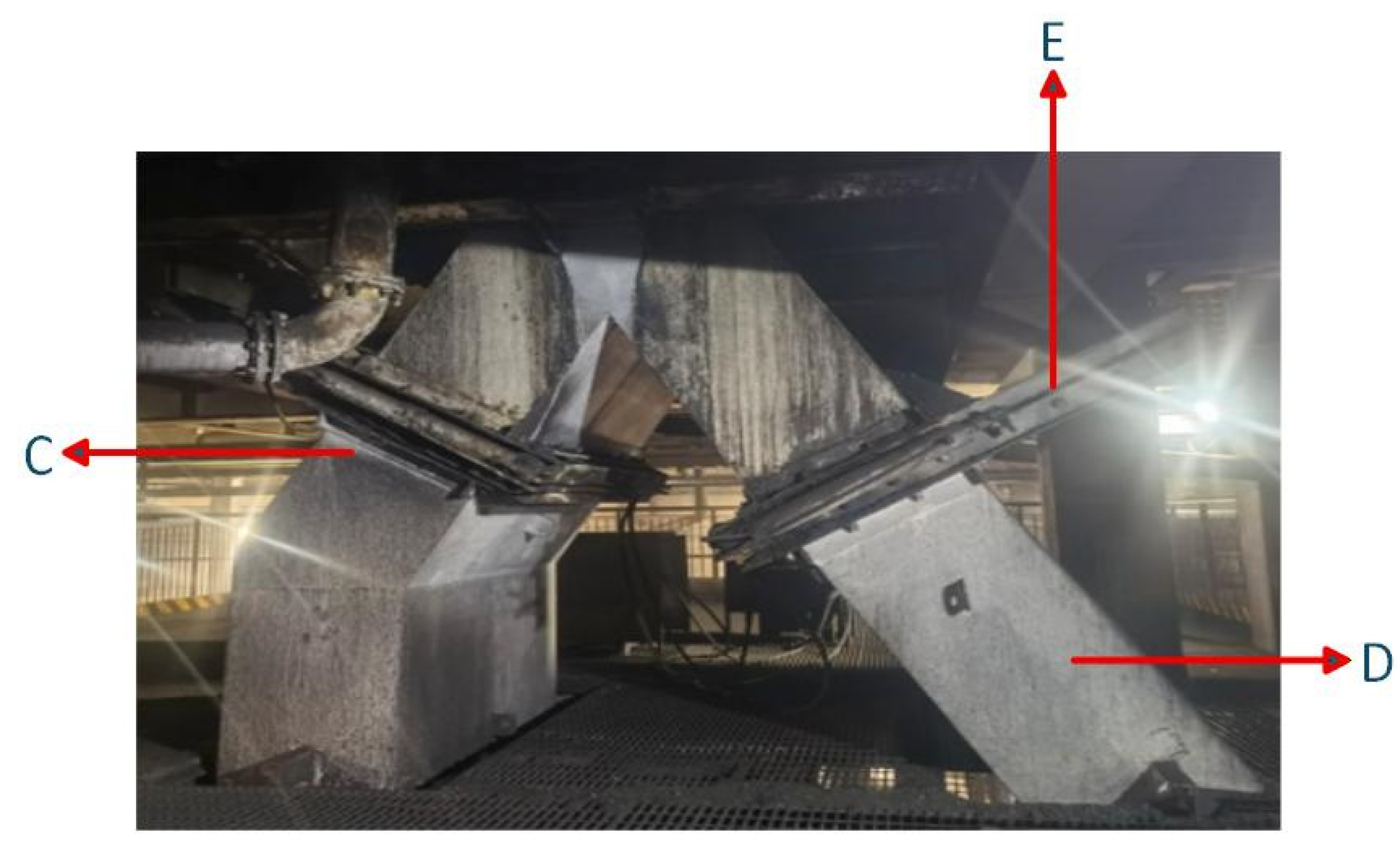
The mixture of middlings and fine gangue is discharged from the front end of the middlings demediuming screen (#3113), falls into a newly added dedicated chute, and is transferred onto the blended coal belt (#801), achieving a rational blend of blended coal, middlings, and fine gangue (as illustrated in Figure 5).
Figure 5.
Installation of a dedicated chute for blended coal input. (C) Feeding chute to the middlings conveyor belt. (D) Feeding chute to the blended coal conveyor belt. The mixture of middlings and fine gangue is discharged into a dedicated chute and merged onto the blended coal conveyor system. (E) Gate valve to shut off the chute when blending is not needed.
3.2.3. Benefits of the Middlings and Fine Gangue Blending Transformation
The average lower calorific value of blended coal produced by the Gucheng Coal Mine Preparation Plant is as high as 5979 kcal/kg, exceeding the customer requirement (5600 kcal/kg). To effectively utilize low-calorific-value by-products while meeting contract specifications, a fixed proportion of 1.5% middlings is blended with fine gangue to produce blended coal. This slightly reduces the calorific value of the commercial blended coal, increases blended coal output, and lowers gangue disposal costs. Statistics from January to September 2024 (shown in Table 2) indicate that a cumulative total of 28.6 thousand t of fine gangue was blended and consumed, increasing blended coal production by 104.5 thousand t and directly generating economic benefits of RMB 52.43 million. In addition, based on a fine gangue transportation and treatment cost of 56 RMB/t, approximately RMB 1.6 million of fine gangue disposal expense was saved. Therefore, the daily production planning method for fully mechanized top-coal caving faces oriented toward coal blending–matched mining coordination demonstrates strong economic and social value.
Table 2.
Analysis of middlings and fine gangue blending.
3.3. Analysis of Daily Working Face Planning and Source Reduction Effect of Gangue
Based on the screening and washing processes for blended coal and injection coal, and using the surface–underground ash mass balance, equations were derived to relate the theoretical coal volume and the drawn gangue volume for each working face. The output per cut for each working face was determined, and daily production plans for each working face were formulated, thereby reducing the hoisting volume of coal gangue from the source.
3.3.1. An Underground Ash Model Based on the Coal Quality Flow Viewpoint
- Sales-Target-Driven Reverse Calculation Model for Underground Raw Coal Output
The Gucheng Coal Mine uses the fully mechanized top-coal caving mining method to extract the 3# main coal seam. This seam is minable across the entire mine field, has a simple structure, and exhibits minimal thickness variation, with an average thickness of 6.27 m. It is classified as a stable coal seam. On 1 April 2024, Gucheng Coal Mine planned to sell 17,199 t of blended coal and 9080 t of injection coal. The key parameters are as follows:
- (1)
- Blended coal: ash content, 30.69%; lower calorific value, 5200 kcal/kg.
- (2)
- Injection coal: ash content, 10.87%; lower calorific value, 6676 kcal/kg.
- (3)
- (4)
- Working face recovery rate: 98%.
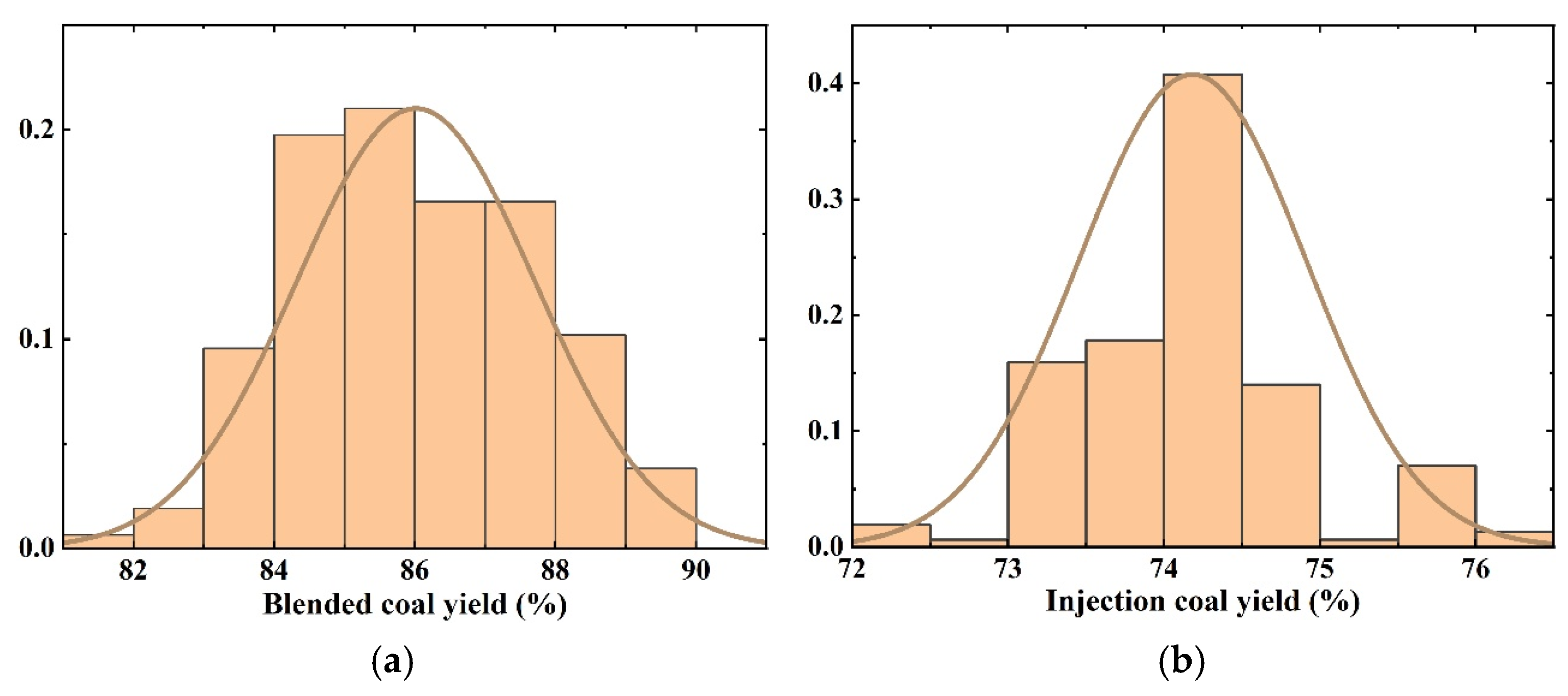
Figure 6.
Yield rates of blended coal and injection coal. (a) Blended coal yield; (b) injection coal yield.
Figure 6.
Yield rates of blended coal and injection coal. (a) Blended coal yield; (b) injection coal yield.

Table 3.
Parameter statistics.
Table 3.
Parameter statistics.
| Yield | Count | Minimum | Maximum | Mean | Standard Deviation |
|---|---|---|---|---|---|
| Blended coal | 205 | 81.9 | 90.3 | 86.0 | 1.6 |
| Injection coal | 192 | 71.7 | 76.4 | 74.0 | 0.8 |
Driven by sales targets, an inverse calculation model was developed to determine underground raw coal production (Equations (6) and (7)). The required total blended coal, comprising both marketable blended coal and blended coal for washing into pulverized injection coal, amounts to 34,266 tons, and the total ash content of the raw coal from the ground is 11,161 tons.
- 2.
- Intrinsic Total Ash Content of the Top-Coal Caving Face
On the same date, both the S1310 and N1306 fully mechanized top-coal caving faces were in production at Gucheng Coal Mine. The specific parameters of these working faces are as follows:
- (1)
- S1310 working face: length, 326 m; coal seam thickness, 6.3 m; ash content, 14.3%; lower calorific value, 6853 kcal/kg; regular daily advance, six cuts; advance per cut, 0.8 m; coal bulk density, 1.43 t/m3.
- (2)
- N1306 working face: length, 303 m; coal seam thickness, 6.22 m; ash content, 14.35%; lower calorific value, 6702 kcal/kg; regular daily advance, six cuts; advance per cut, 0.8 m; coal bulk density, 1.43 t/m3.
Under the condition of no external gangue mixing, the intrinsic total ash content of the S1310 and N1306 fully mechanized top-coal caving faces was calculated to be 3794 tons using Formulas (9)–(11).
- 3.
- Ash Content from Roadway Excavation
Based on roadway type, cross-sectional dimensions, and material parameters (gangue bulk density 2.3 t/m3, raw coal bulk density 1.43 t/m3, and average ash content of coal-roadway excavation faces 14.3%), the total ash content from coal/rock generated by the excavation faces was calculated to be 420 t (see Table 4).
Table 4.
Total ash content from excavation faces.
3.3.2. Planning of Output per Cut for Fully Mechanized Top-Coal Caving Faces
Using the established ash balance model and output allocation model, the gangue volumes drawn for the S1310 and N1306 working faces were found to be 3858 t and 3507 t, respectively. Based on these figures, the planned production and output per cut for the S1310 and N1306 working faces were calculated using the calculation Formulas (15) and (16) for working face production indicators. The daily production plans for the two working faces are shown in Table 5.
Table 5.
Working face production plan.
According to the working face production indicator calculation formulas (Equations (17) and (18)), the planned ash content and gangue content per cut for the S1310 and N1306 working faces were calculated separately, and the coal quality plans for the working faces were compiled as shown in Table 6.
Table 6.
Working face coal quality plan.
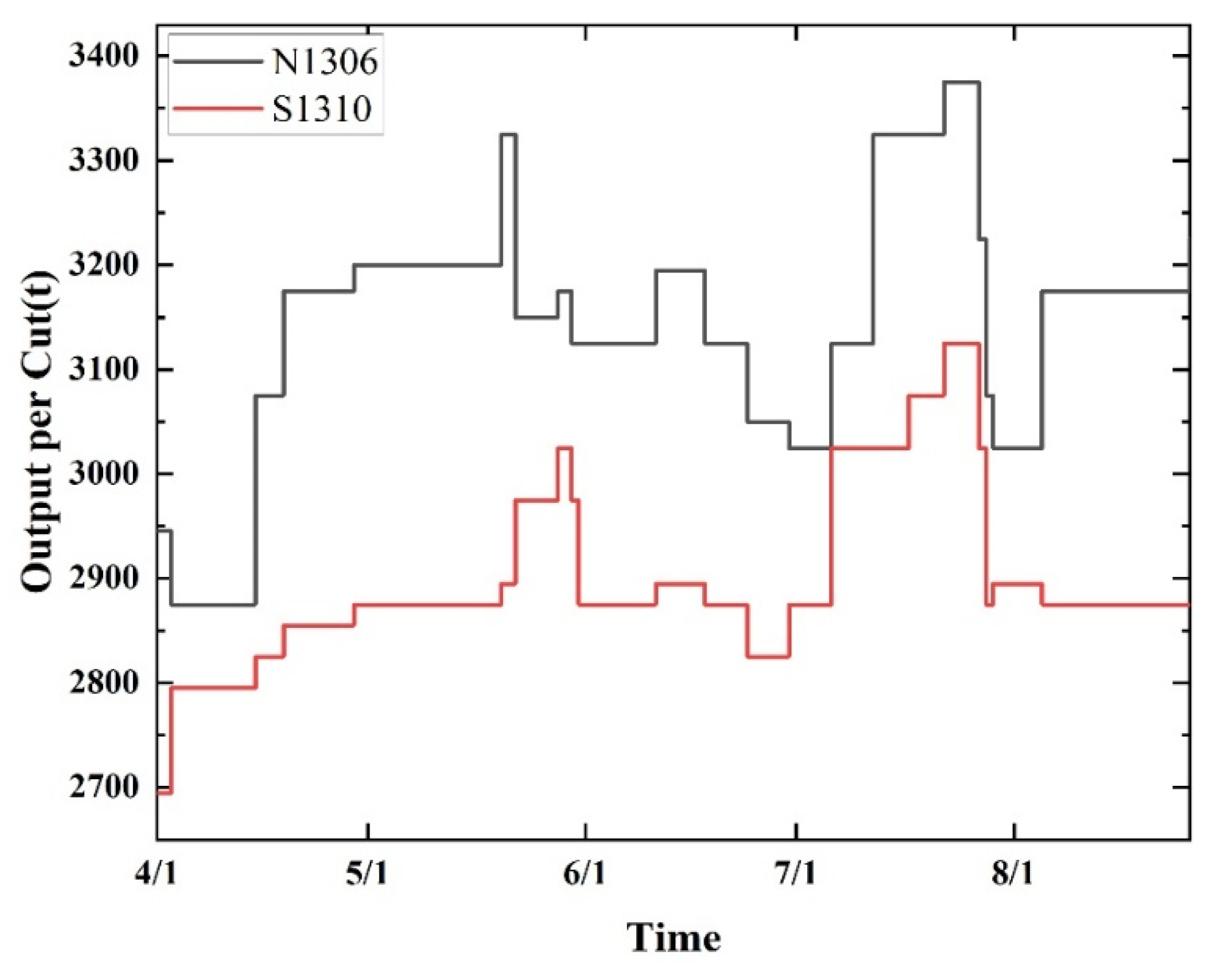
Furthermore, by applying the matched mining model for fully mechanized top-coal caving faces based on reverse ash balance tracking, the output per cut for the S1310 and N1306 working faces at Gucheng Coal Mine from April to August was calculated and summarized, thereby reducing the hoisting volume of coal gangue from the source, as shown in Figure 7.
Figure 7.
Output per cut of fully mechanized top-coal caving faces.
3.3.3. Source Reduction Effect of Gangue
Belt conveyor scales were used to continuously measure the total monthly raw coal output, total working face raw coal output, and total working face gangue output for 2023 and 2024. The data show that the gangue emissions from the working faces at Gucheng Coal Mine in 2023 and 2024 were 1295 thousand tons and 898.9 thousand tons, respectively. The gangue content rates in raw coal from fully mechanized top-coal caving faces were 13.83% and 10.95%, respectively. As indicated in Table 7 and Table 8, implementing a daily production plan coordinated across multiple working faces and quantifying output per cutting cycle to constrain caved gangue volume reduced the gangue content rate in raw coal by 2.89% in 2024. This resulted in a reduction of approximately 230 thousand tons of gangue at the source and corresponding savings of about RMB 12.88 million in gangue transportation and treatment costs.
Table 7.
Gangue discharge statistics for 2023.
Table 8.
Gangue discharge statistics for 2024.
3.3.4. Fitting Analysis of Key Parameters
Using the controlled variable method, with the working face length, coal seam thickness, and tunneling coal and gangue volume held constant, a multiple linear regression was employed to fit the relationship between raw coal output and the number of cuts at the working face. The resulting R2 is 1, indicating that the number of working face advance cuts and output form a defined plane, exhibiting a strictly linear proportional relationship, as shown in Equation (19):
where is the raw coal output (t), is the number of cuts in the S1310 working face, and is the number of cuts in the N1306 working face.
Similarly, a multiple linear regression method was used to fit the relationship between gangue volume, the number of working face advance cuts, and the blended coal yield. The results show that R2 reaches 0.994, indicating an excellent model fit and a significant linear relationship among the three variables, as shown in Equation (20):
where is the gangue volume (t), is the number of cuts in the S1310 working face, is the number of cuts in the N1306 working face, and is the blended coal yield (%).
4. Conclusions
- (1)
- In the coal blending stage, a blending model was developed with calorific value balance as the constraint and cost minimization as the objective, determining the optimal economic ratio of blended coal, middlings, and fine gangue. After implementing this ternary blending scheme, the blending cost and gangue transportation and disposal expenses were reduced while meeting customer calorific value requirements. This resulted in direct economic benefits of approximately RMB 52.43 million, along with a reduction of 28.5 thousand tons of gangue emissions in 2024, demonstrating significant economic and environmental benefits.
- (2)
- In the matched mining stage, based on the “surface–underground ash content balance” reverse tracking model, a reverse coal quality traceability theory was developed to map commercial coal quality requirements to operational parameters at the working face. Sales plans and quality targets for surface commercial coal were precisely decomposed into executable parameters for each fully mechanized top-coal caving face, including the number of cutting cycles, output per cut, and caved gangue volume, enabling the rapid, scientific formulation of daily production plans for the caving faces. In 2024, the gangue content in raw coal decreased by 2.89% year on year, resulting in approximately 230 thousand tons of gangue being removed at the source and corresponding savings of about RMB 12.88 million in gangue transportation and treatment costs. This provides methodological support for refined and dynamic production scheduling in fully mechanized top-coal caving mining.
- (3)
- Regarding the coordination mechanism, based on the calorific value balance blending model and the ash content balance matched mining model, a reverse decision-making method and theory for whole-lifecycle coal quality control were proposed. This established a new deep coordination paradigm integrating underground gangue reduction at the source with surface fine gangue blending. This approach addresses the disconnect between traditional macro-level “production–transportation–sales” planning and micro-level working face process parameters. It provides an operable solution for coal mines to achieve “reduction, resource utilization, and recycling” targets, thereby promoting the sustainability of China’s coal mine circular economy and mine solid waste utilization.
- (4)
- The model is only applicable to fully mechanized top-coal caving mines for thermal coal, and its applicability to coking coal mines needs to be verified; the impact of sudden geological conditions (e.g., faults and coal seam thickness changes) on ash balance and gangue discharge is not considered; the working face process parameters only include the number of cutting cycles and output per cut, while key parameters such as the caving interval and mining-to-caving ratio are not taken into account.
Author Contributions
Conceptualization, M.C. and Q.W.; methodology, Q.W.; software, Q.W.; validation, Q.W., X.G. and M.C.; formal analysis, Q.W.; investigation, X.G.; resources, X.G.; data curation, X.G.; writing—original draft preparation, Q.W.; writing—review and editing, M.C.; visualization, X.G.; supervision, M.C.; project administration, M.C.; funding acquisition, X.G. All authors have read and agreed to the published version of the manuscript.
Funding
This research was funded by the Department of Science and Technology of Shanxi Province (202303021212052, 202304051001008) This research supported by Xinjiang Intelligent Equipment Research Institute (XJYJY2024003).
Institutional Review Board Statement
Not applicable.
Informed Consent Statement
Not applicable.
Data Availability Statement
The raw data supporting the conclusions of this article will be made available by the authors on request.
Conflicts of Interest
The authors declare no conflicts of interest.
References
- Lan, H. Current status, challenges, and strategies of coal gangue utilization in the context of green transition. J. Green Mine 2025, 3, 76–85. [Google Scholar] [CrossRef]
- Zhu, T.; Wu, X.; Xing, C.; Ju, Q.; Su, S. Current situation and progress of coal gangue resource utilization. Coal Sci. Technol. 2024, 52, 380–390. [Google Scholar]
- Gao, L.; Liu, Y.; Xu, K.; Bai, L.; Guo, N.; Li, S. A short review of the sustainable utilization of coal gangue in environmental applications. RSC Adv. 2024, 14, 39285–39296. [Google Scholar] [CrossRef]
- Zhong, G.L.; Deng, X.W.; Fang, C.J.; Zhang, Y.; Chen, Y.L.; Zhang, C.X. Current status and development trend of coal gangue resource utilization. J. China Coal Soc. 2025, 50, 1153–1168. [Google Scholar] [CrossRef]
- Yu, D.; Wang, D.Y.; Liu, T. Research on integrated model of production, transportation, marketing, storage and use. Coal Econ. Res. 2024, 44, 150–158. [Google Scholar] [CrossRef]
- Liu, L.; Zhu, M.B.; Wang, S.M.; Yang, P.; Yu, B.; Ruan, S.S. Research progress and innovative pathways for large-scale green and low-carbon utilization of coal-based solid wastes. Coal Sci. Technol. 2025, 53, 82–103. [Google Scholar] [CrossRef]
- Teatino, M.A.C.; Araujo, J.J.M. Circular economy in the mining industry: A bibliometric and systematic literature review. Resour. Policy 2024, 102, 105513. [Google Scholar] [CrossRef]
- Zhang, H.; Li, G.; Xu, Y.; Zhang, K.; Li, M. Mechanism and application of reaming anchorage of inverted wedge-shaped hole bottom in argillaceous cemented roadway. Sci. Rep. 2026, 16, 5094. [Google Scholar] [CrossRef]
- Liu, M.; Li, Z.; Du, F.; Wang, W.; Zhai, M.; Shi, J. Experimental study on the structural failure characteristics and load-bearing mechanism of anchored fractured rock mass. Sci. Rep. 2026, 16, 4537. [Google Scholar] [CrossRef]
- Zhu, D.; Griffiths, D.V.; Fenton, G.A. Probabilistic stability analyses of two-layer undrained slopes. Comput. Geotech. 2025, 182, 107178. [Google Scholar] [CrossRef]
- Du, P.; Ren, Y.; Liu, Z.; He, J.; Wang, L. From waste to resources: Coal gangue utilization—A comprehensive analysis. Process Saf. Environ. Prot. 2025, 201, 107558. [Google Scholar] [CrossRef]
- Song, Z.; Lyu, J.; Zhang, Z.; Song, B.; Liu, S.; Guan, C. Innovative application and research of industrial solid waste in mining filling materials in China. Sustainability 2025, 17, 5136. [Google Scholar] [CrossRef]
- Antony Jose, S.; Calhoun, J.; Renteria, O.B.; Mercado, P.; Nakajima, S.; Hope, C.N.; Sotelo, M.; Menezes, P.L. Promoting a circular economy in mining practices. Sustainability 2024, 16, 11016. [Google Scholar] [CrossRef]
- Wang, A.; Pan, Y.; Zhao, J.; Liu, P.; Wang, Y.; Chu, Y.; Liu, K.; Sun, D. Research progress of resourceful and efficient utilization of coal gangue in the field of building materials. J. Build. Eng. 2025, 99, 111526. [Google Scholar] [CrossRef]
- Hou, Y.; Xi, S.; Li, H.; Fan, Y.; Li, F.; Wen, Q.; Hao, J. The development of circular economy in China’s coal industry: Facing challenges of inefficiency in the waste recycling process. Sustainability 2025, 17, 8147. [Google Scholar] [CrossRef]
- Zhang, L.; Zhu, D.; Marani, A.; Nehdi, M.L.; Wang, L.; Yang, G.; Zhang, J. Toward sustainable construction: Comprehensive utilization of coal gangue in building materials. Case Stud. Constr. Mater. 2025, 23, e04930. [Google Scholar] [CrossRef]
- Guo, N.H. Study on Optimization of Integration of Production, Transportation and Marketing Considering Inventory. Master’s Thesis, Beijing Jiaotong University, Beijing, China, 2023. [Google Scholar]
- Su, Z.X. Research on Optimization of Coal Production, Transportation and Marketing Integrated Dispatching Considering Coal Blending. Master’s Thesis, Southeast University, Changsha, China, 2021. [Google Scholar]
- Zhang, Z.; Chen, J.; Zheng, H. Joint optimization of inventory and schedule for coal heavy rail considering production-transportation-sales collaboration: A spatio-temporal-mode network approach. Appl. Sci. 2024, 14, 5089. [Google Scholar] [CrossRef]
- Fuksa, D. A method for assessing the impact of changes in demand for coal on the structure of coal grades produced by mines. Energies 2021, 14, 7111. [Google Scholar] [CrossRef]
- Sun, H.Q. Research on Integrated Decision-Making Optimization of Production, Transportation and Sales of Zhuneng Group. Master’s Thesis, China University of Mining and Technology, Xuzhou, China, 2019. [Google Scholar]
- Fuksa, D. Innovative method for calculating the break-even for multi-assortment production. Energies 2021, 14, 4213. [Google Scholar] [CrossRef]
- Ding, G.B. A brief analysis of key points in annual coal production planning for large coal enterprises. Energy Technol. Manag. 2022, 47, 199–201. [Google Scholar] [CrossRef]
- Li, H. Research on Production Project Management of Haerwusu Open-Pit Coal Mine Based on Coal Quality Demand. Master’s Thesis, China University of Mining and Technology, Xuzhou, China, 2021. [Google Scholar]
- Zhang, K.F. Study on the Optimization of Coal Product Structure Based on Steam Coal Price Prediction Using Deep Learning. Master’s Thesis, China University of Mining and Technology, Xuzhou, China, 2021. [Google Scholar]
- Hu, M. Research on Coal Quality Prediction Model and Coal Quality Process Management System. Master’s Thesis, Xi’an University of Science and Technology, Xi’an, China, 2022. [Google Scholar]
- Bo, C.L.; Wang, D.W.; Fan, Y.P. Product structure optimization for Tongxin coal preparation plant. Coal Eng. 2019, 51, 28–32. [Google Scholar]
- Chen, Y.F.; Qiu, G.L. Research and application of software for optimizing coal preparation product structure. Coal Process. Compr. Util. 2020, 46, 14–17+22. [Google Scholar] [CrossRef]
- Liu, J.J.; Yang, H.F.; Yang, M.L. Product specification and economic benefit maximization prediction model of a coal preparation plant in Datong, Shanxi. Int. J. Coal Prep. Util. 2023, 43, 879–899. [Google Scholar]
- Sun, J.L. Design and Implementation of Web-Based Coal Quality Information Management System. Master’s Thesis, China University of Mining and Technology, Xuzhou, China, 2022. [Google Scholar]
- Wang, B.H.; Shi, S.W. Research and application of mine coal quality intelligent management system. China Energy Environ. Prot. 2020, 42, 175–179. [Google Scholar] [CrossRef]
- Kang, D. Research of the Coal Quality Whole Process Management Information System in Coal Enterprise. Master’s Thesis, Xi’an University of Science and Technology, Xi’an, China, 2016. [Google Scholar]
- Jiang, S.J.; Hu, M. Coal quality whole process management system design. Ind. Mine Autom. 2021, 47, 116–120. [Google Scholar]
- Yang, S.S. Coal Quality Data Mining and Comprehensive Information Management System. Master’s Thesis, North China University of Water Resources and Electric Power, Zhengzhou, China, 2016. [Google Scholar]
- Zheng, J.P.; Sun, C.X.; Cheng, Z.Z. Study on the development of coal quality management and its advanced technology in China. China Coal 2022, 48, 56–61. [Google Scholar] [CrossRef]
- Li, N.; Ding, Y.; Dai, B. Deep reinforcement learning framework for the underground mine short-term production scheduling problem. Swarm Evol. Comput. 2026, 93, 102229. [Google Scholar]
- Wu, P.; Wang, Y.; Jiang, C. Dynamic slack-based measure model efficiency evaluation of the impact of coal mining characteristics. Energy Effic. 2023, 16, 11. [Google Scholar] [CrossRef]
- Rocchi, L.; Carter, P.; Stone, P. Sequence optimization in longwall coal mining. J. Min. Sci. 2011, 47, 151–157. [Google Scholar] [CrossRef]
- Gong, C.G. Vehicle allocation algorithm based on improved two-stage method in Pingshuo east open-pit mine. Opencast Min. Technol. 2019, 34, 15–18. [Google Scholar] [CrossRef]
- Zhou, H. Research on the Optimization of Coal-Power Flow Collaborative Scheduling in Coal Mine Production Process. Master’s Thesis, Dalian University of Technology, Dalian, China, 2024. [Google Scholar]
- GB/T 213-2008; Determination of Calorific Value of Coal. Standards Press of China: Beijing, China, 2008.
Disclaimer/Publisher’s Note: The statements, opinions and data contained in all publications are solely those of the individual author(s) and contributor(s) and not of MDPI and/or the editor(s). MDPI and/or the editor(s) disclaim responsibility for any injury to people or property resulting from any ideas, methods, instructions or products referred to in the content. |
© 2026 by the authors. Licensee MDPI, Basel, Switzerland. This article is an open access article distributed under the terms and conditions of the Creative Commons Attribution (CC BY) license.