Article

Cross-National Comparison of Sociocultural Determinants of Environmental Awareness: Citizens in China and Singapore

by
Jin Sun
1,2 and
Ze He
3,*
1
College of State Governance, Southwest University, No. 2 Tiansheng Road, Beibei District, Chongqing 400715, China
2
Postdoctoral Research Station of Chongqing Human Resources Development Service Center, No. 99 Chunhua Avenue, Liangjiang New Area, Chongqing 401120, China
3
School of Humanities and Social Science, Xi’an Jiaotong University, No. 28 Xianning West Road, Xi’an 710049, China
*
Author to whom correspondence should be addressed.
Sustainability 2026, 18(7), 3314; https://doi.org/10.3390/su18073314 (registering DOI)
Submission received: 17 January 2026 / Revised: 14 March 2026 / Accepted: 21 March 2026 / Published: 29 March 2026

Abstract

While environmental awareness is crucial for ecological governance, its sociocultural foundations across different macro-institutional contexts remain underexplored. This study compares the sociocultural correlates of environmental awareness in China and Singapore—two developmental states with state-centric governance but distinct institutional configurations. Integrating Sociocultural Theory and the Theory of Planned Behavior, this exploratory study analyzes World Values Survey data Wave 7 using ordered logistic and probit models. We identify three key patterns. First, both nations exhibit a pervasive “attitude-behavior gap,” with cognitive environmentalism significantly outpacing actual civic action. Second, universally, social trust is correlated with environmental attitudes, while political action and religiosity are positively linked to actual behavior. Third, distinct institutional mechanisms emerge: China reflects a “state-dependent environmentalism” where attitudes are associated with post-materialist values and institutional deterrence, and behavioral participation is strongly related to government trust. Conversely, Singapore displays an “institutionalized civic environmentalism,” where routine political action shows a strong positive association with environmental attitudes—an association neutralized in China. These findings demonstrate that pathways to ecological sustainability in developmental states are structurally divergent, necessitating context-specific governance interventions.

1. Introduction

Global environmental governance has entered a critical phase marked not only by escalating ecological risks but also by widening disparities in public environmental engagement across societies. Although environmental crises, from industrial pollution to climate change, have become transnational in scope, citizens’ environmental awareness and behavioral commitment vary considerably across national contexts. A persistent empirical puzzle concerns the uneven relationship between environmental awareness and environmental action [1]. In many societies, high levels of expressed environmental concern do not automatically translate into sustained civic participation or pro-environmental behavior, a phenomenon often referred to as the “value–action” or “awareness–action” gap [2,3].
Existing cross-national studies have predominantly focused on comparisons between Western industrialized democracies and developing economies, often drawing upon modernization theory or post-materialist values frameworks to explain variation in environmental attitudes [4,5,6]. While these approaches provide insight into how economic development and values correlate with environmental concern, they tend to treat countries as units differentiated primarily by income levels or democratic institutions, with less attention to how institutional–cultural contexts jointly configure environmental awareness. This oversight limits our understanding of environmental cognition beyond materialist explanations.
China and Singapore offer theoretically rich cases for comparative analysis within the broader pan-Asian developmental context. Both nations share a high degree of similarity in their macro-governance models, employing state-centric, developmental governance logics characterized by relatively centralized political power, strong administrative intervention capacities, and performance-oriented policy legitimacy [7,8,9]. Environmental governance in both societies has largely relied on top-down regulatory mechanisms and long-term strategic planning rather than adversarial civic mobilization, embedded within broader state-led modernization strategies [10,11].
Culturally, both societies are historically shaped by Confucian traditions that emphasize collective welfare, hierarchical social order, and normative obligations to the community [12,13]. These cultural roots inform how citizens interpret responsibility, authority, and social harmony, with potential implications for environmental awareness formation. The coexistence of shared governance logic and shared cultural heritage establishes a strong most-similar systems design for comparative inquiry [14].
Despite these institutional and cultural affinities, China and Singapore exhibit observable differences in environmental performance and public engagement patterns. Singapore has institutionalized environmental governance with high compliance and routine civic participation mechanisms [15], whereas China—despite recent advances in ecological governance and environmental rhetoric—still encounters challenges transforming awareness into sustained individual environmental engagement at the societal level [16]. While empirical evidence highlights Singaporeans’ heightened participation in environmental philanthropy as a social and cultural determinant [17], the mechanisms underlying this disparity—whether rooted in education, policy, or religion—remain underexplored. This divergence raises a theoretically productive question: when governance structures and cultural conditions are similar, what sociocultural factors account for differences in the formation and stratification of environmental awareness?
Answering this necessitates integrating macro-level sociocultural contexts with micro-level psychological processes. Environmental awareness stems not merely from material affluence or policy design; it is equally shaped by personal values, social trust, institutional norms, and perceived behavioral control [18]. Moreover, the global and heterogeneous nature of climate change necessitates cross-national comparative examination across different sociocultural systems, as the specific mechanisms shaping environmental awareness may vary depending on institutional contexts [19]. Therefore, this study utilizes data from the 7th wave of the World Values Survey (WVS) to conduct a comparative analysis of public environmental awareness (encompassing attitudes and behaviors) in China and Singapore. Given the inherent limitations of cross-sectional data regarding causal inference, this research is explicitly positioned as an exploratory study. By integrating Sociocultural Theory with the Theory of Planned Behavior (TPB) [20,21], we construct an analytical framework linking macro-institutional–cultural conditions to micro-individual environmental outcomes.
This study addresses two primary research questions: (1) What sociocultural factors influence public environmental awareness in China and Singapore? (2) What are the similarities and differences in these sociocultural determinants between the two publics? By addressing these questions, we aim to decode the sociocultural mechanisms underlying environmental awareness in developmental states, providing valuable theoretical insights into the complex psychosocial transitions toward ecological sustainability.

2. Literature Review and Hypotheses Development

2.1. Defining Environmental Awareness: Attitude and Behavior

In Western academia, the conceptual evolution of environmental awareness traces back to Carson’s Silent Spring, Roth’s concept of “environmental literacy,” [22] and the “New Environmental Paradigm” (NEP) developed by Dunlap et al. (1978) [23]. Scholars subsequently integrated cognitive, affective, and behavioral intentions into multidimensional evaluation systems [24,25]. Following the introduction of Western environmental sociology to China in the 1980s, the conceptualization of environmental awareness in Chinese academia similarly evolved from simple psychological perceptions to multidimensional structures encompassing knowledge, values, and behavioral practices [26,27].
Despite definitional plurality, two core dimensions consistently permeate these academic traditions: attitudinal orientation and behavioral intentions. To clarify how these dimensions are uniquely influenced, this study conceptually retains awareness as encompassing both, but analytically splits them into “Environmental Attitude” and “Environmental Behavior” in the empirical models. This bifurcation allows us to isolate factors that merely “shape cognition” from those that genuinely possess the power to “drive action”.

2.2. Sociocultural Theory and Theory of Planned Behavior

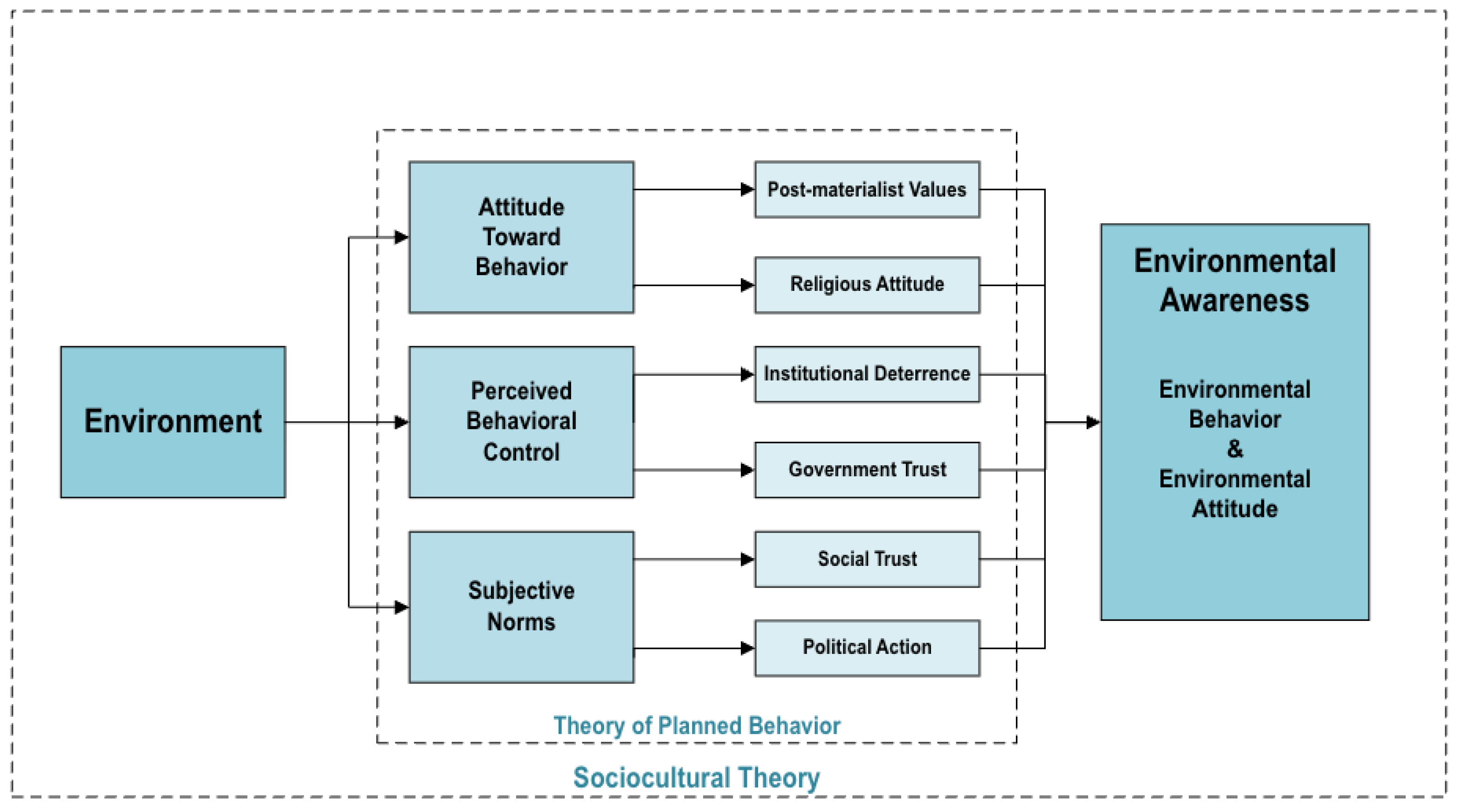
To dissect these mechanisms, this study constructs an innovative, exploratory framework (Figure 1) integrating macro-level Sociocultural Theory and micro-level Theory of Planned Behavior (TPB). Sociocultural Theory posits that individual cognitive development and behavioral choices are deeply embedded within their social interactions, cultural contexts, and institutional environments [28]. In the context of environmental issues, this implies that individuals’ pro-environmental orientations are the outcome of a socially constructed process jointly shaped by national institutional norms, social trust networks, mass media framing, and personal cultural or religious values [29,30,31]. However, while emphasizing macro structures, it often lacks specific pathways explaining how macro factors translate into micro-individual actions.
TPB offers a complementary micro-level framework, asserting that behavioral intentions are determined by three core paths: Attitude toward Behavior, Subjective Norms, and Perceived Behavioral Control [32,33,34]. The innovation of our study lies in precisely mapping abstract sociocultural factors onto these three psychological pathways, bridging the macro-micro divide. Based on empirical realities of developmental states, we operationalize these paths as follows:
Attitude toward Behavior: Driven by deep-seated values. We incorporate “Post-materialist Values” and “Religious Attitude”.
Subjective Norms: Reflecting perceived social pressure and collective expectations. We incorporate “Social Trust” and “Political Action”.
Perceived Behavioral Control: Reflecting the subjective judgment of the ease of performing a behavior, highly dependent on institutional constraints in state-led contexts. We incorporate “Institutional Deterrence” and “Government Trust”.

2.3. Sociocultural Factors in the Attitude Toward Behavior Pathway

In the process of forming environmental awareness, we posit that attitudes toward behavior reflect individuals’ intuitive evaluations of environmental protection, as well as their level of concern for and endorsement of environmental issues. Based on existing research, attitudes and behaviors in the environmental context are primarily influenced by post-materialist values and religious attitudes [35,36].
Post-Materialist Values: With continuous improvements in material conditions, the structure of individual needs shifts, resulting in a generational transition in public values from materialism to post-materialism [37]. This shift reflects an increasing emphasis on higher-order needs such as quality of life and environmental quality, which in turn makes post-materialists more concerned about environmental issues and more willing to invest effort in environmental protection. For instance, studies by Hu, Lu, Wang, and others have demonstrated a significant association between the rise in environmental awareness and the shift toward post-materialist values [38,39,40]. In China, which is currently undergoing a period of economic structural transformation, the emergence of post-materialist values closely aligns with the public’s sensitivity to environmental issues. However, in highly developed contexts such as Singapore, post-materialism may have already become a widespread social consensus, leading to a “ceiling effect” in statistical analyses and reducing its explanatory power as a source of individual variation. Based on this reasoning, we propose the following hypothesis:
H1a. 
Post-materialist values are positively associated with environmental attitudes in China, but this association is non-significant in Singapore.
H1b. 
Post-materialist values are positively associated with environmental behavior in China, but this association is non-significant in Singapore.
Religious Attitude: Religion reinforces moral responsibility systems, encouraging pro-environmental actions as ethical imperatives [41]. Some empirical studies indicate that religious beliefs exert a positive spillover effect in promoting environmentally friendly behaviors among adherents [42]. In Singapore’s multi-ethnic, multi-religious society, religion acts as an explicit social and ethical force. In China, while institutional religion functions differently, deeply ingrained religiosity/traditional ethical attitudes still implicitly shape moral evaluations. Based on this reasoning, we propose the following hypothesis:
H2a. 
Religious attitudes are significantly and positively associated with environmental attitudes, particularly in Singapore.
H2b. 
Religious attitudes are significantly and positively associated with environmental behavior in both nations.

2.4. Sociocultural Factors in the Subjective Norms Pathway

When operationalizing subjective norms in the environmental context, it is essential to consider social trust and political action as key factors, as they can either amplify or constrain perceived group expectations [43,44].
Social Trust: Environmental protection is fundamentally a collective action problem concerning public goods provision. Research has confirmed that social trust can enhance public environmental awareness and encourage participation in environmental actions [45]. When individuals possess high levels of social trust, they are more likely to believe that others will also comply with environmental norms, thereby alleviating concerns about “free riding.” Moreover, according to Homans’ social exchange theory, interactions between two individuals have mutually reinforcing effects [46]. Consequently, as more people trust that others will fulfill their environmental responsibilities, environmental awareness within society as a whole is substantially strengthened. Based on this reasoning, we propose the following hypothesis:
H3a. 
Social trust is significantly and positively associated with high levels of environmental attitudes in both nations.
H3b. 
Social trust is significantly and positively associated with high levels of environmental behavior in both nations.
Political Action: Environmental issues are inherently public affairs. The willingness to engage in political action reflects, to some extent, individuals’ involvement in collective decision-making processes and their proactive efforts to advocate for the public interest. Through political action, individuals not only gain a clearer understanding of societal expectations regarding pro-environmental behavior but also internalize these norms through interactive socialization processes, ultimately perceiving environmental concerns as aligned with broader social values [47]. Based on this reasoning, we propose the following hypothesis:
H4a. 
Political action is significantly and positively associated with environmental attitudes in both nations.
H4b. 
Political action is significantly and positively associated with environmental behavior in both nations.

2.5. Sociocultural Factors in the Perceived Behavioral Control Pathway

Perceived behavioral control refers to individuals’ subjective assessment of the ease or difficulty of performing a specific behavior, with two critical determinants being institutional deterrence and government trust.
Institutional Deterrence: Government institutions, due to their legitimacy, universality, and coercive authority, can directly shape public attitudes and behaviors [48]. Strict environmental enforcement can effectively deter environmental crimes [49]. Under strong institutional deterrence, the public is more likely to recognize the severe consequences of environmental damage and, consequently, support pro-environmental attitudes and actions. However, purely punitive deterrence may lead to a “dependency effect,” whereby individuals perceive environmental protection as solely the government’s responsibility, thereby undermining intrinsic motivation for voluntary environmental behavior. For example, research indicates that China’s incremental, top-down reform approach can foster public reliance on the government, resulting in a phenomenon where citizens express great concern but take limited practical action [50]. Consequently, the public in China tends to delegate governance responsibility to the state rather than assuming personal responsibility [51]. Based on this reasoning, we propose the following hypothesis:
H5a. 
Perceived institutional deterrence is positively associated with environmental attitudes in both nations.
H5b. 
Perceived institutional deterrence is not significantly associated with actual environmental behavior in both nations.
Government Trust: In “strong states” like China and Singapore, resolving macro-environmental issues relies heavily on the state apparatus [52]. High government trust enhances an individual’s “perceived behavioral control,” as they believe their micro-level actions (e.g., waste sorting) are meaningfully supported by the system. Conversely, low trust engenders a sense of powerlessness. Based on this reasoning, we propose the following hypothesis:
H6a. 
Government trust is significantly and positively associated with environmental attitudes in both nations.
H6b. 
Government trust is significantly and positively associated with environmental behavior in both nations.

3. Materials and Methods

3.1. Data Source

This study utilizes secondary data from Wave 7 (2017–2022) of the World Values Survey (WVS) [53], a globally established research program employing nationally representative probability sampling of adults aged 18 and above. The WVS Wave 7 dataset was selected as it provides the most recent, comprehensive, and publicly available environmental module containing rigorously comparable data for both China and Singapore. Data collection was conducted in China (2018) and Singapore (2020), utilizing multistage stratified random sampling. To ensure cross-national comparability, data were gathered primarily through face-to-face interviews under standardized fieldwork protocols (e.g., PAPI and CAPI).
Notably, while there is a two-year temporal gap between data collection in China and Singapore, this specific dataset offers a unique analytical advantage. The data capture the sociocultural landscape right before and during the very early onset of the COVID-19 pandemic, thereby serving as a crucial pre-pandemic baseline. This minimizes the confounding effects of subsequent, large-scale geopolitical and post-pandemic structural shifts on fundamental environmental values, capturing a relatively stable reflection of public environmental consciousness.
To ensure rigorous data quality, observations with missing values or “don’t know/refused to answer” responses on key variables were handled using listwise deletion. Because the missing rate across all core variables was strictly controlled under 5%, this conservative approach maximizes the preservation of original data distributions without introducing imputation bias. The final valid analytical sample comprises 4421 observations (2716 from China and 1705 from Singapore).

3.2. Variables

To ensure reliability, several core independent variables are composite indices constructed from multiple survey items, validated via Cronbach’s alpha. However, due to constraints in the questionnaire design, some variables could be measured only with single-item indicators, which constitutes one of the limitations of this study.

3.2.1. Dependent Variable

Environmental Attitude (Ordinal): Measured by the classic trade-off between environmental protection and economic growth. Responses prioritizing the environment were coded as 2; prioritizing economic growth as 0; and neutral/mixed answers as 1.
Environmental Behavior (Ordinal): Measured by the item “Are you a member of an environmental organization?” Active members were coded as 2, inactive members as 1, and non-members as 0.

3.2.2. Independent Variables

Post-Materialist Values (Ordinal): Operationalized using Inglehart’s classic 4-item index. Materialists (prioritizing order and prices) = 0; Post-materialists (prioritizing free speech and government say) = 2; Mixed = 1.
Religious Attitude (Continuous): Measured on a 10-point scale asking, “How important is God in your life?” (1 = not at all, 10 = very important).
Political Action (Continuous Index): A composite score measuring actual and intended participation in activities like signing petitions, joining boycotts, and attending lawful demonstrations (8 items, Cronbach’s alpha = 0.802).
Social Trust (Continuous Index): An aggregate of trust towards various groups (family, neighbors, strangers, different religions, another nationality, friends) (6 items, Cronbach’s alpha = 0.693).
Institutional Deterrence (Continuous): Measured on a 10-point scale regarding the perceived risk of being held accountable for bribery/corruption (1 = no risk, 10 = very high risk), serving as a proxy for the perceived strictness of state institutional oversight.
Government Trust (Continuous Index): A composite score of trust in the government, police, courts, and political parties (4 items, Cronbach’s alpha = 0.889).

3.2.3. Control Variables

Controls include Gender (Dummy: 1 = Male), Age (Continuous), Education (ISCED scale), Marriage (Dummy: 1 = Married/Cohabiting), Media Use frequency (8-item index, Cronbach’s alpha = 0.753), and Income (1–10 scale).

3.3. Methods

Data analysis was conducted using Stata 18.
First, descriptive statistics and Variance Inflation Factor (VIF) diagnostics were performed to rule out multicollinearity.
Second, Ordered Logistic Regression (Ologit) was utilized as the baseline model. Following the Brant test for the Proportional Odds Assumption, variables in the “Environmental Attitude” model significantly violated the assumption; hence, Generalized Ordered Logistic Regression (gologit2) was applied for attitude, while standard Ologit was retained for behavior.
Third, subgroup regressions and full-sample interaction models were executed to explicitly test cross-national heterogeneities, accompanied by marginal effect visualizations.
Finally, Ordered Probit and Ordered Logit models were used for robustness checks.

4. Results

4.1. Descriptive Statistics and Multicollinearity

Table 1 presents the descriptive statistics for the full sample and the China-Singapore subsamples. A comparison of means reveals notable heterogeneity in environmental awareness and sociocultural characteristics between the two countries. Regarding the dependent variables, the mean value of environmental attitude among Chinese respondents (1.426) is slightly higher than that of their Singaporean counterparts (1.200), indicating a higher level of self-reported support for environmental protection in China. However, scores for environmental behavior show a precipitous drop in both countries (China: 0.054; Singapore: 0.064). This provides direct empirical evidence, at the data level, of a severe “attitude-behavior gap” prevalent in developmental state contexts within the Pan-East Asian region. For the core independent variables, Singaporean respondents report higher average levels of post-materialist values (0.769 vs. 0.540), religious attitude (6.694 vs. 2.785), and social trust (2.760 vs. 2.622). Conversely, Chinese respondents exhibit higher levels of government trust (3.286 vs. 2.839), perceived institutional deterrence (6.854 vs. 6.370), and political action (1.547 vs. 1.441).
To mitigate concerns over multicollinearity and ensure the reliability of subsequent regression analyses, we conducted a correlation analysis and a Variance Inflation Factor (VIF) test (Table 2). The results show that most correlation coefficients among the independent variables are below 0.3. Furthermore, the VIF values for all variables range from 1.03 to 1.75, all well below the conventional threshold of 10 (with the highest value being 1.75 for education). This indicates that the model is not plagued by severe multicollinearity, providing a solid data foundation for the subsequent parameter estimation.

4.2. Baseline Models and Main Effects

Table 3 presents the baseline and full-sample estimates. The inclusion of sociocultural variables substantially improves the model fit: the Pseudo R2 increases from 0.007 (baseline) to 0.027 (full model) for environmental attitudes, and from 0.029 to 0.057 for environmental behavior. This demonstrates that sociocultural factors possess significant explanatory power beyond basic demographic controls.
In the pooled full models, preliminary patterns emerge: government trust, institutional deterrence, social trust, and political action are significantly and positively associated with environmental attitudes; meanwhile, religious attitude, government trust, and political action emerge as significant factors for environmental behavior. While these findings suggest potential shared determinants of environmental awareness, pooled estimates may mask structural heterogeneities. Therefore, we rely on country-stratified models (Table 4) to verify these mechanisms and rigorously test our hypotheses. Due to the cross-sectional nature of the data, all ensuing interpretations denote statistical associations rather than strict causality.

4.3. Cross-National Comparison: Subgroup and Interaction Analyses

To explicitly test the proposed hypotheses and compare national contexts, Table 4 stratifies the sample by country. The analysis is divided into the two dimensions of environmental awareness: attitude and behavior.
Determinants of Environmental Attitude:
In terms of environmental attitudes, the models reveal a mix of shared and context-specific predictors. Social Trust emerges as a universally significant correlate in both nations, which fully supports Hypothesis 3a. However, a coefficient comparison reveals that this association is substantially stronger in Singapore (β = 0.512, p < 0.001) than in China (β = 0.281, p < 0.01). This implies that while interpersonal trust universally builds cognitive consensus for public goods, Singapore’s dense, institutionalized civic networks may amplify this normative association more effectively.
Conversely, context-specific factors are prominent. Post-Materialist Values (β = 0.151, p < 0.05) are significantly correlated with attitudes in China, whereas this association is non-significant in Singapore. This supports Hypothesis 1a, suggesting that China is experiencing a value-driven environmental awakening, whereas post-materialism in highly developed Singapore may have reached a societal saturation point (ceiling effect). Similarly, Institutional Deterrence positively predicts attitudes in China (β = 0.057, p < 0.01) but exhibits weaker/mixed results in Singapore, partially supporting Hypothesis 5a. Notably, Political Action strongly predicts attitudes in Singapore (β = 0.555, p < 0.001) but is non-significant in China, partially supporting Hypothesis 4a. Religious attitude shows no significant association with attitudes in either country, rejecting Hypothesis 2a.
Determinants of Environmental Behavior:
Social trust, post-materialism, and institutional deterrence fail to predict behavior in either country, which supports Hypotheses 3b and 5b, but rejects Hypothesis 1b. Political Action is a highly robust predictor of environmental behavior in both nations, fully supporting Hypothesis 4b. Interestingly, the coefficient in China (β = 1.200, p < 0.001) is considerably larger than in Singapore (β = 0.784, p < 0.01). This suggests that while civic efficacy universally translates into environmental action, this translation is particularly potent in China, where alternative avenues for civic engagement may be more selective, making political propensity a stronger differentiator for NGO participation. Religious Attitude also demonstrates a universal, albeit modest, positive association with behavior across both nations (China: β = 0.100, p < 0.01; Singapore: β = 0.092, p < 0.05), supporting Hypothesis 2b. This indicates that internalized moral frameworks operate similarly across borders to overcome the action threshold.
A critical divergence occurs regarding Government Trust. It serves as a significant positive correlate for actual behavior exclusively in China (β = 0.534, p < 0.05) and is non-significant in Singapore, thereby partially supporting Hypothesis 6b. This highlights a “state-dependent” logic in China: citizens’ willingness to participate in environmental NGOs is contingent upon their confidence in state institutions. In Singapore’s rationalized administrative state, routine civic participation appears decoupled from subjective political trust.
To rigorously validate the cross-national differences observed above, Table 5 presents the full-sample Interaction Model. Most interaction terms (e.g., Post-Materialist Values × Country, Social Trust × Country) do not achieve statistical significance. This non-significance is theoretically meaningful: it implies that the fundamental structural relationships between these sociocultural variables and environmental awareness share a degree of universality across the two developmental states, without undergoing fundamental reversals.
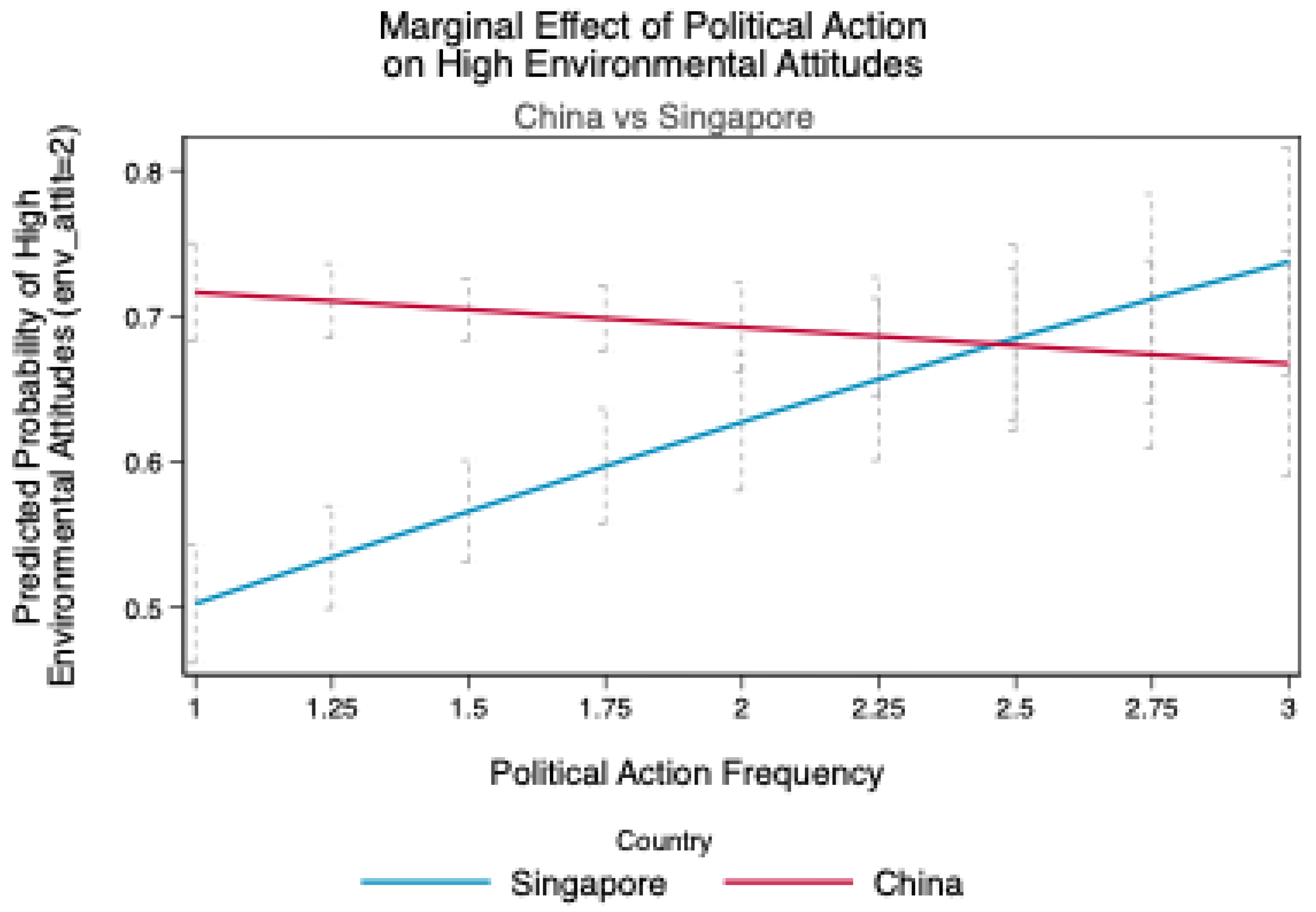
However, the interaction term for Political Action\times Country (China) is highly significant and negative across both threshold levels in the environmental attitude model (β = −0.575, p < 0.001; β = −0.677, p < 0.001). This provides definitive statistical evidence of institutional heterogeneity.
To interpret this divergence intuitively, we refer to the marginal effects plot (Figure 2). The blue trajectory representing Singapore displays a steep upward slope: as the frequency of political participation increases, the predicted probability of holding high environmental attitudes escalates sharply from approximately 50% to over 74%. This suggests that in Singapore, political participation functions as an effective, institutionalized socialization channel for internalizing ecological norms. Conversely, the red trajectory representing China is relatively flat and slightly downward sloping. Despite a higher baseline probability (around 71%), micro-level political action does not correlate with elevated environmental attitudes, and even hints at a slight crowding-out effect.

4.4. Robustness Analysis

To eliminate potential estimation biases arising from specific model specifications, robustness checks were performed (Table 6). We re-estimated the models using Ordered Probit for environmental behavior and standard Ordered Logit for environmental attitudes. The results confirm that the core findings remain remarkably stable. For instance, the universal significance of political action across both behavior models remains highly robust (China: β = 0.531, p < 0.001; Singapore: β = 0.387, p < 0.01). Furthermore, the exclusive significance of government trust for behavior in China (β = 0.234, p < 0.05) and the structural divergence of political action regarding attitudes are entirely preserved. The consistency of coefficient directions and significance levels across different non-linear probability models validates the reliability and scientific rigor of the empirical findings in this study.

5. Discussion

This study reveals several key insights into how sociocultural factors shape environmental awareness in two Pan-East Asian developmental states. First, the descriptive and empirical findings starkly highlight a universal phenomenon across both nations: a pronounced disconnect between high environmental attitudes and exceptionally low institutionalized environmental behavior (NGO membership). This observation corroborates extensive literature documenting the “value-action gap” in global environmental sociology [54]. Our findings suggest that while state-led environmental narratives and global ecological discourse have successfully cultivated cognitive awareness among the public in these developmental states, they have not fostered sufficient structural scaffolding to translate this cognitive alignment into sustained civic action.
This gap underscores a crucial theoretical point: shaping attitudes and catalyzing behaviors operate through distinct sociocultural pathways. As our models indicate, macro-values (like post-materialism) and generalized social trust are effective in building cognitive consensus, but overcoming the high threshold for actual behavioral participation requires different catalysts—namely, strong political efficacy and internalized moral/religious frameworks.
Postmaterialist Values: In China, individuals with more postmaterialist values have significantly higher environmental attitudes, supporting modernization theory’s claim that economic development and generational value shifts can boost environmental concern [55]. This fits prior Chinese research linking modernization and green values. In Singapore, by contrast, postmaterialist values show no effect—likely because most people already hold such values, leaving little variation. This “ceiling effect” interpretation aligns with the literature, noting that once a society uniformly adopts certain values, those values lose explanatory power for individual differences.
Religious Attitude: We find that stronger religiosity is associated with greater environmental action in both countries. This echoes findings from cross-national analyses of the WVS, which show that religiosity often positively correlates with pro-environment attitudes and behaviors [56]. In multicultural Singapore, religious teachings may explicitly frame stewardship as a moral duty, thus enhancing environmental attitudes as well; we observed a hint of that in Singapore (though not in China), perhaps reflecting the more overt role of faith communities in public life there. Our results contrast with some Western studies, where fundamentalist beliefs sometimes undermine environmentalism, highlighting the context-dependence of religion’s effects [56]. In sum, H2 is partly confirmed: religion clearly boosts pro-environmental behavior (and attitudes) in Singapore, underscoring the potential of faith-based mobilization for sustainability in Asia.
Social Trust: High social trust strongly raises pro-environmental attitudes in both countries, which is consistent with theories of collective action—when people trust others to do their part, they feel more confident in endorsing environmental protection [57]. Notably, social trust did not directly increase behaviors. This implies that while trust helps form shared norms and concern, additional factors (e.g., personal capacity, institutional support) determine whether one actually acts. The literature similarly finds that trust creates a conducive atmosphere but is not the sole driver of engagement [57].
Political Action: Civic engagement showed robust positive effects, but with a cross-national twist. In both China and Singapore, more politically active citizens are much more likely to belong to environmental organizations, confirming that activism generally aligns with environmental participation. However, active participation raises environmental attitudes only in Singapore. This disparity may stem from differences in political culture. Singapore’s political sphere, while controlled, still provides outlets (voluntary associations, public consultations) where environmental issues are discussed, making civic engagement a vehicle for normative endorsement. In China, by contrast, political action channels (even legal ones) seldom involve environmental advocacy, and activism is tightly regulated. Consequently, Chinese citizens may participate politically for non-environmental reasons (e.g., other public issues) without it translating to environmental concern. This finding resonates with social-psychological work (e.g., XingXing et al. 2022) showing that “politicized identity” boosts pro-environment activism in freer contexts [57]. Our result suggests that in authoritarian environments, political engagement does not substitute for environmental education or may even reflect disillusionment, a hypothesis for further study.
Institutional Deterrence: Perceived enforcement strength increases environmental attitudes (especially in China) but has no impact on behavior. This supports H5 and matches the idea that stringent laws heighten risk awareness and normative endorsement of conservation. For example, knowing that pollution fines are severe can make people agree more strongly with “protect the environment at all costs”. However, this external deterrence does not make people personally active, which fits the “dependency” critique: if individuals assume the state will enforce compliance, they may feel less personal agency. This pattern parallels findings that institutional trust boosts non-activist behaviors but can dampen self-motivated activism.
Government Trust: Belief in government’s reliability had a clear positive link to environmental outcomes in China but not in Singapore. In China’s statist context, trusting citizens may perceive that their small actions are meaningful within the system (e.g., garbage sorting, joining government-led campaigns), thus both attitude and behavior rise with trust. This echoes Chinese studies’ finding that government credibility enhances willingness to engage in pro-environment actions. In Singapore, the weaker effect could mean that trust levels do not vary enough or that other factors play a larger role. Overall, H6 holds mainly for China.
In sum, our results underscore that the same sociocultural factors can operate differently across contexts. The stronger role of post-materialist values and government trust in China, versus that of political participation and religion in Singapore, highlights the interplay of development stage and cultural values. These findings complement prior cross-national work: for instance, Marquart-Pyatt (2012) showed that education affects environmental concerns differently by country [55]; we extend that insight to trust and activism. The emphasis on qualitative differences—such as the “activation” of norms by civic engagement in Singapore but not China—points to the need to consider political culture in environmental psychology models.
Limitations and Future Directions:
As an exploratory comparative study utilizing secondary survey data, several limitations warrant acknowledgment. First, regarding variable measurement, the operationalization of environmental behavior is confined to a single proxy—environmental NGO membership. While these capture institutionalized civic engagement, they overlook everyday private-sphere pro-environmental behaviors (e.g., green consumption, household waste sorting). Similarly, abstract macro-constructs like institutional deterrence were measured using proxy indicators (e.g., corruption accountability risk) that may not fully capture the specific nuances of environmental law enforcement. Future research should employ multidimensional behavioral scales to capture a more holistic behavioral spectrum.
Second, our reliance on secondary data precludes the use of direct cultural measurement tools. Future research should incorporate established metrics and utilize multilevel modeling to examine how individual cultural orientations might moderate the relationships between sociocultural factors and environmental awareness.
Third, there is a limitation related to data collection timing. Due to the staggered schedule of the WVS Wave 7, the Chinese (2018) and Singaporean (2020) data are separated by a two-year gap, with the latter coinciding with the onset of the COVID-19 pandemic. Although we frame the Singapore data as a pre-pandemic baseline, we cannot entirely dismiss the potential impact of this exogenous shock on the environmental perceptions of the Singaporean public. Consequently, some observed cross-national differences may partially reflect temporal effects rather than genuine country-specific variations. Future comparative studies should ideally collect data simultaneously or employ methods like difference-in-differences to control for temporal disturbances.
Fourth, the cross-sectional design inherently precludes strict causal claims. Future sociological inquiries must prioritize longitudinal panel data or quasi-experimental designs to disentangle the causal sequence between macro-institutional shifts and micro-level environmental psychology in rapidly developing societies.
Finally, the relatively low Pseudo R-squared values in our models indicate that the included sociocultural factors explain a modest portion of the variance in environmental awareness. This is theoretically expected, as environmental cognition is co-shaped by multiple unobserved factors—such as personal experience, local environmental quality, specific media exposure, and environmental education—that are omitted due to data constraints. Given this limited explanatory power, the primary contribution of this study lies not in exhaustively explaining environmental awareness, but rather in identifying how specific sociocultural correlates function differently across similarly structured governance models. Future research should construct more comprehensive explanatory frameworks by incorporating additional micro-level (e.g., environmental knowledge, risk perception) and macro-level (e.g., institutional quality, media agenda) variables, and extend the comparative scope to other Asian developmental states to test the generalizability of these mechanisms.

6. Conclusions

This study identifies three primary empirical patterns regarding the sociocultural correlates of environmental awareness in China and Singapore.
First, both nations exhibit a pervasive “attitude-behavior gap,” where cognitive environmental concern significantly outpaces institutionalized civic action.
Second, universally, social trust correlates with higher environmental attitudes, while political action and religious attitudes are positively linked to actual behavior.
Third, distinct institutional mechanisms emerge: China reflects a “state-dependent environmentalism,” where attitudes are associated with post-materialist values and institutional deterrence, and behavioral participation is strongly related to state trust. Conversely, Singapore displays an “institutionalized civic environmentalism,” where routine socio-political participation shows a robust positive association with environmental attitudes—a correlation neutralized in China.
These findings demonstrate that the psychosocial mechanisms underlying ecological awareness are structurally contingent upon national governance models, necessitating context-specific interventions rather than monolithic policy templates. For state-dependent models like China’s, advancing ecological citizenship requires diversifying legitimate channels for grassroots participation to reduce state reliance. For highly institutionalized societies like Singapore, policymakers should leverage existing civic and religious networks to sustain ecological commitments. Ultimately, integrating macro-level political culture with micro-level psychological models is essential for fully comprehending the sociological pathways to environmental sustainability.

Author Contributions

Data curation, Z.H.; Formal analysis, Z.H.; Investigation, Z.H.; Methodology, J.S.; Writing—original draft, J.S.; Writing—review and editing, J.S. All authors have read and agreed to the published version of the manuscript.

Funding

Project supported by the National Social Science Fund of China (Grant No. 23ASH010). Project supported by Special Funding for Chongqing Postdoctoral Research Project (Grant No. 2023CQBSHTB3050).

Institutional Review Board Statement

The study was conducted in accordance with the Declaration of Helsinki, and approved by Xi’an Jiaotong University Ethics Review Committee protocol code XJTU2026011028 on 10 January 2026.

Informed Consent Statement

Informed consent was obtained from all subjects involved in the study.

Data Availability Statement

The dataset used in this study is available from the corresponding author upon reasonable request.

Conflicts of Interest

The authors declare no conflicts of interest.

References

  1. Colombo, S.L.; Chiarella, S.G.; Raffone, A.; Simione, L. Understanding the environmental attitude–behaviour gap: The moderating role of dispositional mindfulness. Sustainability 2023, 15, 7285. [Google Scholar] [CrossRef]
  2. Kollmuss, A.; Agyeman, J. Mind the gap: Why do people act environmentally and what are the barriers to pro-environmental behavior? Environ. Educ. Res. 2002, 8, 239–260. [Google Scholar] [CrossRef]
  3. Dietz, T.; Stern, P.C.; Guagnano, G.A. Social structural and social psychological bases of environmental concern. Environ. Behav. 1998, 30, 450–471. [Google Scholar] [CrossRef]
  4. Inglehart, R. Public Support for Environmental Protection: Objective Problems and Subjective Values in 43 Societies. PS Political Sci. Politics 1995, 28, 57–72. [Google Scholar] [CrossRef]
  5. Franzen, A.; Vogl, D. Two decades of measuring environmental attitudes: A comparative analysis of 33 countries. Glob. Environ. Change 2013, 23, 1001–1008. [Google Scholar] [CrossRef]
  6. Franzen, A.; Meyer, R. Environmental attitudes in cross-national perspective: A multilevel analysis of the ISSP 1993 and 2000. Eur. Sociol. Rev. 2010, 26, 219–234. [Google Scholar] [CrossRef]
  7. Ortmann, S.; Thompson, M.R. China and the “Singapore Model”. J. Democr. 2016, 27, 39–52. [Google Scholar] [CrossRef]
  8. Bardhan, P. The Chinese governance system: Its strengths and weaknesses in a comparative development perspective. China Econ. Rev. 2020, 61, 101430. [Google Scholar] [CrossRef]
  9. Cheang, B.; Lim, H. Institutional diversity and state-led development: Singapore as a unique variety of capitalism. Struct. Change Econ. Dyn. 2023, 67, 182–192. [Google Scholar] [CrossRef]
  10. Gilley, B. Authoritarian environmentalism and China’s response to climate change. Environ. Politics 2012, 21, 287–307. [Google Scholar] [CrossRef]
  11. Han, H. Singapore, a Garden City: Authoritarian environmentalism in a developmental state. J. Environ. Dev. 2017, 26, 3–24. [Google Scholar] [CrossRef]
  12. Takamatsu, R. Morality through the lens of Confucian heritage countries. Front. Psychol. 2024, 15, 1454425. [Google Scholar] [CrossRef] [PubMed]
  13. Tan, C. For group, (f)or self: Communitarianism, Confucianism and values education in Singapore. Curric. J. 2013, 24, 477–493. [Google Scholar] [CrossRef]
  14. Seawright, J.; Gerring, J. Case selection techniques in case study research: A menu of qualitative and quantitative options. Political Res. Q. 2008, 61, 294–308. [Google Scholar] [CrossRef]
  15. Chng, W.Y.K.; Ong, K.W. The Singapore Green Plan 2030: Analysing its implications on law and the legal industry in Singapore. Environ. Law Rev. 2021, 23, 336–343. [Google Scholar] [CrossRef]
  16. Zhang, J.; Xue, C.; Hou, G. The impact of Chinese public environmental awareness on environmental behavior: An analysis based on China national surveys in 2003, 2010 and 2021. Land 2024, 13, 1418. [Google Scholar] [CrossRef]
  17. Zheng, W.; Chen, Z.; Ong, P. Environmental Philanthropy and Civic Engagement: A Comparison of Mainland China, Taiwan, Hong Kong, and Singapore. China Nonprofit Rev. 2019, 11, 328–364. [Google Scholar] [CrossRef]
  18. Kotyza, P.; Cabelkova, I.; Pierański, B.; Malec, K.; Borusiak, B.; Smutka, L.; Nagy, S.; Gawel, A.; Bernardo López Lluch, D.; Kis, K.; et al. The predictive power of environmental concern, perceived behavioral control and social norms in shaping pro-environmental intentions: A multicountry study. Front. Ecol. Evol. 2024, 12, 1289139. [Google Scholar] [CrossRef]
  19. Sherman, D.K.; Updegraff, J.A.; Handy, M.S.; Eom, K.; Kim, H.S. Beliefs and Social Norms as Precursors of Environmental Support: The Joint Influence of Collectivism and Socioeconomic Status. Pers. Soc. Psychol. Bull. 2022, 48, 463–477. [Google Scholar] [CrossRef]
  20. Wheaton, M.; Ardoin, N.M.; Bowers, A.W.; Kannan, A. Sociocultural learning theories for social-ecological change. Environ. Educ. Res. 2024, 30, 1193–1210. [Google Scholar] [CrossRef]
  21. Ajzen, I. The theory of planned behavior. Organ. Behav. Hum. Decis. Process. 1991, 50, 179–211. [Google Scholar] [CrossRef]
  22. Roth, C.E. Environmental Literacy: Its Roots, Evolution and Directions in the 1990s; ERIC Clearinghouse for Science, Mathematics, and Environmental Education: Columbus, OH, USA, 1992; p. 25. Available online: https://eric.ed.gov/?id=ED348235 (accessed on 17 November 2025).
  23. Dunlap, R.E.; Van Liere, K.D. The “New Environmental Paradigm”: A Proposed Measuring Instrument and Preliminary Results. J. Environ. Educ. 1978, 9, 10–19. [Google Scholar] [CrossRef]
  24. Weigel, R.; Weigel, J. Environmental Concern: The Development of a Measure. Environ. Behav. 1978, 10, 3–15. [Google Scholar] [CrossRef]
  25. Takala, M. Environmental Awareness and Human Activity. Int. J. Psychol. 1991, 26, 585–597. [Google Scholar] [CrossRef]
  26. Chen, J.; Huang, L. Spatial Heterogeneity of Influencing Factors on Public Environmental Awareness in Yangtze River Delta Urban Agglomeration. World Reg. Stud. 2023, 32, 139–151. Available online: https://sjdlyj.ecnu.edu.cn/EN/10.3969/j.issn.1004-9479.2023.08.2020856 (accessed on 17 November 2025).
  27. Su, F.; Qi, L.; Song, N.; Hu, L.; Guo, X.; Xue, B. Analysis of the Impact of Livelihood Capital on Farmers’ Environmental Awareness in Qinba Mountains of Southern Shaanxi Province. Ecol. Sci. 2024, 43, 110–122. [Google Scholar] [CrossRef]
  28. Vygotsky, L.S. Mind in Society: Development of Higher Psychological Processes; Cole, M., Jolm-Steiner, V., Scribner, S., Souberman, E., Eds.; Harvard University Press: Cambridge, MA, USA, 1978. [Google Scholar] [CrossRef]
  29. Ezeudu, T.S.; Chukwudubem, E.K. Exploring Socio-Cultural Factors in the Context of Urban Environmental Management in Nigeria. Int. J. Res. Innov. Soc. Sci. 2023, 7, 282–300. [Google Scholar] [CrossRef]
  30. Melnyk, I.; Podorozhnyi, V. Factors of Environmental Awareness Formation in Students. Pers. Environ. Issues 2023, 3, 5–9. [Google Scholar] [CrossRef]
  31. Vyhovsky, L.A.; Vyhovska, T.V.; Vyhovsky, D.L. Civil Society as a Factor in the Formation of Environmental Consciousness and People’s Culture. Mod. Eng. Innov. Technol. 2022, 22, 99–116. [Google Scholar] [CrossRef]
  32. Akhir, N.M.; Wei Lun, A.; Mee Yeang, C.; Abd Rahman, N.; Halim, L. Establishing the Value-psychological-educational Dimensions for “Learning to Action” Model for Pro-environmental Behavior. Cogent Educ. 2022, 9, 2156748. [Google Scholar] [CrossRef]
  33. De Groot, J.I.M.; Steg, L. General Beliefs and the Theory of Planned Behavior: The Role of Environmental Concerns in the TPB. J. Appl. Soc. Psychol. 2007, 37, 1817–1836. [Google Scholar] [CrossRef]
  34. Greaves, M.; Zibarras, L.D.; Stride, C. Using the Theory of Planned Behavior to Explore Environmental Behavioral Intentions in the Workplace. J. Environ. Psychol. 2013, 34, 109–120. [Google Scholar] [CrossRef]
  35. Oreg, S.; Katz-Gerro, T. Predicting proenvironmental behavior cross-nationally: Values, the theory of planned behavior, and value-belief-norm theory. Environ. Behav. 2006, 38, 462–483. [Google Scholar] [CrossRef]
  36. Yang, J. The environmental impact of religious beliefs in the East: Evidence from Chinese survey data. Front. Psychol. 2024, 15, 1432142. [Google Scholar] [CrossRef]
  37. Peterson, T.; Tollefson, K. A Scientific Discussion of Post-Materialism Values and Environmental Behavior. Businesses 2024, 4, 347–370. [Google Scholar] [CrossRef]
  38. Hu, J.; Pei, Y. The Change of Public Environmental Awareness and Its Influencing Factors in China—Based on the Perspective of Post-Materialism Theory. Jin Yang J. 2019, 3, 101–107. [Google Scholar] [CrossRef]
  39. Lu, C.; Wang, X.; Liu, F. A Comparative Study of Influencing Factors on Public Environmental Behavior in China and the United States: Based on Data Analysis from the Sixth Wave of the World Values Survey. J. Southeast Univ. (Philos. Soc. Sci.) 2020, 2, 110–122. [Google Scholar] [CrossRef]
  40. Wang, C.; Yang, X.; Chen, D. Exploring the Changes and Influencing Factors of Chinese Public Environmental Awareness: A Diachronic Analysis Based on CSS2006, 2013, and 2019. Pol. J. Environ. Stud. 2023, 32, 5365–5372. [Google Scholar] [CrossRef]
  41. Eom, K.; Ng, S.T. The potential of religion for promoting sustainability: The role of stewardship. Top. Cogn. Sci. 2023, 15, 480–499. [Google Scholar] [CrossRef]
  42. Huang, J.J. Religious Belief and Environmental Protection Behavior Choice of Chinese Residents. J. Shaanxi Adm. Coll. 2021, 2, 66–79. [Google Scholar] [CrossRef]
  43. Chang, M.-Y.; Kuo, H.-Y.; Chen, H.-S. Perception of Climate Change and Pro-Environmental Behavioral Intentions of Forest Recreation Area Users—A Case of Taiwan. Forests 2022, 13, 1476. [Google Scholar] [CrossRef]
  44. Maleknia, R.; Hălălișan, A.-F.; Maleknia, K. Who Shapes What We Should Do in Urban Green Spaces? An Investigation of Subjective Norms in Pro-Environmental Behavior in Tehran. Forests 2025, 16, 1273. [Google Scholar] [CrossRef]
  45. Schwartz, S.H. Universals in the Content and Structure of Values: Theoretical Advances and Empirical Tests in 20 Countries. Adv. Exp. Soc. Psychol. 1992, 25, 1–65. [Google Scholar] [CrossRef]
  46. Homans, G.C. Social Behavior as Exchange. Am. J. Sociol. 1958, 63, 597–606. [Google Scholar] [CrossRef]
  47. Syropoulos, S.; Markowitz, E. Perceived responsibility to address climate change consistently relates to increased pro-environmental attitudes, behaviors, and policy support: Evidence across 23 countries. J. Environ. Psychol. 2022, 83, 101868. [Google Scholar] [CrossRef]
  48. Zheng, Q.; Wan, L.; Wang, S.; Li, J.; Wu, J.; Song, M. Can Environmental Regulations Induce Residents to Develop Green Lifestyles? Evidence from China. Syst. Eng. Theory Pract. 2023, 43, 941–957. [Google Scholar] [CrossRef]
  49. Liu, X.; Wang, W.; Huang, S. Criminal enforcement and environmental performance: Evidence from China. J. Environ. Manag. 2024, 358, 108267. [Google Scholar] [CrossRef]
  50. Yan, B. On Adjustment of Environmental Legal System & Change of Civil Environmental Consciousness. Law J. 2007, 3, 129–131. [Google Scholar] [CrossRef]
  51. Wang, Y.; Sun, M.; Yang, X.; Yuan, X. Public Awareness and Willingness to Pay for Tackling Smog Pollution in China: A Case Study. J. Clean. Prod. 2016, 112, 1627–1634. [Google Scholar] [CrossRef]
  52. He, X.; Qin, J.; Ran, X. The perceived decline in trust in local government and Chinese residents’ willingness to participate in household waste sorting. Discov. Sustain. 2026, 7, 193. [Google Scholar] [CrossRef]
  53. Haerpfer, C.; Inglehart, R.; Moreno, A.; Welzel, C.; Kizilova, K.; Diez-Medrano, J.; Lagos, M.; Norris, P.; Ponarin, E.; Puranen, B. (Eds.) World Values Survey: Round Seven—Country-Pooled Datafile Version 5.0; JD Systems Institute & WVSA Secretariat: Madrid, Spain; Vienna, Austria, 2022. [Google Scholar] [CrossRef]
  54. Portus, R.; Aarnio-Linnanvuori, E.; Dillon, B.; Fahy, F.; Gopinath, D.; Mansikka-Aho, A.; Williams, S.-J.; Reilly, K.; McEwen, L. Exploring the environmental value action gap in education research: A semi-systematic literature review. Environ. Educ. Res. 2024, 30, 833–863. [Google Scholar] [CrossRef]
  55. Marquart-Pyatt, S.T. Contextual influences on environmental concerns cross-nationally: A multilevel investigation. Soc. Sci. Res. 2012, 41, 1085–1099. [Google Scholar] [CrossRef]
  56. Saroglou, V.; El Marsni, K.; Benaicha, I. Pro-environmental attitudes and behavior: The role of religion and spirituality in secularized Europe beyond relevant individual differences. J. Environ. Psychol. 2025, 107, 102799. [Google Scholar] [CrossRef]
  57. Xing, Y.; Li, M.; Liao, Y. Trust, Identity, and Public-Sphere Pro-environmental Behavior in China: An Extended Attitude-Behavior-Context Theory. Front. Psychol. 2022, 13, 919578. [Google Scholar] [CrossRef]
Figure 1. Research Framework.
Sustainability 18 03314 g001
Figure 2. Marginal Effect of Political Action.
Sustainability 18 03314 g002
Table 1. Descriptive Statistics of Variables.
VariableChinaSingaporeTotal
ObsMeanStd. Dev.ObsMeanStd. Dev.ObsMeanStd. Dev.
Post-Materialist Values27160.5400.57517050.7690.58544210.6280.590
Religion Attitude27162.7852.52717056.6942.98444214.2923.313
Government Trust27163.2860.53617052.8390.58444213.1130.596
Institutional Deterrence27166.8542.33617056.3703.01844216.6672.630
Social Trust27162.6220.34717052.7600.39744212.6750.373
Political Action27161.5470.36017051.4410.44344211.5060.397
Environmental Attitude27161.4260.87917051.2000.96444211.3390.919
Environmental behavior27160.0540.28517050.0640.28944210.0580.287
Gender27160.4520.49817050.4690.49944210.4590.498
Age271644.29114.477170547.34516.123442145.46815.204
Education27162.8271.89517054.2341.91744213.3702.023
Marriage27160.8020.39917050.5970.49144210.7230.448
Media27162.9460.88217053.6950.87044213.2350.950
Income27164.1421.85417054.9871.69644214.4681.841
Table 2. Results of the Pearson Correlation Matrix and Multicollinearity (VIF) Tests.
Variable12345678910111213VIF
1. Post-Materialist Values1 1.07
2. Religion Attitude0.135 *1 1.19
3. Government Trust−0.159 *−0.188 *1 1.14
4. Institutional Deterrence−0.059 *−0.0170.110 *1 1.03
5. Social Trust0.057 *0.139 *0.135 *0.0151 1.11
6. Political Action0.062 *−0.068 *−0.0140.095 *0.057 *1 1.17
7. Environmental Attitude0.01−0.077 *0.080 *0.070 *0.074 *0.097 *1 -
8. Environmental Behavior0.044 *0.049 *0.0110.0180.0060.104 *0.0231 -
9. Gender0.085 *−0.071 *−0.041 *−0.038 *0.065 *0.041 *0.0220.0031 1.04
10. Age−0.083 *0.107 *0.025−0.01−0.029−0.327 *−0.066 *−0.034 *0.0151 1.43
11. Education0.116 *0.149 *−0.162 *−0.031 *0.185 *0.257 *0.078 *0.061 *0.076 *−0.413 *1 1.75
12. Marriage−0.103 *−0.092 *0.106 *0.041 *−0.054 *−0.111 *0−0.014−0.010.300 *−0.202 *1 1.14
13. Media0.113 *0.214 *−0.116 *0.0030.154 *0.182 *0.0030.091 *0.079 *−0.245 *0.525 *−0.088 *11.48
14. Income0.075 *0.146 *−0.041 *−0.0230.142 *0.083 *0.0240.022−0.004−0.145 *0.359 *−0.038 *0.314 *1.20
Note: Statistical significance levels: * p < 0.05.
Table 3. Baseline Regression Results (Full Sample).
VariableEnvironmental AttitudeEnvironmental Behavior
Gologit2
(Outcome 0)
Gologit2
(Outcome 1)
Ologit
(Baseline)
Ologit
(Full Model)
Ologit
(Baseline)
Independent Variables
Post-Materialist Values0.0790.0790.235
Religion Attitude−0.054 ***−0.037 **0.774 **
Government Trust0.228 ***0.228 ***0.337 *
Institutional Deterrence0.059 ***0.038 **0.028
Social Trust0.336 ***0.336 ***−0.238
Political Action0.405 ***0.313 ***1.046 ***
Control Variables
Gender0.0140.0670.090.0050.003
Age0.001−0.003−0.007 **−0.003−0.007
Education0.107 ***0.091 ***0.091 ***0.0290.053
Marriage0.0970.0970.1290.022−0.025
Media Use−0.109 **−0.109 **−0.122 **0.447 ***0.517 ***
Income−0.0040.0130.006−0.027−0.018
Model Fit
N44214421442144214421
Pseudo R20.0270.0270.0070.0570.029
LR/Wald χ2184.81 ***184.81 ***47.30 ***114.97 ***43.65 ***
Note: Statistical significance levels: * p < 0.05, ** p < 0.01, and *** p < 0.001.
Table 4. Grouped Regression Results by Country.
VariableEnvironmental BehaviorEnvironmental Attitude
Ologit (Singapore)Ologit
(China)
Gologit2 (Singapore Outcome 0)Gologit2 (Singapore Outcome 1)Gologit2
(China Outcome 0)
Gologit2
(China Outcome 1)
Independent Variables
Post-Materialist Values0.2570.1990.0110.0910.151 *0.151 *
Religion Attitude0.092 *0.100 **0.0090.009−0.029−0.007
Government Trust0.0750.534 *0.0620.318 **0.0680.068
Institutional Deterrence0.0310.030.062 **0.0120.057 **0.057 **
Social Trust−0.4620.0390.512 ***0.512 ***0.281 **0.281 **
Political Action0.784 **1.200 ***0.555 ***0.555 ***−0.012−0.16
Control Variables
Gender0.172−0.159−0.005−0.0050.0850.085
Age−0.1590.0160.008 *−0.0020.0040.004
Education0.0380.0670.144 ***0.108 **0.124 ***0.124 ***
Marriage−0.0260.02−0.168−0.1680.0570.057
Media Use0.433 **0.570 ***−0.039−0.168 *−0.002−0.058
Income−0.0620.0160.0310.0310.010.01
Model Fit
N170527161705170527162716
Pseudo R20.0550.0720.0570.0570.0180.018
LR/Wald χ250.33 ***78.61 ***154.08 ***154.08 ***72.02 ***72.02 ***
Note: Statistical significance levels: * p < 0.05, ** p < 0.01, and *** p < 0.001.
Table 5. Heterogeneity Analysis: Interaction Effects with Country.
VariableEnvironmental BehaviorEnvironmental Attitude
Ologit (Interaction Model)Gologit2 (Outcome 0)Gologit2 (Outcome 1)
Main Effects
(Singapore country = 0)
Post-Materialist Values0.2940.0510.051
Religion Attitude0.077 *0.0060.006
Government Trust0.0370.1480.228 *
Institutional Deterrence0.0250.044 **0.02
Social Trust−0.4260.516 ***0.516 ***
Political Action0.856 ***0.548 ***0.548 ***
Country (China = 1)−3.234 *2.470 ***2.470 ***
Interaction Effects
(China vs. Singapore)
Post-Materialist × Country−0.1180.0980.098
Religion Attitude × Country0.027−0.034−0.016
Government Trust × Country0.491−0.084−0.165
Institutional Deterrence × Country0.0060.090.038
Social Trust × Country0.521−0.223−0.223
Political Action × Country0.261−0.575 ***−0.677 ***
Control Variables
Gender−0.0010.0470.047
Age−0.0010.005 *0.001
Education0.040.107 ***0.115 ***
Marriage0.011−0.06−0.06
Media Use0.470 ***−0.025−0.025
Income−0.0160.0140.014
Model Fit
N442144214421
Pseudo R20.0610.0380.038
Wald χ2126.79 ***265.23 ***265.23 ***
Note: Statistical significance levels: * p < 0.05, ** p < 0.01, and *** p < 0.001.
Table 6. Robustness Checks.
VariableEnvironmental BehaviorEnvironmental Attitude
Ordered ProbitOrdered Logit
Full SampleSingaporeChinaFull SampleSingaporeChina
Post-Materialist Values0.116 *0.1330.10.0760.02
Religion Attitude0.037 **0.045 *0.049 **−0.043 ***0.054 **0.02
Government Trust0.153 *0.0170.234 *0.227 ***−0.478 ***−0.226 **
Institutional Deterrence0.0130.0140.0130.046 ***−0.042 **−0.025
Social Trust−0.141−0.225−0.0620.341 ***0.1570.16
Political Action0.491 ***0.387 **0.531 ***0.344 ***0.256 *0.219
Model Fit
N442117052716442117052716
Pseudo R20.0550.0540.070.0210.0350.014
Wald χ2112.29 ***51.81 ***71.68 ***133.17 ***94.17 ***56.93 ***
Note: Statistical significance levels: * p < 0.05, ** p < 0.01, and *** p < 0.001.
Disclaimer/Publisher’s Note: The statements, opinions and data contained in all publications are solely those of the individual author(s) and contributor(s) and not of MDPI and/or the editor(s). MDPI and/or the editor(s) disclaim responsibility for any injury to people or property resulting from any ideas, methods, instructions or products referred to in the content.