1. Introduction
Cultural tourism has become a central component of contemporary destination development strategies, particularly in regions characterised by dense archaeological landscapes and multi-layered historical continuity. Early theoretical work conceptualised tourism as a socially constructed experience shaped by authenticity, representation, and consumption practices [
1,
2,
3], while subsequent scholarship situated heritage tourism within broader political, economic, and cultural geographies of place-making and commodification [
4,
5]. In practical planning terms, earlier tourism frameworks primarily promoted individual monuments or flagship attractions, whereas more recent heritage planning approaches emphasise spatially integrated tourism systems capable of organising dispersed cultural assets into coherent visitor structures [
6,
7,
8,
9]. Corridor-based configurations have therefore gained prominence, as they extend visitor stay duration, strengthen interpretive continuity, improve accessibility coordination, and support a more balanced regional distribution of tourism benefits, particularly in heritage-rich territories characterised by spatial fragmentation [
10,
11,
12,
13].
The governance and management of cultural tourism destinations are widely recognised as critical determinants of sustainability outcomes. Research on tourism governance highlights the importance of coordinated multi-level policy frameworks, stakeholder integration, and adaptive management in mitigating negative socio-spatial impacts associated with unregulated tourism growth [
14,
15,
16]. Lifecycle-based approaches further demonstrate that destinations may experience rapid expansion followed by stagnation or decline when spatial capacity and governance mechanisms are misaligned with visitor pressures [
17]. Transport accessibility and gateway configuration play a decisive role in structuring visitor flows and shaping the spatial distribution of tourism benefits across regions [
18,
19]. Accordingly, integrated planning frameworks are increasingly advocated as mechanisms for aligning conservation objectives, infrastructure provision, and visitor management within sustainable destination systems [
6,
9,
20].
Within this broader theoretical context, the historical region of Cilicia in southern Türkiye represents one of the most culturally extensive yet structurally under-integrated heritage landscapes of the Eastern Mediterranean. Adana Province contains a dense concentration of Roman, Byzantine, medieval Armenian, and Ottoman-period settlements; however, tourism activity remains highly concentrated in the metropolitan centre and is predominantly associated with gastronomy rather than structured historical exploration. This imbalance does not reflect a lack of cultural resources, but rather indicates spatial fragmentation and the absence of an operational routing framework capable of integrating dispersed heritage assets into a unified and legible regional visitor system [
6,
9,
21,
22,
23].
Among the archaeological landscapes of the region, the ancient city of Anavarza constitutes one of the largest and most monumental urban archaeological complexes of Cilicia. Beyond its architectural scale, Anavarza also represents a biocultural landscape situated within the Mediterranean ecological zone of the Cilician plain. The site is historically associated with Pedanius Dioscorides, author of De Materia Medica, one of the foundational works of medicinal botany [
23,
24]. This dual archaeological and ecological significance reinforces the necessity of integrating conservation-sensitive spatial planning within tourism development strategies.
Its extensive fortification systems, ceremonial avenues, monumental architecture, and landscape-scale spatial footprint attest to its historical role as a major administrative and military centre [
22,
23]. Nevertheless, despite its heritage significance and tentative recognition within international heritage frameworks, Anavarza currently functions largely as an isolated archaeological destination that remains weakly integrated into structured regional tourism circulation [
25]. This condition reflects a broader planning challenge observed in dispersed archaeological regions, where monumental heritage cores lack coordinated gateway access, intermediate staging nodes, and sequential visitor routing mechanisms capable of enabling coherent movement, interpretation, and landscape-scale management [
10,
11,
12,
13,
18,
19].
In tourism planning literature, cultural routes and corridors are conceptualised as spatial linkages that organise dispersed heritage assets through coordinated mobility structures and thematic continuity [
10,
11,
12,
13]. Unlike single-site visitation frameworks, corridor-based systems integrate accessibility, staging nodes, and sequential visitor movement to enhance spatial coherence and regional tourism distribution [
10,
12,
26,
27]. Building upon this framework, the present study defines a heritage corridor framework as a hierarchically structured spatial planning instrument that connects a metropolitan gateway, an intermediate transition node, and a primary archaeological anchor through operational sequential routing logic. In this framework, the corridor functions not merely as a promotional itinerary but as a governance-oriented spatial instrument that integrates visitor flow management, infrastructure phasing, and conservation-sensitive distribution within broader heritage management frameworks [
14,
20,
28].
Cultural routes are widely approached in the literature as cultural tourism products connecting heritage sites through thematic itineraries [
29,
30]. By contrast, the corridor proposed in this study extends beyond thematic routing by organising visitor movement through a hierarchical spatial structure linking a gateway city, an intermediate transition node, and an archaeological anchor within a coordinated planning framework.
While cultural tourism scholarship has extensively addressed heritage conservation, governance, and thematic route development, fewer studies have examined how large-scale archaeological landscapes can function as spatial anchors structuring sequential regional visitor movement through hierarchical corridor systems. Addressing this gap, the present study develops and presents a heritage corridor planning framework centred on the Anavarza archaeological landscape, framing anchor-site logic into a governance-oriented spatial framework integrating sequential routing, infrastructural staging, and conservation-sensitive visitor redistribution.
The principal contribution of this study is the development of a transferable spatial planning framework for dispersed archaeological landscapes, structured through hierarchical node organisation, gateway staging, and conservation-sensitive visitor distribution. Accordingly, the objectives of this study are as follows:
- (i)
To conceptualise and structure the Adana–Kozan–Anavarza axis as a hierarchically structured heritage planning framework;
- (ii)
To design a realistic multi-day sequential heritage routing structure;
- (iii)
To assess the environmental and heritage management implications of corridor-based visitor organisation; and
- (iv)
To formulate a transferable spatial planning framework applicable to dispersed archaeological regions.
To operationalise these objectives within a structured analytical framework, the study addresses the following research questions:
How can a large-scale archaeological landscape function as a primary spatial anchor for organising regional cultural tourism movement?
What spatial configuration of a gateway city, an intermediate historic settlement, and an archaeological core enables a realistic and operational multi-day visitor corridor?
How does sequential corridor structuring reshape spatial visitor distribution and interpretive continuity within dispersed archaeological landscapes?
To what extent can corridor-based tourism planning support environmentally moderated visitor flows and heritage conservation objectives within rural archaeological contexts?
3. Materials and Methods
3.1. Research Design and Analytical Framework
The study explicitly distinguishes between empirically derived spatial analyses (including accessibility mapping, service distribution assessment, and visitor-flow structuring) and subsequent planning-oriented corridor design proposals, which are presented as conceptual applications informed by, but not directly produced from, the analytical outputs.
This study adopts a qualitative spatial planning approach to develop an operational cultural tourism corridor framework for the Adana–Kozan–Anavarza axis. The research design integrates site-based heritage evaluation, spatial accessibility analysis, and sequential route design principles to construct a realistic multi-day visitor movement system. This integrative framework follows system-oriented approaches in cultural tourism planning that conceptualise heritage destinations as spatially interconnected networks rather than isolated attractions [
6,
7,
10,
16,
21]. The corridor-based structuring logic is grounded in route and gateway planning frameworks that conceptualise cultural itineraries as instruments of spatial governance rather than solely as thematic tourism trails [
10,
14].
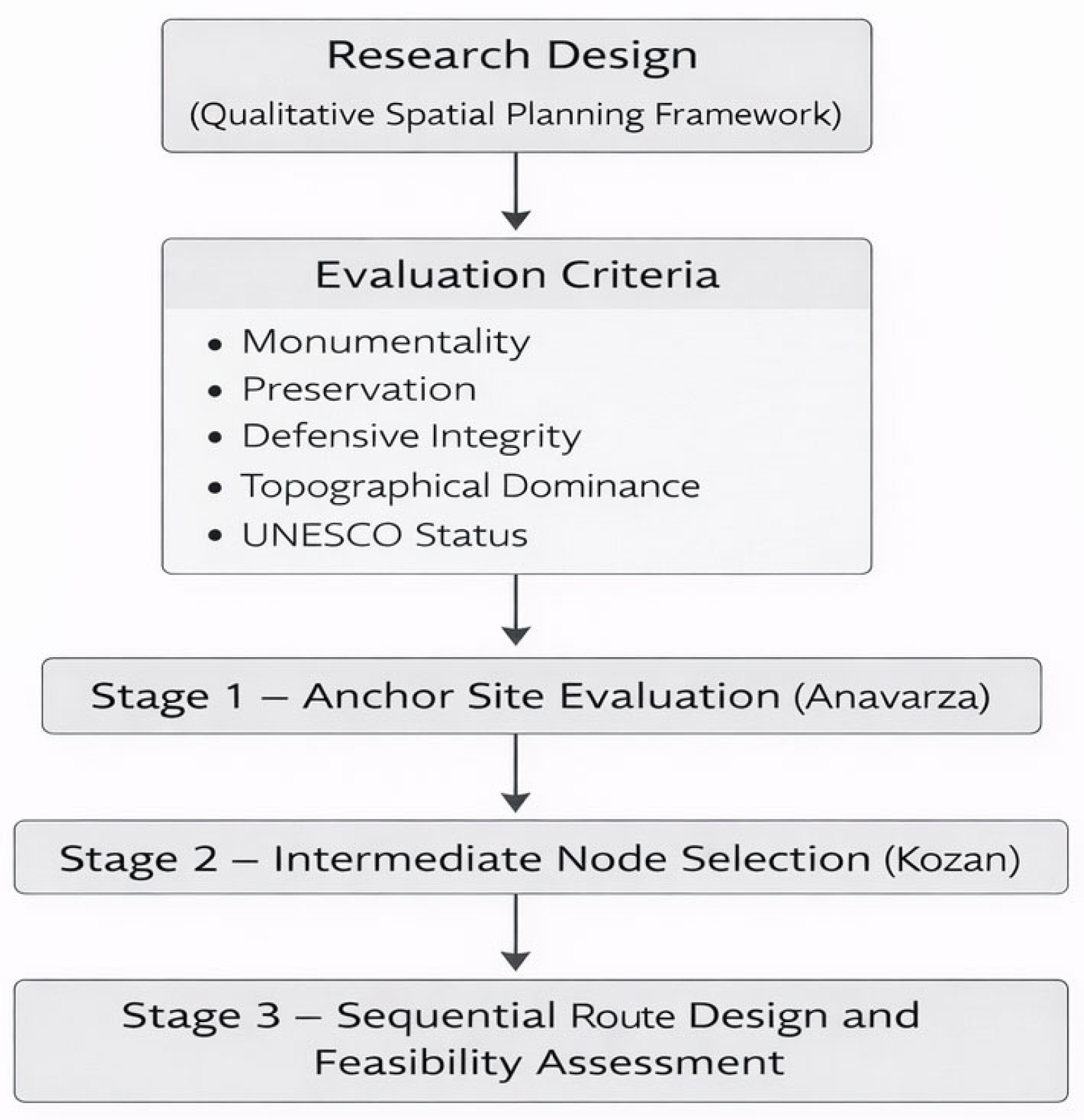
The research process was structured in three analytical stages to ensure transparency, replicability, and methodological coherence: (i) anchor-site suitability assessment; (ii) intermediate node selection based on spatial accessibility and service capacity; and (iii) sequential visitor routing and corridor feasibility testing (
Figure 1). Each stage employed explicitly defined and operationalised criteria derived from established cultural tourism and heritage management literature, enabling methodological transferability to comparable dispersed archaeological regions.
This study develops an empirically informed, scenario-based spatial planning framework whose structural feasibility is assessed through qualitative spatial analysis. Post-implementation performance evaluation remains beyond the scope of the present study.
3.2. Study Area
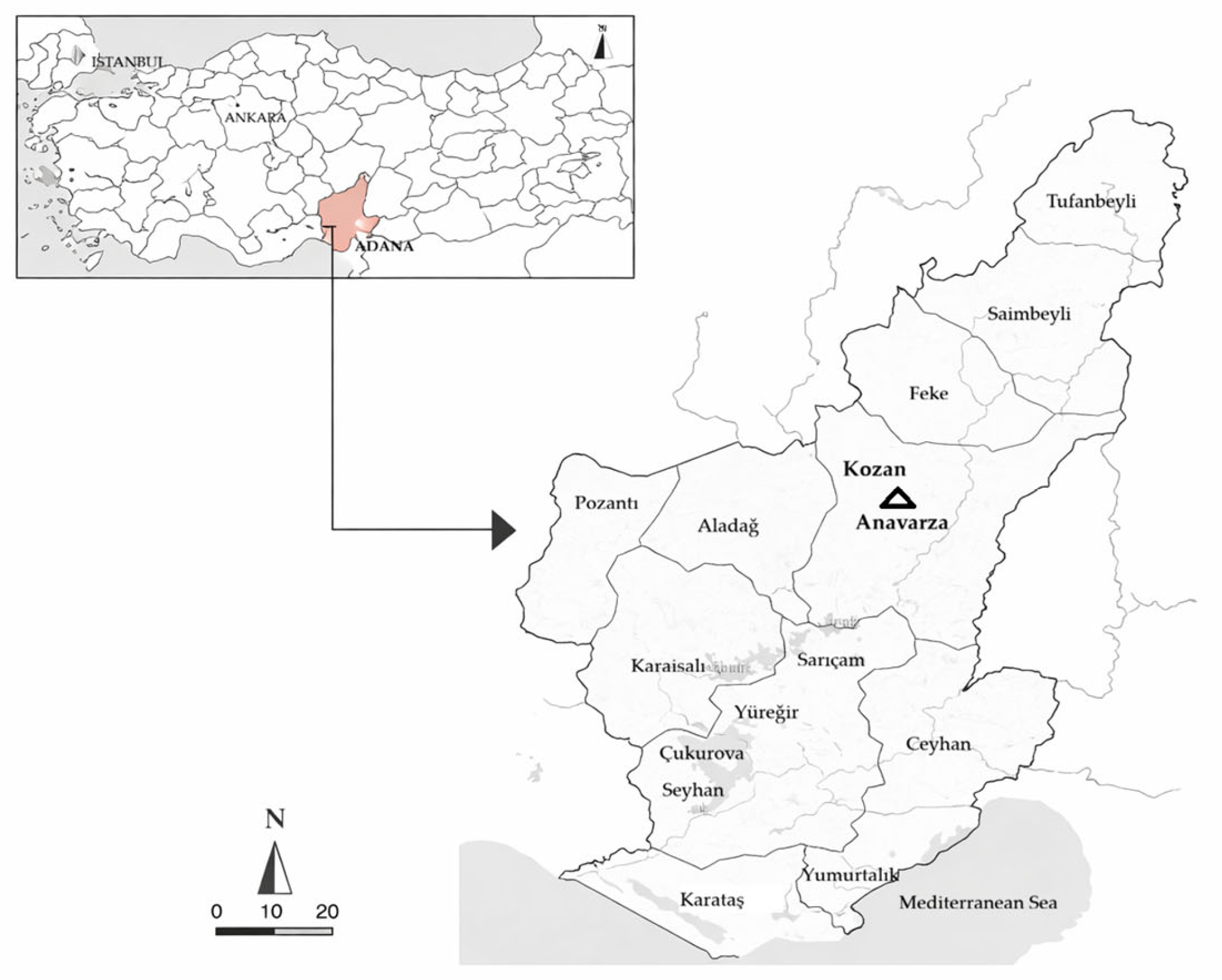
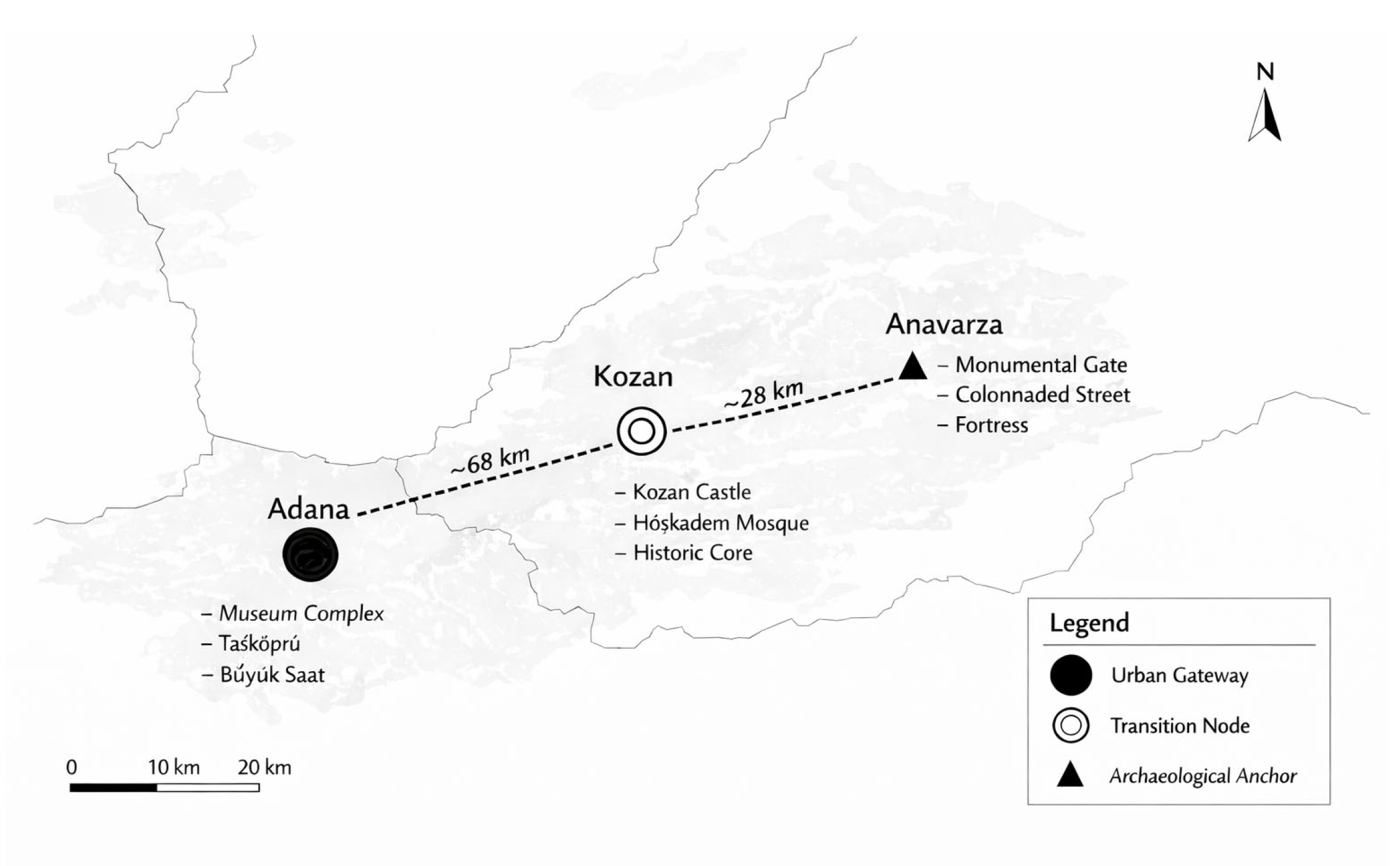
The study area comprises the spatial axis linking the metropolitan centre of Adana, the historic district of Kozan, and the archaeological landscape of Anavarza (ancient Anazarbos) in southern Türkiye (
Figure 2). This territory corresponds to the historical region of Cilicia Pedias (Plain Cilicia), a fertile basin structured by the Ceyhan River system and historically integrated within inland transportation networks connecting central Anatolia to the eastern Mediterranean [
22,
46]. The linear configuration of these settlements forms the territorial framework within which the heritage corridor framework is operationalised.
Anavarza is located within the modern village of Dilekkaya in the Kozan district of Adana Province, approximately 68 km northeast of Adana and 28 km south of Kozan [
46]. Archaeological investigations and systematic excavations indicate that the ancient urban settlement extended across approximately 400 hectares, including suburban zones beyond the currently defined first-degree archaeological protection boundary [
46]. The city was strategically positioned within the Cilician road network and functioned as a major administrative and military centre during Roman, Byzantine, and Armenian periods [
22,
46].
The archaeological landscape preserves a large-scale urban ensemble including a north–south-oriented cardo maximus, a monumental gateway dated to the Antonine period, extensive fortification systems enclosing upper and lower urban sectors, theatre and circus structures, basilical complexes, necropolis zones, and associated infrastructure [
22,
46] (
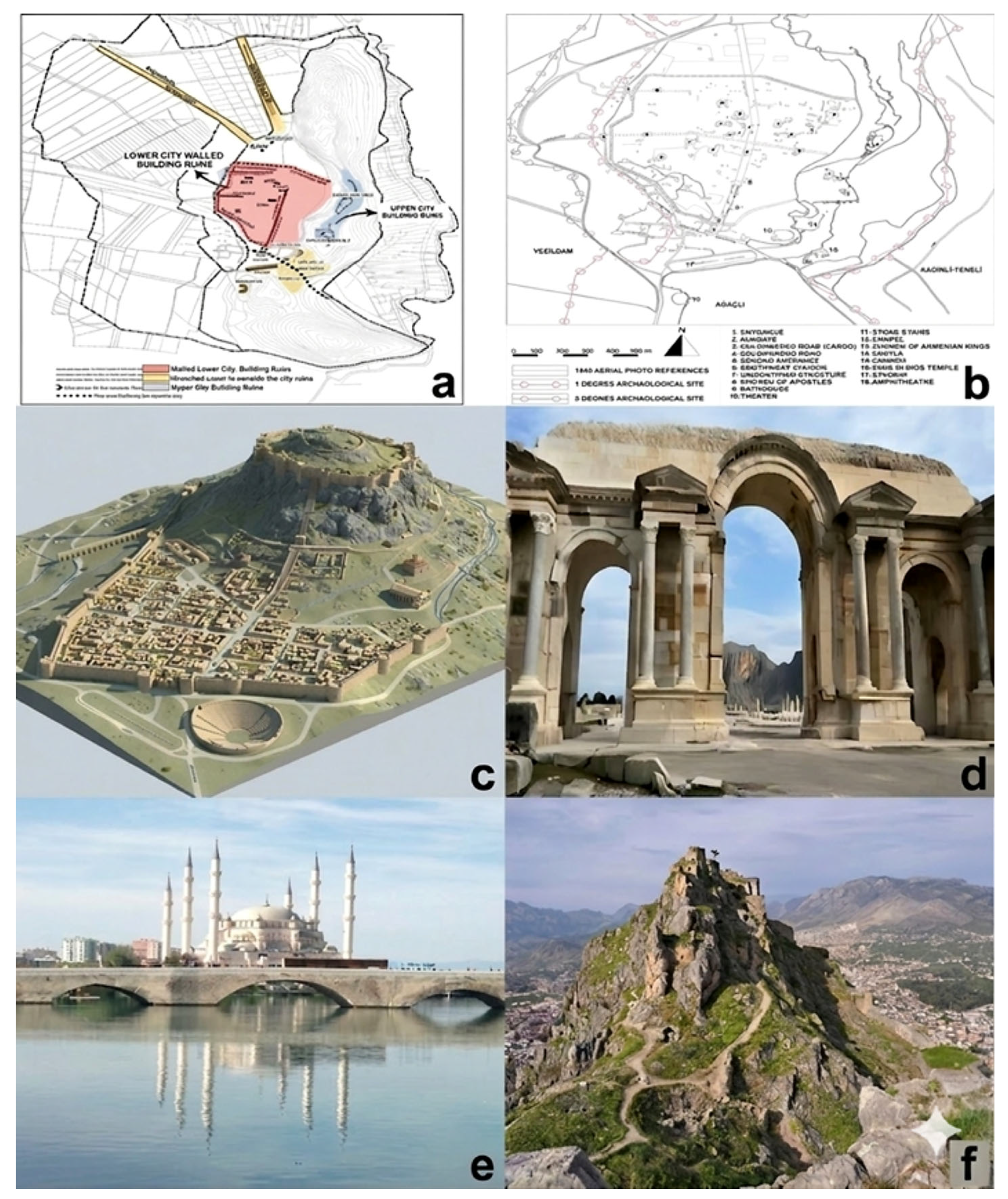
Figure 3a–d).
Figure 3 presents the corridor’s principal heritage components through analytical, documentary, and visual material at different scales. Panels (a) and (b) are included together to distinguish interpreted spatial analysis from the base archaeological documentation of Anavarza. Yüceer et al. identify Anavarza as one of the most spatially extensive and monumentally articulated archaeological cities of Cilicia, distinguished by the scale of its defensive systems and the continuity of its architectural stratification [
22].
The site was included in the UNESCO World Heritage Tentative List in 2014 under criteria (iii), (iv), and (vi), recognising its testimony to successive civilisations, its monumental architectural ensemble, and its association with Pedanius Dioscorides, author of De Materia Medica [
23,
24]. Özbey and Saban underline that the nomination dossier foregrounds the urban morphology, defensive systems, and landscape-scale integrity of the site as key components of its Outstanding Universal Value justification [
24].
Within the proposed corridor framework, Adana functions as the metropolitan gateway due to its transportation connectivity and developed tourism infrastructure. According to official data reported by the Adana Provincial Directorate of Culture and Tourism, as of 2023, the province hosts 160 licenced tourism accommodation facilities with a total bed capacity of 12,811 [
42]. This concentration of accommodation capacity in the metropolitan centre reinforces the structural imbalance between urban tourism concentration and rural archaeological visitation, thereby supporting the rationale for a spatial redistribution strategy through a corridor-based framework.
Kozan, historically known as Sis and formerly serving as the capital of the Armenian Kingdom of Cilicia, constitutes the transition node linking the metropolitan gateway and the archaeological anchor [
22]. The spatial distances between Adana, Kozan, and Anavarza allow feasible multi-day sequencing within a structured corridor itinerary [
46].
Accordingly, the Adana–Kozan–Anavarza axis represents a hierarchically organised spatial system composed of a gateway, a transition node, and an anchor archaeological core. This territorial configuration provides the empirical setting for examining how anchor-site-oriented sequential routing may reorganise visitor flows, strengthen interpretive continuity, and support conservation-sensitive tourism planning within dispersed archaeological landscapes.
The selected cities differ in demographic structure, spatial organisation, and tourism asset concentration. Adana functions as the primary metropolitan gateway with a high concentration of cultural and museum infrastructure supported by 160 licenced tourism accommodation facilities and 12,811 beds [
42]. Within the broader corridor structure, a structured inventory review based on official tourism statistics and cultural heritage documentation identifies 10 major touristic assets. In Adana, these include Taşköprü (
Figure 3e), Büyük Saat, and the Adana Archaeology Museum; in Kozan, Kozan Castle, Hoşkadem Mosque (
Figure 3f), and the Historic Bazaar Axis; and in Anavarza, the Acropolis Fortress, the Monumental Gate (
Figure 3d), Cardo Maximus, and the Defensive Walls (
Figure 3c) [
22,
47].
Figure 3.
Main spatial and visual components of the Cilician Heritage Corridor: (
a) Interpreted archaeological plan of Anavarza [
48]; (
b) Base archaeological plan of Anavarza [
49]; (
c) Hypothetical 3D reconstruction model prepared by the authors based on archaeological plans and published cartographic sources [
22,
24,
48,
49]. (
d) Monumental entrance gate of Anavarza [
49]. (
e) Taşköprü/Stone Bridge, Adana [
47]; (
f) Kozan Castle [
50].
Figure 3.
Main spatial and visual components of the Cilician Heritage Corridor: (
a) Interpreted archaeological plan of Anavarza [
48]; (
b) Base archaeological plan of Anavarza [
49]; (
c) Hypothetical 3D reconstruction model prepared by the authors based on archaeological plans and published cartographic sources [
22,
24,
48,
49]. (
d) Monumental entrance gate of Anavarza [
49]. (
e) Taşköprü/Stone Bridge, Adana [
47]; (
f) Kozan Castle [
50].
Kozan represents a transitional historical node characterised by a fortified medieval morphology and a concentrated historic core. Heritage registry documentation and field observation conducted during the research period indicate a broader set of built heritage elements within the urban fabric, including the castle, mosque, preserved traditional residential morphology, and associated historic public spaces [
22].
Anavarza constitutes the archaeological anchor of the corridor, with monumental remains distributed across its upper and lower urban sectors, including the monumental gateway, colonnaded street, theatre, defensive systems, necropolis zones, and associated urban infrastructure [
22,
23,
24]. Together, these heritage components support the hierarchical differentiation embedded in the proposed corridor framework and reinforce the spatial logic of gateway absorption, transitional staging, and anchor-site concentration.
3.3. Anchor Site Evaluation
In the first stage, the suitability of Anavarza as a primary anchor site was assessed using five operational indicators commonly applied in archaeological tourism and heritage planning: (1) monumental scale, (2) architectural preservation level (presence of substantial standing structures visible above ground), (3) defensive system integrity (extensive visible continuity of defensive wall segments), (4) topographical dominance (visual prominence assessed through qualitative viewshed observation from principal access routes), and (5) international heritage recognition (inclusion on the UNESCO Tentative List). These indicators reflect destination centrality concepts in heritage tourism systems, where monumentality, visibility, and symbolic status function as primary attractors structuring regional visitor flows [
16,
33].
Spatial extent, monumentality, and defensive continuity assessments were based on published archaeological site plans, excavation reports, and documented heritage inventories [
22,
24]. These documentary sources were used to establish the territorial scale of the ancient urban settlement and the relative continuity of its defensive systems within the broader Cilician plain.
Empirical validation was conducted through three field visits undertaken between 2023 and 2024. On-site observations were recorded using a structured, checklist-based site-assessment protocol adapted from heritage management evaluation frameworks informed by UNESCO- and ICOMOS-oriented site management principles and their application in the academic literature [
28,
37,
51]. The observation form documented four categories across the three nodes: spatial configuration, visible preservation levels, access and circulation conditions, and interpretive infrastructure. Data collection combined systematic on-site observation, photographic recording, and field notes. Rather than applying a fixed numerical rating scale, the protocol was used as a qualitative comparative field assessment tool for interpreting observable conditions across the corridor system.
3.4. Intermediate Node Selection and Accessibility Analysis
The second analytical stage focused on identifying an intermediate staging node capable of supporting sequential visitor movement between the metropolitan gateway (Adana) and the archaeological anchor (Anavarza). Candidate settlements (Kozan, Ceyhan, and İmamoğlu) were evaluated using a multi-criteria spatial accessibility and service-capacity framework.
The assessment considered four primary indicators: (a) travel distance and estimated travel time by private vehicle from Adana city centre and to the archaeological anchor; (b) relative accommodation capacity level; (c) concentration of urban-core heritage infrastructure; and (d) presence of dispersed rural heritage assets within administrative boundaries.
In addition to proximity to the metropolitan gateway, spatial integration with the anchor site was treated as a decisive parameter in corridor feasibility. Sequential corridor realism depends not only on metropolitan accessibility but also on the operational coherence of onward movement toward the archaeological core. The comparative results are presented in
Table 1.
For comparative spatial assessment, the categorical expressions used in
Table 1 and
Table 2 (e.g., “Low”, “Moderate”, “High”, “Present”, “Limited”, and “Controlled”) were applied as qualitative analytical classes rather than fixed numerical thresholds. These categories were defined through combined field observation, documentary review, and cross-comparison of the corridor nodes, and indicate relative differences in intensity, adequacy, accessibility, or management constraint within the study area. Accordingly, they are used to support comparative corridor design logic and should not be interpreted as universal quantitative benchmarks.
The node selection process did not apply a formal weighted scoring model; instead, it followed a comparative screening approach based on equal analytical consideration of accessibility, service capacity, heritage character, and spatial continuity. Candidate settlements were assessed across these criteria, and the settlement showing the strongest combined performance—particularly in relation to functional proximity to Anavarza and the ability to support overnight staging—was identified as the transitional node. This approach was adopted because the study aims to establish a transferable planning framework rather than a predictive optimisation model. The decision rule was therefore comparative suitability rather than numerical optimisation.
This integrated evaluation framework aligns with established destination structuring models in tourism planning literature that link accessibility, service provision, and heritage value within regional tourism systems [
6,
18,
19].
The comparative analysis indicates that although Ceyhan is geographically closer to Adana and possesses a larger economic base, its greater distance from the archaeological anchor and the dispersed configuration of its rural heritage assets reduce its operational suitability as a sequential transition node. İmamoğlu, by contrast, demonstrates limited accommodation capacity and weak heritage concentration.
Kozan provides the shortest and most functionally coherent connection to Anavarza (approximately 30–35 min by private vehicle), while also maintaining a concentrated historic urban morphology and moderate accommodation capacity. These characteristics enable realistic multi-day corridor sequencing without exceeding practical daily mobility thresholds, thereby supporting its designation as the most suitable intermediate transition node within the proposed heritage corridor structure (
Figure 4).
A three-node configuration was preferred over a simpler two-node structure because the intermediary settlement performs a distinct staging and buffering role that cannot be adequately fulfilled by either the metropolitan gateway or the archaeological anchor alone. In this configuration, Adana functions as the primary gateway concentrating regional access and metropolitan-scale services, Kozan operates as a transitional staging node providing interpretive continuity, overnight accommodation, and spatial redistribution, and Anavarza remains the conservation-sensitive archaeological anchor. This hierarchical differentiation improves sequential feasibility, reduces direct pressure on the anchor landscape, and enables a more balanced corridor organisation than a direct gateway-to-anchor linkage. The proposed configuration is therefore not presented as a universal optimisation formula, but as a planning logic demonstrating why an intermediate node becomes functionally necessary in this case.
3.5. Sequential Route Design and Corridor Feasibility Testing
The third stage operationalised corridor development through the design of a sequential, multi-day visitor routing structure. Visitor routing principles were adapted from cultural route planning and experiential tourism design literature, which emphasise narrative coherence, feasible daily travel distances, and staged interpretive progression across multi-site heritage systems [
10,
11,
21]. Route feasibility was tested against four operational parameters: (i) maximum daily travel distance corresponding to approximately 90 min of one-way travel time; (ii) attraction density (minimum of three visitable heritage points per day); (iii) overnight logistics (availability of accommodation at staging nodes); and (iv) interpretive progression (chronological and thematic sequencing from metropolitan cultural contexts to rural archaeological landscapes).
These parameters reflect best practices in itinerary design and route-based tourism planning and enable practical implementation without exceeding infrastructural carrying capacity [
10,
11]. The parameters primarily reflect travel behaviour of independent car-based visitors, which represents the dominant mobility pattern in the region. Organised tours or specific visitor groups may require adjusted distance thresholds or modified sequencing. The three-day sequential routing structure presented in
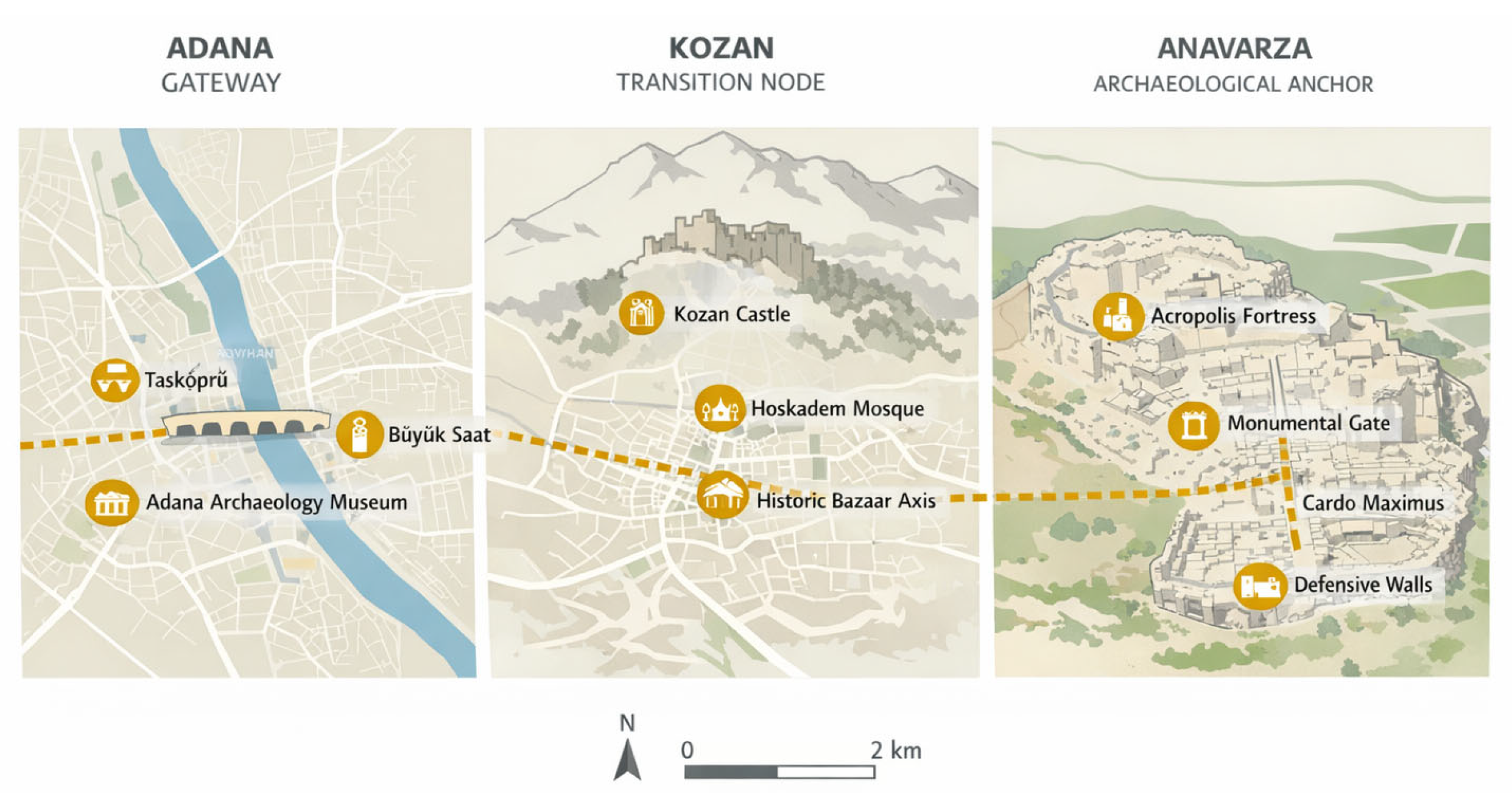
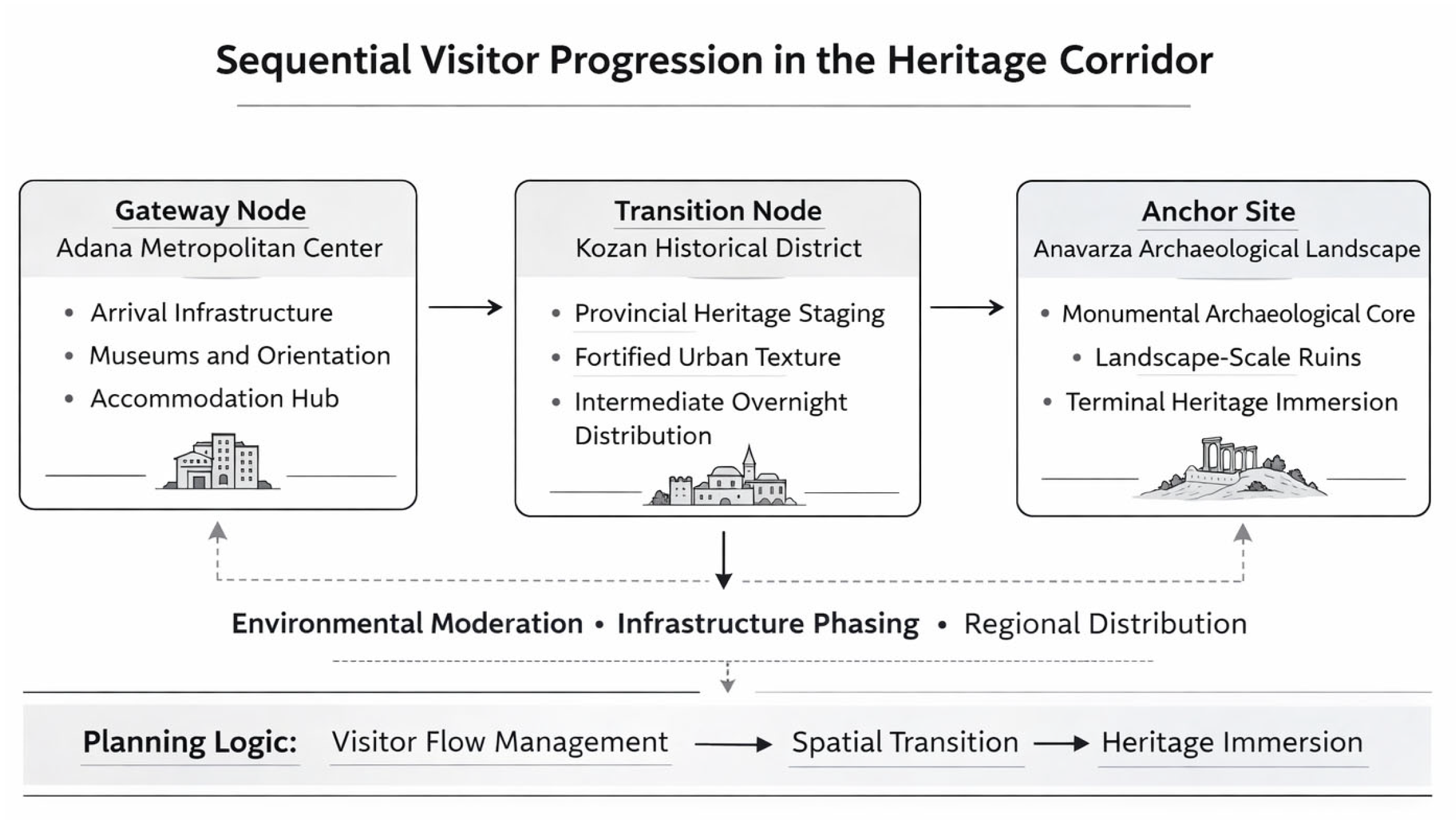
Section 5.2 was iteratively refined through scenario testing to ensure alignment with accessibility constraints, service capacity, and interpretive continuity. The sequential organisation of gateway, transition, and anchor nodes within the proposed corridor framework is illustrated in
Figure 5. The figure illustrates the hierarchical sequencing of the gateway node (Adana Metropolitan Centre), transition node (Kozan Historical District), and anchor node (Anavarza Archaeological Landscape), highlighting the roles of each node in organising visitor flows, infrastructure phasing, and environmentally moderated regional distribution (
Figure 5).
3.6. Environmental Considerations and Sustainability Integration
Environmental considerations were embedded throughout the methodological framework by assessing the capacity of distributed visitor routing to reduce localised pressure on the archaeological core of Anavarza while enabling phased and spatially controlled infrastructure development. This approach aligns with visitor management and carrying capacity literature, which identifies spatial redistribution as a core strategy for mitigating congestion, surface degradation, and ecological stress in heritage environments [
9,
20,
36,
38,
39]. By linking corridor-based dispersal with conservation zoning principles and phased infrastructure staging, the methodology supports the integration of sustainability objectives within an applied spatial planning framework.
3.7. Methodological Limitations and Transferability
The proposed corridor framework is scenario-based and has not yet been validated through empirical visitor-flow data or real-time monitoring. Accordingly, the study presents a planning-oriented framework rather than verified redistribution outcomes. Seasonal variability in visitation patterns and demand elasticity were not analysed quantitatively. Carrying capacity thresholds were operationalised conceptually rather than through numerical simulation methods. Despite these limitations, the framework provides a transferable planning template applicable to other dispersed archaeological regions where gateway cities, intermediate nodes, and anchor sites can be integrated into corridor-based tourism development strategies.
4. Results
4.1. Hierarchical Spatial Reconfiguration of the Corridor Axis
The analytical procedures outlined in
Section 3.3,
Section 3.4 and
Section 3.5 indicate that the Adana–Kozan–Anavarza axis functions as a structured heritage corridor composed of three interdependent nodes: (i) metropolitan gateway, (ii) intermediate transition settlement, and (iii) archaeological anchor landscape.
Anchor-site evaluation indicates that the archaeological landscape of Anavarza fulfils all operational criteria defined in the methodology, including monumental territorial scale (approximately 400 hectares), visible architectural preservation above established threshold levels, substantial continuity of defensive wall systems, topographical dominance over the Cilician plain, and international recognition through inclusion on the UNESCO Tentative List. These attributes position Anavarza as a spatial attractor capable of structuring regional tourism circulation beyond isolated site visitation patterns.
The intermediate node selection process, conducted through multi-criteria accessibility and service-capacity analysis, identifies Kozan as the most suitable transitional staging node among the evaluated settlements. Its proximity to the anchor site, existing accommodation capacity, preserved fortified morphology, and multi-period historical layering enable Kozan to function as a spatial mediator between metropolitan infrastructure and rural archaeological terrain.
Adana operates as the metropolitan gateway due to its transport connectivity, concentration of licenced accommodation capacity (12,811 beds), and institutional museum infrastructure. Its infrastructural density allows initial visitor absorption and interpretive orientation prior to movement toward lower-capacity heritage environments [
53].
Collectively, these findings reveal a vertically ordered spatial hierarchy in which visitor intensity decreases progressively from the metropolitan centre toward the archaeological core. The corridor configuration therefore reframes the regional tourism system from a point-based attraction structure into a hierarchically sequenced spatial network, redistributing functional roles across nodes and integrating dispersed heritage assets within a coordinated territorial framework (
Table 2).
4.2. Sequential Routing Feasibility and Interpretive Escalation
Corridor feasibility testing confirms that the proposed three-day sequential visitor routing framework satisfies all operational parameters defined in
Section 3.5.
The route design was evaluated against three operational considerations applied comparatively across the corridor sequence. First, the requirement of at least three heritage sites per day was verified through the inventory of visitable assets available within each daily segment of the route. Second, the spatial density categories used in
Table 3 (High, Intermediate, Low) refer to the relative concentration and proximity of heritage assets within each segment, taking into account both the number of visitable sites and the continuity of movement between them. Third, the interpretation sequence was not based on subjective judgement alone, but was structured through chronological progression, thematic coherence, and the spatial transition from metropolitan museum environments to historic urban morphology and finally to the archaeological core.
Daily movement remains within an approximately 90 min one-way travel range, supporting feasible sequencing for independent car-based visitors. The spatial separation between Adana, Kozan, and Anavarza allows staged movement while maintaining manageable travel durations.
The minimum attraction-density threshold of three visitable heritage assets per day is also met across the itinerary structure. Day 1 integrates metropolitan museum collections and architectural landmarks; Day 2 incorporates fortified structures and preserved historic fabric in Kozan; and Day 3 focuses on the monumental archaeological ensemble of Anavarza. This distribution indicates that the corridor functions through cumulative thematic layering rather than dependence on a single site (
Table 3).
Overnight staging is supported by accommodation concentration in Adana and existing accommodation capacity in Kozan, enabling phased movement between the metropolitan gateway and the archaeological anchor.
Interpretively, the routing sequence produces a graduated historical progression from administrative and urban contexts to regional medieval governance structures and ultimately to ancient urban monumentality. This progression establishes an interpretive escalation structure in which historical comprehension intensifies spatially and chronologically along the corridor axis.
The findings indicate that the corridor organises visitor experience through structured temporal sequencing rather than simple geographic linkage, transforming dispersed heritage locations into a staged multi-scalar circulation system.
4.3. Redistribution of Visitor Intensity and Conservation-Sensitive Circulation
The hierarchical and sequential configuration of the proposed corridor produces significant implications for spatial visitor distribution within the regional tourism system. Under conventional site-based tourism structures, archaeological destinations are typically subject to direct and concentrated visitor influx, particularly when access is not mediated by intermediate staging nodes. In contrast, the corridor configuration spatially separates arrival, orientation, accommodation, and interpretive functions from the archaeological core, introducing graduated circulation across multiple nodes.
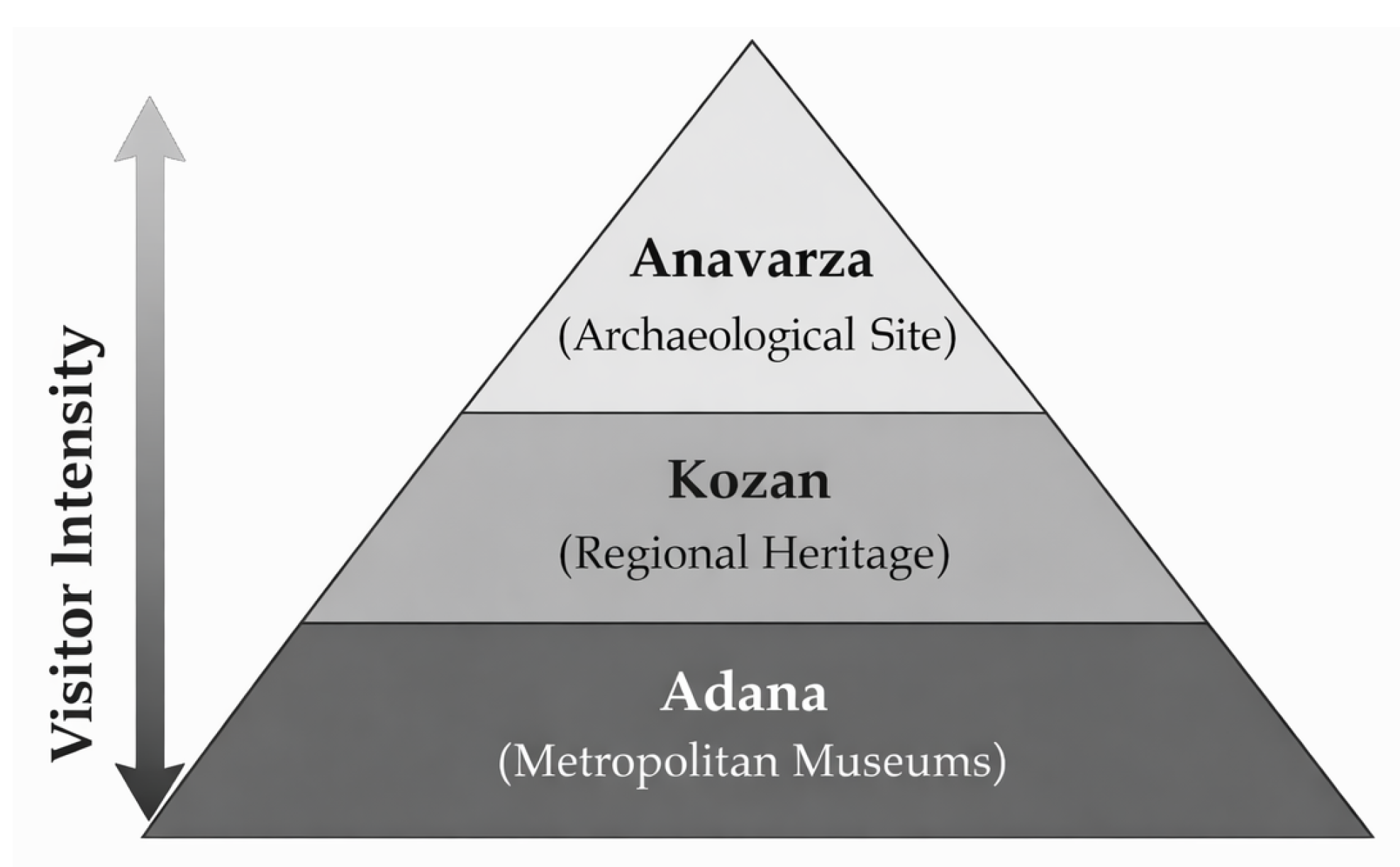
Relative visitor intensity across corridor nodes was assessed qualitatively based on three observable indicators: (i) concentration of licenced accommodation capacity, (ii) presence of museum and interpretive infrastructure, and (iii) documented visitation trends at metropolitan cultural institutions. Rather than relying solely on absolute visitor counts, the assessment evaluates proportional infrastructure concentration and spatial absorption capacity within each node. Accordingly, the figure should be interpreted as a conceptual hierarchy rather than a quantified flow model.
The analysis indicates a descending gradient of infrastructural concentration from the metropolitan gateway (Adana) toward the archaeological anchor (Anavarza). Adana exhibits the highest concentration of accommodation facilities, museum and cultural infrastructure. Kozan demonstrates moderate service capacity and interpretive presence, functioning as an intermediate absorption layer. Anavarza, by contrast, represents a conservation-sensitive low-capacity environment characterised by limited service infrastructure and protected archaeological zoning (
Figure 6).
In addition to its monumental archaeological significance, Anavarza is situated within a Mediterranean ecological zone characterised by semi-arid vegetation patterns and regionally significant floristic diversity. The site’s historical association with Pedanius Dioscorides, author of De Materia Medica, further reinforces its biocultural value [
23,
24]. Mediterranean ecosystems are widely recognised for their ecological sensitivity to surface disturbance, soil compaction, and unregulated circulation. The limestone-based terrain and exposed stratigraphy of the Anavarza landscape increase its vulnerability to uncontrolled foot traffic and vehicular pressure, particularly in areas where archaeological remains are interwoven with natural vegetation cover.
Although Anavarza does not currently experience mass-tourism intensity comparable to major Mediterranean archaeological destinations, recent conservation interventions led by the Ministry of Culture and Tourism and increasing media visibility associated with its use as a filming location have enhanced its destination profile. Official entry statistics indicate an increase from 2004 visitors in 2022 to 10,496 in 2023 and 11,100 in 2024 [
54,
55,
56]. Using the 2024 annual total, average visitation corresponds to approximately 30 visitors per day, or about 0.08 visitors/day/hectare across the c. 400-hectare archaeological landscape. This ratio is reported only to contextualise current intensity levels; it should not be interpreted as a universal congestion threshold, since carrying capacity in archaeological sites is context-specific and depends on site condition, visitor behaviour, seasonality, and management arrangements [
36,
37,
57]. While absolute numbers remain moderate, the marked upward trend reflects growing public attention and suggests the emergence of a new phase of destination visibility. These developments reinforce the importance of implementing proactive spatial visitor management strategies before congestion pressures and ecological degradation risks materialise.
The visitor-intensity hierarchy is based on the combined interpretation of documented visitation trends and three comparative observational indicators: accommodation concentration, museum and interpretive infrastructure, and spatial absorption capacity. Considered together, these indicators were used to establish the relative ordering of the corridor nodes in terms of visitor concentration and reception potential.
Figure 7 presents this qualitative hierarchy across the corridor nodes. This hierarchical structure reflects a shift from concentrated point-based visitation toward more distributed circulation within the corridor framework. By staging visitor movement through metropolitan and intermediate nodes, peak intensity at the archaeological core may be temporally and spatially diffused [
56].
Infrastructure development follows the hierarchical spatial order identified in
Section 4.1. The concentration of high-capacity services within the metropolitan gateway and intermediate node reduces the need for early-stage infrastructural expansion within protected archaeological boundaries. This approach is particularly relevant in environmentally sensitive contexts such as Anavarza, where archaeological remains coexist with Mediterranean vegetation and erosion-prone limestone terrain.
The corridor framework therefore reorients regional tourism movement into a hierarchically distributed circulation system that aligns mobility management with both archaeological conservation and ecological sensitivity. Rather than relying exclusively on restrictive site-level carrying capacity controls, the proposed framework supports sustainability through spatial sequencing, infrastructural differentiation, and graduated mobility design, supporting anticipatory governance in culturally and environmentally significant heritage landscapes.
5. Discussion
The findings of this study suggest that large-scale archaeological landscapes may function not only as heritage conservation units but also as spatial organisers of regional tourism movement within a hierarchically structured corridor framework. The discussion below interprets these findings as structurally grounded planning implications derived from empirical spatial analysis, rather than as measured post-implementation performance outcomes. This interpretation contributes to corridor-based tourism frameworks that conceptualise cultural routes as integrative spatial systems rather than thematic promotional tools [
10,
11,
12,
13]. Previous research has emphasised the experiential and narrative advantages of route-based tourism structures [
1,
2,
33,
34,
35,
36]. The present findings extend this literature by showing more clearly how a monumental archaeological landscape may function as a spatial anchor within a hierarchical corridor system.
Unlike traditional destination inventory frameworks, in which heritage assets are presented as parallel attractions [
6,
9], the Adana–Kozan–Anavarza axis suggests that sequential spatial logic can reorganise fragmented archaeological territories into an operational movement system. In doing so, the study addresses structural imbalances identified in heritage-rich but under-integrated regions [
6,
21], where metropolitan concentration coexists with rural archaeological marginalisation.
5.1. Spatial Logic of Anchor-Based Cultural Corridors
The results indicate the strategic role of anchor sites as spatial attractors capable of structuring surrounding tourism flows, supporting earlier arguments on destination centrality and monumental magnetism [
16,
22,
23]. Archaeological tourism literature has recognised the symbolic and motivational power of large-scale heritage cores [
31,
58]. However, fewer studies have operationalized how such sites can be embedded within hierarchical corridor systems [
10,
12].
The corridor framework developed in this study suggests that anchor-site organisation becomes most effective when supported by metropolitan gateways and intermediate staging nodes. This layered configuration aligns with governance-oriented interpretations of cultural routes [
6,
14,
41], in which corridors function as spatial instruments coordinating accessibility, interpretation, and conservation-sensitive distribution rather than merely thematic itineraries.
Compared with international examples, the present study occupies an intermediate position between cultural-route interpretation and optimisation-based route modelling. Studies such as the Symi Island case emphasise heritage narration, experiential design, and responsible tourism through route-based interpretation, while GIS-oriented examples from Egypt focus more directly on spatial optimisation and route efficiency [
44,
45]. In contrast, the Adana–Kozan–Anavarza case is developed as a spatial planning framework rather than a thematic itinerary alone or a predictive routing model. Its contribution lies in showing how gateway access, intermediate staging, and anchor-site conservation can be structurally coordinated within a territorial sequence designed for dispersed archaeological landscapes.
The findings, therefore, suggest that anchor-based spatial hierarchy can transform dispersed heritage landscapes into structured tourism systems, reinforcing arguments for integrated regional planning frameworks [
6,
20].
From an architectural planning perspective, the proposed corridor framework establishes a differentiated spatial structure across three settlement scales. The architectural assessment conducted in
Section 3 demonstrates how built density, infrastructural capacity, and heritage concentration vary systematically along the corridor axis.
At the metropolitan gateway level, the existing built environment accommodates visitor orientation, museum infrastructure, and accommodation capacity without requiring new large-scale construction. This concentration of services within an already urbanised fabric reduces the need for additional infrastructural expansion in environmentally sensitive areas.
At the intermediate node scale, the preserved historic morphology of Kozan functions as a transitional spatial layer. The fortified structure, compact urban fabric, and identifiable heritage landmarks enable staged interpretive sequencing while maintaining architectural continuity. Rather than introducing new tourism-dedicated structures, the framework prioritises adaptive use of existing urban fabric and controlled service integration.
At the archaeological anchor site, architectural intervention is intentionally minimised. The framework supports conservation-led spatial management by limiting permanent construction within protected archaeological zones and reinforcing established protection boundaries. In this respect, the corridor operates as a spatial planning mechanism that aligns built density, infrastructural intensity, and conservation sensitivity across the territorial gradient.
5.2. Sequential Visitor Routing and Interpretive Continuity
The sequential routing framework contributes to experiential tourism literature by demonstrating cumulative interpretive progression across spatially differentiated nodes [
1,
2,
33,
34,
35,
36]. Prior scholarship suggests that corridor-based systems enhance interpretive continuity by embedding sites within unfolding narratives [
10,
11]. The findings further suggest this proposition within a large-scale archaeological context, where historical comprehension intensifies spatially from metropolitan museum environments to medieval urban morphology and ultimately to monumental ancient urban fabric.
In contrast to fragmented visitation patterns documented in heritage tourism research [
34,
58], the structured three-day routing structure generates interpretive escalation rather than isolated monument consumption. This supports contemporary experience-oriented tourism paradigms emphasising immersion and narrative sequencing [
25,
59].
Importantly, the findings extend experiential corridor literature by demonstrating that interpretive continuity can be aligned with infrastructural feasibility and accessibility realism [
10,
18,
19].
From a spatial design perspective, the sequential routing framework also establishes a calibrated progression in built form and spatial enclosure. The transition from metropolitan museum environments to compact fortified morphology and ultimately to open archaeological terrain produces a gradual reduction in built density and infrastructural intensity. This morphological gradient enhances experiential depth while simultaneously regulating spatial pressure. The architectural sequencing therefore functions not only as a narrative device but also as a territorial management strategy, aligning daily mobility patterns with conservation-sensitive spatial thresholds.
5.3. Infrastructure Alignment and Governance Feasibility
The operational dimension of the corridor framework reinforces governance-centred approaches in tourism planning [
6,
14,
20]. Previous studies have highlighted risks associated with misalignment between infrastructure provision and visitor pressure, particularly in heritage-sensitive environments [
17,
18]. The findings indicate that hierarchical infrastructure staging, concentrating high-capacity services within the metropolitan gateway while limiting expansion in protected archaeological zones, may mitigate these risks. In practical planning terms, this implies coordination across provincial tourism authorities, municipal planning bodies, site-management actors, interpretive programming, parking and orientation decisions, and phased visitor-service investment.
This configuration corresponds to adaptive governance principles emphasising multi-level coordination and phased development [
14,
15]. By embedding primary visitor absorption functions within existing metropolitan infrastructure, the corridor framework reduces premature investment pressure within conservation-sensitive landscapes. In this respect, the study translates sustainable tourism planning principles articulated in UNESCO and ICOMOS frameworks [
20,
28] into applied spatial sequencing mechanisms. The corridor should therefore be understood not as a promotional itinerary alone, but as a governance-oriented planning instrument linking visitor routing, infrastructure phasing, and conservation-sensitive territorial management. Such an instrument may also support the sequencing of access, the concentration of visitor services, and the staged distribution of visitors across the corridor.
5.4. Environmental Sustainability and Spatial Moderation of Visitor Flows
Environmental sustainability literature identifies concentrated visitation as a principal risk factor for archaeological degradation [
18,
19,
35,
36]. Visitor density peaks are associated with erosion, informal trail formation, and infrastructure stress [
39]. The findings suggest that corridor-based sequencing functions as a spatial moderation mechanism by redistributing temporal and geographic pressure prior to arrival at the anchor site.
This aligns with visitor flow management frameworks advocating anticipatory distribution rather than reactive congestion control [
41]. Instead of relying exclusively on restrictive site-level thresholds [
57], the corridor structure introduces a territorial buffering system in which intermediate nodes absorb part of logistical and experiential demand. Through this hierarchical redistribution, sustainability is supported via spatial design rather than solely through quantitative capacity controls.
In the Anavarza context, these sustainability concerns are intensified by the site’s specific environmental characteristics. The archaeological landscape is distributed across exposed limestone terrain and Mediterranean vegetation zones that are vulnerable to surface disturbance, informal trail formation, and localised erosion under increasing visitor pressure. In this respect, the corridor model may contribute to environmental protection not only by redistributing visitor intensity in general terms, but also by reducing premature concentration in ecologically sensitive areas before arrival at the archaeological core. From a management perspective, this suggests the value of preliminary monitoring measures focused on visitor pathways, surface wear, and seasonal pressure patterns, especially in sectors where archaeological exposure and environmental fragility overlap.
5.5. Regional Economic Redistribution and Heritage-Based Development
Tourism concentration in metropolitan centres frequently limits economic benefits to high-capacity urban nodes [
25,
60]. The intermediate-node structure embedded in the corridor framework introduces deliberate redistribution of visitor activity toward secondary historical settlements.
This finding resonates with regional development perspectives advocating distributed benefit allocation and community integration [
8,
33,
60]. By linking archaeological tourism to local service ecosystems in Kozan, the corridor structure may strengthen regional economic integration without intensifying pressure on the archaeological core.
The findings therefore support the argument that corridor-based planning can function simultaneously as a spatial tourism design strategy and as a mechanism for regionally balanced heritage-based development [
20,
60].
5.6. Transferability of the Corridor Planning Framework
The hierarchical sequencing logic developed in this study offers a transferable planning framework beyond the Cilician context. Many archaeological regions contain metropolitan gateways, intermediate settlements, and monumental anchor sites. Previous corridor research has emphasised connectivity and thematic coherence [
10,
11,
12,
13,
27,
35]. The present findings extend this literature by clarifying hierarchical staging principles grounded in infrastructural realism and conservation-sensitive routing.
By conceptualising corridors as governance-based spatial instruments, the framework can contribute to emerging scholarship positioning cultural routes at the intersection of planning policy, visitor management, and heritage conservation [
6,
20,
38,
39,
41,
57].
Although empirically structured through the Adana–Kozan–Anavarza axis, the proposed corridor framework is not site-specific and may be adapted to other dispersed archaeological landscapes facing comparable visitor management and conservation challenges.
5.7. Carrying Capacity and Future Management Implications
Carrying capacity considerations emerging from the Anavarza case highlight the importance of integrating corridor sequencing with formal visitor management systems. While site-level carrying capacity frameworks remain essential [
36,
37,
57], the findings suggest that spatial redistribution mechanisms complement threshold-based management by moderating peak intensity prior to arrival at sensitive zones. In other words, the framework does not replace carrying-capacity assessment; it operates upstream by structuring how visitors approach and experience the site at regional scale.
However, corridor implementation requires empirical validation through visitor monitoring, density modelling, and seasonal demand analysis [
36,
41]. Future research should integrate quantitative impact assessment tools to evaluate long-term effectiveness under varying demand scenarios.
6. Conclusions
This study suggests that large-scale archaeological landscapes may function not only as protected heritage environments but also as spatial anchors within wider regional tourism systems. By examining the Adana–Kozan–Anavarza axis as a hierarchically organised heritage corridor, the study develops a spatial planning approach grounded in accessibility, staged visitor movement, and conservation-sensitive distribution.
Taken together, the findings help address the four research questions guiding the study. First, the results indicate that a large-scale archaeological landscape can function as a primary spatial anchor when connected to a wider corridor structure. Second, the Adana–Kozan–Anavarza configuration suggests that a gateway city, an intermediate historic settlement, and an archaeological core can form a realistic multi-day visitor sequence when accessibility, accommodation, and interpretive continuity are considered together. Third, the study indicates that sequential corridor structuring can reshape visitor movement across dispersed heritage territories while strengthening interpretive continuity between different nodes. Fourth, the findings suggest that corridor-based planning may contribute to environmentally moderated visitor distribution by reducing direct pressure on the archaeological core and by distributing logistical and experiential functions across the wider territorial system.
From a sustainability perspective, the study indicates that corridor-based spatial sequencing may support a more balanced distribution of visitor intensity before arrival at environmentally sensitive archaeological areas. Rather than relying only on site-level control measures, this approach considers the broader territorial organisation of access, staging, and movement. In this respect, the framework may support conservation objectives while also maintaining regional accessibility and interpretive depth.
In theoretical terms, the study contributes to heritage corridor scholarship by showing how anchor-site logic, intermediate staging, and corridor sequencing can be integrated within a single spatial planning framework for dispersed archaeological regions. In practical terms, it indicates that corridor-based planning may assist public authorities and heritage managers in organising visitor movement, staging services outside sensitive cores, and aligning tourism development more closely with conservation priorities.
The study also points to the possible role of intermediate heritage settlements in supporting more regionally distributed tourism development. In the proposed configuration, Kozan is not treated simply as a stop along a route, but as a functional staging node that may help connect metropolitan access with the archaeological anchor. This in turn suggests that corridor-based planning can support a more balanced relationship between heritage conservation, visitor organisation, and regional development.
Rather than proposing a universally applicable formula, the study presents a context-responsive planning approach that may be adapted to other dispersed archaeological regions with similar spatial and infrastructural characteristics. Its main contribution lies in showing how spatial sequencing, intermediate staging, and conservation-sensitive routing can be brought together within a single corridor framework.
Future research should evaluate corridor performance through visitor-flow monitoring, seasonal demand analysis, GIS-based accessibility modelling, and carrying-capacity assessment in order to test the longer-term applicability of the framework under different tourism scenarios.