The Impact of ENSO Shocks on Firm Performance: The Role of Supply Chain Resilience and Network Complexity in Energy Firms

Abstract
1. Introduction
2. Literature Review and Hypothesis Development
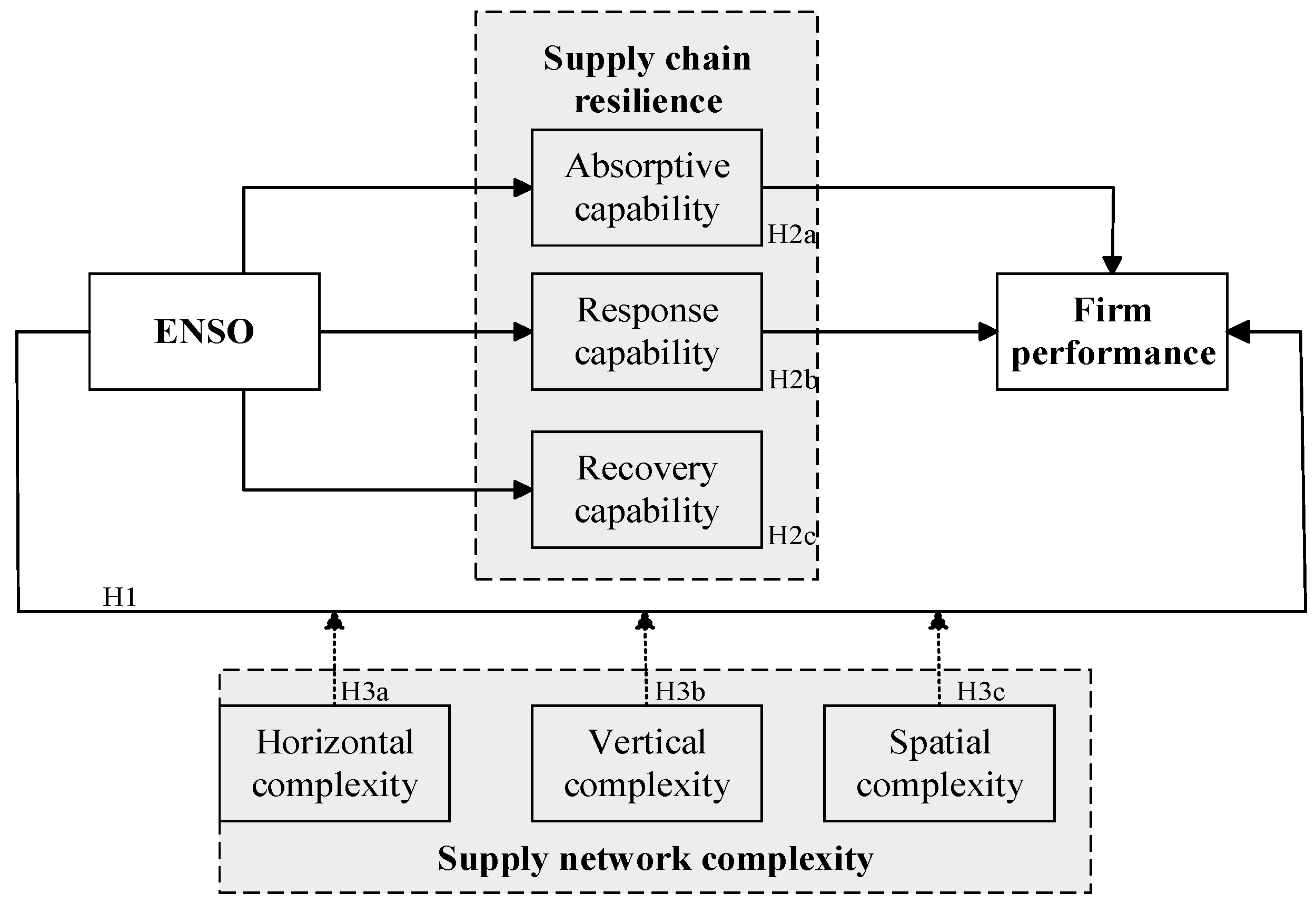
2.1. ENSO and Energy Firms’ Performance
2.2. Mediating Role of Supply Chain Resilience
2.3. Moderating Role of Supply Network Complexity
3. Data and Methodology
3.1. Research Setting and Data Collection
3.2. Dependent Variable
3.3. Core Independent Variable
3.4. Mediating Variables
3.5. Moderators
3.6. Control Variables
3.7. Model Specification
3.7.1. System Generalized Method of Moments (SYS-GMM)
3.7.2. Mediating Effect Model
3.7.3. Moderating Effect Model
4. Analyses and Results
4.1. Direct Effect Analysis
4.2. Mediating Effect Analysis
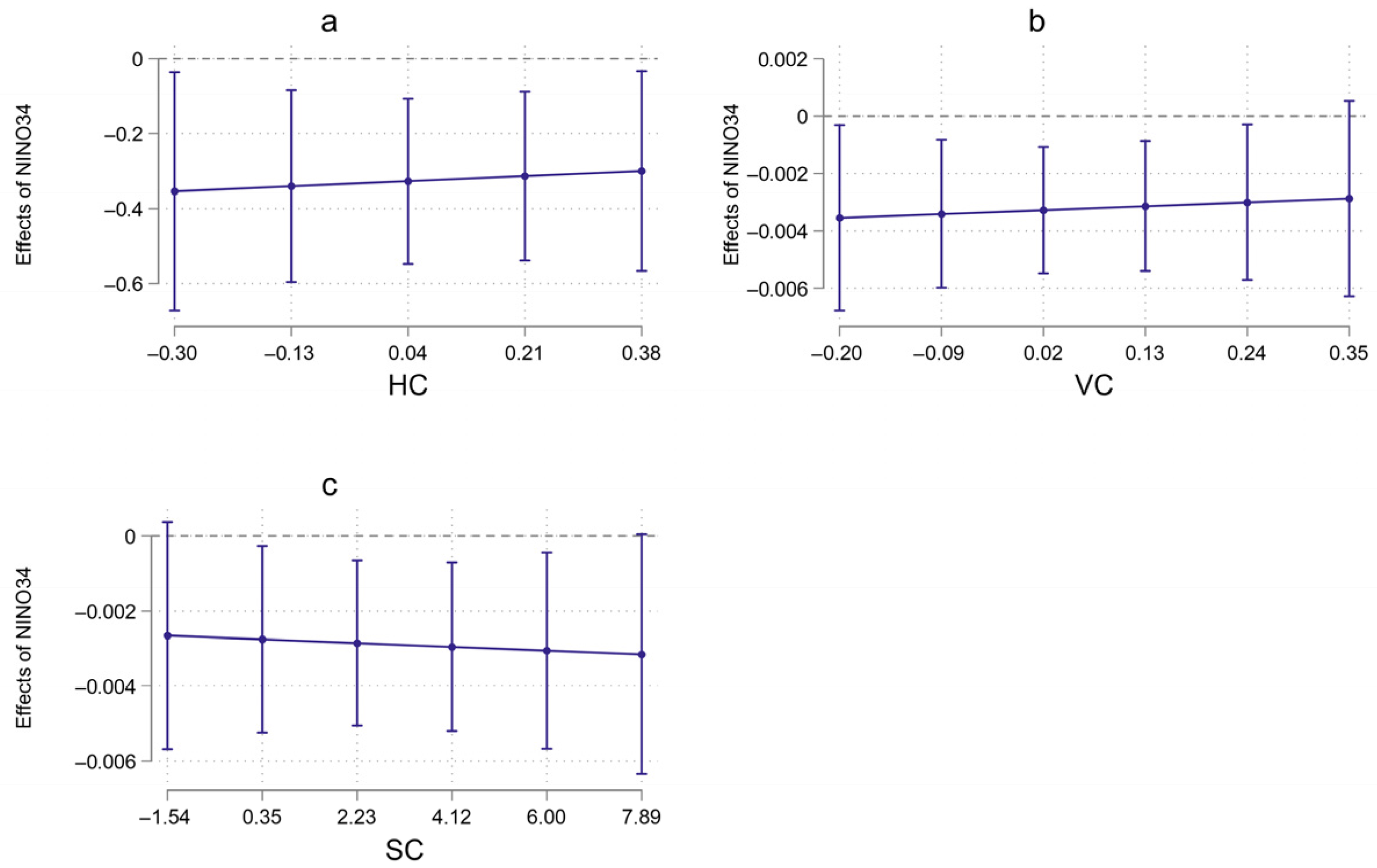
4.3. Moderation Analysis
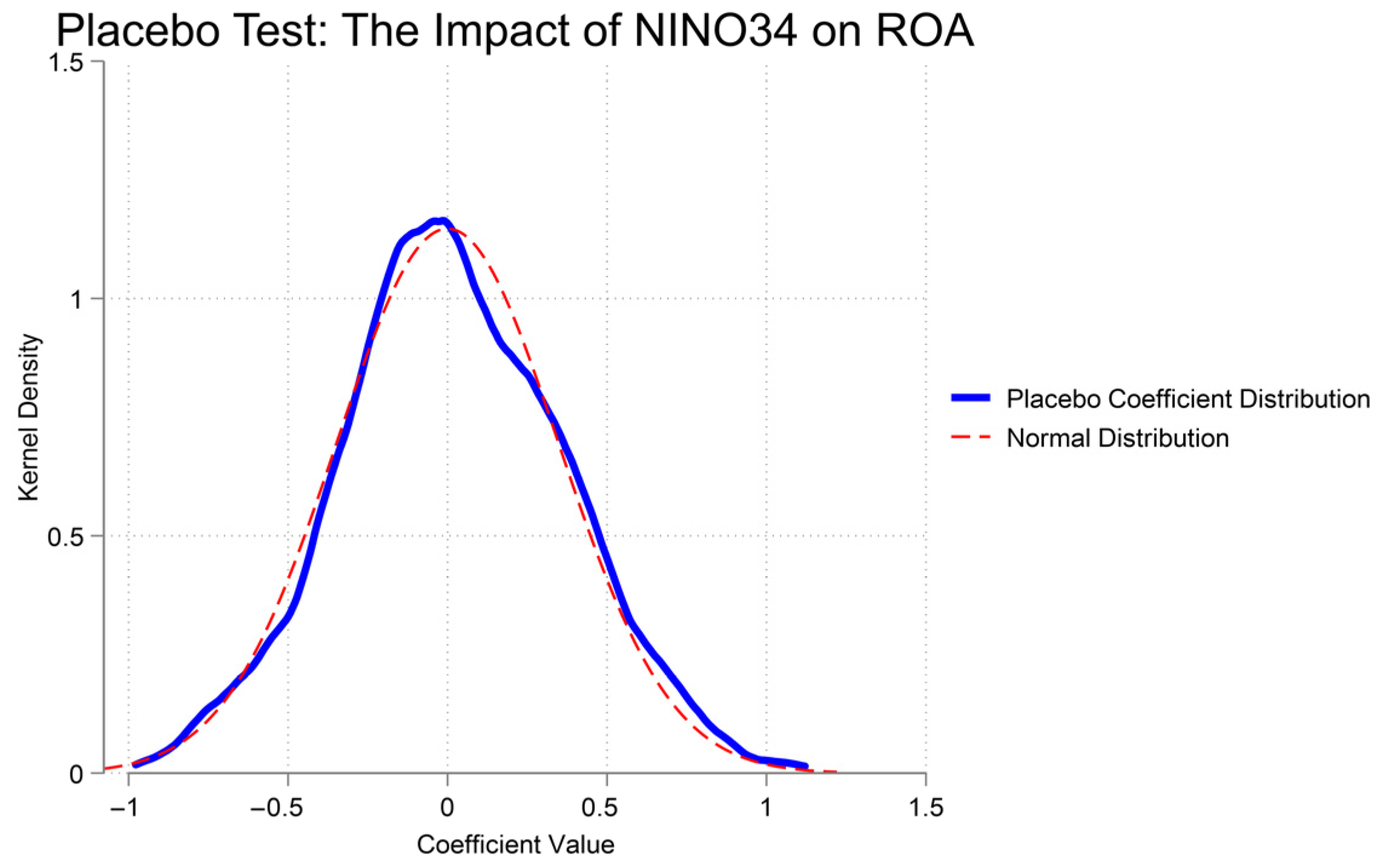
4.4. Robustness Checks
4.5. Further Analysis
5. Conclusions and Implications
- (1)
- ENSO directly impairs energy firm performance by constraining resource reconfiguration capacities and amplifying systemic network risks. A 1 °C SST anomaly increase lowers ROA by 0.142%. This negative impact remains robust across multiple robustness checks, confirming ENSO as a critical external disruptor of operational and financial stability in resource-intensive sectors.
- (2)
- Supply chain resilience as a differentiated mediator in responding to ENSO disruptions. Absorptive capacity acts as a minor mediator (1.927% of total effect), serving as an initial buffer, while response capacity constitutes the dominant mediating channel (51.503%), underscoring that the core vulnerability lies in the inability to dynamically reconfigure resources and coordinate responses after a shock occurs. In contrast, recovery capacity does not function as a mediator but operates independently, exerting a compensatory positive influence on ROA, which aligns with its role as a long-term restorative mechanism often reliant on external support rather than immediate buffering.
- (3)
- Supply network complexity (horizontal, vertical, and spatial) significantly drove losses by increasing structural interdependencies and coordination failures. Marginal effects indicate that high horizontal and vertical complexity steepens performance decline, whereas spatial complexity remains detrimental despite slight attenuation at high levels.
- (4)
- There is notable heterogeneity among regions and firm types regarding climate impacts. In high-sensitivity regions like South China, firms benefit from increased hydropower output, challenging the uniform “victim” narrative, while low-sensitivity regions suffer significant losses. State-owned enterprises are largely insulated from impacts due to government support, whereas non-state-owned enterprises face severe negative effects, highlighting substantial institutional and adaptive disparities.
Author Contributions
Funding
Institutional Review Board Statement
Informed Consent Statement
Data Availability Statement
Conflicts of Interest
Appendix A

| Constructs/Indicators | Mathematical Formula | Data Source |
|---|---|---|
| Absorptive Capability (ASC) | ||
| Customer concentration (CC) | CSMAR | |
| Supplier concentration (SC) | CSMAR | |
| Supply chain emphasis (SCE) | CSMAR/Textual Analysis | |
| Closed-loop supply chain level (CL) | Measured via Degree Centrality in an undirected affiliation network. Evaluated as the total number of unique supplier and customer nodes directly connected to firm. | Derived via Gephi |
| Response Capability (RSC) | ||
| Supply demand matching (Matchingit) | : Standard deviation of the volume. : Mean volume. sup (supply): Upstream production metrics, proxied by sales volume. cus (customer): Downstream demand metrics, proxied by the cost of goods sold. | CSMAR/CNRDS |
| Customer stability (CST) | CSMAR | |
| Supplier stability (SST) | CSMAR | |
| Recovery Capability (RCC) | ||
| Supply chain network community structure | Evaluated via modularity. Quantifies the density deviation of connections within localized network communities versus random networks. | Derived via Gephi |
| Supply chain network location | Evaluated via Eigenvector Centrality. Measures a node’s influence weighted by the centrality of its connected partners. | Derived via Gephi |
| Supply chain network status | Evaluated via PageRank Centrality. A link analysis algorithm assessing global structural importance within the network topology. | Derived via Gephi |
| ROA | L.ROA | NINO34 | ASC | RSC | RCC | HC | VC | SC | CLVA | Size | Age | CAI | LEV | SSR | ECP | FC | CRISIS | PANDE | |
|---|---|---|---|---|---|---|---|---|---|---|---|---|---|---|---|---|---|---|---|
| ROA | 1 | ||||||||||||||||||
| L.ROA | 0.52 *** | 1 | |||||||||||||||||
| NINO34 | −0.07 *** | −0.01 | 1 | ||||||||||||||||
| ASC | −0.02 | −0.04 | −0.09 *** | 1 | |||||||||||||||
| RSC | 0.01 | 0.04 | 0.04 | 0.18 *** | 1 | ||||||||||||||
| RCC | −0.04 | −0.04 | 0 | 0.14 *** | 0.16 *** | 1 | |||||||||||||
| HC | −0.02 | −0.03 | 0.03 | 0.04 | 0.11 *** | 0.15 *** | 1 | ||||||||||||
| VC | −0.01 | −0.02 | 0.03 | 0.04 | 0.10 *** | 0.13 *** | 0.93 *** | 1 | |||||||||||
| SC | −0.07 *** | −0.06 ** | 0.11 *** | 0.19 *** | 0.43 *** | 0.35 *** | 0.39 *** | 0.36 *** | 1 | ||||||||||
| CLVA | 0.74 *** | 0.45 *** | −0.07 *** | 0.01 | −0.01 | −0.04 | −0.01 | −0.01 | −0.04 | 1 | |||||||||
| Size | 0.09 *** | 0.08 *** | 0.01 | 0.10 *** | 0.10 *** | −0.02 | 0.15 *** | 0.16 *** | 0.07 *** | 0.10 *** | 1 | ||||||||
| Age | −0.15 *** | −0.17 *** | −0.02 | 0.23 *** | 0.25 *** | −0.01 | 0.10 *** | 0.10 *** | 0.30 *** | −0.12 *** | 0.22 *** | 1 | |||||||
| CAI | 0.01 | 0.08 *** | 0.01 | −0.04 | 0.01 | 0.01 | 0.08 *** | 0.09 *** | −0.02 | 0.03 | 0.12 *** | −0.08 *** | 1 | ||||||
| LEV | −0.39 *** | −0.31 *** | −0.01 | −0.01 | 0 | 0.13 *** | 0 | 0.01 | 0.02 | −0.32 *** | 0.04 | 0.14 *** | 0 | 1 | |||||
| SSR | −0.14 *** | −0.10 *** | 0.04 | −0.11 *** | −0.07 *** | −0.07 *** | −0.08 *** | −0.08 *** | −0.11 *** | −0.18 *** | −0.43 *** | −0.15 *** | 0.09 *** | −0.11 *** | 1 | ||||
| ECP | 0.14 *** | 0.15 *** | 0.03 | −0.31 *** | −0.25 *** | 0 | −0.11 *** | −0.10 *** | −0.41 *** | 0.06 ** | −0.30 *** | −0.61 *** | 0.11 *** | −0.01 | 0.12 *** | 1 | |||
| FC | −0.11 *** | −0.08 *** | 0.10 *** | 0.13 *** | 0.17 *** | 0 | 0.15 *** | 0.15 *** | 0.39 *** | −0.06 ** | 0.25 *** | 0.43 *** | −0.08 *** | 0.06 *** | −0.07 *** | −0.67 *** | 1 | ||
| CRISIS | 0.10 *** | 0.09 *** | −0.03 | −0.10 *** | −0.14 *** | 0 | −0.11 *** | −0.11 *** | −0.28 *** | 0.03 | −0.16 *** | −0.30 *** | 0.09 *** | −0.03 | 0.48 *** | −0.48 *** | 0.05 ** | 1 | |
| PANDE | −0.07 *** | −0.08 *** | −0.32 *** | 0.35 *** | 0.12 *** | 0 | 0.05 ** | 0.04 | 0.16 *** | −0.02 | 0.18 *** | 0.43 *** | −0.07 *** | −0.01 | −0.67 *** | 0.25 *** | −0.09 *** | −0.20 *** | 1 |
| MEAN | 0.028 | 0.028 | −0.151 | 0.100 | 0.241 | 0.280 | 0.149 | 0.085 | 3.179 | 0.093 | 22.915 | 13.404 | 0.195 | 4.399 | 0.075 | 4.173 | 10.011 | 0.167 | 0.167 |
| SD | 0.055 | 0.055 | 1.155 | 0.175 | 0.112 | 0.145 | 0.556 | 0.323 | 4.719 | 0.240 | 1.478 | 6.532 | 0.200 | 5.437 | 0.064 | 0.095 | 0.507 | 0.373 | 0.373 |
| Model | 1 | 2 | 3 | 4 | 5 | 6 | 7 | 8 | 9 |
|---|---|---|---|---|---|---|---|---|---|
| ROE | ROA | ROA | ROA | ROA | High-Sensitive ROA | Low-Sensitive ROA | State-Owned ROA | Non-State-Owned ROA | |
| NINO34 | −0.019 * | −0.238 ** | 0.600 ** | −0.219 *** | −0.084 | −0.319 * | |||
| (0.010) | (0.120) | (0.271) | (0.079) | (0.076) | (0.188) | ||||
| L.ROE | −0.034 *** | ||||||||
| (0.009) | |||||||||
| L.ROA | 0.131 *** | 0.267 ** | 0.241 *** | 0.116 ** | 0.197 *** | 0.090 *** | 0.236 ** | ||
| (0.038) | (0.114) | (0.054) | (0.059) | (0.050) | (0.029) | (0.098) | |||
| PDO | −0.605 * | ||||||||
| (0.354) | |||||||||
| Treatment | −0.852 ** | ||||||||
| (0.338) | |||||||||
| Nino | −0.114 * | ||||||||
| (0.068) | |||||||||
| Constant | −6.439 | −7.224 | −4.665 | −35.77 * | −27.12 ** | −116.8 *** | −15.02 | 2.434 | −96.14 * |
| (4.755) | (18.05) | (51.44) | (19.68) | (11.95) | (35.55) | (36.18) | (24.82) | (54.81) | |
| Observations | 1751 | 1751 | 721 | 596 | 1751 | 310 | 1441 | 1261 | 490 |
| Controls | YES | YES | YES | YES | YES | YES | YES | YES | YES |
| Firms a | 103 | 103 | 103 | 103 | 103 | 20 | 85 | 82 | 43 |
| Instrument variables | 67 | 31 | 20 | 73 | 20 | 36 | 63 | 38 | |
| Hansen test b | 0.312 | 0.107 | 0.245 | 0.111 | 0.363 | 0.187 | 0.130 | 0.380 | |
| AR(1) | 0.082 | 0 | 0 | 0 | 0 | 0 | 0.001 | 0.007 | |
| AR(2) c | 0.149 | 0.275 | 0.654 | 0.675 | 0.519 | 0.346 | 0.475 | 0.216 |
References
- Zhu, Y.; Zhang, R.H.; Wang, F.; Cai, W.; Li, D.; Guan, S.; Li, Y. Projection of ENSO using observation-informed deep learning. Nat. Commun. 2025, 16, 7736. [Google Scholar] [CrossRef] [Scilit]
- Yeh, S.W.; Cai, W.; Min, S.K.; McPhaden, M.J.; Dommenget, D.; Dewitte, B.; Collins, M.; Ashok, K.; An, S.I.; Yim, B.Y.; et al. ENSO atmospheric teleconnections and their response to greenhouse gas forcing. Rev. Geophys. 2018, 56, 185–206. [Google Scholar] [CrossRef] [Scilit]
- Boca, T.; Cipriotti, P.A. Impacts of ENSO on Spatiotemporal Variability of Rainfall and Crop Yield in the Agricultural Frontier of the Pampas, Argentina. J. Appl. Meteorol. Climatol. 2025, 64, 687–702. [Google Scholar] [CrossRef] [Scilit]
- Ubilava, D. El Niño Southern Oscillation and the fishmeal-soya bean meal price ratio: Regime-dependent dynamics revisited. Eur. Rev. Agric. Econ. 2014, 41, 583–604. [Google Scholar] [CrossRef] [Scilit]
- Hsiang, S.M.; Meng, K.C.; Cane, M.A. Civil conflicts are associated with the global climate. Nature 2011, 476, 438–441. [Google Scholar] [CrossRef] [Scilit]
- Chen, X.; Fu, Q.; Chang, C.P. What are the shocks of climate change on clean energy investment: A diversified exploration. Energy Econ. 2021, 95, 105136. [Google Scholar] [CrossRef] [Scilit]
- Cai, W.; Borlace, S.; Lengaigne, M.; Van Rensch, P.; Collins, M.; Vecchi, G.; Timmermann, A.; Santoso, A.; McPhaden, M.J.; Wu, L.; et al. Increasing frequency of extreme El Niño events due to greenhouse warming. Nat. Clim. Change 2014, 4, 111–116. [Google Scholar] [CrossRef] [Scilit]
- Liu, Y.; Cai, W.; Lin, X.; Li, Z.; Zhang, Y. Nonlinear El Niño impacts on the global economy under climate change. Nat. Commun. 2023, 14, 5887. [Google Scholar] [CrossRef] [Scilit] [PubMed]
- Cai, W.; Santoso, A.; Collins, M.; Dewitte, B.; Karamperidou, C.; Kug, J.S.; Lengaigne, M.; McPhaden, M.J.; Stuecker, M.F.; Taschetto, A.S.; et al. Changing El Niño–Southern Oscillation in a warming climate. Nat. Rev. Earth Environ. 2021, 2, 628–644. [Google Scholar] [CrossRef] [Scilit]
- Levin, T.; Bistline, J.; Sioshansi, R.; Cole, W.J.; Kwon, J.; Burger, S.P.; Crabtree, G.W.; Jenkins, J.D.; O’Neil, R.; Korpås, M.; et al. Energy storage solutions to decarbonize electricity through enhanced capacity expansion modelling. Nat. Energy 2023, 8, 1199–1208. [Google Scholar] [CrossRef] [Scilit]
- Huang, Y.; Shu, M.; Liu, F.; Liu, B.; Huang, C.; Wang, S. Nonlinear heterogeneity impact of El Niño-Southern Oscillation on energy markets: A global perspective analysis. Energy 2025, 333, 137475. [Google Scholar] [CrossRef] [Scilit]
- Novitasari, D.; Hadi, S.P.; Budiarto, R. The climate and land-use changes impact on water availability for hydropower plants in Indonesia. Energy Strat. Rev. 2023, 46, 101043. [Google Scholar] [CrossRef] [Scilit]
- BP. Whiting Refinery operations affected by floods, multiple units shut down. Energy World. 2025. Available online: https://www.nengyuanjie.net/article/116529.html (accessed on 18 March 2026).
- Cashin, P.; Mohaddes, K.; Raissi, M. Fair weather or foul? The macroeconomic effects of El Niño. J. Int. Econ. 2017, 106, 37–54. [Google Scholar] [CrossRef] [Scilit]
- Borgatti, S.P.; Halgin, D.S. On network theory. Organ. Sci. 2011, 22, 1168–1181. [Google Scholar] [CrossRef] [Scilit]
- Zamuda, C.; Mignone, B.; Bilello, D.; Hallett, K.C.; Lee, C. US energy sector vulnerabilities to climate change and extreme weather (No. DOEPI0013); US Department of Energy: Washington, DC, USA, 2013.
- Ambrosini, V.; Bowman, C. What are dynamic capabilities and are they a useful construct in strategic management? Int. J. Manag. Rev. 2009, 11, 29–49. [Google Scholar] [CrossRef] [Scilit]
- Wang, X.; Zhang, M.; Qi, Y.; Wang, Q. Developing supply chain resilience: A supply network perspective. Supply Chain Manag. Int. J. 2025, 30, 353–368. [Google Scholar] [CrossRef] [Scilit]
- Teece, D.J. Explicating dynamic capabilities: The nature and microfoundations of (sustainable) enterprise performance. Strateg. Manag. J. 2007, 28, 1319–1350. [Google Scholar] [CrossRef] [Scilit]
- Zheng, D.; Yan, X.; Tong, D.; Davis, S.J.; Caldeira, K.; Lin, Y.; Guo, Y.; Li, J.; Wang, P.; Ping, L.; et al. Strategies for climate-resilient global wind and solar power systems. Nature 2025, 643, 1263–1270. [Google Scholar] [CrossRef] [Scilit]
- Borgatti, S.P.; Li, X. On social network analysis in a supply chain context. J. Supply Chain Manag. 2009, 45, 5–22. [Google Scholar] [CrossRef] [Scilit]
- Field, R.D.; van der Werf, G.R.; Fanin, T.; Fetzer, E.J.; Fuller, R.; Jethva, H.; Levy, R.; Livesey, N.J.; Luo, M.; Torres, O.; et al. Indonesian fire activity and smoke pollution in 2015 show persistent nonlinear sensitivity to El Niño-induced drought. Proc. Natl. Acad. Sci. USA 2016, 113, 9204–9209. [Google Scholar] [CrossRef] [Scilit]
- Hong, Y.; Yu, J.; Su, Y.; Wang, L. Southern oscillation: Great value of its trends for forecasting crude oil spot price volatility. Int. Rev. Econ. Financ. 2023, 84, 358–368. [Google Scholar] [CrossRef] [Scilit]
- Zhang, M.; Sun, J. Bias of ENSO-like SST breaks the connection between the North Atlantic SST and Northeast China spring precipitation in the NCEP CFSv2. Clim. Dyn. 2024, 62, 6505–6518. [Google Scholar] [CrossRef] [Scilit]
- Ventosa-Santaulària, D.; Tapia, E.; Pérez-Peña, A.K. Inflation dynamics under different weather regimes: Evidence from Mexico. Ecol. Econ. 2024, 220, 108179. [Google Scholar] [CrossRef] [Scilit]
- Nikookar, E.; Ali, I.; Stevenson, M.; Shokouhyar, S. Necessary Antecedents of Supply Chain Resilience: The Nonnegotiable Influence of Supply Chain Responsiveness and Collaboration. J. Supply Chain Manag. 2025, 61, 54–76. [Google Scholar] [CrossRef] [Scilit]
- Ma, J.; Gao, X.; Gao, D.; Dang, J.; Zhao, B. Digital finance, green development, and supply chain resilience: The moderating effects of climate risk. Appl. Econ. 2025, 4, 1–17. [Google Scholar] [CrossRef] [Scilit]
- Zhang, Y.T.; Yang, L.X.; Chen, M.L. Impact of Temperature Variability on Supply Chain Resilience in China: Mechanisms and Insights. Financ. Res. Lett. 2025, 85, 107866. [Google Scholar] [CrossRef] [Scilit]
- Caridi, M.; Crippa, L.; Perego, A.; Sianesi, A.; Tumino, A. Do virtuality and complexity affect supply chain visibility? Int. J. Prod. Econ. 2010, 127, 372–383. [Google Scholar] [CrossRef] [Scilit]
- Chowdhury, M.M.H.; Islam, M.T.; Ali, I.; Quaddus, M. The role of social capital, resilience, and network complexity in attaining supply chain sustainability. Bus. Strateg. Environ. 2024, 33, 2621–2639. [Google Scholar] [CrossRef] [Scilit]
- Ali, I.; Arslan, A.; Tarba, S.; Mainela, T. Supply chain resilience to climate change inflicted extreme events in agri-food industry: The role of social capital and network complexity. Int. J. Prod. Econ. 2023, 264, 108968. [Google Scholar] [CrossRef] [Scilit]
- Hussain, G.; Nazir, M.S.; Rashid, M.A.; Sattar, M.A. From supply chain resilience to supply chain disruption orientation: The moderating role of supply chain complexity. J. Enterp. Inf. Manag. 2023, 36, 70–90. [Google Scholar] [CrossRef] [Scilit]
- Ahmadi, T.; Hesaraki, A.F.; Morsch, J.P. Exploring IT-driven supply chain capabilities and resilience: The roles of supply chain risk management and complexity. Supply Chain Manag. Int. J. 2025, 30, 50–66. [Google Scholar] [CrossRef] [Scilit]
- Hoffart, F.M.; D’Orazio, P.; Holz, F.; Kemfert, C. Exploring the interdependence of climate, finance, energy, and geopolitics: A conceptual framework for systemic risks amidst multiple crises. Appl. Energy 2024, 361, 122885. [Google Scholar] [CrossRef] [Scilit]
- Huang, J.; Guo, J.; Chen, Y. Environmental, social, and governance performance and leverage manipulation. Financ. Res. Lett. 2025, 74, 106736. [Google Scholar] [CrossRef] [Scilit]
- Nam, K. Investigating the effect of climate uncertainty on global commodity markets. Energy Econ. 2021, 96, 105123. [Google Scholar] [CrossRef] [Scilit]
- Wei, Y.; Zhang, J.; Chen, Y.; Wang, Y. The impacts of El Niño-southern oscillation on renewable energy stock markets: Evidence from quantile perspective. Energy 2022, 260, 124949. [Google Scholar] [CrossRef] [Scilit]
- Wei, Y.; Zhang, J.; Bai, L.; Wang, Y. Connectedness among El Niño-Southern Oscillation, carbon emission allowance, crude oil and renewable energy stock markets: Time-and frequency-domain evidence based on TVP-VAR model. Renew. Energy 2023, 202, 289–309. [Google Scholar] [CrossRef] [Scilit]
- Zhang, J.; Zhang, Y.; Wei, Y.; Wang, Z. Normal and extreme impact and connectedness between fossil energy futures markets and uncertainties: Does El Niño-Southern Oscillation matter? Int. Rev. Econ. Financ. 2024, 89, 188–215. [Google Scholar] [CrossRef] [Scilit]
- Zhang, J.; Zou, Y.; Xiang, Y.; Guo, S. Climate change and Japanese economic policy uncertainty: Asymmetric analysis. Financ. Res. Lett. 2023, 56, 104165. [Google Scholar] [CrossRef] [Scilit]
- Trespalacios, A.; Cortés, L.M.; Perote, J. The impact of the El Niño phenomenon on electricity prices in hydrologic-based production systems: A switching regime semi-nonparametric approach. Energy Sci. Eng. 2023, 11, 1564–1578. [Google Scholar] [CrossRef] [Scilit]
- Teece, D.J. The foundations of enterprise performance: Dynamic and ordinary capabilities in an (economic) theory of firms. Acad. Manag. Perspect. 2014, 28, 328–352. [Google Scholar] [CrossRef] [Scilit]
- Helfat, C.E.; Winter, S.G. Untangling dynamic and operational capabilities: Strategy for the (N) ever-changing world. Strateg. Manag. J. 2011, 32, 1243–1250. [Google Scholar] [CrossRef] [Scilit]
- Ali, A.; Mahfouz, A. Building dynamic resilience capabilities for supply chain disruptions: Insights from the Irish food industry. Int. J. Logist. Res. Appl. 2025, 28, 1191–1219. [Google Scholar] [CrossRef] [Scilit]
- Sari, S.K.P.; Abdillah, M.R.; Radjawane, I.M.; Nugraha, D.; Ramadhan, S. Impact of ENSO on the Variability of Electricity Production at a Hydropower Plant in Bakaru Sulawesi, Indonesia. IOP Conf. Ser. Earth Environ. Sci. 2025, 1472, 012026. [Google Scholar] [CrossRef] [Scilit]
- Kim, Y.; Choi, T.Y.; Yan, T.; Dooley, K. Structural investigation of supply networks: A social network analysis approach. J. Oper. Manag. 2011, 29, 194–211. [Google Scholar] [CrossRef] [Scilit]
- Demirer, R.; Gupta, R.; Nel, J.; Pierdzioch, C. Effect of rare disaster risks on crude oil: Evidence from El Niño from over 145 years of data. Theor. Appl. Climatol. 2022, 147, 691–699. [Google Scholar] [CrossRef] [Scilit]
- Changnon, S.A. Impacts of 1997-98 EI Niño-generated weather in the United States. Bull. Am. Meteorol. Soc. 1999, 80, 1819–1828. [Google Scholar] [CrossRef] [Scilit]
- Christopher, M.; Peck, H. Building the resilient supply chain. Int. J. Logist. Manag. 2004, 15, 1–14. [Google Scholar] [CrossRef] [Scilit]
- Liu, Y.; Fang, W.; Feng, T.; Xi, M. Blockchain technology adoption and supply chain resilience: Exploring the role of transformational supply chain leadership. Supply Chain Manag. Int. J. 2024, 29, 371–387. [Google Scholar] [CrossRef] [Scilit]
- Wang, C.L.; Ahmed, P.K. Dynamic capabilities: A review and research agenda. Int. J. Manag. Rev. 2007, 9, 31–51. [Google Scholar] [CrossRef] [Scilit]
- Hong, J.; Zhang, Y.; Ding, M. Sustainable supply chain management practices, supply chain dynamic capabilities, and enterprise performance. J. Clean. Prod. 2018, 172, 3508–3519. [Google Scholar] [CrossRef] [Scilit]
- Chen, Y.; Morton, D.C.; Andela, N.; Van Der Werf, G.R.; Giglio, L.; Randerson, J.T. A pan-tropical cascade of fire driven by El Niño/Southern Oscillation. Nat. Clim. Change 2017, 7, 906–911. [Google Scholar] [CrossRef] [Scilit]
- Liu, L.; Wang, H.; Li, J.; Ren, X. DSRR model for safety vulnerability assessment of power grid infrastructure in Henan Province China. Sci. Rep. 2025, 15, 29283. [Google Scholar] [CrossRef] [Scilit] [PubMed]
- Carnovale, S.; DuHadway, S.; Patrucco, A.S.; Yeniyurt, S. Balancing risk and resilience: How network structures and firm strategies mitigate supply chain disruptions. Int. J. Phys. Distrib. Logist. Manag. 2025, 55, 761–790. [Google Scholar] [CrossRef] [Scilit]
- De Stefano, M.C.; Montes-Sancho, M.J. Complex supply chain structures and multi-scope GHG emissions: The moderation effect of reducing equivocality. Int. J. Oper. Prod. Manag. 2024, 44, 952–986. [Google Scholar] [CrossRef] [Scilit]
- Borgatti, S.P.; Ofem, B. Social network theory and analysis. In Social Network Theory and Educational Change; Harvard Education Press: Cambridge, MA, USA, 2010; pp. 17–29. [Google Scholar]
- Son, B.G.; Kocabasoglu-Hillmer, C.; Roden, S. A dyadic perspective on retailer–supplier relationships through the lens of social capital. Int. J. Prod. Econ. 2016, 178, 120–131. [Google Scholar] [CrossRef] [Scilit]
- Tachizawa, E.M.; Wong, C.Y. The performance of green supply chain management governance mechanisms: A supply network and complexity perspective. J. Supply Chain Manag. 2015, 51, 18–32. [Google Scholar] [CrossRef] [Scilit]
- Simon, H.A. The architecture of complexity. In Facets of Systems Science; International Federation for Systems Research International Series on Systems Science and Engineering; Springer: Berlin/Heidelberg, Germany, 1991; Volume 7. [Google Scholar] [CrossRef] [Scilit]
- Skilton, P.F.; Robinson, J.L. Traceability and normal accident theory: How does supply network complexity influence the traceability of adverse events? J. Supply Chain Manag. 2009, 45, 40–53. [Google Scholar] [CrossRef] [Scilit]
- Craighead, C.W.; Blackhurst, J.; Rungtusanatham, M.J.; Handfield, R.B. The severity of supply chain disruptions: Design characteristics and mitigation capabilities. Decis. Sci. 2007, 38, 131–156. [Google Scholar] [CrossRef] [Scilit]
- Granovetter, M.S. The strength of weak ties. Am. J. Sociol. 1973, 78, 1360–1380. [Google Scholar] [CrossRef] [Scilit]
- Bode, C.; Wagner, S.M. Structural drivers of upstream supply chain complexity and the frequency of supply chain disruptions. J. Oper. Manag. 2015, 36, 215–228. [Google Scholar] [CrossRef] [Scilit]
- China Council for the Promotion of International Trade. Representative Office in Costa Rica. 2023. Available online: https://www.ccpit.org/costarica/a/20230609/20230609qmja.html (accessed on 18 March 2026).
- Tang, C.S. Perspectives in supply chain risk management. Int. J. Prod. Econ. 2006, 103, 451–488. [Google Scholar] [CrossRef] [Scilit]
- Buallay, A. Is sustainability reporting (ESG) associated with performance? Evidence from the European banking sector. Manag. Environ. Qual. Int. J. 2019, 30, 98–115. [Google Scholar] [CrossRef] [Scilit]
- Alhajjeah, D.; Besim, M.; Al-Hajieh, H. Mitigating crisis impact: The influence of corporate social responsibility on non-financial firms’ financial performance. Int. Rev. Econ. Financ. 2025, 101, 104180. [Google Scholar] [CrossRef] [Scilit]
- Peng, J.; Yang, J.; Zhao, P. Investment, Tobin’s q, and the stochastic price of fossil fuel. Energy Econ. 2025, 148, 108553. [Google Scholar] [CrossRef] [Scilit]
- Veeravel, V.; Murugesan, V.P.; Narayanamurthy, V. Does ESG disclosure really influence the firm performance? Evidence from India. Q. Rev. Econ. Financ. 2024, 95, 193–202. [Google Scholar] [CrossRef] [Scilit]
- Ma, Y.; Xie, B.; Feng, Z.; Sun, G.; Zhang, C.; Yang, S. A deep learning-based hybrid model for improved SST prediction in the tropical Pacific Ocean. J. Oceanol. Limnol. 2025, 43, 1709–1725. [Google Scholar] [CrossRef] [Scilit]
- Han, Y.; Chong, W.K.; Li, D. A systematic literature review of the capabilities and performance metrics of supply chain resilience. Int. J. Prod. Res. 2020, 58, 4541–4566. [Google Scholar] [CrossRef] [Scilit]
- Zhao, N.; Hong, J.; Lau, K.H. Impact of supply chain digitalization on supply chain resilience and performance: A multi-mediation model. Int. J. Prod. Econ. 2023, 259, 108817. [Google Scholar] [CrossRef] [Scilit] [PubMed]
- Song, D.L.; Liu, F.J.; Ding, W.L. Enterprise digital transformation and supply chain resilience: From the perspective of social network analysis. J. Southeast Univ. Philos. Soc. Sci. Ed. 2024, 26, 47–60. [Google Scholar] [CrossRef]
- Pham, Q.T.; Nguyen, N.T. The impacts of customer involvement and knowledge absorptive capacity on the performance of startups. Knowl. Manag. Res. Pract. 2024, 22, 404–417. [Google Scholar] [CrossRef] [Scilit]
- Wang, L.; Li, T.; Meng, X. Closer Cooperates, More Greenly Disclosures? The Impact of Supplier Concentration on Climate Change Disclosure Performance. Int. J. Financ. Econ. 2026, 31, 1024–1043. [Google Scholar] [CrossRef] [Scilit]
- Jüttner, U.; Maklan, S. Supply chain resilience in the global financial crisis: An empirical study. Supply Chain Manag. Int. J. 2011, 16, 246–259. [Google Scholar] [CrossRef] [Scilit]
- Freeman, L.C. Centrality in social networks conceptual clarification. Soc. Netw. 1978, 1, 215–239. [Google Scholar] [CrossRef] [Scilit]
- Yang, Z.; Tang, S.; Li, Z. Information disclosure in capital market, relational contract and bullwhip effect in supply chain: Empirical research based on information spillover effect. Manag. World 2020, 7, 89–105. [Google Scholar] [CrossRef]
- Ou, L. Does service-oriented manufacturing improve customer stability? Heliyon 2024, 10, e36198. [Google Scholar] [CrossRef] [Scilit]
- Shishodia, A.; Verma, P.; Jain, K. Supplier resilience assessment in project-driven supply chains. Prod. Plan. Control 2022, 33, 875–893. [Google Scholar] [CrossRef] [Scilit]
- Chen, K.Y.; Chang, K.Y.; Wu, H.M. Knowledge-based resilience and robustness of travel agencies in facing tourism supply chain disruptions. Bus. Process Manag. J. 2025; ahead-of-print. [CrossRef] [Scilit]
- Namdar, J.; Blackhurst, J.; Zhao, K.; Song, S. Cascading disruptions: Impact of modularity and nexus supplier predictions. J. Supply Chain Manag. 2024, 60, 18–38. [Google Scholar] [CrossRef] [Scilit]
- Mijbas, H.A.; Islam, M.K.; Khudari, M. The Role of IT Flexibility in Enhancing Supply Chain Resilience in the Oil Products Distribution Sector. Sustainability 2025, 17, 2295. [Google Scholar] [CrossRef] [Scilit]
- Raj, S.; Brinkley, C.; Ulimwengu, J. Connected and extracted: Understanding how centrality in the global wheat supply chain affects global hunger using a network approach. PLoS ONE 2022, 17, e0269891. [Google Scholar] [CrossRef] [Scilit]
- Li, Y.; Wang, X.; Gong, T.; Wang, H. Breaking out of the pandemic: How can firms match internal competence with external resources to shape operational resilience? J. Oper. Manag. 2023, 69, 384–403. [Google Scholar] [CrossRef] [Scilit]
- Wang, L.; Gao, X.; Ramsey, T.S.; Hewings, G.J. The Role of the Domestic Market Scale in Enhancing Self-Resilience: Analysis based on the PageRank centrality of RCEP and G7 Countries. Glob. Econ. Rev. 2023, 52, 134–166. [Google Scholar] [CrossRef] [Scilit]
- Bozduman, E.T. How Does Export Concentration Affect Economic Complexity? Applying the Seemingly Unrelated Regression Approach for Selected Central and Eastern European Countries. J. Compet. 2025, 17, 185–200. [Google Scholar] [CrossRef] [Scilit]
- Lu, G.; Shang, G. Impact of supply base structural complexity on financial performance: Roles of visible and not-so-visible characteristics. J. Oper. Manag. 2017, 53, 23–44. [Google Scholar] [CrossRef] [Scilit]
- Lambert, D.M.; Cooper, M.C. Issues in supply chain management. Ind. Mark. Manag. 2000, 29, 65–83. [Google Scholar] [CrossRef] [Scilit]
- Kim, S.J.; Park, Z. Measuring the Length of Supply Chains. SSRN Electron. J. 2024, 12, 5028966. [Google Scholar] [CrossRef] [Scilit]
- Sharma, A.; Pathak, S.; Borah, S.B.; Adhikary, A. Is it too complex? The curious case of supply network complexity and focal firm innovation. J. Oper. Manag. 2020, 66, 839–865. [Google Scholar] [CrossRef] [Scilit]
- Schumacher, R.; Kl, M.; Wagner, S.M.; Kumar, M. A Supply Chain Perspective on Product Safety Risk. IEEE Trans. Eng. Manag. 2025, 72, 2165–2179. [Google Scholar] [CrossRef] [Scilit]
- Chon, B.S. The dual structure of global networks in the entertainment industry: Interorganizational linkage and geographical dispersion. Int. J. Media Manag. 2004, 6, 194–206. [Google Scholar] [CrossRef] [Scilit]
- Füssel, H.M. Vulnerability: A generally applicable conceptual framework for climate change research. Glob. Environ. Chang. 2007, 17, 155–167. [Google Scholar] [CrossRef] [Scilit]
- Hsu, C.W.; Chen, H.; Caskey, D.A. Firm internationalization: Does female board representation matter? Int. Mark. Rev. 2025, 42, 817–840. [Google Scholar] [CrossRef] [Scilit]
- Postiglione, M.; Carini, C.; Falini, A. Assessing firm esg performance through corporate survival: The moderating role of firm size. Int. Rev. Financ. Anal. 2025, 100, 103973. [Google Scholar] [CrossRef] [Scilit]
- Arellano, M.; Bond, S. Some tests of specification for panel data: Monte Carlo evidence and an application to employment equations. Rev. Econ. Stud. 1991, 58, 277–297. [Google Scholar] [CrossRef] [Scilit]
- Blundell, R.; Bond, S. Initial conditions and moment restrictions in dynamic panel data models. J. Econom. 1998, 87, 115–143. [Google Scholar] [CrossRef] [Scilit]
- Almugren, H.Z.; Kijas, A.M.; Sarabdeen, M.; Binsuwadan, J. Does quality education and governance matter for women’s empowerment? The role of structural factors and governance in the MENA Region. Sustainability 2024, 16, 10277. [Google Scholar] [CrossRef] [Scilit]
- Baron, R.M.; Kenny, D.A. The moderator-mediator variable distinction in social psychological research: Conceptual, strategic, and statistical considerations. J. Pers. Soc. Psychol. 1986, 51, 1173. [Google Scholar] [CrossRef]
- Gao, J.; Zhao, J.; Hou, P.; Wang, H. Effects of ENSO on hydrological process and hydropower across the Lancang-Mekong River Basin. River 2022, 1, 172–188. [Google Scholar] [CrossRef] [Scilit]
- World Resources Institute. The impacts of El Niño go far beyond water. 2024. Available online: https://www.wri.org/insights/impacts-el-nino-beyond-water (accessed on 18 March 2026).
- Aiken, L.S.; West, S.G. Multiple Regression: Testing and Interpreting Interactions; Sage: Newbury Park, CA, USA, 1991; Available online: https://www.scribd.com/document/792759395/Aiken-L-Multiple-Regression-Testing-and-Interpreting-1991 (accessed on 18 March 2026).
- Canal-Solis, K.V.; Tindall, J.C.; Oldeman, A.M.; Haywood, A.M.; Abe-Ouchi, A.; Baatsen, M.L.J.; Chan, W.L.; Feng, R.; Hunter, S.J.; Li, X.; et al. Asymmetric Pacific variability in the Pliocene: An unchanged PDO relative to a suppressed ENSO. Glob. Planet. Change 2025, 253, 104932. [Google Scholar] [CrossRef] [Scilit]
- Zhang, Y.; Liu, W. How does government subsidy promote technological innovation in new energy enterprises? J. Manag. Sci. China 2025, 28, 1–14. [Google Scholar] [CrossRef]
- Shi, R.; Yin, Q.; Yuan, Y.; Lai, F.; Luo, X. The impact of supply chain transparency on financing offerings to firms: The moderating role of supply chain concentration. Int. J. Oper. Prod. Manag. 2024, 44, 1568–1594. [Google Scholar] [CrossRef] [Scilit]
- Qian, L.; Wei, Y.Y.; Xiao, R.Q. Nonlinear Impact of Business Environment on High-Quality Economic Development in China’s Provinces: The Moderating Effect of Ambidextrous Innovation. Sci. Technol. Prog. Policy 2022, 39, 39–47. [Google Scholar]
- Shi, D.Q.; Ding, H.; Wei, P.; Liu, J.J. Can smart city construction reduce environmental pollution? China Ind. Econ. 2018, 6, 117–135. [Google Scholar] [CrossRef]
- Li, T.R.; Zhang, R.H.; Wen, M. Asymmetric impact of ENSO on precipitation over China during winter half-year and its mechanism. J. Trop. Meteorol. 2017, 33, 1–10. [Google Scholar] [CrossRef]
- Piao, S.; Ciais, P.; Huang, Y.; Shen, Z.; Peng, S.; Li, J.; Zhou, L.; Liu, H.; Ma, Y.; Ding, Y.; et al. The impacts of climate change on water resources and agriculture in China. Nature 2010, 467, 43–51. [Google Scholar] [CrossRef] [Scilit]
- Ren, X.; Zhang, X.; Yan, C.; Gozgor, G. Climate policy uncertainty and firm-level total factor productivity: Evidence from China. Energy Econ. 2022, 113, 106209. [Google Scholar] [CrossRef] [Scilit]


| Research Focus | Author (Year) | Key Research Objective | Relevant Findings |
|---|---|---|---|
| Energy Market Volatility and Pricing | Cashin et al. (2017) [14] | To analyze El Niño’s global macroeconomic transmission | El Niño drives short-term inflation via higher energy prices, with heterogeneous growth impacts |
| Nam (2021) [36] | To assess ENSO’s effect on global commodities | El Niño induces inflationary pressures across energy and non-energy commodities | |
| Hong et al. (2023) [23] | To forecast crude oil volatility using the Southern Oscillation Index (SOI) trend | The SOI trend component boosts crude oil volatility forecast accuracy | |
| Renewable Energy Investment and Financial Markets | Wei et al. (2022) [37] | To explore ENSO’s heterogeneous effects on renewable stocks | Asymmetric impacts on EU renewable stocks |
| Wei et al. (2023) [38] | To quantify connectedness among ENSO, carbon, oil, and renewable stocks | ENSO is a net short-term information contributor; renewables and oil are key spillover bridges | |
| Zhang et al. (2024) [39] | To evaluate ENSO-fossil energy market linkages under extreme conditions | ENSO acts as a net spillover transmitter during market extremes | |
| Macroeconomic and Policy | Zhang et al. (2023) [40] | To compare effects of physical (ENSO) vs. text-based climate indicators on Japan’s EPU | ENSO shocks increase economic policy uncertainty, unlike text-based indicators |
| Hydropower Supply | Trespalacios et al. (2023) [41] | To analyze El Niño’s impact on electricity prices in a hydro-dependent system | El Niño-induced scarcity increases price mean, variance, and tail risk |
| Industry Code | Industry Name | Firms (N) | Proportion (%) |
|---|---|---|---|
| D44 | Electricity and heat production/supply | 49 | 47.57% |
| B06 | Coal mining and washing | 16 | 15.53% |
| B11 | Mining support activities | 10 | 9.71% |
| C25 | Petroleum, coking, and nuclear fuel processing | 10 | 9.71% |
| D45 | Gas production and supply | 9 | 8.74% |
| Others | Other industries (including Water Production and Supply, Oil and Gas Extraction, and Wholesale Trade) | 9 | 8.74% |
| Constructs | Sub-Indicators | Conceptual Description | Adapted From |
|---|---|---|---|
| Absorptive capability (ASC) | Customer concentration | The firm’s degree of reliance on a few key downstream clients | Pham & Nguyen (2024) [75] |
| Supplier concentration | The firm’s degree of centralization on specific upstream supply sources | Wang et al. (2026) [76] | |
| Supply chain emphasis | Management’s attention to supply chain transparency via annual report textual analysis | Jüttner & Maklan (2011) [77]; | |
| Closed-loop supply chain level | The firm’s interconnectedness within the overall supply network (Degree Centrality) | Freeman (1978) [78] | |
| Response capability (RSC) | Supply demand matching | The extent of demand information distortion across the supply chain (bullwhip effect) | Yang et al. (2020) [79] |
| Customer stability | The firm’s ability to sustain long-term, reliable downstream sales channels | Ou (2024) [80] | |
| Supplier stability | The consistency of reliable upstream partnerships to buffer supply risks | Shishodia et al. (2022) [81]; Chen et al. (2025) [82] | |
| Recovery capability (RCC) | Supply chain network community structure | The density of internal connectivity within localized network sub-communities (Modularity) | Namdar et al. (2024) [83]; Mijbas et al. (2025) [84] |
| Supply chain network location | The firm’s integration level based on adjacent nodes’ influence (Eigenvector Centrality) | Raj et al. (2022) [85]; Li et al. (2023) [86] | |
| Supply chain network status | The structural significance of the firm within the global network (PageRank) | Wang et al. (2023) [87] |
| (1) Main Effects | (2) Two-Way Interactions | |||
|---|---|---|---|---|
| Model | 1 | 2 | 3 | 4 |
| Main effects | ||||
| L.ROA | 0.212 *** | 0.198 *** | 0.217 *** | 0.213 *** |
| (0.050) | (0.044) | (0.044) | (0.057) | |
| NINO34 | −0.142 * | −0.136 * | −0.134 * | −0.133 * |
| (0.081) | (0.077) | (0.077) | (0.080) | |
| Horizontal | 0.179 | |||
| (0.180) | ||||
| Vertical | 0.444 | |||
| (0.279) | ||||
| Spatial | −0.045 * | |||
| (0.024) | ||||
| Two-way interaction effects | ||||
| NINO34 × Horizontal | −0.316 * | |||
| (0.182) | ||||
| NINO34 × Vertical | −0.499 ** | |||
| (0.254) | ||||
| NINO34 × Spatial | −0.024 * | |||
| (0.015) | ||||
| Controls | ||||
| CLVA | 7.675 *** | 11.92 *** | 11.53 *** | 5.300 |
| (2.947) | (1.999) | (2.019) | (3.510) | |
| Size | −0.706 | −0.083 | −0.099 | −0.018 |
| (0.491) | (0.263) | (0.272) | (0.153) | |
| Age | −0.015 | −0.025 | −0.019 | −0.020 |
| (0.038) | (0.040) | (0.043) | (0.0294) | |
| CAI | −0.647 | −0.990 | −1.224 | −0.579 |
| (0.937) | (0.724) | (0.762) | (0.537) | |
| LEV | −0.192 *** | −0.170 *** | −0.167 *** | −0.411 *** |
| (0.039) | (0.036) | (0.035) | (0.131) | |
| SSR | −27.09 *** | −10.14 | −12.58 * | −19.64 ** |
| (7.833) | (6.845) | (6.943) | (8.327) | |
| ECP | 3.799 | 2.913 | 2.613 | 7.079 *** |
| (3.838) | (2.605) | (2.916) | (2.430) | |
| FC | 0.402 | 0.118 | 0.126 | 0.532 ** |
| (0.254) | (0.227) | (0.232) | (0.242) | |
| CRISIS | 0.084 | 0.591 ** | 0.643 * | 0.194 |
| (0.334) | (0.296) | (0.350) | (0.343) | |
| PANDE | −0.126 | −0.355 | −0.364 | −0.115 |
| (0.405) | (0.246) | (0.260) | (0.340) | |
| Constant | 0.920 | −8.297 | −6.605 | −29.10 ** |
| (25.85) | (15.53) | (16.86) | (11.91) | |
| Observations | 1751 | 1751 | 1751 | 1751 |
| Controls | YES | YES | YES | YES |
| Firms a | 103 | 103 | 103 | 103 |
| Instrument variables | 34 | 99 | 77 | 30 |
| Hansen test b | 0.151 | 0.333 | 0.217 | 0.391 |
| AR(1) | 0 | 0 | 0 | 0 |
| AR(2) c | 0.470 | 0.509 | 0.542 | 0.827 |
| Model | 1 | 2 | 3 | 4 | 5 | 6 |
|---|---|---|---|---|---|---|
| ASC | ROA | RSC | ROA | RCC | ROA | |
| L.ROA | 0.243 *** | 0.127 ** | 0.199 *** | |||
| (0.057) | (0.051) | (0.046) | ||||
| L.ASC | 0.371 *** | |||||
| (0.100) | ||||||
| ASC | 0.019 ** | |||||
| (0.010) | ||||||
| L.RSC | 0.274 *** | |||||
| (0.062) | ||||||
| RSC | 0.017 * | |||||
| (0.010) | ||||||
| L.RCC | 0.891 *** | |||||
| (0.00) | ||||||
| RCC | 0. 117 * | |||||
| (0.154) | ||||||
| NINO34 | −0.144 * | −0.128 * | −4.302 ** | −0.183 ** | −0.00 * | −0.001 * |
| (0.084) | (0.077) | (1.947) | (0.088) | (0.001) | (0.001) | |
| Constant | 67.05 | 9.087 | 285.2 *** | −0.041 | −0.084 * | −0.674 |
| (63.39) | (23.06) | (68.26) | (0.199) | (0.187) | (0.309) | |
| Observations | 1751 | 1751 | 1751 | 1751 | 1751 | 1751 |
| Controls | YES | YES | YES | YES | YES | YES |
| Firms a | 103 | 103 | 103 | 103 | 103 | 103 |
| Instrument variables | 24 | 45 | 24 | 25 | 35 | 38 |
| Hansen test b | 0.289 | 0.134 | 0.106 | 0.383 | 0 | 0.356 |
| AR(1) | 0 | 0 | 0 | 0 | 0 | 0 |
| AR(2) c | 0.433 | 0.584 | 0.929 | 0.226 | 0.539 | 0.661 |
Disclaimer/Publisher’s Note: The statements, opinions and data contained in all publications are solely those of the individual author(s) and contributor(s) and not of MDPI and/or the editor(s). MDPI and/or the editor(s) disclaim responsibility for any injury to people or property resulting from any ideas, methods, instructions or products referred to in the content. |
© 2026 by the authors. Licensee MDPI, Basel, Switzerland. This article is an open access article distributed under the terms and conditions of the Creative Commons Attribution (CC BY) license.
Share and Cite
Luo, X.; Gong, K.; Li, A.; Ding, X.; Yang, Y. The Impact of ENSO Shocks on Firm Performance: The Role of Supply Chain Resilience and Network Complexity in Energy Firms. Sustainability 2026, 18, 3261. https://doi.org/10.3390/su18073261
Luo X, Gong K, Li A, Ding X, Yang Y. The Impact of ENSO Shocks on Firm Performance: The Role of Supply Chain Resilience and Network Complexity in Energy Firms. Sustainability. 2026; 18(7):3261. https://doi.org/10.3390/su18073261
Chicago/Turabian StyleLuo, Xueting, Ke Gong, Aixing Li, Xiaomei Ding, and Yuhang Yang. 2026. "The Impact of ENSO Shocks on Firm Performance: The Role of Supply Chain Resilience and Network Complexity in Energy Firms" Sustainability 18, no. 7: 3261. https://doi.org/10.3390/su18073261
APA StyleLuo, X., Gong, K., Li, A., Ding, X., & Yang, Y. (2026). The Impact of ENSO Shocks on Firm Performance: The Role of Supply Chain Resilience and Network Complexity in Energy Firms. Sustainability, 18(7), 3261. https://doi.org/10.3390/su18073261