1. Introduction
This paper focuses on path choice models in a transport system, with a particular emphasis on models based on fuzzy-based models. These models fall within the broader domain of traffic assignment [
1,
2] and decision-support modelling frameworks applied to transport systems [
2,
3,
4] including fuzzy environments [
5], and can be used to estimate indicators of the three components of sustainability in smart cities [
6]. For a homogeneous user group, the path choice behaviour within a transport network is modelled using discrete choice frameworks, which enable the estimation of path selection rates across the available alternatives. The most well-established models are based on utility theory [
2,
3,
7,
8], which assumes that each user will choose the alternative offering the greatest perceived utility.
Utility models are based on either deterministic, starting from the Wardrop principle [
9], or non-deterministic perceived utility. In the case of non-deterministic perceived utility, it is assumed that imprecision enters the decision-making process [
7,
10]. Different types of imprecision give rise to different approaches, i.e., probabilistic, random and quantum, and fuzzy [
11].
Path choice models based on random utility theory (e.g., multinomial logit) describe user decisions as probabilistic, capturing the uncertainty that arises from incomplete information, subjective perceptions, and unobserved behavioural factors, while taking into account the perspectives of both analysts and users. However, empirical observations suggest that both users and analysts often operate under uncertainty, with incomplete information and subjective perceptions. Fuzzy logic, introduced by [
12], offers a robust framework for modelling such imprecision. In transportation systems, fuzzy models have been proposed to better capture the vagueness in user preferences more accurately, particularly when evaluating travel time, congestion, comfort, and safety.
Considering the subjective approach:
The probability approach evaluates a user’s confidence in an event happening, without interference between events in the random case [
7,
8], or with interference between events in the quantum case [
13,
14,
15], with precise values of likelihood that follow probability rules;
The fuzzy approach [
16,
17] evaluates the vagueness of concepts for an event using degrees of membership, rather than precise values of likelihood; it is evaluated using the possibility measure, which can be converted into a probability value; however, this conversion assumes a loss of information.
Path choice models are incorporated within traffic assignment models [
2], which in turn estimate the distribution of demand across each path in real and large-size networks and, consequently, across each link.
Therefore, the path choice model cannot be studied in isolation from the assignment model. Furthermore, the path choice model must incorporate the necessary mathematical operations to enable its integration within the assignment framework. Fuzzy path choice models have some limitations in terms of membership function specification, which is often based on a normalised triangular form, as well as in terms of model interpretability, model calibration, computational cost in large networks, and application in assignment models. This paper investigates some of these limitations.
This paper focuses on fuzzy modelling approaches for path choice problems in transportation systems, presenting the following advancements to the state of the art:
- (a)
The fuzzy path choice model is fully specified, including the mathematical operations required for application in assignment models;
- (b)
The proposal is completed by suggesting the use of normalised and non-normalised fuzzy numbers, to test an alternative method of simulating path overlap with a confidence commonality factor;
- (c)
A particular exponential-type membership function is specified.
Overall, the main theoretical advancement in this paper concerns the modelling of path overlaps using a fuzzy approach with two methods: the introduction of a factor that modifies the core of the fuzzy number (core commonality factor) and an approach that modifies the confidence of the fuzzy number (confidence commonality factor). The models relating to the two approaches are specified and applied in a test network either individually or jointly.
Given the proposed advancements, the paper is organised as follows. First, the path choice models, belonging to the random utility family, are specified (
Section 2). These models are defined within a framework where utilities are represented using fuzzy numbers (
Section 3):
- (a)
A fuzzy path choice model is formulated for integration into assignment models, transitioning from link-based costs to path-based costs (
Section 3.1).
- (b)
The framework is further refined by introducing both normalised and non-normalised fuzzy numbers to simulate path overlap and compute possibility and probability values (
Section 3.2 and
Section 3.3).
- (c)
An exponential-type membership function is proposed, which, under specific assumptions, yields results equivalent to the logit model (
Section 3.4); this should not be interpreted as a fuzzy model degenerating into a probabilistic one.
Section 3 is supported by an appendix that specifies the main operations to be performed with fuzzy numbers for the application of path choice models.
Section 4 applies the model to a small network, extracting useful information for the discussion in
Section 5, as well as for the conclusions and possible developments in
Section 6.
3. Fuzzy Path Choice Model
In the FUM, it is assumed that the utility model
u (
uP for the choice set perception level and
uC for the path choice level) is modelled using a fuzzy number defined by a membership function
μu [
16,
17]. It should be noted that only one of the two levels could by fuzzy. In this case, the model is a combination of the fuzzy model and the model used for the other level. In fuzzy models applied to path choice and assignment, the comparison between a fuzzy number (used to compare utilities between paths) and the sum of fuzzy numbers (used to evaluate path utility based on links utilities) must be specified (see
Appendix A for more details).
3.1. From Link to Path Utility with Fuzzy Numbers
It is common practice to represent a transport network mathematically using a graph. This representation enables the path choice and assignment problem to be solved, even in large networks. The sum of fuzzy numbers is required to calculate the path utility, which is derived from the link utility.
In path choice, the utility often only has cost components, resulting in negative values equal to the cost. The provided information is of a general nature, and the structure remains unchanged even when the values are positive. The utility u
k for the path k can be assumed equal to the opposite of the path cost (u
k = −g
k). If the path cost is a fuzzy number, the utility is also a fuzzy number and the path choice rate is equal to the possibility that the users will choose it. For a given path k, the path cost g
k is given by the sum of two terms: the non-additive path cost with respect to each link (g
NAk) and the additive path cost with respect to each link (g
Ak), which is the sum of the costs c
m on all the links m belonging to the path k (∑
mϵ k c
m):
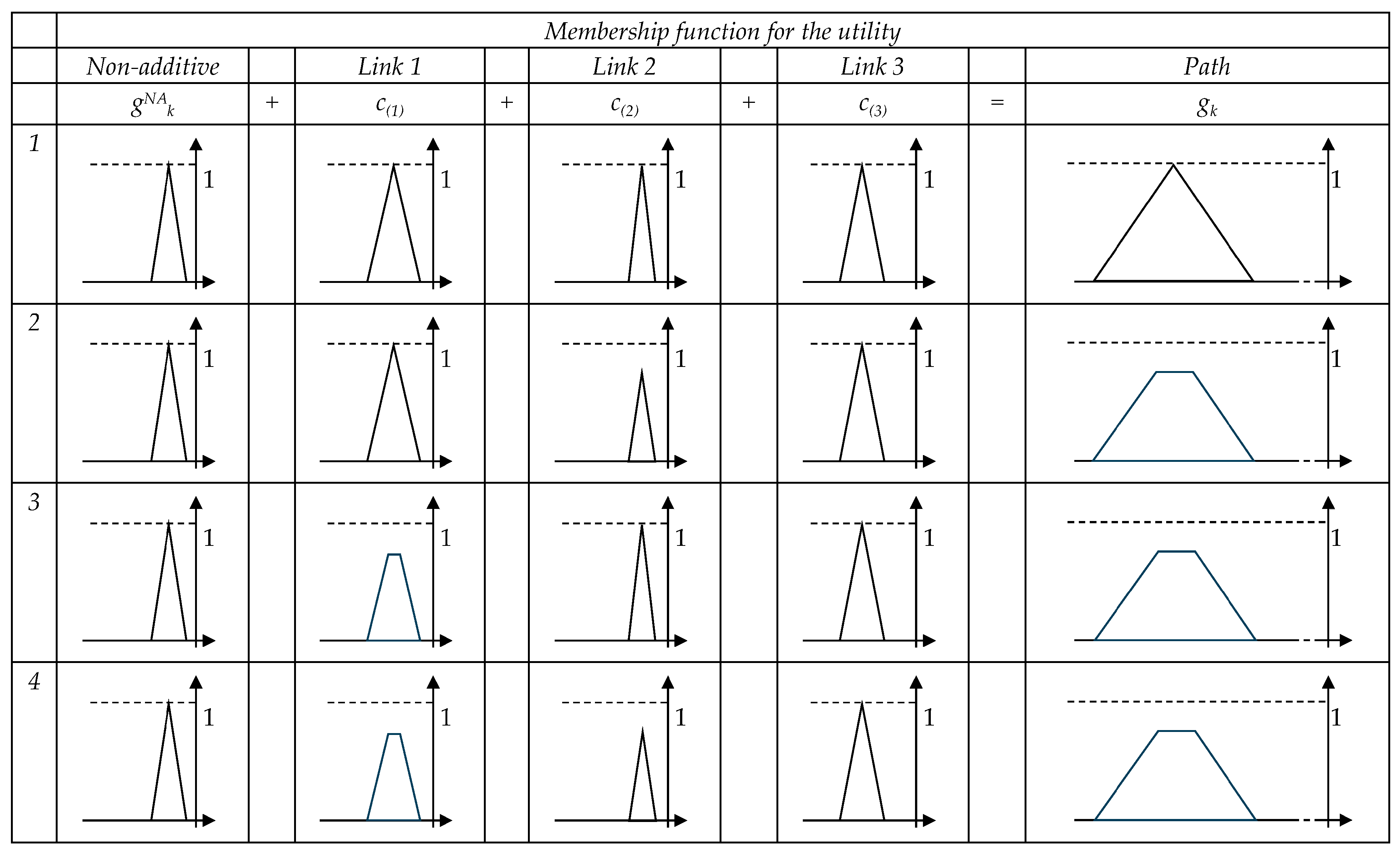
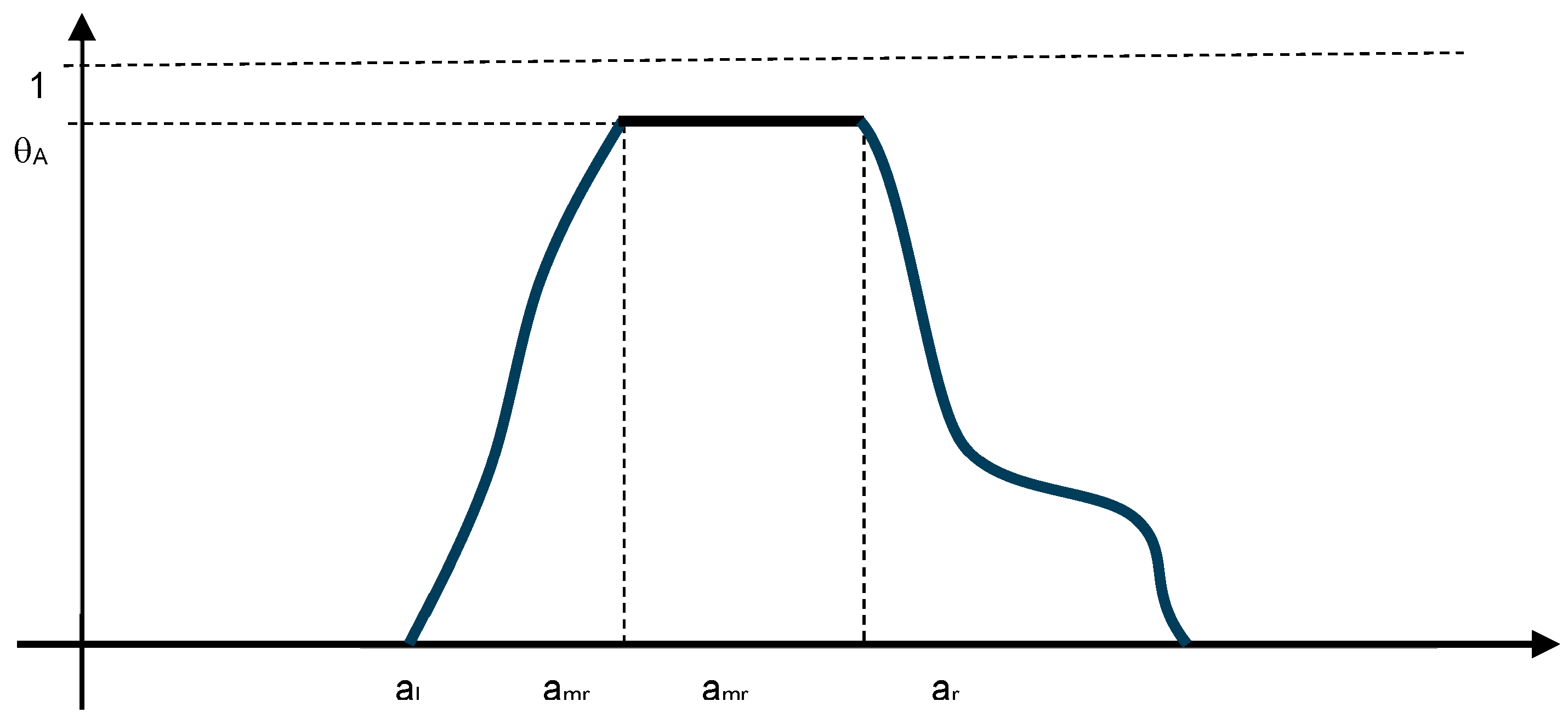
If the non-additive cost and/or the link costs are fuzzy numbers, then the path cost will also be a fuzzy number. The sum of triangular fuzzy costs gives a triangular path fuzzy cost if all values have the same confidence level. Otherwise, the sum of two triangular fuzzy numbers with different confidence levels gives a trapezoidal fuzzy number. The sum of other types of fuzzy numbers must be evaluated on a case-by-case basis.
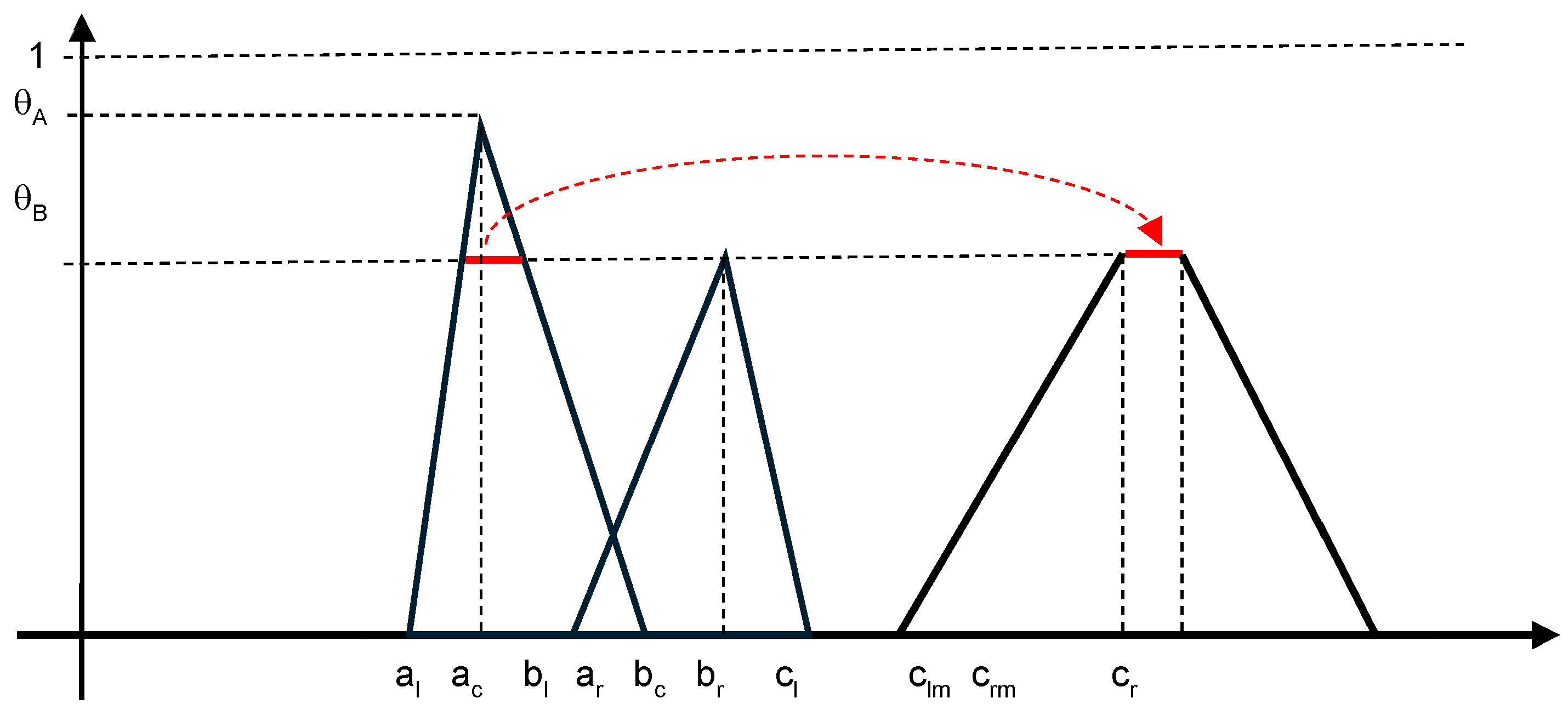
Figure 1 shows some examples of non-additive and additive links and path utility. Note that we consider sums of fuzzy numbers that could have a confidence level of less than one. The case of normalised fuzzy numbers (confidence level equal to one) is a special case of those cases considered in the figure.
3.2. Path Possibility Evaluation
Given a choice set
B (
G for the choice set perception level and
Ii for the path choice level), the possibility of choosing the generic alternative b ϵ
B with utility function
u, given
B, is:
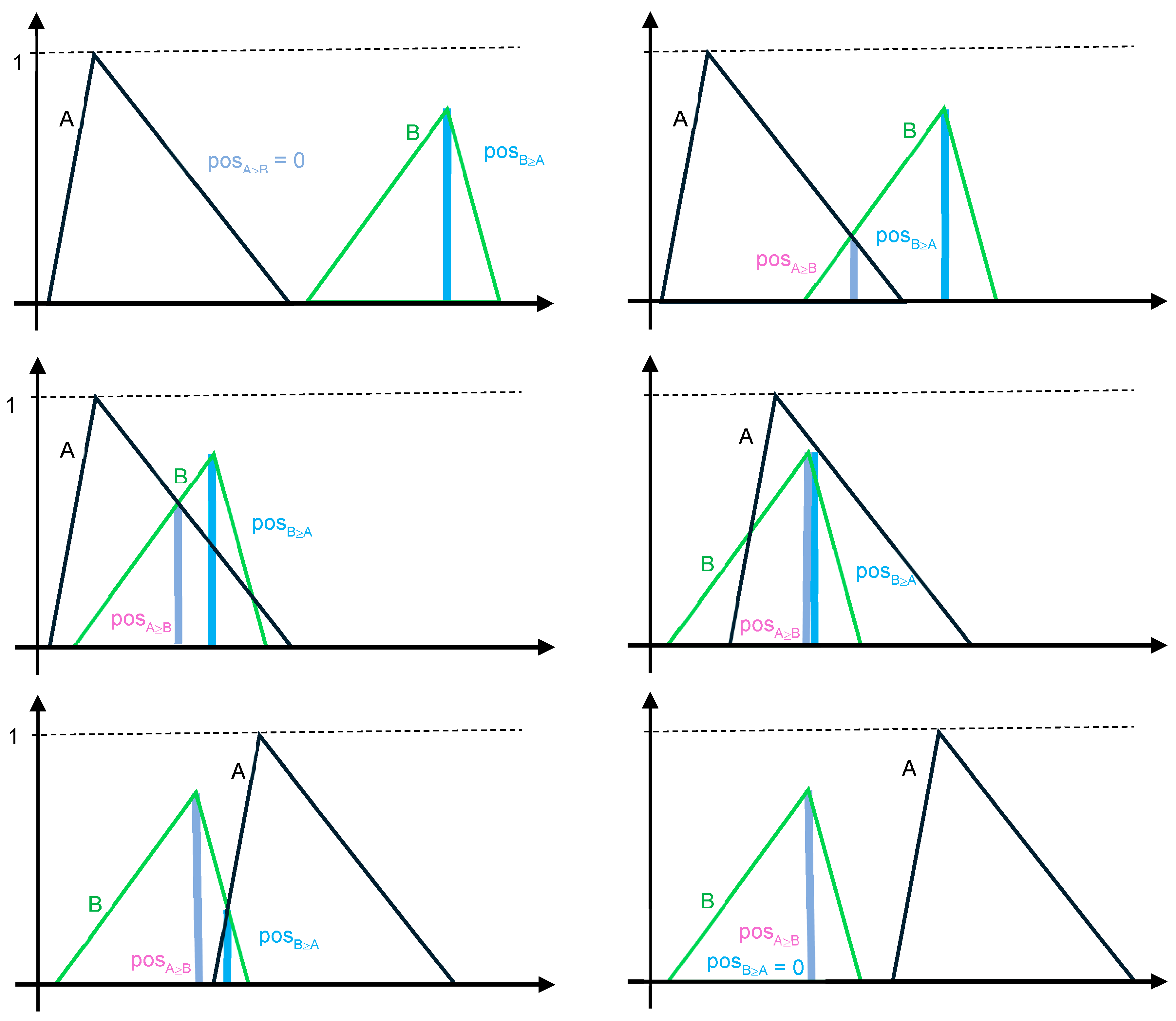
To evaluate the possibility reported in Equation (8), the following steps can be taken: maximum utility evaluation and comparison between the alternative utility and the maximum utility.
The maximum utility gives a utility with a membership function and minimum left values greater than the right values of certain utilities. These utilities have a possibility of zero. This is a natural way to obtain a zero rate for certain alternatives. Other alternatives could have the same possibility values, with different membership functions.
Fuzzy evaluation in path choice provides decision makers with support for generating perceived alternatives and the perceived choice sets. Some of the perceived alternatives are automatically skipped because they give a zero rate in the possibility evaluation and these can be skipped from a choice set. The same consideration applies to a choice set and can be skipped from the perceived choice set.
3.3. Path Probability Evaluation
Given that each possibility is equal to or greater than zero, and that the sum of all possibilities may differ from one, ref. [
18] proposes a method of converting possibility to probability:
with γ being a parameter greater than zero. This conversion assumes a loss of information.
3.4. A Numerical Relationship
It is assumed that the membership function for the path k, with path perceived utility u
k and core of the utility v
k, is specified as follows:
The maximum between the fuzzy numbers is the maximum of the utilities between all the alternatives belonging to the choice set
I of the perceived alternatives, called ‘max’ for simplicity’s sake, with the membership function:
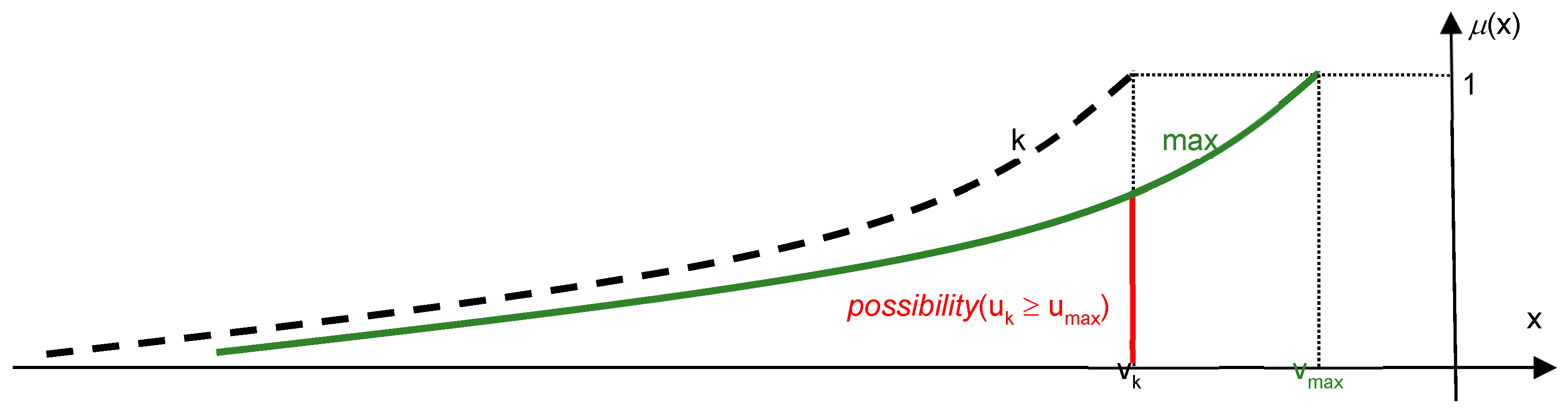
The graphical representation for the two membership functions is reported in
Figure 2.
The possibility that the perceived utility of k is greater than that of the maximum utility alternative is (the length of the red segment in
Figure 2):
The case of vk > cannot happen because, by definition, = maxj ϵ I (vj).
Using the method proposed by Klir (1990) [
18] with parameter γ = 1, the possibility can be converted into a probability when considering the only real case:
Note that, from a mathematical point of view, not from a behavioural point of view, the proposed functional form is equal to the RUM Logit case, where the core value in the FUM is equal to the expected value of the Gumbel in the RUM Logit. Assuming the membership function reported in Equation (12), the Klir conversion reported in Equation (13) and γ = 1, it can be concluded that the FUM gives the same numerical results as the RUM Logit. However, this does not mean that the two models have the same behavioural interpretation; it is just a numerical coincidence.
4. Experimentation
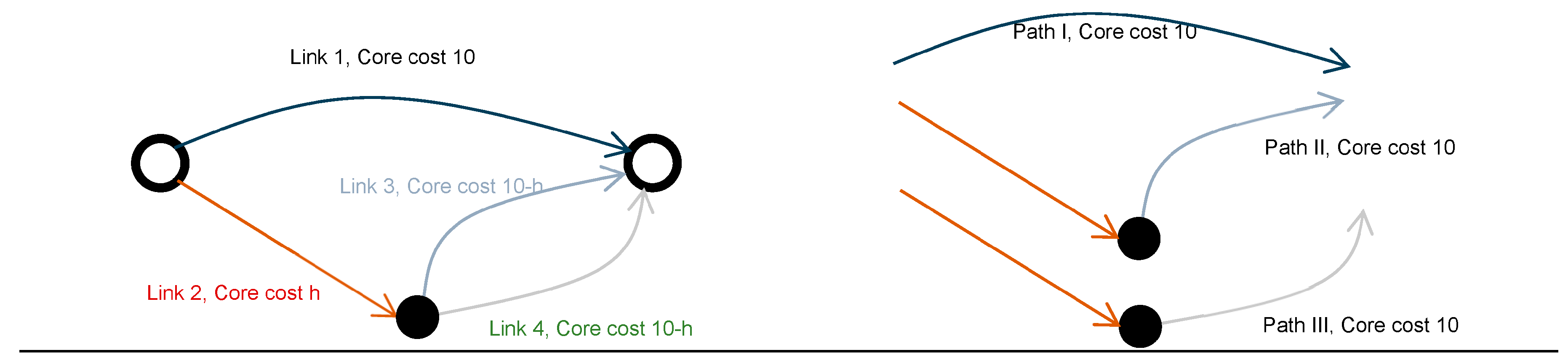
This section reports some numerical results from a small network (
Figure 3). This small network is used to apply the fuzzy model and compare the possible results with those of simpler computational models. This enables the results to be evaluated in relation to the specified functions, demonstrating the advantages and disadvantages of each case. It is assumed that the perceived costs for all links are fuzzy numbers.
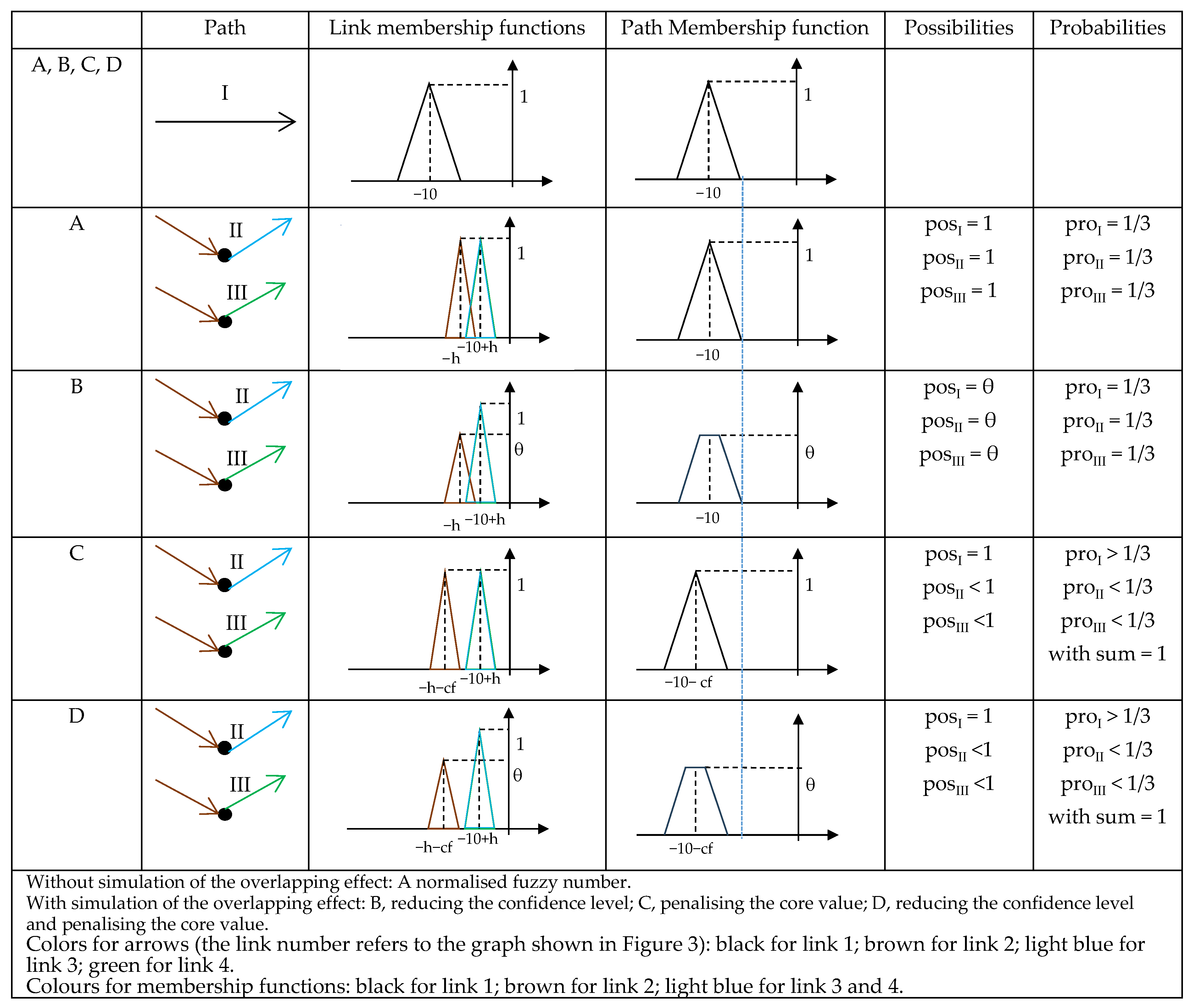
In
Figure 3, it is assumed that the membership function on link 1, and consequently on path I, is triangular with a maximum value equal to one (normalised fuzzy number).
For links 3 and 4, which are not common, it is assumed that the membership function is triangular with a maximum value of 1 (normalised fuzzy number).
For the common link 2, there are four cases (named A, B, C, D) for which the membership function is triangular:
Without simulation of the overlapping effect
- (A)
considering a normalised fuzzy number (confidence level equal to one) and a core value is equal to minus cost;
With simulation of the overlapping effect reducing the confidence level of the fuzzy number (see the specification proposed in this paper below) and/or penalising the core value of the common link with a commonality factor (for the specification of the commonality factor; in particular,
- (B)
Reducing the confidence level of the fuzzy number;
- (C)
Penalising the core value with a commonality factor;
- (D)
Reducing the confidence level and considering the commonality factor.
In the numerical application, it is assumed that the triangular fuzzy number’s left and right values are, respectively, 50% higher or lower than the core value. Different percentage values could be adopted without altering the general conclusions of the experiment.
An option for considering the overlapping effect is to penalise the common link with a core commonality factor, as proposed in [
19], with a different specification for the commonality factor. The utility specification can also include a path size [
20]. In this paper, the adopted specification for evaluating the path cost is as follow:
where
To consider the overlapping effect, another option is to reduce the maximum confidence level θ of the membership function using a confidence commonality factor. For a link, and given an origin-destination pair (the indexes are omitted from the equation for simplicity’s sake), one possible specification is:
where
βF ≥ 0 (with maximum value that guarantee that θ > 0) is a parameter;
((n − 1)/nT)·(c/g) is the confidence commonality factor;
n is the number of paths using the link in the origin-destination pair;
nT is the total number of paths in the origin-destination pair;
c is the link cost;
g is the path cost.
The confidence commonality factor proposed in Equation (15) represents one of the primary methodological contributions of this study. This factor is introduced to address the well-documented issue of path overlapping in path choice modelling. In the traditional literature, dependencies between paths are typically captured either through models that explicitly account for covariance structures, such as the Multinomial Probit [
21], or by incorporating a commonality factor within a Logit [
19]. In the context of fuzzy set theory applied to choice modelling, similar concepts have been explored by modifying the core of the fuzzy numbers. One established approach [
22] involves the specification reported in Equation (14). However, to accurately reflect the impact of overlapping paths within a fuzzy framework, the model must reduce the membership utility of these paths.
In this paper, we propose that path overlapping can be effectively interpreted as a reduction in the confidence level of the non-normalised fuzzy number representing the path utility. This reduction reflects the decreased certainty perceived by the user regarding a specific path when it shares significant segments with alternatives. Consequently, the specification in Equation (15) is introduced as a functional form to operationalize this reduction in confidence, providing a novel way to handle path dependency within fuzzy utility models.
The specification given in Equation (15) is defined considering the results that can be expected from the overlapping of effects: the value must be 1 if there is no overlap (n − 1 = 0); it must increase with the number of overlapping arcs (n) and with the cost of the overlapping arc (c) and it must decrease with the total number of paths (nT) and with the cost of the path (g). Therefore, it is the simplest expression that can be specified. Other expressions can be specified. However, the results obtained in the numerical application confirm the validity of the specification.
The boundaries of the results are shown in
Figure 4.
If the membership function is triangular with a maximum value equal of one (case A), the three paths have the same triangular membership function, the same possibility (1) and the same probability (1/3).
If the membership function in the common link 2 is triangular with a maximum value less than one (case B), the membership functions of paths II and III are trapezoidal with a maximum value of θ which is less than 1; the possibilities of the three paths are the same (θ), as are the probabilities (1/3). Clearly, cases A and B do not consider the effect of the overlapping.
If the membership function in the common link 2 is triangular, but with the cost penalisation considering a core overlapping factor (i.e., CF—commonality factor—proposed in the C-Logit, [
19]), and the maximum value is equal (case C) or less than one (case D), the possibilities of paths II and III are less than the possibility of path I. Consequently, the probability of path I is greater than the probability of path II and III when the effect of overlapping is taken into account.
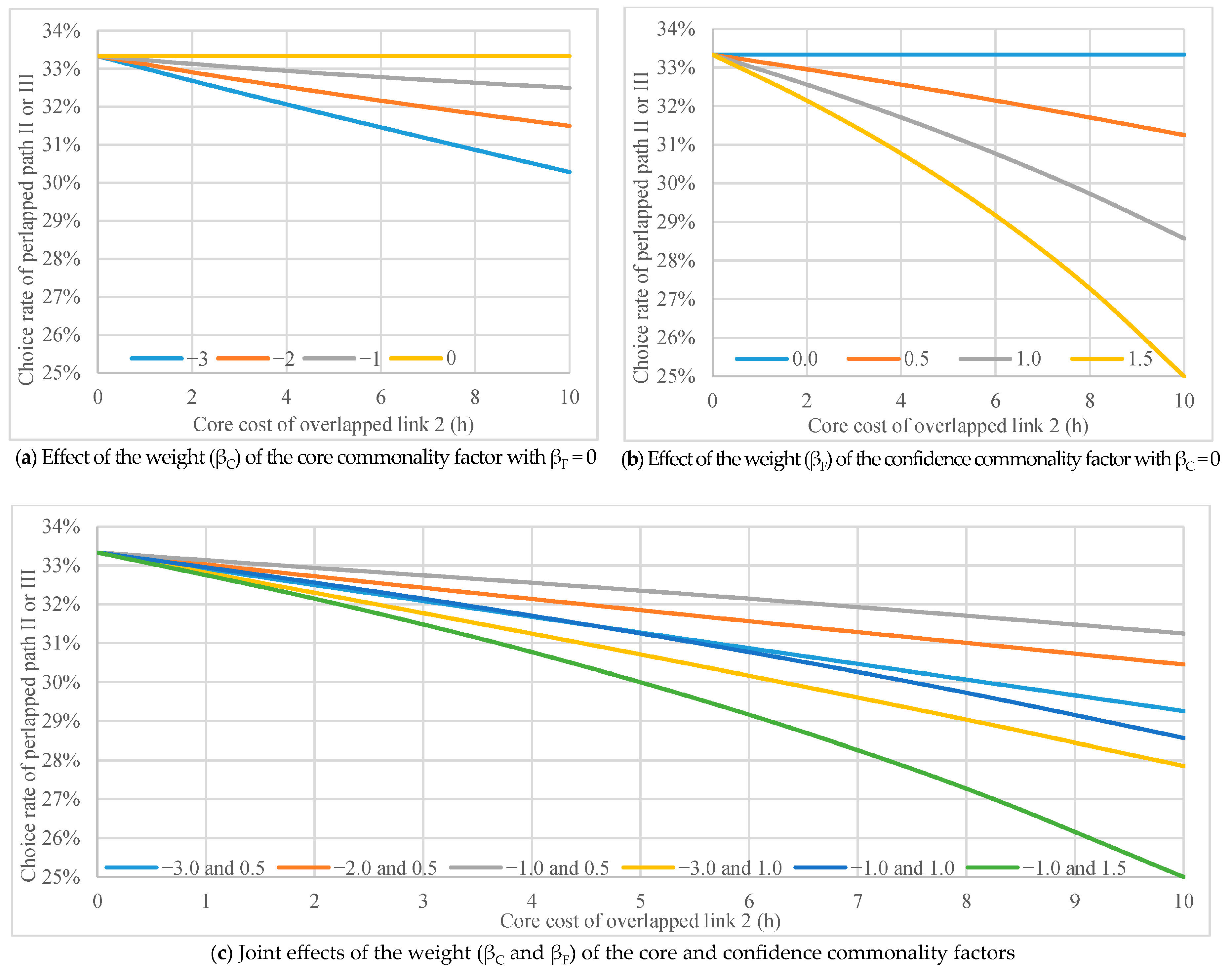
Figure 5 shows a comparison of the effects of the commonality factors on the path choice probabilities in the test system.
Figure 5a illustrates the impact of the weight (β
C) of the core commonality factor on the core cost of the overlapping link, under the assumption that the confidence commonality factor is equal to zero (β
F = 0). As predicted by the theoretical model, the probability for paths II and III decreases as the cost of the overlapping link increases. Increasing the weight of the commonality factor progressively penalises solutions that share links. In the limiting case of complete overlap, the three nominal paths collapse into two independent alternatives. The probability for path II and III must be set at 0.25 (50% of the total), which is equivalent to the probability for path I (50%). Only the high weight of the commonality factor could allow for this effect.
As illustrated in
Figure 5b, the impact of the weight (β
F) of the confidence commonality factor of the membership function is examined, under the assumption that the core commonality factor is equal to zero (β
C = 0). As predicted by the theoretical model, the probability of paths II and III decreases as the cost of the overlapping link increases, ultimately attaining the anticipated theoretical value of 0.25. This is achieved through the judicious allocation of a suitable weight to the maximum likelihood value of the membership function.
Figure 5c illustrates the joint effects of the weight of the core (β
C) and confidence (β
F) commonality factors. The general effect is the aggregate of the preceding case’s individual effects.
In addition to being small, which makes it completely reproducible and controllable, the network is chosen for comparing the effects of the proposed model as the level of path overlap varies. A fuzzy model that does not consider overlap has an equi-probable, equi-possible path rate value of 1/3 (represented by the horizontal line at the top of
Figure 5a,b. As the weights of the two added terms (one derived from the core overlapping factor and one from the confidence commonality factor) increase, so does the effect of overlap. This effect must be modelled in reality. The weights that the parameters must assume must be obtained from real observations and depend on observed reality.
Further comments and results discussions are reported in
Section 5.
5. Discussion and Practical Considerations
The first point to note from the application to the test network is that overlapping paths can be considered when calculating the choice rate. In fuzzy numbers, it is not possible to take the covariance of overlapping paths into account using the standard operators applied to fuzzy numbers. Therefore, it is necessary to adopt techniques that can take into account the effect of the probability reduction calculated for overlapping paths. The most common technique involves penalising the core value of the fuzzy number, for example, using the commonality factor [
22]. This paper tests the hypothesis of using non-normalised fuzzy numbers by reducing the confidence level as a function of overlap. This second solution seems more efficient than using the overlap factor, as it is easy to calculate, depending only on the number of paths crossing each link, the cost of the link and the cost of the path. The proposed confidence commonality factor offers a novel methodological approach to path overlap, interpreting shared segments as a reduction in the perceived certainty, or confidence level, of the fuzzy utility. This formulation successfully operationalises path dependency and its validity is supported by numerical results.
The second point to note is the possibility of calculating path costs from link costs. The sum of triangular fuzzy numbers with identical confidence levels yields a triangular fuzzy number. The sum of several triangular fuzzy numbers with different maximum confidence levels yields a trapezoidal fuzzy number. This consideration is relevant in the application phase because converting from link costs to path costs does not determine the shape of the membership function. However, this problem can be solved numerically.
The third point to note concerns the use of path choice models within assignment models. To the author’s knowledge, fuzzy models cannot be applied through implicit type assignment (without explicit path generation) and require the use of assignment models with explicit path enumeration. While this may seem to be a limitation of fuzzy models, it is in fact not. Implicit assignment models assume that the user perceives a large number of paths for each source–destination pair. For example, implicit probit models assume that all loop-less paths are perceived. However, the perception of a large number of paths does not occur in reality, as each user perceives only a few alternatives. Therefore, if one wants to model user behaviour and not just use a solving algorithm, the explicit enumeration of paths is desirable.
The fourth point to note concerns the use of fuzzy versus probabilistic models. In this case, the author has no preference for either model. Fuzzy models start from less restrictive certainty assumptions than probabilistic models and neither model can be considered a special case of the other. Therefore, when dealing with real-world problems, it is necessary to investigate which model provides better results or whether a mixed model could be more effective, as discussed in the fifth point.
The fifth point to note is the possibility of adopting mixed fuzzy-probabilistic models. As discussed in
Section 2, path choice models consist of two levels: the perception level and the choice level. The fuzzy-type model, as it is defined, would be best suited to the perception level, where users perceive path alternatives with incomplete information. Conversely, the probabilistic model would be more appropriate at the choice level, where users select an option from the set of perceived alternatives. However, this hypothesis requires further investigation based on real observed data.
The sixth point to note is that calibrating the parameters β
C (core overlapping factor) and β
F (confidence commonality factor) is a critical step that depends on the specific characteristics of the study area, user behaviours and network topology. Within a fuzzy logic framework, these parameters represent non-stochastic weights of membership or preference. This precludes the use of some calibration methods that would otherwise be considered for path choice [
23]. Specifically, maximum likelihood estimation, which is standard for probabilistic discrete path choice models, is not suitable here. To overcome this issue, updating the parameters using traffic counts can be applied. As the path choice model is embedded within a traffic assignment procedure, the most effective calibration strategy is a weighted least squares method based on observed link flows. This approach minimises a bi-objective loss function: the first term accounts for the squared deviations between the measured and assigned traffic flows, and the second term accounts for the distance between the optimised parameters and their a priori or preliminary estimates. Notably, this framework can be segmented by origin–destination pair classes, distance classes or user categories. Although this method is usually used for stochastic traffic assignment [
24], it could be adapted for fuzzy-based path choice contexts to ensure empirical consistency with real-world traffic patterns.
6. Conclusions and Further Developments
This paper explores advancements in path choice modelling within transport systems, introducing a fuzzy-based approach. A complete fuzzy path choice model has been specified and the necessary arithmetic operations have been defined to enable its integration into assignment models. This formulation allows for both normalised and non-normalised fuzzy numbers, thereby increasing modelling flexibility. An exponential-type membership function was proposed to provide a continuous representation of decision sensitivity, and the model was validated by applying it to a simplified transport network.
Among the paper’s key innovations is a fully developed fuzzy path choice model, along with the mathematical operations specified for its use in assignment frameworks. The option of using both normalised and non-normalised fuzzy numbers was suggested and an exponential-type membership function was defined to refine decision representation.
The study highlights the following important considerations: the possibility of evaluating overlapping paths in terms of choice probability using both normalised and non-normalised fuzzy numbers; the numerical limitations involved in deriving path costs from link costs, particularly when using triangular membership functions; the fact that fuzzy models cannot be effectively implemented through implicit assignments, meaning that explicit path generation and potentially new algorithms are required. Furthermore, the work emphasises the need to assess the comparative performance of probabilistic and fuzzy models or investigate adopting hybrid approaches that integrate both frameworks at the perception and choice levels. The proposed model specification advances the framework for predicting and evaluating transport policies by providing a more specific representation of traveller perceptions. This approach improves the reproducibility of impact assessments regarding global change and evolving mobility patterns. By offering robust tools for simulating complex transport systems, this research enables more precise calculations of sustainability indicators.
Future developments should focus on expanding the fuzzy-based modelling framework to accommodate implicit assignment algorithms with selective approach and hybrid probabilistic-fuzzy strategies. Applying the model to large-scale, real-world networks is crucial for testing its robustness and scalability. Furthermore, model calibration practices must be improved to ensure reliable and adaptable applications in a variety of transport contexts.