1. Introduction
As the global concern over climate change continues to grow, green and low-carbon transformation has emerged as a critical objective for the economic development of nations worldwide, which is also a core pathway to advance sustainable development and achieve the United Nations Sustainable Development Goals (SDGs), especially SDG 12 (Responsible Consumption and Production) and SDG 13 (Climate Action). According to the Carbon Disclosure Project (CDP), an international non-profit environmental organization, global supply chain-related carbon emissions in 2023 were 26 times higher than the direct operational emissions of enterprises, highlighting supply chain decarbonization as an indispensable part of achieving global sustainable development and corporate environmental responsibilities. Consequently, the environmental impact of supply chain activities has garnered widespread attention [
1]. In addition, studies have shown that increased consumer awareness of environmental issues fosters green innovation within enterprises [
2], which serves as a key driver of sustainable industrial upgrading that balances ecological protection, economic growth, and social welfare. Consequently, many companies have embarked on their green transformation to embed sustainability into their core operational strategies, rather than treating it as a peripheral supplement.
As a globally pioneering leader in the new energy vehicle (NEV) sector, BYD Company Limited (BYD) has implemented systematic and scalable green innovation practices throughout its production, R&D, and market expansion chains. By strengthening green supply chain information sharing and encouraging consumer participation in low-carbon product design and usage scenarios, the company has effectively integrated sustainability into its whole value chain, acting as a paradigmatic example of corporate sustainability-driven transformation in the automotive industry. For instance, in June 2022, BYD Auto successfully entered the Japanese market with the launch of the Seal, a fully electric vehicle model designed for city travel. This model was developed in response to the environmental preferences of Japanese consumers, is an embodiment of sustainable consumption trends that guide enterprises’ green production decisions, and boasts a range of 301 km under CLTC conditions. This new model differs from the domestic version based on several parameters, including battery energy consumption, radiation levels, and charging speeds, all of which are optimized to reduce the environmental footprint and align with the concept of sustainable mobility.
Additionally, it introduces a new pricing strategy that exerts competitive pressure on established car manufacturers in the Japanese market [
3], thereby accelerating the global automotive industry’s transition to green and low-carbon development, which represents a key part of global sustainable mobility goals. Apart from BYD’s pacesetting practices in the new energy vehicle sector, leading enterprises in other industries have also embedded sustainability into daily operations. Toyota and TCL Group continue to advocate for the development of environmentally friendly supply chains to foster green economic growth. They are dedicated to researching and developing green technologies. TCL has incorporated eco-friendly technologies into the production of television products, resulting in a significant reduction in energy consumption, lower carbon emissions, and less environmental pollution, all of which contribute to achieving corporate sustainable development targets and global carbon neutrality goals. Consequently, it has also been awarded energy-saving certification in the television industry [
4].
In fact, the implementation of corporate sustainable development strategies cannot be achieved without the joint efforts of every member of the supply chain. Manufacturers, as key members of the supply chain, create environmentally friendly products that satisfy the needs of consumers, which is essential for distinguishing themselves in a competitive market. However, manufacturers must carefully manage information regarding consumer preferences when developing their products. However, retailers possess specialized knowledge in retailing, excellent market forecasting skills, and access to a substantial amount of direct sales data; they can more accurately predict market demand because they are closer to the consumer [
5]. Information sharing is a crucial factor for the success of a supply chain. Supply chain enterprises can achieve resource sharing through information exchange and build interdependent, supportive, and cooperative relationships on this foundation, optimizing resource allocation, reducing redundant production and waste, and promoting the coordinated development of environmental protection and economic benefits in the supply chain. Information sharing plays a very important role in the development of enterprises, covering many aspects such as demand forecasts, production capacity, inventory status, logistics layout, order progress, manufacturing and distribution arrangements, and key performance indicators [
6], including key sustainability performance indicators (e.g., carbon emission intensity, energy utilization rate, waste recycling rate) that reflect the environmental and social performance of the supply chain.
Given the pivotal role of information sharing in green and sustainable supply chain operations, scholars at home and abroad have conducted in-depth research on this topic. The existing literature has produced notable findings in the study of information sharing, primarily focusing on strategies for information sharing [
7] and the dynamics of information sharing across various modes [
8]. Among these studies, Dan et al. [
9] examined the demand information sharing mechanism within a supply chain by developing a dynamic game model and designing corresponding incentive contracts. Wen et al. [
10] studied, based on a game model, the game relationship between the logistics strategy of an e-commerce platform and the retailer’s information sharing strategy in the sales mode of the e-commerce platform. Liu et al. [
11] analyzed the effects of information sharing on supply chain performance through a dynamic game model, exploring the impact of information sharing on the supply chain. Indeed, information sharing can effectively improve supply chain performance [
12]. Wang et al. [
13] established an evolutionary game model to analyze the impact of information sharing on the profits of all participants in a supply chain. They concluded that sharing is beneficial for increasing the profits of both retailers and manufacturers, but their research did not consider the environmental benefits brought by information sharing, which is an important dimension of sustainable supply chain research.
Furthermore, the impact of information sharing on supply chain performance and stakeholders has long been a research focus. Huang et al. [
14] demonstrated through simulation analysis that the reliability of information positively correlates with supply chain performance, particularly benefiting manufacturers who can obtain more profits. However, in cases of significant product differentiation, manufacturers’ revenues may not reach the potential gains from information sharing. Conversely, if the distribution cost of retailers is high enough, manufacturers can still benefit from exchanging demand information [
15]. Meng et al. [
16] analyzed the information sharing strategies of the members of a supply chain using a game model. Their findings indicated that information sharing is beneficial to manufacturers, while its effects on retailers can be either beneficial or detrimental. Building on this foundation, many scholars have studied the issue of when manufacturers should engage in information sharing. Wang et al. [
17] explored how manufacturers communicate demand information to two competing retailers, considering effort costs and the intensity of service competition in product sales. Their research revealed that when effort costs are high or service competition is intense, manufacturers should selectively share information with certain retailers rather than all of them. Li et al. [
18] explored the impact of information sharing on green supply chains by developing a Stackelberg game model. Their results indicated that competition and consumer green sensitivity significantly shape manufacturers’ information sharing decisions, supporting future research on green preferences, information sharing, and supply chain sustainability.
Meanwhile, challenges regarding information sharing between platforms and manufacturers have also attracted considerable attention from scholars [
19]. Dai et al. [
20] analyzed information sharing between manufacturers and retailers across various supply chain contexts, revealing that when manufacturers heavily invest in big data technology, they often hesitate to share information with retailers, which may hinder the optimization of green production and reduce the sustainable performance of the supply chain. Quadir et al. [
21] explored the information sharing problem in a supply chain consisting of a manufacturer and a retailer based on game theory, finding that the manufacturer’s environmentally friendly decisions influence their willingness to share information. This is one of the few studies that link corporate environmental decisions to information sharing, yet it fails to incorporate consumers as key participants to explore the impact on supply chain sustainability. In practice, retailers also possess significant consumer data, which enables them to better understand market dynamics. As a result, numerous scholars have conducted extensive research on information sharing among retailers.
Given strategic interactions within supply chains, game theory is widely used to analyze information sharing. Feng and Li [
22] constructed a market game model and conducted an in-depth investigation into how information sharing strategies between retailers and suppliers affect the overall market performance and equilibrium outcomes of both parties and the supply chain. Their finding indicated that retailers’ information sharing behavior exhibited strong contextual dependency and was shaped by core market- and production-related factors. Fu et al. [
23] discovered that retailers are more likely to share information when both the accuracy of the information and the volatility of consumer demand are high, but they did not further explore how the volatility of consumer demand for green products affects retailers’ information sharing behavior, a factor closely associated with supply chain sustainability. Chu et al. [
24] examined a supply chain comprising manufacturers and retailers, concluding that when information sharing costs are low, retailers will provide information. Wang et al. [
25] developed a game theory model to identify the optimal strategy for information sharing among retailers. The results revealed that retailers’ willingness to share information is most significantly influenced by manufacturers’ production costs, particularly green production costs, a key determinant of the sustainable development of the supply chain. Additionally, retailers can gain advantages by sharing information with suppliers that have high recycling efficiency, a key indicator of supply chain circularity and sustainability, further reinforcing the connection between information sharing and supply chain sustainable development.
Game theory can characterize the strategic interactions, decision-making behaviors, as well as conflict and coordination among rational agents, and thus has been used by researchers to study demand information sharing in supply chains [
26]. Previous studies have demonstrated that when the service investment efficiency of manufacturers or the service attention of consumers is sufficiently high, retailers will voluntarily share demand information, regardless of the level of competition [
25,
26]. Feng et al. [
27] developed a Stackelberg game model with manufacturers, retailers, and recyclers as the primary participants. They found that although information sharing is beneficial for manufacturers and recyclers, it is not beneficial for retailers, thus developing revenue sharing contracts can incentivize retailers to share information, thereby providing a feasible path for coordinating supply chain members’ interests and promoting sustainable information sharing in circular supply chains. Zhang et al. [
28] examined the motivations behind information sharing between retailers and manufacturers under the agency sales mode and resale mode, discovering that commission rates significantly influence retailers’ willingness to share information under an agency sales mode. In contrast, retailers’ information sharing in a resale mode is linked to the unpredictability of consumer demand. Lin et al. [
29] investigated the dynamics of information sharing between platforms and manufacturers in both resale and agency sales modes by developing a game model that incorporated manufacturers’ environmental efforts. Their findings indicated that in the agency sales mode, low efficiency in agency sales prompts the platform to share information with the manufacturer, while in the resale model, the platform shares information with a single manufacturer, providing important insights for exploring the impact of manufacturers’ environmental efforts on information sharing and supply chain sustainability.
Within the research on supply chain strategic interactions based on game theory, some scholars have found that information sharing among retailers in a two-tier supply chain under bidirectional information asymmetry is affected by information gaps and costs [
30]. The majority of current studies have focused on the conditions under which supply chain members share information and how this impacts their profits, but they have paid insufficient attention to the impact of information sharing on the environmental and social dimensions of sustainable supply chain performance, which is the core focus of this study.
However, information reliability is also a key factor affecting supply chain performance. Huang et al. [
14] highlighted that the reliability of information sharing between manufacturers and retailers positively affects supply chain performance; the higher the reliability of information, the higher the profit obtained by manufacturers. Wang et al. [
13] explored the information sharing strategies of retailers in a retailer-led green supply chain by developing a game model. The results show that information sharing in a green supply chain is beneficial to both manufacturers and retailers. In another study, Wang et al. [
31] developed a green supply chain consisting of manufacturers and retailers and found that the strategies of supply chain members were not affected by production modes. They found that regardless of the mode, the profits of manufacturers and retailers under information sharing were always higher than those without information sharing, but they did not analyze whether this profit improvement was accompanied by improved environmental benefits, which is an important part of sustainable supply chain research.
Some research has examined green supply chains with manufacturers and demand-capable retailers, showing that manufacturers are more willing to produce greener products when information is shared [
32]. Lastly, Ma et al. [
33] developed a multi-stage game model and found that information sharing among retailers is influenced by consumer preferences. If consumers are not concerned about a certain attribute of the product, retailers should retain the information, and if consumers are concerned about a certain attribute of the product, retailers should share information, directly confirming that information sharing can promote the green upgrading of products and contribute to the sustainable development of the supply chain and even the entire industry. Wei et al. [
34] investigated the impact of dynamic demand information sharing on green technology innovation and profits in the supply chain from a long-term perspective. In their study, retailers accessed dynamic demand data for green products, while manufacturers focused on investing in green technology innovation. The findings indicated that sharing dynamic demand information enhances green technology innovation. Additionally, manufacturers benefit from this information sharing if the impact of green technology innovation on the stock of green technology is significant or if the cost of innovation is relatively low.
Against this background, scholars have further explored the impact of pricing strategies on the revenues of both participants in information sharing [
35]. Liu et al. [
36] discovered that the efficiency of value-added services offered by retailers can impact their willingness to share information. In another study, Liu et al. [
37] developed a game model featuring manufacturers and retailers as key players, revealing that the willingness to share information is influenced by associated costs. Fu et al. [
23] investigated information sharing between retailers and manufacturers in the context of trade credit, finding that retailers are more likely to share information when they face tight available capital or when both high information accuracy and high demand volatility are present. Shang et al. [
38] identified that the level of competition and non-linear production costs significantly influence retailers’ motivation to share information.
Similarly, Meng et al. [
16] and Hong et al. [
39] argued that production costs can impact information sharing among retailers in a supply chain. Wei et al. [
40] developed four game models that examine the interaction between suppliers’ sales modes and online retailers’ information sharing strategies. Their findings indicated that regardless of the suppliers’ sales modes or the retailers’ information sharing strategies, the higher the sensitivity of consumers to the green level of products, the higher the expected profits, product prices, and green level of channel members, thereby providing important empirical support for this study to take consumer green preferences as a key factor for exploring information sharing in green supply chains.
Subsequently, game models between retailers and consumers have been extended by incorporating diverse scenarios and heterogeneous preferences. Yang [
41] constructed a two-party game model involving only the retailer and consumers, incorporating consumer green preference, dual-channel competition intensity, market demand information sharing, and green promotion service cost-sharing as four key elements, and established four game scenarios for comparative analysis. But their research did not incorporate manufacturers as key participants to construct a tripartite analysis framework and failed to comprehensively analyze the impact of this information sharing on the overall sustainability of the supply chain. Luo et al. [
42] investigated the information sharing dynamics within two competing green supply chains, concluding that consumers’ preferences for product greenness and green services, along with manufacturers’ effective performance in these areas, are crucial factors for retailers to share demand information, providing key support for this paper to explore the tripartite interaction mechanism of manufacturers, retailers, and consumers in the context of supply chain sustainability.
Existing research on supply chain information sharing has achieved significant progress: On one hand, scholars have explored the information sharing strategies and game dynamics between manufacturers and retailers, confirming that information sharing can improve the profits of both parties. However, retailers’ benefits are constrained by factors such as sharing costs, market competition intensity, and green production costs, resulting in uncertain impacts on retailers’ benefits. On the other hand, some studies have linked information sharing with green supply chains, finding that consumers’ green preferences and manufacturers’ environmental investments significantly influence their information sharing decisions. Moreover, information sharing can drive manufacturers to produce products with higher green levels, thereby providing critical support for supply chain sustainability.
Nevertheless, several aspects of existing research could be further explored. First, although consumers’ preferences for product greenness and manufacturers’ environmental practices influence information sharing, most studies focus on manufacturers and suppliers as the primary participants in the information sharing game, treating consumer preferences merely as a variable rather than incorporating consumers as key participants in the analysis, which overlooks the important role of consumers as the driving force of sustainable consumption in promoting information sharing and the green transformation of supply chains. Nevertheless, the majority of existing tripartite game frameworks predominantly take the government, retailers and other entities as the third participant [
43]. Second, few scholars have considered the dynamic evolution process of behaviors among the three parties under the joint effect of manufacturers, retailers, and consumers. Third, few scholars have analyzed the impact of consumers on information sharing from a quantitative perspective, and even fewer have linked this impact to the sustainable performance of the supply chain, which is inconsistent with the core orientation of the
Sustainability journal to focus on the integration of environmental, economic, and social dimensions. Accordingly, it is imperative to conduct an in-depth dissection of information sharing dilemmas within green supply chains involving consumer engagement.
Based on the above analysis, this study aims to address the following issues: First, what evolutionary trends will emerge in information sharing within green supply chains under the influence of strategies adopted by different supply chain stakeholders and corresponding consumer behaviors? Second, how do consumers’ green preferences and manufacturers’ product production modes jointly affect retailers’ strategic selection and adjustment regarding information sharing? Third, how does manufacturers’ behavior evolve under heterogeneous scenarios of consumer green preferences and information sharing costs? To address the above issues and clarify the mechanism of information sharing in green supply chains with the participation of three parties, we incorporate consumers as key participants of information sharing into the game model and examine how manufacturers’ desire to enhance the environmental friendliness of their products and consumers’ inclination towards green products impacts retailers’ information sharing practices, with the ultimate goal of promoting the sustainable development of green supply chains, optimizing resource allocation, reducing environmental footprint, and realizing a win–win for environmental, economic, and social benefits. By developing a tripartite evolutionary game model involving consumers, manufacturers, and retailers, we investigate the mechanisms of information sharing within a green supply chain and explore how to coordinate the behaviors of the three parties to promote the long-term sustainable operation of the green supply chain. Furthermore, we explore various evolutionary stabilization strategies across different scenarios and perform numerical simulations using MATLAB (R2023a) to analyze the factors influencing information sharing in the supply chain, providing practical guidance for supply chain members to formulate sustainable information sharing strategies and promote the green and low-carbon transformation of the whole supply chain.
In accordance with the writing sequence of papers on tripartite evolutionary game theory, the chapter arrangement of this paper is as follows:
Section 1 Introduction;
Section 2 Assumptions and Construction of the Tripartite Evolutionary Game Model;
Section 3 Analysis of the Evolutionary Game Model for Information Sharing in Green Supply Chains;
Section 4 Numerical Simulation; and
Section 5 Conclusions and Contributions.
3. An Evolutionary Game Model Analysis of Information Sharing Between Manufacturers and Retailers in Green Supply Chains
3.1. Replicating Dynamic Equations
“Replication dynamics” and “evolutionarily stable strategies” are the two core categories of evolutionary game theory. “Replication dynamics” is a dynamic description and analysis of the strategy change process of the limited rationality of participating subjects [
51]. This paper constructs the replication dynamics equations for the strategies of manufacturers, retailers, the environment, and consumers. Let the manufacturer’s expected return of choosing the “improve” strategy be
. The expected return of choosing “not improve” strategy is
This paper constructs the replicator dynamic equation for the behavioral strategy of manufacturers as follows:
The retailer’s expected return from choosing the “share” strategy is
. The expected return of choosing the “not share” strategy is
. The average expected return is
, and thus
The replicator dynamics equation for constructing corporate behavioral strategies is
Consumers’ expectations of choosing the “willingness” strategy are given by
, while the expected payoff for choosing the “unwillingness” strategy is
. The average expected return is
By combining Equations (1)–(3), the replicator dynamic equations of manufacturers, retailers, and consumers can be obtained as follows:
Replicator dynamic equations for manufacturers, retailers, and consumers are denoted as
. We take the partial derivatives of the three replicator dynamic equations with respect to x, y, and z, respectively:
,
,
,
,
,
,
,
,
. According to Friedman’s method, the evolutionary stable strategy (ESS) of a differential equation system can be obtained from the local stability analysis of its Jacobian matrix. The Jacobian determinant can be calculated as [
56]
Manufacturers, retailers, and consumers gradually adjust their strategies to increase their profitability, and the evolutionary stable strategy (ESS) serves as their final strategy. The equilibrium points of the three-party game model should be found first. Let , , , respectively. Eight equilibrium points can be obtained as follows: , , , , , , , .
3.2. Evolutionary Path Analysis
3.2.1. An Evolutionary Path Analysis of Manufacturers’ Strategic Choices
The condition for reaching the evolutionary stable point is that the replicator dynamic equation equals 0 [
53]. According to Equation (4), we can obtain
V(
x) = 0 and know that the stable points are
x = 1 and
x = 0:
When > 0, , , x = 1 is the evolutionary stable point. The manufacturer’s strategy is to improve the greenness of the product.
When < 0, , , x = 0 is the evolutionary stable point. The manufacturer’s strategy is not to improve the greenness of the product.
Combined with the aforementioned tripartite evolutionary game model and cost–benefit parameter settings, it can be seen that manufacturers’ choices of strategies depend on the costs and benefits. As the core producers in the green supply chain, manufacturers bear the main cost of green product upgrading, so their strategic decisions are highly sensitive to cost–benefit ratios. If the cost is relatively low and the economic return from greening is high, or if the brand image and market share can be improved, then manufacturers may prefer to increase greening investment, which also helps them gain long-term competitive advantages and respond to the market’s green consumption demand. If the cost of greenness enhancement is too high and the benefit enhancement is insufficient, coupled with the uncertainty of information sharing benefits, manufacturers may choose a more conservative strategy and be cautious about greenness enhancement. In short, manufacturers’ strategic choices are decisions made in a dynamic balance between costs and benefits, and their willingness to improve product greenness will also vary dynamically with changes in cost–benefit parameters, further affecting the evolutionary stability of the entire green supply chain information sharing system.
3.2.2. An Evolutionary Path Analysis of Retailers’ Strategic Choices
Similarly, it is known from Equation (8) that V(y) = 0 yields the stable points y = 1 and y = 0 in two cases:
When < 0, , , y = 1 is the evolutionary stable point. The retailer’s strategy is to share information with the manufacturer.
When , , , y = 0 is the evolutionary stable point. The retailer’s strategy is not to share information with the manufacturer.
In line with the analysis of manufacturers’ strategic decisions, it can be seen that the retailer’s strategy depends on the revenue from information sharing, the maintenance cost of information sharing, the unit cost of the information management system, the volume of information shared, and the ordering cost, etc. Cost is thus the key factor influencing whether the retailer shares information. As the bridge connecting upstream manufacturers and downstream consumers, retailers bear dual pressures from information transaction costs and market operation risks, and their strategic choices are not only affected by individual cost–benefit accounting, but are also constrained by the overall operation efficiency and trust mechanism of the green supply chain. Unlike manufacturers’ production-oriented decision-making logic, retailers’ information sharing behavior is a typical trade-off between short-term cost control and long-term value creation, which directly determines the smoothness of information transmission in the supply chain.
Under different market states and cost structures, retailers’ information sharing strategies will be different. For example, when the market state is good and the cost of information sharing is low, retailers may be more inclined to share information for supply chain optimization and profit maximization. When the cost of information sharing is too high and the benefits are not enough to cover the costs, especially when the risk of competitive advantage leakage is prominent or the market green demand is sluggish, retailers may choose not to share information. This seemingly conservative choice is essentially a rational decision made by retailers to avoid operational losses and protect their own market position, and it will also directly break the information transmission chain of the green supply chain, impede manufacturers’ green upgrading pace, and then constrain the coordinated development of the entire green supply chain system.
3.2.3. Evolutionary Path Analysis of Consumer Strategy Selection
Similarly, according to Equation (11), it can be known that V(z) = 0 leads to the stable points of z = 1 and z = 0, which is divided into two cases:
When < 0, , > 0, z = 1 is the evolutionary stable point. At this time, consumers are willing to pay for green products.
When , , , z = 0 is the evolutionary stable point. At this point, consumers are not willing to pay for green products.
Following the analytical logic of the tripartite bounded rationality game, it can be inferred that consumers’ strategic choices are primarily influenced by the purchase price and the recycling price of products. As the terminal demand subjects of the green supply chain, consumers are restricted by their own economic rationality and cognitive boundaries, and their willingness to pay for green products (z) is not only driven by environmental awareness, but also shaped by practical economic benefits, thus rendering price factors the core determinant of their final purchase decisions. In a highly competitive market with numerous substitutes, consumers’ sensitivity to prices tends to increase further, which prompts them to place greater emphasis on comparing purchase prices and recycling prices. The widening price gap between ordinary products and high-green products will directly dampen their green consumption willingness. Even if they have certain environmental awareness, they tend to abandon green choices under the constraint of economic costs. Moreover, this price-sensitive consumption behavior will generate a reverse transmission effect, directly affecting retailers’ sales returns and willingness to share information, and further restricting manufacturers’ motivation to invest in green product upgrading. Therefore, when formulating pricing strategies, businesses need to comprehensively consider these factors, balance the production costs of green products, consumer affordability and recycling benefit subsidies, and appropriately narrow the price gap between green products and ordinary products appropriately, so as to better meet consumer demands, stimulate green consumption willingness, and enhance their market competitiveness while promoting the benign operation of the green supply chain information sharing system.
3.3. Analysis of the Stability of the Three Strategies
This section will provide an in-depth discussion of the conditions under which these eight equilibrium points remain asymptotically stable and offer a clear economic interpretation of such conditions.
When the equilibrium point is
the corresponding Jacobian matrix is
The eigenvalues of the Jacobian matrix at this point can be obtained as , , . Under such Jacobian conditions, the additional costs incurred by manufacturers for green upgrading far outweigh the incremental benefits generated by such upgrading, leaving no profit margin for green improvement; thus, manufacturers will rationally choose “not improve”. For retailers, the incremental benefits derived from information sharing fall short of the sum of the costs and risk costs associated with such sharing. As information sharing proves ineffective, retailers opt for “not share”. Meanwhile, the premium expenditure paid by consumers to purchase products with improved green performance exceeds the incremental recycling benefits, which means green consumption brings no extra gains to consumers, so consumers will opt for “unwillingness”. When this equilibrium is stable, the green cooperation within the supply chain is completely stagnant. Constrained by high costs and insufficient returns, manufacturers lack incentives for green upgrading; retailers are unwilling to bear the costs and risks of information sharing; and consumers resist the premium of green products. All three parties adopt conservative non-cooperative strategies, leading to a deadlock in the green transformation of the supply chain. Only traditional production, retailing, and consumption patterns are maintained, with no green value-added benefits. Therefore, when the equilibrium point is (0,0,0), the corresponding strategy set is {not improve, not share, unwillingness}.
When the equilibrium point is
, the corresponding Jacobian matrix is
The eigenvalues of the Jacobian matrix at this point can be obtained as , , . When the equilibrium point is , the corresponding strategy set is {not improve, not share, unwillingness}.
When the equilibrium point is
, the corresponding Jacobian matrix is
The eigenvalues of the Jacobian matrix at this point can be obtained as , Under the above conditions, even if the manufacturer obtains the benefits from retailer information sharing, it still suffers losses from green upgrading and thus firmly chooses “not improve”; the retailer achieves positive net benefits from information sharing and proactively chooses “share”; and consumers have no willingness to purchase due to the excessively high premium for green consumption. When this equilibrium is stable, retailers voluntarily share information, whereas manufacturers lack incentives for green upgrading and consumers show no willingness to purchase. Retailers achieve operational efficiency improvements through information sharing, yet such information fails to support manufacturers’ green upgrading. Meanwhile, consumers do not accept the price premium of green products. Consequently, supply chain information sharing only serves the internal optimization of retailers, failing to drive the green transition of the entire supply chain, thereby yielding only limited and one-sided collaborative benefits. Such an outcome is not conducive to the achievement of long-term sustainability goals, as it impedes the coordinated green development of the supply chain and weakens the impetus for environmental improvement and sustainable operations. When the equilibrium point is (0,1,0), the corresponding strategy set is {not improve, not share, unwillingness}.
When the equilibrium point is
(0,0,1), the corresponding Jacobian matrix is
The eigenvalues of the Jacobian matrix at this point can be obtained as =, , . Under the above conditions, manufacturers face a significant upgrade cost disparity and choose “not improve”; retailers obtain negative net benefits from information sharing and thus choose “not share”; and consumers’ willingness to pay a green premium is lower than the incremental benefits from product recycling. Therefore, even if the product is not upgraded, consumers still retain their green purchasing intention to pursue recycling benefits. When this equilibrium is stable, consumers possess green consumption awareness, but there is no supporting green supply from the upstream supply chain. Constrained by cost–benefit trade-offs, manufacturers and retailers refuse green upgrading and information sharing. Only consumers unilaterally hold green purchasing intentions, which highlights a severe supply–demand mismatch. Green demand cannot be transformed into effective driving forces for supply chain transformation, leading to a green consumption gap in the market and a lack of incentives for upstream entities to respond. When the equilibrium point is (0,0,1), the corresponding strategy set is {not improve, not share, willingness}.
When the equilibrium point is
, the corresponding Jacobian matrix is
The eigenvalues of the Jacobian matrix at this point can be , , . Under the above conditions, the manufacturer’s net benefit, which combines the gains from upgrading and information sharing, is positive, so it chooses “improve”; the retailer’s net benefit from information sharing is positive, so it chooses “share”; and consumers have no willingness to purchase due to the excessively high premium for green consumption. When this equilibrium is stable, the manufacturer and retailer engage in in-depth green cooperation, yet consumers are unwilling to purchase. The upstream supply chain achieves green upgrading and information sharing, with enhanced production and operational efficiency. However, the terminal premium of green products exceeds consumers’ affordability, preventing green products from translating into market sales. As a result, the green transition of the supply chain lacks sufficient market-driven forces. It is necessary to refine pricing strategies or provide green consumption subsidies to stimulate the consumer side. When the equilibrium point is ,the corresponding strategy set is {improve, share, unwillingness}.
When the equilibrium point is
, the corresponding Jacobian matrix is
The eigenvalues of the Jacobian matrix at this point can be obtained as , , . Under the aforementioned conditions, the manufacturer’s gains from green upgrading outweigh the corresponding costs, and thus the manufacturer chooses “improve”. Consumers derive benefits from green consumption and exhibit purchase intentions accordingly. The retailer faces negative net returns from information sharing and therefore refuses to share information. Such a decision-making structure hinders the formation of a coordinated and sustainable supply chain system, weakens the overall efficiency of green development, and is not conducive to the long-term sustainable transformation of the supply chain. When the equilibrium point is , the corresponding strategy set is {improve, not share, willingness}.
When the equilibrium point is
, the corresponding Jacobian matrix is
The eigenvalues of the Jacobian matrix at this point can be obtained as = , , . Under the above conditions, when this equilibrium is stable, the manufacturer faces excessively high green upgrading costs; even with the benefits from information sharing, green upgrading remains unprofitable, so the manufacturer chooses “not improve”. The retailer obtains positive net returns from information sharing and thus chooses “share”. Consumers derive benefits from green consumption and therefore exhibit willingness to purchase. When this equilibrium is stable, retailers and consumers reach a consensus on green cooperation, while manufacturers are absent. Retailers share information to optimize supply and demand, and consumers are willing to purchase green products. However, constrained by high costs, manufacturers refuse to carry out green upgrading. The market is only supported by green demand and information, without the supply of green products. The green transformation of the supply chain is hindered by shortcomings in key components, and policy subsidies and cost control are required to reduce the pressure on manufacturers’ green upgrading, thus promoting the overall sustainability and long-term development of the supply chain. The equilibrium point is (0,1,1), the corresponding strategy set is {not improve, share, willingness}.
When the equilibrium point is
(1,1,1,), the corresponding Jacobian matrix is
The eigenvalues of the Jacobian matrix at this point can be obtained as , , . Under the above conditions, the manufacturer’s green upgrading cost can be covered by upgrading benefits and additional gains from information sharing, making the upgrading strategy long-term profitable. For the retailer, the incremental benefits of information sharing far exceed its costs and risk costs, so information sharing is its optimal strategy. Consumers’ premium expenditure on green consumption is lower than the incremental benefits from product recycling, resulting in a strong willingness to purchase green products and a stable strategic choice. Such a stable equilibrium promotes the coordinated operation of the green supply chain, improves resource utilization efficiency, and provides a solid operational foundation for the long-term sustainable development of the entire supply chain system. The equilibrium point is (1,1,1), the corresponding strategy set is {improve, share, willingness}.
In this study, we derive the replicator dynamics equation via normative analysis and construct the Jacobian matrix to examine the stability of eight equilibrium points, clarifying their parameter constraints and economic implications, thus addressing the lack of in-depth analysis and economic interpretation in previous studies. The results show that equilibrium stability depends entirely on the relative values of cost–benefit parameters: only when all three stakeholders achieve positive net returns from cooperative strategies can the ideal stable state {improve, share, willingness} be attained, whereas if any party’s cooperation cost exceeds its benefit, the equilibrium shifts to non-cooperative strategies and hinders the green transformation of the supply chain. Such a tripartite cooperative equilibrium promotes green upgrading, information sharing, and green consumption, which is conducive to resource conservation, emission reduction, and the development of a circular economy, thus supporting the long-term sustainable development of the supply chain. Future research may adjust cost parameters (e.g., government subsidies, reductions in technological costs) and optimize revenue distribution mechanisms to drive the game toward the ideal equilibrium and improve the practical and sustainable value of the model.
Aiming to advance the development of the green supply chain, this paper proposes an ideal model in which manufacturers improve the greenness of products, retailers share information, and consumers are willing to pay for products with an enhanced environmental performance. The evolutionary game eventually evolves to the state where
. According to
Table 2, when
,
,
, the sum of costs and benefits associated with the manufacturer’s “improve” strategy exceeds that of the “not improve” strategy. For consumers, selling or purchasing products with an enhanced environmental performance yields higher utility and economic returns than traditional alternatives, which strengthens their willingness to support green consumption. Similarly, retailers obtain higher profits and operational efficiency when participating in information sharing than when acting independently, rendering information sharing their dominant strategy. Collectively, these results indicate that reasonable cost–benefit allocation and incentive mechanisms can effectively align the interests of manufacturers, retailers, and consumers, thereby promoting the stable evolution of the green supply chain toward a coordinated and sustainable state.
4. Numerical Simulation
4.1. Analysis of the System Evolution Stability Points in Scenario 1
To further validate the model’s reliability and intuitively characterize the evolutionary path of players’ strategic choices, numerical simulation experiments are performed using MATLAB (R2023a). To drive the strategy combination toward the ideal evolutionary stable state , parameter settings must conform to rigorous theoretical constraints and scientific norms, with core constraints including , , . These constraints are derived from evolutionary game theory and economic rationality principles: the first ensures manufacturers’ net benefits from improving product environmental performance outweigh those of inaction, guaranteeing incentives for green investment; the second guarantees consumers’ higher net utility from green purchasing, consolidating the terminal demand foundation for green supply chains; and the third ensures retailers’ net benefits from information sharing exceed those of non-sharing, eliminating barriers to information transmission. Correspondingly, initial parameter values are set scientifically based on existing green supply chain research conventions, real operational scenarios, and model stability requirements: , , , , , , , , , , , , , , . This parameter assignment not only meets the theoretical conditions for ideal equilibrium convergence but also aligns with the actual cost–benefit logic of supply chain stakeholders, ensuring the authenticity, robustness, and referential significance of simulation results.
To investigate the influence of key parameters on the stability of equilibrium , this section adopts the control variable method to conduct independent sensitivity analyses. With other baseline parameters fixed, we adjust only the focal parameter to examine its isolated impact on strategic evolution and system stability. The detailed experimental designs and corresponding results are presented below.
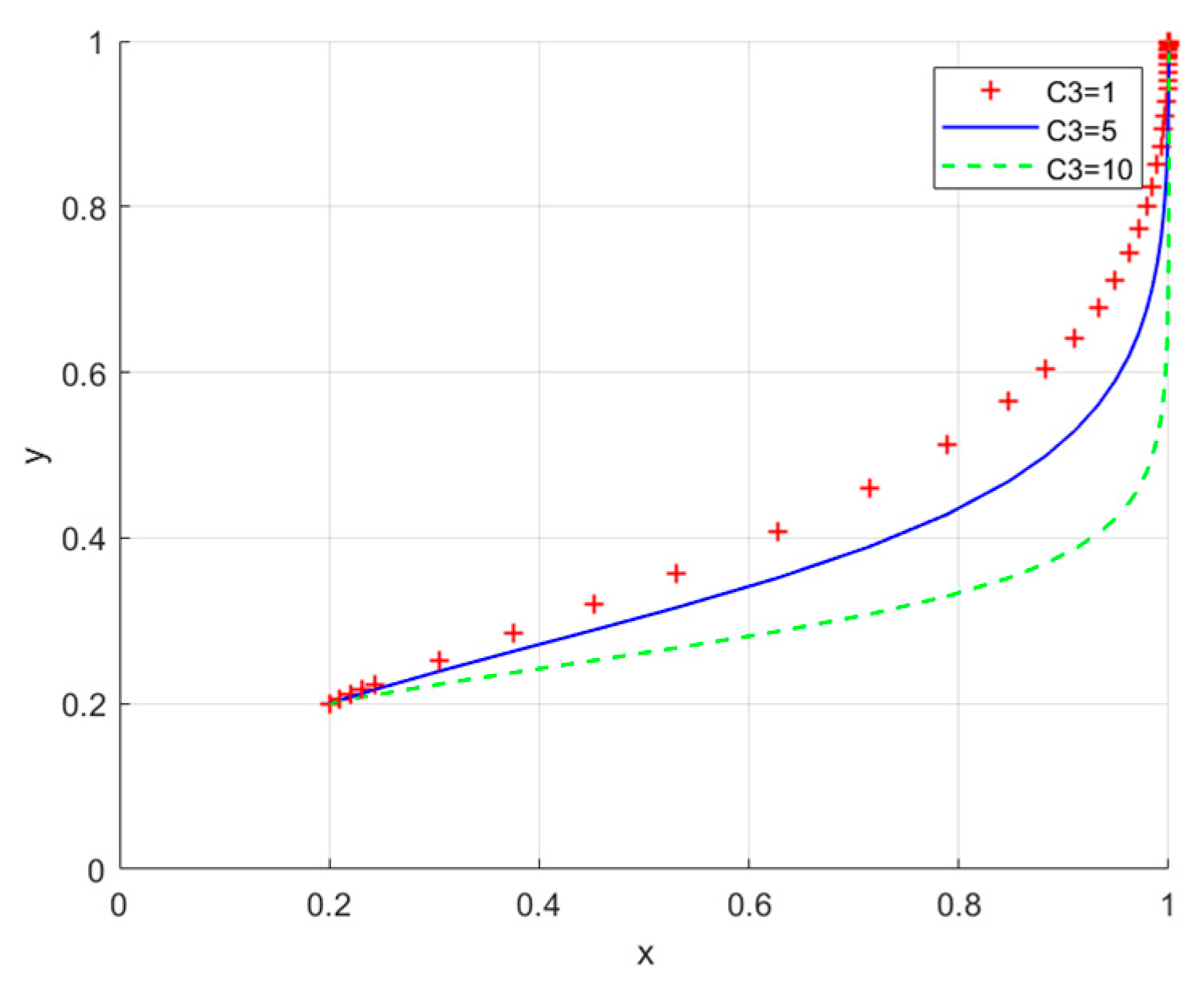
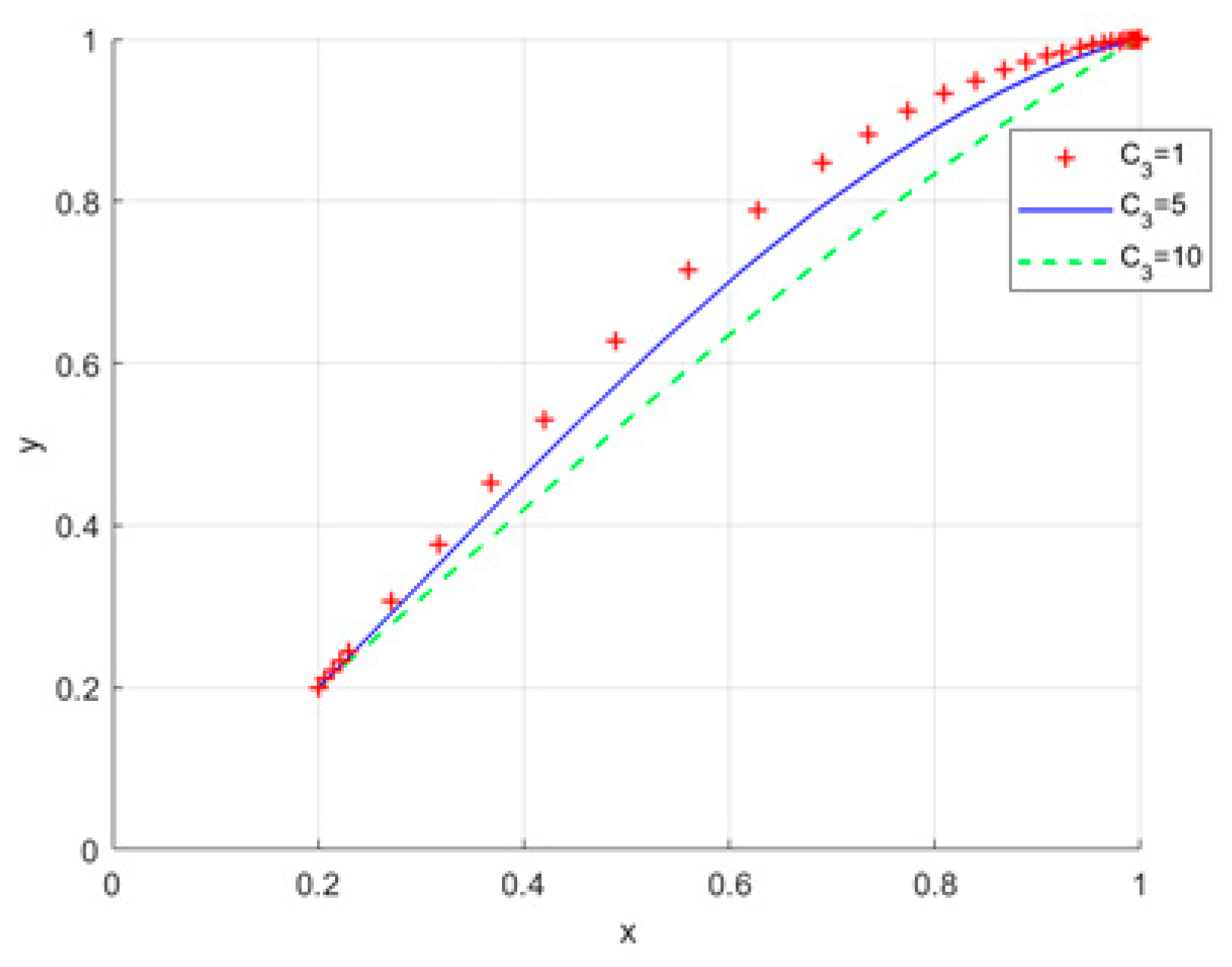
Analysis 1: Sensitivity of unit information management costs
. This analysis seeks to investigate how changes in retailers’ unit information management cost affect the strategic choices of all game participants. Holding other parameters constant at the initial benchmark values,
is assigned gradient values of 1, 5, and 10, respectively; the corresponding simulation results are presented in
Figure 1.
As depicted in
Figure 1, during the dynamic evolution of the three stakeholders toward the system’s evolutionary stable strategy (ESS), two distinct trends are observed: the probability of retailers adopting information sharing with manufacturers decreases significantly as
rises, while the probability of manufacturers improving product greenness shows a gradual upward trend. Within the model assumptions, parameter constraints, and simulation scenarios of this study, this trend reflects the rational strategic adjustment of manufacturers driven by evolutionary game mechanisms and cost–benefit trade-offs, rather than voluntary behavioral initiatives aimed at fostering sound market development or advancing green product diffusion.
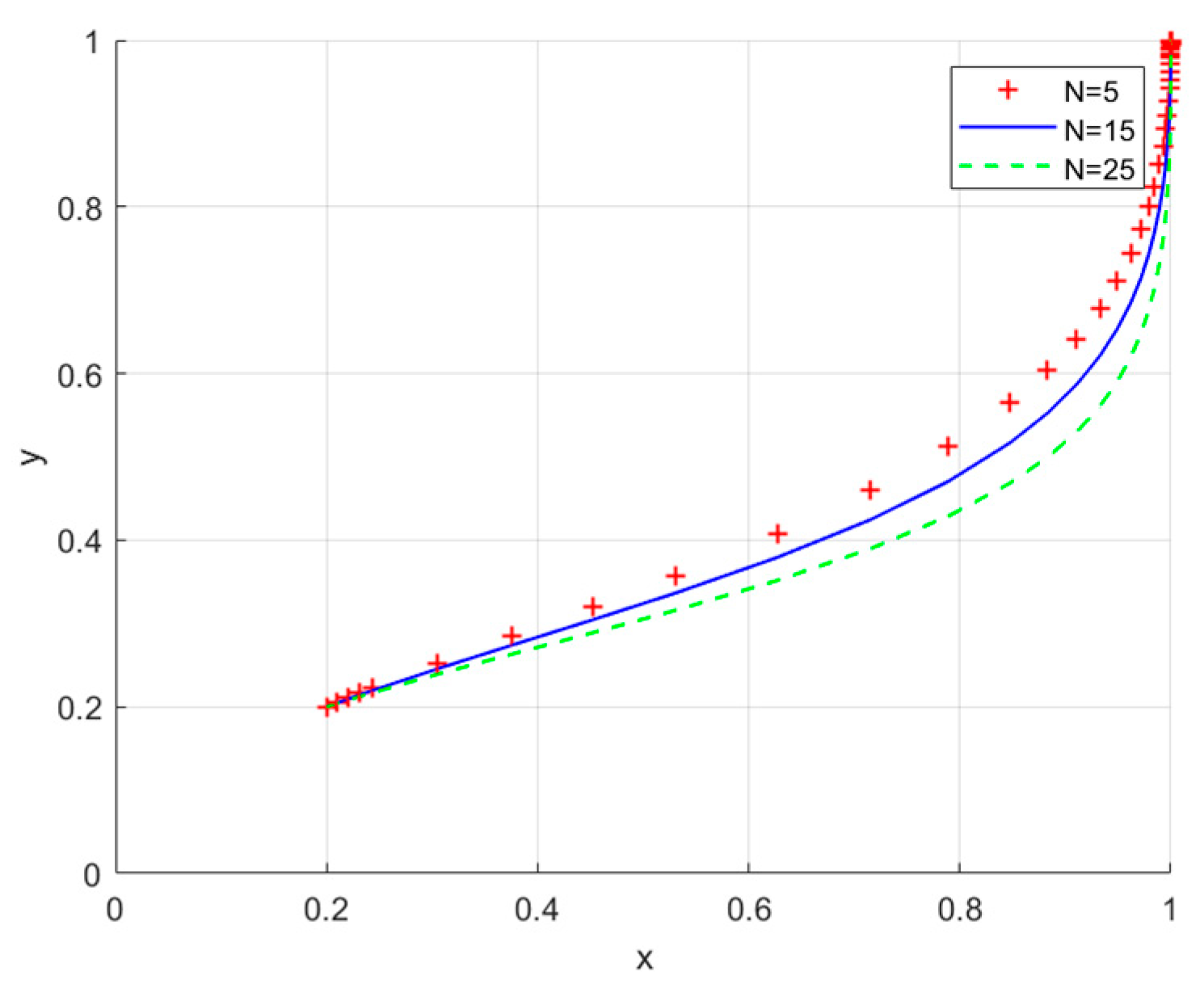
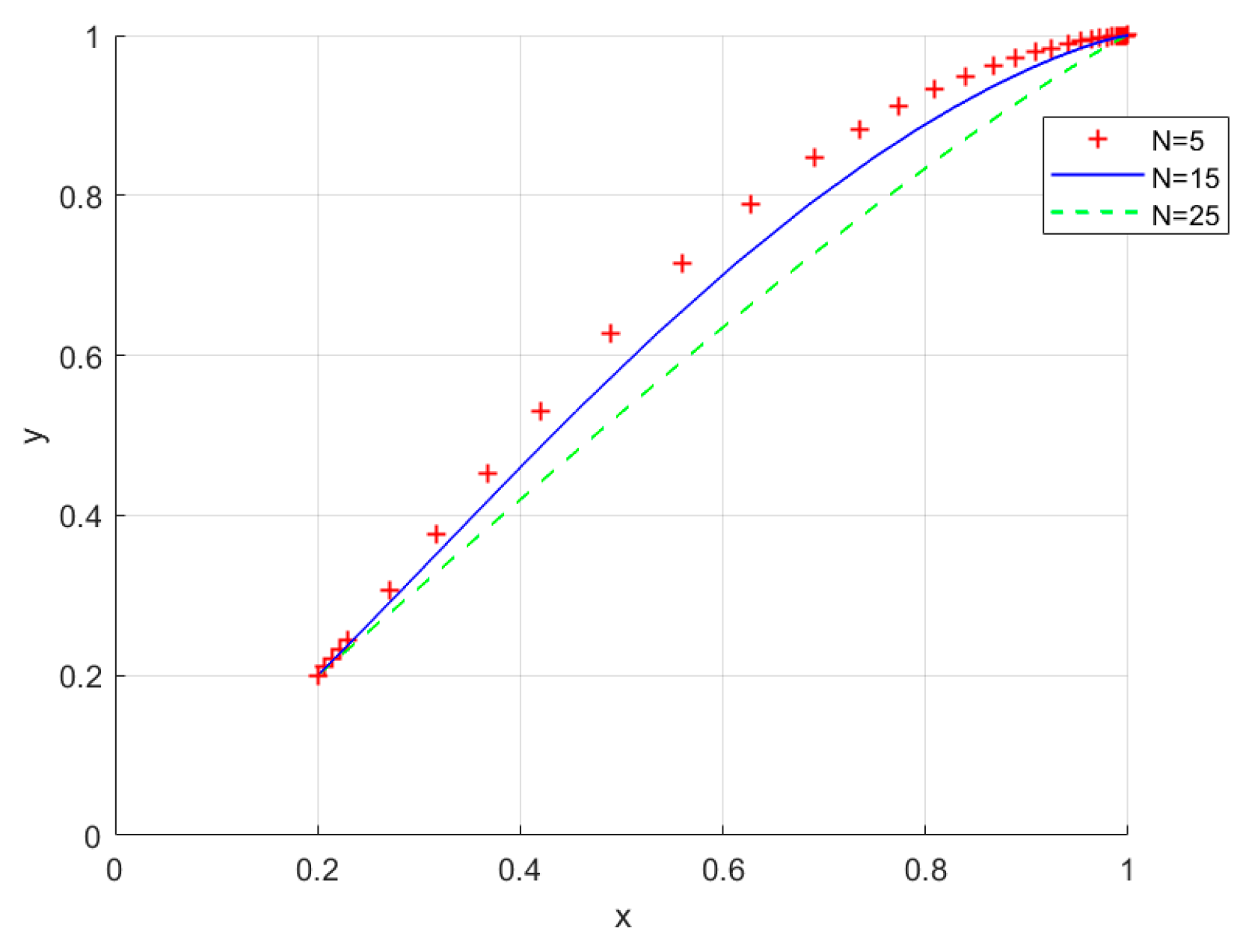
Analysis 2: Sensitivity of parameter information sharing volume
N. This analysis focuses on investigating the impact of parameter
N variations on the evolutionary path and stable state of the system. With other parameters fixed,
N is set to 5, 15, and 25 in sequence, and the simulation results are presented in
Figure 2.
As illustrated in
Figure 2, during the system’s evolutionary process toward stable equilibrium, an obvious trend is identified: the probability that a retailer shares information with a manufacturer decreases gradually as the information sharing volume rises. Within the model assumptions, parameter constraints, and simulation scope of this study, this evolutionary behavior can be ascribed to the cost–benefit trade-off of rational retailers: comprehensive information sharing brings higher input costs for retailers, and such high-cost information sharing lacks cost efficiency, thus inducing retailers to lower their information sharing willingness.
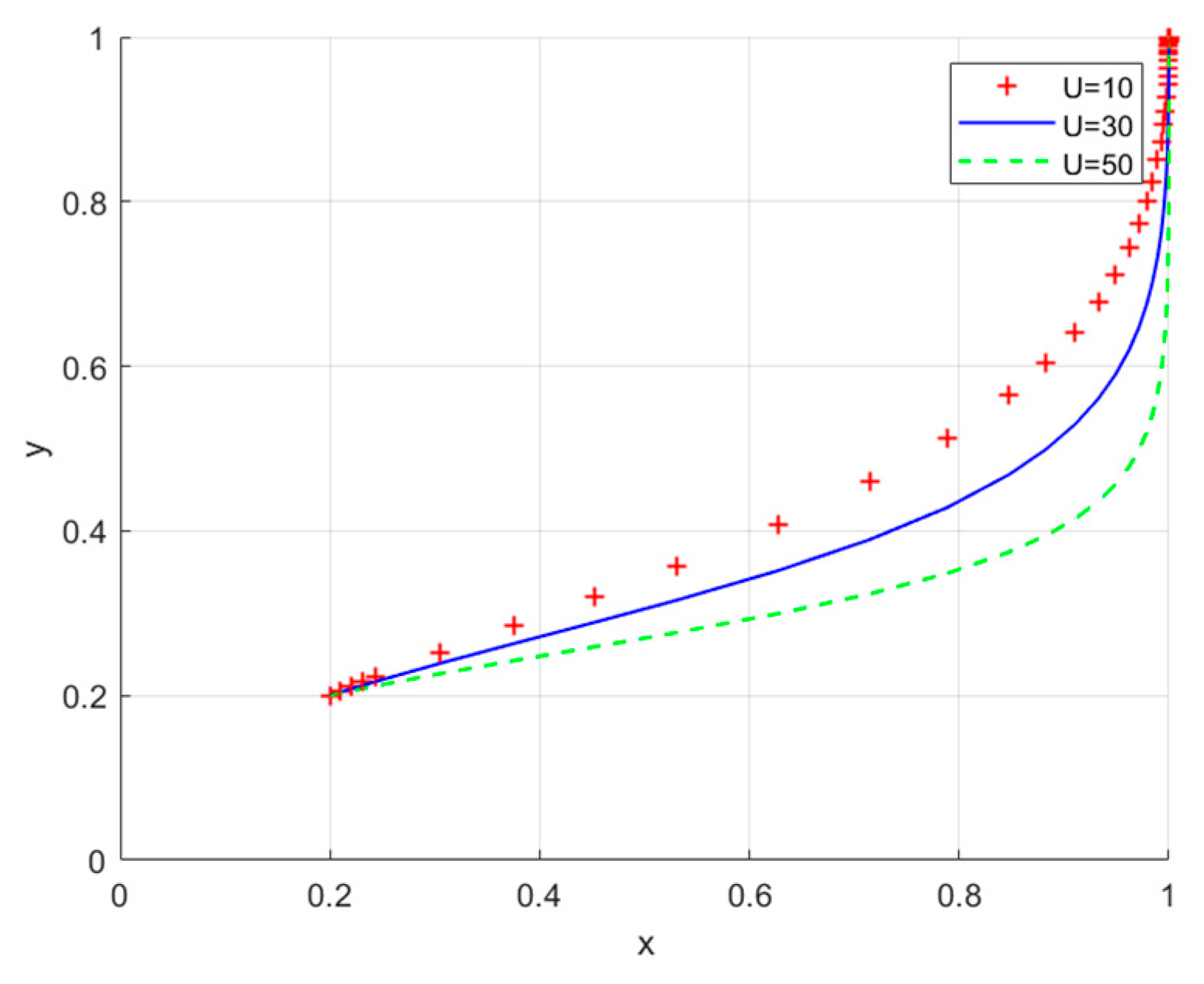
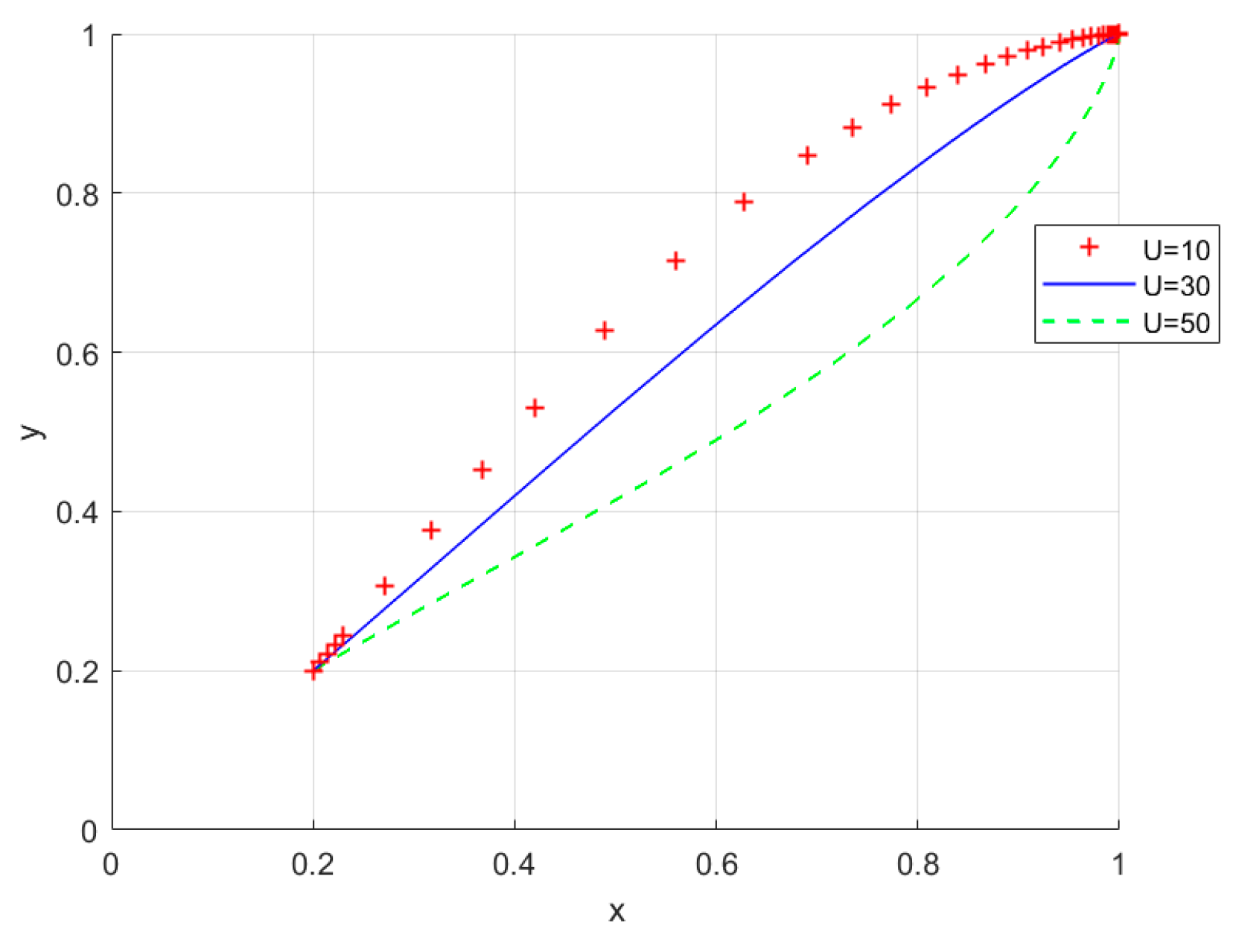
Analysis 3: Sensitivity of the additional cost of information sharing
. This analysis focuses on investigating the impact of fluctuations in parameter
on the evolutionary path and stable state of the system. With other parameters fixed,
is set to 10, 30, and 50 in sequence, and the simulation results are presented in
Figure 3.
As illustrated in
Figure 3, prior to the stabilization of retailers’ strategy choice at the state of information sharing (i.e., a probability value of 1), a notable regularity is identified: the higher the cost of advantage loss incurred by retailers in the process of information sharing, the slower the convergence speed of their strategy evolution toward the stable state of 1. Within the analytical framework and scenario settings of this study, this evolutionary pattern demonstrates that retailers tend to make rational strategic decisions by combining their own operational conditions and carefully weighing the potential adverse impacts and corresponding losses associated with information sharing with manufacturers before determining their final strategic choice.
Combined with the simulation results presented in
Figure 1,
Figure 2 and
Figure 3, it can be concluded within the scope of this research that various types of costs exert a pivotal governing effect on retailers’ willingness to implement information sharing with manufacturers. To further encourage retailers to participate in information sharing and acquire more high-quality market and operation information, manufacturers can adopt targeted and feasible strategies under the premise of this study’s analytical framework: on the one hand, manufacturers can cooperate with retailers to formulate standardized information sharing protocols and standardized operating procedures to simplify the complexity of information sorting and transmission for retailers; on the other hand, manufacturers can apply advanced technical means to assist retailers in reducing the operational costs linked to information sharing and the unit cost of information management systems, thus mitigating the cost pressure of retailers and enhancing their motivation for information sharing.
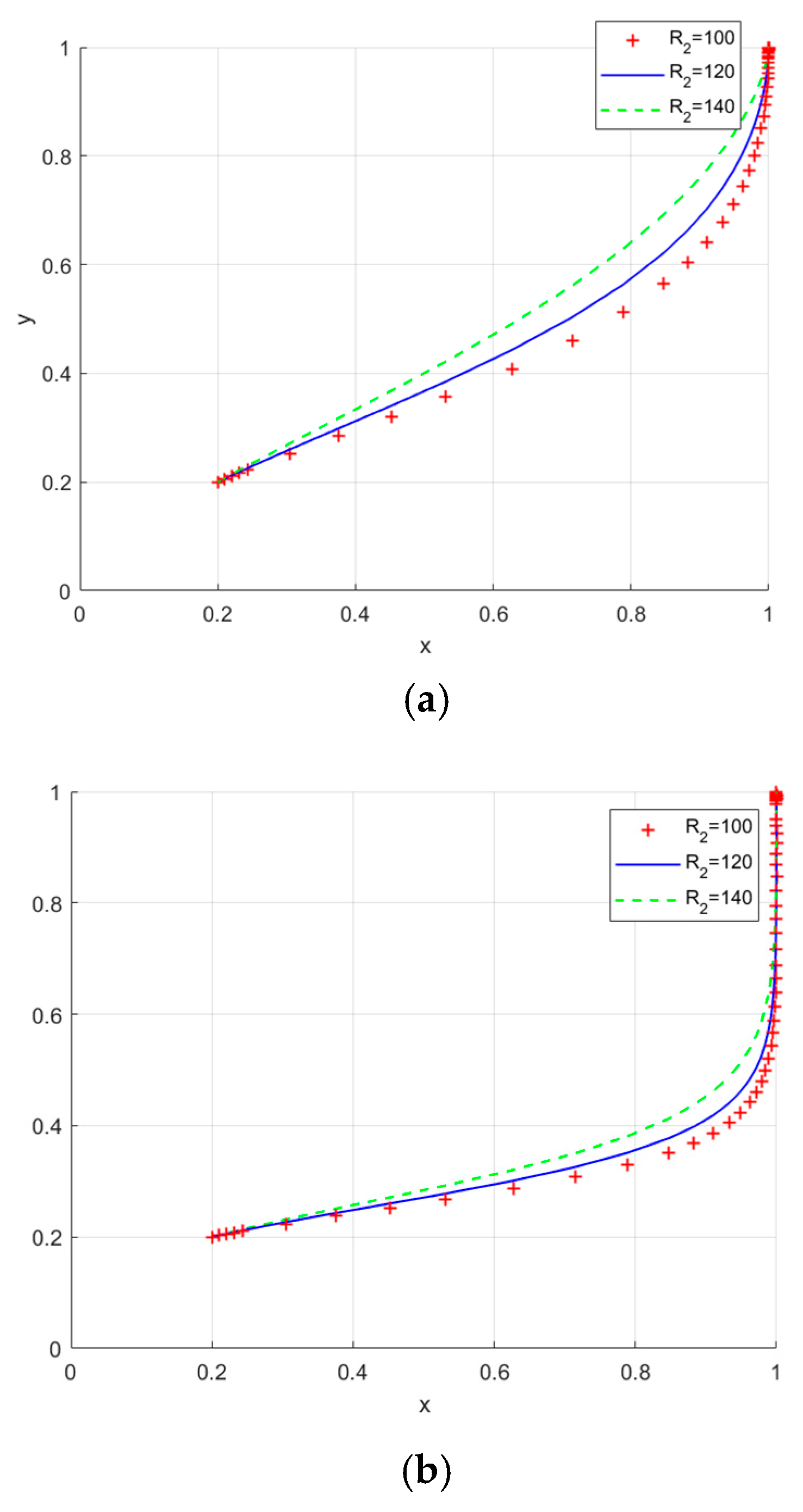
Analysis 4: Sensitivity of manufacturers’ benefit when choosing the “not improve” strategy
. To further evaluate the impact of this critical parameter on the evolutionary game results, this analysis adopts the control variable method, keeping other initial parameters unchanged. The target parameter is assigned gradient values of 100, 120, and 140 respectively, and the simulation results are obtained after 50 iterations of the dynamic evolutionary equations, as illustrated in
Figure 4.
As illustrated in
Figure 4, during the system’s convergence toward evolutionary stability, a clear quantitative trend is observed: as the manufacturer’s benefit under the non-improvement strategy increases, the probability of manufacturers choosing to improve product greenness decreases, whereas the willingness of retailers to conduct information sharing exhibits an upward trend. Within the model assumptions, parameter constraints, and simulation scenarios of this study, this evolutionary trend can be accounted for by the profit-driven behavior of rational game participants: when manufacturers can obtain higher benefits without investing in green product improvement, their incentive to conduct green upgrades is significantly weakened, which is the core cause of the above evolutionary phenomenon.
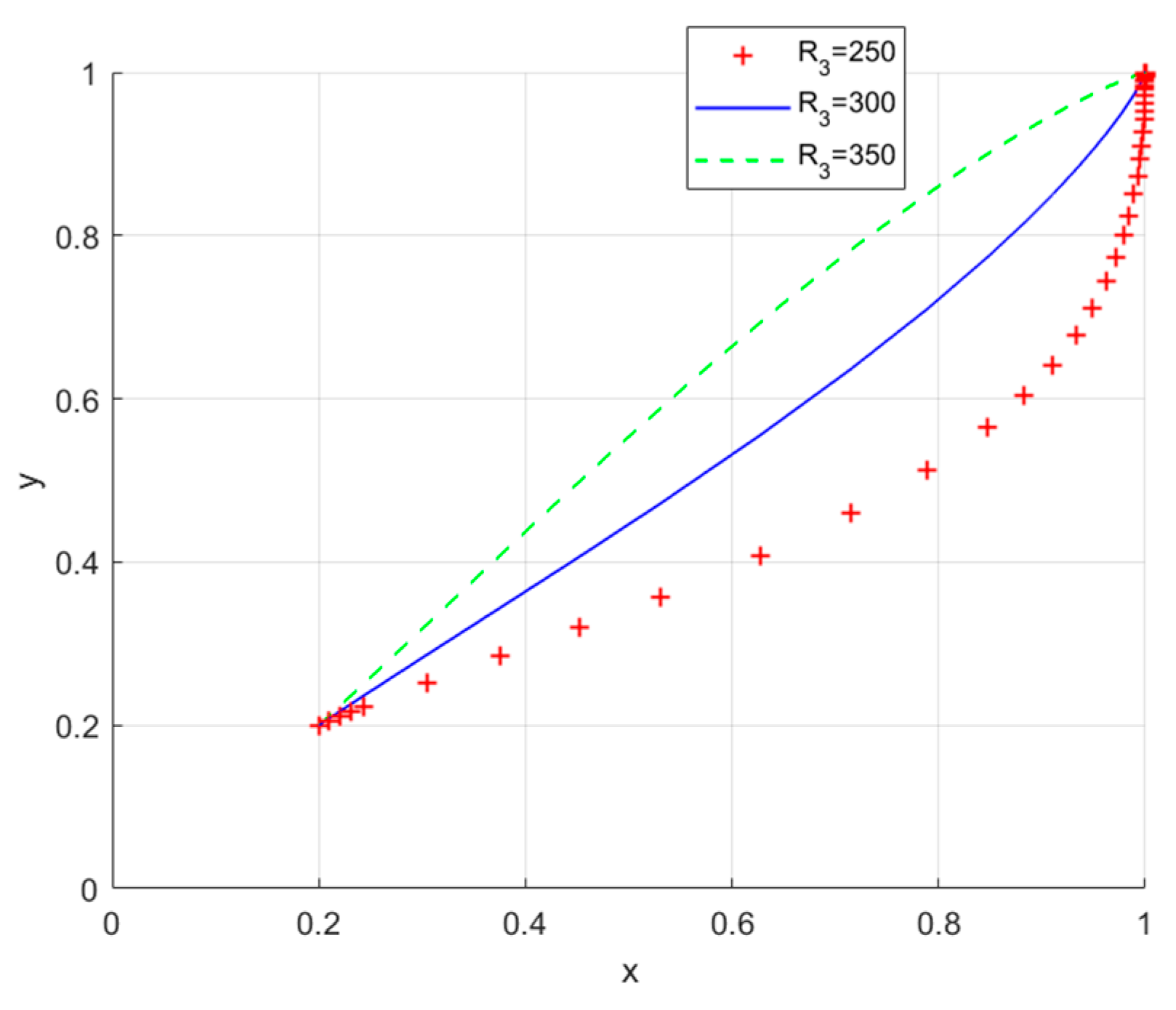
Analysis 5: Sensitivity of the benefits when retailers choose the “share” strategy
. To further evaluate the impact of this critical parameter on the evolutionary game results, this analysis adopts the control variable method, keeping other initial parameters unchanged. The target parameter is assigned gradient values of 250, 300, and 350 respectively, and the simulation results are obtained after 50 iterations of the dynamic evolutionary equations, as presented in
Figure 5.
As shown in
Figure 5, during the system’s process of evolutionary stabilization, a distinct trend is identified: the probability of retailers choosing to implement information sharing rises synchronously with the increase in the target variable value. Within the strict analytical boundaries, model hypotheses, and parameter settings of this study, this evolutionary behavior can be ascribed to the revenue-oriented decision-making logic of rational retailers: when retailers identify that information sharing with manufacturers is conducive to enhancing their own economic benefits, they will have sufficient intrinsic motivation to transmit relevant information to manufacturers.
4.2. Analysis of the System Evolution Stability Points in Scenario 2
To further validate the model’s reliability and intuitively characterize the evolutionary trajectories of players’ strategic decisions, numerical simulations are performed using MATLAB (R2023a). This study aims to steer the strategic profile toward the ideal evolutionarily stable state , and parameter settings must comply with rigorous theoretical constraints and scientific norms, with core constraints including: , , . From the dual perspectives of evolutionary game theory and sustainable supply chain development, the three core constraints act both as critical drivers for the evolutionarily stable equilibrium of “manufacturer upgrading, retailer information sharing, and consumers’ unwillingness to purchase green products”, and as the fundamental basis for evaluating the sustainability of supply chain green transformation.
The manufacturer constraint ensures the revenue advantage of green upgrading, establishes it as the dominant strategy, and drives production-side emission reduction. The retailer constraint ensures the benefits of information sharing, breaks upstream–downstream barriers, and boosts resource efficiency to facilitate synergy effects in green transformation. The consumer constraint clarifies consumers’ preference for non-green products, exposing the core flaw: weak terminal support for green products results in a lack of consumption-side impetus, thus restricting the sustainable development of the supply chain. Correspondingly, the initial parameter values are set scientifically according to existing conventions in green supply chain research, real-world operational scenarios, and model stability requirements: , , , , , , , , , , , , , , . This parameter assignment satisfies the theoretical conditions for ideal equilibrium convergence and aligns with the actual cost–benefit logic of supply chain stakeholders, ensuring the authenticity, robustness, and referential significance of simulation results.
To clarify the influence of key parameters on the stability of equilibrium , this section adopts the control variable method to perform independent sensitivity analyses. With other baseline parameters fixed, we adjust only the focal parameter to examine its isolated impact on strategic evolution and system stability. The detailed experimental designs and corresponding results are provided below.
Analysis 1: Sensitivity of unit information management costs
. This analysis scenario aims to examine how changes in retailers’ unit information management cost affect the strategic choices of all game participants. Holding other parameters constant at the initial benchmark values,
is assigned gradient values of 1, 5, and 10; the corresponding simulation results are illustrated in
Figure 6.
As shown in
Figure 6, with the increase in the retailer’s unit information management cost
, the probability of retailers choosing information sharing drops significantly, and the system converges faster to the target evolutionarily stable state
. The rising
reduces the threshold for retailers to adopt the non-sharing strategy, reflecting stakeholders’ rational cost–benefit trade-off in the evolutionary game, and further consolidates the system’s convergence to the target stable equilibrium.
Consumers’ green purchase strategy is the underlying driving factor of supply chain information sharing, rather than a passive recipient of green transformation. Only when terminal consumers have stable green purchase intentions can retailers’ information sharing secure sustainable revenue support, mitigate the negative impact of information management costs, and maintain supply chain information collaboration. Without the support of terminal consumer demand, upstream and downstream information collaboration will completely lose its economic basis.
Analysis 2: Sensitivity of parameter shared information volume
N. This analysis focuses on exploring the impact of parameter
N fluctuations on the evolutionary path and stable state of the system. With other parameters fixed,
N is set to 5, 15, and 25 sequentially, and the simulation results are presented in
Figure 7.
As shown in
Figure 7, with an increase in the volume of shared information
N, the probability of retailers choosing information sharing drops significantly, and the system converges more rapidly to the target evolutionarily stable state
. The expanding scale of information sharing pushes up retailers’ total costs, while the lack of terminal green demand makes incremental information sharing unable to obtain commensurate economic returns. This reflects stakeholders’ rational cost–benefit trade-offs in the evolutionary game and further consolidates the system’s convergence toward the target stable equilibrium.
Consumers are not passive recipients of supply chain green transformation and information sharing but are the fundamental driver of the entire system. Only when there is stable green purchase intention at the terminal can supply chain information sharing secure its core revenue basis, mitigate the cost pressure caused by the expansion of information sharing scale and the increase in unit cost, and sustain upstream and downstream information collaboration. Without the support of terminal consumer demand, information sharing loses all economic rationality. Regardless of how the scale of information sharing and management costs are adjusted, it is impossible to establish a sustainable supply chain information collaboration mechanism, and the system will eventually become trapped in a stagnant state characterized by a lack of both collaboration and green transformation.
Analysis 3: Sensitivity of the additional cost of information sharing
. This analysis focuses on exploring the impact of fluctuations in parameter
on the evolutionary path and stable state of the system. With other parameters fixed,
is set to 10, 30, and 50 sequentially, and the simulation results are presented in
Figure 8.
As shown in
Figure 8, with an increase in the risk cost of competitive advantage loss
, incurred by retailers during information sharing, the probability of retailers choosing the non-information sharing strategy rises significantly and the system converges more rapidly to the target evolutionarily stable state
. The rising risk cost pushes up the potential loss of retailers’ information collaboration, while a lack of terminal green demand makes information sharing unable to obtain commensurate revenue to compensate for the loss. This reflects stakeholders’ rational cost–benefit trade-offs in the evolutionary game and further consolidates the system’s convergence toward the target stable equilibrium.
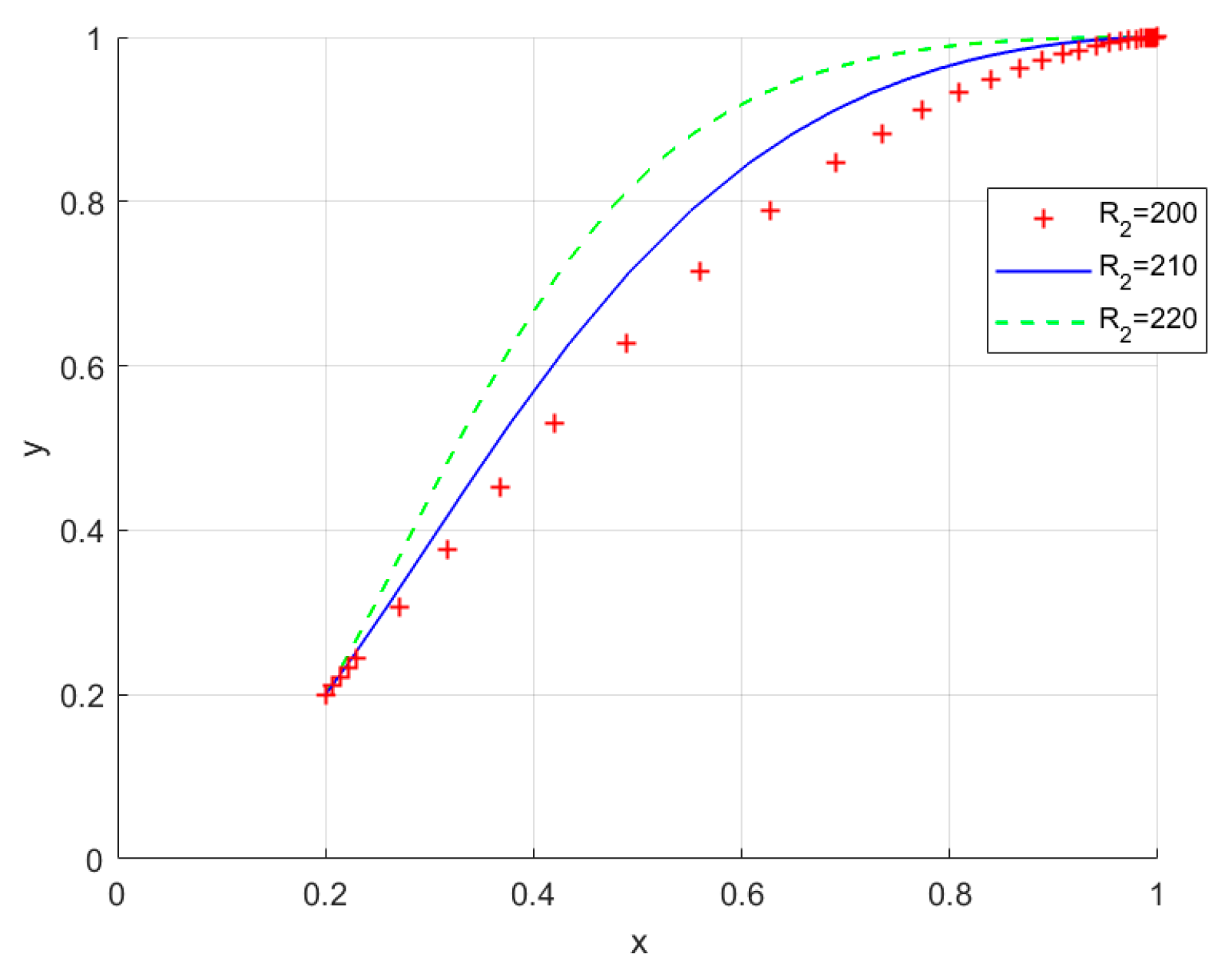
Analysis 4: Sensitivity of the manufacturers’ benefit when choosing the “not improve” strategy
. To further assess the impact of this critical parameter on the evolutionary game results, this analysis adopts the control variable method, keeping other initial parameters unchanged. The target parameter is assigned gradient values of 200, 210, and 220. The simulation results are obtained after 50 iterations of the dynamic evolutionary equations, as illustrated in
Figure 9.
As shown in
Figure 9, with an increase in
, the probability of retailers adopting the non-information sharing strategy rises significantly, and the system converges more rapidly to the target evolutionarily stable state
. The rising
strengthens manufacturers’ preference for the non-upgrading strategy, while the lack of terminal green demand makes retailers’ information sharing completely lose economic value. This reflects stakeholders’ rational cost–benefit trade-offs in the evolutionary game and further consolidates the system’s convergence toward the target stable equilibrium.
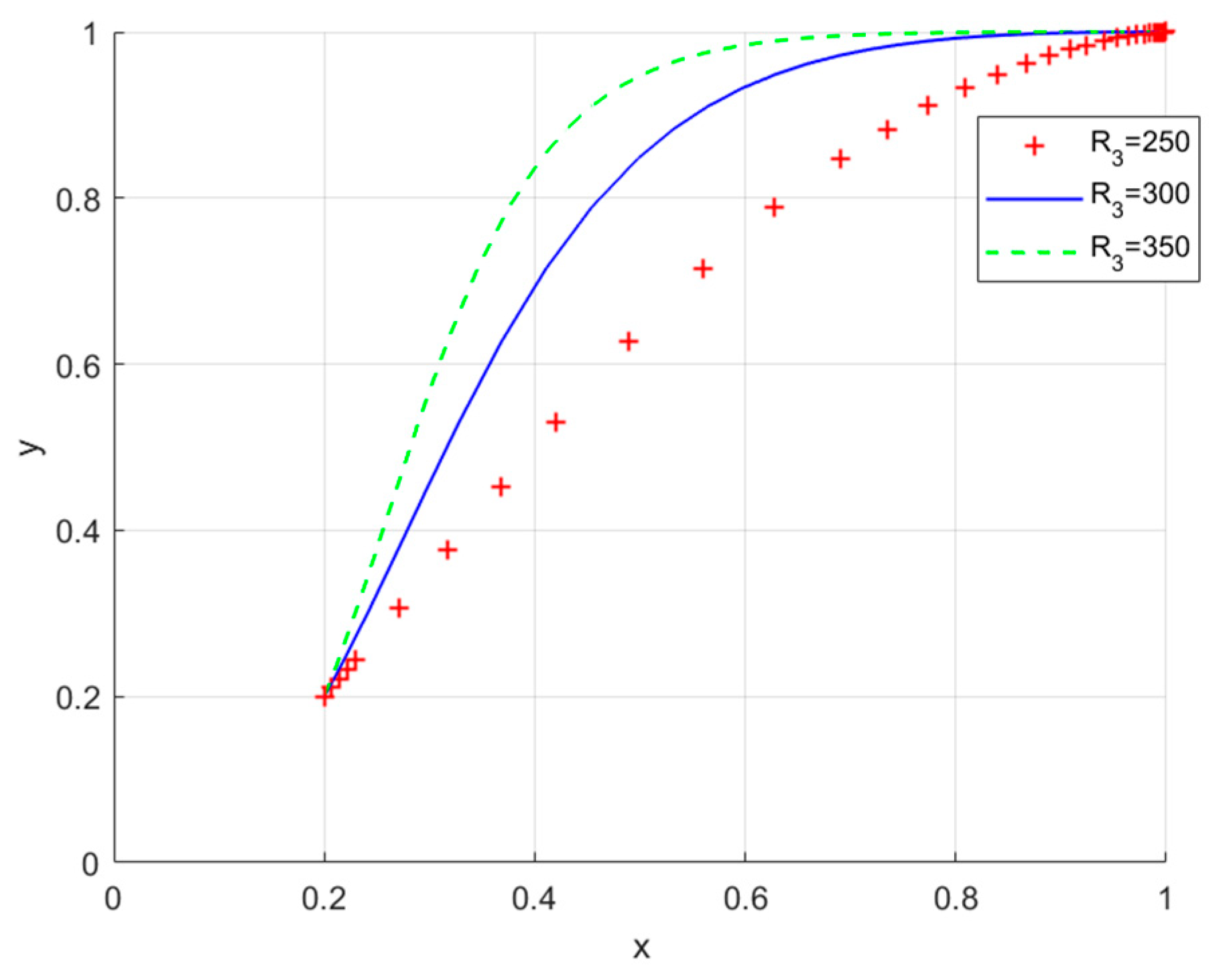
Analysis 5: Sensitivity of the benefits when retailers choose the “share” strategy
. To further assess the impact of this critical parameter on the evolutionary game results, this analysis adopts the control variable method, keeping other initial parameters unchanged. The target parameter is assigned gradient values of 250, 300, and 350. The simulation results are obtained after 50 iterations of the dynamic evolutionary equations, as illustrated in
Figure 10.
As shown in
Figure 10, with an increase in
, the probability of retailers choosing information sharing rises significantly, and the system’s convergence speed toward the target evolutionarily stable state
slows down notably. The rising
partially offsets the cost loss of retailers’ information collaboration, yet the lack of terminal green demand eliminates the sustainable revenue source of information sharing. This reflects stakeholders’ rational cost–benefit trade-offs in the evolutionary game: the rise in
only delays the convergence process yet fails to reverse the final trend of the system locking into the non-sharing stable equilibrium.
The core difference between the two simulations is determined by consumers’ green purchase strategy: when consumers have green purchase intention, is the core incentive for information sharing, with higher strengthening retailers’ sharing willingness and accelerating convergence to full information sharing; when consumers do not, only plays a marginal buffering role, merely slowing convergence to the “ not share” state without reversing the trend or breaking the supply chain’s negative lock-in.
4.3. Comparison of the Analysis Results with Those of Previous Studies
Unique Finding 1: The impact of manufacturers’ non-green benefit on information sharing presents a scenario-dependent reverse trend. The existing literature is dominated by the manufacturer–retailer dual-agent framework and universally concludes that rising manufacturers’ non-green benefit directly weakens retailers’ information sharing willingness, ignoring the regulatory role of consumer behavior. In contrast, this study incorporates consumers as core endogenous participants and finds that the impact of is closely tied to consumers’ green purchase strategies: in Scenario 2 (, consumers refuse green purchases), higher restrains information sharing; in Scenario 1 (, consumers have green purchase willingness), rising boosts retailers’ sharing willingness. This reverse trend reveals the heterogeneous transmission mechanism of parameter effects under consumer participation, fills the research gap of single-scenario parameter analysis in previous studies, and reflects the uniqueness and superiority of the tripartite evolutionary game model constructed in this paper.
Unique Finding 2: Retailers’ sharing benefit fails to drive long-term stable information sharing without consumer green demand support. Existing studies commonly hold that increasing retailers’ information sharing benefit can effectively stimulate sustained information sharing, regarding revenue incentive as a core driving force. However, our simulation results demonstrate that this conclusion is only tenable when terminal consumers have a stable green purchase demand. Without consumer green support, a higher only exerts a marginal buffering effect, slowing down the system’s convergence to the non-sharing stable state yet failing to reverse the overall trend. This finding clarifies the prerequisite role of consumer green preference in enabling benefit incentives to take effect, breaks through the limitations of previous studies that overemphasize benefit incentives and ignore terminal demand constraints, and provides a more realistic and comprehensive theoretical reference for green supply chain information sharing practice.
5. Conclusions and Contributions
5.1. Conclusions and Recommendations
Combined with an evolutionary game to explore the information sharing problem in the green supply chain considering consumer participation, we construct an evolutionary game model with manufacturers, retailers, and consumers as the three participants, derive the replicator dynamics equations and analyze evolutionary stability, and conduct numerical simulation experiments using MATLAB (R2023a) software to verify the reliability of the model and analyze the impacts of key parameters on the evolutionary trajectories of the three parties, thus providing practical guidance for supply chain members to formulate sustainable information sharing strategies and promote the green and low-carbon transformation of the whole supply chain. The specific conclusions drawn are as follows:
Information sharing in the green supply chain cannot be separated from the joint role of manufacturers, retailers and consumers, and the strategy choices of the three parties in the evolutionary game process will affect each other. The manufacturer’s probability of enhancing the greenness of the product is affected by retailers and consumers, the retailers’ probability of sharing information with the manufacturers is affected by manufacturers and consumers, and the consumer’s willingness to buy green products will be affected by manufacturers and retailers.
When the conditions of , , are satisfied, the strategy portfolio eventually evolves to the state of . Specifically, the sum of costs and benefits of the manufacturer when choosing the “improve” strategy (enhancing product greenness to promote sustainable production) is greater than the sum of costs and benefits when choosing the “not improve” strategy; the benefits of the consumer from purchasing the product after green enhancement (supporting sustainable consumption) are greater than those before the enhancement; and the benefits to the retailer of choosing the “not share” strategy are less than the benefits of choosing the “share” strategy (facilitating sustainable supply chain coordination). This evolutionarily stable state is the optimal state for achieving a win–win outcome of sustainable supply chain development and economic benefits.
When retailers and manufacturers share information, the information sharing cost is greater and the retailers will evolve more towards the “not share” strategy, while the manufacturers will evolve towards the “improve” strategy (enhancing product greenness). This shows that manufacturers will enhance the greenness of their products when they lack sufficient information—an adaptive behavior that not only responds to consumer demand for green products but also promotes green innovation and the low-carbon transformation of enterprises. This suggests that manufacturers will increase the greenness of their products and attract consumers through green innovation when they lack sufficient information, thereby contributing to the achievement of global sustainable development goals.
The profits of manufacturers influence their willingness to enhance the environmental friendliness of their products (a core practice of sustainable production). Specifically, higher profits tend to reduce their motivation to increase product greenness—this finding reminds enterprises to balance economic benefits and environmental responsibilities when pursuing sustainability. Simultaneously, the stronger consumers’ preference for green products (the driving force of sustainable consumption) is, the more likely retailers are to adopt a “share” strategy in their strategic decisions. This reflects the positive interaction between sustainable consumption and sustainable supply chain operations, and this forms a key method for promoting supply chain sustainability.
To summarize, the following measures need to be taken by manufacturers, retailers and consumers to promote information sharing in green supply chains and further facilitate the sustainable development of the entire supply chain ecosystem:
Manufacturers and retailers should jointly explore and establish an efficient and low-cost information sharing platform or mechanism—an important guarantee for realizing sustainable information sharing. Current digital technologies (such as big data, the Internet of Things) could be combined to realize the rapid transmission and sharing of information, reduce the costs of manual operation and communication, and minimize resource waste in the information transmission process (in line with the concepts of the circular economy and sustainable development). This can reduce the pressure on retailers to participate in information sharing, making them more willing to share information with manufacturers, thereby promoting collaborative cooperation throughout the supply chain, improving the efficiency and competitiveness of the green supply chain, and laying a solid foundation for achieving the green and low-carbon transformation of the supply chain.
Within the green supply chain, if retailers observe that manufacturers demonstrate limited enthusiasm for improving product sustainability, they should take the initiative to share relevant market intelligence. This information includes consumer preferences for eco-friendly products (to guide sustainable production), the dynamics of market competition in the green product sector, and relevant environmental regulatory requirements (consistent with global sustainable development policies). By providing such information, retailers can help manufacturers fully grasp consumer demand for green products, clarify the significant market potential and opportunities associated with green products, and encourage manufacturers to strengthen their commitment to sustainable production. This collaborative model supports the transformation of the entire supply chain toward sustainability, leading to a win–win between economic benefits and environmental governance. Furthermore, it enables the delivery of more eco-friendly and high-quality products to consumers, thereby contributing to the broader goals of sustainable societal development and meeting the standards of SDG 12.
When the cost of information sharing is high, manufacturers are more inclined to choose the strategy of improving the greenness of their products—this provides an important entry point for guiding enterprises to practice sustainable development. Therefore, governments and industry associations can introduce relevant policies, such as tax incentives and R&D subsidies, to encourage manufacturers to carry out green innovation (a core driver of sustainable production and low-carbon transformation). In addition, manufacturers can obtain more green technology resources and innovative ideas through cooperation with universities and research institutions to enhance the greenness of their products, meet consumers’ demand for green products (supporting sustainable consumption), strengthen their market competitiveness, and ultimately promote the green and low-carbon transformation of the entire supply chain. This multi-stakeholder collaboration (enterprises, governments, universities, research institutions) forms a joint force to advance supply chain sustainability and contribute to global climate action (SDG 13).
5.2. Contributions
5.2.1. Theoretical Contributions
This study delivers multi-dimensional theoretical and methodological breakthroughs in green supply chain information sharing research, with its core innovation lying in moving beyond the dominant manufacturer–retailer dual-agent paradigm and constructing a tripartite evolutionary game framework that incorporates consumers as a pivotal stakeholder. This fills a critical gap in the existing literature, which largely overlooks consumers’ core demand-driven role, is disconnected from real-world market dynamics, and has a limited in-depth exploration of preference-fueled information sharing mechanisms, representing a key advancement for the research field.
Theoretically, this research pioneers the integration of consumers into the analytical paradigm of green supply chain information sharing as a core third participant, abandoning the oversimplified homogeneous and static consumer assumptions adopted in prior studies. It puts forward two realistic hypotheses, the heterogeneity of consumers’ green preferences and dynamic price adaptability, which eliminates the defects of static idealized modeling, substantially enhances the model’s explanatory power and practical applicability, and optimizes the theoretical foundation of relevant research.
Methodologically, a tripartite dual-strategy evolutionary game model is constructed, with eight strategy combinations, profit matrices and replicator dynamic equations systematically derived; a comprehensive analytical framework is further established via Jacobian matrix analysis, eigenvalue verification and numerical simulation. This integrated approach overcomes the limitations of static and single-stakeholder models, enabling the precise depiction of stakeholders’ strategic evolution paths and interactive decision-making mechanisms, and improving the operability of research conclusions.
Sustainable development theory centers on balancing economic growth, social equity and ecological protection to achieve win–win ecological, economic and social benefits, and this study’s innovations align closely with its core tenets. The tripartite paradigm fits the multi-stakeholder synergy logic of sustainable development, the optimized hypotheses cater to its dynamic and realistic demands, the methodological breakthrough facilitates the translation of sustainable goals into tangible supply chain practices, and the theoretical extensions enrich the sustainable supply chain system, laying a solid foundation for the high-quality, green and sustainable development of the entire industrial chain.
5.2.2. Management Contribution
The sustainable development of the supply chain cannot be separated from the deep collaboration of upstream and downstream entities, and the effective transmission of market information is the core premise for the supply chain to accurately match green production with market demand. Different from most existing studies that treat consumer behavior as an exogenously fixed variable, this study integrates consumers’ green purchase strategy into the evolutionary game system of the green supply chain and finds that the green purchase intention of terminal consumers essentially reshapes the cost–benefit structure of supply chain entities’ information sharing behavior, and acts as the core switch that determines whether the supply chain can form a long-term steady-state collaborative mechanism. The main research conclusions are as follows:
First, terminal consumers’ green purchase behavior fundamentally reshapes the value logic and incentive nature of information sharing in the green supply chain. When there is sustained green purchase intention in the end market, information sharing between upstream and downstream of the supply chain has endogenous, sustainable value: the transmission of demand information can accurately match the upstream green production decisions and finally form a sustained incentive closed loop through the market value realization of green products. When the terminal green consumption demand is absent, information sharing loses the core market revenue support, its economic rationality is completely undermined, and no matter how the supply chain adjusts the cooperation mechanism internally, it is impossible to form a long-term stable sharing incentive.
Second, the long-term evolution trend of supply chain entities’ information sharing strategies is completely subject to the green demand support of the terminal consumer market. In a stable green consumption scenario, the willingness of upstream and downstream supply chains to share information will continue to strengthen with the game process, driving the entire system to quickly converge to the ideal steady state of full-chain collaborative sharing. In the scenario lacking terminal green demand, even if short-term mechanism adjustments can delay the speed of the supply chain sliding to the non-cooperative state, they cannot fundamentally reverse the core trend of the system eventually falling into the negative lock-in of “no information sharing, no green transformation”.
Third, terminal green demand is the core link connecting the two-way empowerment of supply chain information collaboration and green transformation. Sustained terminal green purchase intention can foster a positive cycle of “accurate demand information transmission–upstream green production implementation–terminal market value feedback–continuous deepening of collaboration”, enabling information sharing and green transformation to form a benign, mutually promoting linkage and two-way empowerment. When terminal green demand is absent, this core link will be completely broken, and no effective linkage can be established between information sharing and green transformation, eventually leading to a vicious circle of insufficient demand support, low cooperation motivation, and weak willingness to transform.
Fourth, for the practical exploration of green supply chain management, the activation of terminal consumers’ green demand is the core premise for all collaborative incentive measures to play a long-term role. When the end market has a mature green consumption foundation, internal management means such as optimizing supply chain revenue distribution and improving information sharing incentive mechanisms can become long-term effective tools to promote the green and sustainable development of the supply chain. In the scenario where the terminal green consumption intention is insufficient, only focusing on the internal mechanism adjustment of the supply chain can only produce short-term expedient effects and cannot build a sustainable collaborative transformation system. We must take the activation of the green purchase intention of end consumers as the primary prerequisite to lay a solid market foundation for the information collaboration and green transformation of the supply chain.
5.3. Gaps and Further Research Directions
This study has several limitations that point to future research directions, which will deepen the exploration of sustainable information sharing in green supply chains and better align with the core focus of sustainability on integrating environmental, economic, and social dimensions.
First, this study assumes a single-manufacturer and single-retailer supply chain structure. In practice, multi-manufacturer and multi-retailer supply chains are more prevalent, and a greater number of retailers can gather more comprehensive consumer information, especially data on consumers’ heterogeneous green preferences, which is critical for guiding the joint optimization of green production and enhancing the sustainability of multi-agent supply chains. Future research should focus on the dynamics of information sharing in multi-agent supply chains to better reflect the real-world needs of sustainable supply chain management.
Second, the model does not include variables such as the green service efficiency of platform retailers, commission rates, and green R&D costs. These variables are closely tied to green supply chain sustainability: green service efficiency affects consumers’ willingness toward sustainable consumption, while green R&D costs determine manufacturers’ low-carbon innovation capacity. These variables are both critical for Sustainable Development Goals (SDGs) 12 and 13. Future research should incorporate these variables to explore their moderating effects on information sharing and supply chain sustainable performance.
Third, numerical simulations rely on hypothetical data due to difficulties in obtaining real enterprise data and the lack of a specific industry context. Different industries (e.g., new energy, traditional manufacturing) have distinct green transformation paths and information sharing needs, making hypothetical data less reflective of the industry-specific characteristics of sustainable information sharing characteristics. Future research should focus on specific industries and use empirical data to enhance the reliability of the results and provide targeted guidance for industrial green transformation.
Fourth, this study only conducts a limited parameter analysis and simulation based on single baseline values, lacking a comprehensive sensitivity analysis, which weakens the robustness and generalizability of the conclusions. In future research, we will expand the parameter space, carry out full-range sensitivity tests on the core parameters of cost, benefit and consumer preference, and verify the stability of the tripartite game system under diverse parameter combinations. Furthermore, we will combine actual industrial data to calibrate parameters rationally, further explore the dynamic evolution law of green supply chain information sharing, and enhance the practical guiding significance of the model, so as to provide more reliable decision support for the green collaborative development of supply chains.
Fifth, this study still has certain limitations. For the simplicity of model derivation, we define the manufacturers’ information sharing benefit as a linear form , which overlooks the diminishing marginal returns of information sharing and the qualitative nature of information. In addition, the definition of N as the “volume of shared information” is vague and lacks operable quantitative standards, leading to insufficient theoretical support for the setting of the profit function. In future research, we will adopt nonlinear profit functions (such as logarithmic or exponential functions) to fit the real rules of information value transformation, clarify the measurable connotation and quantitative criteria of N, and thereby supplement the theoretical and empirical basis for the specification of the profit function and enhance the accuracy and practicality of the model.