Article

Productive and Physiological Response of Grazing Steers Supplemented with Energy–Protein Supplements During Summer in a Subtropical Humid Region


1
Faculty of Agronomy, Universidad de la República, Montevideo 12900, Uruguay
2
National Institute of Agricultural Research (INIA), Treinta y Tres 33000, Uruguay
*
Author to whom correspondence should be addressed.
Sustainability 2026, 18(7), 3189; https://doi.org/10.3390/su18073189
Submission received: 9 February 2026 / Revised: 16 March 2026 / Accepted: 23 March 2026 / Published: 24 March 2026
(This article belongs to the Special Issue Sustainable Animal Production and Livestock Practices)

Abstract

In the context of climate change and increased frequency of droughts, summer supplementation of grazing cattle may improve productivity and resilience of pastoral systems. However, the provision of supplements may increase the risk of heat stress in cattle. This study aimed to evaluate the productive and physiological response of grazing steers supplemented during summer. Three independent studies were conducted over three summers (2020–2023). In each experiment, steers grazing native grasslands with access to shade were allotted to one of two treatments: control (CONT) and supplementation (SUPPL), in a completely randomized block design. SUPPL steers were group-fed in the morning three days per week with an energy–protein ration at a level of 1.98% body weight (BW) on days of feeding. Pasture attributes, animal performance, respiration rate (RR), and body temperature (BT) were analyzed using a mixed model. According to the temperature–humidity index, cattle were exposed to heat stress 32% of the time. Summer supplementation increased average daily gain and final body weight of steers. Although supplementation temporarily increased BT (morning) and RR (afternoon), daily average RR and BT were similar for both treatments. These findings show that summer supplementation improves animal performance of grazing steers without increased risk of severe heat stress. These results are aligned with the concept of sustainable livestock intensification, which aims to enhance animal source foods to feed a growing population without causing collateral animal welfare issues.

1. Introduction

Rates of liveweight (LW) gain of growing cattle grazing native grasslands in summer can be low due to limitations in forage quantity and quality [1]. One strategy to improve LW gains during summer may be to provide supplemental nutrients [2,3,4,5]. However, there is a lack of technical coefficients on animal response to summer supplementation in subtropical humid regions because it is not a common practice in grazing systems.
In Uruguay, the annual productivity of native grasslands varies between 1.5 and 6.5 t DM/ha in extreme drought and rainy conditions, respectively [6]. The increased frequency and severity of droughts forecasted for South America [7] will impact agricultural activities with less forage and animal productivity, leading to negative impacts for farming systems. Proof of this was the three consecutive summers (2020–2023) with “La Niña” meteorological conditions that caused a prolonged period of drought in Uruguay and triggered the declaration of emergency in the agricultural sector [8]. It is expected that livestock systems based on grazing will be more affected by global warming than industrialized or confined systems of production due to the negative effects of lower rainfall, the effect of more droughts on pasture growth, and the direct effects of high temperature and solar radiation on animals [9,10]. In this scenario, summer supplementation may be required more often to improve the performance of grazing cattle, making the systems more resilient to fluctuations in environmental conditions.
Changes in rainfall extremes are increasingly connected with extreme high temperatures and heat stress conditions [11]. In South America, the past 20 years (2000 forward) presented more consecutive hours under heat stress and higher persistence of such conditions than the previous two decades [12]. Estimates suggest that Uruguay’s temperature could increase by 2 °C by 2050 [13]. Therefore, heat stress is now a growing concern in the temperate and subtropical regions, as it has long been in the tropics [14,15], with the aggravating factor that the systems are less prepared to cope with it (i.e., less heat-tolerant breeds and lack of shade). Numerous studies have shown that during heat stress, animals endure physiological [16] and metabolic [17] changes generally associated with a significant decrease in dry matter intake (DMI) [18], production [19,20], and reproductive performance [21]. Cattle redirect energy from growth-related processes during heat stress to maintain homeostasis, resulting in reduced DMI and overall production. In a meta-analysis, Chang-Fung-Martel et al. [22] reported a significant negative correlation between the temperature–humidity index (THI) and DMI, with DMI reduced by 0.45 kg/day for every unit increase in THI. The THI, a function of air temperature and relative humidity, is the most adopted climatic indicator of heat stress in livestock [23]. Because reduction in voluntary DMI is one of the major problems related to productivity of livestock during thermal stress in summer, cattle supplementation in grazing systems is an effective management strategy for enhancing productivity [24]. However, exposure to energy-dense supplements (“hot ration”) increases the total caloric intake, which, combined with high air temperature and solar radiation, can exacerbate animal heat stress [25].
The aim of this study was to evaluate the productive response of providing energy–protein supplements to growing steers grazing native grasslands in summer and to evaluate the effects of the supplementation on respiration rate (RR) and body temperature (BT) in a subtropical humid region. The hypothesis was that moderate summer supplementation improves LW gain compared to unsupplemented animals with no significant impacts on RR and BT. To our knowledge, this is the first multi-year evaluation of summer supplementation of grazing cattle in Uruguay. This work provides novel experimental evidence of the collateral effects of supplementation on physiological indicators related to heat stress and offers technical coefficients to improve management decisions in grazing systems.

2. Materials and Methods

2.1. Experimental Design

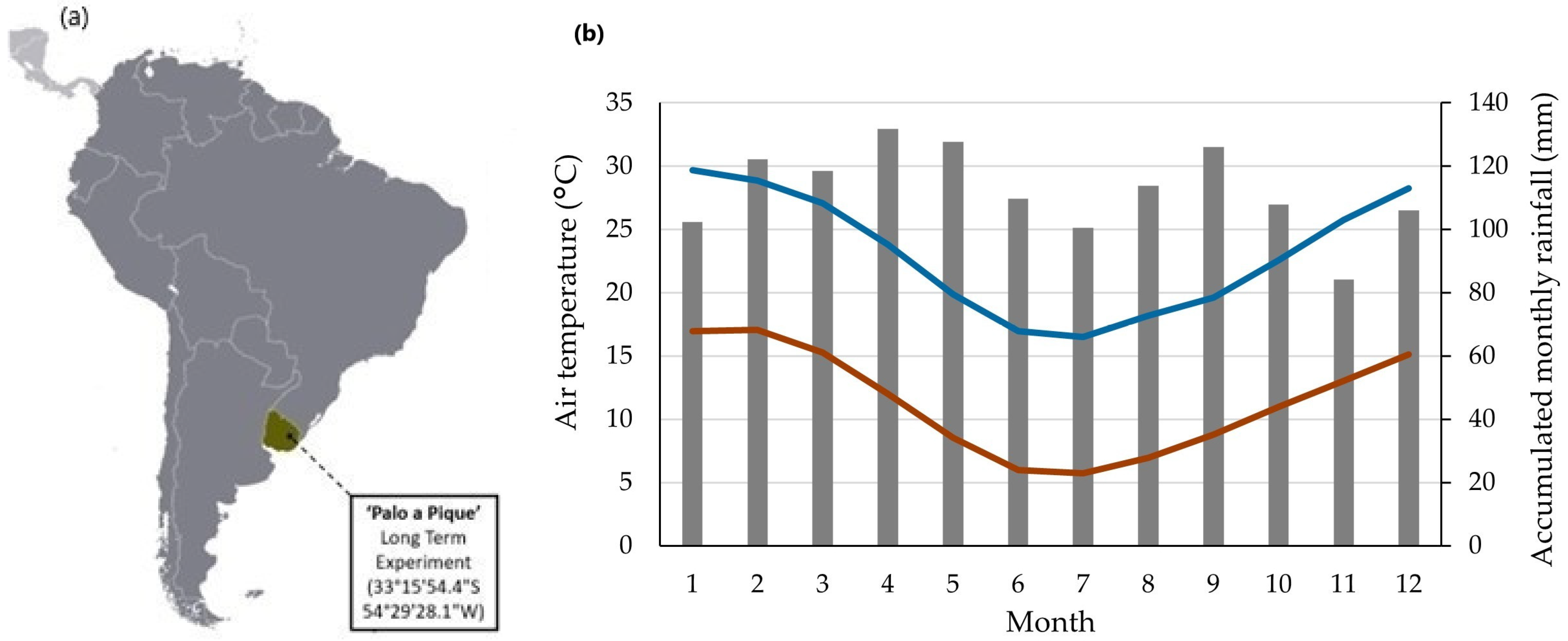
Three independent studies were conducted at the Palo a Pique long-term research platform of the National Institute of Agricultural Research (INIA) in Treinta y Tres (33°15′54.4″ S 54°29′28.1″ W) located in the subtropical humid region of South America (Figure 1). The climate is mesothermic humid with a mean daily temperature of 23 °C and 11 °C in summer and winter, respectively, and a mean annual rainfall of 1300 mm uniformly distributed on average throughout the year [26]. Each experiment had the same design, consisting of two treatments during summer: no supplementation (control, CONT) and supplementation (SUPPL) of beef steers grazing native grasslands. The pasture was dominated by C4 grasses, mainly Paspalum notatum, Axonopus affinis and Cynodon dactylon.
During the summers of 2020/21 (Y1), 2021/22 (Y2), and 2022/23 (Y3), 18 (Y1), 24 (Y2), and 32 (Y3) yearling Angus steers (mean ± SD LW: 273 ± 13 kg) were allotted to one of the two treatments replicated in three blocks in a completely randomized block design. Each block corresponded to a different topographic region (high, medium, or low) as the research site has a 3% average slope. Each block had two 2 ha paddocks grazed by 3 (Y1), 4 (Y2), and 5 (Y3) steers with free access to artificial shade (4 m2/animal) mounted 4 m above the soil surface and water on a continuous stocking system. Steers grazed during 84 days from mid-December through to mid-March (Y1 and Y2) and during 77 days from early-November to late-January (Y3).
Steers in the SUPPL treatment were group-fed in the grazing paddock early in the morning (08:00–09:00 h), three days per week (Monday, Wednesday, and Friday), at a level of 1.98% LW each day. The strategy of supplementation was established to mirror the frequency and level of supplementation commonly used in commercial farms. Animals consumed all of the feed on the days it was offered. The supplements used were a commercially totally mixed ration (TMR) for growing steers (17% CP, 14% ADF, 30% NDF, and 78% TDN) in Y1 and Y2, and a hand-made mix feed (15% CP, 13% ADF, 20% NDF, and 79% TDN) composed of 85% oat grain and 15% protein concentrate with 40% CP in Y3. According to the label, the TMR included cracked grains (maize, sorghum, wheat, and/or barley), industrial byproducts (rice bran and/or wheat bran), vegetal meal (sunflower and/or soybean meal), rice hulls, urea, and a mineral–vitamin mix in a proportion that was not informed by the supplier. The mineral content of the TMR was 8.0%, while calcium and phosphorus concentration (minimum–maximum) were 0.9–1.9% and 0.3–1.2%, respectively (dry matter basis).

2.2. Data Collection and Processing

Precipitation events were obtained from an automated weather station accumulating 489 mm, 419 mm, and 49 mm in Y1, Y2, and Y3, respectively. The experiment finished earlier (January) in Y3 due to severe drought conditions that forced us to change the original protocol. On-site air temperature (T, °C) and relative humidity (RH, %) were collected every one hour by an automated HOBO device (Onset® Computer Corporation, Bourne, MA, USA). Then, the temperature–humidity index (THI) was calculated based on the following equation [28]: THI = 0.8xT + RH (T − 14.4) + 46.4. The THI values were used to determine the risk of heat stress in cattle for each hour based on the following four categories: normal, THI < 74; alert, 74 < THI < 79; danger, 79 < THI < 84; and emergency, THI > 84 [23,29,30]. An analysis was made of heat wave events occurring each summer based on the criteria and categories proposed for Bos taurus cattle [31] (Table S1). Table 1 summarizes meteorological conditions during experimental periods.
In each year, pasture sampling was carried out every 30 days. Herbage mass was sampled by collecting all the aboveground biomass found in a 50 × 20 cm rectangle. Four samples per paddock were taken at each sampling time. Sward height was recorded before pasture sampling. Fresh samples were transported to the laboratory, weighed individually, and then combined per paddock to take three subsamples. Two of the subsamples were oven-dried at 60 °C for 48 h to obtain the percentage of dry matter (DM). The remaining subsample was used in Y1 and Y2 to separate by hand the green and dead fractions, which were individually weighed and then over-dried separately (60 °C for 48 h). All dried samples were ground (1 mm) and sent to the Animal Nutrition Laboratory of INIA La Estanzuela (Colonia, Uruguay) to determine crude protein (CP) [32], acid detergent fiber (ADF), and neutral detergent fiber (NDF) [33]. Total digestible nutrients (TDN, %) were estimated following the equation 92.51 − 0.7965 × ADF% [34]. In addition, the TDN/CP ratio was calculated.
Fasted (18 h) animals were weighed every 21 days. In Y1 and Y2, the respiration rate (RR) of individual animals was measured by counting the rate of flank movements during 1 min [35]. One trained field worker measured the RR of all animals in nine days per year at 08:00–09:00 h (before supplementation) and 14:00–15:00 h, recording whether the animal was under the shade structure or exposed to the sun. Subcutaneous body temperature (BT) was measured continuously in one animal per replicate at 1 h intervals using button-shaped digital thermos-loggers (iButton DS1921H-F5, Maxim Integrated, San Jose, CA, USA) surgically implanted into the lateral neck of the animals following the protocol published for implantation, recovery, and data retrieval [36]. Outlier readings below 37 °C were discarded for further analysis [36].

2.3. Statistical Analysis

All statistical procedures were performed using R software (version 4.0.5) [37]. The group of animals in the 2 ha paddock was considered the experimental unit, and the level of significance was established at p < 0.05. Overall, animal (body weight and average daily gain) and pasture (herbage mass and sward height) variables were analyzed using a mixed model with treatment and block as fixed effects and year as the random effect using the following equation:
Yijk = µ + τi + βj + γk + ξijkl
where:
  • Yijk = observation k in treatment i, block j and year k.
  • µ = the overall mean.
  • τi = the fixed effect of treatment i.
  • βj = the fixed effect of block j.
  • γk = the random effect of year k.
  • ξijkl = random error.
In addition, the fixed effect of month was included for the analysis of chemical composition of the pasture. For the physiological variables (RR and BT), the statistical model was:
Yijk = µ + τi + βj + λl + (τλ)il + γk + ξijklm
where:
  • Yijk = observation k in treatment i, block j and year k.
  • µ = the overall mean.
  • τi = the fixed effect of treatment i.
  • βj = the fixed effect of block j.
  • λl = the fixed effect of hour of the day l.
  • (τλ)il = the interaction between treatment and hour of the day.
  • γk = the random effect of year k.
  • ξijklm = random error.
Analyses of the relationships between THI and animal physiological indicators were investigated using the cor and lm functions in R.

3. Results

3.1. Productive Variables

Total herbage mass and sward height at the beginning of the grazing season were similar (p > 0.05) between treatments (Table 2) with similar conditions between years (Y1: 1742 kg MS/ha and 4.3 cm; Y2: 2045 kg MS/ha and 4.3 cm; Y3: 2000 kg MS/ha and 4.8 cm, averaging across treatments). Although we did not expect differences in the pasture attributes at the beginning of the experiment (as treatments were not yet applied), the lack of differences ensures similar starting conditions and controls potential sources of experimental bias. The green herbage mass decreased from 53% to 32% from the start to the end of the grazing period. CONT paddocks had lower final sward height than SUPPL paddocks (p < 0.05) at the end of grazing. In terms of the inter-annual variation, the reduced final sward height in CONT paddocks compared to SUPPL paddocks was significantly observed in each individual summer (Y1: 6.6 and 7.4 cm, respectively; Y2: 4.7 and 5.5 cm; Y3: 3.1 and 3.5 cm). Supplemented steers had greater bodyweight at the end of summer than CONT steers (p < 0.05) due to ADG that was 100% greater than the CONT animals (p < 0.05), averaging over the years. The magnitude of the difference in ADG between CONT and SUPPL animals was significant and relatively constant between years (Y1: 0.39 and 0.73 kg/a/d, respectively; Y2: 0.35 and 0.90 kg/a/d; Y3: 0.62 and 1.06 kg/a/d). The difference in ADG between CONT and SUPPL animals resulted in a supplement efficiency of 6.8 kg of DM supplement consumed per kg of observed added gain (Y1: 10.1, Y2: 5.3, and Y3: 5.1).
Treatment had no effect on forage quality (p > 0.05). However, the month significantly (p < 0.05) affected the chemical composition of the forage (Table 3). Crude protein varied in the summer months, following a trend of decreasing in January (Y1 = 5.7%; Y2 = 6.3%; Y3 = 7.1% CP), while maintaining CP values above 8.0% through February and March (Table 3). In Y1, there was a decrease (p < 0.05) in CP in January (5.7 ± 0.4%), where all other months stayed similar (7.9 ± 0.1%). In Y2, December (6.4 ± 0.1%) and January (6.0 ± 0.2%) had a significantly lower CP than February (9.6 ± 0.2%) and March (8.7 ± 0.2%). The lowest CP in Y3 was in January (6.9 ± 0.2%) compared to November (10.5 ± 0.7%) and December (8.8 ± 0.2%). Overall, detergent fiber concentrations followed the opposite trend of CP content, with higher fiber content in January (ADF = 41–47%; NDF = 62–65%), but then decreased at the end of summer (40–44% and 58–62%, respectively), showing similar values to the beginning of the grazing period. As a result of the variations in the content of energy and CP, the TDN:CP ratio of forage increased from November (6.0) to January (9.2) and then decreased in February and March, showing values close to 7.0.

3.2. Physiological Indicators

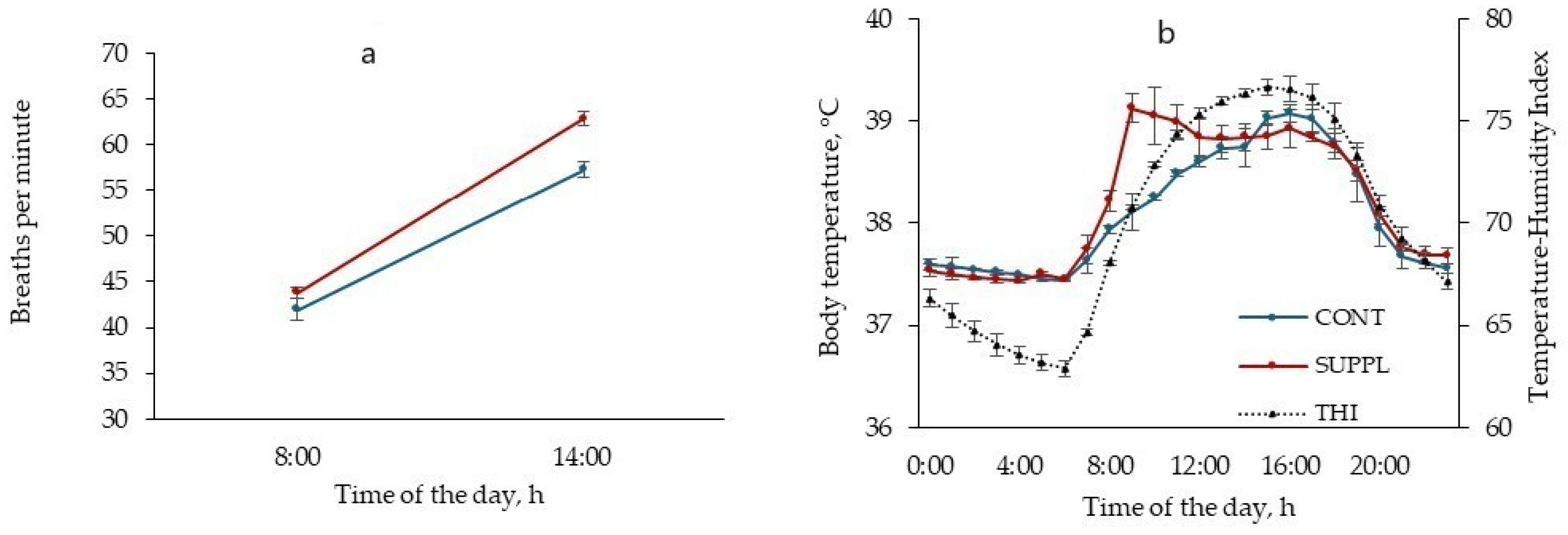
Mean (±SEM) air temperature and THI were 19.1 ± 3.2 °C and 66 ± 5, respectively, at the time of measuring RR before supplementation (08:00 h) with similar conditions between years (Y1: 18.7 °C and 65; Y2: 19.6 °C and 67). Both meteorological variables increased when the second measurement was taken after supplementation (14:00 h) to 28.6 ± 3.4 °C and 77 ± 3, respectively (Y1: 28.6 °C and 76; Y2: 28.5 °C and 77). Under these climatic conditions, with low inter-annual variability, RR of SUPPL and CONT animals was similar at 08:00 h (43 ± 1 rpm; p > 0.05), but SUPPL animals showed higher (p < 0.05) RR than CONT animals at 14:00 h (63 ± 1 rpm and 57 ± 2 rpm, respectively) (Figure 2a). This difference between treatments in RR during the afternoon was similarly observed in Y1 (SUPPL: 63 rpm; CONT: 59 rpm) and Y2 (SUPPL: 63 rpm; CONT: 56 rpm). Respiration rate was high and positively correlated (p < 0.05) with THI in CONT (r = 0.58) and SUPPL (r = 0.54) cattle. The slope of the regression models represented an increase in RR of 1.38 rpm for CONT cattle (p < 0.05; RSE = 10.7; adj. R2 = 0.32) and 1.56 rpm for SUPPL cattle (p < 0.05; RSE = 13.7; adj. R2 = 0.27) per unit increase in THI, respectively.
The subcutaneous BT ranged between 37.0 and 41.8 °C with a 24 h mean (± SEM) of 38.1 ± 0.1 °C and 38.2 ± 0.1 °C for CONT and SUPPL cattle, respectively (p > 0.05). Mean values of BT in relation to THI are shown in Figure 2b. The 1 h interval time-series shows a significant correlation between THI and BT in CONT (r = 0.93) and SUPPL (r = 0.89) steers. A diurnal pattern was evident for both treatments, with the daily minimum BT at 06:00 h for both treatments and a daily maximum at 09:00 h (SUPPL) and 16:00 h (CONT). Although the daily mean BT was similar between treatments (p > 0.05), SUPPL steers had higher BT (p < 0.05) than CONT steers between 08:00 and 12:00 h (38.8 ± 0.1 °C and 38.3 ± 0.1 °C, respectively), with the greatest difference after delivering the supplement (09:00 h) averaging 39.1 ± 0.1 °C (SUPPL) and 38.1 ± 0.1 °C (CONT). This post-feeding peak in BT of SUPPL steers was consistently observed in both years (Y1: 39.3 °C; Y2: 39.0 °C) and exceeded the BT of CONT steers by +1.0 °C and +1.1 °C in Y1 and Y2, respectively.

4. Discussion

This combined analysis of three experiments was the first to evaluate the effects of summer supplementation on ADG, BT, and RR in grazing steers. The data presented herein indicate that summer daily gains of growing cattle in native grasslands were enhanced by +0.45 kg per animal by feeding them an energy–protein supplement, with minor effects on physiological indicators related to heat stress. The difference in ADG between SUPPL and CONT animals was relatively constant between years (Y1: +0.34 kg/a/d; Y2: +0.55 kg/a/d; Y3: 0.44 kg/a/d). It suggests that increasing the energy density of forage-based diets through the controlled incorporation of high-digestible supplements is an effective nutritional strategy for enhancing productivity in grazing systems without compromising the risk of heat stress in subtropical humid regions. The environmental conditions during the experimental periods were considered representative of summers in Uruguay, as the average THI = 70 agreed with the characterization of the thermal environment of summer in Uruguay [38]. Even though THI was developed more than 60 years ago, most studies still use this thermal index for the assessment of cattle heat stress in different regions [20,39], and THI-based livestock advisories have been successfully implemented to provide farmers with real-time data to take necessary actions [40]. From the animal heat stress perspective, cattle were exposed to alert, danger, and emergency heat stress conditions for 23%, 8%, and 1% of the experimental period, respectively. Most of the heat waves (83%) were classified as slight and mild due to their short duration (3–4 days), none or a few hours with a THI > 84 (emergency), and the good night conditions to dissipate heat (THI < 72). Under these conditions, which showed little inter-annual variability, cattle receiving the supplement had greater ADG than CONT animals without affecting the average daily RR and BT. One of the strengths of the present study is the incorporation of physiological indicators that provide valuable information between the cattle and the thermal environment [41,42], in addition to traditional performance indicators. Most of the studies addressing summer supplementation of grazing cattle were carried out in the 1990s when animal welfare was not regarded as a key factor within sustainability frameworks [43].
Measuring RR and classifying the severity of heat stress (low or normal: 40–60 breaths per min, medium or alert: 60–80, and high or dangerous: above 80 breaths per min) is the most accessible and direct method for assessing heat stress in grazing cattle [44,45]. In our study, RR increased greatly in the afternoon in the CONT and SUPPL groups, owing to the climate heat load, but RR increased to a greater extent when combined with feeding the higher energy diet to SUPPL animals. Previous studies reported that supplementation may increase endogenous heat due to the digestion and fermentation of feedstuffs, triggering a spike in RR to enhance evaporative cooling for thermoregulation [25,46,47]. Although the current study reported changes in RR following supplementation (57 and 63 breaths per min for CONT and SUPPL, respectively), the level of RR may not have been great enough to significantly influence heat stress conditions, as RR was at the border of ‘low’ and ‘medium’ risk categories (~ 60 breaths per min). In addition, RR early in the morning (before supplementation) was similar in both groups, suggesting the ability of cattle to dissipate heat at night to enable RR to return to normal levels to ensure ongoing normal physiological function [48].
Rectal temperature is another indicator of thermal balance used to assess the adversity of the thermal environment that can affect the growth of cattle [44]. However, we used subcutaneous BT to monitor the thermal status of the animals as it is correlated to rectal temperature, and therefore it may be used as a reliable reference for the core BT [25]. Average daily subcutaneous BT for CONT and SUPPL animals was below 39.5 °C, which is the threshold from which the risk of heat stress increases, and the nighttime values of BT below 39 °C suggested that the steers were able to recover from the heat load experienced during the day [14]. However, CONT and SUPPL animals showed distinct BT patterns. The BT of CONT steers followed a traditional circadian rhythm with a peak in the afternoon (16:00 h), as previously reported [49]. Peak THI (15:00 h) preceded maximum BT of CONT cattle by 1 h, confirming that BT has a 1–2 h lag response to THI, showing the ability of cattle to maintain the internal temperature beyond thermoneutral zones [50,51].
Contrary to CONT steers, BT of SUPPL steers peaked in the morning, showing a mean value 0.28 °C higher than CONT steers between 08:00 and 12:00 h. Early studies showed that a high plane of nutrition results in significant increases in animal rectal temperature, pulse rate, and RR [25,52] attributed to the heat increment associated with the digestion of feed, metabolism of nutrients, and product synthesis [53]. Similar to our study, Jacob et al. [54] and Colgan and Mader [55] reported that the core BT of grain-fed steers was 0.3–0.4 °C higher than that of grass-fed steers. The magnitude of the difference can vary depending on the type or composition of the supplement due to differences in the rate and extent of rumen fermentation [56,57]. The supplements used in our study were composed mostly of slowly rumen-fermentable ingredients (Y1 and Y2: rice bran, sorghum grain, and rice hulls; Y3: hulled oat), which can reduce endogenous heat increment and metabolic heat production compared to rapidly fermentable ingredients (i.e., wheat and corn grain) [58,59].
From the productive standpoint, summer supplementation improved ADG and final LW of steers due to an increased nutritional quality of the overall diet. The lower final sward height in CONT paddocks confirmed that unsupplemented animals tend to graze to lower sward heights compared to SUPPL animals, as they must work harder to obtain sufficient nutrients, leading to lower residual sward heights [60]. One of the limitations of our study is the lack of information related to the forage intake of steers. We speculate that SUPPL animals had a greater total DMI compared to CONT animals due to the supplement intake, although they may have decreased forage DMI because of the substitution rate (i.e., the decrease in forage DMI per unit of concentrate intake) expected for cattle grazing low-to-medium-digestibility pastures [61]. The low nutritive value of the basal diet observed in Table 3, with medium–low content of CP and high content of NDF, is typical of a pasture dominated by C4 grasses during summer and explains the good results obtained for animal supplementation. A key aspect of their nutritional profile is the high proportion of fiber-bound nitrogen and structural minerals (ash) that limit protein availability to ruminants [62]. Although high CP content is inversely correlated to NDF [63], our data showed some variation associated with limited forage sampling. The energy and protein ratio TDN:CP can be used as an indicator of the expected response to supplementation associated with the adequacy of the amount of nitrogen (N) in the diet. Supplementation while grazing warm-season grasses, with balanced TDN:CP ratios of <7:1, is less likely to result in positive changes in forage intake and digestibility, and therefore, has less potential for positive effects [64,65]. It was observed in this work that native grasslands had an average TDN:CP ratio of 7.4, signifying a slight N deficiency in relation to energy in the diet. Therefore, the selected supplements had a TDN:CP ratio = 5 (79% TDN; 16% CP) to increase the supply of energy in relation to N.
This study provides original experimental evidence of the effects of summer supplementation on productive and physiological indicators of grazing steers. Supplemented shaded steers had increased performance without compromising the risk of heat stress in a subtropical humid region. Supplementation increased total nutrient intake and, consequently, animal performance. As high DMI promotes an increase in metabolic heat, SUPPL animals showed a transient increase in RR triggered by an increase in subcutaneous BT. However, these physiological changes were not severe enough to compromise production based on the magnitude of the difference in ADG between CONT and SUPPL animals, supported by a biologically expected supplement conversion efficiency in low-quality grasslands. These results align well with the concept of sustainable livestock intensification, which aims to enhance animal source foods to feed a growing population without causing additional animal stress. Future studies evaluating the effect of summer supplementation on animals without available shade will be essential for improving management recommendations and reducing the risk of heat stress.

Supplementary Materials

The following supporting information can be downloaded at: https://www.mdpi.com/article/10.3390/su18073189/s1; Table S1: Descriptive characteristics for heat wave categories for Bos taurus feedlot cattle exposed to single heat wave events (Hahn et al., 1999) [31].

Author Contributions

Conceptualization, P.R.; methodology, P.R.; formal analysis, M.V. and P.R.; investigation, P.R. and M.V.; resources, P.R.; data curation, M.V.; writing—original draft preparation, P.R. and M.V.; writing—review and editing, P.R. and M.V.; supervision, P.R.; project administration, P.R. All authors have read and agreed to the published version of the manuscript.

Funding

This research was funded by the National Institute of Agricultural Research (INIA), Rice-Livestock project CL-52. The APC was funded by INIA.

Institutional Review Board Statement

The animal study protocol was approved by the Ethics Commission on the Use of Experimental Animals of the Instituto Nacional de Investigación Agropecuaria (INIA) (protocol code INIA 2021.6 and 1 December 2021).

Informed Consent Statement

Verbal informed consent was obtained from the owner of the animals involved in this study. The rationale for utilizing verbal consent is that the animals belong to the author’s institution, INIA.

Data Availability Statement

The raw data supporting this article will be made available by the authors on request.

Acknowledgments

The authors would like to thank the staff of INIA and undergraduate students for their valuable collaboration in the installation of experiments, handling of animals, collection of samples, and processing of raw data. We also thank the Agencia Nacional de Investigación e Innovación (ANII), Uruguay, for granting the master’s scholarship of Martina Verdaguer (POS_NAC_2023_2_177633).

Conflicts of Interest

The authors declare no conflicts of interest.

References

  1. Heitschmidt, R.K.; Volesky, J.D.; Haferkamp, M.R. Steer performance on native and modified Northern Great Plains rangeland. J. Range Manag. 1993, 46, 529–533. [Google Scholar] [CrossRef]
  2. Phillips, W.A.; Horn, G.W. Supplement intake and performance of steers fed compressed block or liquid protein supplements on bermudagrass pastures. Prof. Anim. Sci. 1998, 14, 36–43. [Google Scholar] [CrossRef]
  3. Karn, J.F. Supplementation of yearling steers grazing Northern Great Plains rangelands. J. Range Manag. 2000, 53, 170–175. [Google Scholar] [CrossRef]
  4. Grings, E.E.; Short, R.E.; Haferkamp, M.R.; Heitschmidt, R.K. Late summer protein supplementation for yearling cattle. J. Range Manag. 2004, 57, 358–364. [Google Scholar] [CrossRef]
  5. Purvis, H.T.; Cox, D.A. Energy and Protein Supplementation Strategies to Improve Summer Weight Gains of Stocker Cattle Grazing Summer Tall-Grass Prairie; Oklahoma State University Publication: Stillwater, OK, USA, 2005; Available online: https://extension.okstate.edu/programs/beef-extension/research-reports/site-files/documents/2005/purvis.pdf (accessed on 19 November 2025).
  6. Ayala, W.; Bendersky, D.; Paruelo, J.; Rovira, P. The importance of Campos ecosystem as a world food producer and as a provider of ecosystem services. In Proceedings of the Joint XXIV International Grassland and XI International Rangeland Virtual Congress, Nairobi, Kenya, 23–29 October 2021. [Google Scholar]
  7. Hagen, I.; Huggel, C.; Ramajo, L.; Chacón, N.; Ometto, J.P.; Postigo, J.C.; Castellanos, E.J. Climate change-related risks and adaptation potential in Central and South America during the 21st century. Environ. Res. Lett. 2022, 17, 033002. [Google Scholar] [CrossRef]
  8. Arias, P.A.; Rivera, J.A.; Sörensson, A.A.; Zachariah, M.; Barnes, C.; Philip, S.; Kew, S.; Vautard, R.; Koren, G.; Pinto, I.; et al. Interplay between climate change and climate variability: The 2022 drought in Central and South America. Clim. Change 2024, 177, 6. [Google Scholar] [CrossRef]
  9. Nardone, A.; Ronchi, B.; Lacetera, N.; Ranieri, M.S.; Bernabucci, U. Effets of climate changes on animal production and sustainability of livestock systems. Livest. Sci. 2010, 130, 57–69. [Google Scholar] [CrossRef]
  10. Rivera-Ferre, M.G.; López-i-Gelats, F.; Howden, M.; Smith, P.; Morton, J.F.; Herrero, M. Re-framing the climate change debate in the livestock sector: Mitigation and adaptation options. Wiley Interdiscip. Rev. Clim. Change 2016, 7, 869–892. [Google Scholar] [CrossRef]
  11. IPCC. Climate Change 2014: Synthesis Report. Contribution of Working Groups I, II and III to the Fifth Assessment Report of the Intergovernmental Panel on Climate Change; Pachauri, R.K., Meyer, L.A., Eds.; IPCC: Geneva, Switzerland, 2014; p. 151. [Google Scholar]
  12. Miranda, V.F.V.V.; dos Santos, D.M.; Peres, L.F.; Salvador, C.; Nieto, R.; Müller, G.V.; Thielen, D.; Libonati, R. Heat stress in South America over the last four decades: A bioclimatic analysis. Theor. Appl. Climatol. 2024, 155, 911–928. [Google Scholar] [CrossRef]
  13. Errazola Anzolabehere, P.A. Climate Change Impacts on the Uruguayan Dairy Sector by 2050. Master’s Thesis, Faculty of Science, Engineering and Built Environment, School of Life and Environmental Sciences, Deakin University, Geelong, VIC, Australia, 2021; p. 143. [Google Scholar]
  14. Pontiggia, A.; Münger, A.; Ammer, S.; Philipona, C.; Bruckmaier, R.M.; Kei, N.M.; Dohme-Meier, F. Short-term physiological responses to moderate heat stress in grazing dairy cows in temperate climate. Animal 2023, 17, 100718. [Google Scholar] [CrossRef]
  15. Leandro, M.A.; Stock, J.; Bennewitz, J.; Mizeck, G.G. Is heat stress a growing problem for dairy cattle husbandry in the temperate regions? A case study of Baden-Württemberg in Germany. J. Anim. Sci. 2024, 102, skae287. [Google Scholar] [CrossRef]
  16. Gujar, G.; Tiwari, M.; Yadav, N. Heat stress adaptation in cows—Physiological responses and underlying molecular mechanisms. J. Thermal Biol. 2023, 118, 103740. [Google Scholar]
  17. Belhadj Slimen, I.; Najar, T.; Ghram, A.; Abdrrabba, M. Heat stress effects on livestock: Molecular, cellular and metabolic aspects, a review. J. Anim. Physiol. Anim. Nutr. 2016, 100, 401–412. [Google Scholar] [CrossRef]
  18. West, J.W.; Mullinix, B.G.; Bernard, J.K. Effects of hot, humid weather on milk temperature, dry matter intake, and milk yield of lactating dairy cows. J. Dairy Sci. 2003, 86, 232–242. [Google Scholar] [CrossRef]
  19. Thornton, P.; Nelson, G.; Mayberry, D.; Herrero, M. Impacts of heat stress on global cattle production during the 21st century: A modelling study. Lancet Planet Health 2022, 6, e192–e201. [Google Scholar] [CrossRef]
  20. Hasan, F.M.; Chlingaryan, A.; Thomson, P.C.; Clark, C.E.F.; Islam, M.R.; Lomax, S. Impact of heat stress on cattle systems: Responses of production metrics to thermal stress. Comput. Electron. Agric. 2026, 240, 111143. [Google Scholar] [CrossRef]
  21. Khan, I.; Mesalam, A.; Seok Heo, Y.; Lee, S.H.; Nabi, G.; Kong, I.K. Heat stress as a barrier to successful reproduction and potential alleviation strategies in cattle. Animal 2023, 13, 2359. [Google Scholar] [CrossRef]
  22. Chang-Fung-Marte, J.; Harrison, M.T.; Brown, J.N.; Rawnsley, R.; Smith, A.P.; Meinke, H. Negative relationship between dry matter intake and the temperature-humidity index with increasing heat stress in cattle: A global meta-analysis. Int. J. Biometeorol. 2021, 65, 2099–2109. [Google Scholar] [CrossRef]
  23. Brown-Brandl, T.M. Understanding heat stress in beef cattle. Rev. Bras. Zootec. 2018, 47, e20160414. [Google Scholar] [CrossRef]
  24. Beede, D.K.; Collier, R.J. Potential nutritional strategies for intensively managed cattle during thermal heat stress. J. Anim. Sci. 1986, 62, 543–554. [Google Scholar] [CrossRef]
  25. Brosh, A.; Aharoni, Y.; Degan, A.A.; Wright, D.; Young, B.A. Effects of solar radiation, dietary energy, and time of feeding on thermoregulatory responses and energy balance in cattle in a hot environment. J. Anim. Sci. 1998, 76, 2671–2677. [Google Scholar] [CrossRef]
  26. Pravia, V.; Kemanian, A.R.; Terra, J.A.; Shi, Y.; Macedo, I.; Goslee, S. Soil carbon saturation, productivity, and carbon and nitrogen cycling in crop-pasture rotations. Agric. Syst. 2019, 171, 13–22. [Google Scholar] [CrossRef]
  27. Rovira, P.; Ayala, W.; Terra, J.; García-Préchac, F.; Harris, P.; Lee, M.R.F.; Rivero, M.J. The ‘Palo a Pique’ Long-Term Research Platform: First 25 Years of a Crop–Livestock Experiment in Uruguay. Agronomy 2020, 10, 441. [Google Scholar] [CrossRef]
  28. Thom, E.C. The discomfort index. Weatherwise 1959, 12, 57–61. [Google Scholar] [CrossRef]
  29. LCI. Patterns of Transit Losses; Livestock Conservation, Inc.: Omaha, NE, USA, 1970. [Google Scholar]
  30. Nienaber, J.A.; Hahn, G.L. Livestock production system management responses to thermal challenges. Int. J. Biometeorol. 2007, 52, 149–157. [Google Scholar] [CrossRef] [PubMed]
  31. Hahn, G.L. Dynamic response of cattle to thermal heat load. J. Anim. Sci. 1999, 77, 10–20. [Google Scholar] [CrossRef]
  32. AOAC. Official Method of Analysis, 15th ed.; Association of Official Analytical Chemists: Washington, DC, USA, 1990. [Google Scholar]
  33. Van Soest, P.J.; Robertson, J.B.; Lewis, B.A. Methods for dietary fiber, neutral detergent fiber, and non-starch polysaccharides in relation to animal nutrition. J. Dairy Sci. 1991, 74, 3583–3597. [Google Scholar] [CrossRef]
  34. Acosta, Y. Estimación del valor nutritive para producción de leche. In Guía Para la Alimentación de Rumiantes, 1st ed.; Mieres, J., Ed.; Instituto Nacional de Investigación Agropecuaria (INIA): Colonia, Uruguay, 2004; pp. 69–78. [Google Scholar]
  35. Dißmann, L.; Heinicke, J.; Jensen, K.C.; Amon, T.; Hoffmann, G. How should the respiration rate be counted in cattle? Vet. Res. Commun. 2022, 46, 1221–1225. [Google Scholar] [CrossRef] [PubMed]
  36. Lee, Y.; Bok, J.D.; Lee, H.J.; Lee, H.G.; Kim, D.; Lee, I.; Kang, S.-K.; Choi, Y.J. Body temperature monitoring using subcutaneously implanted thermos-loggers from Holstein steers. Asian Australas. J. Anim. Sci. 2016, 29, 299–306. [Google Scholar] [CrossRef] [PubMed]
  37. R Core Team. R: A Language and Environment for Statistical Computing; R Foundation for Statistical Computing: Vienna, Austria, 2025. [Google Scholar]
  38. Cruz, G.; Saravia, C. Air temperature and humidity index for regionalization of dairy farming in Uruguay. Agrociencia Urug. 2008, 12, 56–60. [Google Scholar] [CrossRef]
  39. Lee, S.H.; Moriasi, D.; Cibils, A.; Barker, P. Increasing frequency and spatial extent of cattle heat stress conditions in the Southern plains of the USA. Sci. Rep. 2025, 15, 15135. [Google Scholar] [CrossRef]
  40. Mohad, S.B.; Lokhande, A.T.; Kamble, D.K.; Mane, S.H.; Puram, P.N.; Shedge, J.B.; Shingade, S.L. Livestock advisories based on Temperature Humidity Index (THI) for sustainable livestock production. Int. J. Vet. Sci. Anim. Husb. 2025, SP-10, 1–7. [Google Scholar] [CrossRef]
  41. Polsky, L.; von Keyserlingk, M.A.G. Invited review: Effects of heat stress in grazing dairy cattle welfare. J. Dairy Sci. 2017, 100, 8645–8657. [Google Scholar] [CrossRef]
  42. Vitali, A.; Grossi, G.; Lacetera, N. Vaginal temperature of lactating cows during heat waves or normal summer day and effect of additional daily cooling treatments as heat load mitigation strategy. Int. J. Biometeorol. 2024, 68, 419–426. [Google Scholar] [CrossRef]
  43. Marchant, J.N.; Doyle, R.E.; Hötzel, M.J.; Iyasere, O.S.; Sinclair, M. Editorial: The emergence of animal welfare science and policy in Africa, Asia and Latin America. Front. Vet. Sci. 2023, 10, 1171229. [Google Scholar] [CrossRef]
  44. Silanikove, N. Effects of heat stress on the welfare of extensively managed domestic ruminants. Livest. Prod. Sci. 2000, 67, 1–18. [Google Scholar] [CrossRef]
  45. Pacheco, V.M.; Sousa, R.V.d.; Rodrigues, A.V.d.S.; Sardinha, E.J.d.S.; Martello, L.S. Thermal imaging combined with predictive machine learning based model for the development of thermal stress level classifiers. Livest. Sci. 2020, 241, 104244. [Google Scholar] [CrossRef]
  46. Tresoldi, G.; Hejazi, M.; Tucker, C.B. A comprehensive study of respiration rates in dairy cattle in a Mediterranean climate. J. Dairy Sci. 2025, 108, 6229–6243. [Google Scholar] [CrossRef] [PubMed]
  47. Sevi, A.; Annicchiarico, G.; Albenzio, M.; Taibi, L.; Muscio, A.; Dell’Aquila, S. Effects of solar radiation and feeding time on behavior, immune response and production of lactating ewes under high ambient temperature. J. Dairy Sci. 2001, 84, 629–640. [Google Scholar] [CrossRef]
  48. Gaughan, J.B.; Sharman, K.; McGowan, M.R. The effect of day-only versus day-plus-nights cooling of dairy cows. J. Dairy Sci. 2023, 106, 5002–5017. [Google Scholar] [CrossRef]
  49. Theurer, M.E.; Anderson, D.E.; White, B.J.; Miesner, M.D.; Larson, R.L. Effects of weather variables on thermoregulation of calves during periods of extreme heat. Am. J. Vet. Res. 2014, 75, 296–300. [Google Scholar] [CrossRef]
  50. Verwoerd, W.; Wellby, M.; Barrell, G. Absence of a causal relationship between environmental and body temperature in dairy cows (Bos taurus) under moderate climatic conditions. J. Therm. Biol. 2006, 31, 533–540. [Google Scholar] [CrossRef][Green Version]
  51. Islam, M.A.; Lomax, S.; Doughty, A.K.; Islam, M.R.; Thomson, P.C.; Clark, C.E.F. Revealing the diversity of internal body temperature and panting response for feedlot cattle under environmental thermal stress. Sci. Rep. 2023, 13, 4879. [Google Scholar] [CrossRef] [PubMed]
  52. Robinson, K.W.; Lee, D.H.K. The effects of nutritional plane upon the reaction of animals to heat. J. Anim. Sci. 1947, 6, 182–194. [Google Scholar] [CrossRef] [PubMed]
  53. Herd, R.M.; Arthur, P.F. Physiological basis for residual feed intake. J. Anim. Sci. 2009, 87, E64–E71. [Google Scholar] [CrossRef]
  54. Jacob, R.H.; Surridge, V.S.M.; Beatty, D.T.; Gardner, G.E.; Warner, R.D. Grain feeding increases core body temperature of beef cattle. Anim. Prod. Sci. 2014, 54, 444–449. [Google Scholar] [CrossRef]
  55. Colgan, S.L.; Mader, T.L. Effect of high roughage and high energy diets on body temperature. In Nebraska Beef Report; University of Nebraska Lincoln: Lincoln, NE, USA, 2005; pp. 73–75. [Google Scholar]
  56. Herrera-Saldana, R.E.; Huber, J.T.; Poore, M.H. Dry matter, crude protein, and starch degradability of five cereal grains. J. Dairy Sci. 1990, 73, 2386–2393. [Google Scholar] [CrossRef]
  57. Benninghoff, J.; Paschke-Beese, M.; Südekum, K.H. In situ and in vitro ruminal degradation of maize grain and untreated or xylose-treated wheat, barley and rye grains. Anim. Feed Sci. Technol. 2015, 210, 86–93. [Google Scholar] [CrossRef]
  58. Reynolds, C.K. Production and metabolic effects of site of starch digestion in dairy cattle. Anim. Feed Sci. Technol. 2006, 130, 78–94. [Google Scholar] [CrossRef]
  59. Gonzalez-Rivas, P.A.; Sullivan, M.; Cottrell, J.J.; Leury, B.J.; Gaughan, J.B.; Dunshea, F.R. Effect of feeding slowly fermentable grains on productive variables and amelioration of heat stress in lactating dairy cows in a sub-tropical summer. Trop. Anim. Health Prod. 2018, 50, 1763–1769. [Google Scholar] [CrossRef]
  60. Barbero, R.P.; Malheiros, E.B.; Aguilar, N.M.; Romanzini, E.P.; Ferrari, A.C.; Nave, R.L.G.; Mullinks, J.T.; Reis, R.A. Supplementation level increasing dry matter intake of beef cattle grazing low herbage height. J. Appl. Anim. Res. 2020, 48, 28–33. [Google Scholar] [CrossRef]
  61. Bargo, F.; Muller, L.D.; Delahoy, J.D.; Cassidy, T.W. Milk response to concentrate supplementation of high producing dairy cows grazing at two pasture allowances. J. Dairy Sci. 2002, 85, 1777–1792. [Google Scholar] [CrossRef] [PubMed]
  62. Jin, X.C.; Kim, S.J.; Lee, W.Y.; Park, H.J.; Jung, J.S.; Kim, N.Y. Comparative effects of C3 and C4 forages on growth, performance, digestibility and nitrogen balance in Korean crossbred black goats. Animals 2025, 15, 2569. [Google Scholar] [CrossRef] [PubMed]
  63. Fenetahun, Y.; You, Y.; Fentahun, T.; Xinwen, X.; Yong-dong, W. Effects of grazing intensity on forage nutritive value on dominant grass species in Borana rangelands of southern Ethiopia. Peer J. 2021, 9, e12204. [Google Scholar] [CrossRef] [PubMed]
  64. Moore, J.E.; Brant, M.H.; Kunkle, W.E.; Hopkins, D.L. Effects of supplementation on voluntary forage intake, diet digestibility, and animal performance. J. Anim. Sci. 1999, 77, 122–135. [Google Scholar] [CrossRef]
  65. Womack, A.M.; Kegley, E.B.; Gadberry, S.; Hess, T.; Hubbell, D.; Beck, P.A. Evaluating supplementation programs for growing calves grazing bermudagrass pastures. Appl. Anim. Sci. 2024, 40, 91–102. [Google Scholar] [CrossRef]
Figure 1. (a) Location of the Palo a Pique long-term research platform of the National Institute of Agricultural Research (INIA) in Uruguay, and (b) accumulated monthly rainfall (gray bars), mean air maximum temperature (blue line), and mean minimum air temperature (red line) from 1995 to 2025 (months: 1 = January, 2 = February, …, 12 = December) (adapted from Rovira et al. [27]).
Sustainability 18 03189 g001
Figure 2. (a) Respiration rate of control (CONT) and supplemented (SUPPL) steers at 8:00 h (before feeding) and 14:00 h (5 h after feeding); (b) hourly evolution of the temperature–humidity index (THI) and body temperature of CONT and SUPPL steers during summer.
Sustainability 18 03189 g002
Table 1. Mean (±SD) daily average meteorological conditions and heat stress categories.
ParameterYear 1Year 2Year 3
Number of days848477
Ambient temperature, °C22.3 ± 5.022.9 ± 5.023.2 ± 6.0
Relative humidity, %78 ± 1976 ± 1868 ± 21
Temperature–humidity index (THI)70 ± 770 ± 770 ± 8
Nighttime hours < 21 °C, h/night6.6 ± 3.06.0 ± 3.47.2 ± 2.1
Heat stress category 1, % of time
Normal726567
Alert232423
Danger599
Emergency021
Heat waves, N° per year
Slight224
Mild-11
Moderate-1-
Strong-1-
1 Percentage of time assigned to heat stress categories based on hourly THI: Normal: THI < 74; Alert: 74 ≤ THI < 79; Danger: 79 ≤ THI < 84; and Emergency: THI ≥ 84 [18].
Table 2. Effect of summer supplementation on performance of steers grazing native grasslands.
Treatment
CONTROLSUPPLEMENTSEMp-Value
Herbage mass, kg DM/ha
Initial1866199287ns 3
Final19452233137ns
Sward height, cm
Initial4.64.30.2ns
Final4.85.50.4<0.05
Bodyweight per animal, kg
Initial2742733ns
Final3133475<0.05
Average daily gain, kg/a/d0.450.900.07<0.05
Supplement intake, kg DM/a/dof 1-6.20.4-
Supplement efficiency 2-6.81.1-
1 dof = days of feeding; 2 kg added gain LW/kg DM supplement, 3 ns = not significant.
Table 3. Herbage mass (±SEM, DM basis) of native grasslands throughout the summer grazing season over 3 years 1.
Parameter 2Month
NovemberDecemberJanuaryFebruaryMarch
CP, %10.3 ± 0.6 a7.7 ± 0.3 b6.4 ± 0.2 c9.0 ± 0.3 ad8.3 ± 0.2 ad
ADF, %40.8 ± 0.1 a42.6 ± 0.6 b44.9 ± 0.9 c42.5 ± 0.6 abd41.9 ± 0.6 abd
NDF, %60.7 ± 0.7 a62.4 ± 0.7 ab64.2 ± 0.7 b62.9 ± 0.7 ab59.9 ± 0.9 a
TDN, %60.0 ± 2.458.6 ± 2.8 b56.7 ± 3.8 c58.7 ± 2.4 abd59.1 ± 2.7 abd
TDN:CP ratio6.0 ± 0.3 a7.9 ± 0.2 b9.1 ± 0.4 c6.7 ± 0.2 ad7.2 ± 0.2 ad
1 Different superscripts in the same row mean significant differences between months; 2 CP = crude protein; ADF = acid detergent fiber; NDF = neutral detergent fiber; TDN = total digestible nutrients.
Disclaimer/Publisher’s Note: The statements, opinions and data contained in all publications are solely those of the individual author(s) and contributor(s) and not of MDPI and/or the editor(s). MDPI and/or the editor(s) disclaim responsibility for any injury to people or property resulting from any ideas, methods, instructions or products referred to in the content.