Optimization Model of an Integrated Energy System Operation Considering the Utilization of Hydrogen Energy and the Coupling of Carbon-Green Certificates Trading


Abstract
1. Introduction
1.1. Background and Motivation
1.2. Problems and Solutions
1.3. Contributions and Innovations
- (1)
- Clarifying the interrelationships among electricity, carbon, and green certificate trading within the IES, promoting the integrated development of various markets, and enhancing the economic and low-carbon development of the system;
- (2)
- Providing a theoretical modeling framework for the IES that incorporates hydrogen utilization, offering references for related scholars to study and develop system topological structures;
- (3)
- Obtaining a 24 h operation strategy for the energy park based on the proposed optimization model through simulation, and conducting comparative and sensitivity analyses under different scenarios, thereby providing decision-making support for managers in practical park dispatching.
- (1)
- Simultaneously incorporating hydrogen utilization and multi-market coupling into the operation optimization modeling of IES, quantitatively characterizing the sub-module features of complex system operations, enriching the system topological structure and clarifying the system optimization logic;
- (2)
- Establishing a conversion relationship between green certificates and carbon emissions based on market trading prices, breaking through the traditional parallel relationship between carbon markets and green certificate markets in IES research, and refining the actual quantities of carbon emissions and green certificates in IES under the fusion of carbon and green certificate markets;
- (3)
- Constructing an operation optimization model for an IES to minimize total costs. Sub-objectives such as “energy purchase/sale costs, penalties for wind and solar curtailment, green certificate trading, carbon trading, and operational maintenance costs” are used to represent the economic performance of system operations, thereby obtaining the optimal economic operation strategy for the system.
2. Literature Review
2.1. Research About the IES Operation Optimization
2.2. Research About the Market of Electricity, Carbon Trade, and Green Certificate
2.3. The Findings from the Literature Review
- (1)
- Hydrogen-integrated IES has become a hot topic, but there is no unified conclusion on the specific impacts of hydrogen energy on IES. Moreover, the operation optimization objectives of IES are diverse, and selecting appropriate objective functions and optimization boundaries remains a widely debated issue.
- (2)
- Although some studies have considered the influence of carbon markets or green certificate markets in IES operations, these markets remain relatively segmented and operate in parallel. Delving into the logical connections between markets and incorporating them into IES operations can enrich research content and provide references for exploring the impact of multiple markets on IES.
- (3)
- Considering carbon trading, green certificates, and hydrogen utilization represents a key entry point for enhancing the low-carbon performance and economic efficiency of IES. This paper will mathematically model these key elements to develop an operation optimization model for IES, and conduct multi-scenario analyses to explore the impacts of different factors on IES, aiming to provide guidance in decision-making and management for IES managers.
3. Establishment of the IES Operation Optimization Model in the Paper
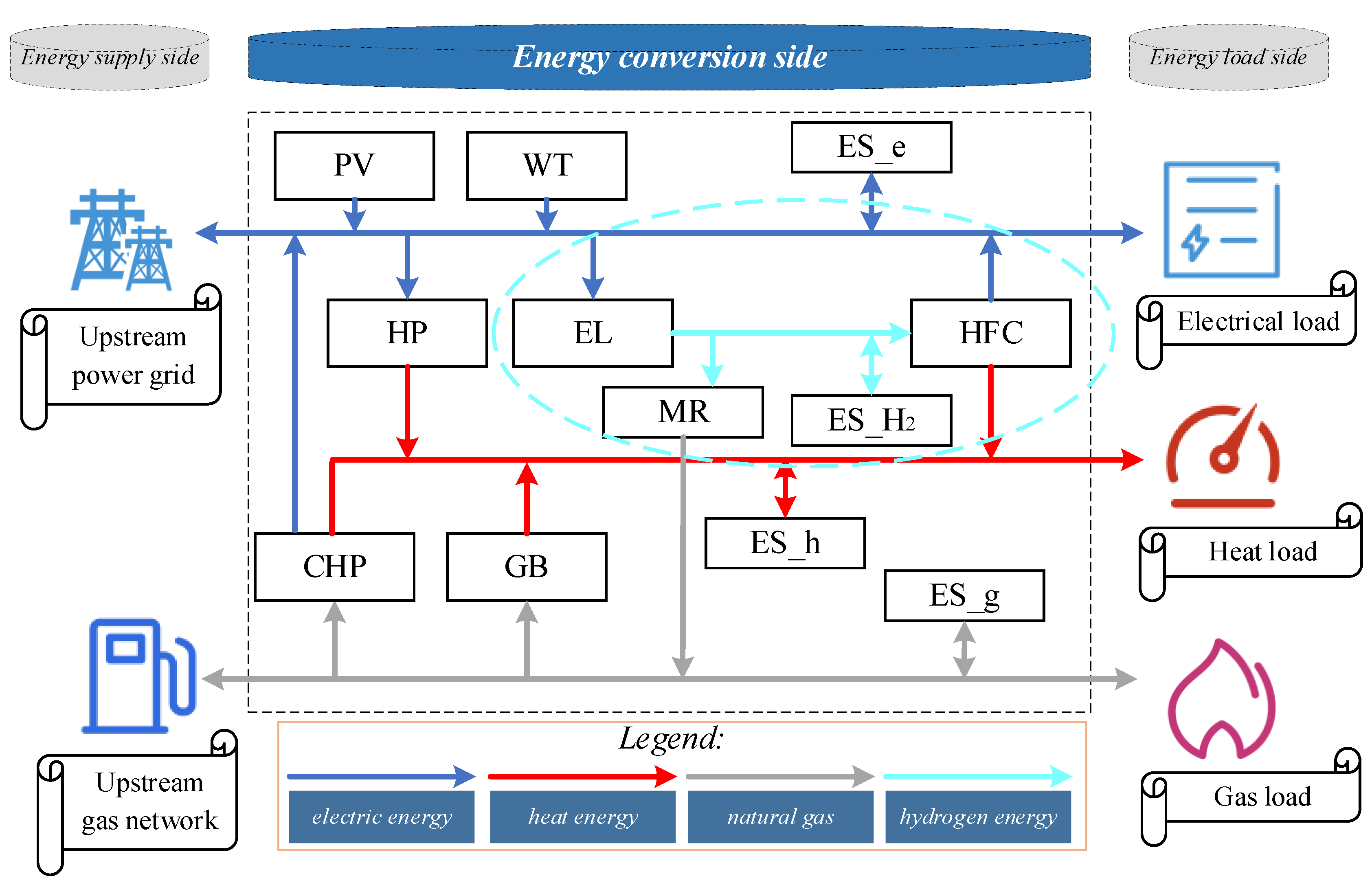
3.1. The Basic Structure of IES in the Article
3.2. Qualitative Analysis of the Electricity–Carbon–Green Certificate Market on IES
3.2.1. Modeling of Carbon Emission Trading
3.2.2. Modeling of Green Certificate Trading
3.2.3. Demonstration of Market Coupling
3.3. Modeling of Subsystems in IES
- (i)
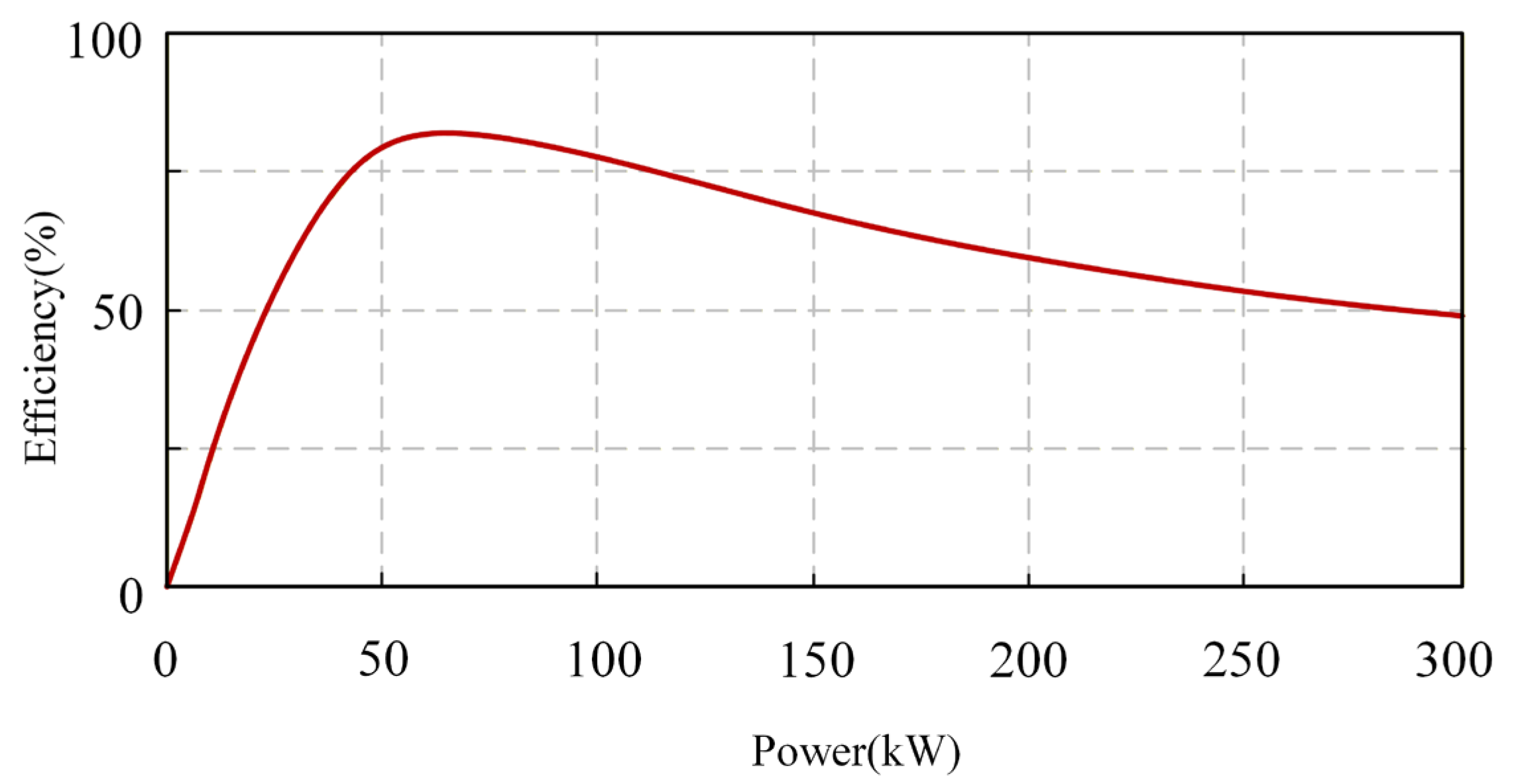
- Electrolyzer (EL) is the core equipment for hydrogen production from electricity, consuming electrical energy to generate hydrogen. It can utilize technologies such as proton exchange membrane electrolyzers, alkaline electrolyzers, and solid oxide electrolyzers to produce hydrogen through water electrolysis. The relevant model is shown as follows [32].where represents the hydrogen power output of the electrolyzer at time t, kW; denotes the hydrogen production efficiency per unit of electricity consumption of the electrolyzer; indicates the electrical power consumption of the electrolyzer during period t, kW; and are the lower and upper ramping limits of the electrical power consumption; and represent the lower and upper limits of the electrical power consumption.
- (ii)
- Hydrogen fuel cell (HFC) is a device that utilizes hydrogen energy to generate electricity and heat, offering the advantage of zero emissions. It is modeled as follows [32]:where and represent the electrical and thermal output power of the HFC at time t, kW; and denote the electrical and thermal conversion efficiency per unit of hydrogen energy; indicates the hydrogen energy consumed by the HFC during period t, kW; and are the lower and upper limits of hydrogen energy consumption by the HFC, kW; and represent the lower and upper ramping limits of hydrogen energy consumption by the HFC; and correspond to the lower and upper limits of the power-to-heat ratio of the HFC.
- (iii)
- Methane reactor (MR), which achieves the methanation of hydrogen, utilizes the reaction between hydrogen and carbon dioxide to produce CH4. This equipment serves the dual functions of carbon capture and utilization, contributing to the reduction of carbon dioxide emissions and enhancing the utilization rate of energy. It is modeled as follows:where represents the methane output power of the MR at time t; denotes the methane production efficiency per unit of hydrogen input of the MR; indicates the hydrogen energy consumed by the MR at time t, kW; and are the lower and upper ramping limits of the hydrogen consumption by the MR; and represent the lower and upper limits of the hydrogen consumption by the MR.
3.4. Establishment of the IES Operation Optimization Model
3.4.1. Objective Function of IES Operation Optimization Model
- (1)
- represents the costs of energy purchase and sale, which consist of purchasing electricity from the upstream grid, purchasing gas from the upstream gas network, selling surplus electricity, and selling surplus natural gas. The optimization orientation of this sub-model in IES operation is the minimum of cost, and the decision variables are the purchasing/selling power of the system at different times. The relevant model is shown as follows:where and represent the power of electricity purchased and sold by the system at time t, yuan/kW; and denote the prices of electricity purchased and sold at time t, yuan/kW; and indicate the power of natural gas purchased and sold by the system at time t, yuan/kW; and represent the prices of natural gas purchased and sold at time t, yuan/kW.
- (2)
- represents the penalty for wind and solar curtailment in the system. The optimization direction of this sub-model in IES is the minimum of cost, and the decision variables are the output power of wind and photovoltaic units at different times. This metric reflects the level of renewable energy integration, as shown in following:where and represent the maximum output of wind and photovoltaic power, kW; and denote the actual output of wind and photovoltaic power, kW; is the penalty coefficient per unit of curtailed electricity, yuan/kW.
- (3)
- represents the transaction cost of the system participating in the green certificate market. The optimization orientation of this sub-model in IES is cost minimization, with the decision variable being the output of IES energy equipment directly related to the green certificate.where is the green certificate quota that the system must fulfill; represents the quantity of green certificates generated by the system; denotes the trading price per unit of green certificate, the unit of measurement is yuan.
- (4)
- represents the transaction cost of the system participating in the carbon market. The optimization orientation of this sub model in IES is cost minimization, with the decision variable being the output level of IES energy equipment directly related to carbon emissions.where represents the carbon emissions of the IES; denotes the carbon quota allocated to the IES; indicates the trading price per unit of carbon emission, the unit of measurement is yuan/kg.
- (5)
- represents the operation and maintenance (O&M) costs of the system devices, the optimization direction of this sub-model is the minimum of cost, and the decision variable is the output of energy equipment in IES. The details are as follows:
- (i)
- O&M cost of wind and solar powerwhere and represent the photovoltaic and wind power O&M costs at time t; and denote the O&M costs per unit power for the photovoltaic and wind power generation, yuan/kW.
- (ii)
- O&M cost of system energy conversion equipmentwhere represents the O&M cost of equipment at time t; denotes the O&M cost per unit power of equipment , yuan/kW.
- (iii)
- O&M cost of energy storage equipmentwhere represents the O&M cost of ES facility at time t; denotes the per-unit charge/discharge O&M cost of ES facility , yuan/kW.
3.4.2. Constraints
- (1)
- Energy balance constraints
- (i)
- Electrical power balance
- (ii)
- Thermal power balance
- (iii)
- Gas balance
- (iv)
- Hydrogen energy balance
- (2)
- Operation constraints
- (3)
- Other constraints
- (i)
- Maximum quantity of green certificate conversion
- (iii)
- Output constraints of wind power and photovoltaic power
3.5. Model Solving
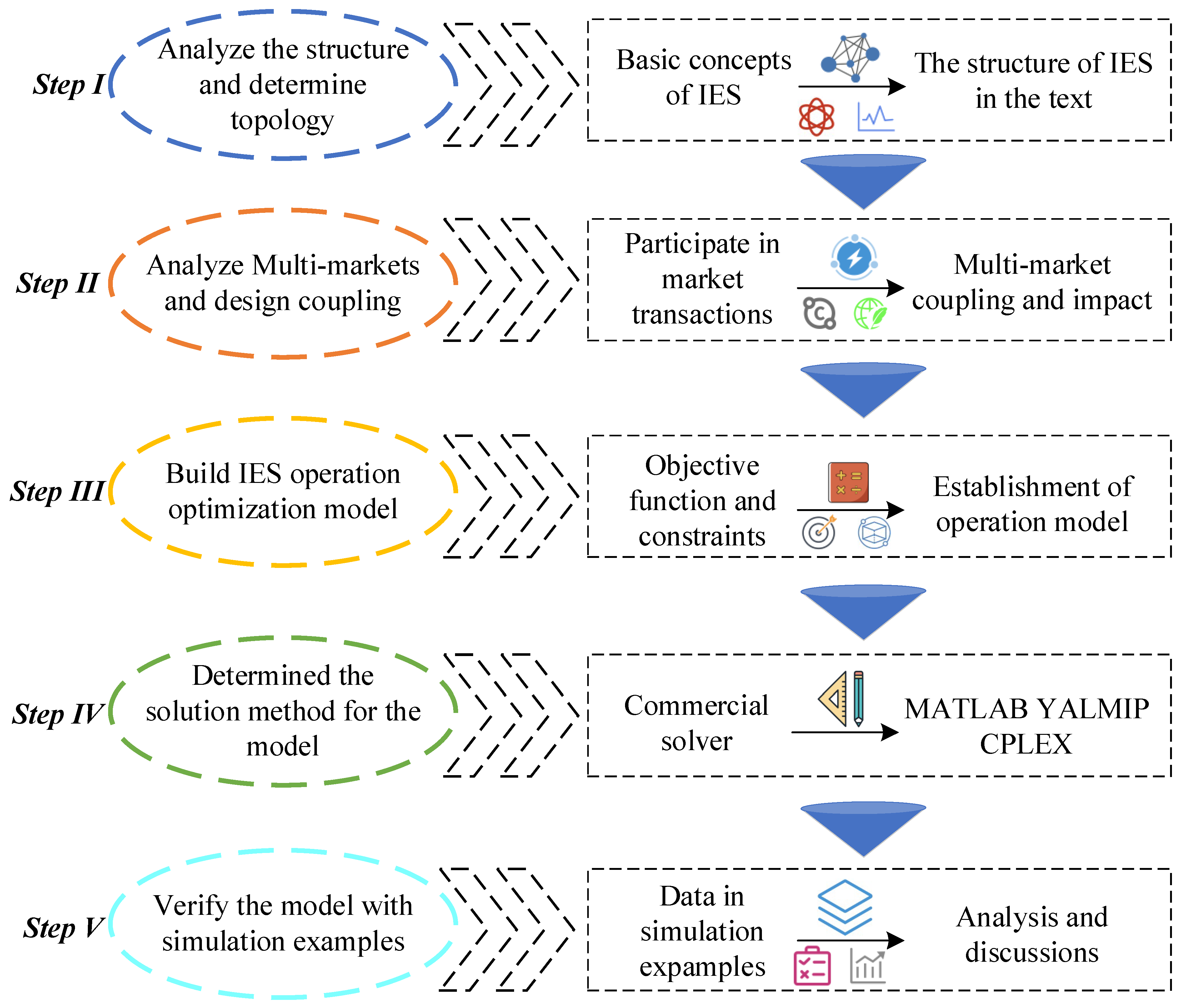
4. Model Validation and Discussion Based on Case Study
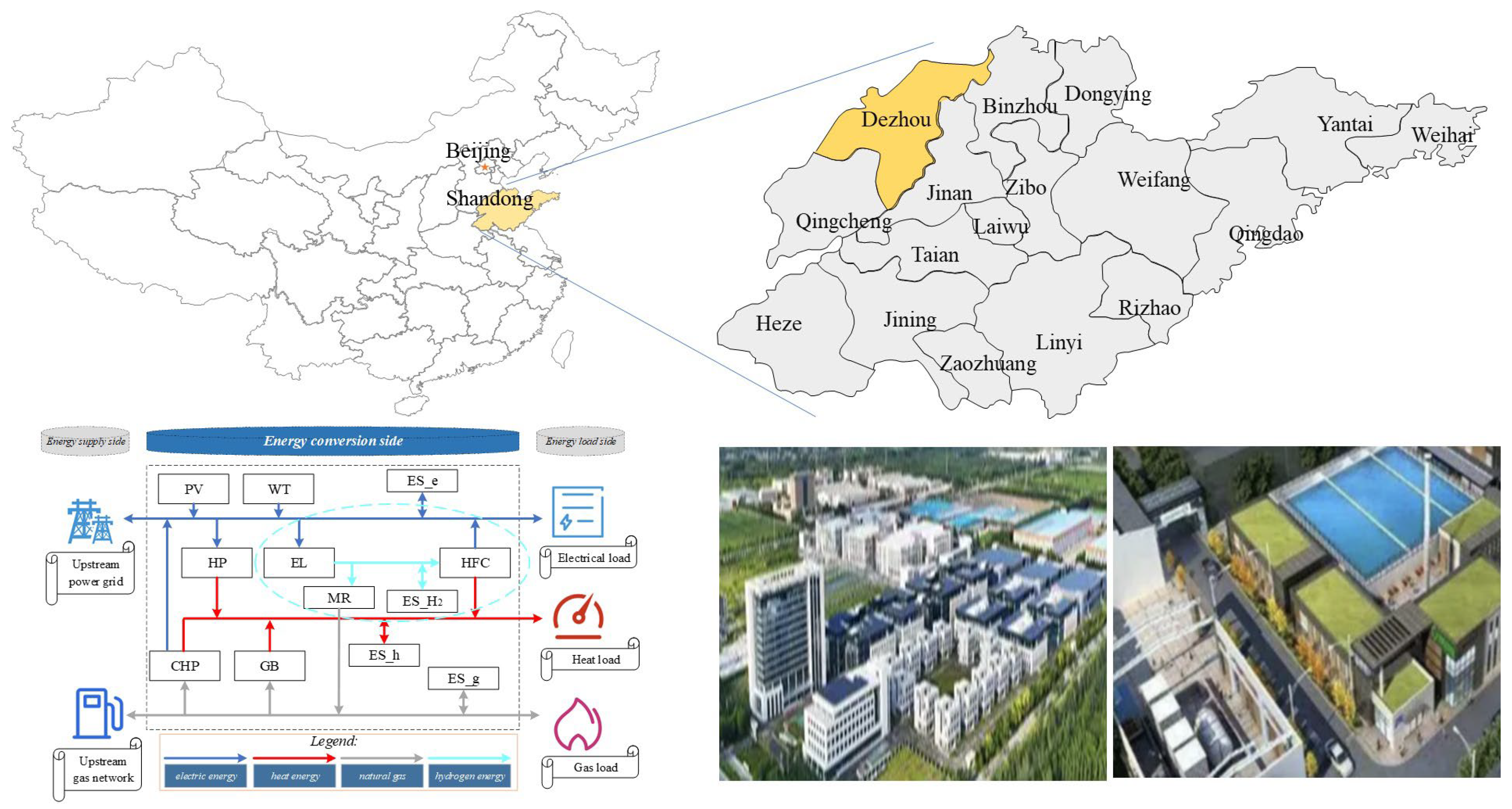
4.1. Basic Information of Case Study and Model Application
4.2. Comparative Analysis and Discussion
4.3. Sensitivity Analysis and Discussion
5. Conclusions and Outlooks
- (1)
- The IES operation optimization model is logically sound and practically feasible. It provides corresponding mathematical expressions for each subsystem of IES operation, and its operability is verified through a simulation case study. The equipment dispatch results derived from the model enable the IES to meet energy consumption demands while achieving optimal comprehensive economic costs, including energy purchase/sale costs, curtailment penalties, carbon market costs, green certificate market costs, and O&M costs. This optimization model can provide dispatch decision support for IES managers in determining the daily operation of various devices.
- (2)
- Considering hydrogen utilization can bring benefits to IES operation in terms of cost optimization, emission reduction, and enhanced integration of renewable energy. On one hand, through hydrogen-based conversion, the interconnection and integration of various energy forms within the IES are improved, and the efficiency of multi-energy utilization is enhanced with the assistance of energy storage. On the other hand, the methanation reactor exhibits a negative carbon effect, reducing the overall carbon emissions of the IES and optimizing its operation cleanliness.
- (3)
- The electricity–carbon–green certificate markets can collectively influence the IES, and the carbon market and green certificate market can achieve mutual recognition and interconnected conversion. Given the potential emission reduction benefits of green certificates, this paper proposes a price-based method for converting green certificates to carbon allowances. However, the simulation analysis of the IES also reveals that the depth of market coupling is influenced by the marginal revenues and costs of each market. The quantity of green certificates allocated to support carbon emission reduction is affected by unit trading prices. Simultaneously, the simulation indicates that market coupling could reduce system operation costs, demonstrating that the research idea of this paper holds both a certain theoretical and practical value.
Author Contributions
Funding
Institutional Review Board Statement
Informed Consent Statement
Data Availability Statement
Conflicts of Interest
Appendix A
- (1)
- The data on different loads and energy prices are seen in Table A1.

| t | Load_e | Load_h | Load_g | |||||||||
|---|---|---|---|---|---|---|---|---|---|---|---|---|
| Time-Sharing Price | Fixed Price | Time-Sharing Price | Fixed Price | Time-Sharing Price | Fixed Price | Time-Sharing Price | ||||||
| 1 | 1076.2 | 1728.5 | 229.9 | 0.38 | 0.5 | 0.3 | 0.45 | 0.35 | 0.3 | 0.15 | 850.4 | 0.0 |
| 2 | 1042.9 | 1883.7 | 224.4 | 0.38 | 0.5 | 0.3 | 0.45 | 0.35 | 0.3 | 0.15 | 864.3 | 0.0 |
| 3 | 1034.6 | 1916.9 | 216.1 | 0.38 | 0.5 | 0.3 | 0.45 | 0.35 | 0.3 | 0.15 | 886.4 | 0.0 |
| 4 | 1047.1 | 1911.4 | 221.6 | 0.38 | 0.5 | 0.3 | 0.45 | 0.35 | 0.3 | 0.15 | 892.0 | 0.0 |
| 5 | 1117.7 | 1977.8 | 224.4 | 0.38 | 0.5 | 0.3 | 0.45 | 0.35 | 0.3 | 0.15 | 894.7 | 15.0 |
| 6 | 1213.3 | 1994.5 | 252.1 | 0.38 | 0.5 | 0.3 | 0.45 | 0.35 | 0.3 | 0.15 | 849.0 | 85.0 |
| 7 | 1254.8 | 1806.1 | 268.7 | 0.38 | 0.5 | 0.3 | 0.45 | 0.35 | 0.3 | 0.15 | 833.8 | 220.0 |
| 8 | 1308.9 | 1667.6 | 288.1 | 0.68 | 0.5 | 0.5 | 0.45 | 0.45 | 0.3 | 0.3 | 653.7 | 420.0 |
| 9 | 1329.6 | 1573.4 | 299.2 | 0.68 | 0.5 | 0.5 | 0.45 | 0.45 | 0.3 | 0.3 | 556.8 | 625.0 |
| 10 | 1350.4 | 1407.2 | 288.1 | 0.68 | 0.5 | 0.5 | 0.45 | 0.45 | 0.3 | 0.3 | 501.4 | 785.0 |
| 11 | 1342.1 | 1329.6 | 293.6 | 0.68 | 0.5 | 0.5 | 0.45 | 0.45 | 0.3 | 0.3 | 432.1 | 880.0 |
| 12 | 1325.5 | 1252.1 | 282.5 | 1.2 | 0.5 | 0.4 | 0.45 | 0.6 | 0.3 | 0.25 | 310.2 | 915.0 |
| 13 | 1313.0 | 1191.1 | 279.8 | 1.2 | 0.5 | 0.4 | 0.45 | 0.6 | 0.3 | 0.25 | 241.0 | 910.0 |
| 14 | 1296.4 | 1180.1 | 271.5 | 1.2 | 0.5 | 0.4 | 0.45 | 0.6 | 0.3 | 0.25 | 252.1 | 865.0 |
| 15 | 1296.4 | 1130.2 | 271.5 | 0.68 | 0.5 | 0.5 | 0.45 | 0.45 | 0.3 | 0.3 | 265.9 | 790.0 |
| 16 | 1302.6 | 1279.8 | 268.7 | 0.68 | 0.5 | 0.5 | 0.45 | 0.45 | 0.3 | 0.3 | 296.4 | 670.0 |
| 17 | 1315.1 | 1429.4 | 277.0 | 0.68 | 0.5 | 0.5 | 0.45 | 0.45 | 0.3 | 0.3 | 343.5 | 520.0 |
| 18 | 1333.8 | 1612.2 | 293.6 | 0.68 | 0.5 | 0.5 | 0.45 | 0.45 | 0.3 | 0.3 | 354.6 | 345.0 |
| 19 | 1321.3 | 1623.3 | 307.5 | 1.2 | 0.5 | 0.4 | 0.45 | 0.55 | 0.3 | 0.25 | 426.6 | 165.0 |
| 20 | 1296.4 | 1662.0 | 304.7 | 1.2 | 0.5 | 0.4 | 0.45 | 0.55 | 0.3 | 0.25 | 526.3 | 45.0 |
| 21 | 1254.8 | 1623.3 | 293.6 | 1.2 | 0.5 | 0.4 | 0.45 | 0.55 | 0.3 | 0.25 | 675.9 | 5.0 |
| 22 | 1225.8 | 1617.7 | 285.3 | 1.2 | 0.5 | 0.4 | 0.45 | 0.55 | 0.3 | 0.25 | 742.4 | 0.0 |
| 23 | 1159.3 | 1601.1 | 277.0 | 0.38 | 0.5 | 0.3 | 0.45 | 0.35 | 0.3 | 0.15 | 854.6 | 0.0 |
| 24 | 1117.7 | 1617.7 | 265.9 | 0.38 | 0.5 | 0.3 | 0.45 | 0.35 | 0.3 | 0.15 | 878.1 | 0.0 |
- (2)
- The data on key parameter values are seen in Table A2.
| Parameters | Value | Parameters | Value |
|---|---|---|---|
| 0.9 | 0.728 | ||
| 0.92 | 0.367 | ||
| 0.95 | 1.08 | ||
| 0.88 | 0.2 | ||
| 0.85 | 0.2 | ||
| 0.6 | 0.106 | ||
| 0.13 | 0.2 | ||
| 0.15 | 0.95 | ||
| 0.25 | 2000 | ||
| 50 | 0.25 | ||
| 0.25 | 0.35 | ||
| 0.08 | 0.12 | ||
| 0.03 | 0.15 | ||
| 0.05 | 0.12 | ||
| 0.03 | 0.03 | ||
| 0.03 | 0.03 |
- (3)
- The simulation data on upper/lower limitation values are seen in Table A3.
| Parameters | Value | Parameters | Value |
|---|---|---|---|
| −120/120 | 600/600 | ||
| −120/120 | 0.5/2.5 | ||
| −160/160 | 0/800 | ||
| 225/225 | 250/250 | ||
| 75/75 | 100/100 | ||
| 90/405 | 100/450 | ||
| 30/135 | 40/180 | ||
| −100/100 | 50/500 | ||
| 50/250 | −50/50 | ||
| 0.5/1.8 | −50/50 | ||
| 50/250 | 15%/30% |
References
- Chen, S.; Liu, P.; Li, Z. Low carbon transition pathway of power sector with high penetration of renewable energy. Renew. Sustain. Energy Rev. 2020, 130, 109985. [Google Scholar] [CrossRef] [Scilit]
- Zhou, Y.; Wang, J.; Xu, H.; Yang, M.; Liu, W. Improving full-chain process synergy of multi-energy complementary distributed energy system in cascade storage and initiative management strategies. Energy Convers. Manag. 2024, 322, 119120. [Google Scholar] [CrossRef] [Scilit]
- Moslehi, S.; Reddy, T.A. A new quantitative life cycle sustainability assessment framework: Application to integrated energy systems. Appl. Energy 2019, 239, 482–493. [Google Scholar] [CrossRef] [Scilit]
- Liu, A.; Zhao, P.; Sun, J.; Xu, W.; Ma, N.; Wang, J. Performance analysis of an electric-heat integrated energy system based on a CHP unit and a multi-level CCES system for better wind power penetration and load satisfaction. Appl. Therm. Eng. 2025, 258, 124644. [Google Scholar] [CrossRef] [Scilit]
- Dragoon, K.; Iliceto, A.; Korpås, M.; Markussen, P.; Pivovar, B.; Ruth, M.; Westlake, B.; Endler, E. Hydrogen as part of a 100% clean energy system: Exploring its decarbonization roles. IEEE Power Energy Mag. 2022, 20, 85–95. [Google Scholar] [CrossRef] [Scilit]
- Parra, D.; Valverde, L.; Pino, F.J.; Patel, M.K. A review on the role, cost and value of hydrogen energy systems for deep decarbonisation. Renew. Sustain. Energy Rev. 2019, 101, 279–294. [Google Scholar] [CrossRef] [Scilit]
- Xu, X.; Wang, B.; Shi, M.; Li, G.; Zhang, Y.; Wang, Q.; Liu, D. Research on hydrogen storage system configuration and optimization in regional integrated energy systems considering electric-gas-heat-hydrogen integrated demand response. Int. J. Hydrogen Energy 2025, 135, 86–103. [Google Scholar] [CrossRef] [Scilit]
- Haowei, C. Synergy effects of the energy quota trading system and carbon emissions trading system: A case study of China. Energy Sustain. Dev. 2025, 87, 101733. [Google Scholar] [CrossRef] [Scilit]
- Tian, J.; Huang, B.; Wang, Q.; Du, P.; Zhang, Y.; He, B. A multi-agent integrated energy trading strategy based on carbon emission/green certificate equivalence interaction. Sustainability 2023, 15, 15766. [Google Scholar] [CrossRef] [Scilit]
- Berjawi, A.; Walker, S.; Patsios, C.; Hosseini, S. An evaluation framework for future integrated energy systems: A whole energy systems approach. Renew. Sustain. Energy Rev. 2021, 145, 111163. [Google Scholar] [CrossRef] [Scilit]
- Wu, D.; Guo, J. Optimal design method and benefits research for a regional integrated energy system. Renew. Sustain. Energy Rev. 2023, 186, 113671. [Google Scholar] [CrossRef] [Scilit]
- Wang, Y.; Liu, Z.; Wang, J.; Du, B.; Qin, Y.; Liu, X.; Liu, L. A Stackelberg game-based approach to transaction optimization for distributed integrated energy system. Energy 2023, 283, 128475. [Google Scholar] [CrossRef] [Scilit]
- Dong, Y.; Zhang, H.; Ma, P.; Wang, C.; Zhou, X. A hybrid robust-interval optimization approach for integrated energy systems planning under uncertainties. Energy 2023, 274, 127267. [Google Scholar] [CrossRef] [Scilit]
- Zhou, X.; Tan, W.; Sun, Y.; Huang, T.; Yang, C. Multi-objective optimization and decision making for integrated energy system using STA and fuzzy TOPSIS. Expert Syst. Appl. 2024, 240, 122539. [Google Scholar] [CrossRef] [Scilit]
- Hou, J.; Li, Z.; Meng, Y.; Cai, J.; Yu, W.; Xu, Z. Low-carbon optimal scheduling of integrated energy system considering hydrogen use and demand response. J. Nanjing Univ. Inf. Sci. Technol. 2024, 16, 587–598. [Google Scholar]
- Wang, L.; Xian, R.; Jiao, P.; Liu, X.; Xing, Y.; Wang, W. Cooperative operation of industrial/commercial/residential integrated energy system with hydrogen energy based on Nash bargaining theory. Energy 2024, 288, 129868. [Google Scholar] [CrossRef] [Scilit]
- Zhang, J.; Liu, Z. Low carbon economic scheduling model for a park integrated energy system considering integrated demand response, ladder-type carbon trading and fine utilization of hydrogen. Energy 2024, 290, 130311. [Google Scholar] [CrossRef] [Scilit]
- Zhou, J.; Li, S.; Zhou, X.; Li, C.; Xiong, Z.; Zhao, Y.; Liang, G. Operation optimization for gas-electric integrated energy system with hydrogen storage module. Int. J. Hydrogen Energy 2022, 47, 36622–36639. [Google Scholar] [CrossRef] [Scilit]
- Yang, M.; Liu, Y. A two-stage robust configuration optimization framework for integrated energy system considering multiple uncertainties. Sustain. Cities Soc. 2024, 101, 105120. [Google Scholar] [CrossRef] [Scilit]
- Ren, T.; Li, R.; Li, X. Bi-level multi-objective robust optimization for performance improvements in integrated energy system with solar fuel production. Renew. Energy 2023, 219, 119499. [Google Scholar] [CrossRef] [Scilit]
- Ruiming, F. Multi-objective optimized operation of integrated energy system with hydrogen storage. Int. J. Hydrogen Energy 2019, 44, 29409–29417. [Google Scholar] [CrossRef] [Scilit]
- Gao, J.; Meng, Q.; Liu, J.; Wang, Z. Thermoelectric optimization of integrated energy system considering wind-photovoltaic uncertainty, two-stage power-to-gas and ladder-type carbon trading. Renew. Energy 2024, 221, 119806. [Google Scholar] [CrossRef] [Scilit]
- Zhou, J.; Wu, Y.; Zhong, Z.; Xu, C.; Ke, Y.; Gao, J. Modeling and configuration optimization of the natural gas-wind-photovoltaic-hydrogen integrated energy system: A novel deviation satisfaction strategy. Energy Convers. Manag. 2021, 243, 114340. [Google Scholar] [CrossRef] [Scilit]
- Huang, H.; Liang, R.; Lv, C.; Lu, M.; Gong, D.; Yin, S. Two-stage robust stochastic scheduling for energy recovery in coal mine integrated energy system. Appl. Energy 2021, 290, 116759. [Google Scholar] [CrossRef] [Scilit]
- Hong, Q.; Cui, L.; Hong, P. The impact of carbon emissions trading on energy efficiency: Evidence from quasi-experiment in China’s carbon emissions trading pilot. Energy Econ. 2022, 110, 106025. [Google Scholar] [CrossRef] [Scilit]
- Feng, T.-T.; Li, R.; Zhang, H.-M.; Gong, X.-L.; Yang, Y.-S. Induction mechanism and optimization of tradable green certificates and carbon emission trading acting on electricity market in China. Resour. Conserv. Recycl. 2021, 169, 105487. [Google Scholar] [CrossRef] [Scilit]
- Jiang, Y.; Chen, W. Review and Prospect of Coupled Electricity-Carbon-Renewable Portfolios Trading. Electr. Power Constr. 2023, 44, 1–13. [Google Scholar]
- Wu, Q.; Li, C. Modeling and operation optimization of hydrogen-based integrated energy system with refined power-to-gas and carbon-capture-storage technologies under carbon trading. Energy 2023, 270, 126832. [Google Scholar]
- Zeng, H.; Du, Y.; LI, T.; Xue, Y.; Sun, K.; Xia, T.; Sun, H. Low-carbon planning of a park-level integrated electric and heating system considering carbon trading and green certificate trading. Integr. Intell. Energy 2023, 45, 22–29. [Google Scholar]
- Luo, Z.; Qin, J.; Liang, J.; Shen, F.; Liu, H.; Zhao, M.; Wang, J. Day-ahead optimal scheduling of integrated energy system with carbon-green certificate coordinated trading mechanism. Electr. Power Autom. Equip. 2021, 41, 248–255. [Google Scholar]
- Suo, C.; Li, Y.; Jin, S.; Liu, J.; Li, Y.; Feng, R. Identifying optimal clean-production pattern for energy systems under uncertainty through introducing carbon emission trading and green certificate schemes. J. Clean. Prod. 2017, 161, 299–316. [Google Scholar] [CrossRef] [Scilit]
- An, J.; Liu, W.; Lin, Y.; Zhang, Q.; Wang, X.; Kang, Y. Optimization Scheduling of Hydrogen-Containing Integrated Energy System Under Green Certificate-Carbon Trading Integration Mechanism. Acta Energiae Sol. Sin. 2024, 45, 104–114. [Google Scholar]
- Dong, H.; Shan, Z.; Zhou, J.; Xu, C.; Chen, W. Refined modeling and co-optimization of electric-hydrogen-thermal-gas integrated energy system with hybrid energy storage. Appl. Energy 2023, 351, 121834. [Google Scholar] [CrossRef] [Scilit]
- Li, Z.; Zhao, Y.; Wu, P.; Chang, Y.; Zhao, S. Low-carbon Dispatching Strategy of Integrated Energy System with Coordination of Green Hydrogen and Blue Hydrogen Based on Fine Modeling of Hydrogen Production Equipment. Power Syst. Technol. 2024, 48, 2317–2326. [Google Scholar]
- Zhang, H.; Zhou, Y.; Tu, L.; Qin, Y.; Li, X. Multi-timescale Optimal Scheduling of Integrated Energy System with Consideration of Green Certificate-Carbon Trading and Hydrogen Energy. Proc. CSU-EPSA 2023, 35, 95–106. [Google Scholar]
- Li, J.; Zhang, Z.; Liang, C.; Zeng, F. Multi-Objective Robustness of Integrated Energy System Considering Source-Load Uncertainty. J. Shanghai Jiaotong Univ. 2025, 59, 175–185. [Google Scholar]
- Chen, J.; Hu, Z.; Chen, Y.; Chen, J.; Chen, W.; Gao, M.; Lin, M.; Du, Y. Thermoelectric optimization of integrated energy system considering ladder-type carbon trading mechanism and electric hydrogen production. Electr. Power Autom. Equip. 2021, 41, 48–55. [Google Scholar]
- Luo, Q.; Li, P.; Zhang, S. Low-carbon and economic scheduling of virtual power plant considering demand response and stepwise carbon trading. Zhejiang Electr. Power 2023, 42, 51–59. [Google Scholar]
- Yuan, S.; Pan, P.; Wei, Y.; Xu, H.; Huo, M. Study on Low-Carbon Economic Optimal Scheduling Model of Community Integrated Energy System. Acta Energiae Sol. Sin. 2024, 45, 347–356. [Google Scholar]
- Liu, D.; Luo, Z.; Qin, J.; Wang, H.; Wang, G.; Li, Z.; Zhao, W.; Shen, X. Low-carbon dispatch of multi-district integrated energy systems considering carbon emission trading and green certificate trading. Renew. Energy 2023, 218, 119312. [Google Scholar] [CrossRef] [Scilit]
- Li, F.; Wang, D.; Guo, H.; Liu, Z.; Zhang, J.; Lin, Z. Two-stage Distributionally robust optimization for hydrogen-IES participation in energy-carbon trading-frequency regulation ancillary services market. Energy 2025, 328, 136404. [Google Scholar] [CrossRef] [Scilit]
- Gao, J.; Shao, Z.; Chen, F.; Lak, M. Multi-energy trading strategies for integrated energy systems based on low-carbon and green certificate. Electr. Power Syst. Res. 2025, 238, 111120. [Google Scholar] [CrossRef] [Scilit]
- Zhang, S.; Xu, Z.; Li, Y.; Zhang, J.; Hu, J. System dynamics simulation model of price transmission in collaboration market of electricity, carbon, and green certificate driven by multiple policies. Energy 2025, 323, 135852. [Google Scholar] [CrossRef] [Scilit]
- Gao, C.; Lu, H.; Chen, M.; Chang, X.; Zheng, C. A low-carbon optimization of integrated energy system dispatch under multi-system coupling of electricity-heat-gas-hydrogen based on stepwise carbon trading. Int. J. Hydrogen Energy 2025, 97, 362–376. [Google Scholar] [CrossRef] [Scilit]
- Huang, X.; Zhong, J.; Xiao, M.; Zhu, Y.; Zheng, H.; Zheng, B. Optimal and Sustainable Scheduling of Integrated Energy System Coupled with CCS-P2G and Waste-to-Energy Under the “Green-Carbon” Offset Mechanism. Sustainability 2025, 17, 4873. [Google Scholar] [CrossRef] [Scilit]


| The Key Variables in IES Operation Optimization Model | The Detailed Explanation of Key Variables in IES Operation Optimization Model |
|---|---|
| , , , , , | Denote the electrical energy output or input of WT, PV, CHP, HFC, HP, EL at time t. |
| , , , | Denote the heat energy output of HP, CHP, GB, HFC at time t. |
| Denote the gas energy output of MR at time t. | |
| , , | Denote the hydrogen energy output or input of EL, MR, HFC at time t. |
| , , , | Denote the energy buy/sale of IES at time t. |
| , , , | Denote the energy loss during transmission process, assuming as 5%. |
| , , , , , , , | Denote the charging and discharging status of IES’s energy storage facilities, including electrical energy, heat energy, gas energy, and hydrogen energy. |
| Scenario (1) | Scenario (2) | Scenario (3) | Scenario (4) | Scenario (5) | Scenario (6) | Scenario (7) | |
|---|---|---|---|---|---|---|---|
| Coupling of carbon and green certificate market | × | √ | × | × | √ | √ | √ |
| Hydrogen utilization | √ | × | √ | √ | √ | √ | √ |
| Participate in green certificate market | √ | √ | × | √ | √ | √ | √ |
| Participate in carbon market | √ | √ | √ | × | √ | √ | √ |
| Time-sharing price of electricity and gas | × | × | × | × | √ | × | × |
| Tiered price in carbon market | × | × | × | × | × | √ | × |
| Refined model of EL | × | × | × | × | × | × | √ |
Disclaimer/Publisher’s Note: The statements, opinions and data contained in all publications are solely those of the individual author(s) and contributor(s) and not of MDPI and/or the editor(s). MDPI and/or the editor(s) disclaim responsibility for any injury to people or property resulting from any ideas, methods, instructions or products referred to in the content. |
© 2026 by the authors. Licensee MDPI, Basel, Switzerland. This article is an open access article distributed under the terms and conditions of the Creative Commons Attribution (CC BY) license.
Share and Cite
Li, C.; Liang, F.; Liu, D.; Liu, Y.; Xie, X.; Tao, Y. Optimization Model of an Integrated Energy System Operation Considering the Utilization of Hydrogen Energy and the Coupling of Carbon-Green Certificates Trading. Sustainability 2026, 18, 3065. https://doi.org/10.3390/su18063065
Li C, Liang F, Liu D, Liu Y, Xie X, Tao Y. Optimization Model of an Integrated Energy System Operation Considering the Utilization of Hydrogen Energy and the Coupling of Carbon-Green Certificates Trading. Sustainability. 2026; 18(6):3065. https://doi.org/10.3390/su18063065
Chicago/Turabian StyleLi, Chenguang, Feng Liang, Dawei Liu, Yang Liu, Xiufeng Xie, and Yao Tao. 2026. "Optimization Model of an Integrated Energy System Operation Considering the Utilization of Hydrogen Energy and the Coupling of Carbon-Green Certificates Trading" Sustainability 18, no. 6: 3065. https://doi.org/10.3390/su18063065
APA StyleLi, C., Liang, F., Liu, D., Liu, Y., Xie, X., & Tao, Y. (2026). Optimization Model of an Integrated Energy System Operation Considering the Utilization of Hydrogen Energy and the Coupling of Carbon-Green Certificates Trading. Sustainability, 18(6), 3065. https://doi.org/10.3390/su18063065