Article

Differentiated Drivers of Tourist Sentiment in Wellness Tourism Destinations: A User-Generated Content (UGC)-Based Analysis of Spatial-Temporal Patterns

1
College of Architecture and Planning, Anhui Jianzhu University, Ziyun Road No. 292, Hefei 230036, China
2
College of Forestry and Landscape Architecture, Anhui Agricultural University, Hefei 230036, China
3
Jinzhai County Forestry Bureau, Jinzhai 237300, China
*
Author to whom correspondence should be addressed.
Sustainability 2026, 18(6), 3037; https://doi.org/10.3390/su18063037
Submission received: 9 February 2026 / Revised: 17 March 2026 / Accepted: 17 March 2026 / Published: 19 March 2026

Abstract

With increasing demand for wellness tourism, identifying the key factors influencing emotional perceptions is essential for optimizing destination planning and management. Although Anhui Province has experienced rapid growth in wellness tourism destinations in recent years, scientific understanding of tourists’ emotional perceptions and their driving mechanisms has lagged behind this rapid expansion, a gap that can be addressed by integrating big data with spatial analysis to provide a scientific perspective for optimizing destination planning and informing regional wellness tourism policy. To address this gap, this study conducts a sentiment analysis of wellness bases in Anhui Province using user-generated content (UGC) data. Sentiment scores were quantified via SnowNLP, while kernel density, time-series, and multivariate statistical analyses were applied to examine spatial distributions, temporal dynamics of sentiments and review volumes, and emotional driving factors. The results indicate a spatial pattern of higher density in the south, lower density in the north, and dual-core agglomeration, closely linked to natural resource endowments. Temporally, sentiment scores rise in spring and summer and decline in winter, while review volumes peak in spring and autumn. Overall regression analyses reveal a significant positive effect of green coverage and a negative effect of accommodation prices. In the typological analysis, sentiment scores of Forest Wellness Bases (FWBs) relate to green coverage and negative ions, while Hydrological Wellness Bases (HWBs), Traditional Chinese Medicine Wellness Bases (TCMWBs), and Wellness Towns (WTs) are driven by the combined effects of facility services, locational price, and ecological environment. These findings provide a scientific basis for the sustainable development and differentiated management of wellness tourism destinations.

1. Introduction

As the global pace of modern life accelerates, sub-healthy status has transcended age boundaries to become a pervasive social challenge [1]. Physical and mental recovery is no longer confined to functional maintenance for the elderly, but has emerged as a core demand for stress relief among young and middle-aged adults, as well as for the holistic development of children [2]. Within this context, the wellness industry is transitioning from niche service provision to full life-cycle coverage [3]. Wellness bases serve as the physical spatial carriers of this transition; their core value lies in the coupling of ecological resources and human intervention to construct environments with restorative qualities [4]. Existing research demonstrates that wellness bases, as integrated spaces combining natural resources, health interventions, and leisure activities, exert significant positive effects on visitors by mitigating psychological stress, promoting emotional recovery, and enhancing subjective health perceptions [5]. However, how the physical environmental quality, facilities, and service provision of these bases translate into positive psychological perceptions remains a critical scientific question in environmental behavior and wellness tourism research.
The design of wellness bases relies not only on high-quality ecological environments, but also on supporting infrastructure and services. For instance, natural landscapes such as forests and lakes are recognized for their restorative effects, while comprehensive accommodation, catering, and medical facilities further elevate the overall visitor experience [6]. Since the outbreak and subsequent global pandemic of COVID-19, public attention toward health, natural environments, and restorative leisure has intensified, further highlighting the significance of wellness bases [7,8]. Consequently, understanding the needs and sentiments of visitors and optimizing their emotional experiences have become primary objectives for the development and management of wellness destinations.
Currently, numerous scholars have investigated the spatial distribution, service facilities, and environmental resources of wellness bases, emphasizing the importance of natural landscapes and amenities in visitor perception. Research indicates that factors such as geographical location, landscape features, and facility configurations significantly influence visitor choice and satisfaction [9,10]. For example, a study on health resort selection behavior in Poland found that quiet natural environments and systematic health services significantly improved visitors’ sense of security and recovery expectations [11]. Another survey of urban nature parks in Guangzhou demonstrated that high perceived crowd density leads to tension and a sense of pressure, whereas optimized vegetation configurations and trail organizations can mitigate negative feelings, thereby enhancing relaxation and overall recreation satisfaction [12]. However, despite providing valuable insights into attractiveness factors, most studies rely on qualitative descriptions or case analyses. Quantitative research on visitor perception often depends on traditional methods such as questionnaires, in-depth interviews, or on-site evaluations [13]. While these methods yield targeted feedback, they face challenges such as limited sample sizes and high acquisition costs in large-scale, cross-regional studies, making it difficult to capture the real-time emotional experiences of massive populations.
To address these methodological limitations, sentiment analysis based on user-generated content (UGC) has recently emerged as a vital tool for understanding visitor perception. Social media and online travel platforms provide spaces for visitors to express emotions and share experiences; analyzing these comments allows for the quantification of emotional responses, enabling a more objective assessment of destination attractiveness and satisfaction [14,15]. Compared to traditional surveys and interviews, UGC data offers superior sample scales, timeliness, and behavioral authenticity, effectively capturing emotional experiences and demand preferences in real-world scenarios [16]. In the field of urban planning, research using social media or online reviews has extensively analyzed public space experiences. Findings suggest that landscape sentiments in urban parks can be quantified through review texts, with environmental quality and facility standards serving as key drivers of emotional tendencies [17]. Cultural ecosystem services in urban green spaces have also been parsed through UGC to identify resident-preferred functional characteristics, providing a basis for green space planning and layout [18]. Furthermore, UGC is widely applied in landscape ecology and tourism research, using theme and content analysis to extract interaction patterns and emotional expressions, thereby revealing emotional fluctuation mechanisms during travel [19]. Thus, sentiment analysis based on UGC provides both a robust reference for wellness base managers and a novel perspective for academic research. However, most existing UGC-based tourism studies mainly focus on destination image, visitor satisfaction, or general perception analysis. Relatively few studies have systematically examined the determinants of visitor emotional perceptions in wellness tourism destinations by integrating sentiment analysis with spatial and quantitative analytical approaches. Therefore, this study develops an analytical framework that combines UGC-based sentiment analysis with spatial and regression analyses to explore the key factors influencing visitor emotional perceptions in wellness tourism destinations. In tourism studies, visitor perceptions of destinations are commonly shaped by multiple destination attributes, including environmental quality, service facilities, accessibility, and price perception. These attributes jointly influence tourists’ emotional experiences and overall evaluations of destinations. Accordingly, this study operationalizes these destination attributes through four dimensions: landscape and environment, service facilities, transportation conditions, and price level to examine the determinants of visitor emotional perceptions in wellness tourism destinations.
To comprehensively capture the multi-dimensional perceptual characteristics of wellness tourists, this study utilizes Ctrip and Xiaohongshu as dual-source databases. As a leading global and China’s largest online travel agency (OTA), Ctrip possesses a highly authoritative and comprehensive evaluation system. Its vast accumulation of structured review data objectively records rational feedback on infrastructure, accessibility, and service quality. Given its broad user base, it provides a robust and statistically representative empirical basis for spatial analysis [20,21]. However, data from a single OTA platform remains limited in capturing nuanced and subjective emotional expressions. Therefore, this study incorporates the prominent social media platform Xiaohongshu as a supplement. Unlike the evaluation-oriented nature of Ctrip, Xiaohongshu functions as a unique lifestyle search engine in China’s digital society, where content is driven by subjective narratives and emotional resonance. Among younger and highly engaged audiences, Xiaohongshu records micro-level psychological fluctuations and scenario preferences through decentralized dissemination mechanisms [22]. By integrating structured evaluations from Ctrip with emotional narratives from Xiaohongshu, this study constructs a composite database balancing rational assessment with affective expression, providing multi-dimensional support for exploring emotional perception mechanisms.
The primary objectives of this study are: (1) to identify the spatial distribution characteristics and formation mechanisms of wellness bases in Anhui Province; and (2) to analyze the temporal dynamics of visitor sentiment scores and review volumes, while identifying key factors influencing emotional perceptions across different wellness base types: Forest Wellness Bases (FWBs), Hydrological Wellness Bases (HWBs), Traditional Chinese Medicine Wellness Bases (TCMWBs), and Wellness Towns (WTs). These findings aim to provide data-driven support and theoretical references for categorical planning, environmental optimization, and service enhancement of wellness destinations.

2. Materials and Methods

2.1. Study Area

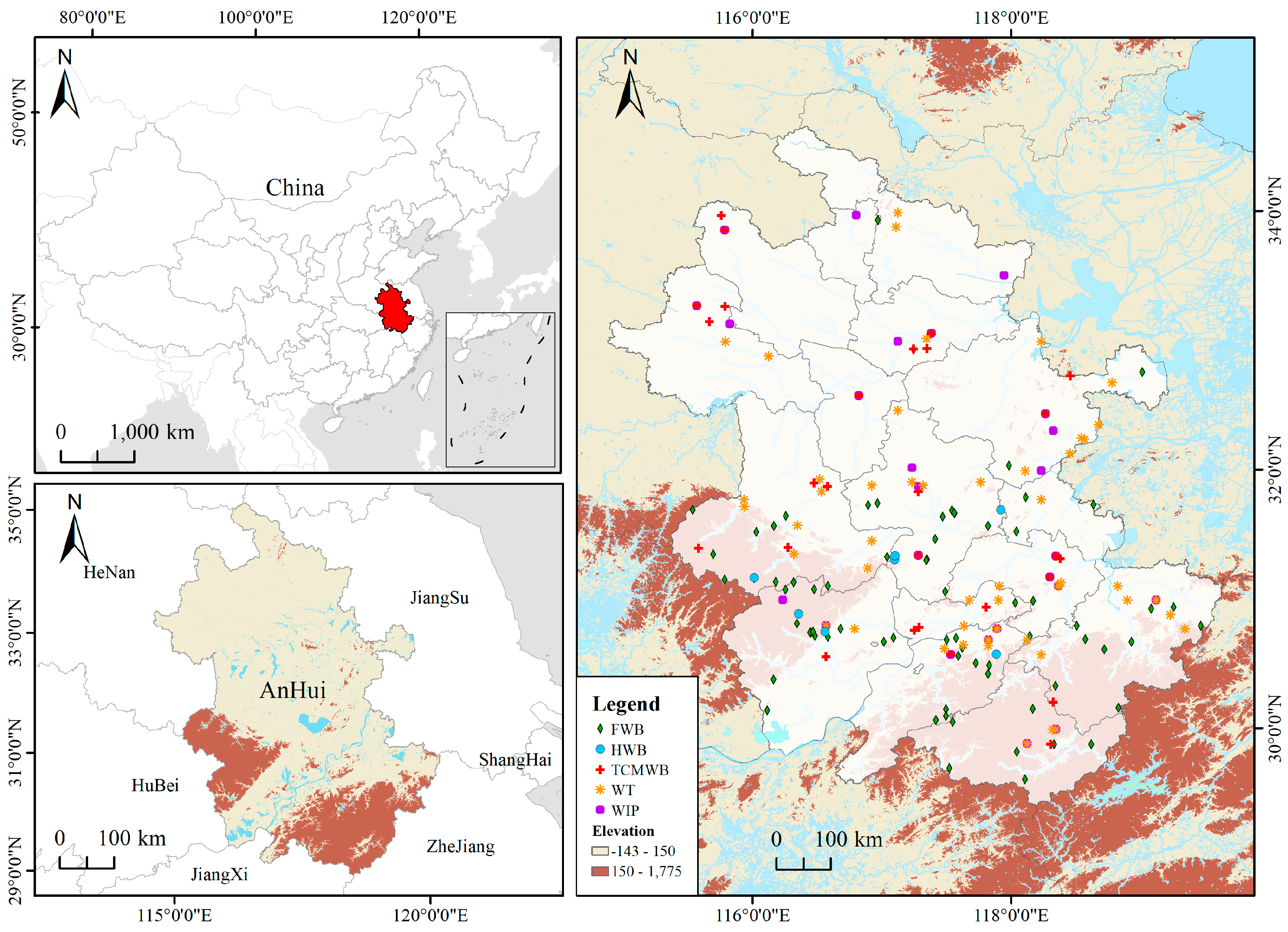
Anhui Province is situated in East China at the confluence of the Yangtze and Huaihe River basins, with geographical coordinates ranging from 29°41′ to 34°38′ N and 114°54′ to 119°37′ E. Covering a total area of approximately 140,000 km2, the province exhibits distinct topographical features characterized by a stepped pattern that transitions from plains in the north to hills and mountains in the south. The unique climatic transition between the north and south, coupled with complex geological structures, provides a profound natural foundation for the development of diversified wellness resources. The interaction of regional tectonic evolution and a humid monsoon climate has shaped a natural healing landscape dominated by mountains, forests, and hot springs, providing the foundational environment for FWB, with mineral and geothermal resources primarily concentrated in areas of high forest coverage. Furthermore, relying on the intricate network of the Yangtze and Huaihe mainstream rivers and numerous lakes, the province possesses exceptional conditions for HWB. Moreover, the legacy of long-standing agrarian civilization, integrated with Xin’an Medicine and Medicine Capital culture, has fostered deep cultural roots for TCMWB, WT and Wellness Industrial Parks (WIP). This resource system, characterized by the deep coupling of natural ecology and cultural heritage, renders Anhui Province a highly representative composite wellness destination in China (Figure 1).
Based on the authority of evaluating institutions and the influence of the sites themselves, this study identified 183 wellness bases in Anhui Province. Data were sourced from official lists published between 2020 and 2024 by several entities, including the National Forestry and Grassland Administration (NFGA), the Ministry of Civil Affairs, the National Health Commission, the National Administration of Traditional Chinese Medicine, and the Anhui Provincial Department of Culture and Tourism. In international wellness tourism research, existing studies have defined the composition and types of wellness tourism from the perspective of the overall supply system [23]. Building upon this, this research systematically classified the wellness bases within the study area by referencing the classification principles of Classification, Investigation and Evaluation of Tourism Resources (GB/T18972–2017) [24]. This was further integrated with the wellness product systems proposed in industry reports, such as the Report on the Development of China’s Wellness Industry, and established research on the spatial patterns of wellness destinations [25,26]. The bases were categorized into five distinct types: FWB, HWB, TCMWB, WT, and WIP. The descriptions and quantities of these bases are detailed below (Table 1).

2.2. Data Collection

To ensure the depth and validity of the sentiment analysis, a further screening of the aforementioned samples was conducted. The inclusion criteria were: (1) the existence of public review records on social media platforms; and (2) a historical review volume of no fewer than 20 entries. Although WIP are listed as one of the official types of wellness bases in Anhui Province, they primarily function as industrial rather than tourism-receptive sites. Consequently, as this study focuses on embodied perceptions from a visitor’s perspective, WIP were excluded from the sentiment analysis. Consequently, 25 FWB, 5 HWB, 2 TCMWB, and 7 WT (totaling 39 typical wellness bases) were selected as the subjects for text mining and sentiment analysis.
Data were crawled using a customized Python program from two mainstream social media platforms, Ctrip and Xiaohongshu, spanning from January 2018 to January 2025. During the crawling process, the official names of the bases were used as search keywords for full-text matching to obtain multi-dimensional data, including review text, publication time, visitor ratings, likes, and user geographic tags. A rigorous cleaning process was performed on the raw data: first, regular expressions were used to eliminate advertisements, system-generated default reviews, and invalid comments with fewer than five characters. Second, redundant information from duplicate posts was filtered out using a text similarity algorithm. Ultimately, 24,501 valid reviews were retained, providing data support for subsequent analysis of visitor perception differences and attractiveness factors.

2.3. Potential Variables Influencing Visitor Sentiment

To determine the potential variables influencing visitor perception at wellness bases, this study followed a two-step process. First, a series of potential influencing factors was identified based on existing literature, encompassing both internal and external factors. The former primarily refers to the intrinsic attributes of the wellness bases, such as area size, green coverage rate [27], facility convenience, and service quality [28]. The latter includes locational and accessibility conditions [29], both of which have been confirmed as significant influences in prior studies. Second, a list of the top 50 high-frequency words was generated using a Python program based on the social media texts collected from Ctrip and Xiaohongshu (Table 2).
The results indicate that keywords such as “scenery,” “air,” “tickets,” “transportation,” and “accommodation” appear with high frequency in the reviews. These keywords reflect visitors’ most frequently mentioned experiential attributes and were therefore used as a data-driven reference for variable selection. Subsequently, the extracted keywords were categorized and interpreted with reference to existing tourism and environmental perception literature. Through this process, semantically related keywords were grouped into broader conceptual dimensions, and representative indicators were selected to construct measurable variables. Ultimately, four themes and 11 predictive variables were generated (Table 3). It is hypothesized that these variables are significantly correlated with visitor sentiment scores.

2.4. Methods

2.4.1. Kernel Density Estimation of Wellness Bases in Anhui Province

Kernel Density Estimation (KDE) is a widely used spatial analysis method that reveals the spatial distribution patterns and agglomeration levels of research objects [30]. Its core principle is to use the research points as centers and calculate the density contribution within a specific bandwidth via a kernel function, thereby creating a continuous spatial surface. The mathematical expression is
f s = 1 n h 2 i = 1 n K d s , s i h
where f ( s ) represents the estimated kernel density value at location s ; n is the number of sample points; h denotes the bandwidth; d ( s , s i ) represents the distance between location s and sample point s i ; and K ( ) is the kernel function. In this study, a point feature layer was first constructed based on the geographic coordinates of wellness bases in Anhui Province. An appropriate bandwidth was then selected to balance smoothing effects and spatial detail representation. Finally, a Gaussian kernel function was employed to generate the kernel density surface. Areas with higher kernel density values indicate stronger spatial agglomeration of wellness bases, whereas lower values suggest spatial dispersion.

2.4.2. Quantification of Visitor Sentiment Based on UGC Data

This study systematically processed and analyzed the collected User-Generated Content (UGC). First, the raw text was cleaned using Python (version 3.11, Python Software Foundation, Wilmington, DE, USA) to remove meaningless characters, punctuation, and advertisements, with the Jieba library (version 0.42.1, Computing Institute of CAS, Beijing, China) utilized for word segmentation. Second, a customized stop-word list—integrating the Harbin Institute of Technology (HIT) Stopword List with domain-specific terms—was constructed to eliminate high-frequency functional words, thereby enhancing the validity of the results.
For sentiment analysis, the SnowNLP library (version 0.12.3, developed by Y. Chen, China) was employed for dictionary matching and polarity analysis. This tool quantifies sentiment into a continuous variable within the range of [0,1], where scores closer to 1 represent positive sentiment and those closer to 0 indicate negative sentiment. As a text mining tool specifically developed for Chinese corpora, SnowNLP features segmentation and sentiment scoring and has been widely applied in Chinese tourism research [31,32]. Compared to traditional surveys, this method reduces subjective bias and more accurately reflects authentic visitor perceptions.

2.4.3. Identification of Sentiment Differences Across Wellness Base Types

To explore whether visitor sentiment varies significantly across different types of wellness bases, descriptive statistics—including mean, median, standard deviation, and quartiles—were calculated and visualized via boxplots [33]. Subsequently, appropriate statistical tests were selected based on the distribution of the sentiment data. If the data followed a normal distribution with homogeneity of variance, One-way Analysis of Variance (ANOVA) was performed [34]. Otherwise, the non-parametric Kruskal–Wallis test was employed to ensure the robustness of the conclusions [35].

2.4.4. Detection of Factors Influencing Visitor Sentiment

In analyzing the factors influencing visitor sentiment across different types of wellness bases, FWB is examined as an independent unit due to its unique reliance on natural resources and restoration mechanisms. Conversely, HWB, TCMWB, and WT are integrated into composite wellness types for in-depth research, given their shared characteristics in human intervention and comprehensive service functions. WIP is excluded from the sentiment analysis phase because it primarily serves long-term care recipients, involving a specific emotional interaction logic. To explore the influence mechanisms of wellness-based attributes on visitor sentiment, a multi-method analytical strategy is adopted based on the data characteristics of different types. At the aggregate level for all wellness bases, an OLS regression model is constructed with visitor sentiment as the dependent variable and attribute indicators—including landscape environment, infrastructure, transportation conditions, and price levels—as independent variables, combined with LASSO regression for variable selection and robustness testing to identify key factors with stable explanatory power [36]. For FWB, which features a smaller sample size and potentially non-normal variable distributions, Spearman’s rank correlation analysis is employed to examine the relationships between visitor sentiment and various attribute variables [37]. For the combined sample of HWB, TCMWB, and WT, PCA is utilized to reduce the dimensionality of multi-dimensional attribute indicators, extracting primary structural factors and summarizing their characteristics through variable loadings and biplots [38]. All data processing and statistical analyses are performed in a Python (version 3.11, Python Software Foundation, Wilmington, DE, USA) environment using NumPy (version 1.26.0, NumPy Developers, USA) and pandas (version 2.0.0, pandas Development Team, USA) for data organization and numerical calculation, alongside SciPy (version 1.11.0, SciPy Community, USA) and scikit-learn (version 1.3.0, scikit-learn Developers, USA) for statistical analysis and regression modeling.

3. Results

3.1. Spatial Distribution Characteristics and Visitor Sentiment Differences of Wellness Bases

3.1.1. Analysis of Spatial Distribution Patterns

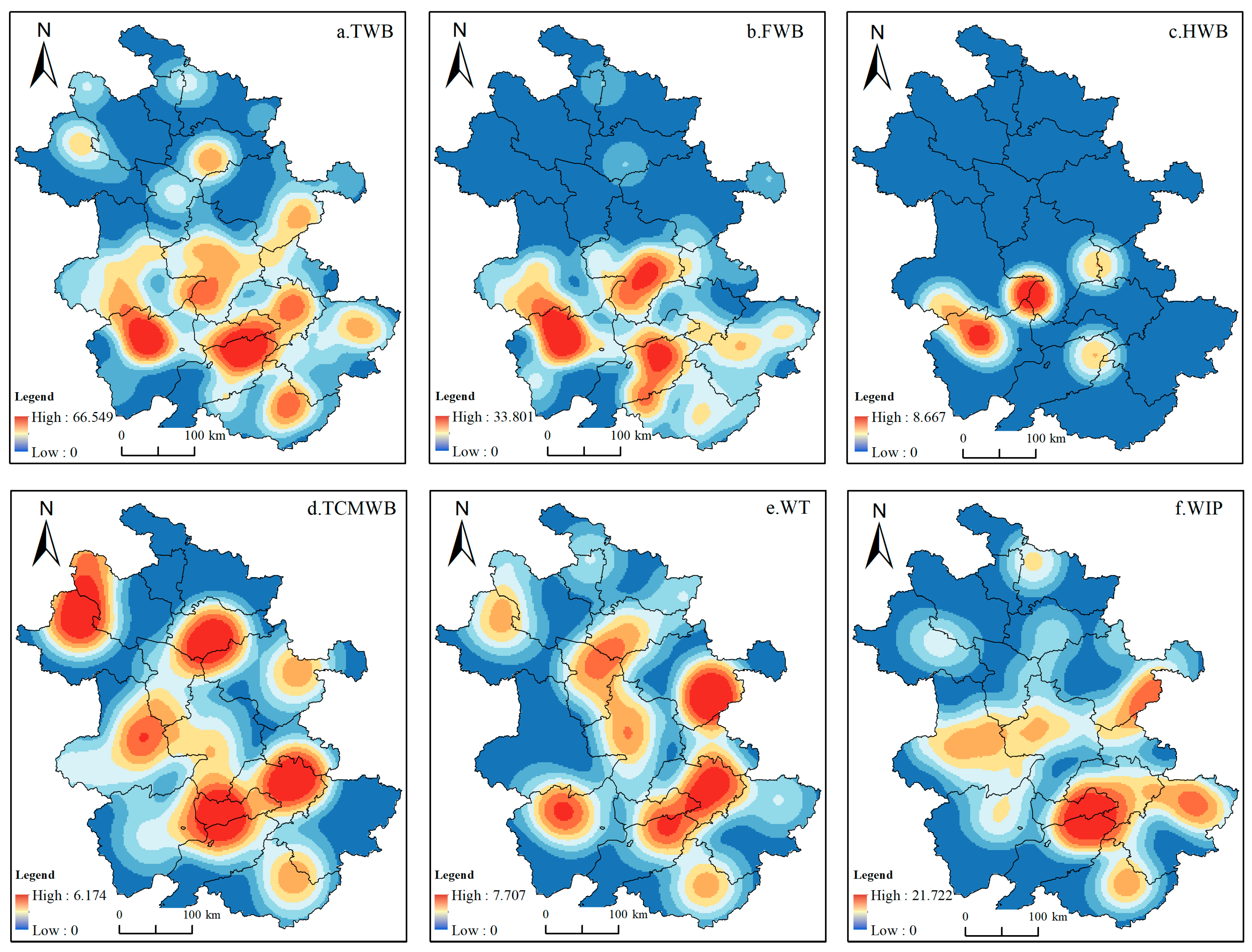
The topography of Anhui Province exhibits a step-like transition from plains in the north to hills and mountains in the south. Constrained by this physical geographical setting, the spatial distribution of wellness bases across the province demonstrates a significant imbalance. The results indicate that (Figure 2) the wellness bases in Anhui Province exhibit a pronounced uneven spatial distribution, forming a dual-core agglomeration pattern centered in Southern and Southwestern Anhui, with an overall spatial trend of higher in the south and lower in the north. Specifically, the density of bases in the Southern mountainous area and the Southwestern Dabie Mountain region is significantly higher than in other areas, constituting the primary high-density clusters at the provincial scale. In contrast, distributions in Central and Eastern Anhui are relatively concentrated but with secondary density levels, while the Northern Anhui Plain shows a sparse and scattered distribution with the lowest overall density.
Regarding specific types, distinct spatial differentiation patterns are observed. FWB are primarily concentrated in the Dabie Mountains of Southwestern Anhui and the mountains of Southern Anhui, exhibiting a belt-like agglomeration along mountain ranges. HWB forms prominent clusters in Central and Southwestern Anhui, showing high spatial consistency with regions rich in hot spring resources. TCMWB are mostly located at or near urban nodes, characterized by a multi-core, point-like distribution. WT are mainly laid out along the landscape tourism belt of Southeastern Anhui, showing a serial distribution along transportation corridors. WIP are concentrated around the Eastern Anhui city circle and the Central Anhui metropolitan area, exhibiting a spatial pattern of clustering reliant on urban agglomerations.

3.1.2. Significance Analysis of Visitor Sentiment Differences Across Wellness Base Types

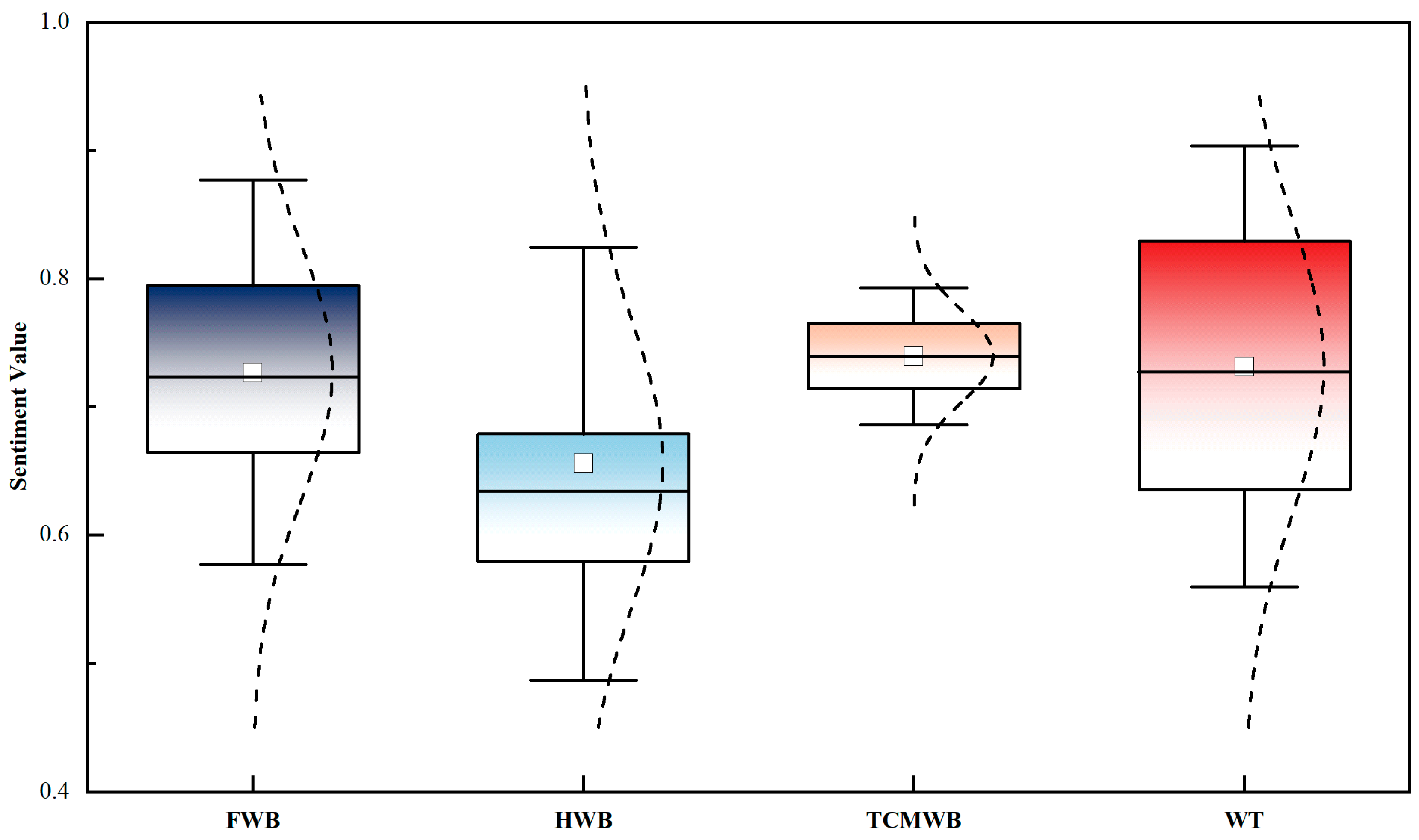
Based on the descriptive statistical results, the mean visitor sentiment values for all types of wellness bases are generally at a high level (Figure 3). Specifically, TCMWB and WT exhibit relatively higher mean values, followed by FWB, while HWB shows a lower mean value but with greater internal variance. Overall, there are certain differences in the mean and degree of dispersion of sentiment values across the various base types.
To further verify whether these differences are statistically significant, the Kruskal–Wallis non-parametric test was employed. The results indicate that the differences in visitor sentiment across different types of wellness bases are not statistically significant (H = 2.368, p = 0.499). This suggests that, at an aggregate level, visitor sentiment perceptions toward various types of wellness bases are relatively consistent and do not exhibit significant variation.

3.2. Temporal Variations in Visitor Sentiment and Review Volume Across Different Types of Wellness Bases

3.2.1. Seasonal Difference Analysis

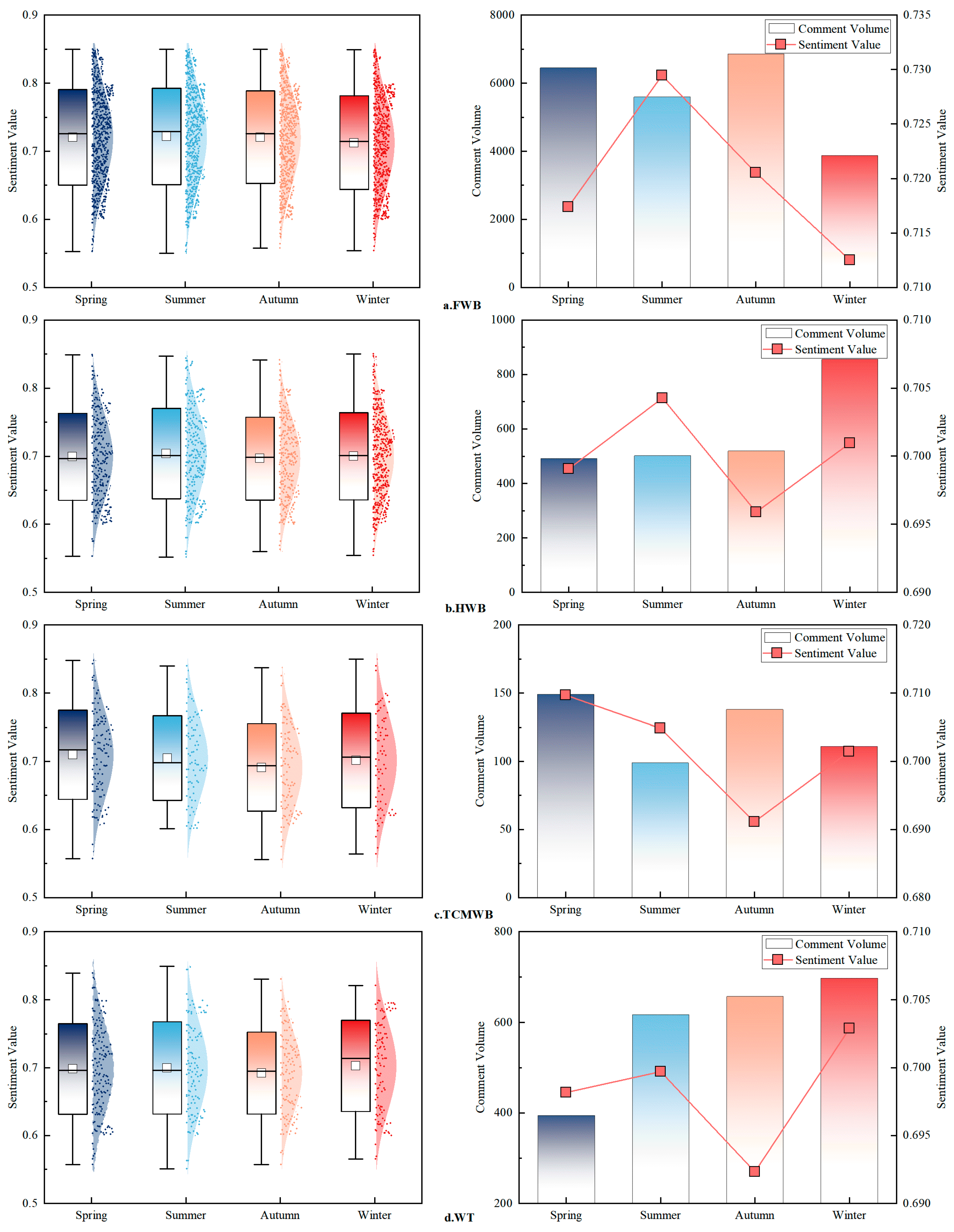
To explore the seasonal variations in visitor sentiment across different types of wellness bases, a statistical analysis was conducted on the review volume and sentiment values for the four types of bases across spring, summer, autumn, and winter (Figure 4). Overall, the visitor sentiment values for wellness bases in Anhui Province show minimal variation across the four seasons, remaining at a consistently high level, with summer slightly exceeding other seasons.
Regarding seasonal trends, the sentiment values for FWB are highest in summer and relatively lower in winter, reflecting a pattern that aligns with changes in climate comfort. Sentiment values for HWB remain relatively stable throughout the year, peaking slightly in summer. TCMWB performs better in spring, while experiencing a slight decline in autumn. For WT, sentiment value fluctuations are minimal, with winter being slightly higher than other seasons. In terms of review volume, FWB maintains the highest level across all seasons, with the most activity in autumn. HWB follows, with a larger volume of reviews in autumn and winter. The review volumes for TCMWB and WT are relatively low, characterized by an overall pattern of activity in spring and autumn and relative stability in winter.

3.2.2. Monthly Variation Analysis

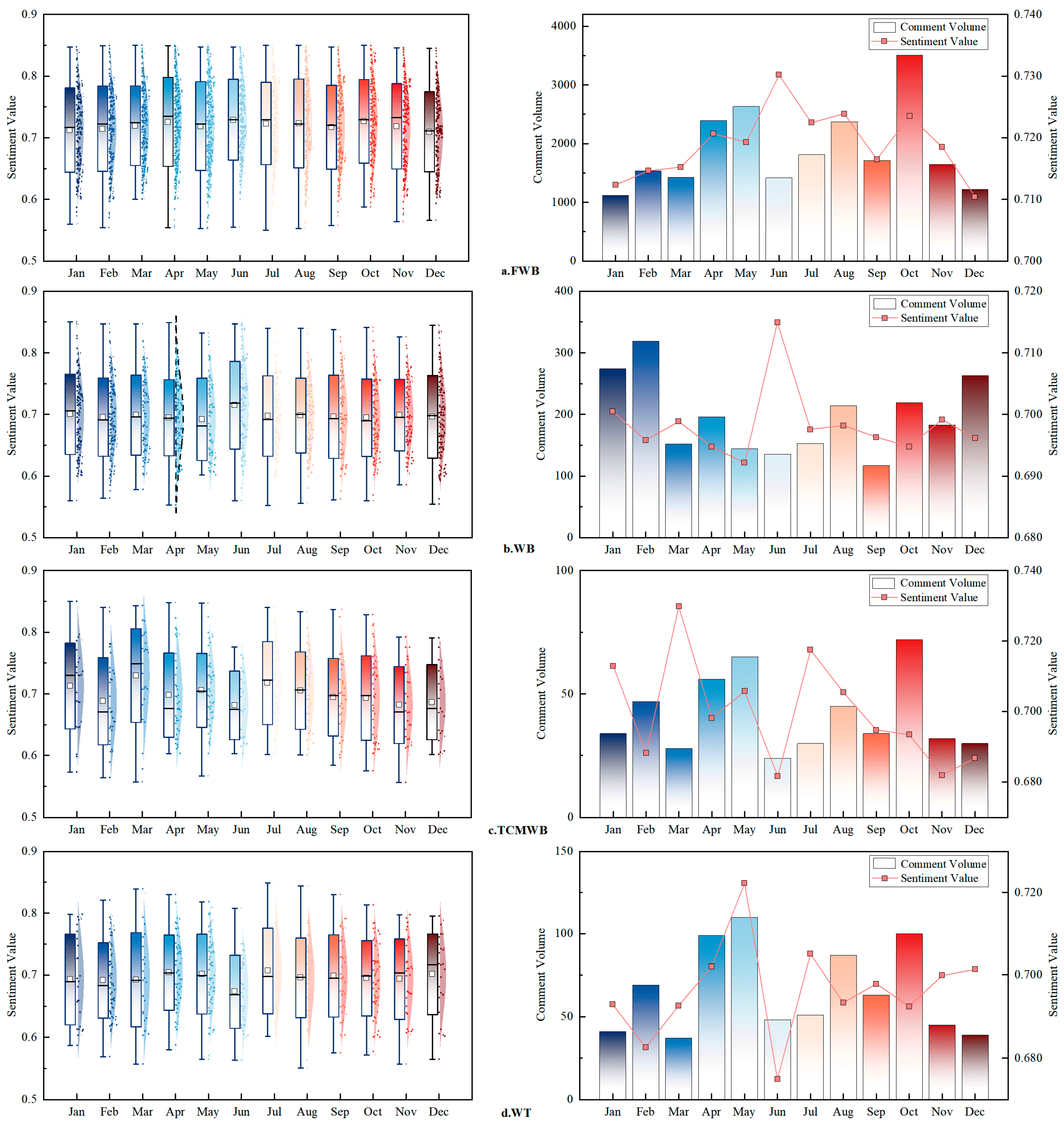
From the perspective of monthly trends (Figure 5), sentiment values for FWB are relatively higher during spring and summer, with a slight decrease in winter, exhibiting fluctuations that align with changes in climate comfort. Its review volume shows distinct seasonal concentration throughout the year, with particularly high activity in autumn. For HWB, differences in sentiment values across months are not significant, with only a slight increase in summer, indicating that the visitor experience is less affected by timing and maintains a stable perceptual level year-round.
Sentiment values for TCMWB exhibit significant fluctuations during the first half of the year, peaking in spring and decreasing slightly in summer before stabilizing in autumn and winter; this reflects that its experiential activities are jointly influenced by climate conditions and visitor demographics. WT shows generally stable sentiment values, with a slight improvement from late spring to early summer and steady levels in winter. In terms of review volume, all base types are more active during spring and autumn, followed by summer, with relatively fewer reviews in winter.

3.2.3. Analysis of Weekday and Weekend Differences

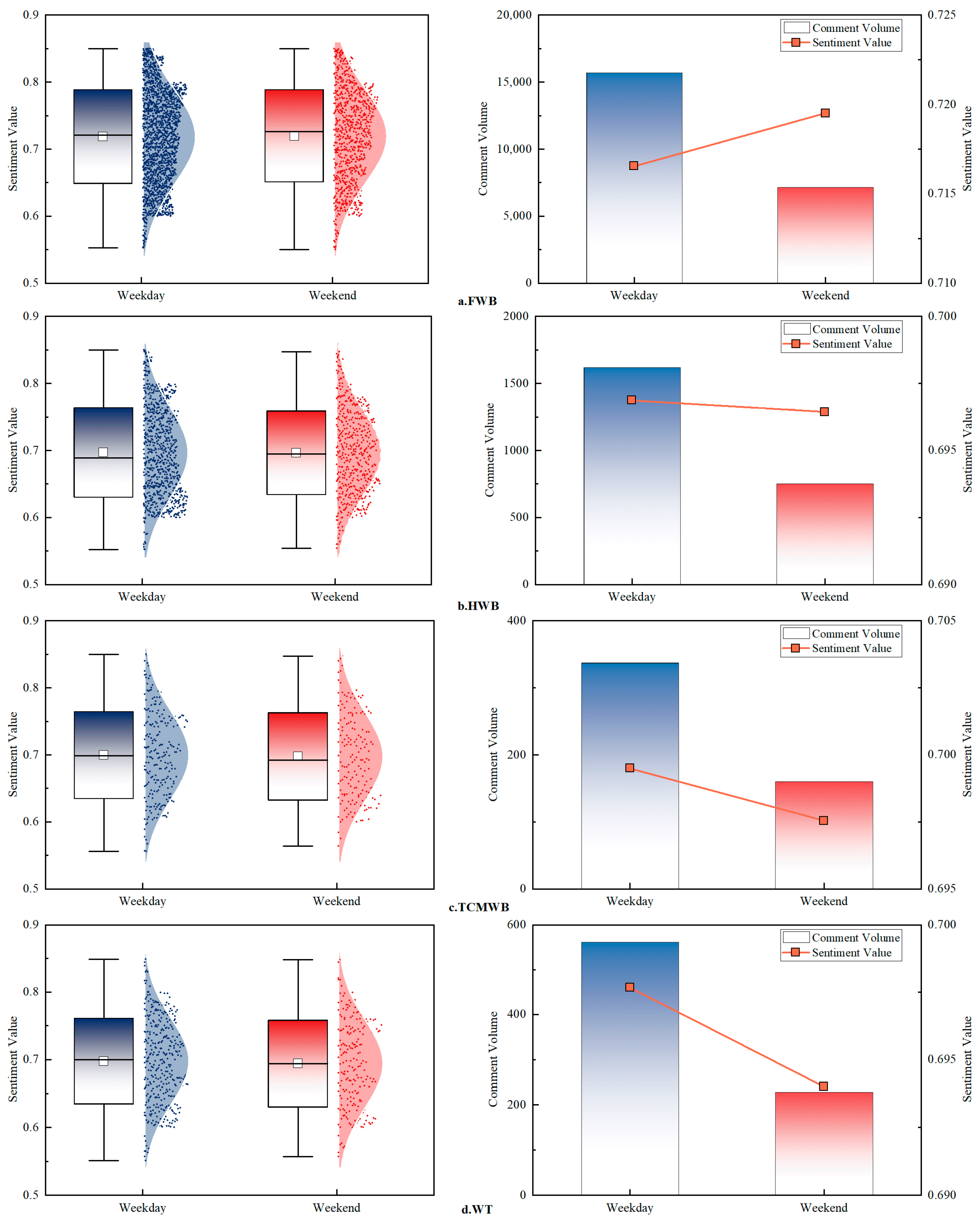
To investigate the patterns of sentiment variation across different time types, a statistical analysis was conducted on the review volume and sentiment values of the four types of wellness bases during weekdays and weekends (Figure 6). Overall, the differences in visitor sentiment across these two time periods for wellness bases in Anhui Province are minimal, with both maintaining a high level. This indicates a generally positive visitor experience and suggests that wellness resources possess strong appeal regardless of the timing of the visit.
Regarding sentiment trends, FWB exhibits slightly higher sentiment levels on weekends, while HWB shows no significant difference between weekdays and weekends. In contrast, TCMWB and WT show slightly higher sentiment values during weekdays. In terms of review volume, FWB significantly exceeds other types, with volume on weekdays being much higher than on weekends. HWB follows in volume, while TCMWB and WT have relatively fewer reviews.

3.3. Analysis of Factors Influencing Visitor Sentiment

3.3.1. Characteristics of Influencing Factors for All Types of Wellness Bases

To identify the primary factors influencing visitor sentiment across all types of wellness bases, this study constructed OLS and LASSO regression models to systematically analyze multi-dimensional attributes and reveal their impact pathways on emotional perception (Table 4). The results indicate that, among all variables, green coverage and average accommodation price exhibit the most stable and significant statistical correlations. In the OLS regression, the R2 value is 0.649, suggesting that approximately 64.9% of the variation in sentiment values can be explained by various environmental and facility variables, indicating an ideal overall model fit. Regarding specific independent variables, green coverage exerts a significant positive influence on visitor sentiment (p < 0.001), while average accommodation price shows a significant negative influence (p < 0.01). Catering facility density is marginally significant at the 10% level (p = 0.076). Although other variables did not pass the significance tests, the directions of their regression coefficients still offer a certain statistical reference value.
Considering potential multicollinearity among some variables, this study further employed LASSO regression for robust variable selection. After determining the optimal λ through cross-validation, the coefficients for eight variables—green coverage, negative oxygen ion concentration, noise level, catering facility density, distance to city center, distance to high-speed railway station, average accommodation price, and average ticket price—remained non-zero, demonstrating their stable explanatory power regarding visitor sentiment. In contrast, the coefficients for base area, accommodation bed density, and attraction density were shrunk to zero, indicating their relatively limited ability to explain sentiment values once other variables are controlled.

3.3.2. Characteristics of Influencing Factors for FWB

To identify the attribute variables significantly associated with visitor sentiment in FWB, this study employed Spearman’s rank correlation analysis (Table 5). The results demonstrate that visitor sentiment is primarily significantly correlated with ecological environment quality and certain supporting service indicators. Specifically, green coverage exhibits a significant positive correlation with visitor sentiment (p = 0.043), and negative oxygen ion concentration likewise shows a significant positive correlation (p = 0.042). Additionally, the correlation between catering facility density and visitor sentiment also reached a level of significance (p = 0.026). Other variables did not pass the significance tests, suggesting that in the sample of forest-type wellness bases, the statistical association between these factors and visitor emotional perception is relatively weak.

3.3.3. Characteristics of Influencing Factors for HWB, TCMWB, and WT

To identify the primary structural characteristics of the multi-dimensional attribute indicators for HWB, TCMWB, and WT, this study employed Principal Component Analysis (PCA) for dimensionality reduction. The results indicate that PC1 exhibits high loadings on infrastructure-related indicators. According to the PCA results (Table 6), the variance contribution rates of the first three principal components are 34.40%, 22.73%, and 17.27%, respectively, with a cumulative variance contribution rate of 74.40%. These components effectively reflect the overall structural characteristics of the multi-dimensional influencing factors for these three types of wellness bases; therefore, PC1–PC3 were selected for further analysis.
From the variable loading matrix (Table 7), the first principal component (PC1) shows high positive loadings on catering facility density (0.494), attraction density (0.473), and accommodation bed density (0.423), while exhibiting negative loadings for green coverage (−0.419) and base area (−0.181). This indicates that PC1 primarily reflects structural characteristics centered on service supply and functional agglomeration, and can be regarded as the Facility-Service Orientation Factor.
The second principal component (PC2) exhibits high loadings on average ticket price (0.551), average accommodation price (0.374), as well as distance to city center (0.318) and distance to high-speed railway station (0.312). This reflects the integrated influence of price levels and locational accessibility, and can be summarized as the Location-Price Factor.
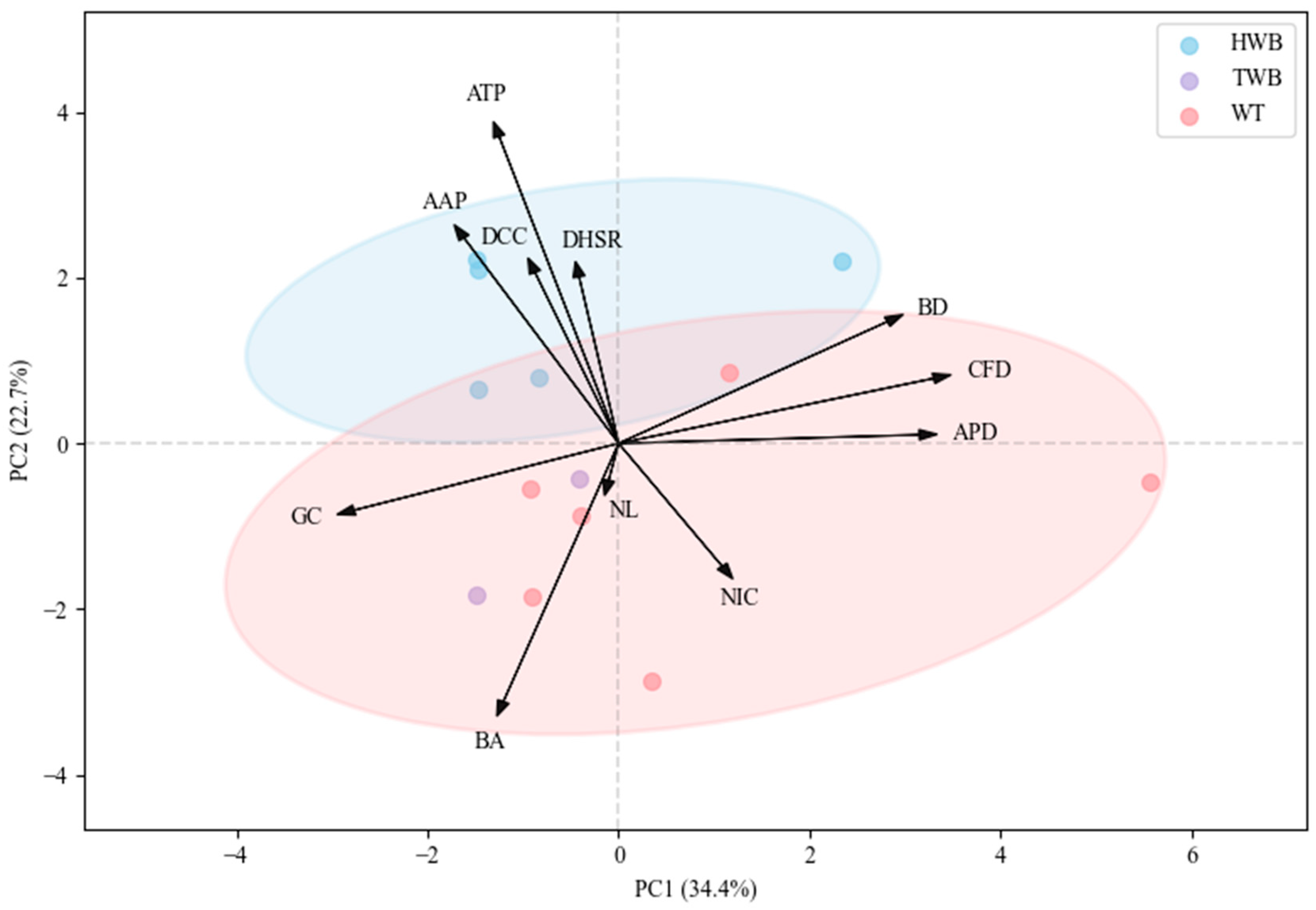
The third principal component (PC3) is primarily composed of negative oxygen ion concentration (0.551) and locational distance variables, reflecting differences in ecological environment quality and relative locational conditions. Its explanatory power is relatively weaker, and it can be viewed as the Ecological Environment Factor. To further visualize the distribution of variables across these primary structural dimensions, a biplot (Figure 7) was generated using PC1 and PC2, which possess the highest explanatory power.

4. Discussion

4.1. Spatial Distribution Characteristics and Formation Mechanisms of Wellness Bases in Anhui Province

The spatial pattern of high in the south, low in the north; dual-core agglomeration observed in Anhui Province’s wellness bases is primarily driven by natural resource endowments and ecological security frameworks. In the mountainous regions of Western Anhui (Dabie Mountains) and Southern Anhui, the distinct topographic relief, high forest coverage, and superior ecosystem integrity provide high environmental comfort. These areas benefit from a synergistic overlay of resources, such as hot springs and water bodies, granting them an inherent advantage in developing FWB and HWB. In contrast, the Huaibei Plain possesses a relatively homogeneous ecological base and limited environmental carrying capacity, leading to its subordinate position in the overall spatial distribution. This underscores that in wellness tourism, natural ecological conditions not only dictate the initial site selection but also define the spatial clustering and development ceiling over a long-term scale [39].
Urbanization levels and public service provision also play critical roles in shaping spatial distribution. TCMWBs and WIPs rely more heavily on the concentration of medical resources, transportation accessibility, and population support; thus, they are predominantly situated near urban nodes or within metropolitan peripheries. For instance, Bozhou, one of China’s four great Medicine Capitals, boasts over 2000 years of TCM history. The city’s heritage is epitomized by the renowned physician Hua Tuo (approx. 1800 years ago during the Eastern Han Dynasty). Leveraging this profound cultural foundation and well-established medical resources, TCMWBs and WIPs exhibit a distinct concentration in and around Bozhou. Meanwhile, WTs typically relies on integrated cultural-tourism complexes and mature destinations, reflecting a layout driven by resource integration and industrial fusion. Conversely, regions with weak public service infrastructure remain limited in clustering, even if they possess an ecological basis [40]. This indicates that the spatial layout of wellness bases is transitioning from being resource-endowment dominated to being driven by the synergy of resource-service-industry systems.
From a regional planning perspective, the spatial asymmetry between southern and northern Anhui suggests the need for differentiated development strategies. Resource-rich mountainous areas in southern Anhui and the Dabie Mountains should prioritize ecological protection and the development of high-quality forest and hydrological wellness tourism, ensuring that tourism development remains compatible with environmental carrying capacity. In contrast, regions in the Huaibei Plain, where ecological resources are relatively limited, may focus on the development of Traditional Chinese Medicine wellness bases and integrated health service industries by leveraging medical resources, cultural heritage, and urban infrastructure. Such differentiated development strategies could help balance regional disparities while maximizing the comparative advantages of different areas. Additionally, a recent study conducted in a wellness tourism destination in the Algarve region of Portugal collected UGC data and applied sentiment analysis to examine tourists’ perceptions [14]. The results show that overall sentiment was strongly positive for key wellness elements such as spa services and natural environment, revealing visitor preferences and experience patterns. These findings suggest that similar analytical frameworks could be applied in other regions with emerging wellness tourism industries, provided that comparable UGC data are available. These results show that overall sentiment was strongly positive for key wellness elements such as spa services and the natural environment, revealing visitor preferences and experience patterns. These findings suggest that similar analytical frameworks could be applied in other regions with emerging wellness tourism industries, provided that comparable UGC data are available.

4.2. Temporal Characteristics and Influencing Factors of Visitor Sentiment and Comment Volume

Integrating the distribution of visitor comment volume and sentiment values across different seasons, wellness bases in Anhui Province generally exhibit high visitor sentiment with minimal seasonal variation. The overall positive experience indicates the continuous appeal of wellness resources. From the perspective of evolutionary trends, visitor sentiment follows a pattern of rising in spring and summer, stabilizing in autumn, and declining in winter, with the highest sentiment recorded in summer, followed by spring, a slight dip in autumn, and the lowest in winter. Existing research suggests that during peak seasons, visitors express higher sentiment regarding natural environment, activities, and service facilities [41]. Furthermore, studies have found a positive correlation between perceptions of comfortable weather and holiday travel sentiment [42], alongside the ability of diverse activities and facilities to significantly enhance emotional experiences [43]. In this study, while high summer sentiment is partially influenced by climatic comfort, the core driver stems from the resource endowments and functional attributes of the bases. For FWBs, the summer peak is driven by their significant cooling and restorative functions. For instance, the Tiantangzhai FWB in the Dabie Mountains features a typical mountain climate with average summer temperatures around 22 °C, significantly lower than the perceived high temperatures (often exceeding 30 °C) in most cities across the province. The cooling micro-climate provided by high green coverage and high negative oxygen ion concentrations creates an ideal environment for heat relief and relaxation, making it a preferred summer destination. This is reflected in UGC (User Generated Content), where keywords such as “cool,” “summer retreat,” and “fresh mountain air” appear frequently. Research on forests in Austria, Belgium, and Germany similarly demonstrates that forest structures with high stand density and canopy cover significantly reduce perceived temperatures and improve psychological comfort, explaining the emotional advantage of FWB in summer [44].
In terms of comment volume, the overall trend reflects spring and autumn peaks, a slight decline in summer, and a winter trough. The surges in spring and autumn are primarily driven by long holidays such as Labor Day and National Day, during which travel and UGC generation are most active. The winter trough is likely due to reduced travel during the Spring Festival and cold weather [45]. Notably, the comment volume for HWBs actually rises in winter, highlighting the unique appeal of hot spring resources for thermal healing during cold months. Similar to European destinations like Baden-Baden or Japanese sites like Kusatsu and Hakone, hot spring bathing is widely recognized as a method for mitigating cold and promoting physical-mental comfort, consistent with empirical studies on the psychological benefits of thermal baths [46]. Conversely, FWBs see a sharp decline in winter comments, illustrating the differentiated seasonal attraction of various resources. Furthermore, variations in sentiment and volume are closely tied to activity characteristics [47]. For WTs, volume is influenced by local cultural events; this study found that some WTs host regular or irregular folk festivals, lantern shows, and Da Tie Hua (Iron Flower) performances. These experiential and ornamental cultural projects significantly boost visitor engagement and emotional expression during specific periods, a result consistent with findings from Hong Kong that indicate cultural festivals significantly enhance visitor satisfaction and comment volume [48]. In contrast, TCMWBs and WIPs offer relatively static activities centered on doctor culture displays, medicinal education, and historical sightseeing, resulting in smaller fluctuations and more stable performance.
On a weekly time scale, the sentiment values and comment volumes of various wellness bases also exhibit distinct rhythmic variations. For FWBs, the comment volume rises significantly on weekends, reflecting functional characteristics dominated by leisure travel and natural experiences that align with the rhythms of holiday outings; however, their sentiment values are slightly higher mid-week, indicating that visitors traveling on workdays—driven by purposes of seclusion and relaxation—benefit from a quieter and more comfortable environment. For HWBs, sentiment remains stable throughout the week, but the weekend comment volume grows substantially, demonstrating the strong appeal of short-distance thermal and therapeutic activities during rest days, with a service model that fits the weekend-oriented wellness consumption rhythm. Sentiments for TCMWBs, WIPs, and WTs remain generally stable during the week, with a slight increase on weekends, suggesting that visitors’ sense of relaxation and experience is somewhat enhanced on rest days, maintaining an overall positive wellness state. In general, visitor comments for FWBs and HWBs are concentrated on weekends, while those for TCMWBs, WIPs, and WTs are distributed more evenly throughout the week.
Notably, the disparities in comment volume among different types of wellness bases also reflect an imbalance between Resource Supply and Market Perception. Although TCMWBs, WIPs, and WTs account for a large proportion of the total number of bases, the number of bases that successfully attract high levels of visitor attention and comments remains relatively limited. This indicates shortcomings in brand visibility and market communication, where visitor recognition and participation have not yet matched the overall scale of resources. In contrast, HWBs are fewer in number, but attract widespread attention due to the unique experiential nature and high shareability of hot spring resources, resulting in comment volumes significantly higher than other types. FWBs possesses advantages in both quantity and popularity, leveraging their natural ecological core to establish stable brand identities and word-of-mouth propagation. Consequently, the wellness tourism landscape in Anhui Province is characterized by a structural pattern of FWBs and HWBs being concentrated and strong, while TCMWBs, WIPs, and WTs have latent potential. Future efforts should focus on strengthening the characteristic branding, product experiences, and marketing communications for TCMWBs, WIPs, and WTs to promote coordinated development and market equilibrium across different wellness sectors.

4.3. Driving Factors Influencing Disparities in Visitor Sentiment

From the perspective of the visitor perception formation mechanism, the emotional experience in wellness tourism is not linearly determined by a single environmental or service element but is the result of the synergy between the natural environment, service supply, and economic costs within specific contexts. Existing studies on wellness and nature-based tourism generally point out that visitors’ emotional evaluations of a destination often stem from a comprehensive perception of multi-dimensional factors rather than the independent effect of a single indicator [49]. The results of this study broadly support the theoretical framework of the environment-facilities-price triad collaboratively influencing visitor experience. Regarding specific mechanisms, natural environmental factors play a foundational role in the wellness tourism context. Research has confirmed that contact with nature can positively impact visitors’ emotional states by alleviating psychological stress, enhancing environmental satisfaction, and increasing perceived restoration [50]. Compared to general sightseeing tourism, the travel motivation of wellness tourists emphasizes physical-mental adjustment and environmental experience; thus, their emotional perception is more sensitive to changes in ecological environment quality [51].
It should be noted that the formation mechanisms of visitor emotional perception are not entirely identical across different types of wellness bases. FWBs relies on the natural environment as its core attraction, where the visitor experience is highly dependent on the direct perception of the ecological environment, making natural elements more fundamental and dominant in sentiment formation. In contrast, HWBs, TCMWBs, and WTs exhibit characteristics of multi-factor synergy, where visitor emotional experiences are influenced not only by the natural environment but also by the collective regulation of service supply, locational conditions, and price levels. This disparity does not imply that a certain category of factors becomes invalid across different types; rather, it reflects the significant context-dependency of wellness tourism emotional perception. For instance, when the travel purpose is primarily ecological therapy and outdoor experience, the importance of the natural environment is easily amplified. In more integrated wellness scenarios, visitors tend to perform a holistic trade-off between environment, facilities, and costs.
Furthermore, the price factor reflects significant characteristics of psychological expectation and value assessment in visitors’ emotional perception. Tourism research generally posits that price is not merely a cost variable but an important reference for visitors to measure whether the experience is value for money. When visitors perceive their consumption as worth it, their satisfaction and emotional evaluations are higher [52]. Meanwhile, the varying performance of certain ecological indicators across different models likely reflects that their influence is context-dependent rather than the effect itself being unimportant. Existing research indicates that visitors’ perception of and behavioral feedback toward ecological value are regulated by various factors, such as travel context, experience type, and perceived value structure. Therefore, the impact of ecological elements on emotional experiences will manifest to varying degrees across different travel contexts and modes of experience [53].

4.4. Management Implications and Future Research

Based on the analysis of spatial patterns, visitor sentiment disparities, and driving factors, wellness bases in Anhui Province exhibit significant differences in their sentiment formation mechanisms. This suggests a need for type-based management and differentiated guidance strategies in practice. For FWBs, where sentiment is primarily driven by natural ecological elements, indicators such as green coverage and negative air ion concentration significantly promote positive emotions. This confirms that the forest ecosystem is the core foundation of the wellness experience. This observation is supported by Spearman correlation results, where green coverage (p = 0.043) and negative air ion concentration (p = 0.042) are significantly positively correlated with visitor sentiment. Consequently, planning and management should prioritize ecological conservation, reasonably control development intensity, and enhance visitors’ immersion in nature.
In contrast, for HWBs, TCMWBs, WIPs, and WTs, visitor experiences are more comprehensively influenced by functional supply and service quality. Infrastructure conditions, service experiences, and price perceptions show stronger explanatory power in these types, indicating a shared emotional driving mechanism. This observation is supported by PCA results, where the first three components explain 74.4% of the variance: PC1 (34.4%) reflects service and facility orientation, PC2 (22.7%) reflects location and price, and PC3 (17.3%) reflects ecological environment. Management for these bases should focus on improving service systems and experience quality while establishing differentiated positioning—such as thermal therapy, TCM health cultivation, or cultural experiences—based on specific resource characteristics to avoid homogenized development. On a holistic level, high prices, unstable service quality, and aging facilities tend to trigger negative emotions. This suggests that operators must focus on the rationality of price structures and the stability of service quality. Additionally, aligning product supply with seasonal fluctuations in visitor sentiment can help better match emotional demands.
This study characterizes visitor sentiment and its influencing factors using UGC data. However, it is important to note that UGC data primarily reflect the perceptions of visitors who actively share their experiences, a group largely composed of young and middle-aged demographics. In addition, UGC data may be subject to self-selection bias, as visitors with extremely positive or negative experiences are more likely to post reviews, whereas those with neutral experiences tend to share their opinions less frequently. Consequently, the emotions reflected in online reviews may not fully represent the overall perceptions of the broader visitor population [54]. This limits the generalizability of the findings to some extent. Furthermore, the limited number of highly active samples for HWBs, TCMWBs, WIPs, and WTs means the analysis reflects their common characteristics rather than detailed comparisons between sub-types.
Future research could further integrate multi-source data to broaden the analytical perspective. For example, combining field observations, questionnaires, and interviews [55] with an environmental psychology lens [56] would provide a deeper understanding. Additionally, leveraging mobile device data and Public Participation Geographic Information Systems (PPGISs) [57] could help characterize the multidimensional relationship between visitor sentiment and the wellness environment from more granular perspectives, thereby enhancing the robustness and depth of the research findings. Beyond expanding data sources, future studies could also explore potential interaction effects among influencing factors and quantitatively evaluate the relative importance of different variables, which would help reveal more complex mechanisms underlying visitor sentiment.

5. Conclusions

UGC data effectively reflects visitors’ subjective perceptions of wellness environments and service experiences, providing a low-cost and scalable research path for characterizing emotional features in wellness tourism. This study, based on UGC data, systematically analyzed the spatial distribution patterns, temporal evolution of visitor sentiment, and their influencing factors for wellness bases in Anhui Province.
At the spatial level, wellness bases in Anhui Province exhibit a distribution pattern characterized by high in the south and low in the north with dual-core agglomeration. In the temporal dimension, visitor sentiment displays a relatively stable seasonal rhythm. Regarding influencing factors, landscape ecological quality and service experience are the core elements affecting emotional perception, with superior natural environments significantly promoting positive emotions. These findings provide empirical evidence for optimizing the spatial layout, resource allocation, and service enhancement of wellness bases, offering practical references for relevant planning and operational management.
From a planning and policy perspective, our findings, derived from UGC analysis of tourists’ emotional perceptions, highlight the need for differentiated regional development strategies in wellness tourism. In resource-rich mountainous areas, where UGC reveals that visitors place high value on natural and ecological features, development should prioritize ecological conservation and nature-based wellness tourism. In regions with limited ecological resources, where UGC indicates that visitor preferences focus more on wellness services and cultural experiences, strategies may emphasize Traditional Chinese Medicine wellness industries and culturally integrated offerings, depending on the availability of local resources. For destination managers, the results also suggest developing personalized wellness packages and optimizing service processes to improve operational efficiency and visitor satisfaction. These strategies should be adjusted according to seasonal fluctuations and differences between weekdays and weekends. In addition, planning and management should integrate sustainability considerations, public health guidance, and wellness promotion, ensuring that tourism development is aligned with environmental protection and the health and well-being of visitors. This could include initiatives such as health-oriented service standards, promotion of preventive and therapeutic wellness programs, and integration of local medical or cultural health resources, providing a holistic framework for sustainable and health-conscious wellness tourism.


Author Contributions

Conceptualization, H.W. and Z.K.; methodology, Z.K. and B.H.; software, Z.K.; validation, H.W., G.L. and K.G.; formal analysis, Z.K.; investigation, G.L. and Y.C.; resources, X.X. and H.W.; data curation, Z.K.; writing—original draft preparation, Z.K.; writing—review and editing, H.W. and B.H.; visualization, Z.K.; supervision, H.W. and X.X.; project administration, H.W.; funding acquisition, H.W. and Z.K. All authors have read and agreed to the published version of the manuscript.

Funding

This research was funded by the Natural Science Research Key Project of Universities in Anhui Province (grant number 2022AH050242); the Director’s Fund of the Anhui Institute of Territorial Spatial Planning and Ecological Research (grant number GTY2024ZR01); the Doctoral Startup Fund of Anhui Jianzhu University (grant number 2022QDZ13); and the Quality Engineering Project for New Era Education (Postgraduate Education) of Anhui Province (grant number 2024xscx119).

Institutional Review Board Statement

Not applicable.

Informed Consent Statement

Not applicable.

Data Availability Statement

The data presented in this study are available on request from the corresponding author.

Conflicts of Interest

Author Youwei Chu was employed by Jinzhai County Forestry Bureau. The remaining authors declare that this research was conducted in the absence of any commercial or financial relationships that could be construed as potential conflicts of interest.

References

  1. Piao, X.; Xie, J.; Managi, S. Continuous worsening of population emotional stress globally: Universality and variations. BMC Public Health 2024, 24, 3576. [Google Scholar] [CrossRef] [PubMed]
  2. Buckley, R. Nature tourism and mental health: Parks, happiness, and causation. J. Sustain. Tour. 2020, 28, 1409–1424. [Google Scholar] [CrossRef]
  3. Lee, J.; Kim, J.-J. A study on market segmentation according to wellness tourism motivation and differences in behavior between the groups—Focusing on satisfaction, behavioral intention, and flow. Int. J. Environ. Res. Public Health 2023, 20, 1063. [Google Scholar] [CrossRef] [PubMed]
  4. Majeed, S.; Ramkissoon, H. Health, wellness, and place attachment during and post health pandemics. Front. Psychol. 2020, 11, 573220. [Google Scholar] [CrossRef]
  5. Si, Y.; Chen, M.; Zhang, M.; Xiao, H. Therapeutic landscapes and tourists’ perceived quality of life. J. Destin. Mark. Manag. 2024, 33, 100918. [Google Scholar] [CrossRef]
  6. Lai, I.K.W.; Hitchcock, M.; Lu, D.; Liu, Y. The influence of word of mouth on tourism destination choice: Tourist–resident relationship and safety perception among mainland Chinese tourists visiting Macau. Sustainability 2018, 10, 2114. [Google Scholar] [CrossRef]
  7. Gössling, S.; Scott, D.; Hall, C.M. Pandemics, tourism and global change: A rapid assessment of COVID-19. J. Sustain. Tour. 2020, 29, 1–20. [Google Scholar] [CrossRef]
  8. Yang, L.; Li, X.; Hernández-Lara, A.B. Tourism and COVID-19 in China: Recovery and resilience strategies of main Chinese tourism cities. Int. J. Tour. Cities 2022, 10, 387–404. [Google Scholar] [CrossRef]
  9. Li, L.; Yang, W.; Liang, J. Analysis on spatio-temporal evolution and factor explanatory ability of attractiveness of health tourism in the Yangtze River Economic Belt based on theory of therapeutic landscape. Resour. Environ. Yangtze Basin 2024, 33, 758–772. (In Chinese). Available online: https://www.geores.com.cn/cjzylyyhj/CN/10.11870/cjlyzyyhj202404007 (accessed on 16 March 2026).
  10. Liu, L.; Zhou, Y.; Sun, X. The impact of the wellness tourism experience on tourist well-being: The mediating role of tourist satisfaction. Sustainability 2023, 15, 1872. [Google Scholar] [CrossRef]
  11. Godlewska, A.; Mazurek-Kusiak, A.; Soroka, A. Push and pull factors influencing the choice of a health resort by Polish treatment-seekers. BMC Public Health 2023, 23, 2192. [Google Scholar] [CrossRef] [PubMed]
  12. Lin, M.; Yu, S.; Wang, Y. Study on visitors’ crowding perception, adjustment mechanism and satisfaction in urban natural parks. J. Nat. Resour. 2023, 38, 1025–1039. (In Chinese) [Google Scholar] [CrossRef]
  13. Li, F.; Shang, Y.; Su, Q. The influence of immersion on tourists’ satisfaction via perceived attractiveness and happiness: Evidence from onsite questionnaire data. Tour. Rev. 2022, 78, 122–141. [Google Scholar] [CrossRef]
  14. George, O.A.; Ramos, C.M.Q. Sentiment analysis applied to tourism: Exploring tourist-generated content in the case of a wellness tourism destination. Int. J. Spa Wellness 2024, 7, 139–161. [Google Scholar] [CrossRef]
  15. Nawawi, I.; Ilmawan, K.F.; Maarif, M.R.; Syafrudin, M. Exploring tourist experience through online reviews using aspect-based sentiment analysis with zero-shot learning for hospitality service enhancement. Information 2024, 15, 499. [Google Scholar] [CrossRef]
  16. Aboalganam, K.M.; AlFraihat, S.F.; Tarabieh, S. The impact of user-generated content on tourist visit intentions: The mediating role of destination imagery. Adm. Sci. 2025, 15, 117. [Google Scholar] [CrossRef]
  17. Huai, S.; Van de Voorde, T. Which environmental features contribute to positive and negative perceptions of urban parks? A cross-cultural comparison using online reviews and natural language processing methods. Landsc. Urban Plan. 2022, 218, 104307. [Google Scholar] [CrossRef]
  18. Li, J.; Gao, J.; Zhang, Z.; Fu, J.; Shao, G.; Zhao, Z.; Yang, P. Insights into citizens’ experiences of cultural ecosystem services in urban green spaces based on social media analytics. Landsc. Urban Plan. 2024, 244, 104999. [Google Scholar] [CrossRef]
  19. Wei, D.; Liu, M.; Grekousis, G.; Wang, Y.; Lu, Y. User-generated content affects urban park use: Analysis of direct and moderating effects. Urban For. Urban Green. 2023, 90, 128158. [Google Scholar] [CrossRef]
  20. Wang, B.; Zhao, Q.; Zhang, Z.; Xu, P.; Tian, X.; Jin, P. Understanding the heterogeneity and dynamics of factors influencing tourist sentiment with online reviews. J. Theor. Appl. Electron. Commer. Res. 2025, 20, 22. [Google Scholar] [CrossRef]
  21. Zhang, S. Research on tourist destination image perception of Suqian City’s San Tai Shan Scenic Area based on Ctrip visitor reviews. Sustain. Dev. 2024, 14, 329. (In Chinese) [Google Scholar] [CrossRef]
  22. Wang, Z.; Huang, W.-J.; Liu-Lastres, B. Impact of user-generated travel posts on travel decisions: A comparative study on Weibo and Xiaohongshu. Ann. Tour. Res. Empir. Insights 2022, 3, 100064. [Google Scholar] [CrossRef]
  23. Dini, M.; Pencarelli, T. Wellness tourism and the components of its offer system: A holistic perspective. Tour. Rev. 2021, 77, 394–412. [Google Scholar] [CrossRef]
  24. GB/T 18972—2017; Classification, Investigation and Evaluation of Tourism Resources. Standards Press of China: Beijing, China, 2017. (In Chinese)
  25. He, M.; Du, J. Report on the Development of China’s Health and Wellness Industry (2017); Social Sciences Academic Press: Beijing, China, 2017. (In Chinese) [Google Scholar]
  26. Wang, Z.; Shi, W.; Su, C. Study on the spatial distribution characteristics and influencing factors of health and wellness tourism destinations in China. Econ. Geogr. 2020, 40, 196–207. (In Chinese) [Google Scholar] [CrossRef]
  27. Zhao, S.; Kong, Y.; Yang, Y.; Li, J. The influencing mechanism of scenic spot online attention and tourists’ purchase behavior: An AISAS model based investigation. Front. Psychol. 2024, 15, 1386350. [Google Scholar] [CrossRef]
  28. Wang, J.; Xia, Y.; Wu, Y. Sensing tourist distributions and their sentiment variations using social media: Evidence from 5A scenic areas in China. ISPRS Int. J. Geo-Inf. 2022, 11, 492. [Google Scholar] [CrossRef]
  29. Tao, J.; Wei, H.; Wang, Q.; Jin, X. Exploring the coupling dynamics between accessibility of tourist attractions and tourism demand in Anhui province. PLoS ONE 2025, 20, e0331577. [Google Scholar] [CrossRef]
  30. Silverman, B.W. Density Estimation for Statistics and Data Analysis; Routledge: New York, NY, USA, 2018. [Google Scholar]
  31. Jin, S. Research on sentiment analysis of tourism review in the West Lake scenic area. Sci. Technol. Eng. Chem. Environ. Prot. 2023, 1, 62. (In Chinese) [Google Scholar] [CrossRef]
  32. Fu, W.; Zhou, B. Theme exploration and sentiment analysis of online reviews of Wuyishan National Park. Land 2024, 13, 629. [Google Scholar] [CrossRef]
  33. Kong, L.; Liu, Z.; Pan, X.; Wang, Y.; Guo, X.; Wu, J. How do different types and landscape attributes of urban parks affect visitors’ positive emotions? Landsc. Urban Plan. 2022, 226, 104482. [Google Scholar] [CrossRef]
  34. Zhu, X.; Gao, M.; Zhang, R.; Zhang, B. Quantifying emotional differences in urban green spaces extracted from photos on social networking sites: A study of 34 parks in three cities in northern China. Urban For. Urban Green. 2021, 62, 127133. [Google Scholar] [CrossRef]
  35. Sia, A.; Tan, P.Y.; Wong, J.C.M.; Araib, S.; Ang, W.F.; Er, K.B.H. The impact of gardening on mental resilience in times of stress: A case study during the COVID-19 pandemic in Singapore. Urban For. Urban Green. 2022, 68, 127448. [Google Scholar] [CrossRef] [PubMed]
  36. Tetzlaff, L.; Rulle, K.; Szepannek, G.; Gronau, W. A customer feedback sentiment dictionary: Towards automatic assessment of online reviews. Eur. J. Tour. Res. 2019, 23, 28–39. [Google Scholar] [CrossRef]
  37. Li, J.; Fu, J.; Gao, J.; Zhou, R.; Zhao, Z.; Yang, P.; Yi, Y. How do urban green space attributes affect visitation and satisfaction? An empirical study based on multisource data. Cities 2025, 156, 105543. [Google Scholar] [CrossRef]
  38. Denicolai, S.; Cioccarelli, G.; Zucchella, A. Resource-based local development and networked core-competencies for tourism excellence. Tour. Manag. 2010, 31, 260–266. [Google Scholar] [CrossRef]
  39. Yan, N.; Zhang, J.; Xia, B.; Li, S.; Yang, W. How can the natural background and ecological & environment promote the green and sustainable development of Chinese tourist attractions? Ecol. Indic. 2024, 169, 112813. [Google Scholar] [CrossRef]
  40. Iamtrakul, P.; Chayphong, S.; Gao, W. Assessing spatial disparities and urban facility accessibility in promoting health and well-being. Transp. Res. Interdiscip. Perspect. 2024, 25, 101126. [Google Scholar] [CrossRef]
  41. Geng, D.C.; Innes, J.L.; Wu, W.; Wang, W.; Wang, G. Seasonal variation in visitor satisfaction and its management implications in Banff National Park. Sustainability 2021, 13, 1681. [Google Scholar] [CrossRef]
  42. Jeuring, J.H.G. Weather perceptions, holiday satisfaction and perceived attractiveness of domestic vacationing in the Netherlands. Tour. Manag. 2017, 61, 70–81. [Google Scholar] [CrossRef]
  43. Truong, T.-H.; Foster, D. Using HOLSAT to evaluate tourist satisfaction at destinations: The case of Australian holidaymakers in Vietnam. Tour. Manag. 2006, 27, 842–855. [Google Scholar] [CrossRef]
  44. Gillerot, L.; Rozario, K.; de Frenne, P.; Oh, R.; Ponette, Q.; Bonn, A.; Chow, W.; Godbold, D.; Steinparzer, M.; Haluza, D.; et al. Forests are chill: The interplay between thermal comfort and mental wellbeing. Landsc. Urban Plan. 2024, 242, 104933. [Google Scholar] [CrossRef]
  45. Zhang, C.; Singh, A.J.; Yu, L. Does it matter? Examining the impact of China’s vacation policies on domestic tourism demand. J. Hosp. Tour. Res. 2016, 40, 527–556. [Google Scholar] [CrossRef]
  46. Wei, X.; Huang, S.; Yap, G.; Wu, X.; Taivan, A. The influence of national holiday structure on domestic tourism expenditure: Evidence from China. Tour. Econ. 2018, 24, 781–800. [Google Scholar] [CrossRef]
  47. Baquero, A. Expo2020 Dubai and tourism marketing: An online user-generated content analysis. J. Hosp. Tour. Issues 2024, 6, 130–148. [Google Scholar] [CrossRef]
  48. Richards, G.; King, B. The experience of cultural festivals: Evidence from Hong Kong. J. Policy Res. Tour. Leis. Events 2022, 14, 296–309. [Google Scholar] [CrossRef]
  49. Yang, Y.; Wang, Z.; Shen, H.; Jiang, N. The impact of emotional experience on tourists’ cultural identity and behavior in the cultural heritage tourism context: An empirical study on Dunhuang Mogao Grottoes. Sustainability 2023, 15, 8823. [Google Scholar] [CrossRef]
  50. Avecillas-Torres, I.; Herrera-Puente, S.; Galarza-Cordero, M.; Coello-Nieto, F.; Farfán-Pacheco, K.; Alvarado-Vanegas, B.; Ordóñez-Ordóñez, S.; Espinoza-Figueroa, F. Nature tourism and mental well-being: Insights from a controlled context on reducing depression, anxiety, and stress. Sustainability 2025, 17, 654. [Google Scholar] [CrossRef]
  51. Gan, T.; Zheng, J.; Li, W.; Li, J.; Shen, J. Health and wellness tourists’ motivation and behavior intention: The role of perceived value. Int. J. Environ. Res. Public Health 2023, 20, 4339. [Google Scholar] [CrossRef]
  52. Qian, J.; Li, X. Perceived value, place identity, and behavioral intention: An investigation on the influence mechanism of sustainable development in rural tourism. Sustainability 2024, 16, 1583. [Google Scholar] [CrossRef]
  53. Sahabuddin, M.; Alam, M.S.; Nekmahmud, M. How do perceived and environmental values influence tourist satisfaction, loyalty, and environmental awareness? Environ. Dev. Sustain. 2026, 28, 7817–7840. [Google Scholar] [CrossRef]
  54. Zhang, X.; Li, Y.; Gretzel, U. Selection biases in crowdsourced big data applied to tourism research: An interpretive framework. Tour. Manag. 2024, 102, 104874. [Google Scholar] [CrossRef]
  55. Kim, J.Y.; Kubo, T.; Nishihiro, J. Mobile phone data reveals spatiotemporal recreational patterns in conservation areas during the COVID pandemic. Sci. Rep. 2023, 13, 20282. [Google Scholar] [CrossRef]
  56. Zhou, B.; Wang, L.; Huang, S.; Xiong, Q. Impact of perceived environmental restorativeness on tourists’ pro-environmental behavior: Examining the mediation of place attachment and the moderation of ecocentrism. J. Hosp. Tour. Manag. 2023, 56, 398–409. [Google Scholar] [CrossRef]
  57. Gheitasi, M.; Salari, N.; Clark, C. Screening the use of public participation geographic information systems (PPGISs) in the tourism industry: A scoping review. Tour. Hosp. 2024, 5, 1260–1273. [Google Scholar] [CrossRef]
Figure 1. Location of Anhui Province and spatial distribution of wellness bases. Notes: In the legend, FWB denotes Forest Wellness Bases, HWB denotes Hydrological Wellness Bases, TCMWB denotes Traditional Chinese Medicine Wellness Bases, WT denotes Wellness Towns, and WIP denotes Wellness Industrial Parks.
Sustainability 18 03037 g001
Figure 2. Kernel density estimation results of different types of wellness bases in Anhui Province. Notes: (a) all types; (b) FWB; (c) HWB; (d) TCMWB; (e) WT; (f) WIP.
Sustainability 18 03037 g002
Figure 3. Differences in visitor sentiment across different types of wellness bases. Notes: The box represents the interquartile range (IQR) from the 25th to the 75th percentile; the solid line within each box indicates the median; the upper and lower whiskers represent the maximum and minimum non-outlier values, respectively; and the dashed line represents the normal distribution density curve.
Sustainability 18 03037 g003
Figure 4. Seasonal distribution of visitor sentiment and review volume change characteristics for different types of wellness bases. Notes: On the left, boxplots illustrate the distribution differences in visitor sentiment by season; on the right, the bar chart represents the volume of visitor reviews, and the line chart indicates the seasonal trends of sentiment values.
Sustainability 18 03037 g004
Figure 5. Monthly distribution of visitor sentiment and review volume change characteristics for different types of wellness bases. Notes: On the left, boxplots illustrate the distribution differences in visitor sentiment by month; on the right, the bar chart represents the volume of visitor reviews, and the line chart indicates the monthly trends of sentiment values.
Sustainability 18 03037 g005
Figure 6. Weekday and weekend distribution of visitor sentiment and review volume change characteristics for different types of wellness bases. Notes: On the left, boxplots illustrate the distribution differences in visitor sentiment for weekdays and weekends; on the right, the bar chart represents the volume of reviews, and the line chart indicates the sentiment value trends across weekdays and weekends.
Sustainability 18 03037 g006
Figure 7. PCA biplot of primary structural characteristics for HWB, TCMWB, and WT. Notes: Vectors represent the direction and strength of variable loadings (refer to Table 7 for variable names and abbreviations), while the proximity between points and vectors indicates the degree of correlation between specific bases and influencing factors.
Sustainability 18 03037 g007
Table 1. Classification and overview of wellness bases in Anhui Province.
TypeDescriptionQuantity
FWBCentered on natural landscapes such as forests, woodlands, and wetlands; emphasizes ecological functions like negative air ions and landscape therapy, and provides services including forest bathing and ecological leisure.72
HWBBased on water resources such as hot springs, rivers, and lakes; utilizes mineral and thermal water for therapeutic purposes, and focuses on waterfront leisure and rehabilitation.7
TCMWBRelies on the accumulation of Traditional Chinese Medicine (TCM) culture and medicinal resources; integrates TCM diagnostics, diet therapy, and medicinal baths to provide professional health management.27
WTUtilizes specific local culture or natural landscapes as a carrier to form integrated wellness clusters characterized by industry-city integration, aesthetic environments, and comprehensive amenities.49
WIPCentered on the agglomeration of wellness industries, including intensive parks for the research, development, manufacturing, and service outsourcing of wellness products.28
Table 2. Top 50 high-frequency keywords from UGC data.
RankKeywordFrequency
1Huangshan5458
2Scenic area3372
3Scenery2970
4Landscape2566
5Mountain1587
6Attraction1463
7Descending the mountain1375
8Cable car1319
9Hour1272
10Beautiful1263
11Ascending the mountain1250
12Admission ticket1045
13Mountain climbing1023
14Experience980
15Sea of clouds957
16Waterfall834
17Sightseeing781
18Grand Canyon779
19Mountain summit740
20Guangming Peak727
21West Sea679
22Value for money633
23Physical stamina632
24Tourist622
25Weather590
26Water587
27Anhui571
28Queue553
29Overall517
30Hotel507
31Lotus Peak474
32Admission ticket466
33Children461
34Beautiful scenery439
35Scenic area434
36Environment425
37Price419
38Famous mountain419
39Tiandu Peak416
40Taoism415
41Mountain climbing414
42Walking388
43Unique rock formations385
44Guesthouse382
45Back mountain382
46Five Sacred Mountains371
47Transportation354
48Route354
49Culture342
50Ctrip341
Table 3. Variable indicator system and data sources.
ThemeVariableUnitData Source
Landscape and EnvironmentArea sizekm2Official website of the base and Extraction from GEE remote sensing imagery
Green coverage rate%Official website of the base and Extraction from GEE remote sensing imagery
Negative air ion concentrationions/cm3Official website of the base and Local environmental monitoring reports
Noise leveldB(A)Official website of the base and Local environmental monitoring reports
Service FacilitiesAccommodation bed densityBeds/10,000 m2Amap (Gaode) API and Python
Catering facility densitysites/10,000 m2Amap (Gaode) API and Python
Number of attractionscountAmap (Gaode) API and Python
Transportation ConditionsDistance to city centerkmAmap (Gaode) API and Python
Distance to High-speed RailwaykmAmap (Gaode) API and Python
Price LevelAverage accommodation priceUSD/nightRoom rates from Ctrip.com
Average ticket priceUSD/personAdult ticket prices from Ctrip.com
Table 4. Regression results of OLS and LASSO models for influencing factors of visitor sentiment.
VariableOLS LASSO
Coeff.Std. Errorp-ValueCoeff.Importance
Area size−0.0001<0.0010.6640FALSE
Green coverage rate0.61260.141<0.001 ***6.490TRUE
Negative air ion concentration0.0005<0.0010.2791.156TRUE
Noise level2.57372.1810.2480.457TRUE
Accommodation bed density−0.06530.0950.5000FALSE
Catering facility density3.16291.7160.0763.579TRUE
Number of attractions−2.46181.9130.2090FALSE
Distance to city center−0.00270.0030.382−1.571TRUE
Distance to High-speed Rail0.04160.0710.5650.903TRUE
Average accommodation price−0.20990.0530.001 **−4.602TRUE
Average ticket price−0.01750.0270.524−0.799TRUE
Notes: ** presents p < 0.01 and *** presents p < 0.001. Standard errors smaller than 0.001 are reported as <0.001 due to rounding. Variables with non-zero coefficients in the LASSO model are considered selected predictors.
Table 5. Spearman’s correlation analysis between visitor sentiment and attributes of FWB.
VariableCoeff.p-Value
Area size−0.1123940.592719
Green coverage rate0.4076920.043077 *
Negative air ion concentration0.4103370.041613 *
Noise level−0.1261020.548083
Accommodation bed density0.2338460.260565
Catering facility density0.4446150.025957 *
Number of attractions0.2792310.176457
Distance to city center−0.1300000.535679
Distance to High-speed Rail−0.0753850.720241
Average accommodation price−0.1741860.404994
Average ticket price−0.2780860.178312
Notes: * presents p < 0.05.
Table 6. Principal component analysis results of influencing factors for HWB, TCMWB, and WT.
Principal ComponentVariance ContributionCumulative Contribution
PC134.40%34.40%
PC222.73%57.13%
PC317.27%74.40%
Table 7. Component loading matrix for HWB, TCMWB, and WT.
VariablePC1PC2PC3
Area size−0.181−0.467−0.107
Green coverage rate−0.419−0.1220.164
Negative air ion concentration0.170−0.2320.551
Noise level−0.021−0.0900.332
Accommodation bed density0.4230.221−0.197
Catering facility density0.4940.117−0.023
Number of attractions0.4730.0160.153
Distance to city center−0.1350.3180.420
Distance to High-speed Rail−0.0640.3120.471
Average accommodation price−0.2440.374−0.295
Average ticket price−0.1860.5510.002
Disclaimer/Publisher’s Note: The statements, opinions and data contained in all publications are solely those of the individual author(s) and contributor(s) and not of MDPI and/or the editor(s). MDPI and/or the editor(s) disclaim responsibility for any injury to people or property resulting from any ideas, methods, instructions or products referred to in the content.