Cannabis sativa L. Phytoremediation of Heavy Metal Soil Contamination, Followed by Biomass Valorization

 ,
,  ,
,  ,
,  , , and
Abstract
1. Introduction
2. Materials and Methods
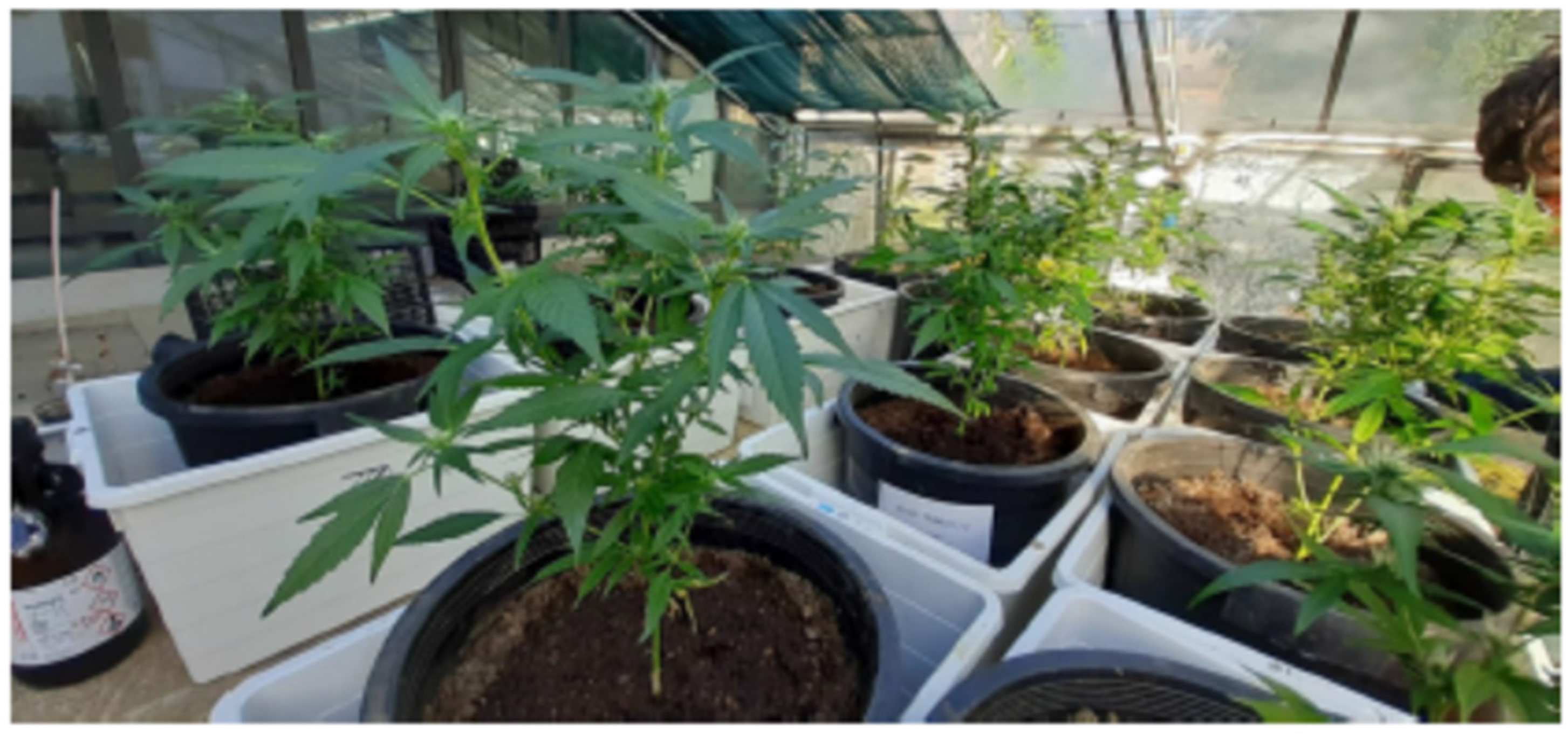
2.1. Plant Growth and Sampling
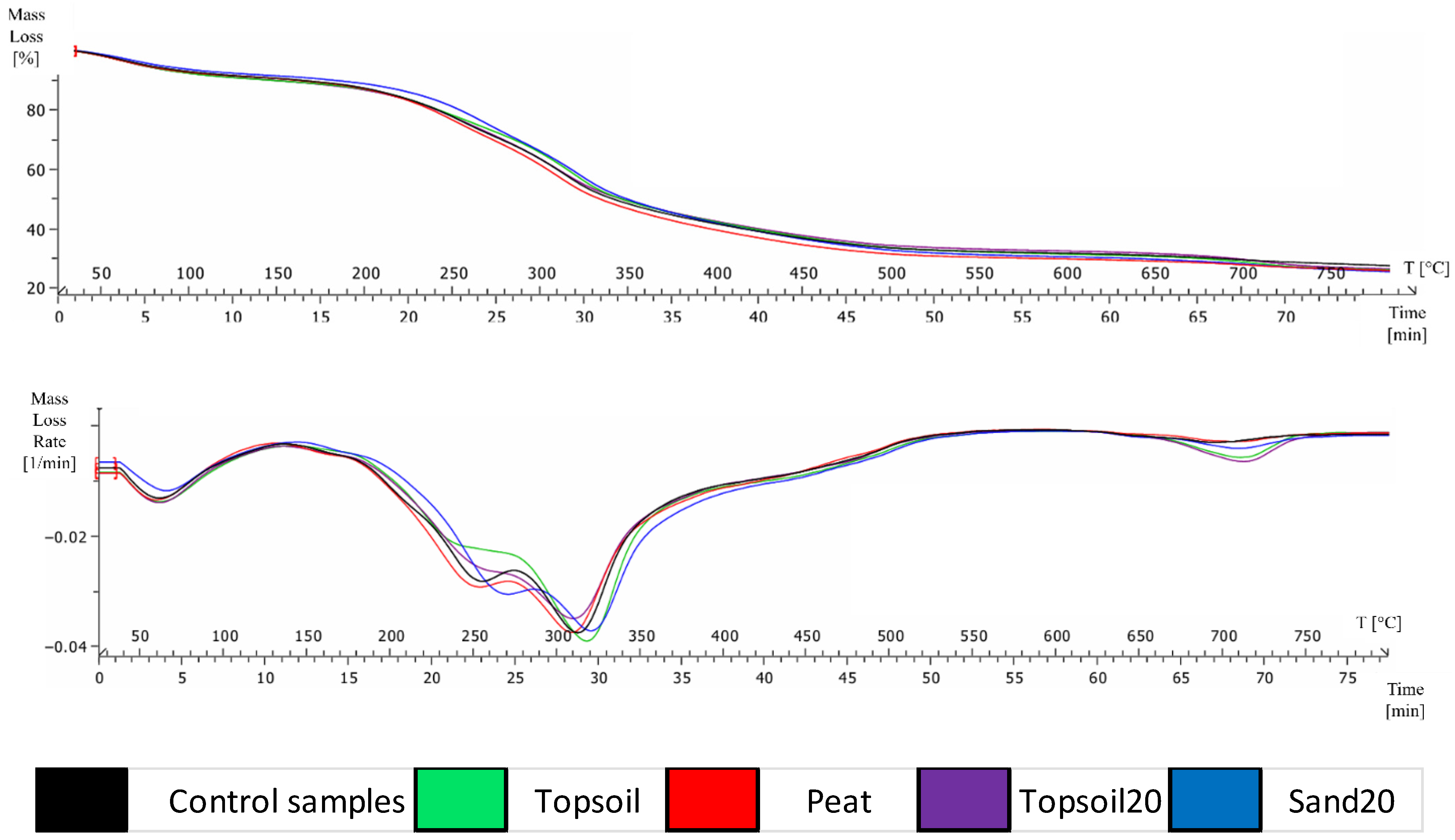
2.2. Thermogravimetric Analysis and Pyrolysis
2.3. Elementary (CHNS) and Electrophoretic Mobility Analyses
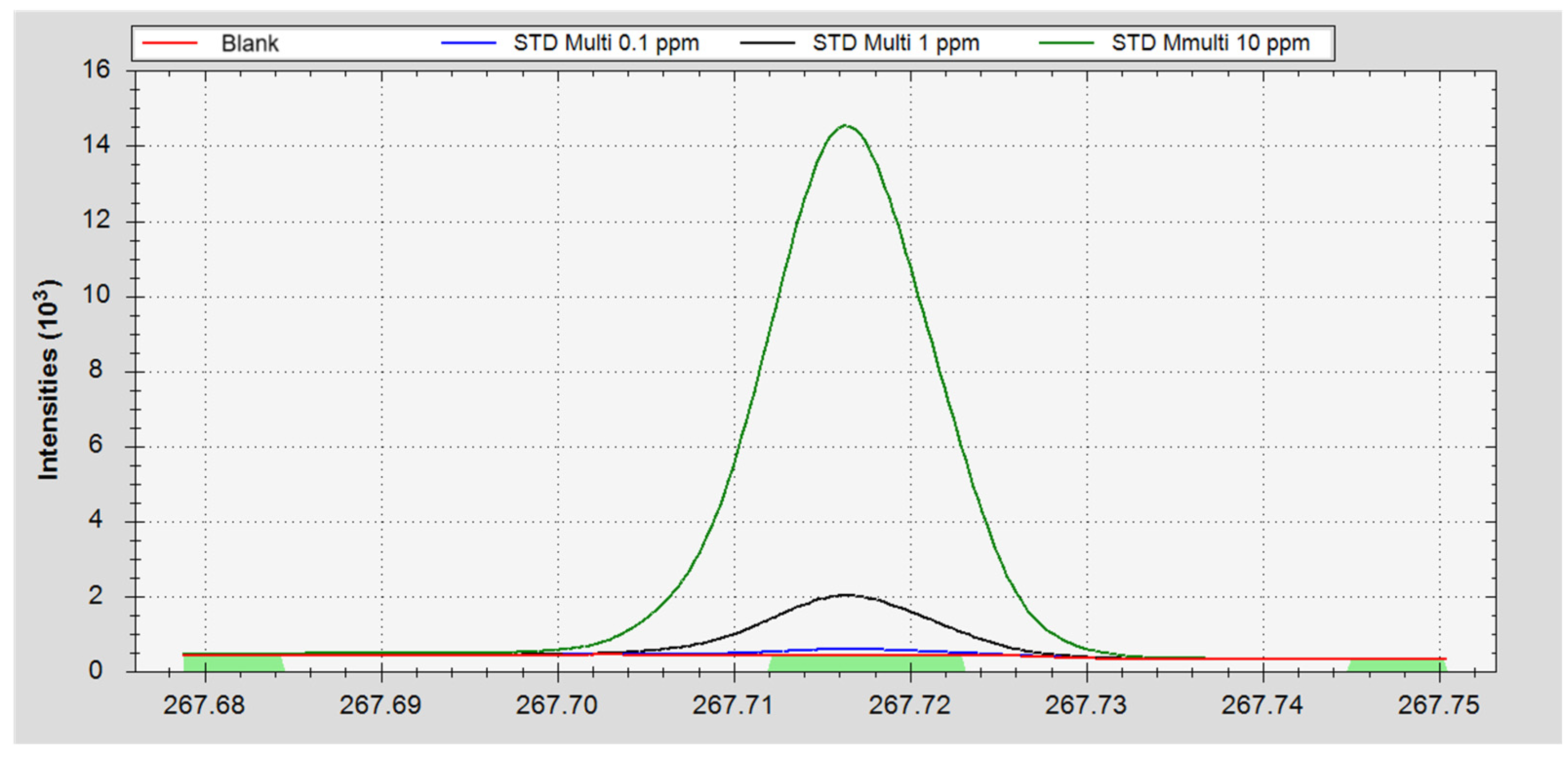
2.4. Heavy Metals Analysis
2.5. Statistical Analysis
3. Results and Discussion
3.1. Biochar Production
3.2. Elementary (CHNS) and Electrophoretic Mobility Analyses
3.3. Heavy Metals Analysis
4. Implications for Integrated Phytoremediation with Biochar Valorization
- -
- Growing substrate composition significantly influenced HMs uptake, with greater adsorption in less compact, mixed substrates. This may indicate that higher soil porosity favored the development of the plants’ radical systems, better soil aeration and cation exchange capacity, making metals more bioavailable. Additionally, in slightly acidic conditions, metals are more mobile, resulting in increased uptake possibility.
- -
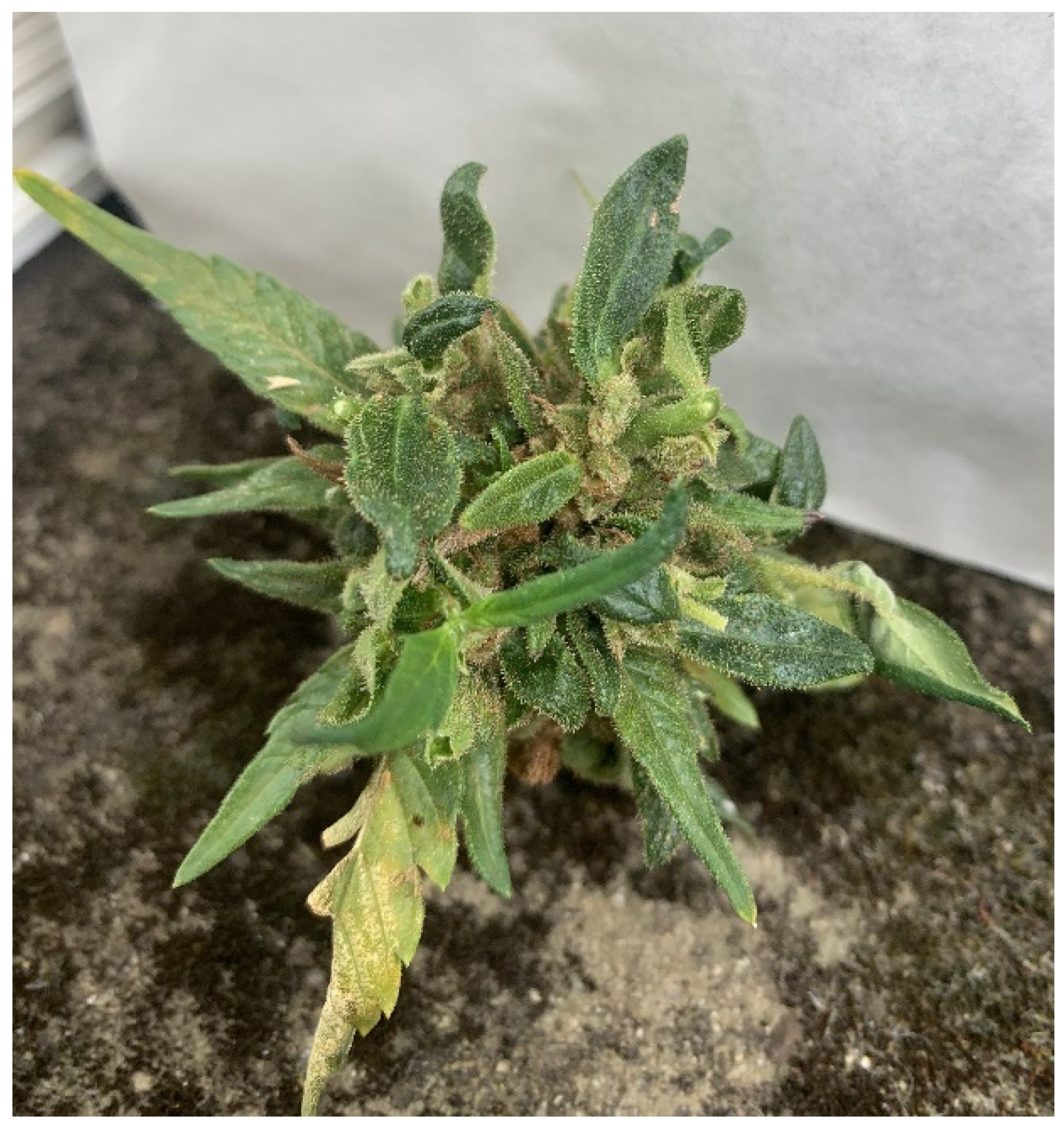
- From a plant physiology perspective, the survival of all plants, albeit with variable biomass production and early flowering in some conditions, suggests the development of contaminant tolerance and resilience mechanisms based on early HM immobilization in the lower plant levels (roots and lower stem) in order to limit damages to the reproductive systems located in the aerial parts.
- -
- HM concentrations in biochar produced from harvested C. sativa biomass remained under EU limit values for soil amendment applications; however, the low (400 °C) process temperature adopted in the study yielded biochar with consistently low C content (~40%), not meeting the Class 1 standards (>60% C content) set by the International Biochar Initiative (IBI) for its classification as a high-quality material, suitable for long-term soil C sequestration. Produced biochar showed reduced colloidal stability (as indicated by the zeta potential) and low conductivity, suggesting limited suitability for nutrient delivery or aqueous media applications. The selected pyrolysis temperature for this study represented a compromise between biochar yield and energy consumption; the resulting biochar physicochemical properties underscore the need for careful consideration of potential reuse scenarios in the selection of biomass postprocessing conditions [22]. Py-gases analysis might play a role in improving the definition of the mass balance of HM, since Cu and Pb may vaporize at high temperatures.
5. Conclusions
Author Contributions
Funding
Institutional Review Board Statement
Informed Consent Statement
Data Availability Statement
Acknowledgments
Conflicts of Interest
References
- Nivetha, A.M.; Sakthivel, C.; Prabha, I. Heavy Metal Contamination in Groundwater and Impact on Plant and Human. In Spatial Modeling and Assessment of Environmental Contaminants. Environmental Challenges and Solutions; Shit, P.K., Adhikary, P.P., Sengupta, D., Eds.; Springer: Cham, Switzerland, 2021. [Google Scholar] [CrossRef]
- Wang, Z.; Luo, P.; Zha, X.; Xu, C.; Kang, S.; Zhou, M.; Nover, D.; Wang, Y. Overview assessment of risk evaluation and treatment technologies for heavy metal pollution of water and soil. J. Clean. Prod. 2022, 379, 134043. [Google Scholar] [CrossRef]
- Dhaliwal, S.S.; Singh, J.; Taneja, P.K. Remediation techniques for removal of heavy metals from the soil contaminated through diferent sources: A review. Environ. Sci. Pollut. Res. Int. 2020, 27, 1319–1333. [Google Scholar] [CrossRef] [PubMed]
- Hu, Y.; Wang, J.; Yang, Y.; Li, S.; Wu, Q.; Nepovimova, E.; Zhang, X.; Kuca, K. Revolutionizing soil heavy metal remediation: Cutting-edge innovations in plant disposal technology. Sci. Total Environ. 2024, 918, 170577. [Google Scholar] [CrossRef] [PubMed]
- Xing, S.; Dai, M.; Yang, J.; Sun, L.; Tan, X.; Peng, C.; Ali, I.; Naz, I. A critical review on the phytoremediation of heavy metals from environment: Performance and challenges. Chemosphere 2022, 291, 132979. [Google Scholar] [CrossRef]
- Awa, S.H.; Hadibarata, T. Removal of Heavy Metals in Contaminated Soil by Phytoremediation Mechanism: A Review. Water Air Soil. Pollut. 2020, 231, 47. [Google Scholar] [CrossRef]
- Liu, Z.; Tran, K.Q. A review on disposal and utilization of phytoremediation plants containing heavy metals. Ecotoxicol. Environ. Saf. 2021, 226, 112821. [Google Scholar] [CrossRef]
- Jurga, A.; Rodziewicz, T.; Grzegorzek, M.; Wdowikowska, A.; Reda, M.; Leluk, K.; Janicka, M.; Kaźmierczak, B. Harnessing Cannabis sativa L. for integrated environmental remediation and circular biomass use. Sci. Total Environ. 2025, 992, 179976. [Google Scholar] [CrossRef]
- Manaia, J.P.; Manaia, A.T.; Rodriges, L. Industrial Hemp Fibers: An Overview. Fibers 2019, 7, 106. [Google Scholar] [CrossRef]
- Ingrao, C.; Lo Giudice, A.; Bacenetti, J.; Tricase, C.; Dotelli, G.; Fiala, M.; Siracusa, V.; Mbohwa, C. Energy and environmental assessment of industrial hemp for building applications: A review. Renew. Sustain. Energy Rev. 2015, 51, 29–42. [Google Scholar] [CrossRef]
- Rehman, M.; Fahad, S.; Du, G.; Cheng, X.; Yang, Y.; Tang, K.; Liu, L.; Liu, F.-H.; Deng, G. Evaluation of hemp (Cannabis sativa L.) as an industrial crop: A review. Environ. Sci. Pollut. Res. 2021, 28, 52832–52843. [Google Scholar] [CrossRef]
- Yano, H.; Fu, W. Hemp: A Sustainable Plant with High Industrial Value in Food Processing. Foods 2023, 12, 651. [Google Scholar] [CrossRef]
- Ahmad, R.; Tehsin, Z.; Malik, S.T.; Asad, S.A.; Shahzad, M.; Bilal, M.; Shah, M.M.; Khan, S.A. Phytoremediation potential of hemp (Cannabis sativa L.): Identification and characterization of heavy metals responsive genes. Clean Soil Air Water 2016, 44, 195–201. [Google Scholar] [CrossRef]
- Blandinières, H.; Amaducci, S. Adapting the cultivation of industrial hemp (Cannabis sativa L.) to marginal lands: A review. GCB Bioenergy 2022, 14, 1004–1022. [Google Scholar] [CrossRef]
- EC. Hemp. Available online: https://agriculture.ec.europa.eu/farming/crop-productions-and-plant-based-products/hemp_en#hempcultivation (accessed on 15 October 2025).
- Brar, K.K.; Raheja, Y.; Chadha, B.S.; Magdouli, S.; Brar, S.K.; Yang, Y.-H.; Bhatia, S.K.; Koubaa, A. A paradigm shift towards production of sustainable bioenergy and advanced products from Cannabis/hemp biomass in Canada. Biomass Conv. Biorefinery 2024, 14, 3161–3182. [Google Scholar] [CrossRef]
- Kraszkiewicz, A.; Kachel, M.; Parafiniuk, S.; Zając, G.; Niedziółka, I.; Sprawka, M. Assessment of the Possibility of Using Hemp Biomass (Cannabis sativa L.) for Energy Purposes: A Case Study. Appl. Sci. 2019, 9, 4437. [Google Scholar] [CrossRef]
- Vávrová, K.; Solcova, O.; Knápek, J.; Weger, J.; Soukup, K.; Humešová, T.; Králík, T.; Bím, J. Economic evaluation of Hemp’s (Cannabis sativa) residual biomass for production of direct energy or biochar. Fuel 2022, 329, 125435. [Google Scholar] [CrossRef]
- Ferrarini, A.; Fracasso, A.; Spini, G.; Fornasier, F.; Taskin, E.; Fontanella, M.C.; Beone, G.M.; Amaducci, S.; Puglisi, E. Bioaugmented phytoremediation of metal-contaminated soils and sediments by hemp and giant reed. Front. Microbiol. 2021, 12, 645893. [Google Scholar] [CrossRef]
- Khan, A.H.A.; Kiyani, A.; Santiago-Herrera, M.; Ibáñez, J.; Yousaf, S.; Iqbal, M.; Martel-Martín, S.; Barros, R. Sustainability of phytoremediation: Post-harvest stratagems and economic opportunities for the produced metals contaminated biomass. J. Environ. Manag. 2023, 326, 116700. [Google Scholar] [CrossRef]
- Callegari, A.; Hlavinek, P.; Capodaglio, A.G. Production of energy (biodiesel) and recovery of materials (biochar) from pyrolysis of urban waste sludge. Rev. Ambient Agua 2018, 13, e2128. [Google Scholar] [CrossRef]
- Callegari, A.; Capodaglio, A.G. Properties and beneficial uses of (bio)chars, with special attention to products from sewage sludge pyrolysis. Resources 2018, 7, 20. [Google Scholar] [CrossRef]
- Capodaglio, A.G. Developments and Issues in Renewable Ecofuels and Feedstocks. Energies 2024, 17, 3560. [Google Scholar] [CrossRef]
- Embaye, T.M.; Zhou, A.; Li, R.; Ahmed, M.B.; Ruan, R.; Wu, D.; Deng, N.; Wang, X. Assessment of heavy metals distribution and environmental risks in biochar from co-pyrolysis of sewage sludge and mixed municipal waste. Process Saf. Environ. Prot. 2025, 193, 1332–1342. [Google Scholar] [CrossRef]
- Fadel, D.; Assaad, N.; Hachem, A.; Argyraki, A.; Kypritidou, Z. Heavy metals interaction in soil-plant system of carmagnola cannabis strain. J. Agric. Sci. 2020, 12, 163–171. [Google Scholar] [CrossRef]
- Sward, S.; Brye, K.R.; Miller, D.M.; Thurston, D.V. Use of Biochar and Industrial Hemp for Remediation of Heavy-Metal-Contaminated Soil: Root Uptake and Translocations for Cd, Pb, and Zn. Soil Syst. 2025, 9, 29. [Google Scholar] [CrossRef]
- Rheay, H.T.; Omondi, E.C.; Brewer, C.E. Potential of hemp (Cannabis sativa L.) for paired phytoremediation and bioenergy production. GCB Bioenergy 2020, 13, 525–536. [Google Scholar] [CrossRef]
- Golia, E.E.; Bethanis, J.; Ntinopoulos, N.; Kaffe, G.G.; Komnou, A.A.; Vasilou, C. Investigating the potential of heavy metal accumulation from hemp. The use of industrial hemp (Cannabis sativa L.) for phytoremediation of heavily and moderated polluted soils. Sustain. Chem. Pharm. 2023, 31, 100961. [Google Scholar] [CrossRef]
- IUSS Working Group WRB. World Reference Base for Soil Resources. International Soil Classification System for Naming Soils and Creating Legends for Soil Maps, 4th ed.; International Union of Soil Sciences (IUSS): Vienna, Austria, 2022. [Google Scholar]
- EMME3 Srl. Available online: https://www.emme3-srl.it/2023/04/27/la-speciazione-del-carbonio-nei-campioni-solidi/ (accessed on 15 January 2025).
- Jindo, K.; Audette, Y.; Higashikawa, F.S.; Silva, C.A.; Akashi, K.; Mastrolonardo, G.; Sánchez-Monedero, M.A.; Mondini, C. Role of biochar in promoting circular economy in the agriculture sector. Part 1: A review of the biochar roles in soil N, P and K cycles. Chem. Biol. Technol. Agric. 2020, 7, 15. [Google Scholar] [CrossRef]
- UNI EN 16173:2012; Fanghi, rifiuti organici trattati e suolo—Digestione delle frazioni di elementi solubili in acido nitrico. Ente Italiano Normazione: Milano, Italy, 2012.
- Adesina, I.; Bhowmik, A.; Sharma, H.; Shahbazi, A. A Review on the Current State of Knowledge of Growing Conditions, Agronomic Soil Health Practices and Utilities of Hemp in the United States. Agriculture 2020, 10, 129. [Google Scholar] [CrossRef]
- Linger, P.; Ostwald, A.; Haensler, J. Cannabis sativa L. growing on heavy metal contaminated soil: Growth, cadmium uptake and photosynthesis. Biol. Plant. 2005, 49, 567–576. [Google Scholar] [CrossRef]
- Netto, A.T.; Campostrini, E.; De Oliveira, J.G.; Bressan-Smith, R.E. Photosynthetic pigments, nitrogen, chlorophyll a fluorescence and SPAD-502 readings in coffee leaves. Sci. Hortic. 2005, 104, 199–209. [Google Scholar] [CrossRef]
- Zrimec, J.; Correa, S.; Zagorščak, M.; Petek, M.; Bleker, C.; Stare, K.; Schuy, C.; Sonnewald, S.; Gruden, K.; Nikoloski, Z. Evaluating plant growth–defense trade-offs by modeling the interaction between primary and secondary metabolism. Proc. Natl. Acad. Sci. USA 2025, 122, e2502160122. [Google Scholar] [CrossRef]
- Kim, M.; Park, J.; Yu, S.; Park, J. Clean and energy-efficient mass production of biochar by process integration: Evaluation of process concept. Chem. Eng. J. 2019, 355, 840–849. [Google Scholar] [CrossRef]
- Ceretta, M.B.; Gorazzi, S.A.; D’Ippolito, S.; Mendieta, J.; Nercessian, D.; Bonanni, S. Cannabis sativa biochar: Characterization and preliminary application in plant growth and adsorption, and as an electrode material. RSC Sustain. 2025, 3, 1932–1940. [Google Scholar] [CrossRef]
- Zhang, K.; Zhang, K.; Li, Y.; Kang, Q.; Wang, Y.; Wang, J.; Yang, K.; Mao, J. Easily Pyrolyzable Biomass Components Significantly Affect the Physicochemical Properties and Water-Holding Capacity of the Pyrolyzed Biochar. Agriculture 2023, 13, 2053. [Google Scholar] [CrossRef]
- Tomczyk, A.; Sokołowska, Z.; Boguta, P. Biochar physicochemical properties: Pyrolysis temperature and feedstock kind effects. Rev. Environ. Sci. Biotechnol. 2020, 19, 191–215. [Google Scholar] [CrossRef]
- Lehmann, J.; Joseph, S. Biochar for Environmental Management: Science and Technology; Routledge: New York, NY, USA, 2009. [Google Scholar]
- Hunter, R.J. Zeta Potential in Colloid Science: Principles and Applications; Academic Press: Cambridge, MA, USA; Elsevier: Amsterdam, The Netherlands, 1981. [Google Scholar] [CrossRef]
- Raimondi, G.; Rodrigues, J.; Maucieri, C.; Borin, M.; Bona, S. Phytomanagement of Chromium-Contaminated Soils Using Cannabis sativa (L.). Agronomy 2020, 10, 1223. [Google Scholar] [CrossRef]
- Royal Queen Seeds. Available online: https://www.royalqueenseeds.it/blog-carenza-di-rame-nella-cannabis-sintomi-e-trattamento-n828 (accessed on 15 October 2025).
- Vasilou, C.; Tsiropoulos, N.G.; Golia, E.E. Phytoremediation & Valorization of Cu-contaminated Soils Through Cannabis sativa (L.) Cultivation: A Smart Way to Produce Cannabidiol (CBD) in Mediterranean Soils. Waste Biomass Valoriz. 2024, 15, 1711–1724. [Google Scholar] [CrossRef]
- Jabłońska, B. Optimization of Ni(II), Pb(II), and Zn(II) Ion Adsorption Conditions on Pliocene Clays from Post-Mining Waste. Minerals 2021, 11, 568. [Google Scholar] [CrossRef]
- Sagimbayeva, A.M.; Tomlekova, N.B.; Saparov, G.A.; Abduraimov, Y.O.; Kerimbayev, A.A.; Nurabayev, S.S.; Assanzhanova, N.N.; Akmyrzayev, N.Z.; Iskakova, K.M.; Omarova, A.S.; et al. Phytoremediation of Heavy Metal-Contaminated Soil Using Drought-Adapted Sweet Sorghum (Sorghum bicolor L.) in Arid Regions of Kazakhstan. Plants 2025, 14, 3627. [Google Scholar] [CrossRef]
- Awad, M.; El-Desoky, M.A.; Ghallab, A.; Kubes, J.; Abdel-Mawly, S.E.; Danish, S.; Ratnasekera, D.; Sohidul Islam, M.; Skalicky, M.; Brestic, M.; et al. Ornamental Plant Efficiency for Heavy Metals Phytoextraction from Contaminated Soils Amended with Organic Materials. Molecules 2021, 26, 3360. [Google Scholar] [CrossRef]
- Spokas, K.A.; Cantrell, K.B.; Novak, J.M.; Archer, D.W.; Ippolito, J.A.; Collins, H.P.; Boateng, A.A.; Lima, I.M.; Lamb, M.C.; McAloon, A.J.; et al. Biochar: A synthesis of its agronomic impact beyond carbon sequestration. J. Environ. Qual. 2012, 41, 973–989. [Google Scholar] [CrossRef]
- Capodaglio, A.G. Energy use and decarbonisation of the water sector: A comprehensive overview of issues, approaches and technological options. Environ. Technol. Rev. 2025, 14, 40–68. [Google Scholar] [CrossRef]
- Yang, J.; Tan, X.; Shaaban, M.; Cai, Y.; Wang, B.; Peng, Q.A. Remediation of Cr (VI)-Contaminated soil by biochar-supported nanoscale zero-valent iron and the consequences for indigenous microbial communities. Nanomaterials 2022, 12, 3541. [Google Scholar] [CrossRef]
- Todde, G.; Carboni, G.; Marras, S.; Caria, M.; Sirca, C. Industrial hemp (Cannabis sativa L.) for phytoremediation: Energy and environmental life cycle assessment of using contaminated biomass as an energy resource. Sustain. Energy Technol. Assess. 2022, 52, 102081. [Google Scholar] [CrossRef]



| Substrate Type | Composition [% by Volume] | Weight [kg] | BD [g/cm3] | pH | Cu2+ [mg/kg] | Ni2+ [mg/kg] | Pb2+ [mg/kg] | Cr [mg/kg] |
|---|---|---|---|---|---|---|---|---|
| Control | 100 Peat | 7 | 0.30 | 6.8 | nd | nd | nd | nd |
| Peat | 100 Peat | 7 | 0.30 | 6.9 | 394 | 394 | 329 | 493 |
| Topsoil | 100 Topsoil | 24 | 1.04 | 7.3 | 120 | 120 | 100 | 150 |
| Topsoil20 | 80 Peat/20 Topsoil | 12 | 0.52 | 6.4 | 120 | 251 | 251 | 209 |
| Sand20 | 80 Peat/20 Sand | 12 | 0.52 | 6.5 | 120 | 251 | 251 | 209 |
| Substrate | Aboveground Biomass | Belowground Biomass | Total Green Biomass | Flowers Biomass | SPAD Index |
|---|---|---|---|---|---|
| g (dw) | g (dw) | g (dw) | g (dw) | - | |
| Control | 70.6 ± 13.9 a | 11.5 ± 5.6 a | 82.2 ± 19.5 a | np | 56.7 ± 7.2 ab |
| Peat | 36.7 ± 21.5 ab | 9.3 ± 4.1 a | 62.1 ± 11.6 a | 16.1 ± 13.4 b | 54.0 ± 9.0 a |
| Topsoil | 14.0 ± 5.1 b | 6.5 ± 2.5 a | 24.3 ± 6.3 b | 3.9 ± 0.2 a | 59.3 ± 5.9 b |
| Topsoil20 | 23.2 ± 8.1 b | 7.7 ± 3.0 a | 48.2 ± 6.8 ab | 17.2 ± 10.9 b | 55.2 ± 7.4 a |
| Sand20 | 40.0 ± 14.7 ab | 9.4 ± 4.7 a | 61.3 ± 17.2 a | 11.8 ± 2.2 b | 56.4 ± 8.1 ab |
| Substrate | Initial Biomass | Produced Biochar | Biochar Yield |
|---|---|---|---|
| g (dw) | g (dw) | % | |
| Control | 0.12 ± 0.01 | 0.05 ± 0.01 | 40 ± 4 a |
| Peat | 0.13 ± 0.01 | 0.05 ± 0.001 | 39 ± 3 a |
| Topsoil | 0.13 ± 0.01 | 0.06 ± 0.01 | 42 ± 5 a |
| Topsoil20 | 0.13 ± 0.01 | 0.05 ± 0.01 | 39 ± 3 b |
| Sand20 | 0.14 ± 0.01 | 0.06 ± 0.01 | 42 ± 1 a |
| Substrate | C [%] | H [%] | N [%] | S [%] | ζ-Potential [mV] |
|---|---|---|---|---|---|
| Control | 40.2 ± 0.40 | 2.9 ± 0.06 | 3.23 ± 0.06 | bdl | −35.8 ± 1.1 |
| Peat | 42.7 ± 0.41 | 3.2 ± 0.06 | 3.61 ± 0.07 | 0.22 ± 0.01 | −26.9 ± 0.5 |
| Topsoil | 43.8 ± 0.44 | 3.8 ± 0.08 | 4.79 ± 0.09 | 0.26 ± 0.01 | −28.8 ± 0.5 |
| Topsoil20 | 41.6 ± 0.42 | 2.9 ± 0.06 | 3.75 ± 0.08 | bdl | −26.8 ± 0.5 |
| Sand20 | 42.7 ± 0.43 | 3.2 ± 0.06 | 3.86 ± 0.08 | 0.26 ± 0.01 | −28.7 ± 1.5 |
| Plant Part | Control | Peat | Topsoil | Topsoil20 | Sand20 | |
| Ni2+ (ppm) | LT | 0.34 ± 0.02 a | 13.47 ± 0.04 b | 3.86 ± 0.01 c | 8.69 ± 0.03 d | 10.51 ± 0.07 e |
| LB | 0.56 ± 0.02 a | 13.47 ± 0.07 b | 4.04 ± 0.04 c | 8.18 ± 0.02 d | 9.71 ± 0.05 e | |
| S | 2.26 ± 0.04 a | 6.21 ± 0.02 b | 7.00 ± 0.03 c | 9.79 ± 0.05 d | 8.01 ± 0.02 e | |
| R | 0.79 ± 0.02 a | 5.94 ± 0.02 b | 16.07 ± 0.03 c | 10.31 ± 0.02 d | 7.15 ± 0.03 e | |
| F | n.p. | 10.40 ± 0.02 a | 9.24 ± 0.02 b | 9.26 ± 0.05 b | 8.55 ± 0.03 c | |
| Plant part | Control | Peat | Topsoil | Topsoil20 | Sand20 | |
| Cu (ppm) | LT | 6.08 ± 0.07 a | 6.66 ± 0.02 b | 9.36 ± 0.04 c | 7.03 ± 0.06 d | 6.31 ± 0.05 e |
| LB | 6.91 ± 0.07 a | 7.04 ± 0.07 a | 10.39 ± 0.10 b | 6.44 ± 0.01 c | 8.51 ± 0.11 d | |
| S | 2.92 ± 0.03 a | 5.45 ± 0.04 b | 9.67 ± 0.10 c | 10.33 ± 0.05 d | 11.35 ± 0.10 e | |
| R | 4.57 ± 0.03 a | 8.25 ± 0.07 b | 21.77 ± 0.03 c | 12.51 ± 0.05 d | 7.72 ± 0.10 e | |
| F | n.p. | 11.81 ± 0.04 a | 21.17 ± 0.07 b | 12.43 ± 0.08 c | 13.52 ± 0.04 d | |
| Plant part | Control | Peat | Topsoil | Topsoil20 | Sand20 | |
| Pb2+ (ppm) | LT | 0.64 ± 0.02 a | 0.87 ± 0.14 a | 2.27 ± 0.03 ab | 1.61 ± 0.11 ab | 3.05 ± 0.10 b |
| LB | 1.67 ± 0.17 ab | 2.42 ± 0.18 ab | 1.34 ± 0.08 a | 3.14 ± 0.08 b | 2.55 ± 0.06 ab | |
| S | 0.27 ± 0.14 a | 2.45 ± 0.08 b | 2.76 ± 0.05 b | 9.33 ± 0.15 c | 8.49 ± 0.12 c | |
| R | 0.87 ± 0.13 a | 2.31 ± 0.09 a | 12.89 ± 0.15 b | 5.68 ± 0.08 c | 2.17 ± 0.15 a | |
| F | n.p. | 2.27 ± 0.17 ab | 2.93 ± 0.15 b | 1.85 ± 0.14 a | 1.75 ± 0.04 a | |
| Plant part | Control | Peat | Topsoil | Topsoil20 | Sand20 | |
| Cr (ppm) | LT | 0.23 ± 0.03 a | 2.15 ± 0.05 b | 4.27 ± 0.02 c | 7.63 ± 0.09 d | 4.07 ± 0.02 c |
| LB | 0.46 ± 0.02 a | 3.61 ± 0.08 b | 3.75 ± 0.01 b | 14.70 ± 0.15 c | 12.35 ± 0.03 d | |
| S | 0.22 ± 0.03 a | 1.73 ± 0.02 b | 4.85 ± 0.02 c | 5.85 ± 0.08 d | 5.29 ± 0.01 e | |
| R | 1.00 ± 0.02 a | 4.40 ± 0.01 b | 19.31 ± 0.04 c | 15.24 ± 0.09 d | 6.33 ± 0.05 e | |
| F | n.p. | 0.37 ± 0.01 a | 2.12 ± 0.02 b | 0.34 ± 0.03 a | 0.79 ± 0.02 c |
| Substrate | Cr (mg/kg) | Ni2+ (mg/kg) | Cu2+ (mg/kg) | Pb2+ (mg/kg) | ||||||||
|---|---|---|---|---|---|---|---|---|---|---|---|---|
| Initial | Final | Rem (%) | Initial | Final | Rem (%) | Initial | Final | Rem (%) | Initial | Final | Rem (%) | |
| Peat | 493 | 198.53 ± 0.78 | 59.74 ± 0.16 | 394 | 159.02 ± 1.66 | 59.63 ± 0.42 | 394 | 267.78 ± 2.64 | 32.04 ± 0.67 | 329 | 187.62 ± 5.69 | 42.97 ± 1.73 |
| Topsoil | 150 | 40.67 ± 0.93 | 72.89 ± 0.62 | 120 | 40.51 ± 0.63 | 66.24 ± 0.53 | 120 | 43.04 ± 0.99 | 64.13 ± 0.83 | 100 | 27.58 ± 6.62 | 74.42 ± 6.62 |
| Peat/Topsoil | 314 | 123.29 ± 0.74 | 60.74 ± 0.24 | 251 | 93.42 ± 0.70 | 62.78 ± 0.28 | 251 | 132.02 ± 1.18 | 47.40 ± 0.47 | 209 | 99.90 ± 8.82 | 52.20 ± 4.22 |
| Peat/Sand | 314 | 80.46 ± 0.84 | 74.42 ± 0.27 | 251 | 55.15 ± 1.19 | 78.00 ± 0.47 | 251 | 34.92 ± 1.78 | 86.06 ± 0.71 | 209 | 34.36 ± 4.49 | 83.60 ± 2.15 |
| Cr (mg/kg) | Ni (mg/kg) | Cu (mg/kg) | Pb (mg/kg) | |
|---|---|---|---|---|
| Control | 9.08 ± 0.21 a | 8.43 ± 0.04 a | 27.05 ± 0.15 a | 7.42 ± 2.71 ab |
| Peat | 0.88 ± 0.50 b | 37.06 ± 0.79 b | 56.00 ± 3.36 b | 8.70 ± 4.66 ab |
| Topsoil | 6.587 ± 1.19 a | 13.85 ± 2.00 c | 45.42 ± 6.23 b | 4.12 ± 1.07 ab |
| Topsoil20 | 0.46 ± 0.05 b | 24.20 ± 0.21 d | 22.74 ± 0.22 a | 2.42 ± 0.07 a |
| Sand20 | 3.05 ± 2.15 b | 24.62 ± 1.18 d | 47.81 ± 7.86 b | 10.81 ± 3.57 b |
| Limit value * | 100 | 40 | 200 | 100 |
Disclaimer/Publisher’s Note: The statements, opinions and data contained in all publications are solely those of the individual author(s) and contributor(s) and not of MDPI and/or the editor(s). MDPI and/or the editor(s) disclaim responsibility for any injury to people or property resulting from any ideas, methods, instructions or products referred to in the content. |
© 2026 by the authors. Licensee MDPI, Basel, Switzerland. This article is an open access article distributed under the terms and conditions of the Creative Commons Attribution (CC BY) license.
Share and Cite
Picchi, G.; Callegari, A.; Capodaglio, A.G.; Martellini, T.; Masi, F.; Mastrolonardo, G.; Nocentini, M.; Sarti, C.; Vadivel, D. Cannabis sativa L. Phytoremediation of Heavy Metal Soil Contamination, Followed by Biomass Valorization. Sustainability 2026, 18, 2926. https://doi.org/10.3390/su18062926
Picchi G, Callegari A, Capodaglio AG, Martellini T, Masi F, Mastrolonardo G, Nocentini M, Sarti C, Vadivel D. Cannabis sativa L. Phytoremediation of Heavy Metal Soil Contamination, Followed by Biomass Valorization. Sustainability. 2026; 18(6):2926. https://doi.org/10.3390/su18062926
Chicago/Turabian StylePicchi, Giulio, Arianna Callegari, Andrea G. Capodaglio, Tania Martellini, Fabio Masi, Giovanni Mastrolonardo, Marco Nocentini, Chiara Sarti, and Dhanalakshmi Vadivel. 2026. "Cannabis sativa L. Phytoremediation of Heavy Metal Soil Contamination, Followed by Biomass Valorization" Sustainability 18, no. 6: 2926. https://doi.org/10.3390/su18062926
APA StylePicchi, G., Callegari, A., Capodaglio, A. G., Martellini, T., Masi, F., Mastrolonardo, G., Nocentini, M., Sarti, C., & Vadivel, D. (2026). Cannabis sativa L. Phytoremediation of Heavy Metal Soil Contamination, Followed by Biomass Valorization. Sustainability, 18(6), 2926. https://doi.org/10.3390/su18062926