


Abstract
Soil heavy metal contamination poses a major environmental threat, negatively impacting ecosystems, agricultural productivity, and human health. Phytoremediation offers eco-sustainable alternatives to conventional remediation techniques by employing plant species capable of extracting and stabilizing pollutants. This study assesses the potential of Cannabis sativa L. var. ‘Carmagnola’ for the remediation of Pb, Cr, Cu, and Ni from four different growth substrates. This species was selected for its high biomass yield, tolerance to toxic environments, and capacity for heavy metal accumulation. Experimental results showed that the composition of the growing substrate significantly affected HM uptake, with higher accumulation occurring in less compact mixed substrates. HM removal from contaminated growth substrates varied between 55 and 75% for Cr, 60–78% for Ni, 32–86% for Cu and 43–84% for Pb after four months of growth in a greenhouse environment. In addition to pollutant removal efficiency, the study explored thermochemical harvested biomass post-processing via pyrolysis in order to produce biochar, a material with recognized agronomic beneficial properties and positive environmental value. Biochar generated from harvested biomass after phytoremediation tests showed residual HM content lower than the applicable EU thresholds for agricultural soil amendment. Integrating bioremediation with biochar production can promote a circular bioeconomy approach to environmental restoration, by transforming contaminated residual biomass into a useful resource rather than waste. These findings support the feasibility potential of coupling C. sativa phytoremediation and biochar production as an environmentally sustainable strategy for large-scale remediation of heavy metal-contaminated soils.
1. Introduction
Soil pollution caused by heavy metals (HM) released by anthropogenic activities is a major environmental issue. Due to their high toxicity and environmental persistence, HMs not only compromise soil health but also pose serious risks of groundwater contamination and biomagnification along the food chain, ultimately affecting both environmental and human health [1,2]. Several remediation strategies have been developed to address HM-contaminated soils, including physical, chemical and biological remediation [3]. However, conventional approaches are often hindered by high operational costs, limited site applicability and environmental drawbacks [4]. In contrast, phytoremediation has emerged as a promising green alternative as an in situ, cost-effective and environmentally sustainable technology that uses plants and their associated microbiota to extract, stabilize or degrade soil pollutants [5].
Phytoremediation mechanisms include extraction, filtration and degradation (or accumulation) of soil contaminants, which are transferred to roots, leaves, and stems, with different plants showing different final maximum concentrations in their various parts [6]. Phytoremediation can be further classified as phytostabilization, a bioremediation technique whereby plants reduce contaminants’ (especially HMs) mobility in soil without necessarily removing them from the site, and phytodegradation, in which plants break down organic contaminants through self-produced enzymes or via metabolic processes taking place within the plant itself. In the case of HMs phytoremediation, metal uptake occurs primarily in roots and may extend to stems and leaves, depending on plant species and the specific metal involved. While the effectiveness of phytoremediation largely depends on plant tolerance and uptake efficiency, the challenge of safely managing the resulting contaminated biomass remains an open issue [7]. Selecting the appropriate plant species is critical: ideal candidates should combine high biomass yield, strong metal tolerance and accumulation capacity, while also minimizing food chain risks and allowing productive residual exploitation for Circular Economy uses.
Non-food, fast-growing crops with industrial value—such as Cannabis sativa L. (hemp)—represent particularly attractive options for bioremediation applications [8]. Hemp is a resilient year-round crop from the Cannabaceae family. Its industrial variety contains low levels of tetrahydrocannabinol (THC), making its cultivation generally legally permissible. The plant’s versatility extends across numerous industries, including seed oil production, textiles, biocomposites, construction materials, bioenergy, and pharmaceuticals [9,10,11,12]; it grows quickly and easily in most climates, without the need for chemical fertilizers, excessive irrigation or pesticides, and tolerates high HM concentrations in soil [13]. Compared with other bioremediation plant species, it produces a larger above-ground biomass quantity with an equal land footprint [14]; this allows the recovery of greater amounts of secondary products after biomass treatment, with potentially larger economic returns. Furthermore, its fast growth increases the CO2 sequestration potential: for this reason, the European Commission indicated industrial hemp as a promising candidate crop for achieving carbon neutrality by 2050, as well as a means to support Sustainable Development Goals [15].
Cannabis sativa biomass is extensively used in commercial and industrial applications, ranging from textiles to building materials and to foodstuffs and multipurpose energy applications [16,17,18]. Appropriate biomass reuse could foster the development of virtuous Circular Economy cycles [19,20]. However, due to its residual contamination generated as a result of the remediation process, proper consideration should be given to its subsequent disposal or productive reuse: possible HM accumulation in biomass may restrict specific end-uses, particularly those involving food, feed or fibers for human contact.
To address the dual challenge of soil decontamination and safe biomass disposal and reuse, this study investigates the use of Cannabis sativa ‘Carmagnola’ in the phytoremediation of different HM-contaminated substrates under controlled greenhouse conditions and explores the feasibility of the potential valorization of harvested biomass through biochar production. Biochar is a charcoal-like substance that is obtained from organic materials, i.e., biomass of varied origin, via a controlled thermal process in an oxygen-depleted atmosphere, known as pyrolysis, which can achieve substantial reduction in the original biomass volume, stabilize organic matter, and recover valuable products [21]. Biochar is a black, highly porous, fine-grained, and lightweight substance with a large surface area [22]; it is also classified as a second-generation, alternative biofuel [23]. Furthermore, pyrolysis shows potential to immobilize most HMs present in processed substrates within its structure, thereby preventing their subsequent leaching and bioavailability to plants and microorganisms in soils [24]. The study, therefore, also aims to fill the research gap concerning the implications of post-phytoremediation biomass pyrolysis treatment for soil amendment applications.
2. Materials and Methods
Cannabis sativa ‘Carmagnola’ was chosen for the study due to its previous referenced use in various phytoremediation studies [25,26] and its availability at a local licensed nursery (“Weester”, Pavia, Italy), from which 14 seedlings were purchased. The ‘Carmagnola’ cultivar has an annual lifespan with a vegetative cycle from February to the beginning of July, followed by a flowering cycle with exponential flower growth ending in September. It is very resilient to parasites and extreme climate conditions and can survive in heavily polluted soils with fast growth, low water and nutrient requirements, and remarkable biomass productivity. For these characteristics, it can be considered a good candidate crop for phytoremediation applications [27,28]. Another important feature of this crop is the root extension: these can easily reach a depth of 2 m, allowing individual plants to gain considerable stability, extract high amounts of nutrients from soils, and possibly reach superficial aquifers, if present.
Seedlings were individually bedded at the beginning of the growing season (late February) into pots of 23 L capacity, each filled with substrates of different compositions (Table 1): peat, topsoil, peat-topsoil and peat-sand, prepared at the Department of Agriculture, Food, Environment and Forestry (DAGRI), University of Florence, from selected individual sources. The peat substrate consisted of a commercial medium, mix of Irish and Baltic sphagnum, coconut fiber and bark humus (‘Cuore di Terriccio’, Vigorplant Italia SRL, Fombio, Lodi, Italy); sand consisted of commercially available river sand with granulometry ranging from 0.8 to 2 mm, purchased from a local garden center; topsoil was extracted from an agricultural field near Florence, Italy (coordinates 44,0019°, 11,3196°) and consisted of unconsolidated fluviolacustrine clays and silts, with a silty clay loam texture, identified as Calcaric Cambisols, according to WRB’s classification [29], which was dried and sieved at 2 mm size before use. The specific substrates were chosen to study hemp’s growth and HM phytoremediation behavior in different settings: peat was selected to simulate an optimal cultivation environment, topsoil to simulate real local growing field conditions, and the remaining two to simulate other commonly encountered mixed soil matrices. Triplicate units of each substrate were created; “control” conditions were simulated in duplicate with a peat-only substrate. In addition, each bedding pot contained a thin bottom layer of expanded clay pellets for leachate control, and a large saucer was placed under each to collect any potential leachate that would not be retained by the latter.
Table 1.
Substrate composition, weight, bulk density (BD), pH, Cu, Ni, Pb, and Cr concentration in bedding pots.
After transplantation, all plants were apically pruned to stimulate lateral growth. Two weeks after planting, all pots (with exception of the two controls) were contaminated with equal volumes of a solution containing four heavy metals (Cu, Cr, Ni, Pb) prepared from dissolving their salts (Cu(NO3)2 3H2O; (CH3CO2)7Cr3(OH)2; Ni(NO3)2 6H2O; Pb(C2H3O2)2) in MilliQ water, in such proportions as to obtain final soil concentrations higher than the admissible limits established by current Italian legislation (Legislative Decree A52/2006 Annex 5, Part IV, Table 1) for public and private green areas, i.e., Pb ≤ 100 mg/kg d.w.; Cu, Ni ≤ 120 mg/kg d.w.; Cr ≤ 150 mg/kg d.w. The two peat-filled “control” pots remained uncontaminated as “blanks”. The final combinations of substrates and contaminant amendments are reported in Table 1. As the same volume of contaminated solution was used in all pots, calculated HMs concentration on a dry mass basis varied due to differences in the specific weight of the fill material.
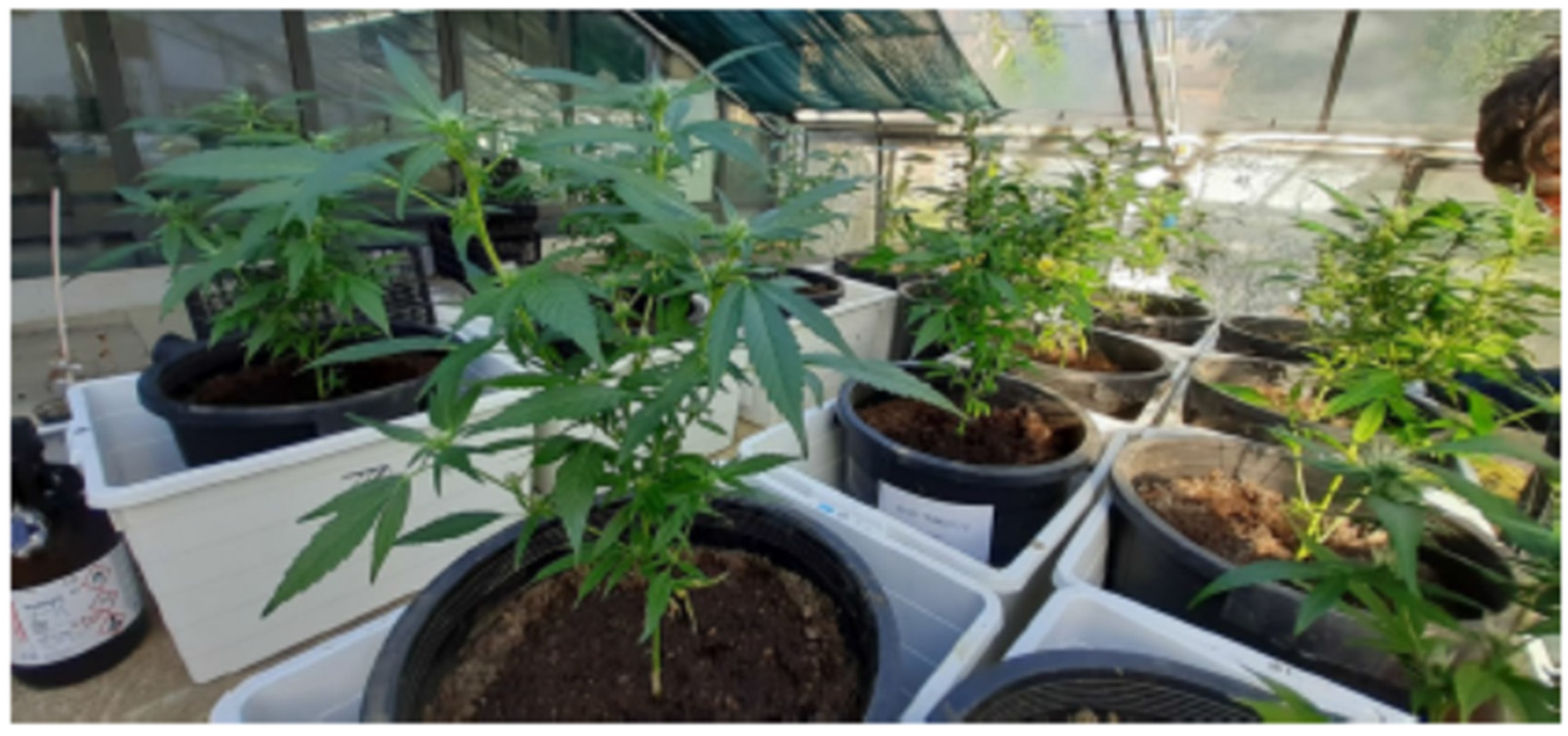
Cultivation was carried out in a greenhouse at DAGRI (Figure 1) in order to minimize any external interference (e.g., atmospheric pollutants deposition, rainwater contribution, etc.) on the experiment. A regular, standardized watering schedule was established, consisting of 500 mL tap water every other day, to avoid generation of leachate from the pots. No fertilizers or pesticides were used.
Figure 1.
Pots with Cannabis Sativa plants approximately one month after bedding.
2.1. Plant Growth and Sampling
After four months of greenhouse growth during which all plants survived and flourished, the leaves’ chlorophyll content was evaluated to assess the plants’ health status. Chlorophyll allows sunlight absorption to carry out photosynthesis, thus its concentration in leaves is considered proportional to the “health status” of the plant: the higher the value, the better the plant’s condition. Chlorophyll content was determined using a portable SPAD-502 Plus chlorophyll meter (Konica Minolta Italia Spa, Milano, Italy). The device non-destructively measures leaves’ absorbance of red (650 nm) and near-infrared (950 nm) wavelengths as SPAD (Soil and Plant Analysis Development) value, which serves as a proxy for actual chlorophyll concentration. SPAD measurements were made on 10 basal leaves and 10 top leaves, randomly selected, for each plant; 3 readings in 3 different positions were made for each leaf and then averaged. Care was taken so the instrument sensor would not damage the leaf surface. The average single leaf values were then averaged for each homogeneous (basal, top) leaf group for each plant.
When growth reached an average height of about 1 m (after about 5 months), 10 bottom and 10 top leaves, representing old and new growth, respectively, were collected from each plant. All the flowers were also collected. Incidentally, it was noticed that plants grown in 100% topsoil substrate presented fewer flowers than the others; however, these were much larger in size and more mature.
Individual plants were then uprooted from their substrate and stems were separated from their root systems; plants grown in 100% topsoil substrate showed less developed roots, much finer and shorter, compared to those in other substrates, which were thicker and even spiralized due to vigorous growth in a confined space. This was attributed to the greater compaction and lower porosity of the growing substrate. The entire green apparatus, roots as well as substrate samples, were then collected, cleaned from soil residue, individually weighed, placed in a ventilated oven at 70 °C for drying, and stored in marked plastic bags.
2.2. Thermogravimetric Analysis and Pyrolysis
Thermogravimetric Analysis (TGA) was used as a preliminary step to assess biomass properties prior to subsequent processing. TGA quantifies the mass loss of a sample as a function of temperature, without providing information on its qualitative composition. TGA was conducted with a METTLER TOLEDO TGA 1 (Mettler Toledo SpA, Milan, Italy) instrument with a STARe System for data collection and analysis. Previously dried biomass fractions (basal and apical leaves, branches, stem, and roots) were separately ground and homogenized in a marble mortar. About 5 mg of each sample was used, heated from 25 °C at a constant rate of 10 °C/min to 800 °C in a N2-flushed, oxygen-free atmosphere at a flux of 50 mL/min to replicate the anoxic conditions expected during pyrolysis. The investigated temperature interval of interest for pyrolysis processing was set between 200 and 600 °C, as this range encompasses the main degradation steps of carbonaceous material: specifically, moisture release occurs up to 100–150 °C; decomposition of total organic carbon (TOC) takes place between 150 and 400 °C; and degradation of elemental carbon (residual oxidizable carbon) is observed between 400 and 600 °C. At temperatures above 600 °C, breakdown of inorganic carbon-containing and carbon-free compounds occurs [30]. TGA was therefore conducted in this temperature range.
Pyrolysis was carried out in an electrically heated furnace: 250 mg samples were placed in the furnace inside a quartz vessel under vacuum, a spiral condenser inside a liquid nitrogen-containing dewar flask allowed potentially damaging py-gas cooling before they could reach the vacuum pump. Due to the specific setup, it was not possible to analyze gas composition. Samples were heated from room temperature (20 °C) at a constant 10 °C/min rate until the set temperature of 400 °C was reached, after which the furnace was turned off and the vessel was left to cool to room temperature for sample extraction. This temperature was selected despite TGA showing organic mass loss until 550 °C, since the initial investigation objective was not to achieve complete carbonization of organics, but the production of biochar with good functional properties, as explained in Section 3.1.
2.3. Elementary (CHNS) and Electrophoretic Mobility Analyses
CHNS (Carbon, Hydrogen, Nitrogen, Sulphur) analysis represents a key point for determining biochar quality because it is closely related to its behavior in soils. In fact, inadequately pyrolyzed biomass may provide too much C without sufficient N, resulting in N immobilization and, therefore, exert negative short-term effects on crop yield when used as a soil amendment [31].
After pyrolysis, a few milligrams of each of the three individual biochar samples obtained from each of the different substrates’ biomass were pooled and analyzed using a Thermo Scientific FlashSmart Elemental Analyzer CHNS/O instrument (Thermo Fisher Scientific GmbH, Bremen, Germany).
To complete the characterization of biochar, samples were also analyzed using a Zetasizer PRO Red Label instrument (Malvern Panalytical, Great Malvern, UK) to determine their ζ-potential and electrical conductivity. ζ-potential measurements were performed in aqueous suspensions prepared under identical experimental conditions for all samples. Although pH and ionic strength were not independently adjusted, the use of a consistent suspension medium allowed reliable comparative evaluation of electrophoretic mobility among samples. These parameters assess the colloidal stability of the biochar in aqueous solutions and its capacity to adsorb ions from soluble salts.
2.4. Heavy Metals Analysis
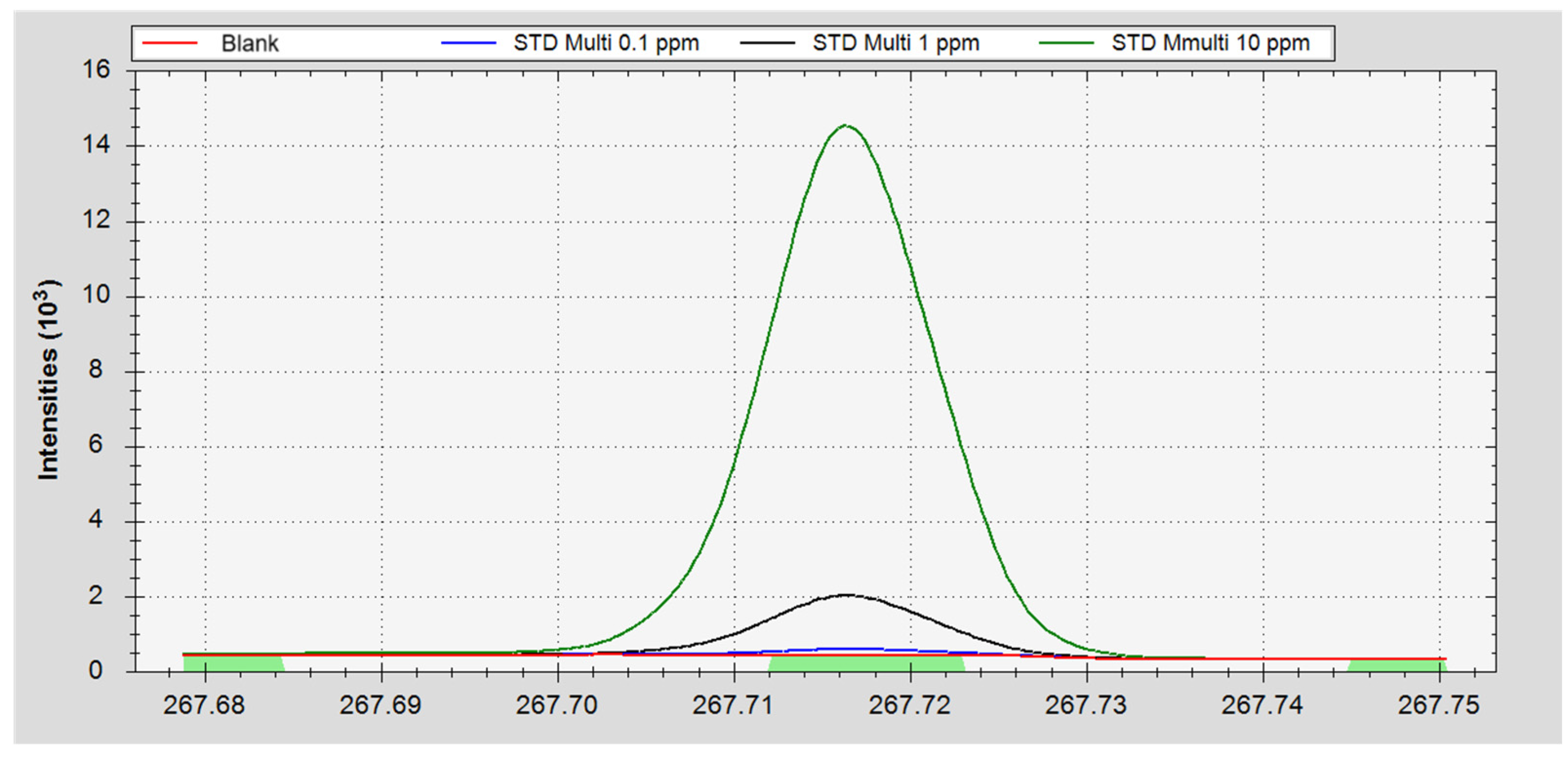
About 250 g of dried biomass fractions (roots, stems, flowers, and bottom and top leaves) from each experiment were separately placed into Teflon test tubes, diluted with 7 mL of 1M HNO3 and positioned in a microwave oven for 20 min at 180 °C to achieve mineralization. Biochar samples were mineralized by dilution with 7 mL 1M HNO3 with 2 mL H2O2 over a cast iron heating plate at 80 °C, to speed up the process. Soil samples were mineralized using nitric acid in a microwave digestion system (Ethos, Milestone, Milestone SpA, Sorisole, Italy) following the standardized UNI EN 16173:2021 method [32], which ensures complete digestion of soil matrices for trace metal analysis. Consistent sample masses were used, and all analyses were performed on triplicate samples to ensure data reliability; digestion efficiency was ensured by the strict application of the standardized protocol, specifically designed for the complete mineralization of environmental matrices prior to elemental analysis. Subsequently, mineralized samples were diluted with Milli-Q water to a final volume of 40 mL for plant samples and 30 mL for biochar samples. The resulting solutions were analyzed using an ICP spectrometer (iCAP 7000 Series, Thermo Fisher Scientific GmbH, Bremen, Germany) to quantify the selected elements based on their characteristic emission wavelengths (Figure 2). Quantification was carried out using external calibration curves. In order to verify the possibility of background signal presence due to procedure contamination, analytical blanks were evaluated by processing reagents in the absence of a sample. No contamination detection was observed.
Figure 2.
Calibration of the ICP Spectometer iCAP 7000 series for the Cr.
2.5. Statistical Analysis
The normality of the data and the homogeneity of variances were assessed using the Shapiro–Wilk and Levene’s tests, respectively. A one-way analysis of variance (ANOVA) was applied to the data and significant differences between means were identified through Tukey’s post hoc test, with a significance level of p < 0.05. All statistical computations were conducted using SPSS, version 29 (IBM Corp., Armonk, NY, USA).
3. Results and Discussion
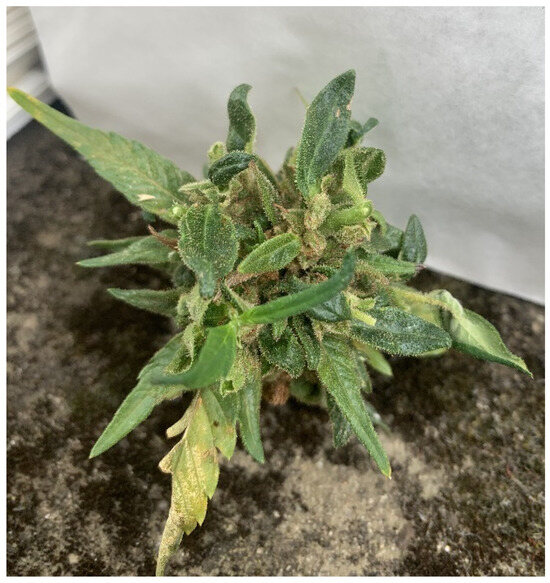
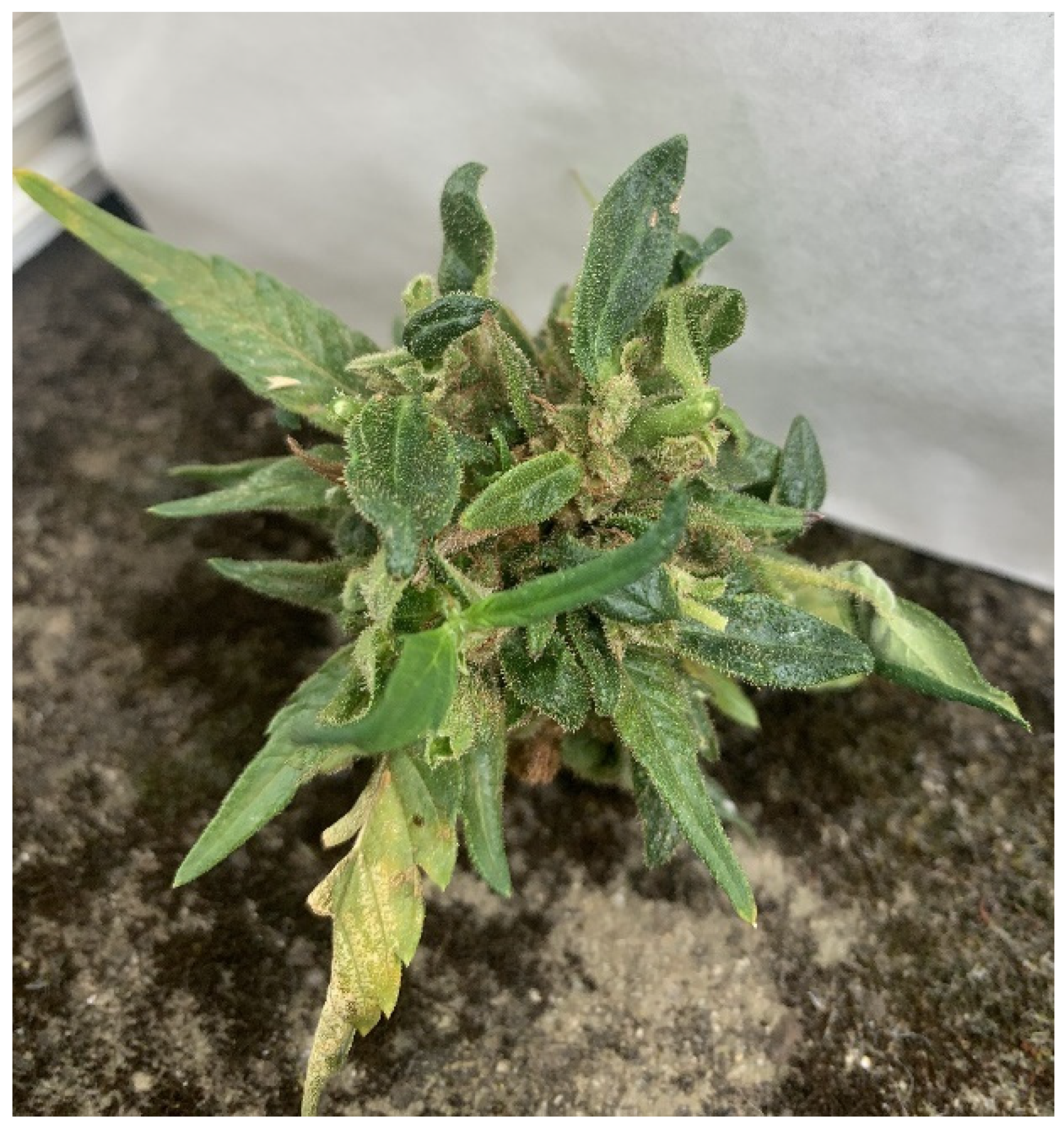
The amounts of biomass fractions and the leaf SPAD indexes of plants grown are summarized in Table 2. Results are closely related to the type of growing substrate: plants grown on topsoil-only or topsoil in mixed substrates produced less biomass across all fraction categories (aboveground, belowground, and floral biomass) compared to the other substrates. In contrast, peat or peat mixes yielded higher biomass quantities. However, in a topsoil-only growing substrate, inflorescences exhibited significantly more advanced stages of maturation despite lower above-ground biomass yield, due to less favorable growth conditions (Figure 3). These may be related to substrate settling, as its original structure may have been likely disrupted during drying and sieving prior to its potting, resulting in higher compaction. Indeed, the initial BD, pH and texture of the used topsoil were initially supposed to be among the most suitable for hemp growing [33].
Table 2.
Aboveground, belowground, flower, and total green biomass (dry weight), SPAD index of plants grown on different substrates. Values represent the mean ± standard deviation of the three same type replicates (pots), save for control, where only two replicates were kept. Apex notations (a, b, ab) indicate statistical result differences within the same column, according to Tukey’s test (p < 0.05). Different letters indicate a significant difference; same letters indicate no significant difference. np: not present.
Figure 3.
Mature inflorescence from 100% topsoil substrate.
HMs contamination somewhat affected biomass development. As in control pots, observed aboveground biomass yield was slightly higher than in all contaminated substrates. In particular, control substrates were the only ones where plants did not reach the flowering stage: in these conditions, all of the plant’s energy seemed geared to spur stem growth, without production of flowers. It had been observed that the presence of HMs in soil may reduce hemp photosynthetic performance and growth, and this could lead to a stress-induced flowering condition [34]. SPAD values had also been reported to be positively correlated with the availability of key nutrients essential for chlorophyll biosynthesis, contributing to plants’ overall nutritional status [35]. In the present experiment, plants grown in topsoil showed both the lowest biomass yield and the highest SPAD values: this could be explained by a stress-related plant strategy to reduce growth while supporting the synthesis of protective molecules to maintain or improve the efficiency of essential vital functions, including photosynthesis, in existing tissues [36].
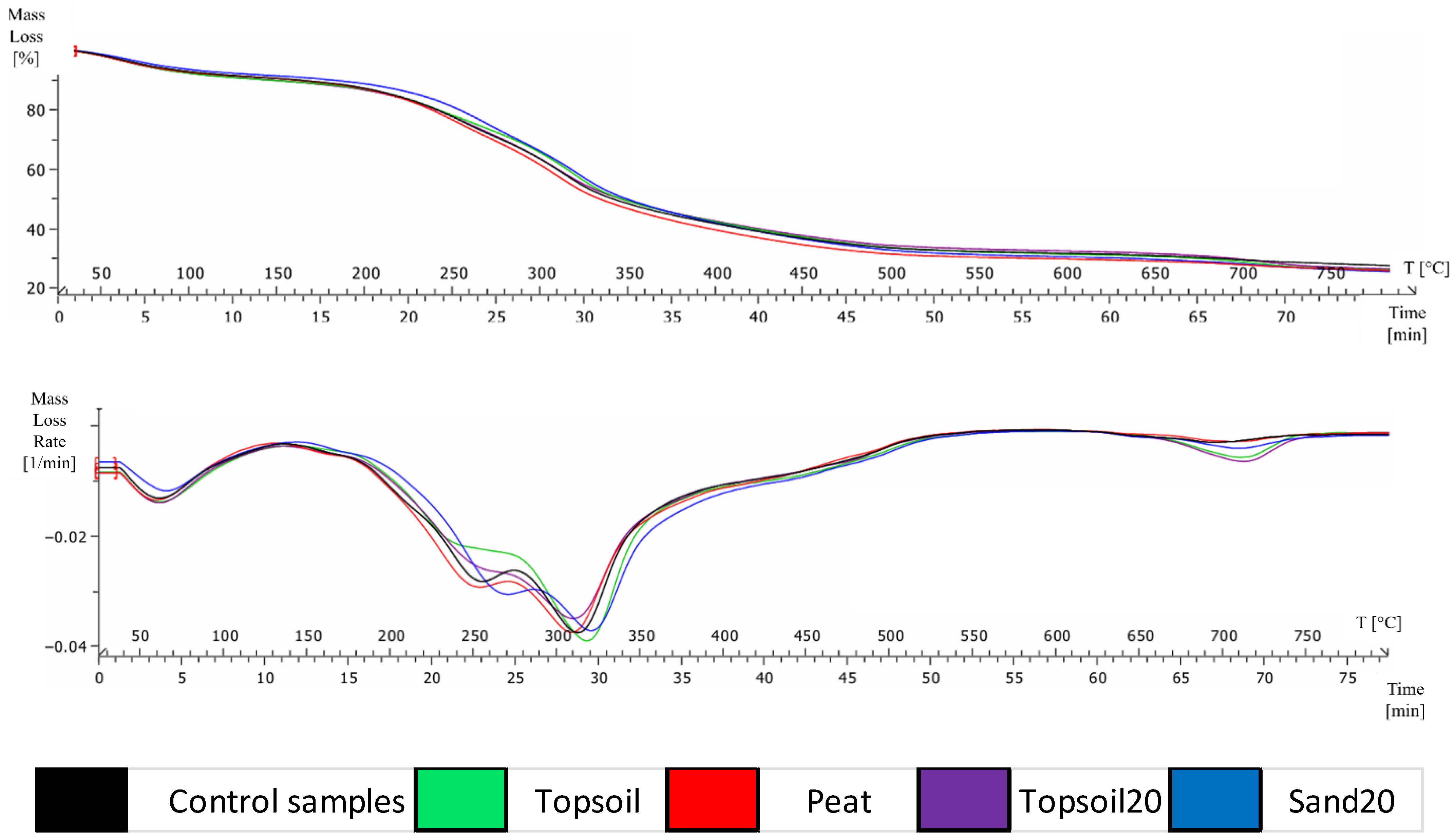
The results of the TGA are summarized in Figure 4: the upper graph shows the percentage of biomass loss in time as a function of rising temperature; the lower one shows sample degradation rates. As indicated in Section 2.2, the mass loss curve exhibits an initial drop due to the loss of water content, followed by a second one associated with organic matter degradation. Ultimately, the curve reaches a plateau representing the residual inorganic fraction (ashes and HMs). No marked differences are evident from the TGA curves for the different substrates, indicating that different substrates and HMs concentrations do not substantially affect biomass samples’ thermal behavior.
Figure 4.
Results of TGA showing mass loss of biomass samples for different growing substrates. Upper graph: percentage mass loss in time as a function of rising temperature. Lower graph: relationship between time derivative of mass loss and temperature, i.e., the rate of the sample’s mass loss. Each peak in the second frame represents a specific event of mass loss. Colors represent samples from different substrates: black—control samples, green—topsoil, red—peat, purple—topsoil20, blue—sand20.
3.1. Biochar Production
Pyrolyzed samples exhibited biochar mass yields (i.e., ratio between biochar and initial sample weight) ranging from 38% to 42% (Table 3), which are consistent with the expected outcomes of the pyrolysis process in the range 30–40% according to previous studies [37,38]. As shown in Figure 4 and confirmed by previous studies [39], the observed mass reduction at 400 °C is due to cellulose and hemicellulose degradation, while the following reduction pertains to lignin fractions. Cellulose and hemicellulose degradation generally allows for obtaining biochar with good ionic exchange capacity, due to functional group components H- and O-, despite its less compact and organized structure [40].
Table 3.
Biomass pyrolysed, mass and yield (%) of biochar produced. Values represent the mean ± standard deviation of three replicates. Apex notations (a, b) indicate statistical difference within the same column, according to Tukey’s test (p < 0.05). Different letters indicate a significant difference among substrate samples; the same letters indicate no significant difference.
3.2. Elementary (CHNS) and Electrophoretic Mobility Analyses
Results from CHNS elemental analysis and electrophoretic mobility measurements are summarized in Table 4. The carbon content of all biochar samples ranged from 40.2% to 43.8%. These relatively low values may be attributed to the mild pyrolysis temperature (400 °C) applied, not achieving complete organic matter decomposition, as evidenced also by the TGA profiles already shown in Figure 4. To obtain biochars with higher carbon content, pyrolysis temperature should be increased to 550–700 °C, as in this range the typical contents reaches 60–70% [41].
Table 4.
Percentage of C, H, N and S from CHNS analysis for the characterization of biochar and ζ-potential and conductivity from electrophoretic mobility analysis.
Under identical experimental conditions, ζ-potential is widely recognized to provide a robust indirect but indicative measure of colloidal stability and aggregation tendency of the analyzed samples, providing meaningful and scientifically sound comparisons among materials with a similar origin and processing history [42]. In this case, Zeta potential values were less negative in biochars derived from contaminated substrates (−26.8 to −28.8 mV) compared with the control ones (−35.5 mV), indicating reduced colloidal stability and a higher tendency toward particle aggregation in aqueous environments. Even though they do not fully describe aggregation mechanisms, these results should be interpreted as a reliable qualitative comparison reflecting variations in surface charge characteristics and associated aggregation behavior. These physicochemical characteristics have direct implications for subsequent potential applications. Specifically, the lower stability and conductivity of contaminated biochars may limit their use in wet substrates, where aggregation and reduced cation adsorption could impair their performance. On the contrary, control samples’ biochar exhibited properties that were more compatible with stable dispersions and higher ion-exchange capacity, making it more suitable for agronomic reuse.
3.3. Heavy Metals Analysis
Accumulated HM distributions varied among elements and plant tissues. The highest concentrations of total Cr were detected in roots and basal leaves of plants grown in topsoil-based substrates. This may be attributed to the lower porosity of this substrate, which reduces contaminant dispersion and increases the availability of Cr for plant uptake. Notably, inflorescences showed comparatively low Cr accumulation, indicating limited translocation of this element to reproductive organs. Limited Cr accumulation in the aboveground biomass of C. sativa was also observed by Raimondi et al. [43], although operating at much lower Cr concentrations (from 24.3 to 87.4 mg/kg) in soils.
Ni exhibited a markedly higher relative overall uptake across all plant parts, particularly in the roots of the plants grown in topsoil. Compared to Cr, Ni absorption was more evenly distributed, with the exception of both apical and basal leaves, for which the level of absorption increased in those grown in peat/topsoil substrate.
From the results reported in Table 5, it can be observed that Cu behavior differs from that of the other elements analyzed Cr, Pb and Ni. Cu concentrations in plant tissues were generally higher, especially in the roots of plants grown in topsoil-containing substrates. Interestingly, Cu was also present in considerable amounts in the inflorescences, with the highest concentrations observed in plants grown in pure topsoil and lower values in mixed substrates. This suggests a physiological role of Cu in flower development likely due to its function in the regulation of photosynthetic capacity [44]. Similar results were reported by Vasilou et al. [45], who detected higher Cu content in plant roots (>50% of the plant’s Cu accumulation) in different soil types, with progressive reduction towards stems and leaves. It was also observed that hemp plants cultivated in high Cu-contaminated soils produced greater amounts of cannabidiol (CBD), suggesting that the presence of this metal favored production of this metabolite.
Table 5.
Heavy metal concentrations (ppm) in different plant parts (LT, LB: leaves, top and bottom; S: Stem; R: Root, F: Flower), according to the different growth substrates. Apex notations (a, b, …) indicate statistically significant differences in results within the same column, according to Tukey’s test (p < 0.05). Different letters indicate a significant difference, same letters indicate no significant difference. n.p.—not present.
Pb is, agronomically speaking, a non-essential and toxic metal with no known biological function in plants. As expected, Pb uptake was generally lower than that of other analyzed metals. Nonetheless, the results indicate that topsoil-based substrates promoted higher Pb accumulation, particularly in root tissues. In mixed substrates, however, the highest Pb concentrations were found in the stem, possibly due to differences in translocation dynamics.
The initial and final residual concentrations of HMs in the different bedding substrates show a significant overall reduction, confirming the effectiveness of the phytoremediation process (Table 6). In most cases, the final concentrations decrease below the threshold values established by (Italian) environmental remediation guidelines, with the only exception of the peat substrate, where residual concentrations remained above acceptable limits. Overall, peat-grown plants exhibited the lowest HM removal efficiency, while the highest reductions were observed in the peat/sand substrate.
Table 6.
HM concentrations in bedding substrates at the beginning and at the end of the experiment and their efficiency of removal. % removal values are all statistically distinct from each other.
The behavior of individual metals reflects their distinct geochemical properties; their partitioning between soil and pore water is governed by the respective partition coefficients (Kd), and by the presence and concentration of other elements (e.g., C, Ni, Mn) that influence their distribution. For example, Cr can exist in different species (Cr(III) and Cr(VI)). In soils, Cr(III) generally has a much higher Kd than Cr(VI), indicating a stronger tendency to adsorb to the solid phase. Cr partition varies significantly depending on specific plant fractions (top and bottom leaves, stem, root and flowers) and growing conditions.
For Pb, the high apparent removal efficiencies observed—up to 84% in the peat/sand substrate—are consistent with its strong affinity for solid phases and limited translocation within plant tissues. In such systems, substrate concentration decreases may therefore reflect a combination of phytoextraction and redistribution or immobilization within the solid matrix, rather than direct accumulation in plant biomass alone. This interpretation is congruent with the known low mobility of Pb in soil–plant systems and supports the assessment of removal efficiency as a system-level outcome. Given the strong affinity of Pb2+ for mineral surfaces and its generally lower mobility compared to the other HMs [46], partial adsorption onto the expanded clay layer (not analyzed) represents a plausible explanation for the observed decrease in substrate Pb concentration. Additionally, Pb may have been redistributed within the substrate and preferentially associated with specific solid fractions (e.g., finer particles or organic matter) that were not fully represented in the final sampling, potentially contributing to the apparent mass imbalance. Although the mass balance may not be entirely accurate, the confirmed uptake of heavy metals by plants under controlled conditions underscores the effectiveness of the phytoremediation process, and the results suggest that the experimental setup premises were sound. Future studies should consider implementing a more isolated and controlled system to better quantify metal uptake and minimize dispersion effects. The heavy metal removal efficiencies reported in Table 6 represent net substrate depletion under controlled conditions, rather than a closed mass balance, as also observed in other studies [47,48].
Finally, Table 7 reports HM concentrations in biochars produced from the harvested biomass. These are compared with limit concentrations established by the Commission Decision (EU) 2022/1244, which defines maximum allowable heavy metal contents for biochar intended for agricultural soil amendment, in order to ensure environmental safety and prevent secondary contamination. These findings are significant in terms of both environmental safety and potential resource recovery. In particular, the highest concentrations were detected in biochar derived from peat substrate, with Ni and Cu reaching 37 mg/kg and 56 mg/kg, below the limits allowed for these metals (40 mg/kg and 200 mg/kg, respectively). The maximum Pb concentration (10.8 mg/kg) was observed in the peat/sand-derived biochar, while Cr concentrations across all samples remained notably low (0.4–9 mg/kg), regardless of growth substrate. These very low Cr concentrations (in some samples < 1 mg/kg) are consistent with the known low mobility and limited volatilization of Cr under moderate pyrolysis temperatures, as well as its preferential retention in solid phases. These values, therefore, reflect the effective immobilization of Cr within the system rather than analytical artifacts. These results demonstrate that pyrolysis does not lead to the enrichment of HMs in biochar leachate, a critical consideration for biochar’s safe reuse.
Table 7.
HMs in biochars, in comparison to the limit values established by Dlgs.2022/1244 for their use as soil amendment. Apex notations (a, b, …) indicate statistically significant differences within the same column, according to Tukey’s test (p < 0.05). Different letters indicate a significant difference, same letters indicate no significant difference.
4. Implications for Integrated Phytoremediation with Biochar Valorization
This study represents a preliminary experimental attempt to integrate phytoremediation with residual biomass valorization through pyrolysis, using Cannabis sativa grown on contaminated substrates. Despite the inherent limitations of a pilot-scale setup, the results are promising and highlight several findings:
- -
- Growing substrate composition significantly influenced HMs uptake, with greater adsorption in less compact, mixed substrates. This may indicate that higher soil porosity favored the development of the plants’ radical systems, better soil aeration and cation exchange capacity, making metals more bioavailable. Additionally, in slightly acidic conditions, metals are more mobile, resulting in increased uptake possibility.
- -
- From a plant physiology perspective, the survival of all plants, albeit with variable biomass production and early flowering in some conditions, suggests the development of contaminant tolerance and resilience mechanisms based on early HM immobilization in the lower plant levels (roots and lower stem) in order to limit damages to the reproductive systems located in the aerial parts.
- -
- HM concentrations in biochar produced from harvested C. sativa biomass remained under EU limit values for soil amendment applications; however, the low (400 °C) process temperature adopted in the study yielded biochar with consistently low C content (~40%), not meeting the Class 1 standards (>60% C content) set by the International Biochar Initiative (IBI) for its classification as a high-quality material, suitable for long-term soil C sequestration. Produced biochar showed reduced colloidal stability (as indicated by the zeta potential) and low conductivity, suggesting limited suitability for nutrient delivery or aqueous media applications. The selected pyrolysis temperature for this study represented a compromise between biochar yield and energy consumption; the resulting biochar physicochemical properties underscore the need for careful consideration of potential reuse scenarios in the selection of biomass postprocessing conditions [22]. Py-gases analysis might play a role in improving the definition of the mass balance of HM, since Cu and Pb may vaporize at high temperatures.
Generally, however, the pyrolysis process could offer, in addition to HM immobilization, the added benefit of long-term carbon sequestration, contributing to broader climate mitigation objectives by retaining organic carbon in a stable, recalcitrant form [49,50]. Furthermore, when used as a soil amendment in agriculture, biochar may decrease or limit residual heavy metal transfer to plant shoots and roots [51]. Other studies showed that Cannabis sativa L. HM phytoremediation can be conducive to other biomass reuse strategies, e.g., for anaerobic digestion or incineration for energy recovery [52].
5. Conclusions
Cannabis sativa confirmed its HMs phytoremediation capabilities in growing substrates contaminated by Cr, Cu, Ni and Pb above the admissible limits of the current Italian legislation. All soil contaminants were reduced below admissible concentrations, except for those in the peat substrate samples. C. sativa showed the capacity of HM immobilization, preferentially in the lower parts (roots and stem), with all plants surviving throughout the experiment. In order to assess the possibility of its reuse after phytoremediation, harvested biomass was pyrolyzed to produce biochar.
Further experimental results confirmed that biochars derived from hemp biomass met regulatory and environmental safety standards and could be safely applied as soil amendments. This result aligns with sustainability and circular economy targets at the EU level, promoting the valorization of waste biomass and closing the loop between remediation and resource recovery.
Notwithstanding these promising results, the scalability and environmental safety of this approach should be confirmed by replication in existing contaminated sites under natural conditions. Concerning the circular reuse of harvested biomass, pyrolysis at process temperatures higher than 400 °C should be tested to assess the possible classification improvement of the produced biochar for improved applications. Capture and analysis of py-gases could provide further insight into the overall mass balance of HMs such as Pb and Cu and advance their possible recovery as fuel. This should be accompanied by an LCA/TEA analysis to optimize energy expenditures during the process and possible biochar environmental and economic value improvement.
Author Contributions
G.P. field experiments, sampling, data analysis, draft writing; A.C. research coordination, supervision; A.G.C. supervision, final draft writing; C.S. laboratory analysis, data analysis; D.V. laboratory analysis; G.M. supervision, data analysis, draft and final writing; M.N. supervision, draft and final writing; F.M. supervision, draft writing; T.M. supervision, draft and final writing. All authors have read and agreed to the published version of the manuscript.
Funding
This research received no external funding.
Institutional Review Board Statement
Not applicable.
Informed Consent Statement
Not applicable.
Data Availability Statement
Dataset available on request from the authors.
Acknowledgments
Weester Pavia provided the Cannabis Sativa (Carmagnola variety) seedlings used for this study.
Conflicts of Interest
The authors declare no conflicts of interest. M.F. of Iridra S.r.l. contributed personal technical expertise to this study. Iridra did not contributed funding and has no financial or non-financial interests in the study.
References
- Nivetha, A.M.; Sakthivel, C.; Prabha, I. Heavy Metal Contamination in Groundwater and Impact on Plant and Human. In Spatial Modeling and Assessment of Environmental Contaminants. Environmental Challenges and Solutions; Shit, P.K., Adhikary, P.P., Sengupta, D., Eds.; Springer: Cham, Switzerland, 2021. [Google Scholar] [CrossRef] [Scilit]
- Wang, Z.; Luo, P.; Zha, X.; Xu, C.; Kang, S.; Zhou, M.; Nover, D.; Wang, Y. Overview assessment of risk evaluation and treatment technologies for heavy metal pollution of water and soil. J. Clean. Prod. 2022, 379, 134043. [Google Scholar] [CrossRef] [Scilit]
- Dhaliwal, S.S.; Singh, J.; Taneja, P.K. Remediation techniques for removal of heavy metals from the soil contaminated through diferent sources: A review. Environ. Sci. Pollut. Res. Int. 2020, 27, 1319–1333. [Google Scholar] [CrossRef] [Scilit] [PubMed]
- Hu, Y.; Wang, J.; Yang, Y.; Li, S.; Wu, Q.; Nepovimova, E.; Zhang, X.; Kuca, K. Revolutionizing soil heavy metal remediation: Cutting-edge innovations in plant disposal technology. Sci. Total Environ. 2024, 918, 170577. [Google Scholar] [CrossRef] [Scilit] [PubMed]
- Xing, S.; Dai, M.; Yang, J.; Sun, L.; Tan, X.; Peng, C.; Ali, I.; Naz, I. A critical review on the phytoremediation of heavy metals from environment: Performance and challenges. Chemosphere 2022, 291, 132979. [Google Scholar] [CrossRef] [Scilit]
- Awa, S.H.; Hadibarata, T. Removal of Heavy Metals in Contaminated Soil by Phytoremediation Mechanism: A Review. Water Air Soil. Pollut. 2020, 231, 47. [Google Scholar] [CrossRef] [Scilit]
- Liu, Z.; Tran, K.Q. A review on disposal and utilization of phytoremediation plants containing heavy metals. Ecotoxicol. Environ. Saf. 2021, 226, 112821. [Google Scholar] [CrossRef] [Scilit]
- Jurga, A.; Rodziewicz, T.; Grzegorzek, M.; Wdowikowska, A.; Reda, M.; Leluk, K.; Janicka, M.; Kaźmierczak, B. Harnessing Cannabis sativa L. for integrated environmental remediation and circular biomass use. Sci. Total Environ. 2025, 992, 179976. [Google Scholar] [CrossRef] [Scilit]
- Manaia, J.P.; Manaia, A.T.; Rodriges, L. Industrial Hemp Fibers: An Overview. Fibers 2019, 7, 106. [Google Scholar] [CrossRef] [Scilit]
- Ingrao, C.; Lo Giudice, A.; Bacenetti, J.; Tricase, C.; Dotelli, G.; Fiala, M.; Siracusa, V.; Mbohwa, C. Energy and environmental assessment of industrial hemp for building applications: A review. Renew. Sustain. Energy Rev. 2015, 51, 29–42. [Google Scholar] [CrossRef] [Scilit]
- Rehman, M.; Fahad, S.; Du, G.; Cheng, X.; Yang, Y.; Tang, K.; Liu, L.; Liu, F.-H.; Deng, G. Evaluation of hemp (Cannabis sativa L.) as an industrial crop: A review. Environ. Sci. Pollut. Res. 2021, 28, 52832–52843. [Google Scholar] [CrossRef] [Scilit]
- Yano, H.; Fu, W. Hemp: A Sustainable Plant with High Industrial Value in Food Processing. Foods 2023, 12, 651. [Google Scholar] [CrossRef] [Scilit]
- Ahmad, R.; Tehsin, Z.; Malik, S.T.; Asad, S.A.; Shahzad, M.; Bilal, M.; Shah, M.M.; Khan, S.A. Phytoremediation potential of hemp (Cannabis sativa L.): Identification and characterization of heavy metals responsive genes. Clean Soil Air Water 2016, 44, 195–201. [Google Scholar] [CrossRef] [Scilit]
- Blandinières, H.; Amaducci, S. Adapting the cultivation of industrial hemp (Cannabis sativa L.) to marginal lands: A review. GCB Bioenergy 2022, 14, 1004–1022. [Google Scholar] [CrossRef] [Scilit]
- EC. Hemp. Available online: https://agriculture.ec.europa.eu/farming/crop-productions-and-plant-based-products/hemp_en#hempcultivation (accessed on 15 October 2025).
- Brar, K.K.; Raheja, Y.; Chadha, B.S.; Magdouli, S.; Brar, S.K.; Yang, Y.-H.; Bhatia, S.K.; Koubaa, A. A paradigm shift towards production of sustainable bioenergy and advanced products from Cannabis/hemp biomass in Canada. Biomass Conv. Biorefinery 2024, 14, 3161–3182. [Google Scholar] [CrossRef] [Scilit]
- Kraszkiewicz, A.; Kachel, M.; Parafiniuk, S.; Zając, G.; Niedziółka, I.; Sprawka, M. Assessment of the Possibility of Using Hemp Biomass (Cannabis sativa L.) for Energy Purposes: A Case Study. Appl. Sci. 2019, 9, 4437. [Google Scholar] [CrossRef] [Scilit]
- Vávrová, K.; Solcova, O.; Knápek, J.; Weger, J.; Soukup, K.; Humešová, T.; Králík, T.; Bím, J. Economic evaluation of Hemp’s (Cannabis sativa) residual biomass for production of direct energy or biochar. Fuel 2022, 329, 125435. [Google Scholar] [CrossRef] [Scilit]
- Ferrarini, A.; Fracasso, A.; Spini, G.; Fornasier, F.; Taskin, E.; Fontanella, M.C.; Beone, G.M.; Amaducci, S.; Puglisi, E. Bioaugmented phytoremediation of metal-contaminated soils and sediments by hemp and giant reed. Front. Microbiol. 2021, 12, 645893. [Google Scholar] [CrossRef] [Scilit]
- Khan, A.H.A.; Kiyani, A.; Santiago-Herrera, M.; Ibáñez, J.; Yousaf, S.; Iqbal, M.; Martel-Martín, S.; Barros, R. Sustainability of phytoremediation: Post-harvest stratagems and economic opportunities for the produced metals contaminated biomass. J. Environ. Manag. 2023, 326, 116700. [Google Scholar] [CrossRef] [Scilit]
- Callegari, A.; Hlavinek, P.; Capodaglio, A.G. Production of energy (biodiesel) and recovery of materials (biochar) from pyrolysis of urban waste sludge. Rev. Ambient Agua 2018, 13, e2128. [Google Scholar] [CrossRef] [Scilit]
- Callegari, A.; Capodaglio, A.G. Properties and beneficial uses of (bio)chars, with special attention to products from sewage sludge pyrolysis. Resources 2018, 7, 20. [Google Scholar] [CrossRef] [Scilit]
- Capodaglio, A.G. Developments and Issues in Renewable Ecofuels and Feedstocks. Energies 2024, 17, 3560. [Google Scholar] [CrossRef] [Scilit]
- Embaye, T.M.; Zhou, A.; Li, R.; Ahmed, M.B.; Ruan, R.; Wu, D.; Deng, N.; Wang, X. Assessment of heavy metals distribution and environmental risks in biochar from co-pyrolysis of sewage sludge and mixed municipal waste. Process Saf. Environ. Prot. 2025, 193, 1332–1342. [Google Scholar] [CrossRef] [Scilit]
- Fadel, D.; Assaad, N.; Hachem, A.; Argyraki, A.; Kypritidou, Z. Heavy metals interaction in soil-plant system of carmagnola cannabis strain. J. Agric. Sci. 2020, 12, 163–171. [Google Scholar] [CrossRef] [Scilit]
- Sward, S.; Brye, K.R.; Miller, D.M.; Thurston, D.V. Use of Biochar and Industrial Hemp for Remediation of Heavy-Metal-Contaminated Soil: Root Uptake and Translocations for Cd, Pb, and Zn. Soil Syst. 2025, 9, 29. [Google Scholar] [CrossRef] [Scilit]
- Rheay, H.T.; Omondi, E.C.; Brewer, C.E. Potential of hemp (Cannabis sativa L.) for paired phytoremediation and bioenergy production. GCB Bioenergy 2020, 13, 525–536. [Google Scholar] [CrossRef] [Scilit]
- Golia, E.E.; Bethanis, J.; Ntinopoulos, N.; Kaffe, G.G.; Komnou, A.A.; Vasilou, C. Investigating the potential of heavy metal accumulation from hemp. The use of industrial hemp (Cannabis sativa L.) for phytoremediation of heavily and moderated polluted soils. Sustain. Chem. Pharm. 2023, 31, 100961. [Google Scholar] [CrossRef] [Scilit]
- IUSS Working Group WRB. World Reference Base for Soil Resources. International Soil Classification System for Naming Soils and Creating Legends for Soil Maps, 4th ed.; International Union of Soil Sciences (IUSS): Vienna, Austria, 2022. [Google Scholar]
- EMME3 Srl. Available online: https://www.emme3-srl.it/2023/04/27/la-speciazione-del-carbonio-nei-campioni-solidi/ (accessed on 15 January 2025).
- Jindo, K.; Audette, Y.; Higashikawa, F.S.; Silva, C.A.; Akashi, K.; Mastrolonardo, G.; Sánchez-Monedero, M.A.; Mondini, C. Role of biochar in promoting circular economy in the agriculture sector. Part 1: A review of the biochar roles in soil N, P and K cycles. Chem. Biol. Technol. Agric. 2020, 7, 15. [Google Scholar] [CrossRef] [Scilit]
- UNI EN 16173:2012; Fanghi, rifiuti organici trattati e suolo—Digestione delle frazioni di elementi solubili in acido nitrico. Ente Italiano Normazione: Milano, Italy, 2012.
- Adesina, I.; Bhowmik, A.; Sharma, H.; Shahbazi, A. A Review on the Current State of Knowledge of Growing Conditions, Agronomic Soil Health Practices and Utilities of Hemp in the United States. Agriculture 2020, 10, 129. [Google Scholar] [CrossRef] [Scilit]
- Linger, P.; Ostwald, A.; Haensler, J. Cannabis sativa L. growing on heavy metal contaminated soil: Growth, cadmium uptake and photosynthesis. Biol. Plant. 2005, 49, 567–576. [Google Scholar] [CrossRef] [Scilit]
- Netto, A.T.; Campostrini, E.; De Oliveira, J.G.; Bressan-Smith, R.E. Photosynthetic pigments, nitrogen, chlorophyll a fluorescence and SPAD-502 readings in coffee leaves. Sci. Hortic. 2005, 104, 199–209. [Google Scholar] [CrossRef] [Scilit]
- Zrimec, J.; Correa, S.; Zagorščak, M.; Petek, M.; Bleker, C.; Stare, K.; Schuy, C.; Sonnewald, S.; Gruden, K.; Nikoloski, Z. Evaluating plant growth–defense trade-offs by modeling the interaction between primary and secondary metabolism. Proc. Natl. Acad. Sci. USA 2025, 122, e2502160122. [Google Scholar] [CrossRef] [Scilit]
- Kim, M.; Park, J.; Yu, S.; Park, J. Clean and energy-efficient mass production of biochar by process integration: Evaluation of process concept. Chem. Eng. J. 2019, 355, 840–849. [Google Scholar] [CrossRef] [Scilit]
- Ceretta, M.B.; Gorazzi, S.A.; D’Ippolito, S.; Mendieta, J.; Nercessian, D.; Bonanni, S. Cannabis sativa biochar: Characterization and preliminary application in plant growth and adsorption, and as an electrode material. RSC Sustain. 2025, 3, 1932–1940. [Google Scholar] [CrossRef] [Scilit]
- Zhang, K.; Zhang, K.; Li, Y.; Kang, Q.; Wang, Y.; Wang, J.; Yang, K.; Mao, J. Easily Pyrolyzable Biomass Components Significantly Affect the Physicochemical Properties and Water-Holding Capacity of the Pyrolyzed Biochar. Agriculture 2023, 13, 2053. [Google Scholar] [CrossRef] [Scilit]
- Tomczyk, A.; Sokołowska, Z.; Boguta, P. Biochar physicochemical properties: Pyrolysis temperature and feedstock kind effects. Rev. Environ. Sci. Biotechnol. 2020, 19, 191–215. [Google Scholar] [CrossRef] [Scilit]
- Lehmann, J.; Joseph, S. Biochar for Environmental Management: Science and Technology; Routledge: New York, NY, USA, 2009. [Google Scholar]
- Hunter, R.J. Zeta Potential in Colloid Science: Principles and Applications; Academic Press: Cambridge, MA, USA; Elsevier: Amsterdam, The Netherlands, 1981. [Google Scholar] [CrossRef] [Scilit]
- Raimondi, G.; Rodrigues, J.; Maucieri, C.; Borin, M.; Bona, S. Phytomanagement of Chromium-Contaminated Soils Using Cannabis sativa (L.). Agronomy 2020, 10, 1223. [Google Scholar] [CrossRef] [Scilit]
- Royal Queen Seeds. Available online: https://www.royalqueenseeds.it/blog-carenza-di-rame-nella-cannabis-sintomi-e-trattamento-n828 (accessed on 15 October 2025).
- Vasilou, C.; Tsiropoulos, N.G.; Golia, E.E. Phytoremediation & Valorization of Cu-contaminated Soils Through Cannabis sativa (L.) Cultivation: A Smart Way to Produce Cannabidiol (CBD) in Mediterranean Soils. Waste Biomass Valoriz. 2024, 15, 1711–1724. [Google Scholar] [CrossRef] [Scilit]
- Jabłońska, B. Optimization of Ni(II), Pb(II), and Zn(II) Ion Adsorption Conditions on Pliocene Clays from Post-Mining Waste. Minerals 2021, 11, 568. [Google Scholar] [CrossRef] [Scilit]
- Sagimbayeva, A.M.; Tomlekova, N.B.; Saparov, G.A.; Abduraimov, Y.O.; Kerimbayev, A.A.; Nurabayev, S.S.; Assanzhanova, N.N.; Akmyrzayev, N.Z.; Iskakova, K.M.; Omarova, A.S.; et al. Phytoremediation of Heavy Metal-Contaminated Soil Using Drought-Adapted Sweet Sorghum (Sorghum bicolor L.) in Arid Regions of Kazakhstan. Plants 2025, 14, 3627. [Google Scholar] [CrossRef] [Scilit]
- Awad, M.; El-Desoky, M.A.; Ghallab, A.; Kubes, J.; Abdel-Mawly, S.E.; Danish, S.; Ratnasekera, D.; Sohidul Islam, M.; Skalicky, M.; Brestic, M.; et al. Ornamental Plant Efficiency for Heavy Metals Phytoextraction from Contaminated Soils Amended with Organic Materials. Molecules 2021, 26, 3360. [Google Scholar] [CrossRef] [Scilit]
- Spokas, K.A.; Cantrell, K.B.; Novak, J.M.; Archer, D.W.; Ippolito, J.A.; Collins, H.P.; Boateng, A.A.; Lima, I.M.; Lamb, M.C.; McAloon, A.J.; et al. Biochar: A synthesis of its agronomic impact beyond carbon sequestration. J. Environ. Qual. 2012, 41, 973–989. [Google Scholar] [CrossRef] [Scilit]
- Capodaglio, A.G. Energy use and decarbonisation of the water sector: A comprehensive overview of issues, approaches and technological options. Environ. Technol. Rev. 2025, 14, 40–68. [Google Scholar] [CrossRef] [Scilit]
- Yang, J.; Tan, X.; Shaaban, M.; Cai, Y.; Wang, B.; Peng, Q.A. Remediation of Cr (VI)-Contaminated soil by biochar-supported nanoscale zero-valent iron and the consequences for indigenous microbial communities. Nanomaterials 2022, 12, 3541. [Google Scholar] [CrossRef] [Scilit]
- Todde, G.; Carboni, G.; Marras, S.; Caria, M.; Sirca, C. Industrial hemp (Cannabis sativa L.) for phytoremediation: Energy and environmental life cycle assessment of using contaminated biomass as an energy resource. Sustain. Energy Technol. Assess. 2022, 52, 102081. [Google Scholar] [CrossRef] [Scilit]

Disclaimer/Publisher’s Note: The statements, opinions and data contained in all publications are solely those of the individual author(s) and contributor(s) and not of MDPI and/or the editor(s). MDPI and/or the editor(s) disclaim responsibility for any injury to people or property resulting from any ideas, methods, instructions or products referred to in the content. |
© 2026 by the authors. Licensee MDPI, Basel, Switzerland. This article is an open access article distributed under the terms and conditions of the Creative Commons Attribution (CC BY) license.