Bioconversion of Saline Human Hair Waste: Syntrophic EM Consortia Outperform Single-Strain Inoculants in Keratinolysis and Nitrogen Recovery

 ,
,  and
and
Abstract
1. Introduction
2. Materials and Methods
2.1. Study Site and Experimental Conditions
2.2. Raw Materials and Substrate Preparation
- Human Hair Waste: Collected from professional beauty salons in Tulcán. Critically, the hair was processed unwashed to preserve the native microbiota and chemical residues (dyes, surfactants) typical of real-world waste. To minimize experimental error derived from the heterogeneity of hair treatments, a composite sampling method was employed: ~100 kg of hair was mechanically homogenized and cut to 1–5 cm lengths prior to pile formation.
- Cattle Manure: Fresh bovine manure was obtained from local dairy farms, serving as the primary source of nitrogen and microbial inoculum. This substrate contributes a diverse load of rumen-derived hydrolytic bacteria, primarily Firmicutes and Bacteroidetes, while the unwashed hair introduces cuticle-associated commensals such as Staphylococcus spp., creating a basal community for the composting process [8,11].
- Bulking Agent: Fresh grass clippings (Pennisetum clandestinum or similar pasture mix) were used to optimize porosity and the C/N ratio.
2.3. Microbial Inoculants
- Effective Microorganisms (EM): EM•COMPOST® (BIOEM S.A.C., Lima, Peru), a liquid consortium containing Lactobacillus spp. (lactic acid bacteria for pH suppression), Saccharomyces spp. (yeast for fermentative breakdown) and phototrophic bacteria (energy synthesis) (1 × 10⁴ CFU mL−1) designed to accelerate organic fermentation.
- Trichoderma: TRICOMPLEX® (BioControlScience—BCS, Quito, Ecuador), a fungal suspension based on Trichoderma harzianum and T. viride designed for lignocellulosic degradation.
- Bacillus: BACILUX® (BioControlScience—BCS, Quito, Ecuador), a bacterial concentrate containing Bacillus subtilis and B. licheniformis (1 × 10⁹ CFU mL−1), selected for their proteolytic activity.
2.4. Experimental Design and Composting Setup
2.5. Process Monitoring and Sampling
2.6. Analytical Methods
- Total Nitrogen (N): Modified Kjeldahl method using a distillation unit (Model UDK 129, VELP Scientifica, Usmate, Italy) [AOAC 955.04] [20].
- Phosphorus (P): Colorimetric Olsen method using a UV-Vis spectrophotometer (Model UV-1800, Shimadzu, Kyoto, Japan) [AOAC 965.17] [21].
- Potassium (K), Ca, Mg: Atomic Absorption Spectrophotometry (AAS) using an AAnalyst 400 (PerkinElmer, Waltham, MA, USA) after acid digestion [AOAC 975.03] [22].
- Organic Matter (OM): Loss on ignition (calcination) in a muffle furnace (Model FB1410M, Thermo Scientific, Waltham, MA, USA) [EPA 160.4] [23].
- Electrical Conductivity (EC) and pH: Measured in a 1:10 (w/v) aqueous extract using a multiparameter meter (Model HQ40d, Hach Company, Loveland, CO, USA) [EPA 9045D/9050A] [24].
- Heavy Metals (Zn, Cu): Acid digestion [EPA 3050B] followed by AAS analysis using an AAnalyst 400 (PerkinElmer, Waltham, MA, USA) [22].
2.7. Statistical Analysis
3. Results
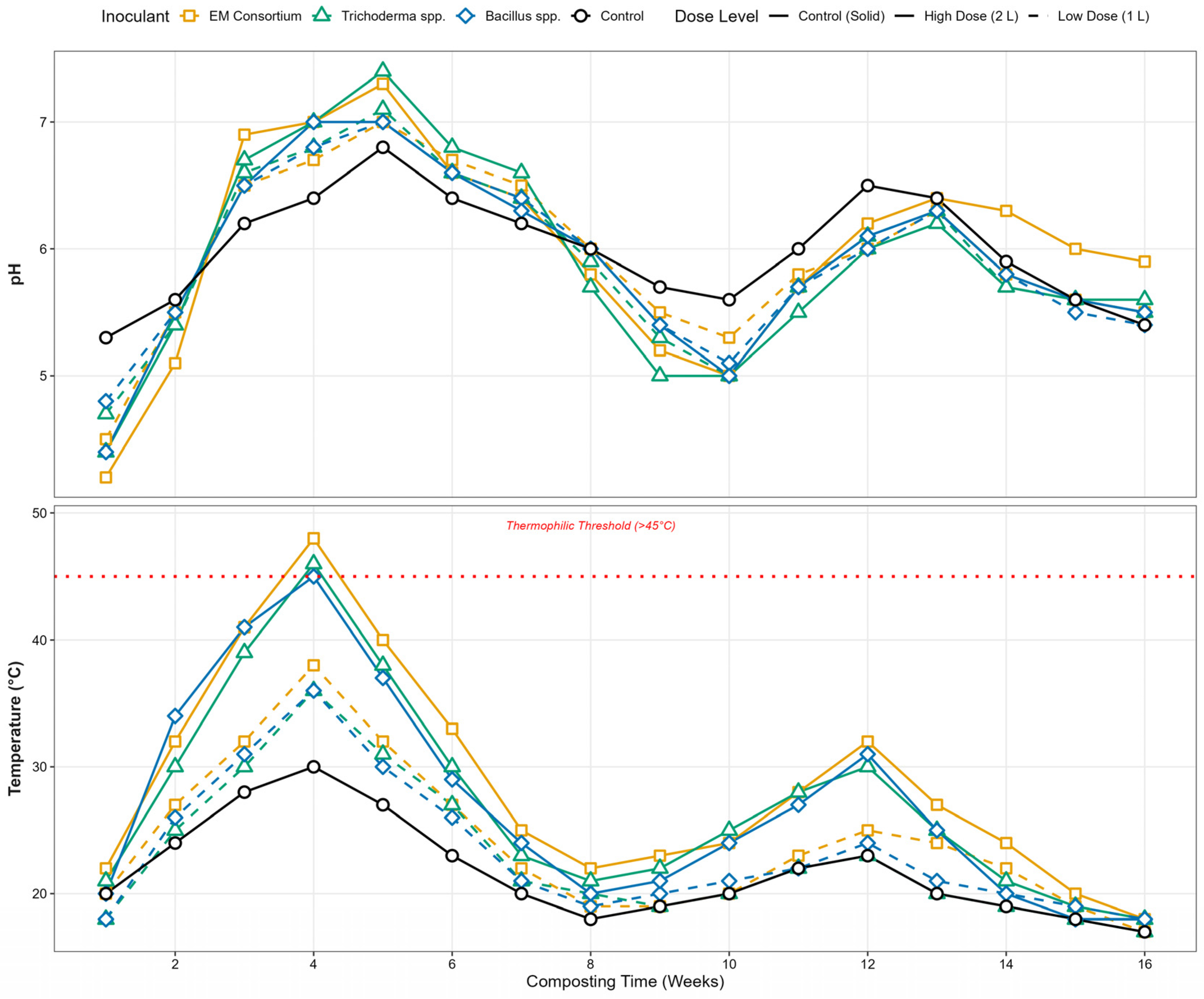
3.1. Process Evolution: Temperature and pH Dynamics
3.2. Physicochemical Quality and Nutrient Recovery
3.3. Salinity Management and Safety
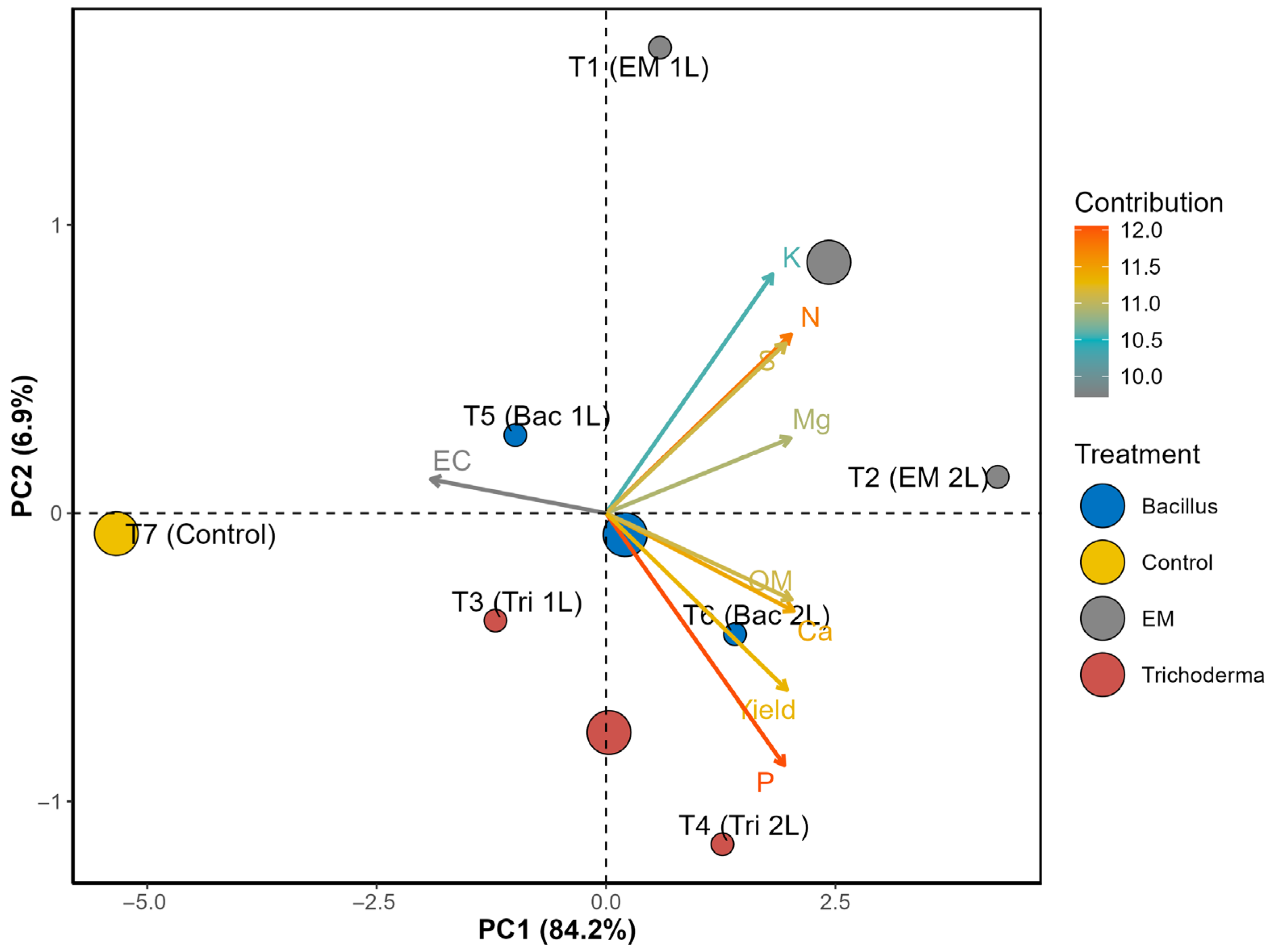
3.4. Multivariate Analysis (PCA)
4. Discussion
4.1. Inoculant Efficiency and Thermophilic Optimization
4.2. Biochemical Mechanisms and Comparative Nitrogen Recovery
4.3. “Static” Strategy: The Key to Nitrogen Conservation
4.4. The Salinity Mechanism: Bio-Stabilization via Humification
4.5. Economic Viability and Circular Economy
5. Conclusions
- Superior Kinetics: The EM consortium (T2) outperformed single-strain inoculants, achieving sanitation temperatures (48 °C) and accelerating keratinolysis through syntrophic succession, confirming that metabolic diversity is essential to withstand osmotic stress.
- Mechanism of Salt Mitigation: In the absence of leaching, the 47% reduction in electrical conductivity confirms that bio-augmentation promotes the complexation of free salts, likely via humification-driven chelation mechanisms.
- Value-Added Product: The resulting compost yields 1.41% (14,133 mg kg−1) of mineralized Nitrogen, surpassing the minimum requirements for organic amendments. The final product complies with US EPA PFRP thermal standards [29] and local regulations (NTE INEN 2871 [19]), ensuring its viability as a high-value biofertilizer.
- Strategic Management: The adoption of a single-turn passive aeration strategy proved crucial for minimizing nitrogen volatilization and protecting fungal colonization networks, validating low-disturbance protocols for keratinous waste.
Author Contributions
Funding
Institutional Review Board Statement
Informed Consent Statement
Data Availability Statement
Conflicts of Interest
Abbreviations
| AAS | Atomic Absorption Spectrophotometry |
| ANOVA | Analysis of Variance |
| C/N | Carbon-to-Nitrogen Ratio |
| CRD | Completely Randomized Design |
| EC | Electrical Conductivity |
| EM | Effective Microorganisms |
| EPA | Environmental Protection Agency |
| HSD | Honestly Significant Difference (Tukey’s test) |
| INEN | Instituto Ecuatoriano de Normalización |
| LAB | Lactic Acid Bacteria |
| OM | Organic Matter |
| PCA | Principal Component Analysis |
| USD | United States Dollar |
References
- UNEP. Global Waste Management Outlook 2024: Beyond an Age of Waste; United Nations Environment Programme: Nairobi, Kenya, 2024. [Google Scholar]
- Murshid, N.; Lamaming, J.; Saalah, S.; Rajin, M.; Yaser, A.Z. A review of vegetable waste bio-processing techniques in rural areas. Int. J. Recycl. Org. Waste Agric. 2024, 13, 1302–1313. [Google Scholar] [CrossRef]
- Ayilara, M.S.; Olanrewaju, O.S.; Babalola, O.O.; Odeyemi, O. Waste management through composting: Challenges and potentials. Sustainability 2020, 12, 4456. [Google Scholar] [CrossRef]
- Holkar, C.R.; Jain, S.S.; Jadhav, A.J.; Pinjari, D.V. Valorization of keratin-based waste biomass: Resource recovery and circular economy. Process Saf. Environ. Prot. 2017, 115, 85–98. [Google Scholar] [CrossRef]
- du Jardin, P. Plant biostimulants: Definition, concept, main categories and regulation. Sci. Hortic. 2015, 196, 3–14. [Google Scholar] [CrossRef]
- Sánchez, A.; Artola, A.; Font, X.; Gea, T.; Barrena, R.; Gabriel, D.; Sánchez-Monedero, M.Á.; Roig, A.; Cayuela, M.L.; Mondini, C. Greenhouse gas emissions from organic waste composting. Environ. Chem. Lett. 2015, 13, 223–238. [Google Scholar] [CrossRef]
- Vidmar, B.; Vodovnik, M. Microbial keratinases: Enzymes with promising biotechnological applications. Food Technol. Biotechnol. 2018, 56, 312–328. [Google Scholar] [CrossRef]
- Brandelli, A.; Sala, L.; Kalil, S.J. Microbial enzymes for bioconversion of poultry waste into added-value products. Food Res. Int. 2015, 73, 3–12. [Google Scholar] [CrossRef]
- Sahni, N.; Sahota, P.; Phutela, U.G. Bacterial keratinases and their prospective applications: A review. Int. J. Curr. Microbiol. App. Sci. 2015, 4, 768–783. [Google Scholar]
- Brandelli, A. Bacterial keratinases: Useful enzymes for bioprocessing agroindustrial wastes and beyond. Food Bioprocess Technol. 2008, 1, 105–116. [Google Scholar] [CrossRef]
- Bwacha, F.; Jongman, M.; Wale, K.R.; Tshekiso, K.; Loeto, D. Keratinolytic enzyme production and poultry feather biodegradation by bacteria isolated from extreme environments in Botswana. Processes 2025, 13, 3050. [Google Scholar] [CrossRef]
- Zheljazkov, V.D.; Silva, J.L.; Patel, M.; Stojanovic, J.; Horgan, T. Human hair as a nutrient source for horticultural crops. HortTechnology 2008, 18, 592–596. [Google Scholar] [CrossRef]
- Sinkiewicz, I.; Śliwiński, M.; Staroszczyk, H.; Kołodziejska, I. Alternative methods of preparation of soluble keratin from chicken feathers. Waste Biomass Valoriz. 2017, 8, 1043–1048. [Google Scholar] [CrossRef]
- Waliczek, T.M.; Drewery, M.; McMoran, A.; Hale, J. Assessing the quality of compost produced from human hair and pet fur waste. Compost Sci. Util. 2023, 29, 57–64. [Google Scholar] [CrossRef]
- Rath, K.M.; Rousk, J. Salt effects on the soil microbial decomposer community and their role in organic carbon cycling. Soil Biol. Biochem. 2015, 81, 108–123. [Google Scholar] [CrossRef]
- Oren, A. Thermodynamic limits to microbial life at high salt concentrations. Environ. Microbiol. 2011, 13, 1908–1923. [Google Scholar] [CrossRef]
- Morris, B.E.L.; Henneberger, R.; Huber, H.; Moissl-Eichinger, C. Microbial syntrophy: Interaction for the common good. FEMS Microbiol. Rev. 2013, 37, 384–406. [Google Scholar] [CrossRef]
- Zhu, N.; Li, W.; Huang, C.; Tian, Y.; Xi, B. Functional redundancy is the key mechanism used by microorganisms for nitrogen and sulfur metabolism during manure composting. Sci. Total Environ. 2024, 912, 169389. [Google Scholar] [CrossRef]
- INEN. Norma Técnica Ecuatoriana NTE INEN 2871: Abonos, Fertilizantes y Enmiendas de Suelo; Requisitos; Instituto Ecuatoriano de Normalización: Quito, Ecuador, 2015.
- AOAC International. Official Methods of Analysis of AOAC International, 21st ed.; AOAC International: Rockville, MD, USA, 2019; Method 955.04. [Google Scholar]
- AOAC International. Official Methods of Analysis of AOAC International, 21st ed.; AOAC International: Rockville, MD, USA, 2019; Method 965.17. [Google Scholar]
- US EPA. Method 3050B: Acid Digestion of Sediments, Sludges, and Soils; Office of Solid Waste: Washington, DC, USA, 1996.
- US EPA. Method 160.4: Residue, Volatile (Gravimetric, Ignition at 550 °C); Environmental Monitoring and Support Laboratory: Cincinnati, OH, USA, 1971.
- US EPA. Method 9045D: Soil and Waste pH; Office of Solid Waste: Washington, DC, USA, 2004.
- R Core Team. R: A Language and Environment for Statistical Computing; R Foundation for Statistical Computing: Vienna, Austria, 2023. [Google Scholar]
- Lê, S.; Josse, J.; Husson, F. FactoMineR: An R Package for Multivariate Analysis. J. Stat. Softw. 2008, 25, 1–18. [Google Scholar] [CrossRef]
- Kassambara, A.; Mundt, F. Factoextra: Extract and Visualize the Results of Multivariate Data Analyses. R package Version 1.0.7. 2020. Available online: https://scirp.org/reference/referencespapers?referenceid=3067217 (accessed on 5 January 2026).
- US EPA. A Plain English Guide to the EPA Part 503 Biosolids Rule; United States Environmental Protection Agency: Washington, DC, USA, 1994.
- US EPA. Environmental Regulations and Technology: Control of Pathogens and Vector Attraction in Sewage Sludge; EPA/625/R-92/013; Office of Research and Development, US EPA: Washington, DC, USA, 2003.
- Partanen, P.; Hultman, J.; Paulin, L.; Auvinen, P.; Romantschuk, M. Bacterial diversity at different stages of the composting process. BMC Microbiol. 2010, 10, 94. [Google Scholar] [CrossRef]
- Mason, I.G. Mathematical modelling of the composting process: A review. Waste Manag. 2006, 26, 3–21. [Google Scholar] [CrossRef]
- Tamreihao, K.; Mukherjee, S.; Khunjamayum, R. Feather degradation by keratinolytic bacteria and biofertilizing potential for sustainable agricultural production. J. Basic Microbiol. 2019, 59, 4–13. [Google Scholar] [CrossRef]
- Wardah; Lahum, Y.; Fuakubun, F.; Sopandi, T. Valorization of chicken feather into organic liquid fertilizer through two species of Bacillus bacteria fermentation. Asian J. Agric. Biol. 2023, 2023, 2022148. [Google Scholar] [CrossRef]
- Mpaka, L.; Nnolim, N.E.; Nwodo, U.U. Microbial keratinolysis: Eco-friendly valorisation of keratinous waste into functional peptides. Microorganisms 2025, 13, 2270. [Google Scholar] [CrossRef]
- Korniłłowicz-Kowalska, T.; Bohacz, J. Biodegradation of keratin waste: Theory and practical aspects. Waste Manag. 2011, 31, 1689–1701. [Google Scholar] [CrossRef]
- Guan, S.; Liu, Y.; Duan, W.; Wang, K.; Wang, P.; Liu, S.; Jia, X.; Hu, Y. Effects of microbial fertilizer on soil physicochemical properties and fungal community diversity in saline–alkali soil cultivated with oil sunflowers. Agronomy 2025, 15, 2769. [Google Scholar] [CrossRef]
- Mironov, V.; Vanteeva, A.; Merkel, A. Microbiological Activity during Co-Composting of Food and Agricultural Waste for Soil Amendment. Agronomy 2021, 11, 928. [Google Scholar] [CrossRef]
- Tiquia, S.M.; Tam, N.F.Y.; Hodgkiss, I.J. Effects of composting on phytotoxicity of spent pig-manure sawdust litter. Environ. Pollut. 1996, 93, 249–256. [Google Scholar] [CrossRef]
- Gupta, S.; Sharma, S.; Aich, A.; Nandi, S. Chicken Feather Waste Hydrolysate as a Potential Biofertilizer for Environmental Sustainability in Organic Agriculture Management. Waste Biomass Valor. 2023, 14, 2783–2799. [Google Scholar] [CrossRef]
- European Commission. Circular Economy Action Plan: For a Cleaner and More Competitive Europe; Publications Office of the European Union: Luxembourg, 2024. [Google Scholar]
- Peng, Z.; Mao, X.; Zhang, J.; Du, G.; Chen, J. Effective biodegradation of chicken feather waste by co-cultivation of keratinase producing strains. Microb. Cell Fact. 2019, 18, 84. [Google Scholar] [CrossRef]
- Li, L.; Li, C.; Guo, H.; Liu, Y.; Sheng, J.; Guo, S.; Shen, Q.; Ling, N.; Guo, J. Enhanced carbon use efficiency and warming resistance of soil microorganisms under organic amendment. Environ. Int. 2024, 192, 109043. [Google Scholar] [CrossRef]
- Donato, R.K.; Mija, A. Keratin associations with synthetic, biosynthetic and natural polymers: An extensive review. Polymers 2020, 12, 32. [Google Scholar] [CrossRef]
- Colla, G.; Nardi, S.; Cardarelli, M.; Ertani, A.; Lucini, L.; Canaguier, R.; Rouphael, Y. Protein hydrolysates as biostimulants in horticulture. Sci. Hortic. 2015, 196, 28–38. [Google Scholar] [CrossRef]
- Nardi, S.; Pizzeghello, D.; Schiavon, M.; Ertani, A. Plant biostimulants: Physiological responses induced by protein hydrolysates and humic substances in plant metabolism. Sci. Agric. 2016, 73, 18–23. [Google Scholar] [CrossRef]
- Chen, H.; Gao, S.; Li, Y.; Li, N.; Li, Q.; Li, X. Valorization of Livestock Keratin Waste: Application in Agricultural Fields. Int. J. Environ. Res. Public Health 2022, 19, 6681. [Google Scholar] [CrossRef] [PubMed]
- Tesfaye, T.; Sithole, B.; Ramjugernath, D. Valorisation of chicken feathers: Characterisation of physical properties and morphological structure. J. Clean. Prod. 2017, 149, 349–365. [Google Scholar] [CrossRef]
- Zheljazkov, V.D. Assessment of wool waste and hair waste as soil amendment and nutrient source. J. Environ. Qual. 2005, 34, 2310–2317. [Google Scholar] [CrossRef] [PubMed]
- Bernal, M.P.; Alburquerque, J.A.; Moral, R. Composting of animal manures and chemical criteria for compost maturity assessment. Bioresour. Technol. 2009, 100, 5444–5453. [Google Scholar] [CrossRef]
- Jusoh, M.L.C.; Manaf, L.A.; Latiff, P.A. Composting of rice straw with effective microorganisms (EM) and its influence on compost quality. Iran. J. Environ. Health Sci. Eng. 2013, 10, 17. [Google Scholar] [CrossRef]
- Gupta, R.; Ramnani, P. Microbial keratinases and their prospective applications: An overview. Appl. Microbiol. Biotechnol. 2006, 70, 21–33. [Google Scholar] [CrossRef]
- Epstein, E. The Science of Composting; CRC Press: Boca Raton, FL, USA, 1997. [Google Scholar]
- Zhao, X.; Li, J.; Che, Z.; Xue, L. Succession of the bacterial communities and functional characteristics in sheep manure composting. Biology 2022, 11, 1181. [Google Scholar] [CrossRef]
- Zheljazkov, V.D. Assessment of wool waste as a soil amendment and nutrient source. HortScience 2005, 40, 1032–1035. [Google Scholar]



| Treatment | Inoculant Type | Commercial Product | Dose (per 50 kg Pile) |
|---|---|---|---|
| T1 | Consortium | EM•COMPOST® | 1.0 L |
| T2 | Consortium | EM•COMPOST® | 2.0 L |
| T3 | Fungal | TRICOMPLEX® | 1.0 L |
| T4 | Fungal | TRICOMPLEX® | 2.0 L |
| T5 | Bacterial | BACILUX® | 1.0 L |
| T6 | Bacterial | BACILUX® | 2.0 L |
| T7 | Control | - | - |
| Treatment | Dose | pH | EC (mS/cm) | OM (%) | N (mg kg−1) | S (mg kg−1) | P (mg kg−1) | K (mg kg−1) | Ca (mg kg−1) | Mg (mg kg−1) | Yield (%) |
|---|---|---|---|---|---|---|---|---|---|---|---|
| T1 (EM) | 1.0 L | 5.59 | 4.45 bc | 12.62 c | 11,099 b | 8888 b | 1890 c | 5966.7 b | 5215.7 c | 671.8 ab | 54.25 c |
| T2 (EM) | 2.0 L | 5.92 | 3.82 c | 16.12 a | 14,133 a | 9814 a | 2983 a | 6548.5 a | 5995.6 a | 698.9 a | 69.48 a |
| T3 (Trich) | 1.0 L | 5.60 | 4.35 bc | 12.43 c | 7265 d | 7007 c | 2036 c | 4461.9 d | 4877.7 d | 604.8 c | 55.50 c |
| T4 (Trich) | 2.0 L | 5.68 | 4.06 c | 13.44 b | 9019 c | 7845 c | 2982 a | 5004.4 c | 5701.4 ab | 651.8 bc | 61.75 b |
| T5 (Bac) | 1.0 L | 5.50 | 4.62 b | 12.20 c | 8043 cd | 6377 d | 1895 c | 5526.1 b | 4978.8 cd | 586.2 c | 56.25 c |
| T6 (Bac) | 2.0 L | 5.53 | 4.29 bc | 15.28 ab | 9727 bc | 7074 c | 2668 b | 6008.7 b | 5381.9 c | 638.5 bc | 62.00 b |
| T7 (Control) | - | 5.48 | 7.23 a | 9.93 d | 4742 e | 4555 e | 1099 d | 4152.6 e | 4478.1 e | 400.3 d | 49.50 d |
Disclaimer/Publisher’s Note: The statements, opinions and data contained in all publications are solely those of the individual author(s) and contributor(s) and not of MDPI and/or the editor(s). MDPI and/or the editor(s) disclaim responsibility for any injury to people or property resulting from any ideas, methods, instructions or products referred to in the content. |
© 2026 by the authors. Licensee MDPI, Basel, Switzerland. This article is an open access article distributed under the terms and conditions of the Creative Commons Attribution (CC BY) license.
Share and Cite
Jácome Sarchi, G.A.; De la Cruz Sarchi, S.A.; Coronel Montesdeoca, N.T.; Mina Ortega, J.I. Bioconversion of Saline Human Hair Waste: Syntrophic EM Consortia Outperform Single-Strain Inoculants in Keratinolysis and Nitrogen Recovery. Sustainability 2026, 18, 2758. https://doi.org/10.3390/su18062758
Jácome Sarchi GA, De la Cruz Sarchi SA, Coronel Montesdeoca NT, Mina Ortega JI. Bioconversion of Saline Human Hair Waste: Syntrophic EM Consortia Outperform Single-Strain Inoculants in Keratinolysis and Nitrogen Recovery. Sustainability. 2026; 18(6):2758. https://doi.org/10.3390/su18062758
Chicago/Turabian StyleJácome Sarchi, Guillermo Alexander, Stalin Aldair De la Cruz Sarchi, Nataly Tatiana Coronel Montesdeoca, and Jorge Ivan Mina Ortega. 2026. "Bioconversion of Saline Human Hair Waste: Syntrophic EM Consortia Outperform Single-Strain Inoculants in Keratinolysis and Nitrogen Recovery" Sustainability 18, no. 6: 2758. https://doi.org/10.3390/su18062758
APA StyleJácome Sarchi, G. A., De la Cruz Sarchi, S. A., Coronel Montesdeoca, N. T., & Mina Ortega, J. I. (2026). Bioconversion of Saline Human Hair Waste: Syntrophic EM Consortia Outperform Single-Strain Inoculants in Keratinolysis and Nitrogen Recovery. Sustainability, 18(6), 2758. https://doi.org/10.3390/su18062758