Advances in Circular Valorization of Construction and Demolition Waste (CDW) Toward Low-Carbon and Resilient Construction: A Comprehensive Review

 , and
, and 
Abstract
1. Introduction
2. Technical Opportunities in CDW-Based Materials
2.1. Development of Climate-Resilient Infrastructure
2.2. Innovative Technologies
2.3. Policy and Planning
2.4. Sustainable Materials and Circular Economy Practices
2.5. Overall Considerations on Sustainable Infrastructure and Innovation
3. The Role of Construction and CDW in Climate Change Mitigation
- Pre-construction phase: Focused on reducing waste through the implementation of policies, the use of technologies, such as BIM, and the optimization of resources, still in the project.
- Construction and renovation phase: It aims to minimize waste generation through efficient management of materials and on-site sorting.
- Demolition phase: Utilizes selective deconstruction techniques to maximize the recovery of recyclable and reusable materials. The non-recyclable fractions are directed to composting, incineration, or landfill.
3.1. Environmental Benefits
3.2. Economic Benefits
- (1)
- Environmental awareness: Increasing through strengthening regulations and raising awareness regarding the reduction in CDW.
- (2)
- Waste collection: Reduces illegal disposal and is directly related to incentives at different stages of CDW management.
- (3)
- Illegal disposal: It may incur environmental costs to the population.
- (4)
- Waste sorting: The percentage of sorting is directly linked to the incentive in the management of CDW.
- (5)
- Recycling and reuse: Two variables are needed to form the basis for calculating the benefits gained from managing CDW.
- (6)
- Regulation: Directly impacts CDW management, as strict regulation can result in less illegal disposal.
- (7)
- Total cost of waste management: This cost includes the environmental cost resulting from illegal disposal.
- (8)
- Total benefits of waste management: These include savings in disposal costs, savings in transportation, cost savings in the purchase of materials, and revenues from the sale of waste materials.
3.3. Social Benefits
3.4. Overall Considerations on Technical Trade-Offs and Circularity
4. Circular Valorization and Climate Mitigation Through CDW Applications
4.1. Scope and Literature Selection
4.2. Timeline Between 2015 and 2025
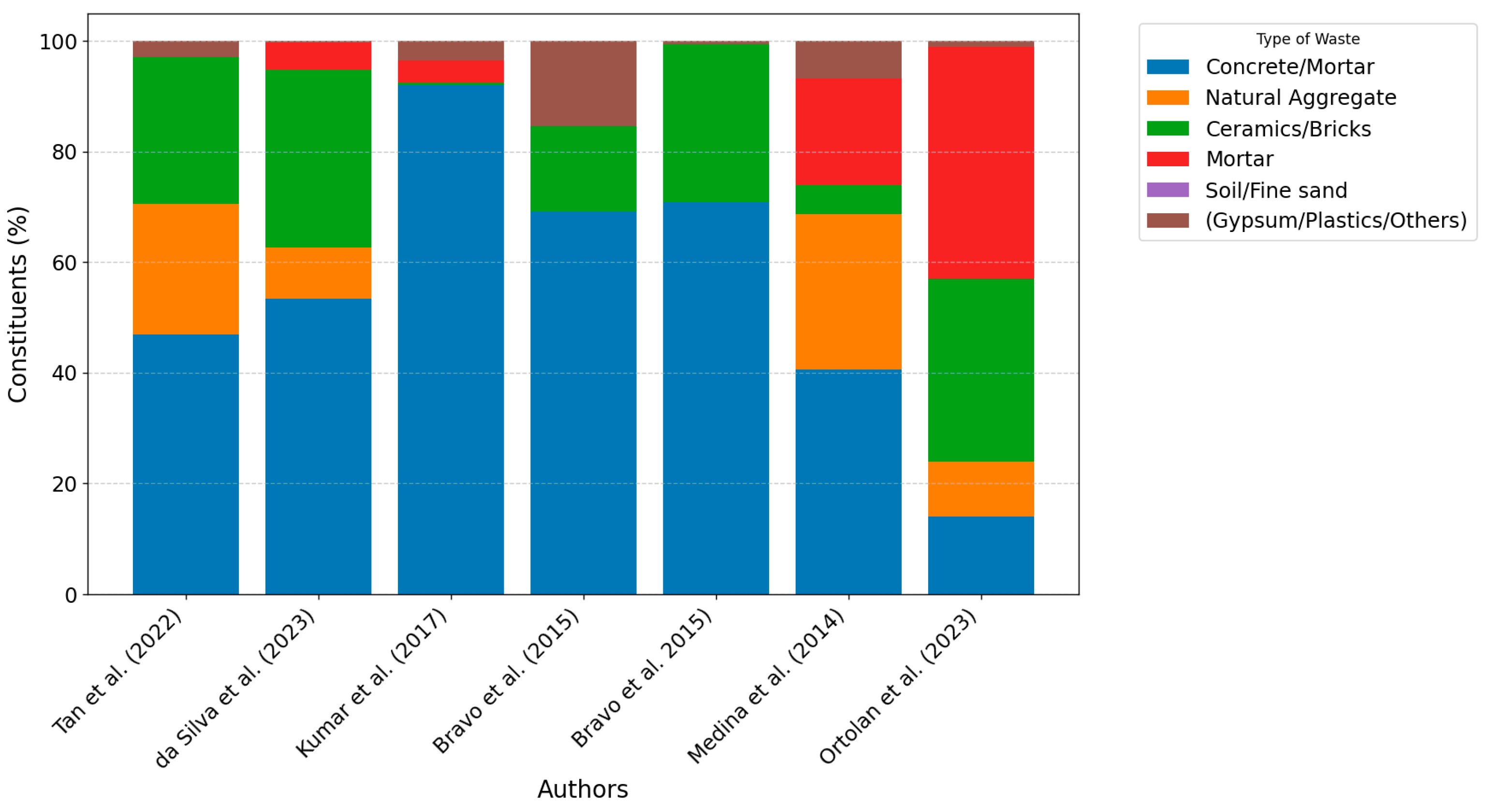
4.3. Aggregates in Concrete
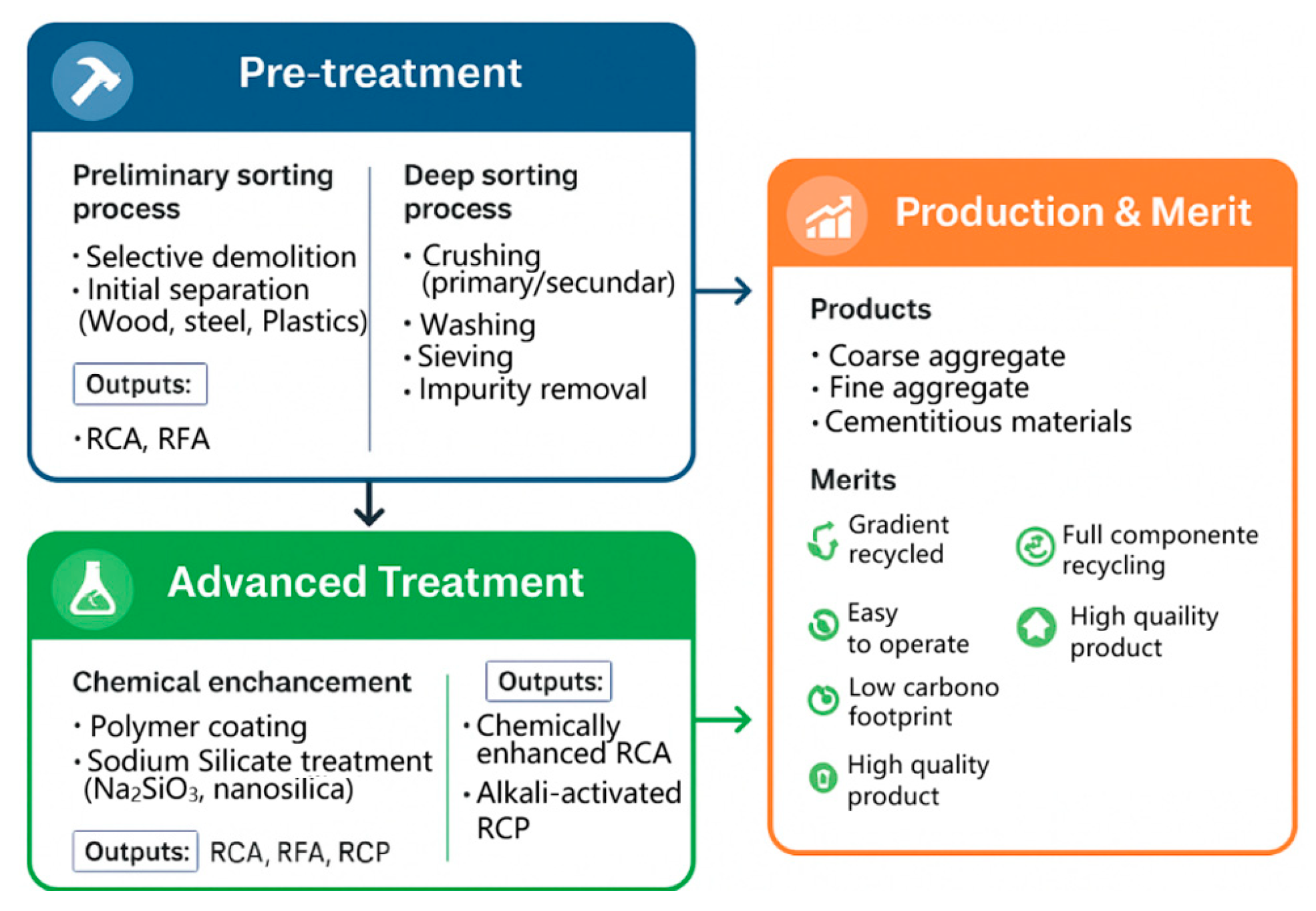
4.3.1. Pre-Treatment and Quality Enhancement
4.3.2. Advanced Treatment
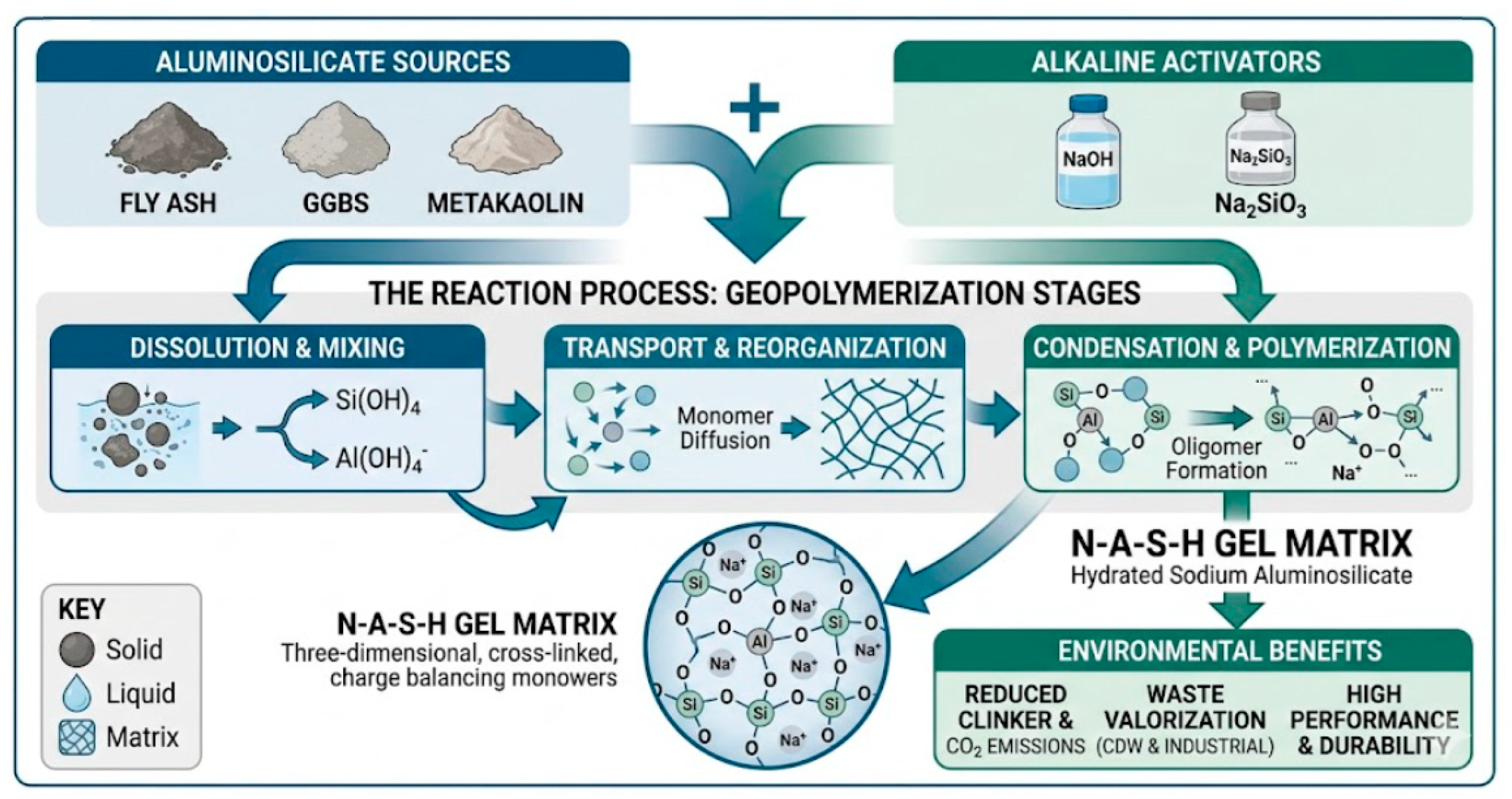
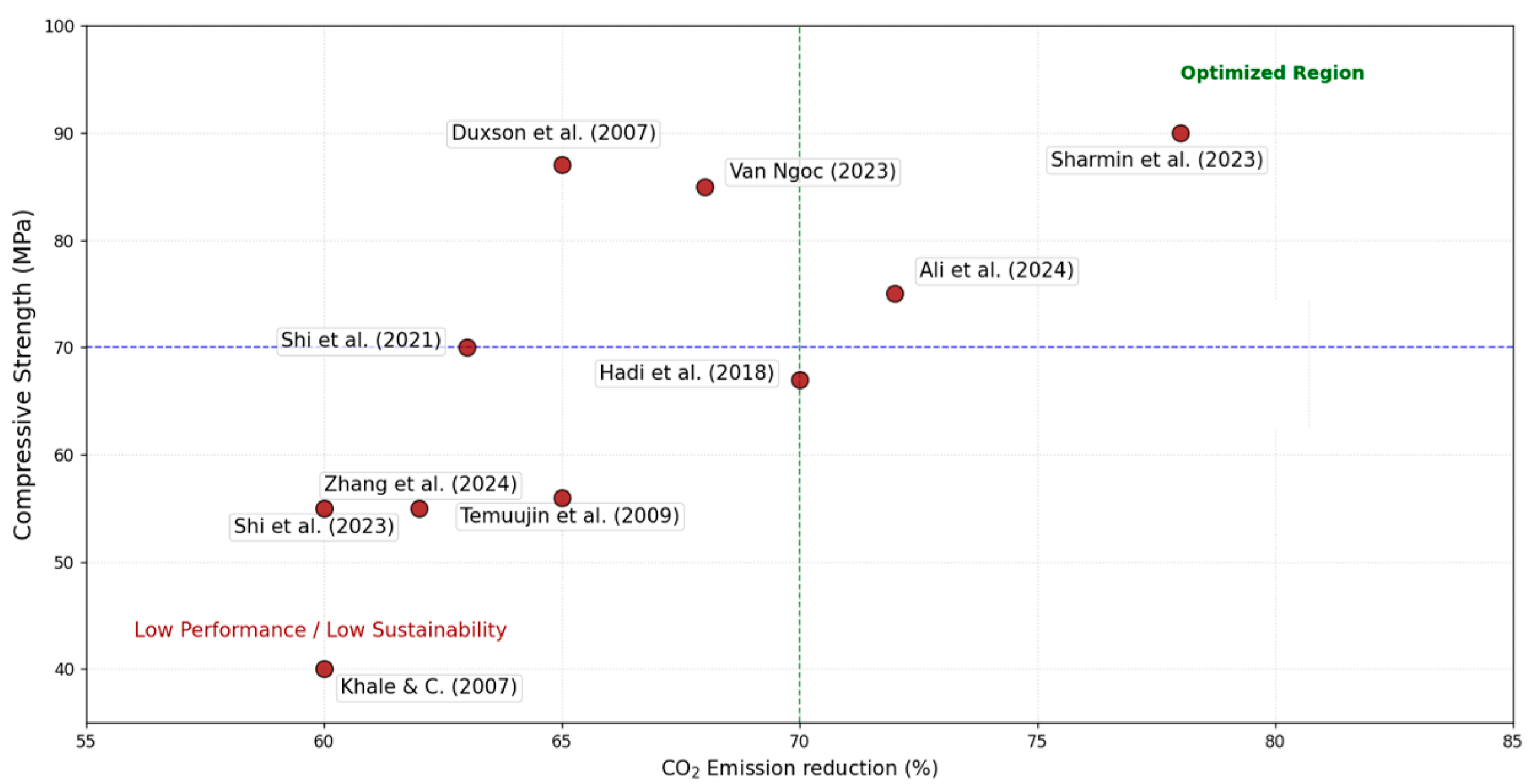
4.3.3. Alkali Activation
- Conservative (±60% reduction): compressive strength < 30 MPa; natural curing or with low molarity solutions.
- Intermediate (65–70% reduction): strength between 35–55 MPa; moderate thermal curing (24–48 h).
- High Optimization (≥75% reduction): strength > 60 MPa. Although high mechanical performance can be achieved with recycled concrete aggregates (RCAs), these processes often require thermal curing, which may partially offset the CO2-reduction benefits due to higher energy consumption.
4.3.4. Environmental Contribution and CO2 Uptake
4.4. Road Base of Pavement and Soil Stabilization
4.5. Overall Considerations on Valorization, Durability, and Regional Challenges
5. Challenges and Barriers to Circular Valorization and Climate Neutrality
5.1. Material Quality and Variability
5.2. Intrinsic Quality Issues of RA
5.3. Life Cycle Assessment (LCA) and Circularity
6. Future Directions: An Integrated Framework for Climate-Resilient CDW
6.1. Integrating Digital Innovation: From Sorting to Traceability
6.2. Development of Performance-Based Standards
6.3. Education and Awareness: Fostering a Sustainable and Resilient Culture
6.4. Regulatory Instruments and Economic Incentives for CDW Adoption
- Push (Regulatory) projects are those that determine the economically illegal and unfeasible destination. One effective instrument is the landfill tax. As Häkkinen and Belloni [15] noted, the landfill tax, in addition to increasing disposal costs, enhances the economic viability of recycling and underscores the need to develop beneficial infrastructure. In addition to penalties, the policy must ensure the development of clear and rigorous technical standards. The lack of certification and quality standards undermines market confidence in CDW’s performance [49].
- Pul (Economic) aims to create demand and reduce adoption costs. The government should establish quotas or bonuses for infrastructure projects that use CDW, with minimum percentage requirements [59]. In addition, tax incentives and subsidies, such as tax exemptions or reductions, are needed to encourage companies to invest in recycling technologies that reduce greenhouse gas emissions [21]. These measures accelerate the development of a more stable market for CDW use in civil construction, aligning with the Circular Economy and climate-mitigation objectives.
6.5. Improvement and Standardization of LCA Practice for CDW
6.6. Machine Learning (ML) Applications
6.7. Overall Considerations on the Integrated Framework and Future Perspectives
7. Final Remarks
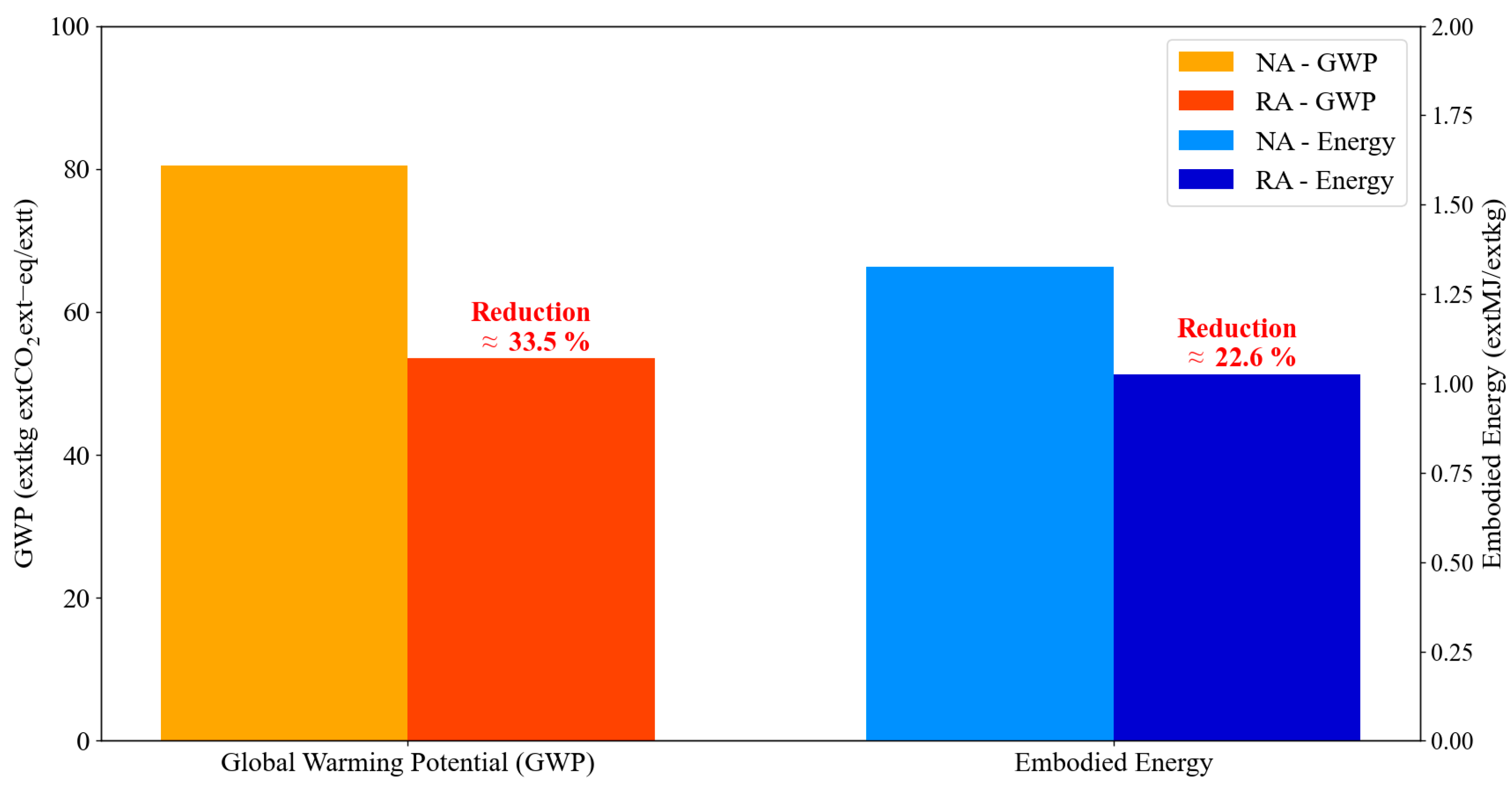
- Environmental Validation: The environmental advantage of using RA is consistent and has been demonstrated through LCA studies. Using the LCA method, it is possible to verify a significant potential to reduce global warming and embodied energy (reductions of 25–40% in CO2-eq), thereby confirming RA’s fundamental role in low-carbon construction.
- Persistent barriers: Economic challenges (such as perceived upfront costs and limited market competitiveness) and regulatory fragmentation (e.g., Brazil’s hard 20% threshold for structures, compared with flexible standards in the European Union) hinder the transition to circularity.
- Need for standardization: Standardizing LCA practices, including system boundaries and functional units, is an essential future guideline to ensure comparability of results and promote technical confidence.
- Technological imperative: Machine Learning (ML) and Blockchain are advanced technologies that help overcome market mistrust. While Blockchain ensures the traceability and integrity required for large-scale structural applications of recycled aggregates, ML provides high-accuracy predictions (R2 > 90) of material properties.
- Policies and Infrastructure: Implementing local policy networks and expanding CDW processing infrastructure are essential to ensure the quality and consistency of RA supply.
Author Contributions
Funding
Institutional Review Board Statement
Informed Consent Statement
Data Availability Statement
Acknowledgments
Conflicts of Interest
References
- IPCC. Activities and Events in 2025—Seventh Assessment Cycle (AR7). 2025. Available online: https://www.ipcc.ch/2025/ (accessed on 2 December 2025).
- de Schirnding Almeida, E.; Boucsein, B. Facing climate emergency: A transdisciplinary, cross-institutional approach for built environment higher education. Cogent Educ. 2025, 12, 2464284. [Google Scholar] [CrossRef]
- Andrić, I.; Koc, M.; Al-Ghamdi, S.G. A review of climate change implications for built environment: Impacts, mitigation measures and associated challenges in developed and developing countries. J. Clean. Prod. 2019, 211, 83–102. [Google Scholar] [CrossRef]
- Mantovani, J.R.; Alcântara, E.; Baião, C.F.; Pampuch, L.; Curtarelli, M.P.; Mariano Ribeiro, J.V.; Guimarães, Y.C.; Londe, L.; Massi, K.; Marengo, J.; et al. Unprecedented flooding in Porto Alegre Metropolitan Region (Southern Brazil) in May 2024: Causes, risks, and impacts. J. S. Am. Earth Sci. 2025, 160, 105533. [Google Scholar] [CrossRef]
- Lamichhane, K.; Karki, S.; Sharma, K.; Khadka, B.; Acharya, B.; Biswakarma, K.; Adhikari, S.; Kc, R.; Danegulu, A.; Bhattarai, S.; et al. Unraveling the Causes and Impacts of Increasing Flood Disasters in the Kathmandu Valley: Lessons from the Unprecedented September 2024 Floods. Nat. Hazards Res. 2025, 5, 875–897. [Google Scholar] [CrossRef]
- Prates-Baldez, D.; Ornell, F.R.; Scherer, J.N.; Diefenthaeler, S.M.; Kapczinski, F.; Balanzá-Martínez, V.; Hauck, S. Climate change and mental health: The urgent warning of Brazil and Spain’s 2024 catastrophic floods. Span. J. Psychiatry Ment. Health 2024. Online ahead of print. [Google Scholar] [CrossRef]
- Larsen, P.H.; Goldsmith, S.; Smith, O.; Wilson, M.L.; Strzepek, K.; Chinowsky, P.; Saylor, B. Estimating future costs for Alaska public infrastructure at risk from climate change. Glob. Environ. Change 2008, 18, 442–457. [Google Scholar] [CrossRef]
- Chinowsky, P.S.; Price, J.C.; Neumann, J.E. Assessment of climate change adaptation costs for the U.S. road network. Glob. Environ. Change 2013, 23, 764–773. [Google Scholar] [CrossRef]
- Pourmokhtarian, A.; Bakhshi, P.; Bannon, Z.; Everett, B. Construction and Climate Change; Challenges and Opportunities: A Case Study of the Northeast U.S. IOP Conf. Ser. Mater. Sci. Eng. 2022, 1218, 12046. [Google Scholar] [CrossRef]
- Amran, M.; Huang, S.S.; Onaizi, A.M.; Makul, N.; Abdelgader, H.S.; Ozbakkaloglu, T. Recent trends in ultra-high performance concrete (UHPC): Current status, challenges, and future prospects. Constr. Build. Mater. 2022, 352, 129029. [Google Scholar] [CrossRef]
- OECD. Infrastructure for A Climate-Resilient Future; Publishing, O., Ed.; OECD Publishing: Paris, France, 2024. [Google Scholar] [CrossRef]
- Liu, P.; Lovegrove, G.; Nehdi, M.L. Climate change in Canadian civil engineering curricula: Gaps and best practices. Can. J. Civ. Eng. 2025, 274, 256–274. [Google Scholar] [CrossRef]
- Rahmati, M.; Toufigh, V.; Keyvan, K. Monitoring of crack healing in geopolymer concrete using a nonlinear ultrasound approach in phase-space domain. Ultrasonics 2023, 134, 107095. [Google Scholar] [CrossRef] [PubMed]
- Szalay, Z. A parametric approach for developing embodied environmental benchmark values for buildings. Int. J. Life Cycle Assess. 2024, 29, 1563–1581. [Google Scholar] [CrossRef]
- Häkkinen, T.; Belloni, K. Barriers and drivers for sustainable building. Build. Res. Inf. 2011, 39, 239–255. [Google Scholar] [CrossRef]
- Ghisellini, P.; Cialani, C.; Ulgiati, S. A review on circular economy: The expected transition to a balanced interplay of environmental and economic systems. J. Clean. Prod. 2016, 114, 11–32. [Google Scholar] [CrossRef]
- Hossain, M.U.; Poon, C.S.; Lo, I.M.C.; Cheng, J.C.P. Comparative environmental evaluation of aggregate production from recycled waste materials and virgin sources by LCA. Resour. Conserv. Recycl. 2016, 109, 67–77. [Google Scholar] [CrossRef]
- Volk, R.; Stengel, J.; Schultmann, F. Building Information Modeling (BIM) for existing buildings—Literature review and future needs. Autom. Constr. 2014, 38, 109–127. [Google Scholar] [CrossRef]
- Nußholz, J.L.K.; Nygaard Rasmussen, F.; Milios, L. Circular building materials: Carbon saving potential and the role of business model innovation and public policy. Resour. Conserv. Recycl. 2019, 141, 308–316. [Google Scholar] [CrossRef]
- Dias, A.; Nezami, S.; Silvestre, J.; Kurda, R.; Silva, R.; Martins, I.; de Brito, J. Environmental and Economic Comparison of Natural and Recycled Aggregates Using LCA. Recycling 2022, 7, 43. [Google Scholar] [CrossRef]
- Caro, D.; Lodato, C.; Damgaard, A.; Cristóbal, J.; Foster, G.; Flachenecker, F.; Tonini, D. Environmental and socio-economic effects of construction and demolition waste recycling in the European Union. Sci. Total Environ. 2024, 908, 168295. [Google Scholar] [CrossRef]
- Tam, V.W.Y.; Soomro, M.; Evangelista, A.C.J. Quality improvement of recycled concrete aggregate by removal of residual mortar: A comprehensive review of approaches adopted. Constr. Build. Mater. 2021, 288, 123066. [Google Scholar] [CrossRef]
- Mosisa, G.B.; Bedadi, B.; Dalle, G.; Tassie, N. Nature-based solutions for urban climate resilience: Implementation, contribution, and effectiveness. Nat.-Based Solut. 2025, 8, 100245. [Google Scholar] [CrossRef]
- Mas-Coma, S.; Artigas, P.; Cuervo, P.F.; De Elías-Escribano, A.; Fantozzi, M.C.; Colangeli, G.; Córdoba, A.; Marquez-Guzman, D.J.; Mas-Bargues, C.; Borrás, C.; et al. Infectious disease risk after the October 2024 flash flood in Valencia, Spain: Disaster evolution, strategic scenario analysis, and extrapolative baseline for a One Health assessment. One Health 2025, 21, 101093. [Google Scholar] [CrossRef]
- Gulliver, J.S. Climate Change Adaptation: Civil and Environmental Engineering Challenge. J. Hydraul. Eng. 2020, 146, 1820001. [Google Scholar] [CrossRef]
- Saifudeen, A.; Mani, M. Adaptation of buildings to climate change: An overview. Front. Built Environ. 2024, 10, 1327747. [Google Scholar] [CrossRef]
- Gao, Y.; Wang, J.; Xu, X. Machine learning in construction and demolition waste management: Progress, challenges, and future directions. Autom. Constr. 2024, 162, 105380. [Google Scholar] [CrossRef]
- Van Gulck, L.; Wastiels, L.; Steeman, M. How to evaluate circularity through an LCA study based on the standards EN 15804 and EN 15978. Int. J. Life Cycle Assess. 2022, 27, 1249–1266. [Google Scholar] [CrossRef]
- D’Alberto, G.; Raj, K.; Tiburcio, V.A.; Coraglia, U.M. Innovative Procedures and Tools for the Digitalisation of Management Construction Processes in PA: A Systematic Scoping Review. Buildings 2025, 15, 3457. [Google Scholar] [CrossRef]
- Papadopoulos, T.; Balta, M.E. Climate Change and big data analytics: Challenges and opportunities. Int. J. Inf. Manag. 2022, 63, 102448. [Google Scholar] [CrossRef]
- Chen, X.; Huang, H.; Liu, Y.; Li, J.; Liu, M. Robot for automatic waste sorting on construction sites. Autom. Constr. 2022, 141, 104387. [Google Scholar] [CrossRef]
- Wang, Z.; Li, H.; Yang, X. Vision-based robotic system for on-site construction and demolition waste sorting and recycling. J. Build. Eng. 2020, 32, 101769. [Google Scholar] [CrossRef]
- Younger, S.; Parry, D.; Meigh, D. Preparing for the future: The impact of climate change on the civil engineering profession. Proc. Inst. Civ. Eng.-Civ. Eng. 2022, 175, 87–93. [Google Scholar] [CrossRef]
- Borges, P.M.; Schiavon, J.Z.; da Silva, S.R.; Rigo, E.; Neves Junior, A.; Possan, E.; de Oliveira Andrade, J.J. Mortars with recycled aggregate of construction and demolition waste: Mechanical properties and carbon uptake. Constr. Build. Mater. 2023, 387, 131600. [Google Scholar] [CrossRef]
- Charef, R.; Morel, J.C.; Rakhshan, K. Barriers to implementing the circular economy in the construction industry: A critical review. Sustainability 2021, 13, 12989. [Google Scholar] [CrossRef]
- Samani, P. Synergies and gaps between circularity assessment and Life Cycle Assessment (LCA). Sci. Total Environ. 2023, 903, 166611. [Google Scholar] [CrossRef]
- Friedlingstein, P.; Rui, G.; Jiaoyue, W.; Longfei, B.; Dan, T.; Philippe, C.; Steven, J.D.; Robbie, M.A.; Fengming, X.; Zhu, L. Global Carbon Budget 2023. Earth Syst. Sci. Data 2023, 13, 1791–1805. [Google Scholar] [CrossRef]
- Dixon, M. Climate change, politics and the civil engineering profession. Proc. Inst. Civ. Eng.-Munic. Eng. 2009, 162, 207–210. [Google Scholar] [CrossRef]
- de Almeida Barbosa Franco, J.; Domingues, A.M.; de Almeida Africano, N.; Deus, R.M.; Battistelle, R.A.G. Sustainability in the Civil Construction Sector Supported by Industry 4.0 Technologies: Challenges and Opportunities. Infrastructures 2022, 7, 43. [Google Scholar] [CrossRef]
- Tiza, M.T. Integrating Sustainability into Civil Engineering and the Construction Industry. J. Cem. Based Compos. 2023, 1, 5756. [Google Scholar] [CrossRef]
- Munaro, M.R.; Tavares, S.F. Design for adaptability and disassembly: Guidelines for building deconstruction. Constr. Innov. 2025, 25, 665–687. [Google Scholar] [CrossRef]
- Cai, G.; Waldmann, D. A material and component bank to facilitate material recycling and component reuse for a sustainable construction: Concept and preliminary study. Clean Technol. Environ. Policy 2019, 21, 2015–2032. [Google Scholar] [CrossRef]
- Geldermans, R.J. Design for Change and Circularity—Accommodating Circular Material & Product Flows in Construction. Energy Procedia 2016, 96, 301–311. [Google Scholar] [CrossRef]
- Yeheyis, M.; Hewage, K.; Alam, M.S.; Eskicioglu, C.; Sadiq, R. An overview of construction and demolition waste management in Canada: A lifecycle analysis approach to sustainability. Clean Technol. Environ. Policy 2013, 15, 81–91. [Google Scholar] [CrossRef]
- Alsheyab, M.A.T. Recycling of construction and demolition waste and its impact on climate change and sustainable development. Int. J. Environ. Sci. Technol. 2022, 19, 2129–2138. [Google Scholar] [CrossRef]
- Purchase, C.K.; Al Zulayq, D.M.; O’brien, B.T.; Kowalewski, M.J.; Berenjian, A.; Tarighaleslami, A.H.; Seifan, M. Circular Economy of Construction and Demolition Waste: A Literature Review on Lessons, Challenges, and Benefit. Materials 2022, 15, 76. [Google Scholar] [CrossRef]
- Tanthanawiwat, K.; Gheewala, S.H.; Nilsalab, P.; Schoch, M.; Silalertruksa, T. Environmental sustainability and cost performances of construction and demolition waste management scenarios: A case study of timber and concrete houses in Thailand. J. Clean. Prod. 2024, 436, 140652. [Google Scholar] [CrossRef]
- de Barros Martins, M.A.; Crispim, A.; Ferreira, M.L.; dos Santos, I.F.; Melo, M.d.L.N.M.; Barros, R.M.; Filho, G.L.T. Evaluating the energy consumption and greenhouse gas emissions from managing municipal, construction, and demolition solid waste. Clean. Waste Syst. 2023, 4, 100070. [Google Scholar] [CrossRef]
- Gálvez-Martos, J.L.; Styles, D.; Schoenberger, H.; Zeschmar-Lahl, B. Construction and demolition waste best management practice in Europe. Resour. Conserv. Recycl. 2018, 136, 166–178. [Google Scholar] [CrossRef]
- Ekvall, T.; Tillman, A.M. Open-loop recycling: Criteria for allocation procedures. Int. J. Life Cycle Assess. 1997, 2, 155–162. [Google Scholar] [CrossRef]
- Allacker, K.; Mathieux, F.; Pennington, D.; Pant, R. The search for an appropriate end-of-life formula for the purpose of the European Commission Environmental Footprint initiative. Int. J. Life Cycle Assess. 2017, 22, 1441–1458. [Google Scholar] [CrossRef]
- Rohani, M.; Huang, T.; Hoffman, L.; Roberts, M.; Ribeiro, B. Cost Benefit Analysis of Construction and Demolition Waste Diversion from Landfill; RIMU: Auckland, New Zealand, 2019; Available online: https://knowledgeauckland.org.nz/publications/cost-benefit-analysis-of-construction-and-demolition-waste-diversion-from-landfill/ (accessed on 7 December 2025).
- Tošić, N.; Marinković, S.; Dašić, T.; Stanić, M. Multicriteria optimization of natural and recycled aggregate concrete for structural use. J. Clean. Prod. 2015, 87, 766–776. [Google Scholar] [CrossRef]
- Yuan, H.P.; Shen, L.Y.; Hao, J.J.L.; Lu, W.S. A model for cost-benefit analysis of construction and demolition waste management throughout the waste chain. Resour. Conserv. Recycl. 2011, 55, 604–612. [Google Scholar] [CrossRef]
- Rashad, A.M.; Essa, G.M.F.; Mosleh, Y.A.; Morsi, W.M. Valorization of Ceramic Waste Powder for Compressive Strength and Durability of Fly Ash Geopolymer Cement. Arab. J. Sci. Eng. 2024, 49, 5653–5665. [Google Scholar] [CrossRef]
- Visintin, P.; Dadd, L.; Ul Alam, M.; Xie, T.; Bennett, B. Flexural performance and life-cycle assessment of multi-generation recycled aggregate concrete beams. J. Clean. Prod. 2022, 360, 132214. [Google Scholar] [CrossRef]
- López Ruiz, L.A.; Roca Ramón, X.; Gassó Domingo, S. The circular economy in the construction and demolition waste sector—A review and an integrative model approach. J. Clean. Prod. 2020, 248, 119238. [Google Scholar] [CrossRef]
- Davidovits, J. Geopolymer CHemistry and Applications, 5th ed.; Geopolymer Institute: Saint-Quentin, France, 2008; Available online: https://www.researchgate.net/publication/265076752 (accessed on 7 December 2025).
- Huang, B.; Wang, X.; Kua, H.; Geng, Y.; Bleischwitz, R.; Ren, J. Construction and demolition waste management in China through the 3R principle. Resour. Conserv. Recycl. 2018, 129, 36–44. [Google Scholar] [CrossRef]
- Oliveira, D.R.B.; Proença, M.P.; Risson, K.D.B.; Neves Junior, A.; Marques Filho, J.; Possan, E. Optimized cementitious matrices with activated CDW fines: A sustainable path to low carbon cement. Constr. Build. Mater. 2025, 483, 141719. [Google Scholar] [CrossRef]
- Podolsky, Z.; Liu, J.; Dinh, H.; Doh, J.H.; Guerrieri, M.; Fragomeni, S. State of the art on the application of waste materials in geopolymer concrete. Case Stud. Constr. Mater. 2021, 15, e00637. [Google Scholar] [CrossRef]
- Ghaffar, M.A.; Khairallah, M.; Salloum, S. Co-constructed rubrics and assessment for learning: The impact on middle school students’ attitudes and writing skills. Assess. Writ. 2020, 45, 100468. [Google Scholar] [CrossRef]
- Rondinel-Oviedo, D.R. Construction and demolition waste management in developing countries: A diagnosis from 265 construction sites in the Lima Metropolitan Area. Int. J. Constr. Manag. 2023, 23, 371–382. [Google Scholar] [CrossRef]
- Munaro, M.R.; Tavares, S.F.; Bragança, L. The ecodesign methodologies to achieve buildings’ deconstruction: A review and framework. Sustain. Prod. Consum. 2022, 30, 566–583. [Google Scholar] [CrossRef]
- Klein, L.L.; Vieira, K.M.; Feltrin, T.S.; Pissutti, M.; Ercolani, L.D. The Influence of Lean Management Practices on Process Effectiveness: A Quantitative Study in a Public Institution. SAGE Open 2022, 12, 21582440221088837. [Google Scholar] [CrossRef]
- Marinković, S.; Josa, I.; Braymand, S.; Tošić, N. Sustainability assessment of recycled aggregate concrete structures: A critical view on the current state-of-knowledge and practice. Struct. Concr. 2023, 24, 1956–1979. [Google Scholar] [CrossRef]
- Xiao, J.; Li, W.; Fan, Y.; Huang, X. An overview of study on recycled aggregate concrete in China (1996–2011). Constr. Build. Mater. 2012, 31, 364–383. [Google Scholar] [CrossRef]
- Silva, R.V.; De Brito, J.; Dhir, R.K. Properties and composition of recycled aggregates from construction and demolition waste suitable for concrete production. Constr. Build. Mater. 2014, 65, 201–217. [Google Scholar] [CrossRef]
- Elsevier. Scopus: Analyze Search Results. 2024. Available online: https://www.scopus.com (accessed on 11 December 2025).
- Dundar, B.; Tugluca, M.S.; Ilcan, H.; Sahin, O.; Sahmaran, M. Valorization of low-quality recycled concrete aggregates in cement-based systems through carbonation: Assessment of engineering performance. J. Aust. Ceram. Soc. 2025, 61, 1769–1784. [Google Scholar] [CrossRef]
- Kakizaki, M.; Harada, M.; Soshiroda, T.; Kubota, S.; Ikeda, T.; Kasai, Y. Reuse of Demolition Waste. In Demolition Reuse Conc Mason V2, 1st ed.; CRC Press: Boca Raton, FL, USA, 2004; p. 10. [Google Scholar] [CrossRef]
- Silva, R.V.; de Brito, J.; Dhir, R.K. Use of recycled aggregates arising from construction and demolition waste in new construction applications. J. Clean. Prod. 2019, 236, 117629. [Google Scholar] [CrossRef]
- Lye, C.Q.; Dhir, R.K.; Ghataora, G.S.; Li, H. Creep strain of recycled aggregate concrete. Constr. Build. Mater. 2016, 102, 244–259. [Google Scholar] [CrossRef]
- Tošić, N.; Torrenti, J.M.; Sedran, T.; Ignjatović, I. Toward a codified design of recycled aggregate concrete structures: Background for the new fib Model Code 2020 and Eurocode 2. Struct. Concr. 2021, 22, 2916–2938. [Google Scholar] [CrossRef]
- Singh Gill, D.; Mariam Abraham, S. Feasibility of CO2 sequestration in concrete containing recycled aggregates. Mater. Today Proc. 2023; in press. [Google Scholar] [CrossRef]
- Zhao, Z.; Liu, Y.; Lu, Y.; Ji, C.; Lin, C.; Yao, L.; Pu, Z.; de Brito, J. Prediction of properties of recycled aggregate concrete using machine learning models: A critical review. J. Build. Eng. 2024, 90, 109516. [Google Scholar] [CrossRef]
- Owais, M.; Idriss, L.K. Modeling green recycled aggregate concrete using machine learning and variance-based sensitivity analysis. Constr. Build. Mater. 2024, 440, 137393. [Google Scholar] [CrossRef]
- Daniel, C. AutoGluon-enabled machine learning models for predicting recycled aggregate concrete’s compressive strength. Aust. J. Struct. Eng. 2025, 26, 368–382. [Google Scholar] [CrossRef]
- Ji, Y.; Wang, D.; Wang, J. Study of recycled concrete properties and prediction using machine learning methods. J. Build. Eng. 2024, 94, 110067. [Google Scholar] [CrossRef]
- Kumar, A.; Jail Singh, G.; Chauhan, B.L.; Kumar, R. Strength and Durability Performance of Recycled Aggregate Structural Concrete with Silica Fume, Furnace Slag, and M-Fine. J. Mater. Civ. Eng. 2024, 36, 04024165. [Google Scholar] [CrossRef]
- Golafshani, E.M.; Behnood, A. Application of soft computing methods for predicting the elastic modulus of recycled aggregate concrete. J. Clean. Prod. 2018, 176, 1163–1176. [Google Scholar] [CrossRef]
- Duan, M. Innovative compressive strength prediction for recycled aggregate/concrete using K-nearest neighbors and meta-heuristic optimization approaches. J. Eng. Appl. Sci. 2024, 71, 15. [Google Scholar] [CrossRef]
- Peng, Y.; Unluer, C. Modeling the mechanical properties of recycled aggregate concrete using hybrid machine learning algorithms. Resour. Conserv. Recycl. 2023, 190, 106812. [Google Scholar] [CrossRef]
- Manan, A.; Pu, Z.; Ahmad, J.; Umar, M. Multi-targeted strength properties of recycled aggregate concrete through a machine learning approach. Eng. Comput. 2025, 42, 388–430. [Google Scholar] [CrossRef]
- Dantas, A.T.A.; Batista Leite, M.; De Jesus Nagahama, K. Prediction of compressive strength of concrete containing construction and demolition waste using artificial neural networks. Constr. Build. Mater. 2013, 38, 717–722. [Google Scholar] [CrossRef]
- Su, Y.; Yao, Y.; Wang, Y.; Zhao, X.; Li, L.; Zhang, J. Modification of Recycled Concrete Aggregate and Its Use in Concrete: An Overview of Research Progress [Modificación del árido de concreto reciclado y su uso en el concreto: Avances de la investigación]. Materials 2023, 16, 7144. [Google Scholar] [CrossRef]
- Han, S.; Zhao, S.; Lu, D.; Wang, D. Performance Improvement of Recycled Concrete Aggregates and Their Potential Applications in Infrastructure: A Review. Buildings 2023, 13, 1411. [Google Scholar] [CrossRef]
- Bu, L.; Du, G.; Hou, Q. Prediction of the compressive strength of recycled aggregate concrete based on artificial neural network. Materials 2021, 14, 3921. [Google Scholar] [CrossRef]
- Suescum-Morales, D.; Salas-Morera, L.; Jiménez, J.R.; García-Hernández, L. A novel artificial neural network to predict compressive strength of recycled aggregate concrete. Appl. Sci. 2021, 11, 11077. [Google Scholar] [CrossRef]
- Duan, J.; Asteris, P.G.; Nguyen, H.; Bui, X.N.; Moayedi, H. A novel artificial intelligence technique to predict compressive strength of recycled aggregate concrete using ICA-XGBoost model. Eng. Comput. 2021, 37, 3329–3346. [Google Scholar] [CrossRef]
- Gao, Q.; Li, X.G.; Jiang, S.Q.; Lyu, X.J.; Gao, X.; Zhu, X.N.; Zhang, Y. qing Review on zero waste strategy for urban construction and demolition waste: Full component resource utilization approach for sustainable and low-carbon. Constr. Build. Mater. 2023, 395, 132354. [Google Scholar] [CrossRef]
- Savva, P.; Ioannou, S.; Oikonomopoulou, K.; Nicolaides, D.; Petrou, M.F. A mechanical treatment method for recycled aggregates and its effect on recycled aggregate-based concrete. Materials 2021, 14, 2186. [Google Scholar] [CrossRef]
- Akbulut, Z.F.; Guler, S.; Yavuz, D.; Avcı, M.S. Toward sustainable construction: A critical review of recycled aggregate concrete properties and future opportunities. Case Stud. Constr. Mater. 2025, 23, e05133. [Google Scholar] [CrossRef]
- Feng, D.; Asce, M.; Ding, J.; Xie, S.; Li, Y.; Asce, M.; Akiyama, M.; Asce, M.; Lu, Y.; Asce, F.; et al. Climate Change Impacts on the Risk Assessment of Concrete Civil Infrastructures. ASCE OPEN Multidiscip. J. Civ. Eng. 2024, 2, 03124001. [Google Scholar] [CrossRef]
- Zajac, M.; Maruyama, I.; Iizuka, A.; Skibsted, J. Enforced carbonation of cementitious materials. Cem. Concr. Res. 2023, 174, 107285. [Google Scholar] [CrossRef]
- Kim, H.S.; Kim, J.M.; Kim, B. Quality improvement of recycled fine aggregate using steel ball with the help of acid treatment. J. Mater. Cycles Waste Manag. 2018, 20, 754–765. [Google Scholar] [CrossRef]
- Akbarnezhad, A.; Ong, K.C.G.; Zhang, M.H.; Tam, C.T.; Foo, T.W.J. Microwave-assisted beneficiation of recycled concrete aggregates. Constr. Build. Mater. 2011, 25, 3469–3479. [Google Scholar] [CrossRef]
- Pacheco, J.; de Brito, J. Recycled aggregates produced from construction and demolition waste for structural concrete: Constituents, properties and production. Materials 2021, 14, 5748. [Google Scholar] [CrossRef]
- Liu, X.; Xie, X.; Liu, R.; Lyu, K.; Zuo, J.; Li, S.; Liu, L.; Shah, S.P. Research on the durability of nano-SiO2 and sodium silicate co-modified recycled coarse aggregate (RCA) concrete. Constr. Build. Mater. 2023, 378, 131185. [Google Scholar] [CrossRef]
- Tam, V.W.Y.; Tam, C.M.; Le, K.N. Removal of cement mortar remains from recycled aggregate using pre-soaking approaches. Resour. Conserv. Recycl. 2007, 50, 82–101. [Google Scholar] [CrossRef]
- Raman, J.V.M.; Ramasamy, V. Various treatment techniques involved to enhance the recycled coarse aggregate in concrete: A review. Mater. Today Proc. 2020, 45, 6356–6363. [Google Scholar] [CrossRef]
- Provis, J.L.; Bernal, S.A. Geopolymers and related alkali-activated materials. Annu. Rev. Mater. Res. 2014, 44, 299–327. [Google Scholar] [CrossRef]
- Pol Segura, I.; Ranjbar, N.; Juul Damø, A.; Skaarup Jensen, L.; Canut, M.; Arendt Jensen, P. A review: Alkali-activated cement and concrete production technologies available in the industry. Heliyon 2023, 9, e15718. [Google Scholar] [CrossRef] [PubMed]
- Cherkos, F.D.; Kerenso, P.G. Integrating Interdependencies of Housing Performance Indicators Using Fuzzy-AHP, ISM, and Quadrant Analysis. KSCE J. Civ. Eng. 2025, 30, 100354. [Google Scholar] [CrossRef]
- Duxson, P.; Fernández-Jiménez, A.; Provis, J.L.; Lukey, G.C.; Palomo, A.; Van Deventer, J.S.J. Geopolymer technology: The current state of the art. J. Mater. Sci. 2007, 42, 2917–2933. [Google Scholar] [CrossRef]
- Khale, D.; Chaudhary, R. Geopolymers, alternative matrices for the immobilization of hazardous waste—Leaching characteristics and environmental compatibility. J. Solid Waste Technol. Manag. 2007, 33, 148–157. [Google Scholar]
- Sharmin, S.; Sarker, P.K.; Biswas, W.K.; Abousnina, R.M.; Javed, U. Characterization of waste clay brick powder and its effect on the mechanical properties and microstructure of geopolymer mortar. Constr. Build. Mater. 2024, 412, 134848. [Google Scholar] [CrossRef]
- Shi, X.; Zhang, C.; Liang, Y.; Luo, J.; Wang, X.; Feng, Y.; Li, Y.; Wang, Q.; Abomohra, A.E.F. Life cycle assessment and impact correlation analysis of fly ash geopolymer concrete. Materials 2021, 14, 7375. [Google Scholar] [CrossRef] [PubMed]
- Hadi, M.N.S.; Al-Azzawi, M.; Yu, T. Effects of fly ash characteristics and alkaline activator components on compressive strength of fly ash-based geopolymer mortar. Constr. Build. Mater. 2018, 175, 41–54. [Google Scholar] [CrossRef]
- Zhang, Y.; Zhang, Z.; Jiang, S.; Wang, C.; Ma, Z. Characterization of geopolymer with 100% thermoactivated construction spoil powder: Effects of alkali dosage, silicate modulus and curing temperature. J. Build. Eng. 2024, 98, 111511. [Google Scholar] [CrossRef]
- Shi, X.; Feng, Y.; Zhang, Y.; Su, Y. A comprehensive investigation on sulphate resistance of geopolymer recycled concrete: Macro and micro properties. Constr. Build. Mater. 2023, 403, 133052. [Google Scholar] [CrossRef]
- Temuujin, J.; Williams, R.P.; van Riessen, A. Effect of mechanical activation of fly ash on the properties of geopolymer cured at ambient temperature. J. Mater. Process. Technol. 2009, 209, 5276–5280. [Google Scholar] [CrossRef]
- Van Ngoc, P. Compressive Strength of Geopolymer Concrete (Dataset). Mendeley Data 2023, V1. [CrossRef]
- Bastos, D.; Brazão Farinha, C.; Maia Pederneiras, C.; Veiga, R.; Bogas, J.A.; Infante Gomes, R.; Santos Silva, A. Pathway to Carbon Neutrality in the Cement Industry: CO2 Uptake by Recycled Aggregates from Construction and Demolition Waste. Appl. Sci. 2024, 14, 5224. [Google Scholar] [CrossRef]
- Lei, B.; Yu, L.; Chen, Z.; Yang, W.; Deng, C.; Tang, Z. Carbon Emission Evaluation of Recycled Fine Aggregate Concrete Based on Life Cycle Assessment. Sustainability 2022, 14, 14448. [Google Scholar] [CrossRef]
- Jaunkeypersad, K.; Colin, J.; Poupardin, A.; Jeong, J. Semi-dynamic Carbonation of mortar aggregate samples in a CO2 reactor with an open-flow system: Effects of temperature, conditioning, and geometry. Constr. Build. Mater. 2025, 475, 141065. [Google Scholar] [CrossRef]
- Torrenti, J.M.; Amiri, O.; Barnes-Davin, L.; Bougrain, F.; Braymand, S.; Cazacliu, B. The FastCarb project: Taking advantage of the accelerated carbonation of recycled concrete aggregates. Case Stud. Constr. Mater. 2022, 17, e01349. [Google Scholar] [CrossRef]
- Zhang, D. CO2 utilization for concrete production: Commercial deployment and pathways to net-zero emissions. Sci. Total Environ. 2024, 931, 172753. [Google Scholar] [CrossRef]
- Mangone, G. Constructing hybrid infrastructure: Exploring the potential ecological, social, and economic benefits of integrating municipal infrastructure into constructed environments. Cities 2016, 55, 165–179. [Google Scholar] [CrossRef]
- Teijón-López-Zuazo, E.; Vega-Zamanillo, Á.; Calzada-Pérez, M.Á.; Robles-Miguel, Á. Use of recycled aggregates made from construction and demolition waste in sustainable road base layers. Sustainability 2020, 12, 6663. [Google Scholar] [CrossRef]
- Garzón, E.; Martínez-Martínez, S.; Pérez-Villarrejo, L.; Sánchez-Soto, P.J. Assessment of construction and demolition wastes (CDWs) as raw materials for the manufacture of low-strength concrete and bases and sub-bases of roads. Mater. Lett. 2022, 320, 24–27. [Google Scholar] [CrossRef]
- Yadav, J.S.; Saini, A.; Hussain, S.; Sharma, V. Estimation of ultimate bearing capacity of circular footing resting on recycled construction and demolition waste overlaying on loose sand. J. Build. Pathol. Rehabil. 2024, 9, 25. [Google Scholar] [CrossRef]
- Tefa, L.; Bianco, I.; Blengini, G.A.; Bassani, M. Integrated and comparative Structural-LCA analysis of unbound and cement-stabilized construction and demolition waste aggregate for subbase road pavement layers formation. J. Clean. Prod. 2022, 352, 131599. [Google Scholar] [CrossRef]
- Leite, F.D.C.; Motta, R.D.S.; Vasconcelos, K.L.; Bernucci, L. Laboratory evaluation of recycled construction and demolition waste for pavements. Constr. Build. Mater. 2011, 25, 2972–2979. [Google Scholar] [CrossRef]
- Beja, I.A.; Motta, R.; Bernucci, L.B. Application of recycled aggregates from construction and demolition waste with Portland cement and hydrated lime as pavement subbase in Brazil. Constr. Build. Mater. 2020, 258, 119520. [Google Scholar] [CrossRef]
- Luiz, G.; Benachio, F.; Duarte, C.; Tavares, S.F. Circular economy in the construction industry: A systematic literature review. J. Clean. Prod. 2020, 260, 121046. [Google Scholar] [CrossRef]
- Tan, J.; Cizer, Ö.; De Vlieger, J.; Dan, H.; Li, J. Impacts of milling duration on construction and demolition waste (CDW) based precursor and resulting geopolymer: Reactivity, geopolymerization and sustainability. Resour. Conserv. Recycl. 2022, 184, 106433. [Google Scholar] [CrossRef]
- da Roberto Silva, S.; de Brito, J.; Andrade, J.J.d.O. Synergic effect of recycled aggregate, fly ash, and hydrated lime in concrete production. J. Build. Eng. 2023, 70, 106370. [Google Scholar] [CrossRef]
- Kumar, R. Influence of recycled coarse aggregate derived from construction and demolition waste (CDW) on abrasion resistance of pavement concrete. Constr. Build. Mater. 2017, 142, 248–255. [Google Scholar] [CrossRef]
- Bravo, M.; De Brito, J.; Pontes, J.; Evangelista, L. Durability performance of concrete with recycled aggregates from construction and demolition waste plants. Constr. Build. Mater. 2015, 77, 357–369. [Google Scholar] [CrossRef]
- Medina, C.; Zhu, W.; Howind, T.; de Rojas, M.I.S.; Frías, M. Influence of mixed recycled aggregate on the physical-mechanical properties of recycled concrete. J. Clean. Prod. 2014, 68, 216–225. [Google Scholar] [CrossRef]
- Ortolan, T.L.P.; Borges, P.M.; Silvestro, L.; da Silva, S.R.; Possan, E.; de Andrade, J.J.O. Durability of concrete incorporating recycled coarse aggregates: Carbonation and service life prediction under chloride-induced corrosion. Constr. Build. Mater. 2023, 404, 133267. [Google Scholar] [CrossRef]
- Meddah, M.S. Recycled aggregates in concrete production: Engineering properties and environmental impact. MATEC Web Conf. 2017, 101, 05021. [Google Scholar] [CrossRef]
- Alexandridou, C.; Angelopoulos, G.N.; Coutelieris, F.A. Mechanical and durability performance of concrete produced with recycled aggregates from Greek construction and demolition waste plants. J. Clean. Prod. 2018, 176, 745–757. [Google Scholar] [CrossRef]
- Bayraktar, O.Y.; Kaplan, G.; Benli, A. The effect of recycled fine aggregates treated as washed, less washed and unwashed on the mechanical and durability characteristics of concrete under MgSO4 and freeze-thaw cycles. J. Build. Eng. 2022, 48, 103924. [Google Scholar] [CrossRef]
- Djerbi, A. Effect of recycled coarse aggregate on the new interfacial transition zone concrete. Constr. Build. Mater. 2018, 190, 1023–1033. [Google Scholar] [CrossRef]
- Pradhan, S.; Kumar, S.; Barai, S.V. Multi-scale characterisation of recycled aggregate concrete and prediction of its performance. Cem. Concr. Compos. 2020, 106, 103480. [Google Scholar] [CrossRef]
- da Silva, S.R.; de Andrade, J.J.O. A Review on the Effect of Mechanical Properties and Durability of Concrete with Construction and Demolition Waste (CDW) and Fly Ash in the Production of New Cement Concrete. Sustainability 2022, 14, 6740. [Google Scholar] [CrossRef]
- da Silva, S.R.; Cimadon, F.N.; Borges, P.M.; Schiavon, J.Z.; Possan, E.; de Oliveira Andrade, J.J. Relationship between the mechanical properties and carbonation of concretes with construction and demolition waste. Case Stud. Constr. Mater. 2022, 16, e00860. [Google Scholar] [CrossRef]
- Blengini, G.A. Life cycle of buildings, demolition and recycling potential: A case study in Turin, Italy. Build. Environ. 2009, 44, 319–330. [Google Scholar] [CrossRef]
- Herranz-Pascual, K.; Vozmediano, L.; Aliri, J.; Goñi-Balentziaga, O.; García-Esteve, D.; Susaeta, I. How do citizens perceive circularity of building products: A case study in the Basque country. Build. Environ. 2024, 262, 111745. [Google Scholar] [CrossRef]
- Katerusha, D. Barriers to the use of recycled concrete from the perspective of executing companies and possible solution approaches-case study Germany and Switzerland. Resour. Policy 2021, 73, 102212. [Google Scholar] [CrossRef]
- Xing, W.; Tam, V.W.; Le, K.N.; Hao, J.L.; Wang, J. Life cycle assessment of recycled aggregate concrete on its environmental impacts: A critical review. Constr. Build. Mater. 2022, 317, 125950. [Google Scholar] [CrossRef]
- European Environment Agency. Economic Instruments and Separate Collection Systems—Key Strategies to Increase Recycling. 2023. Available online: https://www.eea.europa.eu/en/analysis/publications/economic-instruments-and-separate-collection (accessed on 13 December 2025).
- European Commission. Use of Economic Instruments and Waste Management Performances. 2021. Available online: https://ec.europa.eu/environment/waste/pdf/final_report_10042012.pdf (accessed on 13 December 2025).
- Khatib, J.M.; Nader Saad, A.; Widyatmoko, I. 2—Standards for construction and demolition waste quantification. In Advances in Construction and Demolition Waste Management; Pacheco-Torgal, F., Colangelo, F., Tuladhar, R., Ding, Y., Zhao, X., Koutamanis, A., Eds.; Woodhead Publishing: Cambridge, UK, 2025; pp. 15–32. [Google Scholar] [CrossRef]
- Dubey, R.; Gunasekaran, A.; Bryde, D.J.; Yogesh, K.; Papadopoulos, T.; Dubey, R.; Gunasekaran, A.; Bryde, D.J.; Yogesh, K. Blockchain technology for enhancing swift- trust, collaboration and resilience within a humanitarian supply chain setting. Int. J. Prod. Res. 2020, 58, 3381–3398. [Google Scholar] [CrossRef]
- Shou, M.; Domenech, T. Integrating LCA and blockchain technology to promote circular fashion—A case study of leather handbags. J. Clean. Prod. 2022, 373, 133557. [Google Scholar] [CrossRef]
- Kaja, A.M.; Lazaro, A.; Yu, Q.L. Effects of Portland cement on activation mechanism of class F fly ash geopolymer cured under ambient conditions. Constr. Build. Mater. 2018, 189, 1113–1123. [Google Scholar] [CrossRef]
- Pacheco-Torgal, F.; Castro-Gomes, J.; Jalali, S. Alkali-activated binders: A review. Part 1. Historical background, terminology, reaction mechanisms and hydration products. Constr. Build. Mater. 2008, 22, 1305–1314. [Google Scholar] [CrossRef]
- Panda, B.; Unluer, C.; Jen, M. Extrusion and rheology characterization of geopolymer nanocomposites used in 3D printing. Compos. Part B 2019, 176, 107290. [Google Scholar] [CrossRef]
- Zou, S.; Xiao, J.; Duan, Z.; Ding, T.; Hou, S. On rheology of mortar with recycled fine aggregate for 3D printing. Constr. Build. Mater. 2021, 311, 125312. [Google Scholar] [CrossRef]
- ABNT NBR ISO 14040:2009/14044:2009; Gestão Ambiental—Avaliação do Ciclo de Vida—Princípios, Estrutura, Requisitos e Orientações. ABNT: Rio de Janeiro, Brazil, 2009. Available online: https://www.abntcatalogo.com.br/norma.aspx?ID=51080 (accessed on 17 December 2025).
- Hasheminezhad, A.; King, D.; Ceylan, H.; Kim, S. Comparative life cycle assessment of natural and recycled aggregate concrete: A review. Sci. Total Environ. 2024, 950, 175310. [Google Scholar] [CrossRef]
- Al-Subari, B.L.; Hilal, A.; Ekinci, A. Life cycle assessment of soil stabilization using cement and waste additives. Constr. Build. Mater. 2023, 403, 133045. [Google Scholar] [CrossRef]
- Li, Z.X.; Liu, Y.; Ernst, R. Reply to Comment by Åke Johansson on Li et al. (2023): A dynamic 2000—540 Ma Earth history: From cratonic amalgamation to the age of supercontinent cycle. Earth-Sci. Rev. 2023, 241, 104460. [Google Scholar] [CrossRef]
- Andrew, R.M. Global CO2 emissions from cement production, 1928–2018. Earth Syst. Sci. Data 2019, 11, 1675–1710. [Google Scholar] [CrossRef]
- Spitsov, D.; Yazhlev, I. Adaptation of construction and demolition waste management towards climate change. In E3S Web of Conferences; EDP Sciences: Les Ulis, France, 2023; Volume 403, p. 02002. [Google Scholar] [CrossRef]
- Conselho Nacional do Meio Ambiente (CONAMA). Brasil Resolução CONAMA no 307, de 5 de Julho de 2002: Estabelece Diretrizes, Critérios e Procedimentos Para a Gestão dos Resíduos da Construção Civil; Conselho Nacional do Meio Ambiente (CONAMA): Brasília, Brazil, 2002. Available online: https://conama.mma.gov.br/?option=com_sisconama&task=arquivo.download&id=305 (accessed on 17 December 2025).
- Presidência da República. Brasil Lei no 12.305, de 2 de Agosto de 2010: Institui a Política Nacional de Resíduos Sólidos (PNRS); Presidência da República: Brasília, Brazil, 2010. Available online: https://www.planalto.gov.br/ccivil_03/_ato2007-2010/2010/lei/l12305.htm (accessed on 18 December 2025).
- ABNT NBR 15112; Resíduos da Construção Civil e Resíduos Volumosos—Áreas de Transbordo e Triagem Volumosos—Áreas de Transbordo e Triagem–Diretrizes p–Diretrizes Para Projeto ara Projeto, Implanta, Implantação e ção e Operação. ABNT: Rio de Janeiro, Brazil, 2004; 7p.
- ABNT NBR 15116; Agregados Reciclados Para Uso em Argamassase Concretos de Cimento Portland―Requisitos Emétodos de Ensaios. ABNT: Rio de Janeiro, Brazil, 2021; 16p.
- Porto Alegre. Law No. 728, of 8 January 2014. Establishes the Municipal Code of Urban Cleaning. Diário Oficial de Porto Alegre, Porto Alegre, Brazil, 2014. Available online: https://prefeitura.poa.br/sites/default/files/usu_doc/cartadeservicos/728novocodigo.pdf?utm_source=chatgpt.com (accessed on 20 December 2025).
- Porto Alegre. Decree No. 18,467, of 5 December 2013. Regulates the Environmental Licensing Procedures for Waste Transport and Disposal Activities. Diário Oficial de Porto Alegre, Porto Alegre, Brazil, 2013. Available online: https://leismunicipais.com.br/a/rs/p/porto-alegre/decreto/2013/1846/18467/decreto-n-18467-2013-regulamenta-a-gestao-de-residuos-solidos-no-municipio-de-porto-alegre (accessed on 20 December 2025).
- Porto Alegre. Supplementary Law No. 7, of 7 December 1973. Establishes the Municipal Tax System and Public Service and Waste Collection Taxes. Diário Oficial de Porto Alegre, Porto Alegre, Brazil, 1973. Available online: https://www2.portoalegre.rs.gov.br/netahtml/sirel/atos/Lei%20Complementar%20007 (accessed on 21 December 2025).
- Visintin, P.; Xie, T.; Bennett, B. A large-scale life-cycle assessment of recycled aggregate concrete: The influence of functional unit, emissions allocation and carbon dioxide uptake. J. Clean. Prod. 2020, 248, 119243. [Google Scholar] [CrossRef]
- Landi, D.; Germani, M.; Marconi, M. Analyzing the environmental sustainability of glass bottles reuse in an Italian wine consortium. Procedia CIRP 2019, 80, 399–404. [Google Scholar] [CrossRef]
- Ma, C.; Pan, S.; Cui, T.; Liu, Y.; Cui, Y.; Wang, H.; Wan, T. Energy consumption prediction for office buildings: Performance evaluation and application of ensemble machine learning techniques. J. Build. Eng. 2025, 102, 112021. [Google Scholar] [CrossRef]
- Mohammadi Golafshani, E.; Kim, T.; Behnood, A.; Ngo, T.; Kashani, A. Sustainable mix design of recycled aggregate concrete using artificial intelligence. J. Clean. Prod. 2024, 442, 140994. [Google Scholar] [CrossRef]



| Country | Event Description | Human Impact | Infrastructure Impact | Source |
|---|---|---|---|---|
| Brazil | Floods in Rio Grande do Sul | 173 deaths, hundreds of injuries, mass displacement | Severe damage to roads and bridges | [4] |
| Spain | Historic flood in Valencia | Over 200 deaths, service disruption for thousands | Urban drainage and power grid failures | [6] |
| Nepal | Nationwide flooding | 2.59 million people affected | Failures across all infrastructure sectors | [5] |
| Climate Threat | Event Description |
|---|---|
| Extreme temperatures [10,11] | Accelerated material deterioration, thermal expansion, and increased energy demand |
| Heavy rainfall/floods [4,5] | Erosion, foundation instability, bridge and road damage |
| Droughts [12] | Soil shrinkage, cracking of pavements, and water supply system failures |
| Sea level rise [8] | Coastal infrastructure flooding, corrosion of materials |
| Freeze–thaw cycles [13] | Surface cracking, accelerated concrete degradation |
| Strategy | Primary Benefit | Source |
|---|---|---|
| Elevated roads in flood zones | Reduces vulnerability to floods | [25] |
| Nature-based solutions | Green roofs, permeable pavements | [23] |
| Robust materials | Flood- and corrosion-resistant | [11] |
| Digital simulations | Predict vulnerabilities using climate data | [27] |
| Case Study/Material | E.I. | E.V. | T.F. | Key Scientific Issue | Main References |
|---|---|---|---|---|---|
| Recycled Concrete Aggregates (RCAs) | H(+) | M | H | Quality variability and carbonation | [53,55,56] |
| Recycled Glass in concrete | M | L | M | Alkali-silica reaction (ASR) | [57,58,59] |
| Ceramic Waste (Bricks/Tiles) | M | M | H | Pozzolanic activity optimization | [55,60,61] |
| BIM-Integrated Management | H | L (Initial) | M | Data interoperability and sensors | [18,62,63] |
| Design for Disassembly (DfAD) | VH | L | M | Lack of standardized codes | [41,64] |
| Social Impact | Description | Source |
|---|---|---|
| Job Generation | Direct jobs in sorting, transporting, and processing CDW | [62] |
| Inclusion of Cooperatives | Insertion of waste pickers and cooperatives in the construction value cycle | [49] |
| Professional Training | Technical training programs for local labor in reuse techniques | [57] |
| Improvement of Urban Health and Health | Reducing pollution and disease vectors with less waste in dumps and burnings | [63] |
| Reduction in Social Vulnerability | Infrastructure projects with CDW reuse in underserved urban areas | [65] |
 | ||
|---|---|---|
| Initial Technical Focus | Digital Integration and Focus on Infrastructure Resilience | Technological Consolidation and Resilience |
| 2015–2017: Technical studies on the physical and mechanical properties of concrete and mortars using CDW as both coarse and fine aggregate. Analyses of the contribution of CDW use in reducing the effect of greenhouse emissions [17]. 2018–2019: During this period, there was increased attention to the circular economy, with several practical applications utilizing CDW as an aggregate. Studies on carbonation in recycled concretes were intensified. LCA and CO2 footprint were also considered in this period, driven by global climate treaties. | As a result of climate change, articles on the resilience of civil engineering have gained greater emphasis. The search for integrated digital tools to optimize large-scale projects and improve CDW quality was observed during this period. The use of BIM and GIS aims to optimize, track, and qualify the waste stream [27]. | Embedded technologies applied for the optimization of waste streams and traceability, to predict mechanical properties in concretes with CDW, to enhance performance through tests with hybrid mixtures (CDW +fly ash, slag, silica fume). CDW treatments with accelerated carbonation to improve the mechanical properties of recycled concretes were also investigated [70]. |
| Origin of RCA | Properties Evaluated | Main Findings | Source |
|---|---|---|---|
| Review of ML applied to RCA | Workability, mechanical, durability, ML | Comparison of ML algorithms for RCA prediction; applicability and accuracy discussed | [76] |
| Composites with various materials | Compressive strength | Cement and recycled content are the most influential factors for strength | [77] |
| Various RCA datasets | Compressive strength modeling | AutoGluon: CatBoost best performance (RMSE 1.45); cemented the most influential variable | [78] |
| Meta-study | SSD, absorption, compressive strength, ML | Reduced SSD → 40.5% drop in compressive strength; CNN achieved high accuracy (R2 0.969 training) | [79] |
| Treatment with silica fume, slag | Strength, durability | Additions improved the strength and durability of RCA | [80] |
| AI for sustainable mix design | Mix design optimization with AI | AI applied to RCA for sustainable mix design | [81] |
| ML modeling | Compressive strength using KNN/meta-heuristic | Innovative KNN model; good applicability for RCA prediction | [82] |
| Database (607 records) | Compressive strength + ML | Hybrid models (GWO-SVR) up to R2 0.9056; cement and absorption key variables | [83] |
| AI multi-target modeling | Compressive and tensile strength + AI | Random Forest best performance: RCA% and cement are key variables | [84] |
| Experimental RCA concretes | Compressive strength | ANN model R2 up to 0.97; RCA viable when well-controlled | [85] |
| Review: RCA modification and treatments | Physical properties, treatments, and durability | Reviews mechanical, chemical, and biological treatments for RCA; promising methods highlighted | [86] |
| Review: RCA in infrastructures | Strength, permeability, cost-environmental | Shows treatments improve RCA quality; discusses infrastructure applications | [87] |
| Experimental + ANN applied to RCA. | Compressive strength, ANN modeling | ANN achieved R2 ≈0.97 for RCA compressive strength prediction; replacement is feasible with design adjustments | [88] |
| ANN applied to RCA | Compressive strength prediction | The proposed ANN predicted RCA compressive strength accurately, which is helpful for mix optimization | [89] |
| ICA-XGBoost model | Compressive strength prediction (ICA-XGBoost) | ICA-XGBoost outperformed other ML models in RCA strength prediction | [90] |
| Criteria | Conventional Concrete (CC) | Recycled Aggregate Concrete (RAC) |
|---|---|---|
| Production | ✓ Provides high-quality, consistent aggregates. ✖ Requires large amounts of natural resources. | ✓ Utilizes construction and demolition waste. ✖ Mix control can be more complex. |
| Sustainability | ✖ Low sustainability potential. ✖ Generates more construction waste. | ✓ Supports circular economy principles. ✓ Reduces landfill waste. |
| Carbon Footprint | ✖ High carbon emissions. ✖ Intensive cement consumption. | ✓ Reduced carbon footprint. ✓ Lower emissions from extraction and transportation. |
| Performance | ✓ High strength and reliability. ✓ Easier quality control. | ✓ Achievable strength with treatment and admixtures. ✖ May have higher water absorption. |
| Cost | ✖ Increasing raw material costs over time ✓ Short-term supply is predictable. | ✓ Lower raw material cost. ✓ Avoids disposal fees. ✖ May require pre-treatment investment. |
| Workability | ✓ Predictable slump and flow behavior. | ✖ Often reduced due to higher water absorption. ✓ Can be improved with admixtures. |
| Durability | ✓ Long-term performance is well-established. ✓ Proven resistance to environmental exposure. | ✖ Potential durability issues without proper treatment. ✓ Can be improved with SCMs and fibers. |
| Standardization and Codes | ✓ Widely covered by national and international standards. | ✖ Limited inclusion in design codes. ✓ Increasing acceptance through recent revisions. |
| Country | Landfill Tax for CDW (Approx. €/t) | CDW Recycling/Recovery Rate (%) | Policy Impact Analysis |
|---|---|---|---|
| Netherlands | >€75 | >98% | High tax combined with strict landfill bans. |
| Denmark | €60–€80 | >95% | Tax acts as a primary driver for circular economy. |
| United Kingdom | ~€118 (Standard)/€3.5 (Inert) | ~90% | Tiered tax encourages sorting of inert waste. |
| Belgium (Flanders) | €40–€100 | >90% | High correlation between cost and diversion. |
| Italy | €5–€25 (Regional var.) | ~75–80% | Moderate tax: results vary by region. |
| Portugal | <€20 | ~45–60% | Emerging system; lower tax limits efficiency. |
| Greece/Romania | Low/Symbolic | <25% | Insufficient economic incentive for the RA market. |
| Technological Innovation | Primary Purpose in Processing | Key Benefit (Climate and Circular Economy) | Source |
|---|---|---|---|
| Automated Sorting Robot | Overcome variability and ensure the high purity and Recycled Aggregate (RA) consistency. | It enables a safer, larger replacement for natural aggregate, reducing perceived technical risk. | [27] |
| Traceability (Blockchain) | Check the origin, composition, and traceability of each RA batch throughout the value chain. | It increases market confidence and validates sustainability and low-carbon claims. | [147,148] |
| New Blends (Low Clinker) | Develop high-performance concretes that maximize RA absorption and minimize the need for cement. | Direct reduction in the carbon concrete footprint by replacing clinker with low-carbon materials. | [149,150] |
| Additive Manufacturing (3D Printing) | Optimize material use and enable prefabricated element development with RA/CDW. | Minimizing in situ waste and accelerating the construction of circular infrastructure. | [151,152] |
| 1. Goal and Scope Definition | 2. Inventory Analysis | 3. Impact Assessment | 4. Interpretation and Reporting |
|---|---|---|---|
| FU is the specific item with a unique ID. | Primary data collected at the facility level using IoT technologies and supplier questionnaires is allocated to the specific product. | The *LCA software module on the blockchain uses the collected data to perform impact calculations. | Hot spot analysis to identify the most essential processes for impact reduction measures |
| Scope includes the production of the item (from raw material production), transport, and EoL. The use stage is excluded because of variability in consumer care. | The data were taken from standardized databases. | Selected impact categories may be GHG emissions, water use, land use, and water pollution. | Critical review of data completeness and consistency |
| Data, and hence LCA results, are refreshed regularly (1–4 times a year) to have up-to-date results. | Several methods of data validation Integration of AI and OCR for data processing | Communication of impact results to consumers through various channels (labels, website, etc.) |
| Year | Regulation Name | Content |
|---|---|---|
| 2002 | CONAMA Resolution No. 307 [159] | Establishes the guidelines, criteria, and procedures for the management of the CDW. It classifies waste A, B, C, and D and obliges municipalities to prepare their Integrated Management Plans. |
| 2022 | Decree No. 10936 [160] | Regulates the PNRS (Law No. 12305/2010), detailing obligations and instruments, such as Solid Waste Management Plans for large generators, including CDW. |
| 2004 | ABNT NBR 15112 [161] | Establishes the guidelines for the design, implementation, and operation of Transshipment and Sorting Areas (TTA) for CDW and bulky waste. |
| 2004 | ABNT NBR 15116 [162] | It establishes the requirements for the use of recycled CDW aggregates in pavements and concretes with no structural function, encouraging recycling. |
| 2010 | Law No. 12305 (PNRS) [160] | Establishes the national policy that governs all solid waste, including CDW. It defines the shared responsibility and management hierarchy (non-generation, reduction, reuse, recycling, treatment, and final disposal). |
| Regulation/Law | Core Content in Relation to Fees, Fines, and Licenses |
|---|---|
| Federal Law No. 12305 (PNRS) [160] | It establishes the responsibility of generators (including CDW) to manage their waste. It determines that non-compliance subjects the company to the sanctions provided for in the Environmental Crimes Law (Law No. 9605/98). |
| CONAMA Federal Resolution No. 307 [159] | It requires large generators to submit a Civil Construction Waste Management Plan (PGRCC) to obtain the Construction License/Construction Permit. |
| Municipal Laws, Decrees, and Codes of Postures [163] | They determine collection/disposal fees (when the municipality provides the service), establish fines for irregular disposal (throw-away), and regulate operating licenses for CDW transporters and landfills (ATTs). |
| State/Municipal Environmental Licensing Regulations [164] | They require an Operating License (LO) for companies that carry out activities in the Transport, Transshipment and Sorting Areas (ATT) and in the Final Disposal of CDW. |
| Municipal Tax Codes [165] | They can institute the Garbage Collection Fee, which may be levied on the built area or, specifically, on the waste generated. |
| Instruments | Feature | Brazil (Legal Framework Approach) | Other Countries (EU, Finland, Switzerland) |
|---|---|---|---|
| Push (Regulatory) | Landfill Tax | Non-existent at the national level. The collection and disposal fees vary by county and are generally not enough to make landfill disposal more expensive than recycling. | Essential (e.g., Finland—cited in the text and in Häkkinen and Belloni [15]. It creates “discouragement” by making disposal illegal and/or economically unfeasible [19,59]. |
| Quality Norms and Standards | There are ABNT standards (e.g., NBR 15116 [162] for aggregates in floors without structural function), but gaps, a lack of rigor, and a lack of certification undermine market confidence in CDW [49]. | Strict technical standards and certification (e.g., European Union). Essential to overcome market distrust and ensure performance, stimulating the replacement of natural resources. | |
| Mandatory Management Plan | Mandatory for large generators (PGRCC), according to CONAMA 307 [159] and PNRS [160]. Command and Control Tool. | Widely used but complemented by strong enforcement and the direct link to obtaining building permits. | |
| Tax Incentives for Recycling | There are, such as the cost reduction resulting from the tax exemption for CDW recycling companies (PNRS [160], in theory). Still, the application and impact are limited by low demand. | Essential (e.g., Switzerland—use of incentives for the adoption of innovation techniques and high-value-added applications). Exemptions, subsidies, and funding for recycling technologies [21]. | |
| Pull (Economic) | Quotas of Use/Public Contracting | Rare or non-existent at the federal or state level. | Common and effective. The government establishes quotas or bonuses (minimum percentage targets) for the use of CDW in public works [59]. This is the most effective way to generate and secure initial market demand. |
| Valuing Innovation and Applications | At an early stage, it was dependent on isolated initiatives or research. | High focus on technological innovation for the use of CDW in higher value-added applications, rather than just low-value landfill/paving [29]. |
| Phase | Title | Main Objective | Contextualization for CDW |
|---|---|---|---|
| 1 | Goal and Scope Definition | Define the study’s purpose and boundaries. | Objective: To compare the environmental impact of 1 m3 of recycled aggregate and 1 m3 of natural aggregate on the compressive strength of 20 MPa concrete. System Limits: Define whether the final disposal of CDW is an output (by-product) or if the system covers crushing, transport, and application. |
| 2 | Inventory Analysis (LCI) | Collect and quantify data on energy and matter inputs and outputs. | Inputs: Quantify the energy consumption (diesel/electricity) in the crushing and transportation of CDW. Outputs: Quantify atmospheric emissions (particulate matter and CO2) from processing and transport. Challenge: Obtain primary data from Brazilian recycling plants. |
| 3 | Impact Assessment (LCIA) | Assess the significance of potential environmental impacts. | Classification and Characterization: Translate diesel consumption into (GWP) and emissions at the plant into Ecotoxicity or Photochemical Ozone Formation. Focus: To analyze the categories of Resource Depletion and Climate Change, in which CDW typically offers the most significant advantages. |
| 4 | Interpretation | Analyze the results, draw conclusions, recommend actions, and report. | Conclusion: Validate that the benefit of substitution (avoiding virgin production) outweighs the burden of processing (transportation and crushing). Recommendation: Indicate the best applications for CDW or suggest maximum transport distances to maintain the environmental advantage. |
| Main ML Application | Objective Considering RCA or CDW | Relevance to Sustainability and Climate Change | Source |
|---|---|---|---|
| Hybrid models (ANN, SVR + meta-heuristics) for concrete with RA | Predict mechanical properties (e.g., compressive strength) from mixing parameters and characteristics of the recycled aggregate. | Reduces the need for destructive testing and optimizes dosages, reducing material and energy consumption | [83] |
| ML review in CDW management (CNN, SVM, RF, etc.) | Systematize ML uses in the generation, sorting, logistics, and recycling of construction and demolition waste | Indicates that ML can increase recycling rates and reduce shipments to landfills, contributing to a lower carbon footprint of construction | [27] |
| ML + sensitivity analysis for “green RCA” | Model and optimize green concretes with RA, evaluating mixing variables and mechanical performance | Supports the design of more sustainable concrete, reducing the use of natural resources and environmental impacts | [77] |
| Artificial intelligence for sustainable mix design of RCA | Define sustainable concrete traces with RA using AI, considering performance and emissions | Integrates mechanical performance with eco-efficiency criteria, supporting low-carbon decisions in mix design | [169] |
| Technology | Initial Investment | Long-term Economic Benefit | Environmental Dividend | Refs. |
|---|---|---|---|---|
| Automated Sorting | High | Reduced labor & High-purity RA. | Optimized substitution rates. | [31,32] |
| Mobile Crushing (Inferred/Logistic context) | Moderate | Logistics cost reduction. | Lower CO2 from transport. | [55,56] |
| AI Quality Control | Moderate | Real-time certification. | Waste contamination reduction. | [169] |
| ML Models Addressed | Key Variables/Output Models | Central Contribution | Source |
|---|---|---|---|
| ANN, SVR, and hybrid models with optimization algorithms (e.g., GWO-SVR, PSO-SVR) | Compressive strength and mechanical properties of concretes with RA. | They show that hybrid models capture complex nonlinear relationships between RA properties, trace, and resistance, with high predictive accuracy. | [169] |
| Various algorithms (ANN, SVM, Random Forest, CNN, etc.) in CDW studies | CDW generation, waste sorting, recycling fees, collection, and transportation logistics | Review that maps where ML is already effective (screening, generation prediction) and where there are gaps, especially in the integration with environmental indicators and LCA | [27] |
| ML models combined with sensitivity analysis (variance-based) | Strength, mechanical performance, and sensitivity to mixing parameters in “green RCA” | Identify which variables (e.g., RA fraction, mineral additions) most influence performance, facilitating optimization of sustainable blends | [77] |
| AI/ML models for optimal mix design (ensemble and other approaches) | Concrete mix proportioning, mechanical properties, environmental indicators (energy, emissions) | Integrate AI with eco-efficiency criteria, proposing a sustainable blend of RCA that reduces emissions while maintaining adequate performance | [169] |
| Review of ANN, SVM, trees, ensembles, GBM, applied to RCA | Workability, Strength, Elastic Modulus, Durability, Overall RCA Performance | It makes a critical synthesis of the advantages and limitations of each algorithm and suggests good practices for variable selection, calibration, and validation of models for RCA | [76] |
Disclaimer/Publisher’s Note: The statements, opinions and data contained in all publications are solely those of the individual author(s) and contributor(s) and not of MDPI and/or the editor(s). MDPI and/or the editor(s) disclaim responsibility for any injury to people or property resulting from any ideas, methods, instructions or products referred to in the content. |
© 2026 by the authors. Licensee MDPI, Basel, Switzerland. This article is an open access article distributed under the terms and conditions of the Creative Commons Attribution (CC BY) license.
Share and Cite
da Silva, S.R.; Borges, P.M.; Tošić, N.; Andrade, J.J.d.O. Advances in Circular Valorization of Construction and Demolition Waste (CDW) Toward Low-Carbon and Resilient Construction: A Comprehensive Review. Sustainability 2026, 18, 2759. https://doi.org/10.3390/su18062759
da Silva SR, Borges PM, Tošić N, Andrade JJdO. Advances in Circular Valorization of Construction and Demolition Waste (CDW) Toward Low-Carbon and Resilient Construction: A Comprehensive Review. Sustainability. 2026; 18(6):2759. https://doi.org/10.3390/su18062759
Chicago/Turabian Styleda Silva, Sérgio Roberto, Pietra Moraes Borges, Nikola Tošić, and Jairo José de Oliveira Andrade. 2026. "Advances in Circular Valorization of Construction and Demolition Waste (CDW) Toward Low-Carbon and Resilient Construction: A Comprehensive Review" Sustainability 18, no. 6: 2759. https://doi.org/10.3390/su18062759
APA Styleda Silva, S. R., Borges, P. M., Tošić, N., & Andrade, J. J. d. O. (2026). Advances in Circular Valorization of Construction and Demolition Waste (CDW) Toward Low-Carbon and Resilient Construction: A Comprehensive Review. Sustainability, 18(6), 2759. https://doi.org/10.3390/su18062759