1. Introduction
Balancing economic and non-economic objectives is a critical challenge faced by all countries, particularly those undergoing economic transition. While achieving rapid economic growth, China is increasingly confronted with tightening resource and environmental constraints. To attain a sustainable balance between ecological protection and economic growth, China has undertaken substantial efforts in two parallel dimensions. On one hand, China has deepened economic institutional reforms by streamlining administrative approval processes. The establishment of AAC at the prefecture-city level represents a pivotal breakthrough in this reform, aimed at improving the business environment, enhancing administrative efficiency, and stimulating market vitality to achieve economic goals. On the other hand, China has actively promoted urban green innovation through technological advancement and industrial upgrading to reduce resource consumption and pollution emissions, thereby improving environmental quality to achieve non-economic objectives.
However, both the establishment of AAC and the advancement of urban green innovation require substantial and sustained fiscal support from local governments. Consequently, under the constraint of limited fiscal resources, local governments may face a trade-off dilemma, where the pursuit of economic and non-economic goals could conflict with each other. Based on this analysis, this paper hypothesizes that the establishment of AAC will suppress urban green innovation by increasing fiscal burden on local governments. To test this hypothesis, this study treats the staggered establishment of AAC across Chinese prefecture-level cities as a quasi-natural experiment and employs a multi-period DID approach to evaluate its impact on urban green innovation, with an in-depth exploration of the underlying fiscal burden mechanism.
2. Literature Review
The current academic definition of green innovation is not consistent, and green innovation is a broad term that refers to innovation activities that add value to the economy and society while effectively mitigating negative environmental impacts [
1]. Except for exhibiting the general characteristics of innovation, including high risk, long-term cycle, and considerable investment, green innovation generates both positive technology spillovers and environmental benefits. This dual externality is a root cause of systematic underinvestment by firms [
2]. It follows that achieving optimal levels of green innovation is beyond the capacity of market forces alone, making government intervention imperative to address these market failures [
3]. Although scholars debate how environmental regulations affect firm innovation, neither the Porter Hypothesis nor Compliance Cost Theory denies the crucial role of government subsidies in fostering innovation [
4,
5,
6]. As the most direct form of government intervention in green innovation, subsidies can effectively alleviate market failures associated with insufficient green innovation [
7,
8]. However, governments are not always able to easily afford the high investment required for green innovation. Especially when local governments face severe fiscal imbalances, they often prioritize achieving economic growth targets, reducing financial support for green technology research and development, thereby negatively impacting local green innovation [
9].
New institutional economics incorporates transaction costs into economic analysis [
10], emphasizing the importance of reducing institutional transaction costs for economic activities. As a crucial component of the World Bank’s Doing Business assessment framework, the administrative approval environment plays a vital role in lowering these institutional transaction costs. Existing research has demonstrated that administrative approval reforms yield numerous benefits, including promoting economic growth [
11], facilitating firm entry [
12], optimizing resource allocation [
13], stimulating innovation and entrepreneurship [
14], and improving firm export performance [
15]. However, in the actual reform process, administrative approval reform is often not merely a policy change, but also requires additional costs to implement supporting reform measures. Taking AAC construction in China as an example, integrating existing office spaces often proves challenging in meeting the new one-stop service requirements of administrative approval system reforms. Therefore, when constructing AACs, local governments in China generally opt to build a new administrative building to facilitate multi-departmental collaboration and expedited approval processes. Such a situation inevitably requires local governments to incur significant construction costs. Taking Jincheng City in Shanxi Province as an example, the construction of its AAC incurred a total cost of 488.88 million yuan (7.85 million US dollars) [
16]. Furthermore, in this process, some local governments excessively pursue the construction of grand administrative buildings and high-end hardware and software facilities, leading to severe waste of public resources and further deterioration of financial situation [
17]. As previously discussed, green innovation rarely emerges spontaneously and depends heavily on government fiscal support. Existing research has confirmed that sound local fiscal conditions significantly promote corporate green innovation [
18], whereas substantial fiscal pressure suppresses local green innovation [
19]. The underlying mechanism is that increased fiscal burdens incentivize local governments to favor productive investments with higher short-term marginal returns over green technology innovations characterized by longer R&D cycles, thereby generating a crowding-out effect on regional green innovation [
20].
In summary, both supporting green innovation and establishing AACs impose considerable fiscal burdens on local governments. When governments must balance economic and non-economic objectives under fiscal constraints, economic goals often take precedence over non-economic ones, resulting in reduced support for green innovation. Accordingly, this paper hypothesizes that AAC establishment suppresses urban green innovation by increasing fiscal pressure on local governments. Compared to existing studies, the potential marginal contributions of this study are primarily evident in three distinct aspects. First, from the theoretical perspective, few studies have examined the impact of administrative approval system reform on urban green innovation. This paper bridges these two relatively independent research areas, thereby enriching and extending the existing literature in both fields. Second, from the methodological perspective, this study employs a multi-period DID approach to evaluate the staggered establishment of AACs across cities, fully accounting for regional variations in reform timing and avoiding the limitations of using a single policy shock year. Finally, from the practical perspective, this study uses China’s AAC establishment as a case to discuss the dilemma developing countries face in pursuing economic and non-economic objectives simultaneously. Based on findings from heterogeneity tests and other analyses, we provide policy recommendations for central and local governments on navigating these trade-offs and on how to avoid this dilemma through governance innovation. The findings of this study have the potential to serve as a point of reference for other developing countries.
3. Materials and Methods
3.1. Policy Background
With the continuous reform of China’s market economy system and administrative approval system, prefecture-level cities across the country have successively established AACs to achieve the overall goal of facilitating economic system transformation.
AAC is a comprehensive management service agency established by local governments at all levels to handle administrative licensing, payment, confirmation, collection, and other service projects within the scope of authority of the respective government. It serves as an important platform for providing high-quality, convenient, and efficient government services to people. By centralizing the originally scattered approval departments in the same office, AAC has achieved collaborative work. This reform measure greatly reduces the time for enterprises and individuals to process approvals, and improves the transparency and efficiency of approvals.
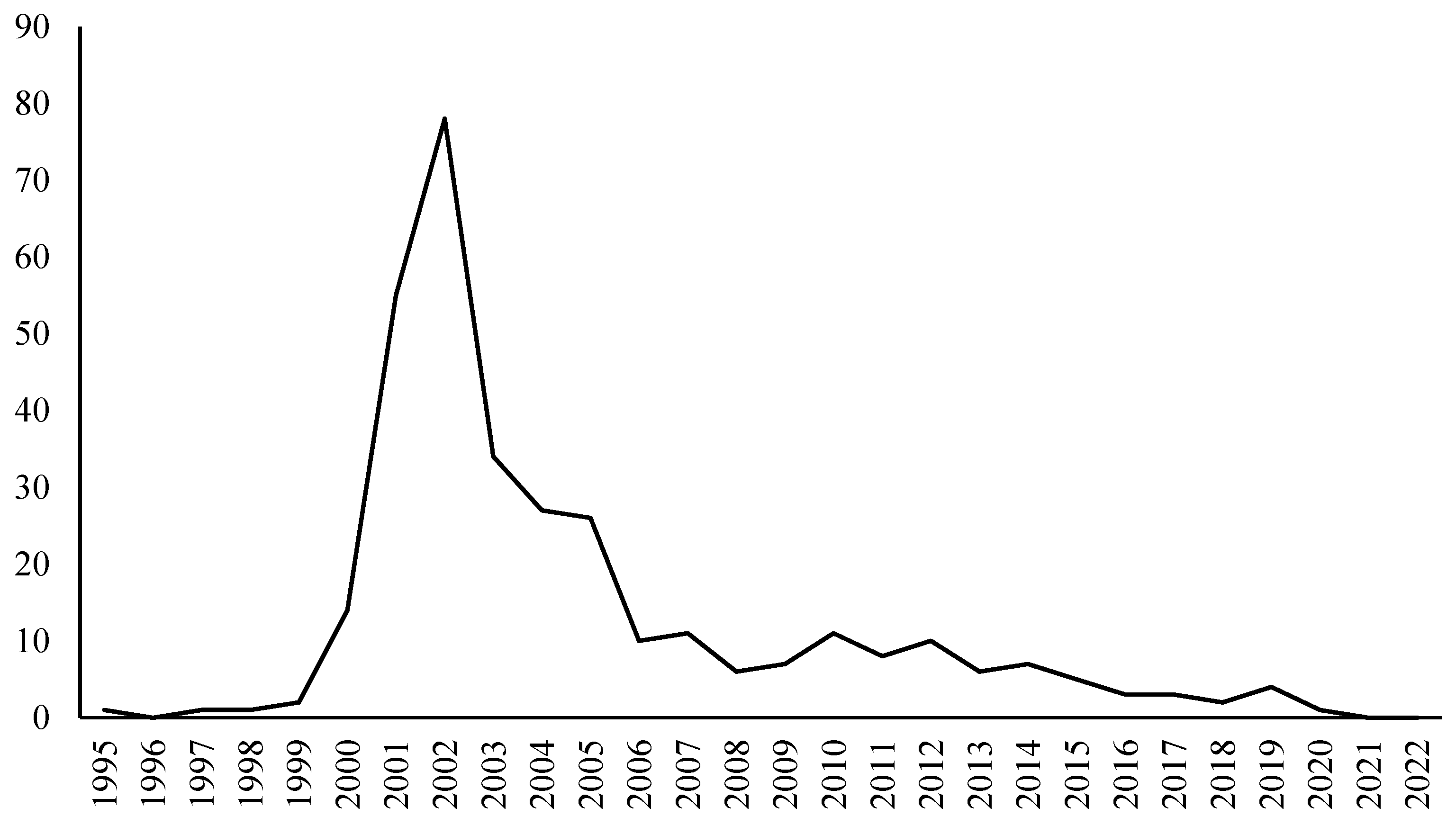
The establishment of AAC began in 1995, with Shenzhen taking the lead in making this breakthrough reform and establishing the first AAC in China. In 2001, the State Council approved and promulgated the Implementation Opinions on the Reform of the Administrative Approval System, initiating a new phase in the reform of China’s administrative approval system. Since then, AACs have been established in various prefecture-level cities across the country, as shown in
Figure 1. By 2022, AACs had been established in all prefecture-level cities in China, enabling the replication and promotion of this reform achievement nationwide and greatly improving China’s administrative approval system environment.
3.2. Research Design
Green innovation is frequently accompanied by substantial research and development (R&D) costs and uncertainty. Consequently, in the absence of external incentives, enterprises may lack the impetus to voluntarily engage in green innovation [
2]. Government subsidies, serving as an effective policy instrument, can mitigate these R&D costs for enterprises, enhance the appeal of green innovation, and thereby channel investment toward sustainable environmental initiatives. However, from the government’s perspective, the implementation of environmental subsidies often brings considerable financial pressure. This is because, in addition to those companies that do engage in green innovation and deserve environmental subsidies, there are also some companies that engage in a large number of non-inventive green innovations just to obtain subsidies [
8].
As mentioned earlier, although the establishment of AAC is an important measure of business environment reform and has brought various positive impacts to local enterprises, the financial expenditure brought by AAC construction may lead to a reduction in green innovation support subsidies and exert a negative impact on urban green innovation. We conceptualize AAC establishment as an exogenous shock and estimate its causal impact on urban green innovation using a multi-period DID method, which accommodates the policy’s staggered implementation. The estimation is formalized by the two-way fixed effects model below.
where the subscripts
i and
t stand for city and year, respectively, and
is the error term. The dependent variable
lnG denotes the level of green innovation in city
i in year
t.
is a core explanatory variable that equals 1 if city
i had established an AAC by year
t, and 0 otherwise. Consequently, the coefficient for
can be interpreted as the effect of implementing an AAC on the level of urban green innovation. To ensure an accurate and credible estimation, we control for a set of factors that may influence urban green innovation, including the level of urban economic development, the financial environment, industrial structure, R&D investment, and education level. Furthermore, both city-fixed effects
θi and time-fixed effects
θt are incorporated into the empirical framework to account for unobserved heterogeneity.
A fundamental assumption of the DID approach is that the treatment and control groups would have followed parallel trends absent the policy [
21]. We test this assumption for urban green innovation by conducting an event-study analysis, specified in the model below:
To test for parallel trends, we replace the Post dummy with a set of year-specific dummies relative to the AAC establishment year in Equation (2), and the time dummy variable denotes observations from n years before the establishment of AAC in each city to n years after.
3.3. Variables and Data
Compiling a panel dataset of Chinese prefecture-level cities over the period 2000–2022, this study employs a multi-period DID design within a quasi-natural experiment framework to evaluate the impact of AAC establishment on urban green innovation. As provincial-level units, municipalities differ structurally from ordinary prefecture-level cities in administrative authority, fiscal autonomy, and resource allocation. To mitigate estimation bias due to sample heterogeneity and improve the comparability of results across typical cities, this study excludes the four municipalities (Beijing, Tianjin, Shanghai, Chongqing) from the full sample [
22,
23]. To reduce heteroskedasticity, most variables in this paper are treated logarithmically.
Dependent variable: The green innovation level is typically measured by the number of green innovation patents. Generally, green innovation patents can be divided into green invention patents and green utility patents [
24,
25]. Invention patents usually represent substantive innovation, which requires long-term technological accumulation, extensive experimental verification, and substantial financial support [
26]. In contrast, utility patents are more like micro-innovations or quick-win technical improvements. Utility patents involve lower R&D investment, do not undergo substantive examination, and do not need to demonstrate prominent substantive features. In some cases, a utility patent can be granted simply by modifying a partial structure of an existing product [
27]. Many firms conduct innovation activities not out of motivations to enhance competitiveness, develop differentiated products, or transform production modes, but treat innovation as a strategic tool to improve corporate image or social reputation [
28]. They pursue the quantity and expenditure of innovation one-sidedly, while neglecting the quality of innovation [
29]. Accordingly, studies suggest that only invention patents genuinely reflect firms’ genuine innovation capacity [
30,
31]. Thus, we use the logarithmic value of the number of green invention patents (
lnGI) granted by the city to measure the level of green innovation in the city.
Key explanatory variables: The main explanatory variable
is used to characterize whether an AAC is established in a prefecture-level city or not. We use the publicly available data on the establishment time of prefecture-level AAC from the Chinese Research Data Services Platform (CNRDS) and manually fill in the missing data by the information on the website of the prefecture-level municipal government (see
Appendix A for details). If a city is newly established or has established an AAC in a given year, the value of the variable
is 1, otherwise it is 0.
Control variables: Considering that urban green innovation is influenced by multiple factors, a set of control variables is introduced, as specified below. (i) Level of urban economic development (
lngdp). An increase in urban economic development improves urban green innovation [
32]. Urban economic development is measured by the log of gross domestic product (GDP) at the city level. (ii) Financial environment (
lnfinance). A good financial environment contributes to more green innovation [
33]. The financial environment is proxied by the year-end natural logarithm of total outstanding loans issued by financial institutions in the city. (iii) Industrial structure (
industry). Generally, an advanced industrial structure helps drive green innovation in cities [
34]. The industrial structure is measured by the share of value added by the service sector in GDP. (iv) R&D investment (
lnRnD). This variable, proxied by the logarithm of R&D expenditure in a city, is a critical driver of green innovation [
35]. (v) Educational attainment (
lnedu). By determining the level and growth of human capital, educational attainment serves as a fundamental driver of green innovation [
36]. We measure the level of educational attainment using the log of the full-time teaching staff count at general higher education institutions.
The raw data were obtained from the China Urban Statistical Yearbook. The descriptive statistics for the variables are reported in
Table 1.
4. Results
4.1. Main Results
Following Equation (1), we estimate the effect of AAC establishment on urban green innovation. The results are reported in
Table 2. Specifications (1) to (3) build up the model by sequentially adding control variables, with city- and year-fixed effects maintained throughout.
According to the results, the coefficient of Post is −0.254 and significant at the 1% level, indicating that the establishment of AACs in prefecture-level cities has reduced urban green innovation by 25.4%. The estimated coefficients for the control variables—urban economic development (lngdp), financial environment (lnfinance), industrial structure (industry), R&D investment (lnRnD), and educational attainment (lnedu)—are all positive, suggesting they are conducive to green innovation. This pattern of results is consistent with findings reported in the existing literature.
4.2. Robustness Checks
4.2.1. Parallel Trend Test
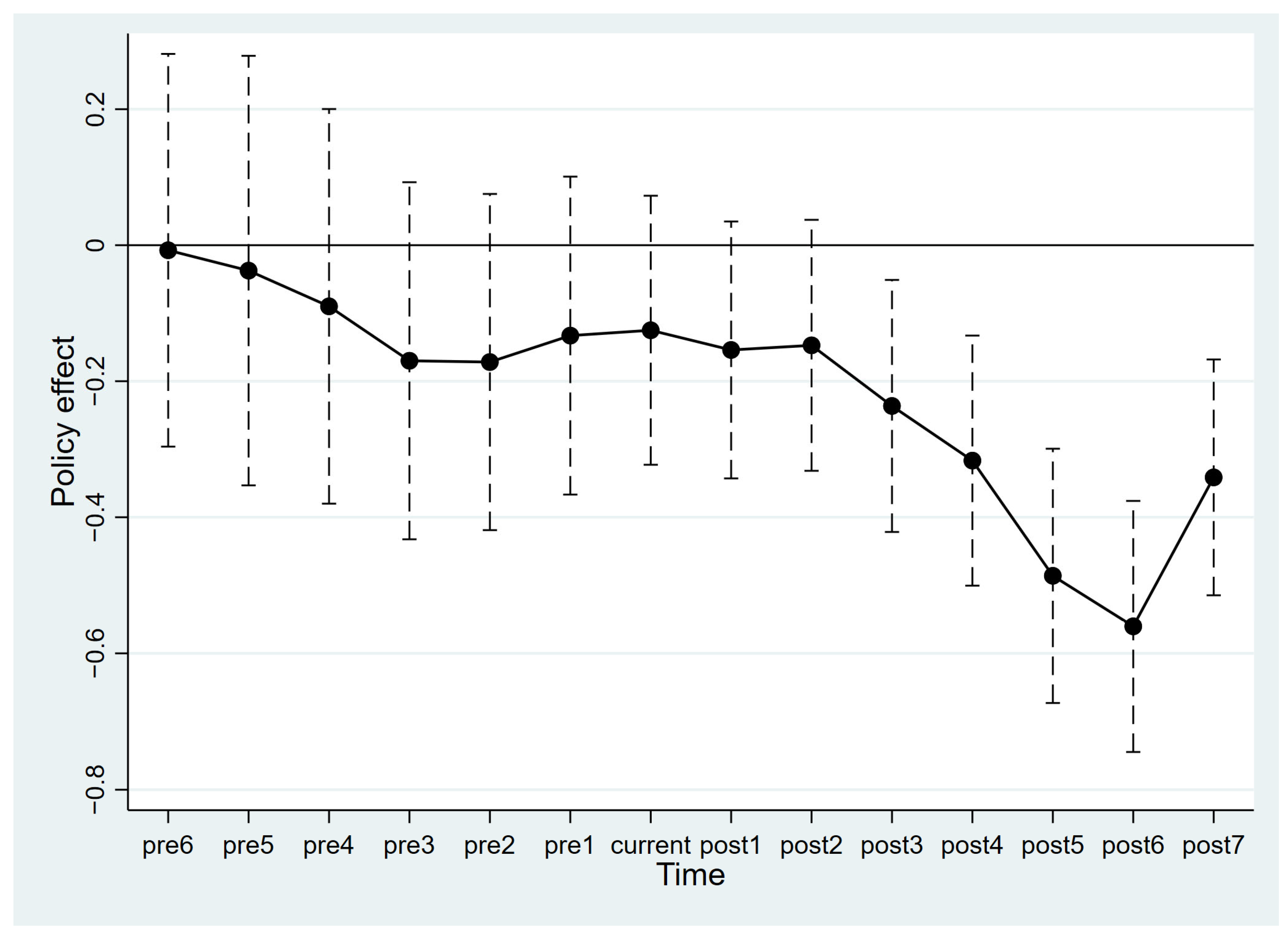
To verify the parallel trend assumption of the multi-period DID model, this study constructs a dynamic effect model based on Equation (2), and selects observations from 7 years before to 7 years after the establishment of AAC for an event-study analysis. We focus on examining whether the green innovation trends of the treatment and control groups are parallel prior to the establishment of AAC, so as to judge whether the baseline regression results satisfy the core identification assumption of the DID model.
Figure 2 and
Table 3 illustrate the relationship between dependent variable and time dummy variable
. Pre-treatment coefficients show no significant differential trends between the groups, whereas a significant treatment effect materializes starting in the third post-establishment year. This evidence supports the validity of the parallel trend assumption in our setting.
4.2.2. Placebo Test
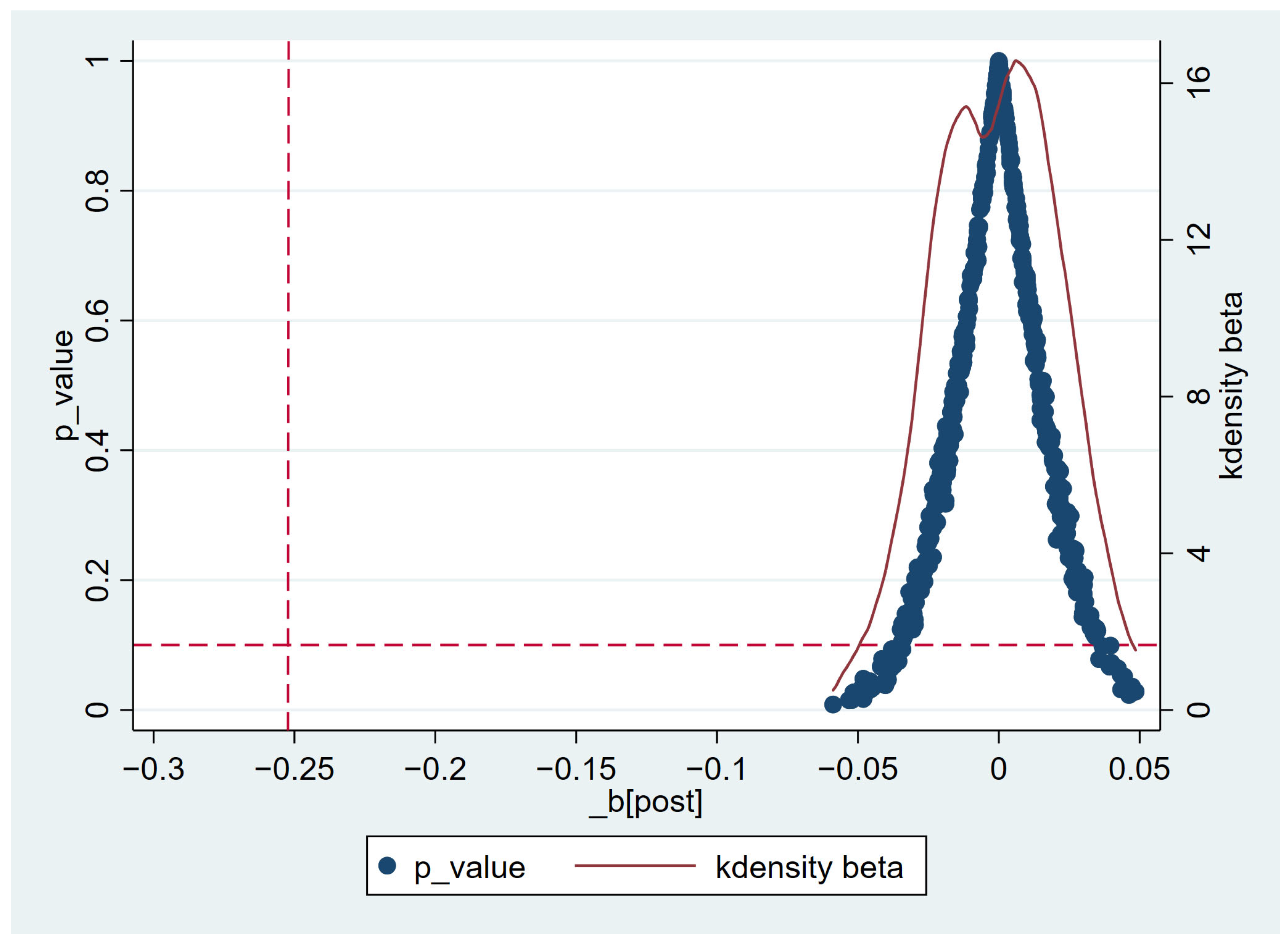
We conduct placebo tests to further verify the robustness of our empirical findings. Specifically, we randomly assign pseudo-treatment status to observations in the sample and repeat this procedure 500 times [
37]. For each iteration, we estimate the placebo treatment effect and compare its distribution with our baseline estimate. This approach allows us to examine whether the observed policy effect could arise by chance. If the placebo estimates differ significantly from the true policy effect, it suggests that our findings are unlikely to be driven by random noise or omitted variables.
As shown in
Figure 3, the placebo estimates follow a normal distribution centered around zero, and their 95% confidence interval does not encompass the baseline estimate of −0.254. This pattern indicates that the negative effect of establishing an AAC on urban green innovation is not spurious. Therefore, our results pass the placebo test, further validating the reliability and robustness of our main findings.
4.2.3. Alternative Estimation Methods
In the benchmark regression, we used the two-way fixed-effects model. To ensure the robustness of the results, different regression methods were used in this section, as shown in
Table 4.
In column (1), we estimate a baseline model featuring Post and the control variables, employing the pooled ordinary least squares (OLS) method. However, the dependent variable contains a number of zero values, indicating that certain cities did not grant any green invention patents in specific years. Directly applying pooled OLS estimation in this context may lead to underestimates of the true marginal effects of the explanatory variables. To address this limitation, we first employ the Poisson Pseudo-Maximum Likelihood (PPML) estimator for robustness checks in column (2). PPML is a regression method specifically designed for count data, which is well-suited for handling datasets containing zero values and overdispersion. Additionally, we further decompose urban green innovation activities into two stages: whether to participate in innovation (the extensive margin) and, conditional on participation, how much innovation output to produce (the intensive margin). To comprehensively capture the influence channels of the AAC establishment, this paper simultaneously employs a panel Probit model in column (3), using a binary indicator of whether a city has obtained green invention patents as the dependent variable DumGI to assess the impact of establishing an AAC on the probability of urban green innovation participation. Complementing this, a panel Tobit model in column (4) is used to examine the effect of establishing an AAC on green innovation output intensity among participating cities. All estimation methods control for the year dummies. After replacing the regression method, the regression results still indicate that the establishment of AAC inhibits urban green innovation.
4.3. Mechanism Analysis
The establishment of AAC has led to an increase in government fiscal expenditure, which has resulted in a reduction in government financial support for the environmental sector, further leading to a decrease in green innovation efforts by enterprises in the face of reduced government support. Next, this section empirically examines the impact mechanism of AAC establishment on urban green innovation. We use the city’s fiscal deficit rate as a mediator variable for two-way fixed-effects regression and empirically examine this impact mechanism through the following three steps [
38].
First, we assess the overall impact of the core explanatory variable
on the dependent variable
lnG, as shown in Formula (1). The empirical results of this step have been presented in column (3) of
Table 2.
The second stage of our mediation analysis investigates the relationship between
and the mediator
, following the model presented in Equation (3). Column (1) of
Table 5 presents the estimation results for this stage of the analysis, showing that AAC establishment has significantly increased the urban fiscal deficit rate as expected at a significance level of 5%.
Lastly, we assess the impact of the key explanatory variable
on the dependent variable
lnG with the mediator
controlled, as shown in Formula (4). The empirical results of this step are shown in column (2) of
Table 5, indicating that the establishment of AAC still suppresses urban green innovation at the 1% significance level after adding the mediating variable
. The absolute value of the coefficient of
in Formula (4) is 0.233, which is smaller than that in Formula (1), indicating the existence of a mediating effect.
As shown in
Table 5, the mediation effect test results indicate that the fiscal deficit ratio plays a mediating role in the relationship between the establishment of AAC and urban green innovation. Column (1) reveals that the AAC establishment significantly increases the local fiscal deficit ratio by 1.27%, while column (2) indicates that a 1% rise in this ratio leads to an average 0.233% reduction in the number of urban green invention patents granted. This finding suggests that the establishment of AAC significantly increases the fiscal pressure on local governments. Faced with heightened fiscal pressure, local governments become highly cautious in allocating fiscal funds, prioritizing the maintenance of basic livelihoods [
39], wage payments, government operations, and economic growth stimulation, while reducing investment in green innovation—which typically involves longer payoff cycles and less pronounced short-term economic benefits. This, in turn, indirectly inhibits urban green innovation.
To test the robustness of the regression results, this study employs the bootstrap method to examine the mediating effect of fiscal deficit [
40]. We conduct 500 bootstrap replications with a 95% confidence interval. A mediating effect is deemed to exist if the 95% confidence interval of the indirect effect does not contain zero. The results show that the 95% confidence interval of the indirect effect is [−0.041, −0.001], which excludes zero. This indicates that the mediating effect is present, and the underlying impact mechanism is valid.
4.4. Heterogeneity Analysis
Although the previous findings suggest that establishing an AAC has lowered the level of urban green innovation, the effectiveness may vary depending on the region in which it is implemented. This section analyzes the heterogeneous impact of establishing an AAC on green innovation, considering regional development level, environmental regulation intensity, and urban administrative level.
4.4.1. Heterogeneity of Regional Development Levels
The three major geographic regions of mainland China—east, central, and west—are characterized by a distinct east-to-west decline in economic development levels. The eastern and central regions are more economically developed and have a more favourable business environment and more abundant production factors than the western regions. Thus, enterprises in eastern and central regions face higher market competition pressure. The establishment of AAC helps optimize the local business environment, simplify administrative procedures for business registration, and stimulate the entry of new firms into the market and intensify competition [
12]. However, intense market competition may make companies more inclined to prioritize short-term survival goals, such as improving production efficiency to increase competitiveness, rather than promoting long-term development requirements with positive environmental externalities such as green innovation. Therefore, the disparity in economic development levels across eastern, central, and western regions results in varying degrees of market competition faced by enterprises, thereby causing the impact of the AAC establishment on urban green innovation levels to exhibit heterogeneity.
As shown in
Table 6, the results of the group regressions and Chow test indicate that the establishment of AAC has indeed exerted a significantly differentiated impact on the levels of green innovation in cities across the eastern, central, and western regions. Specifically, in the economically more developed eastern and central regions, the establishment of AAC exerts a more pronounced negative effect on urban green innovation. By comparison, the AAC establishment has not significantly affected urban green innovation in the less developed western regions. This suggests that, in relatively developed regions, the survival pressure stemming from intense competition outweighs the transaction cost savings brought about by improvements in the business environment. Taking 2024 as an example, there were 18.393 million enterprises in the eastern region, 7.428 million in the central region, and 6.194 million in the western region [
41]. It is evident that, compared with the western region, enterprises in the eastern and central regions face greater competitive pressure. Coupled with the fact that urban industrial land costs, labor costs, and other expenses in the eastern and central regions are all higher than those in the western region, enterprises in these regions consequently face even greater survival pressure, forcing them to prioritize efficiency over sustainable development.
4.4.2. Heterogeneity in Environmental Regulatory Stringency
Heterogeneity in environmental regulation stringency across cities may lead to differential effects of the AAC establishment on urban green innovation. Utilizing data from the China Urban Statistical Yearbook (2007–2022), this study measures the stringency of urban environmental regulation by the ratio of energy conservation and environmental protection expenditure to the general public budget expenditure in each city. Cities are classified as having high environmental regulation intensity if their annual ratio exceeds the national average for that year, and low intensity otherwise. Based on this classification, we compare the two groups to examine how the impact of the AAC establishment on urban green innovation varies with the stringency of environmental regulation.
As shown in
Table 7, the establishment of AAC exerts a significantly negative impact on green innovation across cities with varying levels of environmental regulatory stringency, with the effect being more pronounced in cities with higher stringency. The Chow test indicates that the differences between the groups are statistically significant. This result may be attributed to the fact that firms in cities with stringent environmental regulations already face substantial compliance costs, such as pollution control investments and monitoring expenditures. The fiscal constraints induced by the AAC establishment and the consequent reduction in green innovation support further suppress green innovation in these high-regulation cities. In practice, to meet stringent environmental standards, firms in such cities often prioritize end-of-pipe treatment facilities (e.g., upgrading wastewater discharge systems) over front-end green technology innovation [
42]. Consequently, only those firms with sufficient resources remaining after bearing high compliance costs are likely to engage in green innovation, and cuts to fiscal support for green innovation will leave fewer firms with the capacity to undertake such activities.
4.4.3. Heterogeneity of Municipal Administrative Levels
As mentioned earlier, the increase in fiscal deficit is an important reason why the establishment of AAC affects urban green innovation. Due to significant differences in the financial situation of cities with different administrative levels, differences in urban administrative levels may lead to heterogeneous impacts of the AAC construction on urban green innovation. Here, the provincial capital cities and sub-provincial cities are classified as a high-level administrative city group, while the remaining cities are classified as a low-level administrative city group. To assess heterogeneity, regressions are run for the two subsamples to compare the impact of the AAC establishment on urban green innovation.
Table 8 finds no statistically significant impact of the AAC establishment on green innovation in high-administrative-level cities, but exerts a very significant negative effect on green innovation in lower-administrative-level cities. The Chow test indicates that the differences between the groups are statistically significant. This indicates that cities with high administrative levels typically have strong economic foundations and extensive tax sources, making them more likely to bear the construction and operation costs of AAC. Therefore, the establishment of AAC will not weaken the fiscal support for green innovation in such cities. However, cities with lower administrative ranks often face fiscal constraints. The establishment of AAC in such contexts imposes additional fiscal pressure, thereby diverting funds away from green innovation, which in turn stifles its development. It is worth noting that, although high-administrative-level cities possess resource advantages in the construction of AAC, the mere establishment of AAC can hardly exert a significant promoting effect on green innovation and requires targeted support for green technologies.
5. Further Discussion
Building on the previous analysis, which used green invention patents to measure urban green innovation and assessed the impact of the AAC establishment, this study extends the framework by incorporating green utility patents. This comparative approach allows us to examine how the AAC establishment differentially influences green innovation types. By analyzing the effects of establishing an AAC as an institutional shock on green invention patents and green utility patents, we aim to provide a more nuanced understanding of the structure and mechanisms of this policy’s impact on green innovation.
The establishment of AAC inhibits green invention patents but has an insignificant effect on green utility patents as
Table 9 shows, owing to the two types of innovations’ different sensitivities to the institutional environment. Compared to green invention patents, green utility patents feature relatively shorter R&D cycles, lower capital requirements, and reduced investment risks [
43]. Consequently, they are less dependent on fiscal support and can proceed normally even without sufficient government funding.
6. Conclusions and Suggestions
This paper estimates the effect of the AAC establishment on urban green innovation using a multi-period DID method. Empirical results show that establishing an AAC significantly reduces the level of urban green innovation. Based on the analysis of the impact mechanism in this paper, the main reason for this result is that the fiscal burden brought by the AAC construction has reduced local government fiscal support for green innovation. The heterogeneity analysis indicates that the negative impact of establishing an AAC on urban green innovation is more pronounced in cities located in regions with higher economic development, stronger environmental regulation, and lower administrative levels. In addition, findings from the
Section 5 indicate that the negative impact of the AAC establishment on urban green innovation is indeed manifested in invention patents rather than utility patents.
Considering that many developing countries are also facing the dilemma of balancing economic and non-economic goals under limited fiscal budgets, the findings of this research provide several policy implications for other developing countries, as outlined below.
First, the central government should strengthen the financial safeguards and supervisory system for advancing institutional reforms and innovation. On the one hand, regarding green innovation support, the central government needs to establish a differentiated fiscal transfer payment system that provides targeted assistance based on local fiscal conditions, with particular emphasis on increasing special-purpose grants to lower administrative level cities with weak fiscal foundations. Simultaneously, a mandatory constraint mechanism for green innovation funds should be constructed, setting minimum expenditure thresholds or proportional requirements to prevent local governments from excessively diverting green innovation resources during periods of fiscal austerity. On the other hand, for nationwide administrative reforms such as the AAC establishment, the central government should establish dedicated reform-support funds to alleviate local fiscal pressures. Meanwhile, comprehensive audit and supervision procedures for these funds must be improved to ensure transparent and controllable capital flows. In terms of performance evaluation, the assessment system for local government officials should be optimized to de-emphasize the incentive for “vanity projects,” guiding local governments to allocate limited fiscal resources toward substantive innovative activities rather than superficial constructions.
Second, local governments should implement differentiated environmental regulation policies tailored to local conditions on the basis of establishing green innovation safeguard mechanisms. Even in the absence of mandatory constraints from the central government, local governments should proactively prioritize green innovation expenditures in their fiscal budgets by establishing green innovation funds with strict approval thresholds for utilization, thereby preventing arbitrary diversion or misappropriation during economic downturns. Our heterogeneity test results indicate that the inhibitory effect on green innovation is more pronounced for firms in regions with stringent environmental regulations and economically developed areas under fiscal pressure, suggesting that our findings align with the Compliance Cost Theory. This suggests that local governments should avoid a “one-size-fits-all” regulatory approach. Specifically, for regions already subject to high environmental regulatory intensity, greater flexibility in regulatory instruments should be emphasized, with increased reliance on market-based incentives such as emissions trading schemes and green subsidies rather than sole dependence on administrative command-and-control measures. For developed regions facing intense market competition, local governments should exercise prudence in the pace of environmental standard tightening, avoiding the imposition of overlapping pressures on enterprises resulting from sudden compliance cost increases, and instead provide enterprises with adequate periods and buffer space for technological adjustment.
Finally, other developing countries should leverage digital technologies to advance governance innovation and achieve leapfrog development. Against the backdrop of increasingly mature digital technologies, latecomer countries need not replicate China’s path of “building physical halls first, then transitioning to online platforms.” Instead, they should fully absorb the lessons learned from this experience by directly deploying online approval systems to enhance governance efficiency at lower costs, thereby accomplishing “corner overtaking” in digital reform. Specifically, this can be achieved by promoting digital models such as “one-stop online services” and “approval without face-to-face contact,” integrating the functions of AAC into online government platforms to reduce physical infrastructure costs while improving approval efficiency through data sharing. Furthermore, it is recommended that digital infrastructure construction be incorporated into the scope of special-purpose bond financing to provide stable funding channels for local digital transformation.
Despite its contributions, this study has several limitations that warrant future research. First, we measure urban green innovation using green patent data, which may not capture innovations that remain unpatented. Future studies should employ multiple indicators to construct more comprehensive measures of green innovation. Second, our findings are based on macro-level city data, which may not necessarily reflect micro-level firm behaviors. Future research should validate these conclusions using micro-level data such as that from listed companies to conduct more rigorous examinations of the green innovation effects of the AAC establishment.
Author Contributions
Conceptualization, L.M. and B.Z.; Data Curation, L.M.; Formal Analysis, B.Z.; Funding Acquisition, L.M.; Investigation, B.Z.; Methodology, L.M.; Project Administration, L.M.; Resources, B.Z.; Software, L.M.; Supervision, B.Z.; Validation, L.M. and B.Z.; Visualization, L.M.; Writing—Original Draft Preparation, L.M. and B.Z.; Writing—Review and Editing, B.Z. All authors have read and agreed to the published version of the manuscript.
Funding
This paper was funded by the Beijing Social Science Foundation General Project (Grant No. 24JJC022).
Institutional Review Board Statement
Not applicable.
Informed Consent Statement
Not applicable.
Data Availability Statement
The raw data supporting the conclusions of this article will be made available by the authors on request.
Conflicts of Interest
The authors declare no conflicts of interest.
Appendix A. Details on Data Collection
The data on the establishment time of AACs in prefecture-level cities had some missing values. We manually supplemented the missing data as follows. Local governments have established corresponding institutions to perform the functions of AAC, though they may not be directly named as such. Therefore, we expanded the scope of keywords and searched for terms such as “government service center, government hall, public administrative service center, convenience service center, government service administration bureau, government service and public resource trading center” in documents published on local people’s government websites and relevant news reports released by local media, thereby completing the data on the establishment year of AACs in each city.
References
- James, P. The sustainability circle: A new tool for product development and design. J. Sustain. Prod. Des. 1997, 2, 52–57. [Google Scholar]
- Jiang, R.M.; Chen, G.S. Governmental allowance, enterprise ESG and green innovation. Resour. Ind. 2022, 24, 90–102. [Google Scholar]
- Li, Z.; Huang, Z.; Su, Y. New media environment, environmental regulation and corporate green technology innovation: Evidence from China. Energy Econ. 2023, 119, 106545. [Google Scholar] [CrossRef]
- Porter, M.E. America’s green strategy. Sci. Am. 1991, 264, 193–246. [Google Scholar]
- Viscusi, W.K. Frameworks for analyzing the effects of risk and environmental regulations on productivity. Am. Econ. Rev. 1983, 73, 793–801. [Google Scholar]
- Hoerger, F.; Beamer, W.H.; Hanson, J.S. The cumulative impact of health, environmental, and safety concerns on the chemical industry during the seventies. Law Contemp. Probl. 1983, 46, 59–107. [Google Scholar] [CrossRef]
- Fang, X.M.; Hu, D. Corporate ESG performance and innovation: Empirical evidence from A-share listed companies. Econ. Res. J. 2023, 58, 91–106. [Google Scholar]
- Shang, H.T.; Zhu, L.R. The relationship among environmental R&D subsidies, environmental R&D investments and corporate environmental performance. Soft Sci. 2018, 32, 40–44. [Google Scholar]
- Gan, X.Q.; Xu, Q.F.; Yuan, Y.J. Green transformation policy of regional industries, fiscal pressure and low-carbon development of urban manufacturing. Public Financ. Res. 2022, 475, 104–119. [Google Scholar]
- Coase, R.H. The nature of the firm. Economica 1937, 4, 386–405. [Google Scholar] [CrossRef]
- Xia, J.C.; Liu, C. Administrative approval reform, transaction costs, and China’s economic growth. J. Manag. World 2017, 4, 47–59. [Google Scholar]
- Bi, Q.; Chen, X.; Xu, X.; Li, S. Administrative approval reform and firm entry. Econ. Res. J. 2018, 53, 140–155. [Google Scholar]
- Guo, X.N.; Shao, Y.H. The reform of administrative approval system and the evolution of enterprises’ productivity distribution. Financ. Trade Econ. 2019, 40, 142–160. [Google Scholar]
- Zhang, L.P.; Jiang, W.; Zhou, L.Q. Study of effect of administrative examination and approval on entrepreneurship—Based on the perspective of entrepreneurial ability. China Ind. Econ. 2016, 4, 57–74. [Google Scholar]
- Feng, X.; Wang, Y.J.; Liu, C.L. The efficiency of administrative approval and export performance: Based on the quasi-natural experiment of administrative approval center. J. Financ. Econ. 2018, 44, 98–110. [Google Scholar]
- Ministry of Finance of the People’s Republic of China. Significant Achievements in the Pilot Work of Government Purchase of Services in Shanxi Province. 6 February 2015. Available online: https://www.mof.gov.cn/zhengwuxinxi/xinwenlianbo/shanxicaizhengxinxilianbo/201502/t20150206_1189911.htm (accessed on 10 November 2025).
- Yu, X.H.; Yao, Z.Y. Resolutely Prevent and Correct the “Face Saving Project” of Government Services. Xinhua Daily Telegraph, 10 July 2025. [Google Scholar]
- Peng, F.; Li, X.Y.; Mao, D.F.; Sun, Y.H. Research on the impact of local fiscal sustainability on corporate green technology innovation. Public Financ. Res. 2025, 58–75. [Google Scholar] [CrossRef]
- Sun, Y.Y. Study on the green technology innovation effect of fiscal vertical imbalance: Based on an analysis of provincial panel data. J. Northeast. Univ. (Soc. Sci.) 2025, 27, 37–48. [Google Scholar]
- Liu, B.; Sun, Z.; Fu, K.; Liu, J. Green innovation effect of green fiscal demonstration policy: From the perspective of multiple pressure constraints. J. Nat. Resour. 2024, 39, 2102–2120. [Google Scholar] [CrossRef]
- Chen, S.J.; Mao, H.; Sun, J.Q. Low-carbon city construction and corporate carbon reduction performance: Evidence from a quasi-natural experiment in China. J. Bus. Ethics 2022, 180, 125–143. [Google Scholar] [CrossRef]
- Ai, M.Y.; Wang, P.X.; Bu, Y. Climate policy and inclusive green growth: The role of China’s low-carbon city pilot policy. J. Clean. Prod. 2025, 519, 145959. [Google Scholar] [CrossRef]
- Zhou, H. Can digital finance boost urban economic vitality? Financ. Res. Lett. 2026, 89, 109280. [Google Scholar] [CrossRef]
- Wang, Y.; Magnan, M.; Qiu, Y.T. Going green: An analysis of mutual fund investment and green innovation in the context of China. Environ. Resour. Econ. 2025, 88, 3547–3584. [Google Scholar] [CrossRef]
- Fang, L.; Li, Z. Corporate digitalization and green innovation: Evidence from textual analysis of firm annual reports and corporate green patent data in China. Bus. Strategy Environ. 2024, 33, 3936–3964. [Google Scholar] [CrossRef]
- Song, J.; Xue, L.; Song, Y. The synergistic effects of digital technology application on corporate green innovation: Empirical evidence from China. Int. Rev. Financ. Anal. 2025, 106, 104453. [Google Scholar] [CrossRef]
- Song, Z.; Jia, M.; Ma, Y. Digital technology innovation promotes green transformation: Empirical evidence from Chinese manufacturing enterprises. Sustain. Futures 2025, 10, 100964. [Google Scholar] [CrossRef]
- Zheng, Q.Y.; Li, H.D.; Bu, G.C.; Liu, H.X. Navigating green innovation: The role of carbon regulation and green finance in corporate strategy. Energy Econ. 2026, 153, 109089. [Google Scholar] [CrossRef]
- Kelm, K.M.; Narayanan, V.K.; Pinches, G.E. Shareholder value creation during R&D innovation and commercialization stages. Acad. Manag. J. 1995, 38, 770–786. [Google Scholar] [PubMed]
- Li, W.J.; Zheng, M. Is it substantive innovation or strategic innovation? Impact of macroeconomic policies on micro-enterprises’ innovation. Econ. Res. J. 2016, 51, 60–73. [Google Scholar]
- Li, F.H.; Liu, J.W.; Liu, H.Y. Institutions empowerment for sustainability: ESG performance and enterprise green innovation: Evidence from China. J. Environ. Manag. 2025, 388, 125947. [Google Scholar] [CrossRef]
- Xiong, G.; Fang, F. Digital economy development, industrial diversification and urban green innovation. J. Beijing Technol. Bus. Univ. (Soc. Sci.) 2024, 39, 45–58. [Google Scholar]
- Li, S.; Yang, C. On the influences of financial development on green innovation efficiency. J. Jiangxi Norm. Univ. (Philos. Soc. Sci. Ed.) 2018, 51, 84–92. [Google Scholar]
- Yang, J.; Liu, Q.; Xu, S. Measurement, spatio-temporal evolution and convergence of green innovation efficiency in China. Sci. Sci. Manag. S.&T. 2025, 46, 126–144+164. [Google Scholar]
- Sun, Y.; Ding, Y.; Guo, M. Research on the green innovation effect of government environmental target constraints. Sci. Res. Manag. 2025, 46, 177–186. [Google Scholar]
- Xie, P.; Wang, J.; Tang, S.; Shahzadi, I.; Bilan, Y. How does intergenerational transmission affect green innovation? Evidence from Chinese family businesses. Struct. Change Econ. Dyn. 2025, 73, 158–169. [Google Scholar] [CrossRef]
- Zhang, X.C.; Chen, L.; Liu, X.Y. Does targeted poverty alleviation foster rural entrepreneurship? Evidence from China’s township-level panel data. Econ. Anal. Policy 2025, 87, 1927–1945. [Google Scholar] [CrossRef]
- Baron, R.M.; Kenny, D.A. The moderator-mediator variable distinction in social psychological research: Conceptual, strategic, and statistical considerations. J. Personal. Soc. Psychol. 1986, 51, 1173–1182. [Google Scholar] [CrossRef] [PubMed]
- Ji, Q.; Nie, S. How Does local government fiscal pressure affect corporate ESG performance? Financ. Res. Lett. 2024, 64, 105478. [Google Scholar] [CrossRef]
- Preacher, K.J.; Hayes, A.F. SPSS and SAS procedures for estimating indirect effects in simple mediation models. Behav. Res. Methods Instrum. Comput. 2004, 36, 717–731. [Google Scholar] [CrossRef] [PubMed]
- Tu, Y.Q.; Du, F.F. Enterprise development in China during the 14th Five-Year Plan Period: Characteristics and policy implications. China Natl. Cond. Strength 2025, 8, 21–23. [Google Scholar]
- Pan, A.; Mi, P.Y.; Shi, X.P. From synergy to spread: How environmental regulation is helping Chinese firms achieve low-carbon expansion and take their supply chains with them. Energy Econ. 2026, 153, 109103. [Google Scholar] [CrossRef]
- Wang, P.; Zhang, Y. Corporate digital transformation, strategic green innovation and corporate environmental performance. Econ. Res. J. 2024, 59, 113–131. [Google Scholar]
| Disclaimer/Publisher’s Note: The statements, opinions and data contained in all publications are solely those of the individual author(s) and contributor(s) and not of MDPI and/or the editor(s). MDPI and/or the editor(s) disclaim responsibility for any injury to people or property resulting from any ideas, methods, instructions or products referred to in the content. |