Adapting Mediterranean Agroforestry to Global Change: Trade-Offs and Lessons from the Montado



 , and
, and 
Abstract

1. Introduction
2. Materials and Methods
2.1. Study Area Context
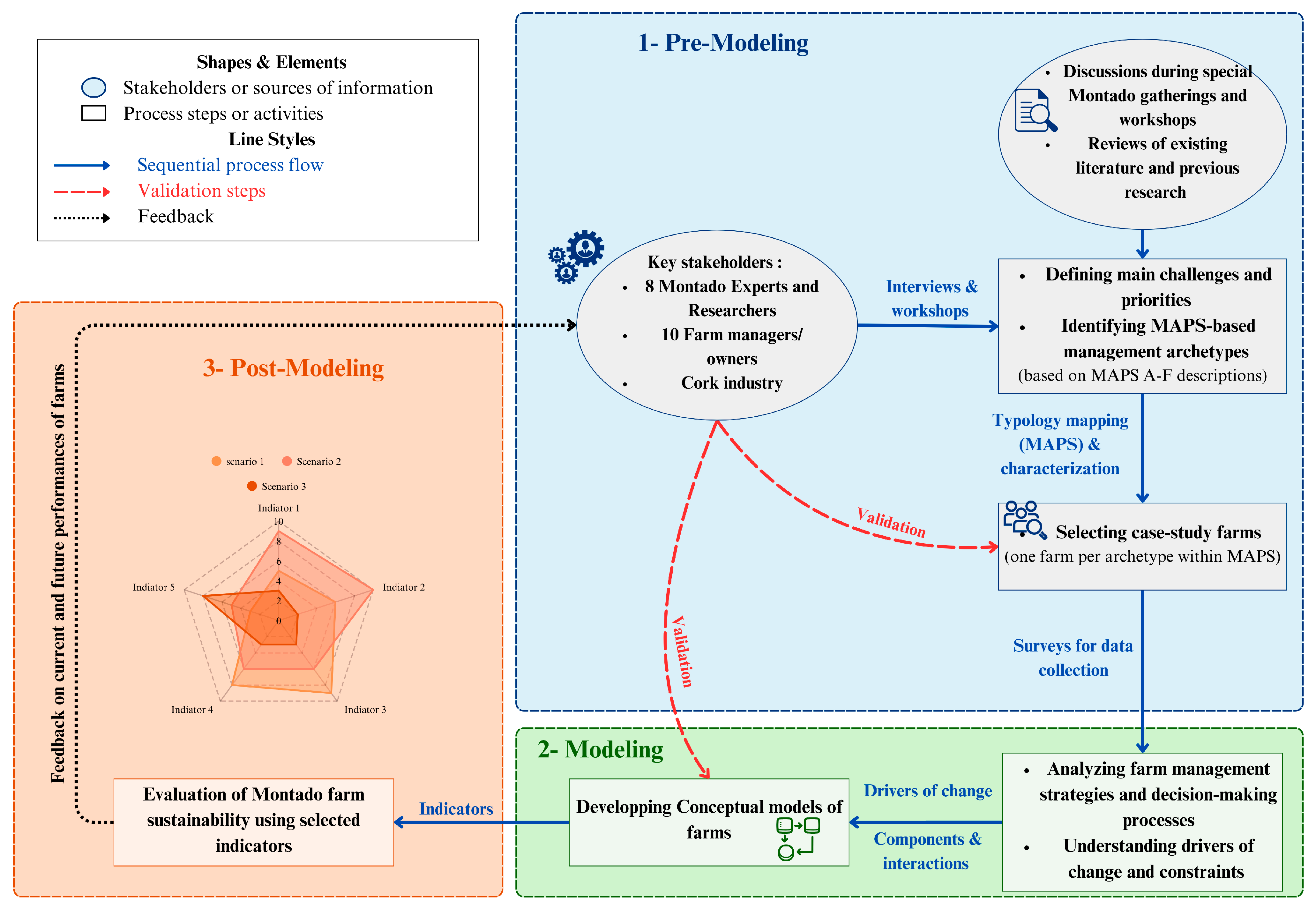
2.2. Study Approach and Participatory Framework
2.3. System Characterization and Data Collection
2.3.1. Establishing Criteria and Typology-Based Farm Selection
- i.
- Montado Agro-Forestry Production Systems (MAPS)
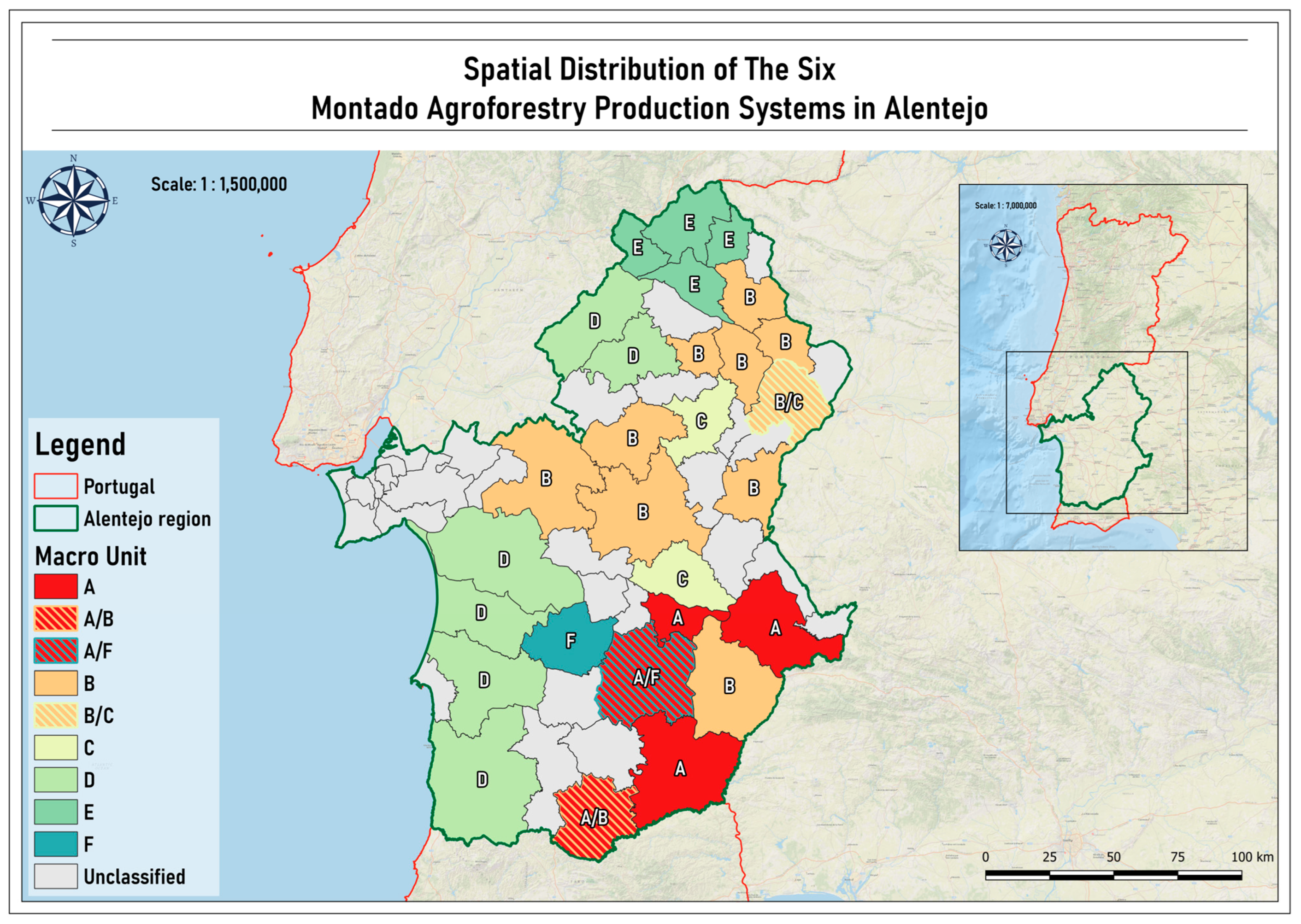
- Livestock-specialized extensive archetype (MAPS A/D): Includes MAPS with very large UAA (Around 800–1366 ha), low-density holm-oak stands, pasture-dominated land use, and extensive livestock grazing in inner or upland dry zones.
- Multifunctional agro-silvopastoral archetype (MAPS B/E/F): Includes MAPS characterized by small to medium UAA (Around 100–450 ha), dense holm and/or cork oak, cereals and pastures under trees, and mixed cattle–sheep systems in inner and inner-littoral zones.
- Forestry-optimized archetype (MAPS C and part of E): Includes MAPS with small UAA (Around 177 ha), high-density cork or mixed oak stands and associated olive/vine systems in wetter littoral or inner-littoral conditions, where high-value tree products dominate farm income.
- ii.
- Stakeholder-derived selection criteria
- iii.
- Selection of case-study farms
- Identification of eligible areas: Predominant municipalities for each MAPS group were identified from the published spatial distribution of homogeneous sub-units [38], defining three geographic strata that broadly correspond to: (i) inner dry zones dominated by extensive livestock systems, (ii) the central mixed agro-silvopastoral belt, and (iii) wetter inner-littoral zones with high tree density.
- Compilation of candidate farms: Within these strata, candidate farms were identified through the MED research network and farmer contacts from previous Montado projects. Candidates were pre-screened to ensure that their basic attributes (location, approximate farm area, dominant tree species, broad land-use pattern, and main activity) matched the profile of the target archetype for that stratum.
- Expert and stakeholder screening: The shortlist of candidates was evaluated by the Montado experts and experienced farmers against the full set of criteria. Farms that diverged from the MAPS-archetype profile (e.g., atypical size, tree composition, or land-use mix for that zone) were excluded.
- Final selection: One farm per archetype was retained, resulting in a set of three case-study farms, each embedded in a different MAPS group and representing one of the three management archetypes (forestry-optimized, multifunctional, and livestock-specialized). Detailed characteristics of these farms, including their locations and quantitative descriptors, are presented in the Results section.
2.3.2. Data Collection
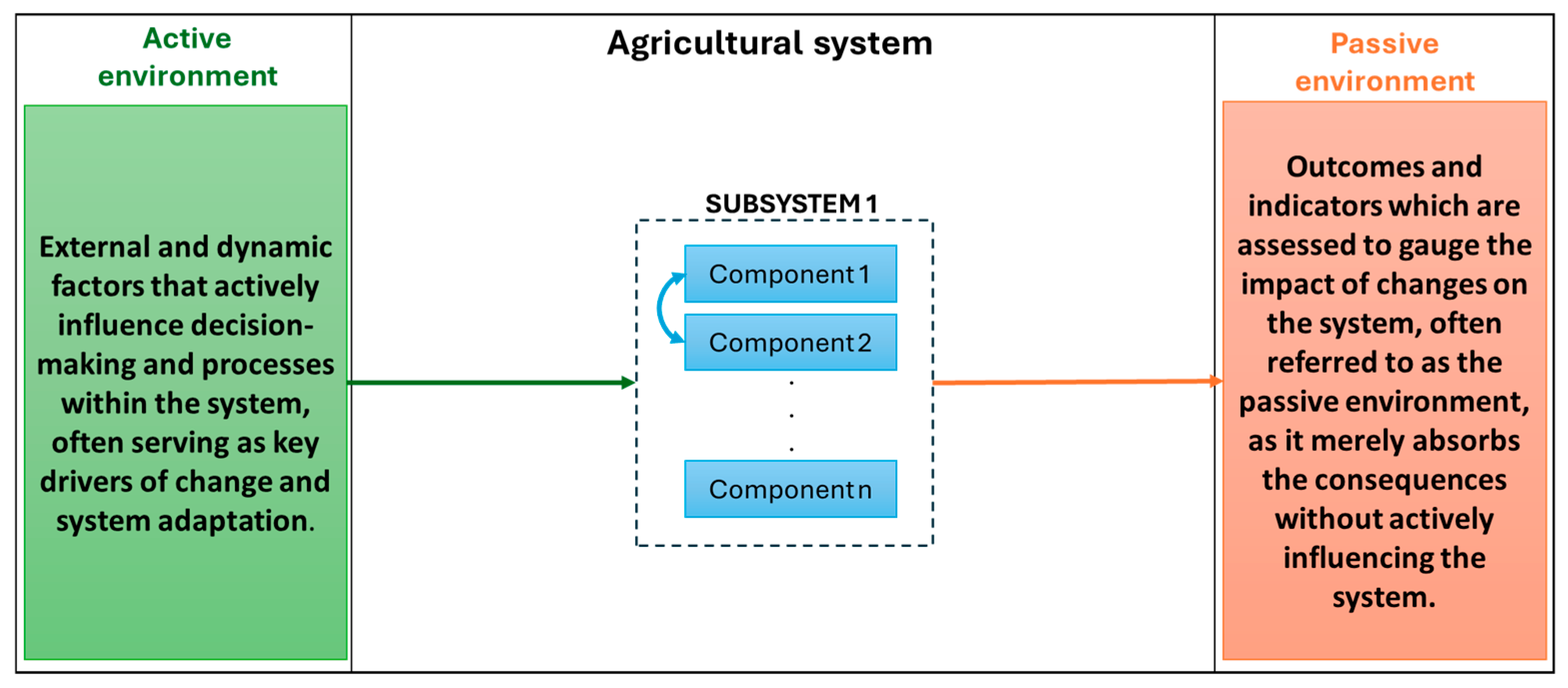
2.4. Elaboration of the Conceptual Models
- Active Environment: Issues and Drivers of Change
- 2.
- The Agro-Silvopastoral System
- 3.
- Passive Environment: Indicators
2.5. Comparative Assessment: Scenario Analysis
3. Results
3.1. System Characterization
3.1.1. Representative Montado Farms
3.1.2. Conceptual Models by Farm
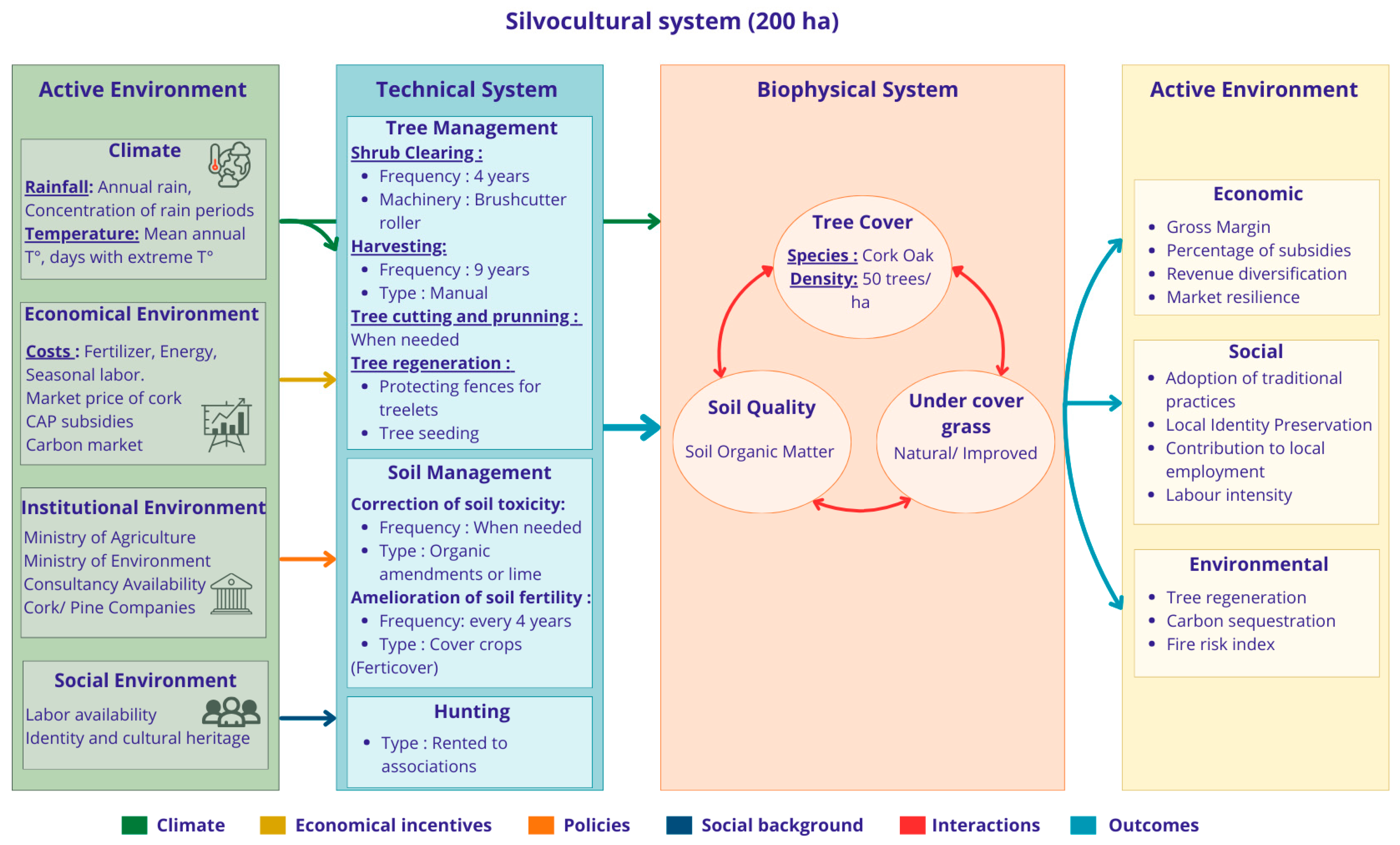
- Farm Type 1: Montado forest
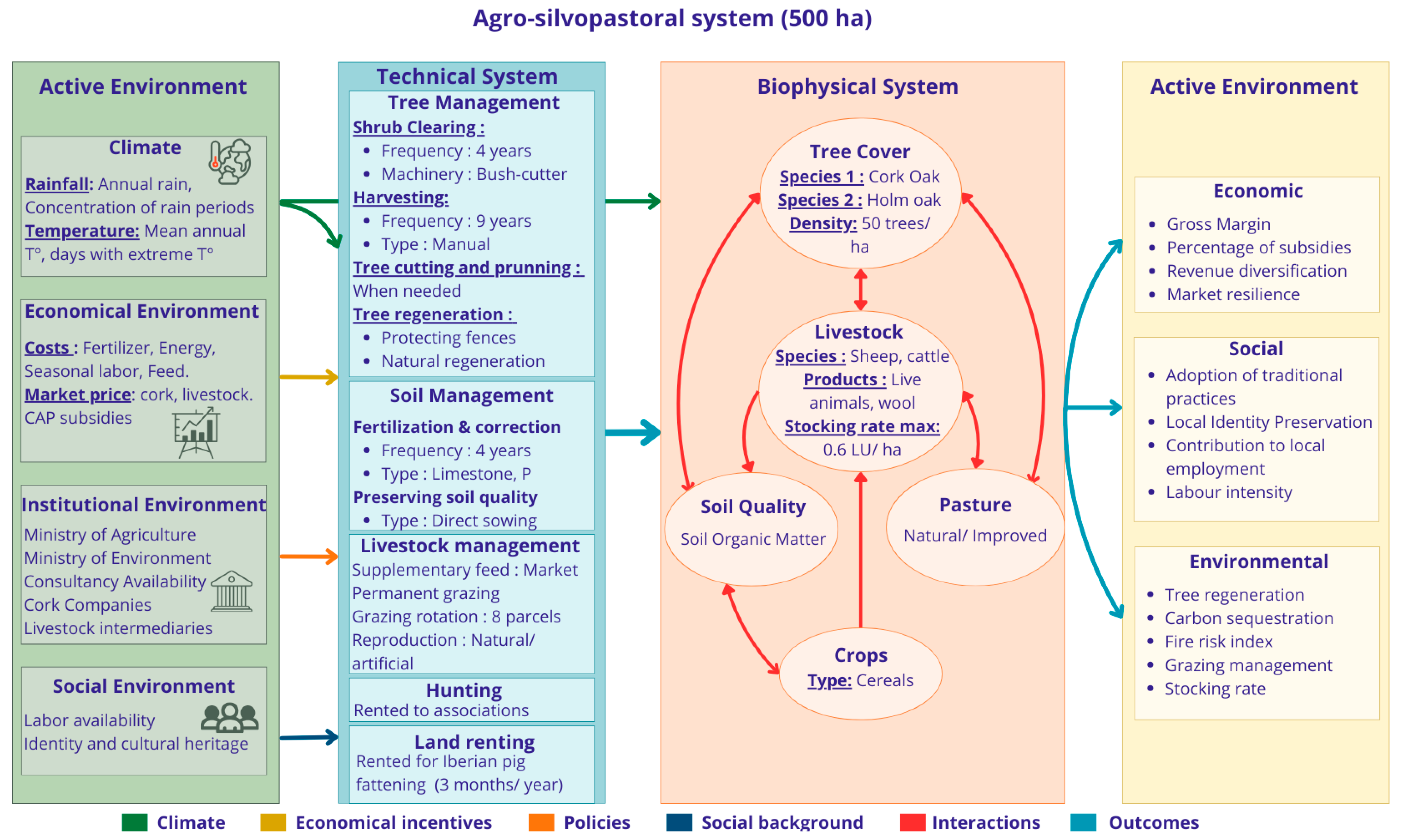
- Farm Type 2: Mixed oak coverage, livestock, and crops
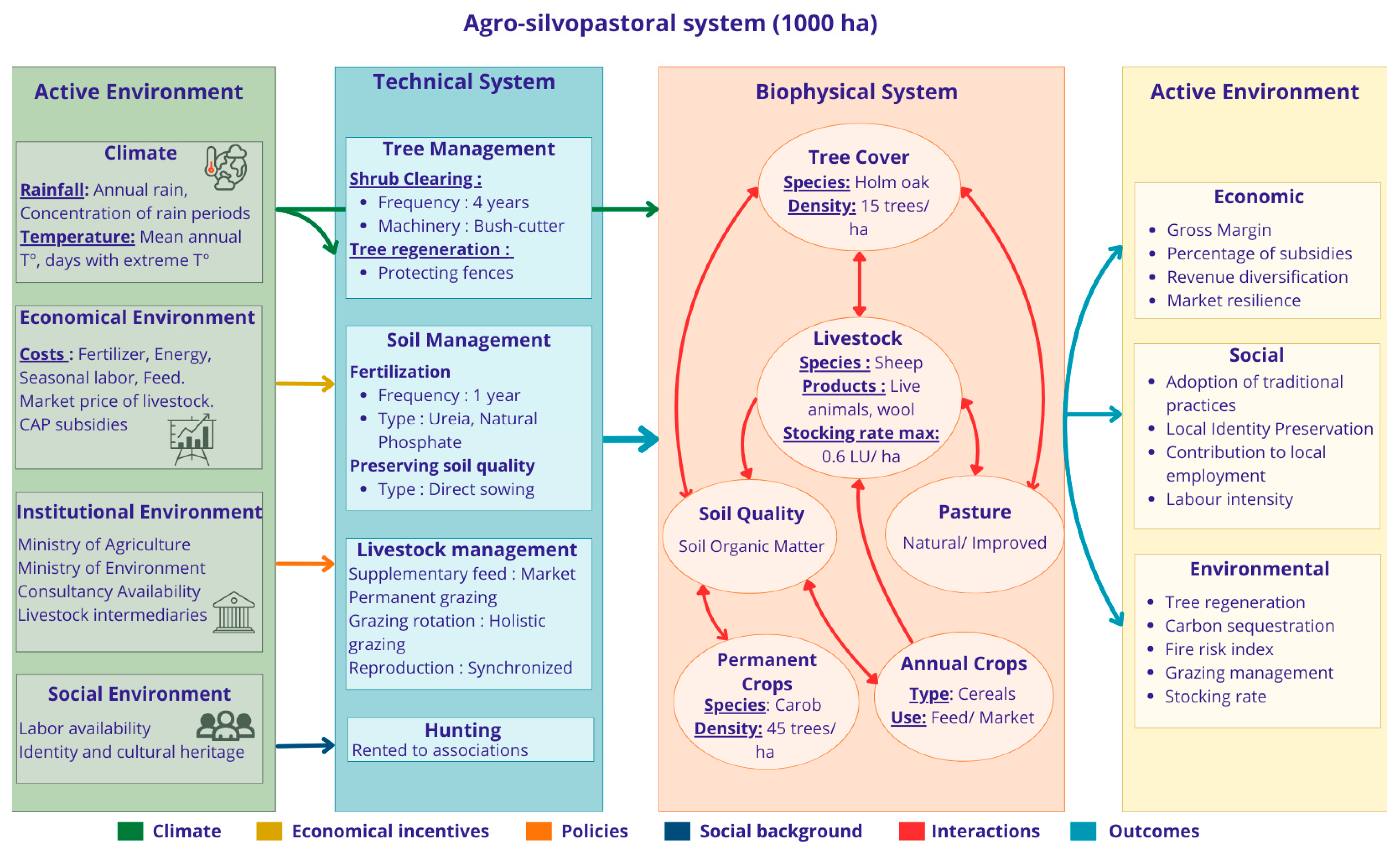
- Farm Type 3: Holm oak coverage, crops, and livestock-focused production
3.2. Comparative Sustainability Analysis
3.2.1. System Constraints
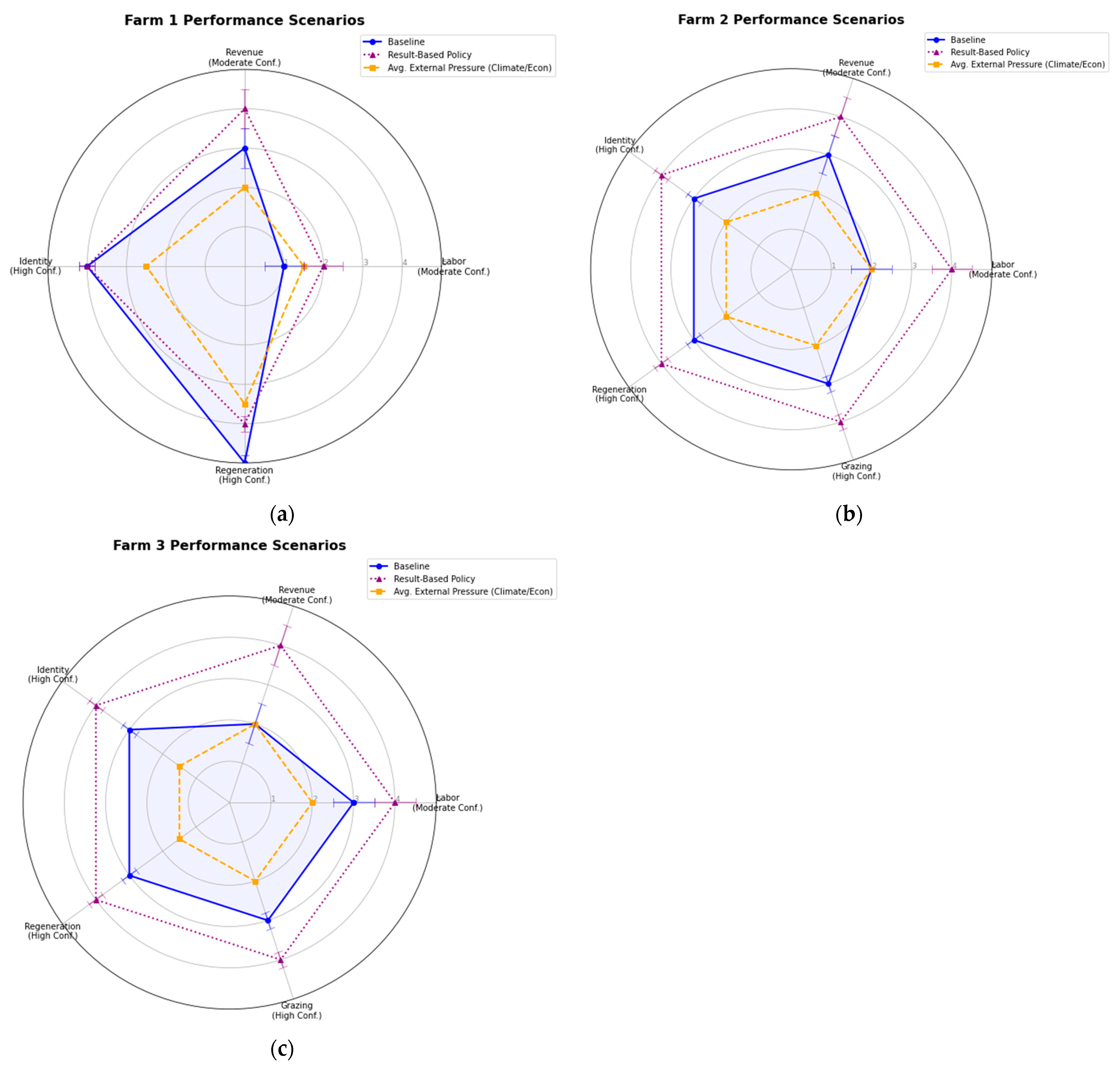
3.2.2. Performance of the Farms and Projected Sustainability
4. Discussion
4.1. Economic Productivity and Socio-Ecological Sustainability Trade-Offs
4.2. Implications for Governance
4.3. Possible Futures for Montado Farms
4.4. Discussion Summary
4.5. Study Limitations
5. Conclusions
Supplementary Materials
Author Contributions
Funding
Institutional Review Board Statement
Informed Consent Statement
Data Availability Statement
Acknowledgments
Conflicts of Interest
Abbreviations
| AES | Agri-Environmental Schemes |
| AWU | Annual Work Unit(s) |
| CAP | Common Agricultural Policy |
| EU | European Union |
| HNV | High Nature Value |
| INE | Instituto Nacional de Estatística (Portugal) |
| IPMA | Instituto Português do Mar e da Atmosfera |
| LSU | Livestock Unit(s) |
| MAPS | Montado Agro-Forestry Production Systems |
| NFI | Net Farm Income |
| NUTS | Nomenclature of Territorial Units for Statistics |
| PPI | Producer Price Index |
| UAA | Utilized Agricultural Area |
References
- Gauquelin, T.; Michon, G.; Joffre, R.; Duponnois, R.; Génin, D.; Fady, B.; Bou Dagher-Kharrat, M.; Derridj, A.; Slimani, S.; Badri, W.; et al. Mediterranean Forests, Land Use and Climate Change: A Social-Ecological Perspective. Reg. Environ. Change 2018, 18, 623–636. [Google Scholar] [CrossRef]
- Damianidis, C.; Santiago-aFreijanes, J.J.; den Herder, M.; Burgess, P.; Mosquera-Losada, M.R.; Graves, A.; Papadopoulos, A.; Pisanelli, A.; Camilli, F.; Rois-Díaz, M.; et al. Agroforestry as a Sustainable Land Use Option to Reduce Wildfires Risk in European Mediterranean Areas. Agrofor. Syst. 2021, 95, 919–929. [Google Scholar] [CrossRef]
- Plieninger, T.; Muñoz-Rojas, J.; Buck, L.E.; Scherr, S.J. Agroforestry for Sustainable Landscape Management. Sustain. Sci. 2020, 15, 1255–1266. [Google Scholar] [CrossRef]
- Xavier, A.; de Belém Martins, M. The Mediterranean Forests: Problems and Management Models. J. Tour. Sustain. Well-Being 2013, 1, 123–136. [Google Scholar]
- MedECC. Climate and Environmental Change in the Mediterranean Basin—Current Situation and Risks for the Future. First Mediterranean Assessment Report; Union for the Mediterranean, Plan Bleu, UNEP/MAP: Marseille, France, 2020; p. 632. [Google Scholar]
- Borsetta, G. Climate and Environmental Changes: Reflections and Prospects for the Future of the Mediterranean Area—Food Security and Climate Change: Agricultural Considerations. Qeios 2024. [Google Scholar] [CrossRef]
- García-Martín, M.; Torralba, M.; Quintas-Soriano, C.; Kahl, J.; Plieninger, T. Linking Food Systems and Landscape Sustainability in the Mediterranean Region. Landsc. Ecol. 2021, 36, 2259–2275. [Google Scholar] [CrossRef]
- Ortiz-Miranda, D.; Moragues-Faus, A.; Arnalte-Alegre, E. Chapter 12 Agriculture in Mediterranean Europe: Challenging Theory and Policy. In Agriculture in Mediterranean Europe: Between Old and New Paradigms; Ortiz-Miranda, D., Moragues-Faus, A., Arnalte-Alegre, E., Eds.; Emerald Group Publishing Limited: Leeds, UK, 2013; Volume 19. [Google Scholar]
- Nocentini, S.; Travaglini, D.; Muys, B. Managing Mediterranean Forests for Multiple Ecosystem Services: Research Progress and Knowledge Gaps. Curr. For. Rep. 2022, 8, 229–256. [Google Scholar] [CrossRef]
- Pinto-Correia, T.; Ribeiro, N.; Sá-Sousa, P. Introducing the Montado, the Cork and Holm Oak Agroforestry System of Southern Portugal. Agrofor. Syst. 2011, 82, 99–104. [Google Scholar] [CrossRef]
- Sá-Sousa, P. The Portuguese Montado: Conciliating Ecological Values with Human Demands within a Dynamic Agroforestry System. Ann. For. Sci. 2014, 71, 1–3. [Google Scholar] [CrossRef]
- Fonseca, A. O Montado no Alentejo: Séculos XV a XVIII; Colibri: Lisboa, Portugal, 2004. [Google Scholar]
- Ferraz-de-Oliveira, M.I.; Azeda, C.; Pinto-Correia, T. Management of Montados and Dehesas for High Nature Value: An Interdisciplinary Pathway. Agrofor. Syst. 2016, 90, 1–6. [Google Scholar] [CrossRef]
- Costa Freitas, M.D.B.; Ventura-Lucas, M.R.; Izquierdo, L.; Deblitz, C. The Montado/Dehesa Cow-Calf Production Systems in Portugal and Spain: An Economic and Resources’ Use Approach. Land 2020, 9, 148. [Google Scholar] [CrossRef]
- Carreira, E.; Serrano, J.; Lopes De Castro, J.; Shahidian, S.; Pereira, A.F. Montado Mediterranean Ecosystem (Soil–Pasture–Tree and Animals): A Review of Monitoring Technologies and Grazing Systems. Appl. Sci. 2023, 13, 6242. [Google Scholar] [CrossRef]
- Ferreira, D.B. Evolução da paisagem de montado no Alentejo interior ao longo do século XX: Dinâmica e incidências ambientais. Finisterra 2001, 36, 179–193. [Google Scholar] [CrossRef]
- Príncipe, A.; Branquinho, C.; Santos-Reis, M. Brief for GSDR 2015—Long Term Sustainability of Agro-Silvo-Pastoral Ecosystems: The Case of Montado Cultural Landscape. 2015. Available online: https://sdgs.un.org/documents/brief-gsdr-2015-long-term-sustainability-20599 (accessed on 16 December 2025).
- Lopes-Fernandes, M.; Martínez-Fernández, E.; Alves, R.; Boa-Nova, D.; Branquinho, C.; Bugalho, M.N.; Campos-Mardones, F.; Coca-Pérez, A.; Frazão-Moreira, A.; Marques, M.; et al. Cork Oak Woodlands and Decline: A Social-Ecological Review and Future Transdisciplinary Approaches. Agrofor. Syst. 2024, 98, 1927–1944. [Google Scholar] [CrossRef]
- Fragoso, R.; Marques, C.; Lucas, M.R.; Martins, M.B.; Jorge, R. The Economic Effects of Common Agricultural Policy on Mediterranean Montado/Dehesa Ecosystem. J. Policy Model. 2011, 33, 311–327. [Google Scholar] [CrossRef]
- Guimarães, M.H.; Guiomar, N.; Surová, D.; Godinho, S.; Pinto Correia, T.; Sandberg, A.; Ravera, F.; Varanda, M. Structuring Wicked Problems in Transdisciplinary Research Using the Social–Ecological Systems Framework: An Application to the Montado System, Alentejo, Portugal. J. Clean. Prod. 2018, 191, 417–428. [Google Scholar] [CrossRef]
- Azeda, C.; Guiomar, N.; Godinho, S.; Medeiros, J.P.; Pinto-Correia, T. The Ambiguous Role of Agri-Environment-Climate Measures in the Safeguarding of High Nature Value Farming Systems: The Case of the Montado in Portugal. Agric. Ecosyst. Environ. 2021, 319, 107562. [Google Scholar] [CrossRef]
- Rodríguez-Rigueiro, F.J.; Santiago-Freijanes, J.J.; Mosquera-Losada, M.R.; Castro, M.; Silva-Losada, P.; Pisanelli, A.; Pantera, A.; Rigueiro-Rodríguez, A.; Ferreiro-Domínguez, N. Silvopasture Policy Promotion in European Mediterranean Areas. PLoS ONE 2021, 16, e0245846. [Google Scholar] [CrossRef] [PubMed]
- Governance for Mediterranean Silvopastoral Systems: Lessons from the Iberian Dehesas and Montados; Pinto-Correia, T., Guimarães, M.H., Moreno, G., Naranjo, R.A., Eds.; Routledge: London, UK, 2021; ISBN 978-1-00-302843-7. [Google Scholar]
- Muñoz-Rojas, J.; Teresa, P.-C.; Hvarregaard, T.; Egon, N. Chapter the Portuguese Montado: A Complex System Under Tension Between Different Land Use Management Paradigms; InTechOpen: London, UK, 2019. [Google Scholar]
- Godinho, S.; Guiomar, N.; Machado, R.; Santos, P.; Sá-Sousa, P.; Fernandes, J.P.; Neves, N.; Pinto-Correia, T. Assessment of Environment, Land Management, and Spatial Variables on Recent Changes in Montado Land Cover in Southern Portugal. Agrofor. Syst. 2016, 90, 177–192. [Google Scholar] [CrossRef]
- Plieninger, T.; Flinzberger, L.; Hetman, M.; Horstmannshoff, I.; Reinhard-Kolempas, M.; Topp, E.; Moreno, G.; Huntsinger, L. Dehesas as High Nature Value Farming Systems: A Social-Ecological Synthesis of Drivers, Pressures, State, Impacts, and Responses. Ecol. Soc. 2021, 26, art23. [Google Scholar] [CrossRef]
- Joffre, R.; Rambal, S.; Ratte, J.P. The Dehesa System of Southern Spain and Portugal as a Natural Ecosystem Mimic. Agrofor. Syst. 1999, 45, 57–79. [Google Scholar] [CrossRef]
- Pulido, F.; García, E.; Obrador, J.J.; Moreno, G. Multiple Pathways for Tree Regeneration in Anthropogenic Savannas: Incorporating Biotic and Abiotic Drivers into Management Schemes. J. Appl. Ecol. 2010, 47, 1272–1281. [Google Scholar] [CrossRef]
- Carmona, C.P.; Azcárate, F.M.; Oteros-Rozas, E.; González, J.A.; Peco, B. Assessing the Effects of Seasonal Grazing on Holm Oak Regeneration: Implications for the Conservation of Mediterranean Dehesas. Biol. Conserv. 2013, 159, 240–247. [Google Scholar] [CrossRef]
- Köbel, M.; Listopad, C.M.C.S.; Príncipe, A.; Nunes, A.; Branquinho, C. Temporary Grazing Exclusion as a Passive Restoration Strategy in a Dryland Woodland: Effects over Time on Tree Regeneration and on the Shrub Community. For. Ecol. Manag. 2021, 483, 118732. [Google Scholar] [CrossRef]
- Gaspar, P.; Mesías, F.J.; Escribano, M.; Pulido, F. Sustainability in Spanish Extensive Farms (Dehesas): An Economic and Management Indicator-Based Evaluation. Rangel. Ecol. Manag. 2009, 62, 153–162. [Google Scholar] [CrossRef]
- Escribano, M.; Díaz-Caro, C.; Mesias, F.J. A Participative Approach to Develop Sustainability Indicators for Dehesa Agroforestry Farms. Sci. Total Environ. 2018, 640–641, 89–97. [Google Scholar] [CrossRef] [PubMed]
- Amer, M.; Daim, T.U.; Jetter, A. A Review of Scenario Planning. Futures 2013, 46, 23–40. [Google Scholar] [CrossRef]
- Kok, K.; Bärlund, I.; Flörke, M.; Holman, I.; Gramberger, M.; Sendzimir, J.; Stuch, B.; Zellmer, K. European Participatory Scenario Development: Strengthening the Link between Stories and Models. Clim. Change 2015, 128, 187–200. [Google Scholar] [CrossRef]
- Ferreira, E.M.; Simões, N.; Carneiro, L. Relationships of Selected Soil Parameters and Natural Pastures Yield in the Montado Ecosystem of the Mediterranean Area Using Multivariate Analysis. Silva Lusit. 2010, 18, 151–166. [Google Scholar]
- Carreira, E.; Serrano, J.; Gomes, C.J.P.; Shahidian, S.; Paniagua, L.L.; Pilirito, A.; Lopes Castro, J.; Carvalho, M.; Pereira, A.F. Effect of Sheep Grazing, Stocking Rates and Dolomitic Limestone Application on the Floristic Composition of a Permanent Dryland Pasture, in the Montado Agroforestry System of Southern Portugal. Animals 2022, 12, 2506. [Google Scholar] [CrossRef]
- Hossard, L.; Fadlaoui, A.; Ricote, E.; Belhouchette, H. Assessing the Resilience of Farming Systems on the Saïs Plain, Morocco. Reg. Environ. Change 2021, 21, 36. [Google Scholar] [CrossRef]
- Fragoso, R.; Martins, M.B.; Lucas, M.R. Generate Disaggregated Soil Allocation Data Using a Minimum Cross Entropy Model. WSEAS Trans. Environ. Dev. 2008, 9, 756–766. [Google Scholar]
- Lamanda, N.; Roux, S.; Delmotte, S.; Merot, A.; Rapidel, B.; Adam, M.; Wery, J. A Protocol for the Conceptualisation of an Agro-Ecosystem to Guide Data Acquisition and Analysis and Expert Knowledge Integration. Eur. J. Agron. 2012, 38, 104–116. [Google Scholar] [CrossRef]
- Chenoune, R.; Allen, T.; Komarek, A.M.; Paloma, S.G.Y.; Flichman, G.; Capillon, A.; Belhouchette, H. Assessing Consumption-Production-Resources Nexus Decisions for Rice-Focused Agricultural Households in Sierra Leone. Land Use Policy 2017, 67, 597–607. [Google Scholar] [CrossRef]
- Rounsevell, M.D.A.; Metzger, M.J. Developing Qualitative Scenario Storylines for Environmental Change Assessment. WIREs Clim. Change 2010, 1, 606–619. [Google Scholar] [CrossRef]
- Portuguese Sea and Atmosphere Institute Instituto Português Do Mar e Da Atmosfera. Available online: https://www.ipma.pt/en/oclima/normais.clima/1981-2010/#535 (accessed on 27 May 2025).
- Serrano, J.; Shahidian, S.; Machado, E.; Paniagua, L.L.; Carreira, E.; Moral, F.; Pereira, A.; De Carvalho, M. Floristic Composition: Dynamic Biodiversity Indicator of Tree Canopy Effect on Dryland and Improved Mediterranean Pastures. Agriculture 2021, 11, 1128. [Google Scholar] [CrossRef]
- Institute of National Statistics Statistics Portugal—Web Portal. Available online: https://www.ine.pt/xportal/xmain?xpid=INE&xpgid=ine_bdc_tree&contexto=bd&selTab=tab2 (accessed on 23 January 2025).
- Almeida, M.A. The Use of Rural Areas in Portugal: Historical Perspective and the New Trends. Rev. Galega Econ. 2020, 29, 1–17. [Google Scholar] [CrossRef]
- OECD. OECD Delivering Quality Services to All in Alentejo: Preparing Regions for Demographic Change; OECD Rural Studies; OECD: Paris, France, 2022. [Google Scholar]
- Pinto-Correia, T.; Muñoz-Rojas, J.; Thorsøe, M.H.; Noe, E.B. Governance Discourses Reflecting Tensions in a Multifunctional Land Use System in Decay; Tradition Versus Modernity in the Portuguese Montado. Sustainability 2019, 11, 3363. [Google Scholar] [CrossRef]
- Moreno, G.; Pulido, F. Silvopastoralism in Mediterranean Basin: Extension, practices, products, threats and challenges. In New Approaches for Grassland Research in a Context of Climate and Socio-Economic Changes; CIHEAM: Zaragoza, Spain, 2012. [Google Scholar]
- Sales-Baptista, E.; d’Abreu, M.C.; Ferraz-de-Oliveira, M.I. Overgrazing in the Montado? The Need for Monitoring Grazing Pressure at Paddock Scale. Agrofor. Syst. 2016, 90, 57–68. [Google Scholar] [CrossRef]
- Pe’er, G.; Zinngrebe, Y.; Hauck, J.; Schindler, S.; Dittrich, A.; Zingg, S.; Tscharntke, T.; Oppermann, R.; Sutcliffe, L.M.E.; Sirami, C.; et al. Adding Some Green to the Greening: Improving the EU’s Ecological Focus Areas for Biodiversity and Farmers. Conserv. Lett. 2017, 10, 517–530. [Google Scholar] [CrossRef]
- Phalan, B.; Onial, M.; Balmford, A.; Green, R.E. Reconciling Food Production and Biodiversity Conservation: Land Sharing and Land Sparing Compared. Science 2011, 333, 1289–1291. [Google Scholar] [CrossRef] [PubMed]
- Fischer, J.; Abson, D.J.; Butsic, V.; Chappell, M.J.; Ekroos, J.; Hanspach, J.; Kuemmerle, T.; Smith, H.G.; von Wehrden, H. Land Sparing Versus Land Sharing: Moving Forward. Conserv. Lett. 2014, 7, 149–157. [Google Scholar] [CrossRef]
- Paracchini, M.L.; Petersen, J.-E.; Hoogeveen, Y. High Nature Value Farmland in Europe: An Estimate of the Distribution Patterns on the Basis of Land Cover and Biodiversity Data; Publications Office of the European Union: Luxembourg, 2008. [Google Scholar]
- Pinto-Correia, T.; Ferraz-de-Oliveira, I.; Guimarães, M.H.; Sales-Baptista, E.; Pinto-Cruz, C.; Godinho, C.; Santos, R.V. Result-Based Payments as a Tool to Preserve the High Nature Value of Complex Silvo-Pastoral Systems: Progress toward Farm-Based Indicators. Ecol. Soc. 2022, 27, art39. [Google Scholar] [CrossRef]
- Helena Guimarães, M.; Pinto-Correia, T.; de Belém Costa Freitas, M.; Ferraz-de-Oliveira, I.; Sales-Baptista, E.; da Veiga, J.F.F.; Tiago Marques, J.; Pinto-Cruz, C.; Godinho, C.; Belo, A.D.F. Farming for Nature in the Montado: The Application of Ecosystem Services in a Results-Based Model. Ecosyst. Serv. 2023, 61, 101524. [Google Scholar] [CrossRef]



| Sub-Criteria | Indicator | Score = 1 (Very Low) | Score = 3 (Moderate) | Score = 5 (Very High) |
|---|---|---|---|---|
| Social dimension | ||||
| Local Identity Preservation | Adoption of traditional practices | No traditional practices retained | Some traditional practices are still in use | Strong reliance on traditional practices |
| Cultural heritage conservation | No attention to cultural heritage | Some cultural elements are preserved | Active conservation and promotion of cultural heritage | |
| Landscape preservation | Visible degradation, soil erosion | Some conservation efforts | Strong landscape conservation, no visible degradation | |
| Labor | Contribution to local employment | No employment generation | Occasional or seasonal local employment | Stable, year-round employment for locals |
| Work intensity (effort vs. return) | Very high effort, low economic return | Balanced workload & economic return | Efficient workload with good return on investment | |
| Economic dimension | ||||
| Farm Revenue | Income stability | Highly fluctuating income | Moderately stable income | Very stable, predictable income |
| Non-dependence on subsidies | Fully dependent on subsidies | Some alternative revenue sources | Very low dependence on subsidies | |
| Revenue diversification | Single income source | Two or more income sources | Highly diversified income | |
| Market resilience | Highly vulnerable to price changes | Moderate resilience | High adaptability and resistance to market fluctuations | |
| Environmental dimension | ||||
| Tree Regeneration | Effectiveness of seeding practices | No seeding efforts | Some replanting, but inconsistent | Regular and effective replanting |
| Presence of protective fencing | No fencing, high risk of damage | Partial fencing in key areas | Well-maintained fencing | |
| Grazing management sustainability | Overgrazing, poor rotation | Some rotational grazing | Well-planned rotational grazing system | |
| Overgrazing Risk | Stocking rate sustainability | Overstocking, exceeding the carrying capacity | Moderate stocking rate | Stocking rate is well-adapted to land capacity |
| Livestock species impact | Heavy livestock is causing degradation | Mix of species with moderate impact | Light livestock species minimize damage | |
| Criteria | Variables | Dimension | Farm 1 | Farm 2 | Farm 3 |
|---|---|---|---|---|---|
| Farm Structure | Area (ha) | Structural | 200 | 500 | 1000 |
| Forest proportion (%) | Environmental | 100 | 35 | 10 | |
| Open pasture proportion (%) | Environmental | 0 | 55 | 75 | |
| Crops proportion (%) | Environmental | 0 | 10 | 15 | |
| Tree density (trees/ha) | Environmental | 50 | 50 | 15 | |
| Agricultural Activities | Primary farm activities | Economic | Cork | Cork + livestock | Livestock |
| Secondary farm activities | Economic | Hunting, beekeeping | Hunting, land renting | Hunting | |
| Labor Structure | Type of labor | Social | Family + service companies | Family + permanent livestock labor + service companies | Family + occasional hires + permanent livestock labor |
| Number of family managers | Social | 1 | 3 | 2 | |
| Permanent labor (AWU *) | Social | 0 | 1.17 | 4.69 | |
| Farm Productivity | Type of products | Economic | Cork | Cork, meat, crops | Meat, crops |
| Net Farm Income ** (€/ha) | Economic | 450 | 415 | 411 | |
| Subsidies (% NFI) | Economic | 19% | 25% | 40% | |
| Regeneration Strategy | Tree regeneration practices | Environmental | Protection fences for treelets, no livestock, seeding | Grazing management, protection fences for treelets | Grazing management, fences for rotational grazing |
| Degree of Intensification | Stocking rate (LSU/ha) | Environmental | 0 | 0.5 | 0.4 |
| Fertilizer rate (kg/ha) | Environmental | 30 | 38 | 15.3 | |
| Part of purchased feed (%) | Economic | NA | 5% | 6% |
| Scenario | Description | Main Driver of Change |
|---|---|---|
| Baseline scenario | Reference scenario in which climate, market, labor, and policy conditions continue to evolve similarly to current trends, with no major disruptions. | Continuity of current trends |
| Scenario 1: Climate stress | Increasingly severe droughts, declining water availability, and higher tree mortality rates. | Continuity of current trends + climate |
| Scenario 2: Economic instability | Cork and feed prices have become increasingly volatile. | Continuity of current trends + market |
| Scenario 3: Average external pressure scenario | Climate and economic drivers shift simultaneously: climate stress intensifies, market volatility grows. | Continuity of current trends + climate + market |
| Scenario 4: Result-based policy | New CAP emphasizes measurable environmental outcomes. Support is tied to performance indicators, increasing opportunities, but also complexity. | Baseline + policy (performance-based implementation) |
Disclaimer/Publisher’s Note: The statements, opinions and data contained in all publications are solely those of the individual author(s) and contributor(s) and not of MDPI and/or the editor(s). MDPI and/or the editor(s) disclaim responsibility for any injury to people or property resulting from any ideas, methods, instructions or products referred to in the content. |
© 2026 by the authors. Licensee MDPI, Basel, Switzerland. This article is an open access article distributed under the terms and conditions of the Creative Commons Attribution (CC BY) license.
Share and Cite
Fatahi, N.-E.; Pinto-Correia, T.; Costa Freitas, M.d.B.; Marques, J.T.; Belhouchette, H. Adapting Mediterranean Agroforestry to Global Change: Trade-Offs and Lessons from the Montado. Sustainability 2026, 18, 2725. https://doi.org/10.3390/su18062725
Fatahi N-E, Pinto-Correia T, Costa Freitas MdB, Marques JT, Belhouchette H. Adapting Mediterranean Agroforestry to Global Change: Trade-Offs and Lessons from the Montado. Sustainability. 2026; 18(6):2725. https://doi.org/10.3390/su18062725
Chicago/Turabian StyleFatahi, Nour-Elhouda, Teresa Pinto-Correia, Maria de Belém Costa Freitas, João Tiago Marques, and Hatem Belhouchette. 2026. "Adapting Mediterranean Agroforestry to Global Change: Trade-Offs and Lessons from the Montado" Sustainability 18, no. 6: 2725. https://doi.org/10.3390/su18062725
APA StyleFatahi, N.-E., Pinto-Correia, T., Costa Freitas, M. d. B., Marques, J. T., & Belhouchette, H. (2026). Adapting Mediterranean Agroforestry to Global Change: Trade-Offs and Lessons from the Montado. Sustainability, 18(6), 2725. https://doi.org/10.3390/su18062725