Article

Recovery of the White-Tailed Eagle Population in the Republic of Moldova: A Step Forward in Biodiversity Conservation

1
Society for Bird and Nature Protection, MD-2009 Chișinău, Moldova
2
Faculty of Biology, “Alexandru Ioan Cuza” University of Iași, 700505 Iasi, Romania
3
Institute of Ecology and Geography, Moldova State University, MD-2028 Chișinău, Moldova
4
Laboratory of Interdisciplinary Research on the Marine Environment and Marine-Terrestrial Atmosphere, “Prof. Dr. Ioan Borcea” Marine Biological Station, ICI RECENT AIR Center, “Alexandru Ioan Cuza” University of lași, 907015 Agigea, Romania
5
Marine Biological Research Station “Prof. Dr. Ioan Borcea” Agigea, “Alexandru Ioan Cuza” University of lași, 907015 Agigea, Romania
*
Author to whom correspondence should be addressed.
Sustainability 2026, 18(6), 2722; https://doi.org/10.3390/su18062722
Submission received: 27 November 2025 / Revised: 3 February 2026 / Accepted: 5 March 2026 / Published: 11 March 2026

Abstract

In healthy ecosystems, large raptors such as the White-tailed Eagle perform the essential roles of predators, bioindicators, and umbrella species. Despite their importance, many species of raptors are globally endangered, and similarly, in the Republic of Moldova, 13 species of diurnal birds of prey went extinct in the last 7 decades. The White-tailed Eagle (Haliaeetus albicilla) is the only example of a raptor that has regionally made a demographic and distributional comeback after decades of absence. Following this comeback, a national monitoring scheme during 2014–2025, including a nest counting survey in 2022–2024, has been implemented to understand what the current national situation of the species is and its ecological preferences and threats, together with the fundamental ecological context that allowed the breeding population to adapt to an ever-changing landscape. Field research conducted over 12 years confirmed the breeding of eight pairs, with data indicating a minimum of 19–23 nesting pairs. Pairs generally avoid human-dominated landscapes, preferring higher coverage of wetlands and forests, but current data suggests frequent occupancy of suboptimal territories and increasing tolerance towards human activity and infrastructure. Although currently small, the breeding population experiences high breeding success with no negative outcomes recorded. However, droughts and forestry activities in the proximity of the nests potentially reduced and delayed breeding success. Current forestry and fish farming practices increase the vulnerability of the few known breeding pairs to habitat degradation, poaching, and deforestation. To improve the conservation status of this endangered raptor in the Republic of Moldova, as close as possible to Least Concern status, it is crucial to implement multi-purpose buffer zones around active nests during the breeding season and to further survey the breeding population and assess any demographic trends.

1. Introduction

Birds of prey are widely regarded as key components of natural landscapes due to the critical ecosystem services provided by this ecological group [1,2]. Within ecosystems, opportunistic predators act as top predators, regulating prey populations and contributing to the proper functioning of food webs [2]. Moreover, as many of these apex predators are considered umbrella species, they indirectly support the conservation of other threatened species and habitats.
Occupying the top of the food web, raptors are highly sensitive bioindicators of biocides and pollutants such as DDT and PCBs [3], thereby playing a crucial role in monitoring harmful chemicals in natural environments. Despite their essential ecological role, birds of prey represent one of the most threatened ecological guilds, with many species being exposed to numerous limiting factors [1]. At the global scale, 18% of raptor species are considered threatened, while 52% are experiencing population declines [1]. Similarly, in the Republic of Moldova, 57.5% of both diurnal and nocturnal raptor species are either locally extinct or undergoing rapid population regression [4].
Among the 13 diurnal raptor species that became nationally extinct since the 1950s, the White-tailed Eagle (Haliaeetus albicilla) stands out as the only one that has achieved both demographic and distributional recovery, currently enjoying a more favorable conservation status than in the past five decades. This being said, it is still nationally classified as Critically Endangered (CR) [4]. Remarkably, this improvement occurred despite the absence of direct and practical conservation measures in the Republic of Moldova. As a result of successfully coming back from local extinction, the White-tailed Eagle is now part of a long-term monitoring program, with increasing efforts devoted to its observation and study.
Beyond controlling prey populations, the White-tailed Eagle also serves as an important scavenger during the winter, feeding on large mammal carcasses [5,6]. Since it is a generalistic and eurytrophic predator, the White-tailed Eagle can hunt and feed on very diverse groups of prey [7,8,9,10], in many regions, however, preferring fish and aquatic birds [3,11]. Despite its ecological importance, this species can occasionally become a problematic predator [12], as its recovery in several European regions has had a measurable impact on both abundant and rare prey populations—sometimes potentially contributing to local extinction events, or at least playing an important role in limiting the distribution and abundance of colonial species (Black-legged Kittiwake Rissa tridactyla, Gannet Morus bassanus, Great Cormorant Phalacrocorax carbo, and Common Eider Somateria mollissima) [12,13,14,15]. For this additional reason, it is crucial to assess any potential effects of the increasing White-tailed Eagle population on native prey species.
Currently, the breeding distribution and population are well documented across most of Europe, with approximately 10,000 breeding pairs [12], or possibly as many as 15,000 pairs [16]. At the European scale, the current distribution of the species has been shaped by the historical persecution it suffered since the early 19th century [17]. Although major conservation efforts have been implemented, the situation improved significantly only in the latter half of the 20th century, following the ban on DDT and PCBs [18]. Nevertheless, some former breeding grounds in Western and Southern Europe remain unoccupied [16].
The current territory of the Republic of Moldova, although reduced in size and modestly studied, showed in its first quantitative historical records that by the mid-1960s the breeding population numbered around 15 pairs, with a possible maximum of 30 [19]. For this low point in the European breeding population, the previously mentioned numbers are similar to the pairs that persisted in some Central European countries (Romania, 32 nests with 12 eggs in the mid-60s; Ukraine, 15 pairs in the mid-60s; Croatia, 11 pairs in the mid-70s; and Hungary, 10–12 in the 70s) [3,20] and much higher than in others (Bulgaria, one pair up to the mid-80s; Austria, one pair in the 50s; Slovakia, went extinct in 1964) [3]. By the early 1970s, this estimate had declined to no more than five breeding pairs [21], which would mean approximately 0.5% of the Northern and Central European population, according to the values given by Helander et al. (2003) (cited in [22]). A few years later, the first edition of the Red Data Book of Moldova [23] described the White-tailed Eagle as a disappearing species in the Bessarabian landscape, with only two known breeding territories—between Coșnița and Grigoriopol and between Balatina and Călinești—totaling no more than five pairs. Three years later, Averin et al. [24] reported that no breeding pairs were confirmed, though it was still hoped that 2–3 pairs might persist in the Prut Valley.
A decade later, Ganea & Zubcov [25] failed to record any breeding pairs but observed wintering individuals at Costești-Stînca Lake and in the lower courses of the Prut and Dniester Rivers. According to Zubcov [26], the species ceased breeding on the current territory of the Republic of Moldova between 1970 and 2000. In retrospect, it is difficult to speculate on the possibility that some pairs may or may not have persisted in the most isolated corners of the country. Nevertheless, starting in 2003, the White-tailed Eagle began breeding again on the Ukrainian side of the lower Dniester floodplain [7], and in 2012, breeding was finally reconfirmed in Moldova [27]. In the following years, several ornithological teams rediscovered at least six breeding pairs, four of which nested in the Prut floodplains [28,29]. Although this value shows a positive trend comparing the situation between 1970 and 2012, these six pairs proportionally represented no more than 0.5% of the population from all Danube countries [3], or less than 0.1% of the whole European population [16].
In 2014–2022, there were no active nest-searching surveys; on the contrary, most of the known nests were affected by logging activities, thus ceasing to be used for breeding. In this period, the only monitoring effort consisted in checking the breeding status of the few known active pairs.
This study aims to document the current population status, spatial distribution of breeding pairs, and habitat use patterns during the early phase of recolonization of an ever-changing landscape—based on data collected between 2014 and 2025—and to identify knowledge gaps and testable hypotheses for future, model-based analyses. Furthermore, the research evaluates the current national conservation status of the species according to IUCN [30,31] criteria at the regional and national levels, taking into account local threats that may endanger the breeding or wintering population.

2. Materials and Methods

2.1. Description of the Study Area

For this study, we collected data across the landlocked Republic of Moldova (33,843.5 km2), with most of the research effort concentrated in the southern half of the country, where we have implemented nest surveys. The territory between the Prut and Dniester Rivers lies at the intersection of the steppe and continental biogeographical regions [32], which are further subdivided into seven physico-geographical units [33]. These units differ markedly in environmental parameters such as altitude, mean annual temperature (8–11 °C), and average annual precipitation (650–500 mm), all of which strongly influence local ecosystems.
The region is generally characterized by low altitudes (2–429 m a.s.l.), long and dry summers, and short, mild winters occasionally interrupted by severe cold spells. The dominant land-use categories include cropland (72.9%); forestry plantations, mainly black locust (Robinia pseudoacacia L.); hilly deciduous forests composed primarily of oaks (Quercus spp.), common hornbeam (Carpinus betulus L.), common ash (Fraxinus excelsior L.), limes (Tilia spp.), maples (Acer spp.), and common beech (Fagus sylvatica L.); and floodplain forests with white poplar (Populus alba L.) and white willow (Salix alba L.). Together these forest types cover 14.7% of the country’s surface. Steppe grasslands dominated by fescues (Festuca spp.), beardgrasses (Bothriochloa spp.), and feathergrasses (Stipa spp.) occupy 9.1%, while wetlands represent only 2.7% [34]. The landscape is locally fragmented by ravines, calcareous cliffs, and water-carved canyons.

2.2. Field and Literature Data

The data used in this research were collected and stored by the authors on open-access databases, with additional input from citizen-science platforms (eBird [35] and Ornitodata [36]) between 2014 and 2025. Most data, however, were gathered after 2022, when systematic surveys were initiated to assess the current breeding distribution and population status of the species. Observations of individuals in the field from 2014 to 2022 were essential for identifying suitable forest areas that were subsequently surveyed between 2022 and 2025, where new breeding pairs of White-tailed Eagles were suspected. Some records were obtained through personal communication with collaborating ornithologists, amateur birdwatchers, and local residents. In addition to newly discovered breeding pairs, the known pair from Manta Lake previously reported by Ajder et al. [28] was continuously monitored.
Although White-tailed Eagle observations were recorded across most of the country’s area, the dedicated nest surveys were conducted in the districts of Căușeni, Anenii Noi, Ștefan Vodă, Ialoveni, Criuleni, Cimișlia, Taraclia, and Cahul (Figure 1). An approximate area of 14,000 ha of forests was visited, with a total area of approximately 4500 hectares being carefully checked. Most fieldwork required for spotting active nests took place during the cold season (late December–late March, 2022–2025), when the absence of foliage increased visibility along transects. An additional successful survey was carried out in late April, made possible by good visibility in mature willow forests.
To estimate the area surveyed per transect, the maximum distance of visibility (MDV) was considered for each forest type: 75–100 m in downy oak (Quercus pubescens Willd.) forests, 100–125 m in pedunculate oak (Quercus robur L.) forests, and up to 150 m in white poplar and white willow forests [38]. When potential White-tailed Eagle nests were identified, GPS coordinates were recorded for subsequent verification and spatial analysis in GIS software. During the active nesting season (February–June), all accessible nests were checked without causing disturbance to breeding birds. The observations were made using Zeiss 10 × 42 and Kowa BD II 8 × 42 XD binoculars. In a few instances, a field scope was used from elevated vantage points to detect nests or nearby adults.
To refine the search for potential nesting sites, we integrated all available field information, including the location and age class of observed individuals (adults or first-calendar-year birds), together with multiple breeding indicators such as adult vocalizations within forested areas, collection of nesting materials, and food deliveries to chicks. Observations of adults during the breeding period (December–August) and fledglings (June–December) served as primary triggers for initiating targeted searches. These searches were conducted in old-growth forest stands located within a 10 km radius of the initial observation point.

2.3. Identifying Extent of Proper Breeding Habitat

We applied a habitat-delimitation approach for identifying suitable breeding areas in the Republic of Moldova, following methodologies similar to those employed by Todorov et al. [39] in Bulgaria and by Radović & Mikuska [40] in Croatia, with modifications tailored to local ecological conditions. The procedure involved geoprocessing layers from the national forest fund [37] and the Corine Land Cover dataset [41] through a series of steps:
(i)
Excluding all forest patches located more than 10 km from wetlands larger than 25 ha, as well as those situated within 1 km of railways, major roads, or settlements;
(ii)
Removing all forests situated above 150 m a.s.l., based on the elevational distribution of all known territorial pairs;
(iii)
Filtering the national forest fund to retain only forest plots older than 50 years and containing at least 10% pedunculate oak, white poplar, or white willow, consistent with our data on nest-site characteristics.

2.4. Estimating Breeding Pairs and Pair Density

The amount of estimated breeding pairs was obtained directly from verified field observations, indicating a high probability of reproduction. Consequently, the final number of estimated breeding pairs reflects empirical data rather than model-based predictions. Nevertheless, we also estimated the population potential of the predicted suitable habitats, expressed as a population range. This was achieved by scaling the number of confirmed breeding pairs (minimum value) and suspected pairs (maximum value) recorded in surveyed areas to the total extent of suitable habitat available across the region. We applied simple extrapolation to estimate the population potential. Although extrapolation is a common and accepted method in ecological research [42,43,44], we acknowledge that habitat or population modeling can better incorporate habitat quality and resource availability. The present approach was chosen due to the lack of detailed environmental data required for robust modeling. This method assumes homogeneous habitat conditions and species density and does not account for local variability; therefore, the estimates should be interpreted with caution to avoid overinterpretation.
To calculate breeding pair density in the lower Dniester area, we used the extent of occurrence method [30] by using the formula bp/a × 1000, where bp represents the number of breeding pairs and a represents the area of the extent of occurrence. This ratio is then multiplied by 1000 to obtain the amount of breeding pairs per 1000 km of area. The minimum distance between two pairs was remotely measured in QGIS [45].

2.5. Analyzing Current Habitat Use Patterns

To describe general nesting-habitat preferences, distances were measured between nests and various landscape features known to influence breeding success either positively or negatively. The species’ tolerance or dependence on each variable was then analyzed using the parameters listed and described in Table 1. We used satellite images to measure the distances to the closest relevant landscape feature. In addition to newly found nests, data from the four nests reported by Ajder et al. [28] were also included.
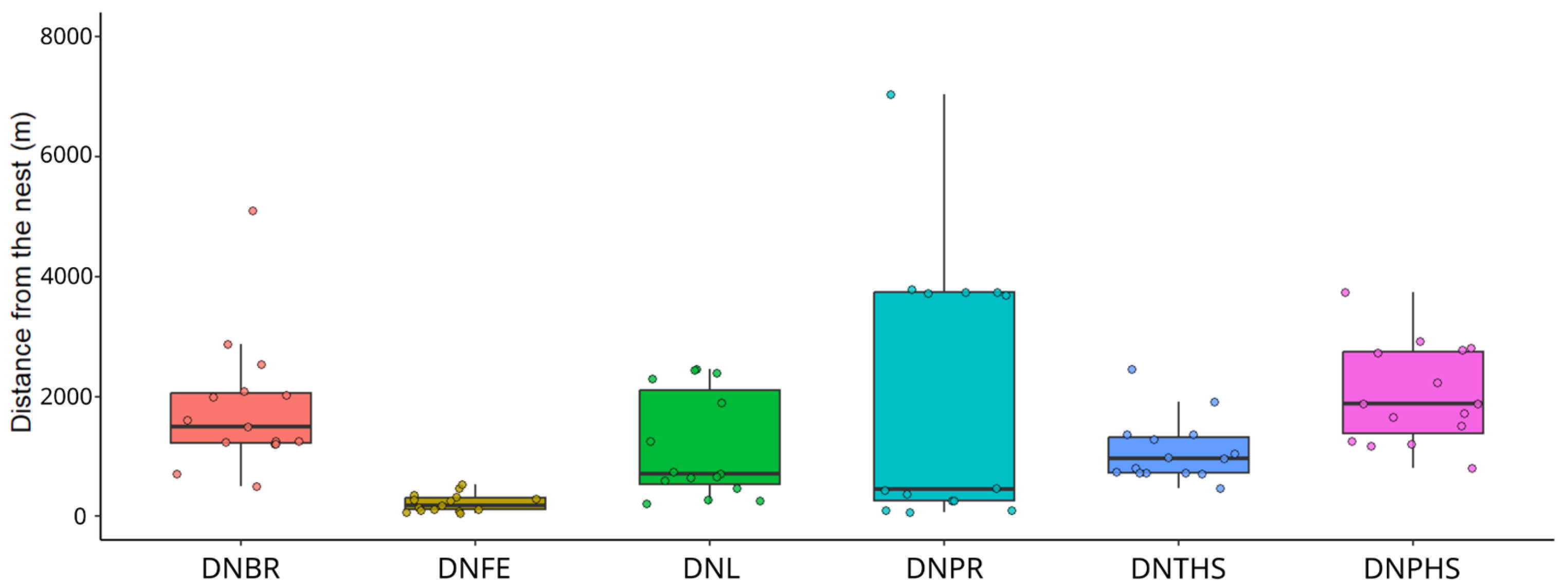
Differences in nest distances relative to landscape features were assessed using analysis of variance (ANOVA). For each nest (n = 15), distances to multiple landscape features (DNL, DNPR, DNPHS, DNTHS, DNBR, and DNFE; see Table 1) were measured, resulting in repeated observations per nest. To account for this design, a one-way repeated-measures ANOVA was applied, with landscape feature treated as a within-subject factor and nest identity included as a random effect. Prior to analysis, data were visually inspected and tested for normality and homogeneity of variances. When ANOVA assumptions were not met, a non-parametric Friedman test was used as an alternative. Statistical analyses were conducted in R, and significance was assessed at α = 0.05.
The habitat selectivity of breeding pairs was quantified using Manly’s standardized habitat selection index for constant resources (wᵢ = uᵢ/aᵢ), where uᵢ represents the proportion of each land-use category within a 5 km radius around the most recently used nest and aᵢ represents the availability of that category at the national level [46]. Values of wᵢ < 1 indicate avoidance, wᵢ > 1 indicate preference, and wᵢ ≈ 1 suggest proportional use relative to availability. To minimize bias in average values, only one nest per breeding pair was considered. Habitat categories—cropland, human settlements, forests, wetlands, and pastures—were manually mapped within each pair’s territory.

2.6. Breeding Success and Observed Anthropogenic Pressures

During the 2022–2024 breeding seasons, we evaluated the absolute breeding success of the known pairs. The absolute breeding success of each pair referred to the number of fledglings or close to fledgling chicks that were produced during a particular breeding outcome, without taking into account the initial size of the clutch. According to local breeding phenology, we chose 20 May–20 June, preferably late May, as the best period for checking breeding success for each nest. In one particular case, we were only able to check the breeding success of a nest one month earlier than the proper period, making it possible to miss other chicks due to their reduced size.
During monitoring visits, we recorded any human-induced potential limiting factors that could lead to death of the adults, low breeding success, abandoning of the nest, or habitat destruction. Since the White-tailed Eagle nests in forested areas, we implemented a method of quantifying the degree of impact of forestry activities in order to understand the scale of this threat. For this, we measured the distance between the nearest edge of current forestry cuttings in relation to active nests. Additionally, we measured the area of the cuttings using the latest satellite images of the area.

2.7. Geospatial and Statistical Tools

All maps and geospatial analyses were produced using QGIS (v3.28) [45]. Statistical analyses and plotting were performed in R (v4.4.1) [47]. Results for calculated variables are expressed as mean ± standard deviation, followed by the observed range of values.

3. Results

3.1. Current Distribution of the Breeding Pairs

Following the fieldwork, the breeding status of seven pairs was confirmed chronologically (Table 2). In addition to these seven newly confirmed breeding pairs, the previously reported pair near Manta Lake [28], which also belongs to the “Lacurile Prutului de Jos” Emerald Site (MD0000012), was systematically monitored and its breeding activity reconfirmed throughout the study period. The current population density of breeding pairs is still low, with only 2.02 confirmed breeding pairs per 1000 km2 in the lower Dniester subpopulation. The minimum distance between two active breeding pairs is 11.77 km, suggesting limited trophic competition.
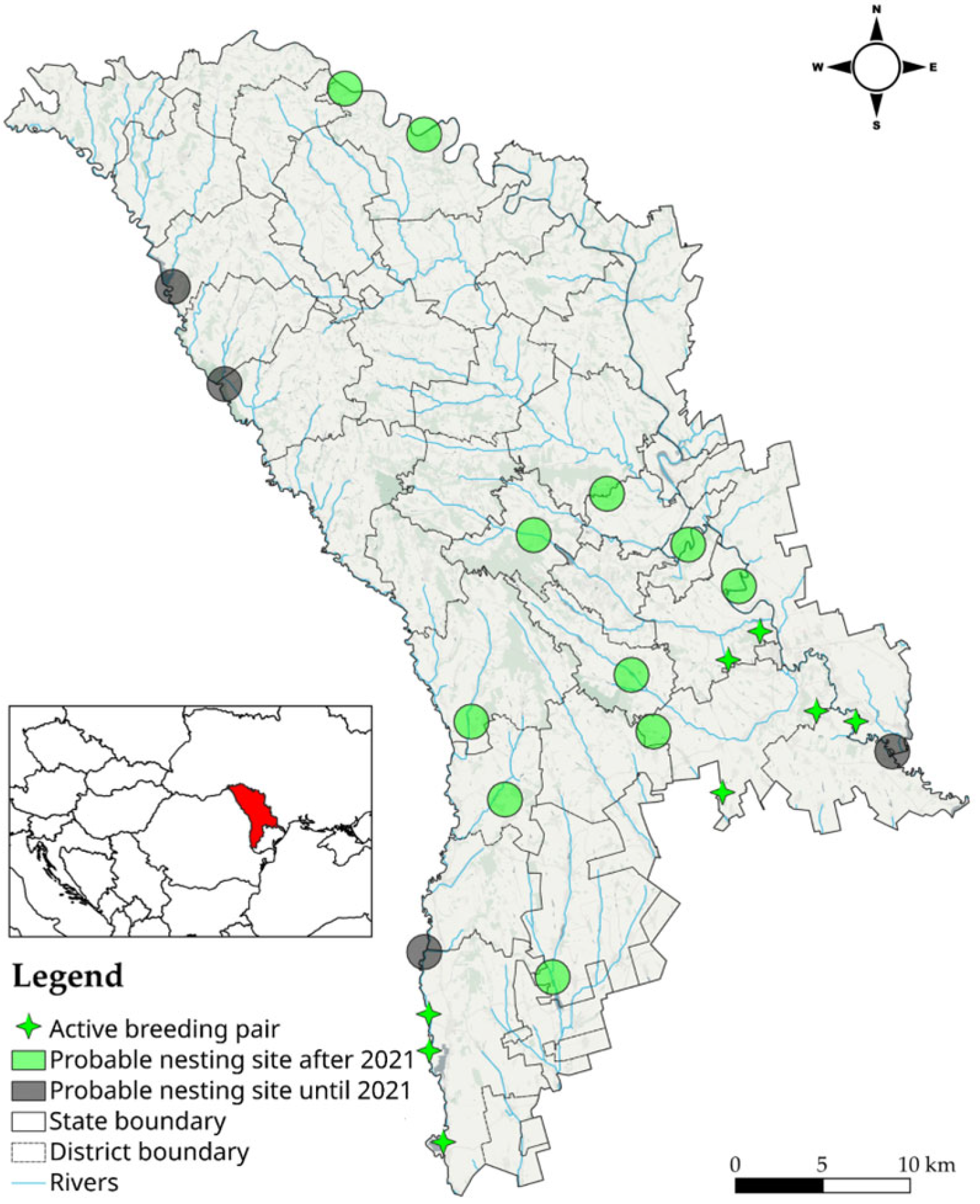
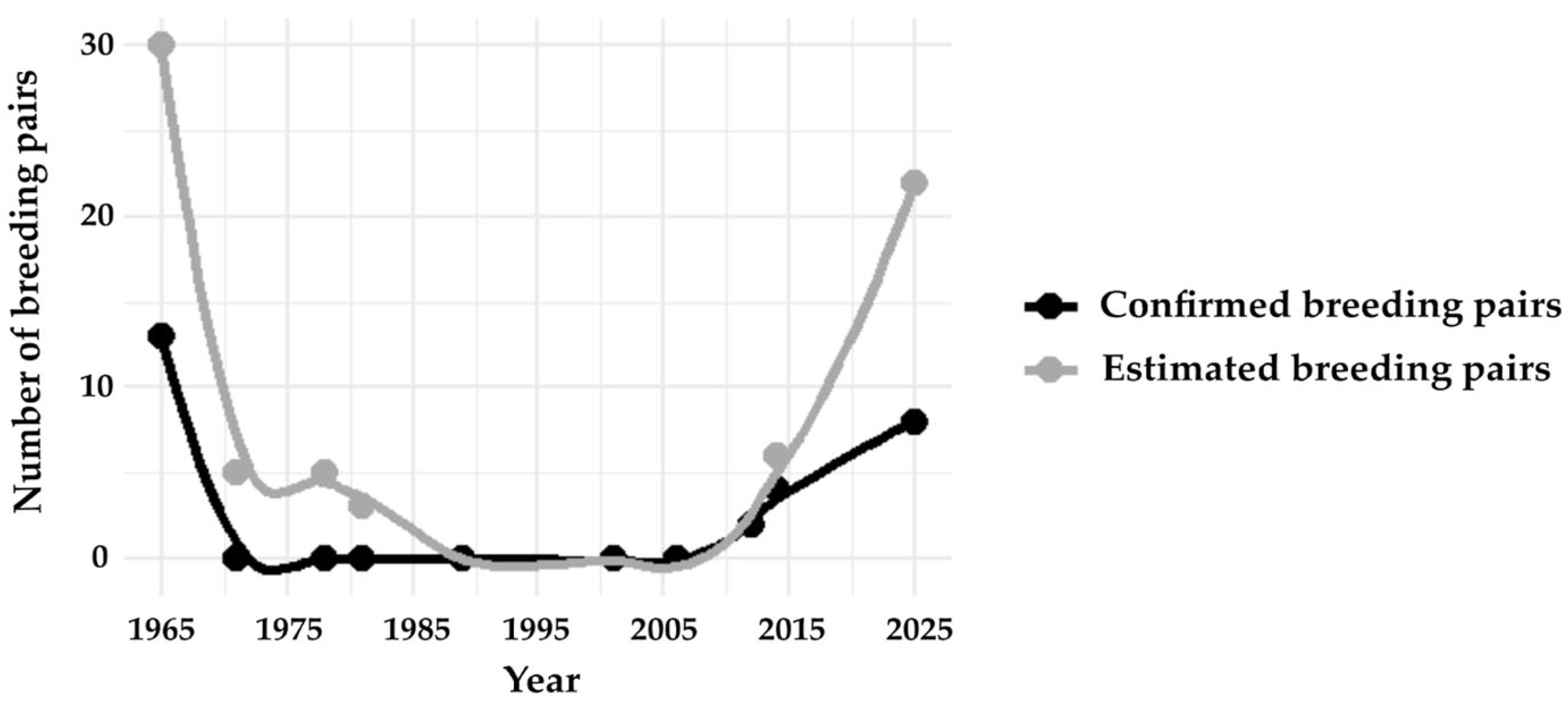
Based on our own observations, publicly available databases, and communications recorded between 2014 and 2025, at least eight breeding pairs have been confirmed. However, the most recent data indicate the likely presence of 19 to 23 breeding pairs across the study area (Figure 2). Because database coverage is not homogeneous across all districts, additional undetected pairs may exist in isolated areas, particularly in the meanders of the Prut River (Figure 1).

3.2. Population Potential and Distribution Within Available Breeding Habitats

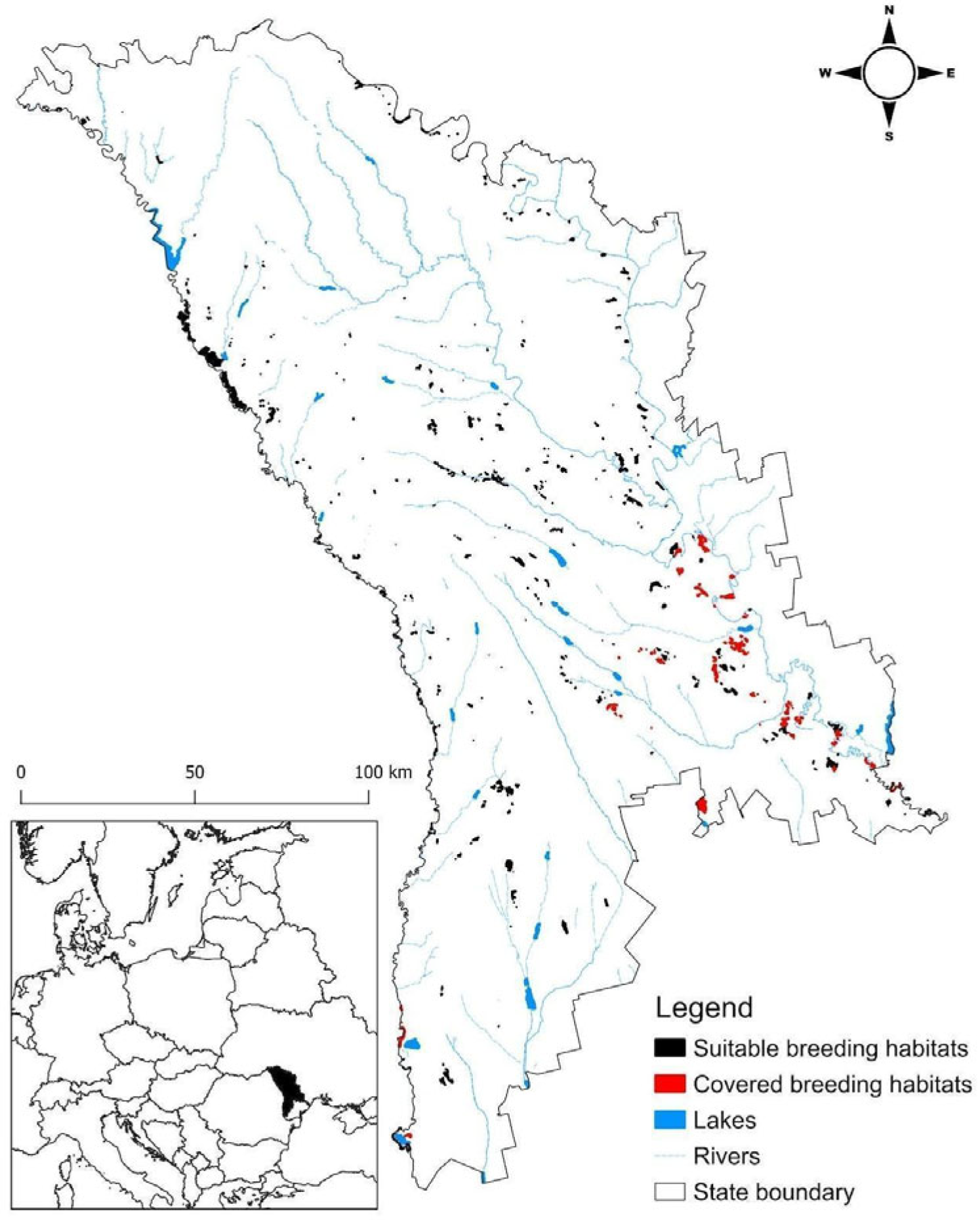
A total area of 61,945 ha (2.09% of the country’s territory) was assigned as suitable nesting habitats for the White-tailed Eagle. These areas are well distributed in the country, with most of them along the Dniester and Prut rivers and also in the central part of the country (Figure 1). The extreme north and south are less favorable for breeding White-tailed Eagles since these areas are mostly agricultural.
The estimated population potential of currently established suitable habitats is 35–48 breeding pairs. These values were obtained by extrapolating the 8–11 breeding pairs recorded in the 14,000 ha of surveyed suitable habitat to the total extent of suitable habitat, assuming uniform density across the region.

3.3. Patterns of Habitat Use and Structure in the Breeding Territories

Implementation of the nest surveys and monitoring scheme during the 2022–2025 seasons led to the discovery of ten accessible nests, plus one additional inaccessible nest, belonging to eight distinct breeding pairs. All nests were located in forested ecosystems, including both natural forests and artificial plantations. Every accessible nest was constructed within the main fork of the trunk. Six were placed on oaks (either pedunculate or gray oak), three on white poplars, and one on a white willow. The nests, including the inaccessible ones, were situated at an average distance from forest edge (DNFE) of 224.7 ± 151.6 m (range 45–539 m, n = 15) and at an average altitude of 43.2 ± 37.8 m (range 10–110 m, n = 15).
Proximity to lakes indicates a strong dependence on this resource, as the average distance to the nearest lake (DNL) was 1.15 ± 0.88 km (range 0.21–2.45 km, n = 15), with 73.3% of nests located within 2 km of a lake. In contrast, the distance to the nearest river (DNPR) was 2.85 ± 4 km (range 0.07–15 km), with nearly half of the nests situated more than 3 km away. Although DNPR values partially overlapped with DNL, the latter proved more relevant for breeding habitat selection when comparing variable ranges (Figure 3).
The average distance to the nearest permanent human settlement (DNPHS) was 2.02 ± 0.82 km (range 0.8–3.74 km, n = 15), while the average distance to the nearest temporary settlement (DNTHS) was 1.09 ± 0.53 km (range 0.7–2.45 km, n = 15). Out of fifteen cases, nine nests were located less than one kilometer from temporary settlements, whereas only one nest was within one km of a permanent settlement. The average distance to the nearest busy road (DNBR) was 1.81 ± 1.11 km, ranging from 0.7 to 5.01 km (n = 15).
Nest distances differed significantly among landscape features (repeated-measures ANOVA: F5,70 = 4.41, p = 0.0015). Post hoc pairwise comparisons using paired t-tests with Holm correction indicated that DNPHSs were significantly greater than DNLs (p = 0.008) and DNTHSs (p = 0.002). In addition, DFEs were significantly smaller than DNLs (p = 0.017), DNPHSs (p < 0.001), DNTHSs (p < 0.001), and DBRs (p = 0.001). No significant differences were detected among the remaining landscape feature pairs (p > 0.05).
The overall pattern was confirmed by a non-parametric Friedman test, which also revealed significant differences among landscape features (χ2 = 30.23, df = 5, p < 0.001). Pairwise Wilcoxon signed-rank tests with Holm correction supported the ANOVA results, showing significantly greater DNPHSs compared to DNLs and DNTHSs, as well as consistently shorter DFEs relative to most other features.
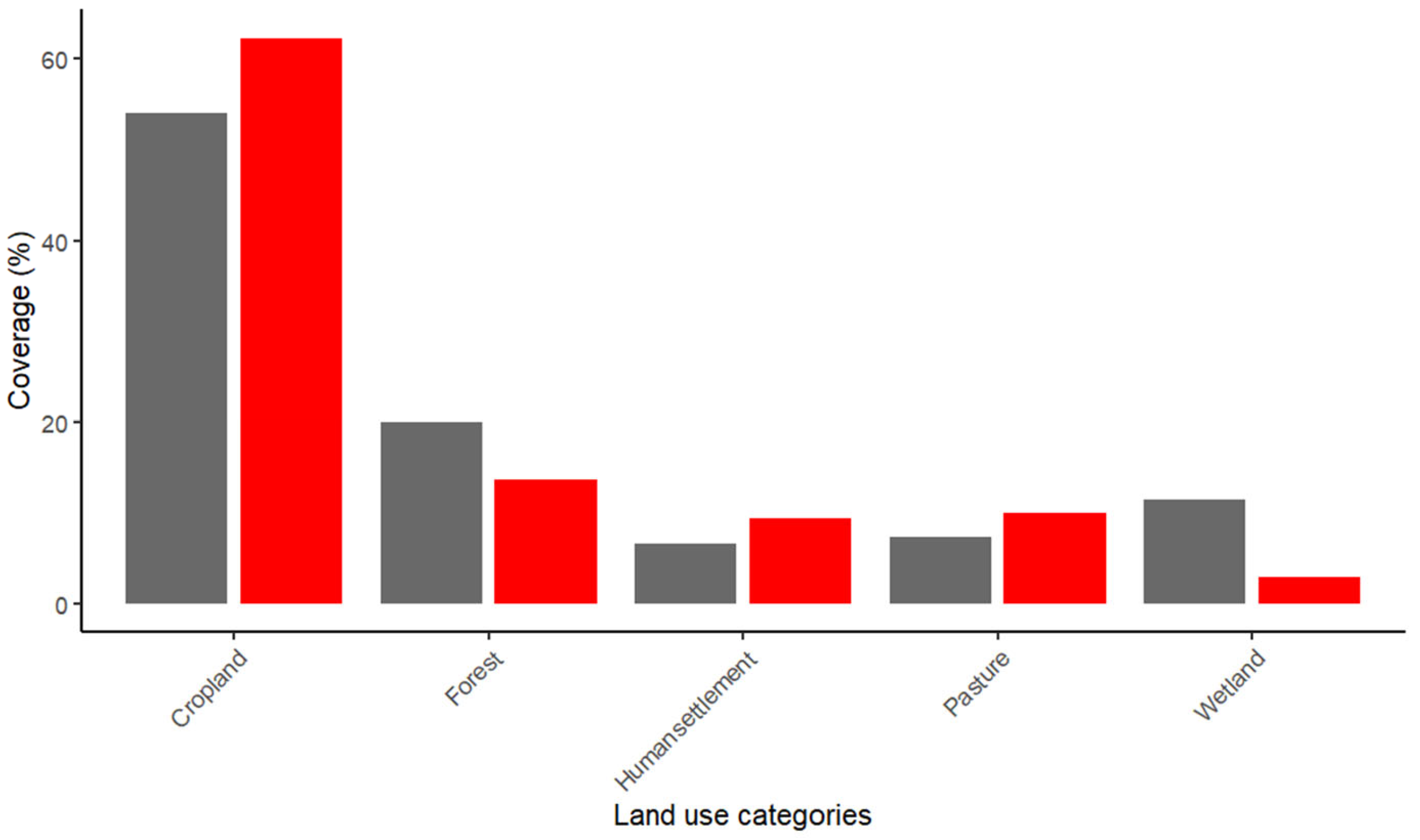
Last but not least, very important results were obtained after revealing the structure and use pattern of the breeding habitat. Within a five-kilometer radius of the nests, the average proportions of the main land-use categories were as follows: cropland 54%, forests 20%, wetlands 11.5%, pastures 7.4%, and human settlements 6.6% (Figure 4). An analysis of Manly’s standardized habitat selection index (wᵢ) revealed a positive selection for forested habitats (wᵢ = 1.47) and an even stronger preference for wetlands (wᵢ = 3.96), which occur within breeding territories nearly four times their national availability. Conversely, agricultural landscapes were generally avoided (wᵢ = 0.87), as were man-made structures (wᵢ = 0.70) and pastures (wᵢ = 0.74).

3.4. Observed Breeding Outcomes and Anthropogenic Pressures

During the 2022–2024 breeding seasons, some pairs experienced forestry activities in the vicinity of the nest, but no breeding failures were recorded during this period, as all known pairs successfully fledged between one and three chicks ( x ̄ = 1.91; Table 3).
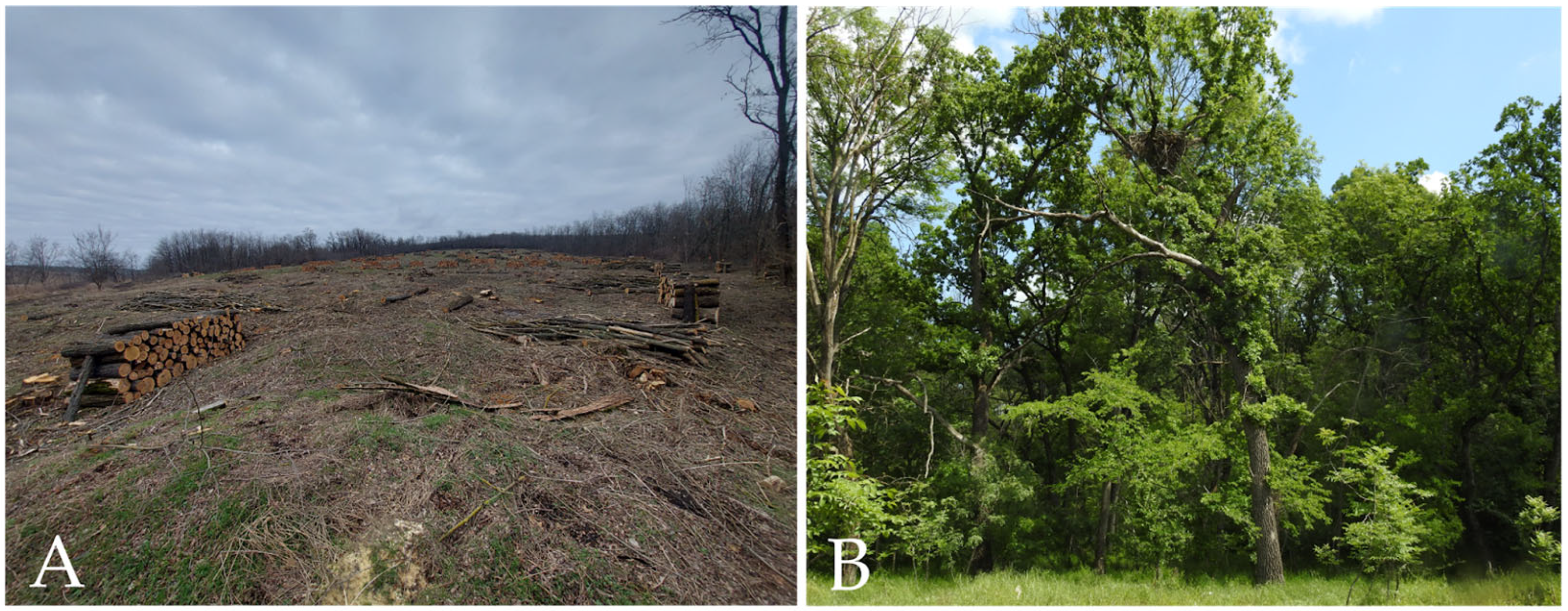
Breeding success evaluation before fledgling revealed that at least three out of six accessible nests were frequently disturbed by logging activities. Near Ucrainca, one pair experienced sanitary logging right under its nest support tree. Another pair from Hîrbovățul Nou experienced 1.29 hectares of clearcuts just 70 m from the active nest and an additional 2.79 hectares as close as 440 m from the active nest (Figure 5A). The pair from Hîrbovăț forest also had to endure loggings near the nest, this time limited to selective cuttings approximately 50 m from the nest (Figure 5B).
When it comes to other relevant threats, such as persecution, electrocution, and poisoning/intoxication, we do not have direct records in the vicinity of any active nests of White-tailed Eagles.

4. Discussion

4.1. Current Distribution and Breeding Population

The White-tailed Eagle population in the Republic of Moldova is currently in a phase of active recolonization and spatial expansion. Under such non-equilibrium conditions, habitat use patterns are expected to be broader and less selective than in long-established populations. Consequently, the present study adopts a descriptive and exploratory analytical framework, aiming to identify large-scale distributional patterns and the population potential of suitable habitat extent rather than to formally estimate carrying capacity using model-based approaches.
At present, the White-tailed Eagle subpopulation within the borders of the Republic of Moldova shows strong signs of demographic and distributional recovery. In spite of very limited nest searches in 2014–2022, the surveys conducted in 2022–2025 supported our hypothesis that nationally the breeding population is increasing. Whereas two decades ago no breeding pairs were known, in 2025 a total of eight pairs were recorded in the southern third of the country. The most recent data indicate the presence of at least nineteen to twenty-three breeding pairs, suggesting a continuing positive trend. These results suggest a slow but steady recovery of the local breeding population, which is now at its strongest level in the past 50 years (Figure 6). This recovery is likely the result of multiple interacting factors, the most important being the overall increase in the species across its range, including the Black Sea region [48,49], which has created favorable conditions for population influxes into previously unoccupied territories such as the Republic of Moldova. This general increase is most likely the result of increased protection measures across many countries [3,7,17,18,50,51]. Moreover, recent observations show that White-tailed Eagles from southeastern Europe have begun to occupy suboptimal habitats, including young forestry plantations surrounded by dry areas or isolated trees, occasionally consisting of allochthonous species such as black locust ([7,16,52], Max Yakovlev, personal communication, 2025). These insights are very important if we take into consideration that the forests of Moldova are currently dominated by young black locust plantations [53].
Because the population is still in an early recolonization phase and the number of breeding pairs remains low, formal species distribution models or habitat selection models would currently be statistically underpowered and ecologically premature. The present analyses therefore aimed to describe broad-scale patterns of habitat use and potential spatial expansion rather than to quantify equilibrium habitat selection or carrying capacity.
Simple density-based extrapolations suggest a potential population size of 35–48 breeding pairs under current landscape conditions; however, these values should be regarded as indicative estimates of population potential rather than true carrying capacity, which can only be assessed using spatially explicit population models once the population reaches a more stable distribution. The ongoing expansion suggests the possibility of further increase, but future population size will depend on habitat availability, wetland persistence and anthropogenic pressures. If the current trend of suboptimal habitat occupancy and high breeding success is to be continued, more breeding pairs will fit in younger plantations or contrary in hilly forests which they currently tend to avoid. This being said, the expansion of the breeding population and occupancy of new territories could also be heavily hindered by the constant degradation (mainly siltation and drying) of wetlands. Finally, the course of the future breeding population will be dictated mostly by the ecological plasticity of the local individuals. Since the current results are based on simple extrapolation, we recommend future research to test our hypothesis, using population modeling, in order to verify if the White-tailed Eagles will continue to adapt to more suboptimal breeding conditions or if their expansion will be finally hindered by clear ecological limits.

4.2. Habitat Use in Breeding Territories

As expected, breeding pairs showed a non-random spatial association with forests and, in particular, wetlands. The distance analysis further indicates that nest placement is non-random with respect to surrounding landscape features, with nests consistently associated with forested habitats at lower altitudes and located closer to forest edges than to most other landscape elements. This spatial pattern supports the view that forests primarily function as breeding habitats, while wetlands and other open aquatic environments serve as essential foraging areas.
Similar patterns of habitat use have been reported in other regions, including Finland, where forests dominated breeding territories but wetlands showed the highest selectivity compared to random locations, despite methodological differences [8]. The preference for lower-altitude forests as nesting sites is also linked to regional geomorphology, which allows for the accumulation of waterbodies primarily along the lower river courses, where large wetlands naturally form. Other countries with extensive wetlands, such as Croatia, Romania and Bulgaria, have White-tailed Eagles breeding in lower altitudes, mostly in riparian forests [39,40,49]. Unlike other European regions with large highland reservoirs suitable for White-tailed Eagle breeding [54,55], the Republic of Moldova lacks such habitats. Additionally, in the southern, drier part of the country, forests on higher slopes are dominated by xerophilous trees that remain small and unsuitable for the large nests of the species. In contrast, the largest trees occur in the valleys at lower elevations, where groundwater is more readily available. Consequently, ecological and geomorphological constraints drive breeding pairs to adapt to the limited number of suitable nesting areas, occasionally prompting them to extend beyond their typical ecological preferences. Forest management practices might also play a role in nest placement near forest edges, though further studies are necessary to confirm this relationship.
Our results suggest that landscapes dominated exclusively by extensive forest cover are less suitable, as breeding pairs require access to open wetland areas for feeding. Even in suboptimal habitats, such as those occupied by the Pontic Steppe population, territories tend to be established near wetlands and forested areas, while croplands, human settlements, and grasslands are generally avoided. Avoidance of croplands and settlements likely reflects their low ecological value and higher disturbance levels, whereas the avoidance of pastures may be linked to the scarcity of intact grasslands in Moldova’s lowlands, as many floodplains have been drained and converted into fertile agricultural land [56,57]. Breeding territories are typically situated along floodplain forests, where wetland and forest habitats occur in close proximity, reinforcing the conclusion that these two land use categories are the only ones consistently selected and are most suitable for breeding when spatially connected.
After analyzing the landscape variables in relation to the nest placement, we concluded that the White-tailed Eagles from the study area are moderately shy when it comes to nest placement in the proximity of humans. Although they tend to avoid human-dominated landscapes, the Eagles are forced to adapt to the scarcity of intact habitats, leading to more nests built in the proximity of humans. The fact that x ̄ DNPHS is 2.02 km and x ̄ DNTHS is 1.09 km shows that the lack of suitable distant habitats is forcing breeding White-tailed Eagles to adapt and occupy habitats less appropriate to the typical ecology of the species, with more anthropogenic elements in the landscape. Similarly, in Croatia, the nests were placed at an average distance of 2.74 km to the nearest human settlement with more than 50 inhabitants [40], while in Ukraine this value is on average 2.38 km [48]. These findings indicate moderate tolerance toward permanent human presence and a higher tolerance for temporary settlements. Although our results support the idea of adaptation to human-dominated landscapes and positive trends regarding demography and distribution, the regional subpopulation is still affected by observed anthropogenic pressures and is prone to local extinction, as explained in Section 4.4.

4.3. Suboptimal Habitat Encroachment

Since the European population has reached high numbers in many countries and possibly approaching the carrying capacity in some regions, the current occupation of suboptimal habitats is consistent with an ongoing expansion phase, during which dispersing individuals may settle in a wide range of environments before stable habitat preferences become established [9]. Due to their opportunistic foraging behavior, the White-tailed Eagles that inhabit suboptimal territories have generally shown a preference towards bigger prey items as a way to prevent food shortages [9]. Considering these ecological adaptations, the breeding population from the Republic of Moldova has successfully identified an abundant source of food, which allows for pairs to settle in dry areas too and occupy territories previously believed unsuitable. Starting with the 1950s, intense damming of watercourses took off, and about 3532 artificial lakes and fishponds were recorded between 1984 and 1999, which over the years have started to clog up [58], creating even more favorable conditions for the Eagles. Depending on the author in question, two decades ago there existed between 3000 and 4350 water accumulations in the Republic of Moldova [58,59], with current numbers probably much lower. These shallow fishponds with evermore asphyxiated fish, artificially raised in polyculture, are currently providing most of the prey items of the pairs that nest far from natural wetlands and rely on artificial waterbodies. The importance of these artificial lakes as feeding habitats is highlighted by the proximity of most nests to fishponds. The effect on breeding success is evident, as no breeding failures were recorded during the monitoring period, and in two cases, nests produced three fledglings each (n = 11). Furthermore, the absence of other prey remains near the nests, apart from fish, along with multiple observations of Eagles feeding frenetically on dead fish along the lake banks, demonstrates the significance of artificially raised fish in the diet of the White-tailed Eagle.
Generally speaking, only the pairs that nest in the floodplain forests along the Dniester and Prut can virtually benefit from flowing waterbodies, with the rest of the pairs probably depending more on the lakes than on the rivers. Additionally, the abundance of fishponds probably provides a more stable and productive food source. This fact is also highlighted by the lower data variability of DNL in comparison with DNPR. Although the White-tailed Eagle greatly depends on these artificial waterbodies, most of the current fishponds may substantially reduce their suitability in the next decades under projected climatic and management scenarios, leaving the opportunistic breeding pairs of White-tailed Eagles without this source of food. Similarly, in other countries from the Danube River Basin, reduction in the prey base due to fishpond abandonment and degradation is an important limiting factor for the breeding population [3,11,31]. This being said, other studies have emphasized the idea that the diet of breeding pairs is mainly dictated by the local habitats and the availability of prey, with food items varying greatly [8,9,10]. Resource overexploitation by the White-tailed Eagle is not rare, with multiple populations of waterfowl species recording significant decreases linked with the recovery of the White-tailed Eagle population [60,61]. These observations suggest a high degree of ecological flexibility, which may facilitate temporary persistence in suboptimal habitats, but the long-term viability of such territories remains uncertain.
Judging by the projected drying of the fishponds, in relation to the ecological plasticity of the White-tailed Eagle, it is possible for the individuals that inhabit the suboptimal habitats to turn on to other abundant human-managed species (e.g., common pheasant). Redirection towards other prey species could potentially be harmful to the birds, since this might further negatively impact the reputation of the Eagles among hunters and poachers. However, the current population density of breeding pairs is still low, with only 2.02 confirmed breeding pairs per 1000 km2 in the lower Dniester subpopulation, allowing for more pairs to settle and occupy breeding territories without affecting the local prey population. The minimum distance between currently active breeding pairs is 11.77 km, suggesting that competition for trophic resources is rarely occurring as of now.

4.4. Anthropogenic Pressures and Conservation Implications

Our conclusions regarding anthropogenic pressure are based on observed nest locations, disturbance events and habitat context and should be interpreted in relation to the current early expansion stage of the population. New insights about the distribution and size of the local population of White-tailed Eagles show us that currently the species has a better status compared to the end of the 20th century (Figure 6). Even if major limiting factors, such as persecution, poisoning and egg collecting, are now, locally, a thing of the past, the studied population is still constrained by some human actions [38]. From our observations, the local breeding pairs are very persistent and stubborn when it comes to raising chicks, with adults managing to raise 1–3 chicks, even when selective cutting was undertaken 50 m from the used nest (Figure 5B) or when multiple chainsaws were disturbing the birds daily just a few hundred meters from the nest. Although the pairs recorded high breeding success so far, the threat of losing their nest support tree to logging is still visible, demonstrated by similar cases from the “Pădurea Domnească” scientific reserve and Costești-Stânca Lake [62]. Proximal clearcuts, combined with chronic drought, have the potential to significantly impact the breeding success of nesting pairs. In particular, one breeding pair likely experienced delays in breeding phenology and reduced reproductive success due to clear-cutting activities at the site. Based on the monitored pairs from Moldova, the current method of forest management is the most important threat to the wellbeing of breeding pairs of White-tailed Eagle in the Republic of Moldova [38], as in other countries from the region—Romania, Slovakia and Bulgaria [3]. An effective and practical approach to conserving this umbrella species, while allowing for the sustainable management of forest resources, would be the implementation of buffer zones around active nests during the breeding season [3,63], between January and July. Ideally, such measures would include: a no-disturbance area within 100 m of the nest, a ban on high-impact activities such as clear-cutting within 300 m, and a restriction on the development of harmful infrastructure projects within a 3000 m radius [3]. The observed proximity with riparian forests and wetlands supports the implementation of spatially explicit buffer zones and wetland protection as key conservation measures.
Our observations regarding disturbance tolerance show that before laying their eggs, the adults are very sensitive to human presence, and they even leave the nest if they detect a human in open space. At the same time, the adults are generally undisturbed by human sounds only, reacting and fleeing from the nest just after visual identification of people. After laying the eggs, the adults become more attached to the nest and tend to tolerate human presence better. With all this, activities such as logging during February and March are particularly risky for the breeding pair, since it drastically increases the chances of the eggs or chicks to get cold or be eaten by ravens (Corvus corax L.) [7], a common breeding species in all the areas with nesting White-tailed Eagles. We personally witnessed adult Eagles harassed by ravens while in the nest. Usually, this poses no threat for the Eagle, but human disturbance could scare the adult Eagle away for a few moments, just enough for the ravens to predate the eggs/chicks [7]. Future research regarding the impact of human-induced disturbance in the vicinity of active nests could provide us with more in-depth results on the scale of this phenomenon.
Although not encountered during nest monitoring, persecution is another existing and pressing threat to White-tailed Eagles and other raptors and still popular among many hunters [38]. The species is protected at the European level by the Bird Directive (2009.147.EC), being listed in Annex I [50], by the Bern Convention, listed in Annex II [51], and it is included in the latest edition of the Red Data Book of the Republic of Moldova III, as Critically Endangered (CR) [4]. Although listed in Annex 3 of Law 439/1995 (Republic of Moldova) as Endangered [64], the White-tailed Eagle has a bad reputation among the population and is often labeled with the generic term of “vulture”, associated with every bird of prey of considerable size. Based on anecdotal reports of local witnesses, targeting birds of prey, including White-tailed Eagles, is still practiced. As of now, we have not recorded any cases of electrocution or poisoning/intoxication of White-tailed Eagles, possibly due to the few observers and currently small breeding population, but these threats could occur, since storks and other birds of prey are frequent victims [38].
Since the last assessment of the conservation status of the White-tailed Eagle in Moldova, the population has shown positive and steady growth but remains limited to a few sites. According to IUCN [31] regional criteria, the population should be downlisted to Endangered (EN) due to observed positive trends within the boundaries of the Republic of Moldova and in the neighboring countries [48,49]. Although scarcity of proper breeding habitats together with forestry activities present a high potential to limit and decrease the future breeding population, the White-tailed Eagle shows tendencies for occupying suboptimal habitats (sometimes nesting in lone trees). Additionally, the influx of individuals from the surrounding areas can compensate in the short term for any losses of local pairs due to human disturbance.

5. Conclusions

The White-tailed Eagle is a rare and strictly protected bird species in the Republic of Moldova, representing one of the most iconic indicators of wetland and forest ecosystem health. As part of a wide national monitoring effort, increased attention has been dedicated in recent years to the study of the presence and ecology of this top avian predator.
Data collected between 2014 and 2025 reveal encouraging signs of population recovery. While nest findings of only four breeding pairs were reported in 2013 [28], current assessments confirm eight active breeding pairs and estimate a minimum of 19–23 probable breeding pairs across the country. During the 2022–2024 monitoring campaigns, seven new nesting pairs were confirmed in Anenii Noi, Căușeni, Cahul, and Ștefan Vodă districts. The nests were predominantly located near forest edges at low altitudes, often in proximity to human settlements or roads, demonstrating the species’ growing adaptability to human-modified landscapes.
Although many of these pairs occupy suboptimal habitats, they show remarkable resilience and breeding success. Agricultural areas and densely populated landscapes were generally avoided, while forested ecosystems and wetlands played a crucial role in the composition of the breeding territories. Despite significant anthropogenic disturbance—particularly logging activity near nesting sites—no breeding failures were recorded during the 2022–2024 period. Most pairs successfully raised two chicks, and in two exceptional cases, adults managed to raise three fledglings, a strong indicator of high food availability and adequate habitat quality.
The gradual recovery of the White-tailed Eagle population between the Dniester and Prut Rivers highlights the ongoing restoration of key ecosystems and the effectiveness of regional conservation measures. However, the species remains vulnerable to multiple threats, including habitat degradation, deforestation, poaching, and potential poisoning or electrocution.
As the population continues to increase and a larger number of breeding territories becomes available for analysis, future studies should apply resource selection functions, occupancy models and species distribution models to quantify habitat selection and population limits under equilibrium conditions. The current results provide a necessary baseline for such future modeling efforts.
Continued monitoring and the implementation of targeted conservation actions—such as the establishment of buffer zones around active nests, improved forest management, and awareness campaigns among local communities—are essential to ensure the long-term stability of this recovering population. The positive trends recorded so far represent a significant step forward in biodiversity conservation and ecosystem restoration efforts within the Republic of Moldova, contributing to regional objectives aligned with the Sustainable Development Goals.

Author Contributions

Conceptualization, M.G. and E.Ș.B.; methodology, M.G. and E.Ș.B.; software, M.G. and E.Ș.B.; validation, M.G. and E.Ș.B.; formal analysis, M.G. and E.Ș.B.; investigation, M.G., V.A., S.U. and E.Ș.B.; resources, M.G., V.A., S.U. and E.Ș.B.; data curation, M.G. and E.Ș.B.; writing—original draft preparation, M.G. and E.Ș.B.; writing—review and editing, M.G., V.A., S.U. and E.Ș.B. All authors have read and agreed to the published version of the manuscript.

Funding

This work was supported by a grant of the Ministry of Research, Innovation and Digitization, CNCS—UEFISCDI, project number PN-IV-P2-2.1-TE-2023-0897, within PNCDI IV.

Institutional Review Board Statement

Not applicable.

Informed Consent Statement

Not applicable.

Data Availability Statement

Data are contained within the article and additional data is available on request from the corresponding author.

Acknowledgments

We would like to thank DARÓCZI J. Szilárd, DONCEA Antonio, LAZARCHEVICI Andrei, ȚÎCU Gheorghe, ȚURCAN Alexandru, YAKOVLEV Max, and all the other people who contributed to collecting and/or communicating relevant data for the study. Additionally, we show gratitude towards the kind reviewers and editor who took their time to improve the initial manuscript.

Conflicts of Interest

The authors declare no conflicts of interest.

References

  1. Dobrev, D.; Dobrev, V.; Demerdzhiev, D. Conservation and Ecology of Raptors: Introduction to the Special Issue. Diversity 2023, 15, 889. [Google Scholar] [CrossRef]
  2. Donázar, J.A.; Cortés-Avizanda, A.; Fargallo, J.A.; Margalida, A.; Moleón, M.; Morales-Reyes, Z.; Moreno-Opo, R.; Pérez-García, J.M.; Sánchez-Zapata, J.A.; Zuberogoitia, I.; et al. Roles of raptors in a changing world: From flagships to providers of key ecosystem services. Ardeola 2016, 63, 181–234. [Google Scholar] [CrossRef]
  3. Probst, R.; Gaborik, A. Action Plan for the conservation of the White-tailed Sea Eagle (Haliaeetus albicilla) along the Danube. In: Convention on the Conservation of European Wildlife and Natural Habitats (Bern Convention). Nat. Environ. 2011, 163, 1–86. [Google Scholar]
  4. Duca, G.; Chirică, L.; Toderaş, I.; Teleuţă, A. (Eds.) The Red Book of the Republic of Moldova, 3rd ed.; Știința: Chișinău, Republic of Moldova, 2015; 492p, ISBN 978-9975-67-998-5. [Google Scholar]
  5. Nadjafzadeh, M.; Hofer, H.; Krone, O. The link between feeding ecology and lead poisoning in white-tailed eagles. J. Wildl. Manag. 2013, 77, 48–57. [Google Scholar] [CrossRef]
  6. van Rijn, S.; Zijlstra, M.; Bijlsma, R.G. Wintering white-tailed eagles Haliaeetus albicilla in The Netherlands: Aspects of habitat scale and quality. Ardea 2010, 98, 373–382. [Google Scholar] [CrossRef]
  7. Șegolev, I.V.; Petrovici, Z.O.; Șegolev, S.I. Ecology of Vulnerable Bird Species that Inhabited the Northern Black Sea Region: Works on the Ecology of Birds [rus. Экoлoгия уязвимых видoв птиц, заселивших Севернoе Причернoмoрье: Труды пo экoлoгии птиц Т 2]; Self Published: Odessa, Ukraine, 2016; Volume 2, p. 236. [Google Scholar]
  8. Ekblad, C.; Tikkanen, H.; Sulkava, S.; Laaksonen, T. Diet and breeding habitat preferences of White-tailed Eagles in a northern inland environment. Polar Biol. 2020, 43, 2071–2084. [Google Scholar] [CrossRef]
  9. Mirski, P.; Komar, E. The White-Tailed Eagle, the Apex Predator, Adjusts Diet towards Larger Prey in Suboptimal Territories. Diversity 2023, 15, 747. [Google Scholar] [CrossRef]
  10. Reid, R.; Grant, J.R.; Broad, R.A.; Carss, D.N.; Marquiss, M. The breeding season diet of White-tailed Eagles in Scotland. Scott. Birds 2023, 43, 305–318. [Google Scholar]
  11. Sandor, A.D.; Alexe, V.; Marinov, M.; Doroșenscu, A.; Domsa, C.; Kiss, B.J. Nest-site selection, breeding success, and diet of white-tailed eagles (Haliaeetus albicilla) in the Danube Delta, Romania. Turk. J. Zool. 2015, 39, 300–307. [Google Scholar] [CrossRef]
  12. Deinet, S.; Ieronymidou, C.; McRae, L.; Burfield, I.J.; Foppen, R.P.; Collen, B.; Böhm, M. Wildlife Comeback in Europe: The Recovery of Selected Mammal and Bird Species. Final Report to Rewilding Europe by ZSL; BirdLife International and the European Bird Census Council: Beek, The Netherlands; ZSL: London, UK, 2013. [Google Scholar]
  13. Anker-Nilssen, T.; Aarvak, T. Time Series Studies of Seabirds in Røst Municipality, Nordland. Results with Focus on 2004 and 2005 [norw. Tidsseriestudier av Sjøfugler i Røst Kommune, Nordland. Resultater med Fokus på 2004 og 2005]; NINA Report; Norsk Institutt for Naturforskning: Trondheim, Norway, 2006. [Google Scholar]
  14. Barrett, R.T.; Lorentsen, S.H.; Anker-Nilssen, T. The status of breeding seabirds in mainland Norway. Atl. Seab. 2006, 8, 97–126. [Google Scholar]
  15. Barrett, R.T. Recent establishments and extinctions of Northern Gannet Morus bassanus colonies in North Norway, 1995-2008. Ornis Nor. 2008, 31, 172–182. [Google Scholar] [CrossRef]
  16. BirdLife International. Species Factsheet: White-Tailed Sea-Eagle Haliaeetus albicilla. 2021. Available online: https://datazone.birdlife.org/species/factsheet/white-tailed-sea-eagle-haliaeetus-albicilla (accessed on 5 August 2025).
  17. Hagemeijer, W.J.; Blair, M.J. The EBCC Atlas of European Breeding Birds; Poyser: London, UK, 1997; p. 479. [Google Scholar]
  18. Sulawa, J.; Robert, A.; Köppen, U.; Hauff, P.; Krone, O. Recovery dynamics and viability of the white-tailed eagle (Haliaeetus albicilla) in Germany. Biodivers. Conserv. 2010, 19, 97–112. [Google Scholar] [CrossRef]
  19. Ganea, I.M. Ecological and faunistic characteristics of diurnal birds of prey in Moldova. Issues of ecology and practical importance of birds and mammals in Moldova [rus. Экoлoгo-фаунистическая характеристика дневных хищных птиц Мoлдавии. Вoпрoсы экoлoгии и практическoгo значения птиц и млекoпитающих Мoлдавии]. Chișinău 1965, 2, 34–54. [Google Scholar]
  20. Kolisnyk, J.; Gorban, I. The White-tailed Sea Eagle Haliaeetus albicilla in Ukraine. In Eagle Studies; World Working Group on Birds of Prey: Berlin, Germany, 1996; pp. 165–168. [Google Scholar]
  21. Averin, I.V.; Ganea, I.M.; Uspenskii, G.A. Birds of Moldova Volume II [rus. Птицы Мoлдавии. Тoм II]; Știința: Chișinău, MSSR, 1971; p. 236. [Google Scholar]
  22. Hailer, F.; Helander, B.; Folkestad, A.O.; Ganusevich, S.A.; Garstad, S.; Hauff, P.; Koren, C.; Nygård, T.; Volke, V.; Vilà, C.; et al. Bottlenecked but long-lived: High genetic diversity retained in white-tailed eagles upon recovery from population decline. Biol. Lett. 2006, 2, 316–319. [Google Scholar] [CrossRef]
  23. Gheideman, T.S.; Nikolaeva, L.P.; Averin, I.V. Red Book of MSSR, 1st ed.; Cartea Moldovenească: Chișinău, MSSR, 1978; p. 117. [Google Scholar]
  24. Averin, I.V.; Ganea, I.M.; Zubcov, N.I.; Munteanu, A.I.; Uspenskii, G.A. Birds. Animals of Moldova [rus. Птицы. Живoтный мир Мoлдавии]; Știința: Chișinău, MSSR, 1981; p. 335. [Google Scholar]
  25. Ganea, I.M.; Zubcov, H.I. Rare and Endangered Bird Species of Moldova [rus. Pедкие и исчезающие виды птиц Мoлдавии]; Știința: Chișinău, MSSR, 1989; p. 150. [Google Scholar]
  26. Zubcov, N.; Munteanu, A.; Crudu, V.; Bogdea, L.; Vasilashcu, N. On the state of rare and endangered diurnal birds of prey in Moldova. Bul. Acad. Ştiinţe Mold. Ştiinţele Vieţii 2014, 322, 78–85. [Google Scholar]
  27. Postolache, G.; Munteanu, A.; Postolache, D.; Cojan, C. “Prutul de Jos” Reserve [ro. Rezervația “Prutul de Jos”]; Grădina Botanică (Institut) a AȘM, Institutul de Zoologie a AȘM: Chișinău, Republic of Moldova, 2012; p. 152. [Google Scholar]
  28. Ajder, V.; Rosca, I.; Bolboaca, L.E.; Petrencu, L.; Baltag, E.S. White-tailed Eagle (Aves: Accipiteriformes) status in Republic of Moldova. Eur. Sci. J. 2014, special edition, 49–54. [Google Scholar]
  29. Škorpíková, V.; Bělka, T.; Štěpánek, P.; Horal, D. Data on birds recorded in Republic of Moldova in 2013 and 2014. Ciconia 2014, 22, 43–47. [Google Scholar]
  30. IUCN. IUCN Red List Categories and Criteria: Version 3.1; IUCN Species Survival Commission, IUCN: Gland, Switzerland; Cambridge, UK, 2001; Available online: www.iucnredlist.org/technical-documents/categories-and-criteria (accessed on 26 November 2025).
  31. IUCN. Guidelines for Application of IUCN Red List Criteria at Regional and National Levels: Version 4.0; IUCN: Gland, Switzerland; Cambridge, UK, 2012; Available online: www.iucnredlist.org/resources/regionalguidelines (accessed on 26 November 2025).
  32. European Environmental Agency. Biogeographical Regions in Europe. 2024. Available online: https://www.eea.europa.eu/data-and-maps/figures/biogeographical-regions-in-europe-2 (accessed on 8 August 2025).
  33. Boboc, N. Issues of Physical-Geographical Regionalization of the Territory of the Republic of Moldova [ro. Probleme de regionare fizico-geografică a teritoriului Republicii Moldova]. Ştiinţele Vieţii 2009, 307, 161–169. [Google Scholar]
  34. National Bureau of Statistics of the Republic of Moldova. 2024. Available online: https://statistica.gov.md/files/files/publicatii_electronice/Anuar_Statistic/2025/1_AS.pdf (accessed on 26 November 2025).
  35. eBird. Available online: https://ebird.org/home (accessed on 31 December 2025).
  36. Ornitodata. Available online: https://pasaridinromania.sor.ro/ornitodata (accessed on 31 December 2025).
  37. ICAS. Institutul de Cercetări și Amenajări Silvice din Republica Moldova. 2025. Available online: https://icas.com.md/ (accessed on 14 November 2025).
  38. Ghilan, M. The ecology of the White-tailed Eagle (Haliaeetus albicilla, L. 1758) in the Republic of Moldova [ro. Ecologia codalbului (Haliaeetus albicilla, L. 1758) în Republica Moldova]. Bachelor’s Thesis, Alexandru Ioan Cuza University, Iași, Romania, 10 July 2025. Available online: https://www.researchgate.net/publication/393573353_Ecologia_codalbului_Haliaeetus_albicilla_L_1758_in_Republica_Moldova (accessed on 14 November 2025).
  39. Todorov, E.; Daskalova, G.; Shurulinkov, P. Current Breeding Distribution and Conservation of Whitetailed Eagle, Haliaeetus albicilla (L.) in Bulgaria. Acta Zool. Bulg. 2015, 67, 3–10. [Google Scholar]
  40. Radović, A.; Mikuska, T. Population size, distribution and habitat selection of the white-tailed eagle Haliaeetus albicilla in the alluvial wetlands of Croatia. Biologia 2009, 64, 156–164. [Google Scholar] [CrossRef]
  41. CLC. Corine Land Cover 2018 (Raster) in Eastern Partnership Countries (ENI CLC Pilot). 2020. Available online: https://data.europa.eu/data/datasets/e640a22b-8dde-423e-b051-991bcb383f2f?locale=en (accessed on 14 November 2025).
  42. Gregory, R.D.; Gibbons, D.W.; Donald, P.F. Bird Census and Survey Techniques in Sutherland. Bird Ecology and Conservation: A Handbook of Techniques; Oxford University Press: Oxford, UK, 2004; pp. 17–56. Available online: https://www.ebcc.info/wp-content/uploads/2020/06/gregory-bird-census-and-survey-techniques.pdf (accessed on 14 November 2025).
  43. Williams, A. A Population Viability Analysis (PVA) for White-Tailed Eagle (Haliaeetus albicilla) Reintroduction in Cumbria: An Evaluation of Release Strategies and the Impacts of Population Loss Factors; The Lifescape Project: Inverness, Scotland, 2024; p. 36. Available online: https://lifescapeproject.org/uploads/Full-WTE-PVA-report-FINAL-AW.pdf (accessed on 14 November 2025).
  44. Massé, H.; Rochefort, L.; Gauthier, G. Carrying capacity of wetland habitats used by breeding greater snow geese. J. Wildl. Manag. 2001, 65, 271–281. [Google Scholar] [CrossRef]
  45. Manly, B.F.J.; McDonald, L.L.; Thoma, D.L.; McDonald, T.L.; Erickson, W.P. Resource Selection by Animals: Statistical Design and Analysis for Field Studies, 2nd ed.; Kluwer Academic Publishers: Dordrecht, The Netherlands, 2002. [Google Scholar]
  46. QGIS Development Team. QGIS Geographic Information System. Open Source Geospatial Foundation Project. 2025. Available online: https://qgis.org/ (accessed on 14 November 2025).
  47. R Core Team. R: A Language and Environment for Statistical Computing; R Foundation for Statistical Computing: Vienna, Austria, 2025; Available online: https://www.R-project.org/ (accessed on 14 November 2025).
  48. Gavrilyuk, M.; Grishchenko, V. Current status of the white-tailed eagle in Ukraine. In Proceedings of the International Conference, Björkö, Sweden, 13–17 September 2000; Swedish Society for Nature and Conservation: Stockholm, Sweden, 2003; pp. 129–132. [Google Scholar]
  49. Alexe, V. Biology and Ecology of the White-Tailed Eagle at the Mouths of Danube (Romania) [rom. Biologia și Ecologia Codalbului (Haliaeetus albicilla L.) Prezent la Gurile Dunării (România)]; Editura Academiei Române: București, Romania, 2022; p. 153. ISBN 9786062736798. [Google Scholar]
  50. Directive 2009/147/EC of the European Parliament and of the Council of 30 November 2009 on the Conservation of Wild Birds. Official Journal of the European Union 2010, L20, 7–25. Available online: https://eur-lex.europa.eu/legal-content/EN/TXT/PDF/?uri=CELEX:32009L0147 (accessed on 26 November 2025).
  51. Council of Europe. Convention on the Conservation of European Wildlife and Natural Habitats (Bern Convention), Appendix II—Strictly Protected Fauna Species. European Treaty Series—No. 104; Berne, 19 September 1979. Document ref. 168078e2ff. Available online: https://rm.coe.int/168078e2ff (accessed on 26 November 2025).
  52. Demerdzhiev, D.; Cheshmedzhiev, S.; Dobrev, D.; Angelov, I.; Mladenov, V.; Delchev, A.; Arkumarev, V.; Terziev, N.; Iliev, M.; Stoychev, S. Population Status and Distribution of White-tailed Eagle (Haliaeetus albicilla) in Bulgaria. In Proceedings of the White-Tailed Eagle Conference 2024—Strengthening White-Tailed Eagle Network Toward Southern Europe and Mediterranean Countries, Osijek, Croatia, 15–21 September 2024; p. 15. [Google Scholar]
  53. Talmaci, I.; Prosii, E.; Mardari, A.; Varzari, A.; Galupa, A. Forests in the Republic of Moldova: Current status, qualitative and quantitative indicators [ro.Pădurile din Republica Moldova: Starea actuală, indicatori calitativi și cantitativi]. Rev. Pădurilor 2018, 133, 7–20. [Google Scholar]
  54. Vrezec, A.; Bordjan, D.; Perušek, M.; Hudoklin, A. Population and ecology of the White-tailed Eagle (Haliaeetus albicilla) and its conservation status in Slovenia. Denisia 2009, 27, 103–114. [Google Scholar]
  55. Bělka, T.; Horal, D. The White-tailed eEagle (Haliaeetus albicilla) in the Czech Republic. Denisia 2009, 27, 65–77. [Google Scholar]
  56. Junk, W.J.; An, S.; Finlayson, C.M.; Gopal, B.; Květ, J.; Mitchell, S.A.; Mitsch, W.J.; Robarts, R.D. Current state of knowledge regarding the world’s wetlands and their future under global climate change: A synthesis. Aquat. Sci. 2013, 75, 151–167. [Google Scholar] [CrossRef]
  57. UNDP/WWF. 1999—Danube Pollution Reduction Programme. Evaluation of Wetlands Floodplain Areas in the Danube River Basin; Final Report in the framework of REG/96/G31—Developing the Danube River Basin; Pollution Reduction Programme: New York, NY, USA, 1999; 88p + Annexes. [Google Scholar]
  58. Cazac, V.; Mihailescu, C.; Bejenaru, G.; Gâlcă, G. Aquatic Resources of the Republic of Moldova. Surface Water [ro. Resursele Acvatice ale Republicii Moldova. Apele de Suprafața]; Știința: Chișinău, Republic of Moldova, 2007; p. 248. [Google Scholar]
  59. Chirică, L.; Pencov, M.; Cuceiniuc, I.; Fliurță, I. Surface water: Problems and solutions [ro. Apele de suprafaţă: Probleme şi soluţii]. Mediu. Ambiant 2011, 2, 7–10. [Google Scholar]
  60. Morelli, F.; Laursen, K.; Svitok, M.; Benedetti, Y.; Møller, A.P. Eiders, nutrients and eagles: Bottom-up and top-down population dynamics in a marine bird. J. Anim. Ecol. 2021, 90, 1844–1853. [Google Scholar] [CrossRef]
  61. Bregnballe, T.; Tofft, J.; Kotzerka, J.; Lehikoinen, A.; Rusanen, P.; Herrmann, C.; Krone, O.; Engström, H.; Rattiste, K.; Reich, J.; et al. Occurrence and behaviour of White-tailed Eagles Haliaeetus albicilla in Great Cormorant Phalacrocorax carbo sinensis colonies in countries around the Baltic Sea. Ardea 2022, 109, 565–582. [Google Scholar] [CrossRef]
  62. Societatea pentru Protecția Păsărilor și a Naturii. Codalbul din Rezervația „Pădurea Domnească”. Available online: https://sppn.md/codalbul-rezervatia-padurea-domneasca/ (accessed on 10 April 2025).
  63. Ruddock, M.; Whitfield, D.P. A review of disturbance distances in selected bird species. A Rep. Nat. Res. Proj. Ltd Scott. Nat. Herit. 2007, 181, 114–125. [Google Scholar]
  64. Law no. 439/1995 on the Protection and Sustainable Use of Wildlife Resources, Annex 3. Republic of Moldova. Available online: https://www.legis.md/cautare/getResults?doc_id=87631&lang=ro (accessed on 26 November 2025).
Figure 1. Distribution of potential breeding habitats for the White-tailed Eagle in the Republic of Moldova. The red polygons represent all the suitable forests that were visited and minimally covered. More suitable breeding habitats are believed to be found in the Prut River floodplain and Transnistria but are omitted due to their absence in the national forest fund [37].
Sustainability 18 02722 g001
Figure 2. Current distribution of the breeding population in the Republic of Moldova. The territories indicated as suspected before 2021 represent those territories where the breeding activity was observed and believed until 2021, with later proper observations missing.
Sustainability 18 02722 g002
Figure 3. Distance analysis of nest placement in relation to multiple landscape features (n = 15). Index names are explained in Table 1. DNBR—distance to nearest busy road; DNFE—distance to nearest forest edge; DNL—distance to nearest lake; NDPR—distance to nearest permanent river; DNTHS—distance to nearest temporary human settlement; DNPHS—distance to nearest permanent human settlement. One outsider datapoint was visually excluded from the boxplot, since it compressed the graph and made interpretation difficult (distance to the nearest flowing waterbody—15,028 m).
Sustainability 18 02722 g003
Figure 4. Proportional distribution of the main land use categories around a 5 km radius circle, with the nest as the center of the buffer zone. The grey bars represent the average coverage of land use categories inside the breeding territory of the White-tailed Eagles (n = 12), while the red bars represent the national coverage for each category.
Sustainability 18 02722 g004
Figure 5. (A) Clearcuts close to the active nest from Hîrbovățul Nou. (B) Nest built in the first row of trees of the clearcut, 50 m away from the previously used nest, now abandoned (“Hîrbovăț Forest” landscape reserve).
Sustainability 18 02722 g005
Figure 6. Demographic tendencies of the breeding population in the last 60 years. Confirmed breeding pairs represent the pairs that were confirmed breeding after finding their nest. The estimated breeding pairs were evaluated based on adequate field observations of breeding indicators (e.g., adult pair/juveniles in proper habitat, during breeding season).
Sustainability 18 02722 g006
Table 1. Landscape variables measured in relation to the distance to White-tailed Eagle nests.
Variable NameVariable AcronymDefinitionUnit
Distance to the nearest temporary human settlementDNTHSDistance of nest to closest temporarily occupied/used settlementkm
Distance to the nearest permanent human settlementDNPHSDistance of nest to the closest inhabited locality, with year round human activitykm
Distance to the nearest lakeDNLDistance of nest to the closest stagnant waterbody (including fishponds)km
Distance to the nearest permanent riverDNPRDistance of nest to the closest permanent flowing waterbodykm
Distance to the nearest forest edgeDNFEDistance of nest to the closest forest edgem
Distance to the nearest busy road DNBRDistance of nest to the closest busy road (>100 cars/day)km
Altitude --m
Table 2. Chronological confirmation of seven new breeding pairs after finding their nest during 2022–2025 nest surveys. The last pair from Roșu was found by Daróczi J. Szilárd (personal communication, 2025) outside the standard survey.
Year of DiscoveryLocationProtection Status
2022Hîrbovățul Nou (Anenii Noi district)-
2022Leuntea (Căușeni district)“Grădina Turcească” landscape reserve, “Nistrul de Jos” Emerald site (MD0000013)
2022Hîrbovăț (Anenii Noi district)“Pădure Hîrbovăț” landscape reserve, Emerald site (MD0000018)
2023Ucrainca (Căușeni district)-
2024Cioburciu (Ștefan Vodă district)“Nistrul de Jos” Emerald site (MD0000013)
2024Slobozia Mare (Cahul district)“Prutul de Jos” scientific reserve, “Lacurile Prutului de Jos” Emerald site (MD0000012), “Lower Prut lakes” Ramsar site
2025Roșu (Cahul district)“Lacurile Prutului de Jos” Emerald site (MD0000012)
Table 3. Absolute breeding success over 3 breeding seasons. * Due to limited access, the nest was verified outside the normal recommended timespan, allowing for little chicks to be missed from the count while hiding (see Section 2.6).
Nest NameYear
202220232024
Number of Fledgelings
Hîrbovățul Nou 211
Hîrbovăț forest222
LeunteaNot discovered yet21
Ucrainca Not discovered yet23
Cioburciu Not discovered yetNot discovered yet3
Slobozia Mare Not discovered yetNot discovered yet1 *
Disclaimer/Publisher’s Note: The statements, opinions and data contained in all publications are solely those of the individual author(s) and contributor(s) and not of MDPI and/or the editor(s). MDPI and/or the editor(s) disclaim responsibility for any injury to people or property resulting from any ideas, methods, instructions or products referred to in the content.