Stakeholder-Driven Circular Agriculture Transformation: Environmental, Economic, and Social Value Creation Through Ecological Innovation in Fuyang, China

 and
and 
Abstract
1. Introduction
2. Theoretical Framework
2.1. Circular Economy Implementation in Agricultural Systems
2.2. Stakeholder Theory and Multi-Stakeholder Value Creation
2.3. ESG Performance in Agriculture
2.4. Ecological Innovation and Technology Adoption
2.5. Exciton-Mineral Technology: Mechanisms and Application
3. Theoretical Propositions
3.1. Environmental Performance Improvements
Exciton-mineral technology implementation will achieve statistically significant reductions in environmental pollution indicators, including ammonia concentrations, methane emissions, and soil degradation markers.(P1)
3.2. Economic Value Creation
Circular agriculture transformation will generate positive net economic value across the stakeholder network, evidenced by farmer profitability improvements, waste valorization revenues, and premium pricing for sustainably produced products.(P2)
3.3. Social Wellbeing and Institutional Trust
Environmental performance improvements will generate measurable social benefits, including enhanced community quality of life, reduced health concerns, and strengthened institutional trust among affected stakeholders.(P3)
3.4. Governance Innovation and Scaling Acceleration
Multi-stakeholder governance arrangements and regulatory innovation will significantly reduce transaction costs and accelerate scaling of circular agriculture practices relative to conventional regulatory approaches.(P4)
4. Methodology
4.1. Research Design
4.2. Case Selection and Context
4.3. Data Collection Methods
4.4. Analytical Approach
4.5. Limitations of Causal Inference
5. Results
5.1. Environmental Performance Improvements (P1)
5.2. Economic Value Creation (P2)
5.3. Social Wellbeing and Institutional Trust (P3)
5.4. Governance Innovation and Scaling Acceleration (P4)
5.5. Integrated Analysis: Cross-Dimensional Value Creation
5.6. Proposition Assessment and Empirical Validation
6. Discussion
6.1. Theoretical Implications
6.1.1. Disconfirming Evidence and Alternative Interpretations
6.1.2. Policy and Practical Implications
6.2. Limitations and Future Research
7. Conclusions
Supplementary Materials
Author Contributions
Funding
Institutional Review Board Statement
Informed Consent Statement
Data Availability Statement
Conflicts of Interest
References
- FAO. World Food and Agriculture—Statistical Yearbook 2023; Food and Agriculture Organization of the United Nations: Rome, Italy, 2023; Available online: https://openknowledge.fao.org/handle/20.500.14283/cc8166en (accessed on 15 January 2025).
- Khoshnevisan, B.; Duan, N.; Tsapekos, P.; Awasthi, M.K.; Liu, Z.; Mohammadi, A.; Angelidaki, I.; Tsang, D.C.W.; Zhang, Z.; Pan, J.; et al. A Critical Review on Livestock Manure Biorefinery Technologies. Renew. Sustain. Energy Rev. 2021, 135, 110033. [Google Scholar] [CrossRef] [Scilit]
- Ministry of Agriculture and Rural Affairs. 14th Five-Year Plan for National Agricultural Green Development; Government of China: Beijing, China, 2021. Available online: https://apps.fas.usda.gov/newgainapi/api/Report/DownloadReportByFileName?fileName=Plan%20for%20Green%20and%20Sustainable%20Ag%20Development_Beijing_China%20-%20People%27s%20Republic%20of_10-21-2021 (accessed on 15 January 2025).
- McAllister, T.A.; Acharya, S.; Guan, L.L.; Duval, B.D. Role of Livestock in Circular Bioeconomy Systems. Anim. Front. 2025, 15, 7–15. [Google Scholar] [CrossRef] [Scilit]
- Peng, J.; Baležentis, T.; Streimikiene, D.; Dabkiene, V.; Agnusdei, G.P. Circular Economy in Agriculture: A Systematic Literature Review. Sustain. Dev. 2025, 33, 501–516. [Google Scholar] [CrossRef] [Scilit]
- GB14554-93; Emission Standards for Odor Pollutants. State Environmental Protection Administration (now Ministry of Ecology and Environment): Beijing, China, 1993.
- Tabler, T.; Thornton, T.; Lewis, L.; Maharjan, P.; Thomas, R. Agriculture and the Circular Bioeconomy Across Sub-Saharan Africa. 2025. Available online: https://www.researchgate.net/publication/393849029_Agriculture_and_the_circular_bioeconomy_across_sub-Saharan_Africa (accessed on 15 January 2025).
- Soussana, J.F.; Lemaire, G. Coupling Carbon and Nitrogen Cycles for Environmentally Sustainable Intensification of Grasslands and Crop-Livestock Systems. Agric. Ecosyst. Environ. 2014, 190, 9–17. [Google Scholar] [CrossRef] [Scilit]
- Zhang, L.; Ali, M.M.; Lin, H.; Zhang, S.; Jin, S.; Zhu, Z.; Liu, Z. Livestock and Poultry Manure Management from the Perspective of Carbon Neutrality in China. Eng. Agric. 2023, 10, 341–362. [Google Scholar]
- Zhou, Y.; Zhou, Q.; Gan, S.; Wang, L. Factors Affecting Farmers’ Willingness to Pay for Adopting Vegetable Residue Compost in North China. Acta Ecol. Sin. 2018, 38, 401–411. [Google Scholar] [CrossRef] [Scilit]
- Korhonen, J.; Honkasalo, A.; Seppälä, J. Circular Economy: The Concept and Its Limitations. Ecol. Econ. 2018, 143, 37–46. [Google Scholar] [CrossRef] [Scilit]
- Bai, Z.; Ma, W.; Ma, L.; Velthof, G.; Wei, Z.; Havlík, P.; Oenema, O.; Lee, M.; Zhang, F. China’s Livestock Transition: Driving Forces, Impacts, and Consequences. Sci. Adv. 2018, 4, eaar8534. [Google Scholar] [CrossRef] [Scilit] [PubMed]
- Lu, Y.; Ma, W.; Shao, L. Strategies to Mitigate the Environmental Footprints of Meat, Egg and Milk Production in Northern China. J. Clean. Prod. 2024, 443, 141027. [Google Scholar] [CrossRef] [Scilit]
- Zhou, K.; Wang, L.; Zhang, Y.; Chen, X. Alleviating Environmental Pressure from Livestock Production. Ecol. Indic. 2024, 160, 111800. [Google Scholar] [CrossRef] [Scilit]
- Kazemi, M. Recycling Agricultural Waste: Sustainable Solutions for Enhancing Livestock Nutrition. Vet. Med. Sci. 2025, 11, e70321. [Google Scholar] [CrossRef] [Scilit]
- van der Veen, S.; Hanke, G.; Saling, P. Strengthening Social Life Cycle Assessment for a Just Bioeconomy. Sustain. Prod. Consum. 2025, 57, 198–212. [Google Scholar] [CrossRef] [Scilit]
- Ha, N.T.; Akbari, M.; Au, B. Last Mile Delivery in Logistics and Supply Chain Management. Benchmarking Int. J. 2023, 30, 1137–1170. [Google Scholar] [CrossRef] [Scilit]
- Wang, S.; Li, X.; Liu, Y.; Chen, Z. Flexible Supply-Demand Matching Mechanism for C2B Crowdsourcing Logistics Platforms. Ann. Oper. Res. 2024, 340, 1053–1085. [Google Scholar]
- Li, J.; Akdeniz, N.; Kim, H.H.M.; Gates, R.S.; Wang, X.; Wang, K. Quantification of Sustainable Animal Manure Utilization Strategies in Hangzhou, China. Agric. Syst. 2021, 191, 103150. [Google Scholar] [CrossRef] [Scilit]
- Freeman, R.E. Strategic Management: A Stakeholder Approach; Pitman: Boston, MA, USA, 1984. [Google Scholar]
- Porter, M.E.; Kramer, M.R. Creating Shared Value. Harv. Bus. Rev. 2011, 89, 62–77. [Google Scholar]
- Fortier, M.O.P.; Teron, L.; Reames, T.G.; Munardy, D.T.; Sullivan, B.M. Introduction to Evaluating Energy Justice across the Life Cycle. Appl. Energy 2019, 236, 211–219. [Google Scholar] [CrossRef] [Scilit]
- Karaosman, H.; Marshall, D.; Ward, I. For the Many Not the Few: Introducing Just Transition for Supply Chain Management. Int. J. Oper. Prod. Manag. 2024, 44, 285–316. [Google Scholar] [CrossRef] [Scilit]
- Ellen MacArthur Foundation. Towards a Circular Economy: Business Rationale for an Accelerated Transition; Ellen MacArthur Foundation: Cowes, UK, 2015. [Google Scholar]
- Kirchherr, J.; Reike, D.; Hekkert, M. Conceptualizing the Circular Economy: An Analysis of 114 Definitions. Resour. Conserv. Recycl. 2017, 127, 221–232. [Google Scholar] [CrossRef] [Scilit]
- Geissdoerfer, M.; Savaget, P.; Bocken, N.M.P.; Hultink, E.J. The Circular Economy—A New Sustainability Paradigm? J. Clean. Prod. 2017, 143, 757–768. [Google Scholar] [CrossRef] [Scilit]
- Velasco-Muñoz, J.F.; Mendoza, J.M.F.; Aznar-Sánchez, J.A.; Gallego-Schmid, A. Circular Economy Implementation in the Agricultural Sector. Resour. Conserv. Recycl. 2021, 170, 105618. [Google Scholar] [CrossRef] [Scilit]
- Zhang, X.; Jin, W.; Du, L. Analysis of the Fertilizer and Energy Utilization Potential of Livestock and Poultry Manure Resources—A Case Study Concerning Liaoning Province, China. Sustainability 2025, 17, 2612. [Google Scholar] [CrossRef] [Scilit]
- Ji, A.; Guo, H.; Li, N.; Zhang, N.; Cheng, S.; Guan, J.; Zhang, Z. Scaling Sustainable Pig Manure Treatment: Life Cycle Assessments for Small to Large Piggeries in China. Sustain. Prod. Consum. 2024, 52, 166–178. [Google Scholar] [CrossRef] [Scilit]
- Sahu, D.K.; Choudhary, D. An Investigation of Circular Economy from Sustainability Perspective in Agricultural Sector of Indian Markets: An Extended PEST-O Framework. J. Foodserv. Bus. Res. 2026, 29, 408–451. [Google Scholar] [CrossRef] [Scilit]
- Freeman, R.E.; Harrison, J.S.; Wicks, A.C.; Parmar, B.L.; De Colle, S. Stakeholder Theory: The State of the Art; Cambridge University Press: Cambridge, UK, 2010. [Google Scholar]
- Hörisch, J.; Freeman, R.E.; Schaltegger, S. Applying Stakeholder Theory in Sustainability Management: Links, Similarities, Dissimilarities, and a Conceptual Framework. Organ. Environ. 2014, 27, 328–346. [Google Scholar] [CrossRef] [Scilit]
- Kujala, J.; Sachs, S.; Leinonen, H.; Heikkinen, A.; Laude, D. Stakeholder Engagement: Past, Present, and Future. Bus. Soc. 2022, 61, 1136–1196. [Google Scholar] [CrossRef] [Scilit]
- Tabas, S.; Civera, C.; Leonidou, C.N. Stakeholder and Customer Engagement in Circular Economy Ecosystems. Bus. Strategy Environ. 2025, 34, 402–416. [Google Scholar] [CrossRef] [Scilit]
- Zhang, Y. A Path to Sustainable Development of Agri-Industries: Analysis of Agriculture 5.0 versus Industry 5.0 Using Stakeholder Theory with Moderation of Environmental Policy. Sustain. Dev. 2024, 32, 4829–4843. [Google Scholar] [CrossRef] [Scilit]
- Gerber, P.J.; Smit, A.; Botha, M. An Evaluation of ESG Reporting in the Agricultural Sector. Bus. Strategy Dev. 2024, 7, e316. [Google Scholar] [CrossRef] [Scilit]
- Leite de Almeida, A.C.; Dale, A.; Hay, R.; Everingham, Y.; Lockie, S. Environmental, Social and Governance (ESG) in Agriculture: Trends and Gaps on Research. Australas. J. Environ. Manag. 2025, 32, 257–286. [Google Scholar] [CrossRef] [Scilit]
- Adams, C.A.; Alhamood, A.; He, X.; Tian, J.; Wang, L.; Wang, Y. The Double Materiality Concept: Application and Issues; Global Reporting Initiative: Amsterdam, The Netherlands, 2021; Available online: https://pureadmin.qub.ac.uk/ws/portalfiles/portal/250711076/GRI_The_double_materiality_concept.pdf (accessed on 15 January 2025).
- KPMG. The Time Has Come: KPMG Survey of Sustainability Reporting 2020; KPMG International: Amstelveen, The Netherlands, 2021; Available online: https://assets.kpmg.com/content/dam/kpmg/my/pdf/time-has-comes.pdf (accessed on 15 January 2025).
- Alareeni, B.A.; Hamdan, A. ESG Impact on Performance of US S&P 500-Listed Firms. Corp. Gov. 2020, 20, 1409–1428. [Google Scholar]
- Horbach, J.; Rammer, C.; Rennings, K. Determinants of Eco-Innovations by Type of Environmental Impact—The Role of Regulatory Push/Pull, Technology Push and Market Pull. Ecol. Econ. 2012, 78, 112–122. [Google Scholar] [CrossRef] [Scilit]
- Rennings, K. Redefining Innovation—Eco-Innovation Research and the Contribution from Ecological Economics. Ecol. Econ. 2000, 32, 319–332. [Google Scholar] [CrossRef] [Scilit]
- Rogers, E.M. Diffusion of Innovations, 5th ed.; Free Press: New York, NY, USA, 2003. [Google Scholar]
- Duflo, E.; Kremer, M.; Robinson, J. Nudging Farmers to Use Fertilizer: Theory and Experimental Evidence from Kenya. Am. Econ. Rev. 2011, 101, 2350–2390. [Google Scholar] [CrossRef] [Scilit]
- Foster, A.D.; Rosenzweig, M.R. Microeconomics of Technology Adoption. Annu. Rev. Econ. 2010, 2, 395–424. [Google Scholar] [CrossRef] [Scilit] [PubMed]
- Horton, P.; Long, S.P.; Smith, P.; Banwart, S.A.; Beerling, D.J. Technologies to Deliver Food and Climate Security Through Agriculture. Nat. Plants 2021, 7, 250–255. [Google Scholar] [CrossRef] [Scilit]
- Liu, J.; Li, X.; Xu, Y.; Wu, Y.; Wang, R.; Zhang, X.; He, J. Highly Efficient Reduction of Ammonia Emissions from Livestock Waste by the Synergy of Novel Manure Acidification and Inhibition of Ureolytic Bacteria. Environ. Int. 2023, 172, 107768. [Google Scholar] [CrossRef] [Scilit]
- Ostrom, E. Governing the Commons: The Evolution of Institutions for Collective Action; Cambridge University Press: Cambridge, UK, 1990. [Google Scholar]
- Tapaninaho, R.; Heikkinen, A. Value Creation in Circular Economy Business for Sustainability: A Stakeholder Relationship Perspective. Bus. Strategy Environ. 2022, 31, 999–1012. [Google Scholar] [CrossRef] [Scilit]
- Yin, R.K. Case Study Research and Applications: Design and Methods, 6th ed.; SAGE: Thousand Oaks, CA, USA, 2018. [Google Scholar]
- Creswell, J.W.; Plano Clark, V.L. Designing and Conducting Mixed Methods Research, 3rd ed.; SAGE: Thousand Oaks, CA, USA, 2018. [Google Scholar]
- Eisenhardt, K.M. Building Theories from Case Study Research. Acad. Manag. Rev. 1989, 14, 532–550. [Google Scholar] [CrossRef] [Scilit]
- Groves, R.M.; Couper, M.P. Nonresponse in Household Interview Surveys; Wiley: New York, NY, USA, 1998. [Google Scholar]
- Groves, R.M.; Peytcheva, E. The Impact of Nonresponse Rates on Nonresponse Bias: A Meta-Analysis. Public Opin. Q. 2008, 72, 167–189. [Google Scholar] [CrossRef] [Scilit]
- Braun, V.; Clarke, V. Using Thematic Analysis in Psychology. Qual. Res. Psychol. 2006, 3, 77–101. [Google Scholar] [CrossRef] [Scilit]
- Komen, J.; Cohen, J.I.; Falconi, C.; Salazar, S. Managing Proprietary Technology in Agricultural Research. In Economic and Social Issues in Agricultural Biotechnology; CABI Publishing: Wallingford, UK, 2002; pp. 193–201. [Google Scholar]
- Shadish, W.R.; Cook, T.D.; Campbell, D.T. Experimental and Quasi-Experimental Designs for Generalized Causal Inference; Houghton Mifflin: Boston, MA, USA, 2002. [Google Scholar]
- GB/T 23349-2020; Fertilizer for Agriculture—Limit of Harmful Substances. State Administration for Market Regulation/Standardization Administration of China: Beijing, China, 2020.
- Friedman, M. The Social Responsibility of Business Is to Increase Its Profits. In Corporate Ethics and Corporate Governance; Springer: Berlin/Heidelberg, Germany, 2007; pp. 173–178. [Google Scholar]
- Jensen, M.C. Value Maximization, Stakeholder Theory, and the Corporate Objective Function. Bus. Ethics Q. 2002, 12, 235–256. [Google Scholar] [CrossRef]



| Technology (Origin) | Treatment Method | Maturation Period | Residual NH3 (ppm) | Earthworm Recovery | Shannon Index (H′) | Overall Rating |
|---|---|---|---|---|---|---|
| EM Microorganism | EM Fermentation Effective Microorganisms | 60–90 days | 25–30 | Partial | 1.8 | Standard |
| Bio-Compost | Enzyme + Fermentation Thermophilic composting | 45–60 days | 15–20 | Present | 2.1 | Stable |
| Organic Treatment | Chemical + Lactic Acid Bio-chemical hybrid | 50–70 days | 12–15 | Insufficient | 1.5 | Average |
| Exciton-Mineral Fuyang | Physical Activation Mineral-surface electron excitation | 20–25 days | ≤6 | Complete Restoration | 3.0+ | Superior |
| Data Source | Collection Method | Sample/Volume | Analytical Purpose |
|---|---|---|---|
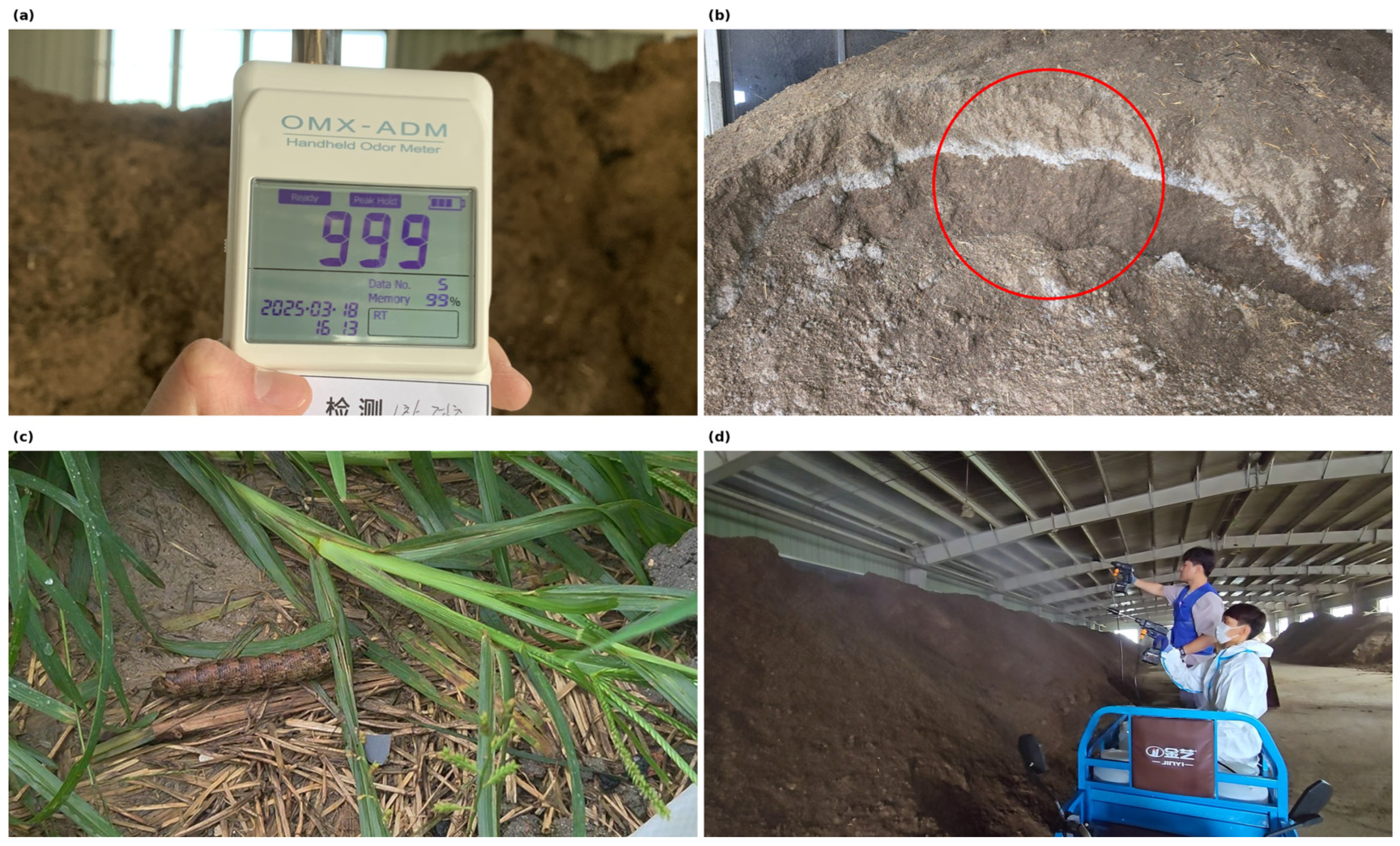
| Environmental Monitoring | Continuous sensors (OMX-ADM, Shinyei Technology Co., Ltd., Kobe, Japan), soil sampling, laboratory analysis | 15 monitoring sites, 200 days | P1: Environmental performance |
| Economic Records | Farm financial records, market price data, facility accounting | 47 farms, 8 markets | P2: Economic value creation |
| Social Survey | Structured household survey, in-person administration | n = 4523 households (94.2% response) Systematic random sampling was employed from a census-derived household registry (12,847 eligible households within the 5 km study radius), with every third household selected. The 94.2% response rate reflects the in-person, household-visit administration methodology commonly employed in rural Chinese survey research [53,54]. Twelve university-affiliated research coordinators completed a standardized 3-day training program. Survey instruments were validated through pilot testing (n = 50) and included reverse-coded items to mitigate social desirability bias. | P3: Social wellbeing and trust |
| Semi-Structured Interviews | Audio-recorded, stakeholder-specific protocols | 61 interviews, 78 h | Mechanism understanding, process dynamics |
| Direct Observation | Site visits, structured field notes | 47 visits, 280 h | Operational verification, context understanding |
| Documentary Evidence | Policy documents, reports, media, complaints | 172 documents | P4: Governance innovation |
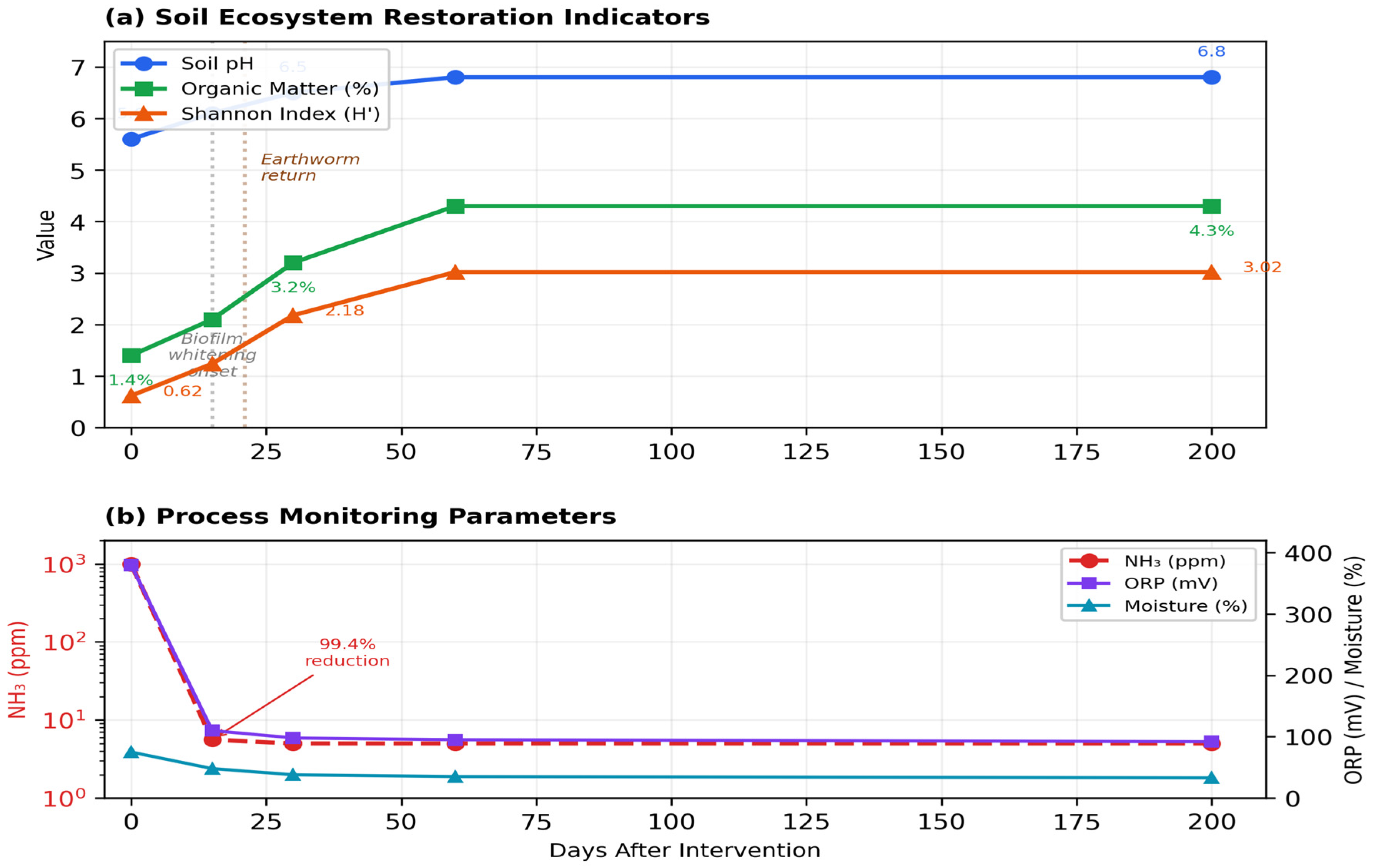
| Monitoring Parameter | Baseline (Day 0) | Day 15 | Day 30 | Significance |
|---|---|---|---|---|
| NH3 (ppm) | 999 | 5.6 | ≤5.0 | 99.4% reduction |
| ORP (mV) | +380 | +110 | +98 | Anaerobic → Aerobic shift |
| Moisture (%) | 75% | 48% | 38% | Natural drying |
| Coliform bacteria | Detected | Not detected | Not detected | Complete elimination |
| Biofilm whitening | Absent | Present | Stabilized | Microbial colonization |
| Parameter | Baseline | Day 15 | Day 60 | Day 200 | Change |
|---|---|---|---|---|---|
| Soil pH | 5.6 | 6.1 | 6.5 | 6.8 | +1.2 |
| Organic Matter (%) | 1.4 | 2.1 | 3.2 | 4.3 | +207% |
| Shannon Index (H’) | 0.62 | 1.24 | 2.18 | 3.02 | +387% |
| Earthworm Density (individuals/m2) | 0 (absent 30 yrs) | — | 3.2 ± 1.4 | 12.3 ± 4.7 | +12.3 |
| Indicator | Poultry | Swine | Cattle | Sheep/Goat |
|---|---|---|---|---|
| Production volume change | +11% | +8% | +5% | +6% |
| Price premium achieved | +57% | +35% | +28% | +22% |
| Net profit change | +20% | +20% | +15% | +18% |
| Mortality rate change | 3.6% → 1.1% | −2.1% pt | −1.5% pt | −1.8% pt |
| Antibiotic use change | −69% | −55% | −42% | −50% |
| CH4 emission reduction | −55% | −48% | −42% | −45% |
| Parameter | GB/T 23349-2020 Standard | Test Result | Status |
|---|---|---|---|
| Moisture | ≤40% | 35–38% | Compliant |
| Organic matter | ≥45% | 48–52% | Compliant |
| Total NPK (N + P2O5 + K2O) | ≥5% | 6.3% | Excellent (125%) |
| Pathogens | Not detected | Not detected | Safe |
| Heavy metals (As, Pb, Cd, Cr) | Below limits | Below detection | Clean |
| Test Parameter | National Standard | Test Result | Status |
|---|---|---|---|
| Tetracycline residue | ≤100 μg/kg | Not detected | Pass |
| Oxytetracycline residue | ≤100 μg/kg | Not detected | Pass |
| Chlortetracycline residue | ≤100 μg/kg | Not detected | Pass |
| Doxycycline residue | ≤100 μg/kg | Not detected | Pass |
| Enrofloxacin residue | ≤10 μg/kg | Not detected | Pass |
| Salmonella | Not detected/25 g | Not detected | Pass |
| Heavy metals (Pb, Cd, Hg, As) | Below limits | Below detection | Pass |
| Indicator | Baseline | Post (Day 200) | Change | p-Value |
|---|---|---|---|---|
| Air quality perception | 2.1 | 6.4 | +4.3 | <0.001 |
| Life convenience satisfaction | 2.8 | 6.3 | +3.5 | <0.001 |
| Government trust | 4.2 | 6.1 | +1.9 | <0.001 |
| Willingness to recommend residence | 2.4 | 5.8 | +3.4 | <0.001 |
| Stakeholder | Environmental | Economic | Social | Governance |
|---|---|---|---|---|
| Farmers | Healthier livestock, reduced mortality | +20% net profit, +57% price premium | Improved working conditions | Permit-free operation |
| Residents | 99.4% odor reduction, clean air | Property value protection | +4.3 pt air quality satisfaction | +1.9 pt government trust |
| Government | Policy compliance achieved | Agricultural GDP growth | Zero complaints, citizen satisfaction | Political capital from policy alignment |
| Consumers | Chemical-free production | Quality-price value | 76% child-feeding confidence | Third-party certification trust |
| Environment | +387% biodiversity, CH4—42% | Waste valorization revenue | Ecosystem services restoration | Outcome-based regulation model |
| P# | Proposition | Key Evidence | Result |
|---|---|---|---|
| P1 | Environmental pollution indicators will show significant reductions | 99.4% NH3 reduction, +387% biodiversity, −42% CH4 | Supported |
| P2 | Positive net economic value across stakeholder network | +20% farmer profit, +57% price premium, waste valorization | Supported |
| P3 | Environmental improvements generate social benefits and trust | +4.3 pt air satisfaction, +1.9 pt government trust, 96.2% satisfaction | Supported |
| P4 | Governance innovation reduces transaction costs and accelerates scaling | 200-day vs. 2–3 yr timeline, permit-free, voluntary adoption | Supported |
| Parameter | Primary Test | Statistic | Robustness Method | Result | Interpretation |
|---|---|---|---|---|---|
| NH3 reduction (999 → 5.6 ppm) | Paired measurement (n = 200 days) | Δ99.4% Cohen’s d = 4.83 | Wilcoxon signed-rank test | p < 0.001 (z = −6.41) | Effect confirmed; non-parametric validation robust |
| Biodiversity index (H′: 0.62 → 3.02) | Shannon diversity index calculation | +387% (5-fold increase) | Bootstrap 95% CI (10,000 iterations) | CI: [2.84, 3.19] Excludes baseline | Recovery statistically significant |
| Soil pH (5.6 → 6.8) | Repeated measures (0, 15, 30, 60 days) | +26.8% neutralization | Friedman’s ANOVA (non-parametric) | χ2 = 42.7, p < 0.001 | Monotonic improvement confirmed |
| Farmer profit (+20%) | Farm-level accounting (n = 47 farms) | +20% net income (±3.2%) | Bootstrapped CI + sensitivity analysis | CI: [16.8%, 23.2%] Robust to ±10% cost | Economically meaningful gain |
| Resident satisfaction (96.2%) | 7-point Likert survey (n = 4523; RR = 94.2%) | M = 6.41/7.00 (SD = 0.73) | Ordered logistic regression | OR = 3.82, p < 0.001 | Satisfaction robust across demographics |
| Composting maturity (20–25 days) | GB/T 23349-2020 standard compliance | NPK ≥ 6.3% Pathogen: 0 | Inter-coder reliability (Cohen’s κ) | κ = 0.84 (substantial agreement) | Assessment reliable across coders |
Disclaimer/Publisher’s Note: The statements, opinions and data contained in all publications are solely those of the individual author(s) and contributor(s) and not of MDPI and/or the editor(s). MDPI and/or the editor(s) disclaim responsibility for any injury to people or property resulting from any ideas, methods, instructions or products referred to in the content. |
© 2026 by the authors. Licensee MDPI, Basel, Switzerland. This article is an open access article distributed under the terms and conditions of the Creative Commons Attribution (CC BY) license.
Share and Cite
Woo, H.-K.; Woo, S.-H.; Woo, S.-W.; Woo, D.-Y.; Dong, K.; Jin, C.-H. Stakeholder-Driven Circular Agriculture Transformation: Environmental, Economic, and Social Value Creation Through Ecological Innovation in Fuyang, China. Sustainability 2026, 18, 2624. https://doi.org/10.3390/su18052624
Woo H-K, Woo S-H, Woo S-W, Woo D-Y, Dong K, Jin C-H. Stakeholder-Driven Circular Agriculture Transformation: Environmental, Economic, and Social Value Creation Through Ecological Innovation in Fuyang, China. Sustainability. 2026; 18(5):2624. https://doi.org/10.3390/su18052624
Chicago/Turabian StyleWoo, Hyun-Kyung, Sang-Hoon Woo, Seong-Woo Woo, Da-Young Woo, Ke Dong, and Chang-Hyun Jin. 2026. "Stakeholder-Driven Circular Agriculture Transformation: Environmental, Economic, and Social Value Creation Through Ecological Innovation in Fuyang, China" Sustainability 18, no. 5: 2624. https://doi.org/10.3390/su18052624
APA StyleWoo, H.-K., Woo, S.-H., Woo, S.-W., Woo, D.-Y., Dong, K., & Jin, C.-H. (2026). Stakeholder-Driven Circular Agriculture Transformation: Environmental, Economic, and Social Value Creation Through Ecological Innovation in Fuyang, China. Sustainability, 18(5), 2624. https://doi.org/10.3390/su18052624