Integration of Artificial Intelligence into Human Resource Management in Manufacturing Enterprises: A Systematic Literature Review of Challenges, Approaches, and Evolution (2000–2025)


Abstract
1. Introduction
1.1. Research Gaps
1.2. Research Questions
2. Methodology
2.1. Review Framework and Scope
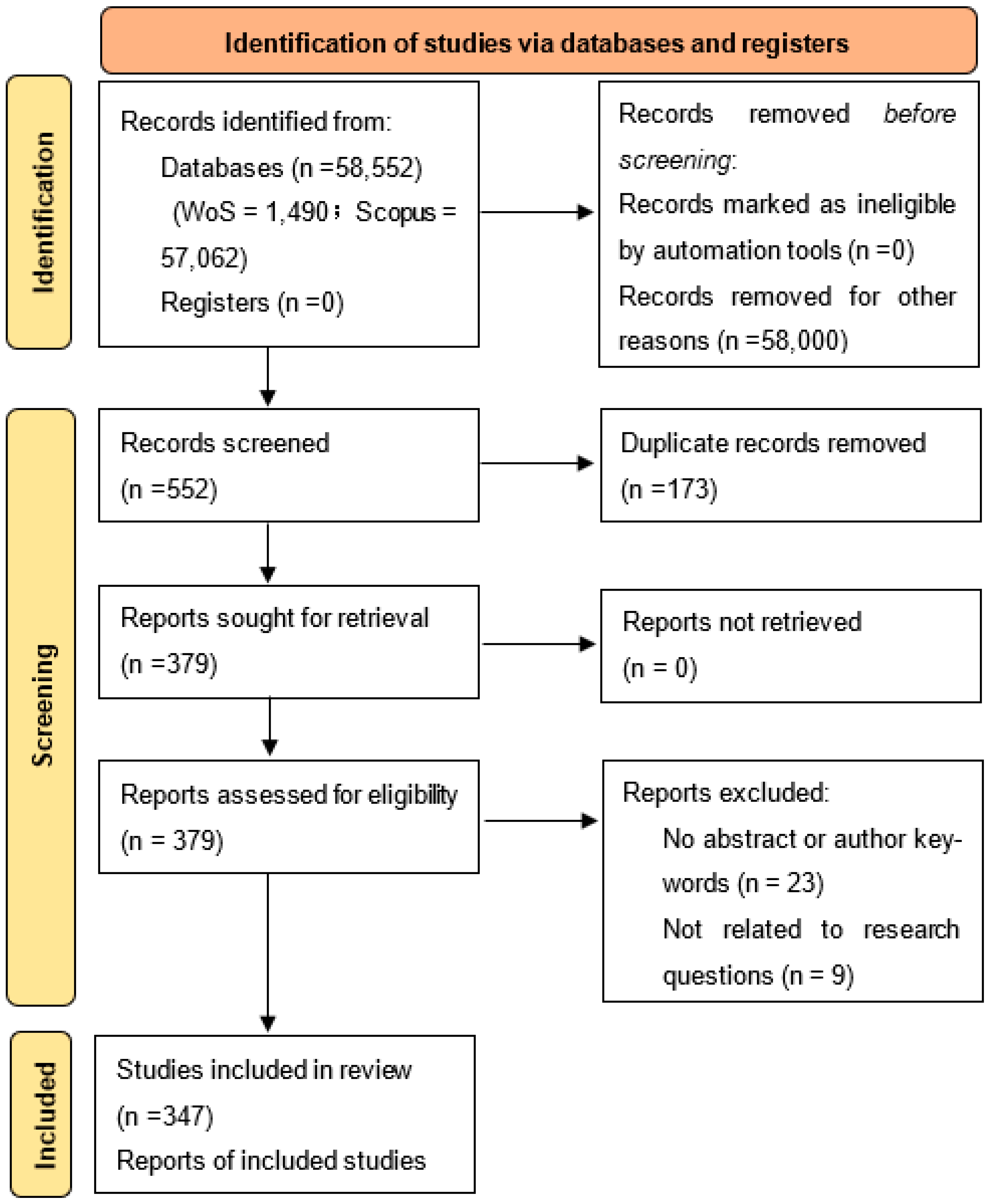
2.2. Search Strategy and Screening Process
2.3. PRISMA Screening Process
2.4. Inclusion and Exclusion Criteria
2.5. Data Extraction and Analysis Methods
- (1)
- Relevance to a manufacturing context;
- (2)
- Substantive exploration of AI-related HRM challenges and integration approaches;
- (3)
- Sufficient theoretical or informational density to support open-ended, axial, and selective coding;
- (4)
- Achieving a fundamental representational balance across research methodologies, geographical regions, and AI-HR application scenarios.
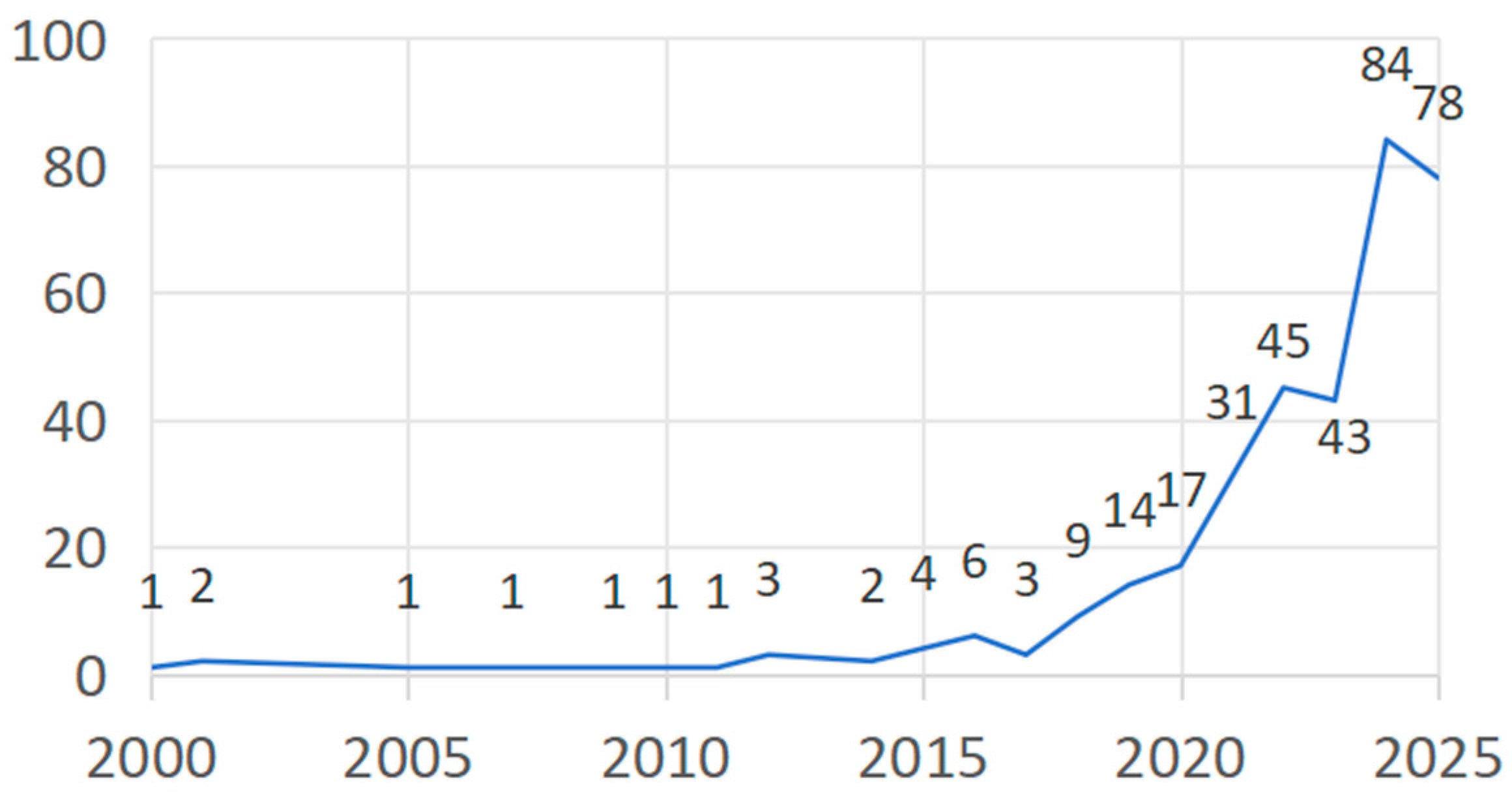
2.6. Descriptive Statistics of the Literature Sample
3. Results
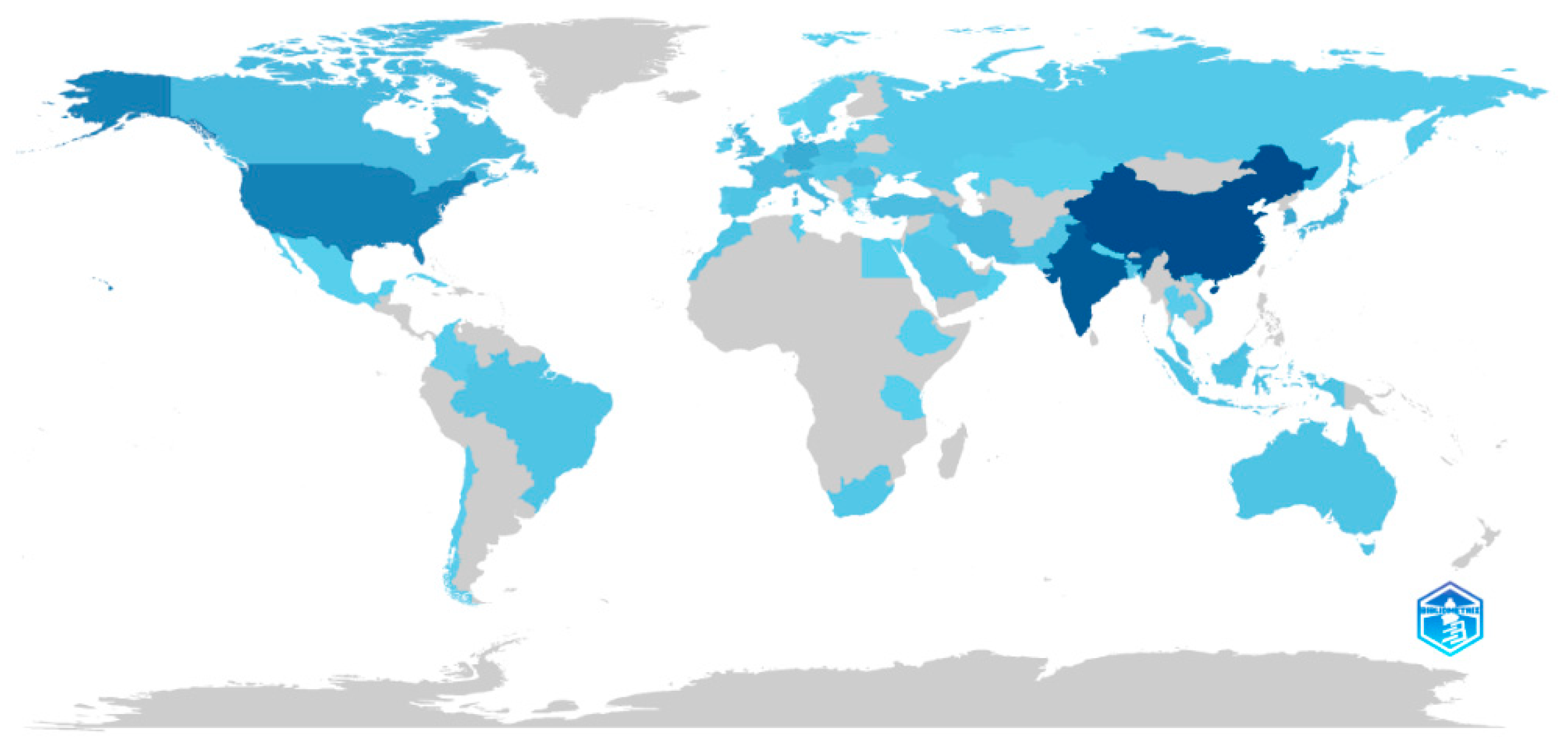
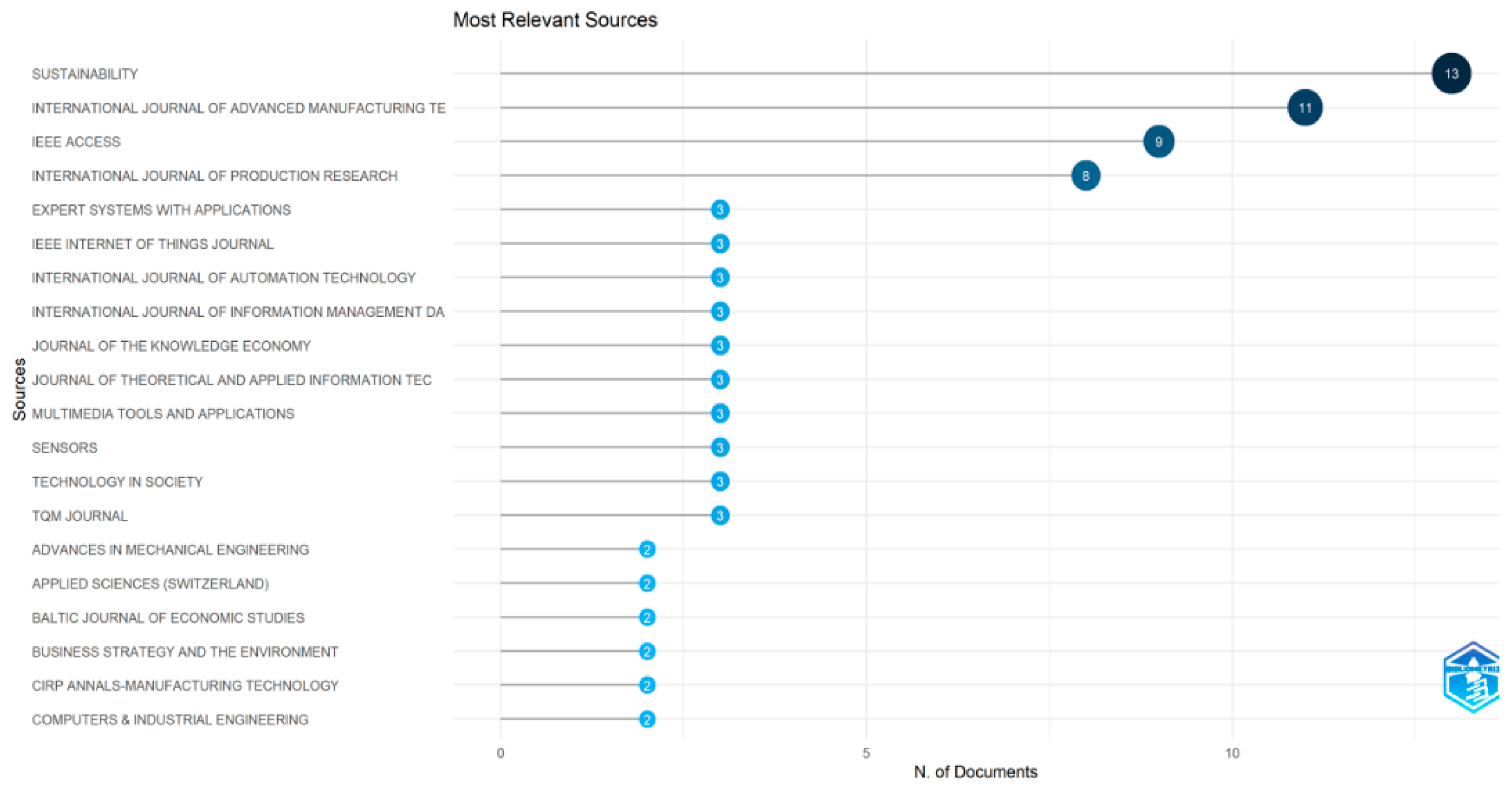
3.1. Descriptive Analysis
3.2. Thematic Findings

| Challenge Approach | A1 | A2 | A3 | A4 | A5 | A6 |
|---|---|---|---|---|---|---|
| C1 | 33 | 19 | 17 | 27 | 28 | 12 |
| (✮✮✮) | (✮✮✮) | (✮✮✮) | (✮✮✮) | (✮✮✮) | (✮✮) | |
| C2 | 24 | 9 | 20 | 25 | 14 | 10 |
| (✮✮✮) | (✮✮) | (✮✮✮) | (✮✮✮) | (✮✮) | (✮✮) | |
| C3 | 29 | 22 | 25 | 54 | 25 | 13 |
| (✮✮✮) | (✮✮✮) | (✮✮✮) | (✮✮✮) | (✮✮✮) | (✮✮) | |
| C4 | 23 | 17 | 24 | 35 | 31 | 10 |
| (✮✮✮) | (✮✮✮) | (✮✮✮) | (✮✮✮) | (✮✮✮) | (✮✮) | |
| C5 | 5 | 2 | 4 | 5 | 6 | 5 |
| (✮) | (✮) | (✮) | (✮) | (✮✮) | (✮) | |
| C6 | 5 | 3 | 5 | 8 | 2 | 1 |
| (✮) | (✮) | (✮) | (✮✮) | (✮) | (✮) |
| Level | Core Focus | Representative Study | Key Insights |
|---|---|---|---|
| Challenges & HR Module | (Derived from 100 in-Depth Studies) | ||
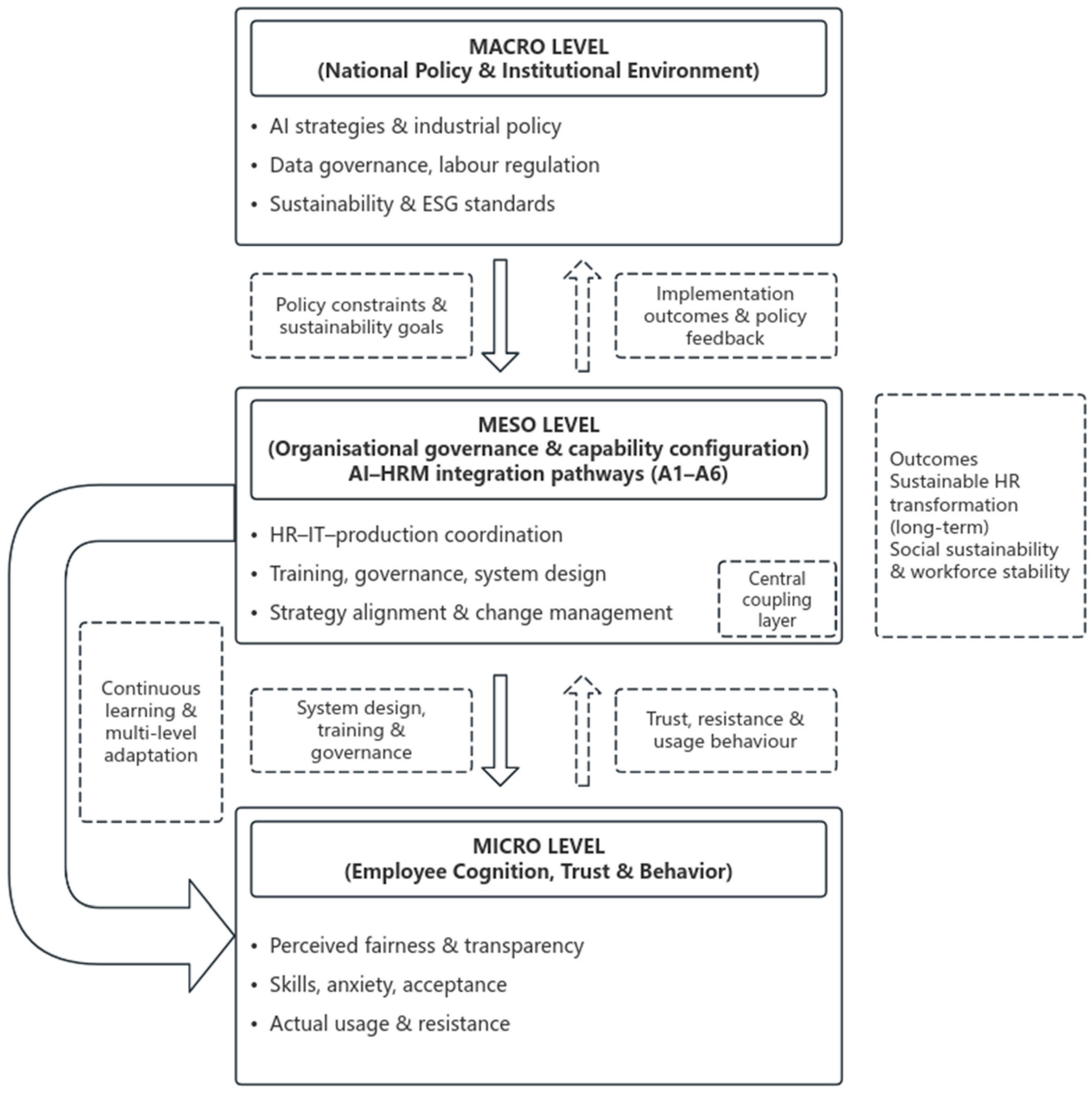
| Macro | C3, C4, C1 HR: Accent on training and safety | [3,15] | Policies significantly drive AI-HR pilot schemes yet lack long-term designs for employee trust and capacity building; empirical evidence is scarce across the policy–organization–employee chain. |
| Meso | C3, C1, C2 HR: Focus on training, performance, safety | [2,7,8] | The organizational layer represents the core bottleneck for AI implementation; cross-departmental collaboration, governance mechanisms, and digital capabilities determine AI effectiveness; research on manufacturing sector variations remains insufficient. |
| Micro | C3, C4 HR: Focus on safety, performance, and training | [9,11] | Employee trust and perceived fairness are fundamental to AI system success; research on frontline workers remains insufficient; longitudinal studies tracking shifts in attitudes and skills are deficit. |
4. Discussion
5. Conclusions
5.1. Theoretical and Practical Implications
5.2. Research Limitations
5.3. Future Research Directions
Supplementary Materials
Author Contributions
Funding
Institutional Review Board Statement
Informed Consent Statement
Data Availability Statement
Acknowledgments
Conflicts of Interest
Abbreviations
| AI | Artificial Intelligence |
| ATF | Algorithm Transparency Frameworks |
| ESG | Environmental, Social, and Governance |
| EU AI Act | European Union Artificial Intelligence Act |
| GDPR | General Data Protection Regulation |
| HAT | Human–AI Teaming |
| HRM | Human Resource Management |
| LDA | Latent Dirichlet Allocation |
| OIPT | Organizational Information Processing Theory |
| PRISMA | Preferred Reporting Items for Systematic Reviews and Meta-Analyses |
| RBV | Resource-Based View |
| SDT | Self-Determination Theory |
| SET | Social Exchange Theory |
| STST | Socio-Technical Systems Theory |
| TAM | Technology Acceptance Model |
| WOS | Web of Science |
Appendix A
- SLR Search Record (AI-HRM × Manufacturing)
- Project: AI-HRM and Manufacturing
- Systematic Review (PRISMA)
- Time Window: 2000–2025
- Language: English
- Document Type: Article and Review
- Search Timestamp: 04 November 2025 09:46:08 +05
- Description: Core databases: Scopus + Web of Science Core Collection
- Web of Science
- TS = ((“artificial intelligence” OR AI OR “machine learning” OR “deep learning” OR “smart manufacturing” OR “industrial internet” OR “IIoT”) AND (“human resource*” OR “human resource management” OR HRM OR “HR system*” OR “talent management” OR “recruitment” OR “training and development” OR “performance management” OR “compensation and benefits” OR “employee safety” OR “employee relations”) AND (manufacture* OR “industry 4.0” OR “smart factory” OR factory))
- AND PY = (2000–2025)
- AND DT = (Article OR Review)
- AND LA = (English)
- AND EDITION = (SCI-EXPANDED OR SSCI OR ESCI)
- Scopus
- TITLE-ABS-KEY((“artificial intelligence” OR AI OR “machine learning” OR “deep learning” OR “smart manufacturing” OR “industrial internet” OR “IIoT”) AND (“human resource*” OR “human resource management” OR HRM OR “HR system*” OR “talent management” OR “recruitment” OR “training and development” OR “performance management” OR “compensation and benefits” OR “employee safety” OR “employee relations”) AND (manufacture* OR “industry 4.0” OR “smart factory” OR factory))
- AND (DOCTYPE(ar) OR DOCTYPE(re))
- AND LANGUAGE(english)
- AND PUBLICATION YEAR > 1999 AND PUBLICATION YEAR < 2026
- Export and deduplication
- Export fields: Title, Author, Year, Journal, DOI, Abstract, Author Keywords, Index Keywords, Citations.
- Deduplication: Deduplicate using DOI as primary key, followed by title deduplication; remove entries lacking abstracts and keywords; remove entries irrelevant to the topic; perform secondary fuzzy matching on titles (ignoring case and punctuation).
Appendix B
- Keyword Groups Used for RQ1–RQ3 Coding
- This appendix presents the keyword framework manually coded for 100 core sample articles, comprising challenge categories (C1–C6), integration pathway categories (A1–A6), and thematic evolution categories (E1–E3). During the actual coding process, the coauthors employed a multi-field retrieval approach encompassing “title–abstract–keywords–main text paragraphs”. The categorization of each document was determined based on keyword frequency, semantic orientation, and contextual relevance. Keyword grouping is not employed for automated classification but serves as a basis for ensuring consistency in manual coding.
- B1. Challenge Keywords (RQ1: Identification of AI-HRM Integration Challenges)
- C1. Technical and Data Infrastructure
- Keywords: “data quality”, “data governance”, “data availability”, “data silo”, “IT infrastructure”, “system integration”, “legacy system”, “interoperability”, “cloud platform”, “algorithmic performance”, “model accuracy”, “technical limitations”, “predictive reliability”, “data noise”, “sensor reliability”, “computational capacity”
- C2. Organizational and Strategic Alignment
- Keywords: “strategic alignment”, “organisational readiness”, “change resistance”, “workflow mismatch”, “process redesign”, “organisational inertia”, “cross-departmental coordination”, “top management support”, “AI adoption strategy”, “misaligned objectives”, “organisational capability gaps.”
- C3. Skills and Capability Gap
- Keywords: “skills shortage”, “digital skills”, “AI literacy”, “competence gap”, “training needs”, “upskilling”, “reskilling”, “workforce capability”, “technical skills”, “data literacy”, “skill mismatch”, “learning curve.”
- C4. Trust, Fairness and Ethical Concerns
- Keywords: “algorithmic fairness”, “bias”, “discrimination”, “privacy concerns”, “transparency”, “explainability”, “trust”, “employee acceptance”, “surveillance concerns”, “autonomy”, “ethical risk”, “decision opacity”, “moral implications”, “psychological safety.”
- C5. Institutional and Regulatory Constraints
- Keywords: “regulation”, “compliance”, “labour law”, “legal risk”, “industrial policy”, “standardisation”, “government requirements”, “data protection law”, “GDPR”, “AI Act”, “compliance cost”, “certification”, “audit requirement”, “industry regulation.”
- C6. Sustainability and Green Transition
- Keywords: “sustainability”, “green manufacturing”, “energy efficiency”, “carbon footprint”, “environmental impact”, “green HRM”, “sustainable workforce”, “resource efficiency”, “ESG”, “Industry 5.0”, “human-centric manufacturing”, “circular economy.”
- B2. Approach Keywords (RQ2: Identifying AI-HRM Integration Pathways)
- A1. Algorithmic and XAI Solutions (Algorithms and Explainable AI)
- Keywords: “explainable AI”, “XAI”, “model transparency”, “interpretable model”, “algorithm design”, “federated learning”, “privacy-preserving”, “fairness-aware”, “bias mitigation”, “algorithm auditing”, “predictive analytics”, “machine learning model”, “AI tool integration.”
- A2. Human–AI Collaboration (Human–Machine Collaboration Mechanisms)
- Keywords: “human–AI collaboration”, “decision augmentation”, “co-creation”, “augmented decision-making”, “AI-assisted work”, “hybrid intelligence”, “task allocation”, “interaction design”, “AI interface”, “workflow augmentation”, “cognitive offloading.”
- A3. Organizational Theories (Theory-Driven Approach)
- Keywords: “TAM”, “UTAUT”, “SDT”, “SET”, “RBV”, “OIPT”,
- “sociotechnical system”, “technology acceptance”, “organisational capability”, “organisational adaptability”, “theoretical framework”, “model development.”
- A4. Change and Training Interventions (Change Management and Skills Development)
- Keywords: “change management”, “training intervention”, “learning programme”, “upskilling”, “reskilling”, “leadership support”, “organisational learning”, “HRD”, “capacity building”, “employee readiness”, “training effectiveness.”
- A5. Ethics and Governance Mechanisms (Ethical Governance and Responsibility AI)
- Keywords: “AI governance”, “responsible AI”, “AI ethics”, “privacy protection”, “data governance”, “algorithmic auditing”, “governance framework”, “risk mitigation”, “ethical guideline”, “trust enhancement”, “employee consent”, “ethical compliance.”
- A6. Policy and Standardization
- Keywords:
- “standardisation”, “industry standard”, “ISO”, “policy intervention”, “policy support”, “government incentive”, “regulatory framework”, “national AI strategy”, “benchmarking”, “sector guidelines”, “public governance”, “compliance mechanism”
- B3. Evolution Keywords (RQ3: Theme Evolution and Trend Identification)
- E1. Technological Evolution and Tool Transformation
- Keywords: “AI evolution”, “automation 4.0”, “smart manufacturing”, “deep learning”, “LLM”, “generative AI”, “digital twin”, “cyber-physical system”, “predictive maintenance”, “intelligent sensing.”
- E2. Organizational Transformation
- Keywords: “workflow transformation”, “organisational redesign”, “HRM digitalisation”, “HR analytics evolution”, “workplace automation”, “organisational maturity”, “AI adoption stage”, “integration trajectory”, “hybrid operation model.”
- E3. Human-Centric Values and Governance Shift
- Keywords: “human-centric”, “employee experience”, “ethical governance”, “AI governance maturity”, “employee empowerment”, “psychological contract”, “well-being”, “trust-building mechanisms”, “responsible adoption”, “Industry 5.0 governance.
References
- Kuo, C.-F.; Juang, Y. A study on the recognition and classification of embroidered textile defects in manufacturing. Text. Res. J. 2016, 86, 393–408. [Google Scholar] [CrossRef]
- Bag, S.; Yadav, G.; Dhamija, P.; Kataria, K.K. Key resources for Industry 4.0 adoption and its effect on sustainable production and circular economy: An empirical study. J. Clean. Prod. 2021, 281, 125233. [Google Scholar] [CrossRef]
- Purohit, R.; Banerjee, T. Artificial intelligence-based organizational decision-making in recruitment practice. Hum. Syst. Manag. 2025, 44, 173–186. [Google Scholar] [CrossRef]
- Vohra, M.; Patwardhan, M.; Upadhyay, Y. Exploring the Impact of HRM Practices on Organizational Effectiveness in the Indian Manufacturing Sector: A Comprehensive Analysis Using PLS-SEM and ANN. Public Organ. Rev. 2025, 25, 1937–1959. [Google Scholar] [CrossRef]
- World Economic Forum. The Future of Jobs Report 2023. World Economic Forum. 2023. Available online: https://www3.weforum.org/docs/WEF_Future_of_Jobs_2023.pdf (accessed on 20 January 2026).
- SCIO. SCIO Briefing on Development of Industry and Information Technology in the First Half of 2025; The State Council Information Office of the People’s Republic of China: Beijing, China, 2025. Available online: http://english.scio.gov.cn/pressroom/node_9016674.html (accessed on 20 January 2026).
- da Silva, L.B.P.; Pontes, J.; Mosconi, E.; Treinta, F.T.; Yoshino, R.T.; De Resende, L.M.M. The future of HRM for intelligent manufacturing systems in the context of industry 5.0. Comput. Ind. Eng. 2026, 211, 111587. [Google Scholar] [CrossRef]
- Salman, A.; Khan, M.R.; Khan, M.A.; Moazzam, M. Exploring the Adoption of Industry 4.0 in Manufacturing Industry and Its Impact on Sustainable Performance: A Systematic Literature Review. Process. Integr. Optim. Sustain. 2025. [Google Scholar] [CrossRef]
- Amayreh, A.; Ta’Amnha, M.A.; Magableh, I.K.; Mahrouq, M.H.; Alfaiza, S.A. Exploring the impact of AI on employee self-competence, performance key variables and outcomes. Discov. Sustain. 2025, 6, 582. [Google Scholar] [CrossRef]
- Malik, N.; Tripathi, S.N.; Kar, A.K.; Gupta, S. Impact of artificial intelligence on employees working in Industry 4.0 led organizations. Int. J. Manpow. 2022, 43, 334–354. [Google Scholar] [CrossRef]
- Delpla, V.; Chapron, K.; Kenné, J.-P.; Hof, L.A. A novel approach for predicting lockout/tagout safety procedures for smart maintenance strategies. Int. J. Prod. Res. 2024, 62, 4754–4775. [Google Scholar] [CrossRef]
- Ključnikov, A.; Popkova, E.G.; Sergi, B.S. Global labour markets and workplaces in the age of intelligent machines. J. Innov. Knowl. 2023, 8, 100407. [Google Scholar] [CrossRef]
- Basu, S.; Majumdar, B.; Mukherjee, K.; Munjal, S.; Palaksha, C. Artificial intelligence–HRM interactions and outcomes: A systematic review and causal configurational explanation. Hum. Resour. Manag. Rev. 2023, 33, 100893. [Google Scholar] [CrossRef]
- Benabou, A.; Touhami, F. Artificial intelligence in human resource management: A PRISMA-based systematic review. Acta Inform. Pragensia 2025, 14, 489–505. [Google Scholar] [CrossRef]
- Úbeda-García, M.; Marco-Lajara, B.; Zaragoza-Sáez, P.C.; Poveda-Pareja, E. Artificial intelligence, knowledge and human resource management: A systematic literature review of theoretical tensions and strategic implications. J. Innov. Knowl. 2025, 10, 100809. [Google Scholar] [CrossRef]
- Xie, Q. Machine learning in human resource system of intelligent manufacturing industry. Enterp. Inf. Syst. 2022, 16, 264–284. [Google Scholar] [CrossRef]
- Page, M.J.; McKenzie, J.E.; Bossuyt, P.M.; Boutron, I.; Hoffmann, T.C.; Mulrow, C.D.; Shamseer, L.; Tetzlaff, J.M.; Akl, E.A.; Brennan, S.E.; et al. The PRISMA 2020 statement: An updated guideline for reporting systematic reviews. BMJ 2021, 372, n71. [Google Scholar] [CrossRef]
- Mwita, K.M.; Kitole, F.A. Potential benefits and challenges of artificial intelligence in human resource management in public institutions. Discov. Glob. Soc. 2025, 3, 35. [Google Scholar] [CrossRef]
- Passalacqua, M.; Pellerin, R.; Magnani, F.; Doyon-Poulin, P.; Del-Aguila, L.; Boasen, J.; Léger, P.-M. Human-centred AI in industry 5.0: A systematic review. Int. J. Prod. Res. 2025, 63, 2638–2669. [Google Scholar] [CrossRef]
- Aria, M.; Cuccurullo, C. Bibliometrix: An R-tool for comprehensive science mapping analysis. J. Informetr. 2017, 11, 959–975. [Google Scholar] [CrossRef]
- Linnenluecke, M.K.; Marrone, M.; Singh, A.K. Conducting systematic literature reviews and bibliometric analyses. Aust. J. Manag. 2020, 45, 175–194. [Google Scholar] [CrossRef]
- Moher, D.; Liberati, A.; Tetzlaff, J.; Altman, D.G.; The PRISMA Group. Preferred reporting items for systematic reviews and meta-analyses: The PRISMA statement. PLoS Med. 2009, 6, e1000097. [Google Scholar] [CrossRef]
- Vrontis, D.; Christofi, M.; Pereira, V.; Tarba, S.; Makrides, A.; Trichina, E. Artificial intelligence, robotics, advanced technologies and human resource management: A systematic review. In Artificial Intelligence and International HRM; Routledge: Abingdon, UK, 2023. [Google Scholar]
- Blei, D.M.; Ng, A.Y.; Jordan, M.I. Latent Dirichlet Allocation. J. Mach. Learn. Res. 2003, 3, 993–1022. [Google Scholar]
- Chen, C. CiteSpace II: Detecting and visualizing emerging trends and transient patterns in scientific literature. J. Am. Soc. Inf. Sci. Technol. 2006, 57, 359–377. [Google Scholar] [CrossRef]
- Fernandez, V.; Gallardo-Gallardo, E. Tackling the HR digitalization challenge: Key factors and barriers to HR analytics adoption. Compet. Rev. 2021, 31, 162–187. [Google Scholar] [CrossRef]
- Snyder, H. Literature review as a research methodology: An overview and guidelines. J. Bus. Res. 2019, 104, 333–339. [Google Scholar] [CrossRef]
- Paez, A. Gray literature: An important resource in systematic reviews. J. Evid.-Based Med. 2017, 10, 233–240. [Google Scholar] [CrossRef]
- van Eck, N.J.; Waltman, L. Software survey: VOSviewer, a computer program for bibliometric mapping. Scientometrics 2010, 84, 523–538. [Google Scholar] [CrossRef]
- Corbin, J.; Strauss, A. Basics of Qualitative Research: Techniques and Procedures for Developing Grounded Theory; SAGE Publications: Thousand Oaks, CA, USA, 2014. [Google Scholar]
- Afzal, M.N.I.; Shohan, A.H.N.; Siddiqui, S.; Tasnim, N. Application of AI on human resource management: A review. J. Hum. Resour. Manag. HR Adv. Dev. 2023, 26, 1–11. [Google Scholar] [CrossRef]
- da Silva, L.B.P.; Soltovski, R.; Pontes, J.; Treinta, F.T.; Leitão, P.; Mosconi, E.; de Resende, L.M.M.; Yoshino, R.T. Human resources management 4.0: Literature review and trends. Comput. Ind. Eng. 2022, 168, 108111. [Google Scholar] [CrossRef]
- Piccarozzi, M.; Aquilani, B.; Gatti, C. Industry 4.0 in management studies: A systematic literature review. Sustainability 2018, 10, 3821. [Google Scholar] [CrossRef]
- Palos-Sánchez, P.R.; Baena-Luna, P.; Badicu, A.; Infante-Moro, J.C. Artificial intelligence and human resources management: A bibliometric analysis. Appl. Artif. Intell. 2022, 36, 2145631. [Google Scholar] [CrossRef]
- Koştı, G.; Kayadibi, İ. A bibliometric analysis of artificial intelligence and machine learning applications for human resource management. Future Bus. J. 2025, 11, 179. [Google Scholar] [CrossRef]
- Alherimi, N.; Abdulmaksoud, S.; Ahmed, V.; Bahroun, Z. A systematic literature review of artificial intelligence advancements in green human resource management. Sustainability 2025, 17, 10283. [Google Scholar] [CrossRef]
- Bujold, A.; Roberge-Maltais, I.; Parent-Rocheleau, X.; Boasen, J.; Sénécal, S.; Léger, P.-M. Responsible artificial intelligence in human resources management: A review of the empirical literature. AI Ethics 2024, 4, 1185–1200. [Google Scholar] [CrossRef]
- Qamar, Y.; Agrawal, R.K.; Samad, T.A.; Jabbour, C.J. When technology meets people: The interplay of artificial intelligence and human resource management. J. Enterp. Inf. Manag. 2021, 34, 1339–1370. [Google Scholar] [CrossRef]
- European Commission. Proposal for a Regulation of the European Parliament and of the Council Laying Down Harmonised Rules on Artificial Intelligence (Artificial Intelligence Act) and Amending Certain Union Legislative Acts (COM(2021) 206 Final; 2021/0106(COD)). EUR-Lex. 2021. Available online: https://eur-lex.europa.eu/legal-content/EN/TXT/?uri=CELEX:52021PC0206 (accessed on 28 November 2025).
- Kasubi, J.W.; Kisumbe, L.A.; Nyabakora, W.I. Mapping the knowledge base for the impact of artificial intelligence on human resources management: A bibliometric study. Sage Open 2025, 15, 21582440251377298. [Google Scholar] [CrossRef]
- Sawada, H.; Nakabo, Y.; Furukawa, Y.; Ando, N.; Okuma, T.; Komoto, H.; Masui, K. Digital tools integration and human resources development for smart factories. Int. J. Autom. Technol. 2022, 16, 250–260. [Google Scholar] [CrossRef]
- Kemendi, Á.; Michelberger, P.; Mesjasz-Lech, A. Industry 4.0 and 5.0—Organizational and competency challenges of enterprises. Pol. J. Manag. Stud. 2022, 26, 209–232. [Google Scholar] [CrossRef]
- Vereycken, Y.; Ramioul, M.; Desiere, S.; Bal, M. Human resource practices accompanying Industry 4.0 in the European manufacturing industry. J. Manuf. Technol. Manag. 2021, 32, 1016–1036. [Google Scholar] [CrossRef]
- Ekuma, K. Artificial intelligence and automation in human resource development: A systematic review. Hum. Resour. Dev. Rev. 2024, 23, 199–229. [Google Scholar] [CrossRef]
- Bérastégui, P. Artificial Intelligence in Industry 4.0: Implications for Occupational Safety and Health; SSRN Scholarly Paper No. 4867719; Social Science Research Network: Rochester, NY, USA, 2024. [Google Scholar] [CrossRef]
- Jayaraj, V.; Venkatesan, S. An investigation into the interconnections among green transformational leadership, innovation, and environmental performance within green human resource management. Int. J. Healthc. Manag. 2025. [Google Scholar] [CrossRef]
- Riaz, A.; Al-Okaily, M.; Sohail, A.; Ashfaq, K.; Rehman, S.U. Green human resource management and sustainable performance: Serial mediating role of green knowledge management and green innovation. In Global Knowledge, Memory and Communication; Emerald Publishing: Leeds, UK, 2024. [Google Scholar] [CrossRef]
- Chuang, S. Indispensable skills for human employees in the age of robots and AI. Eur. J. Train. Dev. 2024, 48, 179–195. [Google Scholar] [CrossRef]
- Mohamed, H.H.; Matimbwa, H.; Banzi, J.; Mohamed, H.; Matimbwa, H.; Banzi, J. Unveiling the potential of artificial intelligence in human resource management: A systematic review of adoption strategies, challenges, and future directions. Cureus J. Bus. Econ. 2025, 2, es44404-025-03698-0. [Google Scholar] [CrossRef]
- Jabeen, I.; Qureshi, H.; Arif, G.; Tabussum, S.; Syed, M.I. Human–AI collaboration in HR: Redefining roles and responsibilities in the digital workplace. Inverge J. Soc. Sci. 2025, 4, 318–329. [Google Scholar] [CrossRef]
- Tinguely, P.N.; Lee, J.; He, V.F. Designing human resource management systems in the age of AI. J. Organ. Des. 2023, 12, 263–269. [Google Scholar] [CrossRef]
- Priatna, D.K.; Roswinna, W.; Limakrisna, N.; Khalikov, A.; Abdullaev, D.; Hussein, L. Optimizing smart manufacturing processes and human resource management through machine learning algorithms. Int. J. Ind. Eng. Manag. 2025, 16, 176–188. [Google Scholar] [CrossRef]
- Sun, Y.; Jung, H. Machine learning (ML) modeling, IoT, and optimizing organizational operations through integrated strategies: The role of technology and human resource management. Sustainability 2024, 16, 6751. [Google Scholar] [CrossRef]
- Zhang, K.; Wu, C.; Ge, M.; Liu, T. AI-enabled workforce integration: Blended human resource contribution rate in Chinese companies. Front. Artif. Intell. 2025, 8, 1645172. [Google Scholar] [CrossRef] [PubMed]
- Venugopal, M.; Madhavan, V.; Prasad, R.; Raman, R. Transformative AI in human resource management: Enhancing workforce planning with topic modeling. Cogent Bus. Manag. 2024, 11, 2432550. [Google Scholar] [CrossRef]
- Najam Shaikh, S.; Sohu, J.M.; Shaikh, S.; Zahra Kherazi, F.; Soomro, S. Artificial intelligence adoption, green HRM, and employee behavior: Driving environmental sustainability in SMEs with organizational culture as a moderator. Sage Open 2025, 15, 21582440251392673. [Google Scholar] [CrossRef]
- Mathushan, P.; Gamage, A.S.; Wachissara, V. Human resource management and artificial intelligence: A bibliometric exploration. J. Bus. Res. Insights (Former Vidyodaya J. Manag.) 2023, 9, 1–29. [Google Scholar] [CrossRef]
- Sexton, R.S.; McMurtrey, S.; Michalopoulos, J.O.; Smith, A.M. Employee turnover: A neural network solution. Comput. Oper. Res. 2005, 32, 2635–2651. [Google Scholar] [CrossRef]
- Cameron, R.; Herrmann, H.; Nankervis, A. Mapping the evolution of algorithmic HRM (AHRM): A multidisciplinary synthesis. Humanit. Soc. Sci. Commun. 2024, 11, 303. [Google Scholar] [CrossRef]
- Ayling, J.; Chapman, A. Putting AI ethics to work: Are the tools fit for purpose? AI Ethics 2022, 2, 405–429. [Google Scholar] [CrossRef]
- Parent-Rocheleau, X.; Parker, S.K. Algorithms as work designers: How algorithmic management influences the design of jobs. Hum. Resour. Manag. Rev. 2022, 32, 100838. [Google Scholar] [CrossRef]
- Jeske, D. Remote workers’ experiences with electronic monitoring during COVID-19: Implications and recommendations. Int. J. Workplace Health Manag. 2022, 15, 393–409. [Google Scholar] [CrossRef]
- Wells, J.; Scheibein, F.; Pais, L.; Rebelo dos Santos, N.; Dalluege, C.-A.; Czakert, J.P.; Berger, R. A systematic review of the impact of remote working referenced to the concept of work–life flow on physical and psychological health. Workplace Health Saf. 2023, 71, 507–521. [Google Scholar] [CrossRef]
- Chatzinikolaou, D.; Kubus, R. Macro–meso–micro: An integrative framework for evolutionary economics and sustainable transitions. Sustainability 2025, 17, 9480. [Google Scholar] [CrossRef]
- Cunningham, J.A.; O’Reilly, P. Macro, meso and micro perspectives of technology transfer. J. Technol. Transf. 2018, 43, 545–557. [Google Scholar] [CrossRef]
- Kwon, B.; Farndale, E.; Park, J.G. Employee voice and work engagement: Macro, meso, and micro-level drivers of convergence? Hum. Resour. Manag. Rev. 2016, 26, 327–337. [Google Scholar] [CrossRef]
- Dwivedi, Y.K.; Hughes, L.; Ismagilova, E.; Aarts, G.; Coombs, C.; Crick, T.; Duan, Y.; Dwivedi, R.; Edwards, J.S.; Eirug, A.; et al. Artificial intelligence (AI): Multidisciplinary perspectives on emerging challenges, opportunities, and agenda for research, practice and policy. Int. J. Inf. Manag. 2021, 57, 101994. [Google Scholar] [CrossRef]
- Geels, F.W. Technological transitions as evolutionary reconfiguration processes: A multi-level perspective and a case-study. Res. Policy 2002, 31, 1257–1274. [Google Scholar] [CrossRef]
- Faraj, S.; Pachidi, S.; Sayegh, K. Working and organizing in the age of the learning algorithm. Inf. Organ. 2018, 28, 62–70. [Google Scholar] [CrossRef]
- von Krogh, G. Artificial intelligence in organizations: New opportunities for phenomenon-based theorizing. Acad. Manag. Discov. 2018, 4, 404–409. [Google Scholar] [CrossRef]
- Nahavandi, S. Industry 5.0—A human-centric solution. Sustainability 2019, 11, 4371. [Google Scholar] [CrossRef]
- Raisch, S.; Krakowski, S. Artificial intelligence and management: The automation–augmentation paradox. Acad. Manag. Rev. 2021, 46, 192–210. [Google Scholar] [CrossRef]
- De Stefano, V. The Rise of the “Just-In-Time Workforce”: On-Demand Work, Crowd Work and Labour Protection in the “Gig-Economy”; SSRN Scholarly Paper No. 2682602; Social Science Research Network: Rochester, NY, USA, 2015. [Google Scholar] [CrossRef]
- Duggan, J.; Sherman, U.; Carbery, R.; McDonnell, A. Algorithmic management and app-work in the gig economy: A research agenda for employment relations and HRM. Hum. Resour. Manag. J. 2020, 30, 114–132. [Google Scholar] [CrossRef]
- Kellogg, K.C.; Valentine, M.A.; Christin, A. Algorithms at work: The new contested terrain of control. Acad. Manag. Ann. 2020, 14, 366–410. [Google Scholar] [CrossRef]
- Bondarouk, T.; Parry, E.; Furtmueller, E. Electronic HRM: Four decades of research on adoption and consequences. Int. J. Hum. Resour. Manag. 2017, 28, 98–131. [Google Scholar] [CrossRef]
- Frank, A.G.; Dalenogare, L.S.; Ayala, N.F. Industry 4.0 technologies: Implementation patterns in manufacturing companies. Int. J. Prod. Econ. 2019, 210, 15–26. [Google Scholar] [CrossRef]
- Jarrahi, M.H. Artificial intelligence and the future of work: Human-AI symbiosis in organizational decision making. Bus. Horiz. 2018, 61, 577–586. [Google Scholar] [CrossRef]
- Leicht-Deobald, U.; Busch, T.; Schank, C.; Weibel, A.; Schafheitle, S.; Wildhaber, I.; Kasper, G. The challenges of algorithm-based HR decision-making for personal integrity. J. Bus. Ethics 2019, 160, 377–392. [Google Scholar] [CrossRef]
- Raji, I.D.; Smart, A.; White, R.N.; Mitchell, M.; Gebru, T.; Hutchinson, B.; Smith-Loud, J.; Theron, D.; Barnes, P. Closing the AI accountability gap: Defining an end-to-end framework for internal algorithmic auditing. In Proceedings of the 2020 Conference on Fairness, Accountability, and Transparency; Association for Computing Machinery: New York, NY, USA, 2020; pp. 33–44. [Google Scholar] [CrossRef]
- Tambe, P.; Cappelli, P.; Yakubovich, V. Artificial intelligence in human resources management: Challenges and a path forward. Calif. Manag. Rev. 2019, 61, 15–42. [Google Scholar] [CrossRef]
- Shahin, M.; Chen, F.F.; Hosseinzadeh, A.; Khodadadi Koodiani, H.; Bouzary, H.; Shahin, A. Enhanced safety implementation in 5S + 1 via object detection algorithms. Int. J. Adv. Manuf. Technol. 2023, 125, 3701–3721. [Google Scholar] [CrossRef]
- Serey, J.; Alfaro, M.; Fuertes, G.; Vargas, M.; Ternero, R.; Duran, C.; Sabattin, J.; Gutierrez, S. Framework for the strategic adoption of Industry 4.0: A focus on intelligent systems. Processes 2023, 11, 2973. [Google Scholar] [CrossRef]


| Study | Manufacturing Focus | Analytical Structure | Multi-Level Perspective |
|---|---|---|---|
| [13] | No | AI-HRM interactions | No |
| [14] | No | Application-oriented review | No |
| [15] | Partial | Theoretical tensions | Limited |
| This study | Yes | Challenges–Approaches–Evolution | Macro–Meso–Micro (MLEF) |
| Coding | Core Concept | No of Documents = 100 | High-Frequency Association with HR Modules |
|---|---|---|---|
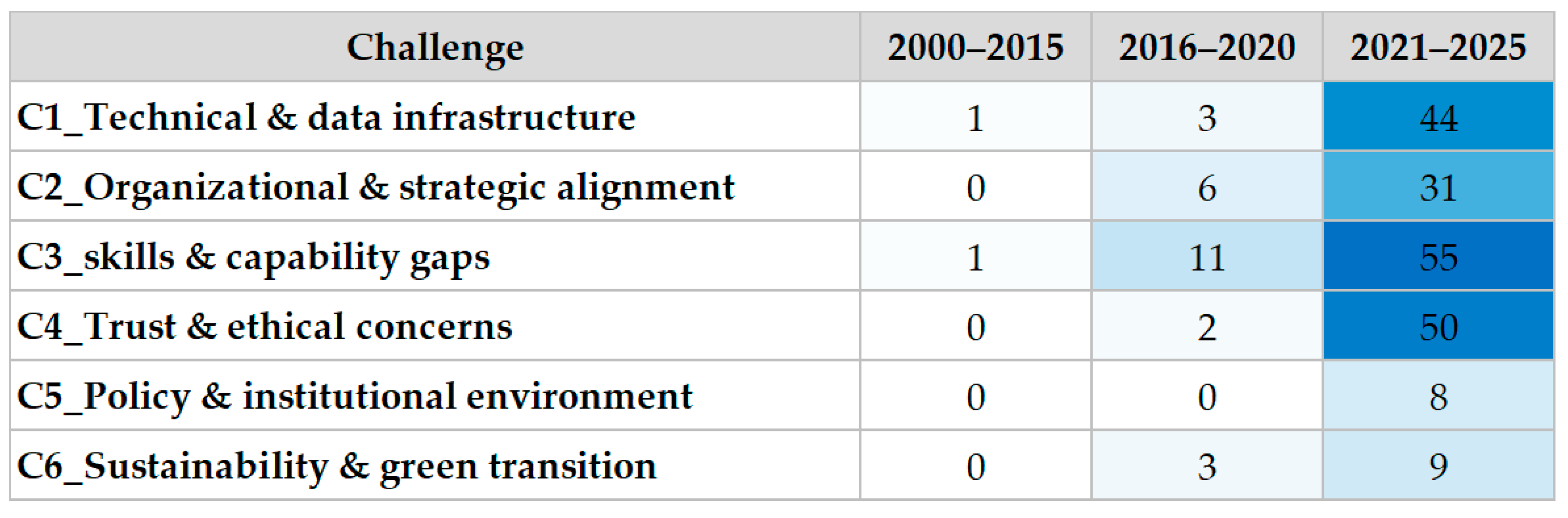
| C1 Technical & data infrastructure | Insufficient foundational conditions—such as algorithmic performance, data quality and integration, IT infrastructure, and security—are required for deploying AI systems in HR scenarios, leading to unstable model implementation or biased outcomes. | 48 | Training and development, employee safety and health, employee relations and engagement |
| C2 Organizational & strategic alignment | AI-HRM initiatives lack alignment with corporate strategy, HR strategy, and business processes. Unclear organizational structures and responsibility boundaries, coupled with inadequate cross-departmental collaboration and resource allocation, often result in AI projects operating in isolation. | 37 | Training and development, performance management, recruitment and staffing |
| C3 Skills & capability gaps | Managers and frontline staff commonly lack data literacy and AI proficiency, while HR teams demonstrate insufficient capabilities in algorithmic understanding, project management, and change facilitation. This results in “technology being available but personnel unable to utilize it” and “systems lying idle or being used in simplified ways”. | 67 | Training and development, employee safety and health, performance management |
| C4 Trust & ethical concerns | Employees and managers harbor concerns regarding fairness, transparency, and privacy protection in sensitive areas such as recruitment, performance evaluation, and remuneration. Fears of being “replaced by machines” or subjected to unfair treatment undermine trust in and willingness to adopt the systems. | 52 | Training and development, employee safety and health, performance management |
| C5 Policy & institutional environment | External regulations and standards lag or remain uncertain, while internal governance systems are incomplete. AI-HRM practices lack clear boundaries regarding data compliance, labor legal liabilities, and algorithmic accountability, leaving enterprises exposed to compliance risks and regulatory vacuums. | 8 | Training and development, employee safety and health, employee relations and engagement |
| C6 Sustainability & green transition | Insufficient mechanisms exist to align AI-HRM with green manufacturing, environmental performance, and social responsibility objectives. Green capability development and employee engagement remain inadequate, with AI predominantly serving efficiency and cost reduction rather than genuinely supporting sustainable and green transition. | 12 | Training and development, performance management, employee relations and engagement |
| Approach Category | Core Methods/Solutions | Typical Theoretical Foundations | Number of Supporting Documents |
|---|---|---|---|
| A1: Algorithmic & XAI Solutions | Explainable Artificial Intelligence (XAI) Differential privacy & federated learning Algorithmic matching for recruitment and performance Bias detection and mitigation | Algorithm transparency frameworks; Organizational Information Processing Theory (OIPT) | 51 |
| A2: Human–AI Collaboration | AI-HR co-decision interfaces Chatbot-assisted HR processes Human–AI interaction in feedback and development | Human–AI Teaming (HAT); Socio-Technical Systems Theory (STST) | 28 |
| A3: Organizational Theories | Technology adoption mechanisms Digital HRM governance Strategic integration of AI within HR systems | TAM; Resource-Based View (RBV); Self-Determination Theory (SDT); Social Exchange Theory (SET); OIPT | 37 |
| A4: Change & Training Interventions | Reskilling and upskilling programs AI literacy and competence development Leadership-driven change management | Organizational Change Theory; Learning Theory | 64 |
| A5: Ethics and Governance Mechanisms | Algorithm audits Fairness and bias mitigation Transparency and risk management protocols | Responsible AI (RAI) models; AI Ethics Frameworks | 42 |
| A6: Policy & Standardization | ISO 30414 human capital reporting Regulatory compliance (e.g., EU AI Act) Industry/sector guidelines for HR analytics | Institutional Theory; Compliance Theory | 22 |
| Dimension | Category | Frequency N | Percentage % |
|---|---|---|---|
| Year | 2000–2010 | 7 | 2 |
| 2011–2015 | 10 | 2.9 | |
| 2016–2020 | 49 | 14.1 | |
| 2021–2025 | 281 | 81 | |
| document type | article | 308 | 88.8 |
| review | 39 | 11.2 | |
| categories (top 5) | management | 46 | 13.3 |
| business | 21 | 6.1 | |
| environmental sciences | 19 | 5.5 | |
| engineering, electrical & electronic | 19 | 5.5 | |
| computer science, information systems | 18 | 5.2 | |
| research areas (top 5) | business & economics | 66 | 19 |
| engineering | 65 | 18.7 | |
| computer science | 41 | 11.8 | |
| environmental sciences & ecology | 21 | 6.1 | |
| science & technology—other topics | 19 | 5.5 |
Disclaimer/Publisher’s Note: The statements, opinions and data contained in all publications are solely those of the individual author(s) and contributor(s) and not of MDPI and/or the editor(s). MDPI and/or the editor(s) disclaim responsibility for any injury to people or property resulting from any ideas, methods, instructions or products referred to in the content. |
© 2026 by the authors. Licensee MDPI, Basel, Switzerland. This article is an open access article distributed under the terms and conditions of the Creative Commons Attribution (CC BY) license.
Share and Cite
Wu, Q.; Gao, X.; Lipovka, A. Integration of Artificial Intelligence into Human Resource Management in Manufacturing Enterprises: A Systematic Literature Review of Challenges, Approaches, and Evolution (2000–2025). Sustainability 2026, 18, 2618. https://doi.org/10.3390/su18052618
Wu Q, Gao X, Lipovka A. Integration of Artificial Intelligence into Human Resource Management in Manufacturing Enterprises: A Systematic Literature Review of Challenges, Approaches, and Evolution (2000–2025). Sustainability. 2026; 18(5):2618. https://doi.org/10.3390/su18052618
Chicago/Turabian StyleWu, Qunwei, Xudong Gao, and Anastassiya Lipovka. 2026. "Integration of Artificial Intelligence into Human Resource Management in Manufacturing Enterprises: A Systematic Literature Review of Challenges, Approaches, and Evolution (2000–2025)" Sustainability 18, no. 5: 2618. https://doi.org/10.3390/su18052618
APA StyleWu, Q., Gao, X., & Lipovka, A. (2026). Integration of Artificial Intelligence into Human Resource Management in Manufacturing Enterprises: A Systematic Literature Review of Challenges, Approaches, and Evolution (2000–2025). Sustainability, 18(5), 2618. https://doi.org/10.3390/su18052618