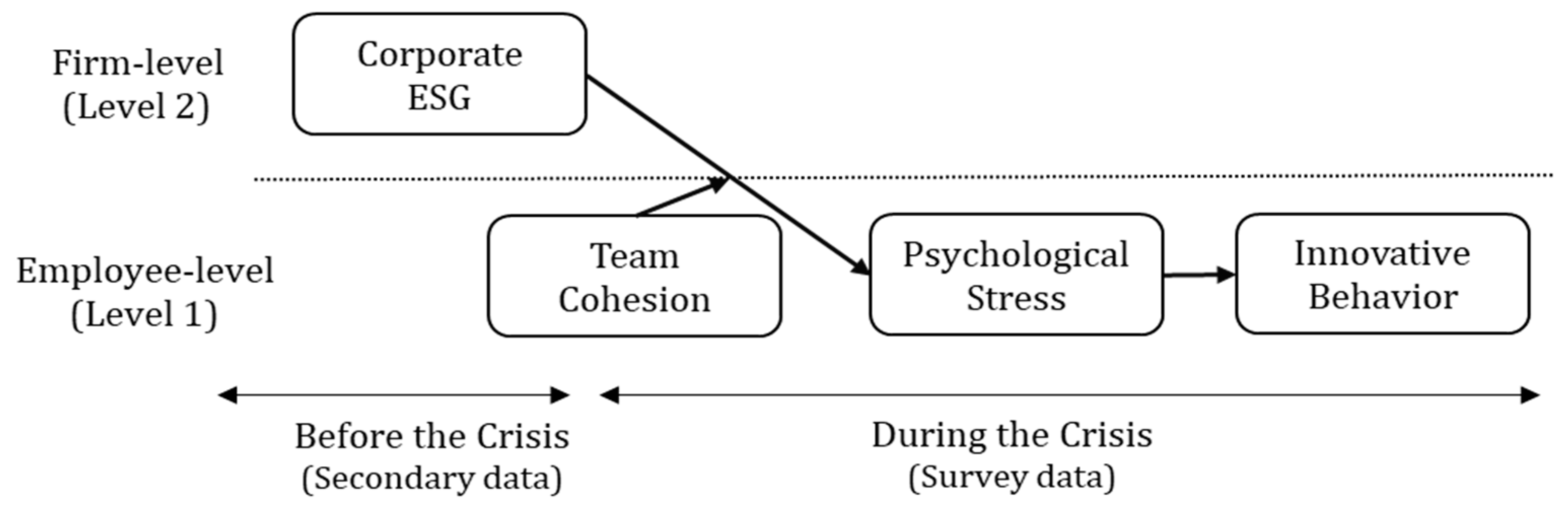
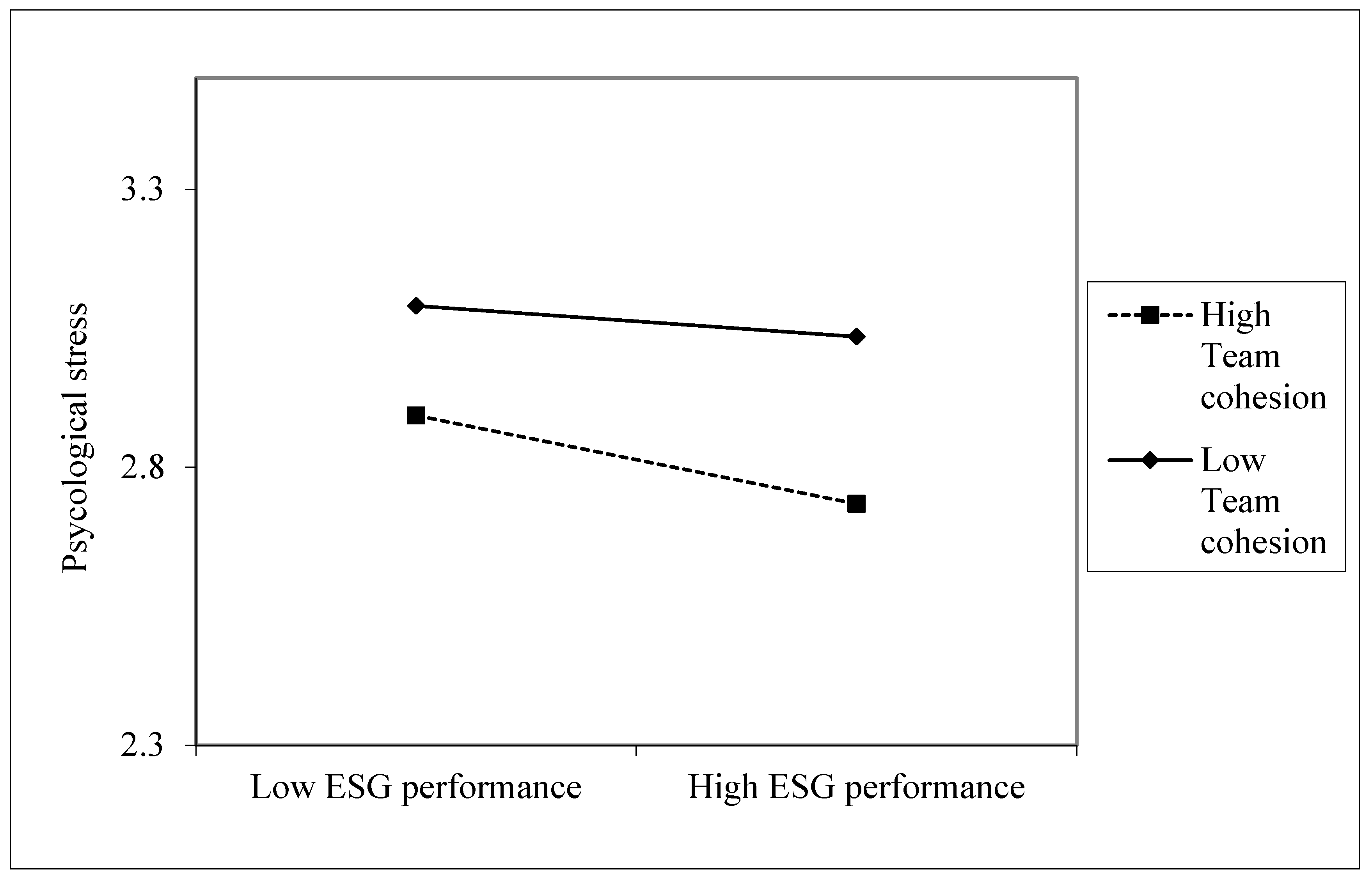
Building Resilience Through ESG: Evidence from Employees’ Stress and Innovation

Abstract
1. Introduction
2. Theoretical Background and Hypotheses
2.1. Employee Innovative Behavior and ESG as Corporate Reputation in Crisis Situations
2.2. ESG, Employee Psychological Stress, and Innovative Behavior
2.3. Moderating Role of Team Cohesion
3. Methods
3.1. Data Collection
3.2. Measures
3.3. Analytical Approach
4. Results
4.1. Preliminary Analysis
4.2. Hypotheses Testing
5. Discussion
6. Conclusions
6.1. Implications for Practice
6.2. Limitations of Research and Future Research Directions
6.3. Overall Summary and Contributions
Funding
Institutional Review Board Statement
Informed Consent Statement
Data Availability Statement
Conflicts of Interest
References
- Galbreath, J. ESG in Focus: The Australian Evidence. J. Bus. Ethics 2013, 118, 529–541. [Google Scholar] [CrossRef]
- Duque-Grisales, E.; Aguilera-Caracuel, J. Environmental, Social and Governance (ESG) Scores and Financial Performance of Multilatinas: Moderating Effects of Geographic International Diversification and Financial Slack. J. Bus. Ethics 2021, 168, 315–334. [Google Scholar] [CrossRef]
- Zervoudi, E.K.; Moschos, N.; Christopoulos, A.G. From Corporate Social Responsibility (CSR) and Environmental, Social and Governance (ESG) Criteria to the Greenwashing Phenomenon: A Comprehensive Literature Review of Causes, Consequences, and Solutions with Case Studies. Sustainability 2025, 17, 2222. [Google Scholar] [CrossRef]
- Carrettin, E.; Lawrenz, J. Corporate Sustainability Through Employees’ Eyes: Internal-External (Mis)Alignment and Ethical Authenticity. SSRN Electron. J. 2025. Available online: https://ssrn.com/abstract=5241854 (accessed on 1 January 2026).
- Itan, I.; Sylvia, S.; Septiany, S.; Chen, R. The Influence of Environmental, Social, and Governance Disclosure on Market Reaction: Evidence from Emerging Markets. Discov. Sustain. 2025, 6, 347. [Google Scholar] [CrossRef]
- Van Duuren, E.; Plantinga, A.; Scholtens, B. ESG Integration and the Investment Management Process: Fundamental Investing Reinvented. J. Bus. Ethics 2016, 138, 525–533. [Google Scholar] [CrossRef]
- Carnini Pulino, S.; Ciaburri, M.; Magnanelli, B.S.; Nasta, L. Does ESG Disclosure Influence Firm Performance? Sustainability 2022, 14, 7595. [Google Scholar] [CrossRef]
- Herman, A.; Oplotnik, Ž.J.; Jagrič, T. The Impact of ESG on Business Performance: An Empirical Analysis of NASDAQ–NYSE-Listed Companies. Sustainability 2025, 17, 9683. [Google Scholar] [CrossRef]
- Karoui, A.; Nguyen, D.K. Systematic ESG Exposure and Stock Returns: Evidence from the United States During the 1991–2019 Period. Bus. Ethics Environ. Responsib. 2022, 31, 604–619. [Google Scholar] [CrossRef]
- Zhang, L.S. The Impact of ESG Performance on the Financial Performance of Companies: Evidence from China’s Shanghai and Shenzhen A-Share Listed Companies. Front. Environ. Sci. 2025, 13, 1507151. [Google Scholar] [CrossRef]
- Zhou, S.; Rashid, M.H.U.; Mohd Zobair, S.A.; Sobhani, F.A.; Siddik, A.B. Does ESG Impact Firms’ Sustainability Performance? The Mediating Effect of Innovation Performance. Sustainability 2023, 15, 5586. [Google Scholar] [CrossRef]
- Lee, C.C.; Luppi, J.L.; Simmons, T.; Tran, B.; Zhang, R. Examining the Impacts of ESG on Employee Retention: A Study of Generational Differences. J. Bus. Manag. 2023, 29, 1–22. [Google Scholar] [CrossRef]
- Zhang, T.; Zhang, J.; Tu, S. An Empirical Study on Corporate ESG Behavior and Employee Satisfaction: A Moderating Mediation Model. Behav. Sci. 2024, 14, 274. [Google Scholar] [CrossRef]
- Bakker, A.B.; Demerouti, E. The Job Demands–Resources Model: State of the Art. J. Manag. Psychol. 2007, 22, 309–328. [Google Scholar] [CrossRef]
- Hobfoll, S.E. The Influence of Culture, Community, and the Nested-Self in the Stress Process: Advancing Conservation of Resources Theory. Appl. Psychol. 2001, 50, 337–421. [Google Scholar] [CrossRef]
- Rupp, D.E.; Shao, R.; Thornton, M.A.; Skarlicki, D.P. Applicants’ and Employees’ Reactions to Corporate Social Responsibility: The Moderating Effects of First-party Justice Perceptions And Moral Identity. Pers. Psychol. Organ. Behav. Hum. Decis. Process. 2013, 66, 895–933. [Google Scholar] [CrossRef]
- Lins, K.V.; Servaes, H.; Tamayo, A. Social Capital, Trust, and Corporate Performance: How CSR Helped Companies During the Financial Crisis (and Why It Can Keep Helping Them). J. Appl. Corp. Financ. 2019, 31, 59–71. [Google Scholar] [CrossRef]
- Filippetti, A.; Archibugi, D. Innovation in Times of Crisis: National Systems of Innovation, Structure, and Demand. Res. Policy 2011, 40, 179–192. [Google Scholar] [CrossRef]
- Alarifi, G.; Adam, N.A. The Role of Participatory Leadership and Employee Innovative Behavior on SMEs’ Endurance. Sustainability 2023, 15, 2740. [Google Scholar] [CrossRef]
- Salem, N.H.; Ishaq, M.I.; Yaqoob, S.; Raza, A.; Zia, H. Employee Engagement, Innovative Work Behaviour, and Employee Wellbeing: Do Workplace Spirituality and Individual Spirituality Matter? Bus. Ethics Environ. Responsib. 2023, 32, 657–669. [Google Scholar] [CrossRef]
- Janssen, O. Job Demands, Perceptions of Effort–Reward Fairness and Innovative Work Behaviour. J. Occup. Organ. Psychol. 2000, 73, 287–302. [Google Scholar] [CrossRef]
- Scott, S.G.; Bruce, R.A. Determinants of Innovative Behavior: A Path Model of Individual Innovation in the Workplace. Acad. Manag. J. 1994, 37, 580–607. [Google Scholar] [CrossRef]
- Parker, S.K.; Williams, H.M.; Turner, N. Modeling the Antecedents of Proactive Behavior at Work. J. Appl. Psychol. 2006, 91, 636. [Google Scholar] [CrossRef]
- Anderson, N.; De Dreu, C.K.W.; Nijstad, B.A. The Routinization of Innovation Research: A Constructively Critical Review of the State-of-the-Science. J. Organ. Behav. 2004, 25, 147–173. [Google Scholar] [CrossRef]
- Baer, M.D.; Bundy, J.; Garud, N.; Kim, J.K. The Benefits and Burdens of Organizational Reputation for Employee Well-Being: A Conservation of Resources Approach. Pers. Psychol. 2018, 71, 571–595. [Google Scholar] [CrossRef]
- Wilson, R. Reputations in Games and Markets. In Game-Theoretic Models of Bargaining; Cambridge University Press: Cambridge, UK, 1985; pp. 27–62. [Google Scholar] [CrossRef]
- Jensen, M.; Kim, H.; Kim, B.K. Meeting Expectations: A Role-Theoretic Perspective on Reputation. In The Oxford Handbook of Corporate Reputation; Oxford University Press: Oxford, UK, 2012; pp. 140–159. [Google Scholar]
- Jensen, M.; Roy, A. Staging Exchange Partner Choices: When Do Status and Reputation Matter? Acad. Manag. J. 2008, 51, 495–516. [Google Scholar] [CrossRef]
- Saxton, T.; Dollinger, M. Target Reputation and Appropriability: Picking and Deploying Resources in Acquisitions. J. Manag. 2004, 30, 123–147. [Google Scholar] [CrossRef]
- Turban, D.B.; Cable, D.M. Firm Reputation and Applicant Pool Characteristics. J. Organ. Behav. 2003, 24, 733–751. [Google Scholar] [CrossRef]
- Cable, D.M.; Turban, D.B. The Value of Organizational Reputation in the Recruitment Context: A Brand-Equity Perspective. J. Appl. Soc. Psychol. 2003, 33, 2244–2266. [Google Scholar] [CrossRef]
- Carmeli, A.; Gilat, G.; Weisberg, J. Perceived External Prestige, Organizational Identification and Affective Commitment: A Stakeholder Approach. Corp. Reput. Rev. 2006, 9, 92–104. [Google Scholar] [CrossRef]
- Mishra, S.K. Perceived External Prestige and Employee Outcomes: Mediation Effect of Organizational Identification. Corp. Reput. Rev. 2013, 16, 220–233. [Google Scholar] [CrossRef]
- Capelle-Blancard, G.; Petit, A. Every Little Helps? ESG News and Stock Market Reaction. J. Bus. Ethics 2019, 157, 543–565. [Google Scholar] [CrossRef]
- Murè, P.; Spallone, M.; Mango, F.; Marzioni, S.; Bittucci, L. ESG and Reputation: The Case of Sanctioned Italian Banks. Corp. Soc. Responsib. Environ. Manag. 2021, 28, 265–277. [Google Scholar] [CrossRef]
- Stern, I.; Dukerich, J.M.; Zajac, E. Unmixed Signals: How Reputation and Status Affect Alliance Formation. Strateg. Manag. J. 2014, 35, 512–531. [Google Scholar] [CrossRef]
- Lazarus, R.S.; Folkman, S. Cognitive Theories of Stress and the Issue of Circularity. In Dynamics of Stress; Plenum Press: New York, NY, USA, 1986; pp. 63–80. [Google Scholar]
- International Labour Organization. An Employers’ Guide on Working from Home in Response to the Outbreak of COVID-19; International Labour Organization: Geneva, Switzerland, 2020. [Google Scholar]
- Hobfoll, S.E. Conservation of Resources: A New Attempt at Conceptualizing Stress. Am. Psychol. 1989, 44, 513–524. [Google Scholar] [CrossRef] [PubMed]
- Hobfoll, S.E.; Spielberger, C.D. Family Stress: Integrating Theory and Measurement. J. Fam. Psychol. 1992, 6, 99. [Google Scholar] [CrossRef]
- Tajfel, H.; Turner, J. The Social Identity of Intergroup Behavior. In Psychology and Intergroup Relations; Nelson-Hall: Chicago, IL, USA, 1986; pp. 7–24. [Google Scholar]
- Baer, M.D.; Dhensa-Kahlon, R.K.; Colquitt, J.A.; Rodell, J.B.; Outlaw, R.; Long, D.M. Uneasy Lies the Head that Bears the Trust: The Effects of Feeling Trusted on Emotional Exhaustion. Acad. Manag. J. 2015, 58, 1637–1657. [Google Scholar] [CrossRef]
- Hayes, C.T.; Weathington, B.L. Optimism, Stress, Life Satisfaction, and Job Burnout in Restaurant Managers. J. Psychol. 2007, 141, 565–579. [Google Scholar] [CrossRef]
- Riolli, L.; Savicki, V. Optimism and Coping as Moderators of the Relation Between Work Resources and Burnout in Information Service Workers. Int. J. Stress Manag. 2003, 10, 235–252. [Google Scholar] [CrossRef]
- Lee, A.Y.P.; Wang, Y.H.; Yang, F.R. Feeling Exhausted? Let’s Play—How Play in Work Relates to Experienced Burnout and Innovation Behaviors. Appl. Res. Qual. Life 2021, 16, 629–648. [Google Scholar] [CrossRef]
- Byron, K.; Khazanchi, S.; Nazarian, D. The Relationship Between Stressors and Creativity: A Meta-Analysis Examining Competing Theoretical Models. J. Appl. Psychol. 2010, 95, 201. [Google Scholar] [CrossRef]
- Cavanaugh, M.A.; Boswell, W.R.; Roehling, M.V.; Boudreau, J.W. An Empirical Examination of Self-Reported Work Stress Among U.S. Managers. J. Appl. Psychol. 2000, 85, 65–74. [Google Scholar] [CrossRef] [PubMed]
- Ren, F.; Zhang, J. Job Stressors, Organizational Innovation Climate, and Employees’ Innovative Behavior. Creat. Res. J. 2015, 27, 16–23. [Google Scholar] [CrossRef]
- Tekleab, A.G.; Quigley, N.R.; Tesluk, P.E. A Longitudinal Study of Team Conflict, Conflict Management, Cohesion, and Team Effectiveness. Group Organ. Manag. 2009, 34, 170–205. [Google Scholar] [CrossRef]
- Grzywacz, J.G.; Carlson, D.S.; Kacmar, K.M.; Wayne, J.H. A Multi-Level Perspective on the Synergies between Work and Family. J. Occup. Organ. Psychol. 2007, 80, 559–574. [Google Scholar] [CrossRef]
- Carron, A.V.; Brawley, L.R.; Widmeyer, W.N. The Measurement of Cohesiveness in Sport Groups. In Advances in Sport and Exercise Psychology Measurement; Fitness Information Technology, Inc.: Logan, UT, USA, 1998; pp. 213–226. [Google Scholar]
- Kozlowski, S.W.J.; Ilgen, D.R. Enhancing the Effectiveness of Work Groups and Teams. Psychol. Sci. Public Interest 2006, 7, 77–124. [Google Scholar] [CrossRef] [PubMed]
- Hunter, E.M.; Perry, S.J.; Carlson, D.S.; Smith, S.A. Linking Team Resources to Work–Family Enrichment and Satisfaction. J. Vocat. Behav. 2010, 77, 304–312. [Google Scholar] [CrossRef]
- Barrick, M.R.; Stewart, G.L.; Neubert, M.J.; Mount, M.K. Relating Member Ability and Personality to Work-Team Processes and Team Effectiveness. J. Appl. Psychol. 1998, 83, 377. [Google Scholar] [CrossRef]
- Mach, M.; Dolan, S.; Tzafrir, S. The Differential Effect of Team Members’ Trust on Team Performance: The Mediation Role of Team Cohesion. J. Occup. Organ. Psychol. 2010, 83, 771–794. [Google Scholar] [CrossRef]
- Weick, K.E. Sensemaking in Organizations; Sage: Thousand Oaks, CA, USA, 1995. [Google Scholar]
- Maitlis, S.; Christianson, M. Sensemaking in Organizations: Taking Stock and Moving Forward. Acad. Manag. Ann. 2014, 8, 57–125. [Google Scholar] [CrossRef]
- Chang, E.; Chin, H.; Lee, J.W. Pre-crisis commitment human resource management and employees’ attitudes in a global pandemic: The role of trust in the government. Hum. Resour. Manag. 2022, 61, 373–387. [Google Scholar] [CrossRef]
- Cohen, S.; Kamarck, T.; Mermelstein, R. A Global Measure of Perceived Stress. J. Health Soc. Behav. 1983, 24, 385–396. [Google Scholar] [CrossRef]
- Seers, A. Team-Member Exchange Quality: A New Construct for Role-Making Research. Organ. Behav. Hum. Decis. Process. 1989, 43, 118–135. [Google Scholar] [CrossRef]
- Huang, F.L. Multilevel Modeling Myths. Sch. Psychol. Q. 2018, 33, 492. [Google Scholar] [CrossRef]
- Musca, S.C.; Kamiejski, R.; Nugier, A.; Méot, A.; Er-Rafiy, A.; Brauer, M. Data with Hierarchical Structure: Impact of Intraclass Correlation and Sample Size on Type-I Error. Front. Psychol. 2011, 2, 74. [Google Scholar] [CrossRef]
- Preacher, K.J.; Zhang, Z.; Zyphur, M.J. Alternative Methods for Assessing Mediation in Multilevel Data: The Advantages of Multilevel SEM. Struct. Equ. Model. 2011, 18, 161–182. [Google Scholar] [CrossRef]
- Richman, P. How to Make Safety Core to Your Company’s ESG Efforts. Prof. Saf. 2024, 69, 16–18. [Google Scholar]
- Gond, J.P.; El Akremi, A.; Swaen, V.; Babu, N. The Psychological Microfoundations of Corporate Social Responsibility: A Person-Centric Systematic Review. J. Organ. Behav. 2017, 38, 225–246. [Google Scholar] [CrossRef]
- Yu, E.P.Y.; Van Luu, B.; Chen, C.H. Greenwashing in Environmental, Social and Governance Disclosures. Res. Int. Bus. Financ. 2020, 52, 101192. [Google Scholar] [CrossRef]
- Gangi, F.; Meles, A.; Monferrà, S.; Mustilli, M. Does Corporate Social Responsibility Help the Survivorship of SMEs and Large Firms? Glob. Financ. J. 2020, 43, 100402. [Google Scholar] [CrossRef]
- Amabile, T.M.; Hadley, C.N.; Kramer, S.J. Creativity Under the Gun. Harv. Bus. Rev. 2002, 80, 52–63. [Google Scholar] [PubMed]
- Beal, D.J.; Cohen, R.R.; Burke, M.J.; McLendon, C.L. Cohesion and Performance in Groups: A Meta-Analytic Clarification of Construct Relations. J. Appl. Psychol. 2003, 88, 989–1004. [Google Scholar] [CrossRef] [PubMed]



| Variable | M | SD | 1 | 2 | 3 | 4 |
|---|---|---|---|---|---|---|
| Level 1 variables | ||||||
| 1. Age | 37.44 | 7.25 | ||||
| 2. Education level | 3.14 | 0.59 | 0.24 ** | |||
| 3. Psychological stress | 2.87 | 0.80 | −0.04 | −0.08 ** | ||
| 4. Innovative behavior | 3.41 | 0.81 | 0.16 ** | 0.18 ** | −0.15 ** | |
| 5. Team cohesion | 3.66 | 0.82 | 0.05 | 0.04 | −0.21 ** | 0.20 ** |
| Level 2 variables | ||||||
| 1. Firm size (log) | 15.36 | 1.33 | ||||
| 2. ESG performance | 3.49 | 0.90 | 0.26 + |
| DV: Psychological Stress | DV: Innovative Behavior | |||||
|---|---|---|---|---|---|---|
| Model 1 | Model 2 | Model 3 | Model 4 | Model 5 | Model 6 | |
| Level 1 variables | ||||||
| Age | −0.01 (0.00) | −0.01 (0.00) | −0.01 (0.00) | 0.02 *** (0.00) | 0.02 *** (0.00) | 0.02 *** (0.00) |
| Education level | −0.11 * (0.05) | −0.11 * (0.05) | −0.10 * (0.05) | 0.19 ** (0.06) | 0.18 ** (0.06) | 0.18 ** (0.06) |
| Psychological stress | −0.12 ** (0.03) | −0.13 *** (0.03) | ||||
| Team cohesion | −0.18 *** (0.03) | |||||
| Level 2 variables | ||||||
| Firm size (log) | −0.05 (0.03) | −0.05 (0.04) | 0.00 (0.02) | −0.01 (0.02) | −0.01 (0.02) | 0.02 (0.02) |
| ESG performance | −0.10 *** (0.03) | 0.12 (0.09) | −0.05 (0.03) | |||
| ESG performance × Team cohesion | −0.07 ** (0.03) | |||||
| Within-level residual variance | 0.61 *** (0.03) | 0.61 *** (0.03) | 0.58 *** (0.03) | 0.62 *** (0.04) | 0.61 *** (0.04) | 0.61 *** (0.04) |
| Between-level residual variance | 0.01 (0.01) | 0.01 (0.01) | 0.00 (0.07) | 0.01 (0.01) | −0.00 (0.01) | 0.00 (0.01) |
| Route | Boot Coefficient | Boot SE | 95% Confidence Interval | |
|---|---|---|---|---|
| LLCI | ULCI | |||
| ESG performance → Psychological stress → Innovation behavior | 0.107 | 0.022 | 0.005 | 0.208 |
| Hypothesis | Relationship | Result | Supported |
|---|---|---|---|
| H1 | ESG → Stress | b = −0.10 *** | Yes |
| H2 | Stress → Innovation | b = −0.21 ** | Yes |
| H3 | ESG → Stress → Innovation | Indirect effect significant | Yes |
| H4 | ESG × Team Cohesion → Stress | b = −0.07 ** | Yes |
Disclaimer/Publisher’s Note: The statements, opinions and data contained in all publications are solely those of the individual author(s) and contributor(s) and not of MDPI and/or the editor(s). MDPI and/or the editor(s) disclaim responsibility for any injury to people or property resulting from any ideas, methods, instructions or products referred to in the content. |
© 2026 by the author. Licensee MDPI, Basel, Switzerland. This article is an open access article distributed under the terms and conditions of the Creative Commons Attribution (CC BY) license.
Share and Cite
Lee, J.W. Building Resilience Through ESG: Evidence from Employees’ Stress and Innovation. Sustainability 2026, 18, 2609. https://doi.org/10.3390/su18052609
Lee JW. Building Resilience Through ESG: Evidence from Employees’ Stress and Innovation. Sustainability. 2026; 18(5):2609. https://doi.org/10.3390/su18052609
Chicago/Turabian StyleLee, Jeong Won. 2026. "Building Resilience Through ESG: Evidence from Employees’ Stress and Innovation" Sustainability 18, no. 5: 2609. https://doi.org/10.3390/su18052609
APA StyleLee, J. W. (2026). Building Resilience Through ESG: Evidence from Employees’ Stress and Innovation. Sustainability, 18(5), 2609. https://doi.org/10.3390/su18052609