Article

Building Resilience Through ESG: Evidence from Employees’ Stress and Innovation

Department of Business Administration, Kyonggi University, Suwon 16227, Republic of Korea
Sustainability 2026, 18(5), 2609; https://doi.org/10.3390/su18052609
Submission received: 18 January 2026 / Revised: 4 March 2026 / Accepted: 5 March 2026 / Published: 6 March 2026
(This article belongs to the Section Economic and Business Aspects of Sustainability)

Abstract

Organizations increasingly rely on environmental, social, and governance (ESG) practices as a core element of sustainable management, yet little is known about how ESG affects employees during periods of crisis. Despite the growing ESG literature, limited research has examined how firm-level ESG performance influences employee psychological mechanisms and innovative behavior under crisis conditions through multi-level pathways. Drawing on corporate reputation theory and conservation of resources (COR) theory, this study examines how corporate ESG performance shapes employee experiences and behaviors under crisis conditions. This study conceptualizes ESG performance as a reputation-based organizational resource that buffers employees against psychological stress, thereby enabling innovative behavior that is critical for business sustainability. In addition, team cohesion as a contextual social resource was proposed to strengthen the stress-buffering effect of ESG. Using multi-level data from 980 employees nested within 51 large Korean firms, combined with objective ESG ratings collected prior to the crisis, this study tests the proposed model through multi-level structural equation modeling. The results show that higher corporate ESG performance is associated with lower employee psychological stress, which in turn promotes innovative behavior. Moreover, team cohesion amplifies the negative relationship between ESG performance and employee stress. By revealing a micro-level pathway through which ESG enhances employee well-being and innovation during crises, this study advances research on the economic and business aspects of sustainability.

1. Introduction

In recent years, sustainable management has emerged as a central concern for organizations seeking to balance economic performance with long-term social and environmental responsibility. Traditionally, for-profit firms emphasized shareholder value and treated social responsibility as a peripheral activity, often confined to corporate social responsibility (CSR) programs or philanthropic initiatives. However, growing societal expectations, regulatory pressures, and investor demands have pushed firms to integrate environmental, social, and governance (ESG) considerations into their core strategies [1,2]. Moreover, while CSR initiatives often emphasize discretionary philanthropic or ethical activities, ESG represents a more systematic and measurable framework that integrates environmental, social, and governance dimensions into core business operations [3]. This distinction is particularly important at the employee level because ESG performance is publicly rated and continuously monitored, making it more visible and credible to employees as a signal of organizational values and long-term commitment, whereas CSR activities may be perceived as episodic or symbolic [4]. As a result, ESG has evolved into a dominant framework through which organizations pursue sustainable value creation and organizational legitimacy [5,6].
Despite the rapid diffusion of ESG-oriented management practices, academic research on ESG remains uneven. Much of the existing literature has concentrated on firm-level outcomes, such as financial performance, risk reduction, or market valuation, and has primarily addressed the perspectives of external stakeholders, including investors, regulators, and customers [2,7,8,9,10,11]. While this stream of research has demonstrated that ESG performance can be associated with favorable financial and reputational outcomes, it provides limited insight into how ESG affects employees, who are critical internal stakeholders and primary agents of sustainable management. Notably, only a small number of recent studies have begun to examine the implications of ESG for employee-related outcomes. For example, Lee et al. [12] investigate the relationship between ESG performance and employee retention, highlighting generational differences, while Zhang et al. [13] examine how corporate ESG behavior influences employee satisfaction. Although these studies offer important initial evidence, research on the internal, employee-level mechanisms through which ESG contributes to organizational sustainability remains scarce. Because organizational sustainability ultimately depends on employees’ behaviors, motivation, and well-being, a deeper understanding of the internal consequences of ESG performance is essential.
In addition, ESG-related practices may also shape employees’ sense of psychological safety and perceived protection at work, which constitutes an important dimension of employee well-being and work effectiveness, particularly during crises. Beyond economic and reputational considerations, ESG-related practices may also influence employees’ perceptions of safety and protection within the organization. Sustainable organizational development increasingly emphasizes not only environmental responsibility and governance transparency but also the creation of a safe and supportive work environment for employees. In particular, during crisis situations characterized by heightened uncertainty, employees’ perceptions of psychological safety and organizational protection become critical for maintaining well-being and work effectiveness. Prior research suggests that ethical governance, responsible organizational practices, and supportive organizational climates can enhance employees’ perceptions of psychological safety and trust within organizations [14,15,16]. ESG engagement may therefore signal that the organization is committed to responsible governance, employee welfare, and long-term stability, thereby strengthening employees’ sense of protection and reducing perceived vulnerability during turbulent periods. Although the present study focuses primarily on psychological safety rather than operational safety, ESG engagement may signal broader organizational responsibility and protection mechanisms that contribute to employees’ perceived security and stability during crisis situations.
An additional limitation of prior ESG research is its predominant focus on relatively stable business environments. In practice, organizations increasingly operate under conditions of persistent uncertainty and recurring crises, such as global pandemics, financial instability, and climate-related disruptions. A few studies suggest that ESG may play a significant role in corporate crisis situations. For example, Lins and colleagues [17] show that during the 2008–2009 global financial crisis, when market-wide corporate trust declined sharply, firms with high ESG performance exhibited higher firm value, stronger growth, and greater employee productivity. These findings suggest that, in times of crisis, both internal and external stakeholders provide greater support and place higher value on firms that actively pursue social value and sustainability. Despite this evidence, empirical research on the role of ESG in crisis contexts remains limited. Accordingly, examining whether and how firms can manage crises more effectively through ESG engagement has important implications for both academic research and managerial practice.
In sum, despite the growing body of ESG research, three important gaps remain. First, most prior studies have concentrated on firm-level financial or market outcomes, providing limited understanding of how ESG influences employees, who are critical internal stakeholders. Second, existing research has rarely examined ESG effects under crisis conditions, where psychological resource loss and uncertainty are heightened. Third, few studies have investigated the multi-level mechanisms linking firm-level ESG performance to employee behavioral outcomes. Building on these observations, this study investigates whether and how corporate ESG performance contributes to sustainable management at the employee level during a crisis. This study focuses on employee innovative behavior as a key outcome because innovation is widely recognized as essential for organizational adaptation and long-term sustainability under turbulent conditions [18]. Drawing on corporate reputation theory and conservation of resources (COR) theory, this study suggests that ESG performance functions as a form of positive corporate reputation that provides employees with valuable psychological resources in times of crisis. These resources reduce employees’ psychological stress and enable them to engage more actively in innovative behavior. Furthermore, this study proposes that team cohesion serves as an important social resource that strengthens the stress-buffering effect of corporate ESG. By empirically examining these relationships using multi-level data collected during the COVID-19 crisis, this study contributes to the sustainable management literature and offers practical insights for organizations seeking to enhance resilience through ESG-oriented strategies.

2. Theoretical Background and Hypotheses

2.1. Employee Innovative Behavior and ESG as Corporate Reputation in Crisis Situations

Workplace innovation is regarded as essential to being competitive in today’s corporate environment, where changes are rapid and unpredictable. In particular, the importance of innovation is further emphasized in an uncertain crisis [18]. However, in order for such corporate innovation to be successful, the daily innovation efforts of individual members to devise and realize new and useful ideas, or employee innovative behaviors, are critical [19,20,21,22]. In other words, the level of organizational innovation can be increased according to how much corporate members engage in innovative behavior [22]. Innovative behavior is a concept that includes two dimensions: the creation of a new idea (idea generation) and the implementation/realization of the created idea. That is, innovation can only occur when employees recognize a problem, develop an idea to solve it, gain support, apply it to their work or organization, and realize it. Therefore, innovative behavior is a more self-directed, change- and improvement-oriented behavior compared with other types of employee behaviors [22,23]. Moreover, since the process of innovation is a very complex task and requires a lot of time and effort to produce results, employees need a lot of energy and resources to perform a high level of innovative behavior [24].
Corporate reputation refers to a general perception of the likeability and attractiveness of an organization [25], and people form expectations about the future performance of the organization related to its characteristics or activities based on the specific reputation of the company [26,27]. Thus, a positive reputation becomes an asset to an organization, and empirical research shows that the higher a company’s reputation, the higher the price it can charge for its products and the better it can attract suppliers and partners [28,29]. Corporate reputation studies also suggest that the benefits of positive organizational reputation can extend to the individual level, for example, showing that companies with good reputations attract excellent applicants, and even if salaries are low, applicants are likely to join the company [30,31]. A positive perception of organizational reputation was found to affect the attitudes and behavior of employees as well. In a company with a high reputation, employees’ organizational commitment and performance were high, and turnover intention decreased [32,33].
This study investigates the effect of ESG performance on employees’ innovation behavior, expecting that corporate ESG performance will serve as an important corporate reputation related to corporate sustainability even in a crisis. In previous studies, corporate ESG performance has been used as one of the essential ingredients of corporate reputation, but it has been mainly studied at the company level. For example, research questions mainly studied in previous studies were about how corporate performance, corporate value, and stock market response vary depending on the ESG reputation level [34,35]. However, as mentioned earlier, since corporate reputation can also affect employees [32,33], the influence of ESG performance as a reputation needs to be identified at the employee level. In particular, the effect of reputation becomes very important in an uncertain situation [36], and, thus, it will be especially meaningful to identify the implications of ESG performance for employees in a crisis situation.

2.2. ESG, Employee Psychological Stress, and Innovative Behavior

Then, how can ESG performance as a corporate reputation in a crisis influence employees’ innovative behavior? In this study, ESG performance is expected to function as an organizational resource that reduces employees’ psychological stress and ultimately enhances their innovative behavior. Psychological stress refers to an individual’s response to external demands that exceed available resources [37]. While organizational research has traditionally focused on job stress, crisis situations such as COVID-19 intensify both personal and work-related stress, making overall psychological stress a more appropriate construct. Empirical evidence also indicates increased depression and emotional strain among employees during the pandemic [38]. Prior studies further demonstrate that employee stress plays a critical mediating role in translating organizational contexts into behavioral outcomes [14,15]. Stress directly reflects perceived resource loss and emotional depletion—such as central mechanisms in COR theory—and, compared with broader constructs such as organizational identification or trust, represents a more immediate psychological state influencing cognitive flexibility and energy available for innovative behavior. Accordingly, psychological stress was selected as the mediating variable in this study.
Drawing on COR theory, this study explains the relationship between ESG performance, employee stress, and innovative behavior. COR theory posits that individuals strive to acquire, maintain, and protect valued resources, and stress occurs when these resources are threatened or lost [15,39]. In organizational settings, such resources include financial stability, job security, motivation, and positive emotional states. The theory further suggests that resource loss has a stronger psychological impact than resource gain and that crises intensify both the likelihood and consequences of such loss [40]. The COVID-19 pandemic, for instance, created widespread disruptions in employment stability and social relations, thereby heightening employees’ vulnerability to stress.
From a sustainable management perspective, employee safety extends beyond physical protection to include psychological safety and perceived organizational support. Organizational practices that demonstrate ethical governance, social responsibility, and employee care can enhance employees’ perceptions of safety and stability within the organization. These perceptions become particularly salient during crises when individuals experience heightened uncertainty and potential resource loss. In such contexts, organizational signals associated with responsible governance and social commitment can function as psychological safety cues that reassure employees and reduce perceived vulnerability [13,14,15,39].
Within this framework, ESG performance can be interpreted as a reputational resource that provides psychological stability to employees. Beyond stress reduction, ESG-related signals may also enhance employees’ sense of psychological safety and stability, which further supports their capacity to cope with uncertainty. A positive ESG-based reputation enhances organizational identification and pride, as employees tend to value affiliation with socially respected organizations [41]. Such identification increases perceived resource availability—such as optimism and confidence in job stability—and supports emotional energy for daily work activities [42,43,44]. Consequently, ESG-driven corporate reputation is expected to alleviate emotional fatigue and reduce psychological stress, thereby creating favorable conditions for innovative behavior. Based on this reasoning, the following hypothesis was established.
Hypothesis 1.
During a crisis, employees in organizations with higher ESG performance will experience lower levels of psychological stress.
Meanwhile, the innovation literature suggests that psychological states such as fatigue and exhaustion play a critical role in employees’ failure to engage in innovative efforts [45], as innovative behavior inherently involves higher cognitive and emotional demands than routine job performance. Consistent with COR theory, employees experiencing heightened stress tend to conserve their remaining resources rather than invest them in discretionary activities such as innovation [15]. Consequently, when psychological stress increases in crisis situations, employees are more likely to reduce their innovative efforts in order to preserve emotional and cognitive energy.
Although relatively few studies have directly examined the relationship between psychological stress and innovative behavior, research on job-related stress provides useful insights. In general, stress is expected to negatively affect individuals, yet prior findings indicate that its effects on innovation can be mixed. A negative perspective argues that stressful conditions reduce cognitive flexibility and hinder creative idea generation [46]. In contrast, a positive perspective suggests that moderate levels of stress may stimulate problem-solving and adaptive motivation [24].
To reconcile these differing findings, recent studies have distinguished between challenge and hindrance stressors [47]. Challenge stressors, such as workload or time pressure, are often perceived as opportunities for growth, whereas hindrance stressors—such as role ambiguity, job insecurity, and organizational politics—are viewed as obstacles to goal attainment. Empirical research indicates that challenge stressors may enhance innovation, while hindrance stressors tend to suppress it [48]. Because the psychological stress examined in this study more closely resembles hindrance stressors, higher levels of stress are expected to reduce employees’ innovative behavior. Taken together, it was hypothesized that strong ESG performance during the COVID-19 crisis would lower employees’ psychological stress and, in turn, promote innovative behavior.
Hypothesis 2.
During a crisis, employees who experience lower levels of psychological stress will exhibit higher levels of innovative behavior.
Hypothesis 3.
During a crisis, organizational ESG performance will have an indirect effect on employee innovative behavior through psychological stress.

2.3. Moderating Role of Team Cohesion

Most of today’s organizations work in teams to achieve their business goals [49], and in the process, most employees frequently interact with other team members. Thus, teams can themselves provide an important social resource that helps individual career development [50]. One of the major social resources addressed in team research is team cohesion, which refers to the degree to which team members are united in pursuing a goal [51,52]. If the cohesiveness of the team is high, members show the characteristic of cooperating toward team and organizational goals, and they typically experience friendship or mutual trust with other team members [53]. According to previous studies, more cohesive teams can achieve more effective team performance [54,55].
This study proposes team cohesion as a contextual social resource that amplifies the stress-buffering role of firm-level ESG performance during crises. High cohesion is characterized by frequent communication, mutual trust, and shared commitment [40,49], which facilitates collective sensemaking under uncertainty [56,57]. In crisis situations, firm-level ESG performance functions as a distal reputational signal; however, employees may differ in whether they perceive this signal as credible and personally relevant. When team cohesion is high, employees are more likely to exchange information, discuss organizational cues, and converge on shared interpretations of the firm’s ESG commitment. This process increases the visibility and usability of ESG-based reputational resources as psychological protection, thereby strengthening the negative association between ESG performance and psychological stress. In contrast, when cohesion is low, limited trust and fragmented communication hinder sensemaking and reduce employees’ ability to convert ESG signals into proximal resources [15,42], weakening the stress-buffering effect of ESG. Therefore, I hypothesize that team cohesion strengthens (i.e., makes more negative) the relationship between corporate ESG performance and employees’ psychological stress during a crisis.
Hypothesis 4.
During a crisis, team cohesion will moderate the relationship between organizational ESG performance and employee psychological stress, such that the effect of ESG performance on reducing employee stress will be stronger for employees with higher levels of team cohesion.
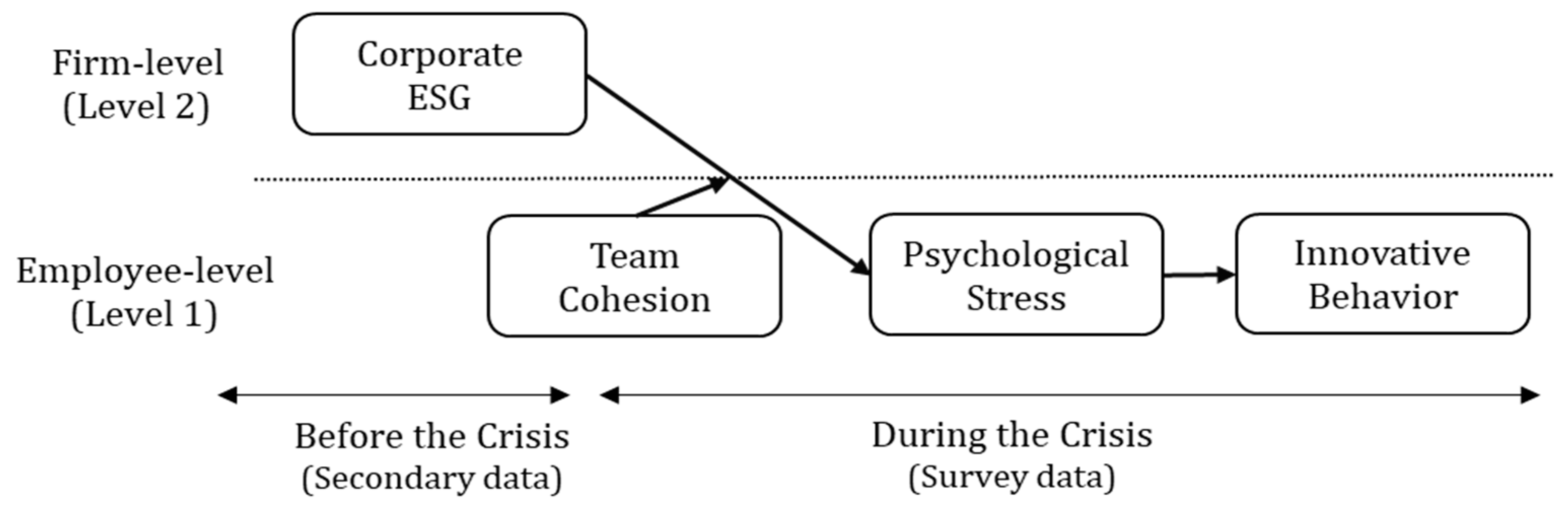
Figure 1 presents the conceptual framework of the study, illustrating the cross-level theoretical relationships among firm-level ESG performance, employee psychological stress, team cohesion, and innovative behavior. Team cohesion is depicted as a contextual social resource that strengthens the stress-buffering mechanism.

3. Methods

3.1. Data Collection

To test the hypotheses, data were collected from two sources of information: listed large companies with sales of more than 150 billion won and their employees. The condition of being a listed company was necessary to utilize externally disclosed objective data such as ESG ratings, and employee data were collected directly from the employee responses since one of the most suitable methods for measuring members’ social/psychological constructs is a survey. Specifically, in order to recruit companies and members to participate in the research, a research team contacted employees of large corporations by using the contact network of an alumnus from a business school in Seoul and the researchers’ professional networks. A total of 52 companies wished to participate, and one company was excluded from the study because no objective ESG performance index was publicly available. Next, a survey was conducted in mid-2020 when COVID-19 transmission rates were at their highest with employees from each company, using variables of psychological stress, innovative behavior, team cohesion, and demographic characteristics. Part of this survey data (different variables) was used in another study [58]. Finally, ESG performance data were drawn from 2019, the year preceding the COVID-19 outbreak, for 51 companies.
All procedures of the survey targeting employees complied with the IRB guidelines. The contents and procedure of the survey were explained to the representative employees of each company, and when they agreed to participate in the study, they were asked to distribute the survey to their colleagues in the same company. Voluntary participation and confidentiality were announced to all participants, and only those who agreed to and signed the informed consent form were allowed to participate in the survey. In addition, a 5000-won coffee coupon was provided as a reward for participation.
A total of 1003 employees from 51 companies participated, and the average number of employees per company was 24.1. As a result of excluding those who worked for less than 6 months and insincere responses, data from 980 employees were used for the analysis. According to the demographic characteristics of the survey participants, about 36.5% were women and the average age was 37. In addition, 91.1 percent of the participants received more than 4 years of university education, and the average tenure was 12.7 years. The average sales of 51 companies were about 1.2 trillion won.

3.2. Measures

The scales used in the survey were originally developed and validated in previous studies. All items were measured on 5-point Likert-type scales with anchors of 1 (strongly disagree), 3 (neutral), and 5 (strongly agree) unless otherwise stated.
Innovative behavior. Innovative behavior was measured using Scott and Bruce’s scale [22]. Items related to idea development include “I come up with new ideas for difficult issues”; “I find new ways of working, including new techniques and tools”; “I find original solutions to problems”; and “I develop my ideas to be useful” (regarding the realization of ideas). The internal consistency reliability was 0.97.
Psychological stress. Psychological stress was measured using a scale developed by Cohen, Kamarchk, and Mermelstein [59]. Based on the respondents’ experience over the past month, the following questions were asked: “I was embarrassed by unexpected things,” “I couldn’t make decisions about important things in life,” “I felt anxious and stressed,” “I was angry that inevitable things happened,” and “I felt that there were many obstacles that were difficult to overcome.” Internal consistency reliability was 0.87.
Team cohesion. Team cohesion was measured using a scale developed by Seers [60]. Items included “Our team members trust each other,” “Our teamwork is strong,” and “Communication between team members is good.” Although team cohesion is conceptually rooted at the group level, the present study focuses on employees’ perceived team cohesion rather than aggregated team-level scores. Measuring perceived team cohesion at the individual level allows capturing employees’ proximal social resource perception, which is particularly relevant during crises when subjective interpretations of team support can be more influential than objective team characteristics. Such perceptions reflect the extent to which employees personally experience solidarity, trust, and communication quality within their teams, thereby directly shaping their emotional and cognitive resource availability. Prior research suggests that individual perceptions of team-level characteristics can meaningfully influence individual attitudes and behaviors, especially under conditions of uncertainty and environmental turbulence. The internal consistency reliability of the scale was 0.92.
ESG performance. For the corporate ESG performance variable, the official ESG ratings from the Korea Corporate Governance Service (KCGS) were used (http://www.cgs.or.kr/business/esg_tab04.jsp (accessed on 12 January 2021). Several ESG indicators are used in ESG research for Korean companies, but the KCGS ESG is the most widely used because it evaluates all 700 listed companies every year and has the advantage of being able to investigate changes in ESG performance for the same company. Therefore, in this study, the ESG evaluation index of KCGS ESG was adopted. The KCGS evaluation evaluates the ESG activities of each company using 7 grades, S, A+, A, B+, B, C, and D, and, in this study, the ordinal ESG grades were converted into a 6-point numerical scale to enable quantitative multi-level analysis while preserving relative performance differences. Specifically, 1 point was given to each grade based on 0 points in the D grade (S = 6 points, A+ = 5 points, A = 4 points, B+ = 3, B = 2, C = 1, D = 0). All 51 companies in this study were found to be distributed between A+ and C grades.
Control variables. Following previous research, variables that may affect the dependent variable were selected as control variables and were included in the analysis. At the individual level, employee age and education level were controlled to account for their potential effects on innovative behavior. At the company level, the impact of COVID-19 on corporate sales may differ, and this may affect employees’ perceptions and experiences at work. Thus, firm sales, a representative indicator of company size, were controlled. Education level was coded with five levels (high school = 1, college = 2, undergraduate = 3, master’s degree = 4, PhD = 5), and each firm’s sales for the first half of 2020 were measured with data from the Korean Financial Supervisory Service. These controls may be associated with key predictors and mechanisms in the model. For example, larger firms often have more formalized governance structures, dedicated sustainability teams, and disclosure capacity, which can be reflected in externally assessed ESG ratings, consistent with the positive correlation between firm size and ESG performance observed in Table 1. In addition, employee age and education may be related not only to innovative behavior but also to stress experiences and access to coping resources during crises (e.g., role demands, job security perceptions, and coping skills), which aligns with the correlations reported in Table 1. Therefore, these variables were included to reduce potential omitted-variable concerns by accounting for factors that may covary with both the outcomes and parts of the explanatory pathway.

3.3. Analytical Approach

Both the hypotheses and data in this study have a multi-level structure of Level 2 and Level 1, and since the moderating effect hypothesis deals with interactions between companies and individual variables, it would be appropriate to perform a multi-level analysis. Multi-level analysis is a useful method for analyzing data structured into higher-level groups (here, companies) and lower-level individuals (here, employees). It assumes that the individual independence of a company is maintained at the corporate level, while the members within the company have the unique influence of each company. ICC(1) was calculated to confirm the appropriateness of multi-level analysis, and the value for innovative behavior was 0.03 and for psychological stress 0.03. Although the values imply that the variance at the company level is not very high, research suggests that if the ICC(1) value exists, the possibility of a Type I error increases. Thus, it is more desirable to proceed with a multi-level analysis that to consider the group effect [61,62]. In addition, structural equations modeling (SEM) can be an appropriate method for verifying the mediating effect through stress. Thus, in this study, the hypotheses were tested using multi-level structural equations modeling (MSEM) with Mplus version 8.3 [63].

4. Results

4.1. Preliminary Analysis

Table 1 shows the descriptive statistics of the variables and the results of correlation analysis. All individual-level control variables show a significant positive relationship with innovative behavior (age: r = 0.16, p < 0.01, education level: r = 0.18, p < 0.01). Firm size shows a marginally positive relationship with ESG performance (r = 0.26, p < 0.10). As for the main study variables, a negative relationship was found between employee psychological stress and innovative behavior (r = –0.15, p < 0.01).
Next, to confirm the validity of the multi-item variables (psychological stress, innovative behavior, and team cohesion), confirmatory factor analysis was performed on the three-factor model. All items were loaded significantly on their respective factor, and the factor loading values were 0.66 or higher. The fit index of the three-factor model was also found to be adequate: χ2(192) = 743.648 (p < 0.001), comparative fit index (CFI) = 0.938, Tucker–Lewis Index (TLI) = 0.933, root mean square error of approximation (RMSEA) = 0.054, and within-firms standardized root mean square residual (SRMR) = 0.036. The three-factor model also showed the best fit when compared with the alternative models in which two or three factors were integrated.
Common method bias was mitigated by using multiple data sources, as ESG performance was obtained from externally verified objective ratings rather than employee self-reports. In addition, confirmatory factor analysis supported discriminant validity among the key constructs, and the multi-level modeling approach further reduced the likelihood of single-source bias influencing cross-level relationships.

4.2. Hypotheses Testing

Next, the study hypotheses were tested, and the results are shown in Table 2. Models 1 and 5 included only control variables, with age and education level showing a negative relationship with psychological stress (age: b = −0.01, p < 0.10, education level: b = −0.18, p < 0.05) and a positive relationship with innovative behavior (age: b = 0.02, p < 0.001, education level: b = 0.18, p < 0.01). For hypotheses testing, a 2-1-1 type of multi-level structural equation model was specified and analyzed [62]. The overall model fit indices were found to be suitable for the data (χ2(4) = 5.551 (p >. 05), CFI = 0.983, TLI = 0.919, RMSEA = 0.020, SRMRwithin = 0.000, SRMRbetween = 0.113).
Hypothesis 1 predicted that employees of companies with high ESG performance would experience less stress during the COVID-19 crisis. Results showed that, as in Model 2 of Table 2, corporate ESG performance showed a negative relationship with psychological stress (b = −0.10, p < 0.001). Hypothesis 1 was thus supported. Although not hypothesized, team cohesion showed a negative relationship with psychological stress (b = −0.18, p < 0.001), which indicates that employees in a cohesive team may experience less stress in crisis situations.
Hypothesis 2 predicted that in the COVID-19 crisis, members who experience low stress will make more efforts for workplace innovation. As shown in Model 5 of Table 2, employee psychological stress was found to have a negative relationship with innovative behavior (b = −0.21, p < 0.01), supporting Hypothesis 2.
Hypothesis 3 proposed that employee stress would mediate the effect of ESG performance on innovative behavior in the COVID-19 crisis. As can be seen in Model 6, the negative effect of employees’ psychological stress on innovative behavior was found to be significant even after ESG performance variable was added (b = −0.13, p < 0.001). In addition, ESG performance, the independent variable, was found to be insignificant, indicating that psychological stress completely mediates the effect of the ESG performance on innovative behavior. Next, a bootstrapping test was performed to confirm whether the indirect effect of ESG performance was statistically significant. As shown in Table 3, the indirect effect of ESG performance through employee stress did not include zero between the upper and lower limits of the 95% confidence interval (indirect effect = 0.107, 95% CI [0.005, 0.208]). The positive indirect coefficient reflects the product of two negative paths. Thus, Hypothesis 3 was supported.
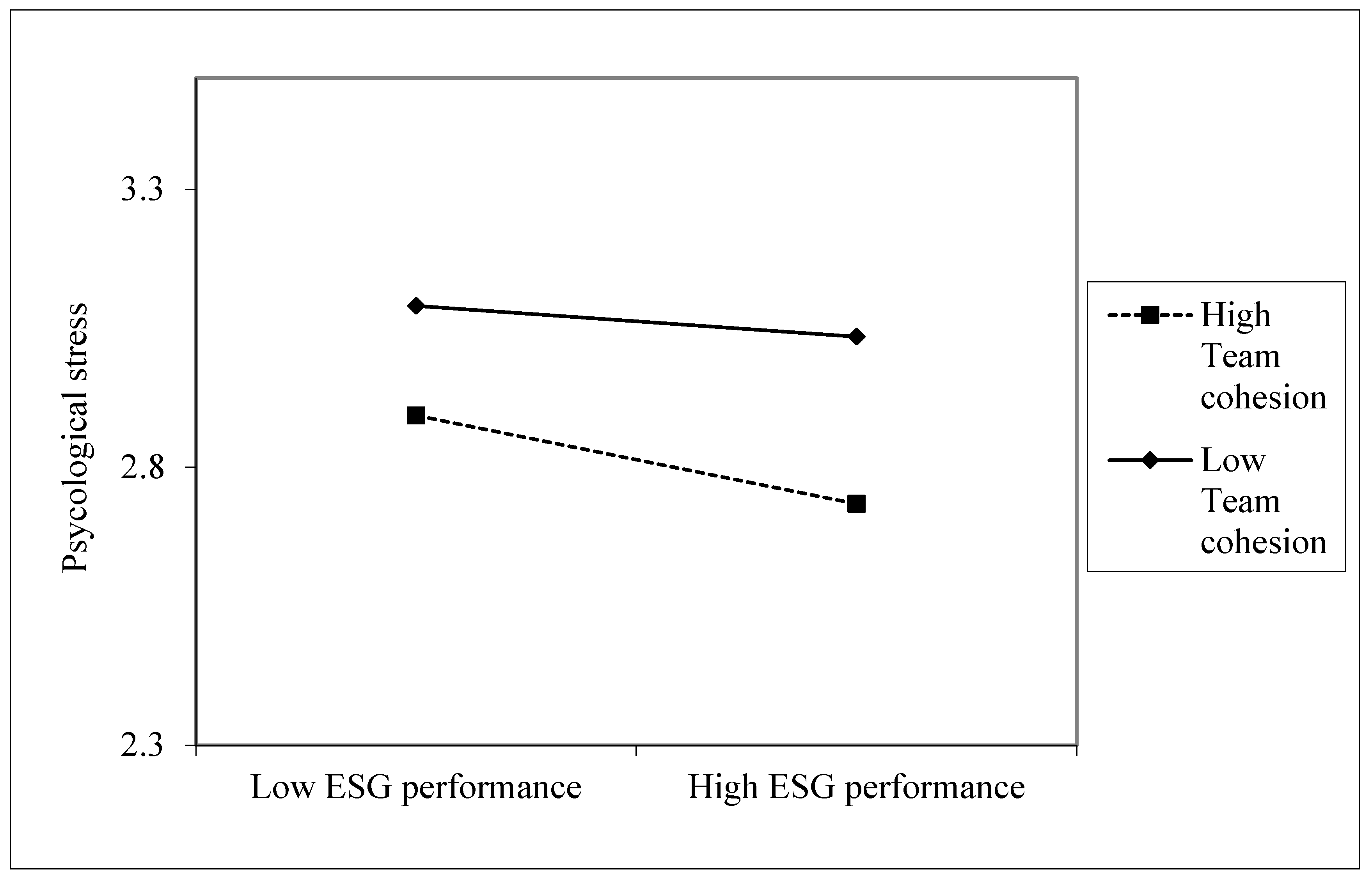
Hypothesis 4 predicted that the effect of ESG performance on reducing employee stress during the COVID-19 pandemic would be greater as team cohesiveness increased. As shown in Model 3, the cross-level interaction term (ESG ratings × team cohesion) was found to be significant (b = −0.07, p < 0.01). Next, the interaction effect was plotted (Figure 2), and the graph showed that the negative relationship between ESG performance and psychological stress was stronger for employees with high team cohesion. As illustrated in Figure 2, the slope becomes steeper under high team cohesion conditions, suggesting that team-level social resources amplify the psychological benefits of ESG reputation. This pattern is consistent with the multi-level resource interaction logic of COR theory. Hypothesis 4 was thus supported. A summary of the hypothesis testing results is presented in Table 4.

5. Discussion

This study contributes to research on the economic and business aspects of sustainability by clarifying how ESG performance supports organizational functioning during crisis situations. While prior ESG research has predominantly focused on external evaluations, corporate reputation, and firm-level financial outcomes, the present study shifts attention to the internal mechanisms through which ESG contributes to sustainable management. Specifically, the findings demonstrate that corporate ESG performance reduces employees’ psychological stress and enhances innovative behavior during crises. These results suggest that ESG engagement generates meaningful internal benefits by strengthening employees’ psychological resilience and adaptive capacity under conditions of uncertainty. Consistent with prior studies showing that socially responsible organizational practices are associated with employee well-being and organizational commitment [14,16], the present study identifies a micro-level pathway through which ESG functions as a strategic organizational resource that sustains employee functioning during turbulent periods. From the perspective of sustainable organizational development, these findings may also be interpreted in terms of employee safety and protection. ESG engagement may signal that the organization prioritizes responsible governance, employee welfare, and long-term stability, thereby enhancing employees’ perceptions of psychological safety and protection during crises. Recent discussions in the ESG literature also emphasize that employee safety constitutes a core component of sustainable organizational practices. Safety initiatives not only reduce operational risks but also enhance employees’ psychological security and trust in their organizations, thereby contributing to organizational resilience and long-term value creation [64]. In this sense, employee safety may function as an important psychological resource that stabilizes employee attitudes and behaviors during periods of uncertainty. In this sense, ESG functions not only as an external reputational mechanism but also as an internal safety signal that reduces perceived vulnerability among employees and supports adaptive work behaviors.
These findings both align with and extend prior research examining the relationship between ESG and employee-related outcomes. The growing body of literature suggests that responsible organizational practices such as ESG and CSR initiatives can positively influence employee attitudes and behaviors, including engagement, organizational commitment, and well-being [14,16,65]. Such practices can strengthen employees’ identification with the organization and reinforce perceptions that the organization behaves responsibly toward both internal and external stakeholders. At the same time, prior studies also indicate that the effects of ESG or CSR initiatives on employees are not always uniformly positive. When such initiatives are perceived as symbolic, inconsistent with internal practices, or lacking authenticity, employees may respond with skepticism or reduced engagement [66,67]. By contrast, the present study demonstrates that ESG performance can function as a meaningful psychological resource particularly in crisis contexts characterized by heightened uncertainty and perceived resource loss. This suggests that the internal value of ESG may become more salient under turbulent conditions when employees seek signals of organizational stability and responsibility.
From a theoretical perspective, this study contributes to ESG research by integrating insights from corporate reputation research with conservation of resources (COR) theory. While previous studies have largely conceptualized ESG as a reputational signal directed toward external stakeholders such as investors, customers, or regulators [14], the present findings demonstrate that ESG also provides meaningful psychological resources for employees. During crisis situations characterized by heightened uncertainty, employees may interpret strong ESG performance as a signal of organizational responsibility, ethical governance, and long-term stability. Such signals may enhance employees’ perceptions of psychological safety and perceived organizational protection, thereby reducing stress and enabling them to maintain adaptive and innovative behavior. This perspective broadens the conceptual scope of ESG by emphasizing its internal role in stabilizing human capital and supporting employee well-being in times of environmental turbulence.
The findings also contribute to the literature examining the relationship between stress and innovation. Prior research has produced mixed evidence regarding whether stress inhibits or stimulates innovative behavior. While excessive stress may undermine cognitive resources and reduce creativity, some studies suggest that moderate levels of challenge-related stress may stimulate problem-solving and innovative thinking [46,68]. By identifying psychological stress as a mediating mechanism, the present study clarifies how organizational resources may influence innovative behavior during crises. Specifically, ESG-related organizational resources appear to mitigate detrimental stress responses and thereby create conditions that enable employees to sustain innovative performance even in uncertain environments.
Finally, this study highlights the multi-level nature of sustainable management by demonstrating how organizational-level and team-level resources jointly shape employee responses to crisis situations. In particular, team cohesion emerges as a key team-level social resource that amplifies the stress-buffering effect of corporate ESG performance. Although the positive consequences of team cohesion have been widely documented in team and organizational research [52,69], the present study newly identifies its role in crisis contexts and its interaction with a firm’s ESG reputation in reducing employee stress and promoting innovation. Moreover, even though it was not originally hypothesized, team cohesion itself was found to be negatively associated with psychological stress, suggesting that solidarity and unity among team members function as independent protective resources during crises. These findings extend existing knowledge by demonstrating that the psychological benefits of corporate ESG are strengthened through complementary team-level social dynamics. Taken together, this study highlights that ESG is not only an external sustainability strategy but also an internal organizational resource that helps stabilize employees’ psychological functioning and sustain innovative behavior during periods of uncertainty.

6. Conclusions

6.1. Implications for Practice

This study offers important implications for practice. From a managerial perspective, the findings suggest that ESG should not be regarded as a peripheral or symbolic initiative, but rather as a core component of a crisis-ready business strategy. The results indicate that firms with a strong and sustained commitment to ESG are more likely to mitigate organizational risks during crises by fostering employees’ psychological stability and encouraging innovative efforts. Accordingly, managers should clearly articulate their sustainability goals and ESG-related activities and actively communicate them to both internal and external stakeholders. While prior research has largely emphasized corporate reputation from the perspective of external stakeholders, such as investors, and many firms have primarily considered ESG in terms of investment-related outcomes, the present study demonstrates that employees are also positively influenced by ESG performance as a signal of a favorable corporate reputation. This positive perception provides employees with valuable psychological resources, which in turn support innovation and adaptive behavior. Therefore, organizations that proactively share and communicate their ESG initiatives with employees can strengthen internal resilience by enhancing employees’ psychological well-being and motivating them to engage in innovative efforts, even under conditions of uncertainty and crisis.
Although the statistical effect sizes such as standardized coefficients are moderate in magnitude, their practical significance becomes substantial at the organizational level because small reductions in employee stress can accumulate across large employee populations and translate into meaningful improvements in innovative output and adaptability. Therefore, from a strategic perspective, the findings suggest that ESG investments can be interpreted as part of firms’ risk management and resilience strategies. Rather than viewing ESG initiatives solely as long-term or reputational investments, managers may consider ESG performance as an intangible asset that protects human capital during periods of disruption. Firms facing increasing exposure to systemic risks may therefore benefit from embedding ESG considerations into strategic planning and crisis preparedness frameworks. In some situations, ESG activities can be implemented as a means of benefiting the organization only rather than society itself [65]. In particular, it is possible for employees to have a rather negative attitude toward ESG activities when organizations rarely seem to care about their members, who are in fact important internal stakeholders, considering only customers and external evaluations as major stakeholders in ESG activities. Therefore, companies need to think about the authentic purpose of ESG and check whether ESG activities are being conducted with sincere intentions. That is, it is necessary to maintain consistency in visible and invisible areas, outside and inside the organization, and above all, to include activities that take into account employees and to actively communicate with employees about the authenticity of ESG activities.

6.2. Limitations of Research and Future Research Directions

The limitations of this study and suggestions for future research are as follows. First, this study collected data through multiple data sources, such as corporate data and employee surveys, and ESG performance data were obtained from the year preceding the crisis, employee-level variables were measured cross-sectionally through self-report. This method has limitations in lowering the internal validity of the study results and may incur the problem of common method bias. Therefore, causal interpretations should be made with caution, and future longitudinal or experimental designs are needed to further establish temporal precedence. Regarding team cohesion, because the data were collected and analyzed at the individual level, there is substantial room for subjective perception to influence the findings. Accordingly, the results should be interpreted as highlighting the role of perceived team cohesion as an individual-level social resource, rather than as definitive evidence of objective team-level effects. Future research should therefore collect data more systematically at the appropriate level of analysis and adopt research designs that enhance causal inference. In particular, to more rigorously examine the interaction effects of team cohesion, it will be necessary to collect and analyze data at the team level.
Furthermore, this study was conducted on large corporations with high resource mobilization or planning ability, which had more resources to pursue social values and had objective ESG evaluation data. However, SMEs are also very interested in and are putting considerable effort into the pursuit of social value [66]. Thus, it is necessary to examine the ESG effect in companies with different characteristics from large enterprises. In addition, the negative impact experienced by small- and medium-sized enterprises (SMEs) in a crisis situation can be greater, so further research will be able to provide more meaningful implications. In addition, the findings should be interpreted within the context of large Korean firms and the COVID-19 crisis. Future research should examine SMEs and diverse cultural or institutional environments to enhance external validity.
Finally, although this study conducted research in the context of the COVID-19 pandemic as a crisis situation, the effect of corporate ESG may vary depending on the type of crisis. For example, the COVID-19 crisis was caused by external factors that a company has almost no control over, but in the case of a global financial crisis, even if it is out of control, the cause is significantly related to the company itself, so it is highly likely to experience a loss of trust in the marketplace. Therefore, in future research, it is necessary to subdivide the characteristics of a crisis and to find out how ESG effects can vary according to the characteristics. Furthermore, since the severity of a crisis can also vary depending on the context to which an individual belongs, examining the effects of various environmental characteristics beyond team cohesion presents another worthwhile research topic.

6.3. Overall Summary and Contributions

In summary, this study demonstrates that corporate ESG performance functions not only as an external legitimacy signal but also as an internal psychological resource that enhances employee resilience and innovation during crises. By identifying psychological stress as a mediating mechanism and team cohesion as a contextual amplifier, the findings provide a multi-level understanding of how ESG contributes to sustainable management. These insights extend ESG research beyond financial metrics and highlight the strategic value of ESG for organizational resilience and employee well-being.

Funding

This work was supported by Kyonggi University Research Grant 2023.

Institutional Review Board Statement

The study was conducted in accordance with the Declaration of Helsinki, and approved by the Institutional Review Board of Yonsei University (protocol code 7001988-202101-HR-911-05 and date of 17 June 2020).

Informed Consent Statement

Informed consent for participation was obtained from all subjects involved in the study.

Data Availability Statement

The data used in the study are available from the corresponding author by request.

Conflicts of Interest

The author declares no conflicts of interest.

References

  1. Galbreath, J. ESG in Focus: The Australian Evidence. J. Bus. Ethics 2013, 118, 529–541. [Google Scholar] [CrossRef]
  2. Duque-Grisales, E.; Aguilera-Caracuel, J. Environmental, Social and Governance (ESG) Scores and Financial Performance of Multilatinas: Moderating Effects of Geographic International Diversification and Financial Slack. J. Bus. Ethics 2021, 168, 315–334. [Google Scholar] [CrossRef]
  3. Zervoudi, E.K.; Moschos, N.; Christopoulos, A.G. From Corporate Social Responsibility (CSR) and Environmental, Social and Governance (ESG) Criteria to the Greenwashing Phenomenon: A Comprehensive Literature Review of Causes, Consequences, and Solutions with Case Studies. Sustainability 2025, 17, 2222. [Google Scholar] [CrossRef]
  4. Carrettin, E.; Lawrenz, J. Corporate Sustainability Through Employees’ Eyes: Internal-External (Mis)Alignment and Ethical Authenticity. SSRN Electron. J. 2025. Available online: https://ssrn.com/abstract=5241854 (accessed on 1 January 2026).
  5. Itan, I.; Sylvia, S.; Septiany, S.; Chen, R. The Influence of Environmental, Social, and Governance Disclosure on Market Reaction: Evidence from Emerging Markets. Discov. Sustain. 2025, 6, 347. [Google Scholar] [CrossRef]
  6. Van Duuren, E.; Plantinga, A.; Scholtens, B. ESG Integration and the Investment Management Process: Fundamental Investing Reinvented. J. Bus. Ethics 2016, 138, 525–533. [Google Scholar] [CrossRef]
  7. Carnini Pulino, S.; Ciaburri, M.; Magnanelli, B.S.; Nasta, L. Does ESG Disclosure Influence Firm Performance? Sustainability 2022, 14, 7595. [Google Scholar] [CrossRef]
  8. Herman, A.; Oplotnik, Ž.J.; Jagrič, T. The Impact of ESG on Business Performance: An Empirical Analysis of NASDAQ–NYSE-Listed Companies. Sustainability 2025, 17, 9683. [Google Scholar] [CrossRef]
  9. Karoui, A.; Nguyen, D.K. Systematic ESG Exposure and Stock Returns: Evidence from the United States During the 1991–2019 Period. Bus. Ethics Environ. Responsib. 2022, 31, 604–619. [Google Scholar] [CrossRef]
  10. Zhang, L.S. The Impact of ESG Performance on the Financial Performance of Companies: Evidence from China’s Shanghai and Shenzhen A-Share Listed Companies. Front. Environ. Sci. 2025, 13, 1507151. [Google Scholar] [CrossRef]
  11. Zhou, S.; Rashid, M.H.U.; Mohd Zobair, S.A.; Sobhani, F.A.; Siddik, A.B. Does ESG Impact Firms’ Sustainability Performance? The Mediating Effect of Innovation Performance. Sustainability 2023, 15, 5586. [Google Scholar] [CrossRef]
  12. Lee, C.C.; Luppi, J.L.; Simmons, T.; Tran, B.; Zhang, R. Examining the Impacts of ESG on Employee Retention: A Study of Generational Differences. J. Bus. Manag. 2023, 29, 1–22. [Google Scholar] [CrossRef]
  13. Zhang, T.; Zhang, J.; Tu, S. An Empirical Study on Corporate ESG Behavior and Employee Satisfaction: A Moderating Mediation Model. Behav. Sci. 2024, 14, 274. [Google Scholar] [CrossRef]
  14. Bakker, A.B.; Demerouti, E. The Job Demands–Resources Model: State of the Art. J. Manag. Psychol. 2007, 22, 309–328. [Google Scholar] [CrossRef]
  15. Hobfoll, S.E. The Influence of Culture, Community, and the Nested-Self in the Stress Process: Advancing Conservation of Resources Theory. Appl. Psychol. 2001, 50, 337–421. [Google Scholar] [CrossRef]
  16. Rupp, D.E.; Shao, R.; Thornton, M.A.; Skarlicki, D.P. Applicants’ and Employees’ Reactions to Corporate Social Responsibility: The Moderating Effects of First-party Justice Perceptions And Moral Identity. Pers. Psychol. Organ. Behav. Hum. Decis. Process. 2013, 66, 895–933. [Google Scholar] [CrossRef]
  17. Lins, K.V.; Servaes, H.; Tamayo, A. Social Capital, Trust, and Corporate Performance: How CSR Helped Companies During the Financial Crisis (and Why It Can Keep Helping Them). J. Appl. Corp. Financ. 2019, 31, 59–71. [Google Scholar] [CrossRef]
  18. Filippetti, A.; Archibugi, D. Innovation in Times of Crisis: National Systems of Innovation, Structure, and Demand. Res. Policy 2011, 40, 179–192. [Google Scholar] [CrossRef]
  19. Alarifi, G.; Adam, N.A. The Role of Participatory Leadership and Employee Innovative Behavior on SMEs’ Endurance. Sustainability 2023, 15, 2740. [Google Scholar] [CrossRef]
  20. Salem, N.H.; Ishaq, M.I.; Yaqoob, S.; Raza, A.; Zia, H. Employee Engagement, Innovative Work Behaviour, and Employee Wellbeing: Do Workplace Spirituality and Individual Spirituality Matter? Bus. Ethics Environ. Responsib. 2023, 32, 657–669. [Google Scholar] [CrossRef]
  21. Janssen, O. Job Demands, Perceptions of Effort–Reward Fairness and Innovative Work Behaviour. J. Occup. Organ. Psychol. 2000, 73, 287–302. [Google Scholar] [CrossRef]
  22. Scott, S.G.; Bruce, R.A. Determinants of Innovative Behavior: A Path Model of Individual Innovation in the Workplace. Acad. Manag. J. 1994, 37, 580–607. [Google Scholar] [CrossRef]
  23. Parker, S.K.; Williams, H.M.; Turner, N. Modeling the Antecedents of Proactive Behavior at Work. J. Appl. Psychol. 2006, 91, 636. [Google Scholar] [CrossRef]
  24. Anderson, N.; De Dreu, C.K.W.; Nijstad, B.A. The Routinization of Innovation Research: A Constructively Critical Review of the State-of-the-Science. J. Organ. Behav. 2004, 25, 147–173. [Google Scholar] [CrossRef]
  25. Baer, M.D.; Bundy, J.; Garud, N.; Kim, J.K. The Benefits and Burdens of Organizational Reputation for Employee Well-Being: A Conservation of Resources Approach. Pers. Psychol. 2018, 71, 571–595. [Google Scholar] [CrossRef]
  26. Wilson, R. Reputations in Games and Markets. In Game-Theoretic Models of Bargaining; Cambridge University Press: Cambridge, UK, 1985; pp. 27–62. [Google Scholar] [CrossRef]
  27. Jensen, M.; Kim, H.; Kim, B.K. Meeting Expectations: A Role-Theoretic Perspective on Reputation. In The Oxford Handbook of Corporate Reputation; Oxford University Press: Oxford, UK, 2012; pp. 140–159. [Google Scholar]
  28. Jensen, M.; Roy, A. Staging Exchange Partner Choices: When Do Status and Reputation Matter? Acad. Manag. J. 2008, 51, 495–516. [Google Scholar] [CrossRef]
  29. Saxton, T.; Dollinger, M. Target Reputation and Appropriability: Picking and Deploying Resources in Acquisitions. J. Manag. 2004, 30, 123–147. [Google Scholar] [CrossRef]
  30. Turban, D.B.; Cable, D.M. Firm Reputation and Applicant Pool Characteristics. J. Organ. Behav. 2003, 24, 733–751. [Google Scholar] [CrossRef]
  31. Cable, D.M.; Turban, D.B. The Value of Organizational Reputation in the Recruitment Context: A Brand-Equity Perspective. J. Appl. Soc. Psychol. 2003, 33, 2244–2266. [Google Scholar] [CrossRef]
  32. Carmeli, A.; Gilat, G.; Weisberg, J. Perceived External Prestige, Organizational Identification and Affective Commitment: A Stakeholder Approach. Corp. Reput. Rev. 2006, 9, 92–104. [Google Scholar] [CrossRef]
  33. Mishra, S.K. Perceived External Prestige and Employee Outcomes: Mediation Effect of Organizational Identification. Corp. Reput. Rev. 2013, 16, 220–233. [Google Scholar] [CrossRef]
  34. Capelle-Blancard, G.; Petit, A. Every Little Helps? ESG News and Stock Market Reaction. J. Bus. Ethics 2019, 157, 543–565. [Google Scholar] [CrossRef]
  35. Murè, P.; Spallone, M.; Mango, F.; Marzioni, S.; Bittucci, L. ESG and Reputation: The Case of Sanctioned Italian Banks. Corp. Soc. Responsib. Environ. Manag. 2021, 28, 265–277. [Google Scholar] [CrossRef]
  36. Stern, I.; Dukerich, J.M.; Zajac, E. Unmixed Signals: How Reputation and Status Affect Alliance Formation. Strateg. Manag. J. 2014, 35, 512–531. [Google Scholar] [CrossRef]
  37. Lazarus, R.S.; Folkman, S. Cognitive Theories of Stress and the Issue of Circularity. In Dynamics of Stress; Plenum Press: New York, NY, USA, 1986; pp. 63–80. [Google Scholar]
  38. International Labour Organization. An Employers’ Guide on Working from Home in Response to the Outbreak of COVID-19; International Labour Organization: Geneva, Switzerland, 2020. [Google Scholar]
  39. Hobfoll, S.E. Conservation of Resources: A New Attempt at Conceptualizing Stress. Am. Psychol. 1989, 44, 513–524. [Google Scholar] [CrossRef] [PubMed]
  40. Hobfoll, S.E.; Spielberger, C.D. Family Stress: Integrating Theory and Measurement. J. Fam. Psychol. 1992, 6, 99. [Google Scholar] [CrossRef]
  41. Tajfel, H.; Turner, J. The Social Identity of Intergroup Behavior. In Psychology and Intergroup Relations; Nelson-Hall: Chicago, IL, USA, 1986; pp. 7–24. [Google Scholar]
  42. Baer, M.D.; Dhensa-Kahlon, R.K.; Colquitt, J.A.; Rodell, J.B.; Outlaw, R.; Long, D.M. Uneasy Lies the Head that Bears the Trust: The Effects of Feeling Trusted on Emotional Exhaustion. Acad. Manag. J. 2015, 58, 1637–1657. [Google Scholar] [CrossRef]
  43. Hayes, C.T.; Weathington, B.L. Optimism, Stress, Life Satisfaction, and Job Burnout in Restaurant Managers. J. Psychol. 2007, 141, 565–579. [Google Scholar] [CrossRef]
  44. Riolli, L.; Savicki, V. Optimism and Coping as Moderators of the Relation Between Work Resources and Burnout in Information Service Workers. Int. J. Stress Manag. 2003, 10, 235–252. [Google Scholar] [CrossRef]
  45. Lee, A.Y.P.; Wang, Y.H.; Yang, F.R. Feeling Exhausted? Let’s Play—How Play in Work Relates to Experienced Burnout and Innovation Behaviors. Appl. Res. Qual. Life 2021, 16, 629–648. [Google Scholar] [CrossRef]
  46. Byron, K.; Khazanchi, S.; Nazarian, D. The Relationship Between Stressors and Creativity: A Meta-Analysis Examining Competing Theoretical Models. J. Appl. Psychol. 2010, 95, 201. [Google Scholar] [CrossRef]
  47. Cavanaugh, M.A.; Boswell, W.R.; Roehling, M.V.; Boudreau, J.W. An Empirical Examination of Self-Reported Work Stress Among U.S. Managers. J. Appl. Psychol. 2000, 85, 65–74. [Google Scholar] [CrossRef] [PubMed]
  48. Ren, F.; Zhang, J. Job Stressors, Organizational Innovation Climate, and Employees’ Innovative Behavior. Creat. Res. J. 2015, 27, 16–23. [Google Scholar] [CrossRef]
  49. Tekleab, A.G.; Quigley, N.R.; Tesluk, P.E. A Longitudinal Study of Team Conflict, Conflict Management, Cohesion, and Team Effectiveness. Group Organ. Manag. 2009, 34, 170–205. [Google Scholar] [CrossRef]
  50. Grzywacz, J.G.; Carlson, D.S.; Kacmar, K.M.; Wayne, J.H. A Multi-Level Perspective on the Synergies between Work and Family. J. Occup. Organ. Psychol. 2007, 80, 559–574. [Google Scholar] [CrossRef]
  51. Carron, A.V.; Brawley, L.R.; Widmeyer, W.N. The Measurement of Cohesiveness in Sport Groups. In Advances in Sport and Exercise Psychology Measurement; Fitness Information Technology, Inc.: Logan, UT, USA, 1998; pp. 213–226. [Google Scholar]
  52. Kozlowski, S.W.J.; Ilgen, D.R. Enhancing the Effectiveness of Work Groups and Teams. Psychol. Sci. Public Interest 2006, 7, 77–124. [Google Scholar] [CrossRef] [PubMed]
  53. Hunter, E.M.; Perry, S.J.; Carlson, D.S.; Smith, S.A. Linking Team Resources to Work–Family Enrichment and Satisfaction. J. Vocat. Behav. 2010, 77, 304–312. [Google Scholar] [CrossRef]
  54. Barrick, M.R.; Stewart, G.L.; Neubert, M.J.; Mount, M.K. Relating Member Ability and Personality to Work-Team Processes and Team Effectiveness. J. Appl. Psychol. 1998, 83, 377. [Google Scholar] [CrossRef]
  55. Mach, M.; Dolan, S.; Tzafrir, S. The Differential Effect of Team Members’ Trust on Team Performance: The Mediation Role of Team Cohesion. J. Occup. Organ. Psychol. 2010, 83, 771–794. [Google Scholar] [CrossRef]
  56. Weick, K.E. Sensemaking in Organizations; Sage: Thousand Oaks, CA, USA, 1995. [Google Scholar]
  57. Maitlis, S.; Christianson, M. Sensemaking in Organizations: Taking Stock and Moving Forward. Acad. Manag. Ann. 2014, 8, 57–125. [Google Scholar] [CrossRef]
  58. Chang, E.; Chin, H.; Lee, J.W. Pre-crisis commitment human resource management and employees’ attitudes in a global pandemic: The role of trust in the government. Hum. Resour. Manag. 2022, 61, 373–387. [Google Scholar] [CrossRef]
  59. Cohen, S.; Kamarck, T.; Mermelstein, R. A Global Measure of Perceived Stress. J. Health Soc. Behav. 1983, 24, 385–396. [Google Scholar] [CrossRef]
  60. Seers, A. Team-Member Exchange Quality: A New Construct for Role-Making Research. Organ. Behav. Hum. Decis. Process. 1989, 43, 118–135. [Google Scholar] [CrossRef]
  61. Huang, F.L. Multilevel Modeling Myths. Sch. Psychol. Q. 2018, 33, 492. [Google Scholar] [CrossRef]
  62. Musca, S.C.; Kamiejski, R.; Nugier, A.; Méot, A.; Er-Rafiy, A.; Brauer, M. Data with Hierarchical Structure: Impact of Intraclass Correlation and Sample Size on Type-I Error. Front. Psychol. 2011, 2, 74. [Google Scholar] [CrossRef]
  63. Preacher, K.J.; Zhang, Z.; Zyphur, M.J. Alternative Methods for Assessing Mediation in Multilevel Data: The Advantages of Multilevel SEM. Struct. Equ. Model. 2011, 18, 161–182. [Google Scholar] [CrossRef]
  64. Richman, P. How to Make Safety Core to Your Company’s ESG Efforts. Prof. Saf. 2024, 69, 16–18. [Google Scholar]
  65. Gond, J.P.; El Akremi, A.; Swaen, V.; Babu, N. The Psychological Microfoundations of Corporate Social Responsibility: A Person-Centric Systematic Review. J. Organ. Behav. 2017, 38, 225–246. [Google Scholar] [CrossRef]
  66. Yu, E.P.Y.; Van Luu, B.; Chen, C.H. Greenwashing in Environmental, Social and Governance Disclosures. Res. Int. Bus. Financ. 2020, 52, 101192. [Google Scholar] [CrossRef]
  67. Gangi, F.; Meles, A.; Monferrà, S.; Mustilli, M. Does Corporate Social Responsibility Help the Survivorship of SMEs and Large Firms? Glob. Financ. J. 2020, 43, 100402. [Google Scholar] [CrossRef]
  68. Amabile, T.M.; Hadley, C.N.; Kramer, S.J. Creativity Under the Gun. Harv. Bus. Rev. 2002, 80, 52–63. [Google Scholar] [PubMed]
  69. Beal, D.J.; Cohen, R.R.; Burke, M.J.; McLendon, C.L. Cohesion and Performance in Groups: A Meta-Analytic Clarification of Construct Relations. J. Appl. Psychol. 2003, 88, 989–1004. [Google Scholar] [CrossRef] [PubMed]
Figure 1. Research model. Solid arrows represent the hypothesized relationships among the study variables.
Sustainability 18 02609 g001
Figure 2. Graph for interaction effect.
Sustainability 18 02609 g002
Table 1. Correlations and descriptive statistics.
VariableMSD1234
Level 1 variables
1. Age37.447.25
2. Education level3.140.590.24 **
3. Psychological stress2.870.80−0.04−0.08 **
4. Innovative behavior3.410.810.16 **0.18 **−0.15 **
5. Team cohesion3.660.820.050.04−0.21 **0.20 **
Level 2 variables
1. Firm size (log)15.361.33
2. ESG performance3.490.900.26 +
Note: Level 1 N = 980, Level 2 N = 51. + p < 0.10, ** p < 0.01.
Table 2. Results for multi-level path analysis.
DV: Psychological StressDV: Innovative Behavior
Model 1Model 2Model 3Model 4Model 5Model 6
Level 1 variables
Age−0.01
(0.00)
−0.01
(0.00)
−0.01
(0.00)
0.02 ***
(0.00)
0.02 ***
(0.00)
0.02 ***
(0.00)
Education level−0.11 *
(0.05)
−0.11 *
(0.05)
−0.10 *
(0.05)
0.19 **
(0.06)
0.18 **
(0.06)
0.18 **
(0.06)
Psychological stress −0.12 **
(0.03)
−0.13 ***
(0.03)
Team cohesion −0.18 ***
(0.03)
Level 2 variables
Firm size (log)−0.05
(0.03)
−0.05
(0.04)
0.00
(0.02)
−0.01
(0.02)
−0.01
(0.02)
0.02
(0.02)
ESG performance −0.10 ***
(0.03)
0.12
(0.09)
−0.05
(0.03)
ESG performance
× Team cohesion
−0.07 **
(0.03)
Within-level residual variance0.61 ***
(0.03)
0.61 ***
(0.03)
0.58 ***
(0.03)
0.62 ***
(0.04)
0.61 ***
(0.04)
0.61 ***
(0.04)
Between-level residual variance0.01
(0.01)
0.01
(0.01)
0.00
(0.07)
0.01
(0.01)
−0.00
(0.01)
0.00
(0.01)
Level 1 N = 980, Level 2 N = 51. Unstandardized path coefficients and standard errors (in parentheses) are reported. * p < 0.05, ** p < 0.01, *** p < 0.001. (Two-tailed test).
Table 3. Results for significance test of indirect effect.
RouteBoot
Coefficient
Boot SE95% Confidence Interval
LLCIULCI
ESG performance → Psychological stress → Innovation behavior0.1070.0220.0050.208
LLCI = low 95% confidence interval; ULCI = high 95% confidence interval.
Table 4. Summary of hypothesis tests.
HypothesisRelationshipResultSupported
H1ESG → Stressb = −0.10 ***Yes
H2Stress → Innovationb = −0.21 **Yes
H3ESG → Stress → InnovationIndirect effect significantYes
H4ESG × Team Cohesion → Stressb = −0.07 **Yes
** p < 0.01, *** p < 0.001.
Disclaimer/Publisher’s Note: The statements, opinions and data contained in all publications are solely those of the individual author(s) and contributor(s) and not of MDPI and/or the editor(s). MDPI and/or the editor(s) disclaim responsibility for any injury to people or property resulting from any ideas, methods, instructions or products referred to in the content.