Engagement of Non-State Actors’ Capacities in the Crisis Management System

 , and
, and
Abstract
1. Introduction
1.1. Foreground and Research Concepts
1.2. Stakeholders and Collective Coping Capacities
1.2.1. The Functional Areas
1.2.2. Coherence via Networking
1.2.3. Engagement via “Protocolisation”
2. Materials and Methods
- (1)
- How has the perception of NSA engagement in disaster responses evolved over time?
- (2)
- What value do NSA add, and in what ways do they contribute to effective disaster management outcomes?
- (3)
- What are the components of the protocolised engagement of non-state actors within the disaster management ecosystem?
2.1. Key Methods
- (a)
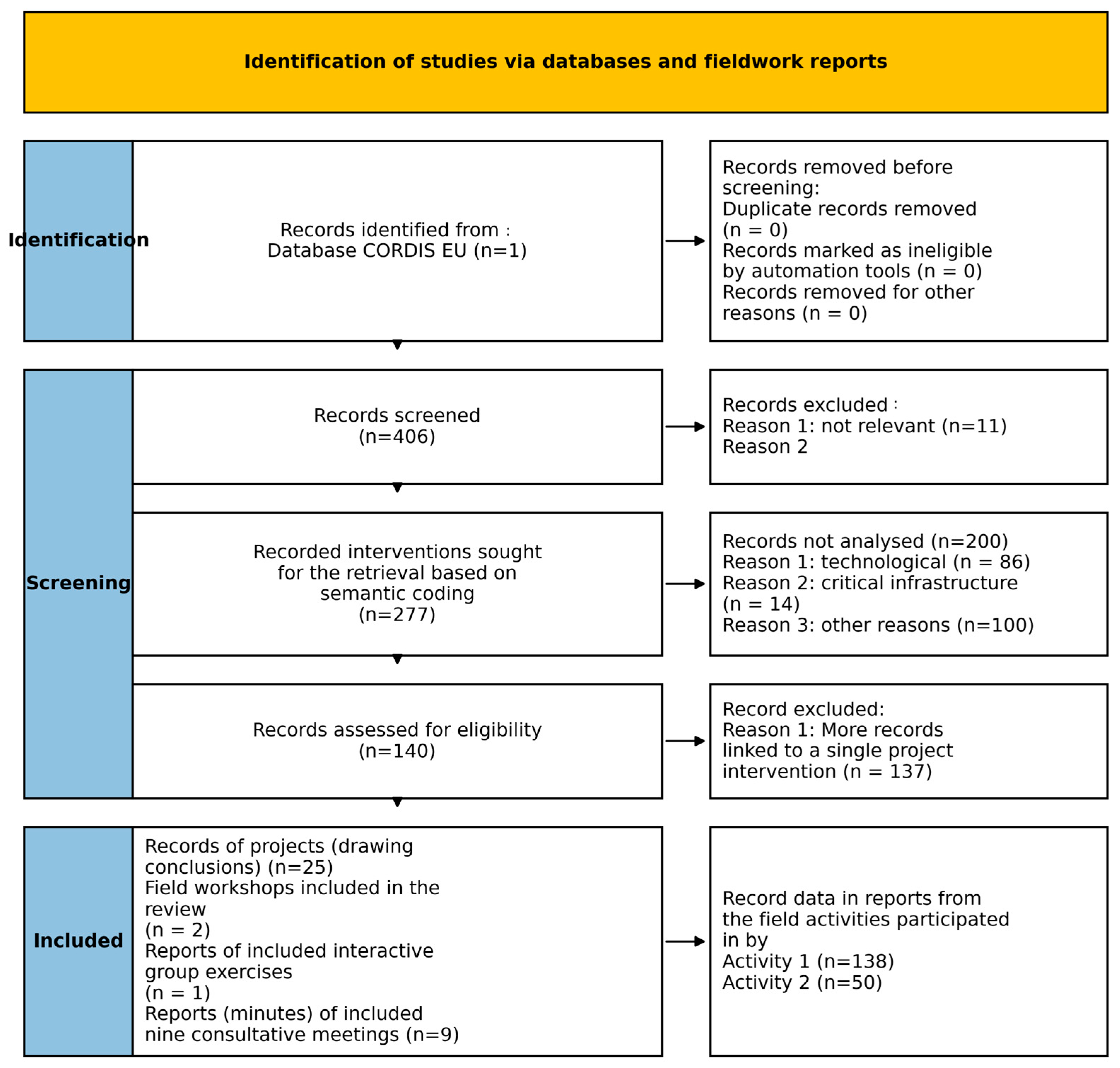
- PRISMA approaches ensuring documentation and justification of statements
- (b)
- The Boolean method provides classification and comprehensiveness across multiple sources, capturing diverse evidence types
- (c)
- Validation through practical experience, confirming the theoretical propositions
2.1.1. A PRISMA (Preferred Reporting Items for Systematic Reviews and Meta-Analyses)
2.1.2. Boolean Strategy
2.1.3. Empirical Verification
2.2. Materials and Research Phases
2.2.1. Literature-Based Identification
2.2.2. Projects’ Analysis
2.2.3. Practical Experience
2.3. Additional Methodological Challenges
2.3.1. AI Support Tool Analyser
2.3.2. Research Limitations
3. Results
3.1. Result 1: Coping Capacity—Definition of Areas of Impact of the Non-State Actors: Multiple Sectoral Engagement
3.2. Result 2: Action Roles Capacitating
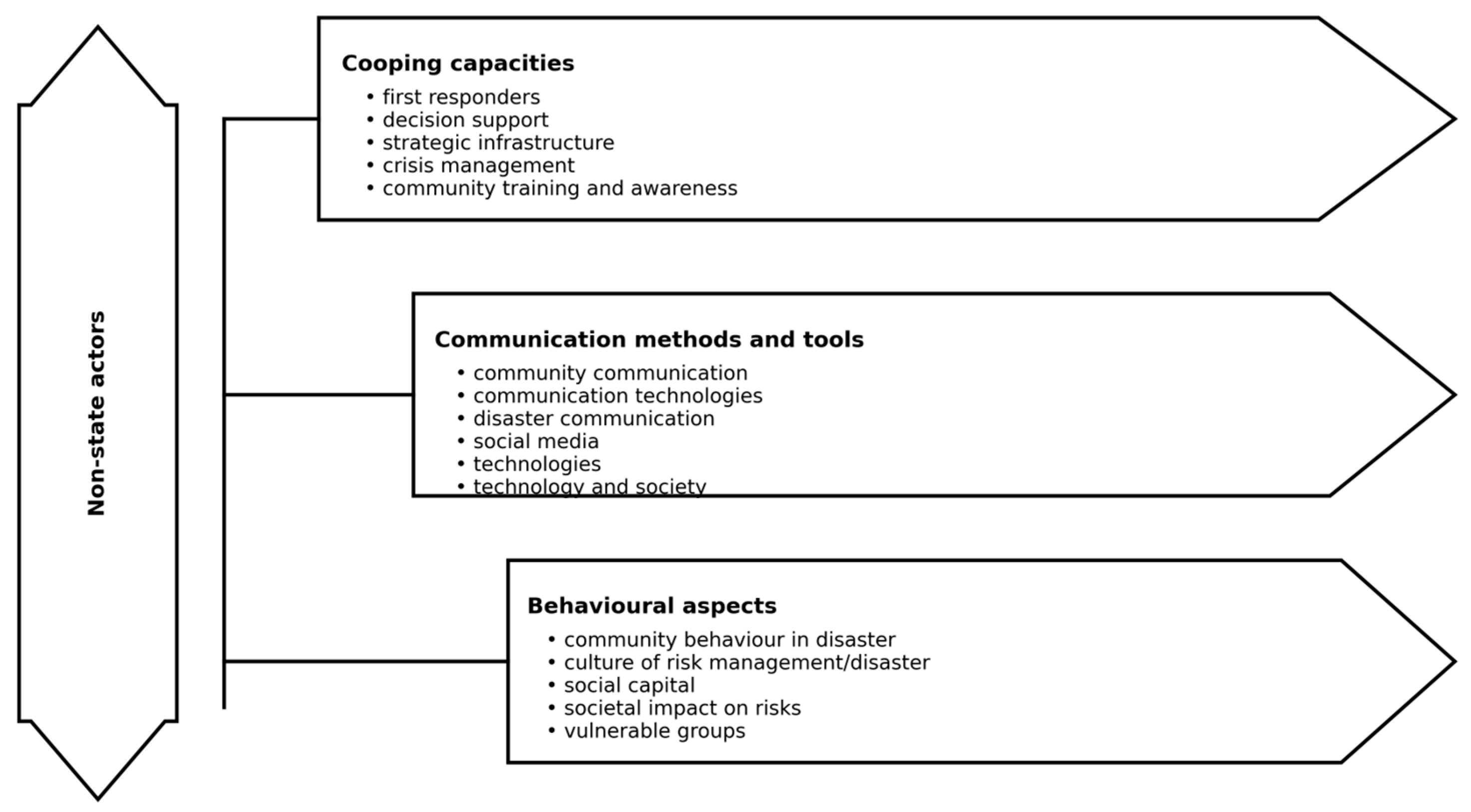
3.3. Result 3: Three Main Engagement Aspects: Capacity, Protocols, and Behavioural Aspects
3.4. Result 4: NSA Self-Assessment of Social Capital
- How do you imagine ensuring communication between formal and informal volunteers during an emergency?
- What are the main key skills that volunteers should have to be helpful at the scene of an emergency?
- How would you create a partnership between formal and informal volunteers before the crisis?
- (i)
- Mobilisation, proper and correct informing, and reliance on a well-structured communication hub are envisaged to ensure information flows efficiently despite technological challenges. Although experienced non-state responders propose the use of advanced communication systems, such as walkie-talkies and intercoms, the use of technology seems less important than acknowledging the agreed approach to mobilisation and activation requests for cooping capacities.
- (ii)
- Tasking of NSA aligns with commitments and references skills, competencies, and roles already described in the previous part 3.1. The aforementioned 15 thematic areas are further broken down into specific examples, such as first-aid skills, highly valued for basic life support; wound care techniques; techniques that save more lives, minimise harm, and provide immediate psychological and crisis intervention assistance in critical situations. Understanding communication protocols and the ability to operate communication devices are also highly ranked to ensure proper reporting and task delivery to team members and affected communities, based on empathy, active listening skills, and clarity in verbal instructions. Amongst the others, the following technical capacities for tasking are pinpointed: Logistics Management, IT Communications Systems, Interpreter and Cultural Mediation, Medical Staff, and search-and-rescue personnel with experience working in hazardous environments, at heights, underground, or with flammable substances. Mastery in these areas necessitates specific training and documented verification of qualifications to ensure safety and efficacy during sensitive or hazardous operations.
- (iii)
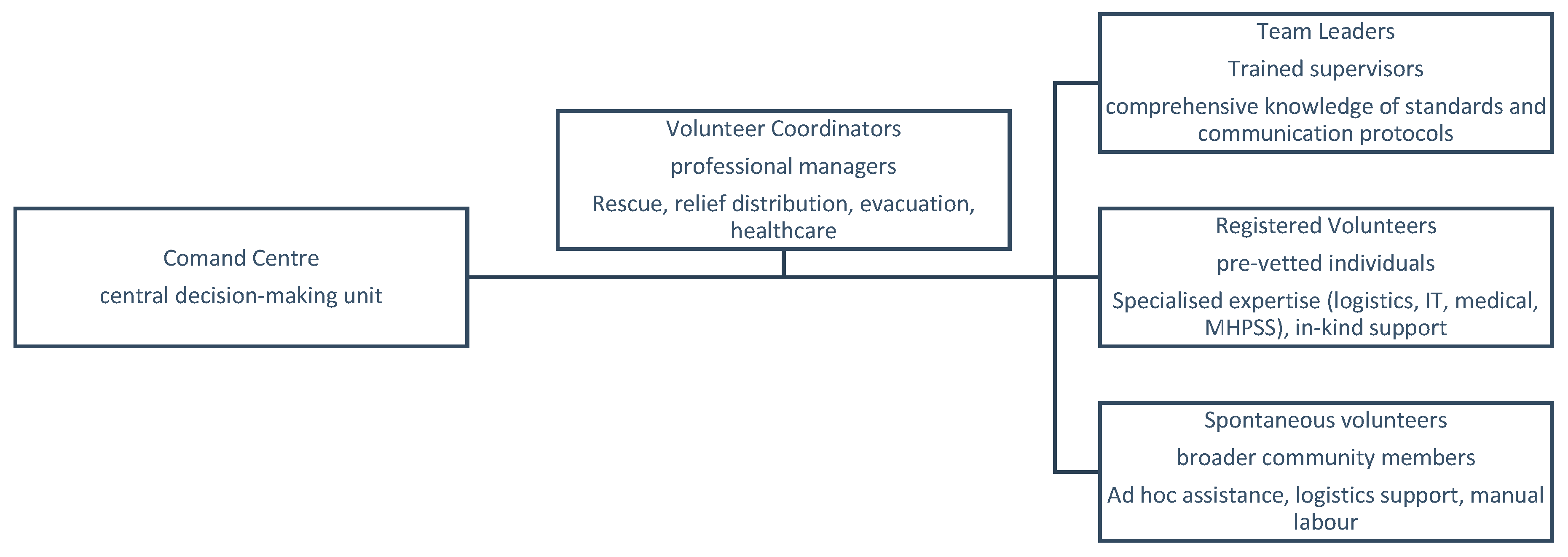
- Coordination is considered an organised approach under which the spontaneous volunteers and organisations are expected to act, being supervised and provided with clear information about the forms of engagement, to minimise any misconduct and risks during the response. The coordination mechanisms proposed by participants are as follows (Figure 3):
3.5. Result 5: Linking Existing ISO Standards to the Standards for Disaster Engagement of the Non-State Actors
- management system standards for overarching frameworks for organisational resilience,
- infrastructure standards unifying codes for essential facilities and networks,
- technical equipment standards provide specifications for tools and technologies and ensure that critical structures can withstand disasters and continue functioning during emergencies.
- coordination standards propose a set of protocols for a multi-agency response.
- information management standards concern the systems and formats for data collection and sharing.
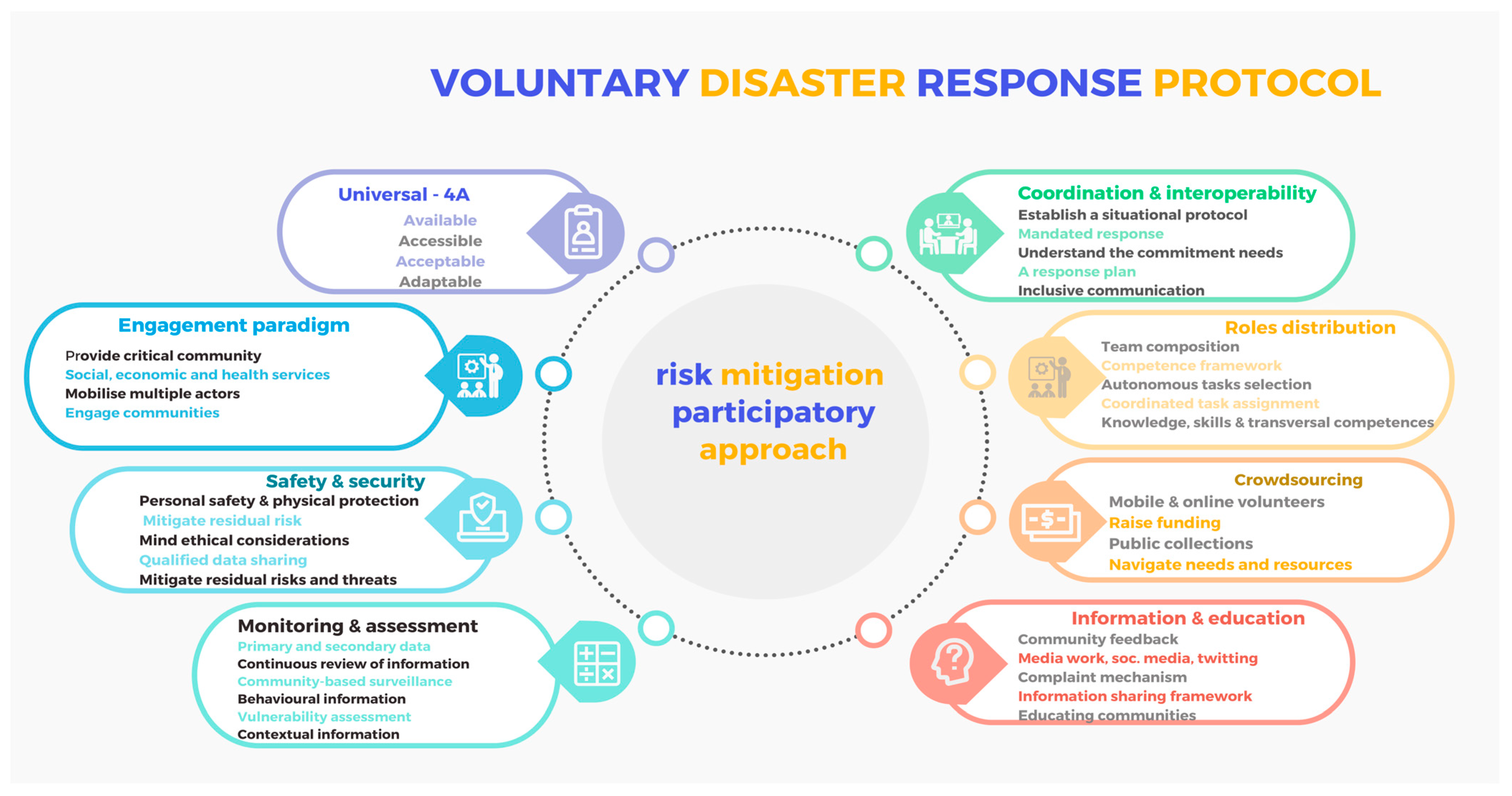
3.6. Result 6: Voluntary Standards for NSA Engagement in the Disaster Management Ecosystem
4. Discussion
- Coordination and organisation protocol to ensure interoperability and coherence of the action,
- Robust understanding of the crisis communication protocols to achieve information sharing across organisational boundaries
- Promoting broadly liability, insurance, and safety responsibilities amongst NSAs and volunteers, which is broadly neglected today
- Enabling preparation for the certification or accreditation system that provides certainties for handling minimum requirements, yet avoiding bureaucracy or any non-transparent actions or power imbalances between organisations
5. Conclusions
- identification of complementary capacities, strengths and needs across governmental and non-governmental actors following contingency and crisis planning based on risk analyses of the resilience of the communities,
- tasking and acknowledging specific competences of a unique nature that could be considered contributions of different actors,
- definition of forms of activation and communication with designated groups of actors who are prescribed as part of the local, regional, national, or international plan of action in case of emergencies, transboundary mass casualty event or disaster
- largely promotion of joint exercises and consultations to build relationships, test coordination mechanisms, and identify areas for improvement
Author Contributions
Funding
Institutional Review Board Statement
Informed Consent Statement
Data Availability Statement
Conflicts of Interest
Abbreviations
| ACMM | ASEAN Centre of Military Medicine |
| ADPC | Asian Disaster Preparedness Centre |
| AHA | ASEAN Coordinating Centre for Humanitarian Assistance on Disaster Management |
| AusAID | Australian Agency for International Development |
| CARE | Cooperative for Assistance and Relief Everywhere |
| CBRN | Chemical, Biological, Radiological, and Nuclear hazards |
| CEN | European Committee for Standardisation |
| CHS | Core Humanitarian Standard |
| CORDIS | Community Research and Development Information Service |
| DESA | United Nations Department of Economic and Social Affairs |
| DG ECHO | Directorate-General for European Civil Protection and Humanitarian Aid Operations |
| DRMKC | EU Disaster Risk Management Knowledge Centre |
| ECOSOC | United Nations Economic and Social Council |
| ERCC | the EU Emergency Response Coordination Centre |
| EU | European Union |
| EUCPM | European Union Civil Protection Mechanism |
| EWI | Early Warning Initiatives (EWI) Working Group |
| GAR | United Nations Global Assessment Report |
| HFLA | Humanitarian Food and Livelihood Assistance |
| ICRC | International Committee of the Red Cross |
| iCSO | Integrated Civil Society Organizations System |
| INSARAG | International Search and Rescue Advisory Group |
| ISO | International Organization for Standardization |
| JICA | Japan International Cooperation Agency |
| MISMA | Minimum Standards for Market Analyses |
| MSF | Médecins Sans Frontières |
| OCHA | United Nations Office for the Coordination of Humanitarian Affairs |
| OSOCC | On-Site Operations Coordination Centre |
| REAP | Risk-informed Early Action Partnership |
| SEE | Social Cohesion by Empowering Volunteering during Emergencies” (No. 101147724) |
| SELA | Latin American and Caribbean Economic System |
| UN | United Nations |
| UNDAC | UN Disaster Assessment and Coordination |
| USAID | United States Agency for International Development |
| V4 | Visegrad Group (Slovakia, the Czech Republic, Poland, and Hungary) |
| WASH | Water, Sanitation and Hygiene |
| WHO | World Health Organization |
Appendix A
The List of All Reference Projects Is Added Under the Bibliography Section
| No. | Abbreviation | Project Name |
| 1 | CUIDAR | Cultures of Disaster Resilience among children and young people |
| 2 | I-REACT | Improving Resilience to Emergencies through Advanced Cyber Technologies |
| 3 | ResiStand | Increasing disaster Resilience by establishing a sustainable process to support Standardisation of technologies and services |
| 4 | beAWARE | Enhancing decision support and management services in extreme weather climate events |
| 5 | BuildERS | Building European Communities’ Resilience and Social Capital |
| 6 | LINKS | Strengthening links between technologies and society for European disaster resilience |
| 7 | SHELTER | Sustainable Historic Environments hoListic reconstruction through Technological Enhancement and community based Resilience |
| 8 | CARISMAND | Culture And RISkmanagement in Man-made And Natural Disasters |
| 9 | RASOR | Final Report Summary-RASOR (Rapid Analysis and Spatialisation Of Risk (RASOR)) |
| 10 | CATALYST | Final Report Summary-CATALYST (Capacity Development for Hazard Risk Reduction and Adaptation) |
| 11 | SPARTACUS | Final Report Summary-SPARTACUS (Satellite Based Asset Tracking for Supporting Emergency Management in Crisis Operations) |
| 12 | ISITEP | Final Report Summary-ISITEP (Inter System Interoperability for Tetra-TetraPol Networks) |
| 13 | IDIRA | Final Report Summary-IDIRA (Interoperability of data and procedures in large-scale multinational disaster response actions) |
| 14 | TACTIC | Final Report Summary-TACTIC (Tools, methods And training for CommuniTIes and Society to better prepare for a Crisis.) |
| 15 | CIPRNET | Final Report Summary-CIPRNET (Critical Infrastructure Preparedness and Resilience Research Network) |
| 16 | DITAC | Periodic Report Summary 1-DITAC (Disaster Training Curriculum) |
| 17 | MATRIX | Final Report Summary-MATRIX (New Multi-HAzard and MulTi-RIsK Assessment MethodS for Europe) |
| 18 | SECINCORE | Final Report Summary-SECINCORE (Secure Dynamic Cloud for Information, Communication and Resource Interoperability based on Pan-European Disaster Inventory) |
| 19 | SENSUM | Final Report Summary-SENSUM (Framework to integrate Space-based and in-situ sENSing for dynamic vUlnerability and recovery Monitoring) |
| 20 | PSYROS | Final Report Summary-PSYCRIS (PSYcho-Social Support in CRISis Management) |
| 21 | PHAROS | Final Report Summary-PHAROS (PROJECT ON A MULTI-HAZARD OPEN PLATFORM FOR SATELLITE BASED DOWNSTREAM SERVICES) |
| 22 | MIAVITA | Final Report Summary-MIAVITA (Mitigate and assess risk from volcanic impact on terrain and human activities) |
| 23 | SGL FOR USAR | Final Report Summary-SGL FOR USAR (Second Generation Locator for Urban Search and Rescue Operations) |
| 24 | RECONNASS | Final Report Summary-RECONASS (Reconstruction and REcovery Planning: Rapid and Continuously Updated COnstruction Damage, and Related Needs ASSessment) |
| 25 | OPSIC | Final Report Summary-OPSIC (Operationalising Psychosocial Support in Crisis) |
| 26 | ELITE | Final Report Summary-ELITE (ELICIT TO LEARN CRUCIAL POST-CRISIS LESSONS) |
| 27 | HELP | Final Report Summary-HELP (Enhanced Communications in Emergencies by Creating and Exploiting Synergies in Composite Radio Systems) |
| 28 | DISASTER | Final Report Summary-DISASTER (Data Interoperability Solution At STakeholders Emergencies Reaction) |
| 29 | DRIVER+ | Final Report Summary-DRIVER+ (DRiving InnoVation in crisis management for European Resilience) |
| 30 | SLANDAIL | Final Report Summary-SLANDAIL (Security System for language and image analysis) |
| 31 | CASCADE | Final Report Summary-CASCADE (Collaborative Action towards Societal Challenges through Awareness, Development, and Education) |
| 32 | COBACORE | Final Report Summary-COBACORE (Community Based Comprehensive Recovery) |
| 33 | CASCEFF | Final Report Summary-CASCEFF (Modelling of dependencies and cascading effects for emergency management in crisis situations) |
| 34 | IRIS | Final Report Summary-IRIS (Integrated European Industrial Risk Reduction System) |
| 35 | STREST | Final Report Summary-STREST (Harmonized approach to stress tests for critical infrastructures against natural hazards) |
| 36 | GERNET | Final Report Summary-GARNET-E (GMES for Africa: Regional network for information exchange and training in emergencies) |
| 37 | MOVE | Final Report Summary-MOVE (Methods for the improvement of vulnerability assessment in Europe) |
| 38 | GEO_PICTURES | Final Report Summary-GEO-PICTURES (GMES and Earth observation with position-based image and sensor communications technology for universal rescue, emergency and surveillance management) |
| 39 | EUGENE | Final Report Summary-EUGENE (Improving coordination, visibility and impact of European GEOSS contributions by establishing a European Geoss Network) |
| 40 | FACEIT | Final Report Summary-FACEIT (Fast Advanced Cellular and Ecosystems Information Technologies) |
| 41 | CORE | sCience and human factOr for Resilient sociEty |
| 42 | BEYOND | Final Report Summary-BEYOND (Building Capacity for a Centre of Excellence for EO-based monitoring of Natural Disasters) |
| 43 | EDUCEN | Periodic Reporting for period 2-EDUCEN (European Disasters in Urban centres: a Culture Expert Network (3C–Cities, Cultures, Catastrophes)) |
| 44 | Search and Rescue | Search and Rescue: Emerging technologies for the Early location of Entrapped victims under Collapsed Structures and Advanced Wearables for risk assessment and First Responders Safety in SAR operations |
| 45 | TURNkey | Towards more Earthquake-resilient Urban Societies through a Multi-sensor-based Information System enabling Earthquake Forecasting, Early Warning and Rapid Response actions |
| 46 | DARWIN | Expecting the unexpected and know how to respond |
| 47 | PANTHEON | Community-Based Smart City Digital Twin Platform for Optimised DRM operations and Enhanced Community Disaster Resilience |
| 48 | SMALLDIS | The impact of small-scale disaster events: an exploration of disaster related losses, extensive risk management and learning at the institutional and community level in Italy |
| 49 | SASPARM | Final Report Summary-SASPARM (Support Action for Strengthening Palestinian-administrated Areas capabilities for Seismic Risk Mitigation) |
| 50 | ECODIS | Final Report Summary-ECODIS (Dynamic Sensing of Chemical Pollution Disasters and Predictive Modelling of Their Spread and Ecological Impact) |
| 51 | TEMA | Trusted Extremely Precise Mapping and Prediction for Emergency Management |
| 52 | FORTRESS | Final Report Summary-FORTRESS (Foresight Tools for Responding to cascading effects in a crisis) |
| 53 | A4A | Final Report Summary-A4A (Alert for All) |
| 54 | PEP | Final Report Summary-PEP (Public Empowerment Policies for Crisis Management) |
| 55 | MEDiME | Motivation and Engagement in Disaster Mapping in Europe |
| 56 | FOCUS | Final Report Summary-FOCUS (Foresight Security Scenarios: Mapping Research to a Comprehensive Approach to Exogenous EU Roles) |
| 57 | ISTOS | Periodic Reporting for period 1-ISTOS (CENTER OF INNOVATIVE SOLUTIONS FOR BUILDING SAFETY– ISTOS Center of Excellence) |
| 58 | IMPROVER | Improved risk evaluation and implementation of resilience concepts to critical infrastructure |
| 59 | xR4DRAMA | Extended Reality For DisasteR management And Media plAnning |
| 60 | SmokeBot | Mobile Robots with Novel Environmental Sensors for Inspection of Disaster Sites with Low Visibility |
| 61 | C2-SENSE | Final Report Summary-C2-SENSE (Interoperability Profiles for Command/Control Systems and Sensor Systems in Emergency Management) |
| 62 | AIRBEAM | Final Report Summary-AIRBEAM (AIRBorne information for Emergency situation Awareness and Monitoring) |
| 63 | VUELCO | Final Report Summary-VUELCO (Volcanic unrest in Europe and Latin America: Phenomenology, eruption precursors, hazard forecast, and risk mitigation) |
| 64 | EOPOWER | Final Report Summary-EOPOWER (Earth Observation for Economic Empowerment) |
| 65 | RESILENS | Periodic Reporting for period 2-RESILENS (RESILENS: Realising European ReSiliencE for CritIcaL INfraStructure) |
| 66 | GEO-PICTURES | GMES and Earth Observation with Position-based Image and sensor Communications Technology for Universal Rescue, Emergency and Surveillance management |
| 67 | RiskPACC | Periodic Reporting for period 1-RiskPACC (Integrating Risk Perception and Action to enhance Civil protection-Citizen interaction) |
| 68 | RESPONDRONE | NOVEL INTEGRATED SOLUTION OF OPERATING A FLEET OF DRONES WITH MULTIPLE SYNCHRONIZED MISSIONS FOR DISASTER RESPONSES |
| 69 | OASIS | OASIS: Open Advanced System for dIsaster and emergency management |
| 70 | ECOSSIAN | Final Report Summary-ECOSSIAN (European Control System Security Incident Analysis Network) |
| 71 | CRISYS | Final Report Summary-CRISYS (Critical response in security and safety emergencies) |
| 72 | INGENIOUS | The First Responder (FR) of the Future: a Next Generation Integrated Toolkit (NGIT) for Collaborative Response, increasing protection and augmenting operational capacity |
| 73 | EPISECC | Periodic Report Summary 2-EPISECC (Establish Pan-European Information Space to Enhance seCurity of Citizens) |
| 74 | STORM | Safeguarding Cultural Heritage through Technical and Organisational Resources Management |
| 75 | MIRACLE | Final Report Summary-MIRACLE (MobIle Laboratory Capacity for the Rapid Assessment of CBRN Threats Located within and outside the EU) |
| 76 | SYNERGIES | Innovating Preparedness by Leveraging SYNERGIES and Enhancing Results of DRM Projects |
| 77 | IN-PREP | An INtegrated next generation PREParedness programme for improving effective inter-organisational response capacity in complex environments of disasters and causes of crises |
| 78 | VALKYTIES | Periodic Reporting for period 1-VALKYRIES (Harmonization and Pre-Standardization of Equipment, Training and Tactical Coordinated procedures for First Aid Vehicles deployment on European multi-victim Disasters) |
| 79 | CLIMFOR | Periodic Reporting for period 1-CLIMFOR (Accurate Seasonal Forecasts for Boosting Renewable Energy Generation and Improving Current Disaster Risk Management) |
| 80 | 5G-EPICENTRE | 5G ExPerimentation Infrastructure hosting Cloud-nativE Network applications for public proTection and disaster RElief |
| 81 | DAREnet | DAnube river region Resillience Exchange network |
| 82 | SECTOR | Final Report Summary-SECTOR (SECURE EUROPEAN COMMON INFORMATION SPACE FOR THE INTEROPERABILITY OF FIRST RESPONDERS AND POLICE AUTHORITIES) |
| 83 | INNOSENSE | Final Report Summary-INNOSENSE (Reinforcement of BioSense Center–ICT for Sustainability and Eco-Innovation) |
| 84 | DEWS | Distant early warning System |
| 85 | IMAPCT | Periodic Reporting for period 2-IMPACT (Impact of Cultural aspects in the management of emergencies in public Transport) |
| 86 | PROACTIVE | PReparedness against CBRNE threats through cOmmon Approaches between security praCTItioners and the VulnerablE civil society |
| 87 | CAST | COMPARATIVE ASSESSMENT OF SECURITY-CENTERED TRAINING CURRICULA FOR FIRST RESPONDERS ON DISASTER MANAGEMENT IN THE EU |
| 88 | PulSAR | The incident management tool to use when everything goes wrong |
| 89 | SECOA | Final Report Summary-SECOA (SOLUTIONS for ENVIRONMENTAL CONTRASTS in COASTAL AREAS) |
| 90 | FLOODIS | Integrating GMES Emergency Services with satellite navigation and communication for establishing a flood information service |
| 91 | ULTRA | Final Report Summary-ULTRA (Unmanned Aerial Systems in European Airspace) |
| 92 | APHORISM | Final Report Summary-APHORISM (Advanced PRocedures for volcanIc and Seismic Monitoring) |
| 93 | ENGAGE | Engage Society for Risk Awareness and Resilience |
| 94 | IRMA | Integrated Risk Management for Africa |
| 95 | GEO VISION | Periodic Reporting for period 2-GEO VISION (GNSS driven EO and Verifiable Image and Sensor Integration for mission-critical Operational Networks) |
| 96 | E2mC | Evolution of Emergency Copernicus services |
| 97 | SUPER | Final Report Summary-SUPER (Social sensors for secUrity Assessments and Proactive EmeRgencies management) |
| 98 | INTACT | Final Report Summary-INTACT (On the Impact of Extreme Weather on Critical Infrastructures) |
| 99 | WATPLAN | Final Report Summary-WATPLAN (Spatial earth observation monitoring for planning and water allocation in the international Incomati Basin) |
| 100 | StRATEGY | Periodic Reporting for period 1-STRATEGY (Facilitating EU pre-Standardization process Through stReamlining and vAlidating inTeroperability in systems and procEdures involved in the crisis manaGement cYcle) |
| 101 | EU CHIC | Final Report Summary-EU CHIC (European Cultural Heritage Identity Card) |
| 102 | DRONECOP | The first integral control and command system for managing missions which delivers 3D cartography and georeferenced data in real-time |
| 103 | EOLES | Earth Observation Linking SMES To face real time natural disaster management |
| 104 | AMADEOS | Architecture for Multi-criticality Agile Dependable Evolutionary Open System-of-Systems |
| 105 | MulHaRes | A probabilistic decision framework for MULti-HAzard RESilience of residential building portfolios subjected to floods and landslides |
| 106 | INCREO | Mapping risk areas to reduce the impact of natural disasters |
| 107 | HEIMDALL | HEIMDALL-MULTI-HAZARD COOPERATIVE MANAGEMENT TOOL FOR DATA EXCHANGE, RESPONSE PLANNING AND SCENARIO BUILDING |
| 108 | IMPACT | Impact of Cultural aspects in the management of emergencies in public Transport |
| 109 | EURANOS | European approach to nuclear and radiological emergency management and rehabilitation strategies (EURANOS) |
| 110 | HTCycle | Sewage sludge reuse with Phosphate recovery and heavy metal absorption with an innovative HTC technology. |
| 111 | SATAGILITY-GO2MARKET | Go to market for the first European ITAR free modular micro control moment gyroscope actuator enabling 10x more in-orbit agility to small satellites ranging from 50 kg to 300 kg |
| 112 | LESSLOSS | Risk Mitigation for Earthquakes and Landslides |
| 113 | REMESH | Research Network on Emergency Resources Supply Chain |
| 114 | OASYS | Integrated optimization of landslide alert systems |
| 115 | DSSNET | Improvement, extension and integration of operational decision support systems for nuclear emergency management |
| 116 | SecureGas | Securing The European Gas Network |
| 117 | ART-SEIS | Automated Real-Time Broad Band Seismology in the Azores-Gibraltar region |
| 118 | AFRIHEAT | Uncovering the structure, dynamics and impacts of humid HEATwaves across AFRIca under present and future climate |
| 119 | DHRS-CIM | Distributed Human-Robot System for Chemical Incident Management |
| 120 | Quakebots | Artificial Intelligence and IoT for seismic monitoring |
| 121 | TRANSRISK | Vulnerability and risk assessment of transportation systems of assets (SoA) exposed to geo-hazards |
| 122 | WaterLANDS | Water-based solutions for carbon storage, people and wilderness |
| 123 | JUERGEN WEICHSELGART | Integrated disaster management model (idmm)-sustainable mitigation policy-making in europe |
| 124 | GATE | GAmma Trial for Emergencies and environment |
| 125 | CONCORDE | Development of Coordination Mechanisms During Different Kinds of Emergencies |
| 126 | E-ECORISK | A regional enterprise network decision-support system for environmental risk and disaster management of large-scale industrial spills. |
| 127 | FISI | Future Integral SatCom Initiative |
| 128 | AWARE | Platform for autonomous self-deploying and operation of wireless sensor-actuator networks cooperating with aerial objects |
| 129 | SAFE4ALL | Safeguarding African Foodsheds and Ecosystems for all Actors across Local, regional and international Levels to manage migration |
| 130 | EU-MEDIN COMPANIONS | Supporting publications on Natural Hazards Research |
| 131 | 3HAZ-CORINTH | Earthquakes, tsunamis and landslides in the Corinth rift, Greece A multidisciplinary approach for measuring, modelling, and predicting their triggering mode and their effects. |
| 132 | EO-ALERT | Next Generation Satellite Processing Chain for Rapid Civil Alerts |
| 133 | TSUMOSLIDE | submarine landSLIDEs and TSUnami MOdeling on the margins of the Mediterranean Sea |
| 134 | SOCIAD | Social Adaptation: When Software Gives Users a Voice |
| 135 | AR3WS | Acquiring and Responding to the 3D World, Smartly |
| 136 | REDIRNET | Emergency Responder Data Interoperability Network |
| 137 | EURAINSAT | European satellite rainfall analysis and monitoring at the geostationary scale (EURAINSAT) |
| 138 | M-Runners | Modal Nonlinear Resonance for Efficient and Versatile Legged Locomotion |
| 139 | REDESIGN | distRibutED, sElf-adaptable, and Scalable wIreless foG Networks |
| 140 | THEMIS | Protecting Human Rights and Public Health in Global Pandemics: A Map of the Standards Applied by EU and US Courts |
| 141 | SAFET | Safety in tunnels, thematic network on development of European guidelines for upgrading tunnel safety |
References
- AL-Fazari, S.; Kasim, N. Role of Stakeholders in Mitigating Disaster Prevalence: Theoretical Perspective. MATEC Web Conf. 2019, 266, 03008. [Google Scholar] [CrossRef] [Scilit]
- Cen-Cenelec. Cwa Download Area. 2025. Available online: https://www.cencenelec.eu (accessed on 27 February 2026).
- Siriwardana, C.; Shehara, I.; Jayathilake, G.; Jayasekara, R.J. The Importance of Managing Stakeholders for Effective Disaster Response. Bolgoda Plains 2021, 1, 36–40. [Google Scholar] [CrossRef] [Scilit]
- European Civil Protection Pool. Available online: https://civil-protection-humanitarian-aid.ec.europa.eu (accessed on 27 February 2026).
- United Nations Office for Disaster Risk Reduction (UNDRR). Sendai Declaration, Japan. 2015. Available online: https://www.preventionweb.net/files/43300_sendaideclaration.pdf (accessed on 27 February 2026).
- Gajewski, S.; Bell, H.; Lein, L.; Angel, R.J. Complexity and Instability: The Response of Non-Governmental Organizations to the Recovery of Hurricane Katrina Survivors in a Host Community. Non-Profit Volunt. Sect. Q. 2010, 40, 389–403. [Google Scholar] [CrossRef] [Scilit]
- Andrew, S.A.; Chatterjee, V.; Namuduri, K.; Winkler, J. Patterns of communication during full-scale emergency/disaster drills. J. Emerg. Manag. 2021, 19, 575–589. [Google Scholar] [CrossRef] [Scilit]
- Risk Informed Early Action Partnership (REAP). The Roles of State and Non-State Actors in Early Warning and Early Action; Risk Informed Early Action Partnership (REAP): Geneva, Switzerland, 2024; Available online: https://www.early-action-reap.org/ (accessed on 27 February 2026).
- Global Platform for Disaster Reduction. Sendai Framework for Disaster Risk Reduction 2015–2030; United Nations: Geneva, Switzerland, 2019; Available online: https://globalplatform.undrr.org (accessed on 27 February 2026).
- FEMA. Guide for All-Hazard Emergency Operations Planning; FEMA: Washington, DC, USA, 2016. Available online: https://www.fema.gov/pdf/plan/glo.pdf (accessed on 27 February 2026).
- Storey, A. Development in Practice, Non-Neutral Humanitarianism: NGOs and the Rwanda Crisis [L’Humanitaire non Neutre: Les ONG et la Crise Rwandaise/Humanitarismo Parcial: ONGs e a Crise de Ruanda/Humanitarianismo No-Neutral: ONGs y la Crisis de Ruanda]; Taylor & Francis, Ltd.: Abingdon, UK, 1997; Volume 7, pp. 384–394. [Google Scholar]
- Shiras, P. Humanitarian Emergencies and the Role of NGOs. In After Rwanda; Whitman, J., Pocock, D., Eds.; Palgrave Macmillan: London, UK, 1996. [Google Scholar] [CrossRef] [Scilit]
- Curnin, S.; Owen, C. A typology to facilitate multi-agency coordination. In Proceedings of the 8th International Information Systems for Crisis Response and Management Conference, Baden-Baden, Germany, 8–11 May 2011. [Google Scholar]
- Schwartz, E.P. Humanitarian NGOs as instruments, partners, advocates and critics in the governance of international humanitarian response: Complementary or conflicting roles? Asia Pac. J. Public Adm. 2016, 38, 43–59. [Google Scholar] [CrossRef] [Scilit]
- Towe, V.L.; Acosta, J.D.; Chandra, A. Towards More Nuanced Classification of NGOs and Their Services to Improve Integrated Planning across Disaster Phases. Int. J. Environ. Res. Public Health 2017, 14, 1423. [Google Scholar] [CrossRef] [Scilit]
- Dany, C. Zwischen Hilfe und Menschenrechten: Wie humanitäre internationale NROs der Krise des europäischen Flüchtlingsschutzes begegnen. Zeitchrift Politikwissenschaft. 2024, 34, 355–372. [Google Scholar] [CrossRef] [Scilit]
- Twigg, J. Disaster Risk Reduction Mitigation and Preparedness in Development and Emergency Programming; Humanitarian Practice Network, Good Practice Review; Overseas Development Institute: London, UK, 2004. [Google Scholar]
- Norris, F.H.; Stevens, S.P.; Pfefferbaum, B. Community Resilience as a Metaphor, Theory, Set of Capacities, and Strategy for Disaster Readiness. Am. J. Community Psychol. 2008, 41, 127–150. [Google Scholar] [CrossRef] [Scilit] [PubMed]
- Alesi, P. Building enterprise-wide resilience by integrating business continuity capability into day-to-day business culture and technology. J. Bus. Contin. Emerg. Plan. 2008, 2, 214–220. [Google Scholar] [CrossRef] [Scilit]
- Madrigano, J.; Chandra, A.; Costigan, T.; Acosta, J.D. Beyond Disaster Preparedness: Building a Resilience-Oriented Workforce for the Future. Int. J. Environ. Res. Public Health 2017, 14, 1563. [Google Scholar] [CrossRef] [Scilit]
- Chandra, A.; Williams, M.; Plough, A.; Stayton, A.; Wells, K.B.; Horta, M.; Tang, J. Getting Actionable About Community Resilience: The Los Angeles County Community Disaster Resilience Project. Am. J. Public Health 2013, 103, 1181–1189. [Google Scholar] [CrossRef] [Scilit]
- Boin, A.; Rhinard, M.; Ekengren, M. Managing Transboundary Crises: The Emergence of European Union Capacity. J. Contingencies Crisis Manag. 2014, 22, 131–142. [Google Scholar] [CrossRef] [Scilit]
- Bly, J.; Hugo Francescutti, L.; Weiss, D. Disaster Management: A State-of-the-Art Review; IntechOpen: Rijeka, Croatia, 2021. [Google Scholar] [CrossRef] [Scilit]
- Chen, R.; Sharman, R.; Chakravarti, N.; Rao, H.R.; Upadhyaya, S.J. Emergency Response Information System Interoperability: Development of Chemical Incident Response Data Model. J. Assoc. Inf. Syst. 2008, 9, 200–230. [Google Scholar] [CrossRef] [Scilit]
- Curnin, S.; Owen, C. Obtaining information in emergency management: A case study from an Australian emergency operations centre. Int. J. Hum. Factors Ergon. 2013, 2, 131–158. [Google Scholar] [CrossRef] [Scilit]
- International Organization for Starndardization (ISO). Store. 2025. Available online: https://www.iso.org (accessed on 27 February 2026).
- Treurniet, W.; Wolbers, J. Codifying a crisis: Progressing from information sharing to distributed decision-making. J. Contingencies Crisis Manag. 2020, 29, 23–35. [Google Scholar] [CrossRef] [Scilit]
- Lassa, J. Roles of Non-Government Organizations in Disaster Risk Reduction. Oxford Research Encyclopedia of Natural Hazard Science. 2018. Available online: https://oxfordre.com/naturalhazardscience/view/10.1093 (accessed on 27 February 2026).
- Abbasi, A.; Kapucu, N. Structural Dynamics of Organizations during the Evolution of Interorganizational Networks in Disaster Response. J. Homel. Secur. Emerg. Manag. 2012, 9, 21. [Google Scholar] [CrossRef] [Scilit]
- Murphy, C.; Creamer, C.; McClelland, A.; Boyle, M. The value of cross border emergency management in adapting to climate change. Borderl. J. Spat. Plan. Irel. 2016, 5, 34–46. [Google Scholar]
- Treurniet, W. Shaping Comprehensive Emergency Response Networks: Network Topology in Command and Control, Chapter 2; IGI Global: New York, NY, USA, 2014. [Google Scholar] [CrossRef] [Scilit]
- Nowell, B.; Steelman, T.; Velez, A.-L.K.; Yang, Z. The Structure of Effective Governance of Disaster Response Networks: Insights from the Field. Am. Rev. Public Adm. 2017, 48, 699–715. [Google Scholar] [CrossRef] [Scilit]
- Mannesh-Khorram, A.; Goniewicz, K.; Hertelendy, A.; Dulebenets, M. Handbook of Disaster and Emergency Management, 2nd ed.; Kompendiet: Gothenburg, Sweden, 2021. [Google Scholar] [CrossRef]
- Acosta, J.; Chandra, A. Harnessing a Community for Sustainable Disaster Response and Recovery: An Operational Model for Integrating Non-governmental Organisations. Disaster Med. Public Health Prep. 2013, 7, 361–368. [Google Scholar] [CrossRef] [Scilit]
- Dobson, R.; Manneshamir-Khorram, A. Handbook of Disaster and Emergency Management, 2nd ed.; Kompendiet: Gothenburg, Sweden, 2021; Chapter 11; ISBN 978-91-527-0705-0. [Google Scholar]
- Williams, E.M. A Tale of Three Systems: Improving Three Emergency Communication Systems. Master’s Thesis, Wright State University-Main Campus, Dayton, OH, USA, 2018. Available online: https://corescholar.libraries.wright.edu/ (accessed on 27 February 2026).
- Nahkur, O.; Orru, K.; Hansson, S.; Jukarainen, P.; Myllylä, M.; Krüger, M.; Max, M.; Savadori, L.; Nævestad, T.-O.; Meyer, S.F.; et al. The Engagement of Informal Volunteers in Disaster Management in Europe. Int. J. Disaster Risk Reduct. 2022, 83, 103413. [Google Scholar] [CrossRef] [Scilit]
- Kuipers, S.; Hart, P.; Boin, A. The Crisis Approach. In Handbook of Disaster Research; Handbooks of Sociology and Social Research (HSSR); Spinger: Berlin/Heidelberg, Germany, 2017. [Google Scholar] [CrossRef] [Scilit]
- Page, M.J.; McKenzie, J.E.; Bossuyt, P.M.; Boutron, I.; Hoffmann, T.C.; Mulrow, C.D.; Shamseer, L.; Tetzlaff, J.M.; Akl, E.A.; Brennan, S.E.; et al. The PRISMA 2020 statement: An updated guideline for reporting systematic reviews. BMJ 2021, 372, n71. [Google Scholar] [CrossRef] [Scilit] [PubMed]
- Al-Husain, R. Promoting Sustainability in Kuwait: An Exploratory Study of Disaster Management Preparedness and Resilience in State Organizations. Sustainability 2023, 15, 10066. [Google Scholar] [CrossRef] [Scilit]
- Health Communication Capacity Collaborative HC3. Social and Behaviour Change. Communication for Emergency Preparedness Implementation Kit. 2016. Available online: https://sbccimplementationkits.org/sbcc-in-emergencies (accessed on 27 February 2026).
- United Nations Office of Disaster Risk Reduction. Terminology. 2017. Available online: https://www.unisdr.org/we/inform/publications/47804 (accessed on 27 February 2026).
- Federal Emergency Management Agency. Principles of Whole Community Engagement in the Recovery Phase. Operational Lessons Learned, in Disaster Response. In Operational Lessons Learned in the Disaster Response; U.S. Fire Administration: Emmitsburg, MD, USA, 2015. Available online: https://apps.usfa.fema.gov/publications/ (accessed on 27 February 2026).
- United Nations—Department of Human Affairs. Glossary: Internationally Agreed Glossary of Basic Terms Related to Disaster Management; United Nations—Department of Human Affairs: Geneva, Switzerland, 1992. [Google Scholar]
- Doyle, E.E.; Johnston, D.M.; Smith, R.; Paton, D. Communicating model uncertainty for natural hazards: A qualitative systematic thematic review. Sci. Direct 2019, 33, 449–476. [Google Scholar] [CrossRef] [Scilit]
- Office for the Coordination of Humanitarian Affairs (OCHA). The Cluster Approach. OCHA on Message; Humanitarian Coordination Support Section, OCHA: Geneva, Switzerland, 2012; Available online: https://www.unocha.org/publications/ (accessed on 27 February 2026).
- Dittmer, C.; Lorenz, D.F. Emergent, extending, expanding and established citizen disaster response in the German Ahr valley flood in 2021. Int. J. Disaster Risk Reduct. 2024, 105, 104394. [Google Scholar] [CrossRef] [Scilit]
- Pycroft, V. Capacity Building and Disaster Response: A Case Study of NGOs’ Response to Cyclone Evan in Samoa. Master’s Thesis, Massey University, Auckland, New Zealand, 2015. Massey Research Online. Available online: https://mro.massey.ac.nz/ (accessed on 27 February 2026).
- Monday.com Emergency Response Team (ERT). ERT and South African Red Cross Case Study. Available online: https://www.mondayert.org/post/monday-com-ert-and-south-african-red-cross-case-study (accessed on 2 February 2026).
- Oğuzhan, Ö.; Uzun, A. The democratic touch of disasters: The perception of non-governmental organizations in public institutions in the context of disaster governance. Int. J. Disaster Risk Reduct. 2025, 125, 105586. [Google Scholar] [CrossRef] [Scilit]
- Lu, Y.; Wang, Y.; Zhang, L. System dynamic modeling of the NGO post-disaster relief contribution in the 2021 Henan flood in China. Int. J. Disaster Risk Reduct. 2023, 89, 103626. [Google Scholar] [CrossRef] [Scilit]
- ISO 22320:2011; Societal Security—Emergency Management—Requirements for Incident Response. ISO: Geneva, Switzerland, 2011.
- Imhoff, R.; Roelvink, F. Actionable warning systems. In Deltares Impact Report: Working Towards Impact 2023; Deltares: Delft, The Netherlands, 2023; Available online: https://specials.deltares.nl/impact_report_2023/actionable_warning_systems (accessed on 27 February 2026).
- Sphere Association. The Sphere Handbook: Humanitarian Charter and Minimum Standards in Humanitarian Response, 4th ed.; Sphere Association: Geneva, Switzerland, 2018; Available online: https://www.spherestandards.org/handbook (accessed on 27 February 2026).



| No. | Terminology | No. | Terminology |
|---|---|---|---|
| 1 | Affected population | 20 | Extensive disaster risk |
| 2 | Build back better | 21 | Hazard |
| 3 | Building code | 22 | Hazardous event |
| 4 | Capacity | 23 | Intensive disaster risk |
| 5 | Contingency planning | 24 | Mitigation |
| 6 | Critical infrastructure | 25 | National Platform for Disaster Risk Reduction |
| 7 | Disaster | 26 | Preparedness |
| 8 | Disaster loss database | 27 | Prevention |
| 9 | Disaster management | 28 | Reconstruction |
| 10 | Disaster risk | 29 | Recovery |
| 11 | Disaster risk assessment | 30 | Rehabilitation |
| 12 | Disaster risk governance | 31 | Residual risk |
| 13 | Disaster risk information | 32 | Resilience |
| 14 | Disaster risk management | 33 | Response |
| 15 | Disaster risk reduction | 34 | Retrofitting |
| 16 | Early warning system | 35 | Risk transfer |
| 17 | Economic loss | 36 | Structural and non-structural measures |
| 18 | Evacuation | 37 | Underlying disaster risk drivers |
| 19 | Exposure | 38 | Vulnerability |
| N-0 | Delineated Roles | Description |
|---|---|---|
| N = 1 | Roles = “3”,”4”, “5”, “6”, “7” | Citizen Disaster Response in the German Ahr Valley Flood of 2021 hit Western Europe, [47]. The disaster led to increased help from local residents and spurred the formation of semi-professional crisis management teams. |
| N = 2 | Roles = “1”,”3”,”4”, “5”, “6”, “7” | NGOs’ Response to Cyclone Evan in Samoa 2015 [48] presents collaborations with non-state organisations for effective response operations, adapted to changing circumstances, fostered strong relationships within the communities they support. |
| N = 3 | Roles = “1”,”3”,”4”, “5”, “6” | A case study illustrating how the Emergency Response Team of Monday.com and the South African Red Cross [49] worked during the severe flooding in KwaZulu-Natal Province in April 2022. |
| N = 4 | Roles = “1”,”3”,”4”, “5”, “6”, “6” | The view of non-governmental organisations within public institutions on disaster governance, 6 February 2023, the Kahramanmaraş earthquakes [50] refers to the Search and Rescue Association (AKUT), a disaster-focused NGO, which rescued numerous individuals from debris and positively influenced public perception of NGO/NSAs within civil society. |
| N = 5 | Roles = “1”, “2”, “3”, “5”, “6”, “7” | Involvement of Chinese civilian rescue teams significantly contributing to the disaster response during the Henan floods, resulting in an approximate 24% decrease in fatalities. It allowed NGO/NSAs to focus on less specialized tasks, such as relocating survivors and improving rescue results [51]. |
| Thematic Criteria | Description/Research Definition | No Interventions |
|---|---|---|
| community communication (1) | Engaging the local community via networking, distribution of vital information for the aim of keeping order and minimising the damage and stress, this the communication supporting the build-up of networking between affected community sin the field. | N = 4 |
| communication technologies (2) | Used technologies for establishing communication, dissemination of situational awareness, harvesting data and information vital for disaster resilience, effective and timely and early action response to disasters, minimising the suffer of persons. | N = 24 |
| community behaviour in disaster (3) | Demonstrating how the community adopts to the information circulated and whether empathy, discipline and support is provided by individuals. | N = 25 |
| community training and awareness (4) | Delivery of methodologies, strategies and various training and drilling activities and exercises. | N = 33 |
| crisis management (5) | Inter-disciplinary communication, interoperability, engagement of various organisations, organisational communication. | N = 43 |
| culture of risk management/disaster (6) | Developing the culture of understanding and communicating the risk. | N = 23 |
| decision support (7) | Decision support system organisation. | N = 24 |
| disaster communication (8) | General forms, types and modes for dissemination and sharing of information about the risk, evolving hazardous event, threats and also for establishing cooperation and interoperability with responders. | N = 14 |
| first responder (9) | Anybody engaged in the response to any emergency and disasters, or gets actively involved in the development of pre-disaster agreements, protocols, communication standards and service standard delivery protocol including capacity, skills, equipment. | N = 7 |
| risk management (10) | Analyses and assessment of the risks, methods and approaches to resilience. | N = 50 |
| social capital (11) | Social capital importance in disaster communication. | N = 6 |
| social media (12) | Use of the social media in crisis and disaster communication. | N = 8 |
| societal impact on risks (13) | Role of society in disaster communication. | N = 3 |
| technology and society (14) | Technology for increasing communication preparedness and reaction of the society. | N = 14 |
| vulnerable groups (15) | Communication engaging the vulnerable groups. | N = 6 |
| Areas of Impact | |
|---|---|
| Description |
| Flexibility and Adaptability | Unlike large governmental agencies bound by bureaucratic procedures, NSAs can often respond more quickly and adaptively to emerging needs during disasters, DRIVER+ project. |
| Resource Amplification | Volunteers significantly expand the human resources available for disaster response and recovery, COBACORE project. |
| Funding mechanisms for sustainability | The ENGAGE project found that sustainable funding is essential for maintaining engagement beyond immediate crisis periods. NGO/NSAs are also adept at mobilising human, financial, and material resources through their networks, which is especially crucial when official resources are overextended during significant disasters. |
| Affiliated Volunteers | NSA and individuals are formally associated with established organisations (e.g., Red Cross and volunteer fire departments) and typically receive training, equipment, and clear operational protocols, ELITE and DRIVER+ projects. |
| Spontaneous Unaffiliated Volunteers | The BuildERS project identifies individuals emerge spontaneously during disasters without prior affiliation to response organisations as a valuable resource and a management challenge, as they arrived without training or formal integration into response structures. |
| Digital Volunteers | Projects like SLANDAIL and E2mC document the growing phenomenon of digital volunteers contributing remotely through crisis mapping, social media monitoring, and information verification. They represent a significant force multiplier but require coordination mechanisms. |
| Cost-Effectiveness | Volunteer work also represents a significant economic value that would be prohibitively expensive to replicate through paid professional services, the integration of volunteers is the subject of the research from ENGAGE, LINKS, and BuildERS projects. |
| Local Knowledge and Community | Trust NSAs typically deeply understand local contexts, vulnerabilities, and cultural sensitivities. Projects like CARISMAND and EDUCEN document how this localised knowledge allows NSAs to tailor disaster interventions appropriately and access communities that might distrust official channels. |
| Community-Based Volunteers | The LINKS and ENGAGE projects focus on the roles of individual specialists who serve as volunteers and provide medical and health support or even save lives during disaster response. |
| Community Resilience | The CARISMAND project outlined the role of volunteers and non-state actors in sustaining risk awareness and resilience actions in communities. |
| |
| Policy frameworks for the integration of non-state actors | The ResiStand project demonstrates that effective standardisation and policy development requires active participation from all stakeholder groups. Obviously, the integrated policy frameworks that explicitly recognise and define roles for diverse stakeholders across all phases of disaster management. |
| Legal frameworks | Establishing clear legal frameworks addressing liability protection, insurance coverage, and compensation for volunteers and NSAs engaged in disaster activities. Research from DRIVER+ project also refers to legal uncertainty as a major barrier to effective stakeholder integration |
| Innovation and Learning | The COBACORE project highlights how NGO/NSAs often drive innovation in disaster management approaches, testing new methodologies and technologies that may later be adopted more broadly. |
| Certification system | Develop certification systems recognising the skills and contributions of non-governmental actors while maintaining necessary quality standards. The ELITE project demonstrated that appropriate recognition systems significantly enhance stakeholder motivation. |
| Coordination Issues | The EPISECC project’s centres on creating coordination challenges and duplicating efforts, and special attention is given to cross-border disaster scenarios. The SHELTER project emphasises that successful disaster management requires establishing clear frameworks for NSA integration that balance the need for coordination with respect for organisational autonomy. Communication methods and tools are outlined by the EPISECC project to addresses the creation of coordination challenges and duplication of efforts, giving special focus to cross-border disaster scenarios. |
| Coordination Complexities | As the number of actors involved in disaster management increases, coordination becomes more complex as new actors enter the system. The DARWIN project documented the gaps in using traditional mechanisms when dealing with various responders and civic actors in modern disaster contexts. This complexity is further compounded in cross-border scenarios. The DAREnet project found that language barriers, differing protocols, and varying legal frameworks create particular challenges for multi-stakeholder coordination in transboundary disasters. |
| |
| Cultural competence as a core capability | The IMPACT project demonstrates that cultural competence—the ability to understand and effectively engage with different cultural contexts—should be considered a fundamental capability for disaster management professionals. |
| Co-design with cultural sensitivity | Projects like CUIDAR and LINKS identify participatory approaches involving diverse stakeholders in the design of disaster management strategies as significant. |
| Leveraging cultural bridges | The CARISMAND addresses the capacities of NSAs and community-based organisations as cultural mediators for the affected communities, translating needs and capacities in both directions. |
| Cultural adaptation of tools and methods | DRIVER+ focuses on adapting disaster management tools, protocols, and training materials to different cultural contexts rather than imposing standardised approaches. |
| Recognition of cultural diversity within communities | The EDUCEN highlighting that nuanced approaches should be applied to different groups so that differences are not ignored. Also, during emergencies, cultural groups cannot be treated as monolithic. |
| Intersectional vulnerability factors | The BuildERS mapping factors multiplying the vulnerability to disasters and emergencies, such as age, disability, socioeconomic status, language barriers, immigration status, and geographic isolation. |
| Dynamic vulnerability | The MOVE project highlights that vulnerability is not static but changes over time and across different hazard contexts. Individuals who are resilient in one scenario may be vulnerable in another. |
| Beyond victims to agents | CUIDAR and ENGAGE projects emphasise on reconceptualising vulnerable groups not merely as victims requiring assistance but as active agents with valuable knowledge, perspectives, and caps. |
| Volunteer Type | Characteristics | Typical Roles |
|---|---|---|
| Trained Disaster Management Volunteers | Specially prepared for emergency situations | Rescue, relief distribution, evacuation, healthcare |
| Existing Organisation Volunteers | Already involved in community activities | First aid, community liaison, needs assessment |
| Emerge during disasters without prior affiliation | Ad hoc assistance, logistics support, manual labour | |
| Corporate Volunteers | Provided by private sector companies | Specialised expertise (logistics, IT), in-kind support |
| International Volunteers | Travel from other countries to assist | Specialist skills, though, often face cultural barriers |
| Online Volunteers | Contribute remotely via digital platforms | Mapping, IT support, data analysis, translation |
| No. | Name of Standard * | Short Description |
|---|---|---|
| N-1 | ISO 31000 [53] | The risk management standard provides systematic approaches to managing organisational risks. |
| N-2 | ISO 2232053 [53] | The standard ensures timely, relevant operational information through standardised processes. |
| N-3 | Sphere Standards [54] | The humanitarian norm defines the minimum acceptable levels of humanitarian assistance. Sphere Standards ensure that humanitarian assistance meets quality requirements, facilitates coordination among aid organisations, and advocates for the rights of affected populations. |
| N-4 | ISO/IEC 27001:2013 [53] | The standard helps the incident response entities assess and improve their capabilities in managing emergencies (crises, disruptions, and disasters). |
| N-5 | ISO 41000, ISO 41001 [53] | The standard refers to facility management mandates for the development of emergency response plans, ensuring organisations are prepared for various scenarios, including natural disasters, by integrating them into overall risk management, emergency preparedness, and business continuity plans. Both core disaster management standards provide guidance. |
| N-6 | ISO 14000 for environmental management [53] | Focusing on the regulations for environmental protection, including environmental management plans, setting environmental controls, and tracking environmental management objectives. |
| N-7 | ISO 26000 for social responsibility [53] | General and worldwide guidance for achieving and practising social corporate responsibility. |
| N-8 | ISO22393:023 Security and resilience—Community resilience [53] | Guidelines for planning recovery and renewal |
| N-9 | ISO 9001:2015 for quality management [53] | Focuses on improving performance related to products, services, and customer outcomes. |
| N-10 | Collaborative emergency response–Common addressing format and emergency identification protocol (CWA 18013:2023) [2] | Guiding principles on the hierarchical naming system of the public and private safety agencies and emergency authorities. The standard refers to the cooperation and interconnectedness of different public safety agencies and rescue teams to effectively respond to crises. A common addressing format to identify the agencies and their teams/departments. |
| N-11 | The CWA on Requirements and recommendations for social media early warning messages in crisis and disaster management (CWA 18005:2023) [2] | This is a set of recommendations for the preparation, design, and visualisation of social media messages regarding early warning messages and notifications in crisis. Promoting consistency in messaging across different organisations is a set of approaches regulating the design of social media warning messages to alert citizens during emergencies. |
| N-12 | Exchanging information about building and infrastructure damaged by using a Common Alerting Protocol (CWA 18022:2023) [2] | A set of guiding principles for disseminating information about the status of buildings and/or infrastructure after an incident. Establishment of a formalised way to report (describe and disseminate) promptly and automatically transfer information. |
Disclaimer/Publisher’s Note: The statements, opinions and data contained in all publications are solely those of the individual author(s) and contributor(s) and not of MDPI and/or the editor(s). MDPI and/or the editor(s) disclaim responsibility for any injury to people or property resulting from any ideas, methods, instructions or products referred to in the content. |
© 2026 by the authors. Licensee MDPI, Basel, Switzerland. This article is an open access article distributed under the terms and conditions of the Creative Commons Attribution (CC BY) license.
Share and Cite
Terzieva, G.T.; Reig-Botella, A.; Seňová, A.; Betuš, M.; Kottferová, N. Engagement of Non-State Actors’ Capacities in the Crisis Management System. Sustainability 2026, 18, 2603. https://doi.org/10.3390/su18052603
Terzieva GT, Reig-Botella A, Seňová A, Betuš M, Kottferová N. Engagement of Non-State Actors’ Capacities in the Crisis Management System. Sustainability. 2026; 18(5):2603. https://doi.org/10.3390/su18052603
Chicago/Turabian StyleTerzieva, Galya Toteva, Adela Reig-Botella, Andrea Seňová, Miroslav Betuš, and Nikola Kottferová. 2026. "Engagement of Non-State Actors’ Capacities in the Crisis Management System" Sustainability 18, no. 5: 2603. https://doi.org/10.3390/su18052603
APA StyleTerzieva, G. T., Reig-Botella, A., Seňová, A., Betuš, M., & Kottferová, N. (2026). Engagement of Non-State Actors’ Capacities in the Crisis Management System. Sustainability, 18(5), 2603. https://doi.org/10.3390/su18052603