Article

Mapping Circularity Strategies in Building Sustainability Assessment Methods

1
Laboratory of Building Construction and Building Physics, Department of Civil Engineering, Aristotle University of Thessaloniki (A.U.Th.), P.O. Box 429, 541 24 Thessaloniki, Greece
2
Institute for Sustainability and Innovation in Structural Engineering (ISISE), Associate Laboratory Advanced Production and Intelligent Systems (ARISE), Department of Civil Engineering, University of Minho, 4804-533 Guimarães, Portugal
3
Institute for Sustainability and Innovation in Structural Engineering (ISISE), Associate Laboratory Advanced Production and Intelligent Systems (ARISE), Department of Civil Engineering, University of Coimbra, 3030-788 Coimbra, Portugal
4
University Centre for Energy Efficient Buildings, Czech Technical University in Prague, 27343 Buštěhrad, Czech Republic
5
Interuniversity Department of Urban and Regional Studies and Planning, Politecnico di Torino, Viale Mattioli 39, 10125 Torino, Italy
6
Department of Civil and Environmental Engineering, School of Engineering and Digital Sciences, Nazarbayev University, Astana 01000, Kazakhstan
7
Departamento de Ingeniería Aeroespacial y Mecánica de Fluidos, Escuela Técnica Superior de Ingeniería Agronómica, Universidad de Sevilla, Ctra. de Utrera, Km. 1, 41005 Sevilla, Spain
8
Faculty for the Built Environment, University of Malta, MSD 2080 Msida, Malta
*
Author to whom correspondence should be addressed.
Sustainability 2026, 18(5), 2585; https://doi.org/10.3390/su18052585
Submission received: 22 December 2025 / Revised: 25 February 2026 / Accepted: 27 February 2026 / Published: 6 March 2026

Abstract

The widespread adoption of circularity principles in the building sector fuels the need for robust and comprehensive evaluation systems, which could benefit from the approaches and indicators employed in widely accepted building sustainability assessment (BSA) methods. Simultaneously, the effective consideration of circular economy (CE) principles into BSA methods becomes increasingly urgent. An important step towards achieving these targets is the investigation of whether, and to which degree, the existing BSA methods encompass and express circularity principles; this study focuses on this relatively underexplored theme. Specifically, this study investigates the degree of association between five widely used BSA methods and the circularity strategies included in the 10R Framework. The methods examined are BREEAM, DGNB, LEED, Level(s) and SBTool (versions and criteria for new buildings). The examination was conducted at the lowest self-contained and score-attributing level of each method and was undertaken by five expert groups—each assigned one method. A quantitative scale from 0 to 5 was used to assess the strength of the association. The results are analysed in terms of (i) the criteria/thematic areas within each method receiving high/low scores, and (ii) the circularity strategies deduced to be strongly/weakly represented in and across the BSA methods. Common trends and milder differences across these axes are observed. Generally, the associations appear stronger in thematic areas relevant to, among others, resources and lifecycle performance, and weaker regarding parameters linked to user comfort. The R-strategies Reduce, Reuse, Recycle and Rethink emerge as more intensely represented in the examined methods. The study’s results indicate areas for further research and potential methodological enhancement.

1. Introduction

The implementation of circular economy (CE) principles is increasingly recognised as a critical strategy for achieving sustainability goals, particularly as their adoption grows across the global building sector [1,2,3]. This trend presents an opportunity—if not a necessity—to redefine the way sustainability is approached in the built environment by focusing on the development of practical methods and tools [4]. Promoting circularity in the construction sector is a multifaceted objective that encompasses various parameters. As such, it can only be effectively achieved through a systematised methodology that supports decision-making processes across the building life cycle. Therefore, there is a growing demand for decision-support systems and assessment tools based on measurable indicators to evaluate circularity at multiple scales. From building materials [5] and individual buildings [6] to cities [7], such tools are essential for providing measurable guidance on circular design decisions.
Despite several well-structured proposals in the extant literature [8,9,10], a universally accepted system for assessing or certifying circular construction has yet to be established. Given the established status of building sustainability assessment (BSA) methods such as BREEAM, DGNB, LEED, Level(s), and SBTool, adapting or redefining these tools may help bridge this gap. Despite the conceptual proximity between Sustainability and CE [11], there remains a noteworthy gap in understanding how and to which degree current BSA methods reflect or incorporate CE principles.
This paper addresses that gap by conducting a novel, structured parallel examination of five leading BSA methods—BREEAM, DGNB, LEED, Level(s), and SBTool—through the lens of the 10R circularity framework proposed by Potting et al. [12]. It provides a study to systematically map the presence and strength of alignment between each method’s criteria or indicators and the full spectrum of circularity strategies, ranging from high-priority actions such as Refuse (R0) and Reduce (R1) to lower-priority ones such as Recover (R9). This unified evaluation framework contributes to laying the foundation for a common language and benchmark for assessing circularity across otherwise diverse sustainability certification systems.
The novelty of this work lies in two main contributions. First, it offers direct insights into whether and to which degree these methods—including Level(s), which is of special interest as the EU-endorsed framework—integrate circularity principles and can, therefore, support the implementation of the European Circular Economy Action Plan in the construction sector. These findings can inform the evolution of BSA methods, influence certification criteria, and support policymaking at both national and EU levels. Furthermore, they can unveil aspects and identify indicators of the already recognised and tested in practice BSA methods that could support the enrichment and or development of circularity assessment frameworks. Second, it introduces a structured, multi-method analysis that uncovers both synergies and gaps between existing sustainability tools and circularity goals, providing quantitative results.
This paper builds upon and significantly extends earlier research by Giarma et al. [13], which laid the groundwork for evaluating circularity in certification tools. The present work deepens that approach by applying a quantitative scale of assessment of the examined associations and broadening the analytical scope. Both studies are conducted within the framework of COST Action CA21103: Implementation of Circular Economy in the Built Environment (Circular B) [https://circularb.eu/, accessed on 15 July 2025].

2. Background

2.1. Critical Reflections on the Circularity–Sustainability Relationship

2.1.1. Historical Development and Conceptual Relationship

The concept of sustainable development began gaining traction in the 1960s as the environmental consequences of unchecked economic growth and social progress became increasingly evident [14]. Since then, multiple definitions have emerged, emphasising dimensions such as climate change mitigation, social equity, ecological protection, and biodiversity conservation [15]. The most widely accepted definition, from the Brundtland Report Our Common Future [16], describes sustainability as “meeting the needs of the present without compromising the ability of future generations to meet their own needs.” This framing highlights sustainability’s systemic nature, calling for a balance between environmental integrity, economic viability, and social equity across generations [17,18].
More recently, the CE has gained momentum in academic, industrial, and policy circles for its promise in advancing sustainable development. Yet, conceptual ambiguities persist regarding CE’s relationship to sustainability, creating challenges for both theoretical coherence and practical application [18]. While CE is often framed as a strategy for operationalising sustainability, critical perspectives highlight divergences in scope, intent, and systemic integration [13].
Although CE is frequently described as an up-to-date synonym or alternative expression of sustainability, only a small fraction of CE definitions explicitly incorporate sustainability principles—just 12%, according to Geissdoerfer et al. [19]. This gap has raised concerns over CE’s engagement with the ethical and social dimensions of sustainability. Korhonen et al. [20], for instance, argue that CE discourse tends to prioritise technical and economic solutions while downplaying value-based and social considerations.
Despite their differences, both sustainability and CE share a core objective: reducing environmental degradation and preserving natural resources [19]. Sustainability, however, presents a broader, normative agenda aimed at integrating environmental protection, economic factors (e.g., economic development) and social concerns (e.g., social and intergenerational justice, user satisfaction), thus extending to institutional aspects as well. In contrast, CE fosters restorative and regenerative industrial systems, promoting strategies such as reuse, recycling, remanufacturing, and extending product lifecycles [21,22,23].
Although CE is often viewed as a recent innovation, many of its core principles—resource efficiency, repair, and waste minimisation—have long been embedded in traditional systems of resource management, well before sustainability emerged as a global policy framework. Historical practices in urban development reflect values consistent with modern CE discourse [14,24].

2.1.2. Methodological and Operational Differences

From a methodological standpoint, sustainability represents a systemic, multi-objective approach, integrating long-term goals such as resilience, equity, and ecological well-being [15]. CE, by comparison, emphasises pragmatic, often sector-specific strategies that close material loops and optimise resource use [18,23]. Its implementation is often visible at the meso level, such as within production networks, logistics systems, and industrial symbioses [22].
The alignment between CE and the Sustainable Development Goals (SDGs) has been extensively studied. Morales et al. [22] identify three core CE strategies that support the SDGs: preserving product functionality through business model innovation (e.g., Product-Service Systems), maintaining material value via recycling, and monitoring progress through circularity metrics. These align most closely with SDGs 9, 11, 12, and 17 related to infrastructure, sustainable cities, responsible consumption, and partnerships. Complementary findings by Schroeder et al. [25] indicate that CE practices contribute directly to 21 SDG targets and indirectly to 28 others, with synergies observed in SDGs 6 (Clean Water), 7 (Clean Energy), 8 (Decent Work), 12 (Responsible Consumption), and 15 (Life on Land). Nonetheless, integration remains uneven, particularly with respect to social and institutional dimensions.

2.1.3. Trade-Offs and Rebound Effects

CE interventions do not inherently guarantee positive sustainability outcomes and can sometimes generate unintended consequences [25]. Indicatively, recycling or remanufacturing of complex materials may result in high energy demands or harmful emissions [26,27,28,29]. For example, recycling insulation materials is expected to reduce virgin material demand, yet in cases of polystyrene panels to which specific flame retardants have been added in the past, the recyclability potential is compromised due to the hazards proven to relate to those additives at the end of life [28]. Likewise, aluminium window frames are highly recyclable, yet their initial production is extremely energy intensive, raising concerns about embodied carbon and rebound effects.
Closed-loop logistics can increase transport-related emissions, creating trade-offs that challenge both scalability and environmental benefits [30,31]. In contrast, a sustainability-oriented approach may favour low-impact materials, even if they are not easily recyclable. These examples illustrate the need for adaptive, context-sensitive policies that align CE practices with broader sustainability objectives.
Furthermore, strengthening the integration of CE into sustainability agendas requires more than technical optimisation. It demands systemic thinking, inclusive governance, and a commitment to long-term resilience and social equity [13]. CE paradigms—such as cradle-to-cradle (C2C)—have enabled businesses to rethink resource use, but often entail trade-offs among competing sustainability dimensions [32]. For instance, enhancing recyclability may come at the expense of environmental safety, and prioritising lightweight materials could introduce toxic components [33]. A case in point is polyvinyl chloride (PVC): although technically recyclable, PVC commonly contains toxic additives such as phthalates, lead, or cadmium stabilisers, which can be released during recycling, posing significant health and environmental hazards [34]. Such risks may outweigh the benefits of maintaining PVC in circular material loops.
Even SDG-aligned initiatives can yield conflicting outcomes: improving waste management (Target 11.6) or recycling rates (Target 12.5) may negatively affect health outcomes (Target 3.9) if working conditions are not properly safeguarded [25].
Such tensions are not unique to CE; sustainability frameworks are themselves fraught with trade-offs. However, the growing implementation of CE makes these conflicts more visible. Rebound effects—where environmental gains are offset by increased energy use or pollution—further complicate the picture [27,35]. As such, evaluating CE strategies solely on material efficiency is insufficient; they must also be measured against ethical and ecological benchmarks [19].
Another critical shortcoming in CE literature is the limited consideration of citizen engagement. Despite their essential role in driving sustainable consumption, individuals are seldom acknowledged as active participants in circular transitions [35]. This oversight further highlights the need to integrate behavioural and social dimensions into CE strategies.
There is a growing consensus that CE cannot be evaluated in isolation from broader sustainability frameworks. While circularity metrics have advanced, they often fall short in capturing the full spectrum of economic, environmental, and social impacts [33]. Generalised claims about the benefits of CE risk overlook context-specific variables such as lifecycle phases, geopolitical conditions, and socio-economic structures [36]. To avoid these pitfalls, robust and systemic evaluation methodologies are essential.
In this regard, Schaubroeck [36] warns against conflating circularity with sustainability assessments. Rather, CE initiatives should be evaluated based on their actual contributions to reducing environmental burdens, promoting social equity, and fostering resilience. This demands robust methodologies—such as lifecycle analysis, stakeholder mapping, and scenario planning—tailored to specific contexts and capable of capturing the full spectrum of sustainability outcomes.
In sum, although CE and sustainability are conceptually distinct, they are united by shared values and complementary goals. Both aim to tackle pressing global challenges—from climate change to biodiversity loss and resource scarcity—while promoting intergenerational equity and systemic transformation [19]. Positioned thoughtfully, CE can serve as a powerful enabler of sustainability, provided it remains grounded in inclusive, ecologically sound, and socially just principles [14].

2.2. Building Sustainability Assessment Methods and Circularity: Alignments and Limitations

BSA methods are not explicitly designed and structured to address key CE strategies, such as material recovery, repurposing, adaptability, and closed-loop systems. Their capacity to guide and evaluate circular approaches in building projects can be perceived as limited, and they may fall short in capturing the full scope of CE strategies for building design, construction, operations, and the end of life [13]. BSA methods typically promote improved practices and behavioural changes in building design and operation practices [37]. Rather than being focused on a cradle-to-cradle (C2C) thinking, they have mainly emphasised performance-based metrics focusing on reducing environmental impact and on enhancing overall performance with regard to the sustainability indicators, such as energy efficiency, water use, indoor environmental quality, and material selection during a building’s lifecycle [38]. Although they support some circularity principles, directly or indirectly, current BSA frameworks often lack explicit or adequately deep consideration of critical CE aspects such as design for disassembly (DfD), adaptability, and material loop closure. Recent developments, however, show efforts to adapt existing BSA frameworks to more effectively integrate CE principles, reflecting a growing consensus on the necessity for more comprehensive and sustainable practices [19,39].
Circularity assessment, in contrast, requires indicators that account for material and waste loops, life cycle extension and/or multiplication, and long-term value retention [40]. Previous research has identified this methodological gap: while sustainability methods prioritise “doing less harm”, circularity strives to “design out waste” and enable regenerative systems [13,38,41]. Accordingly, current BSA methods typically provide only partial insights when used to evaluate circularity strategies [13]. This calls for adapting existing frameworks or developing complementary, circularity-specific assessment methods—an effort that begins with the analysis of the status quo. To move toward a meaningful circularity assessment within BSA methods, the indicators used—whether new or revised—must align with CE principles while being tailored to the specific context of the built environment. For instance, they should address unique building characteristics such as component durability under usage and climatic scenarios, type of connections (e.g., chemical vs. mechanical), structural adaptability, spatial and functional flexibility, and resilience to extreme events and climate change. For credibility, comparability, and applicability across diverse projects and regions, indicators should be grounded in established regulations, standardised procedures, and documented best practices [42].
Restating the close relationship between sustainability and circularity, it becomes particularly relevant to examine how the indicators in BSA tools align with or support circularity goals in practice. This perspective is important not only for establishing stronger conceptual alignment but also from a practical standpoint. Given the widespread application of BSA tools in certification schemes and policy frameworks, they could potentially be used to address circularity requirements as well and foster the practical implementation of the EU Action Plan for Circular Economy in the construction sector [43]. Alternatively, it would be decided if it is necessary to propose more targeted, standalone frameworks specifically designed to capture the full scope of CE strategies in the built environment. Finally, the adoption of indicators used in BSA tools and supporting circular principles may be critical for standalone frameworks assessing circularity.

2.3. Comparative Reviews and Parallel Examinations of BSA Methods in the Literature—A Gap Addressed in This Work

To assess the sustainable performance of construction projects, BSA methods provide a standardised approach for stakeholders to appraise buildings [44,45]. These methods are structured upon a strong network of refined indicators, supported by regulations and statistical data, and constantly fed by the application in real-life construction projects. As such, they may serve as a point of reference for defining sustainability criteria.
In particular, the comparative reviews and parallel examinations of BSA methods—highlighting their differences and similarities—may provide a valuable basis for further developments. Such reviews are conducted in different contexts, including the examination of how BSA approaches to specific issues for the development of new indices [46] or for the identification of commonalities and divergences in various assessment areas [47,48,49], and the holistic analysis of their content and structures for the creation of new tools [44] or with different targeting [50,51,52,53,54,55,56].
Certain assessment areas within BSA methods have been more frequently the object of reviews than others, often in varying research contexts. Indicatively, several reviews have focused on indoor environmental quality, including studies by Cabovská et al. [57]; Jingguang et al. [58]; McArthur and Powell [59]; He et al. [60]; Giarma et al. [61]; Yu et al. [10]. Similarly, the topic of building energy performance has been widely examined, as seen in Rebelatto et al. [62]; Harisankar and Rakesh [63]; Mahmoud et al. [64]; Aleem et al. [65]; Lee [66]; Rodericket al. [67]; Lee and Burnett [68].
To the authors’ knowledge, a comprehensive parallel examination such as the one presented in the current work—covering multiple BSA methods under a unified circularity framework—has not yet been attempted. Some studies focusing on the way specific BSA methods promote or integrate circularity aspects can be found in the literature. For example, Lami et al. [69] examined how two well-known sustainability assessment methods at the neighbourhood scale can support circular transitions. Wong et al. [70] addressed BREEAM-C also with regard to its potential to assess circularity-related issues. Eissa and El-Adaway [71] analysed the integration of CE in LEED v4 by reviewing relevant credit achievements across hundreds of US-based projects. Lemaitre et al. [72] discussed the promotion of CE in the DGNB system through bonus criteria integrated into its structure.
However, the existing studies do not typically include as many BSA methods as the present work and do not extend to a systematic, parallel examination of these methods through the lens of a widely accepted circularity-relevant framework. This gap is addressed in the present work, which builds upon the study of Giarma et al. [13].

3. Materials and Methods

The core aim of this study is to identify the degree of association between the five selected BSA methods and the circularity strategies included in the employed framework, initially proposed by Potting et al. [12]. As will be further explained in Section 3.2, the evaluation takes place at the smallest self-contained, score-receiving assessment item within each method’s structure (e.g., in DGNB, it is the criteria level). Each of these items is assessed based on its degree of association with each of the strategies defined in the employed 10R Framework.
Details about the study’s scope and methodology adopted in this work are provided in the following subsections. It is worth noting that although this work builds upon the earlier research by Giarma et al. [13], it introduces several significant differentiations and advancements. These include but are not restricted to the definition adopted for the “Rethink” strategy (see Section 3.2.), the introduction of a quantitative assessment approach (in contrast to the qualitative estimations in Giarma et al. [13]), an expanded, newly defined, study scope, and a greater number of experts involved in the examination of every method.
These methodological developments and distinctions from the previous study are further highlighted in Section 3.2, while in Section 3.1. the materials of the study, i.e., the examined BSA methods, are presented.

3.1. Materials: Examined Building Sustainability Assessment Methods

3.1.1. Selection of the Methods to Be Examined

The BSA methods selected for this study are BREEAM, DGNB, LEED, Level(s) and SBTool. Their selection was based on their prominence and relevance to sustainable construction in Europe.
BREEAM and LEED are widely used both across Europe and worldwide. DGNB, originating from Germany, is a relatively newer but broadly recognised second-generation method. SBTool functions as a constantly evolving assessment platform, serving as the basis for several region-specific tools actively used in practice, such as SBToolPT [73] (https://www.sbtool.pt/, accessed on 26 June 2025), SBToolCZ (https://www.sbtool.cz, accessed on 26 June 2025), Protocollo Itaca (https://proitaca.org/, accessed on 26 June 2025). Level(s) represents the common European sustainability framework, still under testing and refinement. Although it is not a conventional rating tool, at least in all of its dimensions. However, it can be applied for assessing sustainability of buildings. Several studies have investigated the correlation of various of its aspects with “typical” BSA methods [74,75,76] or have analysed it alongside them in specific contexts (e.g., Bitsiou and Giarma [48]).
For consistency and comparability, only the versions of the selected methods that are internationally applicable (i.e., an application field as wide as possible), that are already established and still have a period of application (e.g., LEED v4.1), and are relevant to new tertiary sector buildings were considered. The focus on new buildings was opted for due to the fact that the design stages offer greater flexibility and more opportunities to incorporate circular strategies. It is at the design stage that major decisions regarding buildings’ forms, structures and characteristics are finalised and provide the context and the foundations for the constructions’ performance throughout their service lives, including the future refurbishment and renovation stages. Circular strategies can be applied and taken into consideration more effectively at the beginning of the process, when the field for decisions is open and flexible. On the contrary, when existing buildings are concerned, the space for profound alterations is limited, with the boundaries for what can be applied and improved having already been set. Hence, the schemes addressing new buildings may align to a stronger degree with circularity strategies and could possibly be more effectively adapted to integrate them in their assessment. Finally, tertiary sector buildings tend to exhibit consistent morphological and constructional characteristics across different regions, at least more than residential units, which often reflect more explicitly regional traditions, local aesthetics and techniques. Therefore, the examined versions, although originating from different regions, are applied to building types that share comparable essential features. Assessment items (e.g., criteria, indicators) that are included in the examined version but refer to fields outside the scope of the present study (e.g., residential or existing buildings) were considered not applicable and were excluded from the present analysis.

3.1.2. Description of the Examined Methods

  • BREEAM
The Building Research Establishment Environmental Assessment Method (BREEAM) is a widely recognised sustainability certification system developed by the Building Research Establishment (BRE—https://bregroup.com/) in the United Kingdom (UK). Since its introduction in 1990, BREEAM has evolved through numerous updates and adaptations, enabling its application to a wide range of building types and scales of the built environment, such as new construction, refurbishment, in-use buildings and even communities and infrastructure projects.
This study specifically refers to the BREEAM International New Construction 2021 scheme, version 6.0 [77]. The scheme structures its assessment into nine environmental categories (referred to as environmental sections within the method) (see Table 1). A tenth section, Innovation, provides opportunities to earn additional credits.
Each section contains a defined number of issues, each of which includes one or more assessment criteria. These criteria contribute a set number of credits (points) to the overall score of the building. For each section, the number of credits achieved is divided by the total credits available, and the resulting ratio is multiplied by the section’s weighting factor, which varies depending on the building type (non-residential, residential single or multiple dwellings) and the assessment focus.
The overall BREEAM score is the sum of the weighted scores across all sections, including the input from the Innovation section. The final score is expressed as a percentage and corresponds to one of the BREEAM rating levels (see Table 1). Additionally, minimum performance standards must be met in key sections to achieve a given rating level.
Although a specialised BREEAM-family tool focused on circularity (BREEAM-C) has recently been published, it is not examined in this work, which focuses exclusively on BREEAM methods typically applied for the sustainability assessment of new buildings.
  • DGNB
The Deutsche Gesellschaft für Nachhaltiges Bauen (DGNB) System is a building sustainability assessment method developed by the homonymous organisation (German Sustainable Building Council—https://www.dgnb.de/en, accessed on 25 June 2025). It is considered a second-generation sustainability assessment method and is the “youngest” among the methods examined in this work (see Table 1). Despite its relatively recent development, DGNB has rapidly evolved over the years to encompass multiple schemes adjusted to the assessment of buildings of a great variety of uses at various phases of their lifecycle stages, application areas, and larger urban scales—such as districts.
This study specifically focuses on the DGNB System for New Buildings—Version 2020 (International) [78], which is globally applicable and addresses several building uses. The environmental performance of buildings under this scheme is structured around six major groups (topics) (see Table 1), each comprising a specific number of criteria. Each criterion includes a set of indicators, each being accompanied by a specific number of available points (which may vary depending on the building use).
Depending on the compliance level with the requirements involved in each indicator, all or part of the respective points are awarded. The score of each criterion is derived from the points earned across its indicators. In principle, the maximum awardable score per criterion is 100 points; however, in several criteria, bonus points allow for scores exceeding this threshold.
The overall building score—referred to as the total performance index—is calculated based on each criterion’s scores, their respective weighting factors, and the relative weightings of the six major topics. In addition, the minimum performance index, which relates to specific topic-level thresholds, provides the basis for the ranking of the building (see Table 1).
Notably, although the examined scheme includes criteria for existing buildings, these were excluded from the present study, which focuses solely on new buildings. Furthermore, some criteria within the scheme feature CE-related bonus points (see Appendix A), which clearly interfere with the presented analysis.
  • LEED
Leadership in Energy and Environmental Design (LEED) is one of the most widely adopted and pioneering green building assessment and certification systems worldwide. Developed by the U.S. Green Building Council (USGBC—https://www.usgbc.org/), it was first launched as a pilot program in 1998 and became an official rating system in 2000. Over the years, LEED has continuously evolved to address emerging sustainability challenges, including climate change, human health, water resource management, biodiversity, green economy, communities, natural resource conservation, and more recently, embodied carbon and CE concerns [79].
The system is structured into categories, each comprising prerequisites (mandatory requirements) and credits. Each credit contributes a certain number of points, with a maximum total of 110 points available. The overall score of a project is determined by the sum of points awarded across all applicable credits. The minimum requirement for certification is 40 points. Based on the total score, buildings can achieve one of four certification levels (see Table 1).
This work analyses version LEED 4.1—Building Design + Construction (BD + C) for New Construction and Major Renovations [79]. This version applies to a variety of building types and addresses the design and construction phases of new buildings and major renovation projects.
The prerequisites and credits are distributed across seven main categories: Integrated Process, Location and Transportation, Sustainable Sites, Water Efficiency, Energy and Atmosphere, Materials and Resources, and Indoor Environmental Quality (see Table 1). In addition, two supplementary categories exist: Innovation, and Regional Priority. The latter does not represent a separate category but offers extra points when a project demonstrates exemplary performance in selected credits from the main categories. In this work, however, Regional Priority credits were not evaluated separately, as their content is already assessed within their respective base category.
  • Level(s)
The Level(s) framework [80] is an EU initiative that provides a common language for assessing sustainability in new-build and renovation projects, focusing on office and residential buildings. Aligning with the EU’s Circular Economy Action Plan, it adopts a lifecycle approach to promote long-term resource efficiency. The framework includes six macro-objectives and 16 performance indicators, covering areas such as environmental performance, resource consumption, waste generation, water use, indoor comfort, and lifecycle costs. Circularity is explicitly addressed, particularly through indicators like Design for Adaptability (DfA) and Design for Disassembly (DfD) featured under macro-objective 2, which focuses on resource-efficient and circular material life cycles. Level(s) also integrates Life Cycle Analysis (LCA) and Life Cycle Cost Analysis (LCCA) to assess both environmental impact and financial performance.
The assessment is structured into three levels:
  • Level 1 (Conceptual Design): A qualitative assessment based on checklists to report sustainability strategies at the early design stage.
  • Level 2 (Detailed Design and Construction): A quantitative assessment using standardised methods to evaluate performance during the design and construction phases.
  • Level 3 (As-Built and In-Use Performance): A quantitative assessment to monitor building performance during its operational phase.
To maintain consistency and facilitate comparability across projects, Level(s) recommends the use of national tools and standards, alongside internationally recognised methodologies. While the framework does not assign an overall sustainability score or credit-based system, it provides a comprehensive set of guidelines for reporting sustainability throughout a building’s lifecycle, allowing for in-depth evaluation of performance aspects.
The framework’s flexibility enables project stakeholders to select the level of assessment that best aligns with their specific needs and priorities. Furthermore, it is possible to focus on a single level or combine multiple levels to enhance the accuracy of sustainability reporting. Performance optimisation can also be achieved by refining input data, exploring alternative design scenarios, and employing advanced calculation methods for more precise performance assessments.
  • SBTool
The Sustainable Building Tool (SBTool) is a dynamic international framework for assessing the environmental performance of buildings. Developed by the International Initiative for a Sustainable Built Environment (iiSBE—https://www.iisbe.org) in 2002, it evolved from GBTool, the computational implementation of the Green Building Challenge (GBC) method, the development of which began in 1996 and was published in 1998.
A distinctive feature of SBTool is its contextual flexibility: the rating system must be adapted in advance to local conditions and context by adjusting weights and benchmarks to allow for tailored application in a specific region.
This study analysed SBTool for buildings (Version 2022), [81] applicable to four key lifecycle stages: pre-design, design, construction, and operations. The assessment is hierarchically structured into 7 performance issues (see Table 1), 20 performance categories, and over 100 performance criteria. Criteria are selected during contextualisation based on project scope, building lifecycle stage, and building type, between other factors. Evaluation occurs at the criterion level. During contextualisation, some criteria are designated mandatory, with a minimum potential score above 1. The rest of the criteria are scored from −1 to 5, where 0 indicates minimum acceptable and 5 represents excellent or best-in-class performance. Results are displayed in a spider web diagram, showing weighted scores per issue and an overall performance score. Additional details, including scores by issue and project data, are provided in the results report. As with other methods, criteria for existing buildings were excluded from the analysis.

3.2. Methodological Approach

3.2.1. Employed Framework

The three foundational strategies of the CE—Reduce, Reuse, and Recycle—are widely recognised and globally adopted within various “R” frameworks [82]. Over time, these frameworks have evolved to better align with CE principles [83], gradually expanding to encompass or refine circularity strategies. Allwood et al. [84] proposed a 4R framework (Reduce, Reuse, Recover, and Recycle), while other variations such as the 6R framework [85] have also emerged.
A more comprehensive framework was later introduced by Potting et al. [12], comprising ten strategies: Refuse, Rethink, Reduce, Reuse, Repair, Refurbish, Remanufacture, Repurpose, Recycle, and Recover. Vásquez-Cabrera et al. [86] identified this as the most comprehensive R-based approach currently available, and it is the one adopted as the basis for the current study. While it is often referred to as the “9R framework” in literature (e.g., [87]), it actually includes ten strategies, which are all examined in the context of this study. Therefore, it is referred to here as the “10R Framework” to reflect its full scope. Notably, a Recover—the lowest-ranked strategy in the circularity hierarchy—is sometimes considered a weak ring in the circularity chain regarding resource efficiency (for example, it is excluded from the categorisation system for the circular economy of the European Commission [88]). The 10R Framework is considered in its entirety in this study.
The 10R Framework [12] is particularly useful for evaluating circularity in the built environment, as it provides a structured hierarchy of strategies aimed at minimising resource consumption, reducing waste, and mitigating environmental impacts throughout a building’s lifecycle. It covers different levels of circular strategies, from prevention (Refuse, Rethink, Reduce) to product-life extension (Reuse, Repair, Refurbish, Remanufacture, Repurpose) and finally to resource recovery (Recycle, Recover). This allows for a comprehensive assessment of circularity in buildings, construction materials, and infrastructure.
In this study, the 10R Framework was applied to assess how effectively existing performance-based BSA methods capture circularity-related strategies, thus strengthening their ability to evaluate resource efficiency and waste reduction in the built environment.
The 10R Framework is primarily product-oriented across industrial sectors; in this context, it is able to represent the circularity potential of building products. In this light, criteria within the examined BSA methods that specifically address characteristics of building materials and products can be directly assessed against the 10R Framework.
However, a building is more than the sum of its constituent components; it being a complex system operating under dynamic conditions and expected to meet a broad range of performance requirements (e.g., safety, functionality, indoor comfort, sustainability, economic viability) broadens the required assessment scope. This is clearly outlined in the BSA methods, which consider a plethora of parameters relevant to every fold of its performance. Therefore, to ensure the meaningful application of the 10R Framework in this study, both building products and building as an integrated product were considered.
To support this broader approach, a revised interpretation of the “Rethink” strategy was adopted. Potting et al. [12] originally defined “Rethink” as “make product use more intensive (e.g., through sharing products or by putting multi-functional products on the market).” In other bibliographic sources (e.g., [89,90]), wider definitions of “Rethink” have been suggested. In this study, the core of the original definition was extended to “intensify product use, i.e., by product sharing—over the whole life cycle of the building”. This expanded definition retains the original focus while allowing for the consideration of building-level (building as an entity) concepts such as adaptability, flexibility and resilience, which are central to building circularity. This tailored approach to “Rethink” constitutes a key methodological advancement over the previous study by Giarma et al. [13].
The 10R Framework, as employed in this study, is summarised in Table 2.
Notably, the strategies presented in Table 2 are interpreted in the multifold context that the dipole “building products and building as an integrated product” defines. For example, Refuse at the product level may be associated to the avoidance of using a system or material, while at the building as an integrated product level it could be correlated even to the decision to not construct the building overall or to construct it on land that has not already been used (i.e., the refusal to occupy unused land).

3.2.2. Methodology

As mentioned in Section 3.2, the effective employment of the 10R Framework in this study is based on a dual approach to the assessments: not only are building products examined, but buildings themselves are treated as “products”. This broader perspective allows the integration of a plethora of building-level considerations, including design aspects, construction and renovation practices, as well as use-stage related issues.
A crucial element of the applied methodology is the decision on what is considered “circular” versus merely “sustainable”. This distinction is essential due to the complex relationship between sustainability and circularity (see Section 2.1), especially given that the five BSA methods assessed are structured primarily on sustainability principles and targeted towards sustainable goals. The adopted approach relies on the literal interpretation of the word “circular”, with “what can be put back into the circle” (of production, use, or economy) forming the backbone of the investigation. This framing emphasises a resource–waste–efficiency perspective.
Nevertheless, the scope was expanded to encompass a broader set of building-related aspects. This was achieved by applying a “building products plus building as an integrated product” approach, adopting an extended definition of the “Rethink” strategy (see Section 3.2), and embracing a broad consideration of the “resource” concept (e.g., including land).
A relevant methodological note concerns how the assessment handles issues related to pollutant emissions, which are prominently featured in BSA methods. Pollutants themselves are not included in the elements that can literally “be put back” into circular flows, and, therefore, criteria or indicators referring exclusively to them were not associated with the 10R Framework. Additionally, greenhouse gas (GHG) emissions were considered indirectly associated with the Reduce (R2) strategy in this study. This association was made not because GHG mitigation is a direct aim of the Reduce strategy, but rather due to the interconnected nature of sustainability and circularity, which was addressed in Section 2.1, and GHG emissions’ role in climate change. In this view, the reduction of GHG emissions is a result of multiple circular strategies, not just Reduce. However, Reduce—in the sense of minimising the use of materials, space, energy, and resources—is frequently aligned with sustainability metrics, including GHGs, particularly when BSA methods include performance-based environmental indicators. This highlights the conceptual overlap and boundary ambiguity between sustainability and circularity, a topic that is interpreted in multiple ways across the literature. Based on these concepts’ relationship, the study treated GHG-related criteria as indirectly connected to circularity—most evidently through the Reduce strategy—without conflating emissions reduction with circular material flows. This approach allowed the study to stay grounded in its “what can be put back in the circle” definition of circularity, while acknowledging the practical intersections between environmental performance and circular design.
As in Giarma et al. [13], the evaluation was conducted at the lowest self-contained and autonomously assessed level within each method. This means that criteria were analysed in the cases of BREEAM, DGNB and SBTool, while credits and prerequisites were evaluated for LEED, and indicators for Level(s), with respect to their association with each of the 10R strategies. Each evaluation of the degree of association was based on the whole content of the examined item (criterion, credit, etc.), i.e., indicators, aim, metrics, benchmarks, etc. The way and the degree to which each examined item incorporates the main principle of each R-strategy, offers insights into it and supports its understanding and practicing, is the basis for the determination of the association depth.
As in the previous relevant work [13], direct associations were established when an item made direct reference to or incorporated description of a certain R strategy. On the other hand, indirect associations were established when no direct reference and or description was found in the content and the structure of the item, but the outcome of applying it would inherently support a certain R strategy.
The assessment was undertaken by five groups of experts (included in the authors of this paper), with each group assigned to one BSA method. Each group consisted of six members. All associations identified in the earlier study by Giarma et, al. [13]—whether direct or indirect—were re-evaluated from the ground up in this study, in light of the revised scope (redefinition of “Rethink”, etc).
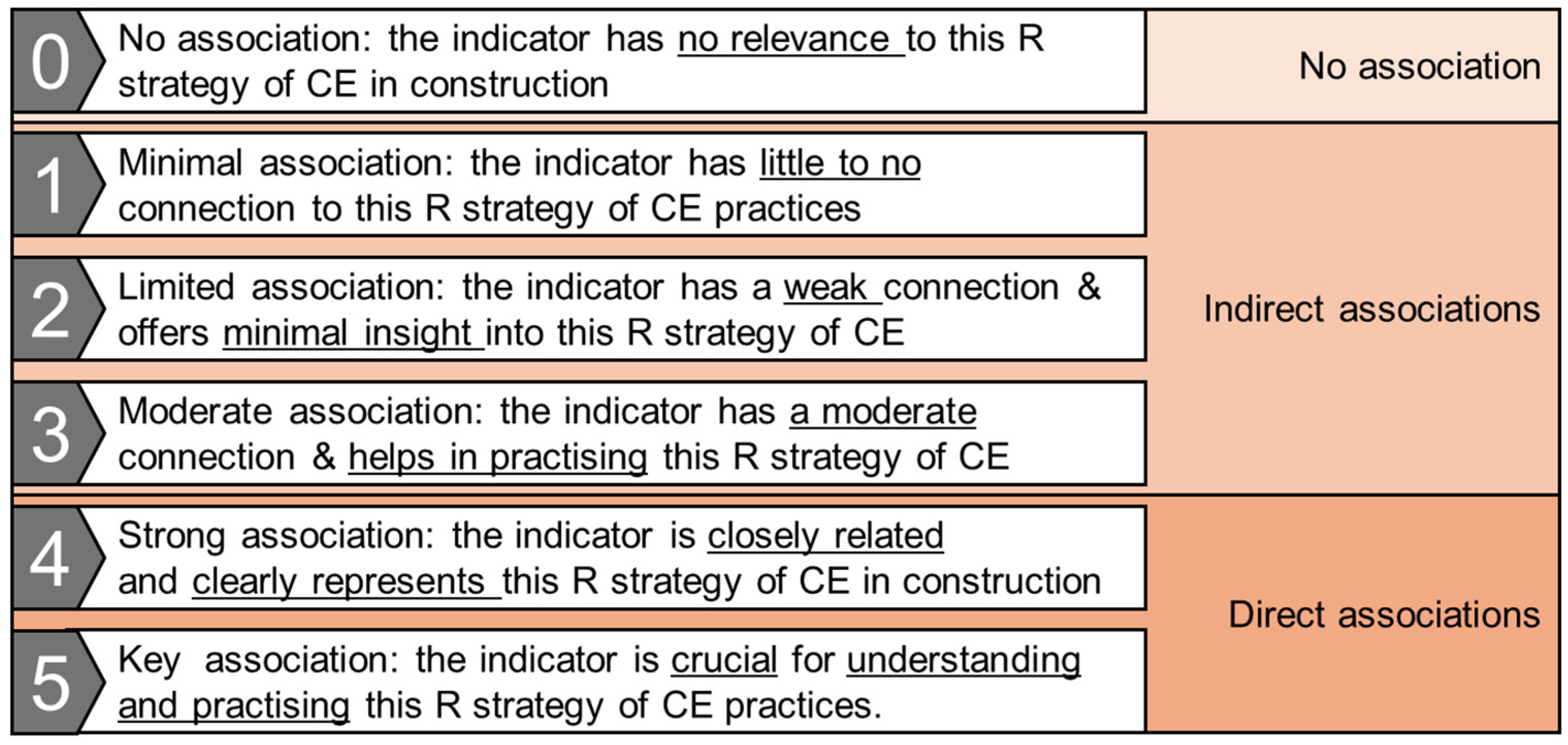
A 6-point quantitative scale of assessment was employed to score the strength of association between each assessed item (e.g., criterion) and each of the 10R principles (Figure 1). In each group, every member independently assigned a score between 0 and 5 to the degree of association for each examined case, and the final score for each association was calculated as the average of the six individual scores, as assigned by the 6 reviewers (Equation (1)):
F S C j = i = 1 6 S r e v i e w e r   i - C j 6
where, in each case, FSCj stands for the final score for the association of criterion j to one of the 10 R strategies, and Sreviewer i-Cj stands for the score assigned by the reviewer i (with i = 1, …, 6) examining this association for criterion j (Sreviewer i-Cj = 0, …, 5).
A distinctive feature of this methodology was the use of extensive round-table discussions, both in plenary and within individual groups, at all stages of the methodological process—from defining the study scope and boundaries to interpreting and validating the final results.
Notably, the experts involved in this study are all active members of the Circular B Cost Action, working in the field of circularity in the building sector. They all have a considerable research background in aspects of sustainability in the built environment, with several of them having extensively worked on BSA methods. The experts volunteered to participate in the study based on their background, each taking part in the examination of the methods, with which they were more familiar. Potential bias was mitigated both by the synthesis of the subgroups and by the continuous discussion process followed throughout this work. Specifically, the vast majority of the experts participated in the assessment of more than one method, with the synthesis of each subgroup being different, ensuring, therefore, consistency in the evaluations and considerations among subgroups. Additionally, the averaging process followed merges different opinions. Furthermore, extensive discussions took place within each subgroup and across the subgroups to reach agreement in the way central aspects of the method would be approached in the context of the already-set scope. Multiple discussions took place at different stages of the assessment, ensuring that all experts’ understanding of the approach was aligned and providing the opportunity for revisions of the preliminary assessments where necessary.
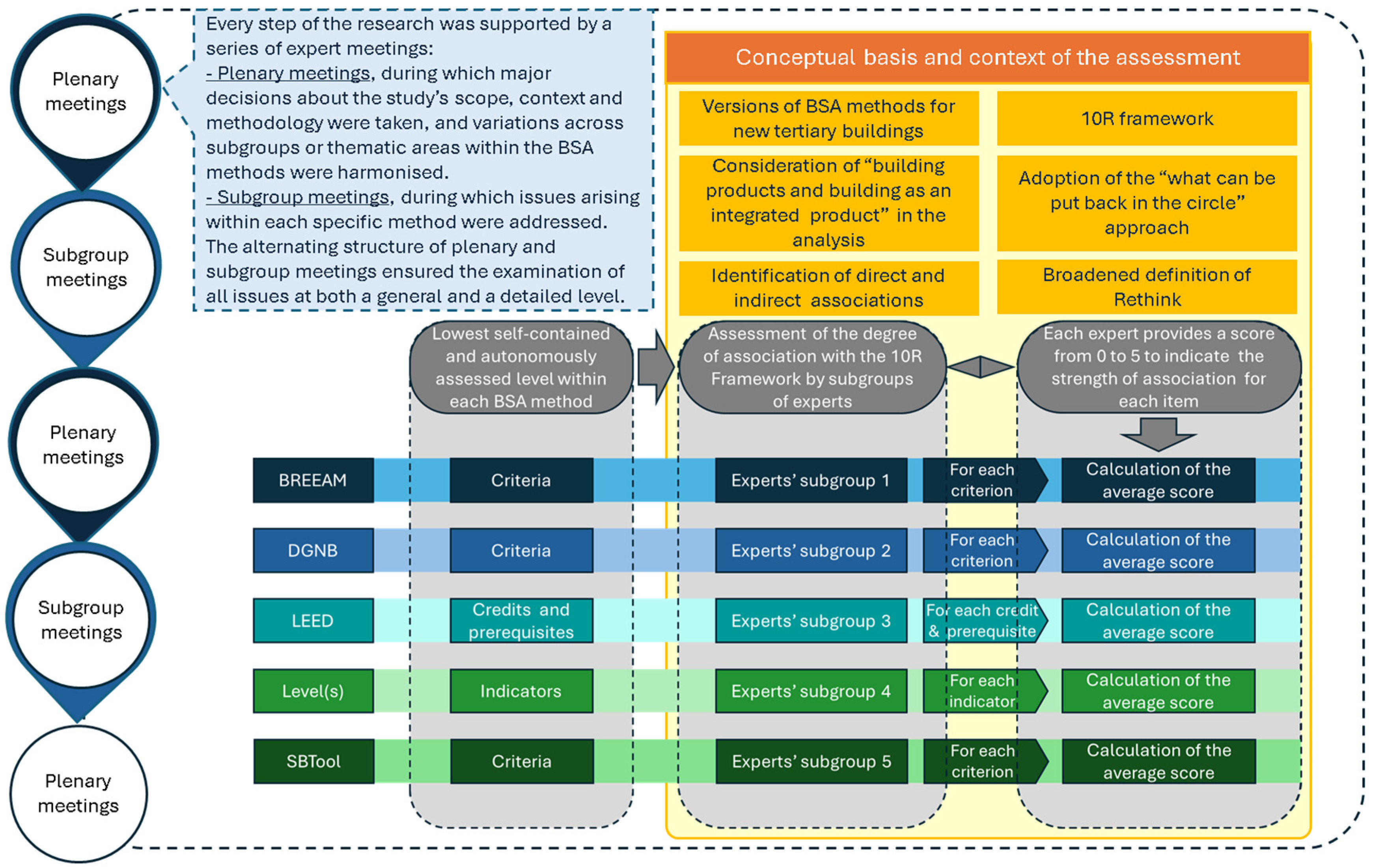
The basic features and components of the applied methodological approach are summarised in Figure 2.

4. Results and Discussion

The following subsections present and discuss the results of the quantitative assessment regarding the association of each method with the 10R principles.
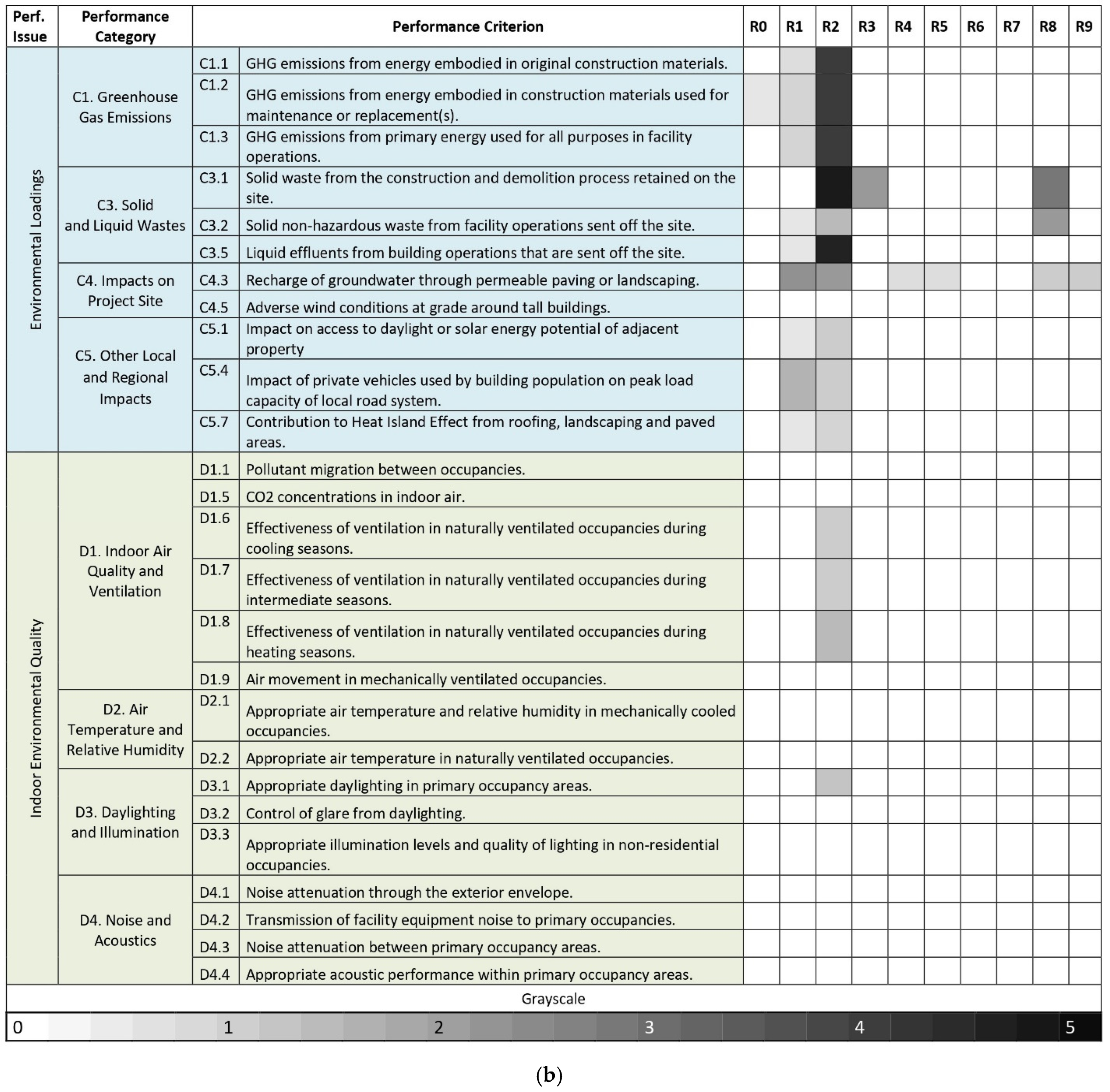
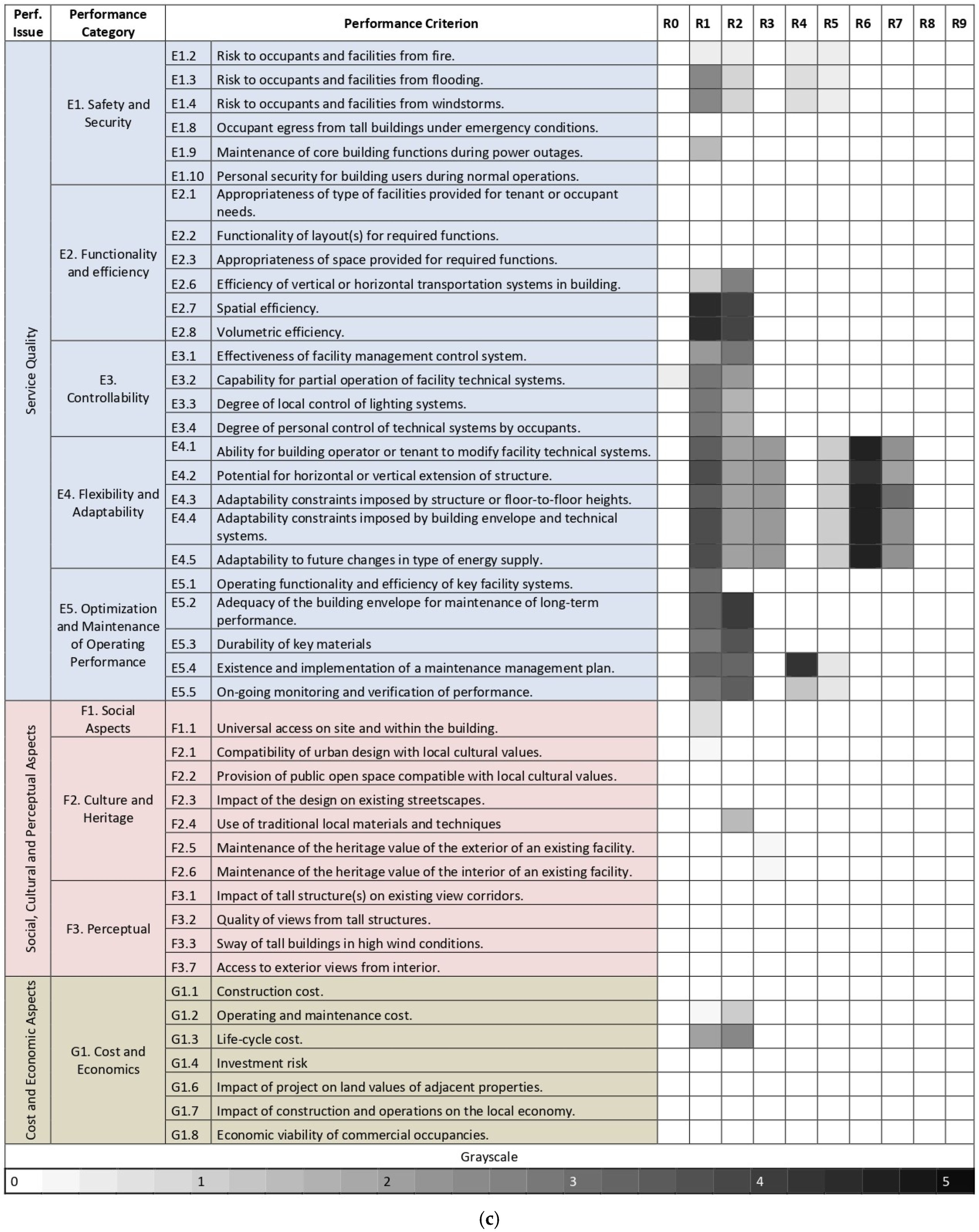
The spine of the presentation for each method is a set of two figures (Figure 3 and Figure 4 for BREEAM, Figure 5 and Figure 6 for DGNB, Figure 7 and Figure 8 for LEED, Figure 9 and Figure 10 for Level(s), and Figure 11a–c and Figure 12a–c for SBTool). In the first figure of each set (Figure 3, Figure 5, Figure 7, Figure 9 and Figure 11a–c), the average scores representing the degree of association of each assessed item with the 10 strategies of the 10R Framework are qualitatively depicted in grayscale. Darker colours indicate higher average scores and thus stronger associations.
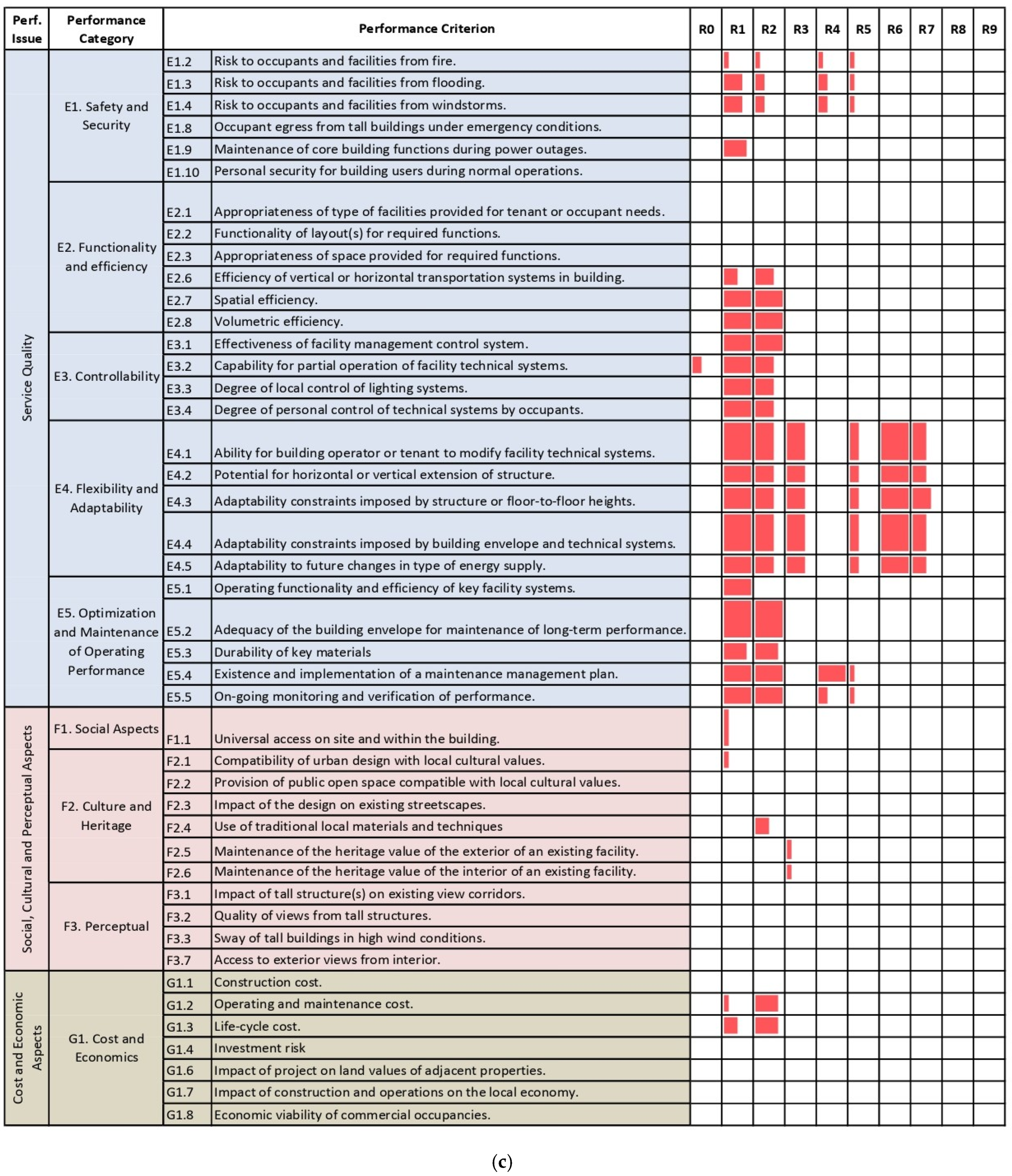
The second figure of each set (Figure 4, Figure 6, Figure 8, Figure 10 and Figure 12a–c) outlines the “level of agreement” among the six reviewers examining the respective method regarding the existence of an association in each assessed item–R strategy pair. Each cell is filled with a red bar to a degree proportional to the number of reviewers identifying a non-zero association. Fully filled cells indicate unanimous agreement that an association exists, while empty cells indicate no association was identified by any one of the involved experts. For the creation of these figures, all non-zero individual scores were considered equally, without distinguishing between direct and indirect associations. Only the existence of an association, regardless of its strength, was taken into account for these visualisations.
Obviously, in Figure 3, Figure 4, Figure 5, Figure 6, Figure 7, Figure 8, Figure 9, Figure 10, Figure 11 and Figure 12a–c, only the assessed items of each method are depicted—not the ones excluded from the analysis.
A general discussion follows the individual method results presentation and analyses, highlighting common findings, methodological features, and implications for further research.

4.1. BREEAM

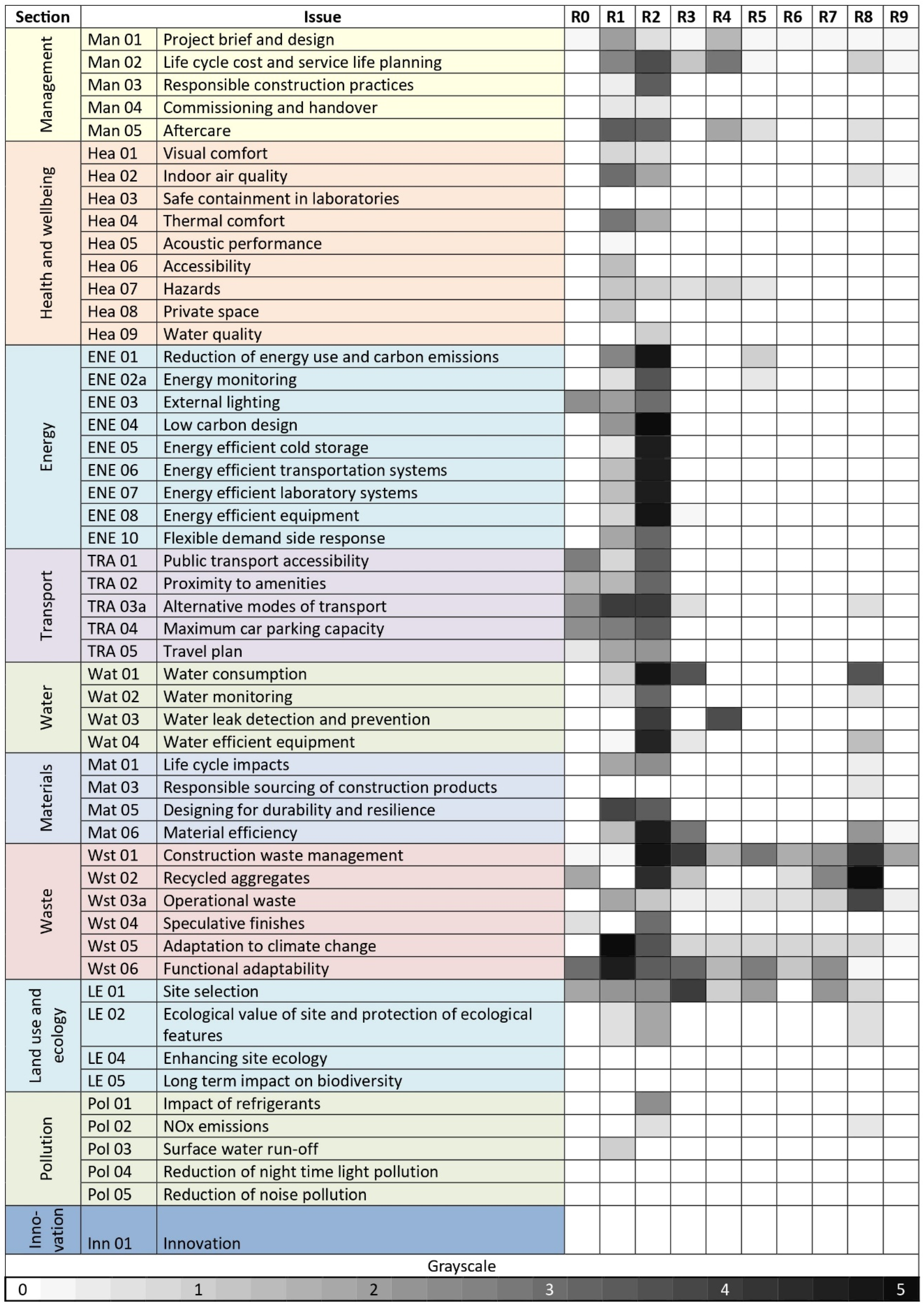
The analysis of BREEAM scheme shows that the “Waste” section demonstrates the highest degree of alignment with the examined 10R principles (R0 to R9), while “Pollution” and “Health and wellbeing” sections show the least alignment (Figure 3). This result may be attributed to their content and assessment basis being primarily focused on general sustainability. The “Water” and “Energy” sections demonstrate a notable association with the principle of Reduce (R2), highlighting the prioritisation of efficiency in resource use. The “Materials” section, as expected, contains issues with strong links to circularity, as outlined in the employed framework, especially Reduce (R2) and Rethink (R1). The “Life Cycle Impact” issue within this section would probably, based on its name, be predicted to show significant association with the 10R Framework—as is often the case with similarly titled criteria/indicators in other rating schemes. However, the findings confirm that alignment varies significantly depending on how the content of each criterion is defined within a specific scheme.
Figure 3. Qualitative depiction, via greyscale, of the average scores representing the degree of association of each criterion in BREEAM with the strategies of the 10R Framework.
Sustainability 18 02585 g003
The “Transport” section is also clearly associated with the 10R Framework, with all its issues relating to multiple 10R principles, mostly in the range from R0 to R3. The “Management” section also shows noteworthy association, while “Land Use and Ecology” ranks among the ones that show weak alignment with the 10R Framework. Figure 1 shows that only three criteria had no association with any one of the considered R strategies.
Among the 10 R strategies, Reduce (R2) had the strongest overall association, reflecting a clear prioritisation of minimising resource consumption and waste generation. Rethink (R1) followed, due to its emphasis—based on the adopted definition—on innovative and alternative approaches to traditional design and construction. Reuse (R3), Recycle (R8), and Refuse (R0) also featured prominently, as well as further concepts, while Recover (R9) was the least represented.
The highest score of 5, indicating the strongest degree of association with the principles of the circular economy as reflected in the employed 10R Framework, was awarded to specific issues regarding different R strategies. Among them, Ene04 “Low carbon design” was most strongly associated with Reduce (R2); Wst05 “Adaptation to climate change” achieved the maximum score for its alignment with the Rethink (R1); Wst02 “Recycled aggregates” received top score for its obvious connection with Recycle (R8).
Figure 4 illustrates the “level of agreement” among the experts. Overall, 169 associations were identified out of 510 possible combinations (51 BREEAM issues x 10 R strategies). Of these, 17% represent cases where only one expert identified a relationship between an issue and a CE principle, while nearly 30% reflected unanimous agreement among all six experts—indicating strong consensus on the relevance of these principles to the selected criteria. In some cases, even full level of agreement (6 out of 6 reviewers), although widely recognised as indicative of subtler or less explicit links to R principles, did not correspond to the highest score (direct association), since the issue may also express an indirect link.
Figure 4. Qualitative depiction of the number of reviewers identifying a degree of association in BREEAM (direct or indirect, weak or strong), and, therefore, assigning a score different from 0, in each examined case.
Sustainability 18 02585 g004

4.2. DGNB

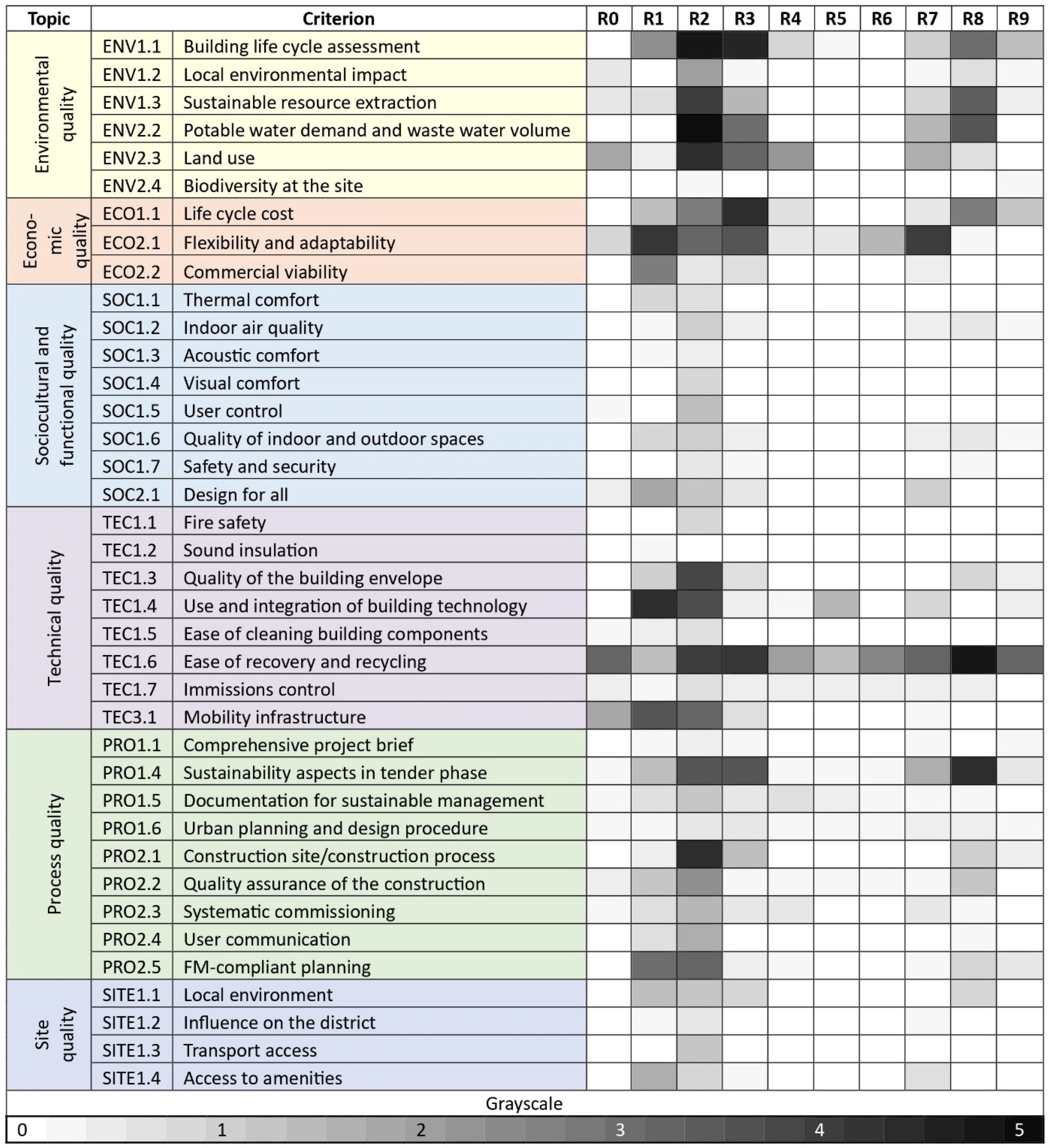
Figure 5 reveals varying degrees of association between different DGNB criteria groups and the 10R Framework (R0 to R9). At a general level, the “ENV” (Environmental Quality) and “ECO” (Economic Quality) topics show the strongest alignment, while the least represented ones were predominantly the “SOC” (Sociocultural and Functional Quality) and, to a lesser extent, “SITE” (Site Quality) topics. This fact can be attributed to the indicators and parameters examined in each area. For example, in the “ECO” topic, the whole life cycle of a building is considered, which even under the economic prism inherently addresses circularity strategies such as Reduce (R2) and Reuse (R3). This topic also covers adaptability and flexibility, which constitute major circularity principles in building design and construction. Similarly, the “ENV” topic includes a plethora of factors related to life cycle assessment of a building and its products, as well as to resources extraction and consumption. An exception is the last criterion in this topic “ENV2.4 Biodiversity at the site,” which shows a very weak alignment due to its sustainability-oriented, rather than circularity, focus. This indicates that even in thematic areas of strong overall associations, divergences and exceptions do occur.
Figure 5. Qualitative depiction, via greyscale, of the average scores representing the degree of association of each criterion in DGNB with the strategies of the 10R Framework.
Sustainability 18 02585 g005
Regarding the least represented topics, the parameters examined in the “SOC” topic in their majority address indoor environmental quality, which relates more to sustainability than circularity, making links to circularity less evident. The “TEC” (Technical Quality) and “PRO” (Process Quality) topics present neither the strongest nor the weakest associations, with some criteria aligned to several strategies and others focused on specific ones. Overall, criterion ENV1.1 shows the strongest association with Reduce (R2), while TEC1.6 aligns most closely with Recycle (R8) (Figure 5).
An interesting point to highlight is the role of CE bonuses throughout the tool and their correlation with the assessment results. As mentioned in in the Section where DGNB is described, criteria with CE bonuses were considered in the analysis. It is not a coincidence that all the criteria accompanied by CE bonuses were found to have associations—most of them strong ones—with the 10R Framework (Figure 5). However, these associations varied in score, and strong associations were also found among criteria without CE bonuses, indicating that the analysis extended beyond the internal cues of the rating system. In terms of individual R strategies, Figure 5 shows that Reduce (R2) is the strategy that is more frequently assigned high scores, with Reuse (R3) and Recycle (R8) being ranked also among the prevailing ones (Figure 5). Interestingly, the dominance of the triad Reduce–Reuse–Recycle—the foundational core of most R frameworks—was “broken” by Rethink (R1), which also received high scores in a significant number of cases (in total, it is equivalently or even marginally more strongly appearing than Reuse (R3) and Recycle (R8)). This is likely due to the adopted definition of Rethink. Other than that, Repurpose (R7) also showed noticeable scores. Only a few criteria were associated with the whole spectrum of the 10R principles. Interestingly, Refurbish (R5) and Remanufacture (R6) strategies had minimal associations with DGNB criteria, likely due to the system’s focus on Recycling and Reuse strategies [78].
This investigation focused on the DGNB Criteria Set for New Constructions, Version 2020 [78]. However, it is important to note that DGNB also offers a separate system (DGNB System for Renovation of Buildings, Version 2022), which is based on DGNB Criteria Set for New Constructions, Version 2020 [78] but adapts to the specific requirements of renovation projects; it was not included in the current study. Furthermore, as highlighted before, the criteria referring to existing buildings in the examined version were excluded from the analysis—an important distinction to note.
Figure 6 indicates that criteria with higher average scores (Figure 5) tend to show a consensus (unanimous or almost unanimous) on the existence of an association (direct or indirect) among reviewers. In these cases, most or all reviewers assigned a score above zero, even if their exact ratings varied. As expected, average scores present a positive correlation with the number of reviewers agreeing on the existence of an association (Figure 5 and Figure 6), though not linearly, due to differing scores assigned by each reviewer. Lastly, in almost 9% of the 380 cases (38 criteria x 10 R strategies), only one reviewer reported an association—these cases correspond to weak average scores. Over 47% of the examined cases showed unanimous agreement on the absence of any association.
Figure 6. Qualitative depiction of the number of reviewers identifying a degree of association (direct or indirect, weak or strong), and, therefore, assigning a score different from 0 in each examined case in DGNB.
Sustainability 18 02585 g006

4.3. LEED

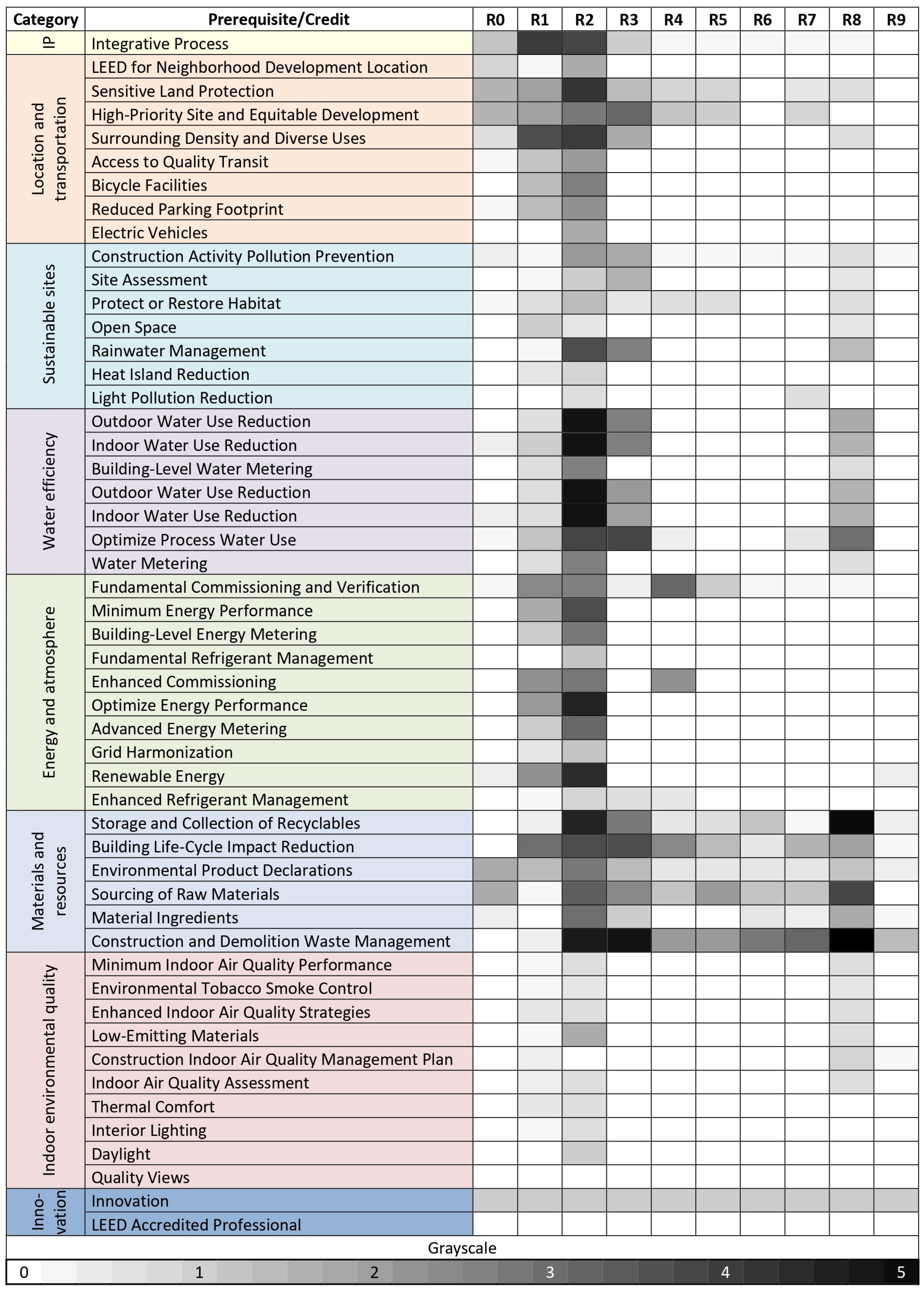
Expert analysis (Figure 7) reveals which LEED categories align with circularity principles, and which remain primarily sustainability oriented. Although circularity aspects are not explicitly integrated into the LEED system, categories such as “Water Efficiency”, “Energy and Atmosphere”, and “Materials and Resources” are more aligned with the 10R Framework, primarily due to their focus on reducing the use of resources such as water, energy, and materials. On the other hand, “Indoor Environment Quality” shows the least alignment among the method’s categories, as it prioritises user comfort, focusing on foundational sustainability concerns. “Location and Transportation” and “Sustainable Sites” show partial, mostly indirect, associations with circularity, encompassing both sustainability and circularity aspects.
Figure 7. Qualitative depiction, via greyscale, of the average scores representing the degree of association of each credit (incl. prerequisites) in LEED with the strategies of the 10R Framework.
Sustainability 18 02585 g007
Figure 7 shows a strong association with the traditional 3Rs, with Reduce (R2) being the most represented strategy overall. Reuse (R3) stands as the next most strongly aligned among the traditional R triad, and Recycle (R8) follows. However, Rethink (R1) emerges as the second most associated strategy overall, even within categories more oriented towards sustainability. This reflects LEED’s emphasis on intensifying the use of buildings and their components throughout their life cycle, e.g., promoting car sharing, cycling infrastructure, and building commissioning. On the other hand, Recover (R9) is the least represented strategy, with only eight out of fifty-one credits/prerequisites showing minimal or limited indirect associations, often identified by only one expert (Figure 8). This could be due to LEED’s focus on energy efficiency and savings, rather than energy recovery. Similarly, Refuse (R0), Repair (R4), Refurbish (R5), Remanufacture (R6), and Repurpose (R7) exhibit only weak, indirect links.
Figure 8. Qualitative depiction of the number of reviewers identifying a degree of association (direct or indirect, weak or strong), and, therefore, assigning a score different from 0 in each examined case in LEED.
Sustainability 18 02585 g008
“Location and Transportation” exhibits moderate alignment, primarily through Reduce (R2) and Rethink (R1)—the only strategies with some direct associations. Refuse (R0) and Reuse (R3) follow, though only through indirect associations, as with the remaining strategies. Recover (R9) and Remanufacture (R6) were not associated with any credits/prerequisites. Reduce (R2) strategy here relates to reduced new land use, fuel consumption, and GHG emissions production, while Refuse (R0) relates to the promotion of alternative transport and land-use patterns. Not all credits/prerequisites, though, are equivalently aligned with the 10R strategies.
“Sustainable Sites” also demonstrates moderate, mostly indirect, associations. As shown in Figure 7, credits/prerequisites such as “Construction Activity Pollution Prevention”, “Protect or Restore Habitat”, and “Rainwater Management” have the strongest circularity association, largely through Reduce (R2). Among all credits of this category, “Rainwater Management” is the only one with a direct association. Overall, Reduce (R2) remains dominant, followed by Reuse (R3). On the other hand, Remanufacture (R6), Recover (R9), and Rethink (R1) show the weakest associations in this category.
In the “Water Efficiency” and “Energy and Atmosphere” categories, strong associations with Reduce (R2) are evident, further supported by the unanimous expert agreement, as shown in Figure 8. This reflects these categories’ core intent to limit water and energy consumption. “Water Efficiency” also shows strong links to Reuse (R3) and Recycle (R8), while Rethink (R1) is clearly less represented, suggesting that water-related credits emphasise technical efficiency and resource use. In contrast, in the “Energy and Atmosphere” category, Rethink is more strongly represented, highlighting its emphasis on energy-saving opportunities and innovative design. This demonstrates how this category promotes a forward-thinking approach to achieving energy efficiency goals.
“Materials and Resources” is the LEED category with the largest number of associations which appear across all 10R strategies. Its emphasis on, among others, reuse, recycling, and lifecycle analysis justifies its strong alignment with the R strategies. Reduce (R2), Reuse (R3), and Recycle (R8) dominate this category, which also shows the highest expert consensus, as shown in Figure 8.
Overall, Figure 8 demonstrates LEED’s stronger emphasis on general sustainability aspects rather than circularity. Of 520 possible associations (52 LEED credits/prerequisites x 10 R strategies), experts identified links in only 44% of the credits/prerequisites. Of these, 95% were indirect according to Figure 7. The strongest expert consensus was for Reduce (R2), reinforcing its position as the most representative circularity strategy within LEED. This aligns with LEED foundational focus on resource efficiency, GHG emissions reduction, energy and water conservation, and waste minimisation.
Finally, “Indoor Environmental Quality” had the fewest associations, most attributed by a single expert, indicating the weakest relationship. This likely reflects the challenges in delineating circularity from sustainability that result from differing, subjective expert interpretations. The blurred boundary between the two concepts, shaped by individual experiences and priorities, explains these divergent assessments. In any case, for most experts, this category is related to conventional sustainability concerns, thus, fewer or no associations can be made with the 10R Framework.

4.4. Level(s)

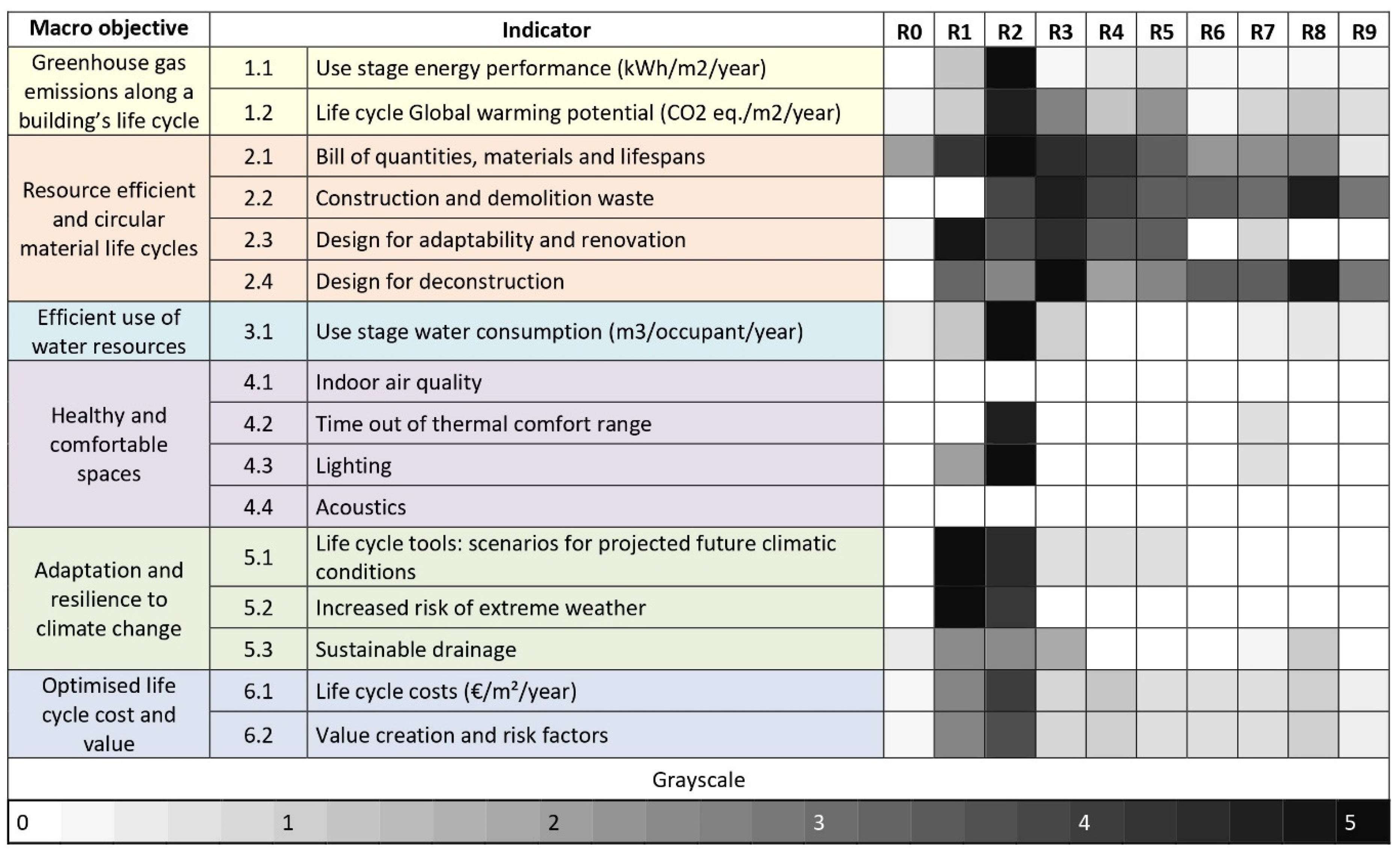
According to Figure 9, the indicators most strongly aligned with circularity fall under Macro Objective 2 (MO2), which addresses resource-efficient and circular material life cycles. These four indicators consistently align with several R strategies. Indicator 2.1 aligns with Rethink (R1) by promoting material savings through the shared use of elements, with Reduce (R2) by encouraging efficient material use, and with Reuse (R3) through planning for adaptive reuse. It also extends material lifespan through Repair (R4), Refurbish (R5), Remanufacture (R6), Repurpose (R7), and Recycle (R8). Uniquely, it is the only indicator that incorporates Refuse (R0) by avoiding unnecessary resource consumption from the outset.
Figure 9. Qualitative depiction, via greyscale, of the average scores representing the degree of association of each criterion in Level(s) with the strategies of the 10R Framework.
Sustainability 18 02585 g009
Indicator 2.2 supports systematic planning for Reuse (R3) and Recycle (R8), along with other value retention strategies such as Repair (R4), Refurbish (R5), Remanufacture (R6), Repurpose (R7). It also promotes the development of waste management plans aimed at minimising CDW and enhancing material recovery, thus aligning with Reduce (R2). Indicator 2.3 seeks to maintain building functionality for as long as possible, aligning with Reuse (R3), Repair (R4), and Refurbish (R5), while also supporting Rethink (R1) and Reduce (R2) by mitigating the need for premature demolition. Indicator 2.4 plays a key role in facilitating Reuse (R3) across multiple cycles through deconstruction-friendly design, which eases access for Repair (R4), Refurbish (R5), Remanufacture (R6), Repurpose (R7) and Recycle (R8). It reflects a lifecycle-focused approach, aligning with Rethink (R1), while contributing to material efficiency and CDW minimisation, therefore supporting Reduce (R2).
Following MO2, indicators under MO1 “Greenhouse Gas Emissions Across a Building’s Life Cycle” and MO6 “Optimised Life Cycle Cost and Value” show the next strongest alignment with circularity. The two indicators in MO1 are primarily linked to Reduce (R2), aiming to lower environmental impact through reduced energy consumption and emissions during building use. This indirect link to circularity highlights the role of energy efficiency in resource conservation. By promoting the reuse of structural elements—on-site or off-site—or recycling them into new materials, these indicators support circular resource flows. Material selection based on circularity principles can also reduce both embodied and operational carbon. While connections to other R strategies are weaker, MO1 still supports component longevity, aligning with Rethink (R1), Reuse (R3), Repair (R4), and Refurbish (R5), as well as end-of-life pathways such as Remanufacture (R6), Repurpose (R7), Recycle (R8), and Recover (R9).
MO6 is clearly associated with Rethink (R1) and Reduce (R2). Circular design and strategic material choices can offer long-term economic benefits by simplifying maintenance and replacement. These cost efficiencies can offset initial investments and extend building service life.
Indicators under MO3 “Efficient Use of Water Resources” and MO5 “Adaptation and Resilience to Climate Change”, show moderate yet meaningful alignment with circularity. MO3 sole indicator 3.1 focuses on reducing water consumption, directly supporting Reduce (R2). The three indicators in MO5 are linked to Rethink (R1) and Reduce (R2), as resilient design considering climatic risks and potential hazards extends service life and reduces resource losses due to damage.
MO4, “Healthy and Comfortable Spaces”, has the weakest overall connection to circularity. However, indicators 4.2 and 4.3 support Reduce (R2) by reducing energy use and emissions through improved thermal comfort and lighting efficiency, while 4.3 also aligns with Rethink (R1) through passive design strategies like optimal orientation and daylighting.
Looking across all R strategies, Reduce (R2) emerges as the most consistently connected strategy within the Level(s) framework. This prominence is unsurprising, as many sustainability indicators—particularly those tied to environmental and economic dimensions—are inherently focused on reduction, whether in material use, energy demand, emissions, or cost. Rethink (R1) and Reuse (R3) also show strong alignment, particularly in indicators emphasising resource intensity and adaptability, such as 2.1, 2.4, 5.1, and 5.2. Reuse (R3) is well-represented in MO2 and is especially important within the waste hierarchy, given its shorter loop and high resource retention potential.
The remaining strategies—Repair (R4), Refurbish (R5), Remanufacture (R6), Repurpose (R7), and Recycle (R8)—are generally well distributed across the indicators, though none stand out as dominant. Recover (R9) is rarely linked, reflecting its lower priority in the circularity hierarchy, where it is considered a last resort. Refuse (R0) is the least associated strategy overall, appearing explicitly only in indicator 2.1.
According to Figure 10, out of 160 possible associations (16 Level(s) indicators x 10 R strategies), experts identified links in 64% of the indicators. Of these, 47% were classified as indirect associations based on Figure 9. Notably, there was consistent agreement on the existence of relationships for MO2 indicators across most R strategies. The strongest expert consensus was observed for Reduce (R2), followed by Rethink (R1) and Reuse (R3). Conversely, full consensus on the absence of alignment was reached in approximately 37% of indicator–strategy pairs (57 instances).
Some inconsistencies, however, were observed. For example, Recover (R9) in indicator 2.1 received divergent evaluations: while half of the reviewers assigned a score of 1, indicating a minimal relationship, the others assessed it as having no relationship (score of 0). Similarly, inconsistencies were noted for Repurpose (R7) in indicator 2.3 and Repair (R4) in indicator 2.4, both under MO2. The highest levels of conflict were observed for MO1 and MO6 indicators in relation to R3 through R9, although some exceptions were noted. Further variation emerged for indicator 5.3 under MO5 concerning strategies Rethink (R1), Reduce (R2), and Reuse (R3). Despite these variations, a joint reading of Figure 9 and Figure 10 provides a more comprehensive understanding and helps justify these inconsistencies. For instance, although Figure 10 shows variability in the number of experts identifying relationships between indicator 1.1 and strategies R3 to R9, Figure 9 confirms that these associations are weak. This suggests that discrepancies stem not from disagreement about the existence of a link but from differing views on its strength.
Figure 10. Qualitative depiction of the number of reviewers identifying a degree of association (direct or indirect, weak or strong), and, therefore, assigning a score different from 0 in each examined case in Level(s).
Sustainability 18 02585 g010

4.5. SBTool

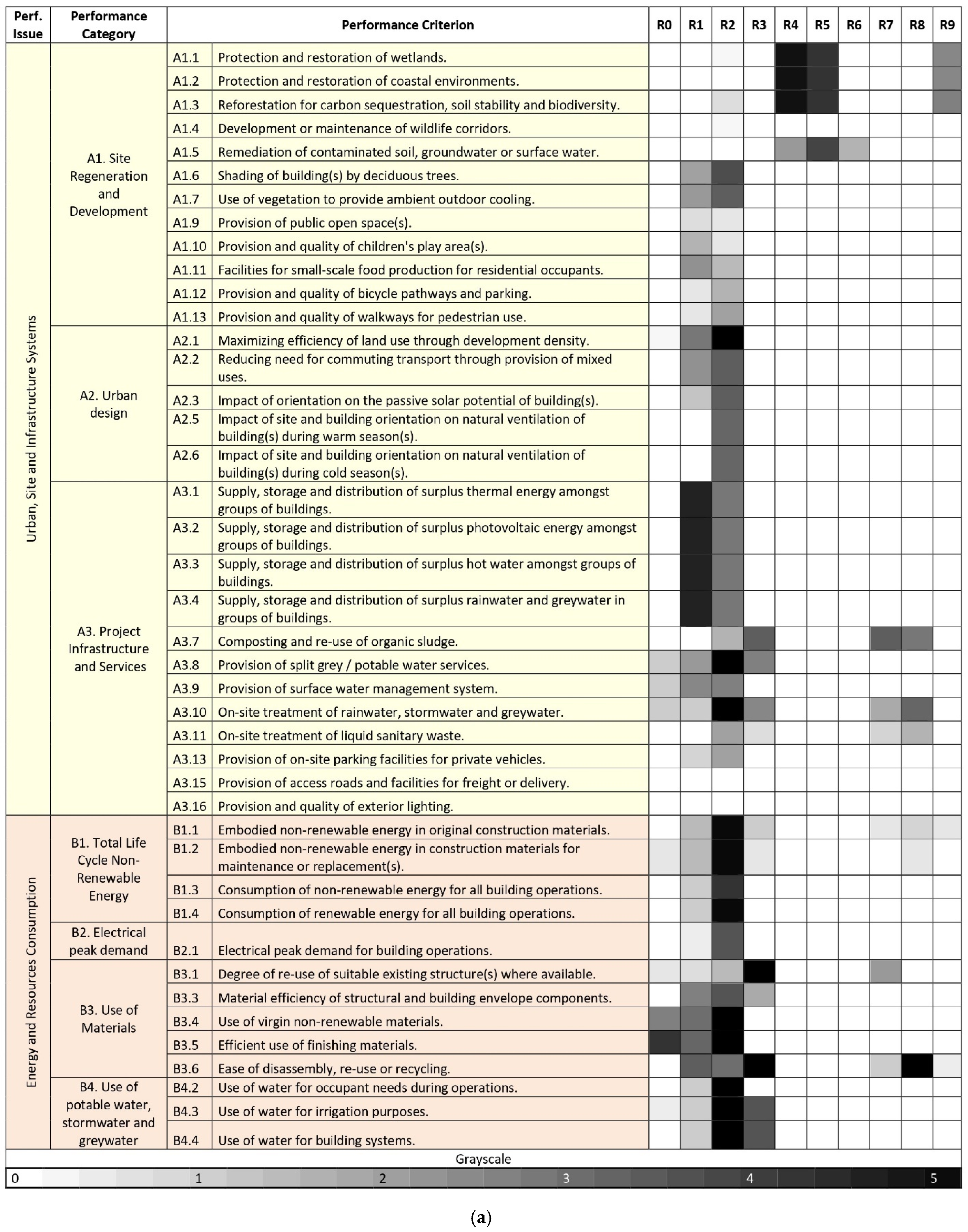
Criteria under “Indoor Environmental Quality” and “Social and Cultural Aspects” show minimal to no link to the 10R Framework. In contrast, those related to resource management under various issues exhibit significantly stronger associations (Figure 11a–c). This difference stems from the focus of each issue. For instance, “Urban, Site and Infrastructure Systems” emphasises site protection, restoration, efficient urban design and use, and infrastructure use, involving strategies like Repair (R4), Refurbish (R5), Rethink (R1) and Reuse (R3). Meanwhile, “Energy and Resources Consumption” and “Environmental Loadings” mainly reflects Rethink (R1), Reduce (R2) and R3 (Reuse), aligning closely with circularity principles.
The “Urban Site and Infrastructure Systems” performance issue had the second-strongest association with the 10Rs, with only two criteria unrelated, following “Energy and Resources Consumption”, where all criteria aligned with multiple R strategies. Within these, “Site Regeneration and Development” category showed strong association with Repair (R4), Refurbish (R5), and Recover (R9) in relation to natural environment regeneration, and with Rethink (R1) and Reduce (R2) when addressing aspects of human well-being. A similar trend appeared in the “Urban Design” category. “Project Infrastructure and Services” showed more varied associations: resource-related criteria aligned with Rethink (R1) and Reduce (R2), while resource management-focused criteria showed broader links, particularly to Reduce (R2). The diverse associations across this issue highlight the nuanced ways in which different strategies intersect with criteria related to environmental regeneration and resource management, given the focus of the 10R Framework on resources rather than human well-being.
Figure 11. (ac) Qualitative depiction, via greyscale, of the average scores representing the degree of association of each criterion in SBTool with the strategies of the 10R Framework.
Sustainability 18 02585 g011aSustainability 18 02585 g011bSustainability 18 02585 g011c
The “Energy and Resource Consumption” issue showed the strongest association with the 10R strategies, reflecting SBTool’s focus on resources efficiency throughout the building lifecycle. It closely aligns with Reduce (R2) and Rethink (R1). Experts identified direct or indirect links to seven of the 10Rs; only Repair (R4), Refurbish (R5), and Remanufacture (R6) were not associated. The associations made in this issue indicate SBTool’s emphasis on resource efficiency, perhaps over strategies that extend the construction product or element lifetime. All categories in this issue relate to at least two of the 10Rs, with only 4 of the 18 criteria showing no link. The category most strongly aligned with circularity was “Use of Materials (B3)”, closely associated with Refuse (R0), Rethink (R1), Reduce (R2), Reuse (R3), and Recycle (R8) due to its focus. For instance, the criterion “Ease of Disassembly, Reuse, and Recycling (B3.6)” highlights reuse and recycling of building components at the end-of-life, encouraging design that supports deconstruction processes (aligned with R1), future reuse (R3) and recycling (R8), thereby reducing virgin material use (R2). Ease of disassembly also supports Recover (R9) by enabling energy recovery from non-reusable or non-recyclable materials. In contrast, the criterion with the weakest link was “Electrical Peak Demand for Building Operations (B2.1)”, which relates to only two Rs. It supports Reduce (R2) by minimising the size of energy production and distribution systems, and indirectly supports Rethink (R1) by encouraging changes in energy use during the operation to avoid peak grid demand.
The “Environmental Loadings” issue showed moderate association with the 10R Framework, more so than parameters related to “Indoor Environmental Quality” and “Socio-Cultural” issues. Criteria related to GHG emissions and solid waste productions showed stronger links, while other impacts showed weaker links. The focus on GHG emissions stems from this study’s scope and boundaries (see “Methodology”). As also observed in BREEAM, some criteria titles imply strong alignment with circularity; however, their intents and indicators lack a true circularity focus. Among the R strategies, Reduce (R2) and Rethink (R1) were most strongly associated, with occasional links to Recycle (R8).
The “Indoor Environmental Quality” issue displayed very weak alignment with the 10R Framework, with only a minor connection to Reduce (R2) through natural ventilation strategies.
The “Service Quality” issue showed relatively strong alignment, especially in the category “Flexibility and Adaptability”, which aligned with six strategies, most strongly with Remanufacture (R6). Criteria like “Spatial” and “Volumetric Efficiency”, under the “Functionality and Efficiency” category, were unanimously linked to circularity strategies, particularly Rethink (R1) and Reduce (R2). The assessment also emphasised the role of control and monitoring systems and maintenance plans in reducing resource use (R2) and rethinking traditional maintenance (R1). Conversely, criteria on resilience (e.g., “Risk to occupants and facilities from flooding, windstorms”) showed weaker connections to the 10R strategies, identified by only a few experts.
“Social, Cultural and Perceptual Aspects” and “Cost and Economic Aspects” issues had few and weak links to the 10R Framework. “Life-Cycle Cost” was the only criterion with notable alignment, primarily with Reduce (R2), followed by Rethink (R1).
The most intensely reflected strategy in the examined method is Reduce (R2), followed by Rethink (R1). Reuse (R3) also shows alignment with several criteria to varying degrees. Recover (R9) is the least represented strategy, while the remaining strategies exhibit intermediate level of representation. Their relative ranking varies depending on whether the ranking is based on the number or strength of associations.
Association strength generally correlates positively with the level of expert agreement. According to Figure 12a–c, the highest consensus was observed for Rethink (R1), Reduce (R2), Reuse (R3) and Repair (R4), while Refuse (R0), Remanufacture (R6), Repurpose (R7), Recycle (R8) and Recover (R9) showed the lowest. Rethink (R1) and Reduce (R2) stand out with near-unanimous agreement on associated criteria. Only 31 associations were identified by just one expert, receiving the weakest scores overall. This number represents just 2.8% of all potential associations (112 SBTool criteria x 10 R strategies = 1120). Among the 31 aforementioned cases, five criteria—F1.1, F2.1, F2.4, F2.5 and F2.6, all under “Social, Cultural and Perceptual Aspects”—were identified as having an association to only one R strategy assigned by only one expert. In contrast, complete consensus on the absence of alignment with a given strategy was achieved in approximately 80% of cases (894 instances).
Figure 12. (ac) Qualitative depiction of the number of reviewers identifying a degree of association (direct or indirect, weak or strong), and, therefore, assigning a score different from 0 in each examined case in SBTool.
Sustainability 18 02585 g012aSustainability 18 02585 g012bSustainability 18 02585 g012c

4.6. Discussion

The preceding analysis reveals both common trends and diverse characteristics among the examined BSA methods regarding their association with the employed 10R Framework, leading to findings that warrant further reflection. This section takes a closer look at these patterns, offering possible interpretations for the identified tendencies, highlighting the significance of this work, and acknowledging its limitations.
Reduce (R2), Reuse (R3) and Recycle (R8)—the well-known 3R framework forming the foundation for subsequent developments in the circularity field—are among the strategies with which the studied BSA methods showed a significant association. These results align with existing literature analysing the prevalence of R strategies with respect to value retention options. For example, sustainability terminology has been reported to predominantly focus on the 3Rs [35]. These terms are also among the most prevalent in CE discussions in construction stakeholders’ opinions, as disclosed on social media [91]. In their recent review on CE evolutionary research, based on the 4R Framework components, Alcalde-Calonge et al. [92] highlighted Recycle (R8) as the most cited R—e.g., CE policy efforts [93]—while Reuse (R3) was identified as the R representing an opportunity for improvement and application within R frames. Interestingly, these three R-strategies represent different levels in the circularity ranks (i.e., the waste hierarchy represented in the 10R Framework), with Reduce and Reuse being classified among the highest ones, and Recycle standing among the least contributing options. This can be attributed to its inherent environmental and economic implications and impacts (economic and environmental costs related to the creation and operation of recycling units, production of secondary products of, in several cases, lower quality, etc.). In this study, a clear trend towards the rise of Rethink (R1) strategy among the Rs more strongly represented in the examined methods has been identified in the preceding analysis, “rupturing” this 3R core. The fact that this “anomaly” appears systematically across the five BSA methods indicates that it is due to the central axes of the study’s scope and context. Indeed, these results can be attributed to the approach adopted in the context of the study regarding the definition of “Rethink” and the establishment of its relevance to principles such as adaptability, flexibility, resilience, etc. (Section 3.2), which are central to buildings’ circularity and are more or less explicitly included in the context of the examined BSA methods.
Another plausible explanation is that Rethink is inherently connected to the early design stage, which is particularly relevant in the context of new construction projects—the focus of the examined versions. One might argue that the prevalence of Rethink contrasts with the strong presence of Reuse, a strategy typically linked to the end-of-life phase. However, this seeming contradiction is resolved when considering the dual analytical axes employed in this study: “building products” and “building as a product.” From this perspective, Reuse is indeed an end-of-life strategy at the component level but a forward-looking design goal at the building level. Buildings are increasingly designed for future reuse and disassembly to enable the recovery and repurpose of their components. This underscores the layered complexity of buildings, which requires a nuanced interpretation of circularity strategies across different levels of the building’s hierarchical structure. The literature reviewed by Schöggl et al. [35] supports this view, highlighting that the application and scale of R strategies are often ambiguous and context dependent. In this light, the present analysis contributes important insights to the discussion of circularity in buildings.
On the other hand, Remanufacture (R6) and, to a lesser extent, Refurbish (R5), although representing important aspects and med-level “ranks” of circularity, are relatively weakly associated with the criteria of the examined BSA methods, with the degree of this underrepresentation varying in each case. This result may be attributed, or at least correlated, to the fact that the versions of the BSA methods examined are intended for new constructions. While new construction projects increasingly promote recoverability and future material pathways as a circularity objective, this does not inherently guarantee that recovered components will be remanufactured, refurbished, or otherwise reintroduced into productive use beyond the building boundary. In the context of new design and construction, emphasis is therefore often placed on enabling recovery or disassembly potential, rather than on defining or securing downstream product lifecycle processes that occur outside the building system. As a result, circularity concerns related to intermediate life cycle stages beyond operation, and particularly those dependent on external industrial or market conditions, tend to receive less attention. In this sense, principles such as Remanufacture (R6) may be slightly overlooked. The choice to focus on new constructions involved the exclusion of criteria that refer exclusively to existing buildings in cases where the examined versions provided such possibilities (e.g., assessment of major renovations). For example, although criteria that apply to existing buildings are included in the studied DGNB scheme, these criteria were excluded from the analysis presented in this study.
Another factor that may explain the lower representation of these strategies is the age and evolution of the BSA methods themselves [13]. Older systems such as BREEAM and LEED, while pioneering in their time, were not initially designed with the broader set of R strategies in mind. In contrast, newer frameworks like Level(s) more clearly integrate the expanded spectrum of circularity strategies. This historical lag also helps explain the similar treatment of Repair (R4) through Repurposing (R7) in some cases. These mid-tier strategies, situated between reuse and recycling, are not always clearly delineated in current practice or assessment tools—reflecting the relatively recent introduction of the extended 10R Framework. Expert evaluations in this study echoed this ambiguity, highlighting a lack of consistent operational definitions or established practices distinguishing one strategy from another.
Recover (R9) presents another point of contention. Initial expert interpretations of this strategy varied, prompting a need for clarification to reduce subjectivity. This mirrors the divergence in the literature, where “recovery” is sometimes used as an umbrella term for all value retention actions—including reuse and repair [94]—while in other cases, particularly in CE discussions, it refers more narrowly to energy recovery as a last resort [93]. The present study follows the latter definition, aligning with the conventional waste hierarchy. Notably, in a recently presented brief report [82], Recover has been reported to be the strategy less mentioned in the reviewed literature.
Refuse (R0) was among the least associated strategies across the examined methods. This is understandable at a building level, as the BSA methods focus on buildings that are already planned or constructed, whereas Refuse addresses the more fundamental question of whether a building should be constructed at all. As such, it pertains more to early-stage decision-making processes, which lie beyond the typical scope of assessment tools. That said, Refuse strategy can still exert an influence at the product level—such as avoiding unnecessary materials or toxic substances [35]—though these aspects are rarely framed explicitly as such within the criteria of the five examined methods.
An interesting piece of information presented in the analysis of the quantitative results for each method is the level of unanimity in the opinions of the experts reviewing whether its assessed items are aligned with the strategies of the 10R Framework. It is deduced that for the majority of the assessed items, the decision on whether an association exists (regardless of its strength) is unanimous. However, the unanimously identified associations were not always of the same strength in the different experts’ opinions. Moreover, there are several cases where fewer than six experts identified an association. In fact, the number of assessment items for which only one reviewer indicated an association is not negligible. This is indicative of the subjectivity inherent in this type of estimation, as the boundary to what may be considered within the scope of the analysis cannot always be absolutely defined.
On a general level, as mentioned in the Methodology section (Section 3.2.2), the approach to what may be considered circular in this work is based on the concept of “what can be put back in the circle.” This approach may seem more restricting than other, broader interpretations of circularity in the building sector found in the literature. However, it outlines a self-contained, well-established and clearly defined framework—enriched with further considerations—for the present study. The adoption of clearly defined principles and scope was necessary, as it contributes to significantly minimising the aforementioned subjectivity.
In any case, the subjective element of the estimations, although restricted to an acceptable level also by the clear determination of the study’s scope, still constitutes a limitation of this work. Since the expression of each reviewer’s view cannot (and should not) be artificially shaped into a fact free from interpretation, the involvement of a larger number of reviewers in future efforts could help soften or normalise the variations observed.
Another limitation of this work is the exclusion of criteria referring to residential buildings and the focus on buildings of the tertiary sector. As implied in the preceding analysis, the study of assessment items (or versions of the methods, where applicable) addressing residential units could reveal interesting similarities and differences among the examined methods. The prioritisation of different principles—reflecting traditional construction techniques and philosophies in the countries where the methods originated—may also emerge. Examining the criteria related to the residential sector through the lens of the presented approach could therefore constitute a future research target.
Finally, the analysis was restricted to new buildings. As previously commented, this led to strategies such as Repair, Refurbishment, Remanufacturing, and Repurposing being less represented than others, as they are more related to the use (operations and maintenance) and end-of-life stages of a building’s life cycle. Although Reuse and Recycle are also related to end-of-life, the BSA methods tend to promote them during design and construction. Studying the versions of these methods that refer to existing buildings would help complement the picture presented in this work.

5. Conclusions

5.1. Summary of Key Scope Aspects and Main Findings

This study set out to explore how five major BSA methods—BREEAM, DGNB, LEED, Level(s), and SBTool—align with circularity principles as captured by the 10R Framework. By evaluating each method’s criteria through the lens of Refuse (R0), Rethink (R1), Reduce (R2), Reuse (R3), Repair (R4), Refurbish (R5), Remanufacture (R6), Repurpose (R7), Recycle (R8), and Recover (R9), the study offers a systematic appraisal of the extent to which current BSA methods support—or overlook—circularity practices. The study focused on the version of each method and its criteria/indicators for new tertiary sector buildings.
To ensure consistency and reduce subjectivity, several boundary-setting decisions shaped the study’s scope. Circularity was interpreted through the concept of what can be put “back in the circle,” adopting a resource- and waste-oriented perspective. This included a broad definition of resources—extending even to energy and land—while pollutants were excluded, and GHG emissions were treated as indirectly linked to the Reduce (R2) strategy. The analysis also considered both buildings as complete products and their individual components and materials, enabling a multi-scale assessment. Moreover, the definition of Rethink (R1) was expanded to account for shared and intensified building use over time, supporting a more integrated understanding of design-stage decisions. The most important findings of the study can be summarised as follows:
  • A strong alignment with the traditional 3Rs—Reduce, Reuse, and Recycle—is revealed across all five examined methods. This aligns with the historical emphasis of sustainability tools on material efficiency, waste minimisation, and performance. What stands out in the performed investigation, however, is the frequent appearance of Rethink (R1), which disrupts this expected pattern. Its prominence reflects the increasing importance of design choices—particularly those that promote adaptability, flexibility, and long-term functionality—in advancing circularity. The broader definition of Rethink (R1) adopted in this study likely contributed to its visibility, but it also reflects a real shift in how circularity principles are being integrated into building assessments.
  • In contrast, mid-tier strategies such as Refurbish (R5), Remanufacture (R6), and Repurpose (R7), along with end-of-life options like Recover (R9), were far less prominent. This may be due to the focus of the present study on BSA versions for new construction, where later life-cycle processes receive less emphasis. It may also point to a lack of well-established definitions and application pathways for these strategies, which makes them harder to incorporate or interpret within assessment tools.
  • Universally, the indicators of the examined BSA methods that are more commonly linked to the 10Rs address materials, resources, energy, and environmental footprint—i.e., areas that align with both the 10R Framework and the scope of the present study. The dual perspective—looking at both products and buildings as products—was key to capturing the complex, multi-scalar nature of circularity. While expert assessments revealed some inherent subjectivity, especially concerning newer or less clearly defined strategies, general consensus on the existence of associations supports the credibility of the findings.
From a policy and practice perspective, the results suggest that existing BSA tools could be improved by more fully integrating CE strategies focused on lifecycle extension, reversibility, and regenerative design. This improvement could be based on the inclusion in the BSA methods of additional indicators/criteria that are explicitly oriented towards such strategies and or the modification of already existing assessment items to more effectively encompass the relevant considerations. Alternatively, new tools tailored specifically for circularity—either as stand-alone systems or as extensions of existing methods—may be needed, which could benefit from indicators existing in the already applied and tested against reality BSA methods. In either case, it is important to ensure alignment between circularity and broader sustainability assessment approaches, regarding all types of buildings (residential and non-residential) at various stages of their lifecycles, and all scales of the built environment.

5.2. Future Research Directions

Based on the above, a main axis of future research should be the enhancement of BSA methods’ consideration of the whole spectrum of CE principles and, simultaneously, the improvement and strengthening of the representativeness, scalability and applicability of circularity-cantered models through the integration of indicators already tested and applied in well-known and recognised BSA methods. This mutually complementary process, beneficial for both actors, is expected to lead to robust and improved building sustainability and circularity assessment models, either as separate methods or even, at more advanced stages, within unified frameworks, and, ultimately, to the efficient implementation of circularity principles in the built environment.
For these universal aims to be achieved, several intermediate steps should be taken. This study represents such a step, mapping the degree to which circularity strategies are integrated into well-known BSA methods. Future research in this context should explore these directions, including the assessment of residential-focused versions of BSA methods so that the representation of different R strategies to different degrees, if present in these versions, can be revealed. Furthermore, additional long-established as well as emerging assessment frameworks should be included in the relevant analyses, so that more evaluation approaches and structures are explored. Another important direction for future research is the examination of BSA methods that address existing buildings, since the implementation, to whatever extent possible, of circularity principles in the management, renovation and end-of-life of the constantly expanding building stock is a complex and urgent task.
This study reinforces the importance of adapting CE models to the construction sector, ensuring circularity strategies are fully integrated into performance metrics. Future efforts should focus on regulatory alignment, stakeholder engagement, and scalability of circular models to advance CE adoption in urban environments.

Author Contributions

Conceptualisation: C.G., R.A., N.T., A.S., P.L., F.K., R.M. and L.B.; Methodology: C.G., R.A., N.T., A.S., P.L., F.K., R.M. and S.T.M.; Formal Analysis: C.G., R.A., N.T., A.S., P.L., F.K., R.M., B.F., A.K., S.T.M., R.P.-M., D.S.T. and L.B.; Investigation: C.G., R.A., N.T., A.S., P.L., F.K., R.M., B.F., A.K., S.T.M., R.P.-M., D.S.T. and L.B.; Data Curation: C.G., R.A., N.T., A.S. and P.L.; Writing—Original Draft Preparation: C.G., R.A., N.T., A.S., P.L., F.K., R.M., B.F., A.K., S.T.M., R.P.-M., D.S.T. and R.P.B.; Writing—Review and Editing: C.G., R.A., N.T., A.S., P.L., F.K., R.M. and B.F.; Visualisation: C.G., R.A., N.T., A.S. and P.L.; Supervision: C.G. and L.B.; Funding Acquisition: L.B. All authors have read and agreed to the published version of the manuscript.

Funding

This research received no external funding.

Institutional Review Board Statement

Not applicable.

Informed Consent Statement

Not applicable.

Data Availability Statement

The raw data supporting the conclusions of this article will be made available by the authors on request.

Acknowledgments

This article is based upon work from COST Action (CircularB—Implementation of Circular Economy in the Built Environment, CA21103), supported by COST (European Cooperation in Science and Technology)). Rand Askar acknowledges the support for this work by FCT—Foundation for Science and Technology under grant agreement PD/BD/150400/2019. Bahar Feizollahbeigi acknowledges the support for this work by FCT—Foundation for Science and Technology under grant agreement 2024.00657.BDANA. Adriana Salles acknowledges the support for this work by FCT—Foundation for Science and Technology under grant agreement 2025.00434.BDANA. Rand Askar, Luis Braganca, Bahar Feizollahbeigi, Ricardo Mateus and Adriana Salles acknowledge the support for this work by FCT/MCTES under the R&D Unit Institute for Sustainability and Innovation in Structural Engineering (ISISE), under the references UID/4029/2025 (https://doi.org/10.54499/UID/04029/2025) and UID/PRR/04029/2025 (https://doi.org/10.54499/UID/PRR/04029/2025), and under the Associate Laboratory Advanced Production and Intelligent Systems ARISE under reference LA/P/0112/2020 (https://doi.org/10.54499/LA/P/0112/2020).

Conflicts of Interest

The authors declare no conflicts of interest.

Appendix A

Included in the presented analysis criteria of the examined version of DGNB, in which CE bonuses are integrated, are the following [78].
  • ENV2.3: Land use
  • ECO1.1: Life cycle cost
  • ECO2.1: Flexibility and adaptability
  • ECO2.2: Commercial viability
  • TEC1.4: Use and integration of building technology
  • TEC1.6: Deconstruction and recycling
  • TEC3.1: Mobility infrastructure
  • PRO1.4: Sustainability aspects in tender phase
  • PRO2.1: Construction site/construction process
  • SITE1.4: Access to amenities

References

  1. Guerra, B.C.; Leite, F. Circular Economy in the Construction Industry: An Overview of United States Stakeholders’ Awareness, Major Challenges, and Enablers. Resour. Conserv. Recycl. 2021, 170, 105617. [Google Scholar] [CrossRef]
  2. Iqbal, M.; Fan, Y.; Ahmad, N.; Ullah, I. Circular Economy Solutions for Net-Zero Carbon in China’s Construction Sector: A Strategic Evaluation. J. Clean. Prod. 2025, 504, 145398. [Google Scholar] [CrossRef]
  3. Nußholz, J.; Çetin, S.; Eberhardt, L.; De Wolf, C.; Bocken, N. From Circular Strategies to Actions: 65 European Circular Building Cases and Their Decarbonisation Potential. Resour. Conserv. Recycl. Adv. 2023, 17, 200130. [Google Scholar] [CrossRef]
  4. Fini, E.; Kazemi, M.; Poulikakos, L.; Christiansen, J.d.C.; Schmidt, W.; Parast, M. Toward Sustainability in the Built Environment: An Integrative Approach. Resour. Conserv. Recycl. 2024, 201, 107241. [Google Scholar] [CrossRef]
  5. Amarasinghe, I.; Hong, Y.; Stewart, R.A. Development of a Material Circularity Evaluation Framework for Building Construction Projects. J. Clean. Prod. 2024, 436, 140562. [Google Scholar] [CrossRef]
  6. Khadim, N.; Agliata, R.; Thaheem, M.J.; Mollo, L. Whole Building Circularity Indicator: A Circular Economy Assessment Framework for Promoting Circularity and Sustainability in Buildings and Construction. Build. Environ. 2023, 241, 110498. [Google Scholar] [CrossRef]
  7. Lei, H.; Yang, W.; Zhang, B.; Li, C.-Q. An Advanced Method for Assessing Circular Economy Performance of Built Environment. J. Clean. Prod. 2025, 486, 144561. [Google Scholar] [CrossRef]
  8. Güngör, B.; Agibayeva, A.; Karaca, F.; Askar, R.; Giarma, C.; Rosado, L.; Pineda-Martos, R.; Griffiths, P.; Bragança, L. Circularity Tools and Frameworks for New Buildings. In Circular Economy Design and Management in the Built Environment: A Critical Review of the State of the Art; Bragança, L., Griffiths, P., Askar, R., Salles, A., Ungureanu, V., Tsikaloudaki, K., Bajare, D., Zsembinszki, G., Cvetkovska, M., Eds.; Springer Nature: Cham, Switzerland, 2025; pp. 431–458. ISBN 978-3-031-73490-8. [Google Scholar]
  9. Finamore, M.; Oltean-Dumbrava, C. Circular Economy in Construction—Findings from a Literature Review. Heliyon 2024, 10, e34647. [Google Scholar] [CrossRef]
  10. Yu, Y.; Yazan, D.M.; Junjan, V.; Iacob, M.-E. Circular Economy in the Construction Industry: A Review of Decision Support Tools Based on Information & Communication Technologies. J. Clean. Prod. 2022, 349, 131335. [Google Scholar] [CrossRef]
  11. Kirchherr, J.; Yang, N.-H.N.; Schulze-Spüntrup, F.; Heerink, M.J.; Hartley, K. Conceptualizing the Circular Economy (Revisited): An Analysis of 221 Definitions. Resour. Conserv. Recycl. 2023, 194, 107001. [Google Scholar] [CrossRef]
  12. Potting, J.; Hekkert, M.; Worrell, E.; Hanemaaijer, A. Circular Economy: Measuring Innovation in Product Chains; PBL Netherlands Environmental Assessment Agency: The Hague, The Netherlands, 2017. [Google Scholar]
  13. Giarma, C.; Lombardi, P.; Askar, R.; Trubina, N.; Santana Tovar, D.; Salles, A.; Oral, H.V.; Pineda-Martos, R.; Karanafti, A.; Feizollahbeigi, B.; et al. Implementation and Consideration of Circularity Within International Sustainability Assessment Methods. In Circular Economy Design and Management in the Built Environment: A Critical Review of the State of the Art; Bragança, L., Griffiths, P., Askar, R., Salles, A., Ungureanu, V., Tsikaloudaki, K., Bajare, D., Zsembinszki, G., Cvetkovska, M., Eds.; Springer Nature: Cham, Switzerland, 2025; pp. 545–624. ISBN 978-3-031-73490-8. [Google Scholar]
  14. Velenturf, A.P.M.; Purnell, P. Principles for a Sustainable Circular Economy. Sustain. Prod. Consum. 2021, 27, 1437–1457. [Google Scholar] [CrossRef]
  15. Bigliardi, B.; Filippelli, S. Sustainability and Open Innovation: Main Themes and Research Trajectories. Sustainability 2022, 14, 6763. [Google Scholar] [CrossRef]
  16. World Commission on Environment and Development. Our Common Future. Brundtland Report, 1st ed.; Oxford Paperbacks; Oxford University Press: Oxford, UK, 1987; ISBN 978-0-19-282080-8. [Google Scholar]
  17. U.S. Chamber of Commerce Foundation Circularity vs. Sustainability. Available online: https://www.uschamberfoundation.org/disasters/circularity-vs-sustainability (accessed on 22 June 2025).
  18. Lingaitienė, O.; Burinskienė, A. Formation the Links between Circularity and Sustainability in the Circular Economy. Logist. Supply Chain Sustain. Glob. Chall. 2024, 14, 1–20. [Google Scholar] [CrossRef]
  19. Geissdoerfer, M.; Savaget, P.; Bocken, N.M.P.; Hultink, E.J. The Circular Economy—A New Sustainability Paradigm? J. Clean. Prod. 2017, 143, 757–768. [Google Scholar] [CrossRef]
  20. Korhonen, J.; Honkasalo, A.; Seppälä, J. Circular Economy: The Concept and Its Limitations. Ecol. Econ. 2018, 143, 37–46. [Google Scholar] [CrossRef]
  21. Ellen MacArthur Foundation. Towards the Circular Economy Vol. 1: Economic and Business Rationale for an Accelerated Transition; Ellen MacArthur Foundation: Cowes, UK, 2013; p. 98. [Google Scholar]
  22. Morales, M.E.; Batlles-delaFuente, A.; Cortés-García, F.J.; Belmonte-Ureña, L.J. Theoretical Research on Circular Economy and Sustainability Trade-Offs and Synergies. Sustainability 2021, 13, 11636. [Google Scholar] [CrossRef]
  23. Tóth, G. Circular Economy and Its Comparison with 14 Other Business Sustainability Movements. Resources 2019, 8, 159. [Google Scholar] [CrossRef]
  24. Reike, D.; Vermeulen, W.J.V.; Witjes, S. The Circular Economy: New or Refurbished as CE 3.0?—Exploring Controversies in the Conceptualization of the Circular Economy through a Focus on History and Resource Value Retention Options. Resour. Conserv. Recycl. 2018, 135, 246–264. [Google Scholar] [CrossRef]
  25. Schroeder, P.; Anggraeni, K.; Weber, U. The Relevance of Circular Economy Practices to the Sustainable Development Goals. J. Ind. Ecol. 2019, 23, 77–95. [Google Scholar] [CrossRef]
  26. Saidani, M.; Kim, H. Nexus Between Life Cycle Assessment, Circularity, and Sustainability Indicators—Part I: A Review. Circ. Econ. Sustain. 2022, 2, 1143–1156. [Google Scholar] [CrossRef]
  27. Terra dos Santos, L.C.; Giannetti, B.F.; Agostinho, F.; Almeida, C.M.V.B. Using the Five Sectors Sustainability Model to Verify the Relationship between Circularity and Sustainability. J. Clean. Prod. 2022, 366, 132890. [Google Scholar] [CrossRef]
  28. von Vacano, B.; Mangold, H.; Vandermeulen, G.W.M.; Battagliarin, G.; Hofmann, M.; Bean, J.; Künkel, A. Sustainable Design of Structural and Functional Polymers for a Circular Economy. Angew. Chem. Int. Ed. 2023, 62, e202210823. [Google Scholar] [CrossRef]
  29. Paula Junior, A.C.; Jacinto, C.; Oliveira, T.M.; Polisseni, A.E.; Brum, F.M.; Teixeira, E.R.; Mateus, R. Characterisation and Life Cycle Assessment of Pervious Concrete with Recycled Concrete Aggregates. Crystals 2021, 11, 209. [Google Scholar] [CrossRef]
  30. Corvellec, H.; Stowell, A.F.; Johansson, N. Critiques of the Circular Economy. J. Ind. Ecol. 2022, 26, 421–432. [Google Scholar] [CrossRef]
  31. Nikolaou, I.E.; Jones, N.; Stefanakis, A. Circular Economy and Sustainability: The Past, the Present and the Future Directions. Circ. Econ. Sustain. 2021, 1, 1–20. [Google Scholar] [CrossRef]
  32. Ünal, E.; Sinha, V.K. Sustainability Trade-Offs in the Circular Economy: A Maturity-Based Framework. Bus. Strategy Environ. 2023, 32, 4662–4682. [Google Scholar] [CrossRef]
  33. Kravchenko, M.; Pigosso, D.C.A.; McAloone, T.C. A Trade-Off Navigation Framework as a Decision Support for Conflicting Sustainability Indicators within Circular Economy Implementation in the Manufacturing Industry. Sustainability 2021, 13, 314. [Google Scholar] [CrossRef]
  34. Hahladakis, J.N.; Velis, C.A.; Weber, R.; Iacovidou, E.; Purnell, P. An Overview of Chemical Additives Present in Plastics: Migration, Release, Fate and Environmental Impact during Their Use, Disposal and Recycling. J. Hazard. Mater. 2018, 344, 179–199. [Google Scholar] [CrossRef] [PubMed]
  35. Schöggl, J.-P.; Stumpf, L.; Baumgartner, R.J. The Narrative of Sustainability and Circular Economy—A Longitudinal Review of Two Decades of Research. Resour. Conserv. Recycl. 2020, 163, 105073. [Google Scholar] [CrossRef]
  36. Schaubroeck, T. Circular Economy Practices May Not Always Lead to Lower Criticality or More Sustainability; Analysis and Guidance Is Needed per Case. Resour. Conserv. Recycl. 2020, 162, 104977. [Google Scholar] [CrossRef]
  37. Kang, H.; Lee, Y.; Kim, S. Sustainable Building Assessment Tool for Project Decision Makers and Its Development Process. Environ. Impact Assess. Rev. 2016, 58, 34–47. [Google Scholar] [CrossRef]
  38. Lee, W.L. A Comprehensive Review of Metrics of Building Environmental Assessment Schemes. Energy Build. 2013, 62, 403–413. [Google Scholar] [CrossRef]
  39. Vogiantzi, C.; Tserpes, K. On the Definition, Assessment, and Enhancement of Circular Economy across Various Industrial Sectors: A Literature Review and Recent Findings. Sustainability 2023, 15, 16532. [Google Scholar] [CrossRef]
  40. van Stijn, A.; Malabi Eberhardt, L.C.; Wouterszoon Jansen, B.; Meijer, A. A Circular Economy Life Cycle Assessment (CE-LCA) Model for Building Components. Resour. Conserv. Recycl. 2021, 174, 105683. [Google Scholar] [CrossRef]
  41. Aubakirov, S.; Pak, A.; Akhmetov, I.; Tleuken, A.; Atakan Varol, H.A.; Akzhalova, A.; Karaca, F. Beyond Buzzwords: NLP Reveals Common Threads in Sustainable and Circular Construction Discourse. PeerJ Comput. Sci. 2025, 11, e3085. [Google Scholar] [CrossRef]
  42. Patil, R.A.; van Langen, S.K.; Ramakrishna, S. Circularity Assessment: Developing a Comprehensive Yardstick. In Circularity Assessment: Macro to Nano: Accountability Towards Sustainability; Patil, R.A., Ramakrishna, S., Eds.; Springer Nature: Singapore, 2023; pp. 3–14. ISBN 978-981-19-9700-6. [Google Scholar]
  43. European Commission. A New Circular Economy Action Plan—For a Cleaner and More Competitive Europe; European commission: Brussels, Belgium, 2020; p. 20. [Google Scholar]
  44. Castro, M.d.F.; Colclough, S.; Machado, B.; Andrade, J.; Bragança, L. European Legislation and Incentives Programmes for Demand Side Management. Sol. Energy 2020, 200, 114–124. [Google Scholar] [CrossRef]
  45. Carvalho, J.P.; Bragança, L.; Mateus, R. Optimising Building Sustainability Assessment Using BIM. Autom. Constr. 2019, 102, 170–182. [Google Scholar] [CrossRef]
  46. Barbosa, J.A.; Bragança, L.; Mateus, R. Assessment of Land Use Efficiency Using BSA Tools: Development of a New Index. J. Urban Plan. Dev. 2014, 141, 04014020. [Google Scholar] [CrossRef]
  47. Giarma, C.; Tsikaloudaki, K.; Karanafti, A.; Kontoleon, K.J.; Theodosiou, T. Water Efficiency, Consumption and Management in Environmental Performance Assessment Methods for Existing Buildings in Use. In Proceedings of the 4th International Conference “Coordinating Engineering for Sustainability and Resilience” & Midterm Conference of CircularB “Implementation of Circular Economy in the Built Environment”; Ungureanu, V., Bragança, L., Baniotopoulos, C., Abdalla, K.M., Eds.; Springer Nature: Cham, Switzerland, 2024; Volume 489, pp. 446–457. [Google Scholar]
  48. Bitsiou, E.; Giarma, C. Parameters Related to Building Components’ Life-Cycle Analysis in Methods for Buildings’ Environmental Performance Assessment. IOP Conf. Ser. Earth Environ. Sci. 2020, 410, 012066. [Google Scholar] [CrossRef]
  49. Park, J.; Yoon, J.; Kim, K.-H. Critical Review of the Material Criteria of Building Sustainability Assessment Tools. Sustainability 2017, 9, 186. [Google Scholar] [CrossRef]
  50. Ramani, A.; García de Soto, B. Estidama and the Pearl Rating System: A Comprehensive Review and Alignment with LCA. Sustainability 2021, 13, 5041. [Google Scholar] [CrossRef]
  51. Bernardi, E.; Carlucci, S.; Cornaro, C.; Bohne, R.A. An Analysis of the Most Adopted Rating Systems for Assessing the Environmental Impact of Buildings. Sustainability 2017, 9, 1226. [Google Scholar] [CrossRef]
  52. Mattoni, B.; Guattari, C.; Evangelisti, L.; Bisegna, F.; Gori, P.; Asdrubali, F. Critical Review and Methodological Approach to Evaluate the Differences among International Green Building Rating Tools. Renew. Sustain. Energy Rev. 2018, 82, 950–960. [Google Scholar] [CrossRef]
  53. Awadh, O. Sustainability and Green Building Rating Systems: LEED, BREEAM, GSAS and Estidama Critical Analysis. J. Build. Eng. 2017, 11, 25–29. [Google Scholar] [CrossRef]
  54. Liu, T.-Y.; Chen, P.-H.; Chou, N.N.S. Comparison of Assessment Systems for Green Building and Green Civil Infrastructure. Sustainability 2019, 11, 2117. [Google Scholar] [CrossRef]
  55. Okeke, F.O.; Ezema, E.C.; Ibem, E.O.; Sam-amobi, C.; Ahmed, A. Comparative Analysis of the Features of Major Green Building Rating Tools (GBRTs): A Systematic Review. In Proceedings of the 8th International Conference on Civil Engineering, Singapore, 22–24 March 2024; Strauss, E., Ed.; Springer Nature: Singapore, 2024; Volume 539, pp. 453–469. [Google Scholar]
  56. Ferreira, A.; Pinheiro, M.D.; Brito, J.d.; Mateus, R. A Critical Analysis of LEED, BREEAM and DGNB as Sustainability Assessment Methods for Retail Buildings. J. Build. Eng. 2023, 66, 105825. [Google Scholar] [CrossRef]
  57. Cabovská, B.; Teli, D.; Ekberg, L. Building Certification Schemes–A Way towards Better IAQ and Thermal Comfort in Schools? A Critical Review of Schemes Used in Northern European Countries. Build. Environ. 2025, 275, 112786. [Google Scholar] [CrossRef]
  58. Jingguang, L.; Jingya, W.; Siyu, J. IAQ Requirements in Green Building Labeling Systems and Healthy Building Labeling Systems. In Handbook of Indoor Air Quality; Springer: Singapore, 2022; pp. 1–23. ISBN 978-981-10-5155-5. [Google Scholar]
  59. McArthur, J.J.; Powell, C. Health and Wellness in Commercial Buildings: Systematic Review of Sustainable Building Rating Systems and Alignment with Contemporary Research. Build. Environ. 2020, 171, 106635. [Google Scholar] [CrossRef]
  60. He, Y.; Wong, N.H.; Kvan, T.; Liu, M.; Tong, S. How Green Building Rating Systems Affect Indoor Thermal Comfort Environments Design. Build. Environ. 2022, 224, 109514. [Google Scholar] [CrossRef]
  61. Giarma, C.; Tsikaloudaki, K.; Aravantinos, D. Daylighting and Visual Comfort in Buildings’ Environmental Performance Assessment Tools: A Critical Review. Procedia Environ. Sci. 2017, 38, 522–529. [Google Scholar] [CrossRef]
  62. Rebelatto, B.G.; Salvia, A.L.; Brandli, L.L.; Leal Filho, W. Examining Energy Efficiency Practices in Office Buildings through the Lens of LEED, BREEAM, and DGNB Certifications. Sustainability 2024, 16, 4345. [Google Scholar] [CrossRef]
  63. Harisankar, R.; Rakesh, P. Simulation-Based Comparative Study on Energy Efficiency Criteria for LEED and BREEAM Systems. J. Phys. Conf. Ser. 2021, 2070, 012222. [Google Scholar] [CrossRef]
  64. Mahmoud, S.; Zayed, T.; Fahmy, M. Development of Generic Energy Efficiency Category: An Accreditation Comparison of Different Green Rating Systems for a Case Study in Canada. In Proceedings of the 33rd PLEA International Conference, Edinburgh, UK, 2–5 July 2017; Brotas, L., Roaf, S., Nicol, F., Eds.; NCEUB 2017—Network for Comfort and Energy Use in Buildings: Edinburgh, UK, 2017; Volume 1, pp. 489–496. [Google Scholar]
  65. Abdel Aleem, S.H.E.; Zobaa, A.F.; Abdel Mageed, H.M. Assessment of Energy Credits for the Enhancement of the Egyptian Green Pyramid Rating System. Energy Policy 2015, 87, 407–416. [Google Scholar] [CrossRef]
  66. Lee, W.L. Benchmarking Energy Use of Building Environmental Assessment Schemes. Energy Build. 2012, 45, 326–334. [Google Scholar] [CrossRef]
  67. Roderick, Y.; McEwan, D.; Wheatley, C.; Alonso, C. Comparison of Energy Performance Assessment between LEED, BREEAM and GREEN STAR. In Proceedings of the Building Simulation 2009: 11th Conference of IBPSA, Glasgow, Scotland, 27–30 July 2009; IBPSA Publications: Glasgow, Scotland, 2009; pp. 1167–1176. [Google Scholar]
  68. Lee, W.L.; Burnett, J. Benchmarking Energy Use Assessment of HK-BEAM, BREEAM and LEED. Build. Environ. 2008, 43, 1882–1891. [Google Scholar] [CrossRef]
  69. Lami, I.M.; Abastante, F.; Gaballo, M. Supporting the Transition from Linear to Circular Economy Through the Sustainability Protocols. In Proceedings of the Computational Science and Its Applications—ICCSA 2021, Cagliari, Italy, 13–16 September 2021; Gervasi, O., Murgante, B., Misra, S., Garau, C., Blečić, I., Taniar, D., Apduhan, B.O., Rocha, A.M.A.C., Tarantino, E., Torre, C.M., Eds.; Springer Nature: Cham, Switzerland, 2021; pp. 626–641. [Google Scholar]
  70. Wong, D.H.; Zhang, C.; Di Maio, F.; Hu, M. Potential of BREEAM-C to Support Building Circularity Assessment: Insights from Case Study and Expert Interview. J. Clean. Prod. 2024, 442, 140836. [Google Scholar] [CrossRef]
  71. Eissa, R.; El-Adaway, I. Circular Economy Integration in Leed: A Decade of Materials and Resources Credit Achievement Patterns. J. Manag. Eng. 2024, 40, 04024047. [Google Scholar] [CrossRef]
  72. Lemaitre, C.; Braune, A.; Ruiz Durán, C.; Geiselmann, D. Fostering the Integration of Circular Economy Aspects into the Construction and Real Estate Industry. IOP Conf. Ser. Earth Environ. Sci. 2019, 290, 012021. [Google Scholar] [CrossRef]
  73. Mateus, R.; Bragança, L. Sustainability Assessment and Rating of Buildings: Developing the Methodology SBToolPT–H. Build. Environ. 2011, 46, 1962–1971. [Google Scholar] [CrossRef]
  74. Lima, R.T.; Couto, P.; Bastos, T.F. Buildings Sustainability Certifications and the Common European Framework Level(s). In Proceedings of the CIRMARE 2023; Lanzinha, J.C.G., Qualharini, E.L., Eds.; Springer Nature: Cham, Switzerland, 2024; Volume 444, pp. 496–507. [Google Scholar]
  75. Ferrari, S.; Zoghi, M.; Blázquez, T.; Dall’O’, G. New Level(s) Framework: Assessing the Affinity between the Main International Green Building Rating Systems and the European Scheme. Renew. Sustain. Energy Rev. 2022, 155, 111924. [Google Scholar] [CrossRef]
  76. Sánchez Cordero, A.; Gómez Melgar, S.; Andújar Márquez, J.M. Green Building Rating Systems and the New Framework Level(s): A Critical Review of Sustainability Certification within Europe. Energies 2020, 13, 66. [Google Scholar] [CrossRef]
  77. BRE Global. BREEAM International New Construction Version 6, Technical Manual—SD250; BRE Global: Watford, UK, 2021. [Google Scholar]
  78. Deutsche Gesellschaft für Nachhaltiges Bauen (German Sustainable Building Council). DGNB Criteria Set New Construction Buildings, Version 2020 International; DGNB: Stuttgart, Germany, 2020. [Google Scholar]
  79. USGBC. Building Design and Construction—Getting Started Guide for Beta Participants; USGBC: Washington, DC, USA, 2020; p. 259. [Google Scholar]
  80. Dodd, N.; Donatello, S.; Cordella, M. Level(s)—A Common EU Framework of Core Sustainability Indicators for Office and Residential Buildings, User Manual 1: Introduction to the Level(s) Common Framework (Publication Version 1.1); European Commission—Joint Research Centre: Brussels, Belgium, 2021. [Google Scholar]
  81. International Initiative for a Sustainable Built Environment (iiSBE) SBTool and SNTool. Available online: https://www.iisbe.org/sbmethod (accessed on 30 April 2025).
  82. Torres Curado, M.; Resende, R.; Rato, M.V. Circular Economy: Current View from the Construction Industry Based on Published Definitions. Sustain. Sci. Pract. Policy 2024, 20, 2364954. [Google Scholar] [CrossRef]
  83. Blomsma, F.; Brennan, G. The Emergence of Circular Economy: A New Framing Around Prolonging Resource Productivity. J. Ind. Ecol. 2017, 21, 603–614. [Google Scholar] [CrossRef]
  84. Allwood, J.M.; Ashby, M.F.; Gutowski, T.G.; Worrell, E. Material Efficiency: A White Paper. Resour. Conserv. Recycl. 2011, 55, 362–381. [Google Scholar] [CrossRef]
  85. Sihvonen, S.; Ritola, T. Conceptualizing ReX for Aggregating End-of-Life Strategies in Product Development. Procedia CIRP 2015, 29, 639–644. [Google Scholar] [CrossRef]
  86. Vásquez-Cabrera, A.; Montes, M.V.; Llatas, C. CARES Framework: A Circularity Assessment Method for Residential Building Structures. Sustainability 2025, 17, 443. [Google Scholar] [CrossRef]
  87. Kirchherr, J.; Reike, D.; Hekkert, M. Conceptualizing the Circular Economy: An Analysis of 114 Definitions. Resour. Conserv. Recycl. 2017, 127, 221–232. [Google Scholar] [CrossRef]
  88. European Commission: Directorate-General for Research and Innovation; Schempp, C.; Hirsch, P. Categorisation System for the Circular Economy—A Sector-Agnostic Categorisation System for Activities Substantially Contributing to the Circular Economy; Publications Office: Luxembourg, 2020. [Google Scholar]
  89. Çimen, Ö. Development of a Circular Building Lifecycle Framework: Inception to Circulation. Results Eng. 2023, 17, 100861. [Google Scholar] [CrossRef]
  90. Tserng, H.-P.; Chou, C.-M.; Chang, Y.-T. The Key Strategies to Implement Circular Economy in Building Projects—A Case Study of Taiwan. Sustainability 2021, 13, 754. [Google Scholar] [CrossRef]
  91. Tleuken, A.; Orel, D.; Iskakova, A.; Varol, H.A.; Karaca, F. Exploring Stakeholders’ Opinions on Circular Economy in the Construction Sector: A Natural Language Processing Analysis of Social Media Discourse. J. Ind. Ecol. 2024, 28, 853–867. [Google Scholar] [CrossRef]
  92. Alcalde-Calonge, A.; Sáez-Martínez, F.J.; Ruiz-Palomino, P. Evolution of Research on Circular Economy and Related Trends and Topics. A Thirteen-Year Review. Ecol. Inform. 2022, 70, 101716. [Google Scholar] [CrossRef]
  93. Ghisellini, P.; Cialani, C.; Ulgiati, S. A Review on Circular Economy: The Expected Transition to a Balanced Interplay of Environmental and Economic Systems. J. Clean. Prod. 2016, 114, 11–32. [Google Scholar] [CrossRef]
  94. Witjes, S.; Lozano, R. Towards a More Circular Economy: Proposing a Framework Linking Sustainable Public Procurement and Sustainable Business Models. Resour. Conserv. Recycl. 2016, 112, 37–44. [Google Scholar] [CrossRef]
Figure 1. The quantitative scale applied to characterise the strength of association between each examined item and each strategy of the 10R Framework.
Sustainability 18 02585 g001
Figure 2. Basic features and components of the applied methodological approach.
Sustainability 18 02585 g002
Table 1. Features of the examined methods (the numbers of the issues/criteria/credits/indicators mentioned in the fifth row of the table refer to the ones included in the analysis).
MethodBREEAMDGNBLEEDLevel(s)SBTool
Studied version and publication yearBREEAM International New Construction 2021
Version 6.0
DGNB System
for new buildings version 2020- International
LEED for Building Design and Construction (LEED BD + C), New Construction and Major Renovations Version 4.1, 2023Level(s) Publication Version 1.1, 2021SBTool for Buildings 2022
Publication year of the first version Initial launch: 1990Initial launch: 2008; first use: 2009 Initial launch: 1998; first rating system: 20002017Initial launch (GBTool) 1996; under iiSBE since 2002
Buildings’ uses covered by the studied versionResidential, commercial (offices, industrial, retail), education, residential institutions, hotels, non-standard building type (e.g., library/cinema, hospital, etc.) Office, education, residential, hotel, consumer market, shopping centre, department store, logistics, production, assembly buildingsCommercial, retail, educational c, data centres, warehouses and distribution centres, hospitality (hotels), healthcare cOffice and residential buildingsAttached housing, multi-residential, hotel, library, offices, academic, research laboratory, restaurant/cafeteria, retail, supermarket, lobby/public space, parking and service area
Major sections aEnvironmental Sections:
(i)Management
(5 issues),
(ii) Health and wellbeing
(9 issues),
(iii) Energy
(9 issues),
(iv) Transport
(5 issues),
(v) Water
(4 issues),
(vi) Materials
(4 issues),
(vii) Waste
(6 issues),
(viii) Land use and ecology (4 issues),
(ix) Pollution
(5 issues),
(x) Innovation (1 issue).
Topics:
(i) Environmental Quality (6 criteria),
(ii) Economic Quality (3 criteria),
(iii) Sociocultural
and Functional Quality (8 criteria),
(iv) Technical Quality (8 criteria),
(v) Process Quality
(9 criteria)
(vi) Site Quality
(4 criteria)
Categories d:
(i) Integrative Process (1 credit),
(ii) Location and Transportation
(8 credits),
(iii) Sustainable Sites (7 credits),
(iv) Water Efficiency
(7 credits),
(v) Energy and Atmosphere
(10 credits),
(vi) Materials and Resources
(6 credits),
(vii) Indoor Environmental Quality (10 credits),
(viii) Innovation (2 credits), and extra
points on Regional Priority
Macro Objectives:
MO1: Greenhouse gas emissions throughout a building’s life cycle
(2 indicators)
MO2: Resource-efficient and circular material life cycles
(4 indicators)
MO3: Efficient use of water resources
(1 indicator)
MO4: Healthy and comfortable spaces
(4 indicators)
MO5: Adaptation and resilience to climate change (3 indicators)
MO6: Optimised life cycle cost and value
(2 indicators)
Performance issues:
(i) Urban, Site and Infrastructure Systems
(29 criteria),
(ii) Energy and Resources Consumption
(13 criteria),
(iii) Environmental Loadings
(11 criteria),
(iv) Indoor Environmental Quality (15 criteria),
(v) Service Quality
(26 criteria),
(vi) Social–Cultural and Perceptual Aspects
(11 criteria),
(vii) Costs and Economic Aspects
(7 criteria)
Expression of the building’s performance BREEAM rating benchmarks [% score]Total and minimum performance indices [%]Number of pointsN/ATarget weighted scores, assessed weighted scores [%]
and relative performance results [scale −1 to 5]
Level of structure with weightingEnvironmental section Topics
Criteria
N/AN/AAssessment criteria
Min. performance requirements/mandatory criteria bYesYesYesN/AYes
RankingsUnclassified, Pass, Good, Very Good, Excellent, OutstandingBronze, Silver, Gold, PlatinumCertified, Silver, Gold, PlatinumN/AScale −1 (negative performance) to 5 (best performance)
a The term is used to represent the major sections of each framework’s structure in a uniform way; the terms used in each framework for these major thematic areas are indicated as the underlined “titles” in the respective cells. b Any type of mandatory criteria or required level of performance in an area for an assessment to proceed. c Some types of buildings, such as schools and hospitals have specific credits and prerequisites. d In the number of the mentioned credits, prerequisites are also included.
Table 2. The 10R Framework, adapted from [12,87], as employed in this study.
SymbolStrategyDescription
R0Refusemake product redundant by abandoning its function or by offering the same function with a radically different product
R1Rethinkintensify product use (e.g., through sharing products) over the whole life cycle of the building
R2Reduceincrease efficiency in product manufacture or use by consuming fewer natural resources and materials
R3Reusereuse by another consumer of discarded product which is still in good condition and fulfils its original function
R4Repairrepair and maintenance of defective product so it can be used with its original function
R5Refurbishrestore an old product and bring it up to date
R6Remanufactureuse parts of a discarded product in a new product with the same function
R7Repurposeuse discarded product or its parts in a new product with a different function
R8Recycleprocess materials to obtain the same (high grade) or lower (low grade) quality
R9Recoverincineration of materials with energy recovery
Disclaimer/Publisher’s Note: The statements, opinions and data contained in all publications are solely those of the individual author(s) and contributor(s) and not of MDPI and/or the editor(s). MDPI and/or the editor(s) disclaim responsibility for any injury to people or property resulting from any ideas, methods, instructions or products referred to in the content.