Article

The Path to Sustainable Agricultural Development: How Does Financial Support Affect the Green Production Behavior Intention of Millet Growers?

School of Finance, Harbin University of Commerce, Harbin 150028, China
*
Author to whom correspondence should be addressed.
Sustainability 2026, 18(5), 2584; https://doi.org/10.3390/su18052584
Submission received: 10 February 2026 / Revised: 1 March 2026 / Accepted: 4 March 2026 / Published: 6 March 2026
(This article belongs to the Section Sustainable Urban and Rural Development)

Abstract

Ensuring the sustainable growth of agriculture and fostering agricultural modernization in rural areas is a strategic method to achieve rural revitalization. Based on the survey responses of 448 millet-planting farmers in three townships of Wuxiang County and two townships of Qinxian County, Shanxi Province, China, and from the perspective of farmers’ economic behavior, on the basis of planned behavior theory, the paper introduces financial support variables, and uses a structural equation model to examine the consequences of financial support on the behavioral attitudes, subjective norms, and perceived behavior control of millet-planting farmers. We first examine the influence of subjective norms and perceived behavior control on the green production intention of millet planting, and then explore the impact of financial support on the green production intention of farmers. The results show that (1) financial support has a substantial influence over the behavioral attitude, subjective norms and perceived behavior control of farmers’ green production. (2) The attitudes, subjective norms and perceived behavior control of millet farmers have a significant impact on their green production intention. (3) The indirect effect of financial support on the green production intention of millet farmers is significant. Finally, the report offers various recommendations and countermeasures for farmers to carry out green production, such as special planting subsidies and insurance guarantees, green food support for agricultural enterprises and preferential loan support for rural areas. The research results have theoretical and practical significance for enriching the Theory of Planned Behavior, promoting the green production behavior of farmers and accelerating the development of green agriculture.

1. Introduction

From a global perspective, millet has become one of the most widely cultivated grain crops worldwide, especially in parts of Africa and Asia that are arid or semi-arid. Due to its strong environmental adaptability, it has become an important crop for ensuring local food security and improving the livelihoods of farmers [1]. Meanwhile, in the process of foreign agricultural green transformation, the green production of grain crops has become an important direction. Agricultural powerhouses like Brazil have adopted a model that ties financial credit with green production to guide farmers to adopt eco-friendly production methods, providing valuable practical experience for green global grain production. With the deepening implementation of China’s rural revitalization strategy, agricultural green development and agricultural modernization have been elevated to the national strategic level. As a characteristic grain crop in northern China, Xiaomi has the advantages of high nutritional value, drought resistance and tolerance to poor soil conditions, and ecological adaptability [2]. It is not only an important supplement to ensure food security but also a superior industry that promotes the development of characteristic agriculture and boosts farmers’ income.
The main grain categories in China include grains, legumes and tubers. Among them, grains are the absolute core of grain production, with a planting area of 100.6 million square kilometers and a yield accounting for over 92% of the national total grain output. Grains mainly include rice, wheat, corn and coarse grains. They play a dominant role in ensuring food security. As a typical representative of coarse grains, millet currently has an annual planting area of approximately 12 billion square meters and a total output of about 2.7 million tons. Due to its unique nutritional and ecological value, it plays an indispensable role in specific regional layouts and agricultural ecosystems. Compared to grains, legumes and tubers serve as important supplementary grains, with a planting area of 118 billion square meters for legumes and 70 billion square meters for tubers, jointly constituting China’s diversified grain supply system [3]. Green agricultural production refers to a production method under the guidance of the green development concept, using high-quality farming management models and advanced technologies to achieve efficient resource utilization, reduce waste and protect the environment. The promotion of green agriculture production is influenced by multiple internal and external factors. Among them, the core internal factor lies in the green production awareness and behavioral intentions of micro-level production entities: farmers. The green transformation of farmers’ production methods is a key link in the high-quality development of green agriculture, and therefore, enhancing farmers’ individual green production intentions and promoting the green transformation of farmers’ production models have become an inevitable requirement for current agricultural green development [4].
Studies on the development of green agricultural production are widely available, both theoretically and practically. The research on farmers’ green production intention is a process of gradual progress. The first stage is at the beginning of the promotion and development of green agricultural production. The literature research is mainly reflected in the support of macro policy development for green agriculture production and its advantages. Some scholars have also explored and studied farmers’ green agricultural production willingness from the micro viewpoint, and analyzed the attitude and willingness of farmers in different regions towards green agricultural production and the influencing factors [5]. As the development of green agriculture is in the initial exploration stage in China, the group has a low understanding of green agricultural production, so it has high requirements on the number and quality of the surveyed groups. Regarding the group’s green production behavior, there is a willingness to switch to organic farming and a willingness of tea farmers to buy green non-public agricultural drugs [6]. According to the research results of scholars, it is necessary to combine government propaganda, economic benefit guidance and technical support to stimulate farmers’ green production intention. The second stage is to gradually consider the impact of individual characteristics and environmental background on the green production behavior and intention of farmers, as discussed in research studies on the green production intention and behavior of micro individuals, which are well-known by the public. In their research, scholars have found that individual characteristics and family characteristics such as planting area, annual income and total expenditure have an impact on green agricultural production [6,7]. With the improvement of theory and the increase in adaptive models, the third stage began to consider the impact of economic policy factors in the study of individual green production willingness in combination with a variety of application models, including the real option evaluation method, the probit model and the logistic model. A variety of research methods and various model construction approaches have a major influence on the accurate analysis of the microfarmers’ intention to produce in a green way, and explore the intention and behavior of farmers from more angles, considering the changes brought to microfarmers in the process of agricultural development such as capital endowment enhancement, large-scale production and participation in rural cooperatives [8,9]. After the latest progress introduced the planned behavior theory into the study of green agricultural production individuals, scholars successively applied structural equation models to explore some internal and external factors, and respectively examined the effects of both external and internal factors such as environmental regulation and village rules and regulations, economic rationality and emotional state, market focus and policy for the production of green agriculture [10,11,12].
The above domestic and foreign research documents have laid the foundation for the research of this paper. However, most of the documents focus on the macro perspective of green agricultural production, overemphasizing the high efficiency and high yield of green production and ignoring the effect of the limitations on individual farmers. According to the micro individual research, farmers’ readiness to implement green agriculture is affected by individual characteristics, geographical environment and ecological development. The influence has not been thoroughly studied regarding psychological factors and cognitive factors on farmers. At the same time, it is found in the literature that there are few studies on the outside variables that affect farmers’ green production practices, and some of them mainly focus on capital endowment, environmental regulation and policy support. In the research, the impact of financial support on farmers’ individual behavior is even less, and financial support has a major incentive to stimulate the production of green agriculture by farmers. In the research methods, few studies use the structural equation model to explore the action path of each influencing factor of the research individual. The use of the structural equation model can lead to better analysis of the process and results of psychological factors, and improve the applicability and fit.
Therefore, this paper introduces the key variable of financial support, and uses 506 investigation data of famous millet-planting counties in Shanxi Province to establish SEM to explore how financial support influences the willingness of smallholder farmers in the rice industry to adopt green production practices, and studies its transmission path and influence factors to provide some reference for policy making and market support. This article’s objectives are to examine the ways in which millet farmers’ aspirations for green production are influenced by financial support and to offer theoretical and practical resources for advancing agricultural green development.
The innovation of this research mainly lies in the following aspects: (1) Existing studies based on the Theory of Planned Behavior regarding farmers’ green production mostly focus on the direct influences of behavioral attitudes, subjective norms, and perceived behavioral control, and rarely consider financial support as a core exogenous variable to systematically explore its transmission effect on the three core dimensions of the theory. This paper, from the perspective of the economic behavior of millet farmers, introduces financial support into the framework of the Theory of Planned Behavior, breaks through the limitation of single endogenous variable influence research, enriches the application scenarios of the Theory of Planned Behavior in the cross-field of agricultural green development and financial support for agriculture, and makes up for the insufficient targeting of existing theoretical applications. (2) Existing studies mostly simply verify the direct correlation between financial support and farmers’ willingness for green production, and do not conduct in-depth exploration of the indirect transmission mechanism between the two. This paper uses the structural equation model to focus on disassembling the indirect transmission chain from financial support to willingness, clarifying the transmission effects of the three mediating variables, clarifying the internal logic of how financial support affects the green production behavioral intention of millet farmers, and providing more targeted theoretical support for the precise design of financial support policies for agriculture.
The other sections include the following: Section 2 contains a review of the literature and research conjectures; Section 3 discusses the research methods; Section 4 explains the empirical analysis; Section 5 includes a discussion of the research findings; and Section 6 covers the conclusion.

2. Literature Review and Theoretical Research Hypothesis

2.1. Planned Behavior Theory

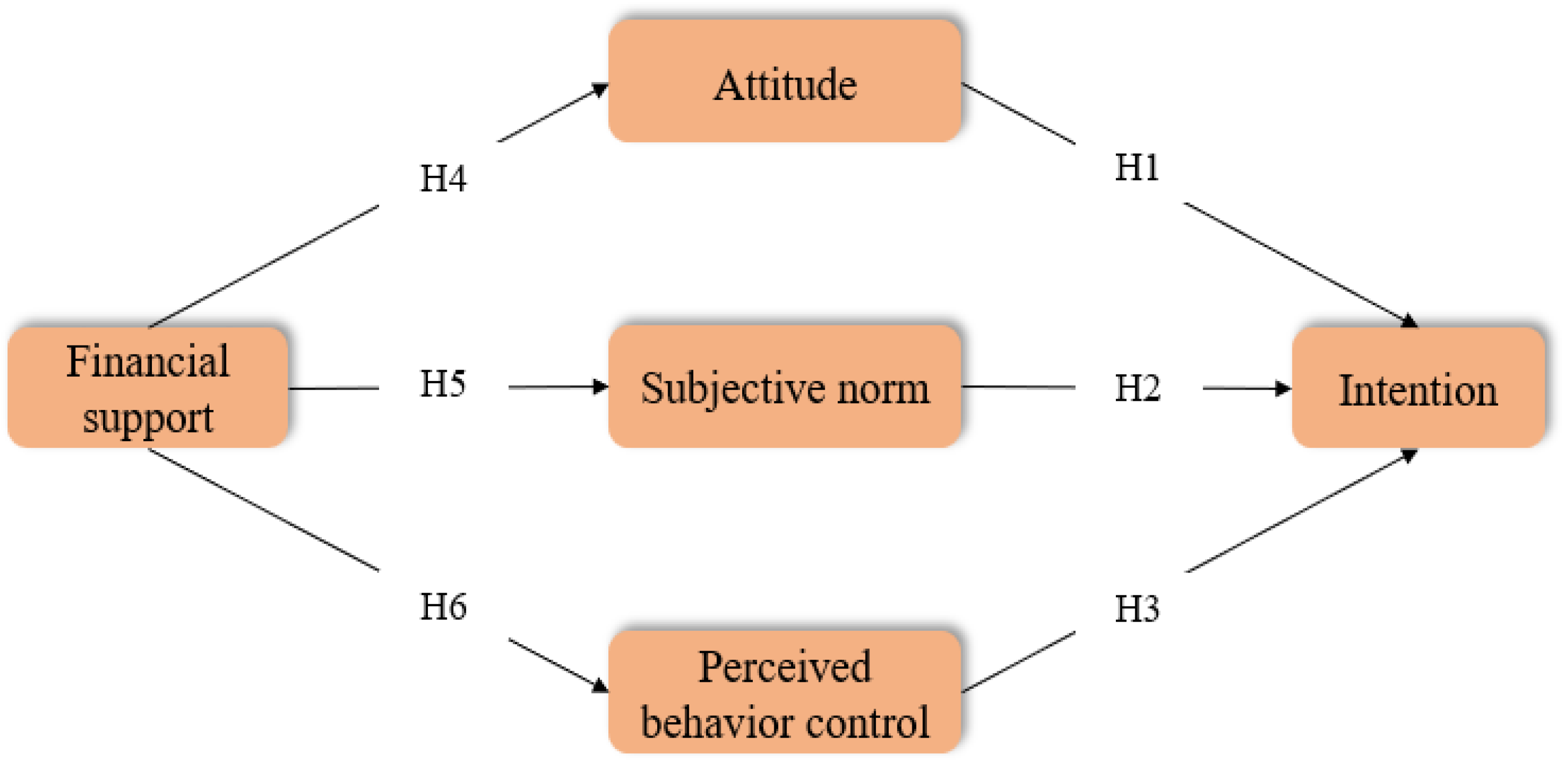
Planned behavior theory (PBT) is a well-known basic theory within the discipline of social psychology used to analyze the will and behavior of micro individuals. This theory is improved on the basis of the rational behavior theory proposed by Ajzen and Fishbein in 1975. It was formed in 1991 after Ajzen added the perceptual behavior control factors and combined them with individual behavior attitudes and subjective norms [13]. According to the Theory of Planned Behavior, first, individual conduct is influenced by the intention behind it and actual conditions, and behavior intention directly determines behavior when actual control conditions are met. Second, perceived behavior control, as an indicator of the degree of satisfaction of actual control conditions, can forecast the likelihood of conduct. Thirdly, attitude, subjective norms and perceived behavior control are latent variables that affect intention. The stronger the attitude, subjective norms and perceived behavior control are, the higher the behavior intention is [13,14]. This study expands on this basic theory, introducing financial support as a variable to focus on the research on the attitude and intention of financial support to millet farmers for green production and the degree of impact (see Figure 1).

2.1.1. Attitude

Behavioral attitude (ATT) refers to a person’s cognition and assessment of objects or actions. Most social psychologists believe that the characteristic attribute of attitude lies in the external evaluation nature [15]. The behavioral attitude discussed in this article relates to millet farmers’ emotional and cognitive propensity toward green production practices over the course of millet cultivation, as well as their readiness to embrace and put into practice green production practices. According to previous research results, attitude has an impact on behavioral intention. Many subsequent studies show that behavioral intent is equally impacted by attitude [16]; Ataei concluded that the better the farmers’ attitude towards green agricultural product seeds, the stronger their willingness to purchase. Generally speaking, the more positive millet farmers’ awareness of green production mode, the more inclined they are to use green production techniques. On the contrary, they will be less inclined to take part in green production.
H1: 
Behavioral attitude has a major favorable effect on the willingness of millet farmers to adopt green production technology.

2.1.2. Subjective Norm

External pressure is referred to as the subjective norm (SN) that a person perceives when they choose to perform a certain behavior, which mainly comes from the individuals and groups with guidance and trust around the individual’s life [17]. The external societal pressure that millet farmers encounter while selecting green production methods is expressly referred to as the subjective norms in this article. This pressure primarily originates from the expectations and direction of the key players who are directly involved in millet cultivation. Ajzen and Fisher’s research results indicate that subjective norms can affect people’s behavior intention, and it has been confirmed that subjective norms and conduct intention have a strong and favorable relationship [4]. Generally speaking, the more positively the close individuals around the millet planting farmers reflect on their behavior, the more obvious the subjective norm tendency of the individual, and the more eager a person is to take part. On the contrary, the willingness to participate decreases.
H2: 
Subjective norms have a major beneficial effect on the green production willingness of millet farmers.

2.1.3. Perceived Behavior Control

This paper is based on the Theory of Planned Behavior (TPB) and explores how financial support influences the green production intentions of smallholder farmers in the rice industry. In addition to reviewing and defining the classic TPB framework, Section 2.1 provides a theoretical foundation for the subsequent introduction of exogenous variables by elucidating the meanings of its three central variables—behavioral attitude, subjective norm, and perceived behavioral control—in the context of millet green production. The main exogenous variable of this study, financial support, is defined and theoretically analyzed in Section 2.2. The study’s hypotheses and theoretical model are developed based on the correlation between financial support and the three core variables of TPB.
The term “perceived behavior control” (PBC) describes how tough it is for a person to carry out a particular activity. The recognition of the difficulty mainly comes from the individual’s own knowledge, the cost-effectiveness of the implementation process and the expected target results [18]. The degree of difficulties millet farmers encounter when attempting to use green production practices during actual cultivation is referred to as the perceived behavior control discussed in this article. The availability of outside assistance, their own proficiency with green wheat cultivation methods, and other elements are the primary causes of this perception. According to the Theory of Planned Behavior, Ajzen stated that behavior intention can be directly influenced by perceived behavior control. Many scholars have shown that when micro individuals have strong control over a certain thing or behavior, they are more able to generate the intention to conduct the behavior [19,20]. Castillo’s research on farmers’ planting behavior also confirms that conduct intention is positively and favorably impacted by perceived behavior control. Generally speaking, the easier millet farmers perceive such behavior, the stronger their perceived behavior control and the stronger their willingness to participate. On the contrary, their willingness to participate is reduced [21].
H3: 
Millet farmers’ willingness to participate in green production is significantly positively impacted by perceived behavior control.

2.1.4. Behavioral Intention

Behavioral intention (INT) refers to the trend and direction of an individual’s subjective willingness to perform a certain behavior, which can directly reflect the individual’s preference for a certain behavior [21,22]. The behavior intention refers to the green production intention of millet farmers under financial support, which mainly refers to the hypothetical path research of farmers’ behavioral attitudes, subjective norms and perceived behavior control on green production intention, and determines its impact degree.

2.2. Financial Support

Financial support (FS) refers to situations in which individuals obtain economic security and financial support, mainly including loan preference, expected excess income and post loss security [23]. In the early 1980s, scholars used measurement technology to study the causal relationship between economic growth and financial development. Rural economic development needs to be based on economic growth to improve agricultural output and farmers’ income. However, with financial support leading to increasing production and income over the years, to a certain extent, China’s agricultural competitiveness is low and green development capacity is facing problems [24]. Financial support for green production groups has become necessary for the development of agricultural modernization. The United States provides loan subsidies and preferential loan interest rates for the development of green agriculture, which can effectively improve the attitude of farmers towards green production. Smith and Goodwin’s research shows that participation in agricultural insurance can improve the control of green production, reducing the use of fertilizers and pesticides by farmers. This research also shows that the more the quality premium of green production products is higher than the output loss, the more farmers will accept green production behavior [25]. Generally speaking, when millet farmers receive higher financial support, their cognitive attitude towards green production will be more positive, their subjective norm tendency will be more obvious, and their perceived behavior control will be stronger [26,27].
H4: 
Financial support has a favorable and considerable influence over millet producers’ attitudes toward green production.
H5: 
Financial support has a favorable and substantial impact on the formation of green production subjective norms of millet farmers.
H6: 
Financial support has a favorable and substantial impact on millet farmers’ perception and behavior control of green production and planting.
By providing targeted incentives for millet green production, financial support influences the three main facets of the planned behavior theory in the context of millet cultivation. It improves farmers’ cognitive assessment of the costs and benefits of millet green production, which shapes their behavioral attitude; it reinforces the social norm of millet green production through market guidance and policy, which improves the subjective norm; and it lessens the perceived difficulty of millet green production by augmenting material and financial resources, which improves perceived behavior control. The indirect transmission mechanism from financial support to millet farmers’ intentions for green production is formed by this multi-path influence.
H7: 
The intention of millet farmers to practice green behavior is directly and indirectly impacted by financial support.

3. Results

3.1. Structural Equation Model

The structural equation model (SEM) was initially put forth by Sewall Wright and applied to path analysis. It is an effective advanced statistical analysis tool. This method is widely used in scientific and social research [28]. SEM can measure variables that cannot be observed by the naked eye through indirect reflection of measurable variables and predictive variables. The above latent variables belong to the subjective clarity of individuals and cannot be obtained through actual measurement. Therefore, the structural equation model is adopted in the study. SEM can not only comprehensively deal with multiple dependent variables, it is also possible to determine the latent variables and their relationships and further analyze the action paths and influence effects of the latent variables and the observed variables [29,30].

3.2. Questionnaire Design and Data Source

3.2.1. Questionnaire Design

Based on the previous research and structural model, this paper designs a questionnaire with validity and discrimination by comprehensively considering the variables used in the relevant literature. The primary purpose of the questionnaire’s design is to assess and quantify the elements that influence millet-planting farmers’ intentions to engage in green production. The main content of the questionnaire includes three parts. The questionnaire’s description appears in the first section, which outlines the questionnaire’s objective, the requirements and the real situation of the investigators to ensure the authenticity of the questionnaire. The second part is the personal information of the questionnaire investigators, the basic personal information of millet farmers, family economy and crop planting. The third part is the scale part of the questionnaire.
There are 19 options in the whole scale, including behavior attitude (4 items), subjective norms (4 items), perceived behavior control (3 items), behavior intention (5 items) and financial support (3 items). Three distinct variables are examined using a Likert 7-point scale (1 = completely inconsistent, 7 = completely consistent) in the financial support (FS) dimension, which quantitatively evaluates the actual acquisition status and perceived intensity of financial incentives received by millet farmers. The dimensions of the evaluation include the following: ① The extent of eligibility for certain green planting incentives, such as those promoting the use of organic fertilizer; ② the provision of preferential loans for rural areas (such as low-interest or interest-free loans for growing the scope of green plantings or buying supplies for green production); and ③ the coverage of agricultural insurance guarantees for green production. In order to ensure the validity and targetedness of the financial support variable measurement, all items are designed to accurately measure the actual impact of various forms of financial support on farmers’ psychological cognition and behavioral decision-making regarding green production, as well as to directly reflect the multifaceted financial support that farmers receive during the millet production process.
These effects are measured using the Likert seven-level scale. The answers of millet-planting farmers are divided into the following groups: completely non-conforming, most non-conforming, a small part non-conforming, moderate, a small part conforming, most conforming and fully conforming, with each answer assigned a value from 1–7 respectively.

3.2.2. Selection of Investigation Site

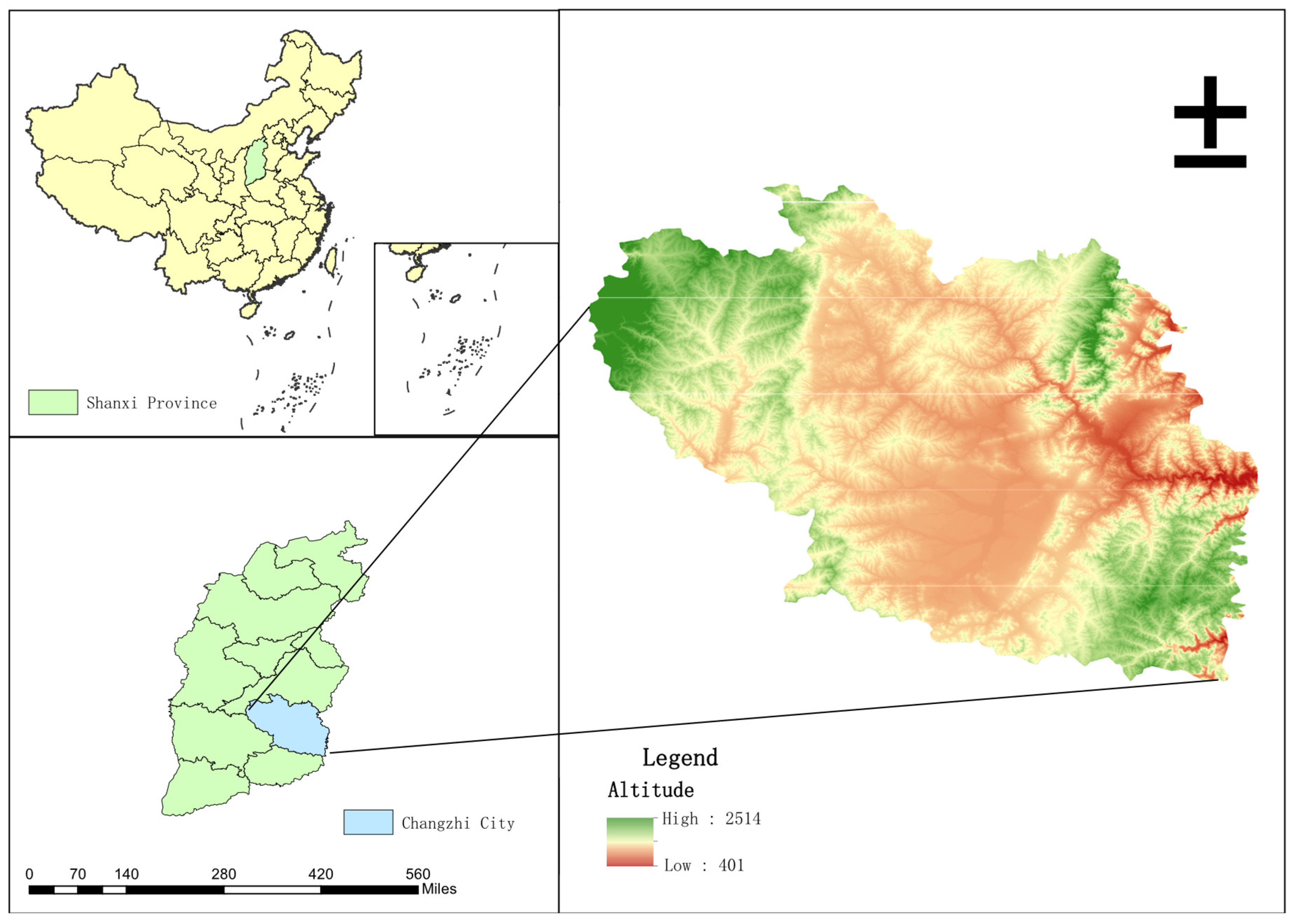
This paper’s investigation site is located in Changzhi, Shanxi Province. Changzhi City is located in the southeast of the Loess Plateau, with an average elevation of more than 1000 m. The special red clay is rich in a variety of mineral nutrients. The light is sufficient, the four seasons are distinct, and the temperature difference between day and night is large. The Qinhe River and the Zhuozhang River run through 10 counties. The total capacity of large and medium-sized reservoirs is 1 billion cubic meters, and the water resources are abundant. The superior geographical environment has created a major millet-producing region, making Changzhi the core area of millet cultivation in China. Based on the evaluation of the regional distribution and yield of millet grain in Changzhi City, Songcun Township, Cicun Township in Qin County and Shangsi Township, Fengzhou town and Shibei Township in Wuxiang County were selected for investigation and analysis by stratified random sampling (Figure 2).

3.2.3. Questionnaire Survey

A multi-stage stratified random sampling technique was used in this study to choose small-millers to be the research participants. First, regional stratification was done based on the ecological circumstances and the degree of green agriculture development in the major millet production areas. Towns and administrative villages were chosen at random within each stratum. Following that, farmers were selected at random based on variations in planting size and financial assistance participation. A combination of offline and online questionnaires were used in the study. In order to ensure that the research data can accurately reflect the influence of financial support on the intentions of small millers to engage in green production behavior, the study sought to balance the differences and representativeness of the samples with respect to production scale, financial participation, and green production behavior.
Because the questionnaire and scale design are based on the previous research and design, and the results are guaranteed, there is no pre survey. At the same time, to guarantee the validity and reasonableness of the survey’s questionnaire data and the convenience of data collection, the practical survey process adopts the online questionnaire star design, and the questionnaire is put into the WeChat groups of the investigated townships and towns for questionnaire guidance and filling. The survey period lasted from April 2024 to July 2024. The first page of the questionnaire has an independent “Informed Consent Notification Module” set up. The survey was absolutely anonymous. In this case, “electronic confirmation of consent”—an expanded version of written consent—is used as informed consent. Before entering the questionnaire filling page, potential subjects must thoroughly read the informed content and click the “I have carefully read and understood the above content and voluntarily participate in this study” confirmation button at the bottom of the module. This document is kept in an encrypted database on an online platform and is linked to the questionnaire data as an electronic informed consent certificate.
Finally, 506 formal survey samples are successfully obtained. After removing the incomplete options and the samples of contradictory items, 448 valid surveys were gathered. The questionnaire survey is prone to reflection bias, which is a tendency rooted in carelessness, extreme acquiescence and systematic reflection when answering the questionnaire. Its existence will affect the questionnaire response and affect the data modeling and variable model results [31]. In this paper, the questionnaire template designed by the predecessors was used to conduct the survey. Before the online survey, the language guidance and detailed description were given to the survey group, and the familiarity of the respondents with the questionnaire was determined through feedback. At the same time, no guiding information will be transmitted in the questionnaire interview, and no mandatory requirements will be imposed on farmers who are unwilling to accept the interview. The questionnaires with high missing values, high repetition rate and short filling time will be excluded from the analysis of the survey results to determine the effective questionnaires and reflect the real results [32].
Our study formally started in July 2024. According to the statistics on the basic characteristics of millet farmers in Table 1 below, the proportion of men in the surveyed individuals is higher than that of women, accounting for 63.8%, and the proportion of women is 36.2%. This result may be related to the division of labor between men and women in the surveyed area or men’s better understanding of family farming. In terms of age structure, the farmer households are mainly over 35 years old, of which 29.5% are 36–50 years old and 54.2% are over 50 years old. This also proves that there is a certain aging phenomenon in the current planting farmer households, as the fields are managed by middle-aged and old people, and the young people mostly go out to work. Regarding educational attainment, the proportion of respondents with junior high school education is the highest, reaching 46.7%, and the proportion of primary school and below is 29.0%. The overall education level is low. In addition, regarding the yearly household income, the survey mainly focuses on the household cultivated land income of farmers. The income of 10,000–50,000 yuan accounts for 52.5%, which is in line with the economic situation of local farmers’ planting income. The area of arable land is relatively close to the income status, and the area of arable land under 6666.67 square meters accounts for 89.7%, which indicates that the research group and the majority of farmers have more research value and green production intention research. At the same time, it also reflects the lack of rural labor force, the local planting land is reduced, and the large-scale development of agriculture needs to be promoted. The paper provides statistics on the planting areas of the farmers surveyed. Among them, the number of people surveyed in Songcun Township of Qinxian County is 154, accounting for 34.4%. The proportion of Shangsi Township and Shibei Township in Wuxiang County, where the cultivated land is located, is 23.0% and 14.5%, respectively. Among them, Songcun Township, Cicun Township and Shangsi Township have more millet planting areas, while Shibei Township and Fengzhou town have less millet planting areas. The questionnaire recovery results are representative. To sum up, the survey of farmers can better reflect the actual situation of millet farmers in Changzhi City and meet the research needs.

4. Empirical Result Analysis

4.1. Reliability and Validity Test

The consistency or stability of the results obtained when the same method is used to measure the same thing again is referred to as dependability of the survey data [33]. The reliability of the scale in this paper is tested by Cronbach’s alpha. SPSS 23.0 statistical software is used to test the reliability of the scale based on α. When the coefficient is higher than 0.6, the reliability result is feasible [34]. In the study on the green production willingness of millet farmers, the overall standard of the scale (Cronbach’s) was measured as α. The coefficient value is 0.888, among which the latent variables are Cronbach’s of ATT, SN, PC, FS and INT α. They are 0.743, 0.708, 0.666, 0.612 and 0.721 respectively, which are greater than the threshold value of 0.6. Therefore, the reliability of each potential variable and measurement index is high and acceptable. Cronbach’s potential and observed variables expressed using α are displayed below in Table 2, along with the measurement findings.
A validity test is used to analyze the accuracy of the scale measurement indicators to meet the research standards, and is also a necessary step for factor analysis. In this paper, the structural validity test and convergence validity test were carried out on the questionnaires.
Structural validity refers to the degree to which the test items correctly respond to the theoretical conceptual characteristics. In the structural validity test, SPSS 23.0 software is employed to assess the validity of the model by KMO test and Bartlett’s spherical test. Generally speaking, every latent variable has a KMO value greater than the 0.5 threshold. When KMO is greater than 0.6 and the significance p value of Bartlett’s spherical test is less than 0.05, it indicates that the results of the survey scale are suitable for factor analysis [35]. The overall KMO value of the survey scale is 0.903, the significance level p of Bartlett’s spherical test is 0.000, and the overall structural validity of the scale is good. The corresponding KMO values of behavioral attitude (ATT), subjective norms (SNs), perceived behavioral control (PC), financial support (FS) and behavioral intention (INT) are 0.747, 0.744, 0.644, 0.617 and 0.779 (Table 3), respectively. The model has strong structural validity and is appropriate for factor analysis since all of the KMO values are larger than 0.6 and the significance level p is less than 0.05.
Convergence validity refers to the degree to which each indicator reflects the same level. The level of convergence validity indicates the construction and connotation of each indicator [36]. In this paper, AMOS 23.0 is utilized to test the convergence validity of the model. The CR and AVE values in the results are measured. Generally speaking, the CR value should not be lower than 0.6. The higher the CR value, the greater the structure’s internal consistency. Fornell and Larcker think that AVE should be higher than 0.5, but it can also be accepted as low as 0.4, indicating that the convergence validity of the model is acceptable [37]. The behavioral attitude Cr, subjective norm CR, perceived behavior control CR, financial support CR, and behavioral intention CR of the model constructed in this paper are 0.747, 0.710, 0.667, 0.621, and 0.724 (Table 4), all of which are greater than 0.6. The internal consistency is acceptable. Behavioral attitude AVE is 0.426, subjective norm AVE is 0.411, perceived behavior control AVE is 0.402, behavioral intention AVE is 0.433, both of which are greater than 0.4, and financial support AVE is 0.392. The result is close to 0.4. It is considered feasible, indicating that the convergence validity of the structural model established by the questionnaire is acceptable.

4.2. Fitness Test

The model fitness is used to judge the degree of fitting and consistency between the test data and the hypothetical model, and the fitness index is used to evaluate whether the survey data and the hypothetical model match each other [38]. AMOS is used to measure the model fitting index, in which the absolute fitting index and the relative fitting index are commonly used. The absolute fitting index includes CMIN and RMSEA, etc. In the domestic and foreign references, when the CMIN/DF is less than 5, the model fits the data well [39]. The RMSEA and RMR values are less than 0.08, indicating that the model fitting is good [40]. The relative fitting indexes used in this paper mainly include GFI, AGFI, NFI, TLI, CFI and IFI; if the relative fitting index is greater than 0.8, the model fitness is acceptable [41]. In this paper, AMOS 23.0 is used to calculate the fitness of the research hypothesis model [42]. The results are shown in Table 5 below. The CMIN/DF value is 3.319, which is less than 5. The RMSEA value is 0.069, which is less than 0.080. The GFI value is 0.901, which is greater than 0.9, and the AGFI, NFI, TLI, CFI and IFI are 0.871, 0.827, 0.853, 0.874 and 0.875, respectively. These values are all greater than 0.8. Therefore, all the reference indexes meet the fitting standard, and the fitness of this hypothetical model is good.

4.3. Hypothesis Test Results

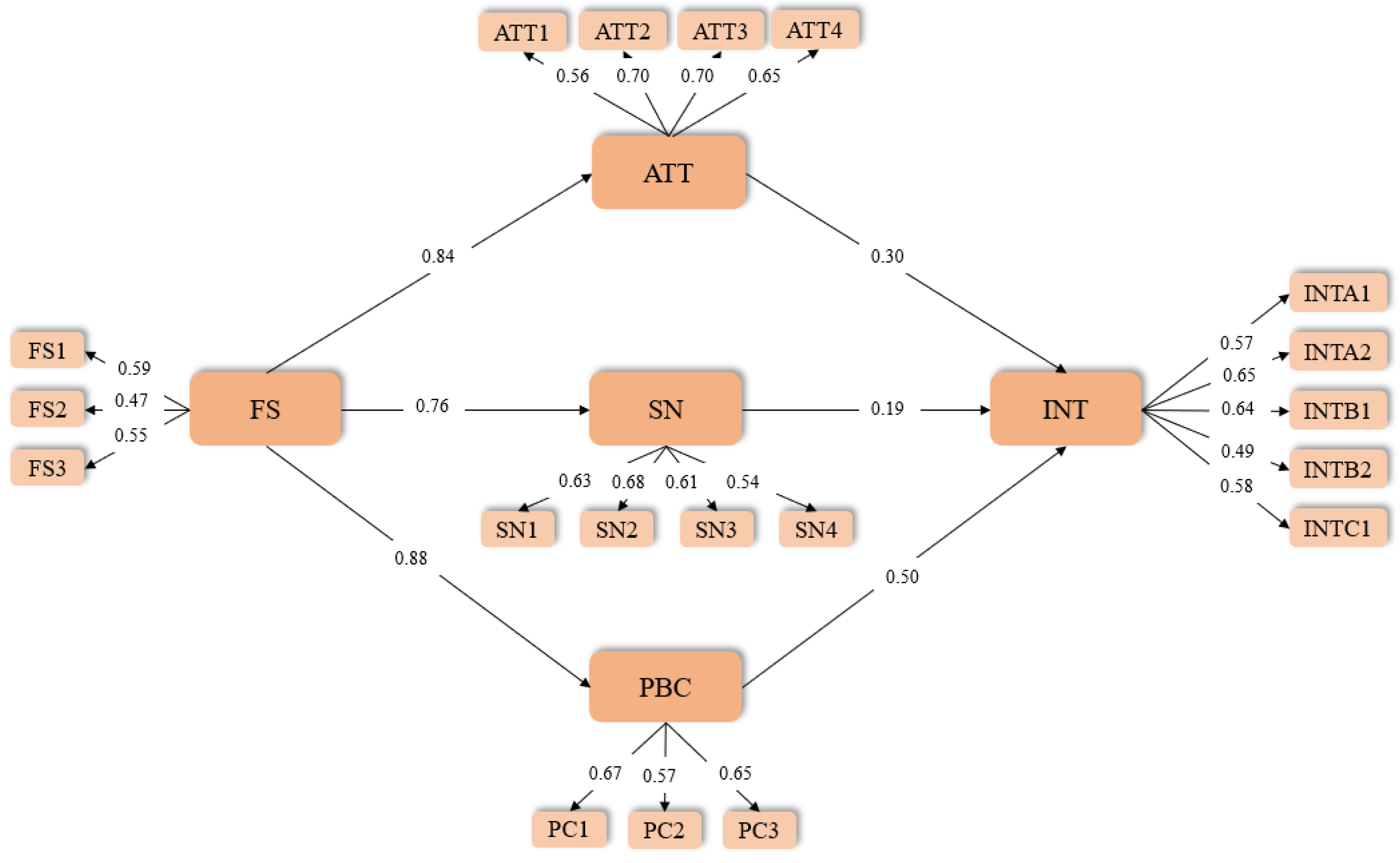
In this study, a structural equation model analysis of millet farmers’ willingness to produce green is conducted using AMOS 23.0 software, and the structural equation model diagram is shown in Figure 3 below. The test results based on the above hypothetical path are as follows (Table 6):
Assuming H1 is established, based on the financial support, the willingness of millet farmers is very advantageously affected by their attitude regarding the adoption of green production technology (β = 0.296, p = 0.004).
Assuming H2 is established, based on the financial support, subjective norms have a considerable favorable effect on the green production willingness of millet farmers (β = 0.188, p = 0.034).
Assuming H3 is established, based on the financial support, the perceived behavior control has a major favorable effect on the willingness of millet farmers to engage in green production (β = 0.499, p < 0.001).
Assuming that H4, H5 and H6 are established, financial support has a favorable and substantial influence on the green production attitude of millet farmers (β = 0.836, p < 0.001). Financial support has a favorable and vital influence on the formation of farmers’ subjective norms of green production (β = 0.755, p < 0.001). Financial support has a positive and significant impact on farmers’ perception and behavior control of green production (β = 0.885, p < 0.001) (Table 7).
Assuming that H7 is established, financial support has an indirect and substantial beneficial effect on the green production willingness of millet farmers, which is conducted through paths H4 → H1, H5 → H2 and H6 → H3 (β = 0.831, p = 0.038 < 0.05) (Table 8).
The standardized path coefficient indicates that farmers’ perceived behavior control is most strongly influenced by financial support, followed by behavior attitude, and then subjective norms. The perceived behavior control has the greatest impact on farmers’ green production intention, followed by behavioral attitudes and subjective norms. The hypothesis test of each path passed.

5. Discussion on Empirical Results

5.1. The Influence of Attitude on Intention

The green production behavior and attitude of smallholder farmers in millet cultivation have a noteworthy favorable effect on their willingness to participate in green production (β = 0.296, p = 0.004 < 0.05), thus supporting H1. The results indicate that the behavioral attitudes held by farmers can significantly influence their intention to participate in green production. Thus, enhancing the behavioral attitudes of millet growers towards green production is crucial for the progress of green production. This is consistent with the earlier research results in the field of green production.
For instance, Xu Jiabin et al. found in their study on the impact of farmers’ cognition on their willingness to engage in agricultural green production under the context of environmental regulation policies that farmers’ cognitive evaluations directly affect their behavioral attitudes, which results in a chain reaction affecting green production decisions. The higher the cognitive evaluation, the more positive the attitude towards implementing this behavior and the stronger the willingness [43]. Zhang Weiyun et al.’s research on rice growers in Jiangxi Province also showed that farmers’ green production willingness is significantly positively influenced by their production cognition, and the higher the cognitive level, the stronger the willingness to adopt green production technologies [35]. Additionally, Luo’s empirical study based on the Theory of Planned Behavior (TPB) found that farmers’ value perception of green production significantly and positively influences their green production participation willingness through the mediating variable of attitude [44].
Our research suggests that when millet growers hold positive evaluations of green production, they are more likely to believe that the green production method can bring economic and ecological benefits. This positive cognition will be transformed into a positive behavioral attitude, thereby enhancing their intrinsic motivation to participate in green production. This means that growers who are optimistic about the prospects of the green millet market are more likely to develop a favorable intention to participate and actively learn and adopt green production technologies. When farmers view green production as an effective way to improve millet quality and increase income sources, they will have more motivation to produce in accordance with green standards, forming a more favorable orientation towards engaging in this specific green production behavior. This positive transformation from attitude to intention can enable millet growers to actively adjust their traditional production habits, thereby increasing their actual behavioral intention to participate in green production.

5.2. The Influence of Subjective Norms on Intentions

The subjective norms of the millet growers have an encouraging impact on their inclination to engage in green production. (β = 0.188, p = 0.034 < 0.05), thus supporting H2. The results are consistent with those of many scholars. Subjective norms also influence the inclination to participate in green production.
For instance, Zhang Dongmin et al. found in their study on farmers’ responses to two-type agricultural behaviors that neighborhood pressure and institutional environment have a noteworthy beneficial effect on farmers’ responses to resource conservation and environmentally friendly concepts. During the decision-making process, farmers are influenced by the exemplary norms from the surrounding groups [45]. Savari et al. found in their study on Iranian farmers’ pro-environmental behavior intentions that subjective norms are one of the three strongest indicators for predicting farmers’ behavioral intentions, and social pressure from important others significantly affects farmers’ environmental protection decisions [46]. Liu et al.’s research based on the Extended Theory of Planned Behavior (TPB) on the willingness of farmers in the Loess Plateau of China to adopt water-saving agriculture shows that regardless of the specific measures, subjective norms are always the most critical factor influencing farmers’ adoption intentions [47]. Additionally, Daxini’s research also confirmed that subjective norms are positively correlated with farmers’ willingness to adopt sustainable agricultural practices, and social expectations and normative pressure can effectively promote farmers’ environmental behavior changes [48].
Our research suggests that when small-scale millet farmers perceive positive expectations from family members, neighbors, agricultural cooperatives, and local government departments, they will feel a strong sense of social pressure, thereby enhancing their willingness to participate in green production. This implies that millet farmers with a high degree of group identification are more likely to be influenced by important people around them. When their social network generally supports green production methods, farmers are more inclined to follow the group norms and adopt green planting technologies. This external social expectation can be transformed into internal behavioral motivation, enabling millet farmers, driven by the herd mentality and group identification, to actively adjust their production behaviors to conform to social expectations, thereby increasing their likelihood of participating in green production.

5.3. The Influence of Perceived Behavioral Control on Intention

The perceived behavioral control of the millet growers also has a remarkable favorable effect on their willingness to participate in green production, (β = 0.499, p < 0.001), thus supporting H3. The results confirm that farmers’ familiarity with knowledge related to green production can positively influence their willingness to engage in green production. This result is consistent with previous research results in the field of green production.
For example, Mills et al. found when exploring farmers’ participation in environmental management behaviors, perceived behavioral control is a crucial factor in the Theory of Planned Behavior that explains farmers’ behavioral intentions. When farmers perceive that they have the knowledge, skills, and resource support to implement environmental protection behaviors, their willingness to participate significantly increases [49]. Additionally, Zhou et al. verified through an empirical study of scattered farmers in the Taihu Lake Basin that perceived behavioral control has a significant positive impact on farmers’ willingness to engage in low-carbon production, indicating that when farmers perceive the usability and availability of green production technologies, their willingness to participate significantly increases [50]. Yu et al.’s farmer fallow behavior model based on the Theory of Planned Behavior also found that farmers’ fallow behavior intentions are closely related to perceived behavioral control, and the stronger the perceived control ability, the higher the willingness to participate [47].
Our research suggests that when small-scale wheat farmers possess sufficient knowledge of green production, master relevant technical skills, and perceive support from external entities such as the government and cooperatives, they will develop a strong sense of self-efficacy, thereby significantly enhancing their willingness to participate in green production. This implies that wheat farmers, who have received green production technology training can obtain stable technical guidance and financial subsidies, are more likely to overcome obstacles in the green production process and form a positive participation intention. At the same time, when farmers perceive that green production materials are easily accessible and the sales channels for green products are unobstructed, this positive cognitive of behavioral control will translate into actual participation motivation. This perception-based control based on self-efficacy and external support can enable wheat farmers to actively overcome the inertia of traditional production methods and actively adopt green production technologies, thereby increasing their likelihood of participating in green production.

5.4. The Impact of Financial Support

Just as expected in H4, H5, and H6, the research results indicate that financial support has a considerable favorable influence on attitudes (β = 0.836, p < 0.001), subjective norms (β = 0.755, p < 0.001), and perceived behavioral control (β = 0.885, p < 0.001), which is consistent with the earlier research findings.
For instance, Wang et al. found when exploring the financing behavior of green agricultural production in Heilongjiang Province, financial support influences the financing behavior of farmers by affecting their psychological structures (attitudes, subjective norms, perceived behavioral control). Government preferential loan policies and financial subsidies can significantly improve farmers’ attitudes towards green production financing, reduce their perceived risks, and enhance their behavioral control ability [50]. Zhao et al., in their study on farmers’ green production decision-making based on the improved TPB framework, confirmed that financial support tools such as subsidies and credit can effectively reduce the marginal cost of farmers’ green production, alleviate financial constraints, and thereby promote green production intentions by enhancing perceived behavioral control [51]. Additionally, Zeng et al., in their research on the green agricultural production behavior of farmers in Xinjiang, showed that financial support intensity is an important observation variable of perceived behavioral control, which has a significant positive impact on farmers’ green production intentions. The stronger the support farmers receive in terms of funds, the more inclined they are to adopt green production practices [52]. Lei et al., in their study on the green production behavior of farmers in the Yangtze River Economic Belt, confirmed that financial support can transform farmers’ attitudes towards green production by alleviating cost pressure. When farmers perceive that green production not only brings higher agricultural income but also leads to government subsidy support, their recognition and positive attitude towards green production significantly increase [53].
Our research suggests that when small-scale farmers in the millet cultivation industry receive adequate financial support, including green production subsidies, preferential credit policies, agricultural insurance coverage, etc., their attitudes towards green production will undergo a positive transformation. They will shift from traditional concerns about costs to recognition of benefits. This indicates that financial support not only directly reduces the production cost pressure on farmers but also enhances their confidence in the stability of green production policies through a signaling mechanism. It also improves their subjective normative cognition of green production; that is, they believe that important people around them and their social circle generally support green production. Moreover, financial support significantly enhances farmers’ perceived behavioral control. When farmers have sufficient financial security and can obtain low-interest loans to purchase green production materials, they perceive that the obstacles to implementing green production have significantly decreased and their self-efficacy has increased. This comprehensive promotion effect of financial support on attitudes, subjective norms, and perceived behavioral control enables millet farmers to have both positive internal attitudes and strong social support when facing the transformation to green production. At the same time, they have sufficient resource control capabilities, thereby significantly enhancing their willingness to participate in green production.

5.5. The Indirect Impact of Financial Support on Farmers’ Willingness

Financial support has a substantial indirect impact on green production willingness of smallholder farmers in Xiaomi cultivation (β = 0.831, p < 0.05), and the indirect effect ranges from 0.761 to 0.912. Therefore, Hypothesis H7 is established; that is, financial support will indirectly influence the green production willingness through attitudes, subjective norms, and perceived behavioral control. This is consistent with the existing research conclusions in the field of agricultural finance and green production behavior.
There have been few studies directly exploring the indirect influence of financial support as a mediating variable. However, many scholars have confirmed the mechanism that financial means can indirectly influence behavioral willingness through psychological variables. For example, Zhang et al. found through an empirical study based on demonstration sites of family farms in Heilongjiang Province that agricultural credit, as an important financial support method, can greatly affect the attitude, subjective norms, and perceived behavioral control of farmers towards green agricultural production financing behavior, thereby promoting the formation of green production willingness [54]. Chen and Wang’s research showed that the availability of agricultural credit not only directly promotes farmers’ adoption of green production technologies, but more importantly, through enhancing farmers’ positive attitudes towards green production and strengthening their perceived behavioral control, it indirectly promotes the green transformation willingness. They believe that financial support can reduce the initial investment cost and risk perception of green production, enabling farmers to form a more positive behavioral attitude, and at the same time, the process of obtaining credit support also enhances farmers’ confidence in implementing green production capabilities [55]. Zeng et al. found through an empirical analysis based on survey data of farmers in Gaochun District, Nanjing City, Jiangsu Province, that the availability of green credit has a major beneficial effect on farmers’ use of green technologies, and this impact is achieved by changing farmers’ attitudes and cognition towards green production [56].
Our research suggests that when smallholder farmers in Xiaomi cultivation receive sufficient financial support, it can change their psychological cognitive structure and have an indirect influence. Specifically, financial support can improve farmers’ attitudes towards green production. When farmers perceive that government subsidies and preferential credit can reduce the economic risks of green production, their evaluation of green production changes from being costly and risky to being profitable and worth trying, thereby significantly enhancing the green production willingness. Secondly, financial support strengthens farmers’ subjective norms. When financial support policies are widely implemented at the village level, farmers will perceive the widespread support for green production from important parties (such as village officials, demonstration households), thereby forming social pressure to follow group norms. At the same time, farmers who obtain credit support are more likely to be recognized by neighbors and the community, thereby strengthening the influence of subjective norms on behavioral willingness. Finally, financial support can significantly enhance farmers’ perceived behavioral control. When farmers have sufficient financial security and can obtain low-interest loans for purchasing green production materials, they will perceive that the obstacles to implementing green production have significantly decreased, their self-efficacy has increased, and their willingness has also improved. This indirect influence of financial support through the three mediating paths of attitudes, subjective norms, and perceived behavioral control on the green production willingness can enable smallholder farmers to face the green production transformation with both positive internal attitudes and strong social support, while having sufficient resource control capabilities, thereby comprehensively enhancing their willingness to participate in green production.

6. Conclusions

6.1. Conclusion

In this paper, the millet growers were investigated and analyzed, and the following conclusions were reached.
The intention of millet growers to enroll in green production is significantly positively impacted by their behavior and attitude. There are many factors that affect the individual’s views and attitudes towards things. In the study, the factors that are mainly considered include economic, green and risk perception, and how financial support shapes attitudes but also includes the above factors. Therefore, through reliable publicity and policy market support to influence the behavior and attitude of farmers, this can help millet growers to establish a good attitude towards green production.
Subjective norm substantially enhances the green production willingness of millet growers. Numerous academics have also verified the effects of subjective norms on individual behavior willingness in different fields. People in the area, especially close people, have an important influence on individual willingness to participate in green production. Under the publicity of authorities such as the government and institutions, the decision of millet growers may be changed. Similarly, under the communication of information, farmers make decisions out of social pressure and the expectation of relatives and friends. The influence of the government, relatives and friends on individual norms can change their green production intention in the same direction.
Millet growers’ intentions for green output are significantly positively impacted by perceived behavior control. Relevant studies also show that the perceived behavior control of farmers will affect their behavior intention, and the degree of influence is the largest. The change in farmers’ perceived behavior control can be achieved by improving farmers’ policy understanding, relevant knowledge learning and external support. The improvement of millet farmers’ perceived behavior control can well promote their green production intention.
Financial support significantly and favorably affects millet farmers’ behavior attitudes, subjective norms, and perceived behavior control. The indirect influence of financial support on millet farmers’ intentions to produce green is confirmed by building the planned behavior theory. The above research results show that reasonable and practical financial support can have an especially favorable impact on the attitude, subjectivity and perception of farmers, and convenient and safe loans, expected premium compensation of enterprises or government agencies and appropriate promotion of land insurance can establish better financial support and enhance green production willingness.

6.2. Theoretical and Practical Significance

The planned behavior theory is frequently employed as the theoretical basis for studying people’s behavior, enriching the ways and methods of studying people’s behavior, and is also widely used in farmers’ planting behavior. This paper introduces financial support into the theory to expand and effectively adds theoretical connotation through the path analysis of intermediary effect. Therefore, the Theory of Planned Behavior is taken as the theoretical background of this paper. It not only involves the expansion and extension of economic sociology research, but also the improvement and refinement of research groups, and more targeted research to provide the most appropriate research results.
This paper focuses on how to improve the green production willingness of millet farmers in Changzhi District, Shanxi Province, promote the green production behavior of farmers, improve the agricultural development level of the region and increase the land use of rural farmers. The following recommendations are made to realize agricultural modernization as soon as possible:
First, the altering of farmers’ attitude towards green production not only requires increasing agricultural subsidies, but also aims to promote farmers’ awareness of green production subsidies and carry out special planting subsidies in combination with local conditions. Farmers’ attitudes towards the implementation of organic fertilizer, plastic film recycling and returning platycodon grandiflorum to the field and other major green production channels have been changed. Through special subsidies and buy backs corresponding to green production technologies, farmers’ income awareness has been increased. At the same time, combined with policies and education and publicity, measures and influence have been promoted to enhance farmers’ participation enthusiasm, increase farmers’ participation guarantee and increase farmers’ willingness to participate.
Second, we will increase the support for agricultural production and investment by policy financial institutions, commercial banks and insurance companies. Policy financial institutions are the main source of agricultural loans. We will give full play to the strength of small loans and insurance guarantee for farmers, so that they can play a crucial part in the method by which farmers participate in green produce, improve the process, laws and regulations of financial support for farmers, and accelerate the structural reform of rural financial institutions. We will establish a stable and rational financial support system for farmers’ agricultural output and strengthen the oversight and management of rural financial institutions.
Third, we aim to promote the expansion and professional development of agricultural enterprises, support appropriate policy easing and economic subsidies, promote the cooperation between agricultural enterprises and farmers, guide farmers’ enthusiasm for green production with mutual benefit, influence farmers’ income through the greening and industrialization of market development, and speed up agricultural modernization.

6.3. Deficiency and Prospect

Finally, there are some limitations in this paper. The indirect impact of financial support on the green production intention of millet farmers is mainly considered in the modeling analysis through the planned behavior theory and financial support. Secondly, considering the convenience and directness of this research, the online questionnaire survey is adopted. Finally, the research group is targeted at millet farmers, and the group is relatively single. In the follow-up study, we will continue to improve the above problems and draw more reasonable and perfect conclusions.
In the future research on millet-planting farmers, we will combine the research, improve and improve the research limitations, deeply analyze the attitude, subjective norms and perception of this group towards green production behavior, properly take into account how other outside influences affect farmers’ conduct, provide some suggestions on the green production of characteristic agricultural products in Changzhi District, Shanxi Province, and promote agricultural modernization and health.


Author Contributions

Conceptualization, methodology, X.L.; investigation, writing—original draft preparation in English language, F.W.; investigation, software, P.W.; data curation, formal analysis, D.W.; validation, supervision, D.Z. All authors have read and agreed to the published version of the manuscript.

Funding

This work was supported by Heilongjiang Province Philosophy and Social Science Fund Project (21JYE394); Heilongjiang Province Philosophy and Social Science Fund Project (21JYD272); National Social Science Foundation of China (17BJY119); Graduate Innovation Project of Harbin University of Commerce (YJSCX2022-761HSD); Harbin University of Commerce Youth Innovation Talent Project (XW0177); Notice of Approval of a Major Project of the National Social Science Foundation (23&ZD069); Heilongjiang Province Philosophy and Social Sciences Research Planning Project (25JYE042).

Institutional Review Board Statement

The study was conducted in accordance with the Declaration of Helsinki, and approved by the Institutional Review Committee of Harbin University of Commerce (protocol code HUC20240305 and 5 March 2024 of approval).

Informed Consent Statement

Informed consent was obtained from all subjects involved in the study.

Data Availability Statement

The original contributions presented in this study are included in the article. Further inquiries can be directed to the corresponding author.

Acknowledgments

We thank all the authors for their support of the article.

Conflicts of Interest

The authors declare no conflicts of interest.

References

  1. Zahra, N.; Saeed, M.K.; Saeed, A.; Javed, N.; Rabiya, A. Milletes for Global Food Security. J. Nutr. Food Process. 2025, 8. [Google Scholar] [CrossRef]
  2. Tay, S.V.C.G. Discovery and Characterization of Hevein-like Peptides in Functional Food and Medicinal Plants. Ph.D. Thesis, Nanyang Technological University, Singapore, 2020. [Google Scholar]
  3. Wen, L.Y.M.; Li, S.H. A Study on the Relationship Amidst Health Consciousness, Ecological Affect, and Purchase Intention of Green Production. Int. J. Organ. Innov. 2013, 5, 124–137. [Google Scholar]
  4. Savari, M.; Gharechaee, H. Application of the extended theory of planned behavior to predict Iranian farmers’ intention for safe use of chemical fertilizers. J. Clean. Prod. 2020, 263, 121512. [Google Scholar] [CrossRef]
  5. Lv, M.; Wang, K. A study on the willingness of farmers in mountainous areas to produce green agricultural products—An Empirical Analysis of tea production in mountainous areas of Southern Anhui. Agric. Technol. Econ. 2004, 5, 33–37. [Google Scholar]
  6. Zhang, T. Analysis on Influencing Factors of farmers’ green vegetable production behavior—Taking 512 green vegetable producing farmers in Sichuan Province as an example. Stat. Inf. Forum 2012, 27, 88–95. [Google Scholar]
  7. Zhang, T.; Yan, T.; He, K.; Zhang, J. The impact of capital endowment on Farmers’ willingness to invest in green production—Taking straw returning to the field as an example. China Popul. Resour. Environ. 2017, 27, 78–89. [Google Scholar]
  8. Huang, Y.; Luo, X.; Li, R.; Zhang, J. Farmers’ cognition, external environment and green agricultural production willingness—Based on the survey data of 632 farmers in Hubei Province. Resour. Environ. Yangtze River Basin 2018, 27, 680–687. [Google Scholar]
  9. Xu, K.; Yang, J.; Lu, Z. Analysis of influencing factors of green production willingness of new agricultural operators in Western China. Rural Econ. 2021, 11, 53–61. [Google Scholar]
  10. Chen, Z. Influence of policy orientation and market orientation on Farmers’ green production—An Empirical Analysis Based on 865 farmers in Henan. J. Manag. 2021, 34, 109–125. [Google Scholar]
  11. Mazhar, R.; Ghafoor, A.; Xuehao, B.; Wei, Z. Fostering sustainable agriculture: Do institutional factors impact the adoption of multiple climate-smart agricultural practices among new entry organic farmers in Pakistan? J. Clean. Prod. 2021, 283, 124620. [Google Scholar] [CrossRef]
  12. Du, S.; Liu, J.; Fu, Z. The impact of village rules and formal environmental regulations on farmers’ cleaner production behavior: New evidence from China. Int. J. Environ. Res. Public Health 2021, 18, 7311. [Google Scholar] [CrossRef]
  13. Ajzen, I.; Fishbein, M. Understanding Attitudes and Predicting Social Behavior; Prentice-Hall: Englewood Cliffs, NJ, USA, 1980. [Google Scholar]
  14. Fishbein, M.; Ajzen, I. Belief, Attitude, Intention, and Behavior: An Introduction to Theory and Research; Addison-Wesley: Reading, MA, USA, 1975. [Google Scholar]
  15. Ajzen, I. From intentions to actions: A theory of planned behavior. In Action-Control: From Cognition to Behavior; Kuhl, J., Beckmann, J., Eds.; Springer: Berlin/Heidelberg, Germany, 1985; pp. 1–39. [Google Scholar]
  16. Bosnjak, M.; Ajzen, I.; Schmidt, P. The Theory of Planned Behavior: Selected Recent Advances and Applications. Eur. J. Psychol. 2020, 16, 352–356. [Google Scholar] [CrossRef]
  17. Ajzen, I. The theory of planned behavior. Organ. Behav. Hum. Decis. Process. 1991, 50, 179–211. [Google Scholar] [CrossRef]
  18. Hull, C.L. Principles of Behavior; Appleton-Century-Croft: New York, NY, USA, 1943. [Google Scholar]
  19. Lewin, K.; Dembo, T.; Festinger, L.; Sears, P.S. Level of aspiration. In Personality and the Behavior Disorder; Hunt, J., Ed.; Ronald Press: New York, NY, USA, 1944; Volume 1, pp. 333–378. [Google Scholar]
  20. Heider, F. Social perception and phenomenal casuality. Psychol. Rev. 1944, 51, 358–374. [Google Scholar] [CrossRef]
  21. Triandis, H.C. Interpersonal Behavior; Brooks/Cole: Monterey, CA, USA, 1977. [Google Scholar]
  22. Liska, A.E. A critical examination of the causal structure of the Fishbein/Ajzen attitude-behavior model. Soc. Psychol. Q. 1984, 47, 61–74. [Google Scholar] [CrossRef]
  23. Bagheri, A.; Emami, N.; Damalas, C.A. Farmers’ behavior towards safe pesticide ha-nding: An analysis with the theory of planned behavior. Sci. Total Environ. 2021, 751, 141409. [Google Scholar] [CrossRef]
  24. George, J.F. The theory of planned behavior and Internet purchasing. Internet Res. 2004, 14, 198–212. [Google Scholar] [CrossRef]
  25. Lin, N.Q.; Roberts, K.R. Using the theory of planned behavior to predict food safety behavioral intention: A systematic review and meta-analysis. Int. J. Hosp. Manag. 2020, 90, 102612. [Google Scholar] [CrossRef]
  26. Herath, C.S. Motivation as a potential variable to explain farmers’ behavioral change in agricultural technology adoption decisions. E+M Ekon. Manag. 2010, 13, 62–70. [Google Scholar]
  27. Ajzen, I. Attitude Structure and Behavior; Lawrence Erlbaum Associates: Mahwah, NJ, USA, 1989; pp. 241–274. [Google Scholar]
  28. Yang, Y.; Liu, Z. Research on financial support for the development of Agricultural Circular Economy—Analysis Based on the willingness of farmers. Rural Econ. 2017, 1, 88–93. [Google Scholar]
  29. Zeng, D.; Su, X.; Ma, Y.; Li, T.; Zhao, H.; Yang, H. Research on Farmers’ behavior response to agricultural green development policy—Taking X county of Xinjiang as an example. China’s Agric. Resour. Reg. 2022, 43, 55–63. [Google Scholar]
  30. Cuevas, C.E.; Buchenau, J. Financial Cooperatives: Issues in Regulation, Supervision and Institutional Strengthening; World Bank: Washington, DC, USA, 2018. [Google Scholar]
  31. Grossfeld, A. Essential Features of Cooperative Scheme in Germany; Nanjing University Press: Nanjing, China, 1990. [Google Scholar]
  32. Wooldredge, J. Path Analysis. In The Encyclopedia of Research Methods in Criminology and Criminal Justice; John Wiley & Sons: Hoboken, NJ, USA, 2021; Volume 2, pp. 515–522. [Google Scholar]
  33. Jensen-Auvermann, T.; Adams, I.; Doluschitz, R. Trust—Factors that have an impact on the interrelations between members and employees in rural cooperatives. J. Co-Oper. Organ. Manag. 2018, 6, 100–110. [Google Scholar] [CrossRef]
  34. Sarkar, A.; Azim, J.A.; Al Asif, A.; Qian, L.; Peau, A.K. Structural equation modeling for indicators of sustainable agriculture: Prospective of a developing country’s agriculture. Land Use Policy 2021, 109, 105638. [Google Scholar] [CrossRef]
  35. Zhang, W.; Lu, H.; Zhao, Y. Research on the Awareness and Willingness of Rice Farmers in Jiangxi Province to Adopt Green Production Methods. Grain Sci. Technol. Econ. 2025, 50, 76–81. [Google Scholar]
  36. Knudson, W.; Wysocki, A.; Champagne, J.; Christopher, H. Entrepreneurshipand innovation in the agrifood system. Am. J. Agric. Econ. 2004, 86, 1330–1336. [Google Scholar] [CrossRef]
  37. Fornell, C.; Larcker, D.F. Evaluating structural equation models with unobservable variables and measurement error. J. Mark. Res. 1981, 18, 39–50. [Google Scholar] [CrossRef]
  38. Paredes, D.; Loveridge, S. Rural electric cooperatives and economic development. Energy Policy 2018, 117, 49–57. [Google Scholar] [CrossRef]
  39. Hair, J.F. Multivariate Data Analysis; Springer: Berlin/Heidelberg, Germany, 2009. [Google Scholar]
  40. Bollen, K.A.; Long, J.S. Testing Structural Equation Models; Sage: Thousand Oaks, CA, USA, 1993. [Google Scholar]
  41. Doll, W.J.; Xia, W.; Torkzadeh, G. A confirmatory factor analysis of the end-user computing satisfaction instrument. MIS Q. 1994, 18, 453–461. [Google Scholar] [CrossRef]
  42. Afthanorhan, A.; Awang, Z.; Majid, N.A.; Foziah, H.; Ismail, I.; Halbusi, H.A.; Tehseen, S. Gain More Insight from Common Latent Factor in Structural Equation Modeling. J. Phys. Conf. Ser. 2021, 1793, 012030. [Google Scholar] [CrossRef]
  43. Xu, J.; Wang, Y.; Li, C. The Impact of Farmers’ Cognition on Agricultural Green Production Intentions under the Context of Environmental Regulation Policies: Evidence from Data of 698 Farmers in Heilongjiang Province. J. China Agric. Univ. 2021, 26, 164–176. [Google Scholar]
  44. Luo, L.; Qiao, D.; Tang, J.; Wan, A.; Qiu, L.; Liu, X.; Liu, Y.; Fu, X. Training of farmers’ cooperatives, value perception and members’ willingness of green production. Agriculture 2022, 12, 1145. [Google Scholar] [CrossRef]
  45. Zhang, D.; Wang, X.; Wang, X.; Liu, Y. Research on the Willingness of Large-scale Farmers to Produce Green and High-Quality Agricultural Products under the TPB-NAM Framework. Chin. Agric. Resour. Reg. Plan. 2023, 44, 1–12. [Google Scholar]
  46. Savari, M.; Damaneh, H.E.; Damaneh, H.E.; Cotton, M. Integrating the norm activation model and theory of planned behaviour to investigate farmer pro-environmental behavioural intention. Sci. Rep. 2023, 13, 7809. [Google Scholar] [CrossRef]
  47. Wang, J.; Liu, L.; Zhao, K.; Wen, Q. Farmers’ adoption intentions of water-saving agriculture under the risks of frequent irrigation-induced landslides. Clim. Risk Manag. 2023, 39, 100484. [Google Scholar] [CrossRef]
  48. Gbedourorou, S.K.; Tovihoudji, P.G.; Alonso, A.; Akponikpè, P.I.; Vanclooster, M. Understanding Lowland Rice Farmers’ Knowledge of Soil Fertilization Practices and Perceptions of Nitrogen-Induced Water Pollution Risks in the Ouémé Watershed, Central Benin. Water 2025, 17, 779. [Google Scholar] [CrossRef]
  49. Mills, J.; Gaskell, P.; Ingram, J.; Dwyer, J.; Reed, M.; Short, C. Engaging farmers in environmental management through a better understanding of behaviour. Agric. Hum. Values 2016, 33, 701–715. [Google Scholar] [CrossRef]
  50. Wang, X.; Zhou, W.; Zhou, F. Influencing Factors of Environmental Behaviors of Leisure Agriculture Operators—Based on Integrating Theory of Planned Behavior and Norm Activation Model. Pol. J. Environ. Stud. 2023, 32, 3201–3215. [Google Scholar] [CrossRef] [PubMed]
  51. Zhao, X.Y.; Zheng, J.; Zhang, M.Y.; Li, H.H. Research on a New Green Production Decision-making Mechanism for Agricultural Operating Entities Based on the Improved TPB Framework. Chin. J. Ecol. Agric. 2021, 29, 1636–1648. [Google Scholar]
  52. Sidike, M.; Li, G.M. Research on Farmers’ Behavioral Responses to Green Agricultural Development Policies: A Case Study of County X in Xinjiang. Chin. J. Agric. Resour. Reg. Plan. 2022, 43, 156–165. [Google Scholar]
  53. Lei, J.L.; Wu, X.L.; Li, W.H.; Li, W. Research on Green Production Behaviors of Farmers in the Yangtze River Economic Belt and Its Influencing Factors—Based on the Improved TPB Framework. Hubei Agric. Sci. 2021, 60, 200–207. [Google Scholar]
  54. Wang, H.; Zhong, S.; Guo, J.; Fu, Y. Factors affecting green agricultural production financing behavior in Heilongjiang family farms: A structural equation modeling approach. Front. Psychol. 2021, 12, 692140. [Google Scholar] [CrossRef] [PubMed]
  55. Wu, Q.; Li, W.; Chen, T.; Bai, Q.; Zang, D. Can Agricultural Credit Promote Farmers’ Green Production Behaviors? Evidence from China. Agriculture 2025, 16, 50. [Google Scholar] [CrossRef]
  56. Zeng, X.; Zhang, J. Research on the Impact of Green Credit on Farmers’ Green Transformation: A Study from the Perspective of Heterogeneity. South Agric. Mach. 2024, 55, 42–48. [Google Scholar]
Figure 1. Research path hypothesis.
Sustainability 18 02584 g001
Figure 2. Research area.
Sustainability 18 02584 g002
Figure 3. Normalized path coefficient.
Sustainability 18 02584 g003
Table 1. Statistics of individual characteristics of millet farmers.
ProjectCategoryQuantityProportion (%)
GenderMale28663.8
Female16236.2
Age (years)21–357316.3
36–5013229.5
Over 50 years old24354.2
Degree of educationPrimary school and below13029.0
Junior high school20946.7
High school9621.4
University or above132.9
Annual household income10,000 yuan and below11425.4
10,000–50,000 yuan23552.5
50,000–100,0007416.5
More than 100,000 yuan255.6
Cultivated land area (square meter)666–333015935.5
3331–666624354.2
6667–13,320357.8
More than 13,321112.5
Location of cultivated landSongcun Township15434.4
Cicun Township8318.5
Shangsi Township10323.0
Shibei Township6514.5
Fengzhou town439.6
Total 448100
Table 2. Reliability test results of the scale.
Latent VariableObserved VariableClone Bach After Deleting Item αCombination Cronbach α
ATTATT10.7220.743
ATT20.647
ATT30.676
ATT40.689
SNSN10.6360.708
SN20.621
SN30.651
SN40.674
PCPC10.4880.666
PC20.610
PC30.608
FSFS10.4040.612
FS20.580
FS30.545
INTINT10.6650.721
INT20.650
INT30.663
INT40.702
INT50.686
Cronbach α 0.888
Table 3. Structural validity evaluation of the scale.
Latent VariableProjectKMOp
ATTATT10.7470.000
ATT2
ATT3
ATT4
SNSN10.7440.000
SN2
SN3
SN4
PCPC10.6440.000
PC2
PC3
FSFS10.6170.000
FS2
FS3
INTINT10.7790.000
INT2
INT3
INT4
INT5
Total project 0.9030.000
Table 4. Convergence validity evaluation of the scale.
Latent VariableProjectSt.dCRAVE
ATTATT10.5570.7470.426
ATT20.699
ATT30.695
ATT40.650
SNSN10.6310.7100.411
SN20.677
SN30.610
SN40.542
PCPC10.6690.6670.402
PC20.574
PC30.654
FSFS10.5870.6210.392
FS20.472
FS30.553
INTINT10.5680.7240.433
INT20.650
INT30.640
INT40.493
INT50.578
Table 5. Model fitness.
IndexCorrelation Coefficient of Fitness TestGood Fit StandardConformity Standard
CMIN/df3.139≤5<8
RMSEA0.069≤0.08-
RMR0.080≤0.08-
GFI0.901≥0.9-
AGFI0.871≥0.9>0.8
NFI0.827≥0.9>0.8
TLI0.853≥0.9>0.8
CFI0.874≥0.9>0.8
IFI0.875≥0.9>0.8
Table 6. Analysis results of non-standardized confirmatory factors.
HypothesisRouteEstimatepC.R (t-Value)Inspection Results
H1ATT → INT0.2790.0042.919Accept
H2SN → INT0.1880.0342.118Accept
H3PC → INT0.422***3.990Accept
H4FS → ATT0.904***8.216Accept
H5FS → SN0.768***7.459Accept
H6FS → PC1.063***8.595Accept
Note: Significance level p value less than 0.001 is indicated by “***”, p value less than 0.01 is indicated by “**”, and p value less than 0.05 is indicated by “*”.
Table 7. Results of standardized confirmatory factor analysis.
HypothesisRouteStandard Path CoefficientInspection Results
H1ATT → INT0.296 **Accept
H2SN → INT0.188 *Accept
H3PC → INT0.499 ***Accept
H4FS → ATT0.836 ***Accept
H5FS → SN0.755 ***Accept
H6FS → PC0.885 ***Accept
Note: Significance level p value less than 0.001 is indicated by “***”, p value less than 0.01 is indicated by “**”, and p value less than 0.05 is indicated by “*”.
Table 8. Analysis of indirect effects of financial support on farmers’ green production willingness.
Effect TypePath RelationshipImpact EstimateInspection Results
Total effectFS → INT0.831 *Accept
Indirect effectFS → ATT → INT0.247 **Accept
FS → SN → INT0.142 *Accept
FS → PC → INT0.442 ***Accept
Note: Significance level p value less than 0.001 is indicated by “***”, p value less than 0.01 is indicated by “**”, and p value less than 0.05 is indicated by “*”.
Disclaimer/Publisher’s Note: The statements, opinions and data contained in all publications are solely those of the individual author(s) and contributor(s) and not of MDPI and/or the editor(s). MDPI and/or the editor(s) disclaim responsibility for any injury to people or property resulting from any ideas, methods, instructions or products referred to in the content.