Article

The Impact of Big Data Analytics on Sustainable Firm Performance in the Telecommunications Sector in Libya: The Mediating Roles of Organizational Learning and Process-Oriented Dynamic Capabilities

by
Aosama Hmodha
*,
Sami Mohammad
and
Serdal Işıktaş
Department of Business Administration, Cyprus Health and Social Sciences University, Güzelyurt 99700, Turkey
*
Author to whom correspondence should be addressed.
Sustainability 2026, 18(5), 2591; https://doi.org/10.3390/su18052591
Submission received: 10 January 2026 / Revised: 2 March 2026 / Accepted: 4 March 2026 / Published: 6 March 2026

Abstract

Big data analytics (BDA) has emerged as a crucial strategic asset for organizations aiming to enhance their sustainable company performance; nevertheless, empirical information elucidating the correlation between analytics and sustainability results is scarce, especially in developing nations. This study examines the influence of big data analytics (BDA) on sustainable firm performance (SFP) within the Libyan telecommunications sector, focusing on the mediating roles of organizational learning (OL) and process-oriented dynamic capabilities (PODCs), utilizing dynamic capability and organizational learning theories. A quantitative, cross-sectional research design was utilized. A systematic questionnaire was used to collect data from personnel at five different managerial and functional levels in the Libyan telecoms sector. There were 354 valid replies from a group of 5400 professionals who worked in the managerial, technical, and strategic areas. We used Partial Least Squares Structural Equation Modeling (PLS-SEM) with Smart PLS 4.0 to look at the proposed research model. We used measurement scales from previous investigations. The findings demonstrate that BDA exerts a positive and statistically significant influence on SFP. Nonetheless, this direct effect is quite minor when juxtaposed with the indirect effects conveyed by OL and PODCs. Both organizational learning and process-oriented dynamic capabilities significantly and partially mediate the relationship between big data analytics (BDA) and sustainable performance. This shows that analytics-driven sustainability outcomes depend heavily on a company’s ability to learn from data and change how it does things. This study enhances the Business and Management literature by elucidating the inadequacy of analytics investments in producing robust sustainability outcomes. It emphasizes the essential function of supplementary organizational capabilities in converting data-driven insights into enduring economic, environmental, and social value. From a practical standpoint, the findings indicate that managers and policymakers in developing economies ought to prioritize learning systems and adaptive process capabilities in conjunction with digital investments to fully harness the sustainability potential of big data analytics.

1. Introduction

As data availability changes, so does the emphasis on big data analytics [1,2]. Data analytics aids organizations in the assessment of complex data in addition to streamlining organizational decisions [3,4], maximizing innovation and improving their performances [5,6]. The integration of sustainable development and business strategy is design to address the interrelated economic, social, and environmental bottom lines [7,8]. In order to advocate and align with the United Nations Sustainable Development Goals (SDGs), data-driven decisions must engrave sustainable practices into accountability [9,10]. The assessment of data for accountability may be limited when data is old, incomplete, or insufficient. Delays in providing data that lacks realism and value highlight the importance of integrating new methods of data analysis and forecasting in order to provide good solutions for sustainability evaluations [11,12]. In this case, the use of big data analytics (BDA) is important because it is predictive, diagnostic and prescriptive in nature; therefore, it enables a firm to enhance its performance and monitor and achieve its sustainability objectives [13,14]. Recent studies show that BDA is a facilitator of sustainable firm performance (SFP), as it fosters green production, supply chain transparency, and energy-efficient processes with positive and sustainable impacts on the environment and society [15,16,17]. However, this research is geographically and empirically limited and mostly focused on a single industry, a single geographic scope, and/or a single perspective [18,19]. Most studies conducted until now on BDA and other performance outcomes have used self-reported surveys, which heighten concerns regarding bias and generalizability [13]. There is still a lot to unpack when it comes to the BDA and sustainability interface, especially broadening the focus on the underlying processes and boundaries, the context-specific mechanisms, organizational learning, process-driven dynamic capabilities, and environmental dynamism [20,21]. This is especially true in relation to the telecommunications industry. Telecommunications, when compared to other industries, is less dynamic but far more data-rich and more integrated with frameworks of digitally sustainable transformation. Despite having sophisticated data and analytics, most telecommunications operators still fail to achieve significant improvements in their sustainable performance. Some issues, like limited potential for organizational learning and underdeveloped process-oriented dynamic capabilities, limit BDA’s potential for sustainable outcomes [22,23,24]. The lack of such empirical works raises the question of how and under what conditions big data analytics leads to sustainable firm performance, and more so in rapidly changing environments like the telecommunications industry. Answering this question is important not only for theory development but also for practice, particularly for managers and policymakers aiming to integrate digital transformation with sustainability. Thus, this study examines the impact of big data analytics in the telecommunications industry on sustainable firm performance.

2. Literature Review

When devising profitable and sustainable business strategies, considering big data analytics (BDA) is crucial, as it is a recent entrant into the business landscape [1,3]. Operational efficiency and effectiveness, coupled with sustainable innovation, are achieved through predictive and prescriptive analytics [5,6]. Within the framework of the triple bottom line (TBL) by Ertz et al. [13], BDA seeks to achieve all three pillars of sustainable firm performance (SFP)—economic, social, and environmental efficiencies. More specifically, prescriptive analytics delivers a better performance than predictive analytics. BDA, in combination with the green supply chain and green HR, improves both operational and environmental performance, as shown in Singh and El-Kassar [25]. Direct support of sustainability performance is enhanced through BDA and business intelligence systems, while the moderating effect of green knowledge management is weak [26]. The absence of clearly defined causative relationships between BDA and sustainability outcomes has generated research interest. Particularly, Alyahya et al. and others [27] have tried to address the gap. The adaptability of BDA capabilities fosters strategic agility and creativity. This has a positive impact in all three dimensions of the triple bottom line. This aligns with the work of Wamba et al. [28], wherein the authors establish that process-oriented dynamic capabilities somewhat mediate the relationship between BDAC and the firm’s performance. They also state that enduring competitiveness relies on the firm’s data-driven agility and learning. Waqas et al. [29] focus on green innovation and advocate that BDA assists in the emergence of eco-innovations and the improvement in environmental performance, with green human resource management and corporate image as intervening variables. Along the same lines, Rashid et al. [22] show that the integration of BDA with artificial intelligence (AI) significantly improves collaboration across the green supply chain, which the authors state improves the sustainable performance of manufacturing firms. This means that operational enhancements are only a fraction of the focus, with BDA as the operational focus. It is primarily the ability to learn and manage knowledge that underpins the sustained benefits derived from the investment in Advanced Data Analytics. Organizations with knowledge management systems and a pronounced emphasis on sustainability “foster high innovation and performance on the sustainability front” [5,30]. According to Jum’a et al. [17], while the influence of tech skills is modest, personal advanced analytical skills, data skills, and evaluation as they pertain to innovation in the supply chain and sustainability performance, among other things, are critical. As Raut et al. [31] and Bag et al. [32] explain, in the developing world, management style, government policy, and workforce skill are the main determinants of the adoption of analytics, and integrating more analytics with HR, human sustainability and sustainability as a whole is suggested to achieve a greater impact. Regardless of contextual challenges, the potential of advanced analytics in the aiding of achieving sustainability goals is yet to be fully recognized. The impact of advanced analytics on a firm’s performance with regard to sustainability is moderated by the firm’s sustainability, supply chain innovativeness, and corporate reputation [15]. Zhu and Yang and others [33] suggest that BDA drives innovation and optimizes internal systems, creating a pathway to the indirect sustainability of BDA. The lack of strategic planning is consistent with the suggestion that the impact of BDA is direct and proximate in a limited sense. Nonetheless, with the exception of Cetindamar et al. [34], BDA’s relation to sustainable supply chain performance has very few peer-reviewed studies. The existing studies have failed to explain the reason why relationships may differ across industry borders and industry value chain parameters. With regard to developing economies characterized by low digital maturity and poorly organized governance structures, this gap has been noted by Nilashi et al. [11]; Vitari and Raguseo [24]. The absence of high-quality data, insufficient analytical frameworks, and resource limitations also complicate the achievement of sustainability objectives via BDA. During the review, it became apparent that no research has documented this phenomenon. First, developing economies have weak digital governance and infrastructure. The analytical infrastructure is weak with poor-quality data. The interest is considerable and developing economies in particular are under-researched. First, most of the literature focuses on particular sectors, like manufacturing, banking, or logistics. This prevents results from being applicable to multiple data-intensive sectors, like telecommunications. The level of research is also disappointing. Most of the studies rely on self-reported BDA capabilities and measures of sustainability outcomes [16,18,19], which is problematic since such approaches invite bias and pose issues of measurement. Third, the literature that explains and analyzes potential sustainability-related BDA (including but not limited to organizational learning and process-oriented dynamic capabilities as mediating mechanisms) and employs the TBL frameworks is scant [20,21].
Currently, the recent literature has been focusing on incorporating data-driven technologies and policy instruments as essential factors for achieving ecological/sustainable performance. In this direction, a study by Du et al. [35] proposed a hybrid Trigonometric Envelopment Analysis for Ideal Solutions (TEA-IS) model for evaluating the ecological efficiencies of 248 cities in China for a period of 14 years. The study revealed that, overall, the cities exhibited relatively low levels of ecological efficiency; however, the implementation of policies for low-carbon pilot cities significantly improved the overall ecological efficiency. More importantly, the study revealed that improved ecological efficiency is a result of green technology innovations; hence, a policy-driven innovation capacity impacts overall environmental efficiency/sustainability. In a similar study on sustainability, Kamble et al. [36] explored sustainability from a digital transformation perspective for achieving sustainability within agri-food supply chains. Through a systematic review of 84 academic publications, the authors revealed that big data, blockchain technology, and the IoT are essential enablers for achieving sustainable supply chain management. The authors also revealed that overall data analytics capabilities encompassing descriptive analytics, predictive analytics, and prescriptive analytics can facilitate supply chain visibility while enhancing economic, social, and environmental sustainability. The authors propose a framework for achieving sustainability by incorporating data-driven capabilities as a fundamental enabler for achieving sustainability; however, adequate resources must be integrated to support overall sustainability.
Hence, while the literature acknowledges the potential of BDA in strengthening a firm’s sustainability through innovation, operational efficiency, and stakeholder integration, the limits and boundaries of realizing such potential are still, to an extent, uncharted. Likewise, the literature is scant on a firm’s ability to evolve flexible learning mechanisms and dynamic capabilities to operationalize BDA for achieving sustainability. Among the reviewed literature there is a consensus that “big data analytics” (BDA) is indispensable for a firm to achieve sustainable performance. This should not be taken for granted, nor is it without contextual influence. With regard to the organizational learning, organizational dynamic capabilities, and external environment of the organization, the relationship between “BDA” and firm performance cannot be considered automatic or constant. The continuing volatility and rapid technological advancement of the environments make it necessary to customize and contextualize the frameworks to understand how BDA relates to the (in)stability of the environment and the dynamic capabilities of that environment. These gaps help frame this study’s focus on BDA and sustainable firm performance in the telecommunications sector through the lens of organizational learning as a process mediator and process-oriented dynamic capabilities as a second mediator. This cross-field perspective helps to advance the body of knowledge in both streams and “practitioner-oriented” BDA to achieve sustainable performance.

3. Hypotheses

3.1. Big Data Analytics and Organizational Learning

Building on the dynamic capability framework, the role of big data analytics (BDA) in organizational adaptation and innovation and the maintenance of competitive advantages under changing conditions has gained significantly more attention [37]. BDA improves the ability of a firm to sense, seize, and reconfigure dynamic resources, which enhance the reactivity and strategic flexibility of that firm [38]. BDA facilitates the extraction of actionable insights from large and complex data sets, which greatly bolsters the support of organizational learning (OL) as the construction and iterative transformation of knowledge bases [39]. This BDA capability has been recognized as a critical precursor to a range of organizational outcomes, notably innovation and agility. For example, within the context of the Jordanian pharmaceutical industry, Al-Omoush, García-Monleón, and Iglesias [40] conducted an empirical analysis on the interrelations of BDA, OL, frugal innovation (FI), and competitive agility (CA). Analyzing data from 223 managers using Smart PLS, the authors concluded that BDA has a statistically significant impact on OL as well as on FI and CA, and that OL has a mediating effect on the relationship among BDA, FI, and CA. The authors demonstrate how BDA propels learning and strengthens innovative and agile capabilities, posited in the dynamic capability view of the literature, whereby learning functions as a bridge in the conversion of technological resources into performance. In the case of BDA, within the telecommunications sector, it is reasonable to argue that it is likely to promote OL and process dynamic capabilities, which are likely to improve the sustainable performance of the firm. In the case of high environmental dynamism, the firm’s capacity to turn analytical knowledge into action as essential to maintaining a competitive edge is documented [41]. The present study builds on the proposed theory and prior empirical work by Al-Omoush et al. [40] and proposes the following hypotheses:
H1. 
Big data analytics capability positively influences organizational learning.

3.2. Big Data Analytics and Process-Oriented Dynamic Capabilities

The sustained competitive advantage for firms within dynamic contexts can be achieved through certain structured organizational processes. These sustained competitive advantages are found within dynamic resource management, the capturing and processing of opportunities, and the continual improvement in protecting, integrating and reconfiguring [42,43]. In essence, PODC examines the firm’s ability to adapt and demonstrate operational resilience and flexibility within a dynamic environment, in the short and long terms. In the context of environmental scanning, some firms are seen to be more opportunistic than others, and this primarily boils down to the successful implementation of a strategic resource management and resource orchestration framework [44]. In this respect, PODC clarifies the variance in a firm’s performance. In the 21st century, the need for process innovation, particularly the application of big data analytics (BDA), is paramount, and PODC focuses on explaining this. Process innovation is operationalized within PODC and fully exemplifies flexibility and change resilience. Wibisono and Supoyo [45] state that dynamic capabilities assist an innovation process that helps a firm adjust to changes in technology and shifting customer demands. Knowing how BDA connects to innovation is vital, since analytics provides the necessary evidence-based insights for rapid development and evaluation and the timely execution of new products [46]. As Pereira and Gartner [47] note, innovation encompasses much more than new products. It includes the adjustment of processes, the reconfiguration of assets, new managerial routines, and other areas where BDA can be transformative. When an organization utilizes analytics to reconfigure their business processes, they can increase how quickly they can adapt their processes and sustain a competitive advantage. Evidence is beginning to develop to support this assertion. Ferreira, Cardim, and Coelho, Awwad, and Pundziene, Nikou, and Bouwman [48,49,50], referring to PODC as a mediator, document both direct and indirect relationships between dynamic capabilities and firm performance. Hence, this study argues that BDA capabilities develop process-oriented dynamic capabilities, which, in turn, enhance firm performance. The integration of decision analytics and process design increases a firm’s ability to renew and reconfigure processes and embrace innovation.
H2. 
Big data analytics capability positively influences process-oriented dynamic capabilities.

3.3. Organizational Learning and Sustainable Firm Performance

Organizational performance is two-fold. The first, task performance, is concerned with the job role outlined in the job description, which is the primary contribution that the employee makes to the production of goods and services. The other is called contextual, or extra-role, performance. This is not core work, and it has more to do with the employee’s social and psychological work surroundings [51]. If there is a measurable goal and/or objectives, there will be an organizational performance which assesses the effectiveness of an organization. The past couple of years, measuring performance has changed greatly. A section of scholars used to suggest that there was an interest solely in financial performance [52,53]. Recently, however, scholars have begun to suggest that financial performance has value, if at all, depending on a few other non-financial factors. Indicators that are not financial in nature could be related to overall performance [54], market performance [55], customer performance [56], and general performance [57]. Present-day scholarship is even more narrow in the sense that it solely concentrates on the absence of financial performance in an organization. A multitude of variables can affect organizational performance. A critical element is organizational learning, which is concerned with the integration of the frameworks which are internal and external to the organization. Learning is concerned with drawing conclusions from the external environment; organizations process the conclusions and their contextual changes [58]. There is a consensus that learning is a significant factor that affects the performance of the firm [59,60,61]. Gomes et al. [62] analyzes organizational learning and organizational performance, arguing that organizational learning generates new knowledge and therefore helps organizations deal with the dynamic changes in the industries as well as the consumers. Therefore, the authors suggest that:
H3. 
Organizational learning positively influences sustainable firm performance.

3.4. Process-Oriented Dynamic Capabilities and Sustainable Firm Performance

Dynamic capability theorists assess “sensing”, “seizing” and “reconfiguring” resources as critical components for acquiring and sustaining competitive advantages amidst a changing competitive landscape [63]. Process-oriented dynamic capabilities (PODCs) may serve as a more pointed and yet in some ways more expansive, formalized theory of dynamic capabilities. With respect to business process innovation theory, PODC is most accurately applied to a firm’s ability and activity concerning the redesign, enhancement, modification, and reconfiguration of its operational and business processes to achieve and sustain the consistent enhancement of its performance and attainment of its strategic goals [64]. In terms of constructive situational routines, after a process is renewed, resources are recombined, dynamic feedback loops are adjusted, and constructive situational routines are created, emphasizing the firm’s adaptive capacity. Regarding the literature on dynamic capabilities and sustainability, there is an emerging body of literature addressing the more pressing need for sustainable outcomes concerning the ESG (economic, social and environmental) dimensions. While less prioritized than innovation, adaptation in both the process and product domains is crucial for the sustainability performance of a business [65]. Sustainable corporate governance is predominantly focused on eco-innovations and the enhancement of the corporate environmental performance [66]. The process-oriented dynamic capability (PODC) framework posits that “processes” are positioned within the boundaries of the resource deployment, value, and efficiency nexus [67]. Firms must, therefore, undertake the cycle of continuous process improvement and value chain reconfiguration to address resource inefficiencies, “go” green, and better respond to stakeholder demands [68]. Moreover, the integration of operational processes with sustaining practices brings to firms a leap forward towards the higher order of sustainable performance. This brings to mind Bhadra et al. [69], who posit that firms that are able, on a continuous basis, to renew their capabilities, process capabilities inclusive, are the most positioned to achieve the triple bottom line of performance—the economic, the environmental, and the social. Considering the circumstances, it is likely, due to this theoretical structure, that studies concentrating on the connections of process-oriented dynamic capabilities and sustainable firm performance remain a developing field [70]. Two primary streams are recognized in the literature: (1) process renewal provides firms with operational and environmental efficiency, and (2) process reconfiguration provides the integration of the social and governance dimensions of the firm’s routines, thereby extending the sustainability net beyond the economic, as suggested by Setyadi, Pawirosumarto, & Damaris [71]. Hence, we propose the following hypothesis:
H4. 
Process-oriented dynamic capabilities positively influence sustainable firm performance.

3.5. Big Data Analytics and Sustainable Firm Performance

Due to the increased intricacy, quickness, and amount of organizational data, more and more scholars and practitioners have focused on the strategic role of big data analytics (BDA) [1,2]. The data landscape is continuously changing, and with the need for complex data processing, organizations are funneling more resources into BDA to improve the quality, speed, and effectiveness of their data-driven managerial decision making [3,4]. Utilizing cutting-edge techniques, such as predictive, diagnostic, and prescriptive analytics, companies can better assess and prepare for trends, understand and meet customer demands, and streamline environmental shifts, thereby fostering innovation and optimizing their organizational performance [5,6]. At the same time, the global concern for sustainability has increased and evolved to become a primary strategic focus for organizations. The potential for creating a more ecologically, socially, and economically balanced business world with the aid of artificial intelligence is vast. Proof of this potential is already found in the fast evolution of business models, such as the incorporation of the United Nations (U.N.) Sustainable Development Goals (SDGs) into the everyday practices of many organizations [7,8]. Practicing Data-Driven Decision-Making Models (DDDMs) fosters accountability in reaching the SDGs, as organizations can assess and report their sustainability in a quantifiable and transparent manner [9,10]. The existing literature points out the fundamental challenge of sustainability assessments: the assessment undermining the time and resources dedicated (and in some instances, wasted) due to fragmented, outdated, and/or poor-quality data [11,12]. In the context of sustainability-oriented decision making, this “Big Data Analytics” (BDA) challenge is time-sensitive and more acute than other decision-making contexts [13,14]. In the more recent literature, the identification of BDA as a primary contributing factor to the sustainability of firm performance by optimizing resources, enhancing operational effectiveness, and fostering environmentally friendly practices is getting increasing attention [15,16,17]. BDA is sustaining evidence of contributing to leaner and greener (sustainable) supply chains and energy-efficient operations along the supply chain. In this context, a good number of firms are now viewing BDA as a strategic asset with possible sustainability (profit) potential for themselves in the long run. For all intents and purposes, the empirical literature on BDA and sustainable firm performance is thin and uneven, despite the scope of this research. There is the tendency to limit empirical research to one segment of an industry, to a particular geographical area of the globe, or to examining only one pillar of the sustainability framework [18,19]. In addition, the reliance on self-reported BDA capabilities and sustainability outcomes has raised concerns about response bias and the overall level of rigor in the study [13]. Because of this, the mechanisms underlying BDA and sustainable performance are poorly understood. There is an increasing belief among scholars that, with BDA, the sustainability value is not automatic; instead, it depends on certain complementary organizational capabilities and contextual conditions. In particular, Oncioiu et al. [21] pinpoint the role of organizational learning and process-oriented dynamic capabilities as the key facilitators for firms to adjust and embed data-driven insights into meaningful sustainability results. In particular, Wamba et al. and Alyahya et al. [27,28] explain how building dynamic capabilities in processes via BDA fosters new forms of continuous and adaptive innovation to strategic pathways of sustainability. In addition, BDA and eco-innovation coupled with green supply chain collaboration have shown positive outcomes for social and environmental performance, particularly with supportive human resource and organizational learning systems [22,29]. However, the intricacies of these capability-based pathways remain unexplored, especially in developing countries with inadequate digital governance, insufficient operational analytics, resources, and data, and poor data quality [11,23,24]. Research in these areas is also scant, particularly in data-driven industries, such as telecommunications. While many firms in the telecommunications sector have highly dynamic and data-rich environments, the majority of firms remain unable to implement advanced analytics in a manner that delivers significant improvements in sustainability outcomes, largely due to insufficient learning and underdeveloped process-oriented dynamic capabilities. Overall, BDA as cited in the literature is BDA as necessary but is not sufficient for achieving the sustainable performance of the firm. The interrelation of BDA and sustainability is multifaceted and context-dependent, with most of the factors being internally organizational. Yet, for the most part, the research is silent concerning BDA and the learning and process-oriented dynamic capabilities of telecom sustainability. To address these gaps, this paper examines the relationship between big data analytics and the sustainable performance of firms in the telecom sector, with a specific focus on the intervening impact of organizational learning and process-oriented dynamic capabilities. From the integrative and capability vantage point, this study seeks to contribute to both theory and practice in the spheres of big data analytics and corporate sustainability.
H5. 
Big data analytics positively influences sustainable firm performance.

3.6. Process-Oriented Dynamic Capabilities as a Mediator Between BDA and (Sustainable) Firm Performance

Big data analytics capability (BDAC) has emerged as a critical organizational resource that can facilitate organizations in accumulating, integrating, processing, and interpreting complex data for effective decision making and organizational performance. However, a growing body of literature has highlighted that analytics technology can only create a limited performance advantage for organizations unless it is complemented by process-based capability development mechanisms. Following the dynamic capability view, organizational performance can only be sustained through a firm’s capacity to identify environmental changes, capitalize on new opportunities, and constantly reconfigure its internal resources and processes. In this theoretical context, process-oriented dynamic capabilities (PODCs) can be recognized as a critical process for converting BDAC into organizational performance [72]. BDAC also plays a significant role in improving organizational sensing by enabling organizations to sense large volumes of data internally and externally in real time. This provides organizations with a platform to improve their understanding of market trends, operational inefficiencies, customer behavior patterns, and environmental pressures more accurately; for instance, in telecommunication environments characterized by dynamic technological and customer demand pressures, analytics provides a platform for detecting network congestion patterns, predicting disruptions, and monitoring energy consumption patterns across various systems within the infrastructure.
While BDAC helps to perceive opportunities more effectively, process-oriented dynamic capabilities can also help to seize these opportunities more effectively by assisting in evidence-based strategic decision making. Managers can utilize alternative strategies for operational activities through simulation models and forecasting techniques. However, analytics-based insights can create value for an organization only if the organization has the potential to incorporate these insights into its operational activities. Process-oriented dynamic capabilities can play this role in creating value for an organization. Empirical research conducted by Wamba et al. [28] revealed that creating value through analytics depends on dynamic capabilities that can incorporate data-based insights into adaptive business processes. The work of Arias-Pérez et al. [72] expands on this point by revealing that BDAC also has both direct and indirect effects on firm performance, with PODC being a strong mediator between analytics outcomes and financial/non-financial outcomes. Through process renewal and resource reconfiguration, firms can achieve better coordination in the supply chain, automate service delivery, and incorporate sustainability practices into their business models. This could have the following meanings for telecommunications firms: the predictive maintenance of infrastructure, the optimization of energy use in data centers, and the deployment of digital customer service tools to enhance accessibility, alongside reductions in operational costs and environmental footprints. Recent research, however, reveals that the mediating function of pervasive digital capability is conditional in nature. A study conducted by Kusbianto and Darmawan [73] reveals that, within emerging market organizations, business process agility acts as a significant mediator of the relationship between BDAC and organizational performance, highlighting the importance of governance maturity and institutional limitations for capability development, particularly for developing economies, where infrastructure and regulatory limitations require organizations to adopt more agile processes rather than rigid operational systems.
The literature has expanded the link between BDAC and PODC to include sustainability performance as well. Sustainable firm performance, as conceptualized through a triple-bottom-line approach, depends to a large extent on transparency in operations, efficiency in resource utilization, and good governance practices. BDAC indirectly contributes to this through its role in the development of strategic agility, green dynamic capabilities, and responsive supply chains, which cumulatively add up to economic resilience, environmental efficiency, and social responsibility [56,74]. This shows that analytics technology contributes to sustainability value only through effective process adaptation capabilities. Complementary organizational enablers also influence this transformation process. Organizational culture and effective leadership are essential for translating analytics-based insights into process innovation and coordinated action [75,76]. Organizational agility and ambidexterity also improve the balancing act between exploration and exploitation, enabling organizational experimentation with sustainability initiatives while maintaining operational stability [77]. Another stream of research on organizational resilience also confirms that analytics-based insights improve supply chain innovation and efficiency, including adaptive routines and process reconfiguration [78,79]. Thus, a comprehensive review of the literature confirms that BDAC acts as an enabling informational resource, while process-oriented dynamic capabilities act as a facilitating organizational mechanism for data-based change, which is then translated into economic, environmental, and social sustainability outcomes through adaptive organizational workflows and operational routines [28].
H6. 
Process-oriented dynamic capabilities mediate the relationship between big data analytics capability and sustainable firm performance.

3.7. Organizational Learning as a Mediator Between Big Data Analytics and Sustainable Firm Performance

Big data analytics capability (BDAC) has increasingly been viewed as a vital organizational resource that helps firms leverage large volumes of complex, ever-changing data, thereby facilitating better decision making and performance. Research into BDAC initially centered around the performance impacts of BDAC. However, contemporary research suggests that investments in analytics do not create sustainable competitive or sustainability benefits. Instead, the value of investments in analytics depends on the mechanisms that transform the insights derived from data into knowledge, processes, and organizational actions. In this context, organizational learning (OL) and process-oriented dynamic capabilities (PODCs) represent two vital routes through which BDAC impacts sustainable firm performance (SFP) [80].
From an organizational-learning-theory point of view, BDAC helps to support learning in an organization by improving the organization’s ability to acquire, process, share, and institutionalize knowledge developed from its internal processes and external environmental cues. With the help of advanced analytics tools, an organization can recognize patterns in customer behavior, operational inefficiencies, and environmental risks. This helps to improve management’s understanding of sustainability challenges and business opportunities. Organizational learning theory suggests that organizational performance can be improved if knowledge is produced and shared between different parts of the organization to support adaptation to environmental changes. BDAC supports these learning mechanisms by providing timely information to support experimentation, collaboration, and improvement. However, analytics information does not necessarily translate to organizational actions. Without learning mechanisms such as knowledge sharing, training programs, and collaborative decision-making processes, analytics information may remain confined to the technical domain of an organization [81].
Empirical studies have also supported this process. BDAC increases learning in organizations, which, in turn, increases their innovation potential, frugal innovation potential, and agility in competing—key drivers of business performance in complex environments [40]. Along a similar vein, exploratory and exploitative learning have been found to fully mediate the BDAC–innovation relationship in firms; thus, innovation through analytics depends on the fundamental ability of firms to learn and refine knowledge through experimentation [82]. Learning processes also play an important role in sustainability-oriented innovation by improving the development of intellectual capital, allowing firms to rethink products to create more sustainable products with less waste and higher resource efficiency [30]. Moreover, longitudinal studies have found that organizations become more effective at improving environmental outcomes as they learn from iterative analytics implementation processes [24].
Moreover, beyond the learning, BDAC plays an important role in process-oriented dynamic capabilities by providing support in the sensing, seizing, and reconfiguring processes of a firm’s operations. For example, the analytics systems allow the firm to sense disruptions in the operations, seize opportunities in terms of predicting demands, and even seize opportunities in terms of assessing the impacts of the environment in real time. These allow the firm’s managers to seize opportunities in terms of reconfiguring the operations, thereby improving the firm’s capabilities in terms of responding dynamically to changes in the technology and the market.
Process-oriented dynamic capabilities leverage the power of analytics insights to inform organizational actions. Firms that excel in process redesign based on analytics findings can achieve better process efficiencies, reduce their resource consumption, increase transparency with their stakeholders, and speed up their rate of innovation adoption. This process of adapting process renewal is vital for achieving sustainability performance, as it involves the constant alignment of economic, environmental, and social value creation. Research findings show that analytics agility and process reconfigurability greatly contribute to better sustainability performance across the bottom line [83,84,85].
Based on the above literature, it can be concluded that big data analytics capabilities (BDACs) serve as a foundation for organizational transformation, while organizational learning (OL) and process-oriented dynamic capabilities (PODCs) play crucial roles in determining the extent to which learning from analytics can be institutionalized. Organizational learning processes play a critical role in converting data into knowledge, while process-oriented dynamic capabilities play a crucial role in converting knowledge into organizational innovation. Thus, through these processes, organizations can achieve economic, environmental, and social sustainability. Therefore, big data analytics capabilities (BDACs) not only directly affect sustainable firm performance but, more importantly, they also do so through learning-based knowledge development and process reconfiguration.
H7. 
Organizational learning mediates the relationship between big data analytics capability and sustainable firm performance.

4. Study Model

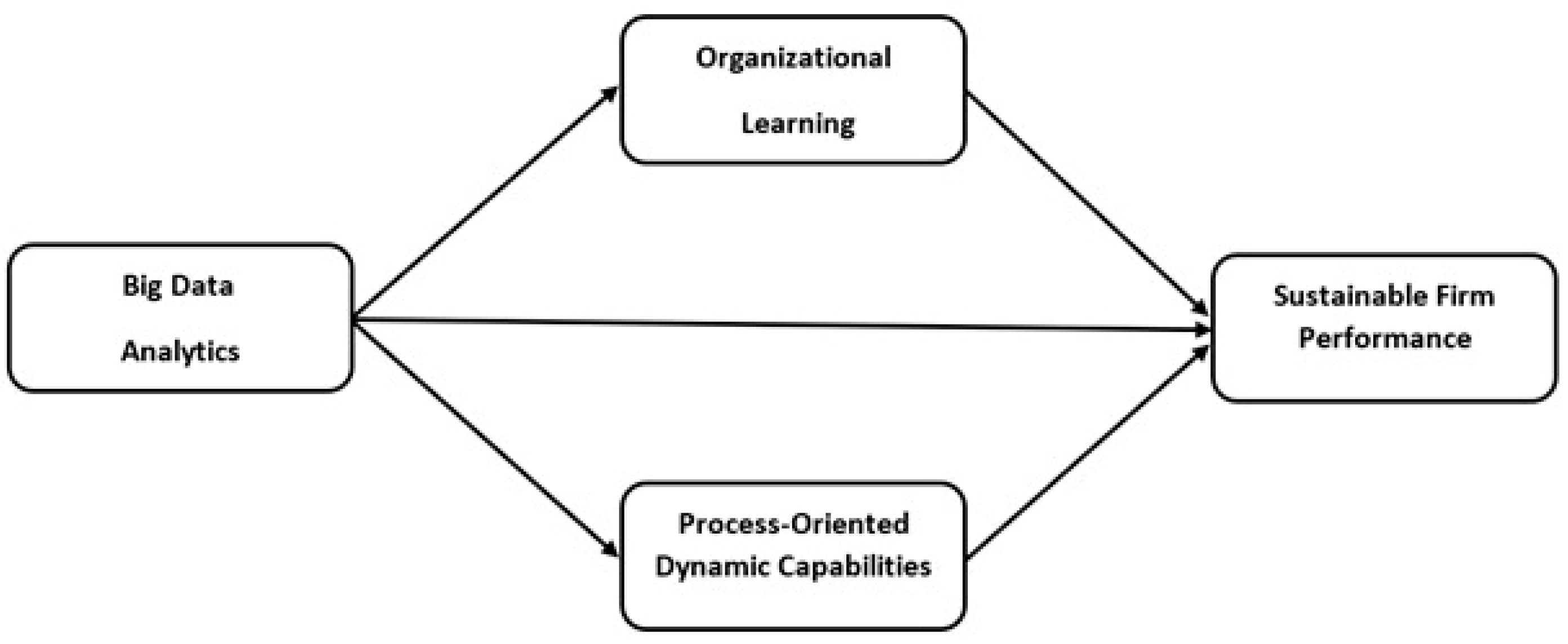
This framework shows how big data analytics (BDA) impacts sustainable firm performance in the telecommunications sector. It suggests that the impact of BDA on performance is channeled through organizational learning and process-oriented dynamic capabilities. The mediation effect of organizational learning and process-oriented dynamic capabilities is illustrated in Figure 1, which is the overarching framework combining big data analytics and sustainable firm performance.

5. Method

This study utilizes a quantitative, cross-sectional research design to investigate the influence of big data analytics (BDA) on sustainable firm performance (SFP) within the Libyan telecommunications sector, employing organizational learning (OL) and process-oriented dynamic capabilities (PODCs) as mediating variables. The quantitative methodology is suitable due to this study’s aim of statistically evaluating proposed links and extrapolating results to the wider population. The empirical context of this study is the Libyan telecommunications sector, which consists of four primary operating companies: Al-madar Aljadid Company, Libyana Mobile Phone Company, Aljeel Aljadeed Company, and Libya Telecom and Technology Company (LTT). These include state-owned and semi-autonomous operators that offer mobile, fixed-line, and data services. The target demographic of this study consists of around 5400 employees from these companies. The population consists of senior executives, middle managers, technical professionals, organizational development officers, and individuals involved in strategy planning, data management, and process enhancement initiatives. These roles were chosen because they are directly involved in using analytics, making decisions, and processes linked to sustainability. A stratified random sampling method was used to make the sample more representative and less biased. Stratification was performed according to management and functional positions, rather than company size, due to the largely homogeneous organizational structure of firms within the industry. The population was divided into five groups: (1) top management, (2) middle management, (3) technical and professional staff, (4) organizational development officers, and (5) strategic planning and process improvement personnel. Then, proportional random sampling was used within each stratum to make sure that the different levels and functions of the organization were well represented. According to Krejcie and Morgan’s [86] table for finding the right sample size, 354 people were needed for a population of 5400. So, questionnaires were sent out to the different groups, and answers were gathered over a set amount of time.
The final usable sample comprised 354 respondents, yielding an approximate 6.5% response rate. This level of participation is typical in organizational survey research conducted in developing and transitional contexts, especially in sectors marked by operational constraints, a limited survey culture, and restricted access to employees. Previous methodological studies indicate that the response rate alone is not a conclusive measure of data quality or representativeness, assuming that suitable sampling methodologies and analytical approaches are utilized. To address worries about non-response bias, a number of steps were taken. First, the use of stratified random sampling made sure that important organizational responsibilities were fairly represented in the final sample. This made it less likely that certain subgroups would be systematically left out. Second, a comparison of early and late responders was performed on essential demographic factors (e.g., position, experience, and education level), indicating no statistically significant differences, which implies that non-response bias is unlikely to substantially influence the results. Third, Partial Least Squares Structural Equation Modeling (PLS-SEM) was chosen as the main method of analysis since it works well with complicated models and smaller samples and does not depend on stringent distributional assumptions. In terms of representativeness, the demographic profile of the respondents closely mirrors the actual composition of the telecommunications workforce in Libya, which is primarily technical and middle-management-focused, with a smaller number of employees in senior executive and strategic planning positions. This distribution aligns with the sector’s organizational structure and reinforces the external validity of the findings within the study setting. When you put all of these things together, they show that, even if the response rate was low, the sample is a good and analytically strong representation of the target population. You can be sure that the results can be understood within the limits of the Libyan telecom sector.
We used Partial Least Squares Structural Equation Modeling (PLS-SEM) because it works well with non-normal data and modest sample sizes. It also has a strong predictive focus and can estimate complex models with many mediating interactions. The main goal of this study is to explain and anticipate sustainable firm performance by looking at how big data analytics, organizational learning, and process-oriented dynamic capabilities all work together. PLS-SEM is especially suitable for exploratory and predictive research, as it facilitates the estimate of intricate causal pathways and indirect effects while optimizing the explained variance in endogenous constructs. Furthermore, the research emphasizes theoretical expansion in a comparatively unexamined situation, advocating for PLS-SEM to evaluate nascent linkages and mediation processes. Consequently, the application of PLS-SEM is in strong accordance with this study’s research aims, model intricacy, and focus on prediction precision rather than on only parameter estimation.
Partial Least Squares Structural Equation Modeling (PLS-SEM) was utilized in this study via SmartPLS 4.0 software to examine the proposed research model because of its excellent fit for prediction-oriented research and complex structural relationships involving multiple mediators. Unlike other approaches that depend on sample size and distribution, this technique was considered appropriate because this study aims to explain and predict sustainable firm performance (SFP) via the simultaneous mediation roles of organizational learning (OL) and process-oriented dynamic capabilities (PODCs) in the relationship between big data analytics (BDA) and performance outcomes. The technique allows for the simultaneous evaluation of direct and indirect effects while ensuring maximum explained variance for endogenous constructs, which fits well in theory development in an untapped environment such as Libya’s telecommunications sector. The mediation effects were examined using a non-parametric bootstrapping technique with 5000 resampled cases to ensure accurate results in terms of standard errors, t-values, and confidence intervals. Indirect effects are considered significant if they exceed critical threshold values.

6. Results

Table 1 lists some of the demographic factors of the respondents (N = 354). The sample was mostly male, who made up 58% of respondents, while females accounted for 42%. This sample’s gender makeup is consistent with what is typically observed in the telecom industry. In terms of age, the majority of respondents were in the 18–28-years-of-age category (39%). This was followed by people older than 38 years (32%), and then respondents who were in the 28–38-year-old category (29%). This sample suggests a young and professionally active workforce. There was also a significant number of older employees. In terms of educational level, a good number of respondents had a bachelor’s degree (60%). This indicates that a good number of respondents were educated. Among the respondents, 27% had a master’s degree, and 13% were doctoral degree holders, illustrating that the management and technical staff had high educational qualifications. In terms of job title, technical professionals were the largest segment (37%), followed by middle management, who were also a significant segment (33%). Organizational development (14%), strategic planning and process improvement (10%), and top management (6%) were less significant, and this aligns with the hierarchy that is found in large telecom companies. The work experience was varied among the respondents.
The largest proportion stated they had between 5 and under 10 years of experience (29%), followed by those who stated they had 10 to under 20 years (23%) and 1 to under 5 years (18%). Even smaller proportions stated under one year (12%) or over 20 years of experience (17%). The experience variables in the demographic profile suggest that the sample was of a good quality and professionally and educationally diverse, with a good balance across all age, role, and experience demographics, giving strength to the empirical findings.

6.1. Descriptive Statistics

The statistics concerning all measurement items linked with big data analytics (BDA), organizational learning (OL), process-oriented dynamic capabilities (PODCs), as well as sustainable firm performance (SFP) are presented in Table 2. The respondents used a five-point Likert scale, where “1” indicates “strongly disagree” and “5” indicates “strongly agree.” The minimum and maximum values show that every measurement used the complete scale. This demonstrates an adequate dispersion of responses, implying that respondents noticed and as instructed placed value among the scale divisions. The average values of the measurement items are around 2.995. This average figure signals that the respondents agreed to some extent to the existence and practice of BDA capabilities, learning, dynamic processes, and sustainable outcomes performances in their organizations. This central tendency indicates that, on average, the respondents did not vehemently reject nor accept the statements in the survey. This shows that the respondents made a realistic and even appraisal of the organizational practices among the firms sampled. The average for all the items was recorded as 1.416. This number indicates a sufficiency of variability in the views of the respondents about the items. There is a notable enough dispersion of responses in relation to the mean for there to be adequate statistical value for authentic statistical analysis and for there to be no need to worry about a limited variance.
Variability is especially valued in structural equation modeling, as it improves the relationships’ explainability power among constructs. The skewness values for all the items are almost equal to zero (0.004), showing that the data for all the items is roughly symmetrically distributed, which shows that there is no systematic response bias toward any of the extremes of the Likert scale. Also, the negative excess kurtosis values (−1.304) for all the items indicate a platykurtic distribution that is less peaked than the normal distribution. This shows that there is a greater than usual spread of the data which defends the center of the data. The overall distribution and values of the item data greatly represent the use of the entire scale and, most importantly, the positive values, which provide robust data for modeling the next stages of measurement modeling and structural equation modeling, specifically, normality, variance, and scale.

6.2. Reliability Analysis

Table 3 summarizes the results pertaining to the reliability and convergent validity for the study constructs: big data analytics (BDA), organizational learning (OL), process-oriented dynamic capabilities (PODCs), and sustainable firm performance (SFP). The evaluation was conducted according to the customary measurement model assessment for PLS-SEM. The overall range of the Cronbach’s alpha is between 0.766 and 0.942 for the various constructs, all of which are above the accepted threshold of 0.70, which means that for all constructs, there is adequate internal consistency. Among the constructs, organizational learning (OL) has the highest reliability (α = 0.942) and thus high inter-item reliability. In contrast, big data analytics (BDA) has a lower reliability (α = 0.766), which is still deemed acceptable for most exploratory and applied research. The composite reliability (rho_a and rho_c) further proves the consistency of the measurement scales. The constructs also all exceed the threshold of 0.70, with the lowest and highest rho_c values being 0.851 and 0.952, respectively. This therefore means that the latent constructs were captured as intended, as the indicators captured the constructs convincingly. The average variance extracted (AVE) was used to measure the convergent validity. The results in Table 3 show that all of the constructs’ AVEs are above the threshold of 0.5, ranging from 0.588 (BDA) to 0.741 (OL), meaning that all constructs explain more than half of the variance in their indicators. The findings indicate that the measurement model has negative reliability and positive convergent validity, thus justifying the analysis of the structural model.

6.3. Variance Inflation Factor

Table 4 illustrates the values of the Variance Inflation Factors (VIFs) for the measurement items capturing the operationalization of big data analytics (BDA), organizational learning (OL), process-oriented dynamic capabilities (PODCs), and sustainable firm performance (SFP). A VIF score greater than one indicates the potential for the presence of multicollinearity, which has the potential to bias parameter estimates and inflate standard errors across the impacted items. The VIF values across the measurement items of the aforementioned constructs range between 1.446 and 3.149. Since these values fall under the cut-off values of 5.0 (most conservative criterion) and 3.3 (more stringent criterion, often recommended for PLS-SEM), it is safe to conclude that multicollinearity is not a concern for any of the measurement models. More specifically, the VIF values across the measurement items of BDA fall between 1.45 and 1.54. Such low values speak to the limited overlap that exists across the measurement items, and the good capture of the intended measurement construct. Measurement items for PODC and SFP also reported VIF values that fall around the 2.0 range, which also speaks to the absence of inter-item redundancy. The VIF values for the OL measurement items, and particularly OL_3 (VIF = 3.149), which reported the highest OL construct VIF score, are at a higher extreme than the other measurement constructs. Even though the VIF score of OL_3 and those of the other OL measurement items are at the higher extreme of the other constructs’ VIF measurements, they appear to indicate measurement concern, as they do fall within the range of acceptable values and do support the inherent sophisticated multidimensional nature of the organizational learning construct, which, by design, involves a number of interrelated behaviors and processes. In general, the VIF outcomes validate that there are no problematic multicollinearity issues amongst the indicators. This affirms the measurement model’s robustness, ensuring that further estimations of the structural model can be relied upon and will yield stable and interpretable results.

6.4. Correlation Matrix

Table 5 contains the correlation matrix for the big data analytics (BDA), organizational learning (OL), process-oriented dynamic capabilities (PODCs), and sustainable firm performance (SFP) core study constructs. Each pairwise correlation is summarized with a single number, which reflects the strength and direction of the linear relationship and constitutes the first piece of evidence for supporting the proposed relationships. The findings indicate that BDA has the highest degrees of positive correlation with OL (r = 0.796), PODC (r = 0.749), and SFP (r = 0.799) in comparison. These correlations, in the positive analytic OL, PODC, and SFP relationship, suggest that organizations exhibiting a greater degree of analytic capability also appear to possess more advanced/sophisticated learning processes, dynamic capabilities, and positive outcomes. With OL, there also exists a strong positive correlation with PODC (r = 0.876) and SFP (r = 0.891), which indicates that learning-oriented organizations are advanced to a greater degree with the ability to reconfigure and achieve sustained performance. This supports the argument that organizational learning is the bedrock upon which all capabilities and performances are constructed. PODC is also positively correlated with SFP (r = 0.876), which suggests that organizations with the ability to continuously adapt and reconfigure are more likely to achieve sustaining economic, social, and environmental outcomes. Although the correlations remain high, suggesting that multicollinearity might be a real concern, they remain below the critical threshold of 0.90. Thus, it is unlikely that multicollinearity will be a serious concern. For the most part, the correlation matrix offers strong existing support for the proposed research model, and it justifies proceeding to the hypothesis testing, via structural equation modeling.

6.5. Variance Testing

In the research model, the endogenous constructs are organizational learning (OL), process-oriented dynamic capabilities (PODCs), and sustainable firm performance (SFP). Table 6 summarizes the model’s explanatory power in terms of the R2 and adjusted R2 for each of these constructs. These metrics indicate the extent to which the predictor variables account for the variability in each endogenous construct. BDA accounts for 45.9% of the variability in OL (R2 = 0.459). This is indicative of a moderate-to-high level of explanatory power, which means that BDA is likely to have a positive impact on learning processes within an organization. The result for the adjusted R2 (0.458), which is closely aligned to the R2, is a further confirmation of the model’s reliability and consistency in explaining OL. In contrast, the model accounts for 37.4% of the variability in PODC (R2 = 0.374). This suggests a moderately positive explanatory power, which means that there are other predictors beyond BDA that influence the development of PODC. The result of the adjusted R2 (0.372) confirms the consistency of this explanation.
Most notably, the model demonstrates a high explanatory power for sustainable firm performance, with an R2 value of 0.731. This value means that BDA, OL and PODC collectively explain 73.1% of the variance in the SFP. Such an R2 value is a good indicator of the model’s effectiveness at capturing the outcome of the sustainability performance. The overall R2 results affirm the predictive power of the model and offer evidence for the theoretical associations within this study.

6.6. Indicator Reliability and Outer Loadings

To check how reliable the indicators were, we looked at the standardized outer loadings of each reflective measurement item. PLS-SEM recommendations say that outer loading values should be higher than 0.70, which means that the construct explains more than 50% of the variance in its indicators [87,88]. The results reveal that all of the indicators have good outer loadings, which means that all of the constructs are very reliable. The loadings for the big data analytics (BDA) indicators range from 0.743 to 0.793, which is higher than the recommended threshold (Table 7). This means that the items reliably measure the firm’s ability to acquire, process, and use data for analysis. These values are a little lower than those of the other constructs, but they are still well within the permitted range for reflecting constructs and do not need to be removed. Organizational learning (OL) typically shows high outer loadings, between 0.833 and 0.871. This suggests that it is a good way to express learning-related processes such as knowledge acquisition, sharing, interpretation, and institutionalization. These high values show that OL is measured with a lot of accuracy and consistency within itself. In the same way, the process-oriented dynamic capability (PODC) indicators show strong loadings between 0.840 and 0.846. This means that the items consistently show how well the company can adjust and adapt its operational processes to changes in the environment. The limited range of loadings reinforces the logical consistency of this notion. The outside loadings for sustainable firm performance (SFP) vary from 0.763 to 0.818, which is beyond the minimum permissible threshold. These results show that the indicators do a good job of measuring sustainability outcomes in all three areas of performance: economic, environmental, and social. In general, all of the measurement items meet the suggested standards for indication reliability, and none of the indicators was taken out of the model. These results strongly support the convergent validity of the constructs and demonstrate that the measurement model is appropriate for later structural model evaluation.

6.7. Heterotrait–Monotrait (HTMT) Ratio

The heterotrait–monotrait (HTMT) ratio of correlations was used to check the discriminant validity again. This is a strong way to check how different constructs are in PLS-SEM models. According to established norms, HTMT values must be less than 0.90 for conceptually related domains to validate sufficient discriminant validity.
Table 8 shows that all of the HTMT values are below the acceptable level. This means that the study constructs have good discriminant validity. The HTMT value between organizational learning (OL) and big data analytics (BDA) is 0.796, which means that these two ideas are related in theory but not in practice. In the same way, the HTMT value between process-oriented dynamic capabilities (PODCs) and BDA is 0.749, which shows that analytical capability and process-based adaptability are clearly different from each other.
The HTMT value between PODCs and OL is 0.876, which is still below the crucial threshold. This is fine because there is a strong conceptual link between learning mechanisms and dynamic process capabilities. Sustainable firm performance (SFP) has satisfactory discriminant validity concerning BDA (0.799), OL (0.891), and PODC (0.876). These scores are large, yet they are still within acceptable bounds and show genuine theoretical connections rather than construct redundancy.
The HTMT results show that all latent constructs are different from each other, which strongly supports discriminant validity and shows that the measurement model is good for evaluating the structural model later on.

6.8. Discriminant Validity (Fornell–Larcker Criterion)

The Fornell–Larcker criterion was used to check for discriminant validity. It does this by comparing the square root of the average variance extracted (AVE) for each construct with its correlations with other constructs. When the square root of the average variance extracted (AVE) is bigger than the inter-construct correlations, it is confirmed that the validity is discriminant.
The diagonal values in Table 9 show the square roots of the AVEs for big data analytics (BDA), organizational learning (OL), process-oriented dynamic capabilities (PODCs), and sustainable firm performance (SFP). These values are all higher than the correlations between these constructs and other constructs. This means that each construct has higher variance with its own indicators than with other hidden variables.
There are quite strong connections between organizational learning and sustainable firm performance, as well as between organizational learning and process-oriented dynamic capabilities. However, these values are still lower than the AVE square roots. Consequently, discriminant validity is sufficiently demonstrated for all constructs, thereby affirming the resilience of the measuring paradigm.

6.9. Hypothesis Testing

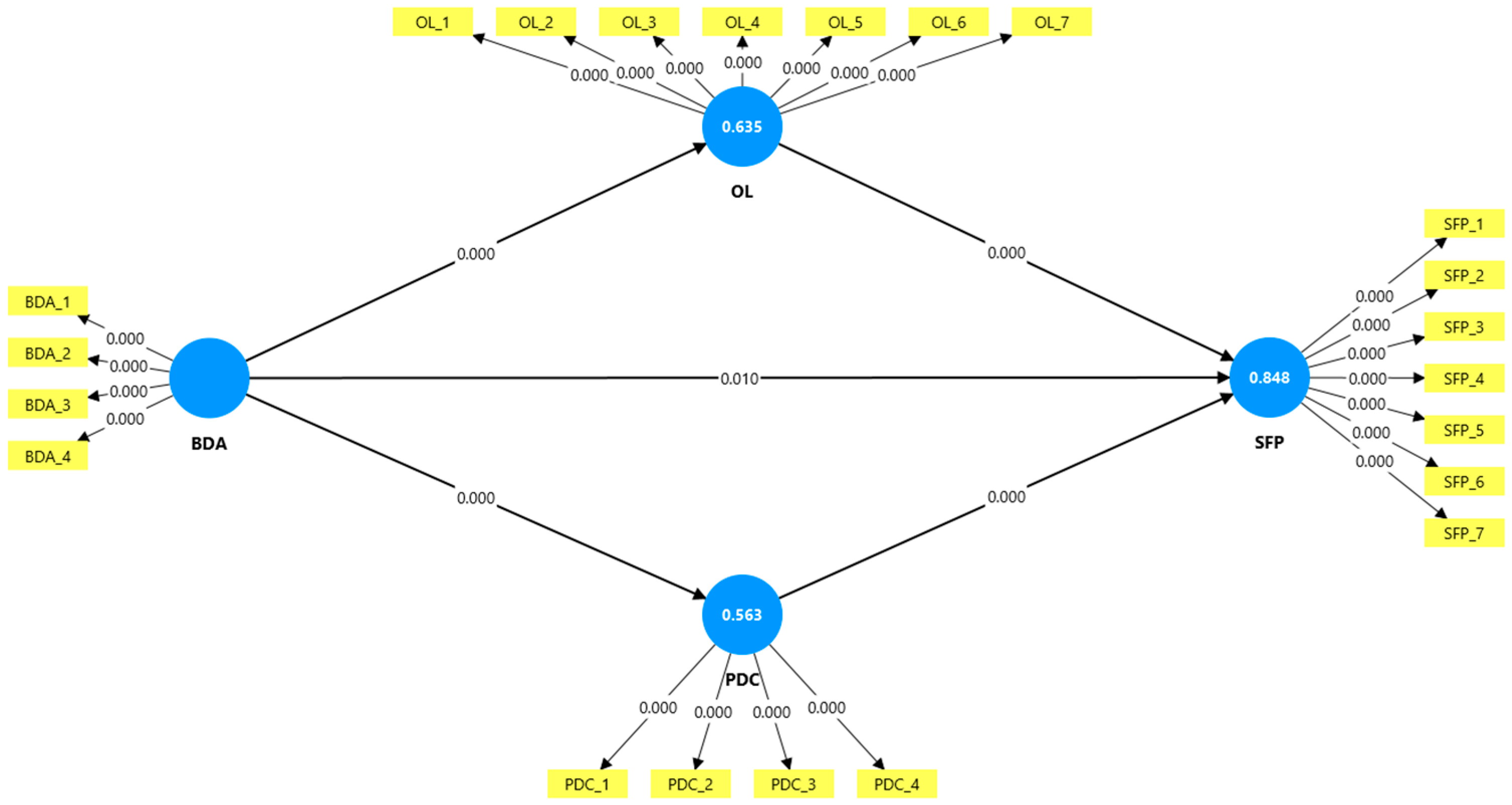
The results on the estimated path coefficients, t-statistics, and significance levels for both direct and indirect relationships, obtained using the PLS-SEM bootstrapping technique, are summarized in Table 10 for the applied research model and visually represented in Figure 2 (PLS-SEM study model). The results evidence the relationships among big data analytics (BDA), OL (organizational learning), PODCs (process-oriented dynamic capabilities), and SFP (sustainable firm performance). It shows how BDA positively and significantly impacts organizational learning (β = 0.797, t = 26.470, p < 0.001), thus confirming that when firms have more advanced analytic capabilities, it helps them to assimilate, comprehend, and utilize more knowledge throughout the firm. BDA also positively influences process-oriented dynamic capabilities (β = 0.751, t = 20.408, p < 0.001), which reinforces the notion that analytics capabilities significantly improve a firm’s ability to reengineer and modify the flow and range of operational activities in the face of change. Besides the indirect pathways, BDA directly impacts sustainable firm performance (β = 0.193, t = 2.561, p = 0.010), which is a weaker influence as compared to the indirect effects but nonetheless has an analytically significant influence on sustainability outcomes, thus confirming the discretionary influence of substantive mechanisms.
As for the mediators, organizational learning (OL) is most affected by sustainable firm performance (β = 0.420, t = 4.355, p < 0.001), which underscores the importance of learning in the organizational perspective, where information is transformed into economically, socially, and environmentally sustainable outcomes. Similarly, process-oriented dynamic capabilities (PODCs) also positively affect SFP (β = 0.364, t = 4.353, p < 0.001), which is indicative of the fact that the continuous redesigning and streamlining of processes by a firm yields a better performance in sustainability. The mediation analysis also indicates that OL and PODC separately and simultaneously mediate the relationship between big data analytics (BDA) and SFP. The mediating effect of PODC (β = 0.273, t = 4.245, p < 0.001) and OL (β = 0.335, t = 4.341, p < 0.001) is confirmed for partial mediation, hence the explanation. All in all, the analysis shows that while BDA streamlines and enhances sustainable firm performance, the impact is much stronger if a firm possesses developed learning systems and process-oriented dynamic capabilities.

7. Discussion

The empirical findings robustly validate the proposed model elucidating the role of big data analytics (BDA) in enhancing sustainable firm performance (SFP) within Libya’s telecommunications sector, facilitated by the concurrent mediating functions of organizational learning (OL) and process-oriented dynamic capabilities (PODCs). These results should be understood in the context of Libya’s status as a developing economy marked by political instability, fragmented digital governance, inadequate infrastructure, and limited institutional maturity. These contextual considerations elucidate both the robustness of the indirect impacts and the comparatively feeble direct effect of BDA on sustainability outcomes. The substantial and statistically significant impact of BDA on OL (β = 0.797, t = 26.470, p < 0.001) demonstrates that analytical skill is essential for enhancing learning processes within Libyan telecommunications companies. In places like Libya, where formal knowledge systems, standardized procedures, and robust institutional support structures are frequently not very good, data-driven insights become an important way to make up for the lack of coordinating mechanisms. Analytics allows businesses to pick up on signals from the outside world and their own operations, lower the level of uncertainty, and help people learn from evidence in situations where there is a lot of outside change and unclear rules [3,5,6,24]. Consequently, OL becomes a primary mechanism through which organizations address contextual deficiencies and enhance sustainability-focused decision making.
In the same way, the considerable positive influence of BDA on PODC (β = 0.751, t = 20.408, p < 0.001) shows how important it is to change processes in Libya’s telecommunications sector. Political instability, economic turmoil, and infrastructural limitations hinder companies’ capacity to depend on consistent routines. In these circumstances, analytics facilitates adaptability by allowing organizations to reconfigure workflows, redistribute resources, and modify operational procedures in response to swiftly evolving conditions [28,46,72]. This finding is consistent with dynamic capability theory, which posits that organizations in volatile settings rely significantly on process-oriented capabilities to maintain performance [63]. The model elucidates a significant percentage of the variance in SFP (R2 = 0.731), highlighting the importance of capability-based frameworks for sustainability performance in developing economies. Both OL (β = 0.420, p < 0.001) and PODC (β = 0.364, p < 0.001) have strong positive effects on SFP. This means that sustainability in Libya’s telecommunications sector is mostly driven by developing internal capabilities, not just by adopting new technologies. This is especially significant in situations where the weak enforcement of rules and limited public monitoring of sustainability lessen the pressure on businesses from outside sources. This means that businesses have to rely more on internal learning and process discipline [13,16,29].
The mediation analysis underscores the contextual significance of the findings. The indirect effects of BDA on SFP via OL (β = 0.335, p < 0.001) and PODC (β = 0.273, p < 0.001) are much more robust than the direct impact (β = 0.193, p = 0.010), suggesting partial mediation. This pattern indicates that in Libya’s institutional context, investments only in analytics infrastructure are inadequate to produce robust sustainability benefits. Analytics should be integrated into learning routines and adaptive processes to address contextual limitations, including skill deficiencies, governance deficiencies, and infrastructure instability [34,80,81]. In general, these results show that the Libyan setting makes organizational learning and process-oriented dynamic capacities even more important as ways to turn analytics into long-term value. BDA offers the informational basis; however, its sustainability impact relies on companies’ capacity to assimilate insights, restructure processes, and institutionalize data-driven methodologies within a context characterized by uncertainty and structural constraints [15,24]. By directly connecting the empirical findings to Libya’s political, economic, and institutional circumstances, this study bolsters the assertion that sustainability outcomes from digital technologies are fundamentally context-dependent and capability-driven.

8. Theoretical and Practical Implications

This study contributes to the broader fields of Business and Management by improving our understanding of how digital technologies support sustainable firm performance. While big data analytics (BDA) has attracted growing attention as a strategic organizational resource, its role in achieving sustainability outcomes remains insufficiently explained. The present findings show that although BDA has a statistically significant direct effect on sustainable firm performance (SFP), this effect is relatively small compared to its indirect effects through organizational learning (OL) and process-oriented dynamic capabilities (PODCs). This result provides an important theoretical insight: analytics technologies alone are not sufficient to generate strong sustainability outcomes.
This study enhances the domains of Business and Management by elucidating the role of digital technologies in fostering sustainable organizational performance. Even while big data analytics (BDA) is becoming more popular as a strategic organizational resource, its function in achieving sustainability outcomes is still not very clear. The current results indicate that while big data analytics (BDA) exerts a statistically significant direct influence on sustainable firm performance (SFP), this influence is rather minor when juxtaposed with its indirect impacts via organizational learning (OL) and process-oriented dynamic capabilities (PODCs). This finding offers a significant theoretical insight: analytics technologies alone are unable to produce robust sustainable outcomes.
The minimal direct influence of BDA on SFP indicates that sustainability performance is less contingent on data availability and more on the capacity of organizations to transform data-driven insights into learning and operational modifications. For an organization to be sustainable, it needs to be economically stable over the long term, take care of the environment, and create social value. To do this, the way the organization works, makes decisions, and behaves must all change. In this context, BDA primarily serves as an enabling resource that fosters sustainability by enhancing learning mechanisms and adaptive process capacities. These findings enhance dynamic capabilities and organizational learning theories by empirically illustrating that the benefit of analytics is derived from complementary internal skills rather than solely from technology adoption. This interpretation aligns with recent sustainability research indicating that digital and operational innovations enhance sustainable performance solely when integrated within organizational capabilities, governance frameworks, and managerial practices [16,89].
From a practical standpoint, the findings indicate that investments in analytics infrastructure alone are unlikely to provide significant enhancements in sustainability. Telecommunications managers should work on building organizational learning systems that encourage knowledge sharing and data-driven decision making. They should also work on building process-oriented dynamic skills that allow for ongoing process improvement and flexibility. Analytics initiatives may stay stuck at the technical level and not have any effect on sustainability results if they do not have these extra skills. The findings emphasize to policymakers in emerging economies the necessity of fostering not only digitalization but also the enhancement of organizational capabilities, skills training, and governance frameworks that enable enterprises to properly utilize analytics for sustainable value creation.
This study enhances research in Business and Management by elucidating the predominantly indirect influence of big data analytics on sustainable performance and by illustrating the essential function of learning and process capabilities in converting analytics investments into enduring sustainability results.

9. Conclusions and Future Research

This research investigated the influence of big data analytics (BDA) on sustainable firm performance (SFP) within the Libyan telecom industry, highlighting the intermediary functions of organizational learning (OL) and process-oriented dynamic capabilities (PODCs). The empirical findings validate that BDA favorably influences sustainability outcomes; however, this influence is predominantly indirect and dependent on the firm’s capacity to derive insights from data and reorganize internal processes. These findings bolster the primary thesis of the research, asserting that analytics tools in isolation do not produce enduring value. Instead, sustainability performance arises when data-driven insights are integrated into organizational learning practices and adaptive process capabilities. This study illustrates that the sustainability benefit of big data analytics (BDA) is neither inherent nor consistent across varying contexts, particularly within a developing economy marked by institutional ambiguity and infrastructural limitations. The results show that companies that work in dynamic and resource-limited settings need to focus on developing their own capabilities in order to turn their investments in analytics into long-term improvements in economic, environmental, and social performance. By doing this, this study adds to Business and Management research by making clear how digital technologies help with sustainable performance.
Even with these contributions, there are still some restrictions that could be useful for future research. First, the cross-sectional design limits causal inference. Subsequent research may utilize longitudinal methodologies to investigate the co-evolution of BDA, OL, and PODC across time. For instance, subsequent research may examine whether the beneficial impact of BDA on SFP intensifies over time as organizational learning gets entrenched and process reconfiguration skills evolve. A testable longitudinal hypothesis could investigate whether increases in OL and PODC at earlier time points enhance the long-term sustainability impact of BDA. Second, the strong connections between BDA, OL, PODC, and SFP indicate that subsequent research may investigate higher-order or hierarchical models. For example, OL and PODC could be conceptualized as facets of a comprehensive analytics-driven dynamic capability, enabling researchers to evaluate whether a second-order construct offers a more succinct explanation of sustainable performance. Third, subsequent research may include moderating variables to elucidate border circumstances. The strength of the BDA–sustainability relationship may be influenced by environmental dynamics, business size, the effectiveness of digital governance, or organizational culture. For instance, subsequent research could examine whether environmental instability enhances the mediating function of PODC, or whether firm size influences the degree to which OL converts analytics into sustainability results. Lastly, broadening the investigation to include other data-heavy industries or doing comparative studies between developing and developed countries will make the results more useful. In general, this work lays a strong platform for future research that seeks to comprehend how analytics-enabled learning and process capabilities facilitate sustained value creation across various organizational and institutional settings.

Author Contributions

Conceptualization, A.H. and S.M.; methodology, A.H. and S.M.; formal analysis, A.H. and S.I.; investigation, A.H. and S.M.; writing—review and editing, S.I.; supervision, S.M. All authors have read and agreed to the published version of the manuscript.

Funding

This research received no external funding.

Institutional Review Board Statement

The study was conducted in accordance with the Declaration of Helsinki, and approved by the Scientific Research Ethics Committee–Cyprus Health and Social Sciences University (KSTU) (protocol code: KSTU//2025/082, date of approval: 27 November 2025).

Informed Consent Statement

Informed consent was obtained from all subjects involved in the study.

Data Availability Statement

The corresponding author can provide the data used in this study upon request.

Conflicts of Interest

The authors declare no conflicts of interest.

References

  1. Hao, S.; Zhang, H.; Song, M. Big Data, Big Data Analytics Capability, and Sustainable Innovation Performance. Sustainability 2019, 11, 7145. [Google Scholar] [CrossRef]
  2. Hu, F.; Liu, W.; Tsai, S.B.; Gao, J.; Bin, N.; Chen, Q. An empirical study on visualizing the intellectual structure and hotspots of big data research from a sustainable perspective. Sustainability 2018, 10, 667. [Google Scholar] [CrossRef]
  3. Akter, S.; Wamba, S.F.; Gunasekaran, A.; Dubey, R.; Childe, S.J. How to Improve Firm Performance Using Big Data Analytics Capability and Business Strategy Alignment. Int. J. Prod. Econ. 2016, 182, 113–131. [Google Scholar] [CrossRef]
  4. Mikalef, P.; Pappas, I.O.; Krogstie, J.; Giannakos, M. Big Data Analytics Capabilities: A Systematic Literature Review and Research Agenda. Inf. Syst. e-Bus. Manag. 2018, 16, 547–578. [Google Scholar] [CrossRef]
  5. Ferraris, A.; Santoro, G.; Bresciani, S. Innovation through Big Data in Knowledge-Intensive Firms: The Mediating Role of Knowledge Management. J. Bus. Res. 2019, 101, 284–291. [Google Scholar]
  6. Gupta, M.; George, J.F. Toward the Development of a Big Data Analytics Capability. Inf. Manag. 2016, 53, 1049–1064. [Google Scholar] [CrossRef]
  7. Miller, H.J.; Clifton, K.; Akar, G.; Tufte, K.; Gopalakrishnan, S.; MacArthur, J.; Irwin, E.; Ramnath, R.; Stiles, J. Urban sustainability observatories: Leveraging urban experimentation for sustainability science and policy. Harv. Data Sci. Rev. 2021, 3, 1–25. [Google Scholar] [CrossRef]
  8. Furtado, L.S.; da Silva, T.L.C.; Ferreira, M.G.F.; de Macedo, J.A.F.; Cavalcanti, J.K.d.M.L. A framework for digital transformation towards smart governance: Using big data tools to target SDGs in Ceará, Brazil. J. Urban Manag. 2023, 12, 74–87. [Google Scholar] [CrossRef]
  9. Fraisl, D.; See, L.; Sturn, T.; MacFeely, S.; Bowser, A.; Campbell, J.; Moorthy, I.; Danylo, O.; McCallum, I.; Fritz, S. Demonstrating the potential of Picture Pile as a citizen science tool for SDG monitoring. Environ. Sci. Policy 2022, 128, 81–93. [Google Scholar] [CrossRef]
  10. Grossi, G.; Trunova, O. Are UN SDGs Useful for Capturing Multiple Values of Smart City? Cities 2021, 114, 103193. [Google Scholar] [CrossRef]
  11. Nilashi, M.; Ooi, K.B.; Tan, G.; Lin, B.; Abumalloh, R. Critical Data Challenges in Measuring the Performance of Sustainable Development Goals: Solutions and the Role of Big-Data Analytics. Harv. Data Sci. Rev. 2023, 5, 1–36. [Google Scholar] [CrossRef]
  12. Kothinti, R.R. Data Analytics for Sustainable Development: Harnessing Big Data to Track and Achieve Global Sustainability Goals. Iconic Res. Eng. J. (IRE J.) 2024, 7, 750–760. [Google Scholar]
  13. Ertz, M.; Latrous, I.; Dakhlaoui, A.; Sun, S. The Impact of Big Data Analytics on Firm Sustainable Performance. Corp. Soc. Responsib. Environ. Manag. 2025, 32, 1261–1278. [Google Scholar] [CrossRef]
  14. Raj, R.; Kumar, V.; Verma, P. Big Data Analytics in Mitigating Challenges of Sustainable Manufacturing Supply Chain. Oper. Manag. Res. 2023, 16, 1886–1900. [Google Scholar] [CrossRef]
  15. Waqas, M.; Tan, L. Big data analytics capabilities for reinforcing green production and sustainable firm performance: The moderating role of corporate reputation and supply chain innovativeness. Environ. Sci. Pollut. Res. 2023, 30, 14318–14336. [Google Scholar] [CrossRef] [PubMed]
  16. Dubey, R.; Gunasekaran, A.; Childe, S.J.; Papadopoulos, T.; Luo, Z.; Wamba, S.F.; Roubaud, D. Can Big Data and Predictive Analytics Improve Social and Environmental Sustainability Practices? Technol. Forecast. Soc. Change 2019, 144, 534–545. [Google Scholar] [CrossRef]
  17. Jum’a, L.; Zimon, D.; Madzik, P. Impact of Big Data technological and personal capabilities on sustainable performance on Jordanian manufacturing companies: The mediating role of innovation. J. Enterp. Inf. Manag. 2023, 37, 329–354. [Google Scholar] [CrossRef]
  18. Ali, S.; Rahman, S.U.; Khan, M.A.; Ahsan, M.; Khan, M.I. The Role of Big Data Analytics in Achieving Sustainable Manufacturing: Evidence from the Automotive Industry. J. Clean. Prod. 2020, 258, 120790. [Google Scholar]
  19. Jaouadi, S. Big Data Analytics and Sustainable Development: Challenges and Opportunities in Emerging Economies. Sustainability 2022, 14, 7352. [Google Scholar]
  20. McAfee, A.; Brynjolfsson, E.; Davenport, T.H.; Patil, D.J.; Barton, D. Big Data: The Management Revolution. Harv. Bus. Rev. 2012, 90, 60–68. [Google Scholar] [PubMed]
  21. Oncioiu, I.; Türkeș, M.C.; Căpușneanu, S.; Topor, D.I.; Constantin, D.M.; Solomon, A.M.; Anghel, E. Sustainable Development of SMEs Through Digitalization and Big Data Analytics. Sustainability 2019, 11, 5789. [Google Scholar]
  22. Rashid, A.; Baloch, N.; Rasheed, R.; Ngah, A.H. Big Data Analytics–Artificial Intelligence and Sustainable Performance through Green Supply Chain Practices in Manufacturing Firms of a Developing Country. J. Sci. Technol. Policy Manag. 2024, 16, 42–67. [Google Scholar] [CrossRef]
  23. Mageto, J. Big Data Analytics in Sustainable Supply Chain Management: A Focus on Manufacturing Supply Chains. Sustainability 2021, 13, 7101. [Google Scholar] [CrossRef]
  24. Vitari, C.; Raguseo, E. Big Data Analytics Business Value and Firm Performance: Linking with Environmental Context. Int. J. Prod. Res. 2020, 58, 5456–5476. [Google Scholar] [CrossRef]
  25. Singh, S.K.; El-Kassar, A.-N. Role of Big Data Analytics in Developing Sustainable Capabilities. J. Clean. Prod. 2019, 213, 1264–1273. [Google Scholar] [CrossRef]
  26. Cheng, J.; Singh, H.M.; Zhang, Y.; Wang, S. The impact of business intelligence, big data analytics capability, and green knowledge management on sustainability performance. J. Clean. Prod. 2023, 414, 139410. [Google Scholar] [CrossRef]
  27. Alyahya, M.; Aliedan, M.; Agag, G.; Abdelmoety, Z.H. Understanding the Relationship between Big Data Analytics Capabilities and Sustainable Performance: The Role of Strategic Agility and Firm Creativity. Sustainability 2023, 15, 7623. [Google Scholar] [CrossRef]
  28. Wamba, S.F.; Gunasekaran, A.; Akter, S.; Ren, S.J.-F.; Dubey, R.; Childe, S.J. Big Data Analytics and Firm Performance: Effects of Dynamic Capabilities. J. Bus. Res. 2017, 70, 356–365. [Google Scholar] [CrossRef]
  29. Waqas, M.; Honggang, X.; Ahmad, N.; Khan, S.A.R.; Iqbal, M. Big Data Analytics as a Roadmap towards Green Innovation, Competitive Advantage and Environmental Performance. J. Clean. Prod. 2021, 323, 128998. [Google Scholar] [CrossRef]
  30. Adiguzel, Z.; AlQhtani, F.M.; Ceptureanu, S.-I.; Georgescu, B. Knowledge Management for Research Innovation in Universities for Sustainable Development: A Qualitative Approach. Sustainability 2025, 17, 2481. [Google Scholar] [CrossRef]
  31. Raut, R.D.; Gardas, B.B.; Narwane, V.S.; Narkhede, B.E. Big Data Analytics: An Empirical Study of Its Impact on Sustainable Supply Chain Performance in the Indian Context. J. Clean. Prod. 2019, 229, 347–365. [Google Scholar]
  32. Bag, S.; Gupta, S.; Kumar, S.; Sivarajah, U. Role of Big Data Analytics in Enhancing Supply Chain Agility and Sustainability. Int. J. Prod. Econ. 2020, 229, 107753. [Google Scholar]
  33. Zhu, S.; Yang, S. Big Data Analytics for Innovation and Indirect Sustainability: Optimizing Internal Systems. J. Clean. Prod. 2021, 319, 128631. [Google Scholar]
  34. Cetindamar, D.; Shdifat, B.; Erfani, E. Understanding Big Data Analytics Capability and Sustainable Supply Chains. Inf. Syst. Manag. 2021, 38, 210–226. [Google Scholar] [CrossRef]
  35. Du, M.; Antunes, J.; Wanke, P.; Chen, Z. Ecological efficiency assessment under the construction of low-carbon city: A perspective of green technology innovation. J. Environ. Plan. Manag. 2022, 65, 1727–1752. [Google Scholar] [CrossRef]
  36. Kamble, S.S.; Gunasekaran, A.; Gawankar, S.A. Achieving sustainable performance in a data-driven agriculture supply chain: A review for research and applications. Int. J. Prod. Econ. 2020, 219, 179–194. [Google Scholar] [CrossRef]
  37. Li, Y.; Waris, M.; Bhutto, M.Y. Big Data Analytics Capabilities and Dynamic Capabilities: Pathways to Organizational Adaptation, Innovation, and Competitive Advantage. Sustainability 2024, 16, 876. [Google Scholar]
  38. Guo, J.; Lin, J.; Luo, X. Enhancing organizational resilience through big data analytics capability: The mediating role of strategic flexibility. Inf. Technol. People 2025, 38, 1–39. [Google Scholar] [CrossRef]
  39. Nakash, M. From knowledge stock to innovation flow: Strategies for organizational learning and renewal. VINE J. Inf. Knowl. Manag. Syst. 2025, 56, 122–138. [Google Scholar] [CrossRef]
  40. Al-Omoush, K.S.; Garcia-Monleon, F.; Iglesias, J.M.M. Exploring the interaction between big data analytics, frugal innovation, and competitive agility: The mediating role of organizational learning. Technol. Forecast. Soc. Change 2024, 200, 123188. [Google Scholar] [CrossRef]
  41. Habibullah, M.; Kamal, A. Environmental dynamism and strategic performance in small and medium enterprises. J. Energy Environ. Policy Options 2024, 7, 35–42. [Google Scholar]
  42. Kusbianto, N.; Sukoharsono, E.G.; Darmawan, A. Exploring the impact of big data analytics capabilities on Indonesian firm performance-A mediation analysis of business process agility and process-oriented dynamic capability. In 2023 6th International Conference on Information Systems and Computer Networks (ISCON); IEEE: Piscataway, NJ, USA, 2023; pp. 1–6. [Google Scholar]
  43. Sun, W.; Chen, K.; Mei, J. Integrating the resource-based view and dynamic capabilities: A comprehensive framework for sustaining competitive advantage in dynamic markets. EPRA Int. J. Econ. Bus. Rev. 2024, 12, 1–8. [Google Scholar] [CrossRef]
  44. Amalia, D.; Artini, Y.D.; Rahayu, G.N.; Purnomo, H.; Zaman, B. Optimizing Organizational Capabilities Through The Integration of Strategic Management And Human Resource Performance. Int. J. Econ. Lit. 2024, 2, 216–228. [Google Scholar]
  45. Wibisono, H.; Supoyo, M. Business transformation: Exploring dynamic capabilities, technological innovation, and competitive advantage through the lens of resource-based view in construction services companies. J. Contemp. Adm. Manag. (ADMAN) 2023, 1, 263–270. [Google Scholar] [CrossRef]
  46. Bhatti, S.H.; Hussain, W.M.H.W.; Khan, J.; Sultan, S.; Ferraris, A. Exploring data-driven innovation: What’s missing in the relationship between big data analytics capabilities and supply chain innovation? Ann. Oper. Res. 2024, 333, 799–824. [Google Scholar] [CrossRef]
  47. Pereira, P.; Gartner, I.R. The Relationship between Big Data Analytics and Banking Financial Performance: An Investigation with Brazilian Data. SSRN 2023. [Google Scholar] [CrossRef]
  48. Ferreira, J.; Cardim, S.; Coelho, A. Dynamic capabilities and mediating effects of innovation on the competitive advantage and firm’s performance: The moderating role of organizational learning capability. J. Knowl. Econ. 2021, 12, 620–644. [Google Scholar] [CrossRef]
  49. Awwad, M.S. Dynamic capabilities, intellectual capital and organisational performance: Mediation and moderation effects. J. Intellect. Cap. 2025, 26, 738–760. [Google Scholar] [CrossRef]
  50. Pundziene, A.; Nikou, S.; Bouwman, H. The nexus between dynamic capabilities and competitive firm performance: The mediating role of open innovation. Eur. J. Innov. Manag. 2022, 25, 152–177. [Google Scholar] [CrossRef]
  51. Zhao, H.; Zhou, Q. Socially responsible human resource management and hotel employee organizational citizenship behavior for the environment: A social cognitive perspective. Int. J. Hosp. Manag. 2021, 95, 102749. [Google Scholar] [CrossRef]
  52. Yang, L.; Aumeboonsuke, V. The impact of entrepreneurial orientation on firm performance: The multiple mediating roles of competitive strategy and knowledge creation process. Mob. Inf. Syst. 2022, 2022, 2339845. [Google Scholar] [CrossRef]
  53. Bil, E. The effect of technological innovation capabilities on companies’ innovation and marketing performance: A field study on Technopark companies in Turkey. J. Life Econ. 2021, 8, 361–378. [Google Scholar] [CrossRef]
  54. Jung, J.C.; Im, J. How does social trust affect corporate financial performance? The mediating role of corporate social responsibility. Bus. Ethics Environ. Responsib. 2023, 32, 236–255. [Google Scholar] [CrossRef]
  55. Chen, X.; Liang, X.; Wu, H. Cross-border mergers and acquisitions and CSR performance: Evidence from China. J. Bus. Ethics 2023, 183, 255–288. [Google Scholar] [CrossRef]
  56. Li, X.; Li, S.; Qiao, J.; Wu, M. Leveraging the supply base for innovation: How does supply base management affect innovation performance? Eur. J. Innov. Manag. 2024, 27, 334–369. [Google Scholar] [CrossRef]
  57. He, K.; Zhu, N. Strategic emerging industry layout based on analytic hierarchy process and fuzzy comprehensive evaluation: A case study of Sichuan province. PLoS ONE 2022, 17, e0264578. [Google Scholar] [CrossRef] [PubMed]
  58. Alzahrani, M.A.; Suleiman, E.S.B.; Jouda, A.A. The relationship between strategic planning, strategic flexibility and firm performance in SMES of Saudi Arabia: Mediating role of strategic flexibility. Int. J. Acad. Reserach Econ. Manag. Sci. 2023, 12, 1–21. [Google Scholar] [CrossRef] [PubMed]
  59. Iqbal, Q.; Ahmad, N.H. Sustainable development: The colors of sustainable leadership in learning organization. Sustain. Dev. 2021, 29, 108–119. [Google Scholar] [CrossRef]
  60. Khan, I.; Bashir, T. Market orientation, social entrepreneurial orientation, and organizational performance: The mediating role of learning orientation. Interdiscip. J. Manag. Stud. (Former. Known Iran. J. Manag. Stud.) 2020, 13, 673–703. [Google Scholar] [CrossRef]
  61. Mazharul Islam, M.; Alharthi, M. Relationships among ethical commitment, ethical climate, sustainable procurement practices, and SME performance: An PLS-SEM analysis. Sustainability 2020, 12, 10168. [Google Scholar] [CrossRef]
  62. Gomes, G.; Seman, L.O.; Berndt, A.C.; Bogoni, N. The role of entrepreneurial orientation, organizational learning capability and service innovation in organizational performance. Rev. Gestão 2022, 29, 39–54. [Google Scholar] [CrossRef]
  63. Teece, D.J. Dynamic Capabilities and Related Paradigms; Elements in Business Strategy; Cambridge University Press (CUP): Cambridge, UK, 2025. [Google Scholar] [CrossRef]
  64. Wamba-Taguimdje, S.L.; Wamba, S.F.; Kamdjoug, J.R.K.; Wanko, C.E.T. Impact of artificial intelligence on firm performance: Exploring the mediating effect of process-oriented dynamic capabilities. In Digital Business Transformation: Organizing, Managing and Controlling in the Information Age; Springer International Publishing: Cham, Switzerland, 2020; pp. 3–18. [Google Scholar] [CrossRef]
  65. Yi, Y.; Demirel, P. The impact of sustainability-oriented dynamic capabilities on firm growth: Investigating the green supply chain management and green political capabilities. Bus. Strategy Environ. 2023, 32, 5873–5888. [Google Scholar] [CrossRef]
  66. Huang, B.; Song, J.; Xie, Y.; Li, Y.; He, F. The effect of big data analytics capability on competitive performance: The mediating role of resource optimization and resource bricolage. Front. Psychol. 2022, 13, 882810. [Google Scholar] [CrossRef] [PubMed]
  67. Schulze, A.; Brusoni, S. How dynamic capabilities change ordinary capabilities: Reconnecting attention control and problem-solving. Strateg. Manag. J. 2022, 43, 2447–2477. [Google Scholar] [CrossRef]
  68. Al Masri, R.; Wimanda, E. The role of green supply chain management in corporate sustainability performance. J. Energy Environ. Policy Options 2024, 7, 1–9. [Google Scholar]
  69. Bhadra, K.V.; Kamalanabhan, T.J.; Singh, S.K. Evolution of dynamic capabilities for business sustainability performance: Evidence from the Indian manufacturing sector. Bus. Strategy Environ. 2024, 33, 5583–5605. [Google Scholar] [CrossRef]
  70. Mishra, R.; Kiran, K.B. Is sustainable performance in MSMEs driven by entrepreneurial orientation through knowledge management and dynamic capabilities? J. Knowl. Manag. 2025, 30, 231–262. [Google Scholar] [CrossRef]
  71. Setyadi, A.; Pawirosumarto, S.; Damaris, A. Rethinking Sustainable Operations: A Multi-Level Integration of Circularity, Localization, and Digital Resilience in Manufacturing Systems. Sustainability 2025, 17, 6929. [Google Scholar] [CrossRef]
  72. Arias-Pérez, J.; Coronado-Medina, A.; Perdomo-Charry, G. Big data analytics capability as a mediator in the impact of open innovation on firm performance. J. Strategy Manag. 2022, 15, 1–15. [Google Scholar] [CrossRef]
  73. Kusbianto, N.; Darmawan, A. Big data Analytics Capability Effect on Indonesia Firm Performance: The Mediating Role of Business Process Agility. Int. J. Account. Bus. Soc. 2024, 32, 224–248. [Google Scholar] [CrossRef]
  74. Khaw, T.Y.; Teoh, A.P. The influence of big data analytics technological capabilities and strategic agility on performance of private higher education institutions. J. Appl. Res. High. Educ. 2023, 15, 1587–1599. [Google Scholar] [CrossRef]
  75. Capurro, R.; Fiorentino, R.; Garzella, S.; Giudici, A. Big data analytics in innovation processes: Which forms of dynamic capabilities should be developed and how to embrace digitization? Eur. J. Innov. Manag. 2022, 25, 273–294. [Google Scholar] [CrossRef]
  76. Munir, S.; Rasid, S.Z.A.; Jamil, F. Big data analytics capabilities & innovation performance through process oriented dynamic capabilities. Leadersh. Organ. Behav. J. 2022, 1, 91–109. [Google Scholar]
  77. Tongtong, S.; Xinhang, C. Research on the impact of enterprise big data analytics capability on ambidextrous innovation capability–the mediating effect of agility. Technol. Anal. Strateg. Manag. 2024, 36, 2242–2256. [Google Scholar] [CrossRef]
  78. Bahrami, M.; Shokouhyar, S.; Seifian, A. Big data analytics capability and supply chain performance: The mediating roles of supply chain resilience and innovation. Mod. Supply Chain Res. Appl. 2022, 4, 62–84. [Google Scholar] [CrossRef]
  79. Bahrami, M.; Shokouhyar, S. The role of big data analytics capabilities in bolstering supply chain resilience and firm performance: A dynamic capability view. Inf. Technol. People 2022, 35, 1621–1651. [Google Scholar] [CrossRef]
  80. Garmaki, M.; Gharib, R.K.; Boughzala, I. Big data analytics capability and contribution to firm performance: The mediating effect of organizational learning on firm performance. J. Enterp. Inf. Manag. 2023, 36, 1161–1184. [Google Scholar] [CrossRef]
  81. Awan, U.; Shamim, S.; Khan, Z.; Zia, N.U.; Shariq, S.M.; Khan, M.N. Big data analytics capability and decision-making: The role of data-driven insight on circular economy performance. Technol. Forecast. Soc. Change 2021, 168, 120766. [Google Scholar] [CrossRef]
  82. Xie, W.; Zhang, Q.; Lin, Y.; Wang, Z.; Li, Z. The effect of big data capability on organizational innovation: A resource orchestration perspective. J. Knowl. Econ. 2024, 15, 3767–3791. [Google Scholar] [CrossRef]
  83. Naz, S.; Haider, S.A.; Khan, S.; Nisar, Q.A.; Tehseen, S. Augmenting hotel performance in Malaysia through big data analytics capability and artificial intelligence capability. J. Hosp. Tour. Insights 2024, 7, 2055–2080. [Google Scholar] [CrossRef]
  84. Aziz, N.A.; Al Mamun, A.; Reza, M.N.H.; Naznen, F. The impact of big data analytics on innovation capability and sustainability performance of hotels: Evidence from an emerging economy. J. Enterp. Inf. Manag. 2024, 37, 1044–1068. [Google Scholar] [CrossRef]
  85. Sangpetch, P.; Ueasangkomsate, P. The influence of the big data analytics and circular economy on the sustainable performance of SMEs. Thammasat Rev. 2023, 26, 114–139. [Google Scholar]
  86. Krejcie, R.V.; Morgan, D.W. Determining sample size for research activities. Educ. Psychol. Meas. 1970, 30, 607–610. [Google Scholar] [CrossRef]
  87. Hair, J.F.; Black, W.C.; Babin, B.J.; Anderson, R.E. Multivariate Data Analysis, 8th ed.; Cengage Learning: Boston, MA, USA, 2019. [Google Scholar]
  88. Hair, J.F.; Hult, G.T.M.; Ringle, C.M.; Sarstedt, M.; Danks, N.P.; Ray, S. Partial Least Squares Structural Equation Modeling (PLS-SEM) Using R: A Workbook; Springer: Dordrecht, The Netherlands, 2022. [Google Scholar] [CrossRef]
  89. Geng, R.; Mansouri, S.A.; Aktas, E. The relationship between green supply chain management and performance: A meta-analysis of empirical evidence in Asian emerging economies. J. Clean. Prod. 2021, 278, 123885. [Google Scholar] [CrossRef]
Figure 1. Conceptual framework.
Sustainability 18 02591 g001
Figure 2. PLS-SEM study model.
Sustainability 18 02591 g002
Table 1. Demographic profile.
DemographicCategoryFrequencyPercentage
GenderMale2050.58
Female1490.42
Age18–281380.39
28–381030.29
Above 381130.32
Education LevelBachelor2120.60
Master960.27
PhD460.13
PositionTechnical Professionals1310.37
Middle Management1170.33
Organizational Development Officers500.14
Strategic Planning and Process Improvement Staff350.10
Top Management210.06
Years of ExperienceLess than 1 year420.12
1—less than 5 years640.18
5—less than 10 years1030.29
10—less than 20 years810.23
More than 20 years600.17
Table 2. Descriptive statistics.
MeanObserved MinObserved MaxStandard DeviationExcess KurtosisSkewness
BDA_12.9951.0005.0001.416−1.3040.004
BDA_22.9951.0005.0001.416−1.3040.004
BDA_32.9951.0005.0001.416−1.3040.004
BDA_42.9951.0005.0001.416−1.3040.004
OL_12.9951.0005.0001.416−1.3040.004
OL_22.9951.0005.0001.416−1.3040.004
OL_32.9951.0005.0001.416−1.3040.004
OL_42.9951.0005.0001.416−1.3040.004
OL_52.9951.0005.0001.416−1.3040.004
OL_62.9951.0005.0001.416−1.3040.004
OL_72.9951.0005.0001.416−1.3040.004
PDC_12.9951.0005.0001.416−1.3040.004
PDC_22.9951.0005.0001.416−1.3040.004
PDC_32.9951.0005.0001.416−1.3040.004
PDC_42.9951.0005.0001.416−1.3040.004
SFP_12.9951.0005.0001.416−1.3040.004
SFP_22.9951.0005.0001.416−1.3040.004
SFP_32.9951.0005.0001.416−1.3040.004
SFP_42.9951.0005.0001.416−1.3040.004
SFP_52.9951.0005.0001.416−1.3040.004
SFP_62.9951.0005.0001.416−1.3040.004
SFP_72.9951.0005.0001.416−1.3040.004
Table 3. Reliabilities.
Cronbach’s AlphaComposite Reliability (rho_a)Composite Reliability (rho_c)Average Variance Extracted (AVE)
BDA0.7660.7690.8510.588
OL0.9420.9420.9520.741
PDC0.8640.8640.9070.710
SFP0.9020.9030.9230.631
Table 4. Variance inflation factors.
VIF
BDA_11.455
BDA_21.472
BDA_31.535
BDA_41.446
OL_13.008
OL_22.813
OL_33.149
OL_43.061
OL_52.457
OL_63.047
OL_72.916
PDC_12.045
PDC_22.043
PDC_32.075
PDC_42.014
SFP_12.105
SFP_22.094
SFP_32.000
SFP_42.079
SFP_52.201
SFP_61.845
SFP_72.137
Table 5. Correlation matrix.
BDAOLPDCSFP
BDA
OL0.796
PDC0.7490.876
SFP0.7990.8910.876
Table 6. R-square.
Table 6. R-square.
R-SquareR-Square Adjusted
OL0.4590.458
PODC0.3740.372
SFP0.7310.729
Table 7. Indicator reliability and outer loadings.
Outer Loadings
BDA_1 <- BDA0.764
BDA_2 <- BDA0.765
BDA_3 <- BDA0.793
BDA_4 <- BDA0.743
OL_1 <- OL0.867
OL_2 <- OL0.855
OL_3 <- OL0.871
OL_4 <- OL0.867
OL_5 <- OL0.833
OL_6 <- OL0.868
OL_7 <- OL0.863
PODC_1 <- PODC0.843
PODC_2 <- PODC0.841
PODC_3 <- PODC0.846
PODC_4 <- PODC0.840
SFP_1 <- SFP0.797
SFP_2 <- SFP0.798
SFP_3 <- SFP0.779
SFP_4 <- SFP0.798
SFP_5 <- SFP0.818
SFP_6 <- SFP0.763
SFP_7 <- SFP0.806
Table 8. Heterotrait Monotrait (HTMT) ratio for discriminant validity.
Heterotrait–Monotrait (HTMT) Ratio
OL <-> BDA0.796
PODC <-> BDA0.749
PODC <-> OL0.876
SFP <-> BDA0.799
SFP <-> OL0.891
SFP <-> PODC0.876
Table 9. Fornell–Larcker criterion for discriminant validity.
BDAOLPODCSFP
BDA0.767
OL0.6780.861
PDC0.6120.7900.843
SFP0.6670.8230.7740.794
Table 10. Hypothesis testing.
Original Sample (O)Sample Mean (M)Standard Deviation (STDEV)T Statistics (|O/STDEV|)p Values
BDA -> OL0.7970.7970.03026.4700.000
BDA -> PODC0.7510.7520.03720.4080.000
BDA -> SFP0.1930.1930.0752.5610.010
OL -> SFP0.4200.4170.0964.3550.000
PDC -> SFP0.3640.3680.0844.3530.000
BDA -> PODC -> SFP0.2730.2760.0644.2450.000
BDA -> OL -> SFP0.3350.3320.0774.3410.000
Disclaimer/Publisher’s Note: The statements, opinions and data contained in all publications are solely those of the individual author(s) and contributor(s) and not of MDPI and/or the editor(s). MDPI and/or the editor(s) disclaim responsibility for any injury to people or property resulting from any ideas, methods, instructions or products referred to in the content.