Article

Sustainable Development in the Regional Economic Security System: Assessment Methodology and Management Tools

by
Anna Polukhina
1,*,
Marina Y. Sheresheva
2,
Dmitry Napolskikh
3 and
Vladimir Lezhnin
1
1
Service and Tourism Department, Volga State University of Technology, Yoshkar-Ola 424000, Russia
2
Faculty of Economics, Lomonosov Moscow State University, Moscow 119991, Russia
3
Department of Management and Law, Volga State University of Technology, Yoshkar-Ola 424003, Russia
*
Author to whom correspondence should be addressed.
Sustainability 2026, 18(5), 2577; https://doi.org/10.3390/su18052577
Submission received: 13 January 2026 / Revised: 26 February 2026 / Accepted: 4 March 2026 / Published: 6 March 2026
(This article belongs to the Special Issue Innovative Development and Application of Sustainable Management)

Abstract

The paper presents a comprehensive methodological system for assessing the level of economic security of Russian regions, based on the synthesis of several complementary approaches and accounting for regional specifics. The central idea is a shift from static monitoring to dynamic analysis, which allows not only for capturing the current state but also for identifying the direction and stability of trends over time. The proposed methodology based on four stages: forming a set of indicators, normalizing their values, aggregating them into integral indices, and then visualizing them for operational decision-making. An important feature of sustainable development is the introduction of mechanisms to account for regional specifics through the clustering of regions and adjustment coefficients, which helps to mitigate the influence of geographical and structural differences on the results comparability. Together, they form an integrated system for diagnosing, planning, and monitoring the economic security of regions. The paper provides examples of threshold values for indicators such as the share of households with internet access, the length of the road network, birth rate, the volume of building commissioning, and innovation expenditures. A classification of regions into stability zones and recommendations for policy measures within each zone accompany the threshold analysis. In particular, for digitalization and transport infrastructure, measures are proposed to enhance monitoring, improve service accessibility, and invest in infrastructure; for the demographic component, measures are proposed to support families and improve quality of life. The practical significance of the research lies in creating a universal, yet flexible, toolkit for monitoring, ranking, and planning regional policy in the field of economic security. The proposed system was designed for application both at the federal level and for interregional analysis, including scenario planning and modeling the impact of management decisions. Thus, this study contributes to the literature by bridging the theory of economic security, the imperatives of sustainable regional development, and the practical potential of information technologies. It offers a concrete, scalable methodology for transforming regional economic security management into a data-driven, forward-looking, and context-sensitive process. In the future, the authors intend to further develop the methodology by considering the sectoral specialization of regions, integrating with medium- and long-term forecasting systems, and creating an automated monitoring platform.

1. Introduction

National security issues are important for any country [1,2,3]. Economic potential serves as the material foundation of national security, making economic security a key component of the national security system [4].
Economic security is characterized by protection from threats, control of national resources, a high standard of living, and a developed economy [5]. It encompasses several aspects: technological, financial, resource, energy, technical-production, informational, and environmental security. Technological security facilitates modernization, financial security ensures the stability of the banking system, environmental security promotes harmony between the economy and nature, resource security guarantees resource supply, energy security protects the fuel and energy complex, technical-production security aids the restoration of productive forces, and information security safeguards technologies [6,7,8,9,10,11,12,13].
Economic security is impossible without ensuring other types of security. Globalization and new methods of competitive struggle between countries intensify the need for its provision. To promptly identify challenges and threats to economic security, respond to them operatively, and develop management decisions and recommendations, there is a need to form a risk management system.
Yet despite increasing attention to the economic security issues, a number of knowledge gaps persist, including scientific justification for ensuring economic security through the application of information technology tools. This gap is especially noticeable in the context of regional development in large emerging economies.
The study contributes to the literature on economic security issues in emerging economies by building an integrated framework based on the existing approaches for assessing and monitoring the economic security. It confirms that developing threshold values for indicators, taking into account regional specifics, is of particular methodological importance. This requires differentiating assessment criteria for different types of regions based on their economic specialization, geographic location, and demographic characteristics, ensuring the comparability of monitoring results while maintaining the objectivity of the assessment. Empirically, the study offers a comprehensive examination of the economic security of four Russian regions, responding to calls for more geographically diverse and region-specific research applied to emerging economies [14,15,16]. The remainder of this paper presents a brief literature review, outlines the methodology, presents the empirical findings and discusses their implications, and then provides conclusions on the methodology diagnostic effectiveness for monitoring the dynamics of regional economic security in the context of sustainable regional economic development.

2. Literature Review

2.1. Tools and Information Support for Studying Economic Security Issues

To ensure the scientific justification of economic security through the application of information technology tools, there is a need to analyze a number of trends in the economic and informational spheres. First and foremost, the transformation of the competition paradigm should be noted: if previously the emphasis was on the struggle for access to information and its certainty, now the paradigm of data openness dominates, where the key factor becomes the efficiency of its use [17,18]. This implies a more rational solution to tasks facing decision-making actors at all levels, from local business structures and municipalities to states and the global community as a whole [19].
Nowadays, due to the rapid development of telecommunication technologies, information has become much more accessible to decision-makers. However, in conditions of data abundance, requirements for its accuracy and reliability have also significantly increased, generating certain risks that affect both the process of making management decisions and the outcomes of their implementation [20]. Therefore, the issue of its validation comes to the forefront. Thus, the relevant task becomes not only ensuring access to information but also developing mechanisms guaranteeing its reliability [21].
For the effective application of the most widely used information technology tools, it is important to conduct a brief analytical review in this subject area.
  • Blockchain Technology Tools. One of the fundamental properties of blockchain technologies is their decentralized architecture, which ensures key characteristics such as data immutability, transaction transparency, and the possibility of universal information exchange [22,23]. Blockchain is not just a distributed ledger but a highly reliable technology for data storage and processing, where each record contains information about network participants, their balances, and all completed transactions. It is important to emphasize that data on all transactions conducted throughout the existence of a network is distributed among all nodes of the system [24]. This ensures a high level of resilience to external interference and increases trust in the system as a whole [25].
Ensuring information reliability, as well as authentication and authorization processes, is especially relevant in a business environment where contractual relations, reputation, and mutually beneficial cooperation traditionally serve as the main incentives for building and maintaining trust. Blockchain technologies help to minimize risks of digital interactions, to protect assets, financial resources, and personal data [26]. In addition to providing a high level of security, blockchain has a number of significant advantages, among which are transaction transparency and the elimination of the need for intermediaries. This allows for preserving the continuity of strategic goals and priorities, minimizing information distortion, and reducing transaction costs [27,28].
Due to its ability to ensure the transparency of business processes and offer a level of data protection surpassing traditional database management systems, blockchain finds wide application in various fields.
2.
Big Data. The analysis of big data, including its structuring, clustering, and other processing methods application, allows for identifying relationships between objects, assessing the relative significance of these connections, and using the obtained data to build multifactor models [29]. This opens up opportunities for solving a wide range of tasks related to forecasting, optimization, and decision-making [30,31,32,33].
3.
Artificial Intelligence (AI), Artificial Neural Networks (ANN), and Machine Learning (ML). Artificial intelligence is closely linked to big data processing and machine learning methods. By using deep neural networks, AI achieves high accuracy in solving tasks that were previously unattainable using traditional approaches. Saba and Pretorius underline that research has confirmed the impact of artificial intelligence (AI) on economic growth, human development, governance, employment and total factor productivity [34]. ANN models are broadly applied to support strategic decisions [35]. Using ANN “is superior to other methodologies such as the conventional machine learning models, shallow neural networks or traditional econometric models” [36]. Machine learning (ML) is a set of mathematical, statistical, and computational methods for developing algorithms that can solve problems indirectly by identifying patterns in a variety of input data [37]. Recent research indicates that ML technologies can reduce the burden on the departments that make management decisions [38,39,40].
4.
Smart Objects, Embedded Systems. Such objects refer to miniature sensors, combinations of computing power, networks, and physical processes, as well as executive devices operating in automatic, semi-automatic, and manual modes [41,42]. They also include wireless technologies, integration of mobile devices into processes, human–machine interfaces, cloud and fog computing, internet banking, and robotic and automated devices such as CNC machines and 3D printers [43]. These technologies have enabled people and machines to communicate and make decisions together. “Furthermore, these systems have become increasingly important in the commercial and industrial sectors over the previous two decades” [44].
5.
Distance Learning (DL) Technologies. These technologies allow for significantly reducing transaction costs, making the learning process more flexible, independent of temporal and spatial constraints, and for the prompt use of software tools to demonstrate educational materials and perform practical assignments. The COVID-19 pandemic underscored the importance of e-learning, “as it became the primary means of connecting instructors and students during the closure of educational institutions worldwide” [45]. DL Technologies are providing a significant opportunity to fulfill educational objectives efficiently but in emerging economies it is important to take into account critical factors that influence the implementation of e-learning, including electricity availability, internet bandwidth, ICT infrastructure, language and computer literacy, funding, policies, objectives, local research, and awareness [46,47].
6.
Virtual Reality (VR) and Augmented Reality (AR). VR/AR technologies allow for creating interactive and immersive environments that improve information perception and interaction. These technologies have found application in various fields, including education [48,49], healthcare [50], real estate trading [51], tourism [52], architecture and design [53], etc.
7.
Autonomous Robotic Systems (ARS). ARS are already used for performing both complex and routine tasks in surgery [54], space, transportation [55], agriculture and food industry [56], etc. These solutions can significantly free up human resources, directing them to solving creative or non-automatable tasks.
8.
Wearable Electronics. These compact, and sometimes larger, devices allow solving management tasks in real-time, ensuring continuous control and operational interaction. They also perform user authentication and authorization functions, effectively replacing their physical presence in certain situations [57,58]. Numerous mobile applications developed for such devices solve communication and data exchange tasks, and manage household, industrial, and office equipment.
One should also mention the Open Source concept [59,60]. It is based on the idea of open access to software source code, allowing any user to study, modify, and distribute it. Such an approach not only stimulates software product development through the collective contribution of the community but also enhances their security, as open code is constantly analyzed and verified by developers and experts. This contributes to identifying and eliminating vulnerabilities, making the software more reliable and transparent.
From an economic security perspective, widespread internet access is a fundamental condition for addressing a number of key challenges [61]. First and foremost, it contributes to the increased competitiveness and digital sovereignty of a country or a region, as it forms the infrastructural foundation for the digital economy development. The introduction of innovative business models, including small and medium-sized businesses, increased productivity through remote formats; process optimization is becoming possible thanks to the widespread availability of the internet. Reducing the internal “digital divide” minimizes the risks of the marginalization of certain territories or social groups, which directly correlates with the goals of sustainable and balanced development. In the context of ensuring regional economic security, this indicator acquires strategic significance that goes far beyond simply characterizing the technical equipment of the population.
Thus, the literature review results show that using high technologies can help solve management tasks to support key elements of economic security. At the same time, modern technologies are not without certain shortcomings and contradictions that require further resolution. It should be emphasized that the application of these technologies, as well as the choice of specific forms of their implementation, require deeper scientific analysis and detailing up to the development of instrumental models.

2.2. Regional Economic Security Assessment of Emerging Economies

The issues of regional economic security assessment for attaining an effective resilience trajectory of regional economies is attracting a growing amount of attention in the academic literature. In recent decades, an obvious shift towards understanding the complexity of the problem has highlighted the necessity of tools that are capable of capturing non-linear, interdependent dynamics and the adaptive processes that occur within regions [62,63].
There is also a growing understanding that effective application of technological tools to assess regional economic security in emerging economies requires a distinct analytical lens. As Ruch highlights, baseline fragility of emerging markets and developing economies (EMDEs) makes them particularly susceptible to a variety of shocks. For some countries like Malaysia, Thailand, Indonesia, or the Philippines, the “middle technology trap” is a key contributing factor to the “middle income trap” and countries that have fallen into the “middle income trap” often experience the “middle technology trap” as a concomitant phenomenon [64,65].
Therefore, there is a need for deeper understanding of the unique structural vulnerabilities and institutional environment of EMDEs, as well as their high exposure to external shocks [66]. In response to this complexity, recent scholarship has moved toward more sophisticated economic security assessment frameworks.
Thus, Alam, Mwatela, and Gachanja employed a weighted scoring model for emerging economies to assess the influence of external and internal factors on economic security in the high-technology sector amidst intensifying US–China competition [67]. The case study of the semiconductor industry in India and Kenya illustrates that readiness for technological self-reliance is highly uneven. By identifying technology and capital deficits, the model helps countries strategically align with international partners but its applicability to regions within one emerging country needs further verification. Additionally, the model accuracy could be enhanced by incorporating dynamic data analytics, such as machine learning-based weight adjustments.
Mukashov et al. proposed a systematic risk profiling (SRP) framework to identify the most critical economic risks facing developing countries [68]. Integrating computable general equilibrium (CGE) models with historical shock data and machine-learning tools, they examined how compound shocks affect development outcomes in Kenya, Rwanda, and Malawi, simulating plausible combinations of world price, capital flow, and productivity exogenous shocks and their impacts on countries’ GDP, household consumption, poverty, and undernourishment. The results revealed sharp, structurally determined differences in vulnerability due to the specific structure of each economy. “Unlike standard ad hoc scenario analysis, SRP quantifies both the likelihood of compound events and the relative importance of their drivers. This transparent, scalable framework provides policymakers a new tool to move beyond reactive measures” and “design targeted, country-specific resilience strategies” [68]. This data-driven approach provides a template for moving beyond aggregate national statistics to assess regional vulnerabilities.
For Russia, Dyuzhilova and Vyakina focused on “pain points” that could become a source of threats to the regional economic security [69]. Syupova and Bondarenko proposed a multifaceted methodology which defines production, scientific and technical, investment, and social and demographic security with the appropriate indicators as the components of the regional economic security [70]. Zaytsev et al. proposed to average the normalized values of all indicators using a simple average method based on the adapted rating approach of the European Commission employed for designing a comparative assessment of the EU regions innovative development level [71]. They applied this method to assess the economic security level of regions belonging to the Northwestern Federal District of the Russian Federation. As a result of the study, the criterion boundaries of the integral indicator for assessing the economic security level were established, which allowed territorial entities within a region to be comapred. Still, the combination of indicators in this case was aimed at creating conditions for their rapid processing by practitioners and novice researchers without the use of specialized technical tools. On the one hand, this approach allows obtaining concise data for comparative analysis. On the other hand, it does not eliminate the problem of taking into account a number of important regional parameters, in particular, regional specialization and geographic location.
There is also the need to develop an adaptive system that directly tackles the problem of heterogeneity, to combine a core set of universal security indicators with a flexible module of region-specific sub-indicators, calibrated based on economic specialization, geographic factors, and demographic profile. This can help to make assessments both relevant and comparable, and to ensure that the security assessment of a technologically advanced metropolis is not compared directly with that of a sparsely populated frontier region, yet both are evaluated against benchmarks appropriate to their context. Calibrating threshold values and indicator weights is a methodologically rigorous step emphasized as crucial but often missing [72,73].
Furthermore, a dynamic monitoring framework leveraging IT tools that integrate principles of big data analytics and predictive ML models could shift the focus from static description to proactive risk identification, enabling adaptive management. Integrating principles of big data analytics for processing diverse statistical and unstructured data streams and the use of Machine Learning (ML) models is important to augment traditional econometric analysis for identifying complex, non-linear risk patterns and forecasting trend deviations [74,75].
Finally, in our study it was important to apply the methodology to the understudied Russian specifics, and to empirically validate the calibration of threshold values and indicator weights across diverse Russian regions, providing a replicable model for how to tailor security assessments to local contexts while maintaining a unified analytical framework.
In summary, the literature indicates that assessing regional economic security in emerging economies demands a multi-faceted methodology. It requires an understanding of structural economic and institutional features that determine resilience or fragility; dynamic modeling that captures the correlation of multiple shocks, as exemplified by the SRP framework; and the development of composite indices that can guide policy and management decisions at different levels.
Since new technologies are of great importance for ensuring economic security at various levels—from individual to global—there is a need for further development and improvement of these technologies to minimize risks and enhance their efficiency. The technological tools discussed in Section 2.1 are not ends in themselves but essential instruments for operationalizing multi-dimensional assessment frameworks.
In this regard, the study aims to bridge the identified gaps by proposing and empirically testing an integrated methodology for assessing and managing the economic security of Russian regions within the sustainable development paradigm.

3. Methodology for Assessing and Monitoring the Economic Security of Russian Regions

Nowadays, economic security in Russia encompasses a wide range of issues, from the population well-being to the state of the economy, which cannot be considered satisfactory due to slowing growth, declining production, and falling oil prices. In this regard, there is a need for an adequate system for assessing and monitoring the economic security of Russian regions which determines the accuracy of diagnostics and the effectiveness of management decisions.
The key issue in organizing such a system is not a shortage of methodological approaches but, on the contrary, their excess, generated by the multitude of models developed to analyze various aspects of economic system functioning. Methodologically, monitoring can be implemented according to one of the two principles: (1) by constructing an integral indicator for a comprehensive assessment or (2) by focusing on a priority component of economic security with its subsequent in-depth study.
In the contemporary literature, there are a number of methodological approaches. In particular, the method of S.N. Yashin and E.N. Puzov is based on calculating an aggregated indicator (a composite index) formed by synthesizing a system of partial indicators [76]. The advantage of this approach lies in its ability to consolidate disparate information into a unified quantitative metric. This, in turn, creates a basis for conducting comparative analysis between different regions and tracking the dynamics of their state over time [76].
The proposed methodology combines five fundamental blocks (components). A comprehensive assessment of which allows for forming a holistic view of a region’s economic security level.
Financial component assesses the stability of the regional budget and financial system. The indicators used are the share of unprofitable enterprises, the volume of overdue accounts payable, the amount of non-interest expenditures of the consolidated budget per capita.
Social component aims at diagnosing the population quality of life, as well as the degree of social stability. It is measured using the unemployment rate, the decile coefficient (the ratio of incomes of the top 10% to the bottom 10% of the population), the dynamics of real disposable money income, and the level of crime.
Raw materials and food component characterizes the level of the region’s provision with critically important resources. The following metrics are used: production of main types of agriproducts per capita, the degree of industrial fixed assets depreciation, and energy intensity of the gross regional product.
Scientific and technological component determines the region’s innovative potential and the degree of technological sovereignty. Key indicators are the share of innovative goods, work, services in total shipments, internal expenditures on research and development, and the number of developed advanced production technologies.
External economic component assesses the region’s integration into the system of interregional and international economic relations, as well as its resilience to external challenges, by using the foreign trade balance, the share of imported goods in the structure of retail trade turnover, and the volume of attracted foreign investments [77].
The five components and the specific set of indicators are not arbitrary, but represent an adaptation of theoretical constructs and strategic priorities that view a region as a complex socioeconomic system. According to recent research, a region’s economic security is a multilayered system that includes not only economic but also social aspects of sustainability [78,79]. The identified components reflect the region’s key functional subsystems: financial (ensuring liquidity and balance), social (reproduction of human capital), resource (raw materials and food supply), innovation (technological renewal), and foreign economic subsystem (integration and protection from external shocks). Their assessment requires differentiating the indicators approved in Russia’s economic security strategy for the period up to 2030 [80,81]. The proposed set of indicators tailored for the regional level of analysis also correlates with the threat system identified in the national official strategic planning documents.
The procedure for calculating the integral indicator is the key, and technically most difficult, element of the methodology and is implemented sequentially through a series of steps. The first step is constructing a matrix of primary statistical data. This involves collecting the values of all selected indicators for the analyzed period within the region under study, as well as forming an array of reference data—either national averages or values from a benchmark region [82].
The second step is the standardization of indicators. Since the original indicators have heterogeneous units of measurement (including percentages, monetary, and physical units), the method of linear scaling relative to reference values is applied to enable their subsequent aggregation. As a result, all normalized indicators become dimensionless, and their increase always indicates an improvement in the situation.
The obtained value, after equalizing all indicators and calculating the integral indicator of economic security (IIES), is subject to interpretation (Table 1):
if IIES ≥ 1, the region’s level of economic security corresponds to the normative level (not lower than the reference value);
if IIES < 1, there is risk to economic security. An inverse relationship exists between the magnitude of the indicator’s deviation from 1 and the level of security: the lower the index value, the more significant the threat to the region’s economic stability.
The above discussed methodology is quite comprehensive, but it does not account for the analysis of dynamics and trends. In the course of our study, we propose a system for assessing the level of economic security that also embraces the study of dynamic trends, by calculating the integral indicator of economic security retrospectively for a period of at least five years. The resulting time series of values allows the direction and stability of trends to be identified. Sustained growth of an indicator is interpreted as positive dynamics, indicating a strengthening of economic security. Conversely, a decline in values, even while the indicator remains above the threshold level, points to a negative trend, indicating an increase in risks and threats [82].
Regular monitoring of economic security is carried out through the systematic comparison of the indicators’ achieved values with established threshold values. This procedure involves the periodic verification of the key economic parameters compliance with security criteria. This approach allows for the timely identification of negative trends and the implementation of preventive measures to avert a critical disruption of economic stability. Comparative analysis was conducted on a regular basis using official statistical data and approved calculation methodologies.
The economic security state is assessed based on analyzing the ratio of actual and threshold values. When an actual indicator demonstrates a more favorable value than the established threshold, this indicates a normative state of the corresponding economic sphere. Conversely, if the actual value exceeds the threshold level or approaches it, a potential threat to economic security arises in the region. This approach enables the continuous monitoring and the timely identification of high-risk zones requiring the adoption of preventive stabilization measures.
As a result of the research, the key methodological problem of the existing approach is identified as its binary nature of threat classification. The dichotomous assessment system of “threat/no threat” does not account for the graduated nature of economic risks. Exceeding the threshold value by 0.1% and by 10% is classified equally, although these situations reflect fundamentally different levels of the economic security threat. This shortcoming reduces the analytical value of the methodology, as it does not allow for ranking threats by their criticality, differentiating response measures, or optimally allocating resources to neutralize the most significant risks. To improve monitoring effectiveness, it is necessary to develop a multi-level assessment scale that considers both the magnitude of deviation from the threshold value, and the dynamics of its change over time.
To solve this methodological problem, we propose a multi-level system of risk gradation, visualized through color coding. The green level is assigned in cases where the actual indicator value significantly exceeds the normative, indicating the absence of risks. The yellow level is assigned when the indicator approaches the threshold value, typically within a range of 90–100% of the critical mark, signaling the need for enhanced monitoring and preventive measures development. The red level is assigned when the threshold value is exceeded which requires the immediate measures to neutralize the threat. This approach allows authorities to conduct a more differentiated assessment of economic risks, rank problems by their severity, and optimally allocate resources to address them.
A critical aspect of this methodology is the justification for the proposed thresholds dividing the “green,” “yellow,” and “red” zones.
There is no single correct method for establishing such thresholds in global or domestic practice; the debate about possible methods remains relevant. Research shows that threshold effects can vary significantly depending on the sample of countries, the econometric methods used, and the time periods analyzed. For example, in classic studies on external debt, the threshold was set at 90% of GDP. However, subsequent studies show a decrease in these thresholds over time, to 54.6% in the 2000s and 47.8% in the 2010s [83]. This study applies a combined approach that takes into account the methodological complexity.
First, a literature review and regulatory analysis were conducted to identify approved or scientifically substantiated critical values for similar indicators. Recent research emphasizes that indicator thresholds in forecasts should consider not only the current state but also long-term development trends, and their assessment should be preceded by identifying strategic threats and defining the sustainable performance zone of the key forecast indicators [84]. For example, the target indicators of National Projects “Digital Economy” and “Housing and Urban Environment” serve for determining benchmark values.
Second, the actual indicator values statistical distribution across all Russian regions was analyzed over a retrospective period (at least 5–10 years). This allows for the empirical determination of the boundaries beyond which the indicator value falls into the group of regions with the worst results (lower quartile). As noted in the literature, the use of the index method and comparison method allows for the interpretation of calculated aggregate indicators taking into account the level of inflation and other macroeconomic factors [78].
Third, the resulting preliminary thresholds were verified and refined. Research shows that using a multi-criteria approach and building different scenarios allows combinations of thresholds that would lead to a gradual increase in the predicted risk probability to be observed, reaching almost 100%. Thus, the proposed critical value threshold of 90% for transitioning to the “yellow zone” is consistent with the methodology that uses individual thresholds to predict risk and to observe heterogeneity among different geographic clusters [85]. This approach ensures a balance between the statistical objectivity and the validity of the proposed assessment scale. It is important to emphasize that the thresholds are not static. They can be adjusted as statistical data accumulates and economic realities change, which is consistent with the recent research conclusions on the need for a dynamic approach to assessing economic security [86].
For example, the threshold we established for the share of households with internet access was determined based on a synthesis of several approaches. On the one hand, it correlates with the targets of the “Digital Economy of the Russian Federation” program, which aims to achieve digital maturity and bridge the digital divide. On the other hand, an analysis of interregional differentiation shows that regions whose scores fall below 85% tend to consistently lag behind in other digital development indicators. Furthermore, an analysis of living standards and human development reveals a direct correlation between the level of digitalization and the quality of labor force reproduction, which is a key condition for the development of knowledge-intensive production and ensuring technological sovereignty [81].
A more comprehensive alternative methodology for calculating the integral indicator of economic security, proposed in the literature [87,88] includes the sequential implementation of interconnected stages. Initially, a system of indicators is formed, with a broader set of indicators selected compared to simplified methods. At the next stage, indicator normalization is carried out using standardization methods, including comparison with threshold values or benchmark indicators. Then, sub-indices are calculated for thematic groups, where indicators are aggregated into specialized indices for key security spheres. The final stage involves the aggregation of the integral indicator of economic security (IIES) by combining all sub-indices using weighting coefficients determined by expert or mathematical means.
This approach yields a quantitative assessment suitable for cross-country comparisons and dynamic analysis. The resulting index of population quality of life (IPQL) plays a significant role.
The Integrated Quality of Life Index (IQOL) is a composite measure that aggregates key socioeconomic characteristics. Its value is interpreted relative to one: a value greater than 1.000 indicates that the quality of life in a given region exceeds the Russian average, while a value below 1.000 indicates that it lags behind the national median.
During our study, it became clear that this methodology fails to account for one of the key global aspects of empirical comparisons across Russian regions: the unified approach to assessing quality of life or economic security fails to account for significant differences between Russian regions. These include, for example, natural and climate conditions, historical specialization, demographic characteristics, and infrastructure development. There are some methods for taking into account regional specifics (Table 2).
The methodology of regional clustering enables the principle of fair comparative analysis, whereby comparisons are made between territorial and economic entities with similar characteristics. This approach enables the identification of genuine systemic problems by eliminating the influence of objective external factors independent of management effectiveness [89].
The key advantage is the ability to develop differentiated development programs tailored to the specific needs of each cluster. This enables a shift from standardized measures to targeted policy interventions taking into account the specific needs of individual regions. The methodology recognizes the unique socioeconomic development of different regions, enabling a more accurate assessment of the effectiveness of regional policy. Implementing this approach creates the foundation for an objective monitoring system that allows for a more accurate assessment of the regional government performance (Table 3).
The system of indicators for assessing the economic security of Russian regions should reflect the ability of regional economic systems to withstand internal and external threats while maintaining their potential for sustainable development. Key aspects of such a system include monitoring the level of economic diversification, assessing the financial stability of economic entities, and analyzing the state of human capital and the innovative potential of the regions [90].
Primary indicators used for the calculations were obtained from the Russian official sources, including data published by the Federal State Statistics Service [91] the Unified Interdepartmental Information and Statistical System [92], the Federal Tax Service [93], and the Ministry of Digital Development, Communications, and Mass Media of the Russian Federation [94]. All cost indicators used for interregional comparisons were converted to a comparable form using deflator indices published by Rosstat.

4. Results and Discussion

4.1. A System of Indicators for Assessing the Level of Selected Russian Regions Economic Security

Four regions were selected for further analysis: the Mari El Republic, the Republic of Tatarstan, Sverdlovsk Region, and Primorsky Krai. The choice was determined by the need to test the methodology in different geographic and economic contexts. The selected regions represent different parts of Russia and different types of economic systems. In Central Russia, the Republic of Tatarstanis a leading, innovative region, and the Mari El Republic is a region with more modest economic indicators; Sverdlovsk Oblast is a major industrial center in Urals, and Primorsky Krai is a strategically important region in the Far East, focusing on the Asia-Pacific. This choice allowed the authors to demonstrate the methodology effectiveness in regions with varying levels of security, which is confirmed by the results of their cluster analysis: the Republic of Tatarstan serves as a “benchmark” region with a high level of security (High Security Zone). Sverdlovsk Oblast and Primorsky Krai represent the “middle level” (Moderate Security Zone) and the Mari El Republic illustrates a region with borderline indicators, located in a risk zone according to a number of criteria (Low Security Zone).
Several factors for assessing every region’s economic condition were selected for subsequent identification and comparison of the economic security indicators for the selected regions.
In the system of the Russian Federation economic security, the share of households with internet access has a key position, serving as a comprehensive indicator of the state and development of critical infrastructure. Its significance stems from several fundamental aspects.
First, access to the global information environment has transformed from a technological option into a basic resource for socioeconomic development, directly influencing the competitiveness of a region. The level of internet penetration determines the potential for implementing strategic national priorities such as the digital transformation of the economy, import substitution in high technology, and ensuring technological sovereignty. Regions with low values for this indicator are objectively limited in their ability to implement digital platforms, develop remote employment, and provide public services electronically, creating systemic risks to their economic security. Second, this parameter is an important marker reflecting the depth of the “digital divide”: the high level of digitalization typical for the leading Russian regions creates competitive advantages and enhances their sustainability, while the lag of other regions, including major industrial centers, increases the risks of “digital isolation”, low investment attractiveness, and human capital outflow. Third, in the context of economic security, internet access is not only an economic but also a social indicator. It provides the population with access to education, remote work, and financial and healthcare services, which directly correlates with the quality of human potential—a key component of national security. Therefore, monitoring this indicator across regions allows us to identify critical vulnerabilities and promptly formulate targeted public policy measures aimed at mitigating imbalances.
Analysis reveals a steady upward growth trajectory resulting in good indicator values of population coverage with critical ICT infrastructure (Table 4).
A comprehensive system of indicator development is a cornerstone of the assessment of Russian regions’ economic security level. This set of indicators, including GRP, fixed capital investment, average monthly nominal wages, and household income, provides a complementary framework for assessing the stability of the regional economic system (Table 5). The importance of each of these indicators stems from their role in reflecting key aspects of economic security.
GRP serves as an aggregate indicator characterizing the overall scale of a region’s economy and its contribution to the national economy. Its dynamics and absolute value are the primary indicator of a region’s economic stability. However, for an in-depth security analysis, GRP alone is insufficient, as it does not reflect the structural features of regional economy or its investment potential.
Fixed capital investment serves as a critical leading indicator, reflecting the potential for future regional development. A high level of investment activity demonstrates the state of the business environment and provides a material basis for economic diversification, reducing the risks of commodity dependence. This indicator directly characterizes the region’s capacity for expanded production and technological modernization.
Average monthly nominal wages and household incomes are key socioeconomic indicators. They reflect the purchasing power of the population and form the basis for domestic consumer demand, and consequently, the regional market stability. Income levels directly correlate with the quality of human capital, influencing social stability and migration sentiment, which are fundamental conditions for long-term economic security.
The systemic interconnection of these indicators lies in the fact that they form a logical chain: investments create the foundation for GRP growth, which, in turn, when effectively distributed, translates into increased household income. Thus, using this set of indicators in combination allows us to move from factual assessment to identifying systemic imbalances—for example, when GRP growth is not accompanied by an adequate increase in household income or investment activity. This systemic approach provides a methodological basis for developing preventive measures to strengthen regional economic security.
The presented set of indicators (GRP, investment in fixed capital, average monthly wages, and monetary income of the population) is not an arbitrary collection of data, but reflects a systemic view of the vulnerabilities and potential of a regional economic system.
The significance of this system lies in its ability to capture the state of key economic subsystems in their interrelation. GRP is a resultant indicator that integrates the aggregate economic activity. However, in isolation from other parameters, its value for security assessment is limited, since high GRP can be generated by a mono-specialized economy, which creates significant strategic risks. Therefore, the analysis of the factors underlying its formation is critically important.
Investment in fixed capital acts as a leading indicator, characterizing the potential of economic security. This indicator reflects the region’s ability to accumulate financial resources and direct them toward modernizing and creating new production capacity. A low level of investment activity, especially in manufacturing and human capital, indicates the exhaustion of extensive growth models and the accumulation of technological lag risks, directly undermining long-term sustainability.
Social indicators—average monthly wages and monetary income of the population—are not merely derivatives of economic outcomes but are independent security factors in their own right. They determine the level of social stability, the quality of human potential, and the capacity of the internal market. A persistent lag in income growth behind GRP growth signals dysfunctions in the system of distributing created value and leads to the degradation of human capital. This, in perspective, initiates a negative feedback loop, weakening all components of the economic system.
The interrelation of these indicators forms a diagnostic circuit (Figure 1). Investments create the material basis for GRP growth, which, given a balanced socio-economic policy, translates into rising population incomes. Income growth, in turn, expands domestic demand and creates favorable conditions for new investments, closing a positive development cycle. A break in this chain—for example, investments that do not lead to significant GRP growth, or GRP growth not accompanied by improved welfare—is a clear signal of systemic imbalances threatening economic security.
Thus, the proposed indicator system functions not as a collection of disparate statistics, but as an integrated diagnostic mechanism. It allows for a shift from stating interregional differentiation to identifying the root causes of this differentiation, pinpointing “bottlenecks” and growth points. Using such an approach is a necessary condition for developing differentiated regional policy aimed not at leveling symptoms, but at strengthening the fundamental foundations of economic security for each region by managing key factors of sustainable development. Comparative analysis of these indicators allows for ranking regions not only by their achieved level of development but also by their resilience to potential threats, which is the primary goal of applying this methodology.

4.2. The Level of Selected Russian Regions’ Economic Security: Assessment Based on the Analysis of Threshold Values

Within the system of national and regional priorities, economic security acts as a comprehensive indicator reflecting the resilience of the socio-economic system to internal and external challenges. A key tool for its monitoring is a system of indicators and their threshold values, which define critical marks; exceeding them signals the emergence of threats. As noted above, in the modern economy access to information and communication technologies, particularly the internet, has transformed from an optional resource into a fundamental factor of production and social integration. In this regard, the share of households with internet access is not just a statistical indicator but a strategically important one, directly influencing such components of economic security as technological, information, and social security.
Within the studied methodology, the indicator “Share of households with access to the internet” belongs to the block characterizing technological and information security. According to generally accepted methodological approaches derived from Russian national strategic development documents, the threshold value for this indicator is set at a level not less than 85%. This figure is a state target, laid down as the basis for digitalization and economic security strategies.
This threshold is determined by the need to ensure the mass availability of digital services, reduce the digital divide, and form digital sovereignty. The economic security zones for this indicator are classified as follows:
Security Zone: Value ≥ 85%.
Risk Zone (Intermediate): Value from 75% to 85%.
Threat Zone: Value < 75%.
The presented data for 2024 allow for a comparative analysis of four selected Russian regions located in different geographical and economic contexts (Table 6).
The Republic of Tatarstan demonstrates an absolute indicator value significantly exceeding the established threshold. This value is in the zone of absolute security. Such a high level of household digitalization is the result of targeted regional policy, the presence of large IT clusters, and a high level of urbanization. The region’s economy has high immunity to threats of digital isolation and possesses a solid foundation for shifting to the next technological paradigm.
Primorsky Krai is also confidently in the security zone, exceeding the threshold value by 6.7 percentage points. This indicates the successful integration of digital infrastructure into the regional socio-economic fabric, which is especially significant given its geostrategic position and orientation towards the Asia-Pacific region. Internet access is a key element of the logistics, trade, and communication chains in which Primorsky Krai participates.
Republic of Mari El is in the security zone, but its indicator is in close proximity to the threshold value. This situation is a kind of “borderline”. Although formally there is no threat, there is a high probability of transitioning to the risk zone with a slight deterioration in the situation (for example, due to reduced investment in infrastructure or increased tariffs for end users). More attention from regional management bodies towards this indicator is required.
According to this methodology, the indicator “Organizations’ expenditures on innovation activities” (Table 7 and Table 8) belongs to the technological security block. To ensure data comparability between regions with different economic potential, a relative indicator is used—innovation expenditures per organization carrying out technological innovations. The threshold value is set at a level ensuring the region’s technological security and amounts to at least 15 million rubles per innovation-active organization. This calculation is based on an analysis of the minimum necessary costs for implementing a full innovation cycle. Economic security zones are classified as follows:
Security zone: ≥15 million rub./organization.
Risk zone: 5–15 million rub./organization.
Threat zone: <5 million rub./organization.
The figure of 15 million was calculated based on an analysis of the “minimum necessary costs for implementing a full innovation cycle”: the authors’ opinion is supported by the recent research that argues that an amount less than 15 million rubles is insufficient to complete all stages, from R&D to the finished product market launch. The threshold of 15 million rubles is defined as a critical level, guaranteeing a region’s ability to maintain and develop its own technologies. Values below this level (the risk zone and the threat zone) indicate the system’s inability to self-replicate and compete.
For comparative analysis, we will calculate specific indicators of innovation costs taking into account the number of innovation-active organizations in each Russian region.
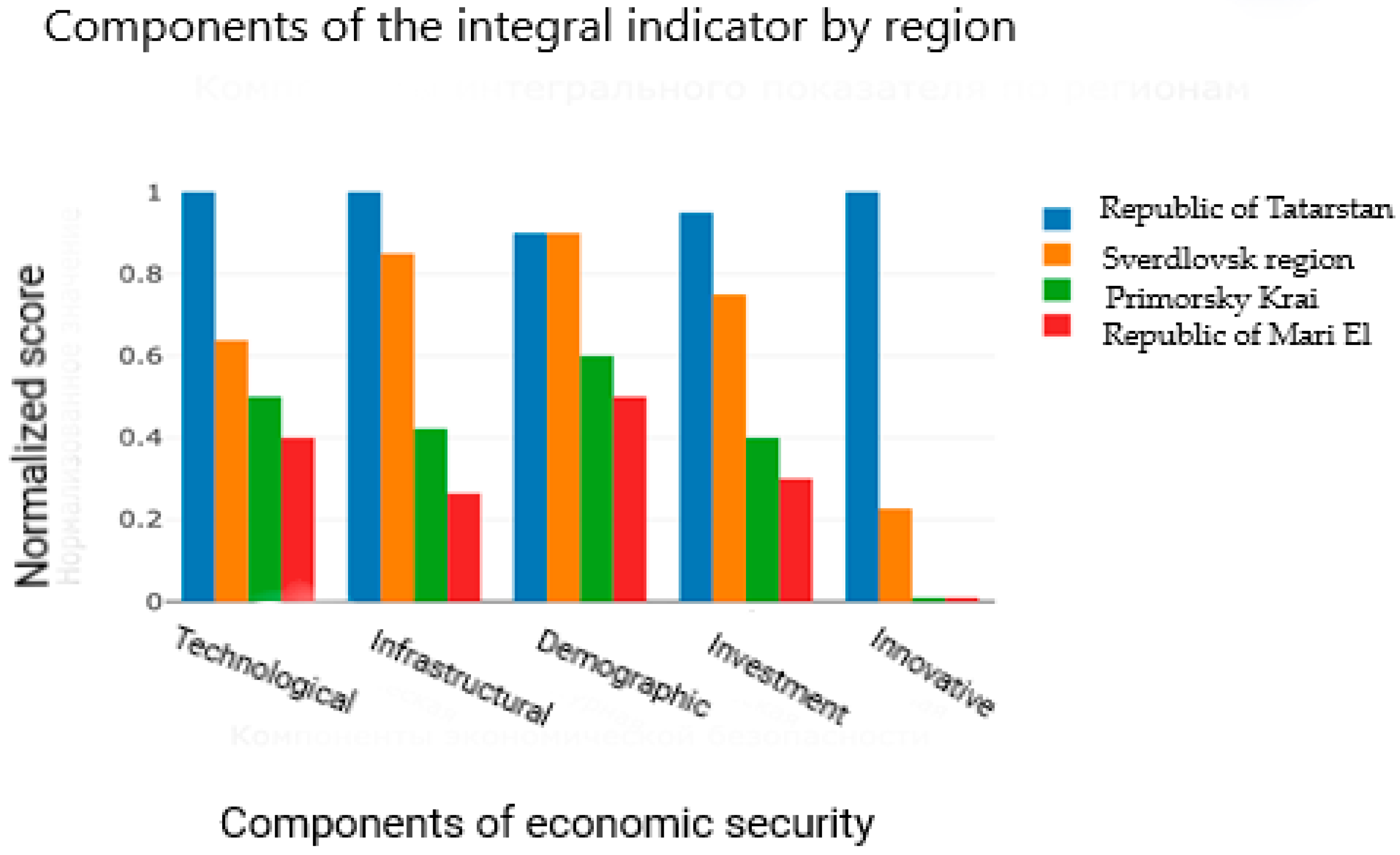
The Republic of Tatarstan demonstrates the highest indicator among the analyzed regions, yet it constitutes only 11% of the established security threshold. Sverdlovsk Region shows the second result, amounting to only 5.6% of the threshold value. The Republic of Mari El and Primorsky Krai have very low levels of innovation funding, not even reaching 2% of the threshold value. The level of innovation spending is absolutely insufficient to ensure these regions’ technological security.
The analysis reveals a systemic crisis of innovation funding in all four chosen subjects. The gap between actual and threshold values ranges from 89% to 99%, indicating total technological vulnerability of regional economies. An absolute disproportion exists between the Republic of Tatarstan and other regions: its indicator is 8.3 times higher than that of Sverdlovsk Region and 9.9 times higher than the indicators of Primorsky Krai and Republic of Mari El.
The current situation requires immediate measures at the federal and regional levels. For all four regions, it is necessary to develop targeted co-financing programs for innovation projects involving extra-budgetary sources. For the Republic of Tatarstan, mechanisms of venture financing can translate innovative activity to a qualitatively new level. For Sverdlovsk Region, the emphasis should be on modernizing the innovation infrastructure of industrial enterprises. For the Republic of Mari El and Primorsky Krai, efforts are needed to implement innovation support programs for small and medium-sized businesses using public–private partnership mechanisms.

4.3. Study of the Four Selected Russian Regions Using Cluster Analysis

Within the framework of studying regional aspects of economic security, identifying statistically significant relationships between the outlined earlier key indicators becomes particularly important. Cluster analysis is an effective method of multidimensional classification, allowing typical groups of regions with similar levels of economic security to be identified.
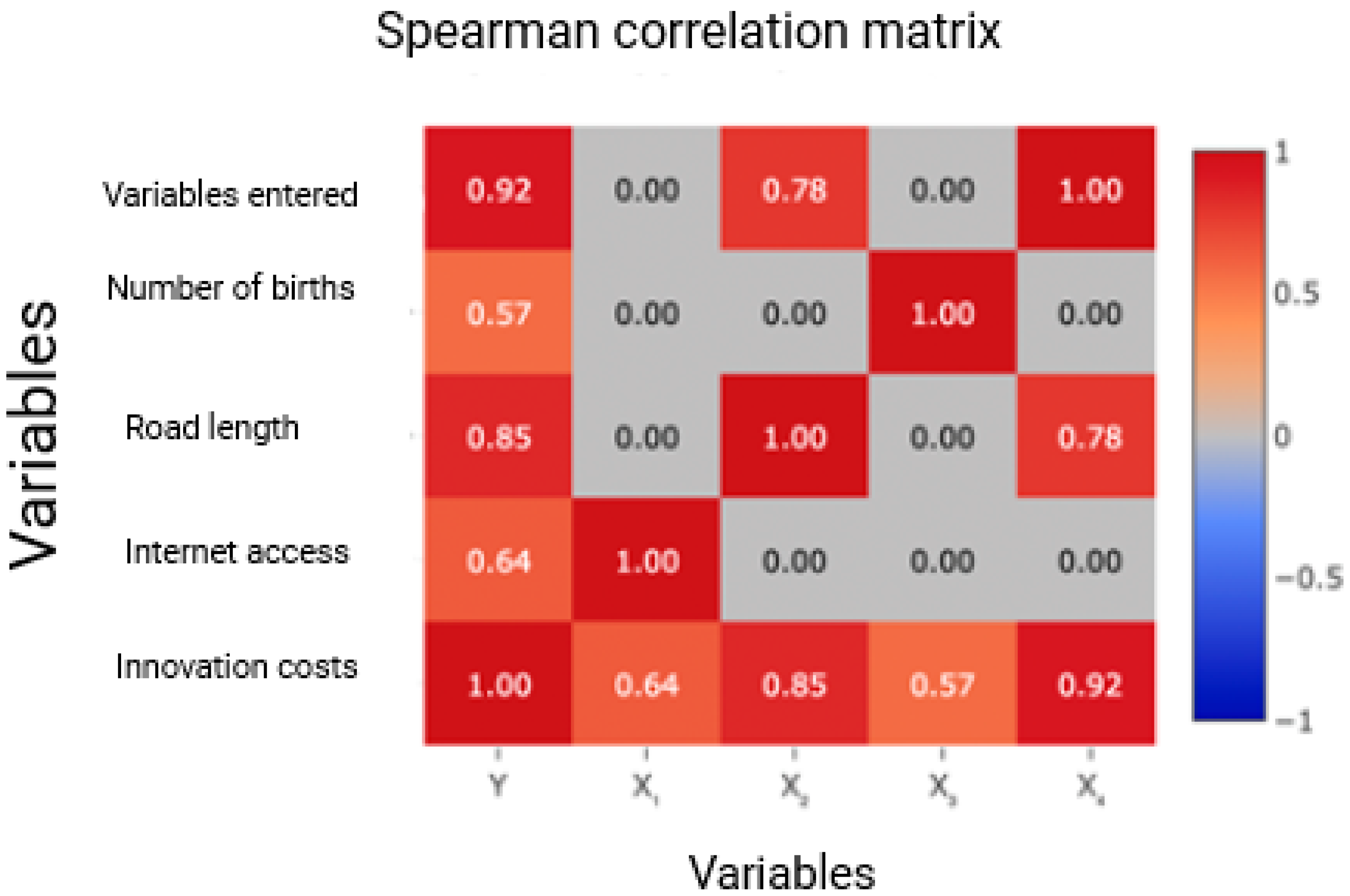
In accordance with the methodology, correlation-regression analysis is conducted in two stages. At the first stage, Spearman correlation coefficients are calculated to assess the closeness of relationships between indicators. The initial data is presented as a panel for 2024 for four selected Russian regions, analyzing the following indicators:
  • X1—Share of households with access to the internet (%).
  • X2—Length of public automobile roads (km).
  • X3—Number of registered births (per 1000 people).
  • X4—Number of completed buildings (units).
  • Y—Costs for innovative activity of organizations (thousand rub.).
The calculation of Spearman correlation coefficients revealed the statistically significant relationships between the analyzed indicators.
The strongest positive correlation is observed between:
  • Costs for innovative activity and the number of completed buildings (ρ = 0.92).
  • Costs for innovative activity and the length of automobile roads (ρ = 0.85).
  • Number of completed buildings and the length of automobile roads (ρ = 0.78).
A moderate positive correlation was identified between:
  • Share of households with internet access and innovation costs (ρ = 0.64).
  • Number of births and number of completed buildings (ρ = 0.57).
To identify statistically significant relationships between the key economic security indicators, a correlation analysis was conducted using Spearman’s rank correlation coefficient. A nonparametric method was chosen due to the small sample size and the uncertainty about the normal distribution of the studied indicators. The matrix of correlation coefficient values, presented in Figure 2, allows us to assess the strength, direction, and statistical significance of the identified relationships.
The analysis results demonstrate that there are some statistically significant correlations. The strongest positive relationship is observed between innovation expenditures (Y) and the number of completed buildings (X4) (ρ = 0.92; p < 0.01). This relationship demonstrates a synergy between investment activity in the real sector and the regional innovative development. The high level of significance (p < 0.01) allows us to confidently state that this pattern is not random for the analyzed group of regions. A statistically significant positive correlation was also found between innovation expenditures and the length of highways (X2) (ρ = 0.85; p < 0.05). This confirms the hypothesis that developed transport infrastructure acts as a catalyst for innovation processes, ensuring resource mobility and technology diffusion. A significance level of p < 0.05 indicates the acceptable statistical reliability of this relationship.
A high correlation was found between the number of buildings commissioned and the length of the road network (ρ = 0.78; p < 0.05), reflecting the cointegration of infrastructure components within regional economic systems. A moderate but statistically significant relationship was found between household digitalization and innovation investments (ρ = 0.64; p < 0.1), indicating the formation of a digital foundation for innovative development. The relationship between demographic processes and construction activity (ρ = 0.57) does not reach statistical significance at the p < 0.1 level, which may be due to the limited sample size. Thus, the conducted correlation analysis revealed the systemic nature of the relationships between infrastructure indicators and regional innovation activity, with most key relationships demonstrating statistical significance, confirming the reliability of the obtained results.
Based on integral assessments, a resource–functional matrix was constructed, enabling the classification of regions by level of economic security (Figure 3):
a
High security zone, characterized by high resources and high efficiency;
b
Moderate security zone, characterized by average resources and average efficiency;
c
Reduced security zone, characterized by low resources and low efficiency.
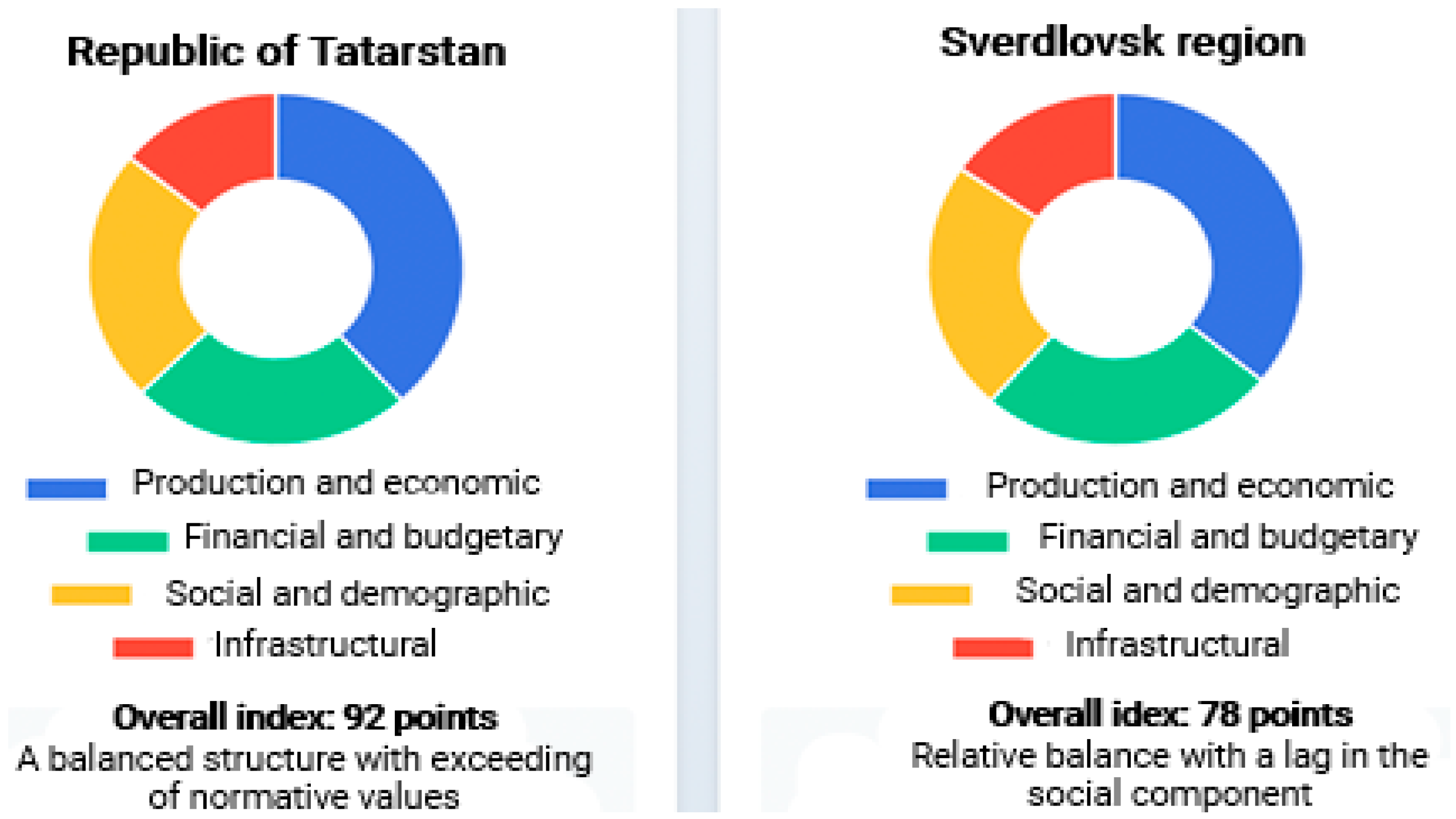
The conducted resource–functional analysis revealed significant differentiation among the four Russian regions by the level of economic security. The most significant lag is observed in the resource-use efficiency. Differentiated approaches are recommended for various types of regions. For leading regions, the strategy implies advanced development through strengthening the innovation component and international cooperation. For regions with average potential—a strategy of optimizing the use of existing resources and increasing efficiency. For regions with low potential—a strategy of targeted support and creating growth points through concentrating resources on promising areas. An integral approach allows for overcoming the limitations of particular indicators and forming a comprehensive assessment that adequately reflects the level of regional economic systems protection from internal and external threats.
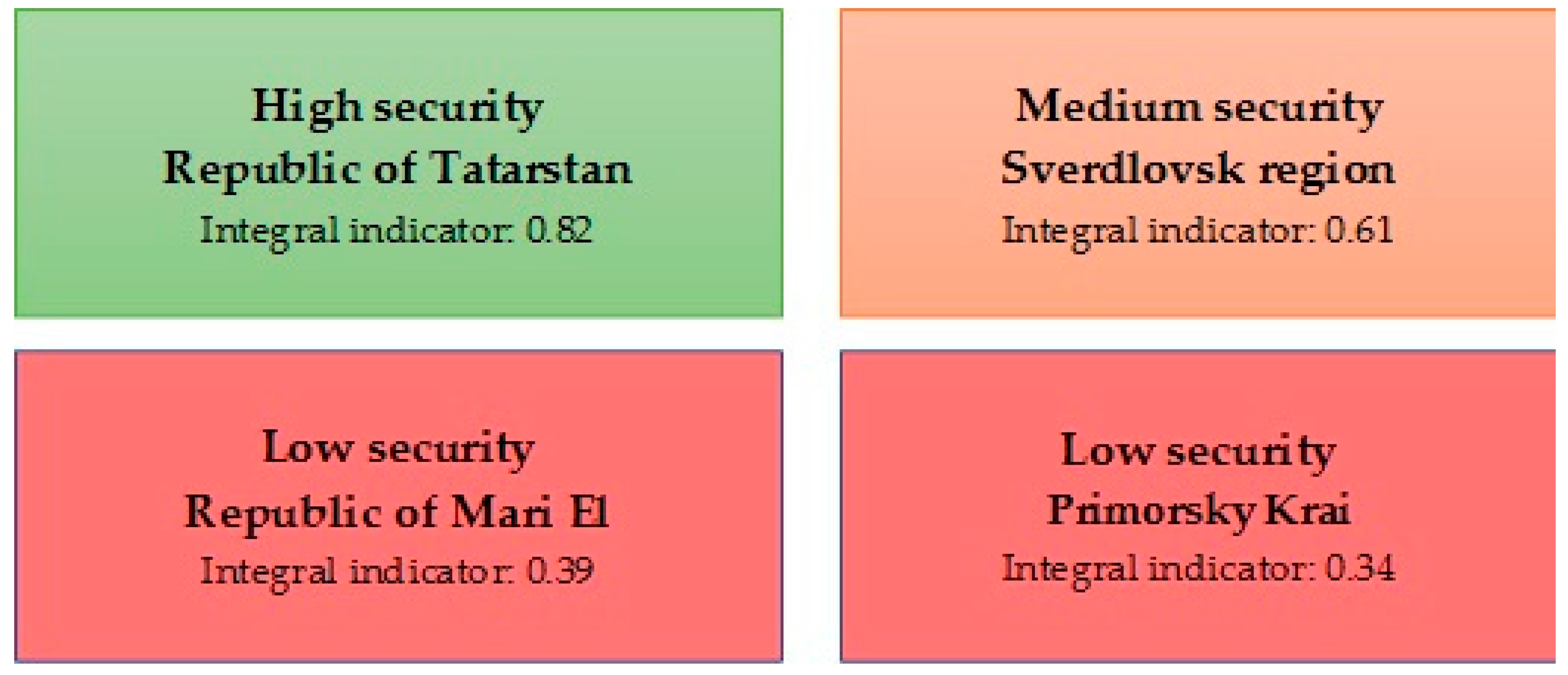
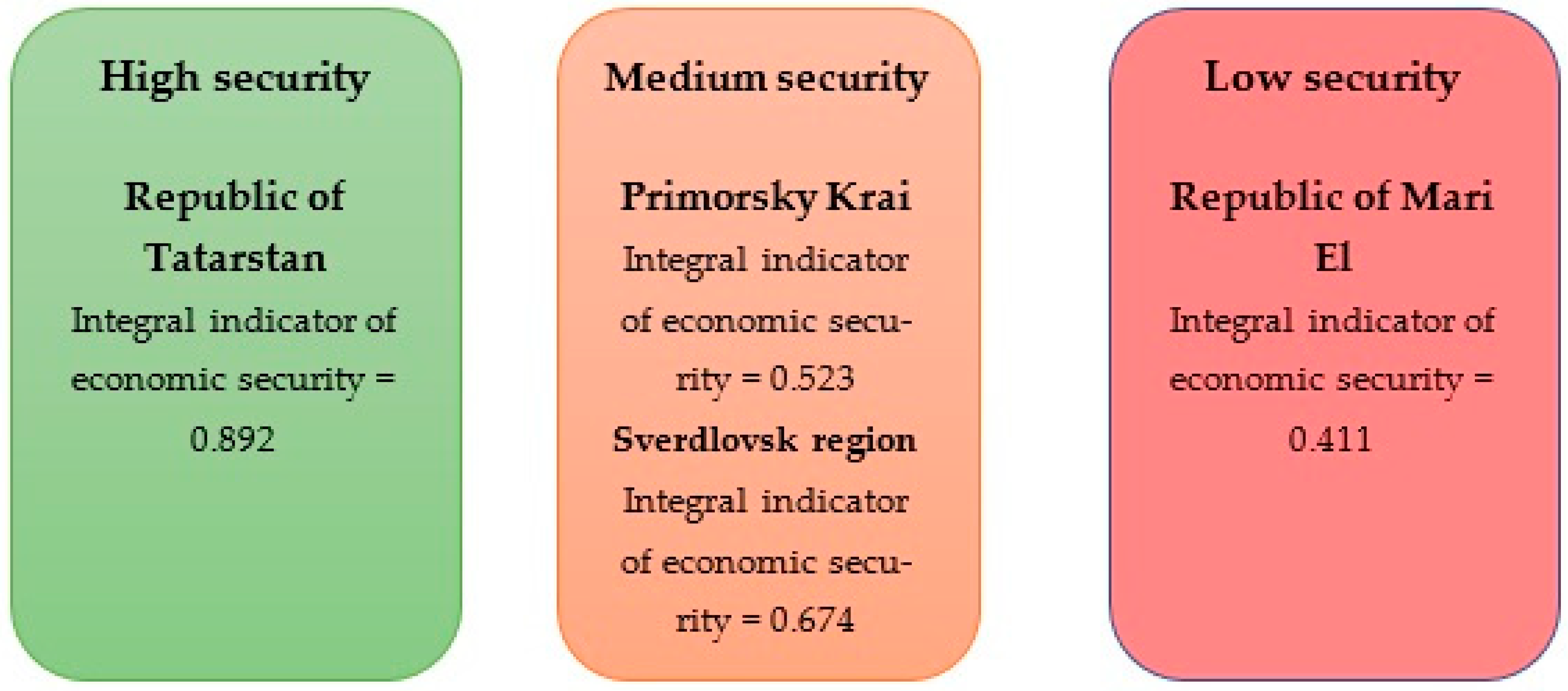
Based on cluster analysis of integral indicators, three groups of regions have been identified (Figure 4):
Group 1—high security (IIES > 0.8): Republic of Tatarstan (0.892).
Group 2—medium security (IIES 0.5–0.8): Sverdlovsk Oblast (0.674), Primorsky Krai (0.523).
Group 3—reduced security (IIES < 0.5): Republic of Mari El (0.411).
The results show that only one of the analyzed four regions has a high level of economic security, while the others demonstrate medium or reduced levels (Figure 5).
Differentiated measures of economic policy are recommended for different groups of regions: for regions with high security—a strategy of advanced development through strengthening competitive advantages and international cooperation. For regions with medium security—a strategy of balanced development with an emphasis on overcoming structural imbalances. For regions with reduced security—a strategy of targeted support with concentration of resources on critically important areas.
The indicative approach allows for identifying critical deviations in socio-economic development and timely implementation of corrective actions.
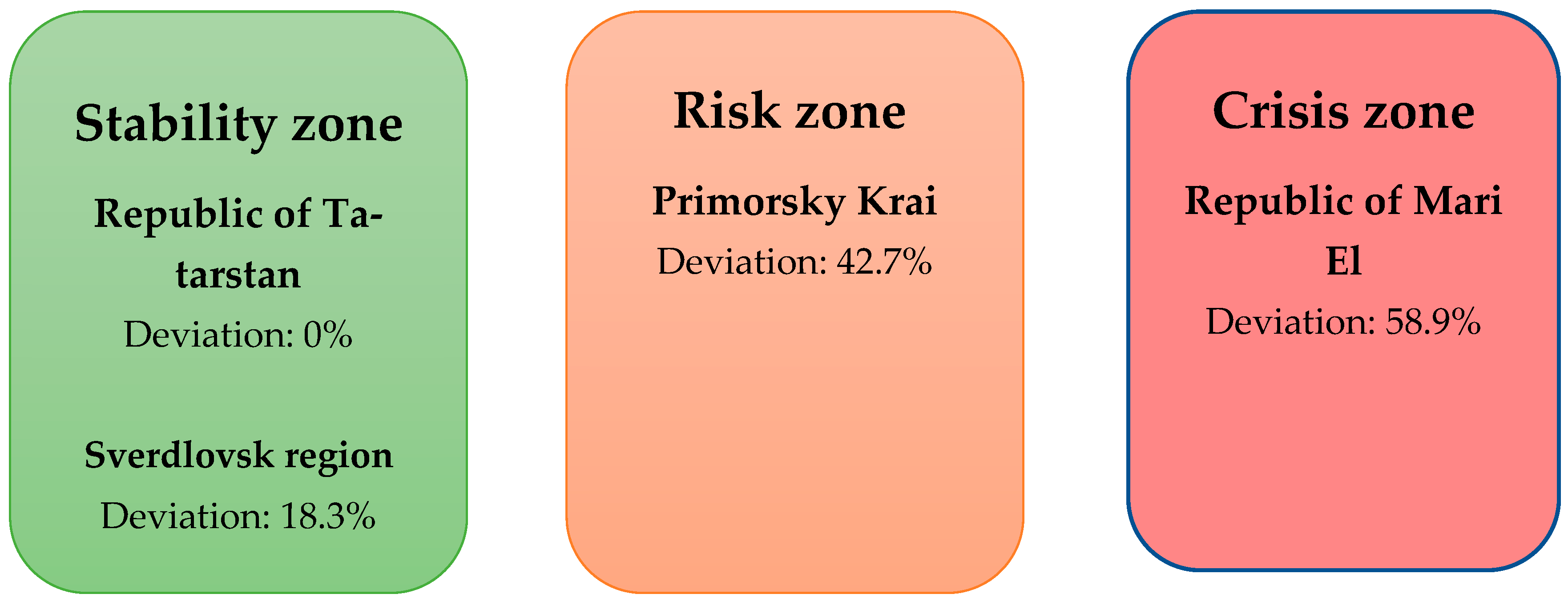
Based on the analysis of deviations from threshold values, three zones are identified (Figure 6):
Stability zone (deviation up to 20%);
Risk zone (deviation 20–50%);
Crisis zone (deviation over 50%);
The conducted study revealed the complementary nature of various methodological approaches for assessing economic security. Each of the analyzed methods possesses unique diagnostic potential. Correlation-regression analysis reveals deep cause-and-effect relationships between components of the economic system, demonstrating the synergistic effect of infrastructure and innovation development. The cluster approach objectively identifies the spatial differentiation of regions, confirming the hypothesis of polarization of economic space and the formation of typological groups of subjects. The resource–functional methodology provides a comprehensive diagnosis of the economic potential use efficiency, identifying institutional constraints in the system of regional governance. The integral assessment creates a basis for ranking regions, possessing high validity and consistency with official ratings. The indicative analysis forms a practical toolkit for operational monitoring and preventive management, allowing for the identification of critical points of economic security. The set of considered approaches forms a holistic diagnostic system, ensuring a transition from a unified to an address-based regional policy that takes into account the structural features and development potential of each region.

5. Conclusions

The study presented in the paper contributes to the theory and practice of regional economic security by developing a new methodology for the integral assessment of the regional economic security level and its testing on the example of four Russian regions. The methodology includes a developed set of diagnostic tools and analytical procedures allowing for monitoring economic security at various levels of territorial organization. The proposed methodological approach overcomes the systemic limitations of traditional assessment methods that level out objective differences between regions and ensures the conduction of a comparable analysis that considers the entire spectrum of the natural-climatic, economic-geographical, demographic, and infrastructural features of each region.
The introduction of infrastructural, demographic, and ecological coefficients ensures the necessary comparability of assessment results for regions with fundamentally different starting conditions of socio-economic development. Significant systemic discrepancies between traditional and adjusted values of the integral index of economic security for individual federal districts were identified. An original algorithm for calculating the adjusted integral indicator of economic security was developed and implemented, organically combining methods of modern statistical analysis, technologized expert assessments, and prospective approaches of multifactor econometric modeling. The created algorithm is implemented as a specialized module ensuring the process of calculation, dynamic monitoring, and clear visualization of the obtained results.
The study confirmed that the economic security of a region is systemically determined not so much by the absolute values of economic indicators, but by the balance of their structural interrelationships and the consistency of development dynamics. A stable systemic dependence between investment activity, the volume of GRP, and population income has been identified and confirmed, the violation of which is a diagnostic sign of structural deformations in the regional economy and requires targeted measures of state regulation.
The conducted large-scale practical testing of the developed methodology convincingly confirmed its diagnostic effectiveness for monitoring the dynamics of regional economic security and solving current tasks of strategic regional planning. The obtained research results are applicable to the practical activities of regional and federal authorities when developing and adjusting socio-economic development strategies.
Thus, the proposed methodology can serve as a scientifically grounded and practice-oriented tool for managing regional development, contributing to the substantiation of management decisions and ensuring the necessary conditions for balanced and sustainable regional development in an emerging economy.
The theoretical and practical significance of the study lies in creating a holistic methodological basis for forming a differentiated regional policy that adequately considers the specifics and potential of each type of region in the context of ensuring national economic security.
Despite its contributions, this study is subject to several limitations that offer avenues for future research. First, the analysis was limited to four selected Russian regions, therefore there is a need to validate the results based on a study of all Russian regions and, if necessary, refine the conclusions and recommendations for regional administrations and federal authorities. Second, the authors intend to further develop the methodology by considering the sectoral specialization of regions, integrating with medium- and long-term forecasting systems, and creating an automated monitoring platform. Third, a promising direction for research could be a cross-cultural study, which could help to formulate a conclusion about the applicability of the developed methodology to other developing economies.

Author Contributions

Conceptualization, A.P.; Methodology, A.P. and M.Y.S.; Formal Analysis, V.L.; Investigation, V.L.; Resources, D.N. and V.L.; Data Curation, D.N.; Writing—Original draft, M.Y.S.; Writing—Review and Editing, M.Y.S.; Supervision, A.P.; Project Administration, D.N. All authors have read and agreed to the published version of the manuscript.

Funding

This research was funded by the grant of the Russian Science Foundation No. 23-78-10042 “Methodology of multilevel integration of economic space and synchronization of innovation processes as a basis for sustainable development of Russian regions (based on the concept of innovative hypercluster)” https://rscf.ru/project/23-78-10042/ (accessed on 4 September 2023).

Institutional Review Board Statement

Not applicable.

Informed Consent Statement

Not applicable.

Data Availability Statement

The data presented in this study are openly available in Federal State Statistics Service at https://eng.rosstat.gov.ru/, accessed on 7 April 2025.

Acknowledgments

The authors thank fellow faculty staff, students and graduate students of Volga State University of Technology who helped in conducting sociological surveys.

Conflicts of Interest

The authors declare no potential conflicts of interest.

References

  1. Kho, S.; McNamara, Y.K. Focus on China: The expansive use of national security measures to address economic competitiveness concerns. Univ. Pa. Asian Law Rev. 2022, 17, 368. [Google Scholar]
  2. Riehle, K.P. Information Power and Russia’s National Security Objectives. J. Intell. Confl. Warf. 2022, 4, 62–83. [Google Scholar] [CrossRef]
  3. Suthar, H.; Rawat, H.; Gayathri, M.; Chidambarathanu, K. Techno-Nationalism and Techno-Globalization: A Perspective from the National Security Act. In Quantum Computing in Cybersecurity; John Wiley & Sons: Hoboken, NJ, USA, 2023; pp. 137–164. [Google Scholar]
  4. Song, M.; Xie, Q.; Shahbaz, M.; Yao, X. Economic growth and security from the perspective of natural resource assets. Resour. Policy 2023, 80, 103153. [Google Scholar] [CrossRef]
  5. Arefieva, O.; Tulchynska, S.; Popelo, O.; Arefiev, S.; Tkachenko, T. The economic security system in the conditions of the powers transformation. Int. J. Comput. Sci. Netw. Secur. 2021, 21, 35–42. [Google Scholar]
  6. Shtangret, A.; Korogod, N.; Bilous, S.; Hoi, N.; Ratushniak, Y. Management of economic scurity in the high-tech sector in the context of post-pandemic modernization. Postmod. Open. 2021, 12, 535–552. [Google Scholar]
  7. Ozili, P.K.; Iorember, P.T. Financial stability and sustainable development. Int. J. Financ. Econ. 2024, 29, 2620–2646. [Google Scholar] [CrossRef]
  8. Almgren, R.; Skobelev, D. Evolution of technology and technology governance. J. Open Innov. Technol. Mark. Complex. 2020, 6, 22. [Google Scholar] [CrossRef]
  9. Karatayev, M.; Hall, S. Establishing and comparing energy security trends in resource-rich exporting nations (Russia and the Caspian Sea region). Resour. Policy 2020, 68, 101746. [Google Scholar] [CrossRef]
  10. Gitelman, L.; Magaril, E.; Kozhevnikov, M. Energy security: New threats and solutions. Energies 2023, 16, 2869. [Google Scholar] [CrossRef]
  11. Mara, D.; Nate, S.; Stavytskyy, A.; Kharlamova, G. The place of energy security in the national security framework: An assessment approach. Energies 2022, 15, 658. [Google Scholar] [CrossRef]
  12. Li, J.; Hai, Q. Evaluation of economic security and environmental protection benefits from the perspective of sustainable development and technological ecological environment. Sustainability 2023, 15, 6072. [Google Scholar] [CrossRef]
  13. Chatterjee, A. Financial inclusion, information and communication technology diffusion, and economic growth: A panel data analysis. Inf. Technol. Dev. 2020, 26, 607–635. [Google Scholar] [CrossRef]
  14. Pani, B.S.; Mishra, D. Sustainable livelihood security in Odisha, India: A district level analysis. Reg. Sustain. 2022, 3, 110–121. [Google Scholar] [CrossRef]
  15. Aliyev, S.; Babayev, F.; Galandarova, U.; Gafarli, G.; Balajayeva, T. Economic security of regions: A prerequisite for diversifying the Azerbaijan economy. J. East. Eur. Cent. Asian Res. (JEECAR) 2023, 10, 827–840. [Google Scholar] [CrossRef]
  16. Yulianita, A.; Rohima, S.; Hermawati, L. National Energy Security: An Analysis of Economic Growth and Energy Consumption at the Regional Level in Indonesia. J. Appl. Econ. Res. 2025, 24, 415–437. [Google Scholar] [CrossRef]
  17. Kitchin, R. The Data Revolution: A Critical Analysis of Big Data, Open Data and Data Infrastructures; SAGE Publications Ltd.: London, UK, 2021. [Google Scholar]
  18. Zhong, Y.; Lai, H.; Zhang, L.; Guo, L.; Lai, X. Does public data openness accelerate new quality productive forces? Evidence from China. Econ. Anal. Policy 2025, 85, 1409–1427. [Google Scholar] [CrossRef]
  19. Nanni, R.; Napolitano, M. Dataspaces, public administration and collective rationality: Opportunities and limits for data-driven policy-making. Public Money Manag. 2024, 44, 484–490. [Google Scholar] [CrossRef]
  20. Glazyev, S.Y.; Sukharev, O.S. Economic growth and monetary policy in Russia. J. New Econ. 2025, 26, 6–30. [Google Scholar] [CrossRef]
  21. Zhou, J.L.; Chen, X.Y.; Wang, H.W. A similarity-conformity-based clustering and decentralized feedback mechanism to manage incompatible decision-makers in large-scale group decision-making. Expert Syst. Appl. 2024, 246, 123209. [Google Scholar]
  22. Dong, S.; Abbas, K.; Li, M.; Kamruzzaman, J. Blockchain technology and application: An overview. PeerJ Comput. Sci. 2023, 9, e1705. [Google Scholar] [CrossRef]
  23. Vaigandla, K.K.; Karne, R.; Siluveru, M.; Kesoju, M. Review on blockchain technology: Architecture, characteristics, benefits, algorithms, challenges and applications. Mesopotamian J. Cybersecur. 2023, 2023, 73–84. [Google Scholar] [CrossRef]
  24. Cao, B.; Wang, Z.; Zhang, L.; Feng, D.; Peng, M.; Zhang, L.; Han, Z. Blockchain systems, technologies, and applications: A methodology perspective. IEEE Commun. Surv. Tutor. 2022, 25, 353–385. [Google Scholar] [CrossRef]
  25. Deng, W.; Huang, T.; Wang, H. A review of the key technology in a blockchain building decentralized trust platform. Mathematics 2022, 11, 101. [Google Scholar] [CrossRef]
  26. Challa, S.R.; Challa, K.; Lakkarasu, P.; Sriram, H.K.; Adusupalli, B. Strategic Financial Growth: Strengthening Investment Management, Secure Transactions, and Risk Protection in the Digital Era. J. Artif. Intell. Big Data Discip. 2024, 1, 97–108. [Google Scholar] [CrossRef]
  27. Tseng, C.T.; Shang, S.S. Exploring the sustainability of the intermediary role in blockchain. Sustainability 2021, 13, 1936. [Google Scholar] [CrossRef]
  28. Centobelli, P.; Cerchione, R.; Del Vecchio, P.; Oropallo, E.; Secundo, G. Blockchain technology for bridging trust, traceability and transparency in circular supply chain. Inf. Manag. 2022, 59, 103508. [Google Scholar] [CrossRef]
  29. Zgurovsky, M.Z.; Zaychenko, Y.P. Big Data: Conceptual Analysis and Applications; Springer International Publishing: Berlin/Heidelberg, Germany, 2020. [Google Scholar]
  30. Mokhammad, A. Networks as part of strategy design for digital platform development in China. BRICS J. Econ. 2025, 6, 73–90. [Google Scholar] [CrossRef]
  31. Iqbal, R.; Doctor, F.; More, B.; Mahmud, S.; Yousuf, U. Big data analytics: Computational intelligence techniques and application areas. Technol. Forecast. Soc. Change 2020, 153, 119253. [Google Scholar] [CrossRef]
  32. Monino, J.L. Data value, big data analytics, and decision-making. J. Knowl. Econ. 2021, 12, 256–267. [Google Scholar] [CrossRef]
  33. Niu, Y.; Ying, L.; Yang, J.; Bao, M.; Sivaparthipan, C.B. Organizational business intelligence and decision making using big data analytics. Inf. Process. Manag. 2021, 58, 102725. [Google Scholar] [CrossRef]
  34. Saba, C.S.; Pretorius, M. The mediating role of governance in creating a nexus between investment in artificial intelligence (AII) and human well-being in the BRICS countries. BRICS J. Econ. 2024, 5, 5–44. [Google Scholar] [CrossRef]
  35. Justino, M.D.R.T.F.; Texeira-Quirós, J.; Gonçalves, A.J.; Antunes, M.G.; Mucharreira, P.R. The role of artificial neural networks (ANNs) in supporting strategic management decisions. J. Risk Financ. Manag. 2024, 17, 164. [Google Scholar] [CrossRef]
  36. Fernandes-Gondoza, G.; Ncwadi, R.; Fernandes, J.M.; Nyika, F. Predicting Currency Crises in Emerging Markets: A Case Study on South Africa Using Artificial Neural Networks. BRICS J. Econ. 2025, 6, 91–116. [Google Scholar] [CrossRef]
  37. Sheresheva, M.Y.; Gorlacheva, E.N. The elaboration of the patent processing instrument based on the machine learning technology. GATR J. Bus. Econ. Rev. 2025, 10, 131–142. [Google Scholar] [CrossRef]
  38. Akter, M.S.; Sultana, N.; Khan, M.A.R.; Mohiuddin, M. Business Intelligence-Driven Healthcare: Integrating Big Data and Machine Learning for Strategic Cost Reduction and Quality Care Delivery. Am. J. Interdiscip. Stud. 2023, 4, 01–28. [Google Scholar] [CrossRef]
  39. Ali, R.; Hussain, A.; Nazir, S.; Khan, S.; Khan, H.U. Intelligent decision support systems—An analysis of machine learning and multicriteria decision-making methods. Appl. Sci. 2023, 13, 12426. [Google Scholar] [CrossRef]
  40. Taherdoost, H. Deep learning and neural networks: Decision-making implications. Symmetry 2023, 15, 1723. [Google Scholar] [CrossRef]
  41. Henschen, L.J.; Lee, J.C. Embedded System Design: Methodologies and Issues; Elsevier: Amsterdam, The Netherlands, 2023. [Google Scholar]
  42. Yalli, J.S.; Hasan, M.H.; Badawi, A.A. Internet of Things (IoT): Origins, embedded technologies, smart applications, and its growth in the last decade. IEEE Access 2024, 12, 91357–91382. [Google Scholar] [CrossRef]
  43. Tsaramirsis, G.; Kantaros, A.; Al-Darraji, I.; Piromalis, D.; Apostolopoulos, C.; Pavlopoulou, A.; Khan, F.Q. A modern approach towards an industry 4.0 model: From driving technologies to management. J. Sens. 2022, 2022, 5023011. [Google Scholar] [CrossRef]
  44. Sadiku, M.N.; Ajayi-Majebi, A.J.; Adebo, P.O. Emerging Technologies in Manufacturing; Springer: Berlin/Heidelberg, Germany, 2023. [Google Scholar]
  45. Gunasekaran, K.; Kumar, V.V.; Kaladevi, A.C.; Mahesh, T.R.; Bhat, C.R.; Venkatesan, K. Smart decision-making and communication strategy in industrial Internet of Things. IEEE Access 2023, 11, 28222–28235. [Google Scholar] [CrossRef]
  46. Chetty, K. Navigating the Transition to Inclusive Online Learning in BRICS and Africa. BRICS J. Econ. 2023, 4, 389–410. [Google Scholar] [CrossRef]
  47. Barikzai, S.; Bharathi, S.V.; Perdana, A. Challenges and strategies in e-learning adoption in emerging economies: A scoping review. Cogent Educ. 2024, 11, 2400415. [Google Scholar] [CrossRef]
  48. Sakr, A.; Abdullah, T. Virtual, augmented reality and learning analytics impact on learners, and educators: A systematic review. Educ. Inf. Technol. 2024, 29, 19913–19962. [Google Scholar] [CrossRef]
  49. Lampropoulos, G. Combining artificial intelligence with augmented reality and virtual reality in education: Current trends and future perspectives. Multimodal Technol. Interact. 2025, 9, 11. [Google Scholar] [CrossRef]
  50. Lakshminarayanan, V.; Ravikumar, A.; Sriraman, H.; Alla, S.; Chattu, V.K. Health care equity through intelligent edge computing and augmented reality/virtual reality: A systematic review. J. Multidiscip. Healthc. 2023, 16, 2839–2859. [Google Scholar] [CrossRef]
  51. Rockel, G.; Rusko, M.; Predajnianska, A. Reshaping the world with computer technologies and their impact on the development of processes in the field of real estate trading. Qual. Innov. Prosper. 2024, 28, 99–113. [Google Scholar] [CrossRef]
  52. Bretos, M.A.; Ibáñez-Sánchez, S.; Orús, C. Applying virtual reality and augmented reality to the tourism experience: A comparative literature review. Span. J. Mark.-ESIC 2024, 28, 287–309. [Google Scholar] [CrossRef]
  53. Vilar, E.; Filgueiras, E.; Rebelo, F. (Eds.) Virtual and Augmented Reality for Architecture and Design; CRC Press, Taylor Francis Group: Boca Raton, FL, USA, 2022. [Google Scholar]
  54. Han, J.; Davids, J.; Ashrafian, H.; Darzi, A.; Elson, D.S.; Sodergren, M. A systematic review of robotic surgery: From supervised paradigms to fully autonomous robotic approaches. Int. J. Med. Robot. Comput. Assist. Surg. 2022, 18, e2358. [Google Scholar] [CrossRef]
  55. Sevgi Ostim, A.; Kadioğlu Ostim, A.M.; Durmuş Ostim, A. Using of Robotic Systems in Transportation. In Proceedings of the IEEE International Conference on Cognitive Mobility; Springer Nature: Cham, Switzerland, 2024; pp. 458–468. [Google Scholar]
  56. Duong, L.N.; Al-Fadhli, M.; Jagtap, S.; Bader, F.; Martindale, W.; Swainson, M.; Paoli, A. A review of robotics and autonomous systems in the food industry: From the supply chains perspective. Trends Food Sci. Technol. 2020, 106, 355–364. [Google Scholar] [CrossRef]
  57. Yin, R.; Wang, D.; Zhao, S.; Lou, Z.; Shen, G. Wearable sensors-enabled human–machine interaction systems: From design to application. Adv. Funct. Mater. 2021, 31, 2008936. [Google Scholar] [CrossRef]
  58. Shajari, S.; Kuruvinashetti, K.; Komeili, A.; Sundararaj, U. The emergence of AI-based wearable sensors for digital health technology: A review. Sensors 2023, 23, 9498. [Google Scholar] [CrossRef] [PubMed]
  59. Norori, N.; Hu, Q.; Aellen, F.M.; Faraci, F.D.; Tzovara, A. Addressing bias in big data and AI for health care: A call for open science. Patterns 2021, 2, 100347. [Google Scholar] [CrossRef] [PubMed]
  60. Bertram, M.G.; Sundin, J.; Roche, D.G.; Sánchez-Tójar, A.; Thoré, E.S.; Brodin, T. Open science. Curr. Biol. 2023, 33, R792–R797. [Google Scholar] [CrossRef]
  61. Haini, H.; Pang, W.L. Internet penetration, financial access and new business formation: Evidence from developing economies. Int. J. Soc. Econ. 2022, 49, 1257–1276. [Google Scholar] [CrossRef]
  62. Nijkamp, P.; Ţigănaşu, R.; Bănică, A.; Pascariu, G.C. Institutional adaptability: Its relevance for enhancing resilience and smart specialization capacity of the European Union’s lagging regions. Eurasian Geogr. Econ. 2024, 65, 1–33. [Google Scholar] [CrossRef]
  63. Carrero Dueñas, D.A.; Ruiz Castañeda, W.L. Sustainable regional development and complex adaptive systems: A methodological proposal through Social Network Analysis. Reg. Sci. Inq. 2025, 17, 85–99. [Google Scholar]
  64. Tsunekawa, K.; Todo, Y. Emerging States at Crossroads; Springer: Singapore, 2019. [Google Scholar]
  65. Ke, Y. ASEAN Four’s middle income trap dilemma: Evidence of the middle technology trap. Asian Rev. Political Econ. 2024, 3, 14. [Google Scholar] [CrossRef]
  66. Kaggwa, S.; Akinwolemiwa, D.I.; Dawodu, S.O.; Uwaoma, P.U.; Akindote, O.J.; Eloghosa, S.O. Digital transformation and economic development: A review of emerging technologies’ impact on national economies. World J. Adv. Res. Rev. 2023, 20, 888–905. [Google Scholar] [CrossRef]
  67. Alam, I.A.; Mwatela, R.Z.M.; Gachanja, P.M.G. Strategic Modelling for High-Technology Sectors: Addressing Economic Security in Emerging Economies amidst US-China Geopolitical Competition. Natl. Secur. A J. Natl. Def. Univ.-Kenya 2025, 3, 151–166. [Google Scholar] [CrossRef]
  68. Mukashov, A.; Robinson, S.; Arndt, C.; Thurlow, J.; Thomas, T. Systematic risk profiling: Assessing compounding economic risks in developing countries. Econ. Model. 2026, 157, 107511. [Google Scholar] [CrossRef]
  69. Dyuzhilova, O.M.; Vyakina, I.V. Analysis of risks and threats to the economic security of the region. Reg. Econ. Theory Pract. 2015, 389, 53–64. [Google Scholar]
  70. Syupova, M.S.; Bondarenko, N.A. System of regional economic security indicators. Bull. Pac. Natl. Univ. 2019, 4, 67–80. [Google Scholar]
  71. Zaytsev, A.; Sun, P.K.; Elkina, O.; Tarasova, T.; Dmitriev, N. Economic security and innovative component of a region: A comprehensive assessment. Sustain. Dev. Eng. Econ. 2021, 58–78. [Google Scholar] [CrossRef]
  72. Mahajan, A.S. Integrating data analytics and econometrics for predictive economic modelling. Int. J. Appl. Math. 2025, 38, 1450–1467. [Google Scholar] [CrossRef]
  73. Li, Q.; Yang, Z.; Tian, Z.; Yin, Q. Multidimensional measurement of the high-quality development of city clusters: Dynamic evolution, regional differences and trend forecasting—Based on the basic connotation of Chinese-style modernization. Ecol. Indic. 2024, 161, 111989. [Google Scholar] [CrossRef]
  74. Ruch, F.U. Prospects, risks, and vulnerabilities in emerging and developing economies: Lessons from the past decade. World Bank Policy Res. Work. Pap. 2020. [Google Scholar] [CrossRef]
  75. Taheri Hosseinkhani, N. Economic Implications of AI-Driven Cybersecurity in Emerging Markets; Elsevier Inc.: Amsterdam, The Netherlands, 2025. [Google Scholar]
  76. Yashin, S.N.; Puzov, E.N. Monitoring the economic security of regions based on their comparative assessment and determining the effectiveness of territorial development. Financ. Credit 2006, 3, 31–36. (In Russian) [Google Scholar]
  77. Levkina, E.V.; Lyalina, Z.I.; Kurasova, E.A. Relevance of economic security as an economic category. Econ. Secur. 2022, 5, 339–350. (In Russian) [Google Scholar] [CrossRef]
  78. Nikolaeva, N.A. Economic security at the national and regional levels: A system of indicators and their assessment. Vestn. Samara Univ. Econ. Manag. 2025, 16, 93–111. [Google Scholar] [CrossRef]
  79. Ilyin, V.A.; Morev, M.V. National Security Strategy–2021: Positive Experiences and Conflicting Expectations. Econ. Soc. Changes: Facts Trends Forecast. 2021, 14, 9–32. [Google Scholar] [CrossRef]
  80. Nakipov, E. Methodological Tools for Assessing Forecasting Indicators of Ensuring Economic Security of Regions. Russ. J. Manag. 2025, 13, 119–140. [Google Scholar] [CrossRef]
  81. Maslov, G.A.; Sherstobitova, Y.A. Standards of living human potential development: Assessing risks to regions’ economic security. J. New Econ. 2025, 25, 24–46. [Google Scholar] [CrossRef]
  82. Mityakov, S.N.; Mityakova, O.I.; Mityakov, E.S.; Yakovleva, G.N. Regional innovation assessment toolkit: Correlation-regression analysis. Innovations 2021, 1, 60–67. (In Russian) [Google Scholar] [CrossRef]
  83. Khan, N.; Ali, S.; Shah, S.S.A. Testing Threshold Effects of External Debt: Empirical Evidence from Developing Countries. SAGE Open 2025, 15, 1–10. [Google Scholar] [CrossRef]
  84. Kononov, Y.D. Goals and methods of estimating energy security indicator thresholds in forecasts. Probl. Prognozirovaniya 2024, 202, 105–115. [Google Scholar] [CrossRef]
  85. Ghulam, Y. Examination and predictions of risk tolerance levels and thresholds in sovereigns’ external debt defaults. Int. Econ. Econ. Policy 2025, 22, 28. [Google Scholar] [CrossRef]
  86. Osadchenko, E.A.; Ferova, I.S. Selection mechanism for regional energy security indicators. Perm Univ. Her. Econ. 2025, 20, 101–112. [Google Scholar] [CrossRef]
  87. Drobysheva, V.V. Techniques and Problems of Assessment of State Control Effectiveness in Life Quality Management System; Tambov State Technical University: Tambov, Russia, 2009; Available online: https://vernadsky.tstu.ru/pdf/2009/03/rus_12_2009_3.pdf (accessed on 26 February 2026).
  88. Ayvazyan, S.A. Methods of Econometrics; INFRA-M: Moscow, Russia, 2010. (In Russian) [Google Scholar]
  89. Sharandina, N.L. The digital economy as a priority national goal of the Russian Federation: A legal aspect. Financ. Law 2018, 15–19. (In Russian) [Google Scholar]
  90. Dudan, M.A. Transfer of innovations in intersectoral cooperation: Synergy effect. Proc. BSTU 5 Econ. Manag. 2021, 1, 163–168. (In Russian) [Google Scholar]
  91. Federal State Statistics Service. 2026. Available online: https://rosstat.gov.ru/folder/10705 (accessed on 16 January 2026).
  92. Unified Interdepartmental Information and Statistical System. Available online: https://www.fedstat.ru/indicators/ (accessed on 16 January 2026).
  93. Federal Tax Service of the Russian Federation. Available online: https://www.nalog.gov.ru/rn77/about_fts/docs/ (accessed on 16 January 2026).
  94. Ministry of Digital Development, Communications and Mass Media. Available online: https://digital.gov.ru/documents (accessed on 16 January 2026).
Figure 1. Diagnostic circuit for the Republic of Tatarstan and Sverdlovsk Region. Source: compiled by authors.
Sustainability 18 02577 g001
Figure 2. The matrix of correlation coefficient values. Source: compiled by authors.
Sustainability 18 02577 g002
Figure 3. The resource–functional matrix classifying selected regions by the level of economic security. Source: compiled by authors.
Sustainability 18 02577 g003
Figure 4. Integral Indicator of Economic Security (IIES) and classification of four selected Russian regions. Source: compiled by authors.
Sustainability 18 02577 g004
Figure 5. Components of the integral indicator. Source: compiled by authors.
Sustainability 18 02577 g005
Figure 6. Regional economic security zones. Source: compiled by authors.
Sustainability 18 02577 g006
Table 1. Integrated indicators of economic security (IIES).
Block/IndicatorEvaluation Criteria
(1 Point)
Evaluation Criteria
(2 Points)
Evaluation Criteria
(3 Points)
Comments
I. National Indicators
1.1GRP Growth Index/Industrial Production Growth Index<1≈1>1GRP (Gross Regional Product) should grow faster than industrial production.
1.2Asset Depreciation Index>1≈1<1The depreciation rate of fixed assets should decrease.
1.3Export/Import Ratio with Neighboring Countries and the CIS<1≈1>1 and → maxFrom the perspective of economic security, the region should strive to maximize exports while minimizing imports.
1.4Industrial Production Index<1≈1>1Industrial production should increase.
1.5Agricultural Production Index<1≈1>1Agricultural production should increase.
1.6Per Capita Retail Turnover Dynamics<1≈1>1Per capita retail turnover should increase.
1.7Dynamics in Number of Organizations Conducting R&D<1≈1>1The number of organizations conducting R&D should increase.
Source: compiled by authors.
Table 2. Methods for taking into account regional specifics.
MethodApproach
1Regional ClusteringGrouping regions by similar characteristics before comparison. Clustering criteria: economic specialization, natural and climatic conditions, level of urbanization, demographic indicators.
2Relative indicators within clustersFormula for calculating the adjusted IQOL.
3Adjustment coefficientsSystem of coefficients for accounting for specific conditions.
4Reference region methodComparison not with an abstract ideal, but with best practices in similar conditions, where the algorithm includes selecting a reference region in each cluster, calculating relative indicators relative to the reference region, and ranking within clusters.
Source: compiled by authors.
Table 3. Method of taking into account regional specifics using correction coefficients.
FactorCoefficient RangeApplication Example
Climatic1.0–1.3Increasing coefficient for northern regions
Infrastructure0.8–1.2Taking into account transport accessibility
Demographic0.9–1.1Adjustment for regions with a specific age structure
Ecological0.7–1.0Taking into account environmental constraints
Source: compiled by authors.
Table 4. Current share of households with internet access in the selected Russian regions, 2024.
RegionShare in 2024 (%)
Mari El Republic86.4
Republic of Tatarstan99.4
Sverdlovsk Region91.7
Primorsky Krai83.8
Source: calculated by the authors based on Rosstat, 2024.
Table 5. Economic indicators for the selected Russian regions, 2024.
RegionAverage Monthly Nominal Wages of EmployeesInvestments in Fixed Capital by Type of Economic Activity (Total, Million Rubles)Cash Income (Rubles)GRP (Billion)
Mari El Republic74,543340039,167349.8
Republic of Tatarstan90,21260,70862,5774179.7
Sverdlovsk Region94,25120,71970,2011539.4
Primorsky Krai93,92141,33264,3613469.8
Source: calculated by the authors based on Rosstat, 2024.
Table 6. Current share of households with internet access in the selected Russian regions, 2024 (with thresholds).
RegionValue in 2024 (%)Threshold Value
Mari El Republic86.485%
Republic of Tatarstan99.4
Sverdlovsk Region91.7
Primorsky Krai83.8
Source: compiled by authors.
Table 7. Organizations’ expenditures on innovation activities.
RegionValue for 2024 (Thousands)Specific Indicator (Rubles/Organization)
Mari El Republic3513195,167
Republic of Tatarstan470,3861,656,289
Primorsky Krai2672167,000
Sverdlovsk Region106,837841,236
Source: compiled by authors.
Table 8. Investment in innovative technologies and processes.
RegionNumber of Innovation-Active Organizations (Units)Expenditures on Technological Innovations (Rub.)Specific Indicator
(Rub./Organization)
Republic of Tatarstan284470,386,000≈1,656,289
Sverdlovsk Region127106,837,000≈841,236
Republic of Mari El183,513,000≈195,167
Primorsky Krai162,672,000≈167,000
Source: compiled by authors.
Disclaimer/Publisher’s Note: The statements, opinions and data contained in all publications are solely those of the individual author(s) and contributor(s) and not of MDPI and/or the editor(s). MDPI and/or the editor(s) disclaim responsibility for any injury to people or property resulting from any ideas, methods, instructions or products referred to in the content.