


AHP in Design for Six Sigma Project Selection


Abstract
1. Introduction
2. Materials and Methods
2.1. Six Sigma and Design for Six Sigma
- Define, with the scope of problem identification and problem-solving team establishment;
- Measure, with data collection and analysis;
- Analyze, with identification and prioritization of root cause of the problem;
- Improve, with removal of real and relevant root causes;
- Control, where Critical to Quality characteristics are monitored to ensure that the performance is improving and the process is stable.
- 6.
- Metric view—mainly focused on the quality score or other KPIs affecting company financial results;
- 7.
- Tool view—focused on the problem-solving statistical and quality-related tools;
- 8.
- Project view—with DMAIC, in case of process optimization or DMADV phases in product or process design;
- 9.
- Program view—perceived as all activities in the organization that allow Six Sigma to be successful, from strategic tasks and multiple project managements through aspects of company culture;
- 10.
- Philosophical view—with foundational focus on customer- and data-driven decisions.
- Define. During the first phase, information is collected on the client’s requests and needs. Specifically, it is important to note what problems the customer encounters when approaching a specific product already on the market;
- Measure. In this phase the Quality Function Deployment (QFD) analysis is carried out to translate the customer’s needs into engineering information. In this way it is possible to obtain those characteristics linked to the design that influence whether the customer’s requests are respected or not;
- Analyze. The key features obtained in the second phase are used to conceive the design of the new product. For this purpose, a benchmarking analysis is carried out, which allows us to study similar designs of competitive models with the product in question;
- Design. Depending on the results obtained from the analysis phase, we proceed with the design of the new product. In this phase, all the information obtained from the previous points must be taken into consideration and attempts must be made to respect them to the best extent possible;
- Validate. In this last phase, it is stated with certainty that the finished product confirms the expected results. It is possible to produce prototypes to be tested to ensure that the product is in line with the required characteristics.
2.2. Project Selection in Six Sigma
2.3. Project Selection Methods in Six Sigma
2.4. Decision-Analysis Techniques
- Multi-Objective Decision-Making (MODM);
- Multi-criteria decision-analysis (MCDA), which also used to be called Multi-Attribute Decision-Making (MADM).
2.5. Analytic Hierarchy Process Essentials
2.6. AHP in Design for Six Sigma Project Selection—General Approach Description
3. Results
3.1. Method for Project Selection in the Automotive Company
3.2. Application of the AHP Method and Project Evaluation in Automotive Company
4. Discussion
4.1. The Outcomes
- 11.
- High potential: score > 7.2;
- 12.
- Medium potential: score 5.2–7.2;
- 13.
- Low potential: score < 5.2.
4.2. Limitations of the Method
4.3. General Remarks
5. Conclusions
Author Contributions
Funding
Data Availability Statement
Conflicts of Interest
Appendix A

| Criterion | Weight | Description | Sub-Criterion | Scale |
|---|---|---|---|---|
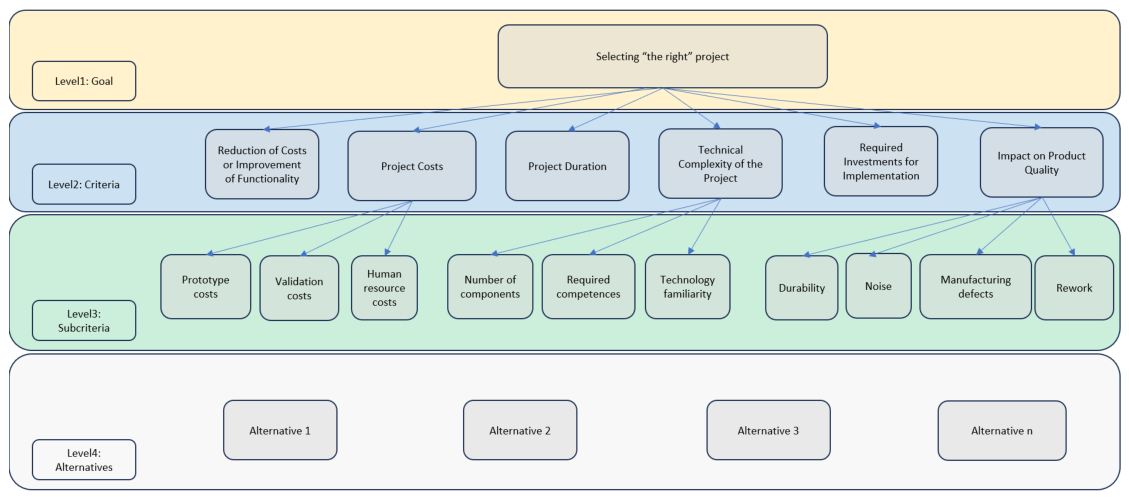
| Reduction in Costs or Improvement of Functionality | 33% | Reducing product manufacturing costs is one of the primary objectives of design engineering teams. It enables the enterprise to increase its competitiveness on the market and to achieve higher profits. The same criterion also incorporates aspects related to product functionality. Enhancing the capabilities of the designed technical system (e.g., higher assistance or improved resistance to environmental conditions) typically leads to increased production costs. To allow project comparison without mutual exclusion of these factors, they were combined into a single AHP category. | - | The evaluation scale for cost reduction is based on estimated differences in component pricing or manufacturing methods and ranges from 1 to 10, with each value linked to an estimated financial effect. The functionality-improvement criterion is also evaluated on a 1–10 scale, with scores assigned subjectively based on expert judgment. |
| Required Investments for Implementation | 18% | This criterion reflects the need for investments—such as acquiring new machinery—that may be required to implement outcomes of the development project. | - | Assessment is based on expert evaluation of necessary production process changes. A 1–10 scale is used, where one indicates extensive process modifications (e.g., replacing multiple machines), and 10 indicates no need for modifications. At this stage, precise cost estimation is often not feasible. |
| Project Duration | 4% | This criterion represents the estimated time required to complete the project. | - | A ten-point scale corresponding to durations between 6 and 36 months is applied. |
| Project Costs | 5% | This criterion is evaluated through the following sub-criteria: prototype component costs, validation costs, and human resource requirements. | Prototype cost | One indicates the need to build a complete, new technical system, while 10 indicates minimal changes to a small number of components. |
| Validation cost | Ten corresponds to low-cost validation at component level (often via simulations); one corresponds to full-system validation, such as life cycle or environmental durability testing. | |||
| Human resource cost | One indicates the need for many engineers with diverse competencies; 10 indicates a task achievable by a single specialist. | |||
| Technical Complexity of the Project | 8% | Technical complexity is also assessed using the following sub-criteria: number of affected components, required competences, and familiarity with applied technology. | Number of components | One indicates many components require redesign; 10 indicates changes to only one or a few components. |
| Required competence | Low scores indicate many unique competencies are needed; high scores represent universal engineering competencies. | |||
| Technology familiarity | Low scores reflect new or unfamiliar manufacturing technologies, while high scores correspond to well-established processes used within the company. | |||
| Impact on Product Quality | 33% | This criterion includes several aspects specific to the expectations of customers and manufacturers of electric power-assisted steering systems. The categories include impact on system durability, noise generation, defect rate in manufacturing, and reparability in case of defect occurrence. | Durability | One corresponds to significantly reduced durability relative to the baseline product; 10 corresponds to significantly increased fatigue resistance. |
| Noise | One indicates a substantial deterioration in noise level; 10 indicates a significant improvement. | |||
| Manufacturing defects | One reflects an increased defect rate; 10 reflects a significant reduction of nonconforming products. | |||
| Rework ability | One indicates no possibility for repair; 10 indicates easy repair or the elimination of defect occurrence. |
References
- Tlapa, D.; Franco-Alucano, I.; Limon-Romero, J.; Baez-Lopez, Y.; Tortorella, G. Lean, Six Sigma, and Simulation: Evidence from Healthcare Interventions. Sustainability 2022, 14, 16849. [Google Scholar] [CrossRef] [Scilit]
- Jou, Y.T.; Silitonga, R.M.; Lin, M.C.; Sukwadi, R.; Rivaldo, J. Application of Six Sigma Methodology in an Automotive Manufacturing Company: A Case Study. Sustainability 2022, 14, 14497. [Google Scholar] [CrossRef] [Scilit]
- Buestan, M.; Perez, C. Identification of Predictive Nursing Workload Factors: A Six Sigma Approach. Sustainability 2022, 14, 13169. [Google Scholar] [CrossRef] [Scilit]
- Ibrahim, A.; Kumar, G. Identification and Prioritization of Critical Success Factors of a Lean Six Sigma–Industry 4.0 Integrated Framework for Sustainable Manufacturing Using TOPSIS. Sustainability 2025, 17, 1331. [Google Scholar] [CrossRef] [Scilit]
- Nakielski, M. Critical Success Factors for Six Sigma Implementation—A Case Study from an Automotive Company Located in Poland. Decis. Mak. Manuf. Serv. 2025, 19, 21–39. [Google Scholar] [CrossRef] [Scilit]
- Eckes, G. The Six Sigma Revolution: How General Electric and Others Turned Process into Profits; Wiley: New York, NY, USA, 2002. [Google Scholar]
- Harry, M.; Schroeder, R. Six Sigma: The Breakthrough Management Strategy Revolutionizing the World’s Top Corporations; Crown Publishing: New York, NY, USA, 2006. [Google Scholar]
- Chakravorty, S. Six Sigma Programs: An Implementation Model. Int. J. Prod. Econ. 2009, 119, 1–16. [Google Scholar] [CrossRef] [Scilit]
- Pande, P.; Neuman, R.; Cavanagh, R. The Six Sigma Way: How GE, Motorola, and Other Top Companies Are Honing Their Performance; McGraw-Hill: New York, NY, USA, 2000. [Google Scholar]
- Tavana, M.; Soltanifar, M.; Santos-Arteaga, F.J. Analytical Hierarchy Process: Revolution and Evolution. Ann. Oper. Res. 2021, 326, 879–907. [Google Scholar] [CrossRef] [Scilit]
- Hahn, G.J.; Doganaksoy, N.; Hoerl, R. The Evolution of Six Sigma. Qual. Eng. 2000, 12, 317–326. [Google Scholar] [CrossRef] [Scilit]
- Marques, P.; Conceição, L.; Carvalho, A.M.; Reis, J. Driving Sustainable Operations: Aligning Lean Six Sigma Practices with Sustainability Goals. Sustainability 2025, 17, 8898. [Google Scholar] [CrossRef] [Scilit]
- Sujova, A.; Simanova, L.; Marcinekova, K. Sustainable Process Performance by Application of Six Sigma Concepts: The Research Study of Two Industrial Cases. Sustainability 2016, 8, 260. [Google Scholar] [CrossRef] [Scilit]
- Rodriguez Delgadillo, R.; Medini, K.; Wuest, T. A DMAIC Framework to Improve Quality and Sustainability in Additive Manufacturing—A Case Study. Sustainability 2022, 14, 581. [Google Scholar] [CrossRef] [Scilit]
- Zhang, W.; Hill, A.V.; Gilbreath, G.H. A Research Agenda for Six Sigma Research. Qual. Manag. J. 2011, 18, 39–53. [Google Scholar] [CrossRef] [Scilit]
- Francia, D.; Donnici, G.; Ricciardelli, G.M.; Santi, G.M. Design for Six Sigma (DFSS) Applied to a New E-Segment Sedan. Sustainability 2020, 12, 787. [Google Scholar] [CrossRef] [Scilit]
- Arcidiacono, G.; Risaliti, E.; Del Pero, F. Design for Six Sigma in the Product Development Process Under a Sustainability Point of View: A Real-Life Case Study. Sustainability 2024, 16, 10387. [Google Scholar] [CrossRef] [Scilit]
- George, M.L.; Maxey, J.; Rowlands, D.; Price, M. The Lean Six Sigma Pocket Toolbook; McGraw-Hill Education: New York, NY, USA, 2005. [Google Scholar]
- Desai, D.A.; Antony, J.; Patel, M.B. An Assessment of the Critical Success Factors for Six Sigma Implementation in Indian Industries. Int. J. Product. Perform. Manag. 2012, 61, 426–444. [Google Scholar] [CrossRef] [Scilit]
- Antony, J.; Kumar, M.; Madu, C.N. Six Sigma in Small and Medium-Sized UK Manufacturing Enterprises. Int. J. Qual. Reliab. Manag. 2005, 22, 860–874. [Google Scholar] [CrossRef] [Scilit]
- Sandholm, L.; Sorqvist, L. Twelve Requirements for Six Sigma Success. Six Sigma Forum Mag. 2002, 2, 17–24. [Google Scholar]
- Cheng, J.-L. Comparative Study of Local and Transnational Enterprises in Taiwan and Their Implementation of Six Sigma. Total Qual. Manag. Bus. Excell. 2007, 18, 793–806. [Google Scholar] [CrossRef] [Scilit]
- Chakraborty, A.; Leyer, M. Developing a Six Sigma Framework: Perspectives from Financial Service Companies. Int. J. Qual. Reliab. Manag. 2013, 30, 256–279. [Google Scholar] [CrossRef] [Scilit]
- Snee, R.D. Six Sigma: The Evolution of 100 Years of Business Improvement Methodology. Int. J. Six Sigma Compet. Advant. 2001, 1, 4–20. [Google Scholar] [CrossRef] [Scilit]
- Snee, R.D.; Rodebaugh, W.F. The Project Selection Process. Qual. Prog. 2002, 35, 78–87. [Google Scholar]
- Sharma, U.; Chetiya, A.R. Six Sigma Project Selection: A Critical Review. Int. J. Lean Six Sigma 2010, 1, 193–207. [Google Scholar] [CrossRef] [Scilit]
- Kumar, M.; Antony, J. Multiple Criteria Decision Making Techniques for Six Sigma Project Selection. Bus. Process Manag. J. 2009, 15, 838–855. [Google Scholar]
- Su, C.T.; Chou, C.J. A Systematic Methodology for the Creation of Six Sigma Projects: A Case Study of Semiconductor Foundry. Expert Syst. Appl. 2008, 34, 2693–2703. [Google Scholar] [CrossRef] [Scilit]
- Kumar, M.; Antony, J.; Douglas, A. Does Size Matter for Six Sigma Implementation? TQM J. 2009, 21, 623–635. [Google Scholar] [CrossRef] [Scilit]
- Büyüközkan, G.; Öztürkcan, D. An Integrated Analytic Approach for Six Sigma Project Selection. Expert Syst. Appl. 2010, 37, 5835–5847. [Google Scholar] [CrossRef] [Scilit]
- Yang, T.; Hsieh, C.H. Six Sigma Project Selection Using National Quality Award Criteria and Delphi Fuzzy MCDM Method. Expert Syst. Appl. 2009, 36, 7594–7603. [Google Scholar] [CrossRef] [Scilit]
- Yang, T.; Chou, P.; Cheng, H. A Fuzzy MCDM Method for Six Sigma Project Selection. Expert Syst. Appl. 2008, 35, 765–771. [Google Scholar]
- Wang, T.C.; Chang, T.H.; Cheng, S.Y. A Hybrid Fuzzy DEMATEL–ANP–VIKOR Method for Selecting Six Sigma Projects. Math. Probl. Eng. 2014, 2014, 969071. [Google Scholar]
- Altıntaş, K.; Dereli, T.; Baykasoglu, A. An Integrated Decision Support System for Six Sigma Project Selection. J. Manuf. Technol. Manag. 2016, 27, 693–718. [Google Scholar]
- Goodwin, P.; Wright, G. Decision Analysis for Management Judgment, 5th ed.; Wiley: Chichester, UK, 2014. [Google Scholar]
- Roy, B. Classement et Choix en Présence de Points de Vue Multiples (La Méthode ELECTRE). Rev. D’inform. Rech. Opér. 1968, 8, 57–75. [Google Scholar]
- Greco, S.; Ehrgott, M.; Figueira, J.R. Multiple Criteria Decision Analysis: State of the Art Surveys; Springer: New York, NY, USA, 2016. [Google Scholar]
- Alinezhad, A.; Khalili, J. New Methods and Applications in Multiple Attribute Decision Making (MADM); Springer: Cham, Switzerland, 2019. [Google Scholar]
- Greco, S.; Słowiński, R.; Wallenius, J. Fifty Years of Multiple Criteria Decision Analysis. Eur. J. Oper. Res. 2025, 323, 351–377. [Google Scholar] [CrossRef] [Scilit]
- Ishizaka, A.; Nemery, P. Multi-Criteria Decision Analysis: Methods and Software; Wiley: Chichester, UK, 2013. [Google Scholar]
- Trzaskalik, T. Wielokryterialne Wspomaganie Decyzji. Zesz. Nauk. Politech. Śląskiej 2014, 74, 239–263. [Google Scholar]
- Roy, B. The Outranking Approach and the Foundations of ELECTRE Methods. In Readings in Multiple Criteria Decision Aid; Springer: Berlin/Heidelberg, Germany, 1990; pp. 155–183. [Google Scholar]
- Figueira, J.R.; Mousseau, V.; Roy, B. ELECTRE Methods. In Multiple Criteria Decision Analysis; Springer: New York, NY, USA, 2016; pp. 155–185. [Google Scholar]
- Brans, J.-P. L’Ingénierie de la Décision: La Méthode PROMETHEE; Presses de l’Université Laval: Quebec City, QC, Canada, 1982. [Google Scholar]
- Brans, J.-P.; De Smet, Y. PROMETHEE Methods. In Multiple Criteria Decision Analysis; Springer: New York, NY, USA, 2016; pp. 187–219. [Google Scholar]
- Martel, J.-M.; Matarazzo, B. Other Outranking Approaches. In Multiple Criteria Decision Analysis; Springer: New York, NY, USA, 2016; pp. 221–282. [Google Scholar]
- Keeney, R.L.; Raiffa, H. Decisions with Multiple Objectives; Cambridge University Press: Cambridge, UK, 1975. [Google Scholar]
- Saaty, T.L. The Analytic Hierarchy Process; McGraw-Hill: New York, NY, USA, 1980. [Google Scholar]
- Saaty, T.L. The Analytic Network Process; RWS Publications: Pittsburgh, PA, USA, 1996. [Google Scholar]
- Lootsma, F.A. The REMBRANDT System for Multi-Criteria Decision Analysis; Technical Report; Delft University of Technology: Delft, The Netherlands, 1992. [Google Scholar]
- Bana e Costa, C.A.; Vansnick, J.-C. MACBETH—An Interactive Path Towards the Construction of Cardinal Value Functions. Int. Trans. Oper. Res. 1994, 1, 489–500. [Google Scholar] [CrossRef] [Scilit]
- Gershon, M.E. Model Choice in Multiobjective Decision Making. Ph.D. Thesis, University of Arizona, Tucson, AZ, USA, 1981. [Google Scholar]
- Tecle, A. Choice of a Multicriterion Decision Making Techniques for Watershed Management. Ph.D. Thesis, University of Arizona, Tucson, AZ, USA, 1988. [Google Scholar]
- Wątróbski, J.; Jankowski, J.; Ziemba, P.; Kaczmarczyk, A.; Zioło, M. Generalised Framework for Multi-Criteria Method Selection. Omega 2019, 86, 107–124. [Google Scholar] [CrossRef] [Scilit]
- Cinelli, M.; Kadziński, M.; Gonzalez, M.; Słowiński, R. How to Support the Application of MCDA. Omega 2020, 96, 102261. [Google Scholar] [CrossRef] [Scilit]
- Goutte, S.; Le, H.-V.; Liu, F.; von Mettenheim, H.-J. MCDA Strategies for Portfolio Optimization. Ann. Oper. Res. 2025, 353, 321–351. [Google Scholar] [CrossRef] [Scilit]
- Wątróbski, J.; Bączkiewicz, A.; Saabun, W. pyrepo-mcda—Reference Objects Based MCDA Software Package. SoftwareX 2022, 19, 101107. [Google Scholar] [CrossRef] [Scilit]
- Huang, H.; Burgherr, P. MCDA Calculator: A Streamlined Decision Support System. In Decision Support Systems XIV; Springer: Cham, Switzerland, 2024; pp. 31–45. [Google Scholar]
- Ginda, G. Metody Porównywania Parametrami; DWE: Wrocław, Poland, 2015. [Google Scholar]
- Kułakowski, K. Understanding the Analytic Hierarchy Process; CRC Press: Boca Raton, FL, USA, 2020. [Google Scholar]
- Burge, S. The Analytic Hierarchy Process Tool. Available online: https://www.burgehugheswalsh.co.uk (accessed on 8 February 2026).
- Teknomo, K. Analytic Hierarchy Process (AHP) Tutorial. Available online: https://people.revoledu.com (accessed on 8 February 2026).
- Veljić, A.; Viduka, D.; Ilić, L.; Karabasevic, D.; Šijan, A.; Papić, M. Sustainable Decision-Making in Higher Education. Sustainability 2025, 17, 10130. [Google Scholar] [CrossRef] [Scilit]
- Tu, J.; Wu, Z. Analytic Hierarchy Process Rank Reversals. Ann. Oper. Res. 2025, 346, 1785–1809. [Google Scholar] [CrossRef] [Scilit]
- Wallenius, J. Making Better Decisions; Springer: Cham, Switzerland, 2020. [Google Scholar]
- Fishburn, P.C. Independence in Utility Theory with Whole Product Sets. Oper. Res. 1965, 13, 28–45. [Google Scholar] [CrossRef] [Scilit]
- Hazelrigg, G.A. Continuous Improvement Processes: Why They Do Not Work and How to Fix Them. J. Mech. Des. 2007, 129, 138–139. [Google Scholar] [CrossRef] [Scilit]
- Wang, A.; Sun, L.; Liu, J. An Innovative TOPSIS–Mahalanobis Distance Approach to Comprehensive Spatial Prioritization Based on Multi-Dimensional Drought Indicators. Atmosphere 2024, 15, 1347. [Google Scholar] [CrossRef] [Scilit]
- Roszkowska, E.; Filipowicz-Chomko, M.; Łyczkowska-Hanćkowiak, A.; Majewska, E. Extended Hellwig’s Method Utilizing Entropy-Based Weights and Mahalanobis Distance: Applications in Evaluating Sustainable Development in the Education Area. Entropy 2024, 26, 197. [Google Scholar] [CrossRef] [Scilit] [PubMed]


| Investment | Cost Saving /Performance Improvement | Project Cost | Quality Impact | Technical Complexity | Time to Complete | Significance by Factor (%) | |
|---|---|---|---|---|---|---|---|
| Investment | 1 | 1/3 | 5 | 1/4 | 5 | 7 | 18% |
| 0.12 | 0.12 | 0.26 | 0.09 | 0.28 | 0.23 | ||
| Cost saving/performance improvement | 3 | 1 | 6 | 1 | 6 | 8 | 33% |
| 0.35 | 0.36 | 0.31 | 0.36 | 0.34 | 0.27 | ||
| Project cost | 1/5 | 1/6 | 1 | 1/5 | 1/2 | 2.00 | 5% |
| 0.02 | 0.06 | 0.05 | 0.07 | 0.03 | 0.07 | ||
| Quality impact | 4 | 1 | 5 | 1 | 5 | 8 | 33% |
| 0.47 | 0.36 | 0.26 | 0.36 | 0.28 | 0.27 | ||
| Technical complexity | 1/5 | 1/6 | 2 | 1/5 | 1 | 4 | 7% |
| 0.02 | 0.06 | 0.10 | 0.07 | 0.06 | 0.13 | ||
| Time to complete | 1/7 | 1/8 | 1/2 | 1/8 | 1/4 | 1 | 3% |
| 0.02 | 0.04 | 0.03 | 0.05 | 0.01 | 0.03 | ||
| Total | 8.54 | 2.79 | 19.50 | 2.78 | 17.75 | 30.00 | 100% |
| Criteria | Sub-Criteria | Weight | Project Idea 1 | Project Idea 2 | Project Idea 3 | Project Idea 4 | Project Idea 5 | Project Idea 6 | Project Idea 7 | Project Idea 8 | Project Idea 9 | Project Idea 10 | Project Idea 11 | Project Idea 12 |
|---|---|---|---|---|---|---|---|---|---|---|---|---|---|---|
| Cost saving/performance improvement | 0.33 | 3 | 10 | 3 | 10 | 1 | 1 | 10 | 4 | 1 | 1 | 10 | 3 | |
| Investment | 0.18 | 8 | 10 | 10 | 10 | 10 | 10 | 10 | 8 | 10 | 10 | 5 | 8 | |
| Time to complete | 0.03 | 5 | 5 | 10 | 10 | 5 | 10 | 5 | 8 | 7 | 5 | 5 | 7 | |
| Project cost | Proto cost | 0.05/3 | 7 | 1 | 10 | 10 | 5 | 8 | 1 | 7 | 9 | 5 | 5 | 8 |
| Validation cost | 0.05/3 | 3 | 1 | 5 | 10 | 7 | 8 | 1 | 7 | 10 | 8 | 1 | 2 | |
| People cost | 0.05/3 | 7 | 5 | 7 | 8 | 8 | 8 | 5 | 8 | 9 | 8 | 7 | 5 | |
| Technical complexity | Number of components | 0.07/3 | 7 | 1 | 10 | 5 | 9 | 9 | 1 | 7 | 9 | 8 | 5 | 7 |
| Required competence | 0.07/3 | 7 | 5 | 7 | 10 | 8 | 9 | 5 | 8 | 9 | 8 | 7 | 5 | |
| Technology familiarity | 0.07/3 | 7 | 8 | 10 | 10 | 8 | 9 | 8 | 9 | 10 | 10 | 8 | 7 | |
| Quality impact | Durability | 0.33/4 | 5 | 5 | 5 | 7 | 5 | 5 | 5 | 7 | 5 | 5 | 10 | 5 |
| Noise | 0.33/4 | 5 | 5 | 5 | 7 | 5 | 5 | 5 | 7 | 5 | 5 | 10 | 5 | |
| Manufacturing defects | 0.33/4 | 8 | 5 | 5 | 6 | 7 | 5 | 5 | 7 | 10 | 5 | 8 | 6 | |
| Rework ability | 0.33/4 | 1 | 5 | 10 | 5 | 5 | 5 | 5 | 7 | 10 | 5 | 5 | 7 | |
| Result | 4.99 | 7.41 | 6.23 | 8.60 | 5.09 | 5.19 | 7.41 | 6.31 | 6.02 | 4.97 | 7.82 | 5.30 | ||
| Rank result | 11 | 3.5 | 6 | 1 | 10 | 9 | 3.5 | 5 | 7 | 12 | 2 | 8 | ||
Disclaimer/Publisher’s Note: The statements, opinions and data contained in all publications are solely those of the individual author(s) and contributor(s) and not of MDPI and/or the editor(s). MDPI and/or the editor(s) disclaim responsibility for any injury to people or property resulting from any ideas, methods, instructions or products referred to in the content. |
© 2026 by the authors. Licensee MDPI, Basel, Switzerland. This article is an open access article distributed under the terms and conditions of the Creative Commons Attribution (CC BY) license.
Share and Cite
Nakielski, M.; Ginda, G. AHP in Design for Six Sigma Project Selection. Sustainability 2026, 18, 5258. https://doi.org/10.3390/su18115258
Nakielski M, Ginda G. AHP in Design for Six Sigma Project Selection. Sustainability. 2026; 18(11):5258. https://doi.org/10.3390/su18115258
Chicago/Turabian StyleNakielski, Marcin, and Grzegorz Ginda. 2026. "AHP in Design for Six Sigma Project Selection" Sustainability 18, no. 11: 5258. https://doi.org/10.3390/su18115258
APA StyleNakielski, M., & Ginda, G. (2026). AHP in Design for Six Sigma Project Selection. Sustainability, 18(11), 5258. https://doi.org/10.3390/su18115258