Article

Selective Openness as a Sustainable Strategy: How Culinary MSMEs Organize Collaboration Across the Value Chain in an Emerging Economy


School of Business and Management, Institut Teknologi Bandung, Bandung 40132, Indonesia
*
Authors to whom correspondence should be addressed.
Sustainability 2026, 18(5), 2572; https://doi.org/10.3390/su18052572
Submission received: 15 January 2026 / Revised: 12 February 2026 / Accepted: 16 February 2026 / Published: 6 March 2026

Abstract

Culinary micro-, small-, and medium-sized enterprises (MSMEs) play a critical role in socio-economic sustainability, yet operate under heightened risks related to product quality, food safety, and business reputation. Although research on collaboration and co-creation often portrays openness as a desirable organizational orientation, limited attention has been paid to how MSMEs strategically regulate openness across their value-chain activities. This study explores how culinary MSMEs organize collaboration and negotiate boundaries between openness and closure. Using a qualitative multi-case approach, the findings show that openness is not uniformly applied but governed by a logic of selective openness shaped by risk exposure, accountability demands, and organizational capacity constraints. Core production activities function as protected zones characterized by strong closure, whereas market-facing functions allow more curated forms of external involvement. By reframing openness as a risk-based governance practice rather than a default collaboration strategy, this study provides a process-level explanation of how MSMEs sustain collaboration without compromising quality control, accountability, and organizational viability. The findings contribute to theorizing boundary governance in small enterprises and offer practical insights for designing collaborative strategies under conditions of risk and constraint.

1. Introduction

Micro-, small-, and medium-sized enterprises (MSMEs) play a central role in sustaining livelihoods in developing economies, functioning not only as sources of income and employment but also as mechanisms of household economic resilience [1,2]. Their contribution to sustainability extends beyond economic output to include poverty alleviation, empowerment, and the adaptive use of family and local resources, particularly through home-based and family-operated enterprises [2,3]. In Indonesia, culinary MSMEs exemplify this dynamic, in which household participation—often involving women—strengthens income and livelihood stability under conditions of uncertainty [1,3].
Among MSME sectors, culinary businesses occupy a structurally important yet vulnerable position. Their embeddedness in everyday consumption sustains local livelihoods and makes the sector widely accessible [4]. However, low barriers to entry also intensify competition and rapid imitation, making product- or price-based differentiation difficult to sustain over time [5,6].
The literature shows that an exclusive focus on products and prices tends to yield only short-term advantages, whereas business sustainability requires the development of non-productive capabilities such as marketing, networking, and relationship management with external actors [6]. For MSMEs with limited resources, developing these capabilities individually is often not feasible and instead requires support from collaborative networks that provide access to complementary resources, knowledge, and channels [7]. However, collaboration does not automatically generate value and may introduce risks of coordination failure, capability mismatches, and reputational burdens if not carefully governed [8]. This makes the governance of openness—deciding what to share, with whom, and under what constraints—a critical challenge for MSMEs seeking collaboration without exposing core processes to risk [9].
Studies of food MSMEs show that collaboration directly shapes multiple value-chain activities, from sourcing and production to marketing and consumer interaction [6]. However, existing research typically treats co-creation as a fragmented activity—often confined to marketing or branding—without examining how collaboration and openness are systematically governed across value-chain activities [10].
As a result, there is a lack of process-level understanding of how MSMEs calibrate openness differently across sourcing, production, marketing, and service activities under sustainability circumstances. To address this gap, a value-chain perspective provides an analytical lens for examining how MSMEs combine internal and collaborative activities to sustain business viability [5,11]. In culinary MSMEs, managing selective openness along the value chain becomes essential for balancing learning opportunities with the protection of quality, operational stability, and reputational integrity [6].
Building on this gap, this study examines how culinary MSMEs organize collaboration and regulate openness across their value chains by advancing selective openness as a value-chain-embedded governance logic. The analysis focuses on three interrelated dimensions: (1) how collaboration is structured across value-chain activities, (2) how actors negotiate boundaries between openness and closure in everyday practice, and (3) the conditions under which collaboration evolves into co-creation or is deliberately limited to sustain long-term socio-economic viability [7,8]. In this study, sustainability is understood not merely as growth or survival, but as the capacity to maintain business longevity, consistent process quality, and accountable collaboration.
Selective openness refers to how MSMEs deliberately organize collaboration boundaries across value-chain activities by determining which domains to open, to whom, and under what governance conditions, based on risk exposure, quality-control needs, and organizational capacity constraints. While prior studies have examined collaboration, co-creation, and openness in MSMEs, they often treat openness as a general organizational orientation or confine co-creation to isolated domains such as marketing and branding. Consequently, limited attention has been paid to how MSMEs systematically differentiate openness and closure across value-chain activities as governance responses to risk exposure and accountability requirements.
By applying a value-chain lens, this study advances a process-level explanation of how boundary permeability is calibrated across interdependent activities to balance learning opportunities with the protection of core processes. Rather than viewing collaboration as uniformly beneficial, the study highlights how MSMEs regulate openness across sourcing, production, marketing, and service domains to sustain long-term socio-economic viability through strategically governed collaboration.
Accordingly, this study addresses three research questions: (1) How do culinary MSMEs manage collaboration and openness along their business value chain? (2) How do culinary MSME actors define and negotiate the boundaries between openness and closure in collaborative practices? (3) Under what conditions does the practice of collaboration translate into co-creation, and when is openness limited or rejected to maintain business sustainability?

1.1. Culinary MSMEs as the Foundation of Socio-Economic Sustainability

MSMEs, particularly in the culinary sector, form a critical foundation of household economies in many developing countries, including Indonesia, by providing livelihoods to families reliant on small-scale, home-based enterprises [12,13]. Development research indicates that these enterprises contribute to poverty reduction and household economic resilience, particularly in contexts where access to formal employment is limited [14]. In Indonesia, the culinary sector is the largest subsector of the creative economy in terms of value added and employment, dominated by family- and community-based microbusinesses [15]. This positions Culinary MSMEs not only as economic actors but also as locally embedded enterprises that directly shape household welfare and community-level economic stability [16,17].
From a sustainability perspective, culinary MSMEs contribute primarily to the social and economic pillars of sustainable development by generating employment, reducing household vulnerability, and maintaining community-based food provision systems [18]. However, these enterprises operate under structurally fragile conditions. The large number of actors and low barriers to entry make the sector highly competitive, vulnerable to rapid imitation, and subject to margin pressures and demand volatility [5,6]. Under such conditions, the sustainability of culinary MSMEs cannot be explained solely by cost efficiency or product excellence, but increasingly depends on how firms manage relationships, networks, and collaborations within their local business ecosystems [19,20].

1.2. Value Chain as a Relational Arena in Culinary MSMEs

The value chain concept traditionally views value creation as a sequence of coordinated internal activities, from raw material procurement to product delivery [5]. While this perspective clarifies the structural organization of business processes, MSME research shows that linear value-chain models often fail to capture the realities of small firms embedded in dense local social and economic networks [21,22]. In culinary MSMEs, key value-chain activities—including sourcing, distribution, and marketing—are frequently conducted through informal, trust-based relationships with local suppliers, point-of-sale partners, communities, and customers [19,23]. Coordination, therefore, relies not only on internal control but also on relational mechanisms such as trust, reciprocity, and shared learning.
To address these limitations, contemporary literature extends the value chain perspective through the concept of value configurations, particularly value networks, which emphasize interaction among actors as a central source of value creation [21]. In the culinary sectors, value creation often takes hybrid forms: production activities tend to follow linear chain logic, whereas marketing, distribution, and consumption-related processes depend more heavily on collaborative and network-based arrangements [17,24]. This hybrid structure implies that different stages of the value chain involve varying degrees of interdependence, uncertainty, and exposure to external influence. Consequently, economic and social value in culinary MSMEs emerges not from isolated firm activities, but from patterned relationships that connect firms to local ecosystems and shape their adaptive capacity under volatility [25,26].
Within this relational value chain, regulating openness and closure becomes a central governance challenge. Since value-chain stages differ in their risk profiles, quality sensitivities, and dependence on external actors, MSMEs cannot adopt a uniform approach to collaboration. Instead, they must selectively manage which activities are opened to external participation and which remain tightly controlled.
Selective openness thus functions as a value-chain-embedded governance mechanism that enables MSMEs to access external resources and learning opportunities where risks are manageable, while protecting core production processes critical to quality assurance and reputation. Through this differentiated boundary management, MSMEs support business continuity, safeguard local livelihoods, and contribute to community resilience.

1.3. Co-Creation as an Adaptive Mechanism in MSMEs

Co-creation is commonly understood as a value-creation process that emerges through active interaction between internal business actors and external stakeholders, in which value is not produced unilaterally by the firm [27]. This view is reinforced by Service-Dominant Logic, which posits that resource integration and interaction are central mechanisms of value formation [28,29]. For limited resource MSMEs, co-creation has been described as an adaptive response to market uncertainty, capability limitations, and environmental volatility, as it provides access to external knowledge, complementary skills, and social legitimacy [7,9].
In the culinary sector, co-creation takes various forms, including menu collaborations, co-production arrangements, shared point-of-sale initiatives, community engagement programs, and joint promotional activities [6,10]. These practices enable risk-sharing, experimentation, and symbolic differentiation that would be difficult for small firms to achieve independently. Importantly, co-creation in this context is not confined to customer interactions but extends across multiple stages of the value chain, including sourcing, production, distribution, and consumption.
However, the literature increasingly emphasizes that co-creation is not inherently beneficial. Collaborative value-creation processes can also generate coordination conflicts, reputational exposure, quality-control challenges, and even value co-destruction when roles, responsibilities, and decision authority are not clearly governed [30,31]. These findings challenge the normative assumption that greater openness or deeper collaboration necessarily leads to positive outcomes.
Taken together, this body of research suggests that the central issue for MSMEs is not whether to engage in collaboration, but how to regulate the depth, location, and conditions of co-creation across different business activities. In high-risk, quality-sensitive sectors such as food, where mistakes directly affect consumer trust and safety, co-creation therefore becomes a governance question as much as an innovation strategy. This shifts analytical attention from collaboration as a uniformly desirable practice toward the need for differentiated boundary management across the value chain.

1.4. From Collaboration to Selective Openness

The literature on collaboration and open innovation often treats the involvement of external actors as synonymous with co-creation, implicitly assuming that participation itself leads to positive value outcomes [32]. However, studies on organizations and MSMEs increasingly demonstrate that collaboration and co-creation are not identical processes; rather, they are contingent, negotiated, and shaped by situational constraints [33,34]. In practice, particularly in culinary MSMEs, openness entails tangible costs and risks related to product quality, food safety, and business reputation. As a result, firms do not simply “open up,” but actively regulate which activities can be exposed to external involvement and which must remain internally controlled [9].
Addressing these concerns, the literature shifts away from viewing openness as a binary state toward understanding it as a partial and context-dependent practice. The extent and form of openness vary according to the type of activity, the characteristics of external actors, and the organization’s capacity to manage risks and uncertainties [34,35]. While this perspective acknowledges variation, it often stops short of explaining how such variation is systematically organized across different business functions.
This study conceptualizes these differentiated boundary decisions as selective openness: a governance logic through which MSMEs deliberately vary the permeability of organizational boundaries across value-chain activities. From this perspective, openness is not a general orientation toward collaboration but a structured, risk-sensitive practice that enables firms to balance knowledge and resource access with the protection of core processes and long-term sustainability [6]. This framing redirects analytical attention from whether MSMEs collaborate to how, where, and under what conditions collaboration is permitted to evolve into deeper forms of co-creation.

1.5. Literature Gap and Research Position

Although the literature on co-creation, open innovation, and MSME collaboration has developed rapidly, most studies still conceptualize co-creation in a fragmented manner, focusing primarily on marketing, branding, and consumer interaction [10]. This approach overlooks how collaboration and openness are negotiated differently across stages of the value chain. In addition, empirical research remains limited in mapping how culinary MSMEs manage the boundary between openness and closure as a sustainable strategy rather than merely as an innovation option [36]. Prior studies on resource-constrained MSMEs and industry clusters have largely emphasized normative or facilitative co-creation frameworks [37], thereby providing limited explanation of how individual MSMEs exercise discretion and set boundaries in everyday practices.
Taken together, these limitations reveal a key gap: the absence of a value-chain-based governance explanation of how MSMEs systematically differentiate openness and closure across business activities and how these boundary decisions relate to long-term sustainability. Addressing this gap, this study introduces selective openness as a governance logic in which MSMEs deliberately vary the extent of external involvement based on risk perception, quality-control needs, and organizational capacity constraints.
While grounded in empirical evidence from culinary MSMEs, selective openness is proposed here not merely as a context-specific description but as a conceptual lens for understanding how resource-constrained firms balance collaboration and protection. Using the value chain as an analytical framework, this study examines how culinary MSMEs selectively organize collaboration across business activities and how this differentiated governance contributes to economic and social sustainability.

1.6. Conceptual Positioning of Selective Openness

Existing research on openness, co-creation, and inter-organizational collaboration has shown how firms access external knowledge and resources, but often treats openness as a normatively beneficial organizational orientation associated with innovation, learning, and network embeddedness. In these accounts, variation in openness is typically framed as a matter of degree (more versus less openness), rather than as a qualitatively distinct governance choice that varies across domains of activity.
In parallel, research on boundary control and governance has emphasized the protection of core knowledge and the management of interdependence. However, these discussions have largely focused on large firms, technology-intensive sectors, or formalized interfirm arrangements. Consequently, limited attention has been paid to how resource-constrained MSMEs—particularly in high-risk consumption sectors such as food—organize openness and closure as part of everyday operational governance.
This study addresses these gaps by introducing selective openness as a value-chain-embedded governance logic relevant to sustainability in risk-sensitive MSME contexts. Rather than conceptualizing openness as a stable firm-level orientation, this research examines how MSMEs deliberately differentiate openness and closure across specific activities, actors, and interaction modes in response to varying levels of operational risk, quality-control demands, and organizational capacity constraints.
To clarify both the theoretical repositioning and the use of key concepts in this study, Table 1 summarizes how central terms are reframed relative to prior literature and how they are defined analytically within this research.
In this study, key terms are interpreted in line with the analytical distinctions summarized in Table 1, which frame how collaboration, openness, co-creation, and governance are understood throughout the analysis.
Taken together, this conceptual positioning frames selective openness as a value-chain-embedded governance logic that explains how MSMEs organize collaboration under conditions of risk exposure, quality accountability, and capacity constraint. The following section outlines the research design used to examine how this governance logic operates in practice.

2. Materials and Methods

2.1. Research Design and Approach

This study adopts an interpretive qualitative approach with a multi-case design to examine how culinary MSMEs manage collaboration, openness, and closure across their value chains. An interpretive approach is appropriate because the study seeks to understand how business actors make sense of, justify, and negotiate the boundaries of external involvement in everyday organizational practices—processes that are embedded in social, material, and normative contexts rather than reducible to measurable variables [38].
The study does not aim for statistical generalization, but for analytical generalization through cross-case comparison. A multi-case design with replication logic is therefore employed to identify recurring patterns, governance mechanisms, and meaningful variations in how openness and collaboration are organized across cases [38,39,40]. The unit of analysis is not the firm as a whole, but rather the set of organizational practices through which MSMEs regulate external involvement across different value-chain stages. This practice-oriented unit of analysis aligns with the study’s aim to explain how governance logics of openness emerge through situated organizational actions rather than through formal structures alone.
Conceptually, the study does not assume that collaboration automatically results in co-creation. Collaboration is defined as the involvement of external actors in organizational activities, whereas co-creation refers to a deeper value-formation process arising from resource integration and stakeholder interaction. Co-creation is therefore treated as an empirical outcome rather than an a priori condition, allowing the analysis to investigate when and how collaboration evolves into co-creation, or remains limited, depending on how actors govern roles, risks, and boundary control in practice [28,33].

2.2. Case Selection

Case selection followed an iterative and theoretically informed process rather than a one-time sampling decision. An initial exploratory phase involved site visits, informal conversations, participation in MSME events, and monitoring of digital platforms to identify culinary MSMEs exhibiting signs of collaboration and external interactions across value-chain activities.
From this pool, cases were refined through purposive and theoretical sampling. In line with OECD classifications, the study focuses on leading or frontier MSMEs—firms characterized by adaptive capacity, innovative orientation, and relative resilience in their local ecosystems [41,42]. These were selected as information-rich cases in which collaboration is more likely to be embedded in organizational routines and governance practices, making them analytically suitable for examining how openness is selectively structured across business activities.
Eight culinary MSMEs in West Java were selected as embedded cases, consistent with methodological guidance recommending four to ten cases for cross-case theory development [39,40]. Case selection continued until conceptual sufficiency was reached, meaning additional cases no longer yielded substantively new patterns in the governance of openness. This focus on more developed MSMEs is consistent with organizational growth theory, which suggests that firms at later developmental stages are more likely to formalize coordination and engage in structured collaboration as organizational complexity increases [43].
Selection was guided by three inclusion criteria: (1) operational maturity (minimum three years of operation or clear scale-up trajectory), (2) documented collaboration experience relevant to value-chain activities (e.g., consignment, co-production, co-branding, community initiatives), and (3) diversity of business models and organizational forms (e.g., bakery, café, restaurant, experiential venture, shared kitchen) to capture variation in openness practices.
This strategy aims at analytical transferability rather than statistical representation. Findings are therefore most applicable to MSMEs at comparable developmental stages where structured collaboration is feasible and strategically relevant [38,39]. Detailed firm profiles are provided in Appendix A, Table A1.

2.3. Participants and Data Sources

Key data were collected through semi-structured, in-depth interviews with MSME core owners or managers—actors holding strategic and operational decision-making authority regarding collaboration and openness practices. These individuals were selected because they directly shape boundary decisions, partnership arrangements, and quality-control mechanisms across value-chain activities. Interviews were conducted face-to-face between July and December 2025, lasted approximately 60–120 min, were audio-recorded with participants’ consent, and transcribed verbatim.
To strengthen construct validity and contextual depth, interviews were complemented with multiple secondary and observational data sources. These included collaboration-related promotional materials, product catalogs, consignment documentation, social media content, informal cooperation rules, and media coverage. In addition, brief, focused observations of production flows, service interactions, collaborative product displays, and community engagement activities were recorded in field notes to capture embodied practices and tacit routines that participants might not explicitly articulate in interviews [38,44].
Data collection followed a principle of conceptual sufficiency rather than numerical saturation. Data were considered adequate when recurring patterns in the governance mechanisms, rationales, and consequences of selective openness practices emerged consistently across cases, and additional data no longer generated substantively new theoretical variation [38,39]. This approach ensured that the analysis captured the diversity of boundary-management practices while maintaining cross-case comparability.

2.4. Data Collection Procedures

Semi-structured interviews were used as the primary data collection method because they allow comparable thematic exploration across cases while providing sufficient flexibility to probe context-specific practices and meanings emerging from participants’ narratives [38]. The interview guide was structured using Porter’s value chain framework as a scope-orientation device to ensure systematic coverage of key primary activities (inbound logistics, operations, outbound logistics, marketing and sales, and service) as well as supporting activities [5].
The value chain framework was not used as a rigid template, but as an activity-based analytical lens. It enabled the study to examine how collaboration and openness are selectively organized across different stages of value creation, a central objective of the research. Since the study investigates how MSMEs regulate external involvement across specific operational domains, an activity-focused structure provides a clearer basis for comparison than firm-level or network-level approaches.
In contrast, relational or network-based perspectives primarily emphasize patterns of ties among actors. While valuable for understanding network governance or inter-organizational structures, such approaches are less suited to examining how openness is variably enabled, restricted, and governed within specific value-creating activities. Since this study seeks to understand where and under what conditions collaboration is permitted or constrained along the value chain, an activity-oriented framework aligns more closely with the research questions.
During interviews, once external actor involvement was identified at a particular value chain stage, follow-up probes explored: (1) the type and depth of access granted, (2) the roles and contributions of external actors, (3) the rationale for opening or restricting involvement, (4) the risks considered (e.g., quality control, reputation, coordination burden, and moral hazard), and (5) the perceived implications for business sustainability. This structured yet flexible approach ensured that data collection captured both cross-case comparability and context-specific variation in how MSMEs govern openness across their value-creating processes.

2.5. Data Analysis: Thematic Coding and Abstraction Process

Data analysis followed an abductive logic, involving iterative movement between empirical materials, sensitizing concepts, and relevant literature to develop conceptual explanations through continuous alignment between data and theory rather than through the mechanical application of predefined coding templates [45,46]. In this process, the value chain framework functioned as a sensitizing device to ensure that all stages of activity were considered, while analytical categories were developed inductively from the data rather than imposed a priori [5,44].
All interview transcripts and field materials were managed in NVivo 15 to facilitate systematic data organization and cross-case comparison. Coding, interpretation, and abstraction remained researcher-driven and theory-informed. The analysis unfolded through a progressive movement from descriptive coding to higher-level conceptual abstraction.
The process began with open coding, which generated a wide range of descriptive codes reflecting participants’ accounts of collaboration practices, boundary decisions, risk considerations, and operational constraints. These codes were continuously compared within and across cases to identify similarities, contrasts, and recurring patterns.
Conceptually related codes were then grouped into first-order themes that remained closely grounded in empirical descriptions. At this stage, the focus was on preserving participants’ meanings and articulations of their practices, rationales, and constraints. Through iterative cross-case comparison, these first-order themes were progressively abstracted into second-order themes representing broader organizational logics through which culinary MSMEs govern openness and closure across value-chain activities.
A transition from first-order themes to second-order themes occurred when three conditions were met: (1) multiple first-order themes reflected a shared underlying organizational logic (conceptual coherence), (2) the pattern recurred across more than one case rather than being confined to a single firm (cross-case recurrence), and (3) the pattern could be meaningfully interpreted using relevant theoretical constructs rather than remaining purely descriptive. Provisional second-order themes were repeatedly compared against other data segments and across cases, allowing refinement, merging, or separation when necessary.
To enhance interpretive credibility, interim coding structures were periodically reviewed through peer debriefing with two co-authors to prevent premature closure of categories and ensure interpretive consistency. In addition, follow-up clarification questions were directed to selected participants when collaboration failures or boundary decisions required deeper contextual understanding.
Conceptual sufficiency was considered achieved when further re-examination of the data no longer generated substantively new second-order themes but instead elaborated or clarified the properties of those already identified. At this stage, the analysis shifted from theme generation to the examination of how each governance logic manifested across cases and value-chain activities.
Throughout the analysis, analytical memos were maintained to document interpretive decisions, conceptual tensions, and developments in cross-case understanding. Importantly, practices of refusing collaboration, restricting access, controlling participation, and other forms of closure were treated as analytically meaningful data rather than as absences of collaboration. Ambiguities were addressed through repeated cross-case comparison and by returning to original interview excerpts to interpret practices within their specific organizational contexts while preserving analytically meaningful differences. Where empirical practices could relate to more than one governance logic, each zero-order code was positioned under the second-order theme that best reflected its dominant functional role in context.
The coding process aimed not at procedural completeness but at identifying patterned governance logics through which MSMEs organize collaboration boundaries across value-chain activities. The resulting coding structure—from zero-order codes to first-order themes and second-order governance logics—is summarized in Table 2, which presents the hierarchical relationship between empirical observations and their conceptual aggregation.

2.6. Credibility, Validity, and Research Ethics

To enhance the credibility and trustworthiness of the findings, this study employed data source triangulation, comparing interview data with documents, digital footprints, and targeted observations, thereby reducing reliance on any single source of evidence [38,44]. An evidence chain was maintained by compiling a structured case database containing transcripts, coding outputs, analytical memos, cross-case matrices, and supporting materials, thereby making the analytical process traceable from raw data to final interpretations [38].
Interpretive rigor was further supported through peer debriefing, in which preliminary coding structures and cross-case theme summaries were discussed with two co-authors to assess conceptual consistency and to challenge potential researcher bias. In addition, limited member checking was conducted by sharing summarized case narratives with selected participants to verify factual accuracy and contextual interpretation, rather than to seek evaluative agreement with theoretical conclusions [38,44].
This research was conducted in accordance with established ethical principles for qualitative research. All participants received an explanation of the research purpose, procedures, and data use prior to participation, and provided informed consent for interviews and audio recording. Business names and participant identities are anonymized to protect confidentiality and commercial sensitivity. Participants were informed of their right to decline questions or withdraw from the study at any time without consequence.
Triangulation and member checking were used not as post hoc validation tools, but as part of an iterative interpretive process that supported the refinement, clarification, and contextual grounding of emerging explanations. For example, in one case, an owner initially attributed the termination of a supplier partnership to “unstable market demand.” However, follow-up clarification and cross-checking against operational records indicated that the underlying issue was internal production capacity constraints rather than demand fluctuations. This prompted a refinement of our interpretation from “external market instability” to “capacity-based boundary tightening,” illustrating how triangulation and member checking informed the revision of initial interpretations and strengthened the credibility of the thematic analysis.

3. Results

3.1. Results Overview and Analytical Map

This section provides an analytical overview to orient readers to the overall pattern of findings before moving into detailed discussions of individual themes. The results indicate that openness in culinary MSMEs is not uniformly applied across value chain activities. Instead, openness is selectively organized according to actor type, assigned roles, and position along the value chain.
To structure the presentation of findings, the Results are organized into five second-order themes that capture the recurring governance logics through which MSMEs manage openness and closure across activities. These logics indicate that openness is shaped by food safety and quality risks, reputational exposure, economic rationality, and constraints on organizational capacity. Rather than representing a stable or normative condition, openness emerges as a contextually calibrated and reversible practice.
Across cases, this interaction produces a differentiated pattern of openness along the value chain. Core production and operational activities are typically governed by protective, tightly controlled boundaries, reflecting the high risks to product integrity. In contrast, marketing and service-related functions exhibit relatively greater, yet strategically curated, forms of openness, in which external involvement is used to enhance visibility, customer engagement, and market reach. Sourcing and distribution occupy intermediate positions, where collaboration is possible but constrained by trust, governance capacity, and operational safeguards.
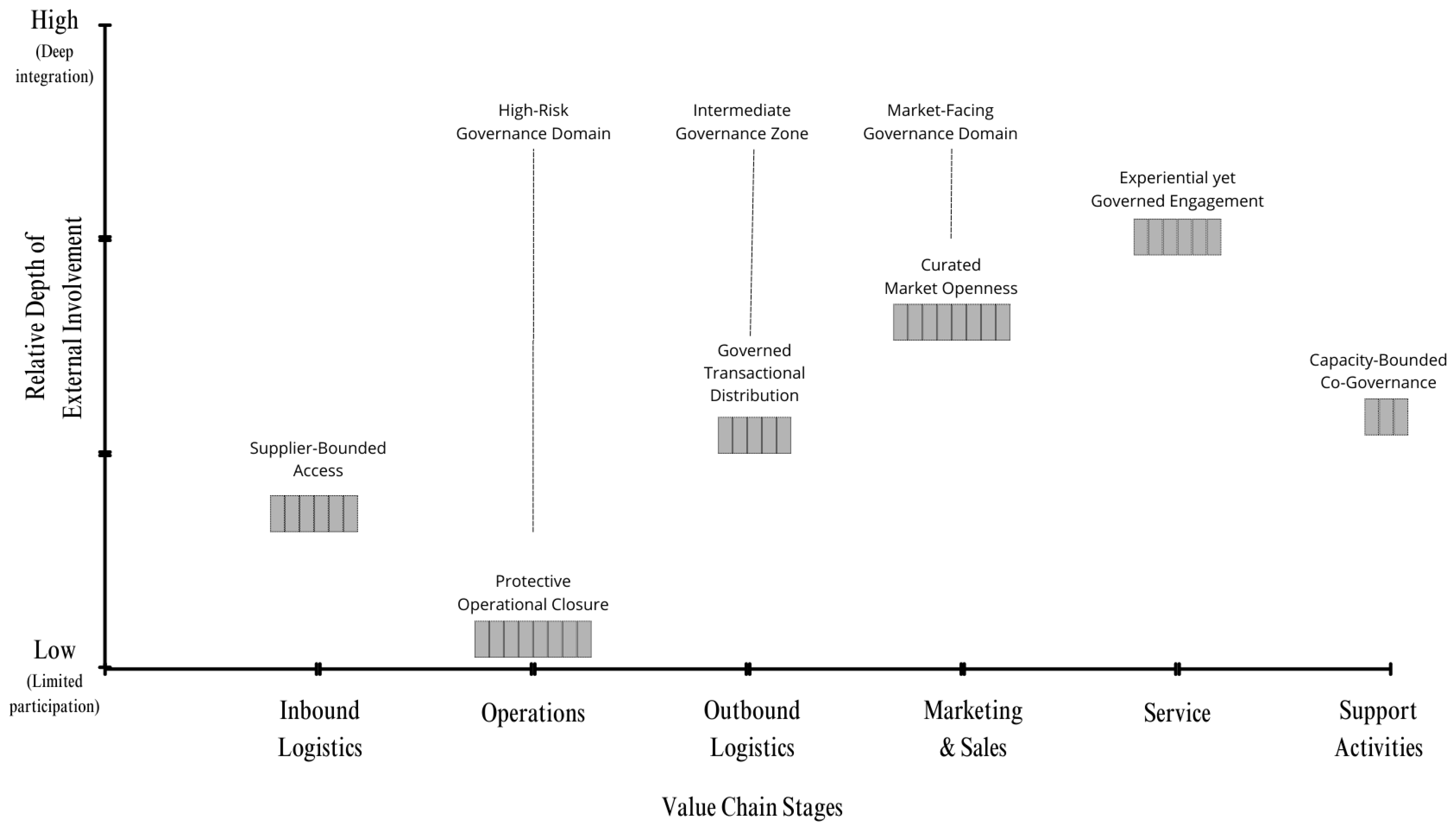
Rather than merely depicting where collaboration occurs, the following figure provides an analytical representation of how the governance logics identified in this study are spatially differentiated across value-chain activities. It illustrates how variations in risk exposure, accountability demands, and organizational capacity shape the depth and mode of openness at each stage of value creation.
In this study, openness refers to the extent to which external actors are allowed to participate in, influence, or contribute to a specific value-chain activity. It encompasses variations in role involvement, decision-making influence, and the degree of integration into value-creation processes. Conversely, closure denotes domains in which external participation is restricted, tightly regulated, or excluded to protect product integrity, safety, accountability, or operational stability. The relative “depth” of openness shown in Figure 1 is derived from coding indicators of external role authority, decision-making influence, and process integration, as summarized in Appendix A (Table A2). In line with the conceptual distinctions outlined earlier (Table 1), collaboration here refers to the involvement of external actors in MSME activities, openness, the degree of boundary permeability governing that involvement, and co-creation, the latter denoting deeper forms of external influence on value formation within MSME decision authority.
Figure 1 synthesizes cross-case patterns in the distribution of selective openness across value-chain stages. It shows how MSMEs differentiate the depth and mode of external involvement in response to governance, risk, and capacity considerations. Appendix A (Table A4) complements this model by providing a cross-case matrix linking value-chain stages, actor types, and modes of openness, making explicit how different actors are involved under distinct governance conditions.
Figure 1 highlights that variation in openness reflects differences in accountability demands, risk exposure, and governance capacity across value-chain stages. Production and core operations remain comparatively closed because quality and food-safety responsibilities are concentrated internally, whereas market-facing functions exhibit more open—but strategically curated—forms of external involvement aimed at visibility and demand generation. Sourcing, distribution, and consumer interaction occupy intermediate positions, where openness is selectively controlled to capture relational benefits while limiting reputational and operational exposure. This differentiated configuration constitutes the core empirical pattern of selective openness observed across cases. Accordingly, Figure 1 should be read not as a descriptive inventory of collaborations, but as a conceptual synthesis of selective openness as a value-chain-embedded governance logic. The following sections elaborate on each of the five second-order themes, explaining how these governance logics operate in practice.
To clarify how the empirical findings relate to the study’s research questions, the five second-order themes collectively address the three analytical foci introduced earlier. RQ1 (value-chain structuring of collaboration) is reflected in the spatial differentiation of openness across value-chain activities and the governance logics that determine where collaboration is permitted or restricted (Section 3.2, Section 3.5 and Section 3.6). RQ2 (boundary negotiation in practice) is addressed through the analysis of how MSME actors define, justify, and operationalize limits of openness in response to risk, accountability, and economic considerations (Section 3.2 and Section 3.3). RQ3 (conditions under which collaboration becomes co-creation) is examined through differentiated modes of external involvement and the selective emergence of deeper, substantive co-creation under controlled conditions (Section 3.4). This mapping clarifies how the thematic structure of the findings directly corresponds to the study’s guiding research questions.

3.2. Second-Order Theme 1: Boundary Governance of Openness

The first second-order theme concerns how openness in culinary MSMEs is organized through boundary governance. Rather than being continuously expanded, collaboration is structured through deliberate distinctions between domains that can be opened and those that must remain closed. These boundaries are not symbolic; they function as concrete risk-management mechanisms related to product quality, food safety, operational accountability, and reputational sustainability. Across cases, although the precise limits of openness vary by business model and scale, a consistent pattern emerges: core production and quality control remain the most protected domains. Boundary governance, therefore, does not restrict collaboration; it enables openness in a controlled and sustainable manner.

3.2.1. Boundary Work Based on Quality and Food Safety

Across cases, product quality and food safety function as non-negotiable boundaries that set the strictest limits on openness in culinary MSME collaboration. External involvement in sourcing or production-related partnerships is permitted only when MSMEs can verify compliance with internal standards, regulatory requirements, and halal and food safety criteria. One owner emphasized the seriousness of this boundary: “In the culinary industry, food safety risks are serious—it concerns lives, especially with allergies.” (SME-A).
This pattern indicates that food safety functions as a governance filter rather than a sign of distrust. MSMEs conduct boundary work through site visits, documentation checks, and process verification to ensure that collaboration does not weaken internal control over quality. Openness, therefore, remains conditional on the firm’s ability to retain authority over safety standards, directly linking boundary governance to long-term reputational and operational sustainability.

3.2.2. Protecting the Core Production Through the Centralized Kitchen and Recipe Closure

Across cases, core production control operates as a structural boundary that enables collaboration around the business without allowing external actors into the technical heart of production. Production processes, recipes, and taste standards are typically centralized within internal kitchens, with decision authority retained by owners or core teams to ensure consistency, hygiene, and accountability across outlets and channels. One owner explained that production remains internal “so that quality and hygiene standards can be fully controlled.” (SME-D).
This reflects a broader pattern in which openness is redirected toward experiential and narrative domains—such as open kitchens, workshops, or storytelling—while technical knowledge and critical processes remain protected. Symbolic transparency thus coexists with operational closure, allowing MSMEs to build trust without transferring production authority or tacit know-how. Although a few cases (e.g., SME-B) exhibit greater openness in production settings, these variations remain constrained by internal control over final decisions and quality standards. Protecting core production thus functions not as resistance to collaboration but as a boundary-governance mechanism calibrated to organizational capacity, risk exposure, and strategic priorities.

3.2.3. Curated External Involvement Through Consignment Practices

Across cases, consignment arrangements function as a curated form of market-level openness, in which external products are admitted only after passing internal screening for quality, safety, and compliance. Rather than constituting substantive co-creation, these collaborations position MSMEs as gatekeepers who evaluate prospective partners based on legal permits, production processes, ingredient integrity, shelf-life suitability, and handling requirements before products are approved for sale. As one manager explained, “We check the permits, the process, the ingredients—if it’s far, we ask for a video. We must be sure it’s safe when we tell customers.” (SME-E).
This indicates that openness at the distribution interface remains conditional on retained decision authority. Governance extends beyond product entry to include monitoring, evaluation, and recall mechanisms, which are treated as routine safeguards rather than as signs of collaborative failure. Even when external actors participate in experiential activities, the resulting products are not commercialized due to contamination and quality-control risks. Consignment-based openness therefore reinforces MSMEs’ role as the final guardians of product standards, thereby protecting consumer trust and long-term reputational sustainability.

3.2.4. Boundary Governance as a Sustainability Mechanism

Taken together, these findings indicate that boundary governance functions not as resistance to collaboration but as a mechanism for sustainability, enabling MSMEs to engage with external actors without amplifying operational or reputational risk. By maintaining firm boundaries around quality standards, production authority, and decision-making, MSMEs create conditions under which collaboration can occur without destabilizing internal processes or undermining market credibility.
Openness therefore emerges as a controlled and situational practice rather than an absolute condition, enabling MSMEs to balance collaboration with long-term operational and reputational sustainability. Boundaries are tightened when risk exposure increases or when internal capacity is constrained, and relaxed when conditions permit. In this sense, boundary governance operates as an adaptive system that aligns collaboration with organizational readiness and institutional expectations, including those related to food safety, halal compliance, and consumer protection.
Through this ongoing calibration, MSMEs maintain business continuity while preserving the flexibility to collaborate under changing operational and environmental conditions.

3.3. Second-Order Theme 2: Economic and Instrumental Rationalization of Collaboration

This theme shows that collaboration in culinary MSMEs is treated as an economic instrument rather than a normative organizational value. Across cases, decisions to continue, scale back, or terminate collaboration are shaped by financial performance, risk exposure, and resource efficiency. Openness to collaboration is therefore conditional and reversible, governed by economic evaluation rather than relational commitment.

3.3.1. Collaboration Evaluated Through Cross-Channel Comparisons

Across cases, collaboration is evaluated through cross-channel performance comparisons rather than symbolic indicators such as crowd density or visibility. As one owner explained: “Collaboration evaluation used to only pursue full occupancy; now the indicator is whether operational costs are covered, we gain customer data, or engagement increases.” (SME-C).
Cross-case evidence shows that while collaborations often increase exposure, final sales conversions frequently occur through MSMEs’ own digital channels rather than through partner-based arrangements (SME-F). Collaboration is therefore maintained only when it demonstrates a measurable contribution to financial sustainability.

3.3.2. Hidden Costs and Declining Conversion as Corrective Triggers

Across cases, recognition of hidden costs and low conversion rates serves as a corrective mechanism, prompting MSMEs to reduce or discontinue low-performing collaborations. Actors noted that revenue-sharing schemes and paid promotions often generate high visibility but thin margins: “If not controlled, collaboration can be crowded in front but unhealthy in the margins.” (SME-F).
Hidden costs become especially visible when layered margin deductions coincide with promotional discounts, making some collaborations less profitable than internal or online channels. MSMEs also observed that engagement metrics from influencers or KOLs frequently failed to translate into transactions (SME-E; SME-G), reinforcing a shift toward performance-based evaluation. Decisions to scale back collaboration, therefore, reflect performance evaluation rather than resistance to openness.

3.3.3. Preference for Risk-Sharing and Flexible Arrangements

Across cases, MSMEs favor collaboration formats that distribute financial risk and preserve flexibility. Instead of fixed-cost commitments, actors prefer revenue-sharing, time-limited partnerships, and limited consignments: “We do not pay a fixed rent; payments are based on revenue share, so the risk is relatively divided.” (SME-D).
Market access openness does not automatically imply openness in value creation. MSMEs deliberately limit the depth and duration of collaboration when expected benefits are uncertain. Risk-sharing thus operates as a financial governance mechanism that allows collaboration while safeguarding long-term stability.

3.3.4. Collaboration as an Economic Governance Tool

Taken together, these findings show that collaboration is positioned as a strategic tool subject to performance evaluation rather than as a normative organizational identity. MSMEs maintain collaboration only when it contributes to financial sustainability and withdraw when margins, conversion, or risk balance deteriorate. Economic rationalization, therefore, functions as a governance filter that determines when openness can be sustained without undermining financial viability.

3.4. Second-Order Theme 3: Differentiated Modes of External Involvement

While Theme 2 explained why MSMEs continue or limit collaboration based on economic evaluation, this theme explains how collaboration is structured when it occurs. The focus here is not financial viability but the governance architecture of participation—specifically, how different external actors are involved under varying degrees of MSME control. Across cases, external involvement is not treated as a uniform expansion of participation, but as a deliberately differentiated spectrum of engagement. The form and depth of involvement vary by actor type, value chain position, and the MSME’s ability to retain decision authority. Openness thus operates as a curated structure of participation rather than as unrestricted inclusion.

3.4.1. Controlled Consumer Involvement: Input Without Control Transfer

Across cases, consumer involvement functions as a structured learning interface in which consumers contribute feedback, preferences, and experiential validation without receiving decision authority. MSMEs actively collect consumer input through reviews, digital channels, surveys, and test groups, yet retain full control over product design and production decisions. As one owner stated, “Some ideas from consumers we develop into new products, but the decision remains with me.” (SME-A).
This pattern indicates that consumer participation expands market learning while preserving internal strategic and operational control. Consumers are positioned as sources of insight rather than as co-decision-makers, thereby enabling adaptive responsiveness without diluting governance.

3.4.2. Selective Substantive Co-Creation: Curated In-Depth Engagement

Across cases, deeper forms of collaboration occur only with actors who possess specific technical or contextual expertise, and even then under tightly controlled conditions. Unlike consumer involvement, which focuses on feedback and validation, substantive co-creation is limited to situations where external knowledge can support product development without shifting decision authority. One MSME described a collaboration involving months of experimentation to adapt global product concepts to local tastes, yet emphasized that final formulation and quality approval remained internal (SME-E).
This pattern shows that MSMEs permit deeper external participation only when it strengthens innovation capacity while preserving internal control over technical standards and product direction. External actors may contribute ideas, trial inputs, or specialized knowledge, but they do not determine final outcomes. Substantive co-creation is therefore a selectively governed process, activated when competencies align and bounded by internal authority over quality and innovation decisions.

3.4.3. Differentiation of Engagement as a Control Mechanism

Across cases, MSMEs manage collaboration by structuring engagement forms based on the level of control risk involved. Rather than expanding participation uniformly, firms assign distinct roles to different external actors. Consumers are engaged primarily as sources of feedback, validation, and market learning, while substantive co-creation is limited to actors with relevant expertise whose involvement can be bounded within defined innovation processes.
This differentiation functions as a governance mechanism that regulates the extent to which external influence can extend into core activities. By segmenting participation in this way, MSMEs can draw on external knowledge and market input while retaining authority over product quality, business identity, and key strategic decisions. Openness therefore develops not as broad inclusion but as calibrated involvement aligned with internal capacity, risk control, and long-term organizational sustainability.

3.5. Second-Order Theme 4: Strategic and Performative Deployment of Openness

Cross-case findings indicate that several openness-oriented practices in culinary MSMEs operate primarily as strategic communication mechanisms rather than as substantive forms of participation. Activities such as open kitchens, workshops, storytelling, and community activation signal transparency and authenticity, while production authority and decision-making remain internal. Openness in this form functions to build legitimacy, emotional attachment, and market trust without transferring operational control.

3.5.1. Openness as a Managed Experience

Experiential openness functions as a managed engagement interface, where public participation is structured as a learning experience without transferring control over core production. Activities such as workshops and kitchen tours are offered selectively and constrained by internal capacity rather than treated as continuous participatory programs (SME-B).
Even in open-kitchen settings, participation is choreographed. Consumers may observe or participate in non-critical stages, but final execution remains internal to ensure consistency and adherence to quality standards. As one owner noted, “In the end, our employees complete it so that the texture fits.” (SME-C). These practices show that experiential openness functions as staged engagement rather than a redistribution of production authority.

3.5.2. Narrative Transparency Without Competency Transfer

Narrative transparency operates as a form of symbolic openness that builds meaning and legitimacy without transferring technical competence. MSMEs share stories about ingredient origins, traditional processes, and product values to strengthen differentiation while protecting replicable knowledge. As one informant explained, educating consumers about bean-to-bar chocolate enhances brand appreciation rather than opening production knowledge (SME-H).
Information sharing is therefore curated to foster emotional connection and understanding, while core know-how remains internal. Even in open-kitchen environments, not all aspects of production are considered shareable, confirming that transparency in this context is representational rather than technical.

3.5.3. Openness as a Communication Strategy and Market Activation

Performative openness at the marketing level functions as a visibility- and legitimacy-building strategy rather than primarily as a direct sales mechanism. MSMEs collaborate with communities, events, and digital platforms to expand exposure and signal credibility through association with trusted networks (SME-C).
However, this visibility is strategically curated. Not all activities are publicized, and not all collaborations are framed as successful outcomes. MSMEs recognize that excessive or poorly aligned exposure can distort brand positioning. Performative openness is therefore continuously monitored and adjusted to balance market reach with brand coherence and long-term strategic positioning.

3.6. Second-Order Theme 5: Capacity-Bounded Openness Under Operational Constraints

Cross-case findings indicate that restrictions on openness in culinary MSMEs are primarily driven by constraints on organizational capacity rather than by ideological resistance to collaboration. Constraints related to time, labor availability, operational consistency, system readiness, and scalability shape decisions to postpone, limit, or suspend collaborative initiatives. Openness thus emerges as a capacity-contingent, dynamic practice, expanding or contracting in response to internal readiness rather than to normative commitments to collaboration.

3.6.1. Time, Labor, and Operational Consistency as Primary Constraints

Time, labor, and operational consistency function as structural capacity ceilings that directly limit the extent of openness MSMEs can sustain. Routine operations frequently absorb available resources, leaving limited bandwidth for additional collaborative activities. As one owner described, “Sometimes in one day there can be three events at once: open a regular booth, send catering, and in the evening there is an event here.” (SME-B). When asked about key challenges, the same informant replied succinctly: “Time and money.” (SME-B).
These constraints translate directly into boundary decisions. Even strategically attractive collaborations are declined when they exceed operational limits. One MSME rejected a partnership requiring a production capacity of 20 people because “our capacity is only 10” (SME-C), while another declined a beverage-brand collaboration due to limited time and energy (SME-B). These cases indicate that openness is often restricted not by strategic misalignment but by hard operational ceilings that define how much external engagement can occur without disrupting core activities.

3.6.2. System Readiness, SOP Formalization, and Menu-Schedule Stability

System readiness serves as an institutional gatekeeper that sets the operational ceiling for openness. Beyond time and labor, openness is bounded by the maturity of internal systems. Informal or flexible operating procedures may enable experimentation, but become constraints when collaboration requires standardization and stability. One owner acknowledged, “For internal work… we do not have a written standard SOP.” (SME-C).
This lack of formalization limits engagement with platforms and partners that require menu stability and procedural consistency. As another informant explained, “Food delivery service has been tried, but it is difficult because our menu and schedule are always changing.” (SME-B). These constraints intensify as firms scale, reducing flexibility and increasing the need for procedural stability. An MSME operating multiple outlets noted that growth reduces flexibility: “Now there are four branches, each new menu must be thought about in terms of readiness of raw materials and SOPs in all outlets.” (SME-G). These findings indicate that openness is contingent on organizational system maturity; without procedural stability, sustained collaboration becomes difficult to sustain.

3.6.3. Failure-Triggered Re-Closure and Strengthening Internal Assets

Failure of collaboration functions as an adaptive learning trigger, leading to strategic re-closure rather than the permanent rejection of openness. Re-closure operates as a corrective governance response, enabling MSMEs to consolidate internal capacity, reassess collaboration criteria, and restore operational control before re-engaging externally. When collaborations impose excessive strain or fail to meet performance expectations, MSMEs temporarily withdraw and redirect resources inward. One owner described this recalibration: “Because the two collaborations failed, we decided to focus on cleaning up the garden first as an internal attraction.” (SME-C).
Importantly, these episodes of discontinuation do not signal resistance to collaboration but rather a reconfiguration of boundaries and partner-selection logic. MSMEs respond to failure by tightening internal standards, becoming more selective in future partner selection, and delaying external engagement until their readiness improves. A similar governance logic appears in growth strategies that prioritize market validation before capacity expansion, as another owner explained: “We sell first, then build a factory to follow the market.” (SME-E). Openness in this context is therefore reversible and staged, alternating between external engagement and internal consolidation. Periods of re-closure constitute phases of internal consolidation that restore the organizational conditions required for sustainable collaboration.

3.7. Synthesis of Findings: Selective Logic in the Openness of Culinary MSMEs

This section synthesizes the cross-thematic findings to articulate the study’s main analytical contribution: openness in culinary MSMEs does not operate as a uniform organizational condition, but as a selectively differentiated governance logic structured along the value chain. Rather than representing a normative commitment to collaboration, openness emerges as a strategic and continuously calibrated practice through which MSMEs regulate external involvement while safeguarding product integrity, economic viability, and organizational stability.

3.7.1. Selective Openness as an Integrated Empirical Logic

Across cases, selective openness is produced through the interaction of five mutually reinforcing governance logics identified in Section 3.2, Section 3.3, Section 3.4, Section 3.5 and Section 3.6. These logics do not function independently; instead, they operate together as an integrated governance architecture that structures how, where, and to what extent openness is enacted.
Boundary governance (Section 3.2) defines non-negotiable limits around core production, quality control, and food safety, establishing protected domains where external involvement remains tightly controlled. Economic and instrumental rationalization (Section 3.3) ensures that collaboration is continuously evaluated in terms of margins, risk exposure, and operational efficiency, rendering openness conditional and reversible. Differentiated modes of external involvement (Section 3.4) organize participation by assigning distinct roles to different actors, enabling market learning and technical input without transferring decision authority.
Strategic and performative deployment of openness (Section 3.5) leverages visibility, experiential activities, and narrative transparency as legitimacy-building mechanisms that do not dilute operational control. Finally, capacity-bounded openness (Section 3.6) constrains the extent of collaboration according to internal readiness, system maturity, and workload pressures. Taken together, these logics form a layered governance configuration in which decisions about collaboration, participation, and visibility are simultaneously shaped by risk management, economic evaluation, competence protection, symbolic positioning, and organizational capacity.
This configuration explains why openness expands in some domains while remaining tightly controlled in others. Openness, therefore, emerges not as an ideology of inclusion but as a value-chain-embedded governance practice that is continually renegotiated in response to shifting risks, opportunities, and organizational readiness. This explains how MSMEs sustain collaboration while protecting quality, financial viability, and organizational resilience.

3.7.2. Value Chain Differentiation and the Dynamic-Reversible Nature of Openness

The cross-thematic synthesis further demonstrates that selective openness is not distributed evenly across value chain activities. Instead, the integrated governance logic described above becomes spatially differentiated, manifesting as distinct configurations of openness and closure across primary and support functions, shaped by variations in risk exposure, accountability demands, and organizational capacity.
Core production and operational domains remain comparatively closed because of their direct implications for product safety, product quality continuity, and reputational risk. In contrast, marketing and customer-facing activities exhibit relatively higher, yet strategically curated, forms of openness, in which external involvement enhances visibility, engagement, and legitimacy without transferring strategic or technical authority. Sourcing, distribution, and service functions occupy intermediate positions, in which collaboration is permitted but is structured through screening, monitoring, and procedural safeguards that preserve internal control.
Importantly, this differentiated configuration of openness is not static. The same governance logics that enable selective collaboration also permit strategic re-closure when economic performance weakens, operational strain intensifies, or system readiness proves insufficient. Openness in culinary MSMEs therefore operates as a dynamic and reversible governance practice, expanding under conditions of capacity and risk alignment, and contracting when organizational stability requires consolidation. Table 3 summarizes how this selectively differentiated governance logic is reflected across value chain activities.

4. Discussion

This study set out to understand how culinary MSMEs organize openness and collaboration across the value chain under conditions of high product risk, regulatory accountability, and limited organizational capacity. Rather than treating openness as a uniform strategic orientation, the findings reveal a selective governance logic that structures where, how, and to what extent collaboration is enacted. Building on the empirical results, this section interprets the findings in relation to the research questions and positions the study’s contribution to the literature on openness, co-creation, and sustainability governance.
In the following discussion, selective openness is interpreted as a governance logic that differentiates boundary permeability across value-chain activities, rather than as a general tendency toward collaboration.
The findings further allow the relationship between governance and sustainability to be understood as a mechanism rather than merely a descriptive association. Selective openness operates as a governance logic that structures how MSMEs regulate external involvement across value-chain activities. By calibrating openness with respect to product risk, quality-control demands, regulatory accountability, and organizational capacity, MSMEs can engage in collaboration while maintaining control over critical processes through risk-regulation and accountability-control mechanisms. This governance of boundaries reduces exposure to quality failures and reputational risks while enabling learning and market access through selected partnerships. In this way, selective openness links governance practices to sustainability outcomes at the firm and value chain levels, including business continuity, food safety reliability, consumer trust, and the resilience of local value chain relationships. Sustainability, therefore, emerges not from maximal openness but from the strategic regulation of collaboration boundaries under conditions of risk and constraint. This interpretation aligns with sustainability perspectives that emphasize long-term viability, relational accountability, and adaptive resilience in small-scale enterprises operating under resource and regulatory pressures.

4.1. Discussion by Research Questions (RQ1–RQ3)

4.1.1. RQ1: How Do MSMEs Manage Collaboration Across the Value Chain?

The findings show that openness in culinary MSMEs is not a firm-level orientation but a value-chain-embedded governance choice shaped by risk distribution and accountability demands. As summarized in Figure 1, MSMEs differentiate openness according to the risk and accountability profile of each activity. Core operational domains associated with food safety and quality continuity are governed by protective closure, whereas downstream domains, such as marketing and customer engagement, permit higher, yet still curated, levels of external involvement.
This challenges the boundary-porosity assumption embedded in much of the open innovation literature [47,48], which treats increasing permeability across functions as inherently beneficial. In high-risk consumption sectors, however, indiscriminate openness may threaten the continuity of quality and regulatory accountability. Openness, therefore, emerges not as an expanding organizational posture but as a differentiated governance mechanism aligned with the distribution of operational risk across the value chain.
Collaboration, in this sense, is not a generalized innovation stance but a situated practice shaped by where risk is concentrated. By demonstrating systematic variation in openness across value-chain stages, this study reframes collaboration as an activity-specific governance arrangement rather than a firm-level attribute.

4.1.2. RQ2: How Are Boundaries Between Openness and Closure Negotiated?

The findings indicate that boundary negotiation is driven primarily by structural and risk-based constraints rather than by ideological resistance to collaboration. As reflected in the governance core in Figure 1, food safety, halal compliance, and product quality function as non-negotiable conditions that shape decisions about access, authority, and knowledge sharing.
Boundaries, therefore, operate as enabling governance mechanisms rather than obstacles to innovation. By maintaining centralized control over sensitive production domains, MSMEs create the conditions under which openness can be safely enacted elsewhere. Even highly visible practices, such as open kitchens, remain limited to experiential and narrative dimensions and do not transfer technical authority.
This suggests that boundary governance functions as a risk-management infrastructure that stabilizes collaboration. Closure in core domains is not a sign of organizational rigidity but a precondition for sustainable openness in high-risk consumption industries.

4.1.3. RQ3: When Does Collaboration Become Co-Creation, and When Is Openness Withdrawn?

The findings show that substantive co-creation is conditional rather than automatic. It emerges only when external actors possess relevant competencies and when associated risks can be governed within existing control structures. When these conditions are absent, collaboration remains transactional or performative rather than integrative.
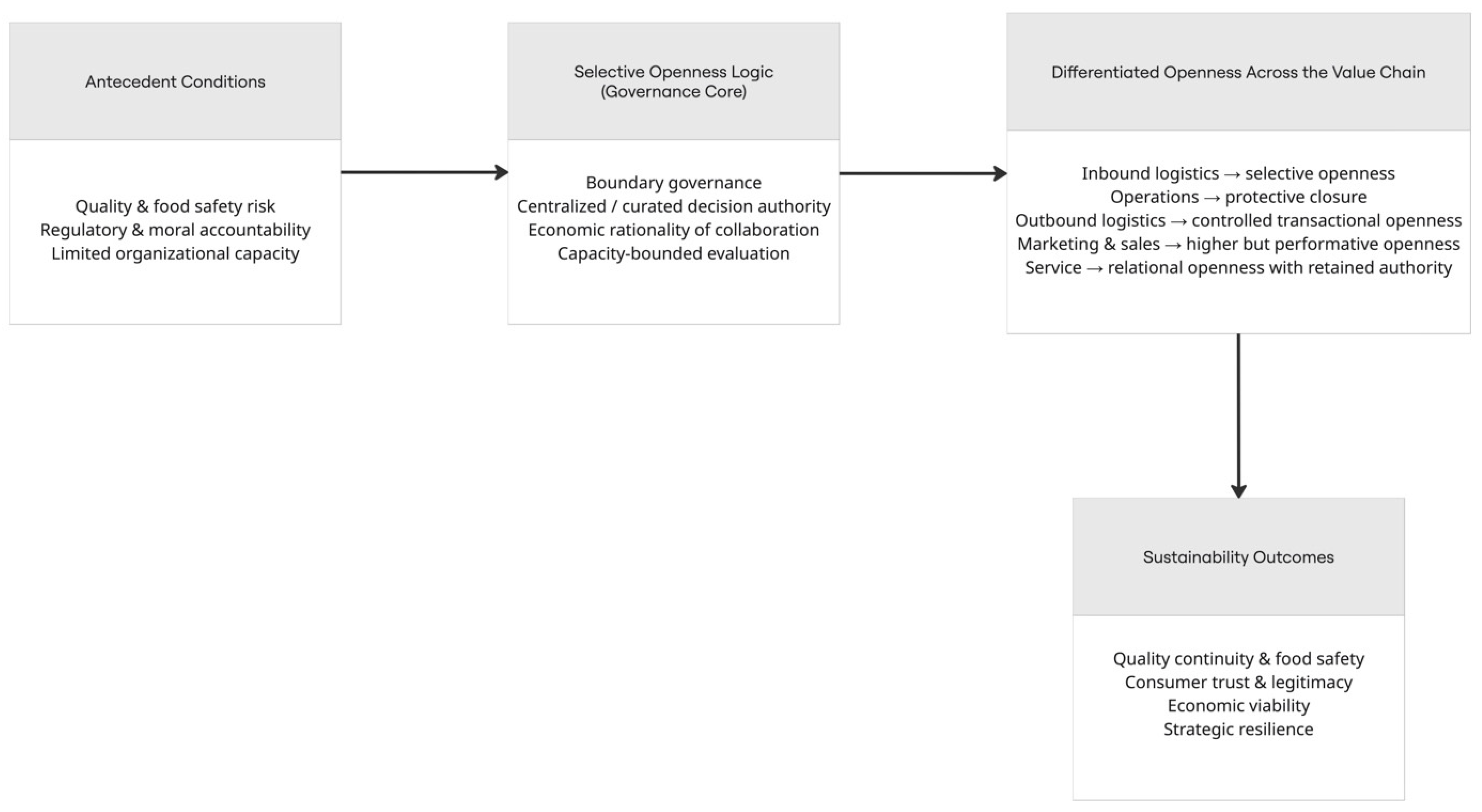
Importantly, openness is shown to be dynamic and reversible. As indicated in Figure 1, limited organizational capacity functions not only as an antecedent condition but also as a recurring constraint that triggers recalibration. Periods of capacity strain, operational overload, or collaboration failure often lead MSMEs to temporarily withdraw from external engagement and refocus on internal consolidation. This dynamic re-closure is not a failure of collaboration but a strategic recalibration aligned with organizational readiness.
These findings challenge linear models of open innovation that imply cumulative progression toward greater openness. Instead, openness in culinary MSMEs operates as a capacity-dependent, dynamic, and reversible governance choice, expanding and contracting in response to internal readiness, performance outcomes, and operational pressures.

4.2. Theoretical Contributions

This study advances theory on openness, co-creation, and sustainable collaboration by introducing selective openness as a value-chain-embedded governance logic rather than a generalized orientation toward collaboration. Building on the empirical findings and the conceptual model in Figure 2, the study makes five main theoretical contributions.

4.2.1. Reframing Selective Openness as Organizational Rationality

The study reframes selective openness as an expression of organizational rationality rather than a deficit in collaborative orientation or a lack of innovativeness. Much of the open innovation literature assumes that greater boundary permeability is inherently progressive or value-enhancing [46,47]. In contrast, this study shows that, in high-risk consumption contexts, openness is deliberately calibrated to risk exposure, accountability requirements, and governance capacity. Selective openness, therefore, represents a situated governance response to operational realities rather than a transitional stage toward “full” openness. By grounding openness decisions in responsibility for quality and consumer safety, this study shifts the theoretical lens from aspiration-driven openness to accountability-driven openness, thereby extending open innovation theory to sectors in which quality failure carries immediate, embodied consequences.

4.2.2. Conceptualizing Boundary Governance as a Sustainability Mechanism

This study positions boundary governance as a central mechanism through which collaboration becomes sustainable in quality-sensitive industries. Rather than viewing boundaries as barriers to innovation, the findings show that boundaries function as trust-enabling infrastructures that allow firms to engage externally while maintaining control over quality-critical domains. This extends discussions on sustainability that often emphasize participation intensity, stakeholder inclusion, or network density as indicators of collaborative success [18,19,20]. The findings suggest that, in high-risk consumption sectors, sustainability depends less on maximizing participation and more on aligning openness with stage-specific risk and governance capacity. Sustainability thus emerges from differentiated boundary management, not from generalized openness.

4.2.3. Distinguishing Performative Openness from Substantive Co-Creation

The study introduces an important conceptual distinction between performative openness and substantive co-creation. Practices such as open kitchens, storytelling, workshops, and community engagement primarily function as mechanisms for legitimacy building and sense-making rather than as channels for transferring technical authority or production control. While much co-creation literature associates openness with substantive participation in production or resource integration [27,28,29], this study shows that visibility and engagement do not necessarily entail shared decision-making. Performative openness enables firms to communicate transparency, authenticity, and care while maintaining internal control over quality-critical processes. This distinction refines co-creation theory by demonstrating that legitimacy and trust can be co-produced through curated visibility without expanding access to technical knowledge or governance authority.

4.2.4. Introducing a Dynamic and Reversible View of Openness

The study advances theory by conceptualizing openness as dynamic, reversible, and capacity-dependent. Existing perspectives often imply that openness evolves cumulatively, with firms progressively becoming more open over time. In contrast, the findings show that MSMEs frequently engage in strategic re-closure when capacity constraints, operational strain, or failures in collaboration threaten stability. Re-closure is not a regression or resistance to collaboration, but a governance adjustment aligned with organizational readiness. This introduces a cyclical understanding of openness in which expansion and contraction are normal components of sustainable collaboration. By linking openness to fluctuating governance capacity rather than to a fixed organizational identity, this study extends existing frameworks beyond static “open versus closed” dichotomies.

4.2.5. Selective Openness as a Sustainability Mechanism

Beyond its role as a governance mechanism, selective openness functions as a sustainability mechanism in culinary MSMEs by stabilizing quality continuity under conditions of high-risk consumption. The findings show that decisions about where and how to allow collaboration through varying degrees of boundary permeability are tightly coupled with risk management, particularly with respect to product quality, food safety, and reputational accountability. In food-based sectors, a single quality failure can generate disproportionate damage and long-term economic consequences. As one owner explained, “If one product is not good, customers may not come back. Reputation is everything for us.” (SME-A).
By maintaining strict control over quality-critical processes while enabling collaboration in lower-risk domains, MSMEs safeguard product consistency and reduce the risk of failure. This continuity of quality sustains consumer trust, which functions as a critical intangible resource in local food markets, where reputation spreads quickly through word-of-mouth and digital networks. In turn, trust stabilizes demand and reduces revenue volatility—an especially important condition for MSMEs operating with limited buffers and high exposure to shocks.
The sustainability implications extend beyond the firm level. When MSMEs maintain stable operations through calibrated openness, they are better able to sustain employment continuity, supplier relationships, and localized economic circulation. Selective openness, therefore, contributes to socio-economic sustainability not by maximizing participation, but by aligning collaboration with risk exposure, governance capacity, and accountability. Here, sustainability refers to the continuity of product quality, consumer trust, and MSME economic viability over time—enabled through calibrated boundary management rather than generalized openness.

4.2.6. Integrative Theoretical Contribution

Taken together, these five contributions consolidate selective openness as a value-chain-embedded governance framework that advances theory on openness and co-creation under conditions of risk and capacity constraint. Rather than conceptualizing openness as a firm-level orientation toward participation or knowledge sharing, this study theorizes openness as a differentiated governance architecture through which firms allocate boundary permeability, decision authority, and responsibility across value-chain activities. This integrative contribution extends openness theory in three ways. First, it shifts analytical focus from participation intensity to governance configuration—explaining how collaboration is organized, bounded, and made reversible rather than how much collaboration occurs.
Second, it locates openness within value-chain positioning, showing that boundary permeability varies systematically across stages as a function of risk exposure, accountability concentration, and operational strain. Third, it incorporates reversibility as a core property of openness governance, demonstrating that strategic re-closure operates as a corrective governance response that maintains organizational stability when collaboration becomes misaligned with capacity or risk conditions.
Accordingly, the integrative contribution is not an additional sustainability claim, but a conceptual consolidation: it reframes selective openness as governance design embedded in activity systems, extending co-creation theory beyond normative prescriptions for “more participation” toward explaining how collaboration can remain governable and durable in quality-sensitive, high-risk consumption sectors.

4.3. Practical and Policy Implications

4.3.1. Managerial Implications for Culinary MSMEs

For culinary MSMEs, the findings challenge the widespread managerial assumption that expanding collaboration is inherently beneficial. Rather than equating collaboration with unrestricted openness, managers may benefit from recognizing it as a governance decision that requires deliberate boundary-setting. The study demonstrates that not all activities should be opened to external actors. Aspects such as core production processes, recipes, and quality control systems constitute high-risk domains that must remain protected through centralized authority and tightly controlled knowledge sharing.
At the same time, the findings show that selective openness can be strategically deployed to support trust and legitimacy without compromising control. Managers can leverage performative openness, such as curated transparency, storytelling, open kitchens, and controlled experiential activities, to communicate authenticity and craftsmanship while preserving internal decision authority. These practices allow firms to respond to consumer expectations for transparency without exposing quality-critical routines or proprietary knowledge.
Importantly, this study reframes re-closure not as a managerial failure, but as a rational sustainability strategy. When organizational capacity is strained by limited labor, time pressure, system immaturity, or heightened quality risk, reducing or postponing collaboration enables firms to stabilize internal processes and protect product integrity. Effective managers, therefore, do not pursue collaboration continuously but actively recalibrate openness in line with organizational readiness, risk exposure, and accountability obligations.

4.3.2. Policy and Ecosystem Implications

At the policy and ecosystem level, the findings challenge approaches that promote openness and collaboration as universal solutions for MSME sustainability. While collaboration can generate learning and market access, policies that emphasize participation density or partnership counts risk amplifying vulnerability in quality-sensitive industries if governance capacity is underdeveloped. This study shows that without adequate internal controls, expanded collaboration may increase operational risk rather than enhance sustainability.
Accordingly, policy interventions should shift from encouraging openness per se toward strengthening MSMEs’ capacity to govern collaboration responsibly. Supporting programs that prioritize the development of internal systems, such as quality assurance routines, standard operating procedures, risk assessment capabilities, and contractual governance, are more likely to enable sustainable collaboration than initiatives that simply incentivize new partnerships. In food-based sectors, where failures directly affect consumer safety and trust, building governance capacity should be treated as a prerequisite for openness, not its consequence.
From an ecosystem perspective, intermediary organizations, accelerators, and support institutions should act as boundary facilitators rather than openness promoters. Their role is not to push MSMEs toward maximal collaboration, but to help them identify which activities can be safely opened, which must remain protected, and how collaboration boundaries should evolve as organizational capacity grows. Without such governance-oriented support, collaboration risks becoming performative at the policy level while remaining unsustainable at the firm level.

4.4. Limitations and Future Research

This subsection clarifies the study’s scope conditions and outlines directions for extending the selective openness framework.
First, the cases focus on leading culinary MSMEs that have moved beyond early survival and have developed relatively stable routines, brand identity, and governance arrangements. This focus is theoretically aligned with the study’s aim: to explain how openness is governed (i.e., boundary-setting, authority allocation, and risk accountability), rather than merely documenting whether collaboration occurs. In practice, more established MSMEs are also more likely to act as initiators and organizers of collaborations, making governance mechanisms empirically observable. At the same time, earlier-stage micro-enterprises and follower firms may engage in collaboration in more reactive or opportunity-driven ways, with limited capacity to shape boundary rules. Future research could therefore examine how openness logics differ between initiators vs. joiners, and how governance-based selective openness emerges (or fails to emerge) as firms develop organizational capacity. Accordingly, the framework is particularly transferable to high-risk consumption sectors in which quality failure has immediate and consequential impacts on consumers.
Second, the empirical setting is concentrated in West Java. While this context provides a rich site for examining collaboration under quality risk and accountability constraints, comparative studies across regions and institutional environments would help clarify how selective openness operates under varying degrees of regulatory strictness, market maturity, and trust infrastructures.
Third, the study adopts a cross-sectional qualitative design. Given that the findings indicate that openness is dynamic and reversible, longitudinal designs would be valuable for tracing how firms expand, contract, and re-stabilize openness over time, particularly in response to shocks, growth transitions, or capacity strain.
Finally, future quantitative and mixed-methods research could operationalize and test the conceptual relationships proposed in Figure 1, particularly how value-chain position, perceived risk exposure, and governance capacity jointly shape openness decisions across broader samples and additional high-risk consumption sectors. Rather than diminishing the present findings, these scope conditions specify where the framework is most applicable and provide clear pathways for theoretical extension through developmental, comparative, and multi-method research.

5. Conclusions

This study demonstrates that openness in culinary MSMEs should not be understood as a uniform orientation toward collaboration, but rather as a strategically differentiated governance architecture embedded across value-chain activities. Rather than expanding collaboration indiscriminately, MSMEs calibrate openness in response to risk exposure, accountability obligations, and constraints on organizational capacity. Through this selective governance of collaboration boundaries, firms sustain product quality, preserve consumer trust, and maintain long-term organizational viability in high-risk consumption contexts.
By advancing selective openness as a governance-based explanation of how collaboration is structured under conditions of quality sensitivity and limited capacity, this study extends sustainability scholarship beyond participation intensity toward responsibility-aligned innovation. The findings show that sustainable collaboration in high-risk consumer sectors does not arise from maximal openness, but from the careful alignment of external engagement with operational control, risk management, and organizational readiness.
In reframing openness as a value-chain-embedded governance choice rather than a generalized collaborative posture, this study offers a theoretical lens for understanding how resource-constrained firms balance innovation with responsibility. This perspective highlights that, in quality-sensitive industries, sustainability is not achieved by opening up more, but by governing openness effectively.

Author Contributions

Conceptualization, L.S.R. and D.D.; Methodology, L.S.R. and D.D.; Investigation, L.S.R.; Formal analysis, L.S.R.; Data curation, L.S.R., D.D., S.W., K.K. and A.B.; Writing—original draft preparation, L.S.R.; Writing—review and editing, S.W. and K.K.; Visualization, A.B.; Supervision, D.D.; Project administration, L.S.R.; Funding acquisition, Not applicable. All authors have read and agreed to the published version of the manuscript.

Funding

This research received no external research funding. However, several authors received individual scholarship support from the Indonesia Endowment Fund for Education (LPDP), Republic of Indonesia. No specific grant number is applicable, as the support was provided as individual scholarships rather than project funding.

Institutional Review Board Statement

Ethical review and approval were waived for this study due to non-medical social science research, such as qualitative studies in business, management, and economics, does not fall under the scope of mandatory ethics committee review under this national regulation in Indonesia. The research was conducted under institutional research permission and academic supervision at the School of Business and Management, Institut Teknologi Bandung.

Informed Consent Statement

Verbal informed consent was obtained from the participants. Verbal consent was obtained rather than written because the interview was conducted via audio recording.

Data Availability Statement

The data supporting the findings of this study are not publicly available due to ethical and confidentiality restrictions. The study is based on in-depth qualitative interviews with MSME owners, and the raw data contain commercially sensitive and personally identifiable information. To protect participants’ privacy and business confidentiality, the interview transcripts cannot be made publicly available. However, anonymized excerpts or aggregated data may be made available from the corresponding authors upon reasonable request.

Acknowledgments

The authors gratefully acknowledge financial support from the Ministry of Finance of the Republic of Indonesia through the Indonesia Endowment Fund for Education (LPDP) scholarship program. The authors also thank the Master of Business Administration Program, School of Business and Management, Bandung Institute of Technology (MBA ITB), for academic support and research facilities. Finally, the authors are grateful to all respondents who generously shared their time and experiences for this study.

Conflicts of Interest

The authors declare no conflicts of interest.

Abbreviations

The following abbreviations were used in this manuscript:
B2BBusiness-to-Business
B2CBusiness-to-Consumer
FAOFood and Agriculture Organization of the United Nations
HACCPHazard Analysis and Critical Control Points
IRBInstitutional Review Board
KOLKey Opinion Leader
LPDPLembaga Pengelola Dana Pendidikan
MBA ITBMaster of Business Administration Program, Bandung Institute of Technology
MoUMemorandum of Understanding
MSMEMicro-, Small-, and Medium-sized Enterprise
NDANon-Disclosure Agreement
NVivoQualitative Data Analysis Software (QSR International)
OECDOrganisation for Economic Co-operation and Development
SKUStock Keeping Unit
SOPStandard Operating Procedure
UGCUser-Generated Content

Appendix A

Table A1. Descriptive Profile of Interviewees.
CaseBusiness Type & FocusInterviewee RoleInterview DateModeLocationFirm Characteristics
SME-AArtisan bakery & café specializing in healthy bread and bakery productsOwner & Head Baker20 October 2025In-person, semi-structuredMain outlet, BandungEstablished in 2019 (online since 2014); 3 outlets (+1 planned); ~30 SKUs; ~40 permanent employees; B2C & B2B; central kitchen; strong emphasis on product quality and health positioning.
SME-BCommunity-based collaborative kitchen and culinary experimentation spaceCo-founder/Core Team Member1 October 2025In-person, semi-structuredMain outlet, BandungFounded in 2020; single outlet; flat organizational structure; rotating collaborators; focus on co-production, workshops, and community-driven value creation.
SME-CGastronomy tourism venture combining villa accommodation and culinary experiencesCo-founder (R&D Product & Storyteller)24 July 2025In-person, semi-structuredBandungFounded in 2022; small core team; experiential food tourism model; revenue from accommodation, culinary trips, and curated dining experiences.
SME-DSushi restaurant chain with affordable pricing and premium presentationFounder22 July 2025In-person, semi-structuredMain outlet, BandungFounded in 2020; 3 outlets; ~14 employees; revenue-sharing co-space model; Owned by a five-star hotel chef, aiming to deliver five-star hotel-style cuisine at an affordable price.
SME-EBakery & café known for signature sponge cake and souvenir-center conceptHead of Production (HOD)23 October 2025In-person, semi-structuredMain outlet, BandungFounded in 2017; 4 outlets; ~60 employees; ~40 SKUs; extensive consignment model involving 100+ MSME partners; production and retail spaces open for B2B site visits and B2C kitchen tours; positioned as a hybrid bakery-café and culinary souvenir center.
SME-FPastry and cake shop evolving from home-based business to multi-outlet brandGeneral Manager20 November 2025In-person, semi-structuredOutlet, BandungEstablished pre-2020; multiple outlets; French-inspired pastry; omnichannel sales; structured management.
SME-GCoffee shop offering coffee-based beverages, Korean-style cakes, and bagelsFinance & Marketing Manager20 November 2025In-person, semi-structuredOutlet, BandungMultiple outlets; product diversification; combination of in-house production and partner sourcing.
SME-HPremium bean-to-bar chocolate brand with café, retail, and education programsHead of Operations & Business Development11 December 2025Online, semi-structuredOnlineFounded in 2023; 3 outlets; ~70 employees; ~300 SKUs; strong supplier collaboration with cocoa farmers; active consumer co-creation via testers, workshops, and factory tours; formal quality systems (HACCP, halal)
Note: All interviews were conducted with owners or key decision-makers of culinary MSMEs. To ensure anonymity, business names and personal identities were pseudonymized.
Table A2. Governance Modes Across the Value Chain.
Value Chain StageGovernance Mode (Figure Label)Definition of the Governance Mode (Coding Basis)SMEs Where Observed (IDs)n/8Typical Depth of Involvement (Level 1–4)Notes on Boundary Conditions
Inbound LogisticsSupplier-Bounded AccessExternal suppliers involved in sourcing, but specification, standards, and final decisions remain firm-controlledA, B, C, D, F, H6/8Level 2Collaboration supports supply continuity, not shared governance of procurement rules
OperationsProtective Operational ClosureCore routine production remains internally governed; no external actors share execution authority or quality controlA, B, C, D, E, F, G, H8/8Level 1Workshops, testers, and kitchen visits occur in some SMEs but do not alter production governance or decision authority
Outbound LogisticsGoverned Transactional DistributionDistribution involves external partners, but pricing, brand control, and logistics coordination remain firm-ledA, B, C, E, F5/8Level 2Partnerships expand reach but do not constitute co-managed distribution systems
Marketing & SalesCurated Market OpennessExternal actors contribute to promotion, branding exposure, or storytelling under firm curationA, B, C, D, E, F, G, H8/8Level 3Collaboration enhances visibility, but brand meaning and strategy remain internally directed
Service/ConsumptionExperiential yet Governed EngagementConsumers participate in experience creation (tastings, visits, events), but experience architecture remains firm-designedA, B, C, E, F, H6/8Level 3Participation shapes value-in-use, not production governance
Support ActivitiesCapacity-Bounded Co-GovernanceExternal actors contribute to learning, ideation, or capability development, constrained by firm capacity and oversightB, C, F3/8Level 2Collaboration occurs where capacity allows; strategic direction remains firm-controlled
Note: This table documents the empirical basis used to construct Figure 1. Each row represents a governance mode identified through cross-case coding. “SMEs where observed” refers to cases in which the governance pattern—not merely a collaborative activity—was evidenced in the relevant value chain stage. Episodic or symbolic participation that does not alter operational authority is noted but does not determine the governance classification.
Table A3. Coding Scheme for Intensity Levels of External Actor Involvement.
LevelMeaningGovernance Interpretation
1External actors provide feedback or symbolic presence onlyBoundary strongly closed; no shared execution
2External actors participate episodically or transactionallyBoundary selectively permeable but controlled
3External actors contribute to value creation activities (experience/market-facing)Engagement deeper but governance authority retained
4Shared rule-setting or decision authorityCo-governance (not observed in core production)
Note: This coding scheme was used to classify the intensity of external actor involvement across different value chain activities during cross-case analysis. The levels indicate increasing degrees of boundary permeability, while governance authority remains primarily with the MSME unless otherwise specified.
Table A4. Integration of Value-chain Stage × External Actor Type × Openness Mode.
External Actor typeInbound LogisticsOperationsOutbound LogisticsMarketing & SalesService/ConsumptionSupport Activities
SuppliersSupplier-Bounded Access (input/availability suggestions; firm decides specs)Internalized decision authority (procurement decisions remain internal)
Consignment partners/partner outlets/resellersGoverned Transactional Distribution (consignment/events/outlets; shelf-life/recall rules)(sometimes) Curated Market Openness (cross-promo)
Communities(limited) Protective Operational Closure (no production authority; occasional workshops)(sometimes) transactional eventsCurated Market Openness (community events/storytelling)Experiential yet Governed Engagement (events/experiences; firm designs)Capacity-Bounded Co-Governance (learning/ideation bounded by capacity)
ConsumersProtective Operational Closure (testers/visits do not change production governance)Curated Market Openness (UGC as curated visibility)Experiential yet Governed Engagement (feedback/testers; authority retained)
InstitutionsCapacity-Bounded Co-Governance (training/legitimacy support bounded by readiness; authority retained)
InfluencersCurated Market Openness (paid/organic promotion under firm curation)
Digital platformsGoverned Transactional Distribution (delivery/market access; coordination firm-led)Curated Market Openness (visibility tools; platform use incremental)Experiential yet Governed Engagement (feedback channels)Selective learning openness (tech adoption incremental; constrained by consistency needs)
Note: This matrix integrates cross-case findings by mapping value chain stages, types of external actors, and modes of openness. The entries reflect empirically observed governance patterns rather than prescriptive categories. Dashes (—) indicate no meaningful or recurrent form of involvement identified in the data.

References

  1. Nursini, N. Micro, Small, and Medium Enterprises (MSMEs) and Poverty Reduction: Empirical Evidence from Indonesia. Dev. Stud. Res. 2020, 7, 153–166. [Google Scholar] [CrossRef]
  2. Gereweme, Y.T. The Role of Micro and Small Enterprises for Poverty Alleviation. Int. J. Res. Stud. Agric. Sci. 2018, 4, 38–47. Available online: https://www.arcjournals.org/international-journal-of-research-studies-in-agricultural-sciences/volume-4-issue-12/5 (accessed on 14 February 2026).
  3. Agustina, R.; Rosmawati, H.; Pusvita, E. The Role of Housewives in Improving Family Economy Through Kerupuk UMKM in Kota Baru Village Oku Timur Regency. Mimb. Agribisnis J. Pemikir. Masy. Ilm. Berwawasan Agribisnis 2025, 11, 1746. [Google Scholar] [CrossRef]
  4. Ayalu, G.; Abbay, A.G.; Azadi, H. The Role of Micro- and Small-Scale Enterprises in Enhancing Sustainable Community Livelihood: Tigray, Ethiopia. Environ. Dev. Sustain. 2022, 25, 7561–7584. [Google Scholar] [CrossRef]
  5. Porter, M.E. Competitive Advantage: Creating and Sustaining Superior Performance (with a New Introduction); Simon and Schuster: New York, NY, USA, 1998. [Google Scholar]
  6. Runfola, A.; Monteverde, G.; Picciotti, A. Local Value Creation for Developing Business Relationships: An SME Case Study in the Pasta Industry. Ital. J. Mark. 2024, 2024, 177–196. [Google Scholar] [CrossRef]
  7. Eikebrokk, T.R.; Garmann-Johnsen, N.F.; Olsen, D.H. Co-Creation in Networks of SMEs: A Conceptual Model of the Co-Creation Process. In Proceedings of the Procedia Computer Science; Elsevier B.V.: Amsterdam, The Netherlands, 2021; Volume 181, pp. 360–366. [Google Scholar]
  8. Brown, D.M.; Apostolidis, C.; Singh, P.; Dey, B.L.; Chelekis, J. Exploring Multi-Stakeholder Value Co-Creation as an Entrepreneurial Approach to Survival and Sustainability: The Case of Pennine Pubs. Int. J. Entrep. Innov. 2022, 26, 366–375. [Google Scholar] [CrossRef]
  9. Ghezzi, A.; Cavallo, A.; Sanasi, S.; Rangone, A. Opening up to Startup Collaborations: Open Business Models and Value Co-Creation in SMEs. Compet. Rev. 2022, 32, 40–61. [Google Scholar] [CrossRef]
  10. Sarasvuo, S.; Rindell, A.; Kovalchuk, M. Toward a Conceptual Understanding of Co-Creation in Branding. J. Bus. Res. 2022, 139, 543–563. [Google Scholar] [CrossRef]
  11. Barney, J. Firm Resources and Sustained Competitive Advantage. J. Manag. 1991, 17, 99–120. [Google Scholar] [CrossRef]
  12. Tambunan, T.T.H. SMEs in Asian Developing Countries; Springer: Berlin/Heidelberg, Germany, 2009; ISBN 9780230250949. [Google Scholar]
  13. Kuncoro, M.; Idris, N.; Universitas, B.; Mada, G. Mengapa Terjadi Growth Without Development Di Provinsi Kalimantan Timur? J. Ekon. Pembang. 2010, 11, 172–190. [Google Scholar] [CrossRef][Green Version]
  14. Ayyagari, M.; Beck, T.; Demirguc-Kunt, A. Small and Medium Enterprises across the Globe. Small Bus. Econ. 2007, 29, 415–434. [Google Scholar] [CrossRef]
  15. Kemenparekraf. Statistik Ekonomi Kreatif 2020; Pusat Data dan Sistem Informasi, Kementerian Pariwisata dan Ekonomi Kreatif: Jakarta, Indonesia, 2020; ISBN 9786239715618. [Google Scholar]
  16. BPS. Statistik Penyediaan Makanan Dan Minuman 2023; BPS (Badan Pusat Statistik): Jakarta, Indonesia, 2024. [Google Scholar]
  17. Utami, H.N.; Alamanos, E.; Kuznesof, S. Going Digital: SMEs Based Food E-Commerce Engaging Customer through Customer Needs-Driven. In Proceedings of the 19th International Conference on Electronic Business; ICEB: Newcastle upon Tyne, UK, 2019; pp. 526–529. [Google Scholar]
  18. FAO. The State of Food and Agriculture—Revealing the True Cost of Food to Transform Agrifood Systems; FAO: Rome, Italy, 2023; ISBN 978-92-5-138167-0. [Google Scholar]
  19. Granovetter, M. Economic Action and Social Structure: The Problem of Embeddedness. Am. J. Sociol. 1985, 91, 481–510. [Google Scholar] [CrossRef]
  20. Provan, K.G.; Kenis, P. Modes of Network Governance: Structure, Management, and Effectiveness. J. Public Adm. Res. Theory 2008, 18, 229–252. [Google Scholar] [CrossRef]
  21. Stabell, C.B.; Fjeldstad, Ø.D. Configuring Value for Competitive Advantage: On Chains, Shops, and Networks. Strateg. Manag. J. 1998, 19, 413–437. [Google Scholar] [CrossRef]
  22. Purnomo, B.R.; Adiguna, R. Entrepreneurial Resilience during the Covid-19 Pandemic: Navigating Survival, Continuity and Growth. J. Entrep. Emerg. Econ. 2021, 13, 497–524. [Google Scholar] [CrossRef]
  23. Mesra, R.; Marsa, Y.J.; Putri, M.E. Pola Interaksi Pedagang Konsinyasi Dengan Pemilik Warung Di Kecamatan Tondano Selatan, Provinsi Sulawesi Utara. JISIP (J. Ilmu Sos. Dan Pendidik.) 2021, 5, 166–175. [Google Scholar] [CrossRef]
  24. Mohamad, A.; Mohd Rizal, A.; Kamarudin, S.; Sahimi, M. Exploring the Co-Creation of Small and Medium Enterprises, and Service Providers Enabled by Digital Interactive Platforms for Internationalization: A Case Study in Malaysia. Sustainability 2022, 14, 16119. [Google Scholar] [CrossRef]
  25. Swisher, M.E.; Ruiz-Menjivar, J.; Koenig, R. Value Chains in Renewable and Sustainable Food Systems. Renew. Agric. Food Syst. 2018, 33, 1–5. [Google Scholar] [CrossRef]
  26. Das, S.; Myla, A.Y.; Barve, A.; Kumar, A.; Sahu, N.C.; Muduli, K.; Luthra, S. A Systematic Assessment of Multi-Dimensional Risk Factors for Sustainable Development in Food Grain Supply Chains: A Business Strategic Prospective Analysis. Bus. Strategy Environ. 2023, 32, 5536–5562. [Google Scholar] [CrossRef]
  27. Prahalad, C.K.; Ramaswamy, V. Co-Creating Unique Value with Customers. Strateg. Leadersh. 2004, 32, 4–9. [Google Scholar] [CrossRef]
  28. Vargo, S.L.; Lusch, R.F. Service-Dominant Logic: Continuing the Evolution. J. Acad. Mark. Sci. 2008, 36, 1–10. [Google Scholar] [CrossRef]
  29. Vargo, S.L.; Lusch, R.F. Institutions and Axioms: An Extension and Update of Service-Dominant Logic. J. Acad. Mark. Sci. 2016, 44, 5–23. [Google Scholar] [CrossRef]
  30. Echeverri, P.; Skålén, P. Co-Creation and Co-Destruction: A Practice-Theory Based Study of Interactive Value Formation. Mark. Theory 2011, 11, 351–373. [Google Scholar] [CrossRef]
  31. Plé, L.; Cáceres, R.C. Not Always Co-Creation: Introducing Interactional Co-Destruction of Value in Service-Dominant Logic. J. Serv. Mark. 2010, 24, 430–437. [Google Scholar] [CrossRef]
  32. Chesbrough, H. Business Model Innovation: It’s Not Just about Technology Anymore. Strateg. Leadersh. 2007, 35, 12–17. [Google Scholar] [CrossRef]
  33. Henkel, J. Selective Revealing in Open Innovation Processes: The Case of Embedded Linux. Acad. Manag. Annu. Meet. Proc. 2006, 35, 953–969. [Google Scholar] [CrossRef]
  34. Henkel, J.; Schöberl, S.; Alexy, O. The Emergence of Openness: How and Why Firms Adopt Selective Revealing in Open Innovation. Res. Policy 2014, 43, 879–890. [Google Scholar] [CrossRef]
  35. Laursen, K.; Salter, A. Open for Innovation: The Role of Openness in Explaining Innovation Performance among U.K. Manufacturing Firms. Strateg. Manag. J. 2006, 27, 131–150. [Google Scholar] [CrossRef]
  36. Lamotte, O.; Durand, M. Inter-Organizational Governance in Nested Entrepreneurial Ecosystems: Lessons from China. J. Entrep. Emerg. Econ. 2025, 1–22. [Google Scholar] [CrossRef]
  37. Dellyana, D.; Hardjakaprabon, B. Co-Creation Framework in Cluster Industry with Limited Resources. Int. J. Bus. Glob. 2021, 29, 178–197. [Google Scholar] [CrossRef]
  38. Yin, R.K. Case Study Research and Applications: Design and Methods; SAGE Publications Inc.: Los Angeles, CA, USA, 2018; ISBN 9781433813757. [Google Scholar]
  39. Eisenhardt, K.M. Building Theories from Case Study Research. Acad. Manag. Rev. 1989, 14, 532–550. [Google Scholar] [CrossRef]
  40. Eisenhardt, K.M.; Graebner, M.E. Theory Building from Cases: Opportunities and Challenges. Acad. Manag. J. 2007, 50, 25–32. [Google Scholar] [CrossRef]
  41. OECD. OECD SME and Entrepreneurship Outlook 2019; OECD: Paris, France, 2019; ISBN 9789264374805. [Google Scholar]
  42. OECD. OECD SME and Entrepreneurship Outlook 2023; OECD: Paris, France, 2023; ISBN 9789264374805. [Google Scholar]
  43. Greiner, L.E. Evolution and Revolution as Organizations Grow: A Company’s Past Has Clues for Management That Are Critical to Future Success. Fam. Bus. Rev. 1997, 10, 397–410. [Google Scholar] [CrossRef]
  44. Miles, M.B.; Huberman, A.M.; Saldana, J. Qualitative Data Analysis: A Methods Sourcebook, 3rd ed.; SAGE Publications Inc.: London, UK, 2014; ISBN 9781452257877. [Google Scholar]
  45. Dubois, A.; Gadde, L.E. Systematic Combining: An Abductive Approach to Case Research. J. Bus. Res. 2002, 55, 553–560. [Google Scholar] [CrossRef]
  46. Timmermans, S.; Tavory, I. Theory Construction in Qualitative Research: From Grounded Theory to Abductive Analysis. Sociol. Theory 2012, 30, 167–186. [Google Scholar] [CrossRef]
  47. Chesbrough, H. The Logic of Open Innovation: Managing Intellectual Property. Calif. Manag. Rev. 2003, 45, 33–58. [Google Scholar] [CrossRef]
  48. West, J.; Bogers, M. Leveraging External Sources of Innovation: A Review of Research on Open Innovation. J. Prod. Innov. Manag. 2014, 31, 814–831. [Google Scholar] [CrossRef]
Figure 1. Governance-Based Differentiation of Selective Openness Across Value Chain Stages. This figure presents a cross-case analytical model showing how the depth and mode of external actor involvement vary across value-chain stages in culinary MSMEs as a function of governance, risk exposure, and organizational capacity. The horizontal axis represents value chain stages. The vertical axis indicates the relative depth of external actor involvement. Block width reflects cross-case prevalence (i.e., the number of cases in which a given governance mode was observed), while block height reflects the typical depth of involvement associated with that mode, based on the coding rules summarized in Appendix A (Table A2). This analytical model synthesizes cross-case findings to show how governance logics produce spatial differentiation in openness across value-chain stages in culinary MSMEs, reflecting variation in risk exposure, accountability demands, and organizational capacity.
Sustainability 18 02572 g001
Figure 2. Selective Openness as a Sustainable Governance Strategy Across the Value Chain. This conceptual model synthesizes the study’s findings by illustrating how risk exposure (e.g., food safety and quality concerns), regulatory accountability, and organizational capacity constraints give rise to a governance core characterized by boundary control, centralized decision authority, economic rationality, and capacity-bounded evaluation. These governance logics shape differentiated boundary permeability across value-chain activities and, in turn, support sustainability outcomes such as quality continuity, consumer trust, economic viability, and strategic resilience.
Sustainability 18 02572 g002
Table 1. Conceptual Positioning and Clarification of Key Terms.
ConceptPrior Literature TendencyReframed in This StudyDefinition in This Study
OpennessOften treated as normatively beneficial for innovation and learningTreated as a selective, risk-governed organizational choiceThe degree of boundary permeability that allows external actor involvement across value-chain activities; variable, activity-specific, and governed rather than a stable firm-level posture
CollaborationFrequently assumed to generate positive outcomesViewed as a governance trade-off requiring boundary regulationThe involvement of external actors in specific MSME activities, ranging from transactional coordination to interactive engagement, without necessarily implying shared authority or influence over core value formation
Co-creationOften equated with broadly open forms of collaboration and innovation outcomesTreated as a specific, governed form of deeper collaborative involvementA form of collaboration in which external actors meaningfully influence value formation, while core decision authority remains with the MSME
Boundary GovernanceCommonly examined in large firms or formal alliancesExamined as everyday operational governance in resource-constrained MSMEsThe mechanisms through which MSMEs regulate access, authority, responsibility, and boundary permeability in collaborative interactions
Value Chain PerspectiveRarely differentiated at the level of specific business activitiesExplicitly distinguished across production, sourcing, marketing, and service stagesThe analytical lens through which openness is examined as varying systematically across stages of value creation
Table 2. Classification of zero-order, first-order, and second-order codes.
Zero-OrderFirst-OrderSecond-Order
  • Core raw materials are sourced from established and trusted suppliers
Quality & Risk Protection as Boundary WorkBoundary Governance of Openness
  • Production is oriented toward product quality and nutritional value rather than low pricing
  • Ease of communication and partner responsiveness are key selection considerations
  • Compliance with halal standards is treated as a non-negotiable boundary
  • External food items are procured only through vetted, short-term transactions to limit quality and liability exposure
  • Consistency in product and service quality is prioritized
  • Final product quality is closely tied to the skills of internal cooks and baristas, limiting external intervention
  • Collaboration partners are screened through on-site visits or remote assessments
  • Overly detailed questions regarding recipes are not addressed
  • Partner products approaching their expiration date are requested to be withdrawn
  • Products produced during workshops are not sold to the general public
  • Trend-driven or viral products are tested gradually over several months
  • Food production is centralized in an internal kitchen
  • Core food and beverage recipes remain closed
  • Food safety risks are treated as a serious concern
  • The cashier system is centrally managed by the focal outlet
Centralized Decision Authority with Curated Participation
  • The production division is involved in marketing-related decision-making
  • Supplier relationships are centrally managed and periodically renegotiated (e.g., annual contracting) under internal procurement authority
  • Menu ideas are developed by the owner
  • Final decisions regarding menu development remain with the owner
  • Collaborators are granted discretion to determine specific days, menus, and ingredients within predefined slots
  • The owner remains directly (hands-on) involved in the production process
  • The selection of raw materials and taste standards is determined internally
  • The selection of collaboration partners considers portfolio, personal rapport, and commitment to cooperation
  • Decision-making is conducted collectively by the core team
  • The organizational structure is relatively flat, without rigid hierarchies
  • Formalization begins with MoUs, then expands to NDAs and more detailed written clauses as risk exposure increases
Formalization of Collaboration as Risk Increases
  • Collaboration arrangements are increasingly intended to be documented in written form
  • The allocation of roles, rights, and obligations in collaborations is documented in writing to ensure clarity from the outset
  • The distribution of tasks, costs, and risks is explicitly specified during collaboration implementation
  • Professional agreements are used to clarify the division of roles, rights, and obligations in collaborations
  • Contract violations are addressed progressively before collaboration termination
  • Discounts and promotional activities are regulated as part of collaboration agreements
  • Rules imposed by community spaces or collaboration platforms restrict certain practices (e.g., packaging types)
  • Non-food consignment collaborations are conducted under written agreements
  • Collaborations that appear visibly crowded or popular are still evaluated against the performance of other sales channels
Economic Evaluation of CollaborationEconomic and Instrumental Rationalization of Collaboration
  • The effectiveness of institutional collaborations is assessed by comparing their impact with alternative sales channels
  • Collaboration decisions are based on cross-channel comparisons involving internal outlets, online channels, and partner channels
  • Collaboration evaluation shifts from occupancy or crowd-based indicators toward operational costs, customer data, and engagement metrics
  • The presence of hidden costs in collaboration schemes is recognized and accounted for from the outset
  • Influencer or KOL involvement is limited or reduced when sales conversion declines
  • Collaborations are discontinued when their financial performance is lower than that of internal channels
  • Collaborations are considered unviable when they generate visibility without a healthy margin contribution
  • Revenue-sharing collaboration models are preferred over fixed-rent schemes to distribute business risk
  • Digital and online channels are prioritized when they deliver higher sales contributions
  • Collaboration pricing schemes are set through internal markups to protect partner revenue
  • Marketing strategies are evaluated rationally based on sales impact rather than exposure or brand perception alone
  • Forms of collaboration are explicitly distinguished from space rental arrangements or purely transactional practices
Selective & Instrumental Collaboration
  • Collaboration is selective and organized around specific projects or designated time slots
  • Collaboration is used to utilize idle or underused capacity
  • Collaboration is managed through scheduled days or fixed time periods
  • Co-selling is conducted without intervening in partners’ final pricing decisions
  • Co-space collaboration operates on a revenue-sharing basis rather than fixed rental fees
  • Collaboration is limited to consignment or product placement arrangements
  • The role of other MSMEs is restricted to distribution or consignment functions
  • Non-core products from external parties are sourced through outright purchase to avoid long-term commitments
  • Property- or location-based collaborations are structured with clearly defined and limited role allocations
  • Consumer input is actively collected through multiple channels
Controlled Consumer InvolvementDifferentiated Modes of External Involvement
  • Consumer feedback is used as a source of ideas for product innovation
  • Consumers may be involved in product voting or evaluation activities
  • Product testers and trial runs involve loyal customers or selected segments as pre-launch validation
  • Product samples are routinely provided to help consumers understand taste characteristics prior to purchase
  • Visually imperfect batches are used for internal product testing and consumer evaluation
  • Some consumer ideas are developed into products, while final decisions remain with internal actors
  • Consumer involvement in the production process is deliberately limited
  • Occasional incentives are offered to encourage consumer feedback and evaluative input
  • Service formats and portion sizes are adjusted to accommodate diverse dietary habits and consumer needs
  • Co-creation is implemented at the co-sourcing stage to support sustainability objectives
Selective Substantive Co-creation
  • Suppliers or farmers are educated as part of the co-sourcing process
  • Suppliers actively contribute to product development by providing technical input and material samples
  • Collaboration involves joint design of menus or products offered for sale
  • Products are developed through technical and aesthetic processes that reflect the distinct characteristics of collaborating parties
  • Product concepts and narratives are jointly developed with partners during co-creation processes
  • Visitor input is used as internal inspiration to refine presentation, packaging, service speed, and flavor development
  • Academic interventions act as catalysts for changes in design and presentation aesthetics
  • Co-design processes are conducted within an internal circle possessing relevant design competencies
  • Collaboration enhances visibility and brand awareness
Strategic Market EngagementStrategic and Performative Deployment of Openness
  • Collaboration expands brand awareness more effectively than individual approaches
  • Collaboration is understood as audience exchange rather than a purely B2B transaction
  • Co-promotion via Instagram Collab functions as an audience-exchange mechanism
  • Relational discounts are offered as a form of network-based trust
  • Endorsements from reputable accounts enhance brand trust
  • Media coverage increases brand exposure
  • Events and pop-up activities are used for brand activation
  • Expos and bazaars are used for both exposure and revenue generation
  • Initial demand emerges from community networks rather than formal advertising
  • Community-based collaborations are used to attract new customer segments
  • Promotion relies more on organic user-generated content (UGC) than paid campaigns
  • Influencers are engaged organically while paid endorsements are declined
  • The primary sales channels are digital-based
  • Market, product, and communication research activities are viewed as essential to business success
  • “Riding the wave” is used as a strategy to retain existing customers
  • “Riding the wave” helps prevent customer switching to competing brands
  • An “upgrading” strategy is pursued through packaging improvements
  • Iconic products serve as anchors of brand identity
  • The value orientation emphasizes affordable pricing with premium taste and presentation
  • Not all trends are fully adopted in order to preserve brand character
  • Content generated by guests or specific activities is not always made public
Performative & Experiential Openness
  • Activities such as open kitchens, workshops, or kitchen tours are not continuously available
  • Open kitchens are used as a form of controlled transparency
  • The public may observe and occasionally participate in the cooking process
  • Kitchen tours function as co-creation experiences and sales activation mechanisms
  • Workshops are used as spaces for learning and engagement
  • Dining experiences are co-created through layered experiential design (e.g., serving tools, traditional plating)
  • Product narratives are refined through direct interaction with guests (storytelling)
  • Selected imperfect batches are offered as experiential samples during engagement activities
  • Consumer education about product characteristics is conducted directly
  • Consumer involvement fosters a sense of belonging
  • Experiential activities are limited in intensity and scale according to operational capacity
  • Dependence on skilled cooks and baristas creates operational bottlenecks that constrain scalability
Operational & Capacity Constraints Shaping OpennessCapacity-Bounded Openness
  • Additional costs and partners’ geographic distance constrain the feasibility of collaborative programs
  • Limited recognition and personal networks restrict access to certain collaboration opportunities
  • Time and labor constraints limit daily operations and often lead to the rejection of collaboration offers
  • Absence from networking moments results in missed collaboration opportunities
  • Maintaining consistent opening hours poses an operational challenge
  • Business operations were intermittent during early stages before organizational structures stabilized
  • Facility development is carried out incrementally based on available financial resources
  • Business growth follows a sell-first, capacity-built-later approach
  • Sales platforms requiring stable menus and schedules are difficult to adopt
  • Standard operating procedures are not yet fully documented
  • When collaborations fail, focus shifts to strengthening internal assets before pursuing new partnerships
  • Operational scalability limits flexibility in collaboration and menu development
  • Digital marketing capacity is still being developed, with limited control over platform algorithms
  • Marketing communication and Google Ads capabilities remain under development
  • Production waste utilization remains suboptimal
Note: This table presents first-order empirical observations and their aggregation into second-order themes through an abductive thematic analysis. The coding process was iterative and theory-informed, supporting progressive refinement of themes while remaining grounded in the data, with each zero-order code placed under its dominant functional logic.
Table 3. Selective Openness Across the Culinary MSME Value Chain. This table synthesizes cross-case evidence showing how different value-chain activities in culinary MSMEs are governed through varying modes of openness and boundary control, indicating how governance logics shape where and how external involvement is permitted.
Value Chain ActivityObserved Mode of OpennessEmpirical Boundary Logic (Cross-Case Evidence)
Primary Activities
Inbound LogisticsSelective, supplier-bounded opennessExternal inputs from suppliers are accepted in the form of material recommendations or availability, but final decisions regarding ingredients, standards, and substitutions remain internal. No co-ownership or open sourcing of critical inputs is observed (SME-A, SME-G).
OperationsProtective closure (low boundary permeability)Core production processes, recipes, quality standards, and operational know-how are tightly controlled. External involvement is limited to non-commercial, experiential contexts (e.g., workshops), without authority over quality or commercialization (SME-B, SME-C).
Outbound LogisticsControlled transactional opennessDistribution through consignment, events, or partner outlets is selectively opened, accompanied by recall mechanisms, shelf-life limits, and non-integration into core production processes (SME-A, SME-E).
Marketing & SalesHigher but performative opennessOpenness is actively deployed through UGC, open kitchens, storytelling, community events, and collaborations. These practices function as communication and trust-building mechanisms rather than transfers of decision authority or brand control (SME-A, SME-B, SME-H).
ServiceRelational openness with retained authorityConsumers are engaged through feedback channels, testers, and educational interactions. However, complaint handling, service adjustments, and final decisions remain centralized within the firm (SME-A, SME-C).
Support Activities
Firm InfrastructureClosed governance with adaptive tighteningStrategic decisions related to collaboration, contracts, MoUs/NDAs, and termination of partnerships are centralized at the owner or core-team level. Openness can be reversed when risks or misalignment increase (SME-C).
Human Resource ManagementCapacity-bounded opennessEngagement with external collaborators or temporary labor is constrained by time, energy, and team consistency. Operational overload frequently leads to the rejection or postponement of collaboration opportunities (SME-B).
Technology DevelopmentSelective learning opennessDigital platforms and marketing technologies are adopted incrementally. Lack of written SOPs, unstable menus, and fluctuating schedules limit integration with systems that require high consistency (SME-B, SME-C).
ProcurementInternalized decision authorityProcurement of key materials and equipment remains an internal decision. Occasional collective purchasing occurs opportunistically but does not evolve into strategic, long-term collaborative procurement (SME-A).
Disclaimer/Publisher’s Note: The statements, opinions and data contained in all publications are solely those of the individual author(s) and contributor(s) and not of MDPI and/or the editor(s). MDPI and/or the editor(s) disclaim responsibility for any injury to people or property resulting from any ideas, methods, instructions or products referred to in the content.