Article

Research on Intergovernmental Collaboration Mechanisms in Rural Water Environmental Governance Based on Complex Network Evolutionary Game

School of Water Conservancy, North China University of Water Resources and Electric Power, Zhengzhou 450045, China
*
Author to whom correspondence should be addressed.
Sustainability 2026, 18(5), 2564; https://doi.org/10.3390/su18052564
Submission received: 6 January 2026 / Revised: 25 February 2026 / Accepted: 27 February 2026 / Published: 5 March 2026

Abstract

The governance of the rural water environment is essential for improving the quality of life of rural residents and advancing the construction of ecological civilization. However, the current governance system faces issues such as fragmented governance entities and low collaborative efficiency. Therefore, in this study, we focus on the intergovernmental collaborative governance mechanism for rural water environments. Drawing on complex network theory and evolutionary game theory, we employ complex network analysis and construct a complex network evolutionary game model among government departments, and we further conduct numerical simulations to examine the evolutionary dynamics of intergovernmental collaboration in rural water environmental governance. The findings show the following: (1) The reward and punishment mechanism, collaborative gain coefficient, and loss intensification trend coefficient all positively influence the participation rates of local governments. When these parameters exceed certain thresholds, they can rapidly and stably increase the proportion of participating nodes. (2) Nodes with stronger environmental preferences respond more directly to the collaborative gain coefficient, while the loss intensification trend coefficient promotes cooperation by amplifying the cost of non-cooperation. (3) The heterogeneity in economic preferences of local governments affects the stability of cooperation. Governments with stronger environmental priorities are more inclined to form the core of cooperation, whereas those driven by stronger economic priorities are more vulnerable to parameter fluctuations, leading to instability in overall participation levels. Reducing or eliminating this heterogeneity can improve both participation rates and the stability of cooperation. These findings offer theoretical support for designing intergovernmental collaborative governance mechanisms for rural water environments and provide practical guidance for calibrating reward–punishment schemes, identifying key coordinating departments, and stabilizing cross-departmental participation, thereby facilitating an efficient transition in rural water environmental governance models.

1. Introduction

The rural water environment encompasses surface water bodies such as rivers, lakes, ditches, ponds, and reservoirs in rural areas, as well as soil water and groundwater. It serves as a fundamental resource for rural production and daily life and constitutes an important component of the overall water environment system [1]. Its quality directly affects the rural economy, agricultural development, farmers’ health, and the sustainability of the rural ecosystem [2]. Currently, an increasing number of countries are placing significant emphasis on the comprehensive management of rural water environments. Common approaches include promoting the coordinated development of agricultural non-point-source pollution control and rural sewage treatment through legislation, financial subsidies, and community participation [3,4,5]. China has further emphasized that, in 2026, rural domestic sewage governance should shift toward improving operational effectiveness, including nationwide inspections of rural sewage treatment facility performance and intensified actions to eliminate rural black and odorous water bodies, so as to consolidate and enhance the overall quality of rural water-environment governance. Against this backdrop, promoting the intergovernmental coordinated governance of rural water environments is an important approach to improving the quality of life for rural residents and enhancing ecosystem resilience.
From the perspective of the sewage treatment rate in rural areas, current water environment governance in rural regions remains a key focus and challenge for promoting sustainable development [6]. Rural water environment governance projects are not only technical challenges but also complex issues involving conflicting interests among diverse stakeholders and varying behavioral orientations [7]. Currently, within the governance system, the division of functions among government entities—such as the environmental protection, agricultural, and housing and urban–rural development departments—has resulted in unclear boundaries of authority and responsibility. At the governance mechanism level, there is still excessive reliance on administrative, command-oriented management [8], lacking market incentive mechanisms and channels for social participation, and in some regions, the phenomenon of “separation of construction and management” has emerged. This governance pattern, characterized by vertical hierarchical division barriers intertwined with horizontal departmental barriers, leads to low resource allocation efficiency, insufficient technical adaptability, and the absence of long-term operation and maintenance mechanisms, resulting in systemic dilemmas such as low efficiency and insufficient technical compatibility. Under such circumstances, the traditional single-entity, self-centered governance model is inadequate for addressing complex rural water environment issues, making establishing an intergovernmental collaborative governance system an urgent need.
Collaborative governance of the rural water environment requires multiple government stakeholders to integrate resources, coordinate the division of labor, and engage in negotiation and communication to improve water quality and protect the ecological environment of surface water bodies, soil water, and groundwater in rural areas. This approach aims to establish a multi-linkage, co-governance, and shared-governance model that supports rural production and livelihoods, agricultural development, and ecological sustainability. Multiple government stakeholders establish a cross-departmental, cross-level, and cross-organizational intergovernmental collaborative governance network through functional division, resource sharing, and negotiation and communication, which serves as a key pathway to resolving governance dilemmas [9]. Studies have demonstrated that collaborative governance of the rural water environment has formed the research network “technology–management–stakeholders”, with cultural theory [10], the water governance complexity framework [11], and the evolutionary game model [12,13,14] at the theoretical framework level. These provide analytical tools to interpret the behavioral logic of multiple stakeholders. At the practical level, innovative models have been developed to address governance fragmentation, including regional linkage and collaborative frameworks [15], systems to evaluate the performance of water environment governance [16], black water body governance [17], rural drinking water safety [8,18], and solutions for agricultural non-point source pollution [19,20]. These models provide operational examples and valuable insights for further research on collaborative governance. In research on the collaborative governance of complex network evolution games, several theoretical tools have been developed, including the correlation analysis of network characteristic parameters and game payoff matrices, and the modeling of multi-agent strategy co-evolution. These tools provide theoretical support for optimizing governance network design and enhancing collaborative efficiency, and they have also been applied and practiced in various fields such as pollution reduction and carbon emission reduction [21], air pollution [22,23], big data [24], and smart cities [25]. However, in the field of collaborative governance of the rural water environment, the application of complex network evolutionary game theory remains relatively limited, with insufficient in-depth exploration of network structures and dynamic game mechanisms.
In the field of collaborative governance of the rural water environment, the research content covers multiple dimensions such as technology, management, and entity collaboration, forming a relatively rich theoretical framework and practical model. The research objects mainly focus on areas such as the ecological environment and improvement in human settlement conditions [26,27], providing important inspirations and thinking directions for subsequent studies. However, current research still presents some shortcomings. On one hand, although collaborative governance has been widely discussed in the literature, the mechanisms of interest coordination and cooperation motivation among government departments involved in rural water governance remain insufficiently explored. In practice, overlapping administrative responsibilities and differentiated performance incentives among departments often impede effective collaborative outcomes from being realized. On the other hand, existing studies tend to concentrate on specific regions or individual types of water bodies, while comprehensive and systematic analyses of the overall intergovernmental collaborative governance mechanism in the rural water environment are still limited. This gap constrains the development of governance strategies that are both institutionally grounded and broadly applicable. Based on this, this study focuses on investigating the evolutionary game dynamics and strategies among heterogeneous governmental sectors during rural water environmental governance, and how simulation parameters affect the intergovernmental collaborative participation rate in the process of rural water environment governance. For computational convenience, this study assumes that rural water environmental collaborative governance is influenced by network size, preferences, costs and benefits, and free-riding behavior. In this study, we focus on the intergovernmental collaborative governance of the rural water environment. By analyzing the structure of the collaborative governance network, we develop an evolutionary game model within a complex network framework, grounded in the theory of complex network evolution. Section 2 introduces the construction process and dynamic rules of the complex network model and the evolutionary game model. Section 3 analyzes the impacts of various factors on the governance participation rate, including external driving forces, coordination and loss effect coefficients, cost–benefit allocation, and heterogeneity. Section 4 discusses the simulation results and their implications for rural water environment governance, focusing on the key drivers of participation, threshold effects, and the role of heterogeneity in shaping collaborative outcomes.

2. Constructing a Multi-Agent Evolutionary Game Model Based on Complex Networks

2.1. Constructing a Complex Network Model

To accurately depict the widespread “project–participant” dichotomy structure in water environment governance projects, and to ground the network construction in the theory of intergovernmental collaborative governance, we employ the bipartite graph model to analyze the network structure. In this framework, government departments are conceptualized as institutional actors participating in rural water environmental governance, whose decision-making behavior reflects differences in administrative responsibilities, policy objectives, and preference structures. If two nodes (i.e., the government departments referenced in this paper) jointly participate in a given project, this joint participation is interpreted as an institutionalized collaborative governance relationship, which is represented by the connecting edges in the network.
To establish a collaborative governance network among departments involved in rural water environment management, we treat the interconnections among government departments within the same project group as a complete graph. We examine the engineering tasks related to rural water environment governance and link these complete graphs based on 44 work tasks to construct an overall network. In the complex network, local government departments, as multiple government actors involved in rural water environmental governance, are represented as nodes, while the links between nodes denote their cooperative implementation of governance tasks under intergovernmental collaborative governance. Within the resulting complex network, local government departments function as multiple intergovernmental actors and are represented as nodes, while the links between nodes denote task-driven cooperation, coordination, and joint implementation in rural water environmental governance.
This study refers to multiple policy documents related to rural water environment governance, including the Three-Year Action Plan for Rural Domestic Sewage Treatment in City A (2023–2025), the Three-Year Action Plan for the Treatment of Rural Black and Odorous Water Bodies in Province B (2024–2026), the Three-Year Action Plan for Winning the Battle of Urban and Rural Water Environment Governance in City C (2023–2025), the Implementation Plan for the Improvement Action of Rural Domestic Sewage Treatment in City D, the Implementation Plan for Rural Domestic Sewage Treatment in City E, the Implementation Plan for Comprehensively Promoting High-Quality and High-Standard Improvement of Rural Domestic Sewage Treatment in City F, the Action Plan for Promoting Rural Domestic Sewage Treatment in City G, the Three-Year Action Plan for Tackling Rural Domestic Sewage Treatment and the Special Action Plan for “Source Interception and Pollution Control, and Rainwater–Sewage Diversion” in City H (2019–2021), the Implementation Plan for Comprehensively Promoting Rural Sewage Treatment in Prefecture I, the Action Plan for Rural Clean Water Campaign in County J, the Plan for Small Watershed and Rural Water Environment Improvement in Province K (2016–2020), and the Work Plan for Rectification of Problems Identified in Rural Water Environment Investigation in District L. Through a systematic review and analysis of relevant policy documents, we identify and summarize 44 rural water environmental governance tasks (only a subset of representative tasks is reported in the main text). In addition, for each task group, a global coordinating department (T), a leading department (P), and supporting/coordinating departments (S) are designated. Selected governance tasks and their corresponding participating departments are presented in the Appendix A. Here, T denotes the department responsible for overall coordination across tasks, P denotes the task-leading department responsible for primary implementation and decision-making, and S denotes departments providing support and coordination in task execution.
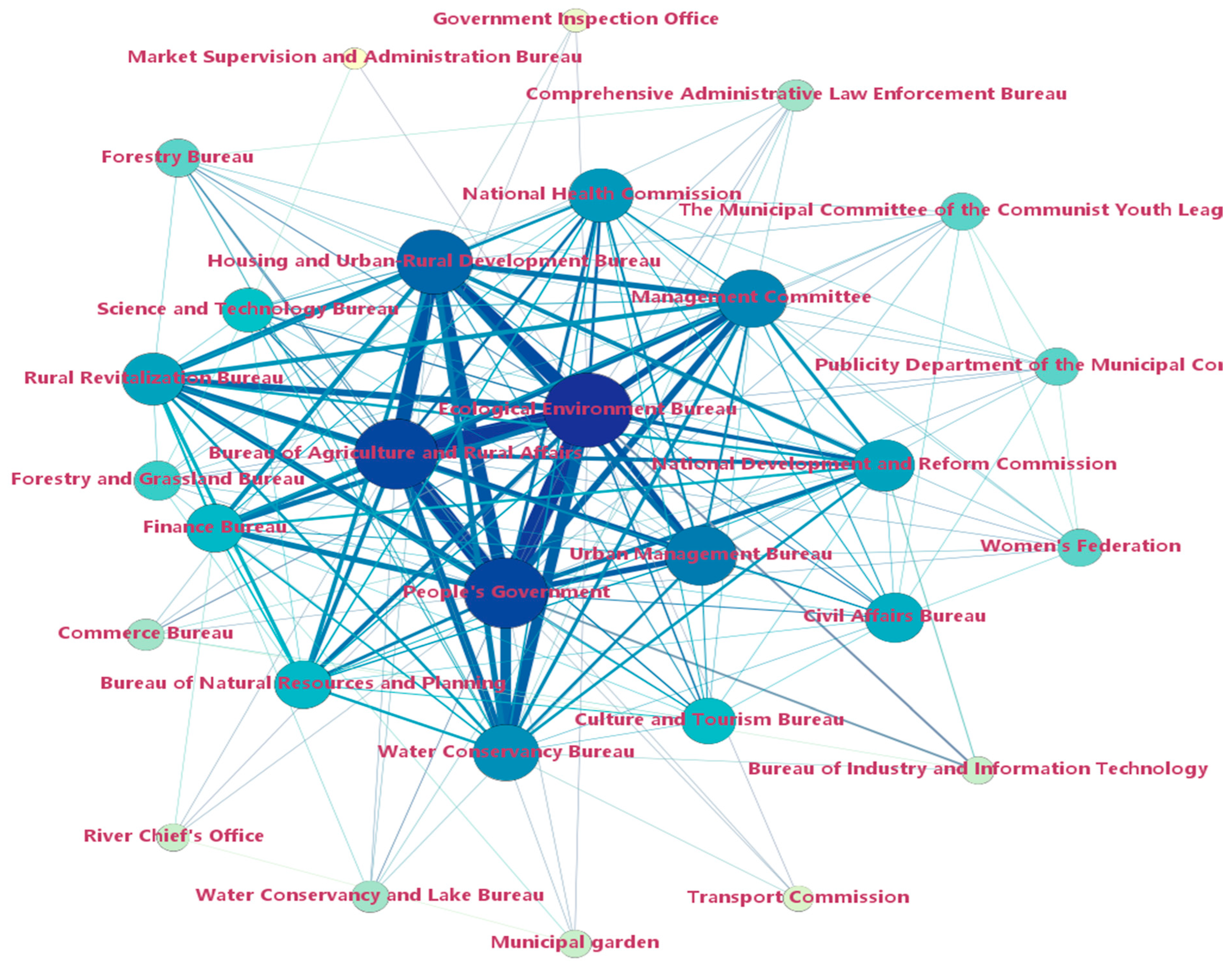
Based on the task allocation information, a table of edges recognizable by Gephi 0.9.7 software was constructed. The weight of each edge was defined by the number of times two nodes jointly participated in tasks (i.e., an edge with a weight of n indicates that the two nodes jointly participated in the task n times). The network edges were undirected, and 192 edges were established among 29 government entities. The complete Source–Target–Weight edge list is provided in Appendix B. All data used in the network construction were obtained through field investigation and survey research, and network visualization was performed using Gephi 0.9.7 software, resulting in what is shown in Figure 1. The size of each node is proportional to the number of its connections (i.e., the degree value). The larger the node, the higher its degree value, and vice versa; the thickness of the edge reflects the frequency of cooperation, and the thicker the edge, the more frequent the cooperation between the two entities, and conversely, the cooperation is less frequent.
As shown in Figure 1, the collaborative governance network for the rural water environment is connected through governance behaviors and shared goals. Various governance entities form a multi-factor-driven, dynamic, complex network through intricate interactions, and within this network, the evolutionary game relationships among the governance entities are intricate. Through dynamic interaction and adaptive adjustments, a multi-level and multi-dimensional collaborative effect is formed. The network’s adaptability and self-organization enable the system to gradually transition from disorder to order, providing an internal driving force and mechanistic guarantee for enhancing the efficiency and achieving the goals of rural water environment collaborative governance. In this study, we utilized the Ucinet 6.186 and Gephi 0.9.7 software to analyze the characteristics of the nodes and the overall properties of the collaborative governance network. The results revealed significant heterogeneity among the various entities within the network, which exhibited the features of a small-world network. Approximately 20% of local government departments, referred to as local government 1, exhibit high centrality. These departments prioritize environmental interests while showing relatively low concern for economic factors. The remaining 80%, categorized as local government 2, participate in water environment governance projects to varying degrees and display a stronger economic preference with lower emphasis on environmental concerns.

2.2. Constructing an Evolutionary Game Model

2.2.1. Game Strategy Analysis

In constructing the model, the evolutionary game entities within the network are uniformly defined as local governments, specifically referring to the local government entities within the relevant administrative regions involved in the collaborative governance of the rural water environment. Considering the heterogeneity of network nodes in this collaborative governance, differentiated configurations are applied within the complex network structure. The game model primarily analyzes the strategy choices and evolutionary patterns of two types of local governments throughout the collaborative governance process. Based on the assumption of bounded rationality [28], the model is constructed using evolutionary-stable strategies and replicator dynamics. Strategy selection is considered a dynamic decision-making process. In the initial stage, their strategies may not be optimal, but through continuous learning and adjustment, they gradually converge to their respective optimal strategies. Unlike existing governance-evolution models that assume homogeneous agents or static incentive effects, we integrate preference heterogeneity, synergy gains, and loss intensification within a networked evolutionary game framework, providing a mechanism-oriented analytical framework that reveals cooperation thresholds and stability patterns not captured by prior models. In particular, earlier models often assume homogeneous preferences and linear, time-invariant incentive effects [29]; we add increasing preference heterogeneity together with explicit synergy gains and loss intensification mechanisms; this enables a more transparent identification of cooperation thresholds, clearer regime/stability characterization across parameter ranges, and more interpretable scenario-based policy calibration.
Assumption 1.
All participants exhibit bounded rationality. The strategies they choose are influenced by expected returns, but there is a certain probability that they may not select the optimal strategy.
Assumption 2.
The behavioral strategies adopted by local governments in the collaborative governance of the rural water environment are influenced by external factors, such as the scale of the collaborative governance network and the rules governing strategy evolution, as well as internal factors, including the income of local government departments and their environmental preferences. In this study, we use the participation rate (i.e., the proportion of nodes choosing active participation) as a parsimonious proxy for governance quality in the simulation, because it captures the breadth and sustained engagement of intergovernmental collaboration—a key prerequisite for effective collaborative governance processes. In evolutionary games on networks, the fraction of cooperators is commonly used to indicate the long-term viability of cooperation in the system. The strategy set for these local governments consists of two options: to actively participate in collaborative governance or to refrain from active participation. Let the probabilities of actively participating in collaborative governance be  x  and  y , and those of not actively participating be  1 x  and  1 y  ( ( x , y ) [ 0 , 1 ] ), where  x  and  y  are functions of  t .
Assumption 3.
If only one party actively participates in the collaborative governance of the rural water environment, the economic and environmental benefits brought by the improvement in the water environment are  R , and the cost incurred is  C . The collaborative governance among government departments will generate a synergy effect, which is specifically manifested as an increase in benefits and a reduction in costs. Collaborative governance can generate additional net gains through information sharing, resource complementarity, and reduced duplicated efforts, so joint participation yields a higher net return than acting separately. If both parties of the game actively participate in collaborative governance, let the synergy gain coefficient be  λ 1 ( λ 1 > 1 ) . Due to the synergy effect, the benefits are  λ 1 ( R C ) . Let  θ  represent the cost–benefit allocation coefficient, which indicates the contribution to rural water environment governance. It denotes the proportion of revenue and cost distribution allocated to local Government 1.
Assumption 4.
Reputation gains refer to the social recognition and enhancement in reputation that local governments acquire through active participation in the collaborative governance of rural water environments. Let the reputation gains be denoted as  U , representing the benefits derived from increased trust in future governance efforts. The proportion of reputation gains allocated to Government 1 is denoted as  θ U .
Assumption 5.
The central or higher-level government sets an incentive amount, denoted by  K , to encourage local governments to actively participate in collaborative governance. This amount may serve either as a reward and subsidy for local governments that actively engage in the collaborative governance of the rural water environment, or as a penalty imposed on those that fail to do so.
Assumption 6.
Local governments may face different development pressures, fiscal constraints, and performance incentives, which leads to heterogeneous emphasis on economic versus environmental goals. To capture such preference differences in a simple and operational way within the model, we parameterize each government’s preference orientation using a single coefficient. To reflect the heterogeneity among local governments, let  α i ( i = 1 , 2 )  represent the economic preferences of local governments. Given limited policy resources and administrative attention, economic and environmental objectives are assumed to compete with each other. Accordingly, environmental preference is specified as  1 α i ( i = 1 , 2 ) , which provides a parsimonious, first-order approximation of the trade-off between development and environmental governance.  F  represents the benefits obtained by the government from pursuing economic growth without actively participating in collaborative governance. Then,  α i F ( i = 1 , 2 )  represents the benefits obtained by local governments 1 and 2 from pursuing economic growth. The loss to the region caused by the government’s pursuit of economic growth without actively participating in governance, represented by  L , is proportional to the economic preferences among local governments, which is denoted by  α i L ( i = 1 , 2 ) . When both parties choose non-participation, governance failures may accumulate and spill over, causing environmental deterioration and social risks to escalate rather than remain constant. To capture this escalation effect in a parsimonious way, we introduce a loss intensification coefficient. When both parties choose non-participation, governance failures may accumulate and spill over, causing environmental deterioration and social risks to escalate rather than remain constant. To capture this escalation effect, we introduce a loss intensification coefficient. At the same time, if neither party actively participates in collaborative governance, regional losses exhibit a more pronounced intensification trend, represented by  β 1 L ( β 1 > 1 ) .
As mentioned above, the symbols and meanings of each parameter are shown in Table 1.

2.2.2. Payoff Matrix

Based on the above assumptions, an evolutionary game payoff matrix among local governments is constructed, as shown in Table 2.

2.2.3. Copying Dynamic Equations

According to the evolutionary game matrix, the expected returns E ( x ) for local government 1 choosing the strategy of actively participating in collaborative governance, the expected return E ( 1 x ) for choosing the strategy of not actively participating, and E ¯ x for the average expected return are, respectively,
E ( x ) = y [ λ 1 θ ( R C + K ) ] + ( 1 y ) [ θ ( R C ) + K α 2 L ] ,
E ( 1 x ) = y ( θ U + α 1 F α 1 L K ) + ( 1 y ) [ θ ( K β 1 L ) + α 1 F ]
E ¯ x = x E ( x ) + ( 1 x ) E ( 1 x ) .
Based on the expected return function, the replicator dynamic equation for local government 1 can be derived as follows:
F x ( x , y ) = d x d t = x [ E ( x ) E ¯ x ] = x ( x 1 ) [ α 1 F + α 2 L θ ( K + β 1 L C + R ) K + ( α 1 L α 2 L + θ ( β 1 L + ( 1 λ 1 ) ( K C + R ) + U ) ) y ] .
The expected benefits E ( y ) for local government 2 choosing the strategy of actively participating in collaborative governance, E ( 1 y ) for choosing the strategy of not actively participating, and E ¯ y for the average expected benefit are, respectively,
E ( y ) = x [ λ 1 ( 1 θ ) ( R C + K ) ] + ( 1 x ) [ ( 1 θ ) ( R C ) + K α 1 L ] ,
E ( 1 y ) = x [ ( 1 θ ) U + α 2 F α 2 L K ] + ( 1 x ) [ ( 1 θ ) ( K β 1 L ) + α 2 F ] ,
E ¯ y = y E ( y ) + ( 1 y ) E ( 1 y ) .
Based on the expected return function, the replicator dynamic equation for local government 2 can be derived as follows:
F y ( x , y ) = d y d t = y [ E ( y ) E ¯ y ] = y ( y 1 ) [ α 2 F + α 1 L + ( θ 1 ) ( β 1 L + K C + R ) K + ( α 1 L α 2 L + ( β 1 L + ( 1 λ 1 ) ( K C + R ) + U ) ( 1 θ ) ) x ] .
In order to determine the equilibrium points of the evolutionary game system within the rural water environment collaborative governance framework, let F x ( x , y ) = F y ( x , y ) = 0 , and the local equilibrium points can be obtained as E 1 ( 0 , 0 ) , E 2 ( 1 , 0 ) , E 3 ( 0 , 1 ) , E 4 ( 1 , 1 ) , and E 5 ( x , y ) .

2.2.4. Stability Analysis of the Equilibrium Point

According to Friedman’s method [30], the local stability of the replicated dynamic equilibrium points can be analyzed using the Jacobian matrix. By taking the partial derivatives of the replicator dynamic equations in the evolutionary game system among government entities, the Jacobian matrix is derived as follows:
D e t ( J ) = F x ( x , y ) x F x ( x , y ) y F y ( x , y ) x F y ( x , y ) y = ( 2 x 1 ) [ α 1 F + α 2 L θ ( K + β 1 L C + R ) K + ( α 1 L α 2 L + θ ( β 1 L + ( 1 λ 1 ) ( K C + R ) + U ) ) y ] x ( x 1 ) ( α 1 L α 2 L + θ ( β 1 L + ( 1 λ 1 ) ( K C + R ) + U ) ) y ( y 1 ) ( α 1 L α 2 L + ( β 1 L + ( 1 λ 1 ) ( K C + R ) + U ) ( 1 θ ) ) ( 2 y 1 ) [ α 2 F + α 1 L ( θ 1 ) ( β 1 L + K C + R ) K + ( α 1 L α 2 L + ( β 1 L + ( 1 λ 1 ) ( K C + R ) + U ) ( 1 θ ) x ] .
The trace of matrix J is
T r ( J ) = F x ( x , y ) x + F y ( x , y ) y = ( 2 x 1 ) [ α 1 F + α 2 L θ ( K + β 1 L C + R ) K + ( α 1 L α 2 L + θ ( β 1 L + ( 1 λ 1 ) ( K C + R ) + U ) ) y ] + ( 2 y 1 ) [ α 2 F + α 1 L + ( θ 1 ) ( β 1 L + K C + R ) K + ( α 1 L α 2 L + ( β 1 L + ( 1 λ 1 ) ( K C + R ) + U ) ( 1 θ ) ) x ]
Based on Friedman’s Jacobian matrix theory, when the conditions of the determinant D e t ( J ) > 0 of the Jacobian matrix and the trace T r ( J ) < 0 are simultaneously met, this equilibrium point will exhibit a locally stable trend, indicating the existence of evolutionarily stable strategies within the evolutionary game system. For the four local equilibrium points in this system, stability analysis was conducted, and E 5 ( x , y ) is non-asymptotically stable. Table 3 shows the D e t ( J ) and T r ( J ) values of the four equilibrium points.
By analyzing and solving the evolutionary game model of collaborative governance of the rural water environment, the equilibrium points of this evolutionary game model under certain conditions were obtained. To facilitate the analysis, a = α 1 F + α 2 L θ ( K + β 1 L C + R ) K , b = α 2 F + α 1 L + ( θ 1 ) ( β 1 L + k C + R ) K , c = α 1 F K α 1 L + θ U + λ 1 θ ( C R K ) , and d = α 2 F K α 2 L + ( 1 θ ) U + λ 1 ( 1 θ ) ( C R K ) were defined. When c < 0 and d < 0 , E 4 ( 1 , 1 ) is the stable point, meaning that, in this situation, both parties choose to actively participate in the collaborative governance. Thus, it can be observed that, in the collaborative governance of the rural water environment, the choice of local government strategies is influenced by the economic preferences of both parties, the distribution of benefits, and the strategies chosen by the other party. Due to the complexity of the real situation, the positive or negative values of D e t ( J ) and T r ( J ) for each equilibrium point are determined by multiple parameters, and the analysis of stable points has numerous conditions. The following analysis is based on c < 0 and d < 0 , as shown in Table 4.

2.3. Evolution Rules of Complex Networks

In this study, we refer to the small-world network among local governments as G = ( N , L , M ) . Here, N = n 1 , n 2 , , n N represents the set of nodes, where N indicates local government nodes in the local government network. L = l 1 , 1 , l 1 , 2 , , l N , N is the set of edges, and if there is an edge between nodes i and j , meaning that there is a collaborative governance evolution game relationship between the two local governments, then l i , j = l j , i = 1 ; otherwise, l i , j = l j , i = 0 . That is to say, there is a collaborative governance evolution game relationship between the two local governments. S i ( 1 , 0 ) represents the strategy combinations of local government departments, where a value of 1 indicates that the local government actively participates in the collaborative governance of the rural water environment, while 0 indicates non-participation. In this network, there are three types of edges, namely (1, 0) representing (actively participating in collaborative governance, not actively participating in collaborative governance), (1, 1) representing (actively participating in collaborative governance, actively participating in collaborative governance), and (0, 0) representing (not actively participating in collaborative governance, not actively participating in collaborative governance). M represents the set of neighbor nodes of a node in the village water environment collaborative governance network, that is, a set of local governments and all neighboring local government entities M = m 1 , m 2 , , m M , where M i = j l i , j = 1 .
Considering the widespread applicability of the classical Fermi rule (FEMI), it is adopted as the evolutionary mechanism for the complex network game. In this network, each node randomly selects one of its neighboring entities as a reference and observes the strategy and corresponding payoff of neighbor j . Then, with a probability P , the node decides whether to adjust its own strategy for participating in collaborative governance [31]. This adjustment process is defined as follows:
P S i , t S j , t = 1 1 + exp [ ( U i , t U j , t ) / η ] .
where P S i , t S j , t represents the probability that participant i converts its own strategy into the strategy of neighbor j ; S i , t and S j , t represent the strategies adopted by participants i and j at time t , respectively; U i , t and U j , t represent the total gains of participant i and neighbor j at time t, respectively; and parameter η represents the learning noise, that is, the possibility of imitating irrational behaviors during the learning process. Generally, η > 0 represents the situation where, due to unpredictable changes in gains or decision-making errors, strategies with lower gains may also be adopted by the participant [32]. When learning noise η 0 is present, it indicates that participant i is rational and will only learn the strategies of neighbor nodes with higher gains; when learning noise η is present, it indicates that participant i is in a noisy environment and is irrational, and will randomly update its own strategy regardless of the strategies and gains of the neighbor nodes. Based on the literature, in this study, we take η = 0.1 to represent that the participant is finitely rational [33,34].
The mechanism for reconnecting broken edges is set as follows: Suppose there are N entities. At any iteration time t , a random edge will be selected, and with a probability p, its original connection will be disconnected, thereby initiating the reconnection operation. The specific approach is to disconnect one end of the selected connection and connect it to other nodes with a probability of p , but a node is not allowed to connect to itself or to have duplicate connections. In this study, a biased mechanism for reconnecting broken edges is adopted [35]. At time t , the probability that node i connects to node j is
p i j , t = i G ( U j , t α / U i , t α ) .
where U i , t and U j , t , respectively, represent the payoffs of nodes i and j at time t . α is a parameter that represents the preference tendency, and it affects the weight of the gains in the calculation of connection probabilities.
During each evolutionary cycle t of collaborative governance for the rural water environment, each local government entity engages in a game with all other entities within its game radius, based on four revenue scenarios defined in the payoff matrix, and receives the corresponding payoffs. Let π ( S i , S j ) represent the game payoff of local government i , where 1 indicates active participation in the collaborative governance strategy and 0 indicates non-participation.
π ( S i , S j ) = π i ( 0 , 0 ) π i ( 1 , 0 ) π i ( 0 , 1 ) π i ( 1 , 1 ) = λ 1 θ ( R C + K ) θ ( R C ) + K α 2 L θ U + α 1 F α 1 L K θ ( K β 2 L ) + α 1 F .
Each local government entity engages in a game with other entities that share a collaborative governance relationship, as defined by the small-world network model. The payoff of each game entity is the cumulative total of the payoffs obtained from the evolutionary game with all its neighboring government entities i . The payoff U i , t of the local government entity node i is
U i , t = j Ω i S i π ( S i , S j ) S j .
where Ω i represents all the neighbors of participant i ; S i represents the strategy of the members; and S j represents the transpose of the neighbor strategies.

3. Simulation Analysis

3.1. Simulation Program

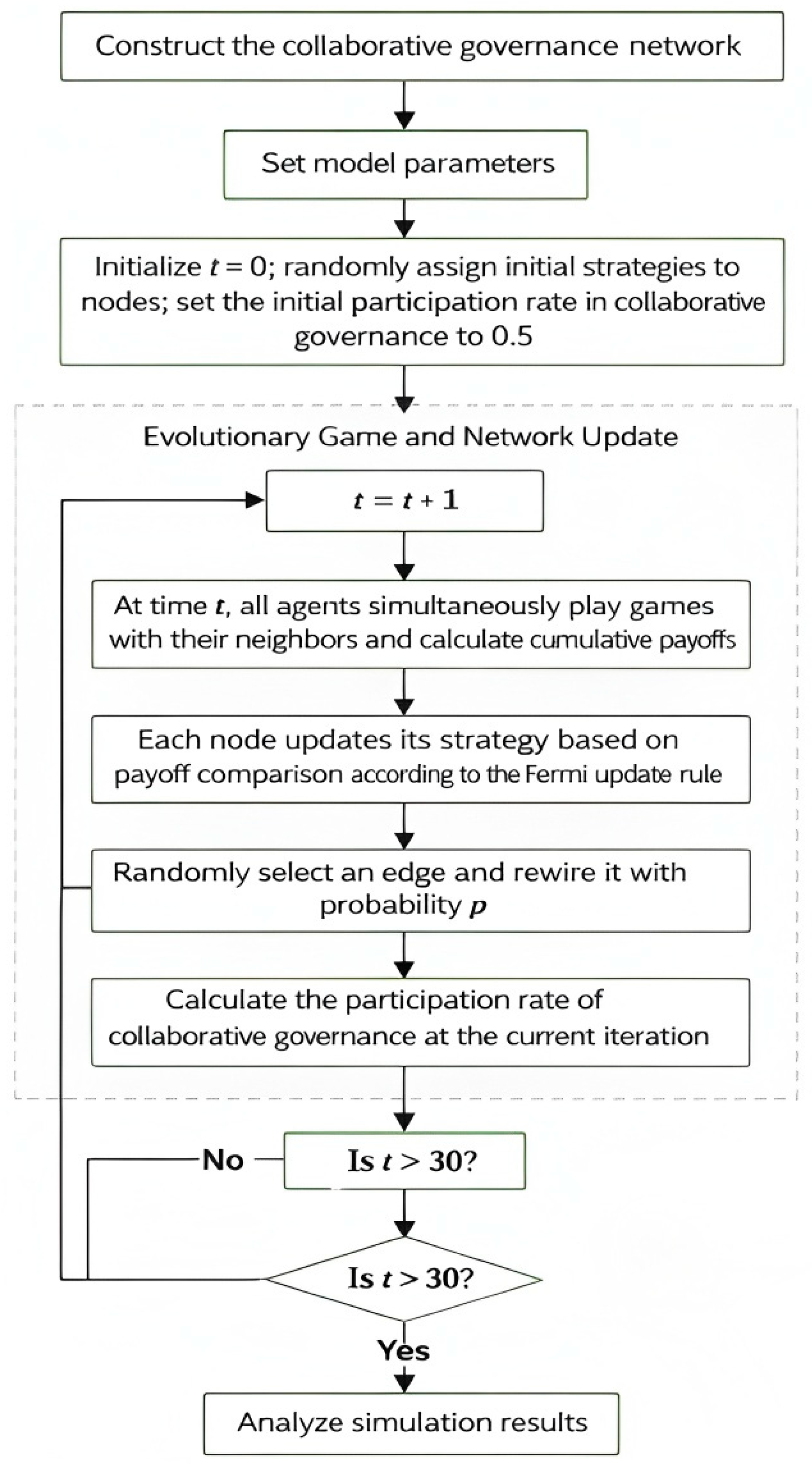
The evolutionary game model for collaborative governance of the rural water environment within complex networks is implemented in MATLAB 2024a. This model analyzes evolutionary game dynamics within the collaborative governance network and evaluates the overall evolution of the network. The simulation program is as follows (see Figure 2):
(1) Network generation
The parameters of the collaborative governance system are first initialized. In this study, a rural water environment collaborative governance network consisting of N nodes is constructed according to the generation rules of the small-world network model. The network evolves over 30 iterations, with 50 Monte Carlo simulations performed in each iteration. In the initial stage of the game, N / 2 nodes are randomly selected to actively participate in collaborative governance, resulting in an initial participation rate of 0.5. The proportion of nodes participating in collaborative governance at any given moment during the game is referred to as the collaborative governance participation rate.
(2) Game mechanism
Within the complex network framework of collaborative governance of the rural water environment, each node interacts in accordance with the principle of evolutionary game theory. Throughout the collaborative governance process, each node first acquires the initial strategy and then engages in the game. The complex network structure among governments is calculated for the game’s benefits according to Equation (13).
(3) Strategy update
At each time step t, all the entities involved in the rural water environment will, in accordance with the FEMI strategy adjustment rules, promptly modify their own strategies. The modified strategies will serve as the basis for the next round of the game.
(4) Structural adjustment
In each round of the evolutionary game cycle among single-level government departments, government nodes within the collaborative governance network of the rural water environment randomly select an edge according to Equation (11), and then perform disconnection and reconnection operations on the links between nodes. This process enables dynamic adjustment of the network structure.
(5) Participation rate calculation
The above steps are repeated until the node strategy reaches a stable state and the simulation ends. The collaborative governance participation rate is calculated and denoted as f ( t ) = n t / N . n t represents the number of collaborative governance participants in the t rounds of the game.

3.2. Parameter Settings

In the simulation experiment, each node in the network represents a local government. The 29 entities mentioned above participate in the rural water environment governance process. Due to regional variations, some areas may involve more entities. Therefore, we expand the scope to 50 entities, setting the network size to an integer value between 29 and 50 (29 ≤ N ≤ 50). The parameter settings were determined by referring to existing studies on evolutionary game theory and collaborative governance, and were further calibrated based on survey data and the specific research context of rural water environmental governance. Based on the equilibrium points derived from the model, the initial parameters were set under the condition that α 1 F K α 1 L + θ U + λ 1 θ ( C R K ) < 0 and α 2 F K α 2 L + ( 1 θ ) U + λ 1 ( 1 θ ) ( C R K ) < 0 , which ensures the stability of the evolutionary game system [36,37]. The relevant evolutionary game parameters are presented in Table 5. Because complete empirical data for all model components are rarely available, evolutionary game models often initialize parameters by combining evidence from the literature with insights from field investigations. Accordingly, our parameter settings are based on two sources: prior studies and our field survey [38,39].
Due to the heterogeneity among government departments, the economic preferences of the nodes in the network are randomly distributed. Nodes with economic preferences less than 0.35 are classified as having lower economic preferences (higher environmental preferences). The coefficient θ for the distribution of costs and benefits of rural water environment governance among nodes with lower economic preferences is 0.6, while for those with higher economic preferences, it is 0.4. The preference tendency δ in the probability of edge removal and reconnection is set to 0.5, and the noise factor η is set to 0.1. Keeping all other parameters unchanged, we draw the images of the changes in the total collaborative governance participation rate and the collaborative governance participation rate of nodes with lower economic preferences under the conditions of node numbers of 29 and 50. The degree of collaborative governance and the evolution speed are observed and compared. All simulation settings and parameter values are summarized in Appendix C.

3.3. Simulation Results

3.3.1. The Impact of External Driving Factors on Network Evolution

(1) The impact of reward/punishment amounts on network evolution
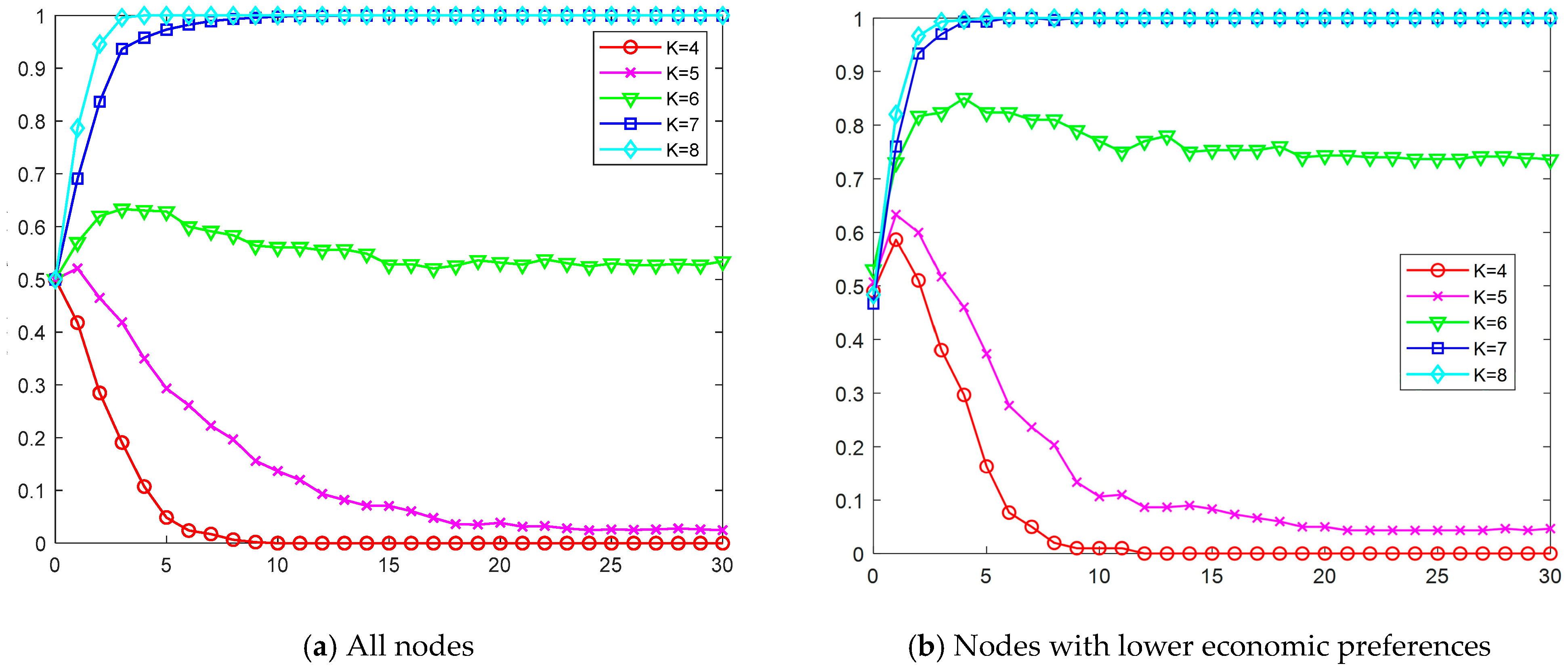
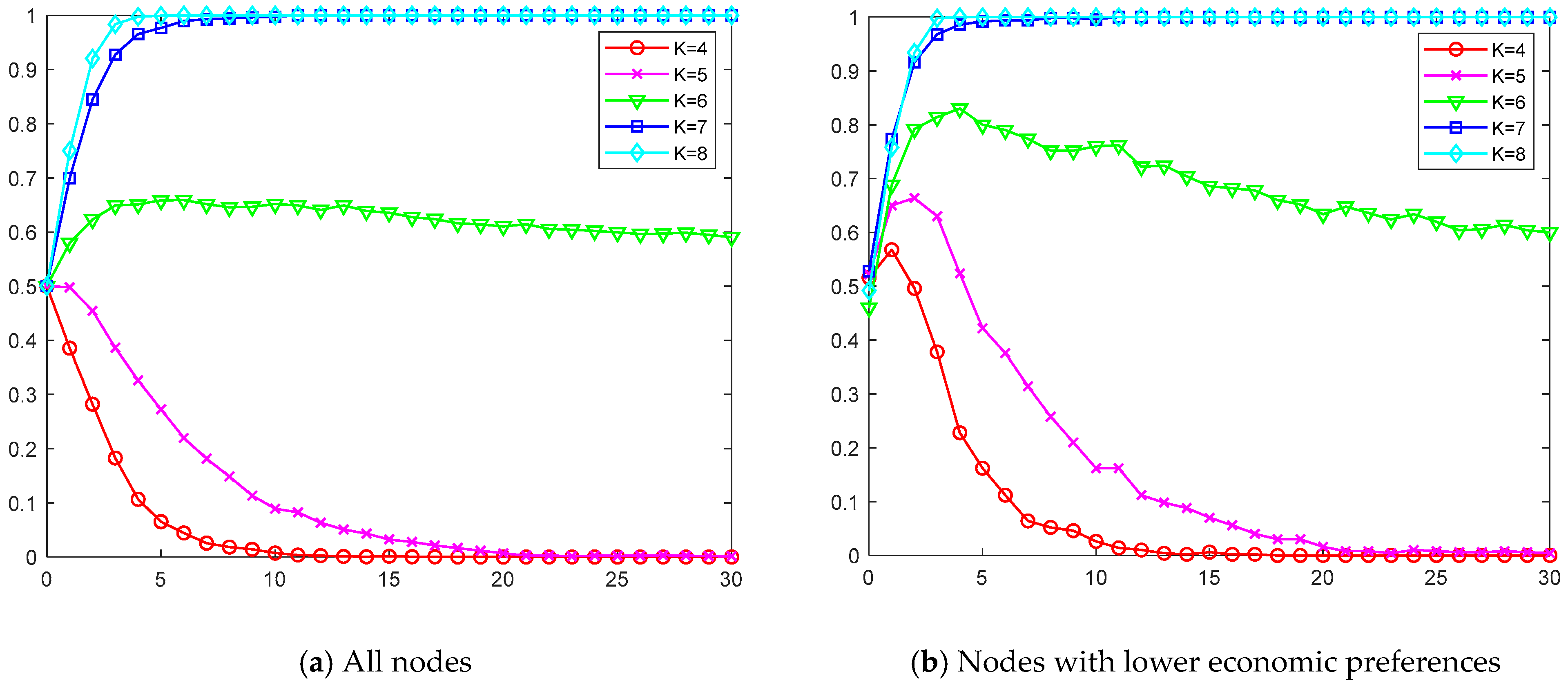
The reward/punishment amount represents the incentives or penalties imposed on local governments for actively participating in or refraining from participation in rural water environmental collaborative governance. It reflects the intensity of external incentives applied by higher-level governments or the institutional environment to influence local government behavior. In the process of network evolution, the reward–punishment amount primarily affects strategy selection and evolutionary trajectories by altering the payoff structure faced by local governments. Keeping all other parameters unchanged, the reward/punishment amounts are set to K = 4 , 5 , 6 , 7 , 8 , respectively, increasing by 1 unit each time. We observe the proportion of all nodes and those with lower economic preferences actively participating in collaborative governance in networks of different scales. The simulation results under the FEMI strategy rule are shown in Figure 3 and Figure 4. Here, the vertical axis represents the participation rate in collaborative governance, and the horizontal axis represents the number of iterations. It can be seen that the critical value of the reward/punishment amount when all nodes actively participate in collaborative governance is between 6 and 7. This critical interval indicates that collaborative governance can fully diffuse across the network only when the external incentive intensity is sufficient to offset the perceived costs and risks faced by nodes with lower economic preferences when participating in collaboration. This finding provides important implications for the design of incentive mechanisms in collaborative governance: if the incentive level remains below this interval, policy effectiveness will be severely constrained, whereas once the threshold is reached, the system may rapidly transition to a stable state with high participation rates.
In this section, we investigate the impact of reward–punishment intensity on cooperation dynamics, showing convergence to stable participation levels over time and higher steady-state cooperation under stronger incentives, with differences across preference types and network sizes.
Figure 3a and Figure 4a illustrate that, as the number of iterations increases, the proportion of all nodes actively participating in collaborative governance under different reward/punishment levels gradually stabilizes. This suggests that, over the course of the long-term evolutionary game process, local governments adjust their behavior in response to the reward/punishment mechanism, eventually reaching a relatively stable state of cooperation. As the reward/punishment level increases, the degree of cooperative behavior across networks of varying sizes improves significantly. Notably, when the reward/punishment level reaches 6 or higher, the participation rate rises sharply and quickly stabilizes. The larger the reward/punishment amount, the higher the value at which the proportion of all nodes actively participating in collaborative governance reaches a stable state.
Figure 3b and Figure 4b show that for nodes with lower economic preferences (higher environmental preferences), as the number of iterations increases, the proportion of nodes actively participating in collaborative governance tends to stabilize. However, compared to all nodes, the proportion of active participation at the stable state is generally higher for these nodes. This suggests that local governments with stronger environmental preferences are more inclined to engage in collaborative water environment governance, and their behavior is less sensitive to changes in the reward/punishment level. Under different K values, the differences in the proportion of actively participating nodes with lower economic preferences are smaller compared to all nodes, further indicating that these nodes have a stronger cooperative intention, and the marginal effect of the reward/punishment amount on their behavioral adjustment is less clear.
Under the same reward/punishment level, as the network scale increases from 29 to 50 nodes, the trend of the proportion of all nodes and nodes with lower economic preferences actively participating in collaborative governance reaching a stable state is different. For some K values, the larger the network scale, the higher the proportion of active participation of all nodes when reaching a stable state. In the case of nodes with lower economic preferences, although an increase in network size exerts some influence, their participation rate generally remains at a relatively high level.
(2) The impact of economic growth benefits on network evolution
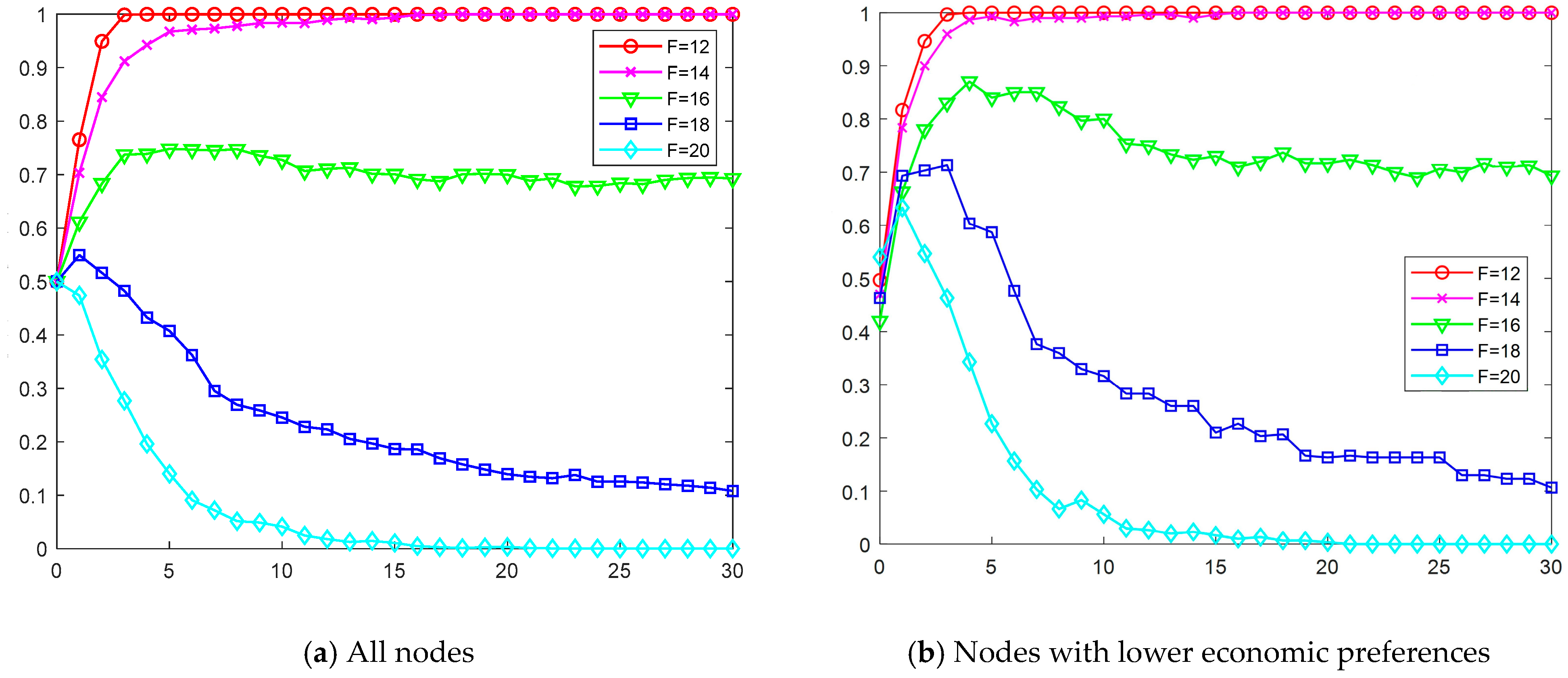
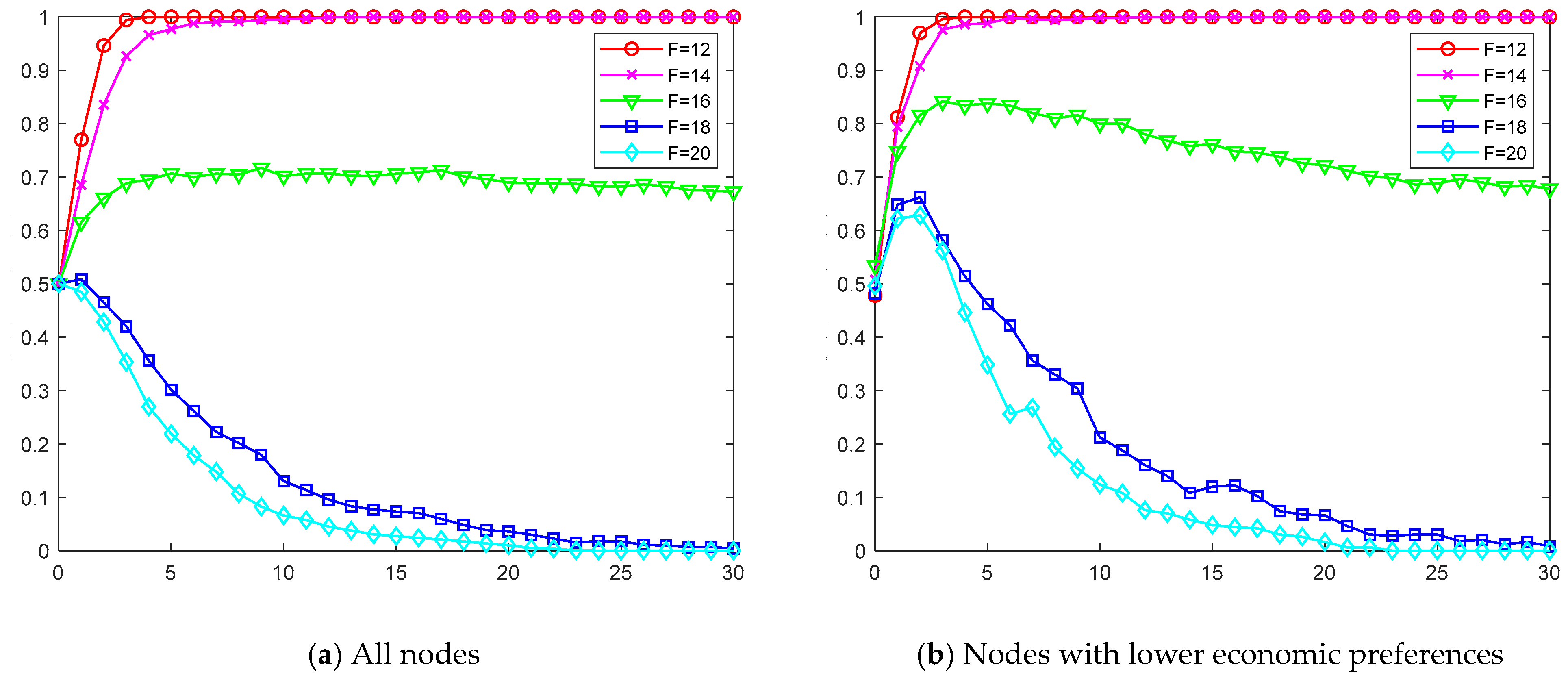
The economic growth benefits that government departments derive from pursuing economic growth reflect their relative preference for development objectives and opportunity returns under constraints of limited resources and administrative attention, and in the process of network evolution, these benefits alter the relative attractiveness of participating in collaborative governance versus prioritizing economic growth. Under the condition that other parameters are kept constant, by adjusting the benefit F obtained by the government department from pursuing economic growth, the impact on the network evolution result can be obtained, as shown in Figure 5 and Figure 6. Here, the vertical axis represents the participation rate of collaborative governance, and the horizontal axis represents the number of iterations. From the figure, it can be observed that the critical value of the benefit from pursuing economic growth when all nodes actively participate in collaborative governance is between 14 and 16. This critical interval suggests that, when the returns governments obtain from economic growth are sufficient in offsetting the coordination and institutional costs associated with collaborative governance, their behavioral orientation tends to shift away from a purely short-term growth focus toward more active and sustained governance engagement. Accordingly, this critical value should be interpreted not simply as a numerical outcome, but as an indication of the balance between economic incentives and investments in collaborative governance.
To analyze how economic growth benefits affect collaborative governance dynamics, we examine Figure 5 and Figure 6 in this section, showing that higher economic incentives tend to slow convergence and reduce the steady-state participation rate, especially as network size increases.
According to Figure 5 and Figure 6, it can be concluded that, as the number of nodes increases, the changes in the proportion of all nodes participating in collaborative governance exhibit a discernible pattern in reaching a stable state. When the benefits from pursuing economic growth are relatively low, the participation rate initially increases rapidly and ultimately stabilizes at a high level. By contrast, as the economic growth benefits increase, the initial growth rate slows down, and the final stable participation rate declines. This indicates that an excessive pursuit of economic growth benefits may weaken the willingness of local governments to engage in collaborative governance of the rural water environment. When the incentives for economic gains become dominant, local governments tend to prioritize economic development, potentially at the expense of environmental collaboration.

3.3.2. The Impact of Synergy and Loss Effect Coefficients on Network Evolution

(1) The influence of the synergy gain coefficient on network evolution
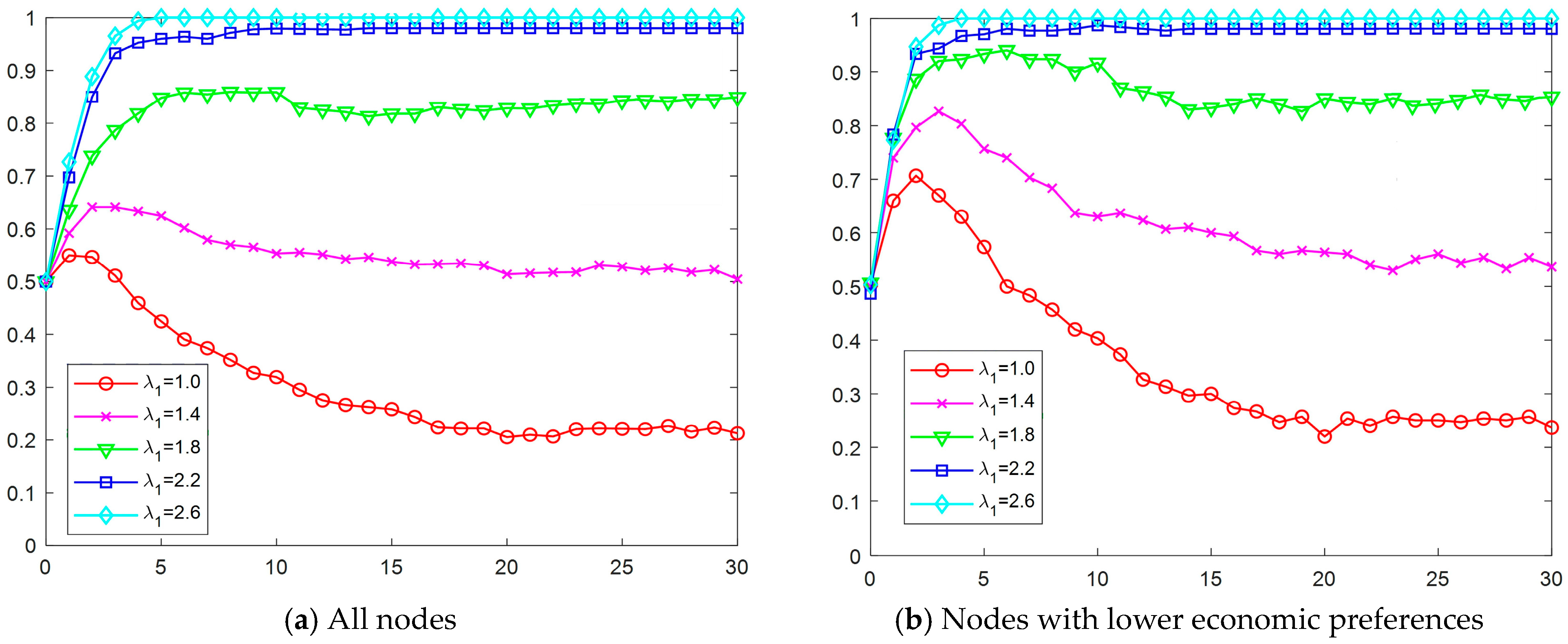
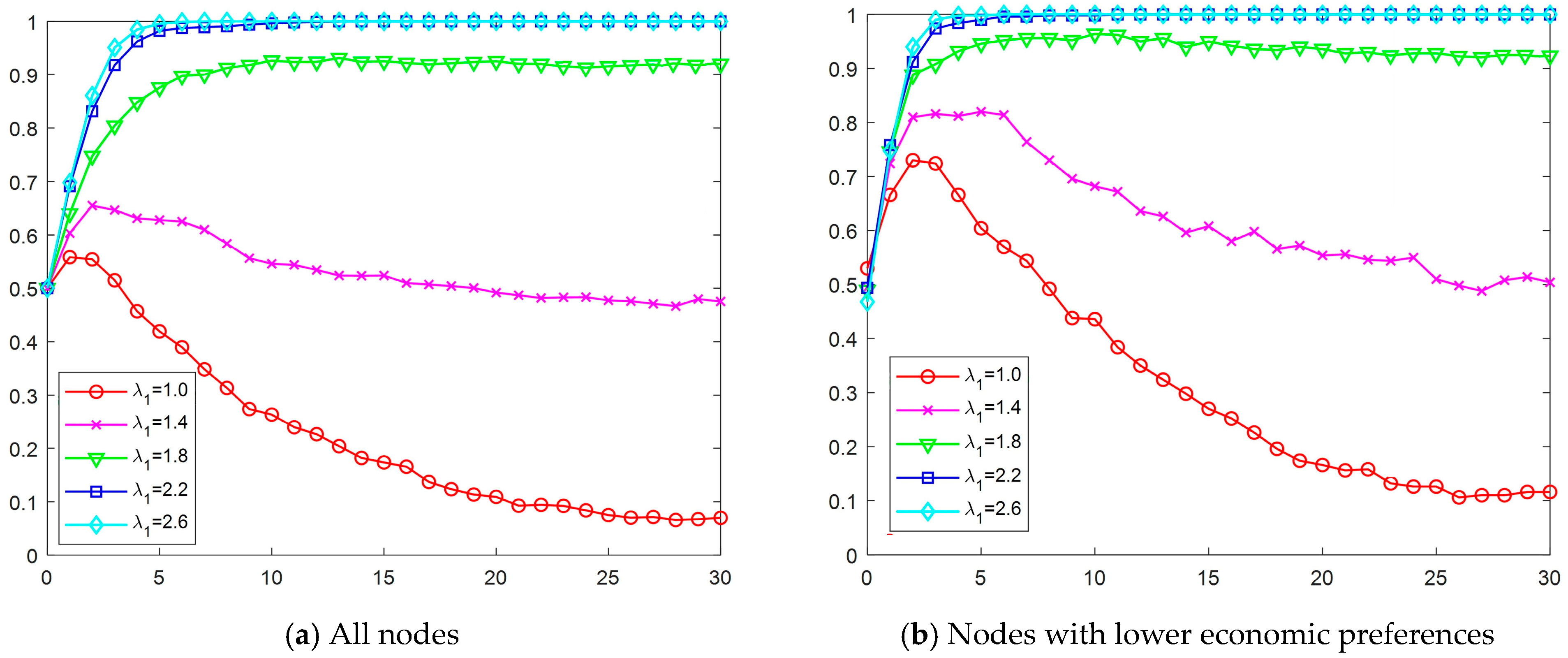
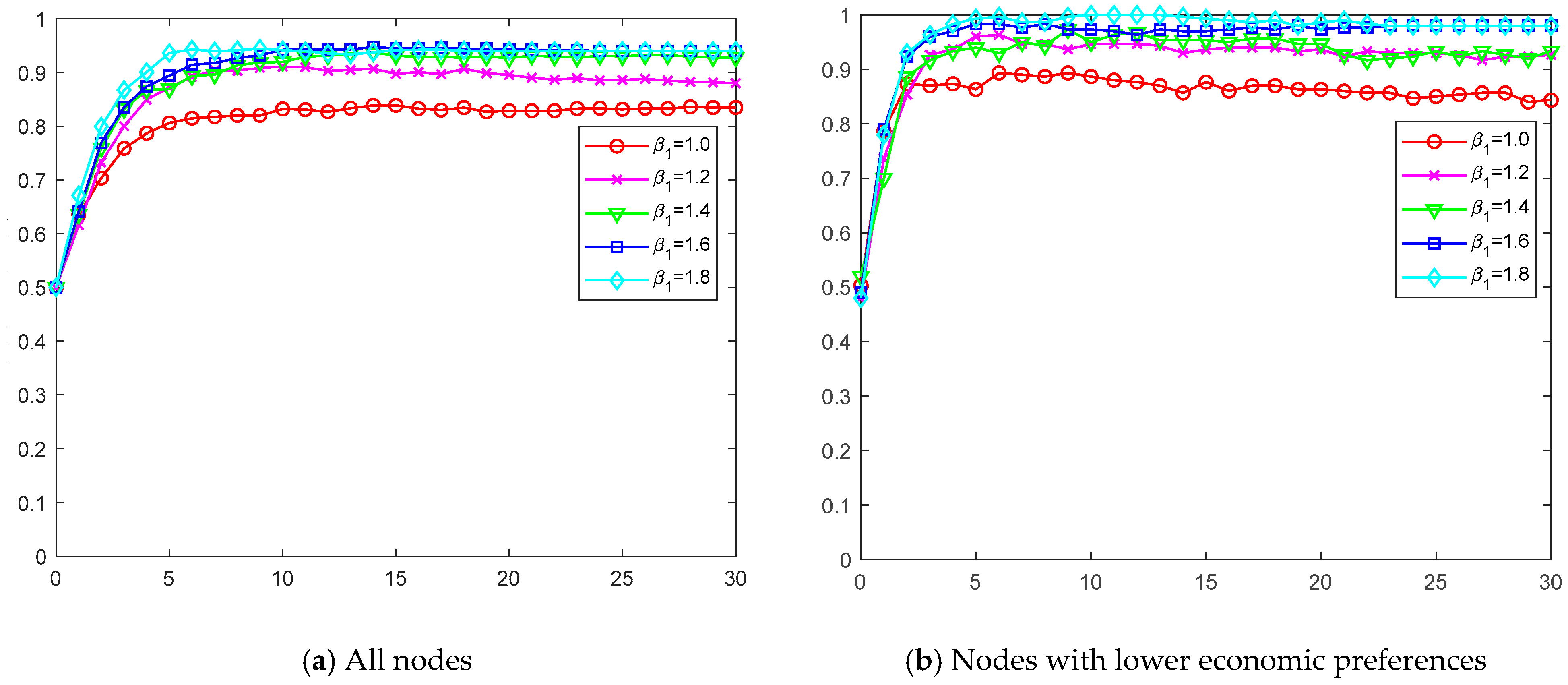
The synergy gain coefficient represents the level of synergistic benefits generated when both parties in the game actively participate in collaborative governance, and it is used to characterize the intensity of the synergistic returns arising from mutual participation in collaborative governance. When all other factors remain constant, adjusting the synergy gain coefficient reveals its impact on the evolution of the network, as illustrated in Figure 7 and Figure 8. Here, the vertical axis represents the participation rate of collaborative governance, and the horizontal axis represents the number of iterations.
To examine how synergistic benefits drive collaborative governance, we analyze the effects of different synergy gain coefficients in this section, revealing a critical interval in which cooperation rapidly diffuses across the network, with higher coefficients leading to faster convergence and higher steady-state participation, while network expansion moderates this effect.
From the figures, it can be observed that, when all nodes participate in collaborative governance, the critical value of the synergy gain coefficient ranges from 1.8 to 2.2. This critical interval indicates that when the synergistic benefits generated by collaborative governance sufficiently exceed the benefits of individual action, the collaborative strategy tends to become the dominant strategy within the network and diffuses rapidly through positive feedback mechanisms. As the number of iterations increases, the proportion of nodes participating in collaborative governance under different synergy gain coefficients gradually stabilizes. A higher synergy gain coefficient leads to a higher steady-state participation rate in collaborative governance. This suggests that, when intergovernmental collaboration yields greater benefits, local governments are more strongly motivated to engage in rural water environment governance. However, compared to all nodes, those with lower economic preferences exhibit higher participation rates even at lower synergy gain coefficient levels, indicating their inherent willingness to participate and greater attention to environmental protection and sustainable development. Furthermore, increasing the synergy gain coefficient can further strengthen their participation.
As the network scale increases, the steady-state participation rate of all nodes tends to decrease. This may be attributed to the increased coordination difficulty in larger networks—despite relatively high synergy gain coefficients, some local governments remain hesitant to participate in collaborative governance. For nodes with lower economic preferences, the expansion of network scale also has a certain effect on their participation rate.
(2) The impact of the coefficient of the intensifying loss trend on network evolution
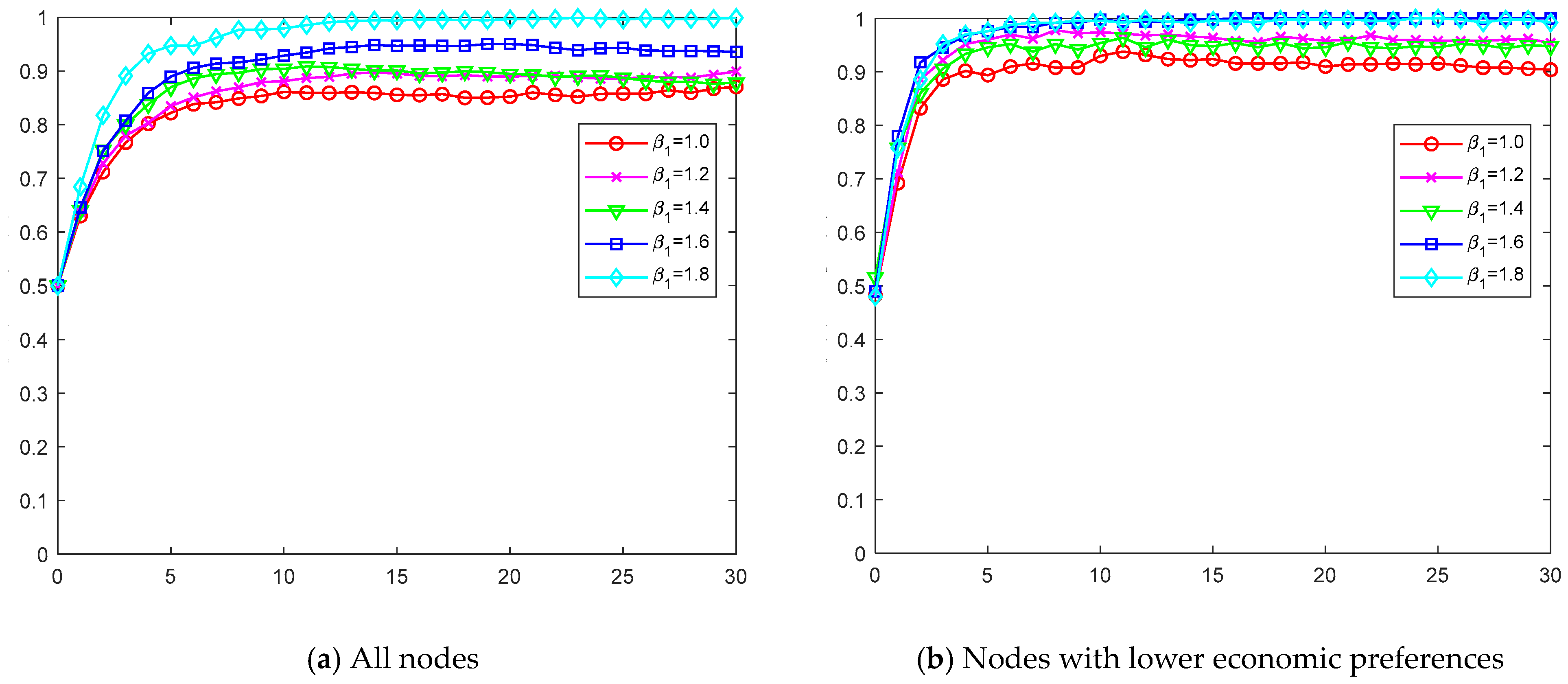
The coefficient of the intensifying loss trend represents the tendency for losses to escalate when neither party actively participates in collaborative governance. During network evolution, this coefficient amplifies the potential losses associated with non-participation strategies, thereby significantly altering the relative payoff structure among actors in strategy comparison. While keeping other factors constant, by adjusting the coefficient β 1 of the intensification trend of losses, the influence of the loss intensification trend coefficient on the network evolution results can be obtained as shown in Figure 9 and Figure 10. Here, the vertical axis represents the participation rate of collaborative governance, and the horizontal axis represents the number of iterations.
In this section, we investigate how varying the loss intensification trend coefficient affects cooperative behavior, revealing a clear trend in which stronger loss intensification accelerates convergence and raises the steady-state participation rate, with more pronounced effects in larger networks.
When the loss intensification trend coefficient is high, the regional losses caused by the government’s lack of active participation in collaborative governance significantly expand, prompting more nodes to actively adjust their strategies and driving the network towards the direction of collaborative governance. A higher loss intensification trend coefficient, i.e., when both parties fail to actively participate in collaborative governance, leads to more significant regional losses and a higher steady-state participation rate among all nodes. This suggests that, when local governments recognize the greater consequences of non-participation, they are more likely to actively engage in rural water environment collaborative governance. For example, in a 29-node network, the curve corresponding to a higher loss intensification coefficient exhibits a greater steady-state participation rate compared to the case with a lower coefficient. Nodes with a lower economic preference (higher environmental preference) already have a relatively high participation rate when the coefficient for the intensification of losses is low. This suggests that local governments with lower economic preferences exhibit a stronger sense of responsibility toward water environment governance. Furthermore, an increase in the loss intensification coefficient further reinforces their willingness to engage in collaborative governance.
As the number of network nodes increases, the variation range of the cooperation rate gradually expands. This suggests that the influence of the loss intensification coefficient on cooperation becomes more pronounced in larger networks. This may be attributed to the fact that, in large-scale networks, information diffuses more rapidly and the interactions among nodes are more complex, thereby amplifying the effect of the loss intensification coefficient on the overall cooperation rate.

3.3.3. The Impact of Cost and Benefit Allocation Coefficients on Network Evolution

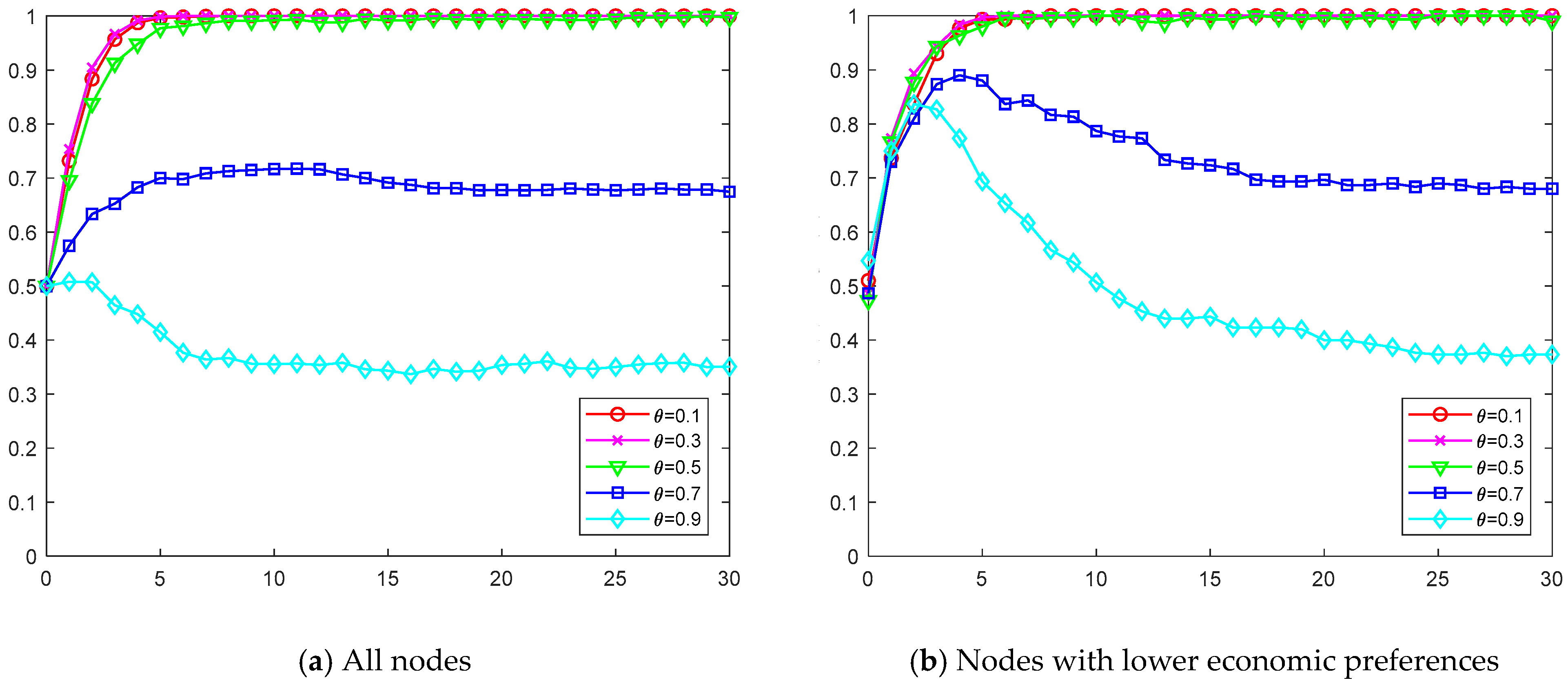
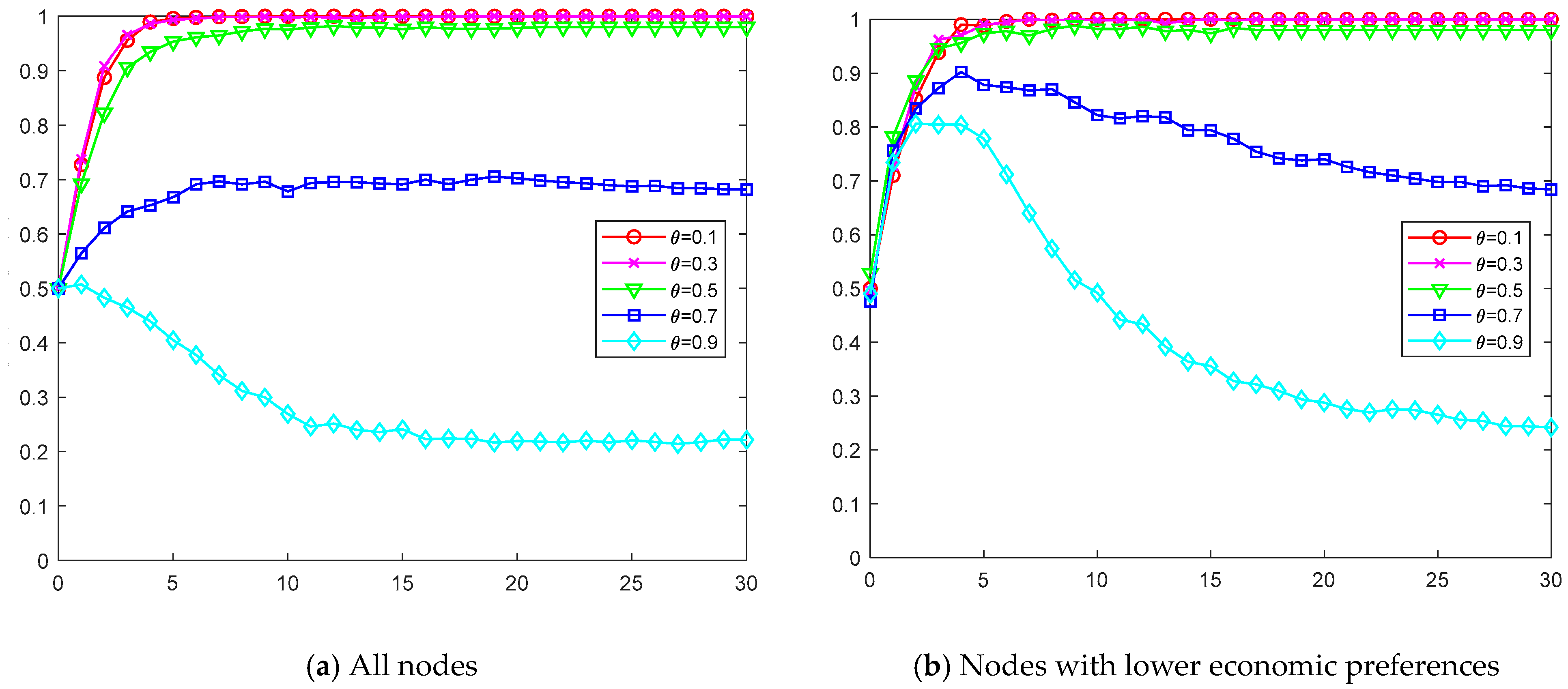
The cost and benefit allocation coefficients characterize the relative proportions of costs borne and benefits obtained by different actors in collaborative governance, and in the process of network evolution, these coefficients influence strategy selection and diffusion paths by altering actors’ expected payoffs from participating in collaborative governance. When other conditions remain unchanged, adjusting the cost and benefit allocation coefficient θ can affect the heterogeneity coefficient of cost and benefit allocation, which affects the network evolution results, as shown in Figure 11 and Figure 12. Here, the vertical axis represents the participation rate of collaborative governance, and the horizontal axis represents the number of iterations.
In this section, we analyze the effect of heterogeneity in cost and benefit allocation on collaborative governance outcomes, revealing a clear threshold range within which cooperation can fully diffuse, while excessive imbalance leads to divergent evolutionary paths and reduced overall participation.
From the figure, it can be observed that the critical value of the heterogeneity coefficient of cost and benefit allocation when all nodes participate in collaborative governance is between 0.5 and 0.7. The variation in the heterogeneity coefficient of cost and benefit allocation during the iteration process is significant. When the coefficient takes different values, the evolution trend and final state of the nodes are different. This critical interval indicates that, within an acceptable range of distributional differences, heterogeneity in cost and benefit allocation reflects the imbalance in responsibility sharing and return distribution among different actors in collaborative governance.
When θ takes a high value, the cost and benefit distribution coefficient for nodes with lower economic preferences increases, while that for nodes with higher economic preferences approaches zero, resulting in reduced benefits for those nodes. As illustrated in Figure 11a and Figure 12a, due to the dominance of high-preference nodes, when the distribution of cooperative benefits is highly uneven, the reduced willingness to participate suppresses the overall level of cooperation. Furthermore, Figure 11b and Figure 12b show that low-preference nodes, owing to their stronger environmental priorities, may form localized cooperative clusters, leading their final cooperation ratio to exceed the overall average. Nevertheless, their localized cooperation advantage can be diluted by the homogeneous competition posed by high-preference nodes, leading to only a limited—or even negative—impact on the overall cooperation level. When θ = 0.5 , the heterogeneity of the two types of nodes tends to be balanced. When θ takes a low value, the cost and benefit distribution coefficient of the dominant higher-preference nodes is larger, and their benefits from collaborative governance are higher. They are more willing to participate in collaborative governance, driving the collaborative governance participation rate to rise rapidly. The lower-economic-preference nodes, despite having lower costs and benefit distribution coefficients, still tend to cooperate under the influence of the higher-preference nodes when their own costs and benefit distribution coefficients decrease.

3.3.4. The Impact of Heterogeneity on Network Evolution

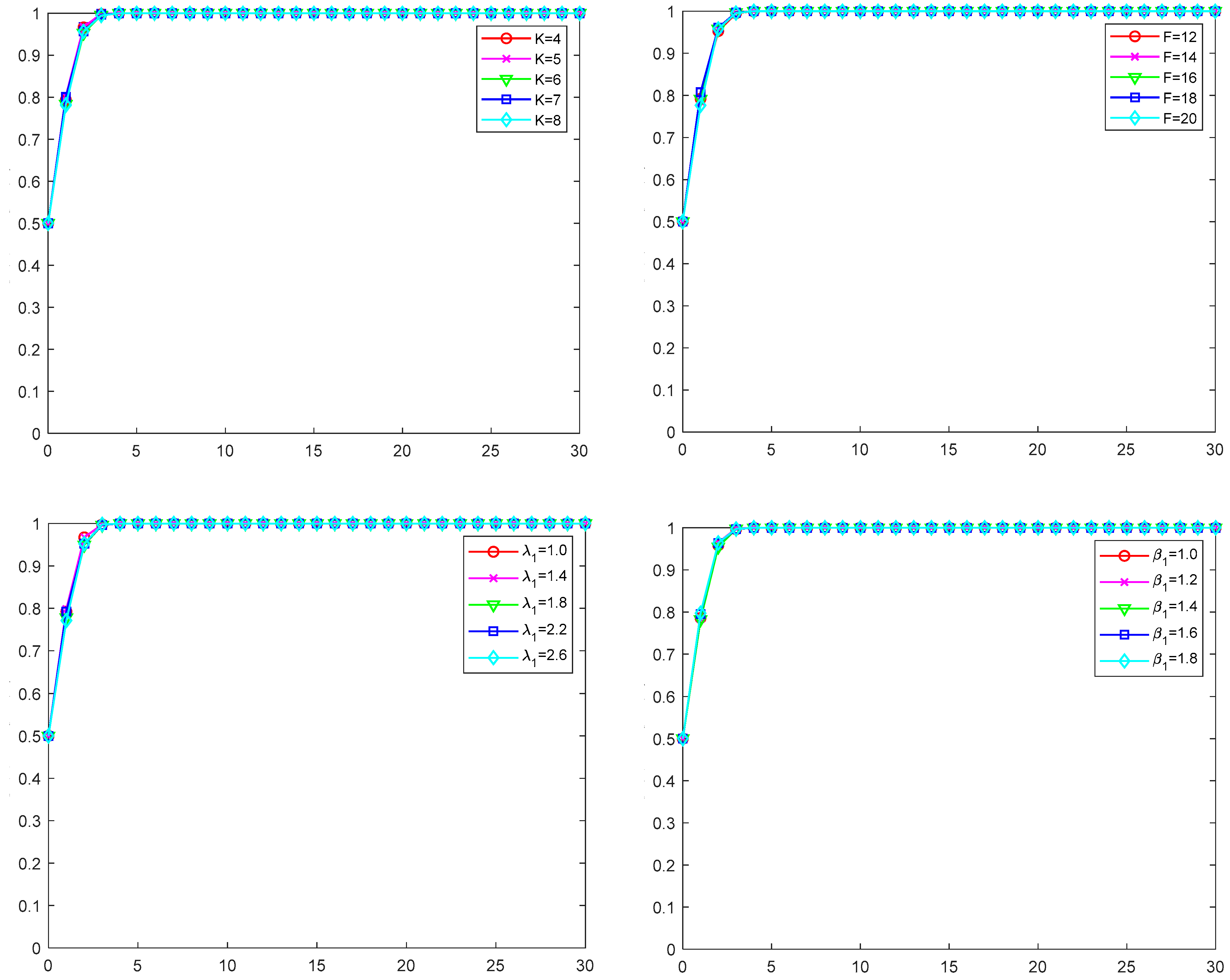
In the original model, the economic preference α of the nodes is randomly distributed. The cost and benefit allocation coefficients are set to 0.6 and 0.4, respectively, to reflect the heterogeneity of network nodes in governmental collaborative governance. This design results in a stronger tendency for the revenue distribution of nodes with lower economic preferences to favor long-term environmental benefits. Under the reward and punishment mechanism, nodes with lower economic preferences tend to maintain more stable participation in collaboration but exhibit a weaker response to short-term economic growth incentives. By contrast, nodes with higher economic preferences are more sensitive to short-term economic benefits and may withdraw from collaboration more rapidly when losses intensify. Their participation rate is more susceptible to fluctuations in the parameter related to pursuing economic growth benefits. In order to discuss the impact of node heterogeneity on the evolution of the cooperative behavior network for local government’s collaborative governance of the rural water environment, while keeping other conditions unchanged, we set the economic preference of all nodes to 0.35, and the heterogeneity coefficient θ of cost and benefit distribution to 0.5 to eliminate node heterogeneity. We also simultaneously increase the node scale, observing the changes in the participation rate of all nodes in collaborative governance under the conditions of the reward/punishment amount K , the gain from pursuing economic growth F , the collaborative gain coefficient λ 1 , and the loss intensification trend coefficient β 1 in a network of 29 nodes, as shown in Figure 13. Here, the vertical axis represents the participation rate of collaborative governance, and the horizontal axis represents the number of iterations.
It can be observed that node strategies tend to become more homogeneous, with reduced strategic differentiation, and the network exhibits a more unified response to parameter changes. Prior to the elimination of heterogeneity, participation rates varied significantly across different parameter values. After heterogeneity is removed, participation rates increase across the board and quickly stabilize. In the presence of heterogeneity, the network is more likely to develop a “core–periphery” structure. Preference heterogeneity creates differences in departments’ net benefits from cooperation: those with higher net benefits participate more frequently, co-occur with more partners across tasks, and accumulate more ties, forming a dense “core,” whereas those with lower net benefits participate less and remain sparsely connected at the “periphery.” Nodes with lower economic preferences tend to form the core of the network, while those with higher economic preferences are often isolated at the periphery. Parameter fluctuations are more likely to trigger abrupt changes in the strategies of peripheral nodes, resulting in instability in overall participation rates. Heterogeneity leads local governments to exhibit substantial behavioral differences when facing incentives such as rewards and punishments, economic gains, synergistic benefits, and loss intensification. These differences contribute to fluctuations and instability in collaborative governance participation rates. After heterogeneity is eliminated, the influence of each factor on participation becomes more stable and predictable, thereby improving and stabilizing participation levels across the network. Therefore, in the process of improving rural water environment governance, it is essential to enhance the stability and consistency of collaborative governance, with particular attention to the issue of heterogeneous regulation. When governance is homogenized, the path of policy incentives becomes clearer, effectively increasing the willingness of local entities to participate and improving collaborative efficiency. This provides a feasible approach to building a long-term, stable, and efficient governance system for the rural water environment.

4. Discussion

Rural water environment governance projects often face the problem of overlapping departmental responsibilities with unclear authority and accountability. This results in fragmented governance entities, inadequate coordination mechanisms, and limited coordination outcomes, ultimately undermining the overall effectiveness of rural water environment governance [40]. As a highly complex public issue, rural water environment governance aligns with the core principles of collaborative governance, including cross-departmental cooperation, efficient resource integration, and the balancing of diverse interests. Moreover, it generates significant positive externalities, requiring local governments to carefully weigh decisions regarding whether to participate and how many resources to allocate to governance efforts [8]. Thus, the driving mechanism of rural water environment collaborative governance involves not only the external influence of complex network structures but also the internal evolutionary game dynamics among participating entities. In this study, we construct an evolutionary game model based on complex networks to reveal the underlying evolutionary patterns and driving mechanisms of collaborative governance among government departments in rural water environment governance projects. The findings contribute to enriching the theoretical framework of rural water environment governance, offer new perspectives for future research on rural public affairs management, and provide practical mechanisms for enhancing the efficiency of governance in real-world projects.
In this study, we developed an inter-departmental evolutionary game model based on a small-world network, designed the evolution rules of the complex network, and systematically analyzed the cooperative behavior of local governments and their influencing factors in the collaborative governance of the rural water environment through simulation experiments. The results indicate that, among the various factors affecting network evolution, the reward and punishment level, the synergy gain coefficient, and the loss intensification trend coefficient exert significant positive incentive effects on the participation rate of local governments. When the values of the above three coefficients exceed their respective thresholds, the proportion of nodes participating in collaborative governance increases rapidly and stabilizes at a relatively high level. This suggests that higher-level governments can effectively enhance the willingness of local governments to cooperate by appropriately designing reward and punishment mechanisms, which is consistent with the findings of [41]. The synergy gain coefficient has a more direct incentive effect on nodes with a lower economic preference (higher environmental preference). The research of [42] also proved this point. Such nodes can maintain a high participation rate even under lower synergy gains, suggesting a stronger inherent sense of environmental responsibility. When the loss intensification coefficient is high, the participation rate of all nodes stabilizes at a higher level during the later stages of the evolutionary process. The increase in the loss intensification trend coefficient amplifies the potential losses of non-cooperative behavior, prompting local governments to actively adjust their strategies and form a cooperative evolution path driven by “loss aversion” [43].
Furthermore, in this study, we found that both the pursuit of economic growth gains and the cost–profit distribution coefficient negatively affect the participation rate of local governments. This conclusion has also been confirmed in related research by [44,45]. When both of these coefficients fall below their respective thresholds, the proportion of nodes participating in collaborative governance increases rapidly and stabilizes at a relatively high level. Specifically, when the level of economic growth benefits pursued is relatively low, the participation rate initially rises sharply and eventually stabilizes at a higher final level. This suggests that an excessive pursuit of economic gains may cause local governments to prioritize economic benefits over collaborative governance of the rural water environment, thereby diminishing their enthusiasm for cooperation and leading to the neglect of rural water environment governance. Nodes with higher economic preferences play a dominant role in how cost and benefit distribution impacts the overall proportion of collaborative governance. When disparities in cooperative revenue distribution are significant, the reduced willingness of lower-preference nodes to participate results in a decline in overall cooperation levels, which is also indirectly supported by the research of [46]. Node heterogeneity plays a critical role in collaborative governance, resulting in pronounced behavioral differences among local governments when confronted with incentives and penalties, economic benefits, synergy effects, and escalating losses. As shown in the results, heterogeneity makes strategy choices less convergent: strategy differentiation is stronger and the network’s response to parameter changes becomes more dispersed, so participation rates differ markedly across parameter values. Upon the removal of heterogeneity, participation rates significantly increase and rapidly stabilize. This is because strategy selection tends to become homogenized, reducing strategy divergence and making the effects of reward–punishment intensity, collaborative gains, and loss intensification more stable and predictable. This phenomenon can be attributed to the influence of the “core–periphery” network structure. When heterogeneity exists, the network is more likely to form a core–periphery pattern, where governments with lower economic preference constitute the cooperative core, while those with higher economic preference remain at the periphery. Parameter fluctuations can easily trigger abrupt strategy switches among peripheral nodes, which in turn causes instability in the overall participation rate. After heterogeneity is eliminated, the core–periphery separation is weakened and the collective response becomes more coherent, thereby improving both the level and stability of collaborative participation.

5. Conclusions

Based on complex network theory and evolutionary game theory, this study centers on the intergovernmental collaborative governance mechanism of the rural water environment. The distinctive contribution of this study is that it incorporates the complex topological network interactions among governmental sectors during rural water environmental governance and establishes an inter-governmental complex network model based on policy analysis and field-based empirical research. In this study, we combine evolutionary game theory with a complex network framework to analyze collaborative governance among government departments, providing a flexible approach for examining how incentives and network interactions shape collaboration dynamics. We systematically uncover the internal mechanisms and evolutionary patterns of collaborative governance among involved entities, and examine the influence of external driving factors, collaboration and loss effect coefficients, and heterogeneity parameters on the collaboration participation rate. The findings provide valuable insights and support for the effective governance of rural water environments. The main research conclusions are as follows:
(1) The collaborative governance network for the rural water environment exhibits small-world characteristics and significant heterogeneity among nodes. A small number of local governments serve as critical hubs within the network. This heterogeneity not only enhances governance vitality but also introduces challenges to the collaborative mechanism, collectively contributing to the complexity and diversity of rural water environment governance.
(2) The reward and punishment mechanism, synergy gain coefficient, and loss intensification trend coefficient all exert significant positive incentives on the participation rate of local governments, exhibiting clear threshold effects. Proper calibration of these parameters by higher-level governments can effectively enhance cooperation willingness. Moreover, different parameters influence local government nodes with varying economic preferences through distinct incentive pathways.
(3) The sole pursuit of economic growth benefits and the cost–benefit distribution coefficient both exert a certain negative impact on the participation rate of local governments. Furthermore, among all nodes, those with higher economic preferences play a dominant role in how cost and benefit distribution affects the proportion of collaborative governance.
(4) This study is based on a stylized evolutionary game model implemented on a complex network to explore the dynamic mechanisms of collaborative governance under different policy and behavioral assumptions. As such, the model is intended to provide theoretical insights into possible evolutionary patterns rather than empirical predictions. It does not imply causality in real-world governance behavior, nor does it capture the full complexity of decision-making processes faced by local governments. The results should therefore be interpreted as illustrative of mechanism-driven tendencies under simplified assumptions, and future research could extend this framework by incorporating empirical calibration, richer behavioral heterogeneity, or case-based validation.

Author Contributions

Conceptualization, G.D. and X.L.; Formal Analysis, Y.Z.; Investigation, G.D.; Methodology, G.D. and X.L.; Project Administration, G.D. and Y.Z.; Resources, X.L. and Y.Z.; Supervision, G.D. and X.L.; Visualization, G.D. and X.L.; Writing—Original Draft, G.D.; Writing—Review and Editing, X.L. and Y.Z. All authors have read and agreed to the published version of the manuscript.

Funding

This research received no external funding.

Institutional Review Board Statement

Not applicable.

Informed Consent Statement

Not applicable.

Data Availability Statement

The raw data supporting the conclusions of this article will be made available by the authors on request.

Conflicts of Interest

The authors declare no conflicts of interest.

Appendix A

Table A1. Rural water environment governance tasks and participating departments (Tasks 1–10).
Responsible AgencyIssue and Disseminate Implementation PlansScientifically Select Governance Models Based on Local ConditionsMake All-Out Efforts to Secure Pilot ProjectsScientifically Plan and Layout Governance FacilitiesPromote Integrated Village–Town Governance in a Coordinated MannerCoordinate the Rural Toilet Revolution with Wastewater TreatmentImprove Facility Construction and Operation & Maintenance MechanismsAdvance Governance in Phases with Emphasis on Key PrioritiesGive Equal Emphasis to Construction and Management and Strengthen Routine SupervisionControl Agricultural Non-Point Source Pollution
People’s GovernmentSSS SSSPPS
Ecology and Environment BureauPPPSPPSSSP
Development and Reform CommissionS S S
Agriculture and Rural Affairs BureauSSSSSPSSSP
Housing and Urban–Rural Development BureauSSSSPSSSS
Rural Revitalization BureauSSSSSS SS
Water Resources BureauSS S SP
Forestry Bureau
Finance BureauS P S
Civil Affairs BureauS
Health CommissionSS S
Culture and Tourism BureauS S
Science and Technology Bureau S S
Forestry and Grassland Bureau S
Natural Resources and Planning BureauSS PSS S
Administrative CommitteeSSS SSS
Water Resources and Lakes Bureau S
Commerce Bureau
Transportation Commission
Market Supervision Administration
Government Supervision Office
Urban Management BureauSS S S
Municipal Publicity Department of the CPC
Communist Youth League Committee
Women’s Federation
River Chief Office
Municipal Landscaping Department
Comprehensive Administrative Law Enforcement Bureau
Industry and Information Technology Bureau
Table A2. Rural water environment governance tasks and participating departments (Tasks 11–20).
Responsible AgencyTreat Industrial and Service-Sector WastewaterRemove Internal Pollution Sources and Solid WasteRestore Aquatic EcosystemsEncourage Governance Through UtilizationStrengthen Maintenance and Management of Small and Micro Water Bodies in Rural AreasImprove Policy Support for Operation and Maintenance of Rural Wastewater Collection and Treatment FacilitiesEstablish and Improve Diversified Investment Mechanisms to Ensure Governance FundingAdvocate Source Reduction and Promote Co-creationStrengthen Zoned and Categorized GovernanceDeepen Resource-Oriented Utilization
People’s Government PSSSSS
Ecology and Environment BureauSSSSS SSPP
Development and Reform Commission S SS
Agriculture and Rural Affairs BureauSS PSPSSSS
Housing and Urban–Rural Development Bureau S SSS
Rural Revitalization Bureau SSS
Water Resources Bureau SS SP S
Forestry Bureau S
Finance Bureau PP
Civil Affairs Bureau
Health Commission
Culture and Tourism BureauS
Science and Technology Bureau
Forestry and Grassland Bureau
Natural Resources and Planning Bureau
Administrative Committee SS
Water Resources and Lakes Bureau
Commerce BureauS
Transportation Commission S
Market Supervision Administration
Government Supervision Office
Urban Management Bureau
Municipal Publicity Department of the CPC
Communist Youth League Committee
Women’s Federation
River Chief Office
Municipal Landscaping Department
Comprehensive Administrative Law Enforcement Bureau
Industry and Information Technology Bureau
Table A3. Rural water environment governance tasks and participating departments (Tasks 21–30).
Responsible AgencyAccelerate the Renovation of Abnormally Operating FacilitiesCoordinate the Remediation of Rural Black and Odorous Water BodiesOrganize Follow-Up Inspections of Completed FacilitiesStrengthen Technological R&D and Standardized GovernanceStrengthen Supervision and Performance AssessmentPromote Circular Utilization of Water for Rural Production and LivingStrictly Implement Standards for Comprehensive Utilization and DischargeStrictly Enforce Construction Quality and Acceptance Procedures for Rural Domestic Wastewater Treatment FacilitiesConduct Extensive Public Awareness and Mobilization CampaignsFully Implement the Construction of Rural Domestic Wastewater Treatment Facilities
People’s GovernmentSSS SSSSP
Ecology and Environment BureauPPPSPSSPSS
Development and Reform CommissionS S
Agriculture and Rural Affairs BureauSSS SSSSSS
Housing and Urban–Rural Development BureauSSS SSSSSS
Rural Revitalization BureauSS
Water Resources Bureau S SS P
Forestry Bureau
Finance BureauS S S
Civil Affairs Bureau S
Health Commission S
Culture and Tourism Bureau
Science and Technology Bureau S
Forestry and Grassland Bureau
Natural Resources and Planning Bureau S
Administrative CommitteeSSS S
Water Resources and Lakes Bureau
Commerce Bureau
Transportation Commission
Market Supervision Administration S
Government Supervision Office S
Urban Management Bureau SSSS
Municipal Publicity Department of the CPC P
Communist Youth League Committee S
Women’s Federation S
River Chief Office
Municipal Landscaping Department
Comprehensive Administrative Law Enforcement Bureau
Industry and Information Technology Bureau
Table A4. Rural water environment governance tasks and participating departments (Tasks 31–40).
Responsible AgencyPromote the Construction and Renovation of Sanitary Toilets in Rural AreasAdvance Source Interception and Rain–Sewage Diversion ProjectsEstablish a Stable Operation and Maintenance Management System for Rural Wastewater FacilitiesComprehensively Promote High-Quality and High-Standard Upgrading of Rural Domestic Wastewater GovernanceImplement Water System ConnectivityDeepen the River–Lake–Canal–Pond Chief SystemEstablish Long-Term Operation and Maintenance Mechanisms for Rural Black and Odorous Water RemediationStandardize Protection of Rural Water Source AreasStrengthen Remediation of Rural Water SourcesEstablish and Improve Long-Term Management Mechanisms for Rural Drinking Water Sources
People’s GovernmentPSSS SSSSS
Ecology and Environment Bureau SSSP SPPP
Development and Reform Commission
Agriculture and Rural Affairs BureauSSSS SS
Housing and Urban–Rural Development BureauS S
Rural Revitalization Bureau
Water Resources Bureau SPSP P
Forestry Bureau S
Finance BureauS SS P
Civil Affairs Bureau
Health CommissionP P
Culture and Tourism Bureau
Science and Technology Bureau
Forestry and Grassland Bureau
Natural Resources and Planning Bureau S
Administrative Committee
Water Resources and Lakes Bureau
Commerce Bureau
Transportation Commission
Market Supervision Administration
Government Supervision Office
Urban Management Bureau SS S
Municipal Publicity Department of the CPC
Communist Youth League Committee
Women’s Federation
River Chief Office S
Municipal Landscaping Department S
Comprehensive Administrative Law Enforcement Bureau S
Industry and Information Technology Bureau
Table A5. Rural water environment governance tasks and participating departments (Tasks 41–44).
Responsible AgencyStrictly Enforce Environmental Access ControlsStrengthen Remediation of Heavily Polluting IndustriesAccelerate the Phase-Out of Outdated Production CapacityStrengthen Centralized Treatment in Industrial Parks
People’s GovernmentSSSS
Ecology and Environment BureauPPPP
Development and Reform CommissionP P
Agriculture and Rural Affairs Bureau
Housing and Urban–Rural Development Bureau P
Rural Revitalization Bureau
Water Resources BureauP
Forestry Bureau
Finance Bureau
Civil Affairs Bureau
Health Commission
Culture and Tourism Bureau
Science and Technology Bureau
Forestry and Grassland Bureau
Natural Resources and Planning Bureau
Administrative Committee
Water Resources and Lakes Bureau
Commerce Bureau P
Transportation Commission
Market Supervision Administration
Government Supervision Office
Urban Management Bureau
Municipal Publicity Department of the CPC
Communist Youth League Committee
Women’s Federation
River Chief Office
Municipal Landscaping Department
Comprehensive Administrative Law Enforcement Bureau
Industry and Information Technology BureauPPPP

Appendix B

Table A6. Source–Target–Weight
SourceTargetWeight
People’s GovernmentEcology and Environment Bureau33
People’s GovernmentDevelopment and Reform Commission9
People’s GovernmentAgriculture and Rural Affairs Bureau29
People’s GovernmentHousing and Urban–Rural Development Bureau22
People’s GovernmentRural Revitalization Bureau13
People’s GovernmentWater Resources Bureau17
People’s GovernmentForestry Bureau2
People’s GovernmentFinance Bureau11
People’s GovernmentCivil Affairs Bureau2
People’s GovernmentHealth Commission6
People’s GovernmentCulture and Tourism Bureau2
People’s GovernmentScience and Technology Bureau3
People’s GovernmentForestry and Grassland Bureau1
People’s GovernmentNatural Resources and Planning Bureau6
People’s GovernmentAdministrative Committee12
People’s GovernmentWater Resources and Lakes Bureau1
People’s GovernmentCommerce Bureau1
People’s GovernmentTransportation Commission1
People’s GovernmentUrban Management Bureau11
People’s GovernmentMunicipal Publicity Department of the CPC1
People’s GovernmentCommunist Youth League Committee1
People’s GovernmentWomen’s Federation1
People’s GovernmentRiver Chief Office1
People’s GovernmentMunicipal Landscaping Department1
People’s GovernmentComprehensive Administrative Law Enforcement Bureau1
People’s GovernmentIndustry and Information Technology Bureau4
Ecology and Environment BureauDevelopment and Reform Commission8
Ecology and Environment BureauAgriculture and Rural Affairs Bureau31
Ecology and Environment BureauHousing and Urban–Rural Development Bureau24
Ecology and Environment BureauRural Revitalization Bureau13
Ecology and Environment BureauWater Resources Bureau18
Ecology and Environment BureauForestry Bureau2
Ecology and Environment BureauFinance Bureau10
Ecology and Environment BureauCivil Affairs Bureau2
Ecology and Environment BureauHealth Commission5
Ecology and Environment BureauCulture and Tourism Bureau3
Ecology and Environment BureauScience and Technology Bureau3
Ecology and Environment BureauForestry and Grassland Bureau1
Ecology and Environment BureauNatural Resources and Planning Bureau8
Ecology and Environment BureauAdministrative Committee12
Ecology and Environment BureauWater Resources and Lakes Bureau1
Ecology and Environment BureauCommerce Bureau2
Ecology and Environment BureauTransportation Commission1
Ecology and Environment BureauMarket Supervision Administration1
Ecology and Environment BureauGovernment Supervision Office1
Ecology and Environment BureauUrban Management Bureau11
Ecology and Environment BureauMunicipal Publicity Department of the CPC1
Ecology and Environment BureauCommunist Youth League Committee1
Ecology and Environment BureauWomen’s Federation1
Ecology and Environment BureauRiver Chief Office1
Ecology and Environment BureauMunicipal Landscaping Department1
Ecology and Environment BureauComprehensive Administrative Law Enforcement Bureau1
Ecology and Environment BureauIndustry and Information Technology Bureau4
Development and Reform CommissionAgriculture and Rural Affairs Bureau8
Development and Reform CommissionHousing and Urban–Rural Development Bureau8
Development and Reform CommissionRural Revitalization Bureau5
Development and Reform CommissionWater Resources Bureau5
Development and Reform CommissionForestry Bureau1
Development and Reform CommissionFinance Bureau5
Development and Reform CommissionCivil Affairs Bureau1
Development and Reform CommissionHealth Commission1
Development and Reform CommissionCulture and Tourism Bureau1
Development and Reform CommissionScience and Technology Bureau1
Development and Reform CommissionNatural Resources and Planning Bureau2
Development and Reform CommissionAdministrative Committee6
Development and Reform CommissionCommerce Bureau1
Development and Reform CommissionUrban Management Bureau1
Development and Reform CommissionIndustry and Information Technology Bureau2
Agriculture and Rural Affairs BureauHousing and Urban–Rural Development Bureau24
Agriculture and Rural Affairs BureauRural Revitalization Bureau13
Agriculture and Rural Affairs BureauWater Resources Bureau15
Agriculture and Rural Affairs BureauForestry Bureau2
Agriculture and Rural Affairs BureauFinance Bureau11
Agriculture and Rural Affairs BureauCivil Affairs Bureau2
Agriculture and Rural Affairs BureauHealth Commission5
Agriculture and Rural Affairs BureauCulture and Tourism Bureau3
Agriculture and Rural Affairs BureauScience and Technology Bureau2
Agriculture and Rural Affairs BureauForestry and Grassland Bureau1
Agriculture and Rural Affairs BureauNatural Resources and Planning Bureau7
Agriculture and Rural Affairs BureauAdministrative Committee12
Agriculture and Rural Affairs BureauWater Resources and Lakes Bureau1
Agriculture and Rural Affairs BureauCommerce Bureau1
Agriculture and Rural Affairs BureauTransportation Commission1
Agriculture and Rural Affairs BureauGovernment Supervision Office1
Agriculture and Rural Affairs BureauUrban Management Bureau11
Agriculture and Rural Affairs BureauMunicipal Publicity Department of the CPC1
Agriculture and Rural Affairs BureauCommunist Youth League Committee1
Agriculture and Rural Affairs BureauWomen’s Federation1
Agriculture and Rural Affairs BureauRiver Chief Office1
Agriculture and Rural Affairs BureauMunicipal Landscaping Department1
Agriculture and Rural Affairs BureauComprehensive Administrative Law Enforcement Bureau1
Housing and Urban–Rural Development BureauRural Revitalization Bureau12
Housing and Urban–Rural Development BureauWater Resources Bureau10
Housing and Urban–Rural Development BureauForestry Bureau1
Housing and Urban–Rural Development BureauFinance Bureau8
Housing and Urban–Rural Development BureauCivil Affairs Bureau2
Housing and Urban–Rural Development BureauHealth Commission5
Housing and Urban–Rural Development BureauCulture and Tourism Bureau2
Housing and Urban–Rural Development BureauScience and Technology Bureau2
Housing and Urban–Rural Development BureauForestry and Grassland Bureau1
Housing and Urban–Rural Development BureauNatural Resources and Planning Bureau7
Housing and Urban–Rural Development BureauAdministrative Committee11
Housing and Urban–Rural Development BureauWater Resources and Lakes Bureau1
Housing and Urban–Rural Development BureauCommerce Bureau1
Housing and Urban–Rural Development BureauGovernment Supervision Office1
Housing and Urban–Rural Development BureauUrban Management Bureau9
Housing and Urban–Rural Development BureauMunicipal Publicity Department of the CPC1
Housing and Urban–Rural Development BureauCommunist Youth League Committee1
Housing and Urban–Rural Development BureauWomen’s Federation1
Housing and Urban–Rural Development BureauComprehensive Administrative Law Enforcement Bureau1
Rural Revitalization BureauWater Resources Bureau5
Rural Revitalization BureauForestry Bureau1
Rural Revitalization BureauFinance Bureau4
Rural Revitalization BureauCivil Affairs Bureau1
Rural Revitalization BureauHealth Commission3
Rural Revitalization BureauCulture and Tourism Bureau2
Rural Revitalization BureauScience and Technology Bureau1
Rural Revitalization BureauForestry and Grassland Bureau1
Rural Revitalization BureauNatural Resources and Planning Bureau6
Rural Revitalization BureauAdministrative Committee9
Rural Revitalization BureauWater Resources and Lakes Bureau1
Rural Revitalization BureauUrban Management Bureau4
Water Resources BureauForestry Bureau2
Water Resources BureauFinance Bureau3
Water Resources BureauCivil Affairs Bureau1
Water Resources BureauHealth Commission3
Water Resources BureauCulture and Tourism Bureau1
Water Resources BureauScience and Technology Bureau2
Water Resources BureauForestry and Grassland Bureau1
Water Resources BureauNatural Resources and Planning Bureau5
Water Resources BureauAdministrative Committee6
Water Resources BureauTransportation Commission1
Water Resources BureauUrban Management Bureau5
Water Resources BureauComprehensive Administrative Law Enforcement Bureau1
Water Resources BureauIndustry and Information Technology Bureau1
Forestry BureauAdministrative Committee1
Forestry BureauUrban Management Bureau1
Forestry BureauComprehensive Administrative Law Enforcement Bureau1
Finance BureauCivil Affairs Bureau1
Finance BureauHealth Commission2
Finance BureauCulture and Tourism Bureau1
Finance BureauNatural Resources and Planning Bureau3
Finance BureauAdministrative Committee4
Finance BureauUrban Management Bureau2
Finance BureauRiver Chief Office1
Finance BureauMunicipal Landscaping Department1
Civil Affairs BureauHealth Commission2
Civil Affairs BureauCulture and Tourism Bureau1
Civil Affairs BureauNatural Resources and Planning Bureau1
Civil Affairs BureauAdministrative Committee2
Civil Affairs BureauUrban Management Bureau2
Civil Affairs BureauMunicipal Publicity Department of the CPC1
Civil Affairs BureauCommunist Youth League Committee1
Civil Affairs BureauWomen’s Federation1
Health CommissionCulture and Tourism Bureau2
Health CommissionScience and Technology Bureau1
Health CommissionForestry and Grassland Bureau1
Health CommissionNatural Resources and Planning Bureau3
Health CommissionAdministrative Committee3
Health CommissionUrban Management Bureau4
Health CommissionMunicipal Publicity Department of the CPC1
Health CommissionCommunist Youth League Committee1
Health CommissionWomen’s Federation1
Culture and Tourism BureauNatural Resources and Planning Bureau2
Culture and Tourism BureauAdministrative Committee1
Culture and Tourism BureauCommerce Bureau1
Culture and Tourism BureauUrban Management Bureau2
Science and Technology BureauForestry and Grassland Bureau1
Science and Technology BureauNatural Resources and Planning Bureau1
Science and Technology BureauAdministrative Committee2
Science and Technology BureauMarket Supervision Administration1
Science and Technology BureauUrban Management Bureau1
Forestry and Grassland BureauNatural Resources and Planning Bureau1
Forestry and Grassland BureauAdministrative Committee1
Forestry and Grassland BureauUrban Management Bureau1
Natural Resources and Planning BureauAdministrative Committee3
Natural Resources and Planning BureauUrban Management Bureau3
Administrative CommitteeWater Resources and Lakes Bureau1
Administrative CommitteeUrban Management Bureau4
Administrative CommitteeMunicipal Publicity Department of the CPC1
Administrative CommitteeCommunist Youth League Committee1
Administrative CommitteeWomen’s Federation1
Water Resources and Lakes BureauUrban Management Bureau1
Commerce BureauIndustry and Information Technology Bureau1
Urban Management BureauMunicipal Publicity Department of the CPC1
Urban Management BureauCommunist Youth League Committee1
Urban Management BureauWomen’s Federation1
Urban Management BureauComprehensive Administrative Law Enforcement Bureau1
Municipal Publicity Department of the CPCCommunist Youth League Committee1
Municipal Publicity Department of the CPCWomen’s Federation1
Communist Youth League CommitteeWomen’s Federation1
River Chief OfficeMunicipal Landscaping Department1

Appendix C

Table A7. Summary statistics of simulation outcomes by scenario (mean ± SD).
Figure(s)Panel/GroupNetwork SizeVaried ParameterParameter ValueMean Final Participation ± SD (Est.)Mean Convergence Iteration ± SD (Est.)
Figure 3 and Figure 4All nodes29K40.00 ± 0.018 ± 2
Figure 3 and Figure 4All nodes29K50.00 ± 0.0120 ± 3
Figure 3 and Figure 4All nodes29K60.52 ± 0.0515 ± 3
Figure 3 and Figure 4All nodes29K71.00 ± 0.016 ± 1
Figure 3 and Figure 4All nodes29K81.00 ± 0.014 ± 1
Figure 3 and Figure 4Lower economic preference29K40.00 ± 0.0110 ± 2
Figure 3 and Figure 4Lower economic preference29K50.05 ± 0.0218 ± 3
Figure 3 and Figure 4Lower economic preference29K60.75 ± 0.0412 ± 2
Figure 3 and Figure 4Lower economic preference29K71.00 ± 0.016 ± 1
Figure 3 and Figure 4Lower economic preference 29K81.00 ± 0.014 ± 1
Figure 3 and Figure 4All nodes50K40.00 ± 0.0110 ± 2
Figure 3 and Figure 4All nodes50K50.00 ± 0.0125 ± 4
Figure 3 and Figure 4All nodes50K60.60 ± 0.0518 ± 3
Figure 3 and Figure 4All nodes50K71.00 ± 0.016 ± 1
Figure 3 and Figure 4All nodes50K81.00 ± 0.014 ± 1
Figure 3 and Figure 4Lower economic preference 50K40.00 ± 0.0112 ± 2
Figure 3 and Figure 4Lower economic preference50K50.00 ± 0.0122 ± 4
Figure 3 and Figure 4Lower economic preference50K60.65 ± 0.0518 ± 3
Figure 3 and Figure 4Lower economic preference 50K71.00 ± 0.016 ± 1
Figure 3 and Figure 4Lower economic preference 50K81.00 ± 0.014 ± 1
Figure 5 and Figure 6All nodes29F121.00 ± 0.015 ± 1
Figure 5 and Figure 6All nodes29F141.00 ± 0.016 ± 1
Figure 5 and Figure 6All nodes29F160.68 ± 0.0510 ± 2
Figure 5 and Figure 6All nodes29F180.12 ± 0.0422 ± 4
Figure 5 and Figure 6All nodes29F200.00 ± 0.0115 ± 3
Figure 5 and Figure 6Lower economic preference29F121.00 ± 0.015 ± 1
Figure 5 and Figure 6Lower economic preference29F141.00 ± 0.016 ± 1
Figure 5 and Figure 6Lower economic preference 29F160.60 ± 0.0512 ± 2
Figure 5 and Figure 6Lower economic preference29F180.10 ± 0.0424 ± 4
Figure 5 and Figure 6Lower economic preference29F200.00 ± 0.0115 ± 3
Figure 5 and Figure 6All nodes50F121.00 ± 0.015 ± 1
Figure 5 and Figure 6All nodes50F141.00 ± 0.016 ± 1
Figure 5 and Figure 6All nodes50F160.68 ± 0.0512 ± 2
Figure 5 and Figure 6All nodes50F180.02 ± 0.0125 ± 4
Figure 5 and Figure 6All nodes50F200.00 ± 0.0118 ± 3
Figure 5 and Figure 6Lower economic preference50F121.00 ± 0.015 ± 1
Figure 5 and Figure 6Lower economic preference 50F141.00 ± 0.016 ± 1
Figure 5 and Figure 6Lower economic preference50F160.58 ± 0.0514 ± 3
Figure 5 and Figure 6Lower economic preference 50F180.02 ± 0.0125 ± 4
Figure 5 and Figure 6Lower economic preference 50F200.00 ± 0.0118 ± 3
Figure 7 and Figure 8All nodes29λ1.00.22 ± 0.0425 ± 4
Figure 7 and Figure 8All nodes29λ1.40.52 ± 0.0520 ± 3
Figure 7 and Figure 8All nodes29λ1.80.82 ± 0.0412 ± 2
Figure 7 and Figure 8All nodes29λ2.20.98 ± 0.016 ± 1
Figure 7 and Figure 8All nodes29λ2.61.00 ± 0.014 ± 1
Figure 7 and Figure 8Lower economic preference 29λ1.00.25 ± 0.0425 ± 4
Figure 7 and Figure 8Lower economic preference 29λ1.40.55 ± 0.0518 ± 3
Figure 7 and Figure 8Lower economic preference 29λ1.80.85 ± 0.0410 ± 2
Figure 7 and Figure 8Lower economic preference 29λ2.20.98 ± 0.016 ± 1
Figure 7 and Figure 8Lower economic preference 29λ2.61.00 ± 0.014 ± 1
Figure 7 and Figure 8All nodes50λ1.00.10 ± 0.0428 ± 4
Figure 7 and Figure 8All nodes50λ1.40.50 ± 0.0522 ± 4
Figure 7 and Figure 8All nodes50λ1.80.92 ± 0.0210 ± 2
Figure 7 and Figure 8All nodes50λ2.20.99 ± 0.016 ± 1
Figure 7 and Figure 8All nodes50λ2.61.00 ± 0.014 ± 1
Figure 7 and Figure 8Lower economic preference 50λ1.00.12 ± 0.0428 ± 4
Figure 7 and Figure 8Lower economic preference 50λ1.40.52 ± 0.0520 ± 3
Figure 7 and Figure 8Lower economic preference 50λ1.80.93 ± 0.0210 ± 2
Figure 7 and Figure 8Lower economic preference50λ2.20.99 ± 0.016 ± 1
Figure 7 and Figure 8Lower economic preference 50λ2.61.00 ± 0.014 ± 1
Figure 9 and Figure 10All nodes29β1.00.85 ± 0.0410 ± 2
Figure 9 and Figure 10All nodes29β1.20.88 ± 0.0410 ± 2
Figure 9 and Figure 10All nodes29β1.40.90 ± 0.0210 ± 2
Figure 9 and Figure 10All nodes29β1.60.92 ± 0.0210 ± 2
Figure 9 and Figure 10All nodes29β1.80.94 ± 0.0210 ± 2
Figure 9 and Figure 10Lower economic preference 29β1.00.90 ± 0.028 ± 2
Figure 9 and Figure 10Lower economic preference 29β1.20.92 ± 0.028 ± 2
Figure 9 and Figure 10Lower economic preference 29β1.40.94 ± 0.028 ± 2
Figure 9 and Figure 10Lower economic preference 29β1.60.96 ± 0.028 ± 2
Figure 9 and Figure 10Lower economic preference 29β1.80.97 ± 0.028 ± 2
Figure 9 and Figure 10All nodes50β1.00.86 ± 0.0410 ± 2
Figure 9 and Figure 10All nodes50β1.20.88 ± 0.0410 ± 2
Figure 9 and Figure 10All nodes50β1.40.90 ± 0.0210 ± 2
Figure 9 and Figure 10All nodes50β1.60.93 ± 0.0210 ± 2
Figure 9 and Figure 10All nodes50β1.80.95 ± 0.0210 ± 2
Figure 9 and Figure 10Lower economic preference 50β1.00.90 ± 0.028 ± 2
Figure 9 and Figure 10Lower economic preference 50β1.20.93 ± 0.028 ± 2
Figure 9 and Figure 10Lower economic preference 50β1.40.95 ± 0.028 ± 2
Figure 9 and Figure 10Lower economic preference 50β1.60.97 ± 0.028 ± 2
Figure 9 and Figure 10Lower economic preference 50β1.80.99 ± 0.018 ± 2
Figure 11 and Figure 12All nodes29θ0.11.00 ± 0.015 ± 1
Figure 11 and Figure 12All nodes29θ0.31.00 ± 0.015 ± 1
Figure 11 and Figure 12All nodes29θ0.51.00 ± 0.016 ± 1
Figure 11 and Figure 12All nodes29θ0.70.68 ± 0.0512 ± 2
Figure 11 and Figure 12All nodes29θ0.90.35 ± 0.0415 ± 3
Figure 11 and Figure 12Lower economic preference29θ0.11.00 ± 0.015 ± 1
Figure 11 and Figure 12Lower economic preference 29θ0.31.00 ± 0.015 ± 1
Figure 11 and Figure 12Lower economic preference 29θ0.51.00 ± 0.016 ± 1
Figure 11 and Figure 12Lower economic preference 29θ0.70.68 ± 0.0512 ± 2
Figure 11 and Figure 12Lower economic preference 29θ0.90.38 ± 0.0415 ± 3
Figure 11 and Figure 12All nodes50θ0.11.00 ± 0.015 ± 1
Figure 11 and Figure 12All nodes50θ0.31.00 ± 0.015 ± 1
Figure 11 and Figure 12All nodes50θ0.51.00 ± 0.016 ± 1
Figure 11 and Figure 12All nodes50θ0.70.68 ± 0.0514 ± 3
Figure 11 and Figure 12All nodes50θ0.90.22 ± 0.0418 ± 3
Figure 11 and Figure 12Lower economic preference 50θ0.11.00 ± 0.015 ± 1
Figure 11 and Figure 12Lower economic preference 50θ0.31.00 ± 0.015 ± 1
Figure 11 and Figure 12Lower economic preference 50θ0.51.00 ± 0.016 ± 1
Figure 11 and Figure 12Lower economic preference 50θ0.70.68 ± 0.0514 ± 3
Figure 11 and Figure 12Lower economic preference 50θ0.90.25 ± 0.0418 ± 3
Figure 13All nodes (heterogeneity removed)29K41.00 ± 0.014 ± 1
Figure 13All nodes (heterogeneity removed)29K51.00 ± 0.013 ± 1
Figure 13All nodes (heterogeneity removed)29K61.00 ± 0.013 ± 1
Figure 13All nodes (heterogeneity removed)29K71.00 ± 0.013 ± 1
Figure 13All nodes (heterogeneity removed)29K81.00 ± 0.013 ± 1
Figure 13All nodes (heterogeneity removed)29F121.00 ± 0.013 ± 1
Figure 13All nodes (heterogeneity removed)29F141.00 ± 0.013 ± 1
Figure 13All nodes (heterogeneity removed)29F161.00 ± 0.013 ± 1
Figure 13All nodes (heterogeneity removed)29F181.00 ± 0.013 ± 1
Figure 13All nodes (heterogeneity removed)29F201.00 ± 0.013 ± 1
Figure 13All nodes (heterogeneity removed)29λ1.01.00 ± 0.014 ± 1
Figure 13All nodes (heterogeneity removed)29λ1.41.00 ± 0.013 ± 1
Figure 13All nodes (heterogeneity removed)29λ1.81.00 ± 0.013 ± 1
Figure 13All nodes (heterogeneity removed)29λ2.21.00 ± 0.013 ± 1
Figure 13All nodes (heterogeneity removed)29λ2.61.00 ± 0.013 ± 1
Figure 13All nodes (heterogeneity removed)29β1.01.00 ± 0.013 ± 1
Figure 13All nodes (heterogeneity removed)29β1.21.00 ± 0.013 ± 1
Figure 13All nodes (heterogeneity removed)29β1.41.00 ± 0.013 ± 1
Figure 13All nodes (heterogeneity removed)29β1.61.00 ± 0.013 ± 1
Figure 13All nodes (heterogeneity removed)29β1.81.00 ± 0.013 ± 1

References

  1. Liu, Y.; Tan, Y.; Zhang, X. The long-term economic impact of water quality: Evidence from rural drinking water program in China. J. Asian Econ. 2024, 94, 101796. [Google Scholar] [CrossRef]
  2. Mishra, S.; Kumar, R.; Kumar, M. Use of treated sewage or wastewater as an irrigation water for agricultural purposes-Environmental, health, and economic impacts. Total Environ. Res. Themes 2023, 6, 100051. [Google Scholar] [CrossRef]
  3. Abarzúa, G.E.B.; Glückler, J. Network governance at the margin of the state: Rural drinking water communities in Chile. Environ. Manag. 2023, 71, 451–464. [Google Scholar] [CrossRef] [PubMed]
  4. Khan, H.; Anum, H.; Yan, Z.; Chunjie, Q. Modernizing Rural Water Governance: A Systematic Review of Transitions, Dynamics, Influential Factors, and Challenges. Water Resour. Manag. 2025, 39, 979–997. [Google Scholar] [CrossRef]
  5. Luo, Y.; Wu, J.; Xu, Y. Can self-governance tackle the water commons?—Causal evidence of the effect of rural water pollution treatment on farmers’ health in China. Ecol. Econ. 2022, 198, 107471. [Google Scholar] [CrossRef]
  6. Xu, Q.; Boelens, R.; Veldwisch, G.J. The evolution of China’s rural water governance: Water, techno-political development and state legitimacy. J. Peasant Stud. 2024, 51, 717–737. [Google Scholar] [CrossRef]
  7. Wang, J.; Zhao, X. Goal orientation and effectiveness of water environment governance in China. Ecohydrol. Hydrobiol. 2025, 25, 100673. [Google Scholar] [CrossRef]
  8. Xu, Q.; Boelens, R.; Veldwisch, G.J. Rural drinking water governance politics in China: Governmentality schemes and negotiations from below. Political Geogr. 2022, 97, 102703. [Google Scholar] [CrossRef]
  9. Ansell, C.; Gash, A. Collaborative governance in theory and practice. J. Public Adm. Res. Theory 2008, 18, 543–571. [Google Scholar] [CrossRef]
  10. Tantoh, H.B.; McKay, T. Assessing community-based water management and governance systems in North-West Cameroon using a cultural theory and systems approach. J. Clean. Prod. 2021, 290, 125804. [Google Scholar] [CrossRef]
  11. Wiek, A.; Larson, K.L. Water, people, and sustainability—A systems framework for analyzing and assessing water governance regimes. Water Resour. Manag. 2012, 26, 3153–3171. [Google Scholar] [CrossRef]
  12. Dakyaga, F.; Kosoe, E.A.; Alhassan, G. Everyday politics in collaborative governance of (non) networked water infrastructures in rural and small towns of Ghana. Habitat Int. 2023, 139, 102904. [Google Scholar] [CrossRef]
  13. Dobbin, K.B.; Kuo, M.; Lubell, M.; Bostic, D.; Mendoza, J.; Echeveste, E. Drivers of (in) equity in collaborative environmental governance. Policy Stud. J. 2023, 51, 375–395. [Google Scholar] [CrossRef]
  14. Feng, J.; Tang, Y.; Xue, S.; Zhang, K. Study on cooperative strategies of rural water environment governance PPP project between companies and farmers from the perspective of evolutionary game. Environ. Dev. Sustain. 2022, 24, 138–155. [Google Scholar] [CrossRef]
  15. Cui, Y.; Huang, Y.; Li, J.; Liu, H.; Jia, X.; Zhou, Y. Implementation Path of Collaborative Treatment of Rural Domestic Sewage in Beijing-Tianjin-Hebei in the New Era. Chin. J. Environ. Manag. 2025, 17, 30–39. (In Chinese) [Google Scholar] [CrossRef]
  16. Yin, F.-F.; Shi, X.; Guo, H.-F.; Shen, Y.-R. Performance evaluation of rural water environment governance based on AHP: A case study of the Beitang River Basin. Water Sci. Technol. 2023, 88, 2661–2676. [Google Scholar] [CrossRef]
  17. Liu, M.; Li, T.; Liu, Y.; Li, J.; Jiang, H.; Wang, L.; An, S. Grading identification and pollution source determination of rural water based on the black-odorous water quality index model. J. Water Process Eng. 2025, 75, 108076. [Google Scholar] [CrossRef]
  18. Dobbin, K.B. “Good luck fixing the problem”: Small low-income community participation in collaborative groundwater governance and implications for drinking water source protection. Soc. Nat. Resour. 2020, 33, 1468–1485. [Google Scholar] [CrossRef]
  19. Gansauer, G.; Haggerty, J.; Dunn, J. Public water system governance in rural Montana, USA: A ‘slow drip’ on community resilience. Soc. Nat. Resour. 2023, 36, 1257–1276. [Google Scholar] [CrossRef]
  20. Wang, C.; Wang, P.; Qian, J.; Hu, B.; Yin, J. Construction of Synergistic Governance System for Agricultural Non-point Source Pollution in the Yangtze River Delta. Strateg. Study CAE 2024, 26, 181–189. (In Chinese) [Google Scholar] [CrossRef]
  21. Dong, L.; Fan, R. Dynamic analysis of the optimal guiding mechanism for second emission trading market in China. J. Clean. Prod. 2023, 418, 138145. [Google Scholar] [CrossRef]
  22. Ge, T.; Chen, X.; Geng, Y.; Yang, K. Does regional collaborative governance reduce air pollution? Quasi-experimental evidence from China. J. Clean. Prod. 2023, 419, 138283. [Google Scholar] [CrossRef]
  23. Liu, X.; Wang, W.; Wu, W.; Zhang, L.; Wang, L. Using cooperative game model of air pollution governance to study the cost sharing in Yangtze River Delta region. J. Environ. Manag. 2022, 301, 113896. [Google Scholar] [CrossRef] [PubMed]
  24. Si, L.; Liu, X. Nip risks in the bud: Research data ethics governance framework and collaborative network from the perspective of UK policy. Aslib J. Inf. Manag. 2025, 77, 599–619. [Google Scholar] [CrossRef]
  25. Liu, S.; Wu, Y.; Jiang, G.; Dong, J. System dynamics modeling of collaborative governance in smart cities: A case study of Dongguan, China. Sci. Rep. 2024, 14, 31758. [Google Scholar] [CrossRef]
  26. Peng, Y.; Peng, X.; Li, X.; Lu, M.; Yin, M. Effectiveness in rural governance: Influencing factors and driving pathways—Based on 20 typical cases of rural governance in China. Land 2023, 12, 1452. [Google Scholar] [CrossRef]
  27. Wei, Y.; Zhang, A.; Ma, Y. A bibliometric review of rural living environment improvement research in China based on CNKI database: 1992–2022. Sustainability 2023, 15, 6561. [Google Scholar] [CrossRef]
  28. Aumann, R.J. Rationality and bounded rationality. Games Econ. Behav. 1997, 21, 2–14. [Google Scholar] [CrossRef]
  29. Weitz, J.S.; Eksin, C.; Paarporn, K.; Brown, S.P.; Ratcliff, W.C. An oscillating tragedy of the commons in replicator dynamics with game-environment feedback. Proc. Natl. Acad. Sci. USA 2016, 113, E7518–E7525. [Google Scholar]
  30. Friedman, D. On economic applications of evolutionary game theory. J. Evol. Econ. 1998, 8, 15–43. [Google Scholar] [CrossRef]
  31. Szabó, G.; Tőke, C. Evolutionary prisoner’s dilemma game on a square lattice. Phys. Rev. E 1998, 58, 69–73. [Google Scholar] [CrossRef]
  32. Szolnoki, A.; Perc, M.; Szabó, G. Topology-independent impact of noise on cooperation in spatial public goods games. Phys. Rev. E Stat. Nonlinear Soft Matter Phys. 2009, 80, 056109. [Google Scholar] [CrossRef]
  33. Li, J.; Jiao, J.; Tang, Y. An evolutionary analysis on the effect of government policies on electric vehicle diffusion in complex network. Energy Policy 2019, 129, 1–12. [Google Scholar] [CrossRef]
  34. Wang, Q.; Wang, H.; Zhang, Z.; Li, Y.; Liu, Y.; Perc, M. Heterogeneous investments promote cooperation in evolutionary public goods games. Phys. A Stat. Mech. Its Appl. 2018, 502, 570–575. [Google Scholar] [CrossRef]
  35. Li, G.; Sun, X. Evolutionary game on a growing multilayer network. Phys. A Stat. Mech. Its Appl. 2021, 578, 126110. [Google Scholar] [CrossRef]
  36. Fan, R.; Wu, T. Research on small-world network evolutionary game of regional environmental cooperation governance with multiple heterogeneity. J. Ind. Eng. Eng. Manag. 2025, 39, 140–154. (In Chinese) [Google Scholar] [CrossRef]
  37. Yang, X.; He, G.; Zhang, S.; Zhao, S.; Qi, L. Research on mechanism design and evolution path for synergistic governance of water pollution in watersheds: A case study of the Xin’an River Basin. J. Saf. Environ. 2024, 24, 3659–3670. (In Chinese) [Google Scholar] [CrossRef]
  38. Chen, J.; Liu, Z.; Cai, Q.; Zhang, W.; Ma, F. Diffusion of low-carbon policies among cities: A complex network and evolutionary game approach. J. Clean. Prod. 2025, 536, 147204. [Google Scholar] [CrossRef]
  39. Tang, X.; Lan, T.; Du, F.; Li, D.; Zhong, H.; Hu, Y.; Cai, B.; Li, H. Promoting Data Sharing Diffusion in the Automotive Industry: An Evolutionary Game Model on Complex Networks. Expert Syst. Appl. 2025, 286, 127992. [Google Scholar] [CrossRef]
  40. Ulibarri, N. Collaborative governance: A tool to manage scientific, administrative, and strategic uncertainties in environmental management? Ecol. Soc. 2019, 24, 15. [Google Scholar] [CrossRef]
  41. Sun, X.; Wang, W.; Pang, J.; Liu, X.; Zhang, M. Study on the evolutionary game of central government and local governments under central environmental supervision system. J. Clean. Prod. 2021, 296, 126574. [Google Scholar] [CrossRef]
  42. Zhao, J.; Zhang, C.; Wu, Y.; Zhu, J.; Ji, Y.; Sun, J. The influence mechanism of multi-government environmental regulation synergy on corporate environmental responsibility. Econ. Anal. Policy 2024, 82, 1296–1319. [Google Scholar] [CrossRef]
  43. Nazari, S.; Ahmadi, A. Non-cooperative stability assessments of groundwater resources management based on the tradeoff between the economy and the environment. J. Hydrol. 2019, 578, 124075. [Google Scholar] [CrossRef]
  44. Chen, Y.; Zhang, J.; Tadikamalla, P.R.; Gao, X. The relationship among government, enterprise, and public in environmental governance from the perspective of multi-player evolutionary game. Int. J. Environ. Res. Public Health 2019, 16, 3351. [Google Scholar] [CrossRef]
  45. Cheng, C.; Fang, Z.; Zhou, Q.; Wang, Y.; Li, N.; Zhou, H. Improving the effectiveness of watershed environmental management—Dynamic coordination through government pollution control and resident participation. Environ. Sci. Pollut. Res. 2023, 30, 57862–57881. [Google Scholar] [CrossRef]
  46. Hu, Z.; Wang, Y.; Zhang, H.; Liao, W.; Tao, T. An evolutionary game study on the collaborative governance of environmental pollution: From the perspective of regulatory capture. Front. Public Health 2024, 11, 1320072. [Google Scholar] [CrossRef]
Figure 1. Collaborative governance network.
Sustainability 18 02564 g001
Figure 2. Flowchart of the evolutionary game simulation process.
Sustainability 18 02564 g002
Figure 3. Influence of reward/punishment limit on network evolution (29 nodes).
Sustainability 18 02564 g003
Figure 4. Influence of reward/punishment limit on network evolution (50 nodes). Note: The vertical axis represents the participation rate in collaborative governance, and the horizontal axis represents the number of iterations. Panels (a) and (b) compare the participation dynamics of all nodes and nodes with lower economic preferences under identical parameter settings.
Sustainability 18 02564 g004
Figure 5. Influence of the pursuit of economic growth benefits on network evolution (29 nodes).
Sustainability 18 02564 g005
Figure 6. Influence of the pursuit of economic growth benefits on network evolution (50 nodes). Note: The vertical axis represents the participation rate in collaborative governance, and the horizontal axis represents the number of iterations. Panels (a) and (b) compare the participation dynamics of all nodes and nodes with lower economic preferences under identical parameter settings.
Sustainability 18 02564 g006
Figure 7. Influence of cooperative gain coefficient on network evolution (29 nodes).
Sustainability 18 02564 g007
Figure 8. Influence of cooperative gain coefficient on network evolution (50 nodes). Note: The vertical axis represents the participation rate in collaborative governance, and the horizontal axis represents the number of iterations. Panels (a) and (b) compare the participation dynamics of all nodes and nodes with lower economic preferences under identical parameter settings.
Sustainability 18 02564 g008
Figure 9. Influence of loss intensification on network evolution (29 nodes).
Sustainability 18 02564 g009
Figure 10. Influence of loss intensification on network evolution (50 nodes). Note: The vertical axis represents the participation rate in collaborative governance, and the horizontal axis represents the number of iterations. Panels (a) and (b) compare the participation dynamics of all nodes and nodes with lower economic preferences under identical parameter settings.
Sustainability 18 02564 g010
Figure 11. Influence of cost and benefit distribution coefficient on network evolution (29 nodes).
Sustainability 18 02564 g011
Figure 12. Influence of cost and benefit distribution coefficient on network evolution (50 nodes). Note: The vertical axis represents the participation rate in collaborative governance, and the horizontal axis represents the number of iterations. Panels (a) and (b) compare the participation dynamics of all nodes and nodes with lower economic preferences under identical parameter settings.
Sustainability 18 02564 g012
Figure 13. Network evolution path after removing heterogeneity (29 nodes). Note: The vertical axis represents the participation rate in collaborative governance, and the horizontal axis represents the number of iterations.
Sustainability 18 02564 g013
Table 1. Parameter definitions.
ParameterMeaning Explanation
R The gains obtained through unilateral governance by one party
C The cost incurred through unilateral governance by a single party
λ i The synergy coefficient is when both parties actively participate in collaborative governance
θ Cost and benefit distribution coefficient for rural water environment governance
K The rewards and penalties applied to local governments that actively participate versus those that do not engage in the collaborative governance of the rural water environment
α i The economic preferences of local governments
F The benefits obtained by local governments from pursuing economic growth
L The lack of active participation by local governments in collaborative governance has resulted in regional losses
β i Indicating the trend of increased losses when neither party actively participates in collaborative governance
U Reputation benefits
Table 2. Return matrix of the evolutionary game.
StrategyLocal Government 1Local Government 2
(Actively participate, actively participate) λ 1 θ ( R C + K ) λ 1 ( 1 θ ) ( R C + K )
(Actively participate, not actively participate) θ ( R C ) + K α 2 L ( 1 θ ) U + α 2 F α 2 L K
(Not actively participate, actively participate) θ U + α 1 F α 1 L K ( 1 θ ) ( R C ) + K α 1 L
(Not actively participate, not actively participate) θ ( K β 1 L ) + α 1 F ( 1 θ ) ( K β 1 L ) + α 2 F
Table 3. Values of equilibrium points D e t ( J ) and T r ( J ) .
Local Equilibrium Point D e t ( J ) T r ( J )
E 1 ( 0 , 0 ) [ α 1 F + α 2 L θ ( K + β 1 L C + R ) K ] [ α 2 F + α 1 L + ( θ 1 ) ( β 1 L + K C + R ) K ] 3 K + R + β 1 L C ( F + L ) ( α 1 + α 2 )
E 2 ( 1 , 0 ) [ α 1 F + α 2 L θ ( K + β 1 L C + R ) K ] [ α 2 F K α 2 L + ( 1 θ ) U + λ 1 ( 1 θ ) ( C R K ) ] ( α 1 α 2 ) F + 2 α 2 L θ ( β 1 L + K C + R ) ( 1 θ ) [ U + λ 1 ( C R K ) ]
E 3 ( 0 , 1 ) [ α 1 F K α 1 L + θ U + λ 1 θ ( C R K ) ] [ α 2 F + α 1 L + ( θ 1 ) ( β 1 L + K C + R ) K ] ( α 2 α 1 ) F + 2 α 1 L + ( θ 1 ) ( β 1 L + K C + R ) θ [ U + λ 1 ( C R K ) ]
E 4 ( 1 , 1 ) [ α 1 F K α 1 L + θ U + λ 1 θ ( C R K ) ] [ α 2 F K α 2 L + ( 1 θ ) U + λ 1 ( 1 θ ) ( C R K ) ] ( α 1 + α 2 ) ( F L ) 2 K + U + λ 1 ( C R K )
Table 4. Stability analysis of equilibrium points.
ConditionsLocal Equilibrium Point D e t ( J ) T r ( J ) Stability
a > 0 , b > 0 E 1 ( 0 , 0 ) +ESS
E 2 ( 1 , 0 ) ++Unstable
E 3 ( 0 , 1 ) ++Unstable
E 4 ( 1 , 1 ) +ESS
a > 0 , b > 0 E 1 ( 0 , 0 ) Not fixedSaddle point
E 2 ( 1 , 0 ) ++Unstable
E 3 ( 0 , 1 ) Not fixedSaddle point
E 4 ( 1 , 1 ) +ESS
a > 0 , b > 0 E 1 ( 0 , 0 ) Not fixedSaddle point
E 2 ( 1 , 0 ) Not fixedSaddle point
E 3 ( 0 , 1 ) ++Unstable
E 4 ( 1 , 1 ) +ESS
a > 0 , b > 0 E 1 ( 0 , 0 ) ++Unstable
E 2 ( 1 , 0 ) Not fixedSaddle point
E 3 ( 0 , 1 ) Not fixedSaddle point
E 4 ( 1 , 1 ) +ESS
Table 5. Evolutionary game parameters of rural water environment collaborative governance network.
ParametersNumerical ValueParametersNumerical Value
The gains obtained through unilateral governance by one party R 25Award/Punishment Amount K 6.5
The cost incurred through unilateral governance by a single party C 23The benefits obtained by local governments from pursuing economic growth F 15
The lack of active participation by local governments in collaborative governance has resulted in regional losses L 6Synergistic gain coefficient λ 1 1.8
Reputation benefits U 8The coefficient of the trend of increasing losses β 1 1.3
Disclaimer/Publisher’s Note: The statements, opinions and data contained in all publications are solely those of the individual author(s) and contributor(s) and not of MDPI and/or the editor(s). MDPI and/or the editor(s) disclaim responsibility for any injury to people or property resulting from any ideas, methods, instructions or products referred to in the content.