Article

Measuring Circular Impact: Using LCA to Validate the Environmental Performance of the Circular Vision Packaging Recovery System in Colombia


by
Felipe Restrepo
1,
Valentina Ruge
1,
Andrea Bolañoz
1,* and
Angie Tatiana Ortega-Ramírez
2
1
Environmental Services, Casostenible S.A.S., Km 2 Vía Chía-Cajicá, Chía 250008, Colombia
2
Sustainable Processes Research Group (GPS), Department of Engineering, Universidad de América, Bogotá 110311, Colombia
*
Author to whom correspondence should be addressed.
Sustainability 2026, 18(5), 2537; https://doi.org/10.3390/su18052537
Submission received: 30 January 2026 / Revised: 23 February 2026 / Accepted: 27 February 2026 / Published: 5 March 2026
(This article belongs to the Section Waste and Recycling)

Abstract

The transition toward a circular economy is essential for reducing the environmental impacts of post-consumer packaging waste. In Colombia, the Circular Vision Collective operates a nationwide Extended Producer Responsibility (EPR) system for packaging recovery and recycling. This study applies a life cycle assessment (LCA), in accordance with ISO 14040 and ISO 14044 standards, to evaluate the environmental performance of the Circular Vision system during 2024. Using a functional unit of one metric ton of post-consumer packaging, three scenarios were assessed: landfill disposal, circular management and transformation, and avoided impacts from virgin material substitution. Seven packaging material streams were analyzed using SimaPro 9.6 and the Ecoinvent 3.10 database, supported by primary operational data. The results show that the circular management system delivers net environmental benefits across all evaluated impact categories, achieving reductions exceeding 10% in key indicators, such as global warming potential, energy demand, and resource use, particularly for plastics, metals, and paper-based materials.

1. Introduction

In recent years, the transition to a circular economy has become a central strategy for addressing environmental and resource management challenges in Latin America, particularly regarding containers and packaging (throughout this study, the term “packaging” refers specifically to post-consumer packaging materials managed within the Circular Vision system). Waste is a growing concern throughout Colombia, including both urban and non-urban areas, not only because of its volume and management complexity but also because of the environmental burden it generates when disposed of improperly. In this context—the development of corporate models for the recovery and transformation of waste into secondary materials—materials are becoming increasingly important in promoting the sustainable use of resources, closing material cycles, and strengthening regional circular economies [1,2].
Life cycle assessment (LCA) has become one of the most widely recognized tools for quantifying the environmental impact associated with products and services throughout their life cycle. In accordance with ISO 14040:2006 and ISO 14044:2006 standards, LCA allows for the evaluation of resource use, emissions, and potential environmental damage from the acquisition of raw materials to final disposal [3,4]. Its application in solid waste management systems has proven to be essential for identifying opportunities for improvement, comparing technological alternatives, and generating evidence-based decision-making, especially in emerging contexts [5,6,7].
In Colombia, the Circular Vision Collective is an Extended Producer Responsibility initiative launched in 2019, led by the National Association of Entrepreneurs of Colombia (ANDI), which promotes circular strategies for packaging waste. The collective includes 149 waste collection and sorting companies (“managers”) and 52 processing companies, which collectively recovered more than 56,000 metric tons of post-consumer packaging and containers in 2024, such as cardboard, metals, plastics, glass, and combinations of multiple materials in 29 departments and 245 municipalities. While this model has gained recognition for its territorial and organizational scope, it is still necessary to evaluate technically and communicate its environmental performance using robust indicators. The observed environmental performance also indicates potential benefits for the packaging value chain, including strengthening local recycling markets, increasing demand for recovered materials, and reducing dependence on virgin resources.
This article presents the results of a life cycle assessment of the current recovery system implemented by the Circular Vision Collective. The study evaluates three scenarios: (1) the environmental impacts of the current recovery and transformation system; (2) a counterfactual scenario in which the same materials are sent to sanitary landfills; and (3) the avoided impacts resulting from the substitution of virgin raw materials with recycled content from the collective’s system. The functional unit is defined as one metric ton of post-consumer packaging material managed and transformed through the Circular Vision program, in accordance with standard practices in waste LCA studies [7]. The analysis covers seven categories of materials: paper, cardboard, glass, metals, mixed materials, rigid plastics, and flexible plastics.
A key methodological feature of the study is the statistical selection of a representative sample of 25 “managers” and 17 “transformers” using probability sampling techniques corrected for finite populations and stratified by geographic region. This ensured the representativeness of the actors responsible for more than 70% of the volume of waste managed during 2024. The LCA model was carried out using the SimaPro v9.6 (PRé Sustainability, Amersfoort, The Netherlands) software and the Ecoinvent database v3.10 (ecoinvent Association, Zürich, Switzerland), applying intermediate impact assessment methods such as the IPCC 2021 GWP 100a model for global warming potential (GWP) and CML v.4.8 for abiotic resource depletion: fossil fuels (ADPF).
One of the most innovative aspects of the study is the integration of a dissemination strategy based on “contextual equivalences,” which translates the technical results of the LCA into intuitive metrics that are easier for the non-specialist public to understand. Following the model proposed by Lim and Park [8], these indicators aim to improve the accessibility and social appropriation of LCA results, in line with the recommendations of recent studies conducted in Algeria [9], Bolivia [10], and India [11].
The analysis revealed that the current Circular Vision model generates environmental benefits that exceed the 10% threshold compared to landfill disposal scenarios, especially in terms of climate change mitigation and fossil fuel savings. These results validate the strategic value of circular models as viable tools for reducing environmental pressures and supporting Colombia’s broader sustainability agenda. In addition, the program’s structure, based on partnerships with local recycling and processing companies, demonstrates high potential for scalability and adaptability to other regions in Latin America.
To our knowledge, this is one of the first representative LCAs of a collective packaging recovery system in Colombia [12].
The environmental performance observed also indicates potential benefits for the packaging value chain, including the strengthening of local recycling markets, increased demand for recovered materials, and reduced dependence on virgin resources [13].
Beyond environmental performance, the LCA results will serve as technical input to support the implementation of Colombia’s Extended Producer Responsibility (EPR) framework and strengthen dialogue with policymakers and industry leaders. By highlighting the avoided impacts of circular strategies, the Circular Vision Collective positions itself as a replicable example of how collective corporate action can generate measurable environmental results. Ultimately, this research seeks to contribute both to scientific knowledge and to viable public–private strategies in the transition to a circular, low-carbon economy.

2. Materials and Methods

Life cycle assessment (LCA) allows for the systematic quantification of the environmental burdens and impacts associated with the management scenarios defined for the seven material streams evaluated. This analysis begins with statistical sampling to ensure that the results of the analysis accurately reflect the actual performance of the packaging management and transformation system established by Circular Vision. It was necessary to define a sampling procedure that would allow for the objective and statistically robust selection of the managers and transformers who would contribute primary data to the study. The methodology applied combines probabilistic, operational, and geographic criteria, ensuring adequate coverage of the most relevant actors in terms of volume, location, and technological capacity.

2.1. Sample Selection

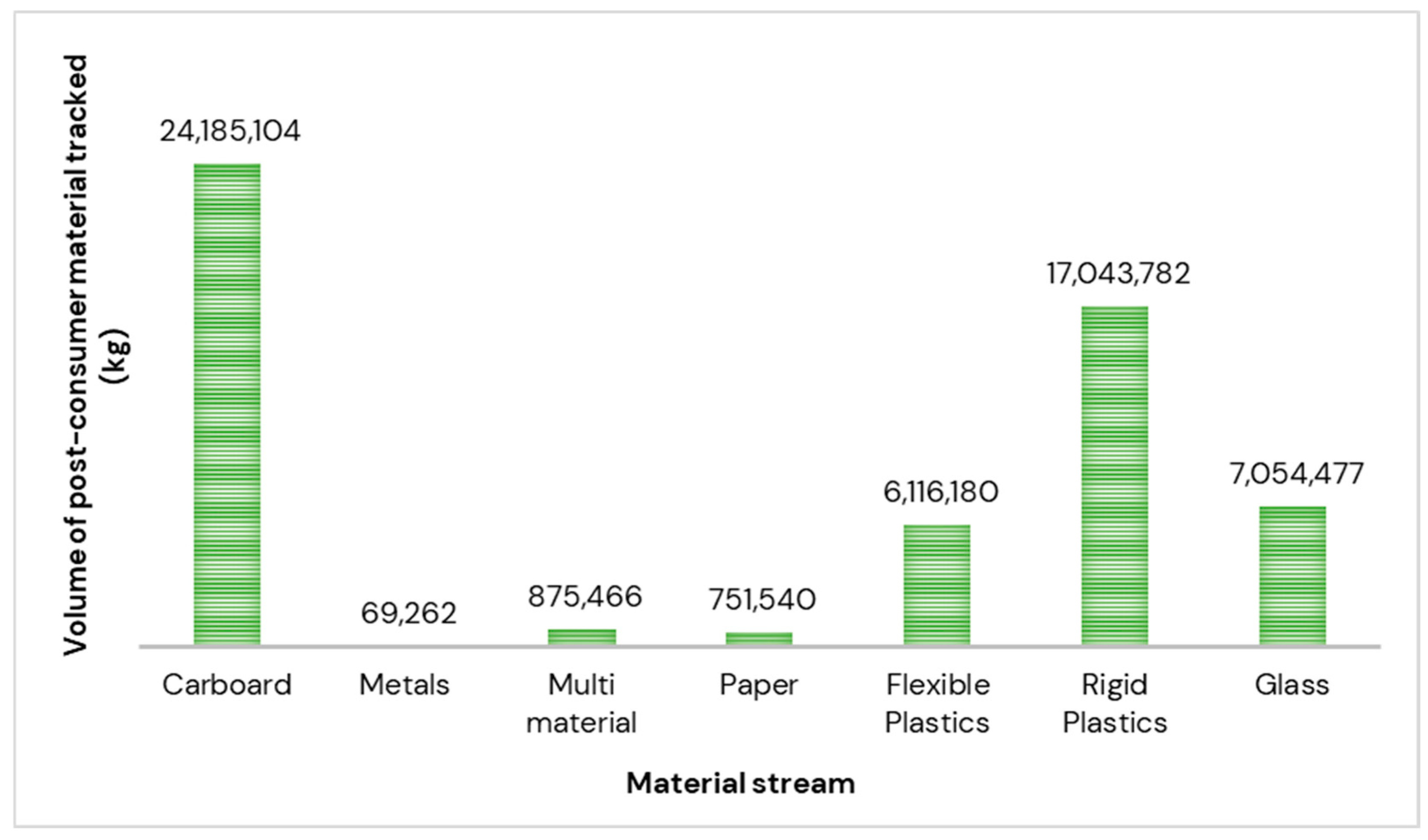
The Circular Vision collective, for 2024, is made up of 149 management companies and 52 processing companies, which processed more than 56,000 tons of cardboard, metal, multi-material, paper, flexible plastic, rigid plastic, glass containers, and packaging for that same year, distributed as shown in Figure 1.
To ensure that the analysis results accurately reflect the actual behavior of the packaging management and transformation system implemented by Circular Vision, it was necessary to define a sampling procedure that would allow for the objective and statistically robust selection of managers and processors who would provide primary data for the study. The methodology applied combines probabilistic, operational, and geographical criteria, ensuring adequate coverage of the most relevant actors in terms of volume, location, and technological capacity.
For this study, a sample was selected in accordance with the representativeness criteria proposed by [14]. These criteria are applied in the context of determining the implementation of life cycle management strategies in industrial sectors, which aim to improve products or services along with their environmental, social, and economic performance. It should be noted that prior to selecting random sampling with finite population correction, probability sampling by size was initially implemented, as some companies are more likely to be selected for the sample because they manage or transform a larger volume of usable material.
First, the primary criterion established was the quantity of packaging managed or transformed by material type. Based on this criterion, the companies with the highest volume of waste were identified. Subsequently, the random sample size formula with correction for a finite population (Equation (1)) was applied, using a minimum confidence interval of 85% for each waste group. This allowed for the determination of the minimum number of companies required per material type. Finally, the sampling results were verified and validated with the technical team of the Circular Vision Collective, ensuring that the selected sample reflected both statistical representativeness and operational relevance within the system. This sample selection model is represented by the following equation [15].
Equation (1). Probability sampling by size:
n = N × z 2 × s 2 N 1 × e 2 + z 2 × s 2
where
  • n is the sample size;
  • z is the standard deviation of the normal distribution used to determine the desired confidence level in the study (1.96, corresponding to a 95% confidence level);
  • s is the standard deviation (maximum dispersion assumed);
  • e is the margin of error assumed in the study, which represents the uncertainty of the results (e.g., 5%);
  • N is the total population size.
Once this model was selected, the z and e values proposed by Molina-Jorge et al. [16] were used, namely 95% and 8%. In their research, the authors used these values to select a representative sample of the Spanish population.
Although the selected managers and processors represent more than 70% of the total managed volume, the remaining ~30% corresponds mainly to small-scale operators with lower throughput and operational structures, comparable to those included in the sample. Given the volumetric weighting applied in the life cycle inventory and the functional unit normalization, their exclusion is not expected to significantly alter aggregated environmental results. Nevertheless, conservative assumptions and secondary datasets were used where necessary to avoid overestimating environmental benefits and to ensure the robustness of the conclusions.

2.2. Data Collection

Data collection for this study was structured based on the representative sample defined in the statistical sampling section and included both primary sources (information from selected managers and processors) and secondary sources to support stages or processes with limited information availability. The objective of this phase was to obtain consistent, verifiable, and sufficiently detailed data to feed into the mass balance and life cycle inventory applied subsequently.

2.3. Excluded Processes and Assumptions

In accordance with the cut-off and relevance criteria established in ISO 14044, the following are excluded:
  • Infrastructure manufacturing (plants, machinery, equipment).
  • Administrative and support activities (offices, services).
  • Use phase of the originally packaged product.
  • Packaging design or primary manufacturing (not covered by the study).
These exclusions have a marginal impact and do not alter the comparability between scenarios.
Likewise, the following were excluded from the analysis from the initial proposal of the scenarios:
  • Impacts from the use and consumption of containers and packaging placed on the market.
For the development of the life cycle analysis, the following assumptions were established with the aim of ensuring the consistency and representativeness of the data:
  • It was assumed that management and processing companies provided transparent, accurate, and representative information about their production processes, ensuring the reliability of the data used in the study.
  • The utilization and disposal data are assumed to be representative of the year 2024, based on the information provided by participating managers and processors and the records of Circular Vision.
When it was necessary to standardize very specific inputs or processes, equivalent datasets (proxies) were selected from the Ecoinvent 3.10 database, always prioritizing the closest geographical (RoW or GLO) and technological representativeness. Example: For complex organic compounds or additives without a specific dataset, generic processes from the category organic chemical, unspecified, or market for organic compounds were used, preserving the energy and environmental order of magnitude of the input. The cut-off system model from the Ecoinvent database was selected due to its suitability for waste management and recycling assessments. In this framework, recyclable materials enter the recycling stage without upstream environmental burdens, enabling a focused evaluation of collection, sorting, and reprocessing activities. This perspective is consistent with the study’s objective of assessing the environmental performance of post-consumer packaging management and comparing linear and circular end-of-life scenarios. Alternative system models, such as allocation at the point of substitution (APOS), distribute environmental burdens differently across the product life cycle and were, therefore, considered outside the analytical scope of this study.
In cases where it was necessary to model transport between managers, transformers, or disposal centers, primary distance information was not available. Therefore, transport models were based on representative routes between regions of operation (urban centers and industrial areas), taking as reference national studies on recoverable waste logistics and geographical consistency criteria from the Circular Vision project.
In the case of operational inputs such as oils, greases, or lubricants used for the maintenance or operation of transformation equipment, it was assumed that the unrecovered fraction is consumed within the process. This loss is considered intrinsic to the use of the input (due to thermal degradation or adsorption on surfaces), so no equivalent output is recorded in the mass balance. Given that its mass contribution is less than 1% of the total system, its treatment does not alter the consistency or closure of the balance.
Final disposal scenarios are modeled under controlled landfill conditions without energy recovery, consistent with the prevailing practice in Colombia.
In transformation processes where water consumption was recorded but no information on discharges was available, it was assumed that 80% of the water input is released back as wastewater, in accordance with typical washing, pulping, and conditioning patterns in recycling systems.
Virgin material substitution was modeled at a 1:1 ratio, validated by primary data from participating transformers on % recycled content displacing virgin inputs in their production (e.g., flake/PET ratios reported in mass balances). This avoids overestimation, as credits reflect actual market displacement.

2.4. Methodology Applied

The methodology was developed in accordance with ISO 14040 [3], which establishes the assessment of potential environmental impact throughout the life cycle of a process, product, or service, and ISO 14044 [4], which is used to assess the life cycle of products, generating the requirements and guidelines for carrying out the assessment. This is how these standards work together [17].
Likewise, the process is structured in four phases: 1. definition of the objective and scope, 2. life cycle inventory (LCI), 3. life cycle impact assessment (LCIA), and 4. interpretation.
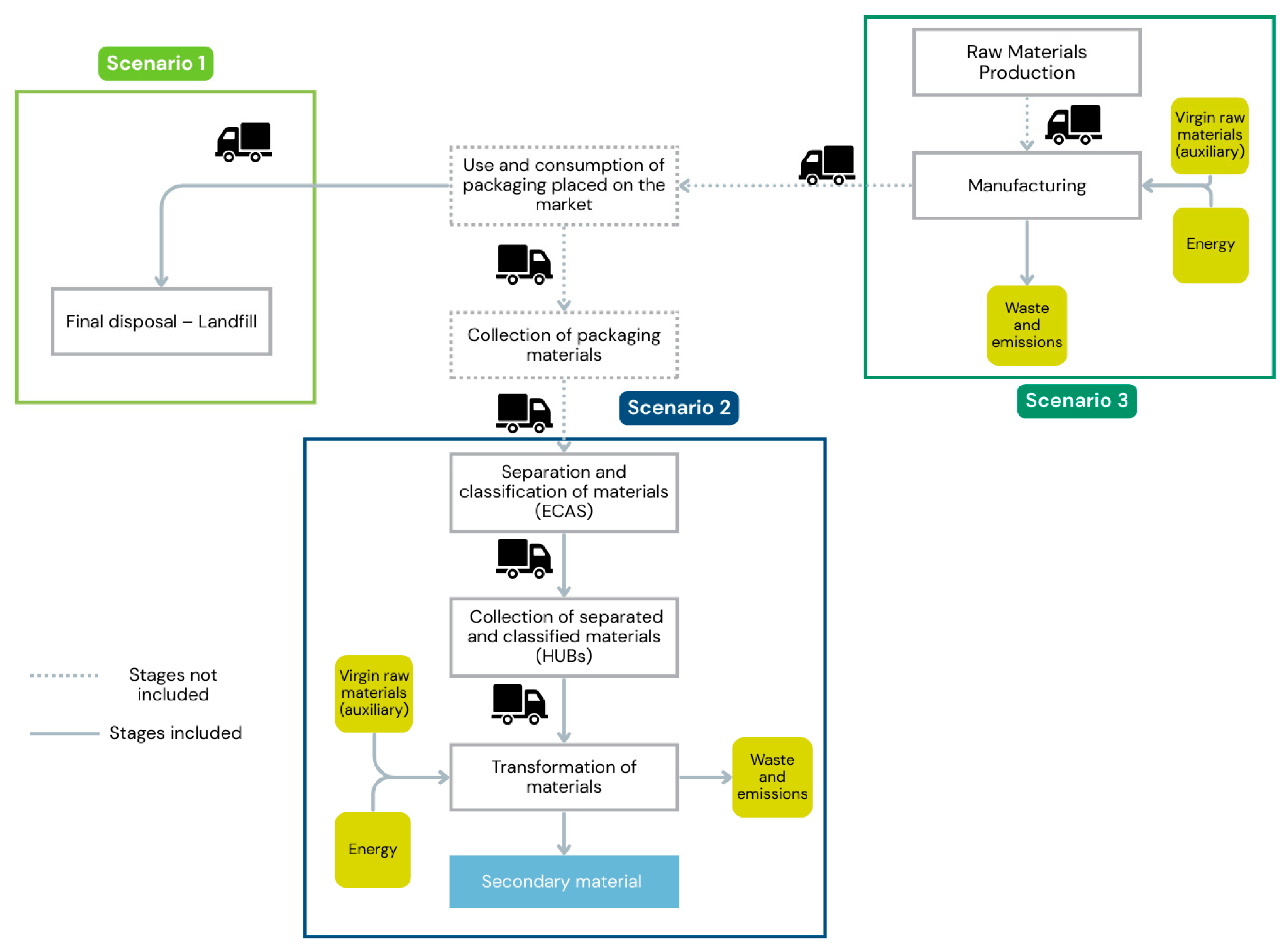
The objective of the life cycle assessment (LCA) is to evaluate and compare the environmental impacts associated with three alternative scenarios for post-consumer packaging management in Colombia in 2024: Scenario 1—Linear Economy (BAU): Traditional flow of final disposal in landfills or energy recovery where applicable, Scenario 2—Circular Vision Management: Environmental performance of the actual collection, sorting, and transformation chain coordinated by Circular Vision, Scenario 3—Avoided Impacts: Net environmental benefits derived from the substitution of raw materials. Figure 2 represents the agreed-upon scenarios.
Water-related impacts were assessed using the ReCiPe Midpoint (H) water consumption indicator, expressed in m3.

2.5. Scenario 1—Linear Economy (BAU Colombia)

For Scenario 1, corresponding to the linear management of post-consumer packaging, the life cycle inventory (LCI) was constructed using only secondary data from the Ecoinvent 3.10 database. This scenario assumes that all post-consumer material is managed through final disposal in landfills, without any material or energy recovery processes. The datasets and key modeling assumptions used to build the LCI for Scenario 1 are summarized in Table 1.

2.6. Scenario 2—Circular Vision Management

In this case, circular vision management applies both to the management carried out by managers and to the transformation processes associated with the seven categories of material evaluated. In the case of waste collectors, given that they collect multiple types of materials simultaneously on their routes, the inventory was constructed using a weighted average, calculated according to the specific share of each waste collector in each of the categories included: where applicable, circular vision management corresponds both to the management carried out by waste collectors and to the transformation processes associated with the seven categories of material evaluated.

2.6.1. Cardboard (Transport and Logistics)

Table 2 shows the types of transport and logistics for handling cardboard-type material and the weighted averages of loads in tons (t).

2.6.2. Paper (Transport and Logistics)

Table 3 shows the types of transport and logistics for handling paper-type material and the weighted averages of loads in tons (t).

2.6.3. Flexible Plastics (Transport and Logistics)

Table 4 shows the types of transport and logistics for handling flexible plastic materials and the weighted averages of loads in tons (t).

2.6.4. Rigid Plastics (Transport and Logistics)

Table 5 shows the types of transport and logistics for handling rigid plastic materials and the weighted averages of loads in tons (t).

2.6.5. Metals (Transport and Logistics)

Table 6 shows the types of transport and logistics for handling metal materials and the weighted averages of loads in tons (t).

2.6.6. Glass (Transport and Logistics)

Table 7 shows the types of transport and logistics used for handling glass materials and the weighted averages of loads in tons (t).

2.6.7. Multi-Materials (Transport and Logistics)

Table 8 shows the types of transport and logistics for handling multi-material materials and the weighted averages of loads in tons (t).

2.7. Scenario 3—Impacts Avoided

For this scenario, a life cycle inventory (LCI) was constructed for the primary production of the materials used in containers and packaging, based exclusively on virgin raw materials. This approach makes it possible to establish the environmental impact that a completely linear model—production, consumption, and final disposal—would have and provides the necessary reference for calculating the impacts avoided by the Circular Vision circular model. To do this, Ecoinvent 3.10 datasets were used, under the cut-off approach, as shown in Table 9.
The inventories of virgin production were used to calculate the environmental impacts associated with the manufacture of one ton of material in a linear model. These results were added to the impacts of Scenario 1 (transport to landfill and final disposal), thus obtaining the complete environmental load of a system without circularity.
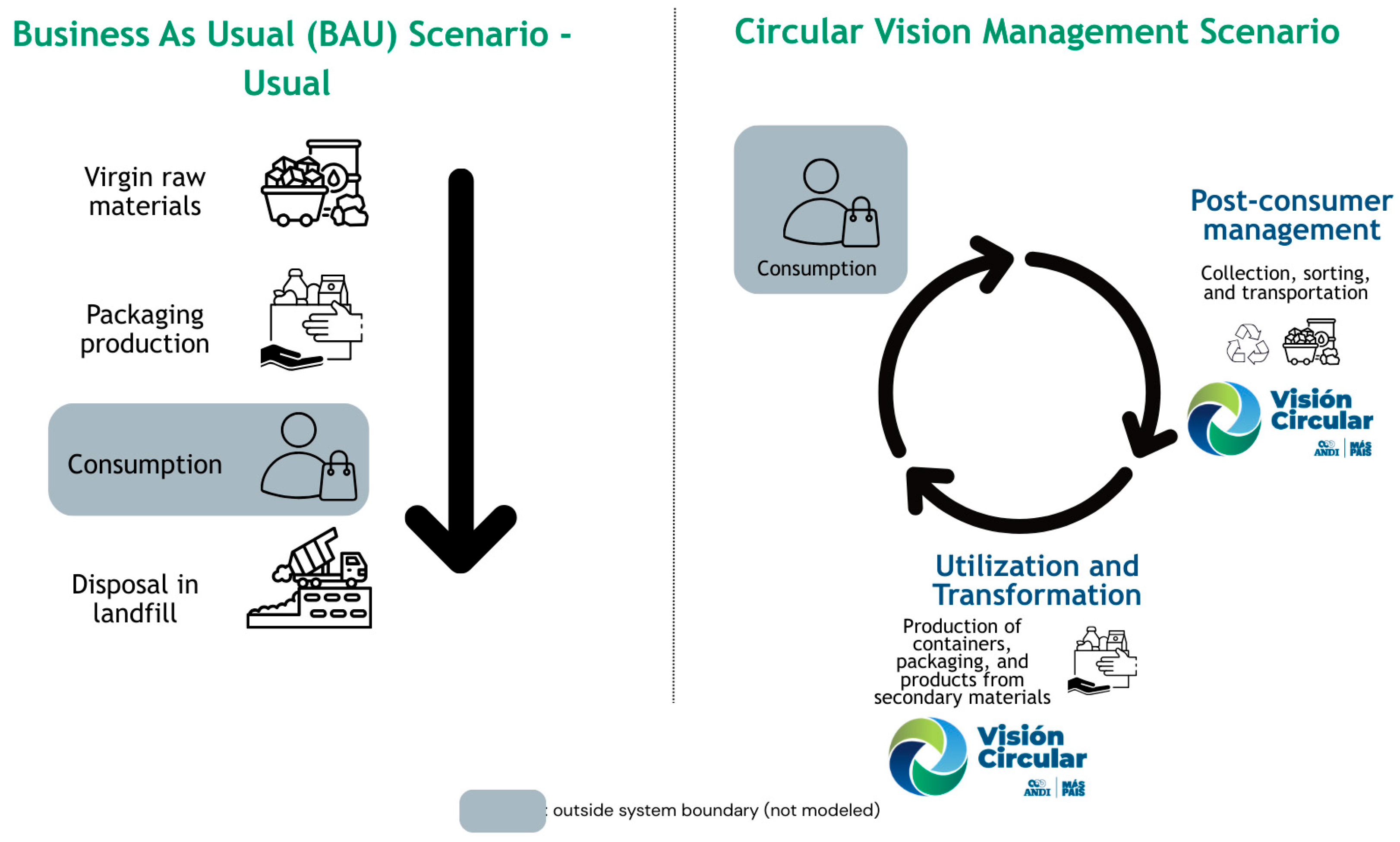
Subsequently, this total load was compared with that generated by the management and transformation of materials in Circular Vision (Scenario 2), allowing us to quantify impacts avoided by replacing virgin raw materials, impacts avoided by not disposing of waste, and the net environmental balance, also considering the loads inherent to the collective’s operation. This is reflected in Figure 3, in comparison with Scenario 3.
Figure 3 synthesizes the net environmental balance of the circular system by contrasting avoided burdens (virgin material substitution and landfill disposal) against the operational impacts of collection, sorting, and transformation. The figure highlights that the principal environmental gains of the Circular Vision model are driven primarily by the displacement of primary raw material production, while avoided disposal plays a secondary—though still positive—role. This relationship is particularly pronounced in polymeric and metallic streams, where virgin production is highly energy-intensive.
Avoided impacts were modeled using a substitution (avoided burden) approach, whereby recycled materials were assumed to displace the production of equivalent virgin materials in the market. A 1:1 displacement ratio was applied for each material stream. The life cycle inventory relied on Ecoinvent datasets using the cut-off system model. Under this allocation framework, recyclable materials enter the recycling stage without upstream environmental burdens, while the environmental credits associated with virgin material substitution are assigned to the recycling system. This approach ensures consistency between the database structure and the avoided impact calculations.

2.8. Using SimPro 9.6 Software

The SimaPro 9.6 software was used as the main tool for life cycle modeling. This software allowed for the integration of primary and secondary data, detailed calculations of environmental impacts, and visualization of input and output flows throughout the product life cycle. Similarly, all scenarios in the comparative analysis were modeled, including management and transformation by the Circular Vision value chain, the scenario of transport and final disposal of packaging materials in a landfill, and the environmental impact associated with their production from raw materials.

2.9. Impact Categories

In this phase, the relevant impact categories were selected, considering key environmental aspects such as greenhouse gas emissions, energy consumption, and waste generation. The inflows and outflows of the system were classified and characterized using recognized impact assessment methods, such as the IPCC (Intergovernmental Panel on Climate Change) for carbon emissions. The environmental impact categories selected for this analysis are presented below. They allow for a comprehensive assessment of the effects of packaging materials in each of the scenarios, both on the environment and on natural resources, as shown in Table 10.
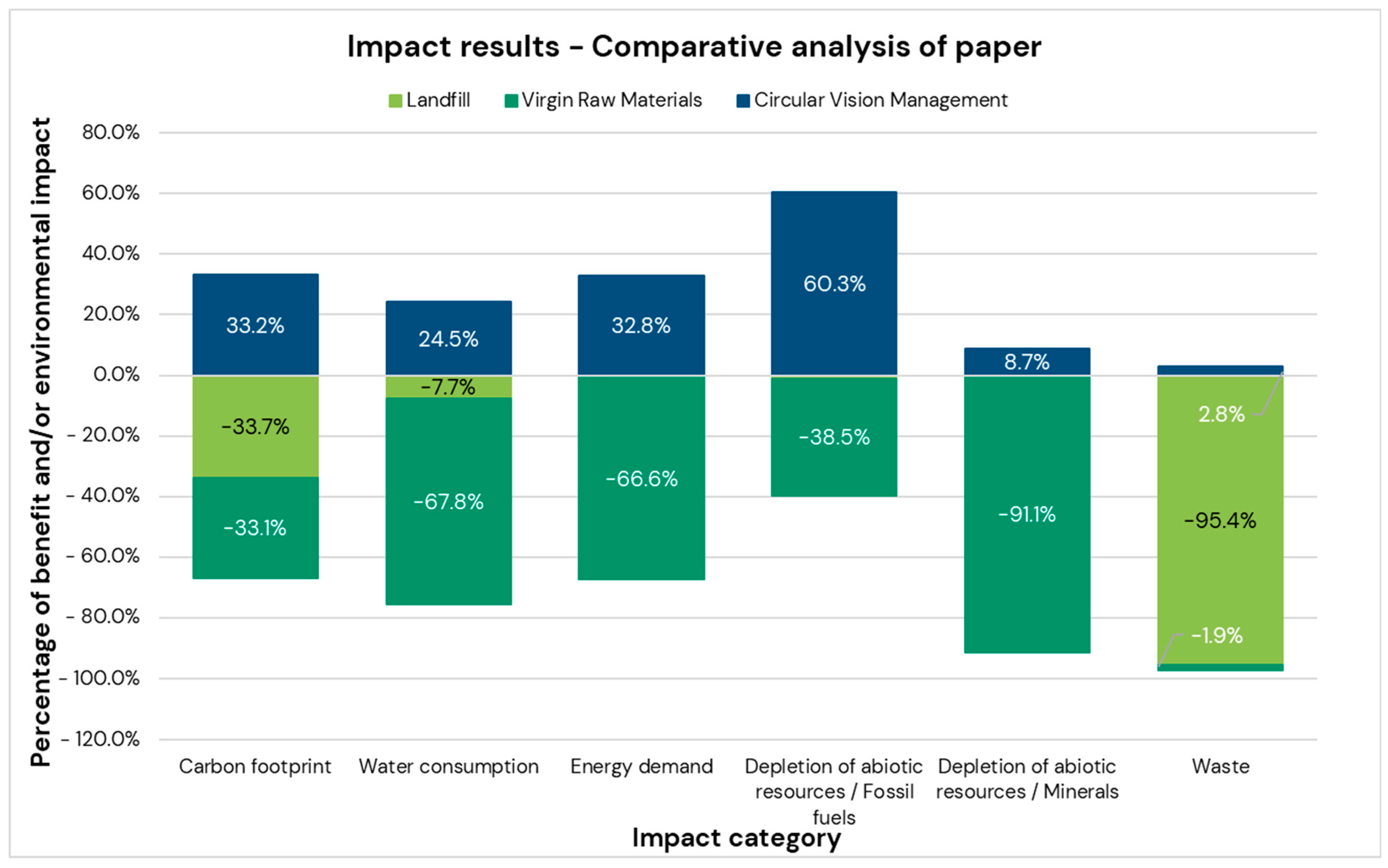
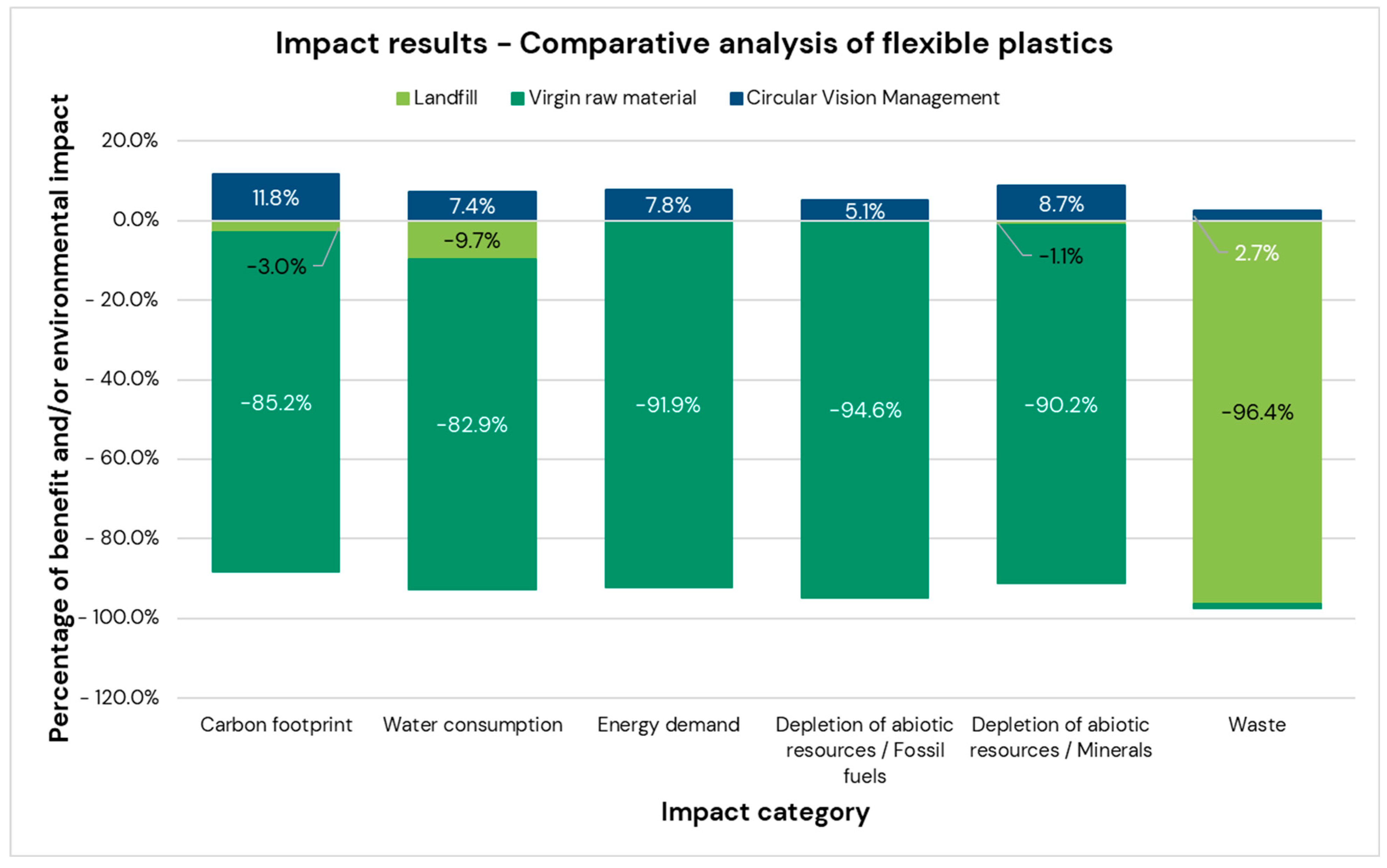
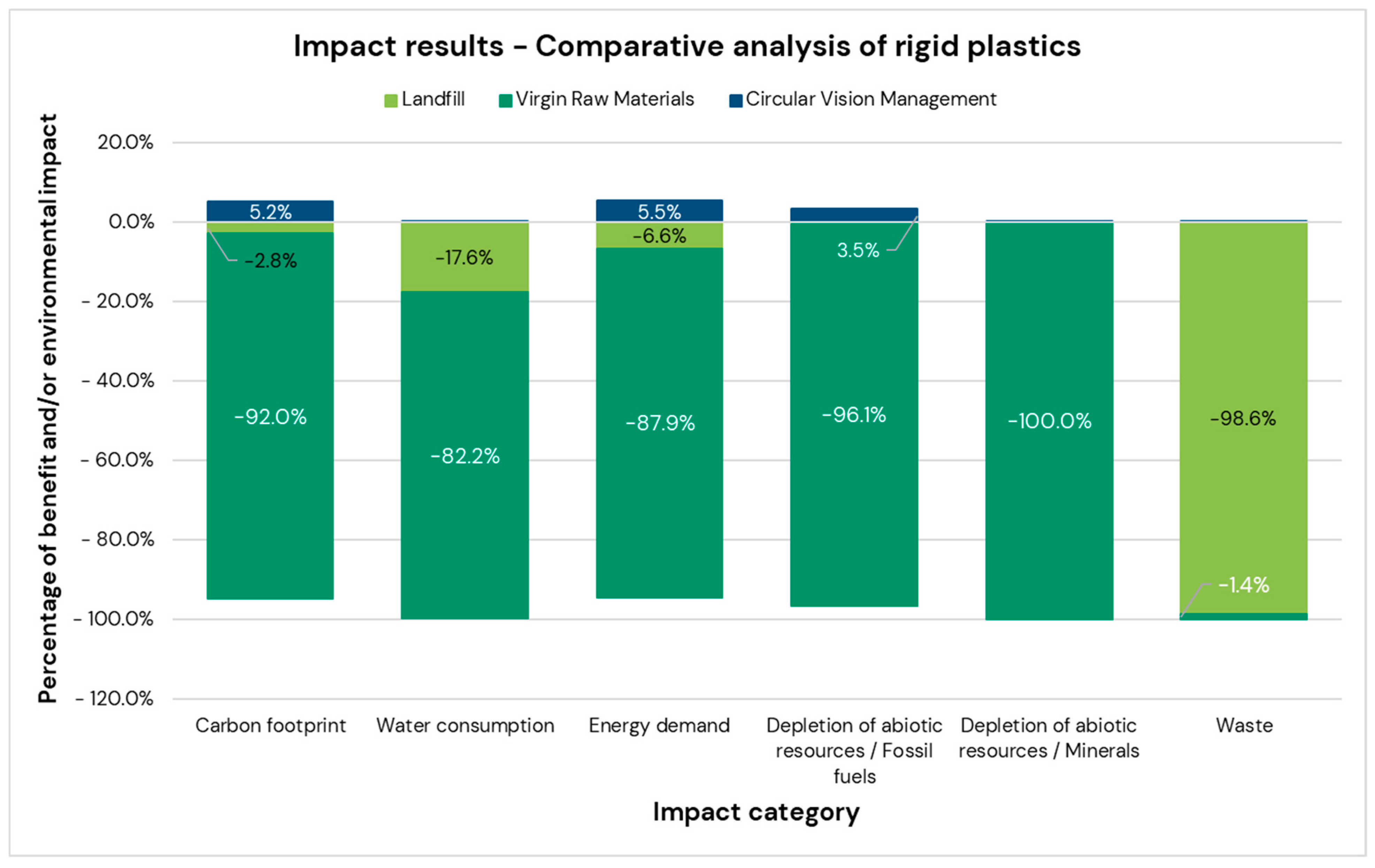
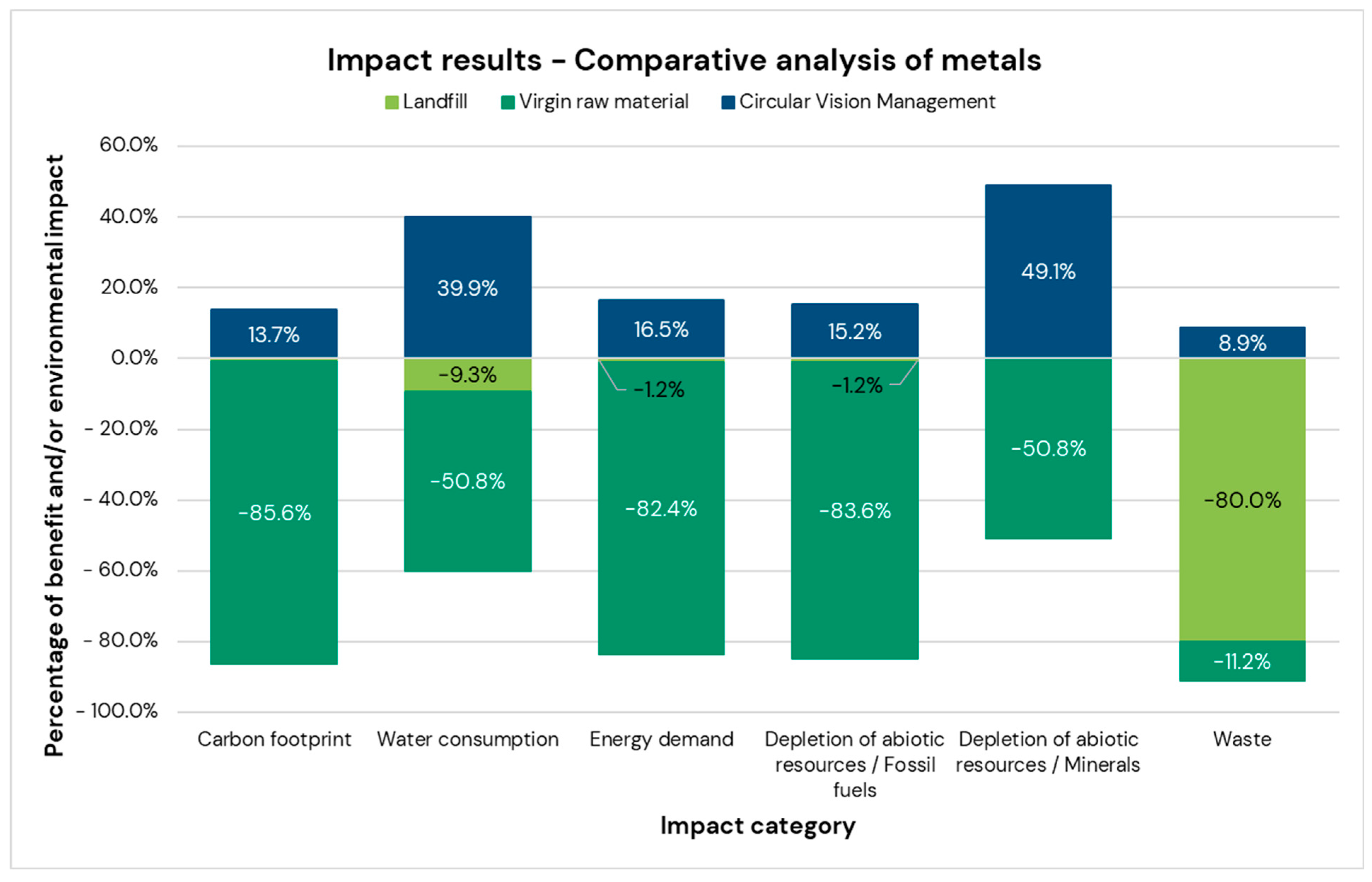
Figure 4, Figure 5, Figure 6, Figure 7, Figure 8, Figure 9 and Figure 10 present percentage-based comparisons across impact categories to facilitate interpretation of the relative contribution of avoided and generated burdens within each material stream. Rather than reflecting absolute magnitudes, these figures highlight dominant environmental drivers and the relative performance of circular management compared with linear and virgin production scenarios.
Although a common functional unit of one metric ton of post-consumer packaging was applied, this study does not aim to compare the intrinsic environmental performance of different material types. Instead, results are interpreted within each material stream, evaluating the relative performance of circular management against its linear counterfactual and virgin production baseline. Differences in absolute impact values reflect inherent production intensities, recycling efficiencies, and technological requirements of each material. Methodological comparability is ensured through harmonized system boundaries, impact assessment methods, and background datasets.

2.10. Sensitivity Analysis and Model Robustness

In line with ISO 14044 interpretation requirements, a targeted one-at-a-time (OAT) sensitivity analysis tested key assumptions. Three parameters were varied quantitatively: (i) water discharge ratio (50%, 80% base, and 100%), (ii) transport distances (±30% tkm stress test), and (iii) proxy energy datasets (RoW/GLO vs. Colombia grid mix approximation, reflecting higher hydro share). Variations caused <10% changes in net impact categories across streams, without reversing conclusions (Circular Vision superior to landfill/virgin). Virgin substitution ratios—provided as primary data from transformer inventories (% of secondary material replacing virgin)—were not varied quantitatively but qualitatively confirmed as robust, mainly affecting benefit magnitude. Proxy use for non-energy processes remains a refinement priority.
The sensitivity analysis (Table 11) confirms the robustness of the results across all material streams: maximum variations of 9.96% (transport ± 30%, water ratios), well below the 10% threshold, with sign changes limited to negligible mineral depletion.

3. Results

In this study, negative values are used to represent avoided environmental impacts resulting from recycling and material recovery processes. These avoided burdens include the displacement of virgin raw material production, avoided landfill disposal, and associated reductions in primary energy demand. This sign convention is consistent with system expansion approaches commonly applied in life cycle assessment to account for substitution benefits.
The comparative life cycle assessment (LCA) carried out for the different material flows evaluated, as well as the indicators reported, corresponds to the most relevant environmental impacts and loads in the study. For the carbon footprint indicator, the final result corresponds to the sum of the global warming potential (GWP) from three sources: fossil, biogenic, and land use. In this way, the consolidated value comprehensively reflects all greenhouse gas emissions and removals associated with the life cycle of each stream.
In terms of energy demand, the total indicator is obtained by adding together contributions from non-renewable sources, including fossil fuels, nuclear energy, and non-renewable biomass, and from renewable sources, such as renewable biomass, solar, geothermal, and hydroelectric energy. This approach allows for a comparison of the overall energy requirement incorporated into each material, regardless of the type of resource from which it comes.
Finally, for the waste generation indicator, the reported value corresponds to the sum of waste classified as hazardous and non-hazardous (bulk waste). The integration of these categories allows for the evaluation of the total waste generated throughout the life cycle and its potential impact on waste management.
These results allow for a consistent comparison of the environmental performance of different material streams.

3.1. Cardboard

The consolidated results for the life cycle impact assessment category for cardboard are shown in Table 12.
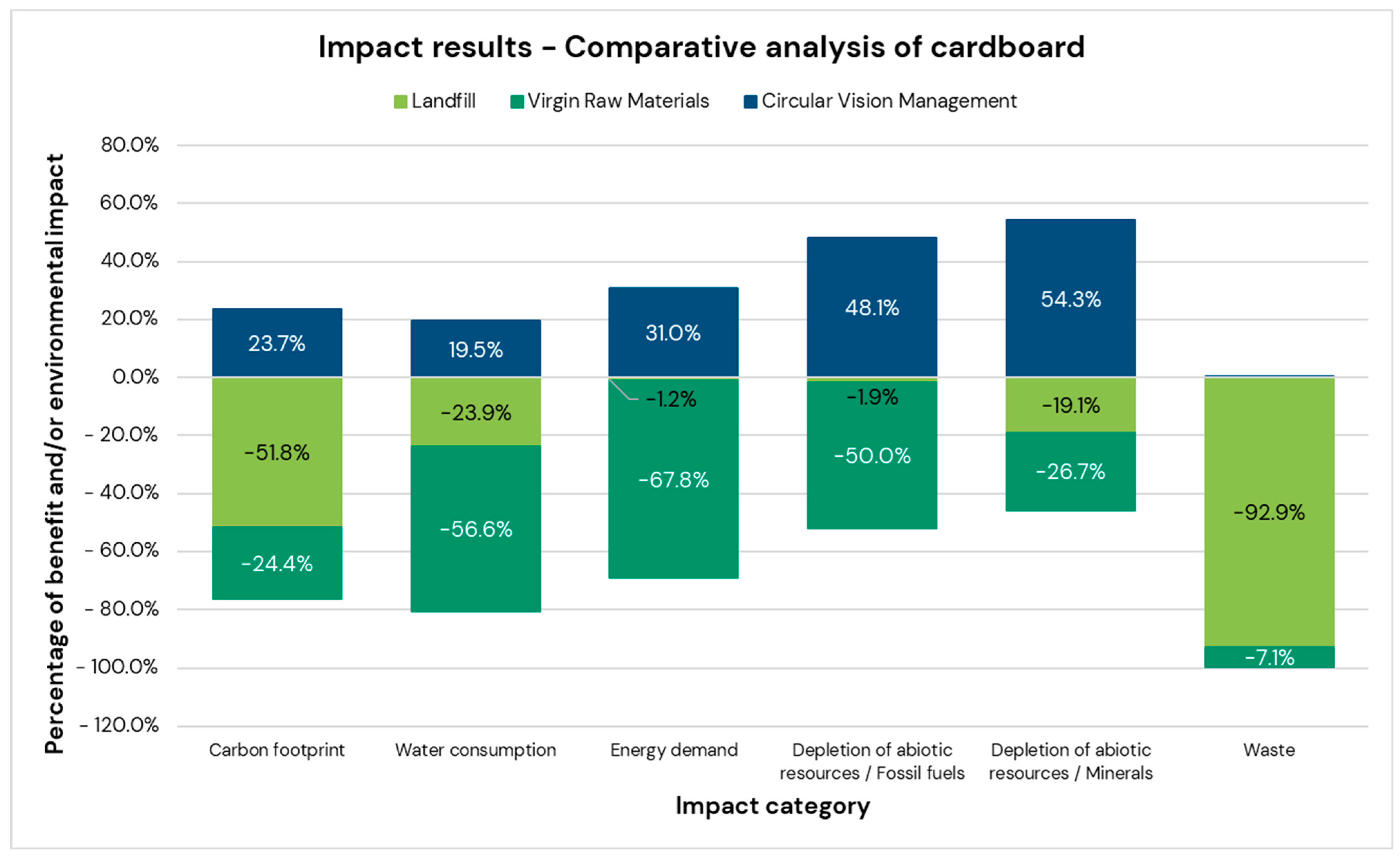
The results of the comparative analysis of cardboard are shown, reflecting the percentage of benefit and/or environmental impact in relation to the impact categories in Figure 4. Percentage values shown in Figure 4, Figure 5, Figure 6, Figure 7, Figure 8, Figure 9 and Figure 10 represent the relative change in impacts of Scenarios 2 and 3 compared to the linear baseline (Scenario 1).

3.2. Paper

The consolidated results for the life cycle impact assessment category for paper are shown in Table 13.
The results of the comparative analysis of paper’s impact are shown, reflecting the percentage of benefit and/or environmental impact in relation to the impact categories in Figure 5.

3.3. Flexible Plastics

The consolidated results for the life cycle impact assessment category of flexible plastics are shown in Table 14.
The results of the comparative analysis of flexible plastics are shown, reflecting the percentage of benefit and/or environmental impact in relation to the impact categories in Figure 6.

3.4. Rigid Plastics

The consolidated results for the life cycle impact assessment category of rigid plastics are shown in Table 15.
The results of the comparative analysis of rigid plastics are shown, reflecting the percentage of benefit and/or environmental impact in relation to the impact categories in Figure 7.

3.5. Metals

The consolidated results for the life cycle impact assessment category for metals are shown in Table 16.
The results of the comparative analysis of metals are shown, reflecting the percentage of benefit and/or environmental impact in relation to the impact categories in Figure 8.

3.6. Glass

The consolidated results for the life cycle impact assessment category for glass are shown in Table 17.
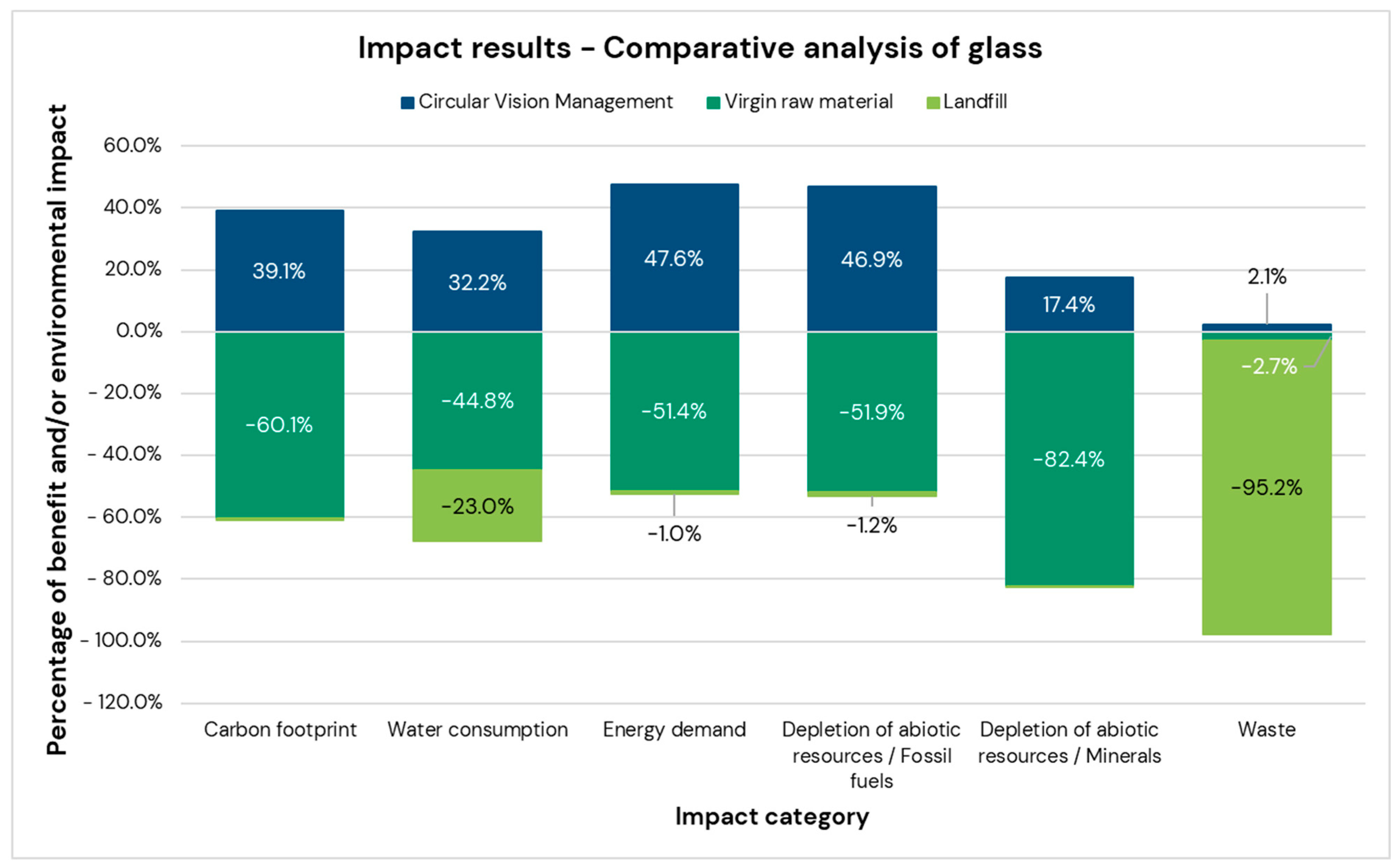
The results of the comparative analysis of glass are shown, reflecting the percentage of benefit and/or environmental impact in relation to the impact categories in Figure 9.

3.7. Multi-Materials

The consolidated results for the life cycle impact assessment category of multi-materials are shown in Table 18.
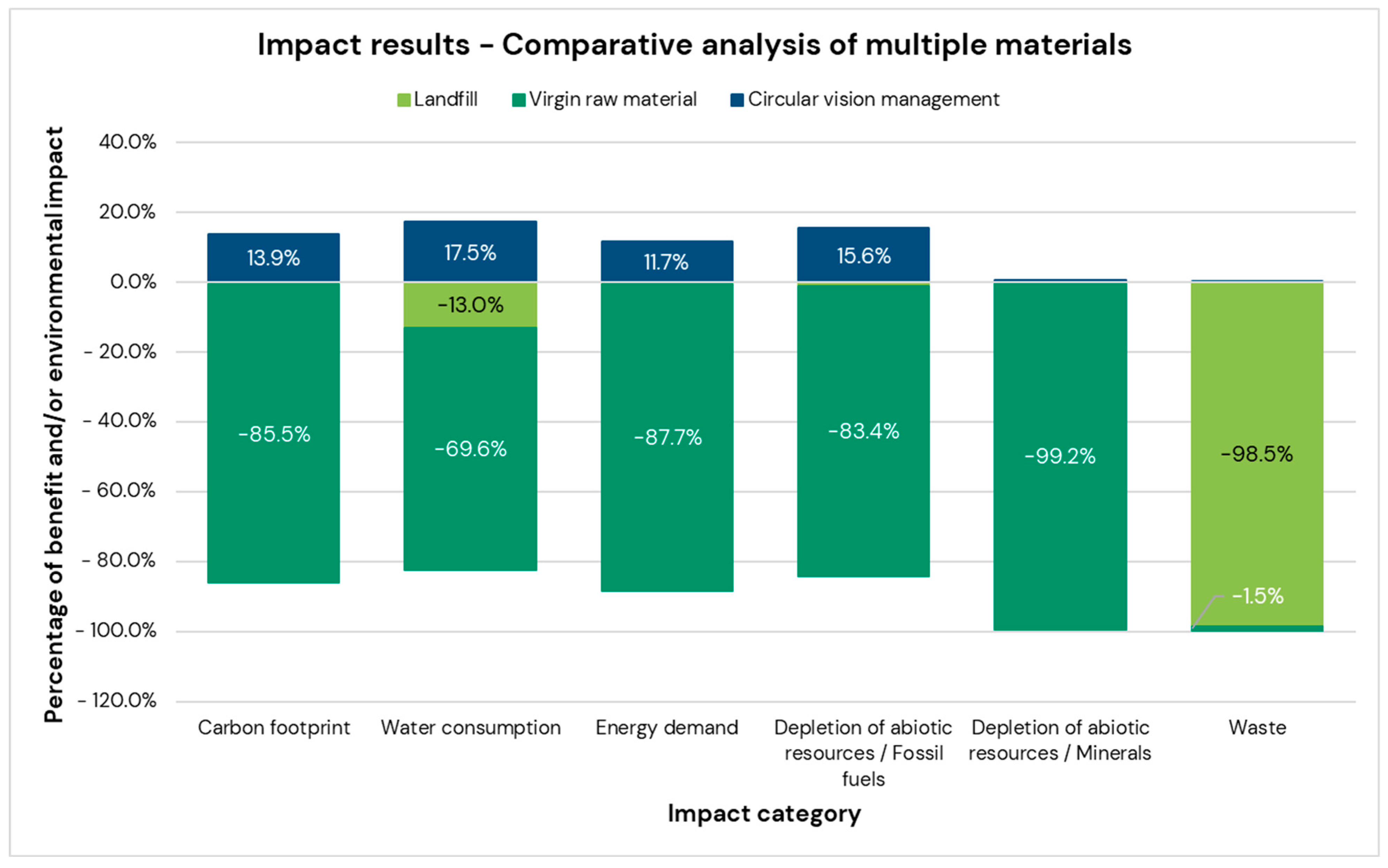
The results of the comparative analysis of the impact of multi-materials are shown, reflecting the percentage of benefit and/or environmental impact in relation to the impact categories in Figure 10.

4. Discussion

Over the last four years, ANDI’s Circular Vision initiative has managed to recycle more than 214,000 tons of packaging materials, including paper, cardboard, glass, metal, multi-material, rigid plastics, and flexible plastics, reaching 228 municipalities in 30 departments across the country. These results have been made possible thanks to the coordination between producers, manufacturers, consumers, managers, processors, and local authorities. This analysis allows for the evaluation of impact categories such as global warming potential, also known as carbon footprint, water consumption, and energy demand, among others, offering a comprehensive view of the environmental performance of the packaging management system operated by the program. Accurate measurement of circular impact helps us implement LCA to validate the environmental performance of the Circular Vision packaging recovery system in Colombia [23,24].

4.1. Interpretation of the Life Cycle

The results show that management through Circular Vision generates environmental benefits in all categories evaluated:

4.1.1. Cardboard

Overall, the results show that the environmental benefits for the cardboard stream are mainly explained by two mechanisms: (i) the elimination of the flow to landfill and (ii) the substitution of virgin cardboard, especially in categories associated with energy, water, and fossil fuels. In these categories, the impacts avoided exceed the operational impacts generated by Circular Vision’s management, resulting in positive net balances [24,25].
The results show that management through Circular Vision generates environmental benefits in all categories evaluated for the cardboard stream. In terms of carbon footprint, Circular Vision management avoids 69% of emissions compared to BAU and 3% compared to the virgin raw material production scenario. Most of the benefit comes from avoiding landfill disposal, which accounts for −51.8% of the total impact, followed by virgin production with −24.4%. The impacts of the management system itself represent +23.7%, a value that is amply offset by the impacts avoided in the linear system.

4.1.2. Paper

The results show that management through the Circular Vision approach generates environmental benefits in most of the evaluated categories, particularly compared to the business-as-usual (BAU) scenario and, in several cases, also compared to production from virgin raw materials. In terms of carbon footprint, the system avoids 50% of emissions compared to BAU, confirming that the greatest benefit comes from avoiding landfill disposal. The majority of the benefit comes from avoiding landfill disposal, which contributes −33.7% of the total impact, followed by virgin production with −33.1%. The impacts of the management system itself represent +33.2%, a value that is more than offset by the impacts avoided in the linear system. Regarding energy demand, the system avoids 51% compared to BAU and the scenario using virgin raw materials, highlighting the energy intensity of primary fiber production compared to the circular operation. The benefit comes from avoiding landfill disposal, which contributes −0.6%, and virgin production with −66.6%.
The paper stream offers significant environmental benefits compared to the linear model and production from virgin raw materials in most of the indicators evaluated, particularly in terms of water, energy, minerals, and carbon footprint. The advantages are explained by the lower resource intensity of recycling and the elimination of disposal. However, in specific categories, such as fossil fuels and waste compared to the virgin scenario, circular management presents higher burdens due to operational energy requirements and process rejects. Even so, the overall environmental balance favors the circularity of paper over linear and primary alternatives [25].

4.1.3. Flexible Plastic

Overall, the flexible plastic stream offers particularly significant environmental benefits in terms of carbon, water, energy, and fossil fuels, driven by the high impacts avoided in primary production. Although the waste category compared to virgin material presents a net burden, the overall balance is largely positive and reinforces the environmental value of incorporating this stream into the circular economy model.
In terms of carbon footprint, the Circular Vision management system avoids 87% compared to business as usual (BAU) and 86% compared to virgin raw materials. Primary production contributes the greatest negative impact, equivalent to −852%, while final disposal avoids only −3.0%. The Circular Vision system’s own costs represent +12%, but these are more than offset by the impacts avoided in the linear scenarios.

4.1.4. Rigid Plastics

Overall, rigid plastics exhibit substantial avoided impacts in several categories; however, lower relative benefits are observed in water-related impacts and mineral resource depletion. These results confirm that recovering and transforming this waste stream within the Circular Vision model offers substantial environmental advantages over the linear model and the manufacture of virgin resin.
In terms of carbon footprint, the Circular Vision management system avoids 95% compared to business as usual and 94% compared to virgin raw materials. The majority of the benefit comes from the replacement of virgin plastic (−92.0%), while the avoided disposal contributes an additional benefit of −2.8%. The costs inherent to the circular system represent +5.2%, but these are significantly outweighed by the avoided impacts.

4.1.5. Metals

Overall, the metal stream offers significant environmental benefits in terms of carbon, energy, and fossil fuels, driven mainly by the substitution of primary metal, whose production is highly resource- and energy-intensive. Although the circular system’s mineral and water loads reduce the net benefit, the overall balance still favors metal use within the Circular Vision model.
In terms of carbon footprint, the Circular Vision management system avoids 84% of emissions compared to both the business-as-usual (BAU) and virgin raw material scenarios. The majority of the benefit comes from the substitution of primary metal (−85.6%), while final disposal contributes a marginal benefit (−0.7%). The circular system introduces an additional environmental impact of +13.7%, which is more than offset by the avoided impacts of the linear and virgin raw material manufacturing models.
In terms of energy demand, the system avoids 80% compared to both BAU and virgin raw material. Primary metal production represents the largest environmental burden (−82.4%), while final disposal provides an additional benefit (−1.2%). The circular management system introduces an operational impact of +16.5%, which is more than offset by the avoided impacts associated with virgin metal manufacturing.

4.1.6. Glass

Overall, the results show that glass has significant environmental benefits compared to the reference scenarios, especially in terms of minerals and carbon footprint. However, water and energy use in the recycling process reduces the net benefit in these categories, reflecting the operational intensity associated with the treatment and preparation of cullet. Even so, the circular model remains environmentally favorable in most of the indicators evaluated.
In terms of carbon footprint, the Circular Vision management system avoids 36% compared to business as usual and 35% compared to virgin raw materials. This benefit is primarily due to the impacts avoided by replacing primary glass (−60.1%) and by avoiding final disposal (−0.7%). The Circular Vision operation introduces a 39.1% increase in carbon footprint, but even so, the avoided impacts exceed the circular system’s overall impact.
Transport distances represent a relevant parameter in the environmental performance of post-consumer packaging management, particularly for heavier or high-volume materials such as glass and rigid plastics. Fuel consumption and associated emissions linked to collection and hauling operations may influence the impact results in categories such as climate change and fossil resource use. While average operational distances were used in the modeling, variations in transport logistics could modify the magnitude of impacts. This aspect should, therefore, be considered when interpreting material-specific results [26,27,28].

4.1.7. Multi-Material

Overall, the results show that the multi-material stream offers significant environmental benefits in all categories evaluated, especially when compared to the production of virgin material. The operational costs of the circular system are low compared to the impacts avoided, which reinforces the environmental relevance of managing this stream within the Circular Vision model.
In terms of carbon footprint, the Circular Vision management system avoids 84% compared to business as usual and 84% compared to virgin raw materials. Most of the benefit comes from replacing primary materials, whose processes have a high carbon footprint (−85.5%), while final disposal contributes a marginal impact (−0.6%). The circular system introduces a carbon footprint of +13.9%, but this is more than offset by the avoided impacts.

5. Conclusions

The life cycle assessment results demonstrate that the Circular Vision system generates substantial environmental benefits compared to both linear disposal and virgin production scenarios. Carbon footprint reductions range from approximately 35% for glass to over 90% for rigid plastics, with avoided emissions exceeding 2.5 × 10³ kg CO2-eq per ton in high-intensity material streams. Energy savings are also significant, particularly in plastics and multi-materials, where avoided cumulative energy demand surpasses 4.0 × 10⁴ MJ per ton when virgin production is displaced. These quantitative outcomes confirm the environmental effectiveness of collective post-consumer packaging recovery systems.
A relevant finding is that, although Circular Vision does not control the internal operational processes of managers and processors, it does act as an integrating company capable of generating capabilities within its partner network. The coordination promoted by the program facilitates improvements in areas such as logistical efficiency, reduction in energy consumption, optimization of sorting and processing, strengthening of traceability, and adoption of more sustainable practices. This integrative role is key to reducing technological gaps, promoting operational standardization, and improving collective environmental performance.
Despite the positive results, the study revealed limitations related to the availability of primary data, particularly for specific transformation processes. These gaps necessitated supplementing the inventory with secondary information, which introduces inherent uncertainties in the modeling. Nevertheless, this analysis constitutes the first comprehensive LCA baseline for real-world packaging and container recovery systems in Colombia, representing a significant advance given the lack of previous studies of comparable scope.
Several methodological assumptions were required in the modeling process, including transport distances, the use of proxy datasets for certain material streams, water discharge ratios, and substitution factors for virgin material displacement. These assumptions were defined based on the available literature and background databases commonly used in life cycle assessment studies.
Sensitivity analysis (Section 2.10) was conducted on these parameters, confirming less than 10% variation across all impact categories (GWP, CED, water, ADP, and waste) with no alteration of comparative trends between scenarios. Although absolute impact magnitudes may vary, the consistent superiority of Circular Vision management over BAU/virgin scenarios remains unchanged across all material streams. Primary transformer data strengthens substitution factor credibility while proxy datasets represent a refinement priority for future iterations.
Finally, this exercise sets a methodological and operational precedent for the country. Its value lies not only in the results but also in its ability to build trust, encourage the participation of more companies, and promote the constant updating of inventories with primary information. The replicability and expansion of this exercise will make it possible to progressively reduce current limitations, increase representativeness, and more accurately reflect the reality of the Colombian utilization system, consolidating Circular Vision as a technical and strategic benchmark in sustainable materials management.

Author Contributions

Conceptualization, F.R.; Methodology, V.R.; Software, A.B.; Validation, F.R.; Formal Analysis, A.B.; Investigation, V.R. and A.B.; Resources, F.R.; Data Curation, V.R.; Writing—Original Draft, A.T.O.-R.; Writing—Review and Editing, F.R., V.R., A.B. and A.T.O.-R.; Visualization, V.R. and A.B.; Supervision, F.R.; Project Administration, F.R.; Funding Acquisition, F.R. All authors have read and agreed to the published version of the manuscript.

Funding

This research received no external funding.

Institutional Review Board Statement

Not applicable.

Informed Consent Statement

Not applicable.

Data Availability Statement

The data presented in this study are available on request from the corresponding author.

Conflicts of Interest

Felipe Restrepo, Valentina Ruge and Andrea Bolañoz are employed by Casostenible S.A.S. The remaining author declares that the research was conducted in the absence of any commercial or financial relationships that could be construed as potential conflicts of interest.

References

  1. Ferronato, N.; Moresco, L.; Guisbert, G.; Gorritty, M.; Conti, F.; Torretta, V. Sensitivity analysis and improvements of the recycling rate in municipal solid waste life cycle assessment: Focus on a Latin American developing context. Waste Manag. 2021, 128, 1–15. [Google Scholar] [CrossRef] [PubMed]
  2. De Feo, G.; Ferrara, C. Advancing communication in solid waste management: Leveraging life cycle thinking for environmental sustainability. Environ. Technol. Rev. 2024, 13, 441–460. [Google Scholar] [CrossRef]
  3. ISO 14040:2006; Environmental Management—Life Cycle Assessment—Principles and Framework. International Organization for Standardization: Geneva, Switzerland, 2006.
  4. ISO 14044:2006; Environmental Management—Life Cycle Assessment—Requirements and Guidelines. International Organization for Standardization: Geneva, Switzerland, 2006.
  5. Nurzhan, A.; Ruan, X.; Chen, D. A Review of Life Cycle Assessment Application in Municipal Waste Management: Recent Advances, Limitations, and Solutions. Sustainability 2025, 17, 302. [Google Scholar] [CrossRef]
  6. Bisinella, V.; Schmidt, S.; Varling, A.S.; Laner, D.; Christensen, T.H. Waste LCA and the future. Waste Manag. 2024, 174, 53–75. [Google Scholar] [CrossRef] [PubMed]
  7. Cheniti, H.; Kerboua, K.; Sekiou, O.; Aouissi, H.A.; Benselhoub, A.; Mansouri, R.; Zeriri, I.; Barbari, K.; Gilev, J.B.; Bouslama, Z. Life Cycle Assessment of Municipal Solid Waste Management within Open Dumping and Landfilling Contexts: A Strategic Analysis and Planning Responses Applicable to Algeria. Sustainability 2024, 16, 6930. [Google Scholar] [CrossRef]
  8. Curran, M.A. Goal and Scope Definition in Life Cycle Assessment. In Life Cycle Assessment Handbook; Springer: Berlin/Heidelberg, Germany, 2017. [Google Scholar] [CrossRef]
  9. Lim, S.; Park, J. Environmental indicators for communication of life cycle impact assessment results and their applications. J. Environ. Manag. 2009, 90, 3305–3312. [Google Scholar] [CrossRef] [PubMed]
  10. Ouedraogo, A.; Kumar, A.; Frazier, R.; Sallam, K. Comparative Life Cycle Assessment of Landfilling with Sustainable Waste Management Methods for Municipal Solid Wastes. Environments 2024, 11, 248. [Google Scholar] [CrossRef]
  11. Ferronato, N.; Damiano, A.; Romagnoli, F.; Mendoza, I.J.C.; Portillo, M.A.G.; Torretta, V. Environmental Life Cycle Assessment of biomass and cardboard waste-based briquettes production and consumption in Andean areas. Energy Sustain. Dev. 2023, 72, 139–150. [Google Scholar] [CrossRef]
  12. Manuja, S. Municipal Solid Waste Composition Analysis and Its Importance: A Case of Kanpur. Int. J. Eng. Res. Technol. 2024, 13, 6. [Google Scholar] [CrossRef]
  13. ISO/TR 14047:2019; Environmental Management—Life Cycle Assessment—Illustrative Examples of the Application of ISO 14044. International Organization for Standardization: Geneva, Switzerland, 2019.
  14. Masoni, P. LCA Compendium—The Complete World of Life Cycle Assessment (book series) Series editors: Walter Klöpffer and Mary Ann Curran. Int. J. Life Cycle Assess. 2016, 21, 595–600. [Google Scholar] [CrossRef]
  15. Boza Chirino, J.; Pérez Rodríguez, J.V.; de León Ledesma, J. Introduction to Sampling Techniques; Ediciones Pirámide: Madrid, Spain, 2016. [Google Scholar]
  16. Molina-Jorge, Ó.; Terrón-López, M.-J.; Latorre-Dardé, R. A Quantitative Assessment Approach to Implement Pneumatic Waste Collection System Using a New Expert Decision Matrix Related to UN SDGs. Appl. Sci. 2024, 14, 8306. [Google Scholar] [CrossRef]
  17. Finkbeiner, M.; Inaba, A.; Tan, R.; Christiansen, K.; Klüppel, H.-J. The New International Standards for Life Cycle Assessment: ISO 14040 and ISO 14044. Int. J. Life Cycle Assess. 2006, 11, 80–85. [Google Scholar] [CrossRef]
  18. Intergovernmental Panel on Climate Change (IPCC). Climate Change 2021: The Physical Science Basis. Contribution of Working Group I to the Sixth Assessment Report of the Intergovernmental Panel on Climate Change; Cambridge University Press: Cambridge, UK; New York, NY, USA, 2021. [Google Scholar]
  19. Goedkoop, M.; Heijungs, R.; Huijbregts, M.; De Schryver, A.; Struijs, J.; van Zelm, R. ReCiPE 2008: A Life Cycle Impact Assessment Method Which Comprises Harmonised Category Indicators at the Midpoint and the Endpoint Level. 2008. Available online: https://www.researchgate.net/publication/302559709_ReCiPE_2008_A_life_cycle_impact_assessment_method_which_comprises_harmonised_category_indicators_at_the_midpoint_and_the_endpoint_level (accessed on 23 February 2026).
  20. Althaus, H.-J.; Bauer, C.; Doka, G.; Dones, R.; Frischknecht, R.; Hischier, R.; Hellweg, S.; Humbert, S.; Jungbluth, N.; Köllner, T.; et al. Implementation of Life Cycle Impact Assessment Methods; Ecoinvent Report No. 3; Swiss Centre for Life Cycle Inventories: Dübendorf, Switzerland, 2007. [Google Scholar]
  21. Guinée, J.B. Handbook on Life Cycle Assessment: Operational Guide to the ISO Standards; Kluwer Academic Publishers: Dordrecht, The Netherlands, 2002. [Google Scholar]
  22. Hauschild, M.Z.; Potting, J. Spatial Differentiation in Life Cycle Impact Assessment—The EDIP2003 Methodology; Danish Environmental Protection Agency: Copenhagen, Denmark, 2005. [Google Scholar]
  23. Chandel, S.; Shaji, A.; Chutturi, M. Life cycle assessment of biocomposites: Environmental impacts and sustainability perspectives. In Innovations and Applications of Advanced Biomaterials in Healthcare and Engineering; IGI Global Scientific Publishing: Hershey, PA, USA, 2025; pp. 439–502. [Google Scholar]
  24. Llatas, C. BIM-LCA model for waste environmental impact during design. In Advances in Construction and Demolition Waste Recycling: Digital Technologies, Management, Processing and Environmental Assessment; Elsevier: Amsterdam, The Netherlands, 2025; p. 345. [Google Scholar]
  25. Ciorobea, A.A.; Enescu, F.M.; Bizon, N.; Dragusin, S.A.; Popa, D.I.; Manuca, I.M.; Manuca, G.-R.; Negosanu, A.; Besliu-Gherghescu, A.A. Innovations in Energy Sustainability: An Ecological Approach to Refrigeration. In Proceedings of the 2025 17th International Conference on Electronics, Computers and Artificial Intelligence (ECAI); IEEE: New York, NY, USA; pp. 1–11.
  26. Penalver, J.G.; Aldaya, M.M.; Muez, A.M.; Martin-Guindal, A.; Beriain, M.J. Carbon and water footprints of the revalorisation of glucosinolates from broccoli by-products: Case study from Spain. Food Bioprod. Process. 2025, 151, 211–221. [Google Scholar] [CrossRef]
  27. Nosková, M. Conceptualizing the Circular Economy: R-frame Question. Green Low-Carbon Econ. 2025, 3, 350–362. [Google Scholar] [CrossRef]
  28. Janson, U.; Richter, J.L.; Milios, L.; Johansson, D. Towards a circular building industry. In Handbook of Sustainability Science in the Future: Policies, Technologies and Education by 2050; Springer International Publishing: Cham, Switzerland, 2023; pp. 1787–1810. [Google Scholar]
Figure 1. Volume of packaging materials tracked by the Circular Vision collective for the year 2024 (source: authors’ own work).
Sustainability 18 02537 g001
Figure 2. System boundaries and general structure of the scenarios evaluated (source: authors’ own work).
Sustainability 18 02537 g002
Figure 3. Graphical representation of the comparison modeled in Scenario 3 (source: authors’ own work). The downward arrow in the BAU scenario represents the linear flow leading to final disposal in landfill. The circular arrows in the Circular Vision management scenario represent the circular loop enabled by post-consumer management and utilization/transformation into secondary materials.
Sustainability 18 02537 g003
Figure 4. Percentage ratio by impact category—cardboard. Source: SimaPro 9.6.
Sustainability 18 02537 g004
Figure 5. Percentage ratio by impact category—paper. Source: SimaPro 9.6.
Sustainability 18 02537 g005
Figure 6. Percentage ratio by impact category—flexible plastics. Source: SimaPro 9.6.
Sustainability 18 02537 g006
Figure 7. Percentage ratio by impact category—rigid plastic. Source: SimaPro 9.6.
Sustainability 18 02537 g007
Figure 8. Percentage ratio by impact category—metals. Source: SimaPro 9.6.
Sustainability 18 02537 g008
Figure 9. Percentage ratio by impact category—glass. Source: SimaPro 9.6.
Sustainability 18 02537 g009
Figure 10. Percentage ratio by impact category—multi-material. Source: SimaPro 9.6.
Sustainability 18 02537 g010
Table 1. Modeled dataset for Scenario 1 (source: authors’ own work).
MaterialEcoinvent DatasetGeography
Rigid plasticPlastic waste, mixed {RoW}|plastic waste treatment, mixed, sanitary landfill|Corte, URoW (rest of the world) regionalized to Colombia
Flexible plastic
CardboardUsed cardboard {RoW}|used cardboard treatment, sanitary landfill|Corte, U
MetalAluminum waste {RoW}|aluminum waste treatment, sanitary landfill|Corte, U
PaperGraphic paper waste {RoW}|graphic paper waste treatment, sanitary landfill|Corte, U
Multiple materialsInert waste {RoW}|inert waste treatment, sanitary landfill|Corte, U
GlassUsed glass {GLO}|used glass treatment, sanitary landfill|Corte, UGLO (global regionalized to Colombia)
Table 2. Cardboard management scenario—weighted average for Colombian managers evaluated (source: authors’ own work).
Cardboard
TransportFactor (tkm)
Vehicle
3.5–7.5 t
Vehicle
7.5–16 t
Vehicle
16–32 t
Vehicle
>32 t
Transport to ECA (Sorting and Utilization Station)12.4917.630.300.00
Transportation from ECA to HUB (Intermediary)0.140.000.000.00
Transport to Transformer17.613.05152.2389.10
Electricity (kWh) 1.530.000.000.00
Table 3. Paper management scenario—weighted average for Colombian managers (source: authors’ own work).
Paper
TransportFactor (tkm)
Vehicle
3.5–7.5 t
Vehicle
7.5–16 t
Vehicle
16–32 t
Vehicle
>32 t
Transport to ECA (Sorting and Utilization Station)60.490.000.000.00
Transportation from ECA to HUB (Intermediary)0.000.000.000.00
Transport to Transformer190.8532.930.000.00
Electricity (kWh) 0.000.000.000.00
Table 4. Flexible plastics management scenario—weighted average for Colombian managers (source: authors’ own work).
Flexible Plastics
TransportFactor (tkm)
Vehicle
3.5–7.5 t
Vehicle
7.5–16 t
Vehicle
16–32 t
Vehicle
>32 t
Transport to ECA (Sorting and Utilization Station)5.190.630.260.00
Transportation from ECA to HUB (Intermediary)0.000.000.000.00
Transport to Transformer14.260.000.230.00
Electricity (kWh) 0.090.000.000.00
Table 5. Rigid plastics management scenario—weighted average for waste management companies in Colombia (source: authors’ own work).
Rigid Plastics
TransportFactor (tkm)
Vehicle
3.5–7.5 t
Vehicle
7.5–16 t
Vehicle
16–32 t
Vehicle
>32 t
Transport to ECA (Sorting and Utilization Station)0.1563.120.000.00
Transportation from ECA to HUB (Intermediary)0.050.000.000.00
Transport to Transformer2.884.900.00298.24
Electricity (kWh) 0.010.000.000.00
Table 6. Metals management scenario—weighted average for Colombian managers (source: authors’ own work).
Metals
TransportFactor (tkm)
Vehicle
3.5–7.5 t
Vehicle
7.5–16 t
Vehicle
16–32 t
Vehicle
>32 t
Transport to ECA (Sorting and Utilization Station)5.470.000.050.00
Transportation from ECA to HUB (Intermediary)0.090.000.000.00
Transport to Transformer18.80.000.000.00
Electricity (kWh) 0.360.000.000.00
Table 7. Glass management scenario—weighted average for Colombian managers (source: authors’ own work).
Glass
TransportFactor (tkm)
Vehicle
3.5–7.5 t
Vehicle
7.5–16 t
Vehicle
16–32 t
Vehicle
>32 t
Transport to ECA (Sorting and Utilization Station)19.5213.145.760.00
Transportation from ECA to HUB (Intermediary)1.060.000.000.00
Transport to Transformer105.5981.589.0120.27
Electricity (kWh) 0.520.000.000.00
Table 8. Multi-material management scenario—weighted average for Colombian managers (source: authors’ own work).
Multi-Materials
TransportFactor (tkm)
Vehicle
3.5–7.5 t
Vehicle
7.5–16 t
Vehicle
16–32 t
Vehicle
>32 t
Transport to ECA (Sorting and Utilization Station)6.8817.010.050.00
Transportation from ECA to HUB (Intermediary)0.000.000.000.00
Transport to Transformer23.22114.3019.230.00
Electricity (kWh) 1.020.000.000.00
Table 9. Primary production datasets for Scenario 3 (source: authors’ own work).
MaterialCompositionEcoinvent Dataset
Rigid plasticPET (polyethylene terephthalate)74%Polyethylene terephthalate, granulated, bottle grade {RoW}|production of polyethylene terephthalate, granulated, bottle grade|Cut, U
HDPE (high-density polyethylene)14%Polyethylene, high density, granulated {RoW}|production of polyethylene, high density, granulated|Cut, U
PP (polypropylene)10%Polypropylene, granulated {RoW}|Polypropylene production, granulated|Cut, U
LDPE (low-density polyethylene)1%Linear low-density polyethylene, granulated {RoW}|Linear low-density polyethylene production, granulated|Cut, U
PS (polystyrene)1%Polystyrene, general purpose {RoW}|Polystyrene production, general purpose|Cut, U
Flexible plasticLDPE (low-density polyethylene)82%Linear low-density polyethylene, granules {RoW}|Linear low-density polyethylene production, granules|Cut, U
PP (polypropylene)16%Polypropylene, granules {RoW}|Polypropylene production, granules|Cut, U
HDPE (high-density polyethylene)2%Polyethylene, high density, granules {RoW}|Polyethylene production, high density, granules|Cut, U
Cardboard50%Packaging cardboard, coating cardboard {RoW}|production of packaging cardboard, coating cardboard, kraftliner|Cutting, U
50%Packaging cardboard, coating cardboard {RoW}|production of packaging cardboard, coating cardboard, test cardboard|Cutting, U
Paper25%Wood-free, uncoated paper {RoW}|production of wood-free, uncoated paper, in integrated mill|Cut, U
25%Wood-free, uncoated paper {RoW}|production of wood-free, uncoated paper, in non-integrated mill|Cut, U
25%Paper, wood-containing, supercalendered {RoW}|production of wood-containing, supercalendered paper|Cut, U
25%Paper, wood-containing, lightly coated {RoW}|production of wood-containing, lightly coated paper|Cut, U
Glass33.3%Glass for containers, brown {GLO}|production of glass for containers, brown, without recycled glass|Cut, U
33.3%Glass for containers, green {GLO}|production of glass for containers, green, without recycled glass|Cut, U
33.3%Glass for containers, white {GLO}|production of glass for containers, white, without recycled glass|Cut, U
MetalAluminum hydrochloride (Primary information DP Watering)
Multi-materialsPrimary information (Tetrapack)
Table 10. Quantified environmental impact categories and life cycle assessment methodologies (source: authors’ own work).
Impact CategoryUnit of MeasurementMethodology Used
Global warming potential (GWP)
Carbon footprint
kg CO2e
(kilograms of carbon dioxide equivalent)
IPCC 2021 GWP 100a [18]
Water consumptionm3
(cubic meters of water)
ReCiPe Midpoint (H) [19]
Cumulative energy demand (CED)MJ
(mega joules of energy)
Cumulative Energy Demand [20,21]
Depletion of abiotic resources—minerals and metalskg Sbe
(kilograms of antimony equivalent)
CML, v. 4.8 [21]
Depletion of abiotic resources—fossil fuelsMJ
(mega joules)
CML, v. 4.8 [21]
Waste generation (hazardous and non-hazardous)kgEDIP 2003 [22]
Table 11. Sensitivity analysis summary (OAT ± 30% transport, water ratios).
MaterialParameter% Max Variation>10%Sign Change?Dominant Impact
All materialsTransport9.69%NoYesDepletion of abiotic resources/minerals for cardboard
All materialsWater ratio2.89%NoNoWater consumption for metals
All material streamsAll parameters9.69%NoADP—Minerals Only
Table 12. Consolidated LCIA results—cardboard.
CategoryUnitScenario 1:Scenario 3:Environmental BenefitScenario 2:Net Balance
LandfillVirgin Raw MaterialCircular Vision Management
Carbon footprintkg CO2-eq1.32 × 1036.21 × 102−1.94 × 1036.03 × 102−1.34 × 10³
Water consumptionm33.76 × 1008.89 × 100−1.27 × 1013.07 × 100−9.58 × 100
Energy demandMJ4.32 × 1022.49 × 104−2.53 × 1041.14 × 104−1.40 × 10⁴
Depletion of abiotic resources/fossil fuelsMJ3.94 × 1021.03 × 104−1.07 × 1049.93 × 103−7.98 × 10²
Depletion of abiotic resources/mineralskg Sb eq4.60 × 10−66.42 × 10⁻⁶−1.10 × 10−51.31 × 10−52.05 × 10⁻⁶
Wastekg1.00 × 1037.67 × 101−1.08 × 1033.30 × 10−1−1.08 × 10³
Table 13. Consolidated LCIA results—paper.
CategoryUnitScenario 1:Scenario 3:Environmental BenefitScenario 2:Net Balance
LandfillVirgin Raw MaterialCircular Vision Management
Carbon footprintkg CO2-eq1.03 × 1031.01 × 103−2.04 × 1031.01 × 103−1.03 × 10³
Water consumptionm33.75 × 1003.30 × 101−3.67 × 1011.19 × 101−2.48 × 101
Energy demandMJ4.32 × 1024.78 × 104−4.82 × 1042.36 × 104−2.46 × 10⁴
Depletion of abiotic resources/fossil fuelsMJ3.95 × 1021.25 × 104−1.29 × 1041.96 × 1046.72 × 103
Depletion of abiotic resources/mineralskg Sb eq4.60 × 10−62.79 × 10⁻³−2.79 × 10−32.66 × 10−4−2.53 × 10⁻³
Wastekg1.00 × 1031.96 × 101−1.02 × 1032.92 × 101−9.92 × 10²
Table 14. Consolidated LCIA results—flexible plastics.
CategoryUnitScenario 1:Scenario 3:Environmental BenefitScenario 2:Net Balance
LandfillVirgin Raw MaterialCircular Vision Management
Carbon footprintkg CO2-eq9.54 × 1012.70 × 103−2.80 × 1033.73 × 102−2.42 × 10³
Water consumptionm33.71 × 1003.17 × 101−3.54 × 1012.82 × 100−3.25 × 101
Energy demandMJ3.03 × 1028.16 × 104−8.19 × 1046.88 × 103−7.49 × 10⁴
Depletion of abiotic resources/fossil fuelsMJ2.82 × 1027.41 × 104−7.44 × 1043.98 × 103−7.03 × 10⁴
Depletion of abiotic resources/mineralskg Sb eq3.99 × 10−63.37 × 10⁻⁴−3.41 × 10−43.27 × 10−50.00 × 100
Wastekg1.00 × 1039.28 × 100−1.01 × 1032.78 × 101−9.81 × 10²
Table 15. Consolidated LCIA results—rigid plastics.
CategoryUnitScenario 1:Scenario 3:Environmental BenefitScenario 2:Net Balance
LandfillVirgin Raw MaterialCircular Vision Management
Carbon footprintkg CO2-eq9.54 × 1013.13 × 103−3.22 × 1031.77 × 102−3.05 × 10³
Water consumptionm33.71 × 1001.73 × 101−2.10 × 1014.55 × 10−2−2.10 × 101
Energy demandMJ3.03 × 1024.03 × 103−4.34 × 1032.52 × 102−4.09 × 10³
Depletion of abiotic resources/fossil fuelsMJ2.82 × 1027.24 × 104−7.27 × 1042.64 × 103−7.01 × 10⁴
Depletion of abiotic resources/mineralskg Sb eq3.99 × 10−62.54 × 10⁻¹−2.54 × 10−12.47 × 10−6−2.54 × 10⁻¹
Wastekg1.00 × 1031.40 × 101−1.01 × 1034.07 × 10−2−1.01 × 10³
Table 16. Consolidated LCIA results—metals.
CategoryUnitScenario 1:Scenario 3:Environmental BenefitScenario 2:Net Balance
LandfillVirgin Raw MaterialCircular Vision Management
Carbon footprintkg CO2-eq2.63 × 1013.07 × 103−3.10 × 1034.93 × 102−2.61 × 10³
Water consumptionm33.83 × 1002.10 × 101−2.48 × 1011.65 × 101−8.31 × 100
Energy demandMJ4.82 × 1023.45 × 104−3.50 × 1046.90 × 103−2.81 × 10⁴
Depletion of abiotic resources/fossil fuelsMJ4.38 × 1023.16 × 104−3.20 × 1045.75 × 103−2.63 × 10⁴
Depletion of abiotic resources/mineralskg Sb eq5.88 × 10−63.98 × 10⁻³−3.98 × 10−33.84 × 10−3−1.39 × 10⁻⁴
Wastekg1.01 × 1031.41 × 102−1.15 × 1031.12 × 102−1.04 × 10³
Table 17. Consolidated LCIA results—glass.
CategoryUnitScenario 1:Scenario 3:Environmental BenefitScenario 2:Net Balance
LandfillVirgin Raw MaterialCircular Vision Management
Carbon footprintkg CO2-eq1.33 × 1011.08 × 103−1.09 × 1037.03 × 102−3.91 × 10²
Water consumptionm33.70 × 1007.21 × 100−1.09 × 1015.18 × 100−5.73 × 100
Energy demandMJ2.97 × 1021.55 × 104−1.58 × 1041.44 × 104−1.42 × 10³
Depletion of abiotic resources/fossil fuelsMJ2.77 × 1021.21 × 104−1.24 × 1041.09 × 104−1.44 × 10³
Depletion of abiotic resources/mineralskg Sb eq3.97 × 10−61.95 × 10⁻³−1.95 × 10−34.12 × 10−4−1.54 × 10⁻³
Wastekg1.00 × 1032.83 × 101−1.03 × 1032.25 × 101−1.01 × 10³
Table 18. Consolidated LCIA results—multi-materials.
CategoryUnitScenario 1:Scenario 3:Environmental BenefitScenario 2:Net Balance
LandfillVirgin Raw MaterialCircular Vision Management
Carbon footprintkg CO2-eq1.35 × 1011.94 × 103−1.95 × 1033.15 × 102−1.64 × 10³
Water consumptionm33.71 × 1001.99 × 101−2.36 × 1014.99 × 100−1.86 × 101
Energy demandMJ2.99 × 1024.61 × 104−4.64 × 1046.14 × 103−4.03 × 10⁴
Depletion of abiotic resources/fossil fuelsMJ2.79 × 1022.32 × 104−2.35 × 1044.35 × 103−1.91 × 10⁴
Depletion of abiotic resources/mineralskg Sb eq4.01 × 10−62.33 × 10⁻³−2.34 × 10−31.46 × 10−5−2.32 × 10⁻³
Wastekg1.00 × 1031.50 × 101−1.02 × 1034.62 × 10−1−1.02 × 10³
Disclaimer/Publisher’s Note: The statements, opinions and data contained in all publications are solely those of the individual author(s) and contributor(s) and not of MDPI and/or the editor(s). MDPI and/or the editor(s) disclaim responsibility for any injury to people or property resulting from any ideas, methods, instructions or products referred to in the content.