Article

Exploring Barriers and Needs: Secondary Teachers’ Perspectives on Climate Change Education Within an International Environmental Campus

by
Antonio García-Vinuesa
1,*,
Mayara Palmieri
2 and
Francisco Sóñora-Luna
3
1
SEPA-Interea Research Group, Departamento de Pedagogía y Didáctica, Instituto de Investigación del Medio Acuático para Una Salud Global, Universidade de Santiago de Compostela, Rúa Prof. Vicente Fráiz Andón, s/n, 15782 Santiago de Compostela, Spain
2
Instituto de Física, Universidade de São Paulo, R. do Matão, 1371, Butantã, São Paulo 05508-090, SP, Brazil
3
Grupo SEPA-Interea R.G., Climántica Project, Departamento de Didácticas Aplicadas, Universidade de Santiago de Compostela, Avda. Xoan XXIII, 15782 Santiago de Compostela, Spain
*
Author to whom correspondence should be addressed.
Sustainability 2026, 18(5), 2519; https://doi.org/10.3390/su18052519
Submission received: 1 December 2025 / Revised: 26 February 2026 / Accepted: 2 March 2026 / Published: 4 March 2026
(This article belongs to the Special Issue Sustainable Education: The Role of Innovation)

Abstract

This study addresses a critical gap by examining the specific barriers and demands faced by secondary school teachers who are deeply engaged in climate change education. Using a qualitative design complemented by quantitative descriptive indicators (code frequencies and co-occurrence counts derived from qualitative data), the study also includes an in-depth analysis of a focus group with 16 teachers at an international environmental campus (82 speaking turns, 136 coded segments). Moving beyond commonly identified challenges, the findings illuminate how structural constraints—such as curricular overload and the lack of interdisciplinary institutional support—intersect with high levels of personal commitment to climate change education. A central finding is the demotivating effect of unrewarded personal effort, whereby additional work related to climate action remains institutionally unrecognized. Moreover, teachers highlighted the difficulty of integrating climate change into non-scientific subjects, pointing to a disciplinary gap in available support. These insights, emerging from a highly committed community of practitioners, underline that effective teacher professional development must address not only general pedagogical needs but also the specific systemic and motivational barriers shaping sustainability-oriented climate change education.

1. Introduction

Since the 1960s, international meetings have been committed to addressing environmental degradation, leading to the creation of monitoring institutions, scientific reports, and cooperation agreements focused on climate change. Scientific consensus soon recognized that anthropogenic activities, particularly those linked to industrial production and greenhouse gas emissions, are the primary drivers of global warming, prompting the widespread use of the term anthropogenic climate change and calls for urgent mitigation [1]. In this context, the IPCC (Intergovernmental Panel on Climate Change) was established to bring together scientists worldwide to assess climate data, evaluate risks to ecosystems and human societies, and propose strategies for mitigation and adaptation, while the UNFCCC (United Nations Framework Convention on Climate Change) created a diplomatic arena through the Conferences of the Parties, or COPs, to negotiate collective responses, most notably the Paris Agreement adopted at COP21 in 2015, which sought to limit global temperature rise to well below 2 °C and preferably to 1.5 °C above pre-industrial levels. Despite these commitments, recent evidence reveals a clear gap between goals and outcomes, as the WMO (World Meteorological Organization) confirmed that 2024 was the hottest year on record, with global temperatures reaching approximately 1.55 °C above pre-industrial levels [2], while the Potsdam Institute for Climate Impact Research reports in 2025 [3] that seven of the nine planetary boundaries have already been exceeded, indicating that multiple biomes are approaching or have crossed critical tipping points. Together, these developments underscore the persistent lack of coordination and insufficient political commitment, especially among the most industrialized and historically responsible nations, in confronting the climate crisis with the seriousness and urgency it demands.
As climate change becomes increasingly evident, with more frequent extreme weather events and more severe impacts, the terminology used to describe this reality seems to evolve in line with its intensification [4]. Whereas decades ago we spoke of climate change, more recently, bodies such as the United Nations and researchers worldwide have begun to refer to the conjuncture of climate alterations as states of climate crisis and climate emergency. Currently, we already find political and scientific authorities naming this moment as climate collapse, Anthropocene, Capitalocene, and many other terms and concepts vying to synthesize the environmentalist narrative, all of which carry in their names the alert that all the data substantiates.
In the field of Education, the situation is no different. Environmental Education was recognized as early as the 1960s as having a determining role in establishing a healthier relationship between human beings and the environment. In the following decade, Environmental Education came to be considered one of the most important strategies for confronting climate change due to its crucial role in forming more conscious citizens equipped to act in favor of solving environmental problems.
Since then, with the increasing occurrence of global conferences that placed the environment on the agenda and with the worsening of climate change and its impacts, new terms have emerged and been reflected in Environmental Education. Under the influence of the 1987 document Our Common Future, which coined the term sustainable development and was later reinforced at the Rio-92 Earth Summit, Environmental Education became associated with this idea. The early 2000s were marked by the emergence and consolidation of the term Education for Sustainable Development, widely disseminated by UNESCO around the world in public policies and curricular documents.
To this day, Environmental Education and Education for Sustainable Development contend for space, ideas, ideologies, and epistemologies and remain the hegemonic concepts within the field [5]. Nevertheless, other terms have emerged and are used to characterize the educational responses to confronting the worsening of climate change in recent decades, such as Sustainability Education, Climate Change Education, Climate Education, and Climate Justice Education, among others.
All these terminologies aim to mobilize a set of values, contents, and worldviews that guide pedagogical practices and curricular documents. What is included—and what is omitted—also characterizes each strand of Environmental Education for Sustainability.
This body of knowledge and pedagogical proposals represents some of the dimensions competing for space in curricula [6]. However, it is the teachers who are on the front lines and tasked with implementing the proposals present in curricular documents. These actors are responsible for materializing the outcome of these disputes into pedagogical practices. To do so, they will rely on their initial and continuing education background, as well as the institutional structure, their personal values and subjectivities, the available teaching materials, and school schedules.
This study investigates secondary school teachers’ perspectives on integrating climate change into their classrooms. As the key actors in mediating curricular content and classroom practice, their reflections, experiences, and concerns are vital for developing effective educational responses. The investigation is particularly motivated by a significant research gap concerning teachers’ perceptions, especially in Brazil, Mexico, Poland, Portugal, and Spain. This disparity is well-documented: García-Vinuesa et al. [7] report that teachers are studied approximately three times less than students, a trend evidenced from 2010 to 2023, with only 50 identified studies focusing on teachers compared to 132 on students. Consequently, this study is guided by the following research question: How do secondary education teachers experience the integration of climate change into their curriculum, particularly in relation to their teaching practices, perceived obstacles, concerns, and professional needs?
To answer this question, we present a methodological design that enables the identification of dimensions related to both teaching practice and personal experience. This is followed by a qualitatively driven analysis of these dimensions and their interrelationships, complemented by descriptive quantification of coded segments. First, we provide a state-of-the-art review concerning secondary school teachers and climate change education. We then describe an exploratory qualitative study involving 16 secondary school teachers with substantial professional engagement in addressing climate change in their practice. Our research is based on a focus group conducted during an international environmental education campus—a setting that highlights the participants’ long-standing commitment to climate issues.
Subsequently, we present results that emerge from this environment of trust, highlighting a set of teacher concerns and needs that show notable convergence with findings from studies in vastly different geographical contexts. We conclude with a discussion comparing our results to other studies conducted with secondary school teachers, followed by the study’s main conclusions.
The uniqueness of our study lies in the distinct profile of its participants: highly motivated educators with accumulated experience in Spain (11), Mexico (2), Brazil (1), Portugal (1) and Poland (1). This study, therefore, seeks to amplify the voices of these experienced educators, exploring their specific concerns, demands, and classroom practices. By doing so, the study provides context-rich evidence from a highly engaged group navigating the complex educational challenges posed by the climate emergency in secondary schools.

Secondary Education Teachers and the Climate Emergency

International recommendations for the educational treatment of climate change have guided its incorporation into educational curricula worldwide. Although the form, substance, and positioning from which the issue is addressed depend on the political cycles in each country, this ideological influence is particularly visible in nations of the Global North and, due to colonial history, in the educational systems of Africa and Latin America, often overlooking local realities and indigenous worldviews [8].
This political–ideological interference becomes even more apparent when considering hegemonic worldviews, which emerge as an influential factor both in assessing climate change risk levels [9] and in supporting its curricular inclusion, including the perspectives from which related content is incorporated into the classroom. When discussing the topic in class, divergent opinions exist regarding how and in which context to include it, whether formal or informal [10]. Although curricula tend to be centralized and prescriptive, how climate change is addressed in practice varies significantly according to teachers’ personal profiles [11].
Political orientation and worldviews appear decisive, particularly in U.S. public schools [12,13]. Teachers holding hierarchical and individualistic worldviews often argue that egalitarian and communitarian understandings of social organization and socio-environmental relationships should not be taught, maintaining that their responsibility lies primarily in teaching climate science from a neutral standpoint [14].
Similarly, the instructional strategies employed seem more influenced by personal than professional factors, often stemming from past experiences, worldviews, classroom dynamics, the subject taught, students’ socioeconomic and personal backgrounds, or physical and curricular constraints. Different teacher positions also emerge regarding how to approach this controversial topic: some advocate presenting all viewpoints and explanations about the causes of climate change as equally valid, others introduce multiple perspectives while highlighting uncertainties, while others argue that the only valid position is the one endorsed by the scientific community. A majority, however, supports teaching “both sides” of the phenomenon, stating they do so to promote independent and critical thinking, thereby teaching the nature of science itself [15]. Nevertheless, Plutzer and Hannah [14] warn that employing debates where two seemingly valid narratives are presented may cause confusion among students about the scientific reality of climate change.
Despite this, most teachers express support for including climate issues in school education, highlighting education’s potential to foster both individual and collective solutions [15,16,17,18,19]. Nevertheless, they also admit to feeling uncomfortable or having low levels of enthusiasm regarding the topic [11,12,17,19,20,21].
Assuming that most secondary teachers support including the topic in their practice, disagreement persists regarding which discipline should assume responsibility for its integration. Some teachers advocate incorporating it within scientific disciplines like Geography or Earth Sciences, while others emphasize the topic’s interdisciplinary nature and argue for its integration across various subjects through a comprehensive transversal approach [10,16,20]. In the first case, science teachers often identify more opportunities to incorporate climate change into their teaching, easily recognizing links between climate change and their disciplinary content, as well as with curriculum standards. In contrast, teachers of social sciences and humanities subjects typically find fewer connections to their content [10,15,16,18,20].
In conclusion, authors of these studies note that this debate stems from climate change’s complex nature and its connections to human societies, consistently identifying climate change as a socio-scientific and controversial issue [14,15,21,22,23]. This perspective transcends a purely scientific dimension, encompassing social, political, economic, environmental, cultural, ethical, and media aspects. This high complexity poses a clear challenge for most secondary teachers. While some science teachers report comfort in teaching climate change, 14% express discomfort [24], a figure that rises to 40–60% among teachers of other disciplines like social sciences, humanities, economics, and mathematics [25].
Within this context, this study aims to amplify the voices of secondary school teachers with experience and motivation in the educational treatment of climate change, exploring their experiences, concerns, needs, and expectations regarding the topic. Simultaneously, it seeks to contribute context-sensitive insights to further the understanding of climate change as an educational issue among this key group responsible for implementing climate change education in secondary schools.

2. Materials and Methods

2.1. Aim of the Study

This study aims to explore and amplify the voices of experienced secondary education teachers by examining their perspectives and expressed needs regarding climate change as an educational topic. Recent reviews on climate change education [7,26] indicate that, despite growing research attention devoted to this field over the past fifteen years, secondary education teachers have participated approximately three times less frequently than students in related studies. Moreover, nearly half of existing research has been conducted in English-speaking countries, revealing a significant gap in understanding these key educational actors and underscoring the need to examine their situated and professional experiences.
To address this gap, the study is guided by the following research question: How do secondary education teachers experience the integration of climate change into their curriculum, particularly in relation to their teaching practices, perceived obstacles, concerns, and professional needs?

2.2. Methodological Design

This study adopts an exploratory qualitative design complemented by quantitative descriptive indicators. To enhance transparency and rigor in qualitative reporting, the study followed the Consolidated Criteria for Reporting Qualitative Research (COREQ), and the completed checklist is provided as Supplementary Materials. A focus group method [27] was used as the primary qualitative data collection strategy to gain an in-depth understanding of how secondary education teachers with substantial professional engagement in climate change education address climate change in their educational practice, capturing their opinions, perceptions, ideas, and feelings regarding this topic. In line with the exploratory and interpretative nature of the study, a non-directive focus group approach was adopted, allowing all participants to freely construct and negotiate meanings around the subject under discussion.

2.3. Analytical Approach

The analytical approach combined qualitative thematic interpretation with a limited descriptive quantification of participant contributions across the analytical dimensions. This qualitatively driven strategy enabled an in-depth exploration of teachers’ narratives while also highlighting recurrent patterns. Frequency-based descriptors were used to support and contextualize the interpretive analysis rather than to enable statistical inference, thereby enhancing the credibility and transparency of the findings by linking theoretical interpretation with empirical indicators [28].
Through the integration of these methodological approaches, the data were analyzed using interpretative procedures and descriptively supported by frequency measures. This enabled a subjective and context-sensitive analysis grounded in the theoretical frameworks underpinning the examined dimensions. The analytical process provided context-sensitive insights into teachers’ experiences [29], offering insights that extend beyond those provided by exclusively quantitative or exclusively qualitative approaches [30].
The methodological framework employed in this study was content analysis conducted from two complementary perspectives: semantic analysis and network analysis. According to Colle [31], semantic content analysis moves beyond mere statistical quantification by examining semantic content in relation to conceptual function and grammatical positioning within the text. This approach seeks to deepen the understanding of the thematic relationships through the identification of specific relational patterns. In contrast, network content analysis conceptualizes text as a lexical network imbued with ideological significance, focusing on the co-presence of elements and the relative positions they occupy within the textual structure [31].

2.4. Participants and Sampling

The research was conducted within the framework of an international, residential educational campus for secondary education students and teachers, held in Portugal in 2024. This campus has extensive experience and is well-regarded for its work in addressing climate change through STEAM approaches [32]. Participants were intentionally recruited from among teachers attending the campus.
The focus group comprised 16 teachers. However, two participants chose not to verbalize their perspectives during the session, resulting in a final sample of 14 active contributors for the data analysis. This is a recognized phenomenon in focus group methodology, where group dynamics can occasionally inhibit individual participation. The 14 active participants included nine educators from Spain, two educators from Mexico, and one educator each from Brazil, Poland and Portugal (Table 1).

2.5. Procedure and Ethical Considerations

The focus group was conducted in Spanish by all participants. Having attended previous editions of the program together, most participants were already familiar with each other and enjoyed a collegial atmosphere. This dynamic helped reduce social desirability bias, allowing participants to share their views more openly. This purposive sampling strategy allowed access to teachers with substantial experience in climate change education, providing rich, in-depth insights while acknowledging the limited generalizability of the findings to the broader teacher population.
The one-hour-and-four-minute session was audio-recorded for subsequent analysis and was co-moderated by two of the study’s authors. One of the moderators has long-term involvement with the international campus, a factor that likely contributed to the collaborative and comfortable atmosphere and encouraged open dialogue. While this established rapport was beneficial for eliciting in-depth insights, the moderators remained mindful of the potential for social desirability bias and consequently maintained a rigorously non-directive approach throughout.
One moderator initiated the discussion by presenting a single, open-ended stimulus to the group, noting the recognized challenge of accessing this specific collective (teachers) for educational research and introducing climate change as a complex educational topic. Following this initial prompt, the teachers engaged in a free-flowing conversation with minimal intervention from the moderators. This facilitation style prioritized the emergence of organic group dynamics and participant-led discourse.
The session was conducted in a comfortable, well-lit room while the participants’ students were engaged in other campus activities. The environment remained free from external interruptions, ensuring appropriate conditions for a focused discussion.
Prior to the session, all participants received comprehensive information about the study’s objectives and procedures and provided written informed consent for their voluntary participation and for the audio recording of the session. Participants were explicitly informed that one of the session moderators was also a study author, and it was made clear that participation was entirely voluntary and could be withdrawn at any time without consequences. Confidentiality was ensured through the anonymization of all data during transcription and analysis.
The audio recording was securely stored in a password-protected folder on an institutionally managed computer used exclusively for research purposes. This study received approval from the Research Ethics Committee of the University of Santiago de Compostela (approval code: USC 18/2024).

2.6. Data Analysis

Data retrieval and organization were conducted using MAXQDA Analytics Pro software (v. 24.8.0), a tool widely used in the social sciences and humanities to support systematic qualitative data analysis and the integration of qualitative data with descriptive quantitative indicators. This tool facilitates the systematic organization, categorization, and interpretation of textual, audiovisual, and other documentary data, in addition to offering advanced coding and visualization resources that contribute to rigorous analyses. Data were organized and extracted through the following sequential steps:
(1)
Import of the audio file and transcription into speaking turns;
(2)
Definition of analytical dimensions;
(3)
Coding of speaking turns according to the analytical dimensions;
(4)
Extraction of excerpts corresponding to each dimension into Excel spreadsheets;
(5)
Quantification of code frequencies in structured tables;
(6)
Generation of frequency charts;
(7)
Creation of network maps.
The audio recording was transcribed verbatim, and its accuracy was verified by the research team. The transcript was subsequently analyzed using a consensus-based coding approach. Two researchers conducted an initial exploration of the data, informed by the findings of the review by García-Vinuesa [33]. The suitability of the proposed analytical dimensions was discussed, and it was agreed that they did not fully fit the data of the present study. Nevertheless, these categories served as a conceptual reference guiding the definition of the analytical dimensions.
Subsequently, two team members jointly engaged in the content analysis, systematically reviewing the entire focus group transcript together. This collaborative process involved continuous dialogue to safeguard a consistent interpretation and application of the analytical dimensions. During this initial comprehensive analysis, the dimensions were revisited, discussed, and refined, resulting in the final set of analytical dimensions used in the study. Any uncertainties or disagreements regarding the categorization of data segments were examined in depth until consensus was reached. This approach prioritized in-depth interpretive discussion over the calculation of inter-coder reliability coefficients (e.g., Cohen’s kappa), thereby enhancing interpretive coherence and analytical rigor of the qualitative analysis.
Therefore, the qualitative content analysis [31] was conducted using these seven analytical dimensions:
The Structural Support dimension relates to the institutional and organizational conditions that either sustain or constrain teaching practices and school routines. We understand these conditions to refer not only to school infrastructure and material resources but also to public policies regulating educational practices, as well as administrative and peer support among teachers. Hargreaves and Fullan [34] emphasize the importance of professional capital—resources, time, collaboration, and institutional support—for the effectiveness of educational practices. Thus, this dimension considers the role of organizational structures in enabling teaching work and educational projects.
The Educational Potential dimension concerns the formative possibilities offered by a topic, approach, resource, or intervention mediated through the teaching-learning process that are deemed meaningful. In this sense, Vygotsky [35] describes learning as a mediated process in which the object of knowledge gains meaning through social and cultural interaction. Therefore, educational potential is linked to the capacity of a given content to foster cognitive, critical, and social development through diverse processes. Regarding critical development specifically, we understand that education is not a neutral field or practice. For this reason, we align with the perspective of Paulo Freire’s critical pedagogy, which advocates for education as an emancipatory and liberating process aimed at providing students with a complex and broad worldview, as well as an understanding of their role within it.
The Personal Aspects dimension encompasses personal factors that influence teachers’ perceptions, engagement, and actions in their professional practices as educators. Aspects such as prior experiences, identity, beliefs, values, emotions, ideologies, and motivations can shape their pedagogical practices, as well as how they engage with activities and confront challenges. We consider this a dimension that acknowledges the role of subjectivity as a significant element in teachers’ decision-making within their professional practice.
The Teacher Training dimension refers to the body of teacher knowledge related to both initial and continuing education, as well as the various sources that constitute professional competencies for teaching. We draw on Tardif [36] in recognizing the integration of different aspects in the formation of teacher knowledge: professional training from educational sciences and pedagogical ideology; disciplinary knowledge; curricular knowledge; and experiential knowledge. Thus, we understand that teacher knowledge extends beyond initial training, being socially constructed through professional practice, formative experiences in different spaces, and the institutional context.
The School Schedule dimension relates to the temporal organization of the school and how time is a determining factor in the development of teaching practices. Among the various times that organize and delimit school activities, we refer specifically to teacher time when adopting this dimension in our analysis. We support this with Silva [37], who argues that the temporal dimension of teaching has its own rhythms and routines, unfolding in the relationships between teacher and student, teacher and teacher, and teacher and school administration. It is this time that both enables and constrains pedagogical practices.
The Individual Interest in Climate Change dimension involves recognizing the expression of teachers’ personal interest, attitudes, and motivation for addressing climate change in the classroom. However, we understand that addressing the topic is not necessarily related to a profound knowledge of it. How a teacher approaches the topic in their practice, just like any individual’s interest in it, stems from a series of factors beyond content knowledge, including values, risk perception, political affiliation, ideology, belief in science, situational causes, and others, as discussed by Hornsey et al. [38] and Stern [39].
The Curriculum dimension refers to the structuring, organization, and selection of school content, as well as the principles guiding its formulation and implementation. We consider the curriculum a social and cultural practice that expresses values, purposes, and ways of organizing knowledge [40], which is also permeated by the ideological dimensions involved in the curriculum and how certain curricular choices privilege specific worldviews [41]. Therefore, it is through this dimension that we analyze, in the teachers’ discourse, how knowledge is systematized and legitimized within the school and pedagogical practice.
These seven dimensions formed the analytical framework for this study. To systematically apply this framework to the rich qualitative data obtained from the focus group, a rigorous and transparent coding process was implemented.
The adoption of MAXQDA helped to guarantee methodological rigor, promoting transparency and traceability throughout the analytical process and the extraction of the excerpts. In this research, teacher statements were coded according to the dimensions they best fit. The co-occurrence criteria are based on the following conditions: the occurrence of a specific dimension one or more times within the same excerpt; the occurrence of two or more dimensions within the same excerpt; or the presence of different dimensions across multiple segments of a single teacher’s speaking turn. This coding process helped organize and interpret relationships between the dimensions that emerged from the data.
Following this structured analytical process, the findings presented in the next section emerge from the systematic organization and interpretation of the data, grounded in the described methodological framework. The verbatim quotations drawn from the transcribed material and used in this section were originally produced in Spanish and have been translated into English with careful attention to preserving their original meaning, nuance, and internal coherence of the language in which the discussions took place.

3. Findings and Analysis

3.1. Descriptive Findings of the Content Analysis

The analysis began with an examination of coded segments corresponding to the dimensions present in the teachers’ statements and perceptions, starting with particular attention to frequency patterns. The transcript comprised 82 speaking turns, which served as the primary unit of analysis, and the attribution of more than one dimension to a single unit was frequent. Thus, on several occasions, for example, a single speaking turn had different dimensions identified.
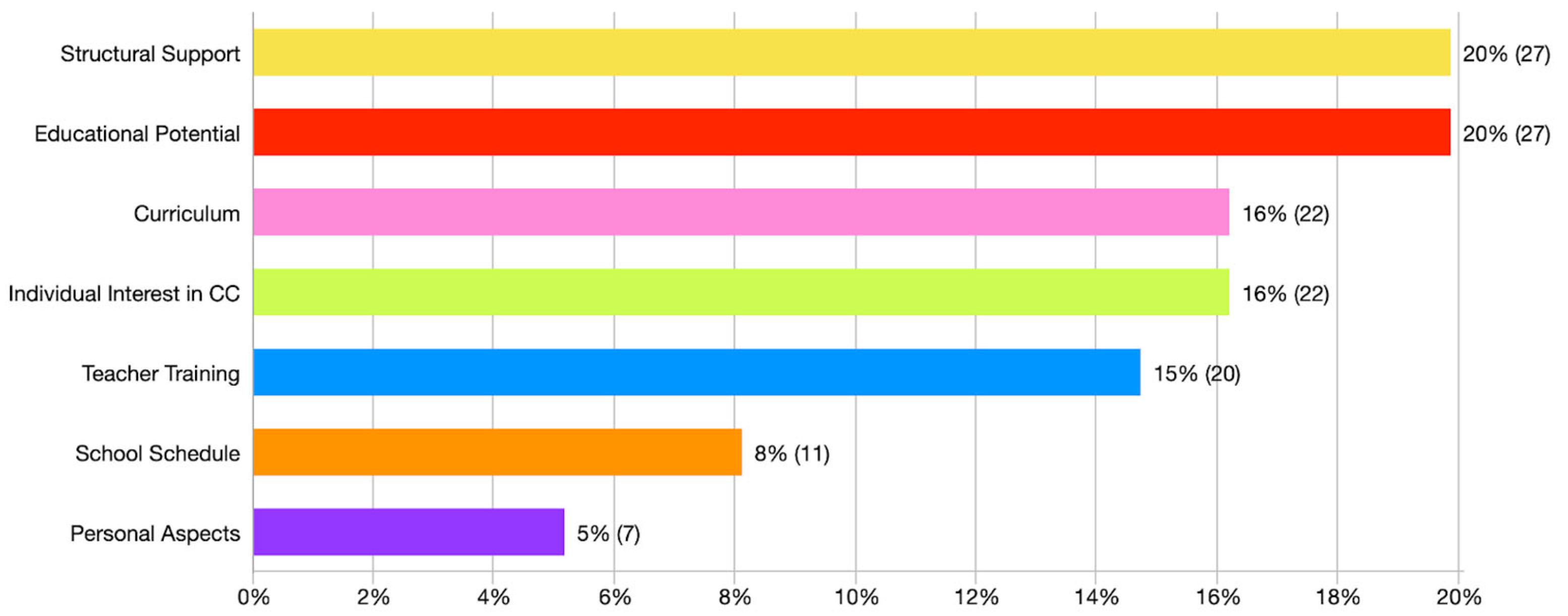
Figure 1 illustrates a comparative visualization of the presence of the dimensions in the teachers’ statements during the interaction. The horizontal axis represents the frequency in percentage, and the vertical axis represents the dimension codes in ascending order. The colors displayed in the following chart correspond to the same colors used to visually differentiate each of the dimensions in the software used for the analysis. We chose to maintain them in both the chart and the maps presented later.
Based on the data presented, we obtained a total of 136 coded segments distributed across the 7 established dimensions. Table 2 provides a representative quotation for each dimension. Two analytical dimensions—Structural Support and Educational Potential—emerged as particularly salient in participants’ discourse, which together represented 40.0% of the coded segments. In contrast, the least present dimensions identified in the teachers’ statements in this meeting were School Schedule and Personal Aspects, which together represented about 11.0% of the coded segments.

3.1.1. Structural Support

Within the most prevalent dimension, Structural Support, the primary challenges to teaching climate change concern institutional support from school leadership, the so-called “educational system” (in the teachers’ words), and collegial support. The challenges identified extend beyond material constraints and are closely linked to rigid timetables, assessment demands, and fragmented curricular structures. Such conditions limit teachers’ autonomy and restrict opportunities for sustained collaborative and interdisciplinary work, revealing a misalignment between innovative pedagogical approaches and the dominant bureaucratic logic of schooling, according to Ball [42]. An excerpt that represents these elements well is present in the following statement:
“[…] in the end, that system ends up running us over, it comes with I don’t know what, it drags us along, if this comes now, and then assessment period arrives, then Christmas, and in the end it ends up dragging us, overwhelm us, doesn’t it? So there are certain moments when one is saturated, tired, and gives in a little and it seems as if that’s the end of it. Then you pick it up again, right?”.
[T8]
This statement reveals that schools continue to operate under organizational models that prioritize efficiency, standardization, and accountability over collective reflection and pedagogical continuity. Consequently, responsibility for developing innovative practices is frequently individualized, increasing professional workload. In this context, climate change education is particularly vulnerable, as it depends on institutional recognition and coordinated action across disciplinary boundaries.
Another challenging and frequent element in the teachers’ statements is cooperation among teachers in collective proposals, as exemplified by this:
“So it’s complicated, sometimes you need your colleagues. You can’t run a school garden like that. We, for example, in our case, started it last year with a very good biology teacher who got very involved. This teacher went on leave and the school garden ended, and departments were involved, each one.”.
[T1]
This statement synthesizes how carrying out a multidisciplinary project often goes beyond having good material and organizational conditions and depends on the involvement and commitment of all parties, including peers. Collaboration among teachers emerges as a recurrent yet structurally fragile element within this dimension. In the absence of formalized mechanisms that support collective ownership, multidisciplinary initiatives tend to rely on individual engagement rather than being embedded within stable organizational arrangements.

3.1.2. Educational Potential

The Educational Potential dimension encompasses both challenges and possibilities related to the formative role of Environmental Education within the teaching-learning process. A prominent challenge identified concerns the centrality attributed to grades and academic performance, which reflects broader social and family pressures oriented toward socially valued career paths. This emphasis on quantification of achievement tends to reduce learning to measurable outcomes, marginalizing processes of meaning-making and critical engagement. From a pedagogical perspective, such dynamics reveal a tension between assessment-driven schooling and conceptions of learning grounded in development, understanding, and transformation, as expressed in the following statement:
“Sorry, but I don’t care about a number [mark]. What matters to me is that these students learn. So yes, I gave them a seven or an eight or a nine or whatever grading system you want. Well, it’s not relevant to me. What I want is for them to learn, and if they learn, I am happy.”.
[T9]
On the other hand, teachers see interdisciplinary work and the search for solutions to contemporary problems through critical education about reality as elements of great potential. Regarding climate change, they believe this is a powerful subject for student development:
“I believe that climate change must be a seed that has to grow in everyone, right? So for me, it has to radiate to the whole world.” [T8] [and also] “Solving the problem is not that, it’s solving a problem, it’s not a subject area. So the kids have a great time, right? They propose solutions, they test them themselves, they critique them themselves, and so then we stop. Maybe, right?”.
[T9]
Conversely, interdisciplinary and problem-oriented approaches to climate change are identified as key sources of educational potential. Due to its complexity and relevance to students’ realities, climate change functions as a mediating issue capable of fostering social and critical development. This perspective aligns with Paulo Freire’s critical pedagogy, which conceptualizes education as a non-neutral and emancipatory practice aimed at developing critical consciousness and social agency.

3.1.3. Curriculum

The Curriculum dimension brings a very strong and present element in the statements of teachers working with climate change: interdisciplinarity. In this sense, interdisciplinarity is pointed out most of the time as a potential but sometimes as a source of difficulties. The potential of an interdisciplinary curricular approach to climate change is manifested through the possibility of bringing different areas of knowledge together around the same topic, the same problem, and analyzing it, thinking about it, and proposing solutions from various epistemologies, as exemplified by the statement:
“For example, the interdisciplinary project for 4th year of ESO (Mandatory Secondary Education in Spain) has to do with the issue of clothing consumption, of the current fashion, all this cheap clothing that is so in fashion… in art class, for example, they design clothes, they recycle clothes. The math study, well, that of production, cost… of geography, of the distribution of…”.
[T6]
However, teachers recognize the tension between the interdisciplinary nature of climate change and the disciplinary organization that characterizes school knowledge and curricular logic. Disciplinary specialization is a challenge due to the specific training of each teacher but also for carrying out school projects in which all areas are involved, as in the following statement:
“Going back a bit to climate change, I think part of the problem of teaching climate change is that it’s a very big and multidisciplinary problem, right? So, I from Chemistry address the little piece that falls to me. So, the little piece that falls to you is related to everything else, right? With biology, with history, with economics, everything. It’s that everything basically is, of course, part of the issue. So, addressing it I think also. Well, I’m going to say something somewhat controversial too, but I think that when we decided to separate knowledge into very specific areas, well, we shot ourselves in the foot because then I know about chemistry, and I only address chemistry and everything else becomes irrelevant. Well of course not, because everything else is connected, right?”.
[T9]
The idea revealed in this quote not only limits pedagogical practice but also reflects ideological assumptions embedded in the curriculum regarding what counts as legitimate knowledge and how it should be organized. Consequently, while interdisciplinarity is acknowledged as a desirable curricular principle, its implementation remains constrained by curricular structures that privilege disciplinary autonomy over integrated and relational understandings of knowledge.

3.1.4. Individual Interest

The Individual Interest dimension brought interesting elements that connect with other dimensions. Some teachers reported that personal interest in the climate issue is a factor that can overcome difficulties related to structural and curricular limitations to the point of compromising self-management itself. However, these dynamics reflect the individualization and responsibility for educational innovation, whereby personal commitment is mobilized to compensate for insufficient support. An example is the following statement:
“[…] but above all, you do it because you like it. So of course, if you like it, the problem of self-limiting you’re going to handle worse, because of course, when you like something, it’s hard to cut back.”.
[T4]
On the other hand, some teachers recognize their interest in working with environmental issues but feel demotivated by the topic and the worsening of climate change, and within a routine with many demands, they say:
“[…] but I prefer to spend my energy on other things. That is, the audiovisual theme, is something that motivates me more than the environmental theme.”.
[T6]
These findings reveal that feelings of demotivation associated with the perceived severity and worsening of climate change, as well as competing professional demands, can lead teachers to deprioritize the topic in favor of areas perceived as more motivating or manageable. Consequently, Individual Interest should be understood as a relational and context-dependent dimension whose educational impact is mediated by structural conditions and cannot, on its own, sustain long-term pedagogical engagement with climate change education.

3.1.5. Teacher Training

Regarding the Teacher Training dimension, the teachers present in this group predominantly pointed out aspects that represent difficulties in addressing climate change. Elements related to initial higher education were cited, reporting that university teaching is very theoretical even for training careers that will work in primary and secondary education, which, according to them, should have more hours dedicated to practice, dedicated to learning how to teach. This gap contributes to feelings of professional insecurity, particularly among teachers trained outside the natural sciences, while also revealing that even those with scientific backgrounds do not feel adequately prepared to address climate change in educational settings. For those trained in other areas, this challenge is even greater. This can be evidenced by the following statement:
“[…] I would like to contribute an idea here, she conveys this insecurity, and she is from sciences, right? Imagine us, for example, me from French, right? That already, well, sciences were maybe not my favorite sector, right? That’s why I leaned more towards languages. So, at first glance, when you are presented with a project of this type, the first thing you think is, ‘Ugh, I’m just not qualified, I don’t have the knowledge’, right? Because even having it sometimes, you can imagine, well, you don’t?”.
[T5]
Another frequent argument was continuous training, but this is also a challenge, mainly due to the long list of professional and personal needs that teachers have, as evidenced in this statement:
“The other one is teacher training, right? Because indeed, well, no one knows everything, right? None of us know everything. So? Well, we need to be learning new things all the time. Of course, learning new things, well, requires time, right? It requires effort, it requires many other things that also, that also make it difficult.”.
[T9]
Our findings unveil the accumulation of professional and personal needs placed on teachers. This process indicates that, as well as in Structural Support and Individual Interest dimensions, teachers find themselves responsible for their own professional development, where they are expected to update their knowledge autonomously in the absence of institutional support. As a result, teacher training functions less as a collective and structured process and more as an individual burden, limiting its capacity to support pedagogical practices aligned with the complexity and interdisciplinarity of climate change.

3.1.6. School Schedule

Although less frequent throughout the coding, the School Schedule dimension relates to many other analyzed dimensions and always presents itself as a challenge in teaching work. The time factor is an important and guiding element for teachers to feel capable of developing work to the standard they believe is the best possible. This situation highlights how temporal organization functions as a regulating mechanism that conditions what kinds of pedagogical practices are feasible within everyday school life. The following excerpt demonstrates this:
“It doesn’t seem to me that it makes you a less interested teacher or ‘Oh, look, he doesn’t want to work’. No, no, it’s that sometimes what you want is to work well, to work under good conditions, to have time to develop your creativity and not be rushed all the time.”.
[T4]
According to the teachers’ interventions in this meeting, the feeling of being “run over” by time is due to the large number of tasks they need to perform at school and the limitation of the school calendar in properly accommodating them, making some of the activities they consider important impossible, as stated by this participant:
“We held meetings but, in the end, everything remained unconcretized. Time passed. Sometimes, sometimes education is a machine. It’s a machine that runs and functions on its own, day after day. And when this was over, the first assessment period arrived. And then you lose the momentum for the first assessment exams. Then the Christmas holidays and time passes…”.
[T2]
The recurrent feeling of being “run over” by time reflects the cumulative effect of multiple institutional demands embedded in the school calendar, such as assessments, meetings, and administrative routines. The metaphor of schooling as a “machine” underscores the self-perpetuating nature of these temporal structures, which prioritize continuity of routines over pedagogical experimentation and reflection. As a result, initiatives as educational responses to climate change are frequently postponed because temporal limits and systematic constraints restrain the space for pedagogical and professional autonomy.

3.1.7. Personal Aspects

The dimension with the lowest number of coded excerpts was Personal Aspects. The element that most mobilized teachers in this dimension was the generational difference identified between them and the student body. According to the teachers, the generational gap between them and the students generated an epistemic contradiction when addressing climate change, which can be synthesized from the following excerpt:
“So, of course, we are a generation that teaches another, and we insert ourselves into that, into that problem. Behavioral problems are increasingly greater between parents and children and between teachers and students. Okay. And there we have to tell them ‘We changed the climate in our generation, and you deal with it’. We are going to say ‘you fix it’. Of course, it’s a tough role.”.
[T11]
This element generated a common feeling of guilt shared by the teachers in this meeting, and they face it as a continuous contradiction, that is, talking about a problem caused by generations prior to the students but which must be solved by them and by future generations. Although climate change is a long-term phenomenon predating the teachers’ lifetimes, this seems to be a salient concern they reported when addressing the topic.

3.2. Network Content Analysis of Dimensional Relationships

To examine the relationship between the analyzed dimensions, we employed network content analysis; that is, we analyzed how the co-presence of ideas and their position in the text can form a lexical network [30]. For this purpose, we used two types of network maps, which are resources that highlight the relationships between our analysis codes (dimensions) and aid in their visualization.
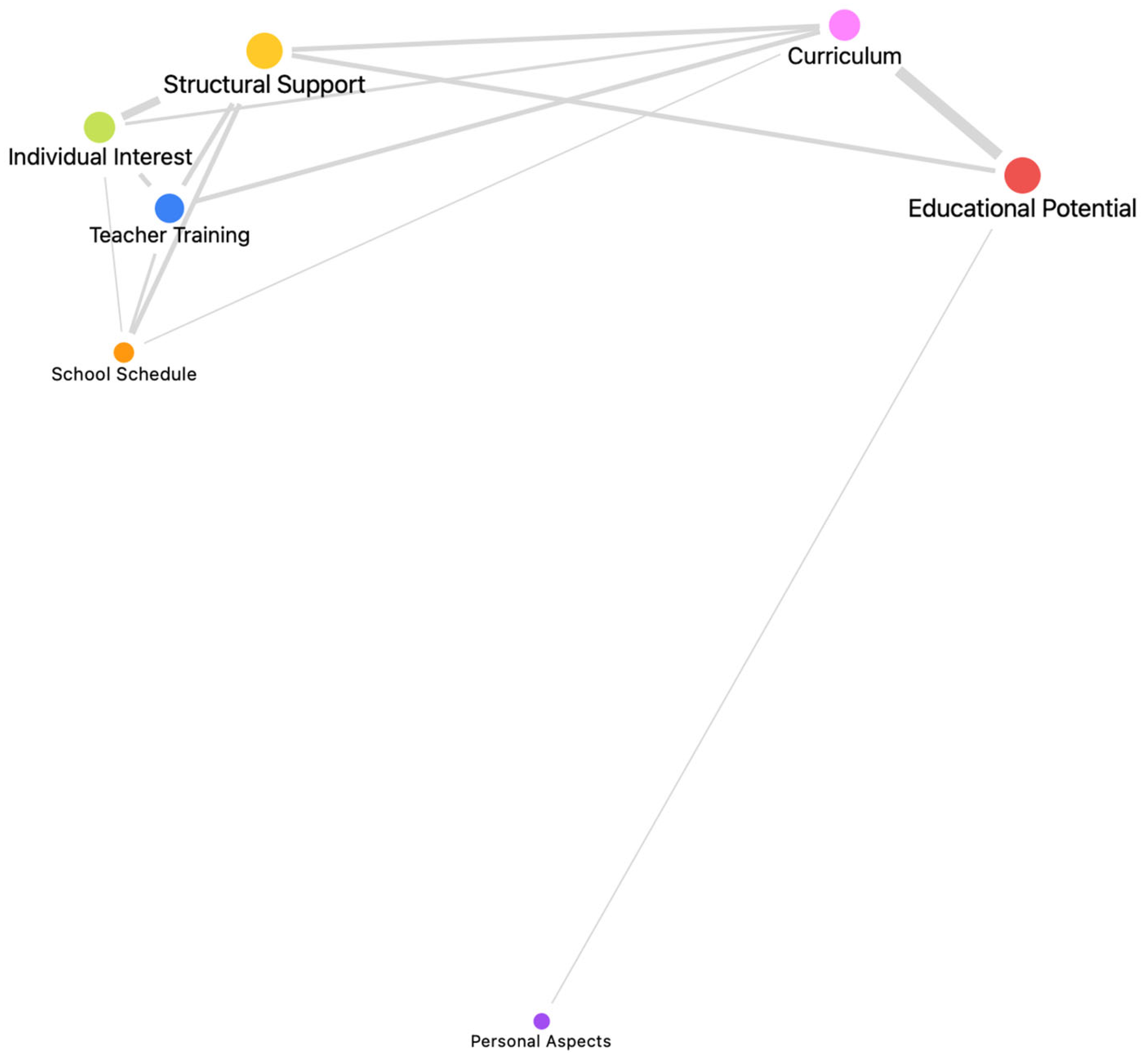
The first visualization stems from the intersection of dimensions within the same segment (frequency range = 1), meaning this map shows the count of how many times two or more codes appear together in a single segment. We considered a segment as one speaking turn. Thus, the map is created based on the average of code intersections within the same speaking turn. In our work, this map is presented in Figure 2 below. This visualization emphasizes, in the context of our data, the relationship of the multiple dimensions that an individual addresses in their speech.
It is important to emphasize that, just like the chart in Figure 1, the maps (Figure 2 and Figure 3) follow the same color scheme related to the dimensions as used in the MAXQDA software. We highlight that the size of the circles and the font size for each dimension are related to their frequency; that is, dimensions with a smaller font and smaller circles are less frequent, and vice versa.
In this map, we can observe three distinct code clusters. This clustering indicates that the dimensions are grouped according to the average strength of their co-occurrence within a single speaking turn. Dimensions more frequently associated with each other appear closer together on the map. The connecting lines indicate the strength of these relationships: thicker lines represent more frequent co-occurrences between codes, whereas thinner lines indicate lower frequencies (see Table 3).

3.2.1. Cluster 1: Structural Support, Individual Interest, Teacher Training, and School Schedule

The map in Figure 2 reveals three primary groupings. The first and most interconnected cluster shows the closest relationship between Structural Support, Individual Interest, Teacher Training, and School Schedule. These dimensions are frequently articulated together within single speaking turns because they relate to the material, organizational, and professional constraints that shape the feasibility of pedagogical action. Teachers tend to reason about these elements holistically, perceiving limitations in one dimension (e.g., time) as directly affecting others (e.g., training or institutional support), which explains their dense interconnection in the map. To illustrate, consider the following quote:
“A few years ago, we set up a makerspace with a laser cutter, machines for working with wood, etc. The idea was for that space to be used by all teachers, right? Which, sadly, isn’t so easy to make happen because, well, planning a ten-hour sequence and investing the time required to learn how to use the machines and so on is hardly viable, right?”.
[T9]
This statement integrates the Structural Support dimension by referencing the school’s material infrastructure—a well-equipped creation space available for all teachers and students. Immediately, however, the teacher links this to the challenges of the School Schedule and Teacher Training, explaining that the sheer time investment needed to master the equipment hinders the effective use of this available resource.

3.2.2. Cluster 2: Educational Potential and Curriculum

The second cluster groups the Educational Potential and Curriculum dimensions. Within teachers’ discourse, curriculum is not treated just as a set of contents or merely a formal structure, but as an important normative and pedagogical mechanism through which educational aims are realized. Therefore, teachers consistently link curricular organization to the formative possibilities of Environmental Education (especially climate change topics), articulating how what is taught and how it is structured conditions students’ opportunities for critical, cognitive, and social development. This strong co-occurrence indicates that, at the level of teacher cognition, curriculum and educational potential are understood as mutually related: curriculum provides the means, while educational potential represents the intended transformative outcome.
The relationship between Curriculum and Educational Potential is frequently evident within individual speaking turns. The following excerpt aptly reflects this connection:
“I believe it has to be teaching for everyone, right? Because it could happen that those you call the needy will become manual laborers, and those with high capacities, let’s say greater knowledge, might be the politicians or those leading us without that awareness.”.
[T8]
This statement underscores a commitment to pedagogical equity, arguing that education must not perpetuate social stratification through unequal access. Here, the teachers recognize the curriculum as the key normative instrument for ensuring this equity, directly linking its design (Curriculum) to its transformative purpose (Educational Potential).

3.2.3. Cluster 3: Personal Aspects

Finally, the third cluster contains only the Personal Aspects dimension, which is the most distant in the map compared to the other groups. This contrast indicates a qualitatively different mode of engagement. Personal aspects, such as generational positioning, feelings of guilt and moral discomfort, tend to be linked as reflective considerations rather than as elements directly shaping pedagogical decisions within the same speaking turns. These aspects are possibly framed as internal tensions or ethical dilemmas that teachers experience individually, rather than as actionable dimensions that can be readily integrated with structural, curricular, or pedagogical considerations. This may explain why Personal Aspects appear less frequently co-articulated with other dimensions, resulting in their spatial isolation on the map.

3.3. Overall Code Proximity Map

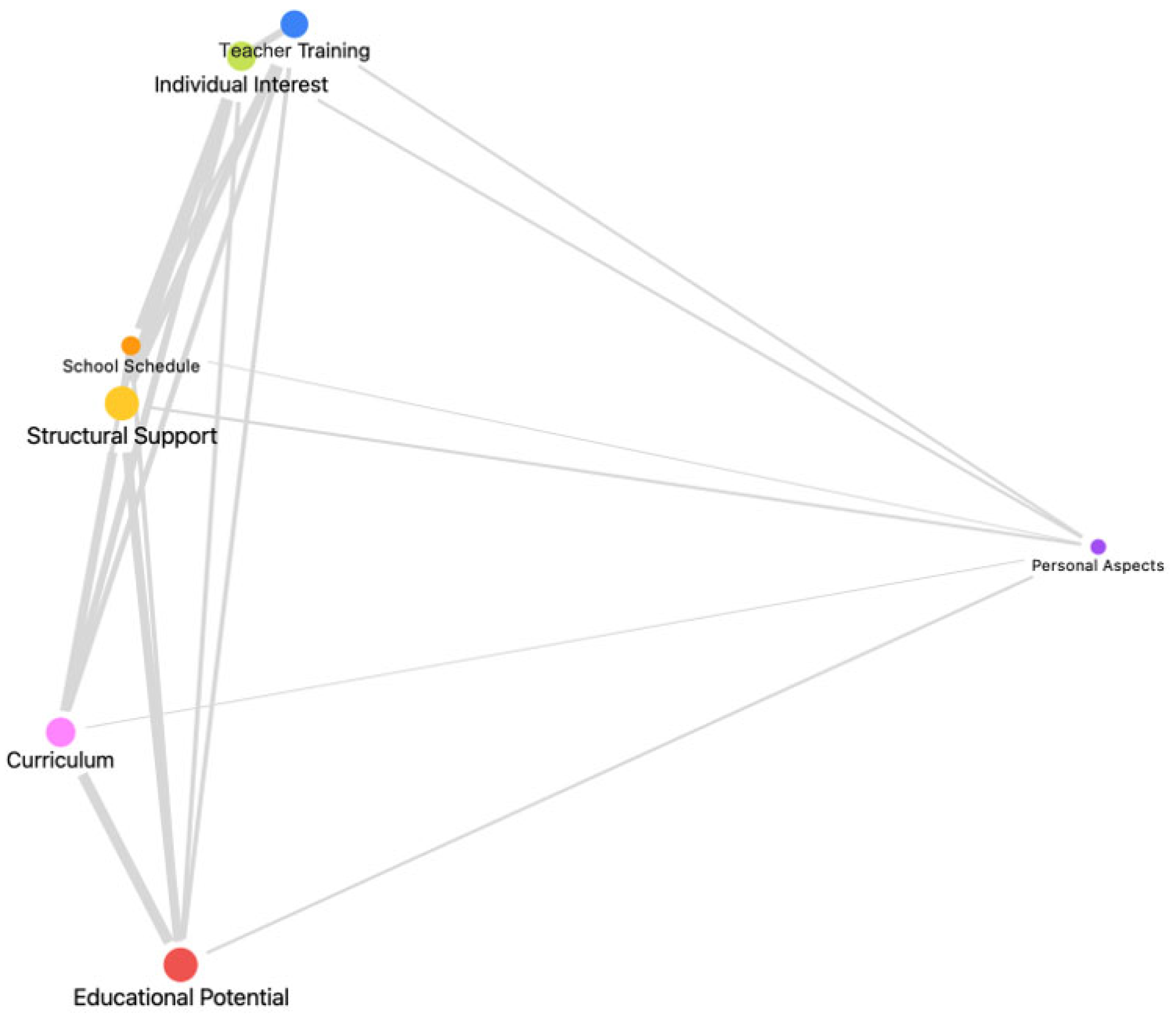
The second map we present illustrates code proximity within the entire meeting (max. distance = 5 paragraphs). Figure 3, therefore, visualizes how the dimensions relate to one another across the entire conversational flow. This provides a holistic view of the conceptual landscape that emerged through the teachers’ dynamic engagement, differing from the isolated analysis of individual speaking turns. We contend this holistic view is crucial, as it is precisely in the interaction between individuals, through language and shared activity, that meanings are negotiated [35]. Following Figure 3, Table 4 shows the frequency with which two dimensions were related to one another across the entire conversational flow. These values directly determine the edge weight (line thickness) in the network visualization shown in Figure 3.
Figure 3. Proximity and relations of dimensions throughout the entire conversation.
Sustainability 18 02519 g003
In this case, we perceive that the grouping of dimensions presented itself differently in contrast to Figure 2.

3.3.1. Cluster 1: Teacher Training and Individual Interest

A first grouping emerged from the dimensions of Teacher Training and Individual Interest, which were more closely related in the context of the meeting, forming a cluster. This proximity reveals an association of teachers’ professional development with their personal motivation, framing continuous learning less as an institutionalized process and more as an individually driven endeavor. They also associated personal interest as a fundamental element driving this continuous professional development. In this sense, we highlight the following excerpt, offered as reassurance in response to a colleague’s self-doubt:
“Look, don’t worry. The very fact that you are here on a Sunday taking a course surely means you are one of the best teachers in your school. In the end, what it means to be a good teacher, to do things well in class, is something each person decides. But the fact that you question it already means you want to be better, and that’s great.”.
[T6]
Reflections of this matter were frequent throughout the meeting, indicating an internalization of individual responsibility by teachers, rather than being structurally guaranteed by the educational system. However, these findings lead us to reflect on the responsibility of public authorities and educational regulators to provide systematic, ongoing teacher training. This responsibility should not fall solely on individual teachers to seek out such training independently in order to feel equipped to address core topics mandated by the curriculum. In a way, the fact that the curriculum demands transversal work on topics not covered in initial teacher training—and that this continuing education is so closely tied to the teachers’ personal interest and motivation—suggests a point of vulnerability in the system.

3.3.2. Cluster 2: School Schedule and Structural Support

A second relational group is composed of the relationship between the School Schedule and Structural Support dimensions, reflecting teachers’ reasoning about feasibility and workload across the school year. Teachers reported that their allocated working hours at school are insufficient to perform all their projects and professional demands. They also articulate the cumulative pressure of institutional demands and insufficient time allocation. To represent this concern, we highlight an excerpt:
“But of course, the Science Club does not come with any associated reduction in hours. So, what are we asking for? We want to ask that, from our supervision duties, they schedule one during the lunch hour—which is when we are with those students. If they don’t grant it, will we keep doing it anyway? Yes, probably. But how? How does that make you feel?”.
[T4]
They also express a lack of support from the school management itself in facilitating a schedule that could more comfortably accommodate the pedagogical work of teachers. We understand that recurring articulation of these dimensions suggests that teachers understand pedagogical quality and innovation as structurally conditioned, rather than as a matter of individual effort alone, even though such effort is frequently demanded in practice.

3.3.3. Cluster 3: Curriculum and Educational Potential

Although positioned somewhat further apart on the map, a distinct cluster nonetheless emerges between the Curriculum and Educational Potential dimensions. The meeting included extensive discussion about the positive potential inherent in many pedagogical proposals found in official curricula and policies. However, the sheer labor and expectation of implementing all these proposals was perceived by teachers as overwhelming and exhausting. This tension is captured in the following excerpt:
“Look, all these kinds of policies are very difficult, right? Because, well, how do I manage to cover the curriculum? But also teach in a multidisciplinary way, but also include STEM. But also take them to the Makerspace. But also. Also. Also. Also. So, you can’t do all that, right? So, well, you have to prioritize what’s worthwhile. And I think sometimes the policies don’t allow us to prioritize the things that we teachers know are worthwhile, right?”.
[T9]
From this dynamic, teachers identify a fundamental gap between the multitude of proposals (and thus requirements) in official documents and the practical reality of the classroom. This gap underscores a critical tension concerning the prioritization of content and approaches deemed most meaningful for student learning.

3.3.4. Cluster 4: Personal Aspects

Figure 3 reinforces the isolation of the Personal Aspects dimension, which, while showing minimal direct relational strength to others in the coding analysis, generated profound engagement and resonance among participants. While concerns about generational positioning, moral discomfort, and feelings of guilt persist on an emotional level, they are translated into discussions of curriculum, training, schedules, or structural conditions. We understand that this suggests that Personal Aspects occupy an introspective space, shaping teachers’ sense of moral responsibility and identity without integrating actionable pedagogical reasoning. The following excerpt crystallizes the sense of intergenerational contradiction in addressing climate change within education:
“But starting from the initial fact of the problem, from the continuous intergenerational struggle we have gotten into, and from the fact that we have caused this problem for those who come after us.” .
[11]
Although not statistically intertwined with the other analytical dimensions in our coding, this concern clearly resonated deeply within the teacher collective, suggesting it permeates their shared experience and pedagogical consciousness.

4. Discussion

This study provides insight into the opinions, needs, and concerns of experienced secondary school teachers strongly committed to sustainability education, particularly regarding the pedagogical treatment of climate change. The findings largely corroborate the seven analytical dimensions identified through the triangulation of prior literature [33] and our consensus-based coding approach.
Our findings closely align with those reported in García-Vinuesa’s review [33]. One teacher’s final comment supports this conclusion:
“So it’s like everything in Spain is exactly the same as with Brazilian teachers—they all say the same things”.
[T14]
Similarly, our findings indicate that secondary school teachers experience a degree of professional insecurity when addressing a topic as complex as climate change [11,12,17,19,20]. This feeling is particularly pronounced among those whose backgrounds lie outside the natural sciences [24,25]. In this context, the issue of teacher training—both initial and continuing—emerges repeatedly. This issue emerges not only as a critique of insufficient preparation in climate-related content and pedagogy but also as an explicit need for professional development that is responsive to their actual needs and interests.
Three primary concerns emerge from the data. First, curricular limitations [16,17] arise from a compartmentalized subject organization. This constrains collaborative or interdisciplinary work and hampers the use of teaching strategies that foster debate, argumentation, and participation—skills essential for navigating socially and politically contested issues [33]. Second, the high teaching and administrative workload, which fragments time and energy, thereby undermining the continuity of projects and making holistic forms of assessment difficult within a system oriented toward standardized, quantitative grading. Third, teachers widely shared a key demand: the need for recognition of those who choose to go beyond the mandates of the curriculum and the administration, driven by their personal commitment to addressing the climate challenge through education. Importantly, this demand was not framed in terms of financial compensation but rather as a call for institutional support that would enable teachers to balance professional commitments without disproportionate personal sacrifice.
Furthermore, the conversation frequently turned to the relationship between the university and the school. Teachers called for more active engagement from higher education institutions with the everyday realities of secondary schooling. They stressed the importance of generating proposals aimed also at students—and not solely at teachers—as well as fostering a horizontal dialogue that would allow for the co-construction of educational initiatives aligned with their actual needs and demands.
While most findings align with prior research [33], two key aspects diverge. First, regarding the perceived potential of education: whereas prior studies often report teachers underestimating education’s role in climate mitigation and adaptation, this group consistently affirmed its transformative power. Indeed, many of the obstacles they described directly constrain this educational potential as a societal response to the socio-ecological crisis. Second, concerning personal and ideological aspects, notable references to the social and political controversy surrounding climate change—common in U.S. studies [12,13]—were absent. This divergence may partly reflect the greater entrenchment of climate denial movements in the U.S. political and media landscape, a context that has at times included disengagement from key international climate agreements and which tends to polarize public debate, making it a more personal issue for educators. In our case, the absence of this tension may be attributable to the specific profile of the participating group, characterized by a high degree of pre-existing commitment and motivation. Furthermore, their collective discourse revealed an inclination toward egalitarian and communitarian worldviews [9].
The emotional dimension also presented distinctive features. Emotions frequently reported elsewhere, such as hopelessness, frustration, or fear, were not salient in the data. However, a salient feeling of guilt was expressed, related to the perceived intergenerational inequality of responsibility in the climate crisis (teachers vs. students). As one participant suggested, this sentiment may directly influence their motivation to engage with the topic in the classroom. The personalization of responsibility for climate change risks obscures the structural, political, and historical dimensions of the problem, thereby complicating its pedagogical treatment. This finding, concerning a sense of guilt that may inhibit the treatment of the topic, constitutes a personal aspect not identified in the literature reviewed for this study. This finding suggests a potentially meaningful avenue for future research, at least from the standpoint of this particular group of educators.
Taken together, these findings portray a group of highly committed teachers who, despite facing structural and institutional constraints, maintain a strong belief in the transformative potential of education to address the climate crisis.

Limitations and Further Research

Despite the convergences between our findings and those identified in the studies analyzed by García-Vinuesa [33], the results of this exploratory qualitative study are not intended to be statistically generalizable but rather to provide contextually grounded insights. This limitation is inherent to its qualitative-dominant design, the small purposive sample of teachers (N = 14), and the specific profile of the participants. Nevertheless, we contend that the contributions of this group are of significant interest for two interconnected reasons. First, these are teachers with a long-standing commitment to integrating climate topics into their classrooms, positioning them as highly relevant profiles within climate change education research. The qualitative depth of our approach was crucial to capturing participants’ nuanced experiences and concerns. Second, this study helps build a contextualized knowledge base—grounded in rich, contextualized insights—for the design of future research and instruments, both qualitative (e.g., new focus groups with teachers from different professional profiles) and quantitative (e.g., to inform the development of survey instruments capable of reaching large samples). Such follow-up research could examine the extent to which our findings are prevalent across a broader and more diverse population of teachers, thereby strengthening their external validity.

5. Conclusions

This study contributes to the growing body of research on climate change education by offering an in-depth understanding of the perceptions, concerns, and professional needs of secondary school teachers strongly committed to sustainability. Although the specificity of this highly motivated group cautions against broad generalizations, their perspectives provide valuable insight into the challenges associated with integrating climate change into educational practice. This also suggests a potential avenue for future research: examining whether the experiences of particularly engaged teachers might help identify barriers that could be even more pronounced among less committed educators.
While many of the challenges identified align with prior research, the findings underscore the persistence of structural barriers—such as curricular fragmentation, workload pressures, and limited institutional recognition—that continue to hinder the pedagogical integration of climate-related issues. At the same time, participants’ strong sense of professional responsibility and their belief in the transformative role of education suggest that motivated teachers constitute a critical leverage point for advancing meaningful climate change education for sustainability [43]. Supporting these educators may require not only improved training opportunities but also institutional conditions that enable collaborative, interdisciplinary, and pedagogically innovative practices [33]. Future research should further explore the emotional and moral dimensions of teaching climate change, as these factors may significantly shape educators’ willingness and capacity to engage with one of the most pressing challenges of our time.

Supplementary Materials

The following supporting information can be downloaded at https://www.mdpi.com/article/10.3390/su18052519/s1, Table S1: Consolidated criteria for reporting qualitative studies (COREQ) 32-item checklist.

Author Contributions

Conceptualization, A.G.-V.; Methodology, A.G.-V. and M.P.; Software, M.P.; Validation, A.G.-V. and F.S.-L.; Formal Analysis, A.G.-V. and M.P.; Investigation, A.G.-V. and F.S.-L.; Resources, F.S.-L.; Data Curation, A.G.-V. and M.P.; Writing—Original Draft Preparation, A.G.-V. and M.P.; Writing—Review and Editing, A.G.-V., M.P. and F.S.-L.; Visualization, M.P.; Supervision, A.G.-V.; Project Administration, F.S.-L.; Funding Acquisition, A.G.-V.; F.S.-L. All authors have read and agreed to the published version of the manuscript.

Funding

This research was developed within the framework of the project Educar a tiempo ante la emergencia climática y la transición socioecológica: realidades y desafíos para la educación en contextos escolares y sociales (resclim@tiempo) (Code: PID2022-136933OB-C21/22), funded by the Proyectos de Generación de Conocimiento 2022 (Ministerio de Ciencia e Innovación, Spain).

Institutional Review Board Statement

This research obtained approval from the Research Ethics Committee of the University of Santiago de Compostela (approval code: USC 18/2024).

Informed Consent Statement

Informed consent was obtained from all subjects involved in the study.

Data Availability Statement

The data presented in this study are available on request from the corresponding author. The data are not publicly available due to ethical restrictions.

Acknowledgments

The authors thank the Climántica project for its support, without which this study would not have been possible. During the preparation of this manuscript, the authors used GPT-5 for the purposes of English language editing and proofreading. The authors have reviewed and edited the output and take full responsibility for the content of this publication.

Conflicts of Interest

The authors declare no conflicts of interest.

References

  1. de Gusmão Pedrini, A. A Educação Ambiental no Enfrentamento da Emergência Climática Editorial. Int. J. Environ. Resil. Res. Sci. 2024, 6, 1–14. Available online: https://e-revista.unioeste.br/index.php/ijerrs/article/view/33644/23374 (accessed on 16 November 2025). [CrossRef]
  2. United Nations. The UN Confirms 2024 as the Hottest Year on Record, with Temperatures Approximately 1.55 °C Above Pre-Industrial Levels. Available online: https://brasil.un.org/pt-br/287173-onu-confirma-2024-como-o-ano-mais-quente-j%C3%A1-registrado-com-cerca-de-155%C2%B0c-acima-dos-n%C3%ADveis (accessed on 30 November 2025).
  3. Planetary Health Check. A Scientific Assessment of the State of the Planet. Available online: https://www.planetaryhealthcheck.org/wp-content/uploads/PlanetaryHealthCheck2025_ExecutiveSummary.pdf (accessed on 30 November 2025).
  4. Intergovermental Panel on Climate Change. Climate Change 2021: The Physical Science Basis; Cambridge University Press: Cambridge, UK, 2021. [Google Scholar] [CrossRef]
  5. Palmieri, M. Perspectivas de Educação Ambiental nos Documentos do Brasil e da Espanha: Um Estudo Comparado [Perspectives on Environmental Education in Documents from Brazil and Spain: A Comparative Study]. Ph.D. Thesis, Universidade de São Paulo, São Paulo, Brazil, September 2025. [Google Scholar]
  6. Arroyo, M. Currículo [Curriculum], Território em Disputa, 5th ed.; Vozes: Petrópolis, Brazil, 2013. [Google Scholar]
  7. García-Vinuesa, A.; Conde, J.; Palmieri, M.; Correa-Chica, A. Secondary education teachers’ perception on climate change: A bibliometric overview. Metrics 2026, 3, 1. [Google Scholar] [CrossRef]
  8. García Vinuesa, A.; Rui Mucova, S.A.; Azeiteiro, U.M.; Meira Cartea, P.Á.; Pereira, M. Mozambican students’ knowledge and perceptions about climate change: An exploratory study in Pemba City. Int. Res. Geogr. Environ. Educ. 2022, 31, 5–21. [Google Scholar] [CrossRef]
  9. Kahan, D.M.; Peters, E.; Wittlin, M.; Slovic, P.; Ouellette, L.L.; Braman, D.; Mandel, G. The polarizing impact of science literacy and numeracy on perceived climate change risks. Nat. Clim. Change 2012, 2, 732–735. [Google Scholar] [CrossRef]
  10. Wise, S.B. Climate Change in the Classroom: Patterns, Motivations, and Barriers to Instruction among Colorado Science Teachers. J. Geosci. Educ. 2010, 58, 297–309. [Google Scholar] [CrossRef]
  11. Ho, L.-C.; Seow, T. Teaching Controversial Issues in Geography: Climate Change Education in Singaporean Schools. Theory Res. Soc. Educ. 2015, 43, 314–344. [Google Scholar] [CrossRef]
  12. Khalidi, R.; Ramsey, J. A Comparison of California and Texas Secondary Science Teachers’ Perceptions of Climate Change. Environ. Educ. Res. 2021, 27, 669–686. [Google Scholar] [CrossRef]
  13. Kunkle, K.A.; Monroe, M.C. Cultural Cognition and Climate Change Education in the U.S.: Why Consensus Is Not Enough. Environ. Educ. Res. 2019, 25, 633–655. [Google Scholar] [CrossRef]
  14. Plutzer, E.; Hannah, A.L. Teaching Climate Change in Middle Schools and High Schools: Investigating STEM Education’s Deficit Model. Clim. Change 2018, 149, 305–317. [Google Scholar] [CrossRef]
  15. Opuni-Frimpong, N.Y.; Essel, H.B.; Opuni-Frimpong, E.; Obeng, E.A. Sustainable Development Goal for Education: Teachers’ Perspectives on Climate Change Education in Senior High Schools (SHS). Sustainability 2022, 14, 8086. [Google Scholar] [CrossRef]
  16. Wang, H.-H.; Bhattacharya, D.; Nelson, B.J. Secondary Agriculture Teachers’ Knowledge, Beliefs and, Teaching Practices of Climate Change. J. Agric. Educ. Ext. 2020, 26, 5–17. [Google Scholar] [CrossRef]
  17. Walshe, R.A.; Chang Seng, D.; Bumpus, A.; Auffray, J. Perceptions of Adaptation, Resilience and Climate Knowledge in the Pacific: The Cases of Samoa, Fiji and Vanuatu. Int. J. Clim. Change Strateg. Manag. 2018, 10, 303–322. [Google Scholar] [CrossRef]
  18. McNeal, P.; Petcovic, H.; Reeves, P. What Is Motivating Middle-School Science Teachers to Teach Climate Change? Int. J. Sci. Educ. 2017, 39, 1069–1088. [Google Scholar] [CrossRef]
  19. Colston, N.M.; Vadjunec, J.M. A Critical Political Ecology of Consensus: On “Teaching Both Sides” of Climate Change Controversies. Geoforum 2015, 65, 255–265. [Google Scholar] [CrossRef]
  20. Howard-Jones, P.; Sands, D.; Dillon, J.; Fenton-Jones, F. The Views of Teachers in England on an Action-Oriented Climate Change Curriculum. Environ. Educ. Res. 2021, 27, 1660–1680. [Google Scholar] [CrossRef]
  21. Zummo, L.M.; Dozier, S.J. Using Epistemic Instructional Activities to Support Secondary Science Teachers’ Social Construction of Knowledge of Anthropogenic Climate Change during a Professional Learning Experience. J. Geosci. Educ. 2022, 70, 530–545. [Google Scholar] [CrossRef]
  22. Gayford, C. Controversial Environmental Issues: A Case Study for the Professional Development of Science Teachers. Int. J. Sci. Educ. 2002, 24, 1191–1200. [Google Scholar] [CrossRef]
  23. Hannah, A.L.; Rhubart, D.C. Teacher Perceptions of State Standards and Climate Change Pedagogy: Opportunities and Barriers for Implementing Consensus-Informed Instruction on Climate Change. Clim. Change 2020, 158, 377–392. [Google Scholar] [CrossRef]
  24. Monroe, M.C.; Oxarart, A.; Plate, R.R. A Role for Environmental Education in Climate Change for Secondary Science Educators. Appl. Environ. Educ. Commun. 2013, 12, 4–18. [Google Scholar] [CrossRef]
  25. White, P.T.; Wolf, K.J.; Johnson-Maynard, J.L.; Velez, J.J.; Eigenbrode, S.D. Secondary Climate Change Education in the Pacific Northwest. Nat. Sci. Educ. 2014, 43, 85–93. [Google Scholar] [CrossRef]
  26. Segade-Vázquez, M.; García-Vinuesa, A.; Rodríguez-Groba, A.; Conde, J.J. Characterizing educational research on climate change in the era of climate emergency (2017–2024). Rev. Esp. Pedagog. 2025, 83, 179–198. [Google Scholar] [CrossRef]
  27. Krueger, R.; Casey, M.A. Focus Group. A Practical Guide for Applied Research, 5th ed.; Sage: London, UK, 2014. [Google Scholar]
  28. Flick, U. An Introduction to Qualitative Research, 7th ed.; Sage: London, UK, 2022. [Google Scholar]
  29. Creswell, J.W.; Creswell, J.D. Research Design: Qualitative, Quantitative and Mixed Methods Approaches, 5th ed; Sage: London, UK, 2022. [Google Scholar]
  30. Pérez Diez, A. La Inclusión de la Crisis Climática en Educación Secundaria Obligatoria. Un Estudio Comparado del Marco Normativo y Curricular en España [The Inclusion of the Climate Crisis in Mandatory Secondary Education. A Comparative Study of the Normative and Curricular Framework in Spain]. Ph.D. Thesis, Universidade de Santiago de Compostela, Santiago de Compostela, Spain, 2022. [Google Scholar]
  31. Colle, R. El Análisis de las Comunicaciones: 2. Técnicas de Análisis [The Analysis of Communications: 2. Analysis Techniques]; Sociedad Latina de Comunicación Social: Tenerife, Spain, 2011. [Google Scholar]
  32. Sóñora-Luna, F.; García-Vinuesa, A. Climántica: A Social, Pedagogical and Environmental Project to Face Climate Change. Pedagog. Soc. Rev. Interuniv. 2020, 36, 63–79. [Google Scholar] [CrossRef]
  33. García-Vinuesa, A. Empowering Secondary Education Teachers for Sustainable Climate Action. Sustainability 2024, 16, 7941. [Google Scholar] [CrossRef]
  34. Hargreaves, A.; Fullan, M. Professional Capital: Transforming Teaching in Every School; Teachers College Press: New York, NY, USA, 2012. [Google Scholar]
  35. Vygotsky, L.S. A Formação Social da Mente [The Social Formation of the Mind]; Martins Fontes: São Paulo, Brazil, 2007. [Google Scholar]
  36. Tardif, M. Saberes Docentes e Formação Profissional [Teaching Knowledge and Professional Training]; Vozes: Petrópolis, Brazil, 2011. [Google Scholar]
  37. Silva, A.F.L. A Representação das Dimensões Espaço e Tempo Docente [Representation of the Spatial and Temporal Dimensions of Teaching]. Rev. Eletrônica Pesqui. 2011, 2, 35–47. [Google Scholar]
  38. Hornsey, M.J.; Harris, E.; Bain, P.; Fielding, K. Meta-Analyses of the Determinants and Outcomes of Belief in Climate Change. Nat. Clim. Change 2016, 6, 622–626. [Google Scholar] [CrossRef]
  39. Stern, P.C. Impacts on Climate Change Views. Nat. Clim. Change 2016, 6, 341–342. [Google Scholar] [CrossRef]
  40. Sacristán, J.G. O Currículo [The Curriculum]: Uma Reflexão Sobre A Prática, 3rd ed.; Artmed: Porto Alegre, Brazil, 2000. [Google Scholar]
  41. Apple, M.W. Ideologia e Currículo [Ideology and Curriculum], 3rd ed.; Artmed: Porto Alegre, Brazil, 2008. [Google Scholar]
  42. Ball, S.J. The teacher’s soul and the terrors of performativity. J. Educ. Policy 2003, 18, 215–228. [Google Scholar] [CrossRef]
  43. Evans, R.S.; McGregor, H.E.; Reed, B. Pedagogical principles for encouraging (socially just) youth climate action: A schema for citizenship education curriculum analysis. Educ. Citizsh. Soc. Justice 2025, 20, 450–468. [Google Scholar] [CrossRef]
Figure 1. Distribution of coded segments (N = 136) across the seven analytical dimensions derived from the focus group analysis (N = 14 participants).
Sustainability 18 02519 g001
Figure 2. Intersection of dimensions within a speaking turn.
Sustainability 18 02519 g002
Table 1. Characteristics of the 14 focus group participants.
InformantGenreCountryDisciplineTeacher Experience
T1FemaleSpainArts>20 years
T2MaleSpainBiology>30 years
T3FemaleSpainSchool CounselorRetired
T4FemaleSpainBiology<5 years
T5FemaleSpainFrench>20 years
T6MaleSpainMathematics>20 years
T7FemaleSpainBiology>30 years
T8FemaleSpainArts>20 years
T9MaleMexicoChemistry>20 years
T10FemaleMexicoBiology>20 years
T11MaleSpainBiology>20 years
T12MalePortugalArts>20 years
T13MalePolandSpanish/English>20 years
T14FemaleBrazilArts>20 years
Author’s elaboration.
Table 2. Key analytical dimensions, their operational definitions, and representative supporting excerpts.
Analytical DimensionDefinitionRepresentative Quotations
Structural SupportStructural conditions (material, policy, support) enabling or constraining teaching“At my center this year, it is going to be implemented that all project coordinators, regardless of the type of project, will have one fewer hour of duty supervision. (…) It’s the only way. The only way to acknowledge a little bit of the extra work. But there’s nothing more than that.” [T7]
Educational PotentialMeaningful potential of content to foster development through mediated and critical learning“I believe that the family plays a very important role, naturally […]. “I want my child to become an engineer, an architect, or a doctor, and what matters to me is that grade. Don’t come to me with this or that—what matters is that in the exam they got an eight, they got a ten.” And how on earth do you dismantle the argument when you are addressing a different set of considerations altogether?” [T12]
Personal AspectsPersonal factors (experiences, beliefs, identity) shaping teachers’ perceptions, engagement, and pedagogical decisions“From my point of view, every time there is a change in legislation or in the educational focus, it places us in an even greater contradiction. I observe that this is happening at an international level. As a result of this contradiction, when we later have to explain ourselves, we feel guilty for not doing things properly, when in reality we cannot, because we are in a constant state of contradiction.” [T11]
Teacher TrainingBody of teacher knowledge (formal training, disciplinary, curricular, experiential) that constitutes professional competency “As a result of the visit by the representative from the University of Santiago, who came to Poland in 2018 and met with me, we were offered something that changed everything for us. Because of this, in our school, students are now able to put into practice the words and phrases we provide them with during each unit. That is, when we work on a particular unit—such as the environment—we provide them with the relevant vocabulary, and then they go to Aveiro or to Galicia and put all of this into practice.” [T13]
School ScheduleTemporal organization and teacher time as a factor that enables or constrains pedagogical practices“We try to carry out projects, we try to develop multidisciplinary projects, but it is very difficult because organizing the logistics when they take place, how many hours are allocated, and who is responsible for delivering them. Is extremely challenging.” [T9]
Individual InterestTeachers’ personal interest, attitudes, and motivation (beyond content knowledge) for addressing climate change in class“We have received awards for documentary-related projects, which shows that, in the end, this is very important: it is essential to build on what truly motivates you, because that is the only way for something to be sustained over time. If you ultimately become involved in something you may like but that does not genuinely inspire you, it is difficult for it to endure. In this regard, environmental issues are something that concern us all.” [T6]
CurriculumSelection, organization, and legitimization of school content, reflecting values and ideologies“The same thing happens to us within the educational system, doesn’t it? We all tend to prioritize differently and interpret the curriculum content in different ways, and we forget that if it is not a shared objective, we will not reach where we want to go.” [T10]
Author’s elaboration.
Table 3. Co-occurrence matrix of analytical dimensions. Cell values indicate the frequency with which two dimensions were coded within the same speaking turn. These values directly determine the edge weight (line thickness) in the network visualization shown in Figure 2.
SSEPPATTSSchIIC
Structural Support (SS)-903464
Educational Potential (EP)9-10009
Personal Aspects (PA)01-0000
Teacher Training (TT)300-233
School Schedule (SSch)4002-11
Individual Interest (II)60031-2
Curriculum (C)490312-
Author’s elaboration.
Table 4. Proximity analysis of analytical dimensions across the entire focus group session. Cell values indicate the frequency with which two dimensions were related to one another across the entire conversational flow. These values directly determine the edge weight (line thickness) in the network visualization shown in Figure 3.
SSEPPATTSSchIIC
Structural Support (SS)-442142364745
Educational Potential (EP)44-2126282747
Personal Aspects (PA)2121-20132116
Teacher Training (TT)422620-254133
School Schedule (SSch)36281325-3145
Individual Interest (II)4727214131-33
Curriculum (C)454716334533-
Author’s elaboration.
Disclaimer/Publisher’s Note: The statements, opinions and data contained in all publications are solely those of the individual author(s) and contributor(s) and not of MDPI and/or the editor(s). MDPI and/or the editor(s) disclaim responsibility for any injury to people or property resulting from any ideas, methods, instructions or products referred to in the content.