1. Introduction
The dynamic development of digital technologies has profoundly transformed contemporary markets and consumer behavior, simultaneously intensifying the debate on sustainability and sustainable consumption. In recent years, sustainability has evolved from a normative concept into a central strategic imperative shaping marketing activities, business models, and consumer decision-making processes [
1,
2,
3]. Digitalization, automation, and data-driven solutions offer new opportunities to support sustainability-related goals, such as improving resource efficiency, reducing transaction costs, and enabling more informed consumption choices. However, their sustainability outcomes remain context-dependent and empirically contingent.
One of the most significant manifestations of these transformations is the emergence of the phygital environment, which integrates physical and digital consumption spaces into a coherent, technology-enhanced system. Rather than constituting sustainable consumption per se, the phygital environment can be understood as a context that may shape consumer decision-making processes relevant to sustainability by enabling access to information, supporting cognitive efficiency, and enhancing the customer experience across multiple touchpoints [
4,
5]. According to Kotler et al. [
6], the future of marketing is immersive and sustainability-oriented, as the integration of digital technologies with physical experiences enables organizations to design more coherent and efficient consumption pathways, potentially conducive to sustainability-oriented choices.
As a result, there is a growing demand among researchers and practitioners for knowledge explaining how consumers behave in phygital environments and how these behaviors may relate to sustainability-oriented decision-making, rather than assuming inherent sustainability of phygital solutions. Understanding the determinants of consumer behavior in such environments is particularly important for sustainability-oriented marketing, which seeks to balance economic value creation with social and environmental responsibility. Identifying purchasing factors that shape consumer behavior in phygital environments, and examining their relevance from a sustainability perspective, is therefore essential for designing marketing strategies aligned with the objectives of sustainable development.
Against this backdrop, the present study aims to advance the literature on consumer behavior in phygital environments by analyzing these behaviors through the prism of sustainability, understood as a normative and strategic context rather than a directly measured outcome. The objective of this study is twofold:
To identify key purchasing dimensions that characterize consumer decision-making in the phygital environment;
To empirically test the direction and strength of their influence on consumers’ engagement in phygital purchasing behavior, analyzed from a sustainability-oriented perspective, using covariance-based structural equation modeling.
To achieve this objective, the study develops and validates a measurement model capturing cognitive, emotional, functional, and experiential dimensions of phygital purchasing and examines their interrelationships within a theoretically grounded structural model. By doing so, the research moves beyond a purely descriptive identification of factors. It provides an explanatory framework that clarifies how established dimensions of consumer decision-making operate in phygital contexts relevant to sustainability-oriented marketing, without equating phygital behavior directly with sustainable consumption outcomes.
Addressing these questions requires, first, a clear conceptualization of the phygital environment as a consumption context in which sustainability-related considerations may emerge. In the literature, the phygital environment is commonly defined as a hybrid space that combines physical and digital elements to enhance consumer experiences through technology-mediated interactions [
7]. From a sustainability-oriented perspective, such environments may support—but do not guarantee—the transition toward more informed, experience-based, and potentially resource-efficient consumption models.
Pantano and Priporas [
7] described phygital environments as spaces where digital interfaces enrich physical settings, enabling more engaging and informed consumer experiences. This interpretation suggests a possible alignment with sustainability-oriented consumption practices, particularly when information transparency and decision efficiency are enhanced. Similarly, Batat [
8] defined the phygital concept as the hybridization of the physical and digital spheres aimed at enhancing consumer experience through the co-creation of emotional and sensory value, which may foster more reflective and responsible consumption when appropriately designed. Lemon and Verhoef [
9] emphasized the importance of seamless integration across physical and digital channels, highlighting its role in delivering coherent customer experiences throughout the entire customer journey, including those aligned with sustainability-oriented marketing strategies.
Considering these perspectives, this article assumes that the phygital environment constitutes an integrated space of communication and consumption that combines physical and digital worlds to support interactive and immersive consumer experiences, whose sustainability implications depend on how consumers engage with available information, emotions, and experiential cues. In such environments, the boundaries between online and offline interactions are blurred, and digital technologies—such as augmented reality (AR), virtual reality (VR), Internet of Things (IoT) solutions, beaconing systems, interactive kiosks, and mobile applications—enhance interactions occurring in physical locations, including retail stores, shopping malls, service facilities, and urban spaces.
The key characteristics of the phygital environment relevant from a sustainability-oriented analytical perspective include:
Seamless integration of physical and digital experiences supporting efficient decision-making [
10];
Interactivity enabling consumer participation and co-creation of value [
11];
Personalization tailored to individual needs, which may reduce unnecessary consumption [
12];
Immersion through multisensory engagement that enhances customer experience [
13,
14];
Dynamic data exchange enabling real-time feedback and more informed choices [
9,
15].
Consumer behavior in phygital environments is influenced by a wide range of purchasing factors, including economic, psychological, social, and technological determinants. Rather than directly measuring sustainable consumption outcomes, the present study focuses on purchasing factors that integrate cognitive efficiency, emotional engagement, and experiential value, as these dimensions may shape decision-making processes relevant to sustainability-oriented consumption contexts.
To address this objective, four research hypotheses were formulated (presented later in the article) to examine the impact of identified purchasing factors—purchase pragmatism, emotional commitment to the purchase, purchase comfort, and purchase pleasure—on consumers’ engagement in phygital purchasing behavior, within a sustainability-oriented marketing context. Understanding these relationships advances consumer behavior theory in phygital environments. It supports managerial decision-making in designing customer experiences that may encourage more informed and responsible consumption, particularly in the context of the emerging Marketing 6.0 paradigm [
6].
2. Materials and Methods
2.1. Data Collection and Study Sample
For this article, quantitative research was conducted employing the survey method (online survey) using the Ariadna Nationwide Research Panel (Warsaw, Poland). The research tool was a questionnaire comprising 19 substantive and 8 metric questions. The substantive questions were formulated using ordinal, bipolar, five- and seven-point scales, nominal scales, and cafeteria closed questions. The reliability of the scales used was assessed by calculating the Cronbach’s alpha coefficient for them, and if we assume the acceptable level of the coefficient to be 0.7 < α < 0.9—as proposed by Nunnally and Bernstein (after Henson, 2001) [
16]—then all scales used in the study can be considered reliable. Basic information about the quantitative research conducted is included in
Table 1.
The study’s main objective was to collect data on purchasing factors that exert a significant, stimulative influence on consumers’ phygital behavior. The study focused mainly on determining the influence (its direction and strength) of the identified purchasing factors on consumers’ willingness to engage in phygital purchasing behavior.
The research was conducted in February 2025. Before the actual research, pilot studies were undertaken to eliminate potential errors in the research tool.
A total of 39,997 people were invited to the study, of whom 4004 responded (10.01%) and began completing the questionnaire. Three hundred fifty-six people did not complete the survey because they stopped at various stages, and 1342 were rejected because they met their demographic quotas. In the end, 2306 people effectively completed the study, of whom 146 were excluded from the database during the collection control, mainly because they completed the questionnaire too quickly (less than 50% of the time allocated for the study). The final sample consisted of 2160 adult consumers (N = 2160). People were randomly selected while assuming control of the sample structure. The quotas were chosen to reflect the representation of the adult Polish population, taking into account the following features: gender, age, and the size of the place of residence. The completed research sample gives results with no more than 2% measurement error at a confidence level of α = 0.95. The average age of the respondents was 47.5 years. The median age was 48, and the dominant age was 66. The youngest respondent was 18, and the oldest was 80. Detailed characteristics of the research sample are included in
Table 2.
2.2. Analytical Strategy and Data Analysis
The study adopts a two-stage analytical design combining exploratory and confirmatory techniques, which is widely recommended in consumer behavior and sustainability research, particularly in emerging research contexts where measurement scales are still evolving [
17,
18,
19].
In the first stage, Exploratory Factor Analysis (EFA) was employed to identify latent purchasing dimensions relevant to sustainable consumer behavior in the phygital environment. In the second stage, Confirmatory Factor Analysis (CFA) and Covariance-Based Structural Equation Modeling (CB-SEM) were applied to validate the measurement model and to test theoretically grounded causal relationships among the latent constructs.
The measurement items were developed based on an extensive review of literature on sustainable consumption, customer experience, and technology-mediated purchasing behavior [
9,
20,
21]. EFA was conducted to explore the underlying factor structure and to group indicators into theoretically interpretable constructs.
Following the EFA, CFA was conducted for all identified latent variables to validate the measurement model and to confirm the factor structure obtained in the exploratory phase. Model fit was assessed using standard goodness-of-fit indices, as recommended by [
17]. Only constructs demonstrating satisfactory reliability, convergent validity, and discriminant validity were retained for further analysis.
After establishing an acceptable measurement model, CB-SEM was employed to test the hypothesized relationships among the latent variables. CB-SEM was selected due to its suitability for theory testing, emphasis on model fit, and appropriateness for large samples (N = 2160), in line with methodological recommendations [
17,
18,
22]. Before CB-SEM estimation, correlation analyses were conducted to examine relationships among constructs and ensure the absence of multicollinearity [
23].
Two structural models were estimated: a complete model that included all indicators and hypothesized paths, and a reduced model that removed indicators with low factor loadings to improve model parsimony and fit. This procedure follows standard CB-SEM refinement practices [
18,
24]. Although two items exhibited slightly elevated skewness and kurtosis values, CB-SEM estimation remains robust under such conditions in large samples. To further mitigate potential biases related to non-normality, bootstrapping procedures were applied [
17,
25].
Given the large sample size and theory-driven refinement process, model stability was assessed through comparative evaluation of the full and reduced specifications rather than through sample-splitting procedures. The categorization of indicators was not based solely on empirical grouping but was grounded primarily in theoretical reasoning derived from consumer decision-making and customer experience research. In particular, “product brand” was assigned to the purchase pragmatism dimension because, within rational and risk-reduction frameworks, brand functions as a cognitive quality signal facilitating evaluative comparison rather than as a purely symbolic or affective attribute. Similarly, “promotional opportunities” were classified under purchase comfort, as temporary price incentives reduce perceived economic barriers and simplify transactional effort, thereby increasing perceived ease of purchase rather than stimulating hedonic engagement. Empirical factor loadings were interpreted in light of these conceptual definitions, and indicators were retained within constructs only when their statistical behavior remained theoretically coherent.
With regard to scale refinement, the removal of low-loading indicators followed a conservative and sequential procedure within CFA. Items were considered for exclusion only when their standardized loadings fell below recommended thresholds and when their removal improved global model fit without altering the conceptual meaning of the latent construct. After each step, composite reliability (CR) and average variance extracted (AVE) were recalculated to ensure that construct reliability and convergent validity improved rather than deteriorated. The final reduced model demonstrated satisfactory CR and AVE values for all constructs, confirming that indicator reduction strengthened internal consistency without narrowing the theoretical scope of measurement.
Discriminant validity was verified using complementary criteria, including comparison of the square root of AVE with inter-construct correlations, examination of shared variance indices, and HTMT ratios. The results supported the distinctiveness of the constructs and confirmed that indicator refinement did not compromise construct separability. Taken together, the theoretically grounded indicator assignment and the multi-step validity verification procedure ensure that the final measurement model remains both conceptually coherent and psychometrically robust.
2.3. Theoretical Framework and Hypotheses Development
The research hypotheses in this study are grounded in established theories of consumer behavior, sustainability-oriented consumption, and customer experience, which collectively explain how cognitive, emotional, functional, and experiential factors shape consumer decision-making in technology-mediated environments. In phygital contexts, where physical and digital interactions are integrated, these theoretical perspectives provide a coherent framework for understanding phygital purchasing behavior examined through a sustainability-oriented analytical lens [
9,
20,
21,
26].
From the standpoint of sustainable consumer behavior theory, purchasing decisions are not solely the result of economic rationality but emerge from the interaction of cognitive evaluations, affective responses, and contextual facilitators. The Theory of Planned Behavior (TPB) emphasizes the role of cognitive assessments, attitudes, subjective norms, and perceived behavioral control in shaping behavioral intentions, including choices relevant to sustainability-oriented consumption [
20,
27,
28]. Complementarily, research on customer experience highlights the importance of emotional engagement, perceived comfort, and hedonic value in influencing consumer behavior, particularly in digitally enhanced environments [
9,
29,
30].
Within this theoretical context, the present study conceptualizes phygital purchasing behavior, analyzed from a sustainability-oriented perspective, as a multidimensional construct influenced by four key purchasing factors: pragmatism of purchase, emotional commitment to purchase, purchase comfort, and purchase pleasure. These constructs reflect distinct but interrelated dimensions of consumer decision-making and are theoretically anchored in prior research on sustainable consumption and experiential marketing [
26,
31].
In line with the conceptual assumptions of this study, sustainability is treated as an analytical and interpretive perspective rather than a directly measured behavioral outcome. Accordingly, the hypotheses refer to consumers’ willingness to engage in phygital purchasing behavior that may be relevant for sustainability-oriented decision-making, rather than to sustainable behavior per se.
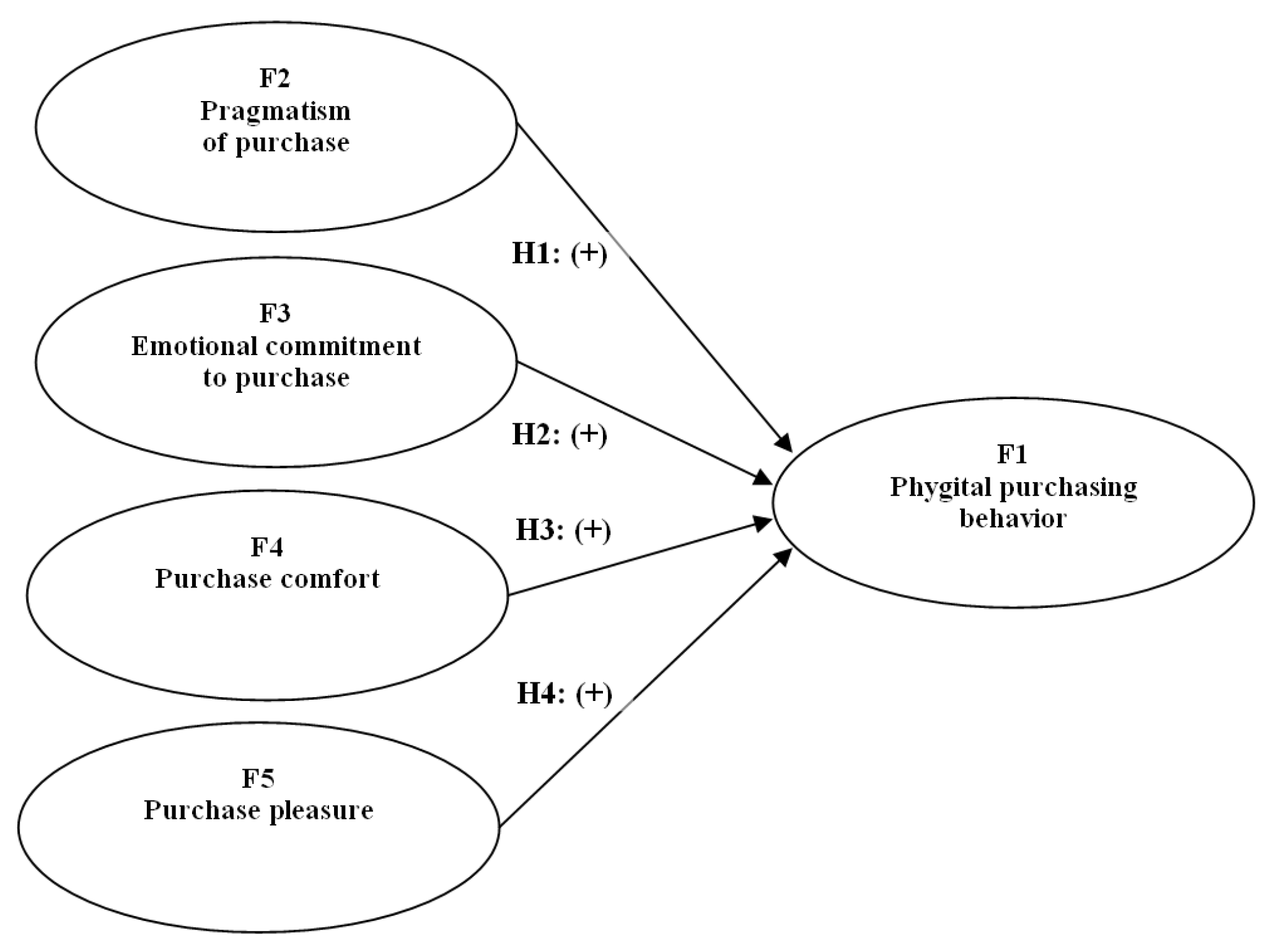
For the research, four hypotheses were formulated; the elements presented in
Figure 1 (the “+” sign in brackets indicates the expected positive influence of the isolated purchasing factor) illustrate the structure of the hypothetical-deductive model. The following hypotheses were put forward:
Pragmatism of purchase refers to consumers’ cognitive and instrumental evaluation of the purchasing process, including efficiency, usefulness, and perceived rationality of the decision. From a sustainability-oriented perspective, pragmatic purchasing behavior may support more informed and potentially responsible consumption decisions by reducing uncertainty, minimizing unnecessary purchases, and facilitating resource-efficient decision-making. In phygital environments, enhanced access to information, transparency tools, and decision-support technologies strengthens this cognitive dimension, which is expected to positively influence phygital behavior relevant to sustainability-oriented decision-making. Pragmatism of purchase can be understood as a cognitively grounded evaluation mechanism. Rooted in rational choice logic and aligned with the cognitive components of the Theory of Planned Behavior, pragmatism reflects instrumental assessment of product attributes, utility, risk, and goal fulfillment. In phygital environments, where digital interfaces expand access to real-time information, comparisons, and product transparency, pragmatic evaluation becomes structurally reinforced. From a sustainability-oriented standpoint, such cognitive reinforcement increases the likelihood that consumers will engage in deliberate assessment of product suitability, durability, and long-term value. The phygital setting therefore strengthens analytical processing conditions that may support more responsible and need-oriented consumption decisions [
20,
32].
Emotional commitment to purchase captures the affective bond between the consumer and the purchasing experience. Emotional engagement has been shown to reinforce pro-social and sustainability-related orientations by increasing consumers’ identification with brands, values, and consumption meanings. In phygital settings, immersive and interactive technologies intensify emotional responses, which may shape phygital engagement in ways relevant to sustainability-oriented decision-making, depending on the nature and design of the experience. Emotional commitment to purchase represents an affective engagement mechanism that operates through identity expression and value alignment. Customer experience theory emphasizes that immersive and interactive environments intensify emotional responses and symbolic meanings associated with consumption. Within phygital contexts, technologies enabling personalization, co-creation, and active participation can deepen consumers’ emotional attachment to the purchasing process. From a sustainability-oriented perspective, affective engagement may enhance consumers’ identification with brands, ethical narratives, or symbolic product meanings. However, emotional intensification may also redirect attention toward experiential immediacy rather than reflective evaluation. Thus, emotional commitment constitutes a theoretically ambivalent pathway whose sustainability relevance depends on whether affect is anchored in enduring product value or in the hedonic stimulation of the purchasing act itself [
21,
26].
Purchase comfort represents the perceived ease, convenience, and lack of friction during the purchasing process. Drawing on technology acceptance and service quality theories, purchase comfort reduces cognitive effort, perceived risk, and transaction costs, thereby facilitating decision-making processes that may align with sustainability-oriented consumption goals [
33,
34]. In phygital environments, seamless integration of physical and digital channels enhances comfort by streamlining interactions and reducing transactional barriers. Purchase comfort reflects a functional facilitation mechanism. Drawing on technology acceptance and service convenience frameworks, perceived ease of use, procedural simplicity, and reduced transaction effort increase behavioral feasibility and perceived control. In phygital environments, seamless integration between digital and physical touchpoints lowers friction in information search, comparison, payment, and product acquisition. From a sustainability-oriented analytical perspective, reduced procedural barriers may increase the probability that consumers incorporate additional evaluative criteria into their decisions, as lower cognitive load frees attentional resources for more comprehensive assessment. Comfort therefore does not determine sustainability directly but creates enabling conditions for more structured and informed decision processes.
Purchase pleasure reflects the hedonic and experiential value derived from the purchasing process. Experiential marketing theory suggests that pleasurable and immersive experiences can strengthen consumer engagement and deepen value co-creation between consumers and brands [
29,
35]. In sustainability-oriented contexts, purchase pleasure may encourage more mindful and value-driven consumption by shifting attention from quantity to the quality and meaning of consumption experiences. However, these effects remain contingent on the design and intent of phygital experiences. Purchase pleasure embodies an experiential valuation mechanism. Experiential marketing theory posits that consumers derive value not only from functional utility but also from sensory stimulation, imagination, and enjoyment embedded in the consumption process. Phygital environments amplify such experiential dimensions through multisensory interfaces, augmented visualization, and interactive engagement. When value perception shifts from mere acquisition toward the quality of the consumption experience, consumers may assign greater importance to meaningful, personalized, and contextually rich products. From a sustainability-oriented viewpoint, this reorientation has the potential to privilege qualitative satisfaction over quantitative accumulation, thereby conceptually linking hedonic engagement with longer-term value perception [
26,
31].
Based on these theoretical considerations, the study assumes that the four purchasing factors are conceptually distinct yet interrelated and jointly influence consumers’ willingness to engage in phygital purchasing behavior examined through a sustainability-oriented analytical lens. The relationships among these constructs are modeled within a structural framework that captures the interactions among cognitive efficiency, emotional engagement, functional facilitation, and experiential value (
Figure 1).
The proposed theoretical framework integrates insights from sustainable consumption theory and customer experience research, providing a foundation for empirically testing hypothesized relationships using covariance-based structural equation modeling. In this study, sustainability is conceptualized as a decision-making orientation shaped by specific cognitive, affective, functional, and experiential mechanisms rather than as a directly observable behavioral outcome. So, each purchasing dimension is a different way that phygital interactions can matter for sustainable consumption. Taken together, these four dimensions represent complementary but theoretically distinct mechanisms embedded in phygital consumption contexts. Pragmatism emphasizes analytical deliberation, emotional commitment centers on affective identification, comfort enhances procedural feasibility, and pleasure reshapes experiential value construction. Their integration within the structural model reflects the assumption that sustainability-oriented decision-making in phygital environments emerges not from technology adoption alone, but from the interaction of cognitive evaluation, emotional engagement, functional facilitation, and experiential meaning-making processes.
3. Results
3.1. Key Factors in the Purchasing Decision-Making Process—Factor Analysis Results
To determine the influence of significant individual factors on consumers’ willingness to engage in phygital purchasing behavior, it was necessary to define the most important components of those factors in purchasing decisions. These components, taking the form of appropriately selected statements (indicators) answering the question “How important are the following factors to you when purchasing a product (goods/service)?”, were used to study the influence of factors that determine the purchase of a product by consumers on their willingness to engage in phygital purchasing behavior. The indicators (statements included in the survey questionnaire) were defined by the authors based on the results of previous studies and on the literature review [
36,
37,
38,
39]. Thirty statements (indicators—“I”) were developed, which were adapted to a seven-point Likert scale ranging from “totally unimportant” (−3) to “totally important” (+3). Detailed descriptive statistics and item-level reliability diagnostics are provided in
Appendix A.
The distribution of individual indicators shows strong differentiation (see
Appendix A). On the other hand, the skewness and kurtosis coefficients do not differ significantly from zero. The skewness is left-sided for all variables, but not very strong—it is the strongest for I2, “Possibility of co-creating a product” (−1.6), and I1, “Recommendations of sellers/service providers on the internet” (−1.5); thus, for all variables, it falls within the range [−2, 2] [
40]. Kurtosis, in turn, falls within the range [−3, 3]. These results confirm that the distributions of individual indicators for factor analysis are appropriate.
Reliability is high for the entire set of 30 indicators (I)—Cronbach’s alpha coefficient is 0.942 > 0.7. For all variables, removing them does not reduce Cronbach’s alpha, and MSA is high, above 0.7 and even 0.9. All indicators also have at least acceptable discriminatory power—the degree of correlation with the overall result is high; for 27 out of 30 variables, the correlation coefficients exceed 0.5; for two, they exceed 0.4; only for I1 is it slightly lower than 4 (
Appendix A). The Kaiser–Mayer–Olkin (KMO) index is also high—it is 0.946, and Bartlett’s test of sphericity is significant (chi-square (435) = 445,583.6,
p < 0.001). This confirms that the indicators were appropriately selected. Both the Cattell criterion and the Kaiser criterion (eigenvalue < 1) indicate that this scale is four-dimensional, with the four dimensions explaining about 63% of the variability of the latent variable. The first factor explains about 38% of the variance, the second explains about 15%, and the remaining two explain about 5% each. The reliability of each subscale is high—the Cronbach alpha coefficient is close to 0.9 for each (
Table 3).
The factor loadings for each dimension are at an appropriate level: for each indicator, they are not lower than 0.4, and for most, they exceed 0.5, confirming their usefulness for measuring the phenomenon under study.
The first dimension can be defined as a factor related to the “Pragmatism of purchase.” It mainly includes variables such as product availability, price, brand, quality, safety, friends’ opinions, and the likelihood of satisfying the need. Consumers for whom this purchasing factor is important are most often guided by common sense and the product’s economic value.
The second factor refers to “Emotional commitment to purchase.” It includes key variables such as co-creation of the product, the possibility of active participation while shopping, or the possibility of personalizing the product. Consumers for whom this purchasing factor is crucial most often participate in the purchase personally, engage emotionally with the brand, and are driven by the purchase’s psychological value.
The third dimension can be defined as a factor related to “Purchase comfort.” It mainly includes variables such as quick order, quick collection, price promotions, convenience of purchase, physical contact with the product, and convenient payment methods. Consumers for whom this purchasing factor is of significant value, mainly the speed of purchase, convenience, and practical shopping solutions, are driven by the functional value of the purchase.
The last factor identified by the analysis has a hedonic dimension and refers to “Purchase pleasure.” This dimension includes such dominant variables as joy of possession, entertainment during the purchase, excitement, imagination of use, or sensual experiences. Consumers for whom this purchasing factor is key believe that shopping should give joy, stimulate the senses and emotions, and cause excitement.
3.2. Phygital Behavior of Polish Consumers—Factor Analysis Results
The willingness of Polish consumers to engage in phygital purchasing behavior was measured based on a scale consisting of eight items, “It” (
Appendix B), which referred to the question “How often, when a need arises, will you almost immediately decide to check information on your smartphone?—When you are in town and want to …” Each of the items was measured on a 7-point scale ranging from −3 (never) to +3 (always). The skewness and kurtosis of each indicator are low (coefficients close to 0). The discriminative power of each indicator is high (correlation coefficients with the overall result > 0.7), and Cronbach’s alpha coefficient deteriorates after removing the item compared to the 8-item scale, for which it is at the level of 0.930. Measure of scale adequacy (MSA) for each variable exceeds 0.7 and even 0.8. The Kaiser–Mayer–Olkin (KMO) index is also high at 0.907, and Bartlett’s test of sphericity is significant (chi-square (28) = 12,971.6,
p < 0.001). This confirms that the indicators were correctly selected. The degree of correlation among variables is not too strong (VIF < 10 indicates the absence of multicollinearity among indicators).
The Cattell criterion (scree plot) and the Kaiser criterion (eigenvalue < 1) indicate that this scale is unidimensional, explaining 67.5% of the variability of the latent variable. The factor loadings for each indicator are high (>0.7), confirming their usefulness for measuring the studied phenomenon (consumer willingness to phygital behavior). Basic descriptive statistics for all eight items are presented in
Appendix B, while
Appendix C presents correlations between variables measuring consumers’ willingness to engage in phygital behavior.
The measurement model of consumers’ “phygitality” was estimated using the ADF method. The analysis confirms that this model is unifactorial, and all eight items (It) have high factor loadings (>0.7) and are statistically significant (p < 0.001). The estimated model has a good fit: RMSEA = 0.045 < 0.05, 90CI RMSEA = [0.036; 0.055], PCLOSE = 0.800 > 0.05, SRMR = 0.0368 < 0.05, CFI = 0.951 > 0.95, GFI = 0.970 > 0.95, and NFI = 0.940 > 0.90. Only the chi-square/df statistic slightly exceeds the threshold of 5 (5.3). Compared with models estimated with other methods, the Akaike information criterion is the lowest: AIC = 125.8. Convergent validity is in line with expectations—AVE = 0.646 > 0.6. The overall reliability is also high: CR = 0.936 > 0.7. This confirms the good measurement properties of the consumer phygitality model.
3.3. The Influence of Purchasing Factors on the Degree of Consumers’ Phygitality—CB-SEM Analysis Results
To assess the influence of the four identified purchasing factors on consumers’ willingness to engage in phygital purchasing behavior, all latent variables were included in two structural equation models (CB-SEM—Covariance-Based Structural Equation Modeling): a complete model and a reduced model. In both models, it was preferred to maintain the system of independent variables and factors while changing the dependent variable. The models described are path models—theoretical constructs (established on a priori knowledge or arbitrary premises) tested using the collected data. IBM AMOS 29 software was used to build the models. In the CB-SEM analysis, we employed the maximum likelihood method with bootstrapping (5000 repetitions).
Both the complete and reduced CB-SEM models included both the measurement and structural components. In the complete model, the latent construct of consumer phygitality was measured using the complete set of eight indicators (It) described in
Section 3.2. In comparison, the purchasing factors were operationalized using the complete set of 30 indicators (I) presented in
Section 3.1.
In the reduced model, the measurement of consumer phygitality was based on seven (out of eight) indicators, whereas the measurement of purchasing factors was refined to 16 (out of 30) indicators, following standard CB-SEM model respecification procedures aimed at improving model fit and parsimony, as recommended in the structural equation modeling literature [
17,
24].
A separate confirmatory factor analysis (CFA) was not conducted exclusively for the consumer phygitality construct, as this variable was specified as a unidimensional latent construct and directly validated within the complete CB-SEM measurement model. The CFA results embedded in the CB-SEM framework confirmed satisfactory factor loadings, internal consistency, and convergent validity for this construct. Therefore, performing an additional standalone CFA for consumer phygitality was considered methodologically redundant and unlikely to provide further explanatory value, in line with established recommendations in CB-SEM methodology [
17,
18].
The reduction in indicators in the measurement model was guided by standardized factor loadings, modification indices, and theoretical interpretability, ensuring that the retained indicators adequately captured the conceptual meaning of the constructs while enhancing overall model fit, consistent with accepted CB-SEM refinement practices [
24,
41].
First, the complete model, including all the indicators, was tested. The properties of this model are acceptable, though not very good. This results from the fact that some factor loadings, although satisfactory, are low (<0.7, or even <0.5), and the standardized residuals for some variables are high (for many, above 3). Detailed information on the complete model (and the reduced model) is included in
Appendix D. However, it should be emphasized that for the complete model, the chi-square test is significant (
p < 0.001), and the RMSEA is within acceptable limits: 0.065 < 0.08, while PCLOSE < 0.05, and the most frequently indicated measure of fit, the RMSR, is 0.091—greater than 0.05. The reliability of each scale is high; Cronbach’s alpha coefficient exceeds 0.7, and multilevel reliability is also high—composite reliability CR is 0.927 for the CP scale and 0.869–0.907 for the P8 scale (CR > 0.7) [
42]. Considering that the properties of the complete model, although acceptable, are not very good, we decided to eliminate some variables from the complete measurement model. These variables were eliminated stepwise (including the exclusion of indicators with factor loadings < 0.7), which resulted in a reduced model with good properties (
Table 4).
The reduced model includes seven items (It) related to the measurement of consumer phygitality (F1) and four indicators (I) in each of the four extracted purchasing factors (F2, F3, F4, F5), and their standardized factor loadings are greater than 0.7 and statistically significant (
p < 0.01). This model is well-fitted; only the exact test has values slightly above the thresholds—the chi-square test is significant (
p < 0.001) [
43,
44,
45]. The comparative indices are above the threshold of 0.95 (CFI = 0.967, NFI = 0.961, TLI = 0.961), and the descriptive fit measures are high—GFI = 0.947, AGFI = 0.932 > 0.9. RMSEA = 0.05 (as recommended), PCLOSE = 0.452 > 0.05, and RMSR = 0.04 < 0.05. Moreover, the Akaike information criterion (lower for the reduced model) indicates that the reduced model is better than the complete model (
Table 4). The reliability of each scale is high—Cronbach’s alpha coefficient exceeds 0.8, and the multilevel reliability is also high, with composite reliability (CR) > 0.7. Convergent validity is at an appropriate level—average variance extracted (AVE) is > 0.5 (
Appendix E).
Even though the reduced model has better properties than the complete model, results from both models were considered when verifying the hypotheses to obtain more comprehensive conclusions. In light of the results obtained, relating them to the hypotheses is essential. Therefore, the following statements should be made:
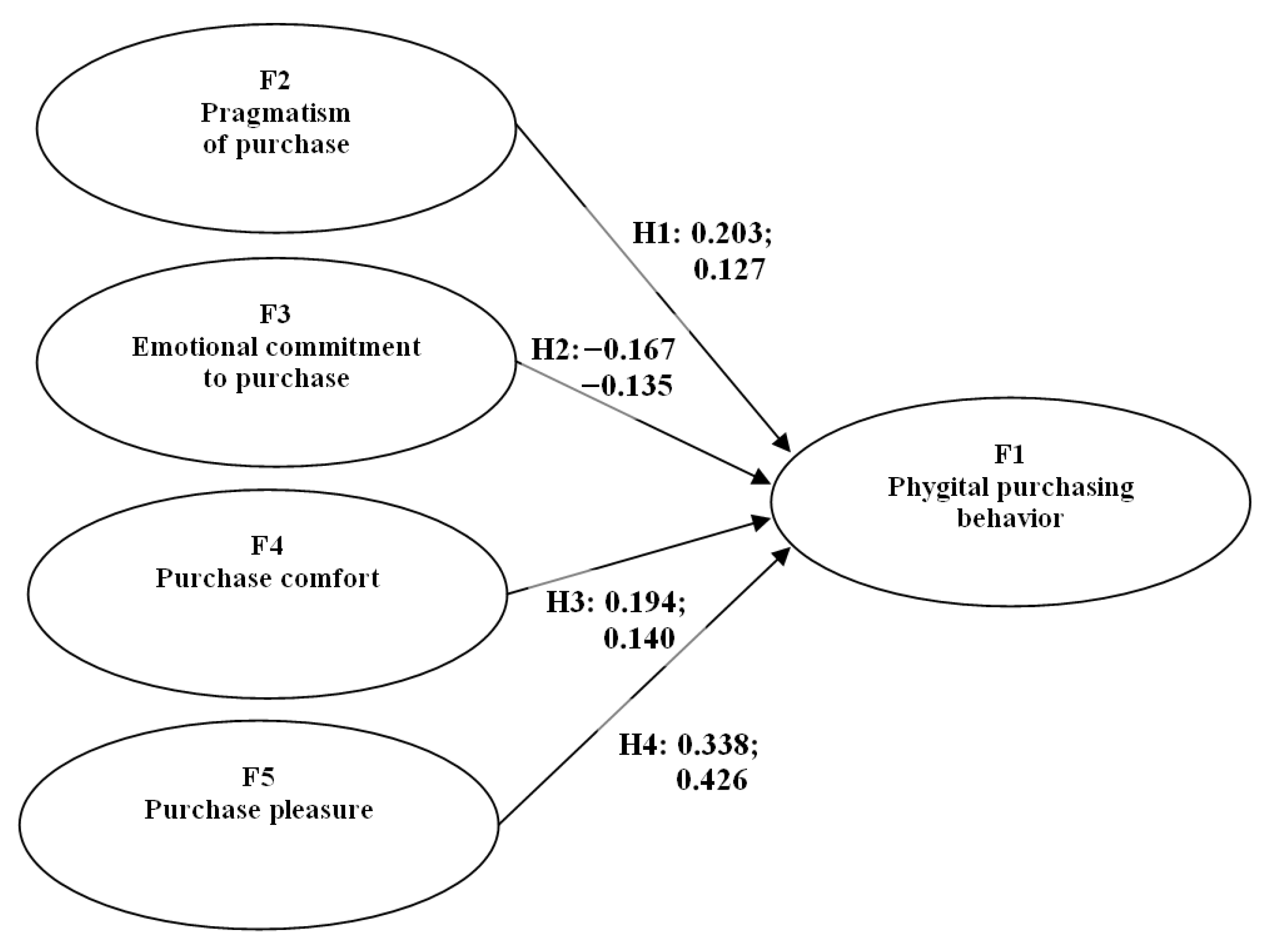
H1: Factor F2, “Pragmatism of purchase,” has a stimulating (positive) influence on consumers’ willingness to engage in phygital purchasing behavior (F1). This hypothesis was confirmed—the results indicate no basis for rejecting H1. Both the complete model (βs = 0.203, t = 4.246, ** p < 0.01) and the reduced model (βs = 0.127, t = 3.010, ** p < 0.01) confirm that this relationship is statistically significant and positive.
H2: Factor F3, “Emotional commitment to purchase,” has a stimulating (positive) influence on consumers’ willingness to engage in phygital purchasing behavior (F1). This hypothesis was not confirmed; the results provide no basis for accepting H2. Both the complete model (βs = −0.167, t = −4.700, ** p < 0.01) and the reduced model (βs = −0.135, t = 3.972, ** p < 0.01) confirm that this relationship is statistically significant, but it is negative (not positive as assumed).
H3: Factor F4, “Purchase comfort,” has a stimulating (positive) influence on consumers’ willingness to engage in phygital purchasing behavior (F1). This hypothesis was confirmed—the results indicate no basis to reject H3. Both the complete model (βs = 0.194, t = 4.487, ** p < 0.01) and the reduced model (βs = 0.140, t = 3.510, ** p < 0.01) confirm that this relationship is statistically significant and positive.
H4: Factor F5, “Purchase pleasure,” has a stimulating (positive) influence on consumers’ willingness to engage in phygital purchasing behavior (F1). This hypothesis was also confirmed—the results indicate no basis to reject H4. Both the complete model (βs = 0.338, t = 5.850, ** p < 0.01) and the reduced model (βs = 0.426, t = 8.214, ** p < 0.01) confirm that this relationship is statistically significant and positive.
The parameters of the complete and reduced models illustrating the influence of the selected purchasing factors on consumers’ willingness to engage in phygital purchasing behavior are presented in
Figure 2.
To summarize the research results, it should be stated that the standardized coefficients for the complete and reduced models confirm H1, H3, and H4. Therefore, the following factors stimulate consumers’ willingness to engage in phygital purchasing behavior: “pragmatism of purchase,” “purchase comfort,” and “purchase pleasure”. The last one is the most significant. The standardized coefficients for both the complete and reduced models do not support H2, which posits that the emotional commitment to purchase does not positively translate into consumers’ willingness to engage in phygital purchasing behavior.
4. Discussion
This interpretation aligns with recent segmentation research emphasizing heterogeneity in emotional orientations toward retail technologies and channel preferences. Recent studies demonstrate psychographic differences in consumers’ emotional attitudes toward phygital tools and identify systematic variation in purchase channel preferences across consumer groups [
46,
47]. Such findings support the conclusion that emotional commitment does not uniformly translate into hybrid engagement; instead, its behavioral consequences depend on how consumers position digital mediation within their broader experiential framework. According to research on retail transformation and digital integration [
48,
49], pragmatism of purchase positively influences phygital behavior. Grewal et al. [
48] emphasize how technological integration enhances transparency and decision efficiency, while Shankar et al. [
49] highlight innovations in shopper marketing that increase information accessibility. The present findings confirm that informational utility and cross-channel verification mechanisms remain relevant drivers of hybrid engagement. However, the magnitude of the pragmatism coefficient is clearly weaker than that of purchase pleasure. This empirical asymmetry suggests that cognitive efficiency stabilizes engagement but does not dominate it. While digital tools reduce information asymmetry and support structured decision-making [
48,
49,
50], they do not generate the strongest behavioral acceleration.
The positive effect of purchase comfort further aligns with omnichannel and service convenience literature [
51,
52,
53,
54]. Verhoef et al. [
54] conceptualize omnichannel retailing as seamless integration across touchpoints, and Jiang et al. [
53] operationalize convenience as reduced effort and time costs. Pine and Gilmore [
51] argue that contemporary markets compete for customer attention through designed experiences, while Nobre and Ferreira [
52] show that interactive and gamified platforms enhance co-creation processes. The moderate coefficient observed for comfort suggests that such mechanisms function as enabling conditions rather than primary motivational drivers. Seamless integration reduces friction and cognitive load—an effect consistent with the experiential technology perspective of Flavián et al. [
50]—but does not independently produce the strongest behavioral impact. From a sustainability standpoint, this intermediate structural position is critical: while improved integration may reduce certain mobility-related impacts, frictionless systems may simultaneously increase transaction frequency.
The strongest positive coefficient was identified for purchase pleasure, underscoring the centrality of hedonic motivations in phygital contexts. This result is theoretically grounded in foundational work on hedonic consumption [
55], which conceptualizes consumption as multisensory and experiential, and in subsequent operationalizations distinguishing hedonic and utilitarian shopping value [
56,
57]. Arnold and Reynolds [
58] identify multiple hedonic shopping motivations, while Jones et al. [
59] demonstrate that hedonic value can exert stronger effects on retail outcomes than utilitarian value. The dominance of pleasure in the present model empirically confirms that experiential drivers outweigh purely utilitarian considerations in hybrid environments.
Pham’s [
60] affect-based decision framework further explains this asymmetry, as feelings often serve as heuristic guides in complex purchasing situations. In technologically layered retail systems, where stimuli are intensified and multisensory, affective cues may become particularly influential. This interpretation is reinforced by immersive technology research. Hilken et al. [
61] demonstrate that augmented reality enhances vividness and perceived control, Poushneh and Vasquez-Parraga [
62] show its positive impact on satisfaction and willingness to buy, and Javornik [
63] highlights its capacity to evoke strong affective and cognitive responses. Flavián et al. [
50] similarly argue that virtual and mixed reality reshape the structure of customer experience. The significantly stronger path coefficient for pleasure compared to pragmatism indicates that experiential amplification mechanisms described in this literature translate directly into intensified behavioral engagement within phygital systems.
However, the dominance of pleasure introduces sustainability-related ambivalence. While experiential richness may foster engagement and attachment, hedonic stimulation can also intensify novelty-seeking and impulsive purchasing. The empirical hierarchy of coefficients suggests that affective acceleration may override rational optimization processes. Consequently, phygital engagement may be driven more strongly by experiential intensity than by deliberative efficiency.
The most conceptually distinctive finding concerns the negative and statistically significant effect of emotional commitment. Unlike pleasure, which reflects situational enjoyment, emotional commitment implies deeper relational attachment. Prior literature links emotional commitment and experiential bonding to loyalty and positive retail outcomes [
59,
64]. Yet in the present model, emotional commitment constrains rather than reinforces phygital engagement. This directional divergence indicates that strong affective attachment may be anchored in physical interaction, sensory verification, and interpersonal continuity.
In digitally mediated environments, technological interfaces—even when integrated with physical channels—may be perceived as reducing authenticity or relational coherence. Heightened affective involvement may increase sensitivity to perceived risk or loss of experiential control. The Polish retail context adds interpretative nuance: traditional brick-and-mortar formats continue to hold symbolic and relational significance, particularly among mature consumer segments. In emotionally salient situations, hybrid mediation may therefore be evaluated as functionally efficient but experientially disruptive.
This interpretation aligns with recent segmentation research emphasizing heterogeneity in emotional orientations toward retail technologies and channel preferences. Recent studies demonstrate psychographic differences in consumers’ emotional attitudes toward phygital tools and identify systematic variation in purchase channel preferences across consumer groups [
2,
46,
47]. Such findings support the conclusion that emotional commitment does not uniformly translate into hybrid engagement; instead, its behavioral consequences depend on how consumers position digital mediation within their broader experiential framework.
Taken together, the differentiated configuration of structural coefficients challenges deterministic narratives that equate digital integration with automatic sustainability advancement. The systematic comparison of effect magnitudes demonstrates that phygital infrastructures operate conditionally: pragmatism and comfort provide instrumental support, pleasure acts as the dominant accelerative force, and emotional commitment introduces a counterbalancing mechanism rooted in authenticity and relational anchoring.
By explicitly linking empirical coefficient differences with theoretical perspectives from retail transformation [
48,
49], experiential marketing [
51,
64], hedonic consumption theory [
55,
56,
57,
58], affect-based decision processes [
60], immersive technology research [
50,
61,
62,
63], omnichannel integration [
54], and psychographic segmentation studies [
46,
47], the discussion strengthens the connection between data and theoretical interpretation. The findings indicate that sustainability implications do not stem from technology itself but from the relative dominance and interaction of motivational forces within hybrid retail systems.
Overall, phygital purchasing behavior should not be conceptualized as inherently sustainable or unsustainable. Rather, it represents a multidimensional behavioral configuration shaped by the interplay and relative strength of cognitive, functional, experiential, and affective drivers. The structural model estimated in this study enables a differentiated interpretation of these forces and clarifies how their asymmetrical effects translate into distinct sustainability trajectories.
5. Conclusions
This study contributes to the literature on phygital consumption by examining purchasing behavior within digitally integrated environments from a sustainability-oriented perspective. Rather than assuming that technological integration inherently promotes sustainable consumption, the analysis demonstrates that the sustainability relevance of phygital behavior depends on the configuration of underlying motivations. Pragmatism of purchase, comfort, and pleasure stimulate engagement in phygital contexts, whereas emotional commitment exerts a negative effect. These results suggest that technology functions as an enabling infrastructure, but sustainability outcomes are shaped by how consumers cognitively and experientially interpret digitally mediated purchasing processes.
Importantly, phygital solutions may generate ambivalent sustainability implications. While digital tools can enhance information access and transactional efficiency, they may simultaneously intensify consumption cycles, increase return rates, and expand logistics-related environmental burdens. The present study does not directly measure such downstream effects; instead, it identifies motivational mechanisms that may indirectly condition them. Consequently, sustainability should not be inferred from technological adoption alone but evaluated in relation to behavioral consequences and system-level externalities.
From a managerial standpoint, the findings underscore the necessity of responsible phygital design. Digital integration should not be equated with sustainability performance. Firms must ensure that immersive interfaces, recommendation systems, and omnichannel architectures support expectation alignment, product fit, and informed choice, thereby reducing corrective consumption behaviors. At the same time, the negative association between emotional commitment and phygital engagement indicates heterogeneity in consumer responses. For certain segments, extensive digital mediation may weaken perceived authenticity or trust, suggesting that sustainability-oriented strategies require differentiated rather than universal digitalization approaches.
Several limitations delineate the boundaries of interpretation. First, the study relies on cross-sectional survey data, which precludes causal inference and does not capture temporal adaptation processes. The estimated structural relationships reflect contemporaneous associations rather than directional or evolving effects. Sustainable behavior in phygital environments may develop cumulatively, as familiarity with hybrid systems increases or as technological ecosystems mature. Longitudinal designs would therefore be necessary to examine persistence, reinforcement, or attenuation of the identified effects over time.
Second, the model specifies direct linear relationships and does not explicitly test mediation, moderation, or non-linear dynamics. The influence of purchasing dimensions may vary across demographic groups, levels of digital competence, or degrees of environmental involvement, yet such boundary conditions were not formally modeled. Moreover, possible interaction effects between emotional, pragmatic, and experiential drivers remain unexplored. As a result, the explanatory framework should be interpreted as structurally parsimonious rather than exhaustive.
Third, sustainability-related outcomes were operationalized indirectly through purchasing determinants rather than through objective behavioral indicators such as return frequency, product lifespan, or waste generation. Although this approach is theoretically justified, it limits the ability to assess the material environmental consequences of phygital engagement. Future studies should incorporate behavioral and post-purchase metrics to bridge the gap between motivational structures and measurable sustainability performance.
Finally, the empirical context is confined to Polish consumers drawn from an online panel. While the large sample size strengthens statistical robustness, cultural norms, institutional trust, regulatory environments, and digital infrastructure conditions may shape the observed relationships. The findings should therefore not be generalized uncritically to other socio-economic contexts without cross-national validation.
Future research should address these limitations through longitudinal and experimental designs capable of disentangling temporal and causal mechanisms. Incorporating moderated or interaction-based modeling could clarify segment-specific effects and structural boundary conditions. Expanding the analytical focus toward measurable sustainability outcomes—such as reduced return behavior, enhanced product longevity, or responsible disposal practices—would strengthen the link between phygital experience design and environmental impact. Comparative cross-country studies could further determine whether the identified motivational configuration represents a context-dependent pattern or a broader structural characteristic of digitally integrated consumption.
By explicitly recognizing these methodological and contextual constraints, this study provides a structured foundation for more dynamic and behaviorally grounded investigations into the sustainability implications of phygital markets.