2.1. Gig Economy and Platform-Based Gig Work
As an emerging labor market arrangement, the management of gig platform workers has attracted increasing scholarly attention. Researchers across countries have examined this form of employment from multiple perspectives, thereby establishing a robust theoretical foundation for understanding the gig economy and accumulating substantial practice-oriented evidence [
9]. From a human resource perspective, flexible employment can be conceptualized in both broad and narrow terms. Friedman (2014) defines the gig economy broadly as an “online + offline” ecosystem grounded in two-sided matching, in which a large number of independent and flexible workers deliver services through digital intermediation [
3]. Wang Jiabao and Cui Xiaoxuan (2018) analyze future trends in human resource management and argue that the gig economy will drive HRM toward greater flexibility and digitalization [
10]. With respect to performance management, the study by Lehdonvirta (2018) offers a distinctive contribution by examining electronic work supervision mechanisms on online labor platforms and assessing their effects on individual workers’ engagement in long-term collaborative innovation, thereby providing new implications for performance management among gig workers [
11]. This line of inquiry complements the research by Wei Wei and Feng Xiliang (2020) [
12] on the psychological contract of platform-based ride-hailing workers in digital platform firms. Specifically, Yundian and Daolin (2022) not only investigate the content and measurement of the psychological contract, but also identify latent categories and group differences, offering a theoretical basis for individualized management of gig workers [
13].
Mulcahy D (2017) argues that the apparent autonomy associated with gig work often conceals implicit control exerted through platform algorithms [
14]. Similarly, Yan Yujun and Gong Xiaoying (2022) examine the impacts of algorithmic management on gig workers, noting that while such management may enhance efficiency, it can also increase workers’ alienation and psychological strain [
15]. Consistent with these arguments, Tu Yongqian (2021) analyze the mechanism through which platform algorithmic control influences gig workers’ turnover intention, highlighting the far-reaching behavioral implications of technology-enabled management [
16]. Using food delivery couriers as an empirical context, Bucher E L et al. (2021) further investigate the determinants and effects of gig workers’ algorithm perceptions, providing evidence for understanding worker–technology interactions in platform-mediated work [
17]. Pei Jialiang et al. (2021) examine the effects of algorithmic management on gig platform workers and demonstrate how technology shapes work processes and employment relations [
18]. From a more macro-level perspective, Chen Wanming et al. (2024) analyze the role of platforms in the gig economy and how they affect gig workers and the broader economy, offering important insights into the systemic functioning of the gig economy [
19]. In a related vein, Lay-Raby et al. (2025) assess workers’ job autonomy in the gig economy—covering work status, job content, and working conditions—thereby deepening understanding of gig workers’ employment situations [
20]. Yu Shengxian et al. (2024), drawing on an organizational behavior perspective, investigate how work identity is constructed in the gig economy, providing an additional lens for interpreting gig workers’ psychological states and behavioral motivations [
21].
Overall, this body of research addresses multiple dimensions of gig platform worker management, including labor rights protection, the identification of employment relationships, and algorithmic management. Collectively, these studies are complementary and contribute to a comprehensive research framework on managing gig platform workers. Nevertheless, despite broad thematic coverage, research remains relatively limited regarding the specific question of how to enhance work engagement among gig platform employees.
2.2. Research on Managing Gig Workers in Platforms
Employee engagement has long been regarded as a central topic in organizational behavior and human resource management, and it has attracted sustained scholarly attention in recent years. As employment arrangements have shifted from traditional employment relationships to emerging gig-economy models, the conceptualization of engagement, its antecedents, and its underlying mechanisms have continued to evolve. As early as 2006, Saks A M (2006) examined the relationship between job embeddedness and employee engagement, reporting a significant positive effect of job embeddedness on engagement [
22]. This finding provides an important basis for explaining how engagement develops. Maslach C et al. (2001) highlighted the pivotal role of organizational climate, arguing that fair performance management and a supportive culture can strengthen employees’ behavioral involvement and willingness to grow [
23]. Basheer M F et al. (2019) further refined this line of research by showing that perceived organizational support is positively associated with engagement, and that demographic characteristics (e.g., age and marital status) are linked to significant differences in engagement [
24]. Drawing on social exchange theory, Boon C and Kalshoven K. (2014) emphasized that long-term and stable employment relationships can enhance employee engagement through reciprocity-based mechanisms [
25].
In addition, leadership style has been consistently identified as a key determinant of employee engagement. Lu, F and Yoon, S.J. (2025) indicate that ethically oriented management can significantly increase employees’ work engagement through the mediating transmission of psychological commitment and organizational belonging [
26]. He Jianhua et al. (2022) further clarify the importance of leaders’ emotion regulation capabilities, showing that when leaders effectively manage their own emotional states and maintain positive interactions with team members, subordinates’ trust, satisfaction, and sense of psychological safety are strengthened, which in turn promotes higher engagement [
27]. He Jianhua et al. (2022) similarly confirms leadership as a critical factor influencing engagement, aligning with international findings while offering localized implications for leadership development in Chinese enterprises [
28]. This evidence contributes to the understanding and management of younger cohorts and has practical relevance for contemporary talent management [
29].
However, the rise of the gig economy introduces new challenges to conventional theories of employee engagement. In gig-economy settings, the relationship between platform workers and platforms is often short-term, flexible, and characterized by limited stability, which constrains the direct applicability of traditional engagement-enhancement strategies [
30]. Prior research suggests that engagement among platform workers is shaped by multiple factors, including job autonomy, income stability, social support, and work meaningfulness [
31]. Platform workers commonly experience substantial income volatility, limited social protection, and restricted career development opportunities, conditions that may undermine engagement [
32]. Consistent with this view, Wei W and Liu B N (2023) argues that under gig-economy arrangements, workers frequently participate in work in non-fixed and short-cycle forms, which is associated with relatively weaker occupational investment and organizational identification [
33]. Such contingent employment patterns may impede the development of sustained work enthusiasm and a stable sense of institutional belonging. These findings underscore how the gig economy disrupts traditional employee–organization relationships and raises new questions for human resource management on gig platforms.
Overall, existing research has examined employee engagement from diverse perspectives, including job embeddedness, organizational justice, leadership style, and belongingness. The literature has enriched the theoretical understanding of engagement and has provided useful directions for subsequent studies. Nevertheless, as the gig economy expands, established engagement theories face increasing challenges. How employee engagement can be enhanced under gig-economy conditions characterized by pronounced flexibility and short-term work arrangements remains an urgent issue. Systematically investigating the determinants of engagement among gig-economy platform workers and developing feasible and effective enhancement strategies are of substantial theoretical and practical importance for promoting the healthy and sustainable development of the gig economy.
2.3. Theoretical Framework and Hypotheses Development
Gig platforms operate within a triadic interaction structure involving the platform, workers, and customers. Rather than reflecting a closed employer–employee arrangement, platform work is embedded in an open, multi-actor ecosystem in which platforms, workers, and customers interact and co-create value [
34]. Workers deliver services to customers, while customer ratings, complaints, and tips are subsequently incorporated into algorithmic task allocation and income distribution. Accordingly, managerial authority is exercised not only through platform rules but also through customer-mediated evaluations, generating a hybrid governance mechanism in which market feedback and managerial control are intertwined [
35]. This triadic structure is critical for explaining work engagement in the gig economy because it reconfigures the sources of support and fairness signals and shapes how workers interpret algorithmic management [
36]. As a result, traditional interpersonal management mechanisms may be attenuated, whereas technology-enabled governance and perceived legitimacy of platform rules are likely to become increasingly salient for workers’ motivation and engagement.
Work engagement is a core outcome in this context because it is closely linked to service quality, reliability, and sustained participation, which are central to long-term platform viability and social sustainability [
37]. Yet engagement in platform work is shaped by distinctive institutional conditions, including opaque algorithmic decisions, unstable income prospects, and ambiguous employment relationships [
38]. To explain engagement under these conditions, we integrate four complementary theoretical lenses that are frequently used in research on motivation under non-standard employment. Self-regulation perspectives emphasize workers’ capacity to manage goals and effort. Social exchange theory highlights perceived support and reciprocal motivation [
39]. Organizational justice theory explains how fairness perceptions shape trust and willingness to invest energy. Algorithmic governance perspectives clarify how perceived predictability and controllability of platform rules shape motivation and compliance [
40].
Self-management refers to individuals’ active regulation of their goals, behaviors, and performance. In the workplace, self-management reflects how workers coordinate personal growth with task demands and organizational expectations [
41]. Self-management capability has been identified as an important component of work engagement, with engagement partly manifesting as effective self-regulation [
42]. Mechanistically, self-management influences engagement through goal commitment, behavioral choice, capability monitoring, and progress evaluation [
42]. Empirical evidence further shows that daily self-management is positively associated with skill acquisition, feedback seeking, and development opportunities, thereby enhancing engagement [
43]. In highly autonomous platform work, self-management becomes particularly salient because workers must plan time, allocate resources, and cope with uncertainty with limited direct supervision.
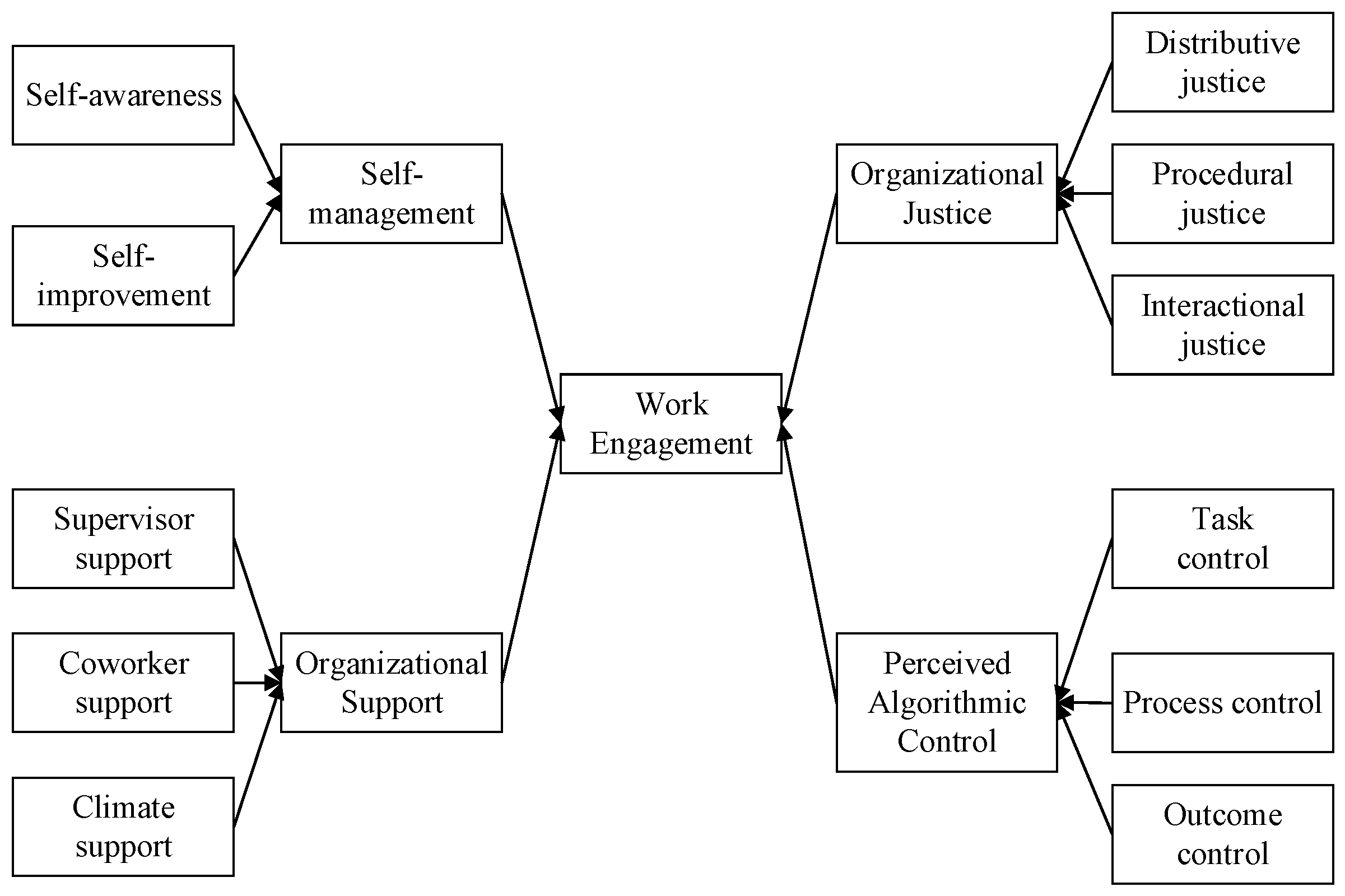
Based on the foregoing analysis, the following hypotheses are proposed regarding the self-management dimension.
H1: Self-management is positively associated with work engagement among platform-based gig workers.
H1a: Self-awareness is positively associated with gig platform workers’ work engagement.
H1b: Self-improvement (self-perfection) is positively associated with gig platform workers’ work engagement.
Perceived organizational support (POS) reflects workers’ overall beliefs that the organization values their contributions and cares about their well-being [
29]. When workers perceive support, they are more likely to develop trust and positive attitudes toward the organization, which strengthens commitment and motivates reciprocation through higher effort and engagement [
29]. Empirical studies suggest that support systems and supportive climates enhance engagement by increasing emotional attachment and encouraging workers to invest energy and attention in their work Related HRM evidence also indicates that high-commitment HRM practices are associated with engagement and commitment, with task proficiency shaping these effects [
25]. Conversely, when workers perceive insufficient recognition and welfare concern, their obligation to contribute may weaken, resulting in reduced engagement and heightened turnover intentions.
In gig platforms, support can be particularly important because employment ties are weaker and workers rely more on social, informational, and developmental resources to sustain motivation [
8]. Therefore, different forms of platform support (e.g., supervisor, peer, and climate support) are expected to contribute to gig workers’ engagement through both socio-emotional and instrumental mechanisms.
Based on the foregoing analysis, the following hypotheses are proposed regarding the organisational support dimension:
H2: Perceived organizational support is positively associated with work engagement among platform-based gig workers.
H2a: Supervisor support is positively associated with gig platform workers’ work engagement.
H2b: Coworker/peer support is positively associated with gig platform workers’ work engagement.
H2c: Climate support is positively associated with gig platform workers’ work engagement.
Organizational justice is widely recognized as a key determinant of positive work attitudes and behaviors. Work on burnout implies that fairness is linked to reduced exhaustion, and because burnout is often treated as the inverse of engagement, fairness is expected to support engagement [
23]. Foundational engagement research distinguishes procedural and distributive justice and finds that procedural justice is positively related to engagement [
22]. Subsequent studies also suggest that justice reduces turnover-related behaviors and encourages effort, with job embeddedness and justice sensitivity acting as relevant mechanisms [
44]. In addition, interactional justice has been shown to influence well-being via psychological empowerment, with power distance shaping these relationships [
45].
For gig workers, distributive justice concerns whether pay and rewards match effort and performance, thereby affecting trust and willingness to continue platform work [
44]. Procedural justice concerns whether task allocation and evaluation rules are transparent, consistent, and contestable, shaping acceptance of platform governance [
22,
37]. Interactional justice concerns respectful communication and humane treatment, fostering cooperation and a positive work climate [
44]. These fairness perceptions are therefore expected to jointly contribute to higher work engagement in platform labor.
Based on the foregoing analysis, the following hypotheses are proposed regarding the organisational justice dimension:
H3: Organizational justice is positively associated with work engagement among platform-based gig workers.
H3a: Distributive justice is positively associated with gig platform workers’ work engagement.
H3b: Procedural justice is positively associated with gig platform workers’ work engagement.
H3c: Interactional justice is positively associated with gig platform workers’ work engagement.
Algorithmic management is a defining feature of gig platforms, whereby algorithms influence task allocation, workflow guidance, performance evaluation, and reward outcomes [
4,
5]. Workers’ perceptions of algorithmic control are consequential because perceived controllability and predictability shape motivation, resource allocation, and compliance behaviors [
17]. Research has conceptualized and measured gig workers’ perceived algorithmic control and verified its performance implications [
18]. Subsequent evidence indicates a “double-edged sword” effect: moderate algorithmic control can reduce uncertainty by providing structured guidance and clearer allocation, while excessive control may intensify resource depletion, stress, and perceived unfairness, thereby undermining engagement and increasing turnover intentions [
19]. Studies on delivery riders further show that perceived unfairness in algorithmic task assignment can reduce work positivity and service quality [
20], and algorithmic control can shape turnover intentions through complex mechanisms [
21]. Recent work also distinguishes “good algorithms” from “bad algorithms” in relation to overwork risks [
31] and examines motivational pathways through which algorithmic control may stimulate proactive service behaviors [
32]. Building on these findings, perceived algorithmic control is expected to influence gig workers’ engagement through simultaneous guidance and constraint mechanisms.
Based on the foregoing analysis, the following hypotheses are proposed regarding the perceived algorithmic control dimension:
H4: Perceived algorithmic control is positively associated with work engagement among platform-based gig workers.
H4a: Perceived algorithmic task control is positively associated with gig platform workers’ work engagement.
H4b: Perceived algorithmic process control is positively associated with gig platform workers’ work engagement.
H4c: Perceived algorithmic outcome control is positively associated with gig platform workers’ work engagement.
2.4. Summary of Literature
Overall, prior research has made substantial progress in describing the gig economy and platform-mediated labor, including debates on labor protection, employment relations, and algorithmic management. Studies on organizational behavior and HRM have also established robust antecedents of work engagement in conventional employment settings, such as perceived organizational support, organizational justice, leadership, and embeddedness. Nevertheless, three gaps remain salient for platform-based gig work.
First, existing gig-economy research has been relatively macro-oriented (e.g., market trends, legal classification, and labor standards), while fewer studies systematically explain gig workers’ work engagement as a micro-level psychological and behavioral outcome under platform governance. Second, engagement research is still dominated by standard organizational contexts, and thus its mechanisms may not fully capture platform work features such as weak employment ties, multi-platform participation, and algorithmic coordination. Third, although recent studies have examined algorithmic management, empirical work that integrates self-regulation resources (self-management), relational resources (organizational support), normative evaluations (organizational justice), and technology-mediated governance (perceived algorithmic control) into a unified framework to explain engagement remains limited.
To address these gaps, this study develops and tests a conceptual model in which work engagement is the key outcome (
Figure 1). Self-management, perceived organizational support, organizational justice, and perceived algorithmic control are proposed as core antecedents, each further represented by multidimensional components. This integrative framework aims to explain how engagement is sustained in highly flexible yet governance-intensive platform work and provides evidence-based implications for platform management and socially sustainable labor practices.