1. Introduction
The pursuit of the United Nations Sustainable Development Goals (SDGs), particularly SDG 11 (Sustainable Cities and Communities) and SDG 13 (Climate Action), is catalyzing a profound transformation in urban transportation systems worldwide. This global agenda underscores the urgent need for efficient, low-carbon, and inclusive mobility solutions, positioning shared micro-mobility services as a critical component of future urban infrastructure [
1,
2]. According to the UK Department for Transport, micro-mobility is defined as the use of small mobility devices designed to carry one or two people or facilitate ‘last mile’ deliveries, with e-scooters and e-bikes serving as primary examples [
3]. Within the scope of urban services, shared micro-mobility refers specifically to the public-access, on-demand rental systems, primarily encompassing shared free-floating bicycles, e-bikes, and e-scooters that address last-mile travel needs. These services have emerged as a promising alternative to reduce congestion, mitigate emissions and noise pollution, and enhance the accessibility of short-distance travel [
4,
5,
6,
7,
8,
9]. Beyond operational benefits, the integration of micro-mobility also influences urban planning priorities, highlighting the critical need to adapt road conditions for user comfort and safety [
10]. Among these emerging modes, free-floating bike-sharing systems (FBSS) and shared e-bike systems have witnessed the most significant global adoption, becoming a ubiquitous feature of modern cityscapes [
11,
12,
13,
14,
15].
Despite their recognized environmental and social benefits, the sustainable operation of FBSS presents significant challenges [
5,
6,
7]. Large-scale deployment often leads to pronounced spatial and temporal imbalances in supply and demand, resulting in bicycle shortages in high-demand zones and surpluses elsewhere [
16,
17]. Furthermore, operational inefficiencies are exacerbated by unregulated parking and weather-induced demand fluctuations, leading to urban clutter and increased operational costs [
11,
18]. These challenges not only undermine system efficiency but also diminish the potential contribution of FFBS to sustainable urban development. Therefore, a deep understanding of user behavior patterns—how, when, and where people ride—is paramount for designing effective management strategies and policy interventions [
8,
19].
Recent advances in data availability have enabled the analysis of shared mobility systems with unprecedented granularity. Millions of anonymized trip records, collected from smart locks and GPS sensors, allow researchers to explore user behavior across temporal, spatial, and environmental dimensions. In this domain, existing literature has achieved remarkable success in enhancing forecasting accuracy through sophisticated deep learning architectures [
20,
21,
22,
23,
24,
25]. However, while these models excel in minimizing prediction errors, practical urban management also presents a distinct demand for model interpretability. Operators and policy-makers often require clear insights into how specific environmental drivers (e.g., weather conditions, temporal cycles) causally influence demand to justify resource allocation decisions. Therefore, alongside high-precision algorithmic development, there is a complementary need for transparent analytical frameworks that prioritize the explainability of demand drivers, ensuring that quantitative forecasts can be directly translated into actionable management strategies [
7].
To address these gaps, this study bridges the divide between algorithmic sophistication and practical decision support by developing a comprehensive, data-driven understanding of shared e-bike usage. Using three months of integrated multi-brand trip records from Ningbo, China, the descriptive analysis systematically examines temporal demand patterns and city-wide spatial distributions. By aggregating all available operators into a unified dataset and projecting trips onto a high-resolution hexagonal grid (H3) system, the analysis reveals meso-scale urban heterogeneity that cannot be observed from single-operator or district-level studies. These empirical patterns highlight the stable daily cycles and localized activity concentrations that characterize how users interact with the built environment.
Building upon this descriptive foundation, the forecasting component is validated using a representative single operator whose data provide consistent hourly records suitable for time-series modelling. This strategic separation between multi-brand descriptive insights and single-brand predictive validation ensures that the temporal forecasting is performed on a homogeneous dataset with stable reporting standards. For this purpose, we adopt a transparent and operationally deployable Seasonal Autoregressive Integrated Moving Average with eXogenous variables (SARIMAX) configuration focused on exogenous driver quantification. Rather than relying on black-box predictors, the model leverages a comprehensive vector of environmental variables to prioritize interpretability. This approach allows operators to explicitly isolate the marginal effects of distinct factors—quantifying exactly how a unit increase in precipitation or temperature shifts demand levels. The resulting short-term forecasts offer a practical balance between accuracy, robustness, and managerial clarity.
This research articulates its unique value through contributions in three distinct dimensions. First, empirically, by integrating data from multiple operators, we provide a comprehensive, city-scale picture of shared mobility demand. This multi-brand approach effectively eliminates the selection bias inherent in single-platform studies, establishing a more accurate baseline for urban mobility analysis. Second, methodologically, we propose a scalable, grid-based SARIMAX framework that explicitly prioritizes interpretability over black-box complexity. Our approach quantifies the specific elasticity of demand to environmental factors, offering a transparent tool for understanding spatial heterogeneity. Third, practically, the study translates these insights into a rule-based operational decision framework. By deriving standardized coefficients for routine fleet management, we provide operators with actionable, transparent rules for day-ahead planning. Finally, the empirical validation in a developing coastal city supports SDG 11 and 13, demonstrating how data-driven insights contribute to reliable and energy-efficient sustainable transport systems.
The remainder of this paper is organized as follows.
Section 2 reviews the related literature.
Section 3 describes the dataset and study area.
Section 4 presents the empirical findings on spatiotemporal and environmental patterns.
Section 5 details the demand forecasting experiment and its evaluation.
Section 6 discusses the managerial implications, and
Section 7 concludes the paper, outlining its limitations and suggesting directions for future research.
2. Literature Review
2.1. Free-Floating Bike-Sharing Systems
FBSS have revolutionized short-distance urban mobility by removing the need for fixed docking stations. Users can pick up and return bikes anywhere within the service area, substantially reducing walking distance and improving convenience [
11]. Compared to traditional dock-based systems, FBSS lower infrastructure and maintenance costs, which enhances market competitiveness and accelerates service expansion [
26]. Equipped with GPS sensors, dockless bikes generate detailed spatiotemporal trajectory data, offering valuable insights into urban mobility patterns and user behavior [
11,
19]. The analysis of this data has become essential for optimizing transport networks, land-use planning, and shared mobility management.
As an integral component of sustainable urban transportation, bike-sharing systems can complement public transit and reduce dependence on private motorized travel [
27,
28,
29]. Empirical evidence indicates that dockless bike-sharing interacts synergistically with subway and bus networks while substituting short car or motorcycle trips [
29]. Moreover, life-cycle assessments have shown that bike-sharing produces lower greenhouse gas emissions than private vehicles or taxis [
7], and its large-scale deployment in China has yielded measurable climate benefits by replacing carbon-intensive travel modes [
30]. These features position FBSS as a key enabler of low-carbon, accessible, and equitable mobility in dense urban environments.
Recent years have witnessed the rapid emergence of shared e-bikes, which share operational similarities with traditional FBSS but extend travel range and convenience through motor assistance. Studies have shown that shared e-bikes effectively bridge the “last-mile” gap between transit stops and destinations, thereby enhancing multimodal accessibility while maintaining environmental advantages [
31,
32,
33]. In addition, e-bikes have attracted new user segments for commuting and daily errands, further reducing car dependency and improving travel efficiency [
7,
34,
35,
36,
37]. However, shared e-bike systems also introduce emerging safety and behavioral challenges due to higher speeds and irregular parking practices [
38,
39]. Adoption studies suggest that perceived usefulness, ease of use, and social influence are key factors influencing the acceptance of shared e-bikes in China [
40].
Despite their rapid diffusion, dockless bike-sharing systems have also created significant governance and operational challenges. The free-floating nature often leads to disorderly parking, oversupply, and uneven spatial distribution of bikes across service areas [
31,
41,
42,
43,
44]. Such issues not only obstruct sidewalks and threaten pedestrian safety but also increase the cost of redistribution and maintenance for operators. These imbalances reveal a fundamental tension between user convenience and system efficiency, highlighting the urgent need to identify and interpret the underlying spatiotemporal patterns of user behavior. In essence, while FBSS has expanded the accessibility and sustainability of urban mobility, its persistent operational issues—particularly inventory imbalance and parking disorder—necessitate predictive, data-informed management to achieve truly efficient and sustainable operations.
2.2. Data-Driven Analysis of Riding Behaviors in FBSS
To address the operational challenges inherent in FBSS, a vast literature has emerged to analyze the strong spatiotemporal heterogeneity of riding behavior, which is shaped by commuting schedules, land-use context, weather, and calendar effects [
11,
29]. Consequently, data-driven studies have focused on revealing recurring demand patterns across time and space, including peak-hour cycles, weekday–weekend differences, and urban core–periphery contrasts, as well as identifying context-dependent anomalies in usage.
Typical studies draw upon multiple sources of data: platform transaction records (pick-up/return events) and GPS trajectories [
19,
30]; environmental covariates including temperature, rainfall and daylight hours [
7]; urban form indicators such as POI density, transit proximity and intersection density [
19,
31]; and calendar indicators like hour-of-day, day-of-week and holiday flags [
27]. Feature engineering often encodes periodicity (diurnal/weekly dummies or Fourier harmonics), spatial context (buffered POI or transit-access metrics) and interaction terms reflecting combined influences of context and time.
Empirical applications across previous approaches have uncovered consistent findings: persistent demand hotspots, clustering of temporal usage profiles at fine spatial scale, and strong linkages between usage patterns and land-use or transit access [
19,
45,
46]. The literature consistently reports several stylised facts: (i) Morning and evening peaks dominate weekday activity, whereas weekend profiles often shift toward leisure and off-peak travel; (ii) Spatially, high-density urban cores and transit-oriented zones exhibit higher pick-up/return volumes and shorter trip durations; (iii) Weather and calendar events modulate usage levels—rainfall and adverse weather reduce ridership, while holidays and special events increase deviations from typical commuting patterns; (iv) There exist centre–periphery gradients in usage intensity, and zones with high POI or activity mix tend to show more diversified trip patterns [
7,
30,
31].
While an increasing number of studies have moved beyond purely descriptive analyses to incorporate dynamic modelling and spatial–temporal segmentation, opportunities remain to further integrate these insights into decision-oriented frameworks. In particular, recent work continues to highlight the need for finer-grained spatial representations, a deeper understanding of interaction effects among contextual drivers, and long-term analyses that capture the temporal evolution of riding patterns. These empirically-derived patterns and identified research gaps provide the perfect foundation for the subsequent discussion on time-series modelling and demand forecasting frameworks.
2.3. Time-Series Modelling for Shared Mobility Demand
Building on descriptive analyses of riding patterns, time-series modelling provides a quantitative framework to capture temporal dependencies and cyclical variations in shared mobility demand. While pattern-mining approaches reveal when and where demand concentrates, time-series models formalize how these patterns evolve over time, thereby enabling short-term forecasting and operational decision-making [
20].
Traditional time-series models, such as autoregressive integrated moving average (ARIMA) and its seasonal extension (SARIMA), remain widely used due to their interpretability and robustness in capturing seasonal cycles [
47,
48]. These models explicitly capture autoregressive and moving-average dependencies and have been applied at station- or station-area scales in bike-sharing contexts, including hybrid designs around urban rail stations [
20,
49]. To enhance predictive realism, these models are frequently extended to incorporate exogenous variables. The SARIMAX framework, for instance, is commonly adopted to integrate weather, calendar, and other contextual factors, yielding improved accuracy in practice [
18,
50].
Recent studies have increasingly explored machine-learning (ML) and deep-learning (DL) techniques to address the nonlinear and high-dimensional characteristics of shared mobility demand. Tree-based ensemble models, such as XGBoost and LightGBM, have demonstrated strong performance by capturing complex feature interactions [
51,
52]. Deep-learning architectures offer even greater flexibility. Long short-term memory (LSTM) networks, for example, have been employed for hourly demand forecasting and often exhibit superior performance to conventional ML methods [
53]. Furthermore, advanced DL models like spatio–temporal graph neural networks (STGNNs) have been developed to explicitly model spatial dependencies and inter-station interactions, which are crucial for system-wide forecasting [
54,
55,
56]. These advanced models also integrate auxiliary contextual data (e.g., POI density, transit accessibility) to improve generalization across urban contexts [
25,
57].
ARIMA-family models are favoured for their interpretability and stable performance under regular seasonal cycles, whereas ML and DL models often achieve higher accuracy in data-rich, nonlinear contexts. Recent comparative studies suggest that hybrid and context-aware frameworks, which fuse statistical structure with data-driven learning, offer the best trade-off between interpretability and precision. Despite these advances, challenges remain in balancing model transparency, scalability, and responsiveness to rapid behavioural changes. These considerations motivate the development of interpretable yet adaptive forecasting frameworks for shared mobility demand.
2.4. Identified Research Gap
While the literature has established a strong foundation for understanding and managing FBSS, a critical research gap persists when applying these insights to the rapidly expanding domain of shared e-bike system. As noted in
Section 2.1, shared e-bike system exhibit unique characteristics that differentiate them from their non-electric counterparts. However, many existing data-driven studies have been developed and validated using traditional bike-sharing data, often at aggregated spatial scales. This creates a specific research gap that this study aims to address.
A primary limitation of current research is the spatial aggregation of demand analysis, which can obscure the local dynamics of e-bike usage. Given their ability to cover longer distances, e-bikes generate demand patterns that may vary significantly even within a single neighborhood. Understanding these fine-scale patterns is crucial for operational tasks like targeted rebalancing. Furthermore, while many high-accuracy forecasting models, such as deep learning architectures, excel at capturing complex, non-linear patterns—particularly in scenarios like event-driven spikes—their “black box” nature often limits their practical utility for operators who need to understand the influence of key contextual drivers on demand.
To address these specific limitations, this study proposes a cell—based forecasting framework for shared e-bike systems, prioritizing model interpretability to bridge the gap of limited practical utility in black-box models and to support routine operational requirements. This approach allows for demand analysis at a much finer spatial resolution than district-level studies. By employing an interpretable time-series model (SARIMAX), our framework not only generates predictions but also quantifies the influence of key contextual factors, such as weather effects. The goal is to provide a practical tool that offers both granular insights and transparent, actionable information for shared e-bike system management.
3. Data and Study Area
This section provides an overview of the empirical foundation of the study, including the research context, data sources, and preprocessing procedures. It begins by describing the study area, outlining the urban characteristics, transportation environment, and relevance of the selected district to sustainable mobility research (
Section 3.1). The subsequent part presents the datasets used in this research and details the preprocessing workflow, including data cleaning, variable extraction, and spatial processing (
Section 3.2). The final subsection summarizes key descriptive statistics and preliminary insights into the temporal, spatial, and behavioral patterns revealed by the dataset (
Section 3.3). Together, these components establish a transparent and reproducible basis for the behavioral analysis and predictive modeling discussed in the following sections.
3.1. Study Area and Context: The City of Ningbo
Ningbo, located in Zhejiang Province, is a major coastal city and a core economic hub in the Yangtze River Delta region. As of early 2025, it was a major metropolitan area with a permanent population of 9.78 million and a high urban population density of approximately 1057 people per km
2 [
58]. The city’s economic vitality, reflected in a 2024 GDP of 1.81 trillion CNY and a high average urban disposable income of 83,110 CNY, suggests a substantial capacity and demand for modern mobility services. These socioeconomic indicators collectively create a fertile ground for the adoption and growth of shared mobility systems.
Geographically, Ningbo’s urbanized area features a mix of dense central districts and expanding suburban zones, characterized by diversified land uses. This spatial configuration provides a favorable setting for shared micromobility services such as free-floating bike-sharing (FFBS). Notably, shared e-bikes have become a dominant mode within Ningbo’s FFBS, catering to the city’s varied topography and longer commute distances. They complement existing public transport systems and promote sustainable short-distance travel [
59].
In alignment with the SDG 11, Ningbo has integrated sustainability objectives into its urban transportation planning. Its local transportation policy encourages multimodal connectivity and the deployment of smart mobility systems to improve operational efficiency and environmental performance [
60]. Within this policy context, Ningbo’s comprehensive city-wide bike-sharing network provides an ideal empirical setting for analyzing urban e-bike mobility behavior, assessing the environmental benefits of micromobility, and exploring how data-driven management can enhance system sustainability.
3.2. Data Sources and Pre-Processing
3.2.1. Data Collection
The empirical foundation of this study is a comprehensive dataset of shared e-bike orders from Ningbo, China, spanning from 1 March to 23 June 2021 (except the time period from 6 June to 10 June). This dataset was obtained from the three major e-bike operators active in the city and represents the complete operational records for all trips during the study period. Each record corresponds to a single event—either a bike pick-up or return action—and is tagged with precise temporal and spatial information. The dataset comprises several key fields, including a unique trip identifier, bike ID, company ID, timestamp, geographic coordinates (longitude and latitude), and an action state (0 for pick-up, 1 for return). A detailed structure and description of these fields are provided in
Table 1.
Each record includes the following fields: CompanyId, BikeId, TripId, Time, Longitude, Latitude and State. A sample of the data structure is shown in
Table 1.
To ensure the representativeness of our analysis, it is crucial to understand the composition of the e-bike market captured in the data. The three included operators exhibit distinct service scopes and target demographics: Brand 1 is a local dominant operator in Ningbo; Brand 2 is a nationwide provider; and Brand 3 primarily serves university campuses.
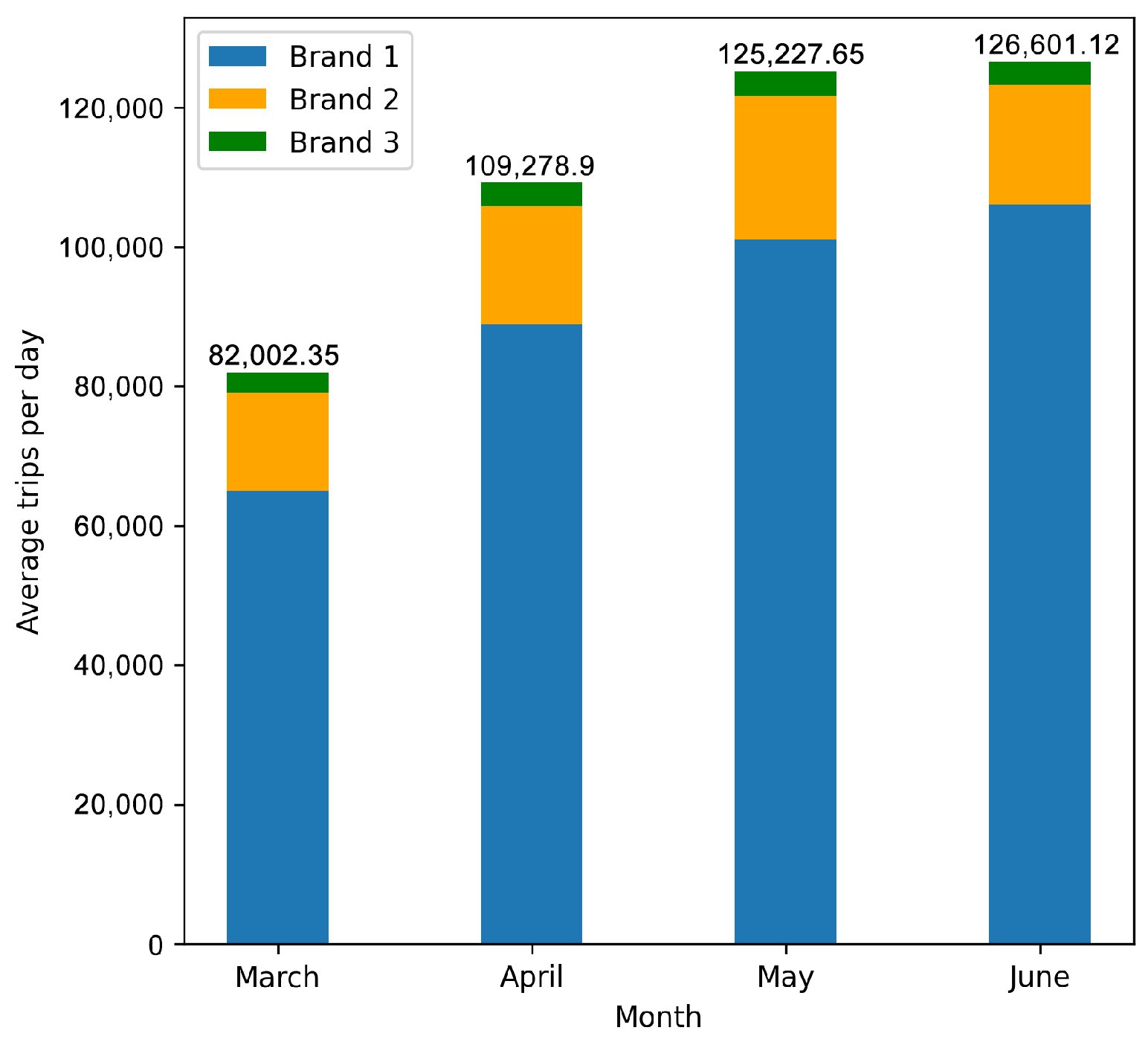
Figure 1 illustrates their respective market shares in terms of average daily trips. The figure reveals that Brand 1 commands a dominant market position, accounting for over two-thirds of all trips, while Brand 2 and Brand 3 constitute smaller but distinct market segments. This multi-operator structure confirms that our dataset captures a comprehensive and heterogeneous cross-section of Ningbo’s shared e-bike ecosystem, reflecting both overall demand patterns and niche usage behaviors.
To incorporate contextual influences, we collected meteorological records for the same temporal scope as the trip data. The raw weather data were recorded at three-hour intervals. To align these records with our hourly trip data, the dataset was resampled to an hourly resolution. Missing values between the recorded points were imputed using a forward-fill method, which propagates the last observed value forward in time. The final processed dataset includes key environmental indicators such as temperature, humidity, and precipitation, allows for a rigorous examination of how environmental conditions affect e-bike riding demand. As presented in
Table 2, integrating these exogenous variables allows our analysis to move beyond purely temporal patterns to quantify the sensitivity of shared mobility demand to weather fluctuations, a critical component for building robust forecasting models.
3.2.2. Trip Construction and Data Cleaning
Each completed trip is represented by two corresponding event records: one pick-up record (State = 0) and one return record (State = 1), sharing the same CompanyId, BikeId, and TripId. These paired records were merged to form a single trip entry containing both temporal and spatial attributes of the start and end points.
To ensure data quality and eliminate abnormal or implausible trips, a multi-step validation procedure was applied. Records were excluded if they met any of the following conditions:
- 1.
The start (pick-up) time is later than the end (return) time.
- 2.
The total trip duration is less than 60 s.
- 3.
The estimated average travel speed (distance divided by duration) is less than 0.1 m/s or greater than 10 m/s.
- 4.
Either the start or end location falls outside the administrative boundary of Ningbo city.
These criteria effectively remove data-entry errors, GPS inaccuracies, and abnormal events such as system resets or bicycle relocation. After pre-processing, the dataset contains 9,723,802 valid trips for Brand 1, 1,896,471 trips for Brand 2, and 361,044 trips for Brand 3. The cleaned dataset provides a high-resolution representation of shared e-bike usage across the entire city and serves as the foundation for the subsequent behavioral and predictive analyses.
3.3. Descriptive Statistics and Preliminary Insights on User Trip Behavior
This section presents an overview of the spatial and behavioral characteristics of shared e-bike usage in Ningbo, based on the processed dataset. The analysis focuses on three aspects: (i) single-trip distance, (ii) trip duration, and (iii) turnover rate. These descriptive statistics provide an empirical foundation for understanding user behavior and identifying the operational dynamics of the shared e-bike system.
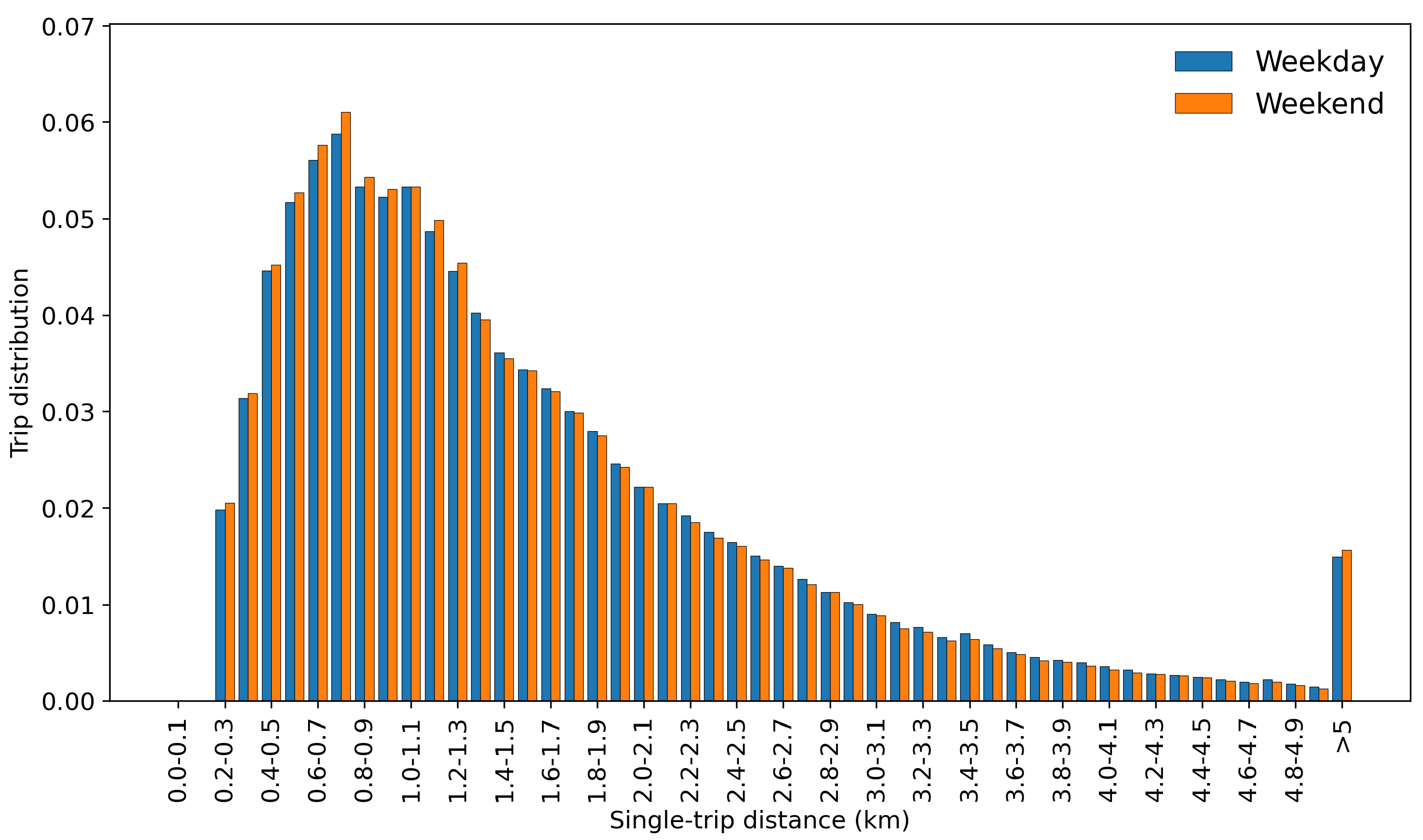
Single-trip distance distribution: As shown in
Figure 2, the majority of trips on both weekdays and weekends are relatively short, with a clear peak observed between 600–800 m, indicating that most users rely on e-bikes for short-distance travel. The trip frequency gradually decreases as distance increases, forming a right-skewed distribution, which is consistent with typical micromobility patterns observed in other urban contexts. Moreover, the similarity between the weekday and weekend bars indicates that trip distance distributions remain relatively stable across weekdays and weekends, implying that trip distance is more strongly influenced by spatial structure than by temporal factors such as weekday scheduling. However, the slightly higher proportion of short trips on weekends may reflect more recreational or flexible travel behavior compared to the structured commuting patterns during weekdays.
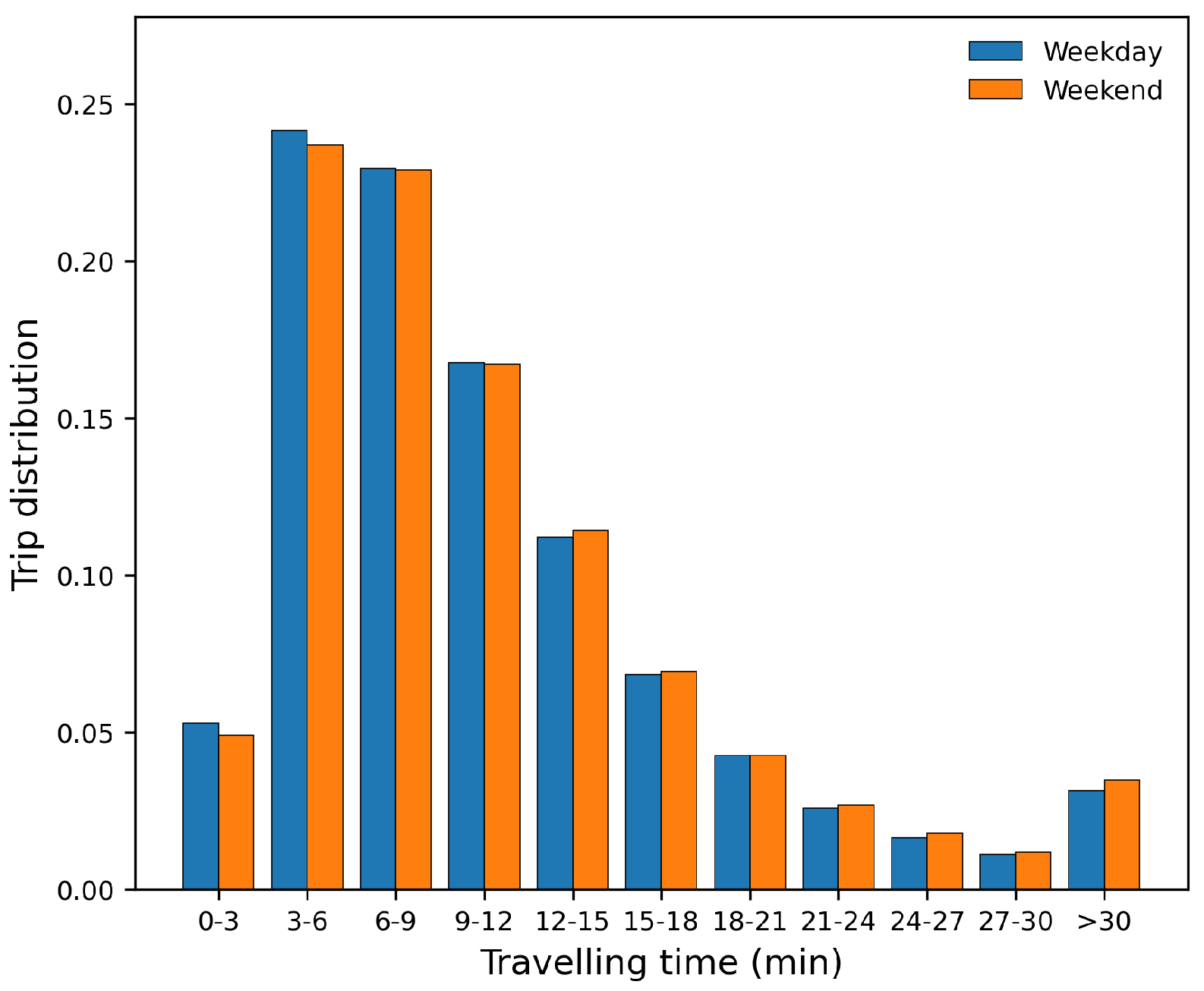
Single-trip duration distribution: As illustrated in
Figure 3, the distributions for both weekdays and weekends are distinctly right-skewed, with a clear peak observed in the 5–10 min interval, indicating that the majority of users rely on e-bikes for short-duration travel. This finding is consistent with the distance distribution, reinforcing the system’s primary role in facilitating short-distance trips. The high degree of similarity between weekday and weekend distributions suggests that user behavior regarding trip duration remains relatively stable across different days. Nevertheless, upon closer inspection, the weekend distribution appears slightly flatter, with the differences in bar heights being less pronounced than on weekdays. This subtle characteristic may indicate a modestly higher proportion of leisure or random-purpose trips on weekends, which have more varied travel times. However, this effect is subtle and does not dramatically alter the overall distribution pattern.
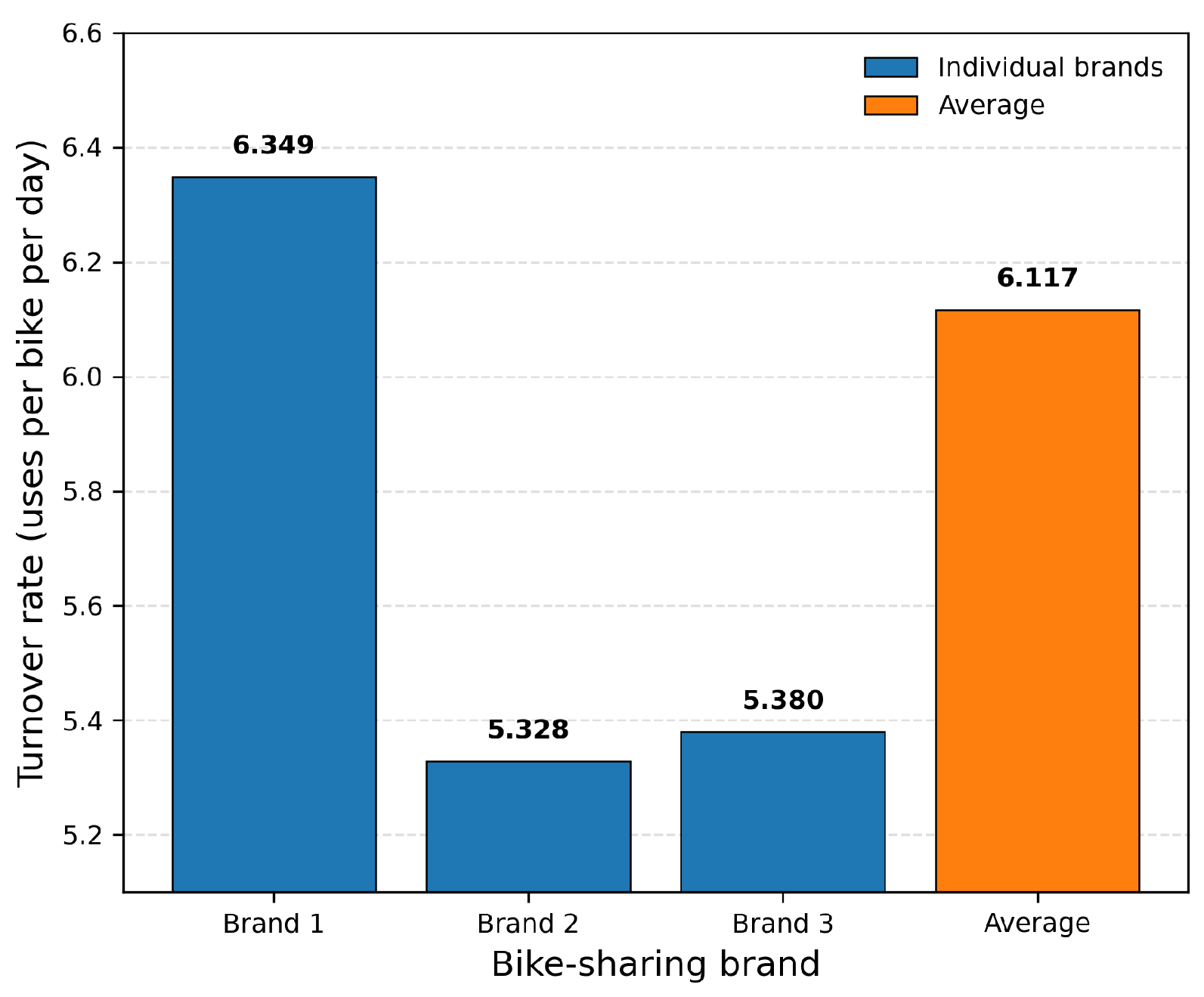
Turnover rate: The turnover rate is defined as the average number of uses per e-bike per day, which is an important indicator of operational efficiency and asset utilization. As shown in
Figure 4, the overall average turnover rate across the three brands is 6.12 trips per bike per day. Among them, Brand 1 exhibits the highest turnover rate (6.35), while Brand 3 and 2 maintain similar values around 5.3. The differences among brands suggest varying market positions and fleet management strategies, with local operators achieving higher utilization in core districts compared to national platforms with broader but less dense coverage.
Overall, the descriptive statistics indicate that shared e-bike trips in Ningbo are short in both distance and duration, reflecting their primary role in fulfilling first- and last-mile travel demands within the city. The consistency of usage patterns across weekdays and non-working days suggests stable and habitual mobility behavior, while slight variations point to the coexistence of commuting and leisure purposes. The comparison among operators further implies that locally adapted management strategies contribute to higher utilization efficiency, indicating a mature and well-integrated shared e-bike system that effectively supports urban mobility needs.
4. Shared E-Bike Dynamics: A Spatio-Temporal and Environmental Analysis
This section presents a multi-dimensional analysis of shared e-bike usage patterns in Ningbo, focusing on temporal, spatial-functional, and environmental dimensions. The analysis proceeds as follows:
Section 4.1 examines temporal patterns of usage at daily and seasonal scales.
Section 4.2 analyzes spatial-functional patterns by relating usage to different urban zones, including commercial, office, and residential areas.
Section 4.3 investigates the effects of environmental conditions, specifically temperature and precipitation, on ridership levels.
4.1. Temporal Patterns of E-Bike Sharing Usage
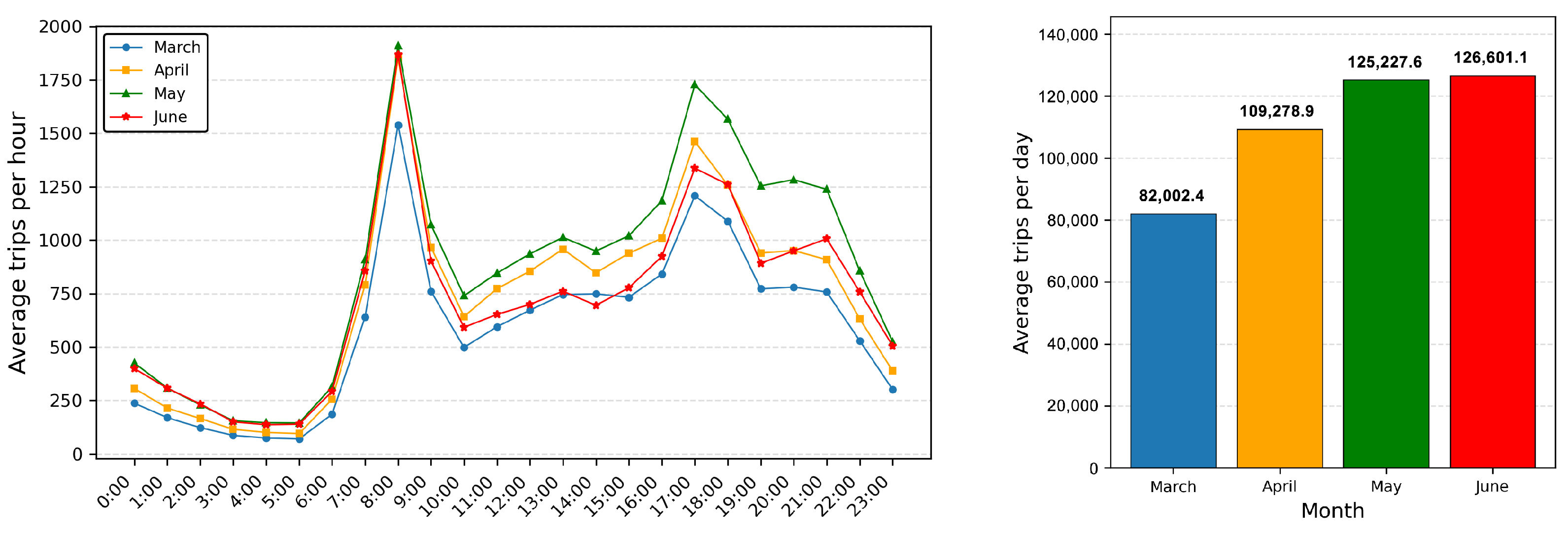
The analysis of hourly and daily trip volumes across different months (March-June) reveals two primary temporal patterns: daily commuting cycles and seasonal variations, as presented in
Figure 5.
On a daily scale, a pronounced bimodal distribution is consistently observed across all months. This pattern is characterized by two distinct peaks at approximately 8 am and 6 pm. A notable detail is that the morning peak consistently demonstrates higher intensity than the evening peak. Beyond this daily rhythm, a clear seasonal trend emerges: the overall trip intensity progressively increases from March to June.
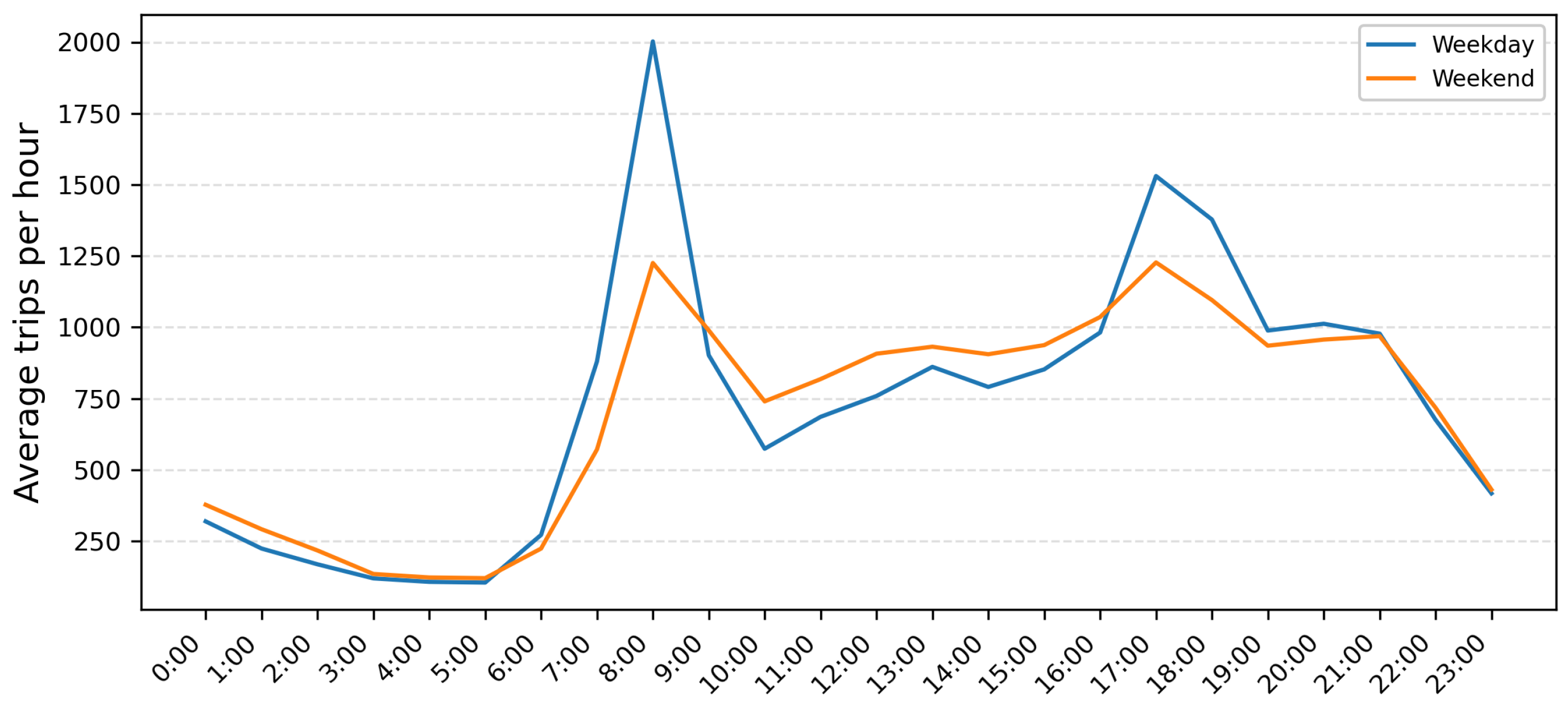
Following the month-level analysis, we examined intra-day usage differences between working and non-working days (
Figure 6). Both day types exhibit the characteristic bimodal pattern, but their usage profiles differ significantly. Weekdays are characterized by sharp, pronounced peaks, while weekends display a much smoother curve with reduced peak intensity and relatively higher activity during midday hours.
The temporal analysis identified that shared e-bike usage in Ningbo exhibits daily commuting cycles and seasonal variations. The double-peak pattern corresponds to morning and evening peaks, and trip intensity increases from March to June. In May, the presence of multiple high-demand hours reflects a mixed pattern of commuting and non-commuting activities. Weekdays show sharp peaks, whereas weekends have smoother curves with midday activity.
4.2. Spatial–Functional Pattern of E-Bike Sharing Usage
Using classified land-use categories derived from point-of-interest (POI), we identify typical functional zones such as residential, commercial, and office areas, and examine their respective trip intensity and temporal patterns.
Commercial areas represent zones where economic and social activities are highly concentrated, typically characterized by intensive pedestrian flow and diverse trip purposes. Based on their spatial configuration and operational characteristics, we distinguish two main sub-types: (1) large-scale commercial complexes, which typically consist of one or several major shopping malls surrounded by smaller retail outlets; and (2) distributed commercial complexes, composed of numerous independent shops dispersed within dense urban fabrics.
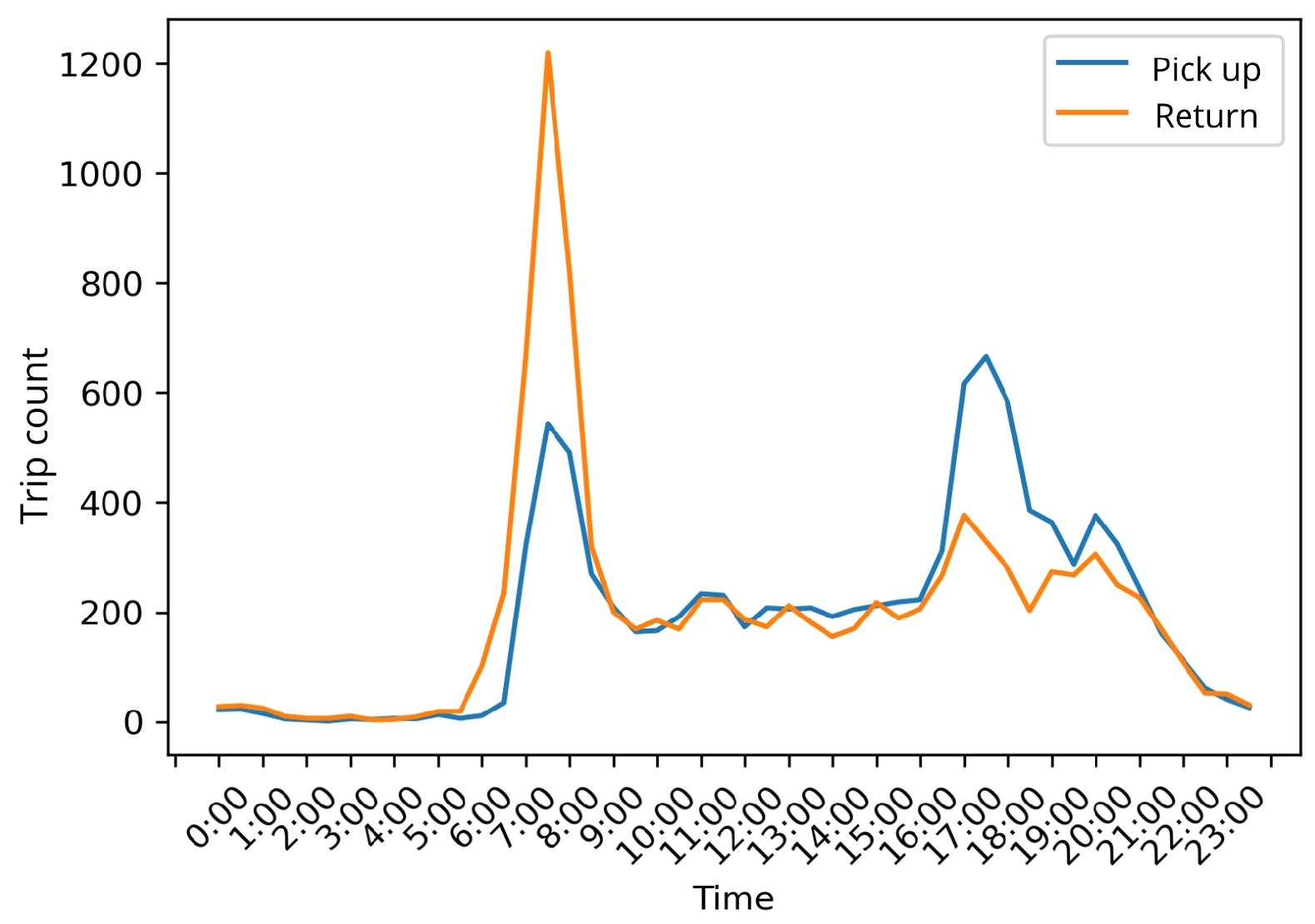
As shown in
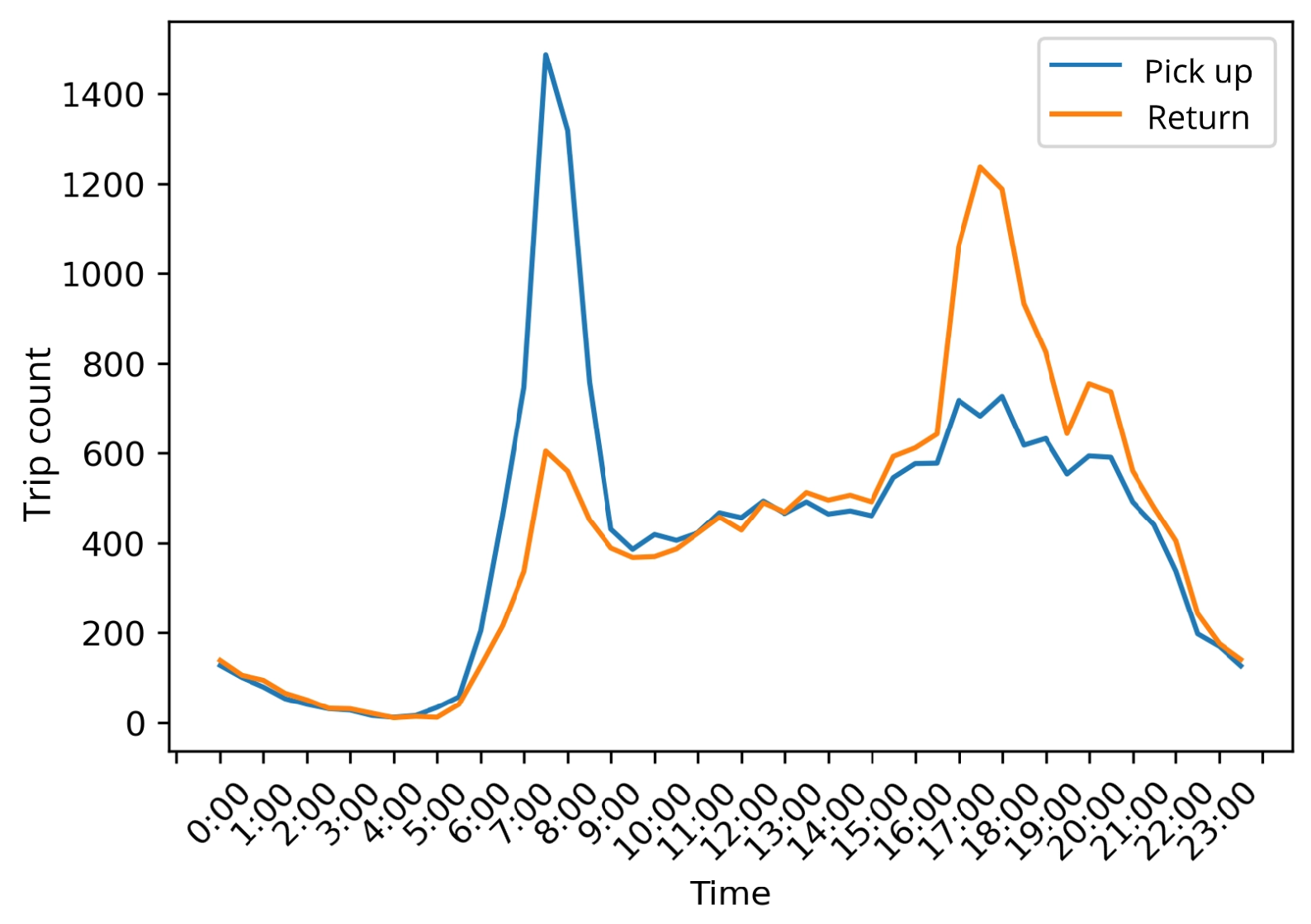
Figure 7, the two commercial sub-types exhibit markedly different temporal usage patterns. Large-scale commercial complexes demonstrate a pronounced tidal pattern, characterized by a significant asymmetry between returning and picking-up. A strong morning return peak occurs around 8:00–8:30 am, followed by a more prominent evening picking peak between 5:00–5:30 pm. In contrast, distributed commercial complexes display a flatter and more balanced temporal profile, with a modest morning picking peak around 8:00 am, followed by a prolonged period of relatively low but stable activity from late morning to late afternoon, and a smaller evening pick-up peak.
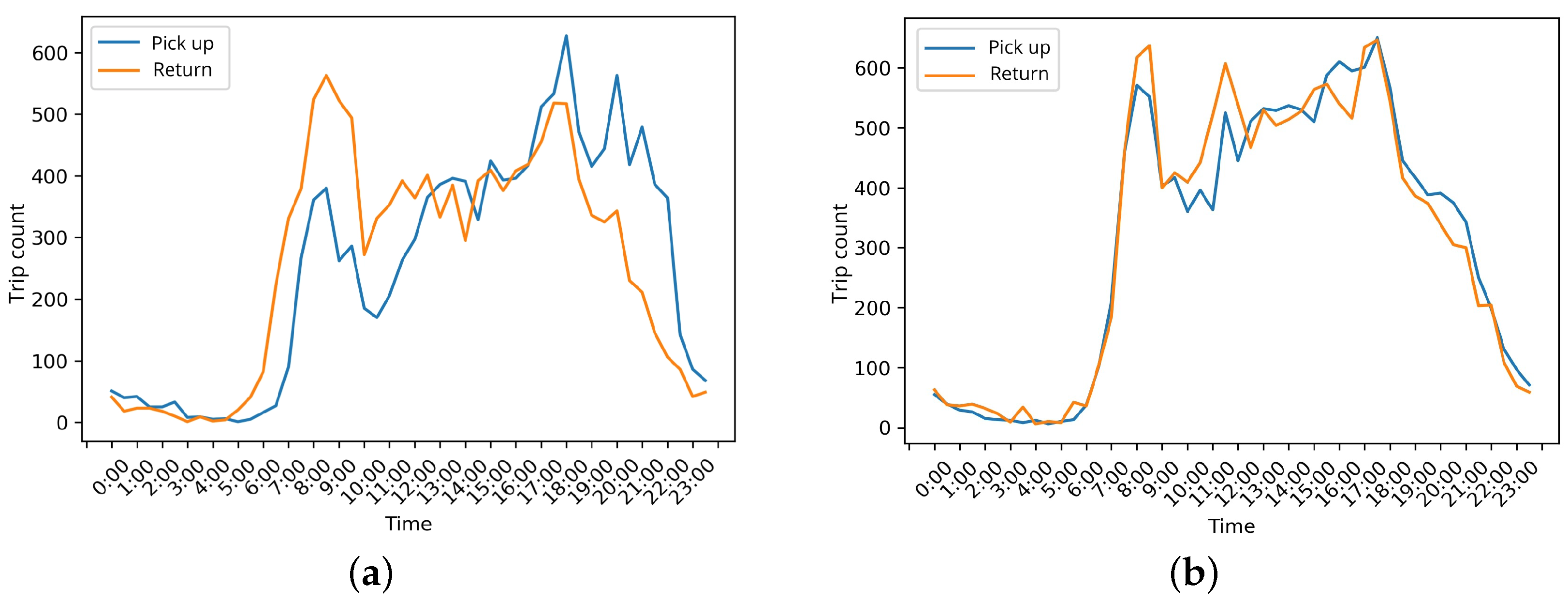
As illustrated in
Figure 8 and
Figure 9, the temporal dynamics of shared e-bike activity in office and residential areas exhibit a clear complementary pattern. In office areas, the returning curve shows a sharp morning surge between 7:30 and 9:00 a.m., while the pick-up volume peaks markedly around 5:00 p.m., forming a distinct tidal commuting structure. In contrast, residential areas display the opposite temporal rhythm, with high morning pick-up volumes and evening return peaks. This opposing behavior confirms that e-bike use in these zones is dominated by regular commuting rather than discretionary trips.
In summary, shared e-bike usage in Ningbo varies by urban zone type. Commercial areas show a mix of commuting and leisure trips, while residential and office areas exhibit complementary temporal patterns that reflect primary commuting flows. The distinct spatial heterogeneity across different functional zones underscores the need to account for zone-specific dynamics, which is crucial for capturing the system’s functional adaptability.
4.3. Environmental Effects on E-Bike Sharing Usage
To understand how environmental factors influence shared e-bike usage patterns, this section examines the relationship between weather conditions and ridership demand. Weather represents a critical external factor that can significantly affect travel behavior, particularly for mode choices like e-bikes that expose users to natural elements.
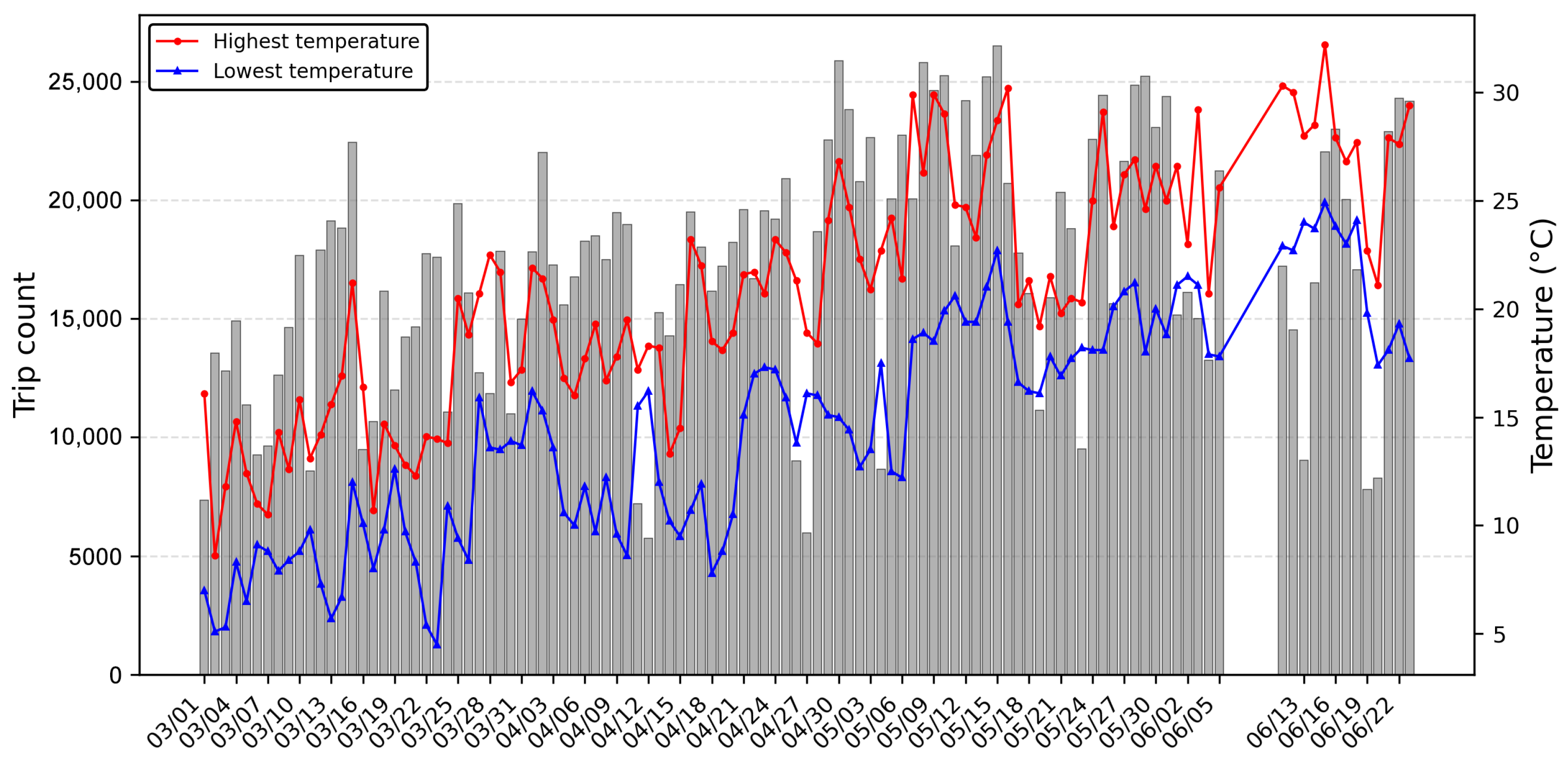
Temperature effects play a fundamental role in shaping e-bike usage patterns. As shown in
Figure 10, a clear positive correlation exists between daily maximum temperatures and trip counts during the study period. The data reveals that e-bike usage increases progressively as temperatures rise from the cooler spring months (March–April) to warmer late spring and early summer (May–June). Peak usage days consistently coincide with temperature ranges between 20–28 °C. However, the relationship appears non-linear, with usage potentially plateauing or declining slightly during periods of extreme heat (>30 °C).
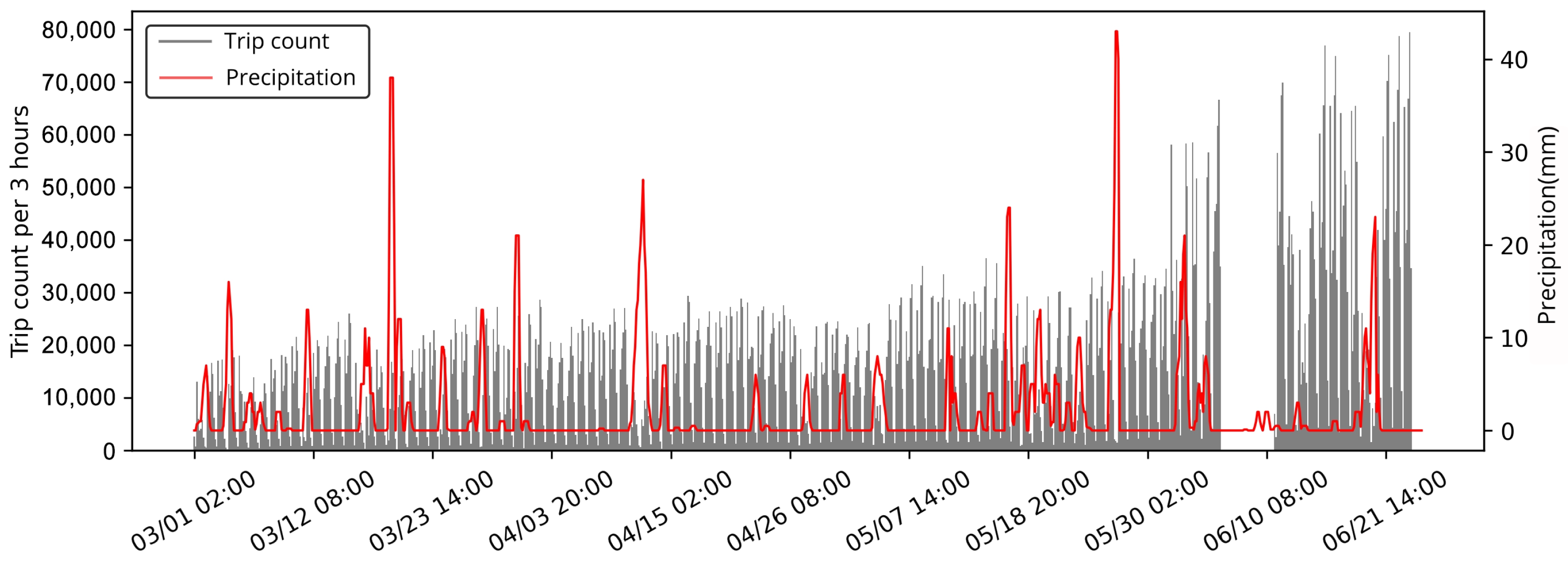
Precipitation effects demonstrate an even more pronounced influence on e-bike usage behavior. As revealed by the strong inverse relationship in
Figure 11, even moderate precipitation events (10–20 mm per 3-h period) correspond to immediate and substantial reductions in e-bike ridership compared to dry conditions. Heavy rainfall events (>30 mm) virtually eliminate e-bike usage, with trip counts approaching zero during the most intense precipitation periods.
The combined analysis of temperature and precipitation effects highlights the critical importance of favorable weather conditions for maintaining high levels of e-bike ridership. Optimal usage periods occur during warm, dry weather windows, particularly in late spring and early summer when temperatures are moderate and precipitation is minimal. Shared e-bike systems exhibit significant weather sensitivity, with demand fluctuating substantially based on short-term meteorological conditions.
5. Experimental Study: Spatio-Temporal Demand Forecasting
This section aims to develop and evaluate forecasting models that can effectively predict the hourly demand for shared e-bikes within the study area. Critically, the model specification is directly grounded in the empirical patterns identified in the descriptive analysis: the distinct bimodal commuting peaks dictate the inclusion of explicit daily seasonality terms, while the verified sensitivity to rainfall and temperature justifies the integration of exogenous meteorological regressors. Accordingly, the SARIMAX framework is adopted as the primary framework to mathematically capture these specific temporal dynamics and external influences. The experimental study proceeds by first characterizing the time-series behavior of the grid-based trip counts, followed by the implementation of statistical models to quantify hourly demand variations. Finally, comparative experiments are conducted to examine how differencing orders affect predictive stability and performance across different spatial cells.
5.1. Data Preparation and Spatio-Temporal Panel Construction
The analysis utilizes utilizes trip records from Brand 2, a major e-bike operator, covering Ningbo’s main urban districts from 1 March to 23 June 2021. The choice of Brand 2 is motivated by its status as a nationwide provider, which offers the optimal balance of data continuity and operational stability. As an established operator, Brand 2 adheres to standardized industry protocols, ensuring that our forecasting framework captures robust and generalizable demand dynamics. Regarding the temporal dimension, the selected three-month window encompasses 13 complete weekly cycles. With observations aggregated at an hourly level, this duration provides a robust sample size to capture the daily and weekly seasonality required for short-term forecasting. Furthermore, this focused time frame minimizes the influence of outdated patterns, ensuring the model reflects current operational conditions rather than obsolete historical trends. To ensure data quality, observations outside the designated geographic bounding of Ningbo’s main urban area were excluded.
The distinct spatial heterogeneity observed in
Section 4 necessitates a grid-based modeling approach rather than a global model, ensuring that functional-zone specific dynamics are captured. The study region therefore was spatially discretized using the H3 hexagonal indexing system at resolution 7 (with an average cell area of approximately 5.16 km
2). The choice of a hexagonal grid over traditional square rasters offers several advantages. Firstly, hexagons provide isotropic adjacency, with each cell having six equidistant neighbors, which reduces directional bias in modeling flow patterns. Secondly, they ensure uniform cell shapes and areas across the study region, improving the comparability of demand intensities between cells. Finally, the H3 system supports efficient spatial indexing and aggregation operations, features critical for city-scale demand modeling.
Regarding the specific resolution level, a trade-off analysis guided our selection: while finer resolutions (e.g., Res 8 or 9) offer higher granularity, they introduce excessive data sparsity and noise, making time-series modeling unstable; conversely, coarser resolutions (e.g., Res 6) tend to obscure critical intra-urban demand variations by smoothing out local hotspots. Resolution 7 strikes an optimal balance by capturing neighborhood-level heterogeneity while maintaining sufficient data density for robust prediction. Operationally, this scale aligns well with service sectors used for fleet management, making the forecasts directly actionable for tasks such as regional bike rebalancing and inventory allocation.
A robust processing pipeline was implemented to map each trip to its corresponding H3 cell and aggregate counts at an hourly level. For each cell
h at hour
t, the demand
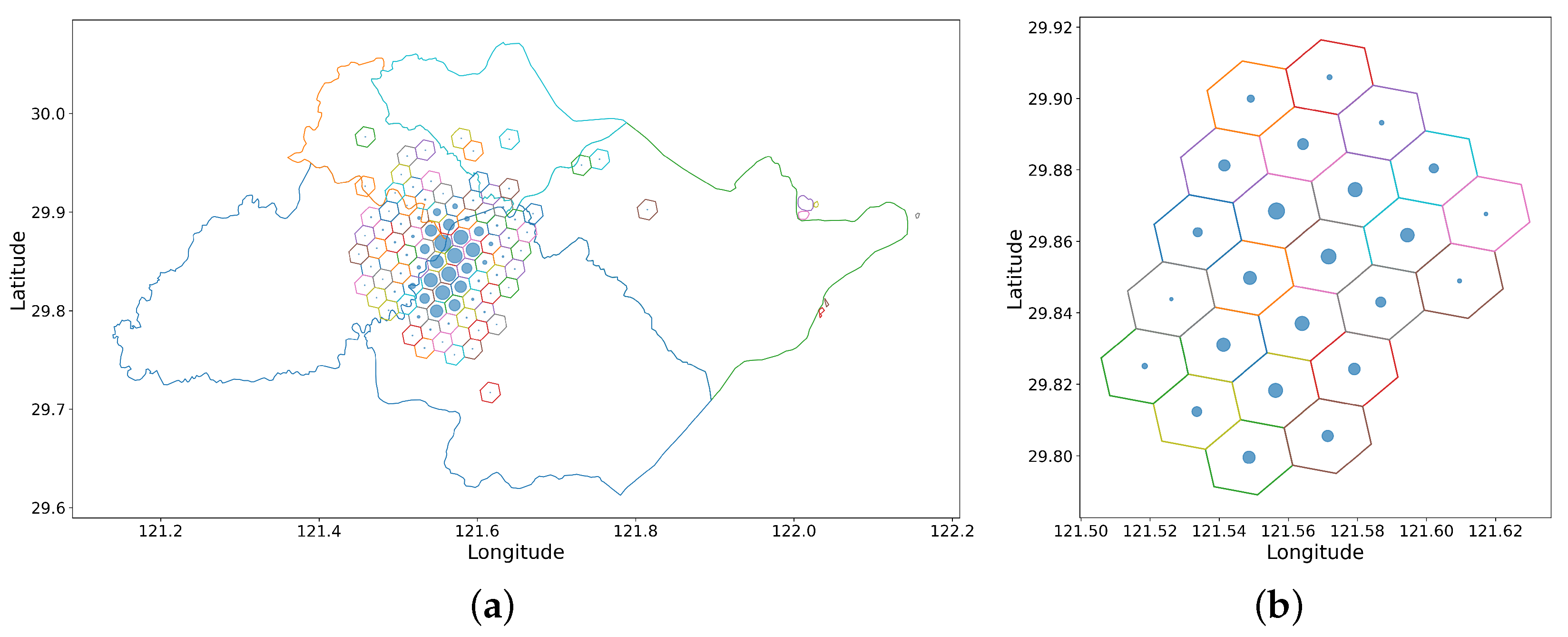
was calculated as the number of trips originating within that cell during that hour. This initial aggregation yielded a sparse panel comprising 92 unique cells. To ensure reliable time-series modeling, a filtering criterion was applied to exclude cells with insufficient temporal activity. Consequently, cells with a total demand exceeding 500 trips were retained. This filtering process resulted in the selection of 24 high-activity cells, as illustrated in
Figure 12, which effectively represent the system’s core dynamics. Statistical analysis confirms that these 24 retained cells account for 99.93% of the total city-wide trip volume. The 68 excluded cells constitute the ’long tail’ of the distribution, contributing only 0.07% of the total demand with negligible temporal coverage. Therefore, the exclusion of these sparse zones does not compromise the model’s ability to capture the city-level mobility patterns.
To improve forecasting accuracy, we enriched the raw demand data with external and temporal features. This process involved three key steps. First, for each of the 24 active cells, we established a continuous hourly demand sequence over the study period. Moreover, environmental indicators are treated as exogenous variables due to the unidirectional causal relationship between weather and e-bike usage—weather influences travel behavior, but aggregate ridership does not affect macro-scale weather. Thus, we incorporated weather conditions by matching each cell’s hourly demand with corresponding data on Temperature, Humidity, and Precipitation. Finally, to capture recurring patterns, we added temporal indicators. We created binary flags for each hour of the day (e.g., a specific flag for the 8.am. hour) and for each day of the week (e.g., a flag for Monday). This allows the model to learn cyclical patterns, such as morning rush hours or weekend usage variations.
The final combined dataset contains 66,240 observations across 24 cells over 2760 hourly timesteps. For model evaluation, the dataset was partitioned into training and testing sets. The training set, with 52,992 observations, covers the period from 1 March to 23 May 2021. The testing set, comprising 13,248 observations, spans the subsequent period from 1 June to 23 June 2021 (except 6 June to 10 June). This temporal split ensures that model performance is assessed on unseen, future data, and a check confirmed no missing or duplicated keys between the two subsets, guaranteeing data consistency.
5.2. SARIMAX Model Specification and Experimental Setup
This section details the experimental framework for spatio-temporal demand forecasting. We first specify the chosen SARIMAX model, including its mathematical formulation and the specific configurations used to test the effect of differencing. Subsequently, we outline the comprehensive evaluation protocol, which encompasses the data partitioning strategy, the selection of performance metrics, the definition of a benchmark baseline, and the robust fitting strategy designed to ensure reliable model estimation across all spatial cells.
5.2.1. Model Formulation and Configuration
To forecast the spatio-temporal demand for shared e-bikes, we employ the a SARIMAX model. This model is particularly well-suited for our study as it simultaneously captures three critical aspects of the demand series: (i) short-term temporal autocorrelation, (ii) strong seasonality, and (iii) the influence of external factors. Given the pronounced sensitivity of ridership to weather conditions, as demonstrated in
Section 4.3, we formally incorporate these environmental factors as exogenous variables. By integrating these regressors, the SARIMAX model allows us to quantify the impact of the covariates constructed in
Section 5.1, thereby enhancing forecasting accuracy beyond what is achievable with univariate time series models.
We adopt a SARIMAX model following the standard formulation in [
61]. For each of the 24 active grid cells, a SARIMAX
model was independently fitted to its hourly demand series. The general mathematical formulation of the model is:
where
is the demand at time
t,
B is the backshift operator;
is noise;
and
are the non-seasonal Autoregressive (AR) and Moving Average (MA) polynomials;
and
are the seasonal AR and MA polynomials with a seasonal period
(hours);
and
are the differencing operators for stationarity; and
represents the regression component with
as the vector of exogenous features (temperature, humidity, precipitation, and temporal dummies) and
as the corresponding coefficient vector.
To investigate the effect of differencing on model performance, we compared three distinct model configurations under identical exogenous regressors:
This experimental design allows us to assess the necessity of non-seasonal
and seasonal
differencing for achieving stationarity and optimal predictive power.
5.2.2. Evaluation Protocol and Robust Fitting Strategy
A rigorous evaluation protocol was established to ensure a fair and reliable comparison of the model configurations. The dataset for each cell was temporally partitioned into the training set and the testing set. Models were trained exclusively on the training data and subsequently used to generate one-step-ahead rolling forecasts over the testing period, thereby preserving temporal causality. Model performance was quantified using three complementary metrics [
61]:
Specifically, Mean absolute error (MAE) provides a robust, explainable measure of average forecast error and is less sensitive to outliers, making it our primary metric for accuracy. Root mean squared error (RMSE) penalizes large errors more heavily, serving as an auxiliary indicator of model performance during demand peaks. It serves as an auxiliary indicator that reflects operational risk sensitivity. Symmetric MAPE (sMAPE) is scale-independent, facilitating performance comparison across cells with varying demand magnitudes.
To contextualize model performance, a seasonal naive baseline was established as a benchmark. This baseline assumes that the demand for a given hour is identical to the observed demand from the same hour on the previous day. Furthermore, it provides a meaningful reference point, as short-term bike demand exhibits strong diurnal periodicity. The baseline is formally defined as:
The relative improvement of our proposed models over this baseline was then calculated for each evaluation metric
as follows:
A positive improvement value indicates that the SARIMAX model outperforms the seasonal baseline, whereas a negative value would indicate a deterioration in performance. This comprehensive evaluation framework allows for a multi-faceted assessment of the models’ practical utility.
Given the heterogeneity across the 24 time series, a robust fitting strategy was crucial. All models were estimated using maximum likelihood estimation with an iteration limit of 150. To ensure robust fitting across all cells, an automatic fallback mechanism was implemented. Models that failed to converge or produced non-invertible parameters were automatically re-fitted using a simplified configuration. Cells for which all fitting attempts failed were excluded from the comparative analysis. This strategy significantly improved the convergence rate and ensured the consistency and reliability of our evaluation across all spatial cells.
5.3. Analysis of Forecasting Performance and Model Behavior
This section presents a comprehensive evaluation of the three SARIMAX configurations. Our analysis focuses on three key aspects: identifying the optimal model configuration, quantifying the practical improvement over a naive benchmark, and interpreting the characteristic forecasting behavior of the models. The findings reveal a clear best-performing model and provide insights into the trade-offs between accuracy, stability, and responsiveness inherent in time-series forecasting.
5.3.1. Comparative Performance of Model Configurations
As summarized in
Table 3, the comparative analysis identifies the non-differenced SARIMAX
configuration as the unequivocal superior performer. More importantly, the performance hierarchy reveals a critical insight regarding the data structure: introducing first-order differencing (SARIMAX
) led to a consistent degradation, while second-order differencing proved catastrophic, with key metrics nearly doubling. This severe degradation highlights that the demand series is fundamentally driven by a stable daily rhythm. Applying differencing was counterproductive in this case; rather than improving the data, it destroyed the critical daily patterns needed for prediction, leaving the model with insufficient information to forecast accurately.
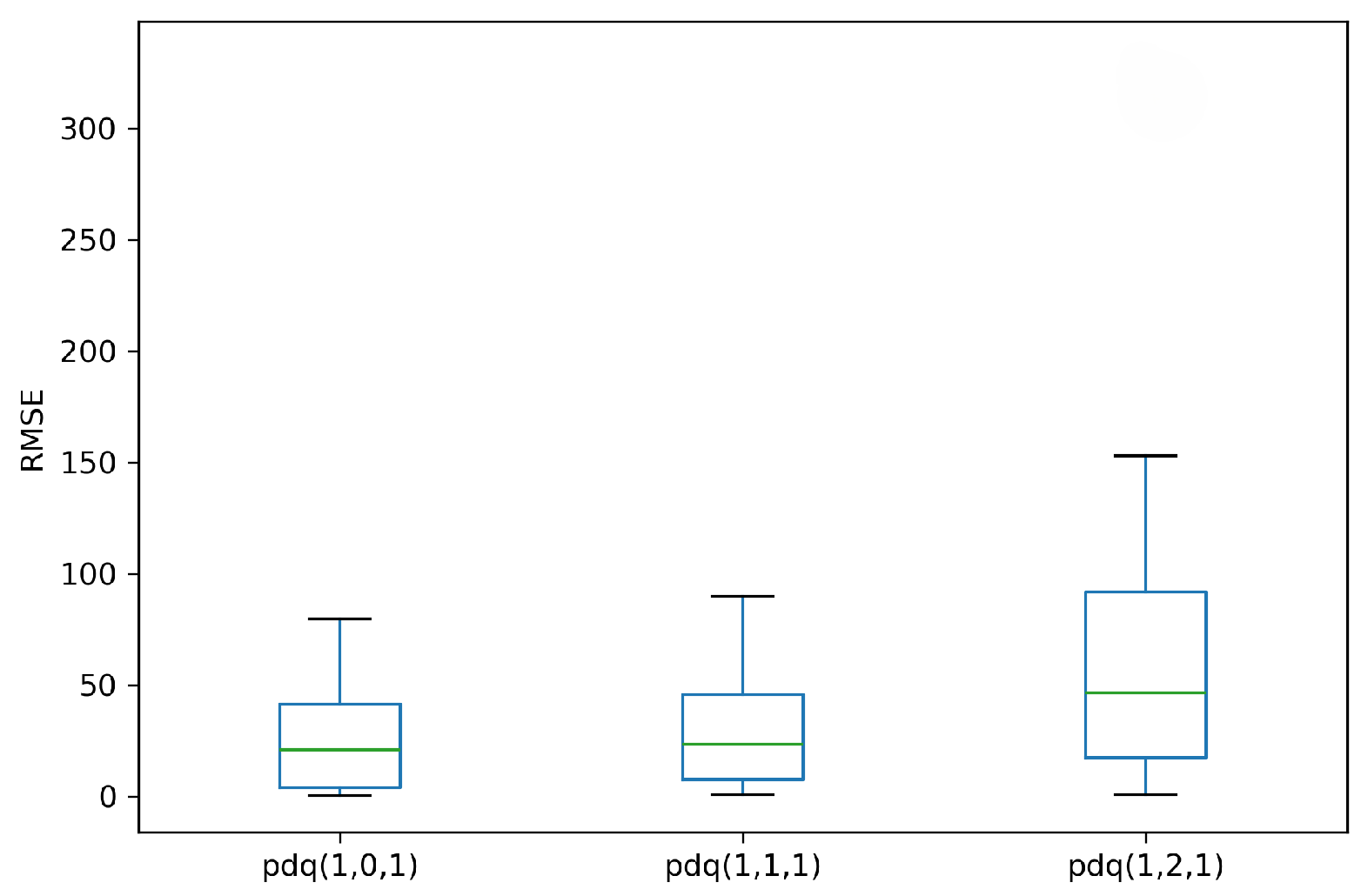
The superiority of the non-differenced model is further corroborated by the distribution of its errors across spatial cells. As illustrated in
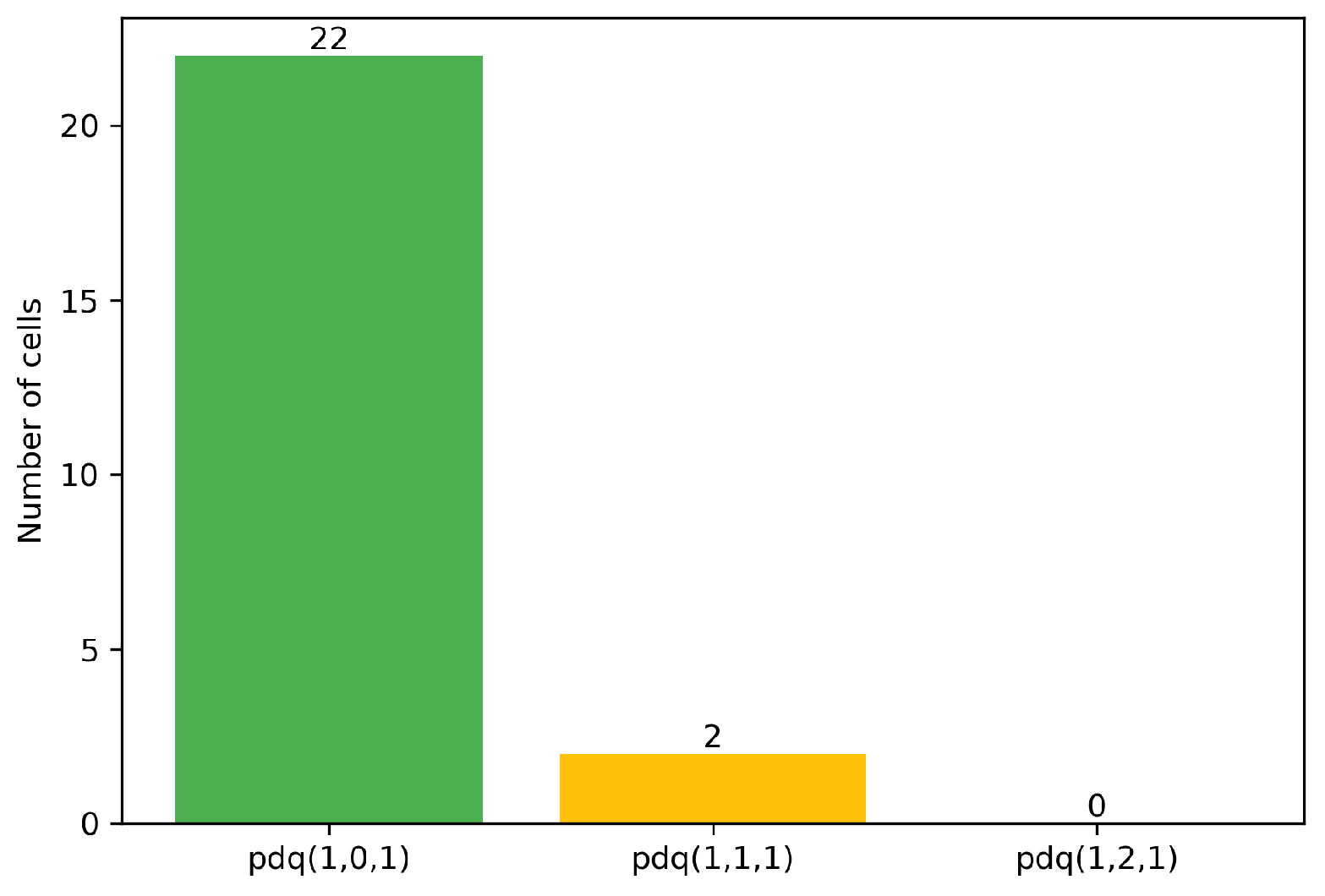
Figure 13, the non-differenced configuration demonstrates a more compact and consistent error distribution. This pattern signifies not only higher average accuracy but, more importantly, greater spatial reliability. This spatial robustness is a critical attribute for a forecasting model intended for city-wide deployment, as it ensures consistent performance without the need for cell-specific adjustments. This finding is further reinforced by the spatial dominance illustrated in
Figure 14, where the non-differenced model achieved the lowest RMSE in 22 out of 24 spatial cells, covering nearly 90% of the heterogeneous study area. This overwhelming spatial performance demonstrates the structural robustness of the selected configuration, suggesting that despite spatial heterogeneity in demand magnitude, the underlying temporal dynamics (e.g., autocorrelation and seasonality) are sufficiently consistent across the city to be captured by a unified model specification, without the need for determining cell-specific differencing orders.
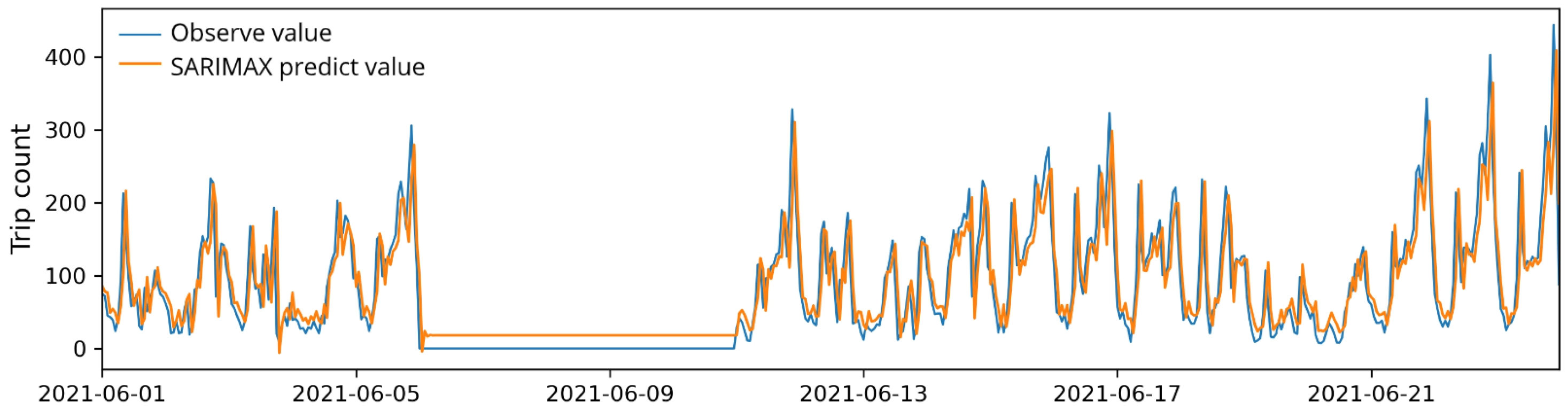
To illustrate the model’s behavioral fidelity, Figure As illustrated in
Figure 15, the model visually demonstrates a strong ability to capture the dominant diurnal rhythm, aligning closely with the timing of evening peaks and early morning troughs. A notable characteristic is the systematic underestimation of peak amplitudes. This deviation is a direct consequence of the model’s linear structure, which, by its nature, tends to smooth out high-frequency fluctuations. Consequently, the forecast line exhibits a regularized appearance compared to the sharper fluctuations of the observed data. This behavior, while potentially reducing sensitivity to random noise, also reflects the inherent limitation of the linear framework in capturing abrupt surges.
5.3.2. Quantitative Improvement over a Seasonal Baseline
To assess the practical utility of the best-performing model, its accuracy computed using Equation (
6) was benchmarked against a seasonal naive baseline. The results, summarized in
Table 4, demonstrate a clear and consistent improvement across all evaluation metrics. On average, the SARIMAX model achieved a 14.2% reduction in MAE and an 18.5% reduction in RMSE. The higher improvement in RMSE is particularly noteworthy, as it indicates the model is especially effective at reducing large forecasting errors, which is critical for managing operational risks during demand peaks. The close proximity of the mean (11.3%) and median (9.4%) sMAPE improvements confirms that these gains are consistent and widespread across cells of varying demand magnitudes, validating the model’s robustness.
5.3.3. Interpretability and Analysis of Demand Factors
Having established the model’s spatial robustness and predictive performance, we now leverage the transparency of our SARIMAX framework. Unlike black-box models, SARIMAX allows us to quantify the marginal impact of exogenous factors. To demonstrate this, we extracted coefficients from a representative high-demand grid cell (
Table 5), which reveals a distinct hierarchy of factors influencing urban mobility.
The results highlight the dominance of temporal rigidities in commuting behavior. The morning (08:00) and evening (18:00) peak hours exhibit disproportionately large, highly significant positive coefficients (). This confirms that the time-of-day is not merely a correlate but the primary determinant of ridership, overwhelming other stochastic factors. In terms of environmental sensitivity, the model identifies temperature as a linear accelerator, where a increase yields approximately 3 additional trips. Conversely, the statistical insignificance of precipitation () in this high-density node offers a counter-intuitive insight: core commuting demand appears inelastic to adverse weather. We attribute this finding to the specific nature of commuting and the spatial characteristics of the study area. First, these high-density nodes likely serve as major employment centers where trips are driven by ‘necessity’ rather than leisure, implying that users have rigid schedules and fixed arrival requirements. Second, trip distances within these dense urban cores are often relatively short. This reduction in travel distance lowers the marginal ‘discomfort cost’ of enduring light rain, leading commuters to prioritize the efficiency of e-bikes over switching to alternative modes of transport for the final leg of their journey.
In conclusion, the SARIMAX model serves a dual purpose: it validates that demand is fundamentally governed by strong, regular temporal cycles, and it provides a transparent quantification of how environmental variables modulate this baseline. This interpretability is critical for operators, as it moves beyond simple prediction to inform strategic decisions regarding fleet allocation and infrastructure planning.
6. Managerial Implications and Sustainable Decision Framework
The empirical findings of this study translate into a structured decision-support framework for shared e-bike operators and urban planners. By bridging the gap between descriptive spatial analytics and interpretable demand forecasting, we propose a transition from experience-based management to a data-driven, rule-based operational protocol. To operationalize this framework effectively, we outline a practical roadmap that categorizes managerial actions into short-term (daily operations), medium-term (fleet planning), and long-term (infrastructure and regulation) horizons.Furthermore, to demonstrate the broader relevance of this approach, we conclude by discussing the framework’s applicability and adaptability to diverse urban contexts.
6.1. Short-Term Actions: Rule-Based Daily Operations
In the short term, the transparency of the SARIMAX framework allows for real-time, rule-based decision-making regarding daily fleet deployment and workforce scheduling. A key advantage of the SARIMAX framework is its transparency, which allows operational decisions to be guided by clear, quantified determinants rather than black-box algorithms. By explicitly estimating the coefficients of exogenous variables, the model provides operators with insight into exactly how environmental factors influence demand.
Regarding environmental adaptation, the model’s calculated sensitivity to precipitation or temperature variations offers a quantitative basis for routine fleet deployment adjustments. By incorporating these specific coefficients into planning protocols, managers can proportionally scale down fleet inventory before adverse weather conditions occur. This proactive adjustment prevents the over-supply of e-bikes that would otherwise remain idle and exposed to damage, thereby directly optimizing maintenance costs and asset utilization.
In terms of temporal regularity, the model’s accurate hourly-ahead predictions support a shift from reactive to data-driven scheduling. The experimental results confirm a rigid commuting structure and distinct off-peak windows. Operators can leverage this predictability to better coordinate fleet logistics and workforce deployment. Specifically, e-bikes can be proactively positioned in residential zones prior to the morning rush and reallocated to commercial districts ahead of the evening peak, while battery-swapping teams are deployed specifically during these anticipated high-load periods. Additionally, the identified “midday lull” serves as the optimal window for trunk-based rebalancing, minimizing truck mileage in congested traffic.
Furthermore, the model produces a stable forecast that can anchor a “management-by-exception” strategy. Since routine operational decisions can reliably follow the model’s baseline expectations, managers can reserve their attention for handling unusual events—such as abrupt weather shifts or localized disruptions. This improves the system’s resilience and responsiveness without increasing the complexity of day-to-day management.
From a technical implementation standpoint, the proposed framework is designed to ensure computational efficiency for daily use. By treating each cell as an independent task, the model supports parallel processing, allowing simultaneous updates across hundreds of units. Furthermore, the SARIMAX architecture maintains low computational requirements, ensuring that day-ahead forecasting workflows remain executable on standard server hardware. This accessibility is critical for enabling operators in mega-cities to adopt these short-term strategies without requiring specialized high-performance infrastructure.
6.2. Medium-Term Actions: Fleet Planning via High-Resolution Spatial Grids
Transitioning to a medium-term horizon, the adoption of the H3 hexagonal grid system enables a shift towards precision governance, where strategic fleet planning and resource allocation are tailored to the specific demand intensity of localized cells. Traditional management based on broad administrative districts carries the risk of overlooking critical local variations in ridership. To address this limitation, the adoption of the H3 hexagonal grid system enables a shift towards precision governance, where operational decisions are tailored to the specific demand intensity of localized cells. First, the pronounced variation across cells suggests the need for a tiered resource allocation strategy. Cells characterized by consistently high demand should be prioritized for denser provision of geo-fenced parking areas, maintenance capacity, and battery-swapping infrastructure. In contrast, low-intensity residential zones can adopt lighter operational footprints to improve cost efficiency. This medium-term planning ensures that capital expenditure is aligned with the spatial heterogeneity of demand revealed by the forecasting model.
6.3. Long-Term Actions: Infrastructure, Regulation, and Sustainability
In the long term, the findings provide a robust evidence base for city authorities to justify targeted infrastructure investments and to formulate differentiated regulatory policies. From a policy perspective, the spatial findings support the implementation of regulations that are tailored to specific urban contexts. The data justifies strict parking enforcement in congested commercial centers to prevent sidewalk clutter, while suggesting that more flexible policies—such as “virtual docks”—are appropriate for residential areas. This evidence-based differentiation ensures that long-term regulations align with actual usage patterns, resolving the tension between maintaining urban order and ensuring accessibility. Furthermore, by quantifying how environmental and temporal factors influence demand, authorities can justify targeted infrastructure investments—such as allocating dedicated parking areas in high-demand nodes—and move toward proactive, rather than reactive, regulatory strategies.
Finally, this framework aligns with broader sustainability goals. Regarding SDG 13, shared e-bikes inherently function as a low-carbon mobility mode; therefore, improving service quality through accurate forecasting amplifies this intrinsic benefit by fostering wider adoption. Beyond this primary impact, the findings highlight that the system’s total environmental performance depends not only on the e-bikes themselves but also on the efficiency of the logistics processes supporting them. By reducing unnecessary rebalancing mileage through more informed deployment strategies (a short-term tactic with long-term benefits), operators can lower logistics-related emissions. With respect to SDG 11, improved reliability contributes significantly to sustainable cities. Reliable availability of shared e-bikes encourages users to adopt micro-mobility as a viable last-mile transport option, reducing reliance on private cars and ride-hailing services. Consistent with recent research, enhancing reliability also mitigates urban noise and congestion, contributing to more livable urban environments.
6.4. Applicability and Adaptation to Diverse Contexts
While our empirical analysis focuses on a specific metropolitan context, the proposed forecasting and decision-support framework is designed with inherent flexibility. Its applicability extends beyond the immediate study area, spanning three critical dimensions of adaptation: environmental parameters, data granularity, and operational modality.
First, regarding different climates, the model’s structure—specifically its integration of exogenous weather variables—remains valid regardless of climatic conditions. The adaptation process primarily involves recalibrating the coefficients of these variables to reflect local sensitivities. For instance, in cities with severe winters (e.g., Nordic regions), temperature and snowfall would likely exhibit stronger negative elasticities compared to the temperate climate studied here. Conversely, in tropical or arid climates, extreme heat indices might become the dominant constraint. The SARIMAX framework seamlessly accommodates these shifts by simply adjusting the weight of the weather covariates, ensuring the model captures the local “weather envelope.”
Second, in scenarios with lower data availability, the framework can be downscaled without losing its core utility. While our study utilizes high-resolution GPS data for granular spatial analysis, the model can operate effectively on aggregated data levels, such as census tracts or traffic analysis zones, where data is often more readily available. Furthermore, if real-time meteorological data is inaccessible, the seasonal differencing components of the SARIMAX model are robust enough to capture recurring temporal patterns using historical demand alone, though with a likely reduction in short-term precision during anomalous events.
Finally, beyond the specifics of data inputs or local weather, the framework’s core logic is applicable to fundamentally different operational models, such as dock-based systems. Although our study utilizes a free-floating model, the fundamental temporal dynamics identified—such as rigid commuting peaks and the “midday lull”—reflect underlying human mobility behavior rather than specific system design. The primary adaptation required is spatial: shifting the unit of analysis from flexible hexagonal grids to fixed station IDs. This allows operators to apply the same SARIMAX forecasts, albeit with an added layer of capacity constraints. In a dock-based context, the demand forecasts would be integrated with a real-time inventory tracking module to prevent station overflow or understock, thereby combining the model’s predictive accuracy with the physical necessities of docking infrastructure.
7. Conclusions
This study demonstrates a comprehensive data-driven analysis and forecasting shared e-bike demand, directly contributing to the advancement of sustainable urban mobility. By integrating granular spatiotemporal pattern analysis with an interpretable statistical forecasting model, we bridge the gap between understanding historical behavior and anticipating future needs, providing actionable insights for both operators and city planners.
Our research reveals a fundamental synergy between descriptive granularity and predictive interpretability. The initial analysis, grounded in integrated multi-brand data and a high-resolution H3 spatial grid, established that shared e-bike demand is governed by rigid spatiotemporal structures. The subsequent SARIMAX model successfully captured these dynamics, achieving a 14.2% improvement in MAE. Crucially, the model demonstrated structural transparency by explicitly quantifying the marginal effects of environmental and temporal factors. This confirms that the identified patterns are not merely descriptive but are predictable, causal factors suitable for rule-based management.
These findings have direct implications for the SDGs. By enabling a transition from reactive management to predictive, rule-based operations, our framework directly advances the objectives of SDG 11 and SDG 13. Ultimately, this research bridges the gap between technical forecasting and sustainable governance, providing the essential quantitative foundation required to engineer more reliable, energy-efficient, and resilient urban mobility systems.
Nevertheless, this study is subject to certain limitations, which also illuminate the path forward. First, regarding the model structure, the current framework treats each spatial cell as an independent time series, thereby omitting potential spatial spillovers and inter-cell dependencies. Furthermore, the inherent linearity of the model constrains its ability to handle abrupt, event-driven surges, leading to systematic underestimation of peak demand during high-impact events. To address these structural constraints, future research could explore non-linear, hybrid threshold-based, or spatio-temporal graph neural networks. While such approaches might trade off some interpretability, they are inherently better suited to assimilate complex neighborhood interactions and regime switches, such as those induced by public holidays. Second, the empirical analysis is confined to a single metropolitan area. Consequently, future efforts should focus on validating and adapting this framework across multiple cities with diverse urban forms. This would not only enhance the model’s generalization capabilities but also help distinguish universal mobility dynamics from city-specific patterns.
In summary, this research successfully translates raw shared e-bike data into a robust, interpretable, and actionable decision-support tool. It underscores the power of combining descriptive analytics with forecasting to create efficient and sustainable urban mobility systems, providing a clear pathway for both industrial application and policy innovation in the pursuit of the SDGs.
Author Contributions
Conceptualization, H.J.; methodology, M.M.; software, M.M.; validation, M.M.; formal analysis, M.M., H.J. and C.L.; investigation, M.M.; resources, H.J.; data curation, H.J. and M.M.; writing—original draft preparation, M.M.; writing—review and editing, M.M.; visualization, M.M.; supervision, H.J.; project administration, H.J.; funding acquisition, H.J. and C.L. All authors have read and agreed to the published version of the manuscript.
Funding
The work is supported by Ningbo Municipal Bureau of Science and Technology (Project ID: 2024S057), Ningbo Municipal Bureau of Science and Technology (Project ID: 2022Z217).
Data Availability Statement
Due to a confidentiality agreement with the data provider, the data used in this study cannot be made publicly available. Interested researchers may contact the corresponding author for inquiries, but data sharing is subject to the original agreement terms.
Acknowledgments
During the preparation of this manuscript, the authors used ChatGPT-5 and GLM-4.6 for the purposes of language polishing and editing. The authors have reviewed and edited the output and take full responsibility for the content of this publication.
Conflicts of Interest
The funders had no role in the design of the study; in the collection, analyses, or interpretation of data; in the writing of the manuscript; or in the decision to publish the results.
Abbreviations
The following abbreviations are used in this manuscript:
| SDG | United Nations Sustainable Development Goals |
| SARIMAX | Seasonal Autoregressive Integrated Moving Average with eXogenous variables |
| H3 | High-resolution Hexagonal Grid |
References
- Goal 11: Sustainable Cities and Communities; United Nations Sustainable Development; United Nations: New York, NY, USA, 2025.
- Goal 13: Climate Action; United Nations Sustainable Development; United Nations: New York, NY, USA; United Nations, 2025.
- Department for Transport. Future of Mobility: Urban Strategy; Technical Report; Department for Transport, United Kingdom: London, UK, 2019. [Google Scholar]
- International Transport Forum (ITF/OECD). Micromobility, Equity and Sustainability; Technical report; OECD Publishing: Paris, France, 2020. [Google Scholar]
- Chen, Z.; van Lierop, D.; Ettema, D. Dockless bike-sharing’s impact on mode substitution and greenhouse gas emissions. J. Transp. Land Use 2022, 15, 799–820. [Google Scholar] [CrossRef]
- Sun, S.; Ertz, M. Can shared micromobility programs reduce greenhouse gas emissions: Evidence from urban transportation big data. Sustain. Cities Soc. 2022, 85, 104045. [Google Scholar] [CrossRef]
- Kou, Z.; Wang, X.; Chiu, S.F.; Cai, H. Quantifying greenhouse gas emissions reduction from bike share systems: A model considering real-world trips and transportation mode choice patterns. Resour. Conserv. Recycl. 2020, 153, 104534. [Google Scholar] [CrossRef]
- Li, A.; Gao, K.; Zhao, P.; Qu, X.; Axhausen, K.W. High-resolution assessment of environmental benefits of dockless bike-sharing systems based on transaction data. J. Clean. Prod. 2021, 296, 126423. [Google Scholar] [CrossRef]
- Danilevičius, A.; Karpenko, M.; Křivánek, V. Research on the noise pollution from different vehicle categories in the urban area. Transport 2023, 38, 1–11. [Google Scholar] [CrossRef]
- Karpenko, M.; Prentkovskis, O.; Skačkauskas, P. Analysing the impact of electric kick-scooters on drivers: Vibration and frequency transmission during the ride on different types of urban pavements. Eksploat. Niezawodn.–Maint. Reliab. 2025, 27, 1–14. [Google Scholar] [CrossRef]
- Chen, Z.; van Lierop, D.; Ettema, D. Dockless bike-sharing systems: What are the implications? Transp. Rev. 2020, 40, 333–353. [Google Scholar] [CrossRef]
- Orvin, M.M.; Fatmi, M.R. Why individuals choose dockless bike sharing services? Travel Behav. Soc. 2021, 22, 199–206. [Google Scholar] [CrossRef]
- NACTO. Shared Micromobility in the U.S. and Canada: 2022 Snapshot; Technical report; NACTO: New York, NY, USA, 2023. [Google Scholar]
- NACTO. Shared Micromobility Report 2023; Technical report; NACTO: New York, NY, USA, 2024. [Google Scholar]
- NACTO. Shared Micromobility Trips Taken in the U.S. and Canada: 2023 Snapshot; Technical report; NACTO: New York, NY, USA, 2024. [Google Scholar]
- Shi, J.g.; Si, H.; Wu, G.; Su, Y.; Lan, J. Critical factors to achieve dockless bike-sharing sustainability in China: A stakeholder-oriented network perspective. Sustainability 2018, 10, 2090. [Google Scholar] [CrossRef]
- Chang, S.; Song, R.; He, S.; Qiu, G. Innovative Bike-Sharing in China: Solving Faulty Bike-Sharing Recycling Problem. J. Adv. Transp. 2018, 2018, 4941029. [Google Scholar] [CrossRef]
- Chang, A.Y.; Wang, X.; Sharafi, M.; Miranda-Moreno, L.; Sun, L. Headwind or tailwind? The evolution of bike-sharing and ride-hailing demand during the COVID-19 pandemic. J. Transp. Geogr. 2024, 118, 103944. [Google Scholar] [CrossRef]
- Bao, J.; He, T.; Ruan, S.; Li, Y.; Zheng, Y. Planning bike lanes based on sharing-bikes’ trajectories. Transp. Res. Part C Emerg. Technol. 2017, 107, 61–72. [Google Scholar] [CrossRef]
- Yu, L.; Feng, T.; Li, T.; Cheng, L. Demand Prediction and Optimal Allocation of Shared Bikes Around Urban Rail Transit Stations. Urban Rail Transit 2022, 8, 370–384. [Google Scholar] [CrossRef] [PubMed]
- Liang, Y.; Huang, G.; Zhao, Z. Bike Sharing Demand Prediction based on Knowledge Sharing across Modes: A Graph-based Deep Learning Approach. arXiv 2022, arXiv:2203.10961. [Google Scholar] [CrossRef]
- Xing, X.; Wan, L.; Luo, F. Demand prediction for shared bicycles around metro stations incorporating STAGCN. PLoS ONE 2025, 20, e0328452. [Google Scholar] [CrossRef]
- Sun, H.; Yang, G.; Liu, R. Dynamic Demand Forecasting for Bike-Sharing E-Fences Using a Hybrid Deep Learning Framework with Spatio-Temporal Attention. Sustainability 2025, 17, 7586. [Google Scholar]
- Li, X.; Xu, Y.; Zhang, X.; Shi, W.; Yue, Y.; Li, Q. Improving short-term bike sharing demand forecast through an irregular convolutional neural network. Transp. Res. Part C Emerg. Technol. 2023, 146, 103986. [Google Scholar] [CrossRef]
- Ma, X.; Yin, Y.; Jin, Y.; He, M.; Zhu, M. Short-Term Prediction of Bike-Sharing Demand Using Multi-Source Data: A Spatial-Temporal Graph Attentional LSTM Approach. Appl. Sci. 2022, 12, 1161. [Google Scholar] [CrossRef]
- Mooney, S.J.; Hosford, K.; Howe, B.; Yan, A.; Winters, M.; Bassok, A.; Hirsch, J.A. Freedom from the station: Spatial equity in access to dockless bike share. J. Transp. Geogr. 2019, 74, 91–96. [Google Scholar] [CrossRef]
- Xu, Y.; Chen, D.; Zhang, X.; Tu, W.; Chen, Y.; Shen, Y.; Ratti, C. Unravel the landscape and pulses of cycling activities from a dockless bike-sharing system. Comput. Environ. Urban Syst. 2019, 75, 184–203. [Google Scholar] [CrossRef]
- Pucher, J.; Buehler, R. Integrating bicyling and public transport in North America. J. Public Transp. 2009, 12, 79–104. [Google Scholar] [CrossRef]
- Li, C.; Xiao, W.; Zhang, D.; Ji, Q. Low-carbon transformation of cities: Understanding the demand for dockless bike sharing in China. Energy Policy 2021, 159, 112631. [Google Scholar] [CrossRef]
- Chen, W.; Liu, Q.; Zhang, C.; Mi, Z.; Zhu, D.; Liu, G. Characterizing the stocks, flows, and carbon impact of dockless sharing bikes in China. Resour. Conserv. Recycl. 2020, 162, 105038. [Google Scholar] [CrossRef]
- Wang, J.; Huang, J.; Dunford, M. Rethinking the Utility of Public Bicycles: The Development and Challenges of Station-Less Bike Sharing in China. Sustainability 2019, 11, 1539. [Google Scholar] [CrossRef]
- Rose, G. E-bikes and urban transportation: Emerging issues and unresolved questions. Transportation 2012, 39, 81–96. [Google Scholar] [CrossRef]
- Zhu, S. Optimal Fleet Deployment Strategy: Model the Effect of Shared E-Bikes on Bike-Sharing System. J. Adv. Transp. 2021, 2021, 6678637. [Google Scholar] [CrossRef]
- MacArthur, J.; Dill, J.; Person, M. Electric bikes in North America: Results of an online survey. Transp. Res. Rec. 2014, 2468, 123–130. [Google Scholar] [CrossRef]
- Zhang, L.; Zhang, J.; yu Duan, Z.; Bryde, D. Sustainable bike-sharing systems: Characteristics and commonalities across cases in urban China. J. Clean. Prod. 2015, 97, 124–133. [Google Scholar] [CrossRef]
- Ji, S.; Cherry, C.R.; Han, L.D.; Jordan, D.A. Electric bike sharing: Simulation of user demand and system availability. J. Clean. Prod. 2014, 85, 250–257. [Google Scholar] [CrossRef]
- Dill, J.; Rose, G. Electric Bikes and Transportation Policy: Insights from Early Adopters. Transp. Res. Rec. 2012, 2314, 1–6. [Google Scholar] [CrossRef]
- Contò, C.; Bianchi, N. E-Bike Motor Drive: A Review of Configurations and Capabilities. Energies 2022, 16, 160. [Google Scholar] [CrossRef]
- Hu, L.; Hu, X.; Wang, J.; Kuang, A.; Hao, W.; Lin, M. Casualty risk of e-bike rider struck by passenger vehicle using China in-depth accident data. Traffic Inj. Prev. 2020, 21, 283–287. [Google Scholar] [CrossRef] [PubMed]
- Li, R.; Krishna Sinniah, G.; Li, X. The factors influencing resident’s intentions on e-bike sharing usage in China. Sustainability 2022, 14, 5013. [Google Scholar] [CrossRef]
- Bieliński, T.; Dopierała, Ł; Tarkowski, M.; Ważna, A. Lessons from Implementing a Metropolitan Electric Bike Sharing System. Energies 2020, 13, 6240. [Google Scholar] [CrossRef]
- Ma, Y.; Lan, J.; Thornton, T.; Mangalagiu, D.; Zhu, D. Challenges of collaborative governance in the sharing economy: The case of free-floating bike sharing in Shanghai. J. Clean. Prod. 2018, 197, 356–365. [Google Scholar] [CrossRef]
- Sun, Y. Sharing and riding: How the dockless bike sharing scheme in China shapes the city. Urban Sci. 2018, 2, 68. [Google Scholar] [CrossRef]
- Liu, A.; Ji, X.; Xu, L.; Lu, H. Research on the recycling of sharing bikes based on time dynamics series, individual regrets and group efficiency. J. Clean. Prod. 2019, 208, 666–687. [Google Scholar] [CrossRef]
- Shang, W.L.; Chen, Y.; Yu, Q.; Song, X.; Chen, Y.; Ma, X.; Chen, X.; Tan, Z.; Huang, J.; Ochieng, W. Spatio-temporal analysis of carbon footprints for urban public transport systems based on smart card data. Appl. Energy 2023, 352, 121859. [Google Scholar] [CrossRef]
- Shang, W.L.; Chen, J.; Bi, H.; Sui, Y.; Chen, Y.; Yu, H. Impacts of COVID-19 pandemic on user behaviors and environmental benefits of bike sharing: A big-data analysis. Appl. Energy 2021, 285, 116429. [Google Scholar] [CrossRef]
- Box, G.E.P.; Jenkins, G.M.; Reinsel, G.C.; Ljung, G.M. Time Series Analysis: Forecasting and Control, 5th ed.; Wiley: Hoboken, NJ, USA, 2015. [Google Scholar]
- Alghamdi, T.; Elgazzar, K.; Bayoumi, M.; Sharaf, T.; Shah, S. Forecasting traffic congestion using ARIMA modeling. In Proceedings of the 2019 15th International Wireless Communications & Mobile Computing Conference (IWCMC), Tangier, Morocco, 24–28 June 2019; pp. 1227–1232. [Google Scholar]
- Cortez-Ordoñez, A.; Vázquez, P.P.; Sanchez-Espigares, J.A. Scalability evaluation of forecasting methods applied to bicycle sharing systems. Heliyon 2023, 9, e20129. [Google Scholar] [CrossRef]
- Wirtgen, C.; Kowald, M.; Luderschmidt, J.; Hünemohr, H. Multivariate demand forecasting for rental bike systems based on an unobserved component model. Electronics 2022, 11, 4146. [Google Scholar] [CrossRef]
- Kim, T.Y.; Park, M.J.; Shin, J.; Oh, S. Prediction of Bike Share Demand by Machine Learning. Int. J. Bus. Anal. (IJBAN) 2022, 9, 1–16. [Google Scholar] [CrossRef]
- Ergül Aydın, Z.; İçmen Erdem, B.; Erzurum Cıcek, Z.I. Prediction bike-sharing demand with gradient boosting methods. Pamukkale Univ. J. Eng. Sci. 2023, 29, 824–832. [Google Scholar] [CrossRef]
- Shi, Y.; Zhang, L.; Lu, S.; Liu, Q. Short-Term Demand Prediction of Shared Bikes Based on LSTM Network. Electronics 2023, 12, 1381. [Google Scholar] [CrossRef]
- Venkadavarahan, M.; Joji, M.S.; Marisamynathan, S. Development of spatial econometric models for estimating the bicycle sharing trip activity. Sustain. Cities Soc. 2023, 98, 104861. [Google Scholar] [CrossRef]
- Zhou, C.; Hu, J.; Zhang, X.; Li, Z.; Yang, K. A bike-sharing demand prediction model based on Spatio-Temporal Graph Convolutional Networks. PeerJ Comput. Sci. 2024, 10, e2391. [Google Scholar] [CrossRef]
- Yang, D.; Wu, R.; Wang, P.; Li, Y. FF-STGCN: A usage pattern similarity-based dual-network for bike-sharing demand prediction. PLoS ONE 2024, 19, e0298684. [Google Scholar] [CrossRef]
- Torres, J.; Jiménez-Meroño, E.; Soriguera, F. Forecasting the Usage of Bike-Sharing Systems through Machine Learning Techniques to Foster Sustainable Urban Mobility. Sustainability 2024, 16, 6910. [Google Scholar] [CrossRef]
- Hongheiku Data. Ningbo City Population Statistics. 2025. Available online: https://tjgb.hongheiku.com/xjtjgb/xj2020/57318.html (accessed on 27 March 2025).
- Kong, H.; Chao, H.; Fu, W.; Lin, D.; Zhang, Y. Relationship between shared micromobility and public transit: The differences between shared bikes and shared E-bikes. J. Transp. Geogr. 2025, 123, 104149. [Google Scholar] [CrossRef]
- Ningbo Municipal Bureau of Transport. The 14th Five-Year Plan for Comprehensive Transportation Development in Ningbo. 2021. Available online: https://www.cctat.cn/index/shows?catid=52&id=19874 (accessed on 27 March 2025).
- Hyndman, R.J.; Athanasopoulos, G. Forecasting: Principles and Practice; OTexts: Melbourne, Australia, 2018. [Google Scholar]
Figure 1.
Average daily trips of the three e-bike brands in Ningbo during the study period.
Figure 1.
Average daily trips of the three e-bike brands in Ningbo during the study period.
Figure 2.
Distribution of single-trip distances on weekdays and weekends.
Figure 2.
Distribution of single-trip distances on weekdays and weekends.
Figure 3.
Distribution of single-trip duration on weekdays and weekends.
Figure 3.
Distribution of single-trip duration on weekdays and weekends.
Figure 4.
Turnover rates of different shared e-bike brands (uses per bike per day).
Figure 4.
Turnover rates of different shared e-bike brands (uses per bike per day).
Figure 5.
Temporal variation of shared e-bike usage across different months (March–June).
Figure 5.
Temporal variation of shared e-bike usage across different months (March–June).
Figure 6.
Comparison of hourly usage patterns between weekdays and weekends.
Figure 6.
Comparison of hourly usage patterns between weekdays and weekends.
Figure 7.
Temporal patterns of e-bike pick-ups and returns in commercial areas: (a) large-scale vs. (b) distributed complexes.
Figure 7.
Temporal patterns of e-bike pick-ups and returns in commercial areas: (a) large-scale vs. (b) distributed complexes.
Figure 8.
Temporal pattern of shared e-bike usage in office areas.
Figure 8.
Temporal pattern of shared e-bike usage in office areas.
Figure 9.
Temporal pattern of shared e-bike usage in residential areas.
Figure 9.
Temporal pattern of shared e-bike usage in residential areas.
Figure 10.
Daily variations in shared e-bike trip count and temperature conditions (March–June).
Figure 10.
Daily variations in shared e-bike trip count and temperature conditions (March–June).
Figure 11.
Relationship between rainfall intensity and shared e-bike trip count (March–June).
Figure 11.
Relationship between rainfall intensity and shared e-bike trip count (March–June).
Figure 12.
Spatial discretization of the study area using H3 hexagonal grids. (a) The complete grid with 92 cells overlaid on Ningbo’s main urban districts; (b) The 24 high-activity cells selected for modeling, with circle size indicating relative demand density.
Figure 12.
Spatial discretization of the study area using H3 hexagonal grids. (a) The complete grid with 92 cells overlaid on Ningbo’s main urban districts; (b) The 24 high-activity cells selected for modeling, with circle size indicating relative demand density.
Figure 13.
Distribution of RMSE values for the three SARIMAX configurations.
Figure 13.
Distribution of RMSE values for the three SARIMAX configurations.
Figure 14.
Number of spatial cells where each model achieved the lowest RMSE.
Figure 14.
Number of spatial cells where each model achieved the lowest RMSE.
Figure 15.
Representative hourly demand forecasts from the SARIMAX model.
Figure 15.
Representative hourly demand forecasts from the SARIMAX model.
Table 1.
Description of fields in the raw e-bike trip event dataset.
Table 1.
Description of fields in the raw e-bike trip event dataset.
| Field | Example | Explanation |
|---|
| CompanyId | Brand 1 | The name of the company (brand). |
| BikeId | 574443515 | The unique id of the e-bike. |
| TripId | | The serial number of the trip order. |
| Time | 2021/5/31 23:55:48 | The time when either a pick-up or return action happens. |
| Longitude | | The current longitude. |
| Latitude | | The current latitude. |
| State | 0 | State 0 indicates a pick-up action while 1 indicates a return action. |
Table 2.
Sample of the hourly weather dataset.
Table 2.
Sample of the hourly weather dataset.
| Datetime | Temperature (°C) | Humidity (%) | Precipitation (mm) |
|---|
| 2021-06-30 23:00 | 22.9 | 93.0 | 0.1 |
| 2021-06-30 20:00 | 23.4 | 94.1 | 0.1 |
| 2021-06-30 17:00 | 24.6 | 92.1 | 0.1 |
| 2021-06-30 14:00 | 25.7 | 91.1 | 0.0 |
Table 3.
Median forecasting performance of three SARIMAX configurations across 24 spatial cells.
Table 3.
Median forecasting performance of three SARIMAX configurations across 24 spatial cells.
| Model | MAE | RMSE | sMAPE (%) |
|---|
| SARIMAX | 15.39 | 20.93 | 44.76 |
| SARIMAX | 17.95 | 23.47 | 46.97 |
| SARIMAX | 35.88 | 46.50 | 66.79 |
Table 4.
Relative improvement of the SARIMAX model over the seasonal naive baseline.
Table 4.
Relative improvement of the SARIMAX model over the seasonal naive baseline.
| Metric | Mean Improvement (%) | Median Improvement (%) |
|---|
| MAE | 14.2 | 12.6 |
| RMSE | 18.5 | 15.8 |
| sMAPE | 11.3 | 9.4 |
Table 5.
Estimated coefficients of key exogenous variables for a representative high-demand grid cell.
Table 5.
Estimated coefficients of key exogenous variables for a representative high-demand grid cell.
| Variable | Coefficient () | Std. Error | p-Value |
|---|
| Temperature | 3.14 | 0.40 | <0.001 |
| Precipitation | 0.33 | 0.34 | 0.332 |
| Hour_08 (Morning Peak) | 105.20 | 12.10 | <0.001 |
| Hour_18 (Evening Peak) | 118.73 | 7.93 | <0.001 |
| Disclaimer/Publisher’s Note: The statements, opinions and data contained in all publications are solely those of the individual author(s) and contributor(s) and not of MDPI and/or the editor(s). MDPI and/or the editor(s) disclaim responsibility for any injury to people or property resulting from any ideas, methods, instructions or products referred to in the content. |