Article

Scenario-Based Economic Valuation of Forest Carbon Sequestration in Nepal: Implications for REDD+ (2030–2050)


1
Department of Earth and Environmental Studies, Montclair State University, 1 Normal Avenue, Montclair, NJ 07043, USA
2
Clean Energy and Sustainability Analytics Center, Montclair State University, 150 Clove Road, Little Falls, NJ 07424, USA
*
Author to whom correspondence should be addressed.
Sustainability 2026, 18(5), 2468; https://doi.org/10.3390/su18052468
Submission received: 26 January 2026 / Revised: 21 February 2026 / Accepted: 2 March 2026 / Published: 3 March 2026

Abstract

Land use and land cover (LULC) change strongly influences national carbon dynamics and the effectiveness of forest-based climate mitigation strategies, particularly in mountainous developing countries. This study integrates scenario-based LULC modeling, spatially explicit carbon accounting, and economic valuation to assess how alternative development pathways affect carbon storage and its economic value in Nepal over the 2020–2050 period. LULC projections for four scenarios: Business-as-Usual (BAU), Rapid Urban Development (RUD), Forest Degradation and Terai Contraction (FDTC), and Agricultural Land Abandonment and Ecological Recovery (ALER), were generated using the TerrSet Land Change Modeler, with 2020 as the baseline. These projections were then used as inputs to the Integrated Valuation of Ecosystem Services and Tradeoffs (InVEST) Carbon Storage and Sequestration model to estimate changes in ecosystem carbon stocks, integrating aboveground biomass, belowground biomass, soil organic carbon, and dead organic matter pools. Carbon stock changes were monetized using a constant carbon price of USD 5/tCO2e and a 3% discount rate to estimate net present values (NPV). Results reveal strong divergence across scenarios. National carbon storage remains near-neutral under BAU (−0.46% by 2050), declines under RUD (−2.42%) and FDTC (−5.32%), and increases substantially under ALER (+11.74%). These biophysical outcomes translate into contrasting economic values: BAU yields a small negative NPV, RUD and FDTC generate large discounted losses, and ALER produces a strongly positive NPV exceeding USD 800 million by 2050. Spatially, forest and other wooded land dominate national carbon dynamics, while urban expansion and forest degradation drive disproportionate losses. Overall, the study results demonstrate that recovery-oriented land-use pathways offer substantially greater long-term carbon and economic benefits than development trajectories dominated by urban expansion or forest degradation, providing a policy-relevant framework to support Reducing Emissions from Deforestation and Forest Degradation, together with conservation, sustainable forest management, and enhancement of forest carbon stocks (REDD+) planning and long-term mitigation assessment in Nepal.

1. Introduction

The combined effects of climate change and land-use transformation have led to a rapid increase in atmospheric carbon dioxide (CO2) concentrations, posing a critical global environmental challenge. Forest ecosystems play a central role in mitigating climate change by acting as major carbon sinks, and reducing emissions from deforestation and forest degradation has therefore become a global priority [1]. Forests are also essential to human well-being: hundreds of millions of people worldwide depend on forests for livelihoods, food, medicinal resources, and household energy, particularly in rural and economically marginalized regions [2]. Globally, forests sequester approximately 4 billion tons of CO2 annually, but this benefit is partially offset by emissions of nearly 2.9 billion tons of CO2 due to deforestation and forest degradation, resulting in a net forest carbon sink of about 1.1 billion tons per year [3]. Despite their importance, forests continue to decline at alarming rates, driven largely by conversion to agricultural and urban land uses, which contribute an estimated 12 to 20% of global greenhouse gas emissions [4].
Developing countries are at a critical juncture, where economic growth, population expansion, and rapid urbanization are exerting increasing pressure on land resources and ecosystem services. Nepal exemplifies these challenges. As a least developed country with a population of approximately 29.1 million according to the 2021 National Population and Housing Census, Nepal spans an exceptional altitudinal range from 60 m to 8848 m above sea level, resulting in highly diverse ecological and socio-economic conditions [5,6]. Climate change has already intensified pressures on Nepal’s agricultural and forest systems, particularly in mountainous regions where rising temperatures, irregular monsoon patterns, glacier retreat, flash floods, and prolonged droughts have reduced agricultural productivity and increased vulnerability [7,8]. At the same time, forest dependency on 6.61 million hectares of forest area remains high: approximately 70% of Nepalese households rely on fuelwood for cooking, and forests provide critical inputs for food security, income generation, employment, and energy supply [2,9,10]. These pressures have been further exacerbated by population growth, rural-to-urban migration, and unplanned infrastructure expansion, leading to accelerated land-use and land-cover (LULC) change across the country [11].
In this context, Nepal’s participation in the Reducing Emissions from Deforestation and Forest Degradation, together with conservation, sustainable forest management, and enhancement of forest carbon stocks (REDD+), reflects a national commitment to aligning land-use governance with climate mitigation and results-based carbon finance. However, effective implementation of REDD+ requires forward-looking assessments capable of evaluating how alternative land-use pathways may influence future carbon stocks and their economic value at the national scale. Recognizing the urgency of sustainable land management, Nepal introduced the National Land Use Policy (2013) to guide land allocation and reduce conflicts arising from rapid urbanization, infrastructure development, and environmental degradation [11]. However, effective implementation of such policies requires a clear understanding of both current and future LULC dynamics and their implications for ecosystem services. Quantitative, spatially explicit assessments of ecosystem services are increasingly recognized as essential tools for landscape-level planning and decision-making, particularly in rapidly transforming regions [12,13]. In Nepal, where livelihoods are closely tied to ecosystem services, national-scale information on their status, spatial distribution, and temporal dynamics remains limited [14].
Existing studies are largely retrospective, localized, or limited to single-scenario analyses, thereby constraining their applicability for strategic land-use planning and results-based carbon finance. Some case studies include the Koshi River Basin [15], Bagmati River Basin [16,17], Phewa Watershed [18], Mardi watershed [19], Kathmandu Valley [20], Panchase Mountain Ecological Region of Western Nepal [14], and selected tropical forest landscapes [21]. Complementing these case studies, Ning et al. (2023) provide national empirical evidence (1995–2020) that land cover in Nepal shifted substantially among forest, shrub, grassland, and cropland, with recent change dominated by cropland expansion and accelerated urbanization, alongside severe and spatially aggregated fragmentation [22]. Their driver analysis further suggests that human activities play a stronger role than climate factors, with community forestry, GDP growth, and precipitation positively associated with forest gains, while services-sector development and rising temperatures are negatively associated [22]. Rai, Paudel [23] synthesize 90 empirical studies (1986–2020) and report that, at the national level, forests tend to increase while agricultural land decreases in recent years, including abandonment, but with notable basin-level differences across Nepal’s regions. More recently, Chaulagain, Ray [24] estimated historical and projected changes in carbon storage and reported associated economic value for 2020 and 2050 without any policy scenarios. Despite these contributions, there remains a lack of integrated national-scale assessments that simultaneously (i) model alternative policy-relevant land-use pathways, (ii) quantify associated carbon stock changes across multiple ecosystem pools, and (iii) evaluate their long-term economic implications within a REDD+-aligned framework extending to mid-century projections.
To our knowledge, few studies have explicitly examined how Nepal’s pronounced altitudinal gradient and decentralized community forestry governance system interact with contrasting development pathways to influence long-term carbon dynamics. Accordingly, this study addresses the following core scientific question: How do alternative policy-relevant land-use trajectories interact with Nepal’s physiographic structure and governance context to shape national-scale carbon storage dynamics and their economic valuation through 2050? This study is distinguished from prior Nepal-focused assessments by combining national-scale, policy-relevant scenario simulation with spatially explicit multi-pool carbon accounting and discounted economic valuation, enabling direct comparison of carbon-finance implications across contrasting development pathways. By explicitly embedding these physiographic and governance dimensions within a scenario-based national framework, the research provides a policy-relevant evidence base that extends beyond retrospective mapping or single-scenario projections.
Moreover, since the mid-1990s, Nepal has experienced substantial land-use transformation driven by cropland expansion, urban growth, migration, and land abandonment, leading to increasingly uncertain trajectories of ecosystem service supply [22,23]. Empirical evidence consistently shows that urban expansion negatively affects ecosystem services, particularly carbon storage and regulation services [25,26]. These trends underscore the importance of scenario-based approaches that can explore how ecosystem services respond to alternative future land-use pathways. Climate change further interacts with land-use processes, reinforcing spatial inequalities and feedback across Nepal’s physiographic regions. Recent studies indicate that climate stressors can accelerate land abandonment in marginal upland areas while intensifying development pressures in accessible lowland regions, thereby reshaping carbon dynamics and ecosystem service trade-offs [22,23,27,28]. These coupled human-environment interactions highlight the need for integrated frameworks that combine land-use modeling, carbon accounting, and economic valuation.
Against this backdrop of accelerating land-use change and climate pressure, REDD+ has emerged as a central international policy mechanism linking forest governance with climate change mitigation and climate finance [29,30]. The REDD+ concept evolved within the United Nations Framework Convention on Climate Change (UNFCCC) negotiations in the mid-2000s, initially framed as a cost-effective pathway to reduce emissions from the forest sector in developing countries while generating co-benefits for biodiversity and rural livelihoods [30,31]. Its institutional foundations were progressively formalized through successive UNFCCC decisions, including the incorporation of REDD+ into the Bali Action Plan, the operational clarification of safeguards, finance, and implementation phases under the Cancun Agreements, and the establishment of methodological guidance for reference levels and measurement, reporting, and verification under the Warsaw Framework for REDD+ [31]. Following the Paris Agreement, REDD+ has been explicitly recognized as a mitigation instrument under Article 5 and increasingly linked to nationally determined contributions and results-based climate finance mechanisms [30,32].
In Nepal, REDD+ has been formally institutionalized through the National REDD+ Strategy (2018–2022), which provides a comprehensive national framework to address the underlying drivers of deforestation and forest degradation while explicitly safeguarding community forestry institutions, local livelihoods, and social and environmental safeguards [33]. The strategy identifies key intervention pillars, including sustainable forest management, enhancement of forest carbon stocks, governance reform, and equitable benefit sharing, and emphasizes results-based finance as a mechanism to align local forest management with national and global mitigation objectives. Consistent with this framework, Nepal has progressed beyond the readiness phase by establishing a national Forest Reference Emission Level, developing a National Forest Monitoring System and Measurement, Reporting and Verification (MRV) arrangements aligned with UNFCCC methodological guidance, and accessing results-based payments for verified emission reductions at the national level [32,34].
Empirical evidence from REDD+ pilot landscapes and community forest settings demonstrates that forest carbon accounting is technically feasible in Nepal, but that the economic performance of REDD+ is highly sensitive to opportunity costs, carbon prices, transaction costs, and local forest-use dynamics [32,34,35]. In the broader international literature, scenario-based land-use modeling integrated with carbon accounting has been widely applied in rapidly urbanizing and ecologically sensitive regions to assess ecosystem service trade-offs under alternative development pathways. For example, Zhang, Huang [26] applied Cellular Automata-Markov (CA-Markov) modeling to evaluate urban expansion impacts on ecosystem services in China, Armenteras, Murcia [36] developed land-use scenarios to assess forest intactness and carbon implications in the Amazon basin, and Babbar, Areendran [37] combined Markov modeling with the Integrated Valuation of Ecosystem Services and Tradeoffs (InVEST) model to analyze carbon sequestration dynamics in India. Although these studies demonstrate the analytical value of integrating spatial simulation with ecosystem service valuation, most applications are regionally confined, focused primarily on biophysical carbon estimation, or do not explicitly link results to national-scale climate policy mechanisms such as REDD+. Thus, this study seeks to fill methodological and policy-integration gaps by combining scenario-based LULC modeling, spatial carbon accounting, and economic valuation to evaluate future forest carbon dynamics and associated economic implications under alternative development pathways for 2030, 2040, and 2050. The specific objectives of this research are: (1) to identify and quantify carbon stocks on a per-unit land-use basis; (2) to quantify the spatial distribution and dynamic variation of terrestrial carbon stocks in response to land-use and land-cover change; and (3) to estimate the economic value of carbon sequestered over time. The findings are intended to support evidence-based land-use planning, strengthen Nepal’s REDD+ implementation, and contribute to national climate mitigation and carbon-neutral development strategies.

2. Methods

2.1. Study Area

The study was conducted at the national scale in Nepal (26°22′–30°27′ N, 80°04′–88°12′ E), a landlocked country in the central Himalayas that forms a major biogeographical transition zone between the Tibetan Plateau to the north and the Indo-Gangetic Plains to the south [38]. Covering approximately 147,516 km2, Nepal exhibits one of the world’s most pronounced altitudinal gradients, ranging from about 60 m above sea level in the southern Terai plains to 8848 m at Mount Everest in the High Himalaya. This extreme vertical relief exerts strong controls on climate, hydrology, vegetation distribution, land-use patterns, and human settlement.
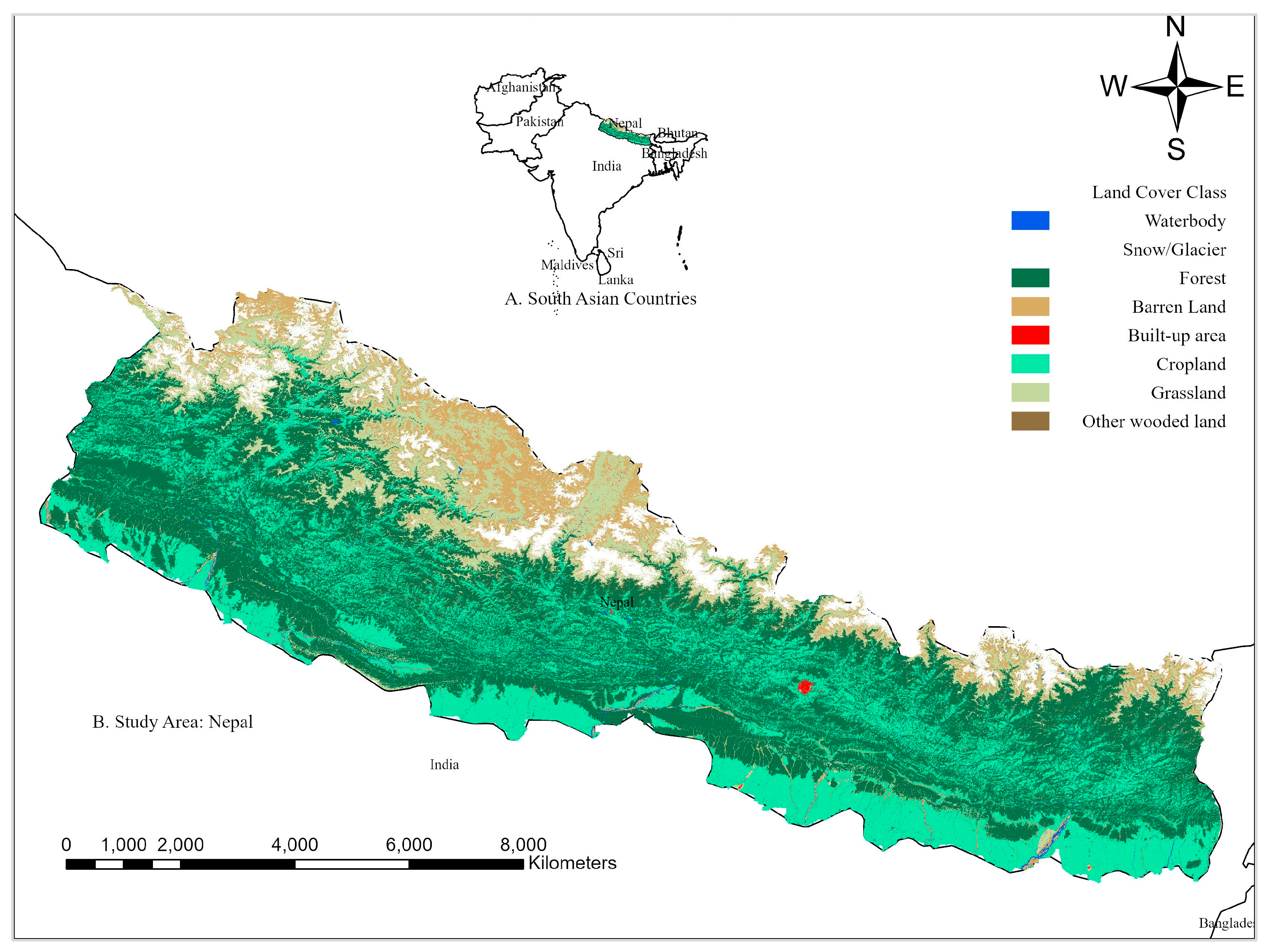
Nepal’s landscape is characterized by a heterogeneous mosaic of land-use and land-cover types, including forests, croplands, grasslands, other wooded land, built-up areas, barren land, snow/glaciers, and waterbodies (Figure 1) [27,39]. These LULC classes are distributed across five major physiographic zones: the Terai plains (<300 m), Siwalik hills (300–1000 m), Mid-Hills (1000–3000 m), High Mountains (3000–5000 m), and the High Himalaya (>5000 m) [40]. This strong physiographic and climatic zonation underpins Nepal’s high ecological diversity and results in spatially differentiated land-use dynamics across regions. Nepal’s complex topography, combined with rapid demographic and economic change, has led to spatially heterogeneous land-use dynamics with important implications for ecosystem services, particularly forest carbon storage [15,24,35]. Forest and other wooded land occupy a substantial proportion of the national territory and represent the dominant carbon-bearing land-cover classes, making Nepal especially sensitive to land-use transitions involving forest degradation, recovery, and urban expansion. The study will employ an integrated methodological framework combining geospatial analysis, carbon modeling, and economic valuation. The analysis is based on LULC projections for 2030, 2040, and 2050, developed using CA-Markov modeling in TerrSet and validated against historical ICIMOD land cover maps.

2.2. Land Use Change Modeling Using CA-Markov in TerrSet

The analysis covers the entire national territory to ensure consistency with national forest monitoring, reporting, and verification systems and REDD+ accounting frameworks [41]. All spatial datasets obtained for LULC 2000, 2010, and 2020, and variables slope, aspect, DEM, elevation zones of Nepal, populated areas, roads, rivers, and protected areas from various sources [39,42,43,44,45,46] were harmonized to a common coordinate system (Lambert Conformal Conic projection, WGS 84 datum), resampled to a uniform spatial resolution of 30 m × 30 m, and aligned to a consistent national extent prior to analysis, using the national boundary as a mask to exclude no-data areas. Raster-based processing was adopted to enable seamless integration between land use change modeling and ecosystem service assessment, consistent with national-scale applications in Nepal and other Himalayan contexts [15,24].
The LULC classification was aggregated into eight major classes in chronological order: (1) waterbody, (2) glacier, (3) forest, (4) bare soil, (5) built-up area, (6) cropland, (7) grassland, and (8) other wooded land. This classification scheme reflects a balance between ecological relevance, data availability, and compatibility with national forest resource assessments and ecosystem service modeling requirements [24,47]. In this classification framework, “forest” refers to land areas of at least 0.5 ha with tree canopy cover ≥10% and trees capable of reaching ≥5 m in height at maturity [39]. “Other wooded land” includes areas dominated by woody vegetation that do not meet the full forest threshold criteria, typically characterized by lower canopy cover and/or shorter woody vegetation < 5 m in height,, including shrub-dominated landscapes [39]. Class definitions were harmonized across datasets to ensure categorical consistency in land-use transition modeling and carbon-pool assignment. Similar aggregation strategies have been widely applied in national and basin-scale LULC change studies in Nepal to reduce classification uncertainty while preserving policy-relevant land categories [15,16,17,21,24]. The 2020 baseline map represents observed land-use conditions and serves as the benchmark against which all future changes in land use, carbon storage, and economic value are evaluated.
Future LULC projections were generated using the Land Change Modeler (LCM) within the TerrSet geospatial modeling framework. TerrSet LCM is a widely used, spatially explicit land change modeling tool that combines empirical transition analysis with machine-learning-based transition potential modeling and scenario-driven land allocation [48,49]. The model has been extensively applied in Nepal and comparable mountain regions to simulate land use change under alternative development pathways [16,24,49,50,51]. LCM was selected for this study because it is particularly well-suited for scenario-based land use projection in data-scarce environments, where explicit process-based modeling may not be feasible [48]. The framework allows land-use transitions to be constrained by biophysical suitability, accessibility, and policy assumptions, making it appropriate for exploring policy-relevant land-use futures, such as urban expansion, forest degradation, and agricultural abandonment [15,16]. Within the CA-Markov framework, future land-use demand was estimated using a discrete-time Markov chain model that quantifies the probability of transitioning from land-use class i to class j over a given time interval based on observed historical changes. The transition probability matrix P was defined as:
P i j = n i j j = 1 m n i j
where P i j represents the probability of transition from land-use class i to class j, n i j is the number of pixels observed to change from class i to class j between two time periods, and m is the total number of land-use classes. Future land-use quantities were then projected by multiplying the initial land-use state vector by the transition probability matrix, following standard Markov chain formulation [15,16,48].
The process of spatially allocating land-use transitions was guided by transition potential maps created using a Multilayer Perceptron (MLP) neural network within TerrSet. The MLP serves as a feed-forward machine learning model adept at identifying nonlinear relationships between recorded land-use transitions and their driving factors, demonstrating superior performance compared to traditional statistical methods in intricate landscapes [50]. The network was developed using transition samples from past land-use and land cover changes along with a range of explanatory variables such as elevation, slope, aspect, proximity to roads, and proximity to rivers, which are recognized as significant determinants of land-use change in Nepal [23,27]. Transition potential surfaces were developed using historical land-use change patterns and a suite of spatial drivers commonly employed in Nepal studies, including topography, proximity to roads and settlements, and existing land-use configuration. To evaluate the relative influence of driving variables, a sensitivity analysis was conducted within the TerrSet MLP framework using variable-forcing procedures. Independent variables were systematically forced to constant values individually and in combination, and the resulting changes in model accuracy and skill measure were evaluated. This approach allowed ranking of variable importance and assessment of model robustness to driver perturbations. Spatial allocation of projected land-use changes was governed by a cellular automata (CA) mechanism, which allocates land-use transitions based on transition probabilities, neighborhood influence, and spatial suitability. For each cell x, the probability of conversion to land-use class j was defined as a function of transition potential and neighborhood effects:
P x j = f T P x j , N x j , S x j
where T P x j represents the transition potential derived from the MLP neural network, N x j captures neighborhood influence reflecting spatial contiguity, and S x j denotes spatial constraints and suitability factors. This CA-based allocation ensures that land-use changes exhibit realistic spatial patterns while satisfying scenario-specific land-use demand, consistent with established LCM applications in Nepal and other mountainous regions [15,24,48].
Four alternative scenarios were implemented: Business as Usual (BAU), which represented the continuation of land use trends without any policy intervention; Rapid Urban Development (RUD), emphasizing accelerated expansion of built-up land; Forest Degradation and Terai Contraction (FDTC), simulating sustained forest degradation and contraction in accessible landscapes; and Agricultural Land Abandonment and Ecological Recovery (ALER), reflecting widespread abandonment of marginal agricultural land and subsequent forest and other wooded land recovery. The four scenarios were designed to represent policy-relevant and empirically plausible land-use trajectories grounded in observed national trends, development pressures, and forest governance dynamics in Nepal. Specifically, the BAU scenario reflects the continuation of transition probabilities derived from observed LULC changes between 2000 and 2020. The RUD scenario captures accelerated urban expansion consistent with recent infrastructure development, road network growth, and services-sector expansion trends documented at the national level [22,23]. The FDTC scenario reflects sustained fragmentation and forest conversion pressures in accessible lowland and Terai regions, as identified in recent empirical assessments [22]. The ALER scenario represents continued agricultural land abandonment and forest regeneration observed in mid-hill regions over the past two decades, associated with migration, remittance economies, and community forestry expansion [23,24,52,53]. These scenarios are exploratory rather than predictive and are intended to evaluate the carbon and economic implications of contrasting yet plausible development trajectories under varying land-use governance conditions.
To implement the scenario narratives into quantitative model parameters, the baseline transition probability matrix derived from observed 2000–2020 LULC dynamics was systematically modified for each projection period (2030, 2040, and 2050). Nationally designated protected areas were incorporated as fixed spatial constraints in the CA-Markov allocation process, restricting conversion of forest and other natural land classes to anthropogenic uses within legally protected boundaries. This ensured consistency with Nepal’s conservation policies and avoided unrealistic land-use transitions in protected landscapes. Under the BAU scenario, transition probabilities were consistent with recent historical trends. Under the RUD scenario, the probability of cropland converting to built-up areas progressively increased from 0.18 (2030) to 0.25 (2040) and 0.32 (2050), while forest persistence declined slightly from 0.99 to 0.98 over the projection horizon, reflecting accelerated urban expansion pressures. Under the FDTC scenario, forest persistence probabilities were reduced substantially, from 0.97 (2030) to 0.90 (2050), accompanied by increased transitions from forest to cropland and other wooded land, indicating intensified degradation and fragmentation in accessible landscapes. In contrast, under the ALER scenario, cropland persistence declined from 0.78 (2030) to 0.42 (2050), with corresponding increases in cropland-to-forest and cropland-to-other-wooded-land transitions, reflecting progressive agricultural abandonment and ecological recovery. These time-dynamic probability adjustments ensured internally consistent scenario trajectories rather than uniform extrapolation of historical trends.
In addition to transition probability adjustments, scenario implementation incorporated spatial driver variables and hard constraints within the LCM framework. For the BAU scenario, no additional hard constraints were imposed, and transitions were driven by topographic, accessibility, and proximity variables, including aspect, elevation, slope, populated places, rivers, and roads. Under the RUD scenario, urban expansion transitions (e.g., forest, cropland, grassland, and other wooded land to built-up area) were restricted by a slope constraint (≤25°) and a protected area mask, prohibiting conversion within legally designated protected areas. The FDTC scenario applied more restrictive physical and geographic constraints, limiting forest conversion to areas with slope ≤3° and within the Terai lowland zone (<300 m elevation), while also excluding protected areas from conversion. In contrast, the ALER scenario applied an elevation-zone mask that restricted agricultural abandonment and subsequent ecological recovery transitions (e.g., cropland to forest or grassland) to the mid-hill and higher Himalayan zones, thereby excluding the Terai and Siwalik lowlands. Protected areas were held constant across all scenarios to ensure consistency with national conservation policy and to prevent unrealistic land-use transitions within legally protected landscapes.
LULC maps were generated for 2030, 2040, and 2050 under each scenario, using 2020 as the baseline. Prior to executing the land-use simulations, the simulations’ effectiveness was assessed by comparing the forecasted land-use map for 2020, generated using a CA-Markov modeling method within the LCM, with the actual 2020 land-use map. Furthermore, land-use demand for each future time step was derived from scenario-specific assumptions embedded within the CA-Markov framework rather than extrapolated purely from historical trends. Scenario narratives were operationalized by adjusting transition probabilities and spatial constraints, allowing the model to represent alternative development pathways rather than deterministic forecasts. This approach is consistent with prior scenario-based LULC studies in that emphasize exploratory rather than predictive modeling [26,36,54]. Model performance was evaluated through hindcasting and comparison of simulated land use and land cover maps with observed LULC data for an intermediate period. Agreement between simulated and observed maps was assessed using the Kappa coefficient, which measures classification agreement beyond chance. The Kappa coefficient ( κ ) was calculated as:
κ = P o P e 1 P e
where P o is the observed proportion of agreement between simulated and observed LULC maps, and P e is the expected agreement due to chance. Kappa values greater than 0.75 are commonly interpreted as indicating substantial agreement in land-use change modeling studies [15,55]. The model achieved an overall Kappa coefficient of 0.7636, indicating substantial agreement and satisfactory performance for national-scale scenario analysis [55,56]. To further assess the robustness of transition potential modeling, a sensitivity analysis of driving variables was conducted within the TerrSet MLP framework using variable-forcing procedures. Independent variables were systematically constrained individually and in combination, and the resulting changes in model accuracy and skill measure were evaluated. Sensitivity testing indicated that elevation-related variables exerted the strongest influence on transition potential modeling, while proximity-based and slope variables contributed comparatively smaller marginal effects. Model performance remained stable when lower-ranked variables were constrained, suggesting structural robustness of transition potential estimation. Given the exploratory and scenario-based nature of the simulations, the validation was designed to assess the structural consistency in spatial allocation patterns rather than exact pixel-level replication. In national-scale CA-Markov analysis focused on comparative scenario analysis, the overall Kappa coefficient is widely used as an indicator of model reliability, particularly when the objective is to evaluate relative differences across alternative development pathways rather than to generate deterministic forecasts. This level of accuracy is comparable to or exceeds values reported in previous LCM-based land-use change studies in Nepal and similar mountain environments, supporting the model’s suitability for generating long-term, scenario-based LULC projections [16,24,49].

2.3. Carbon Storage Estimation Using the InVEST Model

Carbon storage and sequestration were estimated using the InVEST Carbon Storage and Sequestration model. InVEST is a spatially explicit ecosystem service modeling framework designed to assess how changes in land use influence ecosystem services, including carbon storage, at multiple spatial scales [37,57]. The model has been widely applied in Nepal and South Asia to quantify carbon dynamics associated with land use change and forest management [15,16,18,23,24]. The InVEST carbon model estimates total ecosystem carbon storage by assigning carbon pool values to each LULC class and summing four carbon pools: aboveground biomass (C_above), belowground biomass (C_below), soil organic carbon (C_soil), and dead organic matter (C_dead). Carbon stocks are calculated on a per-hectare basis (Mg C ha−1) and aggregated spatially to generate national and scenario-specific totals [57]. Accordingly, carbon storage was computed at the raster-cell level using a stock-based accounting approach, as expressed in the following formulation. For each raster cell i corresponding to a given LULC class, total carbon storage was computed as:
C i = C above , i + C below , i + C soil , i + C dead , i
where C i represents total carbon storage (Mg C ha−1) for cell i, and C above , C below , C soil , and C dead denote aboveground biomass carbon, belowground biomass carbon, soil organic carbon, and dead organic matter carbon pools, respectively. Total carbon storage for each scenario was obtained by spatially aggregating cell-level carbon stocks across the national extent:
C total = i = 1 n C i × A i
where A i is the area of cell i (ha), and n is the total number of raster cells. This stock-based accounting approach is consistent with the InVEST model structure and IPCC good practice guidance for land-use carbon estimation [37,57].
Then, changes in carbon storage between the baseline and future scenarios were quantified using a stock-difference approach, consistent with IPCC good practice for land-use change assessments. Carbon stock change (ΔC) for each raster cell i between time periods t1 and t2 was calculated as:
Δ C i = C i , t 2 C i , t 1
where C i , t 1 and C i , t 2 represent total carbon storage (Mg C ha−1) in cell i at the initial and subsequent time steps, respectively. Positive values of Δ C i indicate net carbon sequestration, while negative values indicate net carbon emissions associated with land-use change. At the national scale, total carbon stock change for each scenario was obtained by spatially aggregating cell-level carbon changes across the study area:
Δ C total = i = 1 n C i , t 2 C i , t 1 × A i
where A i denotes the area of cell i (ha) and n is the total number of raster cells. Average annual carbon sequestration rates were subsequently derived by normalizing total carbon stock change by the length of the projection period.
This carbon accounting framework is explicitly aligned with the IPCC Tier 1 and Tier 2 methodologies for estimating land-use and land-use change carbon. Following the IPCC stock-difference method, total carbon stocks were estimated at discrete time steps, and changes in carbon storage were inferred from the differences between them. Tier 1 default values were applied where country-specific estimates were unavailable, while Tier 2 coefficients derived from Nepal-specific forest inventories and peer-reviewed studies were used for forest and other woody land categories where national data existed. This hybrid Tier 1/2 approach is consistent with IPCC good practice guidance for national greenhouse gas inventories and is widely adopted in national-scale, spatially explicit ecosystem service assessments in data-constrained contexts [29,47,57,58].
The InVEST model assesses carbon storage across various pools (such as soil organic carbon, belowground biomass, aboveground biomass, and dead organic matter) and incorporates land-use and land-cover (LULC) maps to estimate current carbon fixation in a landscape or the total carbon sequestered over time. The value of ecosystem services to society is articulated through data on annual changes in carbon, the market or social value of sequestered carbon, and the carbon discount rate. The model provides several insights using LULC maps: (i) the quantity of carbon stored in different pools (Table 1), (ii) the cumulative carbon balance over time in a landscape, and (iii) an estimate of the market value of the remaining sequestered carbon stock. InVEST is a well-defined spatial model that uses “ecological production functions” to predict the availability of ecosystem services. Subsequently, economic valuation methods are applied to these estimates to derive the economic worth of these services for a particular landscape.
Carbon pool coefficients were derived from peer-reviewed studies conducted in Nepal, national forest inventory reports, and IPCC guidelines, consistent with approaches used in prior Nepal-focused ecosystem service assessments. As per the Tier 1 methodology detailed in the IPCC (2006) guidelines for national greenhouse gas inventories, waterbodies are classified as areas devoid of significant biomass, leading to a default carbon stock value of zero for both living biomass and soil pools [58]. In a similar manner, glaciers and permanent ice, categorized under the IPCC (2006) guidelines as “Lands with no living biomass,” are assigned zero carbon stocks for all biomass and soil pools due to the absence of vegetation and the classification of their underlying soils as inactive for inventory purposes [58].
All carbon pool values reported in Table 1 represent national-average estimates for each land-use and land-cover class rather than region-specific coefficients, consistent with Nepal’s forest reference level framework, while non-forest classes were assigned values reflecting their land cover characteristics. Carbon pool coefficients were assumed to remain constant within each land-use and land-cover class over time, such that changes in total ecosystem carbon storage reflect land-use transitions rather than within-class biomass growth or degradation, an assumption commonly adopted in scenario-based ecosystem service assessments focused on long-term land-use dynamics. For forests, below-ground biomass carbon was set to zero in the spatial carbon pool table to maintain consistency with Nepal’s Forest Reference Level methodology, while other pools used carbon stock data from the national report [15,16,59] and avoid double-counting in raster-based ecosystem service modeling. For Other Wooded Land, carbon stock parameters were obtained from DFRS [59], which reported above-ground biomass at 5.81 t C/ha, soil organic carbon at 98.98 t C/ha, and dead organic matter at 0.45 t C/ha, while below-ground biomass for this land category was recorded as zero. We used benefit-transfer values for carbon to calculate the economic valuation of carbon in the study area. The economic value of carbon sequestration under each scenario was estimated using a discounted net present value (NPV) framework, consistent with ecosystem service valuation and climate mitigation studies. The NPV of carbon sequestration benefits over the study period was calculated as:
NPV = t = 1 T Δ C t P c 1 r ) t
where Δ C t represents the net change in carbon storage (t C) in year t, P c is the carbon price expressed in USD per ton of CO2 equivalent, r is the real discount rate, and T is the length of the analysis period. This discounted valuation framework is consistent with prior ecosystem service valuation studies and IPCC-aligned climate policy assessments [24,57]. For the estimation of carbon emission cost, we used the rate of 5 USD per ton CO2 equivalent (USD 5/tCO2e) defined by the World Bank Carbon Fund Project in Nepal [41].

3. Results

3.1. LULC Change 2030–2050

Land-use and land-cover projections for Nepal were generated using the TerrSet Land Change Modeler. Using the classified 2020 LULC map as the baseline, scenario-specific transition potentials and allocation rules were applied to simulate spatially explicit LULC patterns for 2030, 2040, and 2050 under four alternative scenarios: Business-as-Usual, Rapid Urban Development, Forest Degradation and Terai Contraction, and Agricultural Land Abandonment and Ecological Recovery. LULC changes in the area for all scenarios between 2020 and 2050 are summarized in Table 2.
Under the BAU scenario, projected LULC change reflects a continuation of recent historical trends, with gradual transitions and limited structural change at the national scale. Built-up area increased by 87,061 ha (+107.5%) between 2020 and 2050, while cropland, forest, grassland, and other wooded land experienced small net declines ranging from 0.4% to 1.1%. Forest cover decreased marginally by 29,157 ha (−0.46%), indicating relative stability in forest extent under the absence of strong policy or development shocks. Changes were spatially concentrated near existing settlements and transportation corridors, consistent with the transition rules specified in the BAU scenario. The RUD scenario, parameterized to simulate accelerated urban expansion, exhibited the largest increase in built-up land among all scenarios. Built-up area expanded by 1,444,184 ha (+1783%) between 2020 and 2050, primarily at the expense of cropland and, to a lesser extent, forest and other wooded land. Cropland declined substantially by 1,112,306 ha (−32%), while forest cover decreased by 126,770 ha (−2%). Bare soil and other wooded land also experienced net reductions of 16% and 10%, respectively. These changes reflect the higher transition probabilities and relaxed spatial constraints applied to urban growth in the RUD scenario, particularly in the Terai and peri-urban hill regions.
In contrast, the FDTC scenario was characterized by systematic forest degradation and contraction, thus forest area declined by 443,694 ha (−7%), representing the largest forest loss among all scenarios. Other wooded land remained unchanged at the national scale, while cropland increased by 424,901 ha (+12%), indicating redistribution of land use following forest degradation processes. Built-up area increased modestly (18,792 ha; +23%), reflecting the limited role of urban expansion under this scenario relative to forest loss dynamics. The ALER scenario, designed to capture agricultural land abandonment and ecological recovery processes, exhibited a contrasting LULC trajectory. Cropland declined markedly by 1,280,414 ha (−37%), while forest and other wooded land expanded by 348,610 ha (+5.5%) and 861,318 ha (+162%), respectively. Grassland also increased by 308,142 ha (+16%), reflecting secondary succession on abandoned agricultural land. Built-up area remained unchanged under this scenario, consistent with the restrictive urban expansion assumptions applied in the ALER framework. These transitions were spatially concentrated in the mid-hills and mountain regions, where agricultural abandonment was most likely.
Although the overall spatial configuration of major land-use classes remains structurally similar across scenarios due to shared baseline constraints and physiographic conditions, scenario-specific differences emerge in the magnitude and spatial concentration of change. Under the RUD scenario, built-up expansion is primarily concentrated around existing urban centers and transportation corridors, particularly in the Terai and peri-urban regions. In contrast, the FDTC scenario exhibits increased forest contraction and fragmentation in accessible lowland zones. The ALER scenario demonstrates the spatial expansion of forest and other wooded land in mid-hill regions associated with agricultural abandonment. While the general spatial framework remains constrained by topography and existing land-use patterns, quantitative differences in area allocation and carbon distribution are substantial and are reflected in scenario-specific carbon stock and economic outcomes.
Overall, the TerrSet LCM projections indicate substantial divergence in LULC trajectories across scenarios over the 2020–2050 period. While BAU reflects incremental change, RUD emphasizes urban expansion, FDTC highlights processes of forest degradation, and ALER represents recovery-oriented transitions driven by agricultural abandonment. These scenario-specific LULC outcomes provide the spatial inputs for subsequent carbon storage estimation and economic valuation using the InVEST model, as presented in Section 3.2.

3.2. Spatial and Temporal Patterns of Carbon Storage 2030–2050

The InVEST Carbon Storage and Sequestration model was applied to the baseline (2020) and projected LULC maps to estimate spatially explicit carbon storage in tons of carbon per hectare (Mg C ha−1) for each scenario and year. Total ecosystem carbon storage integrates aboveground biomass (C_above), belowground biomass (C_below), soil organic carbon (C_soil), and dead organic matter (C_dead) pools. The national baseline carbon stock in 2020 was approximately 1389.7 million Mg C, serving as the reference for all scenario comparisons (Table 3).
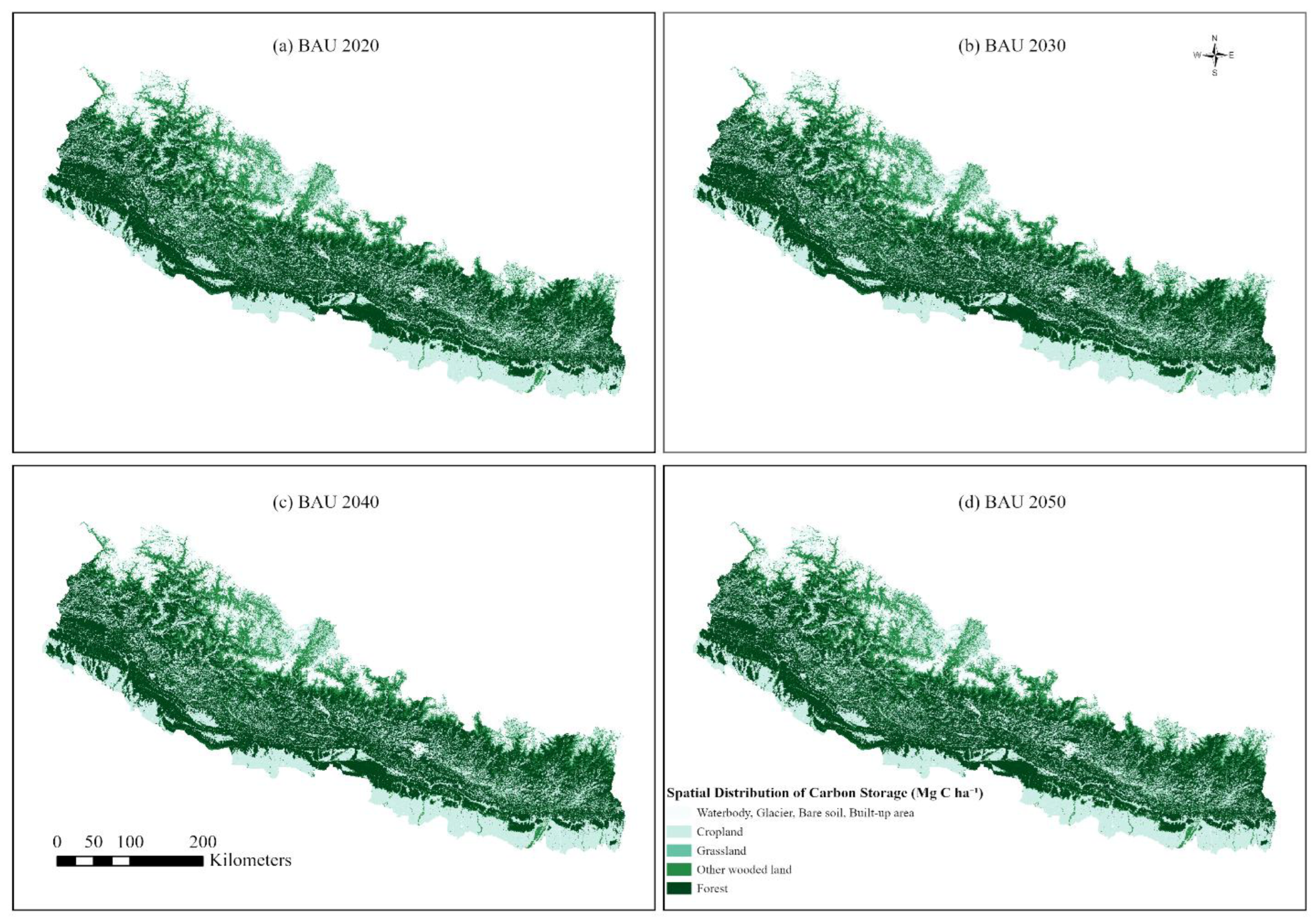
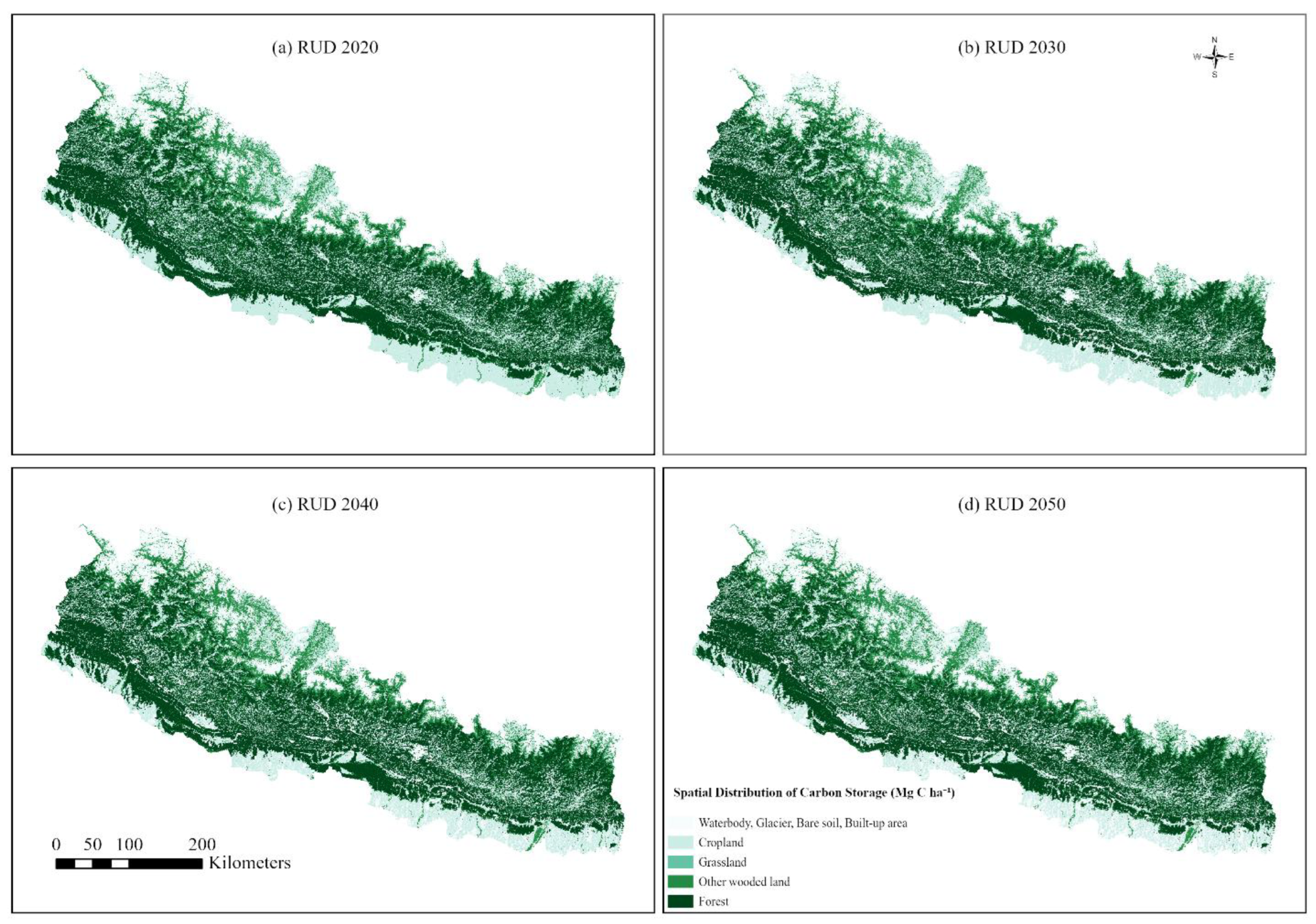
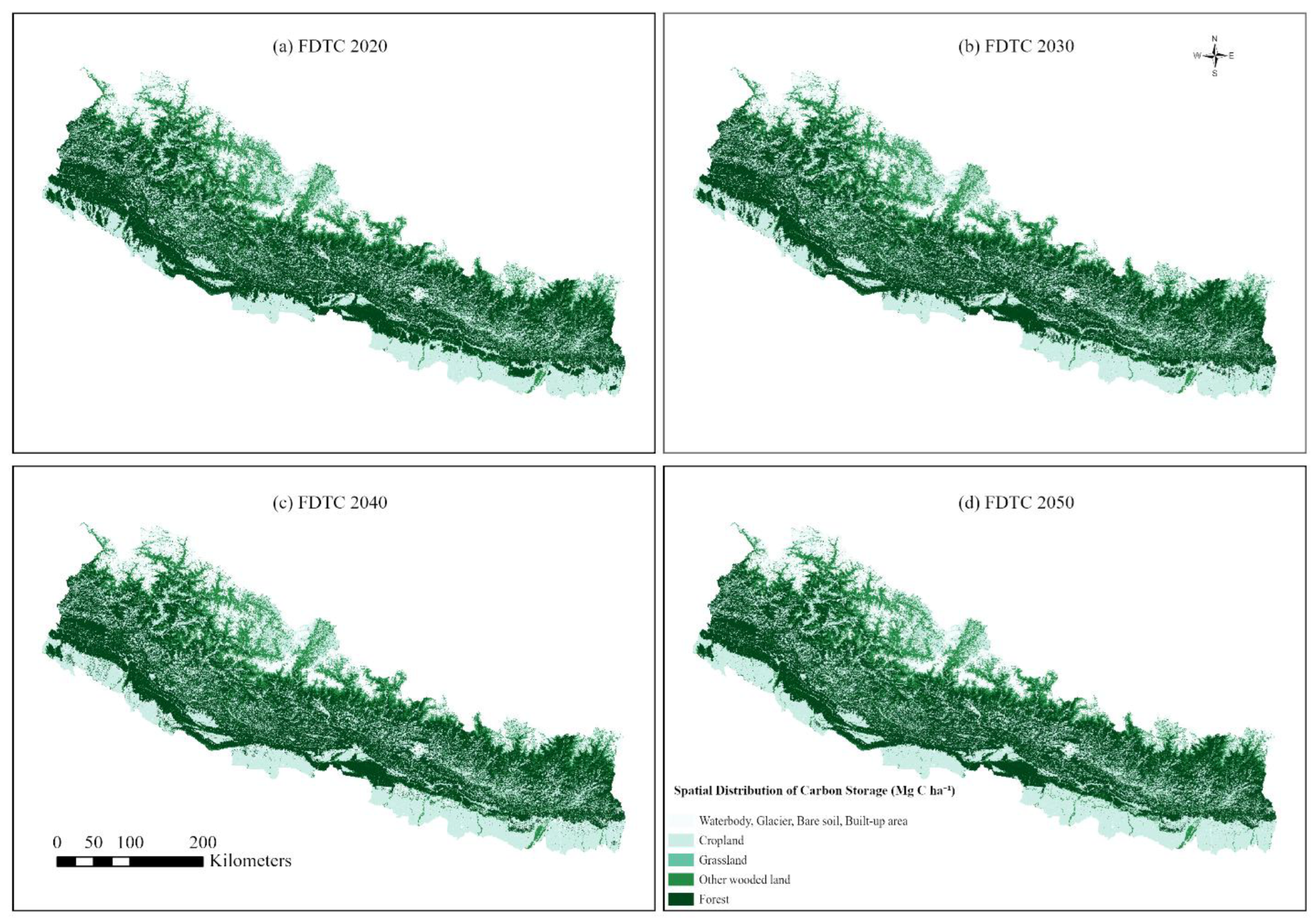
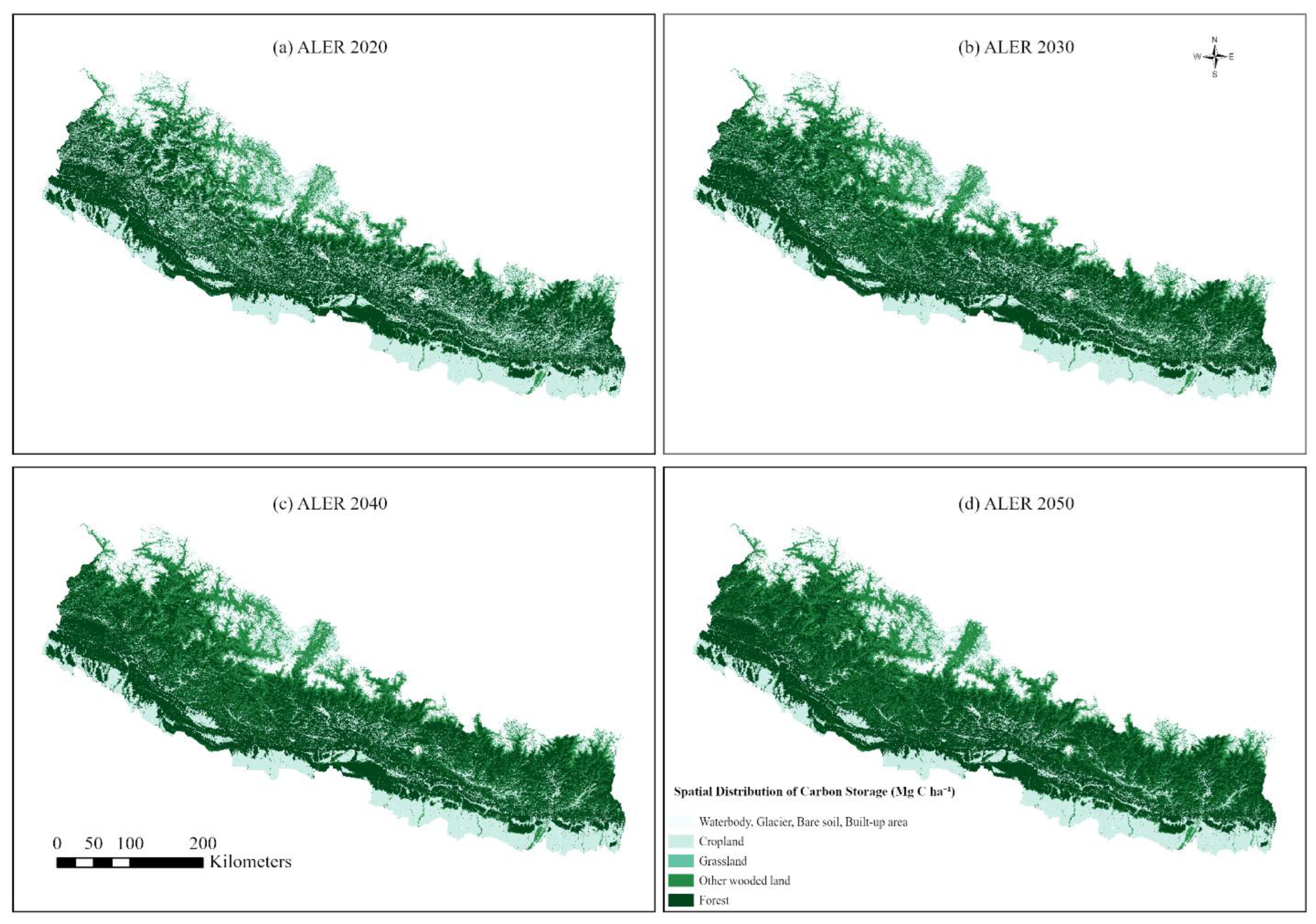
Across all scenarios and years, carbon storage exhibited strong spatial correspondence with forest and other wooded land, which consistently showed the highest carbon storage densities. Grassland and cropland showed intermediate carbon storage, while built-up areas, bare soil, waterbodies, and glaciers contributed to negligible carbon stocks. Although these spatial patterns remained broadly consistent over time, scenario-driven LULC transitions led to distinct national carbon trajectories. National carbon storage totals, absolute changes relative to 2020, and percentage changes are summarized in Table 3, while the corresponding spatial distributions are shown in Figure 2 for BAU, Figure 3 for RUD, Figure 4 for FDTC, and Figure 5 for ALER scenarios.
In 2015, the total estimated carbon for Nepal was 1157.3 million tons of which forests alone accounted for 1055 million tons of carbon storage [16,59]. In this study, under the BAU scenario, national carbon storage remained relatively stable throughout the projection period. Total carbon storage declined gradually from 1,389.7 million Mg C in 2020 to 1383.3 million Mg C by 2050, corresponding to a net loss of 6.4 million Mg C (−0.46%). Changes occurred incrementally over time, reflecting limited deviation from existing land-use trends. The spatial distribution of carbon storage under BAU remained largely consistent with the baseline pattern, with minor localized reductions near expanding settlements and infrastructure corridors (Figure 2).
The Rapid Urban Development scenario results in an early and pronounced decline in national carbon storage. By 2030, carbon stocks decrease to 1353.5 million Mg C, representing a reduction of 36.2 million Mg C (−2.61%). Partial recovery is observed by 2040; however, total carbon storage remains below baseline levels through 2050, with a net loss of 33.7 million Mg C (−2.42%). Spatially, carbon losses are concentrated in urbanizing lowland and peri-urban regions.
The Forest Degradation and Terai Contraction scenario produces the largest and most persistent carbon losses among all scenarios. National carbon storage declines steadily to 1315.8 million Mg C by 2050, corresponding to a cumulative loss of 73.9 million Mg C (−5.32%). Carbon reductions are spatially associated with forest degradation and contraction, particularly in accessible forested landscapes. In contrast, the Agricultural Land Abandonment and Ecological Recovery scenario generated sustained increases in carbon storage throughout the study period. National carbon stocks increase to 1472.7 million Mg C by 2030 (+5.97%) and continue to rise to 1552.9 million Mg C by 2050, representing a net gain of 163.2 million Mg C (+11.74%) relative to the baseline. Carbon gains are spatially concentrated in areas undergoing forest regrowth and expansion of other wooded land.
A physiographic comparison further reveals clear spatial differentiation in carbon stock changes across Nepal’s major ecological zones. Under the RUD and FDTC scenarios, carbon losses were disproportionately concentrated in the Terai Plains and lower-elevation accessible landscapes, where pressures from urban expansion, agricultural conversion, and forest degradation are highest. In contrast, the Mid-Hill region exhibited comparatively moderate carbon losses under these scenarios due to steeper terrain constraints and more fragmented settlement patterns. Under the ALER scenario, carbon gains were most pronounced in the Mid-Hills, where agricultural abandonment and secondary forest succession facilitated expansion of forest and other wooded land. Mountain regions showed relatively smaller absolute changes across all scenarios due to lower baseline forest density and limited anthropogenic conversion pressure. These findings indicate that national carbon trajectories are strongly mediated by physiographic structure, accessibility gradients, and variations in forest carbon density across ecological zones.

3.3. Economic Implications of Carbon Stock Changes and Relevance to REDD+

The monetization of scenario-based changes in carbon stocks provides an economic interpretation of the biophysical outcomes presented in Section 3.1 and Section 3.2 and facilitates comparison with REDD+ relevant performance metrics. Changes in national carbon stocks were subsequently monetized to estimate the NPV of carbon outcomes under each scenario. Carbon valuation was conducted following the established practice based on IPCC guidelines, government official reports, and literature, using a constant carbon price of USD 5/tCO2e defined by the World Bank Carbon Fund Project in Nepal [24,37,41,58] and an annual discount rate of 3% [24,37] over the 2020–2050 period. NPV estimates reflect the discounted value of cumulative carbon gains or losses relative to the 2020 baseline. The temporal evolution of the net present value of carbon stock changes under each scenario is summarized in Table 4.
While BAU remains close to carbon neutrality, RUD and FDTC exhibit increasing economic losses over time, whereas ALER generates progressively larger positive economic values through 2050. Across scenarios, economic outcomes closely tracked the direction and magnitude of changes in national carbon stocks. Scenarios characterized by forest recovery and expansion generated positive economic value, whereas scenarios dominated by forest degradation or urban expansion resulted in negative economic outcomes. These results demonstrate the sensitivity of long-term carbon value to alternative land-use pathways when evaluated under a consistent pricing and discounting framework.
Under the BAU scenario, the near-neutral carbon trajectory resulted in a small negative NPV of approximately USD 32 million by 2050, reflecting minor long-term carbon losses. This outcome reflects the cumulative effect of modest but persistent carbon losses over time and indicates that continuation of recent land-use trends is unlikely to generate substantial carbon-related economic benefits under REDD+ mechanisms. The RUD scenario produced substantially larger economic losses, with an estimated discounted carbon value of USD 168 million by 2050, driven by early and sustained reductions in carbon stocks. These losses were driven primarily by early reductions in carbon stocks associated with the expansion of built-up land, which exerts a lasting influence on discounted carbon value even when partial recovery occurs in later decades. From a REDD+ accounting perspective, this trajectory would be associated with foregone mitigation potential relative to the baseline.
Among all scenarios, the FDTC scenario resulted in the most severe economic outcome. Persistent and spatially extensive forest degradation led to cumulative carbon losses equivalent to a net present value of approximately USD 370 million by 2050. This scenario represents a sustained deviation from forest reference emission level pathways and would substantially constrain the ability to generate performance-based REDD+ payments. In contrast, the ALER scenario results in additional and sustained carbon gains relative to the BAU reference scenario, consistent with the fundamental REDD+ principle of additionality. This leads to a significantly positive economic outcome, with cumulative carbon gains projected to yield an estimated net present value of USD 815 million by 2050. The magnitude of this value reflects sustained increases in national carbon stocks through forest regrowth and expansion of other wooded land. Relative to the baseline, the ALER pathway consistently exceeds reference levels of carbon storage, indicating substantial mitigation potential under REDD+ frameworks. By the end of the projection period, the difference in discounted carbon value between the highest-carbon (ALER) and lowest-carbon (FDTC) scenarios exceeded USD 1.1 billion. This divergence underscores the long-term economic significance of land-use decisions and highlights the role of forest conservation and recovery in shaping national carbon outcomes. Importantly, these estimates represent carbon value only and do not incorporate additional ecosystem services, opportunity costs, or transaction costs associated with REDD+ implementation.
Thus, the economic valuation results indicate that land-use pathways emphasizing forest conservation and ecological recovery align most closely with REDD+ objectives by enhancing carbon storage relative to reference conditions. Conversely, scenarios characterized by forest degradation or rapid urban expansion reduce the economic viability of carbon-based mitigation strategies. These findings provide a quantitative basis for linking scenario-based land-use modeling with REDD+ performance assessment and inform subsequent discussion of policy implications.

4. Discussion

4.1. Linking Land-Use Trajectories, Carbon Storage, and Economic Outcomes

The study results demonstrate a strong, systematic linkage between scenario-specific land-use and land-cover trajectories and national carbon-storage outcomes. Scenario-specific shifts in forest extent and built-up expansion altered national carbon stocks primarily by altering high-density forest carbon pools, underscoring the central role of land-use dynamics in shaping long-term carbon outcomes. Government of Nepal forest resource assessments indicate that forests cover approximately 40.36% of the national land area, with an additional 4.38% classified as shrub or other wooded land, together accounting for nearly 45% of the country’s land surface [41,59]. Because forests and other wooded land contain the highest carbon densities, even modest proportional changes in these classes can produce large absolute shifts in national carbon stocks. This structural characteristic explains why scenario-driven differences in forest dynamics dominate the carbon and valuation outcomes observed in this study.
Under the BAU scenario, modest changes in LULC resulted in near-carbon neutrality at the national scale. Because forest cover remained structurally stable under BAU, national carbon stocks were largely preserved, reflecting the dominant influence of forest carbon density in the national carbon balance. Similar findings have been reported in national-scale assessments of Nepal, where continuation of recent trends yields relatively stable carbon stocks despite localized land-use pressures [15,16,24,65]. From an economic perspective, this relatively stable carbon trajectory generates limited economic returns under discounted valuation, suggesting limited potential for carbon-based economic gains under continuation-of-trend pathways.
In contrast, the RUD scenario illustrates how accelerated urban expansion can generate disproportionate carbon losses. Although forest losses under RUD were moderate in percentage terms, the large-scale conversion of cropland and peri-urban forested areas to built-up land resulted in substantial early reductions in national carbon stocks. This pattern is consistent with studies highlighting the carbon intensity of urban expansion in South Asia, where land conversion effects often outweigh gains from subsequent regrowth or land-use stabilization [53,64]. Empirical evidence from Nepal consistently shows that urban expansion replaces vegetated land with low-carbon built surfaces, thereby reducing national carbon stocks through irreversible land conversion [15,23,24]. For example, in the Bagmati River Basin, built-up land increased by 247.5% between 1988 and 2018, while forest cover declined by 6.2%, contributing to a measurable reduction in carbon storage [16]. The economic valuation results in this study further show that early-period carbon losses disproportionately reduce long-term economic returns under discounted valuation frameworks, a result consistent with established principles of intertemporal carbon valuation [35].
The FDTC scenario resulted in extensive degradation of high-density forest landscapes, generating the most pronounced structural reduction in national carbon stocks. This finding aligns with Nepal’s forest resource assessments, which emphasize that forest degradation through biomass extraction, fragmentation, and repeated disturbance represents a major source of carbon emissions, often exceeding emissions from outright deforestation [21,24,59,66]. Spatially explicit ecosystem service assessments in Nepal have shown that carbon losses are concentrated in physiographic zones with high accessibility and land-use pressure, particularly in the Terai and Churia regions [16,21]. Because forest carbon density far exceeds that of cropland or degraded land, persistent biomass removal produces disproportionately negative long-term economic outcomes. Furthermore, this finding underscores the importance of explicitly accounting for degradation processes in national carbon assessments.
Conversely, the ALER scenario demonstrates the carbon benefits of forest regrowth and expansion of other wooded land following agricultural abandonment. The sustained increase in carbon storage under ALER is consistent with observations from Nepal’s mid-hills, where outmigration and declining agricultural profitability have facilitated secondary succession and forest recovery [52,53,67,68]. Similar recovery-driven carbon gains have been widely documented in mountain regions undergoing socio-economic transitions, where agricultural abandonment, rural outmigration, and declining subsistence farming have facilitated forest regrowth and secondary succession. In such contexts, marginal cropland and pasture are progressively converted to shrubland and forest, leading to substantial increases in aboveground and soil carbon stocks over decadal time scales [69,70]. Global analyses indicate that forest regrowth in mountainous and temperate regions has contributed significantly to net terrestrial carbon uptake, often offsetting emissions from land-use change elsewhere [69,71,72]. Empirical evidence from the Himalayan region supports these patterns. Studies from Nepal’s mid-hills have shown that outmigration-driven land abandonment has enabled natural regeneration of broadleaf forests, resulting in measurable increases in biomass and soil carbon stocks [24,53,67,68]. Similar recovery trajectories have been reported in the Indian Himalaya and other mountain systems, where socio-economic change has reduced pressure on agricultural land and accelerated forest transition processes [37,50,73]. These recovery-driven carbon gains are often spatially heterogeneous but persistent, particularly where regeneration is protected from recurrent disturbance [52,74]. Thus, these findings reinforce broader evidence that forest recovery and secondary succession in mountainous regions can generate sustained carbon accumulation over multi-decadal time scales.
Furthermore, the positive economic valuation under ALER reflects sustained forest regrowth and the cumulative accumulation of high-density carbon stocks over time. While the ALER scenario demonstrates substantial carbon and economic advantages, its broader implementation depends on enabling socio-economic and institutional conditions. Large-scale recovery requires secure land tenure arrangements, effective community forestry governance, safeguards against unmanaged settlement expansion, and alignment with national food security objectives. In regions where agriculture remains economically viable or culturally embedded, widespread abandonment may be neither desirable nor feasible. Therefore, ALER should be interpreted as a policy-contingent and demographically mediated pathway rather than an automatic or universally replicable outcome. Its feasibility ultimately depends on coordinated land-use planning, governance capacity, and the integration of carbon objectives with rural development strategies.

4.2. Interpreting Carbon Valuation and Net Present Value

A key contribution of this study is the explicit integration of spatially explicit carbon accounting with economic valuation, allowing direct comparison of alternative land-use pathways in discounted monetary terms. By valuing changes in carbon stocks rather than absolute stocks, the analysis aligns with the logic of carbon markets and REDD+ accounting, where incremental emissions reductions or sequestration relative to a reference pathway are economically relevant [35]. The valuation results highlight the importance of the timing of carbon change. Scenarios characterized by early carbon losses (RUD and FDTC) exhibit disproportionately negative NPVs, even where later stabilization or partial recovery occurs. This outcome reflects the fundamental role of discounting in long-term environmental valuation and is consistent with prior studies showing that timing effects can dominate discounted outcomes in land-use and forest carbon analyses [24]. In contrast, sustained and progressive carbon gains under ALER yield large positive NPVs, even under conservative carbon price assumptions. It is important to acknowledge that economic valuation outcomes are sensitive to assumptions regarding carbon price trajectories, discount rates, and carbon density coefficients, particularly over extended projection horizons. In this study, a constant carbon price (USD 5 tCO2e−1) and fixed discount rate (3%) were applied to ensure internal consistency and comparability across scenarios. While this approach facilitates structured comparison of alternative land-use pathways, variation in these parameters could alter the magnitude of NPV estimates. Future research could employ Monte Carlo simulation or parameter-range analysis to quantify uncertainty bounds and generate confidence intervals around projected economic outcomes.
Nepal-focused ecosystem service valuation studies further support the plausibility of the economic magnitudes reported here. For example, Pandit, Neupane [35] estimated that carbon storage constitutes one of the largest components of total ecosystem service value in community-managed forests in Nepal, while Rijal, Rimal [16] reported a decline of approximately USD 2.9 million in monetized carbon value in the Bagmati River Basin over three decades due to LULC change. These studies suggest that carbon-related economic signals of the magnitude observed in this study are consistent with empirical valuations in Nepal’s forested landscapes. It is important to note that the valuation presented here considers only carbon benefits. Multiple studies in Nepal have shown that forest recovery and conservation simultaneously enhance other regulating services, including erosion control, water regulation, and biodiversity habitat, which are not captured in carbon-only valuations [10,23,24,35]. Consequently, the positive NPV associated with ALER likely represents a lower bound on total ecosystem service benefits, while the negative NPVs associated with FDTC and RUD likely underestimate total welfare losses where carbon decline coincides with degradation of other services [23].

4.3. Implications for REDD+ Policy and Forest Reference Levels in Nepal

From a policy standpoint, the combined biophysical and economic results suggest that REDD+ strategies in Nepal would benefit from greater integration with land-use planning and rural development policies that influence agricultural abandonment, forest recovery, and urban expansion. Measures that reduce forest degradation in accessible areas, manage peri-urban growth, and support natural regeneration on abandoned agricultural land could substantially enhance national carbon outcomes. REDD+ frameworks emphasize measurable, reportable, and verifiable changes in forest carbon stocks relative to forest reference emission levels, with performance-based payments tied to sustained mitigation outcome [41,47].
In this context, the BAU scenario offers limited scope for generating REDD+ benefits due to its near-neutral carbon trajectory, while the RUD and FDTC scenarios represent pathways associated with substantial foregone mitigation potential. In contrast, the ALER scenario aligns closely with REDD+ objectives by generating sustained, additional carbon gains that exceed baseline conditions throughout the projection period. Importantly, these gains arise primarily from natural regeneration and forest recovery rather than from plantation establishment, consistent with REDD+ priorities that emphasize broader development trajectories like conservation, sustainable management, and the enhancement of forest carbon stocks [30]. Nepal-specific REDD+ analyses have similarly emphasized the importance of addressing forest degradation, supporting regeneration, and aligning REDD+ incentives with broader socio-economic transitions to improve effectiveness and permanence [41].
The valuation results further suggest that REDD+ strategies should consider not only the magnitude but also the timing of carbon benefits. Early intervention to avoid degradation or unmanaged urban expansion may yield higher discounted returns than delayed mitigation, even when total carbon gains are similar. Integrating REDD+ planning with land-use policy, rural development strategies, and peri-urban growth management, therefore, appears critical for maximizing long-term mitigation value. Overall, the scenario-based analysis provides a quantitative basis for evaluating how alternative land-use futures intersect with REDD+ objectives in Nepal. From an operational perspective, the modeled carbon stock trajectories could be integrated within Nepal’s National Forest Monitoring System (NFMS) and MRV framework to inform updates to forest reference emission levels and to evaluate potential performance-based payment scenarios under REDD+. The scenario outputs generate spatially explicit estimates of additionality relative to baseline trajectories, which are central to REDD+ accounting. However, the present analysis does not explicitly model leakage (i.e., displacement of emissions across regions), non-permanence risks associated with disturbance or policy reversal, or implementation costs. These factors are critical in applied REDD+ finance and should be incorporated in future assessments to enhance operational applicability. By linking spatial LULC projections, carbon storage dynamics, and economic valuation, the study demonstrates how integrated modeling approaches can support REDD+ planning, refine forest reference emission levels, and strengthen long-term mitigation assessment.
Like any other study, this study also has a few limitations that should be acknowledged. Carbon valuation results are sensitive to assumptions regarding carbon prices and discount rates, and alternative assumptions would affect the magnitude of NPVs. However, given the large divergence among scenarios, relative rankings are likely to remain robust. In addition, the analysis does not explicitly incorporate implementation costs, opportunity costs, leakage, or permanence risks, which are central considerations in applied REDD+ finance. Finally, carbon pools were assigned using class-level coefficients, which may not fully capture fine-scale heterogeneity in forest conditions or management intensity. Moreover, carbon pool coefficients were treated as constant within each land-use class over time, such that changes in total ecosystem carbon storage reflect land-use transitions rather than within-class biomass growth, degradation dynamics, or management-induced carbon accumulation. In addition, carbon density values were applied uniformly across the national extent for each land-use class, which does not explicitly account for regional heterogeneity associated with physiographic gradients, forest type composition, or soil variability. Similarly, the valuation framework assumes a constant carbon price (USD 5/tCO2e) and a fixed discount rate (3%) across the projection period. While these assumptions are consistent with stock-difference approaches and commonly adopted in national-scale scenario-based assessments, they do not capture dynamic carbon growth functions, temporal variability in carbon markets, or uncertainty in future policy environments. Consequently, the results should be interpreted as structurally comparative across alternative scenarios rather than as deterministic forecasts of future carbon finance outcomes. Despite these limitations, the integrated modeling framework provides a consistent and transparent basis for comparing alternative land-use futures and assessing their carbon and economic implications on the national scale.
Beyond Nepal, these findings contribute to the broader literature on land-use transitions in mountain and developing-country contexts, where forest recovery, agricultural abandonment, and urban expansion interact in complex ways. The divergence across scenarios underscores the importance of integrated land-use and climate policy frameworks for achieving long-term mitigation objectives. Similar transition dynamics have been documented across South Asia and other mountainous regions undergoing socio-economic transformation, suggesting that recovery-oriented pathways may generate significant carbon co-benefits at regional and global scales. Future research should incorporate dynamic carbon growth functions within land-use classes, alternative carbon price trajectories, and sensitivity analysis of discount rates to assess economic robustness. Furthermore, future studies could also incorporate spatially stratified parameters or regional-specific coefficients to improve spatial accuracy. Incorporating opportunity costs, transaction costs, leakage effects, and permanence risks would further enhance the applicability of results to operational REDD+ finance. Additionally, integrating biodiversity, water regulation, and socio-economic co-benefits into a multi-service valuation framework would provide a more comprehensive assessment of ecosystem service trade-offs under alternative land-use futures.

5. Conclusions

This study integrated scenario-based land-use and land-cover modeling, spatially explicit carbon storage estimation, and economic valuation to evaluate alternative development pathways in Nepal over the 2020–2050 period. By linking TerrSet Land Change Modeler projections with the InVEST Carbon Storage and Sequestration model, the analysis provides a coherent national-scale assessment of how contrasting land-use futures influence carbon dynamics and their associated economic significance.
The results demonstrate that alternative land-use trajectories lead to markedly different carbon storage outcomes. Continuation of recent trends under the Business-as-Usual scenario results in near-carbon neutrality, with only minor declines in national carbon stocks by 2050. In contrast, scenarios characterized by accelerated urban expansion or forest degradation generate substantial and persistent carbon losses. The Rapid Urban Development scenario produces early reductions in carbon storage that remain economically consequential in discounted terms, while the Forest Degradation and Terai Contraction scenario yields the largest cumulative carbon losses due to sustained forest degradation in accessible landscapes. Conversely, the Agricultural Land Abandonment and Ecological Recovery scenario results in substantial and sustained increases in national carbon storage, driven by forest regrowth and expansion of other wooded land following agricultural abandonment.
Economic valuation of changes in carbon stocks reinforces these biophysical findings. When carbon dynamics are monetized using a constant carbon price and discounted over time, scenarios associated with early and persistent carbon losses yield strongly negative net present values, whereas recovery-oriented pathways generate substantial positive economic returns. These results highlight the importance of both the magnitude and timing of land-use change, demonstrating that early losses can dominate long-term economic outcomes even when partial recovery occurs in later decades.
From a policy perspective, the findings underscore the importance of integrating forest conservation and recovery with broader land-use and development planning in Nepal. Pathways emphasizing forest regeneration and reduced degradation align most closely with REDD+ objectives by generating sustained, additional carbon gains relative to reference conditions, whereas unmanaged urban expansion and forest degradation reduce the economic and mitigation potential of forest-based climate strategies. The results, therefore, provide a quantitative basis for linking scenario-based land-use planning with REDD+ implementation, forest reference level refinement, and long-term mitigation assessment.
To sum up, this study demonstrates the value of integrated, scenario-based modeling for evaluating land-use futures, carbon storage dynamics, and economic outcomes at the national scale. By explicitly linking LULC change, carbon storage, and economic valuation, the analysis offers a transparent, policy-relevant framework for assessing how current land-use decisions will shape Nepal’s carbon balance and the economic viability of forest-based climate mitigation strategies through mid-century.

Author Contributions

Conceptualization, G.B. and P.L.; methodology, G.B.; software, G.B.; validation, G.B.; formal analysis, G.B.; investigation, G.B.; resources, G.B.; data curation, G.B.; writing: original draft preparation, G.B.; writing: review and editing, G.B. and P.L.; visualization, G.B.; supervision, P.L. All authors have read and agreed to the published version of the manuscript.

Funding

This research received no external funding.

Institutional Review Board Statement

Not applicable.

Informed Consent Statement

Not applicable.

Data Availability Statement

The datasets used and/or analyzed during the current study are available from the corresponding author upon reasonable request.

Conflicts of Interest

The authors declare no conflicts of interest.

References

  1. Gibbs, H.K.; Brown, S.; Niles, J.O.; Foley, J.A. Monitoring and estimating tropical forest carbon stocks: Making REDD a reality. Environ. Res. Lett. 2007, 2, 045023. [Google Scholar] [CrossRef]
  2. FAO. The State of the World’s Forests 2018—Forest Pathways to Sustainable Development; FAO: Rome, Italy, 2018. [Google Scholar]
  3. World Bank Group. Forests Slow Climate Change and Increase Resilience; World Bank Group: Washington, DC, USA, 2016; Available online: https://www.worldbank.org/en/news/infographic/2016/03/16/forests-slow-climate-change-and-increase-resilience (accessed on 11 November 2025).
  4. Saatchi, S.S.; Harris, N.L.; Brown, S.; Lefsky, M.; Mitchard, E.T.A.; Salas, W.; Zutta, B.R.; Buermann, W.; Lewis, S.L.; Hagen, S.; et al. Benchmark Map of Forest Carbon Stocks in Tropical Regions Across Three Continents. Proc. Natl. Acad. Sci. USA 2011, 108, 9899–9904. [Google Scholar] [CrossRef] [PubMed]
  5. World Food Programme. World Food Programme Nepal Country Brief; World Food Programme: Rome, Italy, 2020; Available online: https://docs.wfp.org/api/documents/WFP-000113550/download/?_ga=2.33038526.12604 (accessed on 1 October 2025).
  6. Central Bureau of Statistics. National Population and Housing Census 2021 (National Report); Government of Nepal, Ed.; National Statistics Office: Kathmandu, Nepal, 2021. [Google Scholar]
  7. Bajracharya, S.R.; Maharjan, S.B.; Shrestha, F.; Bajracharya, O.R.; Baidya, S. Glacier Status in Nepal and Decadal Change from 1980 to 2010 Based on Landsat Data; International Centre for Integrated Mountain Development (ICIMOD): Lalitpur, Nepal, 2014. [Google Scholar]
  8. Poudel, S.; Shaw, R. The Relationships between Climate Variability and Crop Yield in a Mountainous Environment: A Case Study in Lamjung District, Nepal. Climate 2016, 4, 13. [Google Scholar] [CrossRef]
  9. Kandel, P.; Chapagain, P.S.; Sharma, L.N.; Vetaas, O.R. Consumption Patterns of Fuelwood in Rural Households of Dolakha District, Nepal: Reflections from Community Forest User Groups. Small-Scale For. 2016, 15, 481–495. [Google Scholar] [CrossRef]
  10. Gautam, N.P.; Bhusal, P.; Raut, N.; Wu, P. Community Forestry in Nepal: A Review of Socioeconomic Contribution to Forest-Dependents in a Changing Climate. J. For. Nat. Resour. Manag. 2024, 4, 82–99. [Google Scholar] [CrossRef]
  11. Wang, S.W.; Gebru, B.M.; Lamchin, M.; Kayastha, R.B.; Lee, W.-K. Land use and land cover change detection and prediction in the Kathmandu district of Nepal using remote sensing and GIS. Sustainability 2020, 12, 3925. [Google Scholar] [CrossRef]
  12. Maes, J.; Egoh, B.; Willemen, L.; Liquete, C.; Vihervaara, P.; Schägner, J.P.; Grizzetti, B.; Drakou, E.G.; La Notte, A.; Zulian, G.; et al. Mapping ecosystem services for policy support and decision making in the European Union. Ecosyst. Serv. 2012, 1, 31–39. [Google Scholar] [CrossRef]
  13. De Groot, R.S.; Alkemade, R.; Braat, L.; Hein, L.; Willemen, L. Challenges in integrating the concept of ecosystem services and values in landscape planning, management and decision making. Ecol. Complex. 2010, 7, 260–272. [Google Scholar] [CrossRef]
  14. Adhikari, S.; Baral, H.; Nitschke, C.R. Nitschke, Identification, prioritization and mapping of ecosystem services in the Panchase Mountain Ecological Region of Western Nepal. Forests 2018, 9, 554. [Google Scholar] [CrossRef]
  15. Rimal, B.; Sharma, R.; Kunwar, R.; Keshtkar, H.; Stork, N.E.; Rijal, S.; Rahman, S.A.; Baral, H. Effects of land use and land cover change on ecosystem services in the Koshi River Basin, Eastern Nepal. Ecosyst. Serv. 2019, 38, 100963. [Google Scholar] [CrossRef]
  16. Rijal, S.; Rimal, B.; Acharya, R.P.; Stork, N.E. Land use/land cover change and ecosystem services in the Bagmati River Basin, Nepal. Environ. Monit. Assess. 2021, 193, 651. [Google Scholar] [CrossRef]
  17. Bastola, S.; Lee, S.; Shin, Y.; Jung, Y. An Assessment of Environmental Impacts on the Ecosystem Services: Study on the Bagmati Basin of Nepal. Sustainability 2020, 12, 8186. [Google Scholar] [CrossRef]
  18. Paudyal, K.; Baral, H.; Bhandari, S.P.; Bhandari, A.; Keenan, R.J. Spatial assessment of the impact of land use and land cover change on supply of ecosystem services in Phewa watershed, Nepal. Ecosyst. Serv. 2019, 36, 100895. [Google Scholar] [CrossRef]
  19. Upadhyay, T.P.; Solberg, B.; Sankhayan, P.L.; Shahi, C. Land-use changes, forest/soil conditions and carbon sequestration dynamics: A bio-economic model at watershed level in Nepal. J. Bioeconomics 2013, 15, 135–170. [Google Scholar] [CrossRef]
  20. Shrestha, M.; Acharya, S.C. Acharya, Assessment of historical and future land-use-land-cover changes and their impact on valuation of ecosystem services in Kathmandu Valley, Nepal. Land Degrad. Dev. 2021, 32, 3731–3742. [Google Scholar] [CrossRef]
  21. Sharma, R.; Rimal, B.; Baral, H.; Nehren, U.; Paudyal, K.; Sharma, S.; Rijal, S.; Ranpal, S.; Acharya, R.P.; Alenazy, A.A.; et al. Impact of land cover change on ecosystem services in a tropical forested landscape. Resources 2019, 8, 18. [Google Scholar] [CrossRef]
  22. Ning, C.; Subedi, R.; Hao, L. Land Use/Cover Change, Fragmentation, and Driving Factors in Nepal in the Last 25 Years. Sustainability 2023, 15, 6957. [Google Scholar] [CrossRef]
  23. Rai, M.K.; Paudel, B.; Zhang, Y.; Nepal, P.; Khanal, N.R.; Liu, L.; Rai, R. Appraisal of Empirical Studies on Land-Use and Land-Cover Changes and Their Impact on Ecosystem Services in Nepal Himalaya. Sustainability 2023, 15, 7134. [Google Scholar] [CrossRef]
  24. Chaulagain, D.; Ray, R.L.; Yakub, A.O.; Same, N.N.; Park, J.; Suh, D.; Lim, J.-O.; Huh, J.-S. Comprehensive Analysis of Land Use Change and Carbon Sequestration in Nepal from 2000 to 2050 Using Markov Chain and InVEST Models. Sustainability 2024, 16, 7377. [Google Scholar] [CrossRef]
  25. Su, S.; Li, D.; Hu, Y.; Xiao, R.; Zhang, Y. Spatially non-stationary response of ecosystem service value changes to urbanization in Shanghai, China. Ecol. Indic. 2014, 45, 332–339. [Google Scholar] [CrossRef]
  26. Zhang, D.; Huang, Q.; He, C.; Wu, J. Impacts of urban expansion on ecosystem services in the Beijing-Tianjin-Hebei urban agglomeration, China: A scenario analysis based on the Shared Socioeconomic Pathways. Resour. Conserv. Recycl. 2017, 125, 115–130. [Google Scholar] [CrossRef]
  27. Paudel, B.; Zhang, Y.-L.; Li, S.-C.; Liu, L.-S.; Wu, X.; Khanal, N.R. Review of studies on land use and land cover change in Nepal. J. Mt. Sci. 2016, 13, 643–660. [Google Scholar] [CrossRef]
  28. Nepal, P.; Khanal, N.R.; Zhang, Y.; Paudel, B.; Liu, L. Land use policies in Nepal: An overview. Land Degrad. Dev. 2020, 31, 2203–2212. [Google Scholar] [CrossRef]
  29. REDD Implementation Centre, Annual Report for Fiscal Year 2024/2025. 2025. Available online: https://redd.gov.np/category/progress-report/ (accessed on 13 December 2025).
  30. Angelsen, A.; Martius, C.; Sy, V.; Duchelle, A.E. Transforming REDD+: Lessons and New Directions; Center for International Forestry Research (CIFOR): Bogor, Indonesia, 2018; p. 276. [Google Scholar]
  31. Morita, K.; Matsumoto, K. Challenges and lessons learned for REDD+ finance and its governance. Carbon Balance Manag. 2023, 18, 8. [Google Scholar] [CrossRef] [PubMed]
  32. Sharma, S.K.; Deml, K.; Dangal, S.; Rana, E.; Madigan, S. REDD+ framework with integrated measurement, reporting and verification system for Community Based Forest Management Systems (CBFMS) in Nepal. Curr. Opin. Environ. Sustain. 2015, 14, 17–27. [Google Scholar] [CrossRef]
  33. MoFE. Nepal National REDD+ Strategy (2018–2022); Ministry of Forests and Environment; Government of Nepal: Kathmandu, Nepal, 2018.
  34. Bhattarai, N.; Karky, B.S.; Avtar, R.; Thapa, R.B.; Watanabe, T. Are Countries Ready for REDD+ Payments? REDD+ Readiness in Bhutan, India, Myanmar, and Nepal. Sustainability 2023, 15, 6078. [Google Scholar] [CrossRef]
  35. Pandit, R.; Neupane, P.R.; Wagle, B.H. Economics of carbon sequestration in community forests: Evidence from REDD+ piloting in Nepal. J. For. Econ. 2017, 26, 9–29. [Google Scholar] [CrossRef]
  36. Armenteras, D.; Murcia, U.; González, T.M.; Barón, O.J.; Arias, J.E. Scenarios of land use and land cover change for NW Amazonia: Impact on forest intactness. Glob. Ecol. Conserv. 2019, 17, e00567. [Google Scholar] [CrossRef]
  37. Babbar, D.; Areendran, G.; Sahana, M.; Sarma, K.; Raj, K.; Sivadas, A. Assessment and prediction of carbon sequestration using Markov chain and InVEST model in Sariska Tiger Reserve, India. J. Clean. Prod. 2021, 278, 123333. [Google Scholar] [CrossRef]
  38. Survey Department. National Geographic Information Infrastructure; Ministry of Land Management, Cooperatives and Poverty Alleviation, Government of Nepal: New Baneshwar, Nepal, 2025. Available online: https://www.dos.gov.np/ (accessed on 10 December 2025).
  39. FRTC. Land Cover of Nepal; ICIMOD: Lalitpur, Nepal, 2022. [Google Scholar]
  40. Asian Development Bank. Country Environment Note: Nepal; Asian Development Bank: Metro Manila, Philippines, 2014. [Google Scholar]
  41. GoN. Benefit Sharing Plan of the REDD+ Emission Reductions Program for 13 Terai Arc Landscape Districts: Part 1-Main Report; Ministry of Forests and Environment: Babarmahal, Kathmandu, 2023.
  42. ICIMOD. Protected Areas of Hindu Kush Himalayan (HKH) Region; ICIMOD: Lalitpur, Nepal, 2020. [Google Scholar]
  43. OCHA Regional Office for Asia and the Pacific. Nepal Road Network; Exchange, H.D., Ed.; OCHA Regional Office for Asia and the Pacific: Bangkok, Thailand, 2015. [Google Scholar]
  44. WorldPop. Nepal Population Density; WorldPop: Southampton, UK, 2020. [Google Scholar]
  45. NASA. NASA Shuttle Radar Topography Mission (SRTM) Global; Open Topography: San Diego, CA, USA, 2013. [Google Scholar]
  46. ICIMOD. Mapping Land Cover; ICIMOD: Lalitpur, Nepal, 2025; Available online: https://www.icimod.org/success-stories/chapter-2/mapping-land-cover/ (accessed on 3 January 2026).
  47. DFRS. National Forest Reference Level of Nepal (2000–2010); Department of Forest Research and Survey (DFRS): Kathmandu, Nepal, 2016.
  48. Eastman, J.R. TerrSet LiberaGIS Geospatial Monitoring and Modeling System; Clark University: Worcester, MA, USA, 2016; Available online: https://s45055.pcdn.co/centers/geospatial-analytics/www-content/blogs.dir/7/files/sites/354/2024/11/Terrset-liberaGIS-Manual.pdf (accessed on 5 March 2025).
  49. Mondal, M.S.; Sharma, N.; Garg, P.K.; Kappas, M. Statistical independence test and validation of CA Markov land use land cover (LULC) prediction results. Egypt. J. Remote Sens. Space Sci. 2016, 19, 259–272. [Google Scholar] [CrossRef]
  50. Mishra, V.N.; Rai, P.K. A remote sensing aided multi-layer perceptron-Markov chain analysis for land use and land cover change prediction in Patna district (Bihar), India. Arab. J. Geosci. 2016, 9, 249. [Google Scholar] [CrossRef]
  51. Sang, L.; Zhang, C.; Yang, J.; Zhu, D.; Yun, W. Simulation of land use spatial pattern of towns and villages based on CA–Markov model. Math. Comput. Model. 2011, 54, 938–943. [Google Scholar] [CrossRef]
  52. McGunnigle, N.K.; Bardsley, D.K.; Nuberg, I.K. Rewilding in the developing world as an alternative development pathway: The example of forest regeneration in the middle hills of Nepal. Environ. Dev. 2025, 55, 101225. [Google Scholar] [CrossRef]
  53. Paudel, K.P.; Tamang, S.; Shrestha, K.K. Transforming land and livelihood: Analysis of agricultural land abandonment in the Mid Hills of Nepal. J. For. Livelihood 2014, 12. [Google Scholar]
  54. Thapa, R.B.; Murayama, Y. Scenario based urban growth allocation in Kathmandu Valley, Nepal. Landsc. Urban Plan. 2012, 105, 140–148. [Google Scholar] [CrossRef]
  55. Pontius, R.G., Jr.; Millones, M. Death to Kappa: Birth of quantity disagreement and allocation disagreement for accuracy assessment. Int. J. Remote Sens. 2011, 32, 4407–4429. [Google Scholar] [CrossRef]
  56. Morales-Barquero, L.; Lyons, M.B.; Phinn, S.R.; Roelfsema, C.M. Trends in Remote Sensing Accuracy Assessment Approaches in the Context of Natural Resources. Remote. Sens. 2019, 11, 2305. [Google Scholar] [CrossRef]
  57. Sharp, R.; Chaplin-Kramer, R.; Wood, S.A.; Guerry, A. InVEST 3.2. 0 User’s Guide; The Natural Capital Project; Stanford University: Stanford, CA, USA; University of Minnesota: Minneapolis, MN, USA; The Nature Conservancy: Arlington, VA, USA; World Wildlife Fund: Gland, Switzerland, 2018; p. 133. [Google Scholar]
  58. Eggleston, H.S.; Miwa, K.; Srivastava, N.; Tanabe, K. 2006 IPCC Guidelines for National Greenhouse Gas Inventories—A Primer; IGES: Hayama, Japan, 2008. [Google Scholar]
  59. DFRS. State of Nepal’s Forests. Forest Resource Assessment (FRA) Nepal; Department of Forest Research and Survey (DFRS): Kathmandu, Nepal, 2015.
  60. Syahrinudin. The Potential of Oil Palm and Forest Plantations for Carbon Sequestration on Degraded Land in Indonesia, 1st ed; Ecology and Development Series No. 28; Vlek, P.L.G., Denich, M., Martius, C., Rodgers, C., van de Giesen, N., Eds.; Cuvillier Verlag: Göttingen, Germany, 2005. [Google Scholar]
  61. Amthor, J.S.; Huston, M.A. Terrestrial Ecosystem Responses to Global Change: A Research Strategy (ORNL Technical Memorandum No. 27); Oak Ridge National Laboratory: Oak Ridge, TN, USA, 1998; p. 37.
  62. Wani, N.; Velmurugan, A.; Dadhwal, V.K. Assessment of agricultural crop and soil carbon pools in Madhya Pradesh, India. Trop. Ecol. 2010, 51, 11–19. [Google Scholar]
  63. Shrestha, B.M.; Sitaula, B.K.; Singh, B.R.; Bajracharya, R.M. Soil organic carbon stocks in soil aggregates under different land use systems in Nepal. Nutr. Cycl. Agroecosystems 2004, 70, 201–213. [Google Scholar] [CrossRef]
  64. Shrestha, K. Variation in soil organic carbon within highland grasslands of Langtang National Park, Nepal. Int. J. Environ. 2016, 5, 57–65. [Google Scholar] [CrossRef][Green Version]
  65. Rey Christen, D.; García Espinosa, M.; Reumann, A.; Puri, J. Results based payments for REDD+ under the green climate fund: Lessons learned on social, environmental and governance safeguards. Forests 2020, 11, 1350. [Google Scholar] [CrossRef]
  66. FRA/DFRS. Terai Forests of Nepal (2010–2012); Forest Resource Assessment/Department of Forest Research and Survey: Babarmahal, Kathmandu, 2014.
  67. Ghimire, B.R.; Maharjan, B.; Sharma, B.K.; Poudel, S.; Mishra, B.; Shahi, T.B. Mapping forest loss and encroachment drivers using remote sensing data and random forest classification. Spat. Inf. Res. 2025, 33, 17. [Google Scholar] [CrossRef]
  68. Jaquet, S.; Shrestha, G.; Kohler, T.; Schwilch, G. The effects of migration on livelihoods, land management, and vulnerability to natural disasters in the harpan watershed in western Nepal. Mt. Res. Dev. 2016, 36, 494–505. [Google Scholar] [CrossRef]
  69. Pugh, T.A.M.; Arneth, A.; Kautz, M.; Poulter, B.; Smith, B. Important role of forest disturbances in the global biomass turnover and carbon sinks. Nat. Geosci. 2019, 12, 730–735. [Google Scholar] [CrossRef] [PubMed]
  70. Keenan, R.J. Climate change impacts and adaptation in forest management: A review. Ann. For. Sci. 2015, 72, 145–167. [Google Scholar] [CrossRef]
  71. Pan, Y.; Birdsey, R.A.; Fang, J.; Houghton, R.; Kauppi, P.E.; Kurz, W.A.; Phillips, O.L.; Shvidenko, A.; Lewis, S.L.; Canadell, J.G.; et al. A Large and Persistent Carbon Sink in the World’s Forests. Science 2011, 333, 988–993. [Google Scholar] [CrossRef]
  72. Foley, J.A.; DeFries, R.; Asner, G.P.; Barford, C.; Bonan, G.; Carpenter, S.R.; Chapin, F.S.; Coe, M.T.; Daily, G.C.; Gibbs, H.K.; et al. Global consequences of land use. Science 2005, 309, 570–574. [Google Scholar] [CrossRef]
  73. Bhatt, I.D.; Negi, V.S.; Rawal, R.S. Promoting nature-based solution (NbS) through restoration of degraded landscapes in the Indian Himalayan Region. In Nature-Based Solutions for Resilient Ecosystems and Societies; Dhyani, S., Gupta, A., Karki, M., Eds.; Springer Singapore: Singapore, 2020; pp. 197–211. [Google Scholar]
  74. Chazdon, R.L.; Broadbent, E.N.; Rozendaal, D.M.A.; Bongers, F.; Zambrano, A.M.A.; Aide, T.M.; Balvanera, P.; Becknell, J.M.; Boukili, V.; Brancalion, P.H.S.; et al. Carbon sequestration potential of second-growth forest regeneration in the Latin American tropics. Sci. Adv. 2016, 2, 1501639. [Google Scholar] [CrossRef]
Figure 1. Geographic distribution of the study area, Nepal.
Sustainability 18 02468 g001
Figure 2. Spatial distribution of carbon storage across Nepal under BAU scenarios for 2020, 2030, 2040, and 2050. Carbon storage values are expressed in Mg C ha−1.
Sustainability 18 02468 g002
Figure 3. Spatial distribution of carbon storage across Nepal under RUD scenarios for 2020, 2030, 2040, and 2050. Carbon storage values are expressed in Mg C ha−1.
Sustainability 18 02468 g003
Figure 4. Spatial distribution of carbon storage across Nepal under FDTC scenarios for 2020, 2030, 2040, and 2050. Carbon storage values are expressed in Mg C ha−1.
Sustainability 18 02468 g004
Figure 5. Spatial distribution of carbon storage across Nepal under ALER scenarios for 2020, 2030, 2040, and 2050. Carbon storage values are expressed in Mg C ha−1.
Sustainability 18 02468 g005
Table 1. Parameters used for carbon storage (tons/ha).
LULC CodeLULC ClassC_AboveC_BelowC_SoilC_DeadTotal
1Waterbody00000
2Glacier00000
3Forest 108.88 [47,59]066.88 [59]1.18 [59]176.94
4Bare soil3.6 [15,60]4 [15,60]007.6
5Built-up area5 [15,16,61]0005
6Cropland3.95 [62]06.6 [15,24,63]010.55
7Grassland0084.9 [15,64]084.9
8Other wooded land5.81 [59]098.98 [59]0.45 [59]105.24
Table 2. LULC area and percent change under alternative scenarios (BAU, RUD, FDTC, ALER) during 2020–2050.
LULC ClassBAU
(2020–2050)
RUD
(2020–2050)
FDTC
(2020–2050)
ALER
(2020–2050)
Area Change (ha)Percent Change
(%)
Area Change (ha)Percent Change
(%)
Area Change (ha)Percent Change
(%)
Area Change (ha)Percent Change
(%)
Waterbody00.0000.0000.0000.00
Glacier00.0000.0000.0000.00
Forest−29,157−0.46−126,770−2.00−443,694−7.00348,6105.50
Bare soil−4183−0.44−152,100−16.0000.00−237,656−25.00
Built-up area87,061107.47144,41841783.0018,79223.0000.00
Cropland−39,626−1.14−111,2306−32.00424,90112.00−1,280,414−37.00
Grassland−11,286−0.5700.0000.00308,14216.00
Other wooded land−2809−0.53−53,009−10.0000.00861,318162.00
Table 3. National carbon storage under alternative land-use scenarios (2020-2050).
ScenarioYearTotal Carbon Storage (Million Mg C)Δ Carbon vs. 2020 (Million Mg C)% Change vs. 2020
BAU20201389.7200.00
20301387.3−2.42−0.17
20401384.96−4.76−0.34
20501383.29−6.43−0.46
RUD20201389.7200.00
20301353.51−36.21−2.61
20401364−25.72−1.85
20501356.04−33.68−2.42
FDTC20201389.7200.00
20301357.73−31.99−2.30
20401325.74−63.98−4.60
20501315.79−73.93−5.32
ALER20201389.7200.00
20301472.6582.935.97
20401519.69129.979.35
20501552.89163.1811.74
Table 4. Net present value of carbon stock changes under alternative land-use scenarios (2020–2050).
Scenarios2030 (USD Million)2040 (USD Million)2050 (USD Million)
BAU−12−24−32
RUD−181−129−168
FDTC−160−320−370
ALER415650815
Disclaimer/Publisher’s Note: The statements, opinions and data contained in all publications are solely those of the individual author(s) and contributor(s) and not of MDPI and/or the editor(s). MDPI and/or the editor(s) disclaim responsibility for any injury to people or property resulting from any ideas, methods, instructions or products referred to in the content.